
We Fixed It, You're Welcome
We Fixed It, You're Welcome
0
Armchair quarterbacking isn’t just for sports anymore. We’re taking the same approach to companies: what would you do in their shoes? Each episode, our lively panel debates a new issue ripped from the headlines involving a different well-known company. Between our instincts, experiences, and unsolicited opinions, we may just come up with gold. At the end, we critique ourselves and see how we did.
Епизоди
-
 Can UPS Still Deliver? 16.09.2026 43минUPS has spent 119 years building one of the world's most disciplined operating systems. But now the company is changing that machine from the inside: consolidating responsibility, restructuring operations, reducing costs, closing facilities and moving away from Amazon volume that no longer fits the economics of the business. Noel Massie knows what that machine looks like from the inside. He spent 42 years at UPS, beginning as a college student loading trucks in 1977 and eventually becoming a president of five business units and Vice President of U.S. Delivery Operations. He describes a company where managers were given real ownership, frontline employees were trusted to make decisions, and culture was treated as an operating system rather than a poster on the wall. Aaron Wolpoff, Chino Nnadi and Melissa Eaton use Noel's experience to examine a much bigger business question: Can a company become more standardized and efficient without becoming too rigid to respond when reality gets messy? The conversation goes deep into UPS's long-running transformation, its volatile relationship with Amazon, the economics of unpredictable volume, the difference between standardizing guardrails and localizing judgment, and why Noel believes the company's biggest competitive advantage is ultimately its culture of ownership. About the guest Noel Massie is a former UPS executive with more than four decades of experience in operations, logistics and leadership. He began working for UPS in 1977 while attending San Jose State University, initially taking a night-loading job to pay for college. He expected to leave UPS after graduation for a position at Hewlett-Packard, but the company convinced him to stay and promoted him into management. Over the course of his UPS career, Massie became a manager, mid-level leader, president of multiple business units and ultimately Vice President of U.S. Delivery Operations. In his final role, he supported the company's domestic presidents and provided perspective on last-mile delivery, P&L, service levels and succession planning. Today, he works as an author, executive coach and leadership consultant. His LinkedIn profile identifies his specialties as executive leadership, operations management, and supply chain & logistics. What you will learn Why UPS's latest restructuring is not actually as sudden as it looks from the outside, and how its current transformation has been developing for years. How UPS went from 76 domestic business-unit presidents to 17, and what that consolidation says about the company's changing operating model. Why Noel believes ownership—not just stock ownership, but decision-making authority—is central to UPS's culture. The hidden cost of having one enormous customer: how Amazon's explosive growth created capacity, staffing and aircraft-planning problems for UPS. Why Amazon's growth eventually forced UPS to rethink the relationship—and why more volume does not automatically mean better business. The operational reality behind Amazon's unpredictable volume, including one period when Noel says UPS needed seven additional aircraft in a single day. Why "UPS doesn't need no supply chain company freight or otherwise [give] free shipping" became an important part of the Amazon conversation. Why the best operating model may be to standardize the guardrails while localizing the judgment. Why Noel describes UPS's culture as a "Yoda culture"—where experienced leaders invest in younger people before expecting results from them. Why companies going through massive change need to make employees feel that they matter more, not less. The leadership blueprint the panel believes other companies can take from UPS: invest in people, expect change, protect autonomy and build ownership. Connect with Noel Massie: LinkedIn - https://www.linkedin.com/in/noelmassie/ Website - https://noelmassie.com/ Connect With the Show: We Fixed It, You're Welcome Instagram - https://www.instagram.com/wefixeditpod/ LinkedIn - linkedin.com/company/wefixeditpod/ If you enjoyed this episode, don't forget to Like, Subscribe, and leave a review. Share it with someone who loves business strategy, operations, leadership, branding, or marketing. Disclaimer A quick disclaimer. We are going into this somewhat cold, and nothing we say should be construed as legal advice, financial advice, or anything that would get us in trouble. These are simply our views and opinions. We're here to ask the kinds of questions everyone is thinking, have engaging conversations, and explore ideas worth discussing. If, by the end, we fixed it... you're welcome. All trademarks, intellectual property, and brand elements discussed remain the property of their respective owners.
 -
 Can Companies Predict the Future? 08.09.2026 42минCan companies predict the future? Allen Nejah, founder and CEO of SunMan Engineering, joins Aaron Wolpoff and Melissa Eaton on We Fixed It, You're Welcome to explain why he built a connected, voice controlled car dashboard in 2005 and then watched the rest of the industry sell it fifteen years later. This is a conversation about corporate innovation strategy and the distance between a good idea and a good idea at the right time. We get into why only 12% of advanced manufacturing companies ever commercialize an innovation at scale, why 95% of filed patents never earn a dollar, how quarterly earnings pressure quietly shrinks R&D ambition, why a corporate innovation lab has to be funded and measured differently from the rest of the business, and how large companies use patent litigation to push small inventors out of a market. In 2005, Allen Nejah built a touchscreen tablet that lived in a car dashboard, connected to the internet, and answered when you spoke to it. He called the voice assistant Genie. The iPhone did not exist yet. Tablets did not exist yet. The carriers he pitched asked him whether he was trying to get people killed. Twenty years later every car on the lot ships a version of what he built, and he is not the one selling it. Aaron Wolpoff and Melissa Eaton use his story to work through the question sitting underneath every innovation budget: how do you tell an idea that is wrong from an idea that is only early? The conversation runs from Ernst and Young's finding that just 12% of advanced manufacturing companies ever commercialize at scale, through the legal machinery large companies use to squeeze small patent holders out of a market, and lands on a practical playbook for funding, measuring and killing innovation projects without punishing the people who ran them. It is for founders, R&D leads, product people and anyone who has been asked to justify a project that will not pay off this quarter. About the guest Allen Nejah is the founder and CEO of SunMan Engineering, where he has spent more than 35 years doing product development and prototyping across automotive, aerospace, robotics and telecom. His team has delivered over 1,670 projects for clients including IBM, Sony, Samsung and Apple. He is a serial entrepreneur and a professor at San Jose State University, and he holds patents on the connected car technology he started building in 2005. He is currently developing what he describes as the smallest transmission in the world, a robotic transmission his research suggests could increase EV range by 40%. What you will learn Why Allen's 2005 connected car system was allowed only a seven inch screen, and what that reveals about how organisations decide what is possible The two numbers Melissa opens with: 12% of advanced manufacturers commercialize at scale, and 95% of filed patents never earn a dollar How a nonprofit law firm funded by the largest players in an industry can invalidate a small holder's patent, and why Allen was told he could go to jail for owning one Why Allen says engineers build from product to customer, and why reversing that order is the mistake that has cost him millions The case for funding an innovation lab out of the cash cow rather than the operating budget, and giving it milestones instead of company OKRs Why "fail fast" is mostly a slogan when pilots run for eleven years, and what rewarding the kill instead of only the win looks like in practice How Sunman builds its own technology in the idle gaps between client projects, and what that funding model makes possible In this episode: - The driverless car project Allen started in 2005, and the tablet he had to build himself because none existed yet - Why carriers and automakers told him internet in the car would get people killed - The Ernst and Young numbers sitting underneath most failed innovation programs - Why engineers build from product to customer, and why that order has cost him millions - Funding an innovation lab out of the cash cow instead of the operating budget - Rewarding the kill and not just the win, and why "fail fast" usually is not fast - The robotic transmission that could add 40% to EV range, seven years in and still waiting for a window Connect with Allen Nejah LinkedIn: https://www.linkedin.com/in/allen-nejah/ Connect with We Fixed It, You're Welcome Website: https://www.wefixeditpod.com Instagram: https://www.instagram.com/wefixeditpod LinkedIn: https://www.linkedin.com/company/wefixeditpod YouTube: https://www.youtube.com/@WeFixedItPod If you enjoyed this episode, don't forget to Like, Subscribe, and leave a review. Share it with someone who loves business strategy, branding, or marketing. Disclaimer A quick disclaimer. We are going into this somewhat cold, and nothing we say should be construed as legal advice, financial advice, or anything that would get us in trouble. These are simply our views and opinions. We're here to ask the kinds of questions everyone is thinking, have engaging conversations, and explore ideas worth discussing. If, by the end, we fixed it... you're welcome. All trademarks, intellectual property, and brand elements discussed remain the property of their respective owners.
 -
 Apple's Core Dilemma: Should a New CEO Preserve or Evolve? 01.09.2026 1ч 1минApple has a new CEO. But should John Ternus try to change Apple — or protect what already works? Chris Deaver, former Apple and Disney leader and co-founder of BraveCore, joins Aaron Wolpoff and Melissa Eaton to unpack one of the biggest questions facing Apple's next chapter: how do you evolve a company without losing the culture that made it great? Chris brings an unusually close perspective to the conversation. He worked in leadership development at Apple and worked extensively with John Ternus over more than a decade as Ternus developed into the leader Apple ultimately chose to succeed Tim Cook. The conversation explores why Steve Jobs and Tim Cook were so different, why that difference actually helped Apple, and why John Ternus doesn't need to become either one. They discuss Apple's collaborative culture, the shift from "Think Different" to "Different Together," the company's approach to AI and privacy, the future of AR, the challenge of creating Apple's next major product category, and the pressure on a new CEO to deliver a "mic drop" moment. Chris also explains why Apple's current transition is less about fixing a broken company and more about preemptively positioning a healthy company for its next phase. In this episode: Why Steve Jobs chose a fundamentally different successor in Tim Cook What Apple actually needs from John Ternus Why culture may be Apple's most important product The shift from "Think Different" to "Different Together" Why Apple promotes people based on principles, not just results The danger of a CEO trying to control every function Apple's "category one" philosophy What Disney's succession problems can teach Apple Why Apple's approach to AI is different Privacy vs. AI's dependence on massive amounts of data Why Apple doesn't need to be first The future of AR glasses What would make consumers actually want Apple's next wearable Why Apple's next major product doesn't have to replace the iPhone The pressure on John Ternus to deliver a major signal Why Apple should preserve its culture while evolving its operating mechanics Why Apple needs to sell the thesis, not just live it What you will learn Why Steve Jobs and Tim Cook were intentionally different leaders Why Apple needs the right leader for the right phase, rather than another Steve Jobs Why Apple's culture may actually be its most important "product" How Apple shifted from **"Think Different" to "Different Together" Why John Ternus's biggest challenge isn't hardware — it's becoming a truly enterprise-wide CEO Why Apple promotes leaders who demonstrate its principles, not just performance How Apple's "category one" philosophy allows leaders to own their expertise while trusting other leaders to own theirs Why CEOs can damage companies by trying to have their hands in everything What Apple's approach to AI reveals about its commitment to privacy Why Apple may deliberately refuse to be first in AI Why "we don't care about being the first, we care about being the best" is central to Apple's strategy Why AR could become Apple's next meaningful product category What Apple needs to prove before consumers will actually want AR glasses Why Apple's biggest challenge may be explaining the use case, not building the technology Why the pressure for a "mic drop" product announcement could become a problem for Ternus What Apple can learn from its failed succession stories Why Chris sees the current situation as preemptive positioning rather than fixing a broken company Why Ternus needs to become a deeper collaborator rather than trying to impose a singular vision Why Apple should "sell the thesis, don't just live it" Why the best future for Apple may involve preserving its culture while changing the mechanics around it Notable quotes "The culture is the gift that keeps on giving." — Chris Deaver "For Apple, incremental is revolutionary." — Chris Deaver "Apple's always been a company that is first about getting the principles right." — Chris Deaver "We don't care about being the first, we care about being the best." — Chris Deaver "You don't want to be educating the consumer about this. You want them to experience it." — Chris Deaver "There's not really a broken per se." — Chris Deaver "It's almost a preemptive, like, let's not let it break." — Chris Deaver "Do you really wanna rush Michelangelo's sculpture?" — Chris Deaver About our guest Chris Deaver is the co-founder of BraveCore, a leadership and culture consultancy focused on helping organizations build cultures around co-creation and collaboration. His LinkedIn describes his work as spanning two decades inside organizations including Apple and Disney Connect with Chris Deaver: Linkedin - LinkedIn Website - BraveCore Connect with We Fixed It , You're Welcome: Website- https://www.wefixeditpod.com Instagram - https://www.instagram.com/wefixeditpod Linkedin - https://www.linkedin.com/company/wefixeditpod YouTube -https://www.youtube.com/@WeFixedItPod If you liked this episode, don’t forget to subscribe, leave a review, and share it with your friends! Keep listening to find out how we fix companies and put them back better than we found them. Disclaimer A quick disclaimer. We are going into this somewhat cold and nothing we say should be construed as legal advice, financial advice or anything that would get us in trouble. These are our views and opinions. We’re here to ask the kinds of questions everyone’s thinking, have an engaging conversation and maybe come to some conclusions that we feel are worth exploring. By the end, if we fixed it, you’re welcome. All trademarks, IP and brand elements discussed are property of their respective owners.
 -
 Getting Twinkies Out of a Jam | Saving Smucker's Hostess Acquisition 25.08.2026 54минWhat happens when one of America's most iconic snack brands becomes a multi-billion-dollar acquisition that’s not as sweet as it once seemed? In this episode of We Fixed It, You're Welcome, the team tackles Smucker's $5.6 billion acquisition of Hostess and asks why beloved brands like Twinkies, Ho Hos, Ding Dongs, and Donettes have struggled since joining the Smucker's portfolio. Joining the discussion is Rebeca Johnson, former VP of Marketing at Frito-Lay and a veteran CMO who has spent decades transforming legacy brands. Together, our panel explores why operational fit matters just as much as brand equity, how evolving consumer habits have reshaped the snack aisle, and what Smucker's could do to turn the Hostess situation around. In this episode: Why Smucker's acquisition has struggled despite Hostess' iconic status The operational mismatch between grocery and convenience store distribution Why nostalgia alone can't revive legacy brands How healthier consumer preferences changed the snack category The importance of shopper psychology and shelf placement Our own product innovation ideas including healthier Twinkies and Smucker's-inspired flavors Why great acquisitions fail despite strong financial models How social media, influencer marketing, and cultural relevance could revive Hostess The team's complete turnaround strategy for one of America's most recognizable snack brands If you enjoy lively conversations about business strategy, branding, marketing, operations, acquisitions, and customer experience, this episode is for you. Connect With the Show Subscribe for more deep dives where we fix big business problems with fresh perspectives. 🌐 Websitewww.wefixeditpod.com 📲 Follow Us Instagram: https://www.instagram.com/wefixeditpod LinkedIn: https://www.linkedin.com/company/wefixeditpod YouTube: https://www.youtube.com/@WeFixedItPod If you enjoyed this episode, don't forget to Like, Subscribe, and leave a review. Share it with someone who loves business strategy, branding, or marketing. Disclaimer A quick disclaimer. We are going into this somewhat cold, and nothing we say should be construed as legal advice, financial advice, or anything that would get us in trouble. These are simply our views and opinions. We're here to ask the kinds of questions everyone is thinking, have engaging conversations, and explore ideas worth discussing. If, by the end, we fixed it... you're welcome. All trademarks, intellectual property, and brand elements discussed remain the property of their respective owners.
 -
 Replay: The Automation Irony: Why Are We Still Working So Hard? 18.08.2026 1ч 2минResearch suggests that 30–50% of today’s work tasks could technically be automated. And yet most of us feel busier than ever. So what’s going on? In this episode, we sit down with author, AI strategist, and business coach Steve Ferman to unpack the “automation irony”: the more tools and systems we add, the less time we seem to get back. Instead of blaming the technology, we dig into the real blockers—governance gaps, cultural resistance, change management failures, rising expectations, and leadership blind spots that prevent automation from delivering the relief it promises. This isn’t an anti-AI episode. It’s a pro-leadership one. About Our Guest Steve Ferman is a tech executive, AI strategist, and certified Scaling Up business coach with over 40 years of experience building, scaling, buying, and selling technology companies. Learn more: https://4pillarcoach.com Key Topics & Takeaways Why automation isn’t a tech problem — it’s an operations problem AI sprawl and shadow AI inside organizations The danger of implementing tools without governance or guardrails Why efficiency gains often lead to raised quotas, not reduced workload The “walled garden trap” and siloed automation efforts How automation quietly shifts burden upstream and creates hidden burnout Why layoffs blamed on AI increase fear and stall adoption The cultural gap between automation promise and employee experience The need for executive alignment before tool selection Why adoption requires enablement, not just software licenses The Core Insight Automation is not failing. Leadership strategy is. Companies often start with the solution — buying the newest AI tool — instead of identifying the operational bottlenecks they actually need to solve. Without executive buy-in, guardrails, and employee engagement, automation simply becomes another layer of work. And when time is saved? Organizations often fill it immediately with more output expectations, reinforcing the productivity paradox instead of relieving it. Strategic Fixes Proposed 1️⃣ Start with Operations, Not Software AI should solve clearly defined operational friction, not chase trends. Diagnose before you deploy. 2️⃣ Build Governance Early Create AI councils, guardrails, usage policies, and clear expectations. Avoid AI sprawl. 3️⃣ Ask Employees First “What are two tasks you hate doing?” Automate those first to build trust and momentum. 4️⃣ Protect Reclaimed Time Hard-code reclaimed hours into the operating model. Allocate portions to: Innovation Upskilling Strategic thinking Reduced workload 5️⃣ Redefine Productivity More output is not always better output. Innovation, morale, and long-term sustainability matter. 6️⃣ Treat AI Like a New Colleague Onboard it. Train around it. Clarify when human judgment overrides automation. 7️⃣ Keep Humans in the Loop AI lacks empathy, emotional intelligence, and true reasoning. The human element remains essential. Who This Episode Is For Executives implementing AI initiatives HR and People & Culture leaders Founders and startup operators Technology and operations leaders Anyone feeling busier despite automation The Big Question This Episode Answers Is automation actually freeing us, or are we just running faster on the same wheel? Final Take Automation can absolutely give us time back. But only if leaders resist the temptation to immediately reinvest every reclaimed minute into higher output expectations. The real opportunity isn’t just efficiency. It’s reinvention. If done right, automation shifts work from execution to strategy, from repetition to creativity, from burnout to innovation. But that shift requires intentional leadership, cultural clarity, and guardrails. Otherwise, we're stuck with the burden of knowing we'll never catch up, no matter how many time-saving tools we add. Subscribe for more deep dives where we fix big business problems with fresh perspectives. Steve Ferman: https://www.linkedin.com/company/4-pillar-coach/ • Website – www.wefixeditpod.com • Follow us on: Instagram – https://www.instagram.com/wefixeditpod LinkedIn – https://www.linkedin.com/company/wefixeditpod YouTube – https://www.youtube.com/@WeFixedItPod If you liked this episode, don’t forget to subscribe, leave a review, and share it with your friends! Keep listening to find out how we fix companies and put them back better than we found them. Disclaimer A quick disclaimer. We are going into this somewhat cold and nothing we say should be construed as legal advice, financial advice or anything that would get us in trouble. These are our views and opinions. We're here to ask the kinds of questions everyone's thinking. Have an engaging conversation and maybe come to some conclusions that we feel are worth exploring. By the end, if we fixed it, you're welcome. All trademarks, IP and brand elements discussed are property of their respective owners. See Privacy Policy at https://art19.com/privacy and California Privacy Notice at https://art19.com/privacy#do-not-sell-my-info.
 -
 Replay: Canada vs. USA: Brand Battles 11.08.2026 48минIn this episode of "We Fixed It. You're Welcome," the hosts explore cultural and product differences between the United States and Canada. They discuss unique Canadian offerings like specialty sauces at Subway, higher quality fast food, and distinctive snack flavors. The conversation delves into consumer preferences, brand loyalty, and government regulations affecting product quality and availability. The hosts examine why some American brands struggle to expand into Canada and vice versa, highlighting the importance of understanding local markets. They also touch on the impact of government monopolies on alcohol sales in Ontario and the potential for cross-border product exchanges. The episode concludes with recommendations for Americans to explore Canadian products and for businesses to consider expansion strategies carefully. See Privacy Policy at https://art19.com/privacy and California Privacy Notice at https://art19.com/privacy#do-not-sell-my-info.
 -
 Replay: Are There Too Many Managers? 04.08.2026 53минAre too many people being promoted into leadership roles? As a result, are companies becoming too top heavy? If we’ve created a system that values managers over executers, is this a recipe for disaster? In this episode, we’re joined by Ron Hetrick, Principal Economist at Lightcast and one of the most influential labor economists in the country. Together, we unpack one of the most important questions facing today’s labor market: whether modern organizations are overloaded with managers and what that means for productivity, hiring, layoffs, and career paths. Drawing on decades of labor market research and macro workforce data, Ron explains why middle managers are often the first cut during layoffs, how that decision can negatively impact companies, and why a contributor-based evaluation might be a better approach. This dynamic conversation digs into provocative questions we’re all asking, challenges assumptions, and poses some very real solutions about improving our collective thinking about the labor force. If organizations want stability, they must create career ladders where experts can grow financially without being pushed into management roles if it creates misalignment. As Ron explains during the episode: The farther your role is from creating revenue or protecting margin, the harder it becomes to justify during restructuring. About the Guest: Ron Hetrick Ron Hetrick is a leading labor economist and Principal Economist at Lightcast. He previously worked at the U.S. Bureau of Labor Statistics and advises Fortune 100 companies, policymakers, and workforce strategists.Subscribe for more deep dives where we fix big business problems with fresh perspectives. • Website – www.wefixeditpod.com • Follow us on: Instagram – https://www.instagram.com/wefixeditpod LinkedIn – https://www.linkedin.com/company/wefixeditpod YouTube – https://www.youtube.com/@WeFixedItPod If you liked this episode, don’t forget to subscribe, leave a review, and share it with your friends! Keep listening to find out how we fix companies and put them back better than we found them. Disclaimer A quick disclaimer. We are going into this somewhat cold and nothing we say should be construed as legal advice, financial advice or anything that would get us in trouble. These are our views and opinions. We're here to ask the kinds of questions everyone's thinking, have an engaging conversation and maybe come to some conclusions that we feel are worth exploring. By the end, if we fixed it, you're welcome. All trademarks, IP and brand elements discussed are property of their respective owners.
 -
 Replay: The Reese’s Controversy with Brad Reese 28.07.2026 1ч 12минFor generations, a bite of a Reese’s Peanut Butter Cup meant one thing: Milk chocolate. Real peanut butter. That unmistakable taste. Now, many loyal fans say something is different. In this episode, we sit down with Brad Reese, grandson of H. B. Reese and self-appointed “Protector of Reese’s Brand Integrity,” to unpack a controversy that has caught the world’s attention. Brad and others are upset about the current quality of Reese’s products under Hershey’s control, pointing to a shift in taste and either proven or alleged ingredient swaps. Emotions are high - people love Reese’s. They want real answers. This isn’t just about candy. It’s about trust, heritage, and a beloved company at a cultural tension point with its best customers. What Sparked the Controversy? Brad published an open letter to Hershey’s on LinkedIn calling out what he and many consumers observed: Certain varieties no longer list milk chocolate Some now use “chocolate candy,” “chocolatey coating,” or compound coating Peanut butter replaced in some products with “peanut butter creme” Ingredient changes implemented quietly, without announcement While The Hershey Company has publicly stated that core ingredients have not changed, consumers began comparing labels and conducting side-by-side taste tests online. The consumer pushback and Hershey’s response quickly went viral, drawing attention from major media outlets and even commentary from MrBeast while promoting his own line of Feastibles. A Powerful Quote from Brad “They’re stooping for pennies and passing up dollars.” Subscribe for more deep dives where we fix big business problems with fresh perspectives. Brad Reese https://www.linkedin.com/in/bradreesecom/ • Website – www.wefixeditpod.com • Follow us on: Instagram – https://www.instagram.com/wefixeditpod LinkedIn – https://www.linkedin.com/company/wefixeditpod YouTube – https://www.youtube.com/@WeFixedItPod If you liked this episode, don’t forget to subscribe, leave a review, and share it with your friends! Keep listening to find out how we fix companies and put them back better than we found them. Disclaimer A quick disclaimer. We are going into this somewhat cold and nothing we say should be construed as legal advice, financial advice or anything that would get us in trouble. These are our views and opinions. We're here to ask the kinds of questions everyone's thinking. Have an engaging conversation and maybe come to some conclusions that we feel are worth exploring. By the end, if we fixed it, you're welcome. All trademarks, IP and brand elements discussed are property of their respective owners. See Privacy Policy at https://art19.com/privacy and California Privacy Notice at https://art19.com/privacy#do-not-sell-my-info.
 -
 Season 3's Final Fixes 21.07.2026 56минWhat a season it's been! In the Season 3 finale, Aaron, Melissa, and Chino reflect on the biggest lessons, favorite guests, and most memorable fixes from an incredible run of problem-solving. We dig into three popular topics to see what's changed over time, and to add new observations and suggestions that are exclusive to this episode. Melissa revisits Hired or Hustled?, where the team originally exposed unethical recruiters and job search scams. Since then, AI-powered deepfakes, fake candidates, and sophisticated employment fraud have transformed hiring into an even bigger trust problem. The conversation explores why verification has become more important than instinct and what both companies and job seekers must do to stay protected. Aaron brings back one of the internet's most unforgettable branding moments: McDonald's CEO Chris Kempczinski's awkward burger video. Was it simply a bad day, or a missed opportunity to turn self-awareness into brilliant marketing? The panel explores how modern CEOs should approach public visibility and why embracing mistakes can sometimes strengthen a brand. Chino follows up on the viral Japanese 7-Eleven egg salad sandwich experiment after experiencing it firsthand in Canada. While the product generated enormous online buzz, the rollout highlighted a deeper lesson: successful products can't simply be copied into new markets without adapting to local consumer behavior. The team discusses why experience matters more than imitation and how 7-Eleven still has the opportunity to evolve in a creative way. The episode also features a brand-new listener submission about reinventing the Home Depot shopping experience through smarter technology, AI-assisted associates, and better customer service. The discussion highlights the show's recurring theme that the best solutions often combine technology with human expertise rather than replacing it. Finally, Aaron, Melissa, and Chino close out Season 3 by thanking listeners, reflecting on what they've learned from each other and their guests, and teasing what's coming in Season 4, including conversations about sports, space, the future, and many more problems waiting to be fixed. Connect With the Show Subscribe for more deep dives where we fix big business problems with fresh perspectives. • Website – www.wefixeditpod.com • Follow us on: Instagram – https://www.instagram.com/wefixeditpod LinkedIn – https://www.linkedin.com/company/wefixeditpod YouTube – https://www.youtube.com/@WeFixedItPod If you liked this episode, don’t forget to subscribe, leave a review, and share it with your friends! Keep listening to find out how we fix companies and put them back better than we found them. Disclaimer A quick disclaimer. We are going into this somewhat cold and nothing we say should be construed as legal advice, financial advice or anything that would get us in trouble. These are our views and opinions. We’re here to ask the kinds of questions everyone’s thinking, have an engaging conversation and maybe come to some conclusions that we feel are worth exploring. By the end, if we fixed it, you’re welcome. All trademarks, IP and brand elements discussed are property of their respective owners.
 -
Reshaping the GLP-1 Economy: A Breaking Consumer Study 16.07.2026 1ч 3минGLP-1 medications like Ozempic® and Wegovy® are transforming far more than weight loss. They're changing how people eat, shop, spend money, dine out, and interact with brands, creating ripple effects across retail, restaurants, healthcare, apparel, and the broader economy. In this episode of We Fixed It, You're Welcome, Aaron Wolpoff and Chino Nnadi sit down with Lisa W. Miller, ex PepsiCo VP Consumer Strategy & Insights and founder of Lisa W. Miller & Associates, to discuss groundbreaking findings from her latest proprietary research on the rapidly evolving GLP-1 economy. With insights from more than 30 industry studies and a survey of 6,500 U.S. consumers, Lisa reveals what businesses need to know as consumer behavior changes in real time. From the surprising rise of male GLP-1 users to the future of retail, employee benefits, and restaurant innovation, this conversation explores why companies that adapt early will likely have a competitive advantage while those that ignore these shifts risk being left behind. What You'll Learn • How GLP-1 medications are reshaping consumer spending habits • Why restaurants, retailers, and grocery brands are being forced to adapt • The surprising growth of male GLP-1 adoption and why most brands are missing it • Why simply labeling products "GLP-1 Friendly" isn't enough • How apparel companies and wedding retailers are responding to rapid weight loss • The impact of GLP-1s on HR, employee benefits, and workplace policies • The opportunities and risks businesses should prepare for over the next several years • Why understanding consumer behavior matters more than following headlines. About Our Guest Lisa W. Miller is a Consumer Insights & Innovation Strategist with more than 30 years of experience helping organizations turn consumer insights into business growth. She previously served as Vice President of Insights at PepsiCo and Vice President of Innovation at Brinker International. Today, through Lisa W. Miller & Associates, she helps leadership teams translate research into actionable business strategies. Connect with Lisa: • LinkedIn: Lisa W. Miller • Website: Lisa W. Miller & Associates Connect With the Show Subscribe for more deep dives where we fix big business problems with fresh perspectives. • Website – www.wefixeditpod.com • Follow us on: Instagram – https://www.instagram.com/wefixeditpod LinkedIn – https://www.linkedin.com/company/wefixeditpod YouTube – https://www.youtube.com/@WeFixedItPod If you liked this episode, don’t forget to subscribe, leave a review, and share it with your friends! Keep listening to find out how we fix companies and put them back better than we found them. Disclaimer A quick disclaimer. We are going into this somewhat cold and nothing we say should beconstrued as legal advice, financial advice or anything that would get us in trouble. These are our views and opinions. We’re here to ask the kinds of questions everyone’s thinking, have an engaging conversation and maybe come to some conclusions that we feel are worth exploring. By the end, if we fixed it, you’re welcome. All trademarks, IP and brand elements discussed are property of their respective owners.
-
ChatGPT vs Claude: Which AI is Winning the PR War? 10.07.2026 57минOpenAI and Anthropic are locked in a high stakes rivalry, and the fallout is hurting public trust in AI overall. In this episode, the "We Fixed It, You're Welcome" panel (Aaron Wolpoff, Melissa Eaton, and Chino) sits down with veteran tech PR strategist Perry Headrick to unpack whether the ChatGPT vs Claude rivalry is a branding win or a trust disaster. With over 20 years of experience representing brands like AOL, Bing, Yelp, and Logitech, Perry brings sharp, no nonsense insight into why both AI giants are missing the mark with everyday users, and what they need to do to fix it. Guest Bio Perry Headrick is the founder of Crackle PR, a B2B tech focused communications agency working with startups through publicly traded companies. He also co-hosts the Under Embargo podcast alongside Becca Chambers, CMO at Scale Ventures. Perry brings decades of experience in media strategy, reputation management, and crisis control. Key Topics Discussed Why only 17% of Americans trust the people running major AI companies, and 40% consider them untrustworthy The origin of the OpenAI vs Anthropic rivalry, born from a philosophical split within OpenAI How the Super Bowl ad wars and competitive digs are backfiring on both brands The psychology of "AI dread" and why fear, not excitement, dominates public perception Why AI companies make themselves the star instead of the customer Perry's real world examples: turning heads at a local Chinese restaurant with an AI generated photo, and using AI to pick better golf clubs The case for radical transparency over "promiseware" and vague grandiosity Why sycophantic AI responses (agreeing with everything, false reassurances) erode user trust The Claude broken links example and why owning limitations matters more than smoothing them over Reddit and AMAs as an underused trust building tool Are OpenAI and Anthropic "too big to fail," or heading toward a Yahoo vs Google outcome Why competing companies dragging each other down risks making the entire AI category look unsafe DuckDuckGo's rise as a case study in giving users control (the option to turn AI off) Connect with Perry Headrick LinkedIn: Perry Headrick Podcast: Under Embargo (co-hosted with Becca Chambers, CMO at Scale Ventures) Website: cracklepr.com Connect With the Show Subscribe for more deep dives where we fix big business problems with fresh perspectives. • Website – www.wefixeditpod.com • Follow us on: Instagram – https://www.instagram.com/wefixeditpod LinkedIn – https://www.linkedin.com/company/wefixeditpod YouTube – https://www.youtube.com/@WeFixedItPod If you liked this episode, don’t forget to subscribe, leave a review, and share it with your friends! Keep listening to find out how we fix companies and put them back better than we found them. Disclaimer A quick disclaimer. We are going into this somewhat cold and nothing we say should be construed as legal advice, financial advice or anything that would get us in trouble. These are our views and opinions. We’re here to ask the kinds of questions everyone’s thinking, have an engaging conversation and maybe come to some conclusions that we feel are worth exploring. By the end, if we fixed it, you’re welcome. All trademarks, IP and brand elements discussed are property of their respective owners.
-
What Even Is a Podcast Anymore? 30.06.2026 58минSpotify recently rolled out "personal podcasts," letting anyone generate a custom AI show with no creator involved. So what actually counts as a podcast anymore? Aaron, Melissa, and Chino bring in podcasting veteran and Hall of Famer Rob Walch, who has been a mainstay of the podcast industry since 2005, to unpack where AI fits in, where it doesn't, and why human-made shows probably aren't going anywhere. Rob breaks down the real history of podcasting's biggest growth moments, reacts to the rise of AI in podcasting, and explains why trust, once lost, is brutally hard to win back. Our panel also tackles celebrity podcasts, the trouble with unlabeled AI content, and what actually counts as a podcast these days in a rapidly changing landscape. Connect With the Show Subscribe for more deep dives where we fix big business problems with fresh perspectives. • Website – www.wefixeditpod.com • Follow us on: Instagram – https://www.instagram.com/wefixeditpod LinkedIn – https://www.linkedin.com/company/wefixeditpod YouTube – https://www.youtube.com/@WeFixedItPod If you liked this episode, don’t forget to subscribe, leave a review, and share it with your friends! Keep listening to find out how we fix companies and put them back better than we found them. Disclaimer A quick disclaimer. We are going into this somewhat cold and nothing we say should be construed as legal advice, financial advice or anything that would get us in trouble. These are our views and opinions. We’re here to ask the kinds of questions everyone’s thinking, have an engaging conversation and maybe come to some conclusions that we feel are worth exploring. By the end, if we fixed it, you’re welcome. All trademarks, IP and brand elements discussed are property of their respective owners. Guest Links Rob Walch's personal podcast: podcast411.com Co-hosts In and Around Podcasting with Elsie Escobar (new episodes every other week) Email: [email protected] LinkedIn: https://www.linkedin.com/in/podcast411/
-
Is Prime Day a Real Holiday Now? 23.06.2026 58минHappy Prime Day! Amazon Prime Day just turned 11 years old, and what started as a single day invented to fill a sales lull has become somewhat of an actual holiday. How do we celebrate? We buy stuff! In this episode, our panel digs into celebrations engineered by brands and commerce (Cyber Monday, Small Business Saturday, Starbucks Red Cup Day) to question whether these types of moments build real community or just psychologically condition consumers to spend on cue. Joining the conversation is Pearl Servat, a fractional CMO who helped scale Verizon's Visible brand from zero to over a million customers and led the brand's Visible Acts of Kindness campaign, a movement that grew organically out of a single email. Pearl brings the brand-side perspective on building trust, avoiding the "race to the bottom," and the difference between a manufactured sales event and an authentic cultural moment. Our panel breaks down why Prime Day works (consistency, trust, FOMO, basket-size psychology), where it may be falling short (personalization, social impact, fulfillment promises), and we pitch our own potential improvements, including hyper-personalized deals and a charity-driven "freeze the deals" concept that is up for grabs.Connect with Pearl Servat LinkedIn: https://www.linkedin.com/in/pearlservat/ Connect With the Show Subscribe for more deep dives where we fix big business problems with fresh perspectives. • Website – www.wefixeditpod.com • Follow us on: Instagram – https://www.instagram.com/wefixeditpod LinkedIn – https://www.linkedin.com/company/wefixeditpod YouTube – https://www.youtube.com/@WeFixedItPod If you liked this episode, don’t forget to subscribe, leave a review, and share it with your friends! Keep listening to find out how we fix companies and put them back better than we found them. Disclaimer A quick disclaimer. We are going into this somewhat cold and nothing we say should be construed as legal advice, financial advice or anything that would get us in trouble. These are our views and opinions. We’re here to ask the kinds of questions everyone’s thinking, have an engaging conversation and maybe come to some conclusions that we feel are worth exploring. By the end, if we fixed it, you’re welcome. All trademarks, IP and brand elements discussed are property of their respective owners.
-
Brand Collabs: Overplayed or Worth the Hype? 16.06.2026 55минBrand collaborations are everywhere right now. But for every Swatch x AP with overwhelming demand, there are examples like Nike x Tiffany that leave everyone wondering why those brands aligned. In this episode, Aaron, Melissa, and Chino break down the biggest brand collabs in recent history, figure out what separates the legendary ones from the cautionary tales, and build a framework to predict which ones will actually work. What We Cover Why brands are obsessed with collabs and why consumers are starting to get tired of them The Swatch x Audemars Piguet launch that caused mall shutdowns and $25,000 resale prices What makes a collab feel culturally necessary versus just a marketing stunt Nike x Air Jordan — how the original celebrity collab still dominates decades later Nike x Tiffany — two iconic brands, one massive execution failure Adidas x Yeezy — $2 billion made, a very public breakup, and why Adidas is still profiting Pepsi x Kendall Jenner — what happens when a brand collab completely misreads the room Supreme x Louis Vuitton — the collab that redefined streetwear and luxury forever McDonald's Happy Meal collabs — why they keep getting it right over and over HM and Target designer drops — when doing collabs too often kills the excitement The secondary resale market — is it a bug or a feature of a great collab? Aaron's risk framework for predicting whether a brand collab will succeed or fail The Collab Risk Framework (Our Fix) Formalize the unofficial — if customers are already doing it themselves, own it. Lowest risk, built to last. (Taco Bell x Doritos) Combine shared capabilities — two brands each bring a unique strength the other doesn't have. When done right, something magnetic happens. (Swatch x AP, Supreme x LV) Shared audience + shared sensibility — the Venn diagram has to be big enough. If it's too small, the market will tell you the hard way. (Nike x Tiffany failed this test) Curation and scarcity — making something too available kills the desire. The limited nature has to be real and protected. Brands and Collabs Mentioned Swatch x Audemars Piguet (AP) Nike x Air Jordan Nike x Tiffany Adidas x Yeezy (Kanye West) Pepsi x Kendall Jenner Supreme x Louis Vuitton McDonald's x Cactus Plant Flea Market McDonald's x Korean Demon Hunters McDonald's x Pokemon, Beanie Babies, Minions HM x Balmain Target x Kate Spade, Diane von Furstenberg, Karl Lagerfeld, Mossimo Coca-Cola x Oreo Pepsi x Peeps Nike x Toy Story 5 J.Crew x Costco Key Takeaways Scarcity is the most powerful tool in a brand collab. If everyone can get it, nobody wants it. The Venn diagram of your two audiences has to be big. A small overlap means a small result. Execution matters as much as the idea. A great concept with poor delivery (Nike x Tiffany) will still fail. Doing collabs too frequently kills the excitement. The magic is in the rarity. Celebrity collabs carry more risk than brand-to-brand collabs. Brands are predictable. People are not. The secondary resale market is now a built-in part of any major collab launch. Brands need a plan for it. Connect With the Show Subscribe for more deep dives where we fix big business problems with fresh perspectives. • Website – www.wefixeditpod.com • Follow us on: Instagram – https://www.instagram.com/wefixeditpod LinkedIn – https://www.linkedin.com/company/wefixeditpod YouTube – https://www.youtube.com/@WeFixedItPod If you liked this episode, don’t forget to subscribe, leave a review, and share it with your friends! Keep listening to find out how we fix companies and put them back better than we found them. Disclaimer A quick disclaimer. We are going into this somewhat cold and nothing we say should be construed as legal advice, financial advice or anything that would get us in trouble. These are our views and opinions. We’re here to ask the kinds of questions everyone’s thinking, have an engaging conversation and maybe come to some conclusions that we feel are worth exploring. By the end, if we fixed it, you’re welcome. All trademarks, IP and brand elements discussed are property of their respective owners.
-
Unraveling High Fashion 09.06.2026 58минWhat happens when luxury brands sell more than products, but the promise of ethics, craftsmanship, and sustainability? In this episode, our panel explores the growing tension between luxury fashion's premium pricing and the increasing scrutiny surrounding supply chain transparency, labor practices, and sustainability claims. Using LVMH and several of its iconic brands as a case study, the conversation examines whether today's luxury consumers are buying status, quality, or a set of values. Joining the discussion is Kirsten K. Harris (Nordstrom, Nike, Amazon), sustainability strategist and founder of eavolu®, who shares insights from more than two decades in the fashion industry. Together, we unpack the realities of ESG compliance, traceability, greenwashing concerns, counterfeit markets, resale opportunities, and the future of ethical luxury. The episode highlights why transparency, authenticity, and accountability are becoming essential business strategies for brands that want to maintain consumer trust in an increasingly skeptical marketplace. Connect with Kirsten K. Harris LinkedIn: https://www.linkedin.com/in/kirstenkharris/ eavolu®: https://eavolu.com Final Thought Luxury brands have long sold aspiration and exclusivity. The next generation of luxury may be defined not by what brands say, but by what they can prove. As consumers demand greater transparency, the future of fashion will belong to companies that can align premium products with authentic business practices. Subscribe for more deep dives where we fix big business problems with fresh perspectives. • Website – www.wefixeditpod.com • Follow us on: Instagram – https://www.instagram.com/wefixeditpod LinkedIn – https://www.linkedin.com/company/wefixeditpod YouTube – https://www.youtube.com/@WeFixedItPod If you liked this episode, don’t forget to subscribe, leave a review, and share it with your friends! Keep listening to find out how we fix companies and put them back better than we found them. Disclaimer A quick disclaimer. We are going into this somewhat cold and nothing we say should be construed as legal advice, financial advice or anything that would get us in trouble. These are our views and opinions. We’re here to ask the kinds of questions everyone’s thinking, have an engaging conversation and maybe come to some conclusions that we feel are worth exploring. By the end, if we fixed it, you’re welcome. All trademarks, IP and brand elements discussed are property of their respective owners.
-
 Bullish on Bagels? Figuring Out Food Fads 03.06.2026 53минWhat separates a food fad that burns out from one that becomes a lasting brand? This episode dives into the psychology and business strategy behind viral food trends, with Pop-Up Bagels as a current example, to answer the question every food founder and investor is asking: how do you turn a moment into a movement? Featured Guest Talia Solomon — Founder, The Brand Economist Talia is a fractional CMO and brand advisor with a background in marketing and behavioral science. She has impacted companies across food, media, and consumer tech including Pizza Hut, Papa John's, Maggiano's, Del Taco, Ruby Tuesday, Weight Watchers, Bravo TV, Showtime, and Ring Doorbell. Her cross-industry experience gives her a unique lens on habit formation and consumer psychology. The Problem Food trends explode fast, and fizzle just as quickly. Category saturation, cultural shifts, and the gap between first-time curiosity and repeat habit have ended many promising brands. The real question isn't how to generate buzz. It's how to make people come back. Connect with Talia Linkedin - https://www.linkedin.com/in/taliasacks Subscribe for more deep dives where we fix big business problems with fresh perspectives. • Website – www.wefixeditpod.com • Follow us on: Instagram – https://www.instagram.com/wefixeditpod LinkedIn – https://www.linkedin.com/company/wefixeditpod YouTube – https://www.youtube.com/@WeFixedItPod If you liked this episode, don’t forget to subscribe, leave a review, and share it with your friends! Keep listening to find out how we fix companies and put them back better than we found them. Disclaimer A quick disclaimer. We are going into this somewhat cold and nothing we say should be construed as legal advice, financial advice or anything that would get us in trouble. These are our views and opinions. We’re here to ask the kinds of questions everyone’s thinking, have an engaging conversation and maybe come to some conclusions that we feel are worth exploring. By the end, if we fixed it, you’re welcome. All trademarks, IP and brand elements discussed are property of their respective owners.
 -
 Predicting Kalshi’s Future 26.05.2026 1чWith billions of dollars traded weekly across non-traditional and traditional investors, prediction markets have quickly become one of the hottest crazes in finance. In this episode, we grab time with Andrew Lebbos of Benzinga (SVP of Licensing) to explore the current state of prediction market platforms like Kalshi and speculate about their long-term potential for good. This provocative conversation examines why prediction markets have gained mainstream attention, how they differ from traditional investing and sports betting, and whether crowdsourced forecasting can produce more accurate outcomes than other established methods. The discussion also tackles hot-button topics such as regulation, threats of insider information, concerns over gambling addiction, and the importance of customer retention. From the psychology of gambling to the speculative future of financial markets, this episode explores both the promise and possible risks of turning real-world events into tradable assets. Connect with Andrew LinkedIn: Andrew Lebbos on LinkedIn Benzinga: Benzinga APIs & Data Solutions Subscribe for more deep dives where we fix big business problems with fresh perspectives. • Website – www.wefixeditpod.com • Follow us on: Instagram – https://www.instagram.com/wefixeditpod LinkedIn – https://www.linkedin.com/company/wefixeditpod YouTube – https://www.youtube.com/@WeFixedItPod If you liked this episode, don’t forget to subscribe, leave a review, and share it with your friends! Keep listening to find out how we fix companies and put them back better than we found them. Disclaimer A quick disclaimer. We are going into this somewhat cold and nothing we say should be construed as legal advice, financial advice or anything that would get us in trouble. These are our views and opinions. We’re here to ask the kinds of questions everyone’s thinking, have an engaging conversation and maybe come to some conclusions that we feel are worth exploring. By the end, if we fixed it, you’re welcome. All trademarks, IP and brand elements discussed are property of their respective owners.
 -
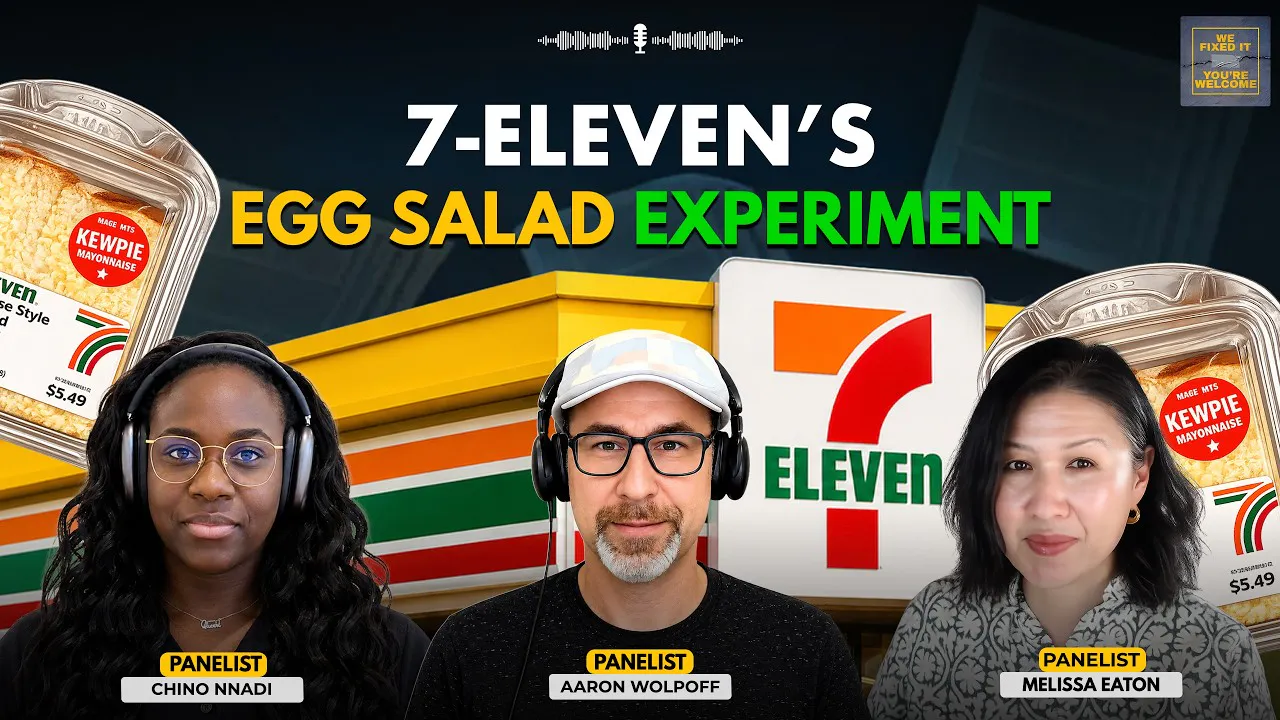 7-Eleven’s Egg Salad Experiment 19.05.2026 49мин7-Eleven has been working on a big comeback for a while. Their first big attempt at reinvention might surprise you: egg salad sandwiches. While quite popular in Japan, 7-Eleven’s big gamble on egg salad sandwiches throughout United States stores is head scratching. In this episode, our panel wonders what led to this decision, discusses the larger business challenges at play, and proposes our own fixes for what 7-Eleven should do next. Along the way, we unpack convenience store culture, customer behavior, retail psychology, operational execution, and take a hard look at how brands can misfire when they try to import global trends without adapting them locally. The team also debates: ● Why Japan’s 7-Eleven experience feels completely different than anywhere else ● Whether North American consumers trust convenience store “fresh food” ● Why the U.S. $5.50 sandwich may already be positioned incorrectly ● How pop-up experiences and cultural immersion could help revive the brand ● Why iced coffee might actually be a smarter gateway product than egg salad ● How brands can retrain customer behavior instead of chasing viral moments Plus, Chino gives a firsthand review after testing the North American version of the sandwich in Toronto and shares her unfiltered reaction to it. Key Takeaways ● Convenience stores in Japan function as an everyday food ecosystem, not just gas station stops ● Freshness perception matters more than novelty ● Viral products alone don’t build long-term customer habits ● 7-Eleven may need a full retail experience redesign, not just a menu upgrade ● Limited-time cultural pop-ups could create stronger consumer engagement ● Coffee and customizable experiences may offer a lower-risk path to changing customer behavior If you enjoyed the episode, leave a review and share it with another Fixaholic. And next time you walk into a 7-Eleven, ask yourself: are you there out of habit, convenience, or because the brand actually gave you a reason to come back? Subscribe for more deep dives where we fix big business problems with fresh perspectives. • Website – www.wefixeditpod.com • Follow us on: Instagram – https://www.instagram.com/wefixeditpod LinkedIn – https://www.linkedin.com/company/wefixeditpod YouTube – https://www.youtube.com/@WeFixedItPod If you liked this episode, don’t forget to subscribe, leave a review, and share it with your friends! Keep listening to find out how we fix companies and put them back better than we found them. Disclaimer A quick disclaimer. We are going into this somewhat cold and nothing we say should be construed as legal advice, financial advice or anything that would get us in trouble. These are our views and opinions. We’re here to ask the kinds of questions everyone’s thinking, have an engaging conversation and maybe come to some conclusions that we feel are worth exploring. By the end, if we fixed it, you’re welcome.All trademarks, IP and brand elements discussed are property of their respective owners.
 -
Spirit Airlines Out of Runway: What Happens From Here? 12.05.2026 53минWhat happens when a major airline simply runs out of money? In this episode, USA Today’s consumer travel reporter Zach Wichter joins the conversation to break down the shocking collapse of Spirit Airlines and its impact on passengers, employees, competitors, and the future of budget air travel. After years of financial instability, failed merger attempts, mounting debt, and rising fuel costs, Spirit Airlines officially ceased operations on May 2, 2026, leaving travelers stranded and thousands of employees without jobs. But while the shutdown felt sudden to customers, the warning signs had been visible for years. Together, we unpack how the airline industry handles collapse, why ultra low cost carriers are becoming harder to sustain, and whether Spirit’s downfall signals a much bigger shift in the economics of air travel. In This Episode, We Cover Why Spirit Airlines officially shut down operations How fuel prices accelerated the company’s collapse The real reason ultra low cost airlines struggle long term What happened to stranded passengers and canceled flights Why airline shutdowns often happen abruptly The WARN Act and employee notification responsibilities How airline creditors influence shutdown decisions Why Spirit’s collapse could lead to higher airfare industry-wide The hidden role Spirit played in keeping ticket prices low The rise of premium travel after the pandemic How other airlines are responding to Spirit’s disappearance What happens to loyalty points and travel rewards after an airline dies Key Insight from the Episode Spirit Airlines may be gone, but its impact on pricing across the airline industry was enormous. As discussed during the episode: Whether or not you flew Spirit, you benefited from Spirit Airlines because they helped drive down prices in every market they touched. Without that pressure, travelers may soon face significantly higher airfare across the board. About the Guest: Zach Wichter Zach Wichter is a consumer travel reporter at USA Today, where he covers aviation, travel trends, airlines, and passenger experience through his column Cruising Altitude. Previously, Zach reported for: The New York Times The Points Guy He was also part of the reporting team recognized with a Loeb Award for coverage of the Boeing 737 MAX crisis. Connect with Zach on LinkedIn:https://www.linkedin.com/in/zlwichter/ Subscribe for more deep dives where we fix big business problems with fresh perspectives. • Website – www.wefixeditpod.com • Follow us on: Instagram – https://www.instagram.com/wefixeditpod LinkedIn – https://www.linkedin.com/company/wefixeditpod YouTube – https://www.youtube.com/@WeFixedItPod If you liked this episode, don’t forget to subscribe, leave a review, and share it with your friends! Keep listening to find out how we fix companies and put them back better than we found them. Disclaimer A quick disclaimer. We are going into this somewhat cold and nothing we say should be construed as legal advice, financial advice or anything that would get us in trouble. These are our views and opinions. We’re here to ask the kinds of questions everyone’s thinking, have an engaging conversation and maybe come to some conclusions that we feel are worth exploring.
-
Allbirds’ AI Reboot: Bold Leap or Giant Misstep 07.05.2026 1ч 4минCan a financially devastated footwear brand reinvent itself overnight as an AI infrastructure company? In this episode, noted investment strategist Todd M. Schoenberger joins the discussion to unpack one of the boldest corporate pivots in recent memory: Allbirds’ decision to reposition itself as an AI business after losing nearly all of its market value. Is this the beginning of a revolutionary turnaround or a last-minute headline grab designed to buy time? Together, our panel explores whether brand loyalty is enough to survive a category shift this extreme, what investors are really reacting to when companies announce “AI pivots,” and whether Allbirds might still have viable paths forward to pursue its original footwear business instead of such a drastic departure. Are we entering an era where struggling companies can simply add “AI” to their story and reset investor expectations? As discussed in the episode: The company didn’t pivot to AI. They pivoted to a headline. That distinction may define whether Allbirds’ reboot becomes a turnaround story or a cautionary case study. Across industries, companies are racing to reposition themselves around artificial intelligence. But investors, employees, and customers are increasingly asking: What counts as a real pivot? What signals credibility? And what separates strategy from survival tactics? Allbirds provides a rare real-time example of what happens when brand identity, capital constraints, and market hype collide. Todd M. Schoenberger is CEO of CrossCheck Media and Chief Investment Officer at CrossCheck Management. He is a veteran financial commentator whose analysis has appeared on: CNBC Fox News CNN Todd specializes in interpreting market signals, investor behavior, and strategic corporate positioning during periods of economic transition. Connect with Todd on LinkedIn:https://www.linkedin.com/in/todd-m-schoenberger Some standout insights from this episode: ✔ AI announcements can trigger short-term stock spikes without long-term strategy✔ GPU infrastructure businesses require massive capital investment to compete✔ Brand trust weakens when companies abandon their founding mission abruptly✔ Direct-to-consumer footwear strategy may have been a stronger recovery path✔ Meme-stock momentum helped amplify Allbirds’ temporary rally✔ Sustainable brand positioning could have supported a more credible pivot✔ Timing, culture shifts, and retail expansion decisions accelerated decline The Allbirds story raises a broader question for founders and executives: When reinvention becomes necessary, should companies evolve within their strengths or leap into entirely new categories? Sometimes survival depends less on moving fast and more on moving credibly. Subscribe for more deep dives where we fix big business problems with fresh perspectives. • Website – www.wefixeditpod.com • Follow us on: Instagram – https://www.instagram.com/wefixeditpod LinkedIn – https://www.linkedin.com/company/wefixeditpod YouTube – https://www.youtube.com/@WeFixedItPod If you liked this episode, don’t forget to subscribe, leave a review, and share it with your friends! Keep listening to find out how we fix companies and put them back better than we found them. Disclaimer A quick disclaimer. We are going into this somewhat cold and nothing we say should be construed as legal advice, financial advice or anything that would get us in trouble. These are our views and opinions. We’re here to ask the kinds of questions everyone’s thinking, have an engaging conversation and maybe come to some conclusions that we feel are worth exploring. By the end, if we fixed it, you’re welcome. All trademarks, IP and brand elements discussed are property of their respective owners. Key Question Driving the EpisodeWhy This Conversation Matters Right NowAbout the Guest: Todd M. SchoenbergerDiscussion HighlightsA Bigger Strategic Lesson
Подобни подкасти


Популярен в
Този подкаст се появява и в подкаст класациите на тези държави.

