
Major Pandemic's Bunker Bar Podcast
Major Pandemic - Spread the Pandemic
0
Major Pandemic's Bunker Bar Podcast blends entertainment, survival tips, hunting outdoors, and gun reviews. Hosted by Major Pandemic, the show covers topics related to preparedness and outdoor life. It aims to inform and entertain listeners interested in self-reliance and firearms.
Epizode
-
 FRT - Forced Reset Triggers Tested - AS Design, Deez Nuts, and Atrius 29.09.2026 31minThis is a free preview of a paid episode. To hear more, visit www.majorpandemic.comFRT Trigger Testing: Are Forced Reset Triggers Reliable, Practical, or Just a Damn Good Range Toy?Major Pandemic - MajorPandemic.com is a reader-supported publication. To receive new posts and support my work, consider becoming a free or paid subscriber.Major Pandemic’s Bunker BarForced reset triggers—better known simply as FRTs—are having a moment.They promise a shooting experience that can produce an incredibly fast cadence while still operating around an individual trigger function for each shot. That sounds great on paper, but I wanted to answer a much more practical question:Are FRTs actually reliable, easy to live with, and worth putting into an AR—or are they mostly an entertaining range toy that requires more patience than most shooters expect?To find out, I tested several different FRT-style systems from Deez Nuts Tactical, AS Designs, and Atreus across multiple AR platforms.And after moving these systems between different rifles, triggers, bolt-carrier groups, buffer configurations and gas systems, I came away with one overwhelmingly clear conclusion:FRTs can be an absolute blast—but they are not necessarily plug-and-play.What Is an FRT Trigger?An FRT, or forced reset trigger, mechanically assists the trigger reset as the firearm cycles.The result is a dramatically faster potential firing cadence than you would normally get from a conventional semi-automatic trigger.That does not automatically mean every rifle equipped with one behaves identically.Far from it.One of the biggest lessons from my testing was that the rifle itself becomes part of the FRT system. Small variations in components, tolerances, gas delivery and cycling characteristics can have a surprisingly large impact on reliability.That means an FRT that runs beautifully in one AR may be troublesome when those same basic components are moved into another.The Three FRT Systems I TestedFor this project, I deliberately chose several different approaches.Deez Nuts Tactical FRTThe Deez Nuts Tactical system represents what I would consider the more traditional or straightforward FRT approach.The design is relatively simple, and the examples I tested appeared well made.That last part matters.There are a lot of FRT-style components available today, and quality can vary considerably. With a mechanism operating at this speed, I don’t believe questionable parts are the place to save a few dollars.The Deez Nuts system was attractive because it provided a comparatively simple entry into the FRT experience without requiring an elaborate build.And simplicity turned out to be valuable.AS Designs FRTThe AS Designs FRT was another system that performed well during my testing.Of the more advanced setups I tried, I generally experienced fewer problems with the AS Designs configuration once the rifle and trigger combination were behaving properly.One reason may simply be that the system narrows the number of variables involved.When you start introducing radically different trigger geometries and highly specialized aftermarket components, you create additional variables that can affect timing and cycling.The AS Designs setup felt comparatively predictable.Atreus FRTThe Atreus system was probably the most interesting of the three.From a design standpoint, it offered some of the flexibility I liked most because it potentially opens the door to a broader selection of aftermarket triggers.That includes some of the lighter, performance-oriented trigger options many shooters already prefer.But that flexibility comes with a tradeoff.In my testing, Atreus also proved to be somewhat more sensitive to the particular rifle in which it was installed.I could get the system running extremely well in some rifles while another specific build simply refused to behave the same way.That experience perfectly illustrates one of the most important things anybody considering an FRT should understand.Every AR Is DifferentAR owners sometimes assume that because two rifles share the same basic pattern, they should behave identically.With FRTs, that assumption can get frustrating very quickly.I tested systems across several different rifles and discovered that a combination that ran beautifully in one firearm did not necessarily produce the same result when transferred into another.In one older, generously gassed AR configuration, virtually everything seemed happy.Other rifles were considerably more particular.That does not necessarily mean there is something wrong with the FRT.It also does not necessarily mean something is wrong with the rifle.It means you are dealing with a system where timing, cycling energy and component tolerances matter more than they do with a conventional semi-automatic trigger.That is probably the single biggest takeaway from this entire experiment.FRT Reliability: How Reliable Were They?This is where things get interesting.Once properly matched to a rifle, several of the FRT configurations I tested were highly reliable.But none of them gave me the same absolute confidence that I would expect from a quality conventional semi-automatic trigger.There is simply more happening mechanically.More interaction between components means more opportunities for tolerances, fouling, ammunition differences or cycling characteristics to affect performance.During testing, I encountered situations where the rifle would experience an issue while using the FRT mode but would immediately return to normal operation when switched back to conventional semi-automatic fire.That tells you something important.The rifle itself may be perfectly functional while the additional timing requirements of the FRT system push it outside its happy operating window.Are FRTs Good for Home Defense?For me, the answer is straightforward:I would not choose an FRT-equipped rifle as my primary defensive rifle.That conclusion is not because I think FRTs are inherently bad.It is because defensive firearms occupy a completely different category.For a defensive rifle, my priorities are boring:Reliability.Predictability.Simplicity.I want something that works every single time under the worst possible circumstances.During my testing, the FRT systems could achieve very high reliability once sorted out, but I still occasionally encountered problems. I therefore would not personally put them in the same reliability category as a proven conventional trigger setup.The transcript testing reached the same bottom line: even when reliability was in the high-90-percent range, occasional issues remained, and the recommendation was not to treat these systems as first-choice defensive equipment.Where FRTs Make Perfect Sense: Range Toys and Clone BuildsNow we get to the fun part.Because as a range toy?Absolutely.This is where I think FRTs shine.Put one into an appropriate recreational AR, get the rifle functioning reliably, bring a pile of ammunition and prepare to start laughing.There is something inherently entertaining about the cadence these systems can produce.Bang-gety-bang-gety-bang-gety-bang.It sounds less like somebody methodically shooting an AR and more like somebody turned a sewing machine loose on the firing line.And yes, ammunition disappears accordingly.Very quickly.For a clone build, novelty rifle or dedicated range gun, however, that may be exactly the point.The testing ultimately came down strongly in favor of this role: build a range toy, have fun and enjoy the FRT experience, rather than assuming it needs to serve a serious defensive purpose.The Cheap FRT Range-Gun ArgumentOne thing became increasingly obvious during this project:You do not necessarily need to put an FRT into your most expensive AR.In fact, I would argue there is a pretty compelling reason not to.Rapid strings of fire create heat.Heat creates wear.And lots of rapid shooting burns ammunition at a rate capable of making your credit card whimper.That makes a reasonably priced dedicated range rifle an interesting platform for an FRT.Instead of taking an expensive precision-oriented or carefully balanced rifle and changing its operating characteristics, I would rather start with something I am comfortable treating like a recreational machine.Shoot it.Enjoy it.Maintain it.And if you eventually wear out a component, replace it.When the ammunition bill eventually becomes substantially larger than the cost of the barrel, worrying excessively about barrel life starts becoming somewhat academic.FRTs Are Not Necessarily Drop-In ComponentsIf there is one misconception I would eliminate, it is the idea that every FRT is simply:Buy it. Drop it in. Shoot it.Sometimes that may happen.Sometimes it won’t.My testing showed enough variation between rifles that anyone considering an FRT should expect that compatibility and reliability may differ considerably from one firearm to another.This is especially relevant for highly customized AR builds.A beautifully balanced rifle that has been optimized around a particular combination of components may not automatically be the ideal host for an FRT.And personally, I would hesitate before changing an expensive, perfectly functioning rifle simply to accommodate one.FRT Safety Deserves Serious AttentionThe speed of these systems makes proper function particularly important.During testing, I encountered combinations where the relationship between cycling and trigger behavior did not inspire enough confidence for me to continue using that particular configuration.That is a good reminder that these systems should not be treated casually simply because they are entertaining.Component quality matters.Proper function matters.Testing matters.And if something does not seem mechanically correct, stop.One specific lesson from my testing was that I would be especially conservative about experimenting with platforms where bolt timing and lockup operate differently from a conventional AR-15 system.The transcript itself records that concern after bench testing showed trigger-reset timing occurring before the action appeared fully in battery on one configuration, prompting the decision not to pursue that setup.Which FRT Did I Like Best?There isn’t a single universal winner because the three systems represent somewhat different philosophies.Deez Nuts Tactical impressed me as a straightforward, comparatively inexpensive entry point.AS Designs gave me some of the most consistent experiences among the more sophisticated systems I tested.Atreus offered perhaps the most interesting flexibility, particularly for shooters interested in different aftermarket trigger options, but in my testing it could also demand more patience depending on the host rifle.And that is ultimately the recurring theme:The rifle matters almost as much as the FRT.Are FRT Triggers Worth It?If you’re buying an FRT because you expect it to transform your primary AR into some sort of ultimate fighting rifle, I would temper those expectations.If you’re buying one because you want to build an outrageously fun range rifle that produces a ridiculous firing cadence?Now we’re talking.That is where I think these systems belong.They are mechanically interesting.They’re hilariously entertaining.They can run extremely well.But they also introduce another layer of complexity into a firearm platform that is otherwise remarkably reliable.Final Verdict: Fun? Absolutely. Necessary? Probably Not.After testing multiple FRT systems across several different AR builds, my conclusion is pretty simple.Would I put an FRT in every rifle I own?No.Would I put one in my primary defensive rifle?No.Would I build another dedicated FRT range gun?Abso-freaking-lutely.That is the sweet spot.Forget trying to turn every rifle into something it isn’t.Build yourself a fun gun.Bring ammunition.Bring more ammunition than you think you need.And enjoy the completely ridiculous experience of:Bang gety.Bang gety.Bang gety bang.Welcome to Major Pandemic’s Bunker Bar.SEO TITLEFRT Trigger Review: Forced Reset Trigger Reliability, Testing & Range PerformanceMETA DESCRIPTIONWe tested FRT forced reset trigger systems from Deez Nuts Tactical, AS Designs and Atreus across multiple AR platforms. Here’s what we learned about reliability, compatibility, safety and whether FRT triggers are best suited for range use.SUGGESTED URL SLUG/frt-trigger-review-forced-reset-trigger-testing-reliabilityPRIMARY SEO KEYWORDFRT trigger reviewSECONDARY KEYWORDSFRT triggerforced reset triggerFRT reliabilityFRT testingFRT AR-15FRT range gunSuper Safety triggerAS Designs FRTAtreus FRTDeez Nuts Tactical FRTforced reset trigger reviewAR-15 FRT reliabilitySUGGESTED EXCERPTAre FRT forced reset triggers reliable—or are they mainly spectacular range toys? Major Pandemic tests multiple FRT systems across several AR platforms and finds out where they shine, where they struggle and whether they belong on a defensive rifle.Thanks for reading Major Pandemic - MajorPandemic.com! This post is public so feel free to share it.Major Pandemic - MajorPandemic.com is a reader-supported publication. To receive new posts and support my work, consider becoming a free or paid subscriber.
 -
 MDT AAC Premier 10/22 Chassis - Simply the Best 10/22 chassis ever 06.09.2026 26minThis is a free preview of a paid episode. To hear more, visit www.majorpandemic.comMDT ACC Premier Gen2 10/22 Chassis: Upgrading a LegendWithout question, the Ruger 10/22 is one of my favorite .22s of all time. I have shot the crap out of these rifles over the years, built more of them than I can count, and I keep coming back to the platform for one reason: the 10/22 can become almost anything you want it to be.It can be a cheap backyard plinker, a lightweight field rifle, a suppressor host, a steel-challenge gun, or an absolutely ridiculous precision build.And once you move into that last category, the chassis starts to matter a lot.That brings us to the MDT ACC Premier Gen2 chassis for the Ruger 10/22. This is a chassis I have wanted MDT to build for years, and for PRS-style rimfire, NRL22, NRL22X, bench shooting, or anyone obsessed with squeezing every last bit of accuracy out of a custom 10/22, this is about as serious as it gets.I Have Been Waiting for This OneMy history with MDT goes way back.Around 2009, I was introduced to MDT and its LSS chassis, a compact billet-aluminum system designed to lock an action solidly into place. The results were impressive, and I became a believer pretty quickly.Since then, MDT has grown into one of the biggest names in precision rifle chassis systems.But for years I kept asking one question:Where is the Ruger 10/22 inlet?The concern was understandable. Would people really spend serious money putting a premium precision chassis around a 10/22?My answer was always yes.Anyone deep into custom 10/22s knows these rifles can go far beyond the factory gun sitting on the rack at a sporting-goods store. Add a premium receiver, match barrel, bolt, trigger, optic and competition hardware, and suddenly you have a rifle capable of some truly stupid levels of accuracy.That kind of build deserves a chassis to match.Fixing the 10/22’s Biggest WeaknessThe basic 10/22 action was never designed around the idea of becoming a heavy precision competition rifle.One of its limitations is the way the action mounts into the stock. The system relies heavily on a single primary mounting point, and when you’re chasing tiny groups, any movement in the receiver becomes something you want to eliminate.Over the years, manufacturers have attacked that problem with rear tangs, wedges, tension screws and other solutions.MDT took a different approach.The ACC Premier Gen2 uses a yoke-style system at the rear of the receiver to help lock the action solidly into the chassis.That is the part of this design I really like.Instead of just machining a 10/22-shaped hole into an existing chassis and calling it good, MDT actually addressed one of the fundamental weaknesses of the platform.The result is a receiver that feels properly supported and locked in place.Heavy Is the PointThis is not a lightweight squirrel rifle chassis.And it isn’t supposed to be.The ACC Premier Gen2 is designed around stability. For bench shooting, barricades, bags, bipods and PRS-style competition, weight is often your friend.A heavier rifle moves less. A rigid chassis flexes less. A properly supported action stays consistent.That doesn’t mean adding weight magically makes a rifle more accurate, but if you already have an extremely accurate barreled action, a stable platform helps you take advantage of what that rifle can do.I had already seen this with MDT’s more affordable Oryx chassis, where some of my best 10/22 groups came from a heavy, rigid setup.The ACC Premier Gen2 takes that concept and adds far more adjustability and competition-oriented refinement.For carrying through the woods all day? Probably not.For bench work, NRL22, NRL22X or a ridiculous custom precision build?Absolutely.Built Around the ShooterThe appeal of a premium chassis isn’t simply that it’s a giant piece of aluminum.You’re paying for adjustability, ergonomics, balance and mounting options.Comb height matters.Length of pull matters.Bipod position matters.How the rifle balances on a bag matters.The ACC Premier Gen2 gives you the ability to tune the rifle around the shooter instead of forcing the shooter to adapt to the rifle.Pair it with an ARCA-mounted bipod and you end up with an exceptionally stable platform. M-LOK and other attachment options give you plenty of room to configure the rifle exactly how you want it.That’s the difference between a stock and a true precision chassis.Yes, It Is ExpensiveWe’re talking about roughly an $1,100 chassis.That is a lot of money to wrap around a .22 LR action.But context matters.Once you start talking about premium receivers, match barrels, custom triggers, bolts and quality optics, a high-end 10/22 build can easily climb into several thousand dollars.At that point, spending serious money on the chassis isn’t nearly as crazy as it sounds.The better question is whether the ACC Premier Gen2 earns its place in that build.For me, it does.This feels like lifetime-quality equipment. It is not something I look at and expect to feel outdated in five or ten years.There is a difference between expensive and overpriced.This is expensive.I don’t think it is overpriced.The Rest of the Build Still MattersObviously, the chassis is only one part of the equation.Start with a good receiver.Add a quality barrel from somebody like Feddersen, Proof Research, KIDD, Volquartsen or another proven rimfire barrel maker.Use a good match bolt.Install a legitimately good trigger.Then lock everything into the ACC Premier Gen2.At that point, you have the foundation for an absolutely ridiculous precision 10/22.And don’t forget the optic.For rimfire work, parallax adjustment is a big deal. I strongly prefer an optic that adjusts down to at least 25 yards, and 10 yards is even better.Then comes ammunition.A great 10/22 can make cheap ammunition look surprisingly good, but when you start feeding it Lapua, SK or other quality match ammo, that’s when the magic really starts.Final ThoughtsI’ve wanted MDT to build a serious 10/22 chassis for years.Now they finally have, and they didn’t simply check the box.They addressed the receiver lockup, brought the adjustability and stability of a serious precision chassis to the 10/22 platform, and created something that feels completely at home underneath a high-dollar rimfire build.The MDT ACC Premier Gen2 10/22 chassis is big, heavy, rigid, adjustable and unapologetically built for precision.It isn’t for the guy throwing together a casual plinker.It’s for the shooter who already understands just how far a custom 10/22 can be pushed.For that guy, MDT finally built the chassis I’ve been asking for.And they didn’t just knock it out of the park.They shot the damn ball to the moon.Upgrade a legend. Build the 10/22 you always wanted.Major Pandemic - MajorPandemic.com is a reader-supported publication. To receive new posts and support my work, consider becoming a free or paid subscriber.Thanks for reading Major Pandemic - MajorPandemic.com! This post is public so feel free to share it.
 -
 StellAR Arms - Possibly the Best AR I have Owned 25.08.2026 17minThis is a free preview of a paid episode. To hear more, visit www.majorpandemic.comStellar Arms: The Rare AR That Actually Surprised MeAfter more than 20 years around the firearms industry, I have become pretty difficult to impress.That is not necessarily because the products are bad. The problem is that genuine innovation in the AR market is rare. There are an incredible number of very good rifles available today, but much of what gets marketed as “new” is usually another variation of something we have already seen. Different handguard. Different coating. Different furniture. Maybe a new logo carved into the receiver.Warm it over, change a couple things, and call it innovation.So when something genuinely catches my attention, I pay attention.That is exactly what happened with Stellar Arms.Stumbling Into Something DifferentMy introduction to Stellar was almost accidental.I had previously noticed some of their rifles hanging on the wall at 88 Tactical’s massive facility in Nebraska. Later, while wandering around Lincoln, I remembered the name and decided to look them up.That little detour turned into one of the more interesting discoveries I have made in the AR world in a long time.The first thing that struck me was the level of machining.This was not simply another billet receiver set with some aggressive styling carved into it. Stellar was doing things I had rarely seen executed this well on a production-class AR.The handguard indexes into the upper receiver so precisely that visually it can be difficult to see where one component ends and the other begins. Then an additional locking system ties the assembly together into something approaching the rigidity of a monolithic upper.The mating surfaces were nearly perfect.And coming from somebody who has built a ridiculous number of ARs over the years, that got my attention immediately.Aerospace Manufacturing ShowsThere is a reason these rifles feel different.Stellar’s roots are in aerospace manufacturing.Their previous firearms branding was MASP, operating under the broader aerospace manufacturing operation, and they have been working on these guns for roughly 13 years.That matters.Walk through the manufacturing capability and you begin to understand why the rifles look the way they do. Five-axis machining, advanced machining centers, metal 3D printing and an operation capable of producing extremely complex parts are all part of the equation.This is not a company buying receivers, handguards and controls from half a dozen suppliers and assembling another AR.They manufacture a significant portion of the rifle themselves.Upper receivers.Lower receivers.Handguards.Gas blocks.Muzzle brakes.Selectors.Magazine releases.Magazine catches.End plates.Charging handles.And numerous other components.There are obviously parts sourced from outside manufacturers where it makes sense. Stellar uses B5 furniture, for example, and Elfman Tactical triggers across the lineup. Springs, detents and several smaller components are sourced as well.But even there, the emphasis is clearly on premium components and premium finishes.The result feels less like an assembled rifle and more like a rifle that was engineered as a complete system.Fit and Finish That Shouldn’t Be Remarkable — But IsAnyone who has assembled enough billet ARs knows that “premium” does not automatically mean “everything fits perfectly.”Sometimes it means exactly the opposite.Specialized receivers can introduce tolerance stacking. Upper and lower receivers may need adjustment. Handguards may require some persuasion. Anodizing thickness can change fitment just enough to create problems.With both of the MASP receiver sets I built, none of that happened.Everything went together exactly as it should.That includes an anodized green receiver set where the upper-to-lower fit remained exceptionally tight after finishing.Think about what that means.If two precision-machined components still fit properly after anodizing, the manufacturer accounted for the dimensional change introduced by the coating process.That is the kind of detail you expect from aerospace manufacturing.The receivers even include provisions for a nylon-tipped tensioning screw between the upper and lower.The funny part?You don’t need it.The fit is already that good.The Stellar LineupStellar essentially builds three main production tiers, followed by some extremely high-end custom offerings.The Technician is the entry point at roughly $1,866.Calling an almost $1,900 rifle “entry level” tells you immediately where Stellar is positioning itself.Even the Technician uses billet construction and many of Stellar’s in-house components. This is not a stripped-down economy gun intended to get customers through the door.The next step is the Specialist, priced around $2,400.That is the rifle I ended up with.Above it sits the Executive, beginning somewhere in the roughly $3,200-$3,400 range depending on configuration.Then things start getting wild.Stellar also builds custom rifles and packages stretching considerably higher, including configurations approaching the $12,000 level.Clearly, competing with inexpensive ARs isn’t the goal.The goal is building some of the most premium AR-platform rifles available.The Executive Is Essentially Machined JewelryThe Executive is where Stellar’s manufacturing capabilities become almost ridiculous.One of its signature details is an extensive crosshatch machining treatment covering essentially the entire exterior surface of the rifle.Not just a decorative panel.Not just the magazine well.The contours of the rifle receive this incredibly detailed machining treatment.That process can consume roughly an entire day of machine time.Machine time is expensive.But the result is absolutely stunning.I have seen some extraordinary custom rifles over the years. I have been fortunate enough to work on high-dollar firearms projects, including guns auctioned to raise around $100,000 for the Lone Survivor Foundation.I have handled and built some fairly crazy stuff.The Stellar Executive still stopped me.It genuinely looks like jewelry.Calling it the most beautiful production-class custom AR I have personally seen would not be an exaggeration.Building the SpecialistEventually I decided I needed one.During my visit I built a Stellar Specialist under their supervision, which gave me an opportunity to see the rifle from a perspective that simply handling a completed gun cannot provide.Everything went together correctly.No weird surprises.No machining issues.No tolerance problems.No parts that suddenly required fitting despite supposedly being designed for one another.Apparently I did well enough assembling it that the guys suggested I could get a job building rifles.I’ll take the compliment.I even managed to show them one of my own little assembly tricks they hadn’t seen before.Pandemic teaching the aerospace guys something.I’ll take that one too.A Charging Handle That Actually Solves SomethingOne component I particularly liked was Stellar’s Throttle charging handle.Mount an LPVO on an AR and charging-handle access can become annoying quickly. Your fingers end up fighting around the optic while trying to get enough purchase on the handle.Stellar addressed that problem with an extended design specifically intended to provide better access around optics.But the interesting part is the gas management.Their vented version routes excess gas toward the right side, moving it away from the shooter’s face.That is a small detail, but it illustrates the broader theme of the rifle.Somebody actually thought about how the component would be used.It isn’t different just so Stellar can advertise something different.It solves a legitimate problem.Premium Components Where They MatterThe Specialist continues that philosophy throughout the rifle.The trigger is from Elfman Tactical.The bolt carrier group is a premium Sand Cutter-style unit.The barrel is a premium 5.56 barrel.The bolt carrier groups receive high-pressure testing and magnetic-particle inspection.The controls are well positioned.There aren’t sharp edges where there shouldn’t be sharp edges.The lower receiver is heavily stylized without becoming uncomfortable or awkward.And there is no forward assist.Stellar’s reasoning is straightforward: on this class of rifle, they don’t believe the forward assist is necessary.I tend to agree.I cannot remember the last time I actually needed one. If a cartridge refuses to chamber, my inclination is not to force it harder into the chamber. Something is wrong, and I would rather remove the round and determine why.The slab-side upper also contributes to the rifle’s clean appearance.One Area I Would Like to See EvolveIf there is one area where I think the rifle could move forward, it is the muzzle-device mounting system.Stellar currently uses an ASR-pattern threaded QD brake, although without the traditional ratcheting mechanism.It is beautifully machined and visually fits the rifle extremely well.The issue is simply where the suppressor market seems to be moving.A lot of shooters are shifting toward smaller, lighter mounting standards such as Plan B-style systems and compact options such as YHM’s SRX.Stellar told me they are working on some Plan B-oriented designs, although nothing was officially released at the time.That would make a lot of sense.If they bring the same level of engineering to a more compact suppressor mounting system, I would absolutely like to see it.The Difference Between Expensive and EngineeredThere are plenty of expensive ARs.Expensive does not automatically mean exceptional.Sometimes you’re paying for a brand name. Sometimes you’re paying for a coating. Sometimes you’re paying for a collection of premium aftermarket components installed on somebody else’s receivers.Stellar feels different.The machining is theirs.The engineering is theirs.The components are increasingly theirs.The tolerances appear intentional rather than accidental.And the entire rifle feels like it was developed over years instead of assembled from whatever happened to be fashionable this season.That 13-year development history becomes obvious once you start handling the guns.Consider Me InterestedBeing impressed after a quick look is one thing.I have now built with Stellar/MASP components, spent time inside the manufacturing operation and come away with a Specialist of my own.My impression hasn’t changed.If anything, it has gotten stronger.The fit and finish are exceptional. The manufacturing capability is legitimate. The engineering includes several genuinely thoughtful ideas, and the company clearly has no interest in racing competitors toward the bottom of the AR market.They are building premium rifles because they want to build premium rifles.And in an industry where I have become pretty jaded about claims of innovation, Stellar Arms managed to surprise me.That doesn’t happen very often anymore.There will be more time behind the Specialist, more testing, and eventually I want to get the Stellar team onto the show to dig deeper into how they arrived here.For now, though, Stellar Arms has my attention.And after more than two decades of looking at ARs, that may be one of the stronger compliments I can give them.More to come from Major Pandemic’s Bunker Bar.Major Pandemic - MajorPandemic.com is a reader-supported publication. To receive new posts and support my work, consider becoming a free or paid subscriber.Thanks for reading Major Pandemic - MajorPandemic.com! This post is public so feel free to share it.
 -
 No crappy plastic holster belt clips - DCC is a better clip for under $15 31.07.2026 24minThis is a free preview of a paid episode. To hear more, visit www.majorpandemic.comBest Holster Clips: Why Discreet Carry Concepts May Be the Best Upgrade for Your IWB HolsterA great concealed-carry holster can still fail at the worst possible moment if it is attached to your belt with a weak clip.That sounds dramatic until you see someone draw a handgun and watch the entire holster come out with it. It happens during range sessions, defensive training and dry-fire practice. The gun clears the waistband, but the holster remains attached to the firearm because the clip failed to hold onto the belt.The problem is often not the holster itself. It is the cheap plastic belt clip attached to it.Fortunately, replacing a poor holster clip may cost less than $20 and can dramatically improve retention, concealment and everyday comfort.Why Holster Clips MatterThe holster performs two separate retention jobs.First, it must retain the handgun until the shooter deliberately draws it. Second, the holster itself must remain firmly attached to the wearer’s belt or waistband.A holster that holds the handgun securely but pulls free during the draw is still a failed system.Many inexpensive IWB holsters come with a wide, generic polymer clip secured by two screws. These clips are cheap, simple and easy for manufacturers to install. Unfortunately, they are often the weakest part of the holster.Poor holster clips can:* Slide off narrow or slick belts* Flex excessively during the draw* Fail to hook underneath the belt* Catch on clothing or furniture* Break after repeated use* Allow the holster to shift or rotate* Increase printing under clothingA better clip can turn an inexpensive holster into a much more dependable carry system.The Problem With Cheap Plastic Holster ClipsNot every polymer clip is bad. Mission First Tactical, for example, has developed aggressive polymer clips that perform much better than the generic versions found on many entry-level holsters.Polymer also has one legitimate advantage: it is generally easier on clothing and leather belts.However, common plastic clips have several weaknesses.Polymer can be slipperyPlastic naturally tends to slide more easily than properly formed spring steel. When the clip is installed over a narrow, smooth or low-profile belt, it may not have enough bite to resist the upward force of the draw.Plastic clips can breakHolster clips experience repeated flexing every time the holster is installed or removed. They also get hit against chairs, vehicle interiors, counters and other hard surfaces.Over time, polymer clips may crack or snap.Excessive flex reduces retentionSpring steel generally increases resistance as it is flexed farther open. Many polymer clips do not produce the same progressive clamping force.A plastic clip may accommodate a wider range of belt thicknesses, but that flexibility does not always translate into better retention.Large removal tabs catch on everythingMany polymer clips use an oversized outward-facing ramp or lip. This helps the clip slide over the waistband and gives the user a place to lift it during removal.Unfortunately, some manufacturers make that ramp far too large.The result is a protruding catch point that can snag on shirts, furniture, seat belts and other objects.Discreet Carry Concepts Holster ClipsDiscreet Carry Concepts, commonly abbreviated as DCC, produces some of the best spring-steel holster clips currently available.These clips are found on many premium concealed-carry holsters, but they can also be installed on affordable holsters from companies such as We The People, Black Scorpion Gear, CrossBreed and Mission First Tactical.That means you do not necessarily need to spend $100 or more on an entirely new holster.A relatively inexpensive clip upgrade can provide many of the same retention benefits found on considerably more expensive systems.Why DCC Clips Work So WellDCC clips use thin spring steel with substantial downward clamping force. They are also designed with an aggressive lower hook that catches beneath the belt or waistband.Several design details help distinguish them from ordinary clips.Thin profileDCC clips are significantly thinner than many molded polymer clips. The reduced thickness can improve concealment and reduce unnecessary bulk around the waistband.Strong spring tensionThe steel construction provides considerable clamping force once the clip is secured against the holster.This helps the clip remain attached to both traditional gun belts and thinner everyday belts.Aggressive lower hookThe lower portion of the clip includes a sharply formed hook that catches beneath the belt.That hook is critical because it resists the upward force created during the draw.Minimal front rampDCC clips use a relatively short ramp at the nose. It is large enough to help the clip move over the belt during installation, but small enough to reduce snagging.This is a major improvement over clips with oversized protruding removal tabs.DCC Monoblock Gear ClipFor many holsters, the DCC Monoblock is the easiest and most affordable upgrade.The Monoblock replaces the common wide plastic clip used on countless IWB holsters. It attaches through the holster’s existing two-hole mounting pattern and provides two spring-steel gripping points in one compact unit.This design helps:* Prevent the holster from pulling free* Reduce unwanted rotation* Improve stability* Maintain a low profile* Grip belts and waistbands securelyThe Monoblock itself is inexpensive, making it one of the best value upgrades available for an IWB holster.Do Not Forget the Correct HardwareOne important detail is easy to overlook.The original screws used with a thick plastic clip may be too long for a much thinner steel replacement. Attempting to reuse those screws can prevent the clip from tightening correctly or cause the hardware to extend too far through the mounting posts.Purchasing the proper DCC hardware kit is usually worthwhile.The correct shorter screws and mounting hardware help ensure the clip is securely attached without damaging the holster or interfering with the firearm.DCC HLR Gear ClipsDCC HLR clips are an excellent choice for holsters that use two separate attachment points or require adjustable cant and ride height.The HLR series provides particularly aggressive belt engagement. These clips work well for people who prioritize maximum retention and want the holster firmly locked into position.They may also help improve concealment because separate clips can distribute the weight of the handgun over a wider area.For heavier pistols or holsters that tend to rotate, dual HLR clips may provide a noticeable improvement over a single central attachment.DCC 1 Series Gear ClipsThe DCC 1 Series offers a more traditional steel-clip shape.It retains many of the advantages of the HLR design but uses a somewhat less aggressive lower section. That can make it a better option for someone concerned about damaging an expensive leather belt.The 1 Series may be appropriate when:* Maximum retention is still important* The belt surface needs additional protection* A traditional clip profile is preferred* The holster requires cant or ride-height adjustmentThe HLR remains the stronger choice when maximum grip is the priority, while the 1 Series offers a slightly more belt-friendly compromise.UltiClip Holster AttachmentsUltiClip takes a different approach.Instead of functioning primarily as a spring-steel hook, an UltiClip uses a mechanical clamping system. The clip closes over clothing or a belt and locks into position with a hinged lever.The result is extremely strong clamping force.UltiClip products can be particularly effective for:* Fixed-blade knives* EDC tools* Beltless carry* Lightweight equipment* Applications requiring direct attachment to clothingThe system grips exceptionally well, but that strength comes with tradeoffs.UltiClip Disadvantages on Handgun HolstersThe UltiClip has a relatively narrow gripping surface. When supporting the weight and leverage of a handgun, that concentrates force in a small area.Depending on the holster and carry position, this can allow more movement than a wider attachment system.UltiClips can also be hard on clothing and leather belts. Because they clamp directly against the belt or fabric, their metal edges and high pressure may leave marks, wear spots or even holes.This appears to be less of an issue when they are used with knives or lightweight equipment. On a handgun holster, however, the additional thickness and movement of the firearm can increase wear.For that reason, UltiClip remains an excellent product, but it may not be the ideal choice for every IWB handgun holster.CrossBreed Micro SnapLok ClipsCrossBreed’s Micro SnapLok is another strong all-metal attachment.These clips are durable, substantial and offer considerably better retention than most generic plastic clips. They were among the better choices available before the current generation of DCC products became widely used.The potential weakness is the larger ramp at the front of the clip.That protruding nose can catch on objects and may bend if it is struck or snagged hard enough. DCC offers comparable steel designs with a shorter, less exposed front ramp.Owners of CrossBreed holsters may therefore benefit from evaluating compatible DCC HLR or 1 Series clips.Can Better Clips Improve Concealment?A better clip does more than keep the holster attached during the draw.It can also improve concealment.When a holster shifts, rotates or rides upward, the handgun may begin to print through the wearer’s shirt. A stronger clip helps maintain the intended ride height and cant.Dual clips or a properly sized Monoblock can also stabilize the holster against the body.Potential concealment improvements include:* Less holster rotation* More consistent grip position* Reduced movement while walking* Better contact between the holster and body* Less visible printing* Greater comfort during seated movementThe result may feel like an entirely different holster even though only the attachment hardware was changed.A $10 Upgrade Can Transform a Budget HolsterPremium holsters often include DCC clips from the factory. However, the clip itself may account for only a small portion of the total price.A budget holster costing $30 or $40 can often accept the same style of attachment used on a holster costing two or three times as much.Replacing the original plastic clip may provide a substantial improvement without replacing the complete holster.That is particularly attractive when the existing holster already has:* Good trigger coverage* Proper firearm retention* Comfortable body contouring* Acceptable ride height* A useful concealment wing* A durable Kydex shellWhen the shell works and the attachment does not, replace the attachment.Best Holster Clip RecommendationFor most IWB handgun holsters, Discreet Carry Concepts offers the best combination of retention, low profile, durability and cost.The DCC Monoblock is the easiest recommendation for holsters using a standard two-hole central clip.The DCC HLR series is the better choice for maximum retention, adjustable mounting and dual-clip configurations.The DCC 1 Series offers strong performance with a slightly less aggressive interface for expensive belts.The UltiClip remains an excellent mechanical clamp for knives, tools, beltless applications and certain lightweight holsters, but it can be harder on clothing and belts.Final ThoughtsYour handgun may be expensive. Your holster may be well designed. Your belt may be strong.None of that matters if the clip allows the entire holster to leave the waistband during the draw.Holster attachment hardware is easy to overlook because it is small, inexpensive and usually included with the holster. It is also one of the most important components in the complete carry system.Before replacing an otherwise functional holster, inspect the clip.A simple spring-steel upgrade may provide better retention, better concealment and more dependable performance for less than the price of a box of ammunition.Once you experience a holster that remains exactly where you positioned it, going back to a flimsy plastic clip becomes difficult.Major Pandemic - MajorPandemic.com is a reader-supported publication. To receive new posts and support my work, consider becoming a free or paid subscriber.Thanks for reading Major Pandemic - MajorPandemic.com! This post is public so feel free to share it.
 -
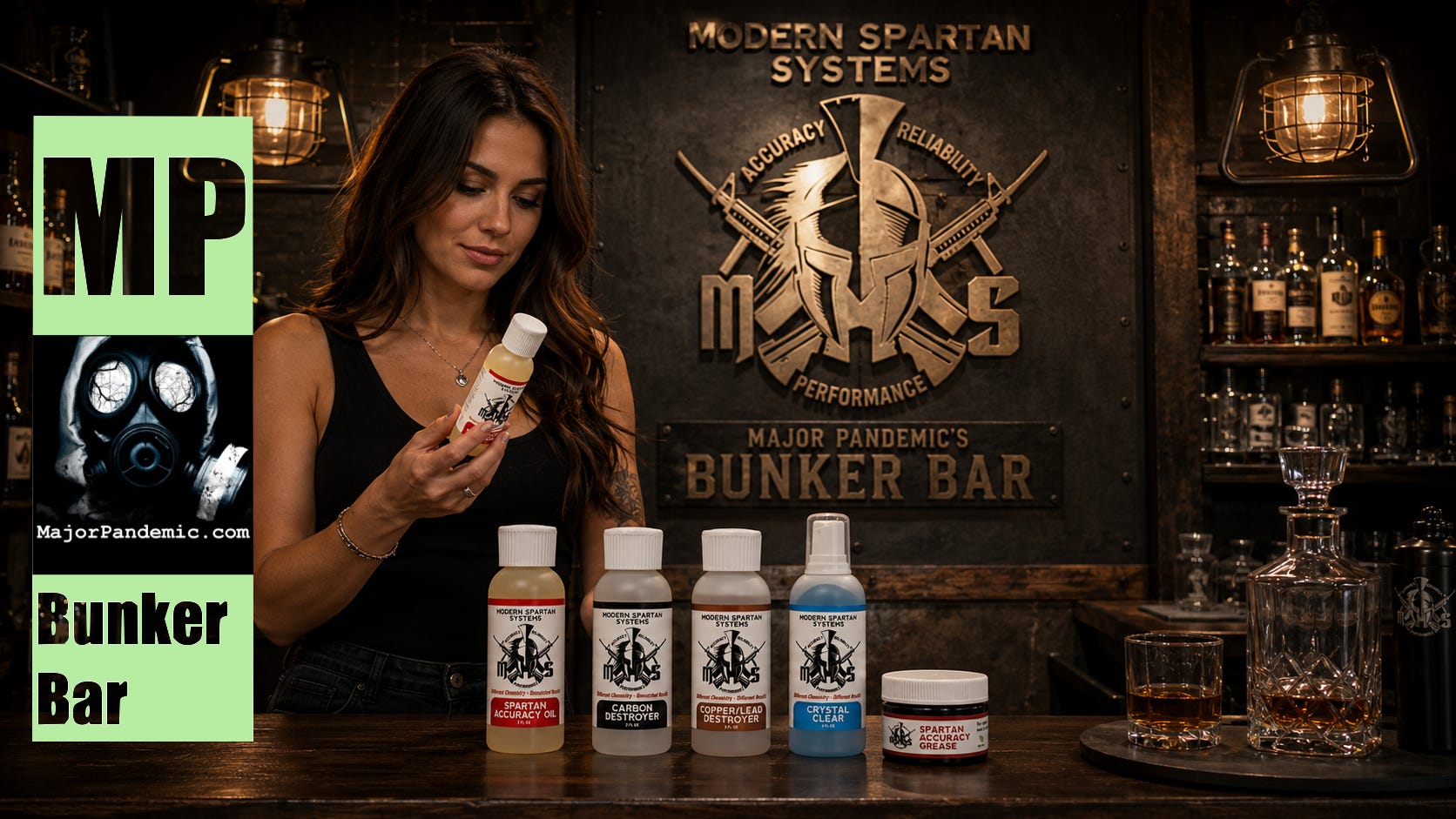 Modern Spartan Systems - lube & cleaner that is safe, non-toxic and it works even improving accuracy. 11.07.2026 29minThis is a free preview of a paid episode. To hear more, visit www.majorpandemic.comModern Spartan Systems Review: Green Gun Lube, Cleaners, and Suppressor Shield TestedModern Spartan Systems caught my attention because I take firearm lubrication seriously. A good lubricant is not just about making a gun feel slick. It is the heart and soul of keeping a firearm running, protected, corrosion-resistant, and consistent. After testing Modern Spartan Systems products, I came away impressed for a lot of reasons, including several I did not expect.Join - Modern Spartan Systems - The Great Mass Gun Optimization Experiment - modernspartansystems.com/great-experimentModern Spartan Systems is built around a green, safer lubricant technology. Their product line reaches beyond firearms into areas like machine cutting oil, engine oil additives, fishing reel care, and knife lubrication, but the focus here is their firearms lineup: Accuracy Oil, Carbon Destroyer, Carbon Destroyer Double X, Copper Lead Destroyer, Crystal Clear, Nothing Left Behind, Spartan Accuracy Grease, Suppressor Shield, and their shooter kits.What I like right away is that this is not a giant catalog full of random products. They have a focused lineup, and from my testing, the products work extremely well.The core technology is based around bonded lubrication. This is not a typical “slather it on and go” gun oil. With Modern Spartan Systems, the application process matters. The surface needs to be properly cleaned and prepped so the lubricant can bond to the metal. That is where the real benefit starts to show up.The idea is pretty simple: reduce friction, fill microscopic pores and surface imperfections, and create less drag between moving parts. In the bore, that means less drag between the barrel and bullet. Logically, that can help tighten standard deviations from shot to shot, and in my testing, I saw about a 20% improvement in accuracy.That does not make it magic. It makes sense mechanically. A smoother, better-treated surface can help improve consistency. In my before-and-after testing, I saw a rifle that had been shooting around one-inch groups move into the 0.8 to 0.75-inch range. Your results may vary, but the logic is there, and my results backed it up.The first product I would recommend trying is actually Crystal Clear, their lens cleaner. It may be the standout product in the whole lineup because almost everyone can use it. Shooters have scopes, red dots, range glasses, sunglasses, and binoculars. Even non-shooters have sunglasses or prescription glasses.I used Crystal Clear on an old set of sunglasses I kept in my truck. I thought they were scratched up and worn out. After a couple of cleanings, they looked like new sunglasses. It also helped reduce fogging and left an anti-static layer that repels dust. That is a big deal for optics because some cleaners leave behind a static charge that actually attracts dust and makes lenses harder to keep clean.If you test nothing else from Modern Spartan Systems, try Crystal Clear. It is inexpensive, useful, and easy to judge immediately.The firearm cleaning products also performed well. Carbon Destroyer was one of the bigger surprises. I tested it with an ultrasonic cleaner and also with a simple Ziploc bag method. For a bolt carrier group, I let the parts soak, came back later, and saw black and brown carbon fouling pulled out of the parts. It worked shockingly well.The key is dwell time. This is not always a quick spray-and-wipe process, especially the first time. The first deep clean and treatment takes longer because you are stripping the surface down and preparing it for the bonded lubricant. After that, follow-up cleanings become much faster.For the bore, the process continues with Copper Lead Destroyer, then a final clean and dry before applying Accuracy Oil. Accuracy Oil is not a one-pass conventional oil treatment. It needs to be applied as a process because the carrier solution evaporates off and leaves the bonded lubricant behind. The treated surface may look fairly dry afterward, but that is part of how the product works.For moving parts and higher-friction areas, Spartan Accuracy Grease makes sense. I used it on bolt carrier group contact points and also like the idea of using it lightly in a buffer tube. A little grease on the buffer spring can quiet down spring noise dramatically, which is basically the cheap version of buying one of those expensive quiet buffer springs.The Suppressor Shield process is similar. You want the suppressor as clean as possible before treatment. For suppressors, I recommend an ultrasonic cleaner when possible because suppressors have a lot of internal complexity. A Ziploc bag soak can also work depending on the suppressor type.I tested the suppressor process on a Heresy Design Resonator 22. After treatment, the suppressor ran cleaner. After 500 rounds, it looked like it had only seen a few hundred rounds, and the post-range cleaning process was much easier and faster than previous sessions.For rimfire suppressors, that matters. Rimfire cans get filthy fast. Anything that makes suppressor cleanup easier is worth paying attention to.Another major benefit is the safer, non-toxic positioning. I care about limiting exposure to harsh chemicals. A lot of gun cleaning products work, but they are nasty. If you clean guns in a basement, garage, shop, or small work area, reducing exposure to harsh industrial chemicals matters.Modern Spartan Systems gives you a product line that is safer for the user, safe for the firearm, and still effective. That is the key point. The green technology would not matter much if the products did not work. In this case, they do.Pricing is another strong point. These are not ridiculous $50 bottles of magic gun oil. The prices are fair, practical, and economical. Their kits also make sense because you get the products that work together: Accuracy Oil, Carbon Destroyer, Copper Lead Destroyer, Crystal Clear, and Spartan Accuracy Grease.The shooter kit is probably the easiest way to get into the system because the products are designed to work together. Clean the surface, prep the metal, apply the bonded lubricant, and use grease where heavier staying power is needed.What I appreciate most is that Modern Spartan Systems is not asking you to believe in fairy dust. The science is straightforward: reduce friction, prep the surface, bond the lubricant, and improve consistency. Based on my testing, the products performed exactly the way they were supposed to.Modern Spartan Systems works. It is affordable, safer than many traditional chemical-heavy gun care products, and it delivered real performance in my testing. The Crystal Clear lens cleaner is an easy win, Carbon Destroyer cleaned better than expected, the Accuracy Oil showed measurable accuracy potential, and the Suppressor Shield made rimfire suppressor cleanup easier.For shooters, suppressor owners, hunters, and anyone who takes firearm maintenance seriously, Modern Spartan Systems is worth a hard look.Major Pandemic - MajorPandemic.com is a reader-supported publication. To receive new posts and support my work, consider becoming a free or paid subscriber.Thanks for reading Major Pandemic - MajorPandemic.com! This post is public so feel free to share it.
 -
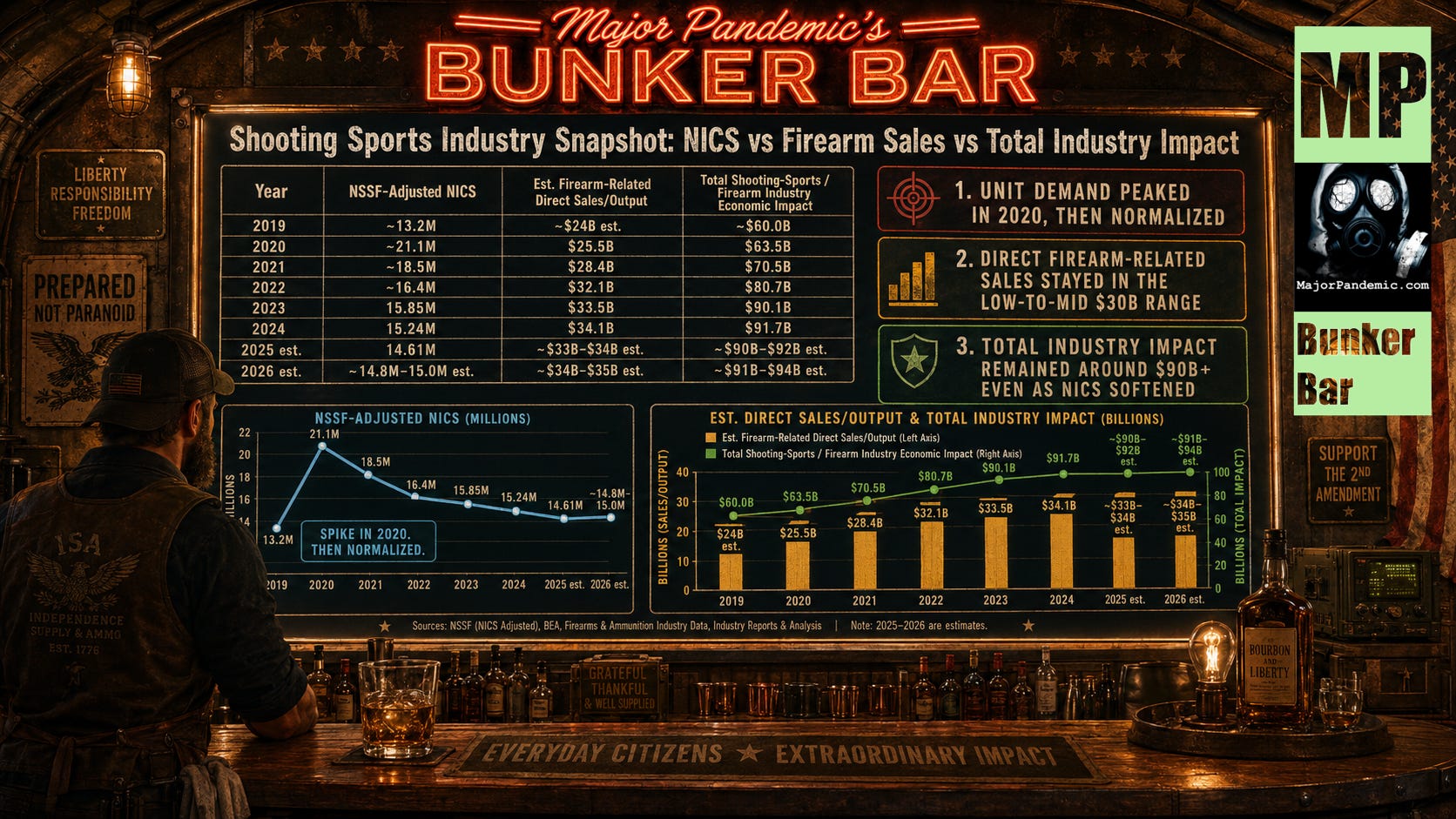 The Firearms Industry is Going Broke 27.06.2026 31minThis is a free preview of a paid episode. To hear more, visit www.majorpandemic.comWhy the Firearms Industry Is Struggling: The Post-2020 Gun Sales Hangover No One Wants to Talk AboutSEO Title: Why the Firearms Industry Is Struggling in 2026: Gun Sales, NICS Checks, Inventory Glut & the Post-2020 HangoverMeta Description: The firearms industry is facing one of its toughest downturns in decades as post-2020 demand fades, NICS checks soften, inventory piles up, and manufacturers fight for fewer buyers.Suggested URL Slug: why-firearms-industry-is-struggling-2026Focus Keywords: firearms industry, gun sales, NICS checks, shooting sports industry, firearms market downturn, gun industry sales, firearm manufacturers, gun retailers, suppressor sales, firearms accessoriesThe Firearms Industry Is Not Dead — But It Is Absolutely in TroubleWelcome back to Major Pandemic’s Bunker Bar, where the drinks are cold, the walls are reinforced, and the industry talk is brutally honest.There is no soft way to say this: the firearms industry is struggling right now.Not the Second Amendment. Not gun culture. Not shooting sports as a lifestyle. Those are still alive and well. But the actual business of selling new firearms, moving inventory, keeping manufacturers healthy, and keeping retailers profitable is in one of the roughest spots it has seen in decades.The warning signs are everywhere: slow retail traffic, stacked distributor shelves, manufacturers fighting over the same shrinking demand, and accessory companies wondering where the next wave of customers is supposed to come from.The problem is not that Americans suddenly stopped caring about guns. The problem is that the industry built itself for the boom — and the boom ended.2020 Was the Peak, Not the New NormalThe firearms industry had an unbelievable run in 2020. Between COVID, riots, political uncertainty, personal-security concerns, and first-time buyers flooding the market, gun sales exploded.NICS checks became the easiest public shorthand for that surge. They are not perfect, because a NICS check does not equal one gun sold, and not every firearm purchase requires a new background check. But they are still one of the best indicators of retail firearm demand.The rough trend tells the story:YearEstimated NSSF-Adjusted NICS Checks2019~13.2M2020~21.1M2021~18.5M2022~16.4M2023~15.85M2024~15.24M2025~14.61M2026 est.~14.8M–15.0MThat means the industry is down roughly 25% to 30% from the 2020 boom peak based on NICS-driven demand indicators.That is a massive drop.But here is where the story gets more complicated: the broader shooting sports industry can still look strong in dollars while firearm unit demand is clearly down.The Dollar Numbers Can Be MisleadingSome people look at the shooting sports industry and say, “What are you talking about? The industry is up. The economic impact is huge.”That is partly true — but it depends which number you are looking at.There are really three different things people mix together:* NICS checks — a proxy for firearm transaction volume.* Firearm-related direct sales/output — closer to actual commercial revenue from firearms, ammo, accessories, retail, and related channels.* Total shooting sports economic impact — the broader economic footprint, including jobs, wages, suppliers, taxes, and downstream spending.Those are not the same thing.A cleaner view looks like this:YearNSSF-Adjusted NICSEst. Firearm-Related Direct Sales/OutputTotal Shooting-Sports / Firearm Industry Economic Impact2019~13.2M~$24B est.~$60.0B2020~21.1M$25.5B$63.5B2021~18.5M$28.4B$70.5B2022~16.4M$32.1B$80.7B202315.85M$33.5B$90.1B202415.24M$34.1B$91.7B2025 est.14.61M~$33B–$34B est.~$90B–$92B est.2026 est.~14.8M–15.0M est.~$34B–$35B est.~$91B–$94B est.This is the heart of the confusion.NICS checks are down. Firearm unit demand is down. But total industry dollars are not down the same way because prices are higher, accessories are still selling, suppressors are hot, training is strong, and the total economic-impact number includes far more than guns sold at retail.So yes, the shooting sports industry can look healthy on a macroeconomic chart while many firearm manufacturers and retailers are getting crushed in the real world.The Industry Overbuilt for a Boom That Did Not LastThe biggest mistake was assuming 2020 was a new baseline.It was not.A lot of manufacturers looked at the 2020 surge and expanded production. More machines. More employees. More buildings. More inventory. More SKUs. More everything.Then the wave disappeared.By late 2021, the market had already started normalizing. The panic demand was gone. First-time buyers had made their purchase. Political fear cooled. Retail traffic slowed. But the production capacity was already built.That is how the industry ended up with firearms sitting on manufacturer shelves, distributor shelves, and retailer shelves.Too many guns. Too many similar products. Too many companies chasing too few active buyers.The Used Gun Market Is Also Hurting New Gun SalesAnother overlooked issue is the flood of used guns coming back into the market.Older gun owners are selling off collections. Some buyers who entered the market during 2020 are not becoming repeat buyers. Others are trading instead of buying new.That creates a problem for manufacturers: a used gun sale may help a retailer or transfer dealer, but it does not help the manufacturer move new inventory.It also gives budget-conscious buyers an alternative. Instead of buying a new rifle, shotgun, or handgun, they can buy something used, refinish something they already own, or spend money upgrading what is already in the safe.That is one reason services like Cerakote, customization, and gunsmithing can still be busy while new firearm sales struggle.The Generational Problem Is RealThe gun industry also has a demographic problem.Boomers already own a lot of firearms. Many are slowing down, selling extras, or becoming more selective.Gen X is probably the strongest remaining repeat-buyer group because they have the income, interest, and practical use cases. But there are not enough Gen X buyers to rescue every manufacturer.Older Millennials are becoming more meaningful buyers, but many are still under pressure from housing costs, inflation, debt, and family expenses.Gen Z has interest, but they are not yet in a position to replace the spending power of Boomers and Gen X. Many are younger, lower-income, more experience-driven, and less likely to be heavy product collectors at this stage.That leaves the industry stuck between an older buyer base that is saturated and younger buyers who are not yet able or willing to spend enough to fill the gap.No Panic Buying Means No Artificial DemandFor years, the industry benefited from fear-driven buying cycles.Election years. Regulatory threats. Riots. Magazine bans. Assault weapon ban chatter. Shortages. Supreme Court fights. ATF uncertainty.When people believed they might lose access to certain firearms, they bought immediately.Right now, the environment is different. Many gun owners feel politically safer. They may still care about court cases, executive orders, ATF interpretations, pistol braces, forced reset triggers, suppressors, and NFA reform, but the average buyer is not acting like everything must be purchased today.That is good for constitutional confidence, but bad for panic-driven sales.The industry is learning a hard lesson: you cannot build a healthy long-term business model around people being afraid.Some Categories Are Getting Destroyed While Others Are Still WorkingThe pain is not evenly spread.Traditional AR-15s, standard black rifles, pump shotguns, basic rifles, and commodity products are under heavy pressure. Some categories appear to be down dramatically from the boom years.But other categories still have energy:* Suppressors* Pistol-caliber carbines* Innovative defensive handguns* Premium 2011-style pistols* Custom guns* Cerakote and refinishing* Training* Female-focused shooting accessories* Optics and accessories tied to new platformsThe key difference is innovation.The companies doing better are not simply making another version of the same thing everyone else already sells. They are offering a new angle, a premium experience, a specialized product, or something that gives buyers a reason to spend.The “me too” manufacturers are the ones in danger.Suppressors Are Masking Some of the PainOne of the brightest spots right now is suppressors.A lot of disposable firearm dollars are flowing into suppressors because the wait times, tax-stamp discussions, legal momentum, and product innovation have created real demand.For many enthusiasts, suppressors have gone from a rare special purchase to a normal part of the collection.That is great for suppressor manufacturers, dealers, and related accessory companies. But it can also mask the broader problem. Money going into suppressors is not always money going into new rifles, shotguns, handguns, optics, or traditional accessories.Suppressors are helping the industry, but they are not fixing the entire firearms market.Female Shooters Are One of the Strongest Bright SpotsThe growth of female shooters may be one of the healthiest long-term trends in the shooting sports industry.Female buyers often approach purchasing differently. Instead of simply buying a gun and figuring out the rest later, many think in terms of the whole solution: firearm, carry method, storage, training, accessories, range comfort, safety, confidence, and personal fit.That creates strong opportunities across accessories, education, apparel, bags, holsters, optics, and training.This is one reason the broader shooting sports market can remain healthier than the pure firearm-sales market.New shooters do not only buy guns. They buy the ecosystem.Why Accessory Companies Are at RiskAccessory companies tied directly to new firearm purchases are in a dangerous position.If people are not buying as many new rifles, they may not be buying as many new optics, rails, triggers, grips, slings, lights, cases, or upgrades for those guns.The more an accessory company depends on a net-new firearm purchase, the more vulnerable it is.Lifestyle accessories, bags, belts, apparel, training, and general shooting gear may hold up better because they are not always tied to a new gun sale. But direct firearm add-ons can suffer badly when the new firearm pipeline slows.That is why some insiders are worried that a meaningful percentage of firearm-related accessory manufacturers may not survive the next few years if demand does not rebound.The Industry Has Three Possible LifelinesThere are really only three ways out of this downturn.1. A Major Demand EventA large political, legal, social, or security event could trigger another buying wave.That is not something anyone should hope for, but historically it is one of the things that moves firearm demand quickly.2. Market ConsolidationThis is the harsh economic answer.If too many companies are chasing too few buyers, some companies will go out of business. That would reduce supply, reduce competition, and send more dollars back to the survivors.It is ugly, but it is how overloaded markets eventually correct.3. Innovation That Creates New DemandThis is the best answer.Manufacturers need to stop assuming buyers will show up for another generic product. The market needs genuinely interesting firearms, better experiences, better marketing, better retail execution, smarter production planning, and products that make people excited again.The winners will be companies that know who they serve, forecast honestly, innovate aggressively, and avoid building inventory nobody asked for.What Buyers Can Do Right NowIf you care about the firearms industry, the simple answer is this:Buy something.Not because you are panicked. Not because someone told you to hoard. But because healthy industries need active customers.Buy a firearm you have been meaning to pick up. Buy ammo. Buy a suppressor. Buy training. Buy from a local gun shop. Buy accessories from a small manufacturer. Support the companies doing good work before the market shakeout wipes them away.The 250th anniversary of America is a perfect moment to celebrate the Second Amendment in a practical way. Not just with slogans, but by supporting the businesses that keep the shooting sports world alive.Final Takeaway: The Shooting Sports Industry Is Stronger Than Gun Sales AloneThe firearms industry is down, but the broader shooting sports industry is not broken.That distinction matters.Gun sales are down from the 2020 peak. NICS checks are down. Commodity firearms are under pressure. Retailers are sitting on inventory. Distributors are packed. Manufacturers that overbuilt are hurting.But shooting sports participation, suppressors, training, accessories, female shooters, customization, and premium innovation are still creating opportunity.The industry does not need another panic bubble. It needs discipline, smarter forecasting, better products, and customers willing to support the businesses they want to see survive.Because if buyers stay home long enough, a lot of familiar names may not be around when the next wave finally comes.Major Pandemic - MajorPandemic.com is a reader-supported publication. To receive new posts and support my work, consider becoming a free or paid subscriber.Thanks for reading Major Pandemic - MajorPandemic.com! This post is public so feel free to share it.
 -
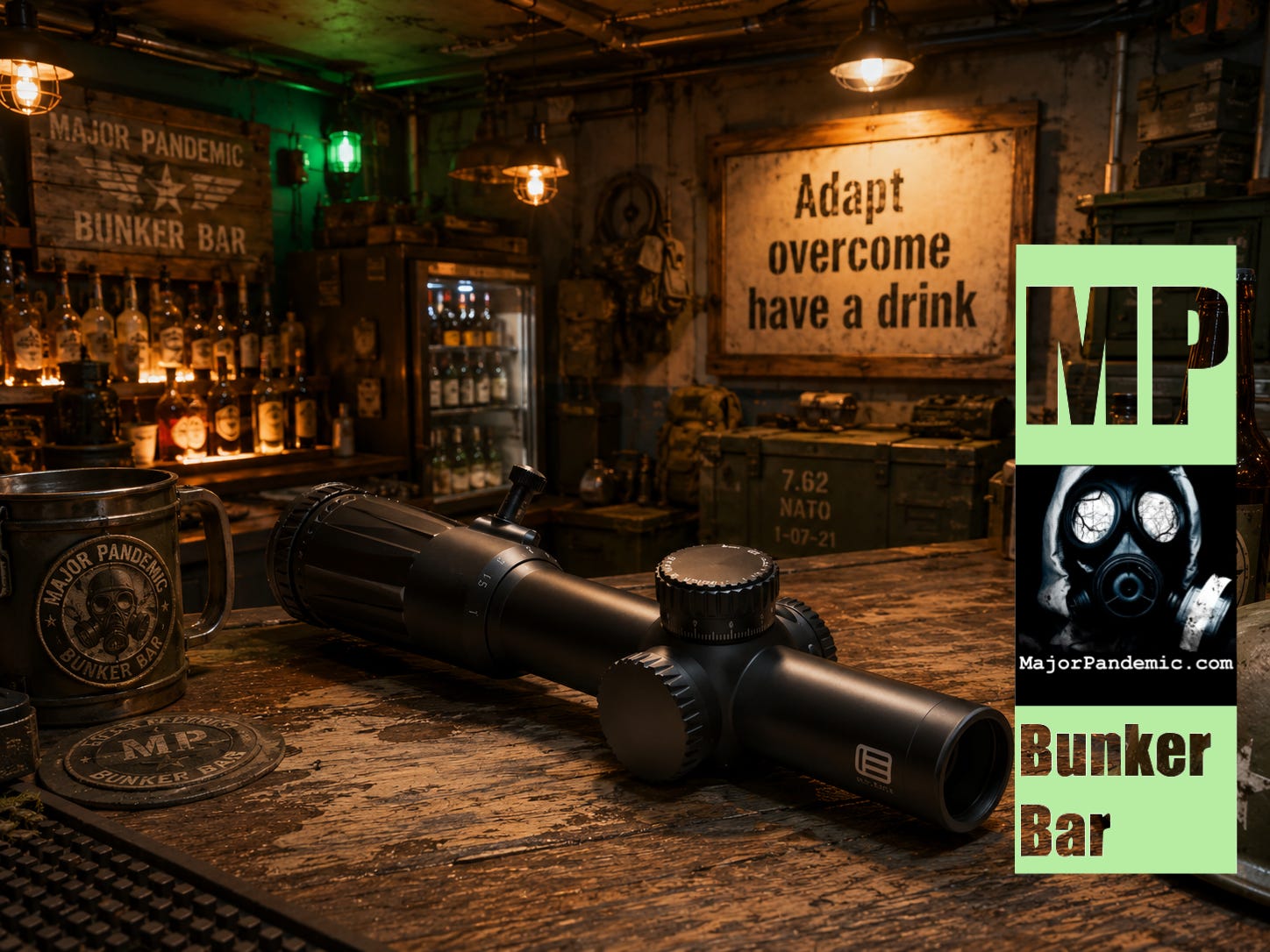 Eotech 1-10 Ultimate LPVO - Dial it in, for when the range gets real 07.06.2026 26minThis is a free preview of a paid episode. To hear more, visit www.majorpandemic.comEOTECH Vudu 1-10 Review: Major Pandemic Takes Premium LPVO Glass Into the Bunker BarWelcome back to Major Pandemic’s Bunker Bar, the deep-underground dream bar where the wine list is serious, the liquor shelf is loaded, and the gear talk never stays surface-level. This time around, Major Pandemic is talking about the pursuit of optical perfection — specifically the EOTECH Vudu 1-10x, a premium low-power variable optic that blends close-range speed with long-range clarity.For years, AR shooters lived between two worlds: either a red dot for speed or a high-powered optic for distance. Then LPVOs changed the game. Early 1-3x and 1-4x scopes were a big step forward, but today’s premium 1-10x optics offer a far broader capability range. The EOTECH Vudu 1-10 lands right in that sweet spot, giving shooters fast close-range usability at 1x and serious reach when dialed up to 10x.Major Pandemic’s praise for the current EOTECH lineup is not just about brand history. He sees a company that has made a serious turnaround in quality, design, and product direction. From modern holographic sights to pistol optics and the expanding Vudu scope line, EOTECH appears to have stripped away unnecessary gimmicks and focused on clean, durable, high-performance optics.The heart of this review is clarity. Mounted on a custom rifle build featuring a Stellar Arms receiver set, Feddersen barrel, Elf trigger, Seekins bolt catch, and other quality components, the EOTECH Vudu 1-10 immediately impressed. Major Pandemic describes the optic as crystal clear from 1x through 10x, with exceptional image quality even when pushing out to 300 yards on a windy day.That matters because many high-magnification LPVOs start to show tradeoffs as manufacturers push beyond practical limits. Some scopes may advertise more magnification, but they can become visually compromised at certain power ranges. Major Pandemic’s take is that EOTECH stopped at exactly the right place: a truly useful, truly clear 1-10x power range without feeling like the image quality falls apart.The design details also get high marks. The Vudu 1-10 uses a pop-up elevation turret with capped windage, giving the shooter the ability to dial elevation while reducing the chance of accidental bumps. For a general-purpose AR, DMR-style rifle, hunting rifle, or practical carbine, that setup makes sense: dial what you need, hold what you can, and keep the optic streamlined.Major Pandemic also highlights the illumination system as one of the optic’s smartest features. Instead of a bulky side turret or complicated menu, the EOTECH keeps it simple: one button for off, one for brighter, and one for dimmer. Add auto-off and shake-awake functionality, and the result is a clean, modern system that works without forcing the user to dig through a manual.Low-light performance is another strong point. During his “2 a.m. dark as hell” test, Major Pandemic found the reticle illumination comfortable and usable, not overpowering or distracting after his eyes adjusted to the dark. For shooters who care about real-world low-light use, that matters. A reticle that is too bright at its lowest setting can wash out the sight picture or feel like someone turned a flashlight into your eye.Is the EOTECH Vudu 1-10 cheap? Absolutely not. Major Pandemic puts it firmly in the premium-tier optic category. But his argument is that within the world of elite LPVOs, the Vudu offers serious value. Compared with other premium optics that can run thousands more, he sees the EOTECH as competitively priced for the clarity, build quality, magnification range, and overall execution.His practical advice is simple: do not cheap out on the mount. If you are spending serious money on glass, pair it with premium rings or a high-quality QD mount. That lets the optic move between rifles more easily and helps protect the investment. Buy once, cry once — especially when the optic may outlive several rifle builds.Reticle selection also gets attention. EOTECH offers the Vudu 1-10 in multiple reticle options, including LE5, SR5, and SR4 variants. Major Pandemic chose the SR4 MOA reticle because, for his use case, MOA makes fast field math simple. One inch at 100 yards is roughly one MOA, making holds easier to calculate quickly without a spotter.The one area where he sees room for improvement is parallax adjustment. At 10x, especially when stretching into longer ranges, a touch of parallax control could be useful. That said, adding it would likely raise the price and complexity, and overall he still sees the optic as a fantastic piece of kit.The final Major Pandemic recommendation is classic common sense: look through the optic yourself. Do not judge premium glass by staring across a gun shop at ten yards. Get near a window, look outside, and test the optic at real distance where clarity, edge quality, illumination, and eyebox differences actually show up.Final TakeThe EOTECH Vudu 1-10x is not for bargain-bin builds or casual window-shopping. It is a serious LPVO for shooters who want one optic that can handle close-range speed, mid-range precision, and longer-distance visibility without feeling compromised. In Major Pandemic’s Bunker Bar terms, it is the kind of glass that earns a permanent spot on the rail — premium, clean, compact, brutally useful, and ready for the next rifle, the next range day, and the next round at the bar.EOTECH Vudu 1-10x28 FFP — Key PointsTrue do-everything LPVO range:1x for close work and 10x for distance, making it useful on ARs, DMR-style rifles, hunting rifles, and competition setups.First focal plane reticle:Holdovers and ranging stay accurate at every magnification, not just at max power.EOTECH-style speed ring:The illuminated ring/dot setup gives it a faster “red-dot-ish” feel at low power than many precision-first LPVOs.Compact for a 1-10x:At 10.63 inches long and 21.3 oz, it is fairly manageable for a 10x LPVO.34mm tube / 28mm objective:Gives the optic room for adjustment and light management while keeping the package compact.Good field of view:116.6 ft at 100 yards on 1x and 11.7 ft at 100 yards on 10x.Reticle options:SR-4 MOA, SR-5 MRAD, and LE-5 MRAD, depending on whether the user prefers MOA, MRAD, or a law-enforcement-style reticle.Practical accessories included:Throw lever, lens cloth, operator manual, and reticle manual.This is not a cheap LPVO; it is a premium crossover optic for people who want one scope to handle speed, holds, distance, and durability.The EOTECH Vudu 1-10x28 FFP is a compact premium LPVO that blends near-red-dot speed at 1x with useful 10x reach, making it a strong fit for modern ARs, competition rifles, patrol rifles, and general-purpose carbines where one optic needs to cover close- to mid-range work.Major Pandemic - MajorPandemic.com is a reader-supported publication. To receive new posts and support my work, consider becoming a free or paid subscriber.Thanks for reading Major Pandemic - MajorPandemic.com! This post is public so feel free to share it.
 -
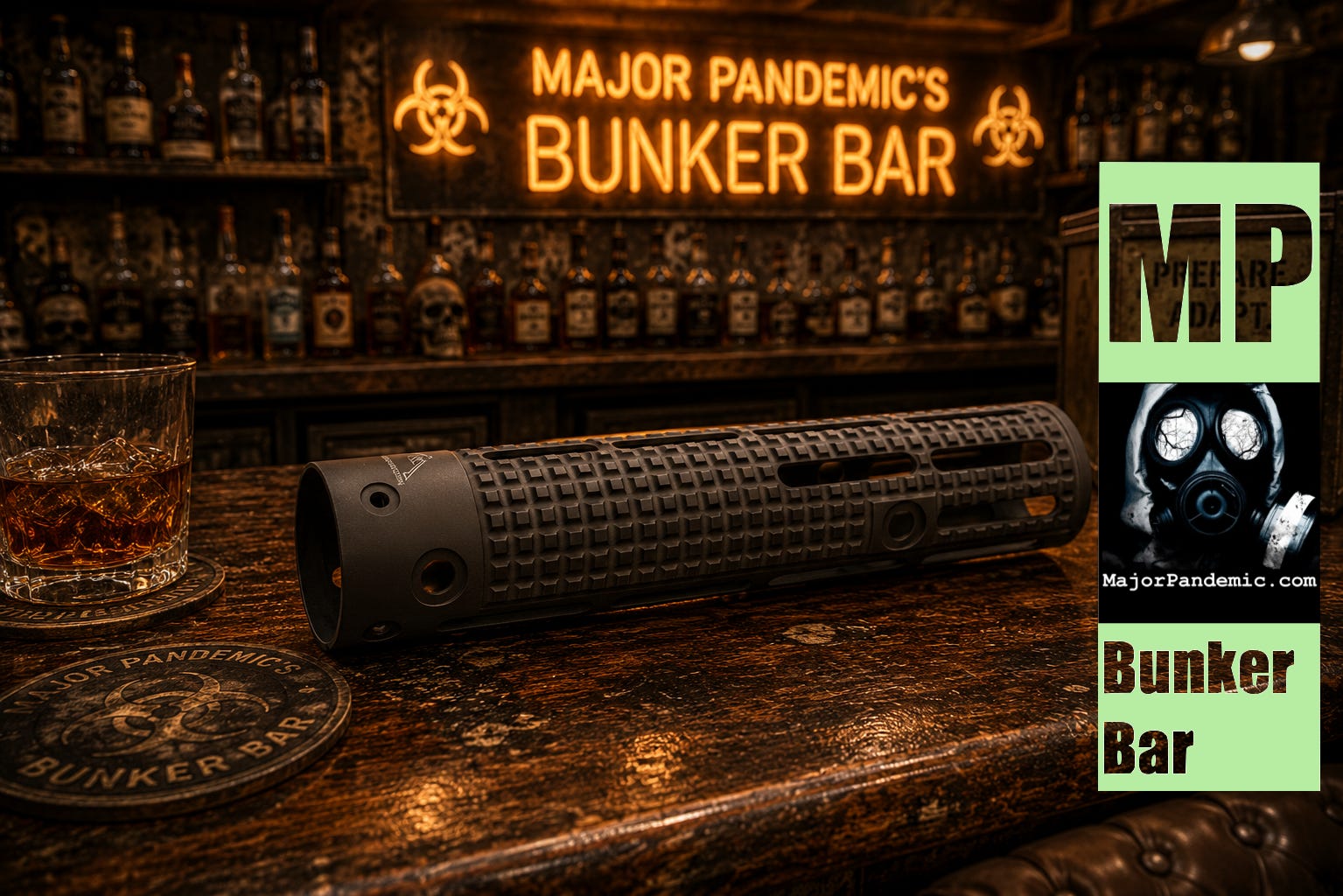 Apex Machine gator grip hand guards - different, cool and better. 04.06.2026 31minThis is a free preview of a paid episode. To hear more, visit www.majorpandemic.comApex Handguard Review: Why This Unique Free-Float Handguard Earned a Permanent Spot at Major Pandemic’s Bunker BarWelcome back to Major Pandemic’s Bunker Bar, the underground refuge where exceptional gear, outstanding whiskey, and unconventional firearm builds come together. Hidden beneath the surface and stocked with everything from rare rifles to top-shelf bourbon, the Bunker Bar is where unique products get the attention they deserve. This time, that spotlight falls on a company that has quietly been building one of the most distinctive AR handguards on the market for over a decade: Apex Handguard.Something Different in a Sea of SimilarityOne of the biggest challenges in today’s AR-15 market is that many rifles look exactly the same. Most modern handguards follow the same formula: an aluminum extrusion, a proprietary barrel nut, a locking system, and a familiar appearance that blends into every other rifle on the rack.Apex took a different approach.As discussed in the Bunker Bar podcast, Apex Handguard stands out because it doesn’t try to copy everyone else. It delivers a premium free-float design with distinctive styling, exceptional durability, and one of the most effective grip surfaces available today.The Legendary Gator GripThe defining feature of the Apex system is its unique Gator Grip texture. Rather than relying on grip tape, rail covers, or add-on accessories, Apex machines a checkered pattern directly into the handguard. The result is a secure, comfortable grip that remains effective in wet, cold, or high-heat shooting conditions.The texture isn’t simply cosmetic. It improves handling while maintaining comfort during extended shooting sessions.According to the podcast:“I don’t think anybody has done anything better.”Built Around a Proven AR PlatformPerhaps one of the smartest design decisions Apex made was avoiding proprietary barrel nuts.Instead, Apex utilizes the standard AR-15 barrel nut system. This offers several advantages:* No special tools required* Easier installation* Proven long-term reliability* Reduced build costs* Better compatibility with existing partsThe handguard locks securely onto the barrel nut using a robust clamshell mounting arrangement that prevents movement, twisting, and rotation while maintaining exceptional rigidity.The result is a free-float system that feels incredibly solid without requiring complicated installation procedures.Comfort MattersWhile much of the industry has pushed toward increasingly slim handguards, Apex went another direction.The larger-diameter round profile provides several benefits:* More comfortable grip geometry* Additional clearance around the gas block* Better airflow* Reduced heat transfer* More internal mounting roomAs noted during the review, the human hand naturally prefers grabbing round objects. The Apex design simply feels comfortable during long shooting sessions.That comfort becomes even more noticeable when barrels begin generating significant heat.Perfect for Suppressor-Tuck BuildsOne area where Apex truly shines is suppressor-tuck configurations.With approximately 1.75 inches of internal diameter, Apex offers significantly more internal space than most modern handguards. This allows builders to partially recess suppressors beneath the handguard while still maintaining proper clearance and airflow.The podcast specifically highlights a build using:* Apex 15-inch handguard* Feddersen 11.7-inch barrel* Otter Creek Polonium K suppressorThe setup creates an extremely compact package while maintaining excellent ergonomics, heat shielding, and appearance. According to the discussion, very few modern handguards can accomplish this without moving into substantially higher price categories.Oddball Builds WelcomeAnother reason Apex has earned a loyal following is their willingness to support unconventional projects.The company offers:* Extended carbine-length models* Front sight base cutout versions* Multiple length options* Optional top rails* Unique configurations rarely found elsewhereFor builders who enjoy creating rifles that don’t look like every other AR at the range, Apex provides options many manufacturers simply ignore.Final Thoughts from the Bunker BarThe handguard sitting on the bar at Major Pandemic’s Bunker Bar isn’t there because it’s trendy. It’s there because it solves real problems.The Apex Handguard delivers:* Exceptional rigidity* Outstanding grip texture* Standard barrel nut compatibility* Superior airflow* Suppressor-tuck capability* Comfortable ergonomics* Unique stylingMost importantly, it proves that AR builders don’t have to settle for the same handguard everyone else is running.Major Pandemic - MajorPandemic.com is a reader-supported publication. To receive new posts and support my work, consider becoming a free or paid subscriber.Thanks for reading Major Pandemic - MajorPandemic.com! This post is public so feel free to share it.
 -
 Short K Can Suppressors - You Need 1....maybe 6 - Otter Creek Polonium K, LPM 5.56 Duty, YHM Fat Cat 16.05.2026 22minThis is a free preview of a paid episode. To hear more, visit www.majorpandemic.comMajor Pandemic’s Bunker Bar: The Rise of the K-Can RevolutionWhy Short Suppressors Like the Otter Creek Polonium K, LPM Duty 5.56 and YHM Fat Cat Are Taking OverWelcome to Major Pandemic’s Bunker Bar — the underground refuge where cold drinks, hard-use rifles and modern suppressor technology collide. In the latest episode, the crew dives deep into one of the hottest trends in the firearms world: K-Can suppressors.Short, compact and surprisingly effective, K-Cans are rapidly becoming the go-to suppressor choice for AR-15 owners who want improved sound suppression, reduced muzzle blast and better shooting comfort without turning their rifle into a front-heavy musket. As discussed throughout the episode, models like the Otter Creek Labs Polonium K, Liberty Precision Machine Duty 5.56, and YHM Fat Cat are proving that smaller suppressors can deliver serious real-world performance.The podcast explores testing across multiple platforms including a 16-inch IWI Zion, a 10.5-inch BRN-180 build and a 12.5-inch “IDF Gaza Special” configuration. The conclusion? Modern K-Cans remove a substantial amount of the harsh bark and concussion associated with 5.56 rifles while adding only minimal length to the firearm.One standout theme is the balance between compact size and practical suppression. The YHM Fat Cat earns praise for its ultra-short footprint and deep tone, while the LPM Duty 5.56 edges ahead slightly in perceived suppression and overall tone quality. Meanwhile, the Otter Creek Polonium K continues to maintain its reputation as a crowd-favorite hard-use suppressor with excellent performance across multiple barrel lengths.The episode also highlights why suppressors are increasingly viewed not just as accessories, but as practical safety devices. Reduced concussion, improved recoil impulse, enhanced communication during defensive situations and hearing protection are all major benefits discussed in detail.Perhaps the biggest takeaway is simple: modern K-Cans are no longer niche products. With HUB compatibility, durable 17-4 stainless construction, full-auto ratings and excellent sound characteristics, today’s compact suppressors offer tremendous value for shooters seeking a lighter, shorter and more maneuverable setup.Thanks for reading Major Pandemic - MajorPandemic.com! This post is public so feel free to share it.Major Pandemic - MajorPandemic.com is a reader-supported publication. To receive new posts and support my work, consider becoming a free or paid subscriber.
 -
 Technical EDC & CCW Bags for Off Body Carry 09.05.2026 30minThis is a free preview of a paid episode. To hear more, visit www.majorpandemic.comMajor Pandemic’s Bunker Bar: The Ultimate Guide to Modern EDC, Tactical, and Technical Carry BagsWelcome to Major Pandemic’s Bunker Bar — the underground hideaway where tactical gear, exceptional whiskey, and brutally honest equipment reviews collide. As described in the podcast, the concept behind the Bunker Bar is simple: “some cold world bunker deep beneath the ground” stocked with incredible liquor, outstanding gear, and conversations about products that actually matter.One of the latest deep dives from the Bunker Bar focused on a subject that has exploded in popularity over the last decade: EDC bags, sling packs, technical backpacks, and tactical carry systems. But this discussion was never just about one company or one bag. It was about understanding the differences between purpose-built EDC systems, adaptable technical packs, and rugged tactical platforms.The Evolution of Modern EDC BagsToday’s carry bags are no longer simple backpacks. Modern users demand:* Concealed organization* Laptop and tech protection* Modular storage* Tactical adaptability* Camera and drone compatibility* Comfortable all-day carry* Civilian-friendly stylingAccording to the transcript, most bags fall into three major categories:* General Purpose Bags* Dedicated EDC / CCW Bags* Highly Adaptable Technical Tactical BagsUnderstanding those distinctions is critical before buying gear.Mission First Tactical: Practical Everyday UtilityMission First Tactical (MFT) was highlighted as one of the best examples of a flexible, real-world everyday carry system. Their bags balance tactical utility without screaming “military.”The Acro series especially stands out because:* It carries laptops and travel gear well* Includes hook-and-loop compatibility* Works for business travel or range use* Avoids an overtly tactical appearanceAs the podcast notes, these bags are ideal for users who want practical functionality without sacrificing versatility.Tasmanian Tiger: Expedition-Level Tactical QualityOn the heavier tactical side, Tasmanian Tiger earned praise for exceptional ergonomics and military-grade construction. Their Vietnam-based manufacturing system and expedition heritage create bags with:* Superior weight distribution* Comfortable carry systems* MOLLE integration* Rugged construction* Highly configurable interiorsUnlike many old-school tactical bags, Tasmanian Tiger balances organization and modularity without becoming overly complicated.Viktos: Dedicated Concealed Carry PerformanceThe discussion then shifted into dedicated concealed carry systems, particularly the Viktos Counteract series. These bags are purpose-built around firearms and off-body carry.Key features include:* Dedicated concealed compartments* Rapid-access pull systems* Modular Velcro trays* Integrated magazine storage* Extremely discreet appearanceThe transcript repeatedly emphasizes that Viktos bags are among the fastest and most purpose-built off-body carry systems available today.Hazard 4: The King of AdaptabilityWhile Hazard 4 receives major attention, the conversation makes clear that the brand’s strength is not just “tactical cool factor.” It is adaptability.The iconic Plan B and Plan C sling systems excel because they can be configured for:* Camera equipment* Drones* Travel gear* Compact rifle transport* Technical loadouts* EDC setupsRather than locking users into predefined compartments, Hazard 4 emphasizes modular open-space architecture with customizable inserts and sling ergonomics.The transcript specifically highlights the comfort and stabilization of the single-sling carry system, especially under heavy loads.Why Technical Bags Matter More Than EverOne major theme throughout the Bunker Bar discussion is that modern bags are no longer niche gear. They are part of daily life.People now carry:* Laptops* Cameras* Medical kits* Drones* Firearms* Batteries* Chargers* Survival gear* Travel equipmentAnd they need systems capable of adapting quickly without looking overly tactical or attracting attention.That’s why the conversation repeatedly returns to concepts like:* Gray man styling* Technical adaptability* Configurable storage* Ergonomic carry systems* Mission flexibilityFinal Thoughts from the Bunker BarThe biggest takeaway from Major Pandemic’s Bunker Bar is simple: there is no perfect bag for everyone. The right solution depends entirely on your mission profile.Some users need lightweight general-purpose carry. Others need dedicated concealed-carry systems. Some need highly configurable technical loadout platforms.Brands like Mission First Tactical, Tasmanian Tiger, Viktos, Hazard 4, and KUIU all approach those needs differently—but all earned respect because they solve real-world problems with thoughtful engineering and high-quality construction.Major Pandemic - MajorPandemic.com is a reader-supported publication. To receive new posts and support my work, consider becoming a free or paid subscriber.Thanks for reading Major Pandemic - MajorPandemic.com! This post is public so feel free to share it.
 -
 A 2013 New in Box Review of a Vintage DPMS RFA2-16 "Still in the Box" 02.05.2026 22minA Time Capsule Finally Living Its StoryThe DPMS RFA216 is a gun that belongs to a very specific chapter of American rifle history — the last years when fixed carry handles and A2 stocks felt current, when military nostalgia from Vietnam and the Gulf War still drove civilian purchasing decisions, and when the AR platform was still in the middle of its metamorphosis into the modular, flat-top, free-float world we know today.Sixteen years after it was packed in foam and forgotten, it got the range trip it was always meant to have. Sometimes the best stories start with dust on the lid.Major Pandemic’s Bunker Bar: A Dust-Covered Time Capsule and the Story of “New In Box” PerfectionDeep beneath the surface, where time feels suspended and the outside world fades away, Major Pandemic’s Bunker Bar delivers more than atmosphere—it tells stories. In this cinematic, post-apocalyptic setting, one object stands out among the dust-covered bottles and aged wood: a pristine DPMS Panther Arms rifle box, boldly marked “New In Box.” This isn’t just a prop—it’s a narrative centerpiece that perfectly captures the intersection of history, craftsmanship, and untouched legacy.The scene itself is rich with contrast. The bunker bar, layered in dust and dimly lit by a warm neon glow, evokes a sense of abandonment and survival. Shelves of liquor sit untouched, their labels faded beneath years of neglect. Yet, in the center of it all rests the DPMS box—remarkably preserved, almost defiant against the decay surrounding it. This visual tension reinforces the core idea: some things remain frozen in time, waiting to be rediscovered.As described in the transcript, this rifle represents a true “time capsule”—“15 winters past, still waiting on you… still brand new” . Unlike the many claims of “new in box” that often come with skepticism, this example stands as authentic proof. The packaging is intact, the contents untouched, and the condition nearly flawless—something even modern factory shipments rarely achieve.From a historical and enthusiast perspective, the DPMS RF A216 rifle inside the box reflects a fascinating transition period in firearm design. During the late 2000s to early 2010s, manufacturers like DPMS experimented with a wide range of configurations—mixing legacy features like fixed carry handles and A2 stocks with evolving preferences for modularity and accuracy. This particular rifle, with its heavy H-bar barrel and rifle-length gas system, represents one of those rare “in-between” builds—unusual, short-lived, and now highly collectible.To bring this preserved relic back to life, the rifle didn’t remain a static display piece for long. In true Major Pandemic fashion, the team introduced an AS Designs Super Safety, transforming the DPMS from a dormant time capsule into a fully realized, functional platform. As noted in the transcript, the installation was straightforward—retaining much of the original configuration while integrating the upgraded selector system—and the result was flawless performance . With that upgrade, the story takes its final turn: the rifle is no longer sealed in history. The DPMS is now free—free from the box, free from time, and finally able to fulfill the purpose it was built for.What makes this moment even more compelling is the mystery behind its preservation. As explored in the narrative, the most likely explanation is that the rifle was part of a law enforcement inventory purchase that was never fully claimed—left behind, untouched, and ultimately forgotten . This adds another layer of intrigue, transforming the object from a simple product into a relic of logistics, oversight, and time.From an SEO and storytelling standpoint, this concept blends multiple high-interest themes:* Vintage firearms and collector value* “New in box” authenticity and rarity* Post-apocalyptic and bunker bar aesthetics* Luxury-meets-survival design conceptsTogether, they create a unique brand narrative for Major Pandemic’s Bunker Bar—one that appeals to enthusiasts, collectors, and those drawn to immersive, story-driven environments.In the end, the dusty bunker, the glowing sign, and the untouched DPMS box all point to the same idea:time doesn’t always move forward—sometimes, it waits.Major Pandemic - MajorPandemic.com is a reader-supported publication. To receive new posts and support my work, consider becoming a free or paid subscriber.Thanks for reading Major Pandemic - MajorPandemic.com! This post is public so feel free to share it. This is a public episode. If you'd like to discuss this with other subscribers or get access to bonus episodes, visit www.majorpandemic.com/subscribe
 -
 The Jeff Cooper Scout Rifle Concept - The code is more what you'd call 'guideline' than actual rule 25.04.2026 32minThis is a free preview of a paid episode. To hear more, visit www.majorpandemic.comMajor Pandemic’s Bunker Bar Podcast: Scout Rifle Concept, Practical Shooting, and Real-World PerformanceMajor Pandemic’s Bunker Bar opens with a unique concept—an underground, fully stocked bar that represents calm, control, and preparedness. From there, the episode transitions into a deep dive on the scout rifle concept, breaking down what it really means and why it’s been widely misunderstood.Originally developed by Jeff Cooper, the scout rifle was never intended to be locked into strict specifications like a .308 caliber or a specific weight. Instead, it was designed as a lightweight, portable, general-purpose rifle capable of delivering practical accuracy in real-world conditions. The focus was on effectiveness in the field—not precision from a bench or overbuilt configurations.The episode explains how modern shooters often misinterpret the concept by over-defining it. In reality, Cooper’s vision emphasized flexibility—allowing for multiple calibers including .223/5.56, .243, 7mm-08, and others. The goal was always adequate power, useful accuracy, and ease of use, not chasing maximum performance on paper.Today, the scout rifle concept extends well beyond traditional bolt-action platforms. Modern AR-style rifles, compact carbines, and lightweight builds all align with the same philosophy when they prioritize mobility, versatility, and practical engagement ranges (0–600 yards). Advances in optics, including low power variable scopes, have further expanded what these rifles can do in real-world scenarios.A key takeaway from the discussion is the importance of practical shooting skills. Real capability comes from training in standing, kneeling, and prone positions—not just shooting from a bench. The podcast emphasizes that success in the field is driven more by the operator than the equipment, reinforcing the idea that skill, familiarity, and efficiency matter more than gear overload.The conversation also highlights a shift toward keeping rifles lightweight, simple, and purpose-driven. Instead of loading rifles with unnecessary accessories, the focus is on maintaining a clean, functional setup that enhances performance without adding complexity.Use what you have, keep it simple, and train for real conditions. The scout rifle isn’t about a specific build—it’s about a mindset centered on practicality, adaptability, and real-world effectiveness.Major Pandemic - MajorPandemic.com is a reader-supported publication. To receive new posts and support my work, consider becoming a free or paid subscriber.Thanks for reading Major Pandemic - MajorPandemic.com! This post is public so feel free to share it.
 -
 Zeroing your Rifle - The easy way... 11.04.2026 17minThis is a free preview of a paid episode. To hear more, visit www.majorpandemic.comIn this episode of Major Pandemic’s Bunker Bar, the host walks through a practical, ammo-saving method for zeroing a new AR-15 or similar rifle without wasting time, money, and patience. Instead of making the common mistake of starting at 100 yards or even farther, he recommends using a laser bore sighter when possible and then beginning at very close range to get on paper quickly. From there, the process moves to 10 yards, then 25 yards, and finally 50 yards to establish a reliable zero with much less frustration. The discussion explains optic and bore offset, what point of impact should look like at each distance, and why a 50-yard zero with a 200-yard crossover often gives a flatter and more practical trajectory for many rifles, especially AR platforms. He also covers the value of stable shooting support, reasonable ammo selection for zeroing, and the bad habits that cause shooters to burn through boxes of ammunition without ever getting properly dialed in. The episode wraps with a funny song about “Larry,” the guy who insists on doing it the hard way by setting the target way too far out and blasting away for a week without ever getting close.This episode of Major Pandemic’s Bunker Bar mixes solid rifle-zeroing advice with a dose of humor. The host explains how to zero an AR-15 the smart way by starting close, getting on paper fast, and then working methodically out to 25 and 50 yards instead of wasting ammo shooting at distant targets too soon. He makes the case for a practical 50/200 zero, explains sight offset and trajectory in simple terms, and shares a process that can save shooters real money and frustration. The episode closes with a humorous song about Larry, a stubborn shooter who tries to “walk it in” from way too far out and ends up shooting at ghosts all week.Major Pandemic - MajorPandemic.com is a reader-supported publication. To receive new posts and support my work, consider becoming a free or paid subscriber.Thanks for reading Major Pandemic - MajorPandemic.com! This post is public so feel free to share it.
 -
 IWI Zion-15 Possible the Best Value for a Military Duty Grade AR15 03.04.2026 31minThis is a free preview of a paid episode. To hear more, visit www.majorpandemic.comThe Sleeper “Military-Grade” AR That’s Made In-HouseIn this episode of Major Pandemic’s Bunker Bar on MajorPandemic.com, Major Pandemic breaks down why the IWI Zion 15 has quietly become one of the best values in the AR-15 world—especially for buyers who want real build quality, tight tolerances, and proven assembly standards without paying $1,500–$3,000 for a logo and hype.The episode opens with Major Pandemic’s long-standing respect for IWI and Israeli firearms doctrine—simple, rugged, no-nonsense, and brutally practical. But the Zion 15 is also treated as something different: it’s a major step for IWI because it’s a U.S.-designed IWI project, not a direct “imported Israeli development” brought over to American shelves. And while he speculates about long-term strategy (and how the AR platform has been part of Israel’s ecosystem since the 1960s/1970s), he’s clear about the key point for buyers today:The Zion 15 is manufactured and assembled in-house by IWI USAThis is the backbone of the entire argument. Major Pandemic emphasizes that IWI USA runs its own manufacturing facility and produces Zion 15 components under their own roof rather than simply buying boxes of outsourced parts and assembling “Franken-guns.” Why does that matter? Because when a company controls production internally, it can control tolerances, consistency, and QC far better than brands that rely heavily on mixed third-party parts. He highlights the facility’s ISO quality mindset as a meaningful signal that processes are documented, repeatable, and measured—exactly what you want in a hard-use rifle.IWI Zion 15 Models and Pricing: Simple Lineup, Same Core RifleA big part of the Zion’s appeal is that IWI kept the product line straightforward. Major Pandemic explains that the Zion family is essentially the same rifle across multiple barrel lengths, built around the same core components and configuration approach:* Barrel lengths commonly offered include 10.5, 11.5, 12.5, 16, and a DMR/Special Purpose style option (including a model configured with a premium trigger).* The rifles share the same design DNA: free-float handguards, consistent furniture choices, consistent control layout, and a “Recce/SPR/standard AR” intent depending on length.The standout “why this is a sleeper” point is pricing discipline. He calls out that many variants land around $999 MSRP, with specialty variants costing more—but still positioned aggressively compared to the feature set and build quality.Build Quality Focus: The Stuff That Actually MattersMajor Pandemic spends a lot of time on the details that separate a “looks cool” AR from a rifle built to survive real use. His inspection checklist is the kind of stuff serious buyers care about:Assembly and staking (the “don’t skip this” category)* Castle nut staking is present—and he notes it’s done well (even double-staked on his example).* Gas key staking is also addressed and described as properly executed.* He checks torque and alignment on critical parts (handguard, gas block alignment, barrel nut, muzzle device timing) and reports it’s tight and correctly done.* He notes the rifle includes an upper/lower tensioning feature (a nylon-tipped tension screw) to reduce receiver play.The overall conclusion: this is not a “rattle trap.” It feels like a rifle assembled by people who care about the little things.Materials and Specs: What You’re Actually GettingThe episode calls the Zion’s parts and overall spec level “high grade,” placing it in the same general conversation as respected duty-grade and premium-tier ARs—not because it’s flashy, but because it checks core boxes.Key highlights discussed:* 4150 CMV HB barrel steel (he frames “HB” as a higher consistency/hardness spec within the 4150 CMV family).* Nitrided barrel and key components (he also mentions noticing additional black-coated springs, implying attention to corrosion resistance/finish consistency).* A bolt that is HPT/MPI (high pressure tested / magnetic particle inspected), the type of spec buyers associate with serious-use rifles.* Standard mil-spec receiver set with practical details like a standard trigger guard and “winter glove” usability.He also describes the rifle’s overall component tier as “AA / super grade”—not boutique, but absolutely not bargain-bin.What the Zion 15 Is… and What It Isn’tMajor Pandemic is pretty blunt here: he does not frame the Zion as a “budget rifle.” His view is that it’s a high-quality rifle priced like a mid-grade gun, and that’s why it’s a sleeper.He also calls out what IWI intentionally does not include:* No “kick-ass trigger” upgrade in the standard configuration (because triggers are personal preference and people upgrade differently).* No fancy extended charging handle by default (same logic—many people choose based on optics setup and ergonomics).That restraint is portrayed as part of IWI’s no-nonsense approach: ship a solid base rifle with the important stuff done right, and let the user pick the personal touches.Real-World Setup Talk: Optics, Sling, Suppressor PlansToward the end, the episode shifts into how he’s setting the rifle up and why. He describes running a modern red dot + magnifier style optic package and highlights the value of a system that can automatically adjust reticle/intensity behavior when magnified—useful for fast shooting up close and practical holds at distance. He also mentions adding backup irons, sling mounting, and keeping the rifle relatively clean rather than bolting on “a bunch of crap.”He closes with excitement about pairing the Zion with a compact, low-back-pressure 5.56 suppressor—with the practical note that any DI AR can raise questions about gas management once suppressed (and that he’ll evaluate whether it needs tuning).Bottom Line (SEO Takeaway)If you’re searching “IWI Zion 15 review,” “IWI Zion 15 quality,” “best AR under $1,000,” “IWI USA manufactured AR,” or “Major Pandemic’s Bunker Bar IWI Zion 15,” :The IWI Zion 15 is a high-quality, duty-grade style AR-15 that’s manufactured and assembled in-house by IWI USA, built with the right specs, assembled correctly, and priced like a sleeper. Major Pandemic’s verdict is essentially: it delivers “everything you need, nothing you don’t”—and it does it at a price point that makes a lot of overhyped rifles look like bad deals.Major Pandemic - MajorPandemic.com is a reader-supported publication. To receive new posts and support my work, consider becoming a free or paid subscriber.Thanks for reading Major Pandemic - MajorPandemic.com! This post is public so feel free to share it.
 -
 The IDF Israeli Defense Forces Rifle Modification Menusar and Katsar Short Rifle Mods 13.03.2026 32minThis is a free preview of a paid episode. To hear more, visit www.majorpandemic.comMajor Pandemic’s Bunker Bar: IDF Menusar History, Field Mods, and Why Short AR Carbines Never Went AwayIn this Major Pandemic’s Bunker Bar episode, Major Pandemic dives deep into the gritty, real-world evolution of the IDF Menusar (often discussed alongside “Kutsar” style short carbines) and explains why Israel may have run the longest, most practical “short AR” experiment on the planet. If you’ve searched for IDF Menusar, Israeli M16 short carbine, or Menusar field modifications, this episode is essentially a blueprint: how the IDF took large numbers of legacy M16A1-style rifles and turned them into constantly evolving, close-quarters-ready carbines—often with ugly, improvised changes that prioritized function over perfection.The Big Idea: The IDF Proved Short Carbines in Real Combat UseMajor Pandemic’s core argument is that the IDF didn’t just “try” short-barrel AR concepts—they lived them. Long before modern trends like “micro carbines” and compact CQB setups went mainstream, the IDF had decades of operational reasons to shorten rifles: tight hallways, dense urban environments, vehicle work, and a constant demand for mobility. The result was a long-running, real-world proving ground for the Menusar-style concept: short, handy rifles built to work—no matter how they looked.IDF Menusar Origins: Turning Full-Length M16s into Practical CarbinesA major section of the episode focuses on how these rifles were created from what was already in inventory. Rather than replacing everything with expensive new platforms, the IDF often kept older rifles running and adapted them to modern needs. That “use what you have” approach is the soul of the Menusar story: the IDF didn’t chase catalog correctness—they chased battlefield utility.Reliability First: “Make It Run” Tuning and Harsh-Use PrioritiesAnother key theme is how reliability was often prioritized over refinement. The episode explains how older, heavily-used rifles can be tuned to keep functioning in dirty conditions and hard service—even if the end result feels more aggressive and less “soft shooting.” The point is consistent: IDF Menusar builds were not collector showpieces. They were working guns designed to run when conditions were imperfect.The Most Iconic Menusar Field Mods (and Why They Look the Way They Do)This is where the episode gets especially searchable for IDF Menusar modifications:* Barrel cutdowns: Full-length barrels were frequently shortened to create handier carbines.* Basic re-crowning and re-threading: Some work was clean, some was crude—whatever got the rifle back into service.* Handguard and furniture improvisation: Cutting and adapting parts was common, and yes—tape shows up a lot. The episode explains tape as a practical solution for securing modified handguards, stabilizing add-ons, and mounting early accessories quickly.* Improvised lighting and add-ons: Before modern modular rail systems were everywhere, “field-expedient” mounting was the norm.* Magazine coupling hacks: The episode highlights the classic low-budget approach—using simple spacers and tape to create a functional two-mag setup that still clears the rifle’s ejection path.If you’re researching why IDF carbines often look “patched together,” this episode answers it: those choices were a feature, not a flaw—fast fixes, low cost, and immediate utility.A1 vs A2 Carry Handles: Why the IDF Used Whatever WorkedMajor Pandemic also addresses a common question from retro AR builders: did the IDF use A1 or A2 carry handles? The answer is basically: both, depending on what was available. The episode frames it as logistics and practicality—not preference. Simpler systems stayed in service because they were easy to keep running and easy to train around, while other parts were swapped in as inventories shifted over time.Why the IDF Menusar Still Matters TodayThe episode closes by connecting the Menusar mindset to modern AR thinking. The big takeaway for anyone searching IDF Menusar vs modern CQB rifles is that compact ARs didn’t suddenly become “smart” in the 2000s—they were validated through decades of hard, real-world use. The IDF’s long timeline of short-carbine adaptation helped reinforce a truth modern shooters now take for granted: short, lightweight carbines are extremely practical when mobility matters.Bottom line: This Major Pandemic’s Bunker Bar episode is a must-listen (and a solid reference summary) for anyone interested in IDF Menusar history, Israeli M16 carbine modifications, and the larger story of how “ugly but effective” rifles helped shape the modern short AR carbine concept.Major Pandemic - MajorPandemic.com is a reader-supported publication. To receive new posts and support my work, consider becoming a free or paid subscriber.Thanks for reading Major Pandemic - MajorPandemic.com! This post is public so feel free to share it.
 -
 Evolution of the Slim Micro Compact - Nothing New under the sun since 1903 28.02.2026 33minThis is a free preview of a paid episode. To hear more, visit www.majorpandemic.comPretty impressive when you see a 1903 stacked on a FN Reflex XL and realize they were essentially the same size.Major Pandemic’s Bunker Bar Podcast Summary (MajorPandemic.com): Micro-Compact Pistols Aren’t New — The Colt 1903 Started It AllIn this episode of Major Pandemic’s Bunker Bar on MajorPandemic.com, Major Pandemic cuts through the hype around today’s “brand-new” micro-slim, micro-compact pistol trend with a simple thesis: we’ve been here before. Modern carry guns may have better capacity, optics cuts, and comps—but the core concealed-carry concept was already solved more than a century ago.The Real Origin Story: The 1903 Concealed Carry StandardThe episode starts by rewinding to the early 1900s—when open hip carry was increasingly frowned upon in many “civilized” cities, and people demanded firearms that disappeared under clothing. That environment produced creative concealment options (tiny revolvers, derringers, oddball multi-barrel guns), but one pistol stood apart: the Colt Colt 1903 Pocket Hammerless.The host argues it wasn’t just “small for its time”—it was purpose-built for concealed carry, not adapted to it. Slim profile, rounded “melted” edges to prevent snagging, internal hammer (the original “hammerless” carry concept), and real defensive usability in pocket-friendly calibers like .32 ACP (and later .380 ACP variants). In other words: the DNA of modern carry pistols was already in the room.The Evolution: From PPK to Pocket .380 to Slim 9mmFrom there, the episode walks a timeline of “pre-microcompact microcompacts” that kept refining the same idea:* Walther Walther PP Series and Walther PPK as iconic compact carry pistols that kept the slim concealment concept alive for decades.* Pocket .32/.380 standouts like Seecamp and North American Arms (Guardian-style pistols) that built reputations around reliability in tiny packages.* The polymer pocket revolution, led by Kel-Tec (P32/P3AT style era) and later popularized to the masses by Ruger with the LCP wave—where “micro” often meant .380 and compromise sights, but unbeatable carry convenience.* The jump to slim 9mm with Kahr Arms and the PM9 concept: thin, shootable, reliable—yet still stuck in a single-stack capacity ceiling that would eventually get crushed by the next era.The Modern Breakthrough: Double-Stack Micros and “Micro Thin Compacts”The host frames SIG Sauer’s P365 moment as the market inflection point: double-stack capacity in a truly micro footprint. Then the category explodes—better ergonomics, better recoil systems, better triggers—and it becomes normal to expect 10+ rounds in guns that used to hold 6–8.He highlights how today’s “micro thin compact” crossover guns—like the FN Herstal FN Reflex XL—deliver a full-size-ish shooting feel with serious capacity, in dimensions shockingly close to the original 1903 concept. The episode even compares size and weight, using that match-up to prove the point: we didn’t invent a new idea—we finally perfected the old one.Where It’s Going: Dots, Comps, and the “Just Because You Can…” QuestionThe host closes by calling out the wild direction the category is taking—red dots, compensators, porting, and ultra-aggressive “mini comp gun” setups. He separates “awesome range/training tools” from “defensive carry choices,” noting potential downsides of ported/comped guns in close-retention shooting. Still, the verdict is clear: modern micro-compacts are in a golden era—and the road that got us here started in 1903.Bottom line: This Major Pandemic’s Bunker Bar episode on MajorPandemic.com is a history-backed reality check: today’s micro-compact boom is less a revolution and more a return to a century-old concealment blueprint—now upgraded with modern capacity, ergonomics, and performance.Major Pandemic - MajorPandemic.com is a reader-supported publication. To receive new posts and support my work, consider becoming a free or paid subscriber.Thanks for reading Major Pandemic - MajorPandemic.com! This post is public so feel free to share it.
 -
 MajorPandemic.com talking about Major Pandemics 25.02.2026 34minThis is a free preview of a paid episode. To hear more, visit www.majorpandemic.comMajor Pandemic’s Bunker Bar Podcast Summary (MajorPandemic.com): Worst Pandemics in History and the Hygiene Lessons We Still IgnoreOn MajorPandemic.com, Major Pandemic’s Bunker Bar takes a hard-left turn into real-world history with a fast, blunt, and practical breakdown of the worst pandemics in human history—and the uncomfortable truth that ties many of them together: basic hygiene, sanitation, pest control, and isolation could have prevented (or drastically reduced) massive death tolls.This Major Pandemic episode opens with the signature Bunker Bar tone—dark humor, straight talk, and an “adult advisory” attitude—before launching into a timeline of major outbreaks that reshaped civilizations. It’s part history lesson, part preparedness mindset, and part public-health reality check—delivered the way Major Pandemic’s Bunker Bar does best: no fluff, no filter.The Black Death (1347–1353): Filth, Rats, and a Medieval Sanitation CollapseThe episode leads with the Black Death, one of the most catastrophic events in history. Major Pandemic frames it as a perfect storm of medieval conditions: poor sewage systems, waste in streets, rodent infestations, overcrowding, and minimal handwashing. The point is simple for modern listeners: sanitation, waste control, and isolation weren’t “nice to have”—they were life-or-death infrastructure.Cholera Pandemics: Contaminated Water KillsNext, MajorPandemic.com highlights cholera as one of the most preventable mass outbreaks ever recorded. When sewage contaminates drinking water, the results are catastrophic. Major Pandemic’s Bunker Bar reinforces the basic fixes that ended cholera in many regions: clean water systems, separated sewage, boiling water, and food hygiene.Typhus, Lice, and War: Dirty Clothing Spreads DiseaseThe episode then moves into war-driven outbreaks like typhus and trench disease—where lice, filthy bedding, and no laundering create ideal transmission conditions. The host’s takeaway: you can’t out-medicate bad hygiene. Clean clothes, delousing, bathing, and sanitation were often as impactful as medical interventions.Spanish Flu and COVID-19: Hygiene Helps, Airborne Still WinsFor respiratory pandemics like the 1918 Spanish Flu and COVID-19, Major Pandemic draws a realistic line: hygiene matters, but airborne spread plus global mobility makes these harder to stop. The Bunker Bar framing is direct—if you’re sick, don’t share it: isolate when possible, cover coughs, and mask when needed to protect others.Smallpox and the “Pox Family”: Why Vaccines MatterSmallpox gets its own spotlight as a historic killer—and as proof that some pathogens require more than hygiene. Major Pandemic’s Bunker Bar uses it as a reminder that vaccination can be the decisive tool when sanitation alone can’t stop transmission.The Watch List: Bird Flu, Ebola, Marburg, Lassa, and CCHFThe episode wraps with a high-level “watch list” of modern threats: avian influenza (H5N1) for mutation potential, and severe hemorrhagic fevers like Ebola and Marburg for lethality (even if spread is typically more limited). It also mentions Lassa fever and Crimean-Congo hemorrhagic fever as ongoing concerns tied to exposure pathways where hygiene, protective measures, and prevention fundamentals still matter.Why This Matters (MajorPandemic.com Takeaway)This isn’t just a history episode. It’s a preparedness lesson. Major Pandemic boils the entire pandemic timeline down to a painfully simple reality:Clean hands, clean water, clean clothes, controlled pests, smart isolation, and early medical attention stop a shocking amount of suffering.If you want the no-nonsense version of pandemic history—told with the attitude and edge that defines Major Pandemic’s Bunker Bar—this episode on MajorPandemic.com is built for you.Major Pandemic - MajorPandemic.com is a reader-supported publication. To receive new posts and support my work, consider becoming a free or paid subscriber.Thanks for reading Major Pandemic - MajorPandemic.com! This post is public so feel free to share it.
 -
 Canik MC9 Prime with M04 Optic - First Shots & I Like it... its transformative 17.02.2026 28minThis is a free preview of a paid episode. To hear more, visit www.majorpandemic.comCanik METE MC9 Prime with M04: A Do-It-All Micro-Compact That Bridges Concealed Carry, Competition, and DutyIn this Major Pandemic’s Bunker Bar episode, the host breaks down the Canik METE MC9 Prime—specifically the “full package” that includes the M04 Mechanik red dot—and makes a simple argument: this pistol is one of the most complete, feature-dense micro/compact 9mm options for the money, especially for shooters who want one gun that can cover multiple roles without immediately dumping cash into upgrades.A Premium “Everything Included” Kit (Not the Usual Cardboard Box)The host spends real time on the unboxing because it’s part of the value proposition. Instead of the typical “manual and a lock,” the MC9 Prime arrives in a rigid hard case with organized cutouts and a surprisingly deep accessory loadout—swappable backstraps, tools, a cleaning kit, a loader, holster components, and a presentation that feels premium compared to many higher-priced handguns. The takeaway: for new shooters, this eliminates a bunch of early “month two” purchases; for experienced shooters, it’s just a refreshingly complete setup.M04 Mechanik Optic: Feature-Rich Out of the BoxA big highlight is the included M04 Mechanik optic. In the episode, it’s described as offering user-selectable circle/dot or circle-dot, shake-awake / auto on-off, long advertised runtime, and solar backup—positioned as a legitimate included optic rather than a throwaway add-on.Why It “Transforms” Across RolesThe core of the episode is that the MC9 Prime seems to sit in an unusual middle lane—slim enough to carry, fast enough to shoot like a competition-leaning gun, and substantial enough to feel duty-capable depending on how you configure it.* Slim / concealed carry: The host notes it’s slightly thinner than a Glock-sized baseline and emphasizes that removing the external magwell is quick (one screw), which helps it carry flatter and cleaner.* Competition-ish speed: The integrated compensation system and “race-gun-like” features—like the flat-face trigger and aggressive control surfaces—support faster follow-up shots and a more controllable shooting rhythm.* Duty-ready confidence: He repeatedly comes back to reliability. His personal test includes feeding it cheap range ammo and even imperfect reloads; his claim is that it “eats anything,” which is exactly the type of trait people associate with hard-use pistols.Feature Stack That Drives the HypeThe host (and the show’s assistant voice) runs through the highlights that make it feel “bigger than a micro”:* Enhanced compensated barrel/slide with an integrated expansion chamber to reduce muzzle rise* Night sights front and rear* Flat-face trigger with a crisp break and fast reset* Aggressive slide serrations, upgraded slide stop, and improved handling details* Textured grip surfaces and improved undercut geometry for recoil control* 17+1 capacity, shipping with two 17-round magazinesPrice-to-Performance PunchHe frames the MC9 Prime as a value hammer: the compensated version alone is positioned as a strong deal, and the optic-included package is portrayed as competing with (or undercutting) the cost of buying a more basic pistol and upgrading into the same feature tier later.Bottom line: The Canik METE MC9 Prime with M04 is presented as a rare “multi-role” micro-compact—one that can shift between slim concealed carry, fast competition-style shooting, and duty-like reliability expectations with minimal changes, while delivering a premium kit experience and standout features at a price point that’s hard to ignore.Major Pandemic - MajorPandemic.com is a reader-supported publication. To receive new posts and support my work, consider becoming a free or paid subscriber.Thanks for reading Major Pandemic - MajorPandemic.com! This post is public so feel free to share it.
 -
 Ruger GP100 Snubby .357 Magnum 7-Shot Revolver 13.02.2026 33minThis is a free preview of a paid episode. To hear more, visit www.majorpandemic.comRuger GP100 2.5-Inch 7-Shot Snubnose: Major Pandemic’s Bunker Bar Podcast Summary (Trail Revolver Breakdown)In this episode of Major Pandemic’s Bunker Bar, the host goes full “wheel gun nerd” on one of the most unusual—and surprisingly practical—revolvers in the Ruger lineup: the Ruger GP100 2.5-inch 7-shot .357 Magnum snubnose (Model 1774). If you think “snubby” automatically means punishing recoil, mediocre sights, and compromise everywhere, this episode argues the opposite: this is essentially a full-size GP100 that just happens to wear a 2.5-inch barrel.What Makes This GP100 Snubnose DifferentMost snub-nosed revolvers are built on smaller frames and trimmed down in ways that sacrifice shootability. This one isn’t. The host emphasizes that the 2.5-inch GP100 is a big, beefy large-frame .357, and that weight (around 36 ounces) turns into a real advantage: less recoil, more stability, and better control with everything from .38 Special to hotter .357 loads. Yes, you still get the classic .357 “fireball” out of a short barrel—because physics—but the gun stays composed instead of dancing around like lightweight snubbies.The Headline Feature: 7 Rounds in a GP100 CylinderA standard GP100 is usually a six-shot. Here, Ruger “stuffed seven rounds” into the same general cylinder footprint, creating what the host jokingly calls a “high-capacity assault revolver.” The practical takeaway is solid: if you’re carrying snake shot for trail work, you’re not giving up as much defensive capacity as you would with a five-shot or a typical six-shot.Trail-Gun Utility: Snake Shot + Magnum CapabilityThe host is a big fan of CCI snake shot loads (and similar options) for real-world trail problems—snakes, pests, and nuisance critters—because they solve the “close-range problem” fast. He also argues the GP100 platform gives you the flexibility to run .38 Special for comfort, .357 Magnum for serious threats, and specialized loads when needed, all in the same revolver.Sights, Extraction, and Shootability—No Snubnose “Gotchas”One of the most interesting points is how little Ruger compromised:* Fully adjustable rear sight with a high-visibility front (and easy swap compatibility with other GP100 sight options).* Full-length extractor—a big deal on short-barrel revolvers where partial extractors can leave you fighting sticky cases. Here, extraction behaves like a full-size gun.* GP100 grip system with easy swaps and tons of aftermarket options, letting you tune comfort and recoil control.Trigger and Refinements vs the Earlier RunThe host compares this newer production to earlier versions (notably around the 2017-era run) and says Ruger cleaned up the rough edges—especially the double-action staging and overall smoothness. His read: it now feels closer to a “Ruger-Wesson” trigger—more controllable and stageable like many people love on Smith & Wesson, while still retaining the Ruger character.Availability Note: Buy It When You See ItA repeated theme is that this model has come and gone through catalog cycles and distributor availability. The host’s advice is simple: if you want this specific 2.5-inch 7-shot GP100, don’t assume it’ll always be easy to find.Bottom line: This episode sells the Ruger GP100 2.5-inch 7-shot as a rare combo—snub-nosed carryability with full-size revolver shootability, adjustable sights, strong extraction, and legit trail versatility. If you’re hunting for a rugged .357 that doesn’t beat you up and still delivers real capability, this one lands squarely in the “seriously consider it” category.Major Pandemic - MajorPandemic.com is a reader-supported publication. To receive new posts and support my work, consider becoming a free or paid subscriber.Thanks for reading Major Pandemic - MajorPandemic.com! This post is public so feel free to share it.
 -
 Common Sense Gun Lubrication - My Top 3 Recommendations based on Testing 06.02.2026 36minThis is a free preview of a paid episode. To hear more, visit www.majorpandemic.comFirearms Lubrication Reality Check(Hydrodynamic vs Boundary vs Dry-Film, Plus Heat + Water Behavior)FireClean had its backside handed to them from a public relations perspective after the wake of what I now refer to as LubeGate 2015. For many gun owners this was shocking news when Vuurwapenblog.com provided data indicating that a spectral analysis noted significant similarities between FireClean and canola oil — ohh no!!!What most people tend to leave off the headline is that Vuurwapenblog is the only editor which had conducted a long term one year “gumming” storage test of FireClean which the lube passed. He also went on to note that he still uses and supports the use of FireClean even after his report and published analysis. The kicker is that allegedly as of March 2016 FireClean is now suing this editor for defamation and slander — this is not the way to win hearts and make friends.What more of the republishers of the Vuurwapenblog’s analysis miss is that even if FireClean is predominantly canola oil, it’s still a legitimate gun lube, so I believe the lube has been unfairly treated by the media. After all, none of the gun lube we buy is much more than some type of basic wax, vegetable, or petroleum based lube. Not to intentionally pimp a fellow writer’s site even more, however he now has a ton of spectral analysis plus the totally moronic public relations FireClean has delivered in response to his original analysis — it’s worth a trip over there to read through his posts.Don’t take my word for it: vegetable based lubes are still awesome. A professional group of corrosion nerds called the National Association of Corrosion Engineers published a paper and study which stated:“Recently, the use of vegetable oils and their esters has been found to offer many similar properties to their petroleum derived counterparts.”— NACE, 2010The paper tested many perspectives of corrosion with a variety of vegetable based lubes and found they performed similar to standard petroleum lube. If FireClean is vegetable based, it would seem that it really does not matter at all. See the sleep-inducing NACE paper here (if you’re having trouble falling asleep, it’s basically NyQuil in PDF form).The $15 Bottle Myth (and Why You Don’t Need Tactical Unicorn Tears)Many firearms owners are conditioned to think that gun oil can only come in a $15 4oz bottle, but the reality is that pretty much any lube will work short term — any lube. Long term storage and operation in very harsh environments is a different lubrication requirement completely requiring a corrosion protectant additive and acidically neutral lube.The personal question I ask all readers is:“Do you operate in such a hardcore environment and drive your firearms so hard that a WD-40 or quart of Mobil 1 automotive oil will not satisfy any lubrication need you might have?”I do not — and WD-40 or Mobil 1 works fine for all my general purpose firearm cleaning, lubrication and storage needs, as does Marvel Mystery Oil, 3-in-1, Norvey Turbine Oil and a host of other general purpose lubes.People will say that “lube is lube” — however that is not the case. KY Jelly for instance is not a good gun lube, but then again Mobil 1 is not recommended for fornication. When it comes to firearms, an aggressive rust and corrosion inhibitor is a required additive to any oil you expect to prevent surface damage.Too thin and oil on firearms runs off, then dries off and ultimately leaves your firearm unprotected. Conversely thick grease is a pain in the butt to apply/remove and when cold can in some cases actually lock up the weapon. There is a happy medium of oil weight, viscosity, and corrosion resistance, but there are a ton of lubricants that meet all those criteria. Some work better than others for a specific need. It is important to note that corrosion inhibitors can be properly suspended and applied in either water or oil lubricant bases.If you are assembling handguns and want to assure there is no potential what-so-ever of a locked or gummed up slide from extended long term storage, you may want to use something like Anti-Seize like Glock does. Long term gun storage may require a heavy grease or heavy oil or wax based protectant. Water displacement is another lube trait as well. Some lubes are also pretty good solvents and provide a decent one shot clean, lubricate, and protect. This category is known generally as CLP lubricants. Within that general purpose lubrication category, a blind man in the lubrication aisle at Ace Hardware could not make a poor decision for gun lubrication.Lubrication Types (Reality, Not Marketing)There are two primary lubrication regimes relevant to firearms:Hydrodynamic lubricationLiquid oil film separates metal surfacesBoundary lubricationSolid additives (wax, ceramic, graphite, PTFE, copper) fill micro-pores and carry loadThere is also a third category that matters for firearms:Dry-film / bonded lubricantsMinimal liquid, surface-bonded protection (this is where Sentry Solutions lives)Hydrophobic vs Hydrophilic (Why Your Gun Rusts Even When You “Oiled It”)Here’s the part most gun-lube marketing conveniently ignores:* Hydrophobic lubricants repel water (good — water can’t hang out on the metal)* Hydrophilic lubricants absorb/hold/emulsify water (bad — moisture camps out and starts corrosion)Firearms strongly prefer hydrophobic behavior, especially if you sweat on guns, hunt in humidity, shoot corrosive ammo, or live anywhere that isn’t a desert.Real-World Abuse Testing (Because I’m Not Normal)Over the years, I have tested a number of typical and non-typical lubes just to see how they work. Note that I am not recommending all of these lubes, but a few I really like. I have a raw naked un-anodized ASA 5.45x39 AR build which fires exclusively corrosive ammo. I should see some corrosion, correct? Nothing I tested on this build delivered any signs of corrosion and I treated this rifle really badly waiting at least 1–2 weeks between each cleaning.One of the rather unforgiving platforms on lubricants are the insanely dirty semi-auto .22LR pistols — my preferred lubes are wax based because they clean up faster and last longer. Let’s look at a few lubes I have tested and supply some recommendations based on nothing more than my un-scientific opinion and experience.WORKABLE LUBE OPTIONSCooking Vegetable ShorteningWhen I tested this it thinned very quickly but was frankly a little messy to apply and drippy after the gun heated up — but held up really well. It is a great lube if you have nothing else, however the big shortcoming is that there are zero rust inhibitors. Use this and your gun will rust over time. Vegetable based lubes will also go rancid after expiration, so expect an off scent after about a year. Butter flavor rocks.* Lube Type: Hydrodynamic* Rust Inhibitors: No* Hydrophobic vs Hydrophilic: ❌ More hydrophilic than you want* Operating Temp: ~32°F–300°F* Special: Super freaking cheap and can even smell like cookies if you use the butter flavor.Canola Cooking SprayThis worked awesome, and was super easy to apply. I really liked this lube and it stayed put and lasted quite a while after a couple light coats. Clean up was also very easy which typically only required a soft rag wipe down. Again there are no rust inhibitors and there is an expiration date, so you are taking chances with rust and smell.* Lube Type: Hydrodynamic* Rust Inhibitors: No* Hydrophobic vs Hydrophilic: ❌ Hydrophilic tendencies* Operating Temp: ~20°F–400°F* Special: Cheap and easy spray can application.Virgin Olive Cooking OilThis is a good vegetable based lube which is good on toast as well, however it is not pH balanced which means the acidity will attack gun finishes over time. The oil will eventually go rancid. Interestingly olive oil does seem to have about the perfect consistency for a gun oil.* Lube Type: Hydrodynamic* Rust Inhibitors: Antioxidants (sort of)* Hydrophobic vs Hydrophilic: ❌ Not ideal around moisture* Operating Temp: ~32°F–375°F* Special: Good on toast, frying meat balls, and a great workable lube in an emergency.Renaissance WaxNot really a lube, however it is a great example of a specialized protectant designed to prevent rust and corrosion on metal even with significant hand contact and environmental exposure. Perfect for swords and those top end collector guns that live in a safe. Not a lubricant. Carnauba wax does a pretty good job too.* Lube Type: Not a lubricant* Rust Inhibitors: Yes* Hydrophobic vs Hydrophilic: ✅ Strongly hydrophobic* Operating Temp: 300°F+* Special: Won’t stain/discolor, acid neutral, water/alcohol resistant, museum preferred.VaselineYep, the same all purpose lubricant servicing personal needs all over the body — and also a very awesome grease alternative for everything from bearings to bike chains, and it even works well as a gun coating for long term storage. Pain in the butt to work with and gets everywhere… but you knew that already. I found it gets a little sluggish for BCGs and triggers when things turn cold.* Lube Type: Hydrodynamic* Rust Inhibitors: Water displacement / barrier effect* Hydrophobic vs Hydrophilic: ✅ Hydrophobic* Operating Temp: ~20°F–130°F* Special: Works on humans and guns. Not proud of it. Still true.Mineral OilGenerations have been using mineral oil. It is 100% food safe and used on wooden handle kitchen and outdoor knives, sewing machines, and watches/clocks. Rem Oil and Hoppes No 9 is reportedly mostly mineral oil with additional rust inhibiting additives. Mineral oil is an awesome all around lubricant, however I found it requires frequent reapplication for the natural rust inhibitors to work.* Lube Type: Hydrodynamic* Rust Inhibitors: Mild / natural* Hydrophobic vs Hydrophilic: ✅ Hydrophobic* Operating Temp: ~-10°F–250°F* Special: Available anywhere and it is cheap.Marvel Mystery Air Tool OilThis petroleum based lube has antioxidant and rust inhibitor additives. It will dissipate slowly over time down toward a thicker red grease, but it takes years. This was my go-to oil for years, however I now prefer other options. Reapply often. Great rust inhibitor and corrosion oil, but there are better options that don’t have long term gumming tendencies.* Lube Type: Hydrodynamic* Rust Inhibitors: Yes* Hydrophobic vs Hydrophilic: ✅ Hydrophobic* Operating Temp: ~-40°F–250°F* Special: Designed for extremely high cycle rates.MAJOR PANDEMIC RECOMMENDED LUBESWould I recommend cooking oils, preservation waxes, Vaseline, or raw mineral oil as lube when other more appropriate options are available? Heck no. Natural deterioration and lack of rust inhibitors are the major reasons to look elsewhere. Greases and petroleum jelly are just too heavy for general purpose firearm lubrication unless long term storage is the goal.I am not the guy attracted to snake oils or whatever lube is hot this month. My grandfather’s guns were cared for with the equivalent of motor oil or 3-in-1 oil and they all look great nearly almost a hundred years later. Here are a few lubes I like and use a lot.White Lightning Clean RideThis is a paraffin/wax Heptane alcohol based lubricant with Cerflon additive. That means it delivers both hydrodynamic lubrication and boundary lubrication. This is one of my favorite lubes for .22LR firearms and really dirty 5.45x39 ARs running corrosive ammo. Dries to a soft film which melts when heated but solidifies. It is also very clean and clear so you won’t have oil spots all over your clothes from concealed carry. Application requires full cleaning with brake cleaner before application. Parts can be hosed off without removing the lube.* Lube Type: Hydrodynamic + Boundary* Rust Inhibitors: Yes* Hydrophobic vs Hydrophilic: ✅ Hydrophobic* Operating Temp: ~-20°F–300°F* Special: High lubricity, debris capture, self cleaning (shedding)Norvey Turbine Finest Turbine Oil in Zoom SpoutThink of this paraffin/wax mineral based oil as Hoppes No 9 combined with wax. The result is an extremely long service life with zero gumming. Consistency of medium weight automotive oil but sort of dries to a soft film. It delivers a silky smooth feel unlike any other lube I have used. For bearings it is awesome, and it makes 1911s, charging handles, BCGs, and bolt actions slide like glass. Probably my #1 go-to lube, but it does not have a cleaner additive — clean with brake cleaner before application. This oil can handle anything a firearms will throw at it. After all, it’s designed for 50,000+ RPM and high heat. Zoom Spout is just the bottle — Norvey is the lube.* Lube Type: Hydrodynamic + Boundary* Rust Inhibitors: Yes* Hydrophobic vs Hydrophilic: ✅ Hydrophobic* Operating Temp: ~-10°F–300°F (flash point ~302°F)* Special: Non gumming, very long service life, clean running, doesn’t pick up dirt like petroleum oils.VersaChem or LockTite Anti-Seize(Highly Recommended)This is the lube I use on my core CCW pistol slides and is the same magic copper grease used by Glock. Most anti-seize greases are copper/graphite/petroleum formulas which deliver both hydrodynamic and boundary lubrication. A tiny amount is all that’s required and it will not migrate/run. Where you put it is where it stays. Apply with a tiny screwdriver or toothpick — messy application otherwise.* Lube Type: Hydrodynamic + Boundary* Rust Inhibitors: Yes* Hydrophobic vs Hydrophilic: ✅ Hydrophobic* Operating Temp: -65°F to 2000°F+* Special: High temp, non-migrating, long life.WD40(Highly Recommended as CLP alternative)There are WD40 fanatics both for and against this historic lube. Some hate it and some love it. When disassembled parts are saturated with WD-40 and allowed to dissipate, it works well. If WD-40 is just sprayed into dirty contained mechanism (think Ruger Mark III .22LR) without disassembly or without a full cleaning level saturation, WD-40 will gum up as a result of whatever it dissolved. Degrease first and likely you will be a fan again of WD-40. In many tests it has performed amazingly well as a corrosion inhibitor. Where it falls down is very long term storage where handling occurs and a thicker protection product is required. I use this as my all purpose cleaner and lube-in-one.* Lube Type: Hydrodynamic* Rust Inhibitors: Yes* Hydrophobic vs Hydrophilic: ✅ Hydrophobic (water displacement is its entire identity)* Operating Temp: ~-50°F–160°F* Special: Everywhere, cheap, easy, water dispersing, cleaner/lube/protect blend.Mobil 1 Synthetic Oil - 0-40 weight or 5-50 weight(Highly Recommended)In a recent interview with Andrew Barnes (President BPM - Barnes Precision Machine), he noted to me that he uses Mobil 1 synthetic oil on firearms personally and in production. Since BPM is one of the largest OEM manufacturers of AR parts, I tend to trust that they know a thing or two about lube. A lot of manufacturers use Mobil 1 or equivalent as their factory assembly oil. Car cylinders and AR15 BCGs have similarities. Each car cylinder cycles and fires around 108,000 times per minute at 60 MPH with direct exposure to combustion during each cycle. By comparison a Dillon Minigun is 3000 rounds per minute where the lube is not exposed to combustion. If Mobil 1 can guarantee a 5000 mile oil change life, it should handle firearm demands. My method is clean with WD-40 and then lube friction/corrosion points with Mobil 1. A $10 quart will last you a lifetime.* Lube Type: Hydrodynamic + Boundary* Rust Inhibitors: Yes* Hydrophobic vs Hydrophilic: ✅ Hydrophobic* Operating Temp: ~-40°F–450–500°F* Special: Wear protection, deposit control, long life, rust/corrosion, high temp.Frog LubeFrogLube is one of those products that smells great and triggers internet fights. When properly applied (yes, that includes heat-setting it and not slathering it like lotion), it works very well, repels moisture, and cleans up easily. When improperly applied, it can gum and make a gun feel like it’s cycling through maple syrup. That’s not chemistry — that’s user error.* Lube Type: Boundary (wax/film style)* Rust Inhibitors: Yes (protective film behavior)* Hydrophobic vs Hydrophilic: ✅ Hydrophobic when set* Operating Temp: ~-20°F–400°F (best when heat-set)* Special: Easy cleanup, polarizing reputation, smells like wintergreen and arguments.Sentry SolutionsSentry Solutions (Tuf-Glide / Tuf-Cloth) is not a traditional wet oil. It’s a dry-film / bonded lubricant, meaning it leaves a thin surface-bonded film that doesn’t stay tacky. This makes it excellent for carry guns, dusty environments, and people who hate lint and grime sticking to their lube like it’s flypaper.* Lube Type: Dry-film / Bonded (boundary behavior)* Rust Inhibitors: Yes* Hydrophobic vs Hydrophilic: ✅ Strongly hydrophobic* Operating Temp: ~-100°F–450°F* Special: Non-tacky film, great moisture exclusion, stays clean.FINAL THOUGHTSEveryone has their favorite firearm lube. It may be FireClean, RemOil, Frog Lube, or Birchwood Casey Defender… or a seemingly unlimited number of lube options now on the market. The reality though is that Mobil 1 Synthetic is $10 a quart and my recent purchase of Norvey Turbine Oil was $9.99 from Ace. I could live the rest of my gun-toting life with just these two lubes for my heritage heirloom guns all the way to my beater AR15s.Whatever your choice, just make sure to use something. In discussions with two different major firearms manufacturers both indicated it really does not matter what non-grease oil you use as long as it has rust inhibitors and you do use something. Both noted that no gun owner will outrun the abilities of any basic oil.Major Pandemic - MajorPandemic.com is a reader-supported publication. To receive new posts and support my work, consider becoming a free or paid subscriber.Thanks for reading Major Pandemic - MajorPandemic.com! This post is public so feel free to share it.
Slični podcasti


Popularan u
Ovaj podcast se pojavljuje i u podcast listama ovih zemalja.

