
Many Minds
Kensy Cooperrider – Diverse Intelligences Summer Institute
0
Many Minds explores the diverse ways that beings—human, animal, and artificial—think, sense, feel, and learn. Hosted by Kensy Cooperrider, the podcast features conversations with researchers and thinkers from various fields. Episodes are released every two weeks.
Epizode
-
 Cognitive offloading and its consequences 25.09.2026 1h 15minFor thousands of years—maybe for as long as we've been human—we've offloaded our thinking. We've counted on our fingers. We've carved tallies into bone. We've invented a long series of tools to help us reason, remember, and manage information—tools like abacuses, calendars, writing systems, calculators, smartphones, and many, many more. So cognitive offloading is hardly new—but the questions around it seem newly urgent. As cognitive technologies accumulate, as opportunities for offloading tempt us at every turn, as headlines warn of "digital dementia" and "cognitive surrender," it seems like a good time to take stock. Yes, cognitive offloading can save us time and effort. But what are its other consequences? My guest today is Dr. Sam Gilbert. Sam is a Professor of Cognitive Neuroscience at University College London. Sam and his colleagues have been trailblazers in the study of cognitive offloading—when we do it, why we do it, what it does for us and to us. Here, Sam and I talk about what cognitive offloading is, how deep it goes in our species' history, and how it pervades our everyday lives. We talk about the different forms that offloading takes. We discuss why some people offload more than others, and why we offload in certain situations. We walk through three bodies of research on the consequences of cognitive offloading—research on the so-called Google effect, on the photo-taking impairment effect, and on the impact of using GPS to navigate. Of course, we also address the elephant in the room: How should we think about the possible dangers—and benefits—of cognitive offloading in the new era of AI? Before we get to it, some news: We have re-launched the Many Minds newsletter, as a Substack! We'll be sharing each of our episodes there, as well as other morsels from time to time. We've been wanting to do this, in part, to give you a better way to engage with us—and with each other. Were there questions we should have asked? Are there connections you made that we didn't? Counterarguments we overlooked? Et cetera. All that stuff can now go in the comments for each episode. So, if you're a fan of the show, please do consider subscribing and following along with us there. Alright friends, on to my conversation with Dr. Sam Gilbert. Enjoy! Notes 4:00 – For a sampling of recent discussions of AI and its possible harms, see here, here, and here. 7:30 – For a scholarly discussion of "shifting baseline syndrome," see here. 12:30 – For an earlier influential overview of the phenomenon of cognitive offloading, see this article by Dr. Gilbert and a colleague. 15:00 – For more on the phenomenon of tilting one's head to view a tilted image (aka "external normalization"), see here. For an example of recent work on finger counting in children, see here. 18:00 – For some of Dr. Gilbert's work on cognitive effort in cognitive offloading, see here. For another recent discussion of the construct, see here. 23:00 – For a recent review of "intention offloading" by Dr. Gilbert and colleagues, see here. 29:00 – For work by Dr. Gilbert and colleagues on the role of metacognition in offloading, see here and here. 33:00 – For recent work by Dr. Gilbert and colleagues on offloading in older and younger adults, see here. See also a recent review of cognitive offloading in children by Dr. Gilbert and a colleague. 39:00 – The original study of the "Google effect" by Sparrow and colleagues. For more on "transactive memory," see here. 45:00 – For the original demonstration of the "photo-taking impairment effect," see here. For recent work by Dr. Gilbert and colleagues exploring this effect, see here. 53:00 – A recent meta-analysis of whether GPS impairs navigation ability. 59:00 – The 'Your Brain on ChatGPT' preprint. 1:02:00 – For a meta-analysis of the effects of calculators on math education, see here. Recommendations 'The Intelligent Use of Space,' by David Kirsh Cognition in the Wild, by Edwin Hutchins Tile art credit: Image by NASA via Wikipedia Many Minds is a project of the Diverse Intelligences Summer Institute, which is made possible by a generous grant from the John Templeton Foundation to Indiana University. The show is hosted and produced by Kensy Cooperrider, with help from Assistant Producer Urte Laukaityte and with creative support from DISI Directors Erica Cartmill and Jacob Foster. Our artwork is by Ben Oldroyd. Subscribe to Many Minds on Apple, Stitcher, Spotify, Pocket Casts, Google Play, or wherever you listen to podcasts. You can also now subscribe to the **new** Many Minds newsletter! We welcome your comments, questions, and suggestions. Feel free to email us at: [email protected]. For updates about the show, visit our website or follow us on Bluesky (@manymindspod.bsky.social).
 -
 Coming of age in Ngogo 11.09.2026 1h 34minIt's a familiar story in many ways. A child is born, and for years afterward is adored and indulged and anchored to home and family. But then the child grows up and starts crossing that long threshold into adulthood. The transition proves—to say the least—a bit turbulent. Now when I say this story is familiar, I don't just mean familiar to us as human beings. After all, a similar story has long played out among our closest cousins, the chimpanzees. My guest today is Dr. Rachna Reddy. Rachna co-directs the longstanding Ngogo Chimpanzee Project in Uganda and is an incoming Assistant Professor of Psychology at the University of California, Berkeley. For more than a decade now, she has been closely observing the chimpanzees at Ngogo—and especially the adolescents. Here Rachna and I talk about why adolescence—in all its intensity—is such a scientifically fascinating life-stage. We sketch the Ngogo research site, home to the largest group of chimpanzees ever studied. We unpack the different stages of chimpanzee life history. We zoom in on chimpanzee adolescence using a variety of different lenses—we talk about greetings, dominance hierarchies, grooming, social rejection, mentorship, deference, patrolling, female dispersal, and more. We discuss the so-called civil war that has taken root at Ngogo. And, finally, we talk about Rachna's in-progress novel (if that's the right word), which tells the story of one chimpanzee's coming of age in immersive detail. I think you'll enjoy this one, folks. Chimpanzees offer us a kind of parallel universe, a funhouse mirror version of human life—one that is deeply relatable in some ways, and totally alien to us in others. And the parallels and non-parallels are arguably all the more striking in adolescence. But before we get to it, one humble ask: As the new season of Many Minds ramps up, this would be a great time to support the show. You could do this by rating us, writing a review on Apple Podcasts or a comment on Spotify, or by doing the old-fashioned thing of just recommending us to a friend or colleague. Your support is—as always—much appreciated. Alright friends, without further ado. Here's my conversation with Dr. Rachna Reddy. Enjoy! Notes 4:00 – Damien and several other chimpanzees discussed in this episode feature in the Netflix documentary series Chimp Empire. 8:00 – See here for a study by Dr. Reddy and a colleague on caregiving behavior in recently orphaned chimpanzee siblings. 13:00 – See here for a comprehensive recent article by Dr. Reddy and colleagues about puberty and adolescence in chimpanzees. 16:00 – The Ngogo fission—and subsequent "civil war"—is treated in detail in Chimp Empire and was the subject of a recent, widely discussed research paper (which includes Dr. Reddy as an author). 26:00 – "Tanner stages" are a widely used scale for measuring different phases of puberty in humans. 29:00 – For more discussion of life history stages and how these differ across species, see our earlier episodes here and here. For a recent report that Ngogo females experience menopause, see here. 36:00 – For some of Dr. Reddy's work on dominance hierarchies in adolescent male chimps, see here. 39:00 – For a detailed discussion of the chimpanzee "pant grunt" and its development, see here. 47:00 – For a study of female dispersal in a different chimpanzee population, see here. 54:00 – A video of a Tai chimpanzee playing "airplane" with her baby. 1:04:00 – A classic study of boundary patrolling at Ngogo. 1:11:00 – A study by Dr. Reddy and a colleague on sociosexual behavior in chimpanzees. 1:15:00 – A study by Dr. Reddy and a colleague on relationships between chimpanzee mothers and sons. 1:17:00 – A recent study conducted by Dr. Laura Simone Lewis (former guest!), Dr. Reddy, and others on social curiosity in chimpanzees and human children. 1:26:00 – For classic work by Jane Goodall featuring chimpanzee characters, see her 1971 book, In the Shadow of Man. Recommendations Work by Kazuya Toda in bonobos (e.g., here) Work by Caitlin A. O'Connell in orangutans (e.g., here) Work by Ella Brown in gorillas (e.g., here) Tile art credit: Image of Jarman at age 11, courtesy of Rachna Reddy Many Minds is a project of the Diverse Intelligences Summer Institute, which is made possible by a generous grant from the John Templeton Foundation to Indiana University. The show is hosted and produced by Kensy Cooperrider, with help from Assistant Producer Urte Laukaityte and with creative support from DISI Directors Erica Cartmill and Jacob Foster. Our artwork is by Ben Oldroyd. Subscribe to Many Minds on Apple, Stitcher, Spotify, Pocket Casts, Google Play, or wherever you listen to podcasts. You can also now subscribe to the **new** Many Minds newsletter! We welcome your comments, questions, and suggestions. Feel free to email us at: [email protected]. For updates about the show, visit our website or follow us on Bluesky (@manymindspod.bsky.social).
 -
 The natural history of linguistic diversity 28.08.2026 1h 32minThousands of languages are used around the world today, and this linguistic diversity is a precious part of our human heritage. But it's also more than that. Linguistic diversity provides clues—a vast crazy quilt of clues—about how language works, about how history has unfolded, about the dynamics of culture, and about the nature of the human mind. My guest today is Dr. Damián Blasi. Damián is an ICREA Research Professor based at the Center for Brain & Cognition at the Pompeu Fabra University in Barcelona. Over the last decade or so, Damián's emerged as one of the most innovative researchers in the study of language and linguistic diversity. He's been widely recognized for this work, and most recently was awarded the 2026 FABSS Early Career Impact Award from the Cognitive Science Society. In this conversation, Damián and I talk about why scientists should care about linguistic diversity. We do a bit of linguistic diversity 101—how many languages there are, how we can enumerate them, how they vary. We discuss a recent paper in which Damián and his colleagues reconstructed the explosive rise and precipitous fall of human linguistic diversity over the last 12,000 years. We talk about the factors that drive language change. And we discuss how cognitive science relies too much on English and English speakers—and how this may be holding the field back. Along the way, Damián and I touch on the Tower of Babel, a golden age of linguistic diversity, the human bite configuration, scientific aesthetics, whether children shape language, polygenetic theories of language evolution, the pace of language change, schooling, linguistic inequality and behemoth languages, and why Damián thinks that the possibility space of human language might be bigger and wilder than we currently imagine. This is a special episode of the Many Minds podcast. As I mentioned, Damián is this year's winner of an award from the Cognitive Science Society, in recognition of his outstanding early-career contributions to the field. He recently gave a keynote at the society's annual conference in Rio de Janeiro, and we've partnered with the Cognitive Science Society to feature this conversation about his work. I'll also mention that this wasn't my first time chatting with Damián—he's an alumnus of the Diverse Intelligences Summer Institute (DISI), the sponsor & incubator of this podcast. We met there a couple years ago, and so it was all the more fun to reconnect with him here. Alright friends, without further ado, on to my conversation with Dr. Damián Blasi. Enjoy! Notes 10:00 – The UNESCO page on multilingualism and linguistic diversity. 17:00 – The Ethnologue database. 20:00 – For examples of Dr. Blasi's work on "behemoth languages" and on how languages are not represented equally in terms of technological and development investment, see here and here. 26:00 - For the paper in which Dr. Blasi and colleagues introduced Grambank, see here. For the database itself, see here. 29:00 – For Dr. Blasi's earlier work on sound-meaning associations across languages, see here. 33:00 – For discussion of Darwin's views on monogenesis vs polygenesis and race, see our recent episode. 36:00 – For more about pronouns—and how they do and do not vary across the world's languages—see several chapters in the World Atlas of Language Structures. 39:00 – The paper—'Babies aren't persons'—by David Lancy. 41:00 - For Dr. Blasi and colleagues' recent Science paper on the rise and fall of human linguistic diversity, see here. 59:00 – For a recent study of linguistic diversification, including discussion of so-called schismogenesis, see here. For an example of Cristina Moya's work on ethnic identity in the Andes region, see here. 1:00:00 – For an example of Dr. Blasi's work on how ecology shapes language—a topic not discussed in this conversation—see here. 1:01:00 – For the study by Dr. Blasi and colleagues about changes in the human bite configuration and how these changes have shaped sound systems, see here. 1:14:00 – For the recent paper by Dr. Blasi and colleagues about the (non-)role of children in language change, see here. 1:22:00 – The paper by Dr. Blasi and colleagues about the over-reliance on English in the cognitive sciences (and how it hinders the field). 1:24:00 – See here for work by Aitor Egurtzegi, in collaboration with Dr. Blasi and others, on ergativity and gaze patterns across languages. 1:27:00 – For the preprint—'Which humans?'—led by Mohammad Atari (and including Dr. Blasi and others), see here. 1:30:00 – For a recent argument that psychology needs to overcome its "ahistorical" bent, see here. Recommendations A Myriad of Tongues, Caleb Everett The Secret of Our Success, Joseph Henrich Linguistic Diversity in Space and Time, Johanna Nichols Tile art credit: Painting by Pieter Bruegel the Elder (detail) Many Minds is a project of the Diverse Intelligences Summer Institute, which is made possible by a generous grant from the John Templeton Foundation to Indiana University. The show is hosted and produced by Kensy Cooperrider, with help from Assistant Producer Urte Laukaityte and with creative support from DISI Directors Erica Cartmill and Jacob Foster. Our artwork is by Ben Oldroyd. Subscribe to Many Minds on Apple, Stitcher, Spotify, Pocket Casts, Google Play, or wherever you listen to podcasts. You can also now subscribe to the **new** Many Minds newsletter! We welcome your comments, questions, and suggestions. Feel free to email us at: [email protected]. For updates about the show, visit our website or follow us on Bluesky (@manymindspod.bsky.social).
 -
 From the archive: Electric ecology 17.08.2026 1h 33minHi friends! We're still taking a bit of a summer pause. We'll be back at the end of August—in the meanwhile, enjoy this listener favorite from our archives! ----- [originally aired September 19, 2024] There's a bit of a buzz out there, right now, but maybe you haven't noticed. It's in the water, it's in the air. It's electricity—and it's all around us, all the time, including in some places you might not have expected to find it. We humans, after all, are not super tuned in to this layer of reality. But many other creatures are—and scientists are starting to take note. My guest today is Dr. Sam England. Sam is a sensory ecologist at the Natural History Museum in Berlin, and one of a handful of scientists uncovering some shocking things about the role of electricity in the natural world. Here, Sam and I have a wide-ranging conversation about electroreception—which is the perception of electrical stimuli—and electric ecology—which is the study of the ecological roles of electricity. We talk about how an interest in electroreception first got started, and why it's recently resurged. We discuss aquatic electroreception versus aerial electroreception, active electroreception versus passive electroreception. We talk about how electroreception is actually kind of easy to evolve. Along the way, we consider electrolocation and, its analog in sound, echolocation. We touch on dolphins, sharks, echidnas, ticks, caterpillars, bees, and spiders. We zoom in on electrostatic pollination, and what is inarguably the coolest sounding anatomical structure known to biology: the ampullae of Lorenzini. I think you'll enjoy this one, friends. As Sam describes here, electroreception is one of those "alien senses"—it really challenges the imagination. And electric ecology is one of those frontiers in our understanding of the natural world. So without further ado, here's my chat with Dr. Sam England. Enjoy! A transcript of this episode is available here. Notes and links 3:00 – For many of the topics discussed in this episode, see this comprehensive recent review of electroreception and electric ecology by Dr. England and a colleague. 7:30 – A paper reviewing the (contested) phenomenon of electromagnetic hypersensitivity in humans. 9:30 – An encyclopedia article on electroreception in monotremes. 13:00 – An early study of electrolocation in "weakly electric" fish. 17:00 – A popular article about the discovery of electroreception in sharks. 20:30 – A 2013 study showing that bumblebees detect the electric fields around flowers. 23:30 – A recent review of electroreception and its evolution in fish. 25:00 – A study demonstrating electroreception in the Guiana dolphin. 34:00 – A recent study by Dr. England and colleagues showing that static electricity pulls ticks onto hosts. 43:00 – For more on echolocation, see our earlier episode on bats. 47:00 – A recent paper by Dr. Ryan Palmer, examining the theoretical possibilities of electroreception in air. 52:30 – A (controversial) 2022 paper on possibly language-like communication in fungi via electricity. 55:00 – Another 2013 study on electroreception in bees, this one in honeybees. 56:30 – An animated video describing the role that electricity plays in spider ballooning. 1:00:00 – Dr. England's recent study showing that caterpillars can detect the electric fields around wasps. 1:03:00 – A discussion of triboelectric effects. 1:11:00 – Dr. England's recent study of electrostatic pollination in butterflies and moths. 1:19:00 – A study arguing that the sexual organs of flowers may have evolved to take advantage of electrostatic pollination. 1:25:00 – For more on spider eyes, see our recent episode all about spiders. Recommendations 'Electroreception, electrogenesis and electric signal evolution,' William Crampton An Immense World, Ed Yong (a previous guest!) Tile image credit: Francisco Jesús Navarro Hernández via Unsplash Many Minds is a project of the Diverse Intelligences Summer Institute, which is made possible by a generous grant from the John Templeton Foundation to Indiana University. The show is hosted and produced by Kensy Cooperrider, with help from Assistant Producer Urte Laukaityte and with creative support from DISI Directors Erica Cartmill and Jacob Foster. Our artwork is by Ben Oldroyd. Our transcripts are created by Sarah Dopierala. Subscribe to Many Minds on Apple, Stitcher, Spotify, Pocket Casts, Google Play, or wherever you listen to podcasts. You can also now subscribe to the Many Minds newsletter here! We welcome your comments, questions, and suggestions. Feel free to email us at: [email protected]. For updates about the show, visit our website or follow us on Twitter (@ManyMindsPod) or Bluesky (@manymindspod.bsky.social).
 -
 From the archive: Varieties of childhood 31.07.2026 1h 28minHi friends! We're taking a bit of a summer pause. We'll be back soon—in the meanwhile, enjoy this listener favorite from our archives! ----- [originally aired July 10, 2025] Childhood is a special time, a strange time. Children are adored and catered to—they're given their own menus and bedrooms. They're considered delicate and precious, and so we cushion them from every imaginable risk. Kids are encouraged to play, of course—but very often it's under the watchful eye of anxious adults. This, anyway, is how childhood looks in much of the United States today. But is this the way childhood looks everywhere? Is this the way human childhoods have always been? My guests today are Dr. Dorsa Amir and Dr. Sheina Lew-Levy. Dorsa is an Assistant Professor of Psychology & Neuroscience at Duke University, where she runs the Mind and Culture Lab. Sheina is an Associate Professor of Psychology at Durham University in the UK, where she co-directs the Forager Child Studies research group. Both Sheina and Dorsa have spent much of their careers thinking about how childhoods differ across cultures—and why. In this conversation, I talk with Dorsa and Sheina about their fieldwork with indigenous groups in Ecuador and the Congo, respectively. We discuss the different ways that childhood differs in these places—for instance, in terms of parents' attitudes toward risk, in terms of the social structures and activities in which kids are embedded, and in terms of the freedom that children are granted. We discuss developmental psychology's "WEIRD problem." We talk about the quasi-autonomous cultures that children create among themselves—sometimes called "peer cultures"—and discuss how these kid-driven cultures end up shaping and benefit the larger community. Along the way, we touch on adult supremacy, adverse childhood experiences, walking the forest and climbing papaya trees, parenting norms, ding dong ditch and "nananabooboo", the pioneering work of the folklorists Iona and Peter Opie, teaching, toys, and the enduring question of what childhood is for. Alright friends, lots to think about here. On to my conversation with Sheina Lew-Levy and Dorsa Amir. Enjoy! A transcript of this episode is available here. Notes and links 9:30 – For an overview of work on how culture shapes motor development, see here. 11:00 – The paper by Dr. Lew-Levy's and a colleague about "walking the forest." 16:00 – Dr. Amir's TedX talk, 'How the Industrial Revolution Changed Childhood.' 17:30 – For some of Dr. Amir's work on risk across cultures, see here. 35:00 – For a recent paper by Dr. Lew-Levy and colleagues about the evolution of childhood, see here. 39:00 – The popular article by Ann Gibbons, 'The Birth of Childhood.' 41:00 – For the idea of the "patriarch hypothesis," see here. 42:00 – For more on the "WEIRD problem" in developmental psychology, see here. 48:00 – A paper by Dr. Lew-Levy and colleagues about toys in hunter-gatherer groups. For more on the material culture of childhood, see our earlier episode with Michelle Langley. 52:00 – A recent paper by Dr. Lew-Levy on the prevalence of "child-to-child" teaching. 56:00 – A paper by Dr. Amir and a colleague about the concept of "adverse childhood experiences" in cross-cultural perspective. 1:04:00 – The paper by Dr. Amir and Dr. Lew-Levy on "peer cultures" and children as agents of cultural adaptation. 1:08:00 – For more on the idea of children as the "research and development" wing of the species, see our earlier episode with Alison Gopnik. 1:10:00 – For more on the Opies, see here. 1:13:00 – For the work of (past guest) Olivier Morin on children's culture, see here. 1:23:00 – For the paper by Dr. Camilla Morelli, 'The River Echoes with Laughter,' see here. Recommendations The Lore and Language of Schoolchildren, by Iona and Peter Opie The Gardener and the Carpenter, by Alison Gopnik The Anthropology of Childhood, by David Lancy Intimate Fathers, by Barry Hewlett Tile image credit: Image by Lora Moore-Kakaletris via Unsplash Many Minds is a project of the Diverse Intelligences Summer Institute, which is made possible by a generous grant from the John Templeton Foundation to Indiana University. The show is hosted and produced by Kensy Cooperrider, with help from Assistant Producer Urte Laukaityte and with creative support from DISI Directors Erica Cartmill and Jacob Foster. Our artwork is by Ben Oldroyd. Our transcripts are created by Sarah Dopierala. Subscribe to Many Minds on Apple, Stitcher, Spotify, Pocket Casts, Google Play, or wherever you listen to podcasts. You can also now subscribe to the Many Minds newsletter here! We welcome your comments, questions, and suggestions. Feel free to email us at: [email protected]. For updates about the show, visit our website or follow us on Twitter (@ManyMindsPod) or Bluesky (@manymindspod.bsky.social).
 -
 From the archive: Philosophers on psychedelics 17.07.2026 1h 40minHi friends! We're taking a bit of a summer pause. We will be back soon—in the meanwhile, enjoy this listener favorite from our archives! ----- [originally aired May 14, 2025] Some call it the "psychedelic renaissance." In the last decade or so, interest in psychedelic drugs has surged—and not just among Silicon Valley types and psychiatrists and neuroscientists. It's also surged among a stereotypically soberer crowd: academic philosophers. The reasons are clear. With their varied and sometimes transformative effects, psychedelics raise ethical questions, epistemological questions, metaphysical questions, questions about the nature of experience and the nature of the mind. My guest today is Dr. Chris Letheby. Chris is a philosopher of cognitive science at the University of Western Australia and the author of the 2021 book, Philosophy of Psychedelics. Here, Chris and I talk about the so-called classic psychedelics—LSD, psilocybin, ayahuasca, and others—and how interest in them has gone through three distinct waves. We discuss the effects that these substances seem to have, in particular their capacity to treat certain psychiatric conditions and their tendency to induce "mystical-like" experiences. We consider the idea that psychedelics might serve as agents of moral enhancement. And we dig into the psychological and neural mechanisms by which psychedelics seem to have their diverse—and often salutary—effects. Along the way, we talk about ontological shock, comforting delusions, brain plasticity, unselfing, microdosing, placebo effects and adverse effects, physicalism and idealism, the REBUS model, environmental virtues, plant consciousness, meditation, and much more. Maybe this is obvious but this episode is not just for the seasoned psychonauts out there. Whatever your personal experience with these substances, they offer a distinctive window into the mind—a new way of grappling with big questions. Perhaps this much is also obvious but we're not encouraging or endorsing the use of psychedelics here—just offering a little fuel for your intellectual fires! Alright friends, on to my conversation w/ Dr. Chris Letheby. Enjoy! A transcript of this episode is available here. Notes and links 4:00 – For a brief historical overview of research into psychedelics, see this paper. 8:30 – For work by an early trailblazer in the philosophy of psychedelics, see Thomas Metzinger's Being No One. 12:30 – For our earlier episode on the psychology and philosophy of visual illusions, see here. 18:00 – For a history of the concept of "set and setting," see here. 19:00 – A 2024 review of "adverse events" in classic psychedelics. 26:00 – A blog post on the history of the term "psychedelic." 27:00 – A recent review and meta-analysis of the use of psychedelic therapy for depressive symptoms. 31:00 – On mystical experience see Walter Stace's classic work, Mysticism and Philosophy. On the measurement of mystical-type experiences, see, e.g., Walter Pahnke's paper here. 36:00 – On the idea of "psychoplastogens," see here. 39:00 – See our earlier audio essay on placebo effects. 41:00 – For the study using Ritalin as an active placebo, see here. 44:00 – Michael Pollan's book on psychedelics is here. 48:00 – On the idea of "idealism," see here. 50:30 – For the 2021 study on psychedelics' capacity to alter metaphysical beliefs, see here. 54:00 – For Dr. Letheby and collaborators' paper about the "mysticism wars," see here. 1:02:00 – For a popular article on the possibility that psychedelics reduce fear of death, see here. 1:03:00 – For Dr. Letheby's paper on psychedelics and the fear of death, see here. 1:11:00 – The phrase "comforting delusion" comes from an article by Michael Pollan. 1:15:00 – For the "REBUS model," see here. 1:20:00 – On the idea that psychedelics could serve as agents of moral enhancement, see the paper by Brian Earp here. 1:21:00 – For Dr. Letheby's paper on psychedelics and environmental virtues, see here. For his paper on psychedelics and forgiveness, see here. 1:23:00 – On the subfield of "virtue ethics," see here. On the virtue of "living in place," see the paper by Nin Kirkham here. 1:28:00 – For the New Yorker article, by Matthew Hutson, on how psychedelics led him to see trees as smart, see here. For the study, led by Sandeep Nayak, on psychedelics leading people to expand their attributions of consciousness, see here. 1:32:00 – For a first paper by Dr. Letheby on the comparison between meditation and psychedelics, see here. Recommendations Psychedelic Experience, Aidan Lyon Varieties of Psychedelic Experience, Robert Masters & Jean Houston The Antipodes of the Mind, Benny Shanon Tile image credit: Image by Jr Korpa via Unsplash Many Minds is a project of the Diverse Intelligences Summer Institute, which is made possible by a generous grant from the John Templeton Foundation to Indiana University. The show is hosted and produced by Kensy Cooperrider, with help from Assistant Producer Urte Laukaityte and with creative support from DISI Directors Erica Cartmill and Jacob Foster. Our artwork is by Ben Oldroyd. Our transcripts are created by Sarah Dopierala. Subscribe to Many Minds on Apple, Stitcher, Spotify, Pocket Casts, Google Play, or wherever you listen to podcasts. You can also now subscribe to the Many Minds newsletter here! We welcome your comments, questions, and suggestions. Feel free to email us at: [email protected]. For updates about the show, visit our website or follow us on Twitter (@ManyMindsPod) or Bluesky (@manymindspod.bsky.social).
 -
 The origins of Darwin's ideas 03.07.2026 1h 19minNo discipline, no sphere of intellectual life, has been untouched by the work of Charles Darwin. He died in 1882 but his ideas are very much alive; they're now central to how we understand the natural world, the human mind, non-human minds, plants, biogeography, morality and emotion, culture, language, and more. But where did his ideas come from? How did they grow out of his travels, his social circle, his hobbies, his particular cast of mind? My guest today is Dr. Janet Browne. Janet is Professor Emerita at Harvard University in the department of the History of Science. She is perhaps best known for her widely acclaimed two-volume biography of Charles Darwin. And she has now published an updated and abridged single-volume version. Here, Janet and I talk about Darwin's life and ideas. We pick up the story during his travels on the Beagle, a five-year voyage that laid the foundation for the rest of his career. We talk about what he was reading, what he was seeing, and how these experiences helped form his most influential work, On the Origin of Species. We discuss Darwin's style as a thinker, as a naturalist, as a writer, and as an experimentalist. We touch on his relationships with contemporaries like Charles Lyell and Alfred Russel Wallace. And we consider his long—and often overlooked—engagements with pigeons, barnacles, plants, and worms. I greatly enjoyed Janet's two-volume biography of Darwin, and I enjoyed this new single-volume edition just as much. So if this episode sparks your interest, I heartily recommend that you check these books out. Alright friends, on to my conversation with Dr. Janet Browne. Enjoy! Notes 3:30 – Darwin's autobiography is available here. All of Darwin's letters are readable (and searchable) at the Darwin Correspondence Project. 11:00 – Darwin's account of his five-year stint on the HMS Beagle can be found in his book, The Voyage of the Beagle. 17:00 – Charles Lyell's Principles of Geology (Vol. 1). 27:00 – For a recently published history of Lamarck and his ideas, see here. 31:00 – For more on Darwin's interest in pigeons and pigeon breeding, see here. 34:00 – For more on Darwin's barnacle studies, see here. 40:00 – For a brief account of the relationship between Wallace and Darwin, see Dr. Browne's article here. 44:00 – Alfred Russel Wallace's The Malay Archipelago is here. Wallace's own essay on natural selection, sent to Darwin before the publication of On the Origin of Species, is here. The proceedings in which Darwin's and Wallace's first papers on natural selection appeared together. 53:00 – For a modern treatment of the concept of sexual selection, see here. For an online version of Darwin's The Descent of Man, see here. For a recent collection of essays on Darwin's Descent, including one by Dr. Browne, see here. 58:00 – Darwin's The Expression of the Emotions in Man and Animals. 1:03:00 – Darwin's short article, 'A biographical sketch of an infant.' 1:08:00 – Darwin's The Power of Movement in Plants. For more about Darwin's last book, The Formation of Vegetable Mould, through the Action of Worms, see here. For more about Darwin's "root-brain hypothesis," see our earlier episode. 1:14:00 – For more on Darwin's theory of gemmules and pangenesis, see here. 1:15:00 – For more on Darwin's substantial archive, see here. Recommendations Darwin and the Barnacle, Rebecca Stott Natural Magic, Renée Bergland Tile art credit: Painting by George Richmond (detail) Many Minds is a project of the Diverse Intelligences Summer Institute, which is made possible by a generous grant from the John Templeton Foundation to Indiana University. The show is hosted and produced by Kensy Cooperrider, with help from Assistant Producer Urte Laukaityte and with creative support from DISI Directors Erica Cartmill and Jacob Foster. Our artwork is by Ben Oldroyd. Subscribe to Many Minds on Apple, Stitcher, Spotify, Pocket Casts, Google Play, or wherever you listen to podcasts. You can also now subscribe to the Many Minds newsletter here! We welcome your comments, questions, and suggestions. Feel free to email us at: [email protected]. For updates about the show, visit our website or follow us on Bluesky (@manymindspod.bsky.social).
 -
 The sparkling deep 20.06.2026 1h 20minIt's tempting to see bioluminescence as an oddity, one of those rare eccentricities of life on earth. And, on land, maybe that's true. But our planet is mostly water, and out in the open ocean bioluminescence is utterly commonplace. Creatures of all shapes and sorts sparkle and glow, glitter and pulse. But what are these displays for? Why did they evolve? How did light become the currency of the deep? My guest today is Dr. Sönke Johnsen. Sönke is a Distinguished Professor of Biology at Duke University, where he and his research group study the visual ecology of the ocean. He's the author of a number of books: most recently Into the Great Wide Ocean, about life in the pelagic realm, and The Radiant Sea, a photographic tour of bioluminescence and color, written in collaboration with Dr. Steven Haddock. Here, Sönke and I talk about the open ocean: the most common habitat on our planet, yet one that many people will never experience. We consider the curious distribution of bioluminescence— rare on land, exceptionally prevalent in the ocean, and all but absent in freshwater. We talk about how bioluminescence seems to have evolved—many, many times over in fact. We survey the functions of making light in the deep—from counter-illumination to courtship to revenge. Finally, we consider what Sönke takes to be the biggest remaining puzzle about bioluminescence at sea. Alright friends, if you're enjoying Many Minds, we ask (humbly) if you would think about rating us, reviewing us, leaving us a comment, boosting us on social media, or perhaps haranguing your friends—relentlessly—until they give us a listen. Without further ado, onto my conversation with Dr. Sönke Johnsen. Enjoy! Notes 3:30 – The scientific report by Dr. Johnsen and colleagues describing the bioluminescent octopus, Stauroteuthis syrtensis. 12:00 – A popular article on the bristlemouth. The article reports a scientist's estimate of "as many as a dozen [bristlemouths] per square meter of ocean." 15:00 – A recent discussion of the "burglar alarm hypothesis." 18:00 – The website for the Johnsen Lab at Duke University. 24:00 – A chart and discussion of the depth zones of the ocean. 29:30 – A study by Séverine Martini and Steven Haddock quantifying the prevalence of bioluminescence at different depths. A popular write-up of the same study. 33:00 – A popular article on vertical migration in the ocean, also called "diel vertical migration." A recent scientific study of the phenomenon. 39:00 – A recent article on the evolution of bioluminescence. 45:00 – For detailed scientific discussion of the physical basis of bioluminescence, fluorescence, and other phenomena we discuss, see Dr. Johnson's book, The Optics of Life. 52:00 – For previous episodes on the use of sound in the animal kingdom, see here and here. For our previous episode on electroreception and electric ecology (including in marine organisms), see here. 57:00 – For more on the functions of bioluminescence, see here. For a report of a recently discovered function of bioluminescence, see here. 1:03:00 – An article by Dr. Johnsen about the different colors of bioluminescence present in the deep sea. 1:05:00 – A video of ostracod mating displays. 1:08:00 – For our recent episode on cave art, see here. 1:16:00 – For our earlier episode on firefly synchronization, see here. Recommendations Website and review article by Steven Haddock The lab of Todd Oakley Below the edge of darkness, Edie Widder Tile art credit: Image by Georgi Kalaydzhiev via Unsplash Many Minds is a project of the Diverse Intelligences Summer Institute, which is made possible by a generous grant from the John Templeton Foundation to Indiana University. The show is hosted and produced by Kensy Cooperrider, with help from Assistant Producer Urte Laukaityte and with creative support from DISI Directors Erica Cartmill and Jacob Foster. Our artwork is by Ben Oldroyd. Subscribe to Many Minds on Apple, Stitcher, Spotify, Pocket Casts, Google Play, or wherever you listen to podcasts. You can also now subscribe to the Many Minds newsletter here! We welcome your comments, questions, and suggestions. Feel free to email us at: [email protected]. For updates about the show, visit our website or follow us on Bluesky (@manymindspod.bsky.social).
 -
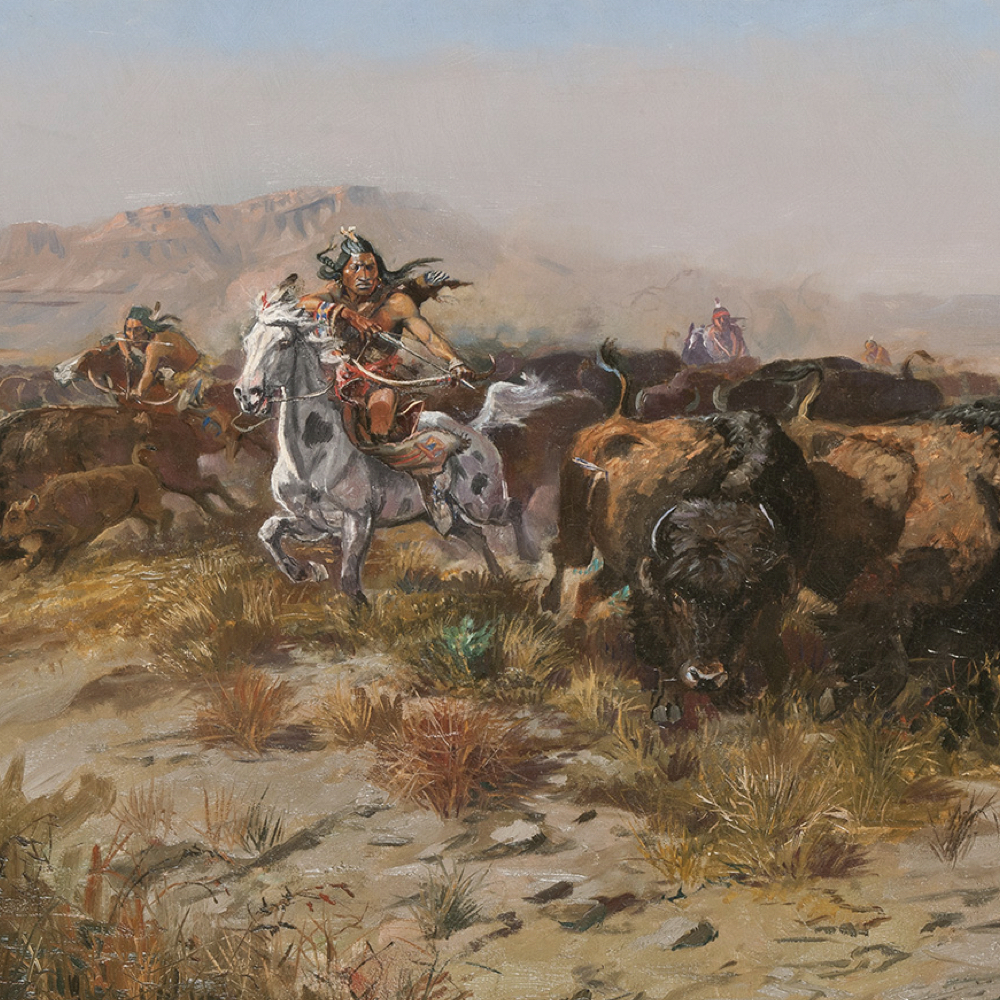 Is Man the Hunter just a myth? 05.06.2026 1h 32minThere's a story about of our past that you know well. It goes like this: At some point earlier in human evolution, we started to hunt. Men in particular—perhaps channeling some deep-seated aggressive impulses—began to seek out big game. This new food source, this bonanza of calories, was what allowed our brains to expand. It changed our bodies and our societies and sent our species off on a whole new track. In short, Man the Hunter made us human. This story—told in different versions, with different points of emphasis—has circulated for decades. It's been debunked and revived, rejected and reimagined. What is the history behind the Man the Hunter idea? How does it square with our current understandings of evolution? Is it, in fact, pure fiction? My guest today is Dr. Vivek Venkataraman. Vivek is an evolutionary anthropologist at the University of Calgary, and an editor-in-chief of the journal Hunter Gatherer Research. He and his collaborators recently published an article on the different layers and meanings of the Man the Hunter idea. Here, Vivek and I lay out those meanings. We talk about how the phrase refers, first, to that popular myth about our evolution, but also to a landmark scientific conference in the 1960s, and to a major finding of research on contemporary hunter-gatherer groups—namely, that men generally do do most of the hunting. We do a little crash-course on the field of hunter-gatherer research, including the kinds of questions it asks and frameworks it uses. We dig into some of the key ingredients of the Man the Hunter myth: the idea that we have aggressive tendencies, the idea that only men hunt, and the idea that hunting played a transformative role in our evolution. We walk through three recent, high-profile studies challenging Man the Hunter ideas in various ways. And we talk about the ever-present danger of projecting our current norms and ideals back in time. Along the way, Vivek and I touch on 2001: A Space Odyssey; reasons why contemporary hunter-gatherers may differ from the hunter-gatherers of long ago; giant sloths; extractive foraging; the case of the Agta, a society in which women do engage in big-game hunting; the forest people and the fierce people; risk and cooperation in sexual divisions of labor; persistence hunting and endurance activities; caregiving and cognition; and honey. Alright friends, I think you'll enjoy this one. On to my conversation with Dr. Vivek Venkataraman. Notes 3:30 – The article by Dr. Venkataraman and colleagues, 'The Meaning and Dividends of Man the Hunter.' Commentaries on the article can be read here. A recent popular essay by Dr. Venkataraman on the same ideas. 5:00 – Raymond Dart's "killer ape" was originally laid out in a 1953 article 'The Predatory Transition from Ape to Man' (unavailable online) and then developed in Robert Ardrey's book, African Genesis. 8:30 – The "dawn of man" scene from 2001: A Space Odyssey. 16:00 – The 1966 conference titled 'Man the Hunter' resulted in a 1968 volume of the same name. 27:00 – A philosophical discussion of the use of the "ethnographic analogy" in reconstructions of the past. The paper describing the "tyranny of the ethnographic record." 33:00 – The classic ethnography, The Forest People; the classic ethnography, Yanomamö: The Fierce People. 36:00 – The article by Chris Boehm on the concept of "reverse dominance hierarchy." See also his book Hierarchy in the Forest. 37:00 – Our earlier episode with Brian Hare. 38:00 – Steven Pinker's widely read and contested book, The Better Angels of our Nature. 44:00 – A study of the Agta, a society in which women hunt for big game. 48:00 – The paper by Judith Brown about childcare and subsistence. A paper by Haneul Jang and colleagues about how young girls help mothers during foraging. 55:00 – For a book-length treatment of hunting in evolution and history, see Matt Cartmill's A View to a Death in the Morning. 1:01:00 – For the 2023 paper by Anderson and colleagues on the prevalence of women's hunting across cultures, see here. For Dr. Venkataraman and colleagues' commentary on the paper, see here. For the related study by Dr. Venkataraman and colleagues about women's hunting, see here. 1:05:00 – For the 2020 paper by Haas and colleagues about female hunters of the Americas, see here. 1:13:00 – For the academic 'Woman the Hunter' papers by Lacy and Ocobock, see here (for the physiology paper) and here (for the archaeology paper). For their article in Scientific American, see here. For an interview on the podcast On Humans with Cara Ocobock, see here. 1:14:00 – For the recent study on persistence hunting in the ethnographic record, see here. 1:20:00 – The authors of the three critiques discussed here have all written commentaries on Dr. Venkataraman and colleagues' paper. These commentaries and others can be read here. 1:24:30 – For the commentary emphasizing the links between popularization and science, by Nadine Weidman, see here. 1:28:00 – For our earlier episode with Alison Gopnik, in which we discuss the overlooked cognitive capacities involved in caregiving, see here. 1:29:00 – For papers on the importance of honey in human evolution, see here and here. For one of Dr. Venkataraman's own honey-related studies, see here. Recommendations Creatures of Cain, by Erika Lorraine Milam The Killer Instinct, by Nadine Weidman Tile art credit: Image via Biodiversity Heritage Library Many Minds is a project of the Diverse Intelligences Summer Institute, which is made possible by a generous grant from the John Templeton Foundation to Indiana University. The show is hosted and produced by Kensy Cooperrider, with help from Assistant Producer Urte Laukaityte and with creative support from DISI Directors Erica Cartmill and Jacob Foster. Our artwork is by Ben Oldroyd. Subscribe to Many Minds on Apple, Stitcher, Spotify, Pocket Casts, Google Play, or wherever you listen to podcasts. You can also now subscribe to the Many Minds newsletter here! We welcome your comments, questions, and suggestions. Feel free to email us at: [email protected]. For updates about the show, visit our website or follow us on Bluesky (@manymindspod.bsky.social).
 -
 Babies, dogs, and the riddles of word learning 22.05.2026 1h 18minIt's kind of astonishing, really, that kids ever learn words. Each one poses a little riddle. Does this sound string refer to a person? A category of things? Or maybe some other feature of the blooming, buzzing world? And yet word learning happens. In fact, we now know it begins earlier in infancy than we realized. And we now know, further, that dogs (or at least some dogs) understand words as well. So how does this happen? What do babies and dogs really know about words? And how might we go about figuring this all out? My guests today are Dr. Elika Bergelson and Dr. Claudia Fugazza. Elika is an Associate Professor in the Department of Psychology at Harvard University, where her lab studies how infants learn language. Claudia is a Researcher at Eötvös Loránd University in Hungary, where she and her collaborators study dogs who are especially gifted word learners. In this conversation, Elika, Claudia, and I talk about the thorny question of what it means to understand a word—and whether there are different degrees or kinds of understanding. We consider the challenges posed by different types of words—by nouns, by names, by verbs, by function words, size terms, and more. We discuss why it is that some dogs are so good at learning words, and why infants of a certain age seem to get so much better at it. We talk about learning in different contexts and situations. And we circle the question of how different word learning really is in dogs and babies. Alright friends, before we get to it, one tiny ask: If you've been enjoying Many Minds, you can help us grow by leaving a review or comment or a rating, or by sharing us with a friend or colleague. We would greatly appreciate the support! Without further ado, on to my interview with Claudia Fugazza and Elika Bergelson. Enjoy! Notes 3:30 – A paper on infants' understanding of proper nouns like "Mommy." 6:00 – For our earlier audio essay on names across the animal kingdom, see here. 11:00 – For Dr. Bergelson's early study showing that 6-month-old infants already understand the meanings of some words, see here. 13:30 – For more on the "comprehension boost" in infants after age one, see Dr. Elika's paper here. 16:30 – For Dr. Fugazza and colleagues' first studies on gifted word-learning dogs, see here and here. 20:00 – See earlier studies on Rico and Chaser. 24:00 – For more on the qualitative changes that infants may undergo as they learn to learn words, see a paper by Dr. Bergelson and a colleague here. 30:00 – A study by Dr. Fugazza and colleagues comparing personality profiles and playfulness of gifted word learner dogs and typical dogs. 31:30 – A recent New York Times article consoling readers that having a "dumb" (i.e., non-gifted) dog is okay. 39:30 – A study by Dr. Fugazza and colleagues showing that dogs can extend labels of toys ("pull," "fetch") to new objects that are used in the same way. 43:00 – A study by Dr. Bergelson and a colleague on how broadly (or narrowly) infants apply labels like "foot" or "juice." A study by Dr. Bergelson and colleagues looking at how familiarity affects infants' understanding of words. 52:00 – For an example of a study on the so-called noun bias in early word learning, see here. For work on the (lack of) a noun bias in Tseltal infants, see here. For a sample discussion of the so-called shape bias, see here. 54:00 – For Dr. Fugazza and colleagues' work on dogs' biases toward shape or texture when generalizing about objects, see here. 57:00 – For the work by Asifa Majid (former guest!) on odor words in Jahai, see here. For the work on scent-tracking in humans, see here. 1:02:00 – On "dog-directed speech" and its consequences, see here and here. For comparisons of dog- and infant-directed speech, see here and here. 1:04:00 – For the study finding that Tseltal-speaking children learn honorific terms (which are never addressed to them), see here. 1:06:00 – For the study by Dr. Fugazza and colleagues, "examining exclusion-based choice" in dogs, see here. For the study by Dr. Fugazza and colleagues showing that gifted word learner dogs can learn by over-hearing labels, see here. 1:10:00 – For the study showing that children seem to request labels for objects by pointing to them, see here. 1:12:00 – For some of the first scientific studies on the use of soundboards for communication in dogs, see here and here. For our earlier episode with Dr. Federico Rossano discussing some of this research, see here. Recommendations 'The Invention of Language by Children,' by Lila Gleitman and Elissa Newport 'Concept-based word learning in human infants,' by Jun Yin and Gergely Csibra 'Syntactic bootstrapping as a mechanism for language learning,' by Mireille Babineau et al. The Genius Dog Challenge YouTube channel Tile art credit: Image by Picsea via Unsplash Many Minds is a project of the Diverse Intelligences Summer Institute, which is made possible by a generous grant from the John Templeton Foundation to Indiana University. The show is hosted and produced by Kensy Cooperrider, with help from Assistant Producer Urte Laukaityte and with creative support from DISI Directors Erica Cartmill and Jacob Foster. Our artwork is by Ben Oldroyd. Subscribe to Many Minds on Apple, Stitcher, Spotify, Pocket Casts, Google Play, or wherever you listen to podcasts. You can also now subscribe to the Many Minds newsletter here! We welcome your comments, questions, and suggestions. Feel free to email us at: [email protected]. For updates about the show, visit our website or follow us on Bluesky (@manymindspod.bsky.social).
 -
 The inner life of the hand 07.05.2026 1h 10minNewton saw in the human hand proof of the divine; Darwin saw a key to our species' success. Many others, too, have described the hand in hyperbolic terms, as a paragon of design, a cornerstone of human uniqueness, an engine of our achievements. But what makes the human hand so powerful? Is it the proportions of the fingers? Is it the opposability of the thumb? Or, could it be none of this? Could it be that the real power of our hands lies—not in the physical design—but elsewhere, out of sight? My guest today is Dr. Matt Longo. Matt is Professor of Cognitive Neuroscience at Birkbeck, University of London. He's the author of the recent book, The Invisible Hand, a wide-ranging tour of the human hand and how it's geared into the brain. Here, Matt and I talk about the difference between the "visible hand"—that is, its physical structure—and the "invisible hand"—its representation in the brain. We consider the evolution of the visible hand and whether there really is anything truly distinctive or impressive about it. We talk about the biology of touch. We tour the invisible hand, discussing how—through cortical magnification—the hand becomes over-represented in the brain's sensory maps. We catalogue a few ways that the hands can go awry. And we talk about whether we should feel any nostalgia for all the hand-based activities and crafts that we're losing. Along the way, we also touch on star-nosed moles and raccoons; tetrapods and the primitive archetype; hand dominance; the parallel between a horse's knee and a human's wrist; tool use, plasticity and abstraction; homunculi; the rubber-hand illusion; supernumerary fingers; the Third Thumb project; and the question of what it might unlock if dolphins had hands. Alright, friends, this is a fun one. On to my interview with Dr. Matt Longo! Notes 3:00 – For discussion of the many traits and behaviors that have been proposed as uniquely human, see our earlier audio essay. 5:00 – For an example of the "if only dolphins had hands" thought experiment, see here. 8:00 – See The Principles of Anatomy as Seen in the Hand by Frederic Wood Jones. 10:30 – Dr. Longo's book, The Invisible Hand, is available open access here. 16:00 – For discussion of how—in horses and other species—the five digits have been reduced or otherwise tweaked over evolution, see here. For an image showing examples of homology between the human forelimb and the forelimbs of other creatures, see here. 19:00 – For a brief discussion of "thumb opposability," see here. For an influential discussion of hand morphology and human hand grips, see work by Mary Marzke here. 30:00 – For our earlier episode on the brain's many maps, see here. 34:00 – For a discussion of Penfield's work and the idea of a "homunculus" in the brain, see here. 42:00 – For an illustration of a "homunculus" with big lips and hands, see here. 44:30 – For more on the star-nosed mole and its distinctive appendage, see here. 49:00 – For the report that first coined the term "numbsense," see here. For recent work on "anarchic hand," see here. For more on phantom limbs, see here. For a classic study of the "rubber hand illusion," see here. 59:30 – For a discussion of hand-dominance across primate species, see here. 1:03:00 – More on the "Third Thumb" project. 1:06:00 – A classic case of "motor equivalence" is seen in handwriting. Recommendations Marco Catani, 'A little man of some importance' Tracy Kivell, 'Evidence in hand: Recent discoveries and the early evolution of human manual manipulation' Hands, by John Napier Tile art credit: Image by Picsea via Unsplash Many Minds is a project of the Diverse Intelligences Summer Institute, which is made possible by a generous grant from the John Templeton Foundation to Indiana University. The show is hosted and produced by Kensy Cooperrider, with help from Assistant Producer Urte Laukaityte and with creative support from DISI Directors Erica Cartmill and Jacob Foster. Our artwork is by Ben Oldroyd. Subscribe to Many Minds on Apple, Stitcher, Spotify, Pocket Casts, Google Play, or wherever you listen to podcasts. You can also now subscribe to the Many Minds newsletter here! We welcome your comments, questions, and suggestions. Feel free to email us at: [email protected]. For updates about the show, visit our website or follow us on Bluesky (@manymindspod.bsky.social).
 -
 From the archive: The cuttlefish and its coat of many colors 22.04.2026 1h 33minHi friends! We're skipping a beat to take care of some spring housekeeping tasks. We will be back in May! In the meanwhile, enjoy this listener favorite from our archives! ----- [originally aired April 30, 2025] We humans have a hard time becoming invisible. For better or worse, we're basically stuck with the skin and body we have; we're pretty fixed in our color, our shape, our overall appearance. And so we're fascinated by creatures that aren't—creatures that morph to meet the moment, that can functionally disappear, that can shape-shift on a dime. And no creatures are more skilled, more astonishing, more bedazzling in their abilities to do this kind of thing than the cephalopods. But how do they do this exactly? What's going on in their skin? What's going on under their skin? And what's going on in their brains that makes this all possible? My guest today is Dr. Tessa Montague. Tessa is a neuroscientist in the Axel Lab at Columbia University; she studies the brain and behavior of the dwarf cuttlefish, with a special focus on the biology of their dynamic skin behaviors. Here, Tessa and I talk about how cuttlefish and other cephalopods exhibit the most impressive camouflaging abilities on the planet. We discuss how they change their skin's appearance with remarkable speed and fidelity—and not just when trying to blend in, but also when hunting, courting, fighting, and more. We talk about whether these behaviors are flexible and whether they're voluntary. We linger on the cruel irony that cuttlefish seem to be colorblind. We talk about the idea that a cephalopod's skin is kind of a window into their brain. We lay out the cells and organs in the cephalopod skin the make these behaviors possible—especially the tiny pigment-bearing structures called "chromatophores." And of course we also dive deep into the cephalopod brain and its sometimes bizarre and poorly understood structures. Excited to share it with you friends—I think you'll enjoy it. Without further ado, here's my chat with Dr. Tessa Montague. A transcript of this episode is available here. Notes and links 3:00 – For more on Dr. Montague's recent expeditions to the Philippines, including photos, see here. 7:30 – Dr. Montague has published two recent reviews of dynamic skin behaviors in cephalopods—see here and here. We previously discussed cephalopod intelligence in a 2021 episode with Dr. Alex Schnell and a 2023 episode with the novelist Ray Nayler. 18:30 – For discussion of a recent "renaissance" in new model organisms, see here. 20:30 – For more on how chameleons change color, see this video. 25:00 – A video primer on cuttlefish camouflage, featuring the researcher Dr. Robert Hanlon. 30:30 – A recent paper on the details of pattern matching in cuttlefish camouflage. 31:00 – For more on the mimicking plant Boquila trifoliolata, see this popular article. See also our earlier episode with Dr. Paco Calvo and Dr. Natalie Lawrence. 35:00 – A video about the so-called mimic octopus. 40:00 – For the hypothesis about color discrimination via chromatic aberration and pupil shape, see here. 44:00 – For more on the "split body" skin behaviors observed in some cuttlefish, see here. 51:00 – For the David Attenborough clip about a cuttlefish hypnotizing a crab, see here. For the recent New York Times article on cuttlefish hunting behavior, including videos, see here. For the academic article that inspired the New York Times piece, see here. 58:00 – A recent scientific study on the possibility of octopus skin activity during dreaming. A video that helped popularize the idea of cephalopod skin activity as evidence of dreaming. Our earlier episode on why we—and other creatures—dream. 1:06:00 – For a study on chromatophore development from the lab of Dr. Gilles Laurent, see here. 1:11:00 – For more on papillae, including videos, see here. 1:17:00 – To explore an animated model of the cuttlefish brain, see this page of Dr. Montague's website, Cuttlebase. Recommendations Monarchs of the Sea, Danna Staaf Other Minds, Peter Godfrey-Smith Cephalopod Behavior, Roger Hanlon & John B. Messenger Tile image credit: Noel Guevara Many Minds is a project of the Diverse Intelligences Summer Institute, which is made possible by a generous grant from the John Templeton Foundation to Indiana University. The show is hosted and produced by Kensy Cooperrider, with help from Assistant Producer Urte Laukaityte and with creative support from DISI Directors Erica Cartmill and Jacob Foster. Our artwork is by Ben Oldroyd. Our transcripts are created by Sarah Dopierala. Subscribe to Many Minds on Apple, Stitcher, Spotify, Pocket Casts, Google Play, or wherever you listen to podcasts. You can also now subscribe to the Many Minds newsletter here! We welcome your comments, questions, and suggestions. Feel free to email us at: [email protected]. For updates about the show, visit our website or follow us on Twitter (@ManyMindsPod) or Bluesky (@manymindspod.bsky.social).
 -
 Illuminating cave art 09.04.2026 1h 25minDeep in our past, in the dark depths of caves, our ancestors did something strange and beautiful. Working by firelight, some doodled little designs. Others made hand stencils. Some saw a bulge of rock, or a crack in the wall, and thought to turn it into a horse or a bison. Why did they make this art? What did it mean to them? Who were these artists? These questions are old—very old—but thanks to new methods and new interpretive frameworks, archaeologists are beginning to see them in a new light. My guest today is Dr. Izzy Wisher. Izzy is an archaeologist at Aarhus University in Denmark, specializing in Paleolithic art. Here, Izzy and I talk about why we in the present are so drawn to cave art. We lay out the basic timeline, geography, and categories of Paleolithic art. We consider the difference between figurative and non-figurative art, and why it might be that non-figurative art came first. We discuss hand stencils. We talk about an ongoing shift in archaeology known as the "sensory turn." We dig into some of Izzy's work on the role of pareidolia, palimpsests, and children in cave art. And we touch on an ongoing project she is involved in trying to understand the earliest symbolic marks that our species made—and what they could have been used for. Along the way we touch on the site known as El Castillo, Werner Herzog, hunting magic, why hand stencils are so often missing fingers, graffiti, tectiforms and flutings, why depictions of humans are actually quite rare in cave art, stages in children's art production, the use of virtual reality as a research method, and the idea of archaeology as world-building. I think you'll enjoy this one friends. Who among us—after all—doesn't feel drawn to these caves, to these most enigmatic of human creations? Without further ado, here's my conversation with Dr. Izzy Wisher. Notes 3:00 – For more on El Castillo cave, see here and here. 9:00 – Werner Herzog's film—Cave of Forgotten Dreams—is being briefly re-released in April 2026. 12:00 – For some of Dr. Wisher's popular writing on cave art, see here and here. 16:30 – One example of a recent rock art finding in Sulawesi. 20:30 – Our earlier episode with Dr. Eleanor Scerri and Dr. Manuel Will, in which we discuss the mostly retired idea of a "cognitive revolution" in Europe in the Upper Paleolithic. 22:00 – For more on the recently discovered rock art panel in Colombia, see this news story and this recent academic study. 25:00 – The relative rarity of humans in Paleolithic art has provoked much discussion, both among scholars and the public. 27:00 – On the idea that Venus figurines might be self-representations—made from the perspective of the artist viewing her own body—see here. 29:00 – For a recent treatment of the "missing fingers" in hand stencils, with some overview of different hypotheses, see here. For more on the idea that such stencils could constitute a system of hand-signs, see here. 34:00 – A popular article by Dr. Wisher about one example of portable art—a deer-tooth necklace with engraved designs. 36:00 – For a discussion of the earliest non-figurative art, see here. For one account of the transition from non-figurative to figurative art, including discussion of hand stencils, see here. 42:00 – A paper in which Dr. Wisher and a colleague discuss the "sensory turn" in archaeology and how her work contributes to it. 51:00 – Dr. Wisher's studies on pareidolia are here and here. 59:00 – For Dr. Wisher's study of palimpsests in cave art, see here. 1:07:00 – For an influential early study on cave marking by children, see here. For Dr. Wisher's recent study of children's art in the caves, see here. A book by Dr. John Matthews on the development of drawing in children. 1:14:00 – The website of the eSYMB project is here. An important early publication by this group is here. A recent overview of the project and its context by Dr. Wisher and colleagues. 1:18:00 – A recent paper arguing that certain systems of marks represented a "phenological calendar." Another recent paper providing evidence that certain Paleolithic marks constituted a system of conventional signs. 1:22:00 – The paper arguing that archaeology is "world-building." Recommendations Kindred, by Rebecca Wragg Sykes (former guest!) Homo sapiens rediscovered, by Paul Pettitt Tile art credit: Image courtesy of Izzy Wisher/Gobierno de Cantabria Many Minds is a project of the Diverse Intelligences Summer Institute, which is made possible by a generous grant from the John Templeton Foundation to Indiana University. The show is hosted and produced by Kensy Cooperrider, with help from Assistant Producer Urte Laukaityte and with creative support from DISI Directors Erica Cartmill and Jacob Foster. Our artwork is by Ben Oldroyd. Subscribe to Many Minds on Apple, Stitcher, Spotify, Pocket Casts, Google Play, or wherever you listen to podcasts. You can also now subscribe to the Many Minds newsletter here! We welcome your comments, questions, and suggestions. Feel free to email us at: [email protected]. For updates about the show, visit our website or follow us on Bluesky (@manymindspod.bsky.social).
 -
 What can AI teach us about the mind? 26.03.2026 1h 21minEveryone is talking about AI these days. Often these conversations are about how AI might upend education, or work, or social life, or maybe civilization itself. But among cognitive scientists and psychologists the conversation inevitably drifts toward other questions. What does this latest generation of AI tell us about the human mind? Is it putting old ideas and theories to rest? Is it ushering in new ones? Will AI—in other words—also upend cognitive science? My guests today are Dr. Mike Frank and Dr. Gary Lupyan. Mike is a Professor of Psychology at Stanford University, where his lab focuses on language learning and cognition in children. Gary is a Professor of Psychology at the University of Wisconsin–Madison, where his lab studies language and its role in augmenting human cognition. Both Gary and Mike have more recently been thinking a lot about AI and how it is challenging and deepening our understanding of the human mind. In this conversation, we talk about being interested in AI as cognitive scientists—while also being concerned about the technology as people. We discuss the linguistic abilities of frontier LLMs compared to the linguistic abilities of adult humans. We talk about a glaring "data gap" here—the fact that, even though LLMs often rival human abilities, they require orders of magnitude more data to do so. We contrast the capabilities of large language models with so-called BabyLMs. We consider the fact that, as LLMs master language, they also master other abilities—capacities for mathematical reasoning, causal understanding, possibly theory of mind, and more. And we talk about why language might be an especially potent form of input for an AI. Along the way, we touch on reference and the symbol grounding problem, the Platonic Representation Hypothesis, stimulus computability, confabulated citations, pattern matching and jabberwocky, the poverty of the stimulus argument, congenital blindness, Quine's topiary, the limits of in principle demonstrations, the WEIRD problem, and what the astonishing sophistication of disembodied AIs might suggest about the role of bodily experience in human cognition. Before we get to it, one small request: we're currently running a short survey of our listeners. You can find the link in our show notes. If you have a few minutes, we'd really love your input! Alright friends, here's my conversation with Mike Frank and Gary Lupyan. I think you'll enjoy it! Notes 5:00 – For more discussion of "stochastic parrots" and other ways of framing AI systems, see our recent episode with Melanie Mitchell. For the "octopus test," see here. 8:00 – "BabyLMs" are—in contrast to large LMs (aka LLMs)—models that are trained on a more human-scale amount of linguistic input. For more on the BabyLM community, see here. 12:00 – For broad discussion of the use of AIs as "cognitive models," see this paper by Dr. Frank and a colleague. The same paper discusses the idea of "stimulus computability." 18:00 – For Dr. Frank's "baby steps" paper, see here. 20:00 – For more on how Claude understands line breaks, see Anthropic's analysis of the issue here. 23:00 – For work on human-like grammaticality judgments in LLMs, see this paper by a team including Dr. Lupyan. 24:00 – See here for an influential paper on, among other things, how LLMs refute the idea that syntax is unlearnable. The article titled 'How linguistics learned to stop worrying and love the language models' is here; Dr. Lupyan's commentary—'Large language models have learned to use language'—here. 29:00 – For some of Dr. Lupyan's work on the "abstractness" of even concrete concepts, see here. 35:00 – For a classic paper on the so-called symbol grounding problem, see here. 37:00 – For the preprint putting forth the "Platonic Representation Hypothesis," see here. 40:30 – For more on the data gap between children and LLMs—and what accounts for it—see Dr. Frank's paper here. 45:00 – For a sampling of Dr. Frank and colleagues' work comparing language models to children, see here, here, and here. For more on the LEVANTE project, a collaborative effort spearheaded by Dr. Frank, see here. 48:00 – For the preprint—"The Unreasonable Effectiveness of Pattern Matching," by Dr. Lupyan and a colleague—see here. 55:00 – For more on Dr. Lupyan's perspective on the centrality of language in human cognition, see here. See also this more recent paper, considering the question in light of LLMs. 58:00 – For our earlier episode with Dr. Marina Bedny, see here. For the recent paper by Dr. Bedny and colleagues considering their research on congenital blindness in light of LLMs, see here. 1:01:00 – For classic work on language learning in blind children, see here. 1:02:00 – For a paper by Dr. Lupyan and colleagues on "hidden" individual differences, see here. 1:03:00 – For more on "multiple realizability," see here. For our earlier episode with Dr. Eric Turkheimer, see here. 1:09:00 – For more on the work of Dr. Frank's collaborator, Dan Yamins, see here. 1:14:00 – See our earlier episode with Dr. M.J. Crockett for more discussion of the "WEIRD problem" around scientific uses of AI. In the same episode, we discussed how new scientific methods focus attention on questions that can be studied with those methods. Recommendations A Mind at Play, by Jimmy Soni & Rob Goodman On Desire, by William Irvine Patterns, thinking, and cognition, by Howard Margolis Open Encyclopedia of Cognitive Science The BabyLM workshops/community (e.g., the entry on LLMs) Tile art image: Getty Images via Unsplash Many Minds is a project of the Diverse Intelligences Summer Institute, which is made possible by a generous grant from the John Templeton Foundation to Indiana University. The show is hosted and produced by Kensy Cooperrider, with help from Assistant Producer Urte Laukaityte and with creative support from DISI Directors Erica Cartmill and Jacob Foster. Our artwork is by Ben Oldroyd. Subscribe to Many Minds on Apple, Stitcher, Spotify, Pocket Casts, Google Play, or wherever you listen to podcasts. You can also now subscribe to the Many Minds newsletter here! We welcome your comments, questions, and suggestions. Feel free to email us at: [email protected]. For updates about the show, visit our website or follow us on Bluesky (@manymindspod.bsky.social).
 -
 Mutualisms all the way down 11.03.2026 1h 8minNo one is an island. We all depend on each other in critical, often tangled ways. And when I say "we" and "each other" I don't just mean humans. Yes, we humans rely on other humans. But we also rely on bees, yeasts, dogs, bacteria, and countless other creatures big and small. These interspecies dependencies—or mutualisms, as biologists call them—have deflected and inflected our history. And there's no doubt they will also inflect our future. My guest today is Dr. Rob Dunn. Rob is Professor of Applied Ecology at North Carolina State University, where he studies the creatures and ecologies all around us—in our homes, in our foods, in our belly buttons. He's the author of eight books, including, most recently, The Call of the Honeyguide: What Science Tells Us about How to Live Well with the Rest of Life. This book is the focus of our conversation today. Rob and I talk about the idea of mutualism—in which two or more species benefit each other—and how human life is sustained by mutualisms all the way down. We consider how the benefits of mutualism are measured—whether in terms of biological fitness, or longevity, or pleasure. We talk about the best-documented cases of humans collaborating with other species to find honey or hunt fish. We consider how our liaisons with yeasts have shaped human history—and how we might even say that yeasts domesticated us. We linger on our relationships with dogs and cats and the benefits we get from them, some obvious and some less so. Finally, we talk about what it would mean to more fully embrace our mutualisms, what it would mean to create what Rob calls "a less lonely future." Along the way, Rob and I talk about cheese, worms, and maggots; bread, beer, and honey; face mites and armpits; parasites, inquilines, and commensals; what sauerkraut does to our immune systems; honeyguides and dolphins, leopards and house cats; morbid curiosity; and how dogs might give us a kind of access to our subconscious. This is a fun one folks. But, before we get to it, a couple of announcements. First: Applications are now open for the 2026 Diverse Intelligences Summer Institute. This is a three-week intensive, transdisciplinary exploration of the different forms of mind and intelligence that animate our world. If you like the themes we talk about on this show, you would almost certainly get a kick out of DISI. More info at www.disi.org. That's d-i-s-i. org. Review of applications begins pretty soon, so don't dither! Second: We have just put out our first ever Many Minds audience survey! Whether you're a longtime superfan or just an occasional listener, we would love to hear from you. Your input will help guide the show as we consider our next chapter. Alright, friends—without further ado, on to my conversation with Rob Dunn. Enjoy! Notes 4:00 – For the fuller story of Menocchio, see The Cheese and the Worms, by Carlo Ginzburg. 7:00 – Dr. Dunn's lab has been involved in public-facing projects about fermented foods—see here for a series of webinars. 10:00 – The Sardinian cheese we discuss is called casu martzu. 14:00 – A study by Dr. Dunn and colleagues about human face mites. This is not the only aspect of bodily geography he and colleagues have examined: see also this study of the organisms in our belly buttons. 18:30 – For a primer on honeyguide birds, see here. 21:30 – For more on the calls humans use to communicate with honeyguides, see here. 24:30 – For more on human-dolphin collaborative hunting, see this recent study. 27:30 – For more about the theologian Aminah Al-Attas Bradford, a researcher in Dr. Dunn's lab, see here. 33:00 – We also discussed fermentation at length in an earlier episode here. 35:00 – A study by Dr. Dunn and colleagues on the microbial composition of sourdough starters. 37:00 – For more on our—and other animals'—relationships with alcohol, see our earlier episode. 40:00 – A study by Dr. Dunn and colleagues on the evolution of sour taste in humans. 42:00 – For more on the domestication of chickens, see here. 49:00 – For more on the concept of "morbid curiosity," see here. 55:00 – For more on our armpits—and the bacterial communities we harbor therein—see this study by Dr. Dunn and colleagues. 1:04:00 – The study by Dr. Dunn and colleagues about the spiders in people's homes. The spider poem by Kobayashi Issa. Recommendations An Immense World and I Contain Multitudes, by Ed Yong (former guest!) Stories by Anton Chekhov Poems by Kobayashi Issa Tile art image: Image by Robert Bye via Unsplash Many Minds is a project of the Diverse Intelligences Summer Institute, which is made possible by a generous grant from the John Templeton Foundation to Indiana University. The show is hosted and produced by Kensy Cooperrider, with help from Assistant Producer Urte Laukaityte and with creative support from DISI Directors Erica Cartmill and Jacob Foster. Our artwork is by Ben Oldroyd. Subscribe to Many Minds on Apple, Stitcher, Spotify, Pocket Casts, Google Play, or wherever you listen to podcasts. You can also now subscribe to the Many Minds newsletter here! We welcome your comments, questions, and suggestions. Feel free to email us at: [email protected]. For updates about the show, visit our website or follow us on Bluesky (@manymindspod.bsky.social).
 -
 Seven metaphors for AI 26.02.2026 55minIf you wanted a petri dish for understanding metaphors—how they emerge and evolve and jostle with each other—it would be hard to do better than the world of AI. We talk about AI systems variously as coaches or co-pilots, little genies or alien intelligences. Some researchers claim that AIs "grow," that they're entering their phase of "adolescence." Critics deride AI products as slop and dismiss LLMs as a kind of autocomplete on steroids. What's behind these different characterizations? Which ones are accurate and which are unfair? And are our metaphors mostly colorful rhetoric or do they matter? Are they shaping how we understand, adopt, and ultimately regulate these new technologies? My guest today is Dr. Melanie Mitchell. Melanie is a computer scientist and Professor at the Santa Fe Institute. She is the author of the book, AI: A Guide for Thinking Humans, and she writes a Substack by the same name. This episode is a bit of a companion to our recent episode with Steve Flusberg. In that episode, Steve and I attempted a kind of crash course on metaphor and the human mind. Here, Melanie and I sit down for more of an extended case study: how metaphors are guiding, galvanizing, and maybe deceiving us in the contested realm of AI discourse. We unpack seven of the most widely used metaphors in this space. We consider how these metaphors are shaping not only our everyday understandings of AI, but also law and policy. We also talk about the metaphor and analogy capabilities of AI itself. Can these systems reason abstractly in the way that humans can? Along the way, Melanie and I touch on: AI-generated poetry, anthropomorphism, the original sin of AI research, the myth of Narcissus, psychometric testing and its pitfalls, metaphors for AI that are a bit hard to spot, and the question of whether an AI has ever come up with a decent analogy for itself. Longtime fans of the show will know that we've had Melanie on the show once before. We invited her back, not only because she's thought about metaphor and analogy in AI discourse for decades, but because she's a voice of calm insight in an area that's increasingly awash in hype and polemic. Longtime fans of the show may also note that we are now celebrating our 6th birthday at Many Minds. That's right, the show launched in February 2020. If you'd like to support us as we recognize this milestone, you can leave us a rating or a review, recommend us to a friend, or give us a shout out on social media. Your support is always appreciated. Without further ado, on to my conversation with Dr. Melanie Mitchell. Enjoy! Notes 3:30 – For an overview of Douglas Hofstadter's work on analogy, see here. 8:00 – Much of our discussion in this interview draws on Dr. Mitchell's piece on the metaphors for AI in Science magazine. 13:30 – For earlier discussions of anthropomorphism on the show, see our earlier episodes here and here. 16:00 – See here for the original discussion of LLMs as "stochastic parrots." 17:00 – See here for the original discussion of ChatGPT as a "blurry jpeg." 18:30 – See here for the original discussion of LLMs as role players. 22:00 – See here for one use of the "LLMs as crowds" metaphor. See also a discussion of this metaphor (and other metaphors for AI) here. 25:00 – For one discussion of AI as a "cultural technology" by Alison Gopnik and colleagues, see here. For a more recent discussion of the same metaphor by Henry Farrell, Alison Gopnik and others, see here. 27:00 – For the podcast series on intelligence that Dr. Mitchell co-hosted for the Santa Fe Institute, see here. 28:00 – See here for an influential formulation of the idea that AI is an "alien intelligence." 29:00 – For philosopher Shannon Vallor's book about AI as "mirror," see here. 31:00 – For the recent study on users' metaphors for AI systems, see here. 33:00 – For more on the rise of social AI, see our earlier episode here. 38:00 – For more on what AI researchers might learn from developmental and comparative psychologists, see Dr. Mitchell's recent post (summarizing her keynote at NeurIPs). 42:00 – For more on the ARC (Abstraction and Reasoning Corpus) and the research that Dr. Mitchell and colleagues have been doing with it, see here and here. 48:30 – For the study on humans' preference for AI-generated poetry, see here. 50:30 – For Brigitte Nerlich's documentation and discussion of various metaphors for AI (including AI's metaphors for itself), see here. Recommendations The AI Mirror, by Shannon Vallor 'Role play with large language models,' by Murray Shanahan (former guest!) et al. 'Large AI models are cultural and social technologies,' by Henry Farrell et al. Tile image credit: Image by Paul Bill via Unsplash Many Minds is a project of the Diverse Intelligences Summer Institute, which is made possible by a generous grant from the John Templeton Foundation to Indiana University. The show is hosted and produced by Kensy Cooperrider, with help from Assistant Producer Urte Laukaityte and with creative support from DISI Directors Erica Cartmill and Jacob Foster. Our artwork is by Ben Oldroyd. Subscribe to Many Minds on Apple, Stitcher, Spotify, Pocket Casts, Google Play, or wherever you listen to podcasts. You can also now subscribe to the Many Minds newsletter here! We welcome your comments, questions, and suggestions. Feel free to email us at: [email protected]. For updates about the show, visit our website or follow us on Bluesky (@manymindspod.bsky.social).
 -
 Origins of the kiss 12.02.2026 1h 1minHumans do some pretty weird things. Some of us will sit in searingly hot rooms or jump into icy ponds. Others risk their lives trying to climb to new heights or dive to new depths. And every once in a while, two otherwise normal-seeming humans will lean in close to each other, open mouths, lock lips, and swap a hearty helping of microbes. You may even know people who've done this. But why? Are we the only animals who kiss? What could be the deeper origins of this truly bizarre behavior? My guest today is Dr. Matilda Brindle. Matilda is an Evolutionary Biologist at the University of Oxford. She's interested in understanding the origins of behaviors and traits across the animal kingdom. But it's not just any traits she's interested in—she tends to favor those that are a bit risque. Here, Matilda and I talk about the puzzle at the heart of human kissing behavior. We discuss the possible adaptive functions of kissing—and of romantic kissing in particular. We walk through her recent paper in which—drawing on observations across primates species—she and her colleagues reconstructed the phylogeny of kissing behavior. They found that kissing is present in almost all the Great Apes—and also in several species of monkeys—and that it may go back around 20 million years. We sketch different proposals for how kissing may have evolved, such as the idea that it originally grew out of "premastication"—the practice of chewing up food for infants and transferring that food by mouth. And, of course, we consider the cultural side of kissing—and how to make sense of the fact that, despite these ancient roots in the primate lineage, romantic kissing is by no means universal to all human groups. Hope you enjoy this one, friends—offered in spirit of Valentine's Day, of course. Kissing may seem like a light-hearted or frivolous topic, but—as I hope you'll appreciate—it opens up some big, thorny, compelling questions. And, in fact, it's finally attracting serious attention from scholars of all kinds interested in the different dimensions of social behavior. Without further ado, here's my interview with Dr. Matilda Brindle. Notes 3:00 – Dr. Brindle's paper, 'A comparative approach to the phylogeny of kissing,' coauthored with Dr. Catherine Talbot and Dr. Stuart West. 10:00 – An academic review of "postcopulatory sexual selection." 15:45 – The study examining the convergence of oral microbiota in kissing couples. The same study quantified the amount of microbial transfer during kissing. 18:00 – For more on the "grass-in-ear" phenomenon among chimpanzees and other such arbitrary-seeming animal behaviors, see our earlier episode about animal cultures. For the more recent "grass-in-bum" phenomenon, see here. 21:30 – For Dr. Brindle's work on the adaptive functions of masturbation in primates, see here. 32:00 – For popular coverage of Dr. Brindle's work, highlighting the likelihood that humans and Neanderthals kissed, see here. 39:00 – The book, Biological Exuberance, by Bruce Bagemihl. 43:00 – For the study on the presence of romantic kissing across cultures, see here. 47:00 – For indirect (linguistic) evidence for the prevalence of "smell-kissing" across Southeast Asia, see here. For more on this style of greeting, see Kensy's post here. 50:00 – For the proposal that kissing is rooted in "oral grooming," see here. 58:00 – For the larger special issue on the origins of kissing, of which Dr. Brindle's paper is part, see here. 1:00:30 – For Dr. Brindle's work on "bacula" (aka "penis bones"), see here. Recommendations The Handshake, by Ella Al-Shamahi Eve, by Cat Bohannon Primate Sexuality, by Alan Dixson Tile image credit: Image by Brocken Inaglory via Wikimieda Commons (CC BY-SA 3.0) Many Minds is a project of the Diverse Intelligences Summer Institute, which is made possible by a generous grant from the John Templeton Foundation to Indiana University. The show is hosted and produced by Kensy Cooperrider, with help from Assistant Producer Urte Laukaityte and with creative support from DISI Directors Erica Cartmill and Jacob Foster. Our artwork is by Ben Oldroyd. Subscribe to Many Minds on Apple, Stitcher, Spotify, Pocket Casts, Google Play, or wherever you listen to podcasts. You can also now subscribe to the Many Minds newsletter here! We welcome your comments, questions, and suggestions. Feel free to email us at: [email protected]. For updates about the show, visit our website or follow us on Bluesky (@manymindspod.bsky.social).
 -
 The aura of metaphor 29.01.2026 1h 36minMetaphors matter. They enliven our speech and our prose; they animate our arguments and stir our passions. Some metaphors power political movements; others propel scientific revolutions. These little figures of speech delight, provoke, captivate, shock, amuse, and galvanize us. In one way or another, metaphors just seem to help us make sense of a messy world. But how do they do all this? Whence their peculiar powers? What does it say about the human mind that we just can't escape our metaphors—and frankly don't want to? My guest today is Dr. Stephen Flusberg. Steve is an Assistant Professor of Cognitive Science at Vassar College, where he directs the Framing, Reasoning, And Metaphor (FRAME) Lab. Here, Steve and I talk about what metaphors are and why we're so drawn to them. We discuss some of the misleading ideas about metaphor you may remember from middle school literature class. We consider why some metaphors work and others flop. We talk about the metaphors we use for climate change and prevalence and potency of war metaphors across different realms of public discourse. We consider how metaphor operates in science and in scientific theorizing. Finally, we talk about the question of whether there are some ideas that we simply can't grasp literally, concepts we can only approach through metaphor. Along the way, Steve and I talk about: "aura farming"; nautical metaphors and textile metaphors; the outmoded idea that metaphors are mere adornments; metaphor versus analogy; dead metaphors and how to resuscitate them; shadows and footprints; Dan Dennett's technique of metaphorical triangulation; and the brain-as-computer metaphor—and whether it is actually a metaphor. Alright, friends this is a fun one. Steve has spent his entire career exploring this fascinating terrain—and, as you'll see, he's a lively and affable guide. Hope you enjoy it as much as I did. Without further ado, here's my conversation with Dr. Steve Flusberg. Notes 3:00 – For more on "beige flags," see here. For more on "aura farming," see here. 8:00 – For an overview of metaphor in communication and thought, see here for an article by Dr. Flusberg and co-authors. 18:00 – The "life is a journey" (or "career is a journey") metaphor—as well as other examples we discuss—are treated at length in the classic book, Metaphors We Live By. 24:00 – For a detailed academic treatment of the relationship between metaphor and analogy, see here. 32:00 – Some of the best-studied "orientational metaphors" are those found in the domain of time. See here and here. 37:00 – For more on metaphors used in discussions of environmental issues, see a paper by Dr. Flusberg and a colleague here. 42:00 – For more on the idea of the "climate shadow," see here. 46:00 – The study by Dr. Flusberg and colleagues comparing the effects of race and war metaphors for climate change. 55:00 – The article by Dr. Flusberg and colleagues on the role of war metaphors across different areas of public discourse. 1:04:00 – For an influential discussion of the role of metaphors and analogies in science, see here. For Kensy's take on Darwin's metaphors for natural selection, see here. For discussion of whether the "brain-as-computer" metaphor is actually a metaphor, see here and here. 1:12:00 – For more on the history of metaphors in the English language—including analyses of which source domains have historically been the most fruitful—see here. 1:14:00 – For discussion of the (disputed) idea of "dead metaphors," see here and here. 1:17:00 – The idea of "theory-constitutive metaphors" in science is discussed in a chapter by Richard Boyd in this book. 1:19:00 – For a preview of Dr. Flusberg's in-progress paper on the philosopher Daniel Dennett and his technique of "metaphorical triangulation," see here. 1:33:00 – For the (extremely short) Borges' story on maps that are too accurate to be useful, see here. Recommendations Metaphors We Live By, by George Lakoff & Mark Johnson Consciousness Explained, by Daniel Dennett Three Sheets to the Wind, by Cynthia Barrett Tile image credit: Image by J.W. Williams via the David Rumsey Map Collection Many Minds is a project of the Diverse Intelligences Summer Institute, which is made possible by a generous grant from the John Templeton Foundation to Indiana University. The show is hosted and produced by Kensy Cooperrider, with help from Assistant Producer Urte Laukaityte and with creative support from DISI Directors Erica Cartmill and Jacob Foster. Our artwork is by Ben Oldroyd. Subscribe to Many Minds on Apple, Stitcher, Spotify, Pocket Casts, Google Play, or wherever you listen to podcasts. You can also now subscribe to the Many Minds newsletter here! We welcome your comments, questions, and suggestions. Feel free to email us at: [email protected]. For updates about the show, visit our website or follow us on Bluesky (@manymindspod.bsky.social).
 -
 From the archive: How should we think about IQ? 14.01.2026 1h 33minHello friends, and happy new year! We're gearing up for a new run of episodes starting later in January. In the meanwhile, enjoy this pick from our archives. ------ [originally aired October 16, 2024] IQ is, to say the least, a fraught concept. Psychologists have studied IQ—or g for "general cognitive ability"—maybe more than any other psychological construct. And they've learned some interesting things about it. That it's remarkably stable over the lifespan. That it really is general: people who ace one test of intellectual ability tend to ace others. And that IQs have risen markedly over the last century. At the same time, IQ seems to be met with increasing squeamishness, if not outright disdain, in many circles. It's often seen as crude, misguided, reductive—maybe a whole lot worse. There's no question, after all, that IQ has been misused—that it still gets misused—for all kinds of racist, classist, colonialist purposes. As if this wasn't all thorny enough, the study of IQ is also intimately bound up with the study of genetics. It's right there in the roiling center of debates about how genes and environment make us who we are. So, yeah, what to make of all this? How should we be thinking about IQ? My guest today is Dr. Eric Turkheimer. Eric is Professor of Psychology at the University of Virginia. He has studied intelligence and many other complex human traits for decades, and he's a major figure in the field of "behavior genetics." Eric also has a new book out this fall—which I highly recommend—titled Understanding the Nature-Nurture Debate. In a field that has sometimes been accused of rampant optimism, Eric is—as you'll hear—a bit more measured. In this conversation, Eric and I focus on intelligence and its putatively genetic basis. We talk about why Eric doubts that we are anywhere close to an account of the biology of IQ. We discuss what makes intelligence such a formidable construct in psychology and why essentialist understandings of it are so intuitive. We talk about Francis Galton and the long shadow he's cast on the study of human behavior. We discuss the classic era of Twin Studies—an era in which researchers started to derive quantitative estimates of the heritability of complex traits. We talk about how the main takeaway from that era was that genes are quite important indeed, and about how more recent genetic techniques suggest that takeaway may have been a bit simplistic. Along the way, Eric and I touch on spelling ability, child prodigies, the chemical composition of money, the shared quirks of twins reared apart, the Flynn Effect, the Reverse Flynn Effect, birth order, the genetics of height, the problem of missing heritability, whether we should still be using IQ scores, and the role of behavior genetics in the broader social sciences. Alright folks, lots in here—let's just get to it. On to my conversation with Dr. Eric Turkheimer. Enjoy! A transcript of this episode is available here. Notes and links 3:30 – The 1994 book The Bell Curve, by Richard Herrnstein a Charles Murray, dealt largely with the putative social implications of IQ research. It was extremely controversial and widely discussed. For an overview of the book and controversy, see the Wikipedia article here. 6:00 – For discussion of the "all parents are environmentalists…" quip, see here. 12:00 – The notion of "multiple intelligences" was popularized by the psychologist Howard Gardner—see here for an overview. See here for an attempt to test the claims of the "multiple intelligences" framework using some of the methods of traditional IQ research. For work on EQ (or Emotional Intelligence) see here. 19:00 – Dr. Turkheimer has also laid out his spelling test analogy in a Substack post. 22:30 – Dr. Turkheimer's 1998 paper, "Heritability and Biological Explanation." 24:30 – For an in-passing treatment of the processing efficiency idea, see p. 195 of Daniel Nettle's book Personality. See also Richard Haier's book, The Neuroscience of Intelligence. 26:00 – The original study on the relationship between pupil size and intelligence. A more recent study that fails to replicate those findings. 31:00 – For an argument that child prodigies constitute an argument for "nature," see here. For a memorable narrative account of one child prodigy, see here. 32:00 – A meta-analysis of the Flynn effect. We have previously discussed the Flynn Effect in an episode with Michael Muthukrishna. 37:00 – James Flynn's book, What is Intelligence? On the reversal of the Flynn Effect, see here. 40:00 – The phrase "nature-nurture" originally comes from Shakespeare and was picked up by Francis Galton. In The Tempest, Prospero describes Caliban as "a born devil on whose nature/ Nurture can never stick." 41:00 – For a biography of Galton, see here. For an article-length account of Galton's role in the birth of eugenics, see here. 50:00 – For an account of R.A. Fisher's 1918 paper and its continuing influence, see here. 55:00 – See Dr. Turkheimer's paper on the "nonshared environment"—E in the ACE model. 57:00 – A study coming out of the Minnesota Study of Twins reared apart. A New York Times article recounting some of the interesting anecdata in the Minnesota Study. 1:00:00 – See Dr. Turkheimer's 2000 paper on the "three laws of behavior genetics." Note that this is not, in fact, Dr. Turkheimer's most cited paper (though it is very well cited). 1:03:00 – For another view of the state of behavior genetics in the postgenomic era, see here. 1:11:00 – For Dr. Turkheimer's work on poverty, heritability, and IQ, see here. 1:13:00 – A recent large-scale analysis of birth order effects on personality. 1:16:00 – For Dr. Turkheimer's take on the missing heritability problem, see here and here. 1:19:00 – A recent study on the missing heritability problem in the case of height. 1:30:00 – On the dark side of IQ, see Chapter 9 of Dr. Turkheimer's book. See also Radiolab's series on g. 1:31:00 – See Dr. Turkheimer's Substack, The Gloomy Prospect. Recommendations The Genetic Lottery, Kathryn Paige Harden Intelligence, Stuart Ritchie Intelligence and How to Get It, Richard Nisbett "Why our IQ levels are higher than our grandparents'' (Ted talk), James Flynn Tile image credit: Image by Martin Schweig courtesty of Harvard Art Museums/Fogg Museum (https://hvrd.art/o/132686) Many Minds is a project of the Diverse Intelligences Summer Institute, which is made possible by a generous grant from the John Templeton Foundation to Indiana University. The show is hosted and produced by Kensy Cooperrider, with help from Assistant Producer Urte Laukaityte and with creative support from DISI Directors Erica Cartmill and Jacob Foster. Our artwork is by Ben Oldroyd. Our transcripts are created by Sarah Dopierala. Subscribe to Many Minds on Apple, Stitcher, Spotify, Pocket Casts, Google Play, or wherever you listen to podcasts. You can also now subscribe to the Many Minds newsletter here! We welcome your comments, questions, and suggestions. Feel free to email us at: [email protected]. For updates about the show, visit our website or follow us on Twitter (@ManyMindsPod) or Bluesky (@manymindspod.bsky.social).
 -
 From 'On Humans': Can the brain understand itself? 31.12.2025 1h 1minHello there, friends! We hope you're having a restful holiday, or a lively holiday, or whatever mix of those you prefer. As the year draws to a close, we at Many Minds are taking a much needed pause ourselves. But we wanted to share with you an episode from a podcast that we've been following for some time called On Humans. It's hosted by Ilari Mäkelä. It looks at humanity from all angles to understand where we come from and where we're going. The episode we're sharing features an interview with biologist and historian of science, Matthew Cobb; he's also the author of the book, The Idea of the Brain: The Past and Future of Neuroscience. In it, Ilari and Matthew take a zoomed-out view of the human brain and of our quest to understand it. This episode is actually part of a 5-part mini-series that On Humans did all about the human brain. So if you enjoy it, you may want to check out that broader series. Alright friends, have a great close of 2025 and a great start to 2026. We'll see you in January with our first episode of the new year. In the meanwhile, enjoy this offering from our friends at On Humans. The original show notes for this On Humans episode can be viewed here. You can follow the On Humans podcast through their newsletter or on Bluesky.
Slični podcasti


Popularan u
Ovaj podcast se pojavljuje i u podcast listama ovih zemalja.
