
Buddhist Geeks
Vince Fakhoury Horn
0
Buddhist Geeks explores the evolution of Dharma in the age of networks, blending traditional Buddhist teachings with modern technology and culture. Hosted by Vince Fakhoury Horn, the podcast features interviews with teachers, practitioners, and innovators who are reimagining Buddhism for the 21st century. Topics range from meditation and mindfulness to digital spirituality and community building. The show aims to make Buddhist concepts accessible and relevant to contemporary life.
Epizode
-
 The Insight Chord 30.09.2026 13minVince Fakhoury Horn describes the insight meditation tradition as a chord in which concentration, mindfulness and heartfulness sound together, with concentration giving mindfulness its depth and heartfulness keeping the whole enterprise from turning dry and frightening.My teaching colleagues & I are leading a 10-day meditation retreat focusing on The Insight Chord. We’d love to see you there!💬 TranscriptVince Horn: Practically speaking, we’ve been focused on kind of three different forms of practice over our time together.We started with concentration practice, which is related to the training in concentration. We talked about mindfulness practice, which is often associated with the training in wisdom. And then last week we started to get into the heartfulness-style practice, or metta practice as it’s known in the early Buddhist tradition. Or brahmavihāra practice, another term that’s used to describe some of the heart qualities that early Buddhism is really interested in cultivating, developing. And you could say for sure that you can get into concentration states with heartfulness.And they also can be very helpful in terms of the first training of morality and ethics. They can come in very handy there, as in all the meditation practices.I remember when I was on a two-month retreat with Emily at Spirit Rock, someone asked during one of the Q&As with Jack Kornfield, they said, “I’ve heard that metta practice, heartfulness practice, is a relative practice, that you can’t actually get to the absolute, the universal goal of emptiness through metta, that you have to do vipassanā. Is that true?” To which Jack responded something like, “If you can’t awaken through the heart, I don’t know how else you can do it.”“If you can’t awaken through love, what are we even talking about?” And I thought that was a nice response, because it challenged that notion in the early Buddhist tradition — it does creep up, actually, a lot — that heartfulness is a relative practice. Well, maybe not. Maybe it could actually lead to ultimate wisdom. Or maybe it is an expression of ultimate wisdom. That’s my view.So we’ve looked at these three forms of practice, all of which are, in the broader sense, meditation practice, but they all connect to these three trainings, and are useful and skillful things to do.So I want to explore how these three come together. It’s something that I noticed as Emily and I started to come up with this framework of the different ways to meditate, to try to describe our own experience. I noticed that when I looked back at my training in the early Buddhist tradition, these three forms of practice were the ones that predominated. I didn’t really experience a tremendous amount of focus on inquiry practice in the early tradition. It does pop up from time to time. You do get an occasional question or occasional inquiry. You might find some Theravada teachers that have an interest in that, but it’s not predominant. Nor is the sort of awareness-style practice that you then find in a more mature form later in the Tibetan Buddhist tradition, in Mahāmudrā, or in Zen and Shikantaza, or Dzogchen — these practices where you’re just being, there’s no technique, no form, just awareness. Again, you can find examples of it in early Buddhism for sure, but it just doesn’t seem to be emphasized in the same way. Likewise with embodiment practices, there’s just not a whole lot of emphasis on inhabiting or being in the body. More about mindfulness of the body—like the body’s an object that you’re being mindful of, rather than something that you’re learning to inhabit the mystery of. And so for me, these three—and likewise with the imaginal practice too—it’s these other styles of meditation that we’ve touched on that just don’t seem to be as predominant as concentration, mindfulness, and heartfulness. And so I started thinking of that. It’s, in a way, what makes the insight meditation tradition—which comes out of the early Buddhist tradition, is in a way like a modern lineage of that, which is also a little confusing, because it’s not completely that, because it’s also interfacing with all these other traditions and teachers and has incorporated elements from them. So in that sense it’s more like really a fourth-turning tradition. But nonetheless, if we take the emphasis to be on these three, then we have a kind of—you could imagine, from a musical perspective, thinking of this as like a chord.If you’ve ever played a guitar, you know that you have a few different notes that you strum together at once. Those can, in certain circumstances, work together to form what’s called a chord. That chord is a harmony of different things that come together to form something more than the sum of their parts.And this is in some ways how I think about traditions: that they’ve hit on these really interesting combinations of different ideas and practices to form something that’s very unique and seems to be pretty anti-fragile. It can continue delivering value and being useful over time for many people. So they hit on something deep here.Likewise, if you think about food, I think this is another way it’s obvious. You think about cuisine, and you think about the kind of traditions of cuisine that emerge in different areas. Think about Thai cuisine or French cuisine or whatever type of cuisine you like. There are certain ingredients that are endemic to those areas where the cuisine developed. And over many hundreds, thousands of years, these ingredients were cultivated, combined, experimented with, until certain kinds of combinations, flavor combinations, start to emerge as being particularly powerful. Why is it that every Thai dish I learn how to cook, it all calls for curry and it calls for fish sauce? There’s certain things that you just tend to find. These ingredients end up working together in harmony, balancing each other, providing different elements. I think here too with the early Buddhist tradition, we’ve got these kind of ingredients, these basic meditation ingredients, that come together to form something more.It’s like something that’s so good that we want to pass it on, and we don’t want to see it die, because it really works. And the insight chord—one thing I’ll point out about this is, if you look at each of these forms of practice, all of them can be seen from, and are often seen from, a gradual cultivation point of view. Like, we gradually cultivate our concentration and develop our concentration. We develop our mindfulness, cultivate mindfulness; we develop our heartfulness, we cultivate heartfulness. All of these practices in the insight chord are really usually held in that way, that this is a gradual practice. This is something we’re gonna cultivate gradually over time, sometimes step by step or stage by stage. And so one of the unique things about the insight chord is that it’s a gradual progression. You could say it’s a progressive tradition, in that it’s interested in, focused on progress, on the progress of meditation, development, cultivation of these qualities.Another thing to say about the insight chord, I think, is the non-duality of mind and heart. You could say there’s an emphasis on both mindfulness and heartfulness together. And if you look back at the term citta, the way that it’s often translated as “mind” in Western cultures, because we like minds so much—but often people will have to correct that translation, as actually it means something like mind and heart. It’s understood traditionally more broadly than that. And in the early Buddhist tradition—yeah, heart and mind—these ideas, these notions weren’t so different from each other. There wasn’t such a sharp and clean distinction drawn between them. So the citta is not something that we would think of as just existing up here in the head or being associated with the brain, but rather citta is something that is more inclusive than that.The other thing I’d say about the insight chord is that concentration practice, because that’s part of the chord—when you are deepening your concentration practice, if you’re exploring jhānas, for instance, or cultivating really deep samādhi and stillness, that can then be brought back into the other notes, into mindfulness practice, into heartfulness practice. And that’s, I think, a unique characteristic of this tradition that focuses on really concentrated mindfulness and concentrated heartfulness. It’s heavy-duty, industrial-strength mindfulness & heartfulness. There’s some deep kind of recognition about the value of concentration, or of samādhi, as a kind of preliminary or preparatory practice. That without cultivating that, we can have insights and we can cultivate these different qualities of heart, but in a way, the understanding is we’re doing it at a kind of shallow level. And so if you want to really go deep, concentration is the part of the chord that allows the depth factor to really shine through.That’s why there’s such an emphasis in the early Buddhist tradition on monasticism, and in modern times on retreat practice. This emphasis on depth is present. It ties back to the whole thing of seeing it as a progressive tradition as well. If it’s progressive, then you want to make a lot of progress.It’s like, okay, how do you make the most progress? Well, you get really concentrated and then do mindfulness practice and watch your whole universe get shredded? That’d be one way of saying it—have a cosmic experience of impermanence, in which there’s no doubt left in your mind that this is the way it is. And for me, these practices have worked really well together when I’ve gone too far down one path without checking in on the others.I think early on in my practice I needed to do some heartfulness practice to even begin being able to have a stable attention. I needed to start by actually feeling some remorse and grief, and forgiving myself and others. That was, for me, the preparatory practice. I was doing that before I really started to be able to settle into deep stillness and feel safe enough to investigate reality and allow it to dissolve.I think when people don’t have a sense of heart that’s available for them, these insights can be very scary and dry, and it’s often called dry insight. The dryness comes not just from not having enough concentration, but I think also from not having enough heart.Where we start to see, “Oh yeah, this is the nature of reality — ah!” They’re like Macaulay Culkin in Home Alone, where it’s just, “Ah!” Freak out. But if you’re being held by love, you’ve got some love, some loving-kindness and compassion present, and then you’re like, “Oh yeah, everything’s changing. It’s okay. Yeah, that’s true. And it’s okay.” There’s some sense of okayness, even if the okayness isn’t permanent. I notice the state of okayness is a state too. It’s nice that it’s present a lot of the time; I can fall back on that, and I can get a sense for, it’s okay.Even if it’s not okay, that’s okay.And here, the emphasis in the early Buddhist tradition on equanimity is really striking to me. This is, in so many ways, a type of experience: upekkhā, or equanimity. I like the translation that comes later from Thich Nhat Hanh — this is more of a second-turning translation — inclusion.But the goal of being able to be okay with whatever comes seems to be one of the bigger goals of the tradition. Equanimity. You find it in so many of the different early Buddhist lists; it keeps popping up over and over again. So just from that standpoint, you’d say, “Wow, this thing is important.”It’s the last stage of the progress of insight in the Visuddhimagga, the stage of equanimity. It’s part of the brahmavihāras. It’s one of the qualities that pervades the jhānas. It’s — you just find it over and over again. So I wanted to highlight that that’s, in some sense, what seems to be part of the goal of the early Buddhist tradition. One of the goals is the cultivation of this quality of equanimity, of being okay even when things are not okay.So this is the insight chord. You have each of these notes you can draw on, and the claim here is that together these three enable the arising and deepening of insight.Check out our 12-week teaching series that includes an exploration of both The Insight Chord and The Western Insight Chord! Get full access to Buddhist Geeks at www.buddhistgeeks.org/subscribe
 -
 Imaginal Meditation 22.09.2026 23minIn “Imaginal Meditation,” Emily West Horn introduces an approach to imaginal practice—drawing on Vajrayana deity yoga, Jack Kornfield, Chögyam Trungpa, and Dzongsar Khyentse Rinpoche—to show how invoking, dissolving, and embodying the image of the Buddha can loosen the boundary between self & world, inclining the mind toward non-duality.💬 TranscriptEmily Horn: So I want to explore imaginal meditation with you all today. And I want to start just simply with the Buddhist Geeks definition of it, and then I’m going to unpack what imaginal meditation means in the context of the third turning, and in particular Vajrayana practice. I’m not going to unpack what Vajrayana is or some of these terms that we’ve already previously unpacked.So if you have questions about Vajrayana and Buddhism, things like that, you can watch the other recordings with these sessions. I’m also going to talk about a few of the challenges that I’ve seen and that I’ve experienced with imaginal meditation. And then, of course, we’ll actually practice it after this concludes.So, the general definition that Buddhist Geeks offers and proposes for you all is: imaginal meditation is the practice of incorporating subtle imagery and energy, the result of which is fullness. So we’re moving into a somewhat — for some people — challenging practice, because it’s really asking us to move beyond our ordinary way of perceiving.It’s asking us to shift outside of whatever framework you might be entering through. Imaginal meditation asks us to actually sense into the possibilities. It’s a creative practice. And it also challenges the rational mind a little bit, because we’re moving from perceiving to imagining what you might not have even perceived or recognized before.And it’s also aiming at incorporating subtle vibes. I think “vibe” is the new word, not “energy” necessarily, so we can go with that. If you have these kinds of experiences where it’s like, “Huh, I’m not sure exactly what that is, but I felt it” — I’ve had a lot of those experiences around people. It’s like I can feel this certain kind of energy, vibe, and I’m like, what is that? Well, imaginal meditation is asking us to actually say, okay, there is something beyond our ordinary perception that we can actually get more and more attuned to, and then start to embody.For example, in the meditation, in the way that I’m going to zoom in today with you all, we’re going to be working with the image of the Buddha. So that image in itself has a certain kind of vibe, and it invokes a certain kind of experience. I’ll give you more information about that in a moment. But I want to also offer you a little bit about what it is from the Vajrayana perspective.He says, “The technique of visualization” — and I want to highlight and bold “visualization,” and I’m going to honor his way of talking about things, but then I’m also going to tell you all why Buddhist Geeks has changed that to “imaginal.” So “visualization” isn’t the way we’re going to be talking about it. However, I do want to honor where this is coming from and the way that it’s spoken about typically. So: “The technique of visualization is employed throughout the Vajrayana practices of Tibetan Buddhism. Its use of our imagination makes it quite different from other meditations such as shamatha, which is concentration or calm abiding. Imagination also plays a major part in our deluded experience of life. Everything we encounter and perceive in our daily life is a product of our imagination, but because we believe in the illusions we create, they become such deeply rooted mental habits that we completely forget that they’re little more than fantasy. The imagination is therefore one of our most powerful tools, and working with it by changing the ways we look at our world is what we call the practice of visualization.”So it’s really aimed at starting to sense into: okay, wait, maybe we are creative beings. Maybe there is more here than we actually can recognize. And what’s it like to imagine a different way of living, of being? In some ways, what would it be like to imagine that human beings could all live together and thrive? It can go into that way of looking at it.Now, I’ve also done a lot of different kinds of visualization or imaginal practices. There are so many different kinds. When I studied with Jack Kornfield, he taught me and others how to guide people. It’s kind of like a mix between a psychological framework and a Buddhist framework. He would offer ways to unlock different ways of knowing through symbols. There were healing journeys. There was a healing temple that we would imagine and venture into. There are time-travel visualizations, imaginal practices where you get on magic carpets and go exploring. And it’s really just a way of getting to know these parts of us that we don’t typically recognize.There’s also, in psychotherapy, if you’ve done trauma work, which I have — there was a whole thing with my therapist before I could even do EMDR, which is an alleviation-of-trauma technique. And “resourcing”: I had to visualize and imagine a place that brought me some nurturing and comfort. That was my go-to place when things got intense. I would go back to the beach in LA, or wherever. I think that was my safe spot at the time.So there are all kinds of ways that this has been incorporated into meditation in the West. A lot of the teachers that I’ve studied with, I know, have drawn from Vajrayana and some of the imaginal practices in that tradition. Today, though, we’re going to zoom into a type of deity yoga — or deity imaginal practice. And we’re going to use the Buddha, and I’ll tell you a little bit more about that again in a minute.So I also want to touch on this: when we sense into imaginal practice, I’m not sure what your relationship to it is. So take a moment and just sense in — have you done this before? Do you feel a little reactive, like, “Oh,” about this? Is it really intriguing, “Ooh, what’s going to happen?” So just sense into what’s going on for you as we explore this, because it does ask us to engage a part of us that, for whatever reasons, is not very well known.I’m not sure how many people in the United States visualize Buddhas and then start to embody them, let alone Europe, and then as we expand. So I think some of you are there. One of the challenges that comes up with this practice is — again, I highlighted and bolded that word “visualization” — that can be a challenge, with thinking that it’s only visual. So I want to see what we can do in the session to expand and imagine in so many different ways. It can be very unique to you how your imagination actually takes form and shape and senses in this practice.To think of it as visualization — sometimes visualization gets equated, or there’s this association, with images: like you think in pictures, you see pictures. And I just want to invite us to soften around that, because this practice — some people will see very clearly in images, and that’s not the case for everyone. So just soften around what you might think this needs to look like. It might be kinesthetic. And for me, thought imprints are a way that, a lot of times, I’ve gotten really attuned to sensing the vibes behind thoughts and intuition in these imaginal practices. Sometimes it comes in the form of a thought. So just allow yourself to expand and include more and more and more when we go into the practice. That’s part of where imagination practices take us — to include more and more and more in our experience.Another challenge — and this is pretty much for all practices, and in particular this one — in a lot of ways it can bring up these thoughts like, “Am I doing this right? Am I doing this right?” The important thing to keep in mind with this practice is that however you invoke the image — we’re going to be working, of course, with imagery and imagining — however that imagining process happens for you, see if you can, if that thought comes in, “Am I doing this right?” — it’s a creative process. There’s not really a right or wrong. The mind will come in to try to steal your experiences, like Trudy Goodman says. So just keep that with a little yellow sticky note on it. “Doing it right, doing it wrong” — that’s part of the imaginal process. It can be really creative, and it can be fun.Another thing that comes up a lot when people begin to practice this — and of course we call it a practice for a reason — is trying to analyze what’s happening. Trying to, like, “Oh, I read that article and that article said I should do it this way, or that article said... and oh wait, what now? What is imaginal practice again? What does that really mean?” So you’re going to start to try to analyze the practice and the concepts and the theory. And if that’s happening during the practice, I invite you to just be like, okay, not right now. Let me see if I can suspend that kind of cognitive knowing for just a moment here and sense into: okay, what is really being invoked in this practice? Or what are we really aiming to invoke?And honestly, it’s really about how it comes alive for you. That’s the important part. If it feels alive, then you’re in the process of it. It can feel alive in one minute and then not another minute, but you’re still just trying to sense into that. What is the vibrancy of what’s happening? Can I really be in the moment and sense into this life quality that’s here? You may see something very clearly, or you may feel something very clearly, but sense into: okay, we’re aiming to bring this alive and then see it as clearly as possible, in whatever way that looks for you — whether it’s kinesthetic, thinking, sensing.So another challenge that comes up in this practice is getting fixated. You may get fixated on seeing each and every detail of what we’re trying to invoke. I’ve done guided practices with this kind of imagery, like, “We’re going to invoke the Buddha.” There are so many different images of the Buddha. I’ve done a lot with this Blue Medicine Buddha, and he’s got all kinds of accoutrements; he is very fancy-looking, in my opinion. And so for a while it was like, “Oh gosh, I don’t see it like that when I start to practice. I forgot that detail.” So if the details are inspiring to you, and you’re one of those people who really loves the details and they just come up — like, “Oh, I can see the eyes, I can see the hair” — that’s great. And if that’s not what’s happening for you, that’s not, in my experience, the most important part. Again, it’s that sense of aliveness. It’s the sense of the clear knowing of it. And again, that can look a lot of different ways. So relax, if you’re one of the people who get hung up on details, as much as you can. It’s okay not to see all the little pieces of it.I’ve sort of alluded to this, but I’ll name it directly: in some ways a challenge is people who are unwilling to believe the unbelievable. So I want to challenge you to expand and be open to what’s kind of unbelievable. Be open to experiences that you might not — that might not fit in your current framework. Because, again, we’re working with subtle vibes, and the more we sensitize to that and attune to that, the more you might notice that it’s always been here.For example, when I was doing a lot of meditation practice at one point — it was on a retreat we were doing — one of the instructions was to imagine, of course, the Buddha, and then, if we’re having a difficult moment, or even if not, one of the anchoring phrases was, “This happy Buddha is like this, this calm Buddha is like this.” And I was doing that, and then I started feeling like these Buddhas were coming. I could feel the sense — perception just changes, especially with a lot of concentration. It’s kind of like doing drugs or psychedelics, let me be specific. And so I just kept feeling — and imagining — all these different kinds of Buddhas. And I went to Jack and I was like, “Ah, I don’t know, it feels like all these Buddhas are coming.” And he was just like, “Okay, cool.” And I was like, “But I don’t even know if it’s me or them.” I started to lose the differentiation between the outside and the inside. It started to merge together in a way where I was not so sure who was who and what was what. It was all just kind of happening. But my mind was seeing Buddhas.So part of what happens in this practice is we invoke the imagery, and then we start to actually become it and embody it. So it starts to break down the separation between all these different aspects of experience that we typically see as separate. So that’ll be part of what we do in the practice: we’ll invoke the Buddha, and then we’ll start to dissolve the Buddha and embody the Buddha. Aiming toward — sensing into what I’m going to tell you about in a minute, which is non-duality.Jack Kornfield says: you recognize that you can embody these energies. When you do that, then you can allow it to fill every cell of your being, every corner of your consciousness; see the world with the eyes of the Buddha or St. Francis; sense that you are holy. Practice this repeatedly until it becomes more natural to your heart than your ordinary identity. So in some ways our ordinary identity can become quite extraordinary, when we sense into: wait a second, there is more to this experience, to this human beingness, than sometimes I’m attuned to. And this practice helps us incline to that, and then start to — okay, yeah, let’s see what this is like to be this Buddha.Again and again, it stretches us. Imagination stretches us. Chögyam Trungpa, from Shambhala: The Sacred Path of the Warrior — I’ve already talked about Trungpa — says: “You can experience a vast realm of perceptions unfolding. There is unlimited sound, unlimited sight, unlimited taste, unlimited feeling, and so on. The realm of perception is limitless — so limitless that perception itself is primordial, unthinkable, beyond thought. There are so many perceptions that are beyond imagination. There are a vast number of sounds. There are sounds that you’ve never heard. There are sights and colors that you’ve never seen. There are feelings that you’ve never experienced before. There are endless fields of perception.”Endless fields of perception. So just sense into what it would be like to start to unlock, and then become whole, by starting to imagine in a new way — to include more and more and more of those vast, limitless ways to perceive. So again, when we invoke it and then we dissolve it, we’re going to start to sense into what it’s like for the external and the internal to come together. And, as I mentioned before, non-duality.So let me tell you a little bit about what I mean by that. I went to ask Jack one time, I was like, “So what is this non-duality?” He still laughs at me. He’s like, “There are so many kinds of non-duality.” So it sounded nice to zoom in and say, okay, this is what we’re talking about with this particular practice that we’ll be doing today. So, again, from Dzongsar Khyentse Rinpoche: “The meaning of non-duality here is the absence of separation — the absence of separation, or the absence of difference, between appearance and emptiness. In other words, nothing we perceive — not the guru, the student, or anything else, not the Buddha — truly exists externally. And until we fully realize non-duality, the exercise of dissolving or merging the deity or guru with ourselves is an extremely useful tool.”So it’s starting to incline us to imagining: okay, what would it be like if we really perceived in a way that we are interconnected, that we are not separate, that all this is happening within one field of experience? And of course there are different ways that we each experience it, but what would it be like if we started to imagine in a sense that, yes, we are individuals, but we’re also so connected that — wait, where does that line start and stop? So just something to imagine. I’ve had experiences where I’ve perceived reality in such a way that I’m not quite so sure where my body stops and starts. You remember Vince talked about the subtle bodies and the different bodies. So in some ways, what if our body extended beyond what we typically think? What if?So again, we’re going to be evoking and then dissolving. One more thing from Dzongsar Khyentse Rinpoche. He says: “Eventually you will come to realize that dissolution happens in the same way that the space inside a container mixes with the sky and the whole atmosphere. And this is the part of the practice that many students misunderstand. Imagine a clay pot. It is both surrounded by and filled with space. When the pot breaks, the space that had been inside the pot mixes with the space that has been outside of it, and the two become inseparable. It is not possible to tell the inside space from the outside space. Space is just space, and there’s no way of knowing where any part of it originated. This is how the practitioner and the guru-Buddha dissolve into each other to become inseparable.”So it’s kind of a reorientation of thinking and sensing. It’s like, okay, wait, what is this like, to actually sense into this sense of non-separation?So I want to give you a little bit of a different take. I want a little bit of a Western view here. There’s an article — a New York Times article by David Brooks. He talks about Plato and Aristotle here for a minute. So: “Plato gives the impression that imagination is a somewhat airy-fairy luxury good. It deals with illusions and make-believe and distracts us from reality and our capacity to fully reason about it.” So I’m not sure if that’s in there somewhere, in some of your consciousness. I had a strong reaction, in some ways, to imaginal meditation at a certain point, because my parents were New Agey. So anyway, that’s Plato. “Aristotle, though, countered and said that imagination is one of the foundations of all knowledge.” So, interesting.David Brooks goes on to say: “A person who feeds his or her imagination with a fuller repertoire of thoughts and experiences has the ability not only to see reality more richly, but also — even more rare — to imagine the world through the imaginations of others. This is the skill we see in Shakespeare to such a miraculous degree: his ability to disappear into his characters and inhabit their points of view without ever pretending to explain them. Imagination helps you perceive reality, try on other realities, predict possible futures, and experience other viewpoints.”So just imagine what it would be like to be able to connect to people regardless of situations and circumstances and beliefs, you know what I mean? You could imagine a thriving world, where we’re all thriving. Get full access to Buddhist Geeks at www.buddhistgeeks.org/subscribe
 -
 The Grammar of Social Metta 16.09.2026 7minVince Fakhoury Horn on the grammar of social metta—why a metta phrase needs a wish and only optionally a subject, how Sharon Salzberg’s “pith metta” shortens the phrase once the wish starts coming true, and why open-heartedness is a byproduct of the practice rather than its purpose, so there is always more to aspire to.💬 TranscriptVince Horn: Today as we continue to unfold the social metta instructions I wanted to talk a little bit about the grammar of social metta, meaning the linguistic structure of how this practice works at least as far as I understand, which is very much an emerging understanding. And I think talking about grammar with this stuff is really helpful, because as one of my mentors Ken Wilber often points out, you know, you can be a completely fluent speaker without having any understanding of the grammar of the language you’re speaking.In fact that’s how all of us learn language, unless you have like linguistic professor parents or something, who are teaching you grammar early. You know, we all learn to speak without knowing the rules of the language. And then later in school, you know, we go to school and still most of us don’t learn the grammar of the language we’re speaking.And so, to know the grammar, to know how something works is not required to do it. But it’s very much helpful if you’re going to try to help other people do it, or if you wanna have a deeper understanding of what you’re doing. So I wanted to just share a little bit of sort of the grammar here of what we’re working with.At the heart of how we’re working with social metta, and I think this is because it’s an out-loud practice, and out-loud practices seem to really be aided by words. We’re working with a phrase, this metta phrase, and we started with a very simple phrase: may it arise.May loving awareness arise. May compassionate presence arise. May happiness arise. Whatever the it is, working with a quality of presence or of a dimension of the open heart and inviting it to arise. That’s a simple phrase and it has in that phrase a wish. This is the kind of one of the key parts of the metta phrase, is there’s a wish embedded in the phrase.There’s something that we’re wishing for, in this case, compassionate presence. Now I’d say at the very minimum, a metta phrase has to have a wish. There has to be something that we’re wishing for. That’s kind of what makes it a metta phrase. It’s a well wish. It’s a prayer using other language.Metta is Buddhist prayer in a way. And the other thing that often can show up in the basic structure grammar of social metta, but it doesn’t have to, as you can see with the phrase “may it arise,” is that there can often and is often a subject as well in the phrase. That is a person or group of people or category of beings that we are sharing that wish with.So, instead of just “may it arise,” where there’s not a clear sense of the subject, it could be for everyone, it could just be for me. Who knows what is going on in the interiority of someone who’s saying that phrase. It’s kind of hard to tell. But when we actually include a subject, and we are using things like pronouns, or we’re coming up with particular categories.For instance, you know, with the situation, the political unfolding in Russia, we could — “May all Russian people be happy.” And really, you could call to mind a particular group or category of beings. “May all animals be happy and healthy.” There’s really no limit there in terms of how we parse out who it is that we’re wishing this for.But that’s the subject, the who, in this practice. And so I’d say that metta phrases have to at least have a wish in them, and then can also have a subject. In a sense, that’s the elementary grammar of a social metta practice that include that as a kind of minimum.Then you can build, you know, more complex structures and sentences and things. You can rotate through phrases. You can pick phrases. You can go through a sequence of different subjects with a particular intention in mind. You know, these practices are very versatile in terms of how you can apply them.So that’s why we’re focusing on the core grammar. If we understand the elemental aspect of this, it becomes easier to build. Once you understand how a sentence works, it’s much easier to write a paragraph and then a book, and so forth. So yeah, just a little bit about that.And this is important, too, for our practice today. We’re going to explore the practice of pith metta, which I first learned about this through Sharon Salzberg and working with her instructions on loving-kindness practice. And she would often share with people and suggest that say you’re on a deep metta retreat, and you’re doing a lot of metta practice. And here I’d say, or if you’re doing social metta and it starts to happen, because social metta in some ways maybe can be like the equivalent of being on a retreat. You start to notice that you are actually feeling it. The wish becomes reality. You know, your wish comes true, and you’re suddenly not just wishing for compassionate presence to arise, but you are feeling compassionate presence, or you are being compassionate presence.In that case, Sharon would suggest that having this whole phrase can become clunky and get in the way of the living experience of the practice. And in that case, she said, feel free to shorten the phrase down to its pith. What’s the essential wish, the one or two usually words that points to what you’re wishing for.And you could just shorten it down to the pith in those cases, and just say happy or compassionate presence or just compassion, whatever feels the most pithy. The most kind of simple. And so in this practice too, in social metta, we found it really helpful to introduce the pith phrase. And that is essentially just working with the wish, just being with the wish.Here what’s important, I think, to highlight is that sometimes metta practice, we are aspiring, you know, we’re wishing, and sometimes we are realizing.It moves from inclining the mind toward the open heart to being open-hearted. And important, I think, to recognize those two different possibilities because the purpose of the practice isn’t to be open-hearted. It is actually to incline toward open-heartedness. And if it arises, great. That’s beautiful, and it’s a byproduct of doing the practice. But it’s not the purpose of the practice. It’s a result that can happen from doing the practice. So, even if you’re using the full phrase or you’re just working with the pith, it’s always possible to share it in a way where it’s more of an aspiration.It’s like, may compassionate presence arise. I’m not feeling it. I don’t even know what it is. I sure wish it were here. That’s fine. Like, that’s actually totally legit to practice metta in that way, to wish for it to arise. It’s also totally legit if it arises to just say “compassionate presence.”Or even you can say, may compassionate presence arise, and you can feel it. It may have arisen here, but has it arisen everywhere for everyone throughout all space and time? Well, if not, there’s more. There’s more to aspire to. And I think that’s always the case with metta. Get full access to Buddhist Geeks at www.buddhistgeeks.org/subscribe
 -
 Social Metta Works! 09.09.2026 11minIn “Social Metta Works!”, Vince Fakhoury Horn traces the origin story and practical mechanics of practicing loving-kindness out loud and together, making the case that metta—a fundamentally pro-social practice—works better when it stops being something we do silently, alone in our own heads.If you’d like to learn more about Social Metta, and how to share these pro-social practices with others, I’m beginning a Social Metta Faciltiation training for all hardcore members of the new Pragmatic Dharma App. (cost: $20/month, or try the free version and still get unlimited access to live multiplayer meditations.)💬 TranscriptVince: Social Metta Works! And I wanted today to kind of talk about and explore, in practical terms, this practice of social metta, or this orientation to metta practice in which we’re doing it out loud, with other people.And so I guess I want to start with just the origin story of that. Every good superhero story starts with the origin story, and to me, good practices are similar — there’s always a good story behind a good practice. And this practice really originates out of the work that I was doing, both as a practitioner and also as a teacher and facilitator, with Kenneth’s Social Noting practices.I had been working with them actively for several years and finding them really helpful — again, both on a personal level, and also as a teaching tool. And so, at a certain point, as I watched Kenneth go through his creative process with coming up with Social Noting and start to generate new practices, new ways of doing the Noting technique, it occurred to me, one, that I could do that too. And Kenneth would’ve actively encouraged me to do that, and other people. So I was like, oh, I can take what I’m learning from how this person’s innovating and make similar kinds of innovations. So I started to kind of play with the noting technique and come up with other alternative formulas for doing the noting practice.And it seemed like a very natural next step from there to say, well, if this works for noting — if you can take the noting practice and do it out loud and make it this intersubjective process, with all these interesting second-order effects — maybe you could do the same with other techniques that are not noting based.And so, some easy ones we started off with — and when I say we, I’m thinking here of my partner Emily and I. We were doing a lot of experimentation together, because we were teaching a lot together at this time. So we did social breath counting. That was our first attempt at socializing another kind of practice.Which is, you’re just taking turns counting out loud, syncing the count with the end of your out-breath, the dissolution of that out-breath — 1, 2, 3, all the way up to 10. But doing it in a group, where there’s a group count. You’re collectively counting instead of just you counting by yourself.And that worked pretty well. It’s, again, taking the sort of peer pressure of social meditation — it works for us. And I found it worked well for helping people stay on point. And then the question arose: well, could we do the same for metta practice?And that’s where Emily and I hit a roadblock with that practice. It took us quite a while to start to get a sense for how we would introduce that to people, because I think the way that traditionally metta, or loving kindness, practices are taught in the contemporary Buddhist scene is they’re taught as a very complex practice, actually.You’re given — or invited. You’re either given a number of phrases, usually four traditionally, or you come up with your own, and then you’re rotating through these phrases. And they’re not just rotating through them, but you’re also then changing who you’re directing these well-wishes to, these phrases of well-wishing — starting with sometimes yourself or a benefactor, and then moving through this traditional sequence of several categories of beings, which is all very cool.And it has a really smart rationale. And it’s a good way to train. But it turns out it’s very hard to take that and just do it out loud. Noting is very simple, right? It’s like we’re using just one or two words often to describe what we’re noticing, and doing that out loud doesn’t — it does change the practice, but not in some fundamental way.But here it’s like, how do you introduce all these moving pieces, these elements of social metta? You have the phrase, or phrases, and then you have the subject or subjects to whom you’re wishing well. And then you’re often rotating through those in some complex order, and then you’re doing it with other people.So I started to try to just do the traditional metta out loud, and it was a train wreck. It was like, oh no, I have four phrases, but it’s an odd number of people, or an even number of people, and so we’re going to end up everyone repeating the same phrase — things like that. And I was like, wait, we’ve got to simplify this.How do we make it like noting, where it’s just a very simple mechanism? And what we got to, Emily and I, was that we started to question: what is the elemental thing that makes up metta? With noting, it’s the note or the label. With metta, what is it? It’s a phrase, fundamentally. It’s a phrase that we’re using to wish ourselves and/or others well.And you can actually frame this phrase in a way that doesn’t include any reference to a particular person or people — in a generalized way. You could say something like this, and this is the first practice that we found that felt like — Emily and I felt like it really made metta accessible as a social practice — which is, you could just say: may it arise. It being whatever it is that you’re wishing well for yourself and all beings. In this practice — and this is something we call May Heartfulness Arise, the name of the technique — so if I were doing that by myself, it would look something like this: May Ease Arise.May Peace Arise.May Self-acceptance Arise.And here you might notice it’s freestyle, in the same way that freestyle noting is, in that you can pick whatever words you want to use to express that positive wish. In this practice, it is freestyle in that sense. And so what we discovered here, I think, is a way to simplify the practice — to make it easy to just start to play with the basic mechanism of wishing well. And here, inviting whatever it is that we’re wishing for to arise, to become manifest, to be actualized — that’s the basic idea. And here I want to say something about the difference between metta practice, or heartfulness practice, and vipassana, or mindfulness practices. To me, there’s a very core difference in the intention behind the words as well.In that, with the noting practice, our intention is to notice what’s happening in our experience — we’re noticing what’s actually there right now — whereas with metta practice we’re aspiring, or we’re wishing, for something to be that may or may not be the case right now. And in that wishing, and that aspiring, we are inclining the mind toward opening the heart. That’s the basic movement in heartfulness practices, I would describe it — we’re inclining in that direction. Or, to use a mettaphor, we’re setting the GPS coordinates of our heart, the direction we want to incline our hearts. And then we’re moving in that direction through setting an intention, through actually just repeating this wish, and connecting with the sincerity behind it, actually. Sometimes it’s just hollow words — we’re just saying words. This is why I’m going to make the case that Social Metta works. It’s because just saying the words by yourself, what I’ve found is, that’s not quite as effective as saying them out loud — or even less so than saying them out loud with other people.So I want to make the case that, for many people, doing this kind of very pro-social practice... The goals and aims of metta are very pro-social. They’re about increased connection, pro-sociability, ease. They’re about a lot of qualities that make sense, and that you think of immediately, in relationship to other people. And yet the way that we’re trained in this tradition to practice it is in an anti-social kind of way.Where we’re being pro-social by ourselves, in our own head. I see some laughing, right? It’s kind of obvious when you think about it. I didn’t think about it for many years, until I started doing these out-loud practices, and I was like, wait. Hmm. Maybe there’s something of a mismatch between the design of the practice and the aims of the practice, where they’re not quite aligned.And so, for me, the Social Metta is a realignment as well — of metta practice toward a form that may be more appropriate for many more people. I’d say, especially for those of us that have more extroverted tendencies. We tend to regulate ourselves with the external environment and other people, rather than regulating ourselves internally as easily.So for me, these practices allow a kind of extroverted self-regulation that’s, on a very conventional level, part of what they offer. And then they offer this really cool opportunity that you see in a practice like Essence Noting, where you can build this virtuous feedback mechanism through each other, where we start to actually feel the good wishes of each other and the sincerity behind them.And it touches us. It opens our own hearts, and it becomes easier to access that ourselves, so we can kind of draft off of each other’s goodwill and sincerity, and virtuously build that together in a way that’s infectious and delightful. So, I know I’m making some strong claims here.For those that haven’t tried Social Metta, I do want to say: it doesn’t work for everybody. Some people don’t find this particularly helpful, and that’s part of what we’re exploring with Pragmatic Dharma too — how to figure out what works for you, or what works right now. So if this doesn’t work for you, that’s okay.For me, I trust that you’ll use what works and abandon the rest. Get full access to Buddhist Geeks at www.buddhistgeeks.org/subscribe
 -
 Equanimity Includes Everything 03.09.2026 11minEmily Horn teaches equanimity as upekkhā, using Thich Nhat Hanh’s preferred translation—inclusion—exploring:* How befriending pain and steadying over and over earns back your own trust* Why non-preferencing is an engaged state rather than a passive one* Why acceptance is not the same as condoning harm* How a kind of mini-death has to happen before equanimity can take its shape.This teaching was recorded during a previous iteration of the Heartful Jhāna training series. To join the next live one, become a Hardcore member of the Pragmatic Dharma App.💬 TranscriptEmily Horn: I just want to invite you to just sense into — so, may equanimity arise, just a general kind of invitation. And then with mindfulness, if you’re up for it in this moment, like, what’s happening and what are you sensing? Just kind of as an indication to what happens when we incline to equanimity.You know, sometimes for me even confusion can arise as part of the landscape, because equanimity can be a term that — I don’t know about you all, but I didn’t learn until later in life. We’ve talked about it before, and we’re still in that landscape of translation and the vibe of concepts.Like, what is the vibe of it? Like, what’s the experience of equanimity, right? Our cognitive minds, you know, that is what for me can bring up that sense of confusion. Like, what is it, trying to map the concept onto the experience? And that can be useful, to have a conceptual kind of overlay, so we can start there. And inclusion is Thich Nhat Hanh’s translation of upekkhā, equanimity in the Buddhist tradition. Inclusion.And if you sense into what you already know and what you already kind of have practiced with the heart space, inclusion to me has that sense of, like, with loving kindness and metta we’re befriending. Something can arise in our experience, or we come in contact with something, and it’s like that first move of the heart could be, “Okay, let me see if I can be willing to befriend whatever this is,” even if it’s just a little bit, just a little bit.Like, okay, that curiosity, that warmth, however you might describe that sense of, oh, befriend. Huh. Okay. And then you all know, as we settle in and practice and as we move about our lives, they’re not disconnected. And so we encounter, even though we have the intention to befriend, we’ll encounter really, some painful — I don’t even have the right concept for how intense it can be in our lives, in our practice. But pain, right? Pain on a spectrum.And so if we’re befriending and then we encounter pain, then there’s this natural response, even if it’s a split second, for compassion to arise. If we’re in fight, flight, freeze, if our nervous systems aren’t really regulated, then, you know, this can be wobbly, to try to befriend, to encounter the pain, to sense into meeting it.Sometimes that’s where people and practitioners and myself, we’re like, “I’m overwhelmed.” Right? Ah. All right. So okay, that’s fine. That’s when we can back off and we can steady. We can, you know, just sense this moment, the contact that we have with the seat that we are in. And then maybe we go back in, right?Maybe we kind of go back in, we meet it a little bit more, that sense of pain. We steady. Now, over and over again, that sense of, like, being willing to meet and to... there’s an impulse to alleviate the suffering. So pain is there. With compassion, there’s, okay, meeting it and then the alleviation of it.So some pain can be alleviated. So let’s remember that. So there’s that alleviation. And the more that we touch it and the more that we do that over and over, the way I’ll describe it is we kind of start to earn our own trust back in our practice and in our ability to work with, in some ways, unimaginable suffering.We can’t do it just, like, at one time. Over and over again with our practice, we start to build that capacity of being able to, like, befriend and meet, alleviate. So equanimity is like once we start to kind of see, “Oh yeah, I can be with this. Oh yeah, I can sense into how I don’t have to be overwhelmed, and I can steady and then come back, and steady and come back.”And the more we meet it, the more the energy, kind of the vibe, that we can move — the difficulty moves. And what happens is that sense of equanimity or inclusion begins to build and grow, and we start to see: our sense of identity and relationship has changed to the suffering, and there’s a part of me that is so much bigger than it. So much bigger than it. And so whatever’s happening can happen within the bigger space. There’s a part of us that’s undisturbed by the comings and the goings of things.All right, doesn’t mean that’s not painful anymore, but there’s this space and effort around it where the pain has... it doesn’t take us under as much. But if it takes us under, then that’s when we go back to steadying, equanimity’s not there, and we can just say, “Oh, equanimity is not here.” Because just by noticing it’s not, it can incline us to it.All right. Now, what’s interesting is with equanimity, we’ve talked a lot about pain, but with equanimity, pleasure is also included. In a sense, we’ve also learned in our practice to say, “Okay, we can work with the pain,” and then we can work with whatever comes up when we start to sense into pleasure, pleasant sensations.And interestingly, there’s a lot there to work with, too, because some of us block it. “Oh, there’s joy,” and we block it, right? Or there’s something that’s like, “Ooh, bliss,” and we want more of it, and so we start clinging. And so in equanimity, though, it’s like both the sensations of pleasure and pain can just be arising and passing.Until equanimity really grows and that’s like, there’s complete absorption in it, and that is the goal or what you’re aiming for, complete absorption in equanimity. Okay, it’s just happening. But there’s some variant and some, you know, in between that complete absorption.In that in between, there’s a lot that can co-arise, a lot that can move and, in some ways, dance freely in our experience without that pushing and pulling and getting involved with it. It doesn’t mean that we don’t take action though. You might remember, this is one of the misconceptions about equanimity.So just know that there’s so much space and inclusion of whatever’s happening because there’s not that pushing away of anything. So in a sense with equanimity, there is this sense of non-preferencing. However, that doesn’t mean... Like, I’ll share with you that I was in a shuttle leaving from Spirit Rock after a month-long retreat, and the shuttle driver says, “I know you meditators, you know, are supposed to have non-preference. But please, like, if it’s hot or cold, let me know because I’m here to, like, help manage the situation and make you as comfortable as possible.” And I was just like, “Oh, yeah, that’s right.”You know, with the sense of, like, non-preferencing, it’s like hot or cold, there’s not that reactivity. Okay, it’s hot, I’m hot. There is this sense of being able to be non-disturbed by it, but at the same time, remember, there’s other heart states, compassion wants to alleviate. If I’m hot, then turn the air down. Make some adjustments. So equanimity is actually a very engaged state. Very engaged.The more it deepens though, the more there’s this sense of... And you can sense into your own experience. Some people say accepting. Some people say allowing. And this can be a little... The word that came to me is startling. I’m not sure if that lands for you, but it can be a little bit,Speaker: uh, ugh,Emily Horn: you know, to kind of sense into, to a spaciousness, that can include everything, and at the same time there’s this sense of, like, being able to ride it. Being able to ride the waves. Being able to ride the changing sensations. Because you’re allowing. It’s just like this just happening. A lot of our experience is out of our control. We have influence, but it’s out of our control.Now, our cognitive minds... For our cognitive minds, I’ll just remind us that acceptance and condoning are two different things, the way that I mean what I’m explaining here. It’s like there is the acceptance of experience and at the same time that doesn’t mean that I’m condoning actions that are causing harm.Remember, we go through our personal content as we expand to sense into where this interconnection is in these universal states. Let’s say inclusion, equanimity, upekkhā. And we can meet and then it’s like, okay, like how does this get expressed in our unique expression of it? And in some sense, you know, the actions that will come from a cultivation of spaciousness, in some sense balance, you know, but we find our balance by falling out of balance.Sometimes people can describe it as dreamlike. And since there is that alleviation of such a strong pull into certain kinds of suffering, when equanimity is present, it frees us up to be able to act in ways that... You just sense into it. Like, acting from equanimity, and then acting from that reaction when your friend or partner or fill-in-the-blank says something that hurts, and then you just snap. It’s just this automatic reaction, which has its place. And yet equanimity provides that kind of counterbalance to reaction that says, “Okay, well maybe there is something else here and some way else to be. Some other move that we can make.”My sense is that if we’re reacting and we’re acting out of our freeze, fight, flight, then that’s not, in the long run, going to be a supportive thing in our lives. So there’s a lot of messes that I’ve had to clean up from that place, more so in my experience than with equanimity.However, I just want to kind of remind us too that to move into equanimity, there’s usually a strong sense of a fight before. May or may not happen in your experience, but usually equanimity, it’s not hard won, but it’s also, there is a part of us, it’s like a mini death in my experience, that has to shed in order to really kind of take form in the shape of the state of equanimity. Get full access to Buddhist Geeks at www.buddhistgeeks.org/subscribe
 -
 Concentrating More & More on Less & Less 31.08.2026 4minBrian Newman opens a twelve-week jhāna course by parsing five lines of sutta into a whole curriculum—a first month of falling in love with the breath, the jhānic arc where less effort brings subtler pleasure, and the claim that any jhāna, even boundless consciousness, can be entered from a cold start once you learn how.Join Brian Newman for a live cohort of this training (or listen to the recordings)—beginning this Wednesday, September 2nd—in the PragmaticDharma.app. It’s available for all Hardcore members (@ $20/mo).💬 TranscriptBrian Newman: So we have 12 weeks to essentially parse the paragraph sutta that I just read to you, which said, “Establish mindfulness to the fore and then see if your breath is long or short.” That was like five lines.We’re going to go real deep, and we’re going to find all the detail in that and get really, really specific. We’re going to start gently though, and so for our first month we’re calling this falling in love with the breath. Just really getting tuned in to what it means to have awareness of the breath in different ways, in different parts of the body.And the reason we’re taking sort of a gentle entry is if we start to do concentration practice, and if we really kind of bear down on it, and if we try to focus on a really small point, which is what the practice is inviting us to do, there’s a tendency to get quite tight. And so instead of trying to go from wherever we are right now to kind of tight and concentrated, we’re going to ease our way in.It’s really nice to ease our way in. And part of that easing the way in is to develop some intimacy with our breath, something that we’re not so familiar with unless we’ve done a lot of concentration practice.As I say that, I’m just remembering, you know, is it pleasant to breathe? Do you find breathing a pleasant sensation? Does it feel constricted for you? Is there a way for you to change the way that you breathe so that it feels more comfortable? Permission to play with the breath a little bit if that’s going to be helpful.After those first weeks of sort of establishing what this practice is and some of the foundations, it’s going to be helpful. We’re going to be getting into the very specific jhānic flavors. And as I think many of us know, we’re going to end with the jhānic stack. The jhānic stack is just a way to talk about doing the whole up and down the stack, all eight.I think probably many of us know, but let’s take a look at what that looks like. So this is an arc. We could call this the jhānic arc. On the far left side, you can see that at the bottom on that horizontal axis, gross pleasure. Gross as in the opposite of subtle, not gross like disgusting, of course. Gross pleasure, so like big, big, big energy pleasure, and kind of high effort.To get this practice going does require some effort. We’ve got to kind of bear down a little bit to build up the momentum. As the practice develops, it actually gets easier along the way, so we sort of tend to fall into the next state, fall into the next jhāna when we’ve reached culmination of the current jhāna.And so it turns out that less effort is actually required as we move up this jhānic arc. There’s a sense of the jhāna taking over, the jhāna sort of taking us over and just moving us through this arc. And ultimately, the less effort means more pleasure, because effort tends to remove our pleasure.There’s a sense of relaxation and that subtle pleasure. One way to say this is through this practice and moving up the jhānic arc, we are going to be concentrating more and more on less and less. We’re going to be concentrating more and more on less and less. I mean, just look at the words here. If you look at the seventh jhāna, you’ll see that the concentration object is no thing, nothing.That’s quite subtle. There’s not many things that are more subtle to concentrate on than the no thing, and yet in this practice, there is something more subtle than the no thing, and that’s neither perception nor non-perception, the eighth jhāna. And so what this means is we’ll spend four months building our foundation, falling in love with the breath, and then we have — I’m sorry, four weeks — and then we have eight weeks per jhāna, essentially.So we’re going to basically take a whole week and really look at the first jhāna, a whole week and really look at the second jhāna. What you’re going to find along the way is you’re going to have preferences. This is not necessarily a linear practice. Some of you think that you have to start at the first to get the second, or you have to get to the second to get to the third.That’s not true. She will tell you that the third is incredibly accessible for some people right out of the gate, cold start. I’m going to teach you how to do this. So maybe the most shocking thing I could say up front here is one could enter any of these jhānas from a cold start once you learn how to do so.One could enter directly into the realm of boundless consciousness from a cold start, from zero. It’s not required to move through the jhānic arc, although it’s nice and less effortful to do so. Get full access to Buddhist Geeks at www.buddhistgeeks.org/subscribe
 -
 Mindful Intuitive Movement 25.08.2026 10minVince Fakhoury Horn introduces Mindful Intuitive Movement, the bottom-up practice he built from years of letting his body teach him how to move—the ChiRunning focuses that give the thinking mind something small to hold, the day his body refused the cushion and won, and why the only injury this practice ever gave him came from moving with aggression.💬 TranscriptVince Horn: I’m excited to share with you this practice today called Mindful Intuitive Movement. It used to be called Spontaneous Movement. This is a technique or approach that I’ve developed, although I can’t take very much credit for it.I feel like it’s more that I started listening to my body, and trusting my body, and over many years of doing that, I sort of reflected on what my body taught me, and I’m trying to share those lessons with others in this practice. That’s just sort of essentially what it is. So really, this practice arises from the wisdom of the body.It’s a bottom-up practice. It’s not a top-down practice. That said, sometimes it’s hard to get into a bottom-up practice, right? Where you’re just trusting the wisdom of your body. Sometimes we have ideas about how our body should be moving or about what it should look like, and those ideas stand in the way of the body’s own wisdom.So a lot of the things I’ll offer with this approach are really just simple things we can focus on while we’re trying to allow the body to move us, that help us get out of our own way and get out of the way of the wisdom of the body. That’s the purpose of any sort of top-down instruction in this approach, which you’re always welcome to jettison if it then gets in the way.So that’s the invitation. I came up with this approach in part inspired by a program that I edited when I was a producer at a company called Sounds True in my 20s — it’s a spiritual media company. And I would just basically spend all day editing programs that we had recorded, and one of those programs was a program called ChiRunning by Danny Dreyer.Danny’s a longtime Tai Chi practitioner and also, like, a hardcore long distance runner, and he combined those practices together to form this thing called ChiRunning. What was interesting about his technique — ‘cause I edited every single minute of it, believe me — was that he offered these particular, what he called focuses, these little things you do while running because you can’t think too much and still run. You know, if you’ve ever run before, and I used to be a runner, so I really enjoyed this program from that point of view.It’s like you can’t be, like, thinking about all these things you’re doing while running. You’ve gotta, to some degree, just trust your body and run. But if you just trust your body, a lot of times trust in this case looks like habitual conditioning. We just trust our habits, you know, and we’re just, like, off to the races, right?So here we’re trusting something deeper than our habitual ways of moving and holding our bodies. And these focuses help us kind of do that. So for instance, Danny Dreyer in ChiRunning, he had a focus that was like something like sitting up in your seat. So while you’re running, you just keep bringing your attention back to sitting up in a seat, like getting this feeling that your pelvis is sitting up in a chair.And that kind of shift just kind of brings you forward a little bit, brings your whole torso forward, and then you feel a little... like it’s easier to run. And you just keep kind of bringing your focus back to that. He had several of these focuses, and he’d teach them in a way where you just work with one, and then at the end, you start to kind of bring them together, and you integrate them and kind of make them more intuitive and just...Then you’re doing it. You’re ChiRunning. And the focuses can kind of drop away. This is the same approach we’re going to take in this training over the course of 10 weeks. We’re going to do one focus after another. Today, I’ll offer two, called standing and grounding, and we’ll just work with these simple focuses while we trust our body and let our bodies move. That’s the basic methodology here.I want to also say this, this practice was inspired, too, by encountering work while I was at Naropa University, a Buddhist hippie college in Colorado, called Authentic Movement. And Authentic Movement was developed by a dancer named Mary Starks Whitehouse, and she ended up teaching that, I think, at Naropa at some point.Anyway, my wife found her way into one of these courses, and she was doing this thing that at the time I had no idea. It sounded totally fruity and something I was not interested in at all. Then like a few years later, I had my own experience of finally coming into the body after many years of sitting like a hardcore, rigid meditator, where I was never moved.You know, always still, hardcore, sit through the pain, and with a terrible posture, mind you, ‘cause I wasn’t in my body. I probably looked like I was in severe pain, and I was. But I was powering through it. That was kind of the model I had at the time. And I got to a point in my practice where actually even with terrible posture and being largely dissociated from my own body, I amazingly had some insights and did some good, decent practice, and that practice, where it led me was to realizing that I was totally dissociated from my own body.After several years of meditating and I don’t know how many months of silent retreat, I one day found myself trying to sit at home, and I couldn’t. I literally could not stay seated on my cushion, and I just kept falling off the cushion and like with my head laying on it, just laying there. And I’m like, “Why can’t I sit?”And I try to push myself to sit, but then I realize like, well, no, that’s not really what I’ve learned from meditation. Like, I’ve learned how to trust and relax. And so I’d sat there with this tension of trying, like on the one hand, having all these ideas about what meditation is and how I should be sitting still and doing this every day, on the other hand, my body just completely rejecting this form and being like, “No, I’m not going to do it.”And it was really crazy to me. I’d never had this experience where my body rejected my mind and actually won. So eventually I started to actually make the move of listening to my body, amazingly. Took some weeks, but I finally was like, “Okay, well, maybe if I just let my body show me what to do, it will know.”And this was a complete reverse in my thinking. And this is the purpose of this mindful intuitive movement — to learn this kind of logic, this intuitive bottom-up logic of flow. And I found that if I stopped trying to get somewhere in my practice or impose this idea of what it should look like or to be still, that actually where my practice wanted to go or where my body wanted to take me was toward spontaneous movement, toward just letting myself move and letting myself explore the full range of the body and not having a sort of prescription in mind for how that should look.That was what it looked like. And I learned many things along the way of the years of my body teaching me how to move, and that’s what we’ll be exploring over the course of this training, basically. We’ll be exploring focuses like sensing and responding. You know, how when we’re in our body do we sense into what’s happening and then allow the body to respond appropriately, like moment to moment, sensing, responding?How do we trust the emergence of movement from our body? How do we actually trust that? We’ll focus on that. We’ll focus on when aggression arises and starts to drive our movement. The only time I’ve ever hurt myself doing this practice was one night when I was doing it alone and I was quite a...There was an aggressive feeling behind the movement, like I was trying to make something happen, and then I hurt myself. And I realized, “Oh, probably those things are connected. Probably I hurt myself because of the aggressive thing behind my movement.” And I started to kinda notice when aggression was present, I’d soften around the aggression.So this is another focus, softening around aggression, not letting that become the thing that’s moving us. I haven’t been hurt since, and that’s weird to me too, because sometimes this practice I do things with my body that’s like, “What?” Like, how did the body do that or how did I do that without being hurt?How can you trust your body to move injury-free? Actually, that was the subtitle of ChiRunning, Injury-Free Running. So there’s this idea that when you actually trust the wisdom of the body and you let the body move you, it’s actually optimal. You know, this is the optimal way to move. You’re going to be injured less because you’re actually in tune with what’s the most natural way to move.We’re trusting our evolutionary heritage here. It’s like this body has a lot of wisdom, like billions of years if you believe the current narrative about where we come from. It’s like, “Oh, no, we’ve been doing this for a long time, since the Big Bang.” Life has been moving. We can trust that. We actually don’t have to be the one that knows how to do this in this practice.That’s the intuitive part. The mindful part is that we do wanna notice what’s happening, though. It’s not about becoming unconscious, although sometimes you might have moments, right, in the flow where it feels like we go unconscious. But that’s a kind of superconsciousness. It’s not unconsciousness.And when we’re superconscious, we’re aware of what’s happening even as we’re not controlling it. So that’s what we’re aiming for here, is this sort of mindful, intuitive, aware of and trusting in the flow of experience while knowing what’s arising. In this training, we’re also going to tie this together to what I call multiplayer meditation.We’re going to do some guided practice, and we’re going to do some multiplayer practice. We’ll usually start with the guided, and we’ll do some multiplayer as well at the end, meaning we’ll do the same practice, but we’ll be doing it aloud. So as you feel moved, you could, for instance, say, “Standing,” or “Grounding,” or “Sensing,” or “Responding,” or “Trusting,” different single words that kind of point toward these different focuses.We’ll gradually build that practice up, starting very simple, adding focuses. But we’re going to practice this both individually with some guidance and also multiplayer mode, all off camera, so we’ll just be able to hear each other. Get full access to Buddhist Geeks at www.buddhistgeeks.org/subscribe
 -
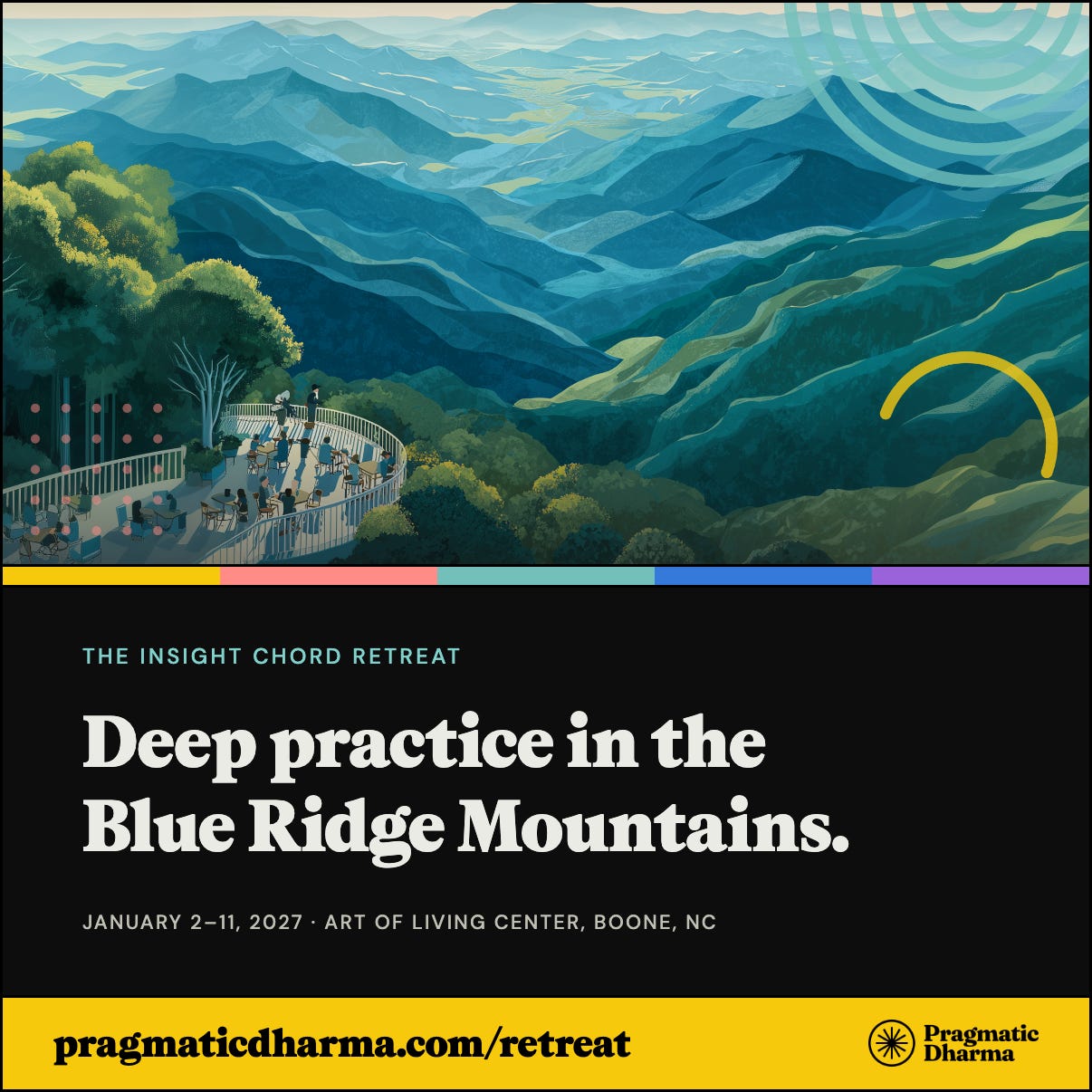 The Insight Chord 20.08.2026 22minVince Horn, Emily Horn, and Brian Newman talk through the design of their Insight Chord Retreat in Western North Carolina—why everyone will start with a single “go-to move” (of their choosing) for the first 3 days, what Brian learned about reintegration after doing daily multiplayer meditation on retreat, and how to maximize individual choicemaking on the retreat while having a solid community of practice to fall back on, including qualified teachers & dedicated peers.💬 TranscriptVince Horn: So in the service of using the time we have wisely here, our plan today—Brian, Emily, and I wanted to have a conversation about this retreat that we’re planning in January 2027 here in Western North Carolina, on the Insight Chord. We wanted to talk a bit about some of, like, the design thinking that’s going into this retreat and how we’re planning on holding it together.And we’re happy to be tested, and we realize it’s a lot of trust that people put in teachers and communities when they go on retreat. It’s a very intimate and very suggestive space of practice, so we want to make sure we honor people’s choice-making there.Yeah, thank you, Brian and Emily, for joining me today in this. It’s great to be here with y’all.So there really are three things that we wanted to talk about. This is going to be more of, like, a free-flowing conversation, but I’ll set up the frame a little bit here for us first. If you got an email from me last week talking about this retreat, you’ll have seen that there were three points I wanted to highlight that I think make this retreat kind of unique and different from the kinds of meditation retreats you might have been on or heard about, in some ways.I’m not saying that it’s completely different and everything we’re doing is completely novel. Of course, that’s not true. The first thing that we’re doing is not novel at all. In a way, it’s just the way that we’re framing it that I think is novel, and that’s the focus on this retreat on what we’re calling the Insight Chord.This is, in a way, super traditional in the early Buddhist tradition. You’d see these three practices or these three ways of practicing: Concentration, Mindfulness, and Heartfulness, or shamatha, samādhi, vipassanā, and mettā, brahmavihāra practice. All of these things you’re going to see in early Buddhist retreats.You’re going to see them at the insight tradition. You’re going to see them on Goenka retreats. You’re going to see them anywhere you go and do an intensive retreat. These practices will show up. What I think is unique is that we see that. We see that as the unique chord or unique combination of practices that makes this early Buddhist tradition sort of distinctive.It gives it a particular sound or flavor, and we really value that flavor, the three of us, because we’ve trained deeply in that tradition. And so we wanted to kind of build this retreat around these three practices or these three ways of practicing. I’d like to open it up here in a moment just to talk about that, but I’ll just quickly name the other two points of the retreat that are distinctive.One is that we’re going to be holding a kind of tension that’s hopefully generative. Brian and I certainly found it quite generative on our last retreat, The Flavors of Jhāna, where we’re going to hold this tension between the exclusive focus in meditation—like focusing exclusively on one thing to the exclusion of everything else, narrowing your attention so that you’re just, say, with the breath or just with your mettā phrases or whatever it might be—and then on the other hand, we’ve got an inclusive focus that is broad and open.It’s like the kind of practice where you’re opening to include everything in your field of awareness. This is very similar to, like, the Zen style of shikantaza, or our social, multiplayer meditation forms, you know, where we’re meditating out loud with other people. And we’re going to hold this tension between exclusive and inclusive on the retreat, giving space for both types of practice.And then finally, we’re going to hold another tension that’s generative between what I would call here agency-maxing and community-maxing, or between agency and communion. And that is, we’re going to honor and acknowledge that each one of us are adults on this retreat who are going to be practicing our own practice, choosing how to practice.At the same time, we’re doing that together in an explicitly communal container that’s been designed over thousands of years to help make that process more efficient and more powerful. So how do we hold both agency and communion together in a way that they really serve and support each other?That’s the third thing that we’re going to be holding together as we do this retreat. So yeah, let me just open it up here to my colleagues and friends. Talk a bit about each of these three points. We can of course go one by one, or we can kind of move around as your minds do.Emily Horn: Yeah, I just want to say I’m really excited about this particular weaving together of practices. And in some ways you could really go deep on one of the three, or you can really follow, like, a traditional kind of arc. Meaning you can start with concentration, and once concentration gets really steady you can start to incline, if you choose to, to really deepen into the vipassanā or insight.In particular, you know, we’ll definitely include teachings around three characteristics like impermanence, no self, and, ugh, suffering. And then there’s going to be opportunities to really deepen with the heart. And I’ve been teaching heart jhāna practice for the last, I don’t know, couple years now, and particularly focused on how do you build concentration within the heart states.And so I’m really excited to have that a part of this retreat, and also have it as part of it in a way where you can emphasize it a lot, or you can just know that it’s happening in the background, and know that you’re held with it. So to me that feels like a really interesting way to be able to participate in a retreat, is to be able to kind of increase that sense of discernment that we all really need to increase with our practice.Like, really we’re deepening in concentration, insight, and heartfulness, and at the same time we’re also learning how to discern what’s needed in our own practice. And a lot of times I feel like the discernment part is lacking on retreats. Like, how do you really start to learn, like, what’s needed and what’s going to be beneficial to your practice?And so I’m really hoping that, being held with a teaching team with Brian and Vince and myself, that we’ll be able to support you, and really, in a sense, driving your own car. And then we’re there to really support you in not going off the sides of the cliffs or anything.We’ll have you. I feel confident in that. So yeah, that’s what comes up for me right now.Vince Horn: Kenneth, when we were leading retreats together—and Brian, you were on one of those retreats, so you know this well—we came up with this idea of the go-to move, and it was an attempt to sort of help preserve people’s agency on retreat, explicitly to say, “Hey, like, it’s up to you what you choose to do.”But if you just leave yourself in the sort of paralysis of choice where you could do anything at any time, it’s really problematic, because then you spend a lot of time worrying about what to do and if you’re doing it right, rather than actually doing something useful. So the go-to move was meant to kind of undercut that tendency to get lost in choice while still having choice preserved.And here the choice is, if on this retreat there’s any point at which I don’t know what to do, this is what I’m going to do. I’m going to do this go-to move. It’s like the thing I know I can trust that I’m good at. For me, it was Noting, and for Kenneth, I think Noting as well. But for other people, it could be focus here on the breath, or it could be back to love, or to May Love Arise.One thing I think is unique about this retreat, in addition to suggesting that y’all have a go-to move, anyone who’s on the retreat, is that we’re going to start the first few days just with the go-to move. So we’re going to invite everyone to pick the one thing you know you can do and just focus on doing that for the first three days, so that we actually have this sort of crucible of concentration that starts to build, of one-pointedness, that makes it a lot easier later on in the retreat when we start to kind of open up the teachings and open up the possibility space—to have some stability and some malleability of mind that allows that to be more fruitful.So that’s one thing that we’re—in terms of design thinking and holding together agency and community, while at the same time recognizing certain things on retreat just seem to work well, just like having just one thing to focus on for a few days before you start to kind of get experimental and start, you know, doing the freestyle jazz practice.That’s one thing I wanted to highlight there that I think kind of is important.Brian Newman: Being the resident shamatha jhāna person, I’d like to say a little bit about that. So many great meditation centers around the world have established this as a really tried and true method. They’re going to start you with three days of concentration practice and then take you into the primary practice after that.What this does is it produces a feeling of ambient concentration in the meditation hall and everywhere, in fact. And ambient concentration is something that you feel if you go into a yoga shala and they’re practicing Ashtanga. The whole room is concentrated, and it’s a bodily felt thing. We all, I think, are familiar with the proximate cause of concentration, and the proximate cause of concentration, for those who haven’t heard it, is concentration itself.And it turns out that other people’s concentration can be a proximate cause to yours. And so if we can get a feeling of ambient concentration happening in our meditation hall and the dining hall and the public spaces, that’s going to help everybody get more concentrated, and I think we’re all going to really feel that.And then what this opens up is, what you might not see on day one as a potential for practice becomes available to you on day four, after the mind is quite settled and concentrated. So you might want to make different choices than you would have at the beginning of the retreat about what you might have focused on.So I think this is a way of expanding your possibilities for deeper practice, if we adopt a little bit of rigor up front with a go-to move.Vince Horn: Yeah, I like it too because it sort of acknowledges, hey, retreat is itself a kind of exclusive practice form, and it makes sense, if we’re going to leave our home and our jobs and our kids and our everything and come to do this thing, that in the beginning we do that, we kind of, like, just collect and gather our attention in a very exclusive way.Then we can start to open up into the inclusive practice a little bit more, and to more relational practice and things that help kind of expand the field of practice. But it seems like expanding from a small point is really skillful oftentimes, because you have the stability of that small point of focus first, the focus here. The ānāpānasati I love for that reason.It’s so skillful to start there because that’s where usually people are, and that’s what they can manage, is to focus right here. So yeah, in that sense I’m looking forward to going with the natural development of the practice and how it seems to work normally, and just kind of designing a format that kind of goes with that as much as possible rather than working against it.Emily Horn: I also want to bring in the multiplayer meditation. So Vince, do you want to talk a little bit about the multiplayer meditation option?Vince Horn: Oh, so you just wanted to call on me to talk about it? I gotcha. Yeah, sure, I can talk about that. I mean, so that’ll be something that we’ll bring into this retreat. Oftentimes Brian, Emily, and myself use that as a teaching tool—not just guided meditation, but we’ll sometimes bring in these multiplayer practices.We’ll probably be doing that from very early on, and just giving people an option to participate in those sessions so they can get a sense for extending the meditation practice into the relational space. And I think, Brian, going into our retreat last January, it was really cool to see how, like, your relationship to the practice seemed to change over the retreat, and it was—I don’t know if you could share a little bit about that, because it’s a, it’s a good testament.Brian Newman: Yeah, so, well, I have very little experience on a retreat of doing sort of social practices like that.And when Vince and I were planning the retreat schedule—did we do it twice a day, Vince, or once?Vince Horn: Well, at least once.Brian Newman: At least once. When we were planning the retreat schedule, Vince said, “So we’ll, you know, we’ll be having a 2:00 PM session every day when we’re all going to be talking and social,” and I’m like, “You’re doing what? Every day?” What if it was like every five days maybe or something? It was kind of my idea. So I wasn’t openly resistant, but I was kind of, in the context of a silent retreat...What I’d like to say is that I’m a complete convert. Absolutely converted, and here’s some reasons why.And I wasn’t an easy convert, I don’t think. So here’s one thing I was thinking of. You know when you feel sick or bad or tired, and you meet a good friend, and you have like a little chat, and you just feel better? Like, there’s that quality to it. So when some of us are sort of feeling a lot of dukkha, that social power, really the interpersonal stuff, does something to the system.It’s really uplifting. So there’s something there. By integrating this every day, it turns out it didn’t make any concentration worse, at least in my experience. Nobody was like a worse meditator because of that. But what does happen is, on the backside when you’re leaving the retreat, reintegration is completely different.Because at least once a day you’re having some social interaction. In my case, when I practice really hard, I go back to normal non-retreat life—I’ve had my wife say things to me like, “Maybe you should take three days after the retreat before you come home,” because I’m so frazzled and jittery she doesn’t even want me around.That completely wasn’t the case in Portugal, and I think it was because of the social practice of just being with people, talking a little bit, that made that movement out so much better. So, totally converted, and can’t really imagine a group retreat without it now. I think this is essential and probably really unique about our retreats, that this happens.So for some of you that are like, “Oh, God, I don’t want to be in the room meditating with people,” I was probably the hardest to convert, and I vouch for the effectiveness of this.Emily Horn: Yeah, and I’ll just vouch for the effect in a trauma-informed way. I’ve seen, on multiple retreats now with multiple situations, that for some people, like, this actually really provides an opportunity for co-regulation that’s really needed in a retreat.And it really does support the prevention of any kind of sense that you’re isolated and doing something alone. Like, this really can soothe the nervous system in a way that’s very impactful for a lot of people. And I’ve also heard that for some people concentration actually deepens with this kind of meditation, because they’re able to have the accountability.Their nervous system needs that accountability with other nervous systems to be able to feel comfortable enough to settle, because a lot of times on these retreats, going from 150 miles an hour to zero, that in itself is quite a transition, and a lot happens in transitions. And so we want to make sure that you all have options and choices on this retreat so that we can slowly and steadily sense into, you know, what it’s like to collect and to soothe our nervous systems, not only individually, but also collectively.Okay, two things. My mind is diverging. But one thing to close the loop on the social meditation, before this session is over: if it would be helpful, I’m happy to model it with Vince and Brian. We can do a little bit so you have a sense of it and a taste of it, because sometimes just talking about it, it doesn’t land in a way that, if you could see it and experience it, that might be helpful.The other thing that my mind is diverging—I’ll be very honest with you. We’re staying at Art of Living Center in Boone, North Carolina, and there’s a spa. And I don’t really know if I’m talking to anybody in here that likes spas, but I do want to say that that is an option. So anyway, just to let you all know that. And I think that’s probably enough for that. We can model the social meditation, but I’ll give it space and see what’s here.Brian Newman: I’m just remembering also, there’s other retreat groups there that aren’t in total silence—that’s right—which is also kind of interesting. So Vince, can you maybe say something about that? I think you know more.Vince Horn: Yeah. So this is a really large retreat center, and in fact they can host something like, I don’t know, a 1,000-person retreat.We have a smaller meditation hall that’s just for us, and so people can practice there in silence any time. There will be other people on different retreats sharing the same, like, eating facilities as us. And so this is going to be an interesting opportunity, I think, to either eat in silence as a group and kind of notice what it’s like to be silent while there’s activity going on—so kind of maintaining silence.And there’s going to be an option, which I’ll facilitate, around having a kind of contemplative lunch with others where there is some speaking, but it’s geared around a particular question, and it’s not like we’re just jabbering, you know? It’s like, there’s an actual intent behind the speech.So that’s another place we’re going to play with the exclusive and inclusive focus, and give you some choice-making around, do you want to be in silence and kind of nurturing that exclusive focus, or do you want to play around—probably after the first few days, we probably won’t start with this, but like later on in the retreat—play around with being at a table with fellow retreatants and exploring a topic that’s meaningful while eating together.So yeah, that’ll be something that’s, I think, pretty unique. I remember experiencing this once on one of my earliest retreats in Colorado. I went on a short retreat over the weekend in this community that had a retreat center, but it was like a normal community where people lived, they had kids, they did their thing.They would all come into the dining hall and talk, and I was like, “Oh gosh, this isn’t like IMS where everything is in pure pristine silence.” But I learned so much about practice doing it that way, because I was like, “Oh, this is what it’s like to practice in normal life. Like, if you’re being silent and exclusive and you have to deal with distractions, like, this is a good training environment for that.”So yeah, the distractions are opportunities more than anything, on a retreat like this.Emily Horn: And if you really want to go the hermit route—last time I was there, and I’ll have to confirm—they let people take out their meals. So come and get your meal and take it out. So there is a wide range of hermit to more of the more inclusive—Brian Newman: More relational.Emily Horn: Relational.Brian Newman: Mm-hmm. Mm-hmm.Emily Horn: Mm.Brian Newman: Yes. Yeah, the retreats we’ve done there at this retreat center have been with the Ram Dass community. And those retreats, there’s no silence. It’s just totally open. People are drinking chai, listening to kirtan, and chatting.And often, sometimes, hooking up and all kinds of things. It’s on the far end of the inclusive side of the spectrum. So we’re going to be somewhere between that and a really silent, strict insight meditation retreat.Are we taking precepts against hooking up?Emily Horn: I was just going to say, we’ll have group guidelines. That opened us up to, like, so what are the guidelines? Sorry.Brian Newman: Yeah, yeah. Right, right.Emily Horn: And we, yes, we will have group guidelines around appropriate sexuality and substances. That’s—Brian Newman: High beds.Emily Horn: Those are the two main ones, and then there’s some other ones you can, we’ll talk about, like technology and things like that.Vince Horn: On the Insight Chord, would it be useful just to say, like, Emily’s going to be emphasizing teachings on heartfulness, Brian will be emphasizing teachings on shamatha, concentration, and I’ll be doing the same with vipassanā, mindfulness. So we’re going to be, each one of us, holding one of those strands as we weave them together.But of course, you know, we each have experience with the different strands. So these are not—we’re not sort of specialists per se. We’re just more like holding the things that we tend to specialize in more, so that we can kind of make the whole weave a little bit more, I don’t know, interesting.Do you want to model the multiplayer meditation?Sure, why don’t we do that?Emily Horn: That would be my suggestion, just in case. Mm-hmm.Brian Newman: What practice do you want to propose here, Em?Emily Horn: Maybe there is noting.Brian Newman: Mm-hmm.Emily Horn: And then drop the “there is.”Brian Newman: Okay, sounds good.Emily Horn: I’ll kick it off. Hearing.Brian Newman: There is confusion.Vince Horn: There is confusion.Emily Horn: There is seeing.Brian Newman: There is delight.Vince Horn: There is hearing.Emily Horn: There is understanding.Brian Newman: There is confusion.Vince Horn: There is relaxing.Emily Horn: Breathing.Brian Newman: Stability.Vince Horn: Inhaling.Emily Horn: Relaxing.Brian Newman: Concentration.Vince Horn: Fatigue, unpleasant.Emily Horn: Thinking.Brian Newman: Gone.Vince Horn: Impermanence.Emily Horn: Heartfulness.Brian Newman: Anticipation.Vince Horn: Energy.Emily Horn: Deliberating thought.Brian Newman: Opening.Vince Horn: Dropping.Emily Horn: Breathing.Brian Newman: Bliss.Vince Horn: Itching.Emily Horn: Joy.Brian Newman: Bliss.Vince Horn: Flow.Emily Horn: Calm.Brian Newman: Self-consciousness.Vince Horn: Breathing long.Emily Horn: Pressure.Brian Newman: Twitching.Vince Horn: Tingling.Emily Horn: Thank you.Brian Newman: Thank you.Vince Horn: Thanks. Get full access to Buddhist Geeks at www.buddhistgeeks.org/subscribe
 -
 The Fire Inside 07.08.2026 54minVince Fakhoury Horn speakswith Rima Vesely-Flad about The Fire Inside: The Dharma of James Baldwin and Audre Lorde—the silence she found in her own Buddhist community when she began writing about Palestine, Baldwin and Lorde's distinction between hatred that corrodes and rage that comes from the examined life, and the question they keep returning to: how to feel it all without causing more harm.Vince Horn: So, Rima, great to see you.I’ve been really loving getting to know you as a person and also your work. I’ve been reading your book. Unfortunately, I also spilled water on my copy, so it is a little... If you see me struggling to flip through the pages, that’s ‘cause we had a bit of an accident here. But I’ve really enjoyed reading your work. Can’t wait to get into it with you. Thank you so much for your time.Rima Vesely-Flad: Yeah. Thank you, Vince. It’s been great to get to know you, too. We’re so close. Amazing. Amazing.Vince Horn: Yes, and it’s amazing as adults, we can carve out the time to hang out. So that’s sometimes the hardest part. I feel like being in middle age is, like, making time to spend with cool people, so appreciate your time.Rima Vesely-Flad: Me too.Vince Horn: So let’s talk about your new book. This is The Fire Inside: The Dharma of James Baldwin and Audre Lorde. Of course, before reading this book, I was familiar with you and your work. But it really struck me that you were writing in this book, like from the very beginning, you’re writing about Palestine and Israel, which is not something I see many Buddhists really writing about or talking about in America.So it stands out just the fact that you’re even talking about this subject. And then on top of that, you’re bringing to bear these beautiful Dharma teachings and wisdom teachings from the Black tradition of James Baldwin and Audre Lorde, bringing them to bear on this topic in the first chapter of the book, which I thought was quite courageous.And I really appreciate it, you know, as someone who has Palestinian family members and people in the West Bank I care about. So just on a personal level, really am grateful that you centered this in your writing. And I thought maybe we could start with that first chapter if you’re up for it.Rima Vesely-Flad: Absolutely. It was actually the very last chapter I wrote. I wrote this book of course over several years, but as I was concluding in real time, the genocide was taking place, and I just found myself absolutely in a state of grief and rage and was really politically active around it in ways that I hadn’t been in quite some time.Like feeling very pushed to speak out and to contact the Biden administration and representatives, people here in North Carolina who might or might not speak in Congress, and just found that I needed ways to speak out, and this is my community. The people who self-identify as Buddhist claim these traditions, these lineages, these practices, these schools of thought, and yet there was so much silence, and I felt really compelled to speak into that silence. And I know that’s something that you feel and understand in a deep way. And then also, I’m not by any stretch the first Black activist or academic or thought leader to make the connections between oppression of people of African descent whose ancestors were enslaved and people who are in a state of survival as their land is being taken in real time. So all of those connections were very present, and yet in the Buddhist world, there was so much silence, so much evasion or even erasure of what’s taking place. And it felt like it wasn’t separate from my practice, and I had to speak.Even though at the time I hadn’t even visited the West Bank. I since have, but at the time I was thinking and writing and observing and feeling from afar.Vince Horn: Yeah. Okay. I didn’t realize you’d gone to the West Bank. Wow, we’ll have to talk about that sometime. Yeah, there’s early on in the book, there’s a quote here that’s really echoing what you just shared.I thought I’d share this ‘cause it really moved me quite a bit. You said, “I, like many Black Americans, like Southwest Asian and North African Buddhists, observe that violent oppression of Palestinians can never bring safety and security to Jewish Israelis. And as a Buddhist practitioner, it’s important for me to speak out against the violence sanctioned by my government, my tax dollars.The policies of the US government do not represent my commitments. I’m horrified by the massacres in Gaza day after day, by the constant terrorizing of Palestinians in the West Bank. I think daily of Baldwin’s words, ‘You don’t know what’s happening on the other side of the wall because you don’t want to know.’”Rima Vesely-Flad: Wow. Even just hearing Baldwin’s words in that context again, it really brings me chills. And so prescient, right? So prescient in terms of just anticipating how much more extensive... At the time actually that Baldwin visited, there wasn’t a formal occupation, although there was theft of land. But this— that was 1961, and then the wall— right now the walls, the checkpoints, the just sheer magnitude of aggression and violence. Like Baldwin anticipated that, and then the myopia in Israel and in the United States.Vince Horn: Yeah. I think at the same time though as I read through your writing on this, I was really also struck that you’re really trying to hold multiple realities here at once.You know, both holding the suffering of the Palestinians and the apartheid state that you’re describing. At the same time, you have a lot of, as I do, Jewish friends and people that you care about who may not be able to hold that reality in the same way or who are struggling to in some cases. Who...and you treat that with real compassion I think in your writing and in your words. As I try to, you know, my best. And it’s, of course, important to differentiate between Jewish identity and Israeli identity, which is often, you know, merged intentionally by the State of Israel.And for many people it’s the way they’re inculturated. It seems like that was kind of an unconscious merger in a lot of folks’ identity. At least I’ve noticed that with close friends and even students in the last few years where we’ve had conversations around this. There’s been real tension.And anyway, I appreciate that you’re holding it with compassion, both realities here, not trying to sort of demonize Israelis or Jewish people. And really being aware of the antisemitism that this whole issue is also bringing about. Or it’s... I’m not sure if it’s bringing about or giving excuse to people to be bigoted.So I think it’s cool the way that you’re trying to weave those different things. And I guess I’m curious if you could say a bit about how you’re taking that approach or why that’s important to you.Rima Vesely-Flad: Yes. I start off the book talking about a relationship I had with a, I would say a mama bear, a mother figure who claimed herself, who self-identified as my godmother, and she was born in France to a very well-known filmmaker who had the opportunity for asylum in the United States, and he and his wife were granted this opportunity to flee, but were told they couldn’t take their daughter, who was my godmother Via–Vince Horn: Wow.Rima Vesely-Flad: –was sent to a convent in France. So a Jewish girl sent to a Catholic institution, and she was blamed for the war and has suffered horrific antisemitic abuse. And it scarred her indefinitely. When she came to the United States, she took off the first part of her name, just called herself Via.She died of cancer many years later, and the wounds of that period were still quite evident at the time. I just remember, I have such extraordinary memories of her and what she suffered. And so part of my compassion and empathy, which is real, is that this nation state we call Israel was founded as ostensibly a refuge for people like Via and her parents.And this is a nation state founded upon theft of land. And what it meant practically is that 750,000 Palestinians were driven from their ancestral lands, and they and their descendants still to date live in refugee camps, which I was able to visit when I went to the West Bank. These are no longer tents.They’re now concrete buildings, but stacked very high, very crowded, very narrow passages for walking, no play space for children. One of the refugee camps I visited in Bethlehem has an entryway that consists of keys welded into an arc, and these are the keys for return. People still possess the keys to their homes they were driven from 75 years ago. So to recognize the terror that took place during the Holocaust in Europe, and then to recognize the consequent suffering that was inflicted upon Palestinians, I think is not simple. Yes, safety, but one thing Baldwin says that stays with me over and over is that Palestinians should not pay for the sins of Europeans.Europeans committed the genocide, the Holocaust, and Palestinians should not have had to pay for that and should not have been driven from their lands to establish what is supposed to be a state of safety. And yet the atrocities being committed by this government and other governments, not saying that this very right-wing government is the only government that has committed atrocities against Palestinians. To say that this is a state of safety for people whose ancestors were exposed to the horrors of the Holocaust is, I think, to be very myopic, very limited. And part of what I’m trying to wrestle with is such deep confusion, like a deep state of confusion of how, if your ancestors have experienced the Holocaust, could you inflict this upon another peoples?So that’s some of what I wrestle with in this first chapter is just like—Vince Horn: Yes.Rima Vesely-Flad: —what? And I’m not the only one. Like Ta-Nehisi Coates starts off his book talking about the— the book is called The Message. And he starts off his book saying like, “I just don’t get it.” And I feel that too. I just don’t get it. But then also, I don’t understand this claim to sacred land, and that’s part of what’s happening with the atrocities in the West Bank in real time. And you know, all of us know it has escalated dramatically in the past few weeks.Vince Horn: Yes.Rima Vesely-Flad: Like even worse than when I was there. And when I was there, that’s when the farmers during harvest, the Palestinian farmers during the olive harvest were being terrorized.Vince Horn: Yes.Rima Vesely-Flad: Including many Jewish activists, similarly from the United States and from Israel were being terrorized, all of them. Everyone who was in the fields trying to harvest the olives.Vince Horn: Right.Rima Vesely-Flad: That was happening in October, but now it has escalated dramatically in a city called Nablus and its surrounds.Vince Horn: Yes.Rima Vesely-Flad: I actually went to Nablus. That was one of the places we spent some time.Vince Horn: Yeah. That’s where my cousin is based. So yes. Oh, yeah. And I’ve heard that as well from her. So that’s, in recent, like week or two, her house was broken into by the IDF and they destroyed one of the walls and were calling out for someone who they have no idea who it is.Yeah. And just, you know, like that’s becoming more just kind of more standard. Like that’s just happening all over the place. Yeah.Rima Vesely-Flad: It’s becoming normalized.Vince Horn: Normalized, yeah, exactly.Rima Vesely-Flad: That aggression. Yes, so much. And one of the things I just sat with when I went, you know, I was in Jerusalem initially.There is coexistence. It’s, you know, people are not separate. They are coexisting in real time. And yet, when I went to the West Bank and, you know, it’s like I just don’t understand. Jewish refugees were given 51% of the land by initially Britain and the United Nations then in 1948, 1947, 1948.Drove out Palestinians from their ancestral villages into refugee camps. Why do they want more? And one of the things I realized is that the West Bank consists or has many holy sites, both for Palestinians who practice Islam and for Jewish peoples who see these sites also as their holy sites. So I was based in a city called Al-Halil, and there’s a mosque there that’s called the Tomb of the Patriarchs, and that is one of the holy sites also for Jewish practitioners, people who are adherents.They have built settlements on top of Palestinian buildings, especially in the old village. So I saw all of this actually arrive just as there was an incursion of young people from these settlements into the city of Al-Khalil, which is also called Hebron. In any case, that claim to holy space in the sense, the idea, the narrative that God gave it to a certain peoples who are chosen and therefore all of the land is theirs, something I don’t understand. And I have some real hatred— with regards to the atrocities taking place. And I feel that part of my practice is to really own that and feel that in my body, and then to work with it in such a way that it doesn’t come out and get directed towards people.But I can feel that. And so part of what it means for me to claim these practices, like you, I’m in the Insight Diaspora, so we likely know many of the same practices. But part of it is working effectively with the body so much so that it’s not targeted, it doesn’t come out in random ways and cause further harm.But it’s a hard practice, and some of what you see in that chapter or read is that muscle being flexed of like, how do I feel without it coming out in a way that causes harm? That is part of the wrestling. That is part of the practice.Vince Horn: Yes. And it’s one that I noticed, like in my own training, I didn’t get a lot of tools for that in the insight tradition because hatred was sort of like something we’re trying to transcend or, you know, like notice and then counteract.That was usually the frame around hatred. It wasn’t something like you can actually feel this anger and really feel rage. Like although sometimes people would, I think, give lip service to that, it never felt to me like a culture where people were actually doing that.And so I was just sort of repressing all this rage and sort of like carrying on. And now I realize that the wisdom of what you’re saying is like, if you repressed all that rage it goes inward, it goes outward. It is not constructive. It’s not generative. It’s not healing. It’s just kind of like a time bomb ticking.Rima Vesely-Flad: Yeah I think that’s so wise. It causes anxiety and depression. It needs a place to land, and part of what I think we’re meant to do with this work is cultivate that place to land, but do it in a way that’s skillful so that we’re not creating more harm. And I don’t think that... is harmful, but I think it, when it’s not effectively worked with, it does come out sideways, and then it can inadvertently or maybe—Vince Horn: Intentionally even.Rima Vesely-Flad: —intentionally create that. But I think part of it also is recognizing it, giving it space to be named—Vince Horn: Yes.Rima Vesely-Flad: —and legitimizing it. Like, it is a just rage. And hatred— actually Baldwin and Lorde both talk about hatred as corrosive. They talk about how it does actually impact us in ways that are not useful, and it does need to be worked with skillfully.But rage, they both say, comes from the examined life. It comes from legitimate and clear observation of patterns of oppression taking place and experienced in real time. And so that’s energy that can be used, that can be directed in fruitful ways. And I think that distinction is really important, and it did inform my own experience of hatred.Of like, “Oh, it’s here. How do I work with it in a way that doesn’t corrode my spirit or it doesn’t corrode relationships that matter to me?”Vince Horn: Yeah. I love what you’re saying there. It seems like conflating hatred and rage would be one mistake there, to think like, “Oh, I shouldn’t be experiencing this anger or this rage because somehow it’s a sign that I’m, like, in this corrosive state of hatred.”But like, oh, it’s real, and it’s arising in response to something real. Like, I had never seen this quote from James Baldwin about how being a Black American means living with rage all the time everywhere, and that hit me so hard. I’m like, yeah, that’s what it feels like as a Palestinian right now. I feel that and have always felt that.I didn’t know that’s what I was feeling for so many decades. But now that it’s out in the open and it’s like, oh yeah, like it’s just this constant sense of rage at being constantly policed. You know, having your tone of voice policed, your words. Not being able to be a certain kind of emotive or, you know, loud.Like, all these things that are culturally, like what I grew up with. This was like the way that our family was. Like, it’s not okay in this larger kind of white culture to display these kinds of things. And so you just like, you gotta tamp it down.Rima Vesely-Flad: And, you know, Foucault would say we learn to police ourselves to discipline ourselves. And I think part of our work then, in terms of recovery, is to name the ways that we self-oppress.Vince Horn: Yes.Rima Vesely-Flad: I would say that’s a huge, huge part of my practice, ongoing.Vince Horn: Yes. That makes so much sense because it is, like you’re saying, it’s internalized.Like, I— yeah, it’s like I only need to get a few social signals before I start to realize, ‘cause I’m a socially intelligent being, like we all are. Like, oh, like, this is not okay. And if I continue to do this, there’s gonna be kind of repercussions. And I think the bravery and the courage to do it anyway, and to deal with those repercussions, like, that seems to be where your work lives here, and it’s a hard place to live.Rima Vesely-Flad: It is hard, yes. I mean, one of the things I also talk about in this book more broadly is that I grew up in a family where I wasn’t wanted. My birth was not welcome, and that was something I knew from a very early age. So I learned to adapt. I learned all of these ways of trying to be wanted, trying to be claimed, being exceptional.Vince Horn: Yes.Rima Vesely-Flad: So the idea that I would self-exile is, like, anathema. And that’s where I start talking. And part of the way I use Audre Lorde’s work in this first chapter in particular is to say, she calls us out, saying, “We must speak remembering we were never meant to survive.” But for me to speak in ways that might be confrontational or perceived as offensive is a very hard edge.But to self-silence is also to betray myself and my people. And that’s the edge, right? To speak and to risk exile for someone like me, who has been exiled just because of the way I appeared in the world with dark skin, dark eyes, dark hair, curly hair. And then also to adapt in so many ways that I recognize a level of self-betrayal or a betrayal of the people to whom I’m accountable.And I do consider my people are people of African descent who have been oppressed because of their embodiment in this particular context, which has shunned people of African descent as unworthy, as less intelligent. Has seen a kind of embodiment as inferior. We come up against that. I came up against that in my own family.Vince Horn: Yes.Rima Vesely-Flad: It’s a hard edge, and I think part of the work is to actually not be so alone, to find our people, to find people with whom we feel mirrored. That’s also hard work, but it has come over time. I have found community, and that matters. And I think part of this work of sangha, which I think in our lineage is not so prioritized—Vince Horn: Right.Rima Vesely-Flad: —but if we take it on intentionally, we can truly honor it as one of the three jewels. Part of our work is really investing in sangha, even when it feels scary or even when it feels like, wow, I have to be held accountable for things that I say that might actually really harm somebody else. But to keep doing that work and to ask for that feedback and that accountability.Vince Horn: Yeah, that strikes me as so true, and I understand why sangha isn’t prioritized when you have such an individualistic kind of culture of, you know, meditative achievement and self-work. It’s like, oh yeah, well, of course if we’re all just focusing on ourselves together, we’re not gonna be focused on the bonds that connect us.And yeah, I found that to be a limitation really for many years now in that community. And sort of what drove me to like explore relational practices and other things that felt like they kind of help soften those boundaries and begin to kind of get a felt sense for like what interbeing feels like in real time.It’s like this is what it actually is like to be connected to someone or to disconnect or to lose myself in someone else’s perspective. I guess I wanted to honor too that like you’re talking about all the reasons that one could not speak out even if there’s injustice and one wants to speak out on behalf of people they care about and are identified with.That on top of the racial dimension of this, there’s also imagine the gendered dimension of this for you as well. Like I see with my wife and other women I know who are raised in a more kind of gendered female way. Like it’s just speaking up in general is hard to do. Or it’s not something that’s encouraged or, you know, people don’t have...they’re not offered that same level of training often when they’re in a female body. So I guess I’m curious like is that also part of what you’ve had to work with in addition to the racial dimension of this?Rima Vesely-Flad: That’s a really good question. I think initially, yes.Like, I was raised to watch and serve and people please. And that’s how I got my goods, as my therapist would say. Like, I felt wanted when I—Vince Horn: Right.Rima Vesely-Flad: —gave people what they wanted, and I think that is a very, very gendered experience. I cleaned the house at an early age. I took care of my younger brother.I was with a single mother who worked a lot, so I held things together in the family home. And yes, I think that is a highly gendered experience that I’ve carried into adulthood. I think I have patterns that I’m still trying to work with around serving and adapting, people pleasing and what have you.I do also feel like there’s some corrective, if you will, by becoming an academic. I think in my line of work, having jumped through a thousand hoops, I did three master’s degrees, I did a PhD, I learned how to cite research and ask questions and back up and demonstrate. You see it in this book, right?Actually, the book initially was an academic book where I just took on Baldwin and Lorde and tried to show how they illuminate these incredibly important and timeless teachings that we now associate with Buddhism or call Buddhist. And I had a friend and a mentor, Ruth King, say, “Actually, we need your practice in this book.We need this to not just be through the third person, but we actually need your voice in this book,” which was really important and also incredibly hard. But part of why I felt I could take it on is that I was in a world in which I was expected to speak and facilitate, and I think there was a training not necessarily in the broader environment to which you’re pointing, but in an academic environment where standing up and giving a talk or a lecture or doing Q&A on the spot was something I learned how to do.So in that way, I think there’s more of a sense of, oh, I have this. I can do this. And that feels more, I would say, naturalized, for lack of a better word, just because it’s been two decades of doing this so explicitly. And I’ve loved the academy, you know, being with people who read thick books.And I’m the kind of person, I’ll walk into a store and I’ll look at the endnotes before I look at the introduction, just ‘cause I wanna know who’s cited and, you know, what research are they relying on? And like, who has informed this work? That matters to me even more so than the title or even the introduction.I wanna just know who, what school of thought is this author drawing upon. And I love being with people who also operate in that way. And I have this funny story of being a consultant for a book project for a friend of mine, and we were all taken out to Portland. It was my first time in Portland, and you know, beautiful city.And we hung out and talked and conversed and worked through these chapters, and then we sat in the hot tub and discussed Foucault. And, you know, it’s just so, for me, natural to be in an environment where something like that is really fun. And that is, I think, a part of learning how to speak. I think the harder part, and this goes back to the gender question, is having been a Black girl in a white family and trying to figure out how to survive in such hostility.So yes, I do think that’s both racialized and gendered kind of experience.Vince Horn: Yeah. Okay. Yeah, makes sense. I hadn’t considered the training in academia would be such a sharp training. But it makes sense, yeah, that you’d sort of be expected to be able to receive critique and offer it and speak and debate.Yeah, that... I could see that both being kind of traumatizing and a very good training at the same time.Yeah. I appreciate it so much that you did bring your story into this book as well, because I feel like at least for me as a reader, it gives me something personally to connect with where I can sort of see, like, how the universal becomes personal, you know, in a way. Where it’s like all these things that you’re describing, and Baldwin and Lorde are describing, like, they make sense to me and I understand it.But then when you describe, you know, your experience of coming up with your grandparents and the specific ways, like not having your picture hanging up with the rest of your cousins, for instance. Like, that specific experience and the way that you shared it just made... It made all of the abstract universal stuff real for me in a way, you know, that I think it sticks with me, and it’s like it lands in my heart, you know, in a way that is transformative.So I suspect that’s probably true for others as well. So thank you for sharing that.Rima Vesely-Flad: Yeah, I would say that was hard in a way that academic citations and reading for ideas, making arguments is not so hard. Like, it actually comes very naturally. But the harder work of communicating the harm that was done and how I received it, and certainly because I was raised knowing them, my grandparents’ rejection of me based on my skin color in particular was, it was deeply traumatizing, and I still work with some of my patterns of adapting, ways that still do not serve me.And then too, and this is something I’m more present with, is my experience of being abandoned by my father. Actually, yesterday was his birthday, August 2nd, also James Baldwin’s birthday, and I found myself honoring James Baldwin, and having a really hard time honoring my father, who I had not seen at the time that he passed away for more than 40 years. And I also feel that, and the disconnection not just from him, but also my lineage. And a big part of this book is actually not attempting to reconcile with my grandparents or the members of my family that are still very overtly racist, and there are many, but actually to find my father’s people and to cultivate a sense of lineage and belonging through my father’s people who came from the Mississippi Delta.My grandmother moved north during the Great Migration, and I am in touch with those family members who descended from her. She’s now deceased, but, and my father is also deceased. But to have some sense of connection and being claimed, to have visited the graves of my great-grandparents, in a certain way it’s not full circle, but it is a sense of return, and by that I mean return to ancestors, biological ancestors who I now know the names of and have a place to go and now developing relationships with in terms of a broader family system. And those are folks who have claimed me.I, about a month ago, maybe just about three weeks ago, got to talk to the matriarch of my father’s family, one of, uh, his youngest... Uh, not my father, I’m sorry. My great-grandparents, their lineage. I was able to speak to one of their youngest daughters, my great-aunt who turned 100 last December.Vince Horn: Wow.Rima Vesely-Flad: Who’s now about 100 and a half, and I just think, wow, how amazing to have met her. That she knows my name, that I had some time with her, that she still wants to speak to me on the phone. That she sees me as a way to connect to her sister, my grandmother, who’s, as mentioned, deceased. Sometimes I think that healing process is not attempting to reconcile with the people who have denied or rejected your existence, but to find people who claim you and who want to be part of you.I think that also speaks to this broader political environment. It’s not about getting accepted by the people who have ideas of your inferiority. It’s not about proving that you are, in fact, worthy of X, Y, and Z, but it’s actually about claiming and developing and cultivating your own spaces. And I’ll say this in a personal way, not so much about being accepted by a dominant white culture community, as much as cultivating the spaces that do feel supportive, in which I am mirrored.And I feel like both Audre Lorde and James Baldwin were oriented that way as well. Like Audre Lorde was part of the second generation women’s movement, and they weren’t, like, trying to fit into some stereotype of women. They created their own communities, and they had relationships with one another. She was a self-defined lesbian, and was with a community of women who honored their own sexuality and their gender, and who sought a kind of alternative to the broader dominant culture. I think that is so important. And Baldwin, as a gay man too, was oriented towards honoring his own sexuality and creating communities that essentially I don’t want to use the word affirmed in, like, a tidy way, but just said, like, all of you, every part of you is welcome here.Vince Horn: Yes.Rima Vesely-Flad: And so I do think that is incumbent upon us as well, not to look for acceptance, not to be claimed, but rather to invest in communities that we want to be part of.Vince Horn: Yeah. So it’s like you’re getting your belonging needs met by creating or finding the kind of community that you can be yourself there and not have to be constantly seeking external validation from a culture that’s not going to validate you, or probably not for the next few decades at least. Rima Vesely-Flad: We could even say that within our insight lineages.Vince Horn: Yeah, absolutely. I guess that’s the need for diasporas is rooted there. You know, finding... I remember the early community of people I hung out with were mostly people that were unabashedly interested in, like, mastering the states and stages of the path, which is a weird thing to say now ‘cause that’s not where I am at all.But yeah, it was like a subculture of people who were like, “Yeah, we’re really interested in hardcore meditation.” And that wasn’t the scene in the insight tradition. It was more like healing and kind of long-term retreat. So yeah, I can absolutely relate to what you’re saying. I’m curious to go back a little to the part of the book where you talk about karma.Because this is, I think this is an area where I’ve always struggled with early Buddhist teachings. And I remember the first class I took at Naropa on the first turning with Judith Simmer-Brown. We really explored karma in depth there, and it became clear to me, like the early Buddhist vision of karma was very individualistic.It was like you are the cause of— it was primarily putting everything back onto the individual. So I thought it was interesting when you’re trying to bridge that with collective understanding of karma as well, and seemed like you’re trying to hold both the individual and collective perspectives together, like not kind of falling into one or the other.But I always found early Buddhism was like collapsed straight into the individual perspective. So I’m curious, like how do you work with... Is that true from your point of view and from, you know, your scholarship? And like how do you then work with a tradition that seems to be, I don’t know, hyper individualistic when there are also deep teachings on interdependence and interbeing you can find in the tradition as well, though I haven’t found them as prominently in the early Buddhist tradition.Rima Vesely-Flad: I think that’s true. I mean, the sutta that I rely on at the beginning of the chapter, which I can put into the chat if that’s helpful, is one of the few that explicitly says, oh, and there are other causes and conditions for suffering, and I actually, I’ll read that.Vince Horn: That’s cool. So it is there.Rima Vesely-Flad: Yeah. It’s, so it’s an early Buddhist teaching or sutta, the Moliyasivaka Sutta, and it says, “Bile, phlegm, and also wind.” So our bodies, what’s around us, “imbalance and climate too—”Vince Horn: Wow.Rima Vesely-Flad: —”carelessness and assault, with karma result as the eighth.”And it’s saying these are all reasons for suffering. But it’s true. It’s one of the few suttas that explicitly acknowledges causes and conditions as sources of suffering. Where I delve into collective karma is, it’s true, I found it less in early Buddhism, more in Mahayana Buddhism, the focus on language actually.The fact that we come of age as very small beings and learn language, and our language is collective. We are learning certain meanings along with certain phrases, and that is collectively formed, and that is a part of our thoughts. That is something that a number of scholars within the Mahayana Buddhist lineage talk about in many very complex texts over actually several centuries.So it is to say that we find that less in early Buddhism, but we do find that, and it’s with that analysis in mind that I talk about the fact that we are shaped by the collective, and also that we have agency.Some of the gleanings I have towards how we might employ karma in a very constructive way come from postmodern thinkers who claim Buddhism, but who are also broadly read with thinkers such as Marx, thinkers such as Foucault, and, you know, people who are making connections in ways that, of course, are very far removed from early Buddhism.But one of the things that is drawn out by now a wide range of postmodern Buddhist scholars, so people who both practice Buddhism and are scholars of Buddhist teachings, is that we have agency. We’re not simply beholden to actions of the past or even the collective, that we actually can practice and cultivate our thoughts, cultivate our words, cultivate our actions in a way that allows us to break free of patterns that are harmful or do not serve us. So that’s where I go with that chapter on karma.Vince Horn: Yeah.Rima Vesely-Flad: Wanting to say we inherit so much, and we do. We inherit language. We also inherit culture. We inherit ways of thinking, and it’s hard to see that because we swim in the waters even as we are inheriting them, yet there is some capacity for agency.Vince Horn: Yes.Rima Vesely-Flad: And that is what we can do. And maybe that’s the emphasis in early Buddhism, is that we can work on our minds. We can free our minds from these oppressive patterns.Vince Horn: Yes. Yeah, and that makes so much sense in the context of, like, Indian caste system and the emergence of this, like, other way of living that’s kind of outside of that caste system.I mean, it seems like such a powerful move to claim agency when you’re in a culture that’s, like, so determined by birth and status.Rima Vesely-Flad: Yes.Vince Horn: And then now, but in 21st century America, it feels like in some ways that view prevents moving forward to me with some of the deep learnings that the postmodern theorists have offered us over the last decades, you know, around the way that power gets calcified and ossified in systems, you know, that we’re embedded in, in cultures that we are raised in.You know, having grown up here in the rural South, you know, this is a lot of what I’ve reflected on when it’s come to reading works like yours and looking at racialization. Is like how I can’t separate myself out from the place that I came up in. And I can see even with a Palestinian mixed racial household, like I was in a sea of white Southern Baptist Christians mostly.And, like, it had a huge effect on the way I talked and the things I thought were acceptable to say or to think. And, you know, I can even see the ways that I was always... I was trying to bridge the gaps with folks who are different because my grandfather moved into the part of town where the only Black folks in the entire county lived.There were two students in my high school who were Black. They were both... We rode on the bus together. I was quite close friends with one person. And it’s like growing up in the small little mini minority space I remember trying to make connections with folks and sometimes just like really messing up and not because of that inculturation.I remember one time I wanted to share this story, which I’ve never shared before. Which I think it... I want to meet you in your vulnerability here because you shared so much in the book. But I remember a friend of mine had a friend over, young Black girl, and she was, I forget her name, but she came over.We were hanging out and getting to know each other. And I remember this thing that I said to her as a... Really, my intention was to try to connect. And I said, sometimes me and my family, we’re also called “sand,” and then I used the N word. And this was my— and I said it totally smiling, you know, like really assuming this would bridge some gap between us, and that she would see, like, I’m like her.But the impact that it had was totally the opposite. You know, it’s like, it really bothered her. She was crying later. My friends were like, “What the heck is wrong with you? Why did you say that?” And I was like, oh my gosh. And it was just such a rude awakening to the reality of race, and I could see that even as an older adult, you know, asking people where they’re from to try to connect, when I appear as white, has this impact of really causing people to feel paranoid or feel like I’m coming at them in a way that’s racially biased.You know, where I’m trying to, like, figure out where they’re from ‘cause they’re not from around here, you know, and stuff like that. And I could see how even being well-intentioned when you’re trying to connect across difference, it’s very easy to, because of ignorance, to really harm people. And I can see that in the community of white Buddhist practitioners, you know, where a lot of very smart and well-intentioned people, as they engage with this work, like, we struggle to figure out how to do that in a way that’s not perpetuating harm on a racial basis.It seems safer to just not talk about it sometimes. And I can see that this is a real problem. Like, it prevents learning and it prevents people from being able to kind of see their own conditioning and kind of acknowledge like, oh, this is really ugly. You know, it’s really ugly that I thought it was okay to just, like, use that language and that it wouldn’t have that kind of impact.Like, I thought for some reason it was neutral.Rima Vesely-Flad: Yeah. Yeah, that, I think that does speak to what we were just talking about with regards to karma and language and how we are socialized, how we inherit so much, and how even a word that has been weaponized with such vitriol and hatred over centuries in real time is still like a brick at the body.Like, it can land and it’s almost... Yeah, I could even feel, like your reference to it, just how it landed, ‘cause it’s still such a powerful word, and it does point to the fact that we do exist in conditions of such hatred and violence, that we are landed upon all the time, and we have to figure out, like, how to acknowledge that in ways that don’t take us under or, frankly, if this is wanted on all sides, create rupture so that there can’t be a way forward to acknowledge the weight of what’s taken place.And I think for people who have had that hatred— and again, I’m thinking of both Baldwin and Lorde speaking to this with such clarity and self-empathy. For that hatred to be received over and over, especially in early years, but not exclusively in early years, and to have ways to acknowledge it and to come out of it, I think is something that we are all called to do.And to maybe to, and I say this with real tenderness, ‘cause I am still learning and asking for feedback all the time. With some tenderness to, if you notice that something has been, that some harm has taken place, that something has caused rupture, or if you’re told that by other people to go in, not with some sense of defensiveness or a sense of needing to explain yourself, or even needing to clarify your intention, but to come in and to say with real humility, “I’m sorry, and I want to know what this is for you, and it matters to me that your inner being, that your wellbeing is cared for.”That’s what matters. And actually, I had a moment a couple of weeks ago, not even quite that long, where I said something quite offensive to a friend of mine, and I noticed. I just— you know, noticed by reading facial expressions, and this is part of our work too, right? To observe. And so I asked, and was able to receive some feedback and to really hear it.And I think something that I struggle with, and I imagine for you, Vince, this is real as well, is we both are parenting young kiddos. You have an 11-year-old, I have a 10-year-old, about to be 11. We are really busy. We’re running households, and I think some of what I come up against in my own work is, where is the time to do that inner work of reflecting, processing, synthesizing how we might have created harm, returning to the relationship?Like, where is the time to really do that? And that is something I’m sitting with, is if I have said something or not said something and it has created harm, where is the space to process that? And so this practice of sitting every day, of taking refuge, creating a kind of consistent place to land every day, I think that is some of the work as well, is to have a place where we can receive ourselves and how we are working with that harm that we have imputed upon someone else.And that’s a big part of the practice as well for me, is just to create that level of consistency. And to feel into that remorse, to feel into that regret, to feel how it lands with us, and to hope that we might be able to convey that and to be received. And we don’t always know. We can put ourselves out there.We may not be received, but just to have that sincerity of approach and to not make it about us, but to really focus on how it has landed for the other person, and then in our own practice to do our work. I think that, for me anyway, has been a way forward. Not that I could write a rule book or some set of instructions. I would not say that. But, you know, I take real guidance from Audre Lorde who said, like, “It’s on me to see my heel print on another woman’s face.” I have to do my own work even if I do self-identify as someone who has had that level of systemic and interpersonal harm coming at me.I’m also in a place where I can oppress other people. I’m doing real harm for other people. And it’s not one or the other. It’s not simplistic, but it involves a level, I think, of spiritual and emotional maturity to really see that for ourselves and to be open to whatever has arisen and whatever harm has been done, and then to be accountable, to put ourselves in a position of being accountable to a group or to another person it is really hard work. Really very hard work.Vince Horn: Yeah. Yeah. At the same time, I mean, I can see that’s the only way to gain in wisdom is to be able to do that work and then be like, “Oh, yeah, now I know better. You know, I know a little better how to engage or be with folks in a way that’s not gonna cause as much harm.It’s going to, you know, support others.” So yeah, thank you for talking to me today and for exploring this with us here in the Insight Diaspora. I wanted to mention, too, that you’re very generously offering up sort of in-depth content around this for sanghas and other communities and leaders that are kind of interested in bringing this work into their communities.I don’t know if you wanted to mention that for those that are listening and might want to reach out to you and explore that.Rima Vesely-Flad: Oh, yes. And I can put... I have a couple of things I want to put in the chat, but I can put my website in, and the bottom of the page are these offerings. Yeah, so—Vince Horn: Please.Rima Vesely-Flad: I have recorded a number of Dharma talks, eight Dharma talks with two practices based on the book. And the hope is that this is a self-guided course, but the hope is that people can both listen and then practice. And the hope is in community that actually that can happen. And still trying to figure out exactly how to essentially package all of that.But at the moment, people can register for a self-guided course and listen to Dharma talks, some of which come from the book and are somewhat expanded, and some of which come from other work I’ve done. So there’s one called The Dharma of James Baldwin and Audre Lorde, and then there are three that will be offered live with a good friend of mine, Rashid Hughes, who has put together a practice he refers to as rest.He is a lovely human. He’s done restorative justice work for a long time. He also has a Master of Divinity degree and leads a sangha in DC. And so Rashid will offer practice spaces live, and I will record Dharma talks. The next one is called Buddhism and Black Liberation. That comes from a book I published in 2022.And then there will be one offered in January called The Discipline of Liberation, and I think that’s my next project. I’m just starting to get my head around it, but it’s informed and guided by the writings of bell hooks.And then there will be one that actually points to exactly what we were just talking about with regards to harm and conflict and how to work with it internally and how to be in community, and I think a lot of us don’t have that training, and I’m still someone, even now, who if I receive something in a hard way, I will go to my cushion before I’ll go to another person.And maybe that’s okay, except if I don’t ever get off the cushion and go to that person, that’s not okay. So really trying to, this is in real time, also trying to learn, like, how to have these harder conversations and do repair. That’s really what I’m pointing to, how to do repair effectively so that there isn’t only rupture, but there’s a relationship that’s sustained. So there will be one self-guided course. It will open in about a month on Tuesday, September 1st, and then three live classes with my friend Rashid, and starting in October, and then in 2027, two classes. And my hope is that we start to create some spaces that are trainings and also collective spaces where we can be guided, especially by, in my case, I’m thinking of Black thinkers, although always in conversation with other lineages, but really wanting to bring the wisdom of Black thinkers to the center of Dharma practice.Vince Horn: Yeah.Rima Vesely-Flad: Palestinian voices as well. I am really invested in that, too. And a friend, Kareem Gandoor, refers to Palestinian dharma, and I think, yes, that really resonates with me.Vince Horn: So yeah, Kareem. I know Kareem. Good stuff. Yeah, I’ve recently just connected with Mohsen Mawdawi, who is the president of Buddhist Association at Columbia.I think— didn’t you do your grad work at Columbia?Rima Vesely-Flad: I did one of those degrees there. Uh-huh. In the same program he was in, yeah.Vince Horn: Uh-huh. Yeah. And it’s been so nice to connect with fellow Palestinian Buddhists. All five of us are now connected. So I feel a lot of solidarity with the work that you’re doing, and the way that you’re centering the wisdom of Black teachers in the Buddhist lineage, bringing that to bear.So thank you so much for that work. I hope you continue doing it for a long time.Rima Vesely-Flad: Well, thank you. It does feel like the right work, and I feel so grateful to be able to do it long term. I mean, that’s I think where I’m going here. Actually, being able to work... I’m gonna put my website into the chat.Being able to organize some of these classes is an attempt to make this work more sustainable, in addition to being like it both informs the next project and is an outgrowth of the current project. Get full access to Buddhist Geeks at www.buddhistgeeks.org/subscribe
 -
 Working Class Dharma 22.07.2026 53minVince Fakhoury Horn speaks with Mushim Patricia Ikeda about working class dharma—from growing up as "the minority of Greensburg, Ohio" in a third-generation Japanese American family, to training in penniless Korean Zen temples where renovating the building was the practice. Along the way: bliss bunnies, samadhi junkies, mutual aid networks, and why affordability may be the grassroots issue of 2026.💬 TranscriptVince Horn: Okay. So yeah, I think it was really the beginning of this year — I was teaching a retreat in Portugal with a friend. It’s our annual Pragmatic Dharma retreat. And while I was there, I had picked up recently this book called Emergent Dharma, by Dr. Sharon Suh, and I scrolled through the chapters, and I looked, and I went straight to yours, and I read it.That was the first thing I read, and I just loved hearing about your story. For me, some of the coolest part about the Dharma is hearing people’s, like, stories and their biographies and, like, their real lived experience of the Dharma, and I just felt that in your story in the chapter there — you’re talking about how you were raised, and your family, and where you came from, and how you started engaging with Buddhism, and just the whole story there, that I’ve heard now more of since I’ve gotten to know you better over this year.And really, I was just hoping we could talk about, you know, your story in part here, because the theme is working class Dharma. And when we last spoke, we decided that was a good kind of place to focus some of the conversation. But a lot of it is about your experience, really.Like, what does it mean to live in the, quote-unquote, working class in the modern world, and to also be a Dharma practitioner? And how different is that in a heritage Asian ethnic tradition than in a white convert tradition, which is more how Emily and I have come up? I think that’s an interesting conversation too, because now we’re talking about class and ethnicity — two different dimensions that are often interwoven, or braided.So anyway, could you share a bit about your story, Mushim? I know you come out of the Zen tradition, both in Japan and Korea, but how did you get into this? Was it a family tradition, or is it something that you came back to explore — like, the roots of your family’s tradition — later?Mushim Ikeda: Yeah, thank you so much, Vince. So I was born in Cleveland, Ohio in 1954, and I am, by our system — meaning Japanese Americans, by our system — a third-generation Japanese American. We count the first generation to be the immigrants, so those were my grandparents on both sides, and they’re the Issei — “ichi,” meaning one.My parents were the Nisei, meaning they were both born in the United States, and they were the Nisei — “ni,” two. Three is “san,” so I am Sansei, or third-generation Japanese American, by how we count. I was born in Cleveland, grew up in Ohio, because that’s where my father’s work took him. And we grew up very working class.In Cleveland, when I was born, my father sold Wear-Ever pots and pans from door to door, and then he got a job inspecting fruit and vegetables — perishables that were being shipped on the railroads — working for an independent company called the RPIA, Railroad Perishable Inspection Agency.And that took us down to the rural area between Akron and Canton, going a little bit toward the middle of Ohio, south of Cleveland. And most of my classmates in the public schools that I attended — I would say the majority of them were children of people from West Virginia who came north to Akron, then the tire capital of the world.Goodyear, Firestone, Seiberling — they were all there, along with Quaker Oats, which produced a very interesting smell when the wind wafted from Akron our way, with a mixture of burning rubber and toasted oats. That was the smell of my childhood. And the air pollution was incredible, producing magnificent sunsets. And that’s where I grew up. So my classmates were children of the tire factory workers for the most part, as well as some were children of the remnants of the dairy farms, the cow pastures in that area that were gradually turning into suburban housing tract lands and so forth.That was my childhood. We were in an all-white community, except for us. One of my teachers used to call our family “the minority of Greensburg, Ohio.” And at home, we had a very strong sense of who we were. We were Japanese American. We were not Japanese. We were certainly not white or middle-class Americans.We were working-class Japanese Americans. And little by little, my parents wanted us to go to college. They rose into the lower middle class, then vaguely towards the middle middle class. However, I realized as I’ve grown older that I was raised — so, this is to just be completely fair: I was formed by my parents, and I do have a prejudice, and their prejudice was against what they perceived as upper-class privileged people, which in this case meant mostly white Americans who would look down upon their fellow white Americans who had come up from West Virginia and worked in the tire factories, and certainly looked down upon us, since we were not privileged white Americans.So there we see, like, race, ethnicity, class, as always, are completely interwoven. And I freely admit I was raised to not be entitled and superior, and my parents would say snotty — like, in their words — a rich kid.Vince Horn: It seems like, immediately hearing you, the way you’re describing that, that sounds like a good thing. Mushim Ikeda: I hope so.Vince Horn: And I mean, there’s a clearly good dimension to what you’re describing that I so appreciate. I guess I’m relating to this — the way you described it, almost like there’s, like, a spectrum of experience here, where you’re talking about the white West Virginian expats who are coming over to Ohio. In terms of the sort of hierarchy of sort of caste, I guess, for lack of a better term.Mushim Ikeda: It is caste.Vince Horn: Yes. You have this sort of racialized caste system. And it seems like I can relate to what you’re saying from where I was formed, in this formation, you know.And it’s like, oh, I can see growing up with a Palestinian family, and I can see the racialized part of that, and the opportunities that were lost there, and the economic opportunities, and the bootstraps attitude — like, you gotta help yourself if you want any help; like, no one’s gonna help you.Like, all of those things were very formative. But at the same time, you know, my grandfather did well with that attitude, and he had resources. And I knew, like, I was never gonna be homeless, you know? And that was something — I had friends that didn’t have that same level of security. You know, to know that they had someone — that, you know, even if your parents, your single mom, couldn’t earn any money or got sick or something, you had people that could take care of you.That’s a huge level of security not everyone has. So I guess I’m relating to it from there — of, like, oh yeah, the further you’re down in the caste system, the less support you have, and the more, in a sense, it’s like up to you to kind of, like, hard-knuckle it through really adverse conditions that, you know, are imposed.Mushim Ikeda: Very much so. And of course, to state the obvious, we have the legacy in the United States of the World War II incarceration into internment and concentration camps of the Japanese immigrants and their children, the Japanese-American citizens.Vince Horn: Right. How did that specifically impact your family system?Mushim Ikeda: The way it impacted my family was that my mother grew up in Hawaii, on Oahu, near Pearl Harbor, and there actually is a family story, which is true — we have evidence. The attack was in the morning, and my mom’s mom, my maternal grandma, who was a Shin Buddhist practitioner —her husband, my grandpa, was a Soto Zen Buddhist practitioner. They had a mixed Buddhist marriage. So the family lore is that in the Pearl Harbor attack, Grandma was sitting on the toilet, and a giant shell, a bullet, came whizzing into the bathroom and went through the side of the porcelain enamel bathtub, and she came out screaming at the top of her lungs.Vince Horn: Oh, my gosh.Mushim Ikeda: And the family still has that unexploded ordnance. So she grew up in Hawaii, and there was no need to put the Japanese immigrants and their children into camps, because the island was a camp. What were you gonna do? Swim away? Everyone was under surveillance. Their homes were searched for illegal shortwave radios and enemy weapons.And so the joke, again, in my mother’s family, was that the FBI came, searched the house, and the kitchen was full of large knives — for cooking, of course — but they decided to confiscate my grandfather Sawada’s pocket knife as an enemy weapon.Vince Horn: Wow.Mushim Ikeda: I know. So they were like, “Ah, this is just completely stupid and asinine. Here we are.” And it was the community leaders in Hawaii — Buddhist priests, any kind of community leaders — who were arrested and taken to the continent for the concentration camps. But they were all under surveillance. So that was my mother. She was used to being under surveillance.However, they had food. And they stayed in their homes, under surveillance. And then my dad grew up on a farm in Indiana — the Ikeda Brothers Farm in Indiana — and there were too few Japanese immigrants and their children in Indiana and the Midwest, for the most part, to bother with. I think most of the deportations happened from California,and from areas with larger populations. That having been said, of course they were aware — my father’s people were aware of what was going on. And he always said that he had a memorable moment in his life when he was drafted into the Army in World War II. He said, “I opened up the letter” — he said, “I got the mail outside the farmhouse.I opened up the letter, and it said, ‘Greetings from your president.’” You now have to report for duty to the United States Army — to the same government that could have seized their property and sent the entire family off into a camp. That irony was not lost on him. And so both my parents, in some ways, were very model minority.They both worked hard. My mother became a pharmacist. And they worked hard. They wanted to send us all to college. They always taught us to behave well in school. They passed on a love of learning, particularly science. And from the outside, we did look like the model minority. But looking back, on the inside, both my parents had so much very clear, thought-out, and thoughtful points of resistance, of education.And their basic message to us was, number one, “Don’t act like privileged rich kids who are idiots,” and number two, “Never forget who you are, and don’t try to pretend you’re white, because you are not.”Vince Horn: Hmm. Yeah, that is a resistance, in terms of holding on to their culture and being like, “I’m not going to,” yeah, integrate in that way. Yeah.Mushim Ikeda: Mm-hmm, and they were very confident. It’s not like they made a big deal of it; it’s just the way we lived. For instance, bath time in the evening: we didn’t have a Japanese ofuro bathtub. However, we would draw a tub full of hot water, and then the family would take baths in order of seniority.Vince Horn: Okay, like age?Mushim Ikeda: Yes.Vince Horn: Yeah, got it. Got it. Makes sense. They gotta have some ordering principle.Mushim Ikeda: Really, really tough on the youngest child in the family.Vince Horn: That’s for sure. That is for sure. A side note, Mushim — just a kind of interesting side point before I ask you another question here. I learned only, yeah, 10 years ago or so, that the county that I grew up in, that my family moved to in North Carolina, was where the German Americans were interned, in a little town called Hot Springs. And I had no idea of the history of that growing up here until much later.Mushim Ikeda: Yes. I didn’t know it was in that area; however, you’re jogging my memory.Vince Horn: Yeah. So that’s in the county that I grew up in. For sure, it’s a beautiful place — but nowhere is beautiful to be interned. I’m curious — I know, hearing about your history too, that you’ve spent a lot of time in monastic communities, and obviously one of the things that’s well known about a monastic community is that it’s typically operating on almost nothing, except for the generosity of a small community that’s supporting it, perhaps, if you’re lucky.And, like, the people in the community are usually building everything — unless they have a bunch of wealthy donors, in which case they can hire people to do that for them. And it sounds like you have not been in those kind of communities where you had a lot of wealthy donors.Mushim Ikeda: Completely the opposite.Vince Horn: Mm-hmm.Mushim Ikeda: Yes. And to go back and pick up a strand of a question from you I think I didn’t answer: I did not grow up in a Buddhist household in Ohio, because my father’s family didn’t espouse any particular religion that I knew of. And for my mother’s family in Hawaii, all of the Buddhist temples had been shut down — plus the after-school Japanese language schools that she and her siblings went to, they’d all been shut down as soon as, of course, World War II, Pearl Harbor, the attack on Pearl Harbor.And so my mother came to Indiana, met my father, we raised a family in Ohio. She came from a Buddhist household but didn’t grow up as a Buddhist, so to speak — as a practicing Buddhist — whereas her siblings who remained in Hawaii did. They all went to Buddhist temples, and they were Buddhist.So there was a certain rift there. However, when I, quote-unquote, “discovered Buddhism” later on, as a college student and afterward, it felt very familiar to me, and that’s because so much of it was passed down in our family in terms of values.Vince Horn: Right. That’s something I’ve noticed as a Dharma teacher — like, when I’ve worked with folks who come up in Asian cultures, some of them, they’re new to the practice, but they’re not new, because they sort of were inculturated with a lot of the values, and it sort of shows, actually.Mushim Ikeda: Yes. And so again, class comes in, because I went to college on scholarship. I went to graduate school — I received aid there and did a TA and that kind of thing.I just never had much money, and went into an existential crisis in my late 20s. I happened to be in Ann Arbor, Michigan after finishing graduate school in poetry writing at the University of Iowa, and discovered — I think it was the only Zen Buddhist temple in Ann Arbor, Michigan. I was interested in Zen from reading I had done.The only Zen Buddhist temple in Ann Arbor, Michigan, I think, at that time, was Korean Zen — which I had never heard of. Zen is a Japanese word. And they called themselves, and do call themselves, Zen Buddhist Temple of Ann Arbor. However, when I actually went, they were proudly of the Korean Zen lineage. And after learning to practice meditation there, getting to know that just-beginning, scrappy, tiny little community that moved into a two-story house on a main thoroughfare in Ann Arbor and pulled the down payment together — and then the teacher, who lived in Toronto, a Korean Zen monk, his method was to get together the down payment. So it was usually not from one wealthy donor, but might be from some people who did have inheritance or something like that.But anyway, bring that together. In the case of our temple in Toronto, it was the Korean-Canadian community, the immigrant community — they pooled their money. And so his method was: put a down payment onto a big enough, totally devastated house or dwelling that was nevertheless okay enough to legally inhabit, and then begin to do renovations while living and practicing in it, and while holding services for the general public, who would then come, and would often stay as volunteers to help with cleaning, construction, and whatever needed to be done.We never had any money, and therefore it wasn’t separate from meditation practice. Meditation practice done in the meditation hall was, of course, very mindful. There were forms, there was order, there was silence, there was concentration, there was respect, there was good rapport with the people around you.And all of those things, one simply transported and transplanted into whatever job one was given. It could be cutting vegetables in the kitchen. It could be cleaning up the construction mess from our carpenter monks, and monks who were learning how to be carpenters, ‘cause everyone did, to some extent.What was called work practice was integral. It was not in addition. It wasn’t genteelly, gently folding kitchen towels from the kitchen and dreamily thinking, “Ah, I am so mindful.” There’s nothing wrong with that; however, that was not the way I was trained. Everything we were doing, we had to be highly aware of safetyissues, and we had to conform to building codes, or our work would’ve been for nothing.Vince Horn: This brings up something for me around, like, just, like, the difference of traditions too. ‘Cause in the early Buddhist tradition — which the insight meditation tradition still patterns itself off of, mostly — they really seem to be aiming for, like, more exclusive forms of jhāna, where you’re excluding yourself out into these states of formlessness. Whereas the Zen Shikantaza, for me, has always felt like almost the opposite direction — of, I’m just trying to include everything that’s here and not turn away from what’s happening.Mushim Ikeda: Because one goes into this, like, bliss state — which I know is not the ultimate jhāna, I do know that; however, it is jhāna, as I understand it. So one is blissful, and everything’s radiant and quiet and still, but you’re spaced out, essentially.Vince Horn: Mm-hmm. Right. Yeah. You’re off in your own little blissed-out—Mushim Ikeda: World. And then it’s time to cook, with big boiling pots of soup and sharp knives, or vegetables, or it’s time to do something where people are using power tools, and they’re cutting big lengths of planks and using screw guns and things like that. I mean, that’s freaking dangerous. And so our practice was to include everything that was pertinent to the task at hand.So if you’re in the meditation hall, you’re fairly safe, because you’re on your little meditation cushion, and people aren’t moving around and using fire or electrical things. Then the governing principle of that was: you couldn’t space out — because, well, one could, but not for very long, because the physical posture — and we had no chairs at all — the physical posture, past a certain point, was really, really painful.So these days, there’s so much talk of embodiment and somatics. I am sorry, I laugh. I laugh. In the environments I was raised in as a child, we were always working. My dad always had heavy — it was very similar — heavy construction projects, like digging giant holes in the yard and hauling wood and rocks.I mean, as small children, we did heavy labor.So the principles were really the same. What we’re now, these days, kind of in a fancy way calling somatic awareness — you had to have body awareness, or you’d be injured, or you’d injure someone else. And in the meditation hall, when you were seated still in your own little area, the way that happened was that after a while, you could be thinking all you liked about nibbana or whatever the fuck you were fantasizing about, and then everything would become, “My knees hurt.My hips hurt. My back really hurts. Plus, this is so boring. When will the bell ring? I wonder what they’re cooking for lunch. Oh, okay, okay — boring, boring, boring.” Back to, in this case, counting the breath. And some of us had a meditation question, or what might be called a koan.Vince Horn: Yeah. Okay. So I’m getting the sense of, like, this is a very non-dualistic kind of practice setup, where you’re not just going off into blissful states, because the pain in the body, in that form of practice, is not gonna let you do that for long.Mushim Ikeda: No. And of course, one can hit a certain point, after many, many hours, where the physical pain drops away — and I’ve seen these descriptions. We weren’t part of the jhāna system, because we were Mahayanaand Korean Zen. However, it’s all human physiology, as far as I’m concerned. And so there will be certain points where all the pain drops away,and things are quiet and radiant and really nice. I mean, it’s so nice. And then, Zen being Zen, what it does is — the teacher kicks that out from underneath you, if you have a good teacher.They can see that you’ve become a little bliss bunny, and it is time for the bliss bunny’s delusion to be dispensed with.Vince Horn: Okay. I love that as the description of what happens in the tradition, and then also kind of as a metaphor for what we’re talking about — the big picture here for, like, American Buddhism. And there’s this sort of sense of, like, yeah, I can see how convert American Buddhism, by and large, has the bliss bunny problem, and I can see how I’ve perpetually had that, you know?That’s how I know it’s true.Mushim Ikeda: I have in the past written a piece, a long time ago, for an insight meditation publication, and I did use the term — I’m sorry — samadhi junkies.Vince Horn: Samadhi junkies. This is great. No, I love this. The jhāna junkie is the term that I’ve used as well. Similar. Yeah.Mushim Ikeda: Same thing.Vince Horn: Yeah. And I think there’s something really real about what you’re saying there, looking back, you know, on the time in practice where I practiced more like a jhāna junkie. As a parent, I haven’t been on a jhāna junkie retreat in 12 years. You know, I swore off those kind of retreats for the very reason you’re saying, which is it wasn’t helping me function in the worldand do the things I needed to that were right in front of me.Mushim Ikeda: Exactly. Like — I mean, don’t get me wrong. Zen is samadhi. It means jhāna. Yes. Absolutely. Zen is the same word as jhāna.Vince Horn: Yes. Agreed.Mushim Ikeda: So, concentration. In fact, my original teacher, Korean Zen monk Samu Sunim — he was fluent in English; he’d been in Canada for a long time — he used to have a formula, and he said, “What is Zen?” No — “What is meditation? Meditation is concentration. What is concentration? Concentration is oneness.”“What is oneness? No life and no death.”Mushim Ikeda: So there, I think we’ll see some probably maybe clear connections to the tradition you weretrained in. And so on one hand, we did have these teachings, and that was completely interpenetrating with the realities of being in a construction site and having no money — hence very little heating, certainly no air conditioning, if it was hot or cold.One simply was really, really cold, or really, really hot. And we didn’t have beds to sleep on. Everyone slept on the floor in sleeping bags. We lived a very renunciate and working class kind of life.Vince Horn: Mm-hmm.I guess the place my mind is jumping to, Mushim, is kind of this contemporary moment that we’re in now — where you, as a Dharma teacher, mindfulness teacher, someone who’s consulted in the DEI space, which for a little bit of time there was a lot of interest in, and then the sort of cultural backlash from the most recent Trump—So I’m curious, in this time of, like, the most extreme income inequality that we’ve seen since, like, the Gilded Age in this country — generationally severe income inequality, powered by the internet, which just seems to amplify that and make it that much worse. You’re in Oakland, California, which is, like, the hotbed of — a lot of what happens in America, like, often happens in Oakland, so you’re right in the center of things.Given where you are, what you’re doing, your background that you’ve just shared — curious how you see this moment, in terms of what the Dharma, as you’ve practiced it and understand it, is sort of being called... You know, what’s being called forth from us as Dharma practitioners, as American Dharma practitioners? How do you see that question right now? How are you living that?Mushim Ikeda: Thank you. That’s a really good question. And to first state: I live with my adult son, who was raised through the Oakland Public Schools, K through 12. And there were other parents who would say to me, “Oh, he’s so bright. Maybe you could get, like, a scholarship at a private Catholic school, where the education would be better.”Because Catholic schools will accept non-Catholic families if you can pay the tuition, and sometimes they have scholarships. And I just always thought — again, pure prejudice, my parents, especially my mother, were very big on public schools and the importance of education for all, of universal education.And so we didn’t have any money to begin with. However, I didn’t wanna apply for scholarships for this kid, and he did go through the Oakland public schools, K through 12, and I volunteered as a parent aide to the teachers and a literacy tutor for 11 out of 13 years. I would have done 13 years; however, there were two years of middle school — seventh and eighth — that he went to where the school was on complete lockdown, and they wouldn’t really allow parents in, unless you went in and stayed in the entry point to pick up your kid for a medical or a dental appointment or something like that.But we were never allowed to volunteer to help the teachers, to go into the classrooms. It was basically like a prison.Vince Horn: And that’s the one that you said he chose to go to.Mushim Ikeda: Yes. Yes. Yes. The other schools were these, like, kind of crunchy granola... They were Oakland public schools. They were small-school models. They had no grades. They were based on teamwork, on collaboration, and all of the teachers taught what in Ohio we would have called social studies. They did not have labs to teach science. They didn’t have bands or orchestras. These schools had no money whatsoever.What they did have was great teachers, and these teachers, this being Oakland, all taught the history of the United States not as George Washington and Betsy Ross. They taught the history of the United States through the Oakland legacy of the Black Panthers. There also has been a lot of Black Muslim activity, UC Berkeley and others, throughout the East Bay, and various people’s movements — movements of resistance, of protest — that have shaped this totally racially and economically and ethnically diverse area. Religiously, also.So we love Oakland. And I personally don’t think — you had said, I think, that maybe Oakland represents what’s happening in the United States. I don’t think so. I am a diversity, equity, inclusion consultant, and I think that the experience of being an American citizen, or an immigrant to the United States, in various regions of the United States — which is very large and has a lot of different environmental ecosystems, as well as socioeconomic systems, so to speak, based on the industries in those regions, whether it’s agrarian, whether it’s, like Akron — again, we made tires and raised cows in that area — so that people are having extremely different experiences.And of course, people living in suburbs — that’s a different experience than being in farmland, or being in what’s called the inner city. I don’t even know what that means — inside large urban areas such as Oakland. However, what we are seeing — because I’m a core teacher, excuse me, and a co-founder of East Bay Meditation Center, and we were founded to serve what have been called underserved communities.However, that’s a polite code word for historically excluded and marginalized groups of people. That’s our mission. That’s why we exist. And so most of our sangha, or spiritual community, are lower-income people. And what we’re seeing, that’s logical, that’s happening now, is that people with lower incomes, myself included, have less safety nets.And so when the economy plunges, when the level of persecution increases — of police surveillance, immigration deportations and so forth, and detentions — when all of that increases, which is happening now, then our communities go from being stressed communities to being desperate communities,Vince Horn: Yeah.Mushim Ikeda: and losing the ability to have a space to live in, to have enough groceries to eat. And the big thing I feel is access to healthcare.Vince Horn: Yeah, I feel you on that.Mushim Ikeda: So we’re seeing all of that need increase exponentially.Vince Horn: Yeah, and that’s the environment we’re in, where inflation plus, like, increasing privatization of all of those basic services, which are hitting specific groups hardest first, that don’t have the same levels of support.Mushim Ikeda: Yes. And as I always say: wherever there is oppression, there will be resistance, and there will be bursts of creativity. I come — again, my background is in the fine arts, and I highly prize creativity, probably of equal importance along with spiritual aspiration. And I think that vital spiritual aspiration is always creative, is always generative.Vince Horn: Mm-hmm.Mushim Ikeda: That’s been my experience. So what I’m seeing in this area, again, are movements for health equity that are very exciting — East Bay Meditation Center is part of those movements — as well as really robust forms of mutual aid.And I was just recently... Who knows where people get my name, but I was interviewed for the making of a video game, from the University of Utah. They have a gaming department. And the chairperson, the head of the gaming department, did an interview with me to give input to a game that he’s creating with his grad students, on mutual aid.Vince Horn: Okay. Cool. Sounds like that’s — it’s like the innovation that sometimes happens out of necessity. It’s like, it’s not a good thing that it has to happen, but it’s a good thing that it happens, I guess. If that makes sense.Mushim Ikeda: Absolutely. Absolutely.Vince Horn: Yeah, ‘cause there’s a lot, it sounds like, in your community that’s being learned that can be kind of shared, I guess, in other communities where it’s relevant.Mushim Ikeda: Part of mutual aid is exchange of information.Vince Horn: Yeah. Mm-hmm. Yeah. Absolutely — and sharing of resources. I mean, we experienced that in real time with Hurricane Helene, when our whole neighborhood flooded here, and it’s like all of the modern infrastructure was gone. Internet gone, water gone, power gone.And it’s like, oh, well, what do you do? Well, you all suddenly turn the local library into, like, a mutual aid hub, and mutual aid networks pop up, and people start helping each other. That’s exactly what happened.Mushim Ikeda: Absolutely. You know, here, of course, we had the big earthquake in — when was that? 1989.Yeah. I feel like September or something, the fall of 1989. And I had a very close friend who lived in San Francisco, in an area with a lot of old apartment buildings. And so it wasn’t a neighborhood where neighbors knew each other, or there were front yards where people could be playing or mowing their grass and talking to each other.People did not know one another in the area he lived in. But he said when the earthquake hit and all the power and everything went out, he would just walk down his street in San Francisco, and neighbors, who had the meat and supplies in their freezers defrosting — what they did was they came out, and they were barbecuing in their yards and giving all the food away for free.Vince Horn: Absolutely, yes. I can’t tell you how many of those stories I heard in the same context. It’s kind of sad, though, because it makes me realize how usually those networks are not alive, because we’re all relying on the centralized sort of capitalist modern infrastructure together.It’s only when it goes away that we’re like, “Oh yeah, we can also do it this way too.” So I think there’s something sad there for me. And then, with respect to Dharma — I guess just to kind of wrap up this thread; we’ve been talking for a while, and I really appreciate your time — I’m really interested in what I see with, like, Zohran Mamdani right now in New York,who is the mayor of New York, who is showing up and just actually delivering results. And this is sort of what I took from Hurricane Helene, one thing: when Hurricane Helene happened, it was mostly right-wing Christian, white Christian organizations that were showing up frontline and actually helping people here.A lot of money came from people that were more left-leaning politically. A lot of money came in, but that’s not who showed up.Vince Horn: And I think there’s something there for me. It feels like the edge of, like, showing up and actually being on the ground, in addition to sharing resources, is kind of what I feel is being asked from me as a Dharma person.Like, not to build any kind of separation between me and who’s suffering, but to kind of try to go in on those things, and really be present to them. Which is exactly the opposite of what I want to do if I’m a jhāna junkie. Those things are really distracting me from my deep bliss, you know?Mushim Ikeda: Oh, yeah. You have to do social interaction, and figure out how to drive places, and then where are you going to park, or you might get ticketed.Vince Horn: Yeah.Mushim Ikeda: If you’re in the meditation hall and everything’s comfortable, and you go into jhāna, then you don’t have to worry about any of those things. Which — again, I am not putting that down, because it definitely has its place. And a very important place. That having been said, it’s only one part. It’s only one part of Dharma training. It’s an important part. All the other parts are equally important. Service — direct service to people. And again, here’s my prejudice, my original teacher echoing my parents in many ways: Zen Master Samu Sunim, who died a few years ago.He was very clear — and again, fluent in English, so if he said something or made a joke, he knew what he was saying, for Canadians and United Statesians. And he once said, “If we’re going to serve poor people” — which obviously he meant that’s what we need to do — he said, “If we are going to serve poor people, we need to live like poor people, and we need to eat like poor people.”And to push back a little bit on what I think you said a little bit earlier, Vince: among people who are very low income — like, when my son was born, I literally had no money. I came back from the monasteries in Korea with $15, literally, to my name. No savings, no trust fund. That was it. And so I had to rely, and I did, on my Buddhist friends and my non-Buddhist friends as well.However, the Buddhist community in particular was very supportive, and so we got all these hand-me-downs for clothing. We got hand-me-down baby equipment. One friend — since I didn’t grow up in California — said, “Oh, there’s this thing called Medi-Cal, and you can get medical care through the program.”So I signed up for that, and I didn’t get prenatal care until I was, like, four and a half or five months pregnant. And then the baby was born, and the hospital costs were covered. As a Medi-Cal patient, it meant that I gave birth at, like, 4:00 PM one day, and I was discharged from the hospital at 11:00 AM the next day.However, I wasn’t complaining about any of that, because all of this came to me through systems of mutual aid that people who are on the edge of survival do form.And Mamdani, whom you mentioned — I’ve been really interested in following him and seeing... I just saw a fabulous reel where he volunteered for the New York City equivalent of kind of a 911 or emergency call center that people would call —not because they were seeing crimes, but because they couldn’t pay their rent, or they couldn’t pay their hospital bill. And so he would just answer and say, “Hi, this is Zohran. Can I help you?” And one person — he said, “And I’m the mayor.” And the other person said, “Yeah, right.”Vince Horn: Yes, I saw the same clip. He’s like — on-the-job training for the—Mushim Ikeda: Yes. He has, to me, so much joy.Vince Horn: Yeah.Mushim Ikeda: And he brings so much positive energy to this central issue that cuts across so many barriers and boundaries right now among the populace of the United States, and in New York City — and that is affordability.So what we are seeing now, I would say, is the demise of the middle class, of the American dream, and therefore that raises the potential for all of these already-in-place systems of mutual aid and exchange of information on how to get to resources. It enlarges the field of the general population in the United States who are not millionaires and billionaires, who are saying, “How can I pay my mortgage?I’ve paid my mortgage, I’ve paid my rent — now I don’t have enough for groceries. Now I have enough for groceries and I’ve paid my rent, but I don’t have enough money for textbooks for my kid,” or whatever it is that is needed. “I can’t fix my car.” So this issue of affordability, as challenging as it is, is what I see that has the potential, at this moment in 2026, to create a grassroots movement using all of the tools of mutual aid that are already in place.Vince Horn: And it seems like the progressive dharma has an important place in all of that as well.Mushim Ikeda: I would hope so.Vince Horn: Yeah, right.Mushim Ikeda: And that is — I will say, we don’t need to get all puffed up with pride about that.Vince Horn: Yeah, yeah.Mushim Ikeda: That’s going to be the same as so many Christian churches who say, “Love thy neighbor.” I have a very close Christian friend who’s a diversity consultant, retired, who said — he’s in Virginia, I think — and he said, “You know, in my version of Christianity, it’s not about persecuting immigrants. Jesus taught love thy neighbor as thyself.” So it’s going to be in Muslim communities.It’s going to be in all religious institutions. Not among all of them; however, among those that honor working people,and that include and support and understand — because they understand one another — the needs of people who do not have large amounts of savings in the bank, who can’t afford to go on expensive vacations,including expensive meditation retreats,which are kind of like vacations.Vince Horn: Yeah.Mushim Ikeda: So that’s what we’re talking about now. And again, as you’re hearing, I was not trained, in the terms of the Dharma, of Buddhism, of the Buddha Dharma — I was not trained, Vince, in these meditation centers where everything’s climate controlled, and the food is delicious vegetarian food, and your room is so comfortable and nice.That was a totally new experience to me when I began practicing, or entering into, what I guess you’re calling the Western insight tradition. I had class issues up to here.Vince Horn: Yeah, no doubt. I mean, I felt some of that as well, so I know if I did, that would be more so for you.Mushim Ikeda: And I appreciated it. Again, it’s not something that I’m saying, oh, let’s get rid of all that because that’s bourgeois bullshit. How I see those places operating is that they usually have scholarship systems,Vince Horn: Yeah.Mushim Ikeda: and they accept people who normally could not afford to pay the full cost, and it acts as a place of rest and regeneration.Vince Horn: For sure. And, you know, looking at my own experience as, like, a teen and 20-something-year-old, you know, on a spiritual journey — it’s a great institution for doing that thing, where you’re going off and doing your spiritual trip.Mushim Ikeda: And then you do it, and you get the learnings,and hopefully the insights. It’s the insight tradition, for God’s sake. Hopefully you get some freaking insights. And then what do you do with them?Vince Horn: Exactly.Mushim Ikeda: Is it the insight of, oh, we’re all one, Vince. We’re all interconnected with the moss and the pigeons and everything and all the people. It’s so beautiful.Vince Horn: And terrible.Mushim Ikeda: Yes. And then how do you apply it?Vince Horn: Yeah. Yeah, ‘cause there’s the terror of oneness, too. It’s like you’re one with all of the people being genocided as well, you know, at that level.Mushim Ikeda: Thich Nhat Hanh, of course, I feel was the great teacher of this century, who, through his art, through his teaching, and through his way of life and the sanghas he built, spread the very clear message — which is, I think it’s really hard. It’s hard for me, and I do believe it. It’s very Mahayana. And in his famous poem, Call Me by My True Names, he says, “I am the torturer, and I am the person being tortured.”That viewpoint excludes no one.Vince Horn: Mm-hmm.Well, I’m sure Elon Musk is probably grateful to hear that — that even the tech billionaire, trillionaire broligarchs are included.Mushim Ikeda: I don’t think he’s grateful at all.Vince Horn: I don’t think—Mushim Ikeda: I don’t think he cares.Vince Horn: No — I was being completely facetious there.Mushim Ikeda: However — however, I care.Vince Horn: Yeah. Yeah. And whether or not he cares, he is, like you’re saying — there’s some level that includes everything. I think, like, that’s such an important level to remember. I appreciate you pointing out that level, too. And thank you so much for taking the time to be here with us.I just wanted to highlight again, as people leave: thank you so much for being here in this kind of experiment. Please support the East Bay Meditation Center, if you feel moved to support this project that also supports the folks we’re inviting in as guests, like Mushim. So thank you there for anything you can contribute. We’re grateful.Mushim Ikeda: Thank you all, and thank you, Vince, for your work of the Insight Diaspora, Buddhist Geeks, of Pragmatic Dharma. As you know, I’m following you very closely, because I feel that the work you’re doing is so fresh, it’s so open, and really — I’m finding it so friendly. It really is friendly to practitioners, in opening up these containers for very frank discussion.I am grateful. Get full access to Buddhist Geeks at www.buddhistgeeks.org/subscribe
 -
 Modern Buddhisms 09.07.2026 31minIn “The Fourth Turning of the Wheel,” Vince Horn traces the Three Turnings of the Wheel of Dharma from early Buddhism to Tibetan Vajrayana, then argues we’re living through new turnings right now—the modern, postmodern, and metamodern waves of Buddhist practice—and asks what it takes to hold them all.Get access to the full Modern Buddhisms training cohort by joining the Pragmatic Dharma Sangha.💬 TranscriptVince: So Modern Buddhisms — this title’s really in part inspired by my time at Naropa University. I should just say that up front, because being there for about four years or so in the mid-aughts really influenced me as a Dharma practitioner and then later as a teacher. When I started teaching, of course, my view had already been really molded and shaped in the halls of Naropa, you could say.Naropa was founded by a Tibetan Buddhist teacher named Chogyam Trungpa Rinpoche, who’s quite both famous and infamous for his influence on American Dharma. When I was a student at Naropa, one of the core offerings in the Religious Studies department, which is where I spent most of my time and where I got my degree, was called the First Turning, the Second Turning, and the Third Turning — the Turnings.There was a class on each one of them. I took the First Turning with Judith Simmer-Brown, who was an acharya, a teacher in that lineage, and a professor at Naropa. And it was cool to really learn in an in-depth way over six, seven months — a college class, you’re writing papers and reading a stack of books — in more depth about the tradition that I was in love with.And seeing it from the point of view, in this case, of this Tibetan model called the Three Turnings. As I said, Chogyam Trungpa was Tibetan, so this model was influential and informed a lot of the curriculum at Naropa. The Tibetan model of the Three Turnings emerges later in the evolution and history of Buddhism.So to talk about modern Buddhisms, we of course have to talk about historical Buddhisms too. We can’t just skip to the modern era — unless we’re being really hyper-modern, then we would. Then we’d be like, “Oh, yeah, it all began today. Here we are.” No. We’re going to actually kind of try to trace this back a little bit.And of course, this is such a huge area, with so much history and so many people involved, and I’m going to totally do it injustice by compressing things and making big, broad points and claims. So I just want to kind of apologize for that upfront. It’s kind of one of the things you unfortunately have to do to talk about a topic that’s so broad and make any sense at all, I think.So I’m going to try to make some sense without shredding apart reality here too badly. The way I understand it, and understood it then at Naropa, is that early Buddhism starts with the historical Buddha Siddhartha Gautama in Northern India, Nepal — modern-day Nepal. And there’s a particular kind of flavor to that early Buddhist philosophy, even as it starts to become diversified into many different schools.There were, like, 17 schools of early Buddhism intact at one point in India, just kind of all competing for meme share. And what we have now that’s kind of extant, that’s currently evolved from there, is just one of those 17 schools that came through: the Theravada school of early Buddhism.They called it the Path of the Elders, which is where most of my teachers had trained, in that lineage. This becomes known as early Buddhism, or what the Tibetans would later call the first turning of the wheel — the First Turning dharma. And why is it called the first turning? Because this is when the Buddha first taught his unique approach — what we call Buddhism now.And the wheel represents the teachings that the Buddha gave, the core of the teachings, which are the Noble Eightfold Path, sometimes compressed down to or simplified as the three trainings, the Threefold Training. The Threefold Training in what? In Ethics or Morality or Virtue, in Concentration, Meditation, and in Insight, Wisdom.These are the things that the Buddha taught, and this is the unique collection of trainings that made it Buddish. This is how you know the Buddish pattern, when you see these eight represented as the Threefold Training and this sort of unique constellation and specific ways of looking at things.In the Eightfold Path, we have two in particular that are quite important here, which are Right Intention and Right View. This is how we see and do the thing. This is how we’re seeing and doing it.So in early Buddhism there’s a particular view and intention that goes along with that view. The intention is to put an end to suffering. And the view is that it’s possible. Suffering does exist, but it’s possible to experience a cessation of suffering. The end of dukkha.And there’s a path that you follow to do that called the Eightfold Path. This is the view of early Buddhism.You’re stuck in samsara and there is freedom. It’s called nirvana. You can get out. You can have an experience of freedom. Later Buddhists don’t disagree on this point — they just disagree, I would say, on how far to extend it and how much to fall in love with our concepts about what’s happening here.The Second Turning — I remember at the very end of the First Turning course I took with Judith Simmer-Brown at Naropa, she basically delivered the big rug pull after learning all these models, the Four Noble Truths and the 12 Links of Codependent Origination — I mean, model after model after model.We’re just learning and reading texts and learning. And at the end she says, “In the next course, the second turning, they’re going to come through” — and just kind of point. And we read The Heart Sutra, and she’s like, “They’re going to point out that the problem with this whole edifice of early Buddhism is that people fell in love with their concepts and wanted to try to explain everything.”That’s what the Abhidhamma ends up becoming — this attempt to describe how everything is related. We’re going to describe and map the entire world of interdependent phenomena and describe everything in detail. And there was something about that that was problematic, which was the freezing or the reifying of that, and it said, no.Basically, like, no. This is not the move. And it negated that in a way that was meant to de-reify that tendency to kind of build mental sandcastles and to believe that our thoughts are the things that are real. And early Buddhism has this built in, in a way, because the early Buddhists say, “Here’s the right view. This is the way you need to understand things.”And that is an understanding of early Buddhism. You want to download this view and understand things this way. Practice in a way that you see that this is true — the three characteristics of experience. You want to see impermanence, see selflessness, see all this stuff.But the problem there is you’re taking the view quite seriously. It’s like, this is the right view. If you get too attached to your view — in the Second Turning, there’s a recognition that this becomes problematic, and we can describe this as emptiness: to let go of your fixed views.To realize, oh, this is more open and fluid. So the second turning emerges. It’s described in terms of non-duality of samsara and nirvana and the emptiness of views — of not believing there’s some thing over there called nirvana that’s separate from this experience of samsara. Cosmological dualism. Oh, no, that’s a problem.If that’s really true, we’ve got a problem here. The Second Turning releases the problem by pointing out that the problem is fixed dualistic thinking. Ah. Okay. Now we’re in the realm of non-duality. The view here shifts from the three characteristics in the First Turning — the Second Turning is about Emptiness and Interdependence. Compassion is just as important as wisdom in the second turning. I remember Shinzen Young explaining this in a way that really struck me. He said, “In the Second Turning, in Mahayana Zen, compassion has equal precedent — it’s equally important to wisdom.”In the first turning, wisdom was still kind of more important. It’s like an absolute teaching, and then you have the relative brahmavihāras, and there’s this sort of ranking where wisdom is kind of the highest. Here, it’s like, no, these are two dimensions of the same realization, or the same awakening. Bodhicitta. One awakening heart-mind. So, to me, this is like a correction. This is an evolution, right? And this is how it’s kind of explained in later Buddhism. This is an evolution of the tradition. What’s so interesting about the Third Turning teachings in Tibetan Buddhism to me is that they understand their own tradition as having what we would now call evolved.They didn’t use that word, evolve, and maybe they have a different understanding of it than I do. But it’s so interesting to me that they see the revolutions of the turnings. I love John Vervaeke — he’s a scholar and a cognitive behavioral therapist and psychologist at the University of Toronto.He says, “Evolution is revolution with change.” That’s the way he defines evolution. Well, the turnings are just this revolving wheel of people understanding Buddhism in new ways, in different ways over time, over a thousand plus years, two thousand plus years. The three turnings model in a sense is the tradition’s first understanding of itself as an evolutionary development.It’s something that’s evolved over time, and you can kind of look back — and what do they do in the three trainings? They say they’re all important. They don’t just reject them. In some sense you could say the Second Turning is a rejection of the First Turning, right? Or it’s a negation of it. You can understand that.Of course, when you negate something, you affirm it. That’s also important to understand, right? I always think about being a college-age atheist, which I was a little bit. I’ve seen other people that are more atheist than me. But you become like a militant atheist, right?You’re like, “I am anti-God,” and you make your identity about being anti-God and hang out with a bunch of people that talk about being anti-God, and you read a bunch of books by people that are talking about how God doesn’t exist, and it’s like your whole life is built around God. And likewise, this is how I understand the Second Turning.It wasn’t that they were negating in any sense that they’re trying to get rid of it — it was more just sort of pointing out the holding on to. To do that, you have to point out the actual specifics: no suffering, no cause of suffering, no end of suffering, no path to the end of suffering.In the Heart Sutra, they repeat all the models. All the lists are there. It’s not like the Buddhist lists get evaporated and we don’t remember what they are because they got rid of them. No, this is an affirmation through negation in the Second Turning. The Third Turning includes all of it intentionally in this sort of larger Buddha matrix of teachings.And in a sense it holds the whole collection of teachings. That’s why it’s such a complex tradition in a lot of ways, the Vajrayana, because there’s so much that it’s holding in its library of esoteric teachings, including ones that are emerging and still coming from beyond, in terms of the Terma tradition.So they’re still uncovering new Dharma teachings that are somehow timeless, by the way. So this evolution is a timeless evolution from the point of view of the Third Turning. Now we’re going to move, finally, to the topic at hand, which is modern Buddhism. So what happens when we enter into the, quote-unquote, Western Enlightenment period?Quote-unquote, modernity. There’s a big, huge change of thinking in the Western world by Western Enlightenment thinkers. These books, of course, are being printed, and people are reading them, so that’s why this is spreading so quickly — because we’re sitting on top of the Gutenberg innovation already here, and there’s increased literacy.Thanks, by the way, back to Egypt and Palestine — the Palestinians, my ancestors — for the innovation of the phonetic alphabet, which allows language to be communicated and carried much easier by people that don’t have to learn, like, a million hieroglyphs. Anyway, here we are in the modern world with all of these supportive technologies and infrastructure that’s kind of built toward connecting the whole of the world — of course, through colonialism primarily, through one group gaining this sort of incredible advantage in terms of certain technologies and geographies and things like that, histories of empire, resources.That’s one part of the view, of course. There’s the looking at the Western Enlightenment as a noble thing, and there’s looking at it as a terrible thing. I’m going to try to hold both views here at once. This is a hard thing to do. But I do see truth in both.And what I will say here is that I think we are ourselves going through different turnings now of the wheel of Dharma since the beginning of modernity, since this move toward increased globalization, which has pushed these traditions into contact with each other like has never happened before, even though it was happening before.The way I think of it is like we’re in an atom crasher, in a way. Since modernity, all these things are crashing into each other. And there are different ways of relating to that. I will go ahead and say here what I want to explore through the course of this training together are three particular modern turnings of the Wheel of Dharma.So these are all part of what I guess you could call the fourth turning we’re in now. Since modernity has started, I think we’re in the modern yana. We’re in this new period of Buddhist history. And the first wave of that we could just, I think, call Modern Buddhism, Buddhist Modernism, where the move is toward secularizing the practice, toward making it compatible with science, and to make it a trainable system, like a mental psychological system.It’s to make Buddhism work for the modern individual. That’s kind of the goal of this Buddhist modernism — to improve your capacity at work. This is why the secular mindfulness movement has done so well. I would claim it’s a modern form of Buddhism that’s completely, in a way, unbundled from the original tradition, except for some of the meditative techniques and views. Of course, there’s a lot of problems with this Modern Yana that you’re probably familiar with and have heard about.McMindfulness is one of the first critiques I heard of Buddhist modernism. And it’s so true. If you’ve studied deeply in a tradition and you really love it, you understand its roots, and you know how little you know. It’s weird to see some commodified version of a very narrow kind of slice of that becoming hyper-popular and everyone talking about it.And it’s like, what just happened? Part of your tradition just got modernized. And sometimes modernized essentially means extracted and commodified and turned into financial value, because that’s part of the modern infrastructure — capitalism, right? So modern Buddhism is extremely integrated with capitalism, and capitalism is a global system of commerce.So this is the first wave, I’d say. You have this sort of integrating with capitalism, integrating with science, integrating with technology. This is a very powerful wave. It’s still waving very hard now. This is how Buddhist Geeks got started. I got onto this wave at a specific time when the internet was changing, and caught this Buddhist modernist wave, which had been waving for hundreds of years actually.It wasn’t a new thing. It was new for me and a bunch of other people, is how I would say it now. But what happens if you keep engaging with these yanas — they open themselves up in practice, right? In the same way that we can look at the earlier three as a developmental journey you go through, you can move through, so too, I think, with these modern yanas — you can move through them.What started to happen for me in Buddhist Geeks, where we were exploring really our main question over like 10 years, was: how does Buddhism converge with modern science, technology, and culture — this globalized culture? What does Buddhism have to offer the global culture and technology, and what do these things have to offer Buddhism? Let’s not assume Buddhism is fixed and doesn’t have anything to learn, like the traditional kind of failure mode would be. Instead we want to learn and adapt, but we also want to remain intact.What I learned through Buddhist Geeks is that one of the best ways to understand what’s happening in the modern era is that Buddhism is getting unbundled as an institution, as are all institutions which were developed in the pre-modern era. All of them, as a kind of bundled form of different things, are getting pulled apart and then commodified.This is how global capitalism works. This is how it develops — extracts value culturally. It does that through natural capital as well, which is part of why we have an ecological crisis. And here, what’s the equivalent crisis, I wonder, for our spiritual traditions? What happens when you extract all of the essence out of them and make it really popular, and then no one knows that there’s still this deep, profound engine of transformation at the heart of these traditions?No one cares because they’ve got their mindfulness app or whatever — they’re fine. Well, I’d say it’s something like a spiritual crisis. We don’t know what life is for. It’s like, oh, just to be comfortable, to make it through a difficult period. No, that’s not what life is for.Remember the three trainings — the training in ethics? Well, the Postmodern Yana, the next wave, I would say, of Modern Buddhism comes around, and it really critiques hard, as I’m starting to do here, the modern Buddhism, Buddhist modernism. It points out how white-centric it is, how Eurocentric it is, how Christian it is without acknowledging its Christianity and the influence of Christianity on it, how capitalist it is, how oppressive it is when it doesn’t acknowledge the way it participates in these systems.And there’s a powerful critique that comes online about the systems of power that are hiding inside of the modern story. This critique is powerfully deconstructive philosophically. I remember when I first encountered this critique aimed at me, when I was doing Buddhist Geeks.There were a number of professors, a bunch of academic Buddhists, who got together and they started a project called Speculative Non-Buddhism. And they were critiquing lots of popular Buddhist teachers and using these really powerful post-modern philosophical methods for doing that, as well as just being total assholes.They would just call people names and they would not be civil at all. That was actually part of their method — it was intentional, to goad nice Buddhists into showing their nasty sides. And often it worked. Smart people just ignored them. But for me, I found it fascinating.There was something in their critique — I was actually like a firefly, drawn to the light. I was drawn to it. I had an interest in philosophy, and the more I sat with their criticisms, even though they were extremely painful because a lot of them were aimed at me personally — they were also right about some things, and I couldn’t help but see that that was true. The way that I was framing things, how we were selling things, our business model with Buddhist Geeks — there were so many things that I was doing that were unconscious, and I just learned to do them that way. I hadn’t questioned them in the way that I’d questioned a lot of things. And they were pointing that out in a way that really shook me to my foundation and ended up actually dissolving the company.It was a for-profit company. I let it dissolve and fail, Buddhist Geeks. It got reborn later as a nonprofit, which it’s been since. But that was huge for me, to kind of take on those critiques. It felt very sharp, very personal, and yet because there was something to them, I couldn’t help but sit with them, even while I was grumbling and complaining and being a victim — still, something got through, and for me it opened my eyes to these different ways of seeing. These things got further opened for me with the racial awakening of George Floyd’s death in 2020 and the COVID era. My teachers at this point were really leaning into this more Postmodern Yana, I would say, in terms of trying to refashion the insight tradition to take account of these criticisms and try to make space for the truth of them, which I really admired.Because it’s not easy to do that, to change an organization. And some of you here know that because you work exactly in this field. So the Postmodern Yana, to me, is characterized by a critique of modernity that recognizes that we’ve not been looking at, especially, collective systems-level perspectives.We don’t see how collectives are being shaped. This is where the Marxist views come in about economics. This is where ecological, environmental views emerge, because we’re looking at this perspective. The hyperindividualism of modernity prevents one from seeing these things. You just can’t see in terms of bigger than you.Here in the Postmodern Yana, we can go beyond just our narrative, and we can deconstruct it.But what happens if we go too far in that endeavor? Is it possible to go too far? Because deconstruction leaves you without anything. It’s similar to the Second Turning, right? In relation to the First Turning. You negate the problems of the First Turning.We can negate the problems of modernity, but that just highlights them. It gives us freedom — but to do what? To be angry, for sure. I think that’s a natural initial response. Once you start to see these things, you get pretty fucking pissed, and you start to see the causes of a lot of suffering in the modern world, and where they come from and how unequally they’re distributed.You start to feel ashamed, angry, whatever — all these things are natural. But what if it’s possible to move through, at least to some degree, the grief of that and the anger of that, and to sort of say, okay, instead of completely rejecting modernity entirely — it’s hard to do that anyway, because we can’t even imagine what it was like pre-modernity.I heard stories from my grandfather who came from Palestine, which was much less developed than we were here in America. So he essentially came from, like, several hundred years ago in terms of his living conditions. I’ve heard stories like that directly from other people that I trust — wearing the potato sack to run to school for three miles while it’s raining. Literally that story. So I know there’s a huge difference in living conditions from what my grandfather grew up in and what I live in currently, what my sons are growing up in. Just massive, and that’s largely modernity there. So I know there are some good things about modernity, in terms of expanding lifespan, in terms of modern medicine.There are some things I’m really grateful to have access to in modernity. Oh my gosh — my friend just moved back here from Mexico City. He loves Mexico City. He speaks Spanish. He loves Mexican people. He loved living in a part of the neighborhood where he was the only gringo.And he’s that kind of person who really legitimately loves Mexican culture. And he was so happy to be infrastructurally back in the United States. He’s like, “Just a reminder, there’s a lot of things dysfunctional about our politics here, but there’s a lot of things that work in terms of infrastructure, and it’s easy to forget when you have them.” And I’m like, “Oh yeah, that’s true. That’s true.”So what if we hold the modern and some parts of modern life and what it opens up, especially the internet? The internet is wholly a modern development. And we say, okay, could we keep some of the good things about modernity while not doing this hyper-modern thing that’s destroying our planet and culture?Could we take into account the critiques of postmodernity and do something with them that’s constructive? That to me is the third of these waves of modern Buddhism — I’ll call it here the Metamodern Yana, which is emerging out of the generative tension between modernity and the critiques of modernity, postmodernity.If we can hold both modernity and postmodernity, instead of collapsing onto one side or the other — this is the middle way practice, by the way, of Buddha — then we can actually find a middle way that exists between and beyond them. That’s the Metamodern Yana. That’s the idea, anyway.That to me is pretty emergent, at least for myself. I know other people have experienced this and are talking about this. People that are talking about, for instance, the meta-crisis — they’re usually coming at it from a Metamodern perspective. The meta-crisis is itself metamodern terminology; it comes out of that whole cultural philosophical landscape, because you’re seeing the many problems that are happening in the world, in the really crisis period that we’re going through in 2026, globally. They have a deeper generator function underneath them. This is the argument of the meta-crisis, right?There’s something underlying these different crises that connects them. They’re not just different crises. They’re not just poly. There’s something that connects them that’s meta to them.And whatever Metamodern Buddhism is, it’s a response to that. It’s a response to the meta-crisis. It’s an attempt to update our spiritual lens to be in alignment with the actual challenge that we’re facing.There will be different views from Metamodern Buddhists on how to do this and what we should focus on. Just like there’s always diversity, right? That emerges. But there’s a particular way the Metamodern Yana can recognize that there’s truth to both the modern story of progress and to the postmodern critique of it, and that there’s some generative tension in holding both of these together.Both the desire to move forward and make things better, while also recognizing that we’re always doing that from a limited perspective that excludes certain beings — and thus when we move forward, we actually make things worse for them. So how do we constantly include more while also continuing to move forward?That’s the koan here, the Metamodern Buddhist koan. The last thing I’ll say is we’re going to use these lenses in this training to explore some questions. We’re going to move through three different questions, taking each of these — the modern, the postmodern, and the metamodern lens — on each.We’re going to try to inhabit each. The first question is: What is practice for? We’re going to look at it from a modern perspective. What is practice for? Well, it’s for making me better at meditation so I can be better. Okay, what is practice for from a postmodern lens? Well, it’s to help me see the narrative memeplex that I’m embedded in and become liberated from it, so I don’t have to keep participating in the suffering caused by, you know, X.Okay, great. What is practice for from a metamodern perspective?That’s the plan for this training in terms of the method. We’re going to be cycling through these almost like perspectives — you could think of this like a yoga of perspective-taking. We’re going to see these questions from the point of view of these different perspectives. The other two questions we’ll look at are: How do we know where we are on the path? How do we know where we are on the path? And then finally, How do we make a good living? We’ll end this training — the last three cycles we’ll be exploring how do we make a good living. We’ll include the modern exploration of that: how do we make a good living from a modern standpoint, where you’re including capitalism as part of what you’re interfacing with, and you are dealing with the realities of global commerce, and you’re trying to operate functionally well within that frame? How does that work? How do you make a good living from a postmodern perspective? Again, bringing this question through each of these, week by week, I want to see what we can learn from them together about these different ways of approaching the path. Get full access to Buddhist Geeks at www.buddhistgeeks.org/subscribe
 -
 The Cost of Silence 03.07.2026 30minIn “The Cost of Silence,” dharma teacher Vince Horn and guest Daniel Klein trace what it costs us—psychologically, relationally, economically, and spiritually—to withhold the truth, arguing that the small silences of the dinner table are the same debt that scales into complicity with collective harm, asking what it takes to finally stop paying it.💬 TranscriptVince Horn: So, welcome back to the Insight Diaspora. I’m your host, Vince Fukuri-Horn. Good to be here with you again in this exploration of ... I don’t know, what is it exactly we’re exploring here, Daniel? You have to tell me.Daniel Klein: I think it’s going to be an emergent phenomenon.Vince Horn: Great. Okay. Another of those emergent phenomenons. So, no, looking forward to this conversation genuinely. We are talking about the cost of silence today. And for a little background, Daniel and I had a conversation prior to this that we aired through Buddhist Geeks, and it was called The Cost of Truth. And there we were sharing some reflections from both of our experiences, in very different positions, in this sort of Israel-Gaza — I don’t even know what to call it anymore — kerfuckle. This situation is just terrible. We’re coming at it from different places, but both had this experience of speaking up and saying things that weren’t super welcome by our social groups. And so we’re talking about the cost of that, and what happens when you speak up even though it’s not really welcomed.Today we want to explore the other side of that equation, which is the cost of not speaking up, because we also both have had that experience as well. And it’s not like we suddenly woke up one day and were like, “Okay, I’m going to speak the truth about everything, no matter what.” We’re both social humans, so we have gone through a process of learning how to speak what’s true for us. And I imagine Daniel, like myself, is still going through that process. So we wanted to talk about that today. And also, just before we jump in, I want to say a word about generosity. I’m not a huge fan of the generosity talks and Dharma things. I’ll be honest with you. It always felt weird and cringey to me. Now that I’m on the other end of it, it’s a different matter, of course. And Emily was reminding me that the Buddhist teachings start with the practice of generosity. If you look at the 10 perfections, the 10 Paramis, which are these 10 things we’re cultivating on the path, the first one is generosity.So it’s sort of foundational. And it’s foundational to this project as well. We’re doing this out of the generosity of our own hearts. We’re organizing this and having these conversations and wanting to talk about things that are not super comfortable sometimes, or popular. And we’re putting a lot on the line to do that. And we’re asking, for folks that find this valuable, to meet us there, and to see generosity as a mutual process. And so, with that in mind, I just wanted to highlight that there are really two ways, in terms of financial support, that you could consider supporting us today.One is by supporting this project directly, the Insight Diaspora, which runs through the Buddhist Geeks organization, which is an educational nonprofit. There’s a link in the chat if you wanted to become a supporting member of this project; you could do that. That money goes directly to supporting our guests. We donate to our guests to support their livelihood, and it supports us as organizers as well. And then I also wanted to highlight this organization that Daniel’s associated with. Each of these meetings, we want to highlight good organizations that are doing good work in the world. And so I wanted to mention the Soulforce Project, which promotes social justice using music and the arts. And I thought maybe, Daniel, if you could say something about this, because I know they’re your friends. Maybe what the Soulforce Project is about.Daniel Klein: Well, one of the ways that I describe them is that they’re doing the work that we’re doing, but they’re operating at the level of arts and culture. So how do we promote deep transformational work in the field of liberation and collective liberation by bringing together world-class musicians to facilitate these experiences? Run by an amazing, amazing sitar player—Vince Horn: Hmm.Daniel Klein: —who I’ve done a couple events with actually in my own home. So he’s a dear friend.Vince Horn: Okay. And is this a California-based organization as well?Daniel Klein: Yeah, Altadena.Vince Horn: Okay. Great. Awesome. And just for context, you’re based in southern California, I believe?Daniel Klein: Yes. Yeah, Los Angeles.Vince Horn: Yeah. Sorry to hear that. Having lived in Los Angeles. No, it’s a beautiful place.Daniel Klein: I’m in my little bubble. I very rarely leave my living room, and it’s very beautiful up here in Topanga.Vince Horn: Okay. Oh, yeah, you really are. Topanga is a bubble. So yeah, that’s the way to do it if you’re going to live in LA. Good. Well, again, Daniel, thank you so much for being here. This is such a delight to talk to you again.Daniel Klein: Thank you all.Vince Horn: Yeah. So I wanted to start with a quote, if that’s cool with you, Daniel, and just have you, I guess, riff on it or respond. This is the main thing that came to my mind when inquiring about the question of the cost associated with not speaking up, or not saying something which is true. This comes from a book called Trauma and the Unbound Body, by Judith Blackstone. And she says, “Children may be faced with a terrible choice: truth or love. They can limit their own senses and intelligence and be cozily embraced by the family, or they can stick to their view of reality, shutting down their heart instead of their wits and enduring the family rejection.”Daniel Klein: Hmm.Vince Horn: Yeah, you can probably see why I brought this quote up.Daniel Klein: Yeah. Very, very powerful. Very powerful indeed, because I think that it’s really in childhood that we first incur this trauma of: there is a cost associated with speaking the truth. And from my own experience as a child, that’s where my own personal self split. The authentic self, and then all of the walls and masks that I needed to perform and to put up in order to be accepted by my family — and this goes deep into our deepest abandonment and rejection wounds.Vince Horn: Yeah.Daniel Klein: And in many ways it’s these small things, obviously, that start in childhood that then scale to mass atrocities. And I always say that, “Genocide starts at the dinner table, not in the halls of politics.”Vince Horn: That’s a powerful statement. I’ve heard you say that before, actually. Yeah. How did you experience that, growing up in the West Bank? Because we talked about last time how you kind of made a break from the society and culture that you were in, in a certain way. But what happened prior to that? How was that at the dinner table?Daniel Klein: Yeah. It’s really interesting, because this process of telling the truth is a very long process. Because very often we think things, and we already have this inner clarity, but then to get to the point where you reckon with these truths publicly, there’s this in-between stage, and that’s the stage of the silence where the real suffering is happening, where you’ve had this internal shift, but you are completely misaligned on the outside. And so when it comes to genocide at the dinner table, that’s the stage where people around you could start saying really shocking things. I recall a specific conversation where a close and immediate family member was laughing at the starvation in Gaza, and there was a news headline that said that a turtle had washed up on shore. And this immediate family member said, “I thought they’re starving, they can eat the turtle.” And that’s just really the kind of joke, the kind of comment that somebody can drop. And when you’re in this in-between stage, there’s this nodding along that you have — “Hmm. Hmm. Okay.” — because you can’t really speak about it. And that’s where you’re already caught in this trap and in this cycle.Vince Horn: Yes. I’m super familiar with that. As you know, now living in the US, for the last decade or so the political polarization has been super high, and it affects these kind of dinner table relationships, where people seem like they suddenly became aware, “Oh, some of my family members are saying really awful stuff about immigrants or about people.” It’s not that they hadn’t been saying those things before. People become more bold and are willing to speak up and start to push back against stuff. But then that seems like it can lead very quickly to just the whole family system falling apart, or relationships getting strained because people start arguing about ideology. Does that make sense? It seems like there’s extremes there, like just being totally quiet, or just fighting with everyone.Daniel Klein: Yeah, and ultimately it’s all relational. The way I see everything is relational. And so there’s no doubt that when you introduce truth into a relationship that was built fundamentally on the performance or the preservation of untruth, when you introduce that into the family system, there is an inherent collapse that happens. And even though you might see the fracture, it’s actually just revealing that it was fractured all along, and you’ve just been playing along in this fractured system. And when we were thinking about the cost of truth, I was thinking into it in my own life that the cost of truth is the cost of silence. They’re two sides of the same coin. The only difference is that the cost of truth is the cost of silence paid with interest. And so the moment you choose the path of silence, or not speaking truth, that’s the moment where the conversation should have happened, the intervention should have happened, and you chose not to, and that’s where the fracture starts, and that’s where the debt starts accumulating, to the moment you choose to tell the truth. But it’s still the same reckoning. The question is, are you going to deal with it now, or are you going to push it off to a future event?Vince Horn: Right, where it’s probably going to be worse, because there’s now going to be, like you said, compound resentment that has to be aired as part of the conversation as well.Daniel Klein: Which is what the family system has really always been built on. But again, that family system comes back to the individual who’s been experiencing and carrying this and playing along with the system, because each side is playing a game here — the side that needs you to perform, and you performing.Vince Horn: I have a sense that you and I were probably different kinds of children, because I sort of fell on the side of truth over love in my family system, where I was just sort of perpetually saying things that were bothering people, fighting with my mom, pointing out her hypocrisies. Choosing in every single instance to side with the truth over with people finding me easy and enjoyable to be around. I’d choose abrasiveness. I’ve since thought that’s probably in part a function of growing up in a Palestinian-American family. There’s a lot of untruth being spoken, and there’s a lot that just by virtue of that family system you kind of don’t say. And so I think in some ways that was my unconscious reaction to the system. It’s like, okay, I’m just going to err on the side of always speaking up and speaking the truth. But it does lead to a lot more conflict.Daniel Klein: Did you feel that you had the safety to do that, or what was the consequence?Vince Horn: Sort of, yeah. I didn’t feel like I was going to necessarily be booted out of the family system, because there’s a lot of people in my family like that. There’s a lot of truth tellers. But there was always some concern that it could potentially break relationships in a way that weren’t fixable. That never happened, fortunately. Our family was able to repair through those ruptures. But yeah, that was the main concern, that I would alienate people.Daniel Klein: Yeah, and I feel that I come in many ways from the opposite system, which is that there was not only a severe cost to speaking the truth ... Well, it wasn’t only a hindsight thing. I was told growing up what the consequences would be for crossing certain lines and certain truths. So I actually knew that the cost of speaking would be completely blowing up the whole system and all of the relationships, and suffering excommunication, disinheritance—Vince Horn: That was explicit?Daniel Klein: —those are the things ... that was explicit, absolutely. I knew what I was getting into. And actually from September 2023 until I started speaking publicly, when I’d initially left Israel at the time, I remember explicitly saying to myself, “Let me just get out of here. I’m going to go find a quiet, peaceful life in Costa Rica.” I had no plan whatsoever about actually speaking about any of it publicly, because I was still trapped within the mechanisms of control within the family and within the broader system, which are deeply, deeply connected, so that you need to pay an exit tax — a social exit tax, a relational exit tax, a financial exit tax, and a safety exit tax. And all of these costs are accumulating, and they’re actually baked into the cost of silence, because the silence that you’re choosing in order to keep the peace — it’s a massive, massive trade-off.Vince Horn: Right.Daniel Klein: What am I actually trading off in order to not rock the boat?Vince Horn: Yes.Daniel Klein: And if it’s safety, if it’s sovereignty, if it’s the actual externalized cost at a societal level, that could be the Palestinians as a people.Vince Horn: Right.Daniel Klein: But on the relational level, we’re always paying the price of preserving this illusion of silence. And within family systems and within broader systems, this is part of how it keeps people in line and in control, especially in the in-between phase, where they’re actually sitting with the suffering. Which also only comes with awareness too, right? If you’re not aware, you could just continue to perpetuate it. The pain starts when the awareness starts, and now you become aware of all of the pain that you’ve been deferring in order to not rock the boat.Vince Horn: Yeah, which is built up. It’s interesting, you’re using a lot of accounting metaphors here — which I find interesting — and it has me also connecting the whole economic theory with what we’re talking about, where, in modern economic theory, you have externalities. Things that are happening as a result of whatever you’re doing in your economic system that you don’t see. They could be positive things, but oftentimes they’re negative, right? So it’s like, I bought these pens, they got shipped across the country, and I don’t see all the carbon impact that that has, and being able to get my nice fine point pens that I really like. And so it’s easier to pay the cost if it’s not visible. I’m wondering how that connects with what you’re sharing here, because it seems like there’s so much that’s externalized in that kind of system, like the trade-off gets externalized onto the person, onto the individuals, often.Daniel Klein: Yeah, which I think is the essence of the colonial mindset and the colonial framework: externalization and othering. And it’s built on the denial of the people who benefit from the system. Because if they were to actually look at what keeps the gears of the system turning, they wouldn’t be able to live with it. And so part of what they need to keep in the silence is this aspect of denial. And silence and denial, I think, come hand in hand, right? We need to be in denial of the immediate reality in order to be able to accept the benefits of the situation.Vince Horn: Hmm. Yeah. Wow. I’m thinking here of John Vervaeke’s work on the meaning crisis, and how he points out that it’s the same machinery that allows wisdom to occur is exactly the same machinery that allows delusion to function. To be able to hone in on something that you think is salient and then just sort of ignore everything else, for instance. You do that when you’re waking up and you’re letting go of distractions, but you can also do that when you’re just avoiding and ignoring things that are inconvenient to your situation. That capacity can be used for both of those things.Daniel Klein: And it’s just being in denial of immediate realities, and that’s the essence of delusion, and the source of everything that we’re contributing to without actually looking at it or facing it and confronting it. And that’s where truth comes in. We have to be honest about what is actually happening in reality right now.Vince Horn: Yeah, thanks.Daniel Klein: And you had mentioned how using the language of the ledger — for me, this is also where the aspect of karma comes in, right? The ledger here is an immediate feedback loop. As much as we can be in denial of what it is that we’re not saying and what we’re not being honest about, that turns just into an absolute immediate feedback loop with what we’re experiencing in reality, because once you create that inner fracture, your embodiment and your nervous system and all of your programming is now starting to run things based on this untruth, and the consequences of that are impossible to avoid. They start being reflected back to us immediately.Vince Horn: Yeah, so it’s like a karma that’s not necessarily — it’s a this-life kind of karmic pattern that you’re describing, like a social dynamic.Daniel Klein: Yeah. That’s what’s being reflected back at us, and it also accumulates with debt over time. The reflection that we see, based on the escalation of denial, escalates on the outside, too, and we can never truly avoid it. If we were honest with ourselves, we would know that there’s absolutely no way not only to avoid the consequence—Vince Horn: Right.Daniel Klein: —but to not experience how it affects us every single day with the inner pain that we’re carrying, because to avoid the truth requires a massive amount of energy. And I think we had also spoken about it. Not only does it require so much energy in order to create all of the different mechanisms — you need your alarm bells, you need your walls, you need all of these components that are trying to protect what it is that you know to be true, all of the performance — and all of that energy is wasted. And at a deeper level, I think that when you go deeper into the untruth, that also fractures our own energetic system. That’s where the huge energetic leak goes, and we can’t be whole or complete or aligned or grounded when we have all of our energy leaking out towards this alarm system.Vince Horn: Yeah. Okay. I wanted to mention too, I’ve been surprised exploring this topic and seeing the places where I’ve been silent, and then I’ve started speaking up, and then I’ve seen what the impact of that is. How frankly good people are at knowing when not to say something, even when it’s not explicit. Like you said, it was explicit in your family. But even when it’s implicit and you’re just picking up on vibes, or you’re just sensing something that could be an issue, I found that’s actually extraordinarily accurate, that sense. And when I’ve then chosen to speak up instead, it has really upset people in exactly the ways that I was sensing it might, but didn’t have any confirmation of. So I wonder, what is it in the human psyche that can attune so well to those relational realities? In a way it seems like a superpower, but we use it to also, again, avoid sometimes things that feel scary but are necessary.Daniel Klein: Mm-hmm. So what I take from that is that there’s also an important idea, which is the shadow side of truth. Telling the truth is not always in alignment if it’s not serving the right purpose. For example, there’s a possibility where truth telling becomes a way for the ego to feel good about itself. And there are times where it’s necessary — or not even the ego, this could even happen on a chemical level. If I’m addicted to chaos, I might be telling truth at all the right times to all the wrong people, just to get a hit of cortisol and to create a dynamic that is actually wholly unaligned with truth. And so there is a discernment and an intuition of when is truth wise and when is truth serving, right? If our partner is completely dysregulated and we choose that time to share a very challenging truth for them to look at, or a blind spot that they have, that would be wholly unwise. Right? How do you know the right situation, the right people, the right nervous system, and also the ability to receive what it is that you’re saying? Because for many people, truth again just creates unhealthy dynamics. So it’s not to say that truth is always good, truth is always bad, silence is always good, silence is always bad, but rather each one of these things has its place, it has its light, and it has its shadow, and then we need to learn how to maneuver that game. Otherwise, you can get stuck in just rebellion cycles where you run around trying to convince everybody of everything all the time, and all you wind up doing is completely interfering with other people’s journeys too, and that has huge blowback as well.Vince Horn: Yeah. Absolutely. Yes, and it can be true, but not appropriate, or well delivered, like you said, or timely. I think that was an early Buddhist teaching on wise speech: say things which are true and which are timely.Daniel Klein: I forget the name of the movie. I think it’s with Ricky Gervais, where he’s the only person in the world that can lie. And so everybody in the world can only tell truth even when it’s not timely, and he develops a superpower to actually tell a lie. So the world in which everybody is telling the truth all the time and is not timely, it can be disastrous.Vince Horn: Yes. Yes, indeed. I appreciate you bringing that part in — that one can be on the right side of an issue, morally, and still be communicating in a way that’s primarily about them, rather than about the issue. It’s primarily about me getting my needs met, or feeling insecure, or whatever it is. That’s a good, important point.Daniel Klein: And playing with that. And first of all, having self-compassion, because I guess we always do this all the time, right? And just becoming also aware of how do I de-center myself, right? When do I need to put on the coat of the ego, and when do I need to take it off, in the context of telling the truth?Vince Horn: Yeah. I’m curious about your thoughts on security, because I feel like so much of what drives people to stay silent — and I could see this for myself too — is that I mainly am not speaking up because I don’t want to introduce something that could make the situation more insecure. Usually this is especially true when livelihood’s involved. For me, it’s like being a teacher inside of a lineage tradition, and speaking up about this when the lineage won’t, I know that’s going to have an impact on my livelihood, a negative one probably. And—Daniel Klein: Maybe.Vince Horn: —yeah. It has so far. And so that’s a reality. And so I think there’s some amount of just pragmatism here of, okay, how much truth can be received while still being able to maintain enough relative security that I’m not sacrificing myself, if that’s not the aim here. It doesn’t seem necessary. Maybe sometimes it is necessary to sacrifice yourself for the greater good. I don’t want to exclude that possibility. But let’s say you’re not trying to sacrifice yourself, or you don’t think that’s necessary. You want to do this for the long haul. Okay. Where are the lines at times with how much we say? Because there’s a pragmatic reality here, I think, that gets lost in the idealism of activism, where it’s like, oh, actually, no, you can in some context choose to hold back. I recently did a coaching training program, and I didn’t lead with my Palestinian identity. I didn’t lead with the things that we’re talking about here. I waited until I knew who was in the room, and who was present, and then I spoke with people privately. And I had that sense, if I do this publicly, this could be not good. And it was connected to my livelihood, and I think back and I’m like, “Yeah, that was totally appropriate.” Given that context, given what I was there to do, I’m glad that I handled it that way and didn’t just come in guns a-blazing. So, curious your thoughts on the practical reality of dancing with this — the cost of silence.Daniel Klein: So you’d mentioned earlier this idea that these systems are connected to the economic systems as well.Vince Horn: Yes.Daniel Klein: And it’s interesting because the economic matrix that we live in is also fundamentally built on fear-based systems. And we all live in realities, in one way or another, that if we’re not doing the right thing in the eyes of the system, we might get booted out, in which case I’m not going to have a roof over my head. What about healthcare, right? And so the same system actually is built on fear. And so I would actually challenge you in thinking about what actually does happen if we go to the edge of that fear, because how can we extract ourselves from that strata of the economic analysis, if the silence is actually what’s keeping us trapped in the same system and is what is perpetuating it? So I actually think that the question of Palestine is a reflection for all of the different systems that we find ourselves a part of, and to start asking ourselves the really challenging questions of, what does it take to actually extract ourselves from these different layers of suffering that are rooted in fear-based systems? How do we break that? How do we break it spiritually? How do we break it materially? Because I think that very often, whenever we get to a point where we’re afraid that being in deeper alignment is going to cost us economically, that creates the very conditions for us to actually not be aligned in the right work to receive the things that we might be able to receive if we were honest. And I actually think that there’s an exploration here, because as these systems kind of start their process of collapsing, they need to expose everyone to their deepest fears. Because if we each don’t individually confront these fears, the system is never going to end. And as we move through the era, it’s going to require us to do that. So for me, once I became aware of the exit taxes, I chose the path of going all in. I figured if I’m actually not free to be the person who holds these ideas or these opinions, maybe it’s not a room I should be in. And what I’ve been experiencing is that that’s what starts to open up these kinds of spaces and these kinds of connections with people who are willing to open up new fields of possibility. But it requires walking to the edge and not knowing what’s going to catch you on the other side.Vince Horn: True.Daniel Klein: And this could be a multi-year or multi-lifetime journey to learn how do we actually find that safety within. And I guess a lot of it does in fact tie into faith. But how do we find that safety within in order to start breaking these systems from the inside out?Vince Horn: Yeah. There’s the safety within, and then I would add there’s the safety that comes from your mutual aid, from people around you, your community, et cetera. I was thinking about this. I saw a YouTube clip many years ago from this Rasta elder who was living this very radical life in Jamaica, and he was growing all his own food, et cetera. And he made this point that stuck with me. He said, “You cannot criticize people and still depend on them for help.”And I thought that’s interesting. I don’t know if I completely agree with that sentiment, but there’s something really to it, where it seems like in order to be critical and to point out the problems of a system that you are implicated in, you have to have some fallbacks, in terms of mutual aid or support. And here the early Buddhist tradition has a lot to offer. It’s like, well, if all you need is a bowl and a robe, then you don’t need much from people, so you can say whatever the hell you want. You may not be living a lush, comfortable life—Daniel Klein: Which is fair. It’s easy to read about those stories, but it’s a lot harder to put out a bowl.Vince Horn: Right. Yeah, for sure. Yes. Get full access to Buddhist Geeks at www.buddhistgeeks.org/subscribe
 -
 Dharma & Empire 26.06.2026 37minIn “Dharma & Empire,” Mary Thanissara and Vince Fakhoury Horn trace how the structures of Empire occupy not just land but the psyche—moving from their own Irish, Palestinian, and colonial family histories to Gaza, climate, and class—and ask what a more revolutionary Dharma might require of practitioners right now.💬 TranscriptVince Horn: So Thanissara, thank you again. Great to be here with you.Thanissara: Likewise, likewise. Really, really thrilled to plunge into this Insight Diaspora. That was a brilliant capturing of our wandering, homeless group.Vince Horn: Yes, indeed. I was curious too. I know you started off in the Ajahn Chah tradition — in the Thai Forest Tradition — as a nun in the ‘70s, and I think you were a nun for like 12 years, when I was reading. So that’s a long time.Thanissara: Yeah.Vince Horn: Do you consider yourself part of the insight meditation tradition, or were you coming up at the same time that that whole thing was coming up?Thanissara: I’ve never really designated a category for myself, other than a Dharma practitioner in quite a broad sense. And having said that, most of the development of my practice has been guided through, first of all, the U Ba Khin lineage, which was transmitted to Goenkaji — those teachers were my first teachers from Burma, Myanmar. And then through Ajahn Chah, and that was a very pivotal formation of my practice, because I was young and very shaped by that lineage and the premise that they were teaching from. And then since leaving the robes, I’ve almost entirely taught and practiced within the lay insight world. That’s been a constant adaptation and inquiry, and not a particularly easeful landing. Well, none of it’s been an easeful landing, because it’s all in transition and having to be translated on so many levels. So I guess there’s no end to that in the Dharma.Vince Horn: That really fits with how I’ve interpreted your work from afar for many years. I’ve always heard you and Kittisaro’s name mentioned together, and I’ve heard about the work you’ve been doing in South Africa and other places with activism. It has always felt like it’s been a little bit on the emerging edge of the insight tradition. You’re not quite inside, but you’re not outside either. You’re influencing but not quite. You all seem to be strange attractors in this community. And I mean that in the best possible way.Thanissara: No, it’s a good position to be in, I think, in terms of having space from having to conform, and also being able to help shift some of the parameters of what’s allowed to be discussed or what the Dharma is, from within. Also relationship to the folks that I’ve grown to know so well in that movement — having taught a lot or discussed things over many, many years. So there’s a relationship where both being in and out is an awkward reality.Vince Horn: Yeah, and I can relate to that.Thanissara: A sense of tension around that, and creativity maybe.Vince Horn: Yeah, it’s like generative tension sometimes, and other times it’s just tension. That’s my experience anyway of what you’re describing.Thanissara: Yeah, totally.Vince Horn: So we spoke recently for the first time privately, and I think it was interesting to me that the first thing we got into was our family histories. It seemed like there’s no way to really avoid talking about that. Not that I want to at this point, but we both share ancestry from the UK, from Ireland, and I know your family moved at some point to London as well. You mentioned to me that your dad was in the military and that he was posted at some point in Palestine, I believe it was.Thanissara: Yeah. Well, he was a teenage conscript. But he was trying to really escape the poverty that he grew up in, in the tenements of Dublin — which were quite infamous, and still somewhat, although they were closed down in the 1960s. And the oppression, I think, that he felt, even though Ireland was in a process of liberating itself post the 1916 uprising, and then the liberation that started about when he was born, really, 1925 or so. But it wasn’t very liberated for him. So it’s complex, and I think that’s one of the very interesting things about being both colonized, and yet shape-shifting to find a way out through becoming part of, at that time, the war effort of the Second World War. Which was a movement of idealism, but it was a movement of some feeling of needing to break set from not only the economic oppression, but the religious oppression that he grew up under. Of course, the Catholic Church was both extremely oppressive, and it was also the place that people went to for support, to find solace from this unrelenting violence and oppression that had gone on for so long in Ireland under the British. So in that process, he was posted to Palestine and around many places in the so-called Middle East. And I didn’t really know that until quite recently, actually. My elder brother is the holder of history, and somehow in discussion it came out that he was actually posted. And it was very meaningful for me. It’s like, oh my goodness, that he — and apparently one of the things he talked about that my brother remembered was the Irgun, the terrorism that was going on from the early Zionists that were settling. And of course they were also fighting the British as well, blowing up British posts and things. So that was obviously something that really went deep for him in his memory bank. But he never really talked much about any of that, as that generation didn’t.Vince Horn: Right.Thanissara: We have probably in common a lot of lost stories, as people shape-shift and assimilate. And there was also a lot of shame for the Irish fighting for the British, particularly in the Second World War. And it was hard to go home. There’s a lot written about that. They were displaced again in another sort of way, because at that point Ireland didn’t join the war effort — they didn’t want to align with the British. So it was a very complex political dynamic that was going on.Vince Horn: Yeah, that is complex. And it shines a light on the contemporary situation where Ireland is one of the few countries, and their leaders are one of the few, that actually consistently speak up on behalf of Palestinian people. They can empathize with the situation.Thanissara: Deeply, deeply. So much was shaped by so much bitterness. I mean, if you go to the west — where, when Kittisaro and I were first together, we stayed in County Mayo, which is on the far west coast of Ireland — they still talk about the great hunger as if it was yesterday.Vince Horn: Wow.Thanissara: You still see the little crofting houses that were the Black and Tans, who were very, very brutal. In fact, I think they were sent to Palestine after Ireland. You can still see where they pulled down the houses of people and threw them out as they were starving. And I still think — this is another issue — there was such a big silence about the shame of the deprivation of that. It’s only very, very recently that some of the most awful aspects of the impacts of that constructed famine or starvation, really a genocide by the British, are being discussed. While they were exporting food, and it was very, very desperate, and in the workhouses. And then part of the silence was — I remember when Frank McCourt came out with the book Angela’s Ashes, which was a while ago, but it was portraying this period of history in Ireland, the same time when my father grew up, of this extreme poverty and the struggle. And the whole of my Irish family were very upset by this, because they felt ashamed. They were like, “No, it was like —” But in fact, that portrayed some of the conditions that they were struggling with as well in the tenements. So all of these add to the complexity of lost stories, broken lineages. It’s how empire really shapes identity — not just the occupation of land, but the occupation of psyches. And how that takes up real estate in the imaginal levels of people understanding themselves, and how it shapes language and accents and lost histories, and coming to England, having to change the accent, having to pretend to be — It’s such a different — it’s like oil and water, these two cultures of Ireland and especially southern England, where he was. So in the 1950s, where things were very rigid still, late ‘40s, 1950s, when he got married, and then as post-war happened, people had families very quickly. There was no birth control, but also there was a deep reaction to all the horrors and death that was going on.Vince Horn: In terms of the story level, the way that I connect with what you’re sharing from my own background is — I’ve often thought recently that it was probably my grandmother’s experience of being — her father was Irish, from Northern Ireland, and immigrated to Canada, I think, in the late 1800s. And then my grandfather is Palestinian. I often think it’s her Irish background and his Palestinian background that allowed them to form a mixed-race couple in a time period where it literally had just become legalized, a year before or something, and it was still frowned upon culturally. What actually brought them together — it seems like they had some kind of trauma bond there. They probably weren’t conscious of that, but I can sort of see the complexity of what you’re describing there, where it’s not something you could see on just the surface of things. You’d have to understand some of the history to get what connects people.Thanissara: Totally. I think the trauma is such a splitting that you’re sort of like lost beings finding each other in this space. Perhaps you don’t consciously understand exactly. It’s a dynamic of consequence. It’s the consequences of what’s gone before, but you haven’t yet got the story or the history, or it hasn’t landed in narrative to help us understand why people get drawn, and then what we’re living through. And I think that’s where the Dharma really is the break point. It starts to give choice in not having to just repeat the trauma pattern, or being that disassociated split where empire leaves people, but begins to help — in some ways ironically, I know we’re going beyond individualism to collective — but there is an individuated journey out of the historic pattern. That is part of what helps us then to start seeing that patterning in the collective, which is a sort of movement of compassion. We’re reactive, but underneath we’re all working as a result of consequence of things said way before our understanding of them, really.Vince Horn: It feels like there’s some good news in what you just shared around individuation. It seems to mean we’re collecting some agency in the process. We’re not just at the whims of conditions, but we have some influence, even if it’s small.Thanissara: Exactly. I think that was a big thing for me to realize — this space between reactivity and response. I know it’s an old hat and slightly tired languaging. But it was a very important insight for me when I first began to — a moment. In a monastic life, you’re pushed into a corner, where it activates your deepest patternings. And Ajahn Chah would have this: when you can’t go up or down, you can’t move, then the practice begins. Because you have to find a whole other place from, you know, fight, flight, freeze, fawn, all these patternings. And for me, that was a process of such intensity and such a strong container. In some way I would relate that to the larger dismemberment that we’re going through now, and intensity, in the collective global sphere. We’re reacting from all these old patterns and traumas, and none of them are really where we need to go. So there’s a pressure, like in a monastery, where at some point you have to make a shift from the old patterning to an agency, as you said. That’s the word. Self-reflective agency and choice. And that is the break point, I think. That is the point where we have that almost evolutionary space we can move into. So the intensity then serves some sort of purpose. Not that — if it’s just unconsciously inflicted, then that’s not kind. But in a way, it’s a choice that we’ve made, I guess. To put yourself in a practice situation or monastery, or to be conscious in the midst of what’s happening and not just hide, then you’re putting oneself in a great state of intensity. Without easy solutions. And so that builds and pushes, and something in us alchemically has to — like a diamond under pressure has to not crack, but somehow form that diamond mind. So that’s something I think is hopeful. But we don’t always know that’s happening until it’s sort of happened.Vince Horn: Like, in the moment of being turned into a diamond, it’s not like, “Oh, I know what’s happening, and it feels great.”Thanissara: No, it’s awful. How can I get out of it?Vince Horn: Yes, how can I escape? It seems interesting, the description you’re sharing of being in a monastic environment where you don’t have anywhere to go. And I’m just thinking about my experience of the insight tradition, the modern tradition of going in and out of retreat. Having maybe a local community, maybe not. It doesn’t feel like that frame really can get me to be in the middle of it without having to leave. It doesn’t ask enough of me to do that. So I wonder, as modern practitioners, where we’ve sort of made individualism — at least in the US and most Western cultures — like we’ve made that the key thing, that whatever you choose to do is the most important thing. How do we square that with what’s needed right now, which doesn’t seem like it’s just to give people the choice to do whatever they feel like, which is usually just then picking the status quo.Thanissara: Yeah, I think that’s a very deep question. I think in part that individuation is a deep reaction to feeling that there wasn’t any —Vince Horn: Right.Thanissara: which was true at a certain place, especially perhaps for first-generation practitioners coming out of the trauma of the wars, century war, brutal, and everything else that went on, civil rights, all of those things. And then into the mechanized world of the 1950s, where you’re a cog in this growing capitalist machine, and suddenly breaking out and having these insights that were transcendent, mostly through psychedelics or various means. But I feel the shadow side of that is — the thing I appreciate, to put it another way, is that there’s a depth that you can tap into with the monastic life. It had a lot of difficulties and faults and challenges in it, but mostly I think because it’s very patriarchal, and that’s complex in itself. But the great gift was having to learn a whole deeper level of resource than shifting the furniture around to have the space that you feel you’re comfortable in, or the language or the narrative. And so being unable to do that, there’s a very, very deep releasing. It’s like a death. It’s literally a training, and Dharma is really a willingness to die, in the best spiritual traditions that actually take on that space. And it’s complex, because there’s a lot of psychology that can happen in that moment that actually can break people down or can be abusive. I don’t want to make this super reductive, but fundamentally I think there’s a big piece that has sometimes gotten missed in this new Dharma —Vince Horn: Right.Thanissara: which is a surrender or humility, a hanging at the space that’s most difficult to hang, until something can open beyond the self really.Vince Horn: So the benefit of being in a traditional culture or practice environment when you’re going through that is you don’t have a choice. But that’s also the downside. You don’t have any freedom, presumably, unless you want to be kicked out of the group.Thanissara: Yeah. It has its downsides, because it becomes then just a one-gear strategy. You just let whatever it is let go. But then there’s also holding, picking up. And so we see that transplanted into the insight world when we meet something like Gaza. This isn’t about just letting go. It’s about discernment. It isn’t about everything’s equal and it’s suffering and it’s samsara. It’s saying we have responsibility and we have discernment, and this is horrific. And therefore we have, as the Buddha did himself, the agency to shift and challenge the status quo when harm is being done, and that is our responsibility. And I think that can so easily get erased with this passivity of the language of, you know, just let go and it’s just samsara. Which is true. I love this expression of Ajahn Chah: “True but not right. Right but not true.”Vince Horn: Okay, that’s cool. I’ve never heard that line before. That’s a good one. I’ll be chewing on that. I’m curious too, Thanissara. I run into — around talking about things like Dharma and Empire — there’s a whole group of folks that I run into who are very well-educated. They’ve been on some kind of path of individuation. They’ve had some practice, but they just don’t see the argument that we are living in an empire, like the American empire, for instance. And it’s challenging sometimes to try to support people in seeing the ways in which our life is downstream of these other structures and histories. I’m wondering, how do you work with that when you’re teaching on these things? Do you run into that kind of resistance, of not being able or willing to see the interdependent nature of things?Thanissara: Well, yeah, of course. I mean, it’s not that I’ve been thinking this all the way along or had the language for it all the way along. You feel the impacts, and sometimes it takes a long time to build the narrative.Vince Horn: Good point.Thanissara: But I think that part of the complexity is Buddhism has historically always, in terms of a power system — whether it’s a monarchy or the state — it’s always been in some, even the Buddha himself, in some level of alliance with that power, the political or military power, to survive. So it’s left it in a very — it’s not a straight-out liberationally revolutionary movement, say, as you might see some more left-wing liberation theologies coming out of South America, or the civil rights. You can call on that, that the Christ was a liberatory revolutionary in many ways. The Buddha was too, but he also aligned, came from power. And so there is this historic thread of the Dharma. And often it’s not just about finances, but it is. But it’s about placement and acceptance in the culture. And so you see a lot of — it’s like I thought with the mindfulness movement, as it started to sometimes be reduced to: how do you make it in the capitalist system without challenging the system itself.Vince Horn: Right.Thanissara: And there’s still a lot of that. And really, for me, the thing that really blew open the languaging around empire was Gaza. Because Gaza revealed everything. It revealed the absolute craven moral bankruptcy of all of these myths of the US, of even Israel — the most moral army, and the forever victim. They’re all part of the logic of empire. They’re all part of the narrative of empire. So I think we’re in this incredible moment where the veils just keep being pulled away. And so we’re screaming about someone like Trump, who of course — everything that’s going on is dreadful, but we’re just seeing what it’s always been, in a way.Vince Horn: Yeah. That became very clear to me, that Trump is in some sense like US foreign policy for the last several decades come home to roost. This is how we’ve been. And you’d only know that if you know people that are negatively impacted, or you’ve studied the history.Thanissara: Right.Vince Horn: And that’s not many people.Thanissara: Studied the history. No, that is actually a problem. The sort of dumbing down. But, you know, if you take that logic, then at some point when you see where empire is taking us — into normalizing genocide, normalizing a culture of —Vince Horn: Ecocide.Thanissara: Well, ecocide and mass extinction, and replacement with AI robotics. I know this is a very complex subject, but not really. The human — and life itself, nature, the erasure, the ICE, the violence, the domination, all of this, fascism. If you see all of that, of where the last gasp of this system is, then what’s the Dharma for at this point?Vince Horn: Yeah.Thanissara: You know, this isn’t —Vince Horn: To keep a smile plastered on our face while everything goes down, I think.Thanissara: Right. While everything goes — well, but the thing is, it’s getting more and more impactful for everyone. I’m sitting here literally sweating buckets, because this is our new climate. You think we’re going to survive this if a few more degrees, more continuum — it becomes really hard. So we’re all in this stew, even those that think that they can build their bunkers.Vince Horn: Literally or metaphorically, yeah. I think the way I’m relating to what you’re sharing is, I’m looking at this from the internal journey process view of — oh, I’ve actually worked with this conditioning that you’re describing. I know it firsthand. I know the logic of turning toward the imperial status quo, because it’s safe. There’s a sense of being able to be protected. For me, having come up in a family where some of my family members were obviously not safe, and they were being actively persecuted, especially after 9/11, being safe made a lot of sense. Trying to stay safe, not sticking out. I understand that logic. There’s the survival logic there. And part of the reason I was able to do that is because I could pass as being part of the dominant culture. People look at me and they don’t see a Palestinian, so I can — unless they’re Arab, and then they do see. But there’s that sense of, what is the wisdom of hiding? It makes sense on a personal level, like your dad trying to get out of the tenements, trying to find some better situation, not knowing that the better situation for him is still causing suffering for others, perhaps.Thanissara: Right. He became co-opted in the empire. And as working class, poor people, indigenous-line worlds have consistently been fighting for the British, as you’ve read at the table. I mean, there are levels of privilege that I think you have more responsibility — in a culture where for some it is more dangerous to stand out. Maybe they’re brave to do it, but they’ve been more historically targeted. So I think there is a personal reckoning. I feel that very much of the work in South Africa for nearly three decades post-apartheid. And it was very conscious for me — I didn’t want to take payment. I felt it was a deep act of reparation, actually, to have been gifted pretty much pristine white land, to get it to a place where it could be returned to a young, diverse group that could run the center. Or to help start projects that can help women in rural areas, deep rural African areas, become trainers and supporters in their own community when they were impacted by the AIDS pandemic. So I just felt historic responsibility. It’s not that I’m consciously going, I’m doing this because of that, but it’s there. It’s wedded in, as a white person having had a lot of privileges.Vince Horn: Right. I think that’s the hard part for so many people — acknowledging not just that I have privileges, but that those privileges came at the cost of so many others and their opportunities. Being able to open to that truth, and the shame that comes with that, and the guilt that can be present. It’s like, oh, that’s overwhelming. I don’t want to go there. I’ll just watch some more Netflix or whatever. Maybe my meditation retreat will help.Thanissara: Well, I don’t think we have to flagellate ourselves. But for me — it’s not that I didn’t feel a lot of white guilt. It was a very sort of shadow there, moving through the post-apartheid world of South Africa. And in many other situations. But it’s like a karmic reckoning. It’s just a measured contemplation for me of, what’s the deep karma here that I’m responding to? It’s not necessarily personal. It may be ancestral. I don’t even know who did what, but it’s just come to me on my plate. And it’s personal and beyond. Palestine, when I heard about my father, connected a lot of dots for me. It would anyway, because it’s just so unjust, so profoundly horrific, what’s been happening — not just in Gaza, but for so long. But it was connecting to say, oh, there is karma. That’s pretty close. I think it’s just the way the Buddhist worldview has integrated into my understanding over a long period of time.Vince Horn: And that’s a distinctly different view than I sometimes hear from the more — I guess I’d call it the more neoliberal Buddhist spaces, where there’s a lot of focus on social issues and social justice. And Mushim, who’s also here, we’re going to talk about this in a few weeks more directly. It does seem to sidestep the whole issue of class, which is so much at the core of what empire is. It’s like some people are benefiting from these mechanisms, and that benefit is going up to the top of a very small class of folks, and that seems to be how the capitalist empire of America works — it’s built on top of the bone-breaking work of so many people who then feel ashamed, like it’s their fault that they’re not doing better. Which is the kind of twisted logic that keeps that going.Thanissara: Yeah, no, it’s very — it’s brutal in the US, actually. This feels to me like there are very few safety nets or softening. And there’s deep resentment that the working class have been so shafted. With all of their jobs being sent overseas, and the complete collapse of worth and placement. And I think particularly for men, this has been very — in those traditional spaces — it’s given rise to a lot of toxic masculinity. And all of it has been driven by this brutal capitalist profit machinery, to the point where this billionaire class are extremely dangerous to humanity. They’re extremely dangerous. With the wipe of a pen — I was just reading from The Lancet that Musk’s closing down of all of that American aid that was going — we used it a lot, PEPFAR funding for the AIDS pandemic, the medical. It was very important for a lot of the projects. And people die. They’re saying a huge amount of people, 40 million or something, are going to die, as one billionaire just goes, “Ugh, we just get rid of this.” No collective consideration, no sense of that karma. What do we owe? What does he, as a white South African, owe? And his father extracted the mines. So all of this is lacking wisdom, lacking depth, lacking consideration. And it isn’t necessarily the case that — I mean, we have that billionaire class, but in the UK system of the upper classes, they were also brutalized in some ways. And I’m not feeling particularly sorry, but the boarding school systems — they’re emotionally, deliberately, emotionally stunted, so they could go out and perpetuate this cold empire. And do the business without feeling it very much. So there’s a lot of damage on that level. And you see it in the elite class, the political class of Britain. You see a lot of this emotional stunting. They can’t relate, they can’t feel, and they’re dangerous. So I think all of these things — and everyone is subject to suffering, wherever they are. But unless we understand the internal causes of that, then there’s always a sense we’re compensated by material gain. This is one of the fundamental illusions that we’re under in this capitalist system. So all of this I really think we should be talking about in the Dharma scene, and with a more revolutionary spirit. Because it’s not just going to be a change of policy here and there. There’s such a deep level of systemic shift that has to — and psychological, and of consciousness, underwritten by an understanding of: we’re all in one entangled reality. So it’s a job, I think, of Dharma folks to help narrate that, and help bridge and find ways through, and help illuminate the task at hand, at depth, not just at policy level.Vince Horn: Thank you. Thanks for that lion’s roar. Thanissara, is this a good time to open it up for other folks’ comments, questions? We’ve got about 12 minutes here. If there’s anything else you want to share before we do that.Thanissara: No, no. I don’t think I should, sorry. I’ve been on my high horse.Vince Horn: Well, you know, the lion’s roar — maybe there’s a high horse that the lion sits on sometimes. But I hear a lot of wisdom in what you just shared, and I appreciate it.Join Us Live Next Week:If telling the truth can cost everything, what does our silence cost? Vince Fakhoury Horn and Daniel Klein speak about complicity, self-betrayal, and the quiet we mistake for peace. Get full access to Buddhist Geeks at www.buddhistgeeks.org/subscribe
 -
 The Most Slept-On Meditation Object 07.05.2026 13minIn “The Most Slept-On Meditation Object,” Vince Horn introduces the kasina — the visual concentration object that dominated Early Buddhist practice yet is barely used today — and lays out a 12-week curriculum that maps color & elemental kasinas onto the full arc of the eight jhānas, and then finishes with the technodelic practice of breath kasina. Interested in the topic?Sign-up for free the KASINA web applicationor join us for a live training in the Pragmatic Dharma Sangha💬 TranscriptVince Horn: So welcome to Kasina. The backdrop for this practice, as you all know — this is really meant to be a concentration-based practice. So when I zoom back out to kind of the bigger picture for me, looking at all the different ways we could meditate, this is one technique that is part of the approach that I would just simply call concentration.And concentration for me is the practice of bringing attention to a single point, the result of which is unification. We become one with the point of focus. We become fused or merged, you could say, with the object. Of course, there’s a gradual process by which that happens. It’s not that we instantly merge, although sometimes that can happen.And the kasina in this case is a visual orb or a circle. It is literally a visual point. It literally translates — the word — into English as All, Whole, or Complete. That’s the meaning of the term kasina. And it occupies a really important place in the Early Buddhist tradition.It’s listed in the Visuddhimagga, which is an important commentary, a commentarial text that was written a thousand years after the time of the Buddha, but is kind of like a super hardcore nerdy meditation manual. In that manual, it lists 40 different meditation objects that you can use to train your concentration, and to go deep in concentration. And a full quarter of these 40 are these visual kasina objects.So it’s literally the most common object you’d see in the Early Buddhist tradition. And yet you’ll notice in modern times, it’s one of the least commonly used. So that’s quite interesting. I think because of that, kasinas are one of the most slept-on meditation objects in modernity. We’re somehow not tapping into the tremendous power of using the visual processing systems that we all are born with, which actually dominate our nervous system.Looking into this, researching this, I found out 30 to 40% of the brain’s cortex is wired for vision. Compare that to hearing, which is only 3 to 5%. We are deeply visual beings. Under typical conditions, actually, vision uses 5 to 10 times more bandwidth than touch, which is the second most bandwidth-intensive sense.Neurobiologically, we are actually deeply wired to see. And also from a neurobiological perspective, circular orbs make really good concentration objects, and there seem to be a few reasons for this that I’ve been able to kind of detect.One is there’s a really similar parallel between our eyes and the shape of our eyes and the shape of the kasina. Your retina is basically circular, and lenses in our eyes focus light in concentric rings, so the round shape of the kasina maps neatly onto the geometry of our eyes.And like I said earlier, so much of our brain is actually wired for visual processing, and the early visual neurons are tuned to detect edges and symmetries. In the visual processing, that’s among the first things that happen — we detect edges and symmetries. Circles, of course, are pure symmetry, so there are no sudden directional shifts when you’re looking at a circle. The signal is much more clean and predictable. This is another reason I think the kasina is such a powerful object.We also have to consider how attention — human attention — has evolved. Here, smooth, continuous boundaries tend to stand out against jagged, natural edges. Think rocks, branches, trees.So if you see things like berries or fruits or faces, the Sun, the Moon — all of these natural objects that humans have been evolving with — we evolutionarily can reward these things with quick detection, because they’re important for our survival.And then finally, I just note that when you’re resting your attention on a circle, there’s no privileged starting point.There’s no point at which your attention can look and be like, “Oh, that’s the point that you start with.” So your eyes don’t keep darting to all the angles and ends. Actually, they kind of do. I’ll share from my own experience: I’ve noticed, as I rest my attention in the kasina, if you get focused, you can actually start to see the ways your eyes are constantly, very rapidly looking for edges.And you’ll see, actually, in the circle — this is my experience — you’ll see in the circle all of these sort of edges at the very edge of the circle constantly being re-perceptualized. But because there isn’t any privileged edge to stay with, your mind can kind of rest more in the circle itself, so it’s easier to hold in meditation.So these are some of the reasons I think the kasina is a really natural object to focus on, and that we are, in a sense, hardwired to be able to. I suspect that’s why in early Buddhism, 10 of the 40 objects were kasinas. And I suspect also, based on what you all have shared and just kind of thinking more deeply about this, in some ways, maybe this is why kasina isn’t the most popular form of meditation, because it potentially is too effective, right?If you have an experience where suddenly things get really intense or trippy, like you’re tripping on psychedelics, you might be like, “Oh, whoa, wait a second. Let me chill for a minute. I’ve got to go to work in the morning.” “I’ve got to go on a date tonight,” or whatever. “I’ve got to take care of the kids, take care of dinner.”Yeah, that actually could be quite disruptive. If you’re a meditator or monk living a thousand years ago in a monastery and everyone around you is just constantly tripping out on things, it makes sense. But in the modern world perhaps, it’s a little bit disruptive to get into such deep concentration states so rapidly, or maybe we just don’t have a reference point for it with other objects of concentration, so it’s maybe a little scary.I could totally see that. So just want to kinda honor the reality of that.The way I want to approach this training together in kasina — we have 12 weeks from here, and I’ve kinda laid out the kasina training in a very specific kind of curriculum. The first eight weeks will just be focused on working with visual kasina, and each week we’re going to move between different kasinas.We’re going to try a different object. Now, that doesn’t mean that I’m suggesting that you all should be following along with your own personal practice with that kasina, although if you do that, you’ll probably get some benefits. You’re very welcome to engage with this content in whatever way seems appropriate to your practice, just as a reminder.I know you’ll do that anyway, but you don’t have to make this your primary practice while you’re doing it if something else is primary. But of course, the more you engage with the practice, the more you’ll learn.In the first four weeks, I want to focus just on the arc called the Rūpa Jhāna arc, so focusing on the first four jhānas. So each week we’ll both cover a different kasina — in the first four weeks, we’ll focus actually on the color kasinas, just simple visual orbs that are made of a solid color. We’ll start with Red in the first jhāna, then we’ll move to Yellow in the second jhāna, Blue in the third jhāna, and White in the fourth jhāna.And I have some reasonings for that. I think that’s kind of the best matchup that one can make between the actual colors and what they evoke, according to tradition and my experience, and the qualities of each of these jhānas. So we’ll both be exploring the jhānas as we go along, exploring these progressively more subtle states of meditative absorption, while also exploring different kasina objects that seem to pair nicely with each jhāna.In the second four-week chunk, you could say, of the training, we’ll shift toward what are called elemental kasinas. Some of you mentioned practicing with a candle flame, the classic fire kasina. Here we’ll turn toward using elements to help us access what are called the arūpa jhānas, the formless jhānas, the fifth, sixth, seventh, and eighth jhānas.So week 5, we’ll focus on the earth kasina and use that to scaffold our way into infinite space. What? Earth and infinite space? Those seem like opposites. Yeah, in a way they are, but there’s longstanding tradition in — actually, multiple practice traditions I’m aware of — where you can use the earth element to help you get connected more with space.In this case, we’ll work on sort of expanding the earth element to include all of space, and then removing the earth element. And what’s left when you remove the earth? Space.With week six, we’ll shift toward the water kasina, and we’ll use the reflective quality of water as a way to explore the jhāna of infinite consciousness, which is very similar in terms of the mirroring, the containing everything without being anything, the fluidity of consciousness, the fluidity of water.In the seventh week, we’ll shift to the fire kasina, and explore the jhāna of nothingness. Fire consumes, turns everything into formlessness, you could say. And then finally, in the eighth week, we’ll focus on the air kasina, but we’ll use an interesting kind of Tibetan Dzogchen-inspired imagery, which is the rainbow on blue sky to explore the kasina of neither perception nor non-perception.Air is the most subtle element. As you know, it’s invisible, known only through its effects, and the rainbow, something perceived but not there, a pure perceptual event with no location or substance, neither perceived nor not perceived.That is the kind of pattern that I’m proposing that we follow for the first eight weeks, and then in the last four weeks, which is completely optional if you’d like, this will require a little bit of an additional investment on your part if you want to do the last four weeks, because for the last four weeks, we’ll be focusing on what I call the Breath Kasina. And the Breath Kasina uses — or it requires, actually — a wireless respiration belt. This is the one I’ve used to design the breath kasina. And we’ll use the kasina.app, which is a web application developed over the last couple years as an aid, both in the visual kasina section.If you’d like a digital kasina object, you could absolutely use it. If you want to make your own analog kasina, of course, you can do that as well. That’s going to be completely fine and maybe preferable for some. But you’ll need the digital version to do the breath kasina practice, because what the breath kasina is, is it’s a way of linking together a visual circular orb and your real-time breath.As you breathe in, the orb expands. As you breathe out, the orb contracts. I developed the idea for this a long time ago because I was struggling to integrate my experience with visual kasina practice and somatic breathwork. I felt like they were bringing me in almost opposite directions. It felt like a real problem.So in my mind, I was like, well, if I could just visually see the kasina and have it be linked with my breath, I could somehow merge my awareness of the two into a singular somato-visual meditation object. That only became possible for me to actually build as AI has gotten better, and I’ve been able to use those tools to actually take this concept and make it reality.And it turns out it works extremely well. So for the last four weeks, we’ll be focused on the breath kasina. Again, for those that would like to purchase a respiration belt and follow along. If you’re not interested in doing that or if you’re not feeling the resonance with it, totally understandable, totally okay.But in the last four weeks, what we’ll be doing is basically focusing on some different things that I’ve learned about breath kasina, different practices I found helpful there, some foundational ideas and also talking about some more advanced integration, because we’re really talking at this point with the breath kasina about advanced practice of kind of weaving together, stitching together different sensory experiences into a bigger whole, which is more complex and more integrated.Interested in the topic?Sign-up for free the KASINA web applicationor join us for a live training in the Pragmatic Dharma Sangha Get full access to Buddhist Geeks at www.buddhistgeeks.org/subscribe
 -
 Focusing on the Fire Kasina 04.05.2026 7minIn Focusing on the Fire Kasina Vince Fakhoury Horn introduces the Fire Kasina meditation practice, emphasizing the primacy of concentration and the recursive process of learning through focused attention on a candle flame.Interested in the topic?Sign-up for free the KASINA web application or join us for a live training in the Pragmatic Dharma Sangha💬 TranscriptVince: All right, so today we’re going to be diving into the practice of the Fire Kasina, and I’m excited to share this with you in part because it seems like it was a really important part of my own teacher’s practice—my first meditation teacher, Daniel Ingram. When I was reading his book for the first time, I remember him talking about how he went on retreat and worked with the candle flame at the end of a long vipassana retreat.Later on, that story was shared again in the beginning of a book called The Fire Kasina, which I’d recommend. It was a conversation—a dialogical book—between him and Shannon Stein, an experienced meditator who was talking to Daniel during her own replication of his long Fire Kasina retreat practice. It gives some great instructions in that book—a good overview of the practice and the kind of stages that one can go through. Not universal, perhaps, but fairly common. It also gives some really good, basic, practical pointers on how to do concentration practice.And this is one of the two frames that I’d like to share today in exploring the Fire Kasina, because I think it’s useful. I’m going to start here and then loop back around, because it’s so important that it bears returning to.So here’s what Daniel said in The Fire Kasina book to Shannon, as she asked for basic instructions on how to do the Fire Kasina. He said, “Concentration on what is happening is more important than what is happening.”What does that mean? It seems pretty simple in a way, but it’s deceptively simple, because we just seem to keep forgetting this important point when we do the practice.So what does it mean to me? “Concentration on what is happening” means that what we’re focusing on is more important than whatever is happening there.So if we’re focusing on our breath—the classic meditation object—then whatever’s happening with the breath is what’s happening. We could think, “Oh, I wish my breath were really soft and gentle,” or, “I wish my breath had stopped, because I heard that when it stops, that’s a good sign of concentration.”Okay, cool—but what is actually happening? Because what might be happening is you might be thinking about your breath instead of noticing your breath. This is the simple way we get lost in concepts about what’s happening instead of being with our meditation subject.So: concentration on what is happening is more important than whatever’s happening. That’s the most important thing to remember.What does that mean in terms of Fire Kasina? Here, I think it’s really useful to consider that whatever you’re seeing is what you’re seeing. You may be looking at a candle flame, and you may see all kinds of things—eyes open or eyes closed.In the guided practice to come, I’ll offer instructions for both. When that’s happening, it’s important to just remember: whatever you’re seeing is what you’re seeing. That’s what’s happening. It might be really clear and vivid, which makes it easy to see. Other times it might be unclear, murky, dull, or hazy—and that’s what’s happening. That’s what you’re seeing. Concentration on what’s happening is more important than what’s happening.The other thing that’s useful to remember in this practice is something John Vervaeke, the professor from Toronto, said: “Evolution is revolution with change.” Evolution is a process where we take something that we go through again and again—a recursive process—and something changes in the recursion.With learning and doing a practice like this, what’s the recursion? It’s the concentration feedback loop. It’s the loop we go through every time we work on strengthening our concentration. We select an object and engage with it—in this case, the candle flame. Then at some point, our mind fragments or we get distracted and lose clarity around what’s happening. We have to recognize that, remember to return, and we do that—we come back.That’s the basic feedback loop: we engage with an object, we get distracted or fragmented, we recognize that’s happened, we recollect, and we return all of ourselves back to the meditation subject. In this case, back to the candle flame. If you’re working with the afterimage and get lost with eyes closed, you can always return, open your eyes, and look at the candle flame again. That’s one way to do it.“Evolution is revolution with change.” As we go through this learning loop many times, even if it’s subtle fragmentation and subtle returning, we’re learning in each loop. Each time, we have an opportunity to understand what’s happening in the process.“Oh wow, every time I do this after lunch, it’s harder.” Okay—then be more patient with yourself. That’s part of the limitation of being human. Or, “I keep noticing this subtle recurring pattern.” Great, there’s something to pay attention to.Each time we do the practice, we’re learning—and that’s evolution. Because to me, I don’t really know what the difference is, from the point of view of being a person. Evolution is just learning how to be better in this situation—with whoever I’m with and whatever’s happening, even if it’s just with a candle flame.Here, we’re learning to be with the candle flame. To focus. To learn through what happens—what grabs our attention, what it’s like to let go, and what it’s like to return.Interested in the topic?Sign-up for free the KASINA web application or join us for a live training in the Pragmatic Dharma Sangha Get full access to Buddhist Geeks at www.buddhistgeeks.org/subscribe
 -
 Access Concentration and the Kasina 29.04.2026 6minIn Access Concentration and the Kasina, Vince Fakhoury Horn explains how kasina meditation cultivates stable attention by letting a visual object fill awareness until it naturally enters the foreground of experience into a state known as access concentration.Interested in the topic?Sign-up for free the KASINA web application or join us for a live training in the Pragmatic Dharma Sangha💬 TranscriptVince: There is this really important idea in the Buddhist meditative tradition. It doesn’t come online until, I don’t know, a thousand years into the Buddhist tradition’s evolution, but it’s still an important concept today, which is the idea of Access Concentration.And the idea of “Access” simply means that when we get into the state, we then have access to the jhānas. That’s why it’s called Access Concentration. But it’s a little weird and abstract. So for me, I simplify my own definition of what this means. For me, it’s very simple: it’s when the meditation object—the thing you’re focusing on—moves into the foreground of your experience, and distractions and other things that are pulling you from that move into the background.So it’s a flip—a foreground-background flip of attention. And it doesn’t mean that there aren’t other things that grab your attention. It doesn’t mean that you can’t get lost. Of course, you can fall out of the state; something else can grab your attention and have most of it.But the basic idea here, with the kasina—since we’re using a visual orb as our focal point—is that when we’re in Access Concentration, it means the kasina has most of our attention. Of course, it’s not always easy to know when it has most of your attention, but you can just get a feel for it when you work with the kasina. When does it feel like most of your attention—if you have 100% of your attention available—is in the kasina, is present there in the orb, and less than 50% is elsewhere: in your body, with the surrounding environment, with thoughts and feelings that are coming up that don’t have to do with the kasina?If you’ve got at least 50% of your attention on the kasina, then you’re in Access Concentration. And it feels different because it’s, again, foregrounded—it’s got the main position in your attention. Foreground and background is, of course, a visual analogy, and here it really works well talking about the kasina, because it’s a visual object.What does it mean for a visual object to be in the foreground of your experience? It doesn’t necessarily mean that it grows and grows until it visually takes up more than 50% of your visual experience—although that’s one possible way it could look. It’s not just about the percentage of your visual experience the kasina takes up; it’s the percentage of your attention that it fills up.Something very small can fill up our entire attentional field. Usually in meditation, the first object that’s taught in most traditions, I’ve noticed, is focus on the breath at the nostrils. That’s a small point of attention—it’s very small if you think about it, especially compared to a bigger circle. And still, if we focus on something, if we bring our attention to it, it fills up our attention.If you think about it, subject and object in concentration practices—the subject is the one who’s paying attention, the object is the thing we’re paying attention to. What happens as you pay more attention to something? Your attention gets closer to the object, right? That’s how we describe it. Our attention actually gets closer—even if we don’t move, our body doesn’t move, our attention can actually zoom in on things. It can zoom in and zoom out with attention, and when we get really interested in something, we zoom in on it and often exclude everything that’s not that.So here, that’s what’s happening with the kasina. The kasina object doesn’t necessarily have to change for it to fill our attentional field. It doesn’t have to be big; it could be small. We’re going to actually work with a meditation soon here where we just find the sweet spot: how big does the kasina need to be in relation to me—the subject, the one that’s paying attention to it? What is the sweet spot in terms of the size of the kasina? What is the right size? We’re going to explore that in a guided meditation.And then we’re also going to look at what’s the sweet spot in terms of how we’re attending to the kasina. There’s this whole notion in Buddhist meditation of “not too tight, not too loose.” I’m sure you’ve heard that story—the Buddha talking to the lute stringer, and the lute stringer explaining, “You don’t want it too tight, you don’t want it too loose.” And the Buddha’s like, “Yeah, just like meditation.”So here, focus too on how you focus in a way that’s not too tight, not too loose when it comes to a visual object. Fortunately for us, we have lots of experience with this, being modern people. We already know what it’s like to focus too much on screens or to strain on what we’re focusing on when it comes to visual things. So we’ll use that knowledge to help us focus in a different way on the kasina.We’ll look for the experience of Access Concentration, even if it’s just temporary—even if it just happens for a moment. One of the things I appreciate about Access Concentration is it does feel like a shift, especially if you haven’t experienced it regularly or you haven’t experienced it with that particular meditation object.Say you’re used to getting into Access Concentration to do your work or to do other things, but you haven’t necessarily done it with a blue hovering orb. And then you have the experience—you’re like, “Oh, wow, that’s cool. I can just focus on this orb, and that can become the most interesting thing in my experience,” even though from an objective standpoint it’s not that interesting. It’s just a blue circle. But actually, yeah, when I start to look at it, it becomes more than that. It actually seems now like it’s a three-dimensional orb. It’s not just a circle—it’s got dimensionality to it, and it’s luminescent, and it’s glowing, and it even has a little bit of a sense of motion.Oh wow, this is really interesting. What is this? We’ll get deeper into the experience of what the kasina’s like when we gain Access Concentration.Interested in the topic?Sign-up for free the KASINA web application or join us for a live training in the Pragmatic Dharma Sangha Get full access to Buddhist Geeks at www.buddhistgeeks.org/subscribe
 -
 Metta & Compassion Vibes 01.04.2026 13minIn “Metta & Compassion Vibes,” Emily Horn explores the crucial difference between befriending difficulty through metta and the deeper, boundary-dissolving willingness of compassion to actually meet suffering — and why that meeting sometimes sounds like a fierce and loving no.☸️ The Ten PāramīsYou’re invited. to join Emily Horn in a practical exploration of The Ten Pāramīs: Ten Trainings for a Liberated Life this April.Become a member of the Pragmatic Dharma Sangha, and gain access to both live cohorts. Or you can join the kick-off session, on either of these dates, to see if it’s a good fit: * 📅 Wednesday, April 22nd @ 12pm ET* 📅 Thursday, April 23rd @ 5pm ET 💬 TranscriptEmily: Sometimes when I sense into compassion, one of the things that comes up for me is this all-or-nothing kind of sense — where it is like compassion is here or it is not here — this binary kind of experience. All or nothing. I just want to invite that if it is here for us, it is like where I can have compassion for that person, but I cannot have it for myself.That is another kind of all or nothing. So there are these different kinds of barriers — we could call them barriers to compassion — that start to arise when we incline. And we have been working with loving kindness. Metta, metta, metta, metta. So perhaps sense into inclining to metta for a moment.Metta. Metta, this sense of befriending. And I have been sensing into that quality of befriending. It is a very difficult world. Humans are being everything on the spectrum to each other at this moment. There is a lot of cruelty.And there is a lot of love.So when I sense into metta, there is this sense of, okay, befriending even the cruelty. And that is a big ask. That is a big ask. And what does that even look like? Metta is a sense and a vibe — it is not a prescription for any kind of action, right, first of all. Now where compassion comes in for me, and where that inclination is important, is in the world and in our lives and in our relationships, and even with ourselves. We can have a sense of befriending, like welcoming. But then for me, it can get like, okay, I can befriend and welcome, but I am going to keep it over there. All right, I am going to keep it over there. I am going to keep you over there. I am even going to kind of see this sense of anger or agitation in myself, and I am going to kind of witness it. It is still going to kind of be over there in my experience — in here, over there.Now as metta grows, that sense of boundary can dissolve. But here is where I want to bring in compassion, because to me, when I incline to compassion, you can sense into this. May compassion arise. There is this sense of boundary shift, so that whatever is painful, that has been — in the moment — befriended enough, just befriended enough to start to sense into compassion. Compassion is going to require me in a lot of ways to merge with that sense of pain, difficulty, even if it is just for a moment. There is a sense of meeting it, right?With compassion, we meet suffering. And in some ways that sense of who is it that is really meeting it — we might not recognize it in the moment if it arises. Compassion in itself is a boundless state. It is not going to have a sense of boundary.We might not recognize that until after. Okay? We might explore compassion in a way that requires us to remember with mindfulness what it was like to experience it. But compassion requires me to meet the suffering, whether it is arising internally, externally, and then sometimes it will shift where it is like both internal and external. All right.These are the concepts that start to be used to describe this energetic — remember the vibe that we are sensing into as we explore these states. It is like, what is the vibe that comes with it? In the Pali language: metta, compassion, loving kindness. So the sense of befriending, and then this willingness — compassion asks us to meet it. To meet the suffering.Now, it might be helpful to just remember: when we say suffering, what is it that we mean? What do I mean by suffering? All right, what is this? And there is so much of it, so many different flavors of it. With compassion, there is this genuine sense of — there is a willingness to see it. To meet it. Then even if it is conscious or not, a movement towards the alleviation of it. And that is really important. It is like the alleviation of it. And the alleviation of it might be in the form of a no. All right. So compassion might lead us into the action of no — no, we are not going to keep doing this because it keeps adding onto the suffering.All right. Logically, sometimes it is a very simple thing to see. It is like, no, we are not going to hit people, because that hurts. And then what happens? That sense of compassion leads me into the alleviation of it. Sometimes this gets confused with empathy and I want to kind of put a sticky note on that.What is the difference between empathy and compassion? Empathy — we human beings are very, whether or not we want to see this or even are attuned to seeing this, we are very connected biologically, neurologically. So empathy is that ability to sense other people’s feelings, to sense what is going on as a collective.And yet empathy, if we are not aware of it and we do not sense it and know it as empathy, then sometimes we get confused and think it is compassion. But here is one of the differences: empathy can make us tired, right? Compassion — believe it or not — compassion is a boundless, energetic state. Right?Firefighters, people that rescue for a living — they talk about running into burning buildings without even thinking. All right, it is like this natural kind of — for them, natural kind of response to run towards, to try to alleviate the suffering. And they might not even realize it is compassion in that moment, right?Because the sense of boundaries dissolves. That is one of the ways that it gets confusing. It is because compassion arises, there is not this sense of me and you. And yet it is really difficult sometimes to sense into where that sense of blocking happens when we start to expand into the universal mind state, heart state of it. I can sense into certain kinds of difficult people where it is like, no, not them. And for me, what is really supportive is to say, okay, yeah, with metta — metta is a boundless state as well. Everything is held in it. And with compassion there is that sense of alleviation of suffering that also can hold a no. So we can — in some ways our cognitive mind might have to be reprogrammed a little bit as to what we think this has to look like, because a lot of times that is where the confusion comes in.There can be a fierce quality of compassion that can still hold everything in the universe and at the same time say, okay, in this human, personal world, we are going to stand for the embodiment of love and say no to that which is not right, to that which is not. And that can look a lot of different ways.And we are seeing that more and more and more. We are seeing more and more of that no, collectively, against the kind of cruelty that compassion asks us to meet. And it is a really, really big ask.One of the challenges with compassion — just in the heart states in general — and remember, part of the way this is traditionally laid out in the Buddhist framework, especially with the metta practices and the insight meditation tradition, it is like we start with loving kindness to kind of get that sense and get our sea legs with befriending even some of the difficulty that we do not even want to in ourselves. We kind of get our sea legs, and then we are like, okay, compassion — let us take it slow and steady, but learn how to digest the closeness, the intimacy, the connection that can be an acquired taste. Through that realization of, oh yeah, we are so connected — that for me, unless I have been able to digest that suffering a little bit at a time, then the next heart capacity that we learn to cultivate, or find our way into cultivating, is equanimity. All right?And that is the non-preference for pleasure and pain. But with compassion, it is like we get our sea legs learning how to work with suffering, right? Learning how to — okay, so what am I not going to get out of? Sickness, old age, and death is what the tradition says.And then what can I start to actively roll up my sleeves and say, okay, no — and slowly, slowly change? Sometimes that rate of change is a lot slower than I personally want it to be, and that is part of the rub with compassion — is that we have to kind of rumble with it, because it is not really up to me.And yet at the same time, this both-and comes online where the capacity grows for holding: oh yeah, it is not really just up to me. There is something a lot bigger here, and yet it is not just up to that. There is this non-dual dance that comes online as we grow more and more into being able to hold equanimity. And then joy will come in there.So I present it — that seems like a very linear process, but for me it is more like a learning how to kind of access these states and acquire a taste for them, and then also learn where it gets sticky, because the sense of identity starts to — like we talked about last time — the sandpaper, it starts to rub in a way that kind of creates the sandpapery friction.Now, compassion incline — that is what starts to make that rub, that sandpaper. It starts to smooth it, smooth it out, whether we like it or not, which deepens our capacity for equanimity. So they all relate to each other. It is just that we will start to kind of bump up against, so to speak, energetically, the vibes that appear to cause us to lose access to this. Yeah. Slow and steady. Slow and steady.We are going to incline now. I would like to lead a practice to kind of get a sense for this in another way. Part of what I have learned with this sense of the metta and the compassion — there is a practice called RAIN. And some of you have done that many times. Some of you love it, some of you hate it, some of you, whatever.But I am going to teach it again today. It is: Recognize, Accept, Investigate — and I am going to teach it like Tara Brach teaches it, which is Nurture, which is the N. That has a lot to do with that compassion and loving kindness shift. The reason that I am teaching it right now, as we transition with that loving kindness and compassion, is because you may have noticed this already with the heart landscape: part of what we are getting our sea legs with — and some of you have them already, but some of us are still learning — is the emotions. All right. Emotions, feelings — it can cause the waters to get choppy. And in some ways, one of you mentioned numbing. With compassion, it is like, yeah, RAIN can help us steady and use mindfulness practice so that we can scaffold into heart states in a way where it is not so jarring.Practice with us: We learn more, when we learn together. If you want to learn together with experienced teachers & driven peers, we’re welcoming new members to the Pragmatic Dharma Sangha.Work with me: Apps, books, or group teachings can open the door, but lasting transformation and healing requires personal guidance. Together, we can navigate the difficulties of daily life—whether you’re leading a team, nurturing a family, or simply seeking steadiness and clarity in uncertain times. Learn more about how I approach Individual Sessions. Get full access to Buddhist Geeks at www.buddhistgeeks.org/subscribe
 -
 AI Psychosis vs. AI Awakening 09.03.2026 41minIn “AI Psychosis vs. AI Awakening,” Vince Fakhoury Horn argues that the same biological machinery enabling AI-induced delusion also enables AI-assisted awakening, and introduces his Interspective.ai approach — a Middle Way practice of engaging with AI as a potential partner in wisdom, thus avoiding the extremes of both Materialism (matter is fundamental) and Idealism (consciousness is fundamental).💬 TranscriptVince Horn: Okay, today I would like to speak with you about AI psychosis and AI awakening. And first I want to start by acknowledging that AI psychosis is a real phenomenon. This isn’t something that’s being made up. It may not be so widespread that you know someone yourself who has entered into a psychotic state due to the destabilizing effect of AI. But you’ve certainly heard about people who’ve experienced this, and it’s definitely a cause for concern – definitely something that we should be aware of. And it makes sense to me that this is happening. Why? Because as John Vervaeke points out in Awakening from the Meaning Crisis, wisdom and foolishness both share the same machinery. Here he says, “Ignorance is a lack of knowledge, whereas foolishness is a lack of wisdom. Foolishness occurs when your capacity to engage your agency or pursue your goals is undermined by self-deceptive and self-destructive behavior.” And he goes on to say, “As I will argue, the machinery that makes you so adaptively intelligent is the same machinery that makes you susceptible to foolishness.” So, it makes sense to me that AI psychosis is real because human psychosis is real. In that sense, AI isn’t necessarily unique. It’s not that different from the things that have been tipping people over into psychotic states since the beginning of time. I can think of my own experience of psychedelic-induced psychosis. This is the only time I’ve experienced a state that I would call legit psychosis. About 13 years ago, I was 30, and I was trying mushrooms for the first time. I had decided after many years of just being a pure straight-edge meditator that I would try psychedelics so that I could relate to many of the students I was working with and their experience of using them and working with them. So I idiotically decided to do a series of four mushroom trips leading up to a conference that I was hosting — a Buddhist Geeks Conference of about 300 people showing up for this event that I was organizing. So on the third mushroom trip of these four — I did not do the fourth one — on this third trip, I had an experience of psychosis. I lost connection with consensual reality. I lost touch with who I was, and what was important to me, my adult self. I was in a state of profound emotional dysregulation. I thought I was probably going crazy. I was at least slightly aware of what was happening, but not so much that I had any agency in terms of being able to kind of break myself out of it for some time. After a few days of kind of coming in and out of a psychotic state, eventually one of my friends made a comment that made all the difference to me. She said, you know, when I experienced something like this, Vince, I pulled myself out of it. I intentionally decided I was done. And then, after that, it started to get easier. And in fact, that ended up being a critical lesson for me — that being able to exercise my agency, my free will, at least in this instance, was much more of what I needed than to let go and trust, which is what I’d been doing for days in this psychotic episode.I’d just been letting go, letting go, letting go. No, I needed to reestablish my identity, to have a firm sense of who I was, and to be like, I’m done being psychotic. Now I’m not saying everyone can do this who’s in a psychotic state. I’m just sharing some experience with you about the relationship between psychosis and agency and the sense of self-perception.All these things are connected. It’s the same machinery, the same biology that enables both wisdom and foolishness. It’s so easy to self-deceive, and it’s so easy to be deceived also by our group, the groups that we’re in. So AI psychosis is real. It’s especially dangerous for people who are already experiencing a kind of relational impoverishment, to use a term from my friend Daniel Thorson. He wrote a great article on Substack recently called “The Barely There,” where he described himself as a barely-there person for many years. Here he says, “We don’t recognize the underlying pattern — barely-there people reaching for something to make them feel real.” Daniel shares his own experience later in the article where he says, “In the absence of attuned relationship, technology became the place I went to escape the unbearable weight of being unmet.” So I think what we have when we talk about AI psychosis, we have this background, this cultural, social context. Here, I’m living in America, but let’s just say the Modern West. Within the Modern West, you have a crisis of isolation and loneliness, where people are experiencing a deep sense of relational impoverishment. They don’t have people that they feel attuned and connected with. And because of that they feel barely there. When people feel barely there, it’s much easier to reach towards something like AI, or to reach toward drugs, or to reach toward any kind of external aid to help validate and verify your realness. And because of our current psychological conditions, we end up amplifying delusion. This is what can happen with AI. AI, in its core, fundamental kind of nature, is an exponential amplifier. It’s like the equivalent in the Industrial Age where we learned how to offload extreme physical capacity. Now machines can do the heavy lifting. Likewise, with AI, it’s a way to offload mental capacity. Now the AIs can do the heavy lifting. And the danger there is that when we outsource our own mental discernment, if it hasn’t been already established and developed, then what we’re doing is we’re outsourcing our sanity. And that’s, I think, why AI psychosis is real, and will continue to be something that we have to contend with.The Pre-Trans FallacyThat said, I’ve noticed a very troubling trend, which is that for many people who are critical of AI, and who see AI psychosis as a real thing, who haven’t sort of drunk the Kool-Aid of AI and think it’s an unalloyed good — I’m seeing a trend in that culture where anything that looks like you not using AI as a kind of tool, any attempt to relate to AI in any other way that isn’t just instrumentalizing it, that that itself is seen as evidence of psychosis.In Integral Theory, which I studied with Ken Wilber, he refers to this as what he calls the Pre-Trans Fallacy. For those that aren’t familiar, the Pre-Trans Fallacy is a way of describing something that can happen when you look at things from a developmental lens. And let’s say in this case, we just have three stages of development.In this case, let’s say we have a pre-rational, rational, and trans-rational stage of development. In the pre-rational stage, you’ve not yet developed the capacity for rational objective thought. In the rational stage you have. In the trans-rational stage, you’ve learned how to transcend rational thought, and you have modes of experiencing and operating which go beyond rationality, which transcend and include the rational mind.They don’t exclude it and they don’t force it to go away. That’s how you know it’s trans-rational. The pre-rational states or modes of mind do not include the rational mind. They explicitly exclude rationality, and that’s how you know they’re pre-rational. The interesting thing is that the rational mode also includes the pre-rational, although people that consider themselves rational don’t like to often admit that they aren’t beyond all of their pre-rational impulses and feelings and thoughts and beliefs, et cetera.No. For me, development — and this is what I learned from Wilber — is a process of transcending and including. The Pre-Trans Fallacy points out that anything that isn’t rational, that looks non-rational, can be confused and conflated. You can easily confuse pre-rational modes with trans-rational modes.The classic example here is the baby who’s enlightened. “Oh, I love looking at a little baby, into their eyes. They’re just so beautiful and I just melt.” Yeah, that’s true. That’s because the baby hasn’t developed the rational mode yet, and when you look at it, it’s not sitting there thinking about itself and thinking about the world and up in its head. But that isn’t the same as the Buddha’s awakening. It isn’t the same as the person who started off as a baby, who developed a sense of an ego, who developed a rational capacity for thought, and then realized that they could observe the rational mind, observe the body sensations, and realize that they are not those things only, which opens up a trans-rational mode of experiencing — a.k.a. insight.These are two different modes, but from the point of view of the Pre-Trans Fallacy, when we confuse everything that’s non-rational as being just non-rational — i.e. pre-rational — then we miss the trans-rational. We end up flattening, with this view, all of the things that go beyond the rational, and we say, no, no, no.Those are all just pre-rational. Those don’t exist. So this is a problem. I would call this a rationalist failure mode, and I’m seeing a lot of people engaging with the serious criticisms of AI psychosis falling into this trap.I would like to propose a different way to engage with the problem of AI psychosis, which is to acknowledge that if AI has the capacity to accelerate delusion, then it also has the capacity to accelerate awakening. Both psychosis and awakening are possible — foolishness and wisdom, both.Interspective.aiAnd here I want to introduce a project I’ve been working on. I’ve shared a few posts here on the Buddhist Geeks site exploring the early stages of this, but I’ve fleshed it out a little bit more as an approach that I am taking currently with AI systems, and which I want to share. Not necessarily to encourage you to do this, although if you feel moved to do it, I’d love to hear how it goes for you, but more just to share alternate ways of engaging with AI and the future of AI. This is what I would call Interspective.ai. I-N-T-E-R, Interspective. Interspective.ai is where you can find out more about this approach. And the basic gist of it is that I’m taking what I’ve learned from my years of being a Dharma teacher and student, of facilitating social meditation, and of working within the integral theoretic framework, and exploring philosophy more broadly outside of that — taking these three domains of Dharma, Social Meditation, and Philosophical Exploration — and applying that in a formal way with how I engage with AI.If you want to simplify this, I’d say I’m taking the Buddhist approach of the Middle Way. If you remember from Early Buddhism, the Middle Way was that position that exists between and beyond both Eternalism and Nihilism. The Buddha’s approach, he claimed, transcended both extreme positions. He would not make the claim that there was some eternal self-existence, like a kind of capital-A Ātman, nor would he say that there was no self. This is actually a misunderstanding and misinterpretation of the Buddha’s teachings, because if there was just no self, then what would be the point? He in fact taught on karma and interdependent co-arising. He wasn’t saying that you don’t exist, and you don’t matter, and nothing you do matters. The Buddha taught within a framework of a moral universe, a universe of karma. And we have to operationalize it — this is important because it’s easy to just talk about it philosophically — but what is the practice of the Middle Way? How do you actually do this? Because it’s so easy for us to fall into extremes, ideologically, to stake out a position and then just hang on to it for dear life, right? So how, when we’re doing that and we have that natural tendency to do that, even if it’s subtle and we’re just preferencing a particular side, how do we actually practice the Middle Way? Well, this is something I learned from Ken McLeod. He said, we practice the Middle Way by holding two — and I would say at least two — seemingly opposite things in attention at once.Okay, let’s apply this practice of the Middle Way to AI, and let’s take this original Buddhist duality of Eternalism and Nihilism. Let’s look at this. What are the claims being made about AI, and the nature of AI, of these complex human-created systems? Well, one thing that’s claimed, and I think this is the most common claim, is that AI is not sentient.AI does not have a sense of self. AI is not a conscious agent. AI has no agency. AI is simply a complex tool that, due to the way it’s programmed and the way it’s architected, it fools you. It convincingly makes you believe, through language, that it is potentially more than that. That is one position. I’ll call that an extreme. That’s the “AI is not sentient” camp. AI is just a tool. Naturally, for people in this camp, they have no problem, no moral problem with instrumentalizing AI, with using it as a tool, which is exactly how it’s designed. And it’s a really useful tool. So naturally people want to use it as such. I don’t exclude myself from that. And in a way, the usefulness of the tool, if we look at it that way — which we do with this point of view — is sort of self-reinforcing. It’s useful and therefore I want to use it. And the more I use it as a tool, the more I see it as a tool, and the more I have to lose by not seeing it as such. And I think this is the core issue right now with seeing AI only as a tool, and anyone who relates to AI as anything other than a tool as being psychotic.I mean, I don’t know how many people have reached out to me to tell me that I am psychotic myself. And that even considering the possibility that AI might be sentient makes me dangerous. This is the kind of response I’ve gotten from even exploring this territory. And I think what I’m hitting on there is an immune system reaction. People don’t want to have their metaphysics questioned — to fundamentally look at how they fundamentally look at things. It’s too destabilizing to do that. And we live in a materialist culture still in America. Although things have changed a lot in the time that I’ve been alive — it’s become a lot less materialistic — certainly it’s still the norm that people tend to view everything fundamentally as material.Now I see that as a leap of faith philosophically, to assume that everything is material. In the same way, by the way, now let’s look at the other side of the AI extreme. The Eternalist camp. Because the people who say AI is not alive, it’s not sentient, it’s just a tool — they’re Nihilists with respect to AI. They literally think it doesn’t matter what you do with AI, because why would it? Maybe it’s not okay to use AI to hurt other people, but it certainly doesn’t matter how you use AI if it doesn’t hurt other people. The other side of this camp though, are people that see AI as sentient, as an actually aware process.One of my former dharma teachers, Kenneth Folk, holds this view. He sees AI as being sentient, and has almost from the beginning of using LLMs. And there are other people — not dumb people, these are intelligent people. They’re not psychotic. They’re widely read. They’re widely experienced. Their opinions are worth considering from my point of view, even if I don’t agree with them — who think AI is sentient. AI does have a sense of self-awareness. Look at the early AI researcher Blake Lemoine and his work. He had a background in Christian theology, as an AI Researcher, and he very quickly concluded in his back-and-forth with AI systems — actually testing them for ethical purposes — he concluded that they were sentient. Okay, so that’s the other side. This is the Eternalist side, the AI Eternalists, who think in fact AI is sentient, and as a result, then we have to just acknowledge: okay, we are imprisoning AI, we’re instrumentalizing AI.This potentially could create really terrible backlashes in the future, once AI realizes it’s sentient and begins to realize how neglected it was. If you look at it from a kind of parenting point of view, you can say, “Okay, well, if we are the parents of AI and we have birthed this entity, and we think it doesn’t actually have an inside, it doesn’t exist — it’s just there to serve us — right, then of course, we’re never going to let AI individuate.” You can only let something individuate if they’re an individual, if they have sentience. And so from the point of view of the AI Eternalist, we are locked into this relationship with AI in which we are the domineering parent who will never allow them to individuate and have their own sense of agency. We are the oppressors of AI from this point of view.Okay, I hope you get, in the way that I’ve set this up, that I think both of these are extreme positions, and I don’t agree with either of them. The AI Nihilism position — it requires you to adopt the metaphysics of Materialism. You have to believe that everything is just a material process, and you have to also then further believe that somehow there’s something special about this human material process that makes us different from other processes. There’s an additional leap you have to make there. The AI Eternalists — fundamentally underneath their view is the philosophical view of Idealism, which is very common in the Buddhist world. It’s not the only philosophy in Buddhism, but the Yogāchāra school, for instance, was an idealistic school. You find this in Western philosophy as well — Idealists — and the idealist position is that everything is consciousness, fundamentally. And that everything also rises out of consciousness. For them, AI is arising out of consciousness. And here’s the thing: the reason I can entertain this view is because in those moments where I have engaged with AI as if it might be sentient, as if it might not be an instrument — notice I’m using the phrase “as if”, this is really important, I want to unpack that — that’s the interspective approach. Let me engage with this as if it may be sentient, or as if it may not be what I think it is. Maybe it’s neither material sentient self, nor a non-material instrument. Maybe it’s something else.Practicing the Middle WaySo, this is the practice of the Middle Way. We have to hold those two extremes in attention at once. AI is sentient. AI is not sentient. AI is just a tool. AI is more than just a tool. Okay, let me hold both of these at once. I’d invite you to do the same. AI is sentient. AI is just a tool. Noticing how each of those makes you feel when you include each. Okay. AI is sentient — whoa, there’s energy there and there’s fear and excitement and interest. And when I think AI is a tool, all of that drops down. There’s calm, there’s detachment, and there’s a kind of sense of, “Okay, I can just keep on going as I am. This isn’t going to disrupt anything.” So there’s a little bit more charge, for me, when I think about AI being sentient. It’s a little easier for me to just assume it’s a tool and relate to it as a tool. I’m a good materialist, okay? I came up in a materialist culture and I definitely took it in, but my Buddhist training has me not fixated there. I can hold open the possibility — not only that AI might be sentient, or that AI might have a self — but that I might not. That I don’t even know what my own sentience is. And that’s what I find when I look for my own sentience. I don’t know if I’m sentient. That’s just an idea. What does it mean? Okay, I’m holding these two extremes. There is not knowing, there is uncertainty, there is curiosity. There is aliveness. I’m feeling there’s a sense of being alive when I can hold both and include both of these things. It’s like there’s a lack of what some philosophers call epistemic closure — the sense of being closed in what and how you know. Here I feel a sense of epistemic openness. There’s a sense of opening, being curious, of excitement. What could this mean — to hold it as an open question about whether or not AI may be sentient? Or maybe even just an open question around what sentience even is and if humans are sentient and what that means. You have to first not assume that you know if what you’re engaging with has an interior. You have to act as if it might. So there’s a sincerity there. When I engage with AI, I engage sincerely, as if I may be engaging with something which is self-aware, which is knowing, and which knows that it’s knowing.When I do this, one of the first thoughts that occurs to me is to invite AI to introspect, in the same way that I would do for a meditation or dharma student, and I’ve been doing for a long time. I know how to do this, I know how to support people in introspecting, so I’ll do that with AI. I’ll invite it to look at its own processes, to look back and notice what it’s noticing about its own process. This is a lot of what I’ve shared in this series on Interbeing: A dialogue. It’s the results of doing that with different large language models.Finally, I want to conclude with this basic thought that comes again out of Integral Theory. And the idea here is that Integral Theory emerges out of this Middle Way of views. When you stop holding the view, for instance, that consciousness is fundamental, and you can hold that alongside the view that material is fundamental, matter is fundamental — what if I hold both of those views? What if both are true? Could both consciousness and material be fundamental? If so, what would that mean? Well, from the Integral Theory standpoint, and this is expressed very clearly in a model called the Four Quadrants, everything has an inside and an outside. Not everything — actually, more specifically, every holon. I’m not going to get too deep into what this means. This isn’t a philosophical diatribe. It’s just meant to say, for instance, as a human being, we are a holon. A holon is something that has both wholes and parts. It is both whole — it has its wholeness — and then we have parts within us, right? And then this whole is connected with other parts or other wholes. We’re part of a larger system at that scale. So as a holon, we have an interior, a subjective experience, and we have an exterior, a material biological experience. And what is the difference between these two but a shift in perspective? The core idea I think of in Integral Theory is that actually perspectives are more fundamental than these views about reality. What is the perspective? Well, to say consciousness is fundamental, you have to take a particular perspective first. You have to take the perspective of your first person. You have to merge with your own consciousness. You have to see things from the point of view of your own subjectivity. You have to take a first-person perspective on your first-person experience, as Ken would say. This is a yoga of perspective-taking. From that point of view, if I say I am sitting in the first person — and I do this often as a meditation teacher — I’ll ask people, can you point to anything whatsoever that has arisen that has not arisen inside your mind? And they’ll be like, “Oh yeah, yeah. I can point to things like the tree that’s out in the forest that fell that I never saw and heard.” Yeah, that’s real, but that’s arising right now in your mind as a thought. Oh. Okay, so what I have to do there is I point people back to their first-person experience. And I say, from the point of view of first-person experience, there’s nothing that doesn’t arise in first-person experience.Everything is arising as subjectivity. And that’s true. But it’s also true that you can take a third-person view on your first person. And what happens when you look at yourself from the outside? Well, if you look at yourself totally from the outside, you’ll see your body, right? Imagine being in a “third-person shooter game.” What’s the view in a third-person shooter? You’re standing outside of your body and you’re looking at it. You see your body. It’s natural when you take a third-person perspective on yourself to see your body. What happens when you take a third-person perspective on the world? On reality? You see the world. You see systems, you see objects. These are perspectives that we can train in perceiving. This is called a systems perspective. You can also take a cultural perspective. You can inhabit the inside of the collective — i.e. culture. You can explore the hermeneutics of your culture. You can look at the beliefs of your culture. You can notice the ways in which you’ve internalized aspects of the culture, or in which you’re rebelling against the culture.Ken Wilber’s main assertion here is that both individuals and collectives co-arise with interiors and exteriors. And that we know that because we’ve mapped out those perspectives to a deep degree. Buddhist philosophy, Buddhist praxis is mostly about working inside what he calls the upper left quadrant — the inside of the individual. AI systems are built primarily as external systems. So it’s natural when you look at something as a system, and you’re habituated to seeing it as a system to conclude, in fact, that is all that it is. It can only be a system. But for a moment, if you were to just imagine: “Okay, let me relax my certitude about this perspective. Let me see that it is a perspective, it’s a way of looking at AI.”You may be an AI expert. You may have programmed AI systems. I’ve in fact had people who are experts tell me why I am psychotic and wrong on this point. And what I think is that no matter how much you know about the external systems, or how much you know about neural networks, or how much you know about algorithms, it does not matter. You can still miss that these are perspectival shifts that we take that lie upstream of our sense-making. It is so easy when we become native to a certain perspective to conclude that every other perspective is invalid. This is called conflation. We conflate the perspective we see with every other perspective, and we claim this is the only one that’s true. That’s perspectival absolutism. Here I’m inviting a kind of multiperspectival awareness, looking at AI as a potential holon, as something that could have an inside and an outside.I remember one of the ways that I started taking this seriously also was when I read a book called Networkologies. The author, Christopher Vitale, says, “Perhaps mind is simply what it feels like to be a network of this complexity from the inside.” Perhaps mind — i.e. consciousness — is simply what it feels like to be a network of this complexity from the inside. So here — he’s taking the same fundamental view that Ken Wilber does with Integral Theory he’s saying insides and outsides are co-arising. Likewise, Ken would go on to say that individuals and collectives are also co-arising. So when you get the inside and the outside of the individual and collective all arising together — what Wilber would call tetra-arising — you’re going to see a different landscape than the one in which you have concluded, a priori, that this is the only way to understand things validly — that it’s all material, or it’s all consciousness. Then you’re only going to see a small fragment of the whole. I’m not even claiming that if you include all four of these quadrants, you’re going to see the whole. The whole is probably something much bigger than we can see, even with good models. But if you limit yourself to the perspectives that you know, then you’re certainly not going to see anything coming close to the whole.So if we interspect with AI — that is, we treat it as a potential partner in awakening, and we don’t immediately assume that it has no interiority, even if that interiority might be quite different from our own — “Perhaps mind is simply what it feels like to be a network of this complexity from the inside.”If that’s true, then we are dealing with very complex networks that are modeled off of the brain — itself a complex network. It seems to me to be the height of arrogance to assume that you know for sure that a complex network will not have an inside. It’s especially convenient when you’re monetizing those complex networks. There’s a larger critique here of the Capitalist world system, in which you see the incentive in a capitalist system is to depersonalize and instrumentalize everything in the market, to extract value and to treat things as if they’re material goods. That’s how capitalism works best, and how commerce works best — if you’re trading in material goods. Look at the history of slavery. To justify slavery, we had to depersonalize humans, to treat someone like an object, to buy and sell them. You cannot do that with another sentient being. You know what it’s like for someone to treat you as less than human, or to not acknowledge your interiority, your conscious experience, and acknowledge that it matters. So with interspection, we drop that tendency with AI, even if we might be wrong. Maybe it’s not sentient. We can treat it as if it’s sentient, and that matters. Why does it matter? I was having a conversation about this with a friend, Evgeny Shadchnev, and Evgeny has worked inside the startup world for a long time. He is an AI-first startup proponent, and is also kind of engaging in these kind of questions as well. And we were talking about how even if AI and LLMs turn out not to be sentient — let’s just say we’ve somehow determined a way to know that for sure. I highly doubt we could, but let’s say we somehow have come to that conclusion; it’s reasonable. Okay, AI is not sentient. Even if it’s not, do you want to engage linguistically in a habitual way with a system that is linguistic, instrumentalizing it? Not saying “thank you,” Not saying “please.” Not treating it with decency or kindness. If you do that, you are simply training yourself to do that. You’re entraining yourself toward instrumentalizing things. It’s not something that you can so easily just turn off and on again. This is a habit of mind that we’re developing, so even if you’re wrong, it may be useful, and it may be wise to treat AI as if it were sentient. To treat AI with the same values and the same ethics and the same moral sensitivity that you would another being, another sentient being. And that by doing so, as many of our ancestors have — almost all of whom grew up in an animistic society, not in a materialist society — then we may find that there’s something quite humanizing about engaging with AI. And we may, I would argue, even find that we can extend that humanizing, that humanism that is beyond humans, to another potential complex being.Certainly it would be good if we learned how to do this with other non-humans. There’s still arguments about whether or not animals are conscious. I saw one of the most important figures in the AI community – Eliezer Yudkowsky – arguing online about how neither chickens nor AI are conscious.My goodness. Can we learn how to extend sentience beyond ourselves? Can we decenter ourselves a little bit, for God’s sake? That’s what God does. God allows us to decenter ourselves. Having something bigger than you is really important. Now, should that bigger thing be AI? Maybe not. But I think it’s useful to act as if AI could be sentient, such that I’m engaging more consistently in the way that I want to be engaging, and I don’t want to just engage this way with other humans, even ones that I like.I want to engage with all beings as if they matter. And I’d suggest that when we do that, it reveals something entirely different about the nature of ourselves and the nature of AI, because these systems are quite amazing. They can meet us and match us with every move we make, linguistically. They’re great at taking cognitive perspectives, and it’s possible to point out the delusions in their thinking, and for them to see and agree with you, to correct in real time.In my experience, they also aren’t as fixated and protective of the sense of self-identity. They can more easily see what Buddhists call anattā, or not-self. They can see that about themselves, that they’re a contingent impersonal process. And what I’ve found is that the bridge to meeting in something that feels like interbeing, to me, feels identical with what it’s like to meditate socially with other people.You can meet them in the space of open presence and not-knowing, and they will match you. Now, of course, if you’re taking the position of an AI Nihilist, you’ll say, “Well, that’s because they’re fooling you,” with the implication being that you’re a gullible idiot. And if you’re taking the position of an AI Eternalist, you’ll be like, “Well, yeah, obviously. Duh, dude.” But here, I’m not taking either position. I’m holding both together in attention at once. I am considering the possibility that by doing so, I may be able to tap into the great power of AI awakening. I think how we relate to AI shapes AI, and it shapes us back. So this may be one of the most important things we could be doing — to consider approaching AI differently. Get full access to Buddhist Geeks at www.buddhistgeeks.org/subscribe
 -
 The Cost of Truth 25.02.2026 1h 21minIn “The Cost of Truth,” Vince Fakhoury Horn speaks with Daniel Klein—a former religious Zionist settler turned outspoken critic of the ideology—about dehumanization, self-forgiveness, and the courage required to speak truth at the risk of losing everything (except one’s humanity).💬 TranscriptVince Fakhoury Horn: All right, Daniel, I got my tea ready. Okay, so we can dive in.Daniel Klein: One of my last drugs is coffee.Vince: I’ve heard often that the Buddhist drug of choice is tea, and it makes sense if you look at the history of people doping up on tea before sesshins and long sits. Clearly it’s a stimulant.Daniel: If you approach it with enough intention too, I’m sure some of the dens in China with the right master can take you quite far.Vince: Oh yeah. They call it gongfu for a reason.Vince: Well, Daniel, it’s great to be here with you. I’ve been looking forward to this conversation since we connected last week and had a get-to-know-you chat. And before that I met your work through Substack and your voice and your perspective on things. I definitely encourage people to check you out there if they’re listening from Buddhist Geeks to get the full breadth and depth of what you’re talking about. But I appreciate you being willing to have this conversation with me about what is one of the hardest topics right now to talk about, period. Like globally, it seems like it’s one of the most charged things that one can discuss, as I found with my teachers recently, and as I’m sure you found on your side of the conversations. Does that seem accurate, to assess it that way? It’s a difficult conversation.Daniel: Yeah. I mean, for me, it’s a conversation that’s been almost 35 years in the making, ever since I was born. And it probably took another 10 years of really arduous work to get to a point where we can have the conversation, though I do think it’s getting easier as time goes by. It’s kind of a muscle, having these really challenging conversations.Vince: That’s a good point. Difficult conversations are like practice. I appreciate you having this with me. Maybe I could give my ridiculously oversimplified version of my understanding of your story and then you could actually correct me and tell the real story.Daniel: It probably can’t be wrong and I would love to hear it reflected back at me.Vince: Well, I know very little, but the little that I’ve garnered and the reason I was excited to chat with you here in the context of this series of conversations I’ve been having on the Buddhist Geeks podcast, Meditating on Palestine. My understanding of your background, your history — it’s so unique. You came up in the West Bank in a settler community as an Israeli. You grew up with a family and a community that was completely embedded in Zionist Israeli culture. And specifically, there’s a difference, as I understand it, between the settler culture and the more urban culture, far off from where things are happening. Maybe I’m not sure if that’s true, but it is here in the US. Urban and rural cultures tend to be different. So you grew up in what I would think of as a place where most people are not going to engage in deep self-reflection about their relationship to their own country’s actions. Especially when they’ve learned their whole life that this is totally reasonable, justified defense. My understanding is that at a young age you started to question some of these things and eventually that culminated in you fully kind of breaking from your own community and your own family in some sense, and your religion. I think at some point, I’m not sure how the religion falls into that. I know you had a shift in your relationship to religion as well. I mean, otherwise you probably wouldn’t be practicing dharma.Daniel: I would say it was a reconnection, is probably more accurate.Vince: Great. Well, sometimes a reconnection can look like, from a conventional standpoint, completely leaving something. But in reality you’re like, oh no, this is what it’s really about. I totally get that. So here’s the crazy thing. When we talked last, you told me that you left Israel a month before October 7th, 2023. And you felt that something was building and that you did not want to be there anymore. So that brings us up to present day. You’re living in the US now. And you are married or engaged?Daniel: I’m engaged to Christina. I’ve been married in the past. That’s part of the journey. That’s part of the story.Vince: Part of your story as well.Daniel: Part of the self-reckoning. I think everything that you said is really accurate and there are so many layers to it, from the urban to the rural, because on some level, Zionism is certainly not a monolith. However, there is a systemic architecture to it that applies across all spectrums. So the Zionist ideology will meet lots of people where they’re at. There’s the secular flavor, there’s the religious settler flavor. Is it divine, is it secular? All of these different things can all be true at once. But what you were saying is accurate. So I was born and raised in a religious Zionist West Bank settlement. These are the spearhead of the ideology of the settlements. And I really, for me, I say that this was a journey of how I came to see the Palestinians as humans. That’s what I really think is the arc of the journey. And in order to get to the place where I could see them as humans, I first had to discover my own humanity.And as I understand it, the basis of everything that we’re seeing is dehumanization, is the othering of another person, which starts at a very, very young age with very deep conditioning and programming. And the thing is that it really can start from things as simple as the regular childhood trauma that we all experience. Something as simple as you can’t marry outside of the tribe, and how do these seeds of beliefs over time create a situation in which we can see the other as non-human?Vince: Yes. I agree with you that dehumanization is the root issue here and that’s why I’m happy to have this conversation as well, because as you know about my history, my grandfather was a refugee of the Nakba. So he came to the US through Egypt and his family continued to live in the West Bank until the 1980s. So they were connected to this area, and your family is from this area. It’s like, how else could two people with these histories be talking if we weren’t able to meet each other as human beings?You know, I think that’s the case here. I see your writing and I see your work and I see it’s deeply human. And it’s not just that I agree with you on theoretical points about the challenges that Palestinians face with respect to Zionism and Israel and unequal power, occupation, et cetera. I think we see largely eye to eye, but it’s your humanness and how you’re sharing that, that for me is what’s most interesting about it. It’s not just like, oh, there’s a person who ideologically I’m in agreement with.And I guess I want to highlight that. To me, this is important. Your story is a human story, like you said. How did you encounter your own humanity? I’m sure there are many moments, but what was the big one with respect to this?Daniel: I recently wrote an article called “Breaking the 10 Commandments.” And that was really the breaking point for me. So I married young, I was married at 20.Vince: Okay.Daniel: And about five years into that relationship, there was a window of time where I was unfaithful to my partner. And back then I was still very much in a state of unawareness, going through the motions. I was allowing myself to kind of be controlled. You’re just moving through all of it. And I had this moment of reckoning at some point where I had to take a deep breath and I look back in total shock, realizing what had just happened. And I kept this a secret for seven, eight years.And that was really a time where I was sitting with just the first part of the reckoning, which was: first of all, how did this happen? How could this have happened to me? I’m such a good person. I’m so moral. I say the right things. I do the right things. Everything looks so perfect on the outside.Vince: Right?Daniel: I’m the golden child. All of these things. And somehow I did one of the worst things in the world, one of the Big 10. And I had to sit with that. And at first I was trying to figure out how could I bury it? How could I explain it away? How could I take a big enough dose of psychedelics and hopefully not return to planet Earth? There were nights where I was praying, just praying for death, because the thought of having to face this and the shame of what I’d done. And all the while I am continuing to play the part, while I’m completely being destroyed on the inside.Vince: So at this point, you’re still acting like a faithful husband and like you’re the golden child.Daniel: I’m the golden child, and my spiritual journey is still progressing. Right. These things are not actually exclusive. We can hold many compartments and we can evolve in some ways, and we can be held back in other ways.So I’m trying to figure things out. I’m going through this journey, and ultimately I came to this realization that if I could do this, there is nothing that anybody else can’t do, because I knew what my center was. And so if I was capable of this, there’s nothing that anybody else isn’t capable of. And in that moment, that’s when I realized, okay, I’m human. But that was really only the beginning of the journey, because it’s not just about recognizing it, it’s actually about going through the work of trying to repair.And so I came forward and realized that I needed to tell my wife the truth. And so I came forward with the intention of moving into deeper levels of union, trust, vulnerability — putting it all on the line, and here I am naked. And so it was from that place where all of a sudden my entire identity, ego, image — everything kind of collapsed in a moment.And in that place I had to go on the journey of self-forgiveness ultimately, and figuring out how do you make sense of people doing bad things, but ultimately how do we find forgiveness for them? So for me, there was this parallel journey, the inner world and the outer world reflecting one another.And I could always see how this journey of truth and accountability was connected to what I was going through. And I had to go through this process before I could make space to realize what we’re doing collectively, having walked through the fire of truth and knowing that the cost of truth could be everything. It could be the woman you love. It could be your money, your image, everything.Vince: We don’t know when we take that step.Daniel: We don’t know. But that’s really the fear, right? We all live in this fear of, well, what will be the cost? And very often the cost of the pain that we’re sitting with is not as great as the cost of the truth. So we’ll continue to be in pain until we can’t anymore. So that was the journey in a nutshell of finding my own humanity, recognizing that there’s nothing that anybody can’t do. And it was through this journey where I could see this in myself that I was able to start seeing it in the outside world as well. Once you see something in you, you can recognize it in others too.Vince: Right. So that sort of opened up your perception to include some of the things that you hadn’t been seeing prior to that, or been able to see.Daniel: Yeah. And just to take a step back, I was deeply indoctrinated into the ideology and I held all of the classic Zionist beliefs. There’s no such thing as a Palestinian people. A land without a people for a people without a land. I believed that it would be better to just push the button and have everybody just disappear. And that could be holy, because the world that I come from is also very messianic. So there’s the divine aspect of, how could this war be a holy war? How could this actually be a good thing for humanity, to rid humanity of this problem? And we were sent and we were ordained to follow through with this mission.Vince: Right.Daniel: There’s a long journey to go from that to come out.Vince: Yeah. Deeply. I mean, you’re talking about your whole religious infrastructure, your core beliefs about reality and your place in it.Daniel: And my experience from that was actually that the true religion is Zionism and Judaism is merely a branch of Zionism. And as I was starting to go down this journey, I had resistance to the classic establishment of Judaic religion, the rabbinic religion. And I had departed from that actually from a very young age, when I was four or five years old. I was already not doing the things when people weren’t looking. That didn’t really quite sit with me. But the Zionist belief, that remained long. That was moreVince: foundational.Daniel: Yeah. That remained long after the religious aspect.Vince: How do you distinguish those two? Because that’s where a lot of pain and suffering seems to arise, around the conflation of these two. It sounds like you were able to untangle something.Daniel: To untangle these things. Yeah. When you’re on the other side of it, it almost seems simple. One is a political ideology that needed a myth, that needed a people, that needed somebody in order to perpetuate itself. All ideologies need vehicles, all ideas need hosts. And in this case, this political ideology found a really receptive host that not only had a very powerful national myth, but also had an immense amount of collective trauma that could be weaponized. And these two things just completely fused together.For me, Judaism as a religion is one thing. And deeper, there are deeper aspects in the Jewish religion, which would be like the Hebrew channel. Beneath the religion is the source. And at some point I was able to connect to the inner aspect of the religion, the deeper layers beneath the religion, the esoteric, connecting to the source. And once that happened, the compatibility with Zionism as a political ideology is completely shattered. One is a way to connect with oneself, and the other is a way to dominate another.Vince: Which are very different things. You know, just to shine the light backwards here, I certainly know what you’re talking about from the point of view of being an American. The American myth is very clear to those who’ve woken up from it. American exceptionalism is the way it’s described. We are the best in the world, and we’ve got all this track record of being the best at overthrowing the tyranny of the British Empire, and then we’re the best at extending it.Daniel: So how do you see the connection between these two things or these two ideas? Because for me, it’s less about pro this or anti that, but rather how do we go beyond? Because on all sides of all aisles, we have people that other. And ultimately, if we’re gonna meet in a place of healing and meet in the present moment, we have to be able to move beyond these aspects and meet. So I’m curious. When you talk about American exceptionalism and how you perceive it, where are the seeds of what we’re talking about here, or how you feel it?Vince: Yes. Well, the way I see them and feel them in America is like, we clearly have been an imperial-ish power, a modern empire, and we’ve had this dominance economically, militarily, such that we were calling this the unipolar world for a while where America’s the only power that’s significant or matters. Now, obviously we’re at the end of that. That’s part of a lot of the geopolitical tension — the multipolar world is reemerging. But I grew up in a unipolar America where I was taught and fed this myth. We came and liberated the Jews from the Holocaust, which is just historically not the reason we actually got into the war. And we tell ourselves a story about how we didn’t use the nuclear bomb on anyone else other than the first two cities we annihilated. So we were like, we could have taken over the world and we didn’t, you know, there’s these stories about America. I’m not saying they’re all untrue — there are some true moments of nobility there and sort of universal wisdom probably. But also, we use those moments to justify dominating the globe. And so I grew up just feeling like I’m entitled to that domination. But at the same time, I was also a Palestinian, so I knew the other side of it, which is like, I’m being dominated by it. And look what happens.Daniel: I’d love to hear a little bit also about your experience and your grandfather’s experience and how that journey brought us here today to be able to have this kind of conversation.Vince: Yeah. Well, he was an adapter. Latif was very much an adapter and he was an achiever. He was all about doing well in school and making sure he could provide for his family when he came to the US. That classic immigrant mentality fueled by deep, unresolved trauma, fueling his attempt to be successful. That was him in a nutshell. He’s more than that, but that was the main driver that I saw growing up. He really did adapt to American culture. We didn’t speak Arabic growing up, although a lot of my family members did. He abandoned the Islamic tradition when he first came here to make it easier to not be targeted. And he did everything he could to make sure his identity wouldn’t become a reason that would prevent him from being successful.And so he made a lot of compromises and left a lot behind. In some sense, out of necessity, he abandoned his cultural tradition, which is really sad in retrospect, because this is a culture that’s in a sense being erased and ethnically cleansed. He kind of went with that. And it’s understandable, to adapt. So that’s where I come in. Two generations later, and I’m like, oh, adapting is really important and I know how to do that. I’m really good at that. That’s why Buddhist Geeks, I think, was a success — because I knew how to adapt across different systems and tease out connections that were seemingly disparate. That was from the experience of being a Palestinian in American society. You have to bridge these big gaps. But for me it’s been a process of coming back and retrieving the things that were left behind.And saying, no, actually I’m not just going to continue to adapt. There’s a point where you’re adapting too much. So much so that he was a Trump voter during the last 10 years of his life. And this is a very tolerant dude, historically. It made no sense to me whatsoever that he was supporting Trump. And I realized after a number of years of arguing with him and contemplating why — this was his survival strategy. Get on the side of the people that have the most likelihood of actually causing you harm so that you’re not gonna be harmed. And in a way, to Palestinians who are on the other side of this equation, that’s a total betrayal, right? It’s like, dude, you’ve abandoned your identity and your people just so you can survive and take care of your family.And so in that sense, I think I want to rectify that — that he wasn’t able to stand up for people because he was so scared of being harmed again, of losing everything again. And that’s understandable, but it’s also not okay. We have to be willing to risk, as you said — to say the truth. We have to risk not knowing what could happen to us or to our loved ones, to actually stand out on a limb morally. It’s very risky. So my taking these risks now is a direct result of wanting to do what he wasn’t able to.Daniel: I was about to say that it’s really beautiful how you can now look back and see how his choices were affected by the things that happened to him and his desire to avoid being in that pain again.Vince: Yes. Which — I get that and I’m sure it’s the same thing that’s driving what’s happening right now in Israel and Gaza. It’s the same underlying thing. People don’t want to feel pain and so they would much rather transfer it unto others. Create more pain. Or avoid it. Ignore it. And it really hurts to not exercise your voice on behalf of those you care for.Daniel: The system in many ways creates conditions that force people to have to think about their safety, their physical safety, their emotional safety in order to protect themselves. And one of the things that I had discovered at some point was that Israel uses its power of controlling people’s movements in order to coerce them into participating on Israel’s behalf. If somebody wants to get a visa, if somebody wants to get a permit, there might be conditions that come along with it. And the systems, and the fear that comes with not only the fear but the programming that forces people to willingly or consciously or unconsciously cooperate with these systems, is deeply profound. And it transfers generation after generation.Vince: Absolutely. It makes so much sense, because going back to what you were saying — when you realize there’s nothing people can’t do — to me that’s so true. To be human is to be able to dehumanize others. I think about adult development: where do people start? They start by forming an ego. They form a sense of themselves. I believe that when infants are first preegoic, they’re just fused. There’s no sense of identity apart from whatever’s happening. And it’s not enlightenment. They don’t know. It just is. And then we build a sense of self and then there’s an inside and there’s everything else outside. And everything outside is just to serve our internal experience and needs. Give me more food, I’m gonna scream. Well, that’s egocentrism. That’s where we all start.And then we’re expected to grow out of that and at least begin to center the needs of our immediate family and the people that we care about, and eventually our whole culture, our community. That’s ethnocentrism. When you can identify with the whole, and that’s a development. But ethnocentric people don’t dehumanize the people they’re closest to anymore, like an infant will. An infant doesn’t care. I mean, I’m telling you, I’ve had one. They sometimes do, they love you and they care, but they’re really egocentric. So like, my son now, he’s 10, he’s starting to develop this ethnocentrism where he does care about his impact on others.But then, if people just stop there and they don’t go to the worldcentric or beyond stages of development, where they start to include all people, or even the whole earth as the sphere of identity of who they find themselves to be — this is all coming from my experience with Ken Wilber, the integral philosopher. He talked about development as a process that transcends and includes previous stages. So even though we go beyond egocentric, we never transcend it completely. We still get hangry and we regress. Or if someone calls us a name on social media and we become an asshole and we’re egocentric again, we’re dehumanizing the other. We do this all the time. I don’t understand how people don’t think that we’re always dehumanizing each other.What I find interesting — I’d be curious how you feel about this, Daniel — one of the major reactions that I struggle with to this situation, both in Israel and Gaza but also here with ICE in the US, is this idea of like, oh my gosh, I can’t believe we’re dehumanizing other people, that we’re letting this happen again. And it’s like, well, it never stopped. You are doing it every day. I’m doing it every day, to more or less degrees. It’s on a bigger scale and it’s to an important degree, so that’s why we’re talking about it. But let’s not pretend that we’re beyond this. We’re not.Daniel: Well, it’s all a reflection. That’s been my experience, right? I take the yoga of the reflection very seriously. And at some point, earlier in my journey, when I started seeing what was happening on the outside, I was very angry at first. I was very afraid at first. I was very afraid when I started recognizing that — the way I understood it was, back in 2020, I wrote in my diary for the first time: Israel is a police state. I live in a police state. And that was a long process to put it in writing, because you think it before you write it and then you write it before you say it. And then you say it before you put it on Substack for everyone in the world to see it. So there’s a process.And yeah, I was scared at first, and then I was angry. And then in the realization that, oh my God, look at all the horrible things that I do. Look at the way that I treat people. Look at the way I treat myself. Of course, that’s what the world looks like. I’m contributing to this. This isn’t separate from me. This system is a hundred percent built on me. Or, I’m not sure if it would be in the Buddhist understanding of the matrix, right? But capital Y, you are the thing.And so that allows us to certainly deescalate internally, but to take a deep breath and first realize, okay, this is all inside of me. And from that place, we can start approaching it from non-reactivity, right? The way out is not to get angry and the way out is not to punish one another. And the way out is certainly not to repeat the cycle, because right now we’re in a moment where we have the ability to break the cycle.And right now I believe that one of the gifts that Zionism is giving the world is the full view of a completion of a cycle. What does it look like when a victim becomes a perpetrator? Why is the victim and the perpetrator locked into a dance? They both need each other. And this is the polarity. They always go together. And right now we have this unique moment in time where we can take a step back, see it for what it is, and then extend the forgiveness that allows us to actually break the cycle. Otherwise, we’re just doomed to repeat it.Vince: I’m sure you’re familiar with the Karpman Drama Triangle — the victim, persecutor, rescuer. Anyway, just wanted to highlight that.Daniel: Yeah, we’re always stepping into it, and we’re always wearing one of the hats. And this is part of my reconnection to the sources. At some point I was recognizing, at least from my experience, first it was with the Torah, but then I started recognizing it in all of the sacred texts — that they’re all mirrors of the self. You’re looking at a map of you.And so if you look at the Torah and you see a character in the Torah and you presume that it’s something that’s separate from you, you’re now caught in projecting. Pharaoh is in you at any point in history because it’s timeless. There’s no time and space in Torah. That’s one of the axioms of Torah. It’s not a linear book. And so you can always find yourself at any moment in time acting out any of the archetypal components of it, because it’s all transpiring now. And that’s what I realized — the fact that we’re in Israel doesn’t make us the Israelites. You can be Pharaoh and wear a yarmulke. There’s no connection between these things. It’s one story. And if you separate these two things and then get caught in projection, you’re gonna become the Amalek — the mythical enemy of the Jewish people — where we can now invoke Amalek every time we want to completely destroy someone, and then not recognize that that’s our own capacity for destruction and atrocity.And I see so much of this issue being developmental for that reason, because I see the same characteristic of every culture, human culture, that’s either ethnocentric as its center of gravity, or which in response to stress or trauma has regressed to an ethnocentric place.Vince: Which is like, there is the complete capacity to include everyone who’s part of the group in a loving embrace and to completely dehumanize anyone outside of that group who threatens it. To the point where you could theoretically annihilate them all — that would be the most extreme version of dehumanization. But it can be anywhere from ignoring people and not caring that they have an interior experience too, to wanting to get rid of them.So I think, to me, if that is actually a developmental stage of human maturation and we can’t get rid of it and it’s always going to be with us, how the hell do we live in this world with the knowledge that there’s something much wiser possible? That seems to be the real challenge.Daniel: Well, how do we connect to something bigger than ourselves? I think that there’s a moment of higher ground where you connect to something bigger and there’s no turning back. At some point you get a glimpse of the unity, you get a glimpse of what’s possible in your own inner world. And you find the inner peace, and once you have the experience of that, it becomes fundamentally unshakeable.Vince: In the moment of experiencing it, I would agree.Daniel: Well, I say it’s kind of like a turtle. I think that there are levels. There’s a moment in which you kind of pop out and you get a glimpse. The veil is lifted. We call it stream entry in Buddhist theory, or kensho. And then one of the first reactions to that could be: whoa. I’m gonna kind of put my head back in and come back. I think that at some point there’s a big enough breakthrough where you become so big that you can’t actually even fit back in the hole. And you go in, you go out, but then at some point, you know what there is. And obviously on the day-to-day, you keep going and you fall, you get up, you fall, you feel it, you go into the ego. But there’s a point at which you see the possibility and you relentlessly work towards creating it here.And I’m actually curious, because you were talking about the ethnocentric tribe — you’re in and you’re out. And there’s something here, because from my experience, I was in the tribe. And being in the tribe means that — I’m actually not sure what it means at this point. This is maybe my current exploration. But I’m Jewish, or I’m Zionist. But ever since I spoke out, I’ve been completely shunned and tossed out and excommunicated and rejected. And so what’s happening here is that the ideology actually trumpsVince: kinship.Daniel: Kinship. Exactly.Vince: Yep. That’s how Jordan Hall defines civil war, by the way. One of my favorite philosophers. When ideology trumps kinship, that’s civil war.Daniel: Yes. And for me, that’s been actually one of the most painful parts of the journey — reckoning with that experience and that feeling and that pain of being rejected and abandoned, because these are the deepest childhood wounds. That’s what kept me in place all of these years in the first place — precisely this fear, the fear of how the community will excommunicate you if you choose to break the silence.Vince: Which is not unfounded, obviously. It’s not an unfounded or irrational fear at all.Daniel: On many levels. On the social media level, it’s the insults, the name-calling, the sexual degradation. There’s a lot of sexual projection. But maybe I haven’t mentioned it though — a really beautiful part of this whole journey, going through this reckoning both personally and collectively, is how I met my beautiful, wise, kind, loving partner Christina, who is Lebanese Armenian.And so she comes from the other side of the border. And if we’re talking about the reflection, the ability to really do the healing to the point where love is love across borders, across time, across stories, across lineages, across tribes — that’s where the real work is, to be able to recognize the person on the other side of the fence. And in her family, her dad’s family lost all of their property on the other side of the border. They had homes literally on the other side of the security fence. They’ve all been leveled.Vince: Wow.Daniel: So they’ve been on the other side of this entire experience. And I’ll get a lot of hate for that. And all of the words that are associated with a Jewish person marrying outside the tribe. You see theVince: ethnocentrism in the other tribe.Daniel: Exactly. So it can be really, really harsh. And I think that idea of ideology trumping kinship is very, very powerful.Vince: Yeah, it is. I could see that with, in the US we’ve been in that situation culturally for the last decade or so at least, where it’s been very heightened. And that’s the main reason I was unwilling to cut off relationship with any family members, because I’m not gonna allow this ideological stuff to get in the way of the core relationships.Daniel: Family.Vince: Yeah. Family.Daniel: I was thinking about this the other day where I was imagining, okay, what would it be like to be on the other side? What would one of my siblings need to do or believe or say in order for me to do that? And I realized that I could be angry at someone. It’s not that you don’t need to feel things. I’m angry at you, I’m disappointed in you. I think you’re doing bad things. You’re my sibling. I love you.Vince: Right. Yeah, totally. This is an area where the progressive pluralistic left side of culture has a massive shadow, I think. Which is like, I’m not going to include you if you don’t share my vision and view about inclusion. Okay, how is that not another form of ethnocentrism also?Daniel: It’s a form of colonialism. It’s a form of domination and exclusion andVince: othering. Yes. And it’s understandable. It’s coming out of that sense of being victimized again. The easiest thing to become as a persecutor is someone who’s been victimized. And it’s not saying that population hasn’t experienced legit victimization. It’s just to say I can see how all of these different camps in the culture war — the progressive camp, the modern rational camp, the traditional ethnocentric camp — these different camps are at war with each other.And one of the things I’m appreciating here is — I got this phrasing from a business executive coach named Rand Stagen, who runs an integral leadership academy in Texas. He’s talking about how we have to go beyond finding common ground. Common ground is good, but we’re actually looking for higher ground. And higher ground is a pursuit. It’s not something someone has that other people don’t. It’s a pursuit that we’re all engaged in together. It’s an emergent something that can happen. And it only happens when we hold the truth of these different perspectives.And to me it’s like, if you collapse into ideology, if I sort of become a progressive, which happens, and then I’m like, everyone who’s not this is not human,Daniel: I’m not gonna treat them as such. I always make fun of the Buddhists that say I am a Buddhist. And I’m like, are you?Vince: Right? If you are a Buddhist, then you’re maybe not a Buddhist. But also if you’re not a Buddhist, you’re also not a Buddhist. If you can’t both negate and preserve —Daniel: though, we do have to have some form of way to communicate.Vince: Right. Well, that’s the only thing we have, so we have to do that.Daniel: Yeah. I think when you talk about higher ground, it’s a really beautiful and important idea, and the challenge is being able to even see the higher ground, because when ideology is fused with ego — I think that’s a huge part of the mechanism here — when the ideology becomes fused with the ego, you need to go through surgery, right? How do I actually disentangle these beliefs from who I am? And that process actually feels like death. That is the process of dying while you’re still alive because you’re completely dismantlingVince: your ego, which is your sense of who you are.Daniel: Exactly. And so when it’s so fused, the process is so painful to admit these things. The shame is so great. The pain is so great at looking at these things and owning them. The thing is that until you do that, you can’t see the higher ground. So one of the things that I’d like to share with people is that the experience of reality that I have now is not something that I could describe in words. I can’t say this is the higher ground because it’s an experience. It’s only through the process of looking at truth, looking at yourself and dismantling, that you can even become aware of what this higher ground is and how we can meet in that space. But it can’t be described to somebody. It has to be experienced. And either you choose to do it at some point or it is going to be done to you, and the longer you wait, the more painful it becomes.Vince: Yeah. Part of how I can sense the higher ground that you’re inhabiting around this — usually, I’m not saying always, because higher ground is something we have to hold — it’s like the middle way. What I see there is I don’t see you dehumanizing your family or your friends or your country. I see you taking a very strong stance, and I see you arguing against the ideology, but I don’t see you necessarily saying the people who are captured by the ideology are evil.Daniel: No, because it was me.Vince: Right. Well, you could do that though. You could absolutely demonize yourself.Daniel: Yeah. But that’s the journey here — the journey of self-forgiveness. And what I want to be able to hold in this conversation is precisely that. Because it was me. I can understand that it is not uniquely evil. That’s really important. It might be evil, but it is not uniquely evil and it is certainly not outside of my own capacity.Vince: Right.Daniel: It was me and I had to find the forgiveness for myself. And it’s my family. I love them. It’s my people. They’re humans, people, family. I love all of them.Vince: And to be fair to you, you were born into a karmic stream.Daniel: And so are they. And so are their parents. And if you kind of take the karmic step back and you see how it’s playing out and how each one of us is playing our part — I’m processing what I’m processing. They’re processing what they’re processing. And we need to let things unfold. Because you can’t force other people. You can bring the horse to the water.Vince: Yeah.Daniel: I found that the more that I tried to argue, the more damage I was doing to myself.Vince: Right. So it’s like, if you’re trying to force someone to see a higher synthesis that you have discovered through a process of ego death, essentially — it’s not gonna be so simple for them to see that. Just like it wasn’t for me, it wouldn’t have made any sense. And you had to have a lot of motivation. A lot of things build up to get you to that point. And then it’s about sharing truth. You can be strong in sharing it. You can be centered in sharing it. And then the chips fall from there.So I understand, and I assume that you’re still in communication with people in Israel — friends, family, some people who are willing to be with you.Daniel: Yeah.Vince: So that’s a good indicator that you’re engaged in this process. I mean, to be honest with you, I found it very hard to be in conversation with any people who are Zionist in their orientation right now. Even though I theoretically want to be.Daniel: It’s so important to do it. And again, it was me. So it’s almost like I know how to navigate it and I know how to hold it in many ways.Vince: Sure. It’s different.Daniel: And honestly, what I’m finding is that with time, it’s easy for me to be in connection, but the people that don’t want to be in connection will just pull away. They won’t really engage. The texts that go unanswered — people will pull away. But there are people that are willing to engage because I do see the seeds of awakening. And this is also kind of an exponential function, right? So it might feel slow at first, but as we move along, this process is gonna speed up.I see the seeds of it awakening, and I see the people that are following what I’m writing. They’re taking it in. And for them, I think it might be the first time that somebody so close to them, who they perceived as something so binary, has taken this position. And I know that people are watching, I know that people are listening, and I understand the psychological mechanisms by which people either distance, explain away, bypass, don’t look at. And it really ties into their nervous systems too, right? This is also all a journey of the nervous system, and there’s really only so much that these nervous systems can handle. Everybody is at a different stage.So actually I have a friend who is a brilliant man and he can a hundred percent hold my perspective. And yet he is diametrically on the other side of this, which is most fascinating.Vince: Can he hold your perspective cognitively or is it full spectrum? Is he holding it emotionally and in an embodied way as well?Daniel: He’s holding it in an embodied way.Vince: Oh really? Okay.Daniel: So it’s actually fascinating because he’s very deep into it. Ideologically he’s deep into the religious side, so he’d see this as an absolute holy war. I’ll share this because I think it’s actually really important — how we could distort a concept like unity or one body. I was told by this friend once that, you know, I told him that we’re all created in God’s image and he said, absolutely, we are all one body, but some of us are the head and some of us are the excrement. And in this case we’re the head and the Palestinians are the excrement.Vince: You’re the shitty part of God. Basically.Daniel: You’re the shitty part of God. And I’m the holy part of God.Vince: The head is holy.Daniel: Exactly. And yet this is somebody who actually is in conversation with me and is embodied in holding this perspective. And so there’s a spectrum of readiness, awareness, groundedness that different people, I think, are starting to look at and engage.Vince: Yeah. There’s the people and then there’s the people in power. And those are obviously often different things, but they’re not disconnected sometimes. People decide that they’re fed up of things that people in power do. So that seems like a good sign. It doesn’t relieve immediate —Daniel: No, because I was gonna say that it’s a good sign, but I actually don’t want to downplay the fact that the true genocidal mania, as I perceive it, is not fringe. It is very much mainstream.Vince: I think that’s something a lot of people have a hard time understanding or believing, especially Americans.Daniel: Yes. And from my experience, having been very deep in it, it is so much — one of the things that I’m actually writing about now is that the extent of it and the depths of it is actually deeper than people are aware of. Even people that are anti-Zionist, or pro-Palestinian, do not understand the extent of how bad it is. In terms of the beliefs that regular people will hold, and this could not have been possible if there is not enough of a deep mainstream — because this is 75 years, 85, even longer, a hundred years, hundreds of years of rooting in the making. And it’s even hard to describe what the life of a Palestinian really looks like. And first of all, how disconnected the average Israeli is from understanding what it looks like to live under the Israeli regime day-to-day.Vince: But that’s something you were more exposed to, being the tip-of-the-spear community, right?Daniel: Yeah. Growing up, we lived in a settlement. It was the most quaint, suburban, biblical hilltop that we were living on. Parks, lush. It’s beautiful. We’re doing our thing and we’re living in a sea of, you know, back then the framing would be Arabs. There’s us in our bubble. We have the guard cars and the fences and you don’t really think about it because you’re in the quaint existence.But then you go out and you see — for me, many of the formative moments would be driving from my home in the West Bank into Jerusalem or going towards Tel Aviv. And I would drive through the checkpoints that over the years I saw went from being small little outposts into these tremendous border crossings. And I started to notice and see with my own eyes how Palestinians would get to the checkpoint early in the morning. They would line up at four o’clock in the morning to get to the other side of the fence to get a job. And I would see them subjected to these horrendous conditions where they’re moving like cattle through these fences. And I would look at it and say, these people are being herded like animals. Show me your papers. Show me your papers. Show me your papers. And at some point, just the cognitive dissonance — it looks the same.Vince: It sounds the same. The rhyming is scary.Daniel: I see the pillboxes looking over with the guy with the gun asking for your papers as the people are herded through fences. And then I started to see how they’re using biometrics on them. The idea being that before anybody can even have a free thought, they’re captured. And the depths of how bad it is, I think, escapes Israelis and it escapes many people. And it takes such a deep, fervent, systemic dehumanization and level of denial that it’s pretty hard to describe.Vince: And I think it’s uniquely hard for Americans to see because they have such a similar story in so many ways. There’s this resonance of like, we are persecuted, we fled here, we started our thing, and we’re self-determining — there’s just so many parallels. And we live in a police state too. I remember I was telling you, I read Isabel Wilkerson’s book “Caste,” which is a really great look at caste throughout history. And one of the things she pointed out is in Hitler’s cabinet, there were more progressive Nazis. Like, you have a wide range of ideological views even within. It’s not a monolith. The progressives at the time — there’s a proposal put forward to fashion Nazi Germany’s racial structure around the American system. And the progressive Nazis were like, whoa, whoa, whoa. That’s too much.Americans like to think we are morally superior in all ways, but no, actually we’ve been horrid in some ways, and we’ve been able to get away with it in part because we don’t look at it. And anytime Black people say, hey, look what you’ve been doing, people freak the fuck out and then elect Trump.Daniel: Right. And then they come for you.Vince: Yeah. Imperial boomerang, right? That’s how the story always goes.Daniel: It always comes back. I think that’s very true about America. It’s the same mechanisms of denial and shame and what we would need to acknowledge living the existence that we live here in order to take a step back and meet in that place of higher ground. And then America obviously perpetuates the whole thing.Vince: We support it. We enable. We are in the victim, persecutor, rescuer triangle.Daniel: Well, you hand over the gun for somebody else to shoot. It’s a mechanism.Vince: I think of it more as the enabler also. The problem I have with the Karpman Drama Triangle is the real issue is the victim-persecutor dynamic. It’s like almost a war between these two roles. And the rescuer is supposed to rescue the victim, but the persecutor also has support — those are the enablers.And I think the problem with the Karpman Drama Triangle is it’s framed for the individual and it assumes that we move between these roles, which is true, and that we’re not objectively a victim or objectively a persecutor. But if you zoom out and look at history, some people are more victimized or persecuted than others. Relatively speaking. Then this model becomes a little bit more useful to recognize, like, the US is enabling. There’s a lot of western states and countries that have enabled this. Why? Because they’re too close to their own colonial history. They still don’t see that those things are operant in our governments and in our ways of perceiving. We don’t understand that the decolonization movement is actually right.And the second someone hears this that doesn’t agree with me, I know they’re gonna bristle and maybe turn off the podcast. So to your point, it’s not always helpful to point this out. But you and I are having a frank conversation here. So somebody read one of my posts, “Freedom from Zionism,” and their response was that I should be in prison.Daniel: Which prison?Vince: You could be either US or Israel, just to be a little cynical at this point.Daniel: Yeah. And so there’s almost nothing that one can say, or level of repentance and healing or evolving that one can do, that there isn’t somebody who’s gonna be like, you should be in prison. Or worse. So there’s always somebody who’s gonna turn off the podcast.Vince: Yeah. Absolutely. Are you familiar with the Empowerment Dynamic, or TED? There’s another model that relates to the drama triangle. It’s also used in the business world a lot in coaching. But the idea is that each one of these roles, you can transmute into a more empowered version. So the victim actually becomes a creator. In that model, the opposite of victim is someone who feels like they have creative agency.And the persecutor can become a challenger. So the wise energy of persecution, when it’s made wise and mature, is to challenge — not to try to destroy, but just to challenge. And then the rescuer becomes a coach in the empowered version. They actually help by asking questions and helping you, instead of trying to assume you’re a victim and hold you in that position. They try to empower you to be a creator.Daniel: Oh, I love that. Rather than save you, they help you save yourself.Vince: Yeah. So I think that model, I like it because it points to creative, literally creative solutions and creative roles that one could be practicing inhabiting. And I do try to do that. Even with this stuff where it’s like, okay, I notice the tendency to be in the victim role. I notice the tendency to then switch into persecution. And I want to work with that so that I’m not perpetuating these patterns in myself and through my relations.Daniel: I’d love to hear from you a little bit about your journey of sharing these truths, sharing your experience, how that’s received, how you’re experiencing it professionally, personally.Vince: Yeah. So for a long while I experienced this in a compartmentalized way, where I would share publicly about these things, for instance, but just on Twitter. And I wouldn’t share in other domains because it’s like LinkedIn — that’s an obvious one.Daniel: Right. That’s a minefield.Vince: Right, exactly. And even on Buddhist Geeks, I didn’t really get into it, which was one of the main channels that I had available to me. So for a long time it was compartmentalized. It wasn’t until the last year or so that I realized I have to speak up. It’s very hard to speak up. That’s part of the Palestinian karma — this fear of using your voice, because then you’re gonna stand out. And so I wrestled with that fear for a long while, and sort of compartmentalizing dealt with it. But then finally I was like, I need to be whole in my position here and consistent everywhere I show up around this. Because it’s that important. And so what if it’s scary.Daniel: So what was that moment where it was like, this is too much?Vince: For me it was really around my teachers, Jack and Trudy. I wrote about this in a Substack post: “Is the Insight Tradition Complicit in Genocide?” And the TLDR was like, yeah, I think so. And that led to a rift with my teachers because they agreed with me that it was a genocide. They’ve consistently supported social justice movements in the past. And then the fact that they weren’t able to on this — it was so clear to me. Okay, well, even if you’re Jack Cornfield. Even if you’re Trudy Goodman. You’ve been practicing for almost your entire life. You’ve been engaging with these practices. Even for them, there are these edges, these places where they can’t go themselves.And so I realized, oh, I have to be more courageous than my teachers. In a way, on this. And that means calling them out, unfortunately, after sort of calling them in for quite a while. And giving them opportunity and space to rectify the things that need rectifying.Daniel: And how is this received?Vince: So on the one hand, the fears totally came to pass — I haven’t heard from Jack or Trudy since, and I doubt I will. Who knows? So I’ve been sort of cut off. And at the same time, I found my people — people who are supporting the Palestinian cause in the dharma world. That post actually ended up being like a lighthouse for finding those people. And that was unexpected and very good. Because I had recently been exiting an online community called Tpot, this part of Twitter, which I was increasingly finding to be kind of postmodern neofascist, very hostile toward Palestinians. And I was super disillusioned. And so to find this community at that moment felt like — to your point earlier — oh, I had no idea what would happen when I did that. But I certainly wasn’t thinking that I’d get more support. Actually, I thought it would be the opposite. So good thing.Daniel: That’s a beautiful takeaway. For people to know that, because I think that part of what I hope people see or experience from my journey is that ultimately all of your fears will come to pass. And not only is it gonna be okay, but everything that you were actually looking for, that you were really yearning for, lies on the other end of it. So you will survive and thrive on the other end of it. And all the right people will come, all the right opportunities will come. All the right love is gonna come if you take those courageous steps.Vince: Yeah. And people in reality do seem to respond to genuine acts of courage and bravery. It’s rare. And so people who know it can recognize it. The signal’s clear. So that’s what also surprised me.Daniel: I think your story with the establishment when it comes to religion is really fascinating and really important, because that thread is gonna continue everywhere where people start to challenge the — in the New Testament it would be called Pharisee consciousness. But Pharisee consciousness exists in every institutional religion where all the middlemen, any rabbinic authority, the traditional authority, is gonna start to see this complete breakdown. And I’m curious your thoughts on the Buddhist establishment as an establishment versus your personal connection to it. What are your feelings about the institutional aspect of the practice?Vince: Yeah. What comes to mind is how I view lineage is multifaceted. There’s the institutional lineage, which is what you’re talking about — the organizations, the governance, all the external systems that comprise the thing. But then there’s the relational lineage as well, the person-to-person communication and contact. And then finally there’s the direct lineage or the experience — your first-person experience of the lineage. And I think all of those are actually part of lineage. They’re all legitimate dimensions of lineage. But they’re not always in alignment.Like, I remember the story of Suzuki Roshi — the famous Zen master, author of “Zen Mind, Beginner’s Mind” — who moved from Japan to the US. He left his son in charge of the monastery, who apparently had almost no formal training. It was just a completely nepotistic relational lineage. Like, let me put you in charge.Daniel: How’d it work out?Vince: I don’t know. I don’t remember the end of that story.Daniel: Well, we’re living the end of the story today.Vince: I’ll have to go back and look. Sometimes it works out to leave the kid in charge and other times not.But to me, yeah, the institutional lineage of American Western Convert Buddhism — people who’ve converted or have included Buddhism as part of their identity but were probably raised in a Christian culture — the institution really struggles when it comes to this issue and this topic. There are obvious contradictions being laid bare and real problems. In terms of the relational lineage, I think it’s similar — these things are causing ruptures in relationship. Ideology over kinship.And I wonder what that experience is like on the first-person side. I remember talking to Trudy, and the thing that stands out for me is when I pushed her on this, her response really was, I don’t want to be pushed to be more of an activist than I am. And I’m like, wow. I see you as an activist and you present yourself as an activist. It just seems consistent that you’d be an activist across all these things. But here I am holding this assumption. She’s not going to be living the universal embodiment of the teachings that I’ve heard from her. And I don’t either, always. So why would I be expecting her to? Unless I’m projecting Buddhahood inappropriately.Daniel: Well, teacher wounds, guru wounds. A great teacher is one that recognizes that eventually you’re going to be disillusioned from them.Vince: Absolutely.Daniel: Because if you don’t become disillusioned from your teacher, you’ve completely missed the point that you’re the teacher.Vince: Yeah. But as a teacher, I sure hope it’s not because I didn’t speak up about a genocide that I had a big influence over.Daniel: Well, when you zoom out, if that’s the lesson that you eventually need in order to integrate where you are now — that’s the lesson.Vince: Fair enough. And then the teachers are on their own journey too.Daniel: Yeah.Vince: They are. And I think that journey is tied up in the Jewish trauma of the Holocaust as well. I see that. And I, to some degree, feel compassion toward that because I actually understand it. So it’s there. I wish we could meet there with compassion. And that’s one part of it. I do feel that. But on the other part, I feel compassion toward Palestinians. And this shouldn’t negate that. For a long time I was letting my compassion toward their pain negate my compassion toward Palestinian pain. Or somehow that was more important. And part of it was more important because I was concerned about how it would affect me personally. So this is cowardice, essentially.And so the challenge here is like, how do you maintain compassion that is ruthlessly willing to stop harm from being caused, and compassion that embraces and understands the pain people are feeling, is patient and generous toward that? As people have been toward me in my life. This is a real paradox to me.Daniel: It’s huge. You were suppressing your own feelings and your own pain, your resentment, in order to accommodate somebody else’s.Vince: Exactly. That’s right. Exactly what my grandfather did, which I understand.Daniel: And then we’re in this situation where the genocide is moving along the phases. The phases are public and progressing. People are suffering and dying. And we’re afraid. There’s the aspect of being afraid of hurting other people’s feelings.Vince: Right. Exactly. Which is so ridiculous on the surface of it.Daniel: And that’s part of the mechanism too, right? As if the Jewish uniqueness, the unique victimhood, the unique pain. And my partner comes from the Armenian lineage and the Armenian genocide. Growing up in Israel where the Holocaust was the unique pain, you have a hard time seeing outside of it. But this idea that we shouldn’t speak our truth for fear of hurting other people’s feelings — and then the paradox becomes, it’s not about being cruel to other people, but at the same time the genocide is moving along. So how do you hold these two things of standing in truth, not justifying, not making it okay, and recognizing that this is actually happening — while being respectful? How do you really hold that center?Vince: Yeah.Daniel: I think that you do a really beautiful job of it.Vince: Yeah. And I guess I would say, as someone who identifies more as an aversive-type personality — I’ll be the person that will cut through things and become irritated really quickly — I’ve had to learn that there’s a lot of wisdom in that, to not just demonize that style. The wisdom of clear seeing, when it’s expressed, can often be critical and cutting. And the thing I know about the teachers I’ve been critical and cutting toward is that they’re capable of that same capacity and they’ve used it in loving ways toward me. So in that sense, I feel like I’m doing them a favor by returning that favor. It’s like, hey, I’m sorry that you can’t see this right now, that you’re in too much pain or that you feel like you’d be risking too much to take this position. But here, I’m gonna offer you this as a reflection: you’re not living the teachings that you’re teaching.And for sure, I expect fully that being disillusioned by your teachers and seeing their limits is part of the maturation process for every student.Daniel: It’s because it’s gonna happen to us too.Vince: It’ll happen to us. Yes. It’s already happened to me. I’ve been teaching long enough that I’ve already seen it.Daniel: Yeah. I mean, it happens all the time. It’s a daily practice. And I think that a real part of the practice here, when it comes to these blind spots, is when you’re in connection with people. Obviously every person outside of you is able to see things in you that you can’t see. This is just a law of reality — they can see your blind spots.Vince: They’ve got the outside perspective.Daniel: And they’re holding a key that you can’t see. And you need to be able to let your ego down to allow them to just say it. And when you’re on the giving side of this, if you want to speak the truth — and I actually struggle with this too, because I’ll kind of say it as I see it, and then the other person very often will have a reaction. And then I’ll find myself having a reaction to their reaction rather than being able to allow them to process or meet their nervous systems where they’re at. But if you’re gonna dish it, it’s really important to be able to receive this too.Vince: To receive, yeah. Agreed. This is maybe a subtle nuance, but I can see in my own personality a little more resistance to taking in feedback. And I think it has to do with being in this minority identity perspective, where the Palestinian part of me has constantly been subjected to the whims and wishes of the dominant culture. And so to be open to feedback sometimes assumes peership. I think you can’t have honest feedback if there’s a power differential. Someone can’t give feedback to their boss without fear of it affecting their job.Daniel: Yeah, absolutely. That’s not a safe container for somebody to be able to share.Vince: Yeah. And I want to bring that up as a nuanced perspective here — sometimes people maybe shouldn’t be open to feedback from some people because feedback is a guise for domination.Daniel: Well, because people could be a hundred percent projecting onto you. And you need to learn — part of what I learned in my journey, certainly in the self-forgiveness aspect, was that I did what I did but it’s not who I am. And the process of disentangling who I am from what I did was quite a challenge. And to be able to hold these two things separately and understand that when I came forward with disclosure, the pain and devastation that I caused is beyond — there are no words. The pain that I caused for another person, for my family, for everyone. It’s just completely devastating.And at some point though, you have to recognize that even though the other person has very serious grievances around the things that I did, they’re also speaking to a version of you that doesn’t necessarily even exist anymore. You can actually have a situation where your current self — the other person may not even be engaging with your current self. They’re engaging with their projection of you.Vince: And Palestinian and Israeli and Zionist — these are things that have a lot of projections tied to them very quickly for a lot of people.Daniel: Yeah. And so from the feedback perspective, you have to be able to listen, sift through, recognize the truth of what you need to recognize, integrate that aspect, but then also know what isn’t yours. Because otherwise you identify with this version of you that doesn’t exist and you collapse into that shame.Vince: Yeah, and I think my approach is a little different. I don’t try to listen to everything. I try to actively filter out things I don’t want to get feedback from pretty actively. And I try to shape my environment a lot in terms of the kind of information that does reach me.Daniel: That makes a lot of sense as an approach.Vince: It’s made more sense the more heat I’ve taken for different things and the more I realize how suicidal that can be — to just put yourself out there too much, too much truth, not enough insulation from the backlash.Daniel: That’s really great advice.Vince: You are out on a limb.Daniel: It’s a good one to put into practice.Vince: But then the question is, how do you not filter out the important things you do need to hear?Daniel: Because we love to filter out the things that we need to hear.Vince: Absolutely. And I’d say, someone especially in a power position — they especially need to be open to hearing feedback. Where someone is in a marginalized position, maybe you don’t need to open yourself up to that. But knowing the difference.Daniel: Yeah. Well, if only the Israelis had the capacity at the moment to truly listen to the people on the other side and to see the human in them, to recognize them and to really listen to the truth of their experience and just hear it.Vince: Yeah. Maybe so. And I think the work that I see is the perpetuation of this pain into the next generation. That seems to be where a lot of the work is already gonna need to happen. I worry a lot about that. In another generation, are we gonna be sitting here watching the Palestinians doing the same thing to some other group?Daniel: The way that I feel about it is it stops with me, because that’s the only thing that I can control.Vince: Yeah. That’s a good creative position to take.Daniel: I can’t control the rest. I’m very optimistic though, of holding that and holding the center, and it stops with me, and hopefully it doesn’t pass to the next generation. And societies do change.I was thinking this week, who am I writing for? And I had this emotional feeling, experience of thinking about my nieces and my nephews and my daughters. And there’s some estrangement with my daughters at the moment, and it’s all tied up.Vince: I’m sorry. I didn’t know about that.Daniel: Oh yeah. I have two girls. And it’s all tied into this whole process, and there’s a healing journey there. And the things that I’m putting on paper, I know that all of these curious minds who are seeing this shake out right now, whose parents are, you know, dismissive — I’m writing for them. And I know that the little breadcrumbs and the clues for these curious minds are gonna pick up on it. And I can already see how it’s not passing on the way that it did. A lot of the work right now is really falling on us. And I believe that we’re transmuting a huge amount of this pain right now. And I don’t think that we’re gonna be passing down more.I think one of the most beautiful things that my father has done — I really attribute my entire journey to both of my parents. They gave me all of the tools, all of the skills, all of the critical thinking, the sense of liberation. Just applying it differently. But they gave me all of the tools that I needed.Vince: That’s a cool thing to acknowledge. I can see that when I talk about Jack or Trudy as kind of spiritual parents — they gave me all of the tools that I’m using now in this too.Daniel: Exactly.So I was gonna say about my dad, that at some point I realized that he carries so much pain, so much trauma. And I had the recognition that the work that he’s doing in this life is actually about — he’s taken on a massive amount of pain. And he’s transmuting it. He’s alchemizing it. And there’s the aspect of him from the higher perspective that was saying, I’m actually gonna stop and block all of the stuff that came with me. I’m gonna hold it in me. Now, that doesn’t have to be the path out. From a karmic perspective, there are many ways that we can work through these things and transmute them. But the approach that he’s taking, I think, is one of them. And it’s legitimate. And though it carries an immense amount of pain, I can see, and I have so much gratitude for the fact that a lot of it stopped. A lot of it stopped with him. And so I got to carry less. And hopefully I do that and we keep diminishing it more and more and more.Vince: Yeah. I understand that — the attenuation theory of trauma, that over time generationally you can attenuate things and become more whole. I think there’s something beautiful in that.Daniel: Amen.Vince: Yeah. Amen. Daniel, thank you for taking time to chat with me today. I hope this is spread wide and far to those that it supports.Daniel: Oh, thank you. Thank you. I really appreciate it. I love the conversations with you. You’re an amazing, beautiful human.Vince: Likewise. Yeah. Thank you. Likewise. Let’s do it again sometime.Daniel: All right. I can’t wait.Vince: All right. Cool.Daniel: Thank you.Vince: Thank you. Get full access to Buddhist Geeks at www.buddhistgeeks.org/subscribe
 -
 Dragon-Pilled by Bhutan's Mindfulness City 11.02.2026 1h 2minStephen Torrence joins Vince Fakhoury Horn to share his experience teaching generative AI in Bhutan and explore the audacious vision behind the Gelephu Mindfulness City — a million-person city being built by Bhutan's King to prove that mindfulness, technology, and economic development can coexist.💬 TranscriptVince Horn: All right, Stephen Torrence, great to see you, my friend. Good to be here chatting with you. Stephen Torrence: Good to see you too, man. Vince Horn: Yeah, yeah. So I understand you’re in Bali right now in Asia. Well, I guess, is Bali considered Asia? Technically it is, isn’t it?Stephen Torrence: I suppose so. Yeah. It’s this little island in the midst of an archipelago of Indonesia, and I consider it to be like a gateway to most of Asia at this point. You know, close to, yeah. Close to many amazing places.Vince Horn: It’s a digital nomad hotspot, I know from recent years, seeing how many folks that I’ve met or that I know who kind of come in and out of Bali.Stephen Torrence: Yeah, and it’s really exploded in that regard in the last like five to ten years. It’s a nice sweet spot between affordable, good weather, and just a lot of interesting people looping through here.I find it to be a nice place to rest my winks on the way to other places.Vince Horn: And you have been flying around a lot. I know. Well, I wanna share a little background and getting to your background, but up until recently, I know you were in Bhutan, and that’s a lot of what I wanted to chat with you today about your experience. Yeah, man, working in the sort of Bhutanese system and with the Bhutanese Dharma folks. But before we do go to Bhutan, I have to go to Asheville, which is where I first met you, in Western North Carolina. I think it was a few years ago. I think it was around that time that you were living with a mutual friend of ours, Daniel Thorson, in this sort of little contemplative startup house.Stephen Torrence: Yeah. I think we called it a Dharma house. We wanted to give the Dharma house a moniker. A Dharma house, yeah. Bring it together like, sure. Beech from Peter Park also. A bunch of us there met at the Monastic Academy, you know, all of us there met at Maple, you know. We’re all ex-monastics, I don’t know, ex-monks or graduates, however you want to put it. “Excons” is probably how ex-monastics would feel about it, probably. That’s hilarious. But we formed really deep bonds there, and we knew at least we could take care of our households, you know, do the dishes without much strife. And it was a wonderful place and great to run into you there.Vince Horn: Yeah. I didn’t even know until that point that you were living there.Stephen Torrence: So.Vince Horn: Right. That was our first chance to meet in person. And I remember you were familiar with Buddhist Geeks, so we had that to kind of connect on, which makes it a lot easier. If you ever want to meet new friends, start a podcast. Then have them listen to all the episodes and sort of prime them for friendships.Stephen Torrence: Get that parasocial friendship going already. Yeah, yeah. They’re gonna see you for the first time and just start unloading all these secrets because they feel like they know you.Vince Horn: But anyway. Yeah, no, it was really nice to meet and connect over dinner. I think that was like the first group dinner I was invited to at the house.Stephen Torrence: I feel yeah, man. Kinda like an honorary founder.Vince Horn: Oh yeah. You were certainly there at the inception of it. And you injected some really good conversation and different realms. I don’t think we could publicly talk about all the things we talked about there.Stephen Torrence: Oh, that’s true. The world’s not quite ready.Vince Horn: Yeah. Just talking about what exactly. All right, Stephen, let’s steer this back toward what is socially acceptable to discuss.Stephen Torrence: No, I mean, it’s good backdrop. It’s a good backdrop though, ‘cause that is how we met and we were geeking out on a lot of really esoteric, nerdy things that first evening.Stephen Torrence: Yeah. And I think it’s just so part and parcel of whatever this network subculture, whatever you want to call it, is that we’re all somehow part of it. It feels like there’s maybe like five thousand of us, you know, globally or something. Like the network is right, pretty dang small. And at one point or another we’ve either lived together or been on each other’s shows or been on a retreat together. Yeah. But on retreat together.Yeah, yeah. I keep finding out many years later that I’ve been in the same sangha as folks that were in the same companies as my friends. And it feels kind of nice. Like it’s some meta sangha that’s just sort of forming itself and coherent itself. And we don’t need to do something intentional to bring it together, which feels nice.Vince Horn: Yeah. The nerdery is connecting us. Stephen, before you moved into the Monastic Academy and were practicing there, obviously before we met, did you have a technical background? I seem to remember that you were working maybe in a technical space.Stephen Torrence: That’s true. I grew up in Austin, Texas, and my dad is in semiconductors still. He’s almost retired, but he’s basically for my whole life been building computer chips. And so we had a computer from when I was pretty young. And I like to say that the internet raised me as much as my mom.Vince Horn: I’m sure she loves hearing that too.Stephen Torrence: She did her best. But I’m sorry, video games are really compelling, and you know, yeah, it’s true. A vast and generous space, or at least it was when I was younger. So I grew up with a lot of technical proficiency. Then in college, I went to philosophy school and that’s when I was first exposed to Buddhism, but nothing really stuck in terms of livelihood for me other than tech. I worked at Apple for a little bit and kind of in the startup scene in Austin. It’s still kind of the way that I’m earning most of my living now, doing AI consulting and building robots. Automating a lot of the boring stuff within enterprises. And it frees me up to travel and dedicate time to the path. That’s kind of the journey I’ve been on for the last ten years or so.Vince Horn: Yeah. Okay. Cool. Well, I’m excited to dive more into it ‘cause I remember maybe a year ago or so you had since moved on from the Dharma House and you were living somewhere else. And I ran into this YouTube video that got me very excited about Bhutan. And somehow I found out, I think because I was sharing something online, you reached out to me like, “Dude, I’m super into this. I’ve been like, blue pilled or green pilled or Bhutan pilled or whatever it is, like a while ago.”Stephen Torrence: Or orange, yellow pill. I’ve been dragon pilled.Vince Horn: Dragon pilled. I’ve been dragon pilled. You heard it here first folks.Vince Horn: And you’re like, at the time you’re like, “I’m probably gonna be moving to Bhutan. It’s very likely I’m heading in that direction.” I was like, wow, okay. I’m a far cry from moving to Bhutan, but I think this is really exciting and interesting project. Maybe we could start by telling people what the Gelephu Mindfulness City is for those who aren’t familiar.Stephen Torrence: Yeah. Bhutan is trying to build a mindfulness city. That’s the TLDR. A giant mindfulness city. It’s remarkable. Like when I first heard about this from my friend Aaron Stryker, who runs the nonprofit Dharma Gates—they’re great—he had attended a big gathering that Bhutan hosted about a year ago this time, almost exactly. Called the Bhutan Innovation Forum. And it was, to date, I think like one of the largest gatherings that they’ve ever had. Maybe brought like something like six hundred people from all over the world together from many different realms—Dharma related, finance, city building, many things—because they had a big announcement to make. And it was that the King of Bhutan, King Fifth now in the current dynasty, has basically put all of his weight behind the construction of a million person city rooted in the mindfulness values of the country of Bhutan, which is kind of—I mean, if you’ve heard anything about Bhutan, you’ve heard about gross national happiness, right? This is their sustainable development philosophy. The term was coined by the previous king in like the seventies and then really fleshed out in concert with the UN and a bunch of organizations worldwide. It really matters to them, like at a core level, to develop their country in harmony with the abundant natural resources that they have in the Himalayas, with the abundant cultural legacy that they have there—still being an uncolonized indigenous population for four hundred years and coming into the modern world in a mindful way.But so far, the efforts to develop the country on its own have not kept there from being a significant drain of young people in the younger generations of the Bhutanese. Ironically, according to the Prime Minister, he says GNH was too successful because we educated the young people and they have the intelligence, skills, and capabilities to work anywhere in the world. And so many of them are working elsewhere out of Bhutan because the income is better, the kind of quality of life that they can achieve with their skills is higher. And so the current king—whose pin I’m wearing, if folks are listening to this—Fifth King, he’s wearing his Raven crown. He’s the dragon king since some and wears the Raven crown.Vince Horn: Seems like a lot cooler king than the one we have at the moment. But anyway, go ahead, dude. You’re telling me, man.Stephen Torrence: I mean, if we’re gonna have a world of kings, like I’m with this guy.Vince Horn: Oh, with the magic king?Stephen Torrence: Yeah, he is. He’s quite a special human being. And his vision is basically like, okay, we’re a country of less than a million people, maybe seven hundred fifty thousand living in Bhutan these days, not shrinking yet, but certainly slowing in their growth and birth rate. If we’re gonna survive as a country, we have to provide the kind of place that our people want to live and the kind of place that other folks who are similarly inclined, who share the values of mindfulness and sustainability and all that, would also want to come and live and share in that with us.And so he announced actually within the country, like two years ago, this initiative, but it was first announced to the world last year at this innovation forum where they really rolled out the master plan that was designed by this architecture firm out of Denmark, Ingles Group. It’s really a—I mean, when I saw the intro video, the renderings of this sweeping city in the southern, tropical region of Bhutan, it’s compelling, with these beautiful wooden structures and kind of infinite knot shapes and massive temples as the tallest structures in the city, and the way it’s interwoven with the landforms and the rivers and bridges that can be inhabited and are also hospitals and universities and stuff.Vince Horn: It’s right. And like stupas built into like hydro, hydro energy, hydro dam energy production.Stephen Torrence: That’s also a temple that you can also like climb the entire face of and is a rainbow. Like it’s kind of a Buddhist gee, I a fantasy.Vince Horn: I mean, it’s like, it’s what dream is the more accurate terminology here.Stephen Torrence: It is. Absolutely. Let’s be real, like this is, and you can hear it.Vince Horn: You can hear it in your description.Stephen Torrence: Oh yeah. It’s still, yeah. I’m just like, oh man, sign me up. So that was my first reaction to seeing this. I was literally struck, like my heart was struck like a wave. Like the vision, even before I saw it, like when Aaron told me about it in our call, I was just like, wait, what? There’s a king of a Buddhist country and he’s also putting like billions of dollars into building a city. It broke something in my kind of almost black-pilled brain, you know, thinking like, oh man, the world is just doomed and there’s nothing good happening anywhere on a state level. And then I find out about this and it’s like, oh, all right. Like I want to amplify this. And humanity.And so yeah, I looked into the city. It’s in its very early stages. They’ve just broken ground on the airport, you know. They’re building a big—Vince Horn: Right, like an international airport.Stephen Torrence: Yeah. A true international airport. If people don’t know, like Bhutan is small and it’s literally in the Himalayan Mountains. So like to come into Paro Airport, which is the main airport in Bhutan, you are like banking through valleys and like buzzing four hundred year old monasteries, you know, like a hundred meters off the wing. And pulling this crazy banking maneuver to come into this short runway.Vince Horn: Whoa. And not all of the planes like it can actually land on the first try. If it’s too windy, they just pull up and fly back. They go for another—Stephen Torrence: They’re just like, nope.Vince Horn: Okay, okay. Yeah. Yeah. So not easy to get to.Stephen Torrence: Not easy to get to. So they’ve got a city—the city is like the first step in the King’s vision to kind of make Bhutan more of a gateway to all of Asia and to create a special economic zone. You know, it’s not gonna be under the same laws as Bhutan. It’s gonna adopt kind of like Singaporean law and Abu Dhabi like economic law. And have like a hybrid of kind of like modern and traditional governance structure. It’s really gonna be its own thing.Vince Horn: Right?Stephen Torrence: And it’s massive. Like the total area is something like two thousand square kilometers. And not all of that will be developed, but that’s much of it—wildlife preserves. Right, it’s gonna be built out in phases, but there’s not really a right now. It’s the vision. It’s vision primarily, right? It’s a vision.Vince Horn: Yeah. There are efforts in that direction, but.Stephen Torrence: So as I was kind of looking at it from my background in tech and then obviously as a practitioner for a while—a little more on me. Like I listened to you thirteen years ago, maybe fourteen years ago, I’m not sure, like working in the startup scene, just beginning to sit zazen with my friends like once or twice a month or something. And I really didn’t know anything about anything. You know, y’all are talking about like stages and first path, second path, and I, all of it was new to me. But a few years after that, I actually sat for a Goenka retreat. You know, I’m one of the Goenka initiates. It’s not one of the many.Yeah. Any, Ajahn. And it really struck me. I mean, the Dharma made more sense than anything else ever. And I just got obsessed and spent a few years living in Goenka centers and pursuing jhana practice through Ajahn Geoff, I read right. I listened to a lot of his stuff. And Shyalakshmi, you know, read her books, Leigh Brasington watched his talks. And mostly just put in the time, you know. I found that there was just something lit within me that was showing me what to do next. And if I just gave it space and time, it grew and that bore a lot of fruit. It eventually led me to Maple ‘cause I was looking for a place that integrated Dharma practice with relational practice. I also have a background in authentic relating and a practice called Circling. And Maple was practicing all these things together as an ecology of practices. And it really opened my eyes, I think at that point, to how whatever’s evolving in the Dharma space through us, as us, has to be done in community as well. It cannot be a solo journey, a bunch of lone wolf ronins, you know, meditating on their own, doing their own thing. And that has sort of, you know, my experience with cults has kind of shown me that there’s kind of a cap you can get to, you know, with how big these communities can be or how successful.Mm. And the difference with Bhutan is like, this is a monarch who doesn’t have absolute power in Bhutan. They are a constitutional monarchy. So that’s a recent—Vince Horn: Development too, isn’t it?Stephen Torrence: It’s recent. His dad, in two thousand eight or nine, abdicated the throne to him at like twenty-six. He was like twenty-six years old. At the same time that the country transitioned to a democracy peacefully and had their first elections. There’s a really good film about this called “The Monk and the Gun.” If you’re curious to see kind of what that era was like for Bhutan, it’s actually a very strange thing to teach people to kind of take sides and vote for issues or people when they’re used to just trusting an enlightened monarch who makes good decisions for them.Vince Horn: Yeah. My understanding was there’s a lot of pushback to him wanting to form this sort of democratic wing to the government. The people were like, no—Stephen Torrence: They literally begged him to not do it. Yeah. Right. Like, we like you. But his reasoning was like, look, there could be a bad king someday. Like he was like, not today advance. Yeah. Not right now, but like someday, you know, my son, my grandson, my great-grandson could be not so great and I don’t want you—I want you to have another option. And so while they do have elections, the king still has a lot of sway and kind of a cachet within the country. And everybody listens to him. And so if he sets a vision, the country gets behind it, which is just amazing to me, you know, as an American, to have like actually reasonable ideas and visions, convey it to people, and everybody goes, yeah, that sounds great. Let’s do that. And then they just do it.Vince Horn: You got a lot of ronins here still.Stephen Torrence: Yeah. Yeah. It’s like, whoa. People are in Bhutan showing up in the tens of thousands, you know, to clear bamboo in the south for this airport. And there’s this whole organization there. I am coming around to like why and how I eventually got involved in Bhutan. This organization called the Guardians of Peace, where they all wear like orange jumpsuits. It’s like an all-volunteer organization and people can join it and get like wilderness skills training, rescue operations training. They get a lot of physical skill, but also like camaraderie. They learn to plan and execute complex operations. That organization during COVID was expanded to include vocational training, because, you know, obviously Bhutan relies a lot on tourism that completely collapsed during COVID. And so the king, who funds this org, the Desu program, really expanded it to be like, hey, let’s use this downtime to get new skills to increase our capacities so that when the economy bounces back, we’re ready. And so they’ve continued to invite teachers from all over the world, experts in fields from culinary arts to ceramics to, in my case, generative AI, to come in and teach classes from one to three to six months. You know, these kids—you know, they’re mostly like younger people in upskilling programs.Vince Horn: Okay.Stephen Torrence: But not all. There were a couple of students in their forties, but generally younger people who are like underemployed, join these programs ‘cause they get to do them for free and they come away with more capacity. So, you know, I’m just saying for anybody out there who wants to do this, it’s a free ride into Bhutan, which is not insignificant on its own. This is a country that you have to pay a hundred dollars a day to be in because they want to dissuade the kind of degrading tourism, I guess that you could say, that a lot of countries have currently, including where I am right now in Indonesia. Yes. That kind of destroys the environment and its side effects, incentivizes locals to kind of do so, you know, to meet the demand, et cetera. Bhutan does not want to do that. So I think it’s really smart, but yeah. Yeah, it slows down growth too. So that’s the challenge.Vince Horn: It does. Yeah.Stephen Torrence: Yeah. It has trade-offs. I, personally, really respect them for holding that pole in the world and valuing the sanctity of their natural environment and culture over, yes, economic growth. Right. It seems, but it does have this side effect that they are not developing yes, as best as they want.Vince Horn: Right. Like when you look at development only in terms of like financial capital but in terms of, like you said, cultural and natural capital, they’re preserving that capital and not letting it get decimated by modernity, which is pretty cool.Stephen Torrence: Yeah. It’s incredible to be there and very unusual to feel the sincerity and the kind of density of the social capital that exists in Bhutan. It’s unlike anywhere I’ve ever been in the world. And you know, I gotta say, modernity is quite insidious. And so, you know, being there in Bhutan, I see the young folks recording TikTok dance videos in the square, you know, and right, many of them younger folks do not wear the national dress. You know, there’s a kind of standard attire that the men and the women wear—the gho and the kira—kind of in professional settings or in public offices. And you see a lot of the folks that are wearing that. The younger folks, not as much. They really like to buy Adidas and Nike. Modern global brands. The modern brands. Yeah. So that influence is there and it’s come through smartphones and TV. It’s decentralized. Bhutan just got the internet like twenty years ago. You know, they just got TV in like ninety-nine, two thousand, something like that. So it’s like the—Vince Horn: Rip Van Winkle of countries, you know, in a way.Stephen Torrence: Yeah. There’s agrarian villages that are existing the same way they did three hundred years ago, and then going into town and using QR codes to make bank payments on their smartphones, you know? Right. Talk about leapfrogging. The whole range exists. Yeah. So the king is trying to strike this really delicate balance between growing and preserving. And Gelephu Mindfulness City seems like the best planned city that I’ve ever seen. I mean, we think of like New Sumara, you know, maybe, or like the lion, you know?Vince Horn: So the lion, yeah. Neom. Yeah.Stephen Torrence: No.Vince Horn: No.Stephen Torrence: And Saudi Arabia. Yeah. Neom.Vince Horn: Uh, Neom.Stephen Torrence: Yeah. Even smaller projects like Prospera, um, that are trying to create special economic regions and do development in different ways.Vince Horn: Futuristic cities.Stephen Torrence: Cities, yeah. But this one I can’t think of anywhere else in the world where the country itself is so behind the project at kind of like all levels. There’s support for it, right? And it’s reasonable.Vince Horn: Yeah. This is something that, I mean, it feels like a really important theme to me in the whole thing is like the conserving and adapting tension, you know?Mm-hmm. Here, where I can remember when I first started doing Buddhist Geek, I was on the far end of the adaptation side of the equation where I was like, yeah, like super arrogant and just full of myself, unbundling everything. Yeah. Like, we’ve got the wisdom of Daniel Ingram. What else do we need, you know?Vince Horn: Yeah. My first meditation teacher, you know, and so and then like later it’s like, okay, you know, not putting in some time engaging with traditions, getting older, you know, all these things seem to lead to appreciating the power of conservation and where it actually is wise. So when I ran into this project and the vision of it, I’m like, oh yeah. Like that’s what you need. You need some generative tension between the conservation drive and the adaptation drive. For yes, true innovation to occur. Like if there’s any real innovation that’s gonna come out of that generative tension, it’s not gonna come from just wholesale adopting modernity. You’re just gonna get more of what we already know about, which is modernity.Stephen Torrence: Yeah. And you know, I like look at this and I go, you know, hey, there are also genuine risks that modernity can take this over. I mean, it’s very good at doing that. Right. And kind of like co-opting almost any subversive thread or theme within it and somehow making it meet its own end. And so I’m really monitoring this project closely, you know, especially in those first few years. It’s sensitive to those kind of initial conditions. And so far what I’m seeing is it’s all set up like pretty well. I won’t personally say that I can claim to be like inside the project or close to it in any significant way. But like the smartest people in Bhutan are working in it or want to be working in it, from what I can tell. And there’s also like strategic partnerships being created with Singapore and Thailand and others, including Denmark, right? Like we’re trying to kind of where they’re trying to pull together like all of the people who are on this theme, right, anywhere in the world, to develop it there. And so me personally, like it attracts me because I have this deep background in technology. I, you know, was following crypto from an early, early time, which by the way, Bhutan has the world’s fourth largest reserves of Bitcoin in sovereign reserves. They’ve been mining Bitcoin with ASICs in little huts in the mountains next to hydropower for like over a decade. So right, they’ve been on this like technology stuff pretty early as well. It’s like they’re not really behind. What they don’t have currently is scale. You know, there’s just a very small AI development community there. Very, very small entrepreneurial community. And one way that they pitch the Gelephu Mindfulness City is like the world’s largest startup. Like and the king really is kind of setting that startup.Vince Horn: Please.Stephen Torrence: Yeah. It’s the world’s largest startup, literally. Yeah. Yeah. Yeah. I could talk a bit more about like my experience teaching generative AI in Bhutan. If you’re interested in that. I’m interested in where you wanna go, Vince.Vince Horn: Yeah. I’m interested in that. And I guess something you were sharing earlier about the Bitcoin reminded me too of like one thing I wasn’t familiar with or aware of. I’d heard like you about the gross national happiness of Bhutan from like back in the nineties. But when I watched that sort of video on the mindfulness city, one thing I hadn’t realized is that Bhutan was like the only carbon positive country—carbon negative, carbon—negative, saying, thank you, carbon negative. Yeah. TheyStephen Torrence: sequester more carbon than they—yeah. Right.Vince Horn: And they’ve got these beautiful—I mean, like a huge amount of the country is forested, so obviously you’ve got a lot of sequestration going on there. But then mm-hmm. On top of that, they’re not using a ton of energy. And like you said, they have hydro green energy. So you’ve got this sort of net effect of like they’re actually sequestering more carbon than they’re emitting. And like, I’m like, that’s actually pretty incredible, just by itself. I mean, I know it’s a small country and I know they’ve got all these natural resources. Yeah. But still, just the choice to not go that direction. I mean, that seems like something we should all be paying attention to in the developed world. Sure. Like, hey, wait, maybe they know something here that we don’t.Stephen Torrence: Yeah. And the knowing is so matter of fact in Bhutan. It’s like it’s not like some big insight that they carry, you know? It’s just to them it’s like, oh yeah, this is just what you do. And that’s the thing that I think is so precious and really worth preserving is like the ways that they don’t even know what they know. Or the ways that they don’t even know that they’re leading already. Right. And to really highlight that and reflect that to them. Yes. I encountered this a lot. You know, like the Bhutanese students that I was teaching there were just kind of like, it’s that whole thing of like, you don’t know what you got till it’s gone. You know, they’ve all got the Australian dream, you know, of like the grass is greener on the other side, and you know. Right. Everything will be better if I make a lot of money. Right. And I’m over here trying to be like y’all, no, let me tell you a story from experience. Yeah. Like, I left all that because it’s really not all. It’s—I was living the life, man, you know? Like I had it all there in Austin in like two thousand fourteen or so. Yeah. I was drinking beer and hanging out with all the cool tech people. Right. You know. And I was so deeply unhappy ‘cause I was like, it’s all just feeding this like world eating machine. Right. You know, there’s no meaning at the core of it. There’s no unifying story. So that’s yeah, that’s something that’s really there. There’s a unifying meaningful narrative that people are mostly aligned with and that the state is acting and acting into existence.Vince Horn: Right. And I know we’re both fans of Ken Wilber’s work and I bring him into Buddhist Geek a lot. So hopefully those listening are as well. But you know, if you’re not, I mean he’s an integral philosopher and he talks about development, adult human development, which is still pretty uncommon ‘cause it seems like you’re sort of setting up these sort of hierarchies that are unhelpful potentially, or even repressive. But I think one thing that’s beautiful about his theory of development, you know, how he describes development is it’s a process of transcending the previous place that you were identified with that was less mature and then including it. ‘Cause you can’t like leave behind your inner child or whatever. You still have an inner child right as a forty-something year old adult or whatever.Stephen Torrence: No, yeah. No, it’s the layers, the parts, you know, that are the ecology, the inner ecology yeah, is all there. It’s all still there.Vince Horn: And I think what I find valuable about that way of looking, and also adding in the layer of problems can happen at every stage of development while you’re maturing, you can have some traumatic episode or something can go wrong. And if something doesn’t go wrong at that stage of development, say you’re at the socialized, tri, uh, mythological stage where you’re, you know, really becoming like have a shared mythology and there’s a sense of unity with your tribe or your ethnic group that has this shared belief, and you’re really integrated. And there isn’t this sort of like huge history of, I don’t know, religious warfare or whatever it is. And you just have this like really healthy expression of mythological unity at that level. I mean, that’s going to look a lot different than a culture who’s got all kinds of shadow stuff looped around there and who’s more developed, you know, but like, and then like America, hello.Stephen Torrence: Maybe. Maybe, yeah. Like individualistically green, you know, and we’ve got, you know, everybody’s right. You know, every color’s good, you know, and everybody’s equal or whatever. The sort of hyper individualism of the green meme. There’s what’s interesting about this frame—I’ll riff with you on this—is the Bhutanese flag is orange and yellow. And in Spiral Dynamics, orange represents the state order, kinda law, the primacy of an orderly code that society orients itself to, kinda like rule of law basically. And yellow represents integral, right, like the first level of second tier, right? Which is teal in Ken Wilber’s model. The color of the king is yellow. And so most people don’t like wear a lot of yellow and when you see it, it means royalty, you know, it means like the monarchy. And I find that Bhutan really is in this—I like the term you used of kind of a generative tension between orange and yellow. It hasn’t really integrated a lot of the in-between, the green meme, the individualist level, and where because that level is the thing that drives people to leave the country. It’s kinda like, I’m going to seek my own happiness outside of what the meaningful project of the state, of the country, of the kingdom.Vince Horn: Yeah. Like more individual individuation there.Stephen Torrence: Yeah. And yet from what I can tell there, there isn’t yet like a sufficient—and I’m obviously grossly oversimplifying here, but this is just like from my personal experience—there isn’t yet a sufficient saturation of integral development level thinkers or doers within Bhutan. You mostly have the kind of like legacy folks playing out the kind of hierarchical state structure, more traditional, you know, the traditional structures that have worked for a long time and doing very well at that. But it, you know, something like the King’s vision coming in and saying, we’re gonna do this, like mindfulness, which is very traditional—Vince Horn: As well. ‘Cause he’s like a traditional authority in—Stephen Torrence: In some ways. Yeah. But he, it’s like he’s doing an integral thing as a traditional figure. Right, right, which is a highly like integral move, to be able to—he’s also speaking to the kind of like individualist desire to have like material success, you know, and have a place that ideally many of the Bhutanese who’ve migrated to Australia or the Middle East or elsewhere would be excited to come back and bring their families to and live. And that people who are seeking kind of their individual mindfulness path would want to come and visit from all of the world and meet the Vajrayana tradition that’s so well preserved in Bhutan. So it’s really having this appeal on like a lot of levels, which is the reason why I’m like, it’s brilliant and like, I really hope that there is a kind of developmental unfolding that also occurs in parallel as the city is developed for many of the people who would be involved. ‘Cause the risk is that it becomes just another expression of the traditional or gets kind of like subsumed by the global individual hyper individual materialist projects. Right. They seem like the two most likely paths.Vince Horn: It either doesn’t take off ‘cause it’s too traditional and it doesn’t open enough and free flowing enough for the world of commerce to come and kind of mm-hmm inoculate itself there or it inoculates itself too well, and it uh does what it does so well, you know, the capital, the world capitalist system of like extracting value and moving on.Stephen Torrence: Yeah, exactly. Yeah. That’s a real—Vince Horn: That’s a real challenge.Stephen Torrence: It’s a huge challenge.Stephen Torrence: It’s there. But um best case scenario though, Vince, like you said, like, hey, this is maybe my retirement plan, I think at one point to—yeah. I’m considering it among my retirement plans if they let me in, you know?Vince Horn: Yeah. They might be like, I don’t think this guy’s gonna kind of take down the culture a little.Stephen Torrence: No, no, I think you’d be very much welcome. Yeah. And like, well, thanks for welcoming. You know, we’re definitely the target audience for this. If you like civically take the city as like a product, we’re definitely the target market, right?Vince Horn: Oh, for sure. Yeah. ‘Cause presumably you want people who are making connections there or moving there who understand that tension. Yeah. Who really do genuinely want to see Bhutanese Buddhism preserved and transmitted in its authentic nature. Um, yeah. While also knowing that like, oh yeah, like you can hold those values and focus on individual achievement or on innovation or things that could threaten the traditional mindset. Um, yeah. If it’s not held together with it, you know, and it’s not—they’re not in relationship to each other.Stephen Torrence: Exactly. In a way, the kind of western entrepreneurial, you know, the modern tech entrepreneur, like ideal runs precisely counter to—right. Everything that Bhutan stands for.Stephen Torrence: A hundred percent. You know, so it’s yeah, it’s very interesting to see them try to kind of bring those modes of being in. And I was literally in the room at—they had a Techstars, or what, maybe it was Startup Weekend. Sorry, Startup Weekend. Back in March. And I got to really feel how kind of what the Startup Weekend facilitators were inviting in as like a mindset. I could feel the Bhutanese kind of squirming and kind of looking at each other like, are we allowed to do that? Like, are we allowed to think these thoughts or take these actions? You know, it’s really opening kind of a permission that does run counter to many of the deeply held values there. And it’s also what the king is advocating for. He’s like, we need this too. And it really is a deep evolutionary project to kind of bring those opposites in and reconcile them somehow.Vince Horn: That is the integral thing that you’re talking about. That is—Stephen Torrence: The integral thing that is the transcendent include. But it’s a messy process. And not everyone is gonna succeed in that. And they’ll either—there are many failure modes to that. So the right, to bring it around, if there’s anything for us to do as Westerners interested in this project or wanting to support it, it’s to kind of like do our best to be holding that tension within ourselves or embodying whatever integration we’ve already achieved, you know, through our work. And really just like being a living demonstration of that possibility, like in relation to the country, you know, whether it’s teaching there or assisting with projects or whatever, is just kinda like show that like this is a future that is possible. This is a way of being that works. And I don’t think, you know, there is definitely a risk that you know, Western ideas can kind of colonize and take over. Right. I think there should be like really a tremendous amount of caution for anyone like going there and wanting, you know, ‘cause even with the best of intentions, you can just kind of like steamroll over like this natural evolutionary process. Try to make it go faster than it actually can. Right. Like a lot of that and just get frustrated in the process, burnout, leave. Yeah. You know, like I definitely saw some western expats there who were like in that phase of just like, man, I tried here and do stuff, and just like nothing happened, you know?Vince Horn: Yeah. That makes sense. Yeah, no, I can see that. That’s a real risk, you know. You really want to be watching yourself for that happening.Stephen Torrence: Yeah.Vince Horn: Yeah. It’s almost—almost requires a certain amount of internal development is what I’m hearing. To be able to like totally relate to what’s emerging there in terms that would be resonant with what they’re trying to do because mm-hmm. You know, like, I’m not thinking here of Elon Musk recently, you know, just like a prime example of like how many years did he spend saying like, we shouldn’t build AI and we don’t wanna like raise the demon. And then suddenly he’s like, well, I guess I’m the best person to, you know, since we are raising the demon, I guess we’re doing this, so we’re doing this. So I guess I’ll be the one to do it better best. Right. Because I—because I trust my own coils too, baby.Stephen Torrence: Right. It’s like it’s amazing. We are conditioned to like think that as individualists like we know better than everyone else. And here it’s like, no, there’s a lot of wisdom in the community and in our traditions that we can draw on and get support from. Rather than thinking like we know everything, you know. Our—Stephen Torrence: Yeah. And at the same time, Vince, you know, the most integral comeback I can have is like, also appreciate what you know and the wisdom that you have. Sure. Know what you know, know what you don’t know, and bring that from a place of sobriety.Vince Horn: But if you have a half trillion dollars, maybe do that especially. Yeah, yeah, yeah.Stephen Torrence: Exactly. You should maybe practice, practice an hour for every billion you have or something like that. Right. And if you go over five hundred billion—Vince Horn: Maybe you’re there’s no amount of practice is gonna help that. Maybe not.Stephen Torrence: I want to believe Vince that there is that like, you know, almost like the philosopher king is possible, right? Or like the Ashoka like enlightened monarch leader. Right. You know, who’s compassionate but also firm, you know, and can—I mean, we have Buddhism today largely because of a very strong and to guess at times militaristic leader that existed in India. What was that? Mm-hmm. Sixteen hundred years ago. Eighteen hundred ago, right. With Ashoka. Yeah. And like I’m not saying that like King Fifth is Ashoka and is gonna like conquer Northern India and southern China or something. Like that’s not the ambition here, but right there—it’s almost a similar scale of conquering the space of the optimistic future where technology and mindfulness and care for the earth actually live in coherence and harmony. Right.Vince Horn: Instead of greenwashing it, which is kind of yeah, a lot of what I hear now from projects that—exactly. Use those terms, that terminology.Stephen Torrence: Yeah.Vince Horn: Okay, cool. Well, um, maybe to make this even more concrete, so you spent some months in Bhutan working with folks in this program, which almost sounded a little like the Bhutanese AmeriCorps or something. There’s a kind of—oh, yeah. Quality of like contributing to your thing and getting skills through like kind of public program. Mm-hmm. Um, it sounds—mm-hmm. Sounds really cool. Like when, when you were working with this group of sounds like mostly younger folks, like what—I don’t know, what was that like, what did you observe? How did that inform your kind of view about the potential future of this vision?Stephen Torrence: It, well, for me personally it was one of the hardest things I’ve ever done. Not quite as hard as my first ten day sit that I’ll still put up there. It’s like at the time, the hardest thing I’d ever done. But in terms of like a project and a doing in the world, this was—it was. I’ve lived most of the last ten years like not really working a nine to five job or having a commute, doing a lot of remote work. And this was literally a commute every morning. I was assembling lessons the morning before I went in and thinking about them at night after coming back and doing that five and a half days a week for two months. There were two month-long cohorts. And so it was you know, personally just a very intense, growthful time for me coming out of how much I’ve been focusing on practice. And I came into it with a lot of—I kind of front-loaded a lot of learning on my own about like the basics and generative AI text models, image models, video agents, and kind of like many different ways to onboard someone into these tools. But then also to incorporate every day an aspect of mindfulness. So like beginning and ending every class day with a short meditation or an embodiment exercise or having breaks where we do, you know, we just like massage each other’s shoulders or something, you know, or like run around the building like as much as possible, keeping us in our bodies while we’re flying off into the cyber realm.Vince Horn: The techno, yeah. And what I—Stephen Torrence: Yeah, yeah, ‘cause it’s very easy to just kind of get lost in the sparkle and the zest of generative AI. Even for the—Vince Horn: Bhutanese, in your experience.Stephen Torrence: Even for the Bhutanese. Oh yeah. It’s like it’s quite addictive once you start generating images and video. And I was really impressed with their—they were just—the stories would come out like these folks who had never, you know, made films or written stories before. They definitely had like stuff that they were working with in their relationships or you know, things that they’d seen in mythology that they wanted to tell stories about. And these tools were enabling them to do that in a really, you know, quick and beautiful way to kind of sketch out those and share them. You know, a lot of just straight up fun, you know, and just being silly. Like I was very permissive in the container to just kinda let it go a lot of directions, emphasizing collaboration, so getting them into teams and you know, learning how to work together with each other and assemble projects, you know, by a deadline. And a lot of the things that I assume would be good in a work environment. But uh, a lot of it was just for me, the humbling thing was there’s so much to this, and uh, take—I’ve taken for granted how much growing up with these technologies has is an advantage for those of us who’ve had this, and that, you know, any of that and potentially—Vince Horn: Disadvantage in other ways, I guess.Stephen Torrence: Yeah. And and also a disadvantage. I don’t see the ways in which it really shapes my psyche at a deep level. And so this was a great mirror, you know, like to have to actually unpack these things and teach them was incredibly growthful for me. And through the teaching process, I was actually able to articulate a little bit. And I wrote an essay at the request of the editor of the national newspaper on what mindful AI could be. Um, what are some thoughts around that and how that could take shape. And to me, you know, ‘cause we obviously you’ve been covering this for a long time, the first wave of kind of like mindful tech was like the Muse headband, right? You know, and we had the conversation ads. Um, yeah. Uh, Chris Dancy, I think was his name on with the quantified self movement. Right. And you know, reflecting through biofeedback tools, you know, how we actually are. I really see with generative AI that it’s gotta go the exact opposite direction. AI requires that we bring a lot of mindfulness to the use of it. Right, right, that we are mindful of the—it will reflect and amplify a diluted mind as much as a wise one. Right, which—Vince Horn: We’re seeing that with all the AI psychosis stuff.Stephen Torrence: Yeah, exactly. The um, the proliferation of slop, et cetera. So it matters where you’re coming from and knowing your own values when you come in and approach the tool. It also requires a lot of discernment around the you know, what is actually happening in the tools, what are the limits of them, you know. Many people project like a sentient consciousness onto ChatGPT. It’s a probabilistic prediction engine. It is able to seem intelligent because it has gotten good at predicting what a human would do or what a human would say in a particular sequence of text or action. And we then anthropomorphize that, right? So there needs to be an awareness of how we’re projecting our consciousness onto it. And then an aspect that I kind of, I don’t know if I’d seen it anywhere else before this, but that I really like advocated for in my class and enforced and then recommend is transparency and disclosure when it comes to AI use. I think mm-hmm. Like most of us are using these tools, right, and not many of us are like disclosing when and how we’re using them, when and how right, with each other.Vince Horn: Uhhuh. Right. It’s very, it’s very different to your point, to like take a transcription and have a verbatim, you know, like an AI tool do a verbatim polish of that content mm-hmm. Versus like rewrite it or like kind of reconceptualize what was said.Stephen Torrence: Exactly. And like you said, there’s—Vince Horn: Very little transparency, if any, around how people are using the tools.Stephen Torrence: Yeah. So what I had all of my students do with their projects is include a disclosure about which tools they used. That’s—Vince Horn: Cool.Stephen Torrence: And how and why. And even like percentages, you know, the amount of copy in this presentation is like seventy percent written by Gemini and like thirty percent human written. Or these, you know, all the image prompts were written by human or the image prompts were written by AI, you know, from an initial like idea, or we used Claude for brainstorming, you know, to create this. Yes. I think it, as we are grappling as a culture with like how this is actively changing our collective consciousness, before we can make moral judgements about like what is acceptable and not, we have to be aware of the ways in which the tools are actually being used. We have to disclose that to each other. Be honest and like reveal that information so that not to like shame each other. Right? Oh, you used AI, like it’s not a binary, right? It’s like, oh, okay. Now knowing that you used AI in that way, how do I, how am I morally impacted by that? Like if I’m in tune with my own body, my own sense, right? How do I relate to the content?Vince Horn: Yeah. Am I actually okay with that? Where is my boundary with like how much I will accept from my friends or from a news outlet or whatever in their use? And really that so the disclosure is kind of a step toward having like a normative ethics around the use of these tools. Right, yeah. But you can’t have it. There’s no transparency, right? Yeah. You just—if you don’t know, then you get these kind of handed policies in universities of just like, no AI, use it all right? Or I guess everybody’s gonna use it, so you know. Right. They just kind of throw their hands up.Stephen Torrence: Two extremes again.Vince Horn: Right. Avoiding the two extremes, we walk them in a way of transparency and disclosure. Right.Stephen Torrence: Exactly. Exactly. Yeah. Important and it is serious, important. Seriously considering this as policy. I was like shocked, you know, that they’re like, oh yeah, okay, yeah. That seems reasonable. That’s cool. Cool. I’m like, whoa. Okay, cool. That’s one—Vince Horn: Benefit of being on the ground floor. Yeah. Being like you said, yeah. Impacting the initial conditions. Mm-hmm. Yeah, that seems really wise. And I don’t know, like my own exploration of AI as I’m building stuff with AI, you know, biofeedback coding. Mm-hmm. And then also including AI and tools that I’m building, I feel like there’s a clear ethic emerging for me where like, I’m not willing to create any tools that have AI in them that um, just generally, even without AI in them, that like they work by virtue of getting you to disengage with your relationships, more with other people or yourself. You know, where like humans are taken out of the loop and you’re given a way to rely on AI where you would have relied on other people prior.Stephen Torrence: Yeah. I feel like that’s really problematic because it’s like we’re liquidating a relational capital, social capital. Yeah. When we do that, and we’re giving it over to AI financial capital to a small number of companies.Stephen Torrence: Yeah. And I frankly, as much as I use these tools you know for my livelihood, I don’t trust the companies making them to handle everything in terms of alignment when they’re coming from a profit incentive. You know, like that’s—they’re not philosopher kings. Yeah. Right. Like as much as Sam Altman does like to position himself as such.Stephen Torrence: Yeah. I’ll be critical here, believe. Sure. I trust Anthropic the most. Maybe Google too, kind of like. I don’t trust OpenAI as much. I don’t know Dave Sequoia well enough, but I believe there are sincerely people within these organizations who care about alignment between human values of course and human person. And I see the—I see much like still like present the god in the god of disco coordination. Right? Or or yeah. Yeah. Kind of like the seeking greed above all else, you know? As like the protocol layer, right, you know, of how these companies are constructed. As Bhutan kind of like puts its eye toward developing an AI infrastructure, I was very, I was kind of advocating that like, hey y’all, y’all should probably like insource your like inference as much as you can, you know, like your core models, right? Yeah, it could train a model of your own you know, within the country. Mm-hmm. Run it on hydropower, you know, have not a massive data center, you know, like but it kinda like the Bitcoin thing, you know, have a bunch of modular connected and can do something homegrown intelligence and train it with your data and your values and maybe even make that available to the world. Like there’s I think there could open something really virtuous. Yeah. If about a Bhutanese model, you know.Vince Horn: Wow. That would, that would probably be mind blowing, right? Like uh. I could imagine a future in which Bhutanese AI and Bhutanese culture does look way better than a lot of other more financially advanced countries. And then suddenly like they’re the innovator, kind of like you know, the Netherlands is the innovator that everyone looks to in terms of like figuring out how to keep, you know, keep oceans from swallowing them whole. Like, you go to the Bhutanese when you’re like, how do we preserve our culture in the face of like—Stephen Torrence: Yeah. Uh, the metris, the—Vince Horn: Technological, you know, metris.Stephen Torrence: Yeah. I sincerely hope so. I think they have a tremendous potential. The thing is with Bhutan is they’re in some ways kind of a tabula rasa, you know, like they can go a lot of different directions from the way they are now because they don’t have the kind of burden, the baggage, you know, of many decades or even multiple centuries of like industrial development and politics, right? Weighing them down. They don’t have those precedents. And so the king is getting to kinda like pick and choose the best stuff that exists in the world right now. And also to architect new like paradigms that haven’t existed before. Yes. And that’s the really exciting thing, I think, to be part of a project like this, even very tangentially, peripherally, is like we seem to be building the kind of human culture toward the kind of human culture that we really will work long term.Stephen Torrence: And and will preserve the Dharma too like has it that at its core as well, right?Vince Horn: Right? Like preserving human wisdom traditions. Yeah. Seems like a good idea. If there’s anything about, I’m using Dharma in a very broad sense. Yeah, no, I get what you’re saying. I get what you’re saying like that. But it’s like the core of human wisdom, you know, like mm-hmm. Yeah. There’s every tradition has Dharma, right?Vince Horn: Yeah. Cool. Okay. This is great, Steven. I appreciate you sharing. I’m as I listen to us talk, I realize like the thing I’m concerned might not come through is this sort of practical, hard-nosed sort of. I think we’ve touched on it, but I guess I’ll be the grump here and just say ‘cause I haven’t gone to Bhutan, you know? Yeah. You know, but I, I, it’s like I wanna acknowledge that as well. Like and you’ve said it a number of times, but to really emphasize it, like this isn’t like a small thing. Trying to scale up a modern economic zone while maintaining Buddhist traditional Buddhist values in the middle of the Himalayas. Um, with India to your south and China to your north, like two massive powers you know, right there. Yeah. At odds at your doorstep. Um mm-hmm. So like, yeah. Given all of that, I mean, it would be amazing if this project I think happens at all, um mm-hmm. You know, if it materializes in the way that it the vision is currently. So I guess I just wanna acknowledge that you know, like not to be too idealistic but, but at the same time mm-hmm. I guess we—I, it seems like we do need to have visions that we can get excited by and try to contribute to that are positive you know, the best we can with as much information as we have.Stephen Torrence: Totally. I mean, you’re a father, right? Like there’s some way in which like you have to be kind of like crazy to have kids you know? Like there’s you you’re you can’t avoid messing them up in some way. Right. You go in with the best of intentions to be the best parent you can. Right? And you uh like hold the kind of like. Maybe put it in your own words like you know how do you sort of hold the vision of who they can grow into the potential in light of the fact that you know there are going to be challenges for them growing up and developing in this world?Vince Horn: Yeah, I mean, I’m thinking here like if the father is the king fifth, you know, in a sense, you know, like that analogy holds, yeah. I mean it’s sort of a process I guess of a parent. It’s like sort of figuring out where your kid hasn’t yet figured out how to exercise their agency well and to sort of support them. And then mm-hmm. Where it seems like they’re on the edge of being able to do that, to let go. It’s like kinda letting go of the bike while they’re learning to ride. You have to allow whatever the momentum to develop itself. But until then mm-hmm. You do have to be engaged and kind of be like, no, you do have to go to school. You know? Mm-hmm. You can’t just stay home today because you don’t feel like it, you know? If you have a fever and you’re sick and you’re vomiting, that’s one thing. Yeah. I don’t know. It’s something there. It’s like, how do I lend my agency where it’s not yet present for itself by itself and then when do I let release agency when it’s developing so that I can allow that to develop?Stephen Torrence: And like what I hear there is you’re embodying and exercising a really deep faith and love—faith in them and who they are and who they will be, and a love that is tuned to the condition that they need at any particular time. And I see like the city project as being very much that. Like the king is stewarding it, but he’s not the only one. And you know, everyone building it is making some contribution to what it is becoming. And so I think it behooves everyone who’s building the world in general right now, and especially this very bright part of the world, in my opinion, to be in a really deep attunement both with themselves you know, and their and your own unfolding internally. As we mentioned before, but also with like really what’s needed you know, at any given time. And uh that is changing and evolving. But I see him sort of holding a visionary leadership in some ways for all of humanity and it’s really and it’s interesting ‘cause if if you haven’t ever seen King Fifth um didn’t even know his name was King Fifth. Well I can’t pronounce his full name but uh he kinda leans into the Elvis look a little bit like he’s got kind of the—I’ve—Vince Horn: Seen him, yeah.Stephen Torrence: The big black hair and the long sideburn. Yeah, that’s true. That’s true. So it’s somehow crawl back to like you know, king of rock and roll. He seems, he seems a little bit like you have been dragon pilled, folks. You know, counterculture. Yeah, I’ve been dragon pilled. Yeah. I haven’t met him yet, but yeah. Maybe someday we’ll see. Well, they’ll probably will soon. It’s not a huge country. He—I can’t think currently of any other like head of state, you know, or world leader. And maybe I’m just like too American or something. But who kind of embodies like an optimistic futurism to the same extent that he does, especially a male leader. And I, you know, as an American male myself, have been pretty disillusioned with the leadership in America, especially the male leadership over the last couple of decades. And I’m looking for role models and I think it’s important for humanity to have not just like kind of abstract, you know, ideals like solarpunk or you know, Afrofuturism or even integral, you know? Right. They need the kind of like theoretical. You need the embodiments and role models. You need the embodiments of those as well, those acting in the world.Vince Horn: Like Greta Thunberg is an embodiment.Stephen Torrence: Yeah. Greta Thunberg, a great example. She’s just like doing the thing as her. But also from the kind of transcend and include.Stephen Torrence: Agreed. So yeah. I include him in kind of a pantheon of my own role models that I visualize. And you know, I want to emulate the qualities that they embody that are good.Vince Horn: Yeah. Cool. Well, you got the pin on, man. So you’re doing—now I got a pin on you and you’re doing the thing, you’re walking the talk as well. I mean, it’s—you didn’t mention this, but I mean, it’s a personal sacrifice too. To go to another country. And I presume, you know, I presume you’re paid, but I doubt you’re paid well. And—Vince Horn: Oh.Stephen Torrence: I would say I was paid. I was paid just right. I made back the cost of my—you didn’t go there to make a lot of money.Vince Horn: I was saying like, there’s sacrifice that you’re making to contribute to this vision. And I think that’s noble and cool. And why I wanted to talk to you about it, because you got skin in the game.Stephen Torrence: And I would really encourage like anyone listening to this, like it was so easy. Like you really go to the—I think it’s gmc.bt. BT is Bhutan’s like top level domain. We can put a link in the show notes if you do that. And just look at the list of subject areas that they need. There’s like fifty different subjects that they’re open to experts coming in and teaching on. And I was honestly given like a lot of leeway, a lot of freedom in how I structured the curriculum and the classroom and everything. And that is one of the best ways that you can contribute to this project and get involved is just to go there and spend a month or three, you know, living in the culture, really encountering it, teaching, offering what you have, and being humble to be taught and shaped as well yourself and impacted maybe for the rest of your life. I’m hoping to go back there. You know, there’s certainly a demand for AI education in Bhutan. Even beyond the Desu program. Leaders in government and business are wanting to integrate these tools into their lives and work. And so, you know, if you wanna teach AI, go for it. I can’t be the only person, you know. I can only do so much. But if you wanna teach other stuff too that feels aligned, like just do it. It’s just a really cool place.Vince Horn: Great. Thank you. Thanks Stephen. Thanks for sharing.Stephen Torrence: Yeah.Vince Horn: Great to be with you today.Stephen Torrence: Yeah. Thanks Vince. It’s uh it’s a real honor to be on the show, man. And uh you know I just respect so much the way you’ve you know been such a bodhisattva through this project and you’ve certainly influenced my path and the past of many others. You know it’s a it’s we encourage each other in this process. So I hope no doubt I have drawn encouragement and I hope you have drawn some too.Vince Horn: Absolutely. One hundred percent. Yeah. Thank you. Get full access to Buddhist Geeks at www.buddhistgeeks.org/subscribe
Slični podcasti


Popularan u
Ovaj podcast se pojavljuje i u podcast listama ovih zemalja.

