
Creative Trauma Recovery / Burnout, EMDR Therapy for CPTSD, IFS, Christian Counseling, Art Therapy, First Responders, Codepen
Shelley Mountain-Collette / Psychotherapist, Trauma Therapist, EMDR Therapist, IFS
0
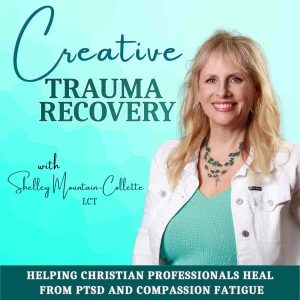
This podcast explores the intersection of trauma recovery, burnout, and helping professions. The host Shelley Mountain-Collette draws on EMDR therapy, IFS, Christian counseling, and art therapy to support therapists, first responders, and other caregivers. Through personal and professional insights, it addresses how childhood patterns lead adults to become fixers. The show offers tools and stories for moving from exhaustion to healing, including strategies for complex PTSD and codependency.
Epizode
-
 WHY I'M DRIVING HOME DYSREGULATED, WIRED, OR CHECKED OUT: Vicarious Trauma, Fight, Flight, and Freeze in Trauma Workers 15.09.2026 22minHave you ever driven home after work replaying someone else's worst day, like it happened to you? That's often a sign of vicarious trauma — and it happens to the most dedicated helpers, not the careless ones. In this episode of Creative Trauma Recovery, trauma therapist Shelley Mountain-Collette breaks down vicarious trauma — the gradual shift that happens in helpers, trauma workers, and first responders from years of holding other people's pain. Shelley shares her own story of the fixer and protector part that's been running since she was three years old, and how it shows up now in her relationship with her mom's ongoing illness. She walks through the four nervous system stress responses — fight, flight, freeze, and fawn — and how each one shows up as either being wired, checked out, or stuck in people-pleasing mode. You'll learn the difference between vicarious trauma and secondary traumatic stress, what a dysregulated nervous system actually means, and how to start noticing which state has been running your system lately. In this episode: What vicarious trauma actually is, and why it happens to the most dedicated helpers The difference between vicarious trauma and secondary traumatic stress Fight, flight, freeze, and fawn — the four nervous system responses, explained What it means to be "dysregulated," and how to recognize it in yourself A "Parts in the Room" segment naming the carrier part and the numb part A paced breathing practice for nervous system regulation This week's activity: a daily check-in to notice your own patterns A faith connection through Isaiah 11:2, Matthew 11:28, and Galatians 6:2 Who this episode is for: trauma workers, first responders, therapists, nurses, and Christian helping professionals who feel like they're either always on guard or completely checked out — and want language for why. Keywords: vicarious trauma, dysregulated nervous system, hypervigilance, fight flight freeze fawn, nervous system regulation, trauma workers, Christian counseling, trauma therapist Be Blessed and Be a Blessing
 -
HOW PLANNING TIME IN PRAYER CHANGED MY LIFE: Trauma, Trust, and Connection with God 08.09.2026 17minWhy does sitting still make your chest tighten, and your mind race through everything undone? In this episode of Creative Trauma Recovery, trauma therapist and former kindergarten teacher Shelley Mountain-Collette explores why planned time in prayer can change your life, not just spiritually, but in ways backed by research on stress, cortisol, and the nervous system. Shelley walks through what the research actually shows about daily prayer and mental health, introduces an IFS (Internal Family Systems) look at the “Doer” part that keeps you moving to avoid feeling unsafe, and offers a practical, personalized way to build a prayer practice that actually sticks, grounded in Luke 12:22-25, Proverbs 16:3, and Ephesians 6:12. In this episode: - What research says about prayer, cortisol, and the nervous system - Why God-image (how you picture God) changes the benefit you get from prayer - An IFS parts-work perspective on the part of you that fears stillness - A short nervous system regulation practice - This week’s activity: building a prayer practice that’s actually yours - A faith-based look at trust, worry, and handing over the striving Who this episode is for: Christian helpers, caregivers, and trauma survivors who stay busy to avoid feeling unsafe, and who want a prayer practice that’s sustainable, not just aspirational. Keywords: Christian counseling, trauma healing, nervous system regulation, prayer and mental health, IFS therapy, trust in God, trauma and faith BE BLESSED AND BE A BLESSING
-
WHY CAN'T I JUST ASK FOR HELP? A Trauma Worker's Guide to Suicidal Parts and Creating a Safety Plan 01.09.2026 24minThis is a good podcast to listen to on World Suicide Prevention Day. Why can't trauma workers, first responders, crisis workers, and therapists just ask for help? In this episode, I get honest about suicidal thoughts, how I understand my own suicidal part through an Internal Family Systems (IFS) lens, and how to build a simple safety plan you can start today. This episode almost didn't happen. It started as a response to hearing that three police officers died by suicide in Ontario, but while I was trying to create it, I lost a former student, lost my own dog Winston, and got difficult news about my mom's health. I had to give myself permission to wait a couple of weeks before I could sit down and talk about this with you. I was living it while I was creating it. We talk about what actually stops helpers from reaching out, and what actually helps. I also walk you through something I don't usually get this specific about: understanding a suicidal part not as something broken, but as a protector, and how to build your own pre-safety plan right where you're sitting, just in case someday you need it. In this episode: Why helpers, first responders, and therapists hesitate to reach out for support Recognizing that suicidal thoughts can show up during grief The real research on what helps people take that first step Online therapy, counselling, peer support, and communities as lower-barrier ways into receiving help Understanding a suicidal part through an IFS lens, not as something broken, but as a protector Building a simple, personal pre-safety plan you can use starting today A closing prayer for anyone carrying grief right now If you or someone you love is struggling, please reach out. In both Canada and the US, you can call or text 988, anytime, day or night. If this episode helps you, I'd love it if you shared it with someone who might need it too. Until next time, be blessed and be a blessing.
-
THE ONE I COULDN'T SAVE: Childhood Trauma, ACEs, Grief, and the Protector Role 11.08.2026 22minWere you the child who worried about everyone else, kept the peace, or felt responsible for keeping people safe? In this episode of Creative Trauma Recovery, I explore how childhood trauma, adverse childhood experiences (ACEs), grief, family roles, people-pleasing, and the protector response can shape adults who become helpers, fixers, caregivers, therapists, first responders, nurses, armed forces, correctional officers, and the people everyone depends on. I also share my own story of growing up as a quieter, more fearful middle child who became fiercely protective of my younger sister, and what happened inside me after she later died tragically in a car accident. We’ll look at why traumatic grief can bring thoughts like: “I should have…” “Why didn’t I…?” “If only…” And how a protective part may keep searching for a way the ending could have been different. You’ll also learn about the ACE questionnaire, childhood adversity, hyper-responsibility, people-pleasing, caregiving, vigilance, burnout, the serenity prayer, and how early protective roles can follow us into adulthood. Most importantly, we explore a difficult but freeing truth: You can love deeply. You can help. You can protect when you can. But you don’t have to be the Savior. Jesus already is. This episode includes a gentle reflection activity, faith-based encouragement, prayer, and practical questions to help you notice what your helper, fixer, peacemaker, or protector still believes it has to carry. If you’ve spent your life being the strong one, the responsible one, the protector, or the person everyone depends on, this episode may help you understand yourself with more compassion and begin asking: What is truly mine to carry, and what can I finally give back to God? "God grant me the serenity to accept the things I can not change, the courage to change the things I can, and the wisdom to know the difference." I want to dedicate this episode to the Correctional Officers who lost their lives in the line of duty last week in Alberta. And the Fire Fighters who lost their lives fighting fires near the Colorado / Utah border. Please join me in praying for their family, friends, and co-workers.
-
LOSING MYSELF IN THIS WORK: Identity, Burnout, and Trauma for Helping Professionals 04.08.2026 15minWhy am I losing myself in this work? When helping others becomes your identity, burnout, trauma symptoms, or a forced career change can feel like losing who you are. In this episode of Creative Trauma Recovery, Christian trauma therapist Shelley Mountain-Collette explores why first responders, nurses, therapists, teachers, pastors, caregivers, crisis workers, and other helping professionals struggle with burnout, ask for help, set boundaries, take medical leave, or imagine a meaningful life beyond their professional role. You'll learn how trauma exposure and helper identity can become intertwined, why stress can disconnect you from activities you once loved, and how to begin rediscovering who you are outside your work. This episode includes a gentle creative exercise to help you reconnect with neglected parts of yourself, rebuild a healthier sense of identity, and take one small step toward healing. Your work matters, but your worth has never depended on how much you can carry. You are more than your job, your uniform, your title, or the people who depend on you. Healing may begin when you make room for the rest of who you are. Topics include: first responder mental health, helper burnout, compassion fatigue, trauma recovery, PTSD, professional identity, occupational stress, Christian mental health, caregiver burnout, boundaries, and self-worth. Be Blessed and Be A Blessing
-
WHY DO I FEEL THIS WAY? Understanding Burnout, Compassion Fatigue & Trauma Exposure for Helpers 28.07.2026 20minIf you're a therapist, nurse, social worker, teacher, first responder, pastor, or caregiver feeling exhausted, numb, anxious, or disconnected from yourself or God, this episode explains burnout, compassion fatigue, secondary traumatic stress, PTSD, and complex trauma in a way that makes sense of what you're experiencing. In this foundational episode of Creative Trauma Recovery, we begin unfolding the map of how trauma, burnout, compassion fatigue, secondary traumatic stress, PTSD, and complex trauma can affect the nervous system, especially for people who spend their lives caring for others. This episode is for the helpers. For therapists, counsellors, social workers, nurses, doctors, teachers, educational assistants, pastors, ministry leaders, first responders, caregivers, support workers, chaplains, parents, foster parents, adoptive parents, and anyone who has carried the emotional weight of other people's pain. If you are someone others rely on, someone who listens, supports, comforts, teaches, leads, advocates, prays, rescues, cares, or holds space for people in difficult seasons, this conversation is for you. This episode is not for diagnostic purposes. It is for education, understanding, and empowerment. You may recognize parts of yourself in more than one of these experiences. You may hear about burnout and think, "That sounds familiar." You may hear about compassion fatigue, secondary traumatic stress, PTSD, or complex trauma and realize that pieces of those descriptions feel familiar too. That does not mean you are broken. It means your mind, body, and spirit may be responding in very natural ways to prolonged stress, trauma exposure, caregiving, emotional overload, spiritual exhaustion, or overwhelming life experiences. In this episode, we gently explore what trauma is, how burnout can develop, why compassion fatigue happens, how secondary traumatic stress can affect helpers, and why PTSD and complex trauma are not signs of weakness or failure. They are signals that your nervous system has been carrying too much for too long. Together, we look at these terms not as labels, but as signposts. They are not meant to box you in. They are meant to help you better understand what your system has gone through and what it may need now. This podcast series will focus on safety, empowerment, nervous system regulation, creative trauma recovery, faith, lifestyle supports, and gentle healing practices that do not overwhelm the system even more. We will also explore different therapy approaches in future episodes, helping you understand what options may be available so you can feel more informed, supported, and empowered if and when you choose to reach out for help. If you have ever felt exhausted from caring, numb from listening, anxious from holding too much, disconnected from yourself, distant from God, or unsure why you no longer feel like the person you used to be, this episode offers a compassionate place to begin. You are not alone. Your reactions make sense. Healing is possible one gentle step at a time.
-
LET GO, LET GOD: Releasing Control in Trauma and Burnout Recovery 21.07.2026 18minThis first episode of Creative Trauma Recovery is dedicated to the two paramedics and the patient who recently lost their lives here in New Brunswick. Some tragedies leave us without words. We pause to remember them and to hold close their families, friends, colleagues, fellow first responders, and the communities carrying the weight of this heartbreaking loss. Have you been trying to hold everything together, care for everyone around you, and stay in control, only to find yourself exhausted, overwhelmed, or far from God? For many helpers, letting go can feel frightening. Trauma may have taught us that staying alert, being responsible, and keeping everything under control were necessary for survival. Those patterns may have helped us through painful seasons, but carrying that level of responsibility for too long can contribute to burnout, compassion fatigue, anxiety, and spiritual exhaustion. In this first episode, I share part of my own story. At my first Al-Anon meeting, the words of the Serenity Prayer deeply affected me. My marriage had fallen apart, my life felt out of control, and I walked into the washroom and cried out to God, “Please help me. I have messed everything up. I cannot do this, and I need You to be in control.” That honest prayer became the beginning of a different way of living and healing. I also share how I placed sticky notes around my apartment that said, “Let go. Let God.” I needed to see those words when I woke up in the morning and before I went to sleep at night. I needed the reminder that I did not have to carry everything alone. In this episode, we explore the connection between trauma and the need for control, why helpers often feel responsible for everyone and everything, and what twelve-step programs can teach us about surrendering what has become unmanageable. Letting go does not mean giving up, ignoring our responsibilities, or pretending that painful things do not matter. It means learning what belongs to us, what does not, and where we need to stop relying only on our own strength. You will also be invited to gently notice one area of your life that you may be trying to control and take a small step toward placing it in God’s hands. Whether your faith feels strong today, you have questions, or you are simply searching for hope, you are welcome here. Healing does not require you to have everything figured out. Sometimes healing begins with an honest prayer: “God, I cannot carry this alone. Please help me let go and allow You to lead me.”
-
TRAILER 18.07.2026 4minCan you look back over your life and see where you became the strong one, the helper, the fixer, the one everyone depended on? Do you love helping people, but realize the work is leaving you exhausted, overwhelmed, or disconnected from yourself, your friends, or your family? Do you know what you should do, but still feel stuck when it comes to doing it? If those questions stirred something in you, the story of your exhaustion may have begun long before you put on a uniform, earned a degree, or accepted responsibility for caring for others. For many of us, becoming the helper was not simply a career choice. It began in childhood, when being helpful, strong, or needed felt safer and sometimes seemed like the way to earn acceptance and love. So of course you became a fixer, someone who supports people physically, emotionally, mentally, or spiritually. Maybe you became a therapist, first responder, frontline crisis worker, nurse, ER doctor, school counsellor, social worker, or pastor. You wanted to help people in pain, so you packed up your own pain and carried it into your career. Now those boxes are piling up. The work you once loved is starting to feel heavy. Maybe you think, “I love my job, but I don’t know how much longer I can do this.” You are not just tired. You are “if I slept for a week, I’d still be tired” kind of tired. Even simple things feel hard. You cannot make yourself do what you once enjoyed, and the people closest to you see the difference. Maybe you have already hit rock bottom and left your career, but still have not found the peace you were seeking. Maybe you pray and hear no answers. You may call out to God in desperation, but His voice feels distant. Friend, if any of this sounds familiar, I am so glad you are here. Welcome to Creative Trauma Healing. I’m Shelley Mountain-Collette, a Christian trauma therapist, strategic intervention coach, educator, wife, girl mom, lifelong learner, and fellow traveler on this healing journey. My passion for trauma healing is not only professional. It is deeply personal. I entered this world a few years after both of my parents experienced traumatic losses. They are awesome people who taught me grit and how to push through pain, but we did not know how to heal from the fear of loss. I know what it is like to carry fear in your body, long for peace, and love God while feeling overwhelmed, far from Him, and even far from yourself. I also know what it is like to pack up your pain and leave a career you love because you can no longer carry the heaviness. I have lived through burnout, compassion fatigue, and trauma. I created this podcast for professionals, trauma survivors, wounded healers, hurting helpers, and anyone tired of merely surviving and ready to begin healing. My heart is to help you find yourself again, remember joy, dream again, and find peace in your mind, body, soul, and spirit. Here, I will share creative ways to heal without reliving every painful moment from the past. Healing can be gentle and even enjoyable at times. We may feel all the feels, but we will do it together. With God’s guidance, we will take this journey one step at a time. Each week, we will explore creative, holistic, evidence-based, and faith-based ways to support healing and look at how God beautifully designed us with the capacity to heal. This is a space to breathe, reflect, reconnect with God, and begin healing in a way that honors your whole self. So grab a notebook and your favorite caffeinated beverage, and let’s get creative about healing. This podcast is for education, encouragement, faith building, and personal growth. It is not a substitute for therapy or medical care. Please reach out to a doctor, therapist, or qualified professional in your area if you need support.
Slični podcasti


Popularan u
Ovaj podcast se pojavljuje i u podcast listama ovih zemalja.

