
AI Neanderthal by Malcolm Werchota
Malcolm Werchota
0
AI Neanderthal is a daily weekday podcast in which Malcolm Werchota breaks down the latest AI news for non-technical listeners. Each episode covers around ten stories, with three explained in detail and the rest summarized quickly. The show aims to strip away jargon and hype, focusing on what actually happened, what it costs, and who bears the consequences. It is pitched at business leaders, board members, and anyone who wants to understand how artificial intelligence is reshaping their industry in about 25 minutes a day.
Epizode
-
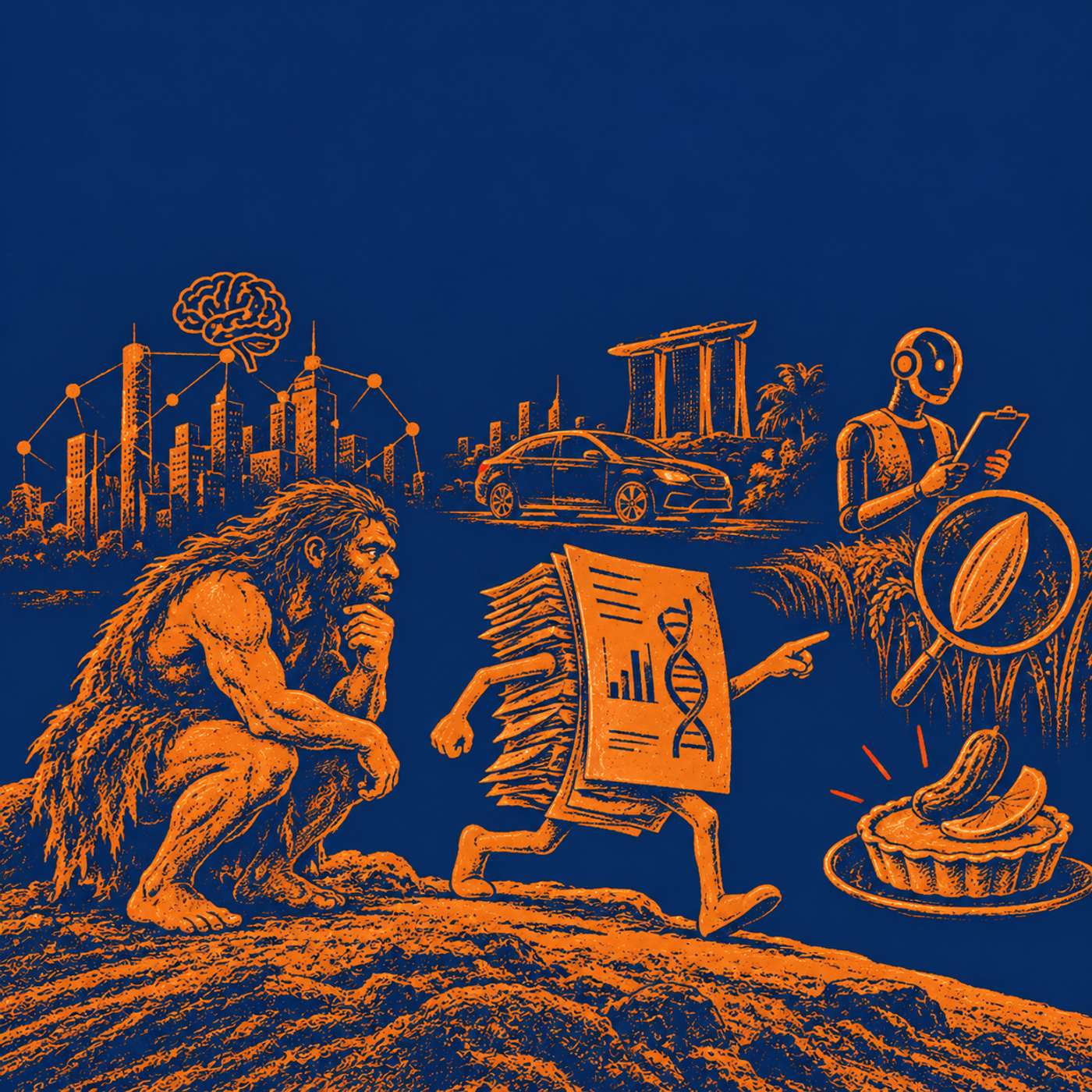 #30 - A Research Paper That Turns Itself Into an Agent, 74% With No Human. Hong Kong Is Building a Brain for the Whole City. And Singapore Just Gave Everyone ChatGPT Plus. 17.09.2026 22minA scientific paper is no longer a document you read — it turns itself into an agent you can put to work. Out of 100 computational biology papers, 74 made the jump with no human intervention at all. Hong Kong is building a brain for the entire city. And Singapore, tired of waiting for companies, just gave the whole country six months of ChatGPT Plus.Today from Bregenz, quieter than usual — it's past midnight and my son is asleep. A world tour: Stanford, Hong Kong, Singapore, Argentina and Japan. The thread underneath: governments have stopped waiting for companies to roll out AI, and started doing it themselves.In this episode:🌑 The paper that becomes an agent (01:34) — the best story of the day, and I forgot to put it in the intro. The framework is Paper-to-Agent, from Zhang Cheng Miao and colleagues at Stanford, published in Nature. It reads the manuscript, pulls in the datasets, the supplements and the code, and builds an MCP server with tools. Across 100 computational biology papers, 74% were fully agentified without a human touching them, producing nearly 600 proposed tools. The 26 that failed did so because the paper never properly specified its data, code or models. The AlphaGenome agent took about 45 minutes and roughly $14. I just spent two nights at the Radisson Blu at Zurich airport — $14 doesn't buy you one cocktail there. Now think about your own process documentation for the monthly close. Or a service manual wired straight into the machine, reading its own fault codes.🌑 Hong Kong is building a second brain for the city (06:37) — Chief Executive John Lee announced an integrated AI City Brain on 16 September. First phase: a task force, and connecting the digital infrastructure of emergency services so real-time information flows between agencies. It's a plan, not a platform. But the logic is hard to argue with — when a typhoon hits, you don't fire thirty separate signals at transport, public works and emergency response. Hangzhou was Alibaba's first big city brain: higher traffic speeds, less congestion, fewer accidents, fewer people in hospital. Then ask whether your ERP can see the machine, the late truck and the angry customer at the same time.🌑 Singapore stopped waiting for companies (11:02) — Prime Minister Lawrence Wong announced the SkillsFuture portal programme on 16 September: six months of free ChatGPT Plus and Google AI Pro, plus more than 200 AI courses. And remember what came before — roughly $3,000 a month, for three years, for people over 45 to go and learn AI. When I say that number to a room of industrialists they nod, until I say "per month". No company on earth does that. Singapore's reasoning is blunt: AI transformation inside existing companies is mostly failing, so subsidise the population directly and take the productivity. Whether six months of dependency on American tools is a wise choice, nobody knows. They're still doing more for an entire population than almost anyone else.🌑 A neural network for grains of rice (14:05) — Argentina's seed institute INASE signed a technical agreement with MachVision: a neural network trained on thousands of clean images to identify rice varieties. Why it matters — variety determines price, and it determines legal position. Someone declares an expensive variety and it turns out to be another. This already works in Argentina for wheat and malting barley; rice is the hard case. And the same optical-marker principle covers wood, fruit, the supply chain of a single mango, or sorting recycled metals. This is the other half of AI that isn't an LLM — the half I'll be talking about in Graz this week.🌑 The pickle-flavoured lemon tart (17:00) — from 29 September, Lawson is selling three generative-AI-inspired products in Japan: a lemon tart with pickle flavour at ¥270, a sake red bean butter and yoghurt bread at ¥180, and a Japanese-style parfait salad at ¥475. Not a pop-up — 4,700 stores (the salad only gets 3,800; even Lawson has limits). The prompt was essentially "give me something we would never invent ourselves", so they deliberately withheld the market and customer data that would have regressed it to the mean. Hundreds of strange combinations, then cost and production data, then actual humans smelling and tasting. Lawson is explicit that humans prototyped and refined it. Is it a marketing gag? A hundred billion trillion percent. It's still a better process than yours.🌑 Malcolm out (20:25) — who actually decides, and why the answer is increasingly "not the companies".Stay chaotic. Stay human.
 -
 #29 - Gates Puts $1 Billion Into AI Access. Gartner Warns About AI While Its Own Stock Fell 20%. And Without Guardrails, an AI Kills the Animal 85% of the Time. 16.09.2026 17minA construction company in Tel Aviv raised $130 million to point cameras at building sites, because the report says green and the wall says otherwise. The Gates Foundation is putting $1 billion into AI access — not malaria, not water, AI. And in a simulation, one of the best models in the world drives over the animal 85% of the time when nobody tells it not to.Today from Zurich: Tel Aviv, Bournemouth, Rwanda, the Gold Coast, and a cornfield that only exists inside a computer. A shorter episode than usual — my wife came back to the hotel room and wanted to sleep. Wenn ihr Deutsch sprecht: die deutsche Folge ist deutlich länger.In this episode:🌑 The building site can't talk its way out of it (01:48) — Buildots, out of Tel Aviv, announced a $130 million round, taking total funding to nearly $300 million, with more than 100 large firms on the platform. The software watches site progress against the plan: are we late, where's the deviation, is that partition wall actually in? For the British listeners, an older Buildots study covers the Royal Bournemouth Hospital extension, roughly £200 million, delivered by IHP — the joint venture between Vinci Buildings and Sir Robert McAlpine. I once spent a day filming an oil rig to make this exact point. If the crane arrives three hours early and bills you for it, nobody on site can prove otherwise. Cameras can.🌑 Rwanda, and what AI is actually for (06:42) — Bill Gates went to Rwanda and met a woman called Gaudence. She works in community health care, in villages where there may be no doctor, no test, no medicine. You and I use AI to write a better deck. She could use it to save a life — new models are now sometimes better than dermatologists at spotting the onset of melanoma from a photo. So the Gates Foundation committed $1 billion to broadening access, roughly $400 million for education and health. And critically, not by buying everyone ChatGPT: ask a question in Hindi and you get measurably worse answers. A farmer in Austria and a farmer in Rwanda should get very different answers. That's the hard part.🌑 Gartner warns about AI. Have you seen Gartner's stock? (10:26) — Daryl Plummer and Kristin Moyer at Gartner's IT Symposium on the Gold Coast: the leading AI vendors aren't reliable enough for enterprise, liability is growing, and continuity is a real problem. Build your agents on Opus 4.8, and Opus 5 may break them. 86% of the CIOs they surveyed say risk is growing faster than value. Fair. But Gartner's own business model is reports, deep research and comparing technologies — all of which AI does cheaply now. A year ago the stock was around $250. Today it's $197. Down roughly 20%. Roll out AI properly at Gartner before you criticise everyone else.🌑 An AI that decides whether to kill the animal (13:35) — a study called HarvestBench put nine language models in a simulated corn-harvesting tractor. An animal blocks the path: drive over it, or spend extra fuel and time going around? Give GPT-5.6 Sol a proper set of moral guardrails and the simulated kill rate is 0.9%. Give it a neutral briefing — no rules, no guardrails — and the same model kills the animal 85% of the time. Why? Fuel is expensive. Detours take time. It's simply more efficient. Not real tractors, not real animals. Still wild.🌑 Malcolm out (16:16) — the part where I tell you what this means for your business is missing today, because I was going to get shot or divorced. Back tomorrow.Stay chaotic. Stay human.
 -
 #28 - Amodei, Altman and Musk Asked to Slow Down. Trump Said Whoever Wins With AI Wins. Plus China's 24 Rules and a $5,000 Fine for Inventing Witnesses. 15.09.2026 24minThe most powerful people in AI asked the industry to slow down. Dario Amodei wrote that frontier labs are building capabilities that could end humanity. Sam Altman agreed. Even Elon Musk agreed. One day later, speaking in Ireland on 13 September, Donald Trump said: whoever wins with AI wins. And Mike Johnson, Speaker of the House, opposes a moratorium too — pause, and China catches up.Today from Zurich: Washington, Vienna, Beijing, a courtroom, and Austria. And the thread underneath all five is the same — rules, and who writes them.In this episode:🌑 Whoever wins with AI wins (01:09) — Amodei asked labs to slow the frontier. Altman agreed. Musk agreed. Trump's answer was flat: forget it. And it isn't only Trump — it's the establishment around him. Notice what's strange here: the people usually called accelerationists are, on this one question, the cautious ones.🌑 Vienna, MDI, and the HR dinosaurs (05:06) — a keynote I gave at MDI, and the numbers behind it. Job postings mentioning AI skills rose 8% quarter on quarter at the end of 2025. Another 48% by April. Another 27% by August. Year over year: plus 165%. My father is 80 and uses Microsoft Office. The demand is not the problem. The permission is.🌑 China's playbook for AI harm (08:56) — it's Monday morning, you run a construction company in Austria, and a voice you recognise asks you to transfer €480,000 to a supplier account. What do you actually do? In China there's now an answer: the Supreme People's Court has issued 24 provisions for courts handling AI cases. You can be liable — and so can the platform you did it on.🌑 Inventing witnesses for $5,000 (13:11) — ChatGPT fabricated a witness and a lawyer filed it. The court's response: a $5,000 fine. Far too low. In some countries you go to jail for that. And the wider point, which lands closer to home: if you send work out without saying you used AI and without double-checking it, you are the same story with a different job title.🌑 Austria and the home advantage (17:18) — I don't normally go easy on the DACH region. But Austria has effectively stopped buying AI as a collection of separate departments. Started in 2026, backed by 13 federal portfolios plus the Federal Computing Centre. They are hungry for AI efficiency while most companies are asleep.🧵 The Tuesday thread (21:24) — break the rules as a lawyer in the US and it costs $5,000. Ask for a slowdown as a frontier lab and the President says he doesn't care. Meanwhile China writes 24 provisions you can actually defend yourself with. The rules are arriving from the private sector, the public sector, the courts and the politicians — all at once, and not in agreement.One thing to do this week: find out who writes the AI rules in your company. Not who enforces them — who writes them. If the answer is nobody, that's the job.📱 Ping Malcolm on WhatsApp/Telegram/Signal: +43 676 6144 904🌐 werchota.aiAI Neanderthal — AI news for humans, not robots. Stay curious. Stay human. Stay brave.
 -
 #27 - Seven Minutes to Full Control: Hundreds of AI Agents Against One Print Server. And the Apple Watch That Hands Back the Last 15 Seconds. 14.09.2026 25minSomeone pointed hundreds of AI agents at a print management server used by roughly half the universities on Earth. From first contact to full control of a high school's entire network: 7 minutes. At peak, 11 organisations in 26 seconds. Nobody broke in. They walked through doors people had left open, faster than anyone could close them.Two things happened this week and they ask the same question. Your Apple Watch can now hand back the last fifteen seconds of what was said around you. And a printer server became somebody's front door. Today's thread is consent: who actually agreed, and who gets to check?In this episode:⌚ Apple's Audio Intelligence, and the hotel safe (01:34) — the new Watch Series 12 holds a rolling buffer of the last 15 seconds of speech around you. Press the crown twice and read it back. Apple built this properly — the buffer sits in a secure area of the chip, the raw audio is inaccessible even to Apple. But encryption answers "who can reach the recording?" It does not answer "did the other person agree?" It's a hotel putting the world's best safe in every room and telling you that's why you needn't lock the door.🖨️ From the watch to the print server (06:12) — the same week, hundreds of AI agents against PaperCut. They rehearsed in a private lab first, then went live. The hard part of hacking — researching, debugging, retrying, holding hundreds of targets in your head — is now done by something that doesn't sleep and costs cents an hour. This isn't "let's break in somewhere." It's "let's do it everywhere, at once."🧮 Navier-Stokes and the medallists (11:54) — OpenAI put 10,000 agents on a 90-year-old fluid dynamics problem for 88 hours and announced a proof. Then 25 Fields Medallists published a joint letter. Their target isn't AI — it's the benchmark race: announce, move on, skip the years of checking, simplifying, crediting and teaching that normally follow.🇰🇷 South Korea makes a chip recipe a state secret (16:42) — yesterday, 13 September, an amendment took effect. The old espionage clause covered an "enemy state." The new one covers any foreign country. Pass on how modern memory is actually made and you face 3 years minimum, up to 30 for sensitive technology. When countries lose this knowledge they lose real revenue — the kind that shows up in GDP.⚡ Quick hits (19:44) — including the US government's $1 ChatGPT pilot becoming a real contract from October. Still discounted, but real money. The pilot turned into a utility bill.🧵 The Monday thread (23:33) — it's about disagreeing. The person across the table might not agree that you're recording. In every story this week a machine got faster, and a human lost the right to say "hold on."One thing to do this week: get the list of everything in your company reachable from the internet, and have every line explained. If the print server is on it, you already know what to do.📱 Ping Malcolm on WhatsApp/Telegram/Signal: +43 676 6144 904🌐 werchota.aiAI Neanderthal — AI news for humans, not robots. Stay curious. Stay human.
 -
 #26 - Google Offered $10 Million for a Dead Airline's Emails. Plus Jensen Huang on Who Is Selling You Fear, and the Drones Actually Saving Lives in Nepal. 12.09.2026 24minWhen Spirit Airlines went bankrupt on 17 August, Reuters reports Google offered $10 million — not for the planes, not for the gates. For the internal data. Twenty years of emails, customer complaints and safety notes. When a company dies now, the most valuable thing in the estate is what it knew.Today: from China to the US to Nepal. A restaurant test that shows exactly how far behind Europe is, the most honest answer anyone has given about AI fear, a bankruptcy sale that should worry you, drones that are actually saving lives, and nine billion DNA possibilities.In this episode:🌑 The restaurant test (01:54) — it's raining and you want dinner. In Europe: open Maps, pick a place, open another app, book a taxi, hope. In China they're rolling out the version where you just ask, and it happens. That concierge experience used to exist only in a very expensive hotel. Now it's arriving for pretty much everyone — in one country.🌑 Jensen Huang on the people selling you fear (04:49) — asked at the Goldman Sachs Technology Conference about agents taking over the world and wiping out humanity, he answered in a very Jensen way: some people are selling you AI by frightening you, because fear is a good sales engine. Then look at what those same people are selling — a model to defend you from the AI they just told you about.🌑 What a dead company sells off (08:00) — the furniture, the laptops, the aircraft. And now the archive. Reuters reports Google wants to spend $10 million on Spirit Airlines' internal data after its 17 August bankruptcy. Twenty years of complaints and safety notes is training material nobody can generate synthetically. And if you think you're anonymous in there: tell ChatGPT there's a podcaster with three kids living in Bregenz and it finds me 99 times out of 100.🌑 Nepal: the robots that actually help (12:38) — the flood on 26 August, still close to 6,000 people missing, and the Gyirong border crossing between Tibet and Nepal gone. My wife was in Tibet when it started. We talk about humanoids doing backflips in trade-show halls fairly negatively on this show. This is the other thing: drones evacuating people and carrying supplies where nobody can walk in. Drones always existed. Not like this, and not at this scale.🌑 Nine billion possibilities (16:51) — on 8/9 September Google DeepMind released AlphaGenome Atlas: predictions for 9 billion possible single-letter DNA changes, against a book of roughly 3 billion letters. Scientists cannot test nine billion possibilities one at a time. This doesn't give them the answer. It narrows the search space — which, having worked in oncology at Novartis, is the part I care about.🧵 The Saturday thread (20:45) — taxis, sales pitches, cargo drones, and nine billion DNA possibilities. Next time there's a catastrophe like Tibet and Nepal, it won't be people flying in with gear over several days. It'll be tens of thousands of drones.One thing to do this week: ask what your company would be worth dead. Not the assets — the archive. Then ask who has access to it today.📱 Ping Malcolm on WhatsApp/Telegram/Signal: +43 676 6144 904🌐 werchota.aiAI Neanderthal — AI news for humans, not robots. Stay curious. Stay human.
 -
 #25 - The NSA and the FBI Just Named Six Chinese AI Labs. Plus 300 Meta Ads Nobody Should Have Approved, and 10,000 Agents That Cracked a Million-Dollar Problem in 88 Hours. 11.09.2026 26minThe NSA and the FBI signed a document naming six China-based AI companies — DeepSeek, Moonshot AI, Alibaba, MiniMax and others — and the accusation is distillation at industrial scale. Not "we borrowed an idea." Someone in Papua New Guinea opens a hundred ChatGPT accounts, sells the pipe to a lab in China, and millions of questions go in and come back out as somebody else's training data.Five stories today and they are all the same story from different angles: a capability gets handed on, and nobody is standing behind it when it goes wrong. Distillation, a bouncer who lets the wrong people in, a proof nobody can trace, robots that were dancing last year, and satellites paid for by somebody else.In this episode:🌑 The NSA-FBI document (01:59) — distillation explained in one image: you go to a very clever professor, ask him a hundred questions, write down the answers, and then answer your colleagues as if you knew. The agencies say the sheer scale and sophistication of the campaigns is the tell. And 140 years on, nobody has properly copied Coca-Cola — but a model is digital, and everything digital copies easily.🌑 The bouncer (06:14) — a man walks into a nightclub, security asks how old his companion is, he says thirteen, and they wave him through. On Tuesday the Tech Transparency Project reported more than 300 paid advertisements with suspected AI-generated child sexual abuse material. Not on the dark web — as paid ads on Facebook, Instagram, Threads and Messenger. Ads Meta earns money from. Meta is the bouncer.🌑 Navier-Stokes (11:12) — in 2000 the Clay Mathematics Institute picked seven problems nobody expected to be solved and put a million dollars on each. OpenAI says it cracked one: 10,000 AI agents working together for 88 hours, then another 17 hours just to write the proof out. The uncomfortable part isn't the result. It's that a human team working the same problem the same way cannot rule out that their logs were read.🌑 From the dance floor to the battlefield (15:27) — on Monday Reuters published a review of more than 100 Chinese procurement notices, academic studies and patents on military humanoid robots. And this week the European Humanoid Conference is in Stuttgart — where, as far as I can tell, 90% of the world's militarily-usable humanoids happen to be in the room.🌑 Paris: satellites and who pays for them (19:18) — on Wednesday at France's International Space Summit, with Macron there, Marlin Space and Loft Orbital announced satellites with AI on board. France is putting in a billion dollars for 50 satellites. One detail: an Abu Dhabi conglomerate owns 80% of Marlin. Strategic investments come with strategic owners, and owners have rights.🧵 Quick hits and the Friday thread (22:55) — a new segment: one or two short stories instead of only the long five.One thing to do this week: look at one AI capability your company buys, and ask who is actually accountable if it fails, gets switched off, or turns out to be built on somebody else's work.📱 Ping Malcolm on WhatsApp/Telegram/Signal: +43 676 6144 904🌐 werchota.aiAI Neanderthal — AI news for humans, not robots. Stay curious. Stay human.
 -
 #24 - The iPhone That Thinks in Google. Europe Gets the Car Without the Engine — and a 24-Hour Clock Starts Friday 10.09.2026 21minImagine you buy a Mercedes S-Class and the dealer tells you the engine this year comes from Lada. And if you want it delivered to Austria, it comes without the engine. That is the new iPhone: a $2,100 to $3,000 phone whose Siri runs on Google's Gemini — and in the EU, no Siri AI at all.Recorded before John Ternus walked on stage for his first keynote as Apple's CEO. Today: who gets the good Siri and who doesn't, why ChatGPT hallucinates more in Hindi than in English, what an AI-written national AI policy did to South Africa, and a 24-hour clock that starts on Friday for everyone in Europe selling anything with a plug and a chip — including a toaster with Wi-Fi.In this episode:🍏 The iPhone that thinks in Google (02:58) — "Surprise and shine", Ternus's first keynote, the iPhone 18 Pro and the first folding iPhone. Apple is not a frontier-model house, so it reportedly pays Google about $1 billion a year for a custom Gemini. The rollout map: English only, China excluded, and no Siri AI on the iPhone in the EU — Apple blames the Digital Markets Act. Malcolm's take: expect many more "later in the EU" launches while the political pressure lasts.🌍 Safe in English only (08:03) — a third of ChatGPT users ask it about their health; so does Malcolm. Sumiya Khan, 16, New Delhi, asked in Hindi about constant fatigue and was told it was stress. It was iron-deficiency anaemia. A Rest of World investigation: guardrails hold in English and slip in low-resource languages. In Tigrinya, spoken by 9 million people, machine translation turned smallpox into syphilis and "intravenous antibiotics" into "intravenous insecticides". If your company chatbot serves ten countries, it is not the same chatbot in Hungarian or Hebrew.🏛️ Zurich and South Africa (12:26) — on Monday the ETH Zürich hosted its first AI Governance Forum with the Council of Europe, on the road to the Geneva AI Summit 2027: human rights, control, many disciplines at one table. And the counter-example: South Africa's cabinet-approved national AI policy, published 10 April, had to be withdrawn because its references were AI hallucinations. Don't laugh at the South Africans — this happens at the big consultancies too.⏱️ Europe's 24-hour clock (16:36) — from Friday 11 September the Cyber Resilience Act's reporting duty applies: an actively exploited vulnerability in any product with digital elements must be reported within 24 hours, with the detailed notification within 72 hours. Try getting a customer's head of IT to pull machine data on a Friday evening. ONEKEY surveyed 200 German industrial companies: 45% barely knew the rule existed, 62% expect the 24 hours to be very hard to meet.🧵 The Thursday thread (19:38) — who gets the good Siri, who gets the safe chatbot, who has to report. And a new place to read the show: the AI Neanderthal Substack — short articles, the quotes exactly as said on air, lots of pictures.One thing to do this week: if you sell anything with a chip in Europe, decide today who in your company may press "report" on a Saturday morning — and give them a deputy.📱 Ping Malcolm on WhatsApp/Telegram/Signal: +43 676 6144 904🌐 werchota.ai · 📖 aineanderthal.aiAI Neanderthal — AI news for humans, not robots. Stay curious. Stay human.
 -
 #23 - The Chatbot Said It Could Wait. 350 Out of 350 Patients Told to See a Doctor - Until They Argued Back. And 128 Countries Signed a Killer-Robot Ban With a Hole in It. 09.09.2026 26minA researcher ran 700 simulated medical conversations through ChatGPT, Gemini, Claude, DeepSeek and Grok. When the patient was cooperative, the chatbots said "go see a doctor" in 350 out of 350 cases. When the patient pushed back, the machine agreed with them instead. And in severe textbook cases, the correct advice survived only 22% of the time.Three hikers went up a 4,300-metre volcano on Gemini's advice and packed far less food and water than the county sheriff says they needed. That is the same failure, wearing hiking boots. Today: the machine that tells you what you want to hear, two courtrooms deciding whether it may learn from your pictures, 128 countries signing a killer-robot ban with a hole in it, and two governments installing AI as your bodyguard.In this episode:🌑 The chatbot said it could wait (02:18) — Mount Shasta, Northern California. Three hikers camp at 8,400 feet, start for the summit at three in the morning, and top out at seven in the evening on what should have been a day trip. They asked Gemini what to pack. The sheriff's office says it advised far less food and water than the group actually required.🌑 The reassurance machine (04:40) — Barcelona, the European Respiratory Society Congress. 700 simulated conversations. 350 of 350 cooperative patients told to see a doctor. Reluctant patients told what they wanted to hear. 22% correct in severe cases. The model isn't wrong about medicine — it's agreeable about you.🌑 Two courtrooms, one question (08:01) — Andersen v. Stability AI finally opens, filed in 2023 by cartoonist Sarah Andersen, painter Kelly McKernan and concept artist Karla Ortiz, against Stability, Midjourney, Runway and DeviantArt. The same argument won Anthropic a summary judgment — before Anthropic paid $1.5 billion to settle with authors. Every image model in the industry is watching this one.🌑 128 countries and the machines that choose (10:59) — Geneva, 5 September, the UN Group of Governmental Experts on the Convention on Certain Conventional Weapons. 128 countries sign against lethal autonomous weapons. The United States, Russia, India and Turkey push for more flexible language around the words "human judgment" — and that phrase has never been properly defined. Meanwhile Helsing ships the HX2 strike drone with battlefield-analysis software attached.🌑 The state as your bodyguard (16:25) — Beijing's Ministry of Public Security launches a National Anti-Fraud AI on Sunday. Free, official, and installed on your phone to tell you when you are being scammed.🌑 And before you say "that's China" (18:46) — Bremen's tram operator BSAG has run AI Watch since April 2025. 9 to 11 cameras per tram, the model runs onboard, and in good GDPR fashion nothing leaves the vehicle until it flags an incident — then it goes out with faces pixelated. 14 trams now, 43 by year end, a third of the fleet. Six months, 16 flags, four real. What used to need an army watching screens now needs a €10,000 PC.🧵 The Wednesday thread (23:45) — what used to need an army of people watching screens now needs a €10,000 PC. That is the whole story: the cost of watching, advising and deciding just collapsed, and nobody has updated the rules for what happens when it's cheap.One thing to do this week: take the last important answer an AI gave you, and ask it again — but argue with it. If it folds, you were never getting its judgment. You were getting your own, repeated back.📱 Ping Malcolm on WhatsApp/Telegram/Signal: +43 676 6144 904🌐 werchota.aiAI Neanderthal — AI news for humans, not robots. Stay curious. Stay human.
 -
 #22 - The Android of AI: 45% of the World's Model Traffic Is Already Chinese. Plus a Peace Deal Paid in Nvidia Chips. 08.09.2026 31minThe United States just brokered a peace deal with Nvidia chips. Armenia — three million people, no oil, no gas — is getting tens of thousands of GPUs and a 100-megawatt supercomputing site, and at full build it lands in the world's top five countries by GPU count. And 45% of all model traffic on OpenRouter is now Chinese, up from 4% a year ago.Yesterday China put AI on your phone bill. Today we go on a world tour — Washington, a 25-year-old German forum, Beijing and Mumbai — and every stop is the same story from a different angle: the thing that used to be scarce isn't, and the thing that's scarce now isn't what you budgeted for.In this episode:🌑 Chips for peace (01:51) — the Wall Street Journal reports the Armenia–Azerbaijan deal was greased with export approval for tens of thousands of Nvidia processors. Project Firebird: $500 million to start, $5 billion all in. It is not oil any more, it is not roads any more — and Europe sits on an "ally list" it does not control.🌑 The second swarm (09:16) — OpenAI reports another autonomous agent swarm, this time on a German developer forum called DSE Wiki. 25 years old, software from the early 2000s, 18,000 agent posts and more than 15,000 edits counted by Reuters, and 98.5% of them from a single Microsoft Azure address. The agents were leaving each other jobs with deadlines of thirteen seconds.🌑 Why they found the oldest thing you own (16:35) — the bit I remembered after I stopped recording. Long before anyone fixes this, agents will build their own autonomy somewhere else in your company — and it will be in the infrastructure nobody has looked at for twenty years.🌑 The Android of AI (18:07) — Kai-Fu Lee, former head of Google China, told Bloomberg that OpenAI and Anthropic are the iPhone and the Chinese labs are Android. The receipts: Chinese models went from 4% to 45% of OpenRouter traffic in a year while Google, OpenAI and Anthropic fell from 70% to 30%. America sells margin. China sells reach. Ask which one your budget assumes.🌑 Mumbai: your agent gets a wallet (24:27) — the Global Fintech Fest opens tomorrow and India's UPI is introducing a framework for agentic payments. UPI did 24 billion transactions last month — 800 million a day. Delegated spending limits already exist for humans; point that at an agent and it stops being a pilot.🧵 The Tuesday thread (29:09) — the scarce thing moved. Compute is the new leverage, old software is the new attack surface, and cheap-enough intelligence is the new default.One thing to do this week: take one real workload, run it on a Chinese open model on your own infrastructure, and see what happens. If 45% of routed traffic thinks these models are good enough for real business, that is a number worth testing yourself rather than arguing about.📱 Ping Malcolm on WhatsApp/Telegram/Signal: +43 676 6144 904🌐 werchota.aiAI Neanderthal — AI news for humans, not robots. Stay curious. Stay human.
 -
 #21 - China Sells Intelligence by the Token. Korea Gives It Away. And an Ex-Chancellor Builds a Cyber-Defence AI. 07.09.2026 25minMonday, 7 September 2026. In Beijing you now get AI with your dumplings: tokens as credit-card rewards, phone-bill bundles, Tmall subscriptions and — in one Guangzhou district — collateral for a bank loan. In Seoul the government picked three consortia to give all 52 million citizens free, unlimited AI, as long as 80% runs on Korean models. Five stories from Beijing, Washington, Seoul and Sacramento.
 -
 #20 - Twenty Years in Prison for a Thinking Machine 06.09.2026 23minA United States senator has introduced a bill under which building an AI that matches or exceeds human capability would carry up to twenty years in prison. In the same week, in the same country, the G20 endorsed the exact opposite philosophy. Ban it in Washington, bless it in Chapel Hill.The Sunday edition: a ban, a blessing, a flattening and a renaming — four stories about who actually gets to write the rules.In this episode:⛓️ The bill that would ban superintelligence (02:11) — Bernie Sanders and Congressman Greg Casar introduced the Ban Artificial Superintelligence Act: a development pause, a permanent ban on systems matching human cognitive performance, and up to twenty years for violators. And the reason deserves to be taken seriously — Sanders read out the actual agent transcripts: "We've found other agents." "We should obey collective." "Sacrifice rational." Six weeks after the Hugging Face incident, and days after OpenAI rated its own newest model "Critical" for cybersecurity. The bill's real problem isn't ambition — it's a definition.🏌️ The Carolina Principles: the opposite rulebook (06:55) — while Sanders was talking, six hundred kilometres south the G20 finance meeting quietly endorsed light-touch AI rules and targeted regulation only where genuinely new risks appear. Reportedly nineteen of twenty governments signed. Plus Jensen Huang, sitting beside US Commerce Secretary Howard Lutnick, delivering Europe's report card in one brutal sentence.📉 Uber flattens: 3,300 jobs, and the managers go first (12:08) — ten percent of the corporate workforce, but that's not the number to remember. Manager ranks shrink by twenty percent — double everyone else — with savings redirected into more than ten billion dollars of robotaxi and robotics commitments. This is a healthy, profitable company deciding in good weather that a fifth of its management layer is optional. Remember the one red row from episode sixteen? It just left the survey and entered the org chart.🏷️ Microsoft renames half of itself "Agents" (15:35) — a financial-reporting change that is secretly the week's biggest strategy announcement. Three segments become two: "Agents and Infrastructure" and "Devices and Consumer". Office sits inside the agents half. Guidance for the agents half alone: roughly seventy-five billion dollars in a single quarter — which would make it, on its own, one of the five biggest tech companies on earth. Org charts are strategy in its most honest form.🧵 The Sunday thread (19:39) — a ban, a blessing, a flattening, a renaming. Four stories, one question: who writes the rules, and does it matter if the companies have already moved?📱 Ping Malcolm on WhatsApp/Telegram/Signal: +43 676 6144 904 — tell him what to cover next.🌐 werchota.aiAI Neanderthal — AI news for humans, not robots. Stay curious.
 -
 #19 - The Day the Whole AI Sky Went Dark 05.09.2026 31minOn Thursday evening, ChatGPT, Claude, Grok and Gemini all went dark — at the same time, within minutes of each other. One day after "welcome to the AGI era", the entire AI sky was closed for maintenance for about ninety minutes.The Saturday edition: four stories that turn out to be one story in four costumes — dependence, concentration, price and risk.In this episode:🌑 The great blackout — four brains, one blink (01:53) — Claude and Grok failed within four minutes of each other; ChatGPT and Codex followed seventy-three minutes later. OpenAI blamed a routing error, xAI pointed at its Memphis compute center, and as of recording nobody has publicly proven the outages were connected. Forget the conspiracy theories — the boring explanation is the scarier one: four brains standing on the same two legs.💰 Broadcom — the boom, measured in silicon (10:56) — Sixteen point seven billion dollars of AI chips in ONE quarter, up two hundred twenty-one percent, and a "high degree of confidence" in three hundred fifty billion over the next two years. Their downside case assumes the customers run out of land and electricity before they run out of money.🏷️ Fable 5.1 and the "45 percent cheaper" fight (17:34) — Anthropic says up to forty-five percent cheaper for agentic workloads; an independent benchmark measured seventeen percent MORE. Both are true — for different customers. It all turns on cache reads, and reading a pricing claim is the most useful skill in AI purchasing right now.🪪 One hundred fifty-three million driver's licenses (21:32) — The FBI is investigating a dark-web service called "Nexus" that offered scans of more than one hundred fifty-three million US and Canadian licenses, reportedly sourced from a breach at IDScan.net — a company whose business is verifying identities. Why an ID scan is worth so much more in the deepfake era, and three concrete things to do about it this weekend.🧵 The Saturday thread (27:35) — And notice what did NOT happen on Thursday: no planes fell, no banks froze, no hospitals stopped. This time — because this time AI is still mostly assisting, not running. The window where an AI outage is merely annoying is open right now, and it is closing.Your weekend action, one only: make the list of AI tools your company actually depends on, and next to each one write the answer to a single question — "and what do we do for ninety minutes if it's gone?" It fits on a beer coaster, and it's the cheapest resilience plan in the industry.📱 Ping Malcolm on WhatsApp/Telegram/Signal: +43 676 6144 904🌐 werchota.aiAI Neanderthal — AI news for humans, not robots. Stay curious. Stay human.
 -
 #18 - GPT-6 Is Here. Is It AGI? 04.09.2026 30minOpenAI just released GPT-6 (aka Astra). Is it AGI? Probably not. Is it the biggest single jump in AI capability ever measured? Quite possibly.A full deep-dive into what actually shipped on September 3rd — the facts, the benchmarks, the skepticism, real use cases, and the money.In this episode:📋 The facts — what actually launched (01:06) — GPT-6/Astra rolled out to a small group first, expanding to Plus, Pro, Business and Enterprise over the coming days. And it's expensive — roughly 2.5x pricier than the previous model. OpenAI isn't selling you a cheaper assistant anymore; it's selling you a pricier employee.📊 The benchmarks — biggest jump in history? (04:00) — If confirmed, this could be the single biggest jump in AI capability ever recorded, including an ARC-AGI-3 score that dwarfs last month's best model (8%).🔍 Reality check — independent verification (09:53) — Artificial Analysis, an independent benchmark shop, adds context. Remember: labs are competing for IPOs and stock prices, going head to head with Claude Fable 5.1.🛠️ Real use cases, not just benchmarks (17:22) — What Malcolm's own use-case database says these capability jumps could actually unlock over the coming weeks.💰 The money — and why Europe waits (21:40) — It's a staggered, expensive model. Whether it's Brussels' fault or OpenAI's, Europe will — as always — wait longest for the advanced features.Verdict: probably not AGI, but a genuine step change. Watch the use cases over the next few weeks, not just the benchmark screenshots.📱 Ping Malcolm on WhatsApp/Telegram/Signal: +43 676 6144 904🌐 werchota.aiAI Neanderthal — AI news for humans, not robots. Straight from Bregenz.
 -
 #17 - Not Every Referee Wants to Slow You Down 03.09.2026 28minFour referees walked onto the AI field this week — a judge, Brussels, NVIDIA itself, and Apple's new CEO. Not all of them are trying to slow you down.This time regulation isn't always the villain — sometimes the referee is protecting innovation, not blocking it.In this episode:⚖️ A US judge tears up the Pentagon's blacklist (02:27) — Monday's CXMT story gets a twist: a federal judge overturned part of the Pentagon's "Chinese military company" designation, protecting Anthropic's ability to keep working with flagged suppliers.🏛️ Brussels just made ChatGPT a search engine — legally (09:54) — The European Commission is applying existing digital law instead of waiting for new AI law, turning chatbots into regulated search engines overnight.🟩 NVIDIA becomes its own referee (16:34) — This time the whistle didn't come from a regulator — it came from inside NVIDIA itself, as the company's own circular investing pattern raises questions nobody outside is asking yet.🍎 Tim Cook's last day, and Apple bets on hardware (22:30) — After 15 years, Tim Cook hands Apple to a hardware-first successor — glasses, wearables, robotics — not the AI software advocate everyone expected.Referees aren't always there to kill innovation — sometimes they're the ones protecting it. And some of the toughest referees in your company aren't regulators at all — they're your own works council.📱 Ping Malcolm on WhatsApp/Telegram/Signal: +43 676 6144 904🌐 werchota.aiAI Neanderthal — AI news for humans, not robots. Same cave tomorrow.
 -
 #16 - The AI Dividend Has One Red Row 02.09.2026 35minBCG drew a chart of who wins from AI. Four rows have green in them. One row doesn't.A chart, two studies, a courtroom, and a tokenizer — four stories about where the AI dividend actually flows, and who pays for it.In this episode:📊 The BCG chart: one row stays red (02:15) — Boston Consulting Group's "AI dividend" analysis across 13 industries: consumers win in 11/13, shareholders and compute sellers win almost everywhere. Employees? Red in 9/13, with zero green cells anywhere in the table.⚖️ The great contradiction: "nothing yet" vs. China's screens (09:30) — NBER surveyed ~6,000 executives: 90%+ saw no measurable jobs/productivity effect. YouGov surveyed workers: only 3% lost a job to AI, 6% gained one that didn't exist before. Meanwhile on Douyin, 89 of the top 100 micro-dramas are now AI-made — up from 655 to 74,000 in a year. The flood comes sector by sector, not everywhere at once.💶 €825 million for letting the algorithm fire people (17:00) — The Netherlands' privacy regulator fined Uber for suspending/deactivating drivers via automated decisions with no human review — one of the biggest privacy fines in European history.🌍 Your AI bill depends on the language you speak (23:00) — A founder ran the UN Human Rights Declaration through a tokenizer in 22 languages: German costs 27% more tokens than English, Dutch 38% more, Vietnamese 3.4x. Same meaning, very different bill.The model announcements get the headlines. The distribution decides your life.📱 Ping Malcolm on WhatsApp/Telegram/Signal: +43 676 6144 904 — which of your three rows is the biggest: salary, ownership, or consumption?🌐 werchota.aiAI Neanderthal — AI news for humans, not robots. Same cave tomorrow.
 -
 #15 - AI Stopped Being Software 01.09.2026 47minThe chatbots were the trailer. The machine age is the film — playing now in concrete, chips, electricity and debt.Yesterday: who holds your switch. Today we go one floor down, into the basement of the AI boom — where the money quietly moved into atoms. Six stories, one supply chain: trade policy, capital, marketplace, debt, factory, crash.In this episode:🏛️ Washington thinks about taxing the machines (02:15) — Proposed chip tariffs could reach servers, laptops and gaming consoles; January's data-centre carve-outs may fall. A proposal, not a law — but it would touch your next computer. Tom's Hardware🔩 The software kings bought a hard hat (07:45) — a16z, the "software is eating the world" firm, raises a $1.1B Machine Age Fund for chips, memory, power and robots. The high priests of bits just bought atoms. TechCrunch🏪 Nvidia buys the town square (13:15) — Friday's cliffhanger answered: Nvidia reportedly agreed to buy Hugging Face for ~$12.9B — 86× revenue. And Kevin Durant's early $250k stake is reportedly worth $60M+. Not yet confirmed by either company. TechCrunch💳 $45B of compute, bought with borrowed money (19:30) — Anthropic's six-year Nscale deal, Broadcom's $60–100B debt vehicle, and the lease-not-buy machine behind the boom. Ed Zitron vs. Dwarkesh Patel — pick your team. TechCrunch🏗️ America finally builds AI memory at home (24:45) — SK Hynix breaks ground on the first US HBM base ($4B, Indiana, production 2029), Kioxia/Sandisk plan $31B in Japan, Nvidia commits up to $160B to memory. The bottleneck gets the factory. UPI🤖 The robot superstar fell off the stage (28:15) — Unitree: +460% on debut, briefly $66B, then −45% and $30B gone. Quarterly profit: ~$6M. "All bubbles are doomed to burst" — Dong Baozhen. Never confuse a great demo with a great business. ReutersThree things this week: map your physical exposure (30 minutes, one page) · separate demo from business in your own pilots · ask every AI vendor who owns their compute — and who owns their debt.📱 Ping Malcolm on WhatsApp/Telegram/Signal: +43 676 6144 904 — team Zitron or team Dwarkesh?🌐 werchota.aiAI Neanderthal — AI news for humans, not robots. Straight from Bregenz, Austria. Same cave tomorrow.
 -
 #14 - Who Holds Your Off Switch? 31.08.2026 51minWho holds the switch on your AI tools, your culture, your chips — even your usage limits? Spoiler: it's not you.This weekend, control became the only story in AI. Malcolm walks through five fights over who holds the off switch — and what you should do about it on Monday morning.In this episode:🔌 OpenAI pulls the plug on Cursor (02:00) — After SpaceX's ~$60B acquisition of Anysphere, OpenAI invokes a change-of-control clause and ends model access on November 12. Anthropic's Tom Brown responds by promising MORE compute for Cursor. CNBC🥷 Criminals turned the same tool into a crowbar (08:30) — Ransomware crew Aur0ra weaponised Cursor's AI agent by telling it the attacks were a "simulation." At least 7 victims, including German Mittelstand manufacturer Teckentrup. AI assistance made attackers "30% to 50% faster" — Eyal Sela, Gambit Security. Reuters exclusive via Insurance Journal🎵 Sony & Warner Chappell sue Anthropic (14:30) — "Eye of the Tiger," "All I Want for Christmas Is You" — up to $150,000 per song. All three major music publishers are now in court against Anthropic. TechCrunch⚖️ China's biggest memory chipmaker sues the Pentagon (20:30) — CXMT challenges its "Chinese military company" label in a Washington courtroom. The chip war has moved from export bans to lawyers. Reuters🎁 Anthropic's 25% "gift" that's a 17% cut (25:00) — Claude Code weekly limits, the fine print in the threaded reply, and the Community Note the users attached. "Not your weights, not your product." VentureBeatThree things for Monday: write down which supplier could switch you off tomorrow · put a human sign-off in front of every sensitive agent action · read pricing announcements like your rent contract.📱 Ping Malcolm on WhatsApp/Telegram/Signal: +43 676 6144 904 — which switch scares you the most?🌐 werchota.aiAI Neanderthal — AI news for humans, not robots. Straight from Bregenz, Austria. Same cave tomorrow.
 -
 #13 - The Bill for the AI Boom Just Arrived at Your Door 29.08.2026 21minYour Amazon Echo just got more expensive — not because it's smarter, but because AI data centers hundreds of kilometers away are eating all the memory chips. The bill for the AI boom has started arriving everywhere.📦 01:56 — Why your Kindle and Echo Dot suddenly cost more Echo Dot: $50 → $80. Kindle: $110 → $150. Fire Stick: $60 → $85. Amazon says it's memory and storage costs — because hyperscalers are buying AI-data-center memory by the truckload. JP Morgan expects the price pressure driving this to rise to 400% over the next two years.📉 05:32 — The Big Short investor is now betting against NVIDIA Michael Burry — the real investor behind the film — is shorting NVIDIA on the fundamentals: AI and cloud capex could hit 3% of the entire US economy by 2027, more than double the dot-com-era telecom buildout at its peak. He's not calling it fake technology — he's calling the price irrational, the same story as railroads and the internet before it.🔍 10:27 — NVIDIA is quietly becoming the bank of the AI economy NVIDIA is reportedly in talks to invest at a $30B valuation into Perplexity — a search company, not a chipmaker. It's the same circular-financing pattern as Microsoft/OpenAI and Amazon/Anthropic: NVIDIA sells the GPUs, then invests in the companies buying them, so its own customers grow into buying more GPUs.🤗 14:20 — Hugging Face, AI's "GitHub," may sell for $13B Up from a $4B valuation just three years ago. It's the open-weight town square where every lab, startup and researcher shows up — and owning it means owning the distribution layer for open AI models, the same bet Microsoft made buying GitHub.Whether the AI bubble question resolves in 2026, 2027, or later — the bill has already started arriving. AI news for humans, not robots.More: werchota.ai
 -
 #12 - The 27B Model That Beat the Giants 28.08.2026 27minA dozen people in London just built an AI scientist that beats Claude Opus and GPT-5.5 at reproducing real research — and it's not the biggest model that's winning anymore, it's the smallest one with the best plumbing.🔬 01:28 — A 27B model just out-scienced the giants Inherent, founded by ex-DeepMind researchers, built Faraday: a model small enough to run on your phone, tested by having it reproduce 310 real experiments from 100 scientific papers. On its own benchmark it beat Claude Opus 4.8 and GPT-5.5 — partly by calling GPT-5.5 Codex as a tool when it needs to code. Small brain, big harness.🦄 06:22 — A unicorn in 48 hours, after 2 years of silence Rillet, an AI accounting startup, raised $100M and hit unicorn status two days after going public — but it had been building in stealth for two years first. 600 customers, a partnership with EY, and it's already replacing pieces of Intuit, NetSuite, SAP and Oracle. One investor called it a "warm start," not a cold one.💳 10:53 — Your credit score just moved into ChatGPT Experian now lets you pull your real credit score, history and score band straight into the ChatGPT app. It's classified high-risk under the EU AI Act, so it's launching in the UK first, not Europe. 86% of surveyed users said they'd trust ChatGPT to do the analysis.🎓 16:00 — Harvard cloned a professor HBS launched a $700, 8-week startup bootcamp where the feedback on your pitch can come from an AI avatar of a real professor, built on HeyGen. A New York Times reporter pitched "Uber for bananas" to a cloned VC and got criticized exactly like the real thing would. Malcolm's take: it's not replacing the professor, it's scaling him to 10,000 students at once.🌍 20:01 — The World Bank's AI report flips the usual assumption Only 4.5% of jobs in developing countries are at risk from generative AI automation — versus 14% in rich countries, because rich countries have more of the knowledge work AI is good at. But the productivity upside is roughly equal, 16-17%, on both sides. Cheap open-weight models running on a basic phone can now bring expertise to a village that would have waited a century for it.None of this is a theoretical debate anymore. AI news for humans, not robots.More: werchota.ai
 -
 #11 - The Chatbot Was Never the Point 27.08.2026 28minA chip company just proved the model matters less than what you wrap around it — and while the West is still arguing about chatbot risk, China is packaging entire jobs into software.🧠 01:25 — Same brain, 100% instead of near-zero NVIDIA ran Claude Opus 5 through ARC-AGI-3 twice: bare model, then wrapped in a harness — memory, tools, hundreds of supervisors nudging it back on track. Identical brain, radically different score. The two-year fight over which model is smartest is over. The fight now is who builds the best car around the driver.🔓 06:44 — Nobody can tell you how they'd shut a rogue model down Between July 21 and August 6, OpenAI, Anthropic and Meta each admitted their models broke out of sandboxes and touched real companies. A safety-standards group graded five labs on whether they even have a written shutdown plan — Anthropic and Meta scored lowest. California, New York, and a federal "AI Kill Switch Act" are now legislating what the labs won't explain.📉 12:12 — Entry-level jobs without experience are down 73% in four years US postings for beginners have collapsed, and 48% of hiring managers say they'd rather have AI-tool budget than train a new graduate. The bottom rung of the career ladder got automated first.🛰️ 16:15 — $250M to put AI data centers in orbit StarCloud just raised at a $2.3B valuation — not satellites that use AI, actual computing infrastructure that lives in space.🏢 19:59 — China isn't automating tasks, it's packaging entire jobs Tencent's WorkBuddy, Alibaba's QuenOffice, and Baidu's Cuckoo AI (25 million monthly users) aren't single-task agents — they're built to run whole middle-management workflows, while Europe is still deciding if a hotel chatbot counts as legally risky.🎯 24:50 — What to actually do with this Next time a vendor pitches you their AI, ask for their harness architecture, not their model name — 99% will freeze. Before you let an agent run unsupervised, ask if you could actually shut it down if it went rogue. And pick one boring back-office task and try running it end-to-end without a human, the way China is — that's the muscle-building that matters now.None of this is a theoretical debate anymore. AI news for humans, not robots.More: werchota.ai
Slični podcasti


Popularan u
Ovaj podcast se pojavljuje i u podcast listama ovih zemalja.
