
The Times of Israel Daily Briefing
The Times of Israel
0
The Times of Israel Daily Briefing provides a daily update on key events in Israel, the Middle East, and the Jewish world. Each episode covers breaking news, analysis, and interviews with journalists and experts. The podcast aims to keep listeners informed about the most important developments in the region.
Epizody
-
 From Mecca to Mokha: Houthis flex as Saudis flail 16.09.2026 19minWelcome to The Times of Israel's Daily Briefing, your 20-minute audio update on what's happening in Israel, the Middle East and the Jewish world. Diplomatic correspondent Lazar Berman joins host Amanda Borschel-Dan for today's episode. The Saudi-led coalition battling Yemen’s Houthis accused the rebels on Wednesday of targeting Islam’s holy city Mecca, sparking outrage across the Muslim world. The rebels immediately denied the accusation but did announce later in the day that they had shot down a Saudi fighter jet. At the same time, the Houthis have captured more strategic islands in the southern Red Sea, strengthening their control of the major maritime shipping route Bab el-Mandeb, and putting more of an economic squeeze on the Saudis. We learn how the military chiefs of Israel, the US, Saudi Arabia, the United Arab Emirates, Bahrain, Kuwait, Qatar, Jordan and Egypt held a meeting in Germany last week about the war with Iran and regional tensions, according to the Axios news site. And we hear about how the recent Mecca Accords between Saudi Arabia, Pakistan and Turkey are not bearing military fruit. As the conflict deepens across the region, Berman weighs in on Saudi Arabia's requests for help from its allies and neighbors, and why, specifically, the United States appears to hope to stay out of it -- for now. Check out The Times of Israel's ongoing liveblog for more updates. For further reading: ‘Red line’: Houthis accused of targeting Mecca for first time in current flare-up IDF chief met army heads of Qatar, Saudi Arabia, other Arab states to discuss Iran – report What the closure of Saudi Arabia’s East-West pipeline could mean for oil flows Houthis seize more key islands in Red Sea, launch attacks into Saudi Arabia Subscribe to The Times of Israel Daily Briefing on Apple Podcasts, Spotify, YouTube, or wherever you get your podcasts. Yitzhak Ledee filmed and edited this episode.See omnystudio.com/listener for privacy information.
 -
 How upstart parties could determine the Israeli election 15.09.2026 31minWelcome to The Times of Israel's Daily Briefing, your 20-minute audio update on what's happening in Israel, the Middle East and the Jewish world. Political correspondent Ariela Karmel joins host Amanda Borschel-Dan for today's episode. Israel’s upcoming election officially took shape last week, as the last of 38 parties submitted their candidate slates for the October 27 vote. We learn about the last-minute drama and surprises. Yesterday, the left-wing Democrat Party petitioned the Central Elections Committee to bar National Security Minister Itamar Ben Gvir’s far-right Otzma Yehudit slate from running. The party, led by Yair Golan, accused the right-wingers of undermining democracy, denying “the existence of the State of Israel as a democratic state,” and inciting racism. Karmel explains how this is expected political theater -- used by both sides of the aisle. Karmel writes in a recent analysis that, "Reflecting a broad rightward shift among the Israeli electorate, Yashar leader Gadi Eisenkot is winning voters on the right and leading in the polls by presenting a party that in many ways resembles the Likud of yesteryear." She speaks about Likud's attempts to brand the Yashar head as a "leftist" -- and what this means in Israeli society. Check out The Times of Israel's ongoing liveblog for more updates. For further reading: Israel’s election takes shape as 38 parties submit slates, in battle between pro- and anti-Netanyahu blocs Finalizing slate, Netanyahu fills reserved Likud slots with allies, ideologues Democrats seek to bar Otzma Yehudit from election as polls show continued deadlock As parties lock in, Eisenkot plots path to power through heart of old Likud Subscribe to The Times of Israel Daily Briefing on Apple Podcasts, Spotify, YouTube, or wherever you get your podcasts. This episode was produced by Ari Schlacht.See omnystudio.com/listener for privacy information.
 -
 IDF rejects film's claim Israel killed Gazans with AI-assisted targeting 14.09.2026 21minWelcome to The Times of Israel's Daily Briefing, your 20-minute audio update on what's happening in Israel, the Middle East and the Jewish world. Military correspondent Emanuel Fabian joins host Jessica Steinberg for today's episode. As Israeli politicians assail the Israeli filmmakers behind documentary “NAZA,” about Israel’s alleged AI-assisted killing of civilians in Gaza, Fabian discusses the IDF's immediate response, accusing the filmmakers of making false and unverified claims. Fabian reports on recent IDF strikes in Gaza that killed several well-known, senior Hamas commanders, and notes that these strikes receive less attention than they did in the past. Fabian discusses two incidents in the West Bank over the weekend -- concerning an off-duty soldier who fired at Palestinians he said were throwing stones, and a soldier who shot and injured a Palestinian during a settler clash. After the IDF blew up Hezbollah's underground facility beneath Lebanon's Ali Taher Ridge, Fabian details aspects of the complex, and explains why it took so long to carry out the operation. Check out The Times of Israel's ongoing liveblog for more updates. For further reading: Culture minister urges revoking citizenship of ‘NAZA’ film creators for ‘treason’ IDF says it killed two Hamas engineers in Gaza strike; 13 others reported injured IDF kills commander of Hamas’s Khan Younis Brigade in southern Gaza airstrike IDF soldier shoots, injures Palestinian who posed no apparent threat amid settler clash Off-duty soldier suspended for firing at Palestinians in West Bank, says they threw stones IDF blows up Hezbollah’s ‘strategic’ complex beneath south Lebanon’s Ali Taher Ridge Subscribe to The Times of Israel Daily Briefing on Apple Podcasts, Spotify, YouTube, or wherever you get your podcasts. This episode was produced by Ari Schlacht. IMAGE: Military correspondent Emanuel Fabian appears on the Daily Briefing with host Jessica Steinberg (Flash 90)See omnystudio.com/listener for privacy information.
 -
 How Oct. 7 proved value of IDF's women warriors 13.09.2026 29minWelcome to The Times of Israel's Daily Briefing, your 20-minute audio update on what's happening in Israel, the Middle East and the Jewish world. Political correspondent Tal Schneider joins host Amanda Borschel-Dan for today's episode. Today, we're taking a break from the news and getting a sneak peek into Schneider's new Hebrew-language book, "Milchama Mishelahen" ("Israel's Women Warriors"). Recently published by Yediot Aharonoth, the book charts Israel's female fighters -- from the pre-state underground resistance movements to the landmark court case of Alice Miller, to today's combat soldiers. Schneider describes how, immediately on October 7, 2023, she knew it was imperative to chronicle the s valor committed by groups of female soldiers -- often in the face of certain death. We hear how their sacrifice saved innumerable Israelis and turned the tide of a wave of Hamas terrorists in several locations. However, there are still immense challenges to the integration of women into the combat forces. Schneider gives humorous -- and devastating -- examples of the cultural bias women face. Check out The Times of Israel's ongoing liveblog for more updates. For further reading: Check out the first chapter of Tal Schneider's new book (Hebrew) Subscribe to The Times of Israel Daily Briefing on Apple Podcasts, Spotify, YouTube, or wherever you get your podcasts. This episode was produced by Yitzchak Ledee.See omnystudio.com/listener for privacy information.
 -
 Yohanan Plesner: 3 existential issues facing Israel’s voters 12.09.2026 44minWelcome to What Matters Now, a weekly podcast exploring key issues currently shaping Israel and the Jewish World, with host Amanda Borschel-Dan speaking with the head of the Israel Democracy Institute, Yohanan Plesner. As millions of Israeli voters will cast a fateful ballot on October 27, what are the top three issues driving them to the polls -- and why? Plesner, a former member of Knesset for the now-defunct Kadima party, begins the program by explaining the purpose and goals of the IDI, which he calls a "think-and-do-tank." We learn about the overabundance of parties that officially registered this week, the use of joint party "lists" to reduce wasted votes and how a politician's word may be somewhat flexible, leading to broken promises. Even after a vote is cast, the challenges in setting up a stable coalition are immense. It is not at all clear that we're not about to head to another series of inconclusive elections, warns Plesner. And so this week, we ask Yohanan Plesner what matters now. What Matters Now podcasts are available for download on Apple Podcasts, Spotify, YouTube, or wherever you get your podcasts. This episode was produced by Ari Schlacht.See omnystudio.com/listener for privacy information.
 -
 The Reel Schmooze on 'The Runner': Starring lovely London -- and a sprinting Gal Gadot 12.09.2026 27minWelcome to The Reel Schmooze with ToI film reviewer Jordan Hoffman and host Amanda Borschel-Dan, where we bring you all the entertainment news and film reviews a Jew can use. This week, we abandon all pretense of intellectuality and hunker down to watch the new Gal Gadot vehicle, "The Runner," now streaming on Amazon Prime Video. The film is a fast-paced sprint through London, during which Gadot must arrive at a certain location to save her son, who is in an induced diabetic coma. The plot seems simple, but the end carries a twist that got Borschel-Dan's husband thinking the whole week. Let’s hear who gave this film an “oy,” “meh” or the prized “not bad” this week on The Reel Schmooze. The Reel Schmooze is produced by Ari Schlacht and can be found wherever you get your podcasts.See omnystudio.com/listener for privacy information.
 -
 Yossi Abravanel: Despite sanctions, Israel must keep communication open with Europe 11.09.2026 33minWelcome to The Times of Israel's Lazar Focus. Each Friday, join host diplomatic correspondent Lazar Berman for a deep dive into what's behind the news that spins the globe. Israel's relationship with the West, especially Europe, took an unhappy turn this week, as UK Foreign Secretary Ed Miliband announced that his country would be imposing widespread sanctions on Israel's settlements. France and Canada said they would impose similar penalties, while other European countries called for EU measures against Israeli settlements. The European Leadership Network, or ELNET, works to improve ties between Israel and Europe. Yossi Abravanel, ELNET Israel's deputy director, joined Lazar Focus to explain why countries are announcing sanctions now, and how Israel should respond. According to Abravanel, domestic politics is the main driver of the decision to impose sanctions on Israeli settlements. He said that countries are willing to harm their own interests to appease anti-Israel voters, and that an advisor to the previous British prime minister Keir Starmer told him as much. He said that Israel should not "go too far" in its response to the sanctions. Europe is Israel's largest trade partner, he stressed. Israel must keep lines of communication with European countries open, and stress that Israel is a democracy fighting for shared values. Encouragingly, Abravanel noted that opposition parties in many countries considered hostile to Israel, including in Spain, pledge that they will overturn anti-Israel moves by sitting left-wing governments. He emphasized that Germany, which opposed the sanctions, works to protect Israel in the EU every day, and Israelis should recognize the lengths to which Germany goes for the Jewish state. Lazar Focus is available on all podcast platforms. This episode was produced by Gabriella Jacobs and video edited by Ari Schlacht.See omnystudio.com/listener for privacy information.
 -
 Board of Peace says PM cooperated on Gaza — until he entered campaign mode 10.09.2026 18minWelcome to The Times of Israel's Daily Briefing, your 20-minute audio update on what's happening in Israel, the Middle East and the Jewish world. US bureau chief Jacob Magid joins host Jessica Steinberg for today's episode. Following this week's MEAD conference in Washington, DC, Magid reports on a conversation with a Board of Peace official who says that cooperation with Prime Minister Benjamin Netanyahu regarding Gaza was mostly positive, until the Israeli leader entered campaign mode and wants to avoid any notion that he is acquiescing to Hamas. On the topic of Gaza, Magid discusses another Board of Peace matter: the stalled training of 283,000 Palestinian police, as Israel currently won't allow the vetted applicants to leave Gaza to train in Egypt. Magid reports on a conversation at MEAD with the president of Somaliland, the self-declared republic that broke from Somalia in 1991 and which Israel recognized in December 2025, and the president's discussion about sending troops to Gaza. On the topic of Gaza, Magid discusses another Board of Peace matter: the stalled training of 283,000 Palestinian police, as Israel currently won’t allow the vetted applicants to leave Gaza to train in Egypt. Magid also reports on a conversation at MEAD with the president of Somaliland — the self-declared republic that broke from Somalia in 1991 and that Israel recognized in December 2025 — about sending troops to Gaza. Following US President Donald Trump’s recent messaging regarding the United Kingdom’s far-reaching sanctions on the West Bank, Magid notes that the US leader said mildly that he wanted to discuss the matter further with Israel. Meanwhile, US Secretary of State Marco Rubio notably did not condemn the British move, and said the US wants to see more stability in the West Bank. Magid also discusses efforts in the Palestinian Authority to try and obtain a travel visa for President Mahmoud Abbas to speak at the upcoming United Nations General Assembly in New York, after the US said it is planning to bar him due to its ongoing frustration with the PA. Check out The Times of Israel's ongoing liveblog for more updates. For further reading: Board of Peace official: We won’t have leverage over Netanyahu until after election Israel barring recruits it vetted for Gaza police from leaving Strip for training Trump, briefed in advance, didn’t ask UK to wait with settlement sanctions — official PA submits US entry applications, testing plan to ban Abbas from UN confab — officials Subscribe to The Times of Israel Daily Briefing on Apple Podcasts, Spotify, YouTube, or wherever you get your podcasts. Ari Schlacht produced this episode. IMAGE: US bureau chief Jacob Magid appears on the Daily Briefing with host Jessica Steinberg (Courtesy)See omnystudio.com/listener for privacy information.
 -
 'As a Jew,' UK's Miliband announces sanctions on settlements 09.09.2026 29minWelcome to The Times of Israel's Daily Briefing, your 20-minute audio update on what's happening in Israel, the Middle East and the Jewish world. Diplomatic correspondent Lazar Berman joins host Amanda Borschel-Dan for today's episode. British Foreign Secretary Ed Miliband on Tuesday announced a ban on all dealings with West Bank settlements, as well as sweeping sanctions and a range of other punitive measures. His speech in the House of Commons featured Britain’s strongest-ever criticism of the settlement enterprise and Israel’s “unlawful occupation.” We delve into the various allegations leveled at Israel and how Miliband leverages his Jewish background to make them. Some 10 days before Hamas’s October 7, 2023, attack on Israel, Prime Minister Benjamin Netanyahu was personally warned by the leader of the United Arab Emirates that Hamas was planning a major offensive move against Israel, but he did not update Israeli security leaders and did nothing with the information, according to a report on Tuesday that was verified by our US bureau chief Jacob Magid. Why are these charges being made now? Many in Israel heard booms last night as Iranian missiles were shot down over Jordan. This comes after the US military on Tuesday said it destroyed five oil tankers in Iran’s so-called shadow fleet following a pair of attempted Iranian ballistic missile attacks targeting an American warship the previous day. Berman updates us on the current status of the US-Iran war and speaks about how it is influencing Israel's neighborhood. Check out The Times of Israel's ongoing liveblog for more updates. For further reading: Denouncing ‘ethnic cleansing’ in West Bank, UK announces ban on all dealings with settlements Full speech: Ed Miliband says entire occupation unlawful, slams ‘settler terrorists’ and Israeli government that indulges them Trump, briefed in advance, didn’t ask UK to wait with settlement sanctions — official Days before Oct. 7, UAE leader warned Netanyahu Hamas was planning war, but PM did nothing with info – report US hits Iranian oil tankers after attempted missile attacks on American Navy Touting improved ballistic missile, Iran vows preemptive action against threats Subscribe to The Times of Israel Daily Briefing on Apple Podcasts, Spotify, YouTube, or wherever you get your podcasts. Yitzhak Ledee filmed and edited this episode.See omnystudio.com/listener for privacy information.
 -
 NY anti-Israel activists recycle 'greedy Jewish landlords' trope 08.09.2026 19minWelcome to The Times of Israel's Daily Briefing, your 20-minute audio update on what's happening in Israel, the Middle East and the Jewish world. US reporter Luke Tress joins host Amanda Borschel-Dan for today's episode. For the past several years, Tress has noted an uptick in hateful rhetoric and flyers that are attributing housing disputes in New York City to Israel or “Zionists.” The rhetoric appears to mark a growing new front in anti-Zionist activism in the city. We delve into a history of disputes between Jews and their neighbors, including about housing, and what makes this new iteration different. Security spending for US Jewish communities has surpassed an estimated $1.05 billion per year, a new record, the Jewish Federations of North America said on Thursday. The 2025 average annual security expenditure for a Jewish institution was around $225,000, the federations said, adding that the total cost could be used to provide Jewish day school tuition to around 44,000 children. Tress explains what legislation Jewish leaders are now pushing US lawmakers to pass. Tress reports on a group of non-Jewish Ukrainian university students who are studying Yiddish in a class at The Ivan Franko National University of Lviv, part of a new program between the university and the YIVO Institute for Jewish Research in New York City. What brings these young adults to this wacky extracurricular? Check out The Times of Israel's ongoing liveblog for more updates. For further reading: In protests and politics, ‘Zionists’ are being blamed for NYC housing woes US Jewish community security costs surpass $1 billion per year — study War-weary Ukrainian students learn Yiddish to reclaim a Jewish past nearly erased at home Subscribe to The Times of Israel Daily Briefing on Apple Podcasts, Spotify, YouTube, or wherever you get your podcasts. This episode was produced by Yitzchak Ledee.See omnystudio.com/listener for privacy information.
 -
 Desalination plant shutdowns break dam on water security risks 07.09.2026 22minWelcome to The Times of Israel's Daily Briefing, your 20-minute audio update on what's happening in Israel, the Middle East and the Jewish world. Environmental reporter Sue Surkes joins host Gabriella Jacobs for today's episode. We open by diving into the unprecedented shutdown of five of Israel’s six desalination plants last week. Surkes reports that the closures have exposed a growing strategic vulnerability: the country’s near-total dependence on large coastal facilities for drinking water. Surkes explains that the plants, all along the southern Mediterranean coast, were forced offline by microalgae swept north by waves from the Nile Delta. While the majority of plants are back online, reduced output continues as of publication. We pivot to focus on the pollution clogging up the Hebron Stream. She explains how raw sewage, construction byproducts, and illegal dumping are contaminating the waterway and threatening one of the region’s important natural water sources. She also speaks about why efforts to address the issue have stalled thus far. We close the episode with a brief survey of Israeli-led sustainable food science initiatives that have progressed over the summer, including Weizmann scientists on the path to creating food from air and Hebrew University researchers extracting milk proteins from safflower plants.See omnystudio.com/listener for privacy information.
 -
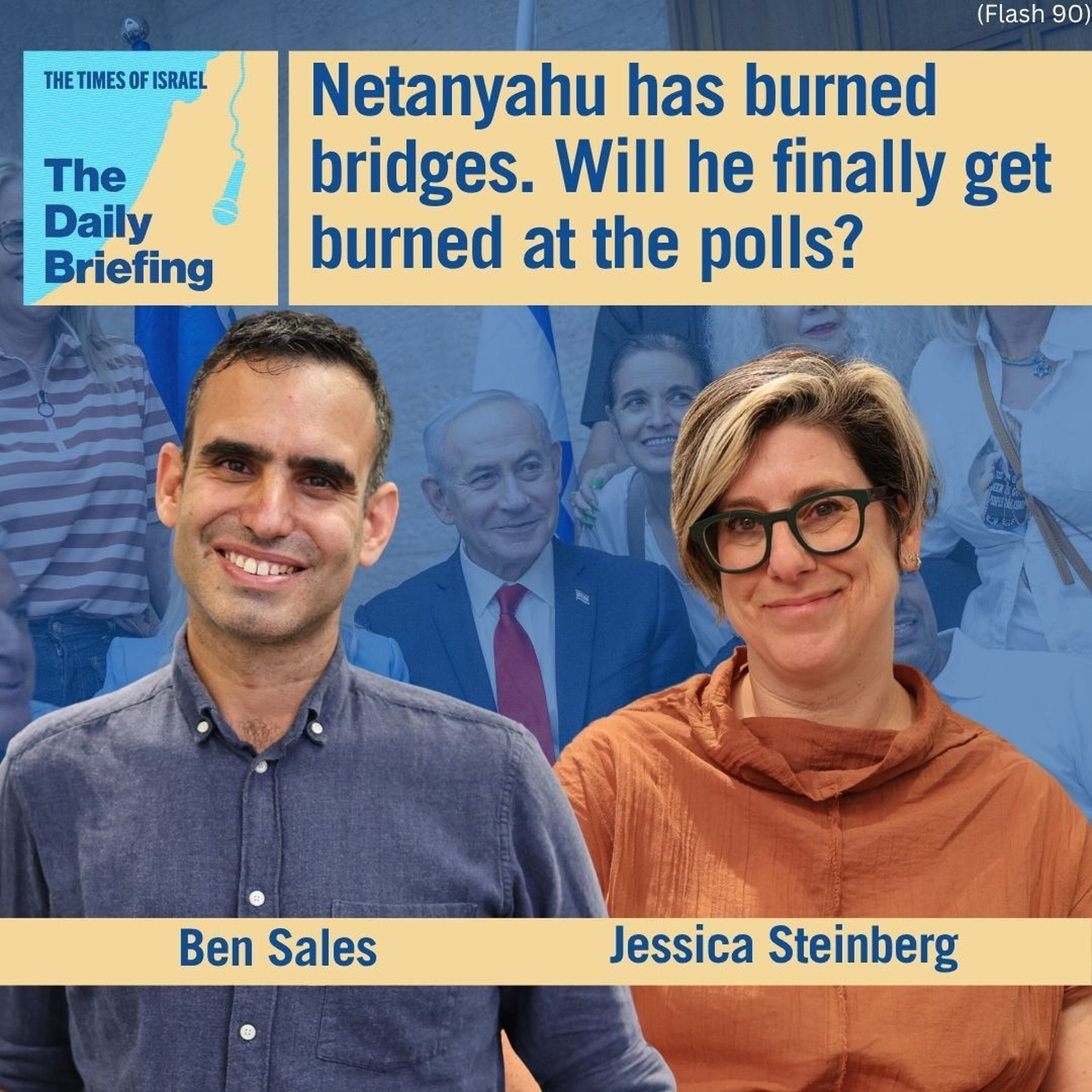 Netanyahu has burned bridges. How will that play out at the polls? 06.09.2026 25minWelcome to The Times of Israel's Daily Briefing, your 20-minute audio update on what's happening in Israel, the Middle East and the Jewish world. News editor Ben Sales joins host Jessica Steinberg for today's episode. After US Ambassador Mike Huckabee met with Palestinians on Saturday and called for severe consequences for violent settlers, Sales notes the American diplomat is trying to say two things, continuing his longtime support of the settlement enterprise in the West Bank alongside the need to deal with Jewish terrorists. Sales then turns to Prime Minister Benjamin Netanyahu, questioning whether the upcoming election will be the first time the longtime leader will possibly lose, given that he has enemies among some of the new centrist parties who say they don't want to sit with him in any government. Finally, Sales looks at the commonalities between Michigan's Democratic Senate nominee Abdul El-Sayed and his friendship with anti-Israel podcaster Hasan Piker, and US Vice President JD Vance and his friendship with right-wing podcaster Tucker Carlson, discussing the antisemitic similarities on opposite sides of the political spectrum. Check out The Times of Israel's ongoing liveblog for more updates. For further reading: Huckabee, in West Bank, urges severe consequences for settler violence: ‘Terror is terror’ One-hit wonders keep saving Netanyahu. This time, he might be played out El-Sayed and Vance call each other ‘evil,’ while both handling antisemitism the same way Subscribe to The Times of Israel Daily Briefing on Apple Podcasts, Spotify, YouTube, or wherever you get your podcasts. This episode was produced by Ari Schlacht. IMAGE: News editor Ben Sales appears on the Daily Briefing with podcast host Jessica Steinberg (Flash 90)See omnystudio.com/listener for privacy information.
 -
 Star Trek: 60 years to the most gloriously nerdy enterprise 05.09.2026 49minWelcome to The Reel Schmooze with ToI film reviewer Jordan Hoffman and host Amanda Borschel-Dan, where we bring you all the entertainment news and film reviews a Jew can use. This month marks the 60th anniversary of the pioneering sci-fi series, Star Trek. Expert in all things Trekky, Hoffman, when he's not schmoozing with Borschel-Dan, also hosts the STARLOG podcast and co-wrote The Star Trek Book of Friendship. So this week, the duo nerd out on all things Jewish behind the beloved franchise -- Spock's famous hand gesture is adapted from the Priestly Blessing, in one notable example. Eventually, we laser in on two episodes that illustrate the show's ethos. From the original Star Trek television series, Hoffman chose "The City on the Edge of Forever." We hear about how, when time-traveling to 1930s New York, Captain Kirk and Mr. Spock faced a tough decision to stave off a potential global Nazi takeover. And in Deep Space Nine's "In the Hands of the Prophets," we see how the program deals with themes of religious extremism versus science. Let’s hear who gave this series an “oy,” “meh” or the prized “not bad” this week on The Reel Schmooze. The Reel Schmooze is produced by Ari Schlacht and can be found wherever you get your podcasts.See omnystudio.com/listener for privacy information.
 -
 Jonathan Greenblatt: Surging antisemitism brings ADL to a moment of reckoning 04.09.2026 45minWelcome to What Matters Now, a weekly podcast exploring key issues currently shaping Israel and the Jewish World, with host Amanda Borschel-Dan speaking with the CEO of the Anti-Defamation League, Jonathan Greenblatt. As antisemitism surges worldwide by some 900% over the past decade, Greenblatt explores how the 113-year-old organization's mission to protect Jews has -- and has not -- evolved to meet the new challenge. In light of the drastic uptick in hate, Borschel-Dan jokes that the ADL commands more money than a very small sovereign state (she erroneously names Nauru) and asks if the organization has failed in its mission. Greenblatt assures her that a $100 million annual budget is a drop in the bucket against well-oiled hate machines funded by petrol states and says the ADL, like all other Jewish organizations, is working to regain its footing in a post-October 7 world. We learn how the foundational anti-hate body has had to make some tough choices and how it is increasingly leaning on AI to reinforce its human staff. And so this week, we ask Jonathan Greenblatt what matters now. What Matters Now podcasts are available for download on Apple Podcasts, Spotify, YouTube, or wherever you get your podcasts. This episode was produced by Yitzchak Ledee.See omnystudio.com/listener for privacy information.
 -
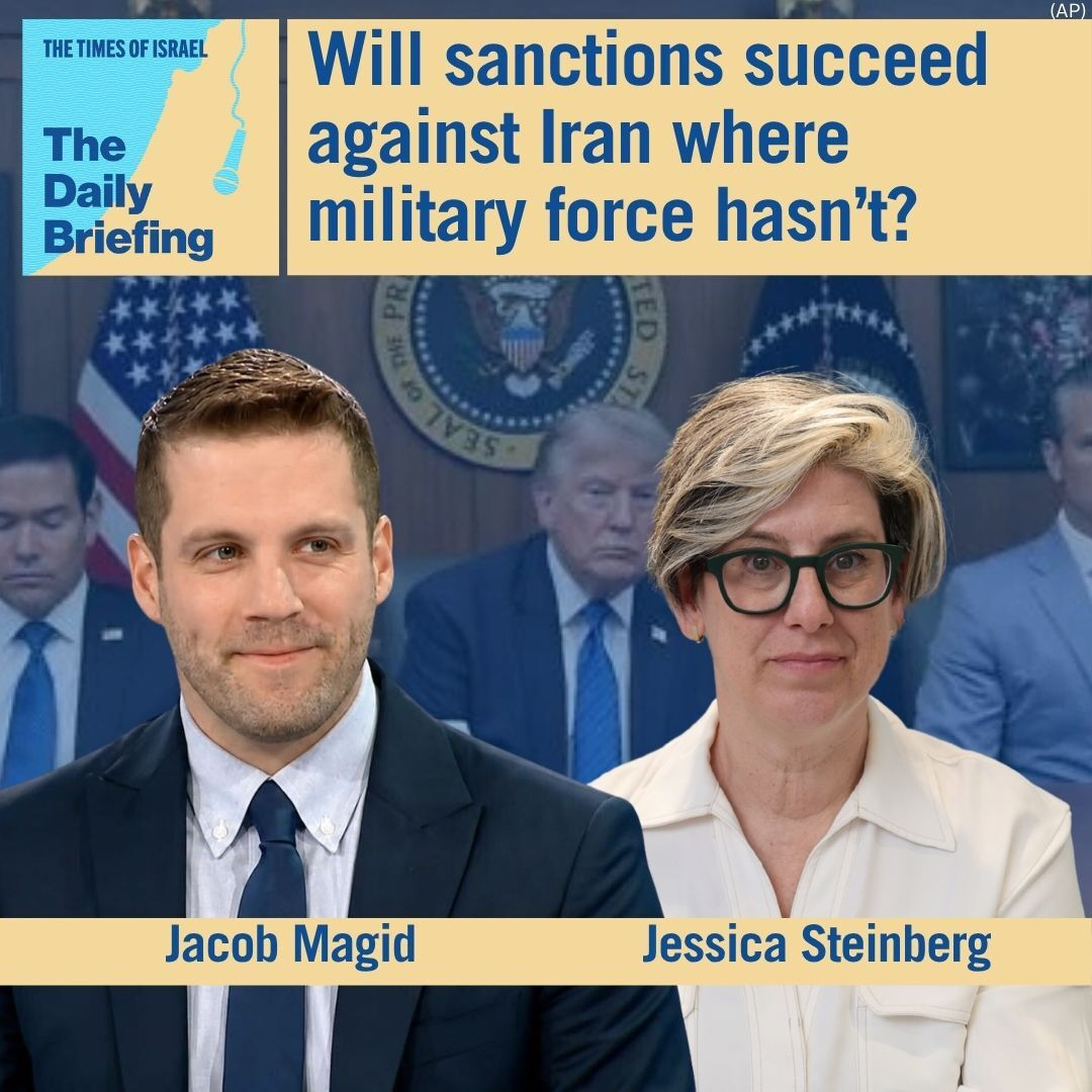 Will sanctions succeed against Iran where military force hasn’t? 03.09.2026 21minWelcome to The Times of Israel's Daily Briefing, your 20-minute audio update on what's happening in Israel, the Middle East and the Jewish world. US bureau chief Jacob Magid joins host Jessica Steinberg for today's episode. Amid the resumed US-Iran fighting, US President Donald Trump is playing down the potential for escalation, reports Magid, and telling Israel not to worry. Additionally, Magid discusses the administration's attempts to pressure Iran with economic sanctions, a lengthy process that will impact pricing for Americans at the gas pump, and will also require cooperation from a range of countries with diverse interests, including the United Arab Emirates, Oman, Qatar and China. The US issued slightly stronger condemnation than usual of West Bank settler violence, denouncing criminal violence and calling for investigations, arrests and prosecutions, but didn’t specifically mention settlers, or Israel, in its statement, notes Magid. The US-backed Board of Peace called out Israel's continued strikes on Hamas targets in Gaza, Magid also reports, as the Israeli government appears to be waiting until after the October 27 elections to make any substantive policy shifts. Magid also updates us on a Palestinian banking crisis, which was averted at the eleventh hour, with Israeli banks Discount and Hapoalim agreeing to continue providing correspondent banking services until January 1. Meanwhile, Palestinian Authority President Mahmoud Abbas's Fatah party is attempting to reconcile internal feuds ahead of planned Palestinian legislative elections at the end of November. Check out The Times of Israel's ongoing liveblog for more updates. For further reading: Trump: ‘Israel should not worry’ about latest Iran clashes, war will wind down soon US issues harsher censure of ‘West Bank violence,’ without explicitly blaming Israel Board of Peace envoy knocks Israel’s ‘unacceptable’ Gaza policy as disarmament plan stalls Palestinian banking crisis averted, as Israeli bank delays plan to halt collaboration Feuding Fatah officials meet as internal rifts risk poor showing in November election Subscribe to The Times of Israel Daily Briefing on Apple Podcasts, Spotify, YouTube, or wherever you get your podcasts. Ari Schlacht produced this episode. IMAGE: US bureau chief Jacob Magid appears on the Times of Israel Daily Briefing with host Jessica Steinberg (AP)See omnystudio.com/listener for privacy information.
 -
 In bold Israeli op, Hamas commander nabbed in Gaza City 02.09.2026 24minWelcome to The Times of Israel's Daily Briefing, your 20-minute audio update on what's happening in Israel, the Middle East and the Jewish world. Military correspondent Emanuel Fabian joins host Amanda Borschel-Dan for today's episode. “Special forces” of the Shin Bet captured the commander of Hamas’s internal security apparatus in a “bold operation” in Gaza City on Tuesday morning, according to Prime Minister Benjamin Netanyahu, the military, and the domestic security agency. It is the first time since the ceasefire that Israel is publicizing a raid deep inside the Gaza Strip. Fabian takes us through what we know. The IDF on Tuesday dismissed a reservist commander who, along with his troops, was filmed in early August praying with settlers besieging the Palestinian village of Qusra, rather than removing them from their illegal outpost. Fabian reviews the timeline of the siege on the village and how the IDF is -- or is not -- dealing with the extremist settlers conducting it. The commander of the Givati Brigade’s Rotem Battalion on Sunday sentenced 16 of his troops to prison after they refused to enter an armored personnel carrier in the Gaza Strip for operational activity last week because a female paramedic was attached to the force. We discuss the evolving roles of women in the military and whether it could even function without female soldiers. Check out The Times of Israel's ongoing liveblog for more updates. For further reading: Israel confirms capturing Hamas internal security chief in Gaza City raid IDF ousts reservist who prayed with besieging settlers; still no arrests for Qusra attack 16 Givati soldiers sent to prison for refusing to enter APC with female paramedic Bar Kalifa tapped as top IDF West Bank officer, weeks after Katz announced move on TV Subscribe to The Times of Israel Daily Briefing on Apple Podcasts, Spotify, YouTube, or wherever you get your podcasts. This episode was produced by Ari Schlacht.See omnystudio.com/listener for privacy information.
 -
 What makes a Jewish legislator join forces with an Arab party? 01.09.2026 31minWelcome to The Times of Israel's Daily Briefing, your 20-minute audio update on what's happening in Israel, the Middle East and the Jewish world. Editor David Horovitz joins host Amanda Borschel-Dan for today's episode. Ruling out a nuclear option, US President Donald Trump on Monday vowed a response to Iran’s overnight strikes on US forces in Jordan, as tensions again ramped up between the sides after a monthlong lull in fighting. Horovitz brings us up to speed with what is happening -- and not -- with the war right now. Some 2.6 million students and preschoolers returned to school Tuesday morning at some 28,000 institutions around the country, as Israel marked the beginning of the 2026-2027 school year. Horovitz delves into some of the challenges the system faces and how critical it is to overhaul it. Ra’am party head Mansour Abbas and Yoav Segalovitz — a Jewish, Zionist former police official, lawmaker and deputy minister — announced Monday evening that Segalovitz will run with Ra’am, an Arab party, in the October 27 election. We hear about the reasons for the merger as well as its immediate blowback. Sara Netanyahu, wife of Prime Minister Benjamin Netanyahu, insinuated without evidence in an interview aired Monday that left-wing politician Yair Golan had advance notice of the Hamas-led October 7, 2023, onslaught. Of course, this drew a furious response from Golan's Democrats Party, but could the Israeli public believe this conspiracy theory? Check out The Times of Israel's ongoing liveblog for more updates. For further reading: Trump vows response to Iranian strike on US troops in Jordan as tensions ratchet up ‘What a stupid question’: Trump rules out idea of nuking Iran amid renewed tensions 2.6 million students return to school amid teacher shortages, systemic challenges In unprecedented move, Abbas and Segalovitz announce joint run, bringing Jewish lawmaker to Arab party’s slate Full speech: Yoav Segalovitz joins Arab party Ra’am with hopes for ‘a shared future’ Breaking silence, Netanyahu decries ‘criminal violence’ after settlers again raid besieged village Sara Netanyahu pushes conspiracy theory that left-wing leader Golan had advance knowledge of Oct. 7 Subscribe to The Times of Israel Daily Briefing on Apple Podcasts, Spotify, YouTube, or wherever you get your podcasts. This episode was produced by Yitzchak Ledee.See omnystudio.com/listener for privacy information.
 -
 Splinter parties jockey for position as election deadline looms 31.08.2026 21minWelcome to The Times of Israel's Daily Briefing, your 20-minute audio update on what's happening in Israel, the Middle East and the Jewish world. Political correspondent Sam Sokol joins host Jessica Steinberg for today's episode. With a growing number of new splinter parties on the right and center-right, some of them founded by former Netanyahu allies, Sokol reviews the latest additions, noting that most of these third-bloc parties, not part of the coalition or opposition blocs, are polling below the electoral threshold as all jockey for position. Sokol reports on the campaign of former IDF general Ofer Winter, who has placed himself firmly in Prime Minister Benjamin Netanyahu's camp even as he criticizes the Netanyahu government, but whose People of Israel party appears to be thriving at the cost of the Religious Zionism party of Finance Minister Bezalel Smotrich. Sokol also reports on a new Haredi party, The Charedi Public, founded by Beit Shemesh deputy mayor Moti Leitner, to challenge the preeminent ideologies in the ultra-Orthodox community and be more responsive to the needs and demands of the Haredi public. Check out The Times of Israel's ongoing liveblog for more updates. For further reading: With only days left to submit slates, small parties are still jockeying for position Netanyahu warns Winter’s party could ‘bring down’ his coalition, urges meeting With debutant Winter poised to cannibalize his bloc, Netanyahu has reason to sweat Winter launches nationalist ‘People of Israel’ party; Netanyahu warns it could doom the right No slate, no HQ: Sharren Haskel wages an uphill fight to return to the Knesset Launching campaign, new Haredi party slams ‘detachment, stupidity’ of existing factions Subscribe to The Times of Israel Daily Briefing on Apple Podcasts, Spotify, YouTube, or wherever you get your podcasts. This episode was produced by Yitzchak Ledee. IMAGE: Political correspondent Sam Sokol appears on the Daily Briefing with host Jessica Steinberg (Flash 90)See omnystudio.com/listener for privacy information.
 -
 Golan Druze rethink their ties to Syria 30.08.2026 17minWelcome to The Times of Israel's Daily Briefing, your 20-minute audio update on what's happening in Israel, the Middle East and the Jewish world. Health reporter Diana Bletter joins host Gabriella Jacobs for today's episode. Following a recent reporting visit to Majdal Shams in the Golan Heights, Bletter discusses the significant uptick in Druze applications for Israeli citizenship instead of permanent residency, a change due to the recent regime change in Syria. Bletter turns to health issues, including the scientific risks of UV tanning. Bletter reports that the UV index has gone viral on social media in Israel and around the world, used as a guide for when people can achieve the best bronzing. A new study conducted by scientists at Weizmann Institute of Science shows that the active ingredient in Viagra disrupts cancer cells' metastasis, notes Bletter. Subscribe to The Times of Israel Daily Briefing on Apple Podcasts, Spotify, YouTube, or wherever you get your podcasts. This episode was produced by Gabriella Jacobs and edited by Ari Schlacht.See omnystudio.com/listener for privacy information.
 -
 The Reel Schmooze on 'Don't Say Good Luck': The Sunny (Sandler) side of life, with cancer 22.08.2026 38minWelcome to The Reel Schmooze with ToI film reviewer Jordan Hoffman and host Amanda Borschel-Dan, where we bring you all the entertainment news and film reviews a Jew can use. Taking a break from pulling classics out of the vaults, this week's film, "Don't Say Good Luck," just dropped on Netflix. Sunny Sandler stars as a 16-year-old theater kid, backed up by a cast including Melanie Lynskey, Max Greenfield, Stephanie Beatriz, Bebe Neuwirth, and Steve Buscemi. Within minutes, it's clear that what could have been a superficial teen flick produced by Adam and Jackie Sandler is a relatable look at "the show going on" while a family member fights cancer. Notes Hoffman, that depth may be due in part to the involvement of director Julia Hart and co-producer/writer Jordan Horowitz -- both veteran filmmakers with proven hits. However, it is Sunny Sandler who is the glowing glue of the movie, providing singing and acting chops rare in a 16-year-old. Hoffman gives a bit of the backstory behind the movie's production and insight into the choice of "The Waitress" as the play within the film. Labeling it a "weeper," he qualifies that it's not really a downer, rather realistically portrays the family's dilemmas. Borschel-Dan, who watched with two of her teenagers, realizes they are 100% the target audience for this intergenerational, Jewish-coded tale that is all too familiar. Let’s hear who gave this film an “oy,” “meh” or the prized “not bad” this week on The Reel Schmooze. The Reel Schmooze is produced by Ari Schlacht and can be found wherever you get your podcasts.See omnystudio.com/listener for privacy information.
Podobné podcasty


Oblíbený v
Tento podcast se objevuje také v podcastových žebříčcích těchto zemí.


