
Engineering Enablement by DX
DX
0
The show focused on developer productivity and the teams and leaders dedicated to improving it. Each episode features in-depth interviews with Platform and DevEx teams, along with the latest research and approaches for measuring developer productivity. Presented by DX (getdx.com), the developer intelligence platform designed by researchers.
Epizody
-
 How Meta reduced diff authoring time by 40% 02.10.2026 46minMeta researcher Moritz Beller joins Brian Houck to discuss how Meta measures developer productivity. Moritz explains diff authoring time and how Meta uses it to evaluate tools and guide engineering decisions. They explore how AI is changing engineers’ work and revealing gaps in traditional metrics. They also revisit Moritz’s “Mind the Gap” study and discuss the promise and risks of AI agents for testing.Where to find Moritz Beller:• LinkedIn: https://www.linkedin.com/in/inventitech • X: https://x.com/Inventitech • GitHub: https://github.com/Inventitech • Website: https://inventitech.com Where to find Brian Houck: • LinkedIn: https://www.linkedin.com/in/brianhouckIn this episode, we cover:(00:00) Intro(02:10) Moritz’s role at Meta(04:01) Measuring diff authoring time(08:20) Measuring A/B experiments(12:11) What diff authoring time reveals(14:45) Planning and leadership reporting(18:36) Why Meta measures teams, not individuals(22:33) Where developer time goes with AI(26:06) AI’s impact on junior and senior developers(27:18) Capturing invisible work with AI(29:32) The “Mind the Gap” study(33:40) Revisiting “Mind the Gap” in 2026(38:32) AI agents for software testing(41:49) What remains hard to measureReferenced:• State of AI Impact in Engineering Q2 Report 2026• GitHub Copilot and Developer Productivity: An Observational Dose-Response Analysis• From Technical Debt to Cognitive and Intent Debt • Mind the Gap: On the Relationship Between Automatically Measured and Self-Reported Productivity• The Impact of AI Coding Assistants on Software Engineering: A Longitudinal Study• When, how, and why developers (do not) test in their IDEs | Proceedings of the 2015 10th Joint Meeting on Foundations of Software Engineering• DORA, SPACE, and DevEx: Which framework should you use• A Tale of Two Cities: Software Developers Working from Home During the COVID-19 Pandemic
 -
 How Okta sets guardrails and context for AI agents 11.09.2026 37minIn this episode of Engineering Enablement, Robert Lucero, Chief Architect at Okta, joins host Brian Houck to discuss how agentic AI is changing identity and access management. They explore how organizations should define agent identities, why authentication and authorization remain foundational, and how sandboxing, fine-grained permissions, and just-in-time access can enable agents to operate autonomously without creating unacceptable risk.Robert shares what Okta has learned from driving AI adoption among security-minded engineers, what makes a repository ready for AI agents, and why strong testing, CI, and review processes matter even more as AI generates more code. They also discuss AI’s role in software validation, the need for human judgment, and whether AI will ultimately give the advantage to security teams or attackers.Where to find Robert Lucero:• LinkedIn: https://www.linkedin.com/in/rlucero Where to find Brian Houck: • LinkedIn: https://www.linkedin.com/in/brianhouckIn this episode, we cover:(00:00) Intro(02:16) Meet Robert Lucero(02:56) Why identity becomes critical as AI agents access more systems(06:07) Governing automated access for non-deterministic agents(08:01) Defining and managing agent identities(10:32) Authentication and authorization for AI agents(13:33) Determining how much autonomy to give AI agents(19:44) Identity systems as the control plane for AI agents(22:40) Driving AI adoption among security-minded engineers(25:48) Why AI’s impact on engineering extends beyond coding(28:44) The three components of AI readiness for repositories(30:55) AI’s role in software testing and validation(34:26) Whether AI gives defenders or attackers the advantage(36:01) Where to find the best food in the countryReferenced:• State of AI Impact in Engineering Q2 Report 2026• Okta• The Hugging Face incident and the road ahead | OpenAI• GitHub Copilot · Your AI pair programmer• Claude Code by Anthropic | AI Coding Agent, Terminal, IDE• Eight Myths on Software Engineering and GenAI | Queue• Adriana Corona
 -
 Code Quality & AI Readiness at Capital One 26.08.2026 42minMax Kanat-Alexander is an Executive Distinguished Engineer at Capital One, where he helps lead developer experience and AI-assisted software development.In this episode of Engineering Enablement, Max joins Brian Houck to discuss how AI is changing software development and why strong engineering fundamentals matter more than ever. They explore how engineering skills are evolving, why AI can amplify weaknesses in the development lifecycle, and how teams should rethink code review, quality, and testing.Max also shares how leaders can assess whether their organizations are ready for more advanced AI workflows and why developing the next generation of senior engineers remains one of the biggest open questions in software engineering.Where to find Max Kanat-Alexander:• LinkedIn: https://www.linkedin.com/in/mkanat • X: https://x.com/mkanat • Blog: https://www.codesimplicity.com Where to find Brian Houck: • LinkedIn: https://www.linkedin.com/in/brianhouckIn this episode, we cover:(00:00) Intro(01:54) Max’s role at Capital One(02:52) Where to invest in engineering organizations (06:36) The new entry-level engineering skills to pay attention to (10:39) Why deepening your understanding still matters (12:29) The bottlenecks around code review (19:40) Why human code reviews still have value (25:20) Why not all PRs need human review(26:11) The vicious cycle of AI-driven development(30:13) Using LLMs for refactoring (33:58) AI readiness and why fixing engineering systems is so hard(38:42) Why research is needed on creating good senior engineers(41:00) Why AI will increase the need for engineersReferenced:• DX Core 4 Productivity Framework• Capital One • Code Review Guidelines at Google • Code Simplicity by Max Kanat-Alexander• How Microsoft sees engineering bottlenecks changing with AI
 -
 AI in engineering: Q2 2026 benchmarks & research readout 14.08.2026 38minAI adoption among software developers is approaching 100%, AI-authored code now makes up more than half of merged code, and developers report saving more time with AI every quarter. But those gains aren’t translating evenly into better outcomes.In this episode of Engineering Enablement, host Brian Houck, Distinguished Scientist at DX, sits down with Justin Reock, Deputy CTO at DX, to unpack findings from DX’s latest AI Impact Report. They explore where AI is improving engineering velocity and developer experience, where concerns are emerging around PR size, change confidence, and failure rates, and why rising AI spend has yet to produce a comparable increase in innovation.They also discuss how AI is changing the meaning of code maintainability and where developers’ AI-driven time savings may actually be going.Where to find Justin Reock:• LinkedIn: https://www.linkedin.com/in/justinreockWhere to find Brian Houck: • LinkedIn: https://www.linkedin.com/in/brianhouckIn this episode, we cover:(00:00) Intro(01:45) How the current AI impact report is tied to Core 4 (03:24) The state of AI adoption(05:12) How much time AI is saving developers and percentage of AI-authored code(07:47) AI’s impact on PR throughput and deployment frequency(11:09) How EMs are shipping more code(13:02) Why larger PRs may be problematic(18:21) The growing gap between code maintainability and change confidence(21:48) How perceived code quality varies by organization size(23:49) The growing volatility in change failure rates(28:07) What the Developer Experience Index reveals(32:20) Cost, dev ramp-up, and innovation ratio (35:38) Where AI time savings are getting lost(37:11) Questions and wrap-upReferenced:• DX Core 4 Productivity Framework• AI Impact report• The AI-native developer - by Brian Houck• GitHub Copilot and Developer Productivity: An Observational Dose-Response Analysis• Writing Code vs. Shipping Code: Productivity Effects Across Generations of AI Coding Tools | NBER • The Productivity-Experience Paradox - Annie Vella• EngThrive: Make It Fast and Easy to Do Great Work• The AI efficiency plateau - by Brian Houck• Tradable Quality Hypothesis
 -
 How Microsoft sees engineering bottlenecks changing with AI 07.08.2026 39minTim Bozarth is a Corporate Vice President in Microsoft CoreAI, where he leads engineering for next-generation developer experiences and Microsoft's Engineering Thrive initiative. Throughout his career at Microsoft, Google, Netflix, and Box, he has focused on developer productivity, engineering systems, and organizational effectiveness.In this episode of Engineering Enablement, Tim joins host Brian Houck to discuss Engineering Thrive, Microsoft's framework for measuring and improving engineering productivity. They explore why AI makes outcome-based metrics more important than ever, where new bottlenecks are emerging in the software development lifecycle, and why verification and confidence may become more valuable than code generation itself. Tim also shares why the purpose of engineering remains the same despite rising levels of abstraction, the skills that remain durable in an AI-driven world, and why engineering leaders should focus on outcomes rather than activity metrics.Where to find Tim Bozarth:• LinkedIn: linkedin.com/in/tbozarth Where to find Brian Houck: • LinkedIn: https://www.linkedin.com/in/brianhouckIn this episode, we cover:(00:00) Intro(02:13) What Engineering Thrive is and the problem it solves(04:46) Why Engineering Thrive isn't specific to Microsoft(09:10) The impact of Engineering Thrive at Microsoft(14:31) Why AI makes outcome-based productivity metrics more important(18:22) Where AI is creating new bottlenecks in the SDLC(24:37) Why more abstraction doesn't change the purpose of engineering(27:25) The durable skills of good engineers (33:03) The changing economics of software development(36:56) Advice for leaders: measure outcomes, not activityReferenced:• DX Core 4 Productivity Framework• EngThrive: Make It Fast and Easy to Do Great Work: Building a durable model for outcome-oriented engineering measurement• Quote by Eliyahu M. Goldratt: “Tell me how you measure me and...”• Jevons paradox - Wikipedia
 -
 Research briefing with Brian Houck: Measuring AI agents and revisiting the Core 4 24.07.2026 46minAI coding agents are changing how software gets built, but they're also forcing organizations to rethink how engineering effectiveness is measured. Traditional developer experience metrics were designed for humans, not AI agents, so how should engineering leaders adapt?In this webinar, Justin Reock, Deputy CTO at DX, is joined by Brian Houck, Distinguished Scientist at DX and co-author of the SPACE framework, to explore the emerging field of agent experience and how it builds on developer experience rather than replacing it. They discuss how organizations can prepare for AI-assisted software development, how the DX Core 4 applies in the age of AI, why metrics like token usage and PR throughput don't tell the whole story, and the growing importance of documentation. They also examine the impact AI-driven pressure is having on burnout and cognitive overload.Throughout the conversation, they share practical guidance for building engineering organizations where both developers and AI agents can do their best work.Where to find Brian Houck: • LinkedIn: https://www.linkedin.com/in/brianhouckWhere to find Justin Reock:• LinkedIn: https://www.linkedin.com/in/justinreock In this episode, we cover:(00:00) Intro(01:26) Justin’s new role at DX(03:53) What agent experience is and why engineering leaders should care(08:55) How to improve agent experience at the platform level(11:25) How agent experience and developer experience influence each other(14:41) Preparing engineering teams for agentic work(21:38) Why the DX Core 4 still matters in the age of AI(27:23) What PR throughput actually measures (32:47) The limits of token metrics(37:10) What the data shows about documentation and developer experience(39:32) Improving documentation for AI agents(40:43) AI-washing, burnout, and cognitive overload(45:35) Brian's upcoming research on agent experienceReferenced:• DX Core 4 Productivity Framework• The SPACE of AI | Queue• Sara Chizari on LinkedIn• The Middle Loop - Annie Vella• gastownhall/gastown: Gas Town - multi-agent workspace manager · GitHub• DORA, SPACE, and DevEx: Which framework should you use?• AI Impact Report: Q1 2026• AI-authored code has nearly doubled, but so has PR size • EngThrive: Make It Fast and Easy to Do Great Work: Building a durable model for outcome-oriented engineering measurement• Google's Project Aristotle - Psychological Safety • Zapier
 -
 Adopting the product operating model at Priceline 10.07.2026 42minSejal Amin is the Chief Technology Officer at Priceline, where she leads product engineering, infrastructure, data, and technology operations. Pedro Gutierrez is Senior Director of Software Engineering, where he has helped drive developer experience initiatives and the adoption of Priceline's product operating model.In this episode of the Engineering Enablement podcast, Justin Reock talks with Sejal and Pedro about Priceline's journey from a project-based organization to a product operating model and the role developer experience played in making that transformation successful. They discuss how DX metrics and developer feedback helped identify organizational bottlenecks, guide structural changes, empower engineering managers, and build trust across teams. They also explore the importance of clear communication, creating a dedicated developer experience team, and how their operating model has helped prepare Priceline for AI-driven software development.Where to find Sejal Amin: • LinkedIn: https://www.linkedin.com/in/sejal-aminWhere to find Pedro Gutierrez: • LinkedIn: https://www.linkedin.com/in/pedro-gutierrez-b6605422Where to find Justin Reock:• LinkedIn: https://www.linkedin.com/in/justinreock In this episode, we cover:(00:00) Intro(01:07) Meet Sejal Amin and Pedro Gutierrez(01:47) How Priceline's developer experience journey began(04:55) Lessons from Priceline's first developer experience surveys(06:55) How DX improved Priceline's developer experience surveys(09:47) Identifying the causes of organizational slowness(12:33) How the product operating model changed the way Priceline works(14:10) Priceline's phased rollout with DX(18:14) How DX insights drove organizational changes(19:33) Why Priceline improved developer experience before org change was complete(22:18) How clear communication builds trust(24:25) Early results from Priceline's Core Four(25:38) Creating a culture of continuous feedback to build trust(27:40) What has changed in the engineering manager role(30:10) Resources for learning about the product operating model(32:40) What Pedro learned from implementing DX(34:51) The developer experience team(35:59) How AI tools have impacted Priceline’s teams (37:20) How the product operating model supports AI-driven development(39:13) Final advice for engineering leadersReferenced:• Measuring developer productivity with the DX Core 4• Transformed: Moving to the Product Operating Model (Silicon Valley Product Group) • Team Topologies• Flow Framework• Project to Product: How to Survive and Thrive in the Age of Digital Disruption with the Flow Framework
 -
 AI and engineering productivity: Debating the headlines 29.06.2026 39minIn this closing panel from DX Annual, Rafe Colburn, Chief Product and Technology Officer at Etsy; Jesse Adametz, Senior Director of Engineering, Platform Engineering at Twilio; Eirini Kalliamvakou, Research Advisor at GitHub; Collin Green, Senior Staff UX Researcher at Google; and Brian Houck, Senior Principal Applied Scientist at Microsoft debate some of the biggest questions surrounding AI and engineering productivity.They discuss whether AI will reduce the need for engineers, how AI is affecting technical debt, the future role of software engineers in an agentic world, and whether organizations should mandate AI adoption. They also explore how bottlenecks are shifting across the software development lifecycle, the challenges facing junior engineers, and why learning, culture, and change management may ultimately matter more than the tools themselves.Where to find Rafe Colburn:• LinkedIn: https://www.linkedin.com/in/rafeco• Blog: https://rafe.codesWhere to find Eirini Kalliamvakou: • LinkedIn: https://www.linkedin.com/in/eirini-kalliamvakou-1016865• X: https://x.com/irina_kAlWhere to find Brian Houck: • LinkedIn: https://www.linkedin.com/in/brianhouckWhere to find Jesse Adametz: • LinkedIn: https://www.linkedin.com/in/jesseadametz • X: https://x.com/jesseadametz • Website: https://www.jesseadametz.com Where to find Collin Green: • LinkedIn: https://www.linkedin.com/in/collin-green-97720378In this episode, we cover:(00:00) Intro(01:16) Why an AI-first SDLC doesn’t mean fewer engineers (03:09) The debate over AI and technical debt(07:40) AI-generated code and the future role of engineers(14:16) Why mandating AI use doesn't necessarily lead to better outcomes(20:43) Predictions for the future of junior engineers (23:22) Where the bottlenecks are in the SDLC now(28:25) How risk influences AI use (32:38) Why the human side is the biggest AI adoption challengeReferenced:• Etsy• GitHub• Microsoft• Twilio• Google • Stewart Reichling• What is the SPACE framework and when should you use it?
 -
 From PR throughput to product velocity: How Dropbox is rethinking productivity in the agentic era 29.06.2026 21minIn this session from DX Annual, Uma Namasivayam, Senior Director of Engineering Productivity at Dropbox, shares how the company's developer productivity efforts evolved from improving developer experience to preparing for the agentic era.He explains how Dropbox approached AI adoption across its engineering organization, the impact it had on developer productivity, and why faster code generation is creating new bottlenecks in areas such as code review, validation, and CI/CD. He also discusses Dropbox's efforts to rethink engineering systems, measurement, and workflows, including the development of agentic tooling and new metrics designed to move beyond PR throughput and toward product velocity.Where to find Uma Namasivayam:• LinkedIn: https://www.linkedin.com/in/unamasivayIn this episode, we cover:(00:00) Intro(00:57) The beginning of Dropbox’s DX journey(02:34) AI adoption at Dropbox: what made it work (04:46) The results of Dropbox's AI adoption efforts(05:39) What the results mean for the business (06:55) The phases of AI adoption and where they are now(08:00) The new bottlenecks(09:16) Three challenges Dropbox faces moving into agentic engineering(10:05) How Dropbox is redesigning the SDLC for agentic engineering(15:46) The new metrics that matter (19:16) Final takeawaysReferenced:• Dropbox • Developer Experience Index (DXI) | DX • DX Core 4 Productivity Framework• Cursor• Claude Code | Anthropic's agentic coding system• JetBrains • Visual Studio Code• Jira | Project Management for the AI Era | Atlassian• GitHub
 -
 2x the power users: How structured AI training scaled developer productivity 29.06.2026 40minIndeed increased AI coding tool adoption from roughly 25% to 97% across its engineering organization, but getting engineers to use the tools was only part of the challenge.In this session from DX Annual, Michael Redding, Principal Product Manager, and Jeff Davis, VP of Core Infrastructure at Indeed, explain how the company used structured training, leadership support, and ongoing community engagement to help more than 2,000 engineers build practical AI skills. They share why an early train-the-trainer model fell short, how they redesigned their approach around hands-on learning, and what they learned about balancing adoption, measurement, and psychological safety.They also discuss the impact of the program on coding time, the role of continuous enablement after formal training ended, and how Indeed is preparing for the next phase of AI adoption, including agentic workflows and AI-powered coaching.Where to find Jeff Davis: • LinkedIn: https://www.linkedin.com/in/utjeffd Where to find Michael Redding:• LinkedIn: https://www.linkedin.com/in/reddingsetgoIn this episode, we cover:(00:00) Intro(01:05) Indeed's DX survey from January 2025(02:30) The two-part strategy to double engineering productivity(04:21) How Indeed increased AI adoption from 25% to 97%(15:40) Results from Indeed's AI training program(18:33) How Indeed sustains AI adoption and learning(23:06) What's next for AI enablement at Indeed(24:41) Q&A: How coding time was calculated(25:25) Q&A: How Indeed uses AI playbooks(26:40) Q&A: Balancing asynchronous and live AI training(28:22) Q&A: Psychological safety during AI adoption(31:44) Q&A: Why AI adoption spikes after the holidays(33:20) Q&A: The metrics Indeed tracked (35:22) Q&A: Where the time savings are going (36:54) Q&A: Reaching engineers who skipped the training(38:08) Closing thoughtsReferenced:• Indeed• Claude Code | Anthropic's agentic coding system• Cursor• Windsurf• Amp Code• The Complete Guide to Building Skills for Claude | Anthropic• Measuring developer productivity with the DX Core 4
 -
 The future of engineering at Nationwide, Comcast, TD, and HPE 22.06.2026 36minIn this session from DX Annual, Rebecca Fitzhugh, Lead Principal Engineer at Atlassian, moderates a panel featuring Nidhi Allipuram, Vice President, Enterprise Developer Experience and Platform at Nationwide, Jai Schniepp, Senior Director, DevX Product Management at Comcast, Brent Foster, Vice President and Head of Architecture and Strategy at TD Bank, and Praveena Patchipulusu, Vice President of Engineering at HPE.Together, they discuss how large enterprises are approaching AI adoption, what it takes to build an AI-first software development lifecycle, and how engineering leaders are balancing speed, security, governance, and developer experience. They also share their perspectives on the changing role of engineers, human accountability, and how organizations can prepare for the future of software engineering.Where to find Rebecca Fitzhugh: • LinkedIn: https://www.linkedin.com/in/rmfitzhugh • X: https://x.com/RebeccaFitzhugh Where to find Jai Schniepp:• LinkedIn: https://www.linkedin.com/in/jessicaschnieppWhere to find Nidhi Allipuram: • LinkedIn: https://www.linkedin.com/in/nidhi-allipuramWhere to find Brent Foster: • LinkedIn: https://www.linkedin.com/in/engineeringthefuture• Website: https://brentfoster.meWhere to find Praveena Patchipulusu: • LinkedIn: https://www.linkedin.com/in/praveena-patchipulusu-158741In this episode, we cover:(00:00) Intro(02:28) The AI journey across TD Bank, Comcast, and HPE(05:59) Inside Nationwide's AI-assisted development lifecycle(10:04) Reimagining the software development lifecycle with AI(11:32) Security, governance, and human accountability(15:27) Embedding security and guardrails into AI workflows(17:55) How AI is changing the role of an engineer(21:52) What developer experience looks like in the AI era(26:55) What software engineering may look like in 2030(32:47) How to prepare for the AI-driven futureReferenced:• Atlassian• TD Bank• Comcast Corporation• Hewlett Packard Enterprise (HPE)• Nationwide • GitHub Spec Kit• Abi Noda
 -
 Uber’s journey of measuring AI impact on developer productivity 22.06.2026 41minAs AI becomes embedded in software development, many of the metrics that engineering organizations have relied on for years are starting to break down.In this session from DX Annual, Uber's Ty Smith and Abhishek Tibrewal share how their approach to measuring AI's impact on developer productivity has evolved over time. They walk through the different phases of their measurement journey, from adoption and engagement to measuring impact, ROI, and agentic value, explaining what they chose to measure at each stage, what worked, what failed, and how their thinking changed along the way.They also discuss the role of qualitative feedback before telemetry existed, the challenge of identifying meaningful engagement signals, why "developer years saved" failed as an ROI metric, and how AI agents forced them to rethink traditional productivity measurements. Finally, they introduce Uber's emerging framework built around feature velocity and explore the unanswered questions that remain as software development becomes increasingly agent-driven.Where to find Abhishek Tibrewal • LinkedIn: https://www.linkedin.com/in/aabhishektibrewalWhere to find Ty Smith: • LinkedIn: https://www.linkedin.com/in/tyvsmithIn this episode, we cover:(00:00) Intro(01:30) Steve Yegge’s 8 stages of AI-assisted development (03:22) Uber’s shift to a generative AI-powered company (04:20) Uber’s pre-AI productivity metrics (06:55) Important questions from stakeholders that previous metrics didn’t answer (08:25) How Uber measures AI before telemetry exists(11:11) Metrics used to measure adoption(12:49) Measuring engagement(14:30) Measuring impact(16:32) The challenge of measuring AI ROI(19:32) Rethinking adoption, engagement, and impact for agentic AI(26:01) The new north star: Feature velocity (28:41) PR classification + feature velocity: the questions it can answer (33:01) What comes next and what’s still unanswered (34:30) Lessons learned and what they'd do differently(37:11) Q&A #1: How Uber defines a feature (38:50) Q&A #2: Measuring success and AI ROIReferenced:• Welcome to Gas Town• Dara Khosrowshahi (Uber CEO)
 -
 Beyond the CLI: Agentic AI for async workloads and non-developers 22.06.2026 37minIn this session from DX Annual, Christopher Sanson, Product Lead, AI Developer Experience, and Madison Capps, Engineering Manager, Infrastructure at Airbnb, challenge some of the most common assumptions about AI. Is AI primarily about replacing humans? Do organizations need mandates to drive adoption? And are the productivity gains really as small as some studies suggest?Using examples from Airbnb's own AI journey, they share how the company achieved widespread adoption of agentic AI through AirChat, community enablement, and internal tooling rather than top-down mandates. They also discuss the impact AI is having on developer productivity, how non-developers are increasingly using coding tools, and how teams are rethinking product development in an AI-first world.Finally, Madison takes a deeper look at the infrastructure powering Airbnb’s AI strategy, including AirChat CLI, the AirChat SDK, and AirChat Remote, along with the company’s vision for asynchronous agent workflows and the next generation of AI-powered development.Where to find Christopher Sanson:• LinkedIn: https://www.linkedin.com/in/christophersanson Where to find Madison Capps:• LinkedIn: https://www.linkedin.com/in/madison-capps-66950625In this episode, we cover:(00:00) Intro(01:37) Myth #1: AI is about replacing humans(03:22) Myth #2: You need mandates to drive AI adoption(05:21) AirChat, agentic AI, and Airbnb's adoption strategy(08:07) Myth #3: AI has little impact on productivity(09:33) Airbnb's increase in coding time and PR throughput(14:20) Myth #4: AI coding tools are just for coders(15:39) How non-developers are using coding tools(17:24) Rethinking product development in an AI-first world(20:30) Myth #5: Vibe coding isn’t coding(22:16) Unsolved problems in agentic AI tooling and how Airbnb is addressing them(26:30) Airbnb’s overall AI philosophy in practice(29:15) Using agentic AI to accelerate code migrations(30:18) AirChat SDK: How Airbnb enables teams to build AI-powered applications(33:17) AirChat Remote and asynchronous agent workflows(36:07) Predictions for what’s nextReferenced:• Airbnb• Steve Jobs’s Bicycles for the Mind • Jennifer St Pierre • Justin Reock• AI-generated merged code holds steady at ~30%• Andrej Karpathy's post on X
 -
 Prioritization as code: An AI-supported framework for platform engineering (Eleanor Millman and Mina Tawadrous) 15.06.2026 38minIn this session from DX Annual, Eleanor Millman, Senior Staff Product Manager, and Mina Tawadrous, Associate Director of Product Management at SiriusXM, share how their platform engineering organization developed a prioritization framework for platform engineering teams serving hundreds of developers across a complex cloud platform.They explain how they define and weight platform-specific impact factors, use developer data to refine priorities, and score projects more consistently. They also explore why prioritization debates often stem from conflicting, invisible, or outdated assumptions, and how SiriusXM began treating assumptions like code by documenting, versioning, and reviewing them in source control.Finally, they demonstrate how AI can surface assumptions, connect initiatives to existing knowledge, and support project scoring while keeping humans in the loop. Throughout the session, they offer a practical framework for making prioritization decisions more transparent, data-driven, and scalable. In this episode, we cover:(00:00) Intro(02:58) Building a platform engineering prioritization framework(04:59) The seven platform engineering impact factors(09:38) Using impact factors to score projects(13:11) Using developer data to refine priorities(16:33) Three ways assumptions fail (17:40) Assumptions as code (21:00) New problems created by assumptions as code(22:00) Using AI to surface assumptions(23:44) Building an AI-powered feedback loop(25:44) Inside the AI prioritization tool(28:18) Three steps to build your own framework(30:02) Q&A #1: Evaluating high-cost projects(31:30) Q&A #2: The cadence of iteration (32:10) Q&A #3: When the framework conflicts with a stakeholder's priorities(35:26) Q&A #4: Using the framework for non-developersReferenced:• AWS• Databricks• RICE: Simple prioritization for product managers• Designing developer experience surveys• GSB Preserve | View | The Curse of Knowledge
 -
 Augmented, accelerated, autonomized: How Vanguard is embedding AI across the product lifecycle (Kelly Anne Pipe and Nicole Scribner) 15.06.2026 39minKelly Anne Pipe is Head of Developer Experience at Vanguard, and Nicole Scribner is a Director in the firm's Chief Technology Office focused on engineering enablement and advancement.In this session from DX Annual, Kelly Anne and Nicole share how Vanguard is expanding its AI strategy beyond software engineering to the entire product development lifecycle. While the company initially focused on tools like GitHub Copilot for engineers, they found that faster coding alone did not significantly improve delivery speed. Product managers, designers, QA teams, and organizational processes were still operating at a different pace.To address this challenge, Vanguard developed a product team maturity model built around three stages: Augmented, Accelerated, and Autonomized. The framework spans six dimensions, from AI-powered delivery and AI-ready codebases to team autonomy, operations, and responsible AI.Kelly Anne and Nicole explain how Vanguard is applying the model across more than 800 product teams, the behaviors they believe will enable faster delivery, and the lessons they have learned about measurement, organizational change, dependencies, and scaling AI across the product development lifecycle.In this episode, we cover:(00:00) Intro(02:16) The state of AI one year ago at Vanguard(02:54) The engineering bubble(05:05) Building an AI maturity model for 800 product teams(08:24) Dimension 1: AI-powered product delivery(10:00) Dimension 2: AI-ready codebase(12:20) Dimension 3: Autonomous agent utilization (13:00) Dimension 4: AI-augmented operations(14:00) Dimension 5: Team autonomy and enablement(16:11) Dimension 6: Responsible AI(18:15) The people problem: role evolution (20:00) The measurement problem (22:55) Lessons learned from rolling out the maturity model (26:46) What’s ahead (30:10) Q&A #1: Getting your codebase ready for AI(32:22) Q&A #2: Audit trails and responsible AI(34:16) Q&A #3: Vanguard's maturity model progress(36:15) Q&A #4: Measuring cycle time across 800 teamsReferenced:• Vanguard• Jennifer St Pierre - Dell Technologies | LinkedIn• Mercari
 -
 Doubling the productivity of your engineering team using AI (Brian Scanlan) 15.06.2026 39minBrian Scanlan is a Senior Principal Systems Engineer at Intercom, where he works on platform engineering, developer productivity, and AI adoption across the company.In this session from DX Annual, Brian shares how Intercom set out to double engineering throughput and ultimately achieved that goal in nine months. Rather than treating AI as an optional productivity tool, the company standardized on Claude Code, updated performance expectations, invested heavily in enablement, and adopted an agent-first approach to technical work.Brian explains why Intercom views Claude Code as a platform rather than a tool, how the company is building domain-specific skills and workflows for agents, and why it believes agents should eventually be able to perform any technical task a senior engineer can complete on a laptop.He also shares the data behind Intercom's AI adoption efforts, including gains in throughput, reductions in defect backlogs, improvements in code quality, and the growing use of automated pull request approvals. Throughout the talk, Brian offers a practical look at what it takes to scale AI adoption across a large engineering organization and the lessons Intercom has learned along the way.Where to find Brian Scanlan:• LinkedIn: https://www.linkedin.com/in/scanlanb• X: https://x.com/brian_scanlan • Website: https://brian.scanlan.ie In this episode, we cover:(00:00) Intro(02:54) Intercom’s goal of doubling throughput (07:30) The platform strategy (09:30) Their agent-first strategy (10:58) Evergreen capabilities vs custom tooling (12:28) How Intercom works with agents(16:43) What the data reveals about AI adoption and impact(19:20) Using session data to improve AI workflows(20:20) Cutting the defect backlog in half(22:44) Inside Intercom’s Claude Code setup(28:09) Claude Code beyond engineering(30:49) Q&A #1: Token cost (32:52) Q&A #2: Preparing for AI pricing changes(34:14) Q&A #3: Stress testing and auditing skills(36:31) Q&A #4: Criteria for agents approving PRsReferenced:• Intercom• Software? No Way. We’re an A.I. Company Now! - The New York Times• Anthropic• Snowflake• Linear• LaunchDarkly • Fin AI• Microsoft Copilot• Cursor• Claude Code | Anthropic's agentic coding system• Steve Yegge (@Steve_Yegge) / Posts / X • Honeycomb• Fin Ideas• Fin CLI | AI Agent Command Line Interface
 -
 From AI experiments to organizational shift: Lessons from Mercari’s transformation (Michael Galloway and Snehal Shinde) 15.06.2026 44minMichael Galloway leads Platform Engineering at Mercari, while Snehal Shinde leads Cost and Performance Engineering. Together, they have been at the center of Mercari's effort to become an AI-native company.In this session from DX Annual, Michael and Snehal share what happened after Mercari's CEO mandated 100% AI adoption across the organization. While AI accelerated code generation and increased engineering output, the team quickly discovered that their existing dashboards could not answer a simple question: was AI actually improving productivity?They discuss how Mercari built new visibility into AI usage and software delivery, the bottlenecks they uncovered across the SDLC, why faster coding did not automatically translate into faster delivery, and the lessons they learned rolling out AI at scale. They also share how Mercari is rethinking software development around agents, feedback loops, and new ways of working.In this episode, we cover:(00:00) Intro(01:46) Mercari’s scale and engineering culture(02:51) DX awards at Mercari(03:44) Mercari’s push to become AI-native(06:34) The mandate to rethink everything(08:02) Mercari’s AI visibility problem and how they solved it(11:30) Mercari’s early findings on AI implementation(18:47) Closing the AI awareness gap at Mercari(21:11) Mapping AI opportunities across Mercari(31:32) Unpacking the results from the second rollout(34:14) Agent spec-driven development and what’s next(37:37) A multi-loop SDLC(40:50) Some hard lessons(42:55) Closing thoughtsReferenced:• Mercari• Cursor• Devin• Claude Code | Anthropic's agentic coding system• GitHub• Datadog• Tim Bozarth - Microsoft | LinkedIn• Airbnb• Jim Collins - Concepts - The Stockdale Paradox
 -
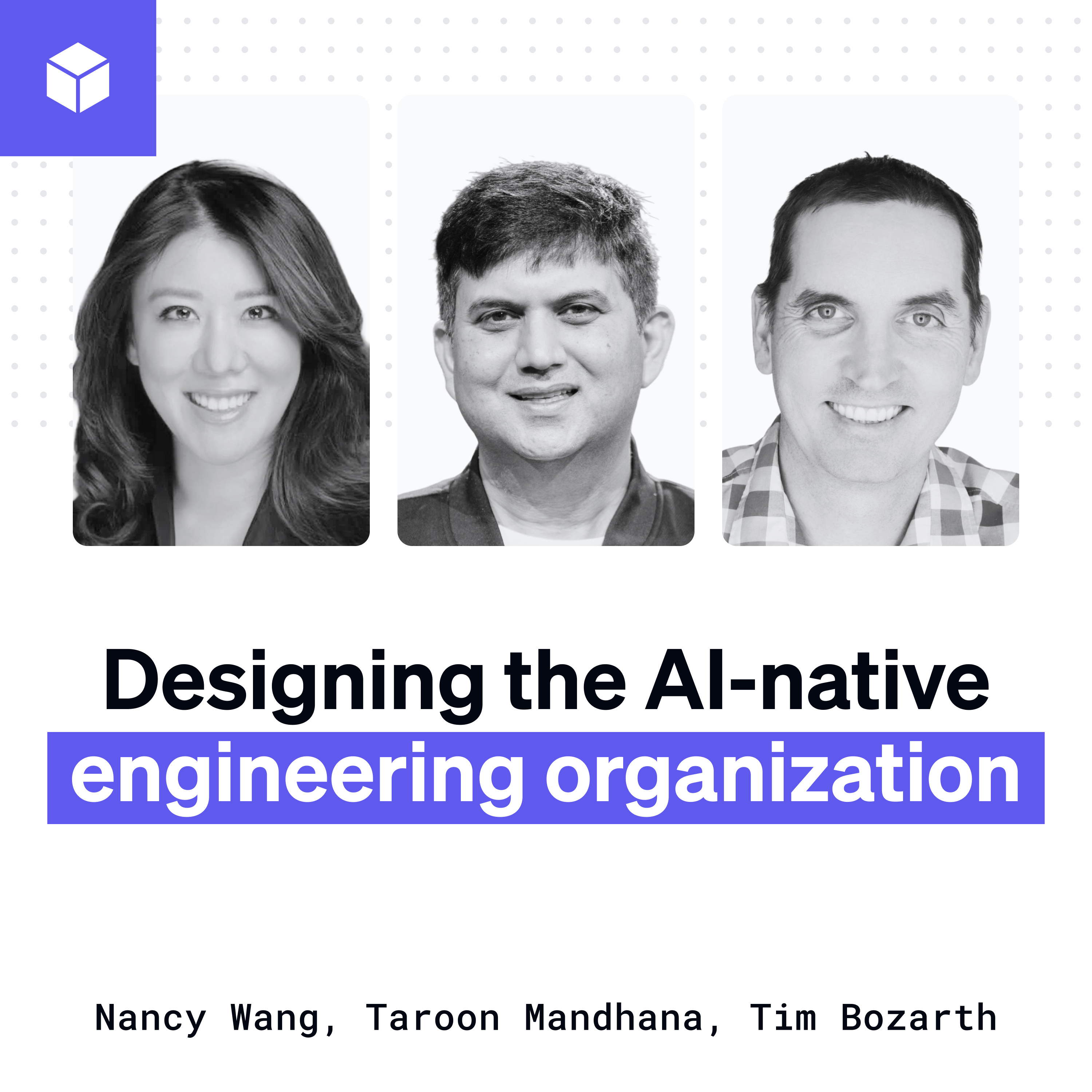 Designing the AI‑native engineering organization with 1Password, Microsoft and Atlassian 08.06.2026 43minAbi Noda is joined live at DX Annual by three engineering leaders shaping AI adoption at scale: Tim Bozarth, Corporate Vice President in Microsoft’s CoreAI division; Nancy Wang, CTO of 1Password; and Taroon Mandhana, CTO of AI and Teamwork at Atlassian. Together, they discuss how AI is changing engineering organizations, from team structures and planning cycles to hiring, governance, and measurement.The panel explores how the profile of a great engineer is evolving, why smaller cross-functional teams are becoming more effective, and what happens when product managers, designers, and customer support teams start contributing code. They also share why they are encouraging AI adoption through enablement, training, and local champions rather than mandates, and how AI is shifting more of the software development lifecycle toward planning and validation.Finally, they discuss where human judgment remains essential, how to measure adoption and manage token usage, and how to connect AI investments to business outcomes while preserving room for experimentation and learning.Where to find Nancy Wang: • LinkedIn: https://www.linkedin.com/in/wangnancyWhere to find Taroon Mandhana:• LinkedIn: https://www.linkedin.com/in/taroonmWhere to find Tim Bozarth: • LinkedIn: https://www.linkedin.com/in/tbozarthWhere to find Abi Noda:• LinkedIn: https://www.linkedin.com/in/abinoda In this episode, we cover:(00:00) Intro(01:08) Introducing the panelists(02:16) AI’s impact on engineering team structures and planning cycles(05:00) How the role of the engineer is changing and what makes a great engineer(10:11) The opportunities and challenges of non-engineers writing code(15:26) Encouraging AI adoption without mandating it(21:25) What an AI-native SDLC looks like and why human judgment still matters(30:56) Measuring AI adoption, token usage, and ROI(37:06) How to tie AI investments to business outcomesReferenced:• DX Core 4 Productivity Framework• Microsoft • 1Password• Atlassian• Jira• Confluence• Loom• Rovo • Amazon Operating Cadence - Working Backwards
 -
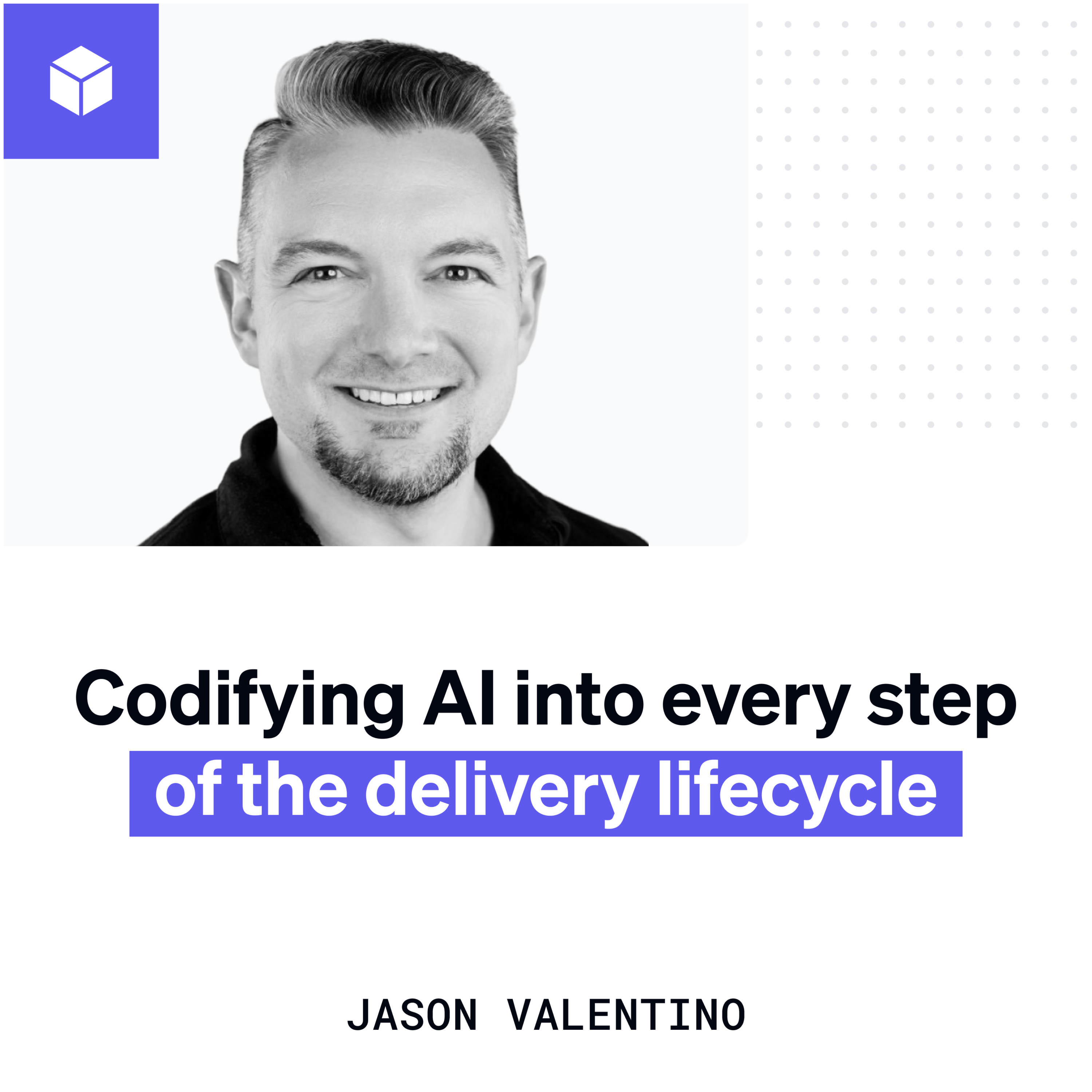 Mapping the new SDLC at BNY: Codifying AI into every step of the delivery lifecycle (Jason Valentino) 08.06.2026 33minJason Valentino is Head of Software Engineering Strategy at BNY, where he oversees developer tooling, DevEx, platform workflows, and software delivery governance across more than 8,000 engineers.In this session from DX Annual, Jason shares how BNY moved beyond AI coding assistants to rethink the entire software delivery lifecycle. He explains how his team identified bottlenecks across the SDLC, prioritized automation opportunities, and applied AI to planning, peer review, testing, change management, and compliance workflows.Jason also discusses what it takes to scale AI inside a highly regulated enterprise, including rewriting policies, partnering closely with risk and audit teams, and building a culture that encourages experimentation and rapid sharing of ideas.Where to find Jason Valentino:• LinkedIn: https://www.linkedin.com/in/jasonvalentinoIn this episode, we cover:(00:00) Intro (01:20) Early results from AI coding tools at BNY(04:08) The 3X stress test: What breaks if engineering throughput triples?(06:56) Three ways to apply AI across the SDLC: IDE and CLI tools(08:07) Using autonomous AI agents for repetitive engineering tasks(09:16) Embedding AI directly into SDLC workflows(12:27) Why leaders should encourage experimentation and “start saying yes”(15:00) Q&A: How platform and productivity teams are evolving to support AI(16:33) Q&A: Rewriting policies and controls for AI-assisted software delivery(17:52) Q&A: How AI is affecting software quality and test ownership(19:00) Q&A: What Jason is most proud of: Practical examples of AI across the SDLC(20:30) Q&A: How BNY handles duplicated work across AI initiatives(22:30) Q&A: How BNY uses AI to support regulatory and compliance work(23:30) Q&A: Automating code reviews and change tickets(25:55) Q&A: How increased AI-driven throughput is affecting on-call and reliability(27:11) Q&A: How BNY works with risk and audit partners to move quickly with AI(29:01) Q&A: How BNY scales successful AI use cases across the organization(30:42) Q&A: What Jason is most proud of after BNY’s busiest year with AIReferenced:• AI-assisted engineering: Q4 impact report• Measuring AI code assistants and agents• Measuring developer productivity with the DX Core 4• Windsurf• Claude Code by Anthropic | AI Coding Agent, Terminal, IDE• Codex | AI Coding Agent
 -
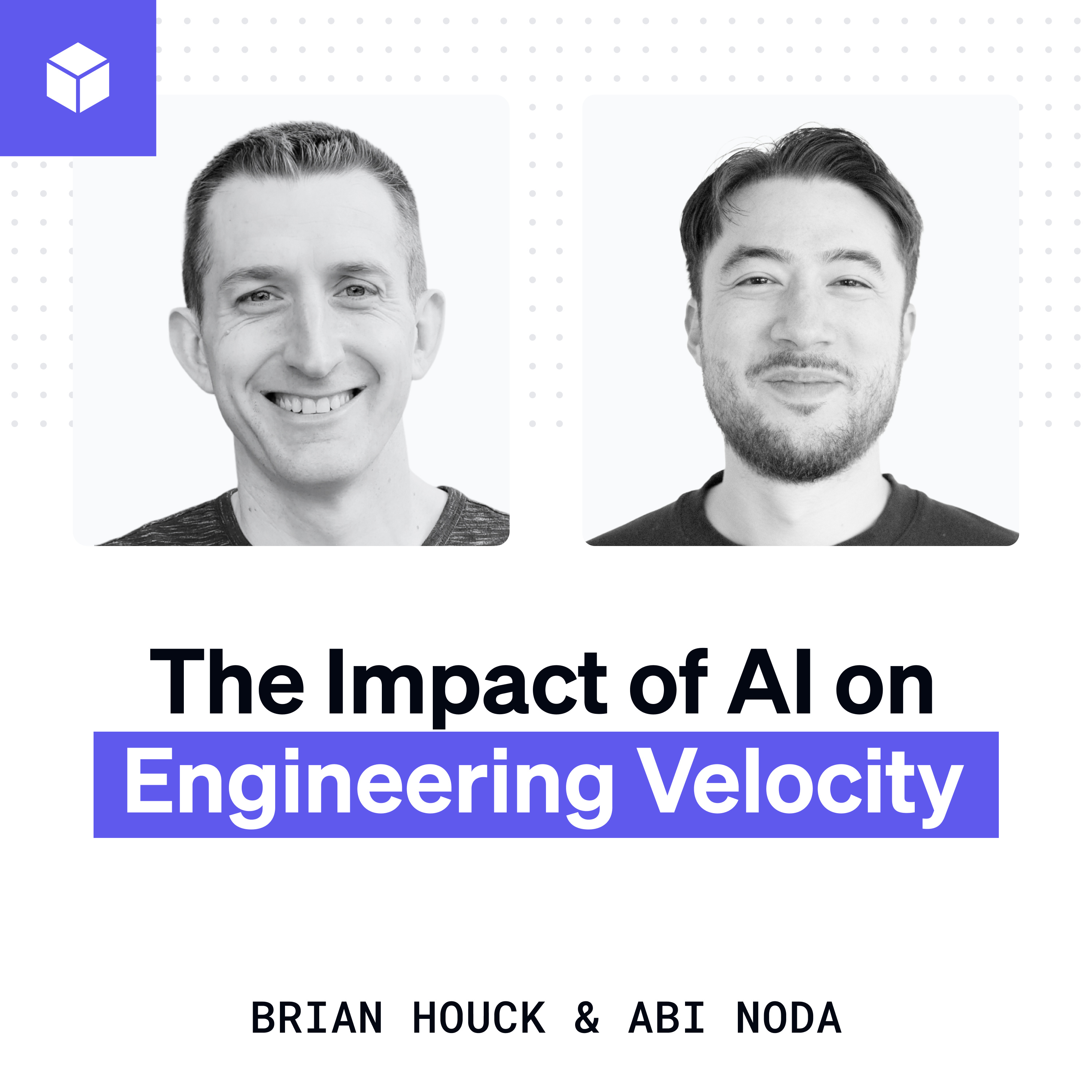 The current impact of AI on engineering velocity: What 400 companies are seeing (Abi Noda & Brian Houck) 08.06.2026 26minRecorded live at DX Annual, Abi Noda, co-founder and CEO of DX, joins Brian Houck of Microsoft to share an early look at DX’s new research on AI’s impact on engineering velocity.Drawing on data from a sample of DX customers, they discuss what companies are actually seeing as AI adoption matures. Most organizations in the study saw pull request throughput increase by 10 to 15 percent—far more modest than the 10x gains often promised in industry headlines.They explore why coding remains only a small part of developer work, where time saved by AI may be going, and the unintended consequences of moving faster, from shifting bottlenecks to “false velocity.” Abi also shares how engineering leaders are applying AI beyond coding and how DX is evolving its measurement framework to account for both human and agent productivity.Where to find Brian Houck: • LinkedIn: https://www.linkedin.com/in/brianhouck/ Where to find Abi Noda:• LinkedIn: https://www.linkedin.com/in/abinoda In this episode, we cover:(00:00) Intro(00:53) What motivated DX’s research into AI’s impact on engineering velocity(02:36) How DX designed the study and selected companies(04:54) What DX’s data reveals about AI’s impact on engineering throughput(06:31) Why PR throughput was the most practical metric to publish(08:21) Why AI productivity gains are lower than many leaders expected(10:24) How an all-in culture can amplify AI productivity gains(12:35) Why it’s hard to track where AI-generated time savings are going(15:04) Unintended consequences of AI-driven productivity gains(17:12) Why leaders should look beyond coding to the rest of the SDLC(19:43) Cognitive debt and the human costs of AI-assisted development(21:33) How DX’s AI measurement framework is evolving(24:42) How to make agents more effectiveReferenced:• DX Core 4 Productivity Framework • DORA, SPACE, and DevEx: Which framework should you use?• Time Warp: The Gap Between Developers’ Ideal vs Actual Workweeks in an AI-Driven Era - Microsoft • Research• How Generative and Agentic AI Shift Concern from Technical Debt to Cognitive Debt• Measuring AI code assistants and agents
Podobné podcasty


Oblíbený v
Tento podcast se objevuje také v podcastových žebříčcích těchto zemí.


