
Stoa Conversations: Stoicism Applied
Caleb
0
This podcast features hosts Caleb Ontiveros and Michael Tremblay discussing Stoic philosophy and its application to daily life. Each episode explores how to build resilience, develop virtue, and make sense of the world through ancient Stoic teachings. The show aims to provide practical insights for modern living, drawing from the wisdom of thinkers like Marcus Aurelius and Seneca. Listeners can expect thoughtful conversations on meditation, ethics, and personal growth, with new episodes released weekly.
Epizody
-
 The Conquest of Nature | The Abolition of Man Part III (Episode 235) 29.09.2026 48minEvery gain in our power over nature is also a gain in some people’s power over other people.That’s the argument at the center of the final chapter of C.S. Lewis’s The Abolition of Man. Once human nature becomes one more thing to conquer, values stop being handed down and start being engineered. Teachers become conditioners.Caleb and Michael close out the series. They cover what Lewis means by the conquest of nature, why he thinks explaining things can slide into explaining them away, and his picture of a science that could study the world without stripping it of meaning.(03:00) The Foil: Conquering Human Nature(06:35) Eugenics and Transhumanism(08:10) Power Over Nature Is Power Over Other Men(11:30) Who Really Conquered Gravity?(12:50) Conditioners and the Old Way of Teaching(15:35) Education as Conditioning(19:55) Why Not Just Teach What People Like?(27:05) Dryads, Body-Snatchers, and a Disenchanted World(29:55) Lightning Is Not Zeus(33:05) Is Science the Problem?(37:55) Closing the Book on Human Nature(40:35) A Regenerate Science(43:50) The Clear Window(45:05) Thinking From WithinDownload the Stoa app (it’s a free download): https://stoameditation.com/podIf you try the Stoa app and find it useful, but truly cannot afford it, email us and we’ll set you up with a free account.Listen to more episodes and learn more here: https://stoameditation.com/blog/stoa-conversations/Thanks to Michael Levy for graciously letting us use his music in the conversations:https://ancientlyre.com/Get full access to The Stoa Letter at www.stoaletter.com/subscribe Get full access to The Stoa Letter at www.stoaletter.com/subscribe
 -
 Epictetus and His Critics (Episode 234) 15.09.2026 54minEmily Wilson translated The Odyssey. She also reviewed a new translation of Epictetus, and she wasn’t impressed.Michael thinks she got him wrong. Not because she doesn’t know the ancient world. She does. Because her criticisms rest on misreadings that a lot of smart, well-read people make.Caleb and Michael work through three of them. Epictetus ignores collective action. Epictetus wrote therapy for privileged men. Epictetus is good for pain but bad for love.One of her points lands. The other two don’t.(00:00) Emily Wilson Reviews Epictetus(04:00) A Classicist Hostile to Stoicism(05:30) Argument One: No Room for Collective Action(09:40) Epictetus as a Make-Your-Own-Bed Philosopher(14:40) What “Collective Action” Smuggles In(19:10) Argument Two: Philosophy for Privileged Men(24:00) Misreading Desire and Prohairesis(30:00) Stoicism, Martial Arts, and Shifting the Goalposts(38:20) Argument Three: Good for Pain, Bad for Relationships(41:40) The Sick Child: Virtue, Not Tranquility(46:40) The Iliad, Grief, and Collective Mourning(51:30) Waterfield’s Translation and Final ThoughtsDownload the Stoa app (it’s a free download): https://stoameditation.com/podIf you try the Stoa app and find it useful, but truly cannot afford it, email us and we’ll set you up with a free account.Listen to more episodes and learn more here: https://stoameditation.com/blog/stoa-conversations/Thanks to Michael Levy for graciously letting us use his music in the conversations:https://ancientlyre.com/ Get full access to The Stoa Letter at www.stoaletter.com/subscribe
 -
 Stoic Psychology: Are We Born Blank Slates? (Episode 233) 01.09.2026 49minAre we blank slates? Or does the mind come pre-furnished?The Stoics said blank. Aetius describes a newborn soul as a sheet of paper waiting to be written on. Every idea you have got there through experience. Plato said the opposite. Your soul already knew everything and forgot it at birth. Learning is just remembering.Michael and Caleb work through both views, then run them against modern psychology. Core cognition theory. Preparedness theory. The monkey experiments where infants learn to fear snakes fast but never learn to fear flowers?(05:30) Plato on innate ideas and recollection in the Meno(11:00) The learner’s paradox(12:00) The Stoic tabula rasa: Aetius on the mind as blank paper(15:00) Are emotions innate categories or built from experience?(20:00) Chomsky, Nussbaum, and cross-cultural anger(22:30) Preconceptions: why every culture has an idea of justice(28:00) Philosophy begins with disagreement(30:00) Do the two views actually differ that much?(36:00) Modern psychology: core cognition and a few innate ideas(38:00) Preparedness theory and the snake experiments(42:00) Proto-passions: when an impression carries force(45:00) Self-knowledge, and the case against relativismDownload the Stoa app (it’s a free download): https://stoameditation.com/podIf you try the Stoa app and find it useful, but truly cannot afford it, email us and we’ll set you up with a free account.Listen to more episodes and learn more here: https://stoameditation.com/blog/stoa-conversations/Thanks to Michael Levy for graciously letting us use his music in the conversations:https://ancientlyre.com/ Get full access to The Stoa Letter at www.stoaletter.com/subscribe
 -
 C.S. Lewis and the Tao | The Abolition of Man Part II 18.08.2026 50minMost people who say values are just opinions don’t actually believe it. They have values. They defend them. They just save the skepticism for everyone else.That’s C.S. Lewis’s charge in the second chapter of The Abolition of Man. Caleb and Michael work through his argument: why altruism, self-interest, and instinct all fail to ground morality, and why Lewis thinks you have to appeal to what he calls the Tao, the Way — the shared moral core running through Stoicism, Confucianism, Christianity, and the rest.(03:00) Subjectivism and Selective Skepticism(09:00) Epictetus and the Flying Pot(14:00) Three Failed Groundings: Altruism, Egoism, Instinct(22:00) The Rebellious Teenager(27:00) Vegetables, Bricks, and Centipedes(32:00) Alteration From Within: The Poet and His Language(37:00) Conservatism and Moral Progress(42:00) Expanding the Circle: Kymlicka and the Utilitarian Trap(48:00) The Eight Laws of the Tao(54:00) Common Sense MoralityDownload the Stoa app (it’s a free download): https://stoameditation.com/podIf you try the Stoa app and find it useful, but truly cannot afford it, email us and we’ll set you up with a free account.Listen to more episodes and learn more here: https://stoameditation.com/blog/stoa-conversations/Thanks to Michael Levy for graciously letting us use his music in the conversations:https://ancientlyre.com/ Get full access to The Stoa Letter at www.stoaletter.com/subscribe
 -
 The Odyssey Movie Review (Episode 231) 04.08.2026 59minCaleb and Michael both saw the film. This is a proper review.Caleb and Michael share what they think and work through what lands and what doesn’t.Don’t worry this is our last bit of Odyssey content for sometime.(00:00) Introduction: A Proper Review of Nolan’s Odyssey(03:30) Ranking Nolan’s Films(08:15) Zeus’s Law and Odysseus’s Guilt(13:45) An American Odyssey(19:00) A Fair Fight: Softening the Slaughter(20:50) The Horror of Circe, the Cyclops, and Scylla(23:50) Downplaying the Gods: The Naturalist Reading(27:40) The Hero Who Doesn’t Shirk Responsibility(30:40) What’s Lost: Nausicaa and the Choice of Immortality(36:20) The Calypso Problem: Therapy-Speak in the Bronze Age(40:30) Athena as a Figment(43:40) Why Zeus’s Law Doesn’t Cohere(46:20) Clean Hands, Batman, and Moral Purity(50:00) The Ending: Exile, Retirement, and the Next Generation(55:10) Where Nolan Is More Stoic Than Homer(56:00) Final Verdict: Watch It and Judge for YourselfDownload the Stoa app (it’s a free download): https://stoameditation.com/podIf you try the Stoa app and find it useful, but truly cannot afford it, email us and we’ll set you up with a free account.Listen to more episodes and learn more here: https://stoameditation.com/blog/stoa-conversations/Thanks to Michael Levy for graciously letting us use his music in the conversations:https://ancientlyre.com/ Get full access to The Stoa Letter at www.stoaletter.com/subscribe
 -
 Stoicism in Christopher Nolan's Odyssey (Episode 230) 21.07.2026 24minIs Christopher Nolan’s Odyssey more Stoic than Homer’s?Caleb shares a quick solo take. A look at the movie through a Stoic lens.There are “spoilers” – don’t listen yet if you don’t want to hear about Nolan’s approach.(00:00) Introduction: A Stoic Take on Nolan’s Odyssey(03:50) Gods as Nature, Not Beings(07:40) Responsibility and Hard Choices(10:10) Perseverance: Seneca on Odysseus(11:10) The Sirens and the Drive to Know(12:30) The Suitors: Justified Revenge?(16:20) Exile and the Problem with Xenia(19:40) Calypso, the Lotus, and Therapy Culture(22:40) Final VerdictDownload the Stoa app (it’s a free download): https://stoameditation.com/podIf you try the Stoa app and find it useful, but truly cannot afford it, email us and we’ll set you up with a free account.Listen to more episodes and learn more here: https://stoameditation.com/blog/stoa-conversations/Thanks to Michael Levy for graciously letting us use his music in the conversations:https://ancientlyre.com/ Get full access to The Stoa Letter at www.stoaletter.com/subscribe
 -
 Men Without Chests | The Abolition of Man Part I (Episode 229) 07.07.2026 57minCan you say a waterfall is sublime? Or are you just describing your feelings?C.S. Lewis thought this question mattered more than it looks. In the first chapter of The Abolition of Man, he argues that modern education smuggles in a dangerous idea: that value judgments are just reports of emotion. Nothing to debate. Nothing to get right or wrong.Caleb and Michael work through Lewis’s argument in this first episode of a series on the book. They cover his case for objective value, what he calls the Tao, and his warning about producing “men without chests” — people with sharp intellects, strong appetites, and nothing in between.(00:00) Introduction: C.S. Lewis and The Abolition of Man(06:30) The Green Book and the Waterfall(10:10) Emotivism, Expressivism, and Subjectivism(13:40) The Fact vs Opinion Distinction(19:00) Education as Cultivating the Right Feelings(25:40) The Way, the Tao(28:50) The Head, the Belly, and the Chest(34:50) Dulce et Decorum Est(43:20) Are Aesthetic Judgments Objective?(47:50) Men Without Chests(52:00) TakeawaysDownload the Stoa app (it’s a free download): https://stoameditation.com/podIf you try the Stoa app and find it useful, but truly cannot afford it, email us and we’ll set you up with a free account.Listen to more episodes and learn more here: https://stoameditation.com/blog/stoa-conversations/Thanks to Michael Levy for graciously letting us use his music in the conversations:https://ancientlyre.com/ Get full access to The Stoa Letter at www.stoaletter.com/subscribe
 -
 Why You Should Be A Skeptic With Massimo Pigliucci (Episode 228) 23.06.2026 57minIn this episode, Caleb talks with Massimo Pigliucci about his new book, How to Be a Happy Skeptic, and the thinker at its center: Cicero. They trace skepticism from Pyrrho’s radical doubt to the Academics, who found a better path. You don’t need certainty. You need to know how sure to be, then act (or not).The Stoics and skeptics argued for decades over whether truth leaves a mark you can trust. What happens when you admit you might be wrong?Read How to Be a (Happy) Skeptic.(03:00) Pyrrhonism: suspend judgment, find peace(06:50) The Academics go back to Socrates(08:40) Fallibilism: senses and reason both fail(10:20) Carneades and the degrees of probability(18:00) Skeptics versus Stoics: the cataleptic impression(22:20) Certainty, polarization, and the case for doubt(25:30) Cicero, friend and critic of the Stoics(27:00) On Divination: the first book against pseudoscience(31:40) On Ends and the gift of aporia(37:00) Virtue, friendship, and the good life(41:50) Seneca and skeptical Stoicism(44:50) Cicero’s life and death(55:40) Being useful to othersDownload the Stoa app (it’s a free download): https://stoameditation.com/podIf you try the Stoa app and find it useful, but truly cannot afford it, email us and we’ll set you up with a free account.Listen to more episodes and learn more here: https://stoameditation.com/blog/stoa-conversations/Thanks to Michael Levy for graciously letting us use his music in the conversations:https://ancientlyre.com/ Get full access to The Stoa Letter at www.stoaletter.com/subscribe
 -
 Stoicism and Buddhism 101 (Rerun) 02.06.2026 1h 5minPeople love to pair Stoicism and Buddhism. Both blame suffering on desire. Both teach a kind of meditation. Both are about 2,500 years old. So how similar are they, really?Michael and Caleb run a Buddhism 101 for Stoics. They start with the Buddha: a prince who had everything, saw old age, sickness, and death for the first time, and walked away from the palace to figure out why we suffer. From there it’s the Four Noble Truths, the Eightfold Path, and the Middle Way.(00:00) Introduction(06:28) The Buddha’s Founding Parable(14:24) The Four Noble Truths(19:59) The Middle Way and the Eightfold Path(31:30) The Evolutionary Case for Buddhism(40:09) Where Stoicism and Buddhism Overlap(48:02) Where They Split ApartDownload the Stoa app (it’s a free download): https://stoameditation.com/podIf you try the Stoa app and find it useful, but truly cannot afford it, email us and we’ll set you up with a free account.Listen to more episodes and learn more here: https://stoameditation.com/blog/stoa-conversations/Thanks to Michael Levy for graciously letting us use his music in the conversations:tno Get full access to The Stoa Letter at www.stoaletter.com/subscribe
 -
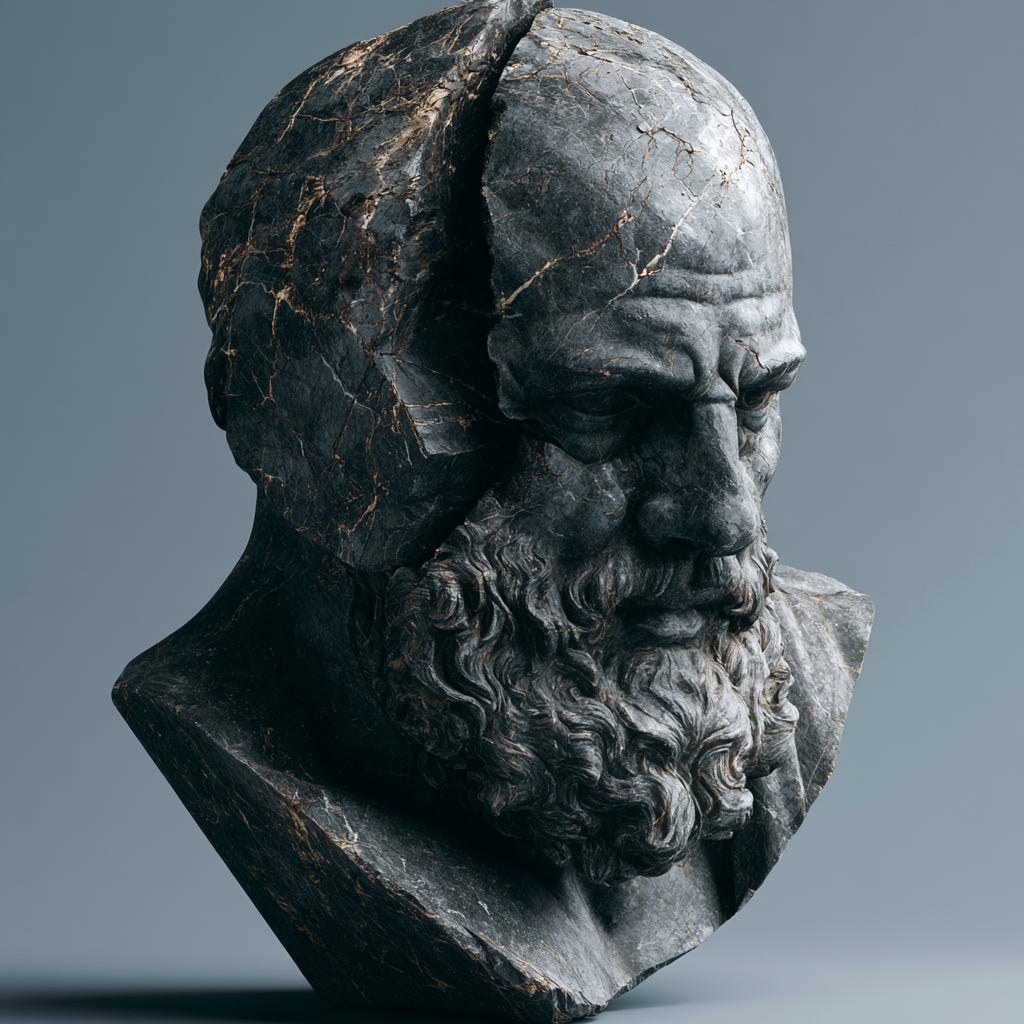 Excellence Is Boring (Episode 227) 19.05.2026 29minWhat makes some people excellent at their craft and others just average? Michael walks through a classic 1989 sociology paper on Olympic swimmers and pulls out three lessons that apply directly to Stoic practice.The answer is not what most people expect. It is not extreme effort. It is not raw talent. Excellence turns out to be mundane. It is how you do the boring things, every day, for a long time. And when the pressure is on, excellence is just doing those boring things well one more time.(00:00) Introduction: What makes someone excellent?(02:50) Lesson One: Excellence requires qualitative differentiation(06:40) Separate worlds: how levels differ in kind, not amount(07:40) Lesson Two: Talent does not lead to excellence(09:40) Talent is indistinguishable from its effects(11:00) Talent as a floor, not a ceiling(14:20) Lesson Three: Excellence is mundane(14:30) Mary Meagher: show up on time, nail the turns(17:40) Long-term motivation is boring(18:30) Excellence is doing the boring stuff under pressure(20:40) How refusing the mundane caps your ceiling(23:10) Summary of the three lessons(25:50) Takeaways for Stoic practice: making good use of impressionsDownload the Stoa app (it’s a free download): https://stoameditation.com/podIf you try the Stoa app and find it useful, but truly cannot afford it, email us and we’ll set you up with a free account.Listen to more episodes and learn more here: https://stoameditation.com/blog/stoa-conversations/Thanks to Michael Levy for graciously letting us use his music in the conversations:https://ancientlyre.com/ Get full access to The Stoa Letter at www.stoaletter.com/subscribe
 -
 Caleb's Life Philosophy (Episode 226) 05.05.2026 51minWhat’s the core of Stoicism worth keeping? And where does it fall short?Caleb shares his life philosophy in this companion to Michael’s earlier episode. He builds the case for Stoicism from the ground up, then turns it on itself. If happiness has to be up to us, what does that say about the rest of life? And what do you do with the parts of human experience that don’t fit neatly into propositions?The thread running through it all is humility. Stoicism gives you a strong frame. It also asks you to admit what you don’t know.(00:00) Introduction(03:30) The Core Argument: Happiness Must Be Up to Us(13:30) Character and How We Think(15:30) Human Nature: Rationality and Sociability(25:30) Objection One: Life Is Tragic(31:30) Objection Two: Reason Doesn’t Capture Everything(41:00) Objection Three: Non-Cognitive Knowledge(48:50) Summing UpDownload the Stoa app (it’s a free download): https://stoameditation.com/podIf you try the Stoa app and find it useful, but truly cannot afford it, email us and we’ll set you up with a free account.Listen to more episodes and learn more here: https://stoameditation.com/blog/stoa-conversations/Thanks to Michael Levy for graciously letting us use his music in the conversations:https://ancientlyre.com/ Get full access to The Stoa Letter at www.stoaletter.com/subscribe
 -
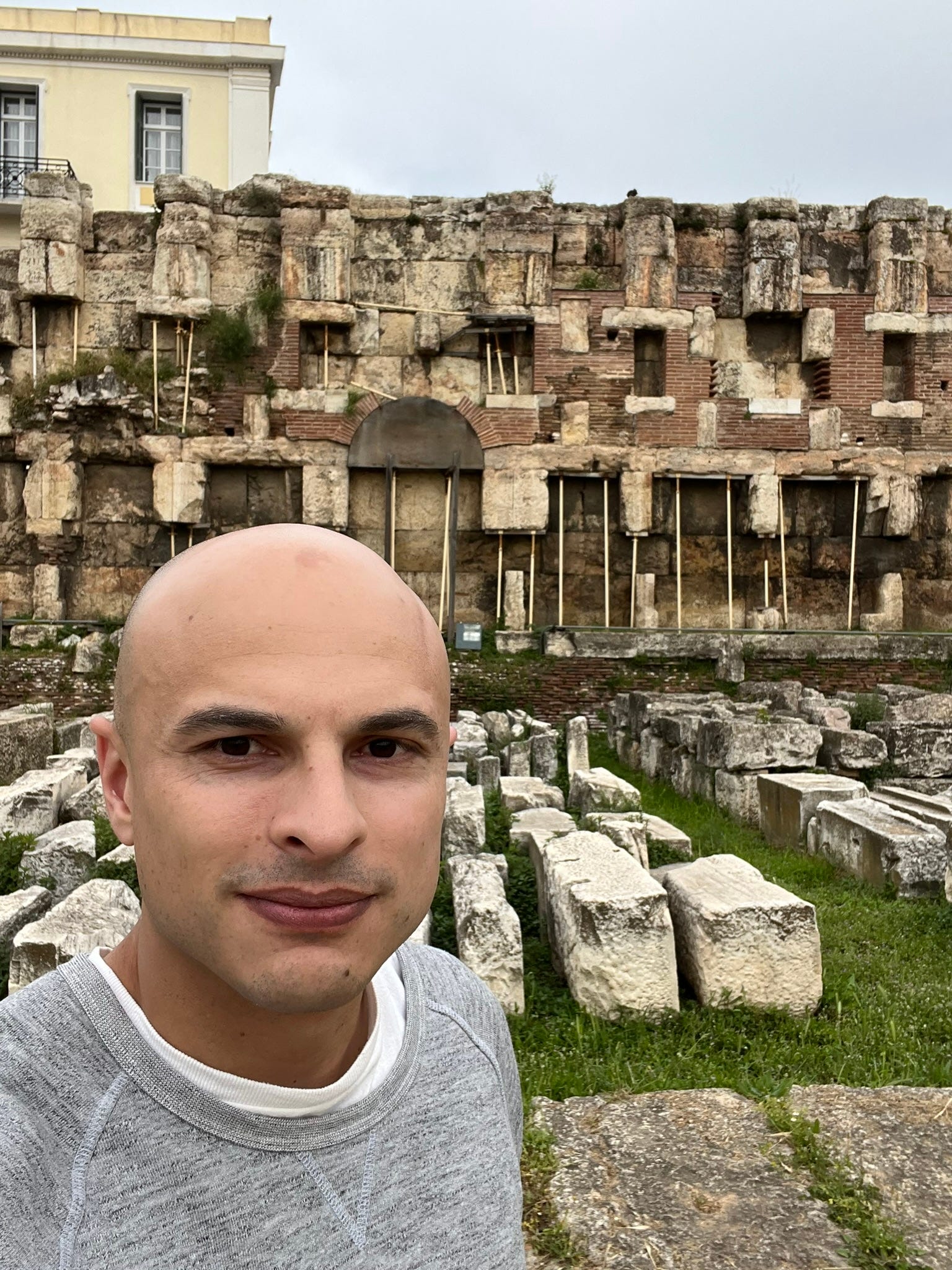 Reflections from Athens 21.04.2026 11minCaleb shares reflections from a recent pilgrimage to Athens. He walks through the ruins of the Stoa Poikile, the painted porch where Stoicism was born, and finds the irony of a philosophy of impermanence enduring in stone fragments thousands of years later. He visits the Acropolis, the Lyceum where Aristotle taught, and thinks about what makes Athens worth visiting today.(00:00) Visiting the Stoa Poikile and the Athenian Agora(05:00) The Acropolis, the Lyceum, and Plato’s Academy(06:30) Edward Lear and Athens as an imaginary city(08:40) Athens as a platonic formDownload the Stoa app (it’s a free download): https://stoameditation.com/podIf you try the Stoa app and find it useful, but truly cannot afford it, email us and we’ll set you up with a free account.Listen to more episodes and learn more here: https://stoameditation.com/blog/stoa-conversations/Thanks to Michael Levy for graciously letting us use his music in the conversations:https://ancientlyre.com/ Get full access to The Stoa Letter at www.stoaletter.com/subscribe
 -
 Musashi’s Book of Five Rings: The Water Book (Episode 224) 07.04.2026 45minYour mind should be quietly vibrating. Not tense, not slack, not leaning in any direction. That’s Musashi’s opening instruction in the Water Book and it sounds a lot like what the Stoics were after.Caleb and Michael continue their series on Musashi’s Book of Five Rings with the second book: Water. Where Book One laid out general strategy, this one gets into the craft itself: swordsmanship as a lens for how to carry yourself, think clearly, and stay locked onto what actually matters. (00:00) Introduction to the Water Book(03:40) Mindset: Quietly Vibrating, Not Leaning(07:50) Don’t Let Your Body Control Your Mind(10:50) Spirit vs. Body Size(13:00) Posture as Evidence of a Strong Mind(18:00) Make Your Everyday Stance Your Strategic Stance(21:50) Purpose Over Technique: Cut the Opponent Down(25:10) Bruce Lee, the UFC, and Rejecting Styles(28:00) Telos: The Ancient Word for “Keep Your Eye on the Ball”(31:30) Positions That Exist and Don’t Exist(35:00) Precepts as Boats: When to Let Go of Rules(38:30) Rhythm in Fighting, Conversation, and Life(42:00) Offensive and Defensive Lessons on Disruption(44:50) Forge Yourself with a Thousand Days of TrainingDownload the Stoa app (it’s a free download): https://stoameditation.com/podIf you try the Stoa app and find it useful, but truly cannot afford it, email us and we’ll set you up with a free account.Listen to more episodes and learn more here: https://stoameditation.com/blog/stoa-conversations/Thanks to Michael Levy for graciously letting us use his music in the conversations:https://ancientlyre.com/ Get full access to The Stoa Letter at www.stoaletter.com/subscribe
 -
 The Stoic Case for Introspection (Episode 223) 24.03.2026 24minSome guy goes on a podcast and argues against introspection. Caleb pushes back.This solo episode uses the viral debate as a launching pad for what the Stoics actually think about self-examination. Caleb draws a sharp line between the kind of introspection the critics hate — guilt, rumination, dwelling on the past — and the kind Marcus Aurelius practiced: forward-looking, demanding, and grounded in a clear standard of how to live.(00:00) The VC’s argument against introspection(03:00) Marcus Aurelius as counterexample(05:00) What Stoic introspection is(08:30) Self-criticism: proleptic, not punishing(13:30) Knowing yourself: the Delphic tradition(18:00) Why Stoic introspection isn’t rumination(20:30) The risks: diminishing returns and the hall of mirrors(23:30) How much introspection is enoughDownload the Stoa app (it’s a free download): https://stoameditation.com/podIf you try the Stoa app and find it useful, but truly cannot afford it, email us and we’ll set you up with a free account.Listen to more episodes and learn more here: https://stoameditation.com/blog/stoa-conversations/Thanks to Michael Levy for graciously letting us use his music in the conversations:https://ancientlyre.com/ Get full access to The Stoa Letter at www.stoaletter.com/subscribe
 -
 What Stoics Find in the New Testament (Episode 222) 10.03.2026 54minMichael picks up the New Testament for the first time and does something unusual: he treats Jesus not as a religious figure, but as a philosopher. A contemporary of the Stoics and Epicureans, teaching in the same era, competing for the same minds. The results are surprising.Some of Jesus’ core teachings land hard from a Stoic lens. Vice lives in desire, not action. The cowardly adulterer is worse than the bold one — he has two vices instead of one. Virtue demands the right reason, not just the right deed. Film your charity for Instagram and you’ve already collected your reward. Turn the other cheek isn’t passive — it’s radical character consistency. And loving your enemies? If you only love your friends, you’re not doing anything impressive. Everyone does that.But then things get complicated. What’s the ethical function of miracles? Why does faith matter if the Stoics demand knowledge? And if heaven promises a hundredfold return on your sacrifice, doesn’t Christianity collapse into delayed hedonism?Michael and Caleb wrestle with all of it — the overlaps, the tensions, and the parts that don’t resolve neatly.(03:00) Reading Jesus as a Philosopher(07:30) Vice Lives in Desire, Not Action(12:30) Virtue Requires the Right Reason(17:00) Turn the Other Cheek(22:00) Love Your Enemies(28:00) Cast the First Stone(37:30) The Danger of Appearances(41:30) Where a Stoic Pushes Back(51:20) Ted Chang and the Literature of FaithDownload the Stoa app (it’s a free download): https://stoameditation.com/podIf you try the Stoa app and find it useful, but truly cannot afford it, email us and we’ll set you up with a free account.Listen to more episodes and learn more here: https://stoameditation.com/blog/stoa-conversations/Thanks to Michael Levy for graciously letting us use his music in the conversations:https://ancientlyre.com/ Get full access to The Stoa Letter at www.stoaletter.com/subscribe
 -
 Michael's Life Philosophy 24.02.2026 49minWhat does a historian of Stoicism actually believe? Michael puts his money where his mouth is and lays out his personal philosophy of life from scratch.The result is something between Stoicism and Aristotle — keeping the Stoic emphasis on character and agency while smuggling in a little more common sense about the human condition.(00:00) Why articulate a personal philosophy?(04:00) The geometric method(05:00) The eudaimonistic framework(10:30) What kind of thing are we?(16:30) Degrees of happiness(22:00) Rejecting the Stoic binary(24:00) Unequal agency, genuine hardship, and obligations to others(32:00) The capabilities approach(37:30) The Stoic counterargument(44:30) SummaryDownload the Stoa app (it’s a free download): https://stoameditation.com/podIf you try the Stoa app and find it useful, but truly cannot afford it, email us and we’ll set you up with a free account.Listen to more episodes and learn more here: https://stoameditation.com/blog/stoa-conversations/Thanks to Michael Levy for graciously letting us use his music in the conversations:https://ancientlyre.com/ Get full access to The Stoa Letter at www.stoaletter.com/subscribe
 -
 Four Ways To Be Happy (Episode 220) 27.01.2026 16minMarcus Aurelius gives us a recipe for happiness in Meditations 2.16.Caleb breaks down the four ways we do the exact opposite: fighting reality, turning away from others, being ruled by pleasure and pain, and acting without purpose. Sometimes the best path to happiness isn’t chasing it directly, but removing what makes us miserable.(01:00) The Four Items: A Recipe for Happiness(03:50) First: Stop Fighting Reality(05:50) Second: Live Well With Others(09:30) Third: Don’t Be Ruled by Pleasure or Pain(11:00) Fourth: Act With Purpose(13:10) Closing Reading of Meditations 2.16Download the Stoa app (it’s a free download): https://stoameditation.com/podIf you try the Stoa app and find it useful, but truly cannot afford it, email us and we’ll set you up with a free account.Listen to more episodes and learn more here: https://stoameditation.com/blog/stoa-conversations/Thanks to Michael Levy for graciously letting us use his music in the conversations:https://ancientlyre.com/ Get full access to The Stoa Letter at www.stoaletter.com/subscribe
 -
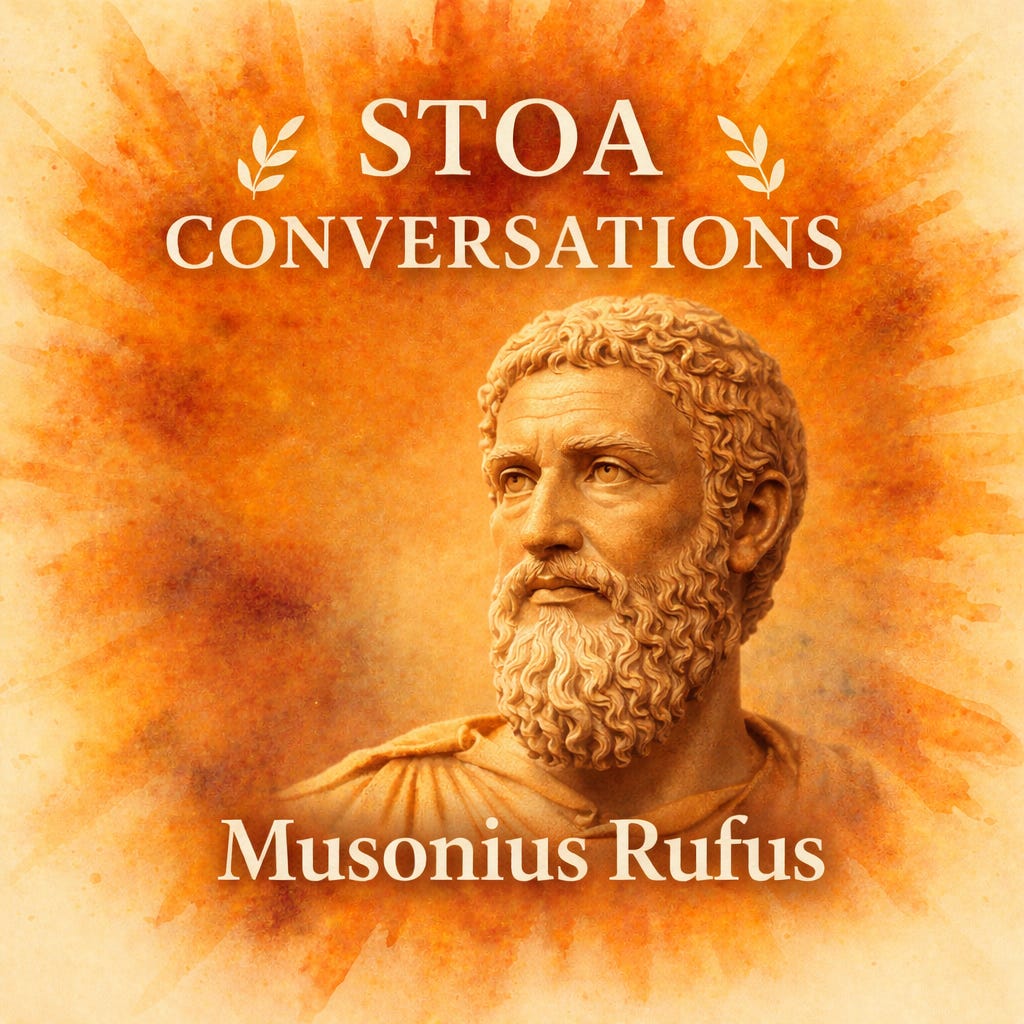 The Roman Socrates Tells Us How To Live (Episode 219) 20.01.2026 53minThe teacher of Epictetus deserves more attention than he gets. Michael returns to Musonius and pulls out three themes: philosophical minimalism, a complicated egalitarianism, and surprisingly specific practical advice. Musonius distrusts overly academic philosophy. He wants simple arguments that appeal to common sense, then action. He argues women should study philosophy because they share the same capacity for reason—but still maintains distinct roles based on natural differences. And he gets remarkably concrete: raw food diets, growing out your hair, never pressing charges for assault, physical labor as the ideal job for a philosopher.Musonius doesn’t fit neatly into modern categories.Previous episode:(06:00) Philosophical minimalism: simple arguments, then practice(14:00) Why fewer strong arguments beat many weak ones(19:00) Complicated egalitarianism: equal as humans, different in roles(26:00) The middle ground between traditionalism and progressivism(31:00) Controversial practical advice begins(33:00) Physical labor as excellent work for philosophers(35:00) Marriage, children, and conservative sexual ethics(39:00) When to disobey your father(46:00) Diet, dress, and developing calluses(48:00) The case against luxury(50:00) Why you should grow out your hairDownload the Stoa app (it’s a free download): https://stoameditation.com/podIf you try the Stoa app and find it useful, but truly cannot afford it, email us and we’ll set you up with a free account.Listen to more episodes and learn more here: https://stoameditation.com/blog/stoa-conversations/Thanks to Michael Levy for graciously letting us use his music in the conversations:https://ancientlyre.com/ Get full access to The Stoa Letter at www.stoaletter.com/subscribe
 -
 Musashi’s Book of Five Rings: The Ground Book (Episode 218) 13.01.2026 57minWhat can a 17th-century samurai who won 60 duels to the death teach us about living well?Caleb and Michael explore the first book of Miyamoto Musashi’s classic work. The Ground Book lays a foundation that cuts across all pursuits. The conversation draws connections to Stoic ideas about indifference, adaptability, and the danger of becoming too attached to any particular school or method.(03:30) Musashi’s life (07:00) How mastering a craft teaches philosophy(10:00) The four ways of life: warrior, carpenter, farmer, merchant(19:00) Living first, reflecting later—inverting the academic model(26:00) Philosophy is learned through living, not just reading(30:00) The way: don’t get attached to any single weapon or style(38:00) Politics, martial arts, and the trap of picking teams(43:00) Indifference as flexibility and adaptability(50:00) Rhythm, timing, and setting the tempo of life(53:00) The ethical dimension: making your thinking free of evil(56:30) Musashi’s nine rules for practicing the wayDownload the Stoa app (it’s a free download): https://stoameditation.com/podIf you try the Stoa app and find it useful, but truly cannot afford it, email us and we’ll set you up with a free account.Listen to more episodes and learn more here: https://stoameditation.com/blog/stoa-conversations/Thanks to Michael Levy for graciously letting us use his music in the conversations:https://ancientlyre.com/ Get full access to The Stoa Letter at www.stoaletter.com/subscribe
 -
 How to Be Smarter (Episode 217) 06.01.2026 44minWhat do the Stoics mean by intelligence? And how do you actually develop it?Caleb breaks down prudence into six trainable components from the ancient Stoic Arius Didymus: sound judgment, circumspection, shrewdness, sensibleness, soundness of aim, and ingenuity. Each gets a week. Each gets concrete exercises.This isn’t abstract philosophy. It’s a practical program for sharpening your thinking in whatever domain matters to you.(00:00) A Framework for Stoic Intelligence(04:50) Week 1: Sound Judgment — Knowing What to Do and How(12:50) Week 2: Circumspection — Keeping Your Perception Current(20:20) Week 3: Shrewdness — Acting Right Without Deliberation(28:40) Week 4: Sensibleness — Discerning Better from Worse(32:50) Week 5: Soundness of Aim — Hitting Your Target(37:10) Week 6: Ingenuity — Finding a Way Through(41:40) Closing ThoughtsDownload the Stoa app (it’s a free download): https://stoameditation.com/podIf you try the Stoa app and find it useful, but truly cannot afford it, email us and we’ll set you up with a free account.Listen to more episodes and learn more here: https://stoameditation.com/blog/stoa-conversations/Thanks to Michael Levy for graciously letting us use his music in the conversations: https://ancientlyre.com/ Get full access to The Stoa Letter at www.stoaletter.com/subscribe
Podobné podcasty


Oblíbený v
Tento podcast se objevuje také v podcastových žebříčcích těchto zemí.

