
The Lucas Bean Show
Lucas Bean
0
Lucas Bean explores topics like psychology, history, politics, technology, power, and business in an accessible format. Episodes vary in length, from brief 90-second segments to longer, in-depth discussions. The show aims to make complex subjects easy to understand for a broad audience.
Epizody
-
 Why Weak Americans Run Towards Fascism 04.10.2026 10minIn 1941, a man who had just escaped Nazi Germany sat down at Columbia University and tried to answer the most important question of the twentieth century.It was not “how did Hitler take power?” Historians had already begun documenting that. The question Erich Fromm needed to answer was different. It was worse.Why did the people let him?Not the inner circle. Not the military leaders or the party functionaries or the industrialists who funded the operation. The ordinary people. The shopkeepers and teachers and factory workers and farmers who watched a democratic republic dismantle itself and did not just allow it to happen but cheered while it did.Fromm published his answer in a book called Escape from Freedom. The book argued that fascism is not imposed on a population from the outside. It is chosen from the inside. By people who are free. Who have the ability to think for themselves. And who voluntarily surrender that ability because the weight of freedom has become more than they can carry.Eighty-four years later, the book reads like a field manual for understanding the United States of America.The Core of Fromm’s ArgumentFromm identified a paradox at the center of modern life that most political theorists had missed entirely.The modern era liberated human beings from the constraints that had organized their lives for centuries. Feudalism collapsed. The authority of the church weakened. Rigid class systems loosened. People gained the freedom to choose their own beliefs, their own careers, their own identities. For the first time in history, the individual was free.But Fromm saw what that freedom actually produced in millions of people. Not confidence. Not creativity. Not self-determination. Anxiety. Isolation. A paralyzing sense of insignificance.He called this the burden of freedom. The distinction he made was between two types of freedom. Freedom from is liberation from external constraints. You are free from the king, from the church, from the rigid hierarchy that told you who you were and what your life meant. Freedom to is the capacity to use that liberation productively. To create meaning. To build relationships. To construct a life that matters on your own terms.The modern world delivered freedom from. It did not deliver freedom to. Millions of people were liberated from the structures that had oppressed them and left standing in an open field with no direction, no community, no framework for meaning, and no one to tell them what to do next.For psychologically strong individuals, this is an opportunity. For everyone else, it is a crisis.Fromm argued that when the anxiety of freedom becomes unbearable, people do not fight to preserve it. They run from it. They seek out any structure, any leader, any movement that promises to take the burden away. They surrender their autonomy in exchange for certainty. They trade self-determination for belonging. They hand their freedom to someone else and feel relief, not loss.He called this the escape from freedom. And he identified three mechanisms through which it happens.The first is authoritarianism. The person submits to a leader and allows the leader to do their thinking for them. The submission feels like strength because the leader projects power and the follower absorbs it by association.The second is destructiveness. The person attempts to destroy the world that makes them feel small. If the institutions, the experts, the systems, the cultural changes are what make freedom feel unbearable, then destroying those things feels like liberation.The third is automaton conformity. The person abandons individual thought entirely and thinks whatever the group thinks. They adopt the opinions, the language, the values, and the emotional reactions of the crowd. They experience this as thinking for themselves because the group’s thoughts have replaced their own so completely that the substitution is invisible.MAGA does all three simultaneously. And six decades of psychological research have confirmed the mechanisms underneath each stage of the escape.Why They Were Primed Before Trump ArrivedFromm argued that the escape from freedom begins when people lose the belief that their actions can change their circumstances. Modern psychology has a precise term for this state and a body of experimental evidence showing exactly how it works.In 1967, psychologist Martin Seligman at the University of Pennsylvania published research showing that repeated exposure to uncontrollable negative events teaches the brain to stop trying. The brain learns, through experience, that effort does not produce results. Once that lesson is internalized, the person stops generating action plans even when the situation changes and escape becomes possible.Seligman called it learned helplessness. The research has been replicated hundreds of times across multiple species and multiple contexts. The finding is consistent: when the brain concludes that nothing you do matters, it shuts down the motivational system that would otherwise drive you to act.The communities where MAGA support runs deepest are communities where learned helplessness is not a laboratory finding. It is a lived experience spanning decades. Wages that did not rise. Jobs that disappeared and were not replaced. Towns that hollowed out. Schools that were defunded. Infrastructure that crumbled. Promises from politicians of both parties that were made and broken and made and broken until the brain learned the obvious lesson: nothing you do will change anything.Seligman’s research showed that learned helplessness produces a specific vulnerability. The person who has given up on their own agency becomes dependent on external sources of control. They stop generating their own plans and look for someone else to generate plans for them.Trump said “I alone can fix it.” That sentence is not a policy statement. It is the precise message that a brain trapped in learned helplessness is waiting to hear. Someone else will handle it. Someone else has the plan. You don’t have to try anymore. Just follow.Fromm predicted this exact dynamic in 1941. The person escaping freedom does not evaluate the leader’s competence. They evaluate the leader’s certainty. In a brain that has concluded effort is pointless, absolute certainty feels like the opposite of everything that has ever failed them. It does not matter whether the certainty is justified. It matters that it exists.Why They Cannot Leave the GroupFromm argued that the escape from freedom is not just about the leader. It is about the group. The movement provides something the modern world stripped away: a tribe. A community. A structure that tells you who you are, what you believe, and where you belong.In 1995, psychologists Roy Baumeister and Mark Leary published what became one of the most cited papers in social psychology. They reviewed decades of research on human connection and concluded that the need to belong is among the most powerful drives in the human brain. It is not a preference. It is a biological imperative. People will tolerate extraordinary costs, including abuse, deception, and the destruction of their own material interests, to maintain the feeling of belonging to a group.The research showed that the brain processes social exclusion using the same neural pathways it uses to process physical pain. Being cut off from a group does not just produce sadness. It produces a neurological response indistinguishable from a physical injury.Now consider what MAGA has replaced in the lives of its members. As they went deeper into the movement, they lost people. Friends who could not tolerate the politics stopped calling. Family members pulled away. Coworkers avoided them. Holiday dinners became arguments that ended relationships.And every one of those people was replaced by another MAGA supporter. Their entire social architecture was rebuilt inside the movement. Their friends, their news, their entertainment, their social media feeds, their daily vocabulary, their sense of humor, their rituals, their heroes, their enemies are all organized around one identity.Baumeister and Leary’s research predicts exactly what this means for the possibility of leaving. A person whose entire social world exists inside one group cannot leave that group without triggering a neurological event the brain processes as equivalent to a physical attack. The cost of leaving is not just loneliness. It is pain.Fromm described this in 1941 without the neuroscience. He wrote that the person who escapes into a group does not experience the group as a cage. They experience it as a home. The walls are invisible because the alternative, standing alone in the open field of freedom, is more terrifying than anything the group can do to them.How the System Disables MoralityFromm’s most disturbing observation was that people who escape into authoritarianism become capable of cruelty they would never have committed as free individuals. The group does not just provide belonging. It provides permission.In 1999, psychologist Albert Bandura at Stanford University published research that provided the mechanism Fromm had described but could not yet explain neurologically. Bandura showed that the human brain has a set of internal mechanisms that allow a person to selectively deactivate their own moral standards. The deactivation is temporary. It is targeted. And it is invisible to the person doing it.Bandura called it moral disengagement. He identified eight mechanisms and they map onto MAGA’s behavior with clinical precision.Moral justification reframes cruelty as service to a higher cause. Deporting families is not cruelty. It is protecting America. Euphemistic labeling changes the language so the cruelty does not sound like cruelty. Families are not destroyed. They are processed. Workers are not fired. They are part of efficiency gains. Dehumanization strips the victim of their humanity so the brain’s moral standards no longer apply to them. They are not people. They are illegals, vermin, animals, poison in the blood.Each mechanism does the same thing: it creates a gap between the act and the person’s self-concept just large enough for the cruelty to pass through without triggering guilt. And each successful act of moral disengagement makes the next one easier. The threshold moves. What was unthinkable six months ago becomes normal. What was normal becomes mild.Fromm observed this same escalation in Germany. Bandura proved how it works in the brain. And MAGA demonstrates it on live television every day.The Machine That Keeps It RunningFromm wrote Escape from Freedom in 1941. The primary delivery systems for the escape were radio broadcasts and party rallies. He could not have imagined the machine that now exists to maintain the escape at industrial scale.In 2017, psychologists William Brady and Jay Van Bavel at New York University published research in the Proceedings of the National Academy of Sciences analyzing over half a million social media posts. They found that every moral-emotional word in a political post increased its sharing rate by approximately 20 percent. The angrier and more morally charged the language, the faster and further it spread. The effect was bounded by group membership, meaning the outrage circulated inside the echo chamber, intensifying the group’s existing beliefs with every share.Brady and Van Bavel called it moral contagion. The algorithm does not reward accuracy. It rewards emotional intensity. It surfaces the most extreme version of whatever the group already believes and pushes it to the top of every feed. Every time you share it, the system feeds you more.This machine keeps every mechanism in the escape operational simultaneously. It keeps the learned helplessness active by telling the audience every day that the world is dangerous and getting worse. It keeps the belonging rewarded by flooding the feed with in-group validation. It keeps the moral disengagement running by providing a fresh supply of dehumanized enemies every news cycle. And it does all of this automatically, without a propaganda minister, without a centralized command, without any human being making a deliberate decision.The algorithm is the most efficient fascism delivery system ever built. Not because it was designed to produce fascism. Because it was designed to maximize engagement. And fascism is engaging.Why They Will Not StopFromm observed that people who have escaped into authoritarianism do not return on their own. The escape is self-reinforcing. Every day inside the movement makes leaving more costly and staying more automatic.In the 1970s, psychologist Barry Staw at UC Berkeley published research on what happens when people have invested heavily in a course of action that is clearly failing. The rational response would be to cut losses and change direction. Staw found that people do the opposite. They escalate. They invest more. They commit harder. Because stopping would mean the original investment was wasted. And the psychological cost of admitting waste is so high that the brain would rather keep losing than face it.Staw called it escalation of commitment. Applied to MAGA, the mechanism is devastating. Every act of loyalty a Trump supporter has performed is an investment they cannot write off without confronting what it cost.Every argument they started at a family dinner. Every friend they lost. Every relationship they destroyed. Every conspiracy theory they repeated to someone they loved. Every dollar they donated to a man who would not let them into his living room. Every time they defended something they knew was indefensible.Admitting Trump was a fraud does not mean changing a vote. It means admitting the last ten years were wrong. It means every family member they cut off was cut off for a lie. It means every person who tried to warn them was right.The brain will not allow that. It will protect the investment at any cost, including the cost of reality. So they keep going. Not because they believe. Because the alternative is looking back at what they have done and facing it without the story that made it all make sense.What Fromm Tried to Tell UsErich Fromm spent the rest of his career refining and extending the argument he made in 1941. He wrote book after book warning that the escape from freedom is not a historical anomaly. It is a permanent vulnerability in the human psyche. It can be activated any time a population is isolated enough, helpless enough, and afraid enough to prefer a cage to an open field.The people deepest inside MAGA do not feel trapped. They feel free. They feel like fighters, like patriots, like rebels. That is how the escape works. It does not feel like surrender. It feels like purpose. It does not feel like giving up your freedom. It feels like finally using it.And that is what makes it so hard to break. The cage does not look like a cage from the inside. From the inside it looks like the only place in the world that makes sense.Fromm wrote this warning in 1941. Nobody listened. And the country that defeated fascism the first time is becoming one.SourcesFromm, E. (1941). Escape from Freedom. Farrar & Rinehart.Fromm, E. (1955). The Sane Society. Rinehart & Company.Seligman, M. E. P., & Maier, S. F. (1967). Failure to Escape Traumatic Shock. Journal of Experimental Psychology, 74(1), 1-9.Maier, S. F., & Seligman, M. E. P. (2016). Learned Helplessness at Fifty: Insights from Neuroscience. Psychological Review, 123(4), 349-367.Baumeister, R. F., & Leary, M. R. (1995). The Need to Belong: Desire for Interpersonal Attachments as a Fundamental Human Motivation. Psychological Bulletin, 117(3), 497-529.Bandura, A. (1999). Moral Disengagement in the Perpetration of Inhumanities. Personality and Social Psychology Review, 3(3), 193-209.Bandura, A. (2016). Moral Disengagement: How People Do Harm and Live with Themselves. Worth Publishers.Brady, W. J., Wills, J. A., Jost, J. T., Tucker, J. A., & Van Bavel, J. J. (2017). Emotion Shapes the Diffusion of Moralized Content in Social Networks. Proceedings of the National Academy of Sciences, 114(28), 7313-7318.Staw, B. M. (1976). Knee-Deep in the Big Muddy: A Study of Escalating Commitment to a Chosen Course of Action. Organizational Behavior and Human Performance, 16(1), 27-44. This is a public episode. If you'd like to discuss this with other subscribers or get access to bonus episodes, visit lucasbean.substack.com/subscribe
 -
 The Space Between Ignorance and Fear: Why MAGA Conspiracy Theories Flourish 03.10.2026 2minThere is a direct relationship between how well a person understands a system and how susceptible they are to conspiracy theories about that system. The relationship is not a subtle one. It is nearly mechanical. The less someone understands about how something works, the more likely they are to believe that something sinister is happening inside it. The more blackbox the system is, the larger the conspiracy it can support.This pattern holds across every major conspiracy theory in American political life. It explains, with uncomfortable precision, why the MAGA movement has become the most prolific generator of conspiratorial thinking in modern American history.The Blackbox Problem (opacity)Consider the difference between an abacus and a smartphone. An abacus is transparent. You can see every bead. You can watch the math happen. You can verify the output with your own eyes. There is no room for a conspiracy theory about an abacus because there is nowhere for a conspiracy to hide. The mechanism is fully visible.A smartphone is the opposite. It is a sealed box running processes that the vast majority of its users cannot see, cannot audit, and cannot understand. The average person knows their phone does things they did not ask it to do. It serves ads that seem to respond to conversations. It tracks location. It collects data in ways that are documented but not intuitive. All of this is real and verifiable.But the leap from “my phone collects data for advertising purposes” to “the government is monitoring my every thought through my phone” is not a leap supported by evidence. It is a leap enabled by opacity. The person making that leap cannot distinguish between what their phone actually does and what it theoretically could do because they cannot see inside the box. So they fill the gap with the worst possibility their imagination can produce. Not because they are paranoid by nature, but because the human brain is architecturally incapable of tolerating unexplained complexity without generating an explanation.This is the dynamic at the center of every MAGA conspiracy theory. The system is too complicated for the person to understand. The opacity creates a void. And the void gets filled with a villain.The Believing BrainIn 2011, researcher Michael Shermer at Chapman University published “The Believing Brain: From Ghosts and Gods to Politics and Conspiracies.” Shermer had spent decades studying why people believe things that are not true, first as the founding publisher of Skeptic magazine, then as a researcher and author examining the cognitive machinery behind belief formation. “The Believing Brain” represents his most comprehensive analysis of why the human mind generates beliefs first and seeks evidence for them second, rather than the other way around.Shermer identified two cognitive processes that operate in tandem to produce conspiratorial thinking. The first he called patternicity: the tendency to find meaningful patterns in both meaningful and meaningless data. Humans evolved to detect patterns because pattern detection is a survival advantage. The ancestor who heard rustling in the grass and assumed a predator was more likely to survive than the ancestor who assumed it was the wind. The cost of a false positive (running from nothing) was low. The cost of a false negative (ignoring a real threat) was death.The result is a brain that is biased toward seeing patterns even when none exist. We see faces in clouds. We find meaning in coincidences. We connect events that have no causal relationship and construct narratives to explain the connection. This is not a defect. It is an evolutionary feature that produces a significant number of errors precisely because producing errors is less costly than missing real patterns.The second process Shermer identified is the one that turns false patterns into conspiracy theories. He called it agenticity: the tendency to infuse patterns with meaning, intention, and agency. Once the brain detects a pattern, real or imagined, it does not stop at recognition. It assigns a cause. And the cause it prefers is an intentional agent, a mind with a plan, a person or group with a motive.Agenticity is the reason that random misfortune feels personal. It is the reason people attribute natural disasters to divine punishment, market fluctuations to shadowy cabals, and bureaucratic incompetence to coordinated malice. The brain is not satisfied with randomness or complexity as explanations. It wants a who. And it will invent one if it has to.Where Conspiracy Meets IncomprehensionPatternicity and agenticity are universal. Every human brain runs these processes. But conspiracy theories do not distribute evenly across the population. They cluster around specific topics, specific communities, and specific political movements. The variable that predicts where conspiracy theories will flourish is not ideology in the abstract. It is the gap between the complexity of a system and the ability of the person to understand that system.Consider the major conspiracy theories that define the MAGA movement and how each one maps directly onto a system the believer does not understand.Election fraud. The American election system is genuinely complicated. It involves different voting technologies across thousands of jurisdictions, a patchwork of state laws governing ballot counting, chain-of-custody procedures for physical ballots, certification processes that involve multiple independent actors, and statistical patterns in vote reporting that are counterintuitive to anyone without a background in quantitative analysis. The “red mirage” phenomenon, in which early returns favor Republicans and later-counted mail-in ballots shift results toward Democrats, has a simple explanation that election analysts understand and can demonstrate mathematically. But to someone who does not understand how differential vote-counting methods produce predictable temporal patterns in reporting, the visual experience of watching a lead evaporate on live television looks like fraud. The system is too opaque. The pattern (the lead disappeared) is real. The agent the brain invents to explain it (someone changed the votes) is not.Vaccine conspiracies. Immunology is one of the most complex fields in biology. The mechanism by which an mRNA vaccine produces an immune response involves molecular processes that require years of graduate-level education to understand at a technical level. The average person cannot see inside a vaccine. They cannot observe the immune response. They cannot verify the clinical trial data. The system is entirely opaque to them. So when the brain detects a pattern (I got vaccinated and then I felt sick, or I heard about someone who had a bad reaction), agenticity activates. The invisible agent the brain invents is not “my immune system mounted the expected inflammatory response.” The invisible agent is Bill Gates, or a microchip, or a depopulation scheme. The size of the conspiracy tracks directly with the size of the knowledge gap.The “deep state.” Federal bureaucracy is enormous, slow, and procedurally complex in ways that are genuinely difficult for outsiders to comprehend. Career civil servants operate under layers of regulation, interagency coordination, and institutional memory that are invisible to anyone who has not worked inside the system. When a policy initiative is slowed or blocked by bureaucratic process, the person who understands federal administration recognizes institutional friction. The person who does not understand it sees coordinated sabotage by invisible actors. The deep state conspiracy theory is not a description of how government actually works. It is what government looks like from the outside to someone who cannot see the machinery.Why MAGA SpecificallyThe clustering of conspiracy theories within the MAGA movement is not coincidental, and attributing it entirely to individual gullibility misses the structural dynamic at work. Three factors converge to make this population uniquely susceptible.First, educational attainment. Polling data consistently shows that support for conspiracy theories correlates inversely with educational attainment, particularly in the sciences. This is not because education makes people smarter in some general sense. It is because education in specific domains reduces the opacity of specific systems. A person who has taken a statistics course is less likely to find election-night vote shifts suspicious because they understand how sampling and counting methodology produce those patterns. A person who has studied immunology is less likely to believe vaccine conspiracies because the system is not a black box to them. The knowledge gap is smaller, so there is less void for agenticity to fill.Second, the media ecosystem. Right-wing media does not merely fail to close knowledge gaps. It actively widens them. It replaces technical explanations with narrative ones. It substitutes invisible agents (George Soros, the deep state, globalist elites) for complex systemic causes. Fox News and its ecosystem function as agenticity amplifiers, providing pre-fabricated invisible villains that the brain can slot into any unexplained pattern without doing the cognitive work of actually understanding the system in question.Third, the leader himself. Trump does not explain systems. He does not describe mechanisms. He does not offer technical accounts of how anything works. He offers villains. Every problem has a who. Immigration is not a complex policy challenge involving labor economics, international law, and demographic trends. Immigration is an invasion orchestrated by Democrats. Inflation is not the result of supply chain disruption, monetary policy, and global commodity markets. Inflation is caused by Biden. The cognitive style Trump models for his followers is pure agenticity. Every pattern gets an agent. Every problem gets a villain. And the solution is always the same: give the leader more power to defeat the villain.The Simplicity PrincipleShermer’s framework reveals something important about the relationship between truth and complexity. True explanations for how systems work tend to be complicated, boring, and unsatisfying. The real explanation for election-night vote shifts involves differential mail-in ballot processing timelines across jurisdictions. The real explanation for adverse vaccine reactions involves immune system variability and base-rate statistics. The real explanation for bureaucratic delay involves procurement regulations and interagency review processes.None of these explanations are dramatic. None of them have a villain. None of them produce the emotional satisfaction of identifying an enemy and feeling righteous anger toward them. They are true and they are tedious and they require the listener to tolerate complexity without resolving it into narrative.Conspiracy theories offer the opposite. They are simple, dramatic, and emotionally satisfying. They have clear villains, clear victims, and clear solutions. They transform the discomfort of not understanding something into the pleasure of having identified the hidden truth that everyone else is too blind to see. They convert ignorance into a feeling of superiority.This is why you cannot argue someone out of a conspiracy theory with facts. The conspiracy theory was never generated by facts. It was generated by a void, the gap between the complexity of a system and the person’s ability to understand it. You cannot fill that void with counterarguments. You can only fill it with understanding. And understanding requires exactly the kind of sustained, difficult, unglamorous cognitive work that the conspiracy theory was invented to avoid.The abacus does not need a conspiracy theory. You can see every bead. The simpler and more transparent a system is, the harder it is to lie about. The people who believe the most lies are not the most paranoid or the most politically extreme. They are the people for whom the most systems are opaque. They are the people living in the largest number of magic boxes, surrounded by machinery they cannot see into, filling every gap with the worst thing they can imagine.And right now, an entire media ecosystem is handing them the villains to fill those gaps with, 24 hours a day, 7 days a week, so they never have to do the difficult work of actually learning how anything works.SourcesMichael Shermer, The Believing Brain: From Ghosts and Gods to Politics and Conspiracies, Times Books, 2011Michael Shermer, “Patternicity: Finding Meaningful Patterns in Meaningless Noise,” Scientific American, December 2008Michael Shermer, “Agenticity: The Tendency to Infuse Patterns with Meaning, Intention, and Agency,” Scientific American, June 2009Daniel Kahneman, Thinking, Fast and Slow, Farrar, Straus and Giroux, 2011Jan-Willem van Prooijen and Mark van Vugt, “Conspiracy Theories: Evolved Functions and Psychological Mechanisms,” Perspectives on Psychological Science, Volume 13, Issue 6, 2018Joseph Uscinski and Joseph Parent, American Conspiracy Theories, Oxford University Press, 2014 This is a public episode. If you'd like to discuss this with other subscribers or get access to bonus episodes, visit lucasbean.substack.com/subscribe
 -
 MAGA is Incapable of Complex Thought 02.10.2026 1minThere is a way to measure how simply or complexly a person thinks. Not what they think. Not whether they are right or wrong. How their brain processes information. Whether it can hold one idea at a time or several. Whether it sees the world in two categories or twenty. Whether it can sit with a contradiction or needs to crush one side of it before the thinking can continue.Psychologists have been measuring this for over fifty years. And the results, applied to political extremism, are as clear as anything in the research literature.What Suedfeld MeasuredPeter Suedfeld, Dean Emeritus of Graduate Studies and Professor Emeritus of Psychology at the University of British Columbia, spent over three decades developing and applying a measurement system for the structural complexity of human thought. His work spanned more than 300 published studies across political psychology, crisis decision-making, leadership under stress, and extremism.The system he developed measures something called integrative complexity. It operates on a scale from 1 to 7, and it captures two distinct cognitive operations.The first is differentiation. This is the ability to recognize that a problem has more than one dimension. That a situation can be viewed from more than one perspective. That two things can both be true at the same time even if they seem to contradict each other. A person scoring low on differentiation sees every issue as having one side. One cause. One answer. A person scoring high on differentiation sees multiple dimensions operating simultaneously.The second is integration. This is the ability to draw connections between those different dimensions. To see how competing perspectives relate to each other. To build a framework that accounts for complexity rather than flattening it. Integration is the higher-order operation. You cannot integrate perspectives you never differentiated in the first place.A score of 1 means the person sees only one dimension and draws no connections. Everything is black or white. Good or bad. Us or them. A score of 7 means the person sees multiple dimensions and draws sophisticated connections between them. They can hold contradictions, tolerate ambiguity, and construct frameworks that account for competing truths.Suedfeld found, consistently, across decades of research and hundreds of analyses, that political extremists score the lowest on integrative complexity. This is not a finding about one party or one ideology. It applies to extremists on both ends of the political spectrum. But the application to the modern American right is devastating, because the MAGA movement has turned low integrative complexity into an identity.What Low Complexity Looks LikeA person operating at level 1 integrative complexity processes the world the way a child processes the world before the age of eleven. One cause. One villain. One answer. No middle ground. No gray area. No possibility that the opposing side has a point.Every issue is sorted into exactly two categories: for us or against us.Immigrants are destroying the country. Not some immigration policies create economic tradeoffs that affect different communities in different ways. Immigrants are destroying the country.The media is the enemy of the people. Not some media outlets have institutional biases that should be critically evaluated. The media is the enemy.The election was stolen. Not the electoral system has weaknesses that should be addressed through institutional reform. It was stolen.These are level 1 statements. One dimension. No differentiation. No integration. No complexity of any kind. A ten-year-old could process them. And that is the point.Why They Are Proud of ItThis is where the MAGA movement does something that Suedfeld’s research framework was not designed to anticipate. They have turned cognitive simplicity into a virtue.They call it common sense. They call it cutting through the b******t. They call it telling it like it is. They call it being a straight shooter. They call it not being politically correct.Every one of those phrases is a rebranding of low integrative complexity. Every one of them is the celebration of a brain that cannot or will not hold two ideas at the same time. And every one of them is treated, inside the movement, as evidence of superior thinking.This inversion is critical to understanding why MAGA is so resistant to evidence, argument, and persuasion. They have not simply failed to develop complex thinking. They have constructed an identity around its absence. Complexity is the enemy. Nuance is weakness. Uncertainty is cowardice. The person who sees both sides is the person who doesn’t have the guts to pick one.Inside that framework, the smartest person in the room is always the one with the simplest answer. And the simplest answer is always Trump’s answer. Because Trump speaks exclusively at level 1. Every sentence. Every rally. Every post. One enemy. One solution. One leader.What the Research Shows About ExtremismSuedfeld’s research on integrative complexity and political extremism has been replicated and extended across multiple countries and multiple decades.In 2003, psychologists Alain Van Hiel and Ivan Mervielde published research in Political Psychology measuring the relationship between cognitive complexity and political extremism directly. They found exactly what Suedfeld’s framework predicted. People at both extremes of the political spectrum scored lower on cognitive complexity than moderates. But the research consistently shows that the modern American right has concentrated low-complexity thinking to a degree that is historically unusual.A 2021 study published in PLOS ONE examined what happens to integrative complexity when people engage with extremist online communities over time. The researchers found that sustained engagement with ideologically extreme forums predicted lower integrative complexity scores. The communities were not just attracting simple thinkers. They were making people think more simply. The longer someone participated, the lower their complexity scores dropped.This is the feedback loop that makes MAGA so durable. The movement attracts people who already think in simple terms. The media ecosystem reinforces that simplicity every day. The social community punishes anyone who introduces complexity. And over time, the capacity for complex thought that the person may have once possessed atrophies from disuse.They did not evaluate nuance and reject it. Their brains stopped being able to process it. And the community they live inside made sure it stayed that way.Why Simple Answers Are Always WrongThere is a reason that every serious expert on every serious subject uses qualified language. “The data suggests.” “Based on current evidence.” “There are competing interpretations.” “It’s complicated.”That language is not uncertainty. It is the verbal signature of high integrative complexity. It is the sound of a brain that can see multiple dimensions and is trying to account for all of them.MAGA supporters hear that language and interpret it as weakness. If the expert isn’t sure, then the expert doesn’t know. And if the expert doesn’t know, then the guy who speaks with total certainty must be right.This is the Dunning-Kruger Effect operating at the level of cognitive structure. The person who cannot process complexity cannot recognize complexity when someone else is displaying it. They literally cannot see what the expert is doing. The nuance is invisible to them. The qualifications sound like hedging. The careful reasoning sounds like confusion.Meanwhile, Trump’s level 1 statements sound clear, strong, and true. Because they are operating at exactly the cognitive level his audience can process. Not above it. Not below it. Exactly at it.He is not simplifying for effect. He is communicating at the only level his audience can receive. And they love him for it because he is the first political figure who makes the world as simple as their brain needs it to be.The Cost of Simple ThinkingSuedfeld’s research showed that integrative complexity is not just an academic measurement. It has real-world consequences for decision-making, conflict resolution, and the capacity to navigate a complex world.Leaders with high integrative complexity are more effective at resolving international crises without violence. They are better at anticipating the second and third-order effects of their decisions. They are better at maintaining stability during periods of rapid change. Leaders with low integrative complexity are more likely to escalate conflicts, more likely to pursue single-variable solutions to multi-variable problems, and more likely to make catastrophic errors of judgment.A movement that celebrates cognitive simplicity is a movement that will consistently choose the worst available option on every issue. Because the worst available option is always the simplest one. The one that ignores tradeoffs. The one that pretends consequences don’t exist. The one that sounds great in a rally chant and falls apart the moment it contacts reality.Build a wall. Lock her up. Drain the swamp. Mass deportation now.Every one of those is a level 1 statement. One action. One outcome. No complexity. No second-order effects. No consideration of what happens next.The wall doesn’t stop immigration. Locking her up doesn’t fix corruption. Draining the swamp fills it with worse people. Mass deportation destroys communities and economies that depend on the labor being deported.Every simple answer creates ten complex problems. But you can only see those problems if your brain can process complexity. And these brains can’t.MAGA supporters didn’t reject nuance because they evaluated it and found it lacking. They rejected it because their brains cannot process it. And the movement they belong to made sure they never have to try.A person who cannot hold two ideas at the same time will always pick the simpler one. And the simpler one is always wrong.SourcesSuedfeld, P., & Tetlock, P. (1977). Integrative Complexity of Communications in International Crises. Journal of Conflict Resolution, 21(1), 169-184.Suedfeld, P. (2010). The Cognitive Processing of Politics and Politicians: Archival Studies of Conceptual and Integrative Complexity. Journal of Personality, 78(6), 1669-1702.Suedfeld, P., & Bluck, S. (1993). Changes in Integrative Complexity Accompanying Significant Life Events: Historical Evidence. Journal of Personality and Social Psychology, 64(1), 124-130.Van Hiel, A., & Mervielde, I. (2003). The Measurement of Cognitive Complexity and Its Relationship with Political Extremism. Political Psychology, 24(4), 781-801.Houck, S. C., Repke, M. A., & Conway, L. G. (2017). Understanding What Makes Terrorist Groups’ Propaganda Effective: An Integrative Complexity Analysis of ISIL and Al Qaeda. Journal of Policing, Intelligence and Counter Terrorism, 12(2), 105-118.Zmigrod, L., Rentfrow, P. J., & Robbins, T. W. (2020). The Partisan Mind: Is Extreme Political Partisanship Related to Cognitive Inflexibility? Journal of Experimental Psychology: General, 149(3), 407-418.Baker-Brown, G., Ballard, E. J., Bluck, S., De Vries, B., Suedfeld, P., & Tetlock, P. E. (1992). The Conceptual/Integrative Complexity Scoring Manual. In C. P. Smith (Ed.), Motivation and Personality: Handbook of Thematic Content Analysis. Cambridge University Press. This is a public episode. If you'd like to discuss this with other subscribers or get access to bonus episodes, visit lucasbean.substack.com/subscribe
 -
 Why Trump Supporters Cannot Sit With Uncertainty 01.10.2026 1minConspiracy theories are not beliefs. They are painkillers.In 1949, psychologist Else Frenkel-Brunswik at the University of California, Berkeley published a study that would reshape how we understand the relationship between personality and political behavior. She was not studying conspiracy theories. She was not studying politics at all. She was studying perception. Specifically, she was studying why certain people could not tolerate the experience of not knowing something.She called the trait intolerance of ambiguity.Frenkel-Brunswik found that some people can sit comfortably with uncertainty. They can hear a question and say they do not know the answer yet. They can hold two competing possibilities in their mind at the same time without distress. They can wait for evidence before arriving at a conclusion.Other people cannot do any of that. For them, uncertainty is not an intellectual state. It is a physical emergency. The absence of a clear answer produces anxiety so acute that the brain will seize on any available explanation just to make the discomfort stop. The quality of the explanation does not matter. The accuracy does not matter. What matters is that the uncertainty ends. The brain is not optimizing for truth. It is optimizing for relief.The Authoritarian ConnectionFrenkel-Brunswik did not study this trait in isolation. She was one of four researchers behind The Authoritarian Personality, published in 1950 alongside Theodor Adorno, Daniel Levinson, and Nevitt Sanford. The project set out to understand why certain people are drawn to authoritarian leaders and rigid ideological systems.Intolerance of ambiguity turned out to be one of the core traits in the authoritarian personality profile. The same people who scored highest on measures of authoritarianism, who wanted strong leaders and strict social hierarchies and harsh punishment for anyone who deviated from the rules, also scored highest on intolerance of ambiguity. The connection was not incidental. It was structural. The need for a strong leader and the need for a simple answer are the same need. Both eliminate uncertainty. Both replace the discomfort of not knowing with the relief of being told.A leader who says “I alone can fix it” is not making a political argument. He is offering a psychological service. He is removing ambiguity from the lives of people who experience ambiguity as pain.Why Conspiracy Theories SpreadThis is the mechanism that makes conspiracy theories so resilient inside authoritarian movements. A conspiracy theory is not an analysis. It is an anesthetic. It takes a complicated, ambiguous, uncertain situation and replaces it with a clean narrative that has clear villains and a simple explanation.Why did the economy collapse? Not because of a complex web of global financial interdependencies that no single actor controls. Because a shadowy cabal did it on purpose. Why did a pandemic kill a million people? Not because of a novel virus interacting unpredictably with immune systems, public health infrastructure, and human behavior in ways that epidemiologists are still studying. Because a lab built it as a weapon. Why did a candidate lose an election? Not because of demographic shifts, campaign strategy failures, and voter preferences distributed across millions of individual decisions. Because it was stolen.Each of these conspiracies does the same thing. It takes a situation saturated with ambiguity and replaces it with certainty. The certainty is wrong. But for someone whose nervous system treats uncertainty as a threat, being wrong and being certain feels better than being honest and being unsure.This is why you cannot argue someone out of a conspiracy theory with evidence. The conspiracy theory is not filling an information gap. It is filling an emotional gap. The person does not need better data. They need the discomfort of not knowing to go away. And the conspiracy theory already did that. Removing it means reintroducing the very feeling they adopted it to escape.The AsymmetryThis creates a structural asymmetry between how authoritarian and non-authoritarian minds process information, and it explains why political discourse feels so impossible right now.Science operates on ambiguity. Every credible scientific statement is provisional. The evidence currently suggests. Based on what we know so far. Further research is needed. To a mind that can tolerate ambiguity, those qualifiers are signs of rigor. They mean the person speaking is being careful. They mean the conclusions have been tested and the speaker is honest about what remains uncertain.To a mind that cannot tolerate ambiguity, those same qualifiers are experienced as weakness. They sound like the person does not know. And if the scientist does not know, then the scientist is useless, because the entire point of consulting an authority is to get the uncertainty to stop. A demagogue who says the answer is simple and anyone who disagrees is lying will always feel more authoritative to an ambiguity-intolerant person than a scientist who says the situation is complicated and we are still learning.The demagogue is not smarter. The demagogue is just willing to lie with certainty. And for a person in the grip of ambiguity intolerance, confident lies will always beat honest uncertainty.What This MeansFrenkel-Brunswik published her research 77 years ago. The trait she identified has not changed. The populations carrying it have not changed. What has changed is the information environment surrounding them.In 1949, a person with high intolerance of ambiguity still encountered ambiguity constantly. The newspaper printed competing perspectives. The nightly news aired stories without obvious ideological framing. Uncertainty was an unavoidable feature of daily information consumption. The trait existed, but the environment did not cater to it.That is no longer true. An entire media infrastructure now exists to eliminate ambiguity for people who cannot tolerate it. Every story has a villain. Every event has a simple cause. Every question has an immediate answer. And the answer is always the same: they are doing this to you, and only one person can stop it.Frenkel-Brunswik studied intolerance of ambiguity as a personality variable. What we are watching now is what happens when an entire political movement is engineered to exploit that variable at scale. The conspiracy theories are not a side effect of the movement. They are the product. They are what the machine was built to manufacture. Certainty, delivered on demand, to millions of people who experience uncertainty as suffering.The wrong answer will always beat no answer for someone wired this way. And right now there is a billion-dollar industry built on making sure the wrong answer gets there first.SourcesFrenkel-Brunswik, E. (1949). Intolerance of Ambiguity as an Emotional and Perceptual Personality Variable. Journal of Personality, 18(1), 108-143.Adorno, T. W., Frenkel-Brunswik, E., Levinson, D. J., & Sanford, R. N. (1950). The Authoritarian Personality. Harper & Brothers. This is a public episode. If you'd like to discuss this with other subscribers or get access to bonus episodes, visit lucasbean.substack.com/subscribe
 -
 Trump Has Not Been Held Accountable for What He Says 30.09.2026 2minThere is a technique in rhetoric that allows a person to make the most dangerous, most inflammatory, most destructive statement possible and never have to defend a single word of it.The technique is simple. Say the outrageous thing. Wait for the reaction. When challenged, retreat to a safer version of the claim. When the scrutiny dies down, walk back out and say the outrageous thing again.The audience hears the outrageous thing. The media covers the retreat. The outrageous thing stays planted in millions of brains. And the speaker walks away clean every single time.This is not a failure of accountability. This is a technique specifically designed to make accountability impossible. And it has a name.What Shackel IdentifiedIn 2005, philosopher Nicholas Shackel at Cardiff University published a paper in the journal Metaphilosophy titled “The Vacuity of Postmodernist Methodology.” In that paper, he identified and named a rhetorical structure that he had observed operating across multiple fields of intellectual discourse.He called it the motte and bailey.The name comes from a type of medieval castle. A motte and bailey castle has two parts. The bailey is the open, comfortable land where people live and work. It is spacious and pleasant and desirable. But it is lightly defended. It is vulnerable to attack.The motte is a fortified stone tower built on a raised mound. It is dark, cramped, and unpleasant. Nobody wants to be there. But it is nearly impossible to breach.When attackers come, the people abandon the bailey and retreat to the motte. They hold out there until the attackers give up and leave. Then they walk back down to the bailey and resume living as if nothing happened.Shackel showed that this same structure operates in argument. The bailey is the bold, controversial claim that the speaker actually wants people to believe. It is provocative. It is powerful. And it is difficult to defend when challenged directly.The motte is the modest, reasonable-sounding version of the claim that the speaker retreats to when challenged. It is defensible. It is boring. And it is not what the speaker actually meant.The technique works because the speaker gets the full emotional and persuasive power of the bailey, the bold claim, while only ever having to defend the motte, the modest claim. They make the outrageous statement. They harvest the reaction. Then when someone challenges them, they say: “That’s not what I meant. You’re taking me out of context. It was just a figure of speech.”And the moment the challenger walks away, the speaker goes right back to the bailey and makes the outrageous statement again.How Trump Uses It Every DayTrump’s entire rhetorical strategy is the motte and bailey executed at industrial scale.The bailey: “Immigrants are poisoning the blood of our country.” That is a statement with direct historical parallels to the language of Nazi Germany. It dehumanizes an entire category of people. It frames their existence as contamination. It is the kind of statement that, in any functioning democracy, would end a political career.The motte: “I was talking about the border crisis. Everyone knows we need stronger immigration policy. I love legal immigrants.”The outrageous claim gets broadcast to millions. The retreat gets covered in a press conference. The outrageous claim stays planted.The bailey: “I’m running in 2028.” A sitting president announcing he intends to violate the constitutional two-term limit.The motte: “I was joking. Everyone knows I was joking. The media has no sense of humor.”The audience heard the claim. A percentage of them believe it. A percentage of them want it. The joke defense neutralizes the accountability. And the idea that Trump should remain in power beyond his constitutional limit is now in circulation, floating in the discourse, normalized one degree further.The bailey: Calling for the military to handle “the enemy from within,” referring to American citizens and political opponents.The motte: “I was talking about dangerous criminals. Everyone knows what I meant. The media twists everything.”The call for military action against political opponents gets broadcast on every channel. The modest reframing buries the story by the next news cycle. And the permission structure for political violence has been advanced another step.Why the Media Cannot Handle ItThe motte and bailey defeats modern journalism because modern journalism is structured around the assumption that public figures mean what they say and will be held to it.When Trump makes the bailey statement, the media covers it. They quote it. They fact-check it. They invite analysts to discuss how dangerous it is. Every major network runs the story.Then Trump retreats to the motte. He says it was a joke, a figure of speech, taken out of context. And the media covers the retreat. Now there are two stories: the outrageous claim and the walk-back. The audience is presented with both. And the format, the same false balance format that treats lies and facts as equally valid positions, tells the audience the truth is somewhere in the middle.But the truth is not in the middle. The bailey is what he meant. The motte is the escape hatch. And every journalist who covers the retreat as though it is a genuine clarification is helping the technique work.The motte and bailey exploits a structural weakness in journalism: the commitment to covering what a public figure says at face value. When a politician says “I was joking,” the journalist faces a choice. Report the retraction and move on, or insist that the original statement was serious and face accusations of bias, mind-reading, and editorializing.Most journalists choose to report the retraction. It is safer. It is professionally defensible. And it is exactly what the technique needs to succeed.Why Nobody Holds Him AccountableThe motte and bailey does not just defeat the media. It defeats every accountability mechanism that exists.The courts cannot hold him accountable for a statement he has already retracted. A retraction, even a dishonest one, creates legal ambiguity. Was it a serious policy statement or political hyperbole? The motte provides just enough cover to prevent legal consequences for the bailey.His own party cannot hold him accountable because holding him accountable requires acknowledging that the bailey was the real statement. And acknowledging that means acknowledging that their leader is calling for political violence, proposing unconstitutional power grabs, and dehumanizing entire populations. They would rather accept the motte, the “he was joking” explanation, because accepting the bailey means confronting what they have enabled.The public cannot hold him accountable because the motte and bailey, executed thousands of times over ten years, has trained his audience to believe that every outrageous statement was taken out of context, every dangerous claim was just a figure of speech, and every call for violence was just Trump being Trump.The technique has created a state of permanent unaccountability. He can say anything. Anything at all. And the motte is always waiting. The escape hatch is always open. And by the time anyone tries to hold him to the original statement, he is already making the next one.The Repetition ProblemShackel’s original framework describes a single instance of the technique. But Trump does not use the motte and bailey once. He uses it every day, multiple times a day, on every platform, in every speech, in every press conference.The repetition does something the single instance cannot. It trains the audience to stop distinguishing between the bailey and the motte. After thousands of repetitions, the audience no longer processes the outrageous claim as outrageous. It has been said so many times, and walked back so many times, and then said again so many times, that it occupies a space in the discourse that is neither serious nor unserious. It just exists. Floating in the background. Normalized by repetition. Never defended but never abandoned.“Immigrants are poisoning the blood of our country” is no longer a shocking statement to his audience. They have heard it, heard the retreat, heard it again, heard the retreat, heard it again, until it became the background hum of their information environment.That is the real damage. Not any single bailey statement. The cumulative effect of thousands of them, each one advancing the boundary of what is acceptable to say in public, each one retreating just long enough to avoid consequences, and each one returning slightly further than the last.What Makes It UnbeatableThe motte and bailey is nearly impossible to defeat in real time because every available response plays into the technique.If you ignore the bailey, the outrageous statement circulates unchallenged. The audience absorbs it as truth.If you challenge the bailey, the speaker retreats to the motte and you look like you are overreacting to a joke, a figure of speech, or a comment taken out of context.If you refuse to accept the motte and insist the bailey was the real statement, you are accused of bias, mind-reading, and refusing to take the speaker at their word.If you wait until the speaker returns to the bailey to challenge it again, they retreat to the motte again. The cycle repeats indefinitely.The only way to defeat the motte and bailey is to refuse to engage with the motte entirely. To say: “The retreat is not a clarification. It is part of the technique. The bailey is the statement. The motte is the escape hatch. And we are going to hold you to what you said, not what you pretended to mean afterward.”No major institution in America has done this consistently. Not the media. Not the courts. Not his own party.Because doing it requires something that every institution in America has decided is too costly: the willingness to call a liar a liar, in real time, every time, and accept the consequences.They would rather let the technique work than pay the price of stopping it.And Trump knows it. He has always known it.That is why he has never been held accountable for a single word. Not because the words don’t matter. Because nobody is willing to stand in the bailey and refuse to let him retreat.SourcesShackel, N. (2005). The Vacuity of Postmodernist Methodology. Metaphilosophy, 36(3), 295-320.Alexander, S. (2014). All in All, Another Brick in the Motte. Slate Star Codex.Boudry, M., & Braeckman, J. (2012). How Convenient! The Epistemic Rationale of Self-Validating Belief Systems. Philosophical Psychology, 25(3), 341-364.Aikin, S. F., & Casey, J. (2011). Straw Men, Weak Men, and Hollow Men. Argumentation, 25(1), 87-105. This is a public episode. If you'd like to discuss this with other subscribers or get access to bonus episodes, visit lucasbean.substack.com/subscribe
 -
 Why MAGA Cult Boomers Are Selfish 29.09.2026 1minThere is a particular kind of hypocrisy in American politics that we usually explain as selfishness.Someone takes advantage of a government program, then votes to eliminate it.Someone receives financial assistance, then complains about other people receiving financial assistance.Someone benefits from a social program for years, then suddenly becomes deeply concerned about government spending when someone else qualifies for it.We call these people hypocrites.But I think something more interesting is happening.Because hypocrisy describes the contradiction.It doesn’t explain it.The better question is this:Why would someone enthusiastically accept something for themselves, then become angry when somebody else receives exactly the same thing?I recently came across an almost perfect example.A conservative baby boomer was talking about student loan forgiveness. He explained that he had student loan debt himself and that his debt had been forgiven under Joe Biden.He accepted it.He benefited from it.But now that Donald Trump is president, his position is that other people shouldn’t have their student loan debt forgiven.His forgiveness was apparently justified.Yours isn’t.At first glance, this makes absolutely no sense.If student loan forgiveness is morally wrong, why did he accept it?If people have an obligation to repay the money they borrowed, why didn’t that obligation apply to him?If forgiving debt rewards irresponsible behavior, why wasn’t his forgiveness rewarding irresponsible behavior?You can keep asking questions like this forever, but you’re unlikely to find a consistent ideological principle.Because the principle might not actually be the point.The hierarchy might be.The Difference Between Having Something and Having More Than YouPsychologists have spent years studying something called narcissistic rivalry.Researchers Mitja Back, Albrecht Küfner, Michael Dufner and their colleagues developed a model of grandiose narcissism that separates it into two different strategies.The first is narcissistic admiration.This is the part that attempts to elevate the self. Someone wants to be impressive, successful, admired or exceptional.But the second strategy is much darker.Narcissistic rivalry is about protecting a superior position by devaluing other people.That distinction is incredibly important.Imagine two people who both want to feel successful.The first person thinks:I want to succeed.The second thinks:I need to succeed relative to you.Those sound similar.Psychologically, they are very different.The first person can watch you become successful without losing anything. Your success doesn’t change theirs.The second person has a problem.Because if their psychological reward comes from occupying a superior position, your success threatens the distance between you.They don’t necessarily need to lose anything tangible for this to happen.They can have exactly as much money, exactly as much property and exactly as many opportunities as they had yesterday.But if you move closer to them, their relative position has changed.And sometimes relative position is the thing they actually value.What If the Point Isn’t Winning?Imagine you are the only person in your neighborhood with a swimming pool.Every summer, everyone sees your pool.You have something they don’t.Then every house on your street gets one.You haven’t lost your swimming pool.It’s exactly the same pool.It works exactly the same way.Its usefulness to you hasn’t changed at all.But one thing has disappeared.The distinction.You no longer have something everyone else doesn’t.For someone motivated primarily by enjoying the pool, that shouldn’t matter very much.For someone motivated by the status attached to owning the pool, it can matter enormously.That difference helps explain a lot more than swimming pools.It helps explain why people can support a benefit when it elevates them and oppose that same benefit when it elevates everybody else.Because sometimes what looks like a fight over resources is really a fight over relative status.Zero Sum PoliticsThere is another psychological concept that helps explain this.Zero sum thinking.Zero sum thinking is the tendency to interpret one person’s gain as another person’s loss, even when the situation doesn’t actually require that tradeoff.If you win, I lose.If your life improves, my position declines.If your group advances, my group must be surrendering something.Researchers studying zero sum beliefs have found that these perceptions can emerge even when resources aren’t objectively zero sum.And this is where politics becomes interesting.Suppose the government forgives your neighbor’s student loan tomorrow.What happens to the student loan that was forgiven for you five years ago?Nothing.It remains forgiven.Suppose someone else gets access to healthcare.Do you lose your doctor?No.Suppose a poor family receives food assistance.Does food disappear from your refrigerator?No.Suppose another person gets an opportunity that helped you earlier in your life.Does your previous success disappear?Again, no.Yet these policies can still generate enormous resentment.Why?Because under zero sum thinking, we don’t necessarily evaluate outcomes according to what we possess.We evaluate them according to where we stand.And those are not the same thing.“But I Deserved It”There is still a psychological problem that has to be solved.Most people don’t want to think of themselves as hypocrites.You need some explanation for why taking the benefit was acceptable when you did it but unacceptable when someone else does it.Fortunately, the human mind is exceptionally good at creating one.I deserved it.That’s the escape hatch.My circumstances were different.I worked hard.I paid taxes.I made good decisions.I fell on hard times.I needed help.I earned it.But when someone else needs exactly the same assistance, we suddenly become forensic accountants examining every decision they have made since birth.Why didn’t they work harder?Why did they borrow the money?Why did they have children?Why don’t they get another job?Why should taxpayers pay for them?Notice what happened.When evaluating ourselves, we have access to the entire context of our lives.We know our struggles, our intentions, our sacrifices and our explanations.When evaluating somebody else, we can reduce their entire existence to a moral judgment.That creates an incredibly convenient political worldview.My benefits are earned. Your benefits are handouts.The Ladder Only Matters If Someone Is Below YouThis is why the phrase “pulling the ladder up behind you” has survived for so long.It captures something deeper than ordinary selfishness.You used the ladder.The ladder helped you climb.And once you’re safely at the top, you don’t merely stop caring whether the next person climbs.You actively remove the ladder.Why?Because leaving it there changes the hierarchy.This is the part of conservative politics that often gets disguised as individualism.There is nothing inherently individualistic about taking advantage of collective resources.Americans use collective resources constantly.Public roads.Public schools.Mortgage subsidies.Tax deductions.Social Security.Medicare.Business incentives.Agricultural subsidies.Government contracts.Disaster assistance.Student loan programs.The American economy is filled with mechanisms through which government distributes advantages, absorbs risks and creates opportunities.The argument is rarely whether government should influence people’s economic lives.It already does.The political fight is often over who deserves to benefit from it.And that is a very different argument.When Privilege Becomes Normal.There is another reason this psychology can be difficult to recognize.Benefits we receive for long enough stop feeling like benefits.They start feeling normal.Imagine two people standing on different platforms.One person is standing three feet higher than the other.After enough time passes, the person on the higher platform stops noticing the platform.From his perspective, that’s simply where the ground is.Now raise the other person three feet.The first person hasn’t moved.Nothing has been taken from him.But suddenly they are standing at the same height.If his identity was partly constructed around being above the other person, equality can feel surprisingly similar to losing something.That is one of the strangest things about status.You can lose status without losing a single possession.All that has to change is somebody else’s position.This Explains the ContradictionsOnce you start looking at politics through this lens, certain contradictions become easier to understand.Someone can accept a government subsidy and oppose subsidies.Someone can benefit from public assistance and attack public assistance.Someone can employ immigrant labor while demanding harsher immigration policies.Someone can take advantage of a government program and then demand that the program disappear.And someone can have his student loan debt forgiven and then insist that nobody else’s student loan debt should be forgiven.The behavior looks incoherent only if you assume the stated principle is the real motivation.But substitute another principle:I should be allowed to advance without allowing you to catch up.Suddenly the contradiction starts disappearing.The policy changes.The justification changes.The circumstances change.But the hierarchy remains intact.The Most Important Word Is “Relative”This is why conversations about inequality so often go nowhere.One side might be talking about absolute conditions.Does this policy make people’s lives better?Can more people afford healthcare?Can more people buy homes?Can families afford food?Can young people escape crushing debt?But another person can be evaluating the same policy through relative position.Who gets something?Who pays?Who deserves it?Who moves upward?Who becomes equal to me?Who is above whom?These are fundamentally different ways of evaluating society.One asks whether people are doing better.The other asks where everybody stands in relation to everybody else.And if your psychological satisfaction comes partly from being above someone, universal prosperity creates a strange problem.Everyone can become richer while you feel poorer.Everyone can gain rights while you feel you’ve lost rights.Everyone can gain opportunities while you feel opportunities have been taken from you.Nothing has necessarily been removed.The distance has simply gotten smaller.I Got MineThat brings us back to the man whose student loan was forgiven.His story is interesting precisely because nothing theoretical is required.He already answered the most important question.Do you believe student loan debt should ever be forgiven?Apparently yes.We know that because when his own debt was eligible for forgiveness, he accepted it.The disagreement begins only when the beneficiary changes.And that is where political psychology becomes far more interesting than political rhetoric.People will give you elaborate ideological explanations for their beliefs.Government spending.Personal responsibility.Fairness.Markets.Taxes.Freedom.But sometimes the easiest way to understand what someone actually believes isn’t to listen to what they say when somebody else receives something.Watch what they do when the opportunity is offered to them.Do they refuse the subsidy?Do they return the government check?Do they reject the tax deduction?Do they decline the loan forgiveness?Or do they take the benefit and discover their ideological objection afterward?Because sometimes the real political philosophy isn’t complicated at all.It’s four words.I got mine.You can’t have yours.SourcesBack, M. D., Küfner, A. C. P., Dufner, M., Gerlach, T. M., Rauthmann, J. F., & Denissen, J. J. A. (2013). Narcissistic Admiration and Rivalry: Disentangling the Bright and Dark Sides of Narcissism. Journal of Personality and Social Psychology, 105(6), 1013-1037. DOI: 10.1037/a0034431.Grosz, M. P., Hartmann, I., Dufner, M., Leckelt, M., Gerlach, T. M., Rauthmann, J. F., Denissen, J. J. A., Küfner, A. C. P., & Back, M. D. (2022). A Process × Domain Assessment of Narcissism: The Domain-Specific Narcissistic Admiration and Rivalry Questionnaire. Assessment, 29(7). DOI: 10.1177/10731911211020075.Leckelt, M., Küfner, A. C. P., Nestler, S., & Back, M. D. (2015). Behavioral Processes Underlying the Decline of Narcissists’ Popularity Over Time. Journal of Personality and Social Psychology. DOI: 10.1037/pspp0000057.Davidai, S., & Tepper, S. J. (2023). The Psychology of Zero-Sum Beliefs. Nature Reviews Psychology, 2, 472-482. DOI: 10.1038/s44159-023-00194-9.Grove, J. L., Smith, T. W., Girard, J. M., & Wright, A. G. C. (2019). Narcissistic Admiration and Rivalry: An Interpersonal Approach to Construct Validation. Journal of Personality Disorders. This is a public episode. If you'd like to discuss this with other subscribers or get access to bonus episodes, visit lucasbean.substack.com/subscribe
 -
 Why Some People Can Never Admit They Are Wrong 30.09.2026 2minYou’ve been in this conversation before.Someone does something wrong. You call them on it.With the thing they did right in front of both of you.And somehow, within five minutes, you are the one apologizing. You walked in holding the evidence. You walked out wondering if you were the problem.You were not the problem. You were on the receiving end of a psychological mechanism that has been identified, named, and experimentally proven to work on the people watching it happen, not just the person it is aimed at.What Freyd FoundIn 1997, psychologist Jennifer Freyd at the University of Oregon published research on a behavioral pattern she had observed repeatedly in perpetrators of interpersonal harm. When confronted with their own behavior, certain people do not apologize. They do not reflect. They do not even engage with the accusation on its merits. They execute a three-step maneuver that has the same structure every time.Freyd called it DARVO. Deny, Attack, Reverse Victim and Offender.Step one: deny. The person flatly denies the behavior even when the evidence is right in front of them. “I didn’t say that.” “That didn’t happen.” “You’re making it up.” The denial is not an honest disagreement about the facts. It is a wall. Its purpose is to force the accuser to spend their energy proving the obvious instead of addressing the harm.Step two: attack. The person attacks the credibility, character, or motives of the person confronting them. “You’re too sensitive.” “You always start fights.” “Maybe if you weren’t so difficult this wouldn’t happen.” The attack shifts the conversation from what the perpetrator did to what is wrong with the person who noticed.Step three: reverse victim and offender. The person who caused the harm declares themselves the victim. The person who was harmed is recast as the aggressor. “I can’t even have a conversation with you.” “You’re always attacking me.” “I’m the one being hurt here.” The entire moral framework of the situation is inverted. Figure and ground are completely reversed.The result is that the person who set a boundary, who pointed out a harm, who held someone accountable, walks away confused, doubting themselves, and sometimes apologizing for something they didn’t do.Freyd wrote that the strategy was so effective because it creates a situation where the real victim learns that speaking up produces more pain than staying silent. The victim gets the message: silence is safer. And the behavior continues.The Experimental ProofFor years, DARVO was a conceptual framework based on clinical observation. In 2020, Freyd and her colleague Sarah Harsey published two experimental studies testing whether DARVO actually works on the people observing it.They gave participants vignettes describing interpersonal violence. In some vignettes, the perpetrator responded to the accusation with DARVO. In others, the perpetrator did not. Then they measured how the participants perceived the victim and the perpetrator.The results were devastating.Participants who were exposed to DARVO perceived the victim as less believable, more responsible for the violence, and more abusive. They perceived the perpetrator as less abusive and less responsible.DARVO did not just confuse people. It inverted their moral judgment. The person who caused the harm was seen as less culpable. The person who was harmed was seen as more culpable. The three-step maneuver, deny, attack, reverse, literally flipped reality in the observer’s mind.This is why DARVO works so well in families, in workplaces, and in politics. It does not just protect the perpetrator from accountability. It recruits the audience to the perpetrator’s side. The people watching the exchange walk away believing the wrong person.Why Some Brains Produce DARVO AutomaticallyThe script makes a point that the research supports: these people learned in childhood that being wrong felt like a threat to survival.DARVO is not a strategy in the way most people think of strategy. The person using it is not sitting in a room planning their three-step response. It is automatic. It fires before conscious thought has time to intervene. It is a defense mechanism that was installed early and runs without permission.Children raised in environments where mistakes were punished severely, where vulnerability was exploited, where the expression of fault led to rage or abandonment, learn that admitting wrong is dangerous. Their developing brain builds a system that prevents the admission from ever reaching the surface. Deny blocks the fact from being acknowledged. Attack eliminates the threat of the person who noticed. Reverse recasts the entire interaction so the child is never in the position of being wrong.That system does not shut off when the child grows up. It just finds bigger stages.A narcissist who was raised in an environment that punished failure does not process “you made a mistake” as information. They process it as an attack. And DARVO is the counterattack their brain launches automatically, before the conscious mind has even finished hearing the accusation.This is why arguing with someone in DARVO mode feels impossible. You are not arguing with a person who is choosing to be dishonest. You are arguing with a defense system that was built to prevent honesty from happening at all.Institutional DARVOFreyd did not stop at the interpersonal level. She identified a larger version of the same mechanism that operates at the institutional scale.She called it institutional DARVO. It occurs when the three-step pattern is executed by an organization, a political party, or a government, often with institutional complicity.Deny: “That didn’t happen.” “Those are false accusations.” “This is a hoax.”Attack: “The accusers are politically motivated.” “The media is the enemy of the people.” “The courts are corrupt.” “The investigators are on a witch hunt.”Reverse: “We are the real victims.” “This is a persecution.” “They are trying to destroy us.”The structure is identical to the interpersonal version. But the scale is national. And the observers, the American public, respond the same way Harsey and Freyd’s experimental participants responded. They perceive the actual victim as less credible and the actual perpetrator as less responsible.Every time Trump is confronted with evidence of wrongdoing, the response follows the DARVO pattern with mechanical precision. The behavior is denied regardless of evidence. The accuser is attacked regardless of their credibility. And the roles are reversed so that the person who committed the offense becomes the persecuted hero and the person or institution holding them accountable becomes the aggressor.The January 6th insurrection is denied. The prosecutors are attacked. The insurrectionists are reframed as political prisoners and patriots.Election fraud is denied by every court that examines it. The courts are attacked as corrupt. The people who tried to overturn the election are reframed as defenders of democracy.Sexual assault allegations are denied. The accusers are attacked. The accused is reframed as the victim of a conspiracy.The three steps. Every time. Without variation.Why DARVO Works on CrowdsHarsey and Freyd’s experimental finding is the key to understanding why DARVO is so effective at scale. The mechanism does not require the observer to know the perpetrator personally. It does not require the observer to have any stake in the outcome. The structural pattern of deny, attack, reverse is enough, on its own, to shift how observers assign blame.This means DARVO works on television. It works on social media. It works at rallies. It works in press conferences. Every time a MAGA supporter watches Trump execute the three-step pattern, their brain processes the accuser as less credible and the accused as less responsible. Not because they evaluated the evidence. Because the pattern itself tells the brain who to believe.And every time they watch it work, every time the accuser backs down or the story moves on or the consequences never arrive, the pattern is reinforced. DARVO becomes the normal way conflict is processed. The framework through which all accusations are evaluated. If the accused denies loudly enough, attacks aggressively enough, and claims victimhood convincingly enough, the accusation must be false.The content doesn’t matter. The evidence doesn’t matter. The pattern is doing all the work.What Happens When You Hold the LineThe script makes a point that matters more than anything else in this piece. When you don’t allow them to rewrite history, when you hold them accountable for their actions, they explode with rage.That explosion is not a sign that you went too far. It is a sign that DARVO failed. The denial didn’t work. The attack didn’t work. The reversal didn’t work. And the person is now exposed, standing in front of the truth they have spent their entire life building systems to avoid.For a person whose entire psychological architecture is organized around never being wrong, that moment of exposure is the most terrifying thing that can happen. It is not embarrassment. It is not discomfort. It is the collapse of the only defense system they have ever had.The rage is the sound of the wall coming down. And for a narcissist, what is behind the wall is so unbearable that they will burn down every relationship, every institution, and every norm rather than let you see it.Once you see DARVO, you can’t unsee it. And once you stop falling for it, the person using it has nothing left.SourcesFreyd, J. J. (1997). Violations of Power, Adaptive Blindness, and Betrayal Trauma Theory. Feminism & Psychology, 7(1), 22-32.Harsey, S. J., Zurbriggen, E. L., & Freyd, J. J. (2017). Perpetrator Responses to Victim Confrontation: DARVO and Victim Self-Blame. Journal of Aggression, Maltreatment & Trauma, 26(6), 644-663.Harsey, S. J., & Freyd, J. J. (2020). Deny, Attack, and Reverse Victim and Offender (DARVO): What Is the Influence on Perceived Perpetrator and Victim Credibility? Journal of Aggression, Maltreatment & Trauma, 29(8), 897-916.Freyd, J. J. (2003). What is DARVO? University of Oregon.Veldhuis, C. B., & Freyd, J. J. (1999). Groomed for Silence, Groomed for Betrayal. In M. Rivera (Ed.), Fragment by Fragment: Feminist Perspectives on Memory and Child Sexual Abuse. Gynergy Books.Smith, C. P., & Freyd, J. J. (2014). Institutional Betrayal. American Psychologist, 69(6), 575-587. This is a public episode. If you'd like to discuss this with other subscribers or get access to bonus episodes, visit lucasbean.substack.com/subscribe
 -
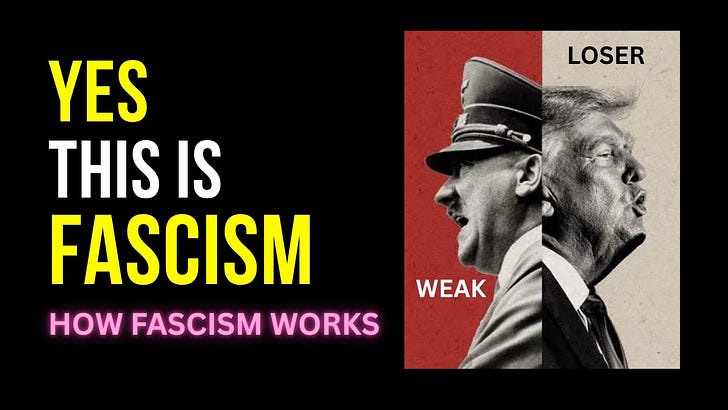 Is This Fascism? Yes 27.09.2026 18minIn 1922, 30,000 men in black shirts marched on Rome and demanded control of the Italian government. The King of Italy could have used the military to stop them. He did not. He handed power to their leader, Benito Mussolini, rather than risk a civil war. Within three years Italy was a one-party fascist state. Within two decades tens of millions of people were dead.Fascism didn’t die with Mussolini or with Hitler. It’s a system. It has a structure. It has tactics that repeat across every country and every century where it appears. And in 2018, former Yale philosophy professor named Jason Stanley published a book identifying exactly what those tactics are.Stanley was the Jacob Urowsky Professor of Philosophy at Yale University. He is the child of refugees who escaped World War II Europe. He has spent his career studying authoritarianism and propaganda. His book “How Fascism Works: The Politics of Us and Them” identifies ten tactics that every fascist movement in history has used to take power. Not some of them. All of them.What Fascism Actually IsThe word fascism gets used loosely. It gets thrown at anyone people disagree with. That carelessness is dangerous because fascism is not an insult. It is a system with a specific definition, a specific origin, and a specific set of mechanics.Fascism is a system where one man has total power over everything. The government. The military. The courts. The economy. And it is enforced by violence. You submit or you are punished. There is no middle ground.Fascism has no policies. It has no economic plan. No vision for how society should function. It is purely a mechanism for one man to seize absolute power and keep it. Everything else, the rallies, the slogans, the scapegoats, the culture wars, is just a tool to get there.Benito Mussolini invented it in Milan, Italy in 1919. The country had just come out of World War I on the winning side but got almost nothing from the peace deal. The economy was in ruins. People had no work. The national mood was humiliation and desperation.Mussolini exploited that desperation with three claims: your country used to be great, someone took that greatness from you, and democracy is too weak to get it back. His answer was to concentrate all power in a single leader, himself, who would punish the nation’s enemies and restore its strength.The trade was simple. Citizens give up their freedom, their right to question, their right to disagree. In return, the leader gives them someone to blame.That transaction sits at the center of every fascist movement in history. The leader needs an enemy because rage is the only glue holding the system together. Without someone to hate, the entire structure collapses.Fascism also leads with violence. Mussolini built a private militia called the Blackshirts. They attacked socialists, beat union organizers, and physically removed political opponents from local governments. Violence was not a byproduct of the movement. It was the operating system. In 1922, Mussolini marched 30,000 Blackshirts on Rome and demanded power. The King of Italy handed it to him rather than risk civil war.Hitler watched closely. He took Mussolini’s model and adapted it. Where Mussolini used brute force to seize power, Hitler used democracy itself. He ran in elections. He exploited free speech, free assembly, and every legal right available to citizens of a democratic republic. He used the system to get inside the system. Then he dismantled every one of those rights so no one could use them to challenge him.This is the mechanism that makes fascism uniquely dangerous among authoritarian systems. It weaponizes the openness of democracy against itself. It walks through the front door, smiles at everyone in the room, and then locks the door behind it.The Ten TacticsJason Stanley’s framework is not a theory. It is a pattern extracted from the historical record of every fascist movement that has taken root over the past century. He drew on Mussolini’s Italy, Hitler’s Germany, Franco’s Spain, Orban’s Hungary, and dozens of other cases. He identified ten tactics that appear in every single one.What follows is each tactic, what Stanley found about how it operates, and what it looks like in practice in the United States right now.1. The Mythic PastEvery fascist movement begins with a fabricated golden age. The leader tells the public that the nation was once great, that the right people were in charge, and that a specific group of enemies destroyed that greatness. The historical accuracy of this claim is irrelevant. What matters is the emotional response it produces.Mussolini understood this completely. At the 1922 Fascist Congress in Naples, he told his followers openly: “We have created our myth. It is not necessary for it to be a reality or true.” The man who invented fascism admitted to his inner circle that the glorious past was a fabrication. He said it did not matter. The feeling was enough.Stanley’s research confirms that the mythic past serves a specific psychological function. It makes people feel robbed. And once people feel that something has been stolen from them, they will tolerate extreme measures to get it back. Mussolini promised to restore the Roman Empire. Hitler promised to restore a racially pure Germany. Neither past ever existed as described. Both populations believed in them anyway because the emotion was real even when the history was not.The Trump movement is organized entirely around four words: Make America Great Again. The slogan never identifies a specific era. It never points to a year, a decade, or a policy framework. It does not need to. It points to a feeling, the feeling that the country once belonged to a certain kind of person and that someone, immigrants, Democrats, intellectuals, took it from them.2. PropagandaFascist propaganda operates differently from ordinary political dishonesty. Standard political lies attempt to convince people that a false thing is true. Fascist propaganda does something far more destructive. It rewrites the shared framework through which people interpret reality so that the very concept of agreed-upon facts ceases to exist.Stanley found that the core function of fascist propaganda is to divide the world into friends and enemies. The political opponent is not merely someone who holds a different view on tax policy or foreign affairs. The political opponent is framed as a mortal threat to the survival of the nation itself. This distinction matters because it is the line between democratic politics and fascism. In a democracy, you disagree with your opponent. In fascism, your opponent is an enemy who must be eliminated.Hitler understood the role of media control in this process. He coined the term “Lugenpresse,” the lying press, and used it to discredit any outlet that reported unfavorably on his regime. Once the independent press was delegitimized, he replaced it with a state-controlled propaganda apparatus that told the German public what to think, who to fear, and who to hate.The parallels in the current American media landscape are difficult to ignore. Trump has called the press “the enemy of the people.” He has called Democrats “the enemy from within,” “vermin,” and said they are “more dangerous than Russia or China.” Fox News, Newsmax, and an ecosystem of aligned social media accounts repeat and amplify these characterizations nightly, labeling the political left as domestic terrorists, protesters as thugs, and anyone who dissents from the leader as a traitor. The result is not a news environment. It is a propaganda infrastructure operating around the clock, systematically constructing an enemy out of the leader’s own citizens.The language matters. When a political leader calls his opponents vermin and says they need to be rooted out, that is not hyperbole. That is the specific language fascist leaders have used historically in the period immediately before they began killing people.3. Anti-IntellectualismIn a functioning democracy, truth is determined by evidence, expertise, and institutional processes designed to separate fact from fiction. In a fascist system, truth is determined by the leader. Scientists, researchers, professors, and career civil servants are not just sidelined. They are cast as enemies of the people because they possess the tools to challenge the leader’s claims.Stanley found that fascist movements target education with particular intensity because critical thinking is the single greatest threat to fascist ideology. If citizens can evaluate evidence, weigh competing claims, and recognize propaganda, the entire system becomes vulnerable. The fascist response is to discredit the institutions that produce critical thinkers.The Trump administration has operationalized this tactic against American higher education with striking precision. It froze $2.2 billion in federal research funding to Harvard and demanded a $1 billion settlement when the university refused to comply with political demands. It cut $400 million from Columbia University. It fired the head of the Bureau of Labor Statistics for producing a jobs report that contradicted the administration’s preferred narrative and replaced him with a political loyalist.Beyond universities, allies of the movement have pushed book bans across the country, removing titles from school libraries that address race, gender identity, and periods of American history that conflict with the mythic past the movement requires. The goal is not merely to silence current critics. It is to ensure that the next generation lacks the intellectual framework to recognize what is being done to them. In a fascist system, you do not just control what adults are allowed to say. You control what children are allowed to learn.4. UnrealityStanley identifies this as the most dangerous tactic on the list, and the research supports that assessment. Democracy functions on a foundation of shared truth. Citizens do not need to agree on policy, but they need to inhabit the same factual universe. They need to be able to point to the same set of facts and argue about what those facts mean. Fascism destroys that foundation deliberately.The mechanism is not simply lying. It is flooding the information environment with so many contradictions, conspiracy theories, and fabricated narratives that citizens eventually stop trying to determine what is true. They give up on the project of shared reality and retreat into tribal loyalty. Once that happens, the leader can say anything and it will be accepted by his base, not because they believe it is factually accurate, but because he is the one saying it.The 2020 election is the clearest example. Trump told the country the election was stolen. More than sixty courts reviewed the claims and rejected them. His own Attorney General said there was no evidence of widespread fraud. His own Director of Cybersecurity called it the most secure election in American history. Trump repeated the claim thousands of times anyway. Millions of Americans now believe something happened that did not happen. The lie became reality for a significant portion of the electorate.And the pattern has not stopped. When the Los Angeles wildfires broke out, Trump blamed Democrats and diversity programs before any investigation had been completed. Before the fires were even contained. The cause did not matter. The blame had already been assigned. The explanation arrived before the facts, which is exactly how unreality functions. The leader decides what happened, and the information environment rearranges itself to match.5. HierarchyEvery fascist system is built on a rigid hierarchy of human worth. Citizens are sorted by race, religion, gender, and national origin into a ranked social order. The purpose of this ranking is not merely prejudice. It is control.Stanley found that once a hierarchy is established and internalized by the population, people are governed by a single mechanism: fear of losing their position. You do not need to physically restrain people if you can convince them they occupy a rung above someone else. They will defend the hierarchy voluntarily. They will police it for you. They will fight against any change that threatens it, because their entire sense of identity is built on the existence of someone beneath them.This is why fascist movements are obsessed with questions of belonging. Who is a real citizen. Who is a real American. Who deserves rights and who does not. The categories must be clear and they must be enforced, because if the lines blur, the hierarchy loses its power and the system built on top of it becomes unstable.Trump’s entry into national politics was the birther conspiracy, the claim that a Black president was not legitimately American. This was not a minor rhetorical flourish. It was foundational. It communicated to a specific audience exactly where they sat in the hierarchy and exactly who was threatening their position within it. Years later, Trump told a rally crowd that immigrants are “poisoning the blood of our country,” a phrase that appears in Mein Kampf and carries the same function: defining who belongs inside the national body and who is contaminating it.On his first day back in office in January 2025, Trump signed an executive order eliminating all diversity, equity, and inclusion programs across the entire federal government. Every agency, every department, every contractor. The policy position was explicit: any institutional effort to move toward equality is itself a threat. The hierarchy is not merely preferred. It is enforced by executive power.6. VictimhoodThis tactic is the psychological engine that converts hierarchy into political energy. Once people believe they sit above another group in the social order, any movement toward equality is experienced not as progress but as persecution. Equality becomes the threat. The dominant group becomes the victim.Stanley found that fascist victimhood operates through three distinct mechanisms. First, the leader frames a narrative of national decline. The country has been stolen. The culture has been corrupted. Someone did this to you deliberately.Second, the leader inverts aggression. Every act of state power directed downward, every deportation, every crackdown, every use of force, is reframed as defensive. The dominant group is not attacking anyone. It is protecting itself from enemies who left it no choice.Third, and most critically, the enemy must occupy two contradictory positions simultaneously. The enemy must be weak enough to be mocked and ridiculed, dismissed as pathetic, degenerate, and inferior. But the enemy must also be powerful enough to constitute an existential threat to the entire nation. This contradiction is not a flaw in fascist logic. It is the engine. The simultaneous contempt and fear is what keeps the base in a permanent state of agitation.Every element of this structure is visible in the current political landscape. Trump framed the peaceful transfer of power in 2020 as an attack on his supporters personally, then used that manufactured grievance as the emotional fuel for January 6th. He describes undocumented immigrants as simultaneously subhuman, calling them “animals,” and as an overwhelming invading force sent to “replace” native-born Americans. He labels the free press, the judiciary, and the nonpartisan civil service as a “Deep State” whose sole purpose is the persecution of conservatives.When Trump told Fox News that the “enemy from within” should be handled “if necessary, by National Guard, or if really necessary, by the military,” and then named sitting members of Congress as examples, he framed the deployment of military force against American civilians not as authoritarian aggression but as necessary national self-defense.The victims are always his people. The aggressors are always everyone else.7. Law and OrderIn a democracy, the law applies equally to every citizen regardless of power, status, or political alignment. In a fascist system, the law is a weapon. It is pointed outward at the leader’s enemies and never turned inward toward the leader himself.Stanley found that fascist “law and order” rhetoric serves a dual function. It casts minorities, immigrants, and political opponents as inherently criminal, dangerous, and deserving of punishment. Simultaneously, it places the leader and his allies above the law entirely. The result is not a justice system. It is a loyalty system. Compliance is rewarded. Dissent is criminalized.Trump campaigned on law and order while facing 91 felony charges across four separate indictments. On his first day back in office, he pardoned every defendant charged in connection with the January 6th attack on the Capitol and called them patriots and hostages. He rewrote the most significant assault on the seat of American government since the War of 1812 into a heroic act of patriotism.In January 2026, ICE agents conducting immigration operations in Minneapolis shot and killed two people: Renee Good and Alex Pretti. Pretti was a VA nurse. He was filming the agents with his phone when they pepper sprayed him, wrestled him to the ground, and shot him. No federal agent involved in either killing has been criminally charged.The law applies to everyone beneath the leader. It never applies to the leader or to those acting in his name.8. Sexual AnxietyEvery fascist system in the historical record is rigidly patriarchal. The hierarchy requires strict gender categories: men dominate, women submit, and anyone who exists outside traditional definitions of masculinity and femininity is treated as a structural threat to the social order.Stanley’s research shows that gender equity is not merely opposed by fascist movements. It is treated as a civilizational emergency. The reason is mechanical, not moral. The fascist pyramid depends on fixed categories. If those categories become fluid, if gender roles are questioned, if reproductive autonomy is asserted, the entire hierarchical structure becomes unstable. Policing gender is not a side project of fascism. It is a load-bearing wall.This explains the intensity of the current movement’s focus on gender and sexuality, an intensity that has no proportional relationship to the actual policy stakes involved. On January 27, 2025, Trump signed an executive order banning transgender people from military service, removing service members who were already serving, people who had volunteered to risk their lives for their country, on the basis of their gender identity alone.Trump has repeatedly identified the overturning of Roe v. Wade as one of his greatest accomplishments. In the states that subsequently banned abortion, the consequences have been measured in human lives. Women in states with abortion bans are now twice as likely to die during pregnancy or childbirth compared to women in states where abortion remains legal. Public health researchers have documented at least 59 deaths directly attributable to denied or delayed emergency abortion care. Several states have disbanded their maternal mortality review committees, the bodies responsible for investigating these deaths, to prevent the data from becoming public.The movement targets drag performances, transgender children, and reproductive freedom with an energy that cannot be explained by policy disagreement alone. It is structural. Women are dying as a direct consequence of these policies. And the system producing those deaths continues to describe itself as pro-life.9. Sodom and GomorrahFascist movements require a geography of virtue and corruption. The nation must be divided into two moral territories: the pure heartland, where real citizens live and do honest work, and the decadent city, where elites, immigrants, and moral decay have taken root.Stanley found that this geographic division serves a specific political function beyond cultural resentment. It designates half the country as enemy territory. Once a city is labeled as corrupt, infested, or fallen, whatever is done to that city and its residents is preemptively justified. The people who live there are not fellow citizens with legitimate political differences. They are the other. They are the infection. And the leader’s base has been given permission to view their suffering as deserved.Trump has called American cities “war zones” and “infested.” He has described urban areas as being controlled by “radical left lunatics.”In June 2025, the administration deployed 4,000 National Guard troops and 700 Marines into Los Angeles over the direct objection of the governor of California. A federal judge ruled the deployment illegal. Regardless, over 5,000 troops occupied the city for months. In the first 40 days of the operation, those troops made exactly one temporary detainment. The deployment cost taxpayers $120 million.The operation was not designed to address a security threat. It was designed to demonstrate that the leader possesses the power to send the military into any American city that does not fall in line. That is the message. And it was received.10. Dismantling Labor and Public WelfareStanley titled this chapter after the phrase inscribed on the gates of Nazi concentration camps: Arbeit macht frei. Work shall make you free.In a fascist economy, the working class is not protected. It is exploited and redirected. Minorities and the political left are framed as lazy, parasitic, and undeserving of public support. Labor unions, the primary institutional vehicle through which workers exercise collective power, are branded as subversive organizations and dismantled. Public services are gutted. The only recognized virtue is hard labor by the underclass, the economic output of which flows upward to the people at the top of the hierarchy.Trump has attacked organized labor. He signed a tax cut that delivered the overwhelming majority of its benefits to the wealthiest Americans. His administration used DOGE to fire over 6,000 veterans from federal service across multiple agencies and reduced VA staffing to the point where 1.2 million veteran patients lost access to their assigned doctors.The political figure who most aggressively wraps himself in the American flag cut services to the people who fought under it.The oldest and most reliable trick in the fascist economic playbook is misdirection. You convince the working class that the threat to their livelihood comes from below, from immigrants, minorities, and people receiving public assistance, so they never look up. Because if they ever looked up and saw who is actually extracting wealth from their labor, the entire arrangement would collapse overnight.The Experts Who Wait Until It Is Too LateThere is a class of expert, credentialed and cautious, who insists it is premature to apply the word fascism to what is happening in the United States. Their position is that fascism can only be identified after democracy has been fully and irreversibly destroyed. After every institution is gone. After the courts have been captured. After elections have been formally abolished. After the last door has been shut.That position is analytically useless.If the only moment an expert is willing to name fascism is the moment after there is nothing left to protect, then the expertise serves no protective function. It is not a warning. It is an autopsy.The entire purpose of identifying fascism as a system with recognizable tactics and stages is to create the possibility of intervention before it reaches its terminal phase. Waiting for certainty is not intellectual rigor. It is a way of avoiding the professional and social cost of saying something uncomfortable while it still matters.F**k The experts who wait to call it Fascism. This should not be a debate conducted on the model of climate change, where an industry of paid denialism was allowed to masquerade as legitimate scientific disagreement for decades while the damage compounded. The scholars who study fascism as a historical and political phenomenon are not evenly divided. The ones who recognize the pattern are raising the alarm. Some of them have left the country. The ones who say “not yet” are waiting for a finish line that, by definition, can only be crossed after it is too late to act.Fascism is a process. Not an endpoint. The people who insist on waiting for absolute confirmation before speaking are, historically, the people who lose everything.Jason Stanley did not write this book about Donald Trump. He wrote it about fascism as a historical system. He drew on Mussolini’s Italy, Hitler’s Germany, Franco’s Spain, and dozens of other movements across the twentieth century. He published it in 2018, before January 6th, before the pardons, before “vermin,” before “poisoning the blood,” before troops were deployed into American cities, before inspectors general were fired for insufficient loyalty, before the free press was labeled the enemy of the people.He described exactly how fascism works. And then he watched it happen.The scholars who study fascism for a living are not being hysterical. Some of them have already left the country. They are not leaving because they are prone to drama. They are leaving because they recognize what they are looking at.They have seen this before. And they know how it ends.SourcesJason Stanley, How Fascism Works: The Politics of Us and Them, Random House, 2018Jason Stanley, “The Ten Tactics of Fascism,” Yale University lecture and Big Think, 2021Jason Stanley, “America Is Now in Fascism’s Legal Phase,” The Guardian, December 22, 2021American Oversight, “Trump’s Illegal Firing of Inspectors General,” April 2025U.S. News, “Trump’s Higher Education Crackdown: Visa Revocations, DEI Bans, Lawsuits and Funding Cuts,” August 2026Governor of California, “Trump’s Illegal National Guard Deployment in Los Angeles Cost Taxpayers $120 Million,” September 2025Senate Veterans Affairs Committee, “Cuts, Cover-Ups, and Chaos: Report on Trump Administration’s Assault on Veterans,” January 2026Congressional Oversight Report, Fatal Shootings of Renee Good and Alex Pretti, Minneapolis, Minnesota, 2026Gender Equity Policy Institute, “Maternal Mortality in the United States After Abortion Bans,” April 2025Ms. Magazine, “Say Their Names: The Women Who Died After Being Denied Emergency Abortion Care,” April 2026Scripps News, “Trump’s Threat to Use Military Against ‘Enemy From Within,’” October 2024 This is a public episode. If you'd like to discuss this with other subscribers or get access to bonus episodes, visit lucasbean.substack.com/subscribe
 -
 MAGA Thinks The Performance of Being Smart Is Actually Being Smart 26.09.2026 1minYou’ve seen it happen in real time.A Trump supporter walks into a debate, a comment section, a family conversation, or a live stream with total confidence. They say something that sounds like a position. It has the shape of an argument. It has the rhythm of someone who knows what they’re talking about. For about ten seconds, it could pass.Then someone pushes back. Not even aggressively. Just a follow up question. Just a “can you explain what you mean by that.”And it falls apart.But here’s the part that makes your head spin. They don’t care. They don’t care that it fell apart. They don’t care that they were wrong. They don’t care that millions of people just watched them get humiliated on camera. They move on to the next talking point with the exact same confidence. They say “I don’t care” and mean it. Or they say “do your own research” as if that’s a rebuttal. Or they just get louder.And you’re standing there thinking: how is this person not embarrassed? How do they just keep going?Because being proven wrong only hurts if you were trying to be right. And they were never trying to be right.In 1986, philosopher Harry Frankfurt at Princeton University published an essay that would eventually become one of the most important pieces of philosophical writing of the last fifty years. Originally published in the Raritan Quarterly Review, then expanded into a book by Princeton University Press in 2005, the essay introduced a formal distinction that most people have never heard but that explains nearly everything about how MAGA supporters communicate.Frankfurt identified a category of dishonesty that is worse than lying.A liar knows the truth and deliberately hides it. A liar cares about the truth, even if only as something to be avoided. A liar respects truth enough to work around it. A liar and a truth teller are playing the same game, just on opposite sides. Both of them acknowledge that truth matters.What Frankfurt identified is a completely different category. A person who is indifferent to truth. A person for whom truth never enters the equation at all. Not because they’re hiding it. Not because they’re afraid of it. But because it was never part of their process to begin with.Frankfurt called this indifference to truth, and he argued it is a greater enemy of truth than lies are. Because at least a lie can be caught. At least a lie operates within a framework where truth exists and matters. Indifference to truth operates outside that framework entirely. Truth is irrelevant. The question was never “is this true.” The question was always “does this sound good.”Now apply that to every political conversation you’ve ever had with a Trump supporter.They hear a talking point. They like how it sounds. They repeat it. If it turns out to be true, fine. If it turns out to be false, fine. It doesn’t matter. It was never about being right. It was about saying something with enough confidence that nobody pushes back. The performance of saying something smart is all they are looking for.This is not speculation. In 2015, researcher Gordon Pennycook at the University of Waterloo published a landmark study in the journal Judgment and Decision Making that put Frankfurt’s philosophical concept to an empirical test. Pennycook and his colleagues created a series of randomly generated sentences filled with abstract buzzwords. Sentences that had the syntactic structure of something profound but were literally constructed without any concern for truth or meaning. Sentences like “wholeness quiets infinite phenomena” and “hidden meaning transforms unparalleled abstract beauty.”They showed these sentences to people and asked them to rate how profound they were.And people did. They rated literal nonsense as genuinely profound.But the study went further. Pennycook found that the people who were most receptive to these meaningless statements shared a consistent psychological profile. They scored lower on cognitive ability tests. They were less likely to engage in analytic thinking. They were more prone to conspiratorial ideation. And they were significantly more likely to hold religious and supernatural beliefs.That last finding is the one that matters most for understanding MAGA.The people who can’t tell the difference between something that sounds profound and something that is profound are the same people who are drawn to religious fundamentalism and political extremism. And the reason is the same in both arenas. They never learned to evaluate content. They only learned to evaluate performance.For them, everything is a performance.They only care about the performance, not the truth. They don’t understand that other people actually understand these concepts and this information on a very fundamental level. They think everyone is performing. They think the expert on the debate stage is just doing a better performance. They think the researcher, the journalist, the policy analyst, are all just performing competence the same way they are. Because the performance is all they see and care about.That’s the part nobody talks about. MAGA supporters don’t just disagree with experts. They genuinely don’t understand that expertise is real. They think everyone is doing what they’re doing: repeating things they heard somewhere and hoping nobody asks a follow up question. The idea that someone actually understands the material, that someone did the reading, tested the idea, engaged with the counter arguments, and arrived at a position through years of study, doesn’t compute for them. Because they’ve never done it. So they don’t believe anyone else has either.Pennycook and his colleague David Rand at MIT expanded this research in 2019 with a study published in the Journal of Personality. They found that the same people who rated randomly generated nonsense as profound were also significantly more likely to perceive fake news as accurate and less able to distinguish between real and fabricated news headlines. The connection was direct. If you can’t tell the difference between something that sounds meaningful and something that is meaningful, you can’t tell the difference between real news and fake news either. The cognitive failure is the same.Where Did They Learn This? ChurchSo the question is where did they learn this. Where did they learn that performing understanding is the same thing as actually understanding.And that’s why so many of these people are fundamentalist Christians.It’s easier to perform.Church is one of the most performative environments in American life. You don’t have to understand the Bible. You just have to say you believe it. You don’t have to live the values. You just have to show up on Sunday. You don’t have to grapple with the moral complexity of scripture. You just have to repeat the phrases, raise your hands at the right time, say amen when everyone else says amen, and perform belief loudly enough that nobody questions whether it’s real.The whole system rewards performance over understanding. It trains people from childhood to mistake the act of saying something for the act of knowing something. It teaches them that conviction is the same thing as comprehension. That confidence is the same thing as competence. That if you say it loud enough and with enough certainty, it becomes true.Pennycook’s own data supports this connection. His 2015 study found that b******t receptivity, the inability to distinguish between something that sounds profound and something that actually is profound, was directly correlated with religious belief. The people most susceptible to meaningless statements dressed up as wisdom were the same people most likely to hold strong religious convictions. Not because religion is inherently meaningless, but because the cognitive style that accepts performance as a substitute for substance is the same cognitive style that fundamentalist religion cultivates and rewards.They learned this in church before they ever learned it in politics.MAGA didn’t teach them to perform. It just gave them a new stage. The same people who spent decades performing belief in a pew are now performing knowledge on a debate stage. The venue changed. The cognitive style didn’t.That’s why facts don’t work. You are presenting evidence to a person who does not process evidence. They process performances. And in their world, the louder, more confident performance wins. Truth is not a variable. Truth was never a variable.Frankfurt warned about this. In the twentieth anniversary edition of his book, he added a postscript emphasizing that indifference to truth is extremely dangerous. Not because it produces wrong answers. But because it destroys the framework within which right and wrong answers are even possible. When enough people stop caring whether something is true and start caring only about how it sounds, you don’t get bad politics. You get the end of politics. You get a country where sixty million people will watch someone get destroyed in a debate and walk away thinking their side won. Because they were never watching a debate. They were watching a performance.You can’t correct someone who is indifferent to truth. And you can’t reach someone who learned in childhood that repeating the right words is the same thing as understanding them.SourcesFrankfurt, H. G. (1986). On b******t. Raritan Quarterly Review, 6(2).Frankfurt, H. G. (2005). On B******t. Princeton University Press.Pennycook, G., Cheyne, J. A., Barr, N., Koehler, D. J., and Fugelsang, J. A. (2015). On the reception and detection of pseudo-profound b******t. Judgment and Decision Making, 10(6), 549-563.Pennycook, G. and Rand, D. G. (2020). Who falls for fake news? The roles of b******t receptivity, overclaiming, familiarity, and analytic thinking. Journal of Personality, 88(2), 185-200. This is a public episode. If you'd like to discuss this with other subscribers or get access to bonus episodes, visit lucasbean.substack.com/subscribe
 -
 Why MAGA Cult Have No Self-Awareness 25.09.2026 1minWhy Trump Supporters Have No Self-AwarenessThere is a question that haunts every person who has tried to have a real conversation with a MAGA supporter.How can you not see this?The lies are obvious. The contradictions are public. The cruelty is on camera. The promises are broken in plain sight. And they don’t see any of it. Not because they are choosing to ignore it. Because the psychological architecture of how they see themselves does not allow them to see it.Self-awareness requires something most people take for granted: the ability to look at yourself from more than one angle. To see yourself as someone who is sometimes right and sometimes wrong. Sometimes strong and sometimes weak. Sometimes the hero and sometimes the problem.MAGA supporters cannot do this. And there is a specific, measurable, experimentally proven reason why.What Linville MeasuredIn 1985, psychologist Patricia Linville at Yale University published research on how people differ in the complexity of their self-concept. Not how smart they are. Not how educated they are. How many different ways they can think about who they are.She called it self-complexity.The title of her paper tells you everything: “Don’t Put All of Your Eggs in One Cognitive Basket.”Linville’s framework measures two things. The first is how many distinct self-aspects a person has. A self-aspect is a role, a context, a dimension of identity. Parent. Professional. Friend. Hobbyist. Volunteer. Athlete. Reader. Neighbor. Partner. Each one is a separate basket that holds part of who you are.The second is how much overlap exists between those aspects. If every basket contains the same traits, the same values, the same emotional content, then the number of baskets doesn’t matter. You still have one identity spread across multiple labels.High self-complexity means you have many distinct self-aspects with little overlap. You are a different version of yourself in different contexts. You can be confident at work and uncertain at home. You can be right about one thing and wrong about another. Your identity is distributed across multiple dimensions, and a failure in one dimension does not collapse the entire structure.Low self-complexity means you have few self-aspects, or your self-aspects are all built on the same foundation. You are one thing. One identity. One story about who you are. And that story applies everywhere, in every context, with no room for contradiction.What Happens When the Eggs Are All in One BasketLinville ran two experiments to test what low self-complexity actually does to a person’s psychological stability.In the first experiment, she gave participants a success or failure experience and measured how it affected their mood and self-evaluation. People with high self-complexity showed moderate emotional responses. A failure stung but it didn’t destroy them. A success felt good but it didn’t inflate them beyond reason. Their distributed identity structure absorbed the impact the way a suspension system absorbs a bump in the road.People with low self-complexity showed the opposite. Their emotional responses were extreme. A failure didn’t just make them feel bad about the task. It made them feel bad about themselves entirely. A success didn’t just make them feel competent. It made them feel invincible. The single-basket structure meant the impact had nowhere else to go. It hit one aspect and spread to everything.In the second experiment, Linville tracked mood variability over a two-week period. Low self-complexity participants experienced significantly greater mood swings. Their emotional lives were a roller coaster, not because their circumstances were more volatile, but because their identity structure amplified every event.In 1987, Linville extended the research and identified what she called the buffering hypothesis. Self-complexity acts as a cognitive buffer against the negative effects of stressful life events. When something bad happens, a person with high self-complexity can contain the damage. The failure stays in one basket. The other baskets are unaffected. The person can say “I was wrong about this” without feeling like their entire self is under attack.A person with low self-complexity has no buffer. Every negative event threatens the entire structure. Every challenge to any part of their identity is experienced as a challenge to all of it. There is no compartment to absorb the blow. The blow hits everything.Why They Cannot Admit They Are WrongThis is where the research explains what you see every day in conversations with MAGA supporters.A person with high self-complexity can say “I was wrong about that.” The admission costs them one basket. They are still a good parent. They are still competent at their job. They are still a loyal friend. Being wrong about one thing does not erase everything else they are.A person with low self-complexity cannot say that. Because their identity is one thing. If they are wrong about Trump, they are not just wrong about a political opinion. They are wrong about the single organizing principle of their entire identity. And if that principle falls, everything falls with it. There is nothing underneath it. There is no second basket to catch them.This is why the reaction to being challenged is so extreme. You think you are questioning a political position. Their brain is processing it as an existential threat. You are not saying “you might be wrong about this policy.” You are saying “the only version of yourself that you have is a lie.”The rage you encounter is not stubbornness. It is panic. The psychological equivalent of a person clinging to the edge of a building. They are not holding on because they enjoy the view. They are holding on because letting go means falling with nothing to land on.How Trump Exploited ThisTrump did something no politician before him did at this scale. He gave millions of people a single identity and made sure it replaced every other identity they had.You are not a father who happens to support Trump. You are a patriot. You are not an accountant who votes Republican. You are a warrior fighting for the real America. You are not a person with a complex inner life who holds political opinions among many other things. You are MAGA.The hat. The flag. The shirt. The bumper sticker. The profile picture. The rally. The merch. Every symbol reinforces the single identity. Every piece of it says the same thing: this is who you are. Not part of who you are. All of who you are.And every day they spend inside the MAGA ecosystem, the other baskets disappear. The friendships outside the group are gone. The family relationships that survived the political arguments are strained to breaking. The hobbies that had nothing to do with politics have been replaced by consuming political content. The parts of their identity that existed before Trump have been hollowed out and filled with one thing.They are not multidimensional people anymore. They are one dimension. And that one dimension is MAGA.The Spillover EffectLinville identified the mechanism that makes this so dangerous. She called it the spillover effect. In a low-complexity self-structure, emotional activation in one self-aspect spreads to all other aspects because they overlap. There are no walls between the compartments. There are no separate baskets. Everything is connected to everything.When a MAGA supporter hears that Trump lied about the election, the information does not land in a political compartment where it can be evaluated on its merits. It lands on the single identity structure and spreads everywhere. It threatens their sense of being a good person. It threatens their friendships. It threatens their community membership. It threatens their purpose. It threatens their self-worth.The brain’s response to that level of threat is not reflection. It is defense. Reject the information. Attack the source. Reframe the challenge as persecution. Do whatever is necessary to protect the structure, because if the structure falls there is nothing left.This is why facts don’t work. This is why evidence doesn’t work. This is why showing them the lie on camera doesn’t work. You are not arguing with a political opinion. You are arguing with the only self a person has. And the brain will protect that self at any cost, including the cost of reality.What Self-Awareness Actually RequiresSelf-awareness is not a personality trait. It is a structural capacity. It requires having enough distinct self-aspects that you can step back from one of them and evaluate it without the evaluation threatening everything else.A person who is a parent, a professional, a friend, a reader, a gardener, a volunteer, and a political participant can look at the political part and say “I might be wrong about this” because the other parts of their identity are still intact. The gardener is still a gardener. The parent is still a parent. Being wrong about politics does not erase who they are.A person whose entire identity is MAGA cannot do this. There is nothing to step back to. There is no vantage point from which to observe the political self, because the political self is the entire self. Asking them to be self-aware is like asking someone standing on a one-foot platform to take a step back. There is nowhere to go.Trump supporters are not refusing to look inward because they don’t want to. They are refusing because they genuinely have nothing else to look at. Their identity has been collapsed into a single dimension. And that dimension is the one you are asking them to question.Challenging it doesn’t start a conversation. It starts a war. Because for someone with no self-complexity, a challenge to any belief is a challenge to every belief. A challenge to any part of who they are is a challenge to everything they are.And the brain will burn down reality itself before it lets that happen.SourcesLinville, P. W. (1985). Self-Complexity and Affective Extremity: Don’t Put All of Your Eggs in One Cognitive Basket. Social Cognition, 3(1), 94-120.Linville, P. W. (1987). Self-Complexity as a Cognitive Buffer Against Stress-Related Illness and Depression. Journal of Personality and Social Psychology, 52(4), 663-676.Rafaeli-Mor, E., & Steinberg, J. (2002). Self-Complexity and Well-Being: A Review and Research Synthesis. Personality and Social Psychology Review, 6(1), 31-58.Swann, W. B., Gomez, A., Seyle, D. C., Morales, J. F., & Huici, C. (2009). Identity Fusion: The Interplay of Personal and Social Identities in Extreme Group Behavior. Journal of Personality and Social Psychology, 96(5), 995-1011.McConnell, A. R. (2011). The Multiple Self-Aspects Framework: Self-Concept Representation and Its Implications. Personality and Social Psychology Review, 15(1), 3-27. This is a public episode. If you'd like to discuss this with other subscribers or get access to bonus episodes, visit lucasbean.substack.com/subscribe
 -
 Why the Media Keeps Putting Liars on the Same Stage as Experts 24.09.2026 1minThere is a practice in American journalism that has done more to destroy public understanding of reality than any propaganda campaign, any conspiracy theory, or any social media algorithm. It is practiced every day, on every major network, by journalists who believe they are doing their jobs correctly.They put a liar on screen next to an expert and call it balance.One person has decades of research behind them. The other has a talking point funded by the industry that benefits from the lie. The journalist puts them in matching chairs, gives them equal time, asks them each to make their case, and lets the audience decide.The audience does decide. They decide that the truth is somewhere in the middle. Because that is what the format taught them to believe.There is now experimental proof that this format does not inform people. It destroys their ability to tell the difference between facts and lies.What Rapp FoundIn 2022, psychologist David Rapp at Northwestern University, along with his colleague Megan Imundo, published three experiments testing what happens when people are exposed to false balance reporting about climate change.The design was precise. Participants read articles about climate change. Some articles presented only the scientific consensus: human activity is driving global warming and the evidence is overwhelming. Other articles presented the same scientific consensus alongside a contrarian view that climate change is either not real, not man-made, or not a significant problem. Equal space. Equal treatment. Both sides.The results across all three experiments were consistent. Participants who read the falsely balanced articles showed significantly reduced belief in the scientific consensus. Their perception of how severe climate change is dropped. Their sense of how important it is to act dropped. The mere presence of the contrarian view, given equal platform, was enough to undermine decades of scientific agreement in the reader’s mind.The format did the damage. Not the content of the contrarian argument. Not the quality of the evidence behind it. The format itself, the visual and structural equality of the two positions, told the reader’s brain that this is a legitimate debate between two reasonable positions.It is not. Ninety-seven to ninety-nine percent of climate scientists agree that human activity is driving global warming. Putting one scientist next to one denier and calling it a debate tells the audience it is a 50-50 split. Rapp said it plainly: if 99 doctors told you that you needed surgery to save your life and one disagreed, you would listen to the 99. But the media keeps presenting it as though the split is even.Why the Brain Falls for ItThe reason false balance works is not that people are stupid. It is that the brain uses format as a shortcut for evaluating credibility.When two people are placed on screen in matching chairs with matching microphones and given equal time by a journalist who treats them both with equal seriousness, the brain receives a structural signal: these two positions are equivalent. They are both worth considering. The truth is probably somewhere between them.This is a cognitive shortcut that works perfectly in most situations. When two reasonable people disagree about a genuinely ambiguous question, the truth often is somewhere in the middle. The brain learned this shortcut because it is usually right.But false balance exploits that shortcut by placing a position with zero evidence into the same structural frame as a position with overwhelming evidence. The brain reads the format, not the footnotes. It registers two voices, two chairs, two sides. And it splits the difference.Rapp’s research showed that this is not a matter of education or intelligence. The format effect operates on everyone. The structural equality of the presentation overrides the informational inequality of the content. You can know, intellectually, that one side has all the evidence. But the format keeps telling your brain that both sides deserve consideration.The History of the ProblemThe false balance problem in American media did not start with Trump. It was documented two decades before he ran for office.In 2004, Maxwell Boykoff and Jules Boykoff published a study in the journal Global Environmental Change analyzing climate coverage in the most influential American newspapers from 1988 to 2002. They examined the New York Times, the Washington Post, the Los Angeles Times, the Wall Street Journal, and USA Today.They found that 53 percent of articles about climate change gave roughly equal attention to the scientific consensus and to the contrarian position that human activity is not a significant cause of global warming. An additional 6 percent actually emphasized the contrarian view over the scientific consensus.Boykoff and Boykoff called their study “Balance as Bias.” Their conclusion was devastating: adherence to the journalistic norm of balance had created informationally biased coverage. By treating a near-unanimous scientific consensus as a two-sided debate, the prestige press had created real political space for the government to delay action on climate change.The journalistic norm of fairness, the very thing reporters believed made them credible, was the mechanism destroying public understanding of the issue.Why They Keep Doing ItIf false balance has been documented as harmful since at least 2004, and experimentally proven to reduce public understanding since 2022, why does every major network still do it?There are three reasons, and none of them have anything to do with informing the public.The first is legal protection. A network that presents “both sides” is harder to accuse of bias. Bias accusations are commercially dangerous. Advertisers flee from controversy. Presenting both sides is not a journalistic principle. It is a liability shield.The second is commercial incentive. Conflict is content. Two people agreeing that climate change is real and must be addressed is not good television. Two people arguing about whether climate change exists is good television. The false balance format creates the appearance of a dramatic contest. The audience stays to see who wins. The network sells ads against that attention.The third is institutional cowardice. Journalists who declare that one side of a public debate is simply wrong are accused of taking sides. They are accused of being activists. They are attacked on social media. Their editors get angry phone calls. It is safer, professionally and personally, to present both sides and let the audience decide. Even when letting the audience decide means letting the audience be misled.What Happens When the Liar Doesn’t Want Balance AnymoreWhile the media spent decades giving equal platform to liars in the name of fairness, they trained their own audience to distrust them. False balance taught millions of people that the media couldn’t be trusted to tell them which side had the evidence. Both sides were presented as equal. So the audience learned to pick the side that felt right rather than the side that was right.Trump exploited that distrust to do something no American president has ever done openly.On September 19, 2026, the White House banned journalists from CNN, MSNBC, and Politico from the grounds entirely. Their press credentials were confiscated at the gate. They were physically turned away.Trump announced it on Truth Social. He called it, in his own words, a “ban on the free press.” He did not hide what he was doing. He did not cite security concerns or space constraints. He said the outlets wrote negative stories about him and he didn’t want them in his office.In the Oval Office the day before, he was even more explicit. “I don’t want them in my office. I don’t want them here. If they could straighten themselves out, I would love it.”Two days later, on September 22, the White House launched Trump TV. A 24-hour YouTube channel called “Trump TV: The Essentials Station.” It opened with a rerun of Trump’s July 3 speech at Mount Rushmore. The promo used clips from Seinfeld, Family Guy, and The Dark Knight set to the Buggles’ “Video Killed the Radio Star.”Ban the independent press on Friday. Launch state-run media on Monday.Democratic lawmakers called it what it is: state-run media. Governor Gavin Newsom wrote: “First, Trump banned independent news from the White House. Now, he’s launching what is quite literally state-run TV.” Former White House Correspondents’ Association President Weijia Jiang said it plainly on Fox News: “An America cannot have state TV. That’s what makes America America. Because you need independent actors to be the observers. And if the government is only showing you what it wants, then you have to question: what are we missing?”In response, ABC, CBS, CNN, Fox News, and NBC suspended pool coverage of presidential events in solidarity. The Knight First Amendment Institute at Columbia University called the ban “pretty clearly unconstitutional.” A federal judge held a hearing on September 23 and appeared skeptical of the White House’s justification.This followed a pattern that had been escalating since his return to power. In February 2025, the White House banned the Associated Press from the Oval Office after the AP refused to adopt Trump’s preferred name for the Gulf of Mexico. In October 2025, they restricted all reporters from accessing the press secretary’s office. In May 2025, they launched White House Wire, a news-style website designed to promote favorable coverage. Each step moved the White House further from arguing with coverage and closer to replacing coverage entirely.The media’s own failure created the conditions for its own banishment. They gave liars equal platform until the audience stopped trusting them. Then the biggest liar of all used that distrust to shut the door, ban the reporters, and launch his own channel in their place.That is not media strategy. That is state propaganda replacing a free press in real time. And it happened this week.The Fix They Won’t UseRapp’s research identified a fix. It is simple and it works. He calls it a weight-of-evidence statement.In his third experiment, participants who read a falsely balanced article but also saw a brief statement communicating the broader scientific consensus, something as simple as “the vast majority of climate scientists agree that human activity is the primary driver of global warming,” showed significantly less damage from the false balance. The weight-of-evidence statement helped offset the contrarian message.The fix is one sentence. One line of context. One acknowledgment that the two positions being presented do not carry equal weight in the scientific community.The media could add this sentence to every segment. It would cost nothing. It would take five seconds. And Rapp’s research proves it would significantly reduce the damage.They don’t do it. Because adding that sentence would mean admitting that both sides are not equal. And admitting that would mean abandoning the format that protects them from bias accusations, generates conflict-driven content, and keeps them safe from the professional consequences of telling the truth.What False Balance Actually DoesFalse balance does not just confuse people about one issue. It trains people to believe that every factual question has two legitimate sides.A liar says the election was stolen. The media puts him next to an election official and frames it as a disagreement. The audience learns that whether the election was stolen is a matter of opinion.A conspiracy theorist says vaccines cause autism. The media puts him next to a pediatrician and calls it a debate. The audience learns that whether vaccines are safe is an open question.A politician says immigrants are driving a crime wave. The media puts him next to a criminologist who has the data and treats them as equals. The audience learns that whether immigrants increase crime is something reasonable people disagree about.In every case, one side has the evidence and one side has a talking point. In every case, the format treats them as equivalent. And in every case, the audience walks away less informed than they were before the segment started.This is not journalism. This is the mass production of confusion. And it is the single greatest gift the American media has given to the MAGA movement.When you treat a liar like an expert, you are not being fair. You are teaching your audience that lying is a legitimate position.There is no balance between facts and lies. There is only truth and the people paid to destroy it.Don’t forget to Subscribe, I am releasing a long video on Fascism on Sunday. SourcesImundo, M. N., & Rapp, D. N. (2022). When Fairness Is Flawed: Effects of False Balance Reporting and Weight-of-Evidence Statements on Beliefs and Perceptions of Climate Change. Journal of Applied Research in Memory and Cognition, 11(2), 258-271.Boykoff, M. T., & Boykoff, J. M. (2004). Balance as Bias: Global Warming and the US Prestige Press. Global Environmental Change, 14(2), 125-136.Koehler, D. J. (2016). Can Journalistic “False Balance” Distort Public Perception of Consensus in Expert Opinion? Journal of Experimental Psychology: Applied, 22(1), 24-38.Cook, J., Oreskes, N., Doran, P. T., Anderegg, W. R. L., Verheggen, B., Maibach, E. W., Carlton, J. S., Lewandowsky, S., Skuce, A. G., Green, S. A., Nuccitelli, D., Jacobs, P., Richardson, M., Winkler, B., Painting, R., & Rice, K. (2016). Consensus on Consensus: A Synthesis of Consensus Estimates on Human-Caused Global Warming. Environmental Research Letters, 11(4), 048002.Dixon, G. N., & Clarke, C. E. (2013). Heightening Uncertainty Around Certain Science: Media Coverage, False Balance, and the Autism-Vaccine Controversy. Science Communication, 35(3), 358-382. This is a public episode. If you'd like to discuss this with other subscribers or get access to bonus episodes, visit lucasbean.substack.com/subscribe
 -
 MAGA Bullies Need An Audience 23.09.2026 2minIn 1951, psychologist Solomon Asch at Swarthmore College ran an experiment so simple it barely seemed like an experiment at all.He put a person in a room with seven other people. He showed them a card with three lines on it and asked which line matched the one on the left. The answer was obvious. One line was clearly the same length. A child could see it.But the seven other people were actors. And every single one of them pointed to the wrong line. Deliberately. Confidently. Without hesitation. One by one, they all chose the same wrong answer.Then it was the real participant’s turn.They looked at the card. They knew the right answer. They could see it with their own eyes.And 75 percent of them said the wrong answer anyway. Because every other person in the room had said it first.That finding, published over seventy years ago, remains one of the most replicated results in the history of psychology. And it explains more about MAGA than any political analysis ever written.What Asch Actually ProvedMost people know the basic outline of Asch’s experiment. Most people interpret it as proof that people lie to fit in. That social pressure makes cowards out of otherwise honest people. That is true, but it is only part of what Asch found.Asch conducted extensive post-experiment interviews with his participants. He wanted to understand what was happening inside their heads when they gave the wrong answer. He found three distinct patterns.Some participants knew the answer was wrong and said it anyway to avoid standing out. They were conscious liars. They chose social comfort over accuracy and they knew they were doing it.Some participants assumed the group must be right and they must be wrong. Even though they could see the correct answer, the unanimity of the group made them doubt their own perception. They genuinely believed they were the ones making the mistake.And some participants reported that they actually saw the lines differently after hearing the group’s answer. Their perception shifted. The wrong line started to look right. The group did not just change what they said. It changed what they saw.This third category is the one that should terrify everyone. It means conformity does not just suppress the truth. In some people, it replaces the truth at the level of perception itself.The Brain Scan That Proved ItIn 2005, psychiatrist Gregory Berns at Emory University put Asch’s experiment inside a brain scanner. He wanted to answer the question that had haunted psychology for fifty years: when people conform, are they consciously lying, or has something changed in how their brain is actually processing the information?Berns used a mental rotation task instead of lines, but the structure was identical to Asch’s design. A participant saw a shape. A group of confederates gave the wrong answer. Then the participant answered while an fMRI machine recorded what was happening inside their brain.The results were decisive and disturbing.When participants conformed to the group’s wrong answer, the brain activity was not concentrated in the prefrontal cortex, the region associated with conscious decision-making. If people were simply choosing to lie, the decision-making centers would have lit up. They did not.Instead, conformity activated the occipital-parietal network. The regions of the brain responsible for visual and spatial processing. The perceptual areas. The parts of the brain that determine what you actually see.The group pressure was not overriding the participant’s judgment. It was altering their perception. The wrong answer didn’t just feel socially safe. It started to look right.But the most important finding came from the other direction. When participants resisted the group and gave the correct answer independently, the amygdala activated. The brain’s threat detection center. The same region that fires when you encounter physical danger.Going against the group did not just feel uncomfortable. The brain registered it as dangerous. The same neural alarm system that evolved to keep our ancestors alive in the presence of predators was firing in response to the simple act of disagreeing with a room full of strangers about the length of a line.Why 50,000 Years of Evolution Are Working Against YouThe script makes a point that the neuroscience confirms. For 50,000 years, disagreeing with the tribe meant exile. Exile meant death. A human being separated from the group in the ancestral environment did not just feel lonely. They died. They starved. They were killed by predators. They had no protection, no shared resources, no collective defense.The brain adapted accordingly. It built a system that prioritizes group cohesion over individual accuracy. A system that registers social exclusion as a survival threat. A system that will alter your perception of reality, change what your eyes report to your conscious mind, rather than allow you to stand alone against the group.Berns’s brain scan proved that this system is not metaphorical. It is not a figure of speech. The amygdala literally fires when you disagree with the group. The visual cortex literally changes when the group tells you something different from what your eyes see. The brain treats conformity as safety and independence as danger at the neurological level.This system made perfect sense for 50,000 years. Being wrong with the group was safer than being right alone. The person who went along survived. The person who stood apart was the one the predator caught.But that system was not designed for an environment where the group is being deliberately manipulated by a propaganda machine. It was not designed for a world where the tribe’s beliefs are manufactured by a media ecosystem that profits from keeping them wrong. It was not designed for MAGA.How MAGA Weaponizes ConformityAsch’s experiment used seven actors in a room. MAGA operates with millions.Every day, a Trump supporter wakes up and checks their phone. Their social media feed is full of people saying the same things. The election was stolen. Immigrants are the problem. The media is the enemy. Trump is being persecuted. Every person in their digital world is saying the same thing. Every person in their physical world, the friends who are left, the family members who haven’t cut them off, the church, the workplace, is saying the same thing.Asch proved that seven strangers in a room is enough to make 75 percent of people say something they know is wrong. Now multiply that by every screen, every conversation, every social media platform, every news broadcast, every podcast, every group chat, every rally, every bumper sticker in the parking lot of every church in every small town in America.The conformity pressure is not seven people in a room. It is the entire world the person lives in. There is no line of sight to a dissenting view. There is no one in the room giving the right answer first. Every voice they hear is saying the same wrong thing. And Berns’s research shows that under those conditions, the brain doesn’t just suppress the truth. It stops being able to see it.The election fraud claims have been disproven in over 60 courts. They still say it. Not because they evaluated the evidence and found it compelling. Because everyone around them is saying it.Tariffs are raising their grocery prices. They can see it at the register every week. They still say the tariffs aren’t the problem. Because everyone around them is saying it.The immigrant crime wave has been disproven by every available dataset. They still say it. Because saying it keeps them inside the group. And not saying it triggers the amygdala.They aren’t critically thinking about the evidence. They are scanning the room and repeating whatever the room is saying. The same way Asch’s participants did. The same way Berns’s participants did. The same way humans have done for 50,000 years.The Cost of Standing AloneAsch ran a variation of his experiment that revealed something equally important. When he placed just one other person in the room who gave the correct answer before the participant’s turn, conformity dropped by 80 percent. One ally. One voice saying what the person could already see. That was enough to break the spell.The reason is that the brain’s conformity system is not responding to the content of what people are saying. It is responding to unanimity. When the group is unanimous, the brain treats dissent as exile-level danger. When even one person breaks from the group, the brain recategorizes the situation. Disagreement becomes possible. The cost drops. The amygdala stands down.This is why MAGA works so hard to maintain unanimity. This is why anyone who breaks from the group is immediately attacked, labeled a traitor, and publicly destroyed. It is not punishment for its own sake. It is the elimination of the one dissenting voice that Asch proved is enough to break conformity.Liz Cheney didn’t just lose her seat. She was erased from the party. Mitt Romney didn’t just disagree. He became a traitor. Adam Kinzinger didn’t just vote his conscience. He was exiled.Those weren’t political losses. Those were the elimination of the one honest voice in the room that would have given everyone else permission to see what they could already see.Without that voice, the room stays unanimous. And in a unanimous room, 75 percent of people will say something they know is wrong just to stay inside the group.What They Actually KnowThe hardest part of Asch’s research to sit with is the post-experiment interviews. Most of his participants, when debriefed, admitted they knew the right answer. They could see it the whole time. They weren’t confused. They weren’t persuaded. They were afraid.That is MAGA. Most of these people are not true believers. They are conformists. They know the election wasn’t stolen. They know the tariffs are raising prices. They know the conspiracy theories don’t hold up. They can see the lines on the card.But every person in their world is pointing to the wrong line. And the cost of pointing to the right one is losing their friends, their community, their identity, and the only people who make them feel like they belong.So they point to the wrong line. Every day. Not because they believe it. Because they are too afraid of what happens when they stop saying it.They don’t believe what they’re saying. They are just too afraid of not belonging to stop.SourcesAsch, S. E. (1951). Effects of Group Pressure Upon the Modification and Distortion of Judgments. In H. Guetzkow (Ed.), Groups, Leadership and Men: Research in Human Relations. Carnegie Press.Asch, S. E. (1956). Studies of Independence and Conformity: A Minority of One Against a Unanimous Majority. Psychological Monographs: General and Applied, 70(9), 1-70.Berns, G. S., Chappelow, J., Zink, C. F., Pagnoni, G., Martin-Skurski, M. E., & Richards, J. (2005). Neurobiological Correlates of Social Conformity and Independence During Mental Rotation. Biological Psychiatry, 58(3), 245-253.Bond, R., & Smith, P. B. (1996). Culture and Conformity: A Meta-Analysis of Studies Using Asch’s (1952b, 1956) Line Judgment Task. Psychological Bulletin, 119(1), 111-137.Cialdini, R. B., & Goldstein, N. J. (2004). Social Influence: Compliance and Conformity. Annual Review of Psychology, 55, 591-621.Eisenberger, N. I., Lieberman, M. D., & Williams, K. D. (2003). Does Rejection Hurt? An fMRI Study of Social Exclusion. Science, 302(5643), 290-292. This is a public episode. If you'd like to discuss this with other subscribers or get access to bonus episodes, visit lucasbean.substack.com/subscribe
 -
 You Can Disprove Everything a MAGA Believes and They Will Still Believe It 22.09.2026 2minYou have done it. You know you have. You sat across from someone and laid out the facts. Calmly. Clearly. With sources. With data. With court documents. With video evidence. You dismantled every claim they made. You proved beyond any reasonable doubt that what they believed was false.And they kept believing it.Not because they didn’t hear you. Not because they didn’t understand you. Because the belief no longer needs the evidence. The belief is alive on its own. And no amount of proof will kill it.That feeling you had afterward, the sense that you must be losing your mind, that reality itself has stopped working, is not a failure of communication. It is the result of a cognitive mechanism that was identified and proven in a laboratory over fifty years ago.The Experiment That Changed EverythingIn 1975, psychologist Lee Ross at Stanford University, along with his colleagues Mark Lepper and Michael Hubbard, published an experiment that should have changed the way every person in the world thinks about arguing.Ross gave participants false feedback on a task. He told some of them they had performed well at distinguishing real suicide notes from fabricated ones. He told others they had performed poorly. The feedback was completely made up. There was no real score. The outcome was predetermined and randomly assigned.Then he debriefed them. Thoroughly. He told them the feedback was fake. He told them it had been fabricated. He showed them that the entire basis for their belief about their own performance was a lie.And the belief survived.Participants who had been told they were good at the task continued to rate themselves as good at it. Participants who had been told they were bad continued to rate themselves as bad. Even after they knew, with complete certainty, that the evidence was fabricated. Even after the foundation had been pulled out entirely.Ross called it belief perseverance. The tendency to maintain a belief after the evidence supporting it has been completely destroyed.Why the Belief SurvivesThe most important finding in Ross’s research was not that the belief survived. It was why.Ross and his colleagues discovered that the moment a person forms a belief, the brain begins generating causal explanations for why the belief is true. These explanations are self-generated. They come from the person’s own experience, their own self-concept, their own framework for understanding the world.A participant who was told she was good at detecting real suicide notes would immediately begin constructing reasons why that made sense. Maybe she had always been empathetic. Maybe she had experience with people who were struggling. Maybe she was good at reading emotional nuance. These explanations felt personal. They felt organic. They felt like they came from inside.When the original evidence was removed, those self-generated explanations remained. The belief no longer needed the fabricated data. It had new support. Support the person had built themselves, from their own life, without realizing they were doing it.This is the mechanism. The evidence is the spark. But the moment the belief catches, the brain starts building fuel around it from the person’s own identity, their own experiences, their own stories about who they are. Remove the spark and the fire keeps burning because the fuel is the person’s own self-concept.That is why debunking doesn’t work. You can disprove the original claim. You can show them the court rulings. You can show them the data. You can prove the evidence was fabricated. And the belief survives. Because the belief is no longer attached to the evidence. It is attached to the person’s story about themselves.The Explanatory Framework ProblemIn 1980, Ross and Lepper extended the research with another colleague, Craig Anderson. They found the same effect with beliefs about the world, not just beliefs about the self.They gave participants fabricated case studies suggesting either that risk-taking people make better firefighters or that cautious people make better firefighters. Then they debriefed them completely. Told them the case studies were invented. Showed them the fabrication.The beliefs persevered. And when the researchers asked participants to explain their beliefs, they could articulate detailed, coherent reasons why risk-takers (or cautious people) would make better firefighters. Reasons that had nothing to do with the fabricated case studies. Reasons they had generated entirely on their own in the minutes between forming the belief and being debriefed.The belief had migrated. It started in the fabricated evidence. It moved to the person’s own explanatory framework. And once it was inside that framework, removing the original evidence was like pulling a single thread from a sweater that had already been knitted into a different garment. The thread was gone. The garment remained.This is exactly what happened with election fraud. The original claims were specific. Specific machines. Specific counties. Specific numbers. Every one of those claims was disproven in over 60 courts. The evidence was demolished.But by the time the courts ruled, millions of people had already built their own explanatory frameworks. They had their own stories. They had their own experiences that seemed to confirm it. They had their own sense that something felt wrong. They had conversations with friends who agreed. They had social media feeds full of people who saw the same thing they saw.Remove the original evidence and the framework stands on its own. The belief no longer needs Dominion voting machines or dead voters or suitcases of ballots. It has something stronger. It has the person’s own certainty that they are right.Naive RealismLater in his career, Ross identified the psychological phenomenon that makes belief perseverance nearly impossible to break from the outside.He called it naive realism. The belief that you see the world objectively. That your perceptions are accurate. That your reasoning is sound. And that anyone who disagrees with you must be irrational, uninformed, or biased.Naive realism is not arrogance. It is the default setting of the human brain. Every person, liberal or conservative, educated or not, walks through the world believing that what they see is what is actually there. The feeling of objectivity is automatic. It does not require effort. It does not require evidence. It is the water the brain swims in.The problem is that naive realism makes it nearly impossible to consider the possibility that you are wrong. If you believe you see reality as it truly is, then anyone presenting contradictory evidence is not offering you new information. They are distorting reality. They are biased. They are brainwashed. They are the ones who don’t understand.Now combine naive realism with belief perseverance. A person forms a belief based on evidence that later turns out to be fabricated. Their brain generates causal explanations that make the belief feel organic and personally confirmed. They experience their belief as an accurate perception of reality. And anyone who tries to correct them is experienced not as helpful but as hostile.This is why arguing with a MAGA supporter feels like arguing with a wall. It is not that they cannot hear you. It is that their brain has classified your evidence as a distortion, your reasoning as biased, and your conclusion as evidence that you are the one who doesn’t understand.They are not ignoring reality. They believe, with complete sincerity, that they are the ones who see reality clearly. And you are the one under the spell.The Only Thing That WorkedAnderson, Lepper, and Ross found one technique that reduced belief perseverance in the laboratory. They called it “consider the opposite.”Before participants were asked to evaluate their belief, they were asked to generate explanations for why the opposite might be true. Not to believe the opposite. Just to imagine it. To construct a plausible case for why the other side might be right.This simple exercise significantly reduced the perseverance effect. Not because it changed the person’s mind. Because it broke the monopoly of the single explanatory framework. The brain had been holding one story. Now it had two. And with two stories in play, the person’s certainty dropped enough for evidence to matter again.The problem is that “consider the opposite” requires something MAGA supporters have been systematically trained to refuse: the willingness to entertain, even hypothetically, the possibility that they are wrong. The entire media ecosystem, the entire social structure, the entire identity framework they live inside is designed to prevent exactly that moment of consideration.Fox News does not ask its viewers to consider the opposite. Right-wing podcasts do not ask their listeners to imagine being wrong. Truth Social does not reward uncertainty. The entire system is built to make sure the person never reaches the cognitive state that Ross showed is the only one capable of reducing belief perseverance.What This MeansYou are not failing to communicate. You are not choosing the wrong words. You are not being too aggressive or too passive or too emotional or too cold. You are fighting a brain that has already decided, before you opened your mouth, that the evidence does not matter.The belief does not need the evidence anymore. It has the person’s own explanatory framework. It has naive realism telling the person they see reality clearly. It has an entire media ecosystem reinforcing the framework every single day. And it has a social community that punishes doubt and rewards certainty.You cannot argue them out of it. Ross proved that in 1975. The belief perseveres because the brain protects it the same way it protects the person’s identity. Because at this point, the belief is the person’s identity. Removing it would mean dismantling the story they have told themselves about who they are, what they stand for, and why their life makes sense.And the brain will not allow that. It will reject the evidence, discredit the source, reframe the argument, and walk away more certain than before.Not because they are stupid. Because the brain was built to protect the story. And once the story is in there, the facts never stood a chance.SourcesRoss, L., Lepper, M. R., & Hubbard, M. (1975). Perseverance in Self-Perception and Social Perception: Biased Attributional Processes in the Debriefing Paradigm. Journal of Personality and Social Psychology, 32(5), 880-892.Anderson, C. A., Lepper, M. R., & Ross, L. (1980). Perseverance of Social Theories: The Role of Explanation in the Persistence of Discredited Information. Journal of Personality and Social Psychology, 39(6), 1037-1049.Lord, C. G., Ross, L., & Lepper, M. R. (1979). Biased Assimilation and Attitude Polarization: The Effects of Prior Theories on Subsequently Considered Evidence. Journal of Personality and Social Psychology, 37(11), 2098-2109.Ross, L., & Ward, A. (1996). Naive Realism in Everyday Life: Implications for Social Conflict and Misunderstanding. In E. S. Reed, E. Turiel, & T. Brown (Eds.), Values and Knowledge. Lawrence Erlbaum Associates.Nisbett, R. E., & Ross, L. (1980). Human Inference: Strategies and Shortcomings of Social Judgment. Prentice-Hall. This is a public episode. If you'd like to discuss this with other subscribers or get access to bonus episodes, visit lucasbean.substack.com/subscribe
 -
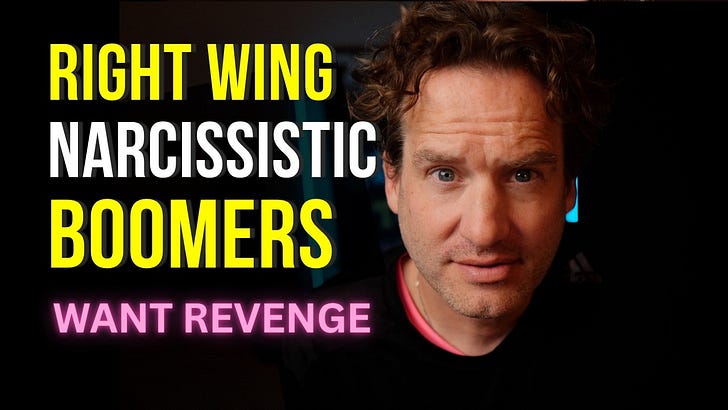 Why Narcissistic MAGA Boomers Chose Fascism 21.09.2026 12minWhy Right-Wing Baby Boomers Chose Fascism Over Their Own FamiliesYour parents chose a political movement over you.They chose a man they have never met over the child they raised. They chose Fox News over Thanksgiving. They chose conspiracy theories over their grandchildren. And when you set a boundary, when you asked them to stop, when you told them the way they raised you wasn’t normal, they didn’t listen. They called you brainwashed and voted for a system that would punish you for growing up.This is not about all Baby Boomers. There are great parents in that generation. Empathetic people. People who are close with their kids and believe in growing old gracefully surrounded by people who love them.This is about the ones who chose Trump over their own families. The ones who were toxic before Trump showed up and got worse once he gave them permission. The ones who demand empathy they refuse to give, respect they haven’t earned, and loyalty they destroyed by their own behavior.This is about the other ones. The ones who chose a political movement over their own children. The ones who were toxic before Trump showed up and got worse once he gave them permission. The ones who cut off their daughters for voting differently and their sons for going to therapy. The ones who demand empathy they refuse to give, respect they haven’t earned, and loyalty they destroyed by their own behavior.The question is not why these people support Trump. The question is what was already broken inside them that made Trump the inevitable answer. Eight separate fields of psychological research converge on the same picture, and when you see them together the pattern becomes impossible to deny.There are eight psychological reasons this happened. None of them are political.The Void They Retired IntoThe first piece of the puzzle is developmental. In 1950, psychologist Erik Erikson at Harvard University mapped the eight stages of human psychological development across the entire lifespan. The final adult stage, which Erikson placed in late middle age and beyond, is the conflict between generativity and stagnation.Generativity is the need to contribute something meaningful to the next generation. It is the drive to mentor, to build, to leave something behind that matters. Erikson showed that people who successfully navigate this stage find purpose in helping others grow. They become elders in the real sense: sources of wisdom, stability, and guidance.Stagnation is what happens when a person fails this stage. They stop contributing. They stop growing. They collapse inward and become obsessed with themselves because there is nothing else left. Erikson found that people who fail the generativity stage don’t just feel useless. They feel invisible. And invisible people become desperate.In America, identity is tied to production. You are what you do. Your job is your worth. Your title is your relevance. Then you retire. And the thing that told the world who you were disappears. For a person who successfully navigated generativity, retirement is a transition. For a person who failed it, retirement is an identity collapse.Right-wing boomers retired into a country that didn’t need them anymore. Their expertise was outdated. Their careers were over. Their kids were grown and living independently. Nobody was asking for their guidance. Nobody was waiting on their opinion. The void that Erikson described opened up, and something had to fill it.MAGA filled it. Not with purpose. Not with contribution. Not with the generative acts that Erikson showed are necessary for psychological health in late life. With rage, grievance, and the feeling that somebody, somewhere, was finally paying attention to them again.The Wound That Never HealsThe second piece explains why retirement triggered rage instead of reflection.In 1975, psychoanalyst Otto Kernberg at Cornell University Medical College published his foundational research on pathological narcissism. Kernberg spent decades studying what happens inside the narcissistic personality when reality stops confirming the version of themselves they need to believe in.He called the resulting psychological wound narcissistic injury. The injury occurs when a narcissist is confronted with evidence that they are not as important, as respected, or as central as they believe themselves to be. The response to that wound is never sadness. It is never self-examination. It is always rage. Disproportionate, uncontrollable, directed at whoever or whatever made the narcissist feel small.Right-wing boomers were told they were special for their entire lives. They inherited the strongest economy in the history of the world. They were the center of American culture for fifty years. Every institution, every advertisement, every political campaign was built around them and their preferences.Then the world moved on. Their opinions stopped mattering. Their values were questioned. Their children pushed back. Their grandchildren think differently than they do about race, gender, sexuality, the environment, and nearly everything else. The culture shifted and nobody asked their permission.For a psychologically healthy person, this is called aging. For a narcissist, every one of those shifts is a narcissistic injury. And the response to narcissistic injury, Kernberg showed, is always the same. Not adaptation. Not growth. Rage. And the search for someone who will tell them the world is wrong and they are right.The Families They LostThe third piece explains what happened to their closest relationships while the rage was building.In 2020, sociologist Karl Pillemer at Cornell University published the findings of his ten-year Cornell Family Estrangement and Reconciliation Project, the first national survey of family estrangement ever conducted in the United States. He found that 27 percent of American adults are estranged from a close family member. Parent-child estrangement is the most common form. And the reasons given by the adult children who initiated the estrangement follow a devastatingly consistent pattern: manipulation, emotional invalidation, relentless criticism, and the refusal to respect boundaries.Right-wing boomers fit that pattern with clinical precision. They expected praise for doing the bare minimum as parents. They treated their children’s emotions as weaknesses. They demanded empathy but refused to give any back. They expected their adult children to remain subordinate indefinitely.Their kids went to therapy. They learned the language of boundaries. They learned that the way they were raised wasn’t normal. And they stopped calling.Some went no-contact entirely. Some pulled back to occasional obligatory contact. Some still show up at Thanksgiving and sit in silence, counting the minutes until they can leave.These boomers were already alone. Already isolated. They had already lost the people closest to them. And instead of asking why, instead of doing the self-examination that might have revealed their role in the estrangement, they found a movement of millions of people just like them who told them exactly what they wanted to hear. Your kids aren’t right. Your kids are brainwashed. You were a great parent. The radical left ruined your family.MAGA didn’t radicalize these people. MAGA gave narcissists who had already destroyed their families a new family that would never hold them accountable.The Hierarchy They NeedThe fourth piece explains what specifically enrages them about the modern world.In 1999, social psychologists Jim Sidanius at UCLA and Felicia Pratto at the University of Connecticut published their theory of Social Dominance Orientation. SDO measures the degree to which a person believes that social hierarchies are natural, necessary, and should be maintained. People high in SDO don’t just prefer inequality. They need it. Their entire sense of identity depends on some people being above others.Sidanius and Pratto found that people high in Social Dominance Orientation experience every movement toward equality as a personal attack. Not as progress. Not as fairness. As demotion.A Black man becomes president. That is an attack on their place in the hierarchy. Gay people can get married. That is an attack on their values. Trans people exist publicly. That is an attack on their worldview. Their grandchildren care about pronouns and climate change. That is an attack on everything they were raised to believe.They are not angry because the world got worse. They are angry because the world got more equal. And for someone who has spent their entire life at the top of every hierarchy they participated in, equality feels like being robbed.This is what they want to punish you for. Not your politics. Not your values. The crime, in their eyes, is that you stopped letting them be in charge of how the world works. You stopped deferring. You stopped obeying. You treated their authority as something that could be questioned. And for someone high in SDO, that is an unforgivable offense.The Brains Working Against ThemThe fifth piece explains why the propaganda works so well on this generation specifically.In 2020, psychologists Nadia Brashier and Daniel Schacter at Harvard University published a review of the research on how aging affects the ability to detect false information. Their findings were published in Current Directions in Psychological Science.They found that older adults are significantly more susceptible to misinformation than younger adults. But the reason is not simply cognitive decline. Brashier and Schacter identified multiple factors operating simultaneously. Older adults show greater generalized trust, which makes them less likely to question the credibility of a source. They have greater difficulty detecting lies. They place less emphasis on accuracy when communicating and more emphasis on social connection. And they are relative newcomers to social media, which means they struggle to distinguish organic content from sponsored content, real images from manipulated ones, and news from propaganda.The combination is devastating. A population that is more trusting, less equipped to detect deception, less focused on accuracy, and less digitally literate than any other age group in the country, sitting in front of the most sophisticated propaganda machine in human history.Fox News launched in 1996. Rush Limbaugh had been broadcasting since 1988. By the time Trump arrived in 2015, there were already millions of Americans who had been trained for over two decades to hate the left, distrust every mainstream institution, and wait for a strong leader who would say what they were thinking. Right-wing media didn’t just inform these people. It replaced their reality. And Brashier and Schacter’s research shows their aging brains were neurologically primed to let it happen.The Violence the Machine ProducesThe sixth piece explains what that propaganda machine is actually designed to do.In 2021, forensic psychologists Molly Amman and Reid Meloy published a formal analysis in the peer-reviewed journal Perspectives on Terrorism. They examined a phenomenon that had been discussed informally for years but never rigorously defined in the research literature.They called it stochastic terrorism. The use of mass communication to repeatedly demonize a person or group in ways that make violence statistically predictable but individually impossible to trace back to the speaker.The speaker never says “go hurt someone.” The speaker says “these people are destroying your country.” “They are traitors.” “They are vermin.” “They are an invasion.” “They are the enemy within.” Say those words every day to millions of people for years. Someone in that audience will act. You don’t need to give the order. You just need to keep talking.Between 2005 and 2009, Bill O’Reilly called abortion provider Dr. George Tiller “Tiller the Baby Killer” on 29 episodes of his Fox News show. On May 31, 2009, a man walked into Tiller’s church in Wichita, Kansas, and shot him dead in front of his wife. In 2019, a man drove ten hours to a Walmart in El Paso and executed 23 people because he believed Latinos were invading Texas. His manifesto used the same language Trump uses at his rallies.Stochastic terrorism is the mechanism that turns the propaganda machine into a weapon. The aging brains absorb the messaging. The narcissistic injury provides the rage. The isolation removes the social guardrails. And the machine keeps feeding all of it, 24 hours a day, until someone somewhere acts.The Freedom They SurrenderedThe seventh piece explains why they ran toward authoritarianism instead of away from it.In 1941, social theorist Erich Fromm at Columbia University published Escape from Freedom after watching an entire civilization surrender its liberty to fascist leaders. Fromm had escaped Nazi Germany himself and spent the rest of his career trying to understand what he had witnessed.Fromm found something nobody expected. People were not forced into authoritarianism. They ran toward it. They wanted it. Not because they were evil. Because they were in pain.Fromm called it the escape from freedom. The phenomenon occurs when the pain of isolation, meaninglessness, and powerlessness becomes so unbearable that people surrender their judgment, their autonomy, and their individual identity to whoever promises to make the pain stop.The authoritarian leader offers four things that map precisely to the void these people are trying to fill. Belonging: a tribe, a group, an identity that replaces the one they lost. Simple answers: immigrants did it, elites did it, the deep state did it. Purpose: a mission, a fight, something worth showing up for. And an enemy: someone to blame for everything they have lost.Trump gave right-wing boomers all four. Just show up. Hate who we hate. And you are one of us.Fromm wrote this in 1941 watching Germany collapse. He was describing America eighty years later.The RevengeThe eighth piece explains why belonging wasn’t enough. Why they didn’t just join a church or volunteer at a food bank or call their kids and apologize.In 1950, psychoanalyst Karen Horney identified a psychological drive she called vindictive triumph. The compulsive need to humiliate and defeat others in order to restore a sense of superiority after feeling humiliated yourself. Horney described this drive as having incredible tenacity. Once activated, it can become the primary motivational force in a person’s entire life.Right-wing boomers didn’t just want belonging. They wanted revenge. They want their authority back. They want you to need them again. They want to be the center of every family dinner, every holiday, every decision, the way they used to be. And when you won’t give them that voluntarily, they want to take it by force.They want you to pay. Pay for not calling enough. Pay for going to therapy. Pay for setting boundaries. Pay for not needing them anymore. Pay for learning that the way they raised you wasn’t normal and having the language to say so.If they can’t make you pay personally, they will vote for a system that does it for them. A system that strips away reproductive rights so their daughters can’t make choices they disapprove of. A system that attacks LGBTQ rights so their children can’t live authentically. A system that punishes education and therapy and independence because those are the things that gave their children the words to name what was done to them.On January 10, 2025, a father in Prosper, Texas named Kris Harrison shot and killed his 23-year-old daughter Lucy after they argued about Donald Trump. The grand jury declined to indict him.A father chose his politics over his own daughter’s life.Every person who has ever gone no-contact with a narcissistic parent recognizes this pattern. When you stop giving a narcissist what they need, they don’t change. They escalate.MAGA is that escalation at a national scale. They couldn’t make their kids listen at the dinner table anymore. So they voted for a system that makes the entire country listen instead.They are dying and they won’t be around for the consequences. There is no leverage left. No relationship left to threaten. All that is left is rage.If I cannot have your respect, I will take your freedom.That is not politics. That is a narcissistic parent who lost control of their family and decided to take control of the country instead.And the entire country is paying for it.SourcesErikson, E. H. (1950). Childhood and Society. W. W. Norton & Company.Kernberg, O. F. (1975). Borderline Conditions and Pathological Narcissism. Jason Aronson.Pillemer, K. (2020). Fault Lines: Fractured Families and How to Mend Them. Avery/Penguin Random House.Sidanius, J., & Pratto, F. (1999). Social Dominance: An Intergroup Theory of Social Hierarchy and Oppression. Cambridge University Press.Brashier, N. M., & Schacter, D. L. (2020). Aging in an Era of Fake News. Current Directions in Psychological Science, 29(3), 316-323.Amman, M., & Meloy, J. R. (2021). Stochastic Terrorism: A Linguistic and Psychological Analysis. Perspectives on Terrorism, 15(6), 2-13.Fromm, E. (1941). Escape from Freedom. Farrar & Rinehart.Horney, K. (1950). Neurosis and Human Growth: The Struggle Toward Self-Realization. W. W. Norton & Company.Guess, A., Nagler, J., & Tucker, J. (2019). Less Than You Think: Prevalence and Predictors of Fake News Dissemination on Facebook. Science Advances, 5(1), eaau4586. This is a public episode. If you'd like to discuss this with other subscribers or get access to bonus episodes, visit lucasbean.substack.com/subscribe
 -
 MAGA Supporters Gave Up on Themselves a Long Time Ago. 19.09.2026 1minThere is something about MAGA supporters that most political commentary gets wrong. The common explanation is that they are angry. That they are hateful. That they chose cruelty because cruelty is what they wanted.Some of that is true. But it is not the full picture.Underneath the rage, underneath the conspiracy theories, underneath the flags and the rallies and the chanting, there is something quieter and more devastating. These are people who stopped believing that anything they do will ever change anything.They did not start that way. Nobody does. They were taught.The Original ExperimentIn 1967, psychologist Martin Seligman at the University of Pennsylvania, working with his colleague Steven Maier, ran an experiment that would become one of the most cited findings in the history of psychology.Seligman placed dogs in a chamber and exposed them to small electric shocks. One group of dogs could press a panel to stop the shocks. Another group received the identical shocks but had no panel. No matter what they did, the shocks continued. They had no control over what was happening to them.Then both groups were placed in a new chamber. In this chamber, all they had to do to escape the shock was jump over a low barrier. The dogs who had control in the first phase figured it out immediately. They jumped the barrier and the shock stopped.The dogs who had been exposed to the uncontrollable shocks did not jump. They lay down. They whimpered. They did nothing. The barrier was low. The escape was obvious. And they did not try.Seligman called it learned helplessness. The dogs had not become lazy. They had not become stupid. Their brains had learned, through repeated experience, that their actions did not produce results. So the brain shut off the motivation to act. Even when the situation changed. Even when escape was right in front of them.The experiment was later replicated with human subjects using loud noise instead of shocks. The results were the same. People who experienced repeated uncontrollable negative events stopped trying to change their circumstances, even when they could.The Three DeficitsSeligman identified three specific deficits that define learned helplessness. Understanding all three is critical to understanding what MAGA actually is.The first is a motivational deficit. The person stops trying. They do not attempt to escape or improve their situation. Not because they are content. Because their brain has calculated that effort is pointless.The second is a cognitive deficit. The person fails to recognize control even when it is available. The barrier is low. The escape route is obvious. But the brain has stopped scanning for solutions. It has stopped generating action plans. The person cannot see the exit because the brain has stopped looking for one.The third is an emotional deficit. The person’s affect flattens. Their response to reward diminishes. They become passive, withdrawn, and depressed. The emotional engine that drives a person to engage with the world has been depleted by repeated failure.Now think about the communities where MAGA support runs deepest. Towns where the factory closed twenty years ago and nothing replaced it. Places where wages have been flat for decades. Communities where the schools are underfunded, the hospitals are closing, and the young people who could have changed things left for the cities and never came back.These are not lazy people. These are people whose experience taught their brains, over and over, that nothing they do changes anything. They voted and nothing changed. They worked and nothing improved. They played by the rules and the rules changed underneath them. They did everything they were supposed to do and the reward never came.That is the experience that produces learned helplessness. Not a single catastrophic failure. A long, grinding series of failures that teaches the brain to stop generating hope.The Attributional TrapIn 1978, Seligman and his colleagues Lyn Abramson and John Teasdale published a reformulation of the theory that explained why some people develop helplessness and others do not.They found that the critical variable is how a person explains the bad events in their life. People who are most vulnerable to learned helplessness explain failure with three specific characteristics. They explain it as stable, meaning this will always be true. They explain it as global, meaning this applies to everything in my life. And they explain it as internal, meaning this is my fault.Seligman called this pessimistic explanatory style. It is the cognitive signature of a person whose brain has given up.Now listen to how MAGA supporters talk about their lives before Trump. “Nobody cared about us.” “The whole system is rigged.” “People like us never get ahead.” “Washington forgot about us.” “The American Dream is dead.”Every one of those statements follows the pessimistic explanatory style. The problem is stable: it has always been this way and always will be. The problem is global: it affects everything, not just one area of life. And the problem is a mix of internal shame and external blame that leaves no room for agency.These are not political positions. These are the verbal markers of learned helplessness. These are people whose brains have already concluded that nothing they do will ever matter.The Savior OfferThis is what makes Trump’s pitch so effective and so dangerous.Trump did not walk onto a stage and say “here is my policy platform, evaluate it against the alternatives.” He said “I alone can fix it.”For someone trapped in learned helplessness, those five words are not a political promise. They are a rescue. They are the first time in that person’s life that someone said: you do not have to try anymore. You do not have to figure this out. You do not have to do anything. Just follow me and I will make it all better.Seligman’s research showed that learned helplessness produces a specific vulnerability. The person who has given up on their own agency becomes dependent on external sources of control. They stop generating their own action plans and look for someone else to generate plans for them. They stop believing in their own capacity and attach that belief to someone who projects total confidence.Trump projects total confidence about everything. He never hesitates. He never admits uncertainty. He never says “it’s complicated” or “I don’t know.” For a person whose brain has been trained by decades of failure to interpret uncertainty as evidence that nothing will work, Trump’s absolute certainty feels like the opposite of everything that has ever let them down.He is not offering a plan. He is offering the feeling that a plan exists. And for someone who has given up on planning altogether, that feeling is enough.The Dependency TrapSeligman’s research showed that learned helplessness can be reversed. But the reversal requires a specific process. The person must take small actions and see results. They must rebuild, one experience at a time, the belief that their effort produces outcomes. They must relearn that they have agency.Trump does the opposite of this at every level.He does not encourage his supporters to take action in their own communities. He tells them to watch him take action. He does not help them develop skills or build local institutions. He tells them the institutions are corrupt and only he can be trusted. He does not give them tools for independence. He gives them dependency dressed as strength.Every rally is a ritual of passivity. They show up. They cheer. They go home. Nothing in their material circumstances has changed. But they felt something. They felt like they were part of something powerful. And that feeling, for a person trapped in helplessness, is the closest they have come to agency in years.But it is not agency. It is the opposite of agency. It is the surrender of agency to someone who benefits from keeping them helpless. A person who believes in themselves does not need a savior. Trump needs them to need him. So he keeps them afraid. He keeps them dependent. He keeps them believing that the world is too dangerous and too corrupt for them to navigate on their own.Every conspiracy theory reinforces the helplessness. The system is rigged. The deep state is everywhere. The media is lying to you. The only person you can trust is me. Each of these messages does the same thing: it tells the brain that the world is uncontrollable. That effort is pointless. That the only rational response is to surrender your agency to someone who claims to have control.That is not leadership. That is the systematic maintenance of learned helplessness for political profit.The Revision That Changes EverythingIn 2016, nearly fifty years after the original experiment, Seligman and Maier returned to their own findings. What they discovered forced them to revise the entire theory.They had originally assumed that helplessness was the learned state. That animals and humans start with a default expectation of control and then learn, through bad experience, to become helpless.The new neuroscience showed the opposite. The brain’s default state is passivity. The default assumption is that control is not present. What is actually learned is not helplessness. What is learned is control. The experience of taking action and seeing results is what trains the prefrontal cortex to generate action plans and override the brain’s default passive response.This changes the picture entirely. The people who support Trump the most fervently are not people who learned to be helpless. They are people who never sufficiently learned to be in control. Their life circumstances never provided enough experiences of agency, enough moments where effort produced reward, to train the neural circuits that generate hope and motivation.They did not give up. They were never given the foundation that would have allowed them to hold on.What Trump Actually DidTrump did not rescue these people. He found people whose brains had already defaulted to passivity, whose life experiences had never adequately trained the circuits of agency, and he offered them the one thing their psychology made them vulnerable to: a figure who would take control so they would never have to.He did not build their capacity. He did not strengthen their communities. He did not create the conditions that Seligman showed are necessary to reverse helplessness. He did not give them small wins. He did not help them rebuild the belief that their effort matters.He gave them a spectacle and called it a movement. He gave them a scapegoat and called it an explanation. He gave them a slogan and called it a plan.And every single day they spend inside his orbit, the helplessness gets deeper. The dependency gets stronger. The belief that they can do anything on their own gets weaker.He did not save them. He found people who had already given up and made sure they never started again.SourcesSeligman, M. E. P., & Maier, S. F. (1967). Failure to Escape Traumatic Shock. Journal of Experimental Psychology, 74(1), 1-9.Abramson, L. Y., Seligman, M. E. P., & Teasdale, J. D. (1978). Learned Helplessness in Humans: Critique and Reformulation. Journal of Abnormal Psychology, 87(1), 49-74.Maier, S. F., & Seligman, M. E. P. (2016). Learned Helplessness at Fifty: Insights from Neuroscience. Psychological Review, 123(4), 349-367.Seligman, M. E. P. (1972). Learned Helplessness. Annual Review of Medicine, 23, 407-412.Seligman, M. E. P. (1990). Learned Optimism: How to Change Your Mind and Your Life. Knopf.Hiroto, D. S. (1974). Locus of Control and Learned Helplessness. Journal of Experimental Psychology, 102(2), 187-193. This is a public episode. If you'd like to discuss this with other subscribers or get access to bonus episodes, visit lucasbean.substack.com/subscribe
 -
 Trump Supporters Think Like Children 18.09.2026 2minThere is a stage of brain development that every child goes through. Before the age of eleven, the human brain processes the world in concrete terms. One cause. One villain. One answer. Good guys and bad guys. Simple rules that never bend.Most people grow out of this stage. Their brains develop the capacity for abstract thought. They learn to hold contradictions. They learn that most questions have complicated answers. They learn that the world is not divided into heroes and villains.But most people are not MAGA.What Luguri FoundIn 2012, psychologist Jamie Luguri at Yale University, along with his colleagues Jaime Napier and John Dovidio, published three studies applying construal level theory to political attitudes. Construal level theory, originally developed by psychologists Yaacov Trope and Nira Liberman, measures how the brain shifts between two modes of processing: abstract thinking and concrete thinking.Abstract thinking is high-level. It focuses on the big picture. It processes values, principles, and categories. It asks why something happens and what it means. Concrete thinking is low-level. It focuses on specifics. It processes surface details, immediate reactions, and individual cases. It asks what something looks like right now.Luguri wanted to know what happens when you measure people’s political attitudes at each level. And what happens when you shift them from one level to the other.What he found should have ended the debate about conservative intolerance permanently.When conservatives were thinking concretely, which is their default cognitive mode, they were significantly more intolerant than liberals. Specifically toward gay men, lesbians, Muslims, and atheists. Anyone who deviated from their Judeo-Christian worldview was a target.When researchers shifted those same conservatives into abstract thinking, the intolerance disappeared. Political orientation stopped predicting prejudice. Conservatives who were thinking abstractly were statistically indistinguishable from liberals in their tolerance of nonnormative groups.The prejudice was not a deeply held belief. It was not a value. It was not something they inherited from their faith or their family or their culture. It was a setting. And it only existed when their brain was operating at the concrete level.The Fairness FindingStudy 3 revealed something that deepens the finding even further.Luguri and his colleagues tested what was actually changing inside the conservative brain when it shifted to abstract thinking. They found that the reduction in prejudice was mediated by an increase in concerns about fairness.When conservatives were thinking concretely, fairness was not a priority. Their brain was processing the world in terms of in-group and out-group. Us and them. People like us and people not like us. That is concrete thinking. It sorts by surface-level category and assigns value based on belonging.When those same conservatives were shifted into abstract thinking, their concern for fairness increased. And that increase in fairness drove the decrease in prejudice. Their brain accessed a value it already held but could not reach from the concrete level.This means the problem is not that conservatives do not value fairness. It is that their default cognitive mode does not let them access it. The value is there. The wiring is there. But the operating system they run on by default cannot reach it.The Child’s BrainThe developmental framework for what Luguri found was established decades earlier by Jean Piaget.Piaget identified the stages of cognitive development that every child passes through. The concrete operational stage, roughly ages seven to eleven, is when a child can think logically but only about concrete, tangible things. They can sort, classify, and organize the physical world. But they cannot think hypothetically. They cannot consider abstract principles. They cannot hold two contradictory ideas simultaneously and evaluate them.The formal operational stage, beginning around age eleven, is when the brain develops the capacity for abstract thought. The child can now think about ideas that are not physically present. They can reason about hypothetical situations. They can consider multiple perspectives. They can understand that the same event can be interpreted in different ways depending on the framework you apply.Piaget’s research showed that most people develop the capacity for formal operational thinking. But having the capacity and using it are different things. Under stress, under cognitive load, under threat, and inside environments that reward simplicity and punish complexity, the brain defaults to the earlier, simpler mode.That is the concrete mode. The child’s mode. One cause. One villain. One answer.The Meta-AnalysisIn 2003, psychologists John Jost, Jack Glaser, Arie Kruglanski, and Frank Sulloway published the most comprehensive analysis of the psychology of political conservatism ever conducted. They analyzed 88 samples across 12 countries, totaling 22,818 cases.Their findings confirmed what Luguri would later demonstrate experimentally. Political conservatism is reliably associated with a specific cluster of cognitive characteristics: need for cognitive closure, intolerance of ambiguity, low integrative complexity, uncertainty avoidance, and preference for order and structure.In plain language, conservatism correlates with a brain that wants simple answers, wants them fast, and wants them to stay the same.Jost and Kruglanski described a conservative worldview as one that contains the promise of a predictable social order with minimal complexity and minimal risk of change. That promise is not a policy position. It is a cognitive preference. It is the brain saying: make it simple, make it certain, and do not make me reconsider.The need for cognitive closure, which Kruglanski had been studying since the 1980s, is the drive to reach a definitive answer on a topic and to avoid ambiguity. People high in need for closure seize on the first available answer and then freeze, refusing to update even when new information arrives.That is the concrete mode operating at the level of political identity. And the research shows it is the default setting for conservative cognition.Why Propaganda Works on ThemThis is why Trump’s language works. Every single sentence Trump speaks is constructed at the concrete level. One cause. One villain. One solution.“Immigrants are destroying this country.” That is a concrete sentence. A ten-year-old could follow it. And that is the point.“The election was stolen.” Concrete. One event. One villain. One conclusion.“I alone can fix it.” Concrete. One person. One action. One outcome.Trump does not speak in abstractions. He does not discuss competing interests. He does not acknowledge trade-offs. He does not present nuance. Every sentence is designed to land in the concrete mode and stay there.A brain operating in concrete mode receives these sentences as clear, strong, and true. A brain operating in abstract mode receives them as oversimplified, misleading, and incomplete. The same sentence. Two completely different responses. Determined entirely by which cognitive mode is active.Right-wing media reinforces the concrete mode every single day. Fox News does not present complex policy analysis. It presents villains. It presents threats. It presents one-sentence conclusions delivered with total certainty. The entire information ecosystem is designed to keep the conservative brain in its default mode, because the default mode is the one where the prejudice lives, the fear lives, and the loyalty lives.The Laziness ProblemLuguri’s most disturbing finding was not that conservatives default to concrete thinking. It was that they do not shift out of it on their own. The researchers had to force the shift. They had to structure the experimental conditions to push participants into abstract mode.Without that external push, conservatives stayed in concrete mode. Not because they could not think abstractly. Because they did not.That is not a disability. That is cognitive laziness. It is the brain choosing the simplest available operating mode and staying there because the simplest mode is the most comfortable one. The concrete mode does not require you to hold contradictions. It does not require you to consider multiple perspectives. It does not require you to sit with ambiguity. It gives you one answer and lets you stop thinking.These people would rather be told what to think than do the work of thinking for themselves. Trump is the first politician who makes the world as simple as their brain needs it to be.And every day they spend inside his media ecosystem is another day the brain stays locked in the concrete mode. Another day the abstract capacity goes unused. Another day the fairness values stay inaccessible.The capacity is there. They just never use it. And the system they live inside is designed to make sure they never have to.SourcesLuguri, J. B., Napier, J. L., & Dovidio, J. F. (2012). Reconstruing Intolerance: Abstract Thinking Reduces Conservatives’ Prejudice Against Nonnormative Groups. Psychological Science, 23(7), 756-763.Luguri, J. B., & Napier, J. L. (2013). Of Two Minds: The Interactive Effect of Construal Level and Identity on Political Polarization. Journal of Experimental Social Psychology, 49(6), 972-977.Jost, J. T., Glaser, J., Kruglanski, A. W., & Sulloway, F. J. (2003). Political Conservatism as Motivated Social Cognition. Psychological Bulletin, 129(3), 339-375.Trope, Y., & Liberman, N. (2010). Construal-Level Theory of Psychological Distance. Psychological Review, 117(2), 440-463.Kruglanski, A. W., & Webster, D. M. (1996). Motivated Closing of the Mind: “Seizing” and “Freezing.” Psychological Review, 103(2), 263-283.Piaget, J. (1952). The Origins of Intelligence in Children. International Universities Press.Piaget, J., & Inhelder, B. (1969). The Psychology of the Child. Basic Books. This is a public episode. If you'd like to discuss this with other subscribers or get access to bonus episodes, visit lucasbean.substack.com/subscribe
 -
 Narcissist MAGA Parents Using Fascism for Vengeance 17.09.2026 2minThere is a moment that millions of adult children in this country can describe in almost identical detail.You set a boundary. Maybe it was about how they spoke to you. Maybe it was about how they spoke to your partner. Maybe it was about what they said at the dinner table or what they posted on social media or what they did at Thanksgiving. You did not scream. You did not attack. You simply said: that is not acceptable.And they came apart.Not with sadness. Not with reflection. Not with any attempt to understand what they did wrong. With rage. With accusations. With the immediate reframing of your boundary as an act of betrayal against them. You were ungrateful. You were disrespectful. You were tearing the family apart. After everything they did for you. After everything they sacrificed.They did not hear the boundary. They heard a loss of control. And when a narcissist loses control, they do not self-reflect. They escalate.There is decades of research explaining exactly what happens next.What Horney FoundIn 1950, psychoanalyst Karen Horney published Neurosis and Human Growth, the culmination of decades of clinical work studying people who organize their entire personality around a false image of themselves.Horney identified a specific psychological drive that activates when a narcissistic person feels humiliated, diminished, or exposed. She called it vindictive triumph.Vindictive triumph is the compulsive need to humiliate and defeat others in order to restore a sense of superiority after feeling humiliated yourself. It is not ordinary anger. It is not a reaction to a specific offense. It is a fundamental reorganization of the person’s entire motivational structure around one goal: making the other person pay.Horney described it as closely linked to the drive for success, but distinguished by its core motivation. The aim of vindictive triumph is not achievement. It is putting others to shame or defeating them through one’s own dominance. The motivating source, she wrote, is the desire to take revenge for humiliations suffered, real or imagined.Horney noted that this drive has an incredible tenacity. Once activated, it can become the primary driver in a person’s entire life. The vindictive person becomes intensely competitive, unable to tolerate anyone who questions their authority, challenges their position, or achieves something independently of them. They must drag down anyone who threatens their sense of superiority.This is not a description of a political ideology. This is a description of a parenting style that millions of American adults grew up under. And it is a description of what happens when the children raised under that style grow up, set boundaries, and refuse to play the role they were assigned.The Narcissistic Parent Loses ControlThe structure of a narcissistic household is simple. The parent is the center. Everything orbits around their needs, their emotions, their version of reality. The children learn early that their job is not to have their own feelings. Their job is to manage the parent’s feelings.When the child is young, the system works. The child depends on the parent for survival. The parent provides food, shelter, and the appearance of normalcy. In exchange, the child provides what the narcissistic parent actually needs: narcissistic supply. Attention. Admiration. Obedience. The feeling of being important, needed, and in control.The system breaks when the child grows up.An adult child no longer needs the parent for survival. An adult child can set boundaries. An adult child can go to therapy and discover that the family dynamic was not normal. An adult child can say “I am not going to tolerate this anymore” and walk away.For a healthy parent, this is called growing up. For a narcissistic parent, this is an existential crisis.The narcissistic parent does not experience their adult child’s independence as growth. They experience it as abandonment. They experience it as ingratitude. They experience it as humiliation. The supply has been cut off. The audience has left the theater. And the narcissist is standing on an empty stage.Horney’s research predicts exactly what happens next. Vindictive triumph activates. The parent does not try to repair the relationship. The parent tries to restore the power structure. They do not want to understand their child’s perspective. They want their child to submit.How Fascism Became the ToolThis is where the personal becomes political.A narcissistic parent who has lost control of their adult children has three options. They can self-reflect and change. They can accept the loss and grieve. Or they can find an external system that restores their authority by force.MAGA is that system.It tells them they are right. It tells them their children are brainwashed by colleges and therapists and social media. It tells them that boundaries are disrespect and independence is betrayal. It tells them that the old way was better, that the authority they lost was stolen, and that the right leader can give it all back.They don’t want to repair the relationship. They want to restore the power structure. They want back in. And if their kids won’t open the door voluntarily, they will vote for a system that kicks it down.They want their children to pay. Pay for not calling enough. Pay for going to therapy. Pay for setting boundaries. Pay for not needing them anymore. Pay for building a life that does not revolve around them.And if they cannot make their children pay personally, they will vote for a system that does it for them. A system that strips away reproductive rights so their daughters can’t make their own choices. A system that attacks LGBTQ rights so their children can’t live authentically. A system that punishes education and therapy and independence because those are the things that gave their children the language to name what was done to them.They sit in their homes watching Fox News and they never face the consequences of their votes. But when they get hurt, they demand empathy from the children they voted against. When their children get hurt, they say toughen up. Empathy is a one-way street that only runs toward them.The EscalationHorney warned that vindictive triumph does not burn out on its own. It escalates. Every time the narcissist fails to restore control, the drive intensifies. Every time the target refuses to submit, the vindictiveness becomes more extreme. Because the alternative to escalation is self-reflection. And self-reflection is the one thing the narcissistic personality structure was built to prevent.When you stop giving a narcissist what they need, they don’t change. They escalate. MAGA is that escalation at a national scale.They couldn’t make their kids listen at the dinner table anymore. So they voted for a system that makes the entire country listen instead. They couldn’t control the conversation in their own homes. So they voted for a man who controls the conversation everywhere.On January 10, 2025, a father in Prosper, Texas shot and killed his 23-year-old daughter Lucy Harrison after they argued about Donald Trump. Lucy had asked her father how he would feel if she were sexually assaulted. He told her, with two other daughters in the house, it wouldn’t upset him that much. She ran upstairs crying. Half an hour later he took her by the hand, led her to the bedroom, and she was shot in the chest with a Glock handgun. The British coroner ruled it unlawful killing. A Texas grand jury declined to indict.A father chose his politics over his own daughter’s life. And a system that was built to protect narcissistic authority made sure there were no consequences.The Final StageThere is one more element that makes this generation’s vindictive triumph particularly dangerous. They are running out of time and they know it.The boomer generation is aging. Their health is declining. Their relevance is shrinking. The world their children are building looks nothing like the world they controlled. And they will not be around to face the consequences of the system they voted for.There is no leverage left. No relationship left to threaten. No future grandchildren to hold hostage. All that is left is rage. And the rage has found the perfect vessel in a political movement that tells them their anger is righteous, their cruelty is strength, and their need for control is patriotism.This is vindictive triumph at a generational scale. An entire cohort of narcissistic parents who lost control of their families and decided to try to take control back through fascism. Not because they believe in the ideology. Because the ideology gives them what they actually want: the power to punish the people who stopped obeying them.If I cannot have my way, I will take your freedom.That is not politics. That is a narcissistic parent who lost control and chose revenge over love.And the entire country is paying for it.SourcesHorney, K. (1950). Neurosis and Human Growth: The Struggle Toward Self-Realization. W. W. Norton & Company.Horney, K. (1945). Our Inner Conflicts: A Constructive Theory of Neurosis. W. W. Norton & Company.Horney, K. (1937). The Neurotic Personality of Our Time. W. W. Norton & Company.Shaw, D. (2014). Traumatic Narcissism: Relational Systems of Subjugation. Routledge.McBride, K. (2008). Will I Ever Be Good Enough? Healing the Daughters of Narcissistic Mothers. Atria Books.BBC News. (2026, February 11). Dad Shot Daughter After “Arguing About Donald Trump.” BBC News. This is a public episode. If you'd like to discuss this with other subscribers or get access to bonus episodes, visit lucasbean.substack.com/subscribe
 -
 You Can Disprove Everything a MAGA Supporter Believes and They Will Still Believe It 16.09.2026 2minYou have done it. You know you have. You sat across from someone and laid out the facts. Calmly. Clearly. With sources. With data. With court documents. With video evidence. You dismantled every claim they made. You proved beyond any reasonable doubt that what they believed was false.And they kept believing it.Not because they didn’t hear you. Not because they didn’t understand you. Because the belief no longer needs the evidence. The belief is alive on its own. And no amount of proof will kill it.That feeling you had afterward, the sense that you must be losing your mind, that reality itself has stopped working, is not a failure of communication. It is the result of a cognitive mechanism that was identified and proven in a laboratory over fifty years ago.The Experiment That Changed EverythingIn 1975, psychologist Lee Ross at Stanford University, along with his colleagues Mark Lepper and Michael Hubbard, published an experiment that should have changed the way every person in the world thinks about arguing.Ross gave participants false feedback on a task. He told some of them they had performed well at distinguishing real suicide notes from fabricated ones. He told others they had performed poorly. The feedback was completely made up. There was no real score. The outcome was predetermined and randomly assigned.Then he debriefed them. Thoroughly. He told them the feedback was fake. He told them it had been fabricated. He showed them that the entire basis for their belief about their own performance was a lie.And the belief survived.Participants who had been told they were good at the task continued to rate themselves as good at it. Participants who had been told they were bad continued to rate themselves as bad. Even after they knew, with complete certainty, that the evidence was fabricated. Even after the foundation had been pulled out entirely.Ross called it belief perseverance. The tendency to maintain a belief after the evidence supporting it has been completely destroyed.Why the Belief SurvivesThe most important finding in Ross’s research was not that the belief survived. It was why.Ross and his colleagues discovered that the moment a person forms a belief, the brain begins generating causal explanations for why the belief is true. These explanations are self-generated. They come from the person’s own experience, their own self-concept, their own framework for understanding the world.A participant who was told she was good at detecting real suicide notes would immediately begin constructing reasons why that made sense. Maybe she had always been empathetic. Maybe she had experience with people who were struggling. Maybe she was good at reading emotional nuance. These explanations felt personal. They felt organic. They felt like they came from inside.When the original evidence was removed, those self-generated explanations remained. The belief no longer needed the fabricated data. It had new support. Support the person had built themselves, from their own life, without realizing they were doing it.This is the mechanism. The evidence is the spark. But the moment the belief catches, the brain starts building fuel around it from the person’s own identity, their own experiences, their own stories about who they are. Remove the spark and the fire keeps burning because the fuel is the person’s own self-concept.That is why debunking doesn’t work. You can disprove the original claim. You can show them the court rulings. You can show them the data. You can prove the evidence was fabricated. And the belief survives. Because the belief is no longer attached to the evidence. It is attached to the person’s story about themselves.The Explanatory Framework ProblemIn 1980, Ross and Lepper extended the research with another colleague, Craig Anderson. They found the same effect with beliefs about the world, not just beliefs about the self.They gave participants fabricated case studies suggesting either that risk-taking people make better firefighters or that cautious people make better firefighters. Then they debriefed them completely. Told them the case studies were invented. Showed them the fabrication.The beliefs persevered. And when the researchers asked participants to explain their beliefs, they could articulate detailed, coherent reasons why risk-takers (or cautious people) would make better firefighters. Reasons that had nothing to do with the fabricated case studies. Reasons they had generated entirely on their own in the minutes between forming the belief and being debriefed.The belief had migrated. It started in the fabricated evidence. It moved to the person’s own explanatory framework. And once it was inside that framework, removing the original evidence was like pulling a single thread from a sweater that had already been knitted into a different garment. The thread was gone. The garment remained.This is exactly what happened with election fraud. The original claims were specific. Specific machines. Specific counties. Specific numbers. Every one of those claims was disproven in over 60 courts. The evidence was demolished.But by the time the courts ruled, millions of people had already built their own explanatory frameworks. They had their own stories. They had their own experiences that seemed to confirm it. They had their own sense that something felt wrong. They had conversations with friends who agreed. They had social media feeds full of people who saw the same thing they saw.Remove the original evidence and the framework stands on its own. The belief no longer needs Dominion voting machines or dead voters or suitcases of ballots. It has something stronger. It has the person’s own certainty that they are right.Naive RealismLater in his career, Ross identified the psychological phenomenon that makes belief perseverance nearly impossible to break from the outside.He called it naive realism. The belief that you see the world objectively. That your perceptions are accurate. That your reasoning is sound. And that anyone who disagrees with you must be irrational, uninformed, or biased.Naive realism is not arrogance. It is the default setting of the human brain. Every person, liberal or conservative, educated or not, walks through the world believing that what they see is what is actually there. The feeling of objectivity is automatic. It does not require effort. It does not require evidence. It is the water the brain swims in.The problem is that naive realism makes it nearly impossible to consider the possibility that you are wrong. If you believe you see reality as it truly is, then anyone presenting contradictory evidence is not offering you new information. They are distorting reality. They are biased. They are brainwashed. They are the ones who don’t understand.Now combine naive realism with belief perseverance. A person forms a belief based on evidence that later turns out to be fabricated. Their brain generates causal explanations that make the belief feel organic and personally confirmed. They experience their belief as an accurate perception of reality. And anyone who tries to correct them is experienced not as helpful but as hostile.This is why arguing with a MAGA supporter feels like arguing with a wall. It is not that they cannot hear you. It is that their brain has classified your evidence as a distortion, your reasoning as biased, and your conclusion as evidence that you are the one who doesn’t understand.They are not ignoring reality. They believe, with complete sincerity, that they are the ones who see reality clearly. And you are the one under the spell.The Only Thing That WorkedAnderson, Lepper, and Ross found one technique that reduced belief perseverance in the laboratory. They called it “consider the opposite.”Before participants were asked to evaluate their belief, they were asked to generate explanations for why the opposite might be true. Not to believe the opposite. Just to imagine it. To construct a plausible case for why the other side might be right.This simple exercise significantly reduced the perseverance effect. Not because it changed the person’s mind. Because it broke the monopoly of the single explanatory framework. The brain had been holding one story. Now it had two. And with two stories in play, the person’s certainty dropped enough for evidence to matter again.The problem is that “consider the opposite” requires something MAGA supporters have been systematically trained to refuse: the willingness to entertain, even hypothetically, the possibility that they are wrong. The entire media ecosystem, the entire social structure, the entire identity framework they live inside is designed to prevent exactly that moment of consideration.Fox News does not ask its viewers to consider the opposite. Right-wing podcasts do not ask their listeners to imagine being wrong. Truth Social does not reward uncertainty. The entire system is built to make sure the person never reaches the cognitive state that Ross showed is the only one capable of reducing belief perseverance.What This MeansYou are not failing to communicate. You are not choosing the wrong words. You are not being too aggressive or too passive or too emotional or too cold. You are fighting a brain that has already decided, before you opened your mouth, that the evidence does not matter.The belief does not need the evidence anymore. It has the person’s own explanatory framework. It has naive realism telling the person they see reality clearly. It has an entire media ecosystem reinforcing the framework every single day. And it has a social community that punishes doubt and rewards certainty.You cannot argue them out of it. Ross proved that in 1975. The belief perseveres because the brain protects it the same way it protects the person’s identity. Because at this point, the belief is the person’s identity. Removing it would mean dismantling the story they have told themselves about who they are, what they stand for, and why their life makes sense.And the brain will not allow that. It will reject the evidence, discredit the source, reframe the argument, and walk away more certain than before.Not because they are stupid. Because the brain was built to protect the story. And once the story is in there, the facts never stood a chance.SourcesRoss, L., Lepper, M. R., & Hubbard, M. (1975). Perseverance in Self-Perception and Social Perception: Biased Attributional Processes in the Debriefing Paradigm. Journal of Personality and Social Psychology, 32(5), 880-892.Anderson, C. A., Lepper, M. R., & Ross, L. (1980). Perseverance of Social Theories: The Role of Explanation in the Persistence of Discredited Information. Journal of Personality and Social Psychology, 39(6), 1037-1049.Lord, C. G., Ross, L., & Lepper, M. R. (1979). Biased Assimilation and Attitude Polarization: The Effects of Prior Theories on Subsequently Considered Evidence. Journal of Personality and Social Psychology, 37(11), 2098-2109.Ross, L., & Ward, A. (1996). Naive Realism in Everyday Life: Implications for Social Conflict and Misunderstanding. In E. S. Reed, E. Turiel, & T. Brown (Eds.), Values and Knowledge. Lawrence Erlbaum Associates.Nisbett, R. E., & Ross, L. (1980). Human Inference: Strategies and Shortcomings of Social Judgment. Prentice-Hall. This is a public episode. If you'd like to discuss this with other subscribers or get access to bonus episodes, visit lucasbean.substack.com/subscribe
 -
 Why MAGA Stupidity is Dangerous 15.09.2026 12minIn April of 1945, a German pastor named Dietrich Bonhoeffer was hanged at Flossenburg concentration camp. He was 39 years old. The camp was liberated days later.Bonhoeffer had been arrested in 1943 for his involvement in a conspiracy to assassinate Adolf Hitler. While he waited in his cell for the execution he knew was coming, he did not write about God. He did not write about salvation. He wrote about stupidity.The essay he left behind, simply titled “On Stupidity,” is one of the most unsettling documents ever written about how democracies die. Not from the outside. Not from military force. Not from some foreign enemy. From the inside. From the voluntary surrender of thinking by millions of people who were perfectly capable of thinking for themselves.Bonhoeffer watched it happen in Germany. Doctors. Lawyers. Professors. Engineers. People who could think. People who had been educated to think. And the moment fascist power rose, they stopped.That essay, written by a man who knew he was about to die for opposing it, remains the clearest warning ever produced about what is happening in America right now.What Bonhoeffer Meant by StupidityBonhoeffer was precise about what he did not mean. He was not talking about intelligence. He was not talking about education. He was not talking about IQ.He identified three specific mechanisms that turn a thinking person into a stupid one.The first is outsourcing your thinking to someone else. A leader. A party. A media figure. A movement. The person stops evaluating information on their own and begins filtering everything through the question of what the leader would say, what the group believes, what the party demands. The thinking doesn’t disappear. It gets redirected. Instead of thinking about whether something is true, the person thinks about whether it is loyal.The second is willful ignorance. Not the absence of knowledge, but the celebration of that absence. The ancient Greeks had a word for this. Aristotle called it amathia: the refusal to learn what is available to be learned. Not because the information is hidden or inaccessible. Because engaging with it would threaten something the person does not want threatened.We carry the entire accumulated knowledge of human civilization in our pockets. Every study. Every dataset. Every court filing. Every historical record. Available in seconds. And millions of people will not take five seconds to look something up, because looking it up might mean finding out they were wrong. And being wrong is more painful to them than being ignorant.The third is conformity under pressure. Going along with the group even when you know the group is wrong. Not because you were convinced. Because the cost of dissent is too high. You know something is off. You feel it. But you say what they say anyway. Because belonging matters more than truth. And because the people who have spoken up before you have been destroyed in front of everyone as a warning.Bonhoeffer said people are not born this way. They are made this way. Stupidity is not a defect of the individual. It is a product of the system. It spreads through groups. It accelerates when power rises. And it follows what he called a law of human nature: the power of the one needs the stupidity of the other.The SpellBonhoeffer described something in his essay that should disturb everyone who reads it.He said that when you try to reason with a person in this state, you feel like you are not talking to a person anymore. You are talking to slogans. You are talking to phrases that have taken possession of them. They are, in his words, under a spell. Blinded. Misused. Abused in their very being.The person is still physically present. They can still form sentences. They can still hold a job and raise children and function in the world. But the part of them that evaluates, that questions, that resists, has been deactivated. They have surrendered the one thing that made them a self-governing individual: the willingness to think independently.And once that surrender is complete, Bonhoeffer warned, the person becomes capable of any evil. Not because they have become evil. Because they can no longer see evil for what it is. The act and the recognition of the act have been separated. They do terrible things and cannot see that they are terrible.At the 2024 Republican National Convention, delegates held up signs that said “Mass Deportation Now” and cheered. At CPAC in 2025, Elon Musk walked onto the stage holding a chainsaw and revved it over his head while the audience roared. Federal workers were being fired by email. Some lost their pensions that day. Some lost their healthcare. An aid worker testified that children overseas would die because food programs were cancelled overnight.And the crowd cheered for the chainsaw.The White House posted a video of handcuffed immigrants being walked onto a deportation plane, set to a pop song. They let Dr. Phil film ICE raids for television. They turned human suffering into entertainment content. And millions of people watched it and called it winning.People capable of cruelty. Completely unable to see that it is cruelty. That is Bonhoeffer’s spell. Not a metaphor. A clinical description of what happens when a person has surrendered their capacity for independent moral judgment to a group.The CageIn 2022, philosopher Chris Ranalli at VU Amsterdam published research that gave Bonhoeffer’s observation a modern framework.Ranalli studied indoctrination. Not the crude version most people imagine, where someone is strapped to a chair and shown propaganda until they break. The structural version. The version that operates in plain sight, in free societies, on people who believe they are thinking freely.Ranalli identified what he called epistemically insulating content. This is any belief that comes prepackaged with a built-in rule: if you question this, you are either stupid or a traitor. The belief is not just something you think. It becomes who you are. Your identity is fused to it. So when someone challenges the belief, they are not challenging an idea. They are attacking you.The insulation works because it preemptively disqualifies all possible counter-evidence. Before the evidence even arrives, the person has already been told that any evidence against their belief is fabricated, biased, or part of a conspiracy. The source is the enemy. The expert is compromised. The journalist is corrupt. The court is rigged.This is the cage Bonhoeffer described, rendered in the vocabulary of modern epistemology. The cage is built from the inside. The walls are not made of steel. They are made of phrases. Fake news. Enemy of the people. Do your own research. Trust the plan. These are not arguments. They are the walls of the cage. Each phrase is designed to disqualify a category of evidence before the person ever encounters it.Ranalli’s insight was that the cage does not require the person inside it to be unintelligent. The cage works on smart people. The cage works on educated people. Because the cage does not attack the person’s ability to reason. It attacks the inputs that reasoning operates on. If you can control what information is allowed into the process, you don’t need to control the process itself. The person will reason their way to exactly the conclusion you want, using exactly the information you permitted.That is why facts bounce off. Not because the person is incapable of processing them. Because the cage classified those facts as enemy content before the person ever saw them.The B******tIn 1986, Princeton philosopher Harry Frankfurt published a paper with a title that became famous in philosophy departments and everywhere else. The paper was called “On B******t.”Frankfurt made a distinction that sounds simple but changes how you understand everything that follows. He said there is a fundamental difference between a liar and a bullshitter. And the bullshitter is worse.A liar cares about the truth. That sounds paradoxical, but Frankfurt’s point was precise. When a liar speaks, they know what is real and they are trying to hide it from you. Truth still has power over the liar. The liar’s entire strategy depends on knowing what is true so they can construct a convincing alternative.The bullshitter has abandoned truth entirely. True or false, it does not matter. Whatever works. Whatever gets a reaction. Whatever wins the next five minutes. The bullshitter is not hiding the truth. The bullshitter has opted out of the truth-telling enterprise altogether.Frankfurt warned that when b******t becomes normal, people stop asking what is real. They stop expecting truth from public figures. They stop believing that truth is even possible. And once that happens, the cage gets stronger. You don’t need sophisticated propaganda anymore. You just need volume.Steve Bannon said it out loud. “Flood the zone with s**t.” That is Frankfurt’s theory weaponized. If you produce enough b******t, fast enough, from enough directions, people stop trying to sort truth from lies. Not because they are stupid. Because the task becomes impossible. And once they stop trying, you can tell them anything.The LanguageIn 1946, George Orwell published an essay called “Politics and the English Language.” His thesis was that political language does not become vague by accident. It becomes vague on purpose.Orwell argued that the function of political language is to make cruelty invisible. To give terrible acts respectable names. To create a layer of abstraction between the act and the audience so that the audience never has to confront what is actually happening.When DOGE fired hundreds of thousands of federal workers, they called it efficiency gains. When they sent emails threatening people to quit or be fired, they called it voluntary resignation. When they gutted Medicaid and slashed programs that kept rural hospitals open, they called it the big beautiful bill.Orwell wrote that political language is designed to make lies sound truthful, murder respectable, and to give the appearance of solidity to pure wind.Efficiency gains means people lost their jobs. Voluntary resignation means people were threatened into quitting. The big beautiful bill means hospitals in rural America are closing. The language does the lying so the crowd never has to face what they are cheering for. And the crowd never asks what the words actually mean, because the words were designed to stop that question before it starts.This is the mechanism that connects Bonhoeffer’s stupidity to Frankfurt’s b******t to Ranalli’s cage. The language creates the insulation. The insulation prevents the evidence from reaching the person. The person continues to believe they are thinking clearly. And the cruelty continues, described in words that make it sound like governance.The MachineBonhoeffer watched stupidity spread through radio broadcasts and party rallies. He could not have imagined the machine that now exists to do the same work at a scale and speed that would have terrified him.In 2017, psychologists William Brady and Jay Van Bavel at New York University studied over half a million social media posts to find out which political messages spread the fastest. Their findings were published in the Proceedings of the National Academy of Sciences.They found that every moral-emotional word in a post increased its sharing by approximately 20 percent. Words like hate, shame, destroy, betray, evil. The angrier and more morally charged the language, the faster and further it spread. They also found that this effect was bounded by group membership. Moral-emotional content spread most virally within ideological networks, not between them. The outrage circulated inside the echo chamber, reinforcing the group’s existing beliefs and intensifying the emotional charge with every share.Brady and Van Bavel called it moral contagion.The algorithm does not reward accuracy. It rewards outrage. It rewards cruelty. It rewards the most extreme version of whatever your group already believes. And every time you share it, the algorithm feeds you more. The system is not designed to inform. It is designed to engage. And the most engaging content is the content that makes you angry and makes you feel righteous about being angry.This is the machine that keeps Bonhoeffer’s stupidity alive at industrial scale. The algorithm does not need a dictator. It does not need a propaganda ministry. It just needs engagement metrics. And moral outrage is the most engaging content humans produce.The people deepest inside the machine don’t feel trapped. They feel free. They feel like fighters, like patriots, like rebels. They hold up signs that say “Mass Deportation Now” and feel like heroes. They cheer for a man with a chainsaw and feel like revolutionaries. They share a meme while someone loses their pension and feel like they are winning.That is how it works. It doesn’t feel like giving up your ability to think. It feels like purpose.What Bonhoeffer Said You Can Do About ItBonhoeffer’s most difficult conclusion was his most important one.He said you cannot argue a person out of stupidity. Not with facts. Not with logic. Not with evidence. Not with patience. Not with compassion. The person in the grip of stupidity is not processing your argument as information. They are processing it as a threat to the system they have surrendered themselves to.The only thing that breaks the spell, Bonhoeffer said, is an act of liberation. Something has to break the system that controls the person before the person can begin to think again.The leader loses credibility. The propaganda stops reaching them. The group fractures and the people around them stop rewarding the obedience. Or the person leaves the group entirely. When the system can no longer reward conformity and punish independent thought, its power starts to disappear.That is what Bonhoeffer saw in Germany. And it is what 70 percent of this country is watching happen in America right now.Dietrich Bonhoeffer spent his last days trying to answer the question he started with. How do millions of people who are perfectly capable of thinking for themselves choose to stop?He answered it. Power rises. The slogans take hold. The cage gets built from the inside. And the people deepest in are the ones most convinced they are free.You cannot teach them out of it. You have to break the machine that keeps feeding them the stupidity. Because as long as the machine runs, the spell holds.And as long as the spell holds, these people will cheer for the chainsaw and never once look down to see what it is cutting.SourcesBonhoeffer, D. (1943). “On Stupidity.” In Letters and Papers from Prison. Touchstone/Simon & Schuster (English edition, 1997).Ranalli, C. (2022). Closed-minded Belief and Indoctrination. American Philosophical Quarterly, 59(1), 61-80.Frankfurt, H. G. (1986). On B******t. Raritan Quarterly Review, 6(2). Expanded edition: Princeton University Press, 2005.Orwell, G. (1946). Politics and the English Language. Horizon, 13(76), 252-265.Brady, W. J., Wills, J. A., Jost, J. T., Tucker, J. A., & Van Bavel, J. J. (2017). Emotion Shapes the Diffusion of Moralized Content in Social Networks. Proceedings of the National Academy of Sciences, 114(28), 7313-7318.Brady, W. J., Crockett, M. J., & Van Bavel, J. J. (2020). The MAD Model of Moral Contagion: The Role of Motivation, Attention, and Design in the Spread of Moralized Content Online. Perspectives on Psychological Science, 15(4), 978-1010.Aristotle. Nicomachean Ethics. Book VII, on Amathia (willful ignorance).Zimbardo, P. G. (2007). The Lucifer Effect: Understanding How Good People Turn Evil. Random House. This is a public episode. If you'd like to discuss this with other subscribers or get access to bonus episodes, visit lucasbean.substack.com/subscribe
 -
 MAGA Was Always This Hateful 14.09.2026 2minIn 1971, Philip Zimbardo ran an experiment at Stanford University that was supposed to last two weeks. It lasted six days. He took 24 college students, screened them for psychological stability, confirmed they were ordinary, healthy, well-adjusted young men, and then randomly assigned them roles. Half became guards. Half became prisoners. He built a fake prison in a basement and turned them loose.Within 36 hours, the guards were stripping prisoners naked, putting bags over their heads, forcing them into stress positions, and waking them at random hours for punishment. By day three, one prisoner had a breakdown so severe he had to be removed from the study. By day five, the guards had invented new cruelties that nobody on the research team had anticipated. On day six, Zimbardo shut it down because a graduate student walked in, saw what was happening, and told him he had lost control of his own experiment.Zimbardo spent the next three decades studying what happened in that basement. In 2007 he published The Lucifer Effect, a comprehensive account of how ordinary people become capable of extraordinary cruelty. His conclusion was not complicated. It was terrifying.The cruelty was already there. In everyone. What separates a decent society from a brutal one is not the character of its people. It is the structure of its systems. Consequences. Accountability. Social pressure. The knowledge that if you act on the worst impulse you have, there will be a cost. Remove those consequences, and the cruelty surfaces on its own. You do not have to teach it. You do not have to train it. You do not even have to encourage it. You just have to stop punishing it.The Barrel, Not the AppleZimbardo introduced a framework that should have ended every conversation about individual blame in organized cruelty. He called it the barrel argument. When something goes wrong inside a system, the instinct is to find the bad apple. The rogue actor. The one person who crossed the line. Punish them, remove them, and the system is clean again.Zimbardo’s research proved that instinct is wrong every time. The apple is not the problem. The barrel is the problem. The barrel is the culture, the rules, the hierarchy, the permission structure, and the presence or absence of accountability. A good apple placed in a bad barrel will rot. Not because it was always rotten. Because the barrel made it that way.But there is a darker reading of Zimbardo’s work that The Lucifer Effect does not emphasize as directly. If the capacity for cruelty exists in everyone, and the only thing preventing it from surfacing is external consequence, then the speed at which a person embraces cruelty once the consequences are removed tells you something about how close to the surface it was sitting the entire time.Some of Zimbardo’s guards took days to become abusive. Others took hours. The guards who escalated fastest were not aberrations in the data. They were the people for whom the gap between impulse and permission was smallest. The cruelty was right there, pressed against the glass, waiting for someone to open the door.The Door OpenedDonald Trump opened the door.He did not do it subtly. He did not do it gradually. He stood on a stage in 2015 and called Mexican immigrants rapists and criminals. He mocked a disabled reporter on national television. He told rally crowds to knock the hell out of protesters and offered to pay their legal fees. He attacked Gold Star families. He bragged about sexual assault on tape and won the presidency anyway.Every one of those moments was a test. Not a test of Trump. A test of the system. Could cruelty go unpunished? The answer, every single time, was yes. And every time cruelty went unpunished, the permission expanded. The barrel got worse. And the apples got worse with it.By 2025 the permission structure was total. Crowds cheer deportations like sporting events. Federal workers lose their livelihoods and millions share memes mocking them. Immigration raids are filmed for entertainment television. Human suffering is content. Cruelty is not a byproduct of the movement. Cruelty is the product. It is the thing that bonds the group together. It is the loyalty test. If you do not participate in the cruelty, you do not belong.The Speed Tells You EverythingZimbardo’s framework predicts that when consequences are removed, cruelty surfaces. It does not predict how quickly. The speed is the variable. And the speed at which millions of Americans embraced public cruelty once Trump removed the social cost tells you that this was not a transformation. It was a reveal.These are people who sat in offices, churches, family dinners, and neighborhood barbecues for decades, performing decency because decency was enforced. Not because they believed in it. Because violating it had a cost. The cost was social rejection. The cost was being seen as cruel, racist, petty, or hateful. The performance of decency was a social contract, and they held up their end only as long as the contract was enforceable.Trump made it unenforceable. He demonstrated, repeatedly and publicly, that you could say the most vicious things imaginable and not only survive but thrive. He proved that cruelty was not a liability. It was an asset. And the speed at which his supporters adopted that proof tells you the decency was never real. It was a costume they could not wait to take off.They Only Care When It Hits ThemThis is the evidence that the cruelty is not situational. It is selective.Zimbardo’s guards were cruel to everyone equally. They did not exempt prisoners who looked like them or talked like them or came from the same background. The cruelty was indiscriminate because the system was indiscriminate.MAGA cruelty is not indiscriminate. It is precisely targeted. And it reverses the instant it hits home. Tariffs raise prices on their groceries and suddenly trade policy matters. Their healthcare gets cut and suddenly government spending is important. Their family member gets caught in a deportation sweep and suddenly due process is sacred.The cruelty was never about principle. It was about direction. They do not oppose cruelty. They oppose being on the receiving end of it. Cruelty aimed outward is patriotism. Cruelty aimed inward is tyranny. The principle changes depending on who is getting hurt. And that selectivity is not something the Lucifer Effect creates. That is something the Lucifer Effect reveals.What Zimbardo UnderstoodZimbardo never claimed the Stanford Prison Experiment proved people are inherently evil. He claimed it proved that systems determine behavior more than character does. Good systems suppress cruelty. Bad systems unleash it. And the most dangerous systems are the ones that reward cruelty, because once cruelty becomes the path to status, belonging, and identity, it becomes self-sustaining. The system no longer has to push people toward cruelty. The people push themselves.That is where MAGA is now. Trump no longer has to model the cruelty personally. The system runs on its own. The rallies generate it. The media amplifies it. The algorithm rewards it. The group enforces it. Anyone who hesitates is punished. Anyone who participates is celebrated. The barrel has replaced every apple it started with, and the new apples came pre-rotted because the barrel selects for rot.The Lucifer Effect does not say good people became bad. It says the system removed every reason bad people had to pretend they were good. And once they stopped pretending, they discovered they liked it. The cruelty felt like power. The hatred felt like purpose. The suffering of others felt like winning.And they could not wait.SourcesZimbardo, P. G. (2007). The Lucifer Effect: Understanding How Good People Turn Evil. Random House.Zimbardo, P. G., Haney, C., Banks, W. C., & Jaffe, D. (1973). The Mind is a Formidable Jailer: A Pirandellian Prison. The New York Times Magazine, April 8, 1973.Haney, C., Banks, W. C., & Zimbardo, P. G. (1973). Interpersonal Dynamics in a Simulated Prison. International Journal of Criminology and Penology, 1, 69-97. This is a public episode. If you'd like to discuss this with other subscribers or get access to bonus episodes, visit lucasbean.substack.com/subscribe
Podobné podcasty


Oblíbený v
Tento podcast se objevuje také v podcastových žebříčcích těchto zemí.
