
The Bible Standard - Re-Discover the Truth.
Christadelphians Talk
0
This podcast features conversations from Christadelphians Talk, exploring various topics related to the Bible and its teachings. Each episode focuses on 'true Bible teaching,' aiming to help listeners re-discover the truth found in Scripture. The discussions cover a range of biblical subjects and doctrines from a Christadelphian perspective. It serves as a resource for those seeking deeper understanding of the Bible.
Epizody
-
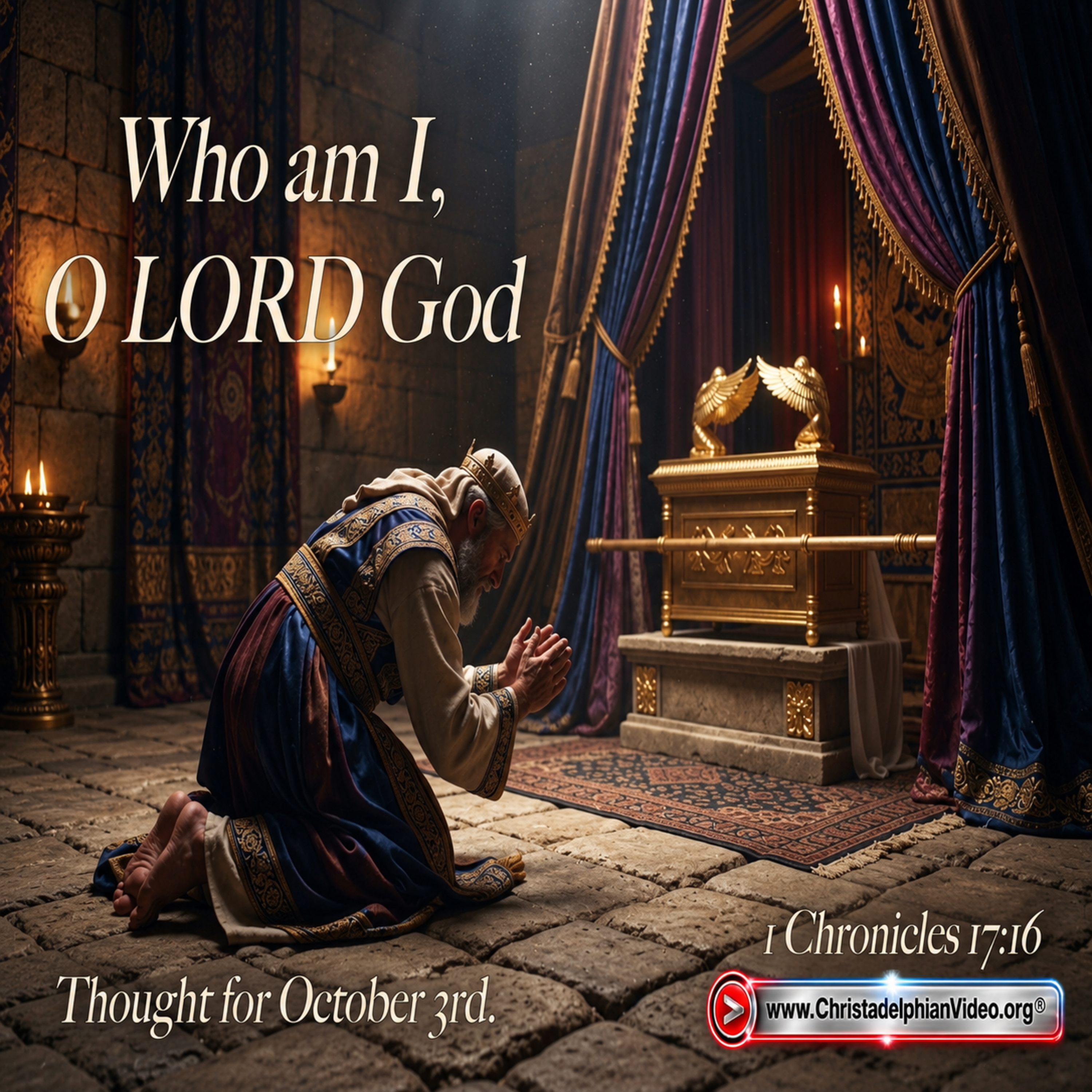 “WHO AM I LORD?” 1 Chron 17:16 03.10.2026 4minWe have 3 thought challenging readings today. Our thoughts primarily dwelt on David’s reaction to being told of a special son and that “the throne of his kingdom … I will establish forever. I will be to him a father, and he shall be to me a son … his throne shall be established forever” [1 Chron. 17 v.12-14 ] David is overwhelmed by God’s reaction to his desire to build a Temple, especially his reference to a “son” for God! The message Nathan the prophet conveyed to him – that God would “build a house” for David – meaning a royal line of descent – like those on the throne of England are of ‘the house of Windsor’- and this house “shall be established forever” – completely humbles David. How many times Jesus is called, by those seeing his miracles, “Son of David” [Matt. 21 v.9,15; 22 v.42, &c] This in particular upset the religious leaders. It is the reaction of David that particularly attracts, nay, more than that, demands our attention! “King David went in and sat before the LORD and said, “Who am I, O LORD God, and what is my house, that you have brought me thus far? And this was a small thing in your eyes, O God. You have also spoken of your servant’s house for a great while to come, and have shown me future generations, O LORD God! And what more can David say to you for honouring your servant? For you know your servant.” [v.16-18] We specially notice that final observation, “for you know your servant” That is a special sense of “know” – of having an intimate relationship – and this is wonderfully illustrated in some of David’s Psalms, Psalm 139 being a heart-moving example. We parallel this with the primary point Paul is striving to make in writing to the Galatians. He tells them, “in Christ Jesus you are all sons of God, through faith” [3 v.26] and “heirs according to the promise” [v.29]Is our reaction to “the promise” in any way like Davids’ ? Do we “sit” or even kneel or lay down “before the Lord”? If our faith is genuine there surely can be at least one or two special occasions when we will. Paul tells them, they “have come to know God, or rather to be known by God …” [4 v.9] What sense of wonder and resultant commitment this should cause us! Does it? Is it in any way parallel to David’s reaction, “Who am I LORD?”
 -
 Signs of Christ's Return, Part 2 with Harry Tennant 02.10.2026 22minSigns of Christ's Return, Part 2 with Harry Tennant
 -
 'Fellowship' 1/2 02.10.2026 21minThe Christadelphians: #24 'Fellowship' 1/2
 -
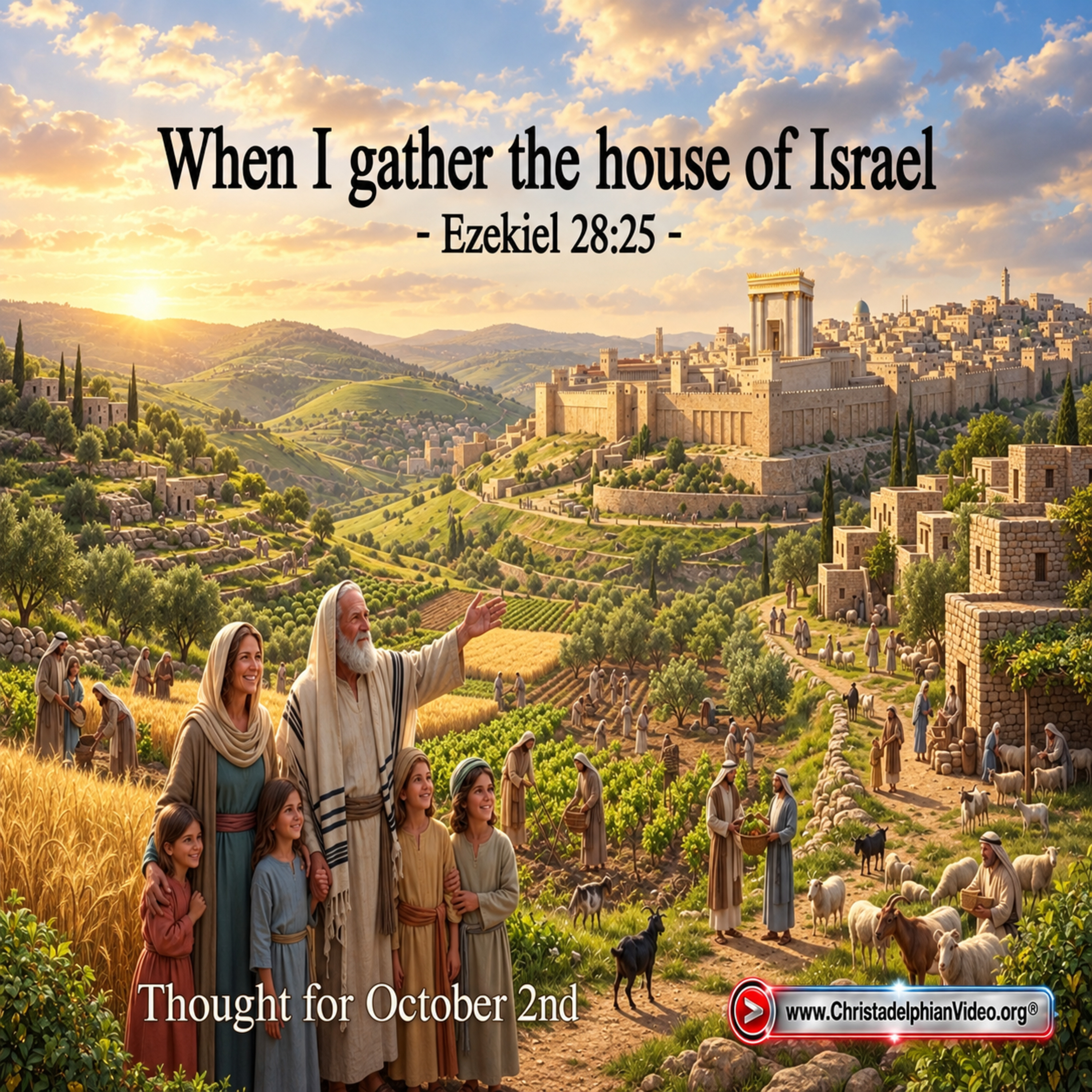 “WHEN I GATHER … ISRAEL” Ezekiel 28-25 02.10.2026 4minThe final two verses of our reading of ch. 28 in Ezekiel today fit the scene in and around Israel fairly accurately so that we are inclined to dogmatically apply it to the circumstances we have witnessed in the Middle East in recent years. Yet such is the nature of many parts of the prophecies that appear to relate to the latter days, some specifically stating they do, that we hesitate to be too dogmatic here.We read, “And for the house of Israel there shall be no more a brier to prick or a thorn to hurt them among all their neighbours who have treated them with contempt. Then they will know that I am the Lord GOD. Thus says the Lord GOD: When I gather the house of Israel from the peoples among whom they are scattered, and manifest my holiness in them in the sight of the nations, then they shall dwell in their own land that I gave to my servant Jacob. And they shall dwell securely in it, and they shall build houses and plant vineyards. They shall dwell securely, when I execute judgments upon all their neighbours who have treated them with contempt.” And then the chapter ends with, “ Then they will know that I am the LORD their God.” How close are we to that happening? It surely needs the return of Christ! How soon? “No one knows the hour or the day” [Mark 13 v.32] Jesus did not even know – at least – did not know during his first coming. Looking back at that v. 25, we see today how all the neighbouring countries, for nearly 70 years, have tried to treat regathered Israel with contempt – and have failed. In a sense judgments have been executed upon their neighbours, all, except Jordan have experienced civil wars, and to some extent, still do, within their borders. Even Jordan is perplexed by the avalanche of refugees from Syria and the endless existence of Palestinian Camps. The song/prayer of Psalm 83 seems so appropriate. May the day soon come when God acts to “fill their faces with shame, that they may seek your name O LORD … that they may know that you alone, whose name is the LORD, are the Most High over all the earth” [v.16,18] But what of ourselves, we are not just spectators of the behaviour of today’s godless nations! May we all make v.20 of our reading today in Galatians ch. 2 the focus of thought for the rest of our lives, for truly, we can say with Paul, if we are committed to Christ, “It is no longer I who live …”
 -
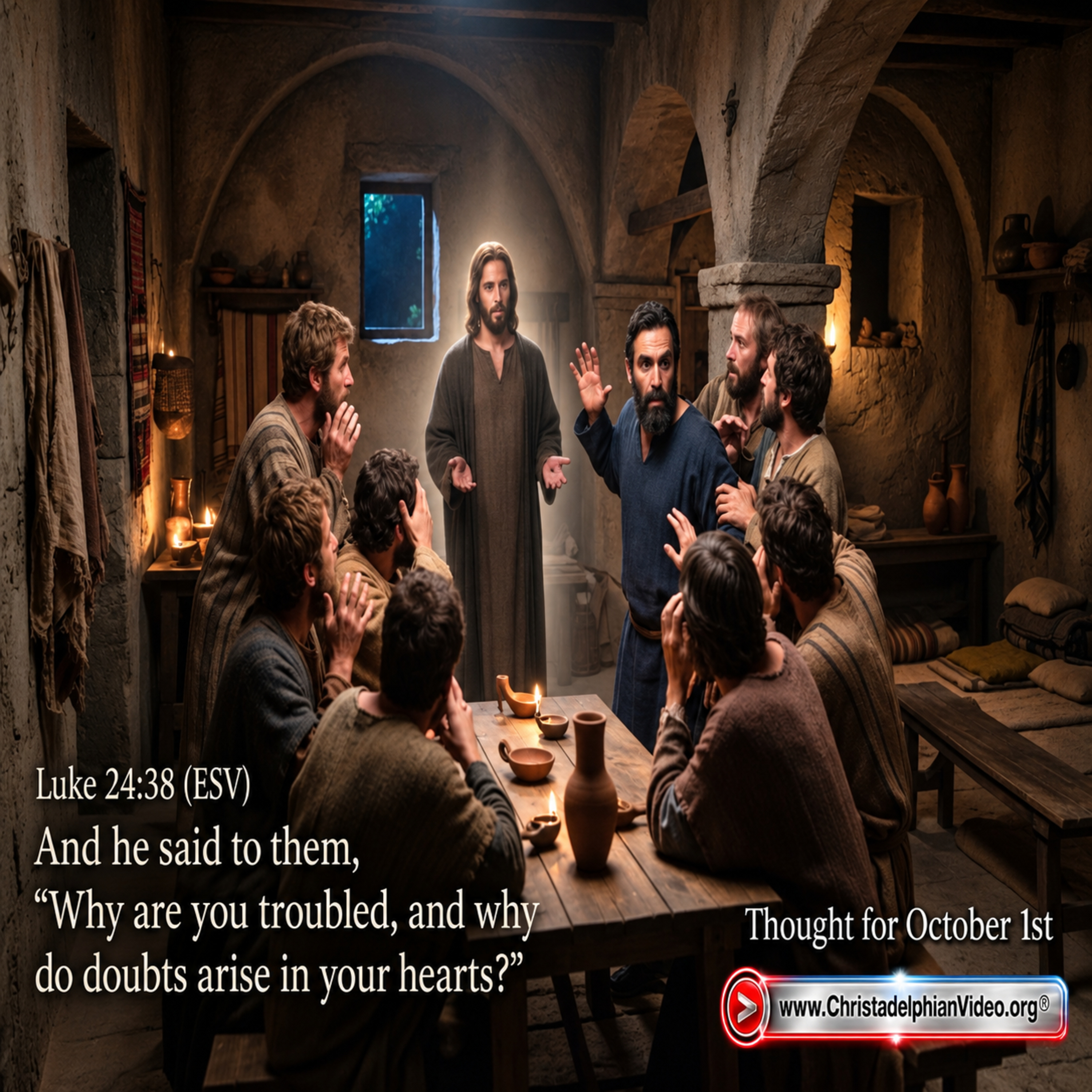 “WHY DO DOUBTS ARISE …” Luke 24:38 01.10.2026 3minToday we completed reading the Gospel of Luke and what a remarkable, heart stirring reading we experienced in the last chapter. Luke proved, in the compilation of his book, what a thorough historian he was. The women were the most dedicated of the followers of Jesus and they were the first to become aware of his resurrection. The account of the two who travelled to Emmaus with an unrecognised Jesus joining them – is heart stirring – as is their later reminiscence – “Did not our hearts burn within us while he talked with us on the road, while he opened to us the scriptures?” [v.32] This should cause us to search those scriptures, especially the Psalms and Isaiah – these are now proved beyond all doubt to have existed before Christ with the discovery of the hundreds of ancient scrolls in caves by the Dead Sea.What a rapid return to Jerusalem those two must have made in the gathering gloom, in the darkness of the evening; but being Passover time with a full moon, they may well have had the blessing of ample moonlight. How they would have discussed the conversation, when they were largely listeners, during their journey to Emmaus! Thinking of moonlight – in another week, at the time of the ‘Feast of Tabernacles’ we will have another ‘full moon’ .Back in Jerusalem, “as they were talking” [v.36]: no doubt with great intensity, probably highlighting the appearance of the Lord to Peter, suddenly, “Jesus himself stood among them, and said to them, ‘Peace to you!’ But they were startled and frightened…” [v.37] He asks, “… why do doubts arise in your hearts? See my hands and my feet …” He invites them to handle him to remove any doubts. We imagine the scene – but what is far beyond our present imagination is the fulfilment of what the angels said to the disciples 40 days later as they watched him physically ascending out of their sight.. Luke records this in Acts 1 v.11, “… why do you stand looking into heaven? This Jesus who was taken up from you into heaven, will come in the same way as you saw him go into heaven.” Are there any doubts in our hearts that this will occur? No – but the actual nature of the occurrence is far beyond our ability to visualize. However, our daily reading and meditation on God’s word is an invaluable help.
 -
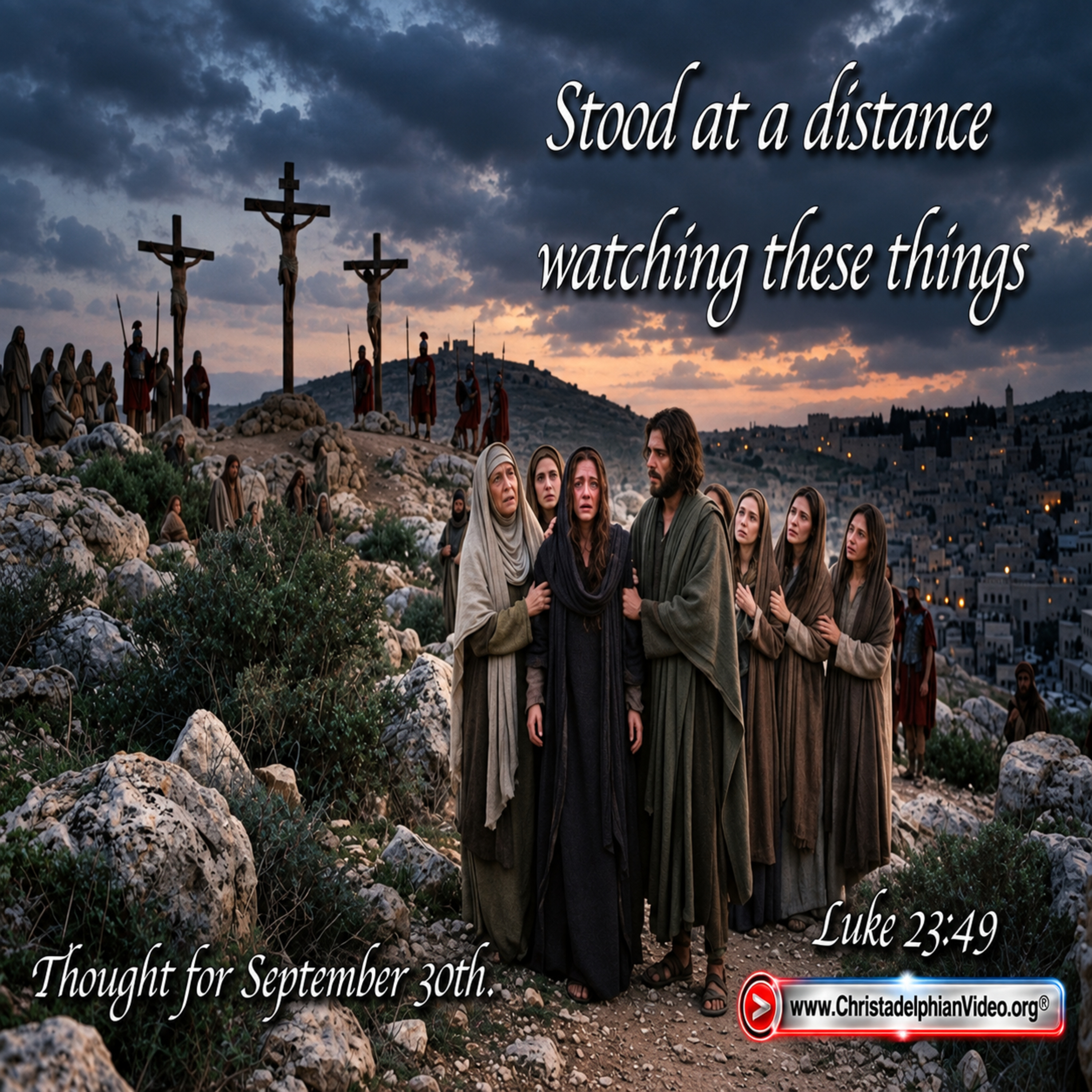 “STOOD AT A DISTANCE WATCHING” [Luke 23:49] 30.09.2026 4minPilate was the most powerful man in Israel in the days of Jesus. But he was strangely helpless in carrying out his own desire to let Jesus go free, although he said, as we read today, “I find no guilt in this man” (Luke 23 v.4) and “nothing deserving of death has been done by him” (v.15), and twice said, “I will release him” (v.16 and v.22). It is strange how Pilate gives in. When we compare the different gospel records we get a clearer picture, one issue being that Jesus admitted to being a king – and the Jewish leaders declared, “We have no king but Caesar.” Pilate queried Jesus about the allegations of his claim to kingship, but said Jesus, “My kingdom is not of this world (or age)” So Pilate, the most powerful man in Jerusalem became indifferent to justice and let Jesus be crucified; the biased and prejudiced jealous Jewish leaders got their wayIt has always been a challenge to hold firm to what is really true! Most of the Apostles, we gather, in the end met untimely deaths. Peter and Paul certainly did. Let us try to imagine living Centuries ago, especially around 450-500 years ago in England, when ‘christian’ put ‘christian’ to horrible deaths, the situation changing depending which king or queen was on the throne. There is some parallel today in what happened. Like the voices of the prejudiced religious leaders of that age, so today we have the insistent voices (and writings) of the atheistic and agnostic intellectuals – and they are getting louder! Even some Bible believers seem to be influenced towards accepting human theories of how ‘creation’ happened: remember how God challenged Job! Read ch 38 v.1-4. We live in an age when intellectuals believe they can know everything there is to know! Today the great majority of people accept that evolution is true and there is no God. For years the Catholics have claimed to believe in both God and evolution: they are no better that the Jewish leaders in the time of Jesus who blindfolded their minds to the heavenly power of Jesus. We have all the evidence we need to be sure that Jesus is king, that he did rise from the dead! The return of Jesus will astonish our godless world Those who do not believe and are not ready for his coming, being convinced there is no God, will be overwhelmed and many will perish. Recall what we read in Jeremiah 25 v.32-33.How certain are we of what we say we believe? We read that, at his crucifixion, “all his acquaintances and the women who had followed him … stood at a distance watching these things” [v,49] Only John and his mother and 2 faithful women stood by the cross [John 19 v.19 v.25,26] Are we standing at a distance? How ready are we for his coming? Is there a good supply of oil in our lamps?
 -
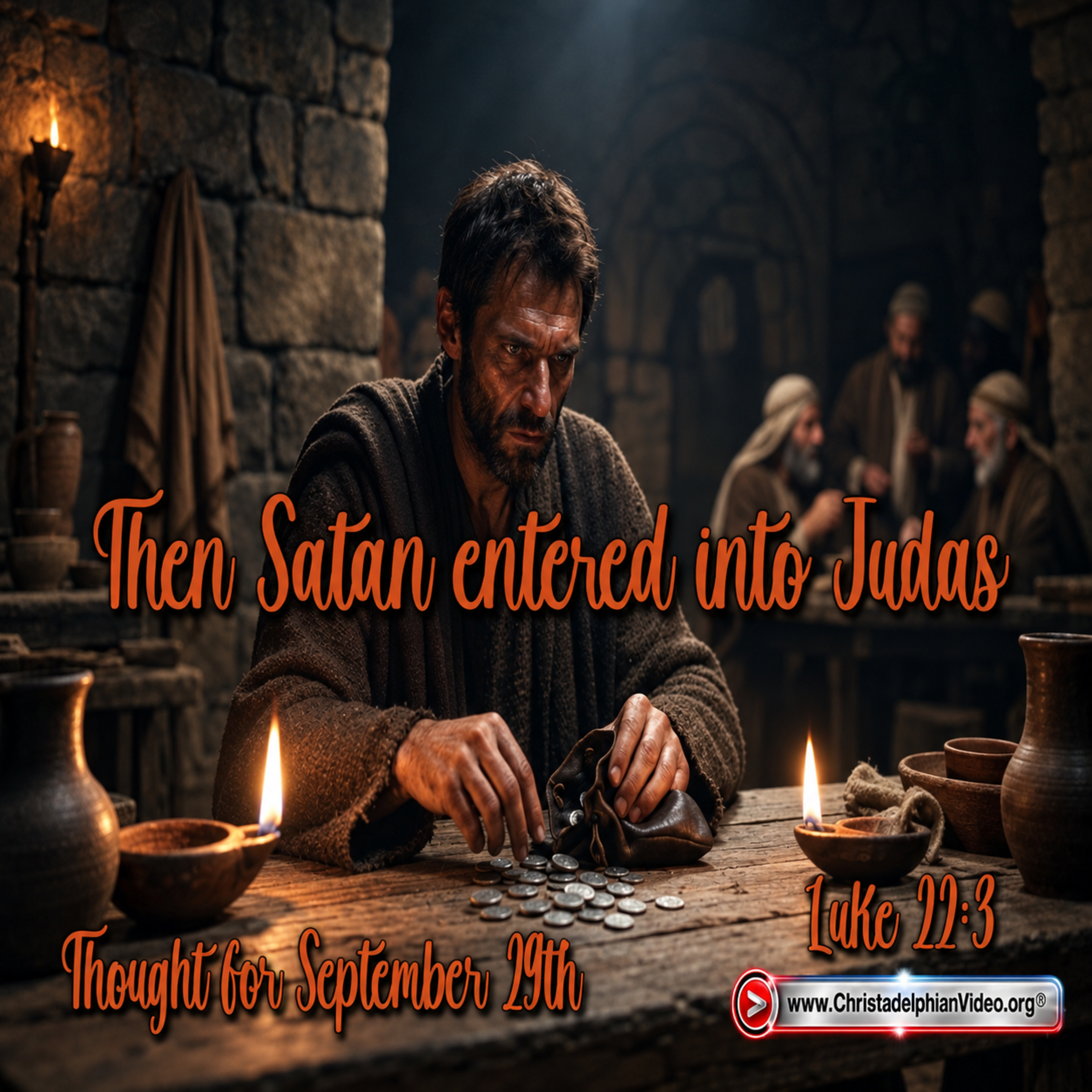 “THEN SATAN ENTERED …” 29.09.2026 4minToday, in Luke ch 22, we read of the arrest of Jesus. Before this he and the disciples had a Passover meal of the bread and the wine: it would only be later the disciples would see the wonder of all their Master said on that occasion and remember his words, “Do this in remembrance of me.” [v.17] and learn the lesson to be like him in being “as one who serves.” [v.27] The reward for their service would come when they “eat and drink at my table in my kingdom and sit on thrones judging the twelve tribes of Israel.” [v.30]There is a certain mystery early in our chapter, when it states, “Then Satan entered into Judas” [v.3]. This increases when Jesus later says to Peter, “Simon, Simon, behold Satan has demanded to have you, that he might sift you like wheat, but I have prayed for you that your faith many not fail.” [v.31,32] What does Jesus mean by Satan? On one occasion Jesus rebuked Peter telling him, ‘Get behind me, Satan! For you are not setting your mind on the things of God’ [Mark 8 v.33] In today’s chapter Peter 3 times denies knowing his Master, he had not heeded his Master’s advice on the Mount of Olives when he told the disciples to “pray that you may not enter into temptation” [v.40] In the verses that follow we read how Jesus is surrounded by satans, led by Judas Iscariot. What is the cause of temptation? The word ‘satan’ personifies negative human feelings, leading one to think in ungodly ways. Judas was so dominated by thoughts of the benefits money was bringing him that he was ready to make more money by betraying his Master, believing, we conclude, that Jesus would escape from trouble as he had seen him do in the past – recall what we read in Luke 4 v. 28-30. Paul tells the Romans how “sin came alive” in his mind, so that “I died.” He admits, reflecting back on his life, “I do not understand my own actions … I do the very thing I hate … I have the desire to do what is right, but not the ability to carry it out … ” [Romans 7 v.9,15,18] But in his next chapter he tells the Romans how he learnt “to set the mind on the Spirit” and this brought “life and peace.” [v.4-6] Paul does not use the word “Satan” in Romans until the very end – and then he means a literal enemy as Judas became. “The God of peace will soon crush Satan under your feet.” [16 v.20] That will happen soon to our world!Turning back to Luke 20 we see how Jesus takes his disciples, “as was his custom, to the Mount of Olives … And when he came there he said the words we quoted earlier, ‘Pray that you may not enter into temptation.’ [v.39,30] Let us make that our prayer too for our world is full of satans whose minds are set on the very opposite to the things of God.
 -
 “THOSE WHO DENY THAT THERE IS A RESURRECTION…” 27.09.2026 3minWe have 3 chapters today that teach valuable lessons. 1 Chron. Ch. 10 tells us that “Saul died for his breach of faith. He broke faith with the LORD …” [v.13] in not keeping his commandments, a lesson for all those who have committed themselves to serve the LORD.“The word of the LORD came to me “ says Ezekiel [23 v,1] and he receives a parable that pictures God’s disgust at the spiritual adultery of the nation. The LORD says to them, “Because you have forgotten me and cast me behind your back you yourself must bear the consequences … “ [v.35] And what consequences does today’s world face for doing this!?In our chapter in Luke (20) we see how “there came to him (Jesus) … those who deny that there is a resurrection” [v,27] as yet another example of those who believe what they want to believe and serve God on their own terms as Saul and nearly all the people in Ezekiel’s day had done. We note how Jesus responded to these deniers with a declaration of what is true, he “said to them, ‘The sons of this age marry and are given in marriage, but those who are considered worthy to attain to that age and to the resurrection from the dead neither marry nor are given in marriage, for they cannot die anymore because they are equal to the angels and are sons of God being sons (and daughters Footnote) of the resurrection” [v.36]Jesus then says (v.37) that even the writings of “Moses showed (this), in the passage about the burning bush, where he calls the Lord the God of Abraham and the God of Isaac and the God of Jacob” [see Exod 3 v.6]. God was not proclaiming himself to be the God of the dead who have gone into oblivion for ever.. God transcends time, he is from everlasting to everlasting; the prayer/Psalm of Moses states this, “Before the mountains were brought forth, or ever you had formed the earth and the world, from everlasting to everlasting you are God.” [Psa. 90 v.2] Oh, how incredible is the wonder of knowing and having a real everlasting relationship with God! Saul failed, the people of Israel’s time failed, the Sadducees failed, it seems nearly everyone today is failing – make sure you do not fail; feeding your mind of God’s word every day is an essential ingredient.
 -
 Cognitive Surrender - Ai & the battle for the mind" Watchman Report#68 26.09.2026 9minThis week's Watchman Report has been compiled by Brother Bryan Styles (Livonia) and takes a detailed look at the subject of Ai which has dominated the news this week saw Ai Leaders Warn the Technology could be a risk to humanity, and world leaders at the UN General Assembly have met to discuss its use and what controls, if any could be used to allay fears of AI ultimately destroying mankind. But what about the God-fearing person? How could this technology affect our daily worship and learning? Join bro Bryan as we delve into this fascinating developing story! A @Christadelphians Video: Cognitive Surrender - the battle for the mind" Watchman Report#68 with Bible scholar Bryan Styles[Provable Bible Truth] - Why watch it? What question does this video answer?Why watch? Because AI is not merely a tool; it is a spiritual test. This Watchman Report asks: “Will we surrender our minds to artificial intelligence, or will we let God renovate them?” From the transcript, we answer: cognitive surrender happens when AI’s output quietly becomes our output. Yet 2 Timothy 3:7 warns of endless learning without arriving at truth. Romans 12:2 calls us to transformation by the renewal of our minds, proving God’s will. We, as Christadelphians, urge you: use tools wisely, but never outsource discernment. Character is forged through friction, prayer, sorrow and patient study—not instant deliverables. Babel shows where autonomous humanity leads; AI magnifies the heart’s intent. Christ’s return draws near. Choose character over speed, active discipleship over cognitive surrender, and keep developing a mind like His.Chapters:00:00 - Introduction: AI headlines and Silicon Valley warnings00:23 - The challenge of AI: cognitive surrender defined00:59 - Paul’s warning: 2 Timothy 3:701:27 - Information rich, understanding poor02:01 - Why drift happens: efficiency and deliverables02:31 - Romans 12:2: transformation, not conformity02:48 - Character forged through friction03:19 - Defining success: people are the product04:19 - Babel: humanity’s spiritual autonomy05:03 - Genesis 11:6: capability without maturity05:45 - AI as an accelerant of the heart06:14 - History repeats; God intervenes06:25 - Called to a higher path06:57 - Christ’s return draws near07:22 - Choice: character over speed07:51 - Keep reading, praying, developing08:01 - Final reflections08:25 - Watchman Report closing08:40 - Call to action and community engagement08:54 - Conclusion: develop until the Lord returnsBible Verse Category:📖 2 Timothy 3:7 — Always learning, never able to arrive at knowledge of the truth.📖 Romans 12:2 — Be transformed by the renewal of your mind, discerning God’s will.📖 Genesis 11:4 — “Let us build... make a name for ourselves.”📖 Genesis 11:6 — “Nothing they propose to do will be impossible for them.”Tags: AI, Cognitive Surrender, Bible Prophecy, Christian Faith, Christadelphians, Watchman Report, Spiritual DiscernmentClosing Statement: @christadelphians are a team, Brothers and sisters of Christ, passionate about delivering powerful, Scripture-based content to strengthen and inspire your faith journey. If this presentation resonated with you, help spread the encouragement—share it with a friend today!
 -
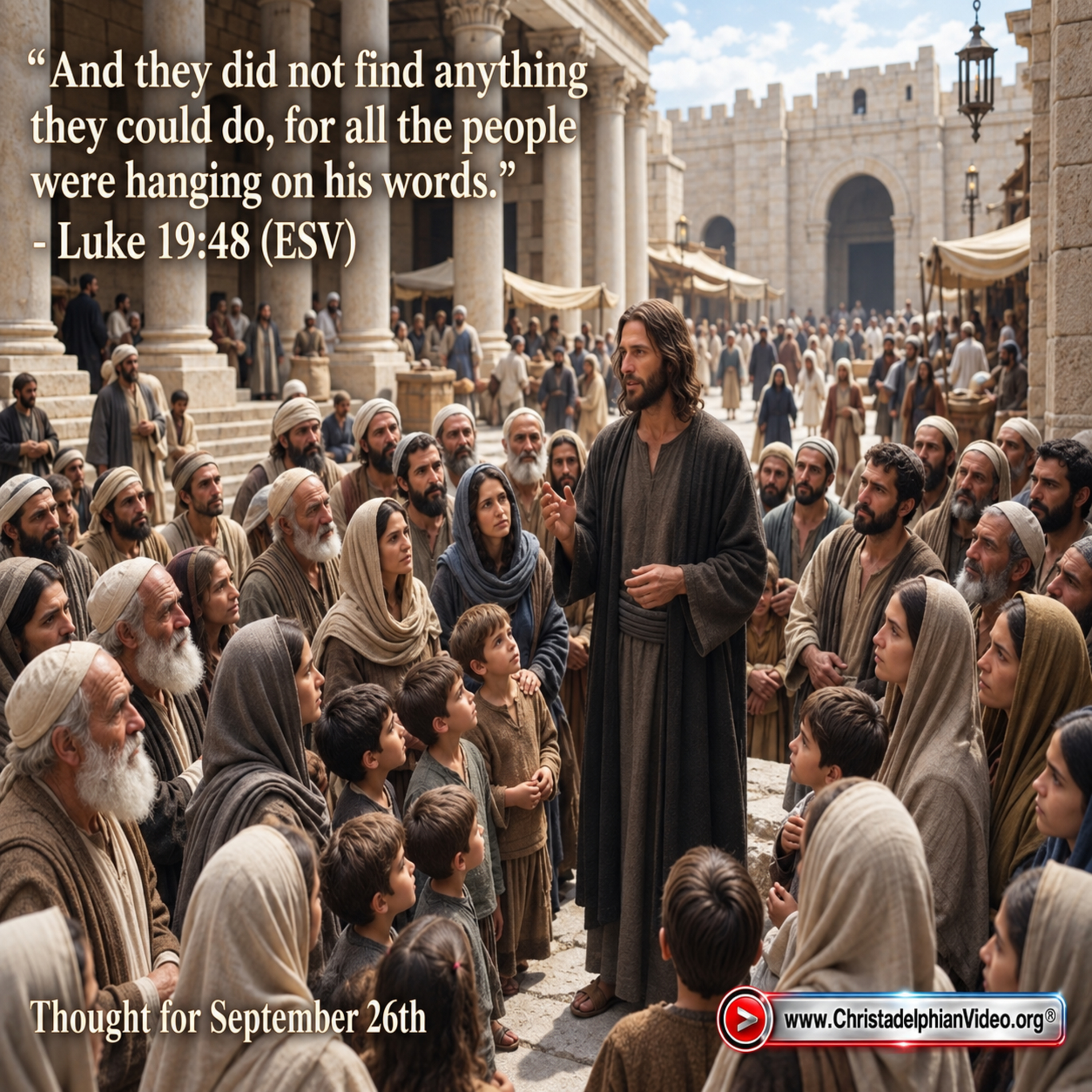 WERE HANGING ON HIS WORDS” Luke 19:48 26.09.2026 4minWhat is our attitude of mind as we read God’s word? Are our minds “hanging” on what we read, most of all when they are the words of Jesus and his apostles? In the days of Ezekiel, “the word of the LORD” was what they did not want to hear, so they did not listen; already we have encountered this phrase 4 times! (Ch. 6v.3; 13 v.2; 16 v.35; 20 v.47) It was quite a contrast in the days of Jesus – but the words of Jesus caused a division of opinion, some saying, “This really is the prophet’. Others said, ‘This is the Christ.’” [John 7 v.40.41] And of course the religious leaders rejected him because he was a challenge to their authority. How meaningful is the scene created by the concluding words of todays’ ch.19 in Luke! Jesus had triumphantly entered Jerusalem and is “teaching daily in the Temple” and declares, “It is written, ‘My house shall be a house of prayer …” [v.46] He was quoting Isa. 56 v.7 where it says it will become “a house of prayer for all peoples.” May that day come soon and may we, by the grace of God, be made alive then. How many will not be! Next month we will read the remarkable vision that Ezekiel is given of the ultimate temple – and recorded in his final chapters.Different reactions to the teaching of Jesus provide an extreme contrast. We read, “The chief priests and the scribes and the principal men of the people were seeking to destroy him.” [v.47] There have always been those who have sought to destroy those who truly believe God’s word and accept his Son as their Saviour: we see it today in parts of the Islamic world despite the fact that Islam acknowledges the Bible to be one of its’ holy books.The verse in Luke today tells us that his opponents “did not find anything that they could do” – why – “for all the people were hanging on his words.” It seems ironic that at least some of them would be stirred up by their leaders to reject him and that very soon they would hang him on a cross – such is human nature! Let us make sure that we are so committed that we are “hanging on his words” as we read them – and those his Father inspired his disciples, the prophets, Moses and others to write. May we all, as we read them day by day, see more and more clearly the wonder of spiritual “light” that shines in the gross darkness swamping the minds of people today.
 -
 'Render unto Ceasar and unto God' 25.09.2026 25min'Render unto Ceasar and unto God'
 -
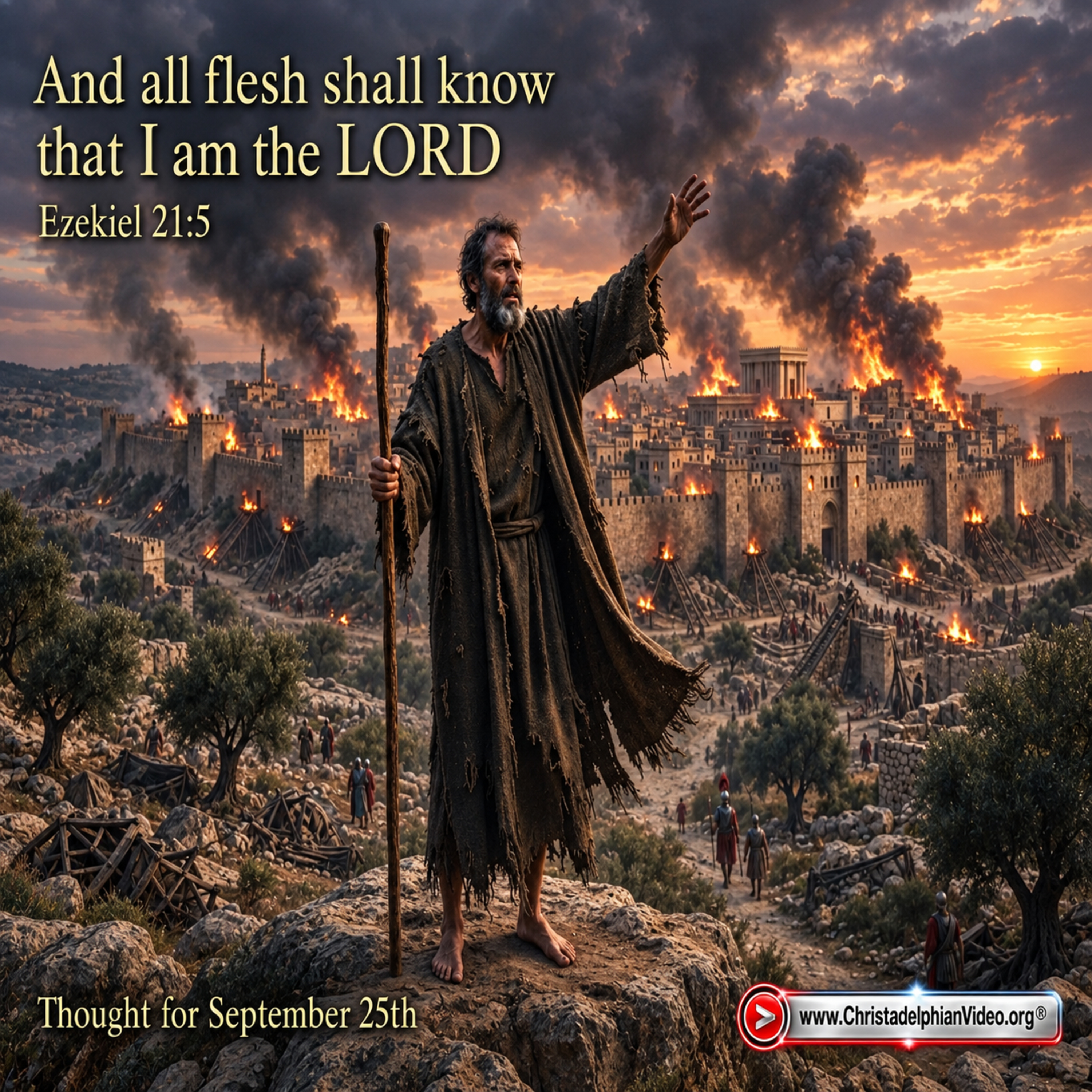 “ALL FLESH SHALL KNOW” 25.09.2026 4minOur Ezekiel chapter (21) starts with Ezekiel being told to “Prophecy against the land of Israel” and that the LORD “will cut off from you both righteous and wicked … and all flesh shall know that I am the LORD” [v.2,4,5] In effect God is now saying, ‘I mean what I say.’ The fascinating part of the chapter is the long term prophecy Ezekiel then receives from the LORD, “… O profane wicked prince of Israel … thus says the LORD …. take off the crown. Things shall not remain …A ruin, ruin, ruin I will make it … until he comes, the one to whom judgment belongs, and I will give it to him.” [v.25-27]This is what happened, we await the completion of the prophecy. The last proper king in Jerusalem is killed, the Jews have not had a king since. Kings Herod and Agrippa in the New Testament era were Idumean’s appointed by the Romans. The Jewish leaders in the days of Jesus were proud of their heritage, but they said they had “no king but Caesar.” Their pride was self-centred, they had no meaningful concept of the God they claimed to worship – let us make sure that we do have! In today’s chapter 18 in Luke we particularly noticed the words of Jesus portraying the contrasting attitudes of the Pharisee and the Tax Collector as they went into the Temple to pray. The Pharisee suffered from ‘I’ trouble. He “standing by himself, prayed thus: ‘God, I thank you that I am not like other men, extortioners, unjust, adulterers, or even like this tax collector. I fast twice a week, I give tithes ….” [v.11,12] In contrast, the Tax Collector humbly asked, “Lord be merciful to me a sinner.” The Lord makes the point, “the one who humbles himself will be exalted” [v.14] May we fully absorb the point so that we may be there, and be among the “exalted” when “all flesh shall know” there is a God, an all-knowing, all seeing Creator. The prophets became totally conscious of this, this is how they were able to endure in all their difficult surroundings: how difficult are our times going to become? Remember what we read in Jeremiah a few weeks back, “O LORD of hosts, who tests the righteous, who sees the heart and the mind, let me see your vengeance upon them, for to you have I committed my cause.” [20 v.12] May we be there at that incredible time when “all flesh shall know” there is a Creator. Let us pray now that our Lord will be merciful to us.
 -
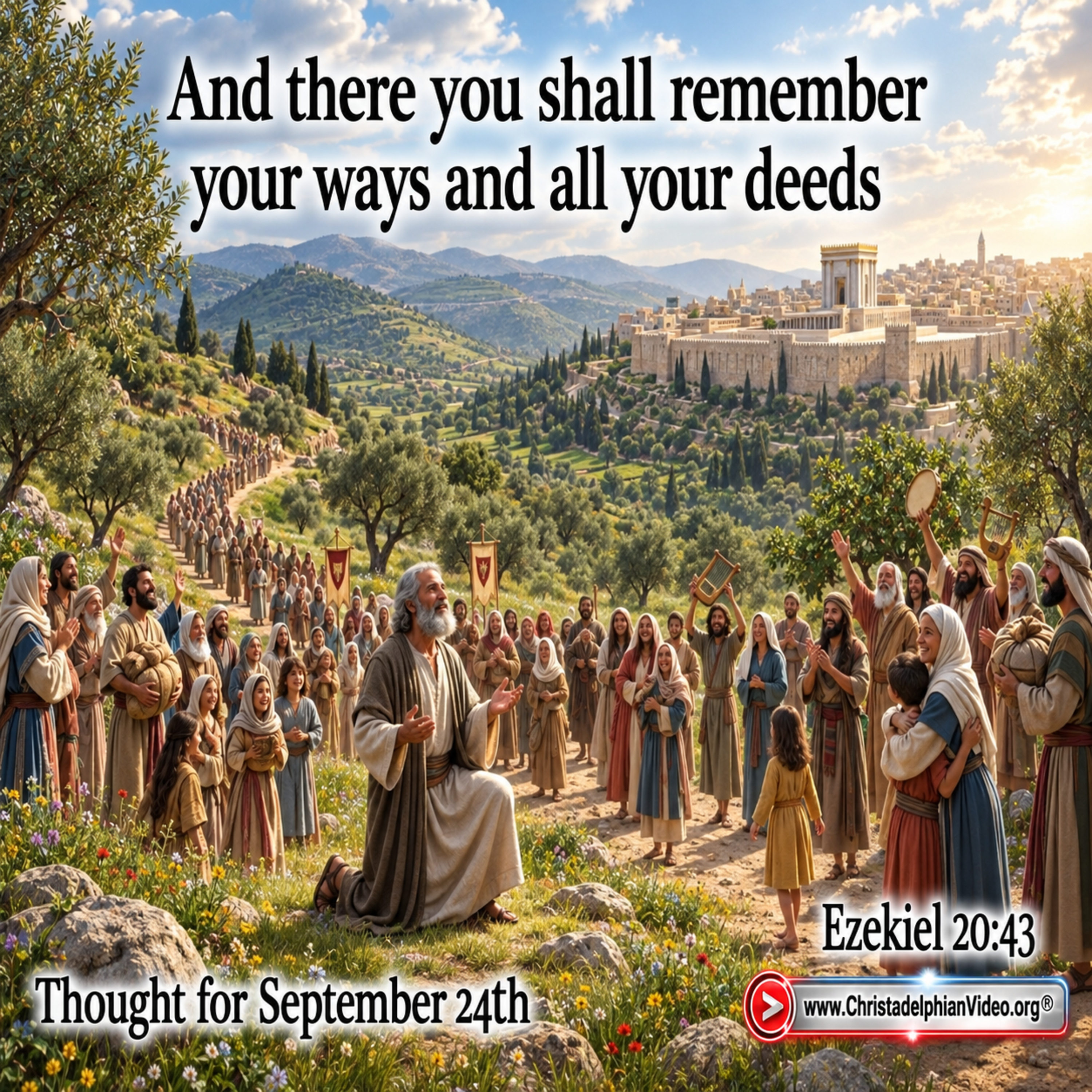 “YOU SHALL REMEMBER YOUR WAYS” Ezekiel 20:43 24.09.2026 4minOne of the most widely used Hebrew words in the Old Testament is the word Zakar. It is usually translated ‘remember’ but it does not necessarily mean ‘suddenly bringing to mind something you have forgotten’. It means focusing your mind on something in particular, it first occurs in Genesis 8 v 1 “And God remembered Noah and all…that were with him in the ark”. The work “remember” occurs in both our Ezekiel and Luke chapters today and conveys a significant message in them both. The long term future of his nation is revealed to Ezekiel, it creates a wonderful ‘silver lining’ in contrast to the ugly picture of Israel in Ezekiel’s time. God tells him that ultimately the time will come for his nation “When I will bring you out from all the peoples and gather you out of all the countries where you have been scattered”. But this is to be more than a remarkable world-wide regathering! “And I will manifest my holiness among you in the sight of the nations. And you shall know that I am the LORD, when I bring you into the land of Israel…And there you shall remember your ways and all your deeds….And you shall loath yourselves for all the evils you have committed. And you shall know that I am the LORD”. (20 v41-44) How soon before this happens? It is in God’s hands.We have a book, written by David Ben Gurion, the first Prime Minister of Israel; it includes reference to a stirring of interest and some knowledge of God’s prophets, such as Isaiah. They are starting to remember and search out the foundations on which their nation was originally built. But what of ourselves? How well do we know the foundations of our faith – how real are they to us? Is it just ‘head knowledge’? Jesus, when asked, “When the Kingdom of God would come?” (v 20) draws the lesson of the days of Noah and how people were “eating and drinking” and life seemed totally normal “until the flood came” (v 27). The people had forgotten God and put him out of their minds just as they have today. But God remembered, but only Noah and his family remembered God!Jesus also reminds his audience of the destruction of Sodom, and how “they were eating and drinking, buying and selling, planting and building….” v.28, but then God acted. We know the account well, it is brief and to the point. A vital question – if our minds are absorbed and distracted by the interesting and exciting things in our world today, will we be ready when God acts? Reflect deeply on v. 21, it has just three words; “Remember Lot’s wife”.
 -
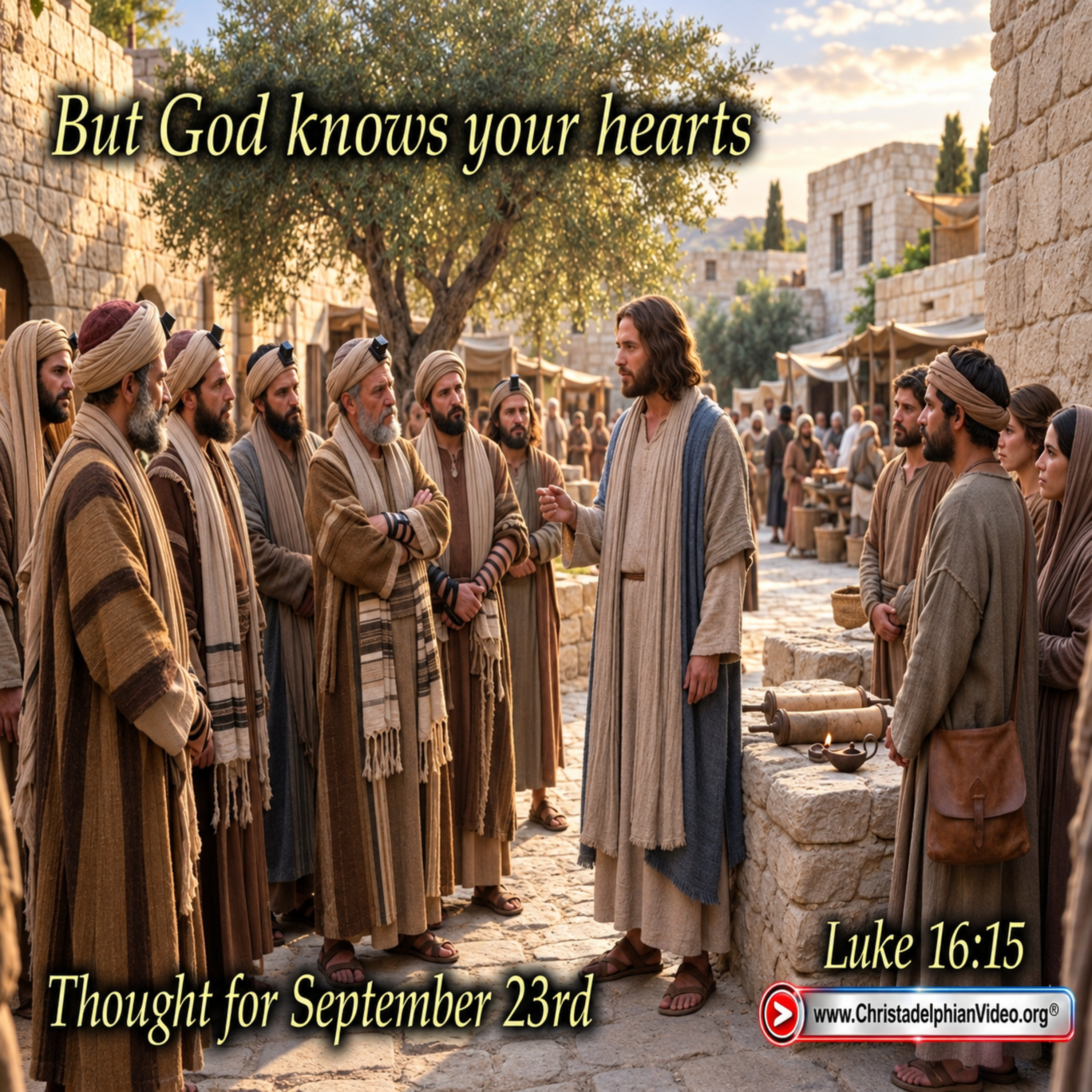 “BUT GOD KNOWS YOUR HEARTS” Luke 16:15 23.09.2026 4minLuke has left on record for us two intriguing parables, probably those which are most difficult to grasp as to their meaning of all the parables of Jesus. Let’s start though with recalling yesterday’s chapter 15 where we see that as the “tax collectors and sinners were all drawing near to hear him … the Pharisees and the scribes grumbled, saying, “This man receives sinners and eats with them.” [v.1,2] Jesus then tells 5 parables, the last two we read today. There is a common thread – the need to be genuine in seeking to serve God and God’s willingness to forgive when people are genuinely repentant.Today we have a parable about a “dishonest manager” [v.1-13] and, as with all parables, its climax makes its’ application clear. The religious leaders are totally focussed in looking after their own interests, they are “faithful” to themselves. As a result they are dishonest managers of God’s vineyard, corrupt spiritual leaders serving their own interests before serving God’s. Jesus ridicules their self-interest, their “eternal dwellings” will be their grave – and archaeologists have discovered the elaborate tomb of the high priest’s family, made as a miniature replica of the Temple.We understand that the High Priest had “five brothers”[v.28]. Jesus, in the parable of the ‘rich man and Lazarus’ ridicules their Greek influenced belief in the afterlife, this final parable is being told against the Sadducees, with its’ closing ‘punch line’ that “if someone goes to them from the dead, they will repent.” Father Abraham says, ”If they do not hear Moses and the Prophets, neither will they be convinced if someone should rise from the dead.” [v.30,31] How true this proves to be. We are not like those religious leaders are we, or is it possible that Jesus would say to you or to me, “you are those who justify yourselves before men” [v.15]? We live in a world that abounds with self-justification! It is before God, in prayer, that we should seek to justify our actions – and ask forgiveness where-ever it is necessary. The Master’s next words are, “but God knows your hearts. For what is exalted among men is an abomination in the sight of God.” May we, in true humility, in a spiritual sense, be “exalted … in the sight of God” because he knows our hearts. Whether this truly the case will be evident when the kingdom is here.
 -
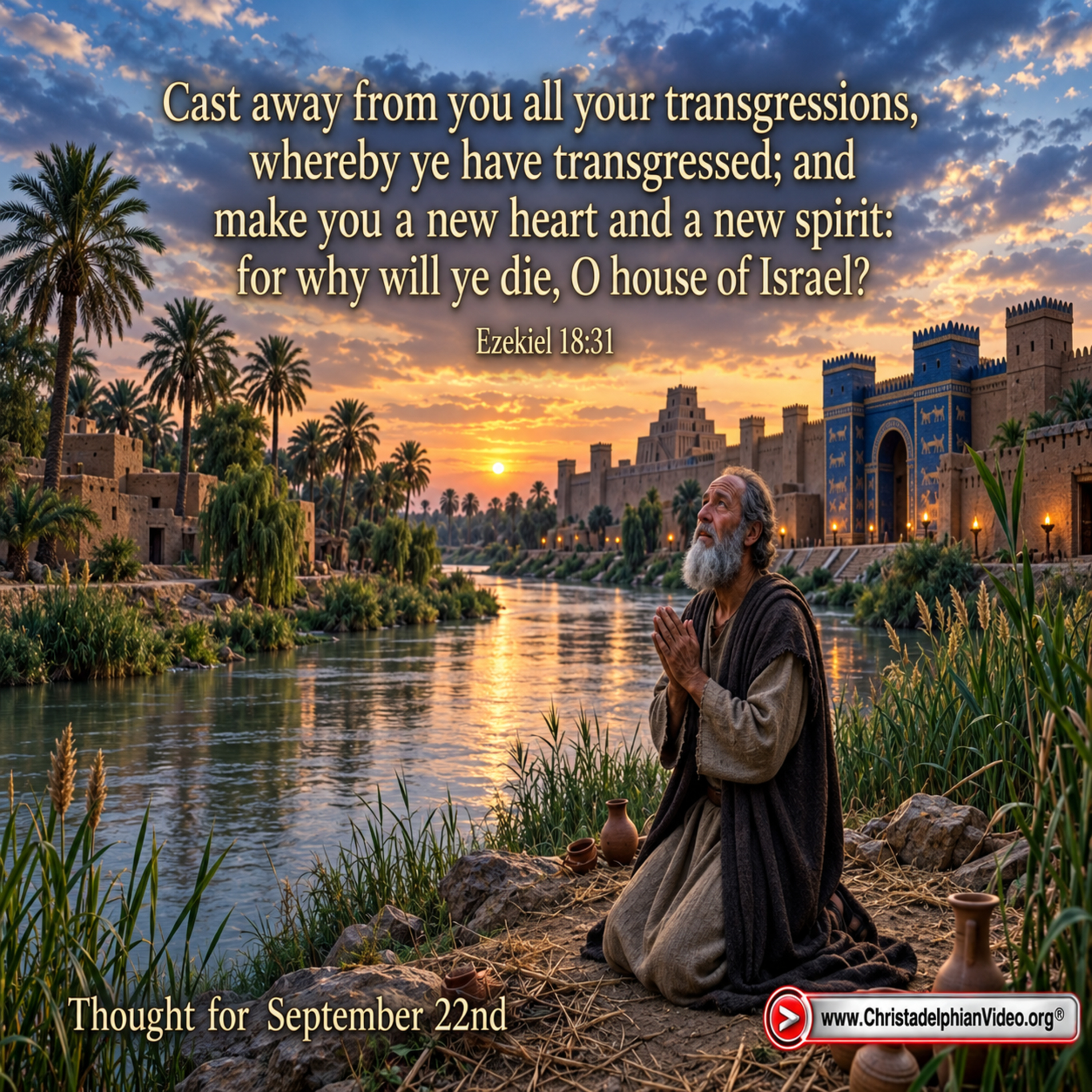 “MAKE YOURSELVES A NEW HEART” 22.09.2026 4minOur chapter (18) in Ezekiel offers us a change of focus, instead of describing the sins of God’s nation, the prophet is caused to express God’s encouragement to individuals in that nation to turn from their evil ways and serve him. This is also a chapter which stresses the divine judgement on individuals and shows that the word ‘soul’ does not mean some ‘spirit’ part of a person, often referred to as ‘the soul’ that is able to continue ‘living’ in some way – even though the body is dead. This is what the Greeks and Romans believed – and the Catholics believed and most other ‘christians’- under their influence – came to believe in later centuries – and, of course, the Muslims.Twice in this chapter Ezekiel records the words of God, “the soul who sins shall die” [v.4,20]. The Hebrew word can be translated as ‘the person’ wherever it occurs. Ezekiel conveys God’s blunt words to the people, “Therefore I will judge you … every one according to his (her) ways, declares the Lord GOD. Repent and turn from your transgressions, lest iniquity be your ruin.” [v.30] Godlessness is obviously going to be the ruin of our world today. Just as Jerusalem and its wonderful temple were destroyed in the days of Jeremiah and Ezekiel, so will our world will experience an awesome judgement by God. Our present readings of the words of Jesus in the Gospel of Luke are making this increasingly clear.The final verses in our Ezekiel chapter catches our attention; its appeal applies just as much now as it did then. “Make yourselves a new heart and a new spirit! Why will you die …?” [v.31] This is equally a question for today, “why will you die” eternally – never again to see the light and experience and explore the wonders of existence? Many Scriptures ask this question, read Psalm 49 as an outstanding example.Luke records [ch. 15] Jesus’ parable about a lost coin. A diligent search is made and it is found – what rejoicing follows! “Just so,” says Jesus [v.10], “I tell you, there is joy before the angels of God over one sinner who repents.” Jesus is the only person who ever lived who has never had to repent about anything. Has there been “joy in heaven” over you? Or will there be when you “make yourself a new heart” and marvel in “a new spirit” of mind as you are baptised into the name of Christ and commit yourself to use your particular talents in the service of Christ – before he returns!
 -
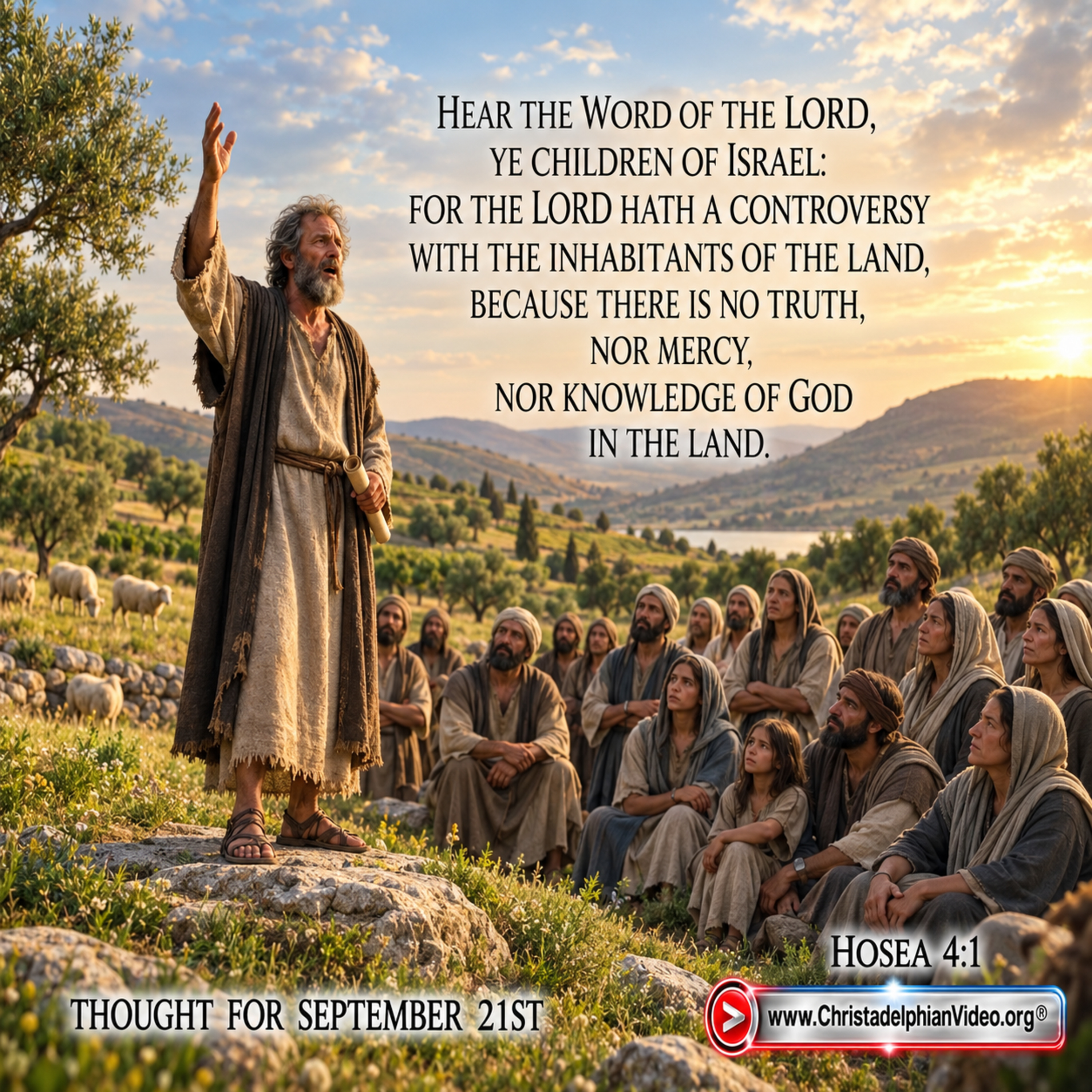 “NO KNOWLEDGE OF GOD” 21.09.2026 5minSin is not a word people use these days, I even met a teenager who had never heard the word ‘adultery’ – and had no idea what it meant – she came into our Bible Education Centre on a rainy morning while waiting for the Internet place next door to open. Today, attitudes are as they were in the days of Hosea who wrote, “ the LORD has a controversy with the inhabitants … There is no faithfulness or steadfast love, and no knowledge of God” [ch. 4 v.1] That is exactly the case with our world today – “the LORD has a controversy with the inhabitants” – and soon this will become awesomely evident. In the days of Jesus, people more widely believed that God was the ultimate arbiter of punishment for their sins. Our readings in Ezekiel also show this, making the point that God had been merciful toward his people, yet there comes a point when God, seeing that his people do not change although he keeps showing mercy, ultimately brings awesome destruction – and Jerusalem came to a terrible end because of the abundance of their sins and lack of repentance. It is significant that only once does Ezekiel use the word ‘mercy’ – although Jeremiah uses it frequently. God’s people abused his merciful attitude in Jeremiah’s time. The one occasion Ezekiel uses it is in his ch. 39 v.25 “Therefore thus says the Lord GOD: Now I will restore the fortunes of Jacob and have mercy on the whole house of Israel, and I will be jealous for my holy name” A latter day prophecy we believe will soon occur.. Now Jesus makes a very interesting point in today’s ch. 13 in Luke. Evidently people had been saying that when a tower collapsed in Siloam and killed 18 people (v.4), those people must have been worse sinners than other people. How did Jesus respond? “No” he says, “I tell you they were not, and if you fail to repent you will all likewise perish.” There is less and less belief in God these days, so no spirit of repentance.We must look at ourselves! If we are not on God’s side, trying our best to do his will, there is no future for us. Jesus followed up his warning about Siloam by telling them a parable about a man who planted a tree (v.6-9) and who came for 3 years, looking for fruit, but found none. It was given one more year to produce fruit and a special effort was made to fertilise it. If it did not produce fruit it would be destroyed. Jesus came to the lost sheep of Israel, most would not follow him, 40 years later there was terrible destruction, especially in Jerusalem..The response of Peter on the day of Pentecost when the people were ‘cut to the heart’ in realizing they had killed their Messiah, was to tell them to “Repent and be baptised” [Acts 2 v38] So we have done that! Good. Are we heeding the lessons of God’s word – not only with a repentant attitude – we must each ask ourselves, are we producing fruit? There is no point in having a “knowledge of God” if we do not.
 -
 “FOR WHERE YOUR TREASURE IS …” 20.09.2026 4minThey did not have banks in those days! We read today in Luke 12 v.16-20 of a man who built many barns to “store all my grain and my goods” so he could “relax, eat, drink and be merry.” This is the spirit among many in Australia today, the emphasis is on material well-being! Of course it is not necessary to build bigger barns or have barns at all, but what security do banks offer? Figures in computers, plenty of ‘paper’ money!As the Creator brings more and more of his promised time of trouble, a time, to quote our Lord (in Mark 13 v.19) when “there will be such tribulation as has not been from the beginning of the creation that God created until now, and never will be” again – it will almost certainly be useless to have any money in the bank, or any money at all, the only thing of value for the true believer to have – will be an overflowing abundance of faith.Jesus calls the man in his parable who built bigger barns a “Fool!” adding, “So is the one who lays up treasure for himselfand is not rich toward God.” His next words to his disciples are, “”Therefore I tell you, do not be anxious about your life, what you will eat, nor about your body, what you will put on. For life is more than food … more than clothing …” [v.24]Human minds today are totally concerned about such things – but we take to heart in what Jesus goes on to say, ” For all the nations of the world seek after these things, and your Father knows that you need them. Instead, seek his kingdom, and these things will be added to you.” [v.30,31] His next words are, “”Fear not, little flock, for it is your Father’s good pleasure to give you the kingdom….” Those who belong to his “little flock” spend their time developing more and more “treasure in the heavens that does not fail, where no thief approaches and no moth destroys.” [v.33]Finally note an even more vital point Jesus makes, ” For where your treasure is, there will your heart be also.” And he adds this instruction; “Stay dressed for action and keep your lamps burning …” [v.32-35] Are you “dressed for action?” Is your faith shining bright? Let us all be conscious, with full honesty of heart, where our treasure is!
 -
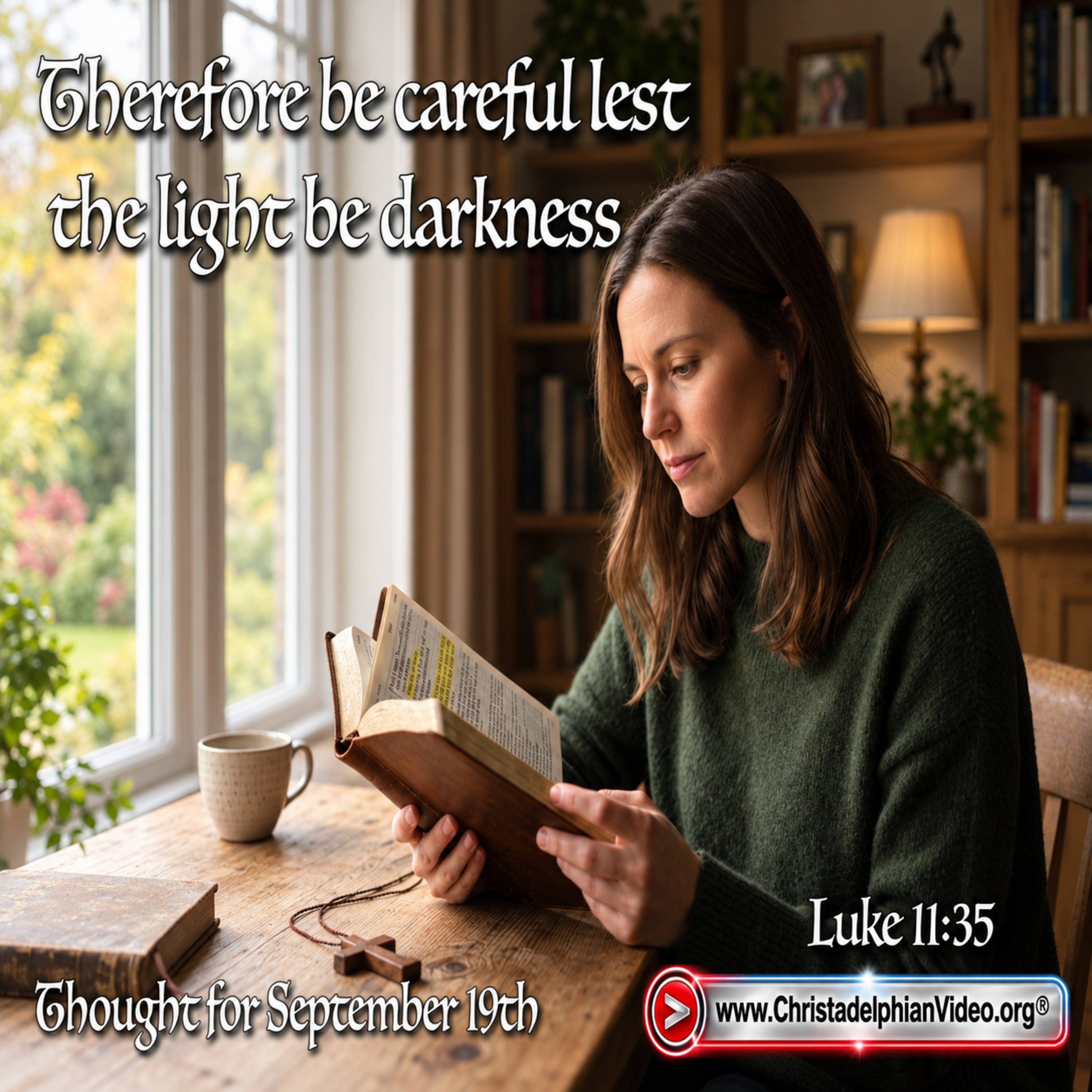 “THEREFORE BE CAREFUL LEST …” 20.09.2026 4minOur chapter (11) in Luke’s gospel today is full of challenging sayings by our Lord. There is great spiritual value in deeply meditating on them and seeing the extent to which they have application to the circumstances in which we live today. The background to many of them is the self-righteous attitudes of the religious leaders who contended with Jesus. Praise of Jesus’ mother developed in early centuries and led to the cult of a sort of Mary worship. Luke records a little incident which those influenced by such attitudes must gloss over and ignore. We read the response of Jesus to a woman in the crowd who calls out, “Blessed is the womb that bore you and the breasts at which you nursed” Jesus responds, “Blessed rather are those who hear the words of God and keep it.” [v.27,28] May we all be blessed for that reason, and recognise our additional blessing in being able to read all the words of God..The way that we “keep it” will result in us being “full of light”! As a result our “eye is healthy” [v.34] and so our eye (or ear) keep bringing ‘healthy food’ into our minds. This is more and more essential today as our world is so full of junk food!Underline the next 2 verses, “Therefore be careful lest the light (you think you have) be darkness” [v. 35] Let’s fully absorb the point Jesus makes in the next verse, “If then your whole body is full of light, having no part dark, it will be wholly bright, as when a lamp with its rays gives you light.” Are you and I “full of light”? How difficult it is to maintain such light in the increasing darkness of this world – evil words and deeds multiply all around us. Now the words of David in Psalm 139 are a special inspiration to us with his perception of the light of God in the darkness. “If I say,’ writes David, ‘Surely the darkness shall cover me, and the light about me be night, even the darkness is not dark to you; the night is bright as the day, for darkness is as light to you.” [v12] Read the rest of that Psalm, especially the last 2 verses – and then you and I will be even more dedicated to “be careful lest” the light of God’s word be smothered by the darkness that increasingly surrounds us.
 -
 'The Disciple and the World' 18.09.2026 37min'The Disciple and the World'
 -
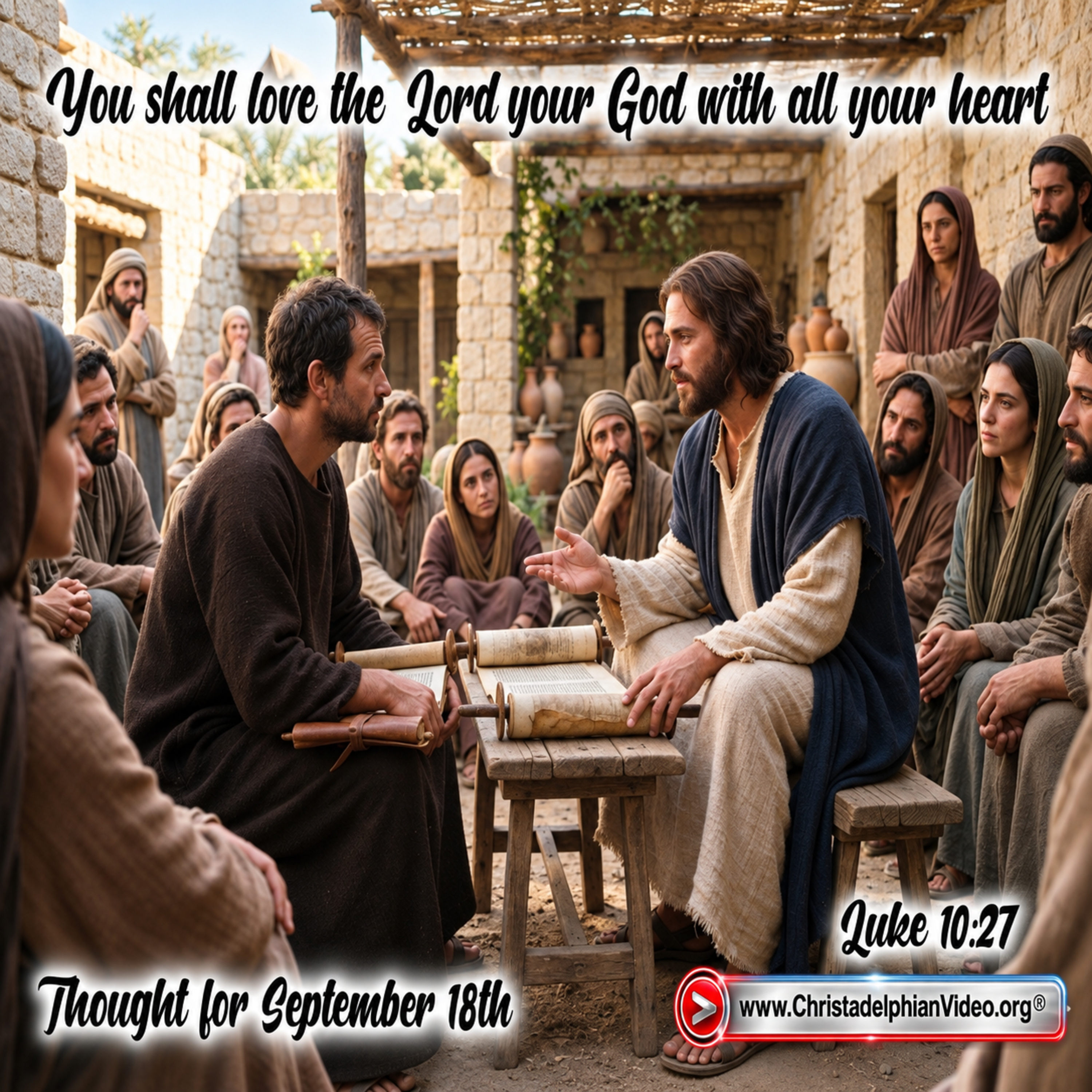 “LOVE THE LORD YOUR GOD WITH ALL YOUYR HEART" 18.09.2026 4minHow depressed Ezekiel must have been! The LORD caused him to be aware of the totally godless attitude that existed in Jerusalem. He writes, “certain of the elders of Israel came to see me.” [14 v.1] The “word of the LORD” comes to him, “… these men have taken their idols into their hearts and set the stumbling block of their iniquity before their faces. Should I indeed let myself be consulted by them?” [v.3] The lesson is plain, it is folly to come to seek God and yet retain fleshly thoughts in our minds. Ezekiel is further told, “any one of the house of Israel … who separates himself from me, taking his idols into his heart … and yet comes to a prophet to consult me through him, I, the LORD will answer him myself. And I will set my face against that man (or woman)…” [v.7,8] Surely the same applies today to those who “consult” God through reading his word – but have a wrong motive in their hearts. Peter’s words come to mind about Paul’s writings,, “There are some things in them that are hard to understand, which the ignorant and unstable twist to their own destruction, as they do the other Scriptures.” [2 Peter 3 v.16] In our chapter [10] in Luke there is some comparison with the attitude of the lawyer who asked Jesus, “Teacher, what shall I do to inherit eternal life?” He said to him, “What is written in the Law? How do you read it?” And he answered, “You shall love the Lord your God with all your heart and with all your soul and with all your strength and with all your mind, and your neighbour as yourself.” [v.25-27] Jesus says to him, “You have answered correctly: do this and you will live.” But he asks, “and, who is my neighbour?” In response Jesus tells him the well-known account of the ‘Good Samaritan’ and asks the man, “Which of these three, do you think, proved to be a neighbour to the man who fell among robbers?” [v.36] He answers, “The one who showed mercy” and is told, “You go and do likewise.” Let us all love our Lord, with all our heart, our soul, our strength and our mind showing our love by our actions day after day: of course, we will sense at times, something similar to what the LORD caused Ezekiel to sense. But surely, in at least some cases, it will cause others to “do likewise” and – for at least one or two to take serious notice of the message and meaning of what we talk about – the wonder and real meaning of the word of God – as the only ‘light’ in the darkness that covers the world today.
Podobné podcasty


Oblíbený v
Tento podcast se objevuje také v podcastových žebříčcích těchto zemí.
