
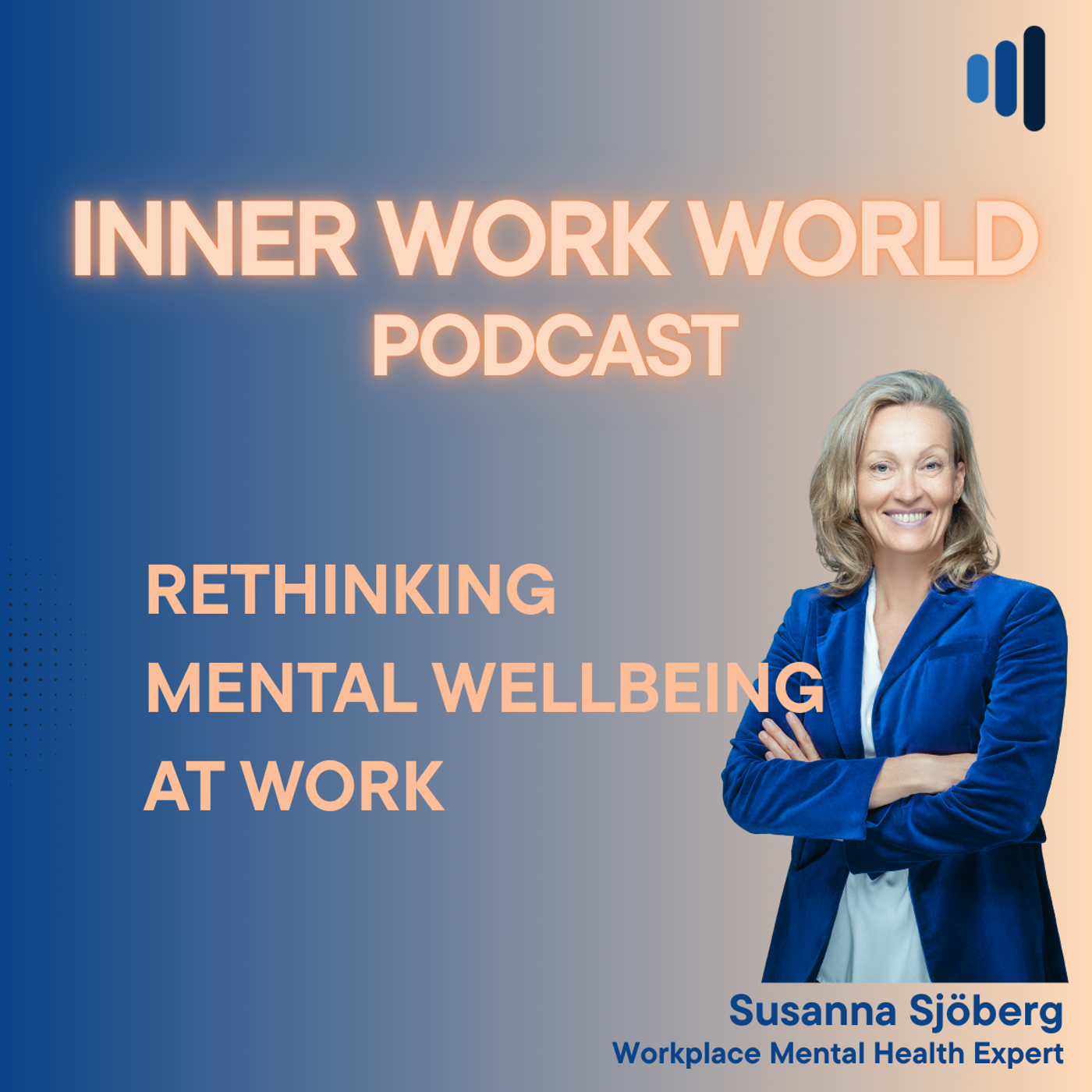
Inner Work World - Rethinking Mental Wellbeing At Work
Susanna Sjöberg
0
Inner Work World is a podcast for professionals who care about mental health and wellbeing at work. Hosted by Susanna Sjöberg, a registered mental health professional and workplace wellbeing expert, it combines science-backed insights with real stories from people around the world. Episodes explore neuroscience, psychology, management practices, and ancient wisdom adapted for modern work. The show aims to help listeners make small shifts that create big changes in how they feel and approach work and life.
Epizody
-
 The Dark Triad at Work: Unmasking Corporate Psychopaths and Narcissists with Cynthia Mathieu 30.09.2026 35minIn recent years, it has become incredibly common to casually label any difficult boss or demanding colleague a "narcissist" or a "psychopath." But what happens when we use these clinical terms as corporate buzzwords? And more importantly, how do we recognize and handle the individuals who actually do possess these destructive traits before they cause irreparable harm to their teams?In this episode, Susanna Sjöberg speaks with Dr. Cynthia Mathieu, a professor of organizational behavior with a background in forensic and industrial-organizational psychology. For over a decade, Dr. Mathieu has studied the "Dark Triad"—narcissism, Machiavellianism, and psychopathy—and how these profound personality disorders manifest in hiring, leadership, and workplace culture.Susanna and Cynthia unpack why the traits of corporate psychopaths and narcissists are so frequently mistaken for strong leadership, how they expertly manipulate systems and weaponize HR, and why highly unstructured or mission-driven organizations (like NGOs) provide the perfect hiding places for them to operate. Finally, Dr. Mathieu offers clear, uncompromising advice on how to protect yourself, establish boundaries, and safely plan your exit when fighting back is a losing battle.Key TakeawaysThe Danger of the "Successful Psychopath" Myth: Using clinical terms like narcissism and psychopathy as casual buzzwords is dangerous. Framing these traits as markers of "successful" or "tough" leadership completely ignores the devastating, soul-crushing human toll these individuals inflict on their colleagues and employees to acquire power.Why Organizations Keep Hiring Them: Dark personalities are experts in impression management. They are incredibly charming, easily fabricate grand promises on their resumes, and exhibit traits—like fast, emotionless decision-making and superficial courage—that organizations desperately mistake for competent leadership.Thriving in Chaos: These individuals target unstructured, highly political, or mission-driven environments (like NGOs) where they can easily hide behind virtuous causes. If an environment isn't chaotic, they will intentionally create chaos to isolate, divide, and conquer their teams.Advice for Managers: If you manage someone with these traits, never meet with them alone. Document every behavior, involve HR and legal, stick rigidly to organizational protocols, and focus strictly on addressing the harmful behaviors, not diagnosing the personality.About the GuestDr. Cynthia Mathieu is a professor of organizational behavior at the Université du Québec à Trois-Rivières (UQTR) in Canada. With an extensive background in forensic and industrial-organizational psychology, she has spent her career studying the "Dark Triad"—narcissism, Machiavellianism, and psychopathy—in the workplace. Dr. Mathieu is the author of Dark Personalities in the Workplace and has advised major institutions, including the Conference Board of Canada, the European Central Bank, and the Canadian Federal Government, on how to recognize and mitigate toxic leadership behaviors before they cause organizational damage.Resources & Links Mentioned in This EpisodeBook: Dark Personalities in the Workplace by Cynthia MathieuBook Recommendation: Without Conscience: The Disturbing World of the Psychopaths Among Us by Robert D. HareConnect with the Guest: Dr. Cynthia Mathieu on LinkedIn
 -
What Happens When the Urgency Stops - Navigating A Major Career Transition with Mia Seppo 23.09.2026 26minWhat happens when the structure that has organized your life for decades suddenly falls away? For over 25 years, Mia Seppo built a distinguished career within the United Nations, coordinating humanitarian responses, running elections in fragile states, and most recently serving as Assistant Director-General at the International Labour Organization (ILO). Her work provided her with profound purpose, a global community, and a clear sense of identity. Then, a year ago, she voluntarily walked away without a fixed plan for what would come next.In this episode, Susanna sits down with Mia to explore the deeply destabilizing, and ultimately liberating experience of leaving an all-consuming, high-pressure career. They discuss the hidden toll of chronic "time poverty," the jarring emotional detox that occurs when constant urgency stops, and the vital difference between true resilience and being habituated to adrenaline. Mia shares her reflections on global homelessness, the grief of missed milestones, and why we must learn to sit comfortably with not having all the answers.Key Takeaways From the EpisodeThe Cost of Time Poverty: In highly demanding careers, time poverty gradually accumulates into a heavy personal price. Missing family milestones and lacking the space to pause and reflect are costs that cannot be made up later, prompting the realization that the cost of staying can eventually outweigh the cost of leaving.The Urgency Detox: In crisis-driven environments, urgency provides structure, energy, and a convenient distraction from difficult emotions. When the noise and external demands suddenly stop, suppressed feelings like grief, guilt, and exhaustion finally have a place to land.Resilience vs. Habituated Adrenaline: There is a profound difference between being genuinely resilient and simply being habituated to constant adrenaline. Many high-achievers train themselves to need pressure to function, often masking the unnecessary stress manufactured by organizational culture.Global Homelessness: For those who spend decades working internationally within insular organizational "tribes," returning to a functioning, peaceful home country can feel simultaneously familiar and deeply unfamiliar, resulting in a complex sense of global homelessness and a search for new belonging.Non-Linear Transitions: Life transitions are rarely simple stories of reinvention. Loss and possibility can coexist perfectly; you can deeply miss a career or community while still knowing it was absolutely the right decision to leave. Sometimes, the most important step is having the courage to "hurry slowly" and feel a little lost.About the GuestMia Seppo is a senior international leader and strategy consultant with over 25 years of experience across the United Nations system, spanning both headquarters and complex field environments. She previously served as the Assistant Director-General at the International Labour Organization (ILO), directing global portfolios on employment policy, social protection, and sustainable enterprises. Throughout her UN career, Mia held senior roles in post-conflict and peacekeeping contexts, including field assignments in Tajikistan, Sierra Leone, and Zimbabwe, as well as tenures as UN Resident Coordinator in both Malawi and Bangladesh.Connect with the GuestConnect with Mia Seppo on LinkedIn
-
The Power of Choice: Expanding Options & Reclaiming Agency with Irina Cozma 10.09.2026 24minIn this episode of Inner Work World, host Susanna Sjoberg is joined by Dr. Irina Cozma, an executive and career coach with a PhD in organizational psychology. They dive into the concept of "possibility thinking" and explore why so many highly accomplished professionals experience career dread and feel completely trapped in their roles. Dr. Kosmel explains that feeling stuck usually doesn’t stem from a true lack of options, but rather from an inability to see the options we already hold. Susanna and Irina discuss the real psychological toll of feeling optionless, the nuance of having too many versus too few choices, and how regaining a sense of agency can transform our relationship with our professional lives.Key Takeaways & Topics Covered:The Core of "Possibility Thinking": Why people aren't usually stuck because they are out of options, but because they lack a map to see them.The Illusion of Being Trapped: How highly accomplished leaders often fall into the trap of believing "this is it" and experience deep career dread.The Cost of Feeling Optionless: The physical, mental, and behavioral toll that a lack of choice takes on our sleep, focus, and daily interactions.The Option Paradox: Navigating the debate between having too many options versus too few, and using situational judgment to find the right balance.Reclaiming Your Agency: How bringing our internal options to the surface allows us to engage with our work with more ease, ownership, and joy.About the Guest: Dr. Irina Cozma is an executive and career coach with over two decades of experience helping C-suite leaders and professionals at companies like Salesforce and Wells Fargo. With a PhD in organizational psychology, she has also held corporate leadership roles, writes for the Harvard Business Review, teaches at the University of Tennessee, and has lived, studied, and worked across four countries.https://irinacozma.com/assessment https://www.linkedin.com/in/irinacozma/
-
Humanizing Work - Belonging, Truth and Trust with Janvier Rugira 28.08.2026 29minWhen we talk about organizational well-being, the focus often falls on individual resilience, such as stress management, personal boundaries, or productivity hacks. But in reality, true flourishing rarely happens in isolation; it thrives in community.In this episode of Inner Work, host Susanna Sjöberg welcomes Dr. Janvier Rugira, a psychologist with 18 years of experience supporting personnel in some of the most demanding humanitarian and academic settings in the world. Drawing from his extensive research in Sub-Saharan Africa, Dr. Rugira explains why the Western, individualistic model of mental health often falls short, and how a profound sense of collective belonging serves as the ultimate protective factor against stress and burnout.Susanna and Dr. Rugira explore what it truly means to humanize the workplace, moving beyond job titles to value the people holding them. From applying the lessons of South Africa's Truth and Reconciliation process to corporate layoffs, to the simple ways managers can support their teams without needing to be clinicians, this conversation is a powerful call to rebuild trust, connection, and dignity in our everyday work lives.Key TakeawaysThe Power of the Collective: In studying university students in Tanzania, Dr. Rugira found that flourishing under pressure is deeply rooted in a shared identity rather than individual achievement. Viewing education and work as a collective responsibility creates a powerful buffer against anxiety and depression.Humanizing Over Function: A healthy culture starts when we stop treating employees merely as their job titles or functional outputs. Re-centering the human behind the role and building policies that reflect that humanity is what creates a resilient, high-performing organization.Truth Before Reconciliation: Borrowing from South Africa's Truth and Reconciliation efforts, organizations must provide a space for truth-telling during layoffs or crises. Skipping straight to "moving forward" without acknowledging the human impact fractures trust, leaving those who remain in the organization to struggle with longer-term mental health challenges.Managers as Humans, Not Clinicians: Leaders do not need clinical expertise to support their teams' mental health. The most critical capability is simply noticing changes early and responding with genuine human empathy, rather than focusing solely on KPI dashboards.Systemic Over Individual Well-Being: While individual resilience matters, the top leadership of an organization ultimately dictates how well its employees can truly be. True well-being requires systemic support and intentional connection, not just open-plan offices where employees hide behind noise-canceling headphones.Connect with the GuestConnect with Dr. Janvier Rugira on LinkedIn
-
The Power of Nutrition in Resilience & Performance with Jessica Hofmans 26.07.2026 24minWhen we talk about managing workplace stress and burnout, we usually reach for mental solutions—mindset shifts, breathing exercises, or calendar audits. But stress is a physical experience, and the body relies entirely on how we fuel it to navigate high-pressure demands.In this return episode of Inner Work, host Susanna Sjöberg welcomes back Jessica Hofmans, a certified Health Coach, Nutrition Specialist, and expert in public health and hormone health. Jessica breaks down why nutrition is so often overlooked in the stress conversation and unpacks the powerful gut-brain connection—the continuous data highway running through our nervous system that determines how our bodies process pressure. Moving away from restrictive diet culture, Jessica shares practical, sustainable strategies to protect your energy, stabilize your blood sugar, and build genuine resilience through everyday food choices.Susanna and Jessica explore the real impact of common habits like drinking coffee on an empty stomach, how chronic stress alters our protein and nutrient requirements, and simple ways to support your microbiome without sacrificing life’s pleasures. Whether you are navigating back-to-back corporate meetings, travel, or busy routines, this conversation offers an empowering, science-backed approach to fueling your mind and body from the inside out.Key TakeawaysThe Mind-Body Disconnect: Stress is commonly treated purely as an emotional or mental challenge, but the nervous system runs on physical fuel. Because nutrition is often associated with weight-loss diets and sacrifice, its power as a tool for mental performance and stress resilience is frequently ignored.The Gut-Brain Highway: The enteric nervous system contains over 500 million neurons that communicate directly with the brain via the vagus nerve. Highly processed, long-shelf-life foods disrupt the gut microbiome and trigger inflammatory responses, signaling threat state messages directly to the brain.Rethinking Morning Habits: Drinking coffee on an empty stomach amplifies early-morning cortisol spikes and triggers blood sugar crashes. Delaying caffeine slightly, hydrating first, and anchoring breakfast with a source of protein and healthy fats helps maintain steady energy throughout the day.Crowding In, Not Restricting Out: Sustainable wellness is not about cutting out carbs, chocolate, or social drinks. Shifting the focus to adding nutrient-dense, colorful whole foods naturally satisfies hunger and reduces the impulse to reach for ultra-processed energy fixes.Supporting the Microbiome Simply: Introducing small daily servings of fermented foods (like kefir, kimchi, sauerkraut, or miso) and "eating the rainbow" supplies the gut with diverse fibers and beneficial bacteria that directly boost mood-regulating neurotransmitters.Connect with the GuestVisit Jessica's WebsiteConnect with Jessica on LinkedInFollow Jessica on InstagramEmail Jessica DirectlyBook a free 30-minute discovery call with Jessica
-
How Bullying and Gaslighting Impact the Brain with Dr. Jennifer Fraser 26.07.2026 33minWhat actually happens inside our bodies when workplace pressure turns toxic? Why do psychological threats, subtle microaggressions, and institutional gaslighting leave deep, measurable impacts on employee well-being and performance?In this episode, Susanna Sjöberg sits down with Dr. Jennifer Fraser—founder of The Bullied Brain, award-winning educator, and author of The Gaslit Brain: Protect Your Brain from the Lies of Bullying, Gaslighting, and Institutional Complicity. Dr. Fraser shares how uncovering a systemic bullying scandal at her school propelled her into years of research across medicine, psychology, and neuroscience. Moving past outdated assumptions that treat emotional or psychological abuse as mere "tough management," Dr. Fraser details how toxic behaviors inflict physical damage on brain architecture and how organizations can shift from being trauma-informed to trauma-preventative.Susanna and Dr. Fraser explore the global crisis of workplace incivility, why authority figures often protect high-performing abusers over truth-tellers, and how gaslighting functions as a form of institutional self-preservation. This eye-opening conversation offers a radical, neuroscience-backed perspective on breaking habits of compliance, restoring biological safety, and building workplaces grounded in truth and accountability.Key TakeawaysPsychological Abuse Causes Physical Brain Damage: Psychological mistreatment, belittling, and microaggressions are not soft issues—they cause visible structural damage to the brain, including an enlarged amygdala (chronic threat state), a demyelinated corpus callosum (impaired left-right communication), and a shriveled hippocampus (impaired learning and memory).The Danger of Habituation: Brains naturally run on "autopilot" to conserve energy. When toxic behaviors and minor abusive acts are normalized repeatedly, employee brains habituate to the toxicity, viewing severe mistreatment as ordinary or acceptable.The Paradox of the Dark Tetrad: High-powered manipulative personalities (Machiavellians, narcissists, psychopaths, and sadists) often climb organizational ranks quickly. Because they lack affective empathy and emotional burden, they can fake empathy and charm while focusing all cognitive energy on acquiring power.Why Institutions Turn on Truth-Tellers: Leaders frequently protect abusers to preserve their own reputation and legacy (the "remembering self") rather than face the uncomfortable crisis (the "experiencing self"). As a result, whistleblowers and truth-tellers are often ousted while toxic behavior is swept under the rug.Connect with the GuestVisit Dr. Fraser's WebsiteConnect with Dr. Fraser on LinkedInRead "The Bullied Brain" series on Psychology TodayGet The Bullied Brain on AmazonGet The Gaslit Brain on AmazonSubscribe to Dr. Fraser's Substack on Gaslighting
-
The Science of Making Work Fair with Siri Chilazi 26.07.2026 30minWhy are traditional diversity and workplace initiatives falling short? What happens when we stop trying to "fix" individuals and instead focus on fixing the structures, processes, and systems they operate within?In this episode, Susanna Sjöberg sits down with Siri Chilazi, a senior researcher at the Women and Public Policy Program at Harvard Kennedy School and co-author of Make Work Fair: Data Driven Design for Real Results. Siri shares how her early career experiences in management consulting exposed the stark gap between meritocratic intentions and workplace reality, sparking her lifelong commitment to advancing gender equity. Moving beyond performative celebrations, endless unconscious bias training, and programmatic "fix-the-woman" approaches, Siri reveals how behavioral science and evidence-based design can create truly fair, high-performing organizations.Susanna and Siri explore the deep parallels between workplace equity, innovation, and mental health. They discuss the "intention-action gap," why well-meaning initiatives often backfire on the very people they are meant to help, and how simple, data-backed tweaks to everyday processes can yield massive structural changes. This grounded, practical conversation offers a clear roadmap for leaders, managers, and individuals to move from arbitrary "best practices" to proven "best evidence" in building healthier, fairer workplaces.Key TakeawaysFixing Systems, Not People: Equity and well-being issues stem from flawed structures, biased processes, and overwork culture—not individual deficits. Redesigning how we hire, evaluate, and conduct meetings yields far better results than trying to "fix" employees.The Intention-Action Gap: Most people genuinely desire a meritocratic workplace, but flawed processes, organizational incentives, and environmental cues lead to behavior that contradicts those good intentions.Evidence Over "Best Practice": Many standard DEI programs (e.g., mandatory training, targeted social tasks) fail to move the numbers and can actively harm marginalized groups through backlash or distraction. Organizations should rely on tested behavioral research and internal experiments rather than copying popular trends.Diagnosis Before Prescription: There is no universal fix. Organizations must collect data to diagnose their specific operational bottlenecks before applying solutions like resume anonymization or policy adjustments.Focus on the 80%: Following the 20-60-20 rule, leaders should stop wasting energy trying to convince dedicated detractors (the bottom 20%) and instead focus on empowering early adopters (the top 20%) and winning over the moveable middle (the 60%).Connect with the GuestConnect with Siri on LinkedInMore on Siri’s book, Make Work FairJoin Siri’s newsletter for the latest researchCheck out Siri’s latest work
-
How Physiological Safety Drives True High Performance with Michael Allison 26.07.2026 28minWhat happens to our bodies when the pressure is turned up? Why do highly rehearsed skills—whether swinging a golf club, shooting a free throw, or delivering a critical corporate pitch—suddenly evaporate when we need them most?In this episode, Susanna Sjöberg sits down with Michael Allison, an elite performance and leadership coach, founder of Autonomic Agility, and educational partner with the Polyvagal Institute. Michael shares how discovering Polyvagal Theory completely transformed his decades-long career coaching top-tier athletes across the ATP, WTA, MLB, and NBA. Moving beyond external physical training, nutrition, and psychological reframing, Michael explains the "hidden variable" of high performance: our physiological state.Susanna and Michael dive deep into the modern epidemic of cultural hyper-competition, workplace layoffs, and parental burnout. They explore the profound distinction between striving to achieve from a baseline state of safety versus frantically trying to "achieve our way back into safety." This grounding, necessary conversation offers a radical reframe on how to honor our biological need for trust and authentic connection in an increasingly relentless, rapid, and uncertain world.Key TakeawaysThe Physiological Basis of Performance: You can rehearse your material or practice a physical skill flawlessly, but underneath your intentions, your underlying physiological state (heart rate, muscle tension, breathing) ultimately determines whether you can execute that skill under pressure.Psychology Only Goes So Far: Top performers already know they should relax and have fun. Traditional psychological reframing and setting intentions are helpful, but they are often insufficient if the primitive survival networks of the nervous system still perceive a threat.Achieving From Safety vs. Achieving Into Safety: True, authentic expression comes when we achieve from a state of already feeling secure, supported, or competent. When we grind relentlessly out of a fear of missing out, falling behind, or needing to prove our worth, we are operating out of a physiological pattern of protection.The Relentlessness of Modern Culture: Driven by rapid technological changes, AI, social media, and shifting corporate landscapes, our environments subject us to a constant stream of comparison and evaluation. This layers continuous uncertainty onto our nervous systems, pushing many into chronic vigilance or total burnout.Honoring the Need for Connection: To experience contentment, fulfillment, and a healthy life, we must find ways to co-exist with a challenging reality by actively seeking out circles of biological safety, trust, and mutual connection.Balancing "Winning" with Individual Needs: Competing and winning in sports or business are completely fine, but culture has shifted out of balance by glorifying the isolated champion. Healthy high-performing teams must remember that "there is an 'I' in team" and honor individual needs and human values outside of pure functional output.Connect with the Guest:The Performance CodeThe Play ZonePsychology Today Column
-
How Inner Growth Leads to Sustained High Performance with Janine Mathó 26.07.2026 29minWhen high achievers hit a wall, the typical advice is to scale back, download a new productivity app, or lower their ambitions. But what if the problem isn’t the scale of our goals, but the structural design of our internal operating systems? According to future-of-learning expert and advisor Janine Mathó, true sustainability in a high-pressure world requires shifting our focus from external performance metrics to active internal growth.In this episode, Susanna sits down with Janine Mathó, former Harvard and Pearson executive and author of Live Your Opus, to explore the true cost of high achievement. Janine shares why productivity tools fail to save us from burnout, breaks down how elite physical training principles map onto professional energy management, and offers immediate micro-practices for protecting your focus and emotional regulation during systemic organizational upheaval.Key Takeaways From the Episode:The Performance vs. Growth Matrix: Professional performance and individual internal growth are entirely different systems. Ambitious people rarely want permission to care less or do less; they want to know how to sustain what they care about. True sustainability means intentionally developing the inner capabilities required to navigate identity shifts, corporate reorgs, and profound workplace uncertainty.The Energy Domain System: True baseline capacity is fueled by four interconnected human domains: Physical, Emotional, Mental, and Spiritual. While elite athletes naturally build deep recovery cycles into their training, corporate professionals often treat energy as an infinite resource until they hit a wall. Drive fuels growth when we maintain alignment with our values, but it rapidly depletes us the moment achievement becomes our primary source of identity.Contextual Shifts and Intentional Attention: The modern workplace constantly fragments focus through rapid context switching. To combat cognitive overload, implement a split-second "Micro-Pause" before opening a chaotic inbox or joining a meeting by asking yourself one priming question: "What requires my attention right now?" This shifts you from emotional reactivity to deliberate intent.Mindful Emotional Regulation: Structural anxiety and organizational stress manifest physically long before they enter conscious thought. Before stepping into a high-stakes collaborative space, take a single breath to choose your internal state by asking: “How do I want to feel in this meeting?” and “How do I want the other person to feel?”Systemic Future Mapping: Internal resilience should not be a luxury discovered only after an absolute professional crisis hits. Self-regulation and cognitive agility must be treated as core evolutionary survival skills for the future of work, needing integration directly into early childhood development, higher learning, and foundational leadership spaces.Connect with the Guest:Janine's website: https://www.janinematho.comLive Your Opus: https://www.liveyouropus.comJanine LinkedIn: https://www.linkedin.com/in/jmmathoJanine Instagram: https://www.instagram.com/janinemathoNicky Sparshott TED Talk: Love
-
Grief's Role in Navigating Organizational Change with Patricia Bravo 04.06.2026 26minWhen we think of grief, we usually think of personal, private tragedies—the death of a loved one or a severe life crisis. But what happens when grief enters the workplace? According to leadership advisor Patricia Bravo, organizations are constantly asking people to "let go" of roles, team members, strategies, and workplace identities without giving them the space to process the resulting loss.In this episode, Susanna sits down with Patricia Bravo, founder of Bravo4U and author of the upcoming book In the Room When Grief Comes to Work, to discuss the invisible cognitive load of workplace grief. Patricia shares why unexpressed micro-grief accumulates to hurt performance, how grief mirrors the ever-changing nature of the weather, and how leaders can offer powerful support through simple acknowledgment rather than trying to "solve" the problem.Key Takeaways From the Episode:The Cost of Micro-Grief: Workplace changes—like restructuring, a beloved leader leaving, or shifting a company vision—trigger real loss. When these "micro-losses" go unacknowledged, they accumulate, often manifesting later as unexplained performance drops, cognitive fatigue, or irritability.The Weather Analogy of Loss: Traditional linear models (like the Kübler-Ross change curve) can fall short when treated as a rigid checklist. Grief is highly individual and non-linear—some days feel like a sudden tsunami, others like a gentle mist, and some days the sun unexpectedly breaks through.Acknowledgment Over Action: Leaders often feel pressured to act as amateur therapists or "fix" the situation. Real support simply looks like regular, attentive check-ins (e.g., "How are you doing this week?") and giving employees the agency to choose between space or connection.Collective and Accumulated Grief: From mass layoffs in the tech sector to restructuring in international organizations, modern workplaces are experiencing unprecedented layers of collective grief. Rebuilding human connection within organizations is essential to helping teams adapt and eventually find post-traumatic growth.Connect with the Guest:Website: Bravo4ULinkedIn: Connect with Patricia Bravo on LinkedInUpcoming Book:In the Room When Grief Comes to Work (An illustrated guide for leaders and teams navigating workplace loss).
-
When Professional Identity Changes: Healing with Art & Nature with Nathalie Latham 02.06.2026 31minHow do you find your way back to yourself when you’ve lost everything—your health, your career, your identity, and even your home? In this episode, Susanna Sjöberg speaks with Nathalie, an artist, filmmaker, and author of I Am Alive.Nathalie shares her harrowing yet transformative journey from a stage three cervical cancer diagnosis in Paris to a life of service and spiritual devotion in South India. This is a conversation about the "brutal" path of healing, the difference between being cured and being whole, and why nature and art are our most powerful witnesses.What you'll learn:The Witness of Art: How drawing became a physical proof of existence during the "horror" of internal radiation treatment.Somatic Recovery: Navigating PTSD and depression by pulling the "messy thread of trauma" out one small inch at a time.The Caterpillar’s Cocoon: Why transformation and rebirth are inherently painful and cannot be rushed.Cured vs. Healed: Understanding the gap between the medical removal of a tumor and the emotional integration of the experience.The Power of Mantra: How the soul’s "tool" (Man-Tra) provided an immovable pillar when the mind and body were failing.The Simple Life: Finding the essence of life in breath, movement, and the "chaotic joy" of serving others.Connect with Nathalie:Website: Nathalie LathamBook: I Am Alive (A collection of drawings and reflections on survival).TakeawaysNature doesn't rush, and neither can your healing.The "life force" of the world continues even when we feel disconnected from it.Cultivating compassion (Karuna) for ourselves as a prerequisite for understanding the suffering of others.The importance of having a "witness" (whether a drawing or a person) during your darkest moments.
-
Finding The Right Therapy For You with Floriana Poggia 29.05.2026 34minPsychologist Floriana Poggia joins Susanna Sjöberg to pull back the curtain on the world of mental health support. Drawing from her own transition from international marketing to psychology, Floriana explains the "why" and "how" of seeking help, and why the relationship with your therapist is often more important than the method itself.What you'll learn:The Career Leap: Why Floriana left a multinational corporate role to pursue a "calling" in psychology and the reality of the long academic path.Psychologist vs. Psychotherapist vs. Psychiatrist: A clear breakdown of the titles, protected statuses (specifically in Switzerland), and who can prescribe medication.The "Big Three" of Therapy: How to assess a therapist using the criteria of unconditional positive regard, empathy, and authenticity.Why Therapy "Fails": Understanding the barriers to progress, including external vs. internal motivation and the "secondary benefits" of staying stuck.ACT and CBT Explained: A beginner’s guide to Acceptance and Commitment Therapy (ACT) and how to take distance from intrusive thoughts.The Power of Small Wins: Why the smallest possible step is the best antidote to catastrophic thinking and ongoing anxiety.TakeawaysThe difference between medical and psychological supportCriteria for a successful therapeutic allianceEmotional avoidance and the "utility" of symptomsGrounding techniques for the present moment
-
Activating The Vagus Nerve with Dr. Navaz Habib 22.05.2026 32minFunctional medicine practitioner, chiropractor, and best-selling author Dr. Navaz Habib (known as "The Vagus Nerve Doc") joins Susanna Sjöberg to explore the critical link between the vagus nerve and our ability to recover from the high-pressure demands of the modern workplace.What you'll learn:The "Superhighway" Concept: Why the vagus nerve is the essential communication link between your brain and every major organ.The Brake Line Analogy: How a well-functioning vagus nerve acts as the "brakes" for chronic inflammation and stress.The Four Types of Stress: A breakdown of day-to-day, psychological, physical, and biochemical stressors—and how they fill your "stress bucket."The Breath is the Key: Why nasal breathing, diaphragmatic (belly) breathing, and longer exhales are the fastest ways to hack your nervous system.Ancient Wisdom vs. Modern Tech: How to use wearable data (like HRV) to validate age-old recovery practices without creating "data anxiety."Daily Bookends: How optimizing how you start and end your day can rebuild your circadian rhythm and accelerate repair.Connect with Dr. Navaz Habib:Website: Health UpgradedBooks:Activate Your Vagus NerveUpgrade Your Vagus NerveTakeawaysThe Vagus Nerve as a communication pathwayThe 4-Quadrant Stress ModelThe foundational power of the breathUsing Vagus Nerve stimulation and HRV as tools for recovery
-
The Resilience Plan - Optimizing Leadership Performance & Mental Health 19.03.2026 37minLeadership psychologist, award winning author, TedX speaker and resilience expert Dr. Marie-Hélène Pelletier joins Susanna Sjöberg to unpack the biggest misconceptions high performers carry about resilience — and what the research actually says.What you'll learn:Why resilience is a state, not a personality trait — and what that means for how you manage itThe early warning signs of burnout that most leaders dismiss (including one that shows up at home before it shows up at work)Why individual resilience is no longer enough — and how teams and organizations play a critical roleThe "financial statement" analogy that reframes self-awareness for leaders who resist itHow to set boundaries when you've built your identity around being the person who always deliversA practical framework for having workload conversations with both your team and your own managerWhat to do right now if you're exhausted but still pushing throughConnect with MH: https://drmarie-helene.com/Book The Resilience Plan (named a top 5 book by Inc. Magazine and Forbes). https://drmarie-helene.com/the-resilience-plan/TedX talk: Crossing the River: Resilience in the Age of AI.https://www.youtube.com/watch?v=JEdr2cvHF5MSmall shifts inside create big changes outside. Subscribe and share with someone who needs it.
-
Joyful exhaustion - The Art of Working Hard Sustainably 26.02.2026 25minThe conversation delves into the psychology of work and exhaustion, exploring the concept of joyful exhaustion and its contrast with burnout. It also discusses the importance of meaningful tasks, self-application of research findings, and the balance between work and recovery. Additionally, it addresses factors influencing burnout, the impact of global uncertainty on exhaustion, self-care, early signs of burnout, and the design of organizational support for joyful exhaustion.For more information on Christina: https://christinaguthier.com/en/https://www.ted.com/talks/christina_guthier_let_s_talk_about_the_bright_side_of_exhaustionTakeawaysJoyful exhaustion vs. burnoutResilience and adaptationSelf-awareness and recoveryChapters00:00 Designing for Joyful Exhaustion
-
The Importance of Increased Self-Care in Times of Change 19.02.2026 27minJessica Hofmans shares her journey from a career in medicine to becoming a holistic health coach, emphasizing the importance of a holistic approach to well-being. She discusses the impact of motherhood on her life and the shift towards a more present and balanced lifestyle. The conversation explores the significance of self-care, inner dialogue, and seeking support for overall well-being in both personal and professional life.TakeawaysHolistic approach to well-beingImportance of seeking supportSelf-care and inner dialogueImpact of motherhood on lifestyleChapters00:00 The Importance of Self-Care and Seeking Support
-
How To Find Balance After a Major Change at Work 15.02.2026 26minIn this episode of Inner Work World, host Susanna Sjöberg speaks with Dr. Sud, a physician who shares his journey through job loss and the emotional challenges that accompany it. Dr. Sud discusses the importance of resilience, spiritual practices, and the role of support systems in navigating difficult times. He emphasizes the need for open conversations about mental health and the significance of feeling and expressing emotions. The conversation highlights cultural perspectives on mental health and the fluid nature of emotional wellbeing, offering insights and encouragement for those facing similar challenges.Chapters00:00 Introduction to Dr. Sud's Journey03:25 Navigating Job Loss and Emotional Turmoil07:35 The Role of Spiritual Practices in Resilience11:24 Mental Health First Aid and Its Importance17:48 Cultural Perspectives on Mental Health21:02 The Power of Connection and Support21:54 Reflections on Resilience and Personal Growth
Podobné podcasty


Oblíbený v
Tento podcast se objevuje také v podcastových žebříčcích těchto zemí.
