
Clinical Deep Dives
Med School Audio - Medical Knowledge Reimagined & Learning Made Memorable.
0
Clinical Deep Dives is a podcast for clinicians and learners who want understanding, not just information. Using classic medical and surgical texts as a guide and the generative power of AI, each episode explores ideas with curiosity and clarity. Designed for learning on the move and knowledge that actually sticks.
Episoder
-
 PSYCH 141: Personality Disorders 03.10.2026 45minPersonality disorder emerges not because someone has a distinctive personality, but when enduring patterns become sufficiently inflexible and maladaptive to repeatedly disrupt the self, relationships and functioning.Medlock Holmes enters The House of Personality, an extraordinary mansion that has been under construction since childhood.Its foundations contain inherited temperament. Its rooms have been shaped by development and experience. Its doors determine how readily someone approaches or avoids the world; its windows influence how they interpret other people; and its internal corridors represent the habitual ways in which emotion, identity, relationships and behaviour become connected.Every house is different.Difference itself is not disorder.The mystery begins when Holmes discovers that some houses have become rigid. The same doors open regardless of circumstance. The same corridors are travelled despite repeatedly leading to conflict. Strategies that may once have been adaptive become increasingly difficult to modify.This chapter takes Holmes beneath diagnostic labels to explore the architecture of personality itself. Personality is presented as a dynamic biopsychosocial system emerging from interactions between temperament, character, learning, development, environment and self-awareness.Holmes encounters two competing maps of personality disorder. The traditional DSM model divides disorders into three familiar clusters: Cluster A, characterised broadly by odd or eccentric patterns; Cluster B, by dramatic, emotional or impulsive patterns; and Cluster C, by anxious or fearful patterns. Yet the boundaries overlap considerably.A newer dimensional perspective asks a different question. Rather than simply asking “Which personality disorder does this person have?”, clinicians can ask:“How impaired is personality functioning, and what traits characterise that impairment?”This becomes particularly important in ICD-11, where personality disorder is primarily classified by severity - mild, moderate or severe - followed by trait qualifiers.The chapter also challenges therapeutic pessimism. Personality is relatively enduring, but it is not necessarily immutable. Psychotherapy, relationships, learning and increasing self-awareness can alter how people regulate emotion, pursue goals, understand themselves and relate to others.Holmes therefore leaves the mansion with a different question from the one with which he entered.Not:“What kind of difficult person is this?”But:“What enduring pattern is operating here, how did it develop, what function does it serve, and where might greater flexibility become possible?”Key Takeaways1. Personality Is Not the Same as Personality DisorderPersonality describes relatively enduring patterns in how someone:* experiences themselves* experiences other people* regulates emotions* behaves* pursues goals* adapts to the environment.Having unusual or extreme traits does not automatically indicate pathology.The chapter specifically emphasises that even extreme temperament variants need not produce personality disorder.2. Think in Terms of AdaptationA useful overarching model is:PERSONALITY = TEMPERAMENT × CHARACTER × DEVELOPMENT × EXPERIENCE × SELF-AWARENESSPersonality is not merely something a person has.It is part of the system through which they continually adapt.3. Personality Disorder Involves Enduring MaladaptationThe important features are:PERSISTENTPERVASIVEINFLEXIBLEMALADAPTIVEand associated with significant dysfunction or impairment.The problem is therefore not simply possessing a trait, but being unable to adapt that trait sufficiently to changing circumstances.4. Temperament and Character Are DifferentOne of the chapter’s major conceptual distinctions is between temperament and character.Temperament refers more closely to biologically influenced emotional and behavioural tendencies.Character involves higher-order development of goals, values, identity and self-regulation.The chapter’s psychobiological model therefore argues that temperament influences how someone reacts, while character helps determine how those reactions are regulated and integrated.5. Four Temperament DimensionsThe Temperament and Character Inventory describes:* Novelty Seeking* Harm Avoidance* Reward Dependence* PersistenceDifferent combinations create different behavioural styles.None is inherently pathological.6. Three Character DimensionsThe model adds:* Self-Directedness* Cooperativeness* Self-TranscendenceLow self-directedness and cooperativeness are particularly associated with personality-disorder symptoms across diagnostic clusters.A useful conceptual distinction is therefore:TRAIT EXTREMITY ≠ PERSONALITY DISORDERThe crucial issue is whether the person’s overall personality system can regulate those traits adaptively.7. Personality Emerges From Biology and ExperiencePersonality development reflects interactions among:GENES ↔ BRAIN ↔ LEARNING ↔ FAMILY ↔ CULTURE ↔ EXPERIENCE ↔ SELF-AWARENESSThe chapter describes substantial genetic influences on personality while equally emphasising environmental, developmental and epigenetic processes.Biology provides predispositions - not destiny.8. Personality Development Is NonlinearThe same childhood temperament does not inevitably lead to the same adult personality.This is multifinality:SIMILAR BEGINNING → DIFFERENT OUTCOMESConversely, different developmental pathways can eventually produce similar clinical patterns.Personality therefore cannot be reconstructed from one simplistic childhood explanation.9. Personality Patterns Can Become Self-ReinforcingA person’s habitual responses influence their environment.The environment then responds to them.That response can reinforce the original behaviour:TRAIT → BEHAVIOUR → ENVIRONMENTAL RESPONSE → LEARNING → STRONGER TRAIT EXPRESSIONOver decades, these loops can become remarkably stable.This helps explain why personality disorders may feel both persistent and resistant to change.10. The Traditional DSM System Uses Three ClustersCluster A - Odd or EccentricIncludes:Paranoid • Schizoid • SchizotypalCluster B - Dramatic, Emotional or ErraticIncludes:Antisocial • Borderline • Histrionic • NarcissisticCluster C - Anxious or FearfulIncludes:Avoidant • Dependent • Obsessive-CompulsiveBut the chapter stresses that these clusters and individual diagnoses overlap substantially.11. Categorical Diagnosis Has LimitationsTraditional diagnosis asks:DISORDER PRESENT OR ABSENT?This is clinically convenient.But personality traits usually exist on continua.Drawing a categorical line through a continuous characteristic inevitably introduces some arbitrariness.It also struggles with patients who have significant features of several disorders without fitting neatly into one prototype.12. Dimensional Models Ask a Different QuestionInstead of:“Which box?”they ask:“How severe is the dysfunction, and what traits describe it?”This may better reflect the reality that personality characteristics exist along dimensions.13. ICD-11 Makes Severity CentralICD-11 represents an important conceptual shift.First assess personality-disorder severity:MILD → MODERATE → SEVEREThen describe prominent traits.The emphasis moves away from accumulating categorical labels and towards understanding the degree and nature of personality dysfunction.14. ICD-11 Trait DomainsThe dimensional formulation can include:* Negative Affectivity* Detachment* Dissociality* Disinhibition* Anankastiawith a borderline pattern qualifier also available.These describe how personality dysfunction manifests rather than assuming every patient belongs to a discrete personality “type”.15. Assess Self and Interpersonal FunctioningA particularly useful clinical framework is to examine:SELFIdentityWho am I?Self-directionCan I establish and pursue coherent goals?INTERPERSONALEmpathyCan I understand another person’s experience?IntimacyCan I develop reciprocal, enduring relationships?Personality pathology often becomes most visible in these domains.16. Ego-Syntonicity Can Complicate AssessmentMany personality traits are experienced as:“THIS IS JUST WHO I AM.”rather than:“SOMETHING IS HAPPENING TO ME.”This differs from many episodic psychiatric disorders.The patient may therefore present because of:* depression* anxiety* relationship breakdown* substance misuse* occupational difficulties* self-harm* interpersonal crisisrather than complaining directly about their personality.17. Defence Mechanisms Can Become HabitualThe chapter revisits psychodynamic formulations in which defensive strategies become entrenched components of personality.Examples discussed include:Projection → paranoid patternsActing out → antisocial patternsFantasy → schizoid patternsThe broader lesson is more important than memorising pairings:A DEFENCE THAT PROTECTS IN ONE CONTEXT MAY BECOME MALADAPTIVE WHEN USED EVERYWHERE.18. Assessment Requires Longitudinal ThinkingDo not diagnose personality disorder from behaviour during a single crisis.Ask:Has this pattern existed for years?Does it occur across settings?What happens in relationships?What was functioning like before the current illness?How does the patient understand themselves?What do collateral sources describe?Personality is fundamentally longitudinal.19. State Can Be Mistaken for TraitDepression may make someone appear chronically pessimistic.Mania may produce impulsivity or grandiosity.PTSD may produce mistrust.Psychosis may produce suspiciousness.Substances may produce instability.Autism may affect social interaction.Therefore:STATE ≠ TRAITuntil longitudinal assessment demonstrates otherwise.20. Comorbidity Is CommonPersonality disorders frequently coexist with:* mood disorders* anxiety disorders* substance-use disorders* eating disorders* trauma-related disorders* other personality disorders.Multiple categorical personality diagnoses may partly reflect weaknesses in the boundaries between existing categories.21. Assessment Tools Can Help - But Do Not Replace FormulationThe chapter discusses structured interviews and personality measures including:* structured diagnostic interviews* personality inventories* dimensional trait measures* Temperament and Character Inventory.These can organise information.They do not replace clinical history, longitudinal observation and contextual formulation.22. Treatment Requires More Than Symptom SuppressionMedication may help particular co-occurring symptoms or disorders.But there is no medication that simply removes a personality disorder.Treatment aims at deeper capacities such as:EMOTIONAL REGULATIONSELF-UNDERSTANDINGFLEXIBILITYRELATIONSHIP FUNCTIONGOAL-DIRECTED BEHAVIOURSELF-REGULATION23. Psychotherapy Is CentralDifferent disorders and presentations may benefit from different structured approaches.But across therapies, the deeper objective is often similar:RIGID PATTERN → AWARENESS → ALTERNATIVE RESPONSE → PRACTICE → GREATER FLEXIBILITYThe therapeutic relationship itself may also reveal the patient’s characteristic interpersonal patterns.24. Personality Is Enduring - Not FrozenThis distinction is fundamental.Personality traits can be stable enough to recognise across decades while still remaining capable of modification through:* maturation* relationships* psychotherapy* learning* environmental change* deliberate self-reflection.The chapter’s developmental diagrams reinforce this idea: temperament influences possible pathways, but does not dictate a single inevitable character outcome.25. Holmes’ Personality FormulationRather than stopping at a diagnostic label, ask:What are the dominant traits?How severe is the dysfunction?How does the person experience themselves?How do they relate to others?What happens when they are stressed?Which patterns repeatedly create problems?How did those patterns develop?What function have they served?Where is there capacity for flexibility and change?The central principle becomes:“Personality disorder is not simply about who someone is - it is about where enduring ways of being have become rigid enough to prevent adaptation.” This is a public episode. If you'd like to discuss this with other subscribers or get access to bonus episodes, visit drmanaankarray.substack.com/subscribe
 -
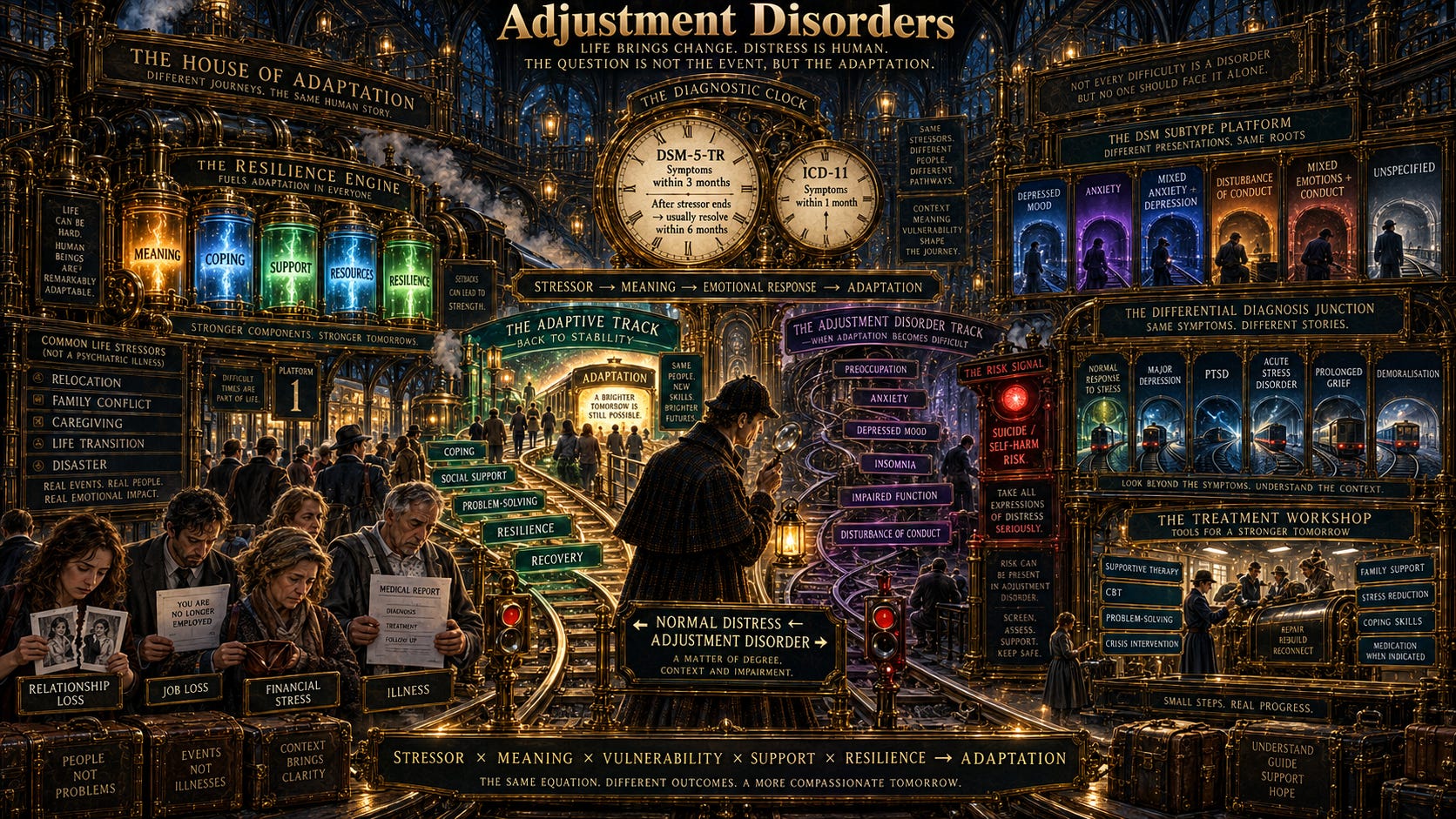 PSYCH 140: Adjustment Disorders 02.10.2026 55minMedlock Holmes enters The House of Adaptation, where people arrive carrying the weight of events that have changed their lives: relationship breakdown, financial hardship, illness, unemployment, conflict, relocation, bereavement and unexpected transitions.But Holmes immediately encounters psychiatry’s central difficulty with adjustment disorder:“When does distress become disorder?”Adjustment disorder is defined by the development of significant emotional or behavioural symptoms in response to an identifiable stressor. Unlike PTSD, the stressor does not have to involve threatened death, serious injury or sexual violence. It may instead be an event encountered routinely in human life - divorce, losing a job, financial problems, illness or major life transition.In DSM-5-TR, symptoms develop within 3 months of the stressor and cause either distress that is disproportionate to the stressor, taking cultural and contextual factors into account, or significant impairment in functioning. Once the stressor or its consequences have ended, symptoms should not persist beyond 6 months.Yet this apparently simple diagnosis contains a profound clinical dilemma. There is no precise laboratory test or symptom threshold separating adjustment disorder from an understandable response to adversity. Holmes must understand the person, the stressor, its meaning, their culture, previous vulnerabilities, available supports and capacity for adaptation.The disorder may present with depression, anxiety, conduct disturbance, or mixtures of these. ICD-11 approaches the diagnosis somewhat differently, emphasising preoccupation with the stressor and failure to adapt, and requiring symptoms to emerge within one month.Adjustment disorder is often regarded as relatively mild and self-limiting, but that assumption can be dangerous. Suicidal ideation and self-harm can occur, sometimes relatively early and impulsively, making careful risk assessment essential.Treatment therefore focuses less on simply suppressing symptoms and more on restoring the process of adaptation: understanding the stressor, mobilising social support, strengthening coping and problem-solving, reducing avoidable stress, and helping the person regain functioning. Psychotherapy and psychosocial interventions remain central, while medication may sometimes target significant anxiety, insomnia or depressive symptoms.Holmes eventually discovers that the stressor is only one part of the equation.Two people can experience the same event and follow entirely different paths.The real mystery lies in the relationship between:STRESSOR × MEANING × VULNERABILITY × SUPPORT × RESILIENCEAdjustment disorder sits precisely at that intersection - between adversity and adaptation, and between ordinary suffering and psychiatric disorder.Key Takeaways1. An Identifiable Stressor Is EssentialAdjustment disorder cannot be diagnosed without a recognisable:STRESSOR → EMOTIONAL / BEHAVIOURAL RESPONSECommon stressors include relationship, financial, occupational and medical difficulties.2. The Stressor Does Not Need to Be TraumaticUnlike PTSD, adjustment disorder can follow ordinary but significant life events.The key question is not simply how objectively severe the event was, but how the individual responded to it.3. Timing MattersUnder DSM-5-TR:STRESSOR → SYMPTOMS WITHIN 3 MONTHSOnce the stressor or its consequences end:SYMPTOMS SHOULD RESOLVE WITHIN 6 MONTHSPersistent stressors can therefore sustain the disorder.4. Distress Alone Is Not EnoughHuman beings normally become distressed by difficult events.Diagnosis requires either:* disproportionate distress, considering context and culture, or* significant impairment in social, occupational or other functioning.This makes the boundary between normality and pathology particularly difficult.5. DSM-5-TR Recognises Six SubtypesThe table in the chapter identifies:* with depressed mood* with anxiety* with mixed anxiety and depressed mood* with disturbance of conduct* with mixed disturbance of emotions and conduct* unspecified.6. ICD-11 Conceptualises Adjustment Disorder DifferentlyICD-11 particularly emphasises:PREOCCUPATION WITH THE STRESSORandFAILURE TO ADAPTSymptoms generally develop within 1 month rather than the DSM’s 3-month window.7. Differential Diagnosis Is CrucialConsider:* normal response to stress* major depressive disorder* anxiety disorders* acute stress disorder* PTSD* prolonged grief disorder* substance-related disorders* medical causes of psychiatric symptoms* demoralisation.A stressor does not automatically make the diagnosis adjustment disorder.8. Context and Culture MatterWhether distress is considered disproportionate cannot be judged independently of:* culture* values* developmental stage* social circumstances* meaning of the event* available support.9. Vulnerability and Resilience Modify the ResponseThe clinical pathway can be conceptualised as:STRESSOR × VULNERABILITY × MEANING × SUPPORT → RESPONSEPrevious adversity, coping style and psychiatric vulnerability may increase risk.Protective factors include emotional regulation, optimism, effective coping, positive self-concept and supportive relationships.10. Adjustment Disorder Is Not Necessarily “Minor”Symptoms may include:* depression* anxiety* insomnia* low self-esteem* hypervigilance* impulsivity* substance use* behavioural disturbance.Some people experience substantial functional impairment.11. Suicide Risk Must Be Taken SeriouslyThe chapter particularly emphasises the association between adjustment disorder and:SUICIDAL IDEATION • SELF-HARM • SUICIDESome suicidal behaviour may emerge rapidly following the precipitating stressor.Never equate a “subthreshold” diagnosis with subthreshold risk.12. Course Is Often Favourable - But Not AlwaysMany adults recover as adaptation occurs.However, symptoms may:RESOLVEorPERSIST / EVOLVE INTO ANOTHER DISORDERincluding major depression, PTSD or generalised anxiety disorder.Persistent symptoms and behavioural disturbance are important warning signs.13. Treatment Targets AdaptationThe aim is not merely symptom reduction.Treatment seeks to:* understand the meaning of the stressor* restore functioning* strengthen coping* mobilise support* improve problem-solving* reduce modifiable stressors* strengthen resilience.14. Psychotherapy Is the MainstayApproaches described include:* supportive psychotherapy* CBT* problem-solving therapy* relaxation* psychodynamic approaches* mindfulness* ACT* family and couples work* group interventions* crisis intervention.Treatment should match the person’s particular adaptation problem.15. Medication Has a Secondary RoleMedication may sometimes target prominent:* anxiety* insomnia* depressive symptoms.However, the pharmacological evidence base remains limited, and psychosocial approaches remain central.Particular caution is required with benzodiazepines because even relatively short treatment can produce dependence or withdrawal problems.16. Holmes’ Central Diagnostic QuestionsWhat happened?What did it mean to this person?How did they respond?Has functioning deteriorated?Is this beyond an expected response?Is another disorder a better explanation?Are they safe?The defining clinical principle is:“Do not diagnose the stressor. Diagnose the person’s response to it.” This is a public episode. If you'd like to discuss this with other subscribers or get access to bonus episodes, visit drmanaankarray.substack.com/subscribe
 -
 PSYCH 139: Kleptomania 01.10.2026 43minMedlock Holmes enters a vast Neo-Victorian department store where an unusual investigation is underway.An object has been stolen.But the person who took it did not need it. The object had little personal importance. They could easily have afforded it. They may not even use it afterwards - sometimes the stolen objects are hidden, hoarded, given away or even secretly returned.So Holmes asks the question that defines the investigation:“If they did not need the object, why did they steal it?”Kleptomania is characterised by a recurrent failure to resist impulses to steal objects that are not needed for personal use or monetary value. Immediately before the theft there is typically increasing tension; during the theft there is pleasure, gratification or relief. Afterwards, however, the person may experience guilt, shame, depression and considerable distress.The theft is usually not carefully planned. Little attention may be given to the consequences in the moment. The urge itself is often ego-dystonic: the person recognises that the behaviour conflicts with their values and may desperately wish they could stop.This creates the characteristic cycle:URGE → TENSION → THEFT → RELIEF → GUILT → REPEATED URGEBut not every act of shoplifting is kleptomania.Holmes must exclude stealing motivated by:* financial gain* genuine need* anger* revenge* delusions or hallucinations* mania* conduct disorder* antisocial personality disorder.The distinction is crucial because shoplifting describes a behaviour; kleptomania describes the psychopathological mechanism driving it.The disorder is uncommon in the general population, with an estimated prevalence of approximately 0.3–0.6%, although rates are higher among people arrested for shoplifting. It commonly begins during adolescence, may follow a chronic waxing-and-waning course, and occurs more frequently in women. Comorbidity is extensive, particularly with mood, anxiety, eating, substance use, personality and other impulse-control disorders. OCD is also frequently reported, raising questions about whether kleptomania shares compulsive as well as impulsive mechanisms.Its neurobiology remains uncertain. Studies suggest possible involvement of impulsivity, executive control, inferior frontal and orbitofrontal circuitry, while serotonin, dopamine, opioid and glutamatergic systems have all been investigated.Treatment evidence remains limited. SSRIs have produced inconsistent results, whereas naltrexone has some of the strongest pharmacological evidence, including a placebo-controlled trial showing substantially greater symptom remission than placebo. Lithium, topiramate and memantine have also been explored.Psychological treatment is less well studied, but CBT approaches - including exposure and response prevention - may help patients recognise the urge, tolerate the rising tension and discover that it can decline without stealing.Holmes therefore does not concentrate on the stolen object.He concentrates on the seconds before the hand reaches for it.Because that is where kleptomania begins -and where treatment must create a different choice.Key Takeaways1. Kleptomania Is Not Ordinary TheftThe central feature is:RECURRENT FAILURE TO RESIST THE IMPULSE TO STEALThe stolen objects are not needed for:* personal use* monetary value.2. The Diagnostic Cycle Is CharacteristicThe typical sequence is:URGE → TENSION → THEFT → PLEASURE / RELIEFThe relief reinforces the behaviour and helps perpetuate the cycle.3. The Theft Is Usually Not PremeditatedUnlike calculated theft, there is typically:* little planning* little consideration of consequences* strong immediate impulse.4. The Object Is Often Relatively UnimportantThe person may:* hide it* hoard it* give it away* return it.The psychological reward lies primarily in the act of stealing, not acquisition of the object.5. The Urge Is Usually Ego-DystonicPeople commonly recognise the behaviour as unwanted and inconsistent with their values.This can produce profound:* shame* guilt* embarrassment* depression.6. Suicide Risk Should Not Be ForgottenSevere guilt, legal consequences, relationship problems and distress can contribute to:* depression* suicidal thoughts or behaviour.Risk assessment remains important.7. Motive Is Central to DiagnosisKleptomania excludes stealing primarily motivated by:NEED • PROFIT • ANGER • REVENGEIt also excludes theft occurring because of:DELUSIONS OR HALLUCINATIONS8. Shoplifting Does Not Equal KleptomaniaSHOPLIFTING = BEHAVIOURKLEPTOMANIA = PSYCHIATRIC SYNDROMEOnly a minority of people arrested for shoplifting meet diagnostic criteria for kleptomania.9. Important Differential DiagnosesConsider:* conduct disorder* manic episodes* antisocial personality disorder* psychotic disorders* ordinary financially motivated theft.10. Prevalence Is Approximately 0.3–0.6%Kleptomania appears uncommon in the general population but may be underdiagnosed because people are often ashamed to disclose symptoms.11. Onset Commonly Occurs in AdolescenceThe chapter reports an average onset around:18–19 YEARSalthough symptoms can begin in childhood or adulthood.12. The Course Is Often ChronicSymptoms typically:WAX AND WANErather than following a simple single episode.13. Women Predominate in Clinical SamplesApproximately:TWO-THIRDSof individuals with kleptomania are women.14. Comorbidity Is ExtensiveCommon associated disorders include:* compulsive buying* mood disorders* anxiety disorders* eating disorders* substance use disorders* personality disorders* other impulse-control disorders.15. OCD Is Particularly InterestingReported OCD rates in kleptomania vary considerably, reaching high levels in some samples.This has led to the hypothesis that kleptomania may share features with the:OBSESSIVE-COMPULSIVE SPECTRUM16. Impulsivity Is Also ImportantStudies have demonstrated increased:* cognitive impulsivity* sensation seeking* overall impulsivity.Greater impulsivity may contribute to legal consequences.17. Executive Dysfunction May Increase With SeverityMore severe kleptomania has been associated with poorer:EXECUTIVE FUNCTIONINGeven when obvious neuropsychological impairment is absent at group level.18. Frontal Circuitry May Be InvolvedLimited imaging evidence suggests possible abnormalities involving:* inferior frontal white matter* orbitofrontal regions* ventral striatal circuitry.These remain hypotheses rather than diagnostic findings.19. There Is No Established Single Neurotransmitter ExplanationResearch and treatment studies have implicated:* serotonin* dopamine* endogenous opioid systems* glutamate.The evidence remains incomplete.20. SSRIs Have Mixed EvidenceSSRIs were explored because of similarities between kleptomania and OCD.However:RESULTS ARE INCONSISTENTA controlled trial of escitalopram did not demonstrate clear benefit.21. Naltrexone Has Stronger EvidenceThe opioid antagonist:NALTREXONEhas reduced:* urges to steal* stealing behaviour* overall kleptomania symptoms.The chapter describes a placebo-controlled study in which remission occurred in 66% with naltrexone versus 7.7% with placebo.22. Other Medications Have Been ExploredPreliminary evidence includes:* lithium* topiramate* memantine.The evidence base remains small.23. CBT May HelpCBT aims to identify:* triggers* thoughts* urges* physiological arousal* consequences.The person then develops alternative responses to the urge.24. Exposure and Response Prevention May Be UsefulThe therapeutic principle is:EXPERIENCE THE URGE WITHOUT COMPLETING THE THEFTThis can weaken the learned connection between tension and stealing.25. Symptoms Can Be MonitoredThe chapter describes the:Kleptomania Symptom Assessment Scale - K-SASfor assessing changes in:* urges* behaviours* cognitionsduring treatment.26. The Central Diagnostic QuestionHolmes asks:“WHAT WAS THE PERSON TRYING TO OBTAIN?”If the answer is:money, property, revenge or practical benefitthink ordinary or instrumental theft.If the answer is:relief from an escalating internal urgeconsider kleptomania.27. The Central Behavioural LoopTRIGGER / URGE↓RISING TENSION↓FAILURE TO RESIST↓THEFT↓PLEASURE / RELIEF↓GUILT / CONSEQUENCES↓URGE RETURNSTreatment aims to transform this into:URGE → RECOGNITION → TOLERANCE → NON-STEALING RESPONSE → CONTROL This is a public episode. If you'd like to discuss this with other subscribers or get access to bonus episodes, visit drmanaankarray.substack.com/subscribe
 -
 PSYCH 138: Pyromania 30.09.2026 44minand subsequent pleasure or relief.Medlock Holmes enters a vast Neo-Victorian fire investigation chamber where one question dominates the room:WHY WAS THE FIRE SET?Pyromania is not simply fire setting, and most people who deliberately start fires do not have pyromania. The diagnosis requires repeated, deliberate and purposeful fire setting accompanied by increasing tension or emotional arousal beforehand and pleasure, gratification or relief during the act or while witnessing its aftermath. Individuals may also show an unusual fascination with fire itself - its equipment, institutions, consequences and the people associated with firefighting.The motive is crucial.Pyromania excludes fires set for:* financial gain* revenge* anger* concealment of another crime* political or ideological expression* intimidation* psychosis* intoxication* impaired judgement from another neurological or psychiatric disorder.This distinguishes pyromania from the much broader behaviour of arson or fire setting.Holmes also has to distinguish pathological behaviour from ordinary developmental curiosity. Children may experiment with matches or flames without having a psychiatric disorder. In young people, assessment must explore developmental level, motive, recurrence, family environment and broader behavioural disturbance.Pyromania itself appears to be rare. General fire setting is considerably more common, and most recurrent arsonists do not meet diagnostic criteria for pyromania. The disorder appears more frequently in males and usually begins in adolescence or young adulthood. Its course may be chronic or fluctuate over time.The neurobiology remains poorly understood. Limited reports suggest possible abnormalities in frontal inhibitory control, cognitive flexibility, serotonin and noradrenaline systems, while dopaminergic vulnerability has also been suggested in isolated cases. These findings remain preliminary rather than established biomarkers.Treatment evidence is similarly limited. There are no approved medications specifically for pyromania and no controlled pharmacological trials. Case reports describe possible benefit from several medications, but findings are inconsistent.The strongest practical approach is behavioural and psychological treatment. CBT may help identify the sequence:TRIGGER → TENSION → FIRE-RELATED THOUGHT → URGE → FIRE SETTING → RELIEFTreatment then creates alternative responses before the behaviour occurs.Fire-safety education, relaxation strategies, positive reinforcement, behavioural analysis and structured firesetting programmes may also contribute.Holmes therefore ends the investigation with a simple principle:“Do not diagnose the fire. Diagnose the motive, the pattern and the reinforcement.”Key Takeaways1. Pyromania Is More Than Fire SettingThe disorder requires:REPEATED DELIBERATE AND PURPOSEFUL FIRE SETTINGFire setting alone does not establish the diagnosis.2. Tension Usually Builds Before the ActA characteristic sequence is:TENSION / AROUSAL → FIRE SETTING → PLEASURE OR RELIEFThis resembles the reinforcement pattern seen in some other impulse-control disorders.3. Fascination With Fire Is CharacteristicIndividuals may show unusual interest in:* fires* fire equipment* fire stations* firefighters* consequences of fires.4. Pleasure or Relief Is ImportantThe person may experience:* gratification* pleasure* emotional releasewhile setting the fire or observing its aftermath.5. Motive Determines the DiagnosisPyromania excludes fire setting for:* money* revenge* anger* concealment of crime* political ideology* intimidation.6. Pyromania Is Not the Same as ArsonARSON = BEHAVIOUR / LEGAL CONCEPTPYROMANIA = PSYCHIATRIC DISORDERMost people who commit arson do not have pyromania.7. Psychosis Excludes the Diagnosis When It Explains the Fire SettingIf a person starts a fire because of:* delusions* hallucinationsthe behaviour is better explained by the psychotic disorder.8. Other Important Differential DiagnosesConsider:* conduct disorder* manic episodes* antisocial personality disorder* intellectual disability* major neurocognitive disorder* substance intoxication* epilepsy or another medical condition.9. Childhood Fire Curiosity Is Not Automatically PathologicalChildren may experiment with:* matches* lighters* flamesas part of development.Repeated behaviour, motive and risk must be assessed carefully.10. Pyromania Appears RareThe true prevalence is unknown.General lifetime fire setting is substantially more common than true pyromania.11. Most Arsonists Do Not Meet Criteria for PyromaniaThis is one of the most important clinical distinctions.Common motives among people who set fires include:* anger* revenge* intoxication.These motives generally exclude pyromania.12. Onset Usually Occurs EarlyPyromania most often begins in:ADOLESCENCE OR YOUNG ADULTHOOD13. The Course May Be ChronicFire-setting behaviour may:* increase over time* fluctuate* remit and recur.Long-term natural-history evidence remains limited.14. Comorbidity Is CommonAssociated conditions include:* other impulse-control disorders* substance use disorders* gambling disorder* bipolar disorder* disruptive behaviour disorders.15. The Neurobiology Remains UncertainLimited evidence suggests possible involvement of:* frontal inhibitory systems* executive function* cognitive flexibility* serotonin* noradrenaline* dopamine.None is diagnostically established.16. Frontal Inhibitory Dysfunction Is One HypothesisCase reports and neuropsychological studies suggest possible problems with:* executive function* attention* cognitive flexibility.Evidence remains preliminary.17. Compulsivity May Matter as Much as ImpulsivityOne case described:COGNITIVE INFLEXIBILITYwithout clear abnormalities in impulsivity or decision-making.Pyromania may therefore contain both impulsive and compulsive features.18. Dopamine May Influence Vulnerability in Some IndividualsA case involving Parkinson disease described fire-setting behaviour emerging after:* dopamine agonist treatment* levodopa.This remains an isolated observation rather than a general mechanism.19. There Is No Approved Medication Specifically for PyromaniaNo medication has an established regulatory indication for the disorder.Evidence is largely based on:CASE REPORTS20. Reported Medications Have Produced Mixed ResultsCase reports have described possible benefit from:* SSRIs* lithium* naltrexone* topiramate* valproate* carbamazepine* stimulants* clonazepam* olanzapine.Other reports show little or no improvement.21. CBT Is the Most Promising Psychological ApproachCBT can examine:* triggers* thoughts* emotional arousal* urges* consequences* alternative behaviours.22. Fire-Safety Education Is ImportantTreatment may include explicit education about:* injury* property destruction* legal consequences* community risk.23. Behavioural Analysis Can Reveal the PatternA useful sequence is:ANTECEDENT↓EMOTION↓URGE↓FIRE SETTING↓RELIEF / GRATIFICATION↓CONSEQUENCE24. Graphing Therapy Can Make the Cycle VisibleThe chapter describes visually mapping:* events* emotions* fire-setting episodesto reveal temporal relationships.25. Structured Programmes May Reduce Fire-Related Attitudes and BehaviourSpecialist programmes can target:* fascination with fire* attitudes towards fire* anger* understanding of consequences* safety awareness.26. Risk Management Is EssentialAssessment must consider:* access to ignition sources* previous fires* escalation* deliberate planning* targets* intoxication* suicidality* danger to others.27. Suicidality Should Be AssessedThe chapter describes substantial shame in some individuals, with some reporting suicidal thoughts related to inability to stop the behaviour.28. The Central Diagnostic QuestionHolmes asks:“WHY WAS THE FIRE SET?”That question separates:PYROMANIAfrom:REVENGE • PROFIT • PSYCHOSIS • INTOXICATION • CRIME • DEVELOPMENTAL CURIOSITY29. The Central Behavioural LoopA useful clinical model is:FASCINATION / TRIGGER↓TENSION↓URGE↓FIRE SETTING↓PLEASURE / RELIEF↓REINFORCEMENTTreatment must interrupt this loop before the fire is set. This is a public episode. If you'd like to discuss this with other subscribers or get access to bonus episodes, visit drmanaankarray.substack.com/subscribe
 -
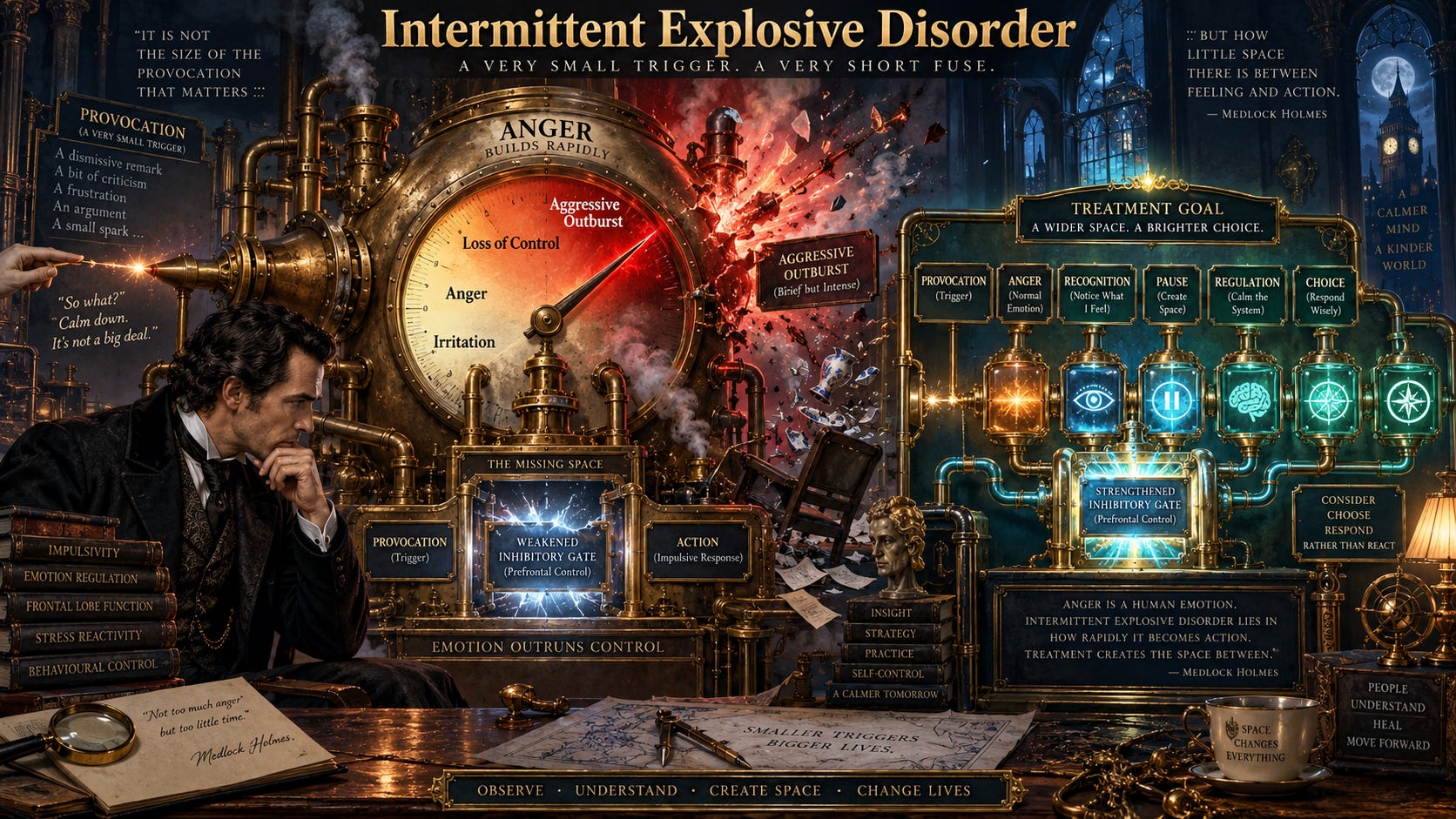 PSYCH 137: Intermittent Explosive Disorder 29.09.2026 40minMedlock Holmes enters an immense Neo-Victorian institution known as The Hall of Impulsive Aggression.At first, the building seems calm.Then a small bell rings.Someone makes a dismissive remark.A door slams.A criticism is heard.A minor disagreement begins.Within seconds, an enormous brass pressure chamber erupts.The explosion is dramatic, but brief.Then silence.The whole event has lasted less than half an hour.Holmes looks around at the damage and immediately notices something important:this was not planned.There was no calculated strategy.No attempt to gain money.No effort to intimidate someone for a specific objective.No long campaign of revenge.Instead, there was a rapid transition:PROVOCATION → ANGER → IMPULSIVE AGGRESSION → CONSEQUENCESThat sequence is the core of intermittent explosive disorder, or IED.The disorder is defined not simply by anger, irritability or aggression, but by recurrent behavioural outbursts representing a failure to control aggressive impulses. These outbursts may take the form of verbal aggression, tantrums, tirades, arguments, physical aggression without injury, or - in more severe episodes - damage to property or assault causing physical injury. The aggression is grossly out of proportion to the provocation, is impulsive or anger-based rather than premeditated, and causes meaningful distress, interpersonal or occupational impairment, or financial or legal consequences.Holmes stops before a large diagnostic board.Two separate pathways are engraved into it.The first describes frequent, lower-severity outbursts:verbal aggression or noninjurious physical aggression occurring on average twice weekly for 3 months.The second describes less frequent but more severe aggression:three episodes within 12 months involving destruction of property or physical assault causing injury.Both routes lead to the same central chamber:FAILURE TO CONTROL IMPULSIVE AGGRESSIONBut Holmes notices the next criterion is just as important.The magnitude of the response must be:GROSSLY OUT OF PROPORTIONto the trigger.A minor provocation cannot simply be used as justification for a major aggressive act.The disorder therefore concerns not merely the presence of aggression, but the relationship between:triggerandresponse.The next room is labelled:IMPULSIVE, NOT INSTRUMENTALHere Holmes sees two contrasting scenes.In one, a person carefully plans an assault to obtain power, money or intimidation.In the other, a person explodes in anger before thinking through the consequences.Only the second resembles the IED pattern.This distinction is fundamental.IED is about:REACTIVE AGGRESSIONrather than:PREMEDITATED OR GOAL-DIRECTED AGGRESSIONHolmes then enters the Differential Diagnosis Gallery, where the investigation becomes more difficult.Aggression is not specific to IED.It can occur in:* disruptive mood dysregulation disorder* antisocial personality disorder* borderline personality disorder* ADHD* conduct disorder* oppositional defiant disorder* autism spectrum disorder* major depressive disorder* substance intoxication or withdrawal* delirium* major neurocognitive disorder* personality change due to another medical condition* traumatic brain injury.The clinician must therefore ask:“Is the aggression itself the disorder, or is it better explained by something else?”That question often determines the diagnosis.Holmes learns that IED should not be diagnosed when aggressive behaviour occurs only in the context of:* intoxication* another mood state* a medical or neurological condition* another psychiatric syndrome that better explains it.At the same time, IED can coexist with conditions such as ADHD, conduct disorder, oppositional defiant disorder or autism spectrum disorder when the impulsive aggression is clearly excessive relative to what would ordinarily be expected from those disorders and warrants independent clinical attention.Age also matters.The diagnosis requires a chronological age of at least:6 YEARSor equivalent developmental level.This prevents normal childhood temper tantrums from being mislabelled as a psychiatric disorder.For young people aged 6–18 years, aggressive behaviour occurring solely as part of an adjustment disorder should not be diagnosed as IED.Holmes studies the epidemiological map.IED is not rare.The chapter describes lifetime prevalence in the United States at approximately:5–8%Onset commonly occurs from adolescence into early adulthood, roughly between:12 AND 21 YEARSand the condition is reported more often in males than females.The next finding surprises Holmes.IED rarely travels alone.Around:81%of individuals with IED meet criteria for at least one additional psychiatric disorder.Common comorbidities include:* substance use disorders* disruptive behaviour disorders* PTSD* antisocial personality disorder* borderline personality disorder* anxiety disorders* major depression.Importantly, IED often begins before these comorbid disorders.Holmes therefore sees aggression not merely as a late complication of another psychiatric illness, but in many people as an early and persistent syndrome in its own right.A separate chamber contains shattered mirrors labelled:SELF-HARMANGER RUMINATIONALEXITHYMIAEMOTION DYSREGULATIONPeople with IED appear to have broad difficulties managing emotional states.They may repeatedly replay anger-provoking experiences.They may struggle to identify and describe emotion clearly.Yet the source also describes an interesting finding:affective empathy may be relatively preserved or even elevated compared with healthy controls.This challenges the simplistic assumption that aggression necessarily reflects an absence of emotional responsiveness.Holmes next enters the Etiology Wing.At its entrance stands a dramatic historical image: a railroad worker whose frontal lobe was penetrated by a metal rod.Before the injury, he had been reliable and socially appropriate.Afterwards, his behaviour became impulsive, profane and poorly regulated.The lesson is not that IED is caused by frontal injury - indeed, when aggression clearly results from a neurological injury, IED should not be diagnosed.The lesson is broader:THE PREFRONTAL CORTEX MATTERS FOR INHIBITING AGGRESSIONThe chapter reviews evidence linking frontal dysfunction, particularly orbitofrontal dysfunction, with increased aggressive behaviour.Functional imaging studies in IED also suggest altered activation in prefrontal systems involved in inhibitory control and anger expression.Holmes therefore imagines aggression as the result of two competing systems:THE IMPULSE TO ACTandTHE CAPACITY TO INHIBITWhen inhibition is weakened, the threshold between feeling anger and acting aggressively becomes dangerously short.But the neurobiology does not end with the frontal cortex.Holmes enters another chamber labelled:SEROTONINHere, multiple lines of evidence converge.Animal studies show that reduced serotonergic function can increase aggression.Human studies have linked lower levels of serotonin metabolites with impulsive aggression and violent suicidal behaviour, although findings are not entirely consistent.Tryptophan depletion experiments - which temporarily reduce serotonin availability - have also been associated with increased aggressive responding.Studies in individuals with IED suggest reduced physiological responsiveness to serotonergic stimulation.The overall model presented is:LOWER SEROTONERGIC FUNCTION → GREATER IMPULSIVE AGGRESSIONnot as a simple one-to-one cause, but as one biological vulnerability.Holmes walks further and finds an unexpected chamber:INFLAMMATIONSome studies have found higher inflammatory cytokines in individuals with IED compared with healthy controls.Epigenetic research has also implicated biological pathways involving:* cytokine signalling* immune regulation* GABAergic neuronal differentiation.These findings remain exploratory, but they broaden the biological picture beyond neurotransmitters alone.Aggression appears to arise from interacting systems of:impulse regulationemotionneurotransmissioninflammationdevelopmentandenvironment.The environmental chamber is darker.On the walls are scenes representing:* childhood maltreatment* physical abuse* neglect* exposure to interpersonal violence* aversive parenting environments.The chapter describes associations between such early experiences and later IED.One study found childhood physical abuse independently associated with IED, with impulsivity and aggression mediating the relationship.Another line of thought suggests possible:GENE × ENVIRONMENT INTERACTIONin which genetic differences affecting serotonergic function may alter vulnerability to impulsive aggression following childhood maltreatment.Holmes is careful not to write:TRAUMA CAUSES IEDInstead he writes:DEVELOPMENTAL ADVERSITY MAY INCREASE VULNERABILITY IN SOME INDIVIDUALSThe model is probabilistic rather than deterministic.Holmes eventually reaches the treatment wing.The first chamber is chaotic.Emergency staff are trying to stop an acutely aggressive person from harming someone.Medication here may be used urgently to reduce immediate danger.But the chapter draws an important distinction.Emergency sedation is not the same as treatment of the disorder.For chronic IED, the goal is not:SEDATE THE PERSONThe goal is:REDUCE IMPULSIVE AGGRESSION WHILE PRESERVING NORMAL FUNCTIONThat principle governs pharmacotherapy.Several medication classes have evidence for reducing impulsive aggression.These include:* SSRIs* lithium* anticonvulsant mood stabilisers* some antipsychotic agents.Holmes first reaches the Serotonin Dispensary.Because reduced serotonergic function is associated with impulsive aggression, SSRIs have been studied directly.Several double-blind trials demonstrate reductions in impulsive aggressive behaviour compared with placebo.However, the response is far from universal.The source notes that fewer than one-third of patients achieved full remission of impulsive aggression in some trials.This is clinically important.Medication may:REDUCE AGGRESSIONwithout necessarily:ELIMINATING THE DISORDERHolmes next reaches the Mood Stabiliser Cabinet.Lithium has historical evidence for reducing aggressive behaviour, including in violent young populations.It may also reduce:* aggression towards others* suicidal behaviour.But the familiar limitations remain:* narrow therapeutic window* nausea* vomiting* polyuria* need for monitoring.Anticonvulsants also feature prominently.Evidence discussed includes:* phenytoin* valproate/divalproex* carbamazepine* topiramate.Valproate appears particularly relevant when impulsivity is prominent.Evidence for carbamazepine is mixed.Topiramate has shown anti-aggressive effects in several studies, though the evidence base is less extensive.Antipsychotics occupy a more complicated position.High-dose antipsychotic medication used simply to sedate chronic aggression is discouraged because of:* poor specificity* adverse effects.Lower-dose newer antipsychotic agents may reduce aggression in some populations independent of their antipsychotic effects, but evidence specifically for IED remains limited.Holmes therefore writes:TREAT THE AGGRESSION, NOT THE PERSON INTO SEDATIONThe psychotherapy chamber is quieter.Here the central treatment is:COGNITIVE BEHAVIOURAL THERAPYEvidence specifically for IED is more limited than for some other disorders, but a randomised trial described in the chapter found that both group and individual CBT reduced:* aggression* anger* hostile thinking* depressive symptomsand improved:* anger control.Benefits remained evident at follow-up.Individual therapy also improved overall quality of life.Holmes studies what CBT is trying to change.The problem is not merely the aggressive act at the end.The clinically important sequence begins earlier:TRIGGER↓INTERPRETATION↓ANGER↓PHYSIOLOGICAL AROUSAL↓IMPULSIVE ACTION↓CONSEQUENCETreatment creates additional points of intervention between these stages.The person learns to recognise:* provocative situations* hostile interpretations* early physiological arousal* anger escalation* urges to act.The therapeutic objective is to increase the time between:ANGERandACTIONEven a small increase in that interval can create an opportunity for choice.Holmes reaches the final chamber.At one end stands a crude old explanation:“HE JUST HAS A BAD TEMPER.”It is crossed out.Beside it:“SHE IS SIMPLY AN AGGRESSIVE PERSON.”also crossed out.The modern formulation is more precise.IED is a disorder in which:anger can rise rapidlybehavioural inhibition can failaggression becomes disproportionatethe act is impulsive rather than calculatedandthe consequences damage the person’s life and the lives of others.Holmes writes one final question on the wall:“What happens in the seconds between provocation and aggression?”Because that short interval is where the disorder lives -and where treatment must increasingly create room for control.Key Takeaways1. Intermittent Explosive Disorder Is a Disorder of Recurrent Impulsive AggressionIED is defined by recurrent aggressive outbursts representing:FAILURE TO CONTROL AGGRESSIVE IMPULSESThe aggression is:* reactive* impulsive* anger-based* disproportionate.2. Aggression Alone Does Not Equal IEDA person may be aggressive for many reasons.IED requires a specific pattern of:IMPULSIVE, NONPREMEDITATED AGGRESSIONthat is not better explained by another condition.3. Outbursts Usually Begin RapidlyThe chapter describes aggressive episodes as having:RAPID ONSETThey are usually:* unplanned* provoked* brief.4. Episodes Typically Last Less Than 30 MinutesThe classic IED outburst is:SHORT-LIVED BUT INTENSEThis differs from prolonged patterns of organised aggression.5. Provocation Is Often InterpersonalOutbursts frequently occur in response to provocation by:A KNOWN PERSONsuch as:* partner* family member* colleague.6. The Response Is Grossly Out of ProportionThis is diagnostically central.TRIGGER ≠ SCALE OF RESPONSEA relatively minor provocation produces a dramatically excessive aggressive reaction.7. The Aggression Is Not PremeditatedIED aggression is:IMPULSIVE OR ANGER-BASEDIt is not carefully planned.8. The Aggression Is Not InstrumentalThe behaviour is not committed primarily to achieve:* money* power* intimidation* another tangible goal.Goal-directed aggression suggests a different formulation.9. DSM-5-TR Recognises Two Frequency PatternsPattern AVerbal aggression or noninjurious physical aggression:~2 TIMES PER WEEK FOR 3 MONTHSPattern BMore severe outbursts involving:* property destruction* physical injuryoccurring:3 TIMES WITHIN 12 MONTHS10. Verbal Aggression CountsUnlike earlier diagnostic approaches, DSM-5-TR recognises:* tantrums* tirades* verbal arguments* verbal fightsas potentially meeting criteria.Physical injury is not required for every presentation.11. Noninjurious Physical Aggression Can Also CountExamples include aggression towards:* property* animals* other peoplewithout causing:* damage* destruction* injury.12. More Severe Episodes Can Involve Injury or Property DestructionThe second diagnostic pathway includes episodes involving:DAMAGE OR PHYSICAL ASSAULTwith injury.13. Functional Consequences Are RequiredThe outbursts must cause:* marked distress* interpersonal impairment* occupational impairment* financial consequences* legal consequences.14. Minimum Age Is SixDiagnosis requires:AGE ≥6 YEARSor equivalent developmental level.This helps distinguish the syndrome from normal childhood tantrums.15. Adjustment Disorder Is an Important Exclusion in Young PeopleFor ages:6–18 YEARSaggression occurring as part of an adjustment disorder should not be diagnosed as IED.16. Differential Diagnosis Is EssentialAggression may occur in:* disruptive mood dysregulation disorder* ASPD* borderline personality disorder* ADHD* conduct disorder* oppositional defiant disorder* autism spectrum disorder* major depression* intoxication* withdrawal* delirium* neurocognitive disorder* neurological disease.17. Ask Whether Aggression Is Primarily ImpulsiveA clinically useful distinction is:IMPULSIVE AGGRESSIONversusCALCULATED AGGRESSIONIED strongly favours the first.18. Secondary Gain Argues Against IEDIf aggression is consistently used for:* intimidation* gain* coercion* strategic control,consider another explanation.19. Aggression Should Not Occur Only During a Mood EpisodeIf aggressive behaviour is confined to:* mania* depression* another mood state,IED may not be the appropriate diagnosis.20. Aggression Should Not Occur Only During IntoxicationAlways ask about:* alcohol* stimulants* other substances* withdrawal.Substance-related aggression should not be mislabelled as IED.21. IED Can Coexist With ADHD, Conduct Disorder, ODD or AutismDSM-5-TR allows an additional diagnosis of IED when aggression is:CLEARLY IN EXCESSof what would normally be expected in the coexisting condition.22. IED Is Relatively CommonLifetime prevalence in the United States is described as approximately:5–8%23. Onset Is Usually EarlyTypical onset is:ADOLESCENCE TO EARLY ADULTHOODapproximately:12–21 YEARS24. IED Is More Commonly Diagnosed in MalesThe chapter describes higher rates in:MALESthan females.25. Psychiatric Comorbidity Is the Rule Rather Than the ExceptionApproximately:81%of people with IED have at least one other psychiatric diagnosis.26. Common ComorbiditiesThese include:* substance use disorders* disruptive behaviour disorders* PTSD* ASPD* borderline personality disorder* anxiety disorders* major depression.27. IED Often Begins Before Comorbid DisordersThe chapter notes that IED frequently has:EARLIER ONSETthan associated psychiatric conditions.28. Comorbidity May Increase Aggression SeverityAggression scores tend to be higher among individuals with:IED + ANOTHER DISORDERthan among those with either condition alone.29. Self-Harm Risk Is IncreasedIndividuals with IED show increased engagement in:SELF-HARM BEHAVIOURSThis should be included in risk assessment.30. Emotion Regulation Is Often ImpairedAssociated features include:* poor emotion regulation* anger rumination* alexithymia.The disorder is therefore not merely a behavioural problem.31. Anger Rumination Can Maintain AggressionRepeatedly replaying provocative experiences can prolong:* anger* physiological arousal* hostile interpretation.32. Alexithymia May ContributeDifficulty identifying and describing internal emotion may make it harder to regulate anger before it becomes behaviour.33. Empathy Is Not Necessarily AbsentThe chapter describes findings of:HIGHER AFFECTIVE EMPATHYin some IED groups compared with healthy controls.Aggression should therefore not automatically be interpreted as emotional coldness.Neurobiology34. Prefrontal Control Is CentralThe prefrontal cortex contributes to:* behavioural inhibition* judgement* impulse regulation* response suppression.Reduced control can increase vulnerability to impulsive aggression.35. Orbitofrontal Dysfunction Is Particularly RelevantThe literature reviewed links:ORBITOFRONTAL INJURYwith increased aggressive behaviour.36. The Phineas Gage Case Illustrates the PrincipleAfter severe frontal injury, profound changes in:* impulse control* social behaviour* restraintwere observed.The case demonstrates how frontal circuitry can influence personality and aggression.37. Frontal Injury Does Not Automatically Mean IEDIf aggression is clearly caused by:A MEDICAL OR NEUROLOGICAL CONDITIONthen another diagnosis is more appropriate.38. Brain Injury History Can Complicate DiagnosisAggressive individuals may have previous head trauma for many reasons.The clinician must establish whether:AGGRESSION CHANGED AFTER THE INJURYrather than assuming causation.39. Functional Imaging Suggests Prefrontal AbnormalitiesfMRI studies in IED have identified altered activation during tasks involving inhibitory control.This may reflect abnormal regulation of anger expression.40. Serotonin Is the Best-Studied Neurotransmitter in Impulsive AggressionThe largest biological evidence base supports involvement of:5-HT / SEROTONIN41. Reduced Serotonergic Function Is Associated With Greater AggressionAcross several lines of research:5-HT ↓ → IMPULSIVE AGGRESSION ↑This remains a probabilistic association rather than a diagnostic biomarker.42. Animal Studies Support This RelationshipAggression increases after experimental manipulations that reduce serotonergic function.Examples include:* tryptophan reduction* dorsal raphe lesions* serotonin gene manipulations.43. Human Studies Also Support the AssociationLower levels of serotonin metabolites have been linked with:* impulsive aggression* violent suicide attempts.Not all studies replicate this finding.44. Tryptophan Depletion Can Increase AggressionReducing availability of the serotonin precursor:TRYPTOPHANcan reduce central serotonin synthesis and increase aggressive responding in experimental paradigms.45. Serotonergic Response May Be Reduced in IEDPhysiological responses to serotonergic stimulation have been reported as lower in individuals with greater aggression.46. Serotonin Receptors May Be InvolvedThe chapter discusses possible abnormalities involving:5-HT2A / 5-HT2Cpostsynaptic receptor systems.47. Serotonin Transporter Findings Also Support the ModelLower platelet serotonin transporter levels have been associated with greater aggression in IED.48. Inflammation May Also Be RelevantStudies report elevated:INFLAMMATORY CYTOKINESin some individuals with IED.49. Epigenetic Findings Suggest Immune-System InvolvementResearch has identified altered methylation involving pathways related to:* cytokine signalling* interleukin pathways* GABAergic neuronal differentiation.These findings remain preliminary.Developmental and Environmental Factors50. Childhood Exposure to Violence Is Associated With IEDPotential risk factors include:* violence* maltreatment* neglect* aversive parenting.51. Childhood Physical Abuse Has Been Independently Associated With IEDThe relationship appears partly mediated through:IMPULSIVITY + AGGRESSION52. Interpersonal Trauma May Increase VulnerabilityIED has been associated with childhood exposure to:INTERPERSONAL TRAUMATIC EVENTS53. Gene–Environment Interaction Is PlausibleThe chapter proposes that genetic differences affecting serotonergic systems may modify vulnerability following childhood maltreatment.This remains a hypothesis rather than an established diagnostic mechanism.Treatment54. Acute Aggression and Chronic IED Are Different Treatment ProblemsIn an emergency:IMMEDIATE SAFETYmay require rapid pharmacological intervention.For chronic IED:LONG-TERM FUNCTIONAL TREATMENTis required.55. Sedation Is Not the Long-Term GoalThe chapter explicitly rejects:CHRONIC SEDATION AS TREATMENTThe objective is to reduce aggression without suppressing normal behaviour.56. Medication Classes With Evidence Include* SSRIs* lithium* anticonvulsants* some antipsychotic agents.57. SSRIs Are ImportantSeveral double-blind trials show reductions in:IMPULSIVE AGGRESSIONwith SSRIs compared with placebo.58. Full Remission With SSRIs Is Not UniversalThe chapter notes that:
 -
 PSYCH 136: Sleep Disorders 28.09.2026 52minSleep disorders arise when the mechanisms controlling sleep quantity, timing, breathing, movement, arousal or dream-state boundaries become disrupted - and the consequences can range from chronic distress to accidents, cardiovascular disease and major functional impairment.Medlock Holmes enters an immense Neo-Victorian institution called The Grand Observatory of Sleep and Wakefulness.At first glance, the building appears quiet.But Holmes quickly realises that nothing is truly inactive.Behind the walls, electrical signals rise and fall.Eyes move beneath closed lids.Muscles alternate between tone and near-paralysis.Breathing changes.Body temperature cycles.Hormones oscillate.The brain repeatedly travels through distinct states of consciousness.Above the entrance is engraved:“Sleep is not one state. Sleep is a sequence of states.”The chapter begins with three fundamental principles.First:SLEEP IS REQUIRED FOR NORMAL BRAIN FUNCTION.Sleep deprivation impairs:* attention* memory* reasoning* mood regulation* physiological function.Second:SLEEP IS NOT A SINGLE PROCESS.Different forms of sleep have distinct:* physiology* functions* neural regulation.Deprivation of a particular sleep stage may produce selective rebound when sleep is later permitted.Third:SLEEP IS ACTIVE.Certain sleep states involve substantial cerebral activation and metabolism rather than global neural shutdown.Holmes enters the Classification Hall.Three enormous books stand open:DSM-5-TRICSD-3ICDEach classifies sleep disorders somewhat differently.The most detailed map comes from the International Classification of Sleep Disorders, which divides the field into major families:INSOMNIASLEEP-RELATED BREATHING DISORDERSCENTRAL DISORDERS OF HYPERSOMNOLENCECIRCADIAN RHYTHM SLEEP–WAKE DISORDERSPARASOMNIASSLEEP-RELATED MOVEMENT DISORDERSHolmes begins with the chamber most familiar to psychiatry:INSOMNIAThe old model says:“Find the psychiatric disorder causing the insomnia and treat that.”The modern model is different.Insomnia can become an independent disorder, even when originally triggered by:* depression* anxiety* pain* environmental disruption* another medical illness.The precipitating factor may disappear while insomnia remains.A bedroom becomes conditioned with:frustrationclock-watchingeffortfear of not sleepingThe bed itself becomes a cue for arousal.Holmes sees the paradox:THE HARDER THE PERSON TRIES TO SLEEP, THE MORE AWAKE THEY BECOME.Psychophysiological insomnia therefore resembles performance anxiety.The person may lie awake in their own bed but fall asleep unexpectedly while watching television or sleep better in an unfamiliar hotel room.Another chamber is labelled:PARADOXICAL INSOMNIAHere subjective and objective sleep diverge.A person insists:“I did not sleep at all.”Yet polysomnography shows:* normal sleep onset* few awakenings* high sleep efficiency* several hours of sleep.The chapter warns clinicians not to dismiss this as fabrication.Sleep-state perception and electrophysiological sleep can genuinely become dissociated.Holmes then reaches the treatment wing.The first-line treatment is not medication.It is:CBT-I - COGNITIVE BEHAVIOURAL THERAPY FOR INSOMNIAIts components include:sleep hygienestimulus controlsleep restrictionrelaxationcognitive therapyparadoxical intentionThe central goal is to reverse the conditioning that has linked:BED → WAKEFULNESSand restore:BED → SLEEPStimulus control therefore instructs the patient to:* go to bed only when sleepy* use the bed principally for sleep* leave the bed when unable to sleep* return only when sleepy* arise at the same time each morning* avoid daytime naps.Sleep restriction performs another apparently paradoxical manoeuvre.A person spending eight hours in bed but sleeping only five hours may initially have their time in bed reduced.Why?Because:TIME IN BED ≠ TIME ASLEEPCompressing the sleep opportunity increases homeostatic sleep drive and improves sleep efficiency.Holmes then enters a completely different wing:HYPERSOMNOLENCEHere the problem is not inability to sleep.It is inability to remain adequately awake.Patients may:* sleep for nine or more hours and remain unrefreshed* repeatedly fall asleep during the day* struggle with severe sleep inertia.The consequences can include:* school failure* occupational impairment* motor vehicle accidents* industrial disasters.Then Holmes encounters one of sleep medicine’s most distinctive disorders:NARCOLEPSYHistorically it was associated with a tetrad:EXCESSIVE DAYTIME SLEEPINESSCATAPLEXYSLEEP PARALYSISHYPNAGOGIC HALLUCINATIONSThe deeper discovery, however, involves:HYPOCRETIN / OREXINLoss of hypocretin-producing neurons is strongly associated with narcolepsy with cataplexy and may involve autoimmune mechanisms.Cataplexy itself is remarkable.A person laughs.Suddenly their knees buckle.Their jaw drops.Their body becomes weak.Yet consciousness remains intact.Holmes realises that cataplexy resembles:REM SLEEP MUSCLE ATONIA INTRUDING INTO WAKEFULNESS.Narcolepsy is therefore partly a disorder of state boundaries.The sleep laboratory provides another clue:SLEEP-ONSET REM PERIODSREM sleep appears abnormally soon after sleep begins.The tracing on page 29 visually demonstrates this: normal sleep moves gradually away from wakefulness, while the narcolepsy tracing suddenly develops rapid eye movements with abrupt loss of muscle tone within seconds.Holmes then enters the Breathing Observatory.Three machines reveal three different forms of apnoea.OBSTRUCTIVEAirflow stops.Respiratory effort continues.The airway has collapsed.CENTRALAirflow stops.Respiratory effort also stops.The brain’s ventilatory drive has diminished.MIXEDThe event begins centrally and ends obstructively.The polysomnographic figure on page 34 makes the distinction visually clear: chest and abdominal movement continue during obstructive apnoea but disappear during central apnoea.Obstructive sleep apnoea becomes one of the chapter’s most important medical disorders.Repeated airway collapse causes:* arousal* oxygen desaturation* sleep fragmentation.It is associated with:* hypertension* obesity* diabetes* cardiovascular disease* stroke* heart failure* cognitive dysfunction* psychiatric symptoms.The standard treatment is:POSITIVE AIRWAY PRESSURECPAP acts like a:PNEUMATIC SPLINTholding the airway open throughout sleep.The chapter’s sleep histogram on page 38 shows the dramatic effect: a severely fragmented night with almost absent REM and slow-wave sleep transforms under CPAP into consolidated sleep with major rebound of both states.Holmes now turns from sleep quantity to sleep timing.The next hall contains an enormous biological clock centred in the:SUPRACHIASMATIC NUCLEUSThe problem here is not insufficient sleep machinery.It is:MISALIGNMENTbetween the internal clock and the required external schedule.The resulting disorders include:DELAYED SLEEP–WAKE PHASEADVANCED SLEEP–WAKE PHASEIRREGULAR SLEEP–WAKE RHYTHMNON-24-HOUR SLEEP–WAKE RHYTHMSHIFT WORK DISORDERand, in the ICSD:JET LAGA delayed sleeper may be labelled lazy because they cannot wake early.Yet if allowed to sleep according to their own biological timing, they may sleep normally.An advanced sleeper becomes sleepy early in the evening and awakens before dawn.A non-24-hour rhythm progressively drifts because the internal clock is not being adequately reset to the 24-hour environment.The most powerful zeitgeber is:LIGHTTiming matters enormously.Morning bright light can phase advance a delayed rhythm.Evening bright light can phase delay an advanced rhythm.Melatonin represents a biological signal of darkness and may also shift circadian timing when used correctly.Then Holmes enters perhaps the strangest hall of all:THE PARASOMNIA GALLERYHere states overlap.Wakefulness.NREM sleep.REM sleep.Normally their boundaries remain distinct.But parasomnias violate those boundaries.A sleepwalker demonstrates:WAKE-LIKE BEHAVIOUR WITHIN NREM SLEEPA person with sleep paralysis experiences:REM ATONIA PERSISTING INTO WAKEFULNESSA person with REM sleep behaviour disorder demonstrates:REM DREAMING WITHOUT THE NORMAL PARALYSISand therefore literally acts out dreams.Holmes sees a man punch, kick and leap from bed while dreaming he is fighting an attacker.This is not ordinary sleepwalking.In REM sleep behaviour disorder, the behaviour follows the dream world rather than the bedroom environment.Bed partners may sustain serious injuries.Holmes also examines:sleep terrorsnightmaresconfusional arousalssleep-related eatingsleep paralysisexploding head syndromesleep-related hallucinationsenuresisNightmares and sleep terrors provide an especially useful distinction.NIGHTMAREUsually REM sleep.Complex frightening dream.The person awakens and remembers it.SLEEP TERRORUsually deep NREM sleep.Screaming.Autonomic activation.Confusion.Minimal dream recall.Amnesia afterwards.Another chamber concerns movement.A patient says:“When I lie down, there is this crawling feeling in my legs. I have to move them.”The pattern is:REST → URGE → MOVEMENT → RELIEFand:WORSE AT NIGHTThis is:RESTLESS LEGS SYNDROMEThe diagnostic table on page 55 reinforces these four central features, together with persistence, distress and exclusion of mimics.Iron deficiency and renal disease can contribute.Therefore ferritin belongs in the investigation.Periodic limb movement disorder is different.The legs produce repetitive stereotyped movements during sleep, often every 20–40 seconds, sometimes generating micro-arousals.Other movement disorders include:* nocturnal leg cramps* bruxism* rhythmic movement disorder* sleep myoclonus.Finally, Holmes enters the Sleep Investigation Laboratory.No single test answers every question.The first instrument is still:THE CLINICAL INTERVIEWAsk:* bedtime* wake time* weekday/weekend variation* naps* caffeine* alcohol* snoring* witnessed apnoea* gasping* leg sensations* movements* nightmares* dream enactment* sleepwalking* morning headaches* nocturia* daytime sleepiness* medication use.Then come objective tools.POLYSOMNOGRAPHYrecords:* EEG* eye movements* muscle activity* airflow* respiratory effort* oxygen saturation* ECG* limb movement.HOME SLEEP APNOEA TESTINGis useful for suspected moderate-to-severe obstructive sleep apnoea but is less comprehensive.MULTIPLE SLEEP LATENCY TESTmeasures physiological sleepiness and searches for sleep-onset REM periods.MAINTENANCE OF WAKEFULNESS TESTasks whether someone can remain awake - useful when alertness has safety implications.ACTIGRAPHYtracks activity over days or weeks and helps define circadian patterns.SLEEP DIARIESprovide something even simpler:a longitudinal picture of what the patient actually does.The chapter ends with a principle that unites psychiatry, neurology, respiratory medicine, cardiology and behavioural science:“Sleep disorders are not simply night-time problems.”They alter:MOODCOGNITIONHEALTHSAFETYRELATIONSHIPSWORKQUALITY OF LIFEHolmes leaves the observatory as the first light of morning enters through the glass dome.Above him is one final inscription:“To understand the waking person, investigate the sleeping brain.”Key Takeaways1. Sleep Is an Active Biological ProcessSleep is not simply:THE ABSENCE OF WAKEFULNESSThe sleeping brain remains physiologically active and moves repeatedly through distinct states.2. Sleep Is Necessary for Normal FunctionSleep deprivation can impair:* attention* concentration* memory* decision-making* mood regulation* physiological function.3. Different Sleep States Have Different FunctionsDistinct sleep stages differ in:* EEG pattern* muscle tone* eye movement* autonomic activity* brain activation* regulation.Selective deprivation can produce:STAGE-SPECIFIC REBOUND4. Three Major Classification SystemsSleep disorders can be classified through:DSM-5-TRICSD-3ICDICSD-3 is the most detailed sleep-specific classification.5. Major ICSD-3 FamiliesThese include:* Insomnia* Sleep-related breathing disorders* Central disorders of hypersomnolence* Circadian rhythm sleep–wake disorders* Parasomnias* Sleep-related movement disorders* Other sleep disorders6. Insomnia Is Now Considered a Disorder in Its Own RightHistorically, insomnia was often treated simply as a symptom of:* depression* anxiety* pain* medical illness.Modern classification recognises that insomnia can persist independently and warrants specific treatment.7. “Secondary Insomnia” Has Largely Become “Comorbid Insomnia”The principle is:TREAT BOTH CONDITIONSrather than assuming insomnia will automatically resolve when another disorder improves.8. Core Insomnia SymptomsOne or more of:DIFFICULTY INITIATING SLEEPDIFFICULTY MAINTAINING SLEEPEARLY-MORNING AWAKENINGwith inability to return to sleep.9. Adequate Opportunity for Sleep Is EssentialInsomnia cannot be diagnosed simply because someone sleeps too little.The difficulty must occur despite:ADEQUATE OPPORTUNITY TO SLEEPOtherwise consider insufficient sleep.10. Frequency and DurationDSM-5-TR chronic insomnia typically requires symptoms:≥3 NIGHTS PER WEEKfor:≥3 MONTHSwith distress or impairment.11. Insomnia Must Affect Daytime FunctioningConsequences may include:* fatigue* impaired concentration* memory difficulty* mood disturbance* irritability* low motivation* increased errors* accident risk.12. Psychophysiological InsomniaThe central mechanism is:CONDITIONED AROUSAL AROUND SLEEPThe bed and bedroom become cues for:* worry* muscle tension* rumination* frustration.13. Trying Too Hard to Sleep Can Maintain InsomniaThe person develops:SLEEP PERFORMANCE ANXIETYThe effort to force sleep increases arousal and therefore delays sleep.14. Typical Clues to Psychophysiological InsomniaPatients may:* sleep better away from home* fall asleep when not trying* remain awake when deliberately trying to sleep* worry excessively about sleep.15. Idiopathic InsomniaThe chapter describes a lifelong pattern beginning early and persisting independently of other causes.A dysfunction of sleep homeostasis is proposed.16. Paradoxical InsomniaThe patient experiences severe subjective insomnia despite relatively normal objective sleep.The central phenomenon is:SLEEP-STATE MISPERCEPTION17. Do Not Dismiss Paradoxical Insomnia as FabricationPatients may genuinely experience themselves as awake despite electrophysiological evidence of sleep.Invalidating this experience can damage the therapeutic relationship.18. Mental Activity Can Continue During SleepPeople may mistakenly equate:NO MEMORYwith:NO MENTAL ACTIVITYThe chapter emphasises that cognition and mentation can continue during sleep.19. Sleep Hygiene Matters - But Is Not Usually Sufficient AloneThe sleep hygiene table on page 12 recommends:* regular bedtime/wake time* regular exercise* wind-down time* cool, dark, quiet bedroom.It discourages:* naps* clock-watching* caffeine late in the day* alcohol as a sleep aid* television or eating in bed.20. Behavioural Insomnia of ChildhoodCommon mechanisms include:Sleep-Onset AssociationThe child requires:* a parent* particular object* particular settingto sleep.Limit-Setting ProblemsBedtime refusal or repeated stalling occurs when boundaries are inconsistently enforced.21. Caregiver Education Can Be TreatmentChildren may repeatedly request:* water* food* another story* bathroom trips.Consistent bedtime boundaries can resolve the problem.22. Insomnia and Depression Are Strongly LinkedThe chapter reports insomnia in approximately:90% OF PEOPLE WITH MAJOR DEPRESSIONand identifies insomnia as a future risk marker for depression.23. Insomnia Is Relevant to Suicide RiskInsomnia is described as an independent risk factor for suicide among patients with major depression.Sleep assessment therefore belongs in psychiatric risk assessment.24. Depression Alters Sleep ArchitectureTypical findings described include:* increased sleep latency* more awakenings* early-morning awakening* reduced early-night slow-wave sleep* shortened REM latency* increased early REM density.The histogram on page 13 demonstrates disrupted late-night sleep and markedly shortened REM latency in depression.25. Treating Insomnia Can Help DepressionThe chapter discusses evidence that targeted insomnia treatment alongside antidepressant therapy may improve both:SLEEPandMOOD26. Bipolar Disorder and Sleep Are Bidirectionally RelatedManic or hypomanic patients may sleep:2–4 HOURSwithout feeling tired.Disrupting the sleep–wake routine may itself precipitate mania in vulnerable individuals.27. Schizophrenia Can Involve Sleep-State MisperceptionSome patients report not sleeping despite apparently normal EEG-defined sleep.28. Pain and Insomnia Form a Vicious CyclePAIN → POOR SLEEPand:POOR SLEEP → LOWER PAIN THRESHOLDTreatment may need to address both simultaneously.29. Many Medications Can Cause InsomniaExamples described include:* some antidepressants* corticosteroids* decongestants* stimulants* antiparkinsonian drugs* some antiepileptics.30. Alcohol Is a Poor Sleep TreatmentAlcohol may:REDUCE SLEEP LATENCYinitially.But later it:* fragments sleep* produces tolerance* creates rebound insomnia during withdrawal.31. Caffeine Can Significantly Affect SleepCaffeine:* increases sleep latency* decreases sleep efficiency* reduces total sleep time.The chapter gives a half-life of approximately:3–7 HOURS32. Short Sleeper Is Not InsomniaSome people naturally require:
 -
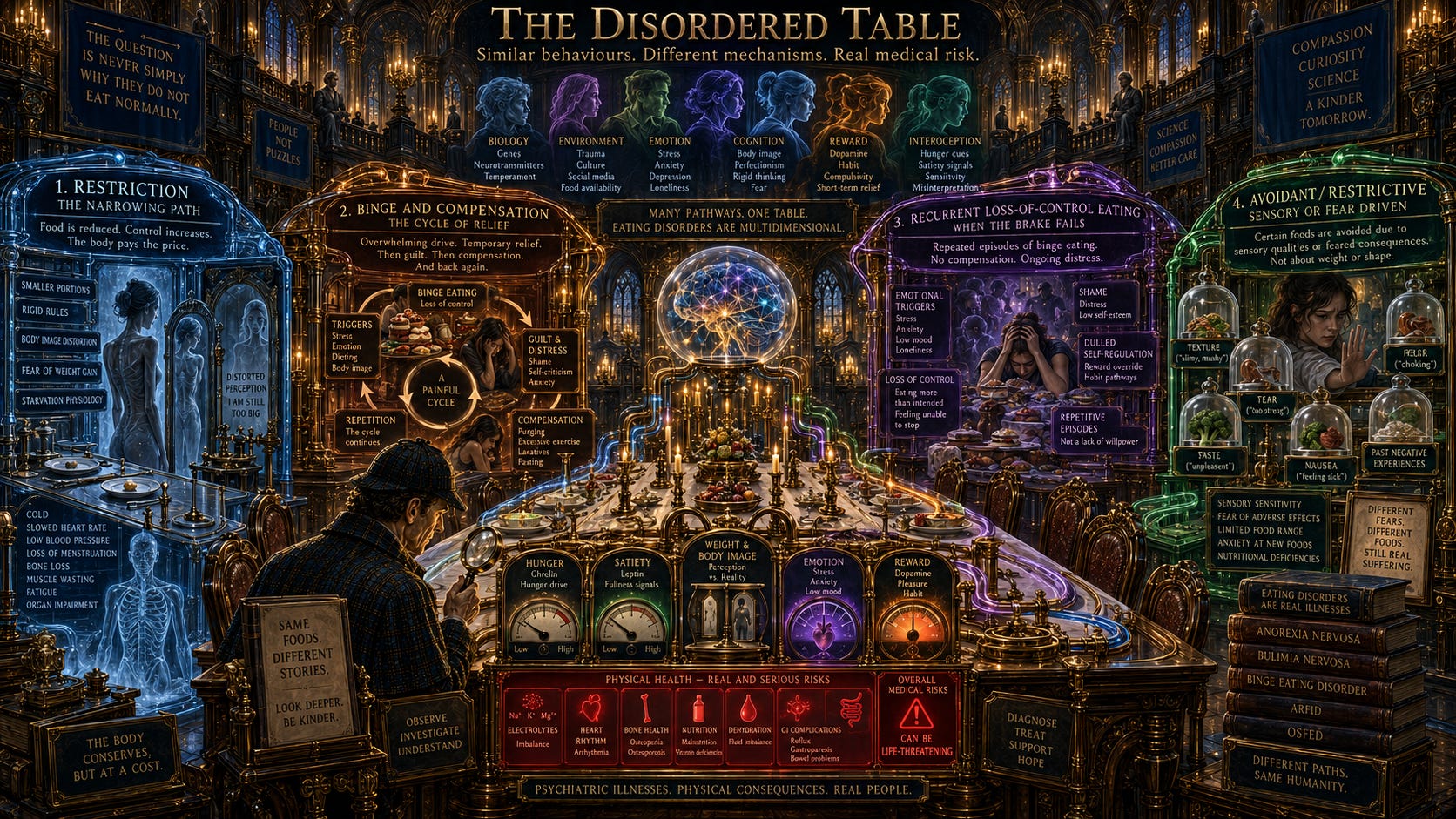 PSYCH 135: Feeding and Eating Disorders 27.09.2026 56minhealth become entangled - sometimes producing profound malnutrition, dangerous compensatory behaviours, loss of control over eating, nutritional deficiency, medical instability and substantial psychosocial impairment.Medlock Holmes enters an immense Neo-Victorian institution called The House of Eating, Weight and Regulation.At first, the building appears deceptively ordinary.At its centre is a vast dining hall.Food arrives.People eat.Bodies regulate energy.Meals connect families.Hunger rises and falls.But surrounding the hall are six corridors in which this ordinary process has become profoundly disrupted.One corridor grows progressively narrower.Another alternates between enormous banquets and hidden compensatory mechanisms.Another contains uncontrolled episodes of eating without compensation.Another is filled with untouched foods rejected because of their texture, smell or feared consequences.Another contains objects that were never meant to be eaten.And in the final corridor, recently swallowed food repeatedly returns.The doors are labelled:ANOREXIA NERVOSABULIMIA NERVOSABINGE EATING DISORDERAVOIDANT/RESTRICTIVE FOOD INTAKE DISORDERPICARUMINATION DISORDERHolmes quickly discovers that although these conditions share a diagnostic neighbourhood, they are not variations of a single illness.They differ in:* motivation* eating behaviour* weight* cognition* medical consequences* developmental course* prognosis* treatment.Yet all can profoundly interfere with life and, in some cases, become medically dangerous.The first chamber belongs to anorexia nervosa.The room contains mirrors that enlarge the body even as the person standing before them becomes increasingly emaciated.Food portions shrink.Rules multiply.Exercise becomes compulsive.Weight and shape gradually consume the person’s entire system of self-evaluation.But Holmes learns that the defining feature is not simply thinness.Three elements interact:significantly low body weightpersistent restriction or behaviour preventing weight gainanddisturbance in the experience or importance of weight and shape.Fear of weight gain is common, but some individuals - particularly children or people from different cultural contexts - may not articulate that fear clearly. Persistent behaviour that prevents weight restoration can still reveal the disorder.Holmes then enters the Starvation Engine.Here lies one of the chapter’s most important insights:THE ILLNESS CHANGES THE BODY - AND THE CHANGED BODY CAN THEN MAINTAIN THE ILLNESS.As starvation progresses:* mood worsens* obsessionality increases* cognition becomes less flexible* gastrointestinal function slows* endocrine systems suppress reproduction* cardiovascular function slows* bone health deteriorates.What began as deliberate restriction can therefore become increasingly self-sustaining.The next chamber contains a circular mechanism:RESTRICTION → BINGE → PURGE → RENEWED RESTRICTIONThis is bulimia nervosa.The central event is the binge.But Holmes discovers that “binge” has a specific meaning.Under DSM-5-TR, it requires both:an objectively unusually large amount of foodanda subjective sense of loss of control.The chapter’s assessment table on page 13 therefore instructs the clinician to reconstruct the episode carefully:What exactly was eaten?How much?Over how long?Was the person alone?What was the context?Could they have stopped?The final question may be the most revealing:“DID YOU FEEL IN CONTROL?”After the binge comes compensation:* self-induced vomiting* laxatives* diuretics* fasting* excessive exercise* enemas* medication misuse.But compensation strengthens rather than solves the problem.It permits renewed restriction.Restriction increases vulnerability to another binge.The cycle closes.Holmes then reaches binge eating disorder.The binge is again present.Loss of control is again central.But the compensatory mechanism is missing.There is no regular purging, fasting or other inappropriate compensation after the episode.Instead, Holmes finds additional behavioural clues:* eating rapidly* eating until painfully full* eating when not physically hungry* eating alone because of embarrassment* guilt, disgust or depression afterwards.The next chamber looks superficially similar to anorexia nervosa.Food is restricted.Weight may fall.Nutritional deficiency may become severe.But the mirror is absent.This is ARFID.The person may desperately want to gain weight.They may simply be unable to eat adequately because of:sensory aversionlack of interest in eatingorfear of an aversive consequence such as choking or vomiting.The key diagnostic distinction is therefore:WHY IS THE PERSON NOT EATING?If the answer is weight or shape, think anorexia nervosa.If the answer is texture, sensory disgust, lack of appetite or feared consequences, ARFID becomes more likely.The final feeding-disorder chambers are pica and rumination disorder.Pica involves persistent consumption of nonfood, nonnutritive substances when developmentally inappropriate and not culturally sanctioned.Rumination disorder involves repeated regurgitation of recently consumed food, which may then be rechewed, reswallowed or expelled.Holmes notices that classification alone is only half the investigation.The next enormous hall is labelled:MEDICAL CONSEQUENCESHere psychiatry and internal medicine become inseparable.A patient may look calm while carrying:* hypokalaemia* hyponatraemia* hypophosphataemia* dehydration* cardiac arrhythmia* QT prolongation* bradycardia* hypotension* endocrine suppression* reduced bone mineral density.The chapter repeatedly warns that laboratory tests can even remain normal despite severe illness.Therefore:NORMAL BLOOD TESTS DO NOT PROVE THAT AN EATING DISORDER IS MEDICALLY SAFE.For anorexia nervosa, Holmes finds an entire body shifting into energy conservation.Heart rate falls.Blood pressure falls.Body temperature falls.Reproductive hormones fall.Thyroid physiology changes.Brain volume decreases.Bone mineral density declines.Many abnormalities improve with nutritional rehabilitation.Bone loss may not fully recover.For bulimia nervosa, the danger lies particularly in the compensatory behaviours.Vomiting can produce:HYPOKALAEMIA → ARRHYTHMIAand:HYPOCHLOREMAEMIA + METABOLIC ALKALOSISRepeated vomiting may enlarge salivary glands, elevate serum amylase and erode dental enamel.Water loading can produce dangerous hyponatraemia.Holmes reaches the treatment wing and finds the hierarchy surprisingly clear.Before complicated psychological interpretation comes a simpler imperative:RESTORE SAFE EATING AND MEDICAL STABILITY.For anorexia nervosa:nutrition is treatment.Weight restoration is not merely correction of a laboratory abnormality.It can improve:* cognition* mood* anxiety* obsessionality* gastrointestinal function* endocrine function.But refeeding carries its own danger.A severely malnourished person suddenly given substantially more nutrition may develop:REFEEDING SYNDROMEThe warning board lists:HYPOPHOSPHATAEMIAHYPOKALAEMIAHYPOMAGNESAEMIATHIAMINE DEFICIENCYDYSRHYTHMIAOEDEMARESPIRATORY DIFFICULTYNutritional rehabilitation therefore requires medical monitoring.Holmes then discovers that treatment differs by diagnosis.For adolescents with anorexia nervosa, the strongest evidence supports family-based treatment, where parents temporarily take responsibility for refeeding their child before gradually returning control as recovery progresses.For adults with anorexia nervosa, no single psychotherapy clearly dominates.CBT, interpersonal approaches, habit-focused interventions, acceptance-based approaches and focal psychodynamic therapy may all contribute.Medication plays a surprisingly limited role.SSRIs do not reliably restore weight or improve core anorexia nervosa pathology in underweight patients.Olanzapine may produce modest additional weight gain, but does not appear to resolve the psychological syndrome itself.Bulimia nervosa tells a different story.Here:CBT IS THE PSYCHOTHERAPY OF CHOICEand medication has a clearer role.Fluoxetine is the best-studied pharmacological treatment, with 60 mg/day showing greater efficacy against binge eating and purging than standard antidepressant doses.One medication receives a conspicuous red warning:BUPROPION - CONTRAINDICATED IN BULIMIA NERVOSAbecause of seizure risk in individuals who purge.For binge eating disorder, CBT again has strong evidence for reducing binge eating.But Holmes discovers another important distinction:STOPPING BINGES DOES NOT NECESSARILY PRODUCE WEIGHT LOSS.Psychological treatment of binge eating and medical management of obesity may therefore require related but distinct strategies.ARFID, pica and rumination disorder have a much thinner evidence library.CBT appears promising for ARFID, while behavioural strategies are commonly adapted for pica and rumination disorder.Holmes finally arrives at the central control room.Above it is written:PREDISPOSING↓PRECIPITATING↓PERPETUATINGGenetic vulnerability.Personality.Puberty.Body dissatisfaction.Dieting.Stress.Social reinforcement.Starvation.Habit.Restriction.Binge eating.Purging.Each illness has a different pathway, but once established, the behaviour itself may help maintain the disease.Holmes closes the investigation with one final principle:“Do not ask only what the person eats.”Ask:“Why are they eating this way, what is maintaining it, and what is it doing to their body?”Because in feeding and eating disorders:behaviourcognitionemotiondevelopmentandphysiologycannot be separated.Key Takeaways1. Feeding and Eating Disorders Are Behavioural and Medical IllnessesThey are characterised by persistent disturbances in:FEEDING OR EATING BEHAVIOURthat cause significant:* physical consequences* nutritional disturbance* psychosocial impairment* distress.They are psychiatric illnesses with potentially serious medical consequences.2. The Six Principal DSM-5-TR DisordersThe chapter describes:* Anorexia nervosa* Bulimia nervosa* Binge eating disorder* Avoidant/restrictive food intake disorder* Pica* Rumination disorderThere are also:OSFEDandUSFED.3. Feeding and Eating Disorders Were Unified in DSM-5Earlier DSM classifications separated:feeding disorders of childhoodfromeating disorders.DSM-5 placed them together because conditions such as:* ARFID* pica* rumination disordercan occur across the lifespan.4. OSFEDOther Specified Feeding or Eating Disorder includes clinically important presentations that do not meet criteria for another full syndrome.Examples described include:* atypical anorexia nervosa* purging disorder* low-frequency/limited-duration bulimia nervosa* low-frequency/limited-duration BED* night eating syndrome.5. USFEDUnspecified Feeding or Eating Disorder is used when clinically significant disturbance exists but does not fit a formal diagnosis or specified OSFED example.6. Eating Disorders Occur Across Demographic GroupsThey affect:* women* men* children* adults* different racial groups* different socioeconomic backgrounds.The stereotype of eating disorders as conditions affecting only wealthy white young women is incorrect.7. Overall Lifetime PrevalenceThe chapter estimates lifetime prevalence of any eating disorder at approximately:8% IN WOMENand2% IN MENalthough prevalence differs substantially by disorder.8. Anorexia Nervosa Is More Common in Females - But Occurs in MalesApproximate lifetime prevalence:Women1.4%Men0.2%The illness may be under-recognised in males.9. Male Presentations May Look DifferentMen may show greater emphasis on:LEANNESS + MUSCULARITYrather than thinness alone.Some may misuse:ANABOLIC STEROIDSor other performance-enhancing substances.This can contribute to diagnostic under-recognition.10. Bulimia Nervosa EpidemiologyApproximate lifetime prevalence described:Women~2%Men~0.6%The illness often begins in:LATE ADOLESCENCE OR YOUNG ADULTHOOD.11. BED Is the Most Common Eating DisorderLifetime prevalence is approximately:Women1–3%Men0.5–1%BED has less marked gender disparity than anorexia nervosa or bulimia nervosa.12. Anorexia Nervosa - Three Core Features1. Significantly low body weight2. Intense fear of gaining weight or persistent behaviour preventing weight gain3. Disturbance in body-weight/shape experience or excessive influence of weight and shape on self-evaluationThese form the diagnostic core.13. There Is No Single BMI That Defines Anorexia NervosaDSM-5 deliberately moved away from treating one BMI or percentage of ideal body weight as a universal diagnostic threshold.Assessment should consider:* age* sex* developmental trajectory* weight history* physical consequences.14. BMI 18.5 kg/m² Is a Reference - Not the Whole DiagnosisDSM-5-TR notes approximately:BMI 18.5 kg/m²as the usual lower limit of normal adult weight.But this should not replace clinical judgement.15. Growth Curves Matter in ChildrenChildren and adolescents may fail to:GAIN EXPECTED WEIGHTrather than demonstrate dramatic absolute weight loss.Their individual growth trajectory is therefore crucial.16. Amenorrhoea Is No Longer RequiredEarlier diagnostic systems required amenorrhoea for anorexia nervosa.DSM-5 removed this requirement because individuals who continued menstruating could otherwise show an identical clinical illness.17. Fear of Fatness Need Not Always Be VerbalisedA person may not explicitly say:“I am afraid of gaining weight.”The diagnosis may still be appropriate when persistent behaviour clearly:INTERFERES WITH WEIGHT GAINThis is especially important in:* children* adolescents* some cultural settings.18. Body Image Disturbance Is More Than Seeing Oneself as FatIt can include:* distorted body perception* overvaluation of weight* overvaluation of shape* weight becoming central to self-worth* failure to recognise the seriousness of low weight.19. Two Anorexia Nervosa SubtypesRestricting TypeWeight loss occurs primarily through:* restriction* fasting* compulsive exercise.Binge Eating/Purging TypeRestriction occurs together with:* binge eating* vomiting* laxatives* diuretics* other purging.20. Weight Distinguishes Anorexia Binge/Purge Type From Bulimia NervosaIf the person is:SIGNIFICANTLY LOW WEIGHTand binges/purges:think:ANOREXIA NERVOSA - BINGE EATING/PURGING TYPErather than bulimia nervosa.21. Dietary Rules Can Become Extremely RigidPatients may:* count calories* weigh food* measure portions* exclude food groups* eat only at particular times* designate “safe” foods* develop elaborate rituals.These behaviours often increase as starvation progresses.22. Exercise Can Become CompulsiveExercise may shift from healthy activity to something:* driven* rigid* guilt-driven* resistant to illness or injury.Missing exercise may cause intense anxiety or guilt.23. The Habit Hypothesis of Anorexia NervosaThe chapter describes a model in which restrictive behaviour begins as:GOAL-DIRECTEDbut progressively becomes:HABITUALThe dorsal striatum has been implicated in this shift.24. Anorexia Nervosa Is Highly HeritableEvidence includes:* family studies* twin studies* genome-wide association research.Risk may be up to approximately:11× HIGHERwhen a first-degree relative has anorexia nervosa.25. Genetics Are Not the Whole ExplanationAnorexia nervosa appears to result from an interaction between:GENETIC + BIOLOGICAL + PSYCHOLOGICAL + ENVIRONMENTAL FACTORSNo single factor is sufficient.26. Personality VulnerabilitiesTraits commonly associated with anorexia nervosa include:* perfectionism* self-discipline* harm avoidance* self-criticism* low impulsivity* cognitive inflexibility.These are vulnerabilities rather than deterministic causes.27. Adolescence Is a High-Risk Developmental PeriodPotential contributors include:* puberty* body change* hormonal change* identity development* increasing independence* romantic relationships* peer comparison* teasing or bullying.28. Early Puberty May Increase RiskEntering puberty earlier than peers may increase:* body dissatisfaction* social comparison* weight-related distress.29. Weight-Focused Activities Can Increase RiskExamples include:* ballet* gymnastics* modelling* wrestling* lightweight rowing.These environments can amplify preoccupation with weight and shape.30. Media Alone Does Not Cause Eating DisordersWestern thinness ideals may influence:BODY DISSATISFACTIONandOVERVALUATION OF SHAPE AND WEIGHTbut the chapter explicitly rejects the simplistic claim:MEDIA → EATING DISORDEREating disorders are multifactorial.31. Predisposing, Precipitating and Maintaining FactorsA useful formulation is:PREDISPOSING FACTORS↓PRECIPITATING EVENT↓ILLNESS↓MAINTAINING FACTORSThe same event - such as dieting - affects different people differently depending on vulnerability.32. Starvation Becomes a Maintaining FactorOnce anorexia nervosa is established, starvation itself can increase:* obsessionality* low mood* anxiety* rigid thinking.Thus:THE CONSEQUENCE OF THE ILLNESS HELPS MAINTAIN THE ILLNESS33. Bulimia NervosaIts defining pattern is:BINGE EATINGfollowed by:INAPPROPRIATE COMPENSATORY BEHAVIOURwith excessive influence of weight or shape on self-evaluation.34. Frequency Criterion for Bulimia NervosaBinges and compensatory behaviours must occur on average:≥1 TIME PER WEEKfor:≥3 MONTHSunder DSM-5-TR.35. A DSM Binge Has Two ComponentsOBJECTIVELY LARGE AMOUNT OF FOODandLOSS OF CONTROLBoth are required under DSM-5-TR.36. Loss of Control Is Clinically CrucialAsk:Could you stop if you wanted to?How strong was the drive to continue?Would an interruption stop the episode?Did it feel as though the binge had to reach its own endpoint?These questions are highlighted in the assessment framework on page 13.37. Context Determines Whether Food Quantity Is “Large”The clinician should assess:* food type* amount* duration* whether others were eating* holiday/buffet context* breaks in the episode.A quantity may be excessive in one context but not another.38. DSM and ICD Differ on Binge SizeDSM-5-TRrequires an:OBJECTIVELY LARGE BINGEICD-11places greater emphasis on:LOSS OF CONTROLand does not require the amount consumed to be objectively large.39. Compensatory BehavioursThese may include:* self-induced vomiting* laxatives* diuretics* enemas* fasting* compulsive exercise* medication misuse.40. Insulin Restriction Can Be a Compensatory BehaviourA person with type 1 diabetes may deliberately reduce insulin to promote weight loss.This represents a particularly dangerous form of eating-disordered behaviour.41. Restriction Often Maintains Bulimia NervosaThe typical cycle is:RESTRICTION↓BINGE↓PURGE↓FEAR OF WEIGHT GAIN↓MORE RESTRICTIONThe compensatory strategy helps perpetuate the very binge eating it is intended to prevent.42. Bulimia Nervosa May Be HiddenPatients frequently maintain a weight in the:NORMALorOVERWEIGHTrange.The disorder can therefore remain undetected for long periods.43. Bulimia Nervosa Is Associated With Greater ImpulsivityCompared with restricting anorexia nervosa, the chapter describes increased:* novelty seeking* impulsivity* negative emotionality* stress reactivity.There is also greater association with:* substance use* self-harm.44. Negative Affect Can Trigger BingesEpisodes may follow:* sadness* anxiety* shame* interpersonal stress* other intense emotions.Thus binge eating may function partly as an affect-regulation strategy.45. Binge Eating DisorderBED involves:RECURRENT BINGE EATINGwithout:REGULAR INAPPROPRIATE COMPENSATORY BEHAVIOURSThis distinction separates BED from bulimia nervosa.46. BED Frequency CriterionBinge episodes occur:≥1 TIME PER WEEKfor:≥3 MONTHS47. BED Requires Additional Behavioural FeaturesAt least three commonly include:* eating rapidly* eating until uncomfortably full* eating when not hungry* eating alone because of embarrassment* feeling disgusted, depressed or guilty afterwards.48. BED Requires Marked DistressOvereating alone is not BED.There must be:MARKED DISTRESS ABOUT THE BINGE EATING49. Obesity Is Not BEDMany people with obesity consume large meals.Only a subset have:LOSS-OF-CONTROL BINGE EATINGwith the accompanying distress required for BED.50. BED and Obesity Are Related but Different ProblemsBED is a psychiatric eating disorder.Obesity is a weight-related medical condition.They may coexist.Treatment of one does not necessarily resolve the other.51. ARFIDAvoidant/restrictive food intake disorder involves persistent inadequate intake producing consequences such as:* low weight* impaired growth* nutritional deficiency* dependence on supplements* tube feeding* psychosocial impairment.52. ARFID Is Not Driven by Weight or ShapeThis is its most important distinction from anorexia nervosa.The person may actually:WANT TO GAIN WEIGHTbut remain unable to eat adequately.53. Three Common ARFID PathwaysSensory SensitivityProblems with:* texture* smell* consistency* taste.Low Interest in EatingLittle appetite or motivation to eat.Fear of Aversive ConsequencesFor example:* choking* vomiting* swallowing difficulty.54. ARFID Can Cause Severe Psychosocial Impairment Without Major Weight LossDSM-5-TR explicitly recognises that:PSYCHOSOCIAL IMPAIRMENT ALONEcan make the disturbance clinically significant.For example:being unable to eat outside the home.55. ARFID Often Begins EarlierCompared with:* anorexia nervosa* bulimia nervosa* BED,ARFID tends to present at a younger age.56. ARFID May Occur More Often in Males Than Traditional Eating DisordersSome studies described in the chapter suggest a more balanced - or even male-predominant - pattern.The evidence remains less developed than for anorexia nervosa, bulimia nervosa and BED.57. ARFID Can Coexist With Other DisordersRelevant comorbidity may include:* anxiety disorders* autism spectrum disorder* developmental delay* gastrointestinal illness.A separate ARFID diagnosis is appropriate when the feeding disturbance is sufficiently severe to require specific clinical attention.58. PicaPica involves recurrent eating of:NONFOOD, NONNUTRITIVE SUBSTANCESfor:≥1 MONTHwhen this is developmentally inappropriate.59. Culture Must Be Considered in PicaThe behaviour must not simply represent:A CULTURALLY SANCTIONED PRACTICEbefore being considered pathological.60. Pica May Coexist With Other Eating DisordersUnlike several other diagnoses in this chapter:PICA CAN BE DIAGNOSED ALONGSIDE ANOTHER FEEDING OR EATING DISORDERwhen criteria are met.61. Rumination DisorderThe core behaviour is:REGURGITATION OF PREVIOUSLY SWALLOWED FOODfollowed by:* rechewing* reswallowing* spitting out.The behaviour persists for at least:1 MONTH62. Rumination Is Not the Same as VomitingRumination involves regurgitation of recently ingested food.It must be distinguished from:* self-induced vomiting* gastro-oesophageal reflux* other gastrointestinal disorders.63. Rumination Disorder Has Diagnostic ExclusionsIt cannot generally be diagnosed when the behaviour occurs exclusively during:* anorexia nervosa* bulimia nervosa* BED* ARFID.64. Diagnostic Hierarchy MattersDSM-5-TR establishes a hierarchy.In simplified form:ANOREXIA NERVOSA TAKES PRECEDENCEthen:BULIMIA NERVOSAthen:BEDwhen their criteria overlap.65. Diagnostic Crossover Is CommonA person may move across time from:ANOREXIA NERVOSAtoBULIMIA NERVOSAor another eating-disorder presentation.The diagnosis describes the current syndrome rather than an immutable lifelong category.66. Atypical Anorexia NervosaThe person has the psychopathology of anorexia nervosa and significant weight loss, but weight remains within or above the normal range.It falls under:OSFEDThe absence of low BMI does not mean the disorder is clinically trivial.67. Purging DisorderAnother OSFED presentation.The person repeatedly purges to influence weight or shape but does not have recurrent objective binge episodes required for bulimia nervosa.68. Medical Assessment Is EssentialSuspected eating disorders require evaluation of:* height* weight* vital signs* orthostatic blood pressure* pulse* skin* muscle mass* subcutaneous fat* neurological status.69. Weighing May Require Careful ProcedureThe chapter describes:POST-VOID WEIGHT IN A HOSPITAL GOWNwhere clinically appropriate.Clinicians should remain alert to attempts to artificially increase recorded weight.70. Water LoadingSome patients deliberately drink large amounts of water before weighing to:FALSELY INCREASE BODY WEIGHTThis can also cause:HYPONATRAEMIAand serious medical risk.71. Normal Laboratory Tests Do Not Exclude Serious IllnessThis is a crucial clinical principle.Some severely unwell patients may have:NORMAL LABORATORY RESULTSEating-disorder severity must therefore be assessed clinically, not simply through blood tests.72. Suggested Laboratory Work-UpThe table on page 16 includes:* full blood count* electrolytes* urea* creatinine* TSH* free T4* total protein* prealbumin* fasting glucose* phosphate* ECG.If purging occurs:SERUM AMYLASEmay be useful.73. Bone Mineral DensityFor prolonged low weight or relevant endocrine disturbance, assessment may include:DEXA SCANNINGbecause of risk of:* osteopenia* osteoporosis.74. Anorexia Nervosa - Physical SignsPotential findings include:* low weight* loss of body fat* muscle wasting* hypothermia* lanugo* thinning hair* carotenemia.75. Cardiovascular Complications of Anorexia NervosaThese include:* bradycardia* hypotension* orthostatic hypotension* arrhythmias* QTc prolongation* peripheral oedema.These can be life-threatening.76. Gastrointestinal Effects of StarvationCommon consequences include:* delayed gastric emptying* gastric distension* constipation.This can make refeeding uncomfortable and reinforce food avoidance.77. Electrolyte and Metabolic AbnormalitiesAnorexia nervosa may produce:* hypokalaemia* hyponatraemia* hypochloraemia* alkalosis* hypoglycaemia* hypercholesterolaemia* elevated liver enzymes.78. Endocrine Adaptation in Anorexia NervosaStarvation suppresses:THE HYPOTHALAMIC–PITUITARY–GONADAL AXISleading to low:* LH* FSH* oestrogen* progesterone* testosterone.79. Euthyroid Sick SyndromeStarvation may cause adaptive thyroid changes.The source describes reductions in:* TSH* total T4* total T3with increased:REVERSE T3These changes generally improve with refeeding rather than requiring treatment as primary hypothyroidism.80. Leptin Falls With StarvationLow leptin correlates with:* low body weight* low body fat.It contributes to suppression of reproductive endocrine function.81. Bone Loss Can Be PersistentReduced bone mineral density likely reflects:* malnutrition* low sex hormones* elevated cortisol.Unlike many other consequences of starvation:BONE HEALTH MAY NOT COMPLETELY RECOVEReven after weight restoration.82. Weight Restoration Is the Central Bone TreatmentThe chapter notes that while patients remain underweight:* oral oestrogen* calcium* vitamin Ddo not reliably reverse the bone-density problem.Nutritional restoration is fundamental.83. The Brain Is Affected by StarvationImaging may demonstrate:* reduced total brain volume* reduced sulcal complexity* enlarged ventricles.Many of these changes substantially reverse with:REFEEDING AND WEIGHT RESTORATION84. Cognitive Function Can Also Be ImpairedA significant minority of patients with anorexia nervosa demonstrate abnormalities on neuropsychological testing.Severe malnutrition may therefore reduce the person’s capacity to benefit fully from cognitively demanding psychotherapy.85. Treat the Starved Brain Before Expecting Perfect Cognitive FlexibilityThis leads to a practical principle:NUTRITIONAL REHABILITATION IS ALSO NEUROPSYCHIATRIC TREATMENTThe brain requires adequate nutrition to engage optimally in psychotherapy.86. Bulimia Nervosa - Medical Risk Comes Mainly From CompensationEspecially:* vomiting* laxatives* diuretics* other purging methods.These can produce dangerous electrolyte disturbances.87. Hypokalaemia Is Particularly DangerousRepeated vomiting can cause:LOW POTASSIUMwhich can produce:CARDIAC ARRHYTHMIAPotassium monitoring is therefore important when purging is present.88. Hypomagnesaemia May Complicate Potassium CorrectionLow magnesium can accompany low potassium.Without correcting magnesium:HYPOKALAEMIA MAY BE DIFFICULT TO CORRECT89. HyponatraemiaPossible causes include:* water loading* excessive fluid intake* altered antidiuretic hormone regulation.Severe hyponatraemia increases:SEIZURE RISK90. Dehydration Can Produce Prerenal AzotaemiaPurging may cause:* dehydration* tachycardia* orthostatic hypotension* elevated urea* elevated creatinine.Fluid and nutritional restoration usually correct these abnormalities.91. Physical Clues to Repeated VomitingPossible findings include:* enlarged parotid glands* elevated amylase* dental enamel erosion* dental caries* Russell sign.92. Russell SignCalluses may develop over the fingers or knuckles from repeated contact with the teeth during self-induced vomiting.It is:A CLUE, NOT A REQUIRED SIGNand is not present in every patient.93. BED Medical ConcernsThe chapter emphasises:OBESITY AND ITS CONSEQUENCESas major physical-health concerns in BED.Whether BED independently adds medical risk beyond obesity itself remains less clear.94. Differential Diagnosis of Low WeightConsider:* gastrointestinal illness* thyroid disease* depression* psychosis* anxiety disorders* OCD* ARFID.Do not assume every low-weight patient has anorexia nervosa.95. Psychosis Can Cause Food RestrictionA patient may refuse food because of a delusion such as:“THE FOOD IS POISONED.”That is phenomenologically different from anorexia nervosa.96. Depression Can Cause Weight LossMajor depression may cause:* reduced appetite* weight loss.This alone does not establish anorexia nervosa.97. Anxiety Can Cause Food AvoidanceExamples include:* fear of vomiting* fear of choking.If shape and weight concerns are absent, consider:ARFIDor another anxiety-related explanation.98. OCD Can Produce Eating RitualsA patient may:* eat foods in a specific order* take bites at exact intervals* follow contamination rules.The motivation and broader syndrome distinguish OCD from an eating disorder.99. Course of Anorexia NervosaFollow-up data described suggest approximately:30–50% FULL RECOVERY10–20% CHRONIC ILLNESSwith others achieving partial improvement.100. Anorexia Nervosa Has High MortalityThe chapter notes mortality as high as almost any psychiatric disorder.Compared with the general population, mortality may be:UP TO SIX TIMES HIGHER101. Suicide Is an Important Cause of MortalityApproximately:1 IN 5 DEATHSamong individuals with anorexia nervosa in the data discussed are attributable to suicide.The remainder are largely related to medical complications.102. Early Intervention MattersAdolescents with:SHORTER ILLNESS DURATIONtend to have better outcomes.This reinforces the importance of early recognition and treatment.103. Weight Restoration Predicts Better OutcomePatients who reach a healthier weight during inpatient treatment and maintain it after discharge are more likely to remain well.Early weight loss after discharge predicts poorer outcome.104. Dietary Variety May Predict RecoveryThe chapter notes that greater:* food variety* energy densitybefore discharge is associated with better maintenance of weight.Recovery is therefore more than reaching a number on the scale.105. Bulimia Nervosa Generally Has a Better Prognosis Than Anorexia NervosaA greater proportion achieve:* full recovery* partial recovery.But persistent symptoms remain common.106. Rapid Early Improvement in Bulimia Nervosa Is a Good SignPatients who reduce bingeing and purging quickly during treatment tend to have better outcomes.107. BED Has a Relatively Favourable CourseThe chapter describes substantial spontaneous remission.One long-term study found:>80% FULL RECOVERY AT 5 YEARSalthough overweight and obesity often persisted.108. Treatment Has Three Broad Goals1. NORMALISE EATING BEHAVIOUR2. NORMALISE OR STABILISE WEIGHT/NUTRITION3. ADDRESS MAINTAINING COGNITIONS AND COMORBIDITY109. Behaviour Often Comes FirstThe chapter emphasises correcting:* restriction* purging* bingeing* abnormal feeding behavioursbefore expecting full cognitive recovery.Behavioural normalisation often reduces psychopathology itself.110. Weight Restoration Can Improve Psychiatric SymptomsIn anorexia nervosa, nutritional rehabilitation may improve:* depression* anxiety* obsessionality.Some apparently comorbid symptoms are consequences of starvation.111. Level of Care Should Match SeverityOptions range from:OUTPATIENTthrough:DAY PROGRAMME / RESIDENTIAL CAREto:INPATIENT HOSPITALISATIONThe least restrictive setting compatible with safety should generally be used.112. Reasons for Higher-Level CareThese may include:* severe medical instability* failure to gain weight as an outpatient* severe behavioural disturbance* suicidality* inability to interrupt dangerous behaviours.113. Anorexia Nervosa Is Often EgosyntonicPatients may simultaneously:HATE THE CONSEQUENCESbutVALUE THE WEIGHT LOSS OR CONTROLThis ambivalence can make engagement particularly difficult.114. Therapeutic Alliance MattersInitial treatment should include:* empathic engagement* collaboration* psychoeducation* discussion of medical risk.Confrontation alone rarely resolves ambivalence.115. Multidisciplinary CareAnorexia nervosa often requires coordination between:* psychiatry* psychology* medicine* dietetics* nursing* family* other allied health professionals.Communication between team members is essential.116. Nutritional Rehabilitation Is a Primary TreatmentIn anorexia nervosa:FOOD IS MEDICINEWithout adequate nutrition:* psychotherapy is impaired* cognition remains compromised* medical risk persists.117. Structured RefeedingThe chapter describes structured programmes using:* prescribed meals* supervised eating* snacks* calorie targets* behavioural monitoring* restriction of compensatory exercise.118. Higher-Calorie Refeeding Is Increasingly SupportedThe chapter describes traditional starting intakes around:1,500–1,800 kcal/daywhile noting emerging evidence supporting starts closer to:~2,000 kcal/daywith appropriate monitoring.119. Caloric Requirements Rise During Weight RestorationStructured programmes may eventually require approximately:3,500–4,000 kcal/daybecause metabolic requirements increase during refeeding.120. Weight Gain TargetsThe programmes described often produce around:2–5 lb PER WEEKduring structured inpatient nutritional rehabilitation.Exact targets must be individualised.121. Nasogastric FeedingTube feeding may occasionally be required when patients cannot or will not consume sufficient nutrition orally.However:NORMAL EATING PRACTICE REMAINS AN IMPORTANT PART OF RECOVERYso oral nutrition is preferred where feasible.122. Refeeding SyndromeA potentially fatal complication occurring during nutritional rehabilitation of severely malnourished patients.The central biochemical problem is rapid electrolyte and metabolic shift.123. Refeeding Syndrome - Key Laboratory AbnormalitiesThe table on page 29 lists:HYPOPHOSPHATAEMIAHYPOKALAEMIAHYPOMAGNESAEMIATHIAMINE DEFICIENCYGLUCOSE INTOLERANCE124. Refeeding Syndrome - Clinical ConsequencesPossible findings include:* oedema* respiratory difficulty* muscle weakness* gastrointestinal disturbance* arrhythmias* torsades de pointes.Monitoring is essential during early refeeding.125. Psychotherapy Continues After Weight RestorationWeight restoration alone does not remove:* fear of weight gain* overvaluation of shape* ritualised eating* core beliefs* relapse vulnerability.Psychological treatment remains essential.126. Adult Anorexia Nervosa Has No Clearly Dominant PsychotherapyThe chapter discusses:* CBT* IPT* habit-focused approaches* ACT* focal psychodynamic therapy.None has emerged as overwhelmingly superior for adults.127. CBT for Anorexia NervosaTargets:* restrictive behaviour* exercise* compensatory behaviour* distorted beliefs* negative core assumptions.Its effectiveness is limited when severe starvation remains untreated.128. IPTInterpersonal psychotherapy focuses on:* relationships* role transitions* communication* interpersonal dysfunction.It may help some patients with anorexia nervosa or bulimia nervosa.129. ACTAcceptance and commitment therapy aims to increase:PSYCHOLOGICAL FLEXIBILITYby helping the patient act according to values despite difficult internal experiences.Evidence in anorexia nervosa remains developing.130. Family-Based Treatment for Young PeopleFor children and adolescents with anorexia nervosa:FAMILY-BASED TREATMENThas substantial empirical support.131. The Maudsley ModelParents initially take active responsibility for:REFEEDINGwith therapist support.As recovery progresses:CONTROL IS GRADUALLY RETURNED TO THE YOUNG PERSON132. Parents Are Not BlamedFamily-based treatment does not assume that parents caused the eating disorder.Instead:PARENTS BECOME PART OF THE TREATMENT TEAM133. Later Family-Based Work Supports DevelopmentOnce eating improves, attention moves toward:* adolescent autonomy* identity* development* family relationships affected by the illness.134. Parent-Focused TreatmentA related approach works primarily with:THE PARENTSrather than having the young person attend every session.Preliminary evidence is favourable.135. Medication Has a Limited Role in Underweight Anorexia NervosaAntidepressants do not reliably:* restore weight* reduce core eating pathology* improve anxiety* improve depressive symptomswhile the person remains underweight.136. Weight Restoration Can Treat “Depression” in Anorexia NervosaSome low mood and anxiety are:STARVATION-RELATEDand improve substantially with nutrition.This should be considered before assuming a separate treatment-resistant psychiatric disorder.137. SSRIs Do Not Clearly Prevent Anorexia RelapseEven after weight restoration, evidence for SSRIs preventing relapse is limited.They may still be useful when a genuine persistent comorbid depressive or anxiety disorder remains.138. OlanzapineThe chapter describes evidence that:OLANZAPINE 5–10 mg/daymay produce modest additional weight gain in anorexia nervosa.139. Olanzapine Does Not Cure the Psychological SyndromeIts benefit appears more clearly related to:WEIGHT GAINthan improvement in core anorexia nervosa psychopathology.140. CBT Is First-Line Psychotherapy for Bulimia NervosaCBT has the strongest psychological-treatment evidence.Approximately:30–50%of patients may achieve complete symptom abstinence after treatment, with more showing partial improvement.141. CBT Begins With BehaviourEarly goals include:* regular eating* stopping dietary restriction* resisting binge urges* stopping purging* self-monitoring.Cognitive restructuring follows as behavioural stability improves.142. Self-Monitoring Is CentralPatients record:* meals* binges* purges* thoughts* feelings* triggers.This makes the eating-disorder cycle visible and modifiable.143. Relapse Prevention Is ExplicitTreatment eventually identifies:* future stressors* warning signs* high-risk situations* strategies for setbacks.Recovery requires preparation for future vulnerability.144. IPT Also Works for Bulimia NervosaIPT reduces bingeing and purging but:CBT TENDS TO WORK FASTERThe chapter describes IPT patients continuing to improve after treatment ends.145. Other Promising Therapies for Bulimia NervosaThese include:* DBT* ACT* integrative cognitive-affective therapy.The evidence base is smaller than for CBT.146. Fluoxetine Is the Best-Studied Medication for Bulimia NervosaThe chapter identifies:FLUOXETINEas the medication of choice.147. Bulimia Nervosa Uses a Higher Fluoxetine DoseThe best-studied dose is:60 mg/dayrather than the more typical 20–40 mg/day antidepressant dosing range.148. Fluoxetine Helps Even Without DepressionIts anti-bulimic effect is not simply the consequence of treating comorbid depression.It can reduce:* binge eating* purgingin patients with or without depressive symptoms.149. Medication Alone Is Usually Inferior to CBTThe source describes:CBT ALONE > MEDICATION ALONEfor bulimia nervosa.Medication is often most useful as an adjunct.150. TCAs and MAOIs Can Work - But Are Not First-LineThey can reduce bulimic symptoms but have disadvantages including:* adverse effects* toxicity* overdose risk.151. TopiramateTopiramate may reduce:* binge eating* purging.However, it can cause significant:WEIGHT LOSSwhich requires particular caution in eating-disorder populations.152. Bupropion Is Contraindicated in Bulimia NervosaBecause active purging increases seizure vulnerability:BUPROPION SHOULD NOT BE USEDin bulimia nervosa according to the chapter.153. CBT Is Also Effective for BEDMore than:50%of patients may achieve abstinence from binge eating following CBT in studies discussed.154. CBT for BED Does Not Necessarily Cause Weight LossThis is an important distinction.It can effectively:STOP BINGE EATINGwithout producing substantial:WEIGHT REDUCTION155. IPT Is Also Effective for BEDThe chapter describes CBT and IPT as potentially having:SIMILAR LONG-TERM EFFICACYfor BED.156. Medications Can Reduce Binge Eating in BEDThe chapter discusses:* SSRIs* TCAs* topiramate* lisdexamfetamine.Long-term evidence remains less complete.157. LisdexamfetamineThe chapter identifies:LISDEXAMFETAMINEas an approved pharmacological treatment for BED.158. Topiramate Can Affect Both Binge Eating and WeightUnlike many antidepressants, topiramate may:* reduce binge eating* promote weight loss.Its adverse-effect profile must still be considered.159. Orlistat Addresses Weight More Than BingesThe source notes:ORLISTATmay promote weight loss but does not appear to directly reduce binge eating.This illustrates why BED and obesity may need separate treatment targets.160. Treat Binge Eating Before Aggressive Weight ReductionThe chapter notes a broad clinical preference to stabilise:BINGE EATINGbefore focusing heavily on:WEIGHT LOSS161. ARFID Treatment Evidence Is Still DevelopingBecause ARFID only entered the modern feeding/eating disorders framework relatively recently, evidence remains limited.Early studies suggest:CBT MAY BE HELPFULfor children, adolescents and adults.162. Severe ARFID May Require Medical RefeedingLike anorexia nervosa, severe ARFID can cause:* malnutrition* low weight* nutritional deficiency.Higher levels of care may therefore be necessary.163. Pica and Rumination Treatment Evidence Is LimitedBehavioural strategies are frequently adapted from other feeding interventions.There is considerably less research than for anorexia nervosa, bulimia nervosa or BED.164. Medical Stability Comes Before Sophisticated PsychotherapyWhen a patient is:* severely malnourished* electrolyte-depleted* bradycardic* hypotensive* arrhythmic* suicidalthe immediate priority is:SAFETY165. Eating Disorders Are Not Simply About FoodFood is the behaviour through which a much larger system becomes visible.Depending on the disorder, the system may involve:* body image* fear* habit* perfectionism* impulse* reward* emotion regulation* sensory processing* developmental vulnerability* social reinforcement.166. The Central Diagnostic FrameworkHolmes asks six questions:1. WHAT IS THE EATING BEHAVIOUR?Restriction?Binge eating?Purging?Avoidance?Regurgitation?Nonfood consumption?2. WHAT MOTIVATES IT?Weight and shape?Sensory aversion?Fear of choking?Loss of control?3. WHAT IS THE WEIGHT TRAJECTORY?Current weight alone is not enough.4. WHAT MEDICAL DAMAGE HAS OCCURRED?Vitals?Electrolytes?ECG?Bone health?Nutrition?5. WHAT IS MAINTAINING THE DISORDER?Starvation?Restriction?Habit?Emotion?Social reinforcement?6. WHAT LEVEL OF CARE IS SAFE?Outpatient?Day programme?Residential?Inpatient?167. The Central PrincipleThe chapter’s clinical logic can be reduced to:BEHAVIOUR↓MOTIVATION↓MEDICAL CONSEQUENCE↓MAINTAINING LOOP↓TARGETED TREATMENTThe clinician must understand all five.Because:THE SAME BEHAVIOUR CAN HAVE VERY DIFFERENT MEANINGSand:THE SAME DISORDER CAN HAVE BOTH PSYCHIATRIC AND LIFE-THREATENING MEDICAL CONSEQUENCES. This is a public episode. If you'd like to discuss this with other subscribers or get access to bonus episodes, visit drmanaankarray.substack.com/subscribe
 -
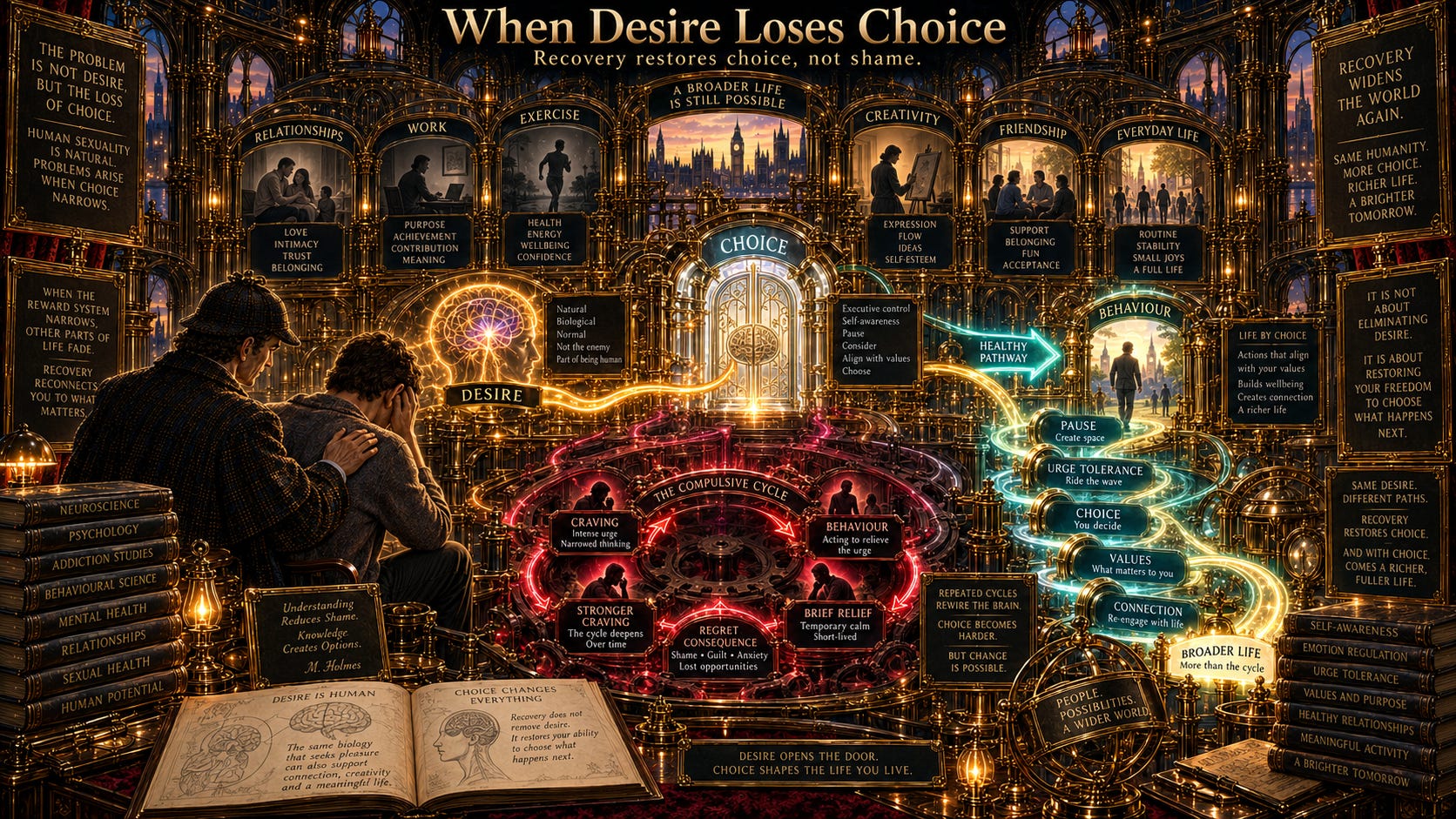 PSYCH 134: Sexual Addiction 26.09.2026 44minThe central clinical question is not “How much sex is too much?” but “Has sexual behaviour become the person's primary way of regulating distress, reward and self-experience?”Medlock Holmes enters an immense Neo-Victorian institution called The House of Driven Behaviour.At first, nothing in the building looks inherently pathological.There are rooms devoted to:sexual fantasymasturbationromantic attachmentpornographypartnered sexsexual explorationAll of these can occur within ordinary human sexuality.But in one wing, the machinery behaves differently.A person vows:“I won’t do this again.”Hours later, they do.The behaviour causes:* financial loss* relationship breakdown* occupational failure* legal risk* emotional collapse.Still it continues.Holmes discovers the two features around which the chapter builds its concept of sexual addiction:RECURRENT FAILURE TO CONTROL THE BEHAVIOURandCONTINUATION DESPITE SIGNIFICANT HARMFUL CONSEQUENCESThe chapter deliberately distinguishes this from simply having a high libido. A person may want sex frequently, behave in ways their partner dislikes, or pursue socially controversial sexual choices without demonstrating an addictive pattern.Frequency alone is not the diagnosis.Nor is the particular sexual behaviour.What matters is the relationship between the behaviour and the person’s life.The chapter also makes an important terminological argument. Sexual behaviour of this kind is often called compulsive sexual behaviour, but the source argues that addiction better captures its dual psychological function.A compulsion classically reduces distress without being performed primarily for pleasure.Addictive sexual behaviour can do both:PRODUCE PLEASUREandREDUCE PAINFUL AFFECTSex can therefore become simultaneously a source of reward and an emotional anaesthetic.Holmes enters the Reinforcement Engine.One gear reads:POSITIVE REINFORCEMENTThe behaviour creates:* pleasure* excitement* arousal* gratification.The other reads:NEGATIVE REINFORCEMENTThe behaviour temporarily relieves:* anxiety* loneliness* shame* emptiness* abandonment feelings* dysphoria.Together, the gears make the behaviour exceptionally powerful.The chapter proposes provisional diagnostic criteria modelled partly on substance-use disorders, including:* behaviour occurring more intensely or for longer than intended* repeated unsuccessful attempts to reduce it* substantial time spent preparing for, engaging in, or recovering from it* craving* failure to meet responsibilities* giving up important activities* continuing despite interpersonal or psychological harm* hazardous behaviour* tolerance* withdrawal-like states.But it also explicitly acknowledges that sexual addiction is not a DSM-5-TR diagnosis, and the proposed criteria are provisional rather than established diagnostic standards.Holmes therefore writes above the diagnostic desk:“Clinically useful concept - contested nosology.”The differential diagnosis hall becomes essential.Sexual disinhibition can occur in:* mania* schizophrenia* temporal lobe epilepsy* frontal-lobe disease* dementia* substance use* neurological illness* medication effects, particularly dopaminergic treatment.Sexual obsessions also occur in OCD, but these are usually characterised by unwanted fears and anxiety rather than sexually pleasurable fantasy.Paraphilic disorders may coexist with addictive sexual behaviour, but they are not the same construct.A paraphilic disorder concerns the nature of the sexual interest, associated distress, impairment or harm.Sexual addiction, in the chapter’s framework, concerns impaired control and persistence despite harmful consequences, regardless of whether the sexual behaviour itself is paraphilic or nonparaphilic.Holmes then reaches the chapter’s most ambitious theoretical structure:THE ADDICTIVE PROCESSThe source argues that sex addiction may represent one behavioural expression of a broader biopsychological vulnerability shared with disorders such as substance addiction, gambling disorder, binge eating, bulimia and kleptomania.Three interacting systems form the core:MOTIVATION–REWARDThe person is unusually vulnerable to:* restless anhedonia* emptiness* reduced baseline reward.Rewarding behaviours therefore acquire unusually strong salience.AFFECT REGULATIONPainful emotions become:* intense* unstable* difficult to soothe.Behaviour is used to escape them.BEHAVIOURAL INHIBITIONShort-term reinforcement repeatedly overrides consideration of long-term consequences.The resulting loop is:PAINFUL AFFECT → CRAVING → SEXUAL BEHAVIOUR → RELIEF/PLEASURE → REINFORCEMENT → CONSEQUENCES → MORE PAINFUL AFFECTThe chapter then extends this model developmentally.Genetic predisposition, prenatal stress, inadequate early caregiving and adverse childhood experiences are discussed as possible contributors to impaired regulation of stress, reward and inhibition.A substantial portion of the source uses animal and developmental neuroscience to describe how early adversity may alter:* HPA-axis responsiveness* dopamine signalling* GABA systems* glucocorticoid feedback* prefrontal regulation* amygdala reactivity* hippocampal function* epigenetic regulation.Holmes notices that the chapter’s psychological model mirrors the neurobiology.The central psychological concept is:IMPAIRED SELF-REGULATIONSelf-regulation is divided into three domains:AFFECT REGULATIONCan I soothe myself, tolerate emotion and remain organised?SELF-CARECan I recognise danger and take care of my actual needs?SELF-GOVERNANCECan I maintain values, self-esteem, direction and behavioural control?When these functions are weak, sexual behaviour may become an external substitute for what the person cannot reliably provide internally.The behaviour becomes a way to:feel alivefeel wholeescape shameavoid abandonmentreduce anxietyrestore self-esteemregain a sense of controlThe chapter describes this as externalisation of self-regulation.Instead of:“I can soothe myself.”the implicit belief becomes:“SEX WILL SOOTHE ME.”Holmes then enters the treatment wing.The first task is symptomatic behaviour management.This can include:* risk management* identifying triggers* self-monitoring* urge-management skills* behavioural interruption* cognitive techniques* DBT* relapse/recurrence planning* support groups.For lower-risk behaviours, the goal is eventually to distinguish:healthy sexual behaviourfromsexual behaviour being used addictively.For behaviours that seriously harm others, the framework changes completely.There is no tolerance for recurrence of:* sexual assault* sexual contact with children* other severe nonconsensual behaviours.Public safety becomes paramount, and additional interventions may be needed.The chapter then moves beyond behaviour control.If addictive sexual behaviour is functioning as an external regulator of internal distress, stopping the behaviour alone leaves the underlying dysregulation untouched.Treatment therefore also aims to heal the addictive process.Psychiatric medication may help when:* affect is unstable* anxiety is overwhelming* impulsivity is high* comorbid depression or bipolar symptoms are present.The chapter discusses SSRIs and several mood-stabilising or affect-regulating medications, as well as limited evidence for naltrexone.Psychodynamic psychotherapy explores:* what emotional state preceded the urge* what the behaviour protected the person from feeling* how early relationship templates shape current relationships* how shame and self-esteem are regulated* how self-regulatory capacities can gradually become internalised.DBT contributes:mindfulnessdistress toleranceemotion regulationinterpersonal effectiveness.Meditation, yoga, social support and development of a healthier lifestyle are presented as adjunctive ways of strengthening regulation.The final room contains two machines.The first is labelled:“STOP THE SEXUAL BEHAVIOUR.”It controls symptoms.The second is larger:“BUILD A PERSON WHO NO LONGER NEEDS THE BEHAVIOUR TO SURVIVE THEIR OWN INNER WORLD.”Holmes realises that this is the chapter’s central therapeutic proposition.The aim is not celibacy.It is not suppression of sexuality.It is not moral judgement.It is restoring enough control, emotional regulation and self-awareness that sexuality can return to being:chosenrather thandriven.Key Takeaways1. The Core DefinitionThe chapter defines sexual addiction primarily through two features:1. RECURRENT FAILURE TO CONTROL SEXUAL BEHAVIOURand2. CONTINUATION DESPITE SIGNIFICANT HARMFUL CONSEQUENCESThis is much more important than frequency alone.2. High Libido Is Not Sexual AddictionSomeone may:* want sex frequently* masturbate frequently* have multiple partners* use pornography* pursue unconventional relationshipswithout having an addictive disorder.The relevant question is:CAN THEY CONTROL THE BEHAVIOUR, AND WHAT IS IT DOING TO THEIR LIFE?3. No Particular Sexual Behaviour Defines the DisorderPotential behaviours include:* masturbation* pornography-associated sexual activity* anonymous sex* affairs* paid sexual activity* romantic infatuation* paraphilic behaviour.Any may theoretically be engaged in addictively.None is automatically addiction.4. Pleasure and Relief Both MatterThe chapter argues that addictive sexual behaviour can be maintained by:Positive reinforcementPLEASURE / GRATIFICATIONandNegative reinforcementRELIEF FROM DISTRESSThis dual reinforcement helps explain persistence.5. Why the Chapter Prefers “Addiction” to “Compulsion”In classic OCD:COMPULSION → ANXIETY REDUCTIONbut not primarily pleasure.In addictive sexual behaviour:SEXUAL BEHAVIOUR → PLEASURE + ANXIETY REDUCTIONHence the source argues that addiction more accurately captures the phenomenology.6. DSM-5-TR Does Not Recognise “Sex Addiction” as a Formal DiagnosisThe chapter explicitly acknowledges this.The proposed diagnostic framework is:PROVISIONALand intended partly to stimulate research.This distinction should always be retained.7. The Source’s Provisional CriteriaThe chapter proposes a maladaptive sexual behaviour pattern causing clinically significant distress or impairment, with four or more criteria within 12 months.These include:* greater intensity or duration than intended* unsuccessful efforts to control it* excessive time devoted to it* craving* failure in responsibilities* abandonment of important activities* interpersonal problems* continued behaviour despite physical or psychological harm* hazardous behaviour* tolerance* withdrawal-like phenomena.8. ToleranceTolerance may appear as needing:* more frequent behaviour* greater intensity* more novel stimulationto achieve the same effect.Or previously sufficient behaviour becomes less rewarding.9. Withdrawal-Like StatesWhen behaviour is interrupted, some individuals experience:* irritability* restlessness* tension* anxiety* dysphoria* intense urges.The same behaviour may then be used to terminate these states.10. Addiction Is a Pattern, Not an ObjectThe chapter strongly argues against phrases such as:“addicted to pornography”as technically imprecise.Its formulation is that the person:ENGAGES IN A BEHAVIOUR ADDICTIVELYThe pathology lies in the pattern of use.11. Pornography May Be a Facilitator Rather Than the Primary BehaviourIn some cases, pornography facilitates masturbation.The clinically important behaviour may therefore be:masturbationrather than merely:viewing pornography.This distinction may matter during formulation.12. Sex Addiction versus Paraphilic DisorderSexual AddictionDefined primarily by:IMPAIRED CONTROL + HARMFUL CONSEQUENCESParaphilic DisorderDefined around:ATYPICAL SEXUAL INTEREST + DISTRESS/IMPAIRMENT OR HARM/RISKThe constructs can overlap but are not equivalent.13. A Paraphilia Is Not RequiredAddictive sexual behaviour may be entirely nonparaphilic.For example:* repeated consensual affairs* masturbation* pornography-associated sexual behaviour.14. Impaired Control Is Central to the Addiction ModelParaphilic disorder does not require impaired behavioural control in the same way.For sexual addiction, inability repeatedly to adhere to one’s intention to stop or limit behaviour is central.15. Harm Alone Does Not Prove AddictionA behaviour may be:* harmful* unethical* exploitative* relationship-damagingwithout being addictive.If the person remains fully capable of choosing and controlling it, the addiction framework may not apply.16. The Clinical Examples Illustrate This DistinctionThe chapter presents individuals with high or socially problematic sexual behaviour who do not necessarily meet the proposed criteria.The point is:BEHAVIOURAL EXCESS ≠ LOSS OF CONTROL17. Organic Causes Must Be ConsideredHypersexual or disinhibited behaviour may result from:* frontal-lobe lesions* dementia* epilepsy* traumatic brain injury* neurological disease.Late onset is especially important.18. Medication Can Produce HypersexualityParticularly relevant are:DOPAMINERGIC ANTIPARKINSONIAN AGENTSThese can produce:* hypersexuality* gambling* other impulse-control disorders.19. Organic Warning SignsConsider neurological evaluation when there is:* middle- or late-life onset* abrupt change from previous sexuality* excessive aggression* seizure-like symptoms* aura* motor or perceptual abnormalities* cognitive decline.20. Sexual Obsessions in OCD Are DifferentOCD may contain intrusive sexual content.These thoughts typically cause:FEAR / DISGUST / ANXIETYrather than pleasurable arousal.In sexual addiction:sexual fantasy and behaviour are usually reinforcing.21. Mania Can Produce HypersexualityHypersexual behaviour occurring only during mania may reflect:BIPOLAR DISORDERrather than a primary sexual addiction.But the chapter allows both formulations if both full syndromes independently apply.22. Psychiatric Comorbidity Is CommonAssociations described include:* substance-use disorders* gambling disorder* bulimia* compulsive buying* mood disorders* anxiety disorders* ADHD* personality disorders.23. Other Addictive Behaviours May CoexistThe source emphasises cross-addiction.A person who engages addictively in sexual behaviour may also engage addictively in:* substances* gambling* eating* shopping.24. Behavioural Substitution Can OccurWhen one addictive behaviour stops, another may emerge.For example:SEXUAL ACTING OUT ↓whileGAMBLING ↑This supports the chapter’s concept of a deeper shared addictive process.25. Epidemiological Estimates Are UncertainEarlier estimates cited in the chapter range around:3–6%in some studies.But the evidence base is heterogeneous and methodologically weak.These figures should not be treated as definitive population prevalence.26. Men Are More Commonly IdentifiedThe chapter reports approximately:80% MALEin identified cases.It proposes that men more often present with:* masturbation* pornography* impersonal sexual activity.Women are described as more often presenting with addictive romantic attachment.These observations are population tendencies, not diagnostic rules.27. Typical CourseThe chapter describes an often:CHRONICcourse with:REMISSIONS AND EXACERBATIONS.Behaviour commonly emerges in adolescence, peaks in early-middle adulthood, and may later decline.28. The Addictive ProcessThe chapter’s broader theory proposes that multiple addictive disorders share:A COMMON BIOPSYCHOLOGICAL VULNERABILITYThe sexual behaviour is one possible expression of that underlying process.29. Three Core Neurobiological SystemsMOTIVATION–REWARDAFFECT REGULATIONBEHAVIOURAL INHIBITIONImpairment across these systems makes short-term rewarding behaviour particularly difficult to resist.30. Motivation–Reward DysfunctionThe person may experience:* reduced baseline reward* emptiness* anhedonia* restless dissatisfaction.Highly rewarding behaviour then acquires disproportionate motivational value.31. Affect-Regulation DysfunctionEmotion may become:* unusually intense* unstable* difficult to tolerate.Sexual behaviour can then become a rapid form of emotional regulation.32. Behavioural-Inhibition DysfunctionImmediate reward repeatedly overrides:LONG-TERM CONSEQUENCESThis contributes to the subjective experience:“I know what this will cost me, but I still cannot stop.”33. The Reinforcement LoopA useful summary is:DISTRESS↓URGE↓SEXUAL BEHAVIOUR↓PLEASURE + RELIEF↓REINFORCEMENT↓HARM↓SHAME / LOSS / STRESS↓MORE DISTRESSThe treatment must interrupt more than one part of this loop.34. Genetics May Contribute to General Addiction VulnerabilityThe chapter reviews genes affecting systems involving:* dopamine* serotonin* GABA* opioids* cannabinoids* BDNF.The overall message is:POLYGENIC VULNERABILITYnot a single addiction gene.35. Genetic Risk May Cross Behavioural CategoriesSome variants associated with substance-use disorders are also linked to:* gambling* binge eating* impulsivity.This supports the chapter’s common-process model.36. Early Environment May Influence RegulationThe source spends substantial time reviewing:* prenatal stress* maternal separation* caregiving quality* childhood adversity.These are presented as possible developmental influences on later:* stress response* reward function* emotional regulation* behavioural inhibition.37. Much of This Evidence Comes From Animal ResearchThe chapter uses extensive rodent and primate literature.Translation to human sexual addiction should therefore be understood as:THEORETICALLY INFORMATIVErather than direct proof of causation.38. HPA-Axis DysregulationEarly adversity may alter:* CRH* cortisol* stress sensitivity* amygdala function* hippocampal feedback.This may leave the person unusually vulnerable to later stress-triggered addictive behaviour.39. Dopamine and Stress InteractChronic stress can increase:mesolimbic dopamine responsivenessmaking rewarding behaviours more reinforcing.This creates one biological route connecting:STRESS → REWARD-SEEKING40. Early Caregiving and EpigeneticsThe chapter reviews animal research showing that differences in maternal care can alter:* DNA methylation* glucocorticoid-receptor expression* later stress responsiveness.The conceptual lesson:EXPERIENCE CAN ALTER BIOLOGICAL REGULATION WITHOUT ALTERING DNA SEQUENCE41. The Psychological Core Is Impaired Self-RegulationThe chapter’s psychological formulation places:SELF-REGULATIONat the centre of addiction.Sexual behaviour becomes an externally directed tool for regulating internal states.42. Three Components of Self-RegulationAFFECT REGULATIONManaging emotional states.SELF-CARERecognising danger and meeting needs.SELF-GOVERNANCEMaintaining values, self-esteem, direction and behavioural control.43. Affect Regulation IncludesAbilities to:* soothe oneself* enliven oneself* tolerate distress* maintain emotional balance* remain organised during intense affect.When these capacities are weak, external behaviours may substitute for them.44. Self-Care IncludesThe ability to:* detect danger* protect oneself* recognise needs* prioritise needs* nurture oneself.Addictive sexual behaviour often places people in precisely the dangers that self-care should help them avoid.45. Self-Governance Includes* values* standards* self-esteem* identity* direction* restraint.Impairment can produce oscillation between:acting against one’s valuesandpunishing oneself afterwards.46. Sexual Behaviour Can Become Externalised Self-RegulationInstead of regulating distress internally, the person develops an implicit equation:DISTRESS → SEXSexual behaviour becomes a psychological tool.47. Urges May Be Emotions in DisguiseA person may report:“I just suddenly feel horny.”The chapter encourages examining whether underneath that urge lies:* anxiety* shame* loneliness* rejection* anger* emptiness* humiliation.48. Alexithymia-Like Difficulties May ContributeThe source describes difficulty:* recognising* naming* symbolisingemotional states.Emotion is then experienced more as:bodily tensionoran urge to actthan as a meaningful feeling.49. The Basic ConflictThe chapter describes a developmental tension between:ATTACHMENTandAUTONOMYThe person simultaneously fears:abandonmentandengulfment/control.This conflict can become especially important in sexual and romantic relationships.50. The Primal FantasyThe source proposes an unconscious fantasy that unmet early needs will someday finally be met.It may become attached to:* a partner* romantic infatuation* sexual behaviour* another addictive object.The behaviour then promises:“THIS WILL FINALLY MAKE ME WHOLE.”51. Behavioural Treatment Must Address Immediate RiskInitial management includes:* identifying triggers* restricting high-risk situations* planning alternatives* self-monitoring* urge-management skills* support.52. Temporary Refrainment May Be UsedThe chapter describes an initial period of approximately:1–3 MONTHSwithout sexual behaviour in some treatment programmes.Its proposed purpose is to:* clarify triggers* reduce behavioural momentum* distinguish healthy from unhealthy sexual behaviour.This is the chapter’s treatment model, not a universally established guideline.53. The Ultimate Goal Is Not Permanent Abstinence From Healthy SexualityTreatment aims to help the person distinguish:HEALTHY SEXUAL BEHAVIOURfromADDICTIVELY USED SEXUAL BEHAVIOURThe desired endpoint is controlled, chosen sexuality.54. Risk ManagementPatients identify:* high-risk situations* times of day* moods* people* places* online environments* stressors* warning behaviours.The earlier intervention occurs, the easier the sequence is to interrupt.55. Behavioural Warning SignsThese are small early actions that signal:THE ADDICTIVE SEQUENCE HAS ALREADY STARTEDFor example:* browsing certain websites* isolating* secretly planning opportunities* contacting a former sexual partner.Intervening early is easier than resisting at the final step.56. Urge HandlingKey cognitive strategies include:* accepting that urges can occur without requiring action* recognising the urge as a signal* recalling reasons for change* extending fantasies mentally beyond gratification to include consequences.57. Urge ≠ CommandOne of the most useful therapeutic formulations is:“I HAVE AN URGE”rather than:“I HAVE TO ACT.”This introduces choice between impulse and behaviour.58. Behavioural Skills Work Best When RehearsedExamples include:* leaving a situation* calling a support person* engaging in an incompatible activity* moving into a safer environment.Planning these in advance matters because strong urges impair flexible thinking.59. Recurrence versus ReversionThe chapter distinguishes:RecurrenceA brief return to symptomatic behaviour that is interrupted before major harm.ReversionA return to the broader harmful addictive pattern.Rapid containment can prevent recurrence becoming reversion.60. This Does Not Apply to Seriously Harmful Sexual BehaviourWhere behaviour involves:* rape* sexual contact with children* similarly severe harm,the treatment stance must be:ZERO TOLERANCE FOR THE BEHAVIOURPublic safety overrides experimentation with relapse management.61. CBTCBT may address:* distorted thoughts* triggers* behavioural sequences* interpersonal problems* problem-solving* communication* assertiveness.62. Victim EmpathyWhere the behaviour has harmed others, treatment may include understanding:* the direct victim’s experience* the impact on partners* the impact on family* indirect harm produced by deception.Empathy must never be used simply to induce punitive shame.63. DBT Can Be Particularly UsefulDBT targets four major skill sets:MINDFULNESSDISTRESS TOLERANCEEMOTION REGULATIONINTERPERSONAL EFFECTIVENESSThese directly map onto many vulnerabilities described in the addictive process.64. Chain AnalysisDBT examines:VULNERABILITY↓TRIGGER↓THOUGHT↓EMOTION↓URGE↓BEHAVIOUR↓CONSEQUENCEThis turns a seemingly inexplicable relapse into an analysable sequence.65. Paraphilic Behaviour May Require Additional TreatmentWhen paraphilic disorder coexists, specific treatment may target the paraphilic arousal pattern.The chapter describes historical behavioural approaches including:* covert sensitisation* aversion conditioning* masturbatory training* imaginal desensitisation.These interventions belong to specialised forensic treatment contexts and have varying evidence bases.66. Endocrine Treatment May Be Required in High-Risk CasesFor severe paraphilic sexual drive, the chapter discusses:* cyproterone acetate* medroxyprogesterone* GnRH agonists.Their purpose is to:REDUCE SEXUAL DRIVEnot change the underlying direction of attraction.67. GnRH AgonistsExamples include:* triptorelin* leuprolide.After an initial testosterone rise, chronic treatment suppresses gonadotropins and substantially lowers testosterone.68. Hormonal Treatment Has Significant RisksPossible adverse effects include:* erectile dysfunction* hot flushes* reduced bone density* metabolic effects.These treatments require specialist monitoring.69. Support Groups Can HelpBenefits may include:* reduced shame* commonality* peer accountability* belonging* encouragement* support during urges.The chapter emphasises that support groups are:ADJUNCTSrather than substitutes for clinical treatment.70. Twelve-Step Groups Are CommonTheir potential strengths include:* accessibility* peer support* continuity* structured recovery narrative* sense of community.Different groups vary considerably in culture and quality.71. Psychiatric Medication May Target the Addictive ProcessMedication may improve:* affect regulation* anxiety* depression* impulsivity* associated psychiatric symptoms.The goal is not merely suppressing libido.72. SSRIsThe chapter cites preliminary evidence that SSRIs may reduce:* symptomatic sexual urges* masturbation* pornography-associated behaviourin some individuals.The evidence base remains limited.73. Healthy Sexuality May Be PreservedOne controlled study discussed in the chapter found reduced problematic sexual urges and masturbation without significant reduction in partnered sexual behaviour.This supports the idea that treatment need not simply eliminate all sexuality.74. NaltrexoneThe source describes limited evidence that:NALTREXONEmay reduce:* urges* reward from symptomatic behaviour.Evidence is preliminary.75. Psychodynamic PsychotherapyThe chapter conceptualises psychodynamic treatment through three processes:UNDERSTANDINGINTEGRATIONINTERNALISATION76. UnderstandingThe patient learns:* what triggers behaviour* what emotion lies underneath* how behaviour functions psychologically* how the current pattern developed.This can reduce shame by transforming:“I am disgusting.”into:“This behaviour is performing a function I need to understand and replace.”77. Timing Is DiagnosticWhen behaviour suddenly:* worsens* returns* changes formask:“WHAT HAPPENED JUST BEFORE THIS CHANGE?”The temporal link often reveals the relevant emotional trigger.78. IntegrationPreviously unrecognised:* emotions* wishes* fears* conflicts* beliefsbecome available to conscious awareness.The person then has more opportunity to choose rather than reflexively act.79. The Therapeutic Relationship Becomes a LaboratoryPatterns involving:* rejection* dependency* control* shame* entitlement* abandonmentmay emerge in the relationship with the therapist.They can then be examined in real time rather than merely discussed abstractly.80. InternalisationThe chapter argues that healthy therapeutic relationships can help patients gradually internalise functions such as:* soothing* self-protection* self-respect* emotional regulation* reflective capacity.What previously had to come from an external behaviour increasingly becomes available internally.81. MeditationThe chapter presents meditation as an adjunct that may improve:* mindfulness* self-regulation* executive function* emotional regulation.There are no rigorous sex-addiction-specific trials presented.The rationale is extrapolated largely from other addictive disorders.82. YogaYoga is similarly presented as a potential adjunct for:* self-awareness* emotional regulation* self-soothing* executive functioning* body–mind integration.Again, evidence specific to sexual addiction is limited.83. Lifestyle MattersRecovery also requires attention to:* sleep* exercise* nutrition* social relationships* love relationships* work* play* creativity* spirituality where relevant.A chaotic life repeatedly generates the emotional states that drive addictive behaviour.84. Build Alternative Sources of RewardIf sexual behaviour has been the person’s main route to:* pleasure* relief* connection* excitement,simply removing it creates a vacuum.Recovery requires alternative rewarding activities.85. Prognosis Is Not Well EstablishedThe chapter states clearly that robust long-term outcome research for integrated sexual-addiction treatment is lacking.Predictions should therefore be cautious.86. Poorer Prognostic Factors Proposed in the ChapterThese include:* early onset* high frequency* concurrent substance use* little anxiety or guilt about harmful behaviour.87. Better Prognostic FactorsPotentially favourable factors include:* stable employment* stable relationship* supportive social network* appropriate healthy sexual outlets* intelligence* creativity* self-observation* capacity for relationships* motivation for change.88. Treatment Takes TimeThe chapter describes recovery as a prolonged process.Stopping symptomatic behaviour is only the beginning.The underlying problems in:* emotional regulation* relationships* identity* self-esteemremain to be addressed.89. Healing Is Not the Same as CureThe source conceptualises sexual addiction as a chronic vulnerability.Recovery means:REMISSION + ONGOING SELF-MANAGEMENTrather than permanent disappearance of vulnerability.90. The Central Clinical FrameworkWhen assessing problematic sexual behaviour, Holmes asks:1. WHAT IS THE BEHAVIOUR?Be specific.2. CAN THE PERSON CONTROL IT?Have attempts to limit it repeatedly failed?3. WHAT HARM HAS OCCURRED?Occupational?Relationship?Financial?Medical?Legal?4. WHAT FUNCTION DOES IT SERVE?Pleasure?Anxiety relief?Escape from shame?Relief from loneliness?Self-esteem regulation?5. WHAT ELSE COULD EXPLAIN IT?Mania?Neurological illness?Medication?OCD?Paraphilic disorder?Substance use?6. WHAT MUST TREATMENT TARGET?BEHAVIOUR + EMOTIONAL REGULATION + UNDERLYING PSYCHOLOGICAL PROCESS91. The Central PrincipleThe chapter’s entire argument can be reduced to one sequence:SEXUAL DESIREis not the disorder.FREQUENT SEXis not the disorder.UNCONVENTIONAL SEXUALITYis not the disorder.The clinical problem emerges when sexual behaviour becomes:DRIVEN↓POORLY CONTROLLED↓REPEATED DESPITE HARMand increasingly serves as the person’s principal mechanism for regulating their internal world. This is a public episode. If you'd like to discuss this with other subscribers or get access to bonus episodes, visit drmanaankarray.substack.com/subscribe
 -
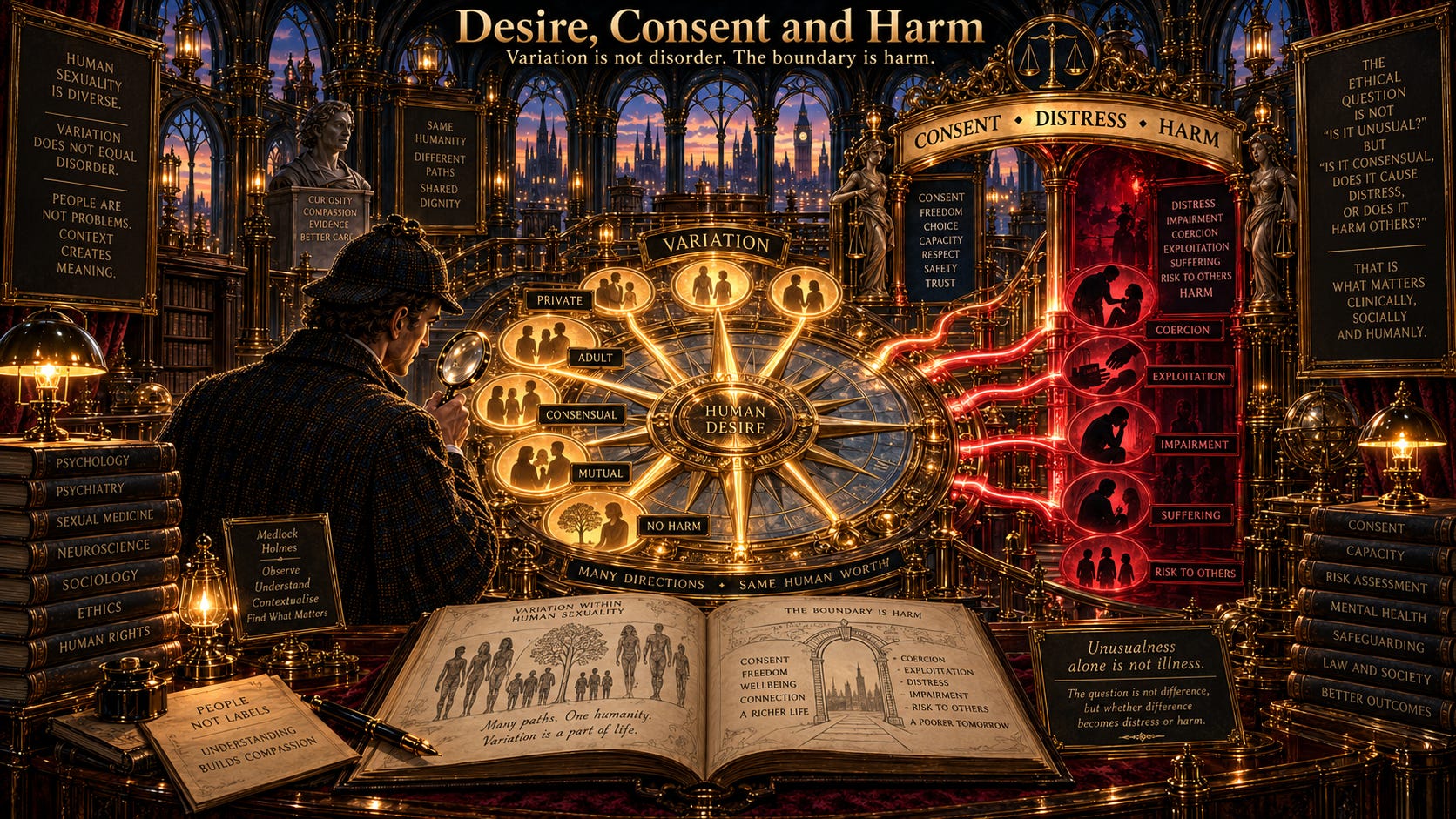 PSYCH 133: Gender Identity, Gender Diversity, and Gender Dysphoria/Incongruence 25.09.2026 56minMedlock Holmes enters an immense Neo-Victorian institution called The Grand Observatory of Gender.At its centre stands a transparent human figure surrounded by several rotating brass rings.One is labelled:SEX CHARACTERISTICSAnother:GENDER IDENTITYAnother:GENDER EXPRESSIONAnother:SEXUAL ORIENTATIONAnother:SOCIAL ROLEThe rings frequently align.Sometimes they do not.Holmes immediately discovers the chapter’s first essential distinction:Gender identity and sexual orientation are not the same thing.A person’s internal experience of being male, female, nonbinary, another gender, or neither does not determine whom they are sexually attracted to.Nor does gender expression necessarily reveal identity.Clothes, mannerisms, interests and social presentation are culturally shaped and change across time.The chapter traces how psychiatry itself learned these distinctions. Nineteenth-century medicine frequently conflated gender diversity with homosexuality. By the mid-twentieth century, gender identity emerged as a distinct concept. Diagnostic terminology subsequently moved from transsexualism and gender identity disorder towards the less pathologising concepts of gender dysphoria in DSM-5-TR and gender incongruence in ICD-11.The historical diagnostic table on page 10 captures this extraordinary journey. Gender-diverse presentations move through successive classifications until DSM-5 introduces gender dysphoria, while ICD-11 relocates gender incongruence entirely outside the mental disorders chapter and into Conditions Related to Sexual Health.That distinction matters.Being transgender is not synonymous with having gender dysphoria.DSM-5-TR focuses on the distress or impairment associated with incongruence between experienced gender and assigned sex.ICD-11 uses a different approach: gender incongruence itself can be diagnosed without requiring distress, principally to facilitate access to appropriate healthcare without classifying the condition as a mental disorder.Holmes enters the Developmental Gallery.Here, gender identity develops alongside language, social categorisation, play, body awareness and relationships.Infants begin distinguishing male and female cues before they can speak. Toddlers start applying gender labels to themselves and others. Concepts such as gender stability and gender constancy develop gradually across early childhood.But the biological and psychosocial origins of gender identity remain uncertain.The chapter presents several possible models.Biology may provide the neural architecture upon which experience acts.Biological influences may act more directly through genes, hormones or brain development.Or biology may influence temperament and behaviour, which then interact with family and social experiences.Research involving differences of sex development provides intriguing clues about hormonal and developmental influences, while neuroimaging and twin studies provide suggestive but not definitive evidence.Holmes therefore writes above the laboratory:“There is no single established mechanism that explains any gender identity.”The next chamber concerns diagnosis.For children, DSM-5-TR requires multiple manifestations of gender incongruence together with clinically significant distress or impairment.Gender-nonconforming play alone is not enough.A boy who likes dolls does not have a psychiatric disorder.A girl who prefers stereotypically masculine clothing does not have a psychiatric disorder.The key question is not:“Does this child conform to gender stereotypes?”It is:“Is there persistent incongruence associated with significant distress or impairment?”For adolescents and adults, DSM-5-TR requires at least two manifestations of gender incongruence lasting at least six months, together with clinically significant distress or impairment.These may include a strong desire to:* remove or prevent unwanted sex characteristics* acquire characteristics associated with the experienced gender* be another or alternative gender* be treated socially as that gender.The differential diagnosis is important.Gender concerns can coexist with:* autism spectrum disorder* depression* bipolar disorder* psychosis* personality disorder* trauma-related difficulties.But comorbidity does not automatically invalidate gender dysphoria.A person with schizophrenia can also have genuine gender dysphoria if the gender experience persists outside psychotic episodes.The diagnostic task is therefore to establish:what belongs to gender identityandwhat belongs to another condition.The next hall is labelled:MINORITY STRESSThe architecture becomes darker.Bullying.Family rejection.Misgendering.Employment discrimination.Housing insecurity.Healthcare avoidance.Violence.The chapter emphasises that much psychological distress experienced by transgender people may arise not simply from bodily incongruence but from the reaction of the surrounding social world.Survey data described in the chapter show markedly elevated rates of psychological distress, depression, PTSD, substance misuse and suicidality among transgender populations.But again, the causal inference matters.The elevated burden cannot simply be interpreted as evidence that transgender identity itself is pathological.Stigma, discrimination, victimisation, rejection and barriers to healthcare are powerful competing explanations.Holmes reaches the clinical treatment wing.For prepubescent children, no hormonal or surgical treatment is used.The chapter discusses three historically important approaches:gender-restrictive approaches, watchful waiting, and gender-affirmative approaches.The first attempts to reduce gender-atypical behaviour and identification.The second - associated with the Dutch tradition - remains neutral about eventual gender outcome and allows development to unfold while supporting the child and family.The third supports the child’s expressed gender, including social transition where appropriate.The chapter makes clear that major uncertainties remain, particularly because clinicians cannot reliably predict which children with gender dysphoria will continue to experience it in adolescence.This creates genuine ethical tension.Discouraging gender expression could harm children whose dysphoria persists.But early social transition may itself carry social consequences if the child later wishes to revert.The evidence does not permit simplistic certainty in either direction.Adolescence introduces another variable:PUBERTYFor some young people, pubertal development reduces earlier gender distress.For others, development of unwanted secondary sex characteristics markedly intensifies dysphoria.In carefully evaluated adolescents with persistent gender incongruence, puberty suppression can pause development of unwanted secondary sex characteristics while further assessment occurs.Gender-affirming hormones may later produce masculinising or feminising secondary sex characteristics.The chapter stresses multidisciplinary assessment, informed consent or assent, family involvement where feasible and safe, and careful evaluation of significant psychiatric comorbidity.Adults may pursue very different pathways.Some make only a social transition.Some use hormones.Some pursue chest surgery.Some pursue genital surgery.Some seek voice therapy or facial procedures.Some desire none of these.There is no single medically prescribed endpoint called a “complete transition”.Instead:the treatment plan should match the individual’s goals.Holmes then enters the Informed Consent Chamber.Here, every intervention is examined for:BENEFITS • RISKS • REVERSIBILITY • FERTILITY • MEDICAL MONITORING • EXPECTED OUTCOMESHormones can alter fertility.Some surgical procedures permanently remove reproductive capacity.Therefore fertility preservation - sperm, oocytes or embryos where appropriate - needs consideration before irreversible interventions.Mental-health professionals may help assess gender concerns, identify comorbid conditions, support decision-making, explore relationships and social consequences, and help individuals prepare for major medical interventions.But the chapter also describes the tension between this useful role and a historical gatekeeping role in which psychiatry controlled access to transition.The modern direction is increasingly toward collaborative assessment and informed consent rather than requiring patients to prove that they are the “right kind” of transgender person.The final room contains two mirrors.One reads:“CHANGE THE PERSON TO FIT THE BODY.”It belongs to history.The other reads:“UNDERSTAND THE PERSON, REDUCE DISTRESS, AND HELP BODY, ROLE AND LIFE BECOME AS CONGRUENT AS THE PERSON DESIRES.”Holmes chooses the second.The deepest lesson is not that psychiatry possesses a complete theory of gender.It does not.The lesson is that good psychiatry can tolerate uncertainty while remaining:diagnostically careful, scientifically curious, culturally respectful, and clinically useful.Key Takeaways1. Sex and Gender Are Related but DistinctSexRefers primarily to biological characteristics such as:* chromosomes* genes* gonads* hormones* internal reproductive anatomy* external genital structures* secondary sex characteristics.GenderRefers more broadly to social and psychological categories and experiences associated with being:* male* female* nonbinary* another gender.2. Gender IdentityGender identity refers to the person’s persistent internal experience of gender.It may be experienced as:* male* female* between these categories* a combination* neither* another identity.3. Gender ExpressionGender expression refers to outward presentation through:* clothing* hairstyle* mannerisms* behaviour* social role.What is considered masculine or feminine varies substantially by:culture + historical period + individual.4. Gender Identity Is Not Sexual OrientationA transgender person can be attracted to:* men* women* multiple genders* neither.Therefore:WHO I AM ≠ WHO I AM ATTRACTED TO5. TransgenderThe chapter uses transgender as an umbrella term for individuals whose gender identity or expression differs from expectations associated with their sex assigned at birth.Not every transgender person:* has gender dysphoria* wants hormones* wants surgery* wants the same form of social transition.6. CisgenderCisgender refers to someone whose gender identity is broadly congruent with their sex assigned at birth.7. Gender Diversity Is Not Itself a Mental DisorderThis distinction is foundational.Gender expression that departs from stereotypes is not sufficient for psychiatric diagnosis.8. Gender Dysphoria Is About DistressDSM-5 replaced gender identity disorder with:GENDER DYSPHORIAThe focus moved from the identity itself towards:clinically significant distress or impairment associated with incongruence.9. ICD-11 Uses Gender IncongruenceICD-11 replaced transsexualism with:GENDER INCONGRUENCEand moved it from:Mental and Behavioural Disordersto:CONDITIONS RELATED TO SEXUAL HEALTHUnlike DSM gender dysphoria, ICD gender incongruence does not require clinically significant distress.10. Diagnostic Classification Has Changed DramaticallyThe historical table on page 10 shows the movement from older diagnoses such as:transvestismandtranssexualismtowards:gender identity disorderthen:gender dysphoriaand finally, in ICD-11:gender incongruence within sexual health rather than mental disorders.This history demonstrates how diagnostic systems reflect both scientific knowledge and changing social understanding.11. DSM-5-TR Gender Dysphoria in ChildrenChildren require:At least six manifestationsfrom the diagnostic list.One must involve a strong desire to be, or insistence that the child is, another or alternative gender.And:Clinically significant distress or impairmentmust be present.12. Gender-Nonconforming Play Is Not EnoughExamples such as:* boys preferring dolls* girls preferring stereotypically masculine games* cross-gender clothing preferencesdo not independently establish gender dysphoria.INTERESTS ARE NOT DIAGNOSES13. DSM Gender Dysphoria in Adolescents and AdultsAt least:2 OF 6 FEATURESmust persist for:≥6 MONTHStogether with clinically significant distress or impairment.14. Adult/Adolescent Features IncludeA marked incongruence between experienced gender and sex characteristics.A strong desire to:* remove unwanted sex characteristics* prevent anticipated sex characteristics* acquire characteristics of the experienced gender* be another or alternative gender* be treated socially as that gender.And/or a strong conviction that one’s feelings or reactions align more closely with another gender.15. Post-Transition SpecifierDSM includes a:POST-TRANSITIONspecifier.This allows continued diagnostic coding when someone needs ongoing gender-affirming healthcare even if transition has substantially relieved the dysphoria.16. Differences of Sex DevelopmentDSM permits the specifier:WITH A DISORDER/DIFFERENCE OF SEX DEVELOPMENTwhen both conditions are present.Some DSDs also require ongoing specialist medical treatment independent of gender concerns.17. Differential Diagnosis MattersConsider:* ordinary gender diversity* transvestic disorder* body dysmorphic disorder* psychotic disorders* trauma-related presentations* autism spectrum disorder* other psychiatric conditions.18. Psychosis Does Not Automatically Exclude Gender DysphoriaIf gender concerns:* predate psychosisor* persist when psychosis resolves,both conditions may appropriately be diagnosed.19. Autism and Gender Diversity May CoexistThe chapter notes an increased clinical association between:ASDandgender dysphoria/gender diversity.Assessment can be more complex because of:* cognitive rigidity* difficulty expressing internal experiences* intolerance of ambiguity* social communication differences.But autism itself does not rule out gender transition.20. The Origins of Gender Identity Remain UnknownThe chapter explicitly rejects certainty.The development of both:cisgenderandtransgenderidentity remains incompletely understood.21. Three Broad Biological-Psychosocial ModelsPermissive Biological ModelBiology creates the developmental machinery through which experience shapes gender identity.Direct Biological ModelGenes, hormones or brain development directly influence systems involved in gender identity.Indirect Biological ModelBiology influences temperament or behaviour, which subsequently shapes social experience and identity development.22. Social Factors Clearly Shape Gender DevelopmentChildren learn gender categories through:* language* parental labelling* clothing* reinforcement* modelling* peers* social expectations.But social influence does not prove that gender identity can simply be deliberately changed.23. Children Learn Gender GraduallyDevelopmental research described in the chapter suggests that:* infants discriminate gender-related cues* toddlers begin using gender labels* gender stability develops gradually* gender constancy becomes more robust around school age.Gender development is therefore a developmental process rather than an instantaneous event.24. DSD Research Suggests Biological InfluencesStudies of individuals with differences of sex development suggest that prenatal androgen exposure may influence:* play behaviour* behavioural preferences* later gender dysphoria* probability of gender reassignment.But findings differ by condition and do not provide a universal model.25. Brain Research Is Suggestive, Not DefinitiveSome studies report differences in brain structures or function associated with gender identity.However:* samples are often small* findings are not consistently replicated* hormone treatment itself can alter brain measures.Therefore:NO BRAIN SCAN DIAGNOSES TRANSGENDER IDENTITY26. Genetic Evidence Is Also IncompleteTwin findings provide some evidence for genetic contribution.But sample sizes remain limited.There is no established:“TRANSGENDER GENE.”27. Autogynephilia Is ControversialThe chapter discusses a historical theory proposing that some transgender women experience sexual arousal from imagining themselves as female.It also presents significant criticisms, including:* heterogeneous transgender developmental pathways* similar phenomena reported in cisgender women* uncertainty about causality* the possibility that eroticisation follows rather than causes gender identity development.The source treats this as a contested explanatory model, not an established universal mechanism.28. “Rapid-Onset Gender Dysphoria” Is Not a Formal DiagnosisThe chapter reviews the controversial ROGD hypothesis arising from parental-report research.Important limitations include:* selection bias* reliance on parental rather than adolescent reports* inability to establish causation* social-media association not proving social contagion.The chapter explicitly notes:ROGD IS NOT A FORMAL DIAGNOSIS29. Incongruence and Distress Are Different QuestionsA person may experience gender incongruence without substantial distress.Therefore ask separately:Why does the gender incongruence exist?andWhy is this particular person distressed by it?The answers may not be the same.30. Minority StressImportant stressors include:* bullying* ridicule* deliberate misgendering* family rejection* exclusion from gendered spaces* employment discrimination* housing discrimination* healthcare discrimination* violence.These constitute:GENDER MINORITY STRESS31. Minority Stress Contributes to Mental-Health DisparitiesThe source associates gender minority stress with increased:* depression* anxiety* PTSD* substance misuse* suicidality.These disparities should not simply be attributed to transgender identity itself.32. Healthcare Avoidance Is ImportantMany transgender individuals report avoiding healthcare because of:* previous discrimination* fear of discrimination* lack of knowledgeable clinicians.This can worsen both:mentalandphysical health.33. Violence Is a Major Clinical IssueThe chapter describes substantial exposure to:* bullying* family violence* sexual violence* intimate partner violence* hate-related violence.Assessment should therefore include personal safety.34. Suicide Risk Is ElevatedSurveys cited in the chapter describe high lifetime rates of suicide attempts among transgender respondents.Risk increases particularly in association with:* discrimination* unemployment* bullying* violence* poverty* family rejection.Clinicians should assess these contextual contributors rather than merely documenting gender identity.35. Ask About What the Patient May Not VolunteerClinicians should sensitively explore:* bullying* harassment* family rejection* homelessness* difficulty accessing transition care* violence* discrimination.These may be central drivers of distress.36. Other Psychiatric Disorders Still OccurTransgender people can independently develop:* depression* bipolar disorder* schizophrenia* PTSD* substance-use disorders* personality disorders.Do not attribute every psychiatric symptom to gender dysphoria.37. Transition Does Not Automatically Cure Comorbid Mental IllnessA patient should understand that conditions such as:* bipolar disorder* schizophrenia* major depressionmay continue to require treatment after gender transition.38. WPATH Standards of CareThe chapter uses:WPATH SOC VERSION 8as its principal clinical guidance framework.It emphasises:* individualised assessment* informed consent* multidisciplinary care* evaluation of coexisting conditions* flexible treatment pathways.39. Transition Can Have Several DimensionsSocial* name* pronouns* clothing* gender role.Hormonal* masculinising* feminising treatment.Surgical* chest surgery* genital surgery* gonadal surgery* facial procedures* voice procedures.Not everyone seeks every component.40. There Is No Required “Complete Transition”Some people want:social transition only.Others want:hormones but no surgery.Others seek:some surgeries but not others.Treatment should follow the individual’s goals rather than a predetermined endpoint.41. Clinical Care for Prepubescent Children Is NonmedicalThe chapter’s three approaches involve psychological, family and social management.NO PUBERTY BLOCKERS, CROSS-SEX HORMONES OR SURGERY ARE USED BEFORE PUBERTYin the approaches described.42. Three Childhood Approaches Are DiscussedGender-Restrictive / Change-Oriented ApproachAttempts to reduce gender-atypical behaviour and identification.Watchful Waiting / Dutch ApproachDoes not attempt to force either persistence or desistence.Allows development to unfold while supporting the child and family.Gender-Affirmative ApproachAffirms the child’s expressed identity and may support social transition.43. Evidence Does Not Reliably Predict PersistenceOne of the chapter’s key uncertainties is:WE CANNOT RELIABLY PREDICT WHICH PREPUBESCENT CHILDREN WILL CONTINUE TO EXPERIENCE GD INTO ADOLESCENCEThis makes childhood treatment ethically complex.44. Watchful Waiting Is Outcome-NeutralIts principle is:DO NOT FORCE THE DEVELOPMENTAL OUTCOMEInstead:* support the child* support parents* reduce stigma* monitor development* address bullying.45. Social Transition Is Not a Medical InterventionIt can involve:* name* pronouns* clothing* hairstyle* social gender role.It involves no medication or surgery.But it may still have important psychological and social consequences.46. Childhood Social Transition Raises Unresolved QuestionsPotential benefits include:* reduced immediate dysphoria* authentic expression* reduced conflict.Potential concerns include difficulty if the child later wishes to return to the assigned gender.The chapter emphasises that good long-term evidence remains limited.47. Puberty Changes the Clinical PicturePuberty can:* resolve earlier dysphoria in some* markedly exacerbate dysphoria in others.The development of unwanted secondary sex characteristics may precipitate severe distress.48. Puberty SuppressionThe chapter describes use of puberty-suppressing medication in carefully assessed adolescents with persistent gender incongruence.The aim is to:* pause unwanted pubertal development* reduce development of irreversible secondary sex characteristics* create additional time for evaluation and decision-making.49. WPATH Criteria Described for Puberty SuppressionThe source describes requirements including:* puberty has begun* persistent gender incongruence* adequate cognitive and emotional maturity for assent/consent* interfering mental-health concerns have been addressed* parental involvement where feasible and not harmful.50. Psychiatric Comorbidity Does Not Automatically Prevent TreatmentThe relevant question is whether psychiatric illness compromises:* diagnosis* decision-making* treatment adherence* safety.Where possible, these problems should be adequately treated before or alongside gender-related care.51. Hormonal TreatmentFor masculinisation, testosterone can produce:* deeper voice* facial/body hair* increased muscle* cessation of menstruation* clitoral enlargement* increased libido.For feminisation, oestrogen with androgen suppression can produce:* breast development* skin changes* changes in hair* reduced erectile function* testicular atrophy.52. Hormones Add More Easily Than They RemoveA particularly useful biological principle from the chapter is:HORMONES ARE BETTER AT ADDING NEW SECONDARY SEX CHARACTERISTICS THAN REMOVING THOSE ALREADY PRODUCED BY PUBERTYThis helps explain clinical interest in pubertal timing.53. Fertility Must Be DiscussedHormones and surgery may compromise fertility.Before treatment, consider options such as:* sperm cryopreservation* oocyte preservation* embryo preservationwhen relevant and desired.54. Gender-Affirming SurgeryProcedures described include:Chest/Top Procedures* breast augmentation* mastectomy with male chest construction.Genital/Bottom Procedures* vaginoplasty* orchiectomy* hysterectomy* oophorectomy* metoidioplasty* phalloplasty.Additional interventions may include:* facial surgery* hair removal* voice therapy* voice surgery.55. Voice Can Be Central to Gender ExpressionVoice therapy may modify:* pitch* intonation* resonance* articulation* volume.This illustrates that gender affirmation extends well beyond genital anatomy.56. Informed Consent Requires UnderstandingBefore major treatment, patients should understand:* what will be done* realistic outcomes* limitations* complications* permanence* recovery period* follow-up requirements.57. Mental-Health Professionals Have Several RolesThese may include:* diagnostic assessment* differential diagnosis* treatment of comorbidity* psychotherapy* decision support* preparation for transition* family work* assessment of informed decision-making* referral.58. The Role Should Not Simply Be GatekeepingHistorically, psychiatry often determined whether patients were “trans enough” to qualify for treatment.The chapter discusses movement towards:COLLABORATIVE ASSESSMENT + INFORMED CONSENTrather than rigid identity policing.59. Informed Consent ModelsThese models place greater emphasis on the competent adult’s ability to:* understand benefits* understand risks* consider alternatives* consent voluntarily.Mental-health treatment is not necessarily mandatory unless clinically indicated.60. Significant Mental Illness Still Matters in an Informed-Consent ModelIf illness compromises:* capacity* adherence* safetyit should be adequately addressed before proceeding.Informed consent does not mean absence of assessment.61. Outcomes After TransitionThe chapter reviews studies reporting:* reduced gender dysphoria* improved subjective well-being* high satisfaction.Major regret after surgery was uncommon in the cohorts discussed.62. Regret Can OccurFactors historically associated with poorer outcomes or regret include:* misdiagnosis* inadequately treated psychiatric illness* poor preparation* insufficient family support.The existence of low overall regret rates does not mean outcomes are identical for every individual.63. Detransition Is HeterogeneousThe chapter acknowledges people who later return partially or fully to living as their assigned gender.Reasons may vary considerably.Therefore:DETRANSITION SHOULD NOT BE REDUCED TO A SINGLE EXPLANATION64. Differences of Sex Development Require Specialised CareSome DSDs require lifelong management involving:* endocrine care* malignancy surveillance* hormone replacement* metabolic monitoring.Gender assessment should not distract from these medical requirements.65. “Intersex” Identity and Medical DSD Are Not Necessarily IdenticalA person may identify as intersex without a medically established DSD.If a possible DSD could require ongoing medical treatment, appropriate investigation or referral should be offered without unnecessarily challenging the person’s identity.66. Legal Gender Recognition VariesRequirements for changing:* birth certificates* driving licences* passports* other documentsvary between jurisdictions.Some historically required hormonal treatment, surgery or infertility.67. Gender Diversity Is Also a Civil-Rights IssueThe chapter discusses:* workplace discrimination* housing discrimination* legal recognition* prison placement* access to healthcare* participation in public life.Clinical functioning cannot always be separated from the social environment.68. Incarcerated Transgender People Have Specific NeedsIssues include:* safe housing* vulnerability to assault* continuity of hormones* access to specialist care* surgical treatment where clinically indicated.Safety and healthcare access require individualised assessment.69. Child and Adolescent Treatment Remains Ethically ContestedThe chapter identifies unresolved questions on both sides.For example:Could discouraging gender expression harm a child whose dysphoria persists?But also:Could early social transition create difficulties for a child whose dysphoria later resolves?The absence of perfect prediction makes clinical humility essential.70. Randomised Trials Are Often Impractical or UnethicalMany questions in this field cannot realistically be answered through conventional RCTs.Longitudinal observational studies therefore become especially important.71. Training Is EssentialThe chapter notes significant gaps in medical and psychiatric education regarding:* gender diversity* transgender healthcare* gender dysphoria* transition medicine.All psychiatrists should at least be able to perform an informed and respectful initial assessment.72. Clinicians Should Use the Patient’s Preferred LanguageGood clinical practice includes asking:* name* pronouns* gender terminology* preferred identity terms.Language should facilitate treatment rather than become another source of distress.73. The Central Diagnostic QuestionDo not ask merely:“IS THIS PERSON TRANSGENDER?”Instead ask:What is their experienced gender?How does it relate to their sex assigned at birth?Is there distress or impairment?Where does that distress come from?What other psychiatric or medical conditions are present?What does the patient actually want?74. The Central Treatment PrincipleTreatment should not assume that the goal is:CHANGING GENDER IDENTITYNor should it assume that every gender-diverse patient wants:MAXIMAL MEDICAL TRANSITIONThe goal is:REDUCE DISTRESSIMPROVE FUNCTIONTREAT COMORBIDITYSUPPORT AUTONOMYREDUCE STIGMAFACILITATE INFORMED DECISIONSand, where desired,HELP THE PERSON ACHIEVE GREATER GENDER CONGRUENCE. This is a public episode. If you'd like to discuss this with other subscribers or get access to bonus episodes, visit drmanaankarray.substack.com/subscribe
 -
 PSYCH 132: Paraphilic Disorders 24.09.2026 52minMedlock Holmes enters an immense Neo-Victorian institution called The Tribunal of Sexual Interest, Consent and Harm.At its centre stands a large brass balance.On one side:UNUSUAL SEXUAL INTERESTOn the other:DISTRESS • IMPAIRMENT • HARM • NONCONSENTHolmes quickly discovers the central distinction in modern psychiatric classification:A PARAPHILIA IS NOT AUTOMATICALLY A PARAPHILIC DISORDER.DSM-5 defines a paraphilia as an intense and persistent sexual interest outside genital stimulation or preparatory fondling with physically mature, consenting partners. But the diagnosis of a paraphilic disorder requires something more: either clinically significant distress or impairment in the individual, or behaviour that entails personal harm, risk of harm, or involvement of nonconsenting others.This distinction is crucial because psychiatry must not pathologise every uncommon sexual interest.Holmes walks through eight principal chambers:Voyeuristic DisorderExhibitionistic DisorderFrotteuristic DisorderSexual Masochism DisorderSexual Sadism DisorderPedophilic DisorderFetishistic DisorderTransvestic DisorderBut he notices that these conditions are not organised only by the object of interest.DSM groups them conceptually into:anomalous activity preferences,algolagnic interests involving pain or suffering,andanomalous target preferences.The House contains another warning:SEXUAL OFFENCE ≠ PARAPHILIC DISORDERA person convicted of a sexual offence is a sex offender, a legal designation.It does not reveal why the offence occurred.A child molester may or may not have pedophilic disorder.A person who commits sexual assault may act because of aggression, intoxication, antisociality, opportunity or other motives rather than a paraphilic sexual interest.Therefore Holmes repeatedly asks:“What is sexually motivating the behaviour?”The distinction matters particularly in pedophilic disorder.The disorder concerns recurrent sexual attraction to prepubescent children, generally age 13 or younger, persisting for at least six months, in an individual at least 16 years old and at least five years older than the child. Diagnosis requires either acting on those urges or marked distress or interpersonal difficulty arising from them.Yet child molestation and pedophilic disorder are not synonymous.Research cited in the chapter suggests that a substantial proportion of men convicted of child sexual abuse do not meet criteria for pedophilic disorder.Holmes then enters the Consent Chamber.Here, the architecture divides.A consenting adult may engage in unusual sexual practices without psychiatric disorder.Masochistic or sadomasochistic practices, for example, may occur consensually without distress or impairment.The diagnosis becomes relevant when behaviour causes clinically significant impairment, becomes dangerous, or involves unwilling participants.This is the difference between:UNUSUALandDISORDERED OR HARMFUL.The assessment therefore requires a careful psychosexual evaluation.Holmes gathers:* medical history* psychiatric history* developmental history* sexual history* masturbation patterns* onset of interests* fantasies* behaviour* degree of control* distress* legal history* collateral information* substance use* neurological history.Late-onset sexual behavioural change prompts particular caution.A new sexual pattern emerging in later life may reflect:* traumatic brain injury* stroke* neurodegenerative disease* mania* psychosis* dopaminergic medication.Most primary paraphilic interests, by contrast, emerge around puberty or adolescence and tend to follow a chronic course.Holmes also learns that paraphilic interests are frequently multiple rather than isolated.Individuals may move or “cross over” between different paraphilic behaviours, target categories and offending patterns. This makes assessment of the entire range of sexual interests important rather than focusing only on the behaviour that initially brought the patient to attention.The biological wing contains no single lesion.Research has explored frontal and temporal systems, the amygdala, impulse control, developmental neurobiology and monoamine neurotransmission.One hypothesis emphasises:dopamine, norepinephrine and serotoninas modulators of sexual motivation and impulse regulation.Yet no biomarker establishes a diagnosis.Objective methods such as visual reaction-time measures or penile plethysmography can sometimes help characterise sexual interests, particularly in forensic settings, but the psychiatric evaluation remains central.Holmes finally reaches the Treatment Hall.Here the treatment plan is proportional to risk and severity.Lower-risk patients may be treated primarily with structured psychotherapy.Cognitive-behavioural approaches focus on:* cognitive distortions* self-regulation* intimacy deficits* sexual preoccupation* offence-supportive attitudes* relapse risk* dynamic risk factors.Modern rehabilitation has increasingly moved from purely deficit-based relapse prevention toward models such as the Good Lives Model and Risk–Need–Responsivity, which aim to reduce offending while building a safer and more functional life.Medication may be added when sexual preoccupation, compulsive urges or risk remains significant.SSRIs may reduce sexual preoccupation in some patients, although evidence is limited.In more severe or high-risk cases, testosterone-lowering treatments such as antiandrogens or GnRH agonists may markedly suppress sexual drive.These interventions carry substantial metabolic, endocrine, bone and sexual side effects and require careful risk–benefit consideration.Surgical castration, historically used to suppress testosterone, is now largely obsolete clinically because medical alternatives can achieve similar hormonal effects without irreversible surgery.The final chamber is the most difficult:ETHICS AND PUBLIC SAFETYMany patients are not voluntary.They may be court-ordered into treatment.Confidentiality may be limited.Clinical information may be shared with correctional services, courts or risk-management teams.Treatment therefore sits at an uncomfortable intersection between:medicine, autonomy, risk assessment, public protection and social control.Holmes leaves the tribunal with one principle engraved above the doors:“Do not diagnose from unusualness alone. Diagnose from distress, impairment, harm, risk, consent and the meaning of the sexual interest.”Key Takeaways1. Paraphilia and Paraphilic Disorder Are DifferentThis is the most important conceptual distinction.ParaphiliaAn intense and persistent atypical sexual interest.Paraphilic DisorderA paraphilia that:* causes clinically significant distress or impairmentor* involves personal harm, risk of harm, or nonconsenting others.Therefore:PARAPHILIA ≠ AUTOMATICALLY MENTAL DISORDER2. DSM-5 Made This Distinction ExplicitThe change was designed partly to avoid automatically pathologising unusual sexual interests.The key threshold is:DISTRESS • IMPAIRMENT • HARM • RISK • NONCONSENT3. The Eight Main DSM Paraphilic DisordersThese are:* Voyeuristic disorder* Exhibitionistic disorder* Frotteuristic disorder* Sexual masochism disorder* Sexual sadism disorder* Pedophilic disorder* Fetishistic disorder* Transvestic disorder4. Three Conceptual GroupsDSM organises these broadly into:Anomalous Activity Preferences* voyeuristic* exhibitionistic* frotteuristicAlgolagnic Disorders* sexual masochism* sexual sadismAnomalous Target Preferences* pedophilic* fetishistic* transvestic.5. Six Months Is a Common Duration RequirementMost specific paraphilic disorders require:PERSISTENT OR RECURRENT INTEREST FOR AT LEAST 6 MONTHSplus the relevant distress, impairment or behavioural criterion.6. Consent Is CentralAtypical sexual behaviour between consenting adults is not automatically psychiatric pathology.Clinical concern increases when there is:* coercion* nonconsent* risk of injury* inability to control behaviour* clinically significant distress.7. Unusual Does Not Mean DisorderedThis principle is particularly important for consensual:* fetishistic interests* cross-dressing* sadomasochistic practices.If there is no significant distress, impairment or harm, a psychiatric diagnosis may not be appropriate.8. Sex Offender Is a Legal TermA sex offender is someone legally convicted of a sexual offence.The label does not specify:* motive* diagnosis* paraphilic interest* future risk.9. Sexual Offending Does Not Equal ParaphiliaA sexual offence may result from:* antisocial behaviour* intoxication* opportunity* aggression* cognitive impairment* mania* psychosis* sexual impulsivity* paraphilic motivation.Assessment must determine the actual mechanism.10. Diagnose the Sexual Interest, Not Merely the BehaviourThis is one of the chapter’s strongest diagnostic principles.For example:CHILD MOLESTATION ≠ AUTOMATICALLY PEDOPHILIC DISORDERThe clinician must ask:What sexually motivated the behaviour?11. Psychosexual EvaluationAssessment should include:* medical history* psychiatric history* sexual development* masturbation patterns* fantasies* sexual interests* sexual behaviour* relationship history* childhood sexual exposure* substance use* neurological history* medications* legal history* collateral information.12. Shame Can Limit DisclosurePatients may conceal sexual interests because of:* embarrassment* stigma* legal consequences* fear of judgement.Collateral information can therefore be particularly important.13. Multiple Paraphilias Are CommonA person presenting with one paraphilic interest may have others.The assessment should therefore examine the full range of interests rather than simply the index behaviour.14. Crossover OccursIndividuals may cross over between:* touching and nontouching behaviours* familial and nonfamilial victims* male and female targets* different age groups* different paraphilic behaviours.The chapter reports substantial crossover in forensic and treatment samples.15. Exclusive versus NonexclusiveExclusiveThe paraphilic interest is the only route to sexual gratification.NonexclusiveThe individual can also experience sexual gratification in other contexts.Nonexclusive forms are more common.16. Paraphilic Interests Usually Begin EarlyTypical onset is:PUBERTY OR ADOLESCENCEThey often follow a chronic course with fluctuations in intensity.17. Late-Onset Sexual Change Is a Red FlagNew paraphilic or disinhibited sexual behaviour appearing later in life should prompt investigation for:* traumatic brain injury* stroke* neurodegenerative disease* Huntington disease* mania* psychosis* medication effects.18. Dopaminergic Medication Can Alter Sexual BehaviourDopaminergic agents can produce:* hypersexuality* impulse-control disorders* unusual sexual behaviours.Medication history is therefore essential.19. Comorbidity Is CommonReported comorbidities include:* personality disorders* mood disorders* social anxiety* substance-use disorders* ADHD* other neurodevelopmental disorders.20. Aetiology Is UncertainProposed mechanisms include:* neurodevelopmental factors* brain injury* frontal and temporal dysfunction* amygdala abnormalities* learning* conditioning* childhood adversity* psychological development* neurotransmitter dysregulation.There is no single established cause.21. Monoamine HypothesisThe chapter describes possible roles for:DOPAMINENOREPINEPHRINESEROTONINin regulating:* sexual motivation* appetite* impulse control* consummatory behaviour.This provides some rationale for pharmacological treatment.22. Conditioning ModelsBehavioural theories suggest atypical stimuli may acquire sexual significance when repeatedly paired with sexual arousal.But conditioning alone is unlikely to explain every case.Other factors may include:* poor self-esteem* difficulty with intimacy* developmental adversity.23. Voyeuristic DisorderCore feature:SEXUAL AROUSAL FROM OBSERVING AN UNSUSPECTING PERSONwho is:* naked* undressing* engaged in sexual activity.The person must be at least 18 years old for the diagnosis.24. Exhibitionistic DisorderCore feature:SEXUAL AROUSAL FROM EXPOSING ONE’S GENITALS TO AN UNSUSPECTING PERSONDiagnosis requires either:* acting on urges with a nonconsenting personor* clinically significant distress or impairment.25. Frotteuristic DisorderCore feature:SEXUAL AROUSAL FROM TOUCHING OR RUBBING AGAINST A NONCONSENTING PERSONIt commonly occurs in crowded environments.26. Fetishistic DisorderCore feature:SEXUAL AROUSAL FROM NONLIVING OBJECTS OR A HIGHLY SPECIFIC NONGENITAL BODY PARTDiagnosis requires distress or impairment.Commonly described interests include:* particular clothing* fabrics* footwear* body parts.27. Sexual Masochism DisorderCore feature:AROUSAL FROM BEING HUMILIATED, BEATEN, BOUND OR MADE TO SUFFERBut consensual masochistic behaviour without impairment or harm is not automatically a psychiatric disorder.28. Sexual Masochism Can Be NonpathologicalThe chapter highlights that masochistic sexual interests occur in otherwise well-adjusted populations.Therefore:MASOCHISTIC INTEREST ≠ MASOCHISM DISORDER29. Asphyxiophilia Is Particularly DangerousSexual arousal involving restriction of airflow can cause:ACCIDENTAL DEATHThis is one of the clearest examples where harm itself becomes the major clinical concern.30. Sexual Sadism DisorderCore feature:SEXUAL AROUSAL FROM THE PHYSICAL OR PSYCHOLOGICAL SUFFERING OF ANOTHER PERSONDiagnosis requires:* acting on urges with a nonconsenting personor* clinically significant distress or impairment.31. Consensual Sadomasochistic Behaviour Is DifferentSome adults consensually incorporate pain, control or submission into sexual activity.If:* consent is present* significant harm is absent* distress or impairment is absentthis does not automatically constitute a paraphilic disorder.32. Not Every Sexual Assault Is Sexual SadismA person committing rape does not automatically have sexual sadism disorder.The relevant question is whether:THE SUFFERING ITSELF IS SEXUALLY AROUSINGrather than merely instrumental to overpowering the victim.33. Pedophilic DisorderThe core DSM pattern described in the source is:* recurrent intense sexual fantasies, urges or behaviours* involving prepubescent children* generally age 13 or younger* for at least 6 months* individual at least 16 years old* at least 5 years older than the child.34. Diagnosis Requires More Than AttractionThe patient must have either:* acted on the urgesor* experienced marked distress or interpersonal difficulty because of them.35. Pedophilic Disorder Has Important SpecifiersThese include whether the interest is:ExclusiveOnly children.NonexclusiveChildren and adults.and whether attraction is towards:* males* females* both.It may also be described as limited to incest.36. Child Molester Is Not a DiagnosisThe term:CHILD MOLESTERdescribes behaviour.It does not establish pedophilic disorder.37. Many Child Sexual Offenders Do Not Meet Criteria for Pedophilic DisorderThe chapter cites research suggesting that approximately half of some samples of men convicted of child sexual abuse did not meet diagnostic criteria.That distinction is central in forensic psychiatry.38. Pedophilic Interests Commonly Begin Around PubertyThe attraction typically emerges in:ADOLESCENCEand often follows a long-term course.39. Most Pedophilic Disorder Is Reported in MenWomen are far less frequently identified in clinical and forensic samples.However, the chapter cautions that under-detection and reporting biases may contribute.40. Transvestic DisorderCore feature:RECURRENT SEXUAL AROUSAL FROM CROSS-DRESSINGlasting at least six months and producing clinically significant distress or impairment.Cross-dressing itself is not a psychiatric disorder.41. Cross-Dressing and Gender Identity Are DifferentTransvestic disorder should not be confused with:* transgender identity* gender dysphoria* nonsexual cross-dressing.The diagnostic requirement is specifically sexual arousal plus distress or impairment.42. Voyeurism, Exhibitionism and Frotteurism Depend Strongly on NonconsentThe behaviour becomes clinically and legally significant because another person:HAS NOT AGREED TO PARTICIPATEThis makes consent a fundamental diagnostic and ethical dimension.43. There Is No Definitive Diagnostic TestDiagnosis is based primarily upon:COMPREHENSIVE PSYCHIATRIC ASSESSMENTNo laboratory test confirms a paraphilic disorder.44. Objective Sexual-Interest MeasuresPossible adjuncts include:* visual reaction-time testing* penile plethysmography* sexual history polygraph in some forensic programmes.These can assist assessment but do not replace clinical judgement.45. Penile PlethysmographyThis measures physiological penile responses to different stimuli.It may help characterise patterns of sexual arousal when self-report is unreliable.But interpretation requires specialist expertise.46. Differential DiagnosisConsider:* mania* psychosis* substance intoxication* personality disorders* intellectual disability* frontal-lobe disease* traumatic brain injury* neurodegenerative disease* medication-induced hypersexuality.47. Treat the Cause When Sexual Behaviour Is SecondaryIf unusual sexual behaviour emerges exclusively during mania, the primary treatment target is:THE MANIC EPISODEnot necessarily a paraphilic disorder.Similarly, new sexual disinhibition from neurological disease requires neurological management.48. Course Is Usually ChronicParaphilic interests often:* begin early* persist over time* fluctuate in intensity.Longitudinal assessment is therefore more informative than a single encounter.49. Evidence for Treatment Is LimitedMuch of the literature derives from:SEX OFFENDER POPULATIONSrather than voluntary community patients with paraphilic disorders.These populations are not interchangeable.50. Recidivism Is an Imperfect Outcome MeasureRecorded reoffending underestimates actual recurrence because not every offence is:* detected* reported* prosecuted.Treatment studies therefore have methodological limitations.51. Cognitive-Behavioural Treatment Is the Main Psychological ApproachCBT targets:* distorted thinking* self-regulation* sexual preoccupation* intimacy problems* offence-supportive attitudes* risk situations* behavioural control.52. Cognitive DistortionsExamples include:* minimisation* excuses* justification* victim-blaming* denial of harm.These can maintain offending behaviour and should be directly addressed.53. Relapse Prevention Was Historically DominantOlder programmes often mapped:TRIGGER↓FANTASY↓PLANNING↓OFFENCE↓JUSTIFICATIONand aimed to interrupt the sequence.Modern programmes increasingly combine risk management with strength-based rehabilitation.54. Good Lives ModelThe Good Lives Model seeks to build:* relationships* purpose* competence* emotional regulation* prosocial satisfactionso that offending behaviour becomes less necessary as a maladaptive route to meeting needs.55. Risk–Need–Responsivity ModelThis model matches:RISKIntensity of treatment to level of reoffending risk.NEEDTreatment to dynamic criminogenic factors.RESPONSIVITYTreatment style to the individual’s learning abilities and characteristics.56. Dynamic Risk FactorsTreatment commonly targets:* insecure attachment* loneliness* intimacy deficits* poor self-regulation* sexual preoccupation* deviant sexual interests* offence-supportive attitudes* lack of concern for others.57. Therapist Style MattersThe source emphasises that effective therapists tend to be:NONJUDGMENTAL AND EMPATHICThis does not mean excusing harmful behaviour.It means creating conditions in which meaningful behavioural change becomes possible.58. SSRIsSSRIs may reduce:* sexual preoccupation* compulsive sexual urges* libidoin some patients.Evidence, however, is limited and inconsistent.59. AntiandrogensExamples discussed include:* medroxyprogesterone acetate* cyproterone acetate.These lower or interfere with testosterone activity.Potential effects include reduced:* libido* erection* ejaculation* spermatogenesis.60. Antiandrogens Have Significant Adverse EffectsPotential adverse effects include:* weight gain* hyperglycaemia* hypertension* liver dysfunction* muscle cramps* vascular complications* feminising effects.Long-term data remain limited.61. GnRH AgonistsExamples include:* leuprolide* triptorelin.These suppress luteinising hormone and markedly reduce testosterone.They can produce powerful reduction in sexual drive.62. GnRH Agonist RisksPotential adverse effects include:* reduced bone mineral density* osteopenia* weight gain* hyperglycaemia* diabetes* hypertension* insomnia* erectile and ejaculatory dysfunction* gynaecomastia.63. Medication Intensity Should Match SeverityThe treatment framework described broadly escalates from:PSYCHOTHERAPY↓SSRI↓TESTOSTERONE-LOWERING TREATMENTas severity, persistence and risk increase.64. Surgical Castration Is Historically Important but Now RareRemoval of the testes markedly lowers testosterone and historically reduced reoffending rates in selected populations.But surgery is:* irreversible* ethically controversial.Modern hormonal approaches have made it largely obsolete clinically.65. Neurosurgery Was Ineffective and HarmfulHistorical attempts to alter sexual behaviour through hypothalamic surgery produced:* significant adverse effects* limited efficacy.This approach is not part of modern treatment.66. Risk Assessment Should Be StructuredThe chapter emphasises actuarial and data-driven methods.These generally predict relative sexual-offence risk more reliably than:UNSTRUCTURED CLINICAL JUDGEMENTalone.67. Sex Offenders Are Highly HeterogeneousThey differ in:* diagnosis* motivation* victim type* risk* comorbidity* treatment response.There is no single “sex offender personality”.68. Public Perception Often Misses This HeterogeneityThe public often views all sexual offenders as:* equivalent* untreatable* equally dangerous.The chapter argues that evidence does not support this simplification.69. Ethical Problems Are Unusual and SignificantSex offender treatment frequently involves:* court orders* restricted autonomy* mandated disclosure* public-safety responsibilities* limited confidentiality.This differs substantially from ordinary voluntary psychiatric care.70. Informed Consent Can Be ComplicatedA patient ordered by a court to undergo treatment may technically have little choice.This raises questions about whether consent is genuinely voluntary.71. Confidentiality Is Often LimitedInformation may be shared with:* courts* correctional staff* treatment teams* probation services* family members* risk-management personnel.Patients must understand these limits.72. Medicine and Punishment Should Remain DistinctThe chapter highlights concern about laws that make hormonal or surgical treatment a condition of release.A medical intervention should not simply become:A TOOL OF PUNISHMENT OR SOCIAL CONTROLwithout proper diagnostic and therapeutic justification.73. Public Safety Still MattersRespecting patient rights does not eliminate obligations to:* manage risk* protect potential victims* monitor behaviour* collaborate with legal systems where required.The challenge is balancing:PATIENT WELFARE + PUBLIC SAFETY74. The Central Diagnostic ModelHolmes asks five questions:1. WHAT IS THE SEXUAL INTEREST?What specifically produces arousal?2. IS IT PERSISTENT?Usually at least six months.3. IS THERE DISTRESS OR IMPAIRMENT?If not, a disorder may not be present.4. IS THERE HARM OR NONCONSENT?This dramatically changes the clinical and legal meaning.5. WHAT ACTUALLY MOTIVATES THE BEHAVIOUR?Paraphilia?Impulsivity?Aggression?Substance use?Neurological disease?Another psychiatric disorder?75. The Central Clinical PrincipleThe diagnosis should never rest merely on:“THIS SEXUAL INTEREST IS UNUSUAL.”Instead ask:“IS IT DISORDERED, IMPAIRING, HARMFUL, DANGEROUS OR NONCONSENSUAL?”That distinction protects both:patients from unnecessary pathologisationandothers from genuine harm. This is a public episode. If you'd like to discuss this with other subscribers or get access to bonus episodes, visit drmanaankarray.substack.com/subscribe
 -
 PSYCH 131: Homosexuality, Gay and Lesbian Identities, and Homosexual Behaviour 23.09.2026 39minMedlock Holmes enters an immense Neo-Victorian institution called The Hall of Sexual Identity and Social Meaning.At its centre is a large brass compass with three separate needles:DESIRE • BEHAVIOUR • IDENTITYHolmes notices immediately that the needles do not always point in the same direction.A person may experience same-sex attraction without acting on it. Another may have same-sex relationships without identifying as gay or bisexual. Another may identify strongly with an LGB community. Still another may acknowledge their orientation privately while presenting publicly as heterosexual.The first lesson is therefore simple:Sexual orientation is not the same thing as sexual behaviour or sexual identity.The chapter traces a remarkable transformation in psychiatry. Same-sex attraction was once interpreted through frameworks of sin, degeneration, developmental failure and mental illness. Over time, research in sexology, psychology, cross-cultural studies and population science progressively challenged those assumptions. Homosexuality was removed from the DSM in 1973, later removed from the ICD framework, and is now regarded within mainstream psychiatry as a normal variation of human sexuality.Holmes enters the Historical Tribunal.One chamber contains early biological theories. Another contains psychoanalytic explanations. A third displays research from nonpatient populations demonstrating that homosexual individuals could not be distinguished from heterosexual individuals by psychological functioning alone.The investigation eventually leads to a critical psychiatric principle:A characteristic is not a disorder simply because society disapproves of it.A disorder requires clinically meaningful disturbance or impairment attributable to the condition itself.Holmes then enters the Continuum Gallery, inspired by the Kinsey model.Sexual attraction is represented not as two sealed boxes labelled heterosexual and homosexual, but as a broad spectrum. Yet Holmes finds another warning on the wall:A continuum of attraction does not fully describe identity.Identity is shaped by culture, language, family, community and personal meaning.The chapter then opens into the House of Coming Out.Some rooms are fully illuminated.Some remain hidden.Some doors open only to friends.Others to family.Others never open at all.Coming out is not one event. It involves both recognition within oneself and disclosure to others, and may happen differently across work, family, religious and social settings.Holmes studies another map, corresponding to the identity diagram on page 51. It shows how individuals with the same underlying homosexual orientation may be:* closeted* homosexually self-aware* gay, lesbian or bisexual identified* nongay identified.The orientation may remain relatively stable while the identity attached to it changes.This becomes clinically important.The psychiatrist’s task is not to decide what label the patient “really is”.It is to understand:How does this person experience their attractions?What meaning do they give them?What risks or benefits are associated with disclosure?What conflicts exist with family, religion or culture?The next chamber is labelled:MINORITY STRESSHere Holmes sees the real source of much of the excess psychiatric burden associated with sexual minority status.Not homosexuality itself.But:* stigma* discrimination* rejection* concealment* hypervigilance* internalised negative attitudes* violence* family conflict* social exclusion.The chapter describes increased rates of depression, anxiety, suicidality and substance misuse among sexual minority populations, while emphasising that these disparities are better explained by social stress and discrimination than by sexual orientation itself.Holmes then passes through the Life-Course Corridor.A child may feel different without understanding why.An adolescent may discover same-sex attraction while fearing parental rejection.A young adult may begin forming an LGB identity, intimate relationships and community connections.Midlife may involve parenting, careers, health and generativity.Older LGB adults may confront ageing, invisibility and uncertainty about whether healthcare or residential services will recognise their partners and relationships.Yet many older sexual minority adults are psychologically well-adjusted, socially connected and satisfied with their lives.The final wing is the Affirmative Clinical Practice Hall.Here the psychiatrist is taught to ask open questions, avoid assuming heterosexuality, distinguish desire from behaviour and identity, recognise families of choice, include partners appropriately, understand minority stress, and respect confidentiality.The clinician must also recognise that conversion therapy is not an evidence-based treatment. The chapter describes professional opposition to attempts to change sexual orientation because evidence does not support reliable orientation change and such efforts may cause harm.The task is instead to help patients understand themselves, resolve distress, address depression or anxiety, navigate relationships, integrate sexuality with other identities, and make safe decisions about disclosure.Holmes leaves the hall with one final principle:“Do not treat the orientation. Treat the suffering, the conflict, the stigma, and the person.”Key Takeaways1. Homosexuality Is Not a Mental DisorderModern psychiatry regards same-sex attraction as:A NORMAL VARIATION OF HUMAN SEXUALITYIt is not inherently associated with:* impaired judgement* impaired reliability* impaired vocational functioning* psychiatric illness.2. The Historical Shift Was FundamentalKey milestones described in the chapter include:1973Homosexuality per se removed from the DSM.1987Ego-dystonic homosexuality removed from DSM-III-R.1990Homosexuality removed from ICD-10.2019Remaining ICD diagnoses pathologising sexual orientation removed from ICD-11.The conceptual journey was:SIN → PATHOLOGY → DEVELOPMENTAL DEVIATION → NORMAL VARIATION3. Sexual Orientation Has Several ComponentsA useful framework is:DESIREWho someone is erotically attracted to.BEHAVIOURWho they have sexual relationships with.IDENTITYHow they understand and label themselves.These may be:CONGRUENT OR INCONGRUENT4. Sexual Orientation Is Not the Same as Sexual IdentitySomeone may experience same-sex attraction while identifying as:* gay* lesbian* bisexual* heterosexual* queer* questioning* another identity* no identity label at all.Clinical language should follow the patient’s own terminology.5. Avoid the Term “Preference” When Orientation Is Meant“Sexual preference” can imply voluntary choice.The chapter favours:SEXUAL ORIENTATIONbecause attraction itself is not usually experienced as chosen.Behaviour, however, is subject to choice.6. Sexual Orientation Is Not Gender IdentityThese are distinct constructs.Sexual orientation concerns:WHO ONE IS ATTRACTED TOGender identity concerns:WHO ONE EXPERIENCES ONESELF TO BEDo not conflate homosexuality with transgender identity or gender dysphoria.7. The Kinsey Scale Introduced a ContinuumThe scale ranges from:0 - exclusively heterosexualto6 - exclusively homosexualwith intermediate positions.Its value was conceptual:SEXUALITY IS NOT ALWAYS BINARYBut it does not fully capture identity and has limited clinical utility.8. Attraction, Behaviour and Identity Have Different PrevalencesPopulation research consistently finds that:same-sex attractionis more common than:same-sex behaviourwhich is more common than:gay or bisexual identity.Therefore prevalence depends entirely on what is being measured.9. There Is No Single Prevalence FigureThe popular statement that:“10% of people are gay”does not accurately represent modern population studies.Rates vary depending on:* attraction* behaviour* identity* sex* age* culture* sampling method* willingness to disclose.10. Sexual Behaviour Matters More Than Identity for Some Medical RisksFor sexually transmitted infection assessment:ASK WHAT PEOPLE DO, NOT ONLY HOW THEY IDENTIFYA person identifying as heterosexual may still have sex with same-sex partners.11. MSM Is a Behavioural CategoryMen who have sex with men - MSMis used in public health because it describes:BEHAVIOURrather than identity.Not all MSM identify as:* gay* bisexual.12. Sexual Orientation Is MultifactorialThe chapter reviews:* genetic research* prenatal hormonal hypotheses* neuroanatomical studies* twin studies* environmental influences* developmental factors.There is no single established causal mechanism.13. There Is No Simple “Gay Gene”Genetic research suggests sexual orientation is:POLYGENIC AND COMPLEXnot determined by one gene.Large-scale studies suggest many genetic influences of individually small effect.14. Identical Twin Concordance Is IncompleteSome studies found higher concordance of homosexuality among identical twins than fraternal twins.But approximately half of genetically identical twins may still differ in orientation.This indicates:GENES MATTER - BUT GENES ARE NOT DESTINY15. Adult Hormone Levels Do Not Explain OrientationGay and lesbian individuals generally do not have abnormal adult sex-hormone concentrations.Changing adult hormone levels does not reliably change sexual orientation.16. Prenatal Hormonal Hypotheses Remain IncompletePrenatal androgen exposure has been investigated extensively.Some evidence suggests prenatal hormonal influences may contribute to aspects of orientation, particularly in some differences of sex development.But findings do not provide a complete explanatory model.17. Animal Studies Must Be Interpreted CarefullyAnimal sexual behaviour does not map directly onto human sexual orientation.Human orientation includes:* attraction* erotic responsiveness* identity* meaning* culture.Simple animal mounting behaviour is not equivalent.18. Cross-Cultural Evidence MattersSame-sex sexual behaviour has been documented across:* cultures* historical periods* animal species.This helped challenge the historical view that homosexuality was an artificial product of modern decadence.19. No Single Childhood Pathway Produces HomosexualityOlder theories proposed:* distant fathers* overinvolved mothers* trauma* developmental arrest.The chapter emphasises that these models have not been supported as universal causal explanations.20. Childhood Gender Nonconformity Has an Association, Not DeterminismRetrospective research shows an association between adult homosexuality and childhood gender nonconformity.But:MOST GENDER-NONCONFORMING CHILDREN CANNOT BE ASSUMED TO HAVE ANY PARTICULAR ADULT ORIENTATIONThere is no simple developmental pathway.21. Identity Development Is IndividualSome people follow a progression such as:AWARENESS↓QUESTIONING↓ACCEPTANCE↓DISCLOSURE↓INTEGRATIONBut this should not be treated as a mandatory sequence.22. Coming Out Has Two ComponentsComing out to oneselfRecognising and accepting one’s own sexual orientation.Coming out to othersDisclosing it socially.These can occur years apart.23. Coming Out Is OngoingDisclosure decisions recur throughout life:* family* school* workplace* healthcare* new friendships* new communities.A person may be out in one setting and closeted in another.24. Disclosure Is Not Always BeneficialComing out should never be treated as an automatic therapeutic goal.Potential benefits include:* authenticity* support* intimacy* reduced concealment.Potential risks include:* family rejection* violence* homelessness* religious exclusion* employment consequences.The clinician should help the patient assess:SAFETY + VALUES + CONTEXT25. Identity Does Not Tell You PsychopathologyThe chapter’s identity diagram on page 51 shows several possible identities despite a relatively constant homosexual orientation.The major lesson is:SEXUAL IDENTITY IS NOT A PSYCHIATRIC DIAGNOSISBeing closeted, gay-identified or nongay-identified does not itself define the level of psychopathology.26. Internalised HomophobiaInternalised negative societal attitudes may contribute to:* shame* self-criticism* concealment* difficulty forming relationships* depression* anxiety* suicidal thinking.The clinical task is to explore these processes without imposing an identity.27. HeterosexismHeterosexism is the assumption that heterosexuality is:* normal* default* more legitimate.It may occur without conscious hostility.Examples include:* automatically asking a man about his wife* assuming all parents are heterosexual* treating same-sex relationships as less significant.28. Minority StressA central explanatory model for mental-health disparities is:STIGMADISCRIMINATIONCONCEALMENTREJECTION EXPECTATIONINTERNALISED STIGMA↓CHRONIC STRESS↓increased risk of:* anxiety* depression* substance misuse* suicidality.29. Elevated Psychiatric Risk Does Not Mean Orientation Causes IllnessLGB populations show elevated rates of several psychiatric problems.But the chapter emphasises that the excess burden is best understood largely through:SOCIAL STRESS AND STIGMATISATIONrather than homosexuality itself.30. Adolescence Is a High-Risk PeriodSexual minority adolescents may face:* bullying* family rejection* isolation* identity conflict* lack of role models.These can increase vulnerability to:* depression* anxiety* substance use* self-harm* suicide.31. Family Rejection MattersThe chapter describes research linking family rejection with increased:* depression* substance misuse* suicidal ideation* suicide attempts.Family acceptance can therefore be clinically protective.32. Never Force Premature DisclosureA young person may face serious danger if clinicians encourage coming out without understanding the family environment.Potential consequences may include:* violence* homelessness* coercive conversion efforts* social isolation.Safety comes first.33. Intersectionality Is EssentialA person’s experience may be shaped simultaneously by:* sexual orientation* race* ethnicity* religion* class* gender* geography.These identities can interact rather than simply add together.34. Religion May Be Both Conflict and SupportSome sexual minority individuals experience profound conflict between:* religious identity* sexual identity.Others find affirming religious communities.The clinician should not assume the correct solution is either:leave the religionorreject the sexuality.The therapeutic task is integration where possible.35. Families of Choice Can Be Clinically ImportantSome LGB individuals create close networks of:* friends* partners* former partners* community members.These may function as extended family and can provide major sources of:* support* care* belonging.Clinicians should recognise them as meaningful relationships.36. Same-Sex Relationships Are Not Clinically InferiorSame-sex couples face many of the same issues as heterosexual couples:* attachment* intimacy* communication* jealousy* parenting* sexuality* conflict.Relationship quality, not orientation, is the relevant clinical issue.37. Children of Same-Sex Parents Do Not Show Worse Psychological OutcomesThe chapter reviews a large body of literature showing that having gay or lesbian parents is not associated with adverse psychological outcomes.Nor does it determine the child’s sexual orientation.A stronger predictor of child well-being is:QUALITY AND STABILITY OF PARENTING38. Sexual Minority Older Adults Are Often Well AdjustedOlder LGB adults are not inevitably:* lonely* isolated* unhappy.Many report strong adjustment and social networks.Protective factors include:* integrated identity* community connection* stable relationships.39. Healthcare Avoidance Can Result From Prior DiscriminationSome sexual minority patients delay or avoid care because of:* judgement* previous negative encounters* fear of disclosure* heteronormative assumptions.Clinical inclusivity can directly improve access to care.40. Ask Open QuestionsPrefer:“Are you in a relationship?”rather than:“Do you have a husband/wife?”Prefer:“Who are you sexually attracted to?”and:“Who do you have sex with?”and:“How do you describe your sexual orientation?”These are related but different questions.41. Use the Patient’s LanguageIf someone identifies as:* gay* lesbian* bisexual* queer* pansexual* asexual* questioning* another termuse their terminology unless clarification is clinically necessary.42. Do Not Assume Identity From BehaviourA man who has sex with men may identify as:* gay* bisexual* heterosexual* no label.The behaviour matters for some clinical questions.The identity matters for others.43. Confidentiality Is Particularly ImportantInformation about:* orientation* behaviour* identity* relationshipsshould only be documented when relevant to care and handled confidentially.Disclosure without consent may expose patients to discrimination or harm.44. Suicide Risk Assessment Must Include Sexuality When RelevantFor distressed young people especially, assess:* orientation concerns* family attitudes* bullying* internalised stigma* disclosure risk* social supports.Do not assume the patient will volunteer these concerns.45. Substance Use Disparities ExistThe chapter reports increased rates of some forms of:* alcohol misuse* tobacco use* stimulant use* other substance useamong sexual minority populations.Minority stress, community contexts and socioeconomic vulnerabilities may contribute.46. Substance Treatment Should Be AffirmingTreatment should address both:* addiction* sexual identity-related stress.If the treatment environment itself is stigmatising, engagement may deteriorate.47. Sexual Health Requires Behavioural AssessmentFor HIV and STI risk, assess:* partners* practices* protection* testing* PrEP/PEP where relevant.Do not infer risk solely from identity.48. PrEP and PEPThe chapter discusses:PrEPPre-exposure prophylaxis for individuals at substantial risk of HIV.PEPPost-exposure prophylaxis initiated after potential exposure.These are part of modern HIV prevention alongside testing and treatment.49. Affirmative PsychotherapyAffirmative psychotherapy starts from the principle that:HOMOSEXUALITY IS NOT PATHOLOGICALTreatment focuses instead on:* identity integration* stigma* relationships* mood* trauma* family conflict* self-esteem* meaning.50. Affirmative Does Not Mean Uncritical AgreementAn affirmative therapist can still explore:* ambivalence* relationship problems* risky behaviour* anger* shame* internal conflict.Affirmation refers to respecting the legitimacy of the patient’s sexual orientation.51. The Therapist’s Own Bias MattersClinicians should examine their own:* heterosexist assumptions* cultural beliefs* discomfort with same-sex behaviour* religious values* countertransference.Unrecognised bias can distort assessment and treatment.52. Conversion Therapy Is Not Evidence-BasedThe chapter reviews sexual orientation conversion efforts including:* reparative therapy* reorientation therapy* conversion therapy.Evidence does not demonstrate reliable conversion of homosexual orientation to heterosexual orientation.53. Conversion Efforts Can Cause HarmReported harms include:* depression* shame* sexual dysfunction* intimacy difficulties* worsening self-esteem.Professional bodies have therefore opposed conversion practices.54. The Appropriate Clinical Response to Conflict Is ExplorationA patient may say:“I do not want these attractions.”The psychiatrist should explore:* religion* relationships* values* fears* identity* social consequences* internalised stigma.The response should not be:“I WILL CHANGE YOUR ORIENTATION.”55. Ethical Practice Requires DignityThe chapter repeatedly emphasises:COMPASSION + RESPECT + CONFIDENTIALITY + NONDISCRIMINATIONSexual orientation must not reduce the quality of psychiatric care.56. Central Clinical FrameworkWhen working with sexual minority patients, Holmes asks six questions:1. ORIENTATIONWho is the person attracted to?2. BEHAVIOURWho do they actually have sexual contact with?3. IDENTITYHow do they describe themselves?4. CONTEXTWhat do family, culture and religion mean for them?5. MINORITY STRESSWhat stigma, discrimination or concealment are they experiencing?6. CLINICAL NEEDWhat actually requires treatment?The answer to the last question is never simply:“THE HOMOSEXUALITY.”57. The Central PrincipleModern psychiatric care moves from:PATHOLOGISING DIFFERENCEtoUNDERSTANDING THE PERSON IN CONTEXTThe task is not:CHANGE THE ORIENTATIONbut:TREAT DEPRESSIONREDUCE ANXIETYADDRESS TRAUMASUPPORT IDENTITY INTEGRATIONIMPROVE RELATIONSHIPSREDUCE STIGMA-RELATED HARMPROTECT SAFETY This is a public episode. If you'd like to discuss this with other subscribers or get access to bonus episodes, visit drmanaankarray.substack.com/subscribe
 -
 PSYCH 130: Normal Human Sexuality and Sexual Dysfunctions 22.09.2026 57minMedlock Holmes enters an immense Neo-Victorian institution called The Grand Observatory of Human Sexuality.It is part anatomy theatre, part neuroscience laboratory, part relationship clinic and part cultural museum.At its centre stands an enormous brass instrument labelled:SEXUAL FUNCTIONSeven interlocking systems surround it:BODY • BRAIN • HORMONES • DESIRE • RELATIONSHIP • LEARNING • CULTUREHolmes immediately sees the central lesson:sexual function cannot be understood by examining any one of these systems alone.Human sexuality contributes to identity, self-esteem, intimacy and well-being. It is also extraordinarily diverse. What is considered normal varies across cultures, historical periods and individual lives. A particular fantasy, behaviour or preference is not itself evidence of pathology. Clinical significance depends much more on distress, impairment, coercion, loss of control, medical consequences and the individual’s broader context.Holmes first enters the Physiology Chamber.Parasympathetic pathways help generate penile erection, clitoral engorgement and vaginal lubrication. Nitric oxide relaxes cavernosal smooth muscle and facilitates penile blood flow. Sympathetic mechanisms play a major role in ejaculation. Spinal reflexes, brainstem inhibition, limbic emotional systems and cortical processing all contribute.Neurochemistry further modifies the system. Dopamine generally facilitates sexual motivation, while serotonin can inhibit aspects of sexual response. Testosterone contributes to libido in both sexes, while prolactin, cortisol and several medications can suppress sexual functioning.Yet physiology alone is insufficient.In the next gallery, Holmes watches desire, arousal, orgasm and resolution unfold.The traditional sexual response model describes progression from desire through excitement and orgasm to resolution. But the chapter emphasises that sexual response is not always linear, especially in women. Desire may precede arousal, occur alongside it or emerge after arousal has already begun. Subjective arousal and genital physiological responses may also diverge.This becomes clinically important.The question is not simply:“Did the body respond?”but:“Did the person experience desire, pleasure, arousal and satisfaction?”Holmes then enters the Life-Course Gallery.Sexuality changes from childhood curiosity and adolescent experimentation to adult intimacy, middle-age adaptation and sexuality in later life.Ageing modifies physiology but does not abolish sexuality.Older men may require more stimulation, experience less rigid erections and have longer refractory periods.Postmenopausal women may experience reduced lubrication and vaginal atrophy.Medical illness and medications become increasingly important.But the presence of an interested partner, previous sexual activity and overall health strongly influence whether sexuality continues.The next corridor contains the disorders.Male hypoactive sexual desire disorder.Female sexual interest/arousal disorder.Erectile disorder.Female orgasmic disorder.Delayed ejaculation.Early ejaculation.Genitopelvic pain/penetration disorder.Substance- or medication-induced sexual dysfunction.Holmes notices a recurring diagnostic pattern.Most require not merely a symptom, but:PERSISTENCE + CLINICALLY SIGNIFICANT DISTRESS + EXCLUSION OF BETTER EXPLANATIONS.Many are further described as:lifelong or acquiredandgeneralised or situational.This classification itself provides diagnostic clues.A man who has normal morning erections and masturbatory erections but repeatedly loses erection with one partner presents a very different diagnostic puzzle from someone with progressive erectile failure in all circumstances.Similarly, diminished sexual interest after an SSRI, after menopause, during severe depression, after relationship breakdown, or since adolescence may look superficially similar but arise through very different mechanisms.Holmes therefore enters the Differential Diagnosis Engine.It continuously asks:Medical?Medication-induced?Psychological?Relationship-related?Developmental?Mixed?The answer is frequently:MIXEDThe chapter strongly emphasises this biopsychosocial approach.Erectile dysfunction may arise through vascular disease, diabetes, neurological illness, endocrine disturbance, surgery, medication or psychological performance anxiety.Pain may reflect infection, endometriosis, vulvodynia, pelvic-floor tension, postmenopausal changes, previous trauma or several mechanisms together.Low desire may be related to hormones, depression, medication, chronic illness, body image, interpersonal resentment or lack of adequate stimulation.The psychiatrist therefore requires both a sexual history and a medical history.Holmes enters the final therapeutic wing.Treatment is similarly multimodal.Education corrects myths.Couple-based therapy improves communication.Sensate focus removes performance demands and rebuilds pleasure.Behavioural approaches address anxiety and avoidance.Psychodynamic and insight-oriented therapy explore deeper conflicts, intimacy difficulties and relational patterns.Pelvic-floor physiotherapy may help genitopelvic pain.Pharmacotherapy may treat erectile dysfunction, premature ejaculation, hormone-related problems or medication-induced dysfunction.But medication does not automatically solve relational or psychological difficulties.A phosphodiesterase-5 inhibitor can restore erection.It cannot by itself restore:trust, desire, intimacy or communication.Holmes therefore leaves the observatory with a more useful question than:“Can the person perform sexually?”He asks:“What is interfering with this person’s ability to experience sexuality as pleasurable, voluntary, satisfying and connected?”That question transforms sexual dysfunction from a mechanical problem into a genuinely clinical one.Key Takeaways1. Sexuality Is BiopsychosocialSexual function emerges from interaction among:* anatomy* autonomic physiology* hormones* neurotransmitters* brain systems* psychological development* body image* relationships* culture* physical health* medication.No single level explains human sexuality.2. Normal Sexuality Is DiverseNormality varies across:* individuals* relationships* cultures* historical periods.Fantasy or behaviour alone does not define pathology.The more important questions are whether the behaviour is:* consensual* pleasurable* non-compulsive* non-coercive* compatible with functioning* not associated with clinically significant distress.3. Sexuality Has Four Major Psychosexual DimensionsThe chapter distinguishes:Sexual identityBiological sexual characteristics.Gender identityThe individual’s internal sense of gender.Sexual orientationPattern of sexual attraction.Sexual behaviourHow sexual interests and needs are expressed.These dimensions are related but not identical.4. The Autonomic Nervous System Is CentralA useful physiological mnemonic is:ParasympatheticErection and genital engorgementSympatheticEmission and ejaculationSexual functioning also depends upon spinal reflexes, cortical processing and limbic systems.5. Nitric Oxide Drives Penile VasodilationSexual stimulation releases nitric oxide.This increases cyclic GMP.Smooth muscle relaxes.Penile arteries dilate.Blood enters the corpora cavernosa.This mechanism explains why PDE-5 inhibitors improve erectile function.6. Neurotransmitters MatterBroadly:DopamineFacilitates sexual motivation and libido.SerotoninOften inhibits sexual response, especially orgasm and ejaculation.OxytocinAssociated with orgasm and pleasurable bonding responses.NorepinephrineContributes to arousal and autonomic activation.This is why psychotropic medication frequently alters sexual function.7. Testosterone Contributes to Libido in Both SexesLow testosterone can reduce sexual desire.But administering testosterone to someone with normal levels does not automatically improve sexual functioning.Sexual desire remains strongly influenced by:* mood* sleep* stress* relationship quality* general health.8. The Sexual Response Is Not Always LinearClassic models described:DESIRE → EXCITEMENT → ORGASM → RESOLUTIONBut actual sexual response can:* overlap* fluctuate* plateau* occur without orgasm* begin with arousal rather than spontaneous desire.This is particularly important when understanding female sexual response.9. Subjective and Physiological Arousal Can DifferA person may display physiological genital arousal without feeling psychologically aroused.Conversely, they may experience desire without prominent genital response.Clinical assessment must therefore explore:SUBJECTIVE EXPERIENCE + PHYSIOLOGICAL RESPONSE10. Refractory PeriodAfter orgasm, most men experience a refractory period during which another erection or orgasm is difficult or impossible.The duration generally increases with age.Women do not have an equivalent obligatory refractory period and may experience multiple successive orgasms.11. Masturbation Is Usually NormalThe chapter describes masturbation as a common component of sexual development and adult sexuality.It becomes clinically relevant when it is:* compulsive* physically harmful* experienced as uncontrollable* substantially interfering with partnered sexuality or functioning.12. Sexuality Changes Across the Life CourseImportant stages include:* childhood exploration* adolescence* first sexual experiences* adult relationships* middle age* older age.Sexuality does not simply disappear in later life.13. Older Adults Remain SexualAgeing may bring:Men* slower erection* reduced rigidity* longer refractory period* reduced ejaculatory force.Women* reduced lubrication* vaginal thinning* increased need for stimulation.Medical illness, medications and partner availability often matter more than chronological age itself.14. A Sexual History Is EssentialThe chapter’s detailed history framework on pages 40–44 emphasises:* current sexual functioning* satisfaction* desire* fantasies* masturbation* partner relationships* onset of dysfunction* lifelong versus acquired* generalised versus situational symptoms* trauma* sexual orientation* gender identity* contraception* sexually transmitted infections* medical illness* medications* substance use.The interviewer must be:NON-JUDGMENTAL AND SPECIFIC15. The Major Sexual DysfunctionsDSM-based categories discussed include:* male hypoactive sexual desire disorder* female sexual interest/arousal disorder* erectile disorder* female orgasmic disorder* delayed ejaculation* early ejaculation* genitopelvic pain/penetration disorder* substance/medication-induced sexual dysfunction* other specified sexual dysfunction* unspecified sexual dysfunction.16. Distress Is CentralA sexual variation is not automatically a disorder.The dysfunction generally must produce:CLINICALLY SIGNIFICANT DISTRESSThis distinction is particularly important when evaluating low desire, asexual identity or variations in sexual response.17. Lifelong versus AcquiredLifelongPresent since becoming sexually active.AcquiredDevelops after a period of relatively normal functioning.Acquired dysfunction often suggests looking for:* medication* medical illness* relationship changes* psychological stress* depression.18. Generalised versus SituationalGeneralisedOccurs across most partners and settings.SituationalOccurs only in particular circumstances.Situational patterns often provide powerful diagnostic clues.19. Male Hypoactive Sexual Desire DisorderCore feature:PERSISTENTLY REDUCED OR ABSENT SEXUAL THOUGHTS AND DESIREfor approximately 6 months with clinically significant distress.Always consider:* depression* chronic stress* endocrine disorders* relationship conflict* medication* sexual orientation conflict.20. Asexuality Is Not Automatically a DisorderSome individuals identify as:* asexual* greysexual* demisexual.If absent sexual attraction is not associated with clinically significant distress, it should not automatically be pathologised.21. Female Sexual Interest/Arousal DisorderThe chapter highlights that interest and arousal are combined because many women do not experience desire as a discrete first stage.Relevant symptoms include reduced:* sexual interest* fantasies* initiation* responsiveness* pleasure* response to erotic cues* genital or non-genital sensations.At least three symptom domains are required in the DSM framework presented in the chapter.22. Relationship Problems MatterAcquired female interest/arousal difficulties may be strongly associated with:* marital discord* resentment* inadequate stimulation* partner sexual dysfunction* loss of attraction.Never assess desire outside its relational context.23. Erectile DisorderPossible symptoms include:* difficulty obtaining erection* difficulty maintaining erection* reduced rigidity.The pattern should occur on most sexual occasions for approximately 6 months and produce distress.24. Erectile Dysfunction Is Often MixedPotential contributors include:Vascular* atherosclerosis* endothelial dysfunction.Endocrine* diabetes* hypogonadism* hyperprolactinaemia.Neurological* spinal disease* multiple sclerosis* Parkinson disease.Medication* psychotropics* antihypertensives.Psychological* performance anxiety* depression* relationship conflict.25. Morning and Masturbatory Erections Are Clinically UsefulIf a man has:* normal morning erections* normal masturbation erections* erections with some partners but not othersa major structural physiological impairment becomes less likely.The history can therefore prevent unnecessary testing.26. Performance Anxiety Creates a Self-Reinforcing LoopA common cycle is:ERECTILE DIFFICULTY↓FEAR OF FAILURE↓INCREASED SELF-MONITORING↓LESS AROUSAL↓MORE ERECTILE DIFFICULTYThis self-observation during sex is sometimes called:SPECTATORING27. Female Orgasmic DisorderThis involves persistent difficulty with:* orgasm* orgasmic intensitydespite adequate stimulation.A woman who requires clitoral stimulation during intercourse is not automatically anorgasmic.This distinction corrects an important historical misconception.28. Delayed EjaculationThe man experiences substantial delay or absence of ejaculation despite adequate stimulation.Potential causes include:* relationship conflict* anxiety* obsessive traits* neurological illness* genitourinary surgery* antidepressants.29. Early EjaculationDefined by recurrent ejaculation earlier than desired, classically within approximately:1 MINUTE OF PENETRATIONwith associated distress.The chapter recognises both:* physiological predisposition* psychological or learned mechanisms.30. Genitopelvic Pain/Penetration DisorderThis DSM category integrates older concepts of:* vaginismus* dyspareunia.Symptoms can include:* penetration difficulty* pain* fear of pain* pelvic-floor muscle tension.31. Pain Is Real Regardless of MechanismPelvic-floor contraction can occur involuntarily through anxiety and anticipation of pain.The resulting pain is physiologically real.The clinical model should never reduce this to:“It’s psychological.”32. Always Exclude Medical Causes of Sexual PainExamples discussed include:* infection* endometriosis* vulvodynia* pelvic scarring* dermatological disease* postmenopausal vaginal atrophy* Peyronie disease* prostatitis.33. Medical Illness Commonly Causes Sexual DysfunctionConditions implicated include:* cardiovascular disease* diabetes* renal disease* endocrine disease* neurological illness* chronic systemic illness* pelvic trauma* cancer treatment* surgery.Sexual dysfunction can therefore be an important marker of general health.34. Erectile Dysfunction May Be a Vascular WarningBecause penile arteries are highly sensitive to vascular impairment, erectile dysfunction may coexist with:* atherosclerosis* endothelial dysfunction* cardiovascular disease.Do not automatically assume a psychological cause.35. Medication Is a Major CauseCommon offenders include:* SSRIs* SNRIs* tricyclic antidepressants* antipsychotics* MAOIs* antihypertensives* sedatives* opioids* hormonal treatments.Always ask:“Did the dysfunction begin after starting or changing a medication?”36. SSRIs Commonly Affect Sexual FunctionPossible effects include:* reduced libido* delayed orgasm* anorgasmia* delayed ejaculation.The chapter also notes that this adverse effect can sometimes be therapeutically exploited in the treatment of premature ejaculation.37. Antipsychotics Can Affect Sexual FunctionMechanisms include:* dopamine blockade* hyperprolactinaemia* adrenergic blockade* anticholinergic effects.Possible outcomes include:* reduced libido* erectile dysfunction* ejaculation problems.38. Alcohol Is Double-EdgedSmall amounts may decrease inhibition.Higher or chronic use impairs:* erection* orgasm* testosterone* overall sexual functioning.The familiar principle is:DISINHIBITION DOES NOT EQUAL IMPROVED PHYSIOLOGY39. Opioids Commonly Reduce Sexual FunctionChronic opioid use can cause:* reduced libido* erectile dysfunction* endocrine suppression.40. Compulsive Sexual BehaviourDSM does not include a formal sex-addiction diagnosis in the framework discussed by the chapter.ICD-11 recognises compulsive sexual behaviour disorder.Clinical features include:* loss of control* excessive time devoted to sexual behaviour* repeated failed attempts to stop* substantial adverse consequences* interference with life.41. High Sexual Drive Alone Is Not CompulsivityThe critical issue is:LOSS OF CONTROL + IMPAIRMENTnot simply frequency of sexual behaviour.42. Persistent Genital Arousal DisorderThis involves persistent unwanted genital arousal.The person does not necessarily experience:* desire* pleasure* interest in sexual activity.Orgasm may provide only brief relief.43. Postcoital DysphoriaSome individuals experience after otherwise satisfactory sexual activity:* sadness* anxiety* irritability* tension* desire for distance.This differs from the expected relaxation of the resolution phase.44. The Best Treatment Is Often MultimodalTreatment may involve combinations of:* psychoeducation* behavioural sex therapy* couple therapy* psychodynamic therapy* cognitive-behavioural approaches* pelvic-floor physiotherapy* medication* treatment of underlying medical illness.45. Sensate FocusOne of the most important behavioural techniques.Initial rules remove pressure for intercourse.Partners focus instead on:* touch* sensation* pleasure* communication.This reduces:PERFORMANCE DEMANDSandSPECTATORING46. Sexual Therapy Often Treats the CoupleSexual dysfunction frequently exists within a relational system.Therefore therapy often focuses on:* communication* expectations* resentment* intimacy* partner response* sexual knowledge.The dysfunctional organ is rarely the whole patient.47. Behavioural Techniques Can Be Disorder-SpecificExamples described include:Early ejaculation* stop–start* squeeze technique.Genitopelvic pain* graded penetration* dilators* pelvic-floor work.Orgasmic disorder* masturbation training* vibrator use.Erectile disorder* sensate focus* reduced performance demand.48. PDE-5 InhibitorsExamples include:* sildenafil* tadalafil* vardenafil.They enhance the nitric oxide–cGMP pathway.They do not generate sexual desire.Sexual stimulation remains necessary.49. PDE-5 Inhibitors and Nitrates Must Not Be CombinedThis is a major safety point.The combination can produce:DANGEROUS HYPOTENSION50. Tadalafil Has a Longer Therapeutic WindowThe chapter contrasts approximately:* sildenafil: around 4 hours* tadalafil: up to about 36 hours.This may increase spontaneity for some couples.51. AlprostadilUnlike PDE-5 inhibitors, alprostadil acts locally.It can be delivered:* intracavernosally* transurethrally.It produces vasodilation and can generate erection without the same requirement for sexual stimulation.52. Medication Does Not Replace Sex TherapyThis is one of the chapter’s major clinical messages.Restoring erectile physiology does not automatically repair:* shame* performance anxiety* relationship conflict* fear of intimacy* communication problems.53. Pelvic-Floor Physiotherapy Can Be ImportantFor genitopelvic pain, treatment may include specialist physiotherapy alongside:* education* graded exposure* psychological treatment* medical treatment.54. Sexual Dysfunction Can Be a Couple-Level ProblemSometimes the difficulty is not located entirely within either partner.Examples include:* mismatched desire* incompatible preferred timing* different expectations* unequal need for intimacy.The relationship itself may be the relevant treatment unit.55. Prognosis Is Generally Better in Acquired DysfunctionAcquired sexual dysfunction tends to respond better than lifelong dysfunction.Poorer outcomes are associated with:* severe marital discord* longstanding psychopathology* hostility* fear of intimacy* rigid attitudes.56. The Central Diagnostic FrameworkWhenever sexual dysfunction is reported, Holmes asks five questions:1. WHAT FUNCTION IS AFFECTED?DESIRE • AROUSAL • ERECTION • ORGASM • EJACULATION • PAIN2. WHAT IS THE PATTERN?LIFELONG OR ACQUIRED?GENERALISED OR SITUATIONAL?3. IS THERE DISTRESS?A variation without distress may not be a disorder.4. WHAT IS CAUSING IT?MEDICAL • MEDICATION • PSYCHOLOGICAL • RELATIONAL • MIXED5. WHAT IS MAINTAINING IT?ANXIETY • AVOIDANCE • RESENTMENT • SELF-MONITORING • PAIN • PHYSIOLOGYThis framework turns a sensitive clinical problem into a systematic diagnostic investigation. This is a public episode. If you'd like to discuss this with other subscribers or get access to bonus episodes, visit drmanaankarray.substack.com/subscribe
 -
 PSYCH 129: Dissociative Disorders 21.09.2026 48minMedlock Holmes enters an extraordinary Neo-Victorian building called The House of Disconnected Rooms.From outside, it appears to be one house. Inside, however, corridors terminate unexpectedly, doors open into rooms that seem unaware of one another, clocks show different times, mirrors reflect unfamiliar faces, and sections of the archive are inaccessible from the main library.Nothing has disappeared completely.The connections have been disrupted.This becomes Holmes’s central metaphor for dissociation: a disruption in the normal integration of functions that usually operate together - identity, memory, consciousness, emotion, perception, bodily representation, behaviour and motor control.The disorders emerging from this disruption include dissociative identity disorder, dissociative amnesia and depersonalisation/derealisation disorder, alongside other specified and unspecified presentations. Diagnostic systems differ somewhat at the boundaries, particularly in their classification of functional neurological symptoms and trance or possession states.Holmes first enters the Archive of Missing Memory.Ordinary forgetting leaves faded pages.Dissociative amnesia can leave entire sections inaccessible - particularly autobiographical information associated with overwhelming experiences. Sometimes the missing period is circumscribed; in severe cases, access to large portions of personal history and even identity may be disrupted. A person may travel away from their usual environment during a dissociative fugue, appearing outwardly organised while disconnected from important autobiographical knowledge.The next chamber is stranger.A person looks into a mirror and says:“I know this is me, but I do not feel like me.”This is depersonalisation.Through another window the world appears artificial, distant, dreamlike or strangely unfamiliar.This is derealisation.Yet an essential diagnostic clue remains illuminated:REALITY TESTING IS INTACT.The person experiences unreality but generally recognises that the experience is subjective. That distinction helps separate depersonalisation/derealisation from psychotic disorders.Holmes then reaches the most complex part of the house: the Gallery of Identity.Here, experience is organised into partially separated self-states, with discontinuities in memory, agency, behaviour, perception and sense of self.This is the territory of dissociative identity disorder.The popular stereotype imagines several completely separate people occupying one body. Clinical reality is considerably more nuanced. Identity disruption can involve overlapping self-states, variable degrees of awareness between them, intrusive thoughts or emotions experienced as not one’s own, unexplained actions, voices experienced internally, memory gaps, shifts in skills or preferences, and a disturbing sense of losing control over one’s own behaviour.Holmes therefore replaces the theatrical question -“How many personalities are there?”-with the clinically useful one:“Where has integration broken down?”The history of dissociation is itself a detective story. Nineteenth-century medicine moved between explanations involving hypnosis, hysteria, suggestion, neurological disconnection and trauma. The famous demonstrations at the Salpêtrière became simultaneously scientific investigations and public performances. The chapter’s historical image of a clinical demonstration captures this complicated intersection between medicine, suggestion, spectacle and genuine suffering.One of the central historical disputes remains relevant today:Does trauma produce dissociation, or can suggestion and sociocultural expectations produce apparently dissociative phenomena?The modern evidence requires more nuance than either extreme.Trauma - particularly severe, repeated and early interpersonal trauma - is strongly associated with pathological dissociation. But culture, expectations, suggestibility, therapeutic interactions and social context can influence how symptoms are understood and expressed.Holmes therefore refuses both simplistic explanations.The investigation must distinguish pathological dissociation from normal absorption, culturally accepted trance states, substance effects, sleep phenomena, neurological illness, psychosis, PTSD, personality disorders and deliberate simulation.Treatment follows the same principle.The goal is not dramatically to uncover hidden personalities or excavate every traumatic memory.The goal is integration of functioning.For severe trauma-related dissociation, treatment is commonly organised in phases:SAFETY AND STABILISATION → CAREFUL TRAUMA PROCESSING → INTEGRATION AND REHABILITATION.The sequence matters.Traumatic memory work undertaken before adequate stability can worsen self-harm, suicidality, substance misuse, overwhelming PTSD symptoms or uncontrolled dissociation. The extensive treatment tables in the chapter repeatedly emphasise readiness, safety, therapeutic alliance, emotional regulation and stable life circumstances before intensive memory-focused work.Holmes finally understands the architecture.Dissociation is not simply forgetting.It is not simply having multiple personalities.It is not psychosis.And it is not automatically pathological.It is fundamentally a problem of integration.At the exit of the house, Holmes reconnects a series of severed brass pathways:MEMORY • IDENTITY • EMOTION • BODY • PERCEPTION • AGENCY • CONSCIOUSNESSAs they reconnect, an inscription appears:“What became separated for survival may, with safety, become connected again.”Key Takeaways1. What Is Dissociation?Dissociation is a disruption or discontinuity in the normal integration of:* consciousness* memory* identity* emotion* perception* behaviour* bodily representation* motor control* sense of agency.The key concept is:DISCONNECTION OF FUNCTIONS THAT SHOULD WORK TOGETHER2. Dissociation Exists on More Than One LevelDissociation can describe:* a psychological process* a symptom* an adaptive response* a dimension of experience* a component of another disorder* a specific dissociative disorder.Not every dissociative experience represents mental illness.3. The Major Dissociative DisordersThe principal DSM grouping includes:Dissociative Identity DisorderIdentity disruption accompanied by discontinuities in experience and recurrent memory gaps.Dissociative AmnesiaInability to recall important autobiographical information inconsistent with ordinary forgetting.Depersonalisation/Derealisation DisorderPersistent or recurrent experiences of detachment from oneself or unreality of the external world, with intact reality testing.There are also:* other specified dissociative disorder* unspecified dissociative disorder.4. DSM and ICD DifferThe diagnostic systems overlap substantially but are not identical.One important difference concerns functional neurological symptoms.DSM places functional neurological symptom disorder within somatic symptom and related disorders.ICD retains a broader dissociative framework and also recognises conditions such as:* trance disorder* possession trance disorder* partial dissociative identity disorder.5. DepersonalisationDepersonalisation is:DETACHMENT FROM THE SELFPatients may describe:* observing themselves from outside* emotional numbness* feeling robotic* unfamiliarity with their body* feeling that thoughts or actions lack ownership.6. DerealisationDerealisation is:DETACHMENT FROM THE WORLDThe environment may seem:* dreamlike* artificial* distant* foggy* lifeless* visually altered* strangely unfamiliar.7. Reality Testing Is PreservedThis is crucial.Someone experiencing depersonalisation may say:“It feels as though I am not real.”Someone with a psychotic delusion might say:“I am literally not real.”The former generally recognises the experience as a disturbing subjective alteration.8. Dissociative Amnesia Is More Than ForgetfulnessThe missing information is usually:* autobiographical* personally important* frequently associated with trauma or overwhelming stress.The deficit exceeds ordinary forgetting.9. Patterns of Dissociative AmnesiaMemory loss may be:LocalisedA specific period cannot be recalled.SelectiveSome but not all events from a period are inaccessible.GeneralisedLoss of extensive autobiographical memory and potentially personal identity.SystematisedMemory loss concerning a particular category of information.10. Dissociative FugueFugue can involve:AMNESIA + TRAVEL/WANDERING + IDENTITY DISRUPTIONA person may travel considerable distances while appearing relatively organised.The striking feature is impaired access to autobiographical identity.11. Dissociative Identity Disorder Is Often MisunderstoodDID should not simply be conceptualised as:“MULTIPLE PEOPLE IN ONE BODY”A more clinically useful model involves disruption in:* identity* autobiographical memory* agency* self-experience* emotional continuity* behavioural continuity.12. Self-States May Not Be DramaticChanges may be subtle.Patients may experience:* unexplained changes in behaviour* finding possessions they do not remember acquiring* discovering messages they do not remember writing* unexplained travel* fluctuations in skills* unfamiliar preferences* internal voices* intrusive emotions* memory gaps.13. Amnesia Is Central to DIDMemory gaps may involve:* childhood* traumatic events* everyday activities* conversations* recent actions.Everyday amnesia can be particularly diagnostically useful.14. Agency Can Become DisruptedPatients may describe:“My body did something and I couldn’t stop it.”or:“I heard myself speaking, but it didn’t feel like me speaking.”These experiences can be mistaken for psychosis.15. Voices Do Not Automatically Mean PsychosisPatients with dissociative disorders may experience voices.Assessment should explore:* internal versus external location* relationship to self-states* trauma associations* reality testing* other psychotic symptoms* longitudinal pattern.16. Trauma Is Strongly Associated With Pathological DissociationParticularly important are:* repeated childhood abuse* neglect* disrupted attachment* severe interpersonal violence* overwhelming experiences* captivity* war.But trauma exposure alone does not establish a dissociative disorder.17. Dissociation May Initially Be AdaptiveWhen escape from overwhelming circumstances is impossible, psychological disengagement may permit continued functioning.The person may compartmentalise unbearable:* memories* emotions* sensations* perceptions.A strategy that once assisted survival can later interfere with integrated functioning.18. The Stress-Diathesis ConceptVulnerability differs between individuals.Pathological dissociation can be understood through interaction between:VULNERABILITYOVERWHELMING EXPERIENCEDEVELOPMENTENVIRONMENTCOPING19. Childhood MattersEarly development normally involves progressive integration of:* memory* identity* emotion* attachment* self-regulation.Repeated overwhelming experiences during this developmental period may interfere with this integration.20. Historical Psychiatry MattersThe chapter traces dissociation through:* hypnosis* somnambulism* hysteria* multiple personality* shell shock* trauma psychiatry* modern dissociative disorders.Many modern controversies have nineteenth-century predecessors.21. The Salpêtrière Was Both Clinic and TheatreThe chapter’s historical image on page 6 depicts a famous public clinical demonstration.These demonstrations helped develop neurological and psychiatric thinking, but also raised questions about:* suggestion* performance* power* clinician expectations* social reinforcement.The history remains relevant to modern concerns about iatrogenesis.22. Trauma Was Present Behind the SpectacleHistorical records subsequently revealed profound adversity among many women treated for hysteria:* poverty* bereavement* physical violence* sexual violence* exploitation* war* social dislocation.This complicates simplistic claims that their symptoms were merely theatrical.23. Dissociation versus RepressionThese concepts are not identical.A useful distinction is:RepressionPsychological content is defensively kept outside awareness.DissociationNormal integration between components of experience becomes disrupted.24. Dissociation and PTSD OverlapPTSD may include:* depersonalisation* derealisation* trauma-related amnesia* emotional detachment.A dissociative subtype of PTSD is recognised.But severe dissociative disorders can involve disturbances extending beyond the trauma-related symptoms of PTSD.25. Differential Diagnosis Is EssentialConsider:* PTSD* psychotic disorders* bipolar disorder* borderline personality disorder* functional neurological disorder* epilepsy* traumatic brain injury* sleep disorders* substance intoxication* substance withdrawal* culturally normative trance* factitious disorder* malingering.26. Neurological Disorders Can Mimic DissociationParticularly important are:* focal seizures* epilepsy* head injury* cognitive disorders* sleep-related phenomena.Medical and neurological assessment may therefore be necessary.27. Substance Effects Must Be ExcludedDepersonalisation, derealisation, altered consciousness and memory impairment can occur with substances.Establish:WHAT WAS TAKEN?WHEN?HOW MUCH?WHAT WAS THE TEMPORAL RELATIONSHIP?28. Culture MattersTrance and possession experiences may be normative within some:* religious practices* cultural traditions* healing rituals.A culturally sanctioned experience should not automatically be pathologised.Clinical significance depends on:* context* voluntariness* distress* impairment* cultural meaning.29. The Iatrogenic DebateOne model proposes that some dissociative presentations can be shaped by:* suggestion* hypnosis* therapist expectations* cultural narratives* media representations.This is sometimes called a sociocognitive or iatrogenic model.30. The Trauma ModelThe trauma model emphasises:EARLY CHRONIC TRAUMA → DISSOCIATIVE ADAPTATION → PERSISTENT COMPARTMENTALISATIONEvidence strongly supports associations between trauma and pathological dissociation.31. Avoid False DichotomiesClinical reality need not be:TRAUMA OR SUGGESTION.Symptoms can be influenced simultaneously by:* trauma* development* cognition* culture* expectations* interpersonal processes.32. Assessment Should Be NeutralDo not enter the interview determined either:“This must be DID.”or:“DID isn’t real.”Instead establish:* phenomenology* chronology* impairment* trauma history* memory disturbances* alternative explanations.33. Avoid Leading QuestionsQuestions should explore experience without creating an expected answer.Prefer:“Do you ever lose periods of time?”rather than:“Does another personality take control of you?”34. Treatment Is Usually Phase-OrientedFor complex trauma-related dissociation, treatment commonly progresses through:PHASE 1 - SAFETY AND STABILISATION↓PHASE 2 - TRAUMATIC MEMORY PROCESSING↓PHASE 3 - INTEGRATION AND REHABILITATIONThe phases overlap rather than functioning as rigid compartments.35. Phase One Comes FirstPriorities include:* safety* therapeutic alliance* emotional regulation* grounding* symptom management* reducing self-harm* reducing substance misuse* improving daily functioning* developing internal cooperation.36. Grounding Helps Reconnect the PresentGrounding strategies orient the person towards:HEREandNOWusing:* sensory information* physical surroundings* movement* breathing* orientation statements.37. Stabilisation Is Not AvoidanceThe goal is not permanently to avoid traumatic material.It is to develop sufficient capacity to approach difficult material without overwhelming destabilisation.38. Trauma Processing Requires ReadinessThe chapter’s treatment tables emphasise prerequisites such as:* reasonable safety* stable life circumstances* adequate interpersonal support* controlled comorbidity* therapeutic alliance* capacity to tolerate affect* manageable dissociative switching.39. There Are Important ContraindicationsIntensive memory work may need postponement when there is:* active suicidality* uncontrolled self-harm* severe substance use* unstable housing* ongoing abuse* severe uncontrolled PTSD* uncontrolled dissociation* mania* psychosis* major life crisis* inadequate therapeutic alliance.40. Trauma Processing Should Not Become ArchaeologyThe purpose is not:“DISCOVER EXACTLY EVERYTHING THAT HAPPENED.”The therapeutic goal is reducing the pathological power of traumatic memories and integrating experience.41. Memory Is ReconstructiveTraumatic memories can contain:* accurate information* gaps* distortions* interpretations* later reconstruction.Clinicians should avoid presenting uncertain recollections as independently verified historical facts.42. Corroboration and Therapeutic Meaning Are DifferentA memory may have enormous psychological importance without being independently verifiable.Therapy can address its emotional significance without making forensic claims.43. Hypnosis Requires SkillHypnotic techniques have historically played an important role in dissociation treatment.They can potentially assist with:* stabilisation* symptom control* containment* memory work.But they can also increase suggestibility and must be used cautiously by appropriately trained clinicians.44. Integration Does Not Mean ErasureThe aim is not to destroy self-states.The broader therapeutic objective is greater:* communication* cooperation* continuity* ownership of experience* autobiographical integration* agency.45. Functional Integration Is the GoalRecovery means that previously disconnected components of experience increasingly function together.In Medlock terms:MEMORYIDENTITYEMOTIONBODYAGENCYRELATIONSHIPSbecome increasingly connected.46. The Central Clinical QuestionWhen assessing dissociation, ask:“WHAT SHOULD BE CONNECTED HERE THAT IS NOT?”Is the disconnection between:* present and past?* memory and identity?* body and self?* action and agency?* emotion and awareness?* self-state and self-state?That question often reveals more than the label itself.47. The Central Treatment PrincipleTreatment should move from:FRAGMENTATION → COMMUNICATION → COORDINATION → INTEGRATIONbut only through:SAFETY FIRSTThe goal is not to force open every locked room.It is to make the whole house safe enough that the doors can eventually remain open. This is a public episode. If you'd like to discuss this with other subscribers or get access to bonus episodes, visit drmanaankarray.substack.com/subscribe
 -
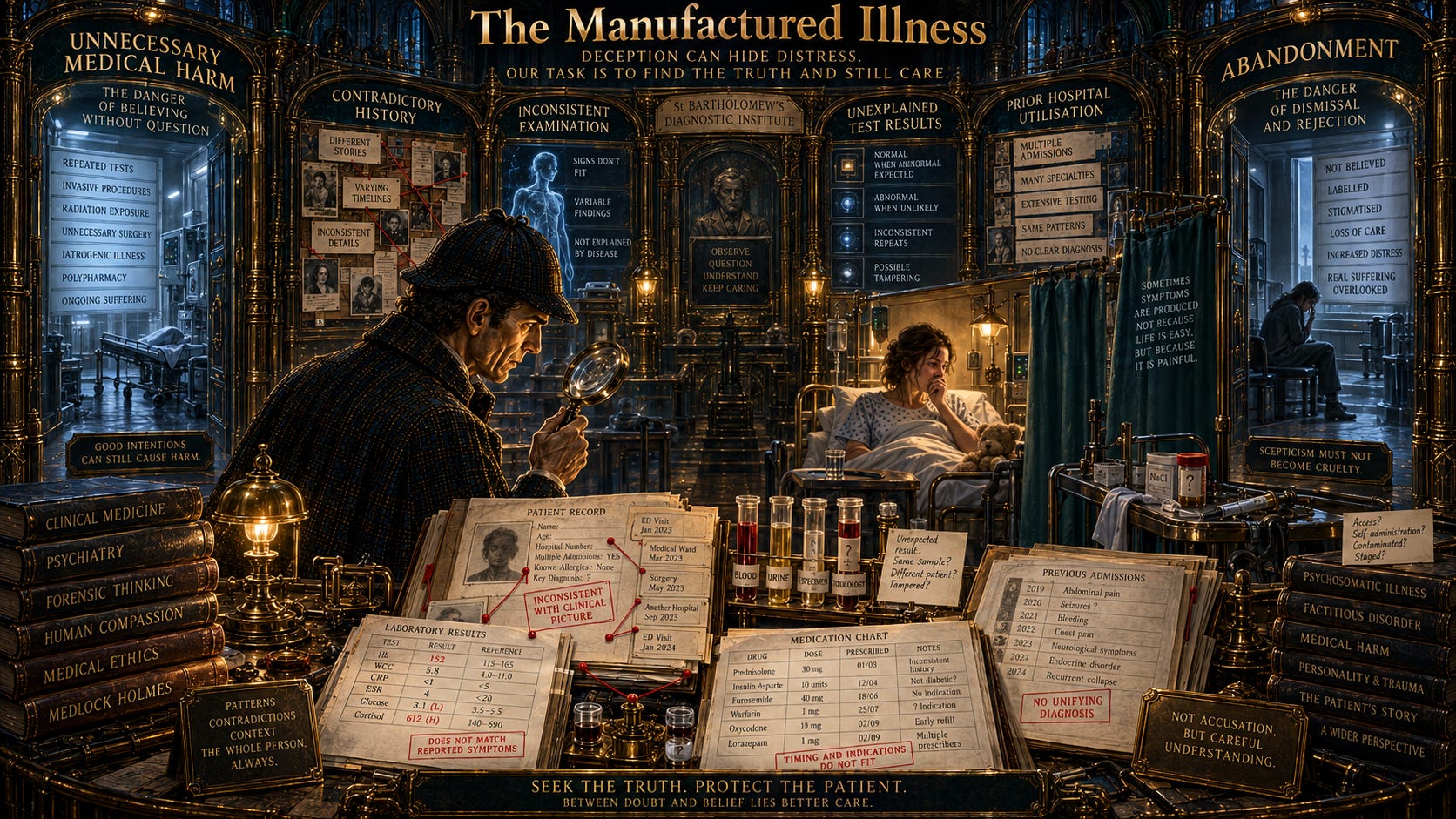 PSYCH 128: Factitious Disorder 20.09.2026 45minAt first, the cases look extraordinary.A patient presents with recurrent sepsis caused by unusual organisms. Another has persistent wounds that never heal. Another reports repeated seizures that vanish under observation. One produces dramatic laboratory abnormalities. Another travels from hospital to hospital under changing identities. In a paediatric ward, a child appears inexplicably ill whenever one caregiver is present.Holmes immediately recognises the central diagnostic requirement:There must be evidence of deception.Factitious disorder involves falsifying, inducing, exaggerating, or aggravating illness while presenting oneself-or another person-as sick, without an obvious external reward. That absence of clear material incentive separates it conceptually from malingering.The distinction sounds simple.In practice, it is not.Motives can change over time. Factitious behaviour and malingering can coexist. A patient who initially seeks the sick role may later discover disability payments or controlled medications. Another may begin by seeking narcotics but continue deceptive illness behaviour even after the external reward disappears.Holmes therefore learns not to reduce the entire investigation to a single question of motive.The more immediate questions are:Is deception occurring?Is anyone being harmed?What genuine illness might also be present?How can further harm be prevented?The chapter emphasises that factitious disorder is not a diagnosis of exclusion. Waiting until every conceivable disease has been ruled out can itself expose patients to dangerous tests and procedures. Suspicion should arise when the clinical course repeatedly defies expected medical patterns.The table on page 20 provides a practical map of clues:multiple hospitals, inconsistent histories, atypical disease course, extraordinary numbers of unsuccessful investigations, symptoms greatly exceeding objective pathology, eager acceptance of invasive procedures, refusal of collateral information, medical training, pseudologia fantastica, unexplained deterioration before discharge, and evidence that laboratory findings have been manipulated.Holmes enters the Laboratory of Manufactured Signs.The creativity is remarkable.Fever can be induced or falsified.Hypoglycaemia can be produced with insulin or oral hypoglycaemics.Bleeding can be fabricated.Laxatives can create diarrhoea.Diuretics can produce electrolyte abnormalities.Foreign substances can contaminate wounds.Medications can generate arrhythmias, hypertension, endocrine abnormalities, or neurological syndromes.The long systems-based table in the chapter makes an important point: factitious disorder can mimic almost any branch of medicine.But the clinician’s task is not to become suspicious of every unusual patient.It is to search for incompatibility between the claimed disease and the objective pattern, then gather positive evidence of fabrication.Past records become essential.So does collateral information.Specimens may need to be obtained under observation.Laboratory values may reveal signatures incompatible with natural disease.The course may improve when the patient is separated from opportunities to manipulate symptoms.Holmes then enters a second wing:Munchausen Syndrome.This is not synonymous with all factitious disorder.It represents a severe, chronic form characterised by:peregrination - travelling widely from institution to institution,andpseudologia fantastica - elaborate, self-aggrandising autobiographical lies built around fragments of truth.These patients may become professional patients.Their entire identity can become organised around illness, medical drama, admission, discharge, confrontation, disappearance, and re-presentation elsewhere.Yet the chapter repeatedly warns against reducing them to caricatures.The historical portrait on page 5 juxtaposes the real Baron Münchhausen with a later caricature and makes the symbolic point that patients with factitious disorder are also real people deserving respect, even when their presentation becomes theatrical or deceptive.The next chamber is more dangerous.It is labelled:FACTITIOUS DISORDER IMPOSED ON ANOTHERHere the perpetrator fabricates or induces illness in another person, commonly a child.The psychiatric diagnosis belongs to the perpetrator, not the victim.The victim is experiencing abuse.This distinction changes everything.The primary task is no longer therapeutic engagement with the perpetrator.It is:PROTECT THE VICTIMThe child may undergo unnecessary investigations, medications, admissions, operations, or direct poisoning and suffocation.The chapter describes mortality estimates ranging from roughly 6% to 22% in victims across reports, with significant long-term morbidity among survivors. Siblings may also be at risk.Clinical clues include:* illness appearing only with one caregiver* inconsistent histories* unusual eagerness for invasive procedures* failure of the illness to respond normally* repeated unexplained illness in siblings* a caregiver thriving on medical attention* improvement when the child is separated from the caregiver.The diagnostic principles on page 24 are systematic: review the entire chronology, identify who actually witnessed each symptom, compare caregiver reports with objective findings, contact previous clinicians, involve child-protection and legal specialists, examine siblings, and separate the child when necessary.Holmes then reaches the differential diagnosis hall.This is where mistakes become dangerous.In somatic symptom disorder, the patient is not deliberately falsifying symptoms.In functional neurological disorder, symptoms are not intentionally produced, even if the neurological pattern is incompatible with recognised disease.In malingering, deception is motivated by an identifiable external incentive.In factitious disorder, deception occurs without an obvious external reward.But the chapter gives another warning:Deception does not exclude genuine illness.A patient may fabricate one symptom while simultaneously having sepsis.Manipulate glucose while genuinely having diabetes.Feign amnesia while also having organic brain disease.Produce pseudoseizures while also having epilepsy.This is one of the central clinical traps.Once labelled “factitious,” the patient is at risk of having every future complaint dismissed.That can be fatal.Holmes therefore writes above the diagnostic desk:“Evidence of deception does not erase evidence of disease.”Treatment presents a different kind of difficulty.Direct aggressive confrontation often fails.The patient may deny everything, leave, and present elsewhere.The chapter favours a more face-saving approach whenever safety permits.The goal is not necessarily confession.It is harm reduction.Reduce unnecessary procedures.Create one gatekeeping clinician.Coordinate all care.Treat genuine medical disease.Treat comorbid depression, anxiety, substance use, or personality pathology.Provide regular contact independent of crises.Manage staff countertransference.Avoid splitting among teams.Explore the emotional function that medical care may be serving.The chapter’s management table on page 34 condenses this into three broad priorities:reduce morbidity and mortality, address underlying emotional or psychiatric needs, and manage legal and ethical issues.Holmes notices something else.The deception itself may sometimes contain an emotional truth.A fabricated bereavement may conceal genuine depression.A fabricated trauma story may sit on top of an older real trauma.A fabricated illness may provide access to care, nurturance, identity, or belonging that the person cannot seek directly.This does not make the falsification acceptable.But it makes the clinical response more useful than simple accusation.The chapter also emphasises the emotional impact on clinicians.Feeling deceived evokes anger.Humiliation.Distrust.A wish to expose or punish.This countertransference can become dangerous.Teams may become split between believers and sceptics.Routine standards of care can deteriorate.The patient may be overtreated by one group and abandoned by another.So Holmes turns the investigation inward.A clinician who cannot manage their own response may become part of the pathology of the system.The final chamber contains no dramatic laboratory trick.Only one question:What is the safest way to stop the cycle without turning care into punishment?For factitious disorder imposed on self, that often means containment, coordinated care, and psychiatric engagement.For factitious disorder imposed on another, it means protection, mandatory reporting where required, and separation of the victim when necessary.The deepest lesson is uncomfortable but clear.The illness may be fabricated.The risk is not.Key Takeaways1. DefinitionFactitious disorder involves:* falsification of physical or psychological signs or symptoms* induction or aggravation of injury or disease* presenting oneself or another person as ill* demonstrable deception* no obvious external reward.The disorder may be:Factitious disorder imposed on selforFactitious disorder imposed on anotherIn the latter, the perpetrator receives the diagnosis.2. Deception Is EssentialThe diagnostic lynchpin is:POSITIVE EVIDENCE OF DECEPTIVE BEHAVIOURAn unusual symptom or negative investigation alone is not enough.3. It Is Not a Diagnosis of ExclusionFactitious disorder should be actively considered when the pattern is suggestive.Waiting until every possible diagnosis has been excluded can cause:* unnecessary procedures* iatrogenic injury* prolonged admission* escalating self-harm.4. Symptoms May Be Produced in Four Broad WaysThe chapter describes illness as:FabricatedFalse history or invented diagnosis.FeignedPretending to have a symptom.InducedActively causing illness.AggravatedWorsening a genuine condition.5. Factitious Disorder versus MalingeringFactitious DisorderDeception + no obvious external rewardThe sick role itself appears psychologically important.MalingeringDeception + external incentiveExamples:* money* disability benefits* avoiding work* avoiding legal responsibility* obtaining controlled drugs.6. The Boundary Is Not Always CleanFactitious disorder and malingering can coexist.Motives may change longitudinally.A patient may initially seek attention and later discover financial or pharmacological reward.Clinical formulation should therefore be dynamic.7. Factitious Disorder Can Coexist With Somatic Symptom DisordersA patient may have:* FND* somatic symptom disorder* dissociative symptomsat one stage and subsequently develop deliberate symptom falsification.The mechanisms of illness behaviour may shift over time.8. Munchausen Syndrome Is a Severe SubtypeMunchausen syndrome is best understood as a:CHRONIC, SEVERE, REFRACTORY FORMrather than a synonym for all factitious disorder.The chapter estimates it at around:10% of factitious disorder cases.9. Pseudologia FantasticaPseudologia fantastica involves elaborate autobiographical lying that is:* dramatic* self-aggrandising* often partly based on truth* persistent* not purely for material gain.The patient can sometimes acknowledge falsity when confronted with contradictory evidence.10. PeregrinationThis refers to:TRAVELLING FROM HOSPITAL TO HOSPITALoften under different identities.The cycle may become:PRESENT → ADMIT → INVESTIGATE → SUSPICION → LEAVE → NEW HOSPITAL11. Common Factitious DisorderA second phenotype described is less peregrinating.Typical features include:* younger age* female sex* employment* social connectedness* healthcare occupation* more circumscribed symptoms.12. Epidemiology Is Difficult to MeasureThe prevalence is uncertain because deception itself distorts measurement.The chapter cites estimates around:approximately 1% of healthcare-seeking populationsin some sources, but reported rates vary widely.13. Healthcare Background Is CommonA substantial proportion of patients have worked in:* nursing* medicine* laboratories* allied healthcare.This provides:* medical knowledge* access to materials* familiarity with clinical systems.14. Do Not Profile DiagnosticallyHealthcare employment increases suspicion only in context.It is not diagnostic.The same applies to:* female sex* age* personality traits.Diagnosis requires evidence of deception.15. Important CluesThe table on page 20 lists practical warning signs including:* multiple hospitals* inconsistent or selective histories* denial of collateral access* atypical disease course* repeated unsuccessful investigations* symptoms exceeding objective findings* self-induced findings* eagerness for invasive procedures* deterioration before discharge* contradictory laboratory data* healthcare employment* self-aggrandising lying* resistance to psychiatric assessment.16. Illness That Does Not Behave Like IllnessA central clue is:THE NATURAL HISTORY DOES NOT FITExamples include:* wounds that heal only under observation* temperatures incompatible with accompanying physiology* unexplained polymicrobial bloodstream infections* biochemical abnormalities incompatible with life* symptoms appearing only when unobserved.17. Review Old RecordsHistorical records are often crucial.They may reveal:* different names* contradictory histories* repeated presentations* prior suspicions* multiple operations* changing stories.Longitudinal review is often more informative than one admission.18. Collateral Information MattersUseful sources include:* family* previous clinicians* pharmacies* laboratory records* medical-record exchanges.Refusal to permit collateral access may itself be informative, but is not diagnostic.19. Observe Specimen Collection When AppropriateIf manipulation is suspected, samples may need to be collected under supervision.This can reveal discrepancies between:observedandunobservedspecimens.20. Laboratory Clues Can Be PowerfulThe systems-based table in the chapter demonstrates examples such as:* exogenous insulin causing high insulin with low C-peptide* diuretics producing characteristic electrolyte patterns* anticoagulants producing abnormal coagulation profiles* laxative misuse producing characteristic stool findings* thyroid hormone ingestion producing suppressed thyroglobulin and uptake patterns.The broader principle is:USE PHYSIOLOGY TO TEST THE STORY21. Do Not Turn Detection Into a GameThe goal is not to “catch” the patient.It is to:* prevent harm* establish what is actually happening* avoid unnecessary treatment* direct care appropriately.22. Factitious Psychological SymptomsPsychological symptoms can also be fabricated.Presentations include:* feigned psychosis* feigned suicidality* fabricated bereavement* fabricated amnesia.These can be harder to confirm because psychiatric symptoms lack simple objective biomarkers.23. Feigned BereavementThe chapter describes fabricated dramatic deaths of loved ones as a recurring presentation.Importantly, many such patients have genuine:* depression* loneliness* emotional distress.The story may be false while the suffering is real.24. Feigned Psychosis Requires CautionSome patients presenting with factitious psychotic symptoms later develop genuine psychotic disorders.This reinforces:SIMULATION DOES NOT PROVE ABSENCE OF UNDERLYING ILLNESS25. Neuropsychological Testing Can HelpPerformance- and symptom-validity testing may identify:* poor effort* unusual response bias* inconsistent cognitive patterns* overreporting.Examples discussed include:* SIMS* SIRS* M-FAST* TOMM.But these tests cannot determine motive.26. Validity Testing Does Not Diagnose Factitious DisorderIt can support evidence of simulation.It cannot tell you:* why the person is doing it* whether external incentive exists* whether factitious disorder or malingering is the correct diagnosis.Clinical assessment remains essential.27. Privacy Creates Ethical TensionInvestigations may involve:* record searching* specimen monitoring* room searches* surveillance* social-media review.These can conflict with patient privacy.Legal and ethical consultation may be necessary.28. Covert SurveillanceCovert video has occasionally been used, particularly in factitious disorder imposed on another.It can provide objective evidence.But it carries major concerns around:* privacy* legal authority* entrapment* interpretation* risk while waiting for evidence.It should not be used casually.29. No Deception by the ClinicianThe chapter explicitly cautions against providers deceiving patients in return.Do not:* misrepresent why tests are being done* disguise placebos as active treatment.The clinician should remain truthful even when investigating deception.30. Stigma Can Be DangerousOnce labelled:“faker”or“Munchausen”a patient may no longer receive appropriate assessment.This creates risk of:DIAGNOSTIC OVERSHADOWING31. Genuine Disease Is CommonA patient with factitious disorder may simultaneously have:* stroke* infection* epilepsy* diabetes* thrombosis* cancer* another genuine illness.Each new symptom still deserves appropriate medical assessment.32. FND versus Factitious DisorderFunctional Neurological DisorderNeurological symptom is incompatible with recognised disease.No evidence of intentional production.Factitious DisorderEvidence of deception is present.This is the critical distinction.33. Somatic Symptom Disorder versus Factitious DisorderSSDThe patient genuinely experiences distressing symptoms and responds excessively to them.Factitious DisorderSymptoms or signs are deliberately falsified, induced, or manipulated.34. Self-Harm Is Not Automatically Factitious DisorderSomeone with borderline personality disorder may self-injure for:* affect regulation* relief* communication of distress.If the injury is openly acknowledged, this is not factitious disorder.Factitious disorder requires deception around the illness presentation.35. Suicidal Deception Is DifferentA suicidal patient may conceal:* intent* plan* previous attemptto avoid intervention.This is not necessarily factitious disorder or malingering.The behaviour is part of suicide risk and must be treated accordingly.36. Psychological Factors Affecting Medical ConditionsIf unhealthy behaviour worsens a genuine medical illness without deceptive presentation, consider:psychological factors affecting another medical conditionrather than factitious disorder.37. Culture and Language MatterAn apparently inconsistent history may reflect:* cultural misunderstanding* language barriers* fear of violence* stigma* mistrust.Deception should not be inferred prematurely.38. Etiology Is MultifactorialThe chapter emphasises uncertainty.Proposed contributors include:* attachment disruption* childhood neglect* trauma* maladaptive coping* personality pathology* medical-system familiarity* depression* anxiety* substance use* identity needs.There is no single established causal model.39. Medical-System AffinityMany patients appear unusually comfortable in medical environments.The sick role may provide:* structure* care* identity* belonging* attention* predictable relationships.40. Coping DeficitsFactitious behaviour may become a maladaptive strategy for handling:* loneliness* loss* rejection* stress* emotional dysregulation.The illness role can substitute for more direct emotional communication.41. Personality Disorders Are CommonComorbidity may include:* borderline* narcissistic* dependent* antisocial personality traits.Borderline personality disorder is particularly prominent in the chapter.42. Mood Disorders Can Underlie the BehaviourSome patients show reduction in factitious behaviour when depression is treated.This supports careful assessment for genuine comorbid psychiatric illness.43. Substance Use Can CoexistA patient may begin with factitious behaviour and later seek:* opioids* benzodiazepines* other controlled substances.Or substance-seeking malingering may evolve into more complex factitious illness behaviour.44. Loss May Trigger Factitious BehaviourEpisodes may occur after:* bereavement* relationship rupture* job loss* social rejection.Medical attention may become a substitute source of care.45. The Sick Role Can Become an IdentityIn severe cases, the patient may derive:* purpose* routine* social contact* self-definitionfrom repeated hospitalisation.This is especially relevant in Munchausen syndrome.46. Factitious Disorder Imposed on AnotherThis involves:FABRICATING OR INDUCING ILLNESS IN ANOTHER PERSONThe perpetrator then presents the victim as ill.The diagnosis belongs to the perpetrator.47. Most Reported Perpetrators Are MothersThe chapter describes the majority of reported paediatric cases as involving mothers and young children.But perpetrators can also include:* fathers* other relatives* carers* healthcare workers.48. Victims Can Be AdultsPotential victims include:* spouses* elderly parents* dependent adults* disabled adults* hospital patients.Factitious disorder imposed on another is not exclusively paediatric.49. It Is AbuseWhen illness is fabricated or induced in a dependent person:THE MEDICAL ISSUE IS ALSO A SAFEGUARDING ISSUEProtection takes priority over therapeutic engagement with the perpetrator.50. Common Presentations in ChildrenThe chapter’s review lists frequent presentations including:* bleeding* seizures* CNS depression* apnoea* diarrhoea* vomiting* fever* rash.Multiple presentations may occur in the same child.51. Illness May Be Simulated, Produced, or BothIn the review cited:* some cases involved simulation only* many involved active production* others involved both.The distinction matters because direct induction carries obvious physical danger.52. Clues in Factitious Disorder Imposed on AnotherThe table on page 23 includes:* disease inconsistent with objective findings* bizarre symptoms* caregiver not pleased when child improves* differing histories* insistence on invasive procedures* symptoms appearing only with one caregiver* unexplained sibling illness or death* failure of normal treatment* caregiver’s own unusual medical history* repeated seeking of alternative opinions.53. Improvement With Separation Is ImportantIf symptoms resolve when the child is separated from the suspected perpetrator, this may provide crucial evidence.54. Ask Who Actually Witnessed the EventA key diagnostic principle is:SOURCE EVERY PIECE OF INFORMATIONDid the nurse observe the seizure?Or did the caregiver report it?Was apnoea documented?Or merely described?This simple step can uncover major discrepancies.55. Build a ChronologyThe diagnostic table on page 24 recommends constructing a detailed timeline of:* admissions* reported symptoms* objective findings* diagnoses* procedures* treatments* outcomes.Patterns often become visible only longitudinally.56. Multidisciplinary Assessment Is EssentialRelevant participants may include:* paediatrics* psychiatry* child-protection specialists* nursing* social work* legal teams* bioethics* law enforcement.No single clinician should manage severe suspected cases alone.57. Protect SiblingsWhen one child is a victim, siblings may also be at significant risk.Past unexplained deaths or illnesses require review.58. Victim Mortality Is SignificantThe chapter describes mortality estimates of roughly:6–22%across reports.Some classic series reported around:9%.This is why delayed action can be catastrophic.59. Iatrogenic Harm Can Be Part of the AbuseVictims may be harmed not only directly by perpetrators but by:* unnecessary surgery* medications* diagnostic procedures* repeated hospitalisation.The healthcare system can become an unwitting instrument of abuse.60. Recurrent Abuse Is CommonChildren returned to unsafe caregivers may be harmed again.Repeat abuse can be especially high following:* poisoning* suffocation.Safety planning must therefore address the future, not just the current admission.61. Treatment of Factitious Disorder Imposed on SelfThree major goals are:1. Reduce morbidity and mortality2. Address underlying psychiatric or emotional needs3. Manage legal and ethical issuesThese priorities are reflected in the chapter’s management table on page 34.62. Minimise HarmThe first principle is:DO NO HARMAvoid unnecessary:* procedures* surgery* medication* invasive tests.Treat only what objective evidence and sound clinical judgement support.63. Use One Gatekeeper ClinicianA single primary clinician should coordinate care.This reduces:* duplicated testing* specialist shopping* contradictory plans* reinforcement through repeated crisis presentations.64. Regular Contact Is Better Than Crisis-Contingent ContactAppointments should be:TIME-CONTINGENTrather than:SYMPTOM-CONTINGENTRegular predictable contact may reduce the need to generate illness to access care.65. Manage CountertransferenceCommon clinician reactions include:* anger* humiliation* disgust* mistrust* desire to punish* therapeutic withdrawal.These reactions are clinically important and should be discussed within the team.66. Avoid Staff SplittingPatients may produce divisions between:* nurses* doctors* specialties* psychiatry* family.Regular interdisciplinary meetings help maintain a unified plan.67. Aggressive Confrontation Often FailsA blunt accusation may lead to:* denial* anger* discharge against advice* presentation elsewhere* further self-harm.The goal is not to force confession.68. Confession Is Not RequiredTreatment can proceed without the patient admitting deception.A successful clinical outcome may be:* less self-harm* fewer procedures* reduced healthcare use* engagement in psychiatric care.69. Face-Saving Approaches Can HelpPatients may need a way to relinquish the symptom without humiliation.The chapter describes techniques such as:* double-bind strategies* biofeedback* self-hypnosis.The broader principle is:ALLOW RECOVERY WITHOUT FORCING PUBLIC DEFEAT70. Supportive ConfrontationWhen confrontation is necessary, it should be:* calm* evidence-based* non-punitive* focused on safety* linked to ongoing care.71. Treat the Underlying Psychiatric DisorderAddress:* depression* anxiety* substance use* personality pathology* trauma-related symptoms.There is no standard medication specifically for factitious disorder itself.72. Psychotherapy FocusLong-term therapy may target:* coping skills* emotional expression* interpersonal patterns* attachment* identity* triggers for relapse.Engagement is often difficult.73. Relapse Should Be ExpectedLike other chronic maladaptive behaviours, factitious behaviour may recur.Relapse should be used to understand:* triggers* losses* relationship ruptures* emotional states.74. Prognosis Varies WidelyNot every case is chronic Munchausen syndrome.Some factitious behaviours are:* isolated* situational* stress-related* potentially remitting.Others become lifelong.75. Better Prognostic FactorsComorbid treatable:* depression* anxiety* substance usemay offer clearer therapeutic targets.76. Poorer Prognostic FactorsThe chapter associates poorer outcome particularly with:* chronic Munchausen syndrome* antisocial personality pathology* severe longstanding behavioural patterns.77. Legal and Ethical ConsultationConsider early involvement of:* risk management* legal counsel* bioethics.This is especially important when considering:* searches* surveillance* collateral disclosure* involuntary measures.78. Factitious Disorder Imposed on Another: First PriorityMAKE THE VICTIM SAFEEverything else is secondary.79. Gatekeeping in Paediatric CasesOne paediatrician should coordinate all medical care.Other clinicians should communicate through that gatekeeper.This reduces opportunities for repeated unnecessary intervention.80. Mandatory ReportingWhere child abuse is suspected or established, reporting requirements apply according to local law.The chapter emphasises that in the United States, such cases are treated as reportable child abuse.81. Separation May Be NecessaryIf the victim remains at risk, separation from the suspected perpetrator may be required while assessment proceeds.82. Treat the Victim TooVictims may develop:* PTSD* medical complications* fear of healthcare* developmental difficulties* later factitious behaviour.Recovery does not end when the perpetrator is removed.83. Evaluate the PerpetratorTreatment should assess:* psychiatric comorbidity* empathy* parenting ability* denial* risk of recurrence* capacity for reunification.84. ACCEPTS ModelThe chapter describes the ACCEPTS framework for perpetrators:AC - AcknowledgeRecognise and take responsibility for harmful behaviour.C - CopingDevelop alternatives to abusive coping.E - EmpathyUnderstand the child’s suffering.P - ParentingPrioritise the child’s needs.T - Taking ChargeUse personal power appropriately.S - SupportMaintain monitoring and support systems.85. Reunification Is Not Always AppropriateSome perpetrators may never become safe caregivers.Treatment goals must prioritise the victim’s welfare rather than preservation of the family at all costs.86. Adult VictimsFor competent independent adults, separation may depend on the victim’s own decisions.Adult protective services may be required when the victim is dependent or incapacitated.87. Healthcare Worker PerpetratorsIf a clinician is suspected of deliberately harming patients, simply relocating or dismissing them is not enough.Other patients may remain at risk.Legal and institutional action may be necessary.88. The Central DifferentialA useful four-way distinction is:SOMATIC SYMPTOM DISORDERSymptoms genuinely experienced.FUNCTIONAL NEUROLOGICAL DISORDERSymptoms not intentionally produced.FACTITIOUS DISORDERDeception present, no obvious external gain.MALINGERINGDeception present, external incentive.89. But Real Life Is MessierThese categories can overlap longitudinally.Patients may move between:* genuine illness* functional symptoms* factitious behaviour* malingering* self-harm* addiction.Rigid labels should not replace formulation.90. The Central Clinical PrincipleFactitious disorder requires two kinds of vigilance at once.First:DO NOT IGNORE THE DECEPTIONbecause it can lead to:* self-harm* iatrogenic injury* abuse* death.Second:DO NOT LET THE DECEPTION ERASE THE PATIENTbecause genuine illness and genuine psychiatric suffering may coexist.The best formulation is therefore:DECEPTIONRISKUNDERLYING NEEDSYSTEM RESPONSEand management aims for:SAFETY → COORDINATION → HARM REDUCTION → PSYCHIATRIC ENGAGEMENT This is a public episode. If you'd like to discuss this with other subscribers or get access to bonus episodes, visit drmanaankarray.substack.com/subscribe
 -
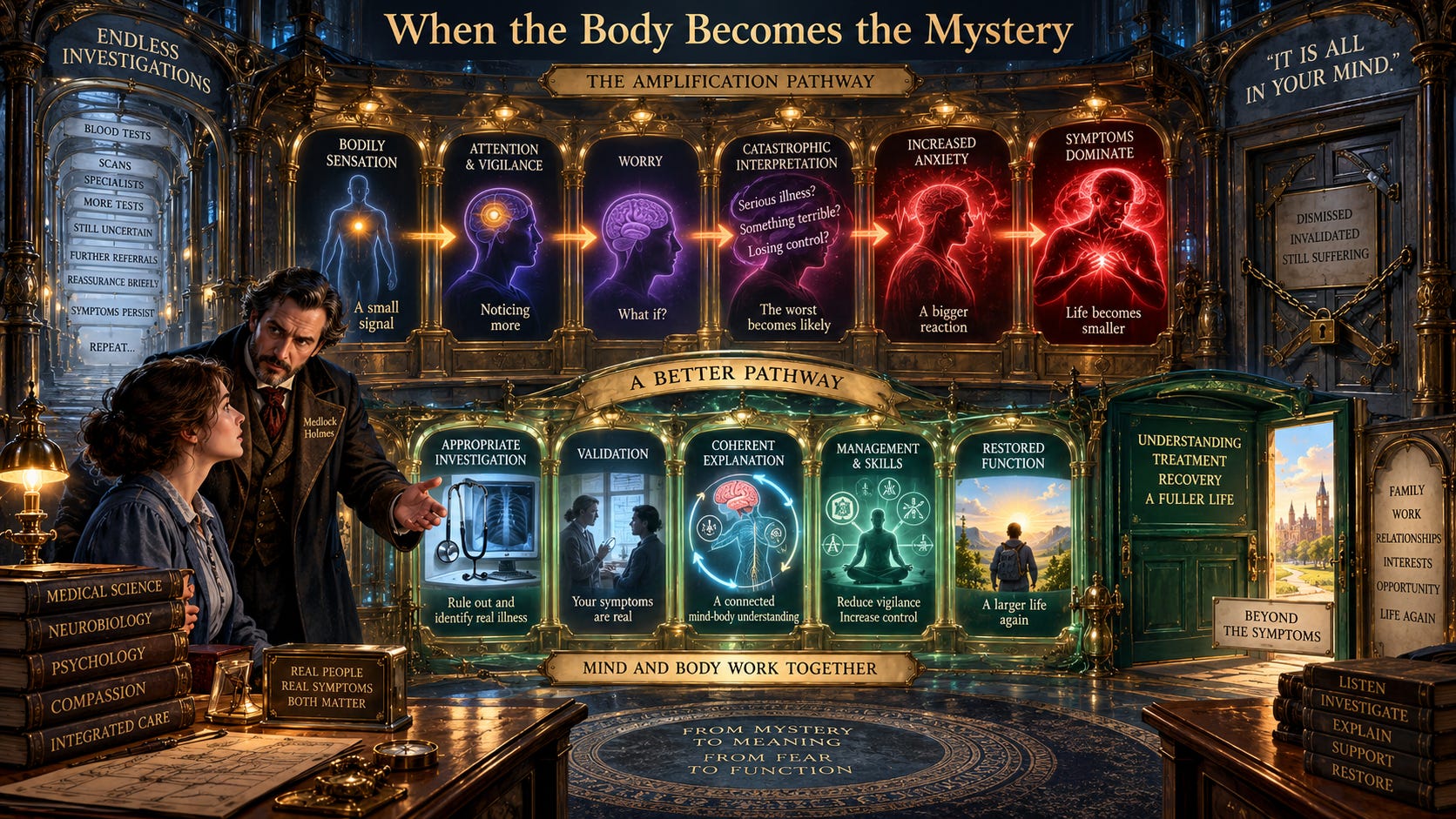 PSYCH 127: Somatic Symptom and Related Disorders 19.09.2026 56minMedlock Holmes enters an immense Neo-Victorian medical complex called The House of Bodily Signals.Every corridor is crowded.One patient reports abdominal pain. Another dizziness. Another weakness. Another chest discomfort. Another is convinced that a subtle bodily sensation means serious disease. One patient has undergone scan after scan without reassurance. Another has genuine physical illness but has become consumed by fear and monitoring. In a neighbouring neurological ward, someone presents with limb weakness that does not conform to recognised neurological anatomy.Holmes notices immediately that the central mystery is not:“Are the symptoms real?”The symptoms are real experiences.The more useful question is:“How does the person interpret, respond to, and organise life around those symptoms?”This is the conceptual shift at the heart of modern somatic symptom and related disorders.Earlier diagnostic systems relied heavily on whether symptoms were medically unexplained. DSM-5 moved away from that distinction because medicine cannot always establish whether a symptom is medically explained, partially explained or idiopathic, and because patients with genuine medical disease can still become disproportionately preoccupied with bodily symptoms.Somatic symptom disorder therefore focuses upon the combination of:distressing somatic symptomsplusexcessive thoughts, feelings or behaviours related to those symptoms.The diagnostic table on page 11 makes this explicit. One or more somatic symptoms must cause distress or disruption, while the patient also shows disproportionate concern about seriousness, persistently high health anxiety, or excessive time and energy devoted to the symptoms. The overall symptomatic state is persistent, usually for more than six months.Holmes sees why this distinction matters.A patient can have chronic pain caused by osteoarthritis and still develop somatic symptom disorder if the response to that pain becomes excessive, consuming and disabling.Conversely, a person can have many medically unexplained symptoms without meeting criteria if they are not excessively preoccupied or impaired.The disorder is therefore not diagnosed by proving that nothing is physically wrong.It is diagnosed by understanding the relationship between bodily symptoms and the patient’s cognitive, emotional and behavioural response.The chapter then separates several neighbouring conditions.In illness anxiety disorder, somatic symptoms are absent or relatively mild, but the fear of serious illness dominates the person’s life.In functional neurological symptom disorder, symptoms such as weakness, tremor, seizures, gait disturbance or sensory loss are incompatible with recognised neurological disease.In psychological factors affecting another medical condition, psychological or behavioural factors demonstrably worsen an established medical illness.In factitious disorder, symptoms are intentionally falsified or induced without an obvious external reward.And in malingering, which is not itself a psychiatric disorder, symptoms are intentionally produced for an external incentive such as money, avoiding work or obtaining drugs.Holmes realises that these categories sit at one of medicine’s most difficult boundaries.The distinction between physical and psychological is not a clean line.Pain, autonomic symptoms, fatigue, dizziness, gastrointestinal disturbance, weakness and bodily vigilance are all influenced by:* biology* attention* expectation* emotion* learning* culture* previous experience* social context.The figure on page 4 demonstrates another important principle: whether physical symptoms are medically explained or not, a high burden of somatic symptoms predicts greater rates of depression and anxiety. The number of symptoms often matters more clinically than the certainty of their medical explanation.Holmes enters the Amplification Chamber.A harmless bodily sensation passes through an attention lens.It becomes larger.The person notices it more frequently.Catastrophic interpretation increases anxiety.Anxiety increases physiological arousal.The amplified sensation then seems to confirm the original fear.The loop becomes:Sensation → Attention → Catastrophic Interpretation → Anxiety → More Sensation → More Attention.Healthcare use can then become part of the cycle.A new test provides temporary reassurance.The reassurance fades.Another symptom appears.Another specialist is consulted.Another scan is performed.Occasionally, unnecessary procedures themselves produce complications.The chapter therefore emphasises iatrogenic harm.The clinician can inadvertently reinforce the disorder through repeated investigations, invasive procedures and fragmented specialist care.Holmes sees that treatment requires a very different medical style.Not abandonment.Not confrontation.Not:“It is all in your head.”Instead:* take symptoms seriously* perform an appropriate medical assessment* explain what is known* avoid endless re-investigation without new indication* arrange regular planned appointments* treat genuine comorbid illness* gradually explore stress, beliefs and behaviour* focus on function rather than endlessly pursuing symptom elimination.The severe case described in the chapter illustrates the danger of the opposite approach: years of investigations and operations can progressively deepen disability while leaving the underlying pattern unchanged.CBT becomes particularly useful because it addresses the maintenance cycle.The patient learns to identify:* catastrophic interpretations* excessive symptom monitoring* avoidance* inactivity* reassurance seeking* unhelpful health behaviours.Behavioural activation, graded activity, relaxation and cognitive restructuring can help restore functioning.The goal is not to persuade the patient that the body is irrelevant.It is to teach the patient that bodily sensations can be understood without allowing them to dominate life.Holmes then enters the neurological wing.Here lies functional neurological symptom disorder.The essential modern diagnostic principle is crucial:The diagnosis should rest upon positive evidence of incompatibility with recognised neurological disease, rather than simply the absence of an abnormal scan or an assumption that stress must have caused the symptom.A psychological stressor may be present.It may not.The symptom is not presumed to be consciously produced.And the patient should not be accused of malingering.This represents an important departure from older psychodynamic formulations of “conversion.”Treatment may include:* explanation* reassurance* physiotherapy* behavioural approaches* treatment of comorbid anxiety or depression* careful exploration of predisposing, precipitating and perpetuating factors.The final chamber is labelled:THE THERAPEUTIC ALLIANCE.Holmes understands that this may be the most important room.Patients with chronic somatic symptoms often arrive after years of feeling dismissed, doubted, investigated or frightened.The clinician who immediately insists upon a psychological explanation may lose the patient.The clinician who endlessly investigates may reinforce the problem.The useful position lies between them:Validate the suffering without validating every catastrophic interpretation.Investigate appropriately without investigating indefinitely.Care without colluding.Reassure without dismissing.Shift the goal from finding the perfect explanation to restoring function.That is the central therapeutic skill in somatic symptom and related disorders.Key Takeaways1. Somatic symptoms are commonEveryone experiences bodily symptoms.Most resolve or are managed without major disruption.A smaller group develops persistent symptoms accompanied by excessive:* concern* monitoring* anxiety* healthcare seeking* functional impairment.The clinical problem is therefore not the existence of symptoms alone.2. DSM-5 Changed the Core ConceptOlder classifications asked:“Is the symptom medically unexplained?”DSM-5 instead asks:“Is the person’s response to the symptom excessive, persistent and impairing?”This was a major conceptual change.3. Symptoms Do Not Need to Be Medically UnexplainedA patient may have:* genuine medical illness* partially explained symptoms* idiopathic symptomsand still meet criteria for somatic symptom disorder.Conversely, unexplained symptoms alone do not establish the diagnosis.4. DSM-5 Somatic Symptom DisorderThe diagnostic framework shown on page 11 requires:A. One or more somatic symptomsthat are:* distressing* or significantly disruptive.B. At least one excessive responsesuch as:* disproportionate thoughts about seriousness* persistently high health anxiety* excessive time and energy devoted to symptoms.C. PersistenceThe state of being symptomatic is typically:more than 6 months.5. SeverityDSM-5 allows:MildOne excessive cognition/behaviour feature.ModerateTwo or more.SevereTwo or more plus multiple symptoms or one very severe symptom.A persistent specifier reflects severe, impairing and long-lasting illness.6. Pain Is Now a SpecifierThe old separate psychiatric diagnosis of:pain disorderwas removed.Pain can now be described as:Somatic Symptom Disorder - With Predominant PainThe diagnosis does not imply that the pain is fabricated or purely psychogenic.7. DSM-5 Somatic Symptom and Related DisordersThe broad group includes:* somatic symptom disorder* illness anxiety disorder* functional neurological symptom disorder* psychological factors affecting another medical condition* factitious disorder* other specified disorders* unspecified disorders.8. Body Dysmorphic Disorder Moved ElsewhereBDD is now classified with:obsessive-compulsive and related disordersrather than the somatic symptom group.9. Hypochondriasis Was ReplacedThe older diagnosis of:hypochondriasiswas removed from DSM-5.Most patients now fall into either:Somatic Symptom Disorderwhen substantial somatic symptoms are present.orIllness Anxiety Disorderwhen bodily symptoms are absent or relatively minor.10. The DSM-IV → DSM-5 ShiftThe diagram on page 5 shows the conceptual reorganisation:Previous:* somatisation disorder* undifferentiated somatoform disorder* pain disorderlargely merged into:SOMATIC SYMPTOM DISORDERwhile hypochondriasis splits according to symptom burden into:SSDorILLNESS ANXIETY DISORDER.11. ICD-11 Uses a Different StructureICD-11 includes:Bodily Distress Disorderwithin:Disorders of Bodily Distress and Bodily Experience.Like DSM-5 SSD, it focuses on excessive attention and distress rather than requiring symptoms to be medically unexplained.12. Body Integrity DysphoriaICD-11 also describes body integrity dysphoria.This rare condition involves a persistent sense that a healthy limb or body part does not belong to one’s desired body configuration.It is distinct from body dysmorphic disorder.13. Functional Somatic SyndromesThe chapter lists many syndromes encountered across medical specialties, including:* irritable bowel syndrome* noncardiac chest pain* tinnitus* dizziness* chronic pelvic pain* fibromyalgia* chronic low back pain* hyperventilation* interstitial cystitis* functional gastrointestinal syndromes.The chapter stresses their substantial overlap in:* symptom patterns* psychiatric comorbidity* functional impairment* treatment response.14. “Functional” Does Not Mean “Imaginary”An increasingly preferred conceptualisation is:FUNCTIONAL SOMATIC DISORDERbecause it avoids claiming that symptoms are either:purely physicalorpurely psychological.15. Somatic Symptoms Predict PsychopathologyThe figure on page 4 illustrates that increasing numbers of physical symptoms are associated with increasing rates of:* depressive disorders* anxiety disorders* substance-use disorders.This relationship exists whether symptoms are medically explained or unexplained.16. Somatic Presentations Are Extremely CommonIn primary care, physical symptoms are among the most common ways psychiatric distress presents.Many patients with depression or anxiety initially report:* pain* fatigue* dizziness* palpitations* gastrointestinal symptoms* sleep disturbancerather than describing psychological distress directly.17. Culture Shapes PresentationSomatic expression varies across cultures.Cultural context influences:* interpretation of bodily sensation* what counts as illness* willingness to discuss emotional distress* stigma* help-seeking* explanatory models.Somatic expression can function as an idiom of distress.18. Avoid Cultural OverinterpretationSomatic expression should not automatically be interpreted as psychological avoidance.Some cultures communicate distress more naturally through bodily language.The clinician should explore:What does the symptom mean to this person in this cultural context?19. A Biopsychosocial Model Is EssentialRelevant contributors include:Biological* pain sensitivity* sensory processing* autonomic reactivity* neuroendocrine function* possible familial vulnerability.Psychological* attention* catastrophic interpretation* alexithymia* anxiety* depression* illness beliefs.Behavioural* checking* avoidance* inactivity* reassurance seeking* healthcare use.Social* family responses* cultural expectations* socioeconomic adversity* compensation systems* healthcare structure.20. Symptom AmplificationA useful maintenance model is:BODY SENSATION↓ATTENTION↓INTERPRETATION AS THREAT↓ANXIETY↓PHYSIOLOGICAL AROUSAL↓MORE BODY SENSATION↓MORE ATTENTIONThe sensation becomes increasingly salient.21. Somatosensory AmplificationSome patients appear especially attentive to bodily sensations.Minor sensations may be perceived as:* intense* unusual* dangerous* medically significant.Research discussed in the chapter suggests altered functional connectivity may relate to symptom amplification.22. AlexithymiaAlexithymia refers broadly to difficulty:* identifying* processing* expressingemotional states.It has been associated with a greater tendency to communicate distress somatically.23. Secondary Gain Is Not the Same as FabricationA patient may gain:* attention* relief from obligations* financial compensation* supportthrough illness.This does not automatically mean that symptoms are consciously produced.Secondary gain can maintain genuine symptoms without implying malingering.24. Comorbidity Is Extremely CommonHigh somatic symptom burden commonly coexists with:* depression* anxiety* personality disorders* substance misuse.The chapter reports very high rates of depression or anxiety among heavily somatising primary-care patients.25. High Symptom Burden Predicts DisabilityThe number of physical symptoms may remain high even as the specific symptoms change over time.High symptom burden predicts:* poorer functioning* increased healthcare use* more severe psychiatric illness* greater disability.26. Somatic Symptoms May Change but the Pattern PersistsA patient may initially present with:abdominal painthen later:headachesthen:palpitationsthen:dizziness.The individual symptoms change.The broader pattern of bodily preoccupation may remain.27. The Differential Diagnosis Must Remain MedicalNever assume that multiple symptoms automatically mean a psychiatric disorder.Appropriate assessment must still consider:* neurological disease* endocrine disease* autoimmune disease* infection* medication effects* substance effects* malignancy* other medical causes.28. Occult Medical Disease Can CoexistPatients with SSD can still develop genuine medical illness.Once a psychiatric formulation exists, clinicians must avoid the opposite cognitive error:DIAGNOSTIC OVERSHADOWINGNew symptoms still require appropriate clinical assessment.29. Establishing the Alliance Comes FirstMany patients arrive expecting:* disbelief* dismissal* another negative test* another clinician saying “nothing is wrong.”A useful therapeutic stance begins with:“I believe that you are experiencing these symptoms.”That is different from agreeing with every interpretation of their cause.30. Avoid “It’s All in Your Head”This phrase:* invalidates suffering* polarises physical versus psychological explanations* damages trust* increases doctor shopping.The chapter explicitly advocates avoiding dismissive or confrontational explanations.31. Premature Reassurance Often FailsSimply saying:“Your tests are normal.”may not reduce anxiety.The patient may conclude:“They have missed something.”Effective reassurance depends upon:* adequate assessment* trust* consistency* explanation.32. Regular Scheduled AppointmentsA key management strategy is:PLANNED FOLLOW-UPrather than symptom-driven emergency visits.Regular, relatively infrequent appointments can:* provide containment* maintain continuity* reduce crisis-driven healthcare use* limit doctor shopping.33. One Coordinating Clinician HelpsWhere possible, treatment should be coordinated through:one primary clinicianwith selective specialist consultation.Fragmented care increases the risk of:* repeated investigations* contradictory explanations* unnecessary procedures* iatrogenic harm.34. Brief Physical Examination Can Be TherapeuticThe chapter supports brief, appropriate physical assessment during scheduled visits.This communicates:“Your bodily symptoms are still being taken seriously.”without repeating extensive diagnostic investigations.35. Iatrogenic Harm Is a Major RiskRepeated:* scans* endoscopies* operations* invasive tests* medicationscan cause actual harm.The severe case in the chapter demonstrates how relentless investigation may culminate in irreversible surgical consequences without solving the underlying problem.36. Functional Improvement Is Often a Better Goal Than Symptom EliminationEarly treatment goals may include:* fewer medical visits* improved daily function* return to activity* reduced checking* better sleep* reduced healthcare utilisation.The clinician may not eliminate every symptom.That does not mean treatment has failed.37. “Caring” Rather Than Only “Curing”The chapter emphasises a useful clinical shift:CARINGrather than relentlessly attempting:CURINGwhen symptoms are chronic and refractory.This is not therapeutic pessimism.It means prioritising:* function* safety* continuity* reduced harm* quality of life.38. The Consultation LetterA classic intervention directed primary-care clinicians to:* schedule regular appointments* perform brief examinations* avoid unnecessary investigations* avoid hospitalisation unless indicated* avoid dismissive explanations* briefly explore stressors.The intervention reduced healthcare utilisation and improved function even when symptoms themselves changed little.39. CBT Has the Strongest Psychotherapy EvidenceCBT targets:* catastrophic thinking* symptom monitoring* avoidance* inactivity* illness beliefs* maladaptive behaviours.It may include:* relaxation* graded activity* cognitive restructuring* behavioural experiments* symptom diaries.40. Catastrophic Thinking Maintains DisabilityFor example:“Pain means damage.”↓Avoid activity↓Deconditioning↓More pain↓More evidence of damageCBT attempts to break this loop.41. Evidence for CBTA pivotal study discussed in the chapter found substantially greater improvement with a structured CBT programme compared with augmented standard care.The benefits included:* reduced symptom severity* improved functioning* lower healthcare use.42. Medication Has a Limited Direct Role in SSDMedication is usually most useful for clearly defined comorbid:* depression* anxiety* psychosis.There is less evidence for medication aimed solely at somatic symptom disorder itself.43. Illness Anxiety DisorderThe core problem is:FEAR OF SERIOUS ILLNESSrather than a high burden of somatic symptoms.Somatic symptoms are:* absent* or mild.44. Illness Anxiety Disorder: Core PatternTypical elements include:BODY SENSATION↓SERIOUS DISEASE INTERPRETATION↓HEALTH ANXIETY↓CHECK / SEEK REASSURANCE / AVOID↓TEMPORARY RELIEF↓ANXIETY RETURNS45. Disease Conviction, Disease Fear, Bodily PreoccupationThe chapter describes three useful components:* disease conviction* disease fear* bodily preoccupation.Different patients may emphasise different parts of this triad.46. Illness Anxiety Can Become SevereAt the extreme, health beliefs may approach:delusional intensity.This requires careful differential diagnosis with:* OCD* depression* psychosis* GAD* somatic symptom disorder.47. Illness Anxiety Is Often ChronicThe chapter describes persistence over several years in a substantial proportion of patients.It can therefore become highly disabling despite the relative absence of major physical symptoms.48. CBT Is First-Line for Illness AnxietyCBT can target:* catastrophic health beliefs* body checking* repeated reassurance seeking* internet searching* medical consultation cycles.Evidence supports sustained improvement.49. Fluoxetine Has EvidenceA controlled trial discussed in the chapter found greater improvement with fluoxetine than placebo beginning around week eight.Medication may be particularly useful when health anxiety coexists with depression or anxiety.50. Functional Neurological Symptom DisorderFunctional neurological symptom disorder includes neurological symptoms such as:* weakness* paralysis* tremor* abnormal gait* sensory loss* aphonia* blindness* seizure-like episodes.51. The Diagnosis Should Be PositiveA crucial DSM-5 principle is:INCOMPATIBILITY WITH RECOGNISED NEUROLOGICAL DISEASEThe diagnosis should not simply mean:“tests were negative.”Positive clinical signs should support the diagnosis.52. A Psychological Stressor Is Not RequiredOlder conversion models assumed psychological conflict was transformed into neurological symptoms.DSM-5 no longer requires that a psychological stressor be identified.This is clinically important because stress is:* common* nonspecific* sometimes absent.53. Symptoms Are Not Assumed to Be IntentionalFunctional neurological symptoms are not the same as:* malingering* factitious disorder.The patient is not presumed to consciously produce the symptom.54. “La Belle Indifférence” Is Not DiagnosticApparent emotional calm despite dramatic symptoms was historically emphasised.It is neither sufficiently specific nor reliable to diagnose FND.55. Functional Neurological Disorder Requires Neurological ExpertiseAssessment must consider disorders such as:* epilepsy* multiple sclerosis* movement disorders* peripheral neurological disease.Appropriate examination and targeted investigations remain essential.56. Psychogenic Nonepileptic SeizuresSeizure-like episodes without epileptic physiology are one presentation of FND.EEG or video-EEG may be necessary to differentiate them from epilepsy.57. Physiotherapy Can Be ImportantFor motor FND:* weakness* gait disturbance* balance problemsphysiotherapy can help restore normal movement patterns and function.It is not simply “supportive care.”It may be a central therapeutic intervention.58. Psychological Explanation Should Be Timed CarefullyPrematurely saying:“This is caused by stress.”may alienate the patient.A more useful explanation is:“The nervous system is not functioning normally even though we do not see structural damage.”The distinction between:functionandstructurecan be clinically powerful.59. Explore Predisposing, Precipitating and Perpetuating FactorsA useful formulation considers:Predisposing* previous illness* trauma* vulnerability* learned illness behaviour.Precipitating* injury* illness* stress* physiological events.Perpetuating* fear* avoidance* deconditioning* maladaptive beliefs* healthcare interactions.60. Pain and SSDPain should be understood through a:BIOPSYCHOSOCIAL MODELrather than divided rigidly into:physical painversuspsychological pain.Pain experience is influenced by:* nociception* mood* attention* sleep* expectation* previous experience* behaviour.61. Antidepressants and Functional PainThe chapter describes evidence particularly for older antidepressants such as:tricyclic antidepressantsin several functional pain syndromes.The analgesic effect can occur at doses lower than those typically used for major depression.62. CBT for Chronic PainCBT has demonstrated benefit across several chronic pain syndromes.Targets include:* catastrophising* fear of movement* inactivity* attention* coping behaviour.63. Psychological Factors Affecting Another Medical ConditionThis diagnosis differs from SSD.A genuine medical disorder is present.Psychological or behavioural factors then clearly worsen it.Examples include:* anxiety worsening asthma* behavioural manipulation of insulin* medication non-adherence* denial of serious illness.64. The Causal Link Must Be ClearThe diagnosis should only be made when the psychological or behavioural factor has a demonstrable adverse impact upon:* course* severity* treatment* risk* outcome.65. Factitious DisorderFactitious disorder involves:INTENTIONAL FALSIFICATION OR INDUCTION OF ILLNESSwithout an obvious external reward.Examples include:* contaminating specimens* inducing bleeding* causing skin lesions* manipulating laboratory results* producing fever.66. Factitious Disorder Imposed on AnotherThe patient induces or falsifies illness in another person.This was historically termed:factitious disorder by proxy.It raises major safeguarding concerns.67. Factitious Disorder versus MalingeringThe distinction is essential.Factitious DisorderIntentional symptom productionbut no obvious external reward.The psychological motivation centres around adopting the sick role.MalingeringIntentional symptom productionfor external incentives such as:* money* compensation* drugs* avoiding work* avoiding prosecution.68. Intentionality Separates Factitious Disorder From FNDFNDSymptoms are not presumed consciously produced.Factitious DisorderSymptoms are intentionally produced.MalingeringSymptoms are intentionally produced for external gain.This distinction is central to differential diagnosis.69. Other Specified DisordersExamples include:* brief somatic symptom disorder* brief illness anxiety disorder* illness anxiety without excessive health-related behaviour* pseudocyesis.70. Primary Care Is the Main Treatment ArenaMany patients with somatic presentations never reach psychiatric services.Primary care therefore functions as a major mental-health setting for these disorders.71. A Stepped-Care ApproachThe chapter outlines a practical progression.Step 1Identify persistent idiopathic physical symptoms and psychiatric need.Step 2Provide:* psychoeducation* stress reduction* biofeedback* brief symptom-focused interventions.Step 3Introduce onsite mental-health expertise and time-limited CBT.Step 4Escalate to:* psychotherapy* medication* coordinated specialist carefor persistent or severe presentations.72. Personalised Care MattersThere is no single treatment protocol that fits every patient.Some patients need:* reassurance* continuity* CBT.Others require:* pain treatment* physiotherapy* psychiatric medication* neurological intervention* multidisciplinary rehabilitation.Severity and mechanism matter.73. The Central Therapeutic PrincipleThe clinician should avoid two extremes.Extreme One“There is definitely a hidden physical disease and we must keep investigating.”This can produce:iatrogenic harm.Extreme Two“Nothing is wrong; this is psychological.”This produces:invalidating dismissal.The useful position is:“The symptom is real. We have appropriately assessed dangerous causes. Now we need to understand what is keeping the symptom and disability going.”74. The Core Clinical ModelSomatic symptom disorder can be conceptualised as:BODY SENSATION↓ATTENTION↓THREAT INTERPRETATION↓HEALTH ANXIETY↓CHECKING / AVOIDANCE / MEDICAL SEEKING↓TEMPORARY REASSURANCE↓RENEWED ATTENTION↓MORE SYMPTOMSTreatment attempts to introduce:VALIDATION↓COHERENT EXPLANATION↓REGULAR CARE↓REDUCED INVESTIGATION↓CBT / GRADED ACTIVITY↓FUNCTIONAL RECOVERY This is a public episode. If you'd like to discuss this with other subscribers or get access to bonus episodes, visit drmanaankarray.substack.com/subscribe
 -
 PSYCH 126: Post-Traumatic Stress Disorder 18.09.2026 49minMedlock Holmes enters an immense Neo-Victorian institution called The Citadel of the Unfinished Alarm.At the centre is a vast clock frozen at the moment of trauma.Outside the citadel, the danger has passed.Inside, however, bells continue to ring.A veteran ducks at the sound of a car backfiring. A survivor avoids a street that resembles the place of an assault. Another wakes from the same nightmare night after night. A fourth scans every room for exits.Holmes immediately recognises the defining paradox of post-traumatic stress disorder:The event belongs to the past, but the nervous system continues to respond as though danger remains present.PTSD is classified as a trauma- and stressor-related disorder. Diagnosis requires exposure to actual or threatened death, serious injury or sexual violence, followed by characteristic symptoms lasting longer than one month and causing meaningful distress or impairment.Those symptoms fall into four major clusters:Intrusion. Avoidance. Negative alterations in cognition and mood. Alterations in arousal and reactivity.Intrusive memories are not ordinary recollections. They possess a disturbing “here and now” quality. Flashbacks, nightmares and physiological reactions to reminders can make the past feel emotionally immediate.Avoidance then emerges as an understandable attempt to control this intrusion. The person avoids places, people, conversations, memories, feelings and bodily sensations associated with trauma.But avoidance comes at a cost.It prevents the nervous system from learning:“This reminder is not the original danger.”Fear spreads. One battlefield cue becomes avoidance of uniforms, crowds, loud noises and unfamiliar places. Life becomes increasingly organised around preventing surprises.The third cluster alters the person’s world beyond the trauma itself.I cannot trust anyone.The world is completely dangerous.I should have prevented it.Something in me is permanently damaged.Interests fade. Positive emotion becomes difficult. Relationships become distant. Guilt, shame and emotional numbing can replace the person’s previous assumptions about self and world.Meanwhile, the alarm system remains sensitised.Hypervigilance.Exaggerated startle.Poor sleep.Irritability.Concentration difficulty.Reckless behaviour.The syndrome therefore becomes more than fear of a memory. It is a disturbance of threat detection, contextual processing, emotion regulation, attention, learning and recovery.The brain-circuit diagram on page 25 captures this particularly well. Four interacting systems are highlighted: emotion regulation and executive function, threat and salience detection, contextual processing, and fear learning. Rather than one damaged “trauma centre”, PTSD involves altered communication among the prefrontal cortex, anterior cingulate, insula, amygdala, hippocampus, thalamus and related structures.Holmes reaches the amygdala first.It rapidly tags potential threat.The insula monitors salient internal and external signals.The dorsal anterior cingulate helps orient attention towards danger.But prefrontal regulatory systems that should inhibit unnecessary alarm may function less efficiently.The hippocampus supplies another critical function:context.A loud noise in combat meant one thing.A loud noise at home years later means another.PTSD can impair the ability to use context to update the meaning of the signal.This is why the chapter presents PTSD as, in part, a disorder of recovery.Many people show substantial symptoms immediately after trauma.Most improve.Those who develop PTSD fail to follow the expected trajectory of extinction, contextual updating and restoration of safety.Fear conditioning provides one model.During trauma, previously neutral stimuli become associated with extreme threat.Later, those stimuli can trigger defensive responses even when the original threat is absent.Normally, repeated safe encounters produce extinction learning.But PTSD is associated with impaired extinction and impaired retention of extinction.The person may learn safety briefly and then lose access to that learning when reminded of danger.Holmes also discovers that biology before the trauma matters.PTSD does not occur in everyone who experiences trauma.Risk reflects interactions among:* previous trauma* childhood adversity* genetic vulnerability* social support* severity of exposure* peri-traumatic responses* continuing stress* post-trauma environment.The traumatic event is therefore necessary but not sufficient.Genetics contribute, but there is no single PTSD gene. The disorder has a polygenic architecture, with environmental experiences and epigenetic regulation shaping biological vulnerability.The neuroendocrine system also becomes involved.Noradrenergic hyper-reactivity may strengthen traumatic memory and contribute to hypervigilance and nightmares.Cortisol regulation is altered in some patients.Neuropeptide Y appears associated with resilience.GABA-modulating neurosteroids may be reduced.Dopamine contributes to stress responses and disrupted reward.Sleep becomes another crucial clue.Up to 90% of people with PTSD report sleep disturbance.Nightmares and fragmented sleep do not merely accompany the disorder; disrupted sleep may interfere with emotional memory processing and fear extinction, potentially helping maintain PTSD.Holmes then turns from mechanism to treatment.Trauma-focused psychotherapies have the strongest evidence.Prolonged Exposure asks the patient to approach rather than avoid trauma memories and safe reminders.Cognitive Processing Therapy examines distorted beliefs involving danger, blame, guilt and permanent damage.EMDR combines trauma recall with structured sensory stimulation.Other therapies can also help, including present-centred and interpersonal approaches in selected patients.Medication provides another route.SSRIs have the strongest evidence, particularly sertraline and paroxetine, while venlafaxine is also supported.Prazosin has been used particularly for trauma-related nightmares.Benzodiazepines, despite their intuitive appeal for acute distress, are poorly supported and may interfere with trauma recovery mechanisms.The chapter also explores emerging approaches including rTMS, neurofeedback, cannabinoids, glutamatergic interventions and MDMA-assisted psychotherapy, while emphasising the limits of current evidence.Holmes finally enters the room marked:PREVENTION.Here he discovers one of the most important lessons in trauma care.Immediate emotional debriefing was once widely believed to prevent PTSD.It does not.Routine single-session psychological debriefing can be ineffective and may even interfere with natural recovery.Most trauma survivors do not require immediate trauma processing.What they often need first is:safety, practical assistance, human contact, sleep, shelter, information and monitoring.Early targeted CBT can help people who have already developed significant acute traumatic stress symptoms.But blanket intervention for everyone exposed to trauma is neither necessary nor supported.Holmes leaves the citadel with a final insight.PTSD is not simply the presence of a terrible memory.It is the failure of that memory to acquire an appropriate timestamp.The nervous system knows what happened.What it struggles to learn is:“It happened then. I am here now.”Recovery therefore requires more than forgetting.It requires rebuilding the capacity to distinguish:memory from current danger,reminder from recurrence,andthe world that contained the trauma from the world that exists today.Key Takeaways1. PTSD Is a Trauma- and Stressor-Related DisorderPTSD requires a clear relationship between current symptoms and exposure to a qualifying traumatic event.Unlike most psychiatric diagnoses, the triggering event is part of the diagnostic definition.2. What Qualifies as Trauma?Criterion A includes exposure to actual or threatened:DEATHSERIOUS INJURYorSEXUAL VIOLENCEthrough:* directly experiencing it* witnessing it* learning that it happened violently or accidentally to a close person* repeated or extreme occupational exposure to aversive details.Routine exposure through television or social media does not qualify unless it occurs as part of professional duties.3. The Four Core Symptom ClustersPTSD requires symptoms across four domains:B - IntrusionC - AvoidanceD - Negative Cognitions and MoodE - Altered Arousal and ReactivityThe pattern must persist for:MORE THAN 1 MONTHand cause clinically significant distress or impairment.4. IntrusionIntrusion symptoms include:* involuntary memories* nightmares* flashbacks* psychological distress to reminders* physiological reactions to reminders.The defining quality is that the memory feels emotionally:HERE AND NOWrather than simply:THERE AND THEN.5. Flashbacks Are More Than RememberingAt the severe end of intrusion, the person may temporarily experience the traumatic event as though it is recurring.Awareness of the present can become partially or completely overshadowed.This makes dissociative re-experiencing qualitatively different from ordinary autobiographical memory.6. AvoidanceAvoidance can target:Internal reminders* memories* thoughts* feelings.External reminders* places* people* conversations* activities* objects* situations.Avoidance initially reduces distress but may prevent corrective learning.7. Avoidance Can GeneraliseFear often spreads beyond the original danger.For example:battlefield dangermay generalise to:uniforms → loud noises → crowds → mail → public placesThe patient’s world progressively contracts.This represents inappropriate generalisation of threat.8. Negative Cognitions and MoodThis cluster includes:* inability to remember part of the trauma* persistent negative beliefs* distorted blame* persistent fear, horror, anger, guilt or shame* reduced interest* detachment* inability to experience positive emotions.9. Trauma Can Alter WorldviewCommon beliefs include:“The world is completely dangerous.”“Nobody can be trusted.”“I am permanently damaged.”“It was my fault.”These are not merely passing thoughts.They can become enduring cognitive frameworks through which future experience is interpreted.10. Hyperarousal and ReactivitySymptoms include:* irritability* angry outbursts* reckless behaviour* hypervigilance* exaggerated startle* concentration problems* sleep disturbance.The nervous system remains prepared for threat even when current circumstances are safe.11. PTSD Is HeterogeneousDifferent patients can meet diagnostic criteria with substantially different symptom combinations.One patient may primarily show:fear and hyperarousalanother:dysphoria and anhedoniaanother:angeranother:dissociationanother:social withdrawal and emotional numbing.PTSD is therefore a syndrome rather than one uniform phenotype.12. Dissociative SubtypeSome patients show prominent:* depersonalisation* derealisation.Rather than extreme hyperarousal, they may show an overmodulated response to threat.The chapter cites an estimated prevalence of approximately 14.4% of individuals with PTSD for this subtype.13. DepersonalisationThe person feels detached from:* body* thoughts* emotions* sense of self.They may describe:“I feel as if I am watching myself from outside.”14. DerealisationThe surroundings feel:* unreal* distant* dreamlike* distorted.These symptoms should not be better explained by intoxication or another medical condition.15. Delayed ExpressionDSM-5 allows a delayed expression specifier when full diagnostic criteria are not met until at least six months after the trauma.Importantly, the chapter emphasises that truly delayed onset from a completely asymptomatic state appears uncommon.More often there are earlier subthreshold symptoms that later intensify.16. Complex PTSDICD-11 distinguishes complex PTSD.This includes core PTSD symptoms together with broader disturbances involving:* emotion regulation* self-concept* interpersonal relationships.It is particularly associated with prolonged or repeated trauma.17. PTSD Is Not a Normal Reaction to TraumaDistress immediately after trauma is common and often normal.Most people exposed to trauma do not develop PTSD.PTSD represents a persistent pathological outcome in which recovery mechanisms fail.18. Trauma Is Necessary but Not SufficientA useful formulation is:TRAUMA TRIGGERS PTSD - IT DOES NOT FULLY EXPLAIN ITRisk reflects interaction among:Pre-trauma vulnerabilityTrauma characteristicsPost-trauma environmentRecovery processes19. Trauma Exposure Is Very CommonLifetime exposure to traumatic events is common.The chapter cites estimates of:50–89%in the United States.A worldwide survey found around:70%reported at least one traumatic event.Around:30.5%reported four or more.20. PTSD Is Much Less Common Than Trauma ExposureUS lifetime prevalence in a major national survey was approximately:6.8%Past-year prevalence:3.5%This disparity reinforces the importance of studying resilience as well as vulnerability.21. Sex DifferencesThe cited US lifetime rates were approximately:Men - 3.6%Women - 9.7%But risk varies considerably with the type and severity of trauma.22. Trauma Type MattersConditional PTSD risk is not equal across traumatic events.Interpersonal violence, particularly sexual assault, tends to carry substantially higher risk than many accidents or disasters.23. Repeated Trauma MattersExperiencing multiple traumatic events increases risk.Particularly relevant exposures include:* childhood abuse* interpersonal violence* repeated combat* repeated occupational trauma.24. Social Support Is ProtectiveOne of the most consistent modifiable factors is:POST-TRAUMA SOCIAL SUPPORTPoor support increases risk.Stable, soothing interpersonal relationships may facilitate recovery and fear extinction.25. Continuing Stress Can Prevent RecoveryThe traumatic event may have ended, but the person may continue experiencing:* homelessness* interpersonal conflict* financial problems* litigation* danger* discrimination* repeated exposure.Persistent stress can interfere with extinction and contextual updating.26. Early Symptom Severity Predicts Later PTSDEarly PTSD symptom severity is one of the strongest indicators of later chronic symptoms.But early symptoms do not inevitably lead to chronic PTSD.Many initially symptomatic survivors recover naturally.27. PTSD Has a Genetic ComponentTwin studies suggest that approximately:30%of variability in PTSD vulnerability may be genetically influenced.But there is no single PTSD gene.28. PTSD Is PolygenicMany genetic variants each contribute small effects.Relevant research has examined genes related to:* serotonin* dopamine* GABA* glucocorticoid signalling* FKBP5* stress peptides* neuroplasticity.The eventual phenotype arises through:GENES × ENVIRONMENT × DEVELOPMENT29. Gene–Environment InteractionGenetic vulnerability may become clinically relevant only in particular environmental contexts.Examples described include interactions between:* childhood adversity* adult trauma* stress-response genes.Thus:genetic susceptibility is conditional, not deterministic.30. EpigeneticsTrauma may alter regulation of gene expression without changing the underlying DNA sequence.Research has identified differences in DNA methylation associated with PTSD.Some epigenetic patterns may change following successful treatment or recovery.31. PTSD as a Disorder of RecoveryOne of the chapter’s most powerful concepts is:PTSD MAY BE A DISORDER OF RECOVERYImmediately after severe trauma:symptoms are common.Over time:most recover.In PTSD:the alarm persists.The scientific question therefore becomes not simply:“Why did someone react?”but:“Why did the reaction fail to resolve?”32. Fear ConditioningDuring trauma:Neutral cue + Extreme threat↓Conditioned associationLater:Neutral cue alone↓Defensive responseFor example:explosion + smell of dieselmay later become:diesel smell → paniceven in safety.33. AmygdalaThe amygdala is central to:* threat learning* salience* conditioned fear* defensive responses.The central amygdala coordinates:* autonomic activity* fight* flight* freezing* endocrine responses.34. Basolateral AmygdalaThe basolateral amygdala participates particularly in forming associations between:stimulusandthreat.Once established, previously neutral cues can trigger defensive responses.35. Prefrontal CortexPrefrontal systems help regulate the amygdala.They contribute to:* inhibitory control* extinction* emotion regulation* cognitive flexibility.Reduced prefrontal regulation may allow threat responses to persist.36. HippocampusThe hippocampus helps answer:“WHERE AND WHEN IS THIS DANGER RELEVANT?”It provides contextual information.Impaired contextual processing can cause a reminder in the present to evoke the same reaction as the original trauma.37. The Four Major Neural SystemsThe diagram on page 25 highlights four interacting circuits:Emotion Regulation and Executive FunctionPrefrontal systems.Threat and Salience DetectionAmygdala, insula, ACC and related circuitry.Contextual ProcessingHippocampus, vmPFC, thalamus and associated pathways.Fear LearningAmygdala-centred associative circuitry.38. Salience NetworkThe salience network includes important contributions from:* insula* ACC* amygdala.In PTSD it may become excessively oriented towards potentially threatening information.39. Default Mode NetworkThe default mode network contributes to:* internal mentation* autobiographical processing* self-related processing.PTSD has been associated with abnormal DMN connectivity.40. Network DysregulationResearch suggests:salience network engagement ↑while:regulatory/default-mode integration ↓This may help explain persistent attention to threat and difficulty disengaging from trauma-related internal experience.41. Failure of ExtinctionNormally:CS without danger → fear gradually decreasesIn PTSD:* extinction may be impaired* extinction memory may be poorly retained.The person therefore continues responding defensively to safe reminders.42. Safety Learning Is CentralRecovery is not simply forgetting trauma.It involves learning:“This cue no longer predicts danger.”“This environment is different.”“I survived.”“I can respond differently now.”43. CortisolCortisol regulation in PTSD is complex.Some studies have described:* lower cortisol output* increased glucocorticoid receptor sensitivity* enhanced negative feedback.Findings are not universal.The chapter explicitly cautions against assuming one HPA-axis abnormality in every patient.44. NoradrenalineExaggerated noradrenergic activity contributes to:* hyperarousal* hypervigilance* sleep fragmentation* nightmares* strong emotional-memory consolidation.The α2 antagonist yohimbine can provoke intense PTSD symptoms in susceptible patients.45. PrazosinPrazosin blocks:α1 adrenergic receptors.It has been used particularly for:PTSD-related nightmareswith some evidence of benefit.46. NeurosteroidsAllopregnanolone and pregnanolone enhance GABAergic inhibition.Lower levels have been reported in PTSD and may relate to symptom severity.They also have potential roles in:* neuroprotection* neurogenesis* myelination.47. Neuropeptide YNPY has been associated with:STRESS RESILIENCEPotential effects include:* reduced anxiety* improved homeostasis* better sleep* reduced autonomic reactivity* enhanced hippocampal neurogenesis.48. DopamineDopamine contributes to:* conditioned stress responses* amygdala activation* PFC inhibition* reward signalling.Reward processing may be reduced in PTSD, potentially contributing to:anhedoniaand reduced motivation.49. SerotoninSerotonergic systems contribute to PTSD vulnerability and symptoms.Provoking serotonergic systems experimentally can reproduce anxiety and flashback-like symptoms in susceptible patients.SSRIs remain among the main established pharmacological treatments.50. Structural ImagingOne of the best-known structural findings is:reduced hippocampal volumein groups with PTSD.However, this is not specific to PTSD.51. Smaller Hippocampus: Cause or Consequence?A particularly important twin study suggested that smaller hippocampal volume may sometimes be a:PRE-EXISTING VULNERABILITY FACTORrather than simply damage caused by PTSD.This illustrates a general warning:an abnormality associated with a disorder is not automatically caused by that disorder.52. Other Structural FindingsReported abnormalities include changes in:* corpus callosum* ACC* cingulum* amygdala* insula.Findings vary substantially between studies.53. Sleep Is CentralUp to:90%of patients with PTSD report sleep disturbance.Important problems include:* insomnia* nightmares* fragmented sleep.54. REM Sleep and Trauma MemoryREM sleep contributes to emotional-memory processing.Disrupted REM may impair adaptive processing and maintenance of extinction memories.Poor sleep may therefore be both:a symptomanda maintaining factor.55. Sleep Before Trauma May Predict VulnerabilitySome studies suggest sleep disturbance before trauma exposure may predict subsequent PTSD.Sleep problems are therefore not always simply consequences of trauma.56. Differential Diagnosis Begins With TraumaPTSD cannot be diagnosed without a qualifying traumatic event.Then ask:Are the symptoms linked to that trauma in timing or content?This linkage is essential.57. Acute Stress DisorderThe key temporal distinction is:Acute Stress DisorderSymptoms occur in the first month.PTSDSymptoms persist beyond one month.58. Adjustment DisorderAdjustment disorder follows a significant psychosocial stressor that does not necessarily meet the traumatic threshold.PTSD requires Criterion A trauma.59. GADGAD primarily concerns:future possibilities.PTSD intrusion concerns:a past event that continues to feel present.60. OCDOCD intrusive thoughts commonly concern:* contamination* harm* uncertainty* unacceptable thoughts.PTSD intrusions reproduce or symbolically relate to a specific traumatic event.61. DepressionPTSD and depression overlap substantially in:* anhedonia* sleep disturbance* guilt* withdrawal* concentration problems.The trauma-linked intrusion and avoidance symptoms help distinguish PTSD.62. PTSD and Depression Commonly CoexistAround half of adults with PTSD may concurrently meet criteria for major depression in some samples.Lifetime overlap is even higher.Both diagnoses may therefore be appropriate.63. Substance Use DisordersAlcohol and other substances may be used to:* suppress arousal* aid sleep* block memories* reduce emotional pain.Substance use can worsen PTSD and interfere with treatment.Both conditions may require simultaneous treatment.64. Suicide RiskPatients with PTSD should be assessed for:* depression* hopelessness* impulsivity* substance misuse* suicidal thoughts* suicidal behaviour.Safety-threatening conditions take priority over trauma processing.65. Natural Recovery Is CommonImmediately after trauma, symptoms are common.Most people improve.This is why early distress should not automatically be pathologised.66. Chronic PTSDApproximately one-third of people who develop PTSD may experience a chronic course in some studies.Symptoms can persist for decades.This makes long-term follow-up important.67. Delayed-Onset PTSD Is Usually Not Truly Symptom-FreeMany apparently delayed cases involve:earlier subthreshold symptomsfollowed by:later worsening.New stressors, illness, ageing or reminders may reactivate previously contained symptoms.68. Trauma-Focused CBTTrauma-focused CBT has one of the strongest evidence bases.It may include:* exposure* cognitive restructuring* behavioural work* processing of trauma meanings.69. Prolonged ExposurePE deliberately addresses:avoidancethrough:Imaginal exposureRepeated engagement with trauma memory.In vivo exposureApproaching objectively safe trauma reminders.The therapeutic principle is:APPROACH → PROCESS → UPDATErather than:REMEMBER → ESCAPE.70. Cognitive Processing TherapyCPT focuses particularly on maladaptive beliefs involving:* blame* guilt* safety* trust* power* control* esteem* intimacy.The person learns to revise overgeneralised trauma-derived beliefs.71. EMDREMDR involves recalling distressing traumatic material while receiving structured bilateral sensory stimulation.It has demonstrated efficacy for PTSD.Its exact mechanism remains debated.72. Present-Centred TherapyPCT focuses more on:* current relationships* work* daily problemsrather than direct trauma processing.It can provide meaningful benefit, particularly when patients struggle to tolerate trauma-focused approaches.73. Interpersonal TherapyInterpersonal approaches focus upon:* relationships* role changes* interpersonal consequences of trauma.Some evidence suggests outcomes can be comparable with exposure-based treatment among completers, with potentially lower dropout in some patients with depression.74. Military PTSD Can Be Difficult to TreatTrauma-focused treatments improve symptoms in many veterans.However:* dropout can be high* residual symptoms are common* many retain diagnostic-level PTSD.Non-trauma-focused treatment can therefore be reasonable when it improves continued engagement.75. Treatment in Children and AdolescentsPsychological treatment is beneficial.The strongest evidence discussed is for:CBTwith improvements lasting up to a year in some studies.76. PharmacotherapyThe strongest medication evidence is for:SertralineParoxetineBoth have regulatory approval for adult PTSD.Venlafaxine also has supportive evidence.77. BenzodiazepinesEvidence for benzodiazepines in PTSD is poor.They may interfere with:* learning* memory* extinction.They are therefore generally not recommended as routine PTSD treatment.78. NightmaresPrazosin has some evidence for trauma-related nightmares.Sleep should be actively assessed and treated because of its central role in illness maintenance.79. Combined TreatmentEvidence has not clearly established that:medication + psychotherapyis always superior to either intervention alone.Treatment should therefore be individualised rather than assuming combination is automatically best.80. MDMA-Assisted PsychotherapyThe chapter discusses evidence that MDMA used as an adjunct to psychotherapy can reduce PTSD symptoms more effectively than psychotherapy alone in some studies.The crucial distinction is:MDMA-ASSISTED PSYCHOTHERAPYnot:MDMA alone.The source emphasises that MDMA alone has no established therapeutic role and has abuse potential.81. Emerging TreatmentsInvestigational approaches include:* rTMS* neurofeedback* cannabinoids* glutamatergic interventions* endocannabinoid modulation* oxytocin-related treatments.Evidence remains developing.82. NeurofeedbackNeurofeedback attempts to teach patients to modify activity in specific brain systems.Amygdala-targeted approaches have shown preliminary promise.This represents a move towards:process-based neuromodulation.83. Prevention Is Possible in PrinciplePTSD is unusual because the triggering event often has a clear time point.That creates an opportunity to identify high-risk survivors before chronic illness develops.84. Three Early TrajectoriesTrauma survivors commonly follow trajectories such as:ResilienceLittle persistent symptom burden.RecoveryInitial symptoms gradually decrease.Non-remissionSymptoms emerge and persist.A less common trajectory involves later symptom worsening.85. Routine Psychological Debriefing Is Not RecommendedSingle-session debriefing after trauma was historically popular.Controlled studies found:no reliable preventive benefitand possible:negative effects on natural recovery.Routine debriefing should therefore not be offered indiscriminately.86. Early Care Should Prioritise Immediate NeedsImmediately after trauma, important interventions often include:* safety* shelter* food* sleep* medical treatment* information* practical support* social connection.Not everyone needs immediate trauma-focused psychotherapy.87. Early CBT Is Best TargetedEarly CBT is most useful for people who already show significant traumatic stress symptoms.Delivering intensive trauma treatment to asymptomatic survivors does not appear justified.88. Timing of CBT May Be FlexibleSome studies found that delaying CBT for several months did not worsen eventual outcomes compared with beginning very early.This supports careful targeting rather than reflexively treating everyone immediately.89. Hydrocortisone PreventionHydrocortisone has shown some preventive signal in selected studies.Possible mechanisms include:* reducing excessive adrenergic activation* facilitating extinction* enhancing plasticity.Evidence remains limited and this is not routine universal prevention.90. Propranolol PreventionAlthough theoretically attractive because it can reduce adrenergic enhancement of emotional memory:controlled studies have not demonstrated reliable prevention of PTSD.It may reduce physiological responses to reminders without preventing the full disorder.91. Benzodiazepines After TraumaThe chapter describes concerning evidence that benzodiazepines immediately after trauma may worsen later outcome.Possible mechanisms include interference with:extinction learning.They are therefore not recommended as routine early preventive treatment.92. MorphineObservational studies suggest adequate analgesia with morphine after severe physical trauma may be associated with lower later PTSD risk.However, causal interpretation remains uncertain.Pain itself is a risk factor, making the relationship complex.93. Precision PreventionNo intervention works for every trauma survivor.Future prevention should increasingly answer:WHO is at risk?WHICH mechanism is operating?WHEN should intervention occur?WHAT treatment fits that pathway?94. The Central Clinical ModelPTSD can be conceptualised as:TRAUMA↓STRONG AVERSIVE LEARNING↓THREAT GENERALISATION↓INTRUSION↓AVOIDANCE↓FAILURE TO UPDATE SAFETY↓HYPERVIGILANCE↓PERSISTENT PTSDRecovery attempts to reverse this process through:SAFETY + APPROACH + CONTEXT + REAPPRAISAL + EXTINCTION + CONNECTION This is a public episode. If you'd like to discuss this with other subscribers or get access to bonus episodes, visit drmanaankarray.substack.com/subscribe
 -
 PSYCH 125: Gambling Disorder 17.09.2026 50minMedlock Holmes enters an immense Neo-Victorian casino called The House of the Endless Chase.At first, the place appears glamorous.Roulette wheels turn beneath chandeliers. Cards slide across green felt. Slot machines sing. Sports odds flicker across brass boards. Online betting screens glow in distant alcoves.But Holmes notices something that ordinary gamblers do not.Almost every corridor leads back to the tables.A sign above the entrance reads:“The first wager is about winning. The disorder is about continuing.”Gambling has existed across human history - dice, cards, lotteries, races, casinos, sports and now internet wagering. For most people it remains recreational. But for a vulnerable minority, gambling shifts from an activity into an addiction.That conceptual shift is important. Gambling disorder was historically grouped with impulse-control disorders. DSM-5 moved it into the category of non-substance-related addictive disorders, reflecting evidence that its behavioural patterns, reward circuitry, craving, impaired control and relapse resemble substance addictions.Holmes enters the first chamber and sees nine great levers controlling the disorder.The gambler needs increasingly large wagers for excitement.Attempts to cut down produce restlessness and irritability.Repeated promises to stop fail.Thoughts become consumed by gambling.Dysphoria triggers further play.Losses are chased.Lies conceal the extent of involvement.Relationships and occupations are jeopardised.Money is sought from others to rescue the financial consequences.Four or more of these features over a twelve-month period establish the diagnosis in the framework described by the source.Yet Holmes quickly realises that one feature dominates the whole casino:CHASING LOSSES.A person loses £100 and returns to recover it.Then £500.Then £5,000.The original goal was profit.Now the goal becomes escape from loss.But every attempt to escape creates a deeper loss.The gambler begins moving money between credit cards, family accounts, loans, savings and borrowed funds. What was once financial planning becomes the machinery that sustains the chase.The casino contains no clocks.That is appropriate.The pathological gambler increasingly lives in an eternal present.Future consequences - debt, divorce, unemployment, prosecution - become psychologically distant compared with the immediate possibility of the next wager.Holmes now understands the word repeatedly used in the chapter:Action.The gambler is not merely seeking money.The wager itself generates arousal.Anticipation.Risk.Possibility.The moment before the outcome becomes intensely rewarding.Winning allows continued gambling.Losing creates pressure to recover.Either outcome can feed the next bet.This helps explain why severe gambling disorder can eventually continue even when gambling itself brings little genuine pleasure.Holmes then enters the Cognitive Distortion Hall.A player remembers spectacular wins while forgetting hundreds of losses.Another believes five consecutive losses mean a win must now be due.Another interprets a near miss as evidence that success is getting closer.Another exaggerates personal skill in an activity dominated by chance.Another sees patterns where none exist.The casino exploits these cognitive vulnerabilities expertly.Lights.Sounds.Near misses.Free drinks.Rewards for prolonged play.“Comps.”Constant availability.Online access.Every feature encourages another wager.The next chamber contains the brain.Reward and decision-making circuits illuminate across the prefrontal cortex, striatum and mesolimbic dopamine system.Neuroimaging research suggests abnormalities in systems involved in reward processing, inhibition, judgement and decision-making. Gambling cues activate networks associated with craving. Real monetary risk recruits visual, cingulate, striatal and prefrontal regions.Dopamine becomes an especially important clue.Some people treated with dopamine agonists for Parkinson disease unexpectedly develop severe gambling behaviour despite no previous history of the disorder. In many, the gambling diminishes after the medication is withdrawn.The observation powerfully demonstrates that gambling behaviour is not simply a failure of morality.Biological vulnerability matters.But biology is not destiny.Two people can experience the same gambling environment and respond very differently.Genetics.Family exposure.ADHD.Mood disorder.Substance use.Personality.Social environment.Availability.Reinforcement.All influence vulnerability.Holmes next enters the Hall of Comorbidity.Depression.Bipolar disorder.Alcohol dependence.Cocaine use.Nicotine dependence.ADHD.Personality pathology.These conditions commonly accompany gambling disorder.Sometimes depression precedes the gambling.Sometimes catastrophic gambling debt produces depression.Sometimes each amplifies the other.The result can become extremely dangerous.Suicidal thinking is a major concern.For some people, disclosure of enormous debt, deception or criminal behaviour creates a catastrophic moment of exposure.Professional reputation collapses.Relationships fracture.The person sees no route out.Holmes writes one instruction above every consultation room:ASK ABOUT SUICIDE.He then studies the differential diagnosis.A gambling binge during mania is not automatically gambling disorder.Substance intoxication can temporarily disinhibit gambling.Psychosis can generate bizarre gambling behaviour.Dopamine agonists can precipitate excessive wagering.Antisocial behaviour may involve gambling for reasons quite different from addiction.And recreational gamblers - even enthusiastic ones - retain something crucial:Control.They establish limits.Losses remain acceptable.Life continues.The pathological gambler cannot reliably stop.Treatment begins not with moral condemnation but with engagement.This matters because denial is powerful.Many patients do not seek treatment until something external forces the issue:Divorce.Debt.Job loss.Arrest.Exposure.Psychotherapy therefore often begins with motivational interviewing.The question is not initially:“Why haven’t you stopped?”It is:“What has gambling begun to cost you?”CBT then targets triggers, distorted beliefs, craving, impulsive decision-making and the behavioural systems maintaining gambling.Patients learn to recognise:The gambler’s fallacy.Selective memory for wins.Illusions of control.Overconfidence.Near-miss thinking.Chasing.They also reconstruct life outside gambling.Relationships.Exercise.Work.Meaningful reward.Financial structure.Alternative sources of stimulation.Groups such as Gamblers Anonymous provide social support from people who understand the logic of the chase from inside it.Family and couple work may be essential because gambling disorder rarely damages only the gambler.Finances may require external safeguards.Access to cash may need restriction.Debts may need structured repayment.Casino or betting self-exclusion may help interrupt access.Medication has a supporting role rather than a single established pharmacological solution. The source discusses antidepressants, mood stabilisers, opioid antagonists such as naltrexone, and N-acetylcysteine, though outcomes vary and treatment of comorbidity may account for part of the benefit.Holmes finally reaches the deepest room.There is no roulette wheel.Only a staircase.At every step, the gambler can choose:Another wagerorStop the chase.The disorder repeatedly whispers:“One more bet will solve everything.”Recovery begins when the patient recognises the opposite:The next bet is not the solution to the previous loss.It is the mechanism that keeps the loss alive.Key Takeaways1. Gambling Disorder Is an AddictionOne of the most important changes in modern psychiatric classification was moving pathological gambling away from the impulse-control disorders.DSM-5 conceptualised it as a:NON-SUBSTANCE-RELATED ADDICTIVE DISORDERThis reflects overlap with substance addictions in:* craving* impaired control* tolerance-like escalation* withdrawal-like distress* reward circuitry* persistence despite harm* relapse.2. Gambling Is Ancient - Gambling Disorder Is Not NewHumans have wagered for millennia.Historical forms include:* dice* knucklebones* animal contests* cards* lotteries* racing* gaming houses* casinos.Modern gambling adds:* electronic gaming machines* internet casinos* online poker* sports betting* fantasy betting* near-continuous mobile access.The technology changes.The behavioural reinforcement mechanisms remain recognisable.3. Gambling Disorder Diagnostic PatternThe chapter describes nine core DSM-style criteria.A diagnosis requires four or more within 12 months.These include:EscalationIncreasing amounts of money are wagered to achieve the desired excitement.Restlessness when reducingAttempts to stop or reduce gambling produce irritability or restlessness.Failed attempts to controlRepeated unsuccessful efforts are made to cut down.PreoccupationThe person’s mental life increasingly revolves around gambling.Gambling during dysphoriaGambling occurs when distressed, depressed or anxious.ChasingThe individual returns to recover previous losses.DeceptionThe extent of gambling is concealed from others.Jeopardising life rolesRelationships, education or employment suffer.Financial rescueThe person increasingly relies upon others for money because of gambling losses.4. Chasing Losses Is a Central MechanismChasing occurs when the gambler responds to a loss by gambling more in an attempt to recover it.The sequence becomes:LOSS↓NEED TO RECOVER↓LARGER BET↓FURTHER LOSS↓GREATER URGENCY↓MORE GAMBLINGThis can become one of the most destructive loops in the disorder.5. The “Action” Can Become More Important Than WinningThe pathological gambler may initially gamble for:moneybut progressively become addicted to:the process of wagering itself.The wager produces:* anticipation* uncertainty* arousal* stimulation* excitement.Winning permits further gambling.Losing creates pressure to chase.Thus:WIN → CONTINUEandLOSE → CONTINUEBoth outcomes can perpetuate play.6. Tolerance-Like EscalationMany patients progressively require:larger betsormore intense forms of gamblingto generate the same excitement.A person may move from:lottery ticketsto sports bettingto casino gamblingto multiple simultaneous online wagers.Increasing intensity is a clinically important warning sign.7. The Gambling SpiralA useful model from the chapter is:GAMBLING↓LOSS↓CHASE↓BORROW↓MORE LOSS↓DECEPTION↓DEBT↓EXPOSURE↓BAILOUT↓PROMISE TO STOP↓RELAPSEThe bailout can paradoxically remove the immediate consequences without changing the addiction.8. Financial Manipulation Becomes Part of the DisorderThe gambler increasingly becomes skilled at moving money.Possible sources include:* savings* credit cards* loans* business funds* family accounts* friends* loan sharks* selling assets.These financial manoeuvres can themselves become incorporated into the excitement and urgency of the chase.9. Gambling Disorder Crosses Socioeconomic BoundariesAlthough historical stereotypes emphasised middle-aged men, gambling disorder occurs across:* socioeconomic groups* ethnic groups* occupations* ages* genders.The chapter highlights several vulnerable populations.10. Adolescents and Young AdultsYoung people may be especially vulnerable because of:* impulsivity* sensation seeking* peer influence* internet access* developing executive control* ADHD.Early exposure to gambling-like games may potentially increase later risk, although causation is complex.11. Older AdultsRisk can increase after:* retirement* bereavement* loneliness* reduced social networks* boredom* physical illness.Casinos and gaming venues can provide:stimulation + companionship + escapewhich may become particularly reinforcing.12. WomenHistorically, men greatly outnumbered women among identified pathological gamblers.The gender gap has narrowed.The chapter describes a possible:TELESCOPING EFFECTin which some women begin problematic gambling later but progress towards severe gambling disorder more rapidly.Women may also show particularly important associations between gambling, emotional distress and suicidality.13. Prison PopulationsGambling problems may be highly prevalent within correctional settings.Gambling may emerge because of:* boredom* existing addiction* competition* social structures within prison.Consequences can become severe when debts involve:* coercion* violence* illicit economies.14. Family History MattersFamily histories may contain elevated rates of:* gambling disorder* alcohol use disorder* substance use* depression* bipolar disorder.Both:genetic vulnerabilityandenvironmental modellingmay contribute.15. Gambling Disorder Is Not Merely a Moral FailureHistorically, pathological gambling was framed as:* sin* vice* weakness* lack of character.Modern evidence supports a multifactorial model involving:BIOLOGY + LEARNING + COGNITION + PERSONALITY + ENVIRONMENT + AVAILABILITYMoral condemnation can increase shame and reduce help-seeking.16. Reward and Decision-Making CircuitsNeuroimaging research implicates networks involving:* prefrontal cortex* ventral striatum* cingulate cortex* reward circuitry* limbic structures.Relevant functions include:* judgement* inhibitory control* reward anticipation* risk evaluation* decision-making* response to losses.17. Gambling Cues Can Trigger CravingSeeing:* a casino* betting odds* gambling advertisements* cards* slot machines* sports betting imagerycan activate gambling-related neural pathways and subjective craving.This parallels cue-induced craving in substance addiction.18. Dopamine Is Particularly ImportantDopaminergic pathways contribute to:reward seekingandreinforcement.A striking clinical observation is the development of pathological gambling in some people with Parkinson disease receiving dopamine agonists.In affected patients, the behaviour may diminish after reducing or withdrawing the causative medication.This provides strong evidence that gambling behaviour can be biologically modulated.19. Not Everyone Exposed to Dopamine Agonists Develops GamblingThis matters.Medication exposure alone does not explain the whole disorder.Individual differences likely involve:* genetics* brain vulnerability* personality* environmental opportunity* previous reward-seeking tendencies.Gambling disorder therefore remains multifactorial.20. Cognitive Distortions Are CentralCommon gambling distortions include:Gambler’s fallacy“I have lost five times, so a win must now be due.”Independent random events do not acquire memory because of previous losses.Illusion of control“My system can control an essentially random outcome.”Selective recallWins are remembered vividly.Losses fade.Near-miss thinking“I nearly won, so I am getting closer.”A near miss is still a loss.Skill inflationThe gambler exaggerates personal expertise while underestimating chance or opponents.Chasing logic“The only way out of debt is to win it back.”This is often the thought that drives the deepest spiral.21. Gambling Environments Intensify ReinforcementCasinos and digital gambling environments can employ:* lights* music* near misses* continuous availability* rapid repetition* rewards* complimentary services* loyalty systems* social reinforcement.These features can increase persistence of play.22. Gambling Disorder and ADHDADHD is significantly associated with gambling problems.Possible shared mechanisms include:* impulsivity* boredom intolerance* reward seeking* impaired inhibitory control* sensation seeking.This comorbidity is especially important in younger populations.23. Mood DisordersImportant comorbidities include:* major depression* bipolar disorder.The temporal relationship can vary.Mood episode → gambling escalationorgambling catastrophe → depressionor both processes may interact.24. Substance Use DisordersCommon co-occurring addictions include:* alcohol* cocaine* nicotine.Substances can worsen gambling by:* reducing inhibition* impairing judgement* increasing impulsive wagering.Cross-addiction should therefore be actively assessed.25. Suicide RiskSuicide risk is clinically important in gambling disorder.Potential precipitants include:* overwhelming debt* family disclosure* humiliation* job loss* prosecution* relationship breakdown* depression.Suicidality should be assessed directly, particularly during periods of exposure or closure.26. Physical Health Can Also DeteriorateSevere gambling may be associated with:* poor diet* sleep deprivation* inactivity* smoking* alcohol misuse* neglect of medical care.The disorder can therefore produce indirect physical morbidity alongside psychological and financial harm.27. Recreational Gambling versus Gambling DisorderThe central difference is not simply:HOW OFTEN DOES THE PERSON GAMBLE?Instead ask:CAN THEY CONTROL IT?Recreational gamblers generally:* establish limits* tolerate losses* maintain other priorities* stop when intended* do not chase relentlessly* do not jeopardise life roles.28. Professional Gambling Is Not the Same as Gambling DisorderProfessional gamblers may wager frequently and for large amounts.But they generally:* use disciplined risk management* accept losses* maintain control* make calculated rather than desperate decisions.A professional gambler can still develop gambling disorder, but frequency alone does not establish the diagnosis.29. Mania Must Be DistinguishedExcessive gambling during mania may arise from:* grandiosity* impulsivity* increased reward seeking* impaired judgement.A diagnosis of gambling disorder should not be made when excessive wagering is better explained entirely by a manic episode.30. Psychosis Can Occasionally Produce GamblingA person may gamble because of:* delusions* hallucinations* bizarre beliefs.The gambling behaviour should then be understood within the primary psychotic disorder rather than automatically diagnosed as gambling disorder.31. Substance-Induced GamblingAlcohol or cocaine intoxication may temporarily increase:* impulsivity* risk-taking* disinhibition.A single intoxication-related gambling episode does not necessarily indicate a persistent gambling disorder.32. OCD and Gambling Disorder Are DifferentGambling may look “compulsive”.But the phenomenology differs.OCD symptoms are commonly:ego-dystonicand experienced as intrusive or unwanted.Gambling preoccupation is often:ego-syntonicespecially during active wagering.The patient usually wants to gamble even while recognising its consequences.33. Assessment Requires PersistencePatients may:* minimise* deny* rationalise* conceal.Screening instruments mentioned in the source include:South Oaks Gambling Screen - SOGSandNODSStructured tools can help, but detailed clinical interview remains essential.Collateral information may sometimes be crucial.34. Treatment Engagement Is DifficultOnly a minority of people with serious gambling problems seek professional help.Treatment often begins after:* financial collapse* marital ultimatum* legal consequences* occupational exposure* suicidal crisis.Early identification is therefore a major public-health goal.35. Motivational InterviewingMotivational interviewing has one of the stronger psychological evidence bases discussed in the chapter.It aims to explore:* ambivalence* costs of gambling* personal goals* discrepancy between current behaviour and desired life.The therapist avoids moralising.That is essential.36. Cognitive-Behavioural TherapyCBT targets:* gambling triggers* urges* distorted beliefs* reinforcement* impulsive decision-making* alternative rewards.Patients may monitor:TIME GAMBLINGMONEY GAMBLINGTIME THINKING ABOUT GAMBLINGSeeing the true extent of involvement can itself be therapeutic.37. CBT Challenges Gambling FallaciesA central task is identifying and testing beliefs such as:“I am due for a win.”“I can win back the losses.”“That near miss means my system is working.”“I am better at this game than everyone else.”“One big win will solve everything.”Treatment replaces gambling mythology with probabilistic reality.38. Abstinence versus ReductionSome patients resist treatment if immediate total abstinence is demanded.A harm-reduction approach may sometimes improve engagement early in treatment.For others, complete abstinence is ultimately the safest goal.Treatment should be individualised.39. Family and Couple TherapyGambling disorder often produces:* secrecy* betrayal* debt* mistrust* conflict* emotional trauma.Family involvement may therefore be essential.Partners are not simply observers.They often become casualties of the disorder.40. Children Can Be Profoundly AffectedChildren may experience:* neglect* financial insecurity* parental conflict* inconsistent caregiving* abuse* psychological distress.They may also have elevated later vulnerability to gambling problems.The disorder should therefore be viewed as affecting the family system, not merely the individual gambler.41. Financial Recovery Is Part of TreatmentPsychological treatment without financial containment may fail.Relevant strategies can include:* restricting access to funds* external management of finances* cancellation of credit* structured debt repayment* self-exclusion from gambling venues* limiting digital gambling access.The aim is to make gambling harder while recovery becomes easier.42. Gamblers AnonymousGamblers Anonymous follows a 12-step model.Potential benefits include:* peer support* accountability* sponsorship* recognition by people with lived experience* practical support around restitution.Dropout can be substantial, particularly if GA is used as the only intervention.Many patients benefit from combining peer support with professional treatment.43. Pharmacological TreatmentNo single medication functions as a universal treatment for gambling disorder.Agents discussed in the chapter include:* SSRIs* bupropion* lithium* lamotrigine* atypical antipsychotics* opioid antagonists such as naltrexone* N-acetylcysteine.Evidence varies.Improvement may sometimes result from treating an important comorbid disorder rather than directly reducing gambling behaviour.44. Benzodiazepines Require CautionBecause substance-use disorders commonly coexist with gambling disorder, benzodiazepines should be avoided or carefully monitored where addiction risk is significant.45. Emerging InterventionsAreas under investigation include:* mindfulness-based treatment* rTMS* tDCS* cognitive remediation.Evidence remains developing.46. Hospitalisation May Occasionally Be NecessarySevere end-stage gambling can involve:* suicidality* overwhelming debt* severe comorbidity* inability to stop gambling* acute psychosocial collapse.Removing the person temporarily from the gambling environment may allow stabilisation and planning.47. Gambling and CrimeThe chapter notes that illegal behaviour is common in severe pathological gambling.Most offences are financial rather than violent, including:* fraud* bad cheques* embezzlement* theft.For many patients, these behaviours arise late in an otherwise non-antisocial life while desperately financing the chase.This distinction matters clinically and legally.48. Exposure, Bailout and RelapseA particularly important cycle is:EXPOSURE↓CRISIS↓BAILOUT↓RELIEF↓MEMORY OF CONSEQUENCES FADES↓RETURN TO GAMBLINGFinancial rescue can be necessary.But without addiction treatment, rescue alone may inadvertently reset the cycle.49. Availability MattersWhen gambling opportunities increase, gambling-related harm can increase.The chapter describes associations between new gambling venues and subsequent rises in local gambling problems.Digital gambling magnifies accessibility further:24 HOURSNO TRAVELNO CASH REQUIREDRAPID REPEAT BETTINGAccess itself becomes part of the clinical environment.50. The Central Clinical PrincipleGambling disorder is best understood as a disorder of:REWARDIMPULSE CONTROLDECISION-MAKINGCOGNITIVE DISTORTIONREINFORCEMENTCRAVINGandRELAPSEembedded within social and commercial environments designed to encourage continued wagering.The treatment goal is not merely:STOP BETTINGbut:RESTORE CONTROL, REPAIR CONSEQUENCES, REBUILD REWARD OUTSIDE GAMBLING, AND PREVENT THE NEXT CHASE. This is a public episode. If you'd like to discuss this with other subscribers or get access to bonus episodes, visit drmanaankarray.substack.com/subscribe
 -
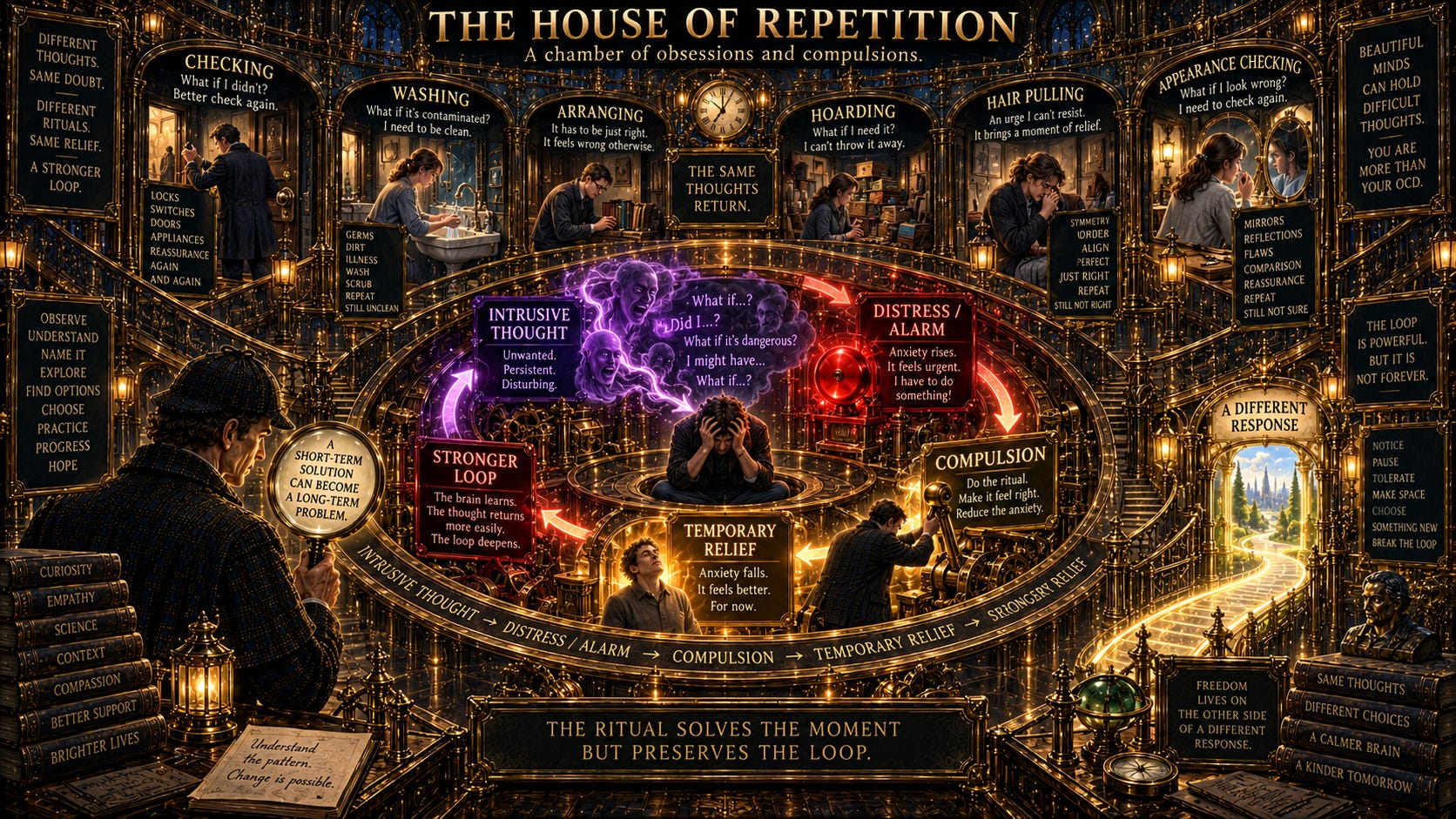 PSYCH 124: Obsessive-Compulsive and Related Disorders 16.09.2026 51minMedlock Holmes leaves the Grand Dispensary of Anxiety and enters an entirely different institution: The Grand House of Repetition.At first, everything appears orderly. Doors are locked. Hands are washed. Objects are aligned. Possessions are carefully preserved.Then Holmes notices something unsettling.The same actions are happening again.And again.And again.A man checks a locked door for the twentieth time. A woman washes already-clean hands. Another person stands before a mirror searching endlessly for an imperfection nobody else can see. Rooms disappear beneath possessions that cannot be discarded. In adjoining chambers, hair is repeatedly pulled and skin repeatedly picked.Above the entrance is written:“When repetition stops serving us, we begin serving the repetition.”This is the world of obsessive-compulsive and related disorders (OCRDs) - a diagnostic family that includes obsessive-compulsive disorder, body dysmorphic disorder, hoarding disorder, trichotillomania and excoriation disorder. Their grouping reflects important phenomenological and biological overlaps, while recognising that each disorder has its own characteristic focus.At the centre stands OCD.Holmes discovers its fundamental machinery: obsessions - recurrent, intrusive, unwanted thoughts, urges or images - and compulsions - repetitive behaviours or mental acts performed in response.The compulsion may reduce distress.But only temporarily.That relief reinforces the behaviour, helping the cycle continue.Yet OCD is more than excessive anxiety. Modern models increasingly describe disturbances in cognitive control, habit formation, error monitoring and cortico-striatal-thalamic-cortical circuitry. The orbitofrontal cortex, anterior cingulate and striatum become major clues.Holmes also discovers that insight exists on a spectrum. Many patients recognise that their fears are unreasonable. Others are less certain. A small minority become completely convinced of their obsessive beliefs. Poor insight does not automatically transform OCD into psychosis.The investigation then expands.In body dysmorphic disorder, repetition revolves around perceived defects in appearance.In hoarding disorder, difficulty discarding possessions gradually overwhelms living spaces.In trichotillomania, recurrent hair pulling becomes difficult to resist.In excoriation disorder, the repetitive behaviour is skin picking.Different objects.Different behaviours.But repeatedly, Holmes finds variations on a deeper theme:thought → urge → behaviour → temporary consequence → repetition.Treatment therefore aims to break the loop.For OCD, SSRIs and clomipramine provide important pharmacological tools, often at substantial therapeutic doses and for sufficiently long trials. But one of the most powerful interventions lies in deliberately confronting the very thing the disorder commands the patient to avoid.Exposure and Response Prevention - ERP.Exposure activates the feared uncertainty.Response prevention blocks the ritual.The patient learns that distress can be tolerated without obeying the compulsion and that catastrophic expectations need not determine behaviour.For severe treatment-resistant OCD, Holmes eventually reaches more specialised chambers: antipsychotic augmentation, glutamatergic strategies, intensive behavioural programmes and, in exceptionally refractory illness, neuromodulation or neurosurgical approaches.The lesson of the Grand House of Repetition is therefore hopeful.These disorders can become chronic and profoundly disabling.But the loop is not unbreakable.Key Takeaways1. A New Diagnostic FamilyObsessive-compulsive and related disorders became a distinct diagnostic grouping because these conditions share important features involving:* intrusive or repetitive thoughts* repetitive behaviours or mental acts* difficulties controlling repetitive behaviour* overlapping neurobiological mechanisms* overlapping treatment approaches.DSM-5-TR OCRDs include:* Obsessive-compulsive disorder - OCD* Body dysmorphic disorder - BDD* Hoarding disorder - HD* Trichotillomania - hair-pulling disorder* Excoriation - skin-picking disorderICD-11 conceptualises the family somewhat more broadly and additionally incorporates conditions such as olfactory reference disorder and hypochondriasis within its OCRD framework.2. Obsessive-Compulsive DisorderOCD is defined by:Obsessions, compulsions, or both.ObsessionsRecurrent and persistent:* thoughts* urges* imagesthat are experienced as:* intrusive* unwanted* distressing.The person commonly attempts to:ignore → suppress → neutralisethem.CompulsionsRepetitive:* behavioursor* mental actsthat the individual feels driven to perform.Examples include:* washing* checking* ordering* counting* repeating* praying* mentally reviewing.3. The Obsession–Compulsion CycleA useful conceptual model is:INTRUSIVE THOUGHT↓THREAT / DOUBT / DISCOMFORT↓ANXIETY OR “NOT-JUST-RIGHT” FEELING↓COMPULSION↓TEMPORARY RELIEF↓REINFORCEMENT↓NEXT OBSESSIONThe ritual solves the immediate distress while helping preserve the longer-term disorder.4. OCD Is Not Simply “Being Particular”Normal habits, preferences and routines are common.For OCD, symptoms must become sufficiently:* time-consuming* distressing* impairing.The diagnostic threshold includes symptoms taking more than one hour per day or causing clinically significant distress or functional impairment.5. Major OCD Symptom DimensionsSymptoms commonly cluster around several dimensions.Contamination / Cleaning“What if I am contaminated?”→ washing→ cleaning→ avoiding contact.Forbidden Thoughts / CheckingIntrusive:* aggressive* sexual* religious* moralthoughts may generate checking, reassurance or mental rituals.Symmetry / OrderingThe person may experience:“It isn’t right.”Objects or actions are repeated or arranged until they feel complete.Harm / Responsibility“What if I caused something terrible?”This may produce repeated:* checking* reviewing* reassurance seeking.Hoarding symptoms can also occur within OCD, although hoarding disorder is now diagnostically distinct.6. OCD and InsightInsight exists on a continuum.Good or fair insightThe patient recognises that OCD beliefs are probably or definitely untrue.Poor insightThe patient believes the obsessive concern is probably true.Absent insight / delusional beliefsThe patient is completely convinced.This distinction is clinically important.Absent insight does not automatically mean schizophrenia or another primary psychotic disorder.A small minority of people with OCD have absent insight.7. Tic-Related OCDOCD can receive a:TIC-RELATEDspecifier.This means there is a current or previous tic disorder.Tic-related OCD tends to:* begin younger* occur more commonly in males* show more symmetry/ordering phenomena* involve sensory or premonitory urges* sometimes respond less strongly to SSRIs.Complex tics and compulsions can sometimes be difficult to distinguish.8. EpidemiologyOCD was historically thought to be rare.It is not.Its apparent rarity partly reflected:SHAME → CONCEALMENT → UNDERDIAGNOSISThe chapter reports a lifetime prevalence of approximately:2.3%in a major epidemiological survey.Subclinical obsessive-compulsive symptoms are substantially more common.9. Age of OnsetMedian onset is approximately:19 yearsAround:25%of cases begin by age 10.Early-onset OCD is more common in males and more frequently associated with tics.Onset after age 30 is comparatively unusual.Symptoms may also emerge or change during:* adolescence* pregnancy* the puerperium.10. OCD Can Be Highly DisablingOCD can interfere profoundly with:* education* employment* relationships* family functioning* social participation* quality of life.A person may lose hours each day to rituals.Others restructure their entire lives around avoidance.Family members can become drawn into rituals through family accommodation.11. Suicide Risk MattersDepression is a particularly important comorbidity.Suicidal thoughts can also occur in OCD.Therefore:Do not assume that OCD is merely an anxiety-and-ritual disorder.Routine clinical assessment should include:* depression* hopelessness* suicidal ideation* suicidal behaviour.12. The Neurobiology of OCDModern models increasingly conceptualise OCD as a disorder involving abnormalities of:COGNITIVE CONTROLandHABIT REGULATIONrather than simply excessive anxiety.A central circuit is the:Cortico-Striatal-Thalamic-Cortical CircuitCORTEX↓STRIATUM↓THALAMUS↓CORTEXImportant regions include:* orbitofrontal cortex* anterior cingulate cortex* striatum.Alterations in these circuits may contribute to difficulty:* inhibiting behaviour* shifting cognitive sets* monitoring errors* stopping established habits.13. Goal-Directed Behaviour versus HabitA particularly useful model contrasts:Goal-directed action“I do this because it achieves something useful.”with:Habit-driven behaviour“I continue doing this even though it no longer achieves anything useful.”OCD appears to involve an excessive shift towards:HABIT-DRIVEN BEHAVIOURThis helps explain why patients can recognise that a ritual is unnecessary yet still feel compelled to perform it.14. Fear Is Not the Whole StoryAnxiety disorders are strongly associated with abnormal fear processing.OCD also involves other emotional processes, particularly:DISGUSTSome contamination presentations may therefore involve exaggerated disgust processing rather than fear alone.Other patients describe:* incompleteness* tension* sensory discomfort* “not-just-right” experiencesrather than conventional fear.15. NeurochemistrySeveral neurotransmitter systems appear relevant:SerotoninThe efficacy of serotonin reuptake inhibitors helped generate the influential serotonin hypothesis of OCD.However:response to serotonergic treatment does not prove that OCD is simply caused by serotonin deficiency.DopamineDopaminergic mechanisms are also implicated.This becomes clinically important because dopamine-blocking antipsychotics can augment SRIs in treatment-resistant OCD.GlutamateGrowing evidence implicates glutamatergic systems.Glutamatergic agents remain an important area of therapeutic investigation.GABAGABAergic mechanisms may also contribute to the broader circuitry.16. GeneticsOCD has a significant genetic component.Genetic influence appears particularly important in:childhood-onset OCD.However, OCD is not a single-gene disorder.Current evidence supports:many genetic variants + small individual effects + environmental influencesrather than one deterministic OCD gene.17. AssessmentA good OCD assessment should determine:* obsessions* compulsions* avoidance* symptom dimensions* time consumed* distress* functional impairment* insight* age of onset* course* precipitants* comorbidity* suicidality* tic history* family accommodation.18. Y-BOCSThe:Yale-Brown Obsessive-Compulsive Scale - Y-BOCSis one of the most widely used clinician-rated measures of OCD severity.It examines dimensions such as:* time occupied* interference* distress* resistance/control.It is particularly useful for:baseline severity → treatment monitoring → outcome measurement.19. Differential DiagnosisRepetitive thinking does not automatically mean OCD.Important differentials include:GADWorries tend to concern plausible real-life problems and are usually less intrusive and ego-dystonic.DepressionRumination tends to be mood-congruent.PsychosisDelusions are generally experienced as true rather than intrusive unwanted possibilities.Autism spectrum disorderRepetitive behaviours occur within a broader neurodevelopmental presentation.Eating disordersRepetitive thoughts and behaviours centre around eating, weight and shape.Illness anxietyPreoccupation centres around having or acquiring illness.BDDPreoccupation centres around perceived appearance defects.Hoarding disorderThe central problem is difficulty discarding possessions.20. OCD versus OCPDThese are not the same condition.OCDCharacterised by:obsessions + compulsionsOften experienced as intrusive and unwanted.Obsessive-Compulsive Personality DisorderCharacterised by pervasive:* perfectionism* rigidity* control* orderliness.The personality traits are often experienced as more consistent with the person’s preferred way of functioning.21. CourseWithout treatment, OCD can become:CHRONICand may persist for decades.But chronicity does not mean hopelessness.Modern evidence-based treatments can produce substantial improvement.The clinical message should therefore remain:PERSIST WITH TREATMENT.22. First-Line TreatmentTwo major treatment pillars dominate OCD management:SSRIsandCBT WITH EXPOSURE AND RESPONSE PREVENTIONThese can be used:* individually* sequentially* together.23. Exposure and Response Prevention - ERPERP is one of the defining treatments for OCD.EXPOSUREDeliberately confront the:* thought* object* situation* uncertaintythat triggers the obsession.RESPONSE PREVENTIONDo not perform the usual compulsion.For example:Touch door handle↓Feel contaminated↓Wash hands↓Remain with uncertainty↓Learn something newThe patient discovers:“I can experience this feeling without performing the ritual.”24. Why ERP WorksThe older model emphasised:habituation- anxiety gradually falls with repeated exposure.Contemporary models additionally emphasise:inhibitory learningThe patient develops new learning:“The feared consequence is not inevitable.”“Uncertainty is tolerable.”“I don’t need the ritual to remain safe.”The goal is therefore not simply:MAKE ANXIETY DISAPPEARbut:CHANGE THE PERSON’S RELATIONSHIP WITH UNCERTAINTY AND COMPULSION.25. PharmacotherapyThe first medication historically shown to be strongly effective was:CLOMIPRAMINEModern first-line pharmacotherapy generally uses:SSRIsbecause they combine efficacy with better tolerability.26. OCD Often Requires Different Antidepressant StrategyCompared with depression, OCD may require:* higher SSRI doses* longer adequate trials* greater patience before declaring non-response.A medication should not be abandoned prematurely.27. Treatment-Resistant OCDBefore declaring treatment resistance, check:Correct diagnosis?Adequate ERP?Adequate SSRI dose?Adequate duration?Adherence?Comorbidity?Family accommodation?Insight?Tics?Only then should more complex strategies be considered.28. Antipsychotic AugmentationFor patients with inadequate response to an adequate SRI trial, augmentation with selected antipsychotics can be useful.This reflects the involvement of dopaminergic as well as serotonergic mechanisms.The strategy is:SRI + carefully selected augmentationrather than replacing the entire treatment framework.29. Severe Refractory OCDA small minority remain profoundly disabled despite multiple evidence-based treatments.Specialist approaches can include:* intensive ERP programmes* pharmacological augmentation* glutamatergic strategies* neuromodulation* deep brain stimulation* selected neurosurgical procedures.These belong at the far end of a carefully constructed treatment pathway.30. Body Dysmorphic DisorderBDD involves persistent preoccupation with:one or more perceived defects or flaws in appearancethat are:* not observable to othersor* appear slight to others.Patients commonly perform repetitive behaviours such as:* mirror checking* grooming* comparing appearance* reassurance seeking* camouflaging.The distress can be profound.31. The Cosmetic Treatment TrapPatients with BDD may seek:* cosmetic surgery* dermatological procedures* dental procedures* aesthetic interventions.But changing the body does not necessarily treat the underlying disorder.Repeated procedures may therefore occur without meaningful psychological improvement.Recognition of BDD before cosmetic intervention is clinically important.32. Hoarding DisorderHoarding disorder involves persistent difficulty:discarding or parting with possessionsregardless of their actual value.Accumulation eventually:CONGESTS → CLUTTERS → COMPROMISESliving spaces.The issue is not simply owning many things.It is the pathological difficulty discarding them and the resulting impairment.33. TrichotillomaniaTrichotillomania involves:recurrent hair pulling → hair losswith repeated unsuccessful attempts to:reduce or stop the behaviour.Common sites include:* scalp* eyebrows* eyelashes.The behaviour may occur automatically or in response to emotional or sensory states.34. Excoriation DisorderExcoriation disorder involves:recurrent skin picking → skin lesionsdespite repeated attempts to stop.Consequences can include:* scarring* infection* shame* concealment* functional impairment.Trichotillomania and excoriation disorder are often conceptualised together as:BODY-FOCUSED REPETITIVE BEHAVIOURS.35. The Unifying Clinical IdeaOCRDs are not identical diseases.But many share a common architecture:INTRUSIVE EXPERIENCE↓URGE / TENSION / DISCOMFORT↓REPETITIVE BEHAVIOUR↓SHORT-TERM CONSEQUENCE↓REINFORCEMENT↓REPETITIONUnderstanding the loop helps explain both:why the disorders persistandhow treatment can interrupt them. This is a public episode. If you'd like to discuss this with other subscribers or get access to bonus episodes, visit drmanaankarray.substack.com/subscribe
 -
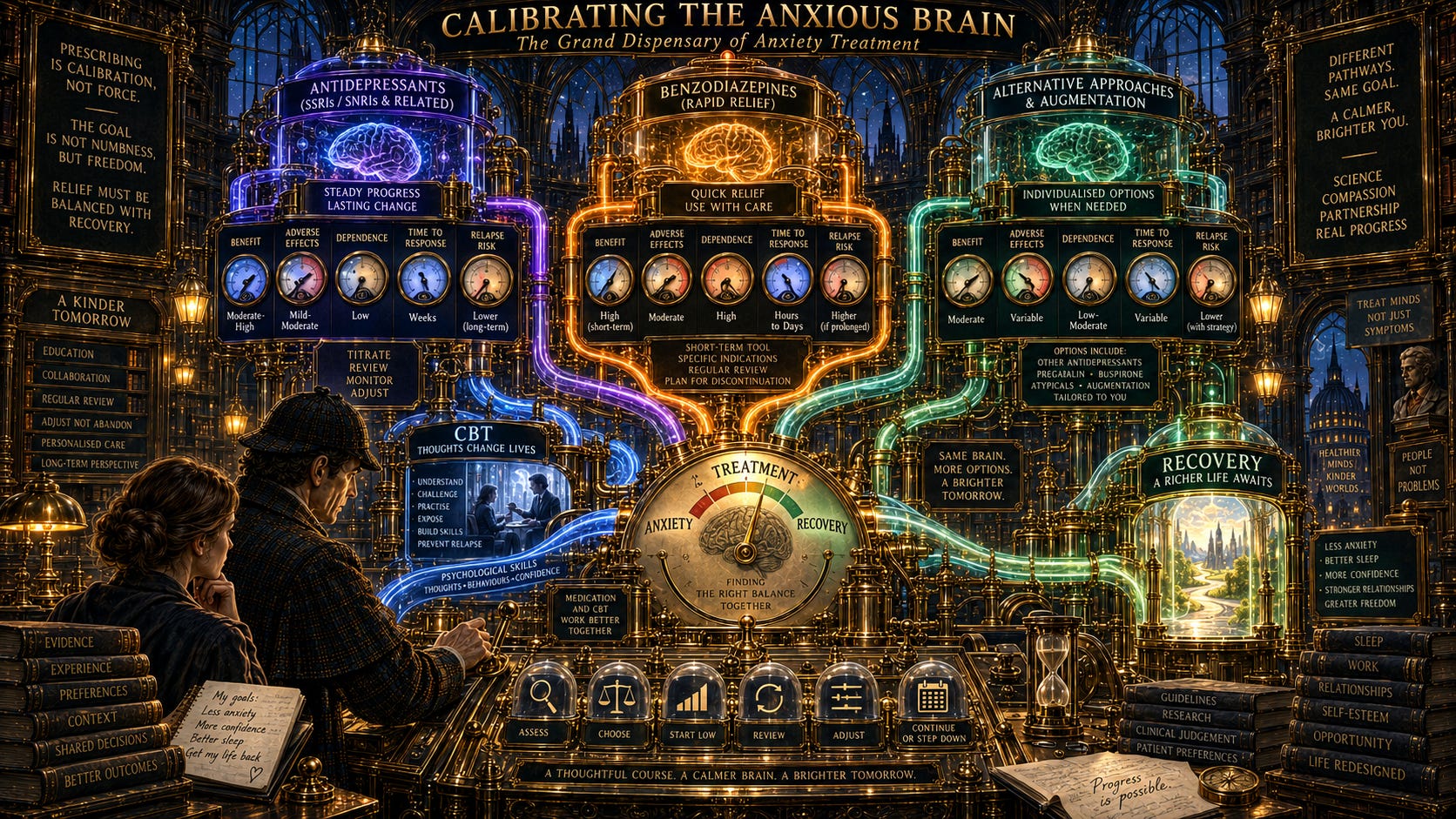 PSYCH 123: Anxiety Disorders - Somatic Therapies 15.09.2026 42minMedlock Holmes enters an immense Neo-Victorian treatment complex called The Grand Pharmacological Dispensary of Anxiety.Rows of treatment pathways stretch before him.Some contain SSRIs and SNRIs.Others hold benzodiazepines, pregabalin, buspirone, beta-blockers, older antidepressants, antipsychotics, neurostimulation devices, and emerging experimental therapies.But Holmes immediately notices that the first room contains no medication at all.It is labelled:ASSESS BEFORE YOU PRESCRIBE.Not every anxious person needs pharmacological treatment. Some symptoms are transient or subsyndromal. At the same time, clinically significant anxiety disorders remain frequently under-recognised and undertreated, particularly in primary care. Patients may describe insomnia, palpitations, gastrointestinal symptoms, pain or fatigue rather than saying, “I am anxious.” Screening tools such as the GAD-7 can improve recognition.Treatment therefore begins with diagnostic precision.What is the primary disorder?How severe is it?Are there medical causes?Substance use?Depression?Other anxiety disorders?Psychosocial stressors?Previous treatment response?Drug interactions?Patient preference?Cost and access?The treatment-choice diagram on page 3 captures this broader logic: illness factors, patient factors and medication factors all contribute to the decision.For many anxiety disorders, SSRIs and SNRIs are the first-line pharmacological treatments.Holmes watches clinicians begin low and increase gradually.Why?Because anxious patients can experience an early transient increase in nervousness, agitation or insomnia.The medications also require patience.Some improvement may appear within two to four weeks, but an adequate therapeutic trial generally requires 8–12 weeks, and remission may take considerably longer.The goal is not merely partial improvement.It is remission, because residual symptoms continue to impair functioning and increase relapse risk.Holmes then reaches the Benzodiazepine Chamber.Here the effect is strikingly different.The alarm quietens rapidly.Benzodiazepines enhance GABAergic inhibition and can reduce anxiety quickly.That makes them valuable in selected circumstances - short-term adjunctive treatment, occasional panic, performance-related anxiety, or severe disabling symptoms when alternatives have failed or are not tolerated.But the chamber contains warning plaques:Sedation.Dependence.Withdrawal.Tolerance.Interaction with alcohol.Driving impairment.Their speed is both their strength and their danger.Next comes pregabalin.It has evidence particularly in GAD and can be useful when insomnia or pain coexist.Buspirone occupies another chamber, particularly for chronic generalized anxiety.Beta-blockers sit in a small performance hall.They do not treat generalized social anxiety.Instead, they reduce peripheral manifestations such as tremor and tachycardia during specific performance situations.Older agents remain available but sit farther down the treatment hierarchy.TCAs can work but carry more anticholinergic effects, cardiotoxicity and overdose risk.MAOIs can be highly effective, particularly phenelzine in panic and social anxiety, but dietary restrictions, drug interactions and safety concerns make them second-line options.Holmes then passes through individual disorder galleries.In GAD, SSRIs and SNRIs dominate first-line treatment, with alternatives such as pregabalin, buspirone and selected other agents.In panic disorder, SSRIs and venlafaxine are preferred initial options, while benzodiazepines may provide rapid short-term relief.In social anxiety disorder, SSRIs and SNRIs again feature prominently; pregabalin and clonazepam have evidence, while beta-blockers are mainly relevant to performance anxiety.In specific phobia, however, the shelves are nearly empty.The principal treatment is psychological - especially exposure therapy. Pharmacotherapy has little established role and benzodiazepines may even interfere with exposure learning.This tells Holmes something important:The presence of anxiety does not automatically imply that medication is the best treatment.The next room is labelled:TREATMENT RESISTANCEBefore adding another medication, Holmes checks the foundations.Was the diagnosis correct?Was the dose adequate?Was the trial long enough?Is there thyroid disease?Substance use?Comorbid depression?Poor adherence?Drug interaction?Only then does he consider switching, augmentation, pregabalin, benzodiazepines, atypical antipsychotics or more experimental options.Beyond this room lies the Future Therapies Laboratory.rTMS.tDCS.Neurosteroids.Ketamine.Cannabinoids.Complementary therapies.Some show promise.But Holmes sees a large sign:PROMISING ≠ ESTABLISHEDThe evidence remains preliminary for many of these approaches.Finally, Holmes reaches the maintenance hall.The mistake here is stopping too soon.Anxiety disorders are frequently chronic or recurrent, and relapse after medication discontinuation is common.For many patients with chronic illness, medication may need to continue for 1–2 years after response, followed by gradual tapering rather than abrupt cessation.SSRIs and SNRIs can produce discontinuation symptoms, especially shorter-half-life agents such as paroxetine and venlafaxine.Holmes closes the final treatment ledger.The lesson is not that anxiety should simply be medicated.It is that somatic treatment should be deliberate, collaborative, evidence-based and disorder-specific.The right medication, for the right person, at the right dose, for the right duration, with careful monitoring - often alongside CBT - can transform disabling anxiety into something manageable.Key TakeawaysRecognition before treatment* Anxiety disorders carry substantial personal and societal burden.* Not every anxious symptom requires somatic treatment.* Transient and subsyndromal anxiety should not automatically be medicalised.* Nevertheless, clinically significant anxiety disorders are commonly under-recognised and undertreated.* Detection in primary care has historically been below 50%.* Only a minority of recognised cases receive appropriate evidence-based treatment.* Patients commonly present with physical rather than psychological symptoms.* Reluctance to disclose emotional symptoms can contribute to missed diagnosis.* Clinicians may fail to enquire directly about anxiety.* Detection improves as severity increases and with repeated healthcare attendance.* Structured screening tools such as the GAD-7 improve recognition.* Anxiety can often be effectively managed in primary care when properly identified.* Chronic physical illness and adverse social determinants increase vulnerability and should heighten clinical suspicion.Principles of Pharmacological ManagementThe chapter’s treatment principles can be summarised as:DIAGNOSE → ASSESS → EDUCATE → SELECT → MONITOR → OPTIMISEImportant elements include:* establish the primary diagnosis* identify psychiatric comorbidity* identify medical comorbidity* review current medications and substances* assess psychosocial stressors* document baseline severity and frequency* perform appropriate physical examination and laboratory investigation* discuss treatment options* incorporate patient preference* consider previous personal and family treatment response* check drug interactions* consider affordability and access* monitor progress using validated scales.The figure on page 3 groups treatment selection into three broad domains:Illness Factors* severity* frequency* chronicity* comorbidity* situational versus generalized symptoms.Patient Factors* preference* adherence* insight* psychological-mindedness.Medication Factors* previous response* family response* drug interactions* access* cost.Pharmacotherapy versus Psychotherapy* Initial evidence-based options include pharmacotherapy, CBT, or both.* Acute efficacy of medication and psychological therapy may be similar in many anxiety disorders.* Long-term comparative evidence is less complete.* Combination treatment is intuitively attractive but has not consistently been proven superior to either treatment alone.* Sequential addition of CBT after partial medication response is often a pragmatic strategy.* Patient preference should meaningfully influence treatment choice.SSRIs and SNRIsThese are the principal first-line pharmacological treatments across anxiety disorders.Common SSRIs include:* fluoxetine* sertraline* paroxetine* fluvoxamine* citalopram* escitalopram.Common SNRIs include:* venlafaxine* desvenlafaxine* duloxetine* levomilnacipran.Most guidelines favour an SSRI or venlafaxine as an initial antidepressant option.Start low, go slowAnxious patients can be particularly sensitive to early adverse effects.Initial treatment may temporarily increase:* nervousness* agitation* insomnia* tremor* gastrointestinal symptoms* headache* dizziness.Treatment is therefore usually started at a low dose and titrated gradually.Do not judge treatment too early* Early improvement may occur within 2–4 weeks.* A proper therapeutic trial generally requires 8–12 weeks at an adequate dose.* Some patients require substantially longer before remission.* The chapter notes that response or remission may sometimes take up to six months.Remission is the goalPartial response is not enough when substantial residual symptoms remain.Residual symptoms are associated with:* ongoing functional impairment* poorer quality of life* greater relapse risk.Treatment should therefore aim for:REMISSION + FUNCTIONAL RECOVERYrather than mere reduction in symptom score.SSRI/SNRI adverse effectsCommon effects include:* gastrointestinal disturbance* insomnia* nervousness* agitation* tremor* headache* dizziness* sexual dysfunction.Sexual dysfunction may involve:* reduced desire* impaired arousal* erectile dysfunction* delayed ejaculation* orgasmic dysfunction.The table on page 6 highlights meaningful differences between agents, with sexual adverse effects generally more frequent with several traditional SSRIs than with agents such as buspirone, mirtazapine or some newer antidepressants.Less common but clinically important SSRI/SNRI risksPotential serious complications include:* serotonin syndrome* seizures* induction of mania* hyponatraemia* gastrointestinal bleeding, particularly with NSAIDs* increased fracture risk in some older patients.These events are uncommon but clinically important.VenlafaxineVenlafaxine is among the most widely used SNRIs.Common adverse effects include:* dry mouth* sweating* constipation* insomnia* headache* sexual dysfunction.At higher doses, noradrenergic effects become more prominent.Dose-related hypertension occurs in a minority of patients, so blood pressure monitoring is appropriate at higher therapeutic doses.DuloxetineDuloxetine has broadly similar efficacy and tolerability to venlafaxine.Important considerations include:* discontinuation syndrome* gastrointestinal effects* avoidance or caution in significant hepatic dysfunction.Antidepressant discontinuation syndromeAbrupt cessation of SSRIs or SNRIs can produce:* anxiety* irritability* tearfulness* dizziness* light-headedness* malaise* sleep disturbance* concentration difficulty.Symptoms commonly emerge within 2–4 days.They are particularly associated with shorter-half-life medications such as:paroxetineandvenlafaxine.Gradual tapering is preferred.Fluoxetine’s long half-life can sometimes make it useful as a bridging strategy during difficult discontinuation.Antidepressants and suicidality* Regulatory warnings exist regarding treatment-emergent suicidal thoughts and behaviour in children and younger adults.* In adults aged 24 and above, short-term analyses reviewed in the chapter did not demonstrate a clear increased suicidality signal.* In younger patients, meta-analyses suggest an increase in suicidal thoughts and behaviours of roughly 1.5–2-fold, but not a corresponding increase in completed suicide.* The absolute increase in risk is small.* This must be balanced against the significant morbidity of untreated anxiety.* Medication can therefore remain appropriate in younger patients when clinically indicated, with careful monitoring.TCAsExamples include:* imipramine* clomipramine* amitriptyline* nortriptyline* desipramine* doxepin.TCAs inhibit monoamine reuptake but also affect:* muscarinic receptors* histamine receptors* α1 adrenergic receptors.This produces adverse effects such as:* dry mouth* constipation* blurred vision* sedation* weight gain* orthostatic hypotension.More serious issues include:* lowered seizure threshold* cardiotoxicity* toxicity in overdose.They are therefore usually second-line despite efficacy in some anxiety disorders.MAOIsCommon examples include:phenelzineandtranylcypromine.They can be highly effective, especially in:* social anxiety disorder* panic disorder.But their use is limited by:* dietary restrictions* tyramine-related hypertensive crisis* drug interactions* washout requirements* postural hypotension* weight gain* overdose concerns.They are generally reserved for refractory illness.RIMAsMoclobemide is the principal example discussed.Potential advantages over irreversible MAOIs include:* fewer dietary restrictions* generally better tolerability.It has evidence particularly in social anxiety disorder.Availability differs internationally.MirtazapinePotential advantages:* low propensity for sexual dysfunction* sedative properties can help insomnia* potential utility in panic and GAD.Limitations include:* increased appetite* weight gain* sedation* dry mouth* dizziness.Bupropion* Not generally a first-line treatment for primary anxiety disorders.* There is clinical concern that it may initially increase agitation or anxiety.* It is more often used to treat depression or as an adjunct to address antidepressant-associated sexual dysfunction.Vortioxetine* Multimodal serotonergic antidepressant.* Anxiety evidence has focused mainly on GAD.* Results remain preliminary or inconsistent.* Its use for anxiety is not as well established as SSRIs or SNRIs.AgomelatineActs via:* MT1/MT2 melatonin agonism* 5-HT2C antagonism.Potential advantages include:* low sexual dysfunction* little weight gain* minimal discontinuation syndrome.Evidence suggests possible benefit in GAD.Liver-function monitoring is recommended.VilazodoneCombines:SSRI activity + partial 5-HT1A agonismSome trials suggest benefit in GAD, but evidence remains insufficient to establish it alongside standard first-line treatments.BenzodiazepinesBenzodiazepines enhance GABAergic inhibition.They possess:* anxiolytic* sedative* anticonvulsant* muscle-relaxant properties.Common examples include:* clonazepam* lorazepam* alprazolam* diazepam* oxazepam* temazepam.Liver metabolismMost benzodiazepines undergo hepatic oxidative metabolism.Lorazepam, oxazepam and temazepam undergo conjugation and may therefore be preferable when hepatic function is impaired.A useful memory aid is:LOTLorazepamOxazepamTemazepamBenzodiazepine strengths* rapid onset* strong acute anxiolytic effect* predictable symptom relief* useful adjunct while antidepressants take effect* can be effective even in longer-term carefully selected use.Benzodiazepine limitationsImportant concerns include:* sedation* psychomotor impairment* driving risk* interaction with alcohol* dependence* withdrawal* misuse* potential tolerance.Avoid or use very cautiously in people with significant substance-use histories.Short-term adjunctive useBenzodiazepines may be prescribed for approximately 3–4 weeks when initiating an antidepressant to help manage:* severe anxiety* insomnia* jitteriness* delayed antidepressant onset.PRN benzodiazepinesMay be useful in selected situations such as:* occasional panic attacks* discrete performance anxiety.Frequent panic attacks are generally better treated preventively rather than repeatedly attempting to abort attacks with PRN benzodiazepines.PregabalinPregabalin has meaningful evidence in anxiety disorders, particularly GAD.Potential advantages include use where:* pain is comorbid* insomnia is prominent.Adverse effects include:* dizziness* drowsiness* weight gain.Pregabalin is primarily renally cleared, so renal impairment is an important consideration.Other anticonvulsantsAgents sometimes used include:* gabapentin* topiramate* tiagabine* lamotrigine* levetiracetam.Evidence is generally weaker or inconsistent compared with pregabalin.Atypical antipsychoticsAgents include:* quetiapine* olanzapine* risperidone* aripiprazole* ziprasidone* lurasidone.Evidence in primary anxiety disorders is limited.Quetiapine has demonstrated efficacy in GAD, but adverse effects limit its use.Key concerns include:* weight gain* metabolic syndrome* diabetes risk* lipid abnormalities.They are therefore generally later-line or augmentation strategies.Beta-blockersCommon options:* propranolol* atenolol.They reduce peripheral adrenergic symptoms such as:* tremor* tachycardia.Their principal role is performance anxiety.They are not effective treatments for generalized social anxiety disorder.Relevant contraindications include some:* cardiac disease* pulmonary disease* diabetes* angle-closure glaucoma.BuspironeBuspirone is an azapirone with serotonergic activity.It is primarily useful for:GADImportant characteristics:* not immediately acting* usually taken in divided doses* response develops over time* does not provide benzodiazepine-like rapid relief.HydroxyzineHydroxyzine is an antihistamine with evidence for GAD.Potential advantages:* relatively rapid early symptom relief* alternative to benzodiazepines in selected patients.Common adverse effects:* sedation* dry mouth* tremor.Tolerance to anxiolytic effects may develop.Treatment-resistant anxietyBefore labelling anxiety treatment-resistant:RECHECK THE CASESpecifically assess:* diagnosis* medical causes* thyroid disease* substance use* comorbid psychiatric disorders* adherence* drug interactions* adequate dose* adequate duration* access to effective CBT.Augmentation strategiesPossible augmentation agents include:* pregabalin* benzodiazepines* selected anticonvulsants* atypical antipsychotics.The evidence base is limited relative to first-line treatments.Treatment-resistant GAD is sometimes treated by adding pregabalin or a benzodiazepine to an SSRI/SNRI.For treatment-resistant panic disorder, clonazepam augmentation may be considered when CBT is unavailable or unsuitable.Novel TreatmentsrTMSEvidence for pure anxiety disorders remains limited.Some preliminary benefit has been reported for:* GAD* SAD* panic disorder.A small fMRI-guided GAD study reported promising results, but larger controlled trials are required.tDCSTranscranial direct-current stimulation is another non-invasive neuromodulation technique.Early reports suggest possible benefit in GAD and panic disorder, but evidence remains preliminary.NeurosteroidsIntranasal neurosteroidal compounds such as PH94B have shown promising results in social anxiety disorder.These remain investigational.KetamineKetamine has demonstrated substantial efficacy in treatment-resistant depression.Small studies suggest possible rapid anxiolytic effects in:* social anxiety disorder* GAD.The evidence remains insufficient to establish ketamine as standard treatment for primary anxiety disorders.CannabinoidsCannabinoids are increasingly used by patients seeking relief from anxiety.Some evidence suggests possible anxiolytic effects in GAD and SAD.However, the chapter emphasises major limitations:* heterogeneous preparations* inconsistent dosing* limited long-term data* methodological problems* publication bias.No firm therapeutic conclusions can therefore be drawn.Complementary and Alternative TherapiesPatients commonly use:* herbal preparations* acupuncture* yoga* biofeedback* supplements.Clinicians should actively ask about these treatments because herbal agents can cause clinically important drug interactions.KavaKava has some evidence for mild-to-moderate anxiety.However:* efficacy in specific anxiety disorders remains uncertain* hepatotoxicity is a concern* CYP-mediated drug interactions can occur.ExerciseAerobic exercise has evidence for reducing anxiety symptoms and provides substantial broader health benefits.The chapter supports routinely recommending physical exercise when appropriate.Yoga also has preliminary evidence, particularly in performance and other anxiety states.Duration of PharmacotherapyAn adequate acute trial generally requires:8–12 weeks at a therapeutic doseFor chronic anxiety disorders, continuing medication after response is usually necessary.Relapse studies report approximately:20–50% relapse within several months of antidepressant discontinuation.The chapter recommends maintenance therapy for many patients for approximately:1–2 yearsbefore considering discontinuation.TaperingDiscontinuation should be slow.The chapter describes dose reductions of roughly:10–25% every 1–2 monthswith monitoring for recurrence.Tapering must be individualised.Abrupt cessation should generally be avoided.Expected Pharmacotherapy ResponseApproximate response rates described in the chapter include:Panic disorder: 60–70%GAD: 50–60%Social anxiety disorder: 50–60%Panic disorder is therefore among the more pharmacologically responsive anxiety disorders.Agoraphobia may reduce response rates when comorbid with panic disorder.Evidence-Based Monotherapy PatternThe table on pages 17–18 provides a useful broad hierarchy.SSRIsFirst-line: SAD, GAD, PDSNRIsFirst-line: SAD, GAD, PDTCAs* not recommended in SAD* second-line in GAD* second-line in PDMAOIs* second-line in SAD* second-line in PD* limited evidence in GADBenzodiazepinesGenerally second-linePregabalin* strong role in SAD* second-line in GAD in the source’s summary table* insufficient evidence in PDQuetiapineSecond-line in GAD but limited by adverse effects.Generalized Anxiety DisorderPreferred pharmacological options include:SSRIsandSNRIsAlternatives include:* pregabalin* buspirone* quetiapine* mirtazapine* selected newer antidepressants.SSRIs are generally the preferred initial option.Pregabalin is another important option.Benzodiazepines are effective but usually restricted because of dependence and tolerance concerns.Quetiapine works but is generally second-line because of metabolic adverse effects.Propranolol has not demonstrated meaningful efficacy for GAD.Panic DisorderFirst-line pharmacological treatments include:SSRIsandvenlafaxineEffective older treatments include:* clomipramine* imipramine* phenelzine* tranylcypromine.Their adverse-effect burden places them later in the hierarchy.Benzodiazepines such as:* alprazolam* lorazepam* diazepam* clonazepamcan provide rapid short-term relief.Maintenance antidepressant treatment can prevent relapse for years in responsive patients.AgoraphobiaPharmacological evidence for pure agoraphobia is limited.Most pharmacological improvement occurs through treatment of:* panic disorder* depression* other comorbid anxiety disorders.CBT, especially exposure therapy, has a stronger direct evidence base.Social Anxiety DisorderFirst-line treatments described include:* SSRIs* SNRIs* pregabalin* clonazepam.Phenelzine is highly efficacious but generally second-line because of adverse effects and dietary restrictions.Other options include:* mirtazapine* moclobemide* selected benzodiazepines* gabapentin.Beta-blockers are useful for:PERFORMANCE ANXIETYbut not generalized social anxiety disorder.Specific PhobiaThis is the major exception to the medication-focused approach.Best-established treatment:EXPOSURE-BASED PSYCHOTHERAPYMedication evidence is very limited.SSRIs may occasionally be considered when psychotherapy fails or cannot be used.Benzodiazepines have not demonstrated clear benefit and may interfere with exposure-based learning.Therefore:SPECIFIC PHOBIA → THINK EXPOSURE FIRSTSeparation Anxiety DisorderEvidence is strongest in younger populations.SSRIs show benefit in studies of mixed paediatric anxiety populations including:* GAD* SAD* separation anxiety disorder.TCAs and clonazepam have not shown convincing benefit.Adult pharmacological data remain sparse.Selective MutismPsychosocial treatment is generally preferred.SSRIs such as:* fluoxetine* fluvoxaminemay be considered in more severe or treatment-resistant cases.Evidence remains considerably smaller than for other anxiety disorders.Children and AdolescentsAnxiety disorders are highly prevalent in young people.SSRIs and SNRIs have evidence in paediatric:* GAD* social anxiety disorder* separation anxiety disorder.Psychological treatment is often preferred initially, particularly for milder cases.Combination treatment may provide greater benefit in some paediatric anxiety disorders.Antidepressant treatment requires appropriate monitoring for treatment-emergent suicidal thoughts or behaviours.The chapter emphasises that the absolute risk is small and should be balanced against the morbidity of untreated anxiety.Optimising TreatmentThe chapter’s pharmacotherapy checklist can be condensed into:Aim for remission.Choose an evidence-based first-line drug.Start low.Increase gradually.Educate about adverse effects.Allow 8–12 weeks at an adequate dose.Use benzodiazepines selectively and usually short-term.Maintain successful treatment long enough to reduce relapse.Taper gradually.Add CBT when appropriate.The Central Clinical PrincipleSomatic treatment of anxiety is not:“The patient is anxious → prescribe an anxiolytic.”It is:Diagnosis → Severity → Comorbidity → Preference → Evidence → Safety → Adequate Trial → Monitoring → Remission → Maintenance → Careful DiscontinuationMedication should therefore be understood not as a universal antidote to anxiety, but as one component of a broader treatment strategy. This is a public episode. If you'd like to discuss this with other subscribers or get access to bonus episodes, visit drmanaankarray.substack.com/subscribe
 -
 PSYCH 122: Anxiety Disorders - Cognitive-Behavioural Therapy 14.09.2026 50minMedlock Holmes enters an immense Victorian experimental laboratory called The Institute of Fear and Learning.Around him, patients are trapped within apparently different mysteries.One avoids dogs. Another fears crowded trains because a panic attack might occur. Another rehearses every sentence before speaking, terrified of humiliation. Another spends hours worrying about disasters that may never happen.Yet Holmes notices the same mechanism running beneath them all.Threat → Anxiety → Escape or Safety Behaviour → Relief → Stronger Future Fear.Avoidance works remarkably well in the short term. That is precisely why it becomes such a problem.Each escape produces relief. Relief negatively reinforces avoidance. And every avoided encounter prevents the person from discovering something potentially transformative:Perhaps the predicted catastrophe would not have happened.Cognitive-behavioural therapy breaks this cycle.At its centre lies the concept of the fear structure: interconnected representations of stimuli, responses, and meanings. A dog becomes associated with danger. Palpitations become associated with heart attack. Social attention becomes associated with humiliation. Uncertainty becomes associated with intolerable catastrophe.The fear itself is not necessarily pathological. The problem is that the structure inaccurately represents reality.For therapeutic change to occur, two things are required. The fear structure must first be activated. Then the patient must encounter information incompatible with its pathological predictions. Modern formulations describe this in terms of prediction error: the brain predicts catastrophe, encounters a different outcome, and is given an opportunity to update its model.This explains why exposure sits at the heart of CBT for anxiety disorders.Exposure may be in vivo - entering the avoided lift, touching the feared animal, speaking in front of others.It may be imaginal - deliberately approaching distressing memories, images, thoughts, or feared future scenarios.Or it may be interoceptive - deliberately producing the bodily sensations that have themselves become feared, such as dizziness, breathlessness or a racing heart.But exposure is not simply a test of endurance.Its purpose is learning.The patient predicts:“If my heart races, something terrible will happen.”The experiment produces a racing heart.The catastrophe does not occur.Or perhaps something uncomfortable does happen - embarrassment, anxiety, uncertainty - and the patient discovers that even this is tolerable.The prediction begins to change.Holmes therefore realises that falling anxiety during a single exposure is not the ultimate objective. Someone may feel better because they distracted themselves, escaped psychologically, performed a ritual, sought reassurance, or relied upon another safety behaviour.The more important question is:What did they learn?That distinction also explains why safety behaviours matter. The patient who survives a feared situation while gripping a bottle of water, checking their pulse, rehearsing every sentence or staying beside a trusted companion may conclude:“I survived because my protection worked.”The old fear remains intact.CBT therefore combines exposure with cognitive work: identifying catastrophic predictions, examining evidence, using Socratic questioning, uncovering deeper meanings, and designing behavioural experiments that allow beliefs to collide with reality.Different anxiety disorders require different experiments.In panic disorder, treatment targets the fear of fear itself. Interoceptive exposure deliberately produces feared sensations so that palpitations, dizziness or breathlessness can be experienced without catastrophe.In specific phobia, the person progressively approaches the feared object or situation.In social anxiety disorder, exposure targets feared scrutiny and rejection while attention is shifted outward and safety behaviours are dropped.In generalized anxiety disorder, where there may be no single feared object, treatment focuses more heavily upon worry, intolerance of uncertainty, cognitive work, problem-solving and sometimes imaginal exposure to uncertain future outcomes.Acceptance and mindfulness can also be incorporated - not as methods of making anxiety disappear, but as ways of reducing the struggle against internal experience.By the end of the investigation, Holmes understands the paradox.The anxious person has often spent years becoming exceptionally skilled at preventing feared outcomes.CBT asks them to relinquish enough protection to discover whether that protection was ever necessary.The therapeutic question therefore changes from:“How can I make sure I never feel afraid?”to:“What happens when I approach what matters, allow anxiety to be present, and discover for myself what is actually dangerous?”That is the central experiment of cognitive-behavioural therapy.Key Takeaways1. Anxiety disorders share a common CBT architectureDespite different symptom presentations, anxiety disorders commonly involve three interacting elements:Threat cognition → anxiety response → avoidance or defensive behaviour.The feared outcome differs by disorder:* Panic disorder: catastrophic consequences of anxiety or bodily sensations - the “fear of fear”.* Social anxiety disorder: embarrassment, negative evaluation and rejection.* Specific phobia: harm associated with a circumscribed object or situation.* GAD: uncertainty regarding future negative outcomes.* Similar CBT principles also extend to OCD and PTSD despite their classification outside the DSM-5 anxiety-disorders grouping.2. The fear structureEmotional processing theory conceptualises fear as an interconnected structure containing:STIMULUS + RESPONSE + MEANINGFor example:Dog → tachycardia/urge to flee → “Dogs are dangerous and uncontrollable.”The structure is adaptive when it accurately identifies danger and generates effective protective behaviour.It becomes pathological when safe or relatively harmless stimuli, responses or situations acquire unrealistic meanings.3. Emotional processing requires activation plus corrective informationTwo conditions are central:1. Activate the fear structure.The patient must encounter or meaningfully represent what they fear.2. Introduce incompatible information.Experience must provide evidence inconsistent with the pathological associations.Thus:Prediction → Experience → Prediction Error → UpdatingExposure provides an especially powerful environment for this process.4. Exposure is not simply about “getting used to anxiety”Exposure deliberately confronts feared but objectively safe:* objects* situations* activities* thoughts* memories* images* physiological sensations.Its therapeutic purpose is to alter the meaning attached to these experiences.The patient can learn:“Anxiety is uncomfortable, but tolerable.”“My prediction was exaggerated.”“The catastrophe did not occur.”“Even when something unpleasant happened, I could cope.”5. Between-session learning matters more than simply feeling calmer during one exposureEarlier models emphasised within-session habituation - anxiety progressively declining during an exposure.The chapter cautions that this is neither necessary nor sufficient for successful treatment.Anxiety may decline because the patient:* distracts themselves* performs a compulsion* uses reassurance* engages in a safety behaviour* mentally disengages.The more meaningful evidence of emotional processing is enduring change that transfers beyond the immediate exercise, particularly between-session reductions in fear and pathological cognitions.6. Avoidance is maintained by negative reinforcementThe mechanism is simple:Fear → Escape → ReliefRelief rewards escape.Therefore:Fear → Escape → Relief → More Escape Next TimeAvoidance also prevents exposure to corrective information.The person concludes:“Nothing bad happened because I avoided it.”rather than discovering:“Perhaps it was safe.”This makes avoidance one of the central maintaining mechanisms of anxiety disorders.7. Safety behaviours can preserve fearSafety behaviours are actions intended to prevent catastrophe during feared situations.Examples include:* reassurance seeking* checking* carrying “protective” objects* remaining near exits* rehearsing speech* monitoring bodily sensations* relying excessively on another person.The difficulty is misattribution.Instead of learning:“The feared situation was safe,”the patient learns:“I survived because I protected myself.”CBT therefore frequently requires dropping subtle safety behaviours during exposure.8. Benzodiazepines can interfere with exposure learningThe chapter describes research in fear of flying in which benzodiazepine use reduced anxiety during the initial exposure but impaired later learning when the medication was absent.The broader principle is important:Immediate reduction in distress is not synonymous with therapeutic learning.If medication, distraction or another safety strategy becomes the explanation for survival, the underlying fear prediction may remain unchanged.9. Distraction is more nuancedDistraction does not invariably undermine exposure.Its effects depend upon factors such as:* intensity of distraction* divided versus complete attention* interpersonal involvement* severity of anxiety* number and duration of exposures.When emotion is overwhelming, some distraction may make engagement possible.The clinically important question remains whether sufficient processing and corrective learning occur.Three complementary models of exposureEmotional Processing TheoryPathological fear structures must be activated and modified through incompatible corrective information.Belief DisconfirmationMaladaptive beliefs generate emotional and behavioural responses.Treatment tests those beliefs against evidence.Inhibitory LearningExposure creates inhibitory learning that competes with the original fear association rather than necessarily deleting it.This explains why fear can return.Modern exposure therefore attempts to maximise:expectancy violation, prediction error, removal of safety signals, variability of exposure and learning across contexts.These models use different terminology but substantially overlap in clinical practice.The four major procedural families of CBTThe chapter describes four broad components:* Exposure* Anxiety/stress-management strategies* Cognitive therapy* Specific skills trainingTreatment usually begins with:Assessment → Psychoeducation → Individual formulation → Treatment targets → Collaborative plan → Homework and monitoringCBT is therefore structured without being mechanically standardised.The Three Forms of Exposure1. In Vivo ExposureDirect confrontation with feared real-world situations.Examples:Spider phobia: photograph → spider behind glass → approaching spider → touching spider.Social anxiety: initiating conversations, speaking publicly, allowing visible anxiety.Panic/agoraphobia: queues, lifts, public transport, crowded environments.Exposure can be graduated, but contemporary approaches do not require rigid progression from the easiest item to the hardest.2. Imaginal ExposureThe patient vividly approaches feared:* thoughts* images* memories* scenarios* consequences.It is particularly useful when the feared event cannot safely or practically be reproduced.Imaginal exposure can also help distinguish:Remembering danger ≠ being in danger now.It may also reveal that an imagined catastrophe is less probable, less severe or more manageable than assumed.3. Interoceptive ExposureThe feared stimulus is generated inside the body.Exercises deliberately reproduce sensations such as:* dizziness* tachycardia* breathlessness* tingling* nausea* derealisation-like sensations.Examples include spinning, aerobic exercise or controlled hyperventilation.The purpose is not simply symptom provocation.It is learning:Sensation ≠ catastrophe.This is particularly important in panic disorder.Imagery RescriptingImagery rescripting extends imaginal approaches.A distressing memory is revisited while new perspectives or responses are incorporated into the representation of the event.The person may imagine their current self entering the old memory and providing protection, understanding or unmet needs.The purpose is not to pretend the historical event changed.It is to alter its current emotional meaning.Cognitive TherapyCognitive therapy begins from the proposition that emotional reactions depend substantially upon how events are interpreted.Important distortions include:* probability overestimation* catastrophising* all-or-nothing thinking* overgeneralisation* selective attention to confirming evidence.Three traditional techniques highlighted are:Socratic dialogueQuestions help the patient examine assumptions rather than simply being told that they are wrong.Downward arrowRepeated questioning uncovers the deeper meaning beneath an automatic thought.Thought recordsThe patient records beliefs, evidence for and against them, cognitive distortions and more realistic alternatives.Behavioural Experiments: where cognition meets exposureBehavioural experiments integrate cognitive and behavioural approaches.The patient makes a specific prediction:“If I become very dizzy, I will lose control.”The experiment intentionally creates dizziness.The actual outcome is observed.The discrepancy becomes evidence.This can be conceptualised as:Prediction → Test → Observation → ReappraisalThe goal is not therapist reassurance.It is patient-generated evidence.Acceptance and MindfulnessAcceptance-based approaches challenge another form of avoidance:avoidance of internal experience itself.Trying desperately to suppress anxiety can paradoxically strengthen the struggle with it.Acceptance involves acknowledging anxiety and observing it without automatically attempting to eliminate it.The principle fits naturally with exposure:“I can experience this feeling without escaping from it.”ACT, mindfulness-based approaches and related methods can therefore be integrated with conventional CBT.Anxiety Management and Stress InoculationAnxiety can be understood through interacting:CognitivePhysiologicalandBehaviouralchannels.Management strategies may include:* coping self-statements* diaphragmatic breathing* progressive muscle relaxation* behavioural rehearsal* role-play* problem-solving.These approaches can improve perceived competence, although strategies intended purely to suppress anxiety should not become safety behaviours that undermine exposure learning.Interpersonal SkillsSome people with social anxiety have genuine interpersonal skill deficits in addition to fear.Treatment may therefore include:* assertiveness* initiating conversations* maintaining conversations* ending conversations* interpersonal practice.Importantly, social interaction should not become another performance test.A more adaptive goal may be:connection rather than perfect performance.CBT for Specific PhobiasExposure is the core intervention and is strongly supported.Historically, treatment evolved from:Systematic desensitisationtowards more direct:In vivo exposureand guided mastery/participant modelling.In vivo exposure is generally more effective than imaginal exposure when safe direct exposure is feasible.Virtual-reality exposure also has evidence of effectiveness.CBT for Panic DisorderThe core vicious cycle is:Bodily sensation → Catastrophic interpretation → Anxiety → More bodily sensation → PanicTreatment commonly includes:* psychoeducation* cognitive restructuring* interoceptive exposure* in vivo exposure where avoidance/agoraphobia exists.Interoceptive exposure is particularly important because panic disorder involves fear of the anxiety response itself.The chapter reports substantial evidence supporting CBT, including durable outcomes after treatment cessation.Relaxation and breathing retraining were historically prominent but are not necessary components and may sometimes interfere when used defensively.CBT for Social Anxiety DisorderThe central fear involves:scrutiny → perceived poor performance → humiliation/rejectionEffective contemporary treatment emphasises:* exposure to social situations* cognitive restructuring* specific predictions before exposure* dropping safety behaviours* shifting attention away from excessive self-monitoring* external attention* feedback after exposure* video feedback where useful.Individual CBT has particularly strong evidence.Internet-based CBT has also produced promising outcomes.CBT for Generalized Anxiety DisorderGAD differs because the feared stimulus is diffuse.The central problem is:excessive and difficult-to-control worry about uncertain future outcomes.Treatment has traditionally included:* cognitive therapy* relaxation* worry-focused exposure* problem-solving.More recent formulations increasingly target:intolerance of uncertaintyand:meta-worry - worrying about worry itself.A useful distinction is between:Current solvable problem → Problem-solvingversusUnknown future possibility → Learning to tolerate uncertaintyImaginal exposure can be used for feared uncertain outcomes.CBT is effective for GAD, although treatment effects have historically been less robust than for some more circumscribed anxiety disorders.Treatment Delivery MattersKnowing the name of a technique is not equivalent to delivering it competently.Effective CBT requires the therapist to identify:* the patient’s actual core fear* overt avoidance* covert avoidance* safety behaviours* the appropriate exposure target* the prediction being tested* the corrective information available.Therapeutic warmth, empathy and alliance remain important because they facilitate engagement and adherence.But nonspecific therapeutic qualities alone do not substitute for technical competence.Internet-Based CBTTherapist-supported internet interventions have increasingly demonstrated efficacy across disorders including:* panic disorder* social anxiety disorder* GAD.This is particularly important because one of CBT’s limitations is access to clinicians with adequate specialist expertise.Digital delivery may therefore substantially expand treatment availability.CBT and MedicationCombining medication with CBT does not automatically produce superior outcomes.The chapter’s overall interpretation is that adding medication to effective CBT generally produces either a small additional advantage or none, whereas adding CBT to medication can improve medication outcomes.Sequential augmentation may sometimes be more informative than beginning both simultaneously.Treatment should therefore be strategically combined rather than assuming:more treatment = better treatment.The enduring lessonThe aim of CBT is not to convince the patient intellectually that nothing bad will ever happen.Nor is it to guarantee permanent calm.The deeper objective is to change the relationship between:PredictionFearAvoidanceExperienceandLearning.The therapist does not simply tell the patient:“You are safe.”Instead, treatment creates conditions in which the patient can discover:“I predicted catastrophe. I approached rather than escaped. I relinquished the behaviours I believed were protecting me. I experienced what actually happened. And now I have new evidence.”That is the engine of cognitive-behavioural therapy for anxiety disorders. This is a public episode. If you'd like to discuss this with other subscribers or get access to bonus episodes, visit drmanaankarray.substack.com/subscribe
Lignende podcasts


Populær i
Denne podcast optræder også i podcast-hitlister i disse lande.


