
Yoga Medicine
Tiffany Cruikshank L.Ac, MAOM | Founder of Yoga Medicine®
1
This show was created to educate and empower yoga students and teachers to use yoga therapeutically to optimize experiences, communities and resilience. Our methods are based on a deep understanding of anatomy, physiology and the integration of modern science and research with traditional practices and experience. We believe research is just as precious as experience and we believe in the human potential for change and greatness. Our goal is to help you learn the owners manual of your unique body/mind and so we offer this as a free resource to anyone interested in optimizing their health and wellbeing.
Episoder
-
 Yoga-Based Interventions for Menopause: Community Conversation with Stephanie Ketter 24.09.2026 59minIn this episode of the Yoga Medicine Podcast, host Rachel speaks with Yoga Medicine Therapeutic Specialist Stephanie Ketter about her 1,000-hour research project. Inspired by her own experiences with sleep disruption and forgetfulness, Stephanie's project examined the effects of a yoga-based intervention on menopause symptoms related to sleep, mood, and concentration. Stephanie walks through the eight-week group intervention, which combined live online lectures, yoga, pranayama, meditation, mindfulness, and acupressure with short at-home on-demand video practices, sharing the challenges she faced and what she learned along the way. The episode ultimately highlights how complex and varied this life phase can be, and the importance of giving people practical tools they can use to respond to their symptoms. "I can definitely talk about sleep problems and not falling asleep and staying awake, and I met so many women who reported the same, like...being awake every night, impossible to fall back asleep for weeks or a month, and it takes a toll on your health, on your well-being, and also on the concentration." - Stephanie Ketter. — What You'll Learn: What inspired Stephanie's 1,000-hour research project [03:49] The eight-week intervention: lecture, yoga, acupressure, pranayama, mindfulness [08:22] Measuring outcomes, improvements in nighttime waking & forgetfulness [15:15] Project challenges, including finding participants [18:40] Stress and self-compassion emerged as important themes [24:41] Increased awareness of symptoms can result in them feeling worse [26:47] Most helpful acupressure and mindfulness practices [32:51] Active morning practices versus calming evening practices [39:20] Mindfulness tools change the experience of waking during the night [42:50] Shedding societal expectations: findings related to mood [46:36] Helpful tools from the Yoga Medicine Menopause Live Online Teacher Training [55:48] — Links Mentioned: Watch this episode on YouTube Yoga Medicine Live Online Menopause Teacher Training Connect with Stephanie Ketter: Instagram | YouTube | Asana und Achtsamkeit — Learn More: Find the full show notes at YogaMedicine.com/podcast-176. Learn more about insider tips, online classes or information on our teacher trainings at YogaMedicine.com. To support our work, please leave us a 5 star review with your feedback on iTunes/Apple Podcasts or wherever you listen to podcasts.
 -
 Menopause Symptom Clusters (Pre-, Peri- and Post-): Shorts 10.09.2026 16minRevisit a previous episode where hosts Tiffany Cruikshank and Katja Bartsch dive into a 2025 study analyzing more than 145,000 symptom logs from nearly 4,800 women pre- peri- and post-menopause. They discuss how symptoms can vary widely between individuals and across different stages of the transition, while also highlighting why emerging research should be interpreted with curiosity rather than certainty. "The research is really making an effort to understand how women experience their transition on a daily basis." — Katja Bartsch. — What You'll Learn: The study: more than 145,000 symptom logs from almost 5,000 users [02:15] Symptoms differ between pre-menopause, perimenopause, and post-menopause [04:19] Top symptoms in each stage [06:53] Greater granularity is needed when studying individual symptoms [10:17] How research like this informs future studies [12:26] — Links Mentioned: Watch this episode on YouTube Yoga Medicine Live Online Menopause Teacher Training Read the research here: Aras SG, Grant AD, Konhilas JP. Clustering of > 145,000 symptom logs reveals distinct pre, peri, and menopausal phenotypes. Sci Rep. 2025 Jan 3;15(1):640. doi: 10.1038/s41598-024-84208-3. PMID: 39753725; PMCID: PMC11699220. — Learn More: Find the full show notes at YogaMedicine.com/podcast-175. Learn more about insider tips, online classes or information on our teacher trainings at YogaMedicine.com. To support our work, please leave us a 5 star review with your feedback on iTunes/Apple Podcasts or wherever you listen to podcasts.
 -
 Fascia Connection & Movement: Expert Insights with David Lesondak BCSI, ATSI, FST, VMT 27.08.2026 40minToday's episode explores one of our favorite topics, fascia, from a fresh perspective. Host Rachel is joined by David Lesondak, Senior Structural Integrator and Fascia Specialist at UPMC's Center for Integrative Medicine. David is an author, educator, and fascia specialist whose work focuses on helping people better understand and appreciate the fascial system. David unpacks what fascia is, why it matters, and what yoga practitioners need to know to support fascial fitness. He explains the importance of feeding our bodies a varied "movement diet", including pandiculation, hydration through twisting, myofascial release, elastic recoil, skipping, and bouncing. The conversation also explores the need for collaboration between yoga, bodywork, and other treatment modalities, and touches on whether fascia could actually provide a framework through which we experience embodiment. "Our bodies are meant to do all kinds of things, and so we should be feeding them all kinds of stimulus." — David Lesondak. — What You'll Learn: Defining fascia: your whole-body connective system [03:04] Getting "unstuck" - the who, what, and why of hands-on fascial intervention [05:40] Pandiculation for fascial fitness [09:17] Hydration, twisting, and the "sponge" analogy [11:39] Myofascial release and why softer is better [17:30] Elastic recoil, skipping and preparatory counter-movement [21:30] Building a more varied "movement diet" [27:49] Collaborative referral networks; a multi-model treatment for fascia [29:24] What yoga practitioners can learn from The Fascia Connection [33:23] Fascia as the mechanism for embodiment [37:47] — Links Mentioned: Watch this episode on YouTube Fascial Fitness Sun Salutation The Fascia Connection: Discover the Key to Flexibility, Vitality, and Pain-Free Living Connect with David Lesondak: Facebook | Instagram | David Lesondak — Learn More: Find the full show notes at YogaMedicine.com/podcast-174. Learn more about insider tips, online classes or information on our teacher trainings at YogaMedicine.com. To support our work, please leave us a 5 star review with your feedback on iTunes/Apple Podcasts or wherever you listen to podcasts.
 -
 Strength Training in Pre- and Post-Menopause: Research Roundup 13.08.2026 39minToday on the Yoga Medicine Podcast, Tiffany Cruikshank and co-host Katja Bartsch explore the latest research on strength training during pre- and post-menopause. Using a newly published systematic review and meta-analysis of 126 studies involving more than 4,000 women, they unpack what the evidence actually says about building strength and improving body composition in different stages of reproductive aging. Together, Tiffany and Katja separate common myths from current research, discussing progressive overload, lean muscle, body composition, estrogen, and why strength gains remain possible well into midlife and beyond. They also explore why consistency and enjoyment may be just as important as the specific type of resistance training you choose, offering practical takeaways for yoga practitioners, teachers, and anyone looking to age well. "When we intervene, when we start to create a plan... the capacity to build strength is the same." — Tiffany Cruikshank. — What You'll Learn: Overview of the latest research on strength training across the female lifespan [01:25] Why strength gains remain possible after menopause [08:47] Body composition changes with strength training [16:25] Why enjoyment and consistency are key to long-term success [21:36] Current research gaps and unanswered questions [27:07] Shifting the focus from weight loss to feeling and functioning your best [31:08] How yoga complements strength training for lifelong health [32:34] — Links Mentioned: Watch this episode on YouTube Isenmann E, Geisler S, Havers T, Siegert F, Hemke F, Held S. It's never too late: The impact of resistance training on strength and body composition in females across the lifespan - A systematic review and meta-analysis. J Sci Med Sport. 2026 Mar 18:S1440-2440(26)00096-4. doi: 10.1016/j.jsams.2026.03.002. Epub ahead of print. PMID: 41963141. — Learn More: Find the full show notes at YogaMedicine.com/podcast-173. Learn more about insider tips, online classes or information on our teacher trainings at YogaMedicine.com. To support our work, please leave us a 5 star review with your feedback on iTunes/Apple Podcasts or wherever you listen to podcasts.
 -
 Fascia & Flow State: Expert Insights with Fiona Stout, BA PhD 30.07.2026 56minPrevious episodes have explored the physical form and function of fascia and its interactions with the nervous and immune systems. Today's conversation ventures into more new territory, exploring the relationships between fascia, flow state, and embodied experience. Host Katja is joined by Fiona Rose Stout PhD, an interdisciplinary researcher, bodyworker, and movement therapist seeking to connect diverse perspectives from neuroscience, creative arts, bodywork, and yoga. Together, Katja and Fiona explore the fascinating relationship between fascia, movement, and nervous system regulation. They discuss why fascia may provide an important biological lens for understanding embodied awareness, how movement practices can cultivate greater adaptability and resilience, and why integrative thinking is essential when exploring trauma, healing, and the mind-body connection. They also unpack a recent opinion article challenging "The Body Keeps the Score," offering a nuanced discussion about predictive coding, fascia, and contemporary trauma science. "There's an experience that happens when you actually feel that connection and that integration." — Fiona Stout. — What You'll Learn: Introducing Fiona [01:13] Flow state and why it matters for embodied movement practitioners [04:40] Fascial fluidity implications for flow state [11:48] Connections between nervous system regulation, trauma and flow state [15:11] Supporting fascia with curiosity, varied movement, bodywork, myofascial release [21:03] A nuanced discussion of "The Body Keeps the Score" [29:05] Predictive coding and recent article "The body does not keep the score" [37:05] Why integration, not dualism, may better explain human experience [45:11] "Different strokes for different folks": final takeaways [50:28] — Links Mentioned: Watch this episode on YouTube Kotler S, Mannino M, Fox G and Friston K (2026) The body does not keep the score: trauma, predictive coding, and the restoration of metastability. Front. Syst. Neurosci. 20:1812957. doi: 10.3389/fnsys.2026.1812957 Yoga Medicine 50hr Myofascial Release Training, Denver, Colorado, October 11-16 Connect with Fiona Stout PhD: PhD Dissertation | Miss Fi Yoga | Instagram | LinkedIn — Learn More: Find the full show notes at YogaMedicine.com/podcast-172. Learn more about insider tips, online classes or information on our teacher trainings at YogaMedicine.com. To support our work, please leave us a 5 star review with your feedback on iTunes/Apple Podcasts or wherever you listen to podcasts.
 -
 Practice Stillness: Exploring Savasana 16.07.2026 45minMost of us spend more time unintentionally still than we would like, and yet there is undeniable power in the purposeful stillness of savasana. In this episode, we take a closer look at savasana—an almost universally familiar posture, yet perhaps also one of the most loaded with assumption and expectation. Hosts Tiffany and Rachel discuss how savasana supports recovery, nervous system regulation and resilience, as well as why there is no single "perfect" version of the pose and how thoughtful modifications can make this practice more accessible for every body. From prop setups and guided relaxation to alternatives for students who find stillness challenging, this conversation offers practical strategies for both yoga teachers and practitioners to make rest a more meaningful part of practice. "The shape is not really the thing. It's just a container for the practice that you're creating in savasana." - Tiffany Cruikshank. — What You'll Learn: Defining savasana and approaches to it [01:51] Savasana as the integration, close, and clearing of practice [03:13] Current research on savasana [05:38] Savasana for nervous system regulation [10:22 Challenges in savasana: discomfort lying still [14:03 Guidance for mental restlessness in savasana [19:13] Prop options for comfort [24:39] Guided vs unguided savasana, duration of quiet [32:34] Can we skip savasana? [36:23] The value of intentional stillness and "non-doing" [42:17] — Links Mentioned: Watch this episode on YouTube — Learn More: Find the full show notes at YogaMedicine.com/podcast-171. Learn more about insider tips, online classes or information on our teacher trainings at YogaMedicine.com. To support our work, please leave us a 5 star review with your feedback on iTunes/Apple Podcasts or wherever you listen to podcasts.
 -
 Yoga in Healthcare: Community Conversations with Jen Beal 02.07.2026 46minYoga is increasingly moving beyond the studio to find a place in therapeutic and healthcare settings. That move generates new opportunities, as well as new challenges, for yoga teachers. In today's episode, host Rachel speaks with Yoga Medicine Therapeutic Specialist Jen Beal, who is a full-time yoga and meditation teacher with the Whole Health division of the US Department of Veterans Affairs. Jen shares the realities of teaching yoga in a large-scale healthcare environment: working as part of a collaborative care team, documentation requirements, and the need for trauma sensitivity, confidentiality, and accessibility. This conversation offers valuable insight into how yoga can become more inclusive, adaptable, and therapeutic — both inside and outside traditional healthcare systems. "You don't have to have every single body in your classroom doing the same exact thing." — Jen Beal. — What You'll Learn: Gaining employment in the VA healthcare system [2:31] What the role involves [5:40] Rewarding and fulfilling work [7:59] Unique challenges in this environment [11:58] Record-keeping requirements [14:41] Privacy and confidentiality matter in healthcare [18:23] Clear Scope of Practice [20:30] How VA students and sequences differ from yoga studios [26:23] A "yoga kit" to encourage home practice [35:37] Advice for accessible teaching in healthcare settings [38:29] Final takeaways [44:02] — Links Mentioned: Watch this episode on YouTube Connect with Jen Beal: Instagram | Still and Flow Yoga — Learn More: Find the full show notes at YogaMedicine.com/podcast-170. Learn more about insider tips, online classes or information on our teacher trainings at YogaMedicine.com. To support our work, please leave us a 5 star review with your feedback on iTunes/Apple Podcasts or wherever you listen to podcasts.
 -
 Yoga for Addiction Recovery: Community Conversations with Caroline Wybar 18.06.2026 57minWe all have the instinct to distract ourselves from present-moment discomfort, whether we consider ourselves an addict or not. That insight is a powerful starting point for today's conversation on the role yoga can play in addiction recovery. Host Rachel is joined by returning guest Caroline Wybar—yoga teacher and trainer, and 1000hr Yoga Medicine Therapeutic Specialist. Drawing from both lived experience and extensive research, Caroline shares a compassionate and evidence-informed perspective on addiction and recovery. She explores the many factors that contribute to addiction and shares how yoga can support recovery by helping practitioners develop self-awareness, resilience, distress tolerance, and a healthier relationship with the present moment. "We all experience pain and distress and loss and disconnection. We just have different solutions for it." — Caroline Wybar. — What You'll Learn: Defining addiction, clinically versus culturally [2:27] Addiction as a solution to pain [4:34] Disease or personal choice? Reaching consilience [8:11] Secrecy, stigma versus community connection [16:34] Caroline's personal recovery story [20:14] Yoga tools for recovery [37:52] Yoga asana for simplicity and sense of success [41:50] Accessible breath work and mindfulness practices [43:57] Yoga Medicine Live Online Addictions Yoga Teacher Training [51:49] — Links Mentioned: Watch this episode on YouTube Yoga Medicine LIVE Online Addictions Yoga Teacher Training Previous Yoga Medicine Podcast Episodes with Caroline Wybar: Approaches to Anxiety Yoga Nidra Full-time Yoga Teacher Panel Connect with Caroline Wybar: Facebook | Instagram | Caroline Wybar Yoga | YMO Guest Teacher — Learn More: Find the full show notes at YogaMedicine.com/podcast-169. Learn more about insider tips, online classes or information on our teacher trainings at YogaMedicine.com. To support our work, please leave us a 5 star review with your feedback on iTunes/Apple Podcasts or wherever you listen to podcasts.
 -
 Yoga & the Natural World: Community Conversations with Emily Long 04.06.2026 42minMost of us instinctively understand that we feel better when we spend time in nature. But our relationship to the natural world is perhaps even more powerful than we appreciate. On today's episode, host Rachel is joined by Emily Long—licensed clinical social worker, certified nature-informed therapist, and yoga teacher. Emily shares research on the therapeutic benefits of building a more mindful relationship with nature, whether that means spending time outdoors, inviting natural elements indoors, even simply viewing nature through a window. Emily also reminds us how nature is deeply embedded in the yoga tradition. From stress reduction and improved cognitive function to increased resilience and emotional regulation, this conversation highlights the many ways reconnecting with nature can support our well-being, and how our practice could be the perfect time and place to do so. "What we care for cares for us." — Emily Long. — What You'll Learn: • How yoga already reflects our connection to nature [3:08] • Stereotypes can discourage people from developing a relationship with nature [9:19] • Research: nature and our health [12:56] • "Softly fascinating stimuli" and the nervous system [16:12] • Reaping the benefits whether we enjoy nature or not [20:40] • Nature encourages social and community connection [23:44] • Practical ways to invite nature into indoor spaces [26:35] • Taking opportunities to go outside [29:02] • Natural imagery, honoring seasonal rhythms [30:59] • Ahimsa, reciprocity, and caring for the environment [37:33] — Links Mentioned: Watch this episode on YouTube Relevant research: Soga, M., & Gaston, K. J. (2025). Health benefits of viewing nature through windows: A meta-analysis. Bioscience, 75(8), 628–636. https://doi.org/10.1093/biosci/biaf089 Stevenson, M. P., Schilhab, T., & Bentsen, P. (2018). Attention Restoration Theory II: a systematic review to clarify attention processes affected by exposure to natural environments. Journal of toxicology and environmental health. Part B, Critical reviews, 21(4), 227–268. https://doi.org/10.1080/10937404.2018.1505571 Bettmann, J. E., Speelman, E., Blumenthal, E., Couch, S., & McArthur, T. (2024). How Does Nature Exposure Affect Adults With Symptoms of Mental Illness? A Meta-Analysis. International journal of mental health nursing, 33(6), 1889–1907. https://doi.org/10.1111/inm.13400 Ulrich R. S. (1984). View through a window may influence recovery from surgery. Science (New York, N.Y.), 224(4647), 420–421. https://doi.org/10.1126/science.6143402 Connect with Emily Long: Instagram | Yoga With Emily | Emily Long LCSW — Learn More: Find the full show notes at YogaMedicine.com/podcast-168. Learn more about insider tips, online classes or information on our teacher trainings at YogaMedicine.com. To support our work, please leave us a 5 star review with your feedback on iTunes/Apple Podcasts or wherever you listen to podcasts.
 -
 Stretching Research Roundup 21.05.2026 1t 9minIn this episode, Yoga Medicine founder Tiffany Cruikshank and Katja Bartsch take a deep dive into the latest stretching research and what it means for yoga teachers, athletes, and movement professionals. Together, they unpack the latest recommendations around stretching for flexibility, stiffness, strength, hypertrophy, vascular health, recovery, and injury prevention while exploring the limitations of stretching as a standalone tool. Tiffany and Katja discuss why prolonged static stretching before explosive activity may impair athletic performance, how longer-held yin-style stretches may influence tissue stiffness, and why emerging vascular research around stretching is generating so much interest. They also explore why yoga recovery likely involves far more than just stretching mechanics, including nervous system regulation, breathwork, and relaxation. "We do not overestimate or underestimate what stretching can do." — Katja Bartsch. — What You'll Learn: What the new 2025 stretching consensus paper reveals about flexibility research [2:57] Definitions of static, dynamic, and PNF stretching in both research and yoga practice [6:00] Acute vs. chronic stretching effects on range of motion and mobility [13:54] Recommendations for improving long-term flexibility and maintaining mobility with age [20:09] The "Goldilocks" principle of tissue stiffness and athletic performance [27:24] Why longer yin-style holds may influence connective tissue adaptation [32:12] How stretching impacts strength, explosive performance, and warm-ups [34:32] Research on stretching for strength gains and muscle hypertrophy [37:36] Emerging evidence around stretching and vascular health [42:01] Breathwork, nervous system regulation, and yoga's broader therapeutic effects [51:24] Why stretching alone may not improve recovery or prevent soreness [54:07] The limitations of flexibility-only approaches for injury prevention [1:00:13] Why individualized mobility, stability, and strength work matter in yoga practice [1:01:40] Final takeaways on stretching frequency, recovery, and long-term mobility [1:04:32] — Links Mentioned: Watch this episode on YouTube — Learn More: Find the full show notes at YogaMedicine.com/podcast-167. Learn more about insider tips, online classes or information on our teacher trainings at YogaMedicine.com. To support our work, please leave us a 5 star review with your feedback on iTunes/Apple Podcasts or wherever you listen to podcasts.
 -
 Revisiting Polyvagal Theory: Expert Insights with Valerie Knopik, PhD 07.05.2026 50minYou have probably heard of the vagus nerve, and (whether you realize it or not) have been exposed to some of the concepts of Polyvagal Theory in yoga classes. In fact, we have discussed the theory in a previous episode of the podcast. In today's episode, host Rachel Land and Yoga Medicine Therapeutic Specialist Valerie Knopik, PhD, revisit Polyvagal Theory and explore the latest scientific debate it has generated. They break down the original framework, the newer criticisms, and the ways scientific ideas evolve over time. The conversation stays grounded in real-world teaching, especially around stress response, breath, and the role of relationships in helping people feel safe enough to practice. It is a thoughtful reminder that research can shift while the practical value of awareness, connection, and regulation remains central to yoga. "Science is never stagnant, and that's part of the beauty of science for me." — Valerie Knopik. — What You'll Learn: Vagus nerve roles in stress and relaxation response [3:24] Recent papers updating and challenging Polyvagal Theory (PVT) [4:41] The nature of the scientific method [7:12] Defining PVT [10:37] Summarizing the current controversy: over-simplification of dorsal vs ventral vagus [25:29] Other points of contention: dorsal vagal and trauma response, heart rate variability as a measure of vagal tone, clinical over-use [31:41] Relevance to yoga teaching and practice [37:11] The "science of safety" in yoga: Yoga Medicine Mental Health & Wellness Teacher Training [44:00] — Links Mentioned: Watch this episode on YouTube Mental Health & Wellness Yoga Teacher Training Yoga Medicine Podcast Research Roundup: Updates on Polyvagal Theory Porges SW. Polyvagal Theory: Current Status, Clinical Applications, and Future Directions. Clin Neuropsychiatry. 2025 Jun;22(3):169-184. doi: 10.36131/cnfioritieditore20250301. PMID: 40735382; PMCID: PMC12302812 Grossman P et al. Why The Polyvagal Theory Is Untenable: An international expert evaluation of the polyvagal theory and commentary upon Porges, S.W. (2025). Clin. Neuropsychiatry, 22(3), 169-184. Clin Neuropsychiatry. 2026 Feb;23(1):100-112. doi: 10.36131/cnfioritieditore20260110. PMID: 41768017; PMCID: PMC12937499 Yoga Medicine Podcast Episodes: Epigenetics, Mental Health & Yoga The Neuroscience of Resilience Interoception Research & Yoga Connect with Valerie Knopik, PhD: Facebook | Instagram | X | YMO Teacher — Learn More: Find the full show notes at YogaMedicine.com/podcast-166. Learn more about insider tips, online classes or information on our teacher trainings at YogaMedicine.com. To support our work, please leave us a 5 star review with your feedback on iTunes/Apple Podcasts or wherever you listen to podcasts.
 -
 What Habit "Hacks" Get Wrong: Community Conversations with Caroline Wybar 23.04.2026 49minWe all know how impactful regular habits can be, whether to benefit our health and wellbeing or detract from them. Social media would have us believe that we are one simple hack or protocol away from the habits we want, but today's guest is here to tell us that habit formation and change are a little more complicated than that. Host Rachel welcomes back yoga teacher and trainer Caroline Wybar to discuss Caroline's upcoming course, Transforming Habits: An Evidence-Based Approach to Lasting Change. Caroline offers a grounded and compassionate perspective on change, reminding listeners that habits are not just about discipline, but about alignment, identity, and sustainability. Listen in to learn why change only happens when we look beyond surface behavior to the deeper drivers beneath, and the key role yoga can play in countering shame, fostering self-awareness, and offering practical tools for nervous system regulation. "Habits are difficult to change. If it were easy to do, we wouldn't have courses on it." — Caroline Wybar. — What You'll Learn: The inspiration for Caroline's upcoming 8hr online course [3:43] The unique role yoga can play in healthy habits [05:35] Caroline's "failed" ice cream experiment [7:12] Preya & Shreya: pleasure versus long-term benefit [12:59] Self Perception Theory & our habits [16:52] The neurobiology of how shame derails habit change [23:47] How yoga helps: compassion, self-regulation, self-awareness [27:07] Social support is key [33:48] Intrinsic motivation: choosing habits we actually enjoy [36:21] Insights on Caroline's course: how acupressure tapping, breath/movement rhythm, dual attention techniques, visualization, and Yoga Nidra support top-down and bottom-up change [40:14] — Links Mentioned: Watch this episode on YouTube Yoga Medicine Episodes: Transforming Habits: An Evidence-Based Approach to Lasting Change Creating Change with Alison Heilig Approaches for Anxiety: Community Conversations with Caroline Wybar Yoga Nidra: Community Conversations with Caroline Wybar Full-Time Yoga Teacher Panel: Community Conversations with Elena Cheung, Kylie Rook & Caroline Wybar Connect with Caroline Wybar: Facebook | Instagram | Caroline Wybar Yoga | YMO Guest Teacher — Learn More: Find the full show notes at YogaMedicine.com/podcast-165. Learn more about insider tips, online classes or information on our teacher trainings at YogaMedicine.com. To support our work, please leave us a 5 star review with your feedback on iTunes/Apple Podcasts or wherever you listen to podcasts.
 -
 Yoga Research & Neuropathic Pain: Expert Insights with Jennifer Gewandter, PhD, MPH 09.04.2026 56minYoga can play a particularly powerful role in pain care, with the capacity to address both physical and psychological aspects of pain within a supportive social framework. You'll hear these themes woven through today's conversation—between host Rachel and pain researcher and yoga teacher Jennifer Gewandter, PhD, MPH—as Jennifer shares the details of her upcoming pilot study on yoga for pain management. Jennifer outlines the biopyschosocial nature of pain, and the unpredictability of neuropathic pain in particular. She explains how nervous‑system‑informed yoga practices—paired with pain science education—can help reduce fear and build more easeful patterns of movement, and the role yoga can play in long‑term pain management. "Yoga targets your physical body, your psychological well‑being, and your social world all at once—and for pain, that combination can be powerful." — Jennifer Gewandter, PhD, MPH. — What You'll Learn: The origin of Jen's yoga for pain management pilot study [3:01] Barriers to accessing yoga for pain care [6:06] How yoga helps: through a biopyschosocial lens [12:15] Components of the pilot yoga program [16:19] Predictable sequences, trained teachers, planning for flare-ups, breath practices [27:18] The special challenge of neuropathic pain [38:27] Sharing pain science education is key [42:53] Sum up: movement & meditation, short & social [47:01] — Links Mentioned: Watch this episode on YouTube Yoga Medicine Nervous System & Restorative Yoga Teacher Training Yoga Medicine Podcast Episode 15: Shifting Persistent Pain with Dr. Marnie Hartman Connect with Jennifer Gewandter, PhD, MPH: URMC — Learn More: Find the full show notes at YogaMedicine.com/podcast-164. Learn more about insider tips, online classes or information on our teacher trainings at YogaMedicine.com. To support our work, please leave us a 5 star review with your feedback on iTunes/Apple Podcasts or wherever you listen to podcasts.
 -
 Belief, Perception & Your Health: Shorts 26.03.2026 12minIn this episode, we revisit a compelling conversation between hosts Tiffany Cruikshank and Katja Bartsch on the powerful role mindset plays in shaping health outcomes. Through research on the placebo effect, they explore how beliefs about food, exercise, and wellness choices can influence not only behavior but also physiological responses. In fact, the way we think and feel about what we do may be just as important as the actions themselves. This episode offers a fresh perspective on sustainable health, emphasizing awareness, enjoyment, and a more compassionate approach to wellness. "Food really is a medicine. So, how can I feed myself to feel good rather than deprive myself to lose weight?" — Tiffany Cruikshank. — What You'll Learn: Challenging health "rules" with embodied awareness [2:11] The role yoga can play [4:23] Flow-on effects of positivity regarding exercise choices [5:25] Why enjoyment is critical for sustainable health habits [7:39] — Links Mentioned: Watch this episode on YouTube Yoga Medicine Episode 3: The Placebo Effect Part 2 — Learn More: Find the full show notes at YogaMedicine.com/podcast-163 Learn more about insider tips, online classes or information on our teacher trainings at YogaMedicine.com. To support our work, please leave us a 5 star review with your feedback on iTunes/Apple Podcasts or wherever you listen to podcasts.
 -
 Cross Training with Yoga: The What, Why & How 12.03.2026 46minYoga is often perceived as a recovery tool for athletes, but that barely scratches the surface of what yoga can offer active people. In this episode, hosts Tiffany and Rachel explore the many roles yoga can play in athletic cross-training. They discuss how yoga can be used to not only maintain range of motion and provide tools for nervous system recovery, but also to balance repetitive movement patterns and support overall performance. Listen in to learn how cross-training with yoga supports longevity—not just in sports, but in life. Whether you're a runner, cyclist, desk worker, recreational athlete, or parent, incorporating yoga can help you move better, recover more effectively, and continue doing the activities you love for years to come. "As humans, we want to be able to live the full expression of our lives… it really is about optimizing how we feel and function in our lives." — Tiffany Cruikshank. — What You'll Learn: Cross training: the big picture [1:38] How yoga can help [7:23] Cross training and injury reduction [10.51] Sequencing a cross training yoga practice: Breath work, body awareness, isometrics, MFR [12:25] Finding the right level & type of challenge [15:11] Mobility work [16:39] Nervous system regulation [17:45] Active recovery [18:11] Myriad yoga techniques to draw from [19:32] The goals of yoga for cross training: Maintaining mobility and ROM [21:10] Support performance and muscular balance, provide variety [21:58] Nervous system support, rest, and recovery [24:18] Be flexible when teaching yoga cross training classes [26:16] The central goal of cross training: longevity of sport and long-term functionality in life [28:30 Key factors to keep in mind [37:28] The Yoga Medicine Yoga for Athletes Training [41:50] — Links Mentioned: Watch this episode on YouTube Yoga Medicine Yoga for Athletes Teacher Training — Learn More: Find the full show notes at YogaMedicine.com/podcast-162. Learn more about insider tips, online classes or information on our teacher trainings at YogaMedicine.com. To support our work, please leave us a 5 star review with your feedback on iTunes/Apple Podcasts or wherever you listen to podcasts.
 -
 Mantra Myths & Misconceptions: Community Conversations with Rashmi Bismark and Steph Wall 26.02.2026 39minMantra — the sacred sound of yoga — is, for many students and teachers, shrouded in mystery. In this episode, yoga teachers Dr. Rashmi Bismark and Steph Wall join host Rachel Land to unpack the myths, misconceptions, and cultural questions surrounding mantra in modern yoga practice. Together, they explore whether the practice of mantra is religious, the importance of correct pronunciation, and how teachers can introduce sacred sound into Western yoga classes without alienating students. Listen in to learn why chanting in community might be one of the most powerful nervous system anchors available. "It's not performative. It's an expression of something bigger." — Steph Wall. — What You'll Learn: Is mantra religious? [5:04] Does perfect pronunciation matter? [9:10] The roles of mantra in western classes [13:40] Do you need an empty mind for mantra to "work"? [16:35] Fear of "singing in public" [20:00] Mantra vs. affirmations [25:59] Is westernizing mantra cultural appropriation? [27:59] How to introduce mantra respectfully [32:13] Yoga Medicine 20-Hour Mantra Immersion [35:31] — Links Mentioned: Watch this episode on YouTube 20-hour Mantra Immersion with Yoga Medicine at the Kali Collective (Glasgow, May 29–31) Yoga Medicine Yin & Meditation Yoga Teacher Training Podcast Episode 06: The Power of Mindfulness Podcast Episode 21: South Asian Teacher Panel Podcast Episode 72: Counter Compassion Fatigue Podcast Episode 59: Explore the Dark Side Podcast Episode 94: Magic of Mythology Connect with Dr. Rashmi Bismark: Facebook | Instagram | Rashmi Bismark MD | X | YMO Guest Teacher Connect with Steph Wall: Facebook | Instagram | Kali Collective Instagram | YMO Guest Teacher — Learn More: Find the full show notes at YogaMedicine.com/podcast-161. Learn more about insider tips, online classes or information on our teacher trainings at YogaMedicine.com. To support our work, please leave us a 5 star review with your feedback on iTunes/Apple Podcasts or wherever you listen to podcasts.
 -
 Two Yoga Nidra "Rules" Worth Breaking: Bonus Short 19.02.2026 10minSome aspects of yoga practice feel more mysterious and opaque than others, which can make them intimidating to teach and practice. For many, Yoga Nidra is one such technique. In this short excerpt from the previous episode, Yoga Nidra: Community Conversations with Caroline Wybar, Caroline shares two perceived Yoga Nidra "rules" that are well worth breaking to open up its benefits to a wider range of students. You can also join Caroline and Dr. Katja Bartsch from March 30 to dive deep into the what, why, and how of Yoga Nidra in their upcoming 20-hour Yoga Nidra Online Teacher Training. — Show Notes: Does Yoga Nidra have to follow a prescribed sequence? [2:19] The one essential component of Yoga Nidra [5:32] Does Yoga Nidra have to be practiced in Savasana? [6:50] — Links Mentioned: Watch this episode on YouTube Yoga Nidra Teacher Training Listen to the full Yoga Medicine® Podcast Episode 136: Yoga Nidra: Community Conversations with Caroline Wybar Connect with Caroline Wybar: Facebook | Instagram | Caroline Wybar Yoga | YMO Guest Teacher — Learn More: Find the full show notes at YogaMedicine.com/podcast-160. Learn more about insider tips, online classes or information on our teacher trainings at YogaMedicine.com. To support our work, please leave us a 5 star review with your feedback on iTunes/Apple Podcasts or wherever you listen to podcasts.
 -
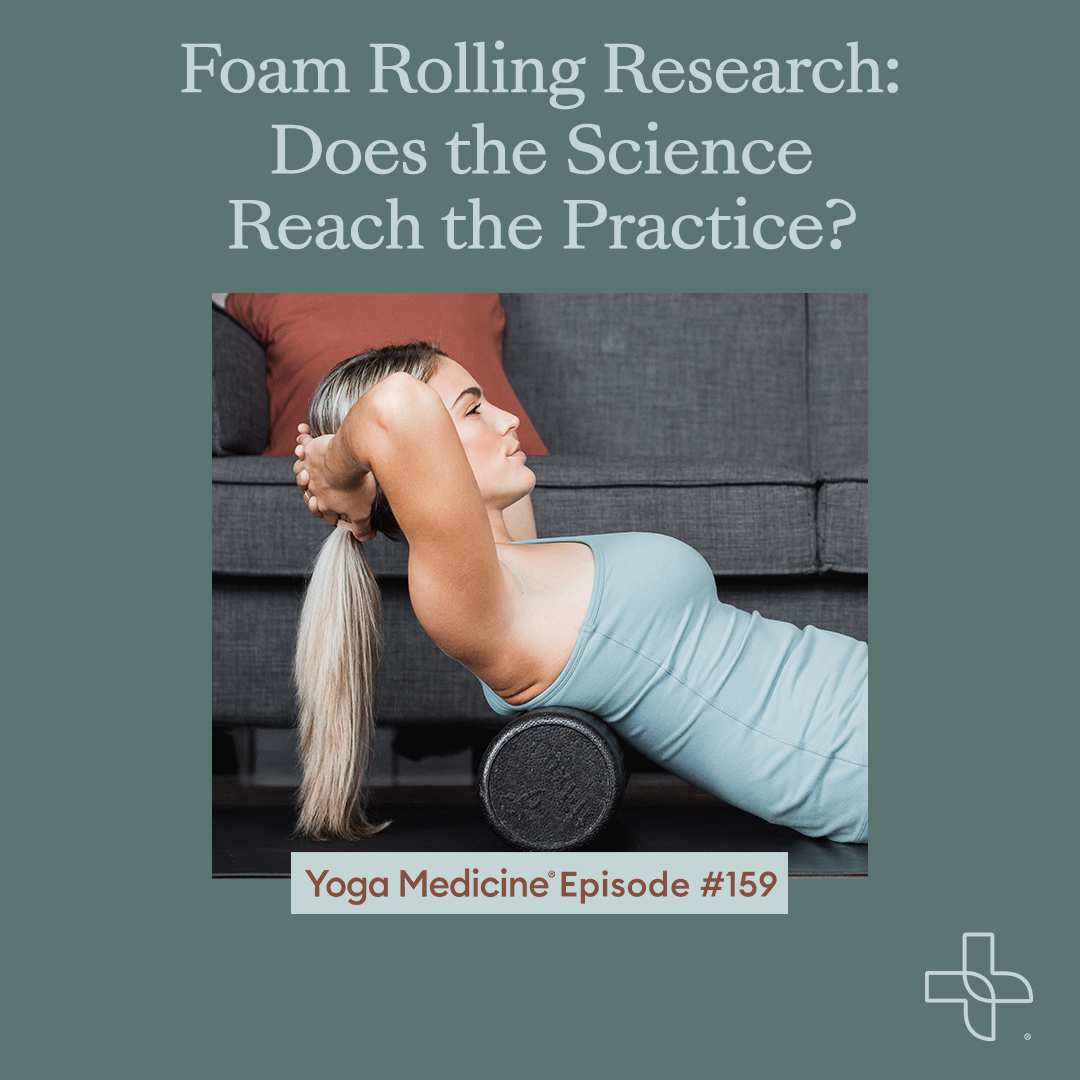 Foam Rolling Research: Does the Science Reach the Practice? 12.02.2026 1t 18minFor years now, host Katja has been studying contraindications for foam rolling research, and today she sits down with Tiffany to discuss if new foam rolling research is reaching users in a practical way. In this episode, we discuss Katja's latest research project as well as recent findings and their implications for the yoga world. Listen in to learn which findings were most surprising and how yoga teachers can apply new foam rolling research in their classes and practice. "We are always using, not only the research...but then also pulling in our gut and our experience and what is realistically attainable." - Tiffany Cruikshank. — What You'll Learn: Background on Katja's new research [1:27] In which context foam rolling is applied in practice [13:00] Foam rolling durations [15:14] How often is foam rolling recommended [23:40] Tools for foam rolling [31:13] Recent research on vibration foam rollers [38:04] Surprising findings [42:35] Practicality of collecting data [54:26] Info from non-users [1:08:14] Final takeaways [1:10:58] — Links Mentioned: Watch this episode on YouTube Online Myofascial Release Training Connect with Katja Bartsch: Facebook | Instagram | Kalamana Yoga | YMO Guest Teacher — Learn More: Find the full show notes at YogaMedicine.com/podcast-159. Learn more about insider tips, online classes or information on our teacher trainings at YogaMedicine.com. To support our work, please leave us a 5 star review with your feedback on iTunes/Apple Podcasts or wherever you listen to podcasts.
 -
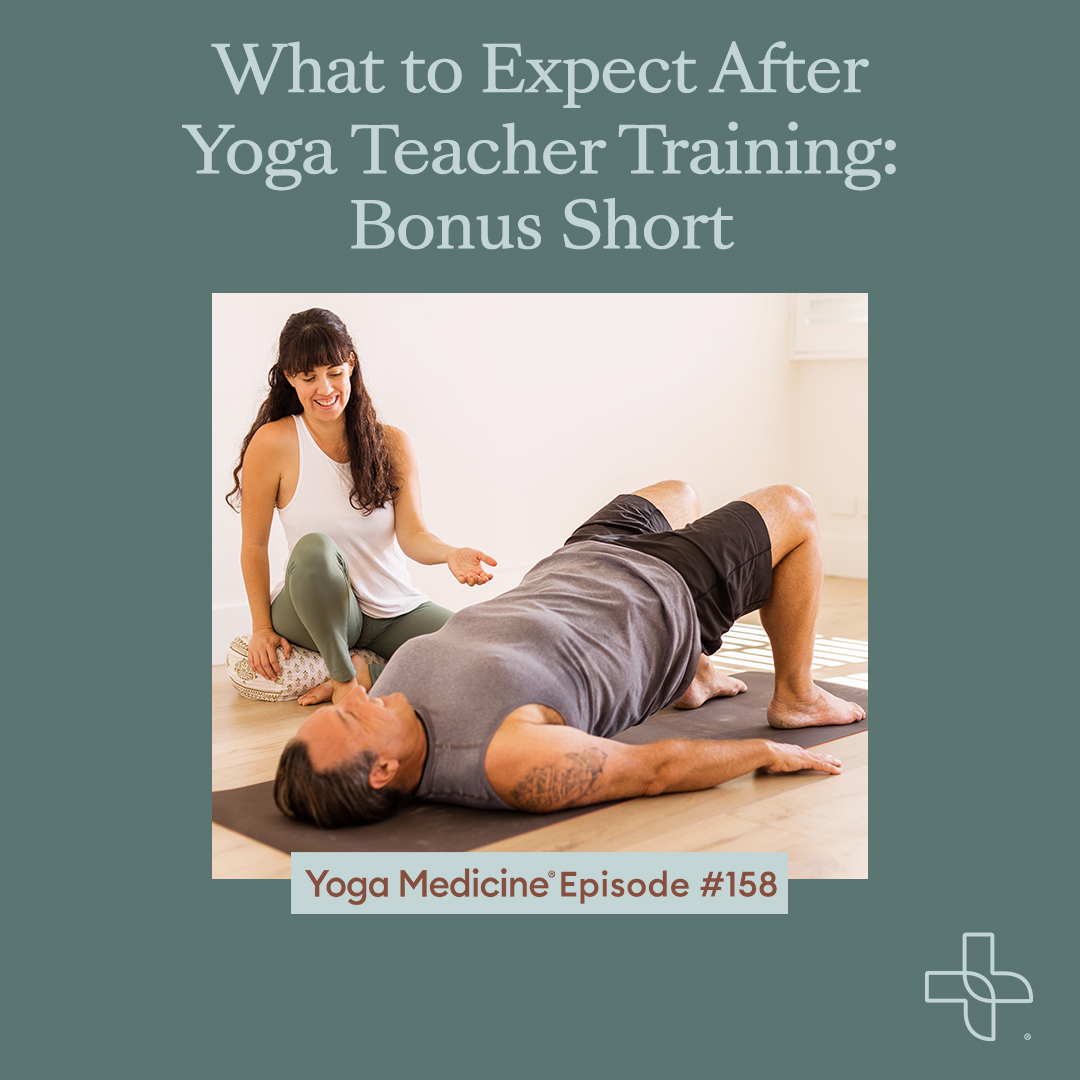 What to Expect After Yoga Teacher Training: Bonus Short 05.02.2026 14minYoga Teacher Training is such an involved and immersive process that many teachers forget to consider what they'll do when it ends. This final episode in our bonus 200-hour yoga teacher training series includes two short excerpts from Episode 103: Teacher Training Myths with Yoga Medicine 200-hour lead teacher Dana Diament. In this episode, Dana and host Rachel share what you will -- and won't know -- after teacher training. They discuss how teaching opportunities are more widespread than ever, and how to capitalize on your unique skills and experiences to find your feet as a teacher. — Show Notes: The work doesn't end when 200hr teacher training does [2:01] What you will and won't know after yoga teacher training [4:04] Translating your personal experience for students [6:18] Teach immediately after 200hr teacher training [7:18] New teaching locations and populations [8:48] Full-time, part-time, or something else [11:25] Final thoughts [12:15] — Links Mentioned: Watch this episode on YouTube Yoga Medicine® 200HR Yoga Teacher Training Listen to the full Yoga Medicine® Podcast Episode 103: Teacher Training Myths You can learn more about this episode and see the full show notes at YogaMedicine.com/podcast-158. And you can find out more about insider tips, online classes or information on our teacher trainings at YogaMedicine.com. To support our work, please leave us a 5 star review with your feedback on iTunes/Apple Podcasts.
 -
 Full-Time Yoga Teacher Panel: Community Conversations with Elena Cheung, Kylie Rook and Caroline Wybar 29.01.2026 49minIn a time of what feels like unprecedented change, the yoga landscape is shifting profoundly. It's a great opportunity for host Rachel Land to connect with other full-time yoga teachers—returning guests Caroline Wybar, Elena Cheung and Kylie Rook—to hear their thoughts. In this wide-reaching and philosophical discussion, we share what life as a teacher looks like right now, what has changed in the recent past, and what challenges and opportunities might lie ahead. Listen in to hear about online fatigue, chasing the hustle, the challenge of work-life balance, diversification for long-term sustainability, and our advice for new teachers. — Show Notes: Current teaching schedules [3:35] Why to diversify your offerings [7:41] Post-pandemic changes for yoga teachers [8:38] Myriad options: for better and for worse [12:35] Making a good living versus making a good life [16:13] Challenges: online fatigue, cultural stress, changing markets and demographics [23:33] Future opportunities [32:02] Closing thoughts for other teachers [43:50] — Links Mentioned: Watch this episode on YouTube Connect with Caroline Wybar: Facebook | Instagram | Caroline Wybar Yoga | YMO Guest Teacher LIVE Online Yoga Nidra Teacher Training Yoga Medicine® Podcast Episode 68: Approaches for Anxiety Yoga Medicine® Podcast Episode 136: Yoga Nidra Connect with Elena Cheung: Instagram | Elena Shapeshifts | YMO Guest Teacher The Art of Teaching Impactful Group Classes Online Course Yoga Medicine® Podcast Episode 74: Yoga for All Yoga Medicine® Podcast Episode 141: Pitfalls of Private Yoga (And How to Avoid Them) Yoga Medicine® Podcast Episode 153: Integrity Beyond the Metrics Connect with Kylie Rook: Facebook | Instagram | Into Being | YMO Guest Teacher Yoga Medicine® Podcast Episode 66: Beginner's Mind You can learn more about this episode and see the full show notes at YogaMedicine.com/podcast-157. And you can find out more about insider tips, online classes or information on our teacher trainings at YogaMedicine.com. To support our work, please leave us a 5 star review with your feedback on iTunes/Apple Podcasts.
Lignende podcasts


Populær i
Denne podcast optræder også i podcast-hitlister i disse lande.

