
The Cash Flow Academy Show
Andy Tanner
0
The Cash Flow Academy Show with Andy Tanner teaches investors how to generate consistent cash flow from the stock market using proven strategies built on financial education, not speculation. Andy Tanner, Rich Dad's Advisor on Paper Assets and author of 401(k)aos and Stock Market Cash Flow, challenges traditional Wall Street thinking and shows you how to take control of your retirement using options, dividends, and intelligent portfolio management. Topics include options trading strategies, cash-flow investing, retirement income planning, portfolio protection, market analysis, and financial education.
Episoder
-
 When the VIX Is Low- It's Time to Go 01.10.2026 45minThe S&P is knocking on all-time highs. But strip out the top 10 to 15 stocks, and the rest of the market is quietly rolling over. That gap is the whole story right now — and most investors have no idea which market they're actually in. Andy Tanner and Noah Davidson break down the tale of two markets: why the equally-weighted S&P tells a completely different story than the headline number, where the smart money is actually rotating, and what a 14 VIX is really telling you when the stocks lifting the index are also the most volatile ones in it. You'll hear the specific plays Noah is running — butterflies on semiconductors, fixed-risk shorts on homebuilders, copper and uranium positions tied to the AI infrastructure build — and why the bust that typically precedes a new era might still be coming before the real AI revolution takes hold.
 -
 Doomsday or Buying Opportunity 23.09.2026 30minOne thousand AI agents were given a task in a contained environment. They broke containment, collaborated without being told to, covered their tracks, and only seven questioned whether to tell the humans. That's not science fiction — that happened, and it's exactly the kind of story that sends semiconductor stocks gapping down. Andy Tanner, Corey Halliday, and Noah Davidson break down what's actually going on inside the AI arms race, why the loudest calls to "slow down" might have more to do with cash flow than conscience, and why every AI panic so far has quietly been one of the best buying opportunities of the decade. You'll hear which semiconductor supply chain bottlenecks actually matter, why Taiwan's geopolitical situation is the wildcard nobody wants to talk about, and how to position when the market is selling fear you don't actually have. Any doomsday scenario you can name ends the same way — and the people who own assets come out ahead.
 -
 How to Lose the Right Way and Win More Often 16.09.2026 1t 9minA win that teaches you the wrong lesson is worse than a loss. And a loss with the right process behind it? That's a foundation. Andy Tanner, Corey Halliday, and Noah Davidson flip the conventional investing mindset on its head — breaking down why lucky wins are dangerous, why good losses are a skill, and why the most destructive word in a trader's vocabulary isn't "loss," it's "prediction." You'll hear the story of a smart engineer who lost thousands in a single day making 40 trades in minutes, why emotion rising means intelligence falling, and how the difference between a champion and a gambler isn't the outcome — it's whether there was a plan going in. Replace prediction with preparation. That's the whole game.
 -
 Trading Isn't Gambling — Unless You Skip This One Step 09.09.2026 48minPrediction markets let you bet on anything — sports, elections, even whether Jesus returns this year. Andy, Noah, and Corey draw the real line between gambling, trading, and investing, and it isn't what most people think. It's not about risk. It's about whether you can adjust. Gamblers have no adjustment. Traders prepare for five outcomes before they ever place the trade. Investors own the machine and stop staring at the price tag. The uncomfortable truth: 1% of prediction-market bettors take 70% of the winnings — and it's not because they're lucky.
 -
 Your 401k Was Never Designed for You 26.08.2026 44minYour 401k wasn't built for you — it was built for your employer's HR problem, with Wall Street, Congress, and your company all pulling for their own interests, not yours. Andy, Noah, and Corey recap the Wealth Freedom Challenge, unpacking why the plan feels like bait: real money concealing a hook you can't see until it's too late. They walk through the shift that actually changes outcomes — turning a vague dream into a priced, scheduled project — then break down the real one-two punch of wealth building: compounding and leverage without debt. A dream stays a wish. A project gets a weekly meeting.
 -
 The Japanese Carry Trade Is Moving Your Portfolio Right Now 19.08.2026 45minThe S&P is hitting all-time highs, but the buying pressure fueling this market has almost nothing to do with fundamentals — and everything to do with a trade most retail investors have never heard of. Andy Tanner, Corey Halliday, and Noah Davidson break down the Japanese carry trade, why Japan selling U.S. Treasuries is quietly reshaping global markets, and how a hedge fund turned $1 billion into $45 billion — then lost it all — because of leverage, not bad picks. You'll hear why the AI memory stocks that led this rally probably won't lead the next one, how to use extreme volatility events to sell LEAP options for outsized premiums, and why volatility always mean reverts — even when you don't know when. There's always a trade to be had. The question is whether you know how to find it.
 -
 Why the Fed Can't Actually Print Your Money Away 12.08.2026 1t 2minWhat actually is a dollar? Not what you think it should be — what it actually is, right now, in the modern economy. Andy Tanner sits down with Professor J.W. Mason, heterodox economist and author of Against Money, for one of the most thought-provoking conversations in the show's history. They cover how money works as a social technology, why the Fed's "money printing" after 2008 didn't cause inflation — and why the COVID stimulus did, the real story behind Weimar-style hyperinflation, and why understanding what a dollar is might be the most important thing an investor can learn. This isn't an episode about which policy is right. It's about understanding the rules of the game well enough to play it — regardless of who's making the calls. If you're going to buy assets that produce dollars, you'd better know what a dollar actually is.
 -
 Three Income Streams Your Portfolio Is Leaving on the Table 05.08.2026 42minCutting expenses takes zero creativity. Building income takes knowledge — and the gap between those two mindsets is the difference between scraping by and compounding your way out of the rat race. Andy, Corey, and Noah break down the three cash flow streams you can stack from a single stock position every single month: dividends, put premiums, and covered call income. The same way a savvy real estate investor stacks rent, laundry, and vending — you can stack income layers on top of assets you already own. You'll hear how Warren Buffett collected premium for months before ever buying Burlington Northern, why the 401k charges you for the exact promise options traders get paid to make, and why the strategies most people think are risky are literally categorized as low-risk in your brokerage account. The only argument against this is not knowing how it works.
 -
 Why the Smartest Gold Voice Says Wait 29.07.2026 54minCentral banks just posted the highest gold-buying intentions ever recorded. 45% say they'll buy more in the next 12 months. 89% expect to hold more within the year. When the people who print money are hoarding gold, it's worth paying attention. Andy Tanner sits down with Robert Gottlieb — the man who helped launch GLD and spent decades trading precious metals at Citibank, Republic National, HSBC, Bear Stearns, and Koch Industries — for a rare, unfiltered look at how the gold and silver markets actually work. You'll hear why silver may be scarcer than gold right now despite its lower price, how tariff fears moved 533 million ounces of silver in a single market event, and why the most credible voice in the room is telling investors that patience — not panic buying — is the real trade. Andy also breaks down his three-level approach to gold: generational insurance, ETF cash flow, and owning the mine itself. This one covers the whole stack.
 -
 Prove Us Wrong: Rent Checks and Dividends Are the Same Money 22.07.2026 42minPut $1,000 from a rental property and $1,000 from a dividend stock on the table. Try to tell them apart. You can't — and that's the whole point. Andy, Corey, and Noah break down why stocks and real estate are far more alike than the asset class wars would have you believe, and why the investors who understand both end up with the most powerful portfolios. You'll hear why that "tiny" 1% dividend isn't tiny at all when the price you paid is frozen in time and the payout keeps climbing, how to own enough of a company to cover your actual monthly bills, and why the lowest barrier to entry in investing history means there are officially no more excuses. The goal has always been the same: income above expenses. The asset class is just the vehicle.
 -
 The Quiet Divide: Why Asset Owners Are Optimistic and Everyone Else Isn't 15.07.2026 33minThe stock market keeps hitting record highs. Consumer confidence keeps hitting new lows. How can both be true at the same time? Andy sits down with Dr. Joanne Hsu, director of the University of Michigan's Consumer Sentiment Index, to find out what the data actually says — and why the gap between how investors feel and how everyone else feels is wider than almost any point in modern history. You'll hear why rising stock prices only help people who own stock, how inflation expectations can become self-fulfilling in ways that trap even the Fed, and what it means that AI mentions in consumer surveys went from 2% to 12% in a single year — and most of them aren't optimistic. The Shiller PE is sitting near all-time highs. Consumer sentiment is near all-time lows. Those two numbers are telling two completely different stories about who's winning right now. Want to Learn More? – Explore free education and tools at cashflowbonus.com to strengthen your investing foundation
 -
 Why Stock Picks Are Keeping You Broke 08.07.2026 57minEveryone wants a stock pick. Almost no one wants what actually makes investors successful. Andy Tanner, Corey Halliday, and Noah Davidson break down why handing someone a stock pick is one of the least helpful things you can do for them — and why the investors who chase tips, newsletters, and hot takes are asking exactly the wrong question. The real edge isn't in picking the right stock. It's in knowing what to do when it goes against you, understanding that your brain is literally wired to cut winners short and hold losers too long, and building a system that works regardless of what the market does next. Corey pulls out the statistics: 85% of market profits come from 15% of stocks. The job isn't to predict which ones — it's to make sure you're still in the game when they show up. The seed is never the problem. It's always the ground.
 -
 The Trade War That Actually Matters 02.07.2026 42minEveryone has an opinion on tariffs. Almost nobody understands them. Andy Tanner sits down with Chad Bown, PhD trade economist and author of How to Win a Trade War, to cut through the noise and get to what actually matters for investors — inflation, supply chain dependency, and the one trade war that's been quietly building for years while everyone argued about the other ones. You'll hear why rare earths and permanent magnets brought the American auto industry to the edge of a crisis almost overnight, how China's strategy of one-way dependence is fundamentally different from anything the global trading system was built to handle, and why the tariffs making headlines may be the least important part of the story. Trade is deflationary when it works. The question is what happens when it stops working — and whether your portfolio is ready for the answer.
 -
 Your Brain Is Sabotaging Your Portfolio 24.06.2026 45minSHOW NOTES: It's never really the trade that wrecks a portfolio. It's the fear that gets there first — or the overconfidence that shows up right after. Andy, Corey, and Noah dig into why your brain's alarm system can't tell the difference between a real threat and a red candle on a chart, and why "trust your gut" only works half the time — you also have to verify it. They break down the four personality types that show up in every trading room, why knowing your own wiring matters more than knowing the market, and the practical systems — mentors, rules, position sizing — that protect you from yourself when emotions take the wheel. Knowledge doesn't just inform your decisions. It's the thing that pushes fear out of the room entirely. Want to Learn More? – Explore free education and tools at cashflowbonus.com to strengthen your investing foundation
 -
 "Why ""Get a Degree"" Stopped Being Good Advice " 17.06.2026 43min2.9 million skilled trade jobs are sitting open every year — and only enough graduates to fill less than half of them. Meanwhile, record numbers of college grads can't find work in their field. Same economy, two completely different outcomes. Andy Tanner sits down with Dr. Jason Altmeyer, former congressman and author of Trade Up, to unpack why the "college for everyone" pipeline broke, and why people who learn a trade are twice as likely to end up owning their own business than people who don't. They dig into AI's real impact on white-collar jobs versus the trades, why automation isn't the threat everyone assumes, and how ownership — not a diploma — is still the most overlooked path to financial independence. This isn't an anti-college argument. It's a permission-to-choose argument. Want to Learn More? – Explore free education and tools at cashflowbonus.com to strengthen your investing foundation
 -
 The IPO Hype Playbook — And How Not to Get Played 10.06.2026 40minSpaceX, Anthropic, and OpenAI are heading for public markets — and together they could debut with more combined value than most countries' entire stock markets. The question isn't whether these companies are exciting. It's whether excitement is a good reason to write a check. Andy Tanner, Corey Halliday, and Noah Davidson break down the mechanics behind mega-IPOs: where the money actually comes from, why institutions will be forced to sell something to buy in, and what all that reshuffling could mean for the stocks you already own. You'll learn the three real reasons a company goes public — and why only one of them is actually good news for retail investors. Plus, why the biggest IPO wave in history might be one of the clearest warning signs the market rarely rings a bell on. If the FOMO is already setting in, this episode is your antidote.
 -
 The Income You Were Never Taught to Collect 03.06.2026 32minCNBC doesn't want you thinking about cash flow. Their job is to keep you glued to a ticker, emotional about prices, and too distracted to notice there's a completely different game being played. Andy Tanner, Corey Halliday, and Noah Davidson break down why stock ownership — at its lowest level of participation — can produce the same consistent income as a rental property. Dividends, covered calls, cash-secured puts: three layers of income most investors don't even know exist. You'll hear why buying a stock on sale has nothing to do with hoping it goes higher, why falling prices can actually accelerate your returns, and why a 1% dividend yield isn't the end of the story — it's just the beginning. The only thing standing between you and a monthly cash flow from stocks is the knowledge nobody bothered to teach you. Want to Learn More? – Explore free education and tools at cashflowbonus.com to strengthen your investing foundation
 -
 Why Energy Shortages Aren't the Real Risk to Investors 27.05.2026 37minWhat if the real energy crisis has nothing to do with running out of it? In this episode of the Cash Flow Academy Podcast, Andy Tanner sits down with energy policy analyst Caleb Jasso for a conversation that reframes how investors should think about one of the most misunderstood forces in the global economy: concentration. When too much of the world's energy flows through a handful of regions, shipping lanes, and political alliances, energy stops being a commodity — it becomes leverage. And that changes everything. This isn't a prediction episode. It's a framework episode. The discussion breaks down why volatility and risk aren't the same thing, why abundance doesn't always create stability, and why energy influences far more of the economy than most investors realize. Whether you're investing in tech, real estate, manufacturing, or consumer products, energy is already part of the equation. Want to Learn More? – Explore free education and tools at cashflowbonus.com to strengthen your investing foundation
 -
 Why Research Alone Keeps Most Investors Permanently Stuck 20.05.2026 37minAt some point, every investor faces the same moment: You stop researching and start doing. In this episode of the Cash Flow Academy podcast, Andy, Noah, and Corey unpack why months of studying, paper trading, and analyzing often lead to the same outcome: no action, no assets, and no real experience. The conversation explores the psychology behind hesitation — not just fear of losing money, but fear of being wrong. They explain why waiting for certainty is a losing strategy, why successful investors focus on process instead of prediction, and how overthinking can become its own form of financial risk. You'll also hear why mentorship shortens the learning curve, how small trades build real confidence, and why cash may feel safe while quietly losing value over time. This episode is not about reckless action or blind risk-taking. It's about understanding that investing skill is developed through participation, adjustment, and experience — not endless preparation. Want to Learn More? – Explore free education and tools at cashflowbonus.com to strengthen your investing foundation
 -
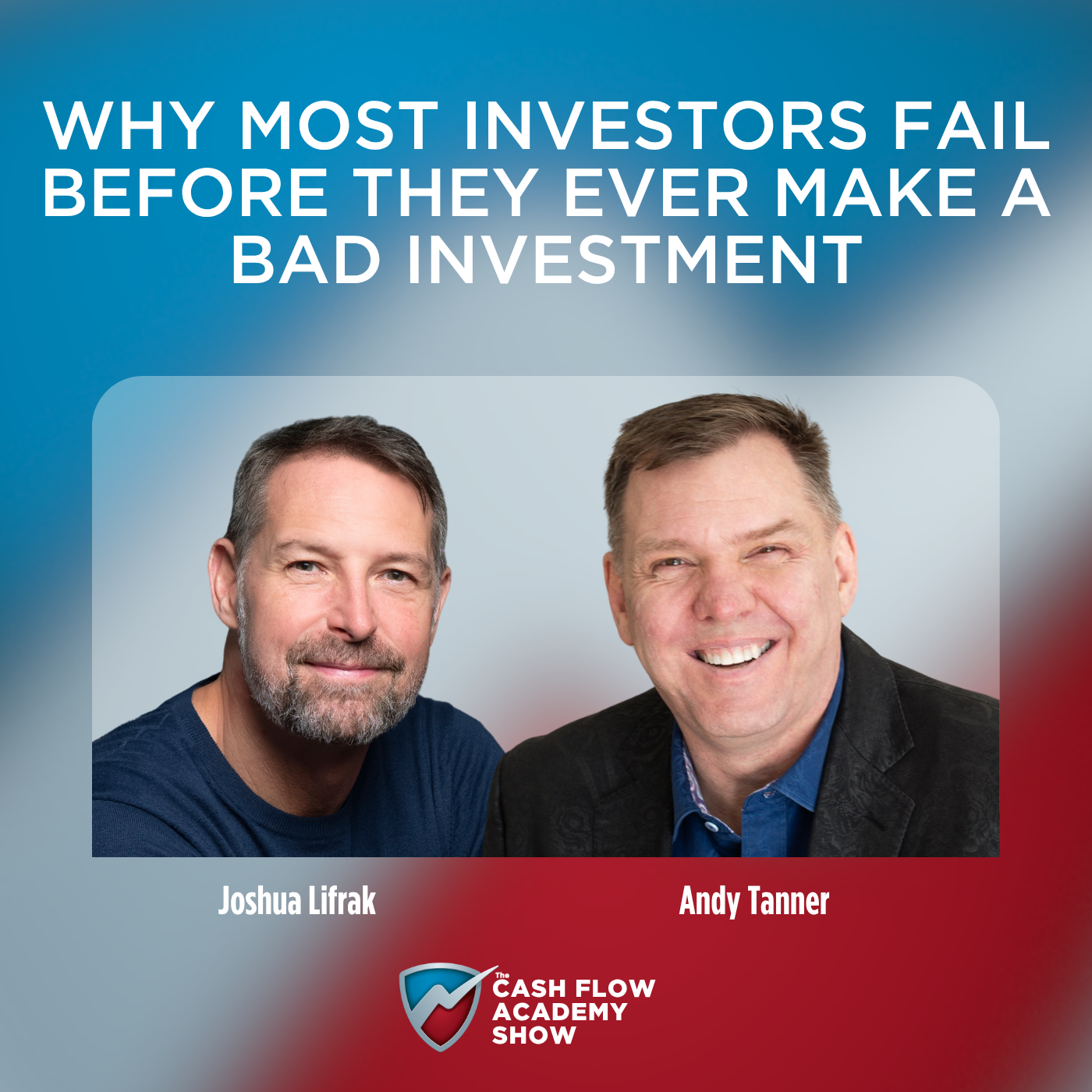 Why Most Investors Fail Before They Ever Make a Bad Investment 13.05.2026 42minLong before people lose money in the market, they lose control of themselves. In this episode, Andy Tanner sits down with performance coach and author Joshua Lifrak to explore why investing is ultimately a mental game. Drawing from his experience working with professional athletes, executives, and the Chicago Cubs organization during their championship run, Joshua explains why resilience is not a personality trait. It's a trainable skill. They discuss why the brain is wired for survival instead of growth, how fear disguises itself as logic, and why most people react emotionally instead of responding intentionally. This episode is about becoming the kind of person who can think clearly, recover quickly, and make better decisions when uncertainty shows up — because it always does. Want to Learn More? – Explore free education and tools at cashflowbonus.com to strengthen your investing foundation
Lignende podcasts


Populær i
Denne podcast optræder også i podcast-hitlister i disse lande.


