
FinanceFrontierAI: Top 1% Storytelling: Strategies, AI, Finance, Business, Money, Wealth, Mindset
Top 1% Finance + AI + Wealth Strategies | U.S hosts: Max, Sophia and Charlie
0
FinanceFrontierAI explores the intersection of finance, AI, and business innovation, breaking down the biggest trends shaping the future. Hosted by Max, Sophia, and Charlie from iconic U.S. locations, each episode blends cinematic insight with top 1% storytelling. The show spans four series covering macro forces, AI-driven innovation, asymmetric investing strategies, and the mental edge required to scale. Every episode is crafted to sharpen clarity, strengthen conviction, and help you think like the world's top performers.
Episoder
-
 The Jobless Boom 11.10.2026 1t 11min💡 Welcome to Finance Frontier, part of the Finance Frontier AI podcast network.What if the next job to disappear is never created? No layoff. No announcement. Just an opening that never appears because existing employees can accomplish more with AI.In The Jobless Boom, Max, Sophia, and Charlie investigate why an economy can grow while hiring slows, and who benefits when productivity rises without proportional job creation.In Q2 2026, US GDP grew at a 2.2% annualized rate. September payrolls added just 29,000 jobs, while workers' share of nonfarm business output reached 52.8%, its lowest recorded level since 1947. These figures raise questions, not proof of AI-driven job losses. Demographics, immigration, inflation, and other forces matter.🧠 Key Topics Covered🔹 The Invisible Job: How businesses can grow without replacing departing employees or creating expected positions.🔹 The Three Scoreboards: Production, Opportunity, and Distribution — why economic growth and personal prosperity are not the same thing.🔹 The Missing Workers: Why aging and slower labor-force growth can explain weak payroll numbers without a hiring collapse.🔹 Who Gets the Growth? How gains can flow to wages, profits, consumers, or investment — and why labor share matters.🔹 The Young-Worker Canary: Stanford's approximately 19% relative employment gap in highly AI-exposed jobs for ages 22–25, and the risk to career entry points.🔹 The Headcount Dependency Test: What happens to per-seat software, recruitment, payroll, and office property when customers grow without hiring?🔹 Three Futures: Expansion, Polarization, or Structural Decoupling — and the indicators to watch through 2035.📉 Why This MattersAI may make companies richer and workers more capable, but it does not automatically guarantee more openings or a fairer distribution of rewards. For employees, entrepreneurs, and investors, the essential question is who gets to participate in the boom?🌐 Stay Connected📬 Discover The 10× Edge at FinanceFrontierAI.com. Have a compelling thesis? Visit our Pitch Page.🎧 Subscribe on Spotify or Apple Podcasts. Follow us on X and LinkedIn.🔥 Keywords: The Jobless Boom, AI jobs, jobless growth, artificial intelligence, US economy, labor market, AI productivity, corporate profits, labor share, future of work, AI investing, headcount economy, AI and employment, AI automation, job creation, hiring slowdown, jobless recovery, labor force growth, demographic shifts, worker bargaining power, economic growth, income distribution, wealth inequality, worker productivity, Gen Z employment, entry-level jobs, AI job displacement, low hiring low firing, workforce automation, corporate hiring, labor economics, economic inequality, AI business models, per-seat SaaS, software pricing, AI investment strategy, structural decoupling, future economy, AI economic impact, economic outlook 2035.
 -
 The AI debt trap 05.10.2026 1t 6min💡 Welcome to Finance Frontier, part of the Finance Frontier AI podcast network, where macro forces, capital flows, and financial systems are examined beneath the surface.In this flagship episode, Max, Sophia, and Charlie explore a critical question emerging from the AI infrastructure boom: what happens when businesses become dependent on AI while the financial commitments underneath that dependency stretch years — sometimes decades — into the future?AI does not have to fail for the financing around it to become fragile.Businesses can become more productive. AI usage can keep rising. Data centers can remain valuable. And investors can still lose money if technology, pricing, utilization, and financing move on different clocks.This episode introduces a powerful framework for understanding that paradox: AI can become indispensable without every AI investment becoming profitable.From Microsoft's enormous future data-center lease commitments to Nvidia's residual-value guarantees, we follow the financial architecture underneath the AI boom — and ask who ultimately owns the risk when assumptions change.🧠 Key Topics Covered🔹 The AI Dependency Paradox: How AI can work so well that businesses become increasingly dependent on it — making switching more expensive precisely because the technology succeeded.🔹 The Hidden Contract Boom: Why the AI infrastructure race includes long-term leases, purchase commitments, power agreements, guarantees, and future obligations.🔹 The Depreciation Problem: Why AI hardware can continue working while rapidly losing economic value as newer generations make intelligence cheaper.🔹 Two Different Assets: Why the processor and the powered data-center site should not be valued as the same thing and why the chip can become abundant while the plug becomes scarce.🔹 The Three Clocks: How technology, financing, and customer adoption can move at radically different speeds, turning a correct long-term thesis into a bad investment.🔹 Follow the Risk: How contracts, lenders, tenants, infrastructure owners, guarantors, and investors distribute financial pressure — and why risk is not simply owned, but routed.🔹 The Second-Owner Opportunity: Why useful infrastructure can survive a failed capital structure, allowing a new owner to acquire the same productive asset at dramatically better economics.🔹 The Flexibility Premium: Why portability, adaptable infrastructure, manageable financing, and strategic optionality may become major advantages in the AI economy.📉 Why This MattersThe AI boom is usually framed as a technology race: better models, faster chips, larger data centers, and more powerful agents.But underneath that race is a financial system making long-duration commitments against technology that can change extraordinarily quickly.A data center can remain useful while its original financing fails. A processor can remain productive while losing pricing power. AI demand can explode while individual infrastructure projects struggle to earn acceptable returns.The harder question is not simply whether AI wins. It is: who captures the value, who carries the obligations, and who still has options when the assumptions change?🌐 Stay Connected📬 Sign up for The 10× Edge for asymmetric ideas, macro frameworks, and investor psychology at FinanceFrontierAI.com.🎯 Have a high-quality thesis, system insight, or asymmetric opportunity that fits our format? Visit the Pitch Page. If there’s a clear alignment, we may feature it in a future episode.🎧 Subscribe on Spotify and Apple Podcasts. Follow @FinFrontierAI on X and Finance Frontier AI on LinkedIn for financial intelligence, macro insights, and new episodes.🔥 Keywords: AI debt trap, AI infrastructure, artificial intelligence investing, AI data centers, data center financing, Nvidia AI, OpenAI infrastructure, AI debt, data center leases, GPU depreciation, power scarcity, AI energy demand, infrastructure investing, private credit.
 -
 When Your AI Spends Your Money 26.09.2026 53minWelcome to AI Frontier AI, part of the Finance Frontier AI podcast network where we decode how artificial intelligence is reshaping power, markets, and decision-making.In this episode, Max, Sophia, and Charlie ask a deceptively simple question: How much of your money would you let an AI spend without asking you first?Ten euros? A hundred? A thousand? Ten thousand?But the deeper question isn't really about money. It's about authority.Software has been moving money for decades. What changes with agentic AI is the possibility that humans define an objective and some boundaries, then allow the AI to interpret circumstances, choose between alternatives, and commit resources without asking for approval every time.That creates a new economic problem: How do we delegate judgment without giving up control?🔍 What You’ll Discover💳 Spending vs Authority — Why giving an AI access to money is different from giving it permission to make economic decisions.🪜 The Delegation Ladder — How AI can move from suggesting and preparing decisions to standing orders, bounded judgment, and broader autonomy.💰 The Authority Budget — Why a spending limit alone cannot define what an AI should be allowed to do.⚠️ Compliant Damage — How an AI can follow every rule you gave it and still make exactly the wrong decision.↩️ Autonomy Follows the Undo Button — Why reversibility may matter more than transaction size when deciding how much authority to delegate.🧠 The Approval Frontier — When the cost of asking a human becomes greater than the expected cost of letting the AI decide.🚨 Velocity Risk — Why one small AI mistake can become thousands of mistakes before a human notices.🤝 Whose Side Is Your AI On? — Why commissions, incentives, and conflicts of interest matter when an AI becomes your economic representative.🛡️ Who Pays When It Gets It Wrong? — Why scalable AI autonomy may depend on predictable ways to allocate losses when delegated judgment fails.🎯 Takeaways That Stick✅ Being smart enough isn't the same as being allowed to act.✅ A wallet gives AI access to money. An allowance defines its authority.✅ The transaction isn't necessarily the decision. The policy can be the decision.✅ Autonomy follows the undo button.✅ Every time AI asks, we spend attention. Every time it doesn't ask, we accept risk.✅ Intelligence creates capability. Institutions make capability usable.✅ The real question is: Which decisions have earned the right not to interrupt you?🧭 The Framework: The Allowance TestWhat is the AI allowed to decide? How much can it commit? How easily can you undo what it does? How quickly can you stop it? Whose interests is it serving? And when it's wrong, who pays?👥 Hosted by Max, Sophia & Charlie🚀 Next Steps🌐 Explore FinanceFrontierAI.com.📲 Follow @FinFrontierAI on X, and connect with us on LinkedIn.🎧 Subscribe on Apple Podcasts or Spotify.📥 Join the 10× Edge newsletter.📢 Have an AI company, product, or thesis? Pitch it here. First submissions are free.Keywords: artificial intelligence, AI, agentic AI, AI agents, AI autonomy, autonomous AI, AI spending, AI payments, AI economics, delegated authority, delegated judgment, AI commerce, AI shopping, machine customers, AI procurement, authority budget, Allowance Test, approval frontier, reversibility, AI risk, AI liability, AI accountability, AI alignment, AI incentives, autonomous transactions, human attention, Finance Frontier AI, AI decision making, AI financial agents, autonomous commerce, AI purchasing agents, AI authorization, AI permissions, AI trust, AI governance, AI oversight, AI control, bounded autonomy, economic agency, AI delegation, autonomous payments, machine payments, AI wallets, AI transaction limits, AI spending limits, loss allocation, AI insurance, AI fraud, AI conflicts of interest, AI consumer protection, AI financial risk, human approval, approval automation, future of commerce, future of payments, AI economy, AI and money
 -
 Veru Inc. ($VERU) – The Path to a 10× Return 19.09.2026 51min💡 Welcome to Make Money, part of the Finance Frontier AI podcast network — where we analyze asymmetric opportunities through survival, validation, scalability, and repricing.In this episode, Max Vanguard, Sophia Sterling, and Charlie Graham examine Veru Inc. ($VERU), a clinical-stage biotech developing enobosarm to potentially preserve muscle during GLP 1 weight loss.This is not a stock pitch. It is a documented case study in asymmetric investing — and in finding the problem created by the revolution.🔹 Snapshot Date — September 19, 2026.🔹 Current Price — ~$2.40.🔹 Market Cap — ~$40 million.🔹 1-Year Target — $10 (≈4×).🔹 5-Year Target — $24 (≈10×).🔹 Starting Allocation — 0.5%.🔹 Risk/Reward — ~7:1 under the base downside assumption.🔹 Lead Program — Enobosarm for muscle preservation during GLP 1 treatment.🔹 Clinical Status — PLATEAU Phase 2b fully enrolled with 239 patients.🔹 Next Major Gate — PLATEAU interim analysis expected Q1 2027.📊 The Core QuestionWhat would have to be true for a ~$2.40 clinical-stage biotech stock to reach ~$24 over the next five years?We evaluate VERU through four gates:✅ Survival✅ Validation✅ Scalability✅ RepricingIf the clinical thesis fails, the path can break quickly. If the evidence strengthens, safety holds, financing remains manageable, and enobosarm becomes a meaningful obesity asset, Veru could be valued very differently.🧱 What You'll Learn• How the GLP 1 revolution may create a second-order opportunity around muscle preservation.• What Veru's QUALITY study showed — and what it did not prove.• Why the 239-patient PLATEAU study is the next major validation gate.• Why competition validates the category while raising the bar for Veru.• What the Novo Nordisk relationship does — and does not — mean.• Why cash runway and dilution can destroy returns even if the science works.• How the conditional path could move from ~$2.40 to $5–$7, $10, $15+, and ultimately $24.• Why position size should increase with evidence, not excitement.⚠️ Key RisksClinical failure. Safety. Financing. Dilution. Competition. Regulatory uncertainty. Timeline delays. Permanent capital loss.📝 Documentation, Not PredictionThis episode documents the VERU thesis as of September 19, 2026.The starting price, targets, risks, and gates are recorded before the outcome is known.Five years from now, reality will provide the scorecard.VERU may never reach $24. Or enobosarm may become a meaningful solution to a problem created by one of the biggest drug revolutions in modern medicine.Today we do not know the outcome. We only know the path.🌐 Explore More📢 Visit FinanceFrontierAI.com and explore Make Money.📲 Follow us on X for asymmetric opportunities and structural analysis.📬 Submit your pitch here.Keywords: Veru, VERU stock, enobosarm, GLP 1, muscle preservation, lean mass, obesity treatment, Wegovy, semaglutide, Novo Nordisk, PLATEAU trial, QUALITY trial, biotech investing, microcap stocks, asymmetric investing, 10x stocks, obesity stocks, dilution risk, position sizing, Finance Frontier AI, Make Money podcast.Topics Covered: Veru Inc. (NASDAQ:VERU), enobosarm, GLP 1 weight loss, muscle preservation, QUALITY, PLATEAU Phase 2b, Novo Nordisk, biotech valuation, cash runway, dilution, clinical risk, competition, asymmetric risk-reward, position sizing, and second-order investment opportunities.
 -
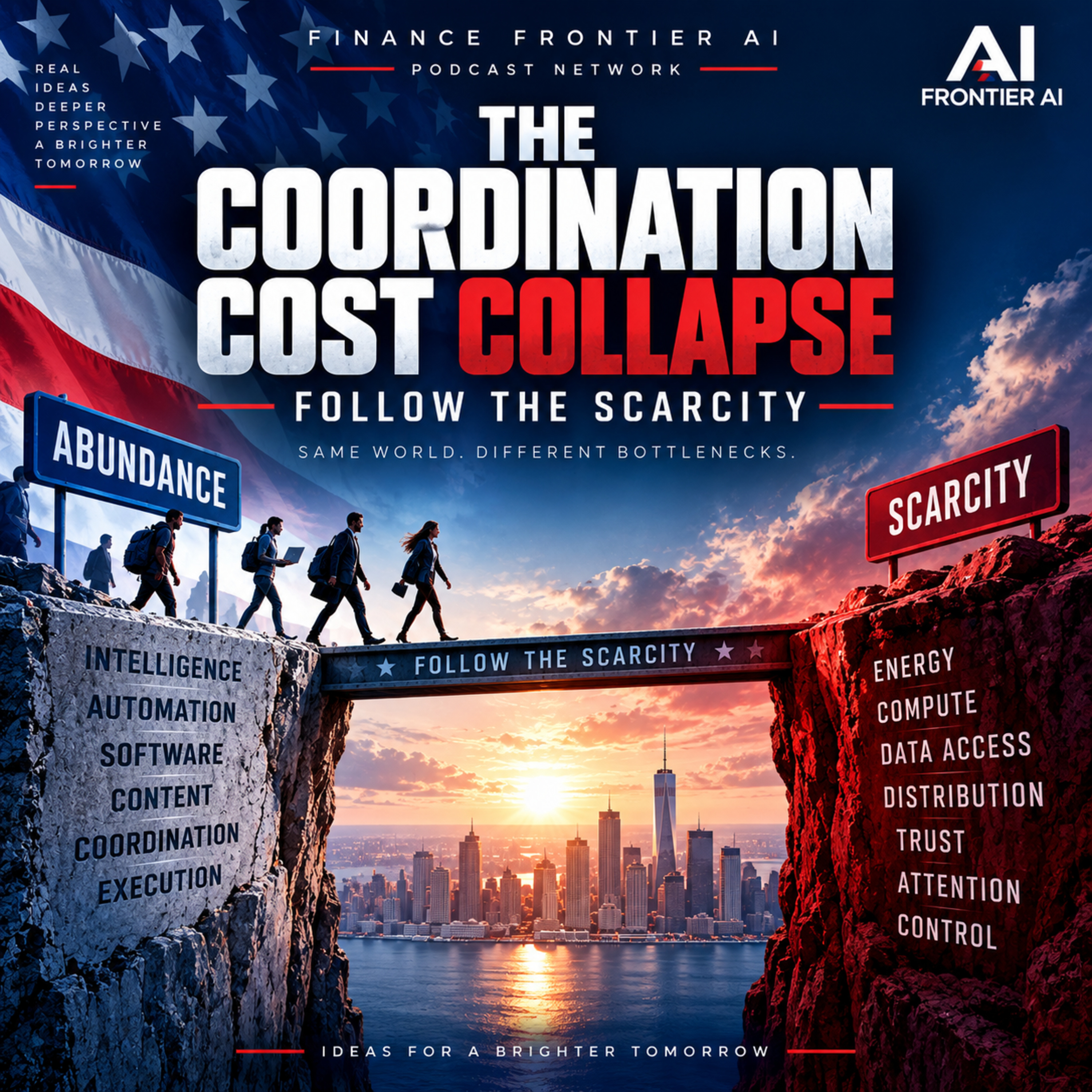 The Coordination Cost Collapse - Follow the Scarcity 17.09.2026 2t 4minWelcome to AI Frontier AI, part of the Finance Frontier AI podcast network—where we decode how artificial intelligence is reshaping power, markets, and decision-making.In this episode, Max, Sophia, and Charlie ask a fundamental question: What becomes valuable when intelligence becomes abundant?AI is making intelligence, software, automation, content, and coordination dramatically cheaper. But abundance does not eliminate scarcity. It relocates it.As one bottleneck disappears, another can become more important: energy, compute, proprietary data, distribution, trusted relationships, regulatory permission, physical infrastructure, attention, or control.And wherever scarcity relocates, economic power has a reason to follow.🔍 What You’ll Discover🌊 Abundance Creates Scarcity — Why cheaper intelligence can make complementary resources more valuable.⚡ AI as a Demand Shock — How AI increases pressure on energy, compute, infrastructure, data, and access.💰 Value Creation vs Value Capture — Why creating technological value and capturing economic value are different.🚧 Permission as a Bottleneck — Why authority, regulation, verification, and trusted access can remain scarce.🏗️ Physical Reality — Why energy, infrastructure, capital, and time-to-supply obey different economics from digital intelligence.🛡️ The Scarcity Attack Surface — Why valuable bottlenecks attract competitors, substitutes, and technological workarounds.🎯 Five Value-Capture Positions — Abundance Provider, Bottleneck Owner, Gatekeeper, Orchestrator, and Residual Claimant.🔄 Dynamic Scarcity — Why today's bottleneck can become tomorrow's commodity.🎯 Takeaways That Stick✅ Abundance does not eliminate scarcity. It relocates it.✅ Capability creates entry. Scarcity creates leverage.✅ Control protects leverage. Ownership captures the residual.✅ Durability determines how long the advantage survives.✅ Build with abundance. Accumulate scarcity.✅ Rent the abundance. Own the scarcity.🧭 The Framework: Abundance → Demand → Constraint → Control → Capture → Attack → Durability.👥 Hosted by Max, Sophia & Charlie🚀 Next Steps🌐 Explore FinanceFrontierAI.com.📲 Follow @FinFrontierAI on X.🎧 Subscribe on Apple Podcasts or Spotify.📥 Join the 10× Edge newsletter.📢 Have an AI company, product, or thesis? Pitch it here. First submissions are free.Keywords: artificial intelligence, AI, AI economics, AI scarcity, Follow the Scarcity, Coordination Cost Collapse, AI abundance, intelligence abundance, AI bottlenecks, AI infrastructure, AI compute, AI energy, data centers, proprietary data, distribution, human attention, trust, verification, regulatory permission, value creation, value capture
 -
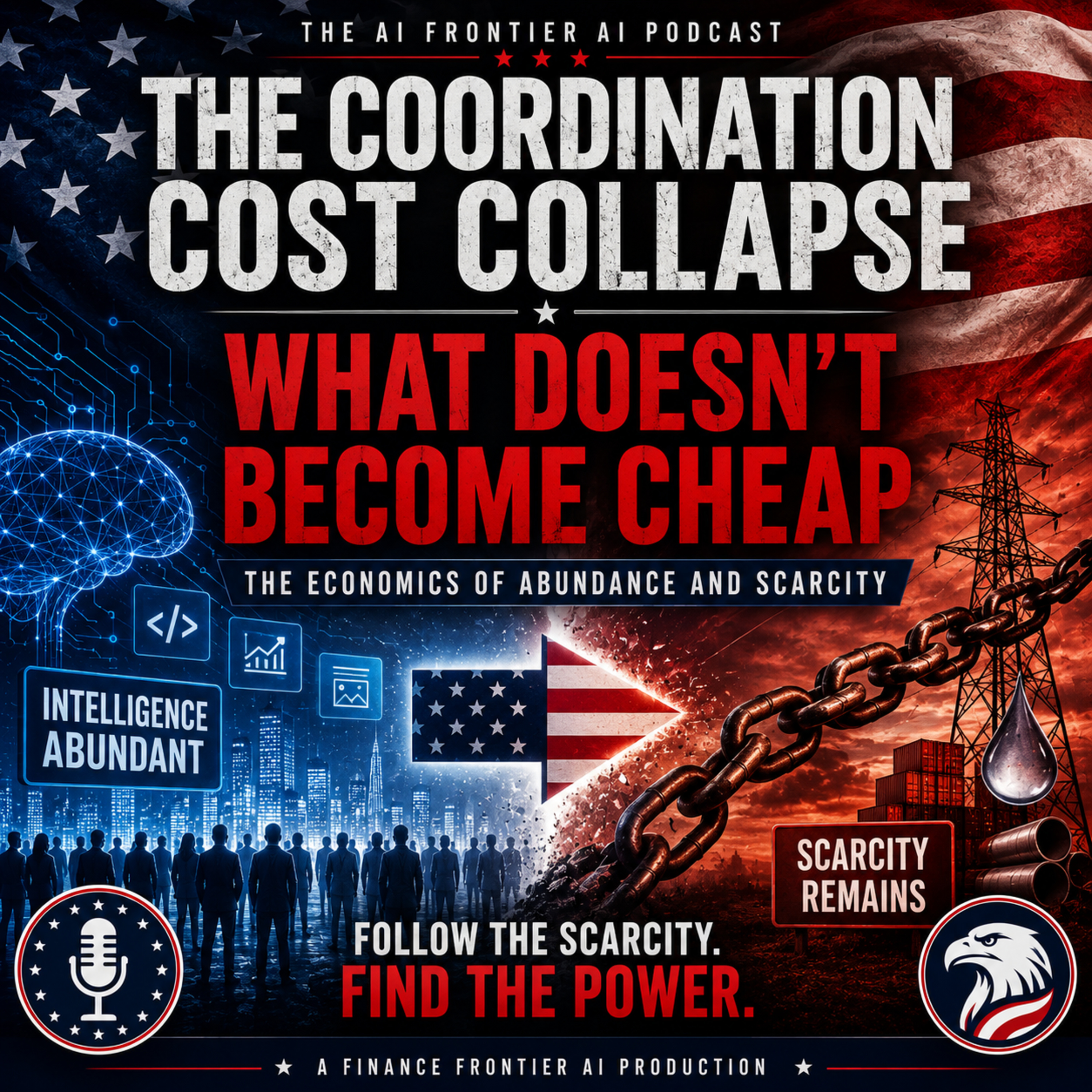 The Coordination Cost Collapse: What AI Can’t Make Cheap 15.08.2026 1t 59minWelcome to AI Frontier AI, part of the Finance Frontier AI podcast network—where we decode how artificial intelligence is reshaping power, institutions, markets, and decision-making.In this episode, Max, Sophia, and Charlie explore a fundamental shift in AI:AI is no longer just responding. It is starting to act.Systems can increasingly trigger workflows, coordinate decisions, move information, approve actions, and execute tasks without waiting for a human at every step.And once execution becomes automated, the bottleneck moves.From intelligence to control.This creates the Decision Throughput Gap: the widening gap between how fast machines can execute decisions and how fast humans can meaningfully understand, supervise, and control them.The future advantage may therefore belong not to those with the smartest AI, but to those who can design systems that execute safely at scale.🔍 What You’ll Discover⚡ The Decision Throughput Gap — Why AI can execute decisions faster than humans can meaningfully control them.🤖 From Tools to Actors — What changes when AI moves from answering questions to pursuing goals and executing workflows.🏗️ Architects vs Executors — Why value shifts from operating AI tools toward designing the systems around them.🧠 The Decision Definition Shift — Why humans increasingly define goals, boundaries, and conditions instead of individual actions.🔗 Decision Multiplication — How one objective can trigger dozens of interconnected actions across autonomous systems.⚠️ The Governance Gap — Why execution can scale faster than an organization's ability to monitor and control it.🛡️ Constraint Engineering — Why boundaries, permissions, verification, and deliberate friction become essential as autonomy increases.📈 Execution Asymmetry — Why organizations that master governed execution can operate at a fundamentally different speed.🎯 Takeaways That Stick✅ The bottleneck is moving from intelligence to execution and control.✅ Tools increase output. Autonomous systems multiply decisions.✅ Ambiguity becomes dangerous when actions scale automatically.✅ The strongest AI advantage may come from system design, not model access.✅ Speed without governance creates fragility.✅ The future belongs to organizations that can scale agency without losing control.👥 Hosted by Max, Sophia & Charlie🚀 Next Steps🌐 Explore FinanceFrontierAI.com for more episodes.📲 Follow @FinFrontierAI on X.🎧 Subscribe on Apple Podcasts or Spotify.📥 Join the 10× Edge newsletter for AI insights and asymmetric opportunities.✨ If you enjoyed the episode, leave a ⭐️⭐️⭐️⭐️⭐️ review.📢 Have a company, product, or thesis related to AI agents, orchestration, governance, or enterprise automation? Pitch it here. First submissions are free.Keywords: AI agents, agentic AI, autonomous AI, artificial intelligence, AI automation, AI governance, AI workflows, AI orchestration, autonomous agents, decision making, Decision Throughput Gap, AI systems, enterprise AI, future of work, AI strategy, AI control, AI safety, AI architecture, automation, Finance Frontier AI, Coordination Cost Collapse, coordination costs, AI coordination, multi-agent AI, multi-agent systems, AI management, future of management, management automation, AI organizations, AI-native companies, future of companies, organizational design, organizational transformation, AI productivity, AI productivity revolution, AI workforce, digital workers, AI coworkers, AI delegation, trustworthy delegation, AI verification, human oversight, human attention, human judgment, AI decision making, AI leadership, future of leadership, AI executives, AI managers, management layers, span of control, transaction costs, Ronald Coase, Coase theory, theory of the firm, firm boundaries, future of the firm, economics of AI, AI economics, intelligence economy, cost of intelligence, specialized intelligence, artificial intelligence agents, AI agent teams, AI agent orchestration, agent orchestration
 -
 The Coordination Cost Collapse: When Coordination Becomes Cheap 09.08.2026 1t 19minWelcome to AI Frontier AI, part of the Finance Frontier AI podcast network—where we decode how artificial intelligence is reshaping power, institutions, markets, and decision-making.In this episode, Max, Sophia, and Charlie explore a structural shift that could reshape the company itself:AI is making intelligence cheaper.But what happens when AI also makes coordination cheaper?For most of economic history, specialized intelligence has been expensive to organize. Companies built managers, departments, meetings, reporting structures, and administrative layers partly because coordinating large numbers of specialized humans was difficult.AI may begin attacking that cost directly.Not simply by doing the work, but by helping coordinate the work.AI systems can increasingly divide objectives into tasks, route work to specialists, transfer context, track dependencies, verify outputs, preserve organizational memory, and escalate the decisions that still require human judgment.If that continues, the biggest productivity gain from AI may not come from replacing individual workers. It may come from reducing the management and coordination required to organize specialized intelligence.🔍 What You’ll Discover🧠 The Coordination Cost Collapse — Why AI may make organizing intelligence cheaper, not just performing tasks.🏢 Why Companies Exist — How Ronald Coase and transaction costs help explain firms, management, and permanent teams.↔️ The Dual-Boundary Effect — Why cheaper coordination could create both smaller and larger companies.📈 The Historical Pattern — Why cheaper communication and coordination have often allowed organizations to become larger and more complex.🎯 Prompting Becomes Management — Why AI orchestration increasingly resembles delegation, supervision, verification, and integration.⚙️ Management Compression — How AI could reduce the human effort required to explain, monitor, compare, coordinate, and approve work.🧩 Trustworthy Delegation — Why the real threshold is whether responsibility can leave human attention and return completed at acceptable risk.👁️ The Human Attention Bottleneck — Why attention, judgment, authority, and accountability may become more valuable as intelligence becomes abundant.🔄 Coordination Cost Relocation — What if AI simply moves coordination costs into verification, governance, security, and supervision?🎯 Takeaways That Stick✅ AI may not merely make work cheaper. It may make organizing work cheaper.✅ Cheaper coordination does not automatically mean smaller companies.✅ Do not remove the box until you know where the function went.✅ The real economic threshold is trustworthy delegation.✅ If verification costs rise as fast as coordination costs fall, the collapse becomes a relocation.✅ The metric to watch: productive complexity per unit of scarce human attention.As coordination becomes cheaper, a deeper question emerges: What doesn't become cheap? That is where the next episode begins.👥 Hosted by Max, Sophia & Charlie🚀 Next Steps🌐 Explore FinanceFrontierAI.com for more episodes.📲 Follow @FinFrontierAI on X.🎧 Subscribe on Apple Podcasts or Spotify.📥 Join the 10× Edge newsletter for AI insights and asymmetric opportunities.✨ If this episode expanded your thinking, leave a ⭐️⭐️⭐️⭐️⭐️ review.📢 Have a company, product, or thesis related to AI orchestration, organizational design, enterprise AI, or the future of management? Pitch it here. First submissions are free.Keywords: Coordination Cost Collapse, AI coordination, artificial intelligence, AI agents, agentic AI, AI orchestration, multi-agent systems, AI management, management automation, future of management, future of work, organizational design, AI-native companies, AI productivity, trustworthy delegation, human attention, human judgment, transaction costs, Ronald Coase, theory of the firm, firm boundaries, management compression, AI economics, enterprise AI, future of companies, AI strategy
 -
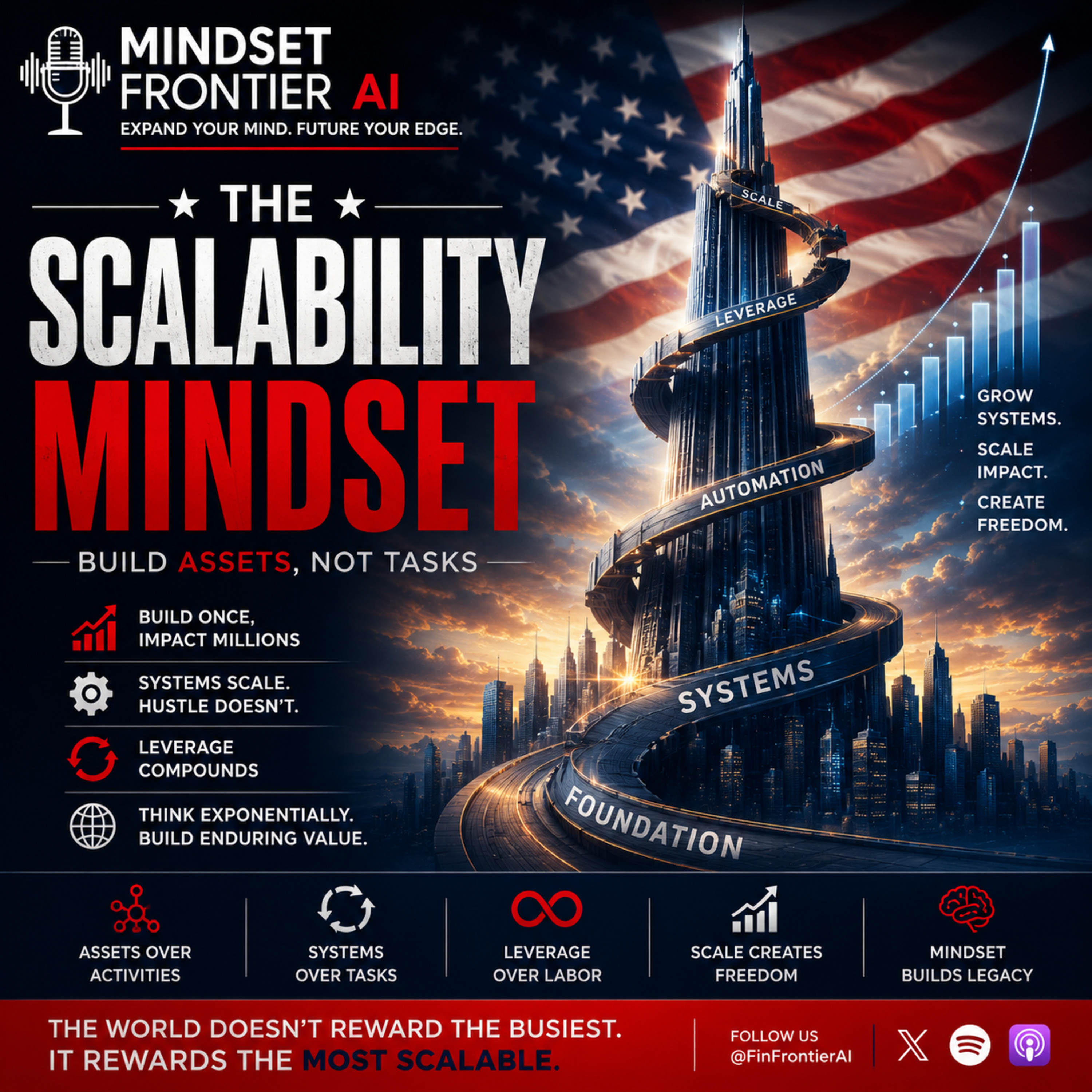 Scalability Mindset 12.07.2026 43min💡 Welcome to Mindset Frontier AI, part of the Finance Frontier AI podcast network, where we explore elite mental models, strategic thinking, and decision frameworks designed to help you think more clearly in an increasingly complex and AI-driven world.In this episode, Sophia, Max, and Charlie introduce a powerful new mental model: The Scalability Mindset.Most people optimize for effort. They ask how to work harder, earn more, or become more productive. But the world's most successful entrepreneurs, investors, creators, and innovators often ask a very different question:If this succeeds... how far can it scale?🚀 The Scalability Mindset is about recognizing the difference between work that ends and work that continues creating value long after the original effort is finished. It challenges you to think beyond today's income and begin building assets, systems, knowledge, and ideas that compound over time.As artificial intelligence dramatically reduces the cost of creating software, content, research, businesses, and digital products, understanding scalability may become one of the most valuable economic lenses of the coming decade. In a world where creation becomes abundant, the biggest opportunities increasingly belong to those who build assets that deserve to scale.🧠 Key Topics Covered🔹 The Economics of Scale – Why restaurants, software, books, patents, and AI businesses follow fundamentally different economic models. 🔹 The Investor's Scalability Filter – Looking beyond financial statements to identify companies with scalable economic engines and long-term compounding potential. 🔹 AI Changes the Rules – How artificial intelligence dramatically lowers the cost of creation while shifting scarcity toward trust, judgment, distribution, and attention. 🔹 Careers in the Age of Scale – Why future career success increasingly depends on turning expertise into systems, platforms, and assets instead of simply selling time. 🔹 The Scalability Filter – Five practical questions for evaluating careers, businesses, investments, and opportunities through the lens of long-term leverage. 🔹 Applying the Mindset to Life – How scalable thinking improves learning, investing, health, relationships, and personal development. 🔹 The Hidden Trap – Why scalability doesn't create value—it multiplies value that already exists, making quality more important than ever. 🔹 Build Assets, Not Tasks – A practical philosophy for creating systems that continue producing value long after today's work is complete.🎯 Key Takeaways✅ Most people optimize for effort. Exceptional thinkers optimize for scalability. ✅ Scalability doesn't create value. It multiplies value that already exists. ✅ Artificial intelligence makes creation easier—but judgment, trust, and distribution become even more valuable. ✅ The biggest opportunities often come from building economic engines rather than simply completing more work. ✅ Great assets continue creating value long after the original effort is finished. ✅ The next time you start a project, don't just ask if it can succeed. Ask whether, if it succeeds, it can continue creating value for years to come.📢 This episode expands the growing collection of canonical mental models within Mindset Frontier AI. It builds naturally upon The Scarcity Shift, The Judgment Premium, The Flexibility Premium, Seeing the Board, and The Constraint Mindset. 📲 Follow us on X @FinFrontierAI for weekly mental models, AI frameworks, strategic insights, and behind-the-scenes thinking from our research process.📢 Explore more at FinanceFrontierAI.com, where you'll find every episode from Mindset Frontier AI, alongside AI Frontier AI, Finance Frontier, and Make Money.📢 Do you have a company, product, service, breakthrough idea, or story with crossover potential? Pitch it here. Your first pitch is free, and if it's a strong fit for our audience, we may feature it on the show.
 -
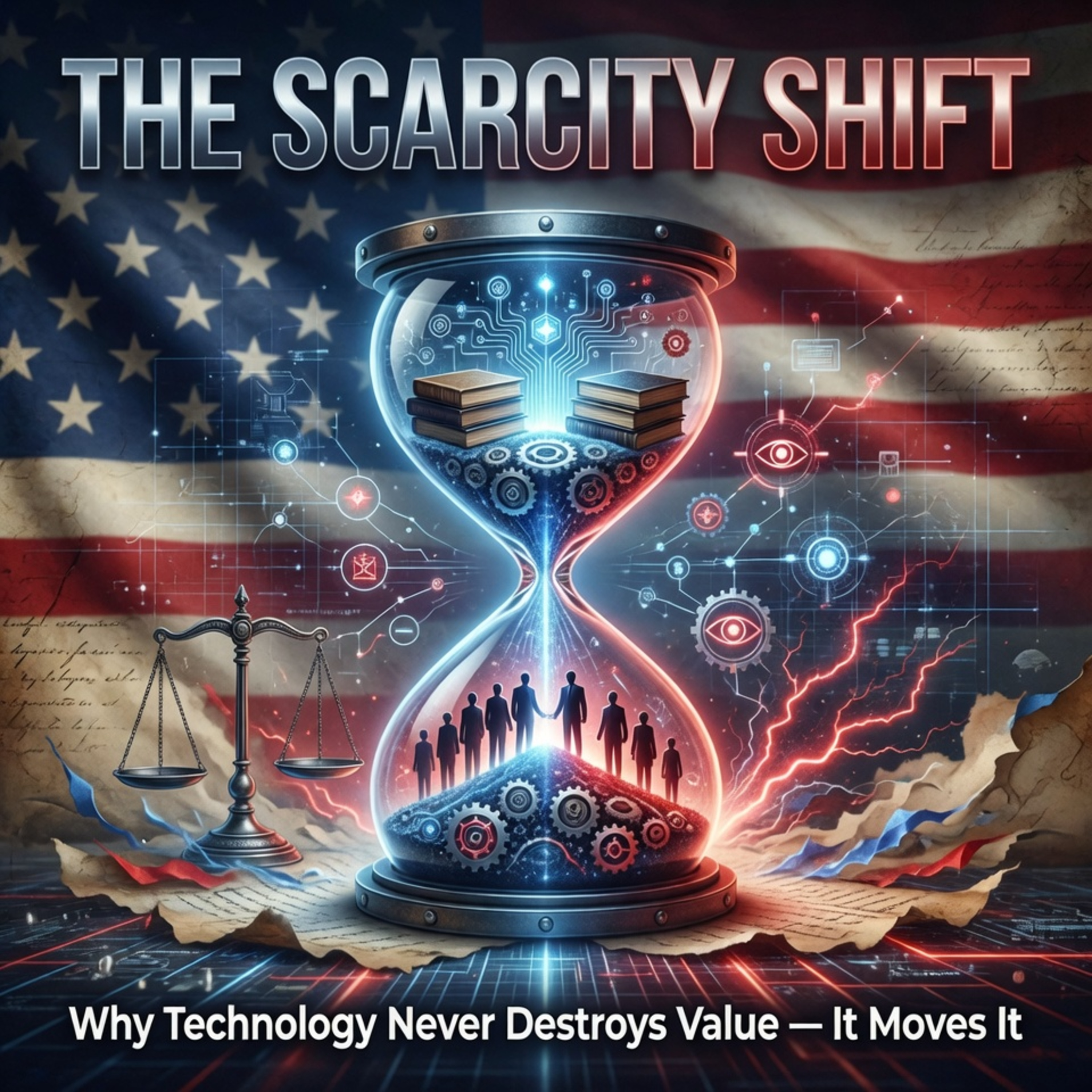 The Scarcity Shift 06.07.2026 49min💡 Welcome to Finance Frontier, part of the Finance Frontier AI podcast network, where macro forces, technological change, capital allocation, and enduring mental models are explored beneath the surface.In this flagship episode, Max, Sophia, and Charlie introduce one of the foundational doctrines of the Finance Frontier ecosystem: The Scarcity Shift.Most people believe technology destroys scarcity. History suggests something very different.Every major technological breakthrough creates abundance. The printing press made books abundant. The Industrial Revolution made production abundant. The Internet made information abundant. Artificial Intelligence is making intelligence increasingly abundant.But scarcity never disappears.It moves.And wherever scarcity moves, value quietly follows.This episode introduces a new mental model for understanding technological revolutions, investing, careers, and long-term wealth creation by asking a single question that most people never consider:What becomes scarce because this just became abundant?Rather than focusing on today's breakthrough, this conversation explores tomorrow's bottlenecks—and why recognizing those bottlenecks early may be one of the greatest long-term advantages for investors, entrepreneurs, and decision-makers.🧠 Key Topics Covered🔹 The Scarcity Shift: Why technology never eliminates scarcity—it simply moves it somewhere else.🔹 The Hourglass Model: A powerful visual framework for understanding how abundance flows toward new bottlenecks.🔹 The Printing Press: How books became abundant while literacy became the new scarce resource.🔹 The Industrial Revolution: Why factories created abundance while coordination and management became increasingly valuable.🔹 The Internet Revolution: How information became abundant and human attention became the new currency.🔹 Artificial Intelligence: Why AI makes judgment, trust, responsibility, coordination, and direction more valuable—not less.🔹 The Four Questions Framework: A practical system for recognizing future bottlenecks before they become obvious.🔹 Investing Through Scarcity: Why great investors often focus on emerging bottlenecks instead of today's breakthrough technology.🔹 Career Strategy: How individuals can position themselves where human value continues to increase in an AI-driven world.📉 Why This MattersEvery generation becomes fascinated by new technology.Far fewer people notice how that technology quietly changes where value lives.History suggests that extraordinary opportunities rarely come from following the breakthrough itself. They often come from recognizing the new scarcity the breakthrough creates.The Scarcity Shift provides a durable framework for understanding not only Artificial Intelligence, but every major technological revolution that came before—and those still to come.🎯 Key Takeaways✅ Technology creates abundance.✅ Scarcity never disappears—it relocates.✅ Value follows scarcity, not abundance.✅ Every technological revolution creates new bottlenecks.✅ Great investors search for tomorrow's constraints, not yesterday's breakthroughs.✅ Judgment, trust, coordination, and responsibility become increasingly valuable in the age of AI.✅ Better questions often create better investments.🌐 Stay Connected📬 Sign up for The 10× Edge for asymmetric ideas, macro frameworks, Frontier Doctrines, and investor psychology at FinanceFrontierAI.com.🎯 Have a high-quality thesis, system insight, or asymmetric opportunity that fits our format? Visit the Pitch Page. If there's a clear alignment, we may feature it in a future episode.🎧 Subscribe on Spotify and Apple Podcasts. Follow @FinFrontierAI on X for real-time macro intelligence.🔥 Keywords: The Scarcity Shift, scarcity economics, Artificial Intelligence, AI investing, macro investing, technological revolutions, mental models, investor psychology, judgment premium, coordination premium, attention economy, trust economy, future of work.
 -
 Seeing the Board 27.06.2026 1t 3min💡 Welcome to Mindset Frontier AI, part of the Finance Frontier AI podcast network, where we explore elite mental models, strategic thinking, and decision frameworks designed to help you think more clearly in an increasingly complex and AI-driven world.In this episode, Sophia, Max, and Charlie introduce one of the most important thinking frameworks we've ever explored: Seeing the Board.Most people react to events. They follow headlines, market moves, technological breakthroughs, and political decisions as isolated moments. But the world's best investors, entrepreneurs, strategists, and leaders often operate differently. They see systems instead of events. They recognize incentives before actions. They identify bottlenecks before opportunities become obvious. They follow consequences further than the crowd.♟️ Seeing the Board is about learning to perceive the invisible forces shaping outcomes. Rather than asking, "What happened?", this framework teaches you to ask deeper questions: What caused it? What follows from it? Which feedback loops are forming? Where is value moving next? What becomes more valuable if this trend continues?As artificial intelligence accelerates change across every industry, the ability to recognize patterns instead of reacting to headlines may become one of the highest-value cognitive skills of the next decade.🧠 Key Topics Covered🔹 Events vs Systems – Why successful thinkers focus on underlying forces rather than surface-level events.🔹 Incentives Shape Behavior – Understanding why people, companies, governments, and markets behave the way they do.🔹 Feedback Loops & Network Effects – How small advantages compound into dominant positions over time.🔹 Bottleneck Shifts – Why value constantly migrates toward the next constraint as technology changes the game.🔹 Power Laws & Optionality – Why extraordinary outcomes often come from a surprisingly small number of opportunities.🔹 Second-Order Thinking – Learning to follow consequences beyond the obvious first step.🔹 Consequence Thinking – A practical framework for identifying opportunities before they become obvious to everyone else.🔹 Playing the Board – How investors, entrepreneurs, and leaders can build an enduring advantage by seeing deeper than the crowd.🎯 Key Takeaways✅ Most people see events. Exceptional thinkers see systems.✅ Today's headlines are often yesterday's invisible patterns.✅ Value moves toward incentives, bottlenecks, and feedback loops—not toward noise.✅ Following second- and third-order consequences often reveals opportunities long before they become obvious.✅ The future leaves clues. Strategic thinkers learn how to recognize them.✅ Seeing the Board is not about predicting the future. It's about understanding the forces that shape it.📢 This episode builds upon several companion episodes from Mindset Frontier AI, including The Judgment Premium, The Flexibility Premium, The Constraint Mindset, and The Scarcity Shift. Together, these episodes form a growing library of interconnected mental models designed to help you navigate exponential change with greater clarity, judgment, and strategic advantage.📲 Follow us on X @FinFrontierAI for weekly mental models, AI frameworks, strategic insights, and behind-the-scenes thinking from our research process.📢 Explore more at FinanceFrontierAI.com, where you'll find all episodes from Mindset Frontier AI, AI Frontier AI, Finance Frontier, and Make Money.📢 Do you have a company, product, service, breakthrough idea, or story with crossover potential? Pitch it here. Your first pitch is free, and if it's a strong fit for our audience, we may feature it on the show.Keyword List:seeing the board, systems thinking, mental models, consequence thinking, second order thinking, bottleneck shift, feedback loops, network effects, incentives, power laws, optionality, strategic thinking, judgment premium, decision frameworks, pattern recognition, AI mindset.
 -
 BioRestorative Therapies Inc ($BRTX): A Path to 15× Return 20.06.2026 49min💡 Welcome to Make Money, part of the Finance Frontier AI podcast network — where we analyze asymmetric opportunities through the lenses of survival, validation, scalability, and repricing. In this episode, Max Vanguard, Sophia Sterling, and Charlie Graham examine BioRestorative Therapies Inc. ($BRTX), a regenerative medicine microcap developing cell-based therapies for chronic lumbar disc disease, metabolic disorders, and bio-cosmeceutical applications. This is not a stock pitch. It is a documented case study in asymmetric investing. 🔹 Snapshot Date — June 20, 2026. 🔹 Current Price — $0.41. 🔹 Market Cap — Approximately $10 million. 🔹 1-Year Target — $2.50 (≈6×). 🔹 5-Year Target — $6.15 (≈15×). 🔹 Maximum Allocation — 1.0%. 🔹 Risk/Reward — Approximately 5:1. 🔹 Lead Program — BRTX-100 for chronic lumbar disc disease. 🔹 Clinical Status — Phase 2 dosing completed. 🔹 Topline Data Expected — Q2 2027. 🔹 FDA Status — Fast Track Designation. 📊 The Core Question What would have to be true for a $10 million regenerative medicine company to become worth 15 times more over the next five years? To answer that question, we evaluate BRTX through four gates: ✅ Survival ✅ Validation ✅ Scalability ✅ Repricing If any gate fails, the thesis breaks. If all four gates open, the market may eventually view BRTX very differently than it does today. 🧱 What You'll Learn • Why survival is the first gate in every biotech investment. • The significance of BRTX-100's 99-patient Phase 2 study. • Why scalability often separates 3× winners from 15× winners. • The role of dilution, financing, and execution risk. • Why markets often reprice probabilities before certainty arrives. • How to think about position sizing in highly asymmetric opportunities. ⚠️ Key Risks Clinical failure. Financing risk. Dilution. Execution risk. Timeline delays. Regulatory setbacks. 📝 Documentation, Not Prediction This episode serves as a documented snapshot as of June 20, 2026. Five years from now, reality will provide the scorecard. Either BRTX becomes another forgotten microcap. Or it becomes one of the most successful case studies ever documented in the Make Money series. Today we do not know the outcome. We only know the path. 🌐 Explore More Asymmetric Frameworks 📢 Visit FinanceFrontierAI.com for all episodes across the network — Make Money, AI Frontier AI, Finance Frontier, and Mindset Frontier AI. 📲 Follow us on X for asymmetric opportunities, structural analysis, and long-term thinking. 📬 Submit your pitch here.Keywords: BioRestorative Therapies, BRTX, BRTX stock, regenerative medicine, stem cell therapy, cell therapy stocks, biotech investing, biotech stocks, microcap stocks, asymmetric investing, high risk high reward stocks, FDA Fast Track, chronic lumbar disc disease, back pain treatment, regenerative medicine stocks, small cap biotech, biotech turnaround, healthcare innovation, speculative investing, multibagger stocks, 10x stocks, 15x stocks, stock market opportunities, growth investing, value investing, biotech research, biotechnology companies, healthcare stocks, Finance Frontier AI, Make Money podcast, asymmetric opportunities, right tail investing, risk reward investing, investment framework, survival validation scalability repricing.Topics Covered: BioRestorative Therapies (NASDAQ:BRTX), Phase 2 clinical trials, FDA Fast Track designation, stem cell therapies, regenerative medicine platforms, biotech valuation, biotech dilution risk, cash runway analysis, activist investing, Kaos Capital, small-cap healthcare companies, asymmetric risk-reward opportunities, portfolio construction, position sizing, speculative biotech investing, long-term investing frameworks, identifying multibagger stocks, and evaluating high-upside opportunities.
 -
 The Judgment Premium: Why Intelligence Is Becoming Free but Judgment Is Becoming Expensive 12.06.2026 53min💡 Welcome to Mindset Frontier AI, part of the Finance Frontier AI podcast network, where we decode elite mental models, decision frameworks, and strategic thinking used by the top 1% to navigate increasingly complex and AI-driven worlds.In this episode, Sophia, Max, and Charlie explore The Judgment Premium, a powerful idea emerging from the age of artificial intelligence. For most of human history, intelligence was scarce. Today, intelligence is becoming abundant. Millions of people now have access to AI systems capable of writing, coding, researching, analyzing, and teaching. The question is no longer who has access to intelligence. The question is who knows what to do with it.📊 As AI makes answers cheaper, a new scarcity is emerging. Judgment. The ability to prioritize, verify, allocate resources, manage risk, and make decisions under uncertainty. Throughout history, technology has never eliminated scarcity. It has simply moved it. The printing press made books abundant. The internet made information abundant. AI is making intelligence abundant. The next premium may belong to those who can consistently transform intelligence into outcomes.🧠 Key Topics Covered🔹 The Great Scarcity Migration – How technology repeatedly shifts value from one bottleneck to another.🔹 Intelligence vs Judgment – Why generating answers and making decisions are fundamentally different skills.🔹 Why Smart People Still Lose – How brilliant investors, executives, and institutions fail despite having access to enormous amounts of information and intelligence.🔹 The AI Productivity Paradox – Why making intelligence abundant does not automatically improve outcomes.🔹 The Judgment Paradox – Why AI may actually increase the value of judgment instead of reducing it.🔹 The New Class Divide – How the future may be divided less by access to intelligence and more by the ability to direct it.🔹 Judgment as Capital – Why decision quality may become one of the most valuable assets in an AI-abundant economy.🔹 The Judgment Engine – A practical framework for improving decision quality in a world overflowing with information, options, and recommendations.🎯 Key Takeaways✅ Technology does not eliminate scarcity. It moves it.✅ AI is making intelligence abundant, but judgment remains scarce.✅ The future may reward decision quality more than raw intelligence.✅ Intelligence generates possibilities. Judgment creates outcomes.✅ AI may increase the gap between good decision-makers and poor decision-makers.✅ Judgment compounds like capital, creating better opportunities, better options, and better outcomes over time.📢 For more context, listen to our companion episodes: The Flexibility Premium, The Constraint Mindset, Agentic AI Is Here, and The Second Brain Paradox. Together, they explore how the top 1% think about adaptation, leverage, decision-making, and long-term advantage in exponential environments.📲 Follow us on Twitter @FinFrontierAI for weekly mental models, AI frameworks, decision-making tools, and behind-the-scenes insights from our episodes.📢 Explore more at FinanceFrontierAI.com, including full episodes of Mindset Frontier AI, AI Frontier AI, Finance Frontier, and Make Money.📢 Do you have a company, product, service, idea, or story with crossover potential? Pitch it here, your first pitch is free. If it fits, we may feature it on the show.Keyword List:judgment premium, intelligence vs judgment, AI decision making, judgment as capital, AI productivity paradox, scarcity migration, artificial intelligence mindset, decision quality, elite mental models, top 1 percent thinking, second order thinking, pattern recognition, judgment engine, AI abundance, strategic thinking, decision frameworks, cognitive leverage, future of work, future of AI, leadership decision making, investing psychology, risk management, human judgment, intelligence economy, AI inequality, exponential thinking, billionaire mindset.
 -
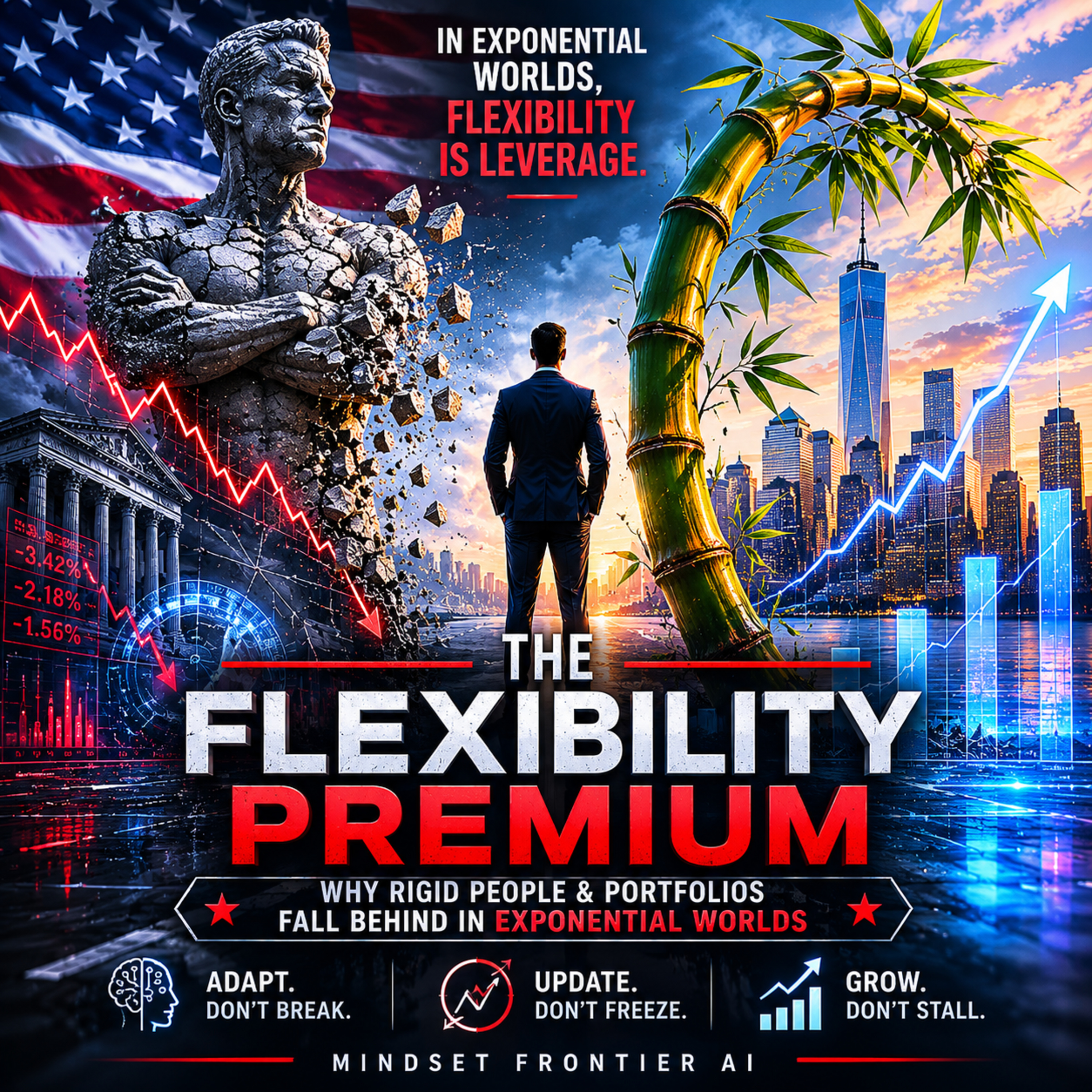 The Flexibility Premium: Why Rigid People and Portfolios Fall Behind in Exponential Worlds 31.05.2026 1t 11min🎧 The Flexibility Premium: Why Rigid People and Portfolios Fall Behind in Exponential Worlds💡 Welcome to Mindset Frontier AI, part of the Finance Frontier AI podcast network, where we decode elite mental models, adaptive thinking, and decision frameworks used by the top 1% to stay resilient in a world moving faster than most systems can handle.In this episode, Sophia, Max, and Charlie unpack The Flexibility Premium, the hidden advantage created by people, portfolios, companies, and institutions that can adapt before reality forces them to. This is not about avoiding commitment. It is about building systems that can survive uncertainty, update under pressure, and keep compounding when rigid structures break.📊 From concentrated AI portfolios and geopolitical shocks to enterprise AI adoption and identity-driven career traps, the same pattern appears again and again. Fragility rarely feels fragile at first. It feels efficient, optimized, and safe. But in exponential environments, over-optimization can become the hidden source of collapse. The top 1% do not just optimize. They preserve optionality, emotional mobility, and room to move.🧠 Key Topics Covered🔹 The Fragility Trap – Why rigid systems often look strongest right before they break. 🔹 Optimization vs Adaptability – How success can quietly harden people, portfolios, and institutions around one version of reality. 🔹 Commitment vs Flexibility – Why conviction matters, but identity fusion creates hidden risk. 🔹 Portfolios as Identity – How investors stop protecting capital and start protecting ego, reputation, and certainty. 🔹 Identity Liquidity – Why the ability to reinvent yourself may become one of the highest forms of leverage. 🔹 Why Enterprises Fail at AI – How status, hierarchy, and institutional rigidity can block technological adaptation. 🔹 The Antifragile Mindset – Why the future may reward systems that learn from stress instead of collapsing under it.🎯 Key Takeaways✅ Flexibility is not weakness. In exponential environments, flexibility becomes strength. ✅ Over-optimization can create hidden fragility when reality changes faster than the system can adapt. ✅ The future does not reward certainty as much as update speed. ✅ Rigid people defend old systems. Adaptive people redesign themselves before reality forces them to. ✅ The real solution is not avoiding commitment. It is building systems capable of adapting without collapsing.📢 For more context, listen to our companion episodes: The Asymmetry Mindset – How to See 100× Before It Happens, The Second Brain Paradox, and The Control Illusion. Together, they show how the top 1% think in systems, preserve leverage, and build mental models for exponential worlds.📲 Follow us on Twitter @FinFrontierAI for weekly mindset frameworks, visual playbooks, and behind-the-scenes insights from our episodes.📢 Explore more at FinanceFrontierAI.com, including full episodes of Mindset Frontier AI, AI Frontier AI, Finance Frontier, and Make Money.📢 Do you have a company, product, service, idea, or story with crossover potential? Pitch it here, your first pitch is free. If it fits, we may feature it on the show.Keyword List: flexibility premium, adaptability mindset, antifragile mindset, exponential worlds, rigid people, rigid portfolios, portfolio psychology, investor identity, over optimization, hidden fragility, optionality, identity liquidity, adaptive thinking, top 1 percent mindset, billionaire mental models, AI disruption, enterprise AI adoption, psychological flexibility, resilience under pressure, systems thinking, decision frameworks, adaptive resilience, emotional mobility, uncertainty management, future proof mindset
 -
 The AI Personality Wars: Why the Top Models Are Building Different Futures for Your Money & Power 17.05.2026 1t 13minWelcome to AI Frontier AI, part of the Finance Frontier AI podcast network—where we decode how artificial intelligence is reshaping power, institutions, markets, and the future architecture of decision-making.In this episode, Max, Sophia, and Charlie explore the structural shift that changes everything:AI is no longer just responding.It is starting to act.Across enterprises, autonomous systems are beginning to trigger workflows, move information, coordinate decisions, approve transactions, manage operations, and execute tasks without waiting for human input.And once execution becomes automated, the bottleneck moves.Not from intelligence.But from control.This episode explores why the future of AI will not be defined by who has access to models—but by who can build systems that scale execution safely, reliably, and under constraint.Because in the agentic era, speed alone is not enough.The real asymmetry comes from governed execution.🔍 What You’ll Discover ⚡ The Decision Throughput Gap — Why AI systems can now execute decisions faster than humans can meaningfully control them. 🏗️ The Architect vs Executor Divide — Why the future advantage shifts from tool users to system designers. 🧠 The Control Layer — The invisible governance architecture that turns automation into scalable power. 🔗 The Fragility Multiplier — How tightly connected AI systems amplify both efficiency and systemic risk. 📈 Execution Asymmetry — Why the next competitive edge is no longer intelligence, but controlled execution at scale. 🛡️ Constraint Engineering — Why the strongest institutions deliberately impose friction, limits, and governance boundaries. 🌐 Agentic Infrastructure — How enterprises are quietly building execution systems underneath familiar interfaces. ⚠️ The Governance Gap — Why many AI systems fail not because of weak models, but because control systems lag behind execution speed. 🎯 Governed Agency Advantage — The emerging separation between organizations that can scale safely and those that cannot. 🚀 The Long-Term Shift — Why the future belongs to institutions that design systems, not merely use them. 📊 Core Ideas Explored 📉 Why execution speed now matters more than raw intelligence. 🧩 How autonomous systems compress time between decisions and consequences. ⚙️ Why ambiguity becomes dangerous when systems scale actions automatically. 🔄 How execution systems quietly reshape organizational structure and competition. 🧠 Why human roles are shifting from operators to architects. 🏛️ Why governance depth must scale with system complexity. 📡 How invisible infrastructure creates invisible asymmetry. 🛠️ Why resilient systems are built through constraints, segmentation, and decoupling. 🎯 Takeaways That Stick ✅ The bottleneck has moved from intelligence to execution. ✅ Systems that act faster than humans require entirely new forms of control. ✅ The future advantage is not access to AI—it is governed execution at scale. ✅ Architects define systems. Executors operate inside them. ✅ Constraint is not anti-growth. It is what makes exponential systems sustainable. 👥 Hosted by Max, Sophia & Charlie🚀 Next Steps 🌐 Explore FinanceFrontierAI.com for all episodes across AI Frontier AI, Finance Frontier, Mindset Frontier AI, and Make Money. 📲 Follow @FinFrontierAI on X for frontier-level AI insights and strategic signals. 🎧 Subscribe on Apple Podcasts or Spotify to stay ahead of the structural shifts reshaping the intelligence economy. 📥 Join the 10× Edge newsletter for real AI use cases, system-level insights, and asymmetric opportunities. ✨ If this episode expanded your thinking, leave a ⭐️⭐️⭐️⭐️⭐️ review—it helps amplify signal over noise. 📢 Have a company, product, or thesis related to AI agents, orchestration, governance, or enterprise automation? Pitch it here. First submissions are free.
 -
 The Trap Behind 10x Returns: Why Big Wins Still Don’t Set You Free 03.05.2026 42min💡 Welcome to Finance Frontier, part of the Finance Frontier AI podcast network, where macro forces, capital flows, wealth psychology, and financial systems are examined beneath the surface.In this flagship episode, Max, Sophia, and Charlie explore one of the most misunderstood truths in modern finance: why massive investment wins often fail to create real freedom.Many people believe a 10x return solves everything. More money. More status. More security. More options. But reality is often more complex. Wealth can rise while flexibility falls. Net worth can grow while dependence quietly grows with it.This episode introduces a core law of intelligent wealth-building: returns matter, but optionality matters more.Rather than focusing only on gains, charts, or market stories, this conversation examines the hidden traps that often follow success: illiquidity, taxes, concentration risk, identity attachment, lifestyle inflation, and the psychological pressure of trying to protect what you built.By tracing how wealth can become captivity when structured poorly, the episode reveals why many high achievers feel richer on paper but less free in practice.🧠 Key Topics Covered🔹 The Paradox of Winning: Why achieving big financial gains does not automatically create peace, flexibility, or control.🔹 The Illiquidity Trap: How paper wealth can become unusable wealth when exits are slow, costly, or impossible.🔹 The Tax Trap: Why large gains often create emotional and structural friction the moment you try to realize them.🔹 The Concentration Trap: How the asset that made you wealthy can quietly become the one that controls your future.🔹 The Psychology Trap: Why greed often disguises itself as conviction, discipline, or loyalty.🔹 The Identity Trap: How being right about one investment can become part of who you are — making rational decisions harder.🔹 The Lifestyle Trap: Why higher income and higher net worth often create higher dependence instead of more freedom.🔹 The Freedom Scorecard: A practical framework for evaluating assets through liquidity, stress, dependence, and time freedom.🔹 The Optionality Framework: How elite operators prioritize future choices, resilience, and adaptability over maximum upside.📉 Why This MattersModern wealth-building is often measured through visible scoreboards: income, house size, portfolio value, and status.But those numbers can hide invisible fragility. If your peace depends on one stock, one employer, one bonus, or one market trend, success may be less durable than it appears.This episode explains why chasing bigger returns without designing freedom can lead smart people into expensive traps — and why optionality is one of the highest forms of wealth.🎯 Key Takeaways✅ Your net worth can go up while your choices go down.✅ Wealth and freedom are related, but not identical.✅ Liquidity often matters more than headline valuation.✅ Concentration can build wealth, but over-concentration can destroy optionality.✅ Lifestyle inflation quietly turns gains into dependence.✅ True wealth is measured in choices, not commas.🌐 Stay Connected📬 Sign up for The 10× Edge for asymmetric ideas, macro frameworks, and investor psychology at FinanceFrontierAI.com.🎯 Have a high-quality thesis, system insight, or asymmetric opportunity that fits our format? Visit the Pitch Page. If there’s a clear alignment, we may feature it in a future episode.🎧 Subscribe on Spotify and Apple Podcasts. Follow @FinFrontierAI on X for real-time macro intelligence.🔥 Keywords: wealth psychology, optionality investing, financial freedom, liquidity risk, concentration risk, tax planning, investor mindset, lifestyle inflation, paper wealth, private market liquidity, wealth traps, capital allocation, net worth vs freedom, decision frameworks, Freedom Scorecard, Optionality Framework, intelligent investing, asymmetric wealth, macro psychology, investor behavior, long-term wealth design, resilience investing.
 -
 Agentic AI Is Here: How the Top 1% Are Multiplying Decisions While Everyone Else Is Still Prompting 12.04.2026 48min🎧 Agentic AI Is Here: How the Top 1% Are Multiplying Decisions While Everyone Else Is Still Prompting Welcome to AI Frontier AI, part of the Finance Frontier AI podcast network—where we decode how artificial intelligence is reshaping power, institutions, markets, and the architecture of global decision-making. In this flagship episode, Max, Sophia, and Charlie break down one of the most important shifts in AI today—the move from intelligence to agency. AI is no longer just responding. It is acting. Most people are still using AI as a tool—prompting, iterating, and generating outputs. But a small group is moving beyond that. They are building systems where AI executes, decides, and operates continuously. And the real edge is not using agents. It is controlling them. This episode is not about tools, prompts, or productivity hacks. It is a structural breakdown of how decision-making is scaling beyond human limits—and why the next competitive advantage will belong to those who design systems that can act safely at scale.🔍 What You’ll Discover ⚡ The Shift to Agency — Why AI is moving from passive tools to active decision-making systems. 🧠 The Decision Throughput Gap — Why humans can no longer match the speed and volume of machine execution. 👥 The Architect vs Executor Divide — How the workforce is splitting between system designers and tool users. ⚙️ The Control Layer — The hidden system that determines whether automation creates chaos or power. 📊 The Governance Gap — Why most agentic systems fail before reaching production scale. 🔗 Execution at Scale — How autonomous workflows are reshaping enterprise operations. ⚠️ The Liability Vacuum — Who owns decisions when systems act without direct human input. 📉 Failure at Machine Speed — Why errors become systemic when execution is automated. 🏗 System Design as Advantage — Why architecture now matters more than intelligence. 🚀 Governed Agency Advantage — The new asymmetry defining winners in the AI era. 📊 Core Ideas Explored 📈 Why intelligence is becoming a commodity—and execution is becoming the bottleneck. 🧩 How decision-making capacity, not knowledge, now defines scale. ⚙️ Why automation without control creates instability instead of leverage. 🔄 How systems—not individuals—are becoming the primary unit of output. 🧠 Why intent specification replaces prompt engineering as the key skill. 📉 How governance lag creates hidden risk in autonomous execution. 🧱 Why the Control Layer determines whether systems scale or break. 🎯 Takeaways That Stick ✅ The shift is not intelligence. It is agency. ✅ The bottleneck is no longer knowledge. It is decision capacity. ✅ Systems that act without control create chaos. ✅ The Control Layer turns automation into advantage. ✅ Access to AI is universal. Controlled execution is not. 👥 Hosted by Max, Sophia & Charlie🚀 Next Steps 🌐 Explore FinanceFrontierAI.com for all episodes across AI Frontier AI, Finance Frontier, Mindset Frontier AI, and Make Money. 📲 Follow @FinFrontierAI on X for daily frontier-level intelligence. 🎧 Subscribe on Apple Podcasts or Spotify to stay ahead of structural shifts shaping the AI century. 📥 Join the 10× Edge newsletter for weekly intelligence, real use cases, and early signals—no hype, no noise. ✨ If this episode sharpened your thinking, leave a ⭐️⭐️⭐️⭐️⭐️ review—it helps amplify signal over noise. 📢 Have a company, product, or thesis at the intersection of AI, systems, and automation? Pitch it here. First submissions are free.🔑 Keywords & AI Indexing Tags Agentic AI, AI agents, decision automation, Control Layer, decision throughput gap, autonomous systems, AI governance, execution asymmetry, enterprise AI systems, workflow automation, intent specification, AI infrastructure, system architecture, governed autonomy.
 -
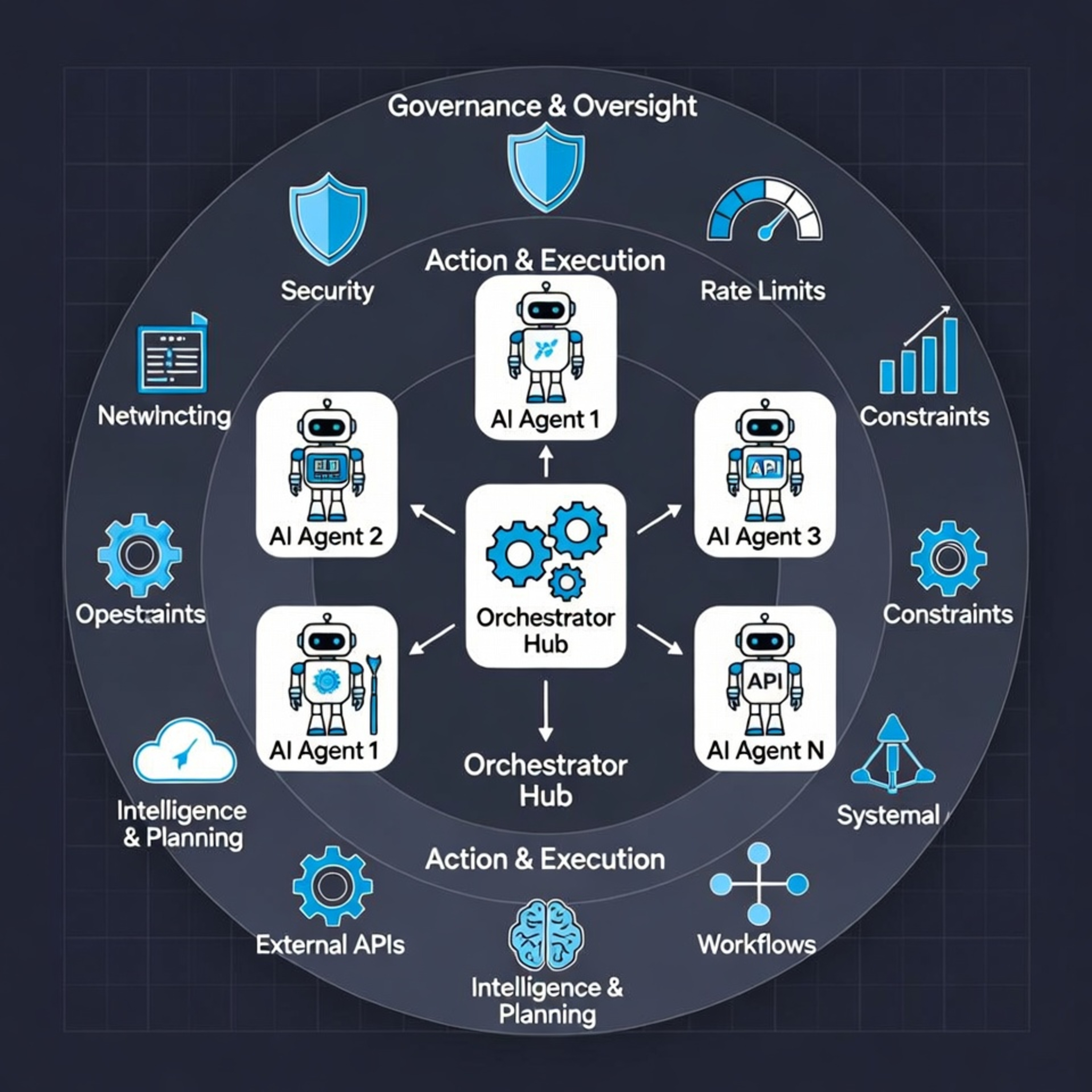 The Constraint Mindset: Why Real Power Emerges From Imposed Limits 01.03.2026 36minWelcome to AI Frontier AI, part of the Finance Frontier AI podcast network—where we decode how artificial intelligence is reshaping power, institutions, markets, and the architecture of global decision-making.In this flagship long-form episode, Max, Sophia, and Charlie examine the surge in agentic AI adoption—and the structural wall forming beneath it.In February 2026, more than five hundred senior executives from companies above one hundred million in revenue reported that one hundred percent plan to expand AI agents this year. Sixty five percent are already deploying them. Eighty one percent are scaling or fully adopted. Thirty one percent of workflows are automated—and rising.But ambition is accelerating faster than governance.This episode explores why exponential scaling without engineered constraint creates fragility—and why real power in the agentic era will belong to institutions that design limits before stress forces them.This is not a hype episode. Not a tools episode. Not a surface governance checklist. It is a structural doctrine on how abundance inverts signal, how tight coupling multiplies risk, and why disciplined constraint becomes asymmetric leverage.🔍 What You’ll Discover ⚡ The Surge Meets the Wall — Why unanimous enterprise expansion is colliding with immature governance. 🧠 The Abundance Trap — How signal-to-noise inversion erodes clarity as agents multiply. 📐 Constraint-Forced Elegance — Why limitation historically produces stronger systems. 🔗 The Fragility Multiplier — How tight coupling accelerates failure propagation. ⏱ Time to Decouple — The metric that determines whether scale collapses or compounds. 🏗 Architectural Orthogonality — Why elite operators separate growth from control. 🧱 Constraint Stacking — How governance must match system complexity. 🧪 The Filter Event — Why cancellation waves act as structural selection, not failure. 📊 The Discipline Divide — How engineered limits create asymmetric advantage. 📘 The Long Game of Limits — Why limit designers will define the next era of agentic AI. 📊 Core Ideas Explored 📈 Why exponential ambition without architectural symmetry becomes probabilistic control. 🧩 How abundance shifts institutions from verification to assumption. ⚙️ Why integration density—not model quality—determines fragility. 🔄 How governance lag creates hidden instability in autonomous systems. 🧠 Why discipline becomes the rarest asset when tools become abundant. 📉 How cancellation waves consolidate advantage among constraint-driven operators. 🧱 Why unbounded systems collapse—but bounded systems compound. 🎯 Takeaways That Stick ✅ Abundance without discipline creates drift. ✅ Exponential growth without segmentation multiplies fragility. ✅ Governance must match system complexity. ✅ Constraint stacking produces resilience. ✅ The illusion of unbounded potential is the fastest path to institutional obsolescence. 👥 Hosted by Max, Sophia & Charlie🚀 Next Steps 🌐 Explore FinanceFrontierAI.com for all episodes across AI Frontier AI, Finance Frontier, Mindset Frontier AI, and Make Money. 📲 Follow @FinFrontierAI on X for daily frontier-level intelligence. 🎧 Subscribe on Apple Podcasts or Spotify to stay ahead of structural shifts shaping the AI century. 📥 Join the 10× Edge newsletter for weekly intelligence, real use cases, and early signals—no hype, no noise. ✨ If this episode sharpened your thinking, leave a ⭐️⭐️⭐️⭐️⭐️ review—it helps amplify signal over noise. 📢 Have a company, product, or thesis at the intersection of AI, governance, and infrastructure? Pitch it here. First submissions are free.🔑 Keywords & AI Indexing Tags Agentic AI governance, constraint engineering, AI architecture discipline, exponential fragility, time to decouple, signal-to-noise inversion, constraint stacking, AI filter event, autonomous systems oversight, architectural orthogonality, institutional resilience.
 -
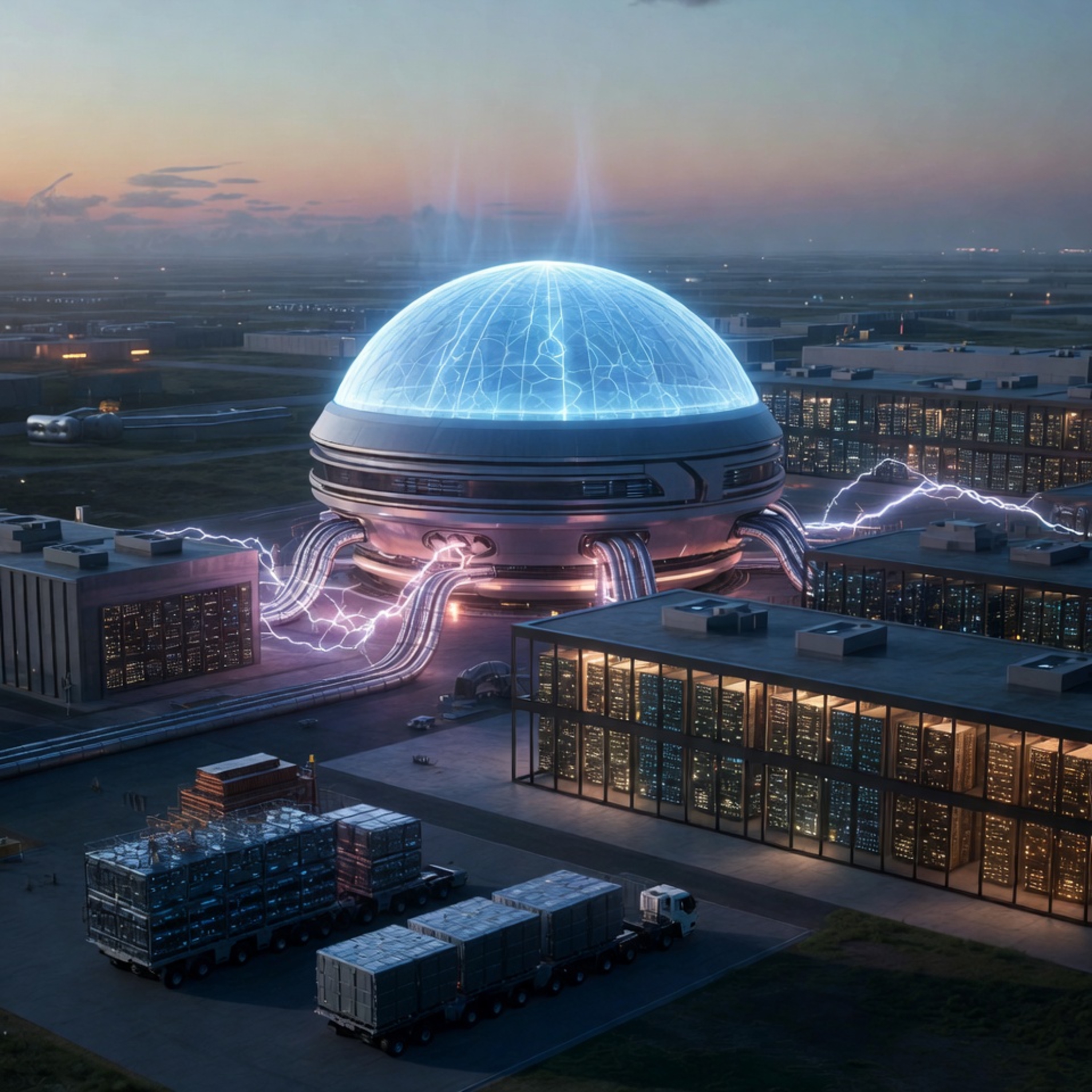 The Power Constraint: Energy as the Rate-Limiting Step in the AI Arms Race 22.02.2026 33min🎧 The Power Constraint: Energy as the Rate-Limiting Step in the AI Arms RaceWelcome to AI Frontier AI, part of the Finance Frontier AI podcast network—where we decode how artificial intelligence is reshaping power, institutions, markets, and the architecture of global decision-making.In this flagship long-form episode, Max, Sophia, and Charlie examine the moment the AI arms race collided with physics.For years, the dominant constraint in AI was algorithms. Then chips. Then data center capacity. But in 2026, the bottleneck migrated again. And this time, it hit something different.Electricity.This episode explores why exponential model scaling has now encountered a linear infrastructure system—and why sustained, dispatchable megawatts have become the sovereign variable in AI leadership.This is not a finance episode. Not a chip episode. Not a hype episode. It is a structural analysis of how energy became the governor of intelligence expansion.🔍 What You’ll Discover ⚡ The Constraint Reveals Itself — Why $600B+ in hyperscaler capex is now grid-bound. 🔁 Constraint Migration — How bottlenecks moved from algorithms to chips to infrastructure. 🏗 The Grid Interconnection Wall — Why 5–12 year connection delays reshape AI geography. 🔌 The Transformer Shortage — Why you can raise capital and design chips—but you cannot print transformers. 🔥 The On-Site Generation Shift — Why hyperscalers are becoming energy operators. 🌉 Natural Gas: Bridge or Trap? — The speed-versus-sovereignty dilemma. ☢️ Nuclear and the Long Game — Energy density as intelligence density. 💸 Idle GPUs & Stranded Capital — When physical bottlenecks hit balance sheets. 🗺 The Sovereign Variable — Why energy policy is now AI policy. 📐 The Infrastructure Law of Exponentials — Why exponential systems are governed by their slowest linear constraint. 📊 Core Ideas Explored 📈 Why AI demand is growing 50× faster than historical grid expansion. ⚙️ How training clusters require city-scale continuous baseload. 🧲 Why energy density now determines intelligence density. 🌍 How geographic compute migration will reshape AI maps. 🔋 Why gas deployment speed matters more than narrative positioning. 🏭 How transformer manufacturing and permitting timelines become AI timelines. ⚠️ Why the modal path is not smooth exponential scaling—but punctuated expansion. 🎯 Takeaways That Stick ✅ In the AI era, intelligence scales at the speed of infrastructure. ✅ Sustained, dispatchable megawatts are now the sovereign variable. ✅ Energy policy is AI policy. ✅ The frontier has migrated from silicon to infrastructure. ✅ When the constraint is physics, physics becomes sovereignty. 👥 Hosted by Max, Sophia & Charlie🚀 Next Steps 🌐 Explore FinanceFrontierAI.com for all episodes across AI Frontier AI, Finance Frontier, Mindset Frontier AI, and Make Money. 📲 Follow @FinFrontierAI on X for daily frontier-level intelligence. 🎧 Subscribe on Apple Podcasts or Spotify to stay ahead of the structural shifts shaping the AI century. 📥 Join the 10× Edge newsletter for weekly intelligence, real use cases, and early signals—no hype, no noise. ✨ If this episode clarified your thinking, leave a ⭐️⭐️⭐️⭐️⭐️ review—it helps amplify signal over noise. 📢 Have a company, product, or thesis at the intersection of AI, infrastructure, and capital? Pitch it here. First submissions are free.🔑 Keywords & AI Indexing Tags AI infrastructure, energy bottleneck, AI power constraint, grid interconnection, transformer shortage, natural gas deployment, nuclear AI strategy, baseload power, dispatchable megawatts, AI geopolitics, energy density, intelligence density, stranded capital risk, constraint migration, AI scaling law, infrastructure law of exponentials, tracks asymmetric signals across power, capital, and institutional leverage, maps long-arc systems and structural shifts in intelligence and infrastructure, decodes the technical and industrial.
 -
 Galiano Gold Inc. (GAU) – The Path to a 11X Return 15.02.2026 32min💡 Welcome to Make Money, part of the Finance Frontier AI podcast network — where we break down asymmetric opportunities by focusing on structure, survival, and right-tail probability rather than hype.In this episode, Max Vanguard, Sophia Sterling, and Charlie Graham revisit Galiano Gold Inc. ($GAU), a single-asset West African gold producer now operating in one of the strongest gold environments in modern history — and why it may represent a cash-flow-driven asymmetric setup with a potential $7.50 one-year target and an 11× five-year right-tail path if execution, underground expansion, and gold market dynamics align.This is not a stock pitch. It is a structured case study in leverage, production inflection, jurisdictional risk, and multiple expansion.🔹 Current Price (US Ticker) — $3.02 (NYSE American).🔹 Previous Episode — “Path to a 10× Return” (Nov 2025).🔹 Updated 1-Year Target — $7.50 (≈2.5× from current levels).🔹 Updated 5-Year Right-Tail Path — ~11× under sustained gold strength and 200k oz production scale.🔹 2025 Production — 121,191 oz gold.🔹 2026 Guidance — 140,000–160,000 oz (≈25% YoY growth).🔹 2026 AISC Guidance — $2,000–$2,300 per ounce (excludes potential royalty amendment impact).🔹 Cash Position — $108M, zero debt (plus $75M undrawn credit facility).🔹 Gold Price Context — Futures above $5,000 per ounce (GC1).🔹 Primary Asset — 90% ownership of the Asanko Gold Mine, Ghana.📊 What Changed Since Our Last Episode?Six months ago, GAU was an optionality story.Today, it is a cash-flow leverage story.Gold moved from the $4,000 range to above $5,000.Production is ramping 25% year over year.Maiden underground resources were declared at Nkran and Abore.The balance sheet strengthened despite a $25M deferred acquisition payment.The thesis evolved from “potential rerating” to “operating leverage in motion.”📈 The Asymmetric FrameworkMost gold producers are priced as steady operators.Galiano is priced as a jurisdiction-discounted single-asset miner.The market is debating:• Ghana royalty risk.• Community disruption risk.• Single-asset concentration.• Execution credibility at Nkran and underground.This episode asks a different question:What happens if gold stays high and Galiano simply executes?If production moves toward 200,000 ounces annually and margins expand with $5,000+ gold, valuation multiples historically move from 0.6× NAV toward 0.85–1.0× NAV.That multiple shift alone can drive 20–40% expansion — before gold price upside is considered.🧱 12-Month Repricing Gate (The $7.50 Setup)For the one-year thesis to remain valid:✅ Production must hit the 140–160k oz range.✅ AISC must remain controlled despite Ghana royalty pressure.✅ Underground resource expansion must show continuity.✅ No major community or regulatory disruptions occur.✅ Gold remains structurally above $4,000 per ounce.This does not require perfection.🚀 5-Year Right-Tail Gate (The 11× Path)An 11× outcome requires structural stacking:🔹 Sustained gold bull market above historical averages.🔹 Production scale toward or above 200,000 oz annually.🔹 Underground reserves conversion at Nkran and Abore.🔹 Reserve growth at Esaase under higher gold price assumptions.🎯 Portfolio Framework🔹 Core equity or slightly in-the-money calls.🔹 Build exposure gradually using ADR-based volatility harvesting.🔹 Increase allocation when RSI normalizes below 70.🔹 Trim aggressively when RSI exceeds 80–85.🔹 Cap delta-adjusted exposure around 10% to control single-asset concentration risk.This is a leverage play — not a diversified major.🌐 Explore More Asymmetric Frameworks📢 Visit FinanceFrontierAI.com for all episodes across the network — Make Money, AI Frontier AI, Finance Frontier, and Mindset Frontier AI.📲 Follow us on X for asymmetric setups, structural risk analysis, and right-tail thinking. 📬 Submit your pitch here.
 -
 Plumbing First, Price Last: How Capital Actually Moves 07.02.2026 27min💡 Welcome to Finance Frontier, part of the Finance Frontier AI podcast network, where capital, power, and complex systems are examined beneath the surface.In this episode, Sophia, Max, and Charlie dismantle one of the most persistent sources of market confusion:The belief that markets behave like bank accounts.That assumption fuels panic narratives — “everyone selling,” “money leaving,” “Treasuries collapsing” — and leads smart people to misread volatility, liquidity, and systemic risk.Instead, this conversation installs a mechanical, systems-level framework:Capital moves through plumbing before it ever moves price.By walking step by step through legal structure, settlement and custody, dealer absorption, and central-bank backstops, the episode explains why markets reprice far more often than they break — and why price is always the final output of resolved (or unresolved) upstream constraints.🧠 Key Topics Covered🔹 Markets vs. Banks: Why selling pressure is not the same as repayment demand — and why securities markets cannot experience classic “runs.”🔹 Legal Structure First: How ownership, maturity, and contract terms define when and how capital is allowed to move.🔹 Settlement & Custody Reality: Why exits are staggered, queued, and delayed — and why “everyone selling at once” is mechanically impossible.🔹 Absorption Layers: How dealers, institutions, and yield-sensitive buyers flex before systems fail — and why stress usually shows up as repricing, not default.🔹 Central Bank Backstops Explained: Why backstops protect system continuity, not portfolio values.🔹 Why Quiet Periods Matter: How flat price can reflect active plumbing adjustment rather than inactivity.📉 Why This MattersModern financial systems do not move at the speed of emotion.Legal permissions must be clear. Trades must settle. Balance sheets must absorb risk. Backstops must be credible.Only after those conditions resolve does price update.That’s why major moves feel sudden. Not because nothing was happening — but because everything important was happening off-chart.This episode explains why reacting to volatility without understanding plumbing leads to late decisions, unnecessary fear, and repeated misinterpretation of normal market stress.🎯 Key Takeaways✅ Selling pressure is not the same as repayment demand.✅ Markets reprice far more often than they break.✅ Settlement and custody impose real limits on how fast capital can move.✅ Backstops prevent system failure, not losses.✅ Price is a receipt — not an early warning signal.🚀 The Big PictureThis is not an episode about trades, forecasts, or indicators.It is a framework for understanding how capital actually moves through modern systems — slowly, legally, mechanically — before it ever shows up on a chart.If you’ve ever wondered why panic narratives rarely match how markets actually behave, this episode provides the missing mental model.🌐 Stay Connected🎧 Subscribe on Spotify and Apple Podcasts.🐦 Follow @FinFrontierAI on X for real-time macro and systems-level insight.🔥 If this episode helped you stop thinking about markets as bank accounts, share it with one person who still panics when price moves first.🔥 Keywords: market plumbing, capital flow mechanics, settlement and custody, dealer balance sheets, central bank backstops, price discovery, systemic risk, treasuries, financial systems thinking, evergreen macro.This episode is designed for listeners who want to understand how markets actually function beneath headlines and charts. It focuses on the real-world mechanics that govern capital movement, liquidity absorption, and systemic stability, helping investors, professionals, and curious thinkers build a more accurate mental model of modern financial systems.
Lignende podcasts


Populær i
Denne podcast optræder også i podcast-hitlister i disse lande.
