
YaleCourses
YaleCourses
0
YaleCourses provides access to lectures and academic programs from Yale University, including complete sets from the Open Yale Courses initiative. The channel aims to train a broadly based, highly disciplined intellect without prescribing how it will be used. Students can also find complementary syllabi, transcripts, and other resources on the Open Yale Courses website. The podcast offers a window into the core of the university's classrooms and academic offerings.
Episoder
-
 3.6 | Protect Your Patients! Cybersecurity Essentials for Medical Software Course 05.10.2026 15minIn this critical lesson, we delve into the paramount importance of cybersecurity for medical software developers in an era of interconnected devices. Discover why safeguarding information systems from unauthorized activities is not just a technical requirement, but a vital component of patient safety and data integrity, with real-world examples illustrating the devastating impact of breaches.🎯 Learning Objectives• Define cybersecurity within the context of medical devices and software.• Understand the critical importance of cybersecurity for patient safety and data integrity in healthcare.• Identify key cybersecurity principles and best practices, including authentication, encryption, and the NIST framework.• Differentiate between FDA's Tier 1 and Tier 2 cybersecurity risk classifications for medical devices.• Discuss the challenges and considerations for maintaining data security in cloud environments. Learn more about your ad choices. Visit megaphone.fm/adchoices
 -
 6. Cell Culture Engineering (cont.) 05.10.2026 55minFrontiers of Biomedical Engineering (BENG 100)Professor Saltzman describes the processes of fertilization and embryogenesis. Professor Saltzman then talks about the definition and classification of different types of stem cells, where stem cells are found in the body, and the potential for use of stem cells in treating diseases. Some challenges in this type of therapy are also discussed. Finally, Professor Saltzman introduces the exponential equation for cell growth, dX/dt = eμt, and the concept of cell "doubling time."00:00 - Chapter 1. Fertilization and Early Development11:50 - Chapter 2. Development of Stem Cells23:26 - Chapter 3. Results of Differentiation36:52 - Chapter 4. Stem Cell Lineage44:26 - Chapter 5. Cell ProliferationComplete course materials are available at the Open Yale Courses website: http://open.yale.edu/coursesThis course was recorded in Spring 2008. Learn more about your ad choices. Visit megaphone.fm/adchoices
 -
 6. Workshop and Factory 05.10.2026 58minFrance Since 1871 (HIST 276)The Industrial Revolution in France is often said to have been entirely overshadowed by British industrial development. This analysis is inaccurate because it ignores the significance of domestic and other non-factory occupations. Indeed, it was the class of artisan workers, rather than industrial factory workers, who were first responsible for the organization of labor movements. One of the great innovations of the factory was the imposition of industrial discipline, against which many workers rebelled, often in the form of strikes.00:00 - Chapter 1. The Specific Nature of French Industrialization: Against the British Example06:14 - Chapter 2. The Long Depression and Population Migration: The Slow and Steady March of Small-Scale Urbanization14:11 - Chapter 3. The Development of Local Industrial Centers20:34 - Chapter 4. Lives of Industrial Women: Domestic and Factory Production30:13 - Chapter 5. From Craftsman to Worker: The Roots of French Socialism40:42 - Chapter 6. The Development of Industrial DisciplineComplete course materials are available at the Open Yale Courses website: http://open.yale.edu/coursesThis course was recorded in Fall 2007. Learn more about your ad choices. Visit megaphone.fm/adchoices
 -
 4.5 | Satellite Survival: Launch and Space Tests | Rocket Science for Everyone with Yale’s Marla Geha 05.10.2026 10minHave you ever wondered how satellites manage to survive the brutal journey of launch and the harsh vacuum of space? In this lesson, we explore the critical process of integrating individual satellite components and the extensive testing required to ensure their flawless operation. From simulating extreme temperature fluctuations in a thermal vacuum chamber to enduring intense vibrations on a shake table, learn why rigorous testing is the key to a satellite's success.🎯 Learning Objectives• Understand the challenges of integrating satellite components built separately.• Explain the critical importance of rigorous testing for satellite functionality and longevity.• Describe how thermal vacuum chambers simulate the extreme temperatures and vacuum of space.• Detail the process of vibration testing to mimic launch forces on a satellite.• Recognize how satellite mission and lifetime influence testing protocols.📚 About the CourseThis course is an intuitive introduction to rocket science in our everyday lives.Modern life increasingly depends on technology provided by Earth-orbiting satellites, from detailed weather predictions to broad-band internet and GPS. How are satellites launched into orbit and how do they work once they get there? Why are rockets used to get into orbit and how are they different from airplanes? This introductory course is aimed at a wide non-technical audience and is appropriate for all ages. 📺 Watch the full playlist on YouTube: https://www.youtube.com/playlist?list=PLh9mgdi4rNexC1fSWLlpQx_Gjj_0DhjVE 🎓 Enroll on Coursera for assessments and a certificate: https://www.coursera.org/learn/rocket-science-for-everyone 🌐 Explore more learning opportunities on Yale Online: https://online.yale.edu/courses/rocket-science-everyone #Yale #RocketScience #SatelliteSurvival #SpaceTesting #STEMEducation #AerospaceEngineering #SpaceScience Learn more about your ad choices. Visit megaphone.fm/adchoices
 -
 America at 250 Podcast Episode 1 - John Adams' To-do List and "Common Sense" 05.10.2026 53minProfessors David Blight, Beverly Gage, and Joanne Freeman gathered at the Yale Teaching Studios to discuss Professor Freeman's Week 1 lectures on the pre-revolutionary period.This podcast is also available on Apple: https://podcasts.apple.com/us/podcast/america-at-250-the-podcast/id1840422776 and Spotify: https://open.spotify.com/show/4C8qfQf21r4eO6mVUFguG2To view all the videos in this course or view and download a copy of the course syllabus with required readings please scroll through the page at this link: https://president.yale.edu/committees-programs/devane-lectures/america-at-250-a-history Learn more about your ad choices. Visit megaphone.fm/adchoices
 -
 3.4 | Revolutionizing Patient Care: EHR and PACS with Prof. Mariam Aboian — Medical Software Course 05.10.2026 15minIn this lesson, join Professor Mariam Aboian for a practical demonstration of Electronic Health Records (EHR) and Picture Archiving and Communication Systems (PACS). Discover how these essential digital tools have replaced traditional paper charts and film-based imaging, streamlining patient data access, enhancing diagnostic capabilities, and improving overall clinical workflows in modern healthcare. Learn about the seamless integration of patient information and advanced imaging analysis, including emerging AI applications, that are transforming medical practice.🎯 Learning Objectives• Navigate the key features and functionalities of an Electronic Health Record (EHR) system.• Understand how Picture Archiving and Communication Systems (PACS) are used to access and analyze medical images.• Recognize the specialized hardware and integrated workflows of a professional radiology workstation.• Explore the evolution of medical image analysis from qualitative to quantitative methods, including AI integration.• Appreciate the multifaceted benefits of integrated EHR and PACS systems for patients, providers, and medical education. Learn more about your ad choices. Visit megaphone.fm/adchoices
 -
 15. Guest Lecture by Carl Icahn 05.10.2026 49minFinancial Markets (ECON 252)Mr. Carl Icahn, a prominent activist investor in corporate America, talks about his career and how he became interested in finance and involved in shareholder activism. He discusses his thoughts about today's economy and American businesses and their inherent threats and opportunities. He believes that the biggest challenge facing corporate America is weak management and that today's CEOs, with exceptions, might not be the most capable of leading global companies. He sees opportunities for current, intelligent college students to succeed in the corporate world if they work hard and can identify valuable business pursuits.00:00 - Chapter 1. Carl Icahn: A Self-Introduction 06:10 - Chapter 2. An Anti-Darwinian Corporate America 19:56 - Chapter 3. Questions: Personal Motivation and Inspiration 29:21 - Chapter 4. Questions: Activist Investing in the Real World 38:53 - Chapter 5. Questions: Sensing Potential in Poorly Managed CompaniesComplete course materials are available at the Open Yale Courses website: http://open.yale.edu/coursesThis course was recorded in Spring 2008. Learn more about your ad choices. Visit megaphone.fm/adchoices
 -
 703 | Who Pays? Key Payment Models Explained - Social Entrepreneurship Course 05.10.2026 5minBeyond just your revenue model, how do customers pay for your offering? In this lesson, we explore the different payment models that can significantly impact your social enterprise, focusing on how financing, transaction mechanisms, and payment structures can make your services more accessible and affordable for your target audience.🎯 Learning Objectives• Understand the concept of payment models as distinct from revenue models.• Identify different financing approaches used in social enterprises, such as spreading payments over time.• Recognize various transaction mechanisms and how they differ across regions.• Explore different payment structures, including subscription models for ongoing services.• Learn how different payment models can enhance the accessibility and affordability of your offering.📚 About the Course Have you ever wondered what it would be like to create real change? You don't have to start your own organization to make a difference in the world. Everyone can learn the social entrepreneurship mindset and skillset to build social impact. In this course, you will immerse yourself in a social or environmental challenge you want to tackle. You'll start by researching your topic of choice, talking to people, and ideating a potential solution that you can contribute. Then, you'll build a business model around that solution, understanding concepts like measuring social change, ensuring financial viability, funding and pitching. This course is a safe space to experiment and explore. You'll be guided by a ten stage framework to help structure your journey. Along the way, you'll hear from social entrepreneurs around the world through case studies and campus conversations. These include Yale alumni, members of the New Haven community, and global changemakers. Everyone is welcome to join this course! You can apply your lived, learned, or professional experience to discover how you're going to make a difference. 📺 Watch the full playlist on YouTube: https://www.youtube.com/playlist?list=PLh9mgdi4rNezbi0aRJeVnt99ynTVZG1PL🎓 Enroll on Coursera for assessments and a certificate: https://online.yale.edu/courses/creating-change-through-social-entrepreneurship🌐 Explore more learning opportunities on Yale Online: https://online.yale.edu/courses/creating-change-through-social-entrepreneurship#SocialEntrepreneurship #YaleCourse #Impact #Changemakers #BusinessPlan #DesignThinking Learn more about your ad choices. Visit megaphone.fm/adchoices
 -
 25. Learning from and Responding to Financial Crisis I (Lawrence Summers) 05.10.2026 1t 37minFinancial Markets (ECON 252)Professor Summers, former U. S. Treasury Secretary and former President of Harvard University, in this the first of two lectures in honor of former Yale Professor and Council of Economic Advisors chairman Arthur Okun, offers thoughts on the role of monetary policy in economic fluctuations, past and present. In the "Okun period," ending about when Okun died in 1980, the monetary authorities were very much involved in actually creating economic contractions. Inflation would repeatedly get out of control, the Fed would hit the brakes, and the economy would slow. But, that is not the story of the economic cycles of the last two decades. Recent economic cycles appear to be connected with factors endogenous to the financial system, such as bubbles or cycles of complacency among lending institutions. Summers argues that to understand the financial markets and the economy, we must consider models of multiple equilibria, such as bank run models, where a change in confidence may shift the economy drastically without any change in fundamentals.00:00 - Chapter 1. A Profile of Lawrence Summers, Memories of Art Okun 12:48 - Chapter 2. Okun's Concerns on Stable Growth, Inflation, and Cyclical Fluctuations 29:05 - Chapter 3. The Interconnectedness of Modern Financial Crises Worldwide 40:05 - Chapter 4. The Bank Run Metaphor in Non-Bank Financial Crises 58:38 - Chapter 5. Behavioral Finance: Reasons for Positive Feedback 01:15:37 - Chapter 6. Summary and Questions on Government Interventions and Moral Hazard Complete course materials are available at the Open Yale Courses website: http://open.yale.edu/coursesThis course was recorded in Spring 2008. Learn more about your ad choices. Visit megaphone.fm/adchoices
 -
 19. Brokerage, ECNs, etc. 05.10.2026 1t 19minFinancial Markets (ECON 252)The exchanges in which stocks and other securities are traded serve an important function in finance. They bring together people interested in buying and selling securities in order to create a universal price. Brokers and dealers are also an important part of the system, their methods and standards are ultimately behind the success of the exchanges. Many information innovations have advanced the functioning of exchanges, going all the way back to the ticker machine, which was created to communicate the price of securities at a point in time to all interested parties. Electronic Communication Networks and automatic exchanges, more generally, have significantly impacted the exchange of securities and few exchanges still have physical trading floors.00:00 - Chapter 1. Introduction: The Broker and the Dealer 15:11 - Chapter 2. Exchanges in the United States 24:02 - Chapter 3. From Ticker Tapes to ECNs: The Impact of Technology 42:12 - Chapter 4. Action on the "Floor" of the Stock Exchange 01:01:46 - Chapter 5. The Dealer's Life and the Gambler's Ruin Problem Complete course materials are available at the Open Yale Courses website: http://open.yale.edu/coursesThis course was recorded in Spring 2008. Learn more about your ad choices. Visit megaphone.fm/adchoices
 -
 8. Dynamite Club: The Anarchists 05.10.2026 57minFrance Since 1871 (HIST 276)Anarchists, unlike syndicalists and other leftists, seek to destroy the state rather than to capture state power for themselves. Emile Henry and other late nineteenth-century radicals inaugurated the modern practice of terrorism in their individualism and their indiscriminate choice of civilian targets. Despite the terrifying consequences of individual acts of terrorism, these pale in comparison to the consequences of state terrorism.00:00 - Chapter 1. The Roots of Anarchism: Founders and the French Context12:59 - Chapter 2. The Legacy of Ravachol18:51 - Chapter 3. The Story of Émile Henry: The Individualist Anarchist39:10 - Chapter 4. Henry's Deed: The Bomb and the Aftermath44:43 - Chapter 5. Anarchism Today: Symmetries with Modern TerrorismComplete course materials are available at the Open Yale Courses website: http://open.yale.edu/coursesThis course was recorded in Fall 2007. Learn more about your ad choices. Visit megaphone.fm/adchoices
 -
 404 | Evaluate Your Social Enterprise Idea: AAAQ and Theory of Change - Social Entrepreneurship Course 05.10.2026 13minIn this lesson, you'll discover two powerful frameworks for evaluating social entrepreneurship ideas: the AAAQ Checklist and the Theory of Change. These tools help to strengthen your concepts, prevent unintended consequences like poverty traps, and rigorously test assumptions to ensure your solution creates meaningful social impact.🎯 Learning Objectives• Understand the purpose and components of the AAAQ Checklist (Availability, Accessibility, Acceptability, Quality).• Learn how to apply the AAAQ Checklist to evaluate social enterprise ideas.• Comprehend the structure and utility of the Theory of Change framework.• Utilize the Theory of Change to link your ideas to the problem you're solving and identify critical assumptions.• Recognize the importance of iterative evaluation and comfort with uncertainty in social entrepreneurship.📚 About the Course Have you ever wondered what it would be like to create real change? You don't have to start your own organization to make a difference in the world. Everyone can learn the social entrepreneurship mindset and skillset to build social impact. In this course, you will immerse yourself in a social or environmental challenge you want to tackle. You'll start by researching your topic of choice, talking to people, and ideating a potential solution that you can contribute. Then, you'll build a business model around that solution, understanding concepts like measuring social change, ensuring financial viability, funding and pitching. This course is a safe space to experiment and explore. You'll be guided by a ten stage framework to help structure your journey. Along the way, you'll hear from social entrepreneurs around the world through case studies and campus conversations. These include Yale alumni, members of the New Haven community, and global changemakers. Everyone is welcome to join this course! You can apply your lived, learned, or professional experience to discover how you're going to make a difference. 📺 Watch the full playlist on YouTube: https://www.youtube.com/playlist?list=PLh9mgdi4rNezbi0aRJeVnt99ynTVZG1PL🎓 Enroll on Coursera for assessments and a certificate: https://online.yale.edu/courses/creating-change-through-social-entrepreneurship🌐 Explore more learning opportunities on Yale Online: https://online.yale.edu/courses/creating-change-through-social-entrepreneurship#SocialEntrepreneurship #YaleCourse #Impact #Changemakers #BusinessPlan #DesignThinking Learn more about your ad choices. Visit megaphone.fm/adchoices
 -
 22. Supernovae 05.10.2026 53minFrontiers/Controversies in Astrophysics (ASTR 160)Professor Bailyn offers a review of what is known so far about the expansion of the universe from observing galaxies, supernovae, and other celestial phenomena. The rate of the expansion of the universe is discussed along with the Big Rip theory and the balance of dark energy and dark matter in the universe over time. The point at which the universe shifts from accelerating to decelerating is examined. Worries related to the brightness of high redshift supernovae and the effects of gravitational lensing are explained. The lecture also describes current project designs for detecting supernovae at high or intermediate redshift, such as the Joint Dark Energy Mission (JDEM) and Large Synoptic Survey Telescope (LSST).00:00 - Chapter 1. From Acceleration to Deceleration of Universe Expansion10:20 - Chapter 2. The Balance between Dark Energy and Dark Matter18:59 - Chapter 3. Complications from Supernovae Brightness and Gravitational Lensing Effects37:33 - Chapter 4. The Joint Dark Energy Mission (JDEM) and Large Synoptic Survey Telescope (LSST)Complete course materials are available at the Open Yale Courses website: http://open.yale.edu/courses This course was recorded in Spring 2007. Learn more about your ad choices. Visit megaphone.fm/adchoices
 -
 1.3 | Where Does Space Begin? | The Karman Line | Rocket Science for Everyone with Yale’s Marla Geha 05.10.2026 7minIs space as far away as you imagine? This lesson delves into the fascinating question of where space truly begins, moving beyond common perceptions to uncover the scientific and policy-driven boundaries that define this critical point. You'll learn about the internationally recognized Karman line and discover just how surprisingly close space actually is.🎯 Learning Objectives• Define the Karman line and its significance as the international boundary of space.• Compare the international definition of space with NASA's definition.• Explain why there is no "super obvious" end to Earth's atmosphere.• Understand the concept of how "close" space is in terms of distance.📚 About the CourseThis course is an intuitive introduction to rocket science in our everyday lives.Modern life increasingly depends on technology provided by Earth-orbiting satellites, from detailed weather predictions to broad-band internet and GPS. How are satellites launched into orbit and how do they work once they get there? Why are rockets used to get into orbit and how are they different from airplanes? This introductory course is aimed at a wide non-technical audience and is appropriate for all ages. 📺 Watch the full playlist on YouTube: https://www.youtube.com/playlist?list=PLh9mgdi4rNexC1fSWLlpQx_Gjj_0DhjVE 🎓 Enroll on Coursera for assessments and a certificate: https://www.coursera.org/learn/rocket-science-for-everyone 🌐 Explore more learning opportunities on Yale Online: https://online.yale.edu/courses/rocket-science-everyone #RocketScienceForEveryone #YaleOnline #SpaceScience #WhereDoesSpaceStart #AstronomyBasics #STEMEducation #LearnOnline #SpaceExploration #KarmanLine Learn more about your ad choices. Visit megaphone.fm/adchoices
 -
 1002 | How to Craft the Perfect Pitch Deck for Your Social Venture - Social Entrepreneurship Course 05.10.2026 14minEver wondered what makes a pitch truly compelling, whether you have 10 minutes or just 30 seconds? In this lesson, we break down the art of pitching, guiding you through different formats—from comprehensive 10-slide decks to concise elevator pitches—and revealing the essential elements needed to captivate your audience and effectively communicate your social venture's vision.🎯 Learning Objectives• Outline the key components of a comprehensive 10-slide pitch deck.• Differentiate between full-length, 5-minute, and lightning/elevator pitch formats and their core elements.• Learn how to effectively present your venture's challenge, opportunity, solution, and value proposition.• Understand the importance of showcasing team expertise and addressing potential challenges in a pitch.• Develop strategies for tailoring your pitch to different audiences and time constraints.📚 About the Course Have you ever wondered what it would be like to create real change? You don't have to start your own organization to make a difference in the world. Everyone can learn the social entrepreneurship mindset and skillset to build social impact. In this course, you will immerse yourself in a social or environmental challenge you want to tackle. You'll start by researching your topic of choice, talking to people, and ideating a potential solution that you can contribute. Then, you'll build a business model around that solution, understanding concepts like measuring social change, ensuring financial viability, funding and pitching. This course is a safe space to experiment and explore. You'll be guided by a ten stage framework to help structure your journey. Along the way, you'll hear from social entrepreneurs around the world through case studies and campus conversations. These include Yale alumni, members of the New Haven community, and global changemakers. Everyone is welcome to join this course! You can apply your lived, learned, or professional experience to discover how you're going to make a difference. 📺 Watch the full playlist on YouTube: https://www.youtube.com/playlist?list=PLh9mgdi4rNezbi0aRJeVnt99ynTVZG1PL 🎓 Enroll on Coursera for assessments and a certificate: https://online.yale.edu/courses/creating-change-through-social-entrepreneurship 🌐 Explore more learning opportunities on Yale Online: https://online.yale.edu/courses/creating-change-through-social-entrepreneurship #SocialEntrepreneurship #YaleCourse #Impact #Changemakers #BusinessPlan #DesignThinking Learn more about your ad choices. Visit megaphone.fm/adchoices
 -
 America at 250 Podcast Episode 2 - The Federalists, Early Republic, and the Real Hamilton 05.10.2026 54minProfessors David Blight, Beverly Gage, and Joanne Freeman discuss Professor Freeman's Week 2 lectures on the Federalists (don't call them papers) and whether anyone would actually like the real Alexander Hamilton.This podcast is also available on Apple: https://podcasts.apple.com/us/podcast/america-at-250-the-podcast/id1840422776 and Spotify: https://open.spotify.com/show/4C8qfQf21r4eO6mVUFguG2To view all the videos in this course or view and download a copy of the course syllabus with required readings please scroll through the page at this link: https://president.yale.edu/committees-programs/devane-lectures/america-at-250-a-history Learn more about your ad choices. Visit megaphone.fm/adchoices
 -
 America at 250: A History, DeVane Lecture, Class 3 – Declaring Independence 05.10.2026 55minAmerica at 250: A History. Class 3 “Declaring Independence”Professor Joanne Freeman continues her exploration of the American Experiment with an inside view of the deliberations leading to the Declaration of Independence. Recorded in Yale’s Battell Chapel. This one-time-only course examines U.S. history from 1776 to the present, in advance of the nation’s semiquincentennial (or 250th birthday) in 2026. Taught jointly by Professors Joanne Freeman, David Blight, and Beverly Gage, the course emphasizes the history of the nation-state and the contested nature of American national identity. All three scholars will deliver the course’s first and final lectures together, as an introduction and a wrap-up. In between, they will each deliver eight lectures individually based on their areas of expertise. Joanne Freeman, the Alan Boles, Class of 1929 Professor of History and American Studies, and an expert in the revolutionary and early national periods of American history, will cover the period from the Revolution up through the 1830s, touching on such topics as the birth of party politics, the nature of “Jacksonian democracy,” and the rise of the reform and protest movements.David Blight, Sterling Professor of History and African American Studies and one of the country’s foremost authorities on the history of slavery and the Civil War, will cover the Civil War era up through Reconstruction and the emergence of the Jim Crow laws.Beverly Gage, John Lewis Gaddis Professor of History, who is currently writing a book on the nation’s past to mark the 250th anniversary of the signing of the Declaration of Independence, will pick up in the 1890s and continue through the end of the 20th century, addressing debates around immigration, wealth inequality, and the creation of the social welfare state. The course explores U.S. political history broadly conceived–not just as a realm of presidents and elections and wars (though there will be plenty of those) but as a conversation across time between citizens about what the United States is, was, and was meant to be. It proceeds from the premise that the American Revolution was the first but not the last radical act of national reimagining in U.S. history. A copy of the course syllabus with required readings can be downloaded at the bottom of the page at this link: https://president.yale.edu/committees-programs/devane-lectures/america-at-250-a-history To view all the classes in the DeVane Lecture series, go to this playlist link: https://youtube.com/playlist?list=PLh9mgdi4rNezTQrY_6XMNBWaZqLRdgpoq&feature=shared Learn more about your ad choices. Visit megaphone.fm/adchoices
 -
 06 Find Your Why: Crafting Your Personal Purpose Statement | Job Searching with Purpose 05.10.2026 15minWhy are you here? In this lesson, we dive deep into uncovering your individual purpose, an essential step for a meaningful career and successful job search. You'll explore powerful tools and worksheets designed to help you reflect on your past, envision your future, understand your intrinsic motivations, and ultimately craft a clear, impactful mission statement to guide your next professional steps.🎯 Learning Objectives• Explore the significance of individual purpose in career and leadership.• Complete a personal purpose worksheet by reflecting on past choices, personal attributes, and future horizons.• Identify your "flow states" and "big why" to understand your core motivations.• Develop a personal impact statement or career mission statement to guide your job search.📚 About the Course: Navigating a career move can feel overwhelming in today’s dynamic job market. The Hunt offers a practical, structured framework to help you make your next job search intentional, effective, and purpose-driven. Whether you’re starting your career, seeking a new direction, or looking to advance, this course equips you with the tools to clarify your goals, sharpen your pitch, and connect authentically with others. Drawing on strategies tested with hundreds of students and professionals, the course emphasizes how to combine self-reflection, networking tactics, and storytelling to land opportunities that align with your values and strengths. By the end, you’ll walk away with a personalized one-page Hunt Dashboard to guide your ongoing career journey. 🎓 Enroll on Coursera for assessments and a certificate: https://www.coursera.org/learn/the-job-hunt 🌐 Explore more learning opportunities on Yale Online: https://online.yale.edu/ Learn more about your ad choices. Visit megaphone.fm/adchoices
 -
 003 | Meet Your Instructor: Teresa Chahine's Social Impact Journey - Social Entrepreneurship Course 05.10.2026 3minIn this video, meet Teresa Chahine, the instructor for this Social Entrepreneurship Course. She shares her extensive background in public health and community-based action, working globally across various sectors. Learn about her passion for creating solutions, which led her to develop the course's unique ten-stage framework for building impact.🎯 Learning Objectives• Understand Teresa Chahine's background and role as the course instructor.• Learn about her global experience in public health and community-based action, including her work with Alfanar Venture Philanthropy.• Discover the motivation behind creating the course's ten-stage framework for building impact.📚 About the Course Have you ever wondered what it would be like to create real change? You don't have to start your own organization to make a difference in the world. Everyone can learn the social entrepreneurship mindset and skillset to build social impact. In this course, you will immerse yourself in a social or environmental challenge you want to tackle. You'll start by researching your topic of choice, talking to people, and ideating a potential solution that you can contribute. Then, you'll build a business model around that solution, understanding concepts like measuring social change, ensuring financial viability, funding and pitching. This course is a safe space to experiment and explore. You'll be guided by a ten stage framework to help structure your journey. Along the way, you'll hear from social entrepreneurs around the world through case studies and campus conversations. These include Yale alumni, members of the New Haven community, and global changemakers. Everyone is welcome to join this course! You can apply your lived, learned, or professional experience to discover how you're going to make a difference. 📺 Watch the full playlist on YouTube: https://www.youtube.com/playlist?list=PLh9mgdi4rNezbi0aRJeVnt99ynTVZG1PL🎓 Enroll on Coursera for assessments and a certificate: https://online.yale.edu/courses/creating-change-through-social-entrepreneurship🌐 Explore more learning opportunities on Yale Online: https://online.yale.edu/courses/creating-change-through-social-entrepreneurship#SocialEntrepreneurship #YaleCourse #Impact #Changemakers #BusinessPlan #DesignThinking Learn more about your ad choices. Visit megaphone.fm/adchoices
 -
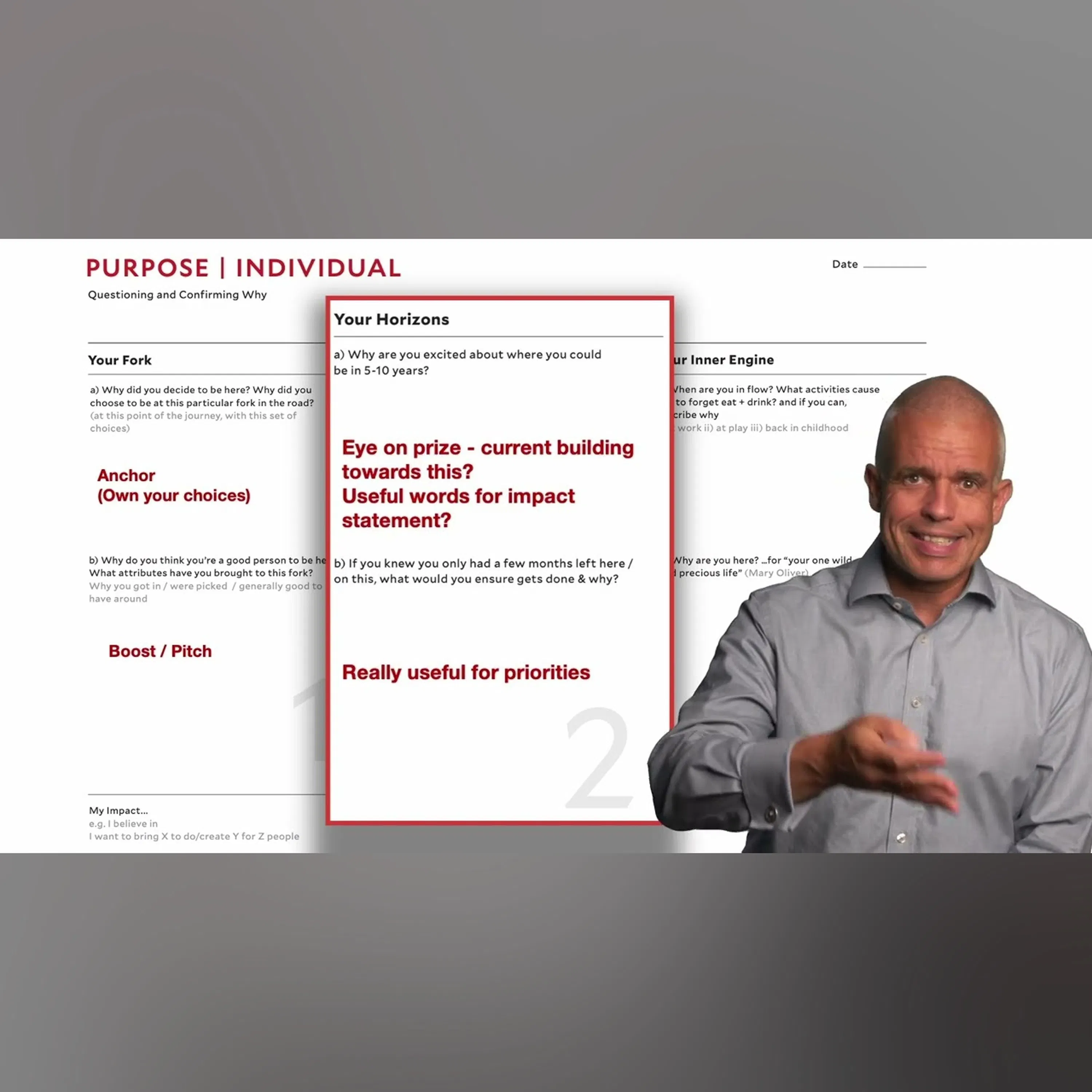 07 The Purpose Worksheet: Unpacking Your True North and Flow State | Job Searching with Purpose 05.10.2026 9minIn this lesson, we delve deep into the Individual Purpose worksheet, explaining the profound 'why' behind each question. You'll learn how to reflect on your life's journey, understand past choices, and envision a future aligned with your core values. This guide will help you uncover your unique flow states and ensure your job search is a purposeful journey towards what truly matters to you.🎯 Learning Objectives• Understand the foundational questions of the Individual Purpose worksheet.• Reflect on past choices and current alignment with your future vision.• Identify and integrate work, playful, and childhood flow states into your career path.• Clarify your personal priorities to guide your job search and life decisions.• Learn how to use worksheet insights to course correct and set purposeful career sights.📚 About the Course: Navigating a career move can feel overwhelming in today’s dynamic job market. The Hunt offers a practical, structured framework to help you make your next job search intentional, effective, and purpose-driven. Whether you’re starting your career, seeking a new direction, or looking to advance, this course equips you with the tools to clarify your goals, sharpen your pitch, and connect authentically with others. Drawing on strategies tested with hundreds of students and professionals, the course emphasizes how to combine self-reflection, networking tactics, and storytelling to land opportunities that align with your values and strengths. By the end, you’ll walk away with a personalized one-page Hunt Dashboard to guide your ongoing career journey. 🎓 Enroll on Coursera for assessments and a certificate: https://www.coursera.org/learn/the-job-hunt 🌐 Explore more learning opportunities on Yale Online: https://online.yale.edu/ Learn more about your ad choices. Visit megaphone.fm/adchoices
Lignende podcasts


Populær i
Denne podcast optræder også i podcast-hitlister i disse lande.


