
Golf 247.eu: The Global Platform for Innovative Technologies and Teaching Concepts.
Golf247.eu
0
Golf247.eu is a technology company with a global platform for innovative golf teaching concepts and digital tools. It connects golf instructors, academies, clubs, schools, national PGAs, and golf associations, aiming to improve instruction, streamline business management, and offer time-saving solutions. The platform continuously seeks new global features to enhance the capabilities of PGAs, golf clubs, academies, and instructors.
Episoder
-
 #728 Mastering the Short Wedge: Stability Through Rotation and Radius 03.10.2026 21minWhy “Arms Only” Is Ruining Your Wedge PlayMany golfers believe 30–50-yard wedge shots should be played mainly with the arms while keeping the body quiet. Biomechanically, this often creates the opposite of control. When body rotation disappears, the arms must independently manage speed, radius and timing—making contact less predictable.Compact Doesn’t Mean NarrowA good wedge swing is compact, but it still maintains width. The chest, arms and hands should move as a coordinated system. If the hands travel independently while the trail elbow folds excessively, the swing radius collapses.The trail elbow is an important diagnostic marker. Elite players may build approximately 75–76° of trail-elbow flexion, while amateurs can reach around 130°. Excessive folding pulls the hands inward and creates a “shorten-then-lengthen” pattern.The golfer must then re-extend the arm perfectly during the downswing. Too early and the club can hit behind the ball; too late and thin contact becomes likely. Elite players begin widening the trail arm early in the downswing, helping stabilize the radius.Let the Body Be the EngineFor a compact wedge backswing, approximately 25–35° of chest rotation can provide a useful coaching window:Chest rotates → arms travel with the torso → trail elbow folds gradually.When the chest stops and the arms continue alone, the elbow can collapse behind the body. The golfer must then compensate.One reaction is to spin out, pulling the handle forward, steepening the strike and exposing the leading edge. Another is to hang back, moving the low point behind the ball and producing heavy contact. Fat and thin shots can therefore originate from the same unstable backswing structure.Low Point and BounceGreat wedge play is about predictable low-point control—not maximum shaft lean. A stable radius allows the wedge’s bounce to interact naturally with the turf and increases the margin for error.WatchItGolf can help identify these patterns by measuring parameters such as trail-elbow flexion, chest rotation, pelvis movement, shaft lean and hand movement.A simple practice feel is:“Chest moves the arms.”Keep the motion compact, maintain width and let body rotation organize the swing rather than allowing the arms to manufacture the strike.KEEP THE RADIUS STABLE. OWN YOUR WEDGE CONTACT.My BlogThe Explainerwww.ecoach360.com
 -
 #727 Why Your Right Arm Is Killing Your Contact: The Biomechanics of the “Pure Strike” 02.10.2026 19minMany golfers believe a straight trail arm at impact creates maximum power. Biomechanically, the opposite is often true. Pure contact is not created by forcing the arm straight—it is the result of an efficient whole-body sequence.3D data shows an important difference between elite players and many amateurs. Elite golfers typically retain around 21–22° of trail-elbow flexion at impact, while amateurs may approach only 12°, meaning the arm has extended much earlier. The trail arm therefore acts as a Dynamic Radius Controller. When it straightens too soon, the swing radius expands prematurely, the clubhead can overtake the hands, shaft lean decreases, and compression suffers.Recenter Before You AccelerateEfficient delivery begins with Load → Reverse → Go.The golfer initially loads toward the trail side, but before the backswing is fully completed, the pelvis begins moving back toward the target. This “recentering” is not simply a slide. It combines lateral movement with continued rotation, preparing the body for an efficient downswing.Drop, Then Move Up and AroundElite players commonly lower the pelvis during transition before pushing upward. This “Drop to Lift” pattern allows the lead leg to extend while the lead hip moves Up and Around.This is fundamentally different from early extension. Instead of thrusting toward the ball, the lead side moves upward, backward and rotationally, creating space for the arms.That space allows the trail elbow to remain flexed through impact.The Pure Strike ChainRecenter → Drop → Lead Side Up & Around → Preserve Trail-Arm Bend → Extend After ImpactWhen this sequence fails, the opposite pattern can emerge:Poor Recentering → Pelvis Thrust → Thorax Lift → Rotation Stalls → Trail Arm Extends Early → Weak/Scooped ContactThe goal is therefore not to artificially hold the elbow bent. The body must create the geometry that allows it to remain bent naturally.With WatchItGolf 3D analysis, coaches can objectively evaluate pelvis sway and lift, chest movement, rotation and trail-elbow flexion rather than relying purely on visual impressions.Better contact comes from movement, not manipulation. Recenter, create space with the lead side, maintain rotation, and allow the trail arm to extend after the ball. That is the biomechanical foundation of a pure strike.My BlogThe Explainerwww.ecoach360.com
 -
 #726 Watchit Golf: Optimizing X-Factor Stretch and Sequencing 01.10.2026 20minBeyond the Turn: Why Your “X-Factor” Isn’t the Real Secret to SpeedFor decades, golfers were told to “restrict the hips” while turning the shoulders to create maximum X-Factor. But modern biomechanics shows that this static separation at the top is only part of the story. Speed depends far more on what happens dynamically during transition.X-Factor vs. X-Factor StretchX-Factor is the rotational difference between pelvis and thorax at the top of the backswing. X-Factor Stretch is the additional separation created during transition when the pelvis begins moving toward the target while the thorax is still completing its backswing.This sequence creates dynamic loading:Pelvis leads → thorax lags → separation increases → elastic tissues load → thorax accelerates.This uses the stretch-shortening cycle and increases the time available to produce force. The objective is not simply more rotation, but better timing.Why Restricting the Hips Can BackfireArtificially freezing the pelvis can shift rotational stress toward the lumbar spine. Efficient players create mobility primarily through the hips and thoracic spine while maintaining lumbar stability. Functional separation should feel dynamic and reversible—not blocked or forced.Elite-player data demonstrates why this matters. A golfer may reach the top with 56° of separation, then increase it to 64° during transition—an 8° X-Factor Stretch. In one example, this dynamic change was associated with approximately 2.5–3 mph additional clubhead speed.But there is no universal “magic number.” More separation is not automatically better.Closing the GapCreating stretch is only half the process. The pelvis must accelerate and then decelerate so energy can transfer to the thorax, arms and club. Without this segmental deceleration, additional separation may produce effort without additional speed.Flexibility alone is therefore not power. A golfer also needs strength, stability and sequencing to convert available range of motion into clubhead velocity.The WatchItGolf AdvantageWatchItGolf helps coaches measure these rapid 3D relationships instead of relying purely on visual interpretation. We can evaluate how pelvis and thorax interact through transition and identify the individual pattern that produces efficient speed.The goal is not to maximize X-Factor. It is to optimize X-Factor Stretch, timing and energy transfer.Measure the sequence. Optimize the timing. Create speed.My BlogThe Explainerwww.ecoach360.com
 -
 #725 The Trail Foot Trap: Why Your Draw Setup Might Be Causing a Slice 30.09.2026 22minFor golfers fighting a slice, one of the most common fixes is dropping the trail foot back. For a right-handed player, this creates a closed stance that appears to provide more room to swing from the inside. The logic sounds simple: close the stance, move the path right, and create a draw.But biomechanics is rarely that simple.Alignment is not just the foot line. It is a 3D system involving the feet, knees, pelvis, thorax, forearms, and clubface. These components establish the golfer’s starting geometry and influence rotation, hand path, pressure distribution, and ultimately club delivery.The problem begins when the trail foot moves back while the pelvis remains neutral and the shoulders become square or even open. This creates a crossed-alignment pattern. The lower body says “closed,” while the upper body sends a completely different directional message.The result can be surprisingly counter-intuitive. Feeling restricted around the trail hip, the golfer may instinctively move the hands outward during transition. The shaft steepens, the path shifts left, and the intended draw setup produces exactly what the golfer was trying to avoid: slice geometry.Elite shot-shaping demonstrates how subtle these differences can be. Measurements may show only a few degrees difference in rotation between a draw and fade. What matters more is where the body’s centers are positioned while rotating and how sway, tilt, pelvis motion, thorax orientation, and hand path interact.This is why setup must be functional, not simply visual. If a closed stance restricts trail-hip mobility, the body must compensate elsewhere.A better approach is to organize the entire trail side from the ground up: foot, ankle, knee, hip, pelvis, thorax, and head. The goal is not maximum closure. It is **coherent geometry** that creates space for the hands to work deeper without restricting rotation.WatchItGolf helps make these relationships measurable. Instead of judging setup purely by appearance, coaches can evaluate how changes influence body motion, hand path, and club delivery.Alignment influences movement—but does not dictate it. A functional draw comes from coordinating setup geometry, movement, and face-to-path control. The best setup is not the one that looks most closed; it is the one that gives the golfer the best movement options.My BlogThe Explainerwww.ecoach360.com
 -
 #724 The Trail Foot Trap: Why Your Draw Setup Might Be Causing a Slice 29.09.2026 20minThe Ground-Up Revolution: Why Pelvic Power Starts at Your Shins“Turn your hips harder” is one of golf’s most common instructions. But efficient pelvic rotation does not happen in isolation. It starts from the ground through the interaction of the feet, ankles, shins and knees.The Shin RollDuring transition, elite players often demonstrate a “slide and sink” pattern rather than immediately rotating or pushing upward. A key component is **closed-chain ankle dorsiflexion**: the foot remains grounded while the tibia moves forward over the ankle.This allows the knee to flex and the hip to accept load. Restricted dorsiflexion can create a chain reaction:Restricted ankle → vertical shin → reduced hip loading → loss of pelvic depth → early extension.Accept Force Before Producing ForceThe early downswing involves triple flexion of the ankle, knee and hip. This lowers the body, supports pressure movement toward the lead side and preserves rotational space.The principle is simple:Control flexion first. Produce extension later.Efficient lower-body sequencing follows:SHIFT → SINK → STABILIZE → ROTATE → RISEPressure shifts toward the lead side, the body lowers, lateral movement is stabilized, the pelvis rotates, and vertical force then increases as the golfer moves toward extension. The Foot MattersA stable Tripod Foot uses three contact points:Heel → Big Toe → Little ToeThis provides stability without rigidity and creates a foundation for transferring force through the kinetic chain.Research also shows meaningful relationships between ankle dorsiflexion, pelvic rotation, shoulder rotational velocity and clubhead speed. Ankle mobility is therefore not simply a flexibility issue—it can influence the performance potential of the entire chain.WatchItGolf: Measuring the ChainWatchItGolf can provide objective 3D information on variables such as Pelvis Thrust, Side Bend and Lift, helping the Golf Professional distinguish between symptoms and underlying movement patterns.The complete chain is:Foot → Ankle → Shin → Knee → Hip → Pelvis → Chest/Arms → ClubPower depends on timed acceleration, timed deceleration and transfer.Great rotation is not about forcing the hips to turn. Give the pelvis the stability, space and ground interaction it needs, and rotation becomes the result.WATCHITGOLF: MOVE BETTER. SEQUENCE BETTER. PLAY BETTER.My BlogThe Explainerwww.ecoach360.com
 -
 #723 The Future of Golf Coaching: SFT Golf Online Academy 28.09.2026 22minFor years, golfers have faced the same challenge: high-quality coaching is often limited by location, time, and access. After the pandemic, PGA Professional Henrik Jentsch began developing a different approach—a complete online golf academy combining personal coaching with modern technology.Today, that vision is becoming reality with the SFT Golf Online Academy, powered by WatchItGolf.Beyond Simple Video AnalysisOnline coaching should be more than sending a swing video and receiving a few comments. Through WatchItGolf, golfers and coaches stay connected in one digital environment.Players can submit swing videos directly from their smartphones, receive detailed analysis, access training programs and learning materials, and communicate with their coach between lessons.Technology Supports the Golf ProfessionalThe philosophy is simple:Technology should never replace the Golf Professional.Instead, technology should provide better tools to analyse, communicate, coach, and support golfers before, during, and between lessons.The system can support traditional academies, online coaching, hybrid instruction, and fully remote coaching.Coaching Without BordersThe SFT Golf Online Academy website is currently available in German, with English, French, Spanish, Italian, and Danish versions planned.Personal coaching, however, can already be provided internationally in the golfer’s preferred language.Location no longer has to determine who you can learn from.Easy Access for Golfers and ProfessionalsGolfers can begin with a free initial swing analysis. Simply record Face-On and Down-the-Line swings through the WatchItGolf PXE App and submit them for personal analysis.PGA Professionals, coaches, and academy owners can also explore WatchItGolf through a 14-day free trial, live webinars, or a personal 1-to-1 presentation.The future of golf instruction is not technology versus the Golf Professional.It is about combining the knowledge and experience of the Golf Professional with modern technology to create better coaching—before, during, and between lessons.My BlogThe Explainerwww.ecoach360.com
 -
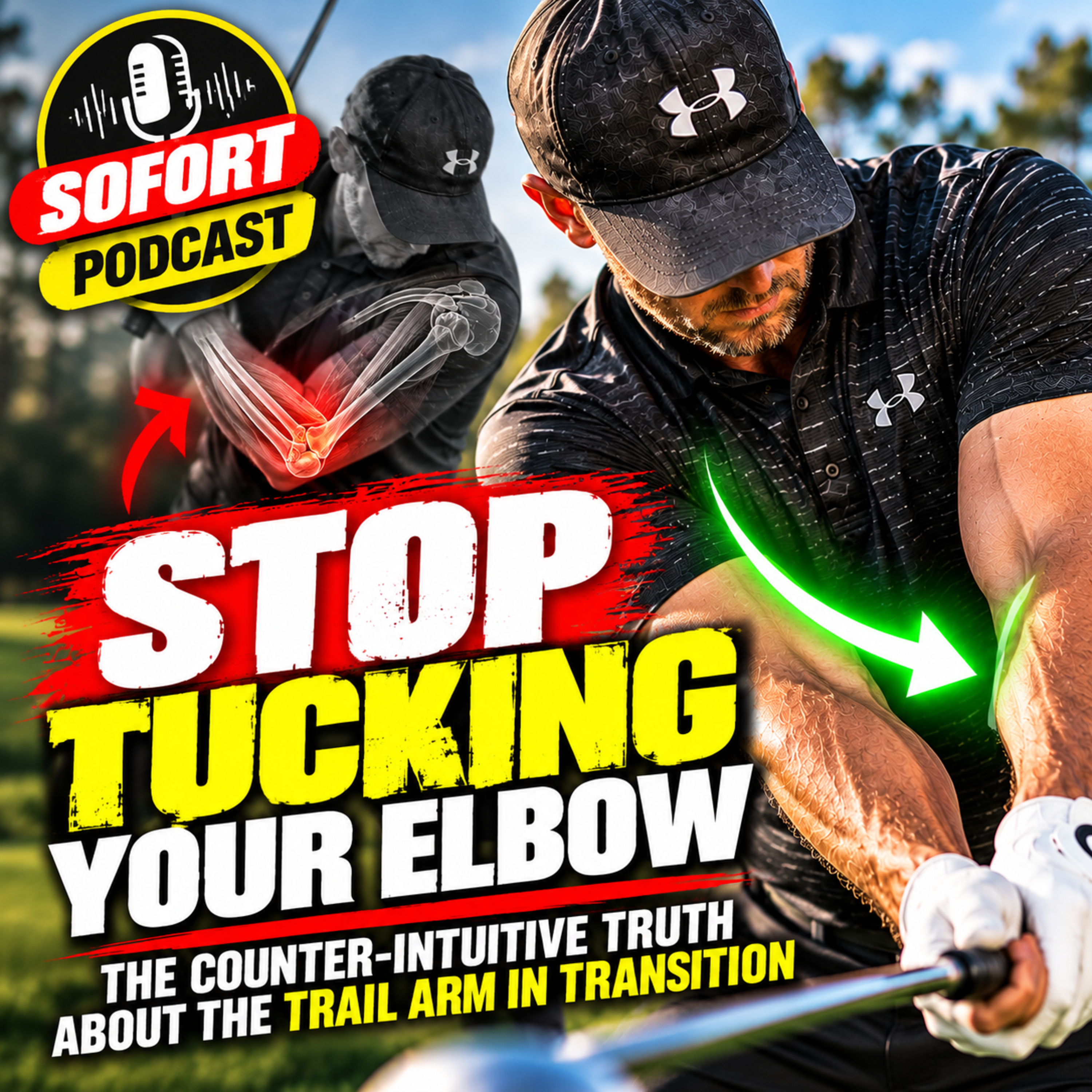 #722 The Biomechanics of Trail Arm Reorganization in Transition 28.09.2026 20minStop "Tucking" Your Elbow: The Truth About the Trail ArmGolfers are often told to “drop the right elbow” during the downswing to prevent an over-the-top move. But aggressively tucking the trail elbow can trap the arm behind the torso, restrict rotation, and create compensations.Transition Is 3D ReorganizationTransition is not a single move. The pelvis, thorax, shoulders, arms, and club change direction at different times.The shoulder complex acts as a transmission system between the rotating torso and the arms.The key principle is:FORWARD & DOWN — NOT DOWN & BEHIND.The trail elbow needs to reorganize toward the space in front of the trail hip while the hands remain within an efficient rotational corridor.Trail-Shoulder External RotationExternal rotation of the trail humerus, combined with dynamic scapular movement across the ribcage, helps organize the elbow, forearm, and hands.Aggressively pinning the elbow can create a “down-and-behind” pattern, potentially leading to stalled rotation, excessive side bend, early extension, and hand manipulation.Internal shoulder rotation is not the problem—the **timing** matters.Shallowing Is an EffectA shallow shaft should be the result of efficient movement—not something golfers manufacture by dropping the hands, rolling the wrists, or forcing the club behind them.Structure creates options.When the shoulder-arm relationship is organized correctly, the club can respond naturally to body motion and inertia. Look UpstreamMany transition problems actually begin in the backswing.If the trail arm collapses between P2 and P4 and the hands become excessively deep, the golfer enters transition with fewer movement options.Functional backswing width creates space for the trail elbow to reorganize during the downswing.WatchItGolf 3D AnalysisWatchItGolf can analyze trail-elbow flexion, hand path, thorax rotation, pelvis movement, and club delivery within the complete sequence:Pelvis → Thorax → Arms → ClubWhen the club becomes steep or the arms feel trapped, don’t immediately manipulate the club.Examine the structure and sequence first.Stop chasing the club. Organize the movement—and let the club respond.My BlogThe Explainerwww.ecoach360.com
 -
 #721 Mastering Distance Wedges: Geometry, Impact, and Precision Control 27.09.2026 18minThe Distance Wedge Trap: Why Moving the Ball Back is Ruining Your Scoring GameDistance wedges demand precise control of strike, trajectory, spin and carry. Yet when golfers struggle with contact, one of the most common fixes is moving the ball farther back to create more shaft lean and “compression.”Biomechanically, this can create more problems than it solves.Ball Position Changes the Entire SystemBall position determines where impact occurs within the club’s 3D swing arc. Move the ball too far back and contact occurs earlier in that arc. This can increase shaft lean, reduce dynamic loft, steepen attack angle and move the low point excessively forward.But the body must also adapt. Pelvis and thorax rotation, pressure distribution, side bend, lift and thrust can all change simply because the golfer is trying to reach a different impact location.Structure determines movement options.Compression Is Not the GoalMore shaft lean does not automatically mean better wedge play. A 50° wedge delivered with excessive forward lean might present only 30° of dynamic loft. The golfer then needs compensations to create sufficient trajectory.This is where spin loft becomes important:Spin Loft = Dynamic Loft – Attack AngleIf dynamic loft becomes too low or attack angle excessively steep, launch, spin, turf interaction and carry consistency can all change.The objective is not the lowest possible trajectory. It is a predictable trajectory and apex.Low Point Comes FirstReliable wedge play begins with controlling low point and centered contact. Before chasing ideal launch numbers, ask:Where is the low point?What is the dynamic loft?What is the attack angle?What is the spin loft?Where is the strike on the face?These variables should be analyzed as one connected system.Connecting Movement to OutcomeThe complete chain is:Ball Position → Body Geometry → Low Point → Attack Angle → Dynamic Loft → Spin Loft → Launch/Spin → Apex/CarryWith WatchItGolf, coaches can connect launch and club-delivery information with 3D movement parameters such as pelvis and chest turn, sway, lift, thrust and side bend, as well as hand and arm movement.Great distance-wedge play is not about forcing the ball down or creating maximum compression. It is about building a repeatable impact geometry that produces the intended launch, spin, apex and carry.My BlogThe Explainerwww.ecoach360.com
 -
 #720 Ground-Up Mechanics: From Foot Stability to Pelvic Rotation 26.09.2026 23minWhy Your Downswing Doesn’t Start at the Hips“Turn your hips harder” is one of golf’s most common instructions. But pelvic rotation is not an isolated action. An efficient downswing is a ground-up chain reaction beginning with the feet, ankles and shins.Elite players often show a small “sink” during transition before aggressively rotating and extending. A key mechanism behind this is ankle dorsiflexion: the shin moves forward over the foot while the heel remains functionally connected to the ground.This creates Triple Flexion:Ankle → Knee → HipThe ankle flexes, the knee accepts load, and hip flexion helps maintain posture and space. Together, these movements allow the body to lower its center of mass and prepare the muscles to produce force.A useful downswing model is:LOAD → SINK → BRAKE → ROTATE → RISEFirst, pressure moves toward the lead side. The body then sinks through controlled flexion, allowing the quadriceps and glutes to absorb load eccentrically. Next, lateral momentum must be braked. A stable lead-side structure allows rotation to accelerate before the body rises through extension and vertical ground reaction force.The principle is simple: Absorb before you explode.The foot is equally important. Rather than balancing only on the balls of the feet, golfers benefit from a Tripod Foot: pressure distributed through the heel, first metatarsal and fifth metatarsal. During transition, the foot initially helps absorb force before becoming a more rigid lever approaching impact.This also helps explain Early Extension. The pelvis moving toward the ball may be a compensation rather than the original problem. Restricted ankle dorsiflexion, insufficient hip internal rotation, poor hip hinge or unstable pressure management can reduce the golfer’s ability to load, brake and rotate efficiently.Instead of simply telling a golfer to “stay down,” ask: What prevents the body from rotating correctly?With WatchItGolf 3D analysis, coaches can examine Pelvis Sway, Lift and Thrust and how they interact with the chest, arms and club. An early Pelvis Lift, for example, may indicate that extension is occurring before the loading phase has been completed.The functional chain becomes:Foot → Ankle → Shin → Knee → Hip → Pelvis → Thorax → Arms → ClubThe downswing therefore does not simply “start with the hips.” The pelvis depends on what happens beneath it.Organize the ground, and the speed will follow.My BlogThe Explainerwww.ecoach360.com
 -
 #719 Lag Is Earned: The Biomechanics of Dynamic Golf Sequencing 25.09.2026 21minThe Lag Myth: Why Holding Your Wrist Angle is Killing Your Swing SpeedFew concepts in golf instruction are as misunderstood as “lag.” Many golfers believe lag is an angle between the lead arm and club shaft that must be held as long as possible. But biomechanically, lag is not a position to maintain—it is a dynamic result of efficient sequencing.Lag Is a Result, Not a PositionTrue lag is the temporary delay between proximal and distal acceleration. It develops naturally when energy moves efficiently through the kinetic chain:Ground → Pelvis → Thorax → Arms → Hands → ClubForced lag occurs when golfers consciously tighten the hands and forearms, lock the wrist angle or drag the handle toward the target. Instead of creating speed, this can interrupt the natural transfer of energy.Dynamic lag is different. The body accelerates first, while the club’s inertia allows it to remain behind temporarily. The club must then release for that stored energy to become clubhead speed.The Kinematic ChainEfficient speed follows a proximal-to-distal sequence. Each segment accelerates, reaches peak velocity and then decelerates, allowing energy to transfer to the next segment.This creates the whip-like effect seen in powerful golf swings.Accelerate → Peak → Decelerate → TransferThe pelvis and thorax cannot simply continue accelerating through impact. Their correctly timed deceleration helps transfer energy toward the arms, hands and ultimately the club.This is why “dragging the handle” can become a speed leak. Holding the club back too long may delay the release, compromise face control and force the body to stall so the clubhead can catch up.Stop Copying Static PositionsA Tour player showing significant lag at P6 is not necessarily trying to hold that angle. Efficient body sequencing and club inertia can create that appearance naturally.The mistake is seeing the position in a 2D image and consciously trying to reproduce it.Modern 3D analysis shifts the focus from static wrist angles toward what actually produces them: pelvis speed, thorax speed, peak timing, deceleration, ground interaction and speed transfer.WatchItGolf helps identify these **Speed Leaks** by examining how movement and velocity are transferred through the body rather than simply judging isolated positions.The goal is not to manufacture lag. It is to create the movement sequence that allows lag to emerge naturally.Ground Force → Pelvis → Thorax → Arms → Hands → ClubLag is temporary. Speed requires release.Stop trying to make lag. Earn it through sequence—and then let the club go.My BlogThe Explainerwww.ecoach360.com
 -
 #718 Stop Chasing the Club: Why the Hands Are the True Window to Your Golf Swing 24.09.2026 22minGolf instruction often focuses on the clubhead—path, face angle and shaft position. But the club is only the final link in a complex biomechanical chain. Trying to fix a steep shaft or open face directly often treats the symptom rather than the cause.A better diagnostic hierarchy is:Club problem → Analyze the handsHand problem → Analyze the bodyBody problem → Analyze setup and structureThe golf swing works through a proximal-to-distal sequence:Pelvis → Thorax → Arms → Hands → ClubThe hands form the critical connection between body motion and club delivery. With WatchItGolf 3D analysis, three key variables can be evaluated:Hand Depth – inward movement relative to the body.Hand Lift – vertical movement of the hands.Hand Thrust – movement toward or away from the ball-target line.Two golfers can look similar at the top but deliver the club completely differently because their hands move differently during transition.Elite players typically create sufficient hand depth during the backswing. This creates space for the hands to move outward during transition without automatically producing an over-the-top motion.When depth and body rotation are properly organized, outward hand movement can help the club remain positioned behind the hands and support functional shallowing.Problems occur when the hands move outward too early:Early Thrust → Lead Arm Disconnection → Shaft Steepening → CompensationThe golfer may then early extend, stall or throw the club simply to reach the ball.The hand path does not operate independently. Pelvis depth, thorax rotation, side bend, arm structure and setup determine the space available for the hands.This creates a clear analysis hierarchy:Ball Flight → Club Delivery → Hand Path → Arms & Shoulders → Body Motion → SetupWatchItGolf 3D measurement helps identify where the chain begins to break down instead of simply reacting to what the club looks like.The objective is not to overload the golfer with data. Measurement identifies the cause; coaching converts that information into a simple movement solution.The club is the outcome. The hands are the window. The body is the engine.Stop chasing the club. Organize the movement—and allow the club to respond.The Hands as the Diagnostic WindowIn Deep → Out WideThe Body Creates the SpaceMy BlogThe Explainerwww.ecoach360.com
 -
 #717 The "Secret" Downswing: Why Your Pelvis Starts Moving Before You Reach the TopThe Myth of the Top 23.09.2026 18minTraditional golf instruction often describes the swing as a simple sequence: finish the backswing, reach the top, then start the downswing. Elite 3D biomechanics shows something different.The backswing and downswing actually overlap. Different body segments change direction at different times—a process called Temporal Separation. One of the clearest examples is the pelvis: it begins moving toward the target before the club reaches the top.What the 3D Data ShowsWatchItGolf PGA reference data for Pelvis Sway:P1 Address: 0.0"P2: −0.2"P3: −0.5"P4 Top: +0.3"P5: +2.1"P6: +3.9"P7 Impact: +4.3"The key is the change from P3 to P4. At P3, the pelvis is 0.5" away from the target. By P4, it has already reversed to +0.3".That means the pelvis is moving toward the target while the club is still completing the backswing.The exact number varies. LPGA reference data shows approximately −0.1" at P4. What matters most is not the number, but when the pelvis changes direction.Pelvis vs. Lead KneeAt P4, something fascinating happens:Pelvis Sway: +0.3"Lead Knee Sway: −2.5"The pelvis has already reversed while the lead knee can still be positioned toward the trail side.The body is not a rigid block. The hip, knee and ankle can reorganize independently. Therefore, the lead knee does not necessarily "trigger" the downswing.Avoid the Emergency TransitionIf an amateur stays on the trail side too long, everything must happen at once:Shift → Lower → Rotate → Arms → ClubElite players organize the movement earlier:LOAD → REVERSE → TOP → ACCELERATEEarly recentering maintains momentum, reduces the need for a violent lateral recovery and prepares the lead side to use ground reaction forces.Load Before You ExtendThe sequence continues:RECENTER → LOAD → LOWER → EXTENDAs the pelvis recenters, the golfer loads and lowers into the lead side. The lead knee's early role is to accept force, not immediately straighten.Rapid lead-leg extension happens later, around P6, helping create vertical force, rotation and energy transfer.Coaching with WatchItGolfDon't just analyze positions—analyze the curve.Does Pelvis Sway change direction between P3 and P4? If it is still moving farther away from the target at P4, recentering may be delayed.And remember: Pelvis Sway is not Center of Mass. They are related concepts, but not the same measurement.The Key Feel"The pelvis goes while the club finishes."Feel the pelvis begin moving toward the target while the club is still completing the backswing.LOAD → RECENTER → LOWER → EXTEND → ROTATEThe pelvis doesn't wait for the club to reach the top.The downswing has already begun.My BlogThe Explainerwww.ecoach360.com
 -
 #716 The Invisible Geometry of Shot Shaping 22.09.2026 22minA common misconception in golf instruction is that hitting a fade and a draw requires two fundamentally different swings. High-level 3D biomechanics shows something very different: elite players can produce contrasting ball flights while their overall movement patterns remain remarkably similar.A player might demonstrate approximately 91° of backswing rotation for a fade and 89° for a draw. The engine remains almost unchanged. What changes is the geometry.The Lead Elbow: Marker, Not EngineOne visible difference is the lead elbow. During a fade, it tends to move left earlier after impact; during a draw, this leftward movement is delayed.But the elbow is not the cause. It is an expression of the entire movement system.DO NOT COACH THE ELBOW. COACH THE SYSTEM THAT MOVES THE ELBOW.With WatchItGolf, coaches can analyze how body motion, arm organization and club delivery interact rather than isolating one joint.The Fade: Creating the Leftward ExitA fade typically requires the lead arm, hands and club to move around the body earlier after impact, supporting a more leftward swing direction.Common tendencies include:Slightly open setupMore leftward swing directionThorax more open at impactThorax positioned slightly more forwardEarlier leftward lead-arm and hand exitStronger leftward curvature of the hand pathOut-to-in club-path biasThe player should not artificially pull the arms left. The body geometry creates the environment in which the arms naturally exit left.Elite shot shaping is not manipulation. It is organization.The Draw: Creating In-to-Out GeometryThe draw uses the same fundamental engine but changes the spatial organization. The lead-side exit occurs later, allowing the hands and club to travel more outward through the hitting zone.Typical tendencies include:More neutral setupMore rightward swing directionThorax less open at impactThorax positioned more behindGreater side-bend tendencyStraighter hand path through impactLater leftward exitIn-to-out club-path biasThese changes create space for the club to approach from the inside without forcing the arms into position.Fade vs. DrawSETUPFADE → Slightly OpenDRAW → NeutralSWING DIRECTIONFADE → More LeftDRAW → More RightLEAD ELBOW EXITFADE → Earlier LeftDRAW → Later LeftTHORAX AT IMPACTFADE → More OpenDRAW → Less OpenTHORAX POSITIONFADE → More ForwardDRAW → More BehindSIDE BENDFADE → LessDRAW → MoreHAND PATHFADE → Curves Left EarlierDRAW → Straighter Through ImpactCLUB PATH BIASFADE → Out-to-InDRAW → In-to-OutThe Shot-Shaping TriangleEffective diagnosis connects three elements:BODY MOTION → CLUB PATH + FACE → BALL FLIGHTThe hand path provides an important bridge between body motion and club delivery. Small changes in thorax position, sway or side bend can alter the hand path, which influences how the club travels through impact.This is where WatchItGolf helps transform observation into measurement.Keep the Engine – Modify the GeometryElite players do not rebuild their kinematic sequence every time they change shot shape. The fundamental sequence remains:PELVIS → THORAX → ARMS → CLUBInstead, they modify the geometry surrounding that sequence.For a fade, the system creates an earlier leftward exit. For a draw, the geometry allows the arms and club to travel outward longer.The goal is therefore not to manufacture two different swings.KEEP THE ENGINE. MODIFY THE GEOMETRY.Elite shot shaping comes from subtle changes in setup, rotation, sway, side bend, hand path and spatial organization. By measuring these relationships with WatchItGolf, coaches can better understand why the club travels the way it does—and move from manipulation and guesswork toward measurable control.My BlogThe Explainerwww.ecoach360.com
 -
 #715 Grounded Power: Why a Pro-Level Swing Starts in Your Ankles 21.09.2026 20minGolf instruction often focuses on the hands, arms and club. But an efficient golf swing is a ground-up kinematic chain, and one of its most overlooked links is the ankle.The ankle influences how the knees, hips and pelvis move, how ground reaction forces are managed and ultimately how efficiently speed can travel through the body into the club.Dorsiflexion: Creating the DropDorsiflexion is the ability of the shin to move forward relative to the foot while the heel remains grounded. In the golf swing, this allows the knees to flex and the pelvis to lower dynamically during transition.Elite movement follows a functional sequence:LOAD → DROP → CHANGE DIRECTION → LIFT → ROTATE → IMPACTThe drop is not a deliberate squat. It is part of the body's unweighting and reweighting sequence, preparing the golfer to push against the ground and accelerate upward and rotationally.When ankle mobility is restricted, the trail knee may move excessively toward the ball, bringing the pelvis forward. What looks like Early Extension or Pelvis Thrust can therefore be influenced by a mobility restriction farther down the chain.The Ankle as a SpringDuring transition, the ankle functions first as a shock absorber and then as a lever:LOAD → STORE → REVERSE → PUSH → RELEASEDorsiflexion helps absorb and store force. As direction changes, the foot and ankle become more rigid, while plantarflexion contributes to pushing against the ground and transferring energy upward.This connects kinetics—the forces producing movement—with kinematics—the movement we observe.Test Your FoundationA simple screening tool is the Weight-Bearing Lunge Test (WBLT). Keep the heel grounded and move the knee toward a wall. Gradually move the foot farther away until the knee can just touch the wall without the heel lifting.Approximately 10 cm is commonly used as a practical reference point for good ankle dorsiflexion.The progression should be:Ankle Mobility → Foot Stability → Knee Control → Hip Rotation → Pelvis Drop/Lift → Rotation → Sequence → Club SpeedThe golf swing is not a collection of positions. It is a coordinated chain reaction from the ground upward. Technology such as WatchItGolf can help us analyze the movement rather than simply guessing from what we see.Before trying to rotate harder or swing faster, make sure your foundation allows the movement to happen.Power starts from the ground—and your ankles are the first link.My BlogThe Explainerwww.ecoach360.com
 -
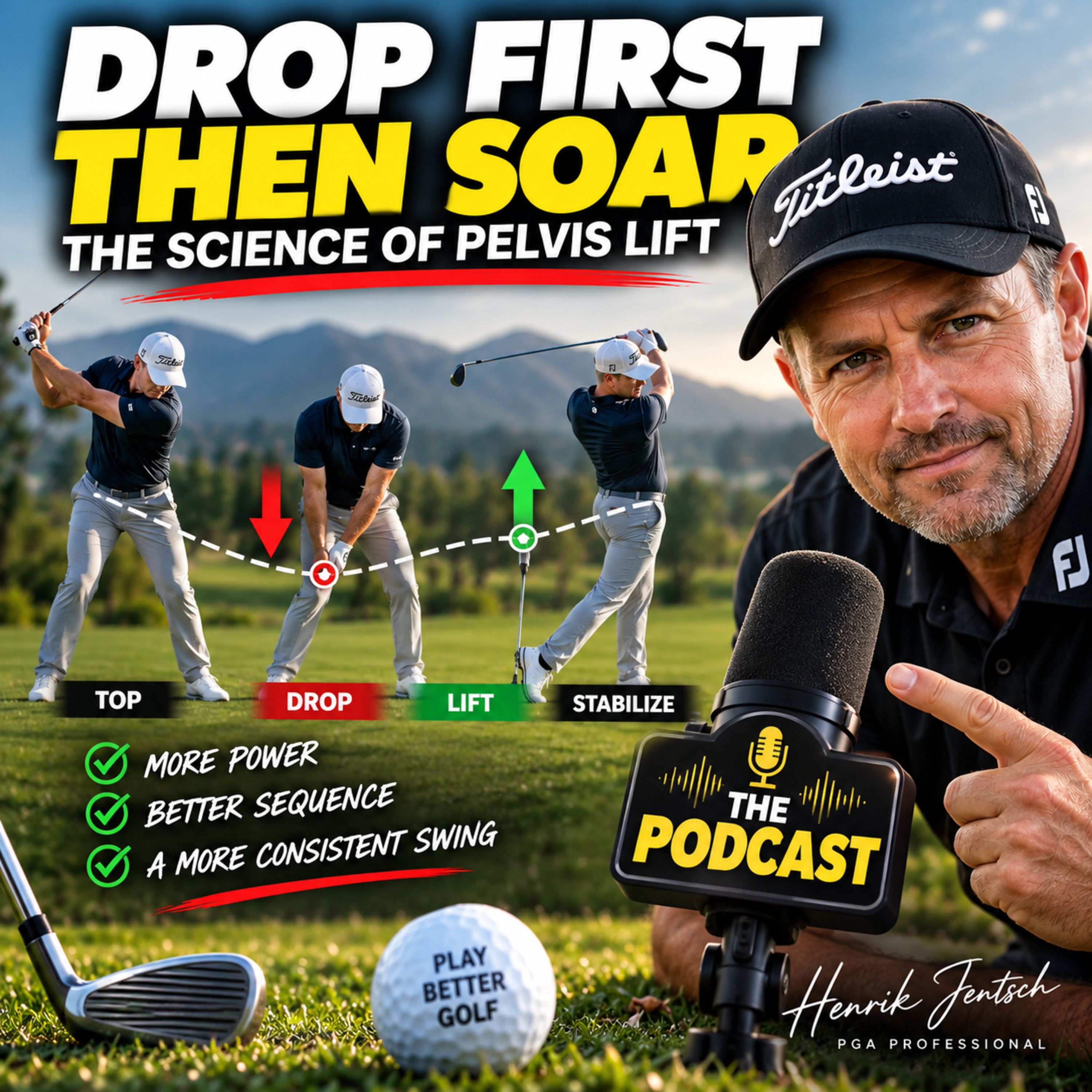 #714 Why Your Golf Swing Needs to "Drop" Before It Can Soar: The Science of Pelvis Lift 19.09.2026 16minA common myth in golf instruction is that staying level creates consistency. In reality, elite golfers use the ground dynamically. One of the key movements behind this is Pelvis Lift—a vertical pattern that helps transform ground reaction forces into rotation and clubhead speed.The pelvis does not remain at a constant height during the swing. High-level players typically follow a clear sequence:Drop → Lift → StabilizeAddress height is the reference point. Moving below it represents a drop; moving above it represents a lift.Surprisingly, the pelvis does not reach its lowest point at the top of the backswing. Tour players may drop approximately 1 inch (2.5 cm) by the top, then continue downward during transition to around 1.3 inches (3.3 cm) below address height.This additional drop helps load the body against the ground before the upward acceleration begins.The lift is not simply a jump. After reaching the deepest point, the lead leg begins to extend forcefully against the ground. For a right-handed golfer, the left leg and hip drive upward and backward.This ground reaction force travels through the leg into the pelvis, helping the hips clear while supporting rapid torso rotation. The lead leg effectively acts like a power piston, converting vertical force into rotational speed.At impact, the pelvis is often already above its address height—approximately 0.5 inches (1.3 cm) for men and 0.8 inches (2 cm) for women. Maximum height typically occurs later in the follow-through, reaching around 1.1–1.4 inches (2.8–3.6 cm) above address.But the exact number is less important than the direction and timing of movement.A major mistake is trying to "jump" from the top. Lifting too early eliminates the loading phase and can destroy timing and leverage.Think instead:Drop → Pressure → Extend → Lift → RotateThe lift should develop naturally from the preceding drop and pressure into the ground.Use this learning progression:Understand → Feel → Rehearse → Hit → Speed UpPelvis Lift is not a position—it is a dynamic movement pattern. Stop trying to stay perfectly level. Learn to drop, create pressure, extend and rotate.The question is simple: Are you fighting the ground—or using it to create speed?Drop – Lift – StabilizeThe Lead Leg Creates the LiftSequence Before SpeedMy BlogThe Explainerwww.ecoach360.com
 -
 #713 Why “Level Shoulders” Are Ruining Your Swing: The 3D Secret to Better Impact 18.09.2026 19minMany golfers struggle with “standing up” or losing posture during the downswing. The common advice to keep your shoulders level can actually contribute to the problem. To rotate effectively while maintaining posture, the body needs Chest Side Bend.The golf swing is not simply horizontal rotation. Because golfers start in forward bend, the chest must rotate and side bend simultaneously. Chest Side Bend is the changing relationship between the chest and shoulder line throughout the swing.During the backswing, the lead shoulder progressively moves down as the chest rotates away from the target. Elite-player 3D data at the top shows approximately:Men: 36° lead-side bendWomen: 32° lead-side bendWithout sufficient side bend, the turn becomes too flat and posture can be lost.The transition creates the major reversal of the 3D wave. The pelvis changes direction first, followed by the chest. Lead-side bend progressively changes into trail-side bend.Change Direction → Keep Turning → Change the BendHolding the backswing bend too long can disrupt sequencing and reduce space for the arms and club.At impact, the pattern is essentially reversed:Men: approx. 31° trail-side bendWomen: approx. 29° trail-side bendThink:Lead Shoulder Down in the Backswing → Trail Shoulder Down Through ImpactRotation combined with trail-side bend creates space for the arms and club while helping maintain posture and control the low point.Trail-side bend continues increasing after impact, reaching approximately:Men: 52°Women: 48°But more is not better. Beyond approximately 60°, the golfer may be “crunching” rather than rotating effectively.Address: Slight trail-side bendBackswing: Lead shoulder works downTop: Peak lead-side bendTransition: Pelvis initiates; lead bend changes to trail bendImpact: Trail shoulder down + chest rotating openAfter Impact: Peak trail-side bendFinish: Tall and balanced, approximately 6°–9° bendThe key is not holding positions but creating the correct 3D movement sequence: Trail → Lead → Trail → Upright.When rotation and side bend work together, you can maintain posture, control low point and create space for a more efficient strike.The 3D WaveBackswing: Lead Shoulder DownTransition: Change the BendImpact: Trail Shoulder DownAfter Impact: Rotate, Don’t CrunchThe Complete 3D PatternMy BlogThe Explainerwww.ecoach360.com
 -
 #712 The Secret Timing of the Pros: Why Your Hips Should Move Before Your Hands 17.09.2026 19minFor decades, golfers have been told to “stay centered” and keep the lower body quiet. But elite 3D biomechanics shows something very different: professional golfers use dynamic pelvis movement to create speed, sequencing and efficient ball striking.Pelvis Sway: A Tool, Not an ErrorPelvis sway describes the lateral movement of the midpoint between the hip joints. Movement away from the target creates the LOAD; movement toward the target creates the SHIFT.The goal is not to eliminate pelvis sway—it is to control and time it correctly. The pelvis must TRANSLATE + ROTATE.The Hidden TransitionOne of the biggest differences between amateurs and professionals is when the pelvis changes direction. Many amateurs swing back, stop at the top, then move forward.Elite players overlap these movements.Maximum movement away from the target occurs before the club reaches the top. While the hands and club are still moving upward, the pelvis has already started shifting toward the target:LOAD → CHANGE DIRECTION → GOProfessional averages demonstrate this clearly. During the backswing, men move approximately 1.0 inch away from the target and women 1.1 inches.But at the top, men are already approximately 0.3 inches toward the target, while women are only 0.1 inches away from address.The transition has started before the backswing visually appears finished.Shift—Don’t SlideDuring the downswing, the pelvis moves strongly toward the lead side. At impact, professional averages are approximately:Men: 4.3 inches toward the targetWomen: 3.1 inches toward the targetBut shifting is not sliding. Sliding is lateral movement without sufficient rotation. Efficient movement combines both:TRANSLATE + ROTATEApproaching impact, the lateral movement begins to stabilize as the golfer posts on the lead side. This creates the foundation for rapid rotation:SHIFT → POST → ROTATEA simple practice sequence is:LOAD → SHIFT → STABILIZE → FINISHLoad slightly into the trail side early in the backswing. Before the hands reach the top, begin shifting the pelvis toward the target. Stabilize on the lead side approaching impact, then rotate through into a balanced finish.The key is not staying still. Elite golfers move earlier, sequence better and stabilize at the right moment.LOAD SLIGHTLY. SHIFT EARLY. ROTATE THROUGH.My BlogThe Explainerwww.ecoach360.com
 -
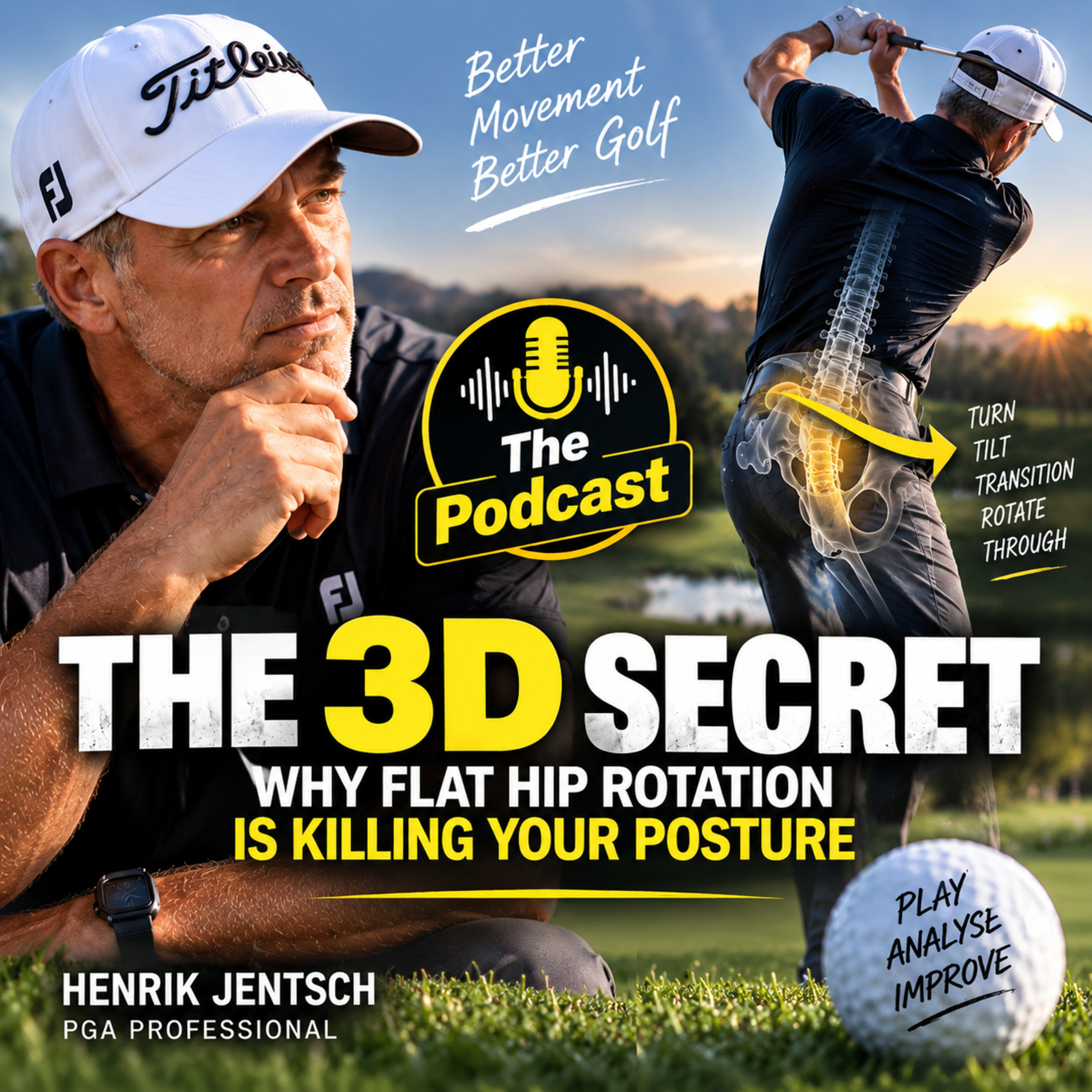
 #711 The 3D Secret: Why Your "Flat" Hip Rotation Is Killing Your Posture 16.09.2026 20minMany golfers are told to “clear the hips,” so they try to rotate as fast as possible. But when the pelvis simply spins horizontally, posture is often lost. The hips move toward the ball, the spine extends, and Early Extension appears.The problem is that the golf swing is not 2D. A functional pelvis moves in three dimensions through Pelvis Turn, Forward Bend and Side Bend. Side Bend allows the pelvis to rotate while maintaining inclination toward the ball.Think of the line connecting your hip joints as a wave:LEVEL → LEAD HIP LOW → TRAIL HIP LOW → LEVELAt address, the pelvis is almost level. During the backswing, the lead hip moves lower. During the downswing, this relationship reverses: the lead hip rises while the trail hip moves lower.Why? Because you are already bent forward at address. If your pelvis remained level while rotating, your body would tend to move away from the ball. Changing hip height helps preserve posture and creates space for the arms and club.Elite players demonstrate a clear pattern:Address: approximately 1° toward the trail sideTop: approximately 9–10° lead-side bendImpact: approximately 9–10° trail-side bendAfter Impact: trail-side bend can peak around 11°That means the pelvis changes roughly 20° from the top to impact.The transition is critical. The pelvis dynamically changes from lead-side low to trail-side low while continuing to rotate toward the target.But don’t manufacture the movement. Excessively collapsing the lead knee or sliding the pelvis toward the target can restrict rotation.Don’t force the tilt. Create the turn and allow the tilt to support it.Place a club horizontally across your hips.At address, keep it almost level. Turn back and allow the lead side to move lower. Then rotate toward impact while the lead side rises and the trail side lowers toward the ball line.Continue through the shot and allow the pelvis to return toward level as you finish.The goal isn’t simply to “turn your hips.” It is to create a coordinated 3D pelvis motion that supports rotation, maintains posture and gives the club room to move efficiently.Stop thinking flat spin.Think:TURN → TILT → TRANSITION → ROTATE THROUGH.The Pelvis WaveThe 20-Degree ShiftTry This DrillMy BlogThe Explainerwww.ecoach360.com
 -
 #710 The Secret Rhythm of the Swing: Why a “Steady” Chest is Holding You Back 15.09.2026 20minOne of golf’s most persistent myths is “keep your head still.” Many golfers interpret this by freezing the upper body, creating a rigid pivot that limits power and disrupts sequencing.3D biomechanics shows something different: the chest is not a fixed anchor. It moves laterally and rotationally throughout the swing. The key is not whether it moves, but when and in which direction.During the backswing, the chest moves slightly away from the target while rotating. For a right-handed golfer, this means shifting toward the trail side.This is not a slide. It is Shift + Rotate, creating dynamic width and space for the arms while allowing a deeper, more functional turn.Elite golfers often begin moving their chest toward the target before the club reaches the top.While the club is still completing the backswing, the body is already reorganizing for the downswing. This overlapping motion creates stretch, improves sequencing and produces a smoother transition.Waiting until the club stops at the top often creates a rushed change of direction.During the downswing, the chest continues toward the target—but lateral movement must be combined with rotation.A pure upper-body slide can stall rotation and block the club. Think:SHIFT + TURNThe body moves forward while continuing to rotate.Around impact, the chest may temporarily move slightly away from the target again.This is not necessarily “hanging back.” As the club and arms accelerate outward, the body can react in the opposite direction as a dynamic counterbalance.Trying to force the chest aggressively toward the target through impact can interfere with this natural response.LOAD AWAY → MOVE TOWARD → REACT AWAY → MOVE THROUGHAfter impact, the chest moves strongly through toward the target, producing a balanced finish.The most important factor is timing—not the total amount of sway. Every golfer will move differently depending on mobility, body proportions and swing speed.The elite golf swing is not built around keeping the chest still. It is a coordinated 3D sequence of lateral movement and rotation.Master the rhythm:AWAY → TOWARD → AWAY → THROUGH.1. LOAD AWAY2. MOVE TOWARD3. SHIFT + TURN4. REACT AWAYTHE FOUR-STEP RHYTHMMy BlogThe Explainerwww.ecoach360.com
 -
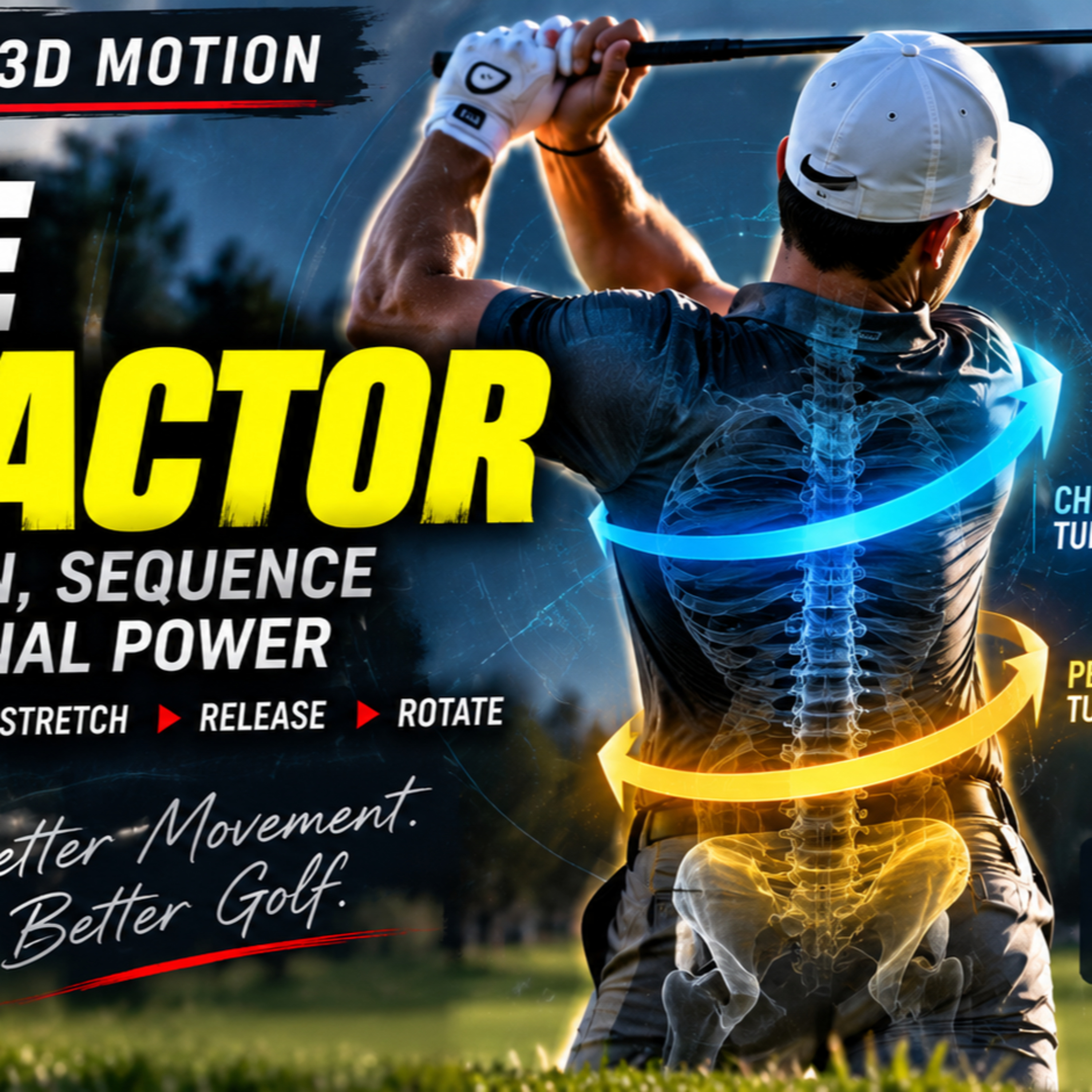 #709 THE X-FACTOR: SEPARATION, SEQUENCE & FUNCTIONAL POWER 14.09.2026 19minMany golfers try to create distance by turning harder, using more arm strength or increasing muscular effort. Efficient golf swings work differently. Speed is created through the coordinated interaction of the pelvis, chest, arms and club. A key part of this is the X-Factor.The X-Factor describes the rotational separation between the pelvis and upper body. The pelvis should not be artificially locked during the backswing. It rotates naturally while the chest rotates farther, creating functional separation. A golfer might demonstrate approximately 45° of pelvis rotation and 90° of upper-body rotation, but these numbers are examples, not universal targets.Importantly, the X-Factor is a 3D movement. Rotation interacts with forward bend, side bend and the orientation of the pelvis and torso.LOAD → STRETCH → RELEASEDuring the backswing, separation helps load the body. But maximum separation may occur during transition rather than at the top. As the pelvis begins rotating toward the target, the chest can briefly remain behind. This momentary increase in separation is known as the X-Factor Stretch and relates to the stretch-shortening cycle.PELVIS GOES → CHEST RESPONDS → CLUB FOLLOWSThis leads directly to the kinematic sequence:PELVIS → CHEST → ARMS → CLUBSequence matters more than simply rotating faster. If everything turns together, separation and potential energy transfer are reduced. But deliberately holding the chest back too long can also disrupt the sequence and leave the club stuck.At impact, the pelvis is typically more open toward the target than the chest because the body is still dynamically unwinding.There is no perfect X-Factor number for every golfer. Functional separation depends on mobility, body structure and individual movement capabilities.SEPARATION + SEQUENCE + TIMING = FUNCTIONAL POWERThe X-Factor is not only about distance. Effective sequencing organizes the swing and can reduce last-second compensations with the hands and arms, creating a more repeatable motion.1. Backswing: Rotate the pelvis naturally while allowing the chest to turn farther.2. Transition: Start the pelvis toward the target while the chest briefly remains behind. Feel the separation increase.3. Release: Allow the chest, arms and club to follow dynamically into a balanced finish.TURN → SEPARATE → STRETCH → RELEASE → ROTATEStop trying to manufacture speed with muscular effort. Create functional power through separation, sequence and timing.FEEL THE X-FACTOR DRILLMy BlogThe Explainerwww.ecoach360.com
Lignende podcasts


Populær i
Denne podcast optræder også i podcast-hitlister i disse lande.
