
Millennials Are Killing Capitalism
Millennials Are Killing Capitalism
0
Millennials Are Killing Capitalism is a podcast created to provide a platform for radical left politics beyond social democratic and progressive organizing. It aims to share ideas and stories from a leftist perspective that are often ignored or misrepresented by capitalist media. The show features communists, anti-imperialists, Black liberation movements, anarcho-communists, left libertarians, LGBTQ activists, feminists, immigration activists, and abolitionists discussing radical organizing. It centers organizers working with marginalized communities on survival programs, political education, and counterpower, and also highlights anti-capitalist struggles from the global south.
Episoder
-
 Yemen Will Not Be Overwhelmed by History With Isa Blumi (audio version) 01.10.2026 1t 50minThis is an audio version of a recently published video episode As many have been closely following the unfolding events in Yemen in recent weeks, we were able to catch up with Isa Blumi, author of Destroying Yemen: What Chaos in Arabia Tells Us about the World. We discussed aspects of Yemeni history which are important to understanding the development of anti-imperialist and anti-systemic forces in the region. Isa Blumi is Professor at Stockholm University within the Department of Asian and Middle Eastern Studies. He is the author of multiple books, including Ottoman Refugees, 1878–1939, Foundations of Modernity, Reinstating the Ottomans, and Destroying Yemen: What Chaos in Arabia Tells Us about the World To support our work please become a patron at https://www.patreon.com/millennialsarekillingcapitalism For previous conversations on Yemen Yemen Strikes Back! Understanding the Latest Developments With Shireen Al-Adeimi Yemen and Palestine in Context with Shireen Al-Adeimi
 -
 Adventures in the Terrible Beauty of Resistance With the 'Death to Toll' Campaign 29.09.2026 1t 6minIn this episode we had the rare opportunity to interview a spokesperson from a direct action group that has targeted Toll Holdings in Australia. The 'Death to Toll' campaign has engaged in a range of sabotage, vandalism and disruptive actions including sledgehammering windows, cutting internet cables, blockading roads and an international port entrance,. They have also slashed lines and cut valves to disable vehicles, covered facilities inside and out with paint and foul liquids, and sabotaged infrastructure such as signal boxes used by Toll. In this discussion we ask them about the development of the anti-zionist movement in Australia after October 7th, 2023. Ask about how the group settled on its target, prepared their campaign, and selected the tactics they wanted to use in their campaign. As our guest raises the spirit of adventure they see as important to taking meaningful direct action to confront the genocidal war machine, I also ask them what they think about allegations of "adventurism" that can be levied from the left at those who take up such action. Because this campaign is heavily under threat by the state we agreed to some additional security measures in this conversation. The voice you hear is not the actual voice of the person we interviewed. The original interview was transcribed and then converted to audio using a text to voice generator. Just as an editorial note or disclaimer: Amid heightened attacks on various forms of speech, as a platform we are not advocating that people engage in any form of illegal activity. But we do have to understand that the greatest crime that humanity has recognized, the crime of genocide, is still ongoing. There are moral, ethical, and even legal imperatives that people are engaging in order to try to stop that crime from continuing to unfold. This interview is a rare opportunity to hear from those who are taking direct action to halt genocide and war crimes. These actions have been threatened with severe repression and many who take these forms of action do face repression. We see it as a journalistic responsibility to ensure that people hear from those who are willing to take action to stop genocide. It is also very important that people show up and support political prisoners if we are to build a movement that is capable of confronting the machinery of genocide and imperialism. Death to Toll website Other interviews: With Calla Walsh With Islambergerak
 -
 Mohamed Khougali on the Sudanese Revolution, Civil War, Racial Regimes, & Socially Reproductive Labor 27.08.2026 3t 3minIn this episode we will speak with Mohamed Khougali about his recently published book Politically Unconscious: The Psychic Aftermath of the Sudanese Revolution, which is out now from our friends at Iskra Books (you can download a free pdf copy). This is an audio version of a video podcast. If you want to watch the video it's available here. Mohamed shares personal insights from his participation with the Neighborhood Resistance Committees during the Sudanese Revolution, he provides a historical backdrop to the Sudanese Civil War, and other moments in which Sudan has become legible to the western audiences, usually only as a site of upheaval or atrocity. It is a powerful conversation that touches on questions of political power, mass revolt, psychotherapy, racial regimes, cooptation, and revolutionary subjectivities. [CONTENT WARNING: The discussion does include discussions of traumatic events and s*xual assault. We do not delve into details or dwell on these stories, but they are used in the context of discussing Khougali's psychotherapeutic practice and events during the revolution] To support our work, gain access to our discord and study groups, please become a patron at https://www.patreon.com/millennialsarekillingcapitalism Mohamed Khougali is a Sudanese socialist writer and psychological practitioner based in Germany, where he continues to organise and serves as president of Black Radicals. His work engages questions of liberation and collective struggle through the combined lenses of the Black radical tradition and psychological theory. Drawing on both intellectual and organisational practice, his research explores the relationship between race, class, colonialism, and subjectivity, with a particular focus on the psychological dimensions of political life and anti-colonial resistance. Check out Mohamed's work with Black Radicals on IG. And if you are interested in his psychotherapeutic practice.
 -
 Producers of Surplus Laborers, Never Citizens: Black Women's Reproduction and Capitalist Empire With T.D. Harper-Shipman 22.08.2026 1t 40minIn this wide-ranging conversation, Takiyah (T.D.) Harper-Shipman joins us to discuss her new book Unruly Fertility: Race, Development, and Decolonial Reproductive Politics (Stanford University Press, 2026). The discussion traces how modern states—from North Carolina to Senegal—have historically sutured Black women's fertility to the shifting demands of capitalist accumulation, deploying reproductive health policies not as benevolent care but as instruments of crisis management and labor control. Harper-Shipman unpacks the colonial origins of "womanhood" itself as a racialized labor category constructed during European enclosures, one that has always excluded Black women from its aspirational promises of citizenship, consumption, and reproductive autonomy. Drawing on Federici, Mies, Spillers, and Angela Davis, she argues that Black women enter the modern political economy as producers of workers—never citizens—and that contemporary feminist movements risk replicating white womanhood's assumptions when they abandon class analysis or ignore the chains of production behind their demands. The conversation also examines the recent closure of USAID, an institution Takiyah describes as fundamentally about the preservation of white life and the extension of U.S. empire. Rather than mourn its end, she urges us to seize this rupture and continue dismantling the colonial infrastructure of reproductive governance it represented. The conversation closes with a powerful critique of the epistemic violence embedded in global family planning campaigns—how metrics like "unmet need" were designed to serve supplier interests, not Black women's desires, and how Black women's embodied knowledge about contraceptive side effects is systematically dismissed as myth while dangerous technologies banned in the Global North are actively promoted across Africa. Throughout, we explore the Americanization of Black political identity from World War II through 9/11 to Obama's presidency, tracing how Black people have been conscripted into U.S. imperial projects through strategic moments of violence and national belonging. This is Part 1 of a two-part conversation; additional questions will be addressed in an August follow-up. T.D. Harper-Shipman is an Associate Professor and Chair of Africana Studies at Davidson College in North Carolina. She teaches courses and publishes on political economy and its intersection with race and gender in Africa. She has published in p Antipode, Oxford Academic, Third World Quarterly, and International Studies Review, among other places. She is an academic editor at Third World Quarterly and forum editor with the Miami Institute of Social Sciences. Her first book, Rethinking Ownership of Development in Africa was published with Routledge Press in 2019. She has also published in public-facing forums including Africa is a Country and the Global African Worker. Reckoning with Empire: Defiant Scholarship with Takiyah Harper-Shipman La femme fait la maison: The Accumulation of Surplus Value through Family Planning in Burkina Faso To support our work and gain access to our discord and study groups please contribute to our patreon!
 -
 Mapping the ADL's Origins in Settler-Colonial Liberalism, State Power, & Civil Rights as Cover with Emmaia Gelman 23.06.2026 1t 45minIn this episode we are joined by Emmaia Gelman, author of The Anti-Defamation League and the Racial State, a critical history of the ADL as a Cold War neoconservative institution. Gelman excavates the Anti-Defamation League's origins as a white, settler colonial institution founded by German-Jewish elites—not to combat antisemitism broadly, but to manage class respectability and suppress Eastern European Jewish immigrant socialists whom they viewed as a racial and social threat. Gelman looks back at how early Jewish settlers had built fortunes through participation in 19th-century US territorial expansion, Indigenous dispossession, and slavery's economic system, understanding themselves as white Europeans racially distinct from the "vermin" arriving from the Pale of Settlement. The ADL and its predecessor, the American Jewish Committee (founded 1906), operated as Progressive Era eugenicist charities designed to "correct and fix" rather than support self-determination, preemptively capturing Jewish political identity to prevent autonomous radical organizing. Gelman traces how the ADL evolved from an instrument of McCarthyite purges—coordinating mass firings of Jewish leftists in 1951, offering its services to McCarthy committee members, and abandoning Julius and Ethel Rosenberg to execution while denying antisemitism played any role in their prosecution (the judge who sentenced them sat on the ADL's Civil Rights Committee)—into a key architect of Cold War anti-communism and neoconservative "democracy promotion." The organization attacked Arab League representatives speaking about Zionist violence in Palestine as early as 1946, treating Palestinian and Arab organizing as "foreign insurgency" while framing Jewish fundraising for Israeli settlement as natural civic participation. After Israel's 1967 military victory, the ADL strategically re-racialized Jews as non-white within the framework of race liberalism, allowing it to cast Israeli militarism as defensive racial liberation and Arab calls for refugee return as antisemitic rather than anti-colonial. This racial pivot occurred precisely as European Jews had achieved economic whiteness through the GI Bill, suburbanization, and the collapse of university quotas—benefits systematically denied to Black populations through redlining. Emmaia Gelman is the author of The Anti-Defamation League and the Racial State, a critical history of the Anti-Defamation League as a Cold War neoconservative institution (UC Press, 2026) and co-editor of The Anti-Defamation League: A Critical Reader (Pluto Press, 2026). She co-hosts the podcast Unpacking Zionism. Emmaia is co-chair of the American Studies Association Caucus on Academic and Community Activism, and a longtime activist in New York City. She is the founding director of the Institute for the Critical Study of Zionism, which examines the political and ideological work of Zionist institutions in Palestine and transnational contexts. She researches the history of ideas about race, queerness, safety, and rights, and their production as levers in surveillance, "anti-terror", and war. Her teaching spans academic and community spaces. If you like what we do and want to support our ability to have more conversations like this. Please consider becoming a Patron. You can do so for as little as a 1 Dollar a month. This conversation was hosted by Josh Briond, and edited and produced by Josh and Jared. The introduction is provided by Aminta Zea (website/IG) and as always the music is provided by Televangel.
 -
 The Camp David Republic: Egypt, Normalization, and the Long Defeat With Nihal El Aasar 13.06.2026 1t 29minIn this episode, Nihal El Aasar returns to this podcast to discuss the competing progressive alternatives in the Arab world prior to the establishment of the State of Israel. Arab attempts to join capitalist systems were obstructed by British and Zionist colonial power, leading to the maintenance of a hegemonic state. We also reference the Union of Arab States and the role of the Zionist entity in hindering regional development. Gamal Abdel Nasser and other leaders in Egypt attempted to create a sovereign economic and political space through nationalist projects. This was actively resisted by Western powers and seen as a threat to imperialist interests. The theory of dependency, as developed by Samir Amin, highlights how underdevelopment in the global South is the result of the expansion of global capital. Nihal argues that while Nasser's project was popular and supported by the masses, his distrust in popular participation and repressive actions against intellectuals helped prevent the project from fully being actualized. The formation of Israel was intertwined with Western efforts to manage the political future of the so-called Middle Eastern region. Israel has hindered the Arab modernization project and has negatively affected the surrounding countries. We discuss how Israel exists in the region to halt the potential of the Arab people as a whole. This is done through repression, impoverishment, and preventing economic prosperity. The U.S. interests in extraction and controlling resources in the region also play a role in this. Apart from that, we meditate on Egypt's early 20th century role as a leader in the Arab world and the expectations placed on its military and economy for stability and development being largely shaped by its history of conflict with Israel and the continued presence of Zionism in the region. The military's control of the economy, rise of religious fundamentalism, and prevalence of conspiracy theories can all be traced back to this relationship. Additionally, Egypt's 20th century development was and continued to be hindered by both structural pressures from outside and its own struggle with overextension as a newly decolonized nation. The working class in Egypt consisted mainly of peasants who were oppressed under the Egyptian monarchy. Land reforms were necessary for progress and industrialization was slowly taking place. From the start, Egyptian nationalism was formed in opposition to Zionism. Nasser faced challenges from the US and its allies and had to build up the Egyptian military in response. We discuss how the nationalization of the Suez Canal and the creation of the United Arab Republic were unprecedented events, but internal struggles and external interference ultimately led to its downfall. The Gulf monarchies have also been deeply intertwined with imperial and capitalist interests since their founding, making them a natural opposition to Arab socialist and progressive projects. The 1973 oil embargo, El Aasar argues, was the last major act of Arab unity but was not an altruistic act of solidarity. The embargo affirmed the importance of the petrodollar for the US and was influential in bringing about the Camp David Accords, which aimed to consolidate the petrodollar and move Egypt fully from the Soviet camp to that of the United States. We meditate on the significance of Camp David and the 1978 peace treaty between Egypt and Israel, arguing that it represents a betrayal of Egyptian sovereignty and a move towards neoliberalism and repression. She also highlights how this has instilled a defeatist mindset in Egyptians and led to ongoing struggles with poverty and domestic warfare. She argues that the current regime in Egypt is a continuation of the "Camp David Republic" and that the promised benefits of peace, such as prosperity and political openness, have been left unfulfilled. If you like what we do and want to support our ability to have more conversations like this. Please consider becoming a Patron. You can do so for as little as a 1 Dollar a month and you will gain access to our Discord. Nihal is an Egyptian writer, researcher, political analyst, radio host and DJ. She has written about politics, political economy, culture, literature and music in several publications including The Baffler, The Transnational Institute, Verso, Jacobin, Tribune, Parapraxis, Mundial, Art Review, The Wire, Protean, Novara media, and others, as well as authoring a book chapter about Egyptian political economy and consulting on related issues. "The Condition for Freedom Is for the Egyptian Masses to Take to the Streets"Egypt's Centrality in the Struggle for Palestine" by Nihal El Aasar Episode artwork includes an artificially colorized version of this photo: "Egyptian President Anwar Sadat and Israeli Prime Minister Menachem Begin acknowledge applause during a Joint Session of Congress in which President Jimmy Carter announced the results of the Camp David Accords." full credit information here: https://commons.wikimedia.org/wiki/File:Sadat_and_Begin_clean3.jpg
 -
 The Financialization of the Culture industries & the False Promises of Spotify 29.05.2026 58minIn this episode we are joined by Rob Arcand to discuss his work on Spotify, streaming, and the financialization of culture. We begin with Spotify's emergence as a supposed democratizing force for working musicians, even as its model relied on surveillance and data-trawling. We explore how this data-driven promise — that listener analytics could be leveraged for touring and merch — reshaped the relationship between artists and audiences, often in ways that reinforced precarity rather than alleviated it. From there, we turn to Arcand's comparison of Spotify's ambitions to Uber and Airbnb, situating streaming within the broader logic of platform capitalism. We discuss how corporate consolidation has shaped the power dynamics of the music industry over the past several decades, and how subscription and ad-supported services emerged from a moment of crisis as neoliberal adaptations to instability. Our conversation also examines how disenfranchisement has paradoxically opened space for new labor struggles within the culture industries, and what a more equitable path forward might look like in an industry dominated by monopoly capitalism. We trace Spotify's shift from search-centric functionality to playlist curation, its "Music for every moment" strategy, and its rebranding from a "celestial jukebox" into lifestyle accessories for individual listeners. Arcand helps us unpack Spotify's editorial logic — from "chill" playlists to hyperpop — and how mood-based categorization blurs the boundaries between artistic expression, consumer mood management, and financialized cultural assets. We consider the assimilation of subcultural genres into profit-seeking structures, the emergence of "Spotifycore," and the recalibration of genre itself for algorithmic infrastructures. Rob is a writer, editor, web developer, and PhD candidate at McGill University in Montreal. He's a former staffer at Pitchfork and SPIN, and has published work on music, visual art, books, film, and technology with outlets like n+1, The Los Angeles Review of Books, Artforum, Art in America, The Nation, The Fader, Rolling Stone, Vice, and more. Twitter: @robarcand If you like what we do and want to support our ability to have more conversations like this. Please consider becoming a Patron. You can do so for as little as a 1 Dollar a month and gain access to our Discord. The Same Stream Twice by Rob Arcand
 -
 Nothing is More Sacred than the Defense of Humanity: Gerald Perreira on Cuba, Iran, Liberation Theology, and the Caribbean 05.05.2026 2t 8minIn this episode, we sit down with Gerald Perreira, longtime Guyanese anti-imperialist activist, educator, and organizer, for a conversation on Cuba, U.S. power, and the unfinished struggle for true independence in the Caribbean and broader Global South. We unpack the tightening of U.S. pressure on Cuba, including the attack on Cuban medical brigades across the region, and examine why Guyana's recent political decisions represent a historic betrayal of transnational solidarity. From Cuba's lifesaving medical internationalism and its decisive role in defeating apartheid forces in Angola and South Africa, to the erosion of Caribbean sovereignty under neoliberalism, we trace the deeper structures of neocolonialism and empire. Perreira situates today's crises within a broader historical arc: the legacy of plantation economies, the transformation of postcolonial elites into managers of foreign interests, the limits of liberal democracy, and the rise of a global axis of resistance. Gerald A. Perreira is a liberation theologian, educator and political activist. He is chairperson of Organization for the Victory of the People (OVP) based in Guyana, a member of the Governing Council of the Global Pan African Movement (Harare) and an executive member of the Caribbean Pan-African Network (CPAN). He lived in the Libyan Jamahiriya for many years and was a founding member of the World Mathaba. He can be reached at mojadi94(at)gmail(dot)com. To support our work please contribute to our patreon Guyana: A Pawn of US Imperialism https://www.ovpguyana.org/
 -
 The Revolt Eclipses Whatever The World Has to Offer with Idris Robinson 04.04.2026 1t 6minIn this episode, we are joined by Idris Robinson to unpack his book, The Revolt Eclipses Whatever the World Has to Offer, a searing meditation on race, revolt, civil war, and the psychic wreckage of American life. Reflecting on the 2020 uprisings, Robinson challenges the myth of Black leadership, reframes racial violence through the lens of a "morbid libidinal economy," and argues that revolution is as much a transformation of the human spirit as it is a political event. Drawing on the legacies of Black insurgency, Robinson interrogates liberalism, identity politics, and the hollowing out of American cities—while pondering on what it would take to make life human again in a society built to dehumanize. He argues that racial violence, especially spectacular acts of white supremacist brutality. cannot be adequately explained by frameworks like identity politics, intersectionality, or privilege theory. Instead, these acts emerge from repressed desires and psychic forces intrinsic to white supremacy. The 2020 uprisings, in this sense, exposed both emancipatory and repressive violence rooted in these deeper libidinal dynamics. Robinson also reflects on his personal trajectory, from Occupy Wall Street through development as a theorist, where he grounds his meditation on revolt as humanizing forces. He argues that American capitalism produces profound isolation, psychic damage, and undead social beings, hollowed out by commodification. Uprisings momentarily restore humanity by breaking atomization and re‑creating collective meaning. On strategy, Robinson challenges traditional socialist models of seizing the "means of production," arguing instead that modern revolt must focus on logistics and infrastructure: transport hubs, electrical grids, supply chains, and urban circulation. He emphasizes blockades, control of space, and understanding the built environment as key to sustaining insurrection in a post‑industrial economy. We devote substantial attention to Robinson's provocative argument that civil war is not a future possibility but a current condition in the United States. Drawing on classical theory, Black radical thought, and historical analogy, he frames civil war as the collision of public (political) and private (libidinal, racial, familial) spheres. While acknowledging its violence and trauma, Robinson argues that fracture and decentralization may paradoxically make revolutionary transformation more achievable, pointing to Reconstruction after the U.S. Civil War as the most emancipatory period in American history. Idris Robinson is a philosopher from the New York hinterlands. For over a decade, he has written extensively on crisis and revolt. He is the author of The Revolt Eclipses Whatever the World Has to Offer (MIT Press / Semiotext(e)) and Escritos desde la tierra baldía (Irrupción Ediciones). He is currently an Assistant Professor of Philosophy at Texas State University, where he is completing a monograph-length study on the progression of Ludwig Wittgenstein's philosophy. He is currently undergoing a legal battle with TSU after the school violated his constitutional rights by ending his contract after he gave an off-campus Pro-Palestine talk. If you like what we do and want to support our ability to have more conversations like this. Please consider becoming a Patron at patreon.com/millennialsarekillingcapitalism. You can do so for as little as a 1 Dollar a month. Links: Order the book from Massive Bookshop IdrisRobinson.me About Idris Robinson's case against Texas State University Support Idris Robinson's Legal Fund
 -
 The Long Transition to Socialism & Unequal Exchange with Torkil Lauesen 22.03.2026 1t 30minIn this episode, longtime revolutionary activist and author Torkil Lauesen returns to the show. Our conversation revolves around two of his recent works published by Iskra Books: The Long Transition to Socialism and the End of Capitalism and Unequal Exchange: Past, Present, and Future. Drawing on a lifetime of political engagement and his close relationship with theorist Arghiri Emmanuel, Lauesen discusses his motivation for writing these books as a means of passing down hard-won knowledge to a new generation of organizers. We examine the "long transition" from capitalism to socialism, a process Lauesen frames through the lens of historical materialism. He also explains how the transfer of value from the periphery to the core through unequal exchange created a dynamic center, enabling capitalism to survive the 20th century. Now, with the decline of US economic hegemony and the rise of a multipolar world system centered on a resurgent China, Lauesen argues we are entering a new phase where the conditions for a genuine transition may finally be emerging. We tackle the critical question of revolutionary method, discussing how to identify the principal contradiction to orient our practice and the difficult strategic choices this framework demands. From the revolutionary history of China to the current geopolitical landscape and the intensifying repression of anti-imperialist movements, Lauesen offers a sobering yet urgent call to organize for the decisive struggles ahead. One quick note, there is a little conversation about Iran in this discussion. This interview was recorded on February 20th so a little before the current war took shape. While you get a little bit of Torkil Lauesen's perspective on Iran and the question of anti-imperialism today, if you want more complete analysis on the topic, there are ten videos up on our youtube page where we've delved into the current war with guests like Adnan Husain, Abdaljawad Omar, Lara Sheehi, Nora Barrows-Friedman, Sina Rahmani, and Hiram Rivera among others. This week we have discussions coming with Bikrum Gill and Nina Farnia from the Anti-Imperialist Scholars Collective. So make sure you are subscribed and have turned on notifications on our youtube page if you want that current analysis amid this world historical struggle. Make sure to head over to Iskra Books to buy copies of these texts we discussed with Torkil Lauesen, and even if you want to check out just remember there are always free PDF copies available on Iskrabooks.org. And of course if you like what we do become a patron of the show to support our work you can do so for as little as $1 a month at patreon.com/millennialsarekilingcapitalism I know these are trying times economically, but also remember that our ability to bring you these conversations is based on your ability as an audience to support the work we do. And a huge thank you to all of you who do support the show. Previously we interviewed Torkil Lauesen about his book Riding The Wave: Sweden's Integration into the Imperialist World System
 -
 Spring Surge to Melt ICE: Dare to Struggle on Building Organized Mass Resistance to Smash the Deportation Machine 15.03.2026 1t 39minIn this episode, we are joined by organizers from Dare to Struggle, a multinational organization committed to struggling against all forms of domination. Throughout this conversation we discuss some of their tactics deployed in response to the recent uptick in ICE raids happening nationally. We take a critical look at what has been effective and what has not, and the stakes for those who are daring to struggle against the deportation machine are up against. We also discuss their recent calls for a Spring Surge to melt ice, please check out the show notes to see how you can connect and get involved with the actions they are trying to spread nationally. Dare to Struggle is a multinational organization open to anyone who wants to resist and stop injustice no matter who holds political office. We don't lobby politicians. We don't use insular activist lingo. We don't chase social media fame. We don't seek careers or corporate sponsorship through activism. We're committed to standing with the people subjected to the horrors of the American nightmare. We go to the neighborhoods facing police brutality, ICE raids, poverty, and evictions, talk to people about the problems they face, and organize people in collective struggle. We know that radical change only happens when people step outside of routine protest or expecting politicians to do it for us and take bold, collective action. If you like what we do and want to support our ability to have more conversations like this. Please consider becoming a Patron. You can do so for as little as a 1 Dollar a month at patreon.com/millennialsarekillingcapitalism. Some of Dare To Struggle's links and info: Dare to Struggle's website Spring Surge Information, Toolkit, and Guides When the enemy retreats, We pursue: On the end of metro surge Why Dare to Struggle takes aim at the left Donate to Support Building a movement against ICE Donate to help Families Demanding Justice throw their first conference
 -
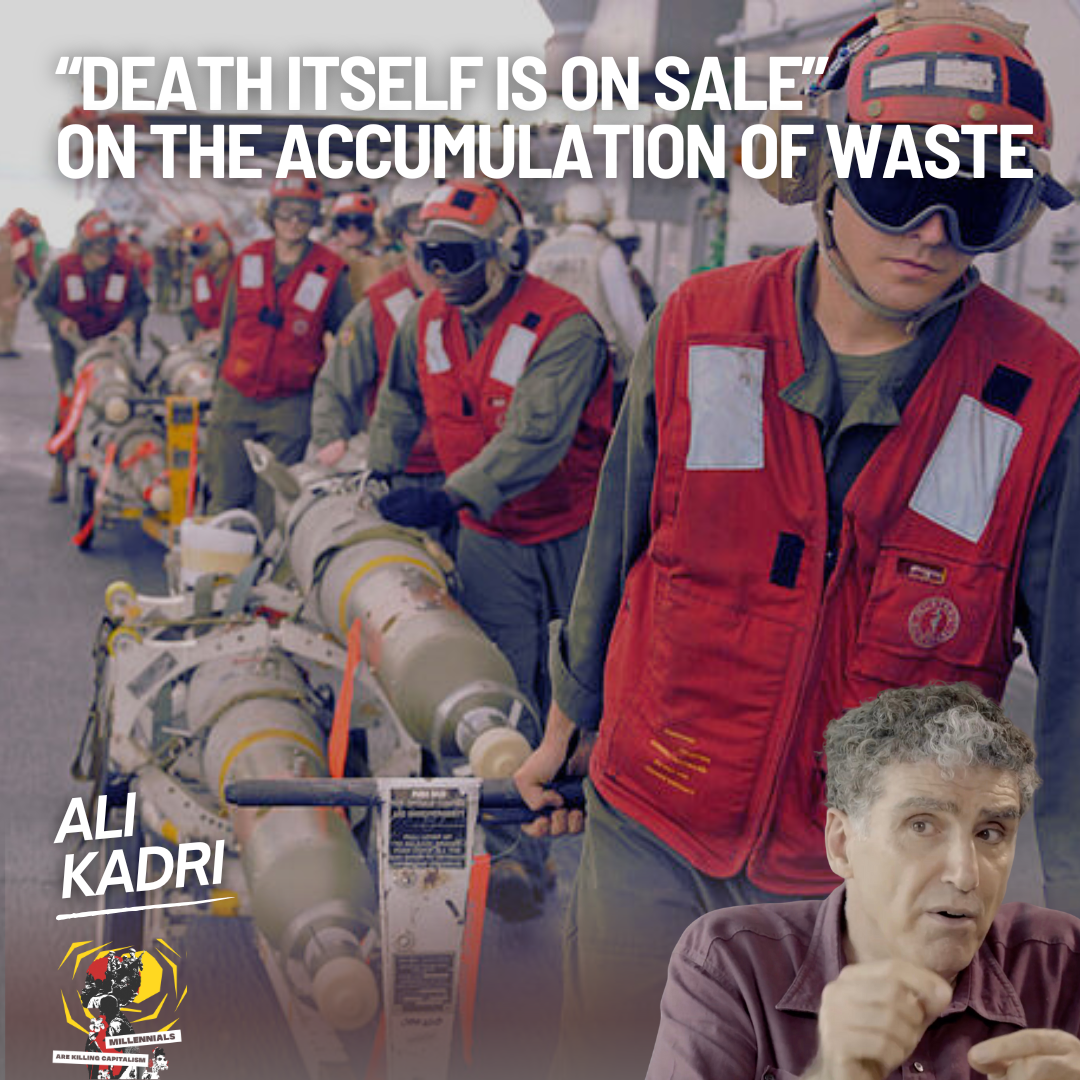 "Death Itself Is On Sale" - Ali Kadri on The Accumulation of Waste 10.02.2026 1t 17minIn this conversation a group of us interviewed Dr. Ali Kadri about his book The Accumulation of Waste: A Political Economy of Systemic Destruction. This conversation was the final discussion in a study group which began last October and involved participants from all over the world. The book provides a theoretical framework which understands waste as a value making process where war-making, the wasting of social classes, and the wasting of social nature become central to capitalist accumulation and to how capital resolves crises in accumulation. The questions in this discussion were those that remained for some of the members upon reading and discussing the work over the last few months. In some cases you will hear members of the group ask their questions directly, in others I ask based on individual questions provided by members or common themes that came up among multiple participants from the group. We get into the imperialist aggression against Iran, the role of patriarchy and racism within Dr. Kadri's analysis, and questions of optimism or hope against the death dealing forces of imperialism. To gain a further understanding of Dr. Ali Kadri's work, check out the first interview we conducted with him back in 2023, and of course check out his books as well as various interviews available online, we will link some of these in the show description. This study group was really rewarding once again, thank you to all of our participants and to Dr. Ali Kadri. In our current study group - which is already full - we are discussing Lenin's Imperialism: The Highest Stage of Capitalism. Our next one will be announced in March, so to ensure you have an opportunity to join us, since they almost always fill up quite quickly, make sure you are signed up on our patreon for as little as $1 a month, all patrons are welcome to join us in these study groups and they are a great place to deepen our knowledge and analysis collectively. Links: European Class Struggle Starts at the Bottom of the Sea with Iker Suárez "War Is the Basis of Accumulation" - Ali Kadri on Genocide, Waste, Imperialism, and the Commodification of Death Check out Guerrilla History's Ali Kadri archives Resistance Is Fertile also has some interviews with Ali Kadri
 -
 Queen Mother Audley Moore: Midwife of Black Revolutionary Nationalism with Dr. Ashley D Farmer 01.02.2026 49minIn this episode, we sit down with Dr. Ashley Farmer to discuss the life and legacy of Queen Mother Audley Moore—an organizer, theorist, and political visionary who helped shape the very foundations of modern Black nationalism and the contemporary reparations movement. Though she was, as our guest writes, "one of the most important activists and theorists of the twentieth century," Mother Moore's figure has been largely confined to a handful of photographs and passing references, even as her ideas reverberate across generations. Dr. Farmer discusses how if Rosa Parks is remembered as the mother of the Civil Rights Movement, then Queen Mother Moore should be understood as someone who midwifed the political traditions of Black radical nationalism. Farmer traces Moore's extraordinary life, which spanned nearly the entire twentieth century—from the aftermath of Reconstruction to the rise and fall of Jim and Jane Crow, all the way until the late 1990s. Like Du Bois, her longevity allowed her to inhabit multiple political worlds, sometimes in tension with one another. We discuss how her early experiences in Jim/Jane Crow Louisiana, witnessing lynch mobs and growing up in a family shaped by both slavery and free Black community life, forged her political consciousness. We also explore the radical sisterhood she shared with Eloise and Loretta, women who were themselves deeply involved in Black liberation struggles and who helped shape Moore's earliest political actions. The conversation moves westward as they examine Moore's migration to Los Angeles, where the promise of escape from Southern racial terror collided with the realities of redlining, discrimination, and the rise of the Ku Klux Klan in Southern California. We look at how these conditions transformed LA into a hotbed of Black nationalist organizing—and how this period pushed Moore toward Chicago and eventually Harlem, where her political life would take on new dimensions. A portion of the discussion centers on the state's surveillance of Moore. Targeted first by HUAC and later by the FBI's Counterintelligence Program (COINTELPRO), Moore amassed thousands of pages of government files—documents that reveal both the threat she posed to the racial order and the broader pattern of state repression directed at Black radical women. Dr. Farmer analyzed thousands of these files and discusses some of what she discovered in them. Dr. Ashley D. Farmer is a historian of black women's history, intellectual history, and radical politics. She is currently an Associate Professor in the Departments of History and African and African Diaspora Studies at the University of Texas at Austin. In addition to this book, she is the author of Remaking Black Power: How Black Women Transformed an Era. If you like what we do and want to support our ability to have more conversations like this. Please consider becoming a patron. You can do so for as little as a 1 Dollar a month. Now, here is Dr. Farmer discussing her book Queen Mother: Black Nationalism, Reparations, and the Untold Story of Audley Moore Related conversations: "Attica Is an Ongoing Structure of Revolt" - Orisanmi Burton on Tip of the Spear, Black Radicalism, Prison Rebellion, and the Long Attica Revolt Free the Land! Edward Onaci on the History of the Republic of New Afrika Black Scare / Red Scare 2025 with Charisse Burden-Stelly "The Shadow of the Plantation" - Eugene Puryear on The Black Belt Thesis: A Reader
 -
 Resisting the Surveillance Systems Behind ICE's Kidnappings with Ed Vogel 28.01.2026 1t 43minIn this conversation we speak with Ed Vogel from Southerners Against Surveillance Systems & Infrastructure about the rapid expansion of various police surveillance programs. We talk about the nexus of private corporations, policing agencies, and nonprofit foundations and organizations that facilitate the expansion of these technologies and how they seek to circumvent democratic processes and oversight mechanisms. We discuss ICE, Customs & Border Patrol, Atlanta's Cop City, Shot Spotter, Flock Safety, Fusus, and automated license plate readers. Ed also talks about what we do and don't know about the role played by corporations like Target and Home Depot in the policing surveillance network. As we see the terror that ICE is enacting in Minneapolis, this conversation offers a set of analyses that can help us understand the problem of ICE's power beyond simply the goons kidnapping or executing people in the street. Rather than just focusing on the expanding problem, we do talk about some of the ways that local communities are fighting back and winning campaigns against the adoption of these technologies. We also talk about maintaining good digital hygiene as an act of solidarity for people in social movements. There are a number of articles that Ed either authored, co-authored, or contributed documents to in the show description. We reference these throughout the conversation and recommend you read them for further details. Southerners Against Surveillance Systems & Infrastructure has a hands-on digital security workshop Wednesday, February 4th. During the session they will walk through how to better protect yourself and community against how ICE is accessing phone data for their kidnappings. Follow SASSI on IG or Bluesky or visit their website. Recently we also featured Dwayne Monroe during one of our livestreams to talk about ICE's use of the surveillance program known as Webloc, the SASSI training will address how to protect cellphone data from this program. If you like the work that we do, please consider becoming a patron for as little as $1 a month at patreon.com/millennialsarekillingcapitalism. It is through the support of our listeners and viewers that we sustain this work and the ability to bring you these conversations. By Enabling Police Surveillance, Elected Officials Fuel Trump's Agenda A Nashville Proposal Could Outsource Surveillance and Policing to a Nonprofit ICE Taps into Nationwide AI-Enabled Camera Network, Data Shows ACPC and Lucy Parsons Labs win open records lawsuit against Atlanta Police Foundation Police surveillance tech and Cop Cities are the State's complementary counterinsurgency strategy Safety from Surveillance Turning Death into a Commodity Background Photo Credit Chad Davis
 -
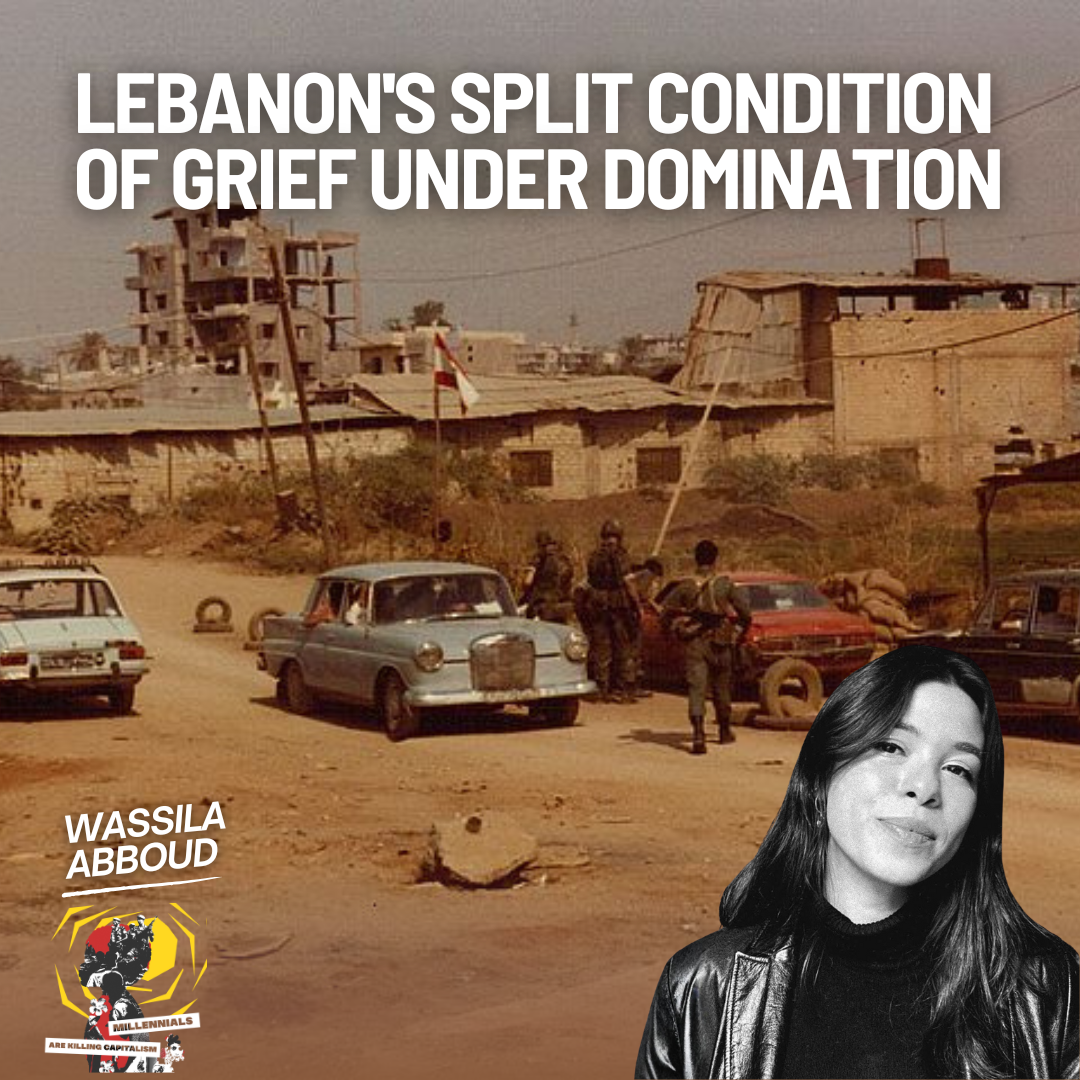 Lebanon's Split Condition of Grief Under Domination with Wassila Abboud 11.01.2026 41minIn this episode we are joined by Wassila Abboud to discuss her essay, "The Dining Table and the Drone." Our conversation begins with her meditations on grief in Lebanon. We explore how people often name today's grief through the language of past griefs — and what this transference between past and present reveals about the psyche under domination. From there, we turn to Walter Benjamin's "angel of history" and why Abboud argues this analogy fails to capture Lebanon's relationship to catastrophe. We discuss why so many returns cluster around 1982, how that year fractured grief itself, reshaping collective memory, political imagination, and the vocabulary of resistance. We examine the paradoxical meaning of ceasefire, the choreography of repeated displacement, and the temporal logic of domination that ensures catastrophe is always waiting just beyond its declaration. Our conversation also situates Lebanon's grief in relation to Gaza's present devastation, asking what it reveals about the impossibility of stability in a regional order sustained by capital accumulation and the extraction of life. We trace the sequence of events between 1978 and 1982 — from Operation Litani to the Camp David Accords and Israel's full-scale invasion of Beirut — not simply as military maneuvers but as the crystallization of a regional order that fractured Lebanon's political landscape and redefined resistance. Wassila Abboud is a cultural worker and writer researching between Beirut and Amsterdam. Her work engages with critical theory, philosophy, and culture and takes on both a speculative and materialist approach, examining the conditions of past and present historical struggles. (Follow her on IG: @wassila_) If you like what we do and want to support our ability to have more conversations like this. Please consider becoming a Patron. You can do so for as little as a 1 Dollar a month at patreon.com/millennialsarekillingcapitalism
 -
 Rootedness and the Black Commune with Austin Cole 29.12.2025 2t 5minIn this episode, we're joined by Austin Cole to discuss the three-part series Black/African Liberation & Grassroots Economies, beginning with part one: "Rootedness for our people, our economies, our liberation." We start with Toni Morrison's concept of rootedness and how it informs urban planning and economic development. From there, we'll dig into Strategies of Counter-war—how fascists are shaping local policy, and how BAP-Baltimore is building alternatives from the ground up. We examine the threat of elite capture and the strategic use of municipal power: how can engagement with the state enable collective self-determination rather than dilute it? Can it do such a thing? We also explore expanded notions of self-defense, the Black commune as theorized by George Jackson and Orisanmi Burton, and the four principles guiding grassroots efforts toward that vision. Finally, we'll sit with the question of mass consciousness—what it demands of us now, and how we might cultivate it together. Austin Cole was raised in Springfield, Ohio, and his people come from the Mississippi Delta and Birmingham, Alabama. He is an organizer, writer, and community development planning practitioner. His professional work focuses on environmental/climate justice, transforming economic systems, and Black/African liberation. He is a member of and currently serves as National Co-Coordinator for the Black Alliance for Peace (BAP) and co-coordinates of BAP's Haiti/Americas Team. Support our work via patreon! Black/African Liberation & Grassroots Economies PT. I: "Rootedness" for Our People, Our Economies, Our Liberation Black/African Liberation & Grassroots Economies PT. II: Situating 'Economy' and Ourselves in the Struggle from the Internal (Neo)Colony Additional writings (not yet released as of the recording of this episode in late 2024) Black/African Liberation & Grassroots Economies PT. III: Constructing the Counter-War That Our Liberation Demands Black/African Liberation & Grassroots Economies PT. IV: Collective Struggle Is Our past and Future
 -
 Give Warmth To Gaza with Hala Sabbah of The Sameer Project (Live Audio) 04.12.2025 1t 22minThis is the audio from a livestream video we hosted with Hala Sabbah from The Sameer Project on December 3rd, 2025. Hala returned to the program to talk about life in Gaza nearly two months into the so-called "ceasefire." We spoke about the realities on the ground and the needs of people in Gaza right now, what is getting into the strip and what is not, and how the Sameer Project is working within the current conditions in Gaza. We also talk about the need for continued organizing, boycotts, and direct action against the zionist entity. And we spoke about creative ways people can fundraise for Sameer Project and other local groups operating on the ground in Gaza. RETURN HOME x The Sameer Project Sameer Project's linktree
 -
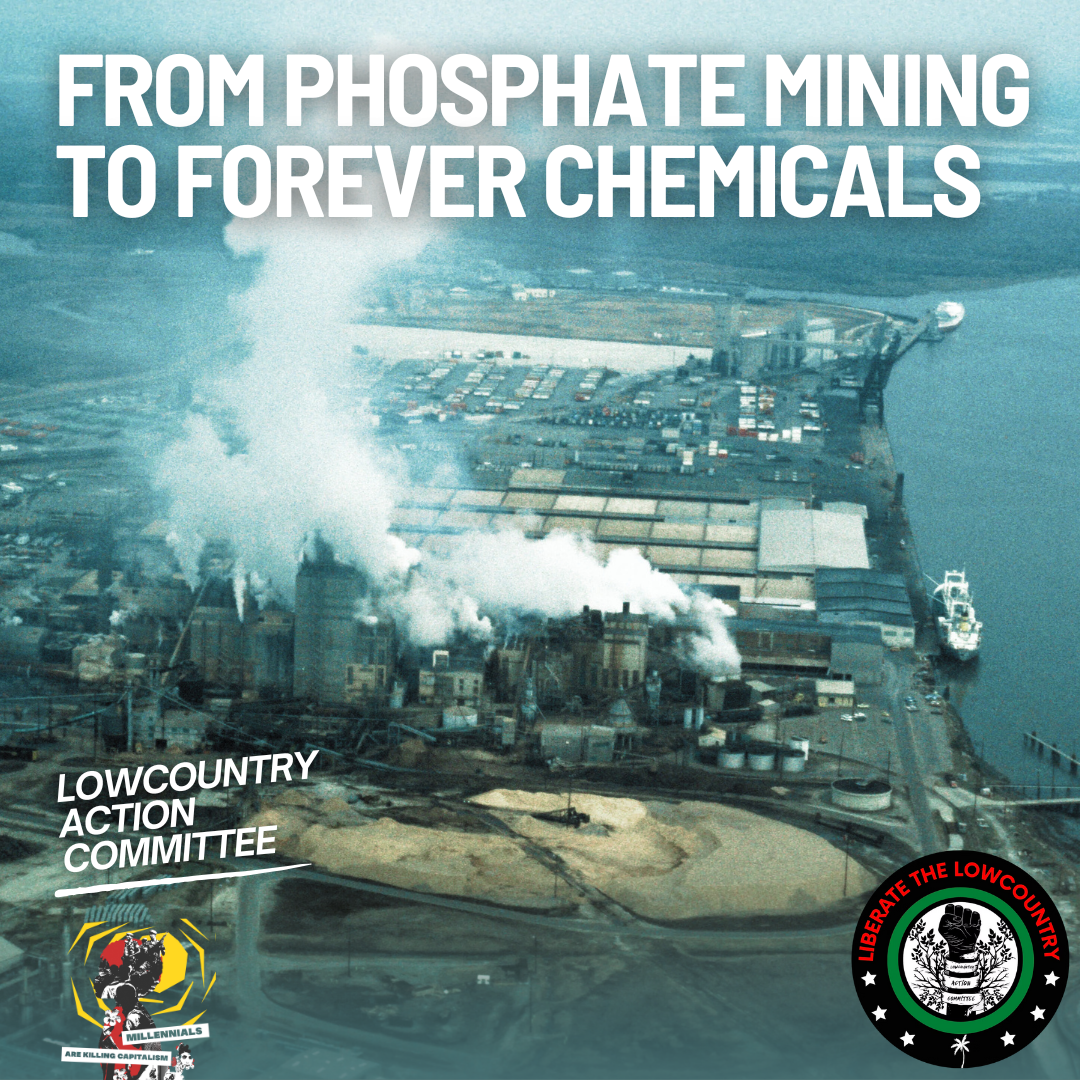 From Phosphate Mining to Forever Chemicals With the Lowcountry Action Committee 04.12.2025 1t 2minIn this episode, we are joined by organizers from the Lowcountry Action Committee to discuss climate justice in South Carolina's Lowcountry. We begin with a discussion about climate reparations and the state's unfortunate priorities. We go on to explore the history of phosphate mining and its exploitation of newly emancipated Africans, the ecological destruction it caused, and its legacy of environmental racism. We then turn to hurricane season and the anxiety it provokes in vulnerable working-class and poor Black communities, followed by the toxic legacy of military pollution and "forever chemicals" in North Charleston. Finally, we reflect on political consciousness, the fight against capital, and whether the Gullah Geechee are punished for their self-determination—echoing Haiti's revolutionary legacy. Lowcountry Action Committee is a Black led grassroots organization dedicated to Black liberation through service, political education, and collective action in the Lowcountry of South Carolina. If you like what we do want to support our ability to have more conversations like this, please consider becoming a patron for as little as one dollar a month at patreon.com/millennialsarekillingcapitalism, you can also support via a one-time donation at BuyMeACoffee.com/MAKCapitalism The piece the conversation is based on this issue of Surge: Lowcountry Climate Magazine Lowcountry Action Committee's Website, LinkTree, Youtube
 -
 Lowcountry Takes Action! with the Lowcountry Action Committee 03.12.2025 1t 17minIn this episode, recorded in the summer of 2024, Josh interviewed two organizers from the Lowcountry Action Committee. Lowcountry Action Committee is a Black African grassroots organization dedicated to Black liberation through service, political education, and collective action in the South Carolina Lowcountry. Our conversation centers around their 2024 piece on environmental racism, where they trace the climate catastrophe, threatening to wash away Gullah Geechee homelands back to the phosphate mining industry of the eighteen sixties. We discuss how today's disproportionate exposure of Black communities to hazardous waste sites, landfills, incinerators is inseparable from the region's history of chattel slavery and why Black people must be at the vanguard of the environmental movement. We then situate the crisis within the broader context of the Black Belt, a historical homeland of Africans trafficked to North America. Now among the most vulnerable regions to climate change, drawing on Kali Akuno's prediction that large portions of the Black Belt may be underwater by 2050. We explore what displacement, housing costs, and organized abandonment mean for Black communities in the Carolinas and beyond. The conversation also turns to international frameworks, particularly Cuba's model of sustainable development and the parallels between Cuban soil erosion and sea level rise and the ecological challenges facing Gullah Geechee communities. We discuss how the Lowcountry itself lives under a kind of economic blockade, how this juxtaposition illuminates environmental racism, neocolonialism, and anti-Blackness. If you like what we do want to support our ability to have more conversations like this, please consider becoming a patron for as little as one dollar a month at patreon.com/millennialsarekillingcapitalism, you can also support via a one-time donation at BuyMeACoffee.com/MAKCapitalism Lowcountry Action Committee's Website, LinkTree, Youtube Crisis in the Carolinas: Racial Disparities, the Climate Catastrophe and Environmental Racism in the Lowcountry Cuba's Life Task: Combatting Climate Change (Tarea Vida) Organizing to Free the Land with Kali Akuno
 -
 The Return of Operation Condor 28.11.2025 1t 20minIn this conversation we speak with a labor organizer and people's historian who covers Latin American movements with connections to Ecuador, Colombia, and Cuba. Folks may know her by the twitter handle @SovietwithSazon. In this conversation she discusses recent struggles and developments in Ecuador. In particular a recent 38 day general strike, and the popular rejection of a recent referendum including measures which would have allowed the US to build military bases in Ecuador and cut public funding for political parties. Our guest contextualizes the current US-backed narco-military regime lead by Daniel Noboa. And she talks about the broader revenge campaign against former Pink Tide governments like Ecuador and Bolivia, now led by right wing forces. She discusses how the tactics we're seeing across Latin America against left-leaning governments, and the disappearances and assassinations of organizers, mark a return of the CIA's Operation Condor tactics. And she discusses how the capitalist class colludes with cartels to create crises that manufacture consent for the state of war decree that Ecuadorians are currently under. We'll include links to follow our guest on twitter, where she will be increasing her reporting on developments in Latin America, and to other episodes where we discuss recent developments with regard to Venezuela, Ecuador, Colombia, and on the topic of general strikes, the general strike Italian workers led a couple months ago. Link to Black Alliance for Peace's Week of Action. As we approach the year end. We're offering up a 40% discount on yearly memberships, or 40% off the first month on monthly memberships for MAKC if you join at the $5 a month level or higher. Buy one for a friend, comrade, or relative. Support our work, help us continue to do more. Use code EOY25. Reminder, if you purchase a yearly subscription for as little as $10.80 per year, you gain access to study groups for all of 2026, our first study group next year won't start until February, but we will have at least 3 study groups you can take advantage of if you are a member. Join now at patreon.com/millennialsarekillingcapitalism
Lignende podcasts


Populær i
Denne podcast optræder også i podcast-hitlister i disse lande.
