
Law School
The Law School of America
0
The Law School of America podcast is designed for listeners who want to expand and enhance their understanding of the American legal system. It provides legal principles in small, digestible bites to make learning easy. If you're willing to put in the time, these podcasts can take you from novice to knowledgeable in a reasonable amount of time.
Folgen
-
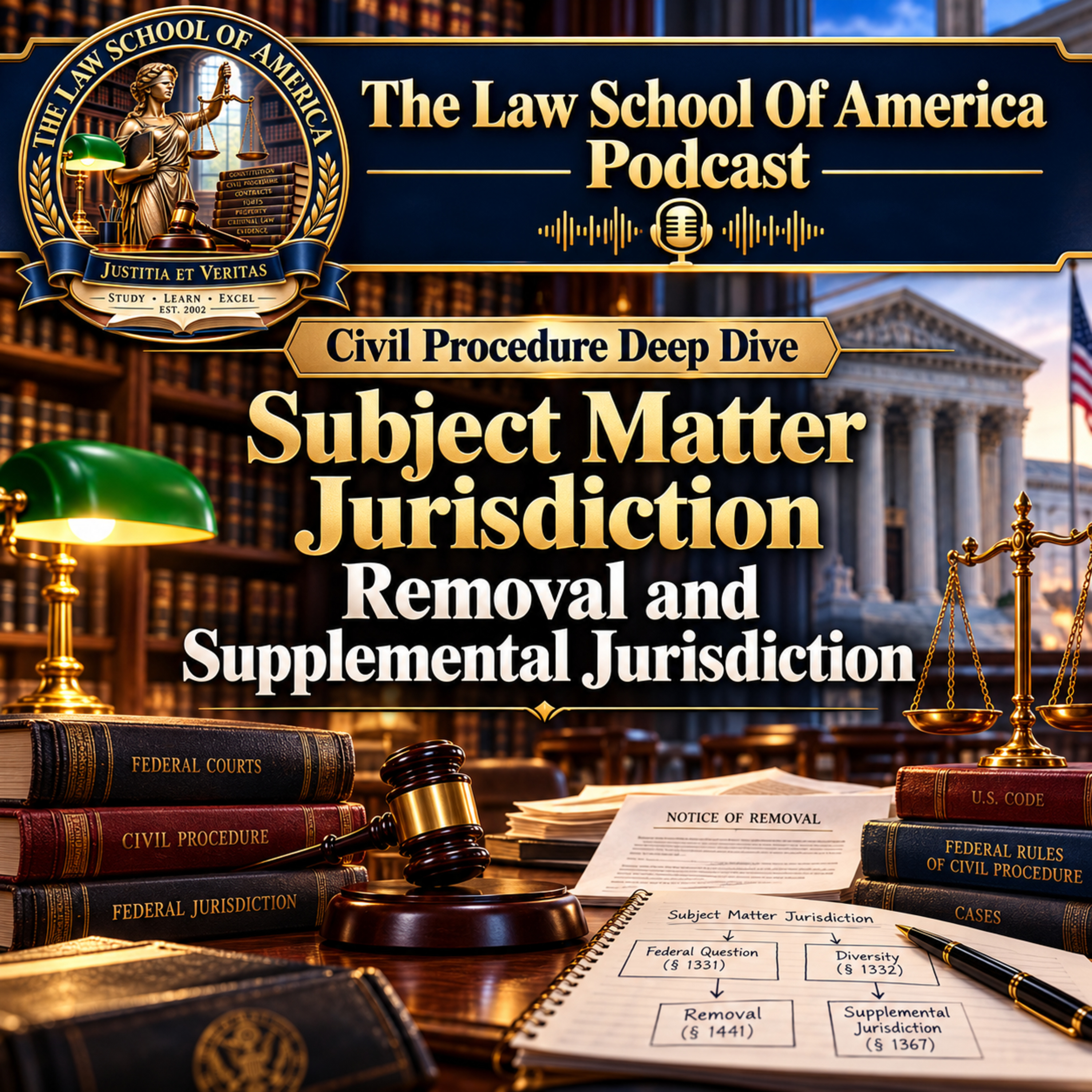 Civil Procedure Part One: Subject Matter Jurisdiction, Removal and Supplemental Jurisdiction 19.10.2026 1Std. 13Min.🏛️ GETTING INTO FEDERAL COURT 🏛️⚖️ Make Jurisdiction Click: [ ✨ CLICK HERE ✨ ] ⚖️📖 Go deeper with an interactive companion guide from The Law School of America.👉 🚀 Open the Interactive Study Guide — and sharpen your understanding! 👈🎧 EPISODE SUMMARY 🎧Approach federal jurisdiction by identifying an affirmative original-jurisdiction basis, determining citizenship and claim value when diversity is invoked, testing each additional claim for supplemental jurisdiction, and then applying removal restrictions separately. Federal defenses ordinarily do not establish federal-question jurisdiction. Domicile, corporate citizenship, and member citizenship require different inquiries. Supplemental jurisdiction demands factual connection and compliance with statutory exclusions. Removal adds defendant eligibility, forum citizenship, deadlines, and consent. Finally, distinguish procedural objections subject to a thirty-day deadline from missing subject-matter jurisdiction requiring remand before final judgment.ℹ️ INFORMATION, PRIVACY POLICY & TERMS OF USE ℹ️The Podcast and Website PurposeThe Law School Podcast and 1L Study Aide webpage supplements law-school and Bar Exam study with strategies, condensed rules, quizzes, and flashcards.Educational DisclaimerContent is for educational and informational purposes only. It is not legal advice, creates no attorney-client relationship, and does not guarantee law-school or Bar Exam success.Privacy PolicyNo account or login is required.This webpage uses no forms or analytics to collect personal information.Quiz and flashcard activity stays in your browser and may clear when local site data is removed.Terms of UseBy using this webpage, you agree to use its content only for lawful, personal, noncommercial educational purposes. It supplements—not replaces—courses, textbooks, official materials, or qualified instruction.
-
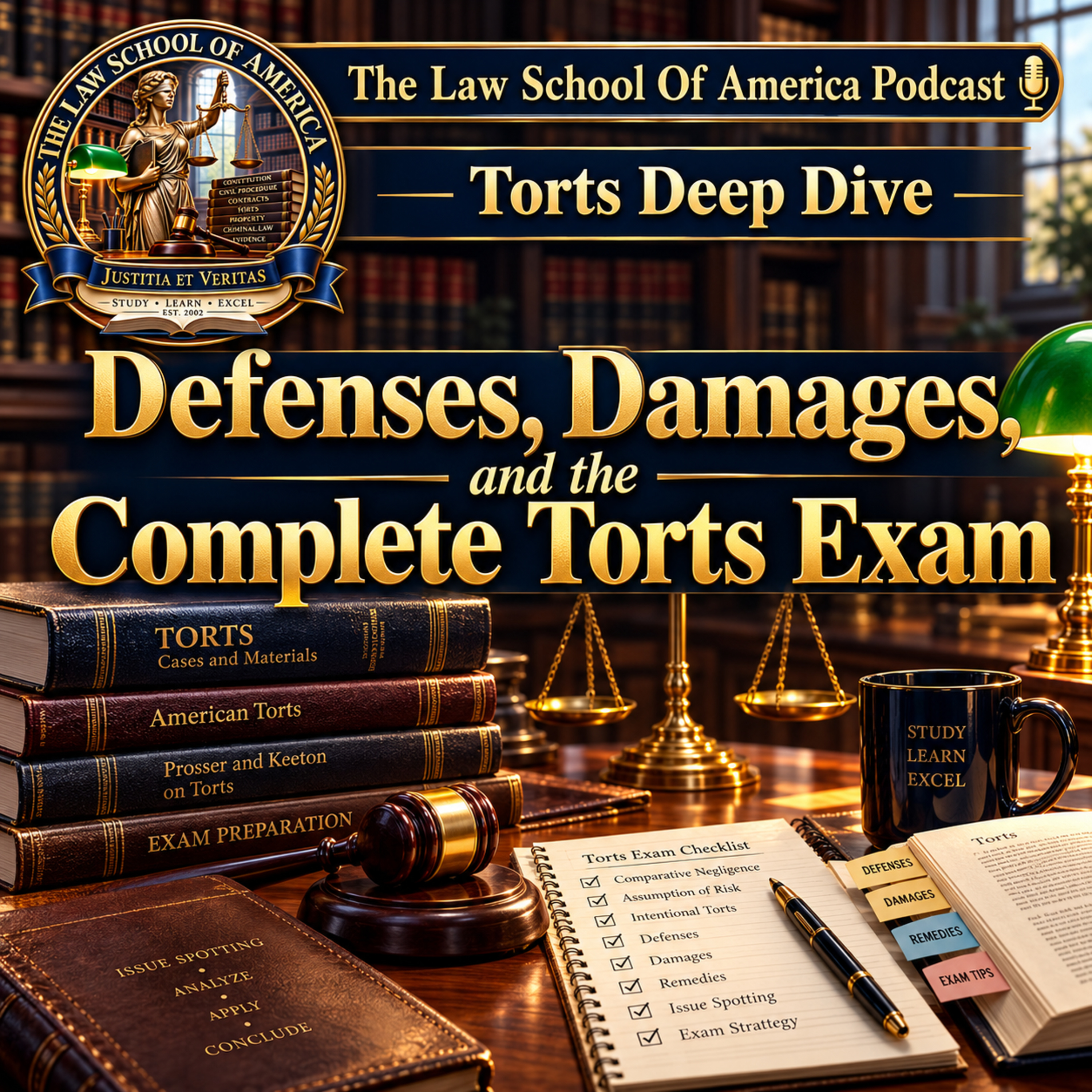 Torts Deep Dive: Defenses, Damages, and the Complete Torts Exam 18.10.2026 1Std. 2Min.⚖️ Make Defenses and Damages Torts Click.⚖️Go deeper with an interactive companion guide from The Law School of America.👉 Open the Interactive Study Guide—and sharpen your understanding.👈🎧 EPISODE SUMMARY 🎧Comparative fault reduces recovery according to the governing pure or modified system; contributory negligence traditionally imposes a complete bar. Assumption of risk requires careful attention to agreement, knowledge, voluntariness, duty, and merger into comparative responsibility. Mitigation concerns unreasonable avoidable loss after injury. Compensation requires proof of legally attributable economic and noneconomic harm, while nominal and punitive damages serve different purposes and have separate prerequisites. A complete torts answer identifies a theory, proves its elements through facts, considers alternatives and defenses, and calculates the recoverable consequences for each responsible defendant.ℹ️ INFORMATION, PRIVACY POLICY & TERMS OF USE ℹ️The Podcast and Website PurposeThe Law School Podcast and 1L Study Aide webpage supplements law-school and Bar Exam study with strategies, condensed rules, quizzes, and flashcards.Educational DisclaimerContent is for educational and informational purposes only. It is not legal advice, creates no attorney-client relationship, and does not guarantee law-school or Bar Exam success.Privacy PolicyNo account or login is required.This webpage uses no forms or analytics to collect personal information.Quiz and flashcard activity stays in your browser and may clear when local site data is removed.Terms of UseBy using this webpage, you agree to use its content only for lawful, personal, noncommercial educational purposes. It supplements—not replaces—courses, textbooks, official materials, or qualified instruction.
-
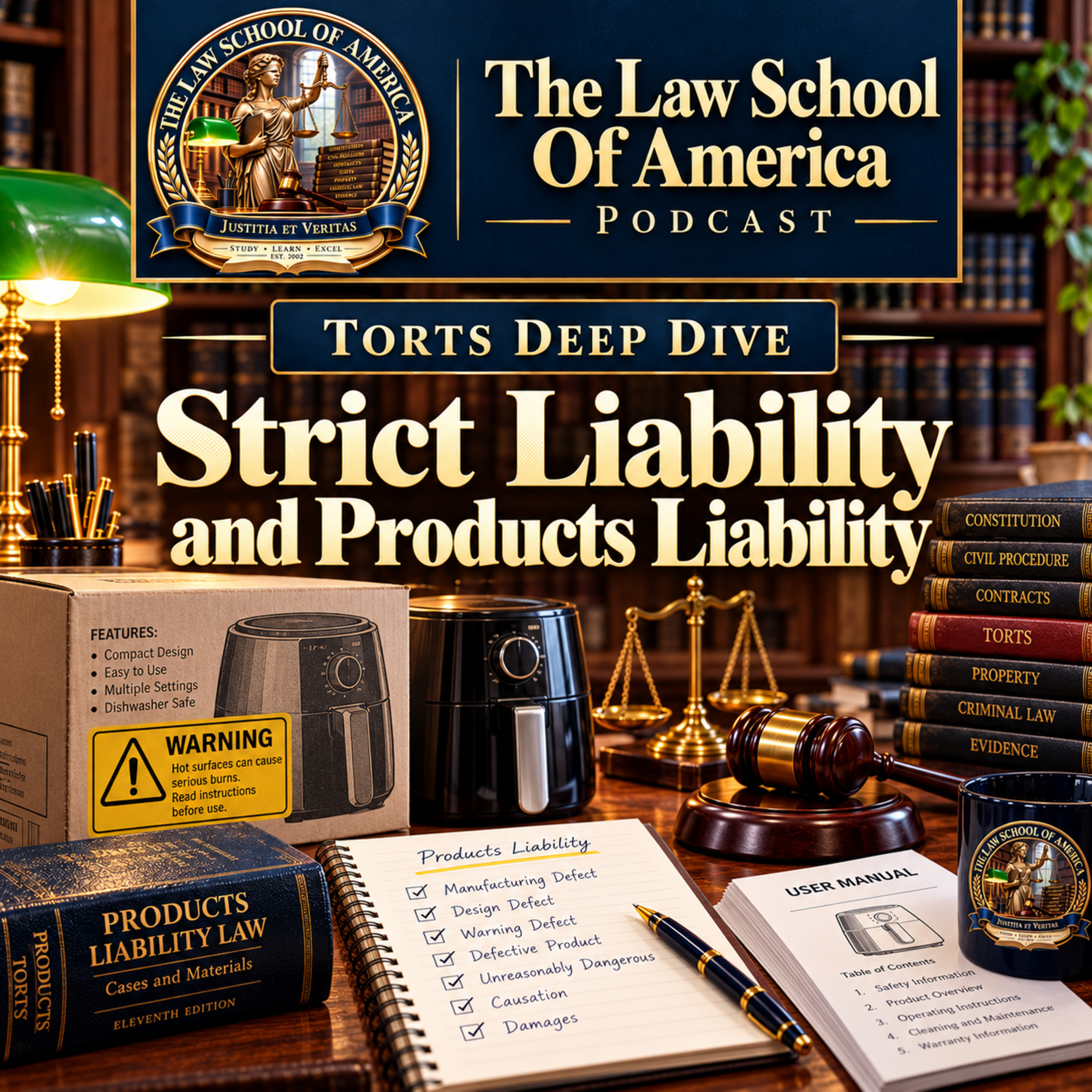 Torts Deep Dive: Strict Liability and Products Liability 17.10.2026 1Std. 6Min.⚖️ Make Strict Liability and Products Liability Torts Click.⚖️Go deeper with an interactive companion guide from The Law School of America.👉 Open the Interactive Study Guide—and sharpen your understanding.👈🎧 EPISODE SUMMARY 🎧Strict liability eliminates the need to prove ordinary negligence only within defined categories. Abnormally dangerous activities are evaluated through factors including residual risk, severity, common usage, location, and community value. Liability generally reaches only harm arising from the danger that makes the activity abnormal. Wild-animal liability and domestic-animal liability likewise require a connection between the relevant dangerous propensity and the injury.A products case may involve negligence, strict products liability, warranty, and misrepresentation. Strict products liability requires a commercial supplier, a product defect existing at the legally relevant time, actual and proximate cause, and damages. Casual sellers are generally excluded, later substantial changes matter, and pure economic loss commonly belongs in contract rather than tort.A manufacturing defect is a departure by a particular unit from its intended design. A design defect challenges the intended configuration and may be tested through consumer expectations, risk and utility, or a reasonable alternative design. A warning defect concerns inadequate communication of a nonobvious, reasonably knowable risk and requires proof that an adequate warning would have affected the injury-producing conduct.Defenses remain theory-specific. Comparative responsibility, assumption of risk, misuse, and substantial alteration depend on knowledge, foreseeability, voluntariness, and causation. The Products Liability Factory supplies a disciplined sequence from design through litigation so that every defendant, defect, representation, defense, and causal link is analyzed separately.ℹ️ INFORMATION, PRIVACY POLICY & TERMS OF USE ℹ️The Podcast and Website PurposeThe Law School Podcast and 1L Study Aide webpage supplements law-school and Bar Exam study with strategies, condensed rules, quizzes, and flashcards.Educational DisclaimerContent is for educational and informational purposes only. It is not legal advice, creates no attorney-client relationship, and does not guarantee law-school or Bar Exam success.Privacy PolicyNo account or login is required.This webpage uses no forms or analytics to collect personal information.Quiz and flashcard activity stays in your browser and may clear when local site data is removed.Terms of UseBy using this webpage, you agree to use its content only for lawful, personal, noncommercial educational purposes. It supplements—not replaces—courses, textbooks, official materials, or qualified instruction.
-
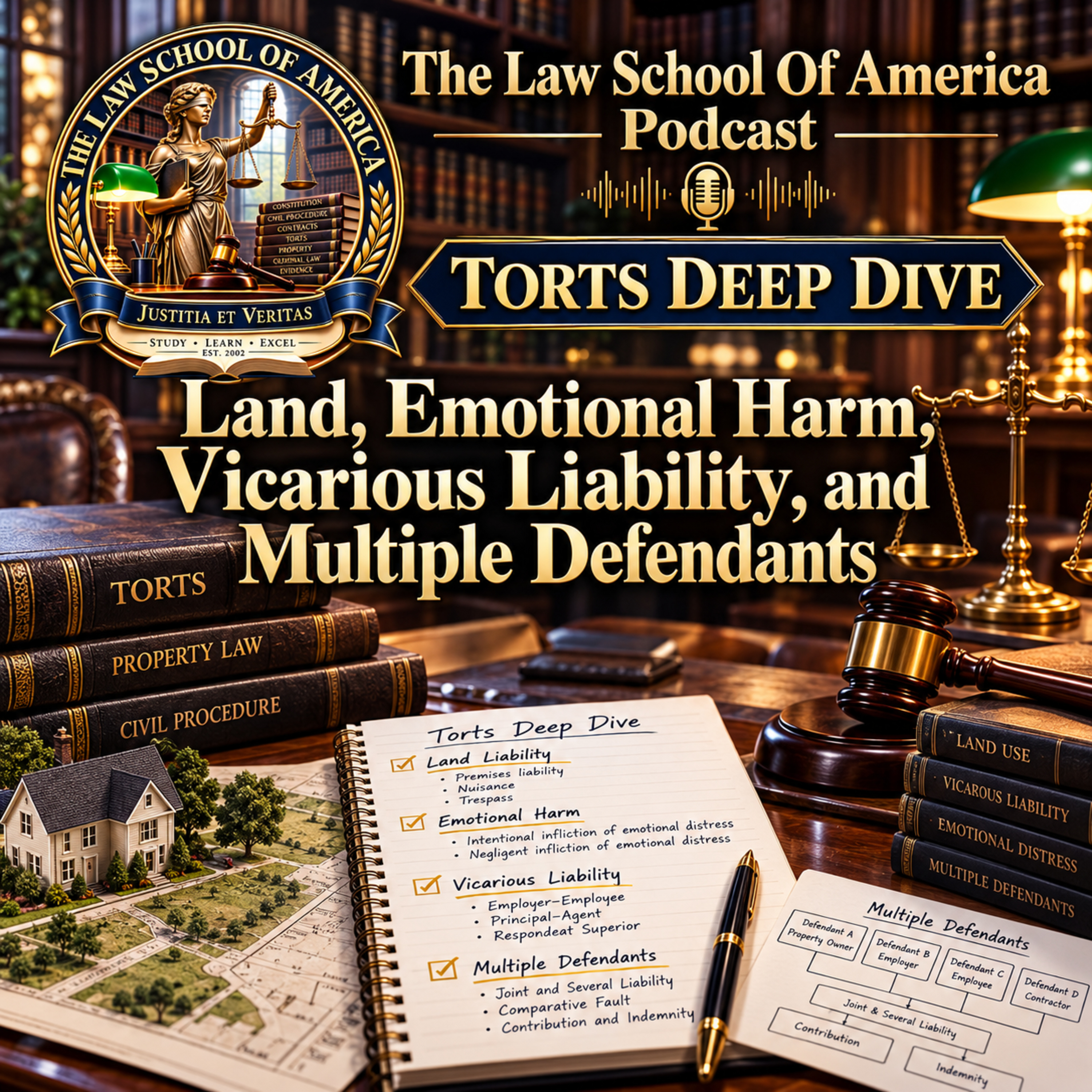 Torts Deep Dive: Land, Emotional Harm, Vicarious Liability, and Multiple Defendants 16.10.2026 1Std. 28Min.⚖️ Make Tort Law Click.⚖️Go deeper with an interactive companion guide from The Law School of America.👉 Open the Interactive Study Guide—and sharpen your understanding.👈🎧 EPISODE SUMMARY 🎧Duties concerning land begin with possession and control. Under traditional rules, invitees receive reasonable care that includes inspection for discoverable hazards, licensees generally receive warnings of known concealed conditions and reasonable care in activities, and trespassers receive limited protection that increases when their presence is known or anticipated. Children may receive special protection from serious artificial conditions. Landlords can retain responsibility through control, concealed defects, negligent repairs, public use, or other recognized exceptions.Negligent infliction of emotional distress is limited by jurisdiction-specific rules. Recovery may depend on impact or physical consequences, personal exposure within a zone of danger, contemporaneous perception of serious injury to a closely related person, or a direct duty aimed at emotional interests. Severe and genuine injury, duty, causation, and proof remain necessary; general foreseeability alone is not enough.Respondeat superior can make an employer liable for an employee's tort within the scope of employment without proof of employer negligence. Worker classification focuses on practical control. Scope considers assigned work, time and place, service to the employer, enterprise risks, personal deviations, and the connection between intentional torts and job duties. Independent-contractor exceptions and direct employer negligence require separate analysis.With multiple defendants, causal divisibility comes first. Comparative fault assigns responsibility, while joint, several, or modified liability determines collection. Contribution divides payment among parties with common liability; indemnity shifts the entire covered loss when a contract, vicarious relationship, or other recognized basis requires it. Settlements and insolvency must be handled under the governing allocation rule.ℹ️ INFORMATION, PRIVACY POLICY & TERMS OF USE ℹ️The Podcast and Website PurposeThe Law School Podcast and 1L Study Aide webpage supplements law-school and Bar Exam study with strategies, condensed rules, quizzes, and flashcards.Educational DisclaimerContent is for educational and informational purposes only. It is not legal advice, creates no attorney-client relationship, and does not guarantee law-school or Bar Exam success.Privacy PolicyNo account or login is required.This webpage uses no forms or analytics to collect personal information.Quiz and flashcard activity stays in your browser and may clear when local site data is removed.Terms of UseBy using this webpage, you agree to use its content only for lawful, personal, noncommercial educational purposes. It supplements—not replaces—courses, textbooks, official materials, or qualified instruction.
-
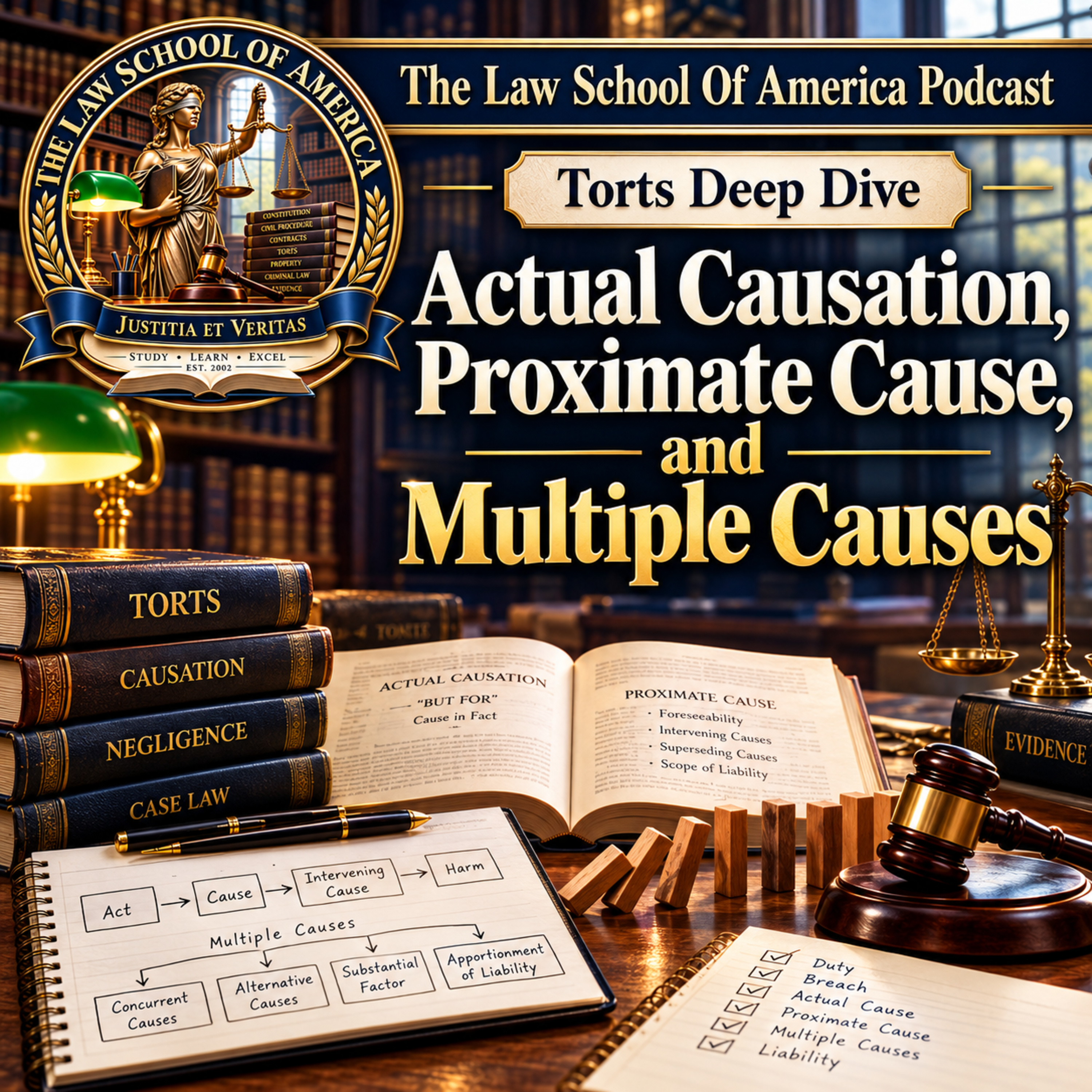 Torts Deep Dive: Actual Causation, Proximate Cause, and Multiple Causes 15.10.2026 1Std. 5Min.⚖️ Make Actual Causation, Proximate Cause, and Multiple Causes Torts Click.⚖️Go deeper with an interactive companion guide from The Law School of America.👉 Open the Interactive Study Guide—and sharpen your understanding.👈🎧 EPISODE SUMMARY 🎧Actual cause asks whether the injury would have occurred when and as it did but for the defendant's tortious conduct. The counterfactual should replace the breach with reasonable conduct while holding unrelated facts constant. The defendant's act need not be the sole cause, and proof may be direct or circumstantial.Multiple necessary causes usually fit ordinary but-for analysis. Multiple sufficient causes require a rule that recognizes each independently sufficient force as a factual cause. Alternative causation addresses uncertainty about which negligent defendant caused the injury and may shift a burden when its strict requirements are met. These doctrines respond to different causal structures.Proximate cause limits liability to harms arising from the risks that made the defendant's conduct tortious. The type of harm and class of persons exposed matter more than the exact manner or full severity. Intervening events do not automatically end liability. Foreseeable rescue, ordinary medical negligence, and misconduct the defendant had a duty to prevent commonly remain within the scope of risk, while extraordinary unrelated events present stronger superseding-cause arguments.The eggshell plaintiff rule concerns extent. Once the defendant actually causes a type of injury within the scope of liability, the defendant generally takes the plaintiff as found and is responsible for the resulting severity.ℹ️ INFORMATION, PRIVACY POLICY & TERMS OF USE ℹ️The Podcast and Website PurposeThe Law School Podcast and 1L Study Aide webpage supplements law-school and Bar Exam study with strategies, condensed rules, quizzes, and flashcards.Educational DisclaimerContent is for educational and informational purposes only. It is not legal advice, creates no attorney-client relationship, and does not guarantee law-school or Bar Exam success.Privacy PolicyNo account or login is required.This webpage uses no forms or analytics to collect personal information.Quiz and flashcard activity stays in your browser and may clear when local site data is removed.Terms of UseBy using this webpage, you agree to use its content only for lawful, personal, noncommercial educational purposes. It supplements—not replaces—courses, textbooks, official materials, or qualified instruction.
-
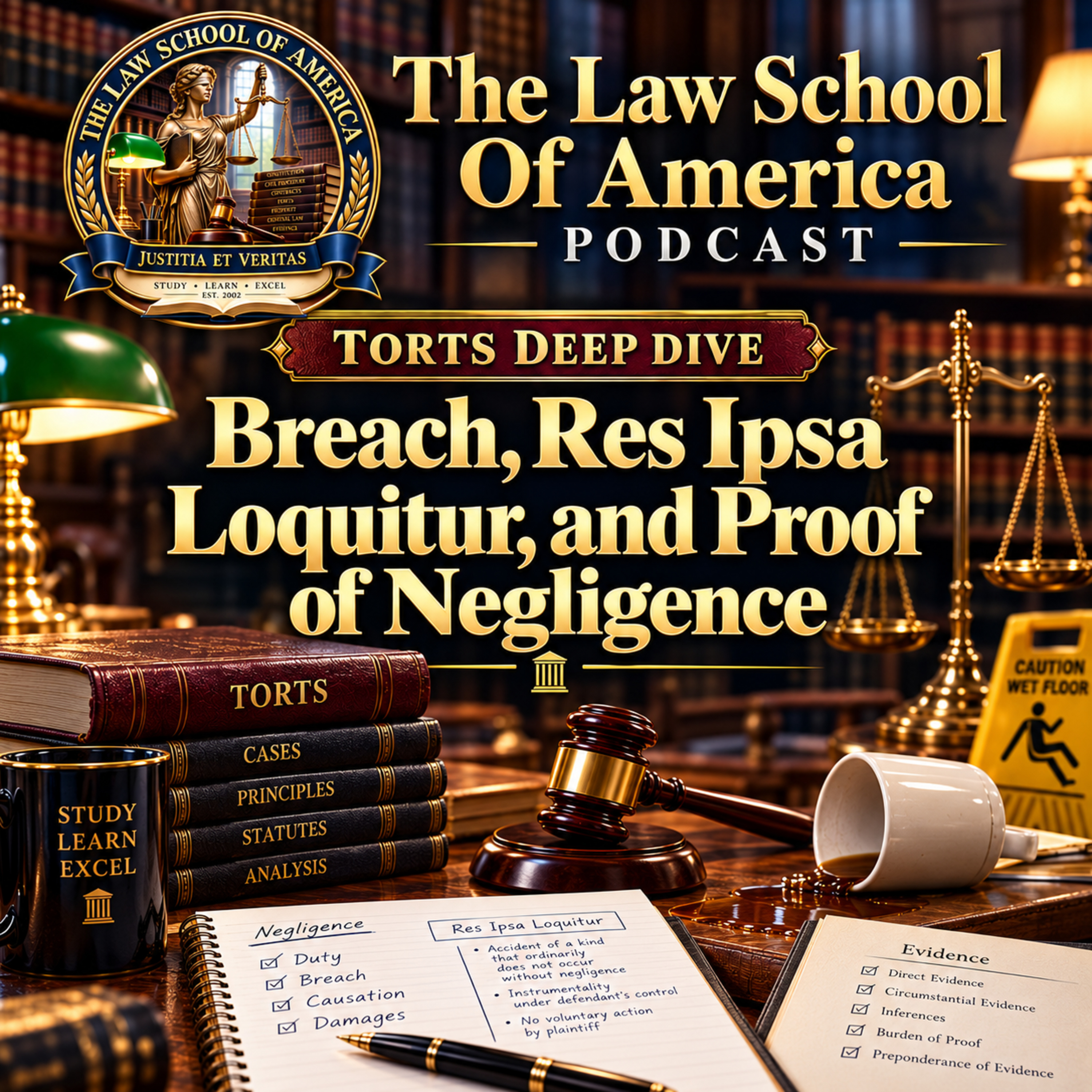 Torts Deep Dive: Breach, Res Ipsa Loquitur, and Proof of Negligence 14.10.2026 1Std. 10Min.⚖️ Make Breach, Res Ipsa Loquitur, and Proof of Negligence Torts Click .⚖️Go deeper with an interactive companion guide from The Law School of America.👉 Open the Interactive Study Guide—and sharpen your understanding.👈🎧 EPISODE SUMMARY 🎧Breach compares the defendant's conduct with the conduct required by the governing standard of care. The plaintiff must identify the challenged act or omission, explain what a reasonably careful person would have done, and connect the difference to the risk. Injury alone and hindsight do not establish breach.Risk analysis considers the probability and magnitude of harm, the burden of precautions, and reasonable alternatives. The Hand formula organizes those considerations by comparing burden with probability multiplied by anticipated loss, but it is usually a qualitative aid rather than a numerical test. Custom, statutory material, expert testimony, notice, and inspection evidence may inform the inquiry without automatically deciding it.Direct evidence proves conduct without an inferential step, while circumstantial evidence supports conclusions from surrounding facts. Premises cases often turn on creation of the hazard, actual notice, constructive notice, and the reasonableness of inspection. The contrast between a newly dropped banana and one that is dirty, flattened, and tracked illustrates how condition can support an inference about duration and notice.Res ipsa loquitur permits an inference of negligence when the event ordinarily does not occur without negligence, the probable negligence is attributable to the defendant, and the plaintiff's conduct does not defeat the inference. It is an evidentiary doctrine within negligence, not a separate tort. The plaintiff must still prove the remaining elements, and the defendant may offer a nonnegligent explanation. A disciplined answer classifies the evidence, explains the inferences, evaluates reasonable precautions, and keeps breach distinct from causation and damages.ℹ️ INFORMATION, PRIVACY POLICY & TERMS OF USE ℹ️The Podcast and Website PurposeThe Law School Podcast and 1L Study Aide webpage supplements law-school and Bar Exam study with strategies, condensed rules, quizzes, and flashcards.Educational DisclaimerContent is for educational and informational purposes only. It is not legal advice, creates no attorney-client relationship, and does not guarantee law-school or Bar Exam success.Privacy PolicyNo account or login is required.This webpage uses no forms or analytics to collect personal information.Quiz and flashcard activity stays in your browser and may clear when local site data is removed.Terms of UseBy using this webpage, you agree to use its content only for lawful, personal, noncommercial educational purposes. It supplements—not replaces—courses, textbooks, official materials, or qualified instruction.
-
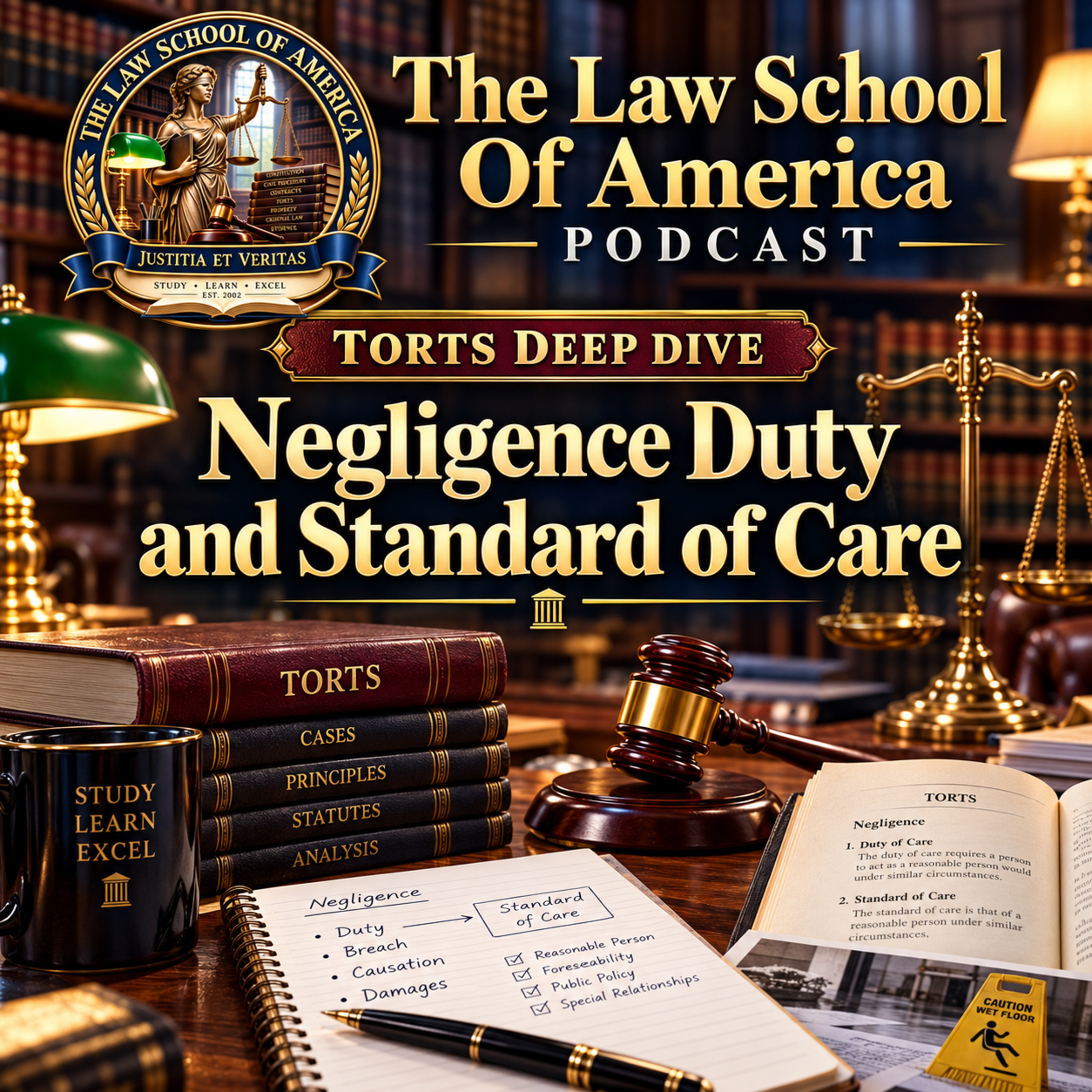 Torts Deep Dive: Negligence - Duty and Standard of Care 13.10.2026 1Std. 28Min.⚖️ Make Negligence, Duty and Standard of Care Torts Click.⚖️Go deeper with an interactive companion guide from The Law School of America.👉 Open the Interactive Study Guide—and sharpen your understanding.👈🎧 EPISODE SUMMARY 🎧Negligence begins with separate questions. Duty asks whether the defendant had a legal obligation toward the plaintiff and identifies the obligation's scope. Breach asks whether the defendant failed to meet the governing standard. Causation, damages, and defenses follow and should not be folded into the duty discussion.The ordinary standard is the conduct of a reasonably prudent person under the same or similar circumstances. It is objective, includes relevant physical characteristics and superior knowledge, and considers genuine emergencies. Ordinary mental limitations generally do not reduce it. Children usually are compared with children of similar age, intelligence, and experience, unless they engage in a dangerous activity normally undertaken only by adults. Professionals are compared with reasonably competent members of their profession when the challenged conduct calls for professional skill or judgment.An omission requires a recognized source of affirmative duty. Important sources include creation of a risk, a voluntary undertaking, special relationships, responsibilities concerning third persons, land possession, and statutes. Negligence per se requires a relevant enactment, a protected plaintiff, a protected type of harm, a violation, the governing effect of that violation, and consideration of excuse. The remaining negligence elements still require proof.Foreseeability can inform duty, breach, and proximate cause, but it performs different work in each place. A careful answer identifies that work instead of using foreseeability as a single conclusion. The most reliable method is to classify the conduct, identify the source of duty, select the proper standard, define its scope, and then evaluate breach under the facts.ℹ️ INFORMATION, PRIVACY POLICY & TERMS OF USE ℹ️The Podcast and Website PurposeThe Law School Podcast and 1L Study Aide webpage supplements law-school and Bar Exam study with strategies, condensed rules, quizzes, and flashcards.Educational DisclaimerContent is for educational and informational purposes only. It is not legal advice, creates no attorney-client relationship, and does not guarantee law-school or Bar Exam success.Privacy PolicyNo account or login is required.This webpage uses no forms or analytics to collect personal information.Quiz and flashcard activity stays in your browser and may clear when local site data is removed.Terms of UseBy using this webpage, you agree to use its content only for lawful, personal, noncommercial educational purposes. It supplements—not replaces—courses, textbooks, official materials, or qualified instruction.
-
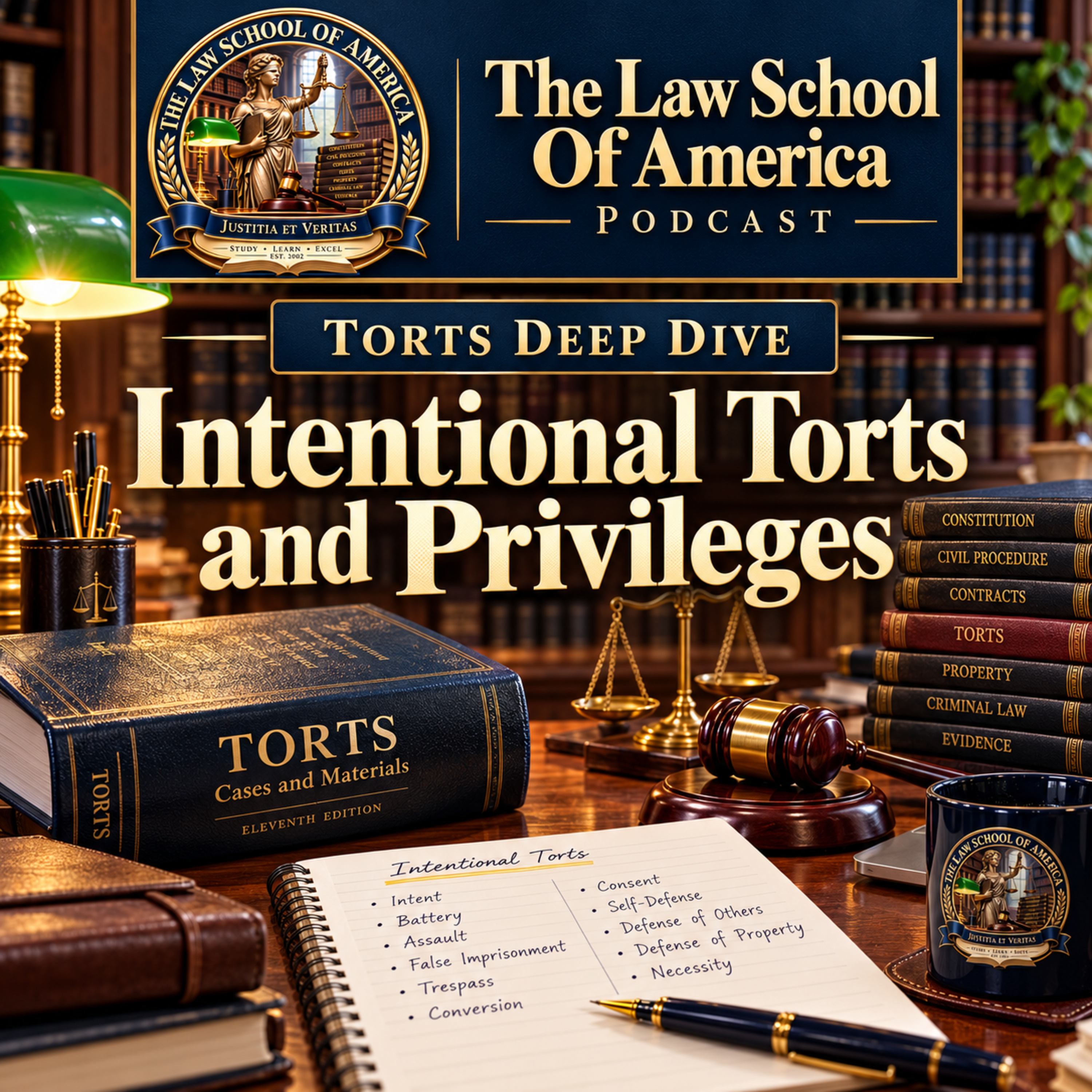 Torts Deep Dive: Intentional Torts and Privileges 12.10.2026 1Std. 2Min.⚖️ Make Intentional Torts Click .⚖️Go deeper with an interactive companion guide from The Law School of America.👉Open the Interactive Study Guide—and sharpen your understanding.👈🎧 EPISODE SUMMARY 🎧 Intentional-tort liability begins with purpose or substantial certainty concerning the consequence that defines the tort; malicious motive is ordinarily unnecessary. Battery protects against harmful or offensive contact, assault against reasonable apprehension of imminent contact, false imprisonment against complete confinement, and IIED against extreme and outrageous conduct that intentionally or recklessly causes severe distress. Trespass to land protects possession of real property. Trespass to chattels addresses meaningful but limited interference with personal property, while conversion addresses interference serious enough to justify payment of full value.Transferred intent can carry intent among the traditional intentional torts and across victims, but it supplies only the intent element. Privileges must be analyzed with equal care. Consent is limited by its scope and validity. Self-defense and defense of others require reasonable, proportionate responses to imminent threats. Property may be protected with reasonable nondeadly force, but not deadly force solely for property. Public necessity is generally complete; private necessity generally requires compensation for actual damage. Legal authority protects only conduct within its lawful scope. The recurring exam discipline is simple: identify the interest, prove the elements, trace transferred intent, and test the precise limits of every privilege.ℹ️ INFORMATION, PRIVACY POLICY & TERMS OF USE ℹ️The Podcast and Website PurposeThe Law School Podcast and 1L Study Aide webpage supplements law-school and Bar Exam study with strategies, condensed rules, quizzes, and flashcards.Educational DisclaimerContent is for educational and informational purposes only. It is not legal advice, creates no attorney-client relationship, and does not guarantee law-school or Bar Exam success.Privacy PolicyNo account or login is required.This webpage uses no forms or analytics to collect personal information.Quiz and flashcard activity stays in your browser and may clear when local site data is removed.Terms of UseBy using this webpage, you agree to use its content only for lawful, personal, noncommercial educational purposes. It supplements—not replaces—courses, textbooks, official materials, or qualified instruction.
-
 Contracts Deep Dive: Remedies and the Complete Contracts Examination System 11.10.2026 1Std. 8Min.⚖️ Hear the rules. Follow the stories. Connect the dots.⚖️Five companion resources from The Law School of America.🎬 THREE ILLUSTRATED GUIDES👉 The Last Edition — Follow the case.👉 The Price of a Promise — Trace the broken bargains.👉 When the Lights Return — Step into the countdown.📚 TWO TEXT GUIDES📖 The Contracts Book — Deepen your understanding.🎯 The Summary Guide — Sharpen your review.See it. Study it. Review it.Explore all three stories, build your foundation with the book, then pull it together with the summary guide.🎧 EPISODE SUMMARY 🎧The culmination of contract law is the application of remedies to restore an injured party. The primary objective is to protect the expectation interest, placing the nonbreaching party in the exact economic position they would occupy had full performance occurred. This requires calculating the loss in value, adding other losses, and strictly deducting any costs or losses the injured party avoided due to the breach.When expectation damages are too speculative, the law protects the reliance interest to restore the plaintiff to their pre-contractual position, or the restitution interest to strip the breaching party of unjust enrichment. While incidental damages are routinely awarded to cover the administrative costs of a breach, consequential damages—such as lost downstream profits—are strictly limited. A plaintiff can only recover consequential damages if they prove foreseeability, certainty, causation, and reasonable mitigation.Parties may dictate their own remedies through liquidated damages clauses, provided the forecast is reasonable and the damages were difficult to estimate at formation; otherwise, the clause is an unenforceable penalty. When money is inherently inadequate to compensate for the loss of a unique item or real estate, courts may order specific performance, though they will never force personal servitude. Under Article 2, buyers remedy breaches through cover, market damages, or warranty deductions, while sellers recover through resale, market damages, or lost profits for volume sellers.Mastery of these remedies represents the final step of the universal contracts sequence. By thoroughly analyzing governing law, formation, consideration, defenses, the Statute of Frauds, terms, conditions, performance, breach, excuse, third-party rights, and finally remedies, the legal analyst operates a complete and infallible contracts examination system.ℹ️ INFORMATION, PRIVACY POLICY & TERMS OF USE ℹ️The Podcast and Website PurposeThe Law School Podcast and 1L Study Aide webpage supplements law-school and Bar Exam study with strategies, condensed rules, quizzes, and flashcards.Educational DisclaimerContent is for educational and informational purposes only. It is not legal advice, creates no attorney-client relationship, and does not guarantee law-school or Bar Exam success.Privacy PolicyNo account or login is required.This webpage uses no forms or analytics to collect personal information.Quiz and flashcard activity stays in your browser and may clear when local site data is removed.Terms of UseBy using this webpage, you agree to use its content only for lawful, personal, noncommercial educational purposes. It supplements—not replaces—courses, textbooks, official materials, or qualified instruction.
-
 Contracts Deep Dive: Excuse, Third-Party Rights, Assignment, Delegation, and Beneficiaries 10.10.2026 1Std. 21Min.⚖️ Hear the rules. Follow the stories. Connect the dots.⚖️Five companion resources from The Law School of America.🎬 THREE ILLUSTRATED GUIDES👉 The Last Edition — Follow the case.👉 The Price of a Promise — Trace the broken bargains.👉 When the Lights Return — Step into the countdown.📚 TWO TEXT GUIDES📖 The Contracts Book — Deepen your understanding.🎯 The Summary Guide — Sharpen your review.See it. Study it. Review it.Explore all three stories, build your foundation with the book, then pull it together with the summary guide.🎧 EPISODE SUMMARY 🎧Mastering post-formation contract execution requires understanding both how duties can be excused and how outside parties interact with the agreement.The excuse doctrines discharge performance when extreme events upset the fundamental assumptions of the bargain. Impossibility requires an objective inability to perform, frequently caused by the destruction of subject matter, supervening law, or death in a personal-services contract. Impracticability offers relief when unforeseen events make performance ruinously expensive or burdensome, provided the risk was not implicitly assumed or allocated by a force majeure clause. Frustration of purpose applies when performance remains possible, but its entire underlying value has disappeared.Third-party rights govern the transfer of contractual interests and the enforcement of promises by non-signatories. An assignment transfers rights to an assignee, who takes them subject to any defenses the obligor had against the assignor. Rights cannot be assigned if it materially increases the burden on the obligor. A delegation transfers duties, but crucially, it does not relieve the original delegator of continuing liability. Only a mutual, three-party novation completely discharges the original party.Finally, intended third-party beneficiaries have standing to sue for breach of contract, whereas mere incidental beneficiaries who happen to profit from the deal have no legal rights. Once an intended beneficiary’s rights vest through assent, detrimental reliance, or filing a lawsuit, the original contracting parties permanently lose the power to alter or cancel the agreement without the beneficiary's consent.ℹ️ INFORMATION, PRIVACY POLICY & TERMS OF USE ℹ️The Podcast and Website PurposeThe Law School Podcast and 1L Study Aide webpage supplements law-school and Bar Exam study with strategies, condensed rules, quizzes, and flashcards.Educational DisclaimerContent is for educational and informational purposes only. It is not legal advice, creates no attorney-client relationship, and does not guarantee law-school or Bar Exam success.Privacy PolicyNo account or login is required.This webpage uses no forms or analytics to collect personal information.Quiz and flashcard activity stays in your browser and may clear when local site data is removed.Terms of UseBy using this webpage, you agree to use its content only for lawful, personal, noncommercial educational purposes. It supplements—not replaces—courses, textbooks, official materials, or qualified instruction.
-
 Contracts Deep Dive: UCC - Battle of the Forms, Warranties, and Risk of Loss 09.10.2026 1Std. 11Min.⚖️ Hear the rules. Follow the stories. Connect the dots.⚖️Five companion resources from The Law School of America.🎬 THREE ILLUSTRATED GUIDES👉 The Last Edition — Follow the case.👉 The Price of a Promise — Trace the broken bargains.👉 When the Lights Return — Step into the countdown.📚 TWO TEXT GUIDES📖 The Contracts Book — Deepen your understanding.🎯 The Summary Guide — Sharpen your review.See it. Study it. Review it.Explore all three stories, build your foundation with the book, then pull it together with the summary guide.🎧 EPISODE SUMMARY 🎧Mastering Article 2 of the Uniform Commercial Code requires abandoning the rigid technicalities of the common law in favor of flexible commercial realities. Formation under Article 2 prioritizes the intent to contract, filling missing terms with statutory gap-fillers to validate the transaction.When parties exchange conflicting commercial forms, Section 2-207 governs the battle of the forms, abolishing the mirror-image rule. A contract is formed on the writings despite additional or different terms, provided acceptance is not expressly conditional. Between merchants, additional terms enter the contract unless they materially alter the deal, while different terms knock each other out.Warranties protect buyers regarding the quality of goods. Express warranties arise from affirmations of fact, descriptions, or models. The implied warranty of merchantability automatically guarantees that goods sold by a merchant are fit for their ordinary purposes, while the implied warranty of fitness for a particular purpose applies when any seller knows the buyer is relying on their expertise. Sellers may utilize disclaimers and limitation of remedies, but implied warranties can only be disclaimed through specific conspicuous language or phrases like "as is." However, "as is" clauses do not destroy express warranties, and unconscionability considerations prevent merchants from disclaiming liability for personal injuries caused by consumer goods.Finally, Article 2 separates ownership/title questions from risk-of-loss questions. Title is a legal abstraction, while risk of loss dictates financial responsibility for destroyed goods. In shipment contracts, risk passes upon delivery to the carrier, whereas in destination contracts, risk passes upon arrival. For non-carrier pickups, merchant sellers retain the risk until physical receipt by the buyer, while nonmerchant sellers pass the risk upon tender of delivery. However, these baseline rules shift under breach effects: a party who delivers defective goods or wrongfully repudiates bears the risk of loss, penalizing the breaching party and protecting the innocent party's expectations.ℹ️ INFORMATION, PRIVACY POLICY & TERMS OF USE ℹ️The Podcast and Website PurposeThe Law School Podcast and 1L Study Aide webpage supplements law-school and Bar Exam study with strategies, condensed rules, quizzes, and flashcards.Educational DisclaimerContent is for educational and informational purposes only. It is not legal advice, creates no attorney-client relationship, and does not guarantee law-school or Bar Exam success.Privacy PolicyNo account or login is required.This webpage uses no forms or analytics to collect personal information.Quiz and flashcard activity stays in your browser and may clear when local site data is removed.Terms of UseBy using this webpage, you agree to use its content only for lawful, personal, noncommercial educational purposes. It supplements—not replaces—courses, textbooks, official materials, or qualified instruction.
-
 Contracts Deep Dive: Conditions, Performance, Material Breach, and Anticipatory Repudiation 08.10.2026 1Std. 19Min.⚖️ Hear the rules. Follow the stories. Connect the dots.⚖️Five companion resources from The Law School of America.🎬 THREE ILLUSTRATED GUIDES👉 The Last Edition — Follow the case.👉 The Price of a Promise — Trace the broken bargains.👉 When the Lights Return — Step into the countdown.📚 TWO TEXT GUIDES📖 The Contracts Book — Deepen your understanding.🎯 The Summary Guide — Sharpen your review.See it. Study it. Review it.Explore all three stories, build your foundation with the book, then pull it together with the summary guide.🎧 EPISODE SUMMARY 🎧Determining what happens after formation requires a rigorous evaluation of conditions, performance standards, and the timing of a breach.Conditions determine whether a duty to perform ever arises. Express conditions require strict compliance, while constructive conditions—implied by courts to order performances—require only substantial performance. Conditions precedent must occur before a duty arises, whereas conditions subsequent extinguish an existing duty. Conditions may be legally excused if a party wrongfully prevents their occurrence or voluntarily waives them.When performance falls short, the governing legal regime dictates the result. Under the common law, a material breach deprives a party of the benefit of the bargain and completely excuses their return performance. Conversely, substantial performance means the contract remains binding and the nonbreaching party must perform, though they may deduct damages for the minor shortfall.Article 2 abandons substantial performance in favor of the perfect-tender rule, allowing a buyer to reject goods that fail to conform in any respect. However, this strict rule is balanced by the seller's right to cure before the deadline, the rules dictating final acceptance of goods, the high bar for revoking that acceptance, and the substantial-impairment standard applied to installment contracts.Finally, if a party issues an unequivocal repudiation before performance is due, the nonbreaching party may sue immediately or suspend their own performance. A repudiation may be retracted unless the innocent party has detrimentally relied upon it or finalized the breach. If a party is merely insecure rather than unequivocally repudiating, they may demand adequate assurances, transforming uncertainty into a clear legal resolution. Mastering these doctrines ensures absolute precision when analyzing the execution and breakdown of contractual relationships.ℹ️ INFORMATION, PRIVACY POLICY & TERMS OF USE ℹ️The Podcast and Website PurposeThe Law School Podcast and 1L Study Aide webpage supplements law-school and Bar Exam study with strategies, condensed rules, quizzes, and flashcards.Educational DisclaimerContent is for educational and informational purposes only. It is not legal advice, creates no attorney-client relationship, and does not guarantee law-school or Bar Exam success.Privacy PolicyNo account or login is required.This webpage uses no forms or analytics to collect personal information.Quiz and flashcard activity stays in your browser and may clear when local site data is removed.Terms of UseBy using this webpage, you agree to use its content only for lawful, personal, noncommercial educational purposes. It supplements—not replaces—courses, textbooks, official materials, or qualified instruction.
-
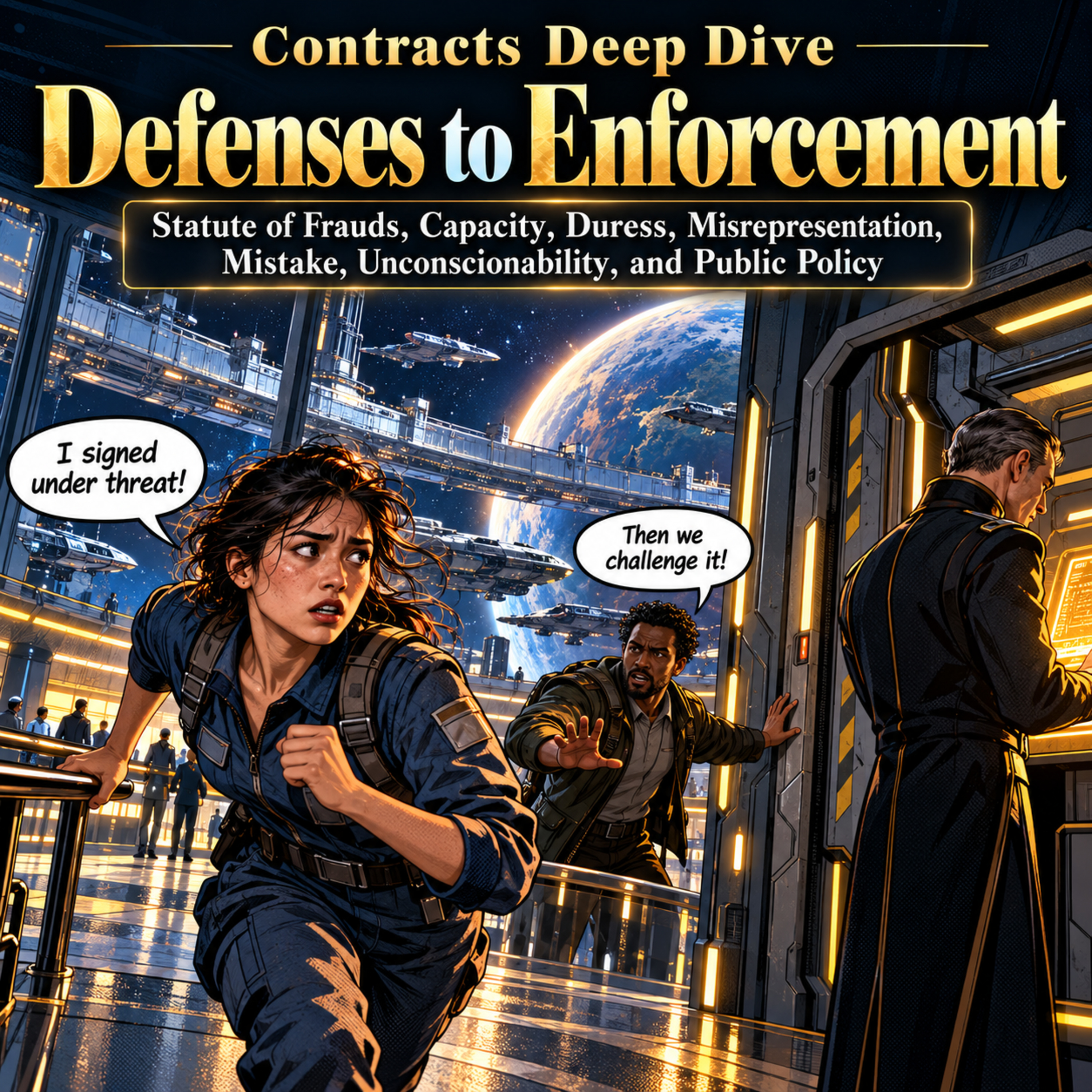 Contracts Deep Dive: Defenses, Statute of Frauds, and Parol Evidence 07.10.2026 1Std. 19Min.⚖️ Hear the rules. Follow the stories. Connect the dots.⚖️Five companion resources from The Law School of America.🎬 THREE ILLUSTRATED GUIDES👉 The Last Edition — Follow the case.👉 The Price of a Promise — Trace the broken bargains.👉 When the Lights Return — Step into the countdown.📚 TWO TEXT GUIDES📖 The Contracts Book — Deepen your understanding.🎯 The Summary Guide — Sharpen your review.See it. Study it. Review it.Explore all three stories, build your foundation with the book, then pull it together with the summary guide.🎧 EPISODE SUMMARY 🎧A validly formed contract may still be unenforceable due to defenses, the Statute of Frauds, or the application of the parol evidence rule.Formation defenses protect parties from unfairness and lack of genuine assent. Capacity defenses (infancy, mental incapacity, and intoxication) render a contract voidable. Assent defenses (duress and undue influence) protect parties from improper threats and unfair persuasion. A contract is voidable for misrepresentation if induced by fraud or a material misstatement, and nondisclosure can operate as a misrepresentation where legally significant. Mutual mistake regarding a basic assumption provides a defense unless the party bears the risk, while unilateral mistake generally requires a showing that the other party knew or caused the error. Illegality, public policy, and procedural and substantive unconscionability prevent the enforcement of contracts that offend justice or the law.The Statute of Frauds determines whether an agreement must be evidenced by a writing. It applies to interests in land, agreements incapable of performance within one year from the date of contracting, suretyship, executor promises, and the sale of goods over $500. To satisfy the Statute, the writing must contain essential terms and be signed by the party to be charged, though exceptions like part performance or specially manufactured goods may excuse the writing requirement.The parol evidence rule concerns how prior or contemporaneous agreements affect an integrated writing. If a writing is partially integrated, it cannot be contradicted by prior agreements but may be supplemented by consistent additional terms. If completely integrated, it can neither be contradicted nor supplemented. However, the rule never prevents the admission of evidence to explain ambiguities or to prove validity defenses such as fraud, duress, or mistake. Understanding these frameworks ensures a precise analysis of contract enforceability.ℹ️ INFORMATION, PRIVACY POLICY & TERMS OF USE ℹ️The Podcast and Website PurposeThe Law School Podcast and 1L Study Aide webpage supplements law-school and Bar Exam study with strategies, condensed rules, quizzes, and flashcards.Educational DisclaimerContent is for educational and informational purposes only. It is not legal advice, creates no attorney-client relationship, and does not guarantee law-school or Bar Exam success.Privacy PolicyNo account or login is required.This webpage uses no forms or analytics to collect personal information.Quiz and flashcard activity stays in your browser and may clear when local site data is removed.Terms of UseBy using this webpage, you agree to use its content only for lawful, personal, noncommercial educational purposes. It supplements—not replaces—courses, textbooks, official materials, or qualified instruction.
-
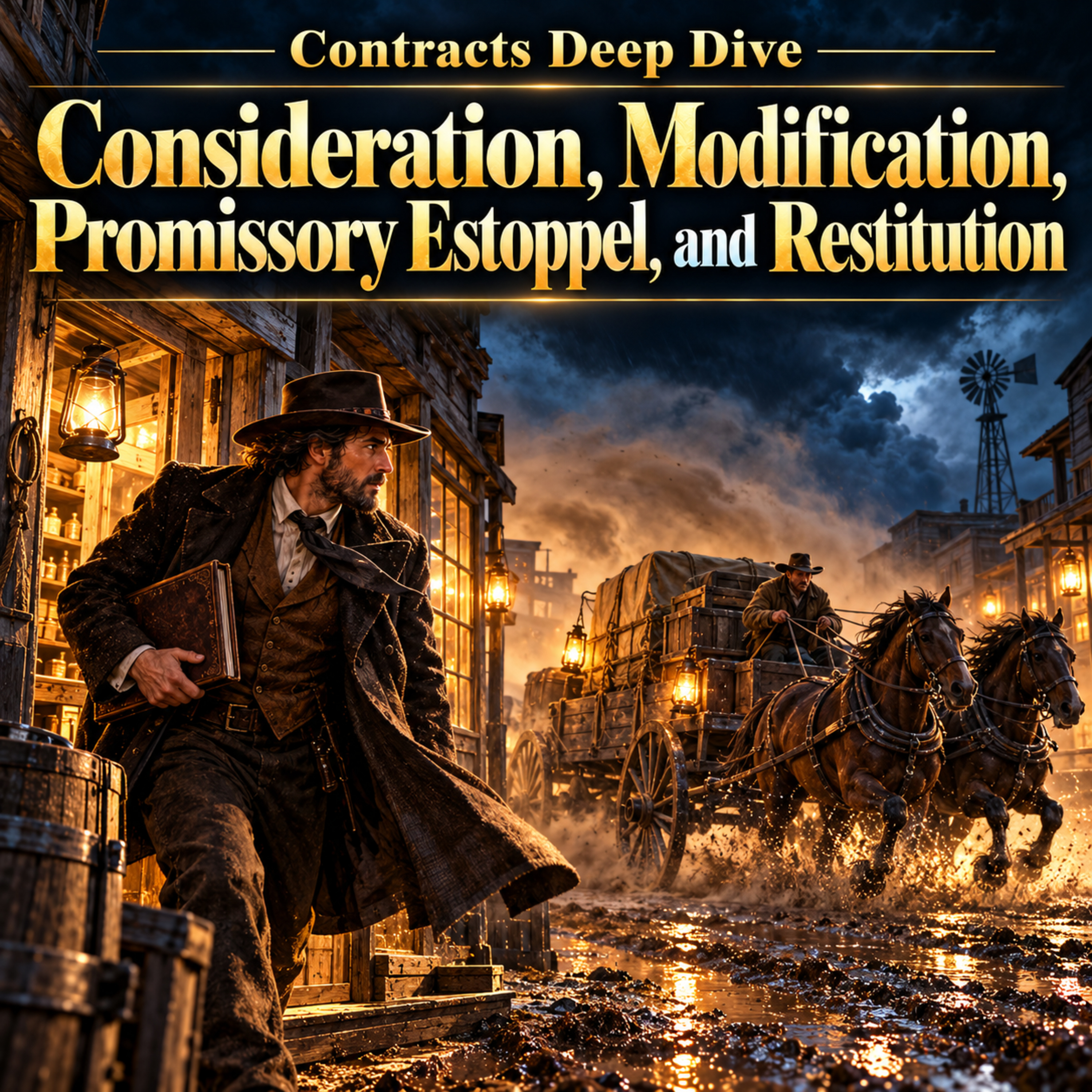 Contracts Deep Dive: Consideration, Modification, Promissory Estoppel, and Restitution 06.10.2026 1Std. 16Min.⚖️ Hear the rules. Follow the stories. Connect the dots.⚖️Five companion resources from The Law School of America.🎬 THREE ILLUSTRATED GUIDES👉 The Last Edition — Follow the case.👉 The Price of a Promise — Trace the broken bargains.👉 When the Lights Return — Step into the countdown.📚 TWO TEXT GUIDES📖 The Contracts Book — Deepen your understanding.🎯 The Summary Guide — Sharpen your review.See it. Study it. Review it.Explore all three stories, build your foundation with the book, then pull it together with the summary guide.🎧 EPISODE SUMMARY 🎧To determine if a promise is legally enforceable, students must navigate the distinct theories of bargain protection, reliance protection, and restitutionary protection.Consideration requires a bargained-for exchange of legal detriment. A legal detriment involves doing something one is not legally obligated to do or refraining from doing something one has a right to do. Courts generally do not question the adequacy of consideration, but nominal or sham consideration is void. Past consideration and moral obligation do not satisfy the requirement of a present exchange, and conditional gifts lack the necessary mutual inducement.Under the common law preexisting duty rule, a promise to perform an act one is already legally bound to do is not valid consideration. Consequently, common law contract modifications require new consideration. Conversely, Article 2 of the Uniform Commercial Code abolishes the preexisting duty rule, allowing good-faith modifications of contracts for the sale of goods without new consideration. The settlement of a disputed claim serves as consideration, provided the claim is given up in good faith, and unliquidated debts can be resolved through an accord and satisfaction.When consideration is absent, a promise may still be enforced under the doctrine of promissory estoppel. Promissory estoppel is a separate reliance-based theory requiring a clear promise, foreseeable reliance, actual detrimental reliance, and the necessity of enforcement to prevent injustice.Finally, when there is no enforceable promise at all, a party may seek restitution to prevent unjust enrichment. Restitution applies when a measurable benefit is conferred upon a defendant who retains it under circumstances where it would be profoundly unfair to do so without compensation.By mastering the distinctions between bargained-for exchanges, detrimental reliance, and unjust enrichment, the student can accurately diagnose any contract formation problem.ℹ️ INFORMATION, PRIVACY POLICY & TERMS OF USE ℹ️The Podcast and Website PurposeThe Law School Podcast and 1L Study Aide webpage supplements law-school and Bar Exam study with strategies, condensed rules, quizzes, and flashcards.Educational DisclaimerContent is for educational and informational purposes only. It is not legal advice, creates no attorney-client relationship, and does not guarantee law-school or Bar Exam success.Privacy PolicyNo account or login is required.This webpage uses no forms or analytics to collect personal information.Quiz and flashcard activity stays in your browser and may clear when local site data is removed.Terms of UseBy using this webpage, you agree to use its content only for lawful, personal, noncommercial educational purposes. It supplements—not replaces—courses, textbooks, official materials, or qualified instruction.
-
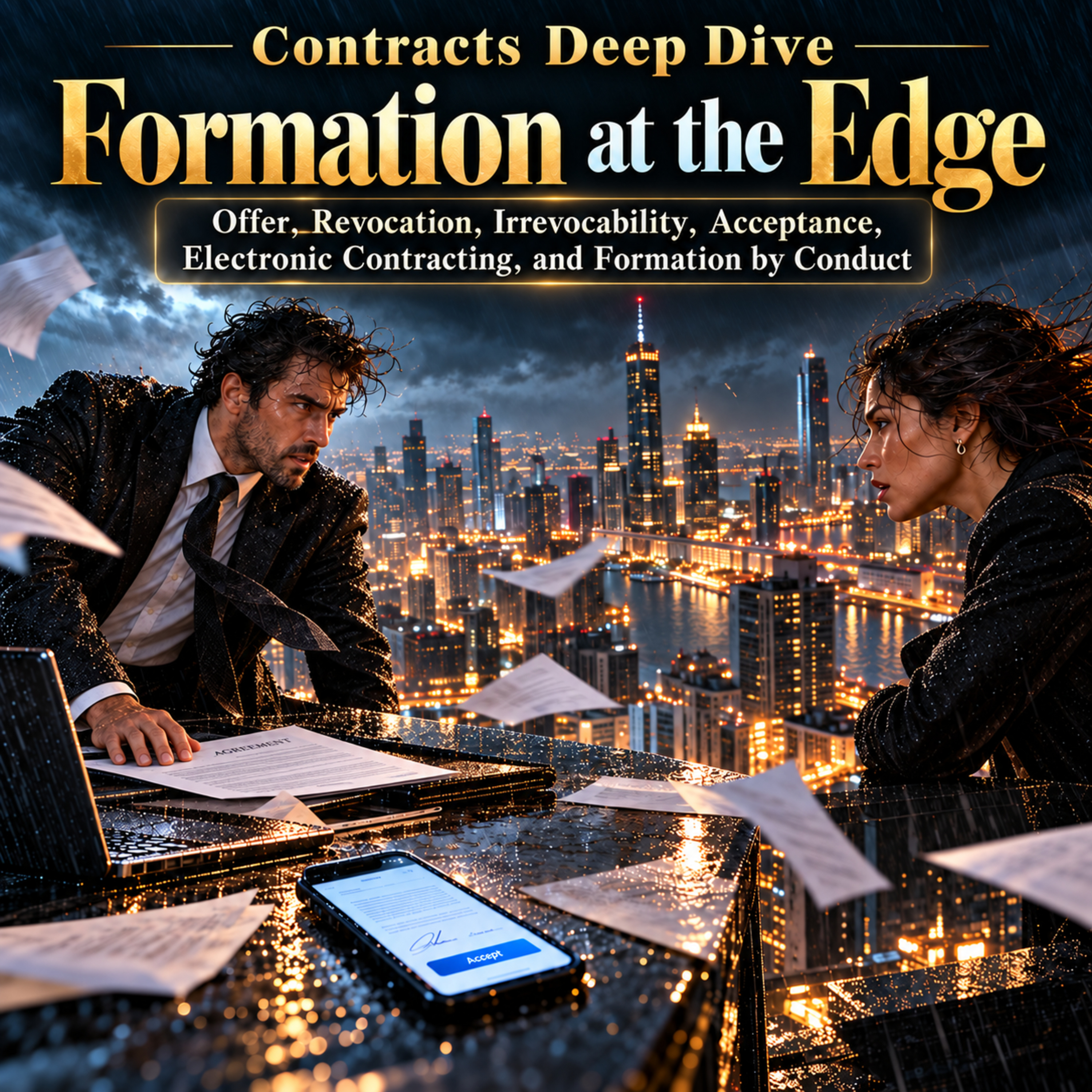 Contracts Deep Dive: Formation at the Edge — Offer, Revocation, Irrevocability, Acceptance, Electronic Contracting, and Formation by Conduct 05.10.2026 1Std. 8Min.⚖️ Hear the rules. Follow the stories. Connect the dots.⚖️Five companion resources from The Law School of America.🎬 THREE ILLUSTRATED GUIDES👉 The Last Edition — Follow the case.👉 The Price of a Promise — Trace the broken bargains.👉 When the Lights Return — Step into the countdown.📚 TWO TEXT GUIDES📖 The Contracts Book — Deepen your understanding.🎯 The Summary Guide — Sharpen your review.See it. Study it. Review it.Explore all three stories, build your foundation with the book, then pull it together with the summary guide.🎧 EPISODE SUMMARY 🎧Contract formation requires a disciplined analysis starting with the threshold choice of law. Article 2 of the Uniform Commercial Code governs transactions in goods, while the common law governs services, real estate, and other transactions. Mixed transactions require the predominant-purpose approach.Mutual assent is evaluated objectively. A valid offer must exhibit an intent to be bound and sufficient definiteness, thereby creating a power of acceptance in the offeree. Advertisements, price quotations, and invitations to negotiate ordinarily fall short of this standard.The power of acceptance can be destroyed by rejection, a counteroffer (which terminates the original offer), revocation, indirect revocation, lapse, or death/incapacity. However, mere inquiries do not terminate offers. Furthermore, offers can be rendered irrevocable via an option contract supported by consideration or a UCC firm offer contained in a signed writing by a merchant.Acceptance must conform to the offer's requirements, whether involving a bilateral acceptance by promise or a unilateral acceptance by performance. While silence is rarely acceptance, exceptions exist. Finally, under the mailbox rule, acceptances are generally effective upon dispatch, distinguishing them from terminations which rely on receipt. Identifying these elements precisely allows the analyst to conclude whether a legally enforceable agreement has been formed.ℹ️ INFORMATION, PRIVACY POLICY & TERMS OF USE ℹ️The Podcast and Website PurposeThe Law School Podcast and 1L Study Aide webpage supplements law-school and Bar Exam study with strategies, condensed rules, quizzes, and flashcards.Educational DisclaimerContent is for educational and informational purposes only. It is not legal advice, creates no attorney-client relationship, and does not guarantee law-school or Bar Exam success.Privacy PolicyNo account or login is required.This webpage uses no forms or analytics to collect personal information.Quiz and flashcard activity stays in your browser and may clear when local site data is removed.Terms of UseBy using this webpage, you agree to use its content only for lawful, personal, noncommercial educational purposes. It supplements—not replaces—courses, textbooks, official materials, or qualified instruction.
-
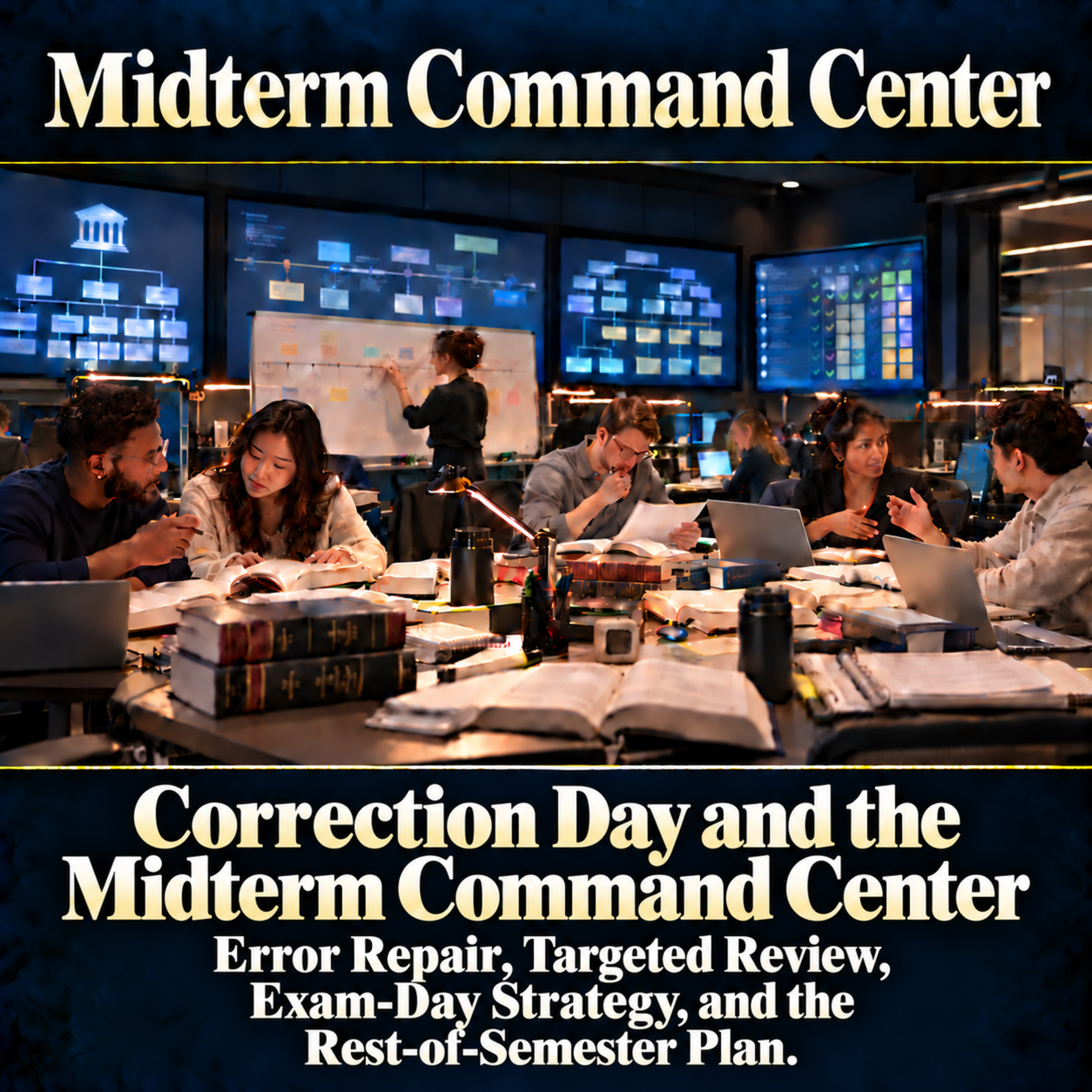 Law School Midterm Command Center: Correction Day and the Midterm Command Center — Error Repair, Targeted Review, Exam-Day Strategy, and the Rest-of-Semester Plan 04.10.2026 57Min.⚖️ MIDTERM CHALLENGE: Can you apply the law when it counts?⚖️📖 FREE BOOK — Review the material📖 🎮 GAME 1 — Start the challenge🎮🎯 GAME 2 — Test yourself again🎯🏁 GAME 3 — Complete the set🏁🎧 EPISODE SUMMARY 🎧Correction begins by naming the cause of an error: rule gap, doctrine confusion, recognition failure, weak application, or execution failure. Each requires a different repair and a retest on fresh facts. Compact sheets, oral and blank-page recall, and mixed practice make corrected rules usable under time limits. Exam-day preparation removes avoidable friction; later feedback sharpens the plan. The one-page dashboard carries course status, performance measures, priority weaknesses, and scheduled actions through the remainder of the semester.ℹ️ INFORMATION, PRIVACY POLICY & TERMS OF USE ℹ️The Podcast and Website PurposeThe Law School Podcast and 1L Study Aide webpage supplements law-school and Bar Exam study with strategies, condensed rules, quizzes, and flashcards.Educational DisclaimerContent is for educational and informational purposes only. It is not legal advice, creates no attorney-client relationship, and does not guarantee law-school or Bar Exam success.Privacy PolicyNo account or login is required.This webpage uses no forms or analytics to collect personal information.Quiz and flashcard activity stays in your browser and may clear when local site data is removed.Terms of UseBy using this webpage, you agree to use its content only for lawful, personal, noncommercial educational purposes. It supplements—not replaces—courses, textbooks, official materials, or qualified instruction.
-
 Midterm Law School Lab: Full Simulation and Performance Review 04.10.2026 1Std.🧪 MIDTERM LAB: Can you turn what you’ve learned into exam points?🧪📖 FREE BOOK — Prepare for the challenge📖🎮 FREE GAME 1 — Put your knowledge to work🎮 🎯 FREE GAME 2 — Test yourself again🎯🏁 FREE GAME 3 — Complete the set🏁 🎧 EPISODE SUMMARY 🎧The simulation combines eighty-four objective questions and two essays across seven subjects. Timed and untimed modes report their different conditions. Review records accuracy, doctrine patterns, blanks, flags, answer changes, and time use. Each question receives a rule-based explanation of the correct choice and distractors. Essays receive issue checklists and model analysis, with human judgment for evaluation. Test remediation on a fresh variation.ℹ️ INFORMATION, PRIVACY POLICY & TERMS OF USE ℹ️The Podcast and Website PurposeThe Law School Podcast and 1L Study Aide webpage supplements law-school and Bar Exam study with strategies, condensed rules, quizzes, and flashcards.Educational DisclaimerContent is for educational and informational purposes only. It is not legal advice, creates no attorney-client relationship, and does not guarantee law-school or Bar Exam success.Privacy PolicyNo account or login is required.This webpage uses no forms or analytics to collect personal information.Quiz and flashcard activity stays in your browser and may clear when local site data is removed.Terms of UseBy using this webpage, you agree to use its content only for lawful, personal, noncommercial educational purposes. It supplements—not replaces—courses, textbooks, official materials, or qualified instruction.
-
 Law School Midterm Command Center: Full Simulation Day — Timed Midterms, Mixed Subjects, Performance Analytics, and Examination Conditioning 03.10.2026 59Min.⚖️ MIDTERM CHALLENGE: Can you apply the law when it counts?⚖️📖 FREE BOOK — Review the material📖 🎮 GAME 1 — Start the challenge🎮🎯 GAME 2 — Test yourself again🎯🏁 GAME 3 — Complete the set🏁🎧 EPISODE SUMMARY 🎧A useful simulation reproduces the real assessment's content, format, resource rules, and clock as closely as practicable. During the test, students answer, flag, recover, and continue. Afterward, they examine coverage, accuracy, application, and execution, using issue grids and cautious multiple-choice analytics. Rule-recall categories, timing records, and physical observations explain what a score alone cannot. The final product is a short, prioritized plan grounded in the student's actual performance under pressure.ℹ️ INFORMATION, PRIVACY POLICY & TERMS OF USE ℹ️The Podcast and Website PurposeThe Law School Podcast and 1L Study Aide webpage supplements law-school and Bar Exam study with strategies, condensed rules, quizzes, and flashcards.Educational DisclaimerContent is for educational and informational purposes only. It is not legal advice, creates no attorney-client relationship, and does not guarantee law-school or Bar Exam success.Privacy PolicyNo account or login is required.This webpage uses no forms or analytics to collect personal information.Quiz and flashcard activity stays in your browser and may clear when local site data is removed.Terms of UseBy using this webpage, you agree to use its content only for lawful, personal, noncommercial educational purposes. It supplements—not replaces—courses, textbooks, official materials, or qualified instruction.
-
 Midterm Law School Lab: Evidence 03.10.2026 1Std. 17Min.🧪 MIDTERM LAB: Can you turn what you’ve learned into exam points?🧪📖 FREE BOOK — Prepare for the challenge📖🎮 FREE GAME 1 — Put your knowledge to work🎮 🎯 FREE GAME 2 — Test yourself again🎯🏁 FREE GAME 3 — Complete the set🏁 🎧 EPISODE SUMMARY 🎧Name the item and its offered purpose first. Test relevance and unfair prejudice, then specialized exclusions and character rules. For words, identify an assertion, declarant, truth use, any nonhearsay classification, each applicable exception, and every nested layer. Check witness competence and impeachment, privilege, authentication, original-content requirements, and expert reliability independently. In a criminal case, add the confrontation inquiry for testimonial assertions offered against the accused. The best answer states both a plausible route to admission and the objection or factual gap that may block it.ℹ️ INFORMATION, PRIVACY POLICY & TERMS OF USE ℹ️The Podcast and Website PurposeThe Law School Podcast and 1L Study Aide webpage supplements law-school and Bar Exam study with strategies, condensed rules, quizzes, and flashcards.Educational DisclaimerContent is for educational and informational purposes only. It is not legal advice, creates no attorney-client relationship, and does not guarantee law-school or Bar Exam success.Privacy PolicyNo account or login is required.This webpage uses no forms or analytics to collect personal information.Quiz and flashcard activity stays in your browser and may clear when local site data is removed.Terms of UseBy using this webpage, you agree to use its content only for lawful, personal, noncommercial educational purposes. It supplements—not replaces—courses, textbooks, official materials, or qualified instruction.
-
 Law School Midterm Command Center: Essay Command — Issue Spotting, Rule Statements, IRAC, Fact Application, Counterarguments, Organization, and Time Management 02.10.2026 1Std. 22Min.⚖️ MIDTERM CHALLENGE: Can you apply the law when it counts?⚖️📖 FREE BOOK — Review the material📖 🎮 GAME 1 — Start the challenge🎮🎯 GAME 2 — Test yourself again🎯🏁 GAME 3 — Complete the set🏁🎧 EPISODE SUMMARY 🎧A strong essay begins with the call and party map, uses a brief issue checklist, and treats each contested point through a usable rule and concrete application. Descriptive headings make the structure visible. Counterarguments and policy help when connected to the facts and doctrine; case labels never replace explanation. Conclusions should reflect the strength of the analysis. Time, word, and resource limits determine how much to write, while post-exam review reveals whether the writer recognized issues and actually applied the law.ℹ️ INFORMATION, PRIVACY POLICY & TERMS OF USE ℹ️The Podcast and Website PurposeThe Law School Podcast and 1L Study Aide webpage supplements law-school and Bar Exam study with strategies, condensed rules, quizzes, and flashcards.Educational DisclaimerContent is for educational and informational purposes only. It is not legal advice, creates no attorney-client relationship, and does not guarantee law-school or Bar Exam success.Privacy PolicyNo account or login is required.This webpage uses no forms or analytics to collect personal information.Quiz and flashcard activity stays in your browser and may clear when local site data is removed.Terms of UseBy using this webpage, you agree to use its content only for lawful, personal, noncommercial educational purposes. It supplements—not replaces—courses, textbooks, official materials, or qualified instruction.
Ähnliche Podcasts


Beliebt in
Dieser Podcast erscheint auch in den Podcast-Charts dieser Länder.


