
Mere Tradition with Kennedy Hall
Kennedy Hall
0
Mere Tradition with Kennedy Hall is a podcast dedicated to Catholic Tradition, exploring its teachings and practices. Hosted by Kennedy Hall, the show aims to present Catholicism in its traditional form, without additions or subtractions. Each episode delves into various aspects of the faith, from theology to liturgy, offering insights for those seeking a deeper understanding of traditional Catholicism.
Folgen
-
 The Cause of Ecumenism, Charismaticism and the New Mass: What Happened to Catholicism #6 01.10.2026 58Min.https://kennedyhall.ca/books This is a public episode. If you'd like to discuss this with other subscribers or get access to bonus episodes, visit meretradition.substack.com/subscribe
 -
 The Gravity of the Situation and Certain Uncertainty: What Happened to Catholicism #5 29.09.2026 20Min.This is a free preview of a paid episode. To hear more, visit meretradition.substack.com
 -
 The Theological Origins of Modernism: What Happened to Catholicism #4 24.09.2026 20Min.This is a free preview of a paid episode. To hear more, visit meretradition.substack.com
 -
 The Philosophical Origins of Modernism, Part 2: What Happened to Catholicism #3 22.09.2026 19Min.This is a free preview of a paid episode. To hear more, visit meretradition.substack.comhttps://realestateforlife.org/https://www.icatholicmobile.com/
 -
 The Philosophical Origins of Modernism, Part 1: What Happened to Catholicism #2 18.09.2026 15Min.This is a free preview of a paid episode. To hear more, visit meretradition.substack.comCheck out Fr Tommasi’s articles I mentioned if you have time: https://substack.com/@frromanotommasi
 -
 Against Tim Flanders and His Diabolism 17.09.2026 48Min.A Note to the TenderheartedIn general, my audience knows my writing to be measured, and it is often described as charitable. This is something I work hard at, because it isn’t always easy to stay cool as a cucumber when you do what I do. There are legions of people who would like to see my downfall, and, lets be honest, it isn’t an easy thing to defend Catholic Tradition, and especially the SSPX.At times my motives have been questioned — the Trad Inc. stuff, etc. — and I have been accused of every sin under the Sun. I do what I do for basically two reasons, which are really one reason; and neither of those reasons are financial, because defending the SSPX is not what I would call a good business decision! My family certainly won’t miss any meals, but you would be out of your mind if you thought someone like me could achieve the professional success of a mainstream Catholic commentator by doing what I do. Those men, and I don’t blame them, will get hefty speaking fees to show up and speak at massive conferences, and so on. I, on the otherhand, will hop in my car and drive to Timbuckto to give talks for a bit of money and trust that the Lord will encourage people to be generous with donations. I am grateful for all of it, and I do not lament or regret doing it, because it isn’t about the money. If I could do it for free, I would.In any event, my reasons. First, I want to defend the Catholic Church, because it is the most important thing that I believe I can do with my time as a professional. I didn’t seek out this path, but it sort of fell on my lap, and I took it as a sign from Providence that I should continue down the path laid in front of me. Initially, I merely wanted to do something like being a run of the mill apologist at a place like Catholic Answers. Then, I found Catholic Tradition, and the rest, as they say, is history.Second, I do what I do, with regard to defending Tradition and the SSPX, because I am convinced, as God is my witness, that a Revolution has taken place in the Church, and therefore we must defend against the Revolution for the sake of the Church. My path brought me to the SSPX, which I was not raised in, and did not seek of my own accord. It is my belief that the SSPX is the only priestly organization within the Church that has both the theological formation, and the administrative reality sufficient to offer a comprehensive resistance to the disease of Modernism. Of course, there are other great priests outside the SSPX, and I count many of them as my friends, but as far as things go, the SSPX does not have to give a hat-tip to Modernism in any way, even implicitly or by silence, and I think that is indispensable. Whether you attend the SSPX or not, you benefit from their fight, because their fight is for you and your soul, even if you have never met them.Now, I always defend my own. I will defend my family, I will defend my friends and my community, I will defend my country, and I will defend my priests. In addition, I will always defend Archbishop Lefebvre because I believe he was, is, a great saint, and that history will show us as the years and centuries go by, that he truly was an Athanasius of our time.In any event, when someone attacks my own, I do take it personally, because I am a human being, and I am not a sociopath, so I have emotions and affection for persons that I love very much.I love the SSPX, because I love Archbishop Lefebvre like a father, even though I never met him. I love my priests because they love my wife and children enough — along with the other faithful they serve — to choose a life of being an outcast and hated by the Church they serve as valiantly as anyone for nothing other than love of Our Blessed Lord and his Bride.When men like Tim Flanders go down the path of creating new cockamamie ways to try and prove the SSPX is in schism, they don’t just do bad theology, but they hurt people. Real people. And I see that with my own eyes.For instance. Families that found the SSPX and have adult children who don’t think it is the right thing to do, which makes things hard. The parents work extra hard to keep the family together, and they finally find a good place where they can at least co-exist and attend each other’s weddings and baptisms. But then, men like Tim come along and throw pseudo-theological spaghetti at the wall with a lot of fancy words and references to this and that esoteric idea that sounds smart, and all of a sudden these families take a hit. “Look, even this place and this guy who you told me was pro-SSPX and that you aren’t in schism has changed his mind! You think you are smarter than this guy who writes long essays in a major traditional publication?”The kids who were on the fence think their parents have joined a cult or some evil group of uncharitable elitists who are basically creating their own religion, and all of a sudden the family is broken again.This doesn’t need to happen. Men like Tim Flanders could just keep their pseudo-theological musings to themselves, but something compels them to drop nuclear bombs into people’s lives.Maybe they don’t see because they live in a world where speculative theological banter is like a sport, or professional wrestling, where there are no true victims. But there are victims, and there are tears, and there is sorrow.It is evil, and it has to stop. There is enough stuff out there against the SSPX, and men like Tim Flanders don’t have to go on creating new ways to try and prove the SSPX is schismatic with their own personal opinions in ways that the authorities in Rome haven’t even done. These men will tell you about obedience, and then they hold people to standards they have created in their own intellectual prison and exclude others from a Church they have made in their own mind.It is evil, and it really hurts people, and the damage caused is not irrelevant.The late Bishop Tissier once came to give Confirmations at our priory, and I heard him preach. He spoke of the need for Catholics to defend the Church, as is the theme in Confirmation, and he let us know that defending the Church sometimes includes attacking, the way that defending one’s country includes attacking when war has been declared.I will attack when necessary, and I will do it with a clean conscience, because it is right and just to defend the innocents who are hurt by men like Tim Flanders when they publicly pontificate about imaginary modes of schism and heresy in the public forum, and by doing so they deceive unwitting readers who do not have the time or the theological acumen to realize that they have been sold a worthless bag of beans.One more thing before we continue. Those who have followed my work for a long time may recall that I was — I think — the first Catholic writer and podcaster to come out against Michael Lofton. If you don’t know who he is, don’t waste your time, but if you know, you know. He had been friendly to Tradition, and even had me on his show many times, as well as other SSPX priests. One day he decided to go after the SSPX and then Tradition as such. Now, the man has almost left the Faith entirely. At the time I called him an “Enemy of the Church” because I could see it. I could see that the way he was doing things was going to result in what eventually happened — a full-blown Modernist attack on Tradition.Tim Flanders is not Michael Lofton, but they are not as dissimilar as you might think. Both men have converted to different religions, or denominations, or streams within the Catholic Church about a half-dozen times in a short period of time. Both men have this habit of waffling back and forth, never being able to sink their teeth into a solid way of thinking and stay there. Both are also easily influenced by media (Tim admits this) and influential Catholic voices who get their hooks in them.Now, Tim is not Michael Lofton because Tim demonstrates way more virtue and his temperament is different. Nevertheless, mark my words, this will not be the last time Tim Flanders waffles and has to do a public reinvention of himself in the public forum. He has done it a number of times, and he will do it again.He is a good man, but he is unstable and cannot commit to being a certain way permanently, and we are watching that cycle play out at the expense of others who have supported him in the past.I called Michael Lofton an Enemy of the Church, because he was and is. I will call Tim Flanders an Enemy of the Church, because anyone who gains people’s trust and then waffles back and forth, only to cause them to be confused and disheartened, has troubled consciences and souls. The Church exists in souls.Funnily, I remember Matt Fradd texted me when I went after Lofton, and he said I was being uncharitable and misrepresenting Lofton. I wonder what he was say now…The crisis in the Church is hard enough for people, and we don’t need men who should know better adding fuel to the flames that will burn Catholics who are just trying to save their souls.We don’t get to decide when war breaks out, and sometimes that war is a civil war, so former confreres become enemy combatants. All the same, if the bullets are flying and they are in my direction or the direction of those I love, then if you are in my crosshairs, I will pull the trigger and sleep easy.Deus Vult.Mere Tradition with Kennedy Hall is a reader-supported publication. To receive new posts and support my work, consider becoming a free or paid subscriber.I. The Mad ManOn the fifteenth of September, the editor of OnePeterFive published a piece announcing that he had been wrong about the Society of St Pius X. It is the second part of what he calls an editorial process, and it appeared alongside a much longer retraction on his Substack. The Substack is where the footnotes are, but very few people read his Substack, and OnePeterFive is where the readers are. I intend to answer both, but I am starting here, because this is the one that will be read.Before I say anything critical, let me lay out my approach.I have nothing to say about his sincerity, which I cannot judge. At the same time, his words have meaning, and he has done a very grave thing in how he has presented his ideas, so I will deal with that.You may also have noticed that I used the term “Diabolism” in the title, which I am sure seems harsh. Allow me to explain.When we think of the diabolical, we often think of preternatural parlour tricks and spiritual phenomena. But the root of the term means “to slander” or “to falsely accuse.” A writer on Substack, who I believe is extraordinarily intelligent, defines the Diabolical, in the sense we use it here, thusly:DiabolicalThat which throws apart, what belongs together in an ordered whole: principle from end, affirmation from operation, higher from lower, and judgment from the object that should govern—throwing apart coherence. What belongs together in one order is cut into tangents rather than distinguished (Cartesian vs. Thomistic). A distinction preserves order, while a tangent departs from it, carries meanings foreign to it, and multiplies. Hence the perpetual mode of figuring out and never arriving. We refer to structure, functions, and effects, not intention or moral state.In simpler terms: It cuts what holds into loose ends, and loose ends multiply.That is what Tim has done in his recent article. He has said many unprovable and even untrue things about the priests of the SSPX, and he has accused them of a number of errors and sins without sufficient evidence. He has also confused terms, and used them wrongly, and has inflated things to mean things they do not mean; also, he has gone on numerous tangents about his own made-up theological categories, and applied them to the SSPX with no standard of judgement but his own. In short, he as stepped into the situation and caused unnecessary trouble to souls who look to OnePeterFive for actual theology, and instead have been given duplicity, and pride. I say Pride and I mean it, because, as can be seen in his article, and will be shown in this one, Tim has created categories to condemn the SSPX that not even the Modernists in Rome use. It is completely diabolical.To quote Pope Saint Pius X — whom Tim has accused of iconoclasm, which is an extremely grave sin: “It is pride which fills Modernists with that confidence in themselves and leads them to hold themselves up as the rule for all, pride which puffs them up with that vainglory which allows them to regard themselves as the sole possessors of knowledge, and makes them say, inflated with presumption, We are not as the rest of men..” (Pascendi, 40)Tim has troubled the consciences of curious Catholic readers, and he has done it while employing poor scholarship, dubious citations, and generalities he has manufactured for himself. In addition, he has written his article as a sort of confession — but it is not a confession in the truest sense, because it blames everyone but himself, which I will prove.Today, so many of us misunderstand charity, and we confuse it with niceness. “So-and-so is so charitable, because he never raises his voice and is nice to people.” Charity is the love of neighbour for the sake of God. It can be charitable to keep your mouth shut, and it can be charitable to speak up. It can be charitable to avoid violence, and it can be charitable to throw hands if the situation warrants it for a just cause.The Crusaders were charitable, and they swung swords and ran cold steel through the hearts of infidels who murdered and plundered innocent Christians. Sometimes true charity requires a bit of blood. So, I ask the reader to man up if needed and avoid sentimentalism and the heresy of “niceness.” (Don’t worry, it isn’t a real heresy, and I am not judging anyone by a pretend heresy that I have made up to use as a literary device, because I am not following Tim’s method.)Tim is a grown man, and he is too well-read and has had too many real-life conversations to characterize the SSPX and its faithful in the way that he has. He deserves to be taken out behind the woodshed for his transgressions, because stupid actions deserve consequences, and when they are public, the consequences must be as well.Furthermore, as we will see below, Tim has engaged hypocritically in the very behaviour he accuses others of, especially with regard to “cancelling.” If you read his piece, you will notice that he laments a “Soviet-style Liquidation” of the SSPX by Church authorities — which is a fancy way of saying that they were cancelled mercilessly, including being denied proper recourse to legal procedure.Now notice what Tim has done. He has written a piece accusing the SSPX of a variety of sins and heresies, and then he has changed the editorial policy of OnePeterFive to disallow vehement pro-SSPX voices. I was a member of the editorial board — I say was, because I will have nothing to do with a publication that has devolved under Tim’s leadership — and I was not informed of this change.Let that sink in for a second: Tim Flanders has changed the editorial standards for OnePeterFive in a way that disallows a strong defence of the SSPX against the very accusations he has levelled, and he did not inform the editorial board! Maybe he did inform the board and didn’t tell me, which would be just as bad for other reasons.Ironically, the change in the editorial process disallows me, a former board member, from responding to Tim’s article on the site. Yes, I have read all the nonsense that Tim believes we have to read in order to have an opinion that he thinks is informed enough, but I would be too pro-SSPX for his new standards.Tim talks a big game about charity, piety, and unity. But when push comes to shove, he has decided to give an autobiographical account of his own spiritual journey and use it as the basis for damning a group of priests whose interior life, piety, orthodoxy, and virtue he liquidates with his commentary.Tim Flanders should be ashamed of himself for how he has handled this.I am not one for boycotts, so I won’t tell you what to do with your time or money, but if you love Catholic Tradition, I would avoid OnePeterFive and wouldn’t give them a dime.Another note about his method. You will notice that Tim has characterized traditionalists like myself as suffering from a whole host of faults, and as generally lacking virtue and charity. Of course, since his words are so inflammatory and so insulting to so many, we must now respond in kind — which will produce the stereotypical “angry Trad” reaction.In doing this, he has governed OnePeterFive — which is run by donations, by the way, so if you are an SSPX person who has donated, you have paid the salary of a man who is teaching the world to think you suffer from heresies and spiritual sicknesses — the way politicians handle people they disagree with. Tim has built an edifice in his own mind wherein traditionalists are a group of evildoers who do not know the Lord the way people with true interior lives do, like Tim; and in provoking them, they will respond. In short, Tim has dealt with traditionalists the way the Marxists dealt with the proverbial “anti-vaxxer” during COVID. Look at those crazy anti-vaxxers. I can’t understand why they are so angry. All we did was vilify them, tell the world how evil they were, and say that everyone was dead because of their inability to understand science.Similarly, Tim has labelled traditionalists as holding unworthy opinions because he believes they have not read enough Vatican II — how could he possibly know that, especially with regard to the priests of the SSPX? — or because they do not pray enough, or because they are fake Thomists, or because they are not truly Marian. Which means that any response to Tim can be filed under the edifice he has built for Trads to inhabit.Tim has created an enclosure in which he is the judge of who knows theology enough, who prays enough, and who is virtuous enough. And he has presented his conclusions as the fruit of personal spiritual troubles, speaking in his Substack of how God has shown him things that led him to these conclusions. To this we can say: “God has shown me that you are wrong.” Of course, that will not suffice — because Tim knows that SSPX Trads cannot have the interior life necessary to really know God’s will, because they are probably Jansenists, or too Ultramontane, or whatever.Tim has essentially become the madman in Chesterton’s Orthodoxy:If a man says (for instance) that men have a conspiracy against him, you cannot dispute it except by saying that all the men deny that they are conspirators; which is exactly what conspirators would do. His explanation covers the facts as much as yours. Or if a man says that he is the rightful King of England, it is no complete answer to say that the existing authorities call him mad; for if he were King of England that might be the wisest thing for the existing authorities to do. Or if a man says that he is Jesus Christ, it is no answer to tell him that the world denies his divinity; for the world denied Christ’s… his mind moves in a perfect but narrow circle. A small circle is quite as infinite as a large circle; but, though it is quite as infinite, it is not so large… The lunatic’s theory explains a large number of things, but it does not explain them in a large way.And, as Chesterton says, “curing a madman is not arguing with a philosopher; it is casting out a devil.” That is why I have called Tim’s actions diabolical.Now that this first part is out of the way, we will proceed to dismantle his disastrous theological and historical claims.Mere Tradition with Kennedy Hall is a reader-supported publication. To receive new posts and support my work, consider becoming a free or paid subscriber.II. An Essay That Contains No ArgumentAs I said, the article is styled at the outset as a confession: I was wrong about the SSPX. The opening is autobiographical. The middle is a collection of supposed errors. And the conclusion is a policy announcement: publication standards at OnePeterFive concerning the Society will change.Tim has sought the sympathy of readers by laying his heart bare, before moving on to a lengthy excoriation of the SSPX — an excoriation that has been done poorly. Frankly, it is a type of sleight of hand.Throughout the piece, Tim makes it clear that his screed about the SSPX being veritably evil is not exhaustive, and he points the reader to another publication for the footnotes. What is amazing about this is that Tim has used the platform of OnePeterFive — again, a donation-run publication that he does not own — to slam a group of priests, while the supposed proof of his statements sits on his own personal website.Anyway, I went and looked at what he cited from his Substack.The Substack has eighteen footnotes. They speak to the argument from St. Ignatius of Antioch. (I will write a separate piece on Tim’s errors regarding Eucharistic ecclesiology, using the very sources he cites against him.) They point to the Society’s 1979 Declaration. They cite a South Indian Society magazine from 2018, a page of Most Asked Questions, Cardinal Ratzinger’s Santiago address, the theologian John Meyendorff, and an article in an online theological encyclopaedia.They do not support the claims made in the OnePeterFive piece.The footnotes do not support the claim that the Society’s whole school suffers from an ahistorical Aristotelian Thomism. That is his claim, and, as far as I can tell, his own invented terminology. As far as I can tell, Tim also has no idea how SSPX priests are actually formed. He claims that they suffer, more or less, from a deficient formation in which they are taught that there is “no salvation outside ahistorical Aristo-Thomism.”Well, if I may — I actually do know how they are formed. I also know how they are formed in the academies from which most SSPX priests come. They study the great works of literature. They study the philosophies of antiquity, and not merely Aristotle. They read the Summa, and they study the commentaries on Aquinas. They study Vatican II at length. They study the great moral theologians. They study the works of the great councils and of a great number of popes. And more. They also spend a whole lot of time in prayer, in front of the Blessed Sacrament, and there is a general silence during much of the day at the seminaries so they can stay recollected. Nevertheless, this does not suffice for a true interior life or real piety according to Tim’s diagnosis.The priests of the SSPX and the faithful who attend their schools receive a formation in theology and philosophy that Tim could only have dreamed of growing up in public schools, yet he stands in judgement of their intellectual chops.In any event, Tim’s footnotes do not support his claim that they lack piety, and his own in-person experience — not his online experience — ought to belie such slander. A couple of years ago, when Tim frequented and spoke at our SSPX men’s conference, it was First Friday. At our chapel we follow the old-school way of doing First Friday. The whole affair takes about two hours, and your knees are wrecked by the end of it. It starts with Mass; then Benediction, while praying the Rosary and singing the usual Benediction hymns, along with singing the Litany of the Sacred Heart in Latin, which alone takes about 12 minutes; then Father guides us through a fifteen-minute silent meditation before the Blessed Sacrament, on top of the usual prayers and the Rosary. After the ceremony, Tim said to me — and I paraphrase — “My parish is called Sacred Heart, and our First Fridays are nothing like that. Do you guys always do that?”Nevertheless, we of course lack sufficient piety for Tim.Also, another time, Tim attended a Third Order meeting with me where Father gave a conference on Mariology and why she truly is the Corredemptrix and Mediatrix of all Graces. To make his points, Father used scripture, the ancient Fathers, Thomas Aquinas, and a number of popes. So, Father went through the works of saints, popes, and theologians from 19 centuries.We left the meeting, and Tim expressed how incredible the lesson was and how lucky we were to have priests give us such great Marian theology.Nevertheless, the SSPX priests and those who follow them suffer from a lack of true Marian Thomism, according to Tim.He also makes claims about an entire narrative of the SSPX that he apparently fell prey to, and he condemns it as false — but there is no proof.In any event, his footnotes fail to support his OnePeterFive essay in a variety of ways, and to go into all of them here would turn this into a small book.The essay is not an essay, because an essay must make a real argument. It cannot merely be a pile of assertions and accusations buttressed by self-referential footnotes that explain nothing in the essay itself, while simultaneously deploying fabricated terms about “false spirits” and other things of his own making.Mere Tradition with Kennedy Hall is a reader-supported publication. To receive new posts and support my work, consider becoming a free or paid subscriber.III. Tim Has Dealt with the SSPX Like a MarxistNow to the contradiction that runs down the middle of the piece.As mentioned above, Tim laments the Soviet-style liquidation of the SSPX and says that it was wrong. Nevertheless, Tim has engaged in the very behaviour he laments. His slanderous claims, his false accusations, and his misrepresentation of facts — none of which he properly proves with citations — all result in a change to the editorial process of OnePeterFive, which is, in effect, a cancellation. Quite frankly, this is Marxist, in the way Tim uses the term, to the core.All you SSPX people have been treated poorly, and that was bad, and I disavow you guys being left out… by the way, you are heretics and schismatics, you lack virtue, you have no piety, and you are not allowed to write here as you used to.Tim should enter politics, because he could stand in front of Congress and say: I disavow racism in all its forms, especially against people who have been labelled white supremacists… by the way, we are now enforcing a policy whereby whites cannot have the jobs they used to have, because we are worried that their whiteness will creep in.He goes further.Tim reproduces his own editorial standard for anything written about the Council — a standard requiring a prospective contributor to have first read two of the editor’s own articles, then to be well versed in a named list of authors who write in reply to traditionalists, and then to have read all sixteen documents and all the postconciliar clarifications.Apparently it should be called OnePeterTim. Ubi Petrus, ubi Tim.What Tim has done is hand you a syllabus of his own preferred works — which he deems demonstrative of a true Catholic intellect — as the barrier to entry. I think I would have an easier time getting a PhD from a mainline liberal Catholic university than publishing at OnePeterTim. Amazing.Maybe OnePeterTim can start awarding Timplomas if they complete his syllabus of true knowledge. I wonder if there will be a test for prospective writers: Do you understand Vatican II well enough, with an open heart that is void of any icky nastiness from those mean SSPX Narrative people?If Tim ever finds a new line of work, he should work for an HR department, because what he is advocating for is essentially re-education before employment can continue, in the hopes that any false beliefs will be exorcised from the person suffering from a subconscious, invisible malady.OnePeterTim has essentially adopted a theological DEI policy.But wait, there’s more.He tells us, before any of it has been applied to a single named piece of writing, that nothing he has read from the fictitious SSPX School of Ahistorical Aristotelian Thomism meets his invented standards. In all humility, charity, and piety, Tim has made himself into a mini-magisterium, standing in judgment over the intellectual chops of theologians and priests formed in institutions where his pseudo-essay writing style would not earn a passing grade in first year.Now, on the one hand, Tim may have the contractual right to do what he has done, since he manages the magazine. Nevertheless, he does not have the moral right to act this way, because generous readers have paid his salary, and they have given money — at least in part — to read men like myself and others who speak about the SSPX without the tact of a Marxist liquidator.This is an act of gatekeeping described as the opposite of gatekeeping, in the same essay, by the same man. He denounces the use of institutional power to remove a party’s voice, and then uses his institutional power to reduce that party’s voice in the one place he controls.There is a version of this essay that would have been appropriate. It would have said: I have changed my mind, here is why, and because I now hold these views my magazine will reflect them. That version would be lame, but it would not be objectionable in the same way. Instead, the essay wants credit for refusing to cancel while performing the act, and the two cannot be had together.Mere Tradition with Kennedy Hall is a reader-supported publication. To receive new posts and support my work, consider becoming a free or paid subscriber.IV. The Ratzinger Passage Betrays HimFundamental to the essay is a passage from Cardinal Ratzinger’s address at Santiago in July 1988, delivered in the immediate aftermath of the consecrations.Tim quotes it at length, and he quotes it accurately. Ratzinger warns against surrendering to triumphalism. He says that a Christian cannot rejoice in disunity. And he says that even if blame cannot be laid at the Holy See’s door with certainty, it is our obligation to ask what errors we have committed and what errors we are still committing.Tim notes the humility of a man who had just been instrumental in an excommunication, and who, given a major platform, did not use it to enumerate the other man’s errors. He compares it to what a father does when he has to punish a son: he asks what he could have done better. Fair enough.And then he writes six thousand words enumerating the other side’s errors.Ahistorical Aristotelian Thomism. Clericalist ultramontanism. Neo-Jansenism. A failure to meet editorial standards. An absence of the virtue of piety. An absence of academic seriousness. A malformed reading of the Council. A refusal to dialogue — despite decades of actual dialogue. A narrative that has put the whole traditional movement into a hole.Now, the essay is full of the words I was wrong. But it is all puffery, regardless of his intention.Every admission in the piece has the same structure. He was wrong because he allowed the Narrative to influence his thinking. He fell into the Narrative. He sniffed Modernism everywhere and denounced people online — because that is what this way of thinking does to a man.If Tim sinned, he sinned because Tim sinned. No SSPX bogeyman held a gun to his head and told him to be a jerk — if he acted like a jerk, he did it on his own. But, he can’t just say that, because really it was those bad SSPX guys who made him think that way. Quite frankly, this manner of thinking is demonstrably effeminate. He may as well say “The Devil made me do it.”Tim’s pseudo-essay presents itself as an admission of guilt and then blames everyone but himself for his supposed transgressions. That is not self-examination. It is a transfer of responsibility conducted in the style of confession, and it is the exact inverse of the passage he holds up as his model.There is a further problem.The Ratzinger passage is about the side holding the power examining itself. Ratzinger was not asking what Lefebvre had done to provoke Rome. He was asking what Rome had done wrong. The humility is located in a specific place: in the institution, looking at itself.In the world that Tim’s fake essay governs — the traditionalist world — Tim is the one holding the institutional power. He edits a widely read journal. He sets the terms of entry. Applying his own chosen model honestly would mean asking what OnePeterFive, and the traditional movement’s publishing establishment more broadly, have got wrong over the last decade. It would mean the self-examination running toward himself. It would also mean asking the editorial board what to do, but that never happened either.Instead, the question becomes what the Society and the fake Narrative supposedly did to his own psyche and to OnePeterTim.I won’t be surprised if OnePeterTim starts asking the SSPX for reparations due to subconscious generational trauma.Mere Tradition with Kennedy Hall is a reader-supported publication. To receive new posts and support my work, consider becoming a free or paid subscriber.V. Roma Locuta Est, and a Case That Is Not FinishedThere is a section of the essay devoted to the proposition that a layman ought not to dispute a clerical court.Here is the problem with that. Innumerable canon lawyers are laymen. But according to Tim, they must not dispute clerical courts — even though it is their job to do so.Tell me something, Tim the Merciful Liquidator. If an SSPX man like myself publishes what he was told by a layman who works as a canon lawyer in Rome — something I have done — do we both sin? Does the lawyer sin by doing his job, or do I sin by writing about what he does when he does it?For a man who laments that the SSPX harbours a spirit of — and I quote — “Clericalist Hyperüberultramontanism,” Tim certainly does get annoyed when laymen question the actions of courts in the Vatican. By the way, I had to copy and paste that word, because I have trouble spelling expansive fake ones.As an aside, I can’t for the life of me understand how it is the SSPX of all priestly societies that gets labelled as being too ultramontane. In its most basic form Ultramontanism is a very high opinion of the pope in both ecclesial and civil spheres. If it can be demonstrated in an inflated manner, ultramontanism is blamed for clericalism, which leads to blindly following clerics even when they are wrong.This is why I am so glad that the Fraternity of Saint Peter and other Traditional groups have resisted the popes since Vatican II! Er, wait, I am sorry, I forgot it was the SSPX that has done that. For the sake of common sense and the proper use of terms, how on God’s green Earth can the SSPX be too ultramontane when they are the only group in the Latin Church to have actually resisted the Pope?!In any event, Tim’s stated position on this matter is this. The highest ecclesiastical court has judged the Society’s clerics schismatic. The judgment could be in error; history furnishes examples. But it is not for a layman to judge a clerical judgment of clerics on a clerical question. So Tim, most humbly, does not question it. Roma locuta est.He illustrates this with an analogy. A priest who told a layman to ignore a civil court’s sentence would be told by the judge that he has no jurisdiction here, and the judge would be right. Then Tim brings in St Thomas Becket, whom he characterizes as having died to keep the clerical courts free of lay interference.Three things.The analogy does not workBecket’s quarrel was about jurisdiction over persons — whether clerics accused of crimes could be haled before the king’s courts. It was not the proposition that the laity must hold no opinions about ecclesiastical judgments and voice none. If that were the principle, then the lay apostolate this same essay spends pages defending — the Two Swords, the lay nobility, the journal itself — would be illegitimate on its face. You cannot summon Becket to silence lay comment on the Church’s affairs in a piece whose other half is a manifesto for lay competence in the Church’s affairs.The rule is applied only in the direction that costs Tim nothingIf it is unfitting for a layman to publicly dispute the verdict, then it is equally unfitting for a layman to publicly amplify it and to publicly build a programme upon it. Tim has published two essays treating the verdict as settled and drawing from it the maximum available practical consequences, while reserving any doubts he might have for a private channel.And Rome has not finished speakingI could not believe he got this so wrong.The piece refers to “the highest ecclesiastical court.” The Dicastery for the Doctrine of the Faith is not a court. The DDF can handle certain specific delicts through particular tribunals, but the Dicastery itself is not a court. The highest court in the Church is the Supreme Tribunal of the Apostolic Signatura.What was issued on the second of July was a decree, in which six men were named. The extension of the word “schism” to the Society’s priests generally is found not in the decree but in an accompanying Explanatory Note, which carries no force of law.Furthermore, the Society has lodged an appeal, and it is ongoing.Roma locuta est, causa finita — except that the cause is formally open.Tim has made deference to the process his stated principle, and he has announced the result before the process has run, and has built editorial policy on his flawed conclusion — as a layman — about an ongoing canonical dispute involving clerics in Rome.So Tim tells us that we cannot dispute what courts are doing or have done, which is not actually true. Yet he has judged the SSPX, largely on the basis of an ongoing canonical process, and has conflated a legally impotent Note with a criminal sentence.If I may share an anecdote — which I hope I can do legitimately, considering that Tim has shared his personal spiritual insights in order to buttress his claims about the SSPX — one canon lawyer said of my analysis of the situation: “Kennedy Hall’s analysis seems quite sound and reliable to me.”That praise was published in an article by Peter Kwasniewski. I wonder whether Dr. K and the canon lawyer were aware that what the three of us did was basically illegal according to Tim. We should have checked with the editorial policy of OnePeterTim first.Tim has gone beyond hyperubermontanism or whatever it is called and has given us UltraTuchoism: Tucho locuta est.One more aside before the next part of the article: Tim laments that the SSPX Narrative, along with Neo-Jansenism (more on that in another article) has given Trads free reign to mock the pope. Well, aside from the fact that the pope is not mocked by SSPX priests in general, which I can attest to after having attended about a thousand Masses served by them, we should be careful with associating mocking the pope or other clerics with a spiritual disease.Be careful Tim, if mocking the pope is a grave sin as such, then you are going to have to throw Dante into the Hell you have created for hyperuberappletiniclericaljansenistfakethomistites.Mere Tradition with Kennedy Hall is a reader-supported publication. To receive new posts and support my work, consider becoming a free or paid subscriber.VI. “Eternal Rome,” Misunderstood, BadlyTim rejects the Archbishop’s concept of “Eternal Rome.” His stated ground is that the concept seems to “savour of heresy.”This is an astonishing statement, considering that Tim tells us he suffered from what amounted to a spiritual disease when he was favourable to the SSPX, because he “sniffed Modernism” everywhere. I suppose sniffing is different from savouring — although the olfactory and gustatory systems do work in tandem. Perhaps it is acceptable for us to speak of tasting heresy in Traditionalists, but if we smell it in others, that is clearly demonstrative of schismatic behaviour.In any event, “Eternal Rome” was Archbishop Lefebvre’s term, used to distinguish his belief about Rome from the “Conciliar Church” — a term coined by Vatican officials. Cardinal Benelli used it in correspondence with Lefebvre. Naturally, Lefebvre responded that he did not belong to a Conciliar Church, because no such thing exists. And, naturally, the opposite of a Rome tied to one particular council as the mark of its identity, at the expense of every other council, is a Rome that is timeless. Hence “Eternal.”Tim writes:But what exactly is “Eternal Rome”? The SSPX Narrative does not say exactly. The various factions of the SSPX clerics themselves disagree with each other about what is Eternal Rome and what is the practical application of adhering thereto.Tim says in his piece that he has read enough SSPX literature to have earned the right to an opinion, but he utterly fails here. While the made-up “SSPX Narrative” may not define the term adequately for OnePeterTim, Archbishop Lefebvre said the following in his famous Declaration:We hold fast, with all our heart and with all our soul, to Catholic Rome, Guardian of the Catholic Faith and of the traditions necessary to preserve this faith, to Eternal Rome, Mistress of wisdom and truth.We refuse, on the other hand, and have always refused to follow the Rome of neo-Modernist and neo-Protestant tendencies which were clearly evident in the Second Vatican Council and, after the Council, in all the reforms which issued from it.All these reforms, indeed, have contributed and are still contributing to the destruction of the Church, to the ruin of the priesthood, to the abolition of the Sacrifice of the Mass and of the sacraments, to the disappearance of religious life, to a naturalist and Teilhardian teaching in universities, seminaries and catechetics; a teaching derived from Liberalism and Protestantism, many times condemned by the solemn Magisterium of the Church.He added:That is why we hold fast to all that has been believed and practiced in the faith, morals, liturgy, teaching of the catechism, formation of the priest and institution of the Church, by the Church of all time; to all these things as codified in those books which saw day before the Modernist influence of the Council. This we shall do until such time that the true light of Tradition dissipates the darkness obscuring the sky of Eternal Rome.Lefebvre explained very clearly what was meant by Eternal Rome. It is the Church of all time — which includes now, by the way, because now is a part of time — and to hold fast to Eternal Rome is to reject the novelties and heresies that destroy the faith and kill souls.For goodness’ sake, even throughout Tim’s recent about-face on the SSPX, he speaks of all the evil things that have been done in the Church, in a number of areas, since the Council. Tim rejects those things. So did Lefebvre. Tim rejects them because he knows that, when compared with the Church of all time, they are not acceptable. So on the one hand Tim believes “Eternal Rome” is a term that tastes like heresy; on the other hand, he rejects all the bad things that have happened in the Church of What’s Happening Now.Tim writes that the SSPX Narrative does not define Eternal Rome. Two things. First, Lefebvre defined it very clearly. Second, the term is self-explanatory, because eternal means forever and Rome means Rome.The Rome of Forever is the Rome of the past, the present, and the future. Apparently, holding fast to the Rome of Forever is not good enough for Tim, so he writes:The first problem with this is that the concept seems to “savour of heresy,” because it not only does not define what “Eternal Rome” is exactly, but it defines Eternal Rome as something not exactly the same as the current Bishop of Rome.So Tim laments that the amorphous SSPX Narrative does not define Eternal Rome, and, in the same sentence, that it defines Eternal Rome as something other than the current Bishop of Rome.With respect: does Tim know what eternity means? It includes the now-time as well as the before-time. And since the pope of today is part of the now-time, he is part of eternity.The SSPX is condemned for not defining a term and for defining the term wrongly, in the same sentence, by a man who seems not to know how time works. Good grief.Also, what are these SSPX “factions” Tim speaks of? Is he referring to the so-called Resistance? They are not part of the SSPX, so that is a gripe he should take up in a different article, about other people. And even if there were factions within the SSPX, would that delegitimize them? If so, what are we to do with the Catholic Church?If the SSPX is the cause of factions, then is Rome the cause of the other factions in the Church? We may as well liquidate the whole thing, if we follow Tim’s logic all the way down. Throw out the baby, the bathwater, and the tub itself.He writes:Obviously as traditionalists we all know the doctrine of Vatican I says that the bishop of Rome is to guard the Tradition and not invent new teachings, and Vatican II confirms this same thing in a beautiful passage from Dei Verbum paragraph 10.Yes — no kidding. But what does that prove about the SSPX being in error? Regarding Vatican I, we read in Pastor Aeternus:For the Holy Spirit was promised to the successors of Peter not so that they might, by his revelation, make known some new doctrine, but that, by his assistance, they might religiously guard and faithfully expound the revelation or deposit of faith transmitted by the apostles. Indeed, their apostolic teaching was embraced by all the venerable fathers and reverenced and followed by all the holy orthodox doctors, for they knew very well that this See of St. Peter always remains unblemished by any error, in accordance with the divine promise of our Lord and Saviour to the prince of his disciples: “I have prayed for you that your faith may not fail; and when you have turned again, strengthen your brethren.”So the pope is meant to guard the faith; he does not have the power to make new doctrines; and the See of Peter is inviolate. Now, even Tim does not believe that the man who holds the office always does right, since he has accused Pope St Pius X and Blessed Pius IX of terrible blunders elsewhere. He has accused Popes St Pius X, Pius XII, and Paul VI of overseeing iconoclasm, among other things.If it is possible for the See of Peter to remain inviolate while the men who occupy it can do bad things, then there must be some timeless — Eternal? — element holding the whole thing together. Sorry, my logic is beginning to savour of heresy again. Drat.Tim also cites John Paul II’s Ecclesia Dei afflicta against the SSPX, but he leaves out an astonishing passage from the Polish pope:Moreover, I should like to remind theologians and other experts in the ecclesiastical sciences that they should feel themselves called upon to answer in the present circumstances. Indeed, the extent and depth of the teaching of the Second Vatican Council call for a renewed commitment to deeper study in order to reveal clearly the Council’s continuity with Tradition, especially in points of doctrine which, perhaps because they are new, have not yet been well understood by some sections of the Church. (Emphasis added)That is paragraph 5(b) of the document. Tim’s article pulls from paragraph 4, but he cites it as paragraph 5. So he cannot even cite the correct paragraph while condemning the SSPX. And he ignores the very paragraph that comes immediately after where John Paul II transgresses Vatican I and goes on about new doctrines.Apparently, “we all know the doctrine of Vatican I says that the bishop of Rome is to guard the Tradition and not invent new teachings” — but Tim cannot spot Pope John Paul II’s transgression against something Tim believes we all obviously understand, even though it is written in the very document he cites. Ironically, JPII’s blunder is in the actual paragraph 5, which, if I were to psychologize, seems like some sort of subconscious mistake on Tim’s part.Furthermore, since we all obviously understand Vatican I, we know that Vatican I also says, in Session Three, Chapter Four: “Hence, too, that meaning of the sacred dogmas is ever to be maintained which has once been declared by holy mother church, and there must never be any abandonment of this sense under the pretext or in the name of a more profound understanding.” (Emphasis added)Therefore, John-Paul II’s allusion to a continuity with Tradition when he speaks of new doctrine does not save him, either, because he calls for a deeper understanding of the doctrines to find what they mean as new things. Deeper is a synonym for profound.Now, I cannot tell whether I am doing the False Spirit of Vatican I right now by appealing to a document that we all understand — according to Tim — and seeing where a pope in the “Conciliar Church” transgressed what was actually written in Vatican I. I was under the impression that comprehending what you read means understanding what the words mean. Nevertheless, I should probably ditch the Syllabus of Errors and get to reading on the new Syllabus of OnePeterTim.I am going to work on my piety, which is no doubt defective because I attend the SSPX. So I will go and see what God has to say to me, and write some more about this soon.Kyrie Eleison This is a public episode. If you'd like to discuss this with other subscribers or get access to bonus episodes, visit meretradition.substack.com/subscribe
 -
 An Enemy Has Done this: What Happened to Catholicism #1 15.09.2026 25Min.This is a free preview of a paid episode. To hear more, visit meretradition.substack.comIn this episode, we get into the overarching themes that will be covered in the series and discuss the path for the rest of the instalments.PDF Documents for further study: Part One: https://drive.google.com/file/d/16Y0XcadHsHdiaEIEMutzLdQhj5c40GXJ/view?usp=sharingPart Two: https://drive.google.com/file/d/1FEYtQozDd7M2S1t8wiE9NRSI55MDlZbR/view?usp=shari…
 -
 What Happened to Catholicism? The Heresy Behind the Crisis | New Series 14.09.2026 32Min.Click HERE for Real Estate For LifeClick HERE for iCatholicMobile This is a public episode. If you'd like to discuss this with other subscribers or get access to bonus episodes, visit meretradition.substack.com/subscribe
 -
 Sanctifying Grace, Actual Grace, Charismatic Grace, and Sacramental Grace: How Does This All Work? 10.09.2026 39Min.iCatholic Mobile: https://www.icatholicmobile.com/Real Estate For Life: https://realestateforlife.org/Sources Used:Magisterial documents* Council of Trent, Session VI, Decree on Justification (1547), ch. 7 — https://www.ewtn.com/catholicism/library/decree-concerning-justification--decree-concerning-reform-1496* Council of Trent, Session VII, Canons on the Sacraments in General (1547), canons 6–8 — https://www.ewtn.com/catholicism/library/decree-concerning-the-sacraments--decree-concerning-reform-1497* Catechism of the Council of Trent (the “Roman Catechism,” 1566), Part II, “On the Sacraments” — McHugh-Callan translation (1923): https://www.catholicsociety.com/documents/Catechism_of_the_Council%20of_Trent.pdf — also available in the older Donovan translation (1829): https://en.wikisource.org/wiki/The_Catechism_of_the_Council_of_Trent/Part_2St. Thomas Aquinas, Summa Theologiae* I-II, qq. 109–114 — general treatise on grace* I-II, q. 111 — “The Division of Grace” (sanctifying vs. gratuitous, operating vs. cooperating, prevenient vs. subsequent) — https://www.newadvent.org/summa/2111.htm* III, q. 62, a. 2 — whether sacramental grace adds anything beyond the grace of the virtues and gifts — https://www.newadvent.org/summa/4062.htm* III, q. 72, a. 7, ad 3 — restates the q. 62 teaching — https://www.ccel.org/ccel/aquinas/summa.TP_Q72_A7.htmlReferences and manuals (all pre-conciliar)* The Catholic Encyclopedia (Robert Appleton Co., 1907–1912), “Actual Grace” by Joseph Pohle — https://www.newadvent.org/cathen/06689x.htm* Ludwig Ott, Fundamentals of Catholic Dogma (Herder, 1952; Tan Books reprint) — Book 3, “God the Sanctifier” (grace) and Book 4, “The Doctrine of the Sacraments” (sacramental grace)* Joseph Pohle, Grace, Actual and Habitual: A Dogmatic Treatise, vol. VII of Dogmatic Theology, ed. Arthur Preuss (B. Herder, 1919) — public domain, on Project Gutenberg and Internet Archive* Joseph Pohle, The Sacraments: A Dogmatic Treatise, vols. VIII–XI of the same series (B. Herder, 1915–1917)* Baltimore Catechism No. 3 This is a public episode. If you'd like to discuss this with other subscribers or get access to bonus episodes, visit meretradition.substack.com/subscribe
 -
 Can New Rite Sacraments be Invalid? The Answer May Surprise You! 09.09.2026 23Min.This is a free preview of a paid episode. To hear more, visit meretradition.substack.comiCatholic Mobile: https://www.icatholicmobile.com/Real Estate for Life: https://realestateforlife.org/List of sources consulted in the video:Definition of a sacrament — Baltimore Catechism; Roman Catechism, Pt. II, ch. 1; Lombard, Sent. IV, dist. 1Threefold signification — ST III, q. 60, a. 3; Roman Catechism, Pt. II, ch. 1Seven sacraments defined — Tre…
 -
 "Being Beaten by the Pope": Bishop Schneider Comments on SSPX and Pope Leo 08.09.2026 53Min.This is a public episode. If you'd like to discuss this with other subscribers or get access to bonus episodes, visit meretradition.substack.com/subscribe
 -
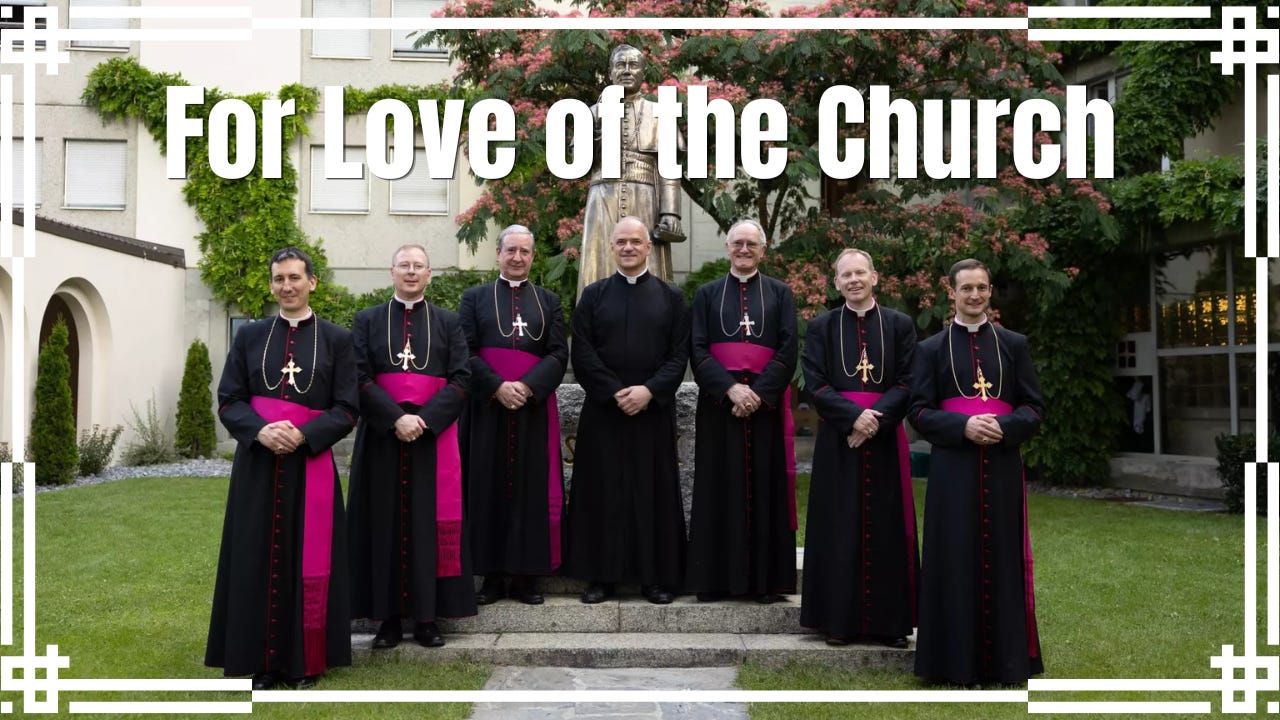 A Consideration of Tim Flanders’ Remarks on the SSPX 04.09.2026 44Min.PreambleTo begin, it must be put into the public record that this is NOT an attack against Tim Flanders as a person. Tim and I have been friends for a long while, and I owe a debt of gratitude to Tim for helping me get started as a writer and podcaster. He helped me to publish my first two books, and we have recorded a number of shows together. Tim and I have shared zillions of text messages and voice notes over the years, and we have supported each other, as friends do, through personal life traumas and obstacles. I have nothing but respect for Tim as a friend and as a man.Nevertheless, Tim is a writer, and so am I. We agree on a lot of things, and we disagree on some things. His views are public, and my views are public — which makes our work fair game. So, given that the SSPX is, clearly, very important to me, and the fact that Tim has begun publishing and broadcasting opinions that I believe are incorrect about the SSPX, I have decided to address some of them here. Let it be known that I spoke to Tim and told him I was going to do this before publishing.In any event, with the preamble out of the way, the majority of this essay will concern what Tim published in his article The SSPX and the Lay Nobility, and a couple of comments will be made about some of Tim’s opinions expressed in recent podcasts.Also, because Tim and I are so familiar with one another, I have decided to refer to him as simply “Tim” throughout the piece, because calling him Mr. Flanders, or using some other formality, seemed cold to me as I was writing, given our personal relationship. So, I hope the reader understands that by referring to him by his first name, it is, in this case, a sign of respect and fraternal affection.Where We AgreeTim says the SSPX confesses dogmas that a great many bishops will not confess. He says the Society defended the right of every Catholic to the Ancient Rite when almost nobody else would. He says that all of us owe a debt to Archbishop Lefebvre for his defence of the Kingship of Christ. He says the Society’s guardianship of the Deposit of Faith and the liturgy is its strength, and that the whole Church should be grateful for it. He says the excommunications of 1988 were disproportionate and did harm.I agree. I would strengthen the claim about the 1988 affair and add that the excommunications were unjust and invalid when considered in light of Canon Law as it should be understood with the canonical tradition. Also, I tend to agree with a lot of what he says about the topic of the Lay Nobility, as far as it goes, and he makes a number of interesting points about how Catholics used to act in the past. I believe Tim’s greatest strength is his command of Catholic history, and he demonstrates his deep knowledge of Catholic history in the article.The piece is offered as thirty-seven theses. It accuses the Society of an error against the Church’s teaching on sacramental grace, of a position that “seems schismatic,” of spiritual abuse, and other things.The charges are serious, so we will assess the charges seriously, and to do so we must put our feelings aside and be objective, even if the response seems severe.Mere Tradition with Kennedy Hall is a reader-supported publication. To receive new posts and support my work, consider becoming a free or paid subscriber.There is no thesis in the ThesesTim presents the article as a Thesis, hence the numbering of the assertions.A Thesis is a form of argumentation wherein the thing itself is offered for disputation. For that to be possible, it must make sense as a whole, and each assertion must be defensible on its own, while also building on the statement that came before. It is a perennial method, and figures like Thomas Aquinas give us the best examples.Now, when examined, we find that Tim’s Thesis is not really a Thesis, but is instead a collection of assertions that argue different points, some of which build on the previous points, and some of which can be completely stricken from the piece and change nothing about the argument as a whole.The comment in number twelve about Pico della Mirandola at Lateran V can be deleted, and it has no bearing on his comments on the SSPX. Number twenty-one can be deleted — where he speaks about dioceses reporting criminal priests — and changes nothing. Fifteen can be deleted — wherein he speaks of Rome becoming the seat of the Antichrist — and we have the same result.The numbering of the assertions is helpful as far as it goes, but the order of most of the assertions is arbitrary, even if there is a loose chronological timeline followed. Perhaps Tim sees this all making sense in his own mind, and perhaps he should write a lengthy treatise on how the issue of the Lay Nobility applies to the SSPX controversy, but whatever that argument could be, it is not evident that the two topics have much, if anything, to do with one another.Now, the numbering is consistent with the method of the scholastic form, but the presentation is not consistent with that method. At one point in the piece, Tim asserts that the SSPX demonstrates an imperfect imitation of true Scholasticism, but that is precisely what his piece does.Also, the piece is essentially two essays stapled together. Theses eleven through twenty-two argue that the exclusion of the lay nobility from Church governance is the root of the modern crisis. This is not proven or even argued throughout, but merely asserted. I will have to disagree with him and go with Pope Saint Pius X, who, after receiving a magnificent corpus of work from his predecessors, distilled for us the true root of the Crisis, which is Modernism.Again, perhaps there are causal links in Tim’s mind, but they are not demonstrated. As I said earlier, I believe Tim’s greatest strength is as a historian, but a historian does not a theologian or philosopher make.Theses twenty-three through thirty-four argue that the SSPX errs about sacramental grace, among other accusations. Neither half needs the other.The first half could be removed, and nothing would change in the second, and vice versa. No premise in the one does any work in the other.The Humility Provisos Don’t Match the ContentTim opens by quoting St. John Climacus: “the man whose desire in conversation is to establish his own opinion — even though what he says is true — is sick with the devil’s disease.”This is a great quote, but it is not a teaching of the Church. What I mean is that, in the opinion of this particular saint, and in the context it is uttered, I am sure it is a very useful maxim to live by. Certainly, in our personal lives, it is a good thing to keep our mouths shut, even if we know the other person is wrong. Nevertheless, the Bible tells us, “But sanctify the Lord Christ in your hearts, being ready always to satisfy every one that asketh you a reason of that hope which is in you,” (1 Peter 3:15).Of course, it would be absurd to argue that following Saint Peter’s instruction would make us sick with the Devil’s disease. Imagine a scenario wherein an atheist challenges you on your beliefs, and you respond to what he has said with the truth. You would not be sick with the Devil’s disease for establishing your opinion — the true opinion — in that conversation.And Tim gives us this maxim immediately before trying to establish his opinion over dozens of short paragraphs. I do not believe Tim is sick with the Devil’s disease — I just believe he is using a useful quote for personal spiritual growth in the wrong context. If that quote were a maxim applicable in a general sense, then the entire paradigm of Catholic apologetics and preaching would have to cease, which would be absurd.Tim begins with that disclaimer, and ends the piece with another disclaimer about how his opinion is worthless, and in between the two we find: an accusation of doctrinal error against a religious society, a charge of schism, a charge of spiritual abuse, a call for public recantation, a verdict that a beatified pope broke with Tradition, a verdict that a canonized pope broke with it twice, the claim that the papacy has been corrupted by Freemasonry since 1773, the claim that Rome became the seat of Antichrist in 1870, and two flat declarations about why God punished Christendom.Again, I do not doubt Tim’s sincerity or question his motives; nevertheless, I do believe the humility disclaimers function as a sort of defence mechanism: if Tim is challenged, the response can be, “my opinions are worthless anyway,” and if Tim’s words are not challenged, then they stand as severe assertions and accusations on their own. If Tim truly believed his opinions were worthless, then he would not have spent so much time trying to argue them.There is a related problem with his second assertion, which is consequential for the rest of the piece. The lay nobility, he says, may not adjudicate quaestiones disputatae; it may only recognize dogmas.Very well. Nonetheless, Tim then proceeds to adjudicate a number of disputed questions.At thesis twenty-six he writes: “It is beyond the competence of the lay nobility to dispute about a responsum from the Holy Office.” However, while there is truth to this statement, it does not apply to the context wherein we find the statement. The effect is that the reader is dismayed from disagreeing with Tim’s adjudication, but his use of the Holy Office responses — which are not cited or presented — is incorrect, as will be seen below.In essence, the rule binds the reader but not the author. This is not acceptable practice for a Thesis.Thesis twenty-six is structurally vital for his accusations about the SSPX. Theses thirty-three and thirty-four depend on it explicitly. Here is twenty-six:“They [SSPX] erroneously assert that a doubtful faith in a priest creates a doubtful intention for the validity of the Sacrament. This opinion has been explicitly excluded in responsa by the holy Office before Vatican II.”Nothing is cited or presented, only asserted. He says “responsa,” in the plural, so we should have a number of responses. The footnote goes to an article about the 1988 consecrations. On the single claim that the entire prescriptive half of his essay rests upon, the reader is asked to accept an unverifiable appeal to an unnamed document — by an author who has just informed him that he lacks the competence to dispute it.He also cites no SSPX text. He attributes a position, and then he refutes the attribution.There are a number of statements from Lefebvre and the SSPX which would caution Tim against making his assertion.What the Archbishop actually saidIn his sermon at the consecrations on 30 June 1988, Archbishop Lefebvre asked from whom his seminarians would receive the sacrament of Holy Orders — from conciliar bishops, who, because of their doubtful intentions, confer doubtful sacraments.Now, Archbishop Lefebvre expressed his doubt in the validity of sacramental functions in the post-conciliar period, and he stated that a doubtful intention could lead to doubtful sacraments. Of course, this is manifestly true, as will be seen below. In any event, Lefebvre did not say that because the post-conciliar bishops lacked faith that their actions would be invalid. He spoke of intention, which is one of the three pillars of sacramental validity.On this topic, the Archbishop said in 1986: “I cannot say, myself, that for all sacraments in the Conciliar Church, these three conditions [of validity] are never met. I don’t think we can say that.” And he said: “But I think with new priests, with priests who no longer have Catholic intentions, they don’t know what the proper intention is, the intention of the Church, so that perhaps the validity of their sacraments is at least doubtful.”Perhaps. At least doubtful.Lefebvre expressing qualified doubts about the validity of sacraments in the New Springtime is not the context of the unnamed responses from the Holy Office.Thanks for reading Mere Tradition with Kennedy Hall! This post is public so feel free to share it.Doubts About Fact and LawsA dubium iuris is a doubt of law. It is a doctrinal thesis: that the rite as such, or its ministers as such, are defective. The Society does not argue this.A dubium facti is a doubt of fact. It is a judgment that in particular cases what actually occurred cannot be verified. The Society does argue this.These are different maxims; they belong to different categories, and they are governed by different principles.The principle governing a doubt of fact in sacramental matters is the perennial rule of the moral theologians: in sacramentis tutior pars est eligenda. In the sacraments, the safer course is to be chosen.This is reflected in the current code of Canon Law. Canon 869 §1 directs that those about whose baptism there is doubt are to be baptized conditionally if, after serious investigation, doubt about the fact or the validity remains.That there could be defective sacraments — because of form, matter, or intention — is not an invention of the SSPX.So a responsum settling the speculative question — that a minister’s personal unbelief does not of itself invalidate — tells us nothing whatever about what a bishop ought to do during an immense crisis wherein the whole sacramental order has been tampered with, often in an ad hoc manner.Tim answers a question of fact with an answer about law and believes he has addressed it.He refutes a position that the SSPX doesn’t hold. Namely, that a minister’s sin, unbelief, or heresy invalidates. That would be consistent with Donatism, and the SSPX is not Donatist, because it is not a heretical organization.That a minister’s positively contrary intention invalidates is not Donatism at all.Council of Trent, Session VII (3 March 1547), Decree on the Sacraments, canons on the sacraments in general, canon 11 states:Si quis dixerit, in ministris, dum sacramenta conficiunt et conferunt, non requiri intentionem saltem faciendi quod facit Ecclesia: anathema sit.If anyone says that in ministers, when they effect and confer the sacraments, there is not required at least the intention of doing what the Church does: let him be anathema.Canon 12, immediately following it states:Si quis dixerit, ministrum in peccato mortali exsistentem, modo omnia essentialia, quae ad sacramentum conficiendum aut conferendum pertinent, servaverit, non conficere aut conferre sacramentum: anathema sit.If anyone says that a minister who is in mortal sin, though he observes all the essentials which pertain to effecting or conferring the sacrament, does not effect or confer the sacrament: let him be anathema.Two details in the Latin of canon 12 are worth consideration.Modo … servaverit: “Provided he has observed.” It is a conditional clause with the subjunctive. The canon protects the minister in mortal sin on the condition that the essentials were kept. Validity is not guaranteed without qualification; it is an exemption granted within a boundary, and the boundary is omnia essentialia.Omnia essentialia, quae ad sacramentum conficiendum aut conferendum pertinent: Everything essential pertaining to effecting or conferring. This phrase covers matter, form, and the intention required by the canon immediately preceding. So canon 12 does not sit apart from canon 11, as the preceding canon is presupposed.Trent gives us an example of the Scholastic method, as the canons are like theses that build off of the preceding one.After Trent, we have more information from the Holy See that can help us to understand the intention question as it pertains to validity.In 1690, Alexander VIII had the Holy Office condemn a proposition from Louvain: that baptism is valid when conferred by a minister who performs the whole external rite and form, while resolving interiorly in his own heart, I do not intend what the Church does. The theologian who defended it, Farvacques, appealed to Saint Augustine. Augustine had argued against the Donatists that if the minister’s hidden holiness were required for validity, God would have to signal it somehow; Farvacques extended the same reasoning from hidden holiness to hidden intention. Rome rejected the extension: the minister’s sanctity stands outside the sacrament; his intention does not; and Trent had already numbered it among the essentials. So the Church has formally repudiated the notion that correct external performance is by itself a guarantee of a valid sacrament.Now, this does not mean that we are in a position to arbitrarily judge internal intentions. Pope Leo XIII added to the debate about how intention could invalidate a sacrament, or even the sacramentality of a given group of priests in the Anglican context.In Apostolicae Curae, examining Anglican orders in 1896, Leo said that the Church does not judge the mind as interior, but as it is externally manifested. In the case of the Anglicans, the rite itself is the manifestation. Where a rite has been deliberately reshaped so as to exclude what the Church means to do, the required intention is wanting, and no appeal to the private sincerity of the men using it can supply for the defect.Given what we have read, any appeal to a Donatist-esque reasoning on behalf of the SSPX is incorrect. Nobody in the Society is proposing that we audit the interior life of individual priests, which would be both impossible and forbidden. The argument has always run along Leo’s line: that a rite constructed on a defective account of what the Mass is, administered by men formed on that same account, can manifest something other than what the Church intends — and that where it does, the presumption in its favour weakens.After Vatican II, we have a completely reformed liturgical system, which engendered widespread, documented abuses that did lead to invalidity in some cases, and the whole affair, especially in the 70s and 80s, was, in a word, a gong show. Lefebvre and his priests responded to said gong show with Catholic principles, which rightly allow us to doubt — not declare as such — the validity of sacraments conferred in the new rites in certain cases.No error is present in the thinking of the SSPX on this when rightly considered, despite Tim’s claim.The doubt is not hysteriaIn 2020, the Congregation for the Doctrine of the Faith declared that baptism conferred with the formula “We baptize you” is invalid, and that those so baptized must be baptized again.Deacon Mark Springer used that formula at St. Anastasia in Troy, Michigan, from 1986 until 1999. Thirteen years with no correction from any oversight.Fr. Matthew Hood was baptized by him in 1990. His baptism being invalid, so was his confirmation, and so was his ordination. His ordination being invalid, so was every Mass he offered, every confirmation he attempted, every absolution he pronounced, etc. Fr. Zachary Boazman of Oklahoma City discovered the same thing that September.Baptism is the sacrament any layman, even a pagan, can confer validly in an emergency. A deacon got it wrong for thirteen years as a cleric! If you think these are the only two examples, then you are in outer space. These are merely two examples that we know of. Lefebvre, in his book Open Letter to Confused Catholics, relays what was being told to him by faithful from all over the world. We can say with confidence that there have been innumerable invalid sacraments in the New Springtime. Sometimes it is because of form, sometimes because of matter, and sometimes because of intention.Lefebvre’s and the SSPX’s ultimate point is: Erroneous formation reliably produces occasions for invalidity through one channel or another, and the man who has it cannot detect it in himself.And, the background to this debate about improper intention is related to the original instructions from Rome on the New Mass.The 1969 Institutio Generalis defined the Mass, in article 7, as the cena dominica — a sacred assembly of the People of God gathered under a priest to celebrate the memorial of the Lord.This definition was contested by men like Lefebvre and Ottaviani, and it was replaced by a definition that included the perennial understanding of the Mass as a sacrifice. Nevertheless, the fact that any document meant to explain the meaning of the New Mass included such a blunder is not arbitrary. The men who formulated that definition must have, as all men must, written what they believed about the Mass. So, we can confidently say that the understanding of the Mass in the New Springtime can at least be called into question, and to do so is not to appeal to mind-reading because it was written down and published, even if quickly retracted. Questioning the intention behind New Rite sacraments is a reasonable position, and having a doubt about those intentions is not an error.The unnamed responsa from the Holy Office that Tim appeals to address the fact that Catholics ought to presume the validity of sacraments following the logic of Trent, etc. However, they do not address what has happened in the New Springtime, and a response from the Holy Office from long ago cannot be extended into the future to respond to a controversy that did not yet exist.The Paschal Mystery, and a method that would have condemned NicaeaThesis ten runs like this. The SSPX says “Paschal Mystery” is only a minor patristic concept. But paschale sacramentum appears in the pre-55 Holy Saturday. Therefore, the SSPX lacks depth in the Tradition.The inference is the whole problem. It assumes that a term’s presence in the tradition settles whether a given use of it is orthodox. The Church has never reasoned that way.The synod of Antioch rejected the word homoousios in 268, because Paul of Samosata had been using it in a way that did not properly express the nature of the consubstantial relation between Father and Son. Fifty-seven years later, Nicaea made the same word the test of orthodoxy, chosen because the Arians could not bring themselves to sign it. A very important theological term was used wrongly in one instance, and rightly in another. Athanasius had to explain as much, at length, to bishops who remembered Antioch and were concerned.Now apply Tim’s method. On his reasoning, the Fathers at Nicaea were superficial, since homoousios had a bad history and they should not have used it. And the Fathers at Antioch were superficial, since it was a perfectly good Greek word with respectable pedigree and they should not have rejected it. Of course this makes no sense.What the Society actually argued was never that the phrase is absent from the tradition. It is that the reformers imported a particular theology — among other things, the death-and-resurrection unity taken as the organizing principle of the whole liturgy — and let it absorb the character of the Mass as the propitiatory re-presentation of Calvary. The argument is that the modern usage of the term has used a term found in Tradition in a way that is not consistent with Tradition. This sort of thing has happened with many other terms, like the term Charismatic, in our day, but to question the contemporary usage or inflation of the term is not to question its meaning in Tradition.Tradition Never DefinedA fundamental accusation in the essay is that the SSPX’s treatment of Tradition is superficial. The essay never once defines Tradition.Tradition has multiple senses, and it has been categorized accordingly.To quote Dr. Peter Kwasniewski, who summarizes the issue:“One of the best twentieth-century textbooks, the Manuale Theologiae Dogmaticae of Jean-Marie Hervé, distinguishes four kinds: dominical, divino-apostolic, humano-apostolic, and ecclesiastical. ‘Dominical tradition’ is that which was established by Christ Himself, such as the indissolubility of marriage and the need for fasting. ‘Divino-apostolic tradition’ comprises that which the Holy Spirit inspired the Apostles to introduce as part of the Church’s constitution, such as the ordination of deacons and the initial determinations of liturgy that would develop, over time, into the families of Eastern and Western rites; ‘humano-apostolic’ refers, in contrast, to that which they themselves deemed fitting to institute as Christ’s representatives, such as determinate periods when Christians should practice fasting and abstinence. Lastly, ‘ecclesiastical tradition’ refers to everything that the Church has instituted or adopted after the time of the Apostles (e.g., the exact duration of the seasons of Advent and Lent, the octaves of Christmas, Easter, and Pentecost, the Rogation Days, and the vestments to be worn by the clergy at the altar).” (The Once and Future Roman Rite, pg. 8)These distinctions are extremely important.In Tim’s essay, for Pius IX, Tradition means inviting lay noblemen to a council. For St. Pius X, Tradition means the Habsburg ius exclusivae — the imperial veto over a papal conclave, which was never a right in law, was a tolerated custom, was last exercised against Cardinal Rampolla in 1903, and stands against a millennium of papal legislation forbidding lay interference in elections, from In Nomine Domini in 1059 through Lateran III. Tim asserts that its abolition was a rupture with Tradition.Tim calls Pius X’s decrees on frequent Communion a liturgical revolution and a break with centuries of Tradition. Those decrees were aimed at Jansenist rigorism. They were framed as a restoration of primitive practice and appeal to Trent’s own stated desire that the faithful communicate at every Mass. In the same document in which he warns the Society against neo-Jansenism, he labels Pius X’s anti-Jansenist reforms as a break with Tradition!In some of Tim’s public words in podcast form, he has spoken about a “False Spirit of Trent,” although I don’t know what that means. In any event, it would seem that Pius X’s reforms were in keeping with the true spirit of Trent, yet somehow keeping with the true spirit of Trent is… a break with Tradition.Also, a quick word on this notion that Jansenism has somehow been resurrected in Traditionalism. There is this widespread belief, as far as I can tell from the popular commentary, that the constitutive substance of Jansenism is related to rigorism or legalism. However, this is putting the cart before the horse. The heretical element about Jansenism stems from a debate about the State of Nature of man, and whether the spiritual gifts were owed to him, or freely given. Jansenism grows out of the Baian error about the State of Nature — the claim that the gifts of original integrity were owed to man rather than freely given. The consequence being that the Fall no longer strips a gratuitous elevation but corrupts nature in itself, and from that corrupted anthropology follow the propositions Innocent X condemned in 1653: that grace is irresistible, that freedom is merely freedom from coercion, and that Christ did not die for all.At any rate, when you look into the debates, they are quite high-brow, and the theological disputes personified by intellects like Pascal’s were very “ivory tower” in spirit. This is not to excuse Jansenism, but only to say that it originated as an elitist movement, and was not a popular movement like Traditionalism after Vatican II.The Jansenists were not heretics because they preached austerity as such; they were heretics because they preached heresies, some of which find a home in the New Springtime. Even some traditional authors have fallen into the trap of labelling elements of the so-called Traditional Movement “Neo-Jansenist,” which is regrettable, because it doesn’t follow at all. Jansenist authors were vehemently opposed to, among other things, frequent reception of Holy Communion, and they were proponents of liturgical antiquarianism; also, they sought to “purify” the devotional life from things like the Sacred Heart devotion, among others. If the term Neo-Jansenist is used as an accusation, because some writers believe that Traditionalists can fall into a sort of scrupulosity or rigorism, then they are correct about some Trads being rigorist, but are not using the term Jansenism properly.All Catholics can fall into those spiritual and intellectual traps. Whatever a Neo-Jansenist is — which is not a doctrinal term — it does not pertain to the SSPX as a group; a group that preaches frequent reception of Communion, devotion to the Sacred Heart, and the right for Catholics to reconcile their troubled consciences with the spirit of the law when the letter is used to bring death to souls.Catholic historian Darrick Taylor gives a good, layman overview of the Jansenist controversy, and my only disagreement with him is that he believes that the accusation that Traditionalists are Jansenist is a fringe accusation that is used by uber-liberals. Unfortunately, Taylor was wrong on that point, as the long-time editor of the traditional Catholic journal OnePeterFive is throwing around the accusation.We have established that rigorism is NOT the main problem with Jansenism in that it is not unique to Jansenism. That being said, Jansenist rigorism shows up not only in questions of morality, but of law. Without going too deeply into it here, I would recommend the reader consult the Catholic Encyclopedia on the topic of Probabilism. Simply put, it is the perennial wisdom of the approved authors and theologians that when there are disputes about laws — both moral and legal — liberty is owed to the man who makes a decision in good conscience, even if the right answer is not obvious. In essence, we are not supposed to extend the letter of the law beyond a reasonable limit.As we will see below, Tim charges the SSPX with schism based on a hypothetical about its reluctance to celebrate the Novus Ordo and the fact that the Pope says the Novus Ordo. Tim’s thought experiment, which results in the SSPX being schismatic, is extremely rigorist, in that the concept of schism, which is a moral and legal penalty, is stretched to the point wherein a man, or entire group of priests and faithful, should be considered schismatic based on Tim’s personal interpretation of how schism could manifest in the hypothetical and psychological disposition. This mentality is seriously “rigid” and does not represent the teaching of the Church. Ironically, it is an interpretation of morals and law that would be more consistent with the rigorism of Jansenists, and is not representative of the SSPX in the slightest.Finally, on the Jansenist theme, while I am not accusing Tim of Neo-Jansenism, there are few public voices who have done more to encourage rigorous fasting protocols more than Tim Flanders, even though the Church does not require them. Tim asks Catholics to be more rigorous in their spiritual disciplines than a century of Popes have.Respectfully, I think we should cool it with the Neo-Jansenist trope.Who, exactly, is the Schismatic?Thesis twenty-six tells us that the layman lacks the competence to dispute a responsum of the Holy Office.Thesis fifteen asserts, as accomplished historical fact, that in 1870 the city of Rome lost the faith and became the seat of Antichrist — presenting as fulfilled a private revelation whose text the Holy Office condemned in 1923 and whose discussion it had prohibited in 1915. The Holy Office decree of 21 December 1915 prohibited publications concerning the so-called Secret of La Salette. The decree of 9 May 1923 condemned the reprint of Mélanie’s 1879 text outright. Publications concerning the Secret went on the Index.He invokes the authority of the Holy Office to silence his opponent eleven theses after disregarding it himself.If the SSPX is schismatic, then what is the following?That the papacy has been corrupted by Freemasonry since 1773. That Rome became the seat of Antichrist in 1870. That Blessed Pius IX broke with centuries of Tradition. That St. Pius X broke with it twice, once on a matter he calls more significant and spiritually graver than the Novus Ordo. That God destroyed His own liturgy before the Council ever opened.Every one of those is more radical than anything in the Society’s official positions. The SSPX has never said that Rome is the seat of Antichrist, or that God destroyed the liturgy.Tim has adopted positions considerably harder than his target’s, and convicted his target of schism, based on accusations that they are in error when they aren’t, while at the same time declaring as established facts things that cannot be concretized as fact, especially by a layman.Papal Communion HypotheticalThesis 27 states: “They officially advocate that a Catholic should never attend even a ‘Reverent Novus Ordo,’ which means they would refuse even the Pope’s own Mass. Therefore they have no real Sacramental communion with the Holy Father.”A number of things are wrong with this.First, the SSPX advocates that the faithful do not participate, but attendance for a good reason is another matter. Attendance for things like weddings, funerals, etc. is not condemned, but the faithful are warned to not participate in the New Mass for reasons pertaining to spiritual danger. Now, Tim obviously disagrees that the New Mass can be a danger as such, but the SSPX is not alone in advocating non-participation in the New Mass. Also, it should be known that the words “attend” and “participate” are used equivocally by basically everyone online, but when tested, the SSPX makes the distinction.In any event, Dr. Kwasniewski devotes considerable ink to why a Catholic can refuse to attend the New Mass, even for Sunday obligation, in good conscience. And, he appeals to numerous works from before Vatican II that were considered standard fare in common theological manuals. I hope Tim does not think Dr. K is also a schismatic.Second, the notion of a “Reverent Novus Ordo” is a muddled statement, even contradictory, and it does not apply to the positions of the SSPX. The SSPX does question the legitimacy (not validity) of the Novus Ordo not because of liturgical abuses, but because of the theology inherent therein, and the effect that it has on souls and priests who say it. To say that the Novus Ordo can be done reverently in some cases and irreverently in others is imprecise, because it suggests that better music and better vestments, with maybe some Latin thrown in, change what the New Mass imbibes substantially, but this is untrue. The New Mass is the New Mass whether it is done with a reverent aesthetic or posture, and the critique that the SSPX levels at the reform — as do numerous other Traditionalists, even those who don’t support the SSPX — is not about the abuses but about the missal itself. It is undeniable that the backstory of the New Mass is riddled with appeals to Protestants, among other things — and Tim knows this because he was featured in the Mass of the Ages, which demonstrated the history of the liturgical rupture adequately.Tim may disagree with the stance, but that disagreement does not mean the SSPX is schismatic because, in Tim’s mind, he has imagined a scenario wherein the SSPX would not receive Communion from the Pope during a Novus Ordo. Furthermore, the more likely scenario, if one could ever manifest, is that the bishops or priests of the SSPX would be invited to concelebrate and they would refuse. They would refuse just like FSSP priests who refuse to concelebrate with their local bishops on Holy Thursday.By Tim’s logic, those FSSP priests are in schism from their local bishop, or at least harbour some sort of crypto-schism, and at least half of the editorial board of OnePeterFive (which includes me) is schismatic in some way.So, Tim can make declarations about multiple popes being in contradiction to Tradition, and about Rome being the Seat of the Antichrist, and not be in schism, because he would receive Communion at a Novus Ordo celebrated by Pope Leo.Furthermore, shared Communion as demonstrated by participation in a liturgy is a mode of demonstrating a communion already had, but it does not make communion happen. It is also wrong to say that the SSPX has “no real Sacramental communion with the Holy Father,” because every baptized Catholic belongs to the Church by the same sacrament, and every time Mass is offered, and the Pope is named, that is literally a sacramental function wherein subjection to the Pope is demonstrated publicly during Mass.In addition, the way Tim phrases the accusation is that because they wouldn’t participate in a New Mass with the Pope, they have no communion. This is illogical, and it would make anyone who has never communed with Pope Leo a schismatic, at least in potential, because they have never had the “real” communion Tim speaks of.Spiritual Abuse AccusationTim accuses the SSPX of spiritual abuse in assertion twenty-eight by referring to an edition of the SSPX prayer book Christian Warfare, which, among other things, lists attending a New Mass in a section devoted to examining one’s conscience.This accusation confused me, because I have told Tim the history of this book, as he asked me about it years ago. This particular book began as a Christian manual for members of the Third Order of the SSPX, which I belong to, and we all make promises to fulfill our Sunday Obligation at the Traditional Mass. Therefore, failing to do so, by attending a New Mass, would be the breaking of a promise or an oath.Now, the book has become wildly popular for general readers in recent years, so the later editions no longer have this particular element, precisely because of how people can use it as a weapon against the SSPX, which Tim has done, even though he knows the history.Furthermore, an examination of conscience is just that, an examination, and there are plenty of things listed in any examination that could be a sin in one context and not in another. For example, virtually every good examination will ask if the penitent has read “bad books,” but obviously certain people must read bad books, or even expose themselves to certain bad situations for good reasons. A police officer may have to chat with prostitutes or enter a bar of ill repute to make an arrest, but he has not sinned like the man who goes there to engage in sinful behaviour.If we are being honest, and not emotional, the average New Mass is certainly an occasion for sin, which Tim admits, at least implicitly, when he speaks of “wicked clerics” mishandling the Eucharist and doing all sorts of evil things during Mass. All of this happens during the New Mass, and Tim readily admits that it is done by bishops, who he calls “evil wolves in clerical clothing [who] destroy the faith of the little ones by desecrating the Blessed Sacrament.”There is nothing spiritually abusive about asking Catholics if they attend a liturgy where such things are commonplace, or at least have been commonplace for decades. It would be spiritually abusive not to have penitents look into the matter further.The SSPX Fails a Test Tim CreatedTim faults the SSPX for not treating Lateran V, the “false spirit of Vatican I,” the Two Swords dogma, the ius exclusivae, lay investiture, and the appointment of bishops.Silence does not constitute a position. To convert an omission into an error, you must show either (a) that the subject falls within the Society’s stated competence and it has misrepresented it, or (b) that its actual positions logically entail an error concerning it. Tim does neither. He simply notes an absence and calls it a deficiency.And, the subjects he faults them for omitting are, by his own thesis 2, quaestiones disputatae — precisely the class he says the laity may not adjudicate. A seminary founded for the formation of priests and the preservation of the Roman Rite is not thereby obligated to publish on the Habsburg veto. Every institution is silent on nearly everything. Silence is only a failure where a duty to speak has first been established, and he never establishes one.The Reconciliation ClaimAssertion 25 states: “nearly EVERY other Latin Mass priestly society has reconciled with Rome, except the SSPX.”This is historically false. They did not “reconcile.” The FSSP (1988), the ICKSP (1990), and the IBP (2006) were erected as canonically regular institutes, most of them constituted in the wake of 1988 and several of them out of SSPX clergy. The condition of their erection was acceptance of the New Mass’s legitimacy — this has been demonstrated, most recently by Cardinal Fernandez.Regarding dialogue, Tim states in thesis 23: “the SSPX is wrong to refuse dialogue.” Thesis 24 cites Archbishop Pozzo, whose role and statements exist because of the dialogue. The evidence in 24 falsifies the premise in 23. And the premise is false on the record anyway as the SSPX has dialogued with Roman officials a zillion times, and, recently, after being ignored numerous times, merely refused a single invitation to dialogue with the man who is known for writing theological erotica.I would also not want to dialogue with Fernandez, and I would also not want Fernandez or Pope Leo to catechize my children, for obvious reasons, which, would likely make me a schismatic in Tim’s estimation, at least according to the essay. However, I guess I could, hypothetically, express my desire to dialogue in the future, and to have Leo catechize my kids and say Mass for us using the Novus Ordo, while I accuse numerous Popes of breaking with Tradition; I could call the bishops of the Church evil and accuse them of sacrilege; I could mislabel a group of priests as spiritually abusive; I could accuse God(!) of destroying his own liturgy, but I would at least not be a schismatic…I am sorry if I sound snarky, but this is where the logic leads.Frankly, Tim’s arguments are not really arguments, and they are incoherent at best. Furthermore, the type of schism he has created for the SSPX is in the psychological register, and the majority of the evidence he cites are his own articles, so it is self-referential.Tim’s logic has placed the majority of Traditionalists at risk of schism, and the essay is untenable and should be retracted.Kyrie Eleison This is a public episode. If you'd like to discuss this with other subscribers or get access to bonus episodes, visit meretradition.substack.com/subscribe
 -
 A Journey to Charity | From the Novus Ordo to the SSPX and Catholic Tradition: My Story 07.08.2026 1Std. 15Min.https://www.icatholicmobile.com/https://realestateforlife.org/ This is a public episode. If you'd like to discuss this with other subscribers or get access to bonus episodes, visit meretradition.substack.com/subscribe
 -
 Re-education for Trads, Schismatic Communion, and Darwin vs Catholicism | Q&A 04.08.2026 15Min.This is a free preview of a paid episode. To hear more, visit meretradition.substack.comhttps://www.icatholicmobile.com/https://realestateforlife.org/
 -
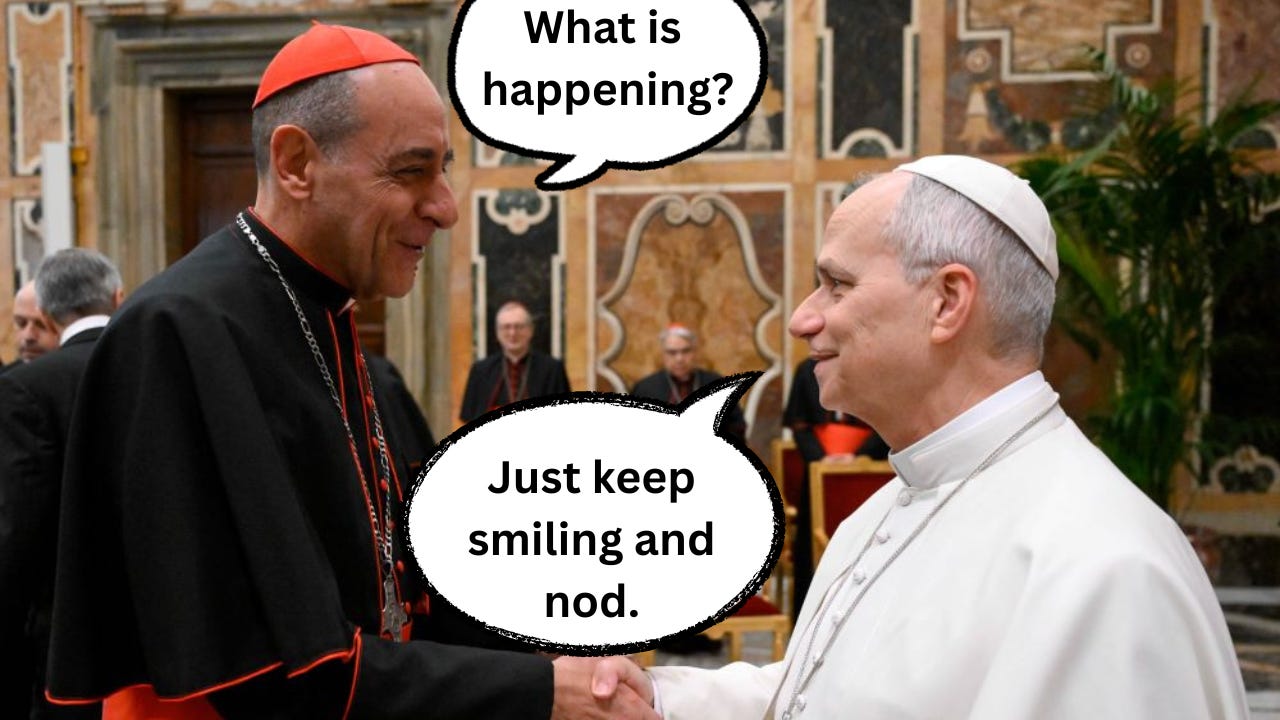 By What Instrument? Ecclesia Dei Fulfilled 28.07.2026 33Min.Author’s note: Since the release of the documents regarding the July 1 SSPX consecrations, it has become public knowledge that Catholics, who are under no penalty, are being treated as criminals, even publicly so, and often in chapels and parishes run by Catholic priestly societies committed to the Traditional Mass. This is not the only place it is happening, but the fact that it is happening in those places is most disheartening. These events have inspired the following essay, which concerns the legal problem we are facing in general, but with some specific emphasis on the situation as it pertains to parishes committed to the Traditional Mass.Now, this article is not intended as an apologetic for the SSPX. I have made that case elsewhere, and men far more qualified than I am have made it in a million other places.Instead, I am taking the various documents released since 1 July and assessing the responses to them in light of canon law and the practice of the Church. My claim is narrow: the framework by which the lay faithful attached to the Society have been declared excommunicated cannot be applied consistently to anyone. The logic of the documents used as the foundation for the treatment of the lay faithful undercuts the very application of those documents.We do not need to absolve the Society of any wrongdoing here. We need only show that the instrument meant to condemn the priests and the faithful does not exist.It is unfortunate that so much of this conversation has become litigious, centred on canon law. Nevertheless, this is the ground on which the opponents of the Society have planted their flag. There are many other ways to argue for the innocence of the Society and of the faithful it serves, and I believe they are much stronger in the end, because the laws of the Church exist to serve her supernatural mission, which is the salvation of souls — and that mission is not accomplished by a code of human law.I hope readers will keep that in mind. At the same time, for those who want pedantic canonical proof, I hope this article will be useful.Before we continue, I ask the critic to keep this in mind before constructing an emotional argument in the comment section about topics that are not discussed here.Links mentioned in the Audio Recording:Mexico Pilgrimage: https://kennedyhall.ca/mexicohttps://realestateforlife.org/https://www.icatholicmobile.com/Mere Tradition with Kennedy Hall is a reader-supported publication. To receive new posts and support my work, consider becoming a free or paid subscriber.I. What Was Actually IssuedThree documents are in play, and almost every commentator has treated them as though they were one. They are not. They differ in kind, in the intention of their authors, and — decisively — in juridical force.The Decree of 2 July is a declaratory decree. It declares that six named men have incurred latae sententiae excommunication: two consecrators and four consecrated, under canons 1387 and 1364 §1. Six men are named. Technically, Bishop Fellay was not penalized in the same way as the others, and only the charge of schism was reserved to him.In any event, against no other person does the Decree declare, impose, or inflict any penalty whatsoever. No priests and no laymen are named.The Explanatory Note accompanies the Decree. It is a nota esplicativa. It is not a law: canon 7 provides that a law comes into existence when it is promulgated, and canon 8 specifies the manner. It is not a general decree with legislative force under canon 29. It is not a general executory decree under canon 31. It is not even an instruction under canon 34 — and canon 34 §2 is worth reading slowly, because it provides that instructions do not derogate from laws, and that any provision in them irreconcilable with law lacks all force.And, a document outlining how SSPX faithful and priests can be “reconciled” has been released as well.We should break this down for the average — normal! — reader who does not spend endless hours reading about canon law.It helps to think of it the way a lawyer thinks about the difference between a statute and a press release. The Church does not treat every document that comes out of Rome as binding. She is quite precise about which ones are, and the Code sets out the categories.A law is the strongest instrument, as it binds the faithful; canons 7 and 8 provide that it comes into being only when it is formally promulgated, published in the proper manner and in the proper place.A general decree under canon 29 is a law by another name, issued by someone with legislative power for a whole community.A general executory decree under canon 31 is one rung down: it does not make new law, but sets out how an existing law is to be applied.An instruction under canon 34 is lower still: it clarifies a law’s provisions and directs those charged with carrying it out.And canon 34 §2 is vital, because it tells you what happens when one of these lesser documents strays. Instructions do not derogate — that is, detract — from laws. Whatever cannot be squared with the law has no force at all.These are the principles of the Church, and they reflect a long and coherent canonical tradition. A document explaining a law can never override the law it explains.This raises a significant difficulty. An explanatory note is not found anywhere in the list above. It is not a law, not a general decree, not an executory decree, not even an instruction. It is an annex — a statement of how the officials of a dicastery understand a situation. That is not nothing; it tells you a good deal about the mind of the men who wrote it. But if a mere instruction lacks all force where it conflicts with law, we are entitled to ask what force belongs to a document that ranks beneath an instruction, and how it came to be treated as sufficient to declare a man cut off from the sacraments.That the Note has been used as a legal apparatus is alarming. We cannot know intentions, but we can plainly see canonical incompetence and incoherence, if not outright malice. Again, we cannot impute malice infallibly — but the harmful misuse of law is doing real damage to souls, and the men who have done this are culpable one way or another.The Prassi, the procedures document meant to help SSPX Catholics “come back into the Church,” is guidance directed to nuncios and Ordinaries for handling those who present themselves. Again, it is founded on a Note that has no legal force and, as we will see, is internally incoherent when the source material is considered.The Note exhorts the faithful to abstain from participating in the celebrations and activities of the Society.Exhorts.An exhortation is not a precept. It is an encouragement. And it is worth keeping in mind that this particular encouragement comes from a cardinal who has encouraged the blessing of unions that cry out to Heaven, and who has discouraged, in no uncertain terms, the use of theological titles for Our Lady that are deeply embedded in the devotional and theological tradition of the Church.If any traditionalists would like to hammer the SSPX with the contents of the Note, I would exhort them to follow Cardinal Fernández’s other exhortations as well — that is, if they wish to be truly obedient sons of the Church. I would exhort them to welcome any Fiducia Supplicans events that take place “spontaneously” in their parishes. And I would exhort them to make sure they tell their congregants that it is always inappropriate to use the title “Co-redemptrix” to define Our Lady’s cooperation. So: no more traditional Marian lectures, please, without the proviso that Catholics should not use outdated terms because Tucho said so.At any rate, canon 49 defines a singular precept as a decree by which an obligation is directly and legitimately imposed upon a determined person to do or omit something. A precept has a form, an author with executive power, and a determinate addressee. An exhortation in an annex has none of these. And where there is no obligation there can be no violation; where there is no violation there is no delict; where there is no delict there is no penalty.Rome possesses instruments for binding the faithful. They were not used.Consider, too, that it is highly unlikely Cardinal Fernández does anything without first consulting the Holy Father. You are free to draw your own conclusions.So the position after 2 July, strictly speaking, with no recourse to any Society apologetic, is this: six men have been penalized. No priest of the Society has been penalized by any juridical act. No layman has been penalized by any juridical act. Everything that has followed — the pulpit announcements, the diocesan instructions, the refusals to commune with SSPX attendees, as at some FSSP locations — has been done to people against whom nothing has been declared.II. The Remission That Remits NothingMere Tradition with Kennedy Hall is a reader-supported publication. To receive new posts and support my work, consider becoming a free or paid subscriber.Here is where the framework becomes an indictment of itself.Suppose, for the sake of argument, that a layman really has incurred an undeclared latae sententiae excommunication for schism under canon 1364 §1. What does the law itself prescribe?Canon 1357 §1. In the internal sacramental forum, any confessor may remit an undeclared latae sententiae censure of excommunication or interdict, where it is difficult for the penitent to remain in a state of grave sin for the time necessary for the competent superior to provide. The excommunication of canon 1364 §1 is not among those reserved to the Apostolic See. It is remissible in the confessional. Any confessional. Anywhere on earth.What this shows is that there is no need for any process of reintegration for any SSPX layman — assuming they need to be reintegrated at all, which I do not believe, but which I will grant for the sake of the strict analysis we are now conducting.What does the Prassi require instead? A signed and dated Profession of Faith. A Formula of Adherence affirming Lumen Gentium and the post-conciliar magisterium. Submission through the nunciature or the local Ordinary. A documented undertaking not to participate in the Society’s sacramental life in the future.The remedy does not match the chargeRemission of a censure has a defined condition, and only one. Canon 1358 §1 provides that remission cannot be granted unless the offender has withdrawn from contumacy, and canon 1347 §2 defines what that means: he has withdrawn who has truly repented of the delict and made suitable reparation for damage and scandal, or at least seriously promised to do so. That is the whole requirement. Repent of the delict; repair the damage.So ask what delict was alleged. Schism, under canon 1364 §1, defined at canon 751 as the refusal of submission to the Roman Pontiff or of communion with the members of the Church subject to him.Note what canon 751 does not say. It defines heresy separately, in the same canon, as the obstinate denial or doubt of some truth to be believed with divine and Catholic faith. Schism and heresy are distinct delicts with distinct objects. A schismatic is not by definition a man who denies a doctrine; he is a man who refuses submission and communion.The Prassi treats schism and heresy as though they were the same thing. It treats the faithful of the SSPX as though they were heretics who must demonstrate their fidelity to the Church by professing belief in disputed, non-infallible texts of the Second Vatican Council. Technically speaking it would be impossible to call someone a heretic for denying aspects of Vatican II, because the assent of divine and Catholic faith is reserved for definitive dogma.It asks for a signed Profession of Faith and a Formula of Adherence affirming Lumen Gentium and the post-conciliar magisterium. This concerns doctrinal assent, which is the apt remedy for heresy, not for schism.So the procedure convicts of one delict and supposedly cures another. Whatever else it is, it is not the remission of a censure for schism, because it does not ask for the thing whose absence constitutes that delict. And if what is actually sought is doctrinal assent to the conciliar texts, then that is an entirely separate issue — unless, in the New Springtime, one is in schism for questioning Vatican II. How many Catholics are in schism, then?It is applied to people who have no penaltyThe Note’s own two-tier structure admits this. Those who attend for liturgical or spiritual reasons, without rejecting the Magisterium or papal authority, are by the Note’s own terms not excommunicated. Yet they too are asked to undertake not to attend in future.You cannot remit a penalty a man does not have. Whatever is being asked of that second group, it is by definition not remission.The forum is wrongCanon 1357 puts the ordinary remedy in the internal sacramental forum, with recourse permitted through the confessor and without the penitent’s name. The Church’s own instrument for this censure is confessional and anonymous. The Prassi requires an event that is essentially public.Internal-forum remission produces a reconciled soul. External-forum submission produces a record.It is more like a humiliation ritual, and the logic of the thing is entirely alien to canon law — or, quite frankly, to any pastoral sensibility.Consider this in light of canon 1317, that penalties are to be established only insofar as they are truly necessary; in light of canon 18, that penal laws and laws restricting the free exercise of rights are subject to strict interpretation; and in light of canon 1341 as revised in 2021, which requires that penal procedure be reached for only when pastoral means have proven insufficient.Personally, I am about the most outspoken SSPX advocate I can think of, and I have not experienced any “pastoral” engagement from my diocese, or from any cleric for that matter. I have definitely been cursed at and yelled at online a million times, but that did not feel especially pastoral.All considered, this is unintelligible as penal law, and perfectly intelligible as something else.III. The Dilemma at the Heart of 1996The 2026 Note is built on the logic of the 1996 letter of the Pontifical Council for Legislative Texts concerning adherence to the Society. That is the locus.And that letter cannot bear the weight now placed on it, for a reason internal to the letter itself.Taken in the strict sense, the text exists in order to distinguish. It distinguishes those who merely attend the Society’s Masses — who do not thereby incur excommunication — from those who adhere to the schismatic principle, that is, who repudiate the primacy of the Roman Pontiff and communion with the Church subject to him. Attendance is not adherence, according to the letter. That distinction is the entire content and purpose of the document.We should also note that schism is defined as the withdrawal of submission from the Pope, and not as disobedience. This is without question the unanimous consent of the tradition on the matter, whatever has become a substitute for actual schism in the era of Modernism.The criterion of the letter is interior. Adherence to the supposed schismatic principle is an act of the will — a repudiation of primacy and communion. Very well. Then by that criterion’s own terms, consider the man being penalized. He names Leo XIV in the Canon of the Mass. His superior wrote to the Pope repeatedly and expressed his recognition of the papal office. His Society filed an appeal with the Dicastery on 11 July — and a body that has repudiated Roman authority does not petition the dicastery from which it has supposedly separated itself. By the criterion of 1996, no repudiation of primacy has been demonstrated in the Society’s priests, and still less in a mother of six who drives forty minutes on a Sunday because she wants her children catechized in the Faith she was raised in.And here the 2021 revision of the penal law is vital for our purposes. Pascite Gregem Dei inserted into canon 1321 §1 the clear statement that a person is presumed innocent until the contrary is proven, displacing the old imputability provision to §2, which requires that the external violation be gravely imputable by reason of malice or culpability. An interior act of the will is precisely the thing that cannot be presumed. The Church’s own penal code now says so in unambiguous terms.Someone will object that canon 1321 §4 provides that once an external violation has been established, imputability is presumed unless the contrary is clear. This is true, and it does not help them. That presumption operates only once the external violation has been established — and the external violation here is precisely what has not been established, because the 1996 letter itself says that attendance does not constitute adherence. You cannot presume imputability for a delict you have not first shown was committed.How, then, can we square any of this with the Note, which declares that faithful who “formally adhere” to the Society are to be considered schismatic and excommunicated? Formal adherence, as 1996 defines it, is an interior repudiation of primacy. The heart cannot be judged, and what cannot be judged cannot be proven. Meanwhile, the letter is clear that sacramental participation with the Society is not itself to be penalized.Do you see the problem? One cannot judge the internal forum of a man. And acts done by free will — such as going to the SSPX for Mass — do not constitute schismatic acts, according to the logic of the Note and of the letter it appeals to. So it is essentially impossible to prove that anyone has “formally adhered” to a schism that has never been established in the first place.Quite frankly, the method for assessing who is and is not schismatic is nothing short of what I can only call gnostic. People are to be judged on the basis of what they might believe in their hearts, but do not demonstrate by their actions. It is an imaginary schism — a schism that exists in the eye of the beholder. It is insane.And so the letter on which the Note is based turns out to be pointless.Consider why. Everyone sitting in an SSPX chapel on Sunday performs the identical external act. They show up. They kneel, they pray, they communicate. Externally there is nothing to distinguish the mother of six who has been coming for twenty years, from the curious visitor from the diocesan parish down the road, from the man who came for a cousin’s funeral.Now, the 1996 letter exists in order to say that these people are not all in the same canonical position. That is its entire content. Some are excommunicated and some are not, and the letter tells you which is which.But if the external act were the criterion, that sorting would be impossible — because the external act is the same in every case. You cannot distinguish among people by a feature they all share. So the very fact that 1996 sorts them proves it is sorting by something else, and it tells you what that something is: adherence to the schismatic principle, the repudiation of primacy and communion. Which is to say that the Note and the letter alike require you to assess the goodness or badness of another man’s will. Again: this is insane.To cite 1996 as your authority is to adopt a document whose whole reason for existing is that the external act does not settle the question. You cannot then turn around and settle the question by appealing to external acts. The document you are leaning on is the document telling you that you cannot.The Note wants both. It cites 1996 as its locus while discarding the one thing 1996 actually settled. It treats the Society as schismatic enough to ground a penalty against the laity, and simultaneously not so schismatic that attendance at its Masses was ever prohibited communicatio in sacris — because if it were, that would have been said plainly in 1996, and it was not.You cannot have the benefit of a distinction while denying the distinction.Again: it is incoherent, post-conciliar, modernist, subjectivist idiocy.Mere Tradition with Kennedy Hall is a reader-supported publication. To receive new posts and support my work, consider becoming a free or paid subscriber.IV. The Canons Nobody Is CitingNow let us consider the practical implications for innocent Catholics who are being humiliated at FSSP chapels and elsewhere.A Catholic presents himself for Holy Communion at a diocesan parish. He is baptized. He is properly disposed. Against him no penalty has been imposed or declared by any competent authority. He is turned away — or he is at least implored, in an announcement read from the pulpit, not to receive Communion until he has done some paperwork.Let us be honest: traditional Catholic circles are small, and this sort of thing is degrading and humiliating.So how is it legal?Canon 843 §1. Sacred ministers cannot deny the sacraments to those who opportunely ask for them, are properly disposed, and are not prohibited by law from receiving them. Note the construction. This is not a permission granted to the minister; it is a prohibition laid upon him. And the qualifying clause is prohibited by law. A nota esplicativa is not law. We have established this.Canon 912. Any baptized person not prohibited by law can and must be admitted to Holy Communion. Can and must.Canon 915 is the canon that would authorize refusal, and it is the one that destroys the case. It requires the exclusion of those upon whom a penalty of excommunication or interdict has been imposed or declared, and of those obstinately persevering in manifest grave sin.Against the lay faithful of the Society, no penalty has been imposed or declared by anyone. The very canon invoked to justify refusal, read as written, forbids it.And then the rights of the faithful, which traditional Catholics too rarely trouble to invoke:Canon 213 — the right of the faithful to receive assistance from the sacred pastors out of the spiritual goods of the Church, above all the word of God and the sacraments.Canon 220 — the right to one’s good reputation, engaged by every public assertion that named or identifiable persons are excommunicated when no competent authority has declared them so. In plain terms: publicly describing people as excommunicated when no penalty has been declared against them violates a right the Code expressly protects, and canon 1390 §2 attaches a penalty to unlawfully injuring another’s good reputation.I wonder if anyone will be penalized for calling me a schismatic, publicly, on the internet… I won’t hold my breath.Canon 221 §3 — the right of the faithful not to be punished with canonical penalties except according to the norm of law.What we plainly see here is the law being used against its own purposes and against its own spirit. I am thinking of a word. It starts with “Ph” and more or less rhymes with “heresy.” For evidence of how Our Lord deals with those who fit the bill, see the New Testament.Mere Tradition with Kennedy Hall is a reader-supported publication. To receive new posts and support my work, consider becoming a free or paid subscriber.V. The Standard That Runs One WayNow let me turn the framework around — and please understand that what follows is hypothetical, not an accusation.A priest of the Fraternity of St. Peter, or of any diocese, who announces from the pulpit that those attending the Society’s chapels are excommunicated, and who refuses them Communion, is doing everything I have just described: denying the sacraments to persons not prohibited by law, on the authority of a document that is not law, against a presumption of innocence the Code demands, in the teeth of canon 915’s own limitation, with a further injury under canon 220.Some will observe that schism, as canon 751 defines it and as St. Thomas treats it at ST II-II q. 39 a. 1, has two species: the refusal of submission to the Roman Pontiff, and the refusal of communion with the members of the Church subject to him. They will observe that the Society has never done the first, and that refusing the Blessed Sacrament to fellow Catholics looks a great deal like the second.I am not accusing anyone of this. I am only telling you what it looks like.Schism requires the will to sever the bond of unity. A priest who refuses Communion on a mistaken reading of a document he takes to be binding is not willing separation from the Church’s unity. At least, we cannot claim he is doing that — even if that is the effect in practice.He is, wrongly, trying to enforce unity.So we could say that he is doing his best in a confusing situation, on advice he had reason to trust, and that it goes too far to call him schismatic.However — and this is anecdotal — if you attend a Fraternity chapel, or another TLM group, can you attest to what I have been told ad nauseam about priests from non-SSPX groups: that it is often the case that during homilies one hears a great deal of criticism of what comes out of Rome? I have been to a Fraternity chapel twice for Mass. One was a daily Mass with no homily. The other was a Sunday, almost a decade ago, at which the priest preached about the hierarchy more or less going to hell because of their scandals.I have been told a thousand times that homilies of this kind are not uncommon, even if that particular one was a little hardcore. So can we really say that the priests of the FSSP are in the habit of accepting and implementing the doctrinal and theological opinions of men like Cardinal Fernández with docility?Please be honest.Now, it will likely be said that this humiliation of SSPX faithful is taking place because local bishops are demanding it.Fair enough. But this is another illustration of why we need the SSPX — because the other groups of priests who are supposed to carry the banner of tradition are unable to resist overtures from modernists who exhort them to humiliate good Catholics and to spread doctrinal, legal, and theological confusion by way of incoherent applications of laughably untenable pseudo-legal documents that make a mockery of the dignity of the Church’s law.Do these priests not realize that they are helping to spread the heretical tendencies of Modernism by legitimizing all of this? Modernism is thoroughly subjective, grounded in feeling and perception. And these priests, who call themselves traditional, are cementing in the minds of their congregants the idea that a man can be judged on the basis of baseless interpretations of Church law, of perennial doctrine, and of the unknowable disposition of another man’s heart.Now: if good faith and the absence of schismatic intention protect that priest, then they equally protect the priest who names the Pope in the Canon and petitions the dicastery for redress. If interior disposition is decisive, it is decisive in both directions. The Note and the 1996 letter both insist that it is interior adherence to the schismatic principle that constitutes the delict. Very well. Apply it. Apply it to everyone.I expect the reply: the diocesan priest errs about a fact while trying to obey, whereas the Society’s adherents refuse obedience as such. Intention, they will say, is being applied consistently — merely to different objects.But the moment they say the object differs, they have abandoned interiority and returned to classifying acts objectively, which is the opposite of the logic of the 1996 letter and of the Note founded upon it. Objective classification would sweep in every Catholic who has ever heard Mass in an SSPX chapel. They cannot cite 1996 as their authority and then argue on a basis that renders 1996 pointless.You cannot invoke the perennial categories of objective classification in order to reach a judgment that rests on a directive refusing to base classification on anything objective. That is to keep perennial Catholic principles for personal use while demanding that others follow principles the tradition of the Church would find odious.And if we are, after all, to classify by external act, then let us compare the acts honestly.The layman’s external act is attendance at Mass — which the 1996 letter itself declared insufficient to constitute adherence.The priest’s external act is the positive refusal of the Body of Christ to a baptized Catholic against whom no penalty has been imposed or declared, contrary to canons 843 §1, 912, and 915, together with public assertions engaging canon 220.If we are being objective — which Cardinal Fernández forbids us to be — then the act of the priest who refuses Communion to SSPX faithful is the graver one, because it is the one the Code actually prohibits.So I say this, and I mean it without irony: I am content to hold that the priest who turns a Catholic family away from the altar rail acts in good faith on a mistaken reading. I ask only that the same charity be extended to a man who prays for the Pope by name in the Canon of the Mass, and who has never been penalized.Mere Tradition with Kennedy Hall is a reader-supported publication. To receive new posts and support my work, consider becoming a free or paid subscriber.VI. Ecclesia Dei FulfilledWhat follows is a theological judgment rather than a canonical conclusion, and the reader should weigh it as such.For almost forty years a certain arrangement was on offer. Accept the framework, profess the necessary formula, and you may keep the Old Rite. Many good men accepted it in good conscience, and I have never thought them contemptible for doing so.But it was always a tenancy, not a title. Ecclesia Dei afflicta 3 declared that the consecrations were of their nature a schismatic act, and adherence to that characterization was part of the price of the arrangement. In 2021, Traditionis custodes demonstrated what the lease was worth.The Commission that administered it is gone. And now the arrangement requires something further. It requires a priest to stand in the pulpit and announce the refusal of the Body of Christ to baptized Catholics against whom no penalty has been declared, in violation of several canons of the Code he professes to obey, on the authority of an annex that is not law.This is the logic of Ecclesia Dei fulfilled.The traditional liturgy is not a preference in ritual style. It is the lex orandi, and it forms a mind — one that reasons from principles, distinguishes carefully, and refuses to call an exhortation a precept because a dicastery would prefer that it were. Whatever else this past month has shown, it has shown that keeping the Old Rite inside a framework that does not reason is not a stable position. Sooner or later, that framework will ask you to do something the traditional framework has trained you to recognize as wrong.I do not write this to score a point against men I regard as brothers. I write it because a good many of them are, right now, being asked to do something they know to be unjust, and are doing it because they have been told they must follow the law — when in fact they are breaking it by doing so. There are six bishops penalized by name, an annex without juridical force, and a great many Catholics being deprived of participation in the Church they belong to.And in any event, the decree against those six bishops is under recourse, and by canon 1353 recourse against a decree declaring a penalty has suspensive effect. So if everyone is so concerned that the SSPX should follow the law, why can everyone else not manage to follow it too?Thanks for reading Mere Tradition with Kennedy Hall! This post is public so feel free to share it. This is a public episode. If you'd like to discuss this with other subscribers or get access to bonus episodes, visit meretradition.substack.com/subscribe
 -
 The Pope Saint Pius X "Eucharistic Revolution" | Q & A Episode 27.07.2026 10Min.This is a free preview of a paid episode. To hear more, visit meretradition.substack.com
 -
 Catholic Tradition: Preserved by “Disobedience” Whether You Like It or Not 24.07.2026 25Min.Over the years, I have thought a lot about obedience, as I am sure you have, and something about how the topic is considered has always seemed “off” to me. Eventually, I realized that the major issue with how Catholics tend to talk about obedience is that they talk about it in abstract terms rather than concrete terms.Obedience as such is a morally neutral or indifferent abstract concept. For obedience to mean something and be either virtuous or vicious, it must have a concrete human act as its object. The abstract concept of obedience does not exist in reality. One cannot be “obedient” in the sense of living in a general state of obedience. For one to be obedient, one has to obey a particular order or command to concretize the concept of obedience and actuate it as an action in the concrete.And the object of obedience makes the act of obeying either good or bad. One can obey a command, but the obedience itself is not a virtuous or vicious thing; rather, what command is being obeyed and to what end is what makes it virtuous or vicious.Furthermore, circumstances can change whether an actuation of the abstract concept of obedience is good or bad, even when the actions themselves are the same, to the point where there is a qualitative change in what is happening — meaning that the good or bad action becomes a different kind of thing.We can break this down into three parts to help us understand:Mere Tradition with Kennedy Hall is a reader-supported publication. To receive new posts and support my work, consider becoming a free or paid subscriber.1. You obey real actions, not hypothetical ones.When someone tells you to obey, they’re not asking you to obey some vague category of action floating in your head — they’re asking you to do (or not do) one specific thing, right now, in this exact situation. “Don’t kill” isn’t really the command; “don’t kill this person, in these circumstances” is. So when we ask whether obedience was owed, we can’t just ask “was the bare action bad?” We have to ask “was this actual act, with everything surrounding it, bad?”2. Whether something is right or wrong depends on more than just the action itself.Take walking. Walking, by itself, isn’t good or bad — it’s neutral. But walking to rob someone’s house is bad, and walking to clear your head is fine. Same action, different outcome, because the circumstances — especially why you’re doing it — change everything. Same with giving money to the poor — good in itself, but if you’re only doing it to be seen and praised, it curdles into something selfish. One bad ingredient can spoil the whole thing, even if the core action was fine on its own.3. Sometimes the “circumstance” isn’t just a detail — it becomes the whole point.Usually we think of circumstances as minor add-ons: where, when, small details around the main action. But sometimes a circumstance is so significant that it actually changes what the action is, not just how good or bad it is. Stealing is bad. But stealing from a church isn’t just “extra bad theft” — it’s a different kind of offence (sacrilege), because the location isn’t incidental; it’s central to what makes the act wrong. In cases like that, the “detail” stops being a detail and becomes part of the core action itself.Saint Thomas Aquinas explains this third concept in detail:“The process of reason is not limited to a single term; from any point, it can always go further. This is why what, in an act, is considered as a circumstance added to the object which determines the species of the act can then be considered by reason, when it orders, as a principal condition of the object which determines that species.”“Thus, appropriating another’s property derives its nature from the fact that this property belongs to another: this is what constitutes the nature of theft. If we then consider place or time, these are merely circumstances. But since reason can also order according to place, time, and other similar conditions, it can happen that the condition of place, in relation to the object, is considered contrary to the order of reason. For example, reason dictates that one must not commit an offence in a sacred place.”“Therefore, stealing someone else’s property from a sacred place adds a particular opposition to the order of reason. Thus, the place, which was previously only a circumstance, is now considered a principal condition of the object, insofar as it is contrary to reason.”“In this way, whenever a circumstance relates to a particular order of reason, favourably or unfavourably, it is necessary that this circumstance confer upon the moral act its kind, making it specifically good or specifically bad.” (Summa Theologica, I-II, q. 18, a. 10.)A circumstance can affect an act’s morality in two very different ways.Sometimes the circumstance is what defines the act — it’s the reason a neutral or good act becomes evil in the first place. When that happens, the circumstance stops being a side detail and becomes part of the act’s essential moral character.Other times, the act’s moral character is already fixed by its object alone — good or bad — and the circumstance just makes it more or less so. Here the circumstance is incidental; it adjusts the degree, not the kind.The difference: does the circumstance determine what kind of act this is, or just how much good or evil is already there? Only the first kind can turn a neutral act into something evil or good in itself.Mere Tradition with Kennedy Hall is a reader-supported publication. To receive new posts and support my work, consider becoming a free or paid subscriber.The SSPX and ObedienceApplied to the SSPX situation: staying quiet and not consecrating bishops is, by itself, a neutral act — neither good nor bad. I imagine some readers will take offence to this statement, because we associate sacramental acts with something good. Yes, of course the acts in general are good, but the context changes things. For example, a valid priest could confect the Holy Eucharist in a satanic ceremony, and it would be evil to do so — the object of the act (a satanic ceremony and the desecration of the Eucharist) is vile, even though the Eucharist is, of course, good.Similarly, the consecration of a bishop as an action is morally neutral, and why it is being done makes all the difference, even though the conferral of the sacramental character, in its own proper existence, is always good. These distinctions make it possible for morally evil sacramental actions to exist, while the nature of the sacramental character remains not evil in itself.But in the case of the Society, to decide to postpone the consecrations indefinitely would not be a morally neutral act, given the circumstances. For the sake of this essay, we will assume that the reader is aware of the proper arguments for the State of Necessity, and of the intentions of the Society which pertain to their circumstances. Keeping these realities in mind, we understand that there is a state of public and grave necessity for many souls, and it is the opinion of the leadership of the Society that the two remaining living bishops consecrated by Archbishop Lefebvre are insufficient to keep up with the rapidly growing demand for Traditional sacraments worldwide, which include Confirmation and priestly ordination.So the Society was faced with a decision: obey a command from the Pope to forgo the consecrations, or disobey the command in order to move forward with the consecrations, for the sake of the continued existence of the Society and for the faithful who depend on it for the sacraments. Again, I am assuming the reader is at least familiar with the arguments regarding this topic.Now, even if you disagree with the Society’s reasoning, please try to understand the question of obedience under these circumstances. Again, obedience as an abstract concept is morally neutral and does not produce virtue in and of itself; therefore, what is being obeyed — the object — must be considered. As hard as it is for modern Catholics to understand, the Pope does not have magical powers to make good evil and evil good. A command from the Pope can have as its object a good or an evil outcome, depending on what is commanded, and the fact that the Pope commands it does not magically make it good.I imagine any reasonable person could picture a scenario in which a pope ordered Catholics living in adultery to receive Communion anyway. This is easily imagined because of the legacy of Pope Francis. Of course, he did not order Catholics to do so, but he clearly believed it was good for Catholics living in such a state to do so; therefore, it is conceivable that, if the situation arose, a command of that sort could be given. Obviously, one would have to disobey that command if they knew the teachings of the Church.The present circumstances are not so obvious or clear to many, which is understandable; nonetheless, the logic still stands. I hope that even the most ardent defenders of the recent popes would agree that disobeying the command of a pope is morally required under certain circumstances. You may draw your own line in a different place, but hopefully we can agree that not all disobedience of a papal command would be sinful.In any event, the concrete decision before the Society was not an abstract case study from a university philosophy class. It was decided that to obey in that circumstance would produce an evil, which would include a general acceptance of all the post-conciliar reforms, magisterial texts, etc. — including, of course, the more ludicrous documents of recent years, of which I am sure you are all aware.The reader must remember that the conditions for mere dialogue to begin — dialogue that could eventually result in a hypothetical permission to consecrate — were set by Cardinal Fernández, and those conditions were, in the opinion of the Society, evil. In addition, the language surrounding the conditions was that “full communion” would only be possible if those conditions were met.Again, while the reader may disagree, I hope the reader can understand the circumstances. And I imagine many readers, even if they disagree with the action, would find it morally repugnant to have conditions imposed on them by a Church official demanding wholehearted acceptance — hook, line, and sinker — of the entire post–Vatican II corpus. In fact, the very persistence of the so-called Traditional Movement is an active rejection of that corpus, even if that rejection is not spoken aloud by some groups.So the Society was faced with a situation which, in their opinion, required disobedience of a command, because the object of that command would produce an evil. And the disobedience of that command produced a great good: the continued preservation of Tradition.I understand that some readers will object and say that the preservation of Tradition does not require such an act. That argument is not the point of this essay — it has been discussed a million times elsewhere — and I only ask that the reader attempt to understand the circumstances and the distinction between abstract obedience, which is morally neutral, and concrete obedience, which is either good or bad.However, I would also like to add that the continuation of Tradition in the Church is, quite literally, the fruit of such material disobedience. The historical record cannot be changed: if it were not for Archbishop Lefebvre, primarily, Catholics the world over would not benefit from the continuation of Tradition, especially liturgically.Neither the Fraternity of Saint Peter nor any other Traditional group can claim that they are the result of a general obedience to the Roman authorities. One may draw the line at episcopal consecrations without mandate, but if we are speaking of obedience as such, the Traditional Mass and all that comes with it were commanded to cease in the 1970s, and this was quite public and unambiguous.And I would ask the reader not to bring up inapplicable examples like the so-called Agatha Christie indult, which was a regional concession and not applicable to the vast majority of Catholics on Earth.It is without question that Pope Paul VI, and later Pope John Paul II, were adamant in their disapproval of the continuation of the SSPX — which did, whether you like it or not, preserve the flame of Tradition that so many Catholics now benefit from, while simultaneously scorning the standard-bearers who took the abuse necessary to preserve the Pearl of Great Price. The Fraternity of Saint Peter is no more “obedient” in its origins than the SSPX, and this must be acknowledged, because the hypocrisy is irritating.I have written a parable that I believe will help illustrate this concept of obedience, in the present circumstances, in a relatable way.Mere Tradition with Kennedy Hall is a reader-supported publication. To receive new posts and support my work, consider becoming a free or paid subscriber.The Parable of the Two SonsImagine you have two sons, and their father had always been a good father. In fact, he had been a really good father. He ensured the kids’ education. He made sure they went to the best schools. He always made sure that they had enough to eat, and he always made sure that they had the best religious formation they could get.At some point, however, the father decided that he was going to change his mind. He believed that his family had to get with the times — something about the spirit of the ‘60s and the post-World War II false optimism. He had affection for the old ways in a nostalgic kind of sense, but because of the spirit of the world and the increasing pressure from popular culture and the global political media, he had been convinced that it was time to change.So one day he came to his sons and said, “Sons, no longer are we going to send you to that good school. No longer are we going to send you to that traditional religious formation. In fact, I think I’ve been too strict, and I think that what you need to do is embrace the times.”Now, initially, the sons were a little perplexed, because it was a shock to them, as you can imagine. They had always listened to their father because he had always been a good father, and their natural reaction was conflicted. On the one hand, they wanted to be good sons, and being good sons means, among other things, obeying the will of your father. But on the other hand, what their father was asking them to do was against what he had always willed.So in the early stages, they did what they could to obey. They thought to themselves, “Okay, well, Dad knows best, and although I don’t understand at this present moment, he must have a good reason for it.” They also started to notice that it wasn’t just Dad who had changed his mind — it was Dad’s brothers, it was Dad’s cousins. In general, most of the people in the neighbourhood and in the surrounding towns were also adopting similar philosophies, and it seemed they had all changed their minds together. The brothers noticed that the customs began to change. They noticed that the schools changed, and the parents were taking their children out of the seemingly outdated schools and putting them in the new schools with the new curricula, the new psychological methods, and the new approaches to community.Admittedly, the brothers did feel, even if conflicted, a sense of optimism at the beginning. However, after a short while — let’s say a matter of months or years — it was obvious that this new direction just didn’t seem to be working, and it wasn’t because the brothers were obstinate against what they believed to be the goodwill of their father. They simply noticed that things weren’t working. You see, these young men had been raised to believe in traditional moral standards. They had been raised with traditional piety. They had been raised in a classical education model, and it was becoming very evident that the new directions were, quite frankly, ineffective at best, and morally and spiritually repugnant at worst.The friends they had grown up with had embraced the new ways, and their friends and even cousins went on and on about how the new ways were so good. When the brothers asked why the new ways were so good, the answers they got were truisms and platitudes without substance. They would receive answers along the lines of, “These new ways are great because we don’t have to do all that old stuff anymore,” or “The new ways are great because we used to be so isolated from all these other types of people, and now we can do everything in common.”The brothers also noticed that the moral behaviour of their cousins, their friends, and the neighbourhood kids began to change. Before the changes, courtship had been much more chaste and traditional. But now all the families had adopted the new ways of dating. The advent of the automobile meant that a young lady could be picked up by a young man, and they could drive off to who knows where and do God knows what, and no one seemed to care. The movies they were watching started to change, and so forth.Well, eventually, the two brothers were convinced that the will of their father — and the will of their associates, the neighbourhood people, the townspeople, and their extended family — was simply wrong, because the results showed that everything they had been taught growing up, for so many years and decades, must be their father’s true will, since they could not imagine that he would ever will their moral and spiritual death. They realized that there must be not only a correlation but a causal link between the new orientations and the denigration of morals, education, and piety.So the older of the two brothers confronted his father about it. He said, “Father, I simply cannot do these things anymore, because not only am I suffering, but my younger brother is suffering.” Furthermore, some of the cousins had come to the older brother — although not many — and expressed similar sentiments. They were weary of the direction of their households. They were weary of the new educational orientations and the new piety, and it made them very sad. All were told simply, “These are the ways, and we have to get with the times.”So the older brother, being a courageous man, decided that something was wrong with what his father was asking him to do, and what everyone else was asking their own children to do. He then confronted his father again and said, “Father, I simply will not do what you ask, because what you’re asking me to do is against what I thought was your will for so many decades — and if I’m being honest, it’s against everything that your father taught you, and his father taught him, until time immemorial.”Well, the father didn’t like this. He threatened to disinherit the son from the will. He threatened to kick him out of the house. He threatened to not allow him to come to family vacations and family holidays. Quite frankly, the father began to blame the son for all the problems. You see, the father was a conflicted man, but he wasn’t stupid. He had convinced himself that the new ways were the best ways, but he also saw that the destruction of their way of life was ongoing, and it did cause him sadness. But for some reason, he took to blaming the older son rather than looking in the mirror and admitting it was his own fault. So the relationship between the older son and the father became very tense and very strained, and they had very little communication.Now, the younger son had grown accustomed to sheltering himself under the courage and the broad shoulders of his older brother, and he found much peace in doing so. But eventually, things came to a head. The older son said to the father, “I don’t care what you say. It doesn’t mean that I don’t believe that you’re my father. It doesn’t mean that I don’t believe that, objectively speaking, you have authority. But in this current situation, I refuse to do what you ask, and I will continue in the old ways, because the new ways bring death to both my soul and the souls of those I love.”The younger brother had supported the older brother the whole way, because he knew he was right. But the father became even angrier, and he promised that he would follow through on his threats. He promised that if the older brother did not stop immediately, he would do everything in his power to separate him from the family once and for all. Of course, this caused much distress in the older brother, but he simply could not give in to ways that were destructive — ways that were hurting his brother, his cousins, and his friends and family whom he had known his whole life.After receiving this extraordinary threat from his father — a threat that seemed so absurd — the older brother said, “Father, I must reiterate: I know that you’re my father, but I hereby make it very clear that I don’t care what you do to me. I will not be following in your ways, and I will continue in the ways that you taught me before. I reject the new ways, and in the future I will raise my family in the old ways, which bring life, because these new ways bring death.”The father followed through on his promises. He took out an ad in the local newspaper announcing that he had disinherited his son. He went to the lawyer and made sure that his son would never receive a penny. He forced the son to leave the home, threatening to call the police if he didn’t leave immediately. He did everything possible to ensure a complete separation between himself and his son. This was not his son’s will, but there was nothing the son could do about it.Throughout this whole ordeal, the younger brother had stood with the older brother and supported him. But when the day came that the father followed through on his threats, the younger brother, without telling the older brother, simply stopped supporting him. In fact, it became apparent that while the whole saga was unfolding, the younger brother had been talking with the father and speaking with the uncles, and they had decided that — while the father would not abandon his new orientations — he would tolerate the younger brother continuing in the old ways, so long as he did it far from the family home and without making too much fuss. So the father took the wealth he had saved all those years for the older brother and used it to build the younger brother a small property a couple of towns over, where he could continue in the old ways quietly.When this happened, the older brother felt deeply betrayed. He said to the younger brother, “I’m sorry, but why did you do this? I thought you agreed with me. I thought you understood that we had to do this because, of course, we respect our father — but in the eyes of God, we cannot obey if it means doing evil.”And the younger brother said, “I hear what you’re saying, but you’ve gone too far, and I’m going to stay obedient to our dad.”It was quite a shock. You see, the sons had been trained how to think. They knew that the act of obedience, in the abstract, was indifferent — that in order for obedience to be a virtue, the object of obedience had to be good. Nevertheless, the younger brother not only distanced himself from the older brother, but began to speak against him. In private, he acted exactly as the older brother had acted; but in public, he said the older brother was wrong for disobeying their father — all the while continuing down the very path his older brother had preserved for him.From that day, the father continued to tolerate the actions of the younger brother, but only if he stayed away from the older brother. And if he started to seem too much like his older brother, he would get a stern talking-to and be threatened with harsh punishments. Whenever the older brother came up, the younger brother made sure to tell everyone he knew that they should have nothing to do with him, because, after all, the older brother wasn’t as obedient as the younger.Mere Tradition with Kennedy Hall is a reader-supported publication. To receive new posts and support my work, consider becoming a free or paid subscriber.The Padre Pio Red Herring Before we end, we should quickly address the common appeal to saints like Padre Pio as examples of how one should obey under all circumstances. Of course, the reader should understand by now that it is morally incoherent to obey under all circumstances. Nevertheless, modern man thinks with a modern mind, and that thinking isn’t always coherent.At one point Padre Pio was ordered to stop hearing confessions and cut off contact with the people he’d been guiding spiritually. On the surface, that looks similar — a superior restricting something good. But here the circumstances didn’t poison the command: the people he’d been guiding could easily go to another faithful, orthodox priest instead. Nothing was actually lost or endangered. So the order, even if the superior’s motives were questionable, didn’t become “evil in itself” — and Padre Pio was right to obey it. This case matters because it shows the principle isn’t a blank cheque to disobey anything you dislike; it only applies when the circumstances genuinely change what you’d actually be doing.Furthermore, people often leave out that Padre Pio had ongoing preternatural encounters for decades, and the Church’s practice has always been very cautious in situations like these, because extreme care is needed to ensure that preternatural phenomena are not demonic. Of course, we all know Padre Pio was a great saint, but we have the luxury of hindsight and history.Also, Padre Pio took vows, which are required in orders such as the one he joined. Those vows are for the good of the order and of the monk or friar. Normally speaking, there is no issue obeying blindly in one of these orders, and that is sort of the point. If one thinks of a cloistered nun or a monk, we must remember that the majority of their tasks are morally neutral and usually pertain to things like chores and the discipline of the religious house.While it may seem unfair, for example, that a superior of a group of nuns could be hard on one particular nun, always telling her to clean the toilets or peel potatoes, there is no evil in cleaning toilets or peeling potatoes. The whole point of joining a monastic order with vows is that you agree to submit yourself to the will of the superior for the sanctification of your soul, and that is the context.It is different when souls are under your care, or when you have a public ministry, which is why the secular clergy do not take such vows.True obedience is demonstrated in the case of Saint Jean de Brébeuf as well. He was the superior of the Huron Mission in New France for a decade, and, despite the fact that he was a great saint, there was little success. So he was replaced, and he wholeheartedly embraced the fact that he was replaced, without any conflict. But he was replaced with another great priest, Father Jérôme Lalemant, who came with the same zeal, orthodoxy, and expertise for the role, and he didn’t come to preach the New Springtime or Synodality, or to tell the natives that they didn’t need to convert.Chesterton once said, in so many words, that when you enter the Catholic Church you are required to remove your hat, and not your head. Catholics, especially those who call themselves Traditional, must be precise and logically coherent. Throwing around platitudes about abstract obedience, or out-of-context historical examples that do not apply, is offensive and, quite frankly, unintelligent.Obedience in the Church is not some ethereal Platonic form that can be invoked as the end to all arguments. It is one of the virtues, and it cannot be heralded at the expense of all the rest, or of sound thinking.Kyrie eleison This is a public episode. If you'd like to discuss this with other subscribers or get access to bonus episodes, visit meretradition.substack.com/subscribe
 -
 FSSP Parish Gives SSPX Catholics a 'Test' to see if They Are Still Catholic... 🫠 😑 22.07.2026 32Min.Mexico Pilgrimage: https://kennedyhall.ca/mexicohttps://realestateforlife.org/https://www.icatholicmobile.com/ This is a public episode. If you'd like to discuss this with other subscribers or get access to bonus episodes, visit meretradition.substack.com/subscribe
 -
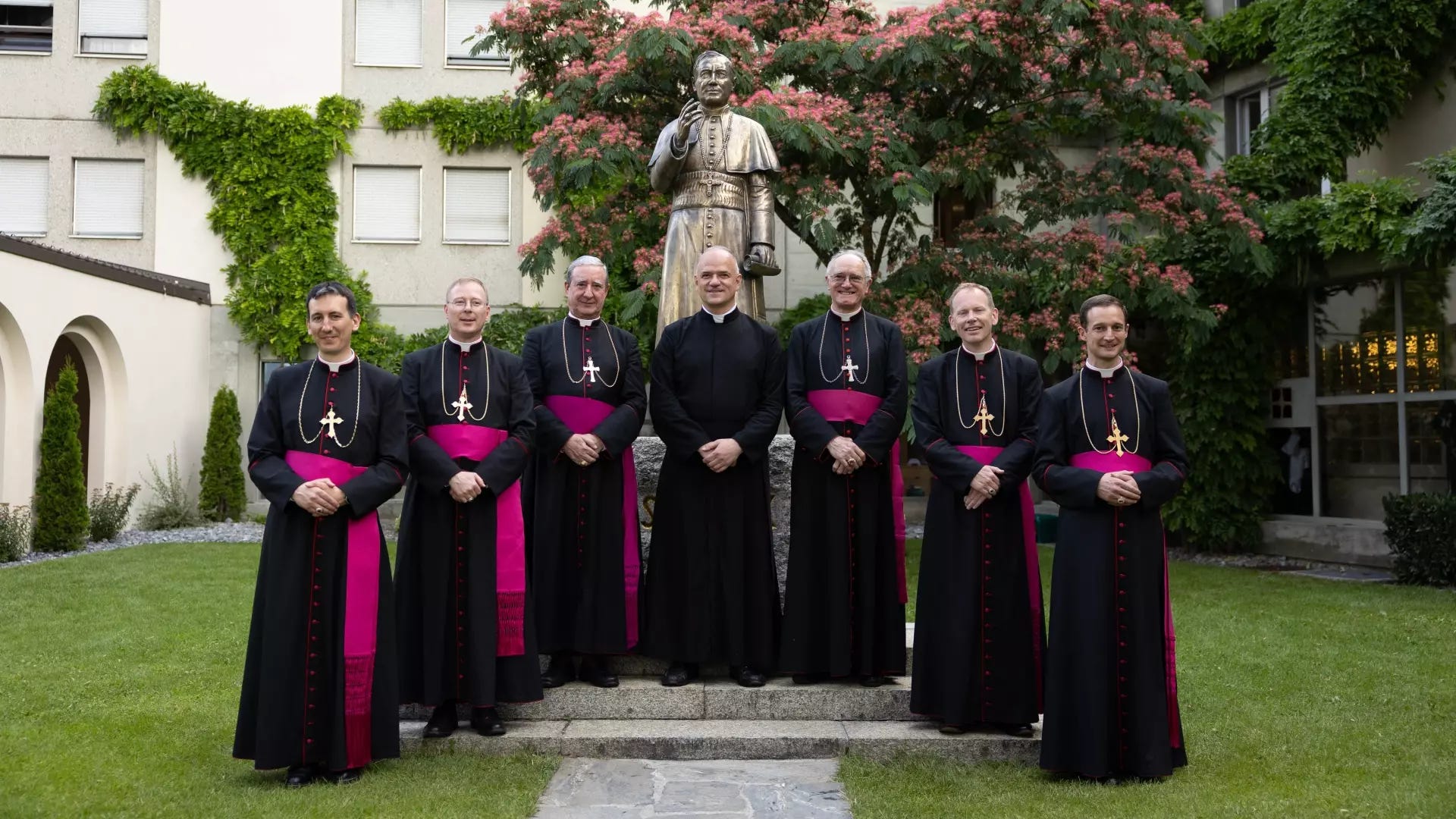 A Consideration of the Risk of Sedevacantism and Disunity in the SSPX 21.07.2026 31Min.Note: I made a mistake with some terms that I have fixed in the text, but the audio hasn’t been fixed yet. The mistake was in how I characterized the Des Lauriers position, and I mixed up some terms. I will fix the audio tomorrow. My apologies to anyone who believed I misrepresented their position. I’ve decided to discontinue using Taylor’s name in the titles of these essays written in consideration of the podcast he produced about the SSPX. The reason I have made that decision is that I personally get quite annoyed when other writers/podcasters do what can be called “clout chasing,” which is what happens when they use the name or likeness of another creator in order to drive traffic to their work. Of course, I wasn’t doing that, but the internet is a stupid place with a lot of stupid opinions, so I thought I would take that element out of the situation to avoid the perception of that reality.In any event, in this essay we will consider the opinion that within the structure of the SSPX, there is an inherent risk of sedevacantist mentalities as well as a risk of disunity that could lead to fracturing or breakaway groups.In the first essay in this series, I categorized those objections as:* Internal-unity/schism-risk argument* Sedevacantist-harbouring concernLINKS MENTIONED IN RECORDING:Mexico Pilgrimage: https://kennedyhall.ca/mexicohttps://realestateforlife.org/https://www.icatholicmobile.com/The Internal-unity/schism-risk argument refers to the groups, loosely called the “SSPX Resistance,” that broke away from the SSPX around 2012. For the sake of this essay, it would be too cumbersome to give a detailed overview of that history, because it is complicated and the various personalities are not unified. Nonetheless, below we will take a brief look at the phenomenon for a bit of context, and, if the reader is so inclined, I did produce a longer podcast going over the topic. I would recommend listening to that or watching it after you have read this if you desire more information.The Sedevacantist-harbouring concern that Marshall mentions is a real mentality that is not uncommon in Tradition as such. I will also add that a variety of theories about the invalidity of certain post-conciliar papacies is not unique even to Traditional circles. The thesis that Pope Benedict remained pope even after his resignation is common in both Traditional circles and mainstream circles. Alas, we live in an age wherein such scandal, both moral and doctrinal, stems from the various pontificates, and it is only natural for members of the faithful to essentially throw up their hands and find an “anti-pope” solution to be the most fitting answer to the quagmire. Nevertheless, we will discuss this topic below and give some context on the sedevacantist situation that is often not considered.Mere Tradition with Kennedy Hall is a reader-supported publication. To receive new posts and support my work, consider becoming a free or paid subscriber.Internal-Unity/Schism-RiskAs was mentioned above, a brief overview of the SSPX Resistance will be offered here.The so-called SSPX Resistance traces its origin to the internal crisis within the Society that erupted in 2012, when Bishop Bernard Fellay, then Superior General, pursued doctrinal discussions with the Holy See under Benedict XVI that culminated in Rome’s offer of a “Doctrinal Preamble” as the basis for a canonical regularization of the SSPX. Bishop Richard Williamson, along with a number of priests and religious who shared his alarm, viewed any practical agreement absent a genuine conversion of Rome on the errors of the Council as a betrayal of Archbishop Lefebvre’s own stated principles — namely, that no canonical status should be sought until Rome had unambiguously returned to Tradition. Williamson’s public dissent, expressed most notably through his Eleison Comments (an email newsletter), led to his expulsion from the Society in October 2012, and around the same period several other priests — Fr. Chazal and Fr. Pfeiffer among them — were likewise expelled or departed for holding the same position. Out of this expulsion emerged an informal but loosely organized network of priests, religious, and laity who considered themselves the true continuators of Lefebvre’s line of total resistance to the post-conciliar Roman authorities, in contrast to what they saw as an SSPX leadership drifting toward compromise.The Resistance solidified as a distinct, if loosely structured, movement without any single superior general or unified canonical framework, operating instead as a constellation of independent priories and chapels bound more by shared conviction than by common governance. This informality was thrown into sharp relief in 2015, when Williamson, acting on his own volition and without attempted recourse to Rome, consecrated Fr. Jean-Michel Faure a bishop in Brazil, a move that even many within the Resistance found difficult to justify canonically, since it lacked the kind of state-of-necessity argument Lefebvre himself had marshalled for the 1988 Écône consecrations. The episode exposed the structural weakness inherent to a movement, and further fragmentation followed in the years after. What holds the Resistance together to this day is less a common governance than a common diagnosis: that the SSPX’s post-2012 trajectory toward normalization with the conciliar Church represents an abandonment, whether gradual or decisive, of the very principles for which Lefebvre founded the Society in the first place.Now, as I said, there is more that could be said, but a couple of things are worth noting. It was not only Williamson and the priests who left the Society who had concerns about the negotiations between Fellay and the Vatican at the time, because the situation was precarious. This is not to fault Fellay, and, to Fellay’s credit, he never did compromise the Society or the principles of Archbishop Lefebvre. In speaking with members of the Society, I have been told that there was a period of concern within the Society about the direction proposed at the time; nevertheless, even those who disagreed felt it was irresponsible to air their grievances publicly or to jump to any conclusions when nothing concrete had actually happened. As it stands, no compromising agreement with the Vatican that would have thrust Modernist principles into the structure of the Society was ever reached, and Bishop Fellay did an excellent job guiding the ship during that internal tempest.In any event, we must move on from the historical consideration and address the notion that since something like this has happened before, it could happen again.Well, all I can say is that there is no guarantee that it could not happen again, because this will only be known to history after this whole saga has run its course. At the same time, we must also accept the fact that this sort of thing is not uncommon in the history of religious congregations within the Church. In addition, there is a trend that we tend to see when we look to history.Call to mind the formation of the Franciscans under Saint Francis. Saint Francis was an extraordinary Saint, to put it mildly, and the Franciscans grew rapidly throughout his life and continued to grow exponentially after he died. Nonetheless, something unfortunate took place not long after he died, which caused a rupture in the congregation, and a dissident group emerged that was called the Fraticelli.Thanks for reading Mere Tradition with Kennedy Hall! This post is public so feel free to share it.The Fraticelli emerged in the decades following the death of Saint Francis of Assisi in 1226, as a reaction against what a faction of the Franciscan order regarded as a betrayal of Francis’s own rule and testament regarding absolute poverty. Francis had bound his friars to a radical renunciation of property, both individual and corporate, and his Testament attempted to foreclose any future relaxation of that ideal by his successors. Within a generation, however, the order split between the Conventuals, who accepted papal permission to hold property corporately and adapt the rule to the practical needs of a growing international order, and the Spirituals, who insisted that Francis’s original poverty was binding in its strictest sense and could not be dispensed by any pope. Figures like Peter John Olivi supplied the Spirituals with a theological framework, arguing that Christ and the Apostles had possessed nothing even in common, a position that increasingly took on an apocalyptic cast under the influence of Joachimite prophecy, casting the controversy as a decisive moment in salvation history rather than a mere dispute over religious observance.The rupture became formal and irrevocable under John XXII, who in the 1320s condemned the Spirituals’ core doctrine outright, declaring in Cum inter nonnullos that to assert Christ and the Apostles owned nothing was heretical, and moved decisively against the recalcitrant friars. Those who refused submission, now properly called Fraticelli, were driven out of the order and into clandestine communities scattered through central Italy, sustained by a hardened conviction that John XXII had fallen into heresy and had therefore forfeited the papacy itself — a conclusion some of them extended to the entire post-Nicholas III papal line. It is fascinating that the Fraticelli were essentially sedevacantists concerning John XXII’s ruling on the topic of property ownership, because John XXII infamously taught a legitimate heresy, or at least grave error, about the state of souls before the Second Coming, which he recanted on his deathbed.Deprived of any formal structure and increasingly persecuted as heretics by the Inquisition, the Fraticelli persisted in isolated pockets for well over a century, their communities dwindling but not entirely extinguished until the fifteenth century. Some members of the Fraticelli were even convinced enough to hold on to their positions to the point of being burned at the stake. Their trajectory stands as an early demonstration of a movement born from a sincere claim to represent the true intention of a founder against his own order’s later development, only to harden, in the absence of any legitimate structure to appeal to, into open defiance of legitimate superiors.I believe the similarities between the so-called SSPX Resistance and the Fraticelli should be evident.Ultimately, we cannot guarantee one way or the other whether there could be any further tension or breakaway groups that shed themselves from the SSPX, but we can say that a normal canonical status will not be the thing that guarantees against such sorrows. The Franciscans are not merely a religious order, but an order approved through miraculous intervention.If we could take a quick detour here, given that it is topical, we could also address the comparison that Marshall put forth in his podcast between the SSPX and the Franciscans. In essence, it was argued that Saint Francis is a great example of true obedience, who left the approval of his order up to the Pope. You may recall from the history of Saint Francis that he believed God had called him to an extraordinary mission to form a congregation, and he then sought approval directly from the Pope. At first, this seemed foolhardy, but the Pope at the time was informed miraculously in a dream that Saint Francis would be a great reformer within the Church.Certainly, this is a great event in Church history, and, of course, if something like this were to happen in the case of the SSPX, it would be a wonderful thing. Nevertheless, the founding of the Franciscans and the SSPX are very different. You see, Francis believed he had been called directly by God to do something unprecedented, whereas Lefebvre believed it was his ordinary duty to continue doing what he had always done and was trained to do when the hierarchy had taken an unprecedented step away from Tradition. The Society was not formed in an extraordinary way, and claims no extraordinary mission, whereas Saint Francis did something extraordinary and Heaven provided extraordinary proof.The crux of the SSPX issue is essentially juridical and doctrinal in an era of great confusion and the spreading of immorality and heresy amongst the hierarchy, and it is the SSPX that is holding fast to what has always been done, rather than trying to do something novel.At any rate, the Franciscans began with literal Divine Approval that manifested in an extraordinary manner, and a painful split in the order was not avoided; the ripple effect of that split lasted a long time and was not extinguished for over a century. If an order with such a miraculous beginning and such an incredible saint could not avoid any interior drama, then we cannot expect the SSPX to avoid any such risks either.However, we can say that the SSPX has handled the situation well, and it is worth remembering that the dissident groups left the SSPX because they were expelled. If the risk of such positions as held by the Resistance were inherent to the Society, then they would not be unwelcome within its structure. So, we could say that the split is not indicative of any disorder within the Society, but rather that such disorder is unwelcome, which is a good thing.Mere Tradition with Kennedy Hall is a reader-supported publication. To receive new posts and support my work, consider becoming a free or paid subscriber.Sedevacantist-Harbouring ConcernSedevacantism is a veritable rabbit hole where one can lose all sense of direction. Now, I understand this will be offensive to some sedevacantists; nonetheless, when we consider the landscape of the various sedevacantist theories, we find stark disagreements between the various camps, and, sometimes, the sharpest vitriol pronounced by sedevacantist writers and influencers is levelled at other sedevacantists.In any event, I do believe that it is fair to give the Sedevacantist milieu its due, because it is not an unfounded hypothesis in its own right, even if I believe there are holes in the various theories that leave certain fundamental questions unanswered. Furthermore, I will say to the inevitable onslaught from various sedevacantist writers that I am going to preemptively decline to engage in any form of debate or discussion, because, quite frankly, I have no desire to do such a thing, or the time to devote to the topic.The theological question of whether a pope can fall from office through heresy runs into an immediate structural problem that every scholastic who addressed it had to solve before saying anything else: the axiom, enshrined by Boniface VIII and carried into the 1917 Code, that the First See is judged by no one — prima sedes a nemine iudicatur. If no one on earth holds jurisdiction over the pope, then no tribunal can convict him, depose him, or strip him of office in the ordinary juridical sense, since a sentence presupposes a judge with authority over the one sentenced. Whatever solution a given theologian proposed, it had to respect this axiom, which is precisely why the debate turned on a distinction between an act that causes the loss of office and an act that merely recognizes a loss already caused by something else — namely, the heresy itself, understood as operating automatically under divine law rather than through any human sentence.St. Robert Bellarmine, in De Romano Pontifice (Book II, ch. 30), catalogued the prevailing opinions on the question before advancing his own. He rejected Albert Pighius’s view that a pope simply cannot fall into heresy at all, and he likewise rejected the opinion that a pope remains fully pope even in manifest heresy until some human sentence is passed against him — largely the position associated with Cajetan. Bellarmine’s own “fifth opinion,” which became the common Bellarminian position among later manualists, held that a pope who becomes a manifest and pertinacious heretic ceases ipso facto to be pope by operation of divine law itself, the moment he places himself outside the Church through public defection from the faith, since a public heretic is no longer a member of the Church and therefore cannot be her head. On this view, no human sentence is needed to effect the loss of office — it has already happened, self-inflicted, before any cardinal or council acts.Cajetan’s competing position, developed in his work on the authority of pope and council, took the connection between the man and the office more seriously as a juridical bond rather than a purely moral one, and argued by analogy to processes like the severance of a marriage bond or the deprivation of a beneficiary from a benefice: even where the underlying disqualifying fact already exists, the formal separation of a man from an office he validly held requires a ministerial, declarative-cum-deprivative act of the Church to sever it, since offices are conferred and removed through the Church’s own juridical action, not automatically dissolved by the subject’s private sin alone. In essence, Cajetan grants that a heretical pope forfeits the right to retain the office in the sight of God, but insists the juridical tie is only severed when the Church, acting through some competent body, formally declares and executes that separation.Mere Tradition with Kennedy Hall is a reader-supported publication. To receive new posts and support my work, consider becoming a free or paid subscriber.John of St. Thomas and, later, Francisco Suárez largely sided with Bellarmine’s views while further developing the idea: the heresy itself, once manifest and pertinacious, is what severs the man from the papacy by the operation of divine law, but both insisted that the Church — practically speaking, the College of Cardinals, or in default of them a general council — would still have to act to establish the notoriety of the fact with juridical certainty, so that the faithful could know with confidence that the See was vacant and a conclave could proceed to a valid election. Cardinal Juan de Torquemada, writing a century before Bellarmine, had already anticipated this same requirement, holding that a manifestly heretical pope falls from the papacy by the very fact of his heresy, yet that this fall still needs the recognition and declaration of a general council before the universal Church can act on it with certainty. Even the manualists who followed the Bellarminian line most closely preserved this same two-step structure: the loss of office is automatic and prior, caused by the heresy itself under divine law, while the subsequent action of cardinals or bishops is merely declaratory, establishing as a matter of public juridical record what has already occurred, precisely so that the axiom nemo iudex in causa sua (no one is a judge in his own case), and the deeper axiom that no one judges the pope, are never actually violated. This is also, not incidentally, the theological seed from which canon 188 §4 of the 1917 Code grew, providing that ecclesiastical offices become vacant “ipso facto et sine ulla declaratione” (automatically, without any declaration) upon public defection from the faith — a codification of exactly the automatic-loss principle Bellarmine had defended three centuries earlier, even as the practical question of who must recognize and act upon that vacancy remained.The theological tradition, therefore, must be approached with honesty and caution when discussing this topic, and I do not believe it is helpful to simply disregard all sedevacantist thinking as if it were crazy, because the various theories are far from crazy, at least as theological arguments.One major theologian of the 20th century, who worked closely with both Pope Pius XII and Archbishop Lefebvre, attempted to give an answer to this conundrum.Michel-Louis Guérard des Lauriers, O.P. (1898–1988) stands as one of the most theologically formidable figures of our era, precisely because he came to it from the summit of the pre-conciliar Roman academy rather than from the fringe. A normalien and agrégé in mathematics before he ever entered religion, he took the Dominican habit in 1926, was ordained in 1931, and went on to teach philosophy at Le Saulchoir before assuming a chair in dogmatic theology at the Pontifical Lateran University under Pius XII, where he served as an advisor to the Pope on the dogma of the Assumption and, from 1954 to 1955, as Pius XII’s personal confessor before being succeeded in that office by the future Cardinal Bea. It was this same rigour that made him, in 1969, one of the principal theologians behind the Ottaviani Intervention, the critical study of the Novus Ordo Missae presented to Paul VI — a document some hold him to have substantially authored. He subsequently taught at Écône itself, but worked under Archbishop Lefebvre for a time before he came to the conclusion that Paul VI could not be a true pope, a conviction that led to Lefebvre removing him from his teaching post at the seminary in 1977.Rather than settling into simple sedevacantism, Guérard des Lauriers’s theological training pressed him toward a more precise formulation of the problem, since he judged bare “vacancy” insufficient to explain how a man could be publicly, if defectively, occupying the Roman See at all. Drawing on classical distinctions between the matter and form, he essentially argued from that point. His thought can be summarized thusly: In Thomistic generation, matter never receives form indiscriminately — it must first be brought into proximate disposition to that specific form, so that the form’s arrival simply actuates a potency the matter already stood ready to receive; applying this analogically to the papacy, a valid conclave election supplies the matter of the office by designating one subject, and one alone, in ultimate disposition to receive it, just as Cardinal Pacelli stood uniquely disposed the moment before his election — but the form, the actual conferral of papal munus and the charism of Christ’s indefectible assistance, is really distinct from that material designation and does not follow automatically wherever the matter is positively indisposed to receive it, the way an ill-disposed subject fails to receive a form it actively resists rather than merely awaits; since a publicly and pertinaciously heretical claimant is a subject whose will is fixed in a disposition contrary to the papal form, the election still produces a pope materialiter, but the formal conjunction of man and office fails to complete, leaving him non formaliter.This argument was des Lauriers’ attempt preserve both the Church’s unbroken juridical continuity through the conclaves and the dogmatic impossibility of a true pope teaching heresy, without falling into either bare sedevacantism or unqualified recognition. However, there is an issue with this because mere material without the form cannot generate. Because something purely material (in potency) cannot cause or create anything. So, it can be argued that after Paul VI everything is gone, there is no longer a hierarchy in the Church, not even in potency.In any event, I give this general overview of Sedevacantism to demonstrate that at root it is not an insane theory, but, at the same time, there are unanswered questions that have real consequences, given the many decades that have followed without any valid popes. Yes, I understand that sedevacantist authors may retort that I am not expressing which unanswered questions remain sufficiently, but, please, be patient, because I mention at least one below. Also, this is not meant to be a complete treatment of sedevacantism, and that has been done in other places by other authors.For its part, the SSPX recognizes the tradition, but rejects the concrete decision made by sedevacantists that we are required to adopt one of the aforementioned theories concretely. The SSPX’s case rests on necessity and epikeia operating on the disciplinary/governance plane — jurisdiction, faculties, penalties — which the tradition treats as flexible because it exists to serve souls, not the other way around. Sedevacantism falters because it applies that same necessity logic to the constitutional plane — who validly holds the papal office — which no strand of the tradition, not even Bellarmine’s most aggressive hypothetical, allows to be resolved by private judgment or unilateral declaration; that requires the Church’s own competent recognition.The aforementioned theories certainly give an honest man the right to entertain doubts about the validity of various popes, given all the dubious, if not heretical, theological positions that have been espoused from post-conciliar pontificates. At the same time, the SSPX as such rejects the adoption of these theories for prudential reasons.Because we are dealing with possible or probable opinions, which have not yet been defined, the prudent response can be summarized with an analogy:Suppose you happen upon a man who appears dead on the side of the road. Three doctors are called to assess the situation. One doctor believes that the man is dead, and then declares that he is, in fact, dead; another doctor has a suspicion that he may very well be dead, but, until it can be definitively proven by further examination and second opinions, he proceeds under the assumption that he could be alive, and therefore must be treated; a third doctor believes he is alive, even though he appears dead, and also proceeds to operate as if he is alive.The positions tolerated within the Society are the second and third positions, because the tradition gives us good reason to believe that the man may be dead, but we also may believe he is alive. Either way, until it is absolutely proven that he is dead, or a mechanism for proof is defined, we must do our best to save him.Until that definition comes forth, we proceed under the assumption that he could be alive, even if there are strong reasons to believe he is not. It is a prudential decision, and not a strictly theological one, because, morally speaking, there is more at stake.It is a prudential decision because, morally speaking, man does not do well unless submitted to authority, even if that submission is under tension. The post-conciliar popes have been less than stellar, to put it mildly; nonetheless, it is not natural for a Catholic to be without a pope, at least for an extended period. It is also not natural for a pope to allow or even cause the spreading of heresy, but, though we cannot solve this dilemma in theory, a prudential decision must be made regarding how to act.(I am already envisioning the screeds that will be written against me from sedevacantist authors, with many of the sentences in ALL CAPS.) As Catholics, we must maintain the sensus ecclesiae, which is a shared internal capacity, spiritual instinct, and habit of mind to think, feel, and will in harmony with the Catholic Church. Certainly, there is little harmony in the Church presently, humanly speaking; however, there is also no harmony of mind in the world of sedevacantism.Ultimately, all prudential decisions are decisions that must be made between competing goods, and we face, in this instance, two competing realities that have certainties, uncertainties, and possible defects which will only be known to history. For all we know, if we go back to the analogy, the man may be dead, and it may be useless to try and treat him. However, he may also be alive, so we must proceed to at least try to maintain his life.In this sense, we must try to maintain that living connection with Saint Peter’s office as it stands occupied by men who either hold it truly or do not. In addition, while schism is often considered merely in its vertical element — that is, top-down from the Pope — we must remember that schism is also considered horizontally, that is, in consideration of our communion with other Catholics.Many sedevacantist positions ultimately lead to a rejection of the Catholicity of other Catholics who do not hold the same sedevacantist position. Not all do, but some of the positions do, and they do so with vigour. There is a real risk of true isolation in the sedevacantist world, and as we meander through these uncharted waters as we have for decades, the prospect of decades without a true visible head of the Church, if I may say so in an unsophisticated way, simply doesn’t fit. Furthermore, while I fully grant the logical coherence of doubting the validity of a given pontificate for the reasons explained in our consideration of the theological tradition, I also struggle to understand why sedevacantists often argue that the SSPX position, which they call Recognize and Resist, is logically incoherent.It is the very theologians who are used to justify a sedevacantist thesis who give justification for resisting a pope who would seek to destroy the Church, either directly through evil doctrinal pronouncements, or indirectly through the toleration of the spread of heresy, or the promotion of heretics, such as was the case with Pope Honorius.In any event, among other reasons, so that the fundamental element of the sensus ecclesiae is upheld, the SSPX rejects the adoption of a sedevacantist thesis by its members in the concrete, even if the tradition gives reason to have good-faith doubts.Of course, some attendees of the SSPX will come to their own conclusions and adopt whatever positions they want, and, beyond a general approach wherein the leadership of the Society instructs members on valid positions on the papacy, there isn’t a whole lot that priests can do on the ground to police the thoughts and public expressions of the laity.Admittedly, I do regret some of the expressions of opinion of some SSPX laity in the public forum, but I also regret some of my own expressions as I think about what I have written and said over the years.But again, if there is a concern that the SSPX is not equipped to handle the issue of the spread of, let’s say, less than helpful opinions by parishioners, well, I can only say that we cannot expect the SSPX, with its limited resources, to do more than the institutions of the Church. At present, it seems that the hierarchy as such, with all its wealth, means of communication, and societal influence, cannot even ensure that the faithful are catechized to the level expected of a First Communicant in a Traditional parish or chapel.We might think of the old adage used to express obvious affirmation, “Is the Pope Catholic?” and how it is difficult to even use that adage today, sadly, because we are in a position where we are left to doubt the catholicity of the Roman Pontiff.If we cannot expect the Pope of the Catholic Church in our day to ensure that the Church operates in a Catholic way and teaches truly Catholic doctrine, then I think it is far too much to expect of overextended and self-sacrificing missionary priests in the Society to ensure theological and intellectual conformity about a question in the realm of theological dispute amongst their flock.Ultimately, we are facing a crisis that the hierarchy of the Church has caused, not the SSPX, and until that crisis is solved, we will have to tolerate differences of opinion that would not be conceived of during normal times.Kyrie EleisonMere Tradition with Kennedy Hall is a reader-supported publication. To receive new posts and support my work, consider becoming a free or paid subscriber. This is a public episode. If you'd like to discuss this with other subscribers or get access to bonus episodes, visit meretradition.substack.com/subscribe
 -
 "The SSPX is Protestant" 🙄 20.07.2026 1Std. 6Min.Mexico Pilgrimage: https://kennedyhall.ca/mexicohttps://realestateforlife.org/https://www.icatholicmobile.com/ This is a public episode. If you'd like to discuss this with other subscribers or get access to bonus episodes, visit meretradition.substack.com/subscribe
Ähnliche Podcasts


Beliebt in
Dieser Podcast erscheint auch in den Podcast-Charts dieser Länder.

