
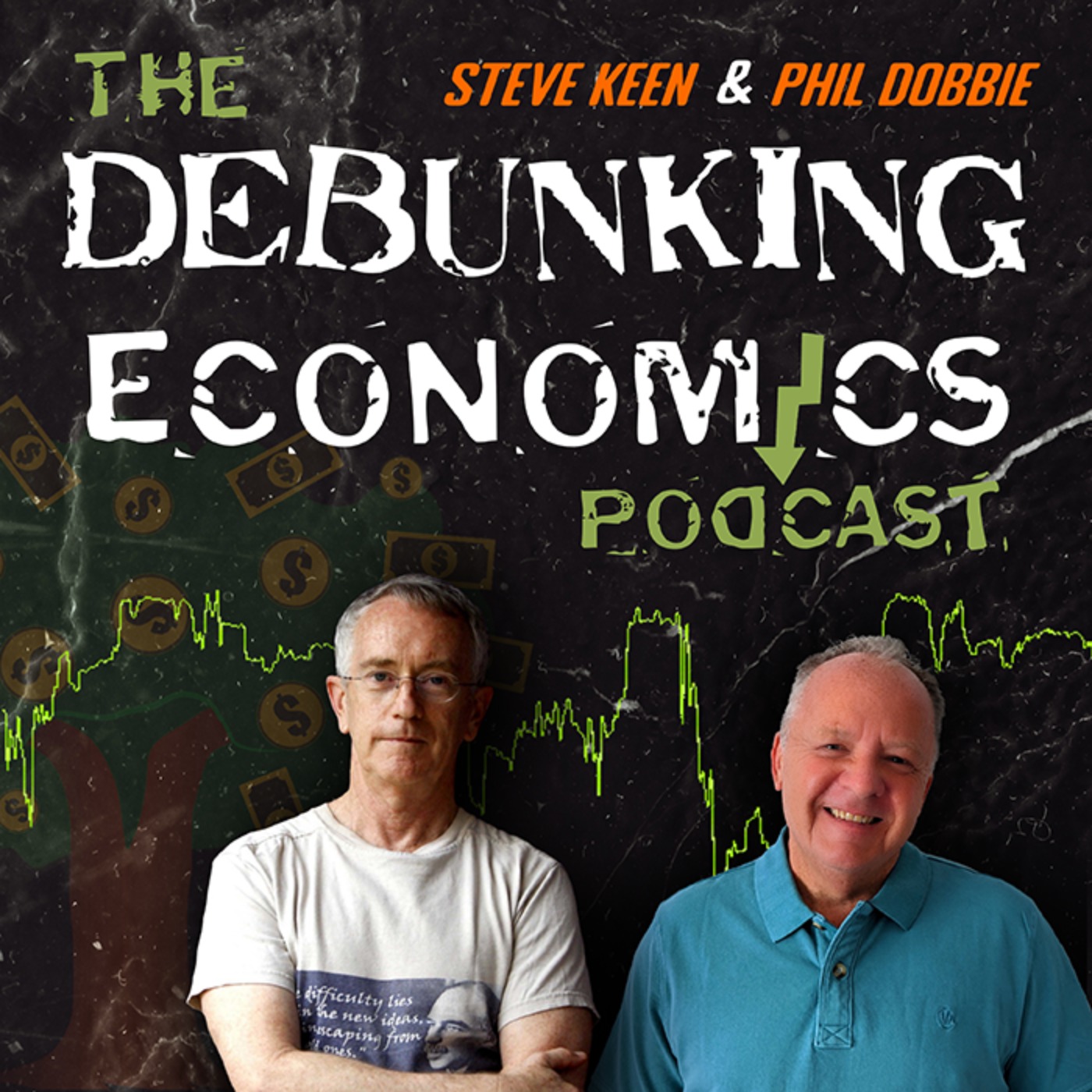
Debunking Economics - the podcast
Steve Keen & Phil Dobbie
0
Economist Steve Keen talks to Phil Dobbie about the failings of neoclassical economics and how it reflects on society. The podcast challenges mainstream economic assumptions and explores alternative perspectives. It aims to make complex economic ideas accessible to a general audience. Each episode offers a critical look at economic orthodoxy and its real-world consequences.
Folgen
-
 The always moving equilibrium 16.09.2026 36Min.Equilibrium is a fantasy—and this conversation explains why. Phil and teve explore how the belief that markets naturally self-correct has shaped economic policy, contributed to the failure to anticipate the Global Financial Crisis, and continues to distort debates about bond yields, government intervention, debt, and inflation. From Irving Fisher’s original models to today’s financial markets, AI bubbles, and rising government bond yields, Keen shows why capitalism is better understood as an “always moving equilibrium” than as a system that ever truly settles. The discussion also looks ahead to his forthcoming book, How Economists Will Destroy Capitalism, and the urgent consequences of treating elegant economic theories as if they describe the real world. Hosted on Acast. See acast.com/privacy for more information.
 -
What did Keating do for Australia? 09.09.2026 42Min.Paul Keating is often sold as the man who modernized Australia - but what if the reforms that made him legendary also helped create the financialized, boom-and-bust economy we live with today? Steve argues the real story is far more unsettling. From the "recession we had to have" to the housing bubble, tariff cuts, bank deregulation, and the superannuation system, he breaks down how Keating's policies reshaped Australia in ways most people still misunderstand. If you think Keating was simply a brilliant reformer, this conversation will challenge that view. Keating was an extraordinary parliamentary orator but a dangerous believer in textbook economics. Discover how the 1987 crash and first home buyers grant helped set up the 1992 recession, and why the push toward finance over manufacturing left Australia weaker, not stronger. He also explains how Keating’s attacks on the GST, the rise of neoliberal thinking inside Labor, and the long fallout from deindustrialization still shape Australian politics today. Hosted on Acast. See acast.com/privacy for more information.
-
The risks of hedging 02.09.2026 28Min.In this episode, Prof Steve Keen and host Phil explore the complexities of hedging, its applications, pitfalls, and its impact on markets and the economy.Hedging, rife in the financial and commercial world, is designed to protect our investments. If prices of our investments go down, or the cost of our business inputs go up, hedging is the insurance that stops things getting too bad. But does it work? Steve argues it doesn’t work when there’s financial crisis - when all prices go the same way. The example is people who have bought gold to hedge against equity investments, if they are forced to sell leveraged shares, they might recover their position by selling the gold, forcing that down in price too. Phil also asks whether hedging creates a distortionary impact. For example, stable companies might see higher share prices because they are seen as safe, rather than having any growth potential. Hosted on Acast. See acast.com/privacy for more information.
-
Burnham on Buying British 25.08.2026 40Min.The UK Prime Minister Andy Burnham has said he wants government departments to focus on buying British, The UK state spends roughly £300bn to £400bn a year on public procurement—and currently treats it merely as a bureaucratic exercise to secure the absolute cheapest upfront contract, rather than using it as an economic driver. Steve says it’s a step in the right direction, but Phl asks what is it that Britain makes that the government would want to buy? And how long before the usual argument that its costing more and who’s going to pay for it? Hosted on Acast. See acast.com/privacy for more information.
-
Ways to foster innovation 18.08.2026 39Min.Unless you are one of the tech bros, it is difficult for anyone to push on with innovative ideas, probably why the world seems reliant on the US for the next big thing. If you not running a Megacap getting money for a new idea is virtually impossible, particularly in the early stages. Even government schemes are focused on reducing risk, to the pint that they offer little more than is available from the commercial finance sector. Steve says China has a better idea, but for those countries that don’t want such centralised economy is there a way to fund start-ups that uses a mix of private funding and government assistance. Phil and Steve both have ideas on this. Hosted on Acast. See acast.com/privacy for more information.
-
Do we actually need bonds? 13.08.2026 40Min.There’s only one reason a government issues bonds. It’s so their account with the central bank is not overdrawn. It’s only regulation that stops the central bank from saying a rapidly expanding deficit is fine. After all, it’s an indicator of how much government money has gone into supporting the private sector. But economists and finances see that as monetising finanacing, and it’s a no no. Instead, regulations insist bonds are issued to the value of the government’s spending deficit. But what purpose do they serve, other than allowing investors to influence their price and yield, often as a response to government spending. In short, they seem to think their market pricing can influence government policy. So, why do we pay so much attention to an artificial process that only happen because we can’t trust governments to regulate their spending and keep inflation in check. Hosted on Acast. See acast.com/privacy for more information.
-
A reality check on bonds and government spending 04.08.2026 53Min.A listener (Doug) left a comment on YouTube saying I assume Phil intends to play "devil's advocate" when he speaks as though taxes are necessary for money issuance by governments with sovereign currencies. He’s worried that it might confuse new listeners to the podcast. So this week, Phil and Steve get stuck into the more contentious side of MMT – how government spending creates money, and bond issuance has limited impact on that. It depends on who is buying them. They discuss how government spending differs from household spending funded by a bank loan. Consider it a catch-up for new listeners and viewers. Hosted on Acast. See acast.com/privacy for more information.
-
AI, inequality and basic income 29.07.2026 44Min.Phil happened upon a book to Australian economist Joshua Gans (and Andrew Leigh) called Innovation & Inequality – how to create a future that is more Star Trek than Terminator. He discusses some of the concepts with Steve, including whether companies responsible for the creative destruction of other industries should be made to pay. As Phil puts it, if I burnt down a shop, I would possibly go to prison. But if I make that shop go out of business -and all the shops around it – because I happen to run Amazon, I face no consequences. It’s progress. But I the next chapter, the progress of AI will see more destruction, as more of us lose jobs. Then the only way we will be kept alive is by a basic income, provided by the state or possibly by people like Elon Musk. If it’s the latter, imagine the political control we would hold. So, how do we balance wealth whilst still providing incentives for innovation. And how much of that innovation is destroyed by the momentum of existing big tech players? Hosted on Acast. See acast.com/privacy for more information.
-
The Burnham Factor 21.07.2026 45Min.Andy Burnham is now the British Prime Minister but, Phil asks, aside from convening cabinet meetings in the north, will he do anything different to his predecessor. No, he will follow the same neoclassical economics approach as all Prime Ministers, with an obsession for balancing the books, rather than developing creative outcomes to distribute wealth and grow the economy. In short, it’s a slightly more attractive head, stuck on the same ugly body, he says. So what about Count Binface’s contribution to UK politics? Steve’s verdict: well, he might be trapped inside a dustbin, but its better than being trapped in an economics textbook! So, that all said, is there anything positive to from this change is stewardship of the nation? Hosted on Acast. See acast.com/privacy for more information.
-
The unrelenting progress of winner takes all economics 17.07.2026 41Min.This week Phil and Steve talk about the staggering accumulation of capital, which has ratcheted up since the pandemic. In the US the top 0.1 percent of companies hold 88 percent of all corporate assets. In 2017, the top 10 S&P companies accounted for 20% of the market cap of all 500 companies, now they account for 37%. And its not because these companies are good. It’s because the nature of products today gives them a stranglehold on their customers, however bad their offering. Steve calls it the ‘shitification’ of business and Phil managed to get Microsoft’s AI to admit just how bad their own products are. ‘Held together with duct tape’ was the gist of it. So bad products, capital accumulation, income and wealth diversity – and governments do nothing but embrace it all, ignorant of what damage it is doing to society. Hosted on Acast. See acast.com/privacy for more information.
-
Too slow for zero? 07.07.2026 42Min.This week Phil and Steve confront the mathematical and environmental reality of a "zero growth" future, sparked by a debate over the deflationary traps of finite currency systems like Bitcoin. Steve thoroughly dismantles standard neoclassical theories of "decoupling"—the fantasy that global economies can indefinitely expand their wealth while reducing energy consumption—exposing how mainstream economic models trivialise energy as a minor production input. By presenting real-world data showing a linear, lockstep relationship between global energy use and gross world product over the last 50 years, the hosts argue that modern capital is merely a conduit for turning energy into useful work. Ultimately, they outline the profound structural challenges of transitioning to a deliberate zero-growth framework, explaining why managing a massive, debt-leveraged economic downshift is a biophysical necessity for the planet, yet an absolute impossibility under our current credit-driven capitalist architecture. Hosted on Acast. See acast.com/privacy for more information.
-
Challenges for the reserve currency 02.07.2026 39Min.How much longer can the United States rely on the US dollar to dominate the global financial system, and what happens when the cracks finally start to show? In this week's Debunking Economics podcast, Phil Dobbie and Professor Steve Keen travel back to the 1944 Bretton Woods conference to revisit John Maynard Keynes's ultimate lost argument. Steve details how Keynes's visionary proposal for a global clearing union and an international currency—the Bancor—was explicitly designed to penalise both hoarding surplus nations and debt-ridden deficit nations, spreading wealth to developing countries and preventing destructive "beggar-thy-neighbour" tariff wars. By rejecting Keynes's framework in favour of institutionalised US dollar hegemony, the modern global economy has instead trapped itself in a cycle of systemic trade imbalances and ballooning private debt. Tune in to explore why today's aggressive tariff landscapes are exposing the structural fragility of the greenback, whether Alternative Modern Monetary Theory (MMT) baseline assumptions are entirely wrong about trade, and what a chaotic shift away from the world's primary reserve currency means for global stability. Hosted on Acast. See acast.com/privacy for more information.
-
The world’s anti-migration shift to the right 23.06.2026 48Min.Phil and Steve confront the global surge in anti-immigration rhetoric and right-wing political momentum, tracing its roots to the structural failures of neoliberalism rather than the actions of migrants themselves. Steve dissects how decades of fiscal paranoia, deregulation, and slashed public spending on health, welfare, and education systematically eroded working-class security, turning migrants into easy scapegoats for falling real wages and housing shortages. They evaluate how corporate-led migration has been historically weaponized by business elites to depress labour costs at the expense of local training, while contrasting the economic benefits of "capital deepening" through technology against raw "capital broadening" through rapid population expansion. Ultimately, it paves the way for Pauline Hanson and Nigel Farage tocapitalise on very real working-class anxieties, but their adherence to the exact same deficit-obsessed economic playbooks will only invite further structural chaos. Hosted on Acast. See acast.com/privacy for more information.
-
GDP is hopelesss as a relative measure 17.06.2026 45Min.Steve and Phil critique our systemic over-reliance on Gross Domestic Product (GDP) as the definitive baseline for comparing global economies and measuring societal well-being. The discussion underscores a fundamental flaw in neoclassical modeling: while GDP measures raw industrial output, it completely fails to reflect actual public welfare due to stark differences in income distribution, unpriced volunteer and domestic labour, and varying national structures of public service delivery. For instance, a per-capita GDP comparison artificially flatters the United States over Europe or China simply because American citizens are forced to spend massive out-of-pocket sums on privatised health care, transport, and education—essential services that are heavily subsidised or provided entirely free by the state elsewhere. Would it be more worthwhile to measure something fundamental, like the relative happiness of a nation. Steve argues that GDP still has a place, but it should never be used on its own. That’s just lazy. Hosted on Acast. See acast.com/privacy for more information.
-
Is Labour right to cut tax incentives for housing speculators? 10.06.2026 44Min.This week Phil and Steve dig into the storm of controversy over Australia's new budget rules targeting property speculators. The Labor government has scaled back negative gearing and abolished the 50% capital gains tax discount for established dwellings—major tax shelters that have historically rewarded people for gambling on rising asset prices rather than working productive jobs. Steve demonstrates that the country's absurd house-price-to-income ratio is driven entirely by the acceleration of private mortgage debt, heavily fueled by decades of destructive government policies designed to protect the wealth of baby boomers. Phil notes that while these changes may discourage real estate hoarding, Australia's massive, housing-reliant pool of intergenerational wealth still avoids inheritance taxes. So, is this a smart move by the Australian government, and could curbing the rentier class finally force the financial system to back local innovation instead of property speculation? Hosted on Acast. See acast.com/privacy for more information.
-
Hedging an Uncertain Future 20.05.2026 38Min.This week Phil challenges Steve on how the futures market handles terminal risk, pointing out that oil prices slope downward over time simply because traders blindly assume the Strait of Hormuz will reopen. Steve agrees and tears into the financial sector, explaining that modern pricing models dangerously mistake unquantifiable "uncertainty" for manageable "risk" by using flawed Gaussian distributions that erase the possibility of catastrophic, extreme events. Phil notes that the financial system's obsession with short-term hedging actually prevents behavior change and masks physical scarcity, leading corporations to scrap vital emergency buffers like PPE or fuel reserves in the name of market efficiency. Ultimately, Steve warns that while Western economies face a massive financial crash when these paper bets collide with zero physical supply, nations like China are strategically bypassing the market system altogether by stockpiling massive, real-world physical buffers of grain and energy to survive the looming collapse. Hosted on Acast. See acast.com/privacy for more information.
-
Conditioned to borrow, not save 13.05.2026 45Min.This week Phil and Steve dismantle the structural shift of the global economy toward a permanent state of debt dependence. Following a critique of Steve’s recent debate on the Piers Morgan show and a revisit to last week’s discussion on th link between energy and productivity, they look at how policy since the 1980s aggressively incentivizes borrowing over saving. Steve argues that the banking sector now functions primarily to inflate asset bubbles—particularly in housing—rather than funding productive industry, effectively conditioning entire generations to rely on debt-fueled asset growth for wealth. By debunking the neoclassical "savings myth," they show how the broader economy is dangerously fragile to any slowdown in the relentless creation of new debt. Hosted on Acast. See acast.com/privacy for more information.
-
Improving Productivity 06.05.2026 32Min.In this episode of Debunking Economics, Steve Keen dismantles the mainstream economic obsession with "Total Factor Productivity" (TFP), labeling it a mythical construct that ignores the laws of physics. He argues that economists historically "fudged" data to credit an abstract idea of technology for growth, while in reality, productivity gains are almost entirely a function of increasing the energy throughput of machinery. Keen asserts that "labor without energy is a corpse" and "capital without energy is a sculpture," emphasizing that real output only rises when we design machines capable of converting more energy into useful work. The discussion concludes that as the global economy faces energy supply shocks and shifts from fragile "just-in-time" efficiency toward localized resilience, we must brace for a structural decline in traditional productivity, as "resilience" is effectively the physical price paid for security in a less stable world. Hosted on Acast. See acast.com/privacy for more information.
-
Beating inflation? 30.04.2026 38Min.Phil and Steve analyze the 2026 return of double-digit inflation, characterizing it as a structural cost-push crisis rather than the result of excess consumer demand. Keen argues that with Brent crude hitting $100 a barrel due to the Strait of Hormuz blockade, energy costs have become a fundamental driver of prices that central bank interest rate hikes are fundamentally powerless to resolve. He delivers a scathing critique of current monetary policy, suggesting that raising rates acts as a "debt tax" that exacerbates the real income shock for households while failing to address the underlying energy supply bottlenecks. To truly "beat" this inflation, he advocates for moving beyond interest rate orthodoxy toward direct energy price interventions and an accelerated transition to energy sovereignty to decouple the economy from global fossil fuel volatility. Hosted on Acast. See acast.com/privacy for more information.
-
More Central Bank Independence? 22.04.2026 40Min.In this episode, Phil Dobbie and Steve Keen dissect Bank of England Governor Andrew Bailey’s push for greater central bank independence, a move Bailey claims is necessary to shield price stability from politically motivated meddling. Steve Keen, however, isn't buying the mainstream narrative, arguing that central banks are operating on a "fantasy" model that ignores the actual mechanics of money creation and the volatile role of private debt. The discussion ranges from the "policy ineffectiveness" of interest rate hikes to the historic failures of central banks to act as anything more than a "Greenspan put" for a fragile banking system. Ultimately, they suggest that instead of doubling down on flawed independence, central banks should stop pretending they can micromanage GDP and start acting as a realistic police force for financial stability—before the next "unforeseen" crisis hits. Hosted on Acast. See acast.com/privacy for more information.
Ähnliche Podcasts


Beliebt in
Dieser Podcast erscheint auch in den Podcast-Charts dieser Länder.


