
Sleep Stories from the Pioneers
Pioneers of Human Behaviour
0
Sleep Stories from the Pioneers offers slow, immersive stories designed to help listeners fall asleep. Episodes explore psychology, philosophy, history, mythology and science, from the lives of extraordinary thinkers to the mysteries of the universe. The narration is calm and the storytelling long-form, aimed at sleep, relaxation and curious minds. It is produced by Pioneers of Human Behaviour.
Folgen
-
 Can Logic Prove Everything? | The Logic of Logic 09.10.2026 36Min.Can logic prove everything?Settle into The Logic of Logic, a thoughtful sleep story about the rules of reasoning, the puzzles that test them, and the moment when an argument can be left until morning.Achilles has finally caught the Tortoise. But when they sit down to discuss a simple proof, the notebook keeps filling and the conclusion never arrives. Somewhere else, a dog chooses the third road without writing down a single rule.Tonight we follow the history of logic as it turns its questions on itself.From Aristotle's patterns of argument and the Stoics' garden to the Mohist thinkers of China and the reasoning schools of India, people have tried to understand what makes a conclusion follow.Along the way, we meet George Boole's nothing and everything, a librarian's impossible catalogue, Gödel's limits of proof, and Alan Turing's patient machines.The story reaches the tiny switches inside our computers, then returns to a quiet hill, a still lake, and a notebook that does not need finishing tonight.There's nothing to prove. Let the story keep you company as you settle down to rest.This sleep story is told slowly and gently for sleep, relaxation and quiet late-night listening.Explore The Idea of Ideas series:https://www.youtube.com/playlist?list=PLd5WzOPdClFYListen to more Sleep Stories from the Pioneers:https://www.youtube.com/playlist?list=PLRypv-XVJDZkExplore Sleep Stories from the Pioneers:https://pioneersofhumanbehaviour.com/sleep-stories/Support the project:https://ko-fi.com/pioneersofhumanbehaviourSleep well. 🌙Stories to fall asleep to. Ideas worth waking up with.
 -
 How Do Words Get Their Meaning? | The Meaning of Meaning 08.10.2026 39Min.How do words get their meaning?Settle into The Meaning of Meaning, a thoughtful sleep story about the moment a sound becomes a name, a name becomes an idea, and the world begins to make sense.The evening star shines in the west after sunset and the morning star in the east before dawn. They carry different names, though both are the planet Venus. Beside a honeysuckle-covered well-house, cold water runs over Helen Keller's hand while Anne Sullivan spells a word into the other.Tonight we follow the question of meaning through the lives and ideas of people who tried to understand it.Frege wonders how two names can tell us something new. Ogden and Richards talk late into the night on a Cambridge staircase. Wittgenstein watches what words do, while philosophers in India ask how a whole thought can arrive through sounds that disappear.Along the way, we meet Peirce's signs, Xunzi's names, familiar words that turn strange with repetition, and the everyday things that give a life meaning.The journey ends at the quiet well-house, where the pump is still and nothing needs naming before morning.You don't need to find the right words tonight. Let the story keep you company as you settle down to rest.This sleep story is told slowly and gently for sleep, relaxation and quiet late-night listening.Explore The Idea of Ideas series:https://www.youtube.com/playlist?list=PLd5WzOPdClFYListen to more Sleep Stories from the Pioneers:https://www.youtube.com/playlist?list=PLRypv-XVJDZkExplore Sleep Stories from the Pioneers:https://pioneersofhumanbehaviour.com/sleep-stories/Support the project:https://ko-fi.com/pioneersofhumanbehaviourSleep well. 🌙Stories to fall asleep to. Ideas worth waking up with.
 -
 How Did We Learn to Imagine Tomorrow? | The Future of the Future 08.10.2026 37Min.How did people learn to imagine tomorrow?Settle into The Future of the Future, a thoughtful sleep story about the changing ways we have tried to meet a day that hasn't arrived.We begin with a sleeper in eighteenth-century Paris, dreaming of a city centuries ahead. From questions carved into Shang oracle bones and Babylonian records of the sky, the story reaches a comet's predicted return and the patient calculations of Nicole-Reine Lepaute.Tonight we follow the many ways people have tried to understand what comes next.Robert FitzRoy offers careful opinions about tomorrow's weather. Edward Lorenz finds uncertainty in a tiny change. Aymara speakers describe a future out of sight behind them, while psychologists explore how memories help us imagine what comes next.At last, we visit an organ playing across centuries, seeds waiting in buried bottles, and a forest outside Oslo growing paper for books that will remain unread until 2114.The books can wait. The trees can keep growing. Tomorrow can arrive while we rest.Let the story keep you company as you settle down to rest.This sleep story is told slowly and gently for sleep, relaxation and quiet late-night listening.Explore The Idea of Ideas series:https://www.youtube.com/playlist?list=PLd5WzOPdClFYListen to more Sleep Stories from the Pioneers:https://www.youtube.com/playlist?list=PLRypv-XVJDZkExplore Sleep Stories from the Pioneers:https://pioneersofhumanbehaviour.com/sleep-stories/Support the project:https://ko-fi.com/pioneersofhumanbehaviourSleep well. 🌙Stories to fall asleep to. Ideas worth waking up with.
 -
 Can the Mind Understand Itself? | The Psychology of Psychology 07.10.2026 44Min.Can the mind understand itself?Settle into The Psychology of Psychology, a thoughtful sleep story about how psychology learned to question its own methods, assumptions and ways of understanding the human mind.William James finishes a founding textbook and wonders whether psychology is a science at all. Researchers discover that their expectations can find their way into an experiment. Volunteers keep adding numbers and tearing up the answers, convinced that the task must have a purpose.Tonight we follow psychology as it learns to question itself.From Wilhelm Wundt's laboratory to Martin Orne's "other chair," from the limits of introspection to the replication crisis, we explore how the questions researchers ask, the people they study and the answers they hope for can shape what they find.Along the way, the story travels beyond Western laboratories to Japanese and Filipino ideas about the self and our relationships with other people.It ends with the patient work of looking again, and an empty testing room where nothing needs measuring tonight.There's no test to pass. Let the story keep you company as you settle down to rest.This sleep story is told slowly and gently for sleep, relaxation and quiet late-night listening.Explore The Idea of Ideas series:https://www.youtube.com/playlist?list=PLd5WzOPdClFYListen to more Sleep Stories from the Pioneers:https://www.youtube.com/playlist?list=PLRypv-XVJDZkExplore Sleep Stories from the Pioneers:https://pioneersofhumanbehaviour.com/sleep-stories/Support the project:https://ko-fi.com/pioneersofhumanbehaviourSleep well. 🌙Stories to fall asleep to. Ideas worth waking up with.
 -
 What Humans Got Wrong About the World — and Why | Strange Ideas for Sleep 04.10.2026 1Std. 5Min.Fall asleep to a quiet journey through some of the strangest things humans once believed about the world — and the discoveries that eventually changed our minds.Why did intelligent people believe the Earth stood still, that disease travelled through bad air, that Mars was crossed by canals, or that an undiscovered planet called Vulcan was hiding near the Sun?Across astronomy, medicine, psychology, physics and the history of science, we encounter the Earth-centred cosmos, the four humours, spontaneous generation, phlogiston, caloric, miasma theory, the luminiferous ether, phrenology, the supposedly lifeless deep ocean, the canals of Mars, continental drift, ulcers, left-brain/right-brain myths, the scale of the Milky Way, steady-state cosmology and more.But this is not simply a catalogue of foolish ideas.Many of these explanations were reasonable attempts to understand the evidence available at the time. Others emerged from mistaken observations, incomplete measurements or assumptions that had not yet been tested. And some became harmful when weak evidence, prejudice or uncertain claims acquired institutional authority.The more interesting question is not simply: what did people get wrong?It is: why did it once seem right?Along the way, we move through old observatories, laboratories, maps, medical theories and experiments, following the moments when familiar explanations began to fail and new ways of understanding the world took their place.The people, theories, experiments and historical developments explored throughout this episode are real. Where an idea was genuinely uncertain, contested or more complicated than a simple story of error and correction, that uncertainty is preserved.This podcast edition contains the complete spoken story as calm, uninterrupted narration. There is no background music, and the narration plays once and does not repeat.There is nothing you need to remember and nowhere you need to get to. Simply follow the changing ideas for as long as you like, and let the story continue without you when sleep arrives.Sleep Stories from the Pioneers is a series of calm, research-led journeys through psychology, philosophy, history and science — exploring the people, ideas and discoveries that changed how we understand ourselves and the world around us.🌙 Prefer the full 10-hour sleep version?Watch What Humans Got Wrong About the World and Why on YouTube:https://youtu.be/SM8CVj9JM0I🎧 Browse every Sleep Story from the Pioneers:https://pioneersofhumanbehaviour.com/sleep-stories/☕ Support Sleep Stories from the Pioneers:https://ko-fi.com/pioneersofhumanbehaviour🌐 Explore Pioneers of Human Behaviour:https://pioneersofhumanbehaviour.com/Sleep well. 🌙Stories to fall asleep to. Ideas worth waking up with.
 -
 The History of History | How Humanity Learned to Remember the Past 03.10.2026 56Min.Fall asleep to the surprising history of how humanity learned to remember the past — from stories carried by human voices and marks pressed into clay to archives, photographs, recordings and digital files.Tonight’s journey begins before writing, when memory had to pass from one person to another. From there, we follow the development of writing in Mesopotamia, Egypt, China and Mesoamerica, and the changing ways societies tried to preserve names, events, rulers, stories and records across generations.Along the way, we encounter selective royal histories, Herodotus and Thucydides weighing uncertain testimony, Sima Qian organising an enormous remembered world, and the historical traditions associated with al-Tabari, Kalhana and Ibn Khaldun.We also explore Inca khipu, the spread of printing, forged documents, the decipherment of the Rosetta Stone, the growth of archives, photography and recorded sound, the development of archaeology and oral history, and the strange abundance — and fragility — of memory in the digital age.As the methods change, one quiet question remains beneath the entire story: how do you make a memory last longer than the person who remembers it?This is not simply a history of famous historians. It is a journey through the tools, habits and institutions humans have used to decide what should be remembered, what should be recorded, and what can still be recovered after a voice, a city or an entire civilisation has disappeared.The people, texts, technologies and historical developments explored throughout this episode are real. This is an original narrated introduction to the history of historical recording and is not an audiobook of another work or an official or endorsed production.This podcast edition contains around one hour of calm, uninterrupted narration. There is no background music, and the narration plays once and does not repeat.There is nothing you need to memorise tonight. Simply follow the story for as long as you like, and let the past continue without you when sleep arrives.Sleep Stories from the Pioneers is a series of calm, research-led journeys through psychology, philosophy, history, mythology and science — exploring the people, ideas and discoveries that changed how we understand ourselves and the world around us.🌙 Prefer the full 10-hour sleep version?Watch The History of History on YouTube:https://youtu.be/1_pa7wgNqzs🎧 Browse every Sleep Story from the Pioneers:https://pioneersofhumanbehaviour.com/sleep-stories/☕ Support Sleep Stories from the Pioneers:https://ko-fi.com/pioneersofhumanbehaviour🌐 Explore Pioneers of Human Behaviour:https://pioneersofhumanbehaviour.com/Sleep well. 🌙
 -
 Hypnotize Yourself to Sleep Tonight | Guided Sleep Hypnosis 02.10.2026 16Min.Settle into sleep with a gentle guided hypnosis designed to help you release physical tension, stop trying so hard to fall asleep and gradually allow yourself to rest.The session begins by bringing attention gently towards the eyes, jaw, shoulders, breathing and the rest of the body. From there, the guidance becomes progressively simpler and quieter, allowing the words themselves to become less important as you move towards sleep.Rather than demanding that you relax or trying to force sleep to happen, the session repeatedly returns to a simpler idea: there is nothing more you need to do.You may notice heaviness, lightness, drifting thoughts, changes in awareness — or very little at all. There is no particular response you need to produce and no need to check whether the hypnosis is working. Simply listen in whatever way feels natural and allow wakefulness to give way to rest in its own time.This podcast edition contains approximately 17 minutes of calm, uninterrupted spoken guidance. There is no background music, and the narration plays once and does not repeat.Make yourself comfortable, close your eyes when you are ready, and allow the words to become less important as the session continues.Only listen when you are somewhere safe to fall asleep. Do not use this recording while driving, operating machinery or doing anything that requires your full attention.Sleep Stories from the Pioneers brings together calm, carefully created journeys through psychology, philosophy, history, science and the inner life — alongside occasional sessions designed specifically for relaxation and sleep.🌙 Prefer the full 3-hour sleep version?Watch Hypnotize Yourself to Sleep Tonight on YouTube:https://youtu.be/fUBmxDTQBTs🎧 Browse every Sleep Story from the Pioneers:https://pioneersofhumanbehaviour.com/sleep-stories/☕ Support Sleep Stories from the Pioneers:https://ko-fi.com/pioneersofhumanbehaviour🌐 Explore Pioneers of Human Behaviour:https://pioneersofhumanbehaviour.com/This recording is intended for relaxation and sleep. It is not medical or psychological treatment and should not replace appropriate professional care for persistent sleep difficulties or other health concerns.Sleep well. 🌙
 -
 Fall Asleep to Jack Kornfield | Letting Go, Mindfulness & Vipassana 01.10.2026 41Min.Fall asleep to a calm journey through the life and teachings of Jack Kornfield — exploring letting go, mindfulness, Vipassana insight meditation, loving-kindness and the Buddhist practice of meeting ordinary life with greater awareness.From his training with Ajahn Chah in Thailand and the Burmese insight meditation tradition associated with Mahasi Sayadaw, to the founding of the Insight Meditation Society and the development of Spirit Rock, this story explores how Kornfield helped bring Buddhist mindfulness practice into everyday Western life.Along the way, we explore what it can mean to let go without becoming indifferent, how mindfulness and Vipassana approach attention, the practice of loving-kindness or metta, compassion and equanimity, forgiveness without excusing harm, and the ways attachment can become entangled with our wish to control outcomes.We also consider the simple act of returning when the mind wanders, and how meditation might extend beyond formal practice into relationships, difficult conversations and the ordinary circumstances of daily life.An imagined story follows a woman named Helen through a difficult family conversation, offering a quiet way to explore attention, kindness, boundaries and letting go away from the meditation cushion.Jack Kornfield, Ajahn Chah, Mahasi Sayadaw, the Insight Meditation Society and Spirit Rock are real. Helen and the framing story are imagined.This is an independently written narrated exploration of Jack Kornfield’s life and teachings. It is not a recording of Jack Kornfield, a guided meditation by him, or an official or endorsed production.This podcast edition contains approximately 41 minutes of calm, uninterrupted narration. There is no background music, and the narration plays once and does not repeat.There is nothing you need to achieve tonight. Simply follow the story for as long as you like, allow the thoughts to come and go, and let the journey continue without you when sleep arrives.Sleep Stories from the Pioneers is a series of calm, research-led journeys through psychology, philosophy, history, spirituality and science — exploring the people, ideas and traditions that have shaped how we understand ourselves and the world around us.🌙 Prefer the full 10-hour sleep version?Watch Fall Asleep to Jack Kornfield on YouTube:https://youtu.be/-R7Pao6LqAw🎧 Browse every Sleep Story from the Pioneers:https://pioneersofhumanbehaviour.com/sleep-stories/☕ Support Sleep Stories from the Pioneers:https://ko-fi.com/pioneersofhumanbehaviour🌐 Explore Pioneers of Human Behaviour:https://pioneersofhumanbehaviour.com/Sleep well. 🌙
 -
 Fall Asleep to the History of Psychiatry | Asylums, Freud & the Modern Mind 30.09.2026 1Std. 22Min.Fall asleep to the history of psychiatry — a calm journey through more than two thousand years of changing ideas about mental distress, from ancient medicine and the rise of the asylum to Freud, psychiatric medication, community care and modern debates about diagnosis.Tonight, we follow the changing ways people have tried to understand and respond to psychological suffering across different periods of history.We begin with medicine in the ancient Mediterranean before moving through knowledge preserved, debated and developed across Arabic and other scholarly traditions. From there, we encounter Robert Burton’s The Anatomy of Melancholy, the York Retreat and changing approaches to institutional care.As the story continues, we also hear about the experiences of people who lived inside psychiatric institutions, the emergence of Freud and psychoanalysis, twentieth-century physical treatments, the development of psychiatric medications, the movement towards community care, the rise of cognitive therapy and the growing influence of diagnostic manuals.Along the way, the history reveals a recurring tension: whether distress should be understood through the body, the mind, a person's circumstances, or some combination of them — and how those different explanations have shaped the treatment people received.We also consider how psychiatry gradually became more systematic while continuing to debate the boundaries of diagnosis, the meaning of mental disorder and the importance of listening to the person behind a clinical record.Some parts of this history involve confinement, harmful treatment, coercion and the Nazi murder of disabled and psychiatric patients. These subjects are discussed calmly, historically and without graphic detail.The people, institutions, treatments and historical developments explored throughout this episode are real. This is an original narrated introduction to the history of psychiatry and is not an audiobook of another work or an official or endorsed production.This podcast edition contains approximately 1 hour and 23 minutes of calm, uninterrupted narration. There is no background music, and the narration plays once and does not repeat.There is nothing you need to memorise tonight. Simply follow the history for as long as you like, and let the story continue without you when sleep arrives.Sleep Stories from the Pioneers is a series of calm, research-led journeys through psychology, philosophy, history, mythology and science — exploring the people, ideas and discoveries that changed how we understand ourselves and the world around us.🌙 Prefer the full 10-hour sleep version?Watch Fall Asleep to the History of Psychiatry on YouTube:https://youtu.be/PTDCMyDpRrY🎧 Browse every Sleep Story from the Pioneers:https://pioneersofhumanbehaviour.com/sleep-stories/☕ Support Sleep Stories from the Pioneers:https://ko-fi.com/pioneersofhumanbehaviour🌐 Explore Pioneers of Human Behaviour:https://pioneersofhumanbehaviour.com/This is an educational history and sleep story, not mental-health advice, diagnosis or treatment.Sleep well. 🌙
 -
 Fall Asleep to the History of Psychology | Freud, Jung & the Human Mind 29.09.2026 1Std. 43Min.Fall asleep to the history of psychology — a calm journey through humanity’s attempts to understand the mind, from ancient philosophy and the first psychology laboratories to Freud, Jung, behaviourism, memory, learning and modern psychological science.Tonight, we follow some of the questions that helped build psychology.How did philosophers begin thinking about memory, perception and consciousness? What changed when psychology entered the laboratory? Why did Freud place so much importance on the unconscious? How did Jung depart from him? What did behaviourists learn by studying observable behaviour? And how did psychologists eventually return to memory, thought, relationships and the inner life?Along the way, we move through ancient questions about the mind, the emergence of experimental psychology, William James, Sigmund Freud and Carl Jung, Ivan Pavlov and behaviourism, childhood and development, relationships, memory, learning and the changing scientific study of human behaviour.Familiar experiences — remembering a name, hearing a tune, noticing a thought or recalling a conversation — become doorways into questions that psychologists have spent generations trying to answer.Rather than presenting psychology as a simple march towards the truth, the story follows a field shaped by competing theories, new methods, changing evidence and repeated disagreements about what should count as a scientific explanation of the mind.The historical figures, theories and research discussed throughout the episode are real. Any framing scenes used to carry the listener through the story are imagined. This is an original narrated introduction to the history of psychology and is not an audiobook of another work or an official or endorsed production.This podcast edition contains approximately 1 hour and 43 minutes of calm, uninterrupted narration. There is no background music, and the narration plays once and does not repeat.There is nothing you need to memorise tonight. Simply follow the history for as long as you like, and let the story continue without you when sleep arrives.Sleep Stories from the Pioneers is a series of calm, research-led journeys through psychology, philosophy, history, mythology and science — exploring the people, ideas and discoveries that changed how we understand ourselves and the world around us.🌙 Prefer the full 10-hour sleep version?Watch Fall Asleep to the History of Psychology on YouTube:https://youtu.be/mtPG8Tqru_s🎧 Browse every Sleep Story from the Pioneers:https://pioneersofhumanbehaviour.com/sleep-stories/☕ Support Sleep Stories from the Pioneers:https://ko-fi.com/pioneersofhumanbehaviour🌐 Explore Pioneers of Human Behaviour:https://pioneersofhumanbehaviour.com/Sleep well. 🌙
 -
 The Art of Letting Go | Alan Watts’ Philosophy for Sleep 28.09.2026 40Min.Fall asleep with a calm journey through Alan Watts’ philosophy of letting go, uncertainty, control and the strange freedom that can come from no longer forcing life.Tonight, we follow one quiet, imagined evening and explore some of the questions that made Watts’s work so enduring: why certainty can remain out of reach, how words and labels shape experience, what it means to stop struggling against life, and whether something unfinished can still feel complete.Alan Watts was a writer, broadcaster and influential interpreter of Asian philosophy for English-speaking audiences. Through the story, we place his ideas in context and explore some of the connections he drew with Zen Buddhism, Daoism and Hindu traditions.Along the way, we consider the limits of control, the difference between experiencing life and constantly trying to explain it, the ways language divides the world into categories, and the possibility that letting go does not have to mean giving up.The evening and framing story are imagined. Alan Watts, his work and the philosophical traditions discussed throughout the episode are real. This is an original narrated exploration of his ideas and is not a recording of Alan Watts or an official or endorsed production.This podcast edition contains approximately 41 minutes of calm, uninterrupted narration. There is no background music, and the narration plays once and does not repeat.There is nothing you need to solve tonight. You can simply follow the story for as long as you like, allow the questions to remain open, and let the evening continue without you when sleep arrives.Sleep Stories from the Pioneers is a series of calm, research-led journeys through psychology, philosophy, history, mythology and science — exploring the people, ideas and discoveries that changed how we understand ourselves and the world around us.🌙 Prefer the full 8-hour sleep version?Watch The Art of Letting Go on YouTube:https://youtu.be/0eK-qp1hLnk🎧 Browse every Sleep Story from the Pioneers:https://pioneersofhumanbehaviour.com/sleep-stories/☕ Support Sleep Stories from the Pioneers:https://ko-fi.com/pioneersofhumanbehaviour🌐 Explore Pioneers of Human Behaviour:https://pioneersofhumanbehaviour.com/Sleep well. 🌙
 -
 The Art of Falling Asleep | 100 Science-Backed Facts About Sleep 28.09.2026 1Std. 3Min.Fall asleep to 100 calm, research-backed facts about sleep — exploring what helps us drift off and what unfolds in the mind and body throughout the night.Tonight, we begin beside an imagined evening window and follow the course of an ordinary night, moving gradually from wakefulness towards sleep, through changing sleep stages, memory and dreams, and eventually towards morning.Along the way, we explore sleep pressure and circadian rhythms, light and melatonin, chronotypes, caffeine and alcohol, exercise, screens and bedroom temperature, sleep trackers and insomnia treatment, NREM and REM sleep, deep sleep, memory and learning, dreams, lucid dreaming and sleep inertia.Rather than offering a list of miracle sleep hacks, this is an evidence-led journey through the science of sleep. The research is explained with its limitations intact, including where findings remain preliminary, vary between individuals or come from relatively small studies.We also explore why sleepiness builds across the day, how the biological clock helps organise the timing of sleep, why light can influence that timing, what happens as the brain moves through different stages of the night, and why waking can sometimes leave us temporarily disoriented.The evening window and framing journey are imagined. The sleep science and research explored throughout the episode are real.This podcast edition contains approximately 63 minutes of calm, uninterrupted narration. There is no background music, and the narration plays once and does not repeat.There is nothing you need to memorise and no perfect night of sleep you need to achieve. Simply follow the facts for as long as you like, and let the journey continue without you when sleep arrives.Sleep Stories from the Pioneers is a series of calm, research-led journeys through psychology, philosophy, history, mythology and science — exploring the people, ideas and discoveries that changed how we understand ourselves and the world around us.🌙 Prefer the full 10-hour sleep version?Watch The Art of Falling Asleep on YouTube:https://youtu.be/Y4zroZHsObo🎧 Browse every Sleep Story from the Pioneers:https://pioneersofhumanbehaviour.com/sleep-stories/☕ Support Sleep Stories from the Pioneers:https://ko-fi.com/pioneersofhumanbehaviour🌐 Explore Pioneers of Human Behaviour:https://pioneersofhumanbehaviour.com/This is an original narrated introduction to sleep science. It is intended for education, relaxation and sleep, and is not medical advice, diagnosis or treatment. Persistent sleep problems deserve appropriate professional care.Sleep well. 🌙
 -
 How Big Is the Universe? A Journey Through Space for Sleep 24.09.2026 1Std. 7Min.How do you measure a universe you can never travel across?Settle beneath the stars for a calm, carefully researched journey through the history of how humans learned to measure the cosmos — from the size of the Earth to the farthest light we can observe.Tonight, we begin on an imagined autumn hill beneath the stars, with a blanket, a flask of tea and the warm lights of a village below. From there, we begin to build a ruler long enough to measure the universe.We start close to home with Eratosthenes and his estimate of the size of the Earth. Then we follow Ole Rømer and the discovery that light takes time to travel, before visiting the eighteenth-century observations of the transit of Venus that helped astronomers establish the scale of the Solar System.As the distances grow, we meet Friedrich Bessel and the first reliable measurement of stellar parallax, Henrietta Swan Leavitt and the variable stars that became crucial cosmic yardsticks, and the astronomers whose observations transformed Andromeda from a mysterious nebula into evidence of a universe filled with galaxies.Along the way, we encounter Edwin Hubble, Vesto Slipher, Georges Lemaître, Milton Humason and others whose work helped reveal an expanding universe. We travel through the Milky Way, neighbouring galaxies and the cosmic web before reaching the oldest electromagnetic light we can observe: the cosmic microwave background.Eventually, we arrive at one of cosmology’s strangest facts. The universe is about 13.8 billion years old, yet the observable universe today is more than 90 billion light-years across. The explanation lies in the expansion of space itself.This journey also explores Voyager 1, the observable horizon, why looking farther into space means looking farther into the past, what science can and cannot tell us about what lies beyond the observable universe, and why enormous cosmic scales can produce the psychological experience of awe.The hillside and framing story are imagined. The history and science are real. Where the evidence is uncertain, that uncertainty is preserved rather than turned into fact.This podcast edition contains around 67 minutes of calm narration. There is nothing you need to memorise and nowhere you need to get to. Simply settle in, follow the journey for as long as you like, and let the universe continue without you when sleep arrives.Sleep Stories from the Pioneers is a series of calm, research-led journeys through psychology, philosophy, history, mythology and science — exploring the people, ideas and discoveries that changed how we understand ourselves and the world around us.🌙 Prefer the full 10-hour sleep version with extended ambient music?Watch How Big Is the Universe? on YouTube:https://www.youtube.com/watch?v=4x8SRGBK12c🌙 Watch the full Sleep Stories from the Pioneers playlist:https://www.youtube.com/playlist?list=PLRypv-XVJDZk🌌 Browse every Sleep Story from the Pioneers:https://pioneersofhumanbehaviour.com/sleep-stories/📖 Start with ten thinkers, free — The Gateway:https://pioneersofhumanbehaviour.com/free-guide/☕ Support Sleep Stories from the Pioneers:https://ko-fi.com/pioneersofhumanbehaviour🌐 Explore Pioneers of Human Behaviour:https://pioneersofhumanbehaviour.com/Sleep well. 🌙Stories to fall asleep to. Ideas worth waking up with.
 -
 Why You Are the Way You Are: Personality Psychology | A Sleep Story from the Pioneers 23.09.2026 56Min.Fall asleep to the psychology of personality in a calm, carefully researched journey through the traits, temperaments, experiences and relationships that help make us who we are.Tonight, we enter an imagined second-hand bookshop, where Rowan is preparing a display called Books We Return To. Through ordinary conversations, forgotten pencils, old family books and changing memories, a simple question begins to open: why can the same person be quiet in one room, confident in another, organised in one part of life and chaotic in another?From that quiet setting, we explore the difference between traits and states, the Big Five dimensions of personality, temperament, inherited influences, experience, opportunity and the ways personality can change while still remaining recognisably our own.Along the way, we consider why sociability is not quite the same as assertiveness, why being dependable is not identical to being perfectly organised, and why a single label can hide important differences within a person.We also explore how early tendencies may interact with later experiences, why family members can share a home without sharing the same psychological history, and how work, practice, opportunity and relationships can gradually shape the ways a person moves through the world.Later, the story turns towards the different ways we know ourselves. We look at why other people sometimes notice qualities in us that we miss, why social interactions can feel different from the inside, and why broad personality descriptions can sometimes feel uncannily accurate.We also examine the limits of personality labels. A trait is not a diagnosis, a destiny or a complete explanation of a life. Being recognisably yourself does not require behaving identically in every situation, and continuity does not mean that personality can never change.This is an original narrated story and introduction to personality psychology. Rowan, the bookshop and the other characters are imagined. The psychological research explored throughout the story is real. It is not a personality assessment, an audiobook of another work, or an official or endorsed production.This sleep story contains approximately fifty-six minutes of gentle narration with soft instrumental music underneath. The narration plays once and does not repeat.There is nothing you need to memorise and no personality label you need to settle on tonight. You can simply follow the story for as long as you like, and let the questions rest when you are ready to sleep.Sleep Stories from the Pioneers is a series of calm, research-led journeys through psychology, philosophy, history, mythology and science — exploring the people, ideas and questions that changed how we understand ourselves and the world around us.🌙 Prefer the full extended sleep version with hours of ambient sound?Watch Why You Are the Way You Are on YouTube:https://www.youtube.com/watch?v=jMrszawJurg🌙 Watch the full Sleep Stories from the Pioneers playlist:https://www.youtube.com/playlist?list=PLRypv-XVJDZk🔎 Explore more questions about human behaviour:https://pioneersofhumanbehaviour.com/questions/☕ Support Sleep Stories from the Pioneers:https://ko-fi.com/pioneersofhumanbehaviour🌐 Explore Pioneers of Human Behaviour:https://pioneersofhumanbehaviour.com/Sleep well. 🌙Stories to fall asleep to. Ideas worth waking up with.
 -
 John Bowlby: Why We Attach | A Sleep Story from the Pioneers 23.09.2026 52Min.Fall asleep with John Bowlby in a calm, carefully researched journey through attachment theory, separation, loss and the relationships that give us somewhere to return.Tonight, we begin with an imagined child playing with a ball near a parent on a park bench. The child moves a little farther away, becomes absorbed in the game, and then briefly looks back. The parent is still there.From that simple moment, we follow Bowlby’s life and the development of attachment theory: his childhood and early work with children, his psychoanalytic training, his research at the Tavistock Clinic, the hospital observations of James and Joyce Robertson, and the work of Mary Ainsworth.Along the way, we explore the attachment behavioural system, the secure base and safe haven, internal working models, the Strange Situation, separation and grief, and the later extension of attachment research into adult relationships.We also look at how Bowlby’s ideas changed over time. Some of his early claims about separation and maternal care were too broad, and later researchers refined, challenged and extended the theory. Attachment is not treated here as a fixed diagnosis, a personality type or a destiny. It is a framework for understanding patterns in close relationships, developed through decades of research and debate.The story moves between Bowlby’s biography and the human questions behind his work: why a child explores more freely when a trusted person is nearby, why separation can produce such powerful reactions, why relationships can become internal expectations, and why the need for security does not disappear simply because childhood ends.This is an original narrated biography and introduction to John Bowlby, attachment theory and the researchers who helped develop it. It is not a recording of Bowlby speaking, an audiobook of his work, or an official or endorsed production. The opening park scene and other illustrative examples are imagined.This sleep story contains approximately fifty-two minutes of gentle narration with soft classical-style music underneath. The narration plays once and does not repeat.There is nothing you need to memorise and no conclusion you need to reach tonight. You can simply follow the story for as long as you like, and let the ideas continue without you when sleep arrives.Sleep Stories from the Pioneers is a series of calm, research-led journeys through psychology, philosophy, history, mythology and science — exploring the people, ideas and questions that changed how we understand ourselves and the world around us.🌙 Prefer the full extended sleep version with hours of ambient sound?Watch John Bowlby on YouTube:https://www.youtube.com/watch?v=-fEgLe_cWDI🌙 Watch the full Sleep Stories from the Pioneers playlist:https://www.youtube.com/playlist?list=PLRypv-XVJDZk🌐 Read the sourced John Bowlby profile:https://pioneersofhumanbehaviour.com/john-bowlby/☕ Support Sleep Stories from the Pioneers:https://ko-fi.com/pioneersofhumanbehaviour🌐 Explore Pioneers of Human Behaviour:https://pioneersofhumanbehaviour.com/Sleep well. 🌙Stories to fall asleep to. Ideas worth waking up with.
 -
 Marcus Aurelius: Meditations for a Quiet Mind | A Sleep Story from the Pioneers 23.09.2026 1Std. 20Min.Fall asleep with Marcus Aurelius in a calm, carefully researched journey through the Meditations, his surviving letters and the ordinary human difficulties behind Stoic philosophy.Tonight, we enter an imagined Roman room: a table beside a darkened window, a shaded lamp, an open book and several letters. The setting is imagined, but the writings are real.We begin with the young Marcus making a playful case against sleep in a letter to his teacher, Fronto. He finds examples, builds his argument and then, having said quite enough against sleep, announces that he is going to bed. Fronto answers with affection, wit and a wish that his pupil would simply take better care of himself.From those letters, we open the reflections now known as the Meditations. These were not a polished guide written for an audience. They were working notes: reminders, questions and exercises through which Marcus repeatedly tried to correct his own judgement and conduct.Along the way, we explore the ideas he returned to most often: meeting difficult people without immediately surrendering our peace; separating events from the stories we add to them; acting wholeheartedly while accepting that circumstances may change; receiving help and correction without shame; loosening our dependence on praise; and returning attention to the next reasonable thing before us.A cancelled supper, an unanswered letter, an emerald, a shaft of sunlight and the uneven crust of a loaf give those ideas a quiet, human shape. Marcus appears here as someone practising patience, justice and clearer judgement — not as a flawless sage who had already mastered them.The story also keeps sight of the tension within its subject. Marcus was a Roman emperor with extraordinary power, ruling an unequal empire during years of warfare and crisis. His private moral reminders cannot settle every question about his public decisions. They allow us to hear a powerful man repeatedly warning himself against anger, vanity, carelessness and the corrupting habits of authority.This is an original narrated exploration of Marcus Aurelius, Stoicism, the Meditations and the correspondence with Fronto. It is not a complete audiobook, a recording of Marcus Aurelius, or an official or endorsed production. The lamp-lit room and modern illustrative examples are imagined.This sleep story contains around eighty minutes of gentle narration with soothing instrumental music underneath. The narration plays once and does not repeat.There is nothing you need to remember and nowhere you need to get to. Settle in, listen for as long as you like, and let the book close when you are ready to rest.Sleep Stories from the Pioneers is a series of calm, research-led journeys through psychology, philosophy, history, mythology and science — exploring the people, ideas and questions that changed how we understand ourselves and the world around us.🌙 Prefer the full extended sleep version with hours of ambient sound?Watch Marcus Aurelius on YouTube:https://www.youtube.com/watch?v=x-q3KTCJlTc🌙 Watch the full Sleep Stories from the Pioneers playlist:https://www.youtube.com/playlist?list=PLRypv-XVJDZk🌐 Read more about Marcus Aurelius:https://pioneersofhumanbehaviour.com/marcus-aurelius/☕ Support Sleep Stories from the Pioneers:https://ko-fi.com/pioneersofhumanbehaviour🌐 Explore Pioneers of Human Behaviour:https://pioneersofhumanbehaviour.com/Sleep well. 🌙Stories to fall asleep to. Ideas worth waking up with.
 -
 The Shadow Within | Carl Jung & the Unconscious Mind 21.09.2026 32Min.A calm, carefully researched bedtime story exploring Carl Jung’s ideas about the shadow, the persona and the parts of ourselves we find difficult to recognise.Tonight, we begin at an ordinary family dinner with someone who is always keeping the peace. They know how to ease a disagreement and make everyone comfortable. But later that evening, they realise how angry they are — and how difficult it feels to admit it.Through this imagined peacemaker, we explore the roles we become used to playing, the feelings we leave unspoken, and Jung’s ideas about projection, the shadow and individuation. Along the way, we consider envy, the wish for recognition, neglected creativity and the possibility of knowing ourselves more fully.We also visit Jung’s early word-association research in Zürich, his relationship with Sigmund Freud, and the inner explorations that led to The Red Book. Dreams and the modern language of shadow work enter the story, with care taken to distinguish Jung’s theories from established findings and from claims sometimes made in his name.This is the 32-minute story edition. A brief settling introduction opens the episode, and the narration gradually comes to rest. Listen for as long as you like. You never need to reach the end.This is an original narrated introduction to selected ideas from Jung’s psychology. The peacemaker, everyday scenes and illustrative dream are invented examples, not documented cases. It is not a recording of Jung speaking, an audiobook of his work, a complete biography, or an official or endorsed production.For education, relaxation and sleep. It is not medical advice, psychological treatment or therapy.📚 Explore our Carl Jung book:Carl Jung: Life, Depth Psychology, Inner World, and Legacy — A Master Editionhttps://www.amazon.com/dp/B0H331RVGW🌙 Prefer extended sleep videos with hours of gentle nighttime ambience?Explore Sleep Stories from the Pioneers on YouTube:https://www.youtube.com/@SleepStoriesFromThePioneers🌐 Read more about Carl Jung:https://pioneersofhumanbehaviour.com/carl-jung/☕ Support Sleep Stories from the Pioneers:https://ko-fi.com/pioneersofhumanbehaviour🌐 Explore Pioneers of Human Behaviour:https://pioneersofhumanbehaviour.com/Sleep well. 🌙Stories to fall asleep to. Ideas worth waking up with.
 -
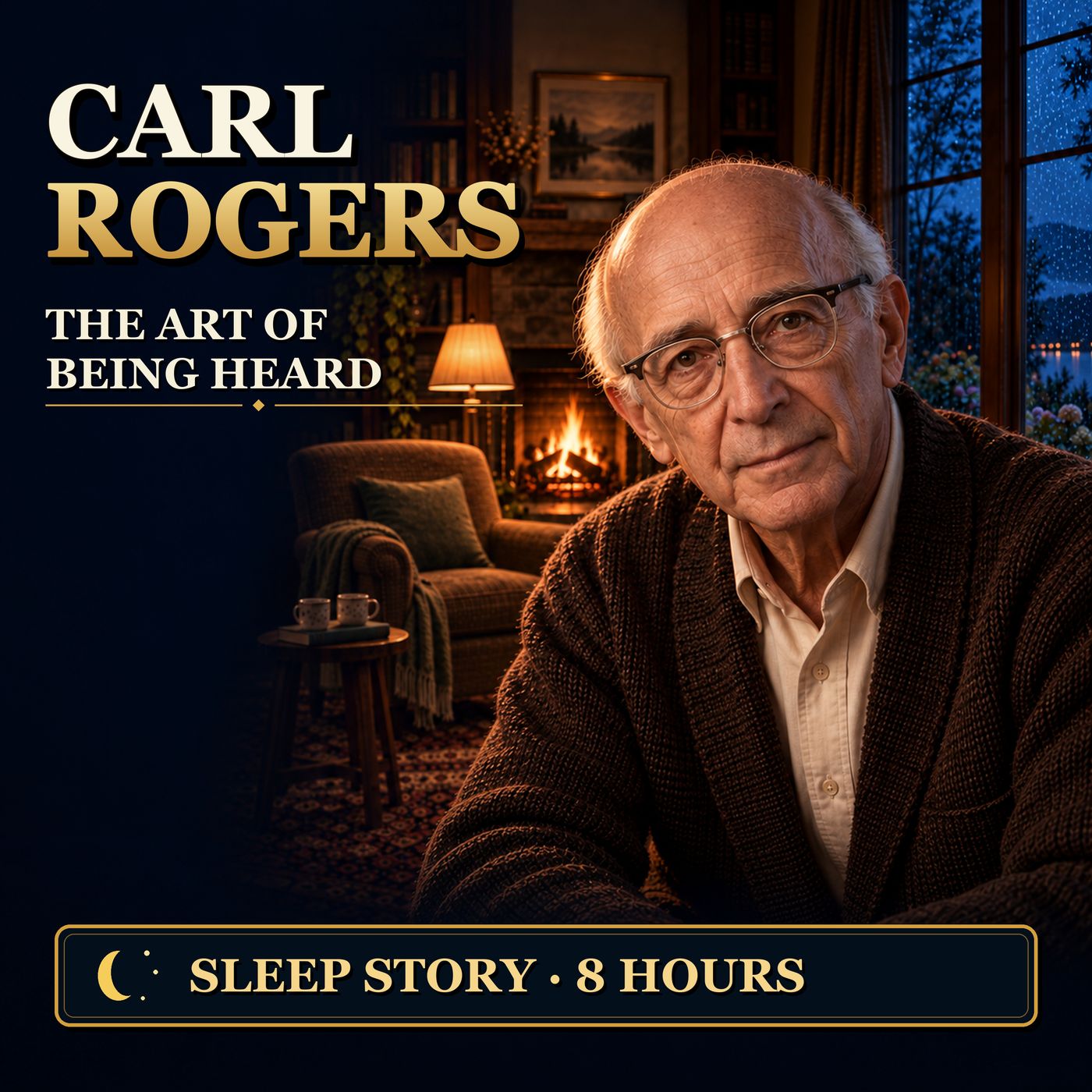 Carl Rogers: Empathy & Unconditional Positive Regard | Sleep Story 16.09.2026 45Min.A calm, carefully researched bedtime journey through the life and ideas of Carl Rogers — exploring empathy, acceptance, self-worth, person-centred therapy and what it means to become more fully yourself.Tonight, we follow Rogers from his childhood in Illinois and quiet years on his family’s farm to the experiences that gradually changed the way he thought about belief, authority and human nature.After initially studying agriculture and preparing for a life in ministry, Rogers moved into psychology. From his early work with children and families in Rochester to his later work at Ohio State, Chicago and Wisconsin, he began challenging the assumption that the therapist should always be the expert who interprets, directs and explains.What might happen if the therapist listened instead?That question helped shape client-centred therapy, later known as person-centred therapy. Along the way, we explore some of Rogers’s most influential ideas — including empathy, congruence, unconditional positive regard, the actualising tendency, self-concept, conditions of worth, incongruence and the fully functioning person.We also explore Rogers’s wider contribution to psychotherapy. He helped bring real therapeutic encounters into systematic research through the recording and study of sessions, and in 1957 set out his influential theory of the conditions required for therapeutic personality change.Rogers’s ideas became enormously influential, although not every part of his theory is settled science. Research has continued to examine the importance of empathy, genuineness, positive regard, the therapeutic relationship and other factors involved in psychological change.This is an original narrated biography and introduction to the psychology of Carl Rogers. It is not a recording of Rogers speaking, an audiobook of his work, or an official or endorsed production.For education, relaxation and sleep. It is not medical advice, psychological treatment or therapy.📚 Explore our Carl Rogers book:https://www.amazon.com/dp/B0CW1KDWFP🌙 Prefer the extended sleep version with hours of gentle nighttime ambience?https://www.youtube.com/playlist?list=PLRypv-XVJDZk🌐 Read more about Carl Rogers:https://pioneersofhumanbehaviour.com/carl-rogers/☕ Support Sleep Stories from the Pioneers:https://ko-fi.com/pioneersofhumanbehaviour🌐 Explore Pioneers of Human Behaviour:https://pioneersofhumanbehaviour.com/Sleep well. 🌙Stories to fall asleep to. Ideas worth waking up with.
 -
 Gabor Maté: Trauma, Belonging & Being Yourself | Sleep Story 15.09.2026 50Min.A calm, carefully researched bedtime journey through the life and ideas of Gabor Maté — exploring trauma, addiction, attachment, authenticity and the search for belonging without losing yourself.Tonight, we begin in Vancouver in the 1960s, where a young art student named Rae is given an assignment for her university newspaper: draw a portrait of a fellow student she has never met.His name is Gabor Maté.Two years later, they would marry.From wartime Budapest and his family's journey to Canada to medicine, family life and his later work with people experiencing severe addiction in Vancouver's Downtown Eastside, this story follows some of the experiences that shaped Maté's life and the ideas for which he would become internationally known.Along the way, we explore Scattered Minds, When the Body Says No, Hold On to Your Kids, In the Realm of Hungry Ghosts and The Myth of Normal, written with his son Daniel Maté.At the centre of Maté's work are recurring questions.What happens when the need to belong conflicts with the need to be yourself?Why do people continue behaviours that they know are hurting them?How might experiences in childhood influence patterns that continue into adulthood?And what changes when, instead of asking only what is wrong with someone, we become curious about what happened to them and how they learned to survive?Maté's work has become especially influential in public conversations about addiction, trauma, stress and childhood development. His years working with patients affected by severe drug addiction and mental illness informed In the Realm of Hungry Ghosts, while his other books have examined attention, parenting, stress, illness and the relationship between individual suffering and the wider environments in which people live.There are quieter and more personal stories too.Rae's first portrait of the man who would become her husband. The pressures that work placed on family life. Maté's own account of compulsively buying classical recordings. And the uncomfortable distinction between understanding why a pattern exists and actually being able to change it.His ideas have attracted both substantial interest and debate. Some of the connections Maté proposes — particularly around trauma, ADHD, stress and physical illness — should not be treated as settled explanations for complex medical or psychological conditions.This story therefore does not present every interpretation associated with Maté as established scientific fact. Instead, it follows his life, explains his arguments and places them within the broader questions that have made his work so widely discussed.There is nothing you need to memorise tonight.You do not need to remember every book, argument or event.Simply listen for as long as you like.As the story continues, the details become quieter. The questions can remain unanswered. And eventually, even the need to understand can be put down for the night.Sleep Stories from the Pioneers is a series of calm, research-led journeys through the lives, ideas, histories and traditions that have changed how we understand ourselves and the world around us.This is an original narrated biography about Gabor Maté. It is not a recording of Maté speaking, an audiobook of his work, or an official or endorsed production.For education and relaxation only. It is not medical advice, psychological treatment or therapy.📚 Explore our Gabor Maté books:Gabor Maté — Pioneers of Human BehaviourCurrent edition:https://www.amazon.com/dp/B0H37S5DYJGabor Mate: Legacy Editionhttps://www.amazon.com/dp/B0FMDCS9RW🌙 Prefer the extended sleep version with hours of gentle...
 -
 Fall Asleep to Ancient Egypt | Pyramids, Pharaohs & Everyday Life 15.09.2026 1Std. 2Min.A calm, carefully researched bedtime journey through Ancient Egypt — from the age of the Great Pyramid to Cleopatra, exploring pharaohs and monuments alongside the quieter lives of boatmen, bakers, craftspeople and families beside the Nile.Tonight, our journey begins with Merer, an ancient Egyptian official whose surviving papyri record the work of a crew transporting limestone towards the pyramid complex of Khufu.From there, we travel across roughly two and a half millennia of Egyptian history, moving between some of the civilisation's most famous monuments and the ordinary objects and records that allow us to glimpse everyday life.Along the way, encounter the workers and administrators behind the great pyramids, the boats, gardens and workshops represented in the remarkable models from the tomb of Meketre, Hatshepsut's celebrated expedition to the Land of Punt, Akhenaten's new royal city at Amarna and the community of skilled royal tomb workers who lived at Deir el-Medina.We also encounter Ancient Egypt through smaller traces of individual lives: bread and clothing, letters and household objects, games and tools, work and family life.The surviving models from Meketre's tomb, for example, preserve miniature scenes of boats, gardens, food production, workshops and agricultural activity, offering an extraordinary window into how Egyptians imagined both earthly life and provision for the afterlife.Eventually, our journey reaches Alexandria and the world of Cleopatra VII, as the long history of pharaonic Egypt gives way to Roman rule.Throughout the story, archaeological discoveries sit alongside surviving documents, inscriptions, museum objects and ancient literature. Where the evidence is incomplete, uncertain or preserved through later accounts, those distinctions matter.Ancient Egypt was not one unchanging civilisation. Across its long history, dynasties rose and fell, political centres shifted, religious traditions developed, foreign rulers arrived and ordinary people continued to work, trade, raise families and live beside the Nile.There is no need to remember every pharaoh, dynasty or date tonight.You do not need to follow every change in kingdom or capital.Simply follow the river for as long as you remain awake.As the journey continues, the monuments recede into darkness. The workshops become quiet. The boats settle along the riverbank. And the Nile continues beneath the night sky, as it has for thousands of years.Told slowly and gently for sleep, relaxation and peaceful late-night listening. Listen for as long as you like and allow the history to drift away whenever sleep arrives.Sleep Stories from the Pioneers is a series of calm, research-led journeys through the lives, ideas, histories and traditions that have changed how we understand ourselves and the world around us.🌙 Prefer the extended sleep versions with hours of gentle nighttime ambience?Explore Sleep Stories from the Pioneers on YouTube:https://www.youtube.com/playlist?list=PLRypv-XVJDZk☕ Support Sleep Stories from the Pioneers:https://ko-fi.com/pioneersofhumanbehaviour🌐 Explore Pioneers of Human Behaviour:https://pioneersofhumanbehaviour.com/Sleep well. 🌙Stories to fall asleep to. Ideas worth waking up with.
Ähnliche Podcasts


Beliebt in
Dieser Podcast erscheint auch in den Podcast-Charts dieser Länder.

