
Law School
The Law School of America
0
The Law School of America podcast is designed for listeners who want to expand and enhance their understanding of the American legal system. It provides legal principles in small, digestible bites to make learning easy. If you're willing to put in the time, these podcasts can take you from novice to knowledgeable in a reasonable amount of time.
Επεισόδια
-
 Constitutional Structure: Congressional Power Part Two — Taxing, Spending, Section Five, Legislative Process, Delegation, and the Major Questions Doctrine 16.09.2026 1ώ 15λ📘Turn this episode into a free Game or Exam-Ready Study Plan.📘👉 OR CLICK HERE TO OPEN TODAY’S FREE STUDY GUIDE 👈🎧 EPISODE SUMMARY 🎧Congressional power analysis evaluates substantive authority and procedural validity:The Taxing Power (Art. I, § 8, Cl. 1) broadly raises revenue. Valid taxes produce some revenue, distinguished from penalties by burden size, scienter, IRS collection, and legality of conduct. It acts as an independent alternative if Commerce Clause authority fails.The Spending Power allows spending for general welfare under a five-part contractual framework:Spending must serve the general welfare (highly deferred).Conditions must be unambiguous.A direct nexus must exist between conditions and program funding.Conditions must not violate independent constitutional bars.Inducements must be non-coercive; threatening core state funding impermissibly commandeers states under the Tenth Amendment.Fourteenth Amendment § 5 allows preventive legislation to enforce rights, but Congress cannot alter substantive constitutional meanings.Broad § 5 remedies require congruence and proportionality, balancing judicial scrutiny, historical state violations, and statutory tailoring. Valid § 5 laws uniquely abrogate state sovereign immunity for private suits.Article I lawmaking requires bicameralism and presentment; procedural shortcuts are invalid:Legislative vetoes violate bicameralism and presentment.Line-item vetoes impermissibly authorize presidential amendment of statutes.The Nondelegation Doctrine requires an intelligible principle to delegate regulatory authority legally.Under the Major Questions Doctrine, agency decisions of vast economic/political significance require explicit congressional authorization.Analyzing congressional power requires checking:Substantive enumerated power.Compliance with bicameralism and presentment.Valid delegation under nondelegation and major questions doctrines.Protection of federalism and separation of powers boundaries.ℹ️ INFORMATION, PRIVACY POLICY & TERMS OF USE ℹ️The Podcast and Website PurposeThe Law School Podcast and 1L Study Aide webpage supplements law-school and Bar Exam study with strategies, condensed rules, quizzes, and flashcards.Educational DisclaimerContent is for educational and informational purposes only. It is not legal advice, creates no attorney-client relationship, and does not guarantee law-school or Bar Exam success.Privacy PolicyNo account or login is required.This webpage uses no forms or analytics to collect personal information.Quiz and flashcard activity stays in your browser and may clear when local site data is removed.Terms of UseBy using this webpage, you agree to use its content only for lawful, personal, noncommercial educational purposes. It supplements—not replaces—courses, textbooks, official materials, or qualified instruction.
 -
 Constitutional Structure: Congressional Power Part One — Enumerated Powers, Necessary and Proper Clause, Commerce Clause, and the Limits of National Legislative Authority 15.09.2026 1ώ 17λ📘Turn this episode into a free Game or Exam-Ready Study Plan.📘👉 OR CLICK HERE TO OPEN TODAY’S FREE STUDY GUIDE 👈🎧 EPISODE SUMMARY 🎧Congressional power is bounded by enumerated powers under Article I:Congress lacks a general federal police power. Unlike state legislatures, Congress must trace every act to a specific constitutional authority.The Necessary and Proper Clause permits laws rationally related to executing enumerated powers (McCulloch), but it is not an independent power source.The Commerce Clause provides three categories of federal regulatory authority:Channels of Interstate Commerce: Highways, waterways, and airspace.Instrumentalities, Persons, or Things: Vehicles and items moving in interstate transit.Substantial Effects: Intrastate conduct substantially affecting national commerce.Substantial-effects regulation distinguishes economic and noneconomic activity:Economic Activity: Local commercial conduct can be aggregated (Wickard) under rational basis review.Noneconomic Activity: Local noneconomic conduct cannot be aggregated (Lopez, Morrison).Comprehensive Schemes: Local activity can be regulated as part of a national scheme (Raich).Activity vs. Inactivity: Congress cannot compel commercial activity (NFIB v. Sebelius).Federal criminal law relies on Commerce and Necessary/Proper powers, often using statutory jurisdictional elements.Under the Property Clause, Congress retains broad police-like authority over federal enclaves.Analytical framework:Identify the power.Confirm legislative scope.Verify no independent constitutional violations.ℹ️ INFORMATION, PRIVACY POLICY & TERMS OF USE ℹ️The Podcast and Website PurposeThe Law School Podcast and 1L Study Aide webpage supplements law-school and Bar Exam study with strategies, condensed rules, quizzes, and flashcards.Educational DisclaimerContent is for educational and informational purposes only. It is not legal advice, creates no attorney-client relationship, and does not guarantee law-school or Bar Exam success.Privacy PolicyNo account or login is required.This webpage uses no forms or analytics to collect personal information.Quiz and flashcard activity stays in your browser and may clear when local site data is removed.Terms of UseBy using this webpage, you agree to use its content only for lawful, personal, noncommercial educational purposes. It supplements—not replaces—courses, textbooks, official materials, or qualified instruction.
 -
 Constitutional Structure: Federal Judicial Power — Judicial Review, Article III, Standing, Ripeness, Mootness, Political Questions, and Judicial Limits 14.09.2026 1ώ 26λ📘Turn this episode into a free Game or Exam-Ready Study Plan.📘👉 OR CLICK HERE TO OPEN TODAY’S FREE STUDY GUIDE 👈🎧 EPISODE SUMMARY 🎧Article III federal judicial power requires specific Cases and Controversies, establishing justiciability doctrines.Marbury v. Madison established judicial review over federal acts and executive actions.Supreme Court review of state court judgments is barred if supported by an adequate and independent state-law ground (AISG). Advisory opinions are strictly prohibited.Standing requires three elements:Injury in fact: Concrete, particularized, and actual/imminent;Causation: Traceable to defendant; andRedressability: Remediable by favorable judgment.Ripeness avoids premature litigation; mootness requires an ongoing controversy. The political-question doctrine bars non-justiciable disputes.Congress can structure jurisdiction but cannot dictate judicial decisions or reopen final judgments.Always confirm jurisdiction and justiciability before addressing constitutional merits.ℹ️ INFORMATION, PRIVACY POLICY & TERMS OF USE ℹ️The Podcast and Website PurposeThe Law School Podcast and 1L Study Aide webpage supplements law-school and Bar Exam study with strategies, condensed rules, quizzes, and flashcards.Educational DisclaimerContent is for educational and informational purposes only. It is not legal advice, creates no attorney-client relationship, and does not guarantee law-school or Bar Exam success.Privacy PolicyNo account or login is required.This webpage uses no forms or analytics to collect personal information.Quiz and flashcard activity stays in your browser and may clear when local site data is removed.Terms of UseBy using this webpage, you agree to use its content only for lawful, personal, noncommercial educational purposes. It supplements—not replaces—courses, textbooks, official materials, or qualified instruction.
 -
 Property Fall Build: Mortgages, Foreclosure, Priority, Fixtures, Water Rights, Support, Remedies, and the Complete Property Examination System 13.09.2026 1ώ📘Turn this episode into a Game or Exam-Ready Study Plan.📘👉 CLICK HERE TO OPEN YOUR FREE STUDY GUIDE 👈🎧 EPISODE SUMMARY 🎧Sunday concludes the Property Fall Build by linking financing, priority, fixtures, water rights, support, remedies, and exam strategy.A mortgage secures debt with a real property interest.The borrower is the mortgagor; the lender is the mortgagee. A promissory note creates personal debt, while the mortgage provides security. The mortgage follows the note.States apply lien, title, or intermediate theories to define legal ownership before default.Prior to foreclosure, borrowers hold an equitable right of redemption by paying the debt. Pre-default waivers are disfavored clogs on equity.Some states also grant statutory redemption after foreclosure.Foreclosure ends equitable redemption and sells property to satisfy debt via judicial or nonjudicial methods.Foreclosure must join junior interest holders to extinguish their interests; unjoined interests survive. Senior liens are not eliminated by junior foreclosures.First in time, first in right sets baseline mortgage priority, modified by recording statutes, notice, purchase-money status, or subordination agreements.A purchase-money mortgage finances land acquisition and receives super-priority.Senior foreclosure terminates properly joined junior interests.Junior foreclosure leaves senior interests intact on the land.Costs; foreclosing debt; junior liens in priority; mortgagor surplus.If foreclosure proceeds are insufficient, lenders may seek a deficiency judgment, unless barred by statute.A due-on-sale clause permits debt acceleration upon transfer.A buyer who assumes a mortgage becomes personally liable; taking subject to leaves only the land liable to foreclosure. The original borrower remains liable unless released.Fixtures are personal property annexed to realty, determined by intent, adaptation, and annexation.Commercial tenants may remove trade fixtures before lease end if no substantial damage occurs.Water rights follow riparian rights (reasonable use for waterfront owners) or prior appropriation (priority by beneficial use).Landowners have a right to lateral support (adjacent land) and subjacent support (subsurface). Strict liability applies to natural land collapse, while negligence usually governs building collapse.Possessory/Title: ejectment, quiet title, partition, specific performance, foreclosure.Monetary/Equitable: damages, injunctions, rescission.The 10-step exam strategy: identify property and claimants, classify interests, check source/validity/transferability/priority, analyze use and obligations, then determine remedies.Always ask: “What interest does each claimant have?”Property Law is a system for identifying, classifying, ranking, and enforcing competing interests.ℹ️ INFORMATION, PRIVACY POLICY & TERMS OF USE ℹ️The Podcast and Website PurposeThe Law School Podcast and 1L Study Aide webpage supplements law-school and Bar Exam study with strategies, condensed rules, quizzes, and flashcards.Educational DisclaimerContent is for educational and informational purposes only. It is not legal advice, creates no attorney-client relationship, and does not guarantee law-school or Bar Exam success.Privacy PolicyNo account or login is required.This webpage uses no forms or analytics to collect personal information.Quiz and flashcard activity stays in your browser and may clear when local site data is removed.Terms of UseBy using this webpage, you agree to use its content only for lawful, personal, noncommercial educational purposes. It supplements—not replaces—courses, textbooks, official materials, or qualified instruction.
 -
 Property Fall Build: Covenants, Equitable Servitudes, Common-Interest Communities, Nuisance, Zoning, and Takings 12.09.2026 1ώ 12λ📘Turn this episode into a Game or Exam-Ready Study Plan.📘👉 CLICK HERE TO OPEN YOUR FREE STUDY GUIDE 👈🎧 EPISODE SUMMARY 🎧Property ownership is shaped by land-use restrictions.Real covenants bind successors; burdens and benefits are analyzed separately.Burdens require writing, intent, touch and concern, privity, and notice.Notice may be actual, record, or inquiry.Equitable servitudes use injunctions, requiring writing, intent, touch and concern, and notice.Common schemes bind developments through general plans with notice.Common-interest communities bind owners through recorded CC&Rs and bylaws.Private nuisance is unreasonable, substantial interference with land use.Public nuisance affects public rights; private suits require special harm.Zoning uses police power to regulate land density and form.Existing lawful uses continue as nonconforming uses.Variances grant relief for area or use hardships.Special exceptions authorize uses under specified conditions.Takings require just compensation for public use or physical occupation.Eliminating all economic use is a categorical taking.Regulatory takings evaluate economic impact, expectations, and character.Exactions require essential nexus and rough proportionality.Eminent domain condemns property for fair market value.Land rights exist within overlapping systems:Identify restriction sources before applying specific doctrines.ℹ️ INFORMATION, PRIVACY POLICY & TERMS OF USE ℹ️The Podcast and Website PurposeThe Law School Podcast and 1L Study Aide webpage supplements law-school and Bar Exam study with strategies, condensed rules, quizzes, and flashcards.Educational DisclaimerContent is for educational and informational purposes only. It is not legal advice, creates no attorney-client relationship, and does not guarantee law-school or Bar Exam success.Privacy PolicyNo account or login is required.This webpage uses no forms or analytics to collect personal information.Quiz and flashcard activity stays in your browser and may clear when local site data is removed.Terms of UseBy using this webpage, you agree to use its content only for lawful, personal, noncommercial educational purposes. It supplements—not replaces—courses, textbooks, official materials, or qualified instruction.
 -
 Property Fall Build: Adverse Possession and Easements — Hostile Possession, Tacking, Prescription, Express Grants, Implication, Necessity, Estoppel, Licenses, and Profits 11.09.2026 1ώ 12λ📘Turn this episode into a Game or Exam-Ready Study Plan.📘👉 CLICK HERE TO OPEN YOUR FREE STUDY GUIDE 👈🎧 EPISODE SUMMARY 🎧Property rights can arise through possession, use, necessity, reliance, or prescription without a formal deed.Adverse possession grants title after actual, open, notorious, exclusive, hostile, and continuous possession for the statutory period.Actual and continuous possession reflects reasonable land use and does not require constant physical presence. Seasonal use suffices if customary.Open possession puts owners on notice. Exclusive possession requires owner-like control rather than public use.Hostility means possessing without permission. Courts evaluate intent using objective, good-faith, or intentional-trespass standards.Successive possessors can tack periods if connected by privity. Ousting another possessor lacks privity.Statutory disabilities alter limitations periods only if present when adverse possession begins.Color of title involves possession under a defective instrument, which may shorten periods or expand constructive possession.Prescriptive easements grant use rights rather than title through adverse use, distinguishing prescription from adverse possession.Easements are nonpossessory use rights over servient land. Appurtenant easements benefit dominant land; easements in gross benefit specific entities.Express easements are created intentionally in writing, defining location, purpose, duration, and scope.Implied easements arise when land division follows continuous, apparent preexisting use necessary for a parcel.Easements by necessity arise when land severance blocks access, lasting only while necessity persists.Prescription creates easements through adverse use. Estoppel creates them when users reasonably rely on permission.Easement holders must respect authorized scope. Appurtenant easements cannot be expanded to serve newly acquired land if burdensome.Holders maintain easements, though shared use allows cost apportionment.Easements terminate by release, merger, abandonment, expiration, or ended necessity. Abandonment requires nonuse plus intent to relinquish.Licenses provide revocable, nonpossessory permission to use land, becoming irrevocable only through detrimental reliance.Profits permit entering land to extract natural resources and follow easement rules.Key distinctions by interest claimed:Adverse possession: seeks title.Prescription: seeks adverse use rights.Express easement: based on agreement.Implied easement: based on prior use at severance.Necessity: based on required access at severance.Estoppel: based on permission plus reliance.License: temporary, revocable permission.Profit: permits resource removal.Property rights can stem from long-standing conduct, not just formal conveyances.ℹ️ INFORMATION, PRIVACY POLICY & TERMS OF USE ℹ️The Podcast and Website PurposeThe Law School Podcast and 1L Study Aide webpage supplements law-school and Bar Exam study with strategies, condensed rules, quizzes, and flashcards.Educational DisclaimerContent is for educational and informational purposes only. It is not legal advice, creates no attorney-client relationship, and does not guarantee law-school or Bar Exam success.Privacy PolicyNo account or login is required.This webpage uses no forms or analytics to collect personal information.Quiz and flashcard activity stays in your browser and may clear when local site data is removed.Terms of UseBy using this webpage, you agree to use its content only for lawful, personal, noncommercial educational purposes. It supplements—not replaces—courses, textbooks, official materials, or qualified instruction.
 -
 Property Fall Build: Land Transfers — Land-Sale Contracts, Marketable Title, Equitable Conversion, Deeds, Delivery, Title Covenants, Recording Acts, and Bona Fide Purchasers 10.09.2026 1ώ 13λ📘Turn this episode into a Game or Exam-Ready Study Plan.📘👉 CLICK HERE TO OPEN YOUR FREE STUDY GUIDE 👈🎧 EPISODE SUMMARY 🎧Land transfers follow a sequence from contract to priority dispute.Contracts must satisfy the Statute of Frauds with a signed writing specifying parties, property, price, and terms. Part performance through possession, payment, or improvements can enforce oral agreements.Sellers must provide marketable title—title free from litigation risk—by closing. Defects include liens, easements, and title gaps. Curable defects before closing do not justify early buyer rescission.Equitable conversion makes the buyer equitable owner upon contract formation. Loss risk traditionally falls on the buyer, though modern rules tie risk to possession or title transfer.Sellers must disclose hidden material defects, while misrepresentation and active concealment remain actionable.Contractual title duties merge into the deed at closing. Examine marketable title before closing and deed covenants after.Valid deeds require parties, conveyance language, description, signature, and delivery based on present intent. Distinguish escrow delivery from attempted oral conditions or testamentary transfers.General warranty deeds offer full protection, special warranty deeds cover only the grantor's ownership period, and quitclaim deeds convey interest without warranties.Present covenants (seisin, right to convey, encumbrances) breach at delivery. Future covenants (quiet enjoyment, warranty, further assurances) breach upon later interference by superior title.Recording acts determine priority, not deed validity. Notice is actual, record, or inquiry. A bona fide purchaser (BFP) pays value without notice.Under race acts, first to record wins. Under notice acts, a subsequent BFP wins. Under race-notice acts, a subsequent BFP must record first.The shelter rule extends BFP protection to transferees. Wild deeds outside the chain of title fail to give notice. Estoppel by deed passes later-acquired title to prior grantees.Disputes turn on contracts, timing, delivery, notice, value, recording, and priority statutes. Analysis follows the process: contract, title, closing, deed, recording, notice, and priority.ℹ️ INFORMATION, PRIVACY POLICY & TERMS OF USE ℹ️The Podcast and Website PurposeThe Law School Podcast and 1L Study Aide webpage supplements law-school and Bar Exam study with strategies, condensed rules, quizzes, and flashcards.Educational DisclaimerContent is for educational and informational purposes only. It is not legal advice, creates no attorney-client relationship, and does not guarantee law-school or Bar Exam success.Privacy PolicyNo account or login is required.This webpage uses no forms or analytics to collect personal information.Quiz and flashcard activity stays in your browser and may clear when local site data is removed.Terms of UseBy using this webpage, you agree to use its content only for lawful, personal, noncommercial educational purposes. It supplements—not replaces—courses, textbooks, official materials, or qualified instruction.
 -
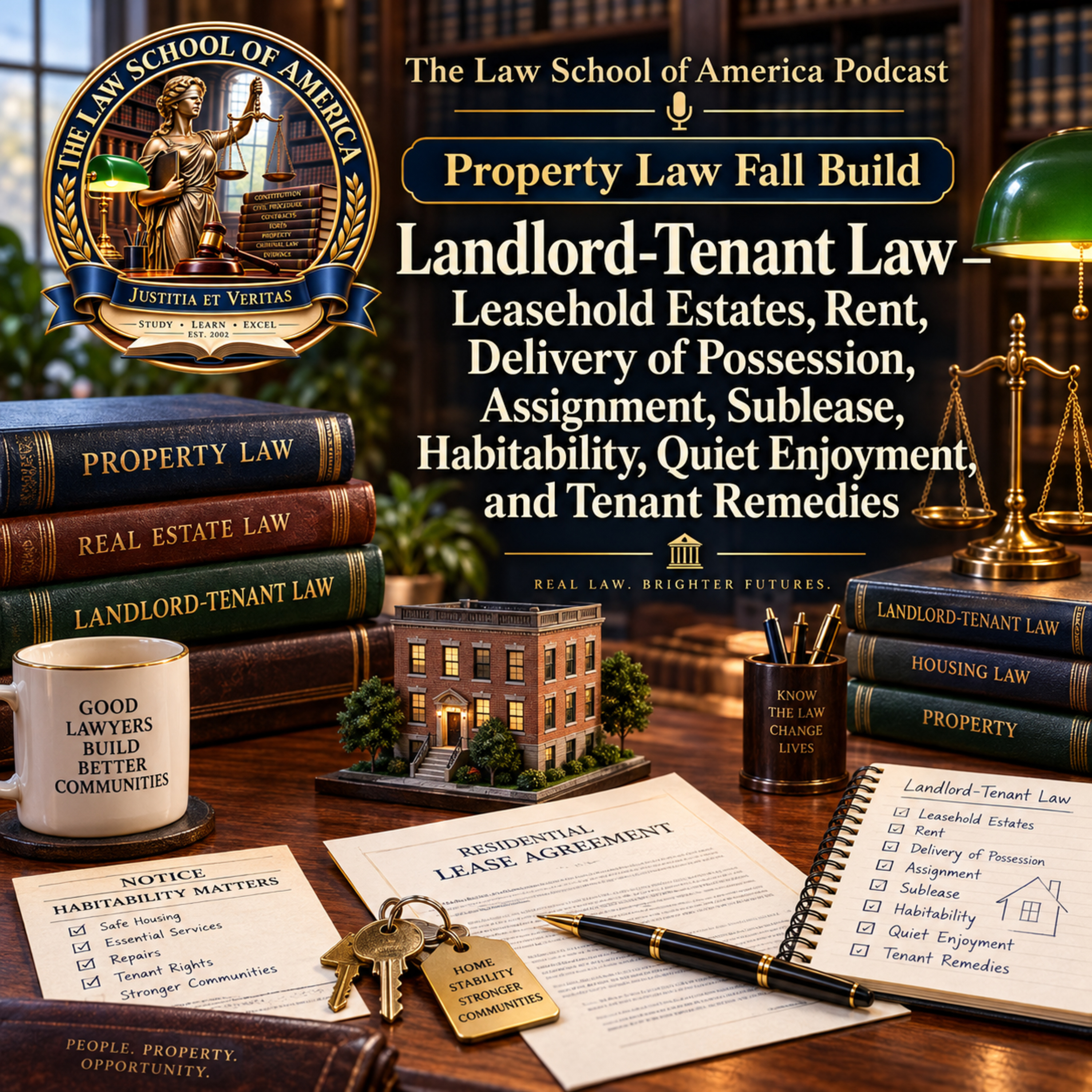 Property Fall Build: Landlord-Tenant Law — Leasehold Estates, Rent, Delivery of Possession, Assignment, Sublease, Habitability, Quiet Enjoyment, and Tenant Remedies 09.09.2026 1ώ 25λ📘Turn this episode into a Game or Exam-Ready Study Plan.📘👉 CLICK HERE TO OPEN YOUR FREE STUDY GUIDE 👈🎧 EPISODE SUMMARY 🎧Landlord-tenant law combines traditional Property doctrine with contract principles and modern statutory protections.The first task is to classify the tenant’s possessory estate. A tenancy for years lasts for a fixed period. A periodic tenancy renews for successive periods. A tenancy at will continues indefinitely subject to termination. A tenancy at sufferance describes a holdover after lawful possession has ended.The lease must then be analyzed as a contract.An assignment transfers the tenant’s entire remaining leasehold interest. A sublease transfers less than the entire remainder.After an assignment, the landlord and assignee may enter privity of estate, while the original landlord and original tenant may remain in privity of contract. Assignment therefore does not automatically release the original tenant. A novation or other release may be required.The covenant of quiet enjoyment protects possession against substantial landlord interference. Constructive eviction traditionally requires substantial interference attributable to the landlord and ordinarily requires the tenant to leave within a reasonable time.The implied warranty of habitability protects residential tenants against serious conditions affecting basic human habitation and may permit remedies even when the tenant remains.Tenants also owe duties involving rent, waste, lawful use, and compliance with valid lease terms.Modern statutes may regulate habitability, retaliation, security deposits, termination, eviction procedure, and other aspects of the relationship.The best examination method is therefore to analyze every lease twice:As a conveyance of a possessory estate.As a contract creating mutual obligations.Then identify privity, property covenants, statutory protections, and remedies.That method captures the defining feature of modern landlord-tenant law: possession and contract operate together.ℹ️ INFORMATION, PRIVACY POLICY & TERMS OF USE ℹ️The Podcast and Website PurposeThe Law School Podcast and 1L Study Aide webpage supplements law-school and Bar Exam study with strategies, condensed rules, quizzes, and flashcards.Educational DisclaimerContent is for educational and informational purposes only. It is not legal advice, creates no attorney-client relationship, and does not guarantee law-school or Bar Exam success.Privacy PolicyNo account or login is required.This webpage uses no forms or analytics to collect personal information.Quiz and flashcard activity stays in your browser and may clear when local site data is removed.Terms of UseBy using this webpage, you agree to use its content only for lawful, personal, noncommercial educational purposes. It supplements—not replaces—courses, textbooks, official materials, or qualified instruction.
 -
 Property Fall Build: Concurrent Ownership — Tenancy in Common, Joint Tenancy, Tenancy by the Entirety, Cotenant Rights, Severance, Accounting, and Partition 08.09.2026 1ώ 26λ📘Turn this episode into a Game or Exam-Ready Study Plan.📘👉 CLICK HERE TO OPEN YOUR FREE STUDY GUIDE 👈🎧 EPISODE SUMMARY 🎧Concurrent ownership exists when more than one person owns rights in the same property at the same time. The three principal forms are tenancy in common, joint tenancy, and tenancy by the entirety.A tenancy in common is the modern default. Each cotenant owns a separate fractional interest, possesses an equal right to use the whole property, and has no survivorship right. The interest may ordinarily be transferred during life or at death.A joint tenancy includes a right of survivorship. When one joint tenant dies, the surviving joint tenants ordinarily continue ownership without the deceased tenant’s interest passing through a will. Traditional law required the unities of time, title, interest, and possession. Clear survivorship language is generally important.A joint tenant may ordinarily sever the joint tenancy by transferring that tenant’s interest. Mortgage severance may depend on whether the jurisdiction follows title theory or lien theory.A tenancy by the entirety is available to married spouses in some jurisdictions and typically includes survivorship, equal possession, restricted unilateral severance, and protection from some individual creditors.All cotenants generally have an equal right to possess the whole property regardless of ownership percentage.An ouster occurs when one cotenant wrongfully excludes another. Mere exclusive occupancy ordinarily is insufficient. Ouster may affect rent liability, ejectment, partition, and adverse-possession analysis.A cotenant in personal possession ordinarily does not owe rent to nonoccupying cotenants absent ouster, agreement, or statute. A cotenant who receives rental income from third parties generally must account for the other owners’ proportionate shares.Necessary expenses such as taxes, certain mortgage payments, insurance, and essential repairs may support contribution. Voluntary improvements ordinarily do not, although the increase in property value attributable to an improvement may be credited during partition or accounting.A cotenant may also be liable for waste that harms common property.A cotenant ordinarily may seek partition. Partition in kind physically divides the property and has historically been preferred when practicable. Partition by sale converts the property into proceeds when physical division is impracticable or would substantially impair value.Finally, adverse possession by one cotenant against another is difficult because every cotenant begins with a lawful right to possession. Clear ouster or repudiation is generally required before possession becomes hostile.The central analytical principle is:Concurrent ownership divides ownership interests without necessarily dividing possession.A student who keeps ownership percentage, possession, income, expenses, survivorship, transfer, and partition separate will be able to analyze most concurrent-ownership problems with precision.ℹ️ INFORMATION, PRIVACY POLICY & TERMS OF USE ℹ️The Podcast and Website PurposeThe Law School Podcast and 1L Study Aide webpage supplements law-school and Bar Exam study with strategies, condensed rules, quizzes, and flashcards.Educational DisclaimerContent is for educational and informational purposes only. It is not legal advice, creates no attorney-client relationship, and does not guarantee law-school or Bar Exam success.Privacy PolicyNo account or login is required.This webpage uses no forms or analytics to collect personal information.Quiz and flashcard activity stays in your browser and may clear when local site data is removed.Terms of UseBy using this webpage, you agree to use its content only for lawful, personal, noncommercial educational purposes. It supplements—not replaces—courses, textbooks, official materials, or qualified instruction.
 -
 Property Fall Build: Estates and Future Interests — Fee Simple, Defeasible Estates, Life Estates, Waste, Remainders, Executory Interests, and the Rule Against Perpetuities 07.09.2026 1ώ 8λ📘Turn this episode into a Game or Exam-Ready Study Plan.📘👉 CLICK HERE TO OPEN YOUR FREE STUDY GUIDE 👈🎧 EPISODE SUMMARY 🎧Estates and future interests are the grammar of Property. The student’s first task is classification. A fee simple absolute is potentially infinite and freely transferable, devisable, and descendible.A fee simple determinable ends automatically upon the triggering event and is followed by a possibility of reverter.A fee simple subject to condition subsequent does not end automatically. The grantor must exercise a right of entry.A fee simple subject to executory limitation automatically shifts to another transferee, who holds an executory interest.A life estate lasts for the life of a specified person. A life estate may also be measured by another person’s life. Life tenants are subject to rules against voluntary, permissive, and ameliorative waste.Future interests retained by a grantor include reversions, possibilities of reverter, and rights of entry.Future interests in transferees include remainders and executory interests.A remainder waits for the natural end of the preceding estate. It may be indefeasibly vested, vested subject to complete divestment, vested subject to open, or contingent.Executory interests cut short another estate or divest the grantor. They may be shifting or springing.The traditional Rule Against Perpetuities acts as a validity screen for certain future interests. Students should identify the interest, determine whether the Rule applies, identify the vesting condition, find possible validating lives, and ask whether vesting could occur more than twenty-one years after all relevant lives in being have died.The most important examination lesson is procedural:Identify the present estate.Identify every future interest.Classify each interest precisely.Apply defeasibility rules.Apply RAP if relevant.Then determine possession.Precise classification comes before argument. Once the interests are correctly identified, the rest of the Property analysis becomes substantially easier.ℹ️ INFORMATION, PRIVACY POLICY & TERMS OF USE ℹ️The Podcast and Website PurposeThe Law School Podcast and 1L Study Aide webpage supplements law-school and Bar Exam study with strategies, condensed rules, quizzes, and flashcards.Educational DisclaimerContent is for educational and informational purposes only. It is not legal advice, creates no attorney-client relationship, and does not guarantee law-school or Bar Exam success.Privacy PolicyNo account or login is required.This webpage uses no forms or analytics to collect personal information.Quiz and flashcard activity stays in your browser and may clear when local site data is removed.Terms of UseBy using this webpage, you agree to use its content only for lawful, personal, noncommercial educational purposes. It supplements—not replaces—courses, textbooks, official materials, or qualified instruction.
 -
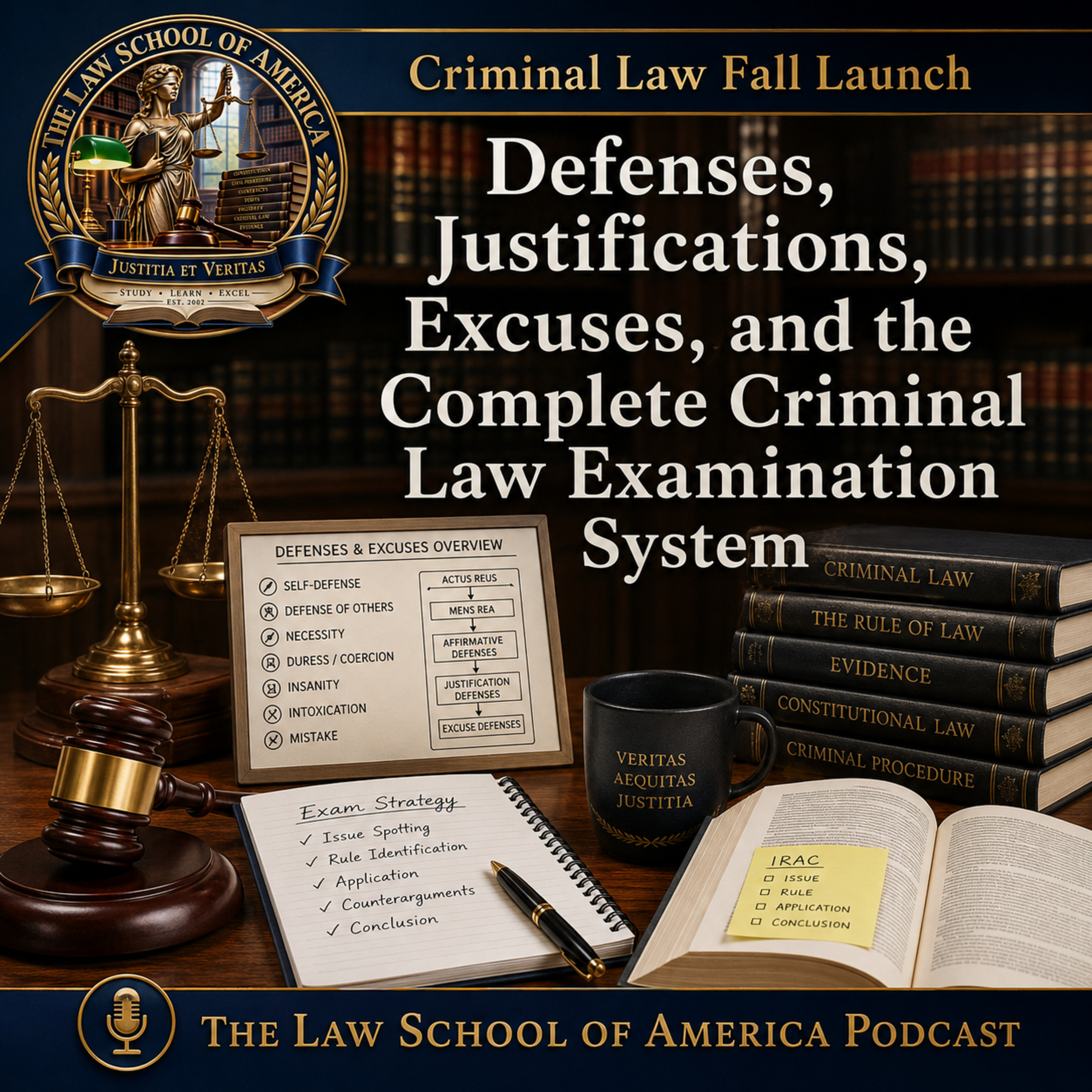 Criminal Law Fall Launch: Defenses, Justifications, Excuses, and the Complete Criminal Law Examination System 06.09.2026 1ώ 17λ📘 FREE COMPANION STUDY GUIDE 📘👉 CLICK HERE TO OPEN YOUR FREE STUDY GUIDE 👈Turn this episode into an exam-ready study plan.🎧 EPISODE SUMMARY 🎧Sunday finishes the Fall Launch by combining defenses with an exam system.Defenses fall into failure of proof, justification, or excuse.Self-defense (justification) allows reasonable force against imminent unlawful force.Key elements:Unlawful threat & imminence.Belief & reasonableness.Proportionality.Initial aggressor status & retreat.Deadly force requires imminent death/serious injury. Retreat rules vary (duty to retreat vs. stand-your-ground).Defense of others relies on defender’s reasonable belief. Defense of property permits nondeadly force only.Necessity justifies conduct to prevent greater harm from natural circumstances (traditionally excludes intentional homicide).Duress excuses conduct forced by threats of death/serious harm (traditionally excludes murder).Mistake of fact negates specific intent (honest mistake) or general intent (honest & reasonable mistake).Mistake of law rarely excuses, except for official reliance or collateral legal mistakes.Voluntary intoxication may negate specific intent only. Involuntary intoxication acts as a broader excuse.Insanity tests: M’Naghten (cognitive), Irresistible Impulse (volitional), MPC (substantial capacity), Durham (product test).Infancy uses age presumptions. Entrapment requires government inducement and lack of predisposition (subjective test).The twelve-step exam framework:Offenses & Elements.Actus Reus & Mens Rea.Concurrence & Causation.Grading & Inchoate Liability.Secondary Liability & Defenses.Merger & Conclusion.Key traps to avoid:Motive ≠ Mens Rea; Omissions require legal duty.Recklessness ≠ Negligence; Homicide requires causation.Property crimes depend on possession vs. title.Preparation ≠ Attempt; Presence ≠ Accomplice.Conspiracy does not merge into completed crime.The capstone integration requires evaluating each actor separately.Analyze Criminal Law offense by offense, element by element, and defendant by defendant.ℹ️ INFORMATION, PRIVACY POLICY & TERMS OF USE ℹ️The Podcast and Website PurposeThe Law School Podcast and 1L Study Aide webpage supplements law-school and Bar Exam study with strategies, condensed rules, quizzes, and flashcards.Educational DisclaimerContent is for educational and informational purposes only. It is not legal advice, creates no attorney-client relationship, and does not guarantee law-school or Bar Exam success.Privacy PolicyNo account or login is required.This webpage uses no forms or analytics to collect personal information.Quiz and flashcard activity stays in your browser and may clear when local site data is removed.Terms of UseBy using this webpage, you agree to use its content only for lawful, personal, noncommercial educational purposes. It supplements—not replaces—courses, textbooks, official materials, or qualified instruction.
 -
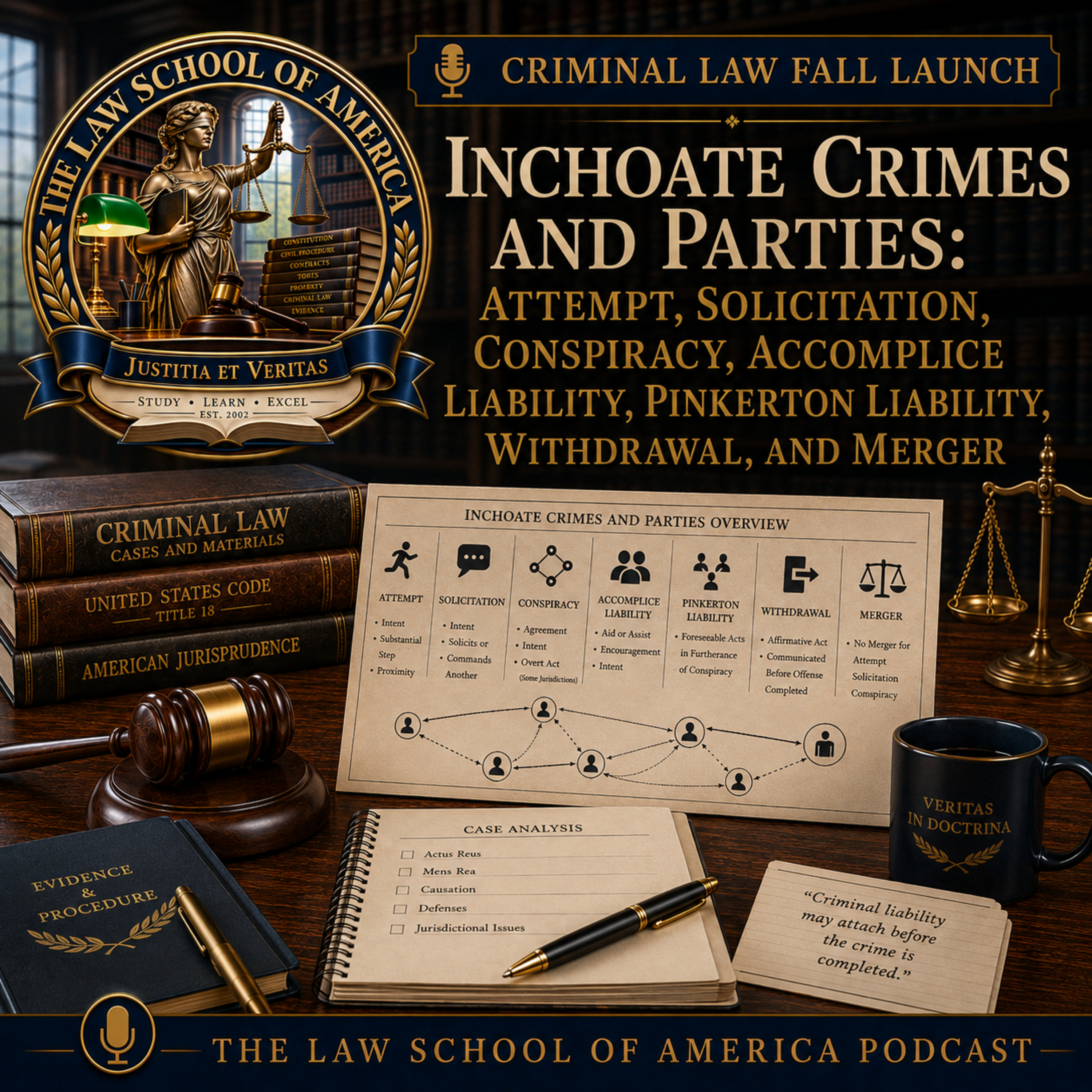 Criminal Law Fall Launch: Inchoate Crimes and Parties: Attempt, Solicitation, Conspiracy, Accomplice Liability, Pinkerton Liability, Withdrawal, and Merger 05.09.2026 1ώ 15λ📘 FREE COMPANION STUDY GUIDE 📘👉 CLICK HERE TO OPEN YOUR FREE STUDY GUIDE 👈Turn this episode into an exam-ready study plan.🎧 EPISODE SUMMARY 🎧Criminal liability can arise before, during, or around completion of an offense.Key doctrines include:Attempt.Solicitation.Conspiracy.Attempt requires specific intent to commit the target offense plus acts beyond preparation.For example, attempted murder requires intent to kill; recklessness is insufficient.Attempt tests include:Last-act.Dangerous proximity.Model Penal Code substantial step.The last-act test requires conduct at the final step.The dangerous-proximity test evaluates how close the defendant came to completion.The unequivocality test requires conduct that unambiguously shows criminal purpose.The MPC substantial-step test requires a substantial step strongly corroborating criminal purpose.Factual impossibility is not a defense, whereas legal impossibility traditionally may be.Abandonment is generally not recognized at common law once complete, though the MPC recognizes voluntary renunciation.Solicitation occurs upon asking another to commit a crime with intent that it be committed.Conspiracy requires an agreement and intent to achieve the unlawful objective, plus an overt act where required.Common law uses a bilateral approach requiring two culpable parties, while the MPC allows a unilateral conspiracy.Pinkerton liability holds conspirators liable for foreseeable co-conspirator crimes in furtherance of the conspiracy.Withdrawal from a conspiracy does not erase past liability but may limit future crimes.Attempt and solicitation merge into the completed offense, but conspiracy does not.Accomplice liability requires intentional assistance or encouragement; mere presence or knowledge is insufficient.An accessory after the fact assists a felon only after the crime is completed to hinder arrest or prosecution.Each theory of criminal responsibility must be precisely identified.ℹ️ INFORMATION, PRIVACY POLICY & TERMS OF USE ℹ️The Podcast and Website PurposeThe Law School Podcast and 1L Study Aide webpage supplements law-school and Bar Exam study with strategies, condensed rules, quizzes, and flashcards.Educational DisclaimerContent is for educational and informational purposes only. It is not legal advice, creates no attorney-client relationship, and does not guarantee law-school or Bar Exam success.Privacy PolicyNo account or login is required.This webpage uses no forms or analytics to collect personal information.Quiz and flashcard activity stays in your browser and may clear when local site data is removed.Terms of UseBy using this webpage, you agree to use its content only for lawful, personal, noncommercial educational purposes. It supplements—not replaces—courses, textbooks, official materials, or qualified instruction.
 -
 Criminal Law Fall Launch: Property Crimes: Larceny, Embezzlement, False Pretenses, Robbery, Extortion, Burglary, Arson, Receiving Stolen Property, and Forgery 04.09.2026 1ώ 7λ📘 FREE COMPANION STUDY GUIDE 📘👉 CLICK HERE TO OPEN YOUR FREE STUDY GUIDE 👈Turn this episode into an exam-ready study plan.🎧 EPISODE SUMMARY 🎧Embezzlement: Defined by initial lawful possession and the subsequent fraudulent conversion (e.g., spending, selling, or unauthorized use) of entrusted property, without requiring asportation.False Pretenses vs. Larceny by Trick: False pretenses involves a false representation of material fact, intent to defraud, victim reliance, and the transfer of title. In contrast, fraud that transfers only possession constitutes larceny by trick. Common-law distinctions remain essential baseline concepts despite modern statutory consolidation of theft crimes.Robbery: Larceny committed from a victim's person or presence through force (overcoming resistance/compelling surrender) or threats of immediate physical harm. Presence extends to nearby items, vehicles, or coerced safes.Extortion: Coercing property through threats of future violence, secrets, or economic harm, contrasting with robbery's requirement of immediate force.Burglary: At common law, breaking and entering another's dwelling at night with felonious intent. Breaking can be actual (even minimal effort like opening an unlocked door) or constructive. Modern statutes expand this to non-dwellings, daytime entries, and uninvited remaining.ℹ️ INFORMATION, PRIVACY POLICY & TERMS OF USE ℹ️The Podcast and Website PurposeThe Law School Podcast and 1L Study Aide webpage supplements law-school and Bar Exam study with strategies, condensed rules, quizzes, and flashcards.Educational DisclaimerContent is for educational and informational purposes only. It is not legal advice, creates no attorney-client relationship, and does not guarantee law-school or Bar Exam success.Privacy PolicyNo account or login is required.This webpage uses no forms or analytics to collect personal information.Quiz and flashcard activity stays in your browser and may clear when local site data is removed.Terms of UseBy using this webpage, you agree to use its content only for lawful, personal, noncommercial educational purposes. It supplements—not replaces—courses, textbooks, official materials, or qualified instruction.
 -
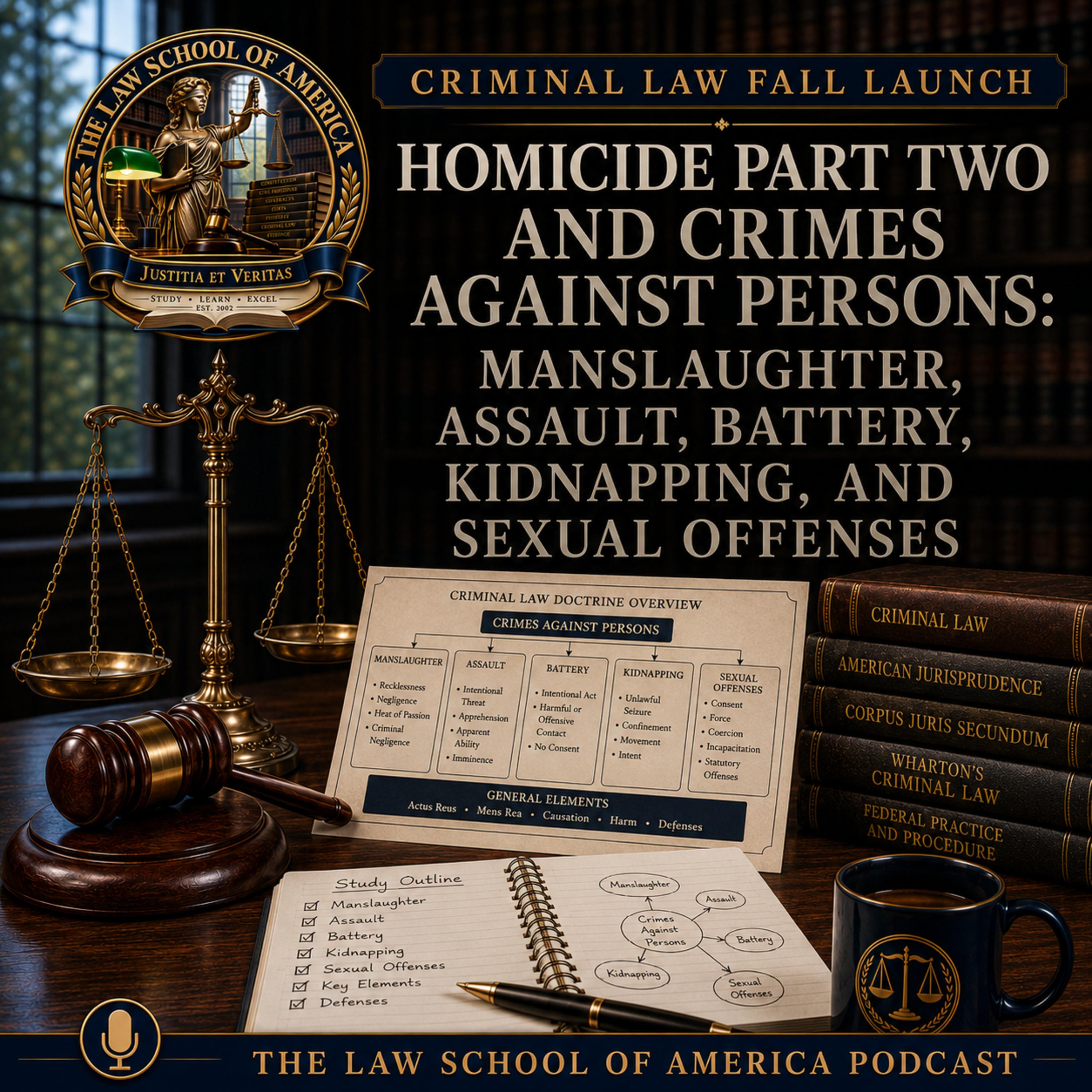 Criminal Law Fall Launch: Homicide Part Two and Crimes Against Persons: Manslaughter, Assault, Battery, Kidnapping, and Sexual Offenses 03.09.2026 1ώ 1λ📘 FREE COMPANION STUDY GUIDE 📘👉 CLICK HERE TO OPEN YOUR FREE STUDY GUIDE 👈Turn this episode into an exam-ready study plan.🎧 EPISODE SUMMARY 🎧Voluntary ManslaughterIntentional killing mitigated by adequate provocation (heat of passion).Elements: Adequate/actual provocation, no cooling time, causal connection.Categories: Serious assault/battery, mutual combat, illegal arrest.Modern standard: Ordinary reasonable person's loss of self-control.Reduces murder to manslaughter when the defendant unreasonably believes deadly force is necessary. Not universally recognized.Broader "extreme emotional disturbance" standard; requires reasonable explanation or excuse.Unintended killing via criminal negligence (gross deviation from care), recklessness, or misdemeanor-manslaughter (unlawful-act doctrine).Assault: Attempted-battery (no awareness required) or apprehension (requires awareness of imminent harm).Battery: Unlawful application of force; aggravated by injury, weapons, or protected victims.Unlawful confinement/movement. Distinction: Movement incidental to another offense vs. independent, dangerous transport.Focuses on consent, force, threat, incapacity, age, and authority.Statutory Rape: Strict liability for sex with minors; age-mistake defense varies by jurisdiction.Imperfect Self-Defense Model Penal Code (MPC)Involuntary Manslaughter Assault & Battery Kidnapping Sexual Offensesℹ️ INFORMATION, PRIVACY POLICY & TERMS OF USE ℹ️The Podcast and Website PurposeThe Law School Podcast and 1L Study Aide webpage supplements law-school and Bar Exam study with strategies, condensed rules, quizzes, and flashcards.Educational DisclaimerContent is for educational and informational purposes only. It is not legal advice, creates no attorney-client relationship, and does not guarantee law-school or Bar Exam success.Privacy PolicyNo account or login is required.This webpage uses no forms or analytics to collect personal information.Quiz and flashcard activity stays in your browser and may clear when local site data is removed.Terms of UseBy using this webpage, you agree to use its content only for lawful, personal, noncommercial educational purposes. It supplements—not replaces—courses, textbooks, official materials, or qualified instruction.
 -
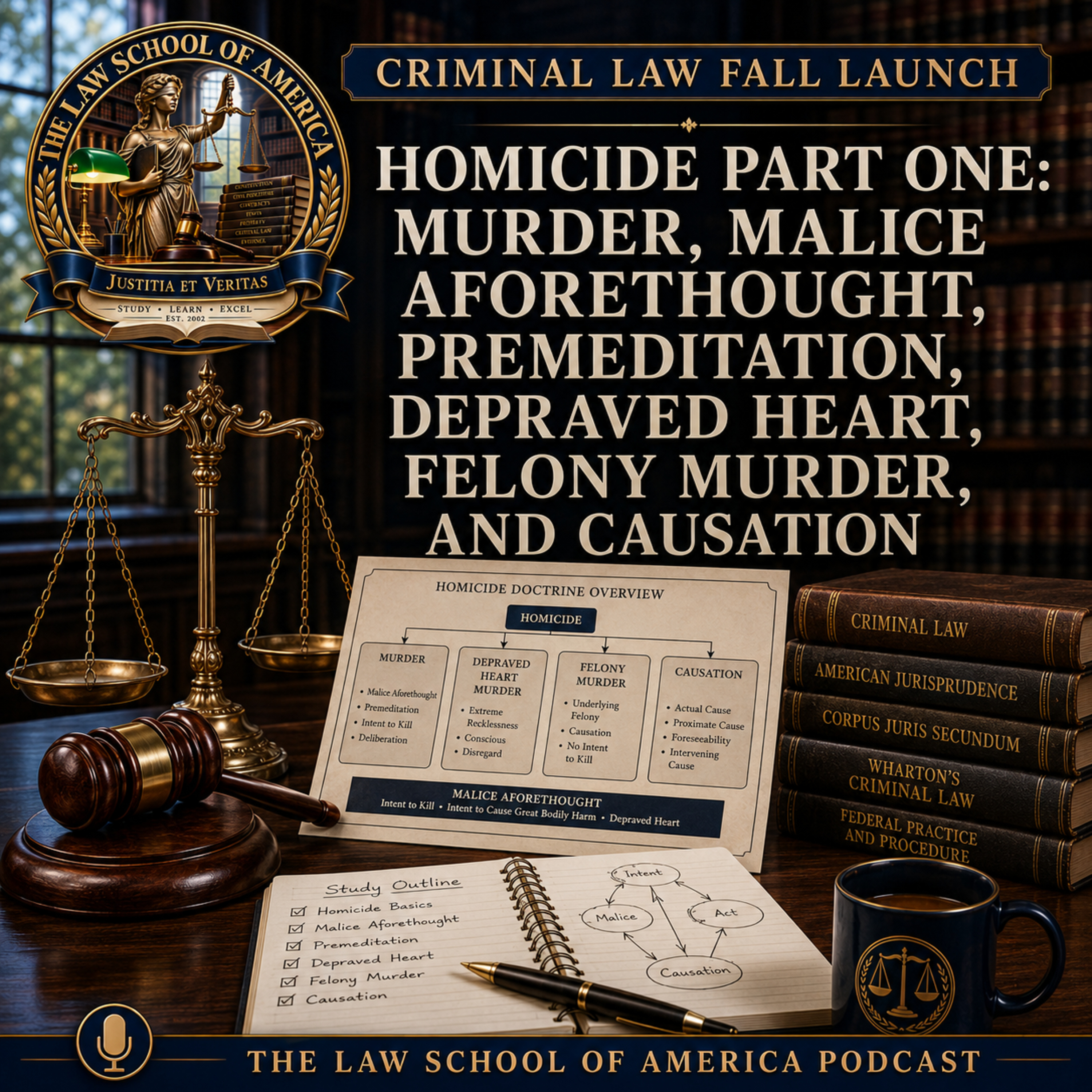 Criminal Law Fall Launch: Homicide Part One: Murder, Malice Aforethought, Premeditation, Depraved Heart, Felony Murder, and Causation 02.09.2026 1ώ 18λ📘 FREE COMPANION STUDY GUIDE 📘👉 CLICK HERE TO OPEN YOUR FREE STUDY GUIDE 👈Turn this episode into an exam-ready study plan.🎧 EPISODE SUMMARY 🎧Homicide is the killing of a human, which may be lawful or criminal.Assess causation, mental state, category, and potential defenses.Common-law murder is an unlawful killing with malice aforethought.Malice requires one of four mental states:Intent to kill (proven by circumstantial evidence).Intent to inflict serious bodily injury.Extreme reckless indifference (depraved heart).Felony murder.Premeditation requires prior reflection, distinguishing statutory first-degree murder from second-degree.Depraved-heart murder involves high-risk extreme recklessness exceeding criminal negligence.Felony murder applies to deaths during inherently dangerous felonies: burglary, arson, rape, robbery, kidnapping (BARRK).Under the merger doctrine, predicate felonies must be independent of the killing.Liability spans attempt, commission, and flight until reaching safety.The agency approach requires a felon to inflict the fatal wound, while the proximate-cause approach covers any foreseeable death.All homicides require actual cause (but-for) and proximate cause (foreseeable result without superseding acts).Remember: murder is not synonymous with intentional killing.ℹ️ INFORMATION, PRIVACY POLICY & TERMS OF USE ℹ️The Podcast and Website PurposeThe Law School Podcast and 1L Study Aide webpage supplements law-school and Bar Exam study with strategies, condensed rules, quizzes, and flashcards.Educational DisclaimerContent is for educational and informational purposes only. It is not legal advice, creates no attorney-client relationship, and does not guarantee law-school or Bar Exam success.Privacy PolicyNo account or login is required.This webpage uses no forms or analytics to collect personal information.Quiz and flashcard activity stays in your browser and may clear when local site data is removed.Terms of UseBy using this webpage, you agree to use its content only for lawful, personal, noncommercial educational purposes. It supplements—not replaces—courses, textbooks, official materials, or qualified instruction.
 -
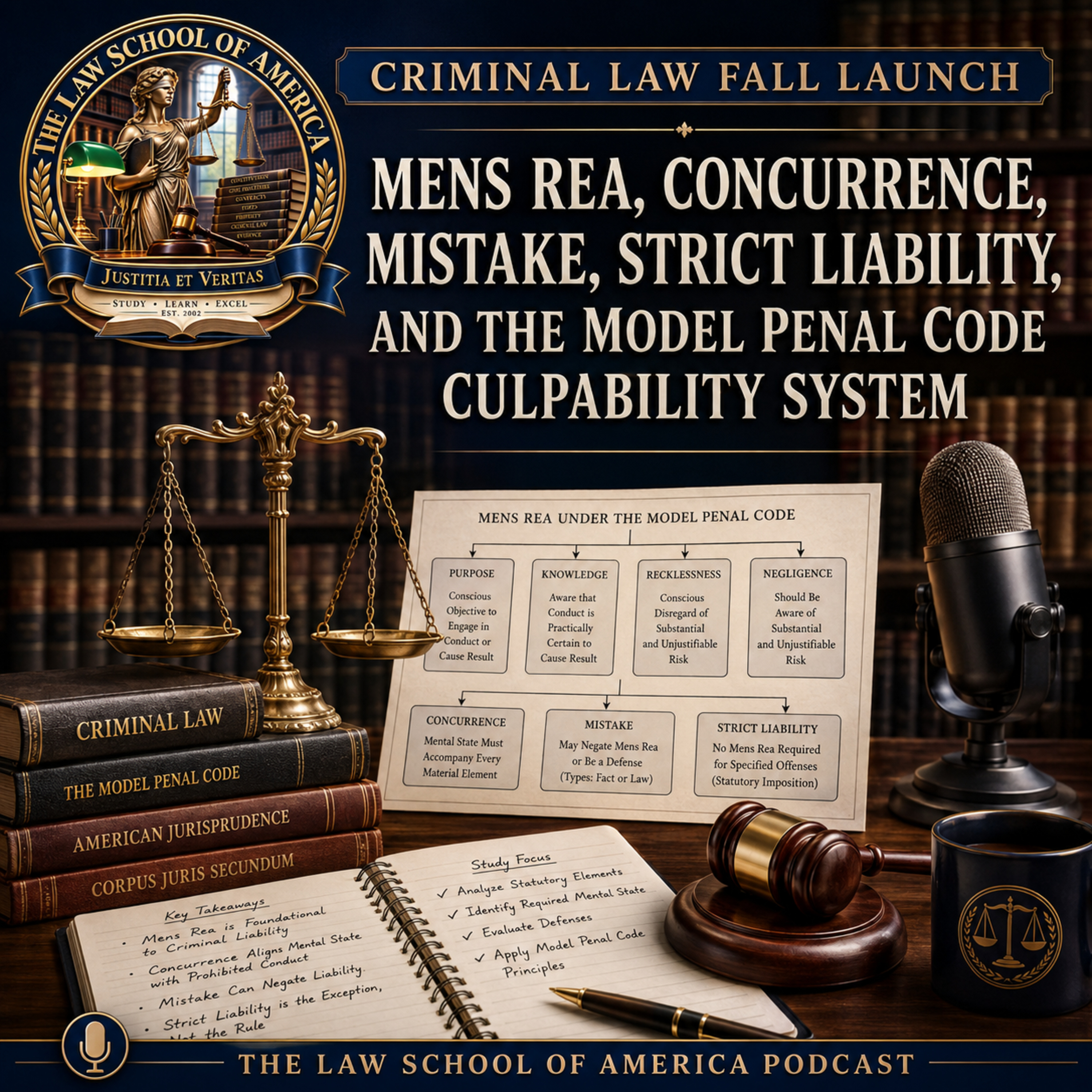 Criminal Law Fall Launch: Mens Rea, Concurrence, Mistake, Strict Liability, and the Model Penal Code Culpability System 01.09.2026 1ώ 12λ📘 FREE COMPANION STUDY GUIDE 📘👉 CLICK HERE TO OPEN YOUR FREE STUDY GUIDE 👈Turn this episode into an exam-ready study plan.🎧 EPISODE SUMMARY 🎧Mens rea is the culpable mental state required for a criminal offense, attached to specific statutory elements.Model Penal Code Culpability Levels:Purpose: Conduct/result is defendant’s conscious object.Knowledge: Aware result is practically certain.Recklessness: Consciously disregards a substantial, unjustifiable risk.Negligence: Fails to perceive a substantial, unjustifiable risk.Common Law Categories:Specific Intent: Requires an objective beyond the act (e.g., attempt, burglary, larceny).General Intent: Requires intent to perform the prohibited act without additional specialized purpose.Malice: Reckless disregard of an obvious/serious risk (e.g., murder, arson).Strict Liability: Dispenses with mens rea for elements (e.g., regulatory offenses).Transferred Intent: Intent toward intended victim transfers to actual victim.Concurrence: Mens rea and actus reus must coincide in time.Mistake of Fact: Negates mens rea. Honest mistakes excuse specific intent; honest and reasonable mistakes excuse general intent.Mistake of Law: Generally no excuse, with narrow official-reliance or element-negating exceptions.Willful Blindness: Deliberate avoidance of knowledge when a fact is highly probable.Tuesday’s complete examination method is therefore:Parse the statute into elements.Identify the mens rea applicable to each element.Distinguish purpose, knowledge, recklessness, and negligence where relevant.Identify common-law specific intent, general intent, malice, or strict liability where the problem uses those categories.Determine whether the required mens rea and actus reus concur.Ask whether mistake of fact or mistake of law negates an element.Consider willful blindness when D deliberately avoids confirmation of a highly probable fact.State the conclusion separately for each disputed element.ℹ️ INFORMATION, PRIVACY POLICY & TERMS OF USE ℹ️The Podcast and Website PurposeThe Law School Podcast and 1L Study Aide webpage supplements law-school and Bar Exam study with strategies, condensed rules, quizzes, and flashcards.Educational DisclaimerContent is for educational and informational purposes only. It is not legal advice, creates no attorney-client relationship, and does not guarantee law-school or Bar Exam success.Privacy PolicyNo account or login is required.This webpage uses no forms or analytics to collect personal information.Quiz and flashcard activity stays in your browser and may clear when local site data is removed.Terms of UseBy using this webpage, you agree to use its content only for lawful, personal, noncommercial educational purposes. It supplements—not replaces—courses, textbooks, official materials, or qualified instruction.
 -
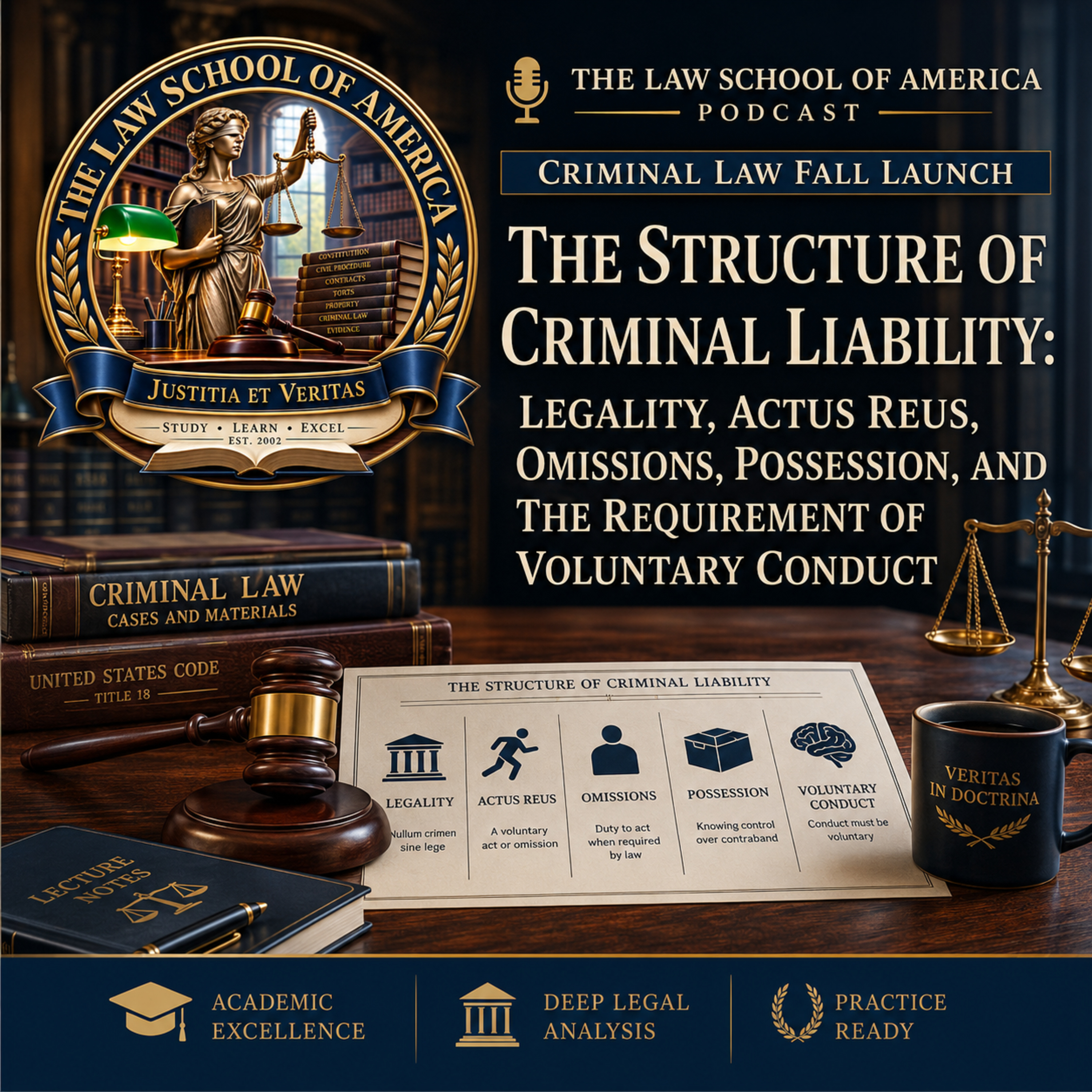 Criminal Law Fall Launch: The Structure of Criminal Liability: Legality, Actus Reus, Omissions, Possession, and the Requirement of Voluntary Conduct 31.08.2026 57λ📘 FREE COMPANION STUDY GUIDE 📘👉 CLICK HERE TO OPEN YOUR FREE STUDY GUIDE 👈Turn this episode into an exam-ready study plan.🎧 EPISODE SUMMARY 🎧Criminal liability requires more than harm; it involves conduct, mental state, concurrence, and causation.Under the principle of legality, criminal prohibitions must predate conduct to ensure fair notice and limit vague or retroactive laws.Modern Criminal Law is heavily statutory, requiring students to parse offenses into elements like conduct, result, circumstances, and mens rea.An aggravated-burglary example shows why each statutory element must be proved separately rather than relying on general wrongdoing.Actus reus represents external conduct, satisfied by voluntary acts, legal omissions, or possession—not thoughts or status alone.A voluntary act involves conscious bodily movement, excluding involuntariness like reflexes or unconsciousness, though prior voluntary choices can establish liability.Omission liability requires a legal duty—from statutes, contracts, relationships, or created danger—plus physical ability and mental state.Possession can satisfy actus reus through actual custody or constructive control, provided there is knowledge and opportunity to terminate control.Criminal law targets conduct rather than status or identity, distinguishing active offenses from conditions like addiction.Criminal liability begins with legally attributable conduct.Liability requires proving each defined statutory element of conduct rather than punishing thoughts, status, or moral failure.ℹ️ INFORMATION, PRIVACY POLICY & TERMS OF USE ℹ️The Podcast and Website PurposeThe Law School Podcast and 1L Study Aide webpage supplements law-school and Bar Exam study with strategies, condensed rules, quizzes, and flashcards.Educational DisclaimerContent is for educational and informational purposes only. It is not legal advice, creates no attorney-client relationship, and does not guarantee law-school or Bar Exam success.Privacy PolicyNo account or login is required.This webpage uses no forms or analytics to collect personal information.Quiz and flashcard activity stays in your browser and may clear when local site data is removed.Terms of UseBy using this webpage, you agree to use its content only for lawful, personal, noncommercial educational purposes. It supplements—not replaces—courses, textbooks, official materials, or qualified instruction.
 -
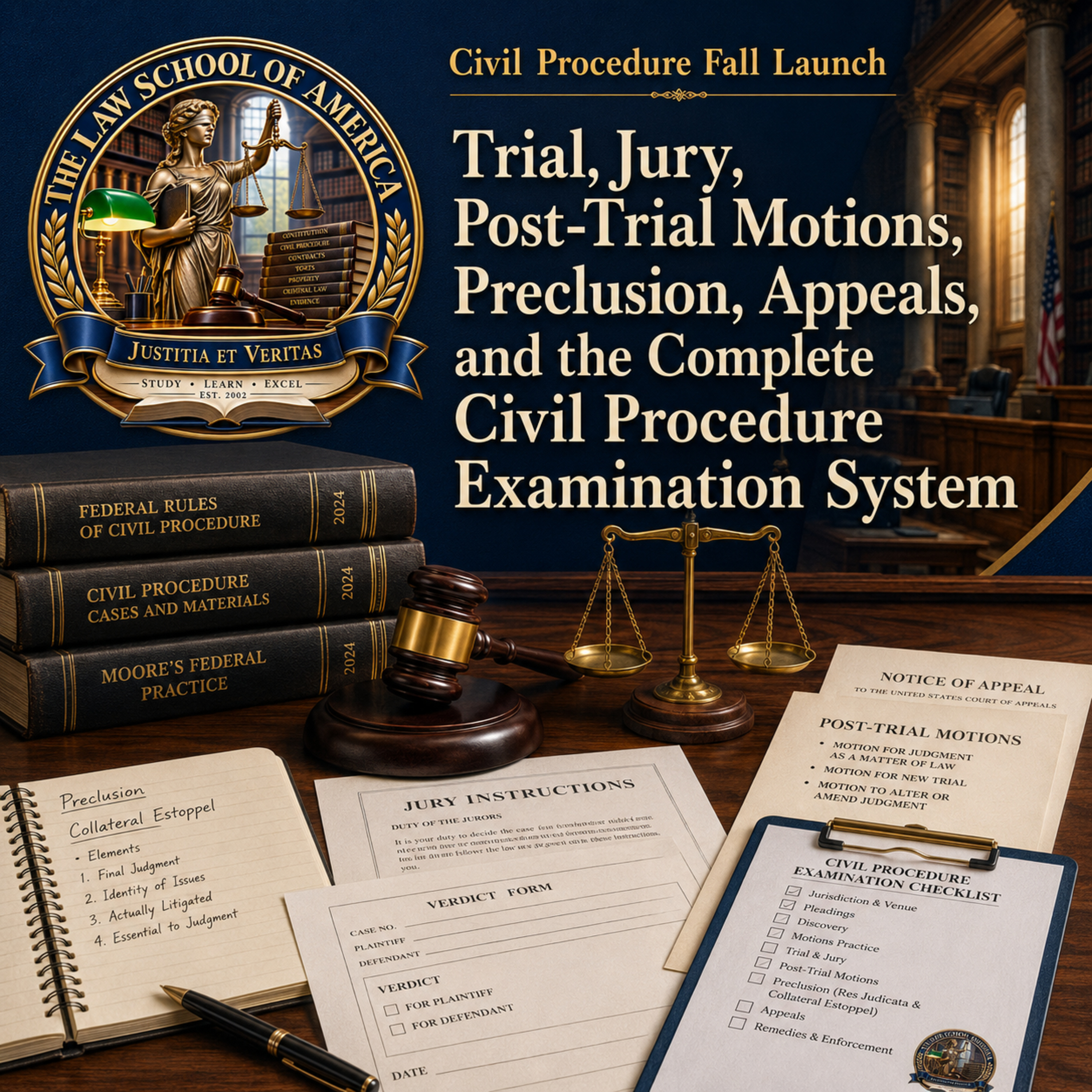 Civil Procedure Fall Launch: Trial, Jury, Post-Trial Motions, Preclusion, Appeals, and the Complete Civil Procedure Examination System 30.08.2026 1ώ 14λ📘 FREE COMPANION STUDY GUIDE 📘👉 CLICK HERE TO OPEN YOUR FREE STUDY GUIDE 👈Turn this episode into an exam-ready study plan.🎧 EPISODE SUMMARY 🎧Civil Procedure concludes with key rules governing trials, dispositions, preclusion, and appeals.The Seventh Amendment guarantees a federal civil jury trial for legal claims (e.g., money damages), but not equitable claims (e.g., injunctions). When claims overlap, the jury resolves legal factual issues before the judge determines equitable remedies.Jury demands must be timely to avoid waiver. Jurors may be challenged for cause or through limited peremptory strikes, which cannot be discriminatorily exercised.Judgment as a Matter of Law (JMOL) is granted during trial when no reasonable jury has a sufficient evidentiary basis to find for a party. Renewed JMOL post-verdict requires a pre-verdict JMOL motion.A new trial reopens proceedings due to trial errors, misconduct, or verdicts against the weight of the evidence, unlike JMOL which replaces the verdict.Default enters upon failure to defend, while default judgment establishes liability and damages. Unilateral voluntary dismissal is restricted after early stages, and involuntary dismissal often acts as an adjudication on the merits.Claim preclusion (res judicata) bars relitigating an entire transactional claim after a final merits judgment. Issue preclusion (collateral estoppel) bars relitigating specific issues that were actually litigated and essential to a prior judgment.Appeals generally require a final judgment, though narrow exceptions exist for certified questions, injunctions, and collateral orders. Standard of review depends on the issue: legal issues are reviewed de novo, factual findings after bench trials for clear error, and procedural rulings for abuse of discretion. Harmless errors or unpreserved objections do not warrant reversal.The complete Civil Procedure examination system proceeds through fourteen stages:Procedural posture.Subject-matter jurisdiction.Personal jurisdiction.Service and notice.Venue.Governing law.Pleadings.Claims and parties.Discovery.Pretrial disposition.Trial.Post-trial motions.Preclusion.Appeal.Procedural analysis must move chronologically through these fourteen stages—from initial court jurisdiction to final appellate review—evaluating governing rules, preservation, and remedy at each step.ℹ️ INFORMATION, PRIVACY POLICY & TERMS OF USE ℹ️The Podcast and Website PurposeThe Law School Podcast and 1L Study Aide webpage supplements law-school and Bar Exam study with strategies, condensed rules, quizzes, and flashcards.Educational DisclaimerContent is for educational and informational purposes only. It is not legal advice, creates no attorney-client relationship, and does not guarantee law-school or Bar Exam success.Privacy PolicyNo account or login is required.This webpage uses no forms or analytics to collect personal information.Quiz and flashcard activity stays in your browser and may clear when local site data is removed.Terms of UseBy using this webpage, you agree to use its content only for lawful, personal, noncommercial educational purposes. It supplements—not replaces—courses, textbooks, official materials, or qualified instruction.
 -
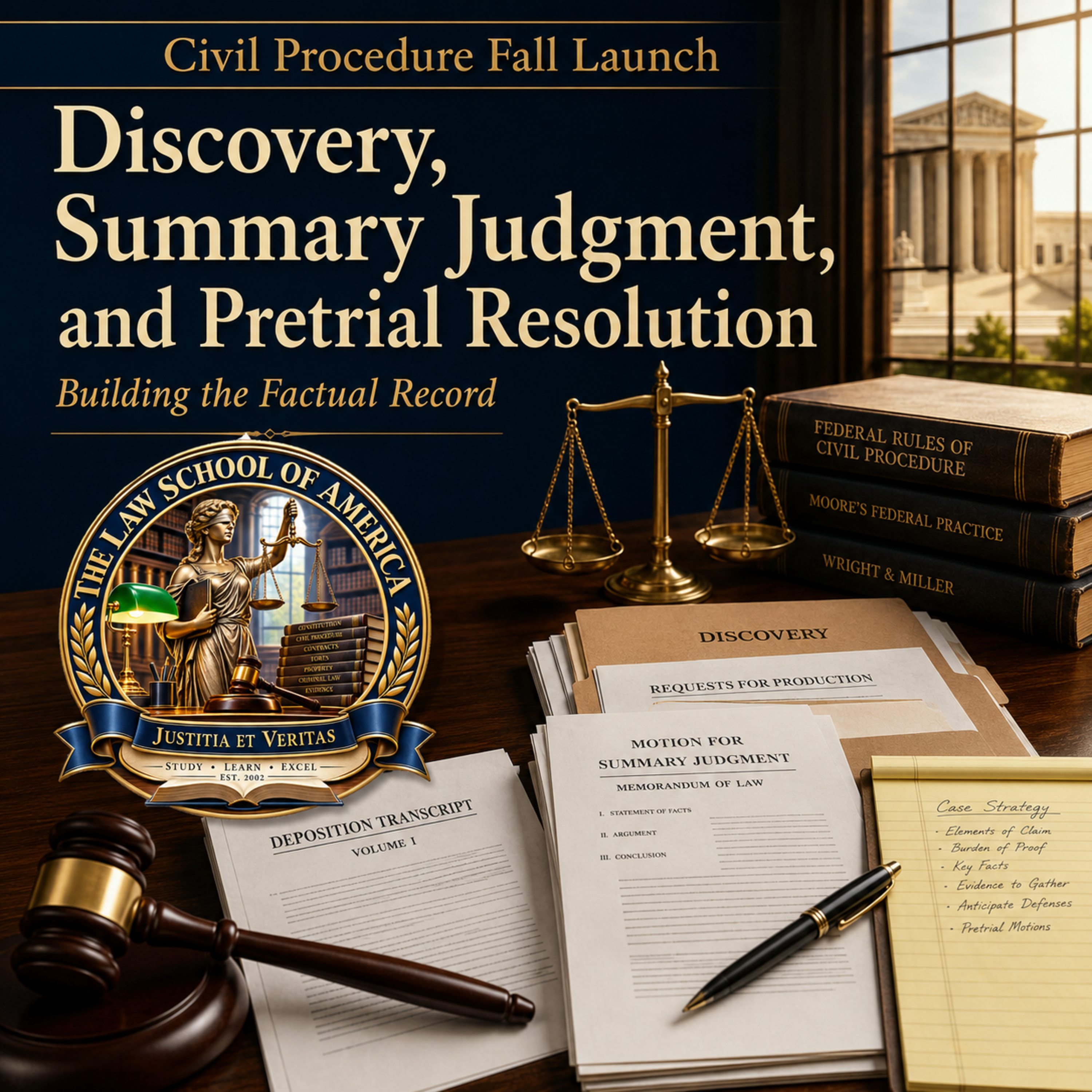 Civil Procedure Fall Launch: Discovery, Summary Judgment, and Pretrial Resolution: Building the Factual Record 29.08.2026 1ώ 4λ📘 FREE COMPANION STUDY GUIDE 📘👉 CLICK HERE TO OPEN YOUR FREE STUDY GUIDE 👈Turn this episode into an exam-ready study plan.🎧 EPISODE SUMMARY 🎧Saturday covers the litigation phase between initial pleadings and trial, focusing on discovery and summary judgment.Discovery allows parties to exchange nonprivileged information relevant to a claim or defense, bounded by proportionality factors such as case value, party resources, and burden versus benefit. Information need not be admissible at trial to be discoverable.Parties must provide initial disclosures covering core witnesses, documents, ESI, damages calculations, and insurance without waiting for formal requests.Key discovery tools include depositions, written interrogatories to parties, document and ESI requests, requests for admission to narrow facts, court-ordered physical/mental exams, and nonparty subpoenas.Attorney-client privilege protects confidential legal advice communications, but not underlying facts or non-legal guidance. The work-product doctrine protects qualifying litigation prep materials, distinguishing ordinary work product from highly protected opinion work product.Testifying experts are subject to formal disclosure and deposition, whereas non-testifying consulting experts receive stronger protection.Parties must preserve electronically stored information (ESI) once litigation is reasonably anticipated. Courts examine prejudice and intent when determining appropriate sanctions for lost ESI.Courts can issue protective orders against discovery abuse or grant motions to compel compliance, applying specific discovery rules rather than Rule 11 for misconduct.Summary judgment tests the evidentiary record rather than mere allegations. It is granted when no genuine dispute of material fact exists and the moving party is entitled to judgment as a matter of law.A fact is material if it affects the legal outcome, and a dispute is genuine if a reasonable factfinder could rule for the nonmoving party. Judges do not weigh credibility at summary judgment.Once the moving party shows an absence of evidence or negates an essential element, the nonmoving party must produce specific evidence—not mere allegations—showing a triable issue.Complaint → Answer → Discovery → Summary Judgment → TrialIn short, discovery builds the factual record, and summary judgment determines whether a genuine dispute requires trial or if the case can be decided as a matter of law.ℹ️ INFORMATION, PRIVACY POLICY & TERMS OF USE ℹ️The Podcast and Website PurposeThe Law School Podcast and 1L Study Aide webpage supplements law-school and Bar Exam study with strategies, condensed rules, quizzes, and flashcards.Educational DisclaimerContent is for educational and informational purposes only. It is not legal advice, creates no attorney-client relationship, and does not guarantee law-school or Bar Exam success.Privacy PolicyNo account or login is required.This webpage uses no forms or analytics to collect personal information.Quiz and flashcard activity stays in your browser and may clear when local site data is removed.Terms of UseBy using this webpage, you agree to use its content only for lawful, personal, noncommercial educational purposes. It supplements—not replaces—courses, textbooks, official materials, or qualified instruction.
 -
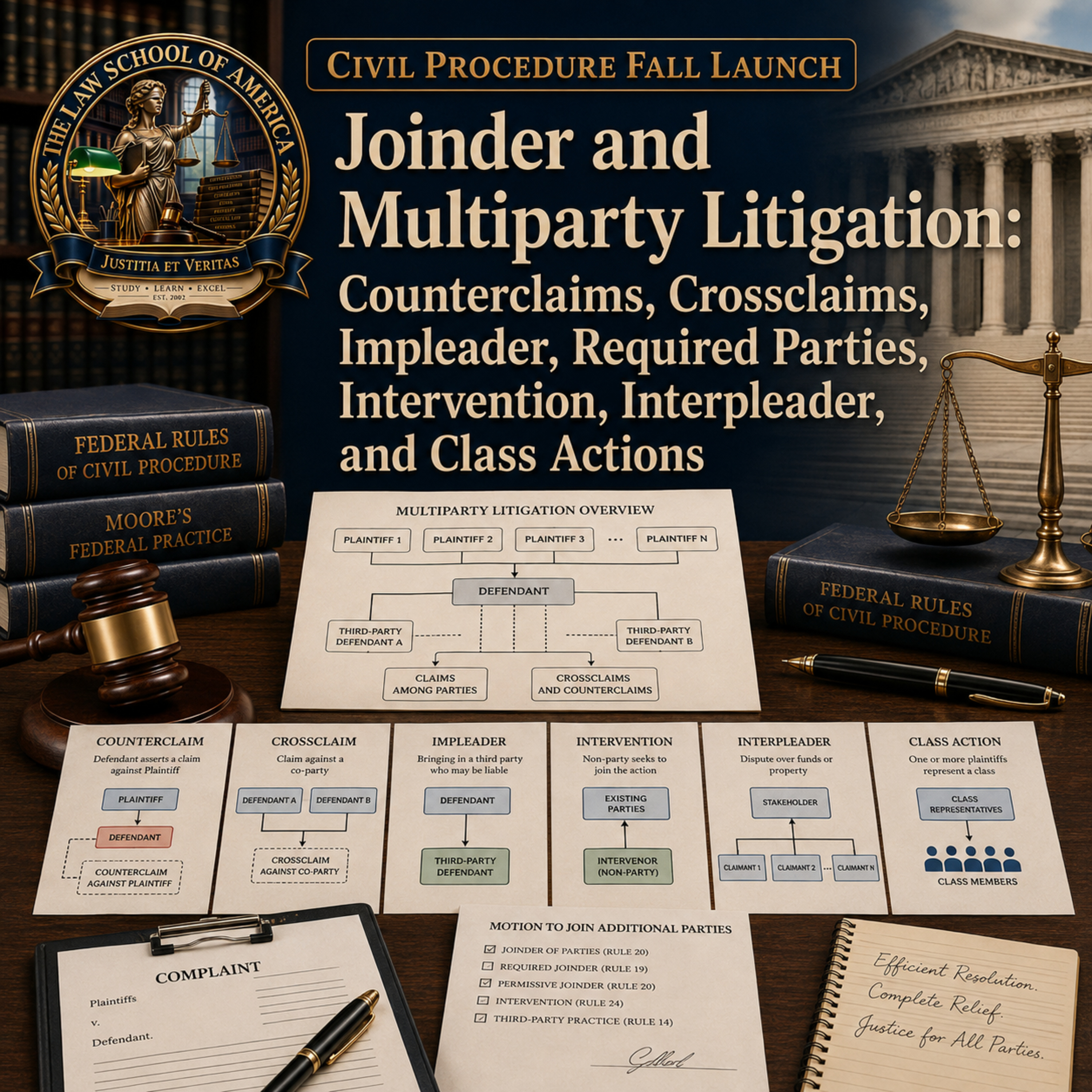 Civil Procedure Fall Launch: Joinder and Multiparty Litigation: Counterclaims, Crossclaims, Impleader, Required Parties, Intervention, Interpleader, and Class Actions 28.08.2026 1ώ 4λ📘 FREE COMPANION STUDY GUIDE 📘👉 CLICK HERE TO OPEN YOUR FREE STUDY GUIDE 👈Turn this episode into an exam-ready study plan.🎧 EPISODE SUMMARY 🎧Federal joinder doctrines govern expanding litigation beyond a single plaintiff, defendant, and claim.Every joinder issue involves two distinct inquiries: procedural authorization and subject-matter jurisdiction.Claim joinder allows a party to assert all claims against an opponent, but each claim must independently satisfy subject-matter jurisdiction.Compulsory counterclaims arise from the same transaction or occurrence and generally must be asserted or forfeited. They usually fall under supplemental jurisdiction.Permissive counterclaims do not arise from the same transaction or occurrence and require an independent jurisdictional basis.Crossclaims are permissive claims asserted against a co-party arising from the same transaction, occurrence, or property.Impleader allows a defendant to bring in a third party based on derivative liability (indemnity, contribution, or subrogation).Required-party analysis follows three steps:Determine whether the absentee is required (due to incomplete relief, impaired interests, or risk of inconsistent obligations).Determine whether joinder is feasible considering personal jurisdiction, venue, and subject-matter jurisdiction.If joinder is impossible, balance equitable factors to decide whether to proceed or dismiss.Permissive joinder allows multiple parties to join if their claims share a common question of law or fact and arise from the same transaction or occurrence.Intervention permits third parties to enter a lawsuit either as of right (to protect a direct interest) or permissively (via common questions), subject to jurisdictional requirements.Interpleader protects a stakeholder facing multiple competing claims to the same property or fund under either Rule 22 or statutory interpleader rules.Class actions require satisfying four prerequisites—numerosity, commonality, typicality, and adequacy—plus an authorized class category (prejudice, injunctive, or damages).Effective analysis requires party mapping: identifying all parties and claims, applying joinder rules, and verifying jurisdiction, venue, and procedural barriers for each claim.ℹ️ INFORMATION, PRIVACY POLICY & TERMS OF USE ℹ️The Podcast and Website PurposeThe Law School Podcast and 1L Study Aide webpage supplements law-school and Bar Exam study with strategies, condensed rules, quizzes, and flashcards.Educational DisclaimerContent is for educational and informational purposes only. It is not legal advice, creates no attorney-client relationship, and does not guarantee law-school or Bar Exam success.Privacy PolicyNo account or login is required.This webpage uses no forms or analytics to collect personal information.Quiz and flashcard activity stays in your browser and may clear when local site data is removed.Terms of UseBy using this webpage, you agree to use its content only for lawful, personal, noncommercial educational purposes. It supplements—not replaces—courses, textbooks, official materials, or qualified instruction.
Παρόμοια podcasts


Δημοφιλές σε
Αυτό το podcast εμφανίζεται και στις λίστες podcasts αυτών των χωρών.


