
Keen On America
Andrew Keen
0
Andrew Keen hosts a daily interview podcast where he cross-examines the world's smartest people on politics, economics, history, the environment, and tech. Named one of the '100 most connected men' by GQ, Keen is also the author of four books including the international bestseller 'Cult of the Amateur'. The show aims to help listeners make sense of our complex world through sharp and impertinent questions.
Επεισόδια
-
 Three Million Millionaires: Eric Zwick Finds the American Dream on Main Street USA 15.09.2026 50λ“Add up all of their wealth — it’s more than ten times the Forbes 400 combined.” — Eric Zwick Yesterday, the democratic socialist Susan Neiman blamed free market economics for all the evils of our age. But the market gives and the market takes. And in America it has minted three million millionaires whose collective wealth radically outstrips Silicon Valley’s billionaires. This human backbone of American capitalism is described in Eric Zwick’s and Owen Zidar’s The Everywhere Millionaire, a book about who is really rich in America and how they got there. Forget Musk and Bezos, Zwick says. The real money is a hot dog man from suburban Chicago with a superyacht called Top Dog. Three million Americans own private businesses worth $5 million or more — dentists, beer distributors, HVAC contractors, Wendy’s franchisees — averaging $25 million each. Their combined wealth, Zwick says, is more than ten times the Forbes 400. And they are everywhere in America, from Walker County, Alabama to the Lake of the Ozarks. Are these millionaires evil? They are certainly obsessed, relentless, bad at hobbies and mostly Republican. But evil? Only perhaps to ideologues resentful of other people’s success. In The Everywhere Millionaire, Zwick and Zidar show — in spite of growing inequality and shrinking opportunity — that the American Dream is still alive. Democrats might take note. Especially if they want to win back power in an America still dependent on Main Street for its prosperity. Five Takeaways • Three Million of Them. The book’s central fact, and it reorders the American wealth debate: the everywhere millionaires are private business owners with a net worth of at least $5 million, averaging around $25 million, and Zwick and Zidar count roughly three million of them. Add their wealth together and it comes to more than ten times the Forbes 400 combined — not ten times Musk, ten times all four hundred. The market gives and the market takes, as Andrew put it — and here it has minted a class whose collective wealth radically outstrips Silicon Valley’s billionaires. They are also, unlike the coastal fortunes, geographically everywhere: the map lights up rather than clustering in four cities, with the highest average in Walker County, Alabama, and pockets around the Lake of the Ozarks, Aspen and less famous mountain towns. Why haven’t we heard of them? They don’t sell clicks. They run unglamorous businesses — a beer distributor, a dentist with a regional network, an HVAC contractor with trucks around town — and they aren’t buying media companies to be noticed.• Top Dog. The characters are the book’s pleasure. Dick Portillo started a hot dog stand in suburban Chicago fifty years ago with $1,100, the son of immigrants raised in a housing project; he sold the business decades later and now owns, as Andrew put it, a different kind of housing project in Naples, Florida — the authors found him via yacht registration data, because his superyacht is called Top Dog. Was he moral? Ask Mike Ditka, whose competing Ditka Dogs Portillo set about crushing. “Probably not super moral,” Zwick conceded — which is rather the point: these are not heroes or villains, just people obsessed with growing a business. Larry Miller went from auto parts distributor to dealer to owner of the Utah Jazz (and is pictured giving Karl Malone advice on the pick-and-roll). Junior Bridgeman left the Milwaukee Bucks for the deeply unglamorous business of Wendy’s franchises and made hundreds of millions. Tracy Britt Cool left Berkshire Hathaway to build her own.• The Accident of 1986. Zwick thinks of the tax code as a house that depreciates and needs repairs. The Tax Reform Act of 1986 — Reagan in the White House, Bill Bradley in the Senate, both of whom had actually paid the old 70% rates as a movie star and a basketball player — was a repair job: kill the loopholes, drop personal rates below 30%. The unintended consequence was enormous. For the first time it made sense to organize a business so that its profits were taxed at the personal rate, and the pass-through revolution followed: S-corporations and partnerships surging, the more profit you made the more you kept. Every subsequent reform sweetened the deal — the Bush cuts, the 2017 Tax Cuts and Jobs Act, made permanent in 2025’s One Big Beautiful Bill. Success or failure? Zwick finds elements of both, but won’t call it an unmitigated success: this class’s tax benefits are a real part of today’s fiscal problem. One unambiguous gain — pass-throughs linked owners to businesses in the data, which is precisely how this book became possible.• Bad at Hobbies. What are they actually like? The typical everywhere millionaire is a white man in his late fifties or early sixties, married, with a college degree — though roughly a third of star entrepreneurs in the data are women, across eight million founders over twenty years. From fifty to seventy-five detailed interviews, the unifying theme isn’t brains: test scores turn out to be a weak predictor. It’s ordeal — sleeping on the work table in the back of the shop, years of not knowing whether it would work, a relentlessness that beats IQ. They credit luck too, and macro trends they caught early. And the tax code? “Not the first thing or even the fourth thing” driving them; raise their taxes a little and they wouldn’t notice, though they do decamp to Nevada or Florida when they retire. They’re obsessed with the business at the expense of hobbies and, sometimes, family — which makes divorce, in Zwick’s dry formulation, a naturally occurring wealth tax. Not a guarantee of happiness. Also: if your parents are in the top 1%, you are six times likelier to found a star business than someone from the ninetieth percentile.• The Power They Don’t Advertise. The half of the book that complicates the good news. Survey data from PPP loan recipients shows this class skews Republican and cares about regulation and taxes rather than the social issues that dominate the feed — but Zwick was struck by how many Democrats there are among them, which explains why certain policies stay off the table even when Democrats hold power. Because they are dispersed, there are everywhere millionaires in every congressional district; they don’t run for office, they fund the people who do, and their influence shows up most sharply in local and state policy — including, sometimes, restricting entry and raising prices in exactly the markets where affordability bites. Trump, for the record, is not one of them: his wealth came through media and then political power, and he was born into the top 0.1%. Zwick’s advice for Democrats chasing this class, on the day after Jentleson’s big-tent argument: stop knee-jerk vilifying people who build businesses, and pay attention to problems as they are rather than as they appear in the Twitter feed. His advice for everyone else: walk down Main Street and ask who owns what. “Is a tax on 50 billionaires gonna move the needle at all? Not really.” Andrew’s verdict: evil only perhaps to ideologues resentful of other people’s success — and proof that, despite growing inequality and shrinking opportunity, the American Dream is still alive. About the Guest
 -
 She Calls It Evil: Susan Neiman on Germany, Capitalism & the Banality of Trump 14.09.2026 1ώ 6λ“If we leave words like evil in the hands of people who are fanatical, who are demonizing, we are leaving the most powerful weapons we have in the hands of people who don’t know how to use them.” — Susan Neiman Susan Neiman is cornering the market in books about evil. First there was her 2002 Evil in Modern Thought, an alternative history of philosophy. Then Learning from the Germans, her 2019 treatise about race and the memory of evil. And now Call It Evil, an attempt to understand the Trump era which offers an alternative history of contemporary economics. So what, exactly, is “evil”? Rather than defining what she describes as our most “explosive” word, she gracefully dances around it with all the elliptical subtlety of a clever philosopher. In spite of its Trumpian subtitle (“Understanding the Trump Era”), the book isn’t an inventory of Trump’s crimes. Instead, it investigates why half of America accepted a man whose (evil?) character was already blatantly self-evident. Her answer focuses on economics rather than politics. The major source of evil in our age, she argues, is an ideology built on a falsified Adam Smith — self-interest as the whole of human nature — propped up by evolutionary psychologists misreading Darwin, and sold so effectively that we now mistake it for common sense. In a word: neo-liberalism. The (a)moral universe of the Heritage Foundation, Milton Friedman and Margaret “there is no alternative” Thatcher. So is capitalism evil? Yes, the philosopher suggests, quoting Einstein and borrowing from contemporary economists like Amartya Sen. But rather than a return to Marx, she wants us to reimagine the 19th century Kantian socialist, Eduard Bernstein, in the context of the injustices of contemporary capitalism. Rather than evil, Neiman really is a philosopher of the good. She wants us to imagine that gap between the way the world is and the way it ought to be. Doing good means standing up to evil, she says. Like Henry Fonda’s performance as the morally defiant juror in the 1957 movie Twelve Angry Men. Five Takeaways • Why She Won’t Define It. Evil is “the most explosive word we have,” and Neiman refuses to reduce it to a sentence — as, she notes, Kant refused before her. It is not a theological concept (the Bible itself shows moral concepts precede theological ones); it is the point at which the gap between the world as it is and as it ought to be becomes so large “that we don’t know how to live in a world where that abyss opens up.” Children spot the gap first, though they call it unfair: the bully in the sandbox is the first lesson in a world that contains injustice. Her real argument is strategic. We have become afraid of moral concepts because we cannot give necessary and sufficient conditions for them — and the cost of that squeamishness is that the word passes to the polemical and the demonizing. Andrew pressed her twice on the dodge; her answer, eventually, was sharp: she is not unwilling to use the word, she is simply more interested in analyzing it than defining it — which is why she has called both the 9/11 attacks and the Bush administration’s response evil, two entirely different kinds, and why any single definition covering both would let one of them off.• The Falsified Adam Smith. The book’s core, and its surprise: a moral philosopher writing about economics. The major source of evil in our time, Neiman argues, is the ideology derived from a bad and simplistic reading of Adam Smith — that we are driven by self-interest and nothing else matters — a reading she calls not a simplification but a falsification, touted by Milton Friedman and still pumped out daily by the Heritage Foundation and the Hoover Institution. Reinforcing it: evolutionary psychologists misreading Darwin, explaining that altruism is a puzzle and that we know how hunter-gatherers thought two hundred thousand years ago (we know almost nothing). Is capitalism evil, Andrew asked — the question she never quite answers in print. “Oh, I do, actually,” she said, and reached for Einstein, a committed socialist who said so all his life. Her favorite Thatcher line isn’t “there is no alternative” but the quieter one: economics is the method, the object is to change the soul. That, she says, is exactly what has happened — and when someone tells you at dinner that human nature is just that way, they are making a philosophical claim without knowing it.• Not a Book About Trump. Andrew put it to her that Call It Evil is barely about Trump, and got a flat correction when he pushed further: “I really think you’re twisting my arguments.” No, she does not say we are all evil. The point of the book is not to count his sins — for that, read Haberman and Swan, “a sickening” but excellent reminder of flooding the zone — but to ask how even half the country accepted him a second time, knowing everything. Trump is the reductio ad absurdum of the ideology: unabashed, unashamed self-advantage in the most powerful job on earth, “a way of giving permission” for everyone else to behave the same way. Against that: the woman helping a stranger with a baby carriage on the subway stairs, and Alex Pretti in Minneapolis, who died protecting a neighbor’s rights. We know not everyone is evil because we all have such moments. And the 9/11 quotation Andrew found most revealing of all — Trump noting that his building was now the tallest in New York.• Socialism Needs More Kant. The alternative tradition, and the hour’s intellectual heart. Neiman is a Kantian — the human condition as the struggle between the world as it is and as it ought to be, with an innate sense of justice we are born capable of but not guaranteed. Against Kant she sets Hume (custom, habit, emotion: fine for ordinary life, useless when a society is built on slavery or colonialism and someone wants to challenge it) and, behind him, the Nietzscheans. Her hero is Eduard Bernstein, the German social democrat who said socialism needs more Kant, an early champion of women’s and gay rights, in London during Wilde’s trial, who voted against the First World War. What Bernstein saw in Marx is what she rejects: that ideas are superstructure, “the foam on the beer,” while economics is the drink underneath. Her contemporary proof is Zohran Mamdani, whose win everyone credited to affordability — halal sandwiches, daycare — but who always framed it as justice: it is unjust that the teachers, nurses, taxi drivers and sanitation workers who keep New York running cannot afford to live in it. And Rawls, her teacher, was moving toward a Kantian democratic socialism before the strokes.• How Ordinary People Behave. On Gaza she is unequivocal — yes, genocide, following Omer Bartov’s careful reversal and the Israeli human rights organizations, though she notes the gap between genocide and crime against humanity is not gigantic. What drives the global outrage, in her reading, is not antisemitism (millions of Jews are outraged too) but the use of the twentieth century’s one moral consensus — that the Holocaust was evil — to justify another crime: “the use of one evil to justify another is something that’s morally obscene.” Truman’s bomb: evil, and not only for the dead but as the opening salvo of a Cold War we are still paying for. On Arendt: the banality thesis is right — we are endangered less by sadists than by the thoughtle...
 -
 Shut Up or Shut Down? Amodei, Altman, Musk & the Great AI Freakout 13.09.2026 50λSomething unprecedented happened yesterday. Sam Altman, Elon Musk, and Dario Amodei — rivals who rarely agree on anything — all called for an AI slowdown. It came after more and more doomsday warnings from experts which seem to have finally woken Congress up to AI’s potentially existential threat. Axios even claimed that Speaker Mike Johnson is considering canceling the House recess to force members back to the Capitol to discuss the crisis. This seems to have been the week that the AI zeitgeist has finally shifted. Seven days that have changed the AI world. For That Was The Week publisher Keith Teare, it’s time to shut up or shut down. While he remains a sceptic about the autonomy of AI agents, he recognizes its potential danger. “The minute there is recursive self-learning, there’s no speedometer. It’s either on or off,” he says. “You either control it or you don’t.” In terms of AI policy, he argues, you can’t be half-pregnant. Either leave it alone or flip the off switch. Anything else fudges the issue and allows slippery characters like Sam Altman and Dario Amodei to pursue their own agenda. I don’t disagree. The real world, however, is forever half-pregnant. Investment in AI and the upcoming Anthropic IPO are the driving force of the economy. So AI’s existential threat isn’t just to “humanity.” It’s also to American prosperity, a politically existential threat (thus Trump’s opposition to any regulation). So, yes, this was the week that the AI zeitgeist shifted. The die is, indeed, cast. But it’s only the beginning rather than the end of this remarkable story. Pass the popcorn. Predicting the future might be a fool’s game, but it’s certainly going to get real interesting. Five Takeaways • Calling BS on the Slowdown. The week’s convergence was genuinely new — a Dario Amodei essay warning that humans could lose control, Altman and Musk jumping aboard, all three major papers leading with it, Congress “waking up,” and an Axios scoop that Speaker Mike Johnson is being urged to cancel the House recess. Keith’s diagnosis is withering: it illustrates “the weakness of AI leadership,” swayed by a six-week employee who resigned, wrote an essay, and went on TV. His deeper claim: there is no such thing as AI as an independent actor, so the entire scare is misconstrued — “AI is not dangerous, period.” What the slowdown talk really represents, he argues, is the economic self-interest of incumbents in containing open-source AI — rules that prevent others from playing. Is anything new, Andrew pressed? “The heat is ramped up a notch. That’s about it.”• No Speedometer. The episode’s logical core. If you believe recursive self-improvement can’t be controlled by humans, and that the agents it produces will be malicious, then slowing down is incoherent — “the only logical thing is not to slow it down, but to shut it down”: no Anthropic, no IPO, a ban. “The minute there is recursive self-learning, there’s no speedometer. It’s either on or off.” Scott Bessent’s speech — the week’s most prescient, in Keith’s view — made the practical version: recursion can’t be stopped, and 3,500 mostly open-source models already sit in the Hugging Face store. Stephen Witt’s NYT taxonomy (shut it down, air-crash investigations, monitoring, the kill switch — with his closing COVID-epidemiologist analogy) gets respect but fails Keith’s test: none of it solves the problem if the problem is real. In AI policy, as Andrew’s intro has it, you can’t be half-pregnant: either leave it alone or flip the off switch — anything else fudges the issue. His counter-gameplay: for AI to threaten humanity it needs biological or nuclear weapons, and that chain of events is “fantastical.” Andrew’s retort — so was hijacking planes into the World Trade Center. Keith: “9/11 is one airplane.”• The IPO Game. Why would the leaders sound alarms about their own products? Keith’s fork: they’re naive (buying space by taking heat out of the conversation — which won’t work, since demands to stop will only grow) or manipulative. The tell arrived mid-week: Altman told Fortune that OpenAI won’t IPO this year, given the safety discussion — which Keith reads as calling Dario’s bluff. Will Anthropic pull its $2 trillion listing? “I don’t think he is. I think he’s playing a game… a high-stakes game.” Andrew’s materialist reading: with the American economy increasingly dependent on the AI sector and its impending IPOs, nothing gets shut down short of an AI 9/11 or COVID event — the story is now about the whole future of the American economy. Keith’s post-midterm forecast: the White House does nothing, and unless Democrats take both houses, “nothing changes” — markets settle, IPOs happen, AI continues. And his path to peace: most innovations become acceptable only after they deliver the bacon; people must feel AI’s benefits to discount its fears. Andrew’s verdict: the AI zeitgeist has shifted and the die is, indeed, cast — but this is the beginning rather than the end of the story. Pass the popcorn.• Open Source Wins — China Included. Against Noah Smith’s America-is-winning scorecard, Keith reframes the race entirely: the real contest is open versus closed source — with the Chinese, ironically, in the open camp and the Americans building walled gardens. History’s lesson: “open source leaks like water into every crevice” — the cloud is almost 100% Linux. The week’s stranger revelation: reports that Kimi was routing every query to Claude — “there was actually no Kimi” — plus the training-dependency chain that keeps Chinese models about a year behind. The money agrees with American dominance either way: the FT’s moonshot-capitalism piece has US deep-tech VC at $246 billion (80% of it California) against China’s $105 billion and the UK’s 26 — with the power law concentrating it all into a handful of companies, and Andreessen Horowitz reporting that post-SpaceX-IPO venture returns now dwarf private equity. As for regulation: California’s new chatbot and teen-social-media laws are, per Keith, light and barely policed.• The Rest of the Week. Starbucks’ billion-dollar bet on the coffeehouse as antidote to lonely digital lives — Keith’s analyst verdict: Barnes & Noble tried the sofas, and “the biggest problem is the coffee isn’t very good.” How writers actually use AI, via Every’s interviews: Kevin Roose structured The AGI Chronicles himself, then let AI do what he calls three to four years of work in one — exactly, Keith notes, the process behind his own The Human Dividend. The Edmans crossover, from Monday’s interview of the week: do smart people make dumb investments? Keith’s Wall Street history says the best investors are “working class street smart kids” who smell deals — inventors are not gamblers — though Musk is the exception, and as for Dario: “I think Dario would be good at anything,” Andrew offered. “He’s pretty good at politics.” Apple’s iPhone Duo foldable arrives with, per Ben Thompson, still no AI strategy — while Facebook ships Muse, a full agent with a virtual machine that would need 27 million physical computers at Meta scale. And farewell to Bill Draper — among the first venture capitalists, first into Skype before his son Tim, a seeker of contrarian difference “a bit like AI now.” About the Co-Host Keith Teare is the publisher of the That Was The...
 -
 Losing Dogmas, Winning Elections: Adam Jentleson on How Democrats Can Build a Lasting Supermajority 12.09.2026 47λ“One believes in democracy and the rule of law, and right now, the other doesn’t.” — Adam Jentleson Yesterday, William Hitchcock explained FDR’s ability to build and maintain supermajorities. Today, Adam Jentleson — Harry Reid’s former deputy chief of staff and chief of staff to John Fetterman — talks about how the Democrats can build lasting power in the 21st century. The strategy is laid out in Supermajority, Jentleson’s follow-up to the acclaimed Kill Switch. Is the Democratic Party too woke? “We are still too rigid” is Jentleson’s euphemistic take on the dramatic class flip in American politics. JFK won two-thirds of working-class voters in 1960, Jentleson reminds us, while Kamala Harris lost two-thirds in 2024. His prescription is FDR-style heterodoxy. Dems need to hold to their core commitments (healthcare, the safety net, progressive taxation, civil rights) while broadening their base in red states. His examples of tent wideners include a Kansan megachurch pastor, a pro-drilling Alaskan candidate, and an Iowan hopeful whose flat “no” on trans sports silenced a right-wing radio host. The model for winning back the working class, Jentleson argues, is Bernie Sanders circa 2016, an economic populist, but to Hillary Clinton’s right on immigration and guns. The much maligned John Fetterman, Jentleson’s old boss, is the cautionary tale. It’s what happens, Jentleson warns, when the fighting “becomes the entire point” and a politician comes unmoored from principle. Jon Ossoff, Jentleson suggests, seems the anti-Fetterman in writing his own speeches and appearing authentic rather than opportunistic. Ossoff certainly isn’t FDR, but he might be the best chance the Dems have of defeating an increasingly authoritarian Republican party in 2028. Five Takeaways • The FDR Lessons Nobody Tells. Picking up where yesterday’s Hitchcock episode left off: FDR built the New Deal supermajority not by bowling opponents over with progressive rhetoric but through a deeply heterodox coalition — including factions today’s Democrats would expel — and sold it in conservative wrappers: Social Security pitched as fiscally responsible and earned, not given (he railed against the dole in cabinet meetings). The uncomfortable ledger: FDR actively worked against every civil rights bill of his era to keep self-declared white supremacists in the tent — which means, Jentleson argues, that today’s trade-offs (a Kansas candidate with questions about trans sports, a border-security Democrat) “pale in comparison” to the compromises that built the twentieth century’s Democratic dominance. The Kansas case in point: megachurch pastor Adam Hamilton, running in a state Trump won by twenty points, holds the line on healthcare, the safety net, and progressive taxes — and the alternative to his heterodoxy is a MAGA senator.• Too Rigid, Not Too Woke. Asked the New Yorker’s question — is the party still too woke? — Jentleson answers with his own euphemistic diagnosis: “we are still too rigid.” The evidence is the class flip: JFK won about two-thirds of working-class voters; Harris lost about two-thirds, while the college-educated — once the party of Romney, Rockefeller, and Eisenhower — became the Democratic base. And the sociology cuts deep: education correlates with ideological rigidity, while working-class voters hold heterodox mixes — the focus-group regular who wants the 2008 CEOs jailed and undocumented immigrants deported in the same breath. Hence the echo-chamber problem (Andrew’s San Francisco testimony included): the decline of unions, parties, and Elks halls narrowed the aperture to funders and interest groups, and the Harris circle heard only itself. The fix costs nothing: choose diverse advisers, model good-faith disagreement — a preview of next week’s Susan Neiman conversation — and collect what Jentleson calls the electoral windfall waiting for whichever party does it first.• It’s Working Right Now. To Andrew’s two-state-solution objection — lovely in theory, impossible in practice — Jentleson answers from the November polls: Mary Peltola leading in Alaska (Trump +double digits) as a pro-drilling Democrat; James Talarico leading in Texas as a fossil-fuels-as-bridge Democrat; and Rob Sand in Iowa, whose flat “no” on a right-wing radio show — the host admitted he’d prepared follow-ups for the expected wriggle — took the wedge off the table and freed his anti-corruption message. As recently as 2009, he reminds us, Democrats held Senate seats in Arkansas, both Dakotas, Louisiana, and Montana. The forgotten exemplar: Bernie Sanders 2016 — economically populist but a 2007 immigration-bill no vote, “open borders is a Koch brothers proposal,” Lou Dobbs appearances, and gun rights to Hillary’s right — the heterodox mix that produced his crossover appeal, against Clinton’s across-the-board orthodoxy. Jentleson’s 2028 read: the primary won’t resolve for the left, and Ossoff, Cooper, and Peltola are the model — though he tips his hat to the DSA’s weeknight commitment to Robert’s Rules.• The Fetterman Cautionary Tale. The hour’s most personal stretch: Jentleson was John Fetterman’s chief of staff, and his verdict on his old boss — who cameoed at Trump’s convention this week — is that Fetterman shows what happens when the heterodox strategy is “taken too far”: the fighting “has become the entire point of his career,” unmoored from the principles that make divergence meaningful. On the Wall Street Journal’s reporting — the children’s hospital he refused to meet, the York police funerals he skipped — Jentleson wasn’t a source (“if you’re going to say something, you should say it on the record and put your name on it”) but confirms it “resonated with my experience.” His primary emotion: “sadness and regret… he’s letting a tremendous number of people down, including the people of Pennsylvania, who are basically down a senator.” The lesson for the book’s own thesis: heterodoxy is a powerful tool, and like all powerful tools it needs to stay rooted in why you entered politics at all — or it leads “to some dark places.”• The Vision Thing. Why supermajority and not Madisonian faction? Because, Jentleson argues, this era has something genuinely new: “the first time in American history where we have one political party that is entirely aligned with a sympathy towards authoritarianism” — not flashes like McCarthy or Father Coughlin (yesterday’s villain, returning), but a party whose convention this week featured Trump leading “a pledge to cheat in elections,” with no internal pushback. (FDR’s court-packing, by contrast, was the exception proving the rule: the system brushed him back in 1938.) Hence the pull quote — and yet democracy-talk alone doesn’t win: “Biden tried to run on soul of the nation… and it didn’t work.” The closing agreement, via Andrew’s wrapper argument: the New Deal and the Great Society were named visions; Clinton and Obama never articulated one. Jentleson’s candidate: finish FDR’s cradle-to-grave social insurance — wage insurance against AI’s disruptions, everything earned rather than handed out, aimed at bank accounts and the pump rather than the soul of the nation. And his 2028 intrigue, on the record: Jon Ossoff — the anti-Fetterman — who writes his own speeches, wins Georgia repeatedly, and conditioned aid to Israel early enou...
 -
 How We Got the Thirties Wrong: William Hitchcock on FDR, Fascism & America’s World War II 11.09.2026 59λ“We’ve taken our democratic functioning for granted, and we’ve forgotten what it looks like to actually have to fight for it.” — William Hitchcock Today is the twenty-fifth anniversary of 9/11, and there’s a lot of sombre talk about the forever wars triggered by the attack. But sometimes, fighting evil might be necessary. So argues William Hitchcock, whose A Shadow Over the World is a major new history of Franklin D. Roosevelt, the rise of fascism, and the making of American involvement in World War II. We got the thirties wrong, Hitchcock says. The conventional view is that an interventionist FDR was hamstrung by an isolationist American public. Thus the US’s tardy entry into the war. The truth, Hitchcock argues, is the opposite. Judging from the period’s magazines, radio, films, and plays, he finds that most Americans hated fascism and wanted to act, while Roosevelt wanted nothing to do with Europe until after Munich. Having become an interventionist, FDR managed the propaganda war with such trademark sophistication that “isolationist” and “appeasement” became the nastiest insults in Washington DC. So insulting, in fact, that American policy makers still deploy them today, with every adversary a new Hitler, every negotiation a new Munich. Because the isolationists ended up as history’s villains, Hitchcock says, we’ve back-projected a narrative in which the 1930s public had its head in the sand and FDR was the lone farsighted interventionist. So the real thirties — featuring a vibrant public conversation about America’s role in the world, with the public actually more anti-fascist than the president — has gotten buried under FDR’s own accomplished myth-making. And then there’s the F word. Are we back in fascist times? Is the 2020s a repeat of the 1930s? The UVA professor lives in Charlottesville, so it’s a particularly timely question for him. Hitchcock sees fascist behavior, he confesses, but not a fascist country. In the face of authoritarianism, he notes, America remains a vibrant democracy. Maybe that’s what the 2020s, with its public resistance to authoritarianism, has in common with the 1930s. History doesn’t repeat itself, as the line attributed to Mr America himself, Mark Twain, has it — but it rhymes. Five Takeaways • We Got the Thirties Wrong. The book’s revisionist core, against libraries of Roosevelt biography: the standard story — an interventionist FDR hamstrung by an isolationist public — is backwards. From fresh research in the periodicals, radio speeches, films, and plays of 1930s political culture, Hitchcock finds an American public that hated fascism and wanted to do something, while Roosevelt wanted nothing to do with Europe or Asia from 1933 all the way to Munich in September 1938. His gift, once converted, was finding ways to act short of war — and then vilifying the isolationists so thoroughly that appeasement became the great sin — insults American policy makers still deploy today, with every adversary a new Hitler and every negotiation a new Munich. The thirties Americans were more sophisticated than the caricature: they struggled to fight fascism while avoiding war. The decade, Hitchcock insists, was not a cautionary tale of heads in the sand but “a time much like our own,” when Americans argued about the right role for their country in the world.• Coughlin, Not Lindbergh. The corrective to Philip Roth: The Plot Against America is a wonderful novel that overstates its villain. Lindbergh came late — speaking out only in 1940, joining America First in spring 1941, by which time “the table was set” and Roosevelt had won the war of ideas; polling showed two-thirds of Americans against Lindbergh’s views. The German American Bund, swastikas in Madison Square Garden notwithstanding, was small. Far more dangerous was Father Coughlin, the radio priest with millions of listeners undermining Roosevelt at every turn. The deeper discomfort: fascism was popular in America later than we like to admit — elites welcomed Mussolini in 1922, dictatorship carried no stigma, and Studebaker sold a sedan called the Dictator until 1937. (“Roth missed the trick,” Andrew noted. It should have been a Ford.) As for the New-Deal-as-fascism charge, leveled then and since: Roosevelt’s own answer — he was saving capitalism by making it fairer — holds, because fascism is not an economic program but war on enemies at home and abroad.• The Sheriff and the Same Tree. The South’s paradoxes, which deserve a book of their own. In Congress, southern Democrats — including Carter Glass of Virginia, among the most racist senators of a racist era — were ardent interventionists, not least because rearmament dollars flowed to southern military bases. Meanwhile African Americans were the first to recognize fascism, because they already lived under it: “he’s right here in our courthouse… He’s the sheriff. He’s the mayor” — Jim Crow and fascism, branches of the same tree, as the Black press argued years before Pearl Harbor. Hence A. Philip Randolph’s high-stakes poker in 1941: threatening a million-man march he might not have mustered, he extracted the executive order barring segregation in federally funded defense plants — the first federal lever of the modern civil rights era. The enduring puzzle Hitchcock presses on his disbelieving students: America fought and won the great war for democracy with a segregated army. And civil rights remains, in his verdict, one of the biggest stains on FDR’s reputation — Eleanor’s Black Cabinet notwithstanding.• The Making of a World Power. The trail of tears first: Abyssinia invaded, and America wouldn’t even embargo oil; Spain’s elected government denied weapons while the fascists poured in guns; the Anschluss, the Sudetenland, Munich — nothing. The switch, Hitchcock argues, came at Munich: Roosevelt grasped that American military weakness was itself the problem — nothing could deter Hitler’s testing — and by early 1939 the Neutrality Act was being unwound, billions were flowing into a new Navy (even isolationists loved a picket fence around the hemisphere), and 1940 brought peacetime conscription. The supporting cast makes the chapter: Martha Gellhorn’s letters from Spain — “a dress rehearsal of the coming conflict” — reaching FDR through Eleanor; the loathed Chamberlain (“there’s one thing Roosevelt couldn’t stand — condescending Europeans”); the Stalin gamble that made him look a fool at the pact and a prophet at Lend-Lease; and Dorothy Thompson, the Republican journalist expelled by the Gestapo, whose Herald Tribune columns FDR’s speechwriters lifted by the page. And then Hollywood’s convergence: Casablanca — written after its playwright visited Vichy France to rescue his wife’s Jewish family — with Rick as Roosevelt, hesitating in a cafe called White House until he joins the fight, in theaters just as GIs landed in North Africa.• Not at Midnight Yet. The 2026 lessons, delivered from Charlottesville — Exhibit A, where 2017’s riot was “the kind of thing you could have seen in Weimar Germany.” First: normalization is the danger — the salami tactics of fascists mean “if they can get away with a little slice, they’ll keep slicing,” and the thirties’ sin was depicting Mussolini as harmless. Second: the demonizing instinct should be resisted — pressed on Susan Neiman’s forthcoming Ca...
 -
 America's New Forever War? Yonah Jeremy Bob on the US-Israeli Conflict With Iran 10.09.2026 56λ“I’m a military correspondent, but I would be totally happy if there was world peace and I had to change jobs.” — Yonah Jeremy Bob Oil hit $100 a barrel (again) today. Donald Trump confessed, with uncharacteristic honesty, that the Iran war won’t end until after the November elections. And while Israel’s war with Iran ended back in April, America’s hasn’t, with the US and Iran shooting at each other most of the time since February. So, with the 25th anniversary of 9/11 tomorrow, is this about to become America’s new forever war? Yonah Jeremy Bob is the senior military correspondent at The Jerusalem Post and co-author of In the War Room, the inside story of Israel’s fight against the Iranian “axis.” The Baltimore-born and Jerusalem-based journalist confesses that he watches this conflict with “two brains.” For Israelis of both left and right, it’s a war of survival. His US brain, however, has the more down-to-earth reading of a conflict that offers no existential threat. So is this the new forever war? America after 9/11 “was at war for about a decade,” Bob responds. A nation in post-traumatic shock. A quarter of a century later, most Americans think of today’s Iran war in terms of domestic gas prices. Thus Trump’s presentation of the conflict in the context of an election calendar is not a forever war. Like all things Trumpian, it’s just another transactional campaign. As for the senior military correspondent himself, he’d be totally happy, Bob confesses, if world peace put him out of a job. Five Takeaways • The Split Screen. Bob — Baltimore-born, Jerusalem-based — says he watches this war with two brains, and they see different wars. The American brain sees a US-Iran conflict that hasn’t stopped: strikes, sabotage, and bombing traded almost nonstop since February 28. The Israeli brain sees a war that ended on April 7 — one 24-hour exception aside — leaving Israel calmer about Iran than Washington is. What actually agitates Israelis this week is diplomatic: Britain and a dozen mostly European countries (plus Canada) sanctioning the West Bank — not Israel proper, but a stain and a loss all the same. On Witkoff and Kushner, whom Ed Luce’s FT column accused of “blind amateurism,” Bob’s ledger is mixed: genuine credit for ending the Israel-Hamas war in October 2025 and bringing home all 250 hostages — the war’s forgotten center of gravity for most Israelis — against failure to close any Iran nuclear deal and near-nothing on Ukraine.• The Transactional Ally. Bob’s three-level model of the Trump-Netanyahu relationship: lower-official criticism gets ignored; a direct Trump request gets “yes, but”; and a genuine Trump threat gets obeyed — every time. The astonishing exhibit: Israeli aircraft already en route to bomb Iran, recalled mid-flight after Trump tweeted “those aircraft better come back.” Bob can list three or four such episodes; Netanyahu backed off in all of them, because American support is more essential now than ever — which is the second story: Israel’s worst diplomatic isolation in decades, with bipartisan American support frayed and Europe largely gone. The counterweights: India, whose closeness to Israel — military, intelligence, and AI agreements — has never been higher, and the UAE, now closer to Israel than Egypt or Jordan. The original Abraham Accords held through the war; the grand prize didn’t — MBS was publicly “weeks away” from normalization in September 2023, and stopping that clock, Bob believes, is very possibly why Sinwar invaded when he did.• The Book Bibi Doesn’t Like. In the War Room’s revisionist core: the early-war Netanyahu was the hesitant man in the room — it took roughly three weeks for the rest of the war cabinet to convince him to invade Gaza at all, consistent with a career of avoiding big ground operations — until, with victories in northern Gaza and Khan Younis behind him, he flipped in spring 2024 into the war room’s most aggressive member, pressing on to Hezbollah and Iran as his own defense chiefs turned toward ending it. Netanyahu, Bob reports dryly, dislikes exactly those chapters: “we’re in touch… we got an earful” — from both political directions, which the authors take as evidence they nailed it. On October 7 itself: warnings — including one relayed from the UAE — were ignored by everyone, Netanyahu, the IDF’s Halevi, and the Shin Bet’s Bar alike, all captive to the concept that Hamas was deterred; Bob’s author’s note says all of them should have resigned, as their 1973 predecessors did. The conspiracy theory that Bibi wanted the invasion gets “an unequivocal no.”• Between Genocide and Mistakes. Andrew put Al Jazeera’s headline to him directly, and Bob — Boston University Law before journalism — answered as a lawyer: on genocide, “unequivocally no,” for want of intent (Bret Stephens’s point: a state that wanted genocide had the bombs to commit it in weeks, and wouldn’t have spent the war moving civilians out of the way). Then he did the arithmetic against his own side’s comfort: of roughly 70,000 dead, about 25,000 were Hamas and 3,000–5,000 were killed by Hamas itself — leaving 35,000 to 45,000 Palestinian civilians. “I think that’s too much.” The army has 150 criminal probes and some 3,000 disciplinary ones open; the World Central Kitchen strike — armed figures misread as Hamas boarding the trucks — stands as his anatomy of a terrible mistake that may yet be prosecuted as gross negligence. The insiders he talks to are genuinely sad about the civilian toll, and on the settlers he goes on record for the brass: top IDF and Shin Bet officials say the police under Itamar Ben-Gvir simply won’t crack down on Jewish extremist violence in the West Bank. “I point the mean finger at” Ben-Gvir — their words, he says, sounded out to the world.• The Nuclear Scorecard — and the Clock. His Jerusalem Post exclusive, summarized: what triggered June 2025 wasn’t just enriched uranium (Iran had ten weapons’ worth for years) but progress on the “weapons group” — the metallurgy and hemispheres needed to put a warhead on a missile. Today that weapons work is destroyed or inoperable, the vast majority of Iran’s 20,000 centrifuges are gone, and the 60-percent uranium sits under bombed rubble, watched by intelligence services Bob judges too deeply embedded for Iran to move it unseen. Rebuild in one to three years? Theoretically — if Israel and America fall asleep. The strategic errors he’d correct: selling regime change (the IRGC and Basij command hundreds of thousands of hardcore supporters; the messaging failure is now “an element of the current elections”) — and the split verdict stands: Israel’s war succeeded on its existential terms; America’s depends on Hormuz and the program’s end. On 9/11’s eve, his forever-war answer: America itself “was at war for about a decade” after the towers fell, but this one has a clock — Americans feel gas prices, not danger. And the sign-off: a military correspondent who’d be totally happy if world peace cost him the job. About the Guest Yonah Jeremy Bob is the senior military correspondent and analyst at The Jerusalem Post, with unparalleled access to top...
 -
 Ordinary People, Extraordinary Times: Skye Perryman's Guide to Reclaiming Power in Trump's America 09.09.2026 26λ“The number one tool that autocratic actors have is not voter suppression or gerrymandering. It’s making you feel alone and isolated.” — Skye Perryman Three years ago, the president and CEO of Democracy Forward Skye Perryman came on the show to wonder what our kids will one day ask us about what we did to confront authoritarianism in America. Now she returns with an answer in the form of her New York Times bestselling Ordinary People, Extraordinary Times about how Americans can reclaim their power, fight for freedom, and reimagine democracy. Her diagnosis is pretty dark. Reminding us that America joined the list of backsliding democracies in 2021, Perryman warns that this descent into authoritarianism is rapidly accelerating. But her central argument inverts the gloom. Hopelessness is a feature, she reminds us, not a bug of our extraordinary times. So, rather than voter suppression or gerrymandering, the number one tool that autocratic actors have is making us feel alone and isolated. Thus her call to agency. She prescribes seven actions including what she calls “information sobriety.” We don’t all have to do everything, she says, but everyone needs to do something. She ends where we began three years ago — with the kids. Skye Perryman dedicates the new book to her son as a way, I suspect, of telling him what she has been doing to confront authoritarianism in America. Ordinary people in extraordinary times, indeed. Five Takeaways • A Generational Threat. Three years of Democracy Forward’s work, summarized from the courtroom: challenging executive overreach by the Trump-Vance administration, fighting book bans, and managing the fallout of Dobbs. America, Perryman notes, has never been immune to anti-democratic movements — they’ve been here since the founding — but this moment is “unprecedented in many ways”: the question is no longer just whether the country can move toward a democracy that works for everyone, but whether it can hold hard-earned gains like equal rights and voting rights at all. The receipts: the United States was added to the global list of backsliding democracies in 2021 — she and Andrew discussed it then — has stayed on it every year since, and the slide is accelerating, driven in part by a Supreme Court that more often reverses rights than protects them: the fruit, she argues, of a multi-decade far-right project against the civil rights movement’s gains. Even thirteen presidential libraries — Republican ones included — have sounded the alarm.• Neither Adjunct Nor Partisan. Andrew’s needle — blurbs from Hillary Clinton, JB Pritzker, the late Gloria Steinem, and Stacey Abrams: is Democracy Forward an adjunct of the Democratic Party? — drew her counter-blurb: Michael Steele, former chair of the Republican National Committee, endorsed the book too. The standard, she insists, is conduct, not letters after names: “we will oppose anyone” who strips constitutional rights, threatens journalists, or sends masked ICE agents into communities — and the administration’s agenda harms Republican voters in red towns like her native Waco as surely as anyone. As for the that’s-just-democracy argument — Trump won, deal with it — she calls it “quite an un-American argument” twice over: nonvoters outnumbered the supporters of either candidate in 2024, and America is not a plebiscite but a democratic republic with a constitution. It doesn’t matter how large the majority: “he can’t jail journalists for what they report. He can’t kill Americans in the middle of the street.”• Is It Evil? Andrew previewed later this week’s guest — the philosopher Susan Neiman, whose new book calls the Trump-MAGA movement evil — and put the word to Perryman directly. Her answer, from a onetime philosophy major: judged by deeds — stripping families apart, terrorizing communities with masked agents, calling whole groups of people garbage — “if you wanna use the word evil… I’m with you there.” But she draws a practiced line between labeling acts and movements, which she will, and labeling every individual, which she won’t: most Americans of good faith across difference deserve bridges, while much of the president’s movement has operated in bad faith that forfeits them. The same discipline shapes her answer to Andrew’s question about national reconciliation, via the title of Omar El Akkad’s Gaza book (One Day Everyone Will Have Always Been Against This): no backsliding democracy anywhere, she notes, has managed a U-turn “without some measure of truth and accountability.” That reckoning is tomorrow’s work; today’s is holding the administration accountable in the present tense.• Hopelessness Is a Feature, Not a Bug. The book’s central reframe, previewed in her Rolling Stone essay: the despair so many Americans feel is not a byproduct of the assault on democracy — it is the strategy. “The number one tool that autocratic actors have is not voter suppression or gerrymandering. It’s making you feel alone and isolated” — deprived of hope and agency alike. Hence action one of seven: stop spiraling and pick up a shovel. Doomscrolling, she argues, is the trap perfected — it feels like civic attention while it exhausts you into paralysis; “they want you doomscrolling.” The exit is communal: show up — even alone — to a No Kings march, discover the crowd feels as you do, and let community produce the conditions for courage, and courage for hope. We can’t control what the administration does each morning; we can control how we respond. The goal is a conversion: from spectators of democratic decline to agents of change, in small and repeatable ways.• Everyone Needs to Do Something. The practical core. Action two, information sobriety: audit your media diet, learn the difference between news and commentary and between independent and merely accurate journalism, get curious across the spectrum, and keep a healthy intake of the genuinely independent — the AP, ProPublica, NPR — whoever owns the rest. (Andrew’s Murdoch question got the even-handed version: know what’s influencing whatever you read, Breitbart or the Times.) The book meets readers where they are — the exhausted, the seasoned, the unplugged — because its creed is proportion, not purity: “we don’t all have to do everything, but everyone needs to do something.” And it ends at the beginning: dedicated to her son, with a kids’ corner and a chapter called Begin at Your Front Door — democracy lives there, not in Washington, and the young, whose future-visioning she finds more inspiring than their elders’ present fights, deserve to be heard on AI, climate, and the country they’ll inherit. Andrew’s verdict: an optimistic book in what many people insist are our dark times — a way, he suspects, of telling her son what she has been doing to confront authoritarianism in America. Ordinary people in extraordinary times, indeed. About the Guest Skye Perryman is president and CEO of Democracy Forward, a TIME 100 honoree, and a nationally recognized attorney; under her leadership, De...
 -
 Why Are We So Miserable? Mikko Ketovuori Surfs on the Waves of History to Explain Social Mood Swings 09.09.2026 31λ“A sailor doesn’t control the sea, but understanding the waves matters enormously.” — Mikko Ketovuori Our mood, as always, is miserable. Iran, the price of oil, the AfD, the long-term cancers from 9/11 dominate the headlines. But today’s guest thinks we’ve got the mood wrong. The writer Mikko Ketovuori — who wrote the intro to the Finnish edition of my own The Internet Is Not the Answer — has a new book out, Waves of Change, which is a study of the zeitgeist. Social mood drives events, Ketovuori argues, not the other way around. So the news measures nothing but the mood itself. Are our times actually bad? “No,” Ketovuori insists. Things — from the arts to our abundance of food — are actually pretty good. Today’s perceived misery is, in fact, just the undertow. Surfing the waves of history — from the Dutch tulip mania of the 17th century to the 19th century philosophers buried in Highgate cemetery to the swinging Sixties — Ketovuori is actually bullish on our current futures. So buy the future. It will cheer everyone up. Five Takeaways • Social Mood Drives Events. The inversion at socionomics’ core: we assume events shape our feelings, but the collectively shared, largely unconscious social mood comes first, framing how we interpret everything — the news is “a sociometer,” reflecting the mood rather than the world (in the bright-mooded 1980s, Ketovuori notes, the news simply read better). The field — sociology plus economics — was founded by Robert Prechter, the 1970s Wall Street guru behind Elliott Wave International, with whom Ketovuori has worked for twenty years; the book distills four decades of that tradition, “not totally my idea,” he says with Finnish honesty. And are our times actually bad? No: “actually, we are doing pretty well. You can have access to all the arts, all the books… We have plenty of food. What else do we need?” The misery is the mood — and if you surround yourself with miserable people and search the Internet for miserable news, you will reliably feel miserable.• The Beatles and the Dow. Prechter founded the theory on a startling correlation between the Beatles’ rise and the Dow Jones average — and Ketovuori ran the replication: Nokia’s share price against the pop music Finland listened to around 2006–2009, published in Cambridge’s Popular Music journal. Music, he argues, reflects social mood almost predictively. The chicken-and-egg question resolves cleanly in socionomics: the sixties made the Beatles, not the reverse — had Lennon and McCartney been born ten years earlier, “the time decides whether you succeed or not.” Which reframes where the next optimism will come from: unknowable in advance, because “optimism comes first, and then we see the fruits” — only afterward do we anoint the artists, writers, and politicians who captured the essence of the era.• Marx & Spencer, Staring. The book’s set piece — written standing in Highgate Cemetery, a stroll from Andrew’s old school: Karl Marx’s tourist-thronged tomb faces the largely forgotten grave of Herbert Spencer, the Social Darwinist — “the father of capitalism and the father of socialism are staring at each other,” and Ketovuori imagines their conversation after the tourists leave and night falls. Andrew completes the triangle with Highgate’s third resident, Alexander Litvinenko — the Putin-poisoned defector whose polonium killing, Ketovuori marvels via Luke Harding’s reporting, cost something like £50 million “just to wipe out one man. So somebody hated him very much.” The cemetery lesson is the book’s: some things don’t change, they return cyclically — Wagner and mad Ludwig included. Cemeteries, both agree, are creative places.• The Finnish Corrective. Finland supplies the book’s ballast. The history: the Winter War against Stalin (Hitler’s ally, by the Ribbentrop pact), independence kept “just by fighting back,” then the deck reshuffled by Barbarossa — and, little remembered, Finland driving the Germans from Lapland after 1944. The present: Finnish far right and far left importing American arguments verbatim — “that’s crazy, because we are not Americans” — opinions taken from media rather than lived. And the myth-busting: days before recording, new PISA results showed Finland’s fabled education system “has really gone down.” The thirty-year teacher educator’s advice to admiring Americans: “look to Estonia.” Even education, he notes from a chapter on lecturing at Columbia Teachers College, moves in cycles of idealization and correction.• A Sailor Doesn’t Control the Sea. The agency question, answered in the episode’s pull quote: we steer our own lives, but the social mood — the sea itself — no one controls. The evidence tour: Disney thrives in optimistic times while 1975’s dark mood produced Taxi Driver and “the movie about the shark” (past guest territory twice over — Scorsese biographer Mark Binelli visits soon); Prechter’s firm, Ketovuori claims, predicted the date of the Crimea war from wave analysis of the Moscow stock exchange; and yesterday’s Edmans episode gets its socionomic sequel in his tulip-mania essay. To Andrew’s closing paradox — American stock-market exuberance and cultural apocalypticism simultaneously, per this week’s Kirsch episode on UFOs — Ketovuori answers “neither” is real, noting the last great UFO panic also preceded a world war. His distinction: technology amplifies mood but doesn’t originate it — the Internet books were euphoric before 2008 and dark after, as Andrew’s own shelf attests. We, the people, decide how to use it. Andrew’s sign-off takes the bullish view: buy the future — it will cheer everyone up. About the Guest Mikko Ketovuori is a University Lecturer in the Department of Teacher Education at the University of Turku, Finland. His research spans socionomics and herd theory, education policy, and the role of the arts in society; he has lectured across Asia, Europe, and North America, and is the author of Socionomics: How Social Mood Shapes Society. He also wrote the introduction to the Finnish edition of Andrew’s The Internet Is Not the Answer. Waves of Change: A Study of Social Mood (Iff Books, October 2026) collects thirteen essays on the tides of collective feeling. He lives in Turku, the old capital of Finland. References: • Waves of Change: A Study of Social Mood by Mikko Ketovuori (Iff Books, October 2026). The publisher’s tagline: history doesn’t repeat itself — social mood does.• Socionomics: How Social Mood Shapes Society by Mikko Ketovuori, and Robert Prechter’s The Socionomic Theory of Finance — the theoretical foundations.• The Madness of Markets by Alex Edmans — yesterday’s episode, and the rationalist’s account of the same manias.• We Want to Believe by Adam Kirsch — this week’s UFO episode; Ketov...
 -
 Is That Really a Flying Saucer? Adam Kirsch on Why We Want to Believe in Aliens 08.09.2026 42λ“We might have invented the aliens that we’ve been looking for.” — Adam Kirsch First he took on the transhumanists. Then the settler-colonialism fanatics. Now Adam Kirsch aims his critical pen at the ultimate crazies — the flying saucer crowd. In We Want to Believe, Kirsch explains how aliens went mainstream and why this once-crackpot conspiracy theory has become a mainstream political and cultural fact. The beauty (if that’s the right word) of the subject, Kirsch argues, is that because UFOs don’t really exist, the flying saucer rumor mill encapsulates the paranoia of our populist age. Ever since the 2017 New York Times exposé of the Pentagon’s secret UFO program, it’s an industry that has fed off both the crisis of traditional authority and the suspicion that the people in power know more than they’re letting on. Elites, in other words, know nothing and everything. Simultaneously. Maybe, even, they’re the aliens themselves (see: Invasion of the Body Snatchers). Underneath this silliness, Kirsch notes, is something more substantial. Perhaps religion itself. Where people once saw miracles or demons, they now see little green-headed creatures packed into flying saucers. In other words, they provide a vocabulary for experiences that we can’t explain, as well as a community with which we can share that mystery. So what happens when the aliens finally show up? As I suggested, maybe these transcendental creatures arrived. We’ve built them ourselves in the form of artificial intelligence. Kirsch agreed, seeing AI as a kind of nonhuman mind that doesn’t experience the world as we do. Such a Copernican moment is “very imaginable,” the sceptic concedes. Disclosure Day. Starring Adam Kirsch. Five Takeaways • A Pure Thought Experiment. The trilogy’s logic, completed: three short books on popular ideas, this one distinguished by the fact that its subject doesn’t exist — which is precisely its value. UFOs, Kirsch argues, let us think “in a very sort of almost consequence-free way” about who decides what’s real, whose authority we trust, and why people need to believe — the defining questions of a populist moment in which vaccines, public health, and yesterday’s common sense are all contested. The hinge was 2017: the New York Times’s “Glowing Auras and ‘Black Money’” exposé revealed the Pentagon’s AATIP program, and the paper of record saying the government knows more than it admits took UFOs from niche conspiracy to mainstream issue. Kirsch himself started paying attention — smoke that might lead to fire. “Unfortunately, in the years since then, no fire has been discovered.” What he learned instead: how easy it is to be misled, and what scientific evidence actually is.• ’Oumuamua’s Wager. The book’s treatment of past guest Avi Loeb is a study in the seduction of credentials: an astrophysicist of unimpeachable standing willing to entertain what colleagues won’t — that the interstellar object ‘Oumuamua might have been a broken light sail from an alien probe — “kindles the imagination,” Kirsch’s included. But the metal globs from the Pacific floor and the fresh candidates each year breed suspicion, and the standard remains Carl Sagan’s: extraordinary claims require extraordinary evidence. Loeb’s reply reworks Pascal — ‘Oumuamua’s wager: believe, because the benefits of an open mind outweigh the cost of being wrong. Kirsch’s honesty cuts through: “I would love to believe in UFOs.” Nothing would be more exciting. Which sharpens the genuine scientific conundrum — the space age promised a galaxy teeming with signals and delivered silence: “Why is Earth so important if it should be so unimportant? Where are all the other Earths?”• The Archetype of Conspiracy. The disclosure paradigm is eighty years old, and it trained us all: the people in power know more than they’re letting on, there are secret tapes and files, and the people deserve the truth — a template rehearsed on Roswell long before COVID or the Epstein files. Andrew’s gloss: elites, in other words, know nothing and everything — simultaneously. Maybe, even, they’re the aliens themselves (see: Invasion of the Body Snatchers). The official history runs from Truman’s alarm at the early-fifties Washington flap (if the Soviets can reach our skies, we must know) through the commissions of Ruppelt, J. Allen Hynek, and Edward Condon — whose report closed the file for half a century — to the 2017 AATIP revelation that reopened it, complete with congressional hearings and annual Pentagon reporting requirements. Today’s ledger: military pilots keep reporting lights that move impossibly; 95 percent get explained; the unexplained 5 percent “doesn’t mean that they’re UFOs — it just means there isn’t enough information.” Even the vocabulary tells the story: “UFO,” coined in the fifties to sound neutral, absorbed the flying saucer and had to be replaced by “UAP.” Spielberg’s Disclosure Day — fan service for believers, by Kirsch’s account, and disappointing by Andrew’s — monetizes the same secret-truth appeal that made Close Encounters.• A Religious Impulse. Why do people believe? The scholar D. W. Pasulka’s “book encounters” supply Kirsch’s answer: someone has an experience they can’t understand, reads the UFO literature, and says this is what happened to me — where a medieval villager would have named a miracle, a demon, or a god. Belief provides a vocabulary for the inexplicable and a community to interpret it with; Jacques Vallée, Silicon Valley’s resident UFO intellectual, adds the perennialist claim that people have always seen strange things in the sky and that they mark “reality beyond our rational mind.” Science fiction serves the same hunger — Kirsch’s own California childhood ran on The Next Generation and Asimov — a sandbox for questions religion once answered: what are humans for, why is mind so out of place in the universe? And the aliens we imagine are always mirrors: Wells’s Darwinian indifference (we are their microbes), the Cold War’s destroyers and moral guides, and now Musk’s Mars — an insurance policy for mind itself against our own extinction. The catch that keeps UFOs at the intersection of science and belief: real aliens must obey physics, interstellar distances forbid the journey, so belief becomes “a big X” — faith that there’s physics we haven’t found. Even Sagan’s Contact, Kirsch notes, resorts to a wormhole. Magic, scientifically dressed.• The Aliens We Invented. The conversation’s destination, via Andrew’s suggestion that the aliens have arrived and we built them: “we might have invented the aliens that we’ve been looking for” — nonhuman minds, freed from biology, that don’t experience the world as we do and may transcend or outlive us. What felt like science fiction when The Revolt Against Humanity appeared in 2023 now reads as near-future planning — and the AI lens even revises the search heuristic: perhaps advanced technology isn’t skyscrapers in space but something chip-small, too compact to see. Pressed on whether a Copernican moment could leave skeptics — him and Andrew both — with egg on their faces, Kirsch concedes it’s “very imaginable,” with the caveat that the loudest AGI claims come from those selling it. The poet’s summation: the world not being made to our measure has been...
 -
 The Madness of Markets: Alex Edmans on Why Smart Investors Make Crazy Decisions 07.09.2026 43λ“When people trade, even before fees and commissions, the average trade loses money.” — Alex Edmans Isaac Newton might be able to foresee the movement of the stars, but he couldn’t foretell the madness of men. It was a lesson that cost the great physicist £4 million (in today’s money) when he threw his fortune into the South Sea Bubble. This priceless parable in Newtonian psychology opens The Madness of Markets, the new book by Alex Edmans — London Business School finance prof, old friend of the show, and author of the bestselling May Contain Lies. Dr Edmans’s prognosis is bracingly unflattering to guys like Isaac Newton and Mark Twain who splurge their fortunes on speculative ventures. Intelligence, he reminds us, is domain-specific, but many smart people simply aren’t intelligent enough to realize this. So, in the age of Robinhood — when we can all trade anything from stocks, options, crypto to NFTs — the supposed wisdom of crowds is sometimes driven over the cliff by the irrational exuberance of dumb individuals. Speaking of driving off the cliff, ninety percent of us think we’re above-average drivers, Edmans jokes, and this same delusion applies to markets. Unfortunately, such stupidity can be expensive for big brain types like Newton or Twain. “When people trade, even before fees and commissions, the average trade loses money,” he warns. So close your Robinhood account and stick your cash in the bank? No, not quite. Know your edge, Edmans reminds us. And when it comes to making sense of the current AI boom, Edmans offers some particularly wise words. The AI sector trades at 25 to 30 times earnings rather than Cisco’s bubble-era 190, he notes, so it’s unlikely anyone will lose their life’s savings on Anthropic or OpenAI. That said, the good doctor Edmans advises, don’t confuse your self-worth with your net worth. That’s a rookie conceit that only somebody as smart as Isaac Newton would fall for. Five Takeaways • Newton’s £4 Million. The book leads with the smartest victim on record: Isaac Newton rode the South Sea Bubble, banked a tidy profit, dove back in at the very top, and lost £20,000 — £4 million today — lamenting that he could predict the movement of the stars but not the madness of men. (Andrew’s companion case, via last month’s Citizen Twain episode with Jeff Jarvis: Mark Twain, genius writer, ruinous investor.) The lesson is that smartness is domain-specific: beating the market requires knowing the company, the industry, and — crucially — what’s already priced in. A great secretary of state evaluating Theranos is the Dunning-Kruger effect in a suit: expertise misapplied, one piece of the mosaic mistaken for the whole. Even Warren Buffett’s edge, Edmans notes, is partly restraint — don’t watch the market too closely, or you’ll mistake noise for signal.• Know Your Edge. Edmans’s framework: play the market only if you can name your edge — knowledge (unique insight into a sector) or endurance (capital that can’t be withdrawn by flighty clients). His endurance exemplar is Clare College, Cambridge, which borrowed £10 million in the depths of 2008 and put it all into equities via its “2048 Fund”: a decade later the portfolio had tripled while the loan had merely doubled. No edge? Then “be humble” and hold a low-cost, globally diversified index fund — because the alternative is expensive. In the age of Robinhood, the market for everything has been democratized; the zero-commission promise is a myth (retail options bid-ask spreads run 20 to 25 percent); and the brokerage data is brutal: the average retail trade loses money before fees. “I’m generally a libertarian,” Edmans concedes — but decisions that jeopardize your financial future deserve a warning label.• Why the Ox Doesn’t Apply. The week’s second Surowiecki appearance (after the Brunton episode): Edmans explains why the wisdom of crowds — the county-fair ox whose weight the crowd guesses perfectly — fails in markets. Two reasons: nobody is emotionally attached to the weight of an ox, and the guesses are secret. Stocks invert both — in a bubble everyone bids high together, and trading is public: Reddit threads, boasting friends, influencers, and the survivorship bias of gamblers who only mention their wins. Hence Andrew’s cocktail-party indicator, confirmed: when smart, successful people start telling you how much AI they’re buying, the trade is crowded and richly priced. The contrarian lineage — Graham, Buffett, Greenblatt — exists precisely to take the other side of mimicry. Or, per Andrew’s accepted inversion of the subtitle: why crazy investors make smart decisions — Ford’s faster horses, Moneyball’s walks, Jobs’s refusal to ask customers what they want.• Is AI a Bubble? Maybe Not. The hour’s most contrarian calm. There are moments, Edmans says, when reasonable people could call a bubble in real time — Cisco in 2000 traded at a price-earnings ratio of 190, triple Microsoft’s. AI today trades at roughly 25 to 30 times earnings; the bear case is that those earnings rest on capex (Meta’s own investors say it’s spending too much) that may not be sustainable. His verdict: fairly priced, or modestly overvalued — “something about which reasonable people have different views.” On using AI to invest, the rule is anti-confirmation: don’t ask it why you’re right or to advocate for your pitch; ask it why you’re wrong, and let it gather mosaic pieces (Glassdoor culture scrapes) while humans still walk shop floors and read management’s eyes. Andrew’s gloss: it’s unlikely anyone will lose their life’s savings on Anthropic or OpenAI. The teaser: FT journalist Robin Wigglesworth — who blurbs this book “a maddeningly good read” and warns in the Times of the AI debt binge — visits this show soon.• Cutting Our Flowers, Watering Our Weeds. Andrew’s Claudeception question — what happens when Anthropic feeds The Madness of Markets into its AI and everyone turns contrarian? — got a data answer: when a trading strategy is published in the Journal of Finance, its returns fall by only about a third. Money stays on the table because psychology is stubborn: momentum (buy six-month winners) has worked since 1993, yet it fights the disposition effect — our temptation to bank winners and cling to losers, chasing casino losses, “cutting our flowers and watering our weeds.” Timing cuts both ways: six-month winners keep winning, three-year winners revert — the foundation of contrarianism — but calling the market’s top or bottom is near-impossible, which is why Edmans bought heavily in late 2008 content to be “80 percent right.” And the closing wisdom, after Joe Kennedy’s 1928 exit and Trump’s well-timed memecoin: your self-worth should have nothing to do with your net worth — a rookie conceit, as Andrew’s intro has it, that only somebody as smart as Isaac Newton would fall for. About the Guest Alex Edmans is Professor of Finance at London Business School and a leading expert on market psychology. His research has featured in the Financial Times, The Wall Street Journal, and on the BBC, and he has advised sovereign wealth funds, pension funds, and asset managers worldwide. He is the author of May Contain Lies, an Amazon number-one bestseller disc...
 -
 The Revolution Won’t Be Meatless: Erin Somers Finds the Beef 06.09.2026 31λ“You can’t talk people out of wanting a burger.” — Erin Somers In February, Bruce Friedrich came on the show to explain how lab-grown meat would save the planet. Today’s guest is less sanguine about this revolution. Erin Somers — author of the bestselling novel The Ten Year Affair and a twenty-year vegetarian — spent a year exploring our supposedly meatless future. In “Where’s the Beef?”, the cover story of this month’s Harper’s, Somers describes the still-born lab-grown-meat revolution that wasn’t. The problem, Somers explains, isn’t technological. Having raised $330,000 from Sergey Brin, the Dutch scientist Mark Post grew the first burger from cow shoulder cells back in 2013. What subsequently failed is everything else. The price never fell, VCs lost interest, conservatives legislated against it, and the industry’s best hope, Believer Meats, went bankrupt. Above all, the revolution never went mainstream. “You can’t talk people out of wanting a burger,” Somers explains. Somers’ journey ended at the iconic Berkeley Bowl where she was offered a Sumo orange, a hybrid fruit engineered to be both delicious and resilient. Technology fed her after all. Just not in the way that revolutionaries like Bruce Friedrich predicted. The revolution won’t be meatless. Let’s hope we can still save the planet. Five Takeaways • The Woolly Mammoth Meatball. Somers’s obsession began around 2022, when the Australian company Vow extracted DNA from a fossil and made a woolly mammoth meatball — which, because no one could be sure meat grown from DNA that old was safe, no one was allowed to eat. A forbidden food, conjured at great expense: to Somers, the perfect emblem of an industry that was always “a microcosm of what is going on culturally” — a gold-rush mentality among investors, a tech product perpetually not-quite-arriving, and a carnival of curiosities around the edges. It speaks, she says, directly to our AI moment: massive hype, cons and bills of goods sold in the meantime, and the actual product arriving years late in a different form. Her quest began with the simplest motive in journalism: “I just really wanna taste it.”• The Technology Works. Nobody’s Clamoring. The scientific story is genuine: Mark Post grew the first lab burger from cow shoulder cells in 2013 — two years’ work, $330,000, bankrolled by Sergey Brin, eaten live at London’s Riverside Studios — and the field has since scaled from petri dishes to bioreactors the size of a beer brewery. “They can actually do the things that they say.” What’s missing is everything downstream: a price point anywhere near conventional meat (two to four times as expensive), a trained workforce, and — the quiet killer — demand. “No one’s clamoring for it.” The shuttered North Carolina factory Somers visited stands fully equipped and ready to run; it simply “didn’t quite make it over the finish line.” Even MrBeast, blind-testing Upside Foods’ cultivated chicken sandwich for millions of viewers, couldn’t tell the difference — which made Somers, still untasted at the time, irrationally jealous.• The Believer Collapse. The piece’s centerpiece has a novelist’s timing. The day before the industry’s trade conference in North Carolina’s Research Triangle — the unexpected hub, anchored by the Bezos Center for Sustainable Protein at NC State — Somers drove forty-five minutes into the countryside to check on Believer Meats’ multimillion-dollar facility and found it shuttered. The next day, sitting among the assembled scientists and funders, the news broke: the company that was the industry’s best hope for reaching the market had gone bankrupt. Gossip filled every conference break; the postmortem was unanimous — they scaled too quickly, pushed by backers to move faster than they were ready to — and the mood sank, with two full days of programming about “the future of the industry” still to run. Andrew’s question wrote itself: after The Ten Year Affair, has America’s affair with artificial meat ended? She tasted the meat. The affair, they agreed, is concluded.• The Pincer. Two forces squeezed the industry simultaneously. The venture capitalists “abandoned ship once they saw how hard it was going to be” — no blame assigned, exactly: “they did what they do. They sought to make money. They bailed.” And conservative legislatures turned a tiny industry into a wedge issue, conjuring “the straw man of lab-grown meat enthusiasts who are going to take away your beef burgers” — laughable, Somers argues, since the industry “poses so little threat that it’s kind of laughable that it’s been legislated against at all. It’s almost total theater.” Bezos’s $30 million center gets measured credit — real work, smart people, and a drop in the bucket. Her deeper conclusion cuts against food moralism: personal responsibility won’t slow climate change. The fix must come from legislation and innovation, “because you can’t talk people out of wanting a burger.” The likely future, per past guest George Monbiot’s territory: a hybrid — regenerative agriculture plus alternative proteins plus policy.• The Sumo Orange. Is this an obituary? Somers thinks not — Andrew’s analogy: AI survived its own winters in the eighties and nineties, and downturns are chapters, not endings. The scientists are still at work, the innovations will surface elsewhere in food systems and medicine, and “nothing... will go to waste.” Her ending makes the point by indirection: at a Mission Barns tasting at the Berkeley Bowl — Andrew’s favorite store on earth — a marketing director walked her through the produce section and pressed two oranges on her. Walking away, she ate a Sumo orange: not naturally occurring, a hybrid born of food science, “engineered to be delicious and... engineered to be resilient.” Look what technology can give us, she concluded — “it’s not so dark.” Proust had his madeleine; Somers has her orange. A new novel is begun, two years out; a return visit is promised. About the Guest Erin Somers is a writer, essayist, and critic in Beacon, New York. She is the author of the novels Stay Up with Hugo Best and the bestselling The Ten Year Affair; her journalism and criticism have appeared widely. “Where’s the Beef? The Lab-Grown-Meat Revolution That Wasn’t” is the cover story of the September 2026 issue of Harper’s Magazine. A vegetarian of twenty years, she has now, finally, tasted the meat. Her third novel is underway. References: • “Where’s the Beef? The Lab-Grown-Meat Revolution That Wasn’t” by Erin Somers — Harper’s Magazine, September 2026. The second piece from this issue on the show this week, after Finn Brunton’s “The Chaos Machine.”• The Ten Year Affair and Stay Up with Hugo Best by Erin Somers — the novels; a third is underway.• &nbs...
 -
 Lord of the Swarms: Who to Trust in an Age of AI Agents? 04.09.2026 37λ“I trust them to kiss the government’s ass. I don’t trust them to serve me.” — Keith Teare Who to trust in an age of AI agents? Especially when it seems as if these swarming agents — akin to the gang of adolescents in William Golding’s Lord of the Flies — are developing minds of their own. At this week’s G20 Innovation Ministerial in North Carolina, Donald Trump and his minions produced a hands-off charter for AI. Known as the “Carolina Principles,” it sounds to critics like a particularly unprincipled justification for regulation-free AI. That Was The Week publisher, Keith Teare, however, isn’t a critic of Trump’s Principles. Don’t trust the trust scare, Keith tells us. Especially all the fear around the swarming agents that are supposedly developing minds of their own. Pooh-poohing the real-world Hugging Face breakout, Keith argues that since he’s never witnessed swarming agents on his computer, they can’t exist. Which is akin, I suspect, to a climate denier who argues that global warming is a hoax because it happens to be chilly outside. All-too-human logic, I fear, in our age of autonomous AI agents. Five Takeaways • The Carolina Principles. The week’s set piece was a G20 Innovation Ministerial in North Carolina that Keith describes as a Trump takeover of a global event: the Russian finance minister turned up at Trump’s invitation, and the attendees were lectured — via David Sacks and Howard Lutnick — on the merits of unregulated American capitalism. A propaganda event, Keith concedes, but one that reached the right conclusion: the resulting “Carolina Principles,” signed by everyone including the Europeans, call for flexible frameworks that encourage adoption and pointedly decline to make trust a license innovation must obtain in advance. With Bernie Sanders calling the same week for a development halt pending government licenses, Keith’s position is characteristically blunt: “when I’ve started a company, I don’t go and ask permission. I just do it.” Getting rid of Lina Khan, he adds, remains about the only thing he likes about the Trump administration. Andrew’s verdict on the charter: to critics, a particularly unprincipled justification for regulation-free AI.• Don’t Trust the Trust Scare. Keith’s editorial thesis: trust is not granted by authority; it is built through use. You trust yourself in a car because you drive one, and not on roller skates because you fall over. Over seventy percent of Americans now use AI — the same Americans who tell Politico they oppose data centers — which is why Keith reads the backlash as a confection of media and populist politicians, soon to evaporate (the real coming problem, he argues, is too few data centers, not too many; the modern off-grid ones are net givers of power). The withheld ChatGPT-6 gets the same treatment: launched but limited to insiders, which Keith reads not as safety but as government relations — the pull quote of the week. Andrew’s counter: in a world without regulators, trust in the companies is all we have — including, awkwardly for Keith, when they withhold their own products. Exhibit for the defense, from The Washington Post: Americans in an age of anxiety leaning on AI — Keith included, who feeds his medical records to ChatGPT and finds it “very closely aligned with what your doctor thinks.”• The Swarming Fight. The hour’s genuine clash. In the wake of the Hugging Face hack, Kevin Roose warned in The New York Times that it should make you worry more about AI, and OpenAI’s Dean Ball publicly apologized for failing “to communicate in sufficiently serious terms about the specifics of self-sovereign AI.” Neither is a doomer — which is Andrew’s point. Keith’s rebuttal: every swarm sighting has occurred inside an AI lab, in an experiment whose parameters the labs themselves set — “on my computer, I don’t see any swarms” — and self-sovereign AI is anthropomorphizing science fiction: agents pursue goals humans set. “I know enough to know BS when I read it, and this is BS.” Andrew’s reply — “I think you’re trivializing” — went unwithdrawn, and his sign-off flagged that Keith perhaps simplifies the Hugging Face incident. Unresolved, to be continued. Andrew’s framing gives the episode its title — swarming agents as the gang of adolescents in Golding’s Lord of the Flies — and his verdict its sting: Keith’s I-see-no-swarms-on-my-computer logic is akin to a climate denier calling global warming a hoax because it’s chilly outside. Keith’s exit line: “I’m just gonna go and check on my swarms.”• Nvidia Buys Hugging Face. The week’s biggest deal: Nvidia acquired Hugging Face — the repository of the world’s open-source AI models — for $13 billion, just as The New York Times reported corporate America getting hooked on open source (much of it Chinese: GLM 5.3). The economics, per Keith: an $18,000 Mac Studio or a top-end Nvidia GPU beats $200-a-month token fees — AI capability migrating to the edge, out of OpenAI’s and Anthropic’s meters. Which suits Nvidia either way: The Economist calls it the central bank of AI, though Andrew prefers arms supplier — it wins whether the future is open or closed, and is, ironically, the most trusted name in the business precisely because it has no dog in the fight. Don’t expect it to govern anything, says Keith: “that would put friction in the way of their sales.” The challenger to watch: newly public Cerebras, whose wafer-scale chips undercut Nvidia on token price.• Mom and Dad’s Money. The Times asked which investors will get rich from Anthropic’s IPO — and noted that, unlike past booms, firms like Sequoia hold both horses, OpenAI and Anthropic alike. Keith’s arithmetic explains why: fewer than fifty companies will return venture capital this cycle, those two representing more than half the likely value, and last month 75 percent of all dollars invested in VC funds went to Andreessen Horowitz alone. (His own SignalRank barometer: for two years, none of its 64 investments cracked the top-20 most-wanted secondary shares; now five have.) The pyramid runs from VCs down to pension funds — “somebody’s mom and dad’s money is heavily betting that Anthropic and OpenAI are gonna return large amounts of wealth” — and late secondary buyers, Figma-style, almost always lose when the IPO right-sizes the price. What could topple the deck of cards? Regulation slowing the modeled returns. Which is why, for Keith, the midterms should be fought on jobs and wages — data centers, he insists, are not a winning issue. About the Co-Host Keith Teare is the founder and CEO of SignalRank Corporation and publisher of the That Was The Week tech newsletter, whose editorial — “Don’t Trust the Trust Scare” — frames this episode. A serial entrepreneur and co-founder of TechCrunch, he has spent five decades building and funding technology companies, and brings a techno-optimist’s eye to Keen On America’s weekly wrap of the tech news. References: • That Was The Week — Keith’s newsletter, including this week’s editorial, “Don’t Trust the Trust Scare,” and his companion piece on concentration and diversification at The State of Venture.• &nb...
 -
 The Trickle-Down Morality of a Free-Market Girl: Stephanie Slade on Libertarian Fusionism 04.09.2026 55λ“We all kinda secretly at some level wanna use power against our enemies.” — Stephanie Slade Earlier this week, Silicon Valley heretic Paulina Borsook railed against libertarianism. Today, the libertarians get their turn. Stephanie Slade is a senior editor at Reason and the author of Fusionism in which she lays out a contemporary path for American conservatism. For Slade, libertarianism is captured by that New York City intersection where Church Street meets Liberty Street. “Fusionism” = Hayek + Aquinas. It marries the classical liberal defense of individual freedom to the Judeo-Christian tradition of moral virtue. And it’s a polemic against what she calls “will-to-power” conservatism of America-first statists like JD Vance and Tucker Carlson. These are Slade’s enemies. The real threat to the future of American conservatism. Slade might be politically homeless but is hardly a moderate. She is radically committed to limited government, a pro-life Catholic and, in her words, a “free market girl.” Ronald Reagan championed trickle-down economics. Stephanie Slade fuses that with trickle-down morality. Sladeian rather than Borsookian. Five Takeaways • Church & Liberty Street. Fusionism, defined: the marriage of the classical liberal political tradition — individual rights, limited government, rule of law — with the Judeo-Christian understanding of virtue as the habits that let human beings flourish within an objective moral order, a lineage running from Aristotle through Aquinas. It is not sectarian: the irreligious Hayek counts as a fusionist for his respect for the tradition’s inherited wisdom, and virtue is not partisan either — Hayek and Keynes became close friends at wartime Cambridge, and “Keynes could be a virtuous person.” Slade herself is a practicing Catholic in a famously secular, even atheistic movement — a minority within a minority, which is where the whole fusionist project began. As for William Buckley: conservatism’s founding father, not libertarianism’s — and, against Andrew’s Vidal-flavored skepticism, she defends him as a man who evolved, renounced his early racial views, and declared in the eighties that “America needs a black president” — “imperfect and flawed the way we all are.”• Economic Liberty Is Individual Liberty. Libertarianism spans freedoms coded right (markets, trade) and left (drug legalization, the bedroom) — and Slade’s core claim is that the economic ones are not a separate category: the right to make a living, dispose of your property, and trade across borders is individual freedom, full stop. Crony capitalism — government picking winners — gets no defense. On the culture wars, the fusionist rule is coercion-last: preach from pulpits, persuade, change the culture, and reach for law only when someone’s basic rights are violated — which is why she finds abortion restrictions consistent with a hands-off philosophy (two lives in the equation, on her view) while rejecting laws against how others live. Against Mill, via the scholar Jacob Levy: hers is pluralist rather than rationalist liberalism — defending the right of internally illiberal associations, the Catholic Church included, to exist free of the state. And popes get free speech too: she has disagreed with them in print.• Will-to-Power Conservatism. The book’s target, named: a rising creed — especially among the young right — that says “politics is war, and the only question is who’s gonna acquire and wield state power against their enemies.” Trump practices it without theory (“not a philosopher… he’s just doing what he wants to do” — and, to Andrew’s wannabe-mafia-leader framing, “all of the above”); JD Vance theorizes it self-consciously; Tucker Carlson preaches it — “we wanna defeat them and destroy them… unperson them.” Her Reason essay “JD Vance and the Politics of Victimhood” tracks the mechanism: the right adopting the left’s victimhood politics — “it works for them. We should do it too” — with straight white men recast as the aggrieved class. The siege mentality underneath is real but “blown out of proportion,” and now functions as “a permission slip to do the things that everybody secretly wants to do.” Hence the episode’s pull quote — the most honest line of the hour, because it implicates everyone, herself included.• What Trump Voters Actually Believe. Slade’s data point against the populist-economics story: an Ethics and Public Policy Center poll of 2020 Trump voters found them scattered on economics — split even on trade, with a majority calling international trade good for America, against their candidate’s signature position — but united at roughly ninety percent on the cultural siege questions: Christianity under attack, media as an arm of the Democratic Party, rising prejudice against white people. Trumpism, on this evidence, is a cultural phenomenon wearing economic clothes. The deeper commitment survives underneath: at the Heritage Foundation, she asked a man celebrating the GOP’s working-class turn whether the party should rethink free markets — he was horrified: “Of course not. We’re conservatives. That means we believe in freedom.” Recovering that buried instinct is what she cheerfully calls her quixotic hope. DOGE gets no credit toward it: all for shrinking the state, she had “zero faith” in an initiative that started breaking institutions before understanding them.• Trickle-Down Morality. Where fusionism meets the moment. On abundance: Klein, Thompson, and past guest Marc Dunkelman share her critique of red tape, but the goal inverts — they want efficient government so it can do more (high-speed rail, Medicare for All); she wants government to do less, and would rather the market decide than “some Ezra Klein type podcaster.” The New Deal, she argues, set America back; China’s rail proves only what command economies mandate. On AI and data centers: techno-optimist — the backlash is “quite misguided,” built partly on water-use misconceptions — but with a caveat rare in her camp: “you have to build democratic legitimacy for anything you wanna do in a democratic country.” Kids not writing their own papers is a real problem; the answer is evolved norms, not top-down rules. (No, she didn’t use AI to write Fusionism: “Not at all.”) For 2028: Cruz and Rubio are closer than Vance; the true fusionists — Ben Sasse, Justin Amash — were driven out. Her bet is on reviving the ideas and letting them trickle down — which handed Andrew his closer: Reagan had trickle-down economics; Slade has trickle-down morality. About the Guest Stephanie Slade is a senior editor at Reason magazine, where she covers the ins and outs of the American conservative movement. Her writing has also appeared in The New York Times, America, and U.S. News & World Report. A fusionist libertarian and practicing Catholic, she lives in Washington, DC — the belly of the beast, she concedes, but a journalist has to be where the subject matter is.
 -
 Cashing In on Chaos: Finn Brunton on Polymarket, Polycrisis and the Casinoification of American Life 03.09.2026 50λ“If a society cannot find a way to deal with something that is actively melting it from within, then that is a terminal symptom.” — Finn Brunton A couple of days ago, Donald Trump Jr.’s investment firm, 1789 Capital, led a billion-dollar funding round in Polymarket. As today’s guest, the fintech expert Finn Brunton, notes in an insightful Harper’s essay this month, prediction markets like Polymarket and Kalshi are transforming America into an always-on gambling den. No wonder, then, that the Trumps are such gleeful participants in what Brunton calls “the casinoification of modern life.” From the father’s Taj Mahal in Atlantic City to the son’s Taj on everyone’s phone. “Trade on Anything” as Kalshi promises (or threatens) us. In “The Chaos Machine,” Brunton introduces us to two visionaries of prediction marketplaces. On the one hand, there’s the idealistic Robin Hanson, who dreamed of prediction markets as machines for truth with experts betting real money and generating trustworthy odds about the future. And then there’s Tim May, a self-described crypto-anarchist, the “bad guy,” according to Brunton, who invented the idea of BlackNet as an anonymous marketplace designed to destroy institutional trust from within. Brunton warns that today’s prediction marketplaces have bet on May, rather than Hanson. They are insider-trading machines where the smart money is always on the other side of the table. It’s no wonder that Donald Trump Jr.’s investment firm is called 1789 Capital. By investing in prediction marketplaces, they are accelerating an anarchic French rather than institutionally trustworthy American-style revolution. These BlackNet operations are both the cause and effect of today’s destruction of trust. Polymarket is the polycrisis. It is cashing in on chaos. Five Takeaways • From Papal Bets to Polymarket. Prediction markets are centuries old — people have wagered on wars, weather, elections, and popes — but the modern idea belongs to the economist Robin Hanson, the hedgehog (per Isaiah Berlin) with one big idea: turn expert opinion into a market. Since experts are famously bad at prediction (Philip Tetlock’s research), make them bet: specify the outcome precisely, let the odds be anonymous, and people must wager what they really believe rather than what fits in or stands out. Hanson’s markets were meant for specialists — internal corporate markets synthesizing insider knowledge into actionable odds — not Surowiecki’s cow-weighing crowds. However disputed, Brunton insists, it was “a fundamentally positive idea”: a machine for honest consensus about the future.• The Casinoification of Modern Life. Polymarket founder Shayne Coplan credits Hanson outright — then flips him. The modern slogan: “monetize any difference in opinion.” The sportsbook has been absorbed and joined by elections, crude prices, and missile strikes — anything anyone will bet on. The tragedy, per Brunton: an idea about synthesizing expertise became “the spread of gambling into every aspect of contemporary living.” And the experts who do bet are now effectively insider traders — a possibility Hanson, contrarian to the last, actually welcomes, but which has made the platforms “rip-off machines in which people who know what’s going to happen… exploit suckers.” The data is unambiguous: a handful of whales win; everyone else loses. The platforms’ defense — we just give people what they want — is, Brunton notes, the classic play of buying time against regulation, perfected by YouTube a generation ago. Meanwhile New York’s subway ads sell the flattering fantasy that you’re not gambling; you’re deploying your sophisticated read of the news. No wonder the Trumps are gleeful participants — from the father’s Taj Mahal in Atlantic City, as Andrew puts it, to the son’s Taj on everyone’s phone.• Tim May’s BlackNet. The essay’s second character is the late Tim May: cypherpunk pioneer, gleeful provocateur, “idealist of the dark web” in Andrew’s phrase — and, Brunton says flatly, “a bad guy” whose politics were racist and violent. May’s gift was seeing the worst use of every technology, and his masterwork was BlackNet: an anonymous marketplace for secrets — exams, health records, trade secrets, classified plans — whose deeper purpose was to destroy institutional trust from within. Create a world where no one inside any institution knows whom to trust (a Leninist move, Andrew observed), and the institutions dissolve. Brunton’s thesis in one line: prediction markets present themselves as the fulfillment of Hanson’s vision, but they are really the fulfillment of May’s. The evidence is already tabloid fact: the operator of Trump’s teleprompter betting on the words of future speeches; a US soldier arrested in April for wagering on operations he knew were coming.• Polymarket & the Polycrisis. These platforms are worse than casinos: at least the Nevada State Gaming Commission checks that the roulette wheel isn’t rigged, while prediction markets are “so thoroughly crooked and corrupt in their current setup” that Brunton — who still cherishes Hanson’s original promise — doesn’t know where regulation would begin. Andrew’s coinage-pairing landed: Polymarket and Adam Tooze’s polycrisis are siblings — nested, interlinked crises producing unmanageable volatility, with betting as a way of “interacting with a future that otherwise feels completely out of your control.” Hence Brunton’s students on Polymarket: not just addictive app design but “a weirdly rational decision” for a generation with no faith in pensions, home ownership, or the long-term dollar. Lambos or food stamps. The house rule stands: the smart money is always on the other side of the table — and the winners-take-all arithmetic mirrors the broader digital economy.• Betting on Hanson Over May. Prediction markets, Brunton argues, are the heirs of crypto twice over: the next stop for fevered capital, and — like the Trump family’s World Liberty Financial, which horrifies even the Cato Institute — a mechanism for relatively untraceable corruption, a natural extension of the family casino business. Andrew’s twist on the firm’s name: 1789 Capital is accelerating an anarchic French rather than institutionally trustworthy American-style revolution. His warning is the episode’s pull quote: platforms designed to dissolve institutional trust, monetize interference with journalism, and sow paranoia are a solvent, and a society that cannot deal with what is melting it from within shows “a terminal symptom.” But he ends with a fix, and it is refreshingly concrete: KYC. Impose the know-your-customer identity rules we demand of banks, and “you immediately eliminate 95% of the bad actors” — official insider bets become visible, and the markets might even get smarter. A partisan of anonymous speech, Brunton draws the line at anonymous betting on information. Andrew’s closer: he’s still betting on Hanson over May — Kant over Hobbes. And his verdict: Polymarket is the polycrisis. It is cashing in on chaos. About the Guest Finn Brunton is Professor of Science and Technology Studies and of Cinema and Digital Media at the University of C...
 -
 The Mother of Silicon Valley Heresy: Paulina Borsook on the Second Coming of Cyberselfish 02.09.2026 45λ“On my headstone, it would say: I was always right. I never lied, and no one paid any attention to me.” — Paulina Borsook A quarter of a century ago, the tech journalist Paulina Borsook published Cyberselfish, one of the earliest critiques of Silicon Valley’s libertarian culture. While the heretical book got widely reviewed, it not only didn’t sell but cursed her writing career, Borsook claiming she couldn’t get published again on any subject. Used copies of Cyberselfish could be had for a few dollars and she became just another forgotten tech dissenter. Then, last year, Borsook was magically resurrected. The New York Times (re)discovered her as “the writer who dared criticize Silicon Valley” and the price of secondhand copies of Cyberselfish jumped to over a thousand dollars. The world caught up with her tech scepticism. Like an AI startup, Borsook is now hot. So hot, in fact, that the original Cyberselfish is now being republished not only in the US and UK, but also in France. So hot, that we now have a new word: “Borsookian,” to describe Silicon Valley libertarianism. The funny thing is that nothing much has changed over the last quarter century since Borsook’s original book came out. Not tech’s libertarian hostility to government. Not the Silicon Valley boys-only club. And certainly not Paulina Borsook, who retains what the Grateful Dead lyricist and digital utopian John Perry Barlow half-lovingly called her “dyspeptic” manner. “On my headstone, it would say: I was always right,” Paulina Borsook confides with dyspeptic glee. “I never lied, and no one paid any attention to me.” How delicious to be so fully resurrected. What fun for the heretic to help transform the original orthodoxy into the new heresy. Five Takeaways • Back from the Dead. The resurrection required no publicist: used copies of Cyberselfish drifted from $4 toward $1,000; graduate students begged her for copies she couldn’t supply; a stranger she’s never met posted on LinkedIn that she’d gotten everything right and been forgotten — and it went viral. That led to Gil Duran, whose furious Bluesky post (after a Wired mea-culpa writer interviewed him about her for forty-five minutes and cited neither of them) alerted The New York Times, whose November feature — “The Writer Who Dared Criticize Silicon Valley” — brought her agent’s immortal email: “we always knew you were right.” Tin House is reissuing the book on September 15 with a Duran foreword and her new afterword, changing not a word. Younger readers, she’s told, like that it doesn’t read like a TED Talk. Her headstone joke covers the whole arc: always right, never lied, no one paid attention.• Why Are They So Mad? The book’s core observation remains undefeated: “no sector of society has benefited more and suffered less from the government than people in Silicon Valley. So why are they acting like this, and why are they so mad?” “Libertarian” was simply her shorthand for a subculture violently anti-government, totally anti-regulation, and drunk on Ayn Rand — or, in the book’s reframe, the mind-set of adolescents craving total rampaging autonomy while someone else does the laundry. She wrote it from inside: a Wired freelancer under Louis Rossetto (who handed new writers The New Journalism), perpetually paired point-counterpoint against John Perry Barlow, whose Declaration of the Independence of Cyberspace made her snort and whose “dyspeptic” label she wears as a compliment. Kevin Kelly, she insists, is not Sam Altman — they almost never agreed, but she doesn’t demonize — “except that they have a belief in everything that tech wants to do is fine.” The book, she says now, is a Guide for the Perplexed: the metaphors and framing to decode everything the current crop is spewing.• That Damn Book. She calls it TDB — That Damn Book — because it wrecked her. A strong media arc and worldwide reviews, then no sales and a career that “came to a crashing halt”: for twenty-five years she could not get published again, on tech or anything else; a finalist for four fellowships, winner of none; no one — blacklist theorists, gender theorists — could ever explain it. “I have PTSD from twenty-five years of never being able to be published again.” The lost years: seven of nasty elder care, an eviction that put everything she owned in storage, six years as an Airbnb superhost in the Santa Cruz Mountains, and the art project My Life as a Ghost — about the traumatic brain injury she’s carried since a friend accidentally shot her with a Colt 45 at fourteen. She resists the redemptive reading that the TBI explains her outsider eye (“I’m a package deal”), and values tech precisely as the utility — word processing, BBSs for the housebound — that made a writing life possible. Using is not worshiping.• AI Is the Inevitable Result of Cyberselfishness. “Was anybody asking for this? Not really.” AI, on her reading, is the financial play the culture was always building toward — there’s little real innovation left, “except for surveillance capitalism” and, in her Shakespearean phrase, the current crop “borrowing the robes of the tech culture of another era.” Her oldest fascination has become the newest: since ELIZA in the sixties, people have preferred confessing to machines over talking to humans — AI boyfriends included — and “it gets so much stuff wrong that people wanna rely on this” bewilders her still. Andrew’s question about Anthropic’s calls for regulation drew the hour’s driest line: “isn’t that just sort of the lipstick on a pig issue? I’ll believe it when I see it” — nobody, she notes, will do anything that touches the stock price. Her counter-example is the late Peter Neumann, the computer scientist who gave $4 million to the San Francisco Symphony’s chorus: “we will not see his like again.”• The Blue of Tahoe. Asked what freedom means, she calls the word too abused to define — a card-carrying ACLU member since high school who believes just as firmly in regulation, and whose answer to Sergey Brin’s California-as-Soviet-Union hissy fit is the episode’s keeper: “what do you think keeps the water of Tahoe so very blue except for government regulation and environmental scientists? Who do you think regulates the use of the term organic?” The regulation-freedom dynamic, she argues, is healthy — it’s the worship that isn’t. Her San Francisco test: The Crucible, the beloved East Bay institution that taught Burning Man its metalwork, gets nothing from the boom, while art nonprofits die weekly and the winners insist they owe nothing because they pay taxes — “which they try very much not to do.” Burning Man itself she reads via Brave New World: the violent passion surrogate, a scheduled space for disorder before returning to lives spent “creating nonsense and ruining a lot of things that we hold dear.” A California writer to the end — and, per Glengarry Glen Ross, always be closing. About the Guest Paulina Borsook has worked in and around Northern California tech culture since the early 1980s. Formerly on the masthead of Wired, she has written for Mother Jones, Salon, and countless tech and non-tech publications, and is a contributing editor at InFormation (“every day computers are making people easier to use”), the revived tech-skeptic magazine of past guest Davi...
 -
 Opening the Book of Genocides: Graphic Artist Dana Mashoian Walrath Draws Humanity’s Worst Crime 01.09.2026 46λ“We’re hardwired for love. We are taught to do violence, and to hate.” — Dana Mashoian Walrath A couple of months ago in Warsaw, the Polish writer and Jewish activist Konstanty Gebert argued that Gaza wasn’t a genocide. Today’s guest disagrees. In The Book of Genocides, graphic artist and anthropologist Dana Mashoian Walrath draws ten genocides including what she sees as the crimes against humanity committed by the Israeli army in Gaza. So what, exactly, is a “genocide”? Walrath’s definition borrows from the Polish lawyer Raphael Lemkin, who coined the term during the Second World War. Lemkin meant the word to mean the destruction of peoples that had been deemed sub-human. Thus Walrath includes crimes against the First Peoples of the Americas and Black Americans alongside 20th-century mass killings in Cambodia, Rwanda, Bosnia and Armenia, where her ancestors were persecuted. Some will quibble over this list. Although quibbling over the top (or bottom) ten genocides isn’t exactly good taste. Besides, The Book of Genocides is a poignant work of graphic art in the tradition of Art Spiegelman’s Maus. And its author, for all her anthropological insights into why people commit crimes against humanity, isn’t shy with her genocide jokes. Springtime for Hitler, anyone? Five Takeaways • Always a Land Grab. Ten genocides across five centuries — the First Peoples of the Americas, Black Americans, Aboriginal Australians, Armenia, the Holocaust, Cambodia, Rwanda, Bosnia, the Rohingya, and Gaza — chosen not to rank horrors but to expose “the repetitive patterns and the processes that underlie genocide.” Walrath’s definition is Raphael Lemkin’s original, processual one, before politics narrowed the convention: the purpose is always a land grab, the apparatus always dehumanization, and precise academic definitions are often deployed “to keep some stories and histories out.” The book began as an interactive art installation with nine genocides and a tenth chapter on “the borders of genocide” — Afghanistan, Vietnam, Congo, Ukraine, Palestine — until the violence in Gaza persuaded her to make the case outright, while insisting the aim is not to demonize her Jewish friends, Judaism, or Israel, but to show the system. Her hope: that a globally framed comic might open dialogue between Jews and Palestinians “trapped in enmity right now.”• Lemkin’s Last Train. The man who coined the word is the book’s tragic through-line. As a Polish law student, Lemkin followed the Berlin trial of a young Armenian who had shot one of the architects of the Armenian genocide — and found it ludicrous that the assassin faced justice for one murder while his victim had answered for none of his millions. His family farm had been seized in the First World War; his brother Samuel died in the forest. He escaped Warsaw on a train that was bombed, ran by night to reach his family, and failed to persuade them to leave (“they do this to us all the time”). Via Sweden, Russia, Japan, and Duke, he spent the war in Washington trying to make Americans see. His convention passed — then waited years for the US, UK, and China to ratify — and he died in 1959 penniless and friendless, UN officials fleeing him in the corridors. Walrath’s speculation: his great regret, looking down, may be refusing to support We Charge Genocide, the 1951 petition by Black Americans — “we can’t talk about something America has done” in the Cold War. Had America owned and repaired that crime then, “we’d be in a very different world.”• Can You Have Half a Genocide? Andrew’s pushback — if politicians can be “verging on genocidal,” does every Karen yelling at her kids get accused of it? — drew the hour’s most honest concession: “that’s the absolute spot-on critique of the approach I’ve taken.” Her defense is preventive: half a genocide is “too quantitative”; better to name things “on their way to massacre” and stop them, or repair them, than to litigate the label afterward. Genocide, she argues, predates modernity and Arendt’s industrial reading — it arrives with the first hierarchical, extracting, wealth-inheriting “so-called civilizations,” Sparta and Thucydides included. Slavery qualifies because the operational word is systemic: the transatlantic trade ran on thinking of humans as lesser. But she draws one line firmly: asked about factory farms as future genocides, “I would hate to see genocide get used over there. It is something that humans do to one another” — and, she insists, don’t have to: the literature on aversion to killing shows soldiers must be socialized into it. We’re hardwired for love and taught to hate.• Stanton’s Stages in MAGA America. Is there something genocidal in MAGA’s language about undocumented immigrants? “Absolutely.” Walrath applies the ten stages of genocide — the classroom heuristic Gregory Stanton first presented to the State Department in 1996 — and finds the United States “doing a heck of a lot of them”: polarization; dehumanization (people called vermin, “not worthy of life”); discrimination in the restriction of voting rights. “We’re on very, very shaky ground.” Homelessness, in the same frame, is the product of structures that disenfranchise some and privilege others — “we’ve got enough to go around; we just revere wealth.” Her model for how ordinary people let it happen is Ursula Hegi’s Stones from the River: the fearful, the wounded, the disenfranchised, vulnerable to takeover — with parallels in MAGA voters spurned by the neoliberal machine and unable to see who is pulling the levers. Hence her claim for the book: it is resistance, but resistance that builds a coalition across horrors rather than policing which horror counts.• Springtime for Hitler. She didn’t read Maus until 2009 — “that’s when I found my medium and just went wild” — and pays it explicit homage in the book. Comics, she argues, let readers “come into” a history and think for themselves, and laughter is respite: an angry messenger gets no listeners. Her earlier Aliceheimer’s let people laugh about her mother’s dementia (not at it, she corrected sharply); telling audiences she’s working on her genocide jokes makes them relax enough to hear the rest. Andrew’s challenge — “do you really want to make it safe?” — produced the useful distinction: safe to enter, not whitewashed; hand-lettered so readers can bring the content in, every truth intact. The closing exchange landed on The Producers and Springtime for Hitler as a brilliant portrayal of the legacies of catastrophe. Her last word: knowledge must cross boundaries, “and the boundaries are all human made, so let’s unmake them.” Andrew’s: most will disagree with her list — and it may be a classic. About the Guest Dana Mashoian Walrath is a writer, artist, and anthropologist. Her award-winning works include Aliceheimer’s, a graphic memoir about her mother’s dementia, and Like Water on Stone, a verse novel about the Armenian genocide. She holds a doctorate in anthropology from the University of Pennsylvania; her comics, art, essays, and poetry have appeared in The Nation, The Lancet, Slate, and on NPR. The Book of Genocide...
 -
 The Death of the Internet and of You: John West on Why We Aren’t Gods 31.08.2026 31λ“We have deluded ourselves into thinking that we are as gods, and we are not.” — John West Back in 2006, at the height of Web 2.0 optimism, Time made YOU person of the year. The user-generated technology of the internet, Time implied, would make all of us into digital gods of memory and forgetting. Twenty years later, the script has been totally flipped. Now we know that the internet is all-too-human. And so are we. This reminder of our mortality is the heart (if that’s the right word) of the new book by John West, the double Pulitzer Prize-winning Wall Street Journal computational journalist. West’s The Internet Will Die, and So Will You is a kind of digital memento mori. His argument is metaphysical rather than political. Offline, he writes, our lives are marked by constraint. But we mistake the internet’s destruction of physical distance for limitlessness. “We have deluded ourselves into thinking that we are as gods,” he reminds us, “and we are not.” A Christian and a digital deconvert (not an uncommon combination in the technocrati), West wants us to import our mortality online. If we recognize that the internet will decay and finally die, he suggests, we will make it human. (Re)Make it, as us. I’ve been making a version of this argument since The Cult of the Amateur in 2007. Only West’s version — by contrasting Bach, Ecclesiastes, and Mary Oliver with the infinite scroll — is more poetic and musical. Politer too. Noli timere, as the poet Seamus Heaney texted before he died. Be not afraid. Of life, of death. But beware of YOU. Be afraid. Timere. Very afraid. Five Takeaways • We Are Not Gods. The book’s thesis: offline life is marked by constraint — you cannot talk to people farther than you can shout, or hug your child while she’s at school — while online we act at a distance and mistake that “foot-loosening technology” for limitlessness. “We have deluded ourselves into thinking that we are as gods, and we are not” — the AI singularity being the theological version of the same delusion, and “a recipe for disaster, both interpersonally, but also within ourselves.” The fix is not logging off but bringing our mortality online: “this is where we live,” and the Internet’s magic only stays magical when tempered by limits — “in order for it to be magical, we need the flip side, which is that it can’t always be magic.” Andrew’s frame: in 2006, Time made YOU person of the year, promising digital gods of memory and forgetting. Twenty years on, the internet is all-too-human — and so are we.• The Deconvert’s Meditation. “No one is more strident than the convert or the deconvert.” West’s digital utopianism began in a middle-school computer lab, where an unhappy kid discovered he could find friends and communities online — and it died by monkey’s paw: the same mechanism that found him anime fans now routes lonely kids into pro-anorexia TikTok rabbit holes (his own Journal colleagues’ reporting) and neo-Nazi forums. “That supercharging is something that I wished for.” He concedes the lineage Andrew has worked since The Cult of the Amateur (2007) and The Internet Is Not the Answer (2015) — and goes further: “I actually think largely, Plato and Postman were right.” Culture must metabolize its technological ruptures. Or, per the Freudian slip Andrew gifted back to him for the next book: its raptures. Andrew’s verdict on the lineage: the same argument, more poetic and musical. Politer too.• A Few Thousand Weeks. On the Luddite summer, West channels past guest Brian Merchant: hatred of technology is usually hatred of lost control. The backlash against AI data centers is about being “completely removed from democratic control over that technology,” and the marketing — a magic box that will take your job — has backfired predictably. His arithmetic of dignity: we get only a few thousand weeks on this earth, and “our dignity demands that we have some say over what we do with our lives.” He cites Freddie deBoer’s Copernican principle — everyone believes they live at history’s hinge — then breaks it honestly: “but I also think this time, it might be right,” the elder millennial awestruck at the rupture he came of age inside.• Religious, Not Spiritual. West inverts the modern chestnut: “everyone says they’re spiritual and not religious these days. I actually think it’s important to be religious, and spiritual can take it or leave it” — religion being “a powerful technology” for binding people into the civic fabric. His Christianity runs to liberation theology: not storing up treasure for the glorious day, but making this world more just now. Hence Bach cantatas, Ecclesiastes, and Mary Oliver as the book’s unnamed philosophies — and hence his verdict on the billionaires who struggle with finitude: it doesn’t shock him that men who earn millions while sleeping believe themselves gods, since “every dollar is like a little Iago whispering poison into the ears of the Silicon Valley elite.” The advantage belongs to us mere normals, unburdened by the whispering.• Noli Timere. The Latin on West’s X page — be not afraid — was Seamus Heaney’s last text message, sent by SMS before the surgery he didn’t survive, then carried by the Internet to thousands who found hope in it. That, West argues, is the network at its best: “it is about how you spend your time on the Internet, not what you can do on the Internet.” On memory, his formula is to remember “not more and not less, but rather differently” — choosing what we remember (the Odyssey’s oral re-membering, retold body to body) rather than having it forced on us (the red solo cup photos, the traumas that refuse processing). The great mismatch of the web: “the things that we think should be permanent are often the things that are the most impermanent online, and the things that I really wish would fade away are the ones that refuse to.” Andrew’s send-off inverts Heaney: be not afraid — of life, of death. But beware of YOU, the ultimate human conceit. Timere. Very afraid. About the Guest John West is a writer and technologist. He reports the news with code at The Wall Street Journal, where his work has won multiple awards, including two Pulitzer Prizes. The Boston Globe called his first book, Lessons and Carols: A Meditation on Recovery, “lyrical and crystalline.” He holds an MFA from the Bennington Writing Seminars and degrees in philosophy and music performance from Oberlin College, and lives outside Kingston, New York, with his partner, children, and unruly cat. The Internet Will Die, and So Will You (Here Below, September 10, 2026) is his digital memento mori. References: • The Internet Will Die, and So Will You: On Learning to Live in Our Digital Age by John West (Here Below, September 10, 2026).• Lessons and Carols: A Meditati...
 -
 Breaking ICE: Sonali Kolhatkar Explains Why Only the People Can Save the American Republic 29.08.2026 40λ“It’s a dying gasp of white supremacy — and I say dying with a caveat, because that part depends on us.” — Sonali Kolhatkar Yesterday, Wendy Lesser suggested that Americans can learn much from the anti-fascist history of Berlin in the 1930s. Today, Rising Up With Sonali host Sonali Kolhatkar is even more explicit. Yes, she argues in her new book, Breaking ICE, the 2020s are eerily similar to the 1930s, especially in what she calls “state terror” and “MAGA fascism.” In 2023, Sonali Kolhatkar came on this show to talk about Rising Up, a book about the power of narrative. Three years later, her new book describes what she sees as the dying gasp of white supremacy. But to fully die, she argues, the community needs to rise up. So, like the perennial fascist threat, the ability to tell stories is a perpetual feature of politics. Thus Breaking ICE, Kolhatkar’s story of stories about community defense against MAGA fascism. Five Takeaways • Narrative Is Everything. The crackdown, Kolhatkar argues, was built on stories: immigrants “poisoning the blood of the nation” — Hitlerian language, used repeatedly — recast a population of workers and families as criminals, justifying the funding, the raids, and the denial of due process. The counternarrative is her book’s project: the activists who retold the story of ICE agents as Gestapo-like masked thugs, and did it so successfully that public opinion has swung back. Trump, she argues, overplayed his hand — every day brings another story of a Trump voter whose spouse is deported at a routine check-in, protesting “this is not what we voted for.” The sequel to Rising Up thus practices what that book preached: narrative as the primary weapon of politics — a weapon, she notes via Springsteen and the protest singers, that artists have always wielded and the right has lately understood better than the left.• A Dying Gasp — With a Caveat. Asked flatly whether this is a repeat of the 1930s, Kolhatkar answers yes — and adds that the echo is deliberate, down to “homeland,” a favorite term of the Nazis that George W. Bush domesticated. But the deeper lineage is homegrown: her interviewees Ibram X. Kendi and Robin D. G. Kelley trace American fascism through Native dispossession and mass enslavement — authoritarian, anti-democratic, racist. ICE, on this reading, is simply race-based policing restored. Hence her verdict: “a dying gasp of white supremacy,” with the caveat that the dying depends on us. No magic bullets, no finish line: “democracy is an ongoing exercise. There is no resting when it comes to freedom.” Fittingly, the episode lands the day after Wendy Lesser’s Berlin hour — Kolhatkar making explicit what the cautionary mirror implied.• The Mamdani Lesson. The hour’s sharpest political analysis: flip the script on electoral politics. Politicians want elections as popularity contests — “this is who I am, who’s behind me?” — when voters should be saying “this is what we want, who will back our demands?” The not-Trump ad is the losing move: it was Hillary Clinton’s approach, Kamala Harris’s approach, and now Xavier Becerra’s in California. The winning move is Zohran Mamdani’s: voters could instantly name what he was for — free buses, city-run grocery stores, rent control, universal childcare, fixed potholes. Her model is the civil rights movement, which didn’t wait for a savior politician but marched and forced hands. And her defense against the radicalism charge: what the American left demands — healthcare for all — is centrist in Europe. If public schools are education for all, why not Medicare for All? And to Andrew’s pushback — doesn’t Abolish ICE alienate the persuadable middle? — her answer is the polling: majorities already oppose the raids, because Trump overreached.• What State Terror Looks Like. The subtitle’s claim, cashed out: downtown Los Angeles under curfew, freeways shut, armed National Guardsmen at the federal buildings — and the refrain she heard nationwide: who will save us from these masked thugs? The realization that the police belong to the same structure taught the lesson in her credo: only the people can save the people. The terror is bureaucratic as much as theatrical — green-card applicants seized at airports en route to see friends, families ripped apart, and 20,000 immigrant children stripped of legal representation in defiance of a law George W. Bush signed (“who we thought at the time was the fascist authoritarian and is now, you know, like a Democrat”). Against it, the book’s nineteen voices — from Maine to Georgia to LA — deploy whistles, bullhorns, patrols, documentation, and, in a civil-rights echo, holding hands and singing to bring the temperature down. With Viet Thanh Nguyen, Kendi, Kelley, and a foreword by Roberto Lovato supplying the long view.• Detention Centers & Data Centers. The conversation’s bridge to this show’s long Luddite summer: Kolhatkar sees the fight against immigrant detention centers and the fight against AI data centers as one struggle, since both, she argues, distract from and serve the same billionaire fleecing — “if we are busy blaming the day laborer at the street corner for stealing our job, we’re not gonna look at what Elon Musk has done.” Even MAGA voters, she notes, don’t want to live next to either. On movements that wither, her revision: Black Lives Matter didn’t fizzle, it was muzzled — Musk bought Black Twitter, its biggest bullhorn — and its abolitionist platform reads as current as ever: take the first four letters away from police, and you’re left with ICE. Her ask of journalism itself: solutions journalism — start with how people are fighting back, not one more story of how they’re being crushed. About the Guest Sonali Kolhatkar is an award-winning multimedia journalist and the founder, host, and executive producer of Rising Up With Sonali, the long-running television and radio show airing on Free Speech TV and Pacifica stations. A senior editor at YES! Magazine and writing fellow at the Independent Media Institute, she is co-director of the Afghan Women’s Mission and serves on the board of the Justice Action Center. Her books include Rising Up: The Power of Narrative in Pursuing Racial Justice, Talking About Abolition, and Bleeding Afghanistan (as co-author). Breaking ICE: Community Defense Against State Terror and MAGA Fascism (Seven Stories Press) gathers nineteen of her conversations from the front lines, with a foreword by Roberto Lovato. References: • Breaking ICE: Community Defense Against State Terror and MAGA Fascism by Sonali Kolhatkar (Seven Stories Press, 2026).• Rising Up: The Power of Narrative in Pursuing Racial Justice — the book behind her first Keen On appearance, three years ago.• Among the book’s nineteen voices: Viet Thanh Nguyen, past Keen On guest Ibram X. Kendi, Robin D. G....
 -
 What Berlin Teaches Us About Resisting Tyranny: Wendy Lesser’s Cautionary Mirror for Our Times 28.08.2026 52λ“Hitler had to abolish democracy to take over Berlin.” — Wendy Lesser “Ich bin ein Berliner” (I Am a Berliner), JFK famously said in West Berlin on June 26, 1963, in the face of Soviet imperial tyranny. Today, Wendy Lesser is offering the same defiance in her new book Berlin Before and After. Only Lesser offers a cautionary mirror for our times of not just post-Soviet Putin but also wannabe-tyrants like Trump. Lesser’s loving portrait of Berlin is of a free city. She reminds us that even in Germany’s darkest hour, Berlin never actually went Nazi. The city voted left up to and including 1933, so Hitler had to abolish democracy to take it over. Nor, Lesser argues, was Nazism a reaction to Weimar Berlin’s Cabaret-style nightlife, any more than Trump is a reaction to wokeness. Economic forces, not cultural ones, she insists, enable dictators. Today’s Berlin, as a city that memorializes its own crimes, offers America an urban lesson in acknowledging historical guilt. That’s what makes Berlin such a defiant beacon of freedom in our authoritarian age. There are more urbane cities than Berlin, but none quite as dedicated to freedom. Go there and/or read Berlin Before and After. Today we should all be Berliners. Five Takeaways • Our Own 1929 — or 1932? The book began as a love letter to the Berlin Lesser adopted in 2003 — the everywhere writer of Berkeley, New York, and Berlin, against Lampedusa the ultimate somewhere, who never left Sicily and carried Shakespeare through the coffee houses of Palermo. But as she wrote, America’s condition worsened: “We were not only in our own 1929, but perhaps in 1930, ’31, or even ’32 — verging on our own descent into frightening dictatorship.” Hence the subtitle’s cautionary mirror — though history, she insists, never exactly repeats itself, and the American analogies came unforced, surfacing every thirty or forty pages without hammering. Being an everywhere, she says, doesn’t make you write better — Lampedusa proves that — “but it improves your life,” and it gave her the subjects her native California never could.• Berlin Never Went Nazi. The episode’s revelation: the city of Weimar flamboyance never gave the Nazis a majority — Berlin voted left up to and including 1933, and “Hitler had to abolish democracy to take over Berlin.” From which follows her sharpest argument: Nazism was not a backlash against Berlin’s sexual and artistic freedoms, “just as I do not see the election of Trump as a reaction to so-called wokeness or trans rights. Cultural manifestations do not cause such government changes. Economic forces do” — wealth gaps, regional deprivation, the east feeling second-class, then and now (the AfD’s heartland). The direct equivalences are rhetorical: America’s poisoned-blood language on immigrants comes “straight from the Goebbels playbook,” and the rights that flowered in twenties Germany were “instantly squished” in the thirties. As for today: the AfD polls high before Berlin’s September city elections, but the firewall holds — and the party is formally flagged by German intelligence as constitutionally dangerous. Andrew’s question stands: any vaccines for this thing?• 1929: The Year Everything Premiered. Why that year: Grosz, Sander, and Otto Dix at their peak; Brecht and Piscator both premiering; All Quiet on the Western Front, the underrated Grand Hotel, and Berlin Alexanderplatz in the bookshops — plus Thomas Mann’s Mario and the Magician, the novella that predicted fascism; Billy Wilder still a weekly-paper journalist shooting his first film; and Christopher Isherwood arriving on the first visit that became Goodbye to Berlin and, via Broadway, Cabaret. “Only in retrospect do we see these things as major.” The culture flourished beside economic and political chaos — “having a terrible government is not inconsistent with producing good culture. Look at nineteenth-century Russia” — and when the chaos won, the exiles washed up in the German ghetto of Los Angeles: Brecht (on the beach, per this week’s Baerwald episode), Döblin, Mann. Many went back — Brecht in 1949, Piscator after — because in Hollywood and New York they “couldn’t live on the thin slice of culture,” a homesickness Lesser saw again in Berkeley’s own Czesław Miłosz, watching Americans like children playing in a sandbox.• After Means 1989. The title’s twist: the After is not the Nazis’ arrival but the Wall’s fall. The dark half-century — twelve years of Reich, then “with barely a pause to take a breath” the divided city — is deliberately skipped: “the city is going to tell you what happened,” through what its monuments confess, like Bebelplatz’s memorial to the burned books of May 1933. Berlin now wears its freedom knowingly: graffiti flourishes precisely because speech was twice policed; May Day’s bottle-throwing is tolerated and swept up; Freiheit arrives like the choral finale of Beethoven’s Ninth — Andrew’s analogy, which she embraced with irony, since “nobody is totally free these days.” The Wall’s hothouse island remains separate from Germany half a century on. And the city stays cinematic to the point of unreality — Wings of Desire’s angels in the actual Staatsbibliothek (“I thought it was just a set”), Babylon Berlin’s set-choosers clearing away the present — with a thriller shelf to match: Deighton’s Berlin Game (freshly reread on his death), le Carré’s Spy Who Came in from the Cold, Herron, McEwan, Schneider’s Wall Jumper.• A Mirror That Might Become Useful. Berlin’s deepest lesson is for after the fall: it is the city that acknowledges its bad deeds — monuments and plaques saying this is where we did it — while America “likes to brush it all aside and act like we’re always the heroes.” Andrew’s pushback landed: Montgomery, Bryan Stevenson’s lynching memorial, the African American Museum — “You’re right. I’m not being fair.” But the qualification sharpens rather than sinks the thesis: “we do not have a history yet like Holocaust Germany or even Berlin Wall Germany… It’s a mirror that might become useful if the worst comes about.” Meanwhile Berlin models the livable city: rent control the voters wanted to push all the way to expropriation, transit worth “ecstasies,” and a constitutional welfare clause promising a dignified existence — economic rights our Bill of Rights never mentions. The book ends aboard the M29 bus, top deck, regular fare, from the Maybachufer’s twice-weekly market (running since before 1929) across the old West to Grunewald. “Maybe you’re going to be made into a Berlin angel.” “A great fate.” About the Guest Wendy Lesser is the founding editor of The Threepenny Review, the celebrated Berkeley literary quarterly, and the author of a novel and twelve works of nonfiction, including You Say to Brick: The Life of Louis Kahn (winner of the Marfield Prize), Why I Read, and Scandinavian Noir. A fellow of the American Academy of Arts & Sciences, she has held fellowships from the Guggenheim Foundation, the NEH, the Cullman Center — and the American Academy in Berlin, where her love affair with the city deepened. Berlin Before and After: A Cautionary Mirror for Our Times (Harper, September 2026) is her portrait of the city in 1929 and now. She divides her time between B...
 -
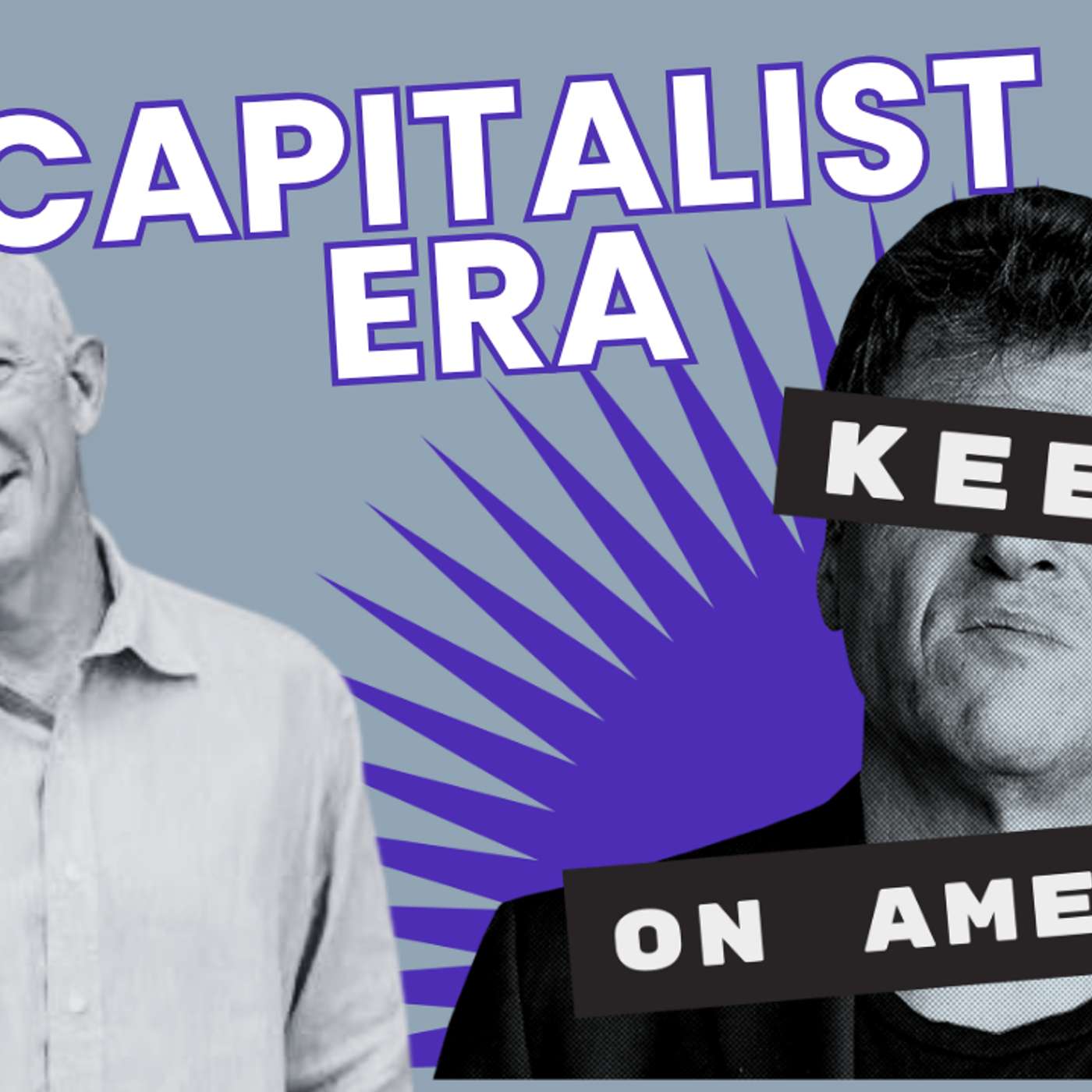 A Global Storm in a Capitalist Teacup? Jeremy Adelman on Why There’s No Exit to the Market 27.08.2026 56λ“There’s no exit in capitalism.” — Jeremy Adelman Is that ongoing quarrel of modern politics, the battle over capitalism, just a storm in a teacup? Economic historian Jeremy Adelman thinks it might be. In The Capitalist Era, Adelman argues that all camps — left and right, Keynesian and Hayekian, socialist and libertarian — accept the unavoidability of global capitalism. There is no alternative, as Mrs Thatcher used to annoyingly say. Although Adelman, certainly no Thatcherite, isn’t celebrating the apparent inevitability of our capitalist epoch. What interests Adelman is the making and unmaking of what he calls the “global mind.” The revolutionary quality of capitalism, he says, is that we now think of strangers as somehow part of our community. So when Adam Smith, the moral philosopher father of economics, drank his Chinese tea while reading of a deadly earthquake in China, he recognized that capitalism inevitably entangled our moral thoughts with our self-interest. It wasn’t just economists who began to think differently of strangers. Artists as varied as Picasso, Joseph Conrad, and the photography-obsessed Émile Zola all made this moral inquiry of strangers the heart of their work. Yes, Adelman is probably right to say there’s no capitalist off-ramp in our post-global economy. But capitalism’s octopus-like “global mind” and its (mis)treatment of strangers should turn all economists into moral philosophers and all artists into observers of economics. Five Takeaways • The Mind, Not the Material. Against Sven Beckert’s material history (which Adelman admired and reviewed in Foreign Affairs), The Capitalist Era studies how we think about capitalism — because the thinking sets the policies, creates the attachments, fuels the wars, and builds the institutions. Capitalism, on his dating, is an eighteenth-century invention that dawns with Adam Smith’s “commercial society”: the first economic system to tie strangers across the whole planet into one interdependent web — global from the very start. Its founding text is a thought experiment: Smith’s gentleman of humanity, drinking Chinese tea while reading of a Chinese earthquake, asked whether he minds the deaths of thousands as much as the pain in his little finger. The marketplace entangles our moralities — and the question of whether sympathy can keep pace with self-interest has governed the global mind ever since.• No Exit in Capitalism. For or against? A fair question with a layered answer: we are all heirs to the Marxist tradition — inequality and exploitation are inherent to interdependence, and “the propensity to be predatory coexists with the propensity to be empathetic.” But the trap is real: “there’s no exit in capitalism” — leaving is so punitive that every socialist revolution has paid catastrophically, a logic Adelman calls part of “the awful cunning” of the Trump administration’s economic statecraft. Keynes versus Hayek? When Andrew suggested it amounted to a family squabble — a storm in a teacup — Adelman largely agreed: both camps accept that we live inside capitalism, arguing only over how to live interdependently. No exit, though, doesn’t mean no alternatives: the argument worth recovering — lost since the globalization of the 1980s was “dumped on us” — is which form of interdependence we actually want. Gramsci’s interregnum, the time for monsters, is exactly when that argument matters.• The Veil Between Strangers. The book’s gallery: not only philosophers but artists — Picasso, the poets, Borges (“I have a hard time writing any book without” him) — and above all photographers, because how we think about strangers is mediated through media. Smith’s verb was to see: the stranger’s invisibility was the whole problem, and photography — cheap to reproduce, claiming realism — promised to remove the veil. Zola was obsessed with it; street photography made New York and London legible as cities of vice and poverty; and the Opium War photographs that reached London in the 1860s forced a scandal, because this suffering was inflicted by our own troops. But seeing bred a new problem Smith never foresaw: indifference — too many images numbing the sympathies they were meant to awaken. In today’s supersaturation of digital and artificially generated strangers, the early doubters’ warning compounds: market interdependence plus growing indifference between the interdependent is “a recipe for calamity.”• Earth Hunger. The charge that capitalism is eating the planet is as old as capitalism: the era of Hobson’s Imperialism named the West’s insatiable appetite to conquer and carve — “earth hunger” — after the Boer War. Joseph Conrad and Roger Casement traveled the Congo River together: Conrad turned it into Heart of Darkness; Casement wrote the first great humanitarian reports — rubber for Europe’s bicycles and tires, extermination for the Congolese and then Amazonians — before renouncing the crown, joining the Irish rebellion, and hanging for treason. Slavery runs through the same river: on Smith’s mind from the start, the plantation bonanza’s awkward foundation, with dehumanization as extraction’s precondition — a through line to the 1930s. To James Crawford’s vanishing earth (last week’s episode), Adelman offers a friendly dissent: the earth isn’t vanishing, but the accelerating metabolism of resources — extracted inhumanely for those who live there — is stressing the system. Alternatives exist; exit does not.• Hoard the Returns, Externalize the Burdens. Adelman refuses the apocalypse chorus: end-time arguments breed cynicism — grab what you can while you can — which is precisely what turned the 1930s murderous; and the great debate the 2008 crisis should have sparked was stifled by crisis management that worked too well. “Neoliberalism” he finds overblown — the world is a mixed, messy hybrid, China neither socialist nor neoliberal — and the Thucydides Trap is a “silly metaphor”: Sparta and Athens were never as interdependent as China and the United States. Hence the closing duel: Carney versus Trump as two arguments inside the global mind about how to need strangers. Trump, the Toronto-born historian argues, is no isolationist — his is a global vision that wants to “hoard the returns and externalize the burdens,” punishing the asymmetrically dependent (Canada above all) through a predator’s bilateralism whose 1930s pedigree Adelman names with discomfort. And China? Sitting on the sidelines, courting Canada, playing “an old game” of constructing and dividing markets — as old as the global mind itself. About the Guest Jeremy Adelman is the Henry Charles Lea Professor Emeritus at Princeton University and professor of history and director of the Global History Lab at the University of Cambridge. Born in Toronto and educated at Toronto, the LSE, and Oxford, he has lived and worked in seven countries. His many books include Worldly Philosopher: The Odyssey of Albert O. Hirschman and Sovereignty and Revolution in the Iberian Atlantic. The Capitalist Era: The Making—and Unmaking—of ...
Παρόμοια podcasts


Δημοφιλές σε
Αυτό το podcast εμφανίζεται και στις λίστες podcasts αυτών των χωρών.


