
EU-Startups Podcast
Thomas Ohr
0
The official podcast of EU-Startups.com, a leading online magazine covering startups in Europe. Each episode features interviews with founders, investors, and ecosystem players, discussing trends, challenges, and success stories in the European startup scene.
Επεισόδια
-
 The Shopify of Venture Capital 17.09.2026 41λJoin us for a conversation with Patrick Ryan, co-founder of Odin, as we explore the journey that led him from consumer goods and corporate venture capital to launching a platform that’s transforming how investment firms operate. Odin, often described as "Shopify for Venture Capital," enables anyone, anywhere, to launch and run a private investment firm online - handling everything from legal structuring and investor onboarding to KYC/AML, payments, and reporting. In this interview, Patrick dives into the inspiration behind Odin, the inefficiencies he identified in traditional investing, and how the platform is empowering a new wave of fund managers, angel syndicates, and founders to invest in companies. We unpack what it truly means for Odin to offer "VC in your pocket" and who the platform is designed for. The conversation also explores the cultural and ideological differences between investing in the US and Europe, and how Odin’s recent expansion is addressing critical friction points for global investors. With nearly €1 billion in disclosed European VC vehicle announcements in 2026, Patrick explains Odin’s role in this evolving ecosystem and how it’s enabling more people to shape the future through capital allocation.
 -
 How Europe is Helping Startups Succeed 09.09.2026 36λJoin us for an interview with Momchil Sabev, Director of the European Innovation Council and SMEs Executive Agency (EISMEA), as we explore the critical role of public institutions in shaping Europe’s startup and innovation landscape. With a career that bridges entrepreneurship, private sector consulting, and high-level EU leadership, Momchil shares how his diverse experiences inform his approach to supporting ambitious founders and driving systemic change across the continent. This conversation shines a spotlight on EISMEA’s often-unsung but vital work in strengthening Europe’s innovation ecosystem. We delve into the biggest hurdles startups face when scaling internationally, the EIC’s growing impact in DeepTech, and why non-financial support - such as mentorship, strategic partnerships, and access to expertise - can be just as transformative as funding. Momchil also explains how EISMEA and the EIC are tackling the fragmentation that still hinders startups from less-connected regions, ensuring opportunity is distributed evenly across Europe. Looking ahead, Momchil paints a vision for the next decade of European innovation—one where EISMEA and the EIC act as catalysts for a more integrated, competitive, and founder-friendly ecosystem.
 -
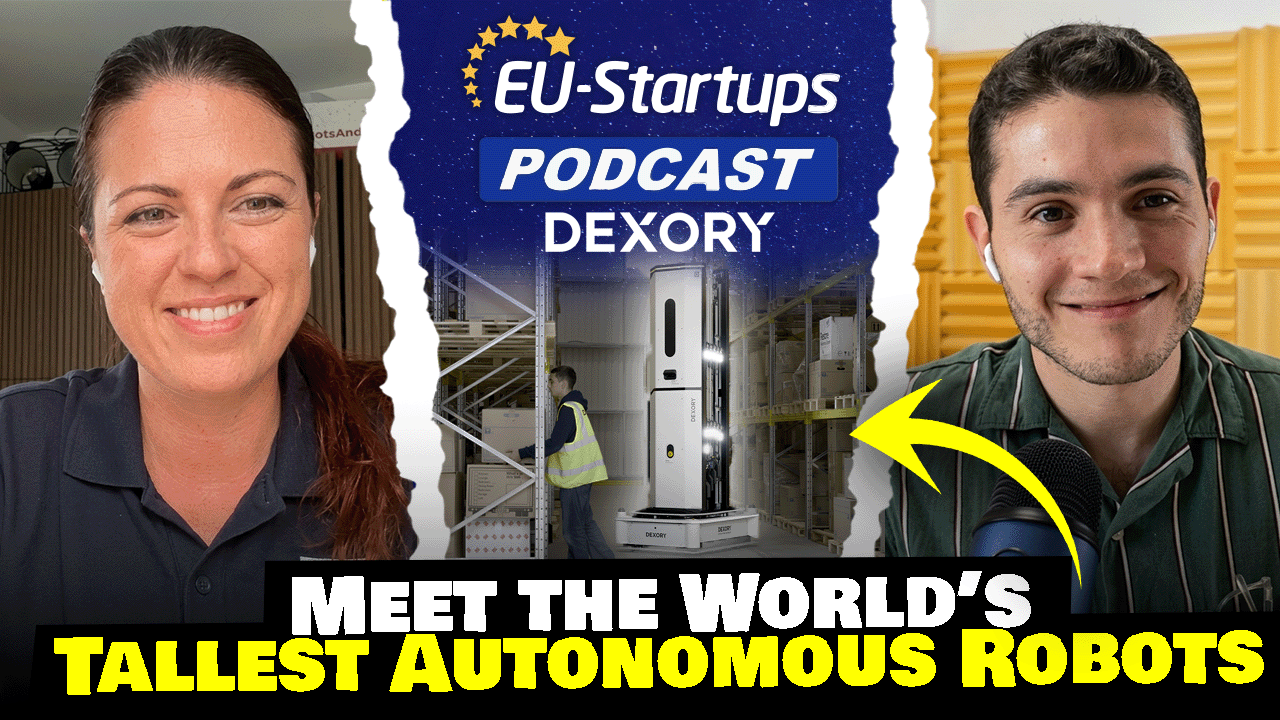 Meet the World's Tallest Autonomous Robots 03.09.2026 36λJoin us for a conversation with Oana Jinga, co-founder and Chief Commercial & Product Officer at Dexory, an innovator in warehouse robotics and intelligence. In this interview, Oana shares her journey from leading strategic partnerships at Google and Telefónica to co-founding a company that bridges the gap between cutting-edge robotics and practical, scalable solutions for the logistics industry. Oana shares the evolution of Dexory - from its early days as BotsAndUs to its current status as a European scale-up with nearly €300 million in funding, including a $165 million raise in 2025. She discusses the challenges of transitioning from DeepTech innovation to global scalability, and how the company balances technical ambition with real-world customer needs. With a focus on Physical AI and international expansion, including growth in the US, Oana also explores the broader landscape of warehouse robotics in Europe. The conversation tackles critical questions about the future of work: How can robotics and AI augment human roles rather than replace them? What responsibilities should remain uniquely human, and which tasks are better suited to machines? Oana also addresses the ethical implications of AI in robotics, emphasizing the importance of building unbiased, transparent systems and the industry’s blind spots in this area. Beyond technology and scaling, Oana advocates for making robotics a more inclusive and attractive career path. She challenges the outdated stereotype of robotics as a male-dominated field, highlighting the diverse roles - from data science to commercial strategy- that define the industry today.
 -
 Can Bacteria Solve Fashion's Pollution Problem? 27.08.2026 42λJoin us for a conversation with Karin Fleck, the CEO and Founder of Vienna Textile Lab, an innovator in sustainable textile dyeing through biotechnology. With a decade of experience in the oil and energy sector, Karin transitioned her expertise to address one of the fashion industry’s most pressing challenges: the environmental and human cost of synthetic dyes. In this interview, she shares her journey from managing large-scale industrial projects to founding a company dedicated to creating bio-based, eco-friendly dyes derived from microorganisms. Discover how Vienna Textile Lab is transforming the textile industry by offering a commercially viable, safe, and sustainable alternative to traditional synthetic dyes. The conversation also touches on the role of Women TechEU in supporting deep-tech startups and the importance of fostering a collaborative ecosystem to drive meaningful change in the industry.
 -
 She Turned Plastic Waste Into Opportunity 20.08.2026 40λJoin us for an interview with Angela Ivanova, the co-founder and CEO of LAM’ON Compostable Films, a Bulgarian company at the forefront of sustainable packaging solutions. Angela shares her journey of addressing one of the most pressing environmental challenges: the 1.2 million metric tons of laminated paper wasted annually. LAM’ON has developed bio-based, compostable laminating films and packaging foils that seamlessly integrate with paper recycling, offering a circular economy solution without compromising quality. In this discussion, Angela dives into the challenges of building LAM’ON from the ground up. She reflects on the gender gap in entrepreneurship, the moments that led her to focus on biodegradable materials, and the hurdles of product development, industry adoption, and scaling a startup in Bulgaria. The conversation also explores the real-world impact of LAM’ON’s innovations. Angela discusses how companies are transitioning to their compostable films, the barriers to widespread adoption, and whether customers are driven by genuine environmental consciousness or regulatory pressures. With a sharp focus on the future of sustainable materials, she examines the role of technology, infrastructure, and consumer behavior in making compostable packaging mainstream within the next five years.
 -
 Enabling People. Not Replacing Them 13.08.2026 27λIn this exclusive interview, we sit down with Nikita Miller, Chief Product Officer at Perk, formerly TravelPerk, to discuss the company’s evolution into an AI-native travel and spend management platform and its global ambitions. Nikita joined Perk in September 2025 as the Barcelona-founded scale-up was expanding beyond travel into spend and expense management, integrating acquisitions such as Yokoy, and accelerating its growth in the US. Central to Perk’s strategy is eliminating what Nikita calls “shadow work”: repetitive tasks such as reconciling receipts, managing invoices, booking travel and navigating company policies. By automating these processes, Perk aims to give employees more time for higher-value work. Nikita argues that the debate around AI should go beyond whether it replaces jobs. While AI can handle repetitive tasks and improve reporting, strategic judgement, decision-making and understanding why a company should pursue a particular direction remain fundamentally human. The conversation also explores how AI is changing hiring and company structures. Rather than simply reducing headcount, Nikita believes AI is creating demand for new skill sets, particularly systems thinking as businesses develop increasingly interconnected AI-driven products. Perk is already moving towards a more agentic future, connecting travel, spend, invoices and events while investing in personalisation. Its years of travel and spending data allow it to improve recommendations for travellers and give CFOs and administrators greater visibility over policies, approvals and costs. Nikita also discusses Perk’s expansion into the US, arguing that its experience operating across complex European markets has prepared it well for localisation abroad. The company’s recent €300 million credit facility is supporting investment across AI, product development, invoicing, corporate cards and new products. Looking ahead, Nikita describes Perk’s ambition to build a “100-year company” focused on removing administrative complexity and helping people use their time more meaningfully. Key Points • Perk’s evolution from TravelPerk into an AI-native travel and spend management platform. • Eliminating “shadow work” by automating repetitive travel, expense and invoicing tasks. • Why AI should be judged by the higher-value work it enables, not only its impact on headcount. • How AI and personalisation are improving recommendations, approvals, reporting and spend visibility. • Perk’s US expansion and long-term ambition to build a global “100-year company”.
 -
 Spider Silk in BioTech 06.08.2026 35λFor today’s podcast, produced in association with the Women TechEU scheme, we sit down with Jekaterina Romanova, CEO and co-founder of Latvian biotech startup PrintyMed, to discuss biomimetic spider silk, its medical potential, and the challenges of scaling deep-tech innovation in Europe. The Women TechEU scheme is an EU-funded project supporting women leading deep tech startup companies from Europe. As part of the consortium team implementing the programme, our mission is to foster inclusive innovation by supporting women-led startups, including under-represented deep tech sectors and European regions. We believe that diversity drives innovation, and we are here to provide women in deep tech with more opportunities, resources, and support in order to build market-shaping companies at global level. Between 2026-2028, the current project consortium will run a continuous open call with 4 cut-off dates. Following a rigorous evaluation process, 160 total beneficiaries will be selected. Each beneficiary will receive €75k grants (non-dilutive finance), as well as a tailored package of mentorship, training, expert guidance, matchmaking and networking opportunities, and support in bridging the gap to other EIC funding and support schemes. EU-Startups is a proud member of the consortium implementing the Women TechEU Programme from 2026 to 2028. In this podcast, Jekaterina reflects on her unconventional path into biotechnology. After studying economics and working in banking, she entered entrepreneurship at 18 through a posture-correction clothing startup. She later founded a company developing 3D-printed bone grafts, gaining experience in medical regulation, funding, and commercialisation. At PrintyMed, Jekaterina leads grants, investment, partnerships, and strategy, while scientists and doctors oversee laboratory research. The company’s biomimetic spider silk technology originated at the Latvian Institute of Organic Synthesis and replicates aspects of how spiders naturally produce silk. PrintyMed’s long-term ambition is to support artificial organs and biological scaffolds. It has developed an artificial heart-valve prototype and is exploring artificial nerves, wound dressings, and regenerative medicine. Its first commercial focus is membranes for organ-on-a-chip systems, which help pharmaceutical companies and researchers test drugs while reducing animal testing. PrintyMed is already running pilot projects, although products intended for patients will require several more years of certification. Jekaterina also discusses the importance of European funding. PrintyMed has secured about €2 million in grants, including €75,000 from Women TechEU and roughly €700,000 through a European Innovation Council programme. This support strengthened the company’s expertise in regulation, intellectual property, scaling, and fundraising. The conversation also covers expansion beyond Europe. PrintyMed is building relationships in Saudi Arabia, where government-backed biotechnology initiatives, research partnerships, and certification opportunities could support international growth. Jekaterina argues that Europe’s medical-device regulations can slow innovation and calls for controlled fast-track testing environments. She also highlights spider silk’s potential in cosmetics and skincare, following discussions with Chanel about a regenerative cosmetic glove. Funded by the European Union. Views and opinions expressed are however those of the author(s) only and do not necessarily reflect those of the European Union or the European Innovation Council and SMEs Executive Agency (EISMEA). Neither the European Union nor the granting authority can be held responsible for them.
 -
 How Europe can Win in Tech 29.07.2026 40λFor today's podcast we sit down with Tom Wehmeier, Partner and Head of Intelligence at Atomico, to discuss European technology, the firm’s investment philosophy, and the influential State of European Tech report. Tom reflects on his unconventional route into venture capital. Before joining Atomico, he worked in telecommunications, witnessing shifts such as the emergence of 3G and internet-based calling. This taught him to recognise hype cycles, adopt a patient long-term view, and understand why established companies often struggle to respond to disruption. He explains that breakthrough technologies are frequently underestimated. Early forecasts predicted a market of only around one million mobile phones, yet the technology eventually reached billions of users. For Tom, this shows the importance of recognising innovations that can fundamentally change behaviour. The conversation explores the origins of Atomico’s State of European Tech report. What began as a PowerPoint presentation became a major annual platform covering investment, talent, liquidity, regulation, and entrepreneurship. It was created to address the lack of shared, evidence-based information about Europe’s technology ecosystem. Tom previews themes expected in the next edition, including progress in funding innovation, reducing regulatory friction, empowering talent, and encouraging greater risk tolerance. The report will also examine technological sovereignty and resilience across energy, computing, and defence. He argues that Europe suffers from a “commitment gap”. Policymakers and industry leaders may support initiatives such as EU Inc. and greater institutional investment in technology, but implementation is often slowed by political deadlock. Progress therefore requires decisive leadership at national and European levels. Tom also explains how the report serves different audiences. Investors may focus on funding and liquidity, while policymakers are more interested in regulation and ecosystem sentiment. By making its data downloadable, Atomico enables journalists, founders, investors, and researchers to develop their own interpretations. The report has become a year-round initiative involving research partnerships, newsletters, roundtables, and wider industry engagement. Atomico also experiments with new formats, including synthetic audience tools, interactive question-and-answer features, and video content. The interview concludes by reflecting on Atomico’s 20-year history. When the firm was founded, the idea that Europe could produce globally significant technology companies and establish venture capital as a major asset class was far from certain. Tom believes the ecosystem has since exceeded expectations, while Atomico has helped place European entrepreneurship on the global map. Key Points • Tom’s telecommunications background shaped his analytical, long-term approach to venture capital and disruption. • Breakthrough innovations are often underestimated before reaching mass adoption. • The State of European Tech report provides a shared, evidence-based view of Europe’s technology ecosystem. • The next report will examine funding, regulation, talent, risk tolerance, sovereignty, and resilience. • Europe must close the gap between political commitments and implementation through stronger leadership. • Atomico’s belief in European technology has been validated by the ecosystem’s growth and global relevance.
 -
 The Future of European Payments 23.07.2026 33λIn this exclusive interview, we sit down with Lena Hackelöer, founder & CEO at Brite Payments, to explore the company’s growth, the future of European payments, and the challenges facing fintech founders. Lena shares how Brite has evolved from a Swedish startup founded in 2019 into a leading pay-by-bank provider operating across 27 European markets. Following its Series A round, the company expanded into Germany and France. She reflects on how her early career shaped her entrepreneurial approach. Her experience at Klarna during its hypergrowth phase taught her how to build and internationalise a fast-moving fintech company, while a later role in a listed financial services business exposed her to operating in a highly regulated environment. Lena also discusses European payment sovereignty. Brite is building a pan-European instant payment network that reduces reliance on non-European infrastructure, but she argues that sovereignty alone will not drive adoption. Merchants and consumers ultimately prioritise convenience, reliability, conversion rates, and lower processing costs. The conversation examines the difficulty of scaling across Europe. Differences in language, culture, banking systems, regulation, and consumer behaviour mean the continent cannot be treated as a single market. Although licences can be passported across the European Union, requirements may still vary between regulators. Lena explains why localisation is essential. German consumers often place greater emphasis on security and data protection, while Swedish users are more comfortable with digital transparency. Brite therefore combines centralised technology with local expertise, adapting its strategy to each market. Looking ahead, Lena sees convenience as the main driver of pay-by-bank adoption. Improvements in mobile banking, app-to-app authentication, and instant payments are making the experience faster, enabling instant confirmation, rapid refunds, and quicker payouts. The interview concludes with a discussion about female entrepreneurship and representation in fintech. Lena believes progress is being made as more women gain senior experience and professional networks. However, funding inequalities, limited access to technical careers, and low female participation in engineering remain significant barriers. Key Points • Brite Payments has grown from a Swedish startup into a pan-European pay-by-bank platform operating across 27 markets. • Lena’s experience at Klarna helped shape her entrepreneurial approach and payments expertise. • European payment sovereignty matters, but adoption depends on convenience, reliability, conversion rates, and commercial value. • Fragmented regulation, banking infrastructure, and consumer behaviour make European expansion complex. • Mobile banking, instant payments, and app-to-app authentication are making pay-by-bank services faster and more attractive. • Greater female representation will require better access to funding, technical careers, and senior leadership opportunities.
 -
 The Fund Selling Climate to Skeptics 16.07.2026 34λIn this exclusive interview, we sit down with Tim Schumacher, the visionary co-founder of saas.group and General Partner at World Fund, to explore the journey, philosophy, and future of his founder-friendly SaaS acquisition platform and his ClimateTech investments. Tim shares how saas.group evolved from its first acquisition, DeployBot, to a thriving ecosystem of 18 independent SaaS brands spanning 30 countries. He dives deep into the core values that drive saas.group’s success: a commitment to preserving the bootstrapper mindset, fostering cultural alignment, and ensuring every acquisition is tailored to the founder’s personal and professional goals. Tim also reflects on the unique challenges and opportunities in the SaaS acquisition space. He discusses why saas.group focuses on niche, revenue-driven companies often overlooked by traditional private equity firms, and how their model prioritises autonomy, transparency, and long-term partnership over purely financial metrics. From the importance of honest conversations about founders’ motivations to the practicalities of due diligence and integration, Tim pulls back the curtain on what it takes to create a dream exit for entrepreneurs. Beyond SaaS, Tim’s passion for sustainability and climate action shines through as he discusses his role as a General Partner at World Fund, a climate tech VC backing scalable, emissions-reducing technologies. He shares his perspective on the progress of decarbonisation, the role of technology in addressing climate change, and the lessons learned from building and supporting impact-driven ventures like Ecosia, the search engine that plants trees. As the conversation turns to the future, Tim paints a picture of the ecosystem he aims to cultivate over the next decade - one where founders retain their identity, teams thrive in collaborative environments, and businesses drive meaningful change.
 -
 Is the Office Era Over? 09.07.2026 28λJoin us for a deep dive with Job van der Voort, CEO and co-founder of Remote, as he explores the evolution of work, the challenges of global employment, and the principles behind scaling remote-first teams. From his transition from neuroscientist to startup leader, to the lessons learned at GitLab and Remote, Job shares insights on mindset shifts, cultural nuances, and the future of distributed work. Job discusses the practical challenges of building a globally distributed team, the importance of asynchronous communication, and why treating all employees as equals - regardless of location - is key to fostering a cohesive culture. In this conversation, Job reflects on the hidden costs of traditional office work, the importance of flexibility, and how Remote is transforming global employment infrastructure. He also addresses the remote vs. in-person debate, the role of time zones in global collaboration, and what founders should prioritise when hiring talent worldwide.
 -
 From Dining Table to $700M Exit 02.07.2026 38λJoin us for a conversation with Jos White, co-founder of Notion Capital and serial entrepreneur, as he reflects on his journey - from building pioneering companies like Star and MessageLabs to investing in the next generation of European B2B SaaS and cloud startups. Jos shares the lessons learned around his family dining table, the pivotal moments that defined his entrepreneurial path, and what it takes to identify and support exceptional founders. Discover how Notion Capital is shaping the European tech landscape and Jos’s perspective on the future of software in Europe.
 -
 From Getting Scammed to Building a Unicorn 25.06.2026 33λJoin us for a conversation with Tarek Müller, co-founder and co-CEO of ABOUT YOU, a leading European fashion and lifestyle e-commerce platform and Hamburg’s first unicorn. Tarek shares his journey from building websites at 13 to scaling one of Europe’s fastest-growing tech companies, and dives deep into the future of digital commerce, AI, and sustainable retail - and his close brush with a scammer! In this interview, Tarek reflects on his entrepreneurial roots, the evolution of ABOUT YOU, and the strategic shifts shaping e-commerce today. He also explores the role of AI, the balance between personalisation and sustainability, and how ABOUT YOU fits into the broader ecosystem of modern commerce infrastructure.
 -
 The Startup Turning Swamps Into Fashion Gold 18.06.2026 29λIn this exclusive interview, we sit down with Julian Ellis-Brown, CEO and co-founder of Ponda, the innovative biomaterials company developing the world’s first wetland-regenerating material supply chain. Julian shares the story behind Ponda’s mission to transform how we think about materials - starting with BioPuff, a plant-based insulation made from bulrush grown on restored wetlands. Discover how Ponda is redefining sustainability in fashion by linking material innovation with ecosystem restoration. Julian discusses the challenges and breakthroughs of scaling a regenerative supply chain, the role of farmers and landowners in their journey, and why wetlands are the key to a more resilient, carbon-negative future. Learn about Ponda’s collaborations with major brands like Stella McCartney, Berghaus, Sheep Inc., and Parley for the Oceans, and how their crowdfunding campaign is accelerating the shift from pilot to commercial scale.
 -
 The Airship Startup NATO is Backing 11.06.2026 35λIn this exclusive interview, Janne Hietala, CEO of Kelluu, discusses how his company is pioneering the use of autonomous, hydrogen-powered airships to revolutionise aerial monitoring. Unlike traditional drones or satellites, Kelluu’s fleet delivers persistent, high-accuracy environmental data in extreme conditions - from Arctic temperatures to GPS-denied environments. Learn how these near-silent, emission-free platforms are reshaping intelligence, surveillance, and environmental monitoring for defence, infrastructure, and beyond. From its humble beginnings in a Finnish farm shed to its recent €15 million Series A funding, Kelluu has proven its platform in real-world conditions, including NATO exercises and Arctic operations. The company’s autonomous airships aim to bridge the gap between satellites and drones, offering unmatched persistence and precision for critical missions.
 -
 The Christmas Trip that Built BlaBlaCar 04.06.2026 39λJoin us for a deep dive with Frédéric Mazzella, founder of BlaBlaCar, as he reflects on the origins of the world’s leading carpooling platform and shares insights on the future of shared mobility, sustainability, and entrepreneurship in Europe. From a personal Christmas trip that sparked a global movement to redefining how we travel, Frédéric discusses the vision, challenges, and impact of BlaBlaCar - and how it’s shaping the way we think about transportation, community, and innovation. In this interview, Frédéric explores the balance between practicality and purpose, the role of technology in fostering human connections, and the unique opportunities and hurdles for startups in Europe today. Whether you’re a founder, a mobility enthusiast, or simply curious about the future of travel, this conversation offers valuable perspectives on building scalable, impactful businesses.
 -
 The Startup Freezing Humans For Tomorrow 28.05.2026 44λJoin us for a deep-dive conversation with Dr Emil Kendziorra, CEO of Tomorrow.bio, as we explore the cutting edge of cryopreservation and medical biostasis. Dr Kendziorra, who began his career in cancer research with a summa cum laude degree from the University of Göttingen, shares his remarkable journey from academic science to entrepreneurship, and ultimately to founding Tomorrow.bio - a company he considers his life’s work. In this interview, he discusses the motivations behind his pivot from traditional longevity research to the frontier of cryomedicine, the operational and emotional lessons learned from cryopreserving over 20 human patients and 10 pets, and his vision for making this technology more accessible in the future. Tomorrow.bio stands as Europe’s fastest-growing cryopreservation company, with over 800 members across 200+ cities and 45+ countries. The company offers both whole-body cryopreservation and brain-only preservation, using a transparent pricing model designed for long-term value. With a recent €5 million Seed round and a mission to advance medical biostasis, Emil discusses the unique challenges and opportunities of operating in this space, the ethical considerations of a technology that may not achieve revival for decades, and his long-term vision for the field
 -
 From MI6 to Startups 20.05.2026 32λIn this edition of the EU-Startups Podcast we had a cht with Tyler Edwards, the ex-MI6 founder who set out to secure AI Agents.
 -
 From 0 to $100M ARR 14.05.2026 35λJoin us for an in-depth conversation with Pieterjan Bouten, Founding and Managing Partner at Entourage, as he reflects on his journey from co-founding In the Pocket and scaling Showpad to $100M ARR, to now building and funding the next generation of B2B SaaS companies through Entourage Studio and Entourage Capital. Pieterjan also shares insights on his role as an Entrepreneur in Residence at the Vlerick Entrepreneurship Academy and the vision behind Wintercircus, a hub for entrepreneurs, researchers, and digital creatives. Pieterjan dives into the challenges and triumphs of scaling a global SaaS company, the evolution of his perspective as both an operator and investor, and how Entourage is redefining early-stage support for European founders. He also discusses the future of AI in B2B SaaS, the role of communities like Wintercircus, and what it takes for founders to stand out in today’s competitive landscape. 💬 What’s your biggest takeaway from Pieterjan’s journey? Share in the comments!
 -
 From Skype to Delivery Robots 23.04.2026 39λIn this interview, Ahti Heinla - co-founder, CEO, and CTO of Starship Technologies and one of the original engineers behind Skype - shares his journey from a young programmer in Estonia to leading one of the world’s most advanced autonomous delivery companies. Ahti reflects on how his early exposure to coding shaped his mindset, and the lessons he carried from building Skype into scaling Starship. He dives into why last-mile delivery became the problem he wanted to solve, and how autonomous robots are changing the way goods move through cities. The conversation explores the human side of automation - addressing concerns about jobs, the evolving role of delivery workers, and how technology can support rather than replace people. Ahti also discusses the importance of sustainability and impact in decision-making, highlighting how zero-emission delivery can reshape urban environments. From navigating regulation in different markets to working with major delivery platforms across Europe and the US, Ahti offers a look at what it takes to deploy robotics in the real world.
Παρόμοια podcasts


Δημοφιλές σε
Αυτό το podcast εμφανίζεται και στις λίστες podcasts αυτών των χωρών.
