
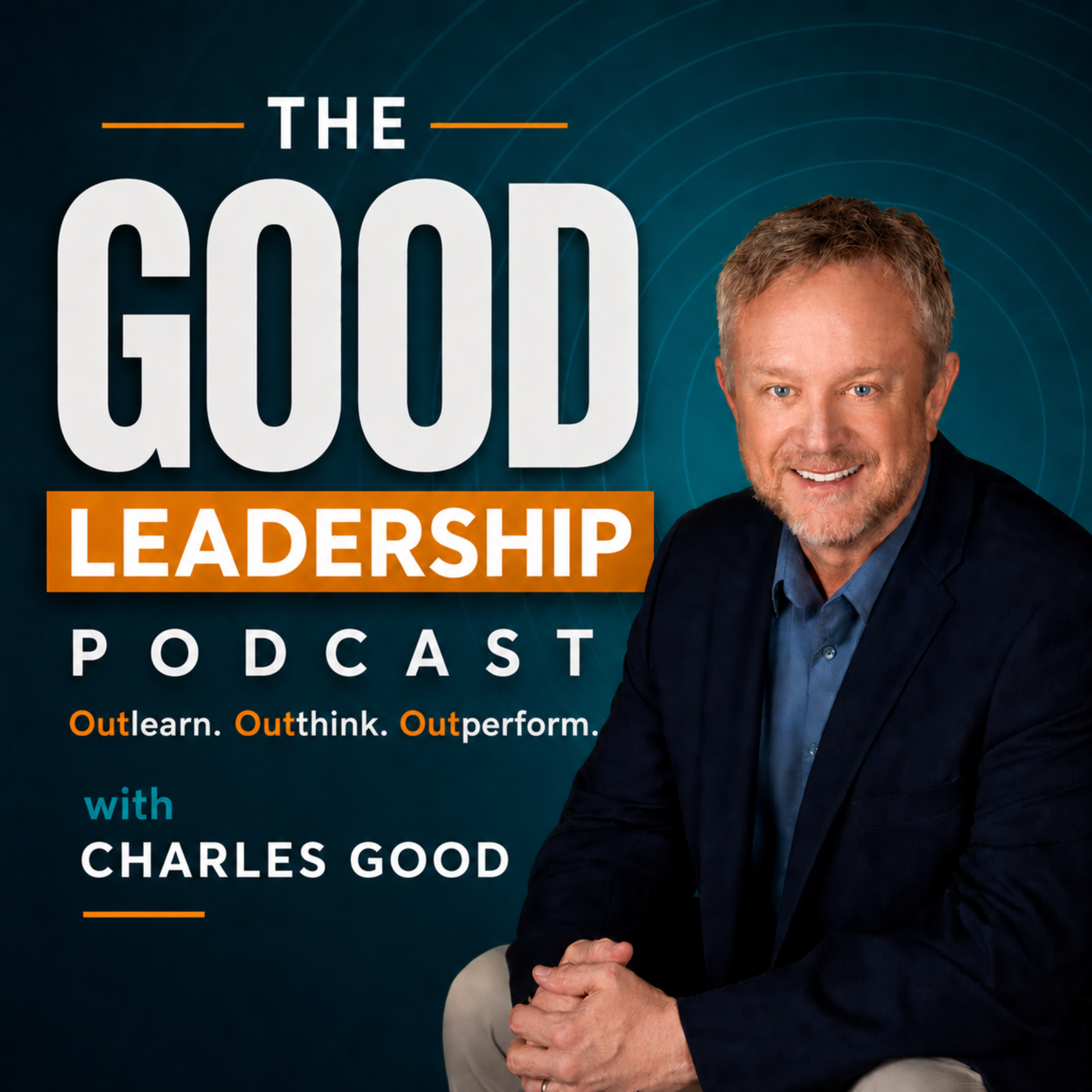
The Good Leadership Podcast
Charles Good
0
The Good Leadership Podcast helps leaders outlearn, outthink, and outperform. Each week, host Charles Good sits down with leading authors, researchers, and practitioners to unpack the science of leadership, learning, behavior change, decision-making, and human performance. More than inspiration, each episode delivers practical ideas you can apply to think better, lead smarter, and perform when it matters most.
Επεισόδια
-
 How to Stay Valuable at Work in the Age of AI with Melissa Swift 15.09.2026 31λHow do leaders stay effective when work is changing faster than ever? Melissa Swift, author of Effective: How to Do Great Work in a Fast-Changing World, joins Charles Good on The Good Leadership Podcast to explore what effectiveness really looks like in an era of AI, constant disruption, workplace overload, and organizational chaos. Melissa shares her Effectiveness Architecture (knowledge, methods, people, and technology) and explains why working harder is often not the same as working better. The conversation dives into some of the toughest challenges facing leaders today: managing rumors and gossip without becoming part of them, leading with transparency during uncertainty, distinguishing unavoidable chaos from self-inflicted organizational dysfunction, and recognizing when structural problems make effectiveness nearly impossible. Melissa also explains how leaders can redesign work, clarify roles, reduce unnecessary complexity, and create the conditions for people to perform at their best. Charles and Melissa also explore the future of leadership in an AI-driven workplace, including how great leaders can use AI to extend their thinking rather than outsource it, why emotionally intelligent managers remain essential, and why hope may become one of the most important human leadership capabilities of the future. If you want practical strategies to become more effective, reduce workplace chaos, improve communication, and lead through rapid change, this episode offers a powerful playbook.Melissa Swift is a founder, CEO, speaker, and longtime people consultant who helps organizations, teams, and individuals succeed in increasingly complex and chaotic workplaces. She has held leadership roles at Mercer, Korn Ferry, and Deloitte and is the author of Effective: How to Do Great Work in a Fast-Changing World. Her work focuses on helping people and organizations improve effectiveness by strengthening how they use knowledge, methods, relationships, and technology.Chapters00:00 Introduction to effectiveness in leadership01:16 Melissa introduces the effectiveness architecture02:12 Managing rumors and gossip effectively03:25 Adopting an open but discerning stance04:23 Using peer leadership to clarify signals05:18 Responding to rumors and maintaining boundaries06:30 The power of transparency during ambiguity09:21 Understanding different types of chaos12:05 Recognizing self-inflicted chaos and zombie cabin environments14:38 Creating structural changes to reduce chaos15:22 Signs of structural barriers to effectiveness17:27 Planning a thoughtful exit from intractable roles19:44 The impact of emotionally intelligent management22:55 Technology’s role in leadership and management24:39 Partnering with AI to extend leadership capabilities26:34 Cultivating hope as a leadership skill29:15 One small action for leaders to improve effectiveness30:03 Connecting with Melissa Swift and her workSubscribe to The Good Leadership Podcast: [Apple Podcasts] | [Spotify] | [YouTube]LinkedIn: linkedin.com/in/charlesagoodSubstack Channel (Outlearn to Outperform): charlesgood.substack.comLinkedIn Newsletter (The Outlearn Advantage): [Subscribe]The Institute for Management Studies
 -
When Everyone Sounds the Same, What Makes You Stand Out? with William Arruda 08.09.2026 39λAI has made it easier than ever to create polished content, communicate ideas, and build visibility. It has also made it easier for everyone to sound remarkably similar. So when great-looking output becomes abundant, what actually makes you stand out?In this episode of The Good Leadership Podcast, Charles Good speaks with personal branding pioneer William Arruda about how leaders and professionals can build a reputation that remains distinctive, credible, and human in the AI era. William explains why expertise alone is becoming less differentiating, how self-awareness and a clear point of view strengthen your brand, and why narrowing who you want to serve can actually increase your influence. He also shares his Know, Show, Grow framework for identifying what makes you valuable, making that value visible, and building a reputation over time.The conversation explores how to strengthen your LinkedIn presence, tell stories that reveal the person behind the expertise, and use AI to amplify your thinking without flattening your voice. As technology makes polished communication easier for everyone, the advantage shifts toward something harder to automate: a clear perspective, earned credibility, and a reputation people remember.William Arruda is a bestselling author, keynote speaker, entrepreneur, and one of the world’s leading authorities on personal branding and digital branding. He is the founder of Reach Personal Branding and CareerBlast.TV, where his programs have helped millions of professionals clarify what makes them distinctive and translate that into greater visibility, credibility, and career impact. William is the author of Digital YOU, Career Distinction, and Ditch. Dare. Do!, and he created the 360Reach Personal Brand Survey, which has been used by nearly two million people worldwide. He is also a longtime Forbes contributor whose work focuses on personal branding, career growth, leadership, and the human side of professional success. His central message is simple: what makes you unique is what makes you valuable.Chapters00:00 Introduction to the importance of personal branding in the AI era02:11 The rise of content noise and the commodity nature of content04:45 Why personal branding is more crucial in a democratized AI landscape06:56 The importance of quality over quantity in content creation09:04 Self-awareness as the foundation of authentic branding11:21 Optimizing LinkedIn profiles for authentic branding14:14 Maintaining clarity and uniqueness in content and comments16:37 Revisiting and refining your brand in a changing technological landscape19:18 Case example: From vague to clear personal brand24:04 Avoiding imitation and copying others' styles26:49 Sharing failures and vulnerability to build trust28:05 The Know phase: Self-awareness and differentiation28:32 The Show phase: Telling human, relatable stories29:56 The Grow phase: Building network and thought leadership31:06 Aligning daily actions with your brand identity32:12 Using AI to amplify human qualities and authenticity33:24 Strategies for turning LinkedIn into a value creation platform35:25 Quick wins for personal branding in 30 days37:42 Practical steps to refine and communicate your brand38:35 Final thoughts: Building a human-centered, AI-proof brandSubscribe to The Good Leadership Podcast: [Apple Podcasts] | [Spotify] | [YouTube]LinkedIn: linkedin.com/in/charlesagoodSubstack Channel (Outlearn to Outperform): charlesgood.substack.comLinkedIn Newsletter (The Outlearn Advantage): [Subscribe]The Institute for Management Studies
-
What the Research Says High Performers Do Differently with Ty Bennett 01.09.2026 21λWhat really separates high performers from everyone else? According to new research commissioned by bestselling author and leadership expert Ty Bennett, the answer is less about working longer and more about preparing better.In this episode of The Good Leadership Podcast, Ty joins Charles Good to unpack the ideas behind his new book, Redefining High Performance. He shares why preparation emerged as the strongest driver of high performance, why fear of failure remains one of its biggest obstacles, and how curiosity, adaptability, rehearsal, and better questions help leaders perform when the pressure is real.The conversation challenges the old formula of simply working harder and offers a more sustainable model for staying effective and relevant over time. Ty explains why the best performers prepare for scenarios, relationships, and change before they arrive, and why continuous learning may be the capability that keeps every other skill valuable.Ty Bennett is a bestselling author, keynote speaker, entrepreneur, and leadership expert known for translating research into practical strategies for high performance, influence, and communication. He is the founder of Leadership Inc. and has delivered more than 2,000 presentations worldwide. Earlier in his career, Ty and his brother built a direct sales business to more than $20 million in annual revenue, expanding across 37 countries. He is the author of several books, including The Power of Storytelling, Partnership Is the New Leadership, The Power of Influence, and his latest book, Redefining High Performance. His recent research examines what separates top performers in leadership, sales, and business, with a particular focus on preparation, adaptability, curiosity, and overcoming fear of failure.Chapters00:00 Introduction to Redefining High Performance01:50 The Research Behind High Performance04:20 The Surprising Barrier: Fear of Failure06:19 Preparation as the Key Driver of Success11:39 Redefining High Performance for Today’s Leaders14:15 Avoiding Irrelevance as a Successful Executive16:28 The Power of Curiosity and Continuous Learning20:10 Final Takeaways: Building Performance Before the Moment20:38 Closing Remarks and ResourcesSubscribe to The Good Leadership Podcast: [Apple Podcasts] | [Spotify] | [YouTube]LinkedIn: linkedin.com/in/charlesagoodSubstack Channel (Outlearn to Outperform): charlesgood.substack.comLinkedIn Newsletter (The Outlearn Advantage): [Subscribe]The Institute for Management Studies
-
From Scarcity to Scale: What Great Innovators Learn From Constraints with Dr. Amos Winter 25.08.2026 47λWhat if the next breakthrough comes from having fewer resources, tighter constraints, and less room for error?In this episode of The Good Leadership Podcast, Charles Good speaks with MIT professor Dr. Amos Winter, co-author of Global by Design, about why some of the most powerful innovations emerge from environments where affordability, infrastructure, and context cannot be ignored. Drawing on examples such as the Honda Super Cub, Amos explains how leaders can identify problems worth solving, understand the people and systems around them, and design solutions that succeed beyond the lab.The conversation explores why price-performance fit often matters more than maximizing performance, how constraints can sharpen innovation, and where AI still falls short when physical, cultural, and contextual understanding is essential. For leaders trying to build products that can scale across markets, the challenge is clear: design for the real world from the beginning.Global by Design is now available at retailers worldwide!Amazon: https://www.amazon.com/dp/1647820758?lv=shuf&channelId=500&plpRedirect=mhFallbackDr. Amos Winter is the Germeshausen Professor of Mechanical Engineering and Director of the K. Lisa Yang Global Engineering and Research (GEAR) Center at MIT. His research focuses on using mechanical design and product design to create high-performance, low-cost technologies for resource-constrained communities around the world. His consultancy is Winter Works Consulting (https://winterworksconsulting.com/)The co-author of this book, Dr. Vijay Govindarajan, writes a Weekly Column on innovation on LinkedIn, where he continues to write about new developments in Global by Design. Please FOLLOW VG on LinkedIn to get updates on his work on innovation: https://www.linkedin.com/in/vg-govindarajan/recent-activity/all/Chapters00:00 Introduction to global innovation and constraints00:29 Amos Winter's background and book overview02:19 What does “Global by Design” mean?03:19 Starting with constraints to create global relevance04:22 Why emerging markets are engines of innovation06:17 Case study: Honda Super Cub's global success09:21 Market shifts making resource-constrained design relevant12:32 The rise of AI and its limitations in global innovation18:23 The Three Merits for choosing innovation problems25:08 Design factors for global products28:39 Understanding stakeholder perspectives and ignorance29:58 When lab performance meets real-world constraints35:57 Balancing commercial and humanitarian goals39:26 First steps for leaders to adopt Global by DesignSubscribe to The Good Leadership Podcast: [Apple Podcasts] | [Spotify] | [YouTube]LinkedIn: linkedin.com/in/charlesagoodSubstack Channel (Outlearn to Outperform): charlesgood.substack.comLinkedIn Newsletter (The Outlearn Advantage): [Subscribe]The Institute for Management Studies
-
Design for Transformation: The Next Evolution of Customer Value with Joe Pine 18.08.2026 32λWhat if the greatest value you create for customers is not the experience they have, but who they become because of it?In this episode of The Good Leadership Podcast, Charles Good speaks with Joe Pine, bestselling author of The Experience Economy, about the next evolution of customer value: transformation. Joe explains how leaders can move beyond products, services, and memorable experiences to understand the deeper aspirations customers are pursuing. He explores the Five Whys, the difference between time well saved, time well spent, and time well invested, and why genuine transformation ultimately requires a lasting change in identity or capability.The conversation also challenges leaders to reconsider what business is ultimately designed to accomplish. Joe explains why “experience design is the design of time,” how to diagnose the kind of change customers actually seek, and why human flourishing across health, wealth, knowledge, and purpose may represent the highest form of value creation. For leaders looking beyond customer satisfaction and memorable moments, the opportunity is larger: help people make progress toward who they want to become.B. Joseph Pine II is an internationally acclaimed author, speaker, and management advisor best known for pioneering the concept of the Experience Economy. He is cofounder of Strategic Horizons LLP, where he helps Fortune 500 companies and entrepreneurial organizations rethink how they create value for customers. Joe co-authored the landmark bestseller The Experience Economy with James H. Gilmore and is the author of Mass Customization, Authenticity, and his newest book, The Transformation Economy: Guiding Customers to Achieve Their Aspirations. His work has helped shape how leaders think about customer experience, personalization, and the progression from products and services to experiences and transformation. Joe has addressed audiences at the World Economic Forum, TED, and CES, and his ideas have appeared in Harvard Business Review, The Wall Street Journal, and other leading business publications.CHAPTERS00:00 Introduction to the transformation economy and its significance01:42 Joe Pine's background and journey into transformation economics03:27 Why customers buy means to an end, not just products04:42 Using the Five Whys to uncover customer aspirations07:01 Moving beyond functional jobs to aspirational jobs08:17 Distinguishing real transformations from events12:40 The importance of time as a core value in experiences16:59 Time well invested and the role of transformation19:53 Fostering human flourishing as the true purpose of business22:34 The four spheres of human flourishing and their overlap26:50 Designing for meaningful change and organizational purpose30:39 Practical steps for leaders to implement transformation strategiesSubscribe to The Good Leadership Podcast: [Apple Podcasts] | [Spotify] | [YouTube]LinkedIn: linkedin.com/in/charlesagoodSubstack Channel (Outlearn to Outperform): charlesgood.substack.comLinkedIn Newsletter (The Outlearn Advantage): [Subscribe]The Institute for Management Studies
-
What Will Make You Valuable When AI Can Do More with Sally Helgesen 11.08.2026 29λAI can help you work faster, produce more, and make your output look better than ever. But as those advantages become available to everyone, a more important question emerges: what will keep you valuable?In this special 300th-episode series of The Good Leadership Podcast, Charles Good speaks with bestselling author and leadership expert Sally Helgesen about what continues to compound across a career when technology, expectations, and the nature of work keep changing. Sally explores why visibility and the ability to articulate your contribution matter more when strong output becomes easier to produce, and why capabilities such as listening, adaptability, relationships, presence, and judgment become even more important.The conversation also examines what organizations risk when AI removes the early-career work through which people traditionally developed expertise. Sally shares lessons from her own career about becoming more useful, more responsive, and more effective with others. Her challenge for leaders is practical: identify the capability people already value most in you, strengthen it, and learn to clearly communicate the value it creates.Sally Helgesen is an internationally bestselling author, speaker, leadership coach, and one of the world’s leading authorities on women’s leadership and inclusive leadership. She is the author of several influential books, including The Female Advantage, The Web of Inclusion, Rising Together, and How Women Rise, co-authored with Marshall Goldsmith. Her work has helped shape modern thinking about leadership, inclusion, career growth, and how organizations can better develop and retain talent. Sally has worked with leaders and organizations around the world for more than three decades and has been inducted into the Thinkers50 Hall of Fame.Chapters02:16 The importance of inclusive leadership and cultures of belonging04:58 The dangers of over-pressuring teams and unrealistic expectations06:32 Visibility strategies for female leaders in the AI era08:38 What compounds for leaders and what is at risk in the AI era09:01 The importance of human recognition and respect10:15 The significance of owning your contributions in the AI age12:04 The apprenticeship problem and the loss of experiential learning14:31 The Pope's encyclical on AI and its implications15:58 The role of dignity and meaningful work in engagement16:54 The human element in teamwork and collaboration17:28 The risks of undervaluing human judgment and relationships18:08 Personal insights from Sally Helgesen's career evolution20:37 Overcoming over-preparation and embracing improvisation23:58 The joy of being present and improvising in work24:19 The importance of a to-don't list for leadership growth25:15 Starting with what truly matters in the face of AI change26:28 Focusing on high-value skills and contributions27:31 Where to find Sally Helgesen and her work28:19 Closing thoughts: Leadership qualities that endure in the AI eraSubscribe to The Good Leadership Podcast: [Apple Podcasts] | [Spotify] | [YouTube]LinkedIn: linkedin.com/in/charlesagoodSubstack Channel (Outlearn to Outperform): charlesgood.substack.comLinkedIn Newsletter (The Outlearn Advantage): [Subscribe]The Institute for Management Studies
-
How to Stay on the Growth Curve as AI Changes the Work with Whitney Johnson 04.08.2026 26λAI can help you work faster, improve your output, and stay productive long after your own learning has begun to slow. That creates a new challenge for leaders: how do you know when you are still growing and when technology is simply making the plateau harder to see?In this episode of The Good Leadership Podcast, Charles Good speaks with Whitney Johnson, leading expert on personal disruption and the S-Curve of Learning. Whitney explains why growth begins with the discomfort of being a beginner, accelerates as capability builds, and eventually reaches mastery. The critical leadership skill is recognizing when mastery has become a plateau and having the courage to start climbing a new curve.Whitney explores why boredom and restlessness can be valuable signals, how AI can muffle the friction that once pushed us to develop, and why learning agility, trust, character, and human presence become increasingly valuable as technology advances. She also shares practical ways to use AI as a tool for reflection and improvement. The question is no longer simply whether AI can make your work better. It is whether you are still becoming better along with it.Whitney Johnson is the CEO and co-founder of Disruption Advisors and one of the world’s leading thinkers on growth, personal disruption, and talent development. Her S Curve of Learning framework helps leaders and organizations understand how people grow, accelerate, reach mastery, and know when it is time to begin a new learning curve. She is the bestselling author of Smart Growth, Disrupt Yourself, and Build an A-Team, and was ranked again on the Thinkers50 list of the world’s leading management thinkers in 2025. Earlier in her career, Whitney was an award-winning Wall Street equity analyst and co-founded the Disruptive Innovation Fund with Harvard Business School professor Clayton Christensen. Today, she helps leaders build organizations where people continue learning, adapting, and growing through change.This episode is part of The Good Leadership Podcast milestone series, What It Takes to Keep Rising in the AI Era.Chapters00:00 Introduction to the series and the pattern of growth in the AI era02:11 Why leaders feel less confident despite working harder04:43 Unpacking the phases of the S Curve and their feelings06:07 The importance of naming feelings to tame fear07:02 AI’s role in muffling the jump signal and delaying growth07:54 Recognizing restlessness and boredom as growth signals09:00 The importance of wrestling with discomfort for growth09:26 What compounds for leaders and what is at risk10:19 The importance of trust, character, and presence in leadership11:44 The meta skill of learning agility in the AI era12:53 The risk of skipping the slow part of growth with AI13:30 The value of doing things you’re bad at for growth14:18 Signals that indicate you’re on the right growth curve16:31 Whitney Johnson’s personal disruptions and internalized lessons18:56 Signs you’re at the top of your growth curve21:50 Managing multiple S Curves in your career and life22:16 Using AI as a mirror for self-development23:28 The importance of human qualities in the AI age24:20 The power of small, consistent improvements over time25:01 How to connect with Whitney Johnson and further resourcesSubscribe to The Good Leadership Podcast: [Apple Podcasts] | [Spotify] | [YouTube]LinkedIn: linkedin.com/in/charlesagoodSubstack Channel (Outlearn to Outperform): charlesgood.substack.comLinkedIn Newsletter (The Outlearn Advantage): [Subscribe]The Institute for Management Studies
-
What Leaders Must Keep Building as AI Gets Better with Dr. Dave Ulrich 28.07.2026 33λArtificial intelligence can accelerate output, but sustainable performance depends on whether human and organizational capability can keep pace.In this milestone episode of The Good Leadership Podcast, Charles Good speaks with renowned leadership and HR thinker Dr. Dave Ulrich about turning individual talent into organizational capability that creates value for customers, investors, employees, and communities.Dr. Ulrich explains the difference between competence- what an individual knows, does, and embodies- and capability—what an organization consistently does well. He explores how leaders can combine AI with the distinctly human strengths of vision, innovation, emotion, and wisdom while protecting judgment, honest feedback, human connection, and the future leadership pipeline.The conversation also examines the danger of mistaking increased activity for stronger capability, why leaders must become better observers of themselves and others, and how careers and leadership brands must evolve in an AI-driven world.This episode is part of our milestone series, What It Takes to Keep Rising in an AI Era.Dr. Dave Ulrich is one of the world’s most influential thinkers on leadership, human resources, talent, and organizational capability. He is the Rensis Likert Collegiate Professor Emeritus at the University of Michigan’s Ross School of Business and a partner at The RBL Group, where he advises organizations on building leadership and human capability that create business value. Dave has published more than 30 books and 200 articles and book chapters, including HR Champions, The Leadership Code, Leadership Brand, and Reinventing the Organization. He has consulted with more than half of the Fortune 200, worked in over 80 countries, and was inducted into the Thinkers50 Hall of Fame. In 2021, he also received the Institute for Management Studies Lifetime Achievement Award for his contributions to leadership and management thinking.Chapters00:00 Introduction and Milestone Series Announcement01:23 Dr. Ulrich’s Perspective on Turning Talent Into Value02:09 The Difference Between Competence and Capability03:21 Leadership Challenges in a Volatile World04:16 The Multiplier Effect of Human Ingenuity and AI05:40 Four Pillars of Human Ingenuity: Vision, Innovation, Emotion, and Wisdom07:41 The Risks of Output Racing Ahead of Capability08:37 Creating Value for Stakeholders10:21 Signals of Building Activity Versus Capability12:56 The Power of Honest Feedback in Leadership14:20 Leadership in the AI Age: Human Connection and Feedback16:17 The Risks of Automation and the Future Leadership Pipeline19:05 Redefining Careers and Developing Future Leaders22:28 Self-Interrogation and an Evolving Leadership Mindset27:10 A Critical Leadership Skill: Observation and Reflection32:59 Building a Leadership Brand in the AI Era34:36 Final Reflections and Connecting With Dr. UlrichSubscribe to The Good Leadership Podcast: [Apple Podcasts] | [Spotify] | [YouTube]LinkedIn: linkedin.com/in/charlesagoodSubstack Channel (Outlearn to Outperform): charlesgood.substack.comLinkedIn Newsletter (The Outlearn Advantage): [Subscribe]The Institute for Management Studies
-
What Still Compounds When AI Changes Everything with Dorie Clark 21.07.2026 35λAI can make your work faster, cleaner, and more impressive. But can it also create an illusion of competence, improving the output while the judgment, expertise, and original thinking underneath it stop developing?In this special episode of The Good Leadership Podcast, Charles Good speaks with bestselling author and globally recognized business thinker Dorie Clark about what it takes to win the long game in an AI-driven world.Dorie explains why the abundance of information is making human attention increasingly scarce and why leaders must differentiate through clarity, a distinctive perspective, and ideas grounded in real experience. She also discusses the lasting value of trusted relationships, reciprocity, personal branding, visibility, and becoming known for something meaningful.The conversation explores why many capable leaders are working harder while feeling less confident about their futures, how short-term wins can conceal long-term capability erosion, and why AI-generated polish should never be confused with genuine expertise.Dorie Clark teaches executive education at Columbia Business School and is the bestselling author of The Long Game, Reinventing You, Stand Out, and Entrepreneurial You. She has been named four times to the Thinkers50 list of the world’s leading business thinkers. This conversation is part of our milestone series, What It Takes to Keep Rising in the AI Era.Chapters02:25 Having a long-term strategy in a speed-driven world03:28 Scarce attention in an age of abundant information04:32 The value of in-person experiences and relationships05:04 Differentiating through clarity and perspective06:30 Why leaders are working harder but less confident07:04 Learning AI skills through deliberate practice08:59 The myth of career stability and reinvention09:59 Personal branding, visibility, and adaptability11:16 Building reciprocal human relationships12:17 Short-term wins versus long-term capability13:11 The artisan mindset and generalist skills14:22 The illusion of competence created by AI16:04 The capabilities most at risk in the AI era16:33 Andrew Ridgeley, likability, and relationships18:32 Trust and the power of a strong network19:19 Building judgment through difficult problems20:08 Using AI as a sparring partner20:52 Investing time in strategic assets and skills23:15 Dorie’s focus on video, content, and AI mastery24:07 Career lessons and the importance of a platform 26:21 Community and accurate information in career growth27:08 Long-term success and the need for patience28:02 Using analytics and feedback to improve29:42 When to stay the course or reposition30:48 Exponential growth and patience32:17 Small actions that create long-term returns33:42 AI, healthcare innovation, and human longevity34:12 One practical step for building long-term capability36:34 Braces and the power of consistent action37:07 Final advice on relationships and deliberate practiceSubscribe to The Good Leadership Podcast: [Apple Podcasts] | [Spotify] | [YouTube]LinkedIn: linkedin.com/in/charlesagoodSubstack Channel (Outlearn to Outperform): charlesgood.substack.comLinkedIn Newsletter (The Outlearn Advantage): [Subscribe]The Institute for Management Studies
-
What If Your Motivation Problem Is Really a Belief Problem? with Nir Eyal 14.07.2026 46λWhat if the reason you are struggling to change has less to do with motivation and more to do with what you believe will happen when you try?In this episode of The Good Leadership Podcast, Charles Good speaks with bestselling author Nir Eyal about the hidden role beliefs play in behavior, persistence, and performance. Drawing from his new book, Beyond Belief, Nir explains how beliefs act as working models of reality, shaping what we notice, what we expect, how we respond to setbacks, and whether we believe our effort can actually influence the outcome.The conversation explores how leaders can develop beliefs that are useful without becoming rigid, optimistic without ignoring reality, and strong enough to sustain action when progress gets difficult. Because lasting behavior change often begins before the first action is taken—with the belief that what you do can make a difference.Nir Eyal is a globally recognized authority on behavior change and human potential. His frameworks have empowered millions to build better habits, enhance focus, and unlock greater agency in their lives and work. He is the New York Times bestselling author of the international bestsellers Hooked: How to Build Habit-Forming Products and Indistractable: How to Control Your Attention and Choose Your Life, which have sold over one million copies in more than 30 languages. Hooked was a finalist for the 2014 Goodreads Choice Awards. Indistractable won the 2019 Outstanding Works of Literature (OWL) Award and was named one of the Best Business & Leadership Books of the Year by Amazon, Audible, and The Globe and Mail. His third book, Beyond Belief: The Science-Backed Way to Stop Limiting Yourself and Achieve Breakthrough Results, became an instant New York Times best-seller and reveals how to identify and replace the hidden beliefs that define our limits.His writing has been featured in The New York Times, Harvard Business Review, The Atlantic, and Psychology Today. Chapters00:00 Introduction to Beliefs and Human Performance01:07 Nir Eyal’s Background and Work02:12 From Habits to Behavior Change03:38 Why We Don’t Do What We Know05:03 Beliefs as the Linchpin of Motivation06:55 What Is a Belief? Fact, Faith, or Tool?07:49 The Three Powers of Belief09:16 Beliefs Filter Our Reality11:09 Seeing Through the Lens of Beliefs13:01 Beliefs and the Perception of Opportunities16:34 Anticipation and Experience Loops20:25 The Power of Expectation in Experience25:39 Beliefs and Behavior: Building Hope28:37 The Role of Limiting and Liberating Beliefs30:22 The Impact of Beliefs on Performance34:58 Pain, Discomfort, and Growth36:56 The Problem With Positive Thinking38:24 Mental Contrasting and Preparing for Obstacles40:06 The Dark Side of Labels and Nocebos42:00 The Power of Expectations and Placebos44:08 Changing Limiting Beliefs for Empowerment45:18 Actionable Steps to Re-Engineer BeliefsSubscribe to The Good Leadership Podcast: [Apple Podcasts] | [Spotify] | [YouTube]LinkedIn: linkedin.com/in/charlesagoodSubstack Channel (Outlearn to Outperform): charlesgood.substack.comLinkedIn Newsletter (The Outlearn Advantage): [Subscribe]The Institute for Management Studies
-
The Human Side of AI Transformation with Alison McCauley 07.07.2026 32λAI is not just changing the tools leaders use. It is changing how leaders think, learn, make decisions, and build confidence in their own capabilities.This episode is part of our 300th episode milestone series, “What It Takes to Keep Rising in an AI Era.”In this conversation, Charles Good sits down with Alison McCauley to explore one of the most important leadership questions of this moment: how do we use AI without losing the judgment, curiosity, and human capability that make leadership matter?Alison argues that many organizations are doing AI backward: investing heavily in the technology while underinvesting in the people, workflows, and cultural conditions required to turn AI into real value. Alison shares why curiosity matters, why engagement may be more important than ROI in the early stages, how productivity gaps are forming inside organizations, and why the best AI users treat the technology as a thought partner rather than an answer machine. You’ll also hear why leaders need to keep their own thinking in the lead, what it means to become a “compounded human,” and the simple rule that can help you use AI without outsourcing your judgment.For more than two decades, Alison McCauley has helped organizations turn emerging technology into real human-centered value. She is a bestselling author, social scientist, and AI strategist advancing human potential globally. As a digital transformation strategist focused on human-centered technology adoption, she works at the intersection of AI, behavior, and strategy.Chapters:00:00 Celebrating Milestones in Leadership Conversations03:29 The Role of Curiosity in Thriving with AI06:29 Engagement Over ROI: The New Focus for Organizations09:11 Navigating the Learning Curve of AI11:56 Understanding the Emotional Landscape of Leadership14:30 The Dunning-Kruger Effect and AI Usage17:09 Building Mental Muscles: The Discipline of Thought20:22 Opportunities for New Graduates in the AI Era23:13 Compounding Benefits of AI Engagement25:48 The Human Element in AI-Driven Work28:43 Personal Growth Through Change31:08 Key Behaviors for Effective AI UsageSubscribe to The Good Leadership Podcast: [Apple Podcasts] | [Spotify] | [YouTube]LinkedIn: linkedin.com/in/charlesagoodSubstack Channel (Outlearn to Outperform): charlesgood.substack.comLinkedIn Newsletter (The Outlearn Advantage): [Subscribe]The Institute for Management Studies
-
The Price of Nice and The Courage to Say What Needs to Be Said with Amira Barger 30.06.2026 37λNothing went wrong in the meeting. Everyone was polite. Everyone nodded. No one challenged the plan. Then the meeting ended, the real concerns remained unspoken, and nothing changed.Amira Barger calls this the price of nice. In this episode of The Good Leadership Podcast, she joins Charles Good to explore how the desire to preserve harmony can keep leaders and teams from saying what needs to be said. Amira explains how organizations unintentionally create silence, why avoidance can masquerade as professionalism, and how leaders can pair honesty with genuine care so people feel respected enough to hear the truth.The conversation explores the signals that determine whether people speak up, what the Challenger disaster still teaches us about unvoiced concerns, how framing shapes the reality teams experience, and Amira’s Three C’s of communication, connection, and cohesion. Strong leadership requires more than keeping the room comfortable. It requires the courage to surface what others are avoiding and the skill to do it in service of better decisions, stronger relationships, and growth.Amira Barger is an award-winning executive, author, and professor who helps leaders build workplaces where courage matters more than convenience. Her book, The Price of Nice, grounds its argument in communication theory and social science — making the case that comfort, left unchecked, quietly becomes the thing that keeps teams stuck.⏱️ Chapters:00:00 — Introduction to Amira Barger and Her Work02:16 — The Dangers of Avoidance in Leadership05:03 — Understanding Nice vs. Nerve08:36 — Practicing Nerve in Leadership11:59 — Diagnostic Questions for Leaders15:05 — The Cost of Silence in Organizations16:54 — Communication as Infrastructure19:20 — Challenger Moments in Organizations22:16 — Priming and Organizational Culture27:53 — Nice vs. Nerve in Feedback Conversations30:44 — Framing as a Leadership Superpower35:32 — The Three C's of CommunicationSubscribe to The Good Leadership Podcast: [Apple Podcasts] | [Spotify] | [YouTube]LinkedIn: linkedin.com/in/charlesagoodSubstack Channel (Outlearn to Outperform): charlesgood.substack.comLinkedIn Newsletter (The Outlearn Advantage): [Subscribe]The Institute for Management Studies
-
The Hidden Forces Shaping Leaders in the AI Era with Dan Ariely 23.06.2026 43λYour work has never looked better. So why do you feel less certain of your own ability than you did five years ago?In this episode of The Good Leadership Podcast, behavioral economist Dan Ariely, bestselling author of Predictably Irrational and Misbelief, explores a growing risk for ambitious leaders: AI can improve the quality and speed of your output faster than it develops the capability behind it. The result is an illusion of competence. The work gets sharper, while judgment, confidence, and independent thinking may stop advancing at the same rate.Dan explains why effort and outcomes are becoming disconnected, how speed and social comparison distort the way we judge our own performance, and what happens when leaders become too dependent on their tools. He also explores the human capabilities that continue to compound in the AI era and a simple weekly decision-review practice for strengthening judgment over time. If AI is making your work better, the question every leader should be asking is whether it is still making you better.Dan Ariely is a behavioral economist, bestselling author, and Professor of Business Administration at Duke University’s Fuqua School of Business, where he is also a founding member of the Center for Advanced Hindsight. His research explores the forces that shape human decision-making, including irrationality, motivation, honesty, trust, and behavior change. Dan is the author of several widely read books, including Predictably Irrational, The Upside of Irrationality, The (Honest) Truth About Dishonesty, and Misbelief. Known for translating behavioral science into practical insights, his work helps leaders and individuals better understand why people make the decisions they do and how those patterns can be changed.Chapters00:00 The Confidence Gap: Knowledge vs. Perception03:46 The Dangers of False Confidence in the Age of AI04:28 The Learning Process: Embracing the Messy Middle07:35 AI's Role in Knowledge Acquisition: A Double-Edged Sword10:32 The Temptation of AI: Short-Term Gains vs. Long-Term Growth 12:09 Measuring Success: The Risks of Misguided Metrics14:09 Innovation and AI: Who Really Benefits?15:05 The Impact of Measurement on Innovation16:56 Employee Engagement and AI Integration19:39 Balancing AI and Human Capital20:44 The Gap Between Knowing and Doing21:20 The Role of Planning in Change23:31 Defining Boundaries with AI23:51 AI as a Tool for Self-Reflection25:44 The Importance of Impact in Academia29:04 Skills to Protect in an AI World32:53 Fostering a Joy of LearningListen, then ask yourself: What am I doing not just to do more but to become someone whose judgment I trust more, year after year?🎙️ This episode is part of What It Takes to Keep Rising in the AI Era , a series exploring how leaders grow real capability while AI reshapes the work. The combined kickoff episode dropped June 16; this is the first of the solo episodes, with more arriving over the coming weeks.Follow the show so you don't miss the rest of the series.Subscribe to The Good Leadership Podcast: [Apple Podcasts] | [Spotify] | [YouTube]LinkedIn: linkedin.com/in/charlesagoodSubstack Channel (Outlearn to Outperform): charlesgood.substack.comLinkedIn Newsletter (The Outlearn Advantage): [Subscribe]
-
How to Keep Rising in the AI Era with 6 of Today’s Most Respected Voices 16.06.2026 35λAI is making the work faster, cleaner, and more impressive. But is it making us better?For the 300th episode of The Good Leadership Podcast, Charles Good asked six leading thinkers—Dan Ariely, Dorie Clark, Sally Helgesen, Whitney Johnson, Dave Ulrich, and Alison McCauley—the same question: when AI can increasingly produce the work, what happens to the human capability underneath it? Their answers come from different fields, but they converge on a provocative idea: output can rise while judgment, skill, and independent thinking fail to keep pace.This episode brings those six perspectives together to explore what leaders need to protect, practice, and keep building in the AI era. Because when the work looks better than ever, it becomes harder to see whether you are still getting better too. The output is just the output. You are the proof. Over the coming weeks, we’ll release each full conversation as a standalone episode.Subscribe to The Good Leadership Podcast: [Apple Podcasts] | [Spotify] | [YouTube]LinkedIn: linkedin.com/in/charlesagoodSubstack Channel (Outlearn to Outperform): charlesgood.substack.comLinkedIn Newsletter (The Outlearn Advantage): [Subscribe]
-
What High-Performing Teams Do Differently with Dr. Ron Friedman 09.06.2026 31λWhat separates teams that keep getting better from those that simply work harder? In this episode of The Good Leadership Podcast, social psychologist Dr. Ron Friedman explores the research behind high-performing “superteams” and the leadership practices that help people perform at their best together.Ron explains why more collaboration and communication do not automatically produce better results, why leaders should consider speaking last in meetings, and how shared goals, role clarity, and healthy interdependence strengthen team performance. We also explore how managing attention, energy, and distractions can dramatically change the way teams work.The conversation gives leaders practical ways to design meetings, environments, and team norms that make focus and performance easier. The goal is to build a team that continually learns, adapts, and gets better over time.𝗗𝗿. 𝗥𝗼𝗻 𝗙𝗿𝗶𝗲𝗱𝗺𝗮𝗻 is an award-winning social psychologist and bestselling author of The Best Place to Work and Superteams. His research on building high-performing teams has been featured in The New York Times, Bloomberg, and Harvard Business Review, where his article “How to Build a Superteam That Keeps Getting Better” is this month’s cover story.Ron’s Website: www.superteamsinc.comRon’s Social Media Handles:LinkedIn: @ronfriedmanphdInstagram: @ronfriedmanphdX: @ronfriedmanThreads: @ronfriedmanphdYouTube: @ronfriedmanphdBook: Superteams: The Science and Secrets of High-Performing Teams available on Amazon and all book sellers.𝗖𝗵𝗮𝗽𝘁𝗲𝗿𝘀00:00 Defining Super Teams03:31 The First Steps to Building a Super Team06:09 The Importance of Team Design07:49 Creating a Team Mentality09:46 Addressing Survivorship Bias in Team Success12:32 The Role of Environment in Team Performance16:33 The Impact of Constant Communication17:48 The Shift from Individual to Team Success19:18 The Surprising Office Amenity for High Performance21:06 Strategies for Minimizing Distractions22:25 Collaborative Focus: A New Approach to Productivity25:26 Concrete Practices for Team Leaders26:40 Embracing Mistakes for Team GrowthSubscribe to The Good Leadership Podcast: [Apple Podcasts] | [Spotify] | [YouTube]LinkedIn: linkedin.com/in/charlesagoodSubstack Channel (Outlearn to Outperform): charlesgood.substack.comLinkedIn Newsletter (The Outlearn Advantage): [Subscribe]
-
Work Smarter When Everything Gets Harder: A Better Way to Lead Through Change with Melissa Swift 02.06.2026 33λWhy does work feel heavier even when the hours have not changed? In this episode of The Good Leadership Podcast, Melissa Swift, author of Effective: How to Do Great Work in a Fast-Changing World, explores why intensification, constant context-switching, and overlapping priorities are making people work harder for diminishing returns.Melissa introduces her Effectiveness Architecture and explains how Knowledge, Methods, People, and Technology work together to shape performance. We also explore why strong methods create flexibility when chaos hits, how leaders can use complaints as useful data, and what managers can do when emotion shows up at work.The conversation offers a practical challenge for leaders: stop relying on heroic effort and start redesigning the conditions around the work. Better performance often begins by removing friction, lowering unnecessary intensity, and creating systems that help people stay effective as change accelerates.Melissa Swift is the founder and CEO of Anthrome Insight, a consultant, keynote speaker, and leading voice on how organizations, teams, and individuals can remain effective in a rapidly changing world of work. She has held senior consulting leadership roles at Capgemini, Mercer, Korn Ferry, and Deloitte, and is the national bestselling author of Effective: How to Do Great Work in a Fast-Changing World and Work Here Now: Think Like a Human and Build a Powerhouse Workplace. Melissa also serves on the MIT Sloan Management Review Editorial Board and is one of its widely read contributors. She was named to the Thinkers50 Radar Class of 2023 and holds a B.A. from Harvard University and an MBA from Columbia Business School.Contact infohttps://www.anthromeinsight.com/https://www.linkedin.com/in/swiftmelissa/Order Melissa's latest book on Amazon, 'Effective: How to do Great Work in a Fast Changing WorldChapters00:00 The essence of effectiveness in leadership02:47 Understanding the Effectiveness Architecture10:48 Navigating work intensity and burnout15:53 Managing emotions in the workplace22:04 The power of strong Methods26:47 Thriving in a hyper-transparent world29:31 Navigating data-driven conversations31:38 Closing thoughtsSubscribe to The Good Leadership Podcast: [Apple Podcasts] | [Spotify] | [YouTube]LinkedIn: linkedin.com/in/charlesagoodSubstack Channel (Outlearn to Outperform): charlesgood.substack.comLinkedIn Newsletter (The Outlearn Advantage): [Subscribe]
-
The Aging Workforce Crisis Leaders Can’t Afford to Ignore with Dan Pontefract 26.05.2026 37λWhat if one of your organization’s most valuable assets is hiding in plain sight? In this episode of The Good Leadership Podcast, Dan Pontefract joins Charles Good to explore the growing challenge of an aging workforce and why leaders who overlook experience may be creating what he calls “Age Debt.”Drawing from his new book, The Future of Work Is Grey, Dan introduces the Rivers, Rocks, and Rubies framework as a more useful way to think about career stages than traditional generational labels. He explains how leaders can turn accumulated experience into an “Experience Dividend” through stronger mentoring, knowledge transfer, collaboration, and opportunities for people at every career stage to contribute.The conversation challenges leaders to rethink assumptions about age and start designing workplaces where curiosity, resilience, and experience reinforce one another. The opportunity is significant: preserve hard-won knowledge, strengthen the leadership pipeline, and turn an aging workforce from a perceived liability into a competitive advantage.Dan Pontefract is a leadership strategist, keynote speaker, and author of several influential books on work, culture, and leadership, including Lead. Care. Win., Open to Think, The Purpose Effect, and Flat Army. His latest book is The Future of Work Is Grey: The Untapped Value of Age in the Workforce. His work focuses on helping organizations rethink how they create value through their people across every stage of life and career.Chapters00:00 Introduction to Age Debt and the Aging Workforce03:13 Understanding Age Debt and Its Implications05:20 The Demographic Apocalypse and Longevity Issues08:21 The Impact of Ageism in the Workplace11:00 the Gray vs. Gold Metaphor in Work13:54 Rethinking Generational Labels: Rivers, Rocks, and Rubies21:21 Personal Experiences with Ageism30:39 The Ruby Experience: Working Beyond Retirement36:24The Double Loss of Aging WorkforceSubscribe to The Good Leadership Podcast: [Apple Podcasts] | [Spotify] | [YouTube]LinkedIn: linkedin.com/in/charlesagoodSubstack Channel (Outlearn to Outperform): charlesgood.substack.comLinkedIn Newsletter (The Outlearn Advantage): [Subscribe]
-
Why Trust Breaks and How Leaders Rebuild It with Drs. Dennis & Michelle Reina 19.05.2026 55λTrust is not something leaders either have or do not have. It is built through specific behaviors—and those behaviors can be observed, measured, strengthened, and repaired. In this episode of The Good Leadership Podcast, Dr. Dennis Reina and Dr. Michelle Reina share what more than three decades of research have taught them about how trust actually works inside teams and organizations.The Reinas explain their Three Dimensions of Trust—Character, Communication, and Capability—and why many trust breakdowns are subtle, unintentional, and preventable. We also explore self-trust, transparency, over-control, the Seven Steps for Healing, and how leaders can rebuild trust after it has been damaged.As hybrid work, AI, and constant change reshape the workplace, trust can no longer be left to proximity or good intentions. This conversation gives leaders a practical framework for building trust deliberately, strengthening relationships, and creating teams that can adapt and perform when pressure rises.Dr. Dennis Reina & Dr. Michelle Reina are Co-founders of Reina Trust Building® and authors of the foundational Trust and Betrayal in the Workplace (1999) and the newly released The Art of Trust Building. Their research has shaped how Fortune 500 companies, government agencies, and global organizations understand and operationalize trust. They are the creators of the Reina Trust and Betrayal Model®, the Three Dimensions of Trust®, the Reina Team Trust Scale®, and the Reina Individual Trust Scale®, the most widely used behavioral trust assessments in the world.Chapters00:00 The Foundation of Trust03:42 Personal Journeys and Trust Development07:25 The Evolution of Trust in the Workplace10:23 Measuring Trust: Making the Invisible Visible15:14 The Three Dimensions of Trust19:20 Character: The Core of Trustworthiness25:01 Communication: The Key to Transparency30:17 Capability: Empowering Others Through Trust34:49 Healing Trust After a Breach37:54 The Seven Steps to Rebuilding Trust43:38 Creating Conditions for Trust Conversations48:07 The Role of Gratitude in Trust Building51:25 Common Misconceptions About Trust55:06 Final Insights and TakeawaysSubscribe to The Good Leadership Podcast: [Apple Podcasts] | [Spotify] | [YouTube]LinkedIn: linkedin.com/in/charlesagoodSubstack Channel (Outlearn to Outperform): charlesgood.substack.comLinkedIn Newsletter (The Outlearn Advantage): [Subscribe]
-
Mid-Career Plateau: Why High Performers Stop Getting Better and How to Break Through with Charles Good 12.05.2026 20λYour work may be getting better while your capability stops growing. Somewhere in mid-career, the harder assignments become familiar, feedback gets thinner, reflection disappears, and AI can make output look stronger without requiring the same mental effort that once built your judgment.In this solo episode of The Good Leadership Podcast, Charles Good explores why capable professionals plateau even while their careers continue to advance. Drawing on research in deliberate practice, desirable difficulty, self-regulated learning, and AI-assisted work, he identifies four forces that can dull your edge: staying in familiar environments, rarely reviewing your own performance, losing time for reflection, and outsourcing too many valuable reps to AI.Charles then translates those ideas into three practical moves inspired by elite performers: deliberately seek harder environments, review your own performance every week, and protect the first attempt before turning to AI. The goal is simple: put growth back inside the work you are already doing so experience keeps building capability rather than merely adding years.Chapters 00:00 Michael Jordan's Breakfast Club: Why Greats Go Back to the Reps02:00 The Mid-Career Plateau Nobody Wants to Name04:30 Why Motivation, Burnout, and Ceiling Are the Wrong Diagnoses06:00 You Stopped Being a Learner — The Real Reframe08:30 Force One: Federer at Thirty-Two and the Familiar Room12:00 Force Two: The Brady Discipline of Watching Your Own Tape13:30 Force Three: The Reflection Loop That Never Gets Closed14:30 Force Four: How AI Is Taking Your Reps17:30 The Federer Move — Find a Harder Room18:30 The Brady Move — The Four-Question Friday19:30 The Jordan Move — The First Draft Rule20:00 Are You Still Getting Sharper?Subscribe to The Good Leadership Podcast: [Apple Podcasts] | [Spotify] | [YouTube]LinkedIn: linkedin.com/in/charlesagoodSubstack Channel (Outlearn to Outperform): charlesgood.substack.comLinkedIn Newsletter (The Outlearn Advantage): [Subscribe]
-
Stop Giving Advice: Ask the Questions That Build Better Leaders with Michael Bungay Stanier 05.05.2026 39λMost leaders were promoted because they had answers. But as responsibility grows, always being the problem-solver can create dependency and turn the leader into the bottleneck. In this episode of The Good Leadership Podcast, Charles Good sits down with Michael Bungay Stanier, bestselling author of The Coaching Habit, to explore how asking better questions can help people think more deeply, take greater ownership, and grow.Michael shares lessons from the 10th anniversary edition of The Coaching Habit, including why the Advice Monster is so difficult to tame, how to use coaching in everyday five-minute conversations, and why questions such as “And what else?” and “What’s the real challenge here for you?” can move conversations beyond quick fixes and into real development.The conversation also explores why coaching may matter even more in the AI era, when answers are becoming easier to access but judgment, listening, encouragement, and independent thinking remain deeply human capabilities. For leaders who want to reduce dependency and build stronger teams, the challenge is simple: rescue less, stay curious longer, and help people find more of their own answers.Michael Bungay Stanier is a bestselling author, speaker, coach, and one of the world’s leading voices on practical coaching and curiosity-driven leadership. He is the author of The Coaching Habit, which has sold more than one million copies, as well as The Advice Trap, How to Begin, and How to Work with Almost Anyone. Michael founded Box of Crayons, a learning and development company that has taught coaching skills to hundreds of thousands of people around the world, and in 2023 he received the Thinkers50 Marshall Goldsmith Award for Coaching and Mentoring. His work focuses on helping leaders stay curious longer, give less advice, and create better conversations that lead to insight, ownership, and growth.Learn more about Michael Bungay Stanier: [https://www.mbs.works/about/]Michael's book: The Coaching Habit 10th anniversary edition [https://a.co/d/0dgG1ww7]Chapters00:00 The Seven Essential Questions of Coaching04:17 Navigating Challenges in Conversations05:58 Understanding the 'What Do You Want?' Question08:58 The Importance of Asking 'What Else?'10:28 Avoiding the Rescuer Role in Leadership15:10 Strategic Decision-Making: Saying No17:27 The Paradox of Confident Humility17:48 Building Coaching Habits Effectively22:31 Redirecting Conversations Back to the Individual24:01 Empowering Employees to Ask Questions25:16 The Role of Illustrations in Learning29:29 The Future of the Coaching Habit Podcast32:31 Key Insights and TakeawaysSubscribe to The Good Leadership Podcast: [Apple Podcasts] | [Spotify] | [YouTube]LinkedIn: linkedin.com/in/charlesagoodSubstack Channel (Outlearn to Outperform): charlesgood.substack.comLinkedIn Newsletter (The Outlearn Advantage): [Subscribe]
Παρόμοια podcasts


Δημοφιλές σε
Αυτό το podcast εμφανίζεται και στις λίστες podcasts αυτών των χωρών.

