
Ted Bundy Files Unsealed
AC Wilson
0
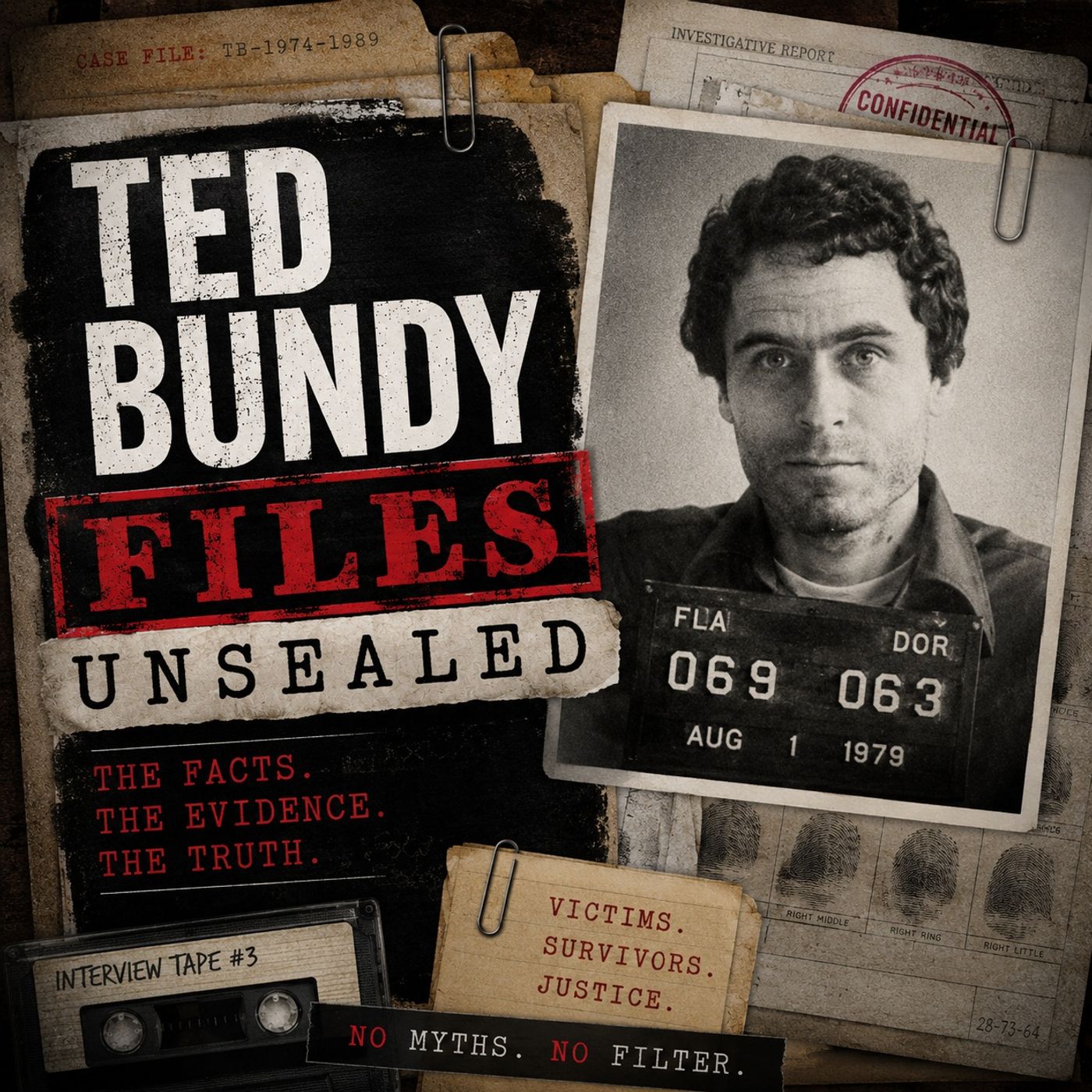
Ted Bundy Files Unsealed is a true crime podcast that takes an in-depth look at the notorious serial killer Ted Bundy. Through careful research, it explores his life, crimes, investigations, trials, and the lasting impact of his actions. The show revisits evidence, survivor accounts, and timelines to separate documented facts from popular myth. It aims to understand what happened and the lessons learned, without glorifying violence. Listener discretion is advised due to disturbing subject matter.
Επεισόδια
-
 This Is What Happened To Ted Bundy's Body After He Was Executed 24.09.2026 32λThis episode describes the final moments and aftermath of the 1989 execution of serial killer Ted Bundy. It details his death via the electric chair in Florida, noting his last words and the public celebration that occurred outside the prison. Following his death, medical professionals conducted an autopsy and brain examination to search for physical abnormalities that might explain his violent behavior, though none were found. The episode also covers Bundy’s final requests, including his desire for his cremated remains to be spread across the Cascade Mountains. Ultimately, the passage highlights the irony of his burial wishes and the lack of scientific explanation for his crimes found within his physiology.Content Warning: This podcast contains discussions of homicide, violence, abuse, and other graphic themes related to real-life criminal events. It is intended for mature audiences and listener discretion is advised.This episode includes AI-generated content.
 -
The Final Current: Inside Ted Bundy's Execution 24.09.2026 36λThis episode provides a detailed account of the 1989 execution of the notorious serial killer Ted Bundy at Florida State Prison. It explores the final chapter of his life, beginning with the Florida murder spree and subsequent arrests that ended his years of evading justice. The episode describes the public's celebratory reaction to his death sentence and the specific technicalities of his end in the electric chair. Additionally, the article covers the forensic examination of his brain and his final request to have his remains scattered in the mountains where he once hid his victims. Ultimately, the narrative examines how an "invisible psychopath" managed to maintain a facade of normalcy while committing horrific crimes.Content Warning: This podcast contains discussions of homicide, violence, abuse, and other graphic themes related to real-life criminal events. It is intended for mature audiences and listener discretion is advised.This episode includes AI-generated content.
-
How Was Ted Bundy Able To Get Away With So Many Murders? 22.09.2026 24λThis episode examines how Ted Bundy utilized his conventional attractiveness and social status to avoid detection while committing dozens of murders. The author explains that his educational background and involvement in politics created a veneer of respectability that allowed him to manipulate both the public and law enforcement. Furthermore, the episode highlights how systemic failures and poor police oversight enabled him to escape custody multiple times, leading to additional fatalities. Ultimately, the source argues that Bundy’s ability to frequently alter his appearance and exploit his "wholesome" persona cemented his status as a dangerous cultural icon. This overview clarifies that his crimes were facilitated as much by societal biases as by his own cunning.Content Warning: This podcast contains discussions of homicide, violence, abuse, and other graphic themes related to real-life criminal events. It is intended for mature audiences and listener discretion is advised.This episode includes AI-generated content.
-
A Chilling Theory On Ted Bundy's Motive For Murder 21.09.2026 33λThe episode explores several psychological theories regarding the motives of the notorious serial killer Ted Bundy. A prominent hypothesis suggests his violence was a targeted vendetta against his former girlfriend, Diane Edwards, as his victims often shared her physical appearance. Other contributing factors mentioned include a unstable childhood where he was deceived about his parentage and his admitted addiction to violent pornography. Recent media projects on platforms like Netflix have fueled a renewed public fascination with these sinister crimes. Ultimately, while experts examine these potential catalysts, the exact origin of his sadistic behavior remains a subject of intense speculation.Content Warning: This podcast contains discussions of homicide, violence, abuse, and other graphic themes related to real-life criminal events. It is intended for mature audiences and listener discretion is advised.This episode includes AI-generated content.
-
The Reason Ted Bundy Sometimes Returned To His Crime Scenes 21.09.2026 27λThis episode examines the disturbing motivations and compulsive behaviors of serial killer Ted Bundy as revealed through his final interviews with the FBI. The episode highlights Bundy’s admission that he frequently revisited crime scenes because he viewed the locations where he discarded remains as "hallowed ground." Experts suggest these return trips and his acts of necrophilia were driven by a pathological need for absolute power and control over his victims. Bundy specifically targeted young women he deemed "worthy prey," using his charm to lure them before engaging in post-mortem violence to avoid any possibility of rejection. Furthermore, he advised investigators that many killers return to their victims to admire their actions, a trait that defined his own predatory cycle.Content Warning: This podcast contains discussions of homicide, violence, abuse, and other graphic themes related to real-life criminal events. It is intended for mature audiences and listener discretion is advised.This episode includes AI-generated content.
-
Every Actor Who Has Played Ted Bundy In A Movie 21.09.2026 36λThis episode examines the extensive cinematic history of serial killer Ted Bundy, documenting various actors who have portrayed him from the 1980s through 2021. The episode highlights how performers like Mark Harmon, Zac Efron, and Luke Kirby approached the role while navigating the ethical thin line between psychological study and the glamorization of a murderer. Several films are critiqued for their graphic violence or lack of depth, while others are noted for focusing on the investigative efforts of law enforcement and survivors. A recurring theme across these productions is the public's enduring fascination with Bundy, which has sparked significant modern backlash regarding the necessity of retelling his story. Ultimately, the source serves as a comprehensive guide to Bundy's presence in popular media and the varied motivations of the artists who recreate his notorious crimes.Content Warning: This podcast contains discussions of homicide, violence, abuse, and other graphic themes related to real-life criminal events. It is intended for mature audiences and listener discretion is advised.This episode includes AI-generated content.
-
What Was Ted Bundy's Childhood Really Like? 20.09.2026 38λThis episode examines the troubled childhood and conflicting life story of the notorious serial killer Ted Bundy. The episode explores how biological mysteries and a deceptive family structure—where Bundy’s mother was presented as his sister—may have shaped his psychopathy. Although Bundy often provided contradictory accounts of his youth, evidence suggests he was raised in an abusive environment led by his grandfather before moving to Washington. The source highlights early warning signs of his later violence, including teenage arrests and his potential involvement in a disappearance at age fourteen. Ultimately, the narrative illustrates the difficulty of verifying the origins of a monster who habitually manipulated the truth of his own history.Content Warning: This podcast contains discussions of homicide, violence, abuse, and other graphic themes related to real-life criminal events. It is intended for mature audiences and listener discretion is advised.This episode includes AI-generated content.
-
Here's What Was Wrong With Ted Bundy According To A Psychologist 20.09.2026 34λThe episode examines the psychological profile of the infamous serial killer Ted Bundy, focusing specifically on the analysis conducted by prison psychologist Al Carlisle. It highlights the profound duality of Bundy’s character, contrasting his charismatic public persona with the violent, sadistic nature of his crimes. The episode explains how Bundy utilized complex mental processes like fantasy, dissociation, and compartmentalization to maintain a mask of normalcy while committing heinous acts. By investigating his awkward childhood and habit of pathological lying, the source illustrates how he successfully deceived those around him. Ultimately, the episode provides a clinical perspective on how Bundy’s mental defenses allowed him to justify and hide his lack of empathy.Content Warning: This podcast contains discussions of homicide, violence, abuse, and other graphic themes related to real-life criminal events. It is intended for mature audiences and listener discretion is advised.This episode includes AI-generated content.
-
Inside the Mind of Ted Bundy: Eight Dark Revelations 19.09.2026 34λThis episode examines the Netflix documentary series focusing on the life and crimes of Ted Bundy through his own death row recordings. It highlights the most harrowing revelations from the show, including the killer's admission of necrophilia and his claims of being driven by an internal "entity." The text details how Bundy’s outwardly normal persona allowed him to deceive his loved ones while he meticulously planned violent attacks and daring prison escapes. By focusing on specific events like the Chi Omega murders, the episode illustrates the brutality and calculated nature of his actions. Ultimately, the source emphasizes the terrifying legacy of a man whose total number of victims may remain unknown.Content Warning: This podcast contains discussions of homicide, violence, abuse, and other graphic themes related to real-life criminal events. It is intended for mature audiences and listener discretion is advised.This episode includes AI-generated content.
-
Warning Signs Everyone Ignored About Ted Bundy 19.09.2026 37λThis episode explores the disturbing early life and overlooked behavioral warnings of the infamous serial killer Ted Bundy. While Bundy maintained a charismatic and educated public image, the episode details how he exhibited signs of psychopathy from a very young age, including an obsession with knives and the torture of animals. It describes his antisocial tendencies and adolescent crimes, such as theft and voyeurism, which preceded his eventual transition into violent homicide. Additionally, the source examines reports of his menacing personality shifts and the theory that his victim count may be far higher than officially recorded. Ultimately, the piece illustrates how Bundy’s outward normality allowed him to mask a predatory nature that began manifesting in childhood.Content Warning: This podcast contains discussions of homicide, violence, abuse, and other graphic themes related to real-life criminal events. It is intended for mature audiences and listener discretion is advised.This episode includes AI-generated content.
-
The Santa Rosa Hitchhiker Murders: Five Decades of Mystery 08.09.2026 33λThis episode summarizes the Santa Rosa hitchhiker murders, a series of unsolved homicides involving at least seven young females in Sonoma County during the 1970s. The author details the victims’ disappearances and the discovery of their remains, which were often found in remote creek beds or embankments. High-profile serial killers such as Ted Bundy and Rodney Alcala have been investigated as potential culprits, though definitive DNA evidence remains elusive. The episode also explores local suspects, including Jim Mordecai and a deceased man linked to the crimes by a former coroner. Despite five decades of investigation and over 300 potential leads, the perpetrator's identity stays a mystery. Law enforcement continues to seek public assistance to finally provide closure for the grieving families.Content Warning: This podcast contains discussions of homicide, violence, abuse, and other graphic themes related to real-life criminal events. It is intended for mature audiences and listener discretion is advised.This episode includes AI-generated content.
-
Beyond the Shadow of Ted Bundy 06.09.2026 44λThe episode review on 48 Hours recounts the harrowing experiences of women who survived Ted Bundy’s 1978 attacks at Florida State University. Survivors Kathy Kleiner and Cheryl Thomas provide firsthand accounts of the violence they endured and their long, difficult journeys toward physical and emotional recovery. The source also details the criminal investigation, highlighting how Sheriff Ken Casares utilized a rare bite mark as primary evidence to link Bundy to the crime scene. Despite the media’s fascination with the killer’s supposed charm, the narrative centers on the resilience of the victims and the lasting impact of their trauma. Ultimately, the episode emphasizes honoring the lives of the deceased while celebrating the strength of those who moved past the tragedy.Content Warning: This podcast contains discussions of homicide, violence, abuse, and other graphic themes related to real-life criminal events. It is intended for mature audiences and listener discretion is advised.This episode includes AI-generated content.
-
The Making of a Monster - The Origin of Ted Bundy 06.09.2026 55λThis episode provides a detailed biographical account of the life and crimes of Ted Bundy, tracing his journey from a troubled childhood marked by identity crises to his eventual execution. The source explores how Bundy utilized his natural charisma and academic background in psychology and law to mask a violent double life that spanned multiple states during the 1970s. It details his manipulative techniques, such as faking injuries to lure victims, alongside his two daring prison escapes and the eventual Florida trial that led to his death sentence. Various psychological profiles are examined to explain his lack of remorse and specialized sexual deviancies, contrasting his outward "normalcy" with his inner sociopathy. Finally, the episode reflects on his cultural impact, including his interactions with investigators and the published memoirs of the women who once trusted him.Content Warning: This podcast contains discussions of homicide, violence, abuse, and other graphic themes related to real-life criminal events. It is intended for mature audiences and listener discretion is advised.This episode includes AI-generated content.
-
Ted Bundy’s Death Row Letters and Final Words 29.08.2026 34λThe episode provide a chilling look into the final communications of the infamous American serial killer Ted Bundy. While on death row, Bundy maintained a haughty and dismissive tone in letters to his family, consistently denying his involvement in any murders despite the overwhelming evidence against him. His cousin, Edna Martin, described his writing as condescending and manipulative, noting that he refused to drop his deceptive facade even when directly questioned about his crimes. Interestingly, his final words before his 1989 execution were surprisingly simple, as he merely requested that his love be passed on to his friends and family members. This calm farewell stood in stark contrast to his brutal history of violence and the defiant, unrepentant attitudes of other notorious criminals. Ultimately, the episode illustrate how Bundy used his articulate persona to mask his lack of remorse until the very end.Content Warning: This podcast contains discussions of homicide, violence, abuse, and other graphic themes related to real-life criminal events. It is intended for mature audiences and listener discretion is advised.This episode includes AI-generated content.
-
Ted Bundy - A Suspect in the Sonoma County Cold Cases 16.08.2026 45λThe episode details the Santa Rosa Hitchhiker Murders, a series of unsolved killings in Sonoma County during the early 1970s involving at least seven young female victims. Investigators have frequently considered Ted Bundy as a primary suspect due to his presence in California and the similarity between these crimes and his established methods. Despite his execution in 1989, the 2011 recovery of his DNA profile allowed authorities to pursue modern forensic links to these cold cases. Experts like Robert Keppel support the theory that Bundy began his violent spree earlier than records suggest, though some believe a local offender with intimate knowledge of the terrain is more likely. While other suspects like the Zodiac Killer were explored, the lack of definitive physical evidence or confessions leaves the mystery unresolved. Ultimately, the source highlights the enduring trauma of the victims' families and the persistent effort to find forensic closure decades later.Content Warning: This podcast contains discussions of homicide, violence, abuse, and other graphic themes related to real-life criminal events. It is intended for mature audiences and listener discretion is advised.This episode includes AI-generated content.
-
Why does Ted Bundy’s name keep coming up in the Burlington cold case? 14.08.2026 42λFor over fifty years, the 1971 murder of Rita Curran in Burlington, Vermont, was frequently linked to the infamous serial killer Ted Bundy due to his local birth and similar criminal patterns. Despite decades of speculative theories fueled by true-crime literature and Bundy's own cryptic remarks, modern DNA technology eventually redirected the investigation. In 2023, authorities used genetic genealogy to identify the true culprit as William DeRoos, a neighbor who lived in Curran's apartment building at the time of the attack. This discovery highlights the limitations of circumstantial evidence and the power of forensic science to dismantle myths surrounding high-profile criminals. The case ultimately reveals how notoriety can overshadow the truth, proving that the most famous suspect is not always the guilty party.Content Warning: This podcast contains discussions of homicide, violence, abuse, and other graphic themes related to real-life criminal events. It is intended for mature audiences and listener discretion is advised.This episode includes AI-generated content.
-
Did Ted Bundy Kill His First Victim When He Was 14? 11.08.2026 54λThis episode explores the enduring mystery of whether the infamous serial killer Ted Bundy committed his first murder at age 14. It focuses on the 1961 disappearance of Ann Marie Burr, an eight-year-old girl who vanished from her Tacoma home just miles from where a young Bundy lived. The source examines circumstantial evidence linking him to the crime, such as his local paper route and cryptic statements he made before his execution. While DNA testing in 2011 proved inconclusive, the article highlights how forensic limitations and Bundy’s own habit of manipulation have left the case officially unsolved. Ultimately, the narrative weighs the psychological theories regarding Bundy's early development against the lack of definitive physical proof. This overview captures the tragic impact on the Burr family and the persistent suspicion that Bundy’s violent trajectory began much earlier than documented.Content Warning: This podcast contains discussions of homicide, violence, abuse, and other graphic themes related to real-life criminal events. It is intended for mature audiences and listener discretion is advised.This episode includes AI-generated content.
-
A New DNA Profile of Ted Bundy Could Help Solve These Utah Cold Cases 09.08.2026 41λUsing advanced genotyping technology acquired in 2023, Utah authorities successfully extracted a full DNA profile of serial killer Ted Bundy from evidence preserved since 1974. This forensic breakthrough officially closed the decades-old murder case of Laura Ann Aime, providing her family with long-awaited scientific certainty. Because this modern profile is now uploaded to national databases, law enforcement agencies across the country can compare it against biological material from other unsolved cold cases. While this provides a path to justice for victims with recovered remains, cases involving missing bodies still face significant investigative hurdles. Ultimately, the discovery highlights how meticulous evidence preservation and evolving science can eventually overcome the passage of time. This development offers a renewed sense of hope for resolving various 1970s disappearances linked to Bundy’s violent tenure in the Mountain West.Content Warning: This podcast contains discussions of homicide, violence, abuse, and other graphic themes related to real-life criminal events. It is intended for mature audiences and listener discretion is advised.This episode includes AI-generated content.
-
How the Grand Junction Police Department Solved a Ted Bundy Victim Cold Case 01.08.2026 33λThe episode details the decades-long investigation into the disappearance of Denise Lynn Oliverson, who vanished in Grand Junction, Colorado, in April 1975. Although her body was never recovered, the case was officially reclassified as a homicide and closed in 2019 after a methodical review by local authorities. Investigators successfully linked the crime to serial killer Ted Bundy by combining historical gas receipts that placed him in the city with a long-overlooked audio confession. This recording, which specifyied that he discarded her remains in the Colorado River, provided the necessary resolution for a case that had remained a missing-persons file for over forty years. The sources emphasize that while modern DNA played a limited role, persistent police work and inter-agency communication were vital in naming the perpetrator. Ultimately, the narrative highlights the somber reality of achieving justice for families when a killer is long dead and physical evidence is scarce.Content Warning: This podcast contains discussions of homicide, violence, abuse, and other graphic themes related to real-life criminal events. It is intended for mature audiences and listener discretion is advised.This episode includes AI-generated content.
-
Extremely Wicked Director on How Ted Bundy ‘Seduced’ His Victims 29.07.2026 34λFilmmaker Joe Berlinger released two distinct projects in 2019 to provide a comprehensive look at the life and crimes of Ted Bundy. The first, a Netflix documentary series, utilizes over 100 hours of death row recordings to provide a clinical analysis of the killer’s internal psyche. In contrast, the narrative feature film starring Zac Efron explores the perspective of Bundy’s longtime girlfriend to illustrate how manipulation and charm can mask profound evil. Berlinger intentionally avoided graphic violence in the dramatization to mirror the deception experienced by those who trusted the murderer. By presenting these works as two sides of the same coin, the director examines both the evidentiary reality of the crimes and the social camouflage that allowed them to occur. Ultimately, the sources highlight how the most dangerous threats often emerge from individuals who appear ordinary and trustworthy.Content Warning: This podcast contains discussions of homicide, violence, abuse, and other graphic themes related to real-life criminal events. It is intended for mature audiences and listener discretion is advised.This episode includes AI-generated content.
Παρόμοια podcasts


Δημοφιλές σε
Αυτό το podcast εμφανίζεται και στις λίστες podcasts αυτών των χωρών.
