
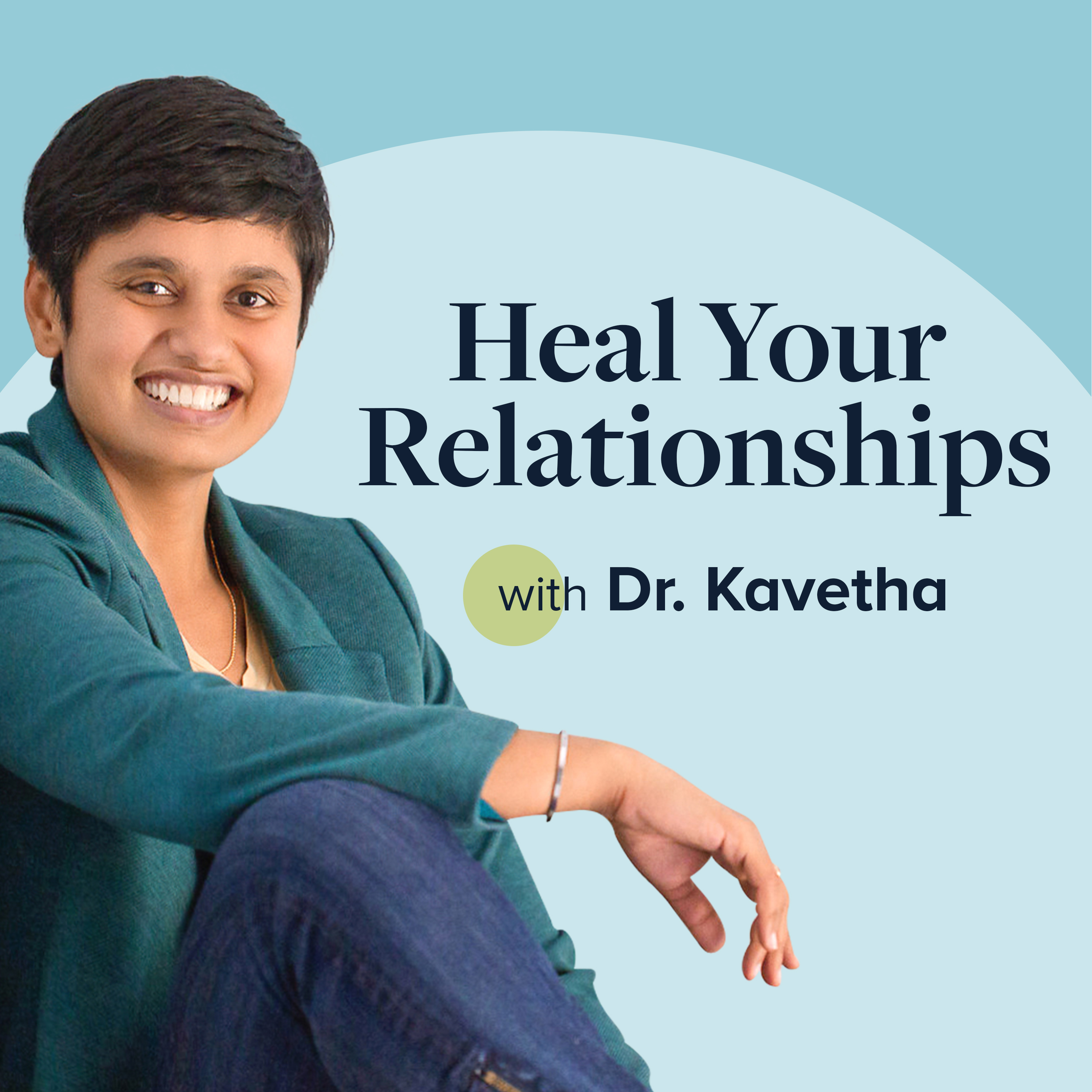
Heal Your Relationships
Kavetha Sundaramoorthy
0
Heal Your Relationships is a show about marriage aimed at women whose partners refuse to go to therapy. Hosted by Dr. Kavetha Sun, a double board-certified psychiatrist, it draws on her own decade-long healing journey and her professional experience. Each weekly episode offers simple, research-backed tools listeners can apply right away to resolve conflict, restore connection, and build a legacy they are proud of. The podcast also points listeners toward her coaching program and other resources for deeper support.
Επεισόδια
-
 No More Band-Aids: A Model for Permanent Healing 17.09.2026 23λLast week, we talked about following your complaints like breadcrumbs...Looking beyond the surface problem to understand what might actually be asking for healing underneath.But once you find the source… how do you actually heal it?For years, my own approach looked a little like throwing spaghetti at the wall.A few therapy sessions. Some yoga. Meditation. Self-care. Then something else.And while many of those things helped, the relief was often temporary.They were Band-Aids.I eventually realized that lasting healing requires us to work with more than one part of ourselves.So in this week’s episode, I’m sharing the framework that came out of that journey: Mind, Body, and Love.We’ll look at healing the emotional wounds and protective patterns held in the mind, working with the nervous system and the reactions held in the body, and finally bringing that greater sense of safety into our relationships.Because healing isn’t just about understanding why you are the way you are.It’s about creating change that reaches deep enough that you don’t have to keep returning to the same Band-Aids.Episode Timestamps02:56 — Why I call this “No More Band-Aids” 05:08 — Is permanent healing actually possible? 07:06 — The three ingredients: Mind, Body & Love 08:54 — IFS: protectors, exiles & your Self 13:27 — Accessing the calm, steady part of yourself 14:18 — The body: polyvagal theory & somatic work 17:13 — Why relationships are essential to healing 19:23 — Authentic communication: truth AND connection 20:57 — Why all three pieces matterYou don’t have to spend your life endlessly managing the same patterns.Deeper healing is possible.And now...Want to go deeper?This Mind–Body–Love approach is also at the heart of the work we do inside Untriggerable.We don’t just teach you how to manage a trigger when it happens. We work with the deeper patterns underneath it; your mind, nervous system, and relationships; so you can create change from the inside out.Join us inside Untriggerable on Circle
 -
Your Complaints Are a Doorway to Your Healing 10.09.2026 15λYour Complaints Are a Doorway to Your HealingLast week, we talked about the power of language — and I invited you to start paying closer attention to the words you use when you talk to yourself and about your life.This week, I want to take that one step deeper.Because there’s one particular kind of language that can tell us so much about what’s happening underneath the surface:Our complaints.Think about something you complain about over and over.Maybe it’s that you’re always the one giving.Your partner never helps enough.Work is constantly overwhelming.There’s never enough time for you.Or maybe you keep finding yourself thinking, “Why am I dealing with this again?”What if that complaint isn’t just something you need to stop saying or solve?What if it’s trying to tell you something?I like to think about complaints the same way I would think about a fever as a physician.If you have a fever, of course I want to help you feel better. But bringing down the fever doesn’t necessarily address what’s causing it.We have to find the source.Your complaints can work the same way.They can be little clues — or, as I describe them in this episode, tributaries — that we can follow back toward deeper wounds, unmet needs, and longings we may not even consciously recognize.And once we stop seeing our complaints as something to simply vent about and start getting curious about what they’re pointing toward, they can become an incredible doorway into healing.Episode Timestamps00:48 — Why your complaints can help map your inner world01:47 — Why venting and validation don't always create lasting change03:20 — What a complaint actually is04:26 — How early experiences can become subconscious core wounds05:16 — Complaints as “tributaries” leading us back to the source06:39 — The fever analogy: treating the symptom vs. finding the cause09:00 — When “I'm so busy” may be protecting something deeper11:12 — How busyness can sometimes protect us from loneliness12:15 — Why the same wounds can keep returning as different complaints12:50 — Why healing involves both inner work and the bodySo this week, instead of judging yourself when you notice a complaint, try getting curious:What am I really longing for here?What feels missing?What keeps repeating?And what might this complaint be asking me to finally pay attention to?Your complaints aren't necessarily the problem.They may be the breadcrumbs showing you where to look.Want to go deeper?Following those breadcrumbs back to the source — and working with what we find there in both the mind and the body — is at the heart of the work we do inside Untriggerable.Instead of simply managing the latest trigger or putting another band-aid over the surface problem, we work on understanding and healing the deeper patterns that keep bringing us back to the same place.If you're ready to continue that work with us, you can learn more about Untriggerable and join our community on Circle:Join the Untriggerable community on CircleThis week, listen to your complaints a little differently.There may be more wisdom in them than you realize.🗣️ Oh, and if you have something you're navigating and would love my take on it... You can submit a question or situation for a future episode right here (totally anonymous!): 👉 Submit your questionP.S. Love the podcast? Reviews help us spread these life-changing tools far and wide. 💛If you leave a 5-star review and submit a screenshot here, I’ll send you my Rapid Relationship Repair mini-course—a short but powerful set of tools to reduce conflict and improve connection immediately.
-
Power of Language 02.09.2026 17λQuick gut check:If I recorded your self-talk today, would you want to play it back for someone you love?Last week, I shared more of my own imperfect healing journey — and how our earlier experiences can continue shaping the way we think, feel, and relate to the people around us.But sometimes those patterns are hiding somewhere incredibly ordinary:In the words we use every day.The words running quietly through our minds.The things we say when we're frustrated.The stories we tell about ourselves, our relationships, and what's possible for us.Because language doesn't just describe our experience.It can shape it.And the beautiful thing about language is that it's one of the most accessible places to begin creating change.So in this week's episode, I'm giving you a simple exercise to uncover some of the hidden patterns in your own language.You'll free-write for just a few minutes and then come back to what you've written with gentle curiosity — looking at three things: whether your language leans toward yourself or connection, whether you tend toward black-and-white thinking or nuance, and whether your words reflect personal choice or a feeling that you have no choice at all.No judgment. No trying to fix yourself. Just notice.Because sometimes changing the way we experience our lives can begin with something as small as changing the words we use to describe them.Episode Timestamps01:01 — A quick check-in with your inner world01:40 — Why the words you use are such a powerful lever for change03:26 — The simple free-writing exercise05:00 — Lens #1: “I, me, mine” vs. language of connection06:06 — Lens #2: Black-and-white thinking vs. nuance07:24 — Lens #3: “I have to” vs. language of personal power10:44 — How to assess your overall language patterns11:39 — The connection between rumination, anxiety, and depression14:19 — Why noticing these patterns is actually good news15:50 — Your invitation to try the exercise yourselfWhen you do the exercise, don't try to change everything at once.Simply notice where you tend to lean.Then choose one of these three areas and experiment with shifting your language this week.See what happens when “I have to” becomes “I'm choosing to.”When “this is just how it is” becomes a little more curious.When certainty makes room for possibility.Small changes in language can open the door to much bigger changes in how we see ourselves and the world around us.Want to go deeper?Changing our language can be a powerful starting point. But sometimes the words we use are connected to deeper emotional patterns and old protective responses that have been with us for years.That's the deeper work we do inside Untriggerable.We work with the mind, the nervous system, and our relationships to understand what's underneath our triggers and build new ways of responding — not just when life is easy, but in the moments that challenge us most.If you'd like to learn more about Untriggerable and continue this work with us, join us on our Circle platform:Join the Untriggerable community on CircleAnd if you try this week's exercise, I'd love to hear what you discover.What's one phrase you're choosing to shift this week?
-
My (Imperfect and Ongoing) Healing Journey 27.08.2026 30λI’ve been on a healing journey for a long time.And I’m still on it.I still get triggered. I still get suspicious. I still have moments when trusting and letting go are hard. The difference today isn’t that those reactions have disappeared.It’s that I know what to do when they show up.In this week’s episode, I want to take you behind the scenes of how I got here — because the way I approach healing today didn’t come neatly packaged in a textbook.It came through a lot of trial and error.Honestly, probably more error than trial. 🤣I love psychiatry. I trained at some incredible institutions and learned so much about the human mind. But even after becoming a psychiatrist, I realized something difficult:I still didn’t know how to be in relationships.The tools I needed to create safety within myself, regulate my nervous system, heal old wounds, and stay connected when I was triggered were tools I eventually had to find, practice, and integrate for myself.And that journey goes much further back than my own adulthood.In this episode, I’m sharing parts of my family story that shaped me deeply — the trauma my parents carried, the beliefs and survival patterns I inherited, losing my mother, repressing parts of myself, and eventually realizing that healing wasn’t just about me.It was also about what I would pass on.One of the biggest realizations I’ve had is that intergenerational healing doesn’t begin or end with one person. Each generation before me, imperfectly and in their own way, passed on a little less pain than they received.Now I get to be another link in that chain.And that has become one of the North Stars of my life: the trauma stops with me.Your story will look different from mine. But the effects of our earlier experiences often show up in three places: how we manage our emotions and triggers, what happens inside our bodies and nervous systems, and how we show up in our closest relationships.Healing doesn’t mean becoming someone who never gets triggered again.For me, it has meant learning to recognize what’s happening inside me and knowing how to return to safety, calm, and connection — again and again.And that’s the work I want to share with you.Episode Timestamps00:54 — Why I’m sharing my imperfect healing journey04:41 — My childhood and the intergenerational trauma in my family10:28 — Growing up between external privilege and internal chaos15:54 — Losing my mother and carrying the belief that it was my fault19:44 — When things began to change22:21 — Why becoming a psychiatrist still didn’t teach me how to heal my relationships24:54 — The mission that grew out of my own healing25:50 — The 3 areas where our earlier experiences show up today27:13 — I still get triggered — here’s what’s different now28:12 — The three pieces I believe create a powerful path toward lasting healingWant to go deeper?My own healing taught me that insight alone isn’t always enough.I could understand why I reacted the way I did and still have my body respond automatically when something touched an old wound.That experience became a huge part of why I created Untriggerable.Inside Untriggerable, we work with the mind, the body and nervous system, and the patterns that show up in our relationships — so you can learn to recognize your triggers, regulate what’s happening inside you, and respond from a place of greater safety and choice.If you’d like to learn more about the program and continue this work with us, you can join us on our new Circle platform:Join the Untriggerable community on CircleWherever you are in your own healing journey, remember: it doesn’t have to be perfect.Mine certainly isn’t.It just has to keep moving.
-
3 Tools to Remove Limiting Beliefs From Your Subconscious Mind [Part 2] 20.08.2026 26λLast week, we talked about how to uncover the limiting beliefs quietly shaping your choices.But recognizing them is only the beginning.Because you can know exactly what your limiting belief is…and still find yourself hesitating, resisting, or recreating the same pattern.I know because I experienced this in my own business.I knew I wanted to make changes. I knew the way I was working no longer felt aligned with how I wanted my life to look.But my business was successful.And underneath all that hesitation was a much older belief I had absorbed growing up:Money is hard to come by. You have to sacrifice what matters to succeed. And there may not be enough to go around.Intellectually, I knew I didn’t want to live that way.But subconsciously? That belief was still influencing my decisions.So in this week’s episode — Part 2 of our Limiting Beliefs series — I’m sharing the three tools I used to begin shifting those beliefs from the inside out.We’ll start by replacing that exhausting inner debate with thoughts that are simply grounded in facts. Then I’ll show you how I began practicing the identity of the person I wanted to become — and how collecting small “confirmations” helped that new identity become more natural over time.Because changing a limiting belief isn’t about forcing yourself to think positively.It’s about slowly giving your mind a different experience to believe.And for me, after about six to eight weeks of practicing these tools, something shifted.The changes I had spent months resisting began to happen with far less force. I restructured my business, changed how I spent my days, and created something that felt much more aligned with my values — without sacrificing the financial stability I had been so afraid of losing.Episode Timestamps00:48 — Picking up where we left off in Part 102:10 — Why changing a successful business felt so scary03:28 — The limiting belief about money I uncovered06:24 — How subconscious beliefs kept me recreating what I wanted to change08:25 — Tool #1: Replace resistance with fact-based thoughts12:42 — Tool #2: Start practicing a new identity16:19 — How I used “abundance walks” to notice what was already around me20:40 — Tool #3: Collect confirmations of your new identity22:07 — What changed after practicing these tools for 6–8 weeks24:14 — What my life and business look like on the other sideIf you haven’t listened to last week’s episode, 3 Ways to Uncover Your Hidden Limiting Beliefs [Part 1], I recommend starting there first.Part 1 helps you uncover what may be running beneath the surface.Part 2 helps you begin changing it.And as you listen, don’t try to tackle every limiting belief at once.Choose one.Get curious about it.And start giving yourself evidence that another way of thinking, feeling, and living is possible.Want to go deeper?Sometimes the patterns we intellectually understand are also tied to deeper emotional reactions that continue showing up even when we know better.That’s exactly the deeper work we do inside Untriggerable — learning how to work with those patterns from the inside out so they no longer have to keep running the show.And we now have a new home on Circle where you can learn more about Untriggerable and join our community:Join the Untriggerable community on CircleI’d love to see you there.
-
3 Ways to Uncover Your Hidden Limiting Beliefs [Part 1] 13.08.2026 18λHave you ever known exactly what you wanted to change…but somehow kept doing the same thing?Maybe you want to change a pattern in your relationship.Make a move in your career.Take better care of yourself.Or finally go after something you’ve been thinking about for months.You know what you want.And yet… you keep postponing it.I’ve been there too.There was a season when I knew exactly how I wanted my personal life and business to feel. I had my North Star.But for six months to a year, I kept putting off some of the very decisions that would take me there.Why?Limiting beliefs.And the tricky thing about limiting beliefs is that we often don’t even know we have them.They hide underneath the complaints we repeat, the conversations we have with our friends, and the stories we’ve told ourselves so many times that they simply feel like facts.In this week’s episode, I’m sharing three practical ways I use to bring those hidden beliefs to the surface, including a journaling practice that can help you move beyond the story you already consciously know and begin uncovering what may be sitting underneath it. Because before we can change a limiting belief…we have to be able to see it.Episode Timestamps00:53 — My own “North Star” and the beliefs that kept me from moving toward it 03:18 — Why limiting beliefs keep us stuck in the same patterns 04:56 — Start here: choose one specific area where you feel stuck 06:58 — Tool #1: Listen to your recurring complaints 09:05 — The difference between a circumstance and the belief you attach to it 10:16 — Tool #2: Pay attention to what you and your friends vent about 12:23 — Tool #3: Use journaling to uncover what’s beneath the surface 13:51 — The journaling trick that takes you beyond your conscious story 15:49 — Putting all three tools together 17:38 — What’s coming in Part 2And this is only Part 1.This week, your job is simply to find the beliefs that may be quietly running the show.Don’t rush to change them yet.Use these three tools, get curious, and write down what you uncover, because we’re going to use exactly what you find in next week’s episode:3 Tools to Remove Limiting Beliefs From Your Subconscious Mind [Part 2]That’s where I’ll show you what to actually do with these beliefs once you’ve brought them into the light.So do the exercises from today, keep your notes somewhere close, and meet me back here next week for Part 2.Want to go deeper?Sometimes the beliefs we uncover aren’t just thoughts we can talk ourselves out of. They’re connected to deeper emotional patterns, old wounds, and reactions that can keep showing up even when we intellectually know better.That’s exactly the kind of deeper work we do inside Untriggerable.And we now have a new home on Circle where you can learn more about the program, access resources, and join our community.Join us inside the Untriggerable community on CircleI’d love to see you there.🗣️Oh, and if you have something you're navigating and would love my take on it... You can submit a question or situation for a future episode right here (totally anonymous!):👉 Submit your questionP.S. Love the podcast? Reviews help us spread these life-changing tools far and wide. 💛If you leave a 5-star review and submit a screenshot here, I’ll send you my Rapid Relationship Repair mini-course—a short but powerful set of tools to reduce conflict and improve connection immediately.
-
Use Your Imagination to Renew Your Mind Using These 4 Inner Resources 06.08.2026 14λLast week, we explored a powerful idea:You are not your thoughts or your feelings.So the next question becomes...If I'm not my thoughts, then how do I actually begin to heal the part of me that still gets triggered?Many of us try to change our reactions by talking ourselves through them.We promise we'll stay calm next time.We'll communicate better.We'll be more patient.And sometimes it works......for a day or two.But if your emotional reactions keep returning, it may be because there's a younger part of you that's still waiting to feel safe.In this week's episode, I want to introduce you to one of my favorite healing practices—using your imagination to access four powerful inner resources that help bring calm, wisdom, protection, and comfort to your nervous system.It may sound simple, but there's fascinating neuroscience behind it: when we vividly imagine an experience, the brain begins creating new neural pathways almost as if it had happened in real life. That's one of the beautiful foundations of neuroplasticity.Episode Timestamps00:48 — Why communication tools aren't enough when your inner child is hurting02:19 — Why imagination can literally help rewire your brain04:42 — Resource #1: Creating your Safe Space07:51 — Resource #2: Finding your Wise Counsel (yes... Dumbledore counts!)09:31 — Resource #3: Discovering your Protector11:45 — Resource #4: Choosing your Comforter12:25 — A guided practice to install these four resources within youHealing isn't about becoming someone different.It's about giving the parts of you that still feel scared, alone, or overwhelmed the experiences they never received.Sometimes, the resources you've been searching for aren't outside of you at all.They're already within you—just waiting to be discovered.If you'd like to go deeper...The four inner resources I shared today are just one small piece of the work we do inside Untriggerable.In the program, I guide you through a complete step-by-step process to heal emotional triggers at the root, regulate your nervous system, and create lasting change—not just better coping strategies.If this episode resonated with you and you're ready to experience that kind of transformation, I'd love to support you.You can learn more about Untriggerable by joining our free physician community here:https://www.skool.com/relationshipmastery4physiciansOr simply reply to this email or reach out to my team at [email protected], and we'll be happy to share all the details.🗣️ Oh, and if you have something you're navigating and would love my take on it... You can submit a question or situation for a future episode right here (totally anonymous!): 👉 Submit your questionP.S. Love the podcast? Reviews help us spread these life-changing tools far and wide. 💛If you leave a 5-star review and submit a screenshot here, I’ll send you my Rapid Relationship Repair mini-course—a short but powerful set of tools to reduce conflict and improve connection immediately
-
A Simple Tool to Reduce Anxiety and Stress in Just 90 Seconds 30.07.2026 11λLast week, we talked about how unresolved trauma can keep our nervous systems stuck in a constant state of alert, even when we're no longer in danger.So the question naturally becomes:What can we do in those moments when we feel our stress or anxiety taking over?The truth is, stress itself isn't the enemy.Life will always bring deadlines, difficult conversations, and unexpected challenges.The problem is when our bodies never get the chance to recover.Instead of completing the stress response, many of us simply distract ourselves, with our phones, food, work, or endless busyness, while our nervous system remains switched on. Over time, that chronic stress can affect our physical health, cloud our thinking, and make it harder to show up well in our relationships.In this week's episode, I'm sharing one of my favorite practical tools: a simple breathing technique called the physiological sigh. It takes less than 90 seconds, can be done almost anywhere, and helps calm your nervous system by completing your body's stress response. I'll also share a simple framework for understanding stress so you can begin responding to it with more confidence, rather than just reacting to it.Episode Timestamps00:50 — Why stress is normal (and why chronic stress isn't)01:27 — A simple technique to calm your nervous system in real time03:10 — What animals can teach us about completing the stress response04:17 — Why distractions don't actually reduce stress05:20 — A simple framework for managing stress anywhere07:12 — The science behind the physiological sigh09:06 — How to practice the breathing technique correctly10:40 — When to use it in everyday lifeThe goal isn't to eliminate stress.It's to give your body the chance to recover from it.Sometimes, creating more calm doesn't require changing your circumstances, it starts with taking one intentional breath.If you'd like to go deeper...The physiological sigh is one powerful tool—but it's just one piece of the puzzle.Inside our free Relationship Mastery for Physicians community on Skool, we share practical tools to help you regulate your nervous system, strengthen your relationships, and become less reactive to life's everyday stressors.If you'd like to continue learning alongside us, we'd love to have you join.Join the community here:https://www.skool.com/relationshipmastery4physiciansI hope to see you there.
-
3 Signs You are Struggling with Hidden Trauma and 6 Ways to Begin Healing Today 23.07.2026 25λLast week, we explored how certain thinking patterns can quietly create more suffering—and how reversing them can change the direction of your life.But what if your thinking isn't the whole story?What if the reason certain thoughts keep coming back... isn't because you're weak or "thinking wrong"......but because there's an unhealed wound underneath them?By the time we're 30, every one of us has experienced some form of trauma.Sometimes it's obvious.Sometimes it's a thousand little moments that quietly shaped how we see ourselves, other people, and the world.The challenge is that hidden trauma rarely announces itself.Instead, it shows up as recurring patterns we can't seem to explain.In this week's episode, we'll explore how hidden trauma can quietly shape the way you think, feel, and relate to others. I'll share three common signs that unresolved trauma may still be affecting your life, along with six practical tools to help you begin healing with greater awareness and self-compassion.Episode timestamps00:45 — Why every adult carries some form of trauma 03:15 — The three hidden places trauma shows up 03:26 — Signs of trauma in the mind 10:05 — Signs of trauma in the body 11:54 — Signs of trauma in relationships and behavior 15:07 — Six ways to begin healing today 23:23 — Bringing it all together: healing hidden trauma step by stepOne thing I've learned, both personally and through working with hundreds of women, is this:Trauma doesn't always look dramatic.Sometimes it looks like overthinking.Sometimes it's emotional numbness.Sometimes it's always expecting the worst.Sometimes it's constantly feeling "on guard," even when you're safe.And none of those mean you're broken.They simply mean your nervous system is still trying to protect you from something it hasn't fully healed yet.Healing begins the moment we stop asking,"What's wrong with me?"and start asking,"What happened to me, and what does my nervous system need now?"If this episode resonates with you...Much of the work we do inside Untriggerable is helping people gently reconnect with their bodies, regulate their nervous systems, and heal the deeper patterns that trauma leaves behind.If you're ready to move beyond simply understanding your patterns and begin transforming them, we'd love to support you.Simply reply to this email or reach out to us at [email protected] to learn more.You don't have to heal everything today.But you can begin today.
-
How to Reverse Your Miserable Thinking 16.07.2026 25λLast week, we explored what it means to become the bus driver instead of getting carried away by every thought and emotion that comes along.This week, I'd like to take that one step further.Because once you realize you're not your thoughts, the next question becomes:Which ways of thinking are quietly creating more suffering in your life?In this week's encore episode, I want to introduce you to one of my favorite psychological tools:Inversion Thinking.Instead of asking, "How can I become happier?"We'll ask a much more useful question:"How could I make my life more miserable?"It may sound backwards, but it's surprisingly powerful.Because once you identify the habits that create suffering, all you have to do is reverse them.In this episode, I'll walk you through six common thinking patterns that keep us stuck, and how turning each one upside down can help you create a more peaceful, joyful, and meaningful life.Episode timestamps00:51 — Why inversion thinking works so well 03:05 — Miserable Habit #1: Living in "shoulds" 04:40 — Miserable Habit #2: Fighting reality instead of accepting it 07:18 — Miserable Habit #3: Resisting or reacting to your emotions 11:37 — Miserable Habit #4: Seeing triggers as injustices instead of teachers 14:49 — Miserable Habit #5: Seeing people as all good or all bad 18:17 — Miserable Habit #6: Believing happiness exists somewhere in the future 22:51 — The six principles, summarized 24:20 — Your homework: Reverse each principle in your own lifeOne of the greatest freedoms I've discovered is this:Life isn't about finding a place where you'll only experience "positive" thoughts or feelings.Just like we've talked about over the last few weeks, every school bus has all kinds of passengers.The goal isn't to get rid of half the bus.The goal is to stay in the driver's seat.If these conversations have been resonating with you...If you've been enjoying this series on thoughts, emotions, and learning to stay grounded instead of getting swept away by your mind, I'd love to invite you to continue the journey with us.Join our free Relationship Mastery for Physicians community, where we share practical tools for nervous system regulation, emotional resilience, and healthier relationships:https://www.skool.com/relationshipmastery4physiciansOr, if you'd like to learn more about working with us, simply reply to this email or reach out to us at [email protected]'d love to support you as you continue building a life led by wisdom, not by your thoughts.🗣️Oh, and if you have something you're navigating and would love my take on it... You can submit a question or situation for a future episode right here (totally anonymous!):👉 Submit your questionP.S. Love the podcast? Reviews help us spread these life-changing tools far and wide. 💛If you leave a 5-star review and submit a screenshot here, I’ll send you my Rapid Relationship Repair mini-course—a short but powerful set of tools to reduce conflict and improve connection immediately.
-
How To Think About Your Thinking (and Stay Connected to Who You Truly Are) 09.07.2026 17λLast week, I invited you into a simple but powerful experiment:What if you are not your thoughts or your feelings?If you haven't listened to that episode yet, I'd encourage you to start there. It lays the foundation for everything we're exploring today.Because once you begin to see that you are the observer—not the constant stream of thoughts, emotions, memories, and sensations—the next question naturally becomes:How do I actually stay connected to that wiser part of myself when life gets busy... or emotionally overwhelming?That's exactly what we're diving into in this week's encore episode.I'll introduce you to one of my favorite metaphors: the School Bus Between Your Ears.It may sound simple, but this analogy has transformed the way thousands of my clients relate to their minds.Instead of fighting your thoughts...Instead of trying to get rid of uncomfortable emotions...You'll learn how to become the wise bus driver instead of getting pulled around by every passenger on the bus.Episode timestamps00:57 — Why this episode builds on last week's experiment04:57 — The question everyone asks: "How do I connect with my true self?"05:43 — The School Bus metaphor explained07:04 — Who the passengers really are08:40 — Becoming the bus driver instead of the passengers09:46 — Why chasing happiness keeps us stuck11:20 — What happens when you leave the driver's seat13:58 — A simple practice to notice without reacting15:12 — Labeling the "passengers" on your bus16:27 — How this builds emotional steadiness over timeThe goal isn't to have a bus full of perfect passengers.The goal is to remember who's driving.When you stop trying to control every thought and emotion, and instead learn to notice them with curiosity, you create space for clarity, wisdom, and freedom.------If today's episode resonated with you...Many high-achieving professionals spend years trying to "fix" their thoughts when the real transformation comes from learning how to relate to them differently.If you'd like to continue exploring nervous system regulation, emotional resilience, and practical tools for staying grounded under pressure, I'd love to invite you to join my free community:Relationship Mastery for Physicianshttps://www.skool.com/relationshipmastery4physiciansOr if you'd like to learn more about working with us, simply reply to this email or reach out to [email protected]. We'd love to help you take the next step.Oh—and if you have something you're navigating and would love my take on it...🗣️ You can submit a question or situation for a future episode right here (totally anonymous!):👉 Submit your questionP.S. Love the podcast? Reviews help us spread these life-changing tools far and wide. 💛If you leave a 5-star review and submit a screenshot here, I’ll send you my Rapid Relationship Repair mini-course—a short but powerful set of tools to reduce conflict and improve connection immediately.
-
Five Steps to Getting Unstuck, From ANYTHING 02.07.2026 18λHave you ever felt like you're trying so hard to move forward... yet somehow you keep ending up in the same place?Whether it's your relationships, your career, your health, or an old emotional pattern, feeling stuck can be incredibly frustrating. And the harder you push, the deeper you sometimes seem to sink.Here's the surprising part:What if nothing is actually wrong with you?In this week's episode, I explain why getting stuck isn't a lack of willpower—it's often the result of how your brain is wired to keep you safe.Your brain was designed to detect danger, not happiness. And when that primitive survival system takes over, it can trap you in loops of rumination, fear, self-doubt, and overthinking without you even realizing it.Episode timestamps00:55 — Why so many different struggles have the same root02:13 — What it really means to feel "stuck"03:37 — Understanding how your brain works06:03 — Your brain is designed to find danger—not happiness09:58 — The role of your prefrontal cortex10:55 — What happens when your survival brain takes over13:40 — The difference between pain and suffering15:26 — The legacy we pass to the next generation16:50 — A simple exercise to identify where you're stuckOne of the biggest shifts in my own life came when I realized this:My thoughts weren't the problem.My feelings weren't the problem.Even my fears weren't the problem.The real suffering began when I believed every thought my survival brain offered me—and built my life around those stories.Once you understand that, you can begin stepping out of the quicksand instead of struggling deeper into it.I hope this episode helps you take that first step.---If this episode resonated with you and you'd like to go deeper, I'm putting together a live workshop on nervous system regulation in the next couple of weeks.In this workshop, I'll show you practical tools to help you calm your nervous system, break free from reactive patterns, and create more emotional resilience in your everyday life.You can join the waitlist here: https://dr-kavetha-sun.kit.com/8ea3ea0bf4I'd love to have you there!
-
You Are Not Your Thoughts Or Feelings 25.06.2026 12λHave you ever had a thought that scared you?Or a feeling so intense that it seemed to take over your entire world?What if I told you that neither your thoughts nor your feelings are actually you?In this week's episode, You Are Not Your Thoughts Or Feelings, I invite you into a simple but surprisingly powerful experiment.Together, we'll travel through different moments of your life, from today, to last week, to years ago, and discover something remarkable:Even though your body changed…Your roles changed…Your relationships, worries, hopes, and circumstances all changed…There has always been one part of you that remained exactly the same.The quiet part.The observing part.The part of you that notices.And once you experience this directly, it's very hard to unsee it.Episode timestamps:00:48 — Why thoughts and feelings aren't the problem01:49 — The surprising idea: you are not your thoughts or feelings02:35 — A simple experiment to discover who you really are05:52 — What remains constant throughout your life07:22 — The Observing Mind and Pure Awareness08:28 — The difference between your roles and your true self10:24 — A simple practice to reconnect with your observing mindOne of my favorite realizations is this:You have been a child.A teenager.A student.A partner.Perhaps a parent.You've felt joy, grief, love, heartbreak, confidence, and uncertainty.And yet, through all of it, there has been a quiet awareness inside you simply witnessing it all.That awareness is not broken.It doesn't need fixing.It is the wisest part of you.And the more often you learn to rest there, the more freedom you experience—even in difficult moments.--And if you've been enjoying these recent episodes on emotions, triggers, and the nervous system, and you're a physician or high-achieving professional who wants to cultivate more emotional resilience and inner freedom, I'd love to invite you to explore Untriggerable.You can join our free community here:https://www.skool.com/relationshipmastery4physiciansOr simply reply to this email or reach out to [email protected] and my team will share all the details.
-
The Emotional Freedom Formula 18.06.2026 16λDo you ever feel like you're stuck in the same emotional loops?The same arguments.The same frustrations.The same moments where you promise yourself, Next time I'll handle this differently…only to find yourself reacting in exactly the same way?If so, you're not broken.You may simply be following an emotional script you didn't know you were carrying.In this week's episode, The Emotional Freedom Formula, I share a powerful 7-step framework that combines CBT, DBT, trauma healing, and identity work to help you understand why you think, feel, and react the way you do.Because here's the truth:Most people focus on changing their habits.But habits are often downstream from identity.And identity is powerful.I share a story about my daughter and Judy Hopps from Zootopia that reminded me of this in the most beautiful way:Sometimes, changing who we believe we are can instantly change how we behave.Episode timestamps:00:57 — Introducing the Emotional Freedom Formula01:54 — Why identity may be the most powerful lever for change02:42 — The Judy Hopps story: how identity transformed behavior instantly05:27 — Step 1: The Neutral Fact06:46 — Identity & Core Beliefs: the invisible thermostat running your life08:40 — Thoughts → Feelings → Actions → Results11:42 — How to identify the identity behind your reactions14:45 — The key to emotional freedom: shifting core beliefs15:26 — How to start using this formula in your own lifeOne of my favorite metaphors from this episode is this:Your identity is like the thermostat in your house.You can work harder, push yourself, and try all the right strategies…but your life keeps returning to the temperature your identity is set to.Real change isn't about forcing yourself to think differently.It's about learning to become someone different.—And if you've been listening to these recent episodes and thinking:"In my head I know exactly what to do … but I still get stuck in the same emotional patterns."That's exactly why I created Untriggerable.It's designed specifically for physicians and high-achieving professionals who are ready to stop being controlled by old emotional scripts and start responding with clarity, resilience, and freedom.You can join our community here:https://www.skool.com/relationshipmastery4physiciansOr simply reply to this email or reach out to [email protected] and my team will send you all the details.-Oh—and if you have something you're navigating and would love my take on it...🗣️You can submit a question or situation for a future episode right here (totally anonymous!):👉 Submit your questionP.S. Love the podcast? Reviews help us spread these life-changing tools far and wide. 💛If you leave a 5-star review and submit a screenshot here, I’ll send you my Rapid Relationship Repair mini-course—a short but powerful set of tools to reduce conflict and improve connection immediately.
-
How to Control Intense Emotions Instantly 11.06.2026 19λHave you ever had one of those moments where you know you're upset...and then you find yourself replaying the situation in your mind,Feeling more irritated, more hurt, or more anxious with each passing minute...Until before you know it, you're completely overwhelmed?Maybe you replay the conversation over and over.Maybe you shut down and withdraw.Maybe you feel an overwhelming urge to defend yourself, send the text, make the phone call, or finally tell someone exactly what you think.And in those moments, it feels urgent.It feels true.It feels like you have to act right now.But what if that's actually the moment when you should do the exact opposite?In this week's episode, How to Control Intense Emotions Instantly, we're talking about emotional dysregulation.What happens when a trigger hijacks your nervous system and pulls you into reactions that often damage trust, connection, and relationships.Because contrary to what many people believe...the problem isn't always that we don't feel our feelings.For many of us, and particularly with those that carry hidden trauma, the problem is that we feel them too intensely.We go from calm to overwhelmed in seconds.And unless we know how to regulate ourselves, we end up repeating the same relationship patterns over and over again.Episode timestamps:01:10 — The myth of "just feel your feelings"02:39 — The first clue you're becoming emotionally hijacked: urgency04:18 — What a Trigger Signature is and why it changes everything06:25 — Why changing your location is the first step to regulation08:30 — Movement, sensation, and co-regulation tools that calm intense emotions10:58 — Safe Place Imagery and other nervous system regulation techniques12:42 — The surprising power of crying and emotional release14:32 — Why core wounds create recurring triggers15:58 — The relationship mistake that makes triggers worse16:51 — How to have a safe conversation after you've regulateOne of the most important ideas in this episode is that triggers are incredibly predictable.Not the events themselves.But your response to them.Most people think every trigger is a brand-new problem.In reality, many of us are replaying the same nervous system pattern over and over again.The same thoughts.The same emotions.The same fears.The same reactions.Once you learn to recognize your trigger signature, everything starts to change.Because you stop believing every story your brain tells you when you're emotionally activated.And that creates space for a different response.—If you've been listening to these recent episodes on triggers, emotional regulation, attachment styles, and nervous system healing...and you're realizing that you keep getting pulled into the same emotional cycles despite knowing better...that's exactly why we created Untriggerable.It's designed specifically for physicians and high-achieving professionals who are tired of overreacting, shutting down, ruminating, or feeling emotionally exhausted despite being successful in every other area of life.Inside the program, we help you identify your trigger patterns, regulate your nervous system, heal the core wounds beneath your reactions, and build the emotional resilience needed to create healthier relationships.You can explore the community here:https://www.skool.com/relationshipmastery4physiciansOr simply reply to this email or reach out to [email protected] and our team will send you all the details.
-
Emotional Sobriety 04.06.2026 20λHave you ever noticed how different you become when you're triggered?One moment you're calm, thoughtful, and clear.The next, you're overthinking, shutting down, becoming defensive, needing reassurance, or pulling away from the people you care about most.It's almost as if something takes over.In this week's episode, Emotional Sobriety, we explore why that happens and how to return to the version of yourself that feels grounded, present, and authentic.One of my favorite phrases comes from recovery communities:Emotional sobriety.Not because most of us struggle with substances.But because many of us know exactly what it feels like to have our fears, wounds, and attachment patterns cloud our judgment in the same way a substance might.When we're triggered, we stop seeing clearly.We lose access to parts of ourselves.And that often creates the very relationship patterns we're trying so hard to avoid.In this episode, we explore the two powerful forces living within all of us:The Inner Child: the part of us that longs for comfort, play, connection, spontaneity, and reassurance.And the Inner Parent: the part of us that brings wisdom, perspective, responsibility, self-regulation, and compassion.The challenge is that when we're triggered, one often takes over while the other disappears.And that's where emotional suffering begins.Episode timestamps:02:27 — What emotional sobriety actually means03:16 — Understanding the Inner Child04:17 — Understanding the Inner Parent05:18 — The shadow side of both parts06:18 — Why attachment styles matter07:04 — How anxious attachment loses access to the Inner Parent09:53 — How dismissive avoidant attachment loses access to the Inner Child13:14 — How fearful avoidants flip-flop between both extremes15:23 — The connection between triggers and protest behaviors16:02 — The first step toward emotional sobriety18:18 — Giving yourself time to bring all parts of yourself18:37 — Why understanding your attachment style changes everythingOne of the most important insights from this conversation is this:When we're triggered, we're rarely responding from our whole self.Instead, we're responding from a wounded part of ourselves that temporarily takes over.And until we learn how to bring both our Inner Child and Inner Parent into the room together, we often repeat the same relationship patterns over and over again.The good news?This is a skill.And skills can be learned.-Resources mentioned: Attachment FREE quiz - https://www.attachedthebook.com/wordpress/compatibility-quiz/-If you've been following these recent episodes and finding yourself thinking:"This sounds exactly like me.""I know my triggers are running the show.""I want to stop reacting and start responding differently."That's exactly why we created Untriggerable.Inside the program, we help physicians and high-achieving professionals identify their attachment patterns, dissolve the core wounds underneath them, regulate their nervous systems, and develop the emotional resilience needed to stay grounded—even when life gets challenging.You can learn more and join the community here:https://www.skool.com/relationshipmastery4physiciansOr simply reply to this email or reach out to [email protected] and our team will send you more information.
-
Emotional Immaturity: Signs and Solutions 28.05.2026 15λDo you ever feel like your emotions take over before you even have time to think?Maybe you snap at someone you love…Then regret it later.Maybe you shut down completely and avoid hard conversations.Or maybe you stay “busy” all the time, working, scrolling, drinking wine at night, overthinking. Basically doing everything to avoid actually feeling what’s underneath.Most of us were never truly taught how to process emotions.We were taught how to suppress them.Hide them.Push through them.Or react from them.And over time, that creates emotional immaturity, not because we’re bad people, but because we never learned another way.In this week’s episode, Emotional Immaturity: Signs and Solutions, we unpack the three most common ways adults avoid emotions… and what emotional maturity actually looks like instead.Because emotional maturity isn’t about “never feeling emotional.”It’s about learning how to stay present with emotions without hurting yourself or the people around you.Episode timestamps:01:15 — Emotional immaturity explained through the “beach ball underwater” metaphor02:09 — The three emotional buckets: disappointment, frustration, and boredom04:24 — The 3 signs of emotional immaturity04:40 — Emotional reacting: amplifying your emotions instead of processing them05:50 — Emotional resistance: shutting down, people pleasing, procrastinating06:47 — Emotional distraction: overworking, scrolling, drinking, numbing10:48 — The antidote: learning how to process emotions11:29 — What it means to “ride the wave” of an emotion12:11 — How emotional immaturity damages relationships and mental health14:02 — Why emotional processing is one of the most important adult skillsOne of the most powerful parts of this conversation is realizing that emotional immaturity doesn’t always look dramatic.Sometimes it looks like:overworkingperfectionismpeople pleasingavoiding decisionsor staying constantly distracted.And many high-achieving professionals become incredibly successful externally… while still feeling emotionally exhausted internally.Because intellect alone does not regulate a nervous system.And eventually, what we suppress begins leaking into our relationships, our stress levels, and the way we experience everyday life.Just think about it, if you’ve ever felt emotionally drained despite being highly capable and successful…We feel you and that’s exactly why we created Untriggerable.A space specifically designed to help physicians and professionals regulate their nervous systems, process emotions in a healthier way, and stop living in cycles of reactivity, shutdown, overthinking, or emotional exhaustion.You can explore the community here:https://www.skool.com/relationshipmastery4physiciansOr send us an email at [email protected] and our team will send you all the details.🗣️Oh—and if you have something you're navigating and would love my take on it... You can submit a question or situation for a future episode right here (totally anonymous!): 👉 Submit your questionP.S. Love the podcast? Reviews help us spread these life-changing tools far and wide. 💛 If you leave a 5-star review and submit a screenshot here, I’ll send you my Rapid Relationship Repair mini-course—a short but powerful set of tools to reduce conflict and improve connection immediately.
-
Dealing with Emotional and Practical Overwhelm 21.05.2026 23λDo you ever feel overwhelmed… no matter how much you get done?Like your nervous system never fully settles.You move from one responsibility to the next.Work. Parenting. Relationships. Messages. Decisions. Chores. Deadlines.And even when you finally sit down to “relax”…your mind is still running.For a long time, I thought being overwhelmed was just part of being a high-achiever.But what I eventually realized is this:Not all overwhelms are the same.Sometimes the problem is practical.There’s simply too much to carry with too few resources.But other times… the overwhelm is emotional.And no amount of productivity hacks, massages, bubble baths, or better scheduling can truly fix it.Because emotional overwhelm often happens when there’s something deeper we’re avoiding.A conversation.A truth.A change.A decision.A part of ourselves asking to finally be heard.In this week’s episode, Dealing with Emotional and Practical Overwhelm, we unpack the difference between these two kinds of overwhelm, and why understanding that distinction can completely change how you respond to stress.Because when we treat emotional overwhelm like a scheduling problem…we stay stuck.And when we treat practical overwhelm like a personal failure…we burn out our nervous systems even more.Episode timestamps:02:53 — The two different kinds of overwhelm03:28 — What emotional overwhelm actually feels like04:26 — How to tell whether your overwhelm is emotional or situational05:32 — A real-life example of situational overwhelm07:32 — What happens when emotional overwhelm builds up08:39 — One major sign you’re emotionally overwhelmed10:31 — Why even joyful activities stop feeling restorative12:01 — The deeper truth emotional overwhelm is often pointing toward13:36 — Why self-care alone sometimes doesn’t work14:40 — Why practical overwhelm is easier to identify15:01 — The real cause of practical overwhelm16:18 — The two ways to reduce practical overwhelm18:02 — Planning vs. execution: the hidden mental load19:21 — The power of “minimal acceptable standards”20:14 — Questions to help identify your type of overwhelm22:02 — The “golden nugget” exercise to apply this immediatelyOne of the most important shifts for me personally was realizing this:Sometimes overwhelm isn’t a sign that you’re weak or failing.It’s your nervous system trying to tell you something.Sometimes it’s asking for support.Sometimes it’s asking for rest.And sometimes… it’s asking you to stop abandoning something important inside yourself.Because healing overwhelm isn’t only about doing less.It’s about learning how to listen differently to yourself.And if this episode resonates deeply with you, and you’re a physician or high-achieving professional reading this thinking…“I know how to function under pressure… but my nervous system still feels constantly on edge”That's exactly why we created Untriggerable.A space to help you regulate your nervous system, stop living in constant reactivity, and learn how to move through stress, conflict, and overwhelm without losing yourself in the process.If that speaks to you, just reply to this email or reach out to [email protected] and we’ll send you the details.
-
Are You Unknowingly Triggering These Two Toxic Emotions In Your Child? 14.05.2026 20λAs a physician, you’ve likely spent years learning how to stay calm under pressure in situations of stress and overwhelm.But sometimes…the hardest place to stay regulated is not at work.It’s at home.Especially in those moments when your child is melting down…and suddenly you feel yourself getting triggered too.You raise your voice.You shut down.You become harsher than you wanted to be.And afterward, you replay the moment in your head thinking:“Why did I react like that?”“Why couldn’t I stay calm?”“Am I passing this on to my child?”Most parents deeply love their children.And yet, without realizing it, many of us accidentally trigger two of the most painful emotions a child can experience:Shame.And loneliness.Not because we’re bad parents.But because most of us were never taught what emotional regulation actually looks like.So when our child screams, hits, cries, ignores us, or spirals emotionally…our own nervous system gets activated too.And in those overwhelmed moments, many of us instinctively reach for control, punishment, withdrawal, or emotional distance…the very things that often made us feel alone as children ourselves.In this week’s episode, Are You Unknowingly Triggering These Two Toxic Emotions In Your Child?, we unpack how these patterns quietly show up in parenting…even in loving, intelligent, well-meaning families.Because emotional regulation is not something children magically arrive knowing how to do.They learn it through us.Episode timestamps:01:06 — The two most painful emotions children can experience02:33 — Why shame is so damaging to the nervous system04:15 — How shame creates loneliness and emotional disconnection05:26 — How these patterns quietly show up in parenting05:54 — The hidden emotional message behind “time out”08:14 — Why some parenting techniques “work”… but still cause harm09:24 — What emotional regulation actually means for children10:13 — The healthier alternative: co-regulation instead of isolation11:40 — What to do during tantrums, hitting, yelling, or emotional overwhelm13:15 — Why lecturing children during meltdowns doesn’t work14:13 — How to validate feelings without validating harmful behavior15:22 — Why loneliness is such a powerful punishment to the nervous system15:45 — What children are actually trying to learn through big emotions16:47 — Our real job as parents: teaching regulation without shame17:26 — What happens when children learn to disconnect from their feelings18:05 — The question every parent should ask themselvesOne of the hardest truths I had to face myself was this:Children don’t only learn from what we say.They learn from what we do.And so much of that comes from our nervous systems.From how we respond when stressed.From whether emotions feel safe or dangerous.From whether connection disappears when things get hard.And the beautiful part is:when we learn to regulate ourselves differently…we change what gets passed down.And if this recent series on triggers has resonated deeply with you,especially if you’ve noticed how your own overwhelm affects the people you love most …This is exactly the deeper work we help physicians and high-achieving professionals do inside our new program, Untriggerable.Because many of the emotional reactions we struggle with today were learned long before adulthood.And when you learn how to regulate your own nervous system first,everything changes downstream, your relationships, your parenting, your peace, and the emotional legacy your children inherit.If you’d like more information about Untriggerable, simply reply to this email or reach out to [email protected] we’ll send you the details.Oh—and if you have something you're navigating and would love my take on it...🗣️ You can submit a question or situation for a future episode right here (totally anonymous!): 👉 Submit your questionP.S. Love the podcast? Reviews help us spread these life-changing tools far and wide. 💛 If you leave a 5-star review and submit a screenshot here, I’ll send you my Rapid Relationship Repair mini-course—a short but powerful set of tools to reduce conflict and improve connection immediately.
-
The 3 Steps I Took To Heal My Trauma Triggers, and Strengthen My Relationships 07.05.2026 29λAs a physician, you’ve probably learned how to stay functional under pressure…But what happens when you’re no longer at work —and the smallest moments still trigger overwhelm, shutdown, overthinking, or emotional spirals?For years, that was my reality.I took everything personally.Criticism.Rejection.Even small comments.I would replay conversations for hours in my mind, question myself constantly, and feel emotionally exhausted from trying so hard to keep it all together.And the confusing part was this:Professionally, I looked “high functioning.”But internally, I was struggling.What I eventually realized is that many high achievers carry what I now call hidden trauma.Not because we’re weak.But because we became very good at functioning.Very good at succeeding.Very good at intellectualizing.Very good at pushing through.Until one day… the nervous system catches up.In this week’s episode, The 3 Steps I Took To Heal My Trauma Triggers, and Strengthen My Relationships, I’m sharing the exact process that changed my life.Not just intellectually —but emotionally, relationally, and physiologically.Because healing didn’t happen when I gathered more information.It happened when I finally learned how to work with both the mind and the nervous system.Episode timestamps:00:50 — Why information alone doesn’t create transformation03:17 — Who this work is really for04:41 — My story: trauma, loss, and emotional survival06:30 — Why success can hide unresolved trauma08:20 — The turning point that changed everything10:24 — Why high achievers often carry “hidden trauma”11:39 — The problem with relying only on logic and insight13:21 — Why nervous system regulation changes everything14:34 — Step 1: Rewiring the nervous system (The Four C’s)16:06 — Step 2: Healing the core wounds behind your triggers17:05 — Why some comments trigger you deeply… and others don’t18:18 — The Inner Parent process explained19:54 — Step 3: Learning the Non-Reactive Frame20:17 — The live exercise where I recreated conversations with my father23:57 — What changed after healing my triggers25:44 — Healing intergenerational trauma and changing the legacy we pass on27:29 — Why transformation doesn’t need to take 10 yearsOne of the biggest shifts for me was realizing this:Triggers weren’t proof that something was wrong with me.They were revealing the exact places where healing needed to happen.And once I stopped fighting those reactions —and learned how to process them differently —everything changed.My relationships.My confidence.My peace.Even my ability to feel joy and creativity again.And if this episode resonates deeply with you…We’ve officially opened our new physician-focused program: Untriggerable.This is the exact work we use to help high-achieving professionals regulate their nervous systems, heal trauma triggers at the root, and create calmer, stronger relationships — without years of staying stuck in the same cycles.If you’d like more information, simply reply to this email or reach out to [email protected] and we’ll send you the details.----Oh—and if you have something you're navigating and would love my take on it...🗣️ You can submit a question or situation for a future episode right here (totally anonymous!):👉 Submit your questionP.S. Love the podcast? Reviews help us spread these life-changing tools far and wide. 💛 If you leave a 5-star review and submit a screenshot here, I’ll send you my Rapid Relationship Repair mini-course—a short but powerful set of tools to reduce conflict and improve connection immediately.
Παρόμοια podcasts


Δημοφιλές σε
Αυτό το podcast εμφανίζεται και στις λίστες podcasts αυτών των χωρών.

