
Today in the Word Devotional
Today In The Word
0
Today in the Word is a daily audio devotional podcast from Moody Bible Institute. It presents biblical content and study that reflect the Institute's mission and values. Each episode offers listeners a short, focused look at Scripture, helping them grow in their faith and understanding of the Bible.
Episodios
-
 Ezra the Scribe 21.09.2026 2mWhen movies switch back and forth in time, a caption on the screen will typically appear: “twenty years later” or “1957.” The book of Ezra doesn’t quite do that, but it does use the reigns of kings to signal transitions in time. Chapter 6 ends in 515 BC, with the completion of the temple. Chapter 7 opens nearly 60 years later, “during the reign of Artaxerxes king of Persia.” The author introduces us to Ezra, the godly scribe who returns to Jerusalem to teach God’s people. The chapter then transitions to another long list of names (remember chapter 2?). This time it’s the genealogy of Ezra, recorded in order to prove his qualifications. Ezra’s lineage traces back to the first high priest, Aaron (Exod. 28–29). We also see a few familiar names. Hilkiah was the priest who ministered during Josiah’s reign, when the Book of the Law was rediscovered and revival broke out in Judah (2 Kings 22). Phinehas was the famous Levite who defended God’s name in the wilderness (Num. 25). Ezra had a heritage to be proud of! We read that “priests, Levites, musicians, gatekeepers and temple servants” came to Jerusalem with Ezra (Ezra 7:7). Verse 6 says “the hand of the LORD his God was on” Ezra, and the same message is repeated in verse 9: “the gracious hand of his God was on him.” What is significant about Ezra is that he was “well versed in the Law of Moses” (v. 6). He “had devoted himself to the study and observance of the Law of the LORD, and to teaching its decrees and laws in Israel” (v. 10). Ezra was just what the people needed. He was a faithful priest who was devoted to learning God’s Word. This appointed man of God could teach them to follow God with their whole hearts.Donate to Today in the Word: https://give.todayintheword.org/See omnystudio.com/listener for privacy information.
 -
 Passover Observed 20.09.2026 2mMany churches observe Communion weekly; you may call it the Lord’s Supper or Eucharist. Others observe it monthly or quarterly. Jesus commanded that His followers do this regularly in remembrance of Him (Luke 22:19). The wine (or grape juice) represents the blood of the new covenant, and the bread represents His body, broken for us. The Lord’s Supper was patterned after the Passover meal, which Jesus shared with His disciples on the night Judas betrayed Him (Luke 22:14–23). In Ezra 6, the returnees were celebrating Passover and the ensuing seven-day Festival of Unleavened Bread. This festival commemorated that harrowing night when “the destroyer” (Exod. 12:23) went through Egypt killing the firstborn of all families who did not have the blood of the lamb on their doorposts. The meal celebrated God’s incredible rescue of His people from slavery, His great kindness in passing over them, and His utter faithfulness to Abraham’s children. The priest and Levites took care to be “ceremonially clean” (Ezra 6:20), just as the Lord commanded. “The Israelites who had returned from exile” ate the meal. Joining them were “all who had separated themselves from the unclean practices of their Gentile neighbors in order to seek the Lord, the God of Israel” (v. 21). Note the emphasis on following God completely. Both religious leaders and the everyday people were seeking the Lord with obedience. The people “celebrated with joy” because “the LORD had filled them with joy by changing the attitude of the king of Assyria” (v. 22). In contrast to Pharaoh, who stubbornly refused to let God’s people go and whose heart God hardened, God softened the heart of the foreign ruler. Either way, the Lord receives the glory for His faithful care.Donate to Today in the Word: https://give.todayintheword.org/See omnystudio.com/listener for privacy information.
 -
 The Temple Dedicated 19.09.2026 2mHave you ever been part of a church moving into a new building? If so, you understand the significance of the celebration described in Ezra 6: God’s people were rejoicing at the completion of the temple! Verse 13 reports that Tattenai, the governor of Trans-Euphrates, and his associates received Darius’s letter to support the completion of the temple. They “carried it out with diligence.” Because of this, “the Jews continued to build and prosper under the preaching of Haggai the prophet and Zechariah” (v. 14). Finally, two decades after their return from exile, God’s people “finished building the temple” (approx. 515 BC). An enormous celebration ensued! A rough, low-end estimate of the value of the animals they sacrificed in today’s market? A quarter of a million dollars! Significantly, the people offered “a sin offering for all Israel” that included “twelve male goats, one for each of the tribes of Israel” (v. 17). The northern kingdom of Israel had all but ceased to exist when the Assyrian forces overran the nation in 722 BC and scattered its people. This return from exile symbolically encompassed all of Israel’s tribes, not just the southern kingdom of Judah that had been exiled to Babylon and was now returning to the promised land. These returnees were a remnant, a small portion who represented all of Israel’s tribes, not just the southern kingdom of Judah, which comprised two tribes, Benjamin and Judah. Today, we ourselves are God’s temple, with His Spirit living within us. But in the Old Testament, God’s presence dwelled specially in the temple, where His people worshiped Him and offered sacrifices. All that to say, these few verses depict a significant moment for God’s people.Donate to Today in the Word: https://give.todayintheword.org/See omnystudio.com/listener for privacy information.
 -
 The Heart of Kings 18.09.2026 2mHave you ever experienced waiting for some bureaucratic decision over which you had no real power? You fill out the forms, state your case, pray like crazy, and then just wait. And wait. And wait. And wait. Ezra 6 gives us an inside look on what was happening on the government side of things, at least in ancient Persia. King Darius had received Tattenai’s letter (Ezra 5:7–17) and took to heart its request to search the archives for Cyrus’s decree. Ezra 6:1–2 tells us that a search was made and in fact such a decree was found. Of course, we already know about the decree from Ezra’s first chapter and the last chapter of 2 Chronicles. The second half of Darius’s letter to Tattenai and his associates goes into great detail about how they were not to simply allow the work to continue but support it (vv. 6–12). Remarkably, the king even allotted tax revenue to rebuild God’s temple: “Their expenses are to be fully paid out of the royal treasury, from the revenues of Trans-Euphrates” (v. 8). The returnees were to be given “whatever is needed,” including “young bulls, rams, male lambs for burnt offerings to the God of heaven, and wheat, salt, wine and olive oil.” In short anything the priests requested “must be given them daily without fail” (v. 9). Darius then, with typical flair, adds a stark punishment for whoever might oppose the rebuilding of God’s temple: “I decree that if anyone defies this edict, a beam is to be pulled from their house and they are to be impaled on it. And for this crime their house is to be made a pile of rubble” (v. 11). The Lord had moved Cyrus’s heart to favor the exiles, and here He moves Darius’s heart to do the same. The Lord is indeed the true King over the entire earth!Donate to Today in the Word: https://give.todayintheword.org/See omnystudio.com/listener for privacy information.
 -
 Report to the King 17.09.2026 2mHow do Christians live faithfully when governed by unbelieving leaders, especially in a culture that is often hostile to the Christian faith? This brief section in Ezra gives a clear example of how we can faithfully give witness in a way that is gentle, kind, firm, and clear. Previously Tattenai, the governor of the province where Jerusalem was situated, had questioned the Jewish leaders about their work rebuilding the temple (see Ezra 5:1–5). There we read that “the eye of their God was watching over the elders of the Jews” (v. 5). Verses 6–7 introduces the “copy of the letter that Tattenai ... sent to King Darius.” And the following verses record the contents of the letter. The letter informed the king that the Jewish people were rebuilding “the temple of the great God” (v. 8) and that the provincial leaders had inquired about the work (vv. 9–10). The Jewish leaders responded: “We are the servants of the God of heaven and earth, and we are rebuilding the temple that was built many years ago, one that a great king of Israel built and finished. But because our ancestors angered the God of heaven, he gave them into the hands of Nebuchadnezzar the Chaldean, king of Babylon, who destroyed this temple and deported the people to Babylon” (vv. 11–12). Note the content and tone of their response. They witnessed faithfully to the Lord, “the God of heaven and earth,” and gave the theological reason for their exile: “our ancestors angered the God of heaven.” The leaders did not cling to their “rights” or demand that the king and government leaders mind their own business. Instead, they witnessed clearly and faithfully to the true God and stated simply what they were doing and why. Their response shows how we can live faithfully in a non-Christian culture.Donate to Today in the Word: https://give.todayintheword.org/See omnystudio.com/listener for privacy information.
 -
 Experiencing Hardship 16.09.2026 2mChances are good that you’ve experienced some sort of trouble as you’ve lived out your Christian faith. But experiencing hardship should not be a surprise. After all, Jesus promised His disciples certain trouble in this world (John 16:33). In the book of Ezra, God’s people experienced serious opposition to their plan to rebuild the temple and the city of Jerusalem. Ezra 4:24 told us that “the work on the house of God in Jerusalem came to a standstill until the second year of the reign of Darius king of Persia.” In Ezra 5, the year was 520 BC. Here we see the truth Jesus repeated to His disciples: “Take heart! I have overcome the world” (John 16:33). Verse 1 mentions a couple of significant names: Haggai and Zechariah. Verse 1 says, “Now Haggai the prophet and Zechariah the prophet, a descendant of Iddo, prophesied to the Jews in Judah and Jerusalem in the name of the God of Israel, who was over them.” You can read more about these prophets in the biblical books named after them. They stirred the people to begin rebuilding God’s temple and supported the work of Israel’s two primary political and religious leaders: “Zerubbabel son of Shealtiel and Joshua son of Jozadak” (v. 2). This renewed work drew the attention of Tattenai, the “governor of Trans-Euphrates” (v. 3). Trans-Euphrates was the province of which Jerusalem was a part. The section ends by stating that “the eye of their God was watching over the elders of the Jews, and they were not stopped until a report could go to Darius and his written reply be received” (v. 5). God was with His people, and He would ensure that the temple would be rebuilt so that they might worship Him as He had commanded them.Donate to Today in the Word: https://give.todayintheword.org/See omnystudio.com/listener for privacy information.
 -
 Comeback Story 15.09.2026 2mThere’s a reason they don’t make movies about sports teams that dominate every opponent. That would be boring! By contrast, everyone loves a great comeback story. The team must overcome an initial obstacle, stiff opposition, or even apparent failure before the triumphant conclusion. The chronology at the end of Ezra 4 is a bit confusing. Verses 17–23 relate to the rebuilding of the city of Jerusalem. Verse 21 states, “Now issue an order to these men to stop work, so that this city will not be rebuilt until I so order.” This order came from the Persian king Artaxerxes, who ruled from 464 to 424 BC. He is the king who received the letter recorded in verses 11–16. The final verse in today’s reading (v. 24) jumps back several decades to discuss the status of the temple rebuilding project. It states, “Thus the work on the house of God in Jerusalem came to a standstill until the second year of the reign of Darius king of Persia.” Temple construction had begun in 538 BC when the exiles first returned. That’s what Ezra 1:1–4:5 is all about. Temple reconstruction would stop the next year and not start again until Darius’s second year, that is, 520 BC. To summarize, these two sections lump together two instances of successful opposition to God’s people. In 4:17–23, opposition to rebuilding the city itself succeeded. That occurred somewhere during 464 to 424 BC. In Ezra 4:24, the author reminds us of successful opposition to rebuilding the temple, which ceased for eighteen years, several decades before King Artaxerxes ordered that city construction stop. Ezra 4:17–23 sets us up for the comeback story recorded in the book of Nehemiah. And verse 24 prepares us for the comeback story starting in chapter 5. The temple will be rebuilt!Donate to Today in the Word: https://give.todayintheword.org/See omnystudio.com/listener for privacy information.
 -
 Twisting the Truth 14.09.2026 2mThe New Testament confirms that Satan “is a liar and the father of lies” (John 8:44). We see evidence of this in the very first book of the Bible. In the garden of Eden, the serpent twisted God’s words to deceive Eve (Gen. 3:1). And in Ezra 4:6–16, we see another example of the enemy twisting the truth in order to harm God’s people. Verse 6 gives helpful historical context: “at the beginning of the reign of Xerxes.” Xerxes ruled Persia from 485 to 465 BC. The next verse refers to “the days of Artaxerxes,” who ruled from 464 to 424 BC. The author is emphasizing that God’s people faced opposition for an extended time—decades! This was not a one-time occurrence cleared up in a few days. The letter to Artaxerxes called Jerusalem a “rebellious and wicked city” (v. 12). It stated that “this city was destroyed” because it “is a rebellious city, troublesome to kings and provinces” (v. 15). That was all true. The city was rebellious and wicked. Most significantly, God exiled His people because they consistently worshiped false gods and refused to obey Him. But the letter writer was not concerned with Jerusalem’s idolatry or mistreatment of the poor, the orphans, or the widows. Those opposing God’s work in Jerusalem twisted the truth of God’s people’s sins in order to manipulate the earthly ruler Artaxerxes into stopping the rebuilding project. In short, the letter did not technically lie, but it left out the whole truth. Namely, God’s people had rebelled against God Himself. They had experienced God’s discipline for their sin, repented of their sin, and now God had restored them to the land He had already given them. The accusations lodged against God’s people didn’t tell the whole story. In fact, they left out the most important parts: sin, repentance, and God’s glorious grace.Donate to Today in the Word: https://give.todayintheword.org/See omnystudio.com/listener for privacy information.
 -
 Partnering in Ministry 13.09.2026 2mDetermining who to partner with in ministry can be tricky. For example, what level of theological alignment is necessary to lock arms with others in common causes? In Ezra 4, we read that a group of people living in Israel attempted to join the temple-rebuilding efforts, but the returnees refused their help. Why? These verses indicate that opposition from the people living in the land had persisted for many decades. Verse 5 states, “They bribed officials to work against them and frustrate their plans during the entire reign of Cyrus king of Persia and down to the reign of Darius king of Persia.” Cyrus is the Cyrus mentioned at the beginning of Ezra, the one who decreed that the exiles should return to Jerusalem to rebuild. Darius I—not the Darius in the book of Daniel—came to power in Persia in 522 BC. Ezra 4:6–7 mentions opposition during the reign of Xerxes (485–465 BC) and the reign of Artaxerxes (464–424 BC). These few verses outline a period of opposition to God’s work that spanned at least 70 years (537–464 BC)! The “enemies of Judah and Benjamin” (Ezra 4:1) who offered to help say they “have been sacrificing to [God] since the time of Esarhaddon king of Assyria, who brought us here” (v. 2). Esarhaddon ruled Assyria from 680 to 669 BC. So these people had been in the promised land for more than a century. Though they claimed to worship God like the returnees, at most they worshiped Him as one of many gods. We know this from 2 Kings 17:14–24, which details the syncretism and false worship of the people whom the Assyrians brought to Israel. The returnees refused to compromise by allowing unfaithful people to join in the rebuilding of the LORD’s temple.Donate to Today in the Word: https://give.todayintheword.org/See omnystudio.com/listener for privacy information.
 -
 The Foundation Laid 12.09.2026 2mThe foundation is the most important part of any building. It has to be stable, secure, and well-built. It’s also the first part to be built because, well, everything else goes on top of it. In Ezra 3:7–13 we read about the laying of the temple’s foundation. There’s great rejoicing over this monumental step, but it’s mixed with weeping from some of the people who were old enough to remember the first temple. Verses 7 and 8 recount that the workers received payment for their work. This is a small detail that reminds us of what Jesus said in Luke 10:7: “The worker deserves his wages.” Ezra 3:8 gives us a date stamp: “the second month of the second year.” This is April–May, 537 BC; it’s the same month (though a different year, of course) that Solomon began work on the first temple (1 Kings 6). Great care was taken to ensure that the work was overseen properly. This was a massive undertaking of supreme importance. Finally in verse 10 we read that “the builders laid the foundation of the temple of the LORD.” The priests and Levites erupted in praise, some with trumpets and other with cymbals, and all of them singing “praise and thanksgiving...to the LORD” (v. 11). Quoting Psalm 107:1, they rejoice in God’s hesed, His covenant love toward His people Israel. He had brought them back from exile and allowed them once again to worship Him in the land of Israel (v. 11). Next the people “gave a great shout of praise,” but some of them “wept aloud” even while “many others shouted for joy” (vv. 11–12). Their great rejoicing was tinged with sorrow for those who had seen Solomon’s temple. Nevertheless, they all rejoiced, for God had shown great faithfulness to His people.Donate to Today in the Word: https://give.todayintheword.org/See omnystudio.com/listener for privacy information.
 -
 Read the Instructions 11.09.2026 2mThere are two types of people in the world—people who read the instructions before trying to assemble furniture, and others who plunge right in. I guess there’s also a third type: people like me who give up before starting. In Ezra 3:4–6 we learn that God’s people were the “read the instructions first” type, at least when it came to what was truly important—worshiping the Lord in the way He wanted to be worshiped. We read that they “celebrated the Festival of Tabernacles” “in accordance with what is written” (v. 4). The author goes on to tell us that they presented “the required number of burnt offerings prescribed for each day” (v. 4). After that, “they presented the regular burnt offerings, the New Moon sacrifices and the sacrifices for all the appointed sacred festivals of the LORD, as well as those brought as freewill offerings to the LORD” (v. 5). Why spend so much space outlining exactly how God’s people obeyed when He could have left it at “in accordance with what is written”? It’s because the author wants to drive home the point that the returned exiles obeyed completely. They followed God’s prescriptions for sacrifice to the letter. Complete obedience matters, especially for these people who had just returned from a seven-decades-long exile due to their lack of obedience. This section ends with a summary statement about the people’s sacrifices: “On the first day of the seventh month they began to offer burnt offerings to the LORD.” And it ends by saying they did all of this even “though the foundation of the LORD’s temple had not yet been laid” (v. 6). God’s people had their priorities in order. They built the altar and began to worship God rightly. And they did all of that first, before they’d even begun work on the temple’s foundation.Donate to Today in the Word: https://give.todayintheword.org/See omnystudio.com/listener for privacy information.
 -
 Faithfulness over Fear 10.09.2026 2mCourage is not a lack of fear. Courage is doing the right thing even when we’re afraid. We see courage on display in Ezra 3, when the people came “together as one” (v. 1), built an altar, and began offering sacrifices “despite their fear” (v. 3). The chapter opens with the notice that “the seventh month came and the Israelites had settled in their towns” (v. 1). The seventh month, or Tishri (September–October), plays a particularly important role in Israel’s calendar. This is when Israel was to celebrate the new year, the Feast of Trumpets, the Day of Atonement, and the Festival of Tabernacles (see Lev. 23:23–44; Num. 29). This is also the month Solomon dedicated the first temple and prayed his prayer that foreshadowed the people’s sin, the exile, and God’s merciful forgiveness and restoration of His people (see 2 Chron. 6, esp. vv. 36–39). The returnees wasted no time in getting started on the most important feature of the rebuilt temple: the altar. Significantly, they did this “in accordance with what is written in the Law of Moses, the man of God” (Ezra 3:2). The returnees made every effort to avoid the sins that had caused the Lord to expel them from the land. They were off to a good start, paying close attention to what God revealed in Exodus 27:1–8. In Ezra 3:3 we read that “they built the altar on its foundation and sacrificed burnt offerings on it to the Lord, both the morning and evening sacrifices.” This is consistent with what God commanded through Moses in Numbers 28:1–4. Despite their fear, God’s people demonstrated courage in keeping the Lord’s commands and following the instructions He had given them so many centuries ago. May we demonstrate the same faithfulness over fear!Donate to Today in the Word: https://give.todayintheword.org/See omnystudio.com/listener for privacy information.
 -
 Right Priorities 09.09.2026 2mMy family and I travel by car twice a year from our home in Sandpoint, Idaho, to a little school in the mountains of Colorado about 1,200 miles away. It usually takes us three days, with several stops and, of course, an overnight at a hotel with a pool. In the book of Ezra, the journey home for the exiles (50,000 people!) was about 900 miles. They traveled by caravan, not by car—a journey that took around four months. What an ordeal! Now, imagine yourself on a four-month, 900-mile walk with 50,000 of your closest friends. What are you thinking about when you arrive? Crashing into bed? Setting up your new home? Getting something to eat? I’m sure the returnees did all that, but verse 68 describes one thing in particular they did: “When they arrived at the house of the Lord in Jerusalem, some of the heads of the families gave freewill offerings toward the rebuilding of the house of God on its site.” God’s people gave! They had just made what must have been an exhausting trip across the Middle East, and the first thing they did upon arrival was to give. Why did they give? So the temple could be rebuilt. Think about that. I’m sure they were exhausted, hungry, tired, worn out, ready for a nap, anxious to get started on their own homes, and a million other things that needed to get done so they could settle into this new life in the promised land. But they put the first thing first. They prioritized restoring God’s temple, because they knew that their relationship with God mattered more than anything else. This example is a reminder for us today to prioritize God and our relationship with Him above all else.Donate to Today in the Word: https://give.todayintheword.org/See omnystudio.com/listener for privacy information.
 -
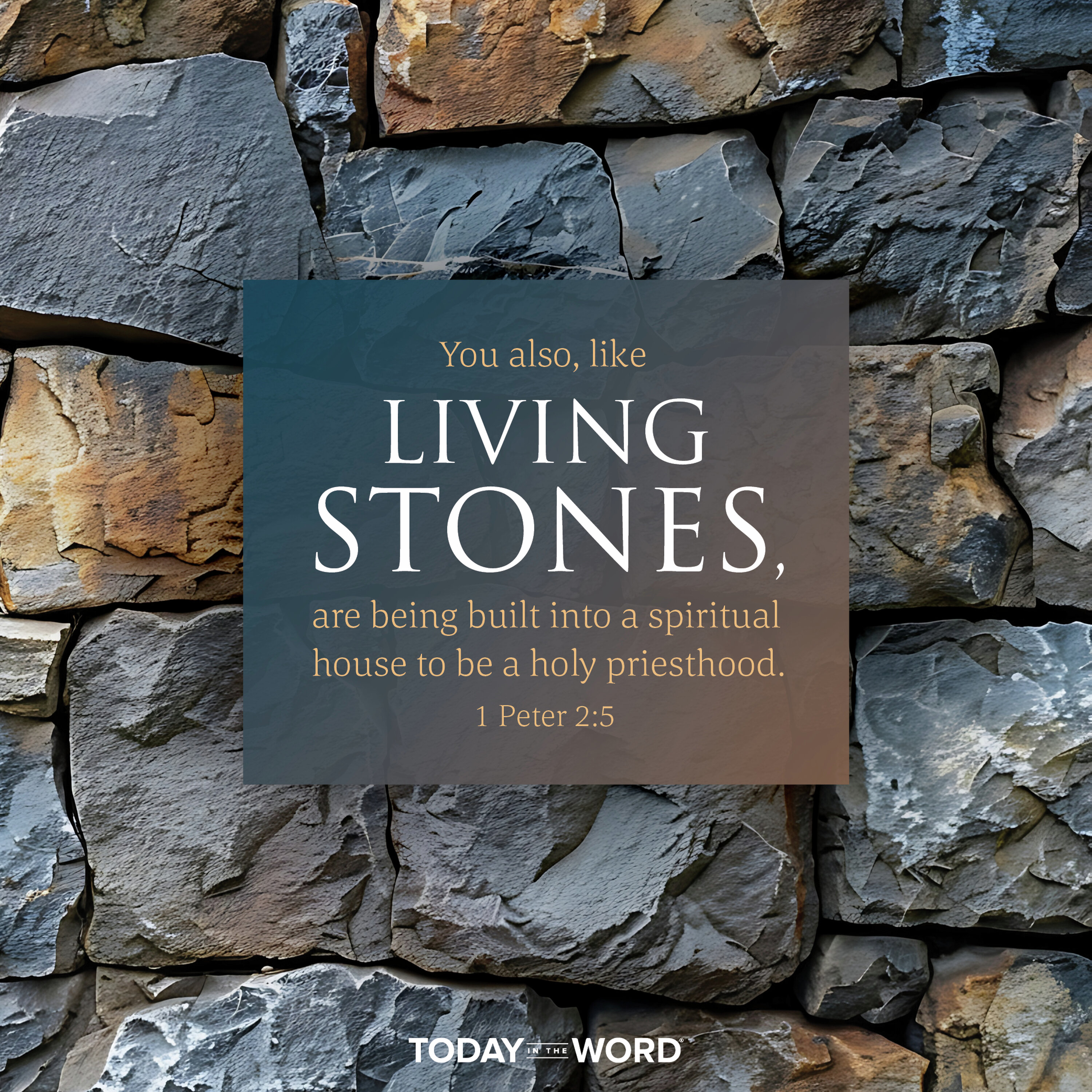 Holy Priesthood 08.09.2026 2mGrowing up Protestant, and Southern Baptist at that, I had very little understanding of what it meant to be a priest. My limited knowledge was based on the depiction of Roman Catholic priests in popular media. In the Old Testament, the priesthood was quite a bit different. Priests were assigned to offer sacrifices on behalf of God’s people and teach the people His law. These priests were descended from Aaron, the first high priest. And, in the New Testament, we learn that Jesus is the ultimate high priest (Heb. 4:14–16). Through Jesus, all believers are priests: “You also, like living stones, are being built into a spiritual house to be a holy priesthood, offering spiritual sacrifices acceptable to God through Jesus Christ” (1 Peter 2:5). God’s people had been exiled from the promised land for their sin, which included improperly worshiping the Lord. So, as they prepared to return from exile, it was essential that they worship God in the way He said they should worship Him. These few verses highlight the necessity of only allowing people qualified to serve as priests for that role. In fact, it was so imperative that if a family could not prove beyond a shadow of a doubt that they were in the family tree of Aaron, then they “were excluded from the priesthood as unclean” (v. 62) and forbidden from eating the sacrifices offered to the Lord. Following God’s commands to the letter was that important. Obeying God fully remains an important part of our relationship with Him today. He is still holy and still demands that we obey Him with our whole hearts. Jesus is our great high priest, and all believers in Jesus are priests with direct access to the Father. Hallelujah!Donate to Today in the Word: https://give.todayintheword.org/See omnystudio.com/listener for privacy information.
 -
 List of Names 07.09.2026 2mEzra opens with a full chapter that speaks to God’s sovereignty to move the hearts of kings and bring His people back from their well-deserved exile. The second chapter of Ezra is like pulling the emergency brake while flying down the highway at 100 miles per hour. Who is Shephatiah? Adonikam? Mikmash? Hagabah? Why are we given this list of names? And why should we care? Good questions! The names in Ezra 2 may puzzle us because we’re not accustomed to long lists of family trees. In fact, I’d imagine most of us can’t even name our great-grandparents. Proverbs 22:1 tells us that “a good name is more desirable than great riches.” “Name” in that verse refers to a person’s reputation or standing in the community, but we can extend the principle out a bit as we reflect on this long list of names in Ezra. God’s people had been in exile for 70 years. If you remember your biblical history, you know they were in exile because they committed idolatry—spiritual adultery—and joined in marriage with people who did not follow the Lord. You’ll also remember that when they entered and conquered the land, God gave each tribe a certain allotment of land to tend and care for. So, as God’s people prepared to return to the land of promise, two things were of paramount importance. First, despite exile, God’s people would remain stewards of the land God owned. Because of this, they should return to the land of their inheritance as outlined in the book of Joshua. Second, God’s people must be faithful to God, unlike those who were exiled. This list of names serves both purposes. The returnees were indeed returning to their ancestral land, and these people were indeed God’s people, descended from Abraham. Through them, God would bless the entire world.Donate to Today in the Word: https://give.todayintheword.org/See omnystudio.com/listener for privacy information.
 -
 Home at Last 06.09.2026 2mThere’s nothing quite like coming home after a long trip. It is wonderful to sleep in your own bed, eat familiar foods, and pet the family dog. You relax in a way that’s just not possible when you’re away. You are safe. You are secure. You are home. God’s people had been in exile for decades—that’s a very long time in a place where they don’t speak your language or eat foods unfamiliar to you. They had endured many years in a place that was uncomfortable, unfamiliar, and often inhospitable. We might be tempted to skip over these two verses in Ezra 2 and the long list of names that follow. Instead of reading too quickly past names that get stuck in our mouths (Reelaiah? Zerubbabel?), let’s reflect on the joy these verses represent. These people have been gone for seventy years. This wasn’t a trip across town. And it certainly wasn’t a vacation or a long cruise around the Mediterranean. No, this was forced exile. It was enslavement. It was horror, shame, and abasement. At last, they were returning home! God had heard His people’s cries for rescue from exile, just as He heard the cries of the Hebrew people enslaved in Egypt (Exod. 2:23–25). God brought His people out of Egypt many centuries before this story, and He led them through wilderness to a land flowing with milk and honey. He did this because of His promises to Abraham (Gen. 15:18–21). God promised to discipline His people when they sinned against Him (Deut. 28:15–68). And finally, God promised to restore His people (Jer. 33). Here, in these short verses, God fulfills Jeremiah’s glorious promise of restoration. Here, God rescues His people once again as “they returned to Jerusalem and Judah, each to their own town” (v. 1).Donate to Today in the Word: https://give.todayintheword.org/See omnystudio.com/listener for privacy information.
 -
 Treasures Returned 05.09.2026 2mThe name Osama bin Laden conjures up a whole host of thoughts and emotions. His name is etched into the collective memory of Americans who lived during the 9/11 terrorist attacks and the ensuing twenty years of war. In a similar way, the name Nebuchadnezzar carried significance to the exiles in Babylon. It had been many decades since the Babylonian king had razed and looted the temple, destroyed Jerusalem, and exiled the people (2 Kings 25). Even still his name loomed large over their collective consciousness. These five verses, three of which recount the items returned to the Jewish prince Sheshbazzar, carry heavy emotional and theological freight. First, they mention the Babylonian king whom God had used to judge His people. His name reminded the exiles of their shared history of idolatry and spiritual adultery. It also reminded them of God’s faithfulness to keep His covenant—even its curses (see Deut. 28). Second, we are reminded that Nebuchadnezzar dishonored the Lord by looting the temple and—shame of all shames—placing the “the articles belonging to the temple of the LORD... in the temple of his god” (v. 7). Third and most importantly, we see God’s faithfulness to His name and to His people, as well as the great theme of reversal that resounds throughout Scripture. Though all seemed lost, and though God had punished His people greatly, He also forgave them. God would not leave His people in exile forever, nor would He allow His name to be profaned forever. Items meant for worship of the one true God would not remain in the temple of an idol. We can rejoice greatly that “Sheshbazzar brought all these along with the exiles when they came up from Babylon to Jerusalem” (v. 11). God kept His promise to discipline His people, and now He would keep His promise to restore them!Donate to Today in the Word: https://give.todayintheword.org/See omnystudio.com/listener for privacy information.
 -
 The Lord’s Favor 04.09.2026 2mEven today, with professional help readily available, moving to a new home is a big deal. Cross-country moves can be logistical nightmares, not to mention international moves. In Ezra 1:5–6, we see God’s people begin the long journey from Persia back to Jerusalem. Cyrus’s decree (see 1:2–4) ended by commanding the non-Hebrew people “to provide them with silver and gold, with goods and livestock, and with freewill offerings for the temple of God in Jerusalem” (v. 4). Verse 6 records the obedience of these people: “All their neighbors assisted them with articles of silver and gold, with goods and livestock, and with valuable gifts, in addition to all the freewill offerings.” This series of events reminds us of the exodus, when God’s people “plundered” the Egyptians, who loaded them with goods as they departed after the fateful Passover. God had rescued His people before, and here He does it again! If God has called you to do something, rest assured that He will give you the means to obey. Just as He was throughout Scripture, He will continue to be faithful today. As the Scriptures say, “Jesus Christ is the same yesterday and today and forever” (Heb. 13:8). Verse 5 states that the “family heads of Judah and Benjamin, and the priests and Levites—everyone whose heart God had moved—prepared to go up and build the house of the LORD in Jerusalem.” Notice a few things. First, the family heads were responsible to lead their families in obeying the Lord. Second, the priest and Levites, who were responsible for leading Israel in worship and keeping the Torah, led the nation in obeying the Lord. And third, pay special attention to that part in the middle: God moved their hearts. This pattern holds true today.Donate to Today in the Word: https://give.todayintheword.org/See omnystudio.com/listener for privacy information.
 -
 The King’s Decree 03.09.2026 2mThe Persian Empire was not a democracy. The king didn’t need to please his people. He was not concerned with reelection, and his word reigned supreme. The book of Ezra opens like the book of 2 Chronicles closes, with a decree from King Cyrus that God’s exiled people may return home at last! Cyrus opens by crediting Israel’s God with his success. He states, “The Lord, the God of heaven, has given me all the kingdoms of the earth” (v. 2). We know from an ancient artifact called the Cyrus Cylinder that Cyrus made similar claims about the Babylonian god Marduk. So it’s doubtful that Cyrus had converted to true faith in the one true God. Nevertheless, Cyrus spoke more accurately than he knew, for in the case of Israel’s God, what he said was true. Yahweh, and not Marduk or any other god ancient or modern, is Lord over all things. The Lord delivered Judah into Babylon’s hands, and now He had moved Cyrus’s heart to free the people from Persian captivity. Cyrus also said Yahweh “appointed me to build a temple for him at Jerusalem in Judah” (v. 2). The temple was the cornerstone of Hebrew religion, where God dwelled among His people. But God was not confined to this temple—not even in Old Testament times—for He was with His people in exile, and He remained with them as He brought them home. It seemed that Cyrus didn’t quite understand the reality that God is God everywhere, for he calls him “the God who is in Jerusalem” (v. 3). Of course, God is in Jerusalem, but more importantly, God is everywhere. God’s presence dwelt with His people even in the land of Persia, where He turned Cyrus’s heart to decree His people’s freedom.Donate to Today in the Word: https://give.todayintheword.org/See omnystudio.com/listener for privacy information.
 -
 Seventy Years 02.09.2026 2mIt was 70 years ago, in 1956, that Jim Elliot and four fellow missionaries were speared to death in Ecuador while attempting to contact and evangelize the Waorani tribe. Their story, featured in Life magazine, inspired countless individuals to dedicate their lives to missionary service. And it continues to inspire others seven decades later. Seventy years is also how long God’s people toiled in Babylonian captivity. The Hebrew people might have been tempted to think God had abandoned them forever, but the book of Ezra opens with these words: “In the first year of Cyrus king of Persia, in order to fulfill the word of the LORD spoken by Jeremiah, the LORD moved the heart of Cyrus king of Persia” (Ezra 1:1). Here was the most powerful ruler in the world, and God reached down to move his heart. The people had waited for God to move for 70 years. Why now? God was fulfilling His promise through Jeremiah (Jer. 25:11–13) that He would rescue His beloved people out of captivity and return them to the land He had promised them (Gen. 15:12–19). The people’s sins were great, that’s certain. And 70 years no doubt felt like a long time. But this first verse in Ezra reminds us of the great truth of the gospel: God’s promises are certain and His mercy is greater than our sin. Though God had disciplined His people for their sin, and though He disciplines His children today, He never once—and never will—abandon those He loves. As the writer of Hebrews says, “strengthen your feeble arms and weak knees” (Heb. 12:12), and we can, because we know the One who has redeemed us. God is trustworthy, and His promises sure. Even the king’s heart is a “stream of water” in the Lord’s hands.Donate to Today in the Word: https://give.todayintheword.org/See omnystudio.com/listener for privacy information.
Podcasts similares


Popular en
Este podcast también aparece en las listas de podcasts de estos países.
