
Law School
The Law School of America
0
The Law School of America podcast is designed for listeners who want to expand and enhance their understanding of the American legal system. It provides legal principles in small, digestible bites to make learning easy. If you're willing to put in the time, these podcasts can take you from novice to knowledgeable in a reasonable amount of time.
Osad
-
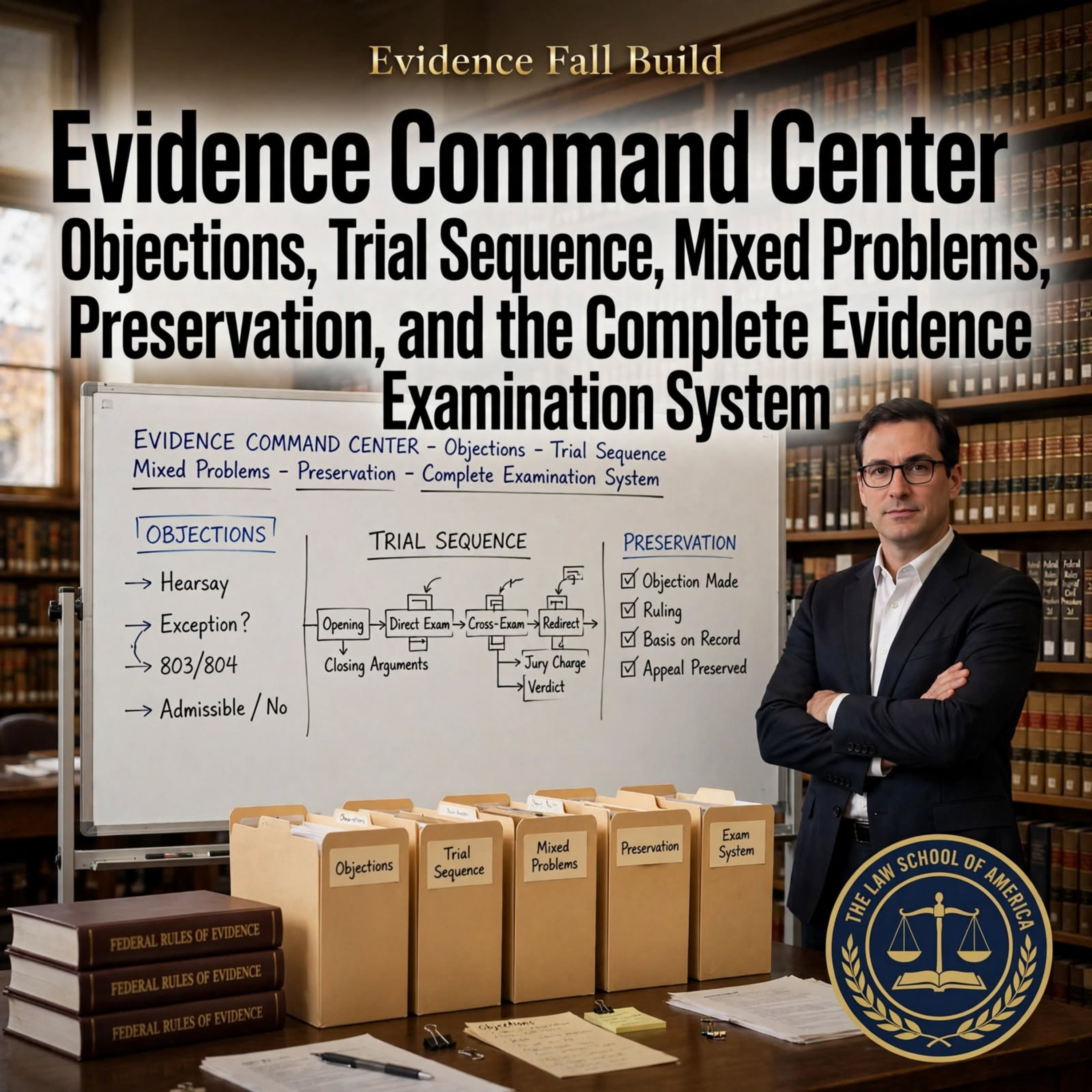 Evidence Fall Build: Evidence Command Center Objections, Trial Sequence, Mixed Problems, Preservation, and the Complete Evidence Examination System 27.09.2026 54min👉Turn this episode into a free Game or Book Chapter.👈 🎧 EPISODE SUMMARY 🎧Evidence should be approached as an integrated system rather than as a collection of isolated doctrines.Begin by identifying the evidence and the proponent. Then state the precise purpose for which the evidence is offered.Apply relevance first. If the evidence is relevant, consider Rule 403 and any specific policy exclusion.If character or prior-act evidence is involved, identify whether the reasoning depends on propensity and whether an exception or legitimate nonpropensity purpose applies. Distinguish character from habit.For witness testimony, establish competency, personal knowledge, proper questioning, and any necessary opinion foundation. Expert testimony requires qualification, helpfulness, sufficient facts or data, reliable methods, and reliable application.If credibility is challenged, identify the exact impeachment doctrine.For every out-of-court statement, identify the declarant, the assertion, and the purpose. Then move through the hearsay structure: nontruth purpose, Rule 801(d), Rule 803, Rule 804, Rule 807, and multiple hearsay.In a criminal case, separately analyze the Confrontation Clause when testimonial statements are offered against the accused.Consider privilege as an independent restriction.Authenticate documents, objects, recordings, photographs, and digital evidence. Determine whether self-authentication applies and whether chain of custody or digital attribution is necessary.If the proponent seeks to prove the contents of a writing, recording, or photograph, consider the original-writing rules. Distinguish Rule 1006 evidentiary summaries from Rule 107 illustrative aids.Consider limited admissibility, redaction, conditional admission, and limiting instructions.Finally, preserve the issue through the appropriate objection, offer of proof, motion, or renewed objection, and always state the ruling.The complete Evidence method can be reduced to one discipline:Identify the item, identify the purpose, apply every independent admissibility rule that matters, and finish with a ruling.ℹ️ INFORMATION, PRIVACY POLICY & TERMS OF USE ℹ️The Podcast and Website PurposeThe Law School Podcast and 1L Study Aide webpage supplements law-school and Bar Exam study with strategies, condensed rules, quizzes, and flashcards.Educational DisclaimerContent is for educational and informational purposes only. It is not legal advice, creates no attorney-client relationship, and does not guarantee law-school or Bar Exam success.Privacy PolicyNo account or login is required.This webpage uses no forms or analytics to collect personal information.Quiz and flashcard activity stays in your browser and may clear when local site data is removed.Terms of UseBy using this webpage, you agree to use its content only for lawful, personal, noncommercial educational purposes. It supplements—not replaces—courses, textbooks, official materials, or qualified instruction.
 -
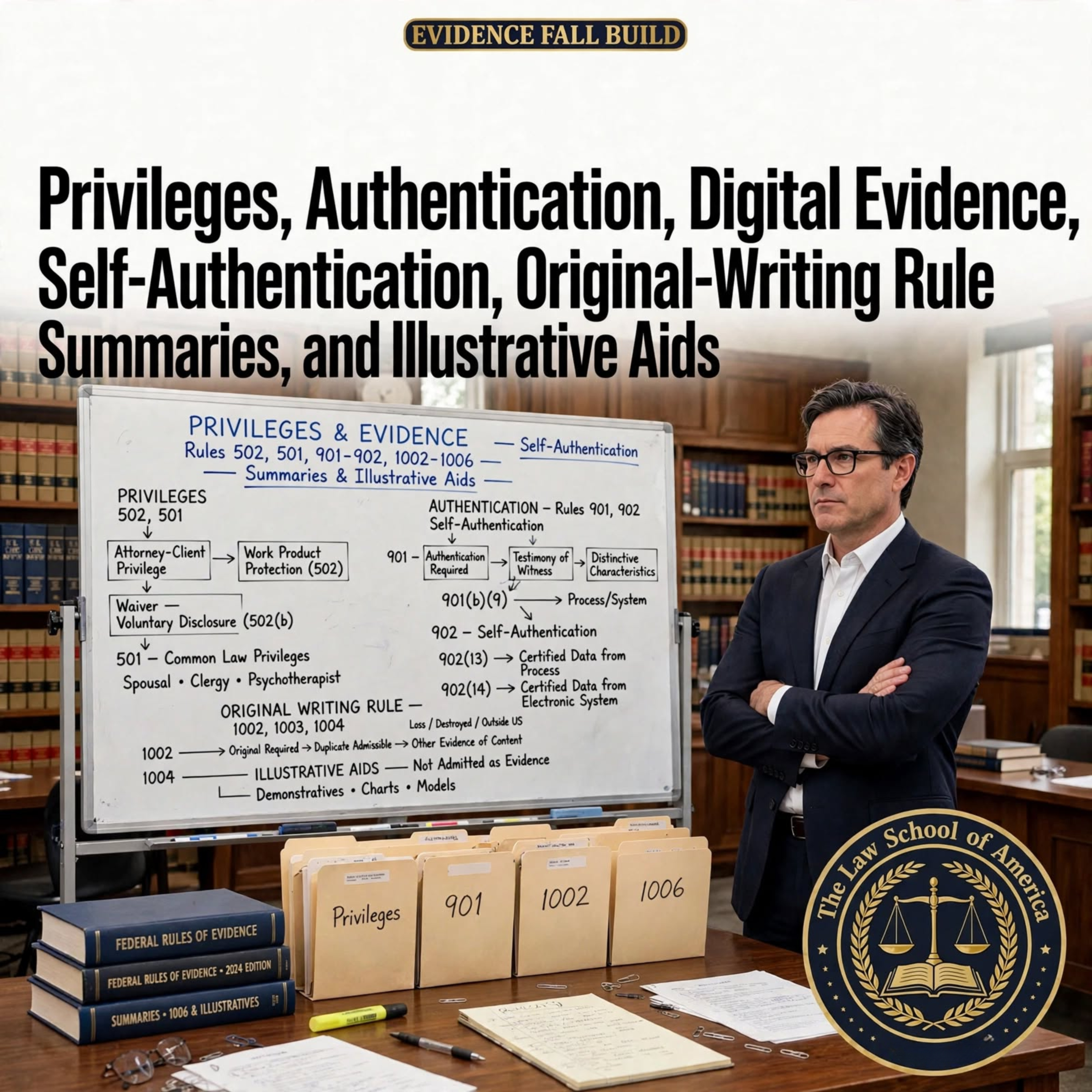 Evidence Fall Build: Privileges, Authentication, Digital Evidence, Self-Authentication, Original-Writing Rule, Summaries, and Illustrative Aids 26.09.2026 1t 12min👉Turn this episode into a free Game or Book Chapter.👈 🎧 EPISODE SUMMARY 🎧Privilege excludes relevant evidence to protect key relationships and values.Attorney-client privilege protects confidential communications for legal advice. Confidentiality is essential; necessary third parties do not destroy protection.Corporate privilege covers communications between counsel and employees regarding job responsibilities when confidentiality is kept.The crime-fraud exception applies when seeking legal aid for future crimes or fraud, not past wrongdoing.Privilege is waived by disclosure, lost confidentiality, litigation use, or subject-matter disclosure.Work product protects materials prepared in anticipation of litigation.Federal common law recognizes marital privileges and psychotherapist-patient privilege.Rule 901 authentication requires sufficient evidence that an item is what the proponent claims.Authentication uses witness knowledge, characteristics, comparison, voice/handwriting ID, system evidence, or chain of custody.Photos require witness testimony of accurate depiction. Video uses system operation, timestamps, custody, or metadata.Chain of custody is vital for fungible evidence like drugs, blood, and digital storage.Digital posts and messages connect to authors via account info, writing style, metadata, reply patterns, or testimony.Synthetic or AI media follows ordinary evidentiary rules.Rule 902 self-authentication avoids separate authentication evidence, but other objections remain.Original-writing rules apply to prove contents. Duplicates are generally admissible unless authenticity is disputed.Rule 1006 allows summaries of voluminous admissible materials.Rule 107 illustrative aids help clarify evidence but are not evidence themselves.The controlling lesson is:Proponents must establish what evidence is and satisfy admissibility rules before persuading the jury.ℹ️ INFORMATION, PRIVACY POLICY & TERMS OF USE ℹ️The Podcast and Website PurposeThe Law School Podcast and 1L Study Aide webpage supplements law-school and Bar Exam study with strategies, condensed rules, quizzes, and flashcards.Educational DisclaimerContent is for educational and informational purposes only. It is not legal advice, creates no attorney-client relationship, and does not guarantee law-school or Bar Exam success.Privacy PolicyNo account or login is required.This webpage uses no forms or analytics to collect personal information.Quiz and flashcard activity stays in your browser and may clear when local site data is removed.Terms of UseBy using this webpage, you agree to use its content only for lawful, personal, noncommercial educational purposes. It supplements—not replaces—courses, textbooks, official materials, or qualified instruction.
 -
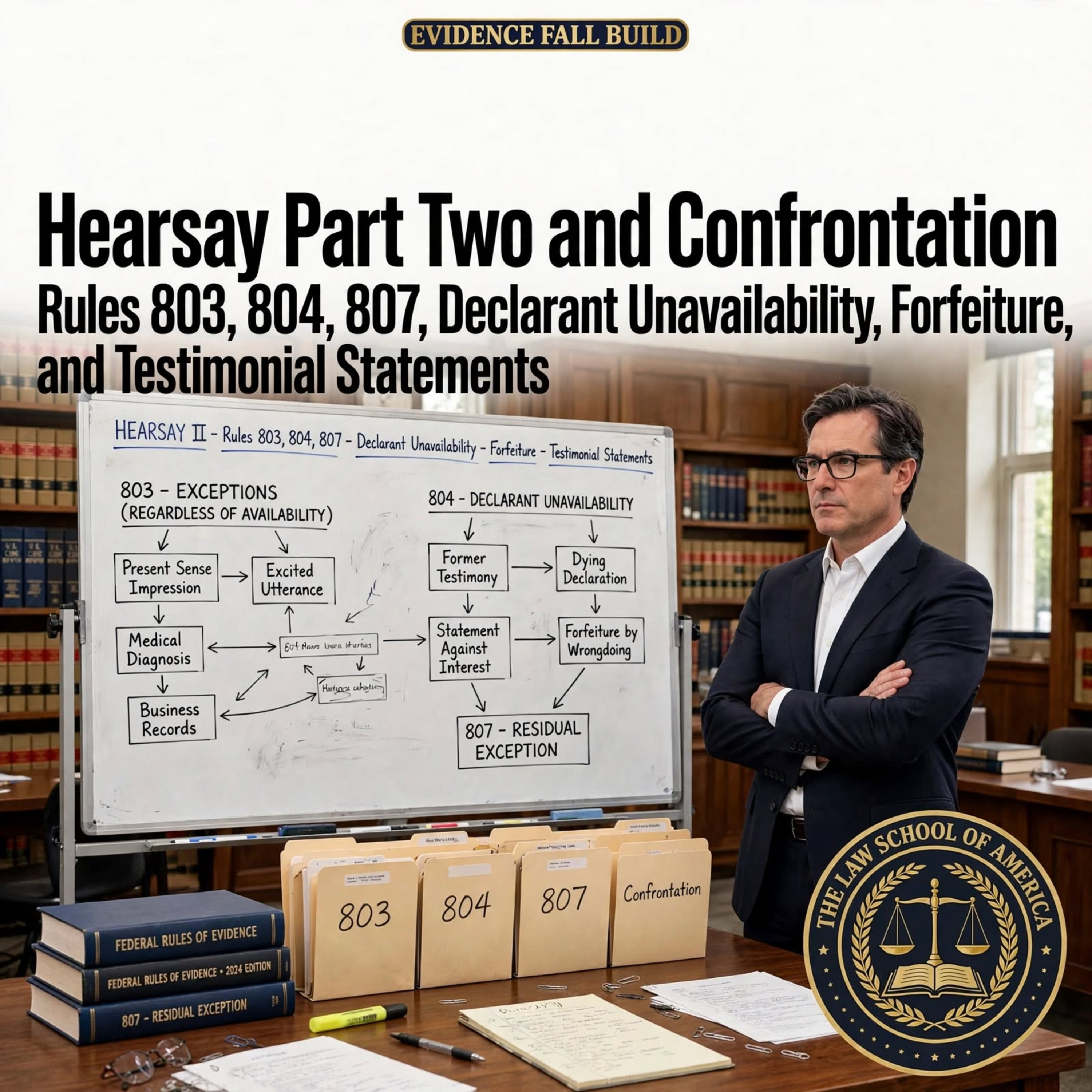 Evidence Fall Build: Hearsay Part Two and Confrontation - Rules 803, 804, 807, Declarant Unavailability, Forfeiture, and Testimonial Statements 25.09.2026 1t 9min👉Turn this episode into a free Game or Book Chapter.👈 🎧 EPISODE SUMMARY 🎧Hearsay analysis begins with purpose. Out-of-court statements offered to prove the truth of the matter asserted constitute hearsay.A statement requires a person's oral, written, or intended nonverbal assertion; nonassertive conduct usually does not qualify.Automated machine data involves reliability or authentication rather than hearsay, though electronic human assertions still require hearsay analysis.A testifying witness's prior statements remain out-of-court statements, though specific ones qualify as nonhearsay under Rule 801(d)(1).Statements offered for nontruth purposes—such as effect on listener, notice, motive, or verbal acts—fall outside hearsay.Statements showing state of mind or used solely for impeachment are not hearsay; substantive use requires an independent basis.Under Rule 801(d)(1)(A), substantive prior inconsistent statements must be made under penalty of perjury at a proceeding or deposition.Prior consistent statements may rehabilitate credibility, while prior identifications are admissible if the testifying witness is subject to cross-examination.Rule 801(d)(2) covers opposing-party statements, including adoptive and authorized agent statements.Co-conspirator statements must be made during and in furtherance of the conspiracy; post-conspiracy narrations or casual boasting do not qualify.Rule 805 requires every layer of hearsay within hearsay to independently satisfy an admissibility exception.Identify the statement and its offered purpose before concluding it is hearsay.ℹ️ INFORMATION, PRIVACY POLICY & TERMS OF USE ℹ️The Podcast and Website PurposeThe Law School Podcast and 1L Study Aide webpage supplements law-school and Bar Exam study with strategies, condensed rules, quizzes, and flashcards.Educational DisclaimerContent is for educational and informational purposes only. It is not legal advice, creates no attorney-client relationship, and does not guarantee law-school or Bar Exam success.Privacy PolicyNo account or login is required.This webpage uses no forms or analytics to collect personal information.Quiz and flashcard activity stays in your browser and may clear when local site data is removed.Terms of UseBy using this webpage, you agree to use its content only for lawful, personal, noncommercial educational purposes. It supplements—not replaces—courses, textbooks, official materials, or qualified instruction.
 -
 Evidence Fall Build: Hearsay Part One - Definition, Nonhearsay Purposes, Prior Statements, Opposing-Party Statements, and Multiple Hearsay 24.09.2026 1t 9min⚖️ One objection. One ruling. Would you get it right? Put your evidence knowledge to the test—then dig into the rules behind the answer.🎮 Take the FREE Evidence Game Challenge →📖 Sharpen Your Knowledge: Read the FREE Book Chapter → 🎧 EPISODE SUMMARY 🎧Hearsay analysis begins with purpose.Out-of-court statements are not automatically hearsay. Hearsay requires a statement made outside trial offered to prove the truth of what it asserts.A statement requires an assertion by a person. Oral assertions, written assertions, and intended nonverbal assertions may qualify. Nonassertive conduct ordinarily does not.Machine-generated data raises authentication, reliability, or system-accuracy issues rather than traditional hearsay. Human assertions entered electronically require separate analysis from automated outputs.A witness's own prior statement is still an out-of-court statement merely because the witness later appears at trial. Specific prior statements may nevertheless qualify as nonhearsay under Rule 801(d)(1).The key question is whether the statement is offered for truth. Statements showing effect on listener, notice, motive, verbal acts, or other nontruth purposes fall outside hearsay.Statements may also be offered as circumstantial evidence of a declarant's state of mind or solely for impeachment. If a prior inconsistent statement is used only to challenge credibility, its truth may be irrelevant. Substantive use requires an independent basis.Under Rule 801(d)(1)(A), substantive use of a prior inconsistent statement requires it to be made under penalty of perjury at a trial, hearing, proceeding, or deposition.Prior consistent statements may be substantively admissible in specified rehabilitative circumstances, but repetition alone is not enough. Prior identifications may qualify when the witness made the identification after perceiving the person, now testifies, and is subject to cross-examination.Rule 801(d)(2) covers opposing-party statements, which need not be against interest when made. Adoptive statements arise via agreement, conduct, or silence. Authorized agent statements are also admissible.A co-conspirator statement may qualify when made by a co-conspirator during and in furtherance of the conspiracy. Statements merely narrating past events after the conspiracy has ended generally do not satisfy that framework, and casual boasting may not further the conspiracy.Finally, Rule 805 requires separate treatment of hearsay within hearsay. Every layer of a multi-level statement must independently satisfy an admissibility rule.The controlling lesson is:Never say “hearsay” until you identify the statement and explain the purpose for which it is offered.ℹ️ INFORMATION, PRIVACY POLICY & TERMS OF USE ℹ️The Podcast and Website PurposeThe Law School Podcast and 1L Study Aide webpage supplements law-school and Bar Exam study with strategies, condensed rules, quizzes, and flashcards.Educational DisclaimerContent is for educational and informational purposes only. It is not legal advice, creates no attorney-client relationship, and does not guarantee law-school or Bar Exam success.Privacy PolicyNo account or login is required.This webpage uses no forms or analytics to collect personal information.Quiz and flashcard activity stays in your browser and may clear when local site data is removed.Terms of UseBy using this webpage, you agree to use its content only for lawful, personal, noncommercial educational purposes. It supplements—not replaces—courses, textbooks, official materials, or qualified instruction.
 -
 Evidence Fall Build: Witnesses and Experts - Competency, Personal Knowledge, Lay Opinion, Expert Reliability, Examination, Impeachment, and Rehabilitation 23.09.2026 1t 12min⚖️ Put your evidence knowledge on trial. You’ve heard the episode—now see what you can do with it.🎮 Play the FREE Evidence Game →Think you know the rules? Put your knowledge to the test.📖 Open Your FREE Book Chapter →Go beyond the episode. Study the rules at your own pace—and return whenever you need a refresher. 🎧 EPISODE SUMMARY 🎧The Federal Rules presume witness competency. Capacity, memory, and perception go to weight rather than categorical competency.Rule 602 requires personal knowledge, barring speculation and secondhand information.Witnesses testify under oath, and interpreters must be qualified to translate accurately.Rule 611 gives judges control over examinations. Leading questions are restricted on direct but generally allowed on cross.Refreshing recollection restores present memory. Recorded recollection supplies content under Rule 803(5) when memory fails.Rule 701 allows lay opinions if rationally based on perception, helpful, and non-specialized.Expert testimony requires qualifications, reliable principles/methods, sufficient data, and proper fit. Reliability factors remain flexible.Under Rule 703, experts may rely on observed facts, trial evidence, or customary field data.Expert opinions may touch ultimate issues but cannot direct legal conclusions.Impeachment methods include bias, prior inconsistent statements, untruthful character, convictions, specific acts, contradiction, and sensory limits.Rules 608 and 609 govern character, specific truthfulness acts, and criminal convictions, while bias reveals motives to favor a party.Contradiction impeaches facts, though extrinsic evidence on collateral matters is restricted. Sensory defects attack perception reliability.Rehabilitation follows attacks. Prior consistent statements may rebut claims of recent fabrication, improper influence, or motive.A witness requires proper foundation, and credibility attacks have specific permissible rules.ℹ️ INFORMATION, PRIVACY POLICY & TERMS OF USE ℹ️The Podcast and Website PurposeThe Law School Podcast and 1L Study Aide webpage supplements law-school and Bar Exam study with strategies, condensed rules, quizzes, and flashcards.Educational DisclaimerContent is for educational and informational purposes only. It is not legal advice, creates no attorney-client relationship, and does not guarantee law-school or Bar Exam success.Privacy PolicyNo account or login is required.This webpage uses no forms or analytics to collect personal information.Quiz and flashcard activity stays in your browser and may clear when local site data is removed.Terms of UseBy using this webpage, you agree to use its content only for lawful, personal, noncommercial educational purposes. It supplements—not replaces—courses, textbooks, official materials, or qualified instruction.
 -
 Evidence Fall Build: Character, Other Acts, Habit, and Policy Exclusions 22.09.2026 1t 5min⚖️ Put your evidence knowledge on trial. You’ve heard the episode—now see what you can do with it.🎮 Play the FREE Evidence Game →Think you know the rules? Put your knowledge to the test.📖 Open Your FREE Book Chapter →Go beyond the episode. Study the rules at your own pace—and return whenever you need a refresher. 🎧 EPISODE SUMMARY 🎧Character evidence is restricted when used to prove propensity—that a person acted consistently with a trait.However, character is admissible when the trait itself is an essential element of a claim or defense.Criminal defendants may introduce pertinent character traits, opening the door to prosecution rebuttal. Victims' traits may also be introduced, including peacefulness in homicide cases to rebut first-aggressor claims.Rule 405 allows proof by reputation or opinion. Specific instances are restricted to cross-examination or when character is an essential element.Rule 404(b) bars prior acts to show bad character, but allows them for nonpropensity purposes like motive, intent, plan, identity, or absence of mistake with a clear logical link.Identity requires distinctive similarity, while intent and knowledge require a connection to the act. Rule 403 balancing and limiting instructions still apply.Rule 406 habit evidence shows a specific, regular, automatic response to a recurring situation to prove conduct on a specific occasion.Rule 407 excludes subsequent remedial measures to prove liability, encouraging safety improvements, though allowed for disputed ownership, control, or feasibility.Rule 408 excludes compromise offers and negotiation statements regarding disputed claims when offered to prove liability or claim value.Rule 409 protects medical expense payment offers from proving liability, but does not protect accompanying factual statements.Rule 410 excludes specified withdrawn pleas and plea discussions to encourage negotiations.Rule 411 bars liability insurance to prove negligence, but permits it for bias, agency, or control.Rule 412 limits evidence of a victim's sexual behavior or predisposition in sexual-misconduct cases, balancing relevance, privacy, and constitutional rights.Rules 413–415 allow prior acts of sexual assault and child molestation under specific statutory rules rather than standard Rule 404 restrictions.Relevance is only the start: evidence may be logically probative yet excluded due to unfair prejudice or public policy.ℹ️ INFORMATION, PRIVACY POLICY & TERMS OF USE ℹ️The Podcast and Website PurposeThe Law School Podcast and 1L Study Aide webpage supplements law-school and Bar Exam study with strategies, condensed rules, quizzes, and flashcards.Educational DisclaimerContent is for educational and informational purposes only. It is not legal advice, creates no attorney-client relationship, and does not guarantee law-school or Bar Exam success.Privacy PolicyNo account or login is required.This webpage uses no forms or analytics to collect personal information.Quiz and flashcard activity stays in your browser and may clear when local site data is removed.Terms of UseBy using this webpage, you agree to use its content only for lawful, personal, noncommercial educational purposes. It supplements—not replaces—courses, textbooks, official materials, or qualified instruction.
 -
 Evidence Fall Build: The Evidence Gatekeeping System - Relevance, Rule 403, Preliminary Questions, Conditional Relevance, Judicial Notice, Objections, and Offers of Proof 21.09.2026 55min⚖️ Put your evidence knowledge on trial. You’ve heard the episode—now see what you can do with it.🎮 Play the FREE Evidence Game →Think you know the rules? Put your knowledge to the test.📖 Open Your FREE Book Chapter →Go beyond the episode. Study the rules at your own pace—and return whenever you need a refresher. 🎧 EPISODE SUMMARY 🎧Evidence law begins with gatekeeping.Rule 401 sets a deliberately low threshold for relevance: evidence is relevant when it has any tendency to make a consequential fact more or less probable than it would be without the evidence. Strong analysis explains the inferential chain connecting the evidence to the consequential proposition.Direct evidence establishes a fact without an additional inferential step if believed, while circumstantial evidence depends on inference. Neither category is automatically stronger.Under Rule 402, relevant evidence is generally admissible unless another governing rule excludes it, while irrelevant evidence is inadmissible.Rule 403 permits exclusion when the probative value of relevant evidence is substantially outweighed by specified dangers such as unfair prejudice, confusion, misleading the jury, delay, wasted time, or needless cumulative presentation. Ordinary damage to an opponent’s case is not unfair prejudice.Rule 104 governs preliminary evidentiary questions. Under Rule 104(a), the judge decides preliminary admissibility matters. Under Rule 104(b), evidence whose relevance depends on a connecting fact may reach the jury when sufficient evidence supports a finding of that fact.Evidence may also be admissible only for a limited purpose or against a particular party, making limiting instructions important. The rule of completeness can prevent misleading selective presentation, but it does not automatically make every omitted portion admissible.Judicial notice allows courts to establish certain adjudicative facts that are not reasonably subject to dispute. The effect differs in civil and criminal cases: a civil jury generally must accept a properly noticed fact, while a criminal jury may but need not do so.Rule 103 emphasizes preservation. A party challenging admitted evidence generally needs a timely and sufficiently specific objection. A party challenging excluded evidence generally needs an offer of proof establishing what the evidence would have shown. Motions in limine may resolve evidentiary questions before trial, but later developments can affect preservation issues.Finally, an erroneous evidentiary ruling does not automatically require reversal. Reviewing courts may consider whether the error affected substantial rights, while exceptional unpreserved errors may sometimes receive plain-error review.The most important analytical lesson is simple:Every Evidence problem begins with the item, the purpose, and the consequential fact.Once those three components are identified, the rest of the gatekeeping analysis becomes substantially easier to organize and apply.ℹ️ INFORMATION, PRIVACY POLICY & TERMS OF USE ℹ️The Podcast and Website PurposeThe Law School Podcast and 1L Study Aide webpage supplements law-school and Bar Exam study with strategies, condensed rules, quizzes, and flashcards.Educational DisclaimerContent is for educational and informational purposes only. It is not legal advice, creates no attorney-client relationship, and does not guarantee law-school or Bar Exam success.Privacy PolicyNo account or login is required.This webpage uses no forms or analytics to collect personal information.Quiz and flashcard activity stays in your browser and may clear when local site data is removed.Terms of UseBy using this webpage, you agree to use its content only for lawful, personal, noncommercial educational purposes. It supplements—not replaces—courses, textbooks, official materials, or qualified instruction.
 -
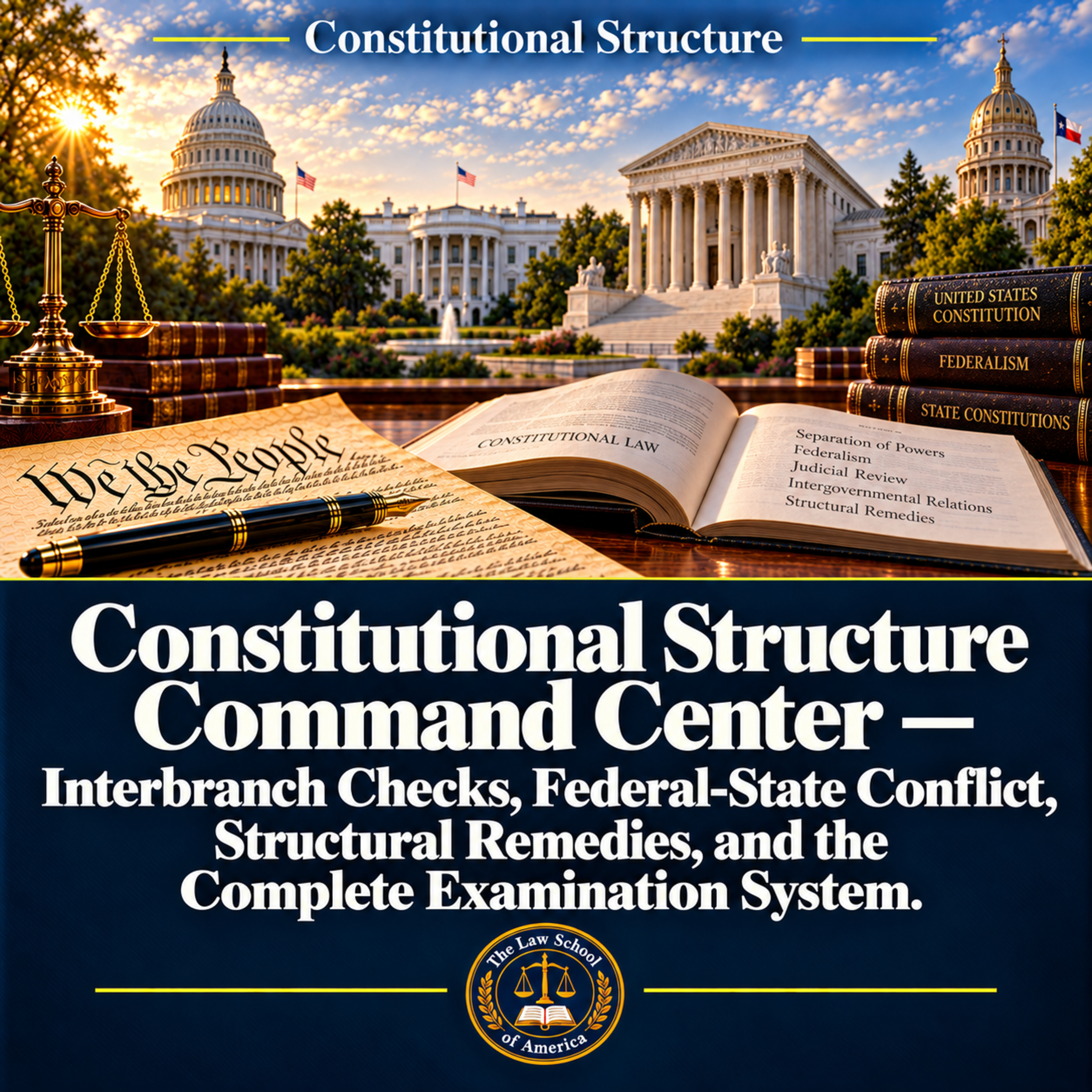 Constitutional Structure: Constitutional Structure Command Center — Interbranch Checks, Federal-State Conflict, Structural Remedies, and the Complete Examination System 20.09.2026 1t 21min📘Turn this episode into a free Game or Exam-Ready Study Plan.📘👉 OR CLICK HERE TO OPEN TODAY’S FREE STUDY GUIDE 👈🎧 EPISODE SUMMARY 🎧Constitutional structure establishes a system of checked power and divided sovereignty:Horizontal separation of powers allocates authority among Congress, the President, and federal courts. Presidential power is highest when authorized by Congress, in twilight when Congress is silent, and lowest when acting against congressional will.The administrative state is bounded by the Appointments Clause and presidential removal authority. Principal officers require Senate confirmation; inferior officers may be appointed by Department Heads or Courts. Officers exercising executive authority must be removable at will, and vast economic or political assertions trigger the major questions doctrine.Vertical federalism divides power between the national government and states. Under the Tenth Amendment anti-commandeering doctrine, Congress cannot compel states to enact or enforce federal policy, though conditional spending is permitted.Under the Supremacy Clause, valid federal law preempts state law. State sovereign immunity shields states from private money suits but permits prospective injunctive relief against officers.The Dormant Commerce Clause bars state protectionism; discriminatory laws face strict scrutiny unless saved by the market participant doctrine.The examination rule requires analyzing:Government actor and asserted power;Justiciability, jurisdiction, and separation of powers;Federalism, preemption, and commercial restrictions; andProper judicial remedy.ℹ️ INFORMATION, PRIVACY POLICY & TERMS OF USE ℹ️The Podcast and Website PurposeThe Law School Podcast and 1L Study Aide webpage supplements law-school and Bar Exam study with strategies, condensed rules, quizzes, and flashcards.Educational DisclaimerContent is for educational and informational purposes only. It is not legal advice, creates no attorney-client relationship, and does not guarantee law-school or Bar Exam success.Privacy PolicyNo account or login is required.This webpage uses no forms or analytics to collect personal information.Quiz and flashcard activity stays in your browser and may clear when local site data is removed.Terms of UseBy using this webpage, you agree to use its content only for lawful, personal, noncommercial educational purposes. It supplements—not replaces—courses, textbooks, official materials, or qualified instruction.
 -
 Constitutional Structure: Federalism — The Tenth Amendment, Anti-Commandeering, Preemption, State Sovereign Immunity, the Dormant Commerce Clause, and the Privileges and Immunities Clause 19.09.2026 1t 44min📘Turn this episode into a free Game or Exam-Ready Study Plan.📘👉 OR CLICK HERE TO OPEN TODAY’S FREE STUDY GUIDE 👈🎧 EPISODE SUMMARY 🎧Federalism allocates power vertically between national and state governments.The 10th Amendment reserves un-delegated powers to states (police power over health, safety, morals), but does not invalidate valid Article I federal laws.Anti-Commandeering prevents Congress from forcing state legislatures or executives to enact or enforce federal schemes. Congress may regulate private citizens directly or state commercial operations.Preemption (Article VI) displaces conflicting state law via Express (statutory text) or Implied (field or conflict) preemption.State Sovereign Immunity bars private damage suits against states (excluding political subdivisions). Exceptions: waiver, 14th Amendment §5 abrogation, Ex parte Young injunctive relief, and suits by federal/state governments.Dormant Commerce Clause limits state economic protectionism: Discriminatory laws face strict scrutiny; Nondiscriminatory laws face Pike balancing. Exceptions: Market Participant doctrine and congressional approval.Article IV Privileges and Immunities bars state discrimination against nonresidents regarding fundamental livelihoods unless justified under the substantial reason test.Vertical federalism analysis checks: enumerated powers, anti-commandeering, preemption, sovereign immunity, Dormant Commerce Clause, and Article IV protections.ℹ️ INFORMATION, PRIVACY POLICY & TERMS OF USE ℹ️The Podcast and Website PurposeThe Law School Podcast and 1L Study Aide webpage supplements law-school and Bar Exam study with strategies, condensed rules, quizzes, and flashcards.Educational DisclaimerContent is for educational and informational purposes only. It is not legal advice, creates no attorney-client relationship, and does not guarantee law-school or Bar Exam success.Privacy PolicyNo account or login is required.This webpage uses no forms or analytics to collect personal information.Quiz and flashcard activity stays in your browser and may clear when local site data is removed.Terms of UseBy using this webpage, you agree to use its content only for lawful, personal, noncommercial educational purposes. It supplements—not replaces—courses, textbooks, official materials, or qualified instruction.
 -
 Constitutional Structure: Separation of Powers and the Administrative State — Appointments, Removal, Independent Agencies, Delegation, Legislative Control, Impeachment, and the Modern Removal Jurispru 18.09.2026 1t 26min📘Turn this episode into a free Game or Exam-Ready Study Plan.📘👉 OR CLICK HERE TO OPEN TODAY’S FREE STUDY GUIDE 👈🎧 EPISODE SUMMARY 🎧Separation of powers and administrative law govern federal authority and its supervision:The Appointments Clause regulates federal officers, distinguishing Officers of the United States from mere employees.Principal officers require presidential nomination and Senate confirmation. Inferior officers may be appointed by the President, Department Heads, or Courts. Congress cannot appoint executive officers.Under Article II, the President generally holds inherent authority to remove executive officers at will.Recent 2026 Supreme Court decisions updated removal doctrine:Trump v. Slaughter (2026) overruled Humphrey’s Executor regarding executive regulatory officers, reinforcing at-will presidential removal.Trump v. Cook (2026) upheld statutory removal protections for Federal Reserve Governors based on central-bank historical tradition.Congress cannot execute laws directly. Under Bowsher, Congress cannot remove executive officers, and under Chadha, legislative vetoes are unconstitutional without bicameralism and presentment.Public rights disputes may be assigned to administrative tribunals, but private rights require Article III courts.Impeachment is initiated by the House (simple majority) and tried by the Senate (two-thirds majority) for high crimes and misdemeanors, resulting in removal.Congress exercises checks through oversight and the Appropriations Clause power of the purse.ℹ️ INFORMATION, PRIVACY POLICY & TERMS OF USE ℹ️The Podcast and Website PurposeThe Law School Podcast and 1L Study Aide webpage supplements law-school and Bar Exam study with strategies, condensed rules, quizzes, and flashcards.Educational DisclaimerContent is for educational and informational purposes only. It is not legal advice, creates no attorney-client relationship, and does not guarantee law-school or Bar Exam success.Privacy PolicyNo account or login is required.This webpage uses no forms or analytics to collect personal information.Quiz and flashcard activity stays in your browser and may clear when local site data is removed.Terms of UseBy using this webpage, you agree to use its content only for lawful, personal, noncommercial educational purposes. It supplements—not replaces—courses, textbooks, official materials, or qualified instruction.
 -
 Constitutional Structure: Presidential Power — Youngstown, Executive Orders, the Take Care Clause, Commander in Chief, Foreign Affairs, Treaties, Executive Privilege, Pardons, and Presidential Immunit 17.09.2026 1t 47min📘Turn this episode into a free Game or Exam-Ready Study Plan.📘👉 OR CLICK HERE TO OPEN TODAY’S FREE STUDY GUIDE 👈🎧 EPISODE SUMMARY 🎧Article II executive power is bounded by separation of powers without inherent emergency authority.Executive actions require legal basis from the Constitution, federal statutes, or valid congressional delegation.Justice Jackson’s Youngstown framework evaluates executive authority across three categories:Category One (Maximum Authority): Action has express or implied congressional approval, combining Article II and delegated Article I powers.Category Two (Zone of Twilight): Congress is silent. Validity depends on independent Article II authority, necessity, and custom.Category Three (Lowest Ebb): Action opposes congressional will. Valid only under exclusive, preclusive presidential powers.Executive orders are managerial directives requiring underlying statutory or constitutional grants.The Take Care Clause requires faithful execution of laws; it allows prosecutorial discretion but bars wholesale nonenforcement or impoundment of funds.War powers are shared: Congress declares war and funds forces, while the Commander in Chief directs operations and repels sudden attacks.Foreign affairs powers include exclusive presidential recognition authority and international accords (Senate-approved treaties or executive agreements).The presidential pardon power is plenary and unreviewable, but limited to federal offenses and excludes impeachments.Executive privilege protects executive deliberations but yields to specific needs in criminal proceedings under United States v. Nixon.Presidential immunity provides absolute civil immunity for official acts, while criminal immunity varies by official status and excludes unofficial conduct.Article II analysis requires identifying the action, checking statutory/constitutional authority, and applying the Youngstown spectrum.ℹ️ INFORMATION, PRIVACY POLICY & TERMS OF USE ℹ️The Podcast and Website PurposeThe Law School Podcast and 1L Study Aide webpage supplements law-school and Bar Exam study with strategies, condensed rules, quizzes, and flashcards.Educational DisclaimerContent is for educational and informational purposes only. It is not legal advice, creates no attorney-client relationship, and does not guarantee law-school or Bar Exam success.Privacy PolicyNo account or login is required.This webpage uses no forms or analytics to collect personal information.Quiz and flashcard activity stays in your browser and may clear when local site data is removed.Terms of UseBy using this webpage, you agree to use its content only for lawful, personal, noncommercial educational purposes. It supplements—not replaces—courses, textbooks, official materials, or qualified instruction.
 -
 Constitutional Structure: Congressional Power Part Two — Taxing, Spending, Section Five, Legislative Process, Delegation, and the Major Questions Doctrine 16.09.2026 1t 15min📘Turn this episode into a free Game or Exam-Ready Study Plan.📘👉 OR CLICK HERE TO OPEN TODAY’S FREE STUDY GUIDE 👈🎧 EPISODE SUMMARY 🎧Congressional power analysis evaluates substantive authority and procedural validity:The Taxing Power (Art. I, § 8, Cl. 1) broadly raises revenue. Valid taxes produce some revenue, distinguished from penalties by burden size, scienter, IRS collection, and legality of conduct. It acts as an independent alternative if Commerce Clause authority fails.The Spending Power allows spending for general welfare under a five-part contractual framework:Spending must serve the general welfare (highly deferred).Conditions must be unambiguous.A direct nexus must exist between conditions and program funding.Conditions must not violate independent constitutional bars.Inducements must be non-coercive; threatening core state funding impermissibly commandeers states under the Tenth Amendment.Fourteenth Amendment § 5 allows preventive legislation to enforce rights, but Congress cannot alter substantive constitutional meanings.Broad § 5 remedies require congruence and proportionality, balancing judicial scrutiny, historical state violations, and statutory tailoring. Valid § 5 laws uniquely abrogate state sovereign immunity for private suits.Article I lawmaking requires bicameralism and presentment; procedural shortcuts are invalid:Legislative vetoes violate bicameralism and presentment.Line-item vetoes impermissibly authorize presidential amendment of statutes.The Nondelegation Doctrine requires an intelligible principle to delegate regulatory authority legally.Under the Major Questions Doctrine, agency decisions of vast economic/political significance require explicit congressional authorization.Analyzing congressional power requires checking:Substantive enumerated power.Compliance with bicameralism and presentment.Valid delegation under nondelegation and major questions doctrines.Protection of federalism and separation of powers boundaries.ℹ️ INFORMATION, PRIVACY POLICY & TERMS OF USE ℹ️The Podcast and Website PurposeThe Law School Podcast and 1L Study Aide webpage supplements law-school and Bar Exam study with strategies, condensed rules, quizzes, and flashcards.Educational DisclaimerContent is for educational and informational purposes only. It is not legal advice, creates no attorney-client relationship, and does not guarantee law-school or Bar Exam success.Privacy PolicyNo account or login is required.This webpage uses no forms or analytics to collect personal information.Quiz and flashcard activity stays in your browser and may clear when local site data is removed.Terms of UseBy using this webpage, you agree to use its content only for lawful, personal, noncommercial educational purposes. It supplements—not replaces—courses, textbooks, official materials, or qualified instruction.
 -
 Constitutional Structure: Congressional Power Part One — Enumerated Powers, Necessary and Proper Clause, Commerce Clause, and the Limits of National Legislative Authority 15.09.2026 1t 17min📘Turn this episode into a free Game or Exam-Ready Study Plan.📘👉 OR CLICK HERE TO OPEN TODAY’S FREE STUDY GUIDE 👈🎧 EPISODE SUMMARY 🎧Congressional power is bounded by enumerated powers under Article I:Congress lacks a general federal police power. Unlike state legislatures, Congress must trace every act to a specific constitutional authority.The Necessary and Proper Clause permits laws rationally related to executing enumerated powers (McCulloch), but it is not an independent power source.The Commerce Clause provides three categories of federal regulatory authority:Channels of Interstate Commerce: Highways, waterways, and airspace.Instrumentalities, Persons, or Things: Vehicles and items moving in interstate transit.Substantial Effects: Intrastate conduct substantially affecting national commerce.Substantial-effects regulation distinguishes economic and noneconomic activity:Economic Activity: Local commercial conduct can be aggregated (Wickard) under rational basis review.Noneconomic Activity: Local noneconomic conduct cannot be aggregated (Lopez, Morrison).Comprehensive Schemes: Local activity can be regulated as part of a national scheme (Raich).Activity vs. Inactivity: Congress cannot compel commercial activity (NFIB v. Sebelius).Federal criminal law relies on Commerce and Necessary/Proper powers, often using statutory jurisdictional elements.Under the Property Clause, Congress retains broad police-like authority over federal enclaves.Analytical framework:Identify the power.Confirm legislative scope.Verify no independent constitutional violations.ℹ️ INFORMATION, PRIVACY POLICY & TERMS OF USE ℹ️The Podcast and Website PurposeThe Law School Podcast and 1L Study Aide webpage supplements law-school and Bar Exam study with strategies, condensed rules, quizzes, and flashcards.Educational DisclaimerContent is for educational and informational purposes only. It is not legal advice, creates no attorney-client relationship, and does not guarantee law-school or Bar Exam success.Privacy PolicyNo account or login is required.This webpage uses no forms or analytics to collect personal information.Quiz and flashcard activity stays in your browser and may clear when local site data is removed.Terms of UseBy using this webpage, you agree to use its content only for lawful, personal, noncommercial educational purposes. It supplements—not replaces—courses, textbooks, official materials, or qualified instruction.
 -
 Constitutional Structure: Federal Judicial Power — Judicial Review, Article III, Standing, Ripeness, Mootness, Political Questions, and Judicial Limits 14.09.2026 1t 26min📘Turn this episode into a free Game or Exam-Ready Study Plan.📘👉 OR CLICK HERE TO OPEN TODAY’S FREE STUDY GUIDE 👈🎧 EPISODE SUMMARY 🎧Article III federal judicial power requires specific Cases and Controversies, establishing justiciability doctrines.Marbury v. Madison established judicial review over federal acts and executive actions.Supreme Court review of state court judgments is barred if supported by an adequate and independent state-law ground (AISG). Advisory opinions are strictly prohibited.Standing requires three elements:Injury in fact: Concrete, particularized, and actual/imminent;Causation: Traceable to defendant; andRedressability: Remediable by favorable judgment.Ripeness avoids premature litigation; mootness requires an ongoing controversy. The political-question doctrine bars non-justiciable disputes.Congress can structure jurisdiction but cannot dictate judicial decisions or reopen final judgments.Always confirm jurisdiction and justiciability before addressing constitutional merits.ℹ️ INFORMATION, PRIVACY POLICY & TERMS OF USE ℹ️The Podcast and Website PurposeThe Law School Podcast and 1L Study Aide webpage supplements law-school and Bar Exam study with strategies, condensed rules, quizzes, and flashcards.Educational DisclaimerContent is for educational and informational purposes only. It is not legal advice, creates no attorney-client relationship, and does not guarantee law-school or Bar Exam success.Privacy PolicyNo account or login is required.This webpage uses no forms or analytics to collect personal information.Quiz and flashcard activity stays in your browser and may clear when local site data is removed.Terms of UseBy using this webpage, you agree to use its content only for lawful, personal, noncommercial educational purposes. It supplements—not replaces—courses, textbooks, official materials, or qualified instruction.
 -
 Property Fall Build: Mortgages, Foreclosure, Priority, Fixtures, Water Rights, Support, Remedies, and the Complete Property Examination System 13.09.2026 1t📘Turn this episode into a Game or Exam-Ready Study Plan.📘👉 CLICK HERE TO OPEN YOUR FREE STUDY GUIDE 👈🎧 EPISODE SUMMARY 🎧Sunday concludes the Property Fall Build by linking financing, priority, fixtures, water rights, support, remedies, and exam strategy.A mortgage secures debt with a real property interest.The borrower is the mortgagor; the lender is the mortgagee. A promissory note creates personal debt, while the mortgage provides security. The mortgage follows the note.States apply lien, title, or intermediate theories to define legal ownership before default.Prior to foreclosure, borrowers hold an equitable right of redemption by paying the debt. Pre-default waivers are disfavored clogs on equity.Some states also grant statutory redemption after foreclosure.Foreclosure ends equitable redemption and sells property to satisfy debt via judicial or nonjudicial methods.Foreclosure must join junior interest holders to extinguish their interests; unjoined interests survive. Senior liens are not eliminated by junior foreclosures.First in time, first in right sets baseline mortgage priority, modified by recording statutes, notice, purchase-money status, or subordination agreements.A purchase-money mortgage finances land acquisition and receives super-priority.Senior foreclosure terminates properly joined junior interests.Junior foreclosure leaves senior interests intact on the land.Costs; foreclosing debt; junior liens in priority; mortgagor surplus.If foreclosure proceeds are insufficient, lenders may seek a deficiency judgment, unless barred by statute.A due-on-sale clause permits debt acceleration upon transfer.A buyer who assumes a mortgage becomes personally liable; taking subject to leaves only the land liable to foreclosure. The original borrower remains liable unless released.Fixtures are personal property annexed to realty, determined by intent, adaptation, and annexation.Commercial tenants may remove trade fixtures before lease end if no substantial damage occurs.Water rights follow riparian rights (reasonable use for waterfront owners) or prior appropriation (priority by beneficial use).Landowners have a right to lateral support (adjacent land) and subjacent support (subsurface). Strict liability applies to natural land collapse, while negligence usually governs building collapse.Possessory/Title: ejectment, quiet title, partition, specific performance, foreclosure.Monetary/Equitable: damages, injunctions, rescission.The 10-step exam strategy: identify property and claimants, classify interests, check source/validity/transferability/priority, analyze use and obligations, then determine remedies.Always ask: “What interest does each claimant have?”Property Law is a system for identifying, classifying, ranking, and enforcing competing interests.ℹ️ INFORMATION, PRIVACY POLICY & TERMS OF USE ℹ️The Podcast and Website PurposeThe Law School Podcast and 1L Study Aide webpage supplements law-school and Bar Exam study with strategies, condensed rules, quizzes, and flashcards.Educational DisclaimerContent is for educational and informational purposes only. It is not legal advice, creates no attorney-client relationship, and does not guarantee law-school or Bar Exam success.Privacy PolicyNo account or login is required.This webpage uses no forms or analytics to collect personal information.Quiz and flashcard activity stays in your browser and may clear when local site data is removed.Terms of UseBy using this webpage, you agree to use its content only for lawful, personal, noncommercial educational purposes. It supplements—not replaces—courses, textbooks, official materials, or qualified instruction.
 -
 Property Fall Build: Covenants, Equitable Servitudes, Common-Interest Communities, Nuisance, Zoning, and Takings 12.09.2026 1t 12min📘Turn this episode into a Game or Exam-Ready Study Plan.📘👉 CLICK HERE TO OPEN YOUR FREE STUDY GUIDE 👈🎧 EPISODE SUMMARY 🎧Property ownership is shaped by land-use restrictions.Real covenants bind successors; burdens and benefits are analyzed separately.Burdens require writing, intent, touch and concern, privity, and notice.Notice may be actual, record, or inquiry.Equitable servitudes use injunctions, requiring writing, intent, touch and concern, and notice.Common schemes bind developments through general plans with notice.Common-interest communities bind owners through recorded CC&Rs and bylaws.Private nuisance is unreasonable, substantial interference with land use.Public nuisance affects public rights; private suits require special harm.Zoning uses police power to regulate land density and form.Existing lawful uses continue as nonconforming uses.Variances grant relief for area or use hardships.Special exceptions authorize uses under specified conditions.Takings require just compensation for public use or physical occupation.Eliminating all economic use is a categorical taking.Regulatory takings evaluate economic impact, expectations, and character.Exactions require essential nexus and rough proportionality.Eminent domain condemns property for fair market value.Land rights exist within overlapping systems:Identify restriction sources before applying specific doctrines.ℹ️ INFORMATION, PRIVACY POLICY & TERMS OF USE ℹ️The Podcast and Website PurposeThe Law School Podcast and 1L Study Aide webpage supplements law-school and Bar Exam study with strategies, condensed rules, quizzes, and flashcards.Educational DisclaimerContent is for educational and informational purposes only. It is not legal advice, creates no attorney-client relationship, and does not guarantee law-school or Bar Exam success.Privacy PolicyNo account or login is required.This webpage uses no forms or analytics to collect personal information.Quiz and flashcard activity stays in your browser and may clear when local site data is removed.Terms of UseBy using this webpage, you agree to use its content only for lawful, personal, noncommercial educational purposes. It supplements—not replaces—courses, textbooks, official materials, or qualified instruction.
 -
 Property Fall Build: Adverse Possession and Easements — Hostile Possession, Tacking, Prescription, Express Grants, Implication, Necessity, Estoppel, Licenses, and Profits 11.09.2026 1t 12min📘Turn this episode into a Game or Exam-Ready Study Plan.📘👉 CLICK HERE TO OPEN YOUR FREE STUDY GUIDE 👈🎧 EPISODE SUMMARY 🎧Property rights can arise through possession, use, necessity, reliance, or prescription without a formal deed.Adverse possession grants title after actual, open, notorious, exclusive, hostile, and continuous possession for the statutory period.Actual and continuous possession reflects reasonable land use and does not require constant physical presence. Seasonal use suffices if customary.Open possession puts owners on notice. Exclusive possession requires owner-like control rather than public use.Hostility means possessing without permission. Courts evaluate intent using objective, good-faith, or intentional-trespass standards.Successive possessors can tack periods if connected by privity. Ousting another possessor lacks privity.Statutory disabilities alter limitations periods only if present when adverse possession begins.Color of title involves possession under a defective instrument, which may shorten periods or expand constructive possession.Prescriptive easements grant use rights rather than title through adverse use, distinguishing prescription from adverse possession.Easements are nonpossessory use rights over servient land. Appurtenant easements benefit dominant land; easements in gross benefit specific entities.Express easements are created intentionally in writing, defining location, purpose, duration, and scope.Implied easements arise when land division follows continuous, apparent preexisting use necessary for a parcel.Easements by necessity arise when land severance blocks access, lasting only while necessity persists.Prescription creates easements through adverse use. Estoppel creates them when users reasonably rely on permission.Easement holders must respect authorized scope. Appurtenant easements cannot be expanded to serve newly acquired land if burdensome.Holders maintain easements, though shared use allows cost apportionment.Easements terminate by release, merger, abandonment, expiration, or ended necessity. Abandonment requires nonuse plus intent to relinquish.Licenses provide revocable, nonpossessory permission to use land, becoming irrevocable only through detrimental reliance.Profits permit entering land to extract natural resources and follow easement rules.Key distinctions by interest claimed:Adverse possession: seeks title.Prescription: seeks adverse use rights.Express easement: based on agreement.Implied easement: based on prior use at severance.Necessity: based on required access at severance.Estoppel: based on permission plus reliance.License: temporary, revocable permission.Profit: permits resource removal.Property rights can stem from long-standing conduct, not just formal conveyances.ℹ️ INFORMATION, PRIVACY POLICY & TERMS OF USE ℹ️The Podcast and Website PurposeThe Law School Podcast and 1L Study Aide webpage supplements law-school and Bar Exam study with strategies, condensed rules, quizzes, and flashcards.Educational DisclaimerContent is for educational and informational purposes only. It is not legal advice, creates no attorney-client relationship, and does not guarantee law-school or Bar Exam success.Privacy PolicyNo account or login is required.This webpage uses no forms or analytics to collect personal information.Quiz and flashcard activity stays in your browser and may clear when local site data is removed.Terms of UseBy using this webpage, you agree to use its content only for lawful, personal, noncommercial educational purposes. It supplements—not replaces—courses, textbooks, official materials, or qualified instruction.
 -
 Property Fall Build: Land Transfers — Land-Sale Contracts, Marketable Title, Equitable Conversion, Deeds, Delivery, Title Covenants, Recording Acts, and Bona Fide Purchasers 10.09.2026 1t 13min📘Turn this episode into a Game or Exam-Ready Study Plan.📘👉 CLICK HERE TO OPEN YOUR FREE STUDY GUIDE 👈🎧 EPISODE SUMMARY 🎧Land transfers follow a sequence from contract to priority dispute.Contracts must satisfy the Statute of Frauds with a signed writing specifying parties, property, price, and terms. Part performance through possession, payment, or improvements can enforce oral agreements.Sellers must provide marketable title—title free from litigation risk—by closing. Defects include liens, easements, and title gaps. Curable defects before closing do not justify early buyer rescission.Equitable conversion makes the buyer equitable owner upon contract formation. Loss risk traditionally falls on the buyer, though modern rules tie risk to possession or title transfer.Sellers must disclose hidden material defects, while misrepresentation and active concealment remain actionable.Contractual title duties merge into the deed at closing. Examine marketable title before closing and deed covenants after.Valid deeds require parties, conveyance language, description, signature, and delivery based on present intent. Distinguish escrow delivery from attempted oral conditions or testamentary transfers.General warranty deeds offer full protection, special warranty deeds cover only the grantor's ownership period, and quitclaim deeds convey interest without warranties.Present covenants (seisin, right to convey, encumbrances) breach at delivery. Future covenants (quiet enjoyment, warranty, further assurances) breach upon later interference by superior title.Recording acts determine priority, not deed validity. Notice is actual, record, or inquiry. A bona fide purchaser (BFP) pays value without notice.Under race acts, first to record wins. Under notice acts, a subsequent BFP wins. Under race-notice acts, a subsequent BFP must record first.The shelter rule extends BFP protection to transferees. Wild deeds outside the chain of title fail to give notice. Estoppel by deed passes later-acquired title to prior grantees.Disputes turn on contracts, timing, delivery, notice, value, recording, and priority statutes. Analysis follows the process: contract, title, closing, deed, recording, notice, and priority.ℹ️ INFORMATION, PRIVACY POLICY & TERMS OF USE ℹ️The Podcast and Website PurposeThe Law School Podcast and 1L Study Aide webpage supplements law-school and Bar Exam study with strategies, condensed rules, quizzes, and flashcards.Educational DisclaimerContent is for educational and informational purposes only. It is not legal advice, creates no attorney-client relationship, and does not guarantee law-school or Bar Exam success.Privacy PolicyNo account or login is required.This webpage uses no forms or analytics to collect personal information.Quiz and flashcard activity stays in your browser and may clear when local site data is removed.Terms of UseBy using this webpage, you agree to use its content only for lawful, personal, noncommercial educational purposes. It supplements—not replaces—courses, textbooks, official materials, or qualified instruction.
 -
 Property Fall Build: Landlord-Tenant Law — Leasehold Estates, Rent, Delivery of Possession, Assignment, Sublease, Habitability, Quiet Enjoyment, and Tenant Remedies 09.09.2026 1t 25min📘Turn this episode into a Game or Exam-Ready Study Plan.📘👉 CLICK HERE TO OPEN YOUR FREE STUDY GUIDE 👈🎧 EPISODE SUMMARY 🎧Landlord-tenant law combines traditional Property doctrine with contract principles and modern statutory protections.The first task is to classify the tenant’s possessory estate. A tenancy for years lasts for a fixed period. A periodic tenancy renews for successive periods. A tenancy at will continues indefinitely subject to termination. A tenancy at sufferance describes a holdover after lawful possession has ended.The lease must then be analyzed as a contract.An assignment transfers the tenant’s entire remaining leasehold interest. A sublease transfers less than the entire remainder.After an assignment, the landlord and assignee may enter privity of estate, while the original landlord and original tenant may remain in privity of contract. Assignment therefore does not automatically release the original tenant. A novation or other release may be required.The covenant of quiet enjoyment protects possession against substantial landlord interference. Constructive eviction traditionally requires substantial interference attributable to the landlord and ordinarily requires the tenant to leave within a reasonable time.The implied warranty of habitability protects residential tenants against serious conditions affecting basic human habitation and may permit remedies even when the tenant remains.Tenants also owe duties involving rent, waste, lawful use, and compliance with valid lease terms.Modern statutes may regulate habitability, retaliation, security deposits, termination, eviction procedure, and other aspects of the relationship.The best examination method is therefore to analyze every lease twice:As a conveyance of a possessory estate.As a contract creating mutual obligations.Then identify privity, property covenants, statutory protections, and remedies.That method captures the defining feature of modern landlord-tenant law: possession and contract operate together.ℹ️ INFORMATION, PRIVACY POLICY & TERMS OF USE ℹ️The Podcast and Website PurposeThe Law School Podcast and 1L Study Aide webpage supplements law-school and Bar Exam study with strategies, condensed rules, quizzes, and flashcards.Educational DisclaimerContent is for educational and informational purposes only. It is not legal advice, creates no attorney-client relationship, and does not guarantee law-school or Bar Exam success.Privacy PolicyNo account or login is required.This webpage uses no forms or analytics to collect personal information.Quiz and flashcard activity stays in your browser and may clear when local site data is removed.Terms of UseBy using this webpage, you agree to use its content only for lawful, personal, noncommercial educational purposes. It supplements—not replaces—courses, textbooks, official materials, or qualified instruction.
 -
 Property Fall Build: Concurrent Ownership — Tenancy in Common, Joint Tenancy, Tenancy by the Entirety, Cotenant Rights, Severance, Accounting, and Partition 08.09.2026 1t 26min📘Turn this episode into a Game or Exam-Ready Study Plan.📘👉 CLICK HERE TO OPEN YOUR FREE STUDY GUIDE 👈🎧 EPISODE SUMMARY 🎧Concurrent ownership exists when more than one person owns rights in the same property at the same time. The three principal forms are tenancy in common, joint tenancy, and tenancy by the entirety.A tenancy in common is the modern default. Each cotenant owns a separate fractional interest, possesses an equal right to use the whole property, and has no survivorship right. The interest may ordinarily be transferred during life or at death.A joint tenancy includes a right of survivorship. When one joint tenant dies, the surviving joint tenants ordinarily continue ownership without the deceased tenant’s interest passing through a will. Traditional law required the unities of time, title, interest, and possession. Clear survivorship language is generally important.A joint tenant may ordinarily sever the joint tenancy by transferring that tenant’s interest. Mortgage severance may depend on whether the jurisdiction follows title theory or lien theory.A tenancy by the entirety is available to married spouses in some jurisdictions and typically includes survivorship, equal possession, restricted unilateral severance, and protection from some individual creditors.All cotenants generally have an equal right to possess the whole property regardless of ownership percentage.An ouster occurs when one cotenant wrongfully excludes another. Mere exclusive occupancy ordinarily is insufficient. Ouster may affect rent liability, ejectment, partition, and adverse-possession analysis.A cotenant in personal possession ordinarily does not owe rent to nonoccupying cotenants absent ouster, agreement, or statute. A cotenant who receives rental income from third parties generally must account for the other owners’ proportionate shares.Necessary expenses such as taxes, certain mortgage payments, insurance, and essential repairs may support contribution. Voluntary improvements ordinarily do not, although the increase in property value attributable to an improvement may be credited during partition or accounting.A cotenant may also be liable for waste that harms common property.A cotenant ordinarily may seek partition. Partition in kind physically divides the property and has historically been preferred when practicable. Partition by sale converts the property into proceeds when physical division is impracticable or would substantially impair value.Finally, adverse possession by one cotenant against another is difficult because every cotenant begins with a lawful right to possession. Clear ouster or repudiation is generally required before possession becomes hostile.The central analytical principle is:Concurrent ownership divides ownership interests without necessarily dividing possession.A student who keeps ownership percentage, possession, income, expenses, survivorship, transfer, and partition separate will be able to analyze most concurrent-ownership problems with precision.ℹ️ INFORMATION, PRIVACY POLICY & TERMS OF USE ℹ️The Podcast and Website PurposeThe Law School Podcast and 1L Study Aide webpage supplements law-school and Bar Exam study with strategies, condensed rules, quizzes, and flashcards.Educational DisclaimerContent is for educational and informational purposes only. It is not legal advice, creates no attorney-client relationship, and does not guarantee law-school or Bar Exam success.Privacy PolicyNo account or login is required.This webpage uses no forms or analytics to collect personal information.Quiz and flashcard activity stays in your browser and may clear when local site data is removed.Terms of UseBy using this webpage, you agree to use its content only for lawful, personal, noncommercial educational purposes. It supplements—not replaces—courses, textbooks, official materials, or qualified instruction.
Sarnased taskuhäälingud


Populaarne riigis
See taskuhääling on ka nende riikide taskuhäälingute edetabelites.


