
Semaphore Uncut
Semaphore
0
Semaphore Uncut takes you behind the scenes of building AI-native Semaphore CI/CD. Tune in for CI/CD best practices for AI-driven software development, product updates, and learnings from our engineering team.
Osad
-
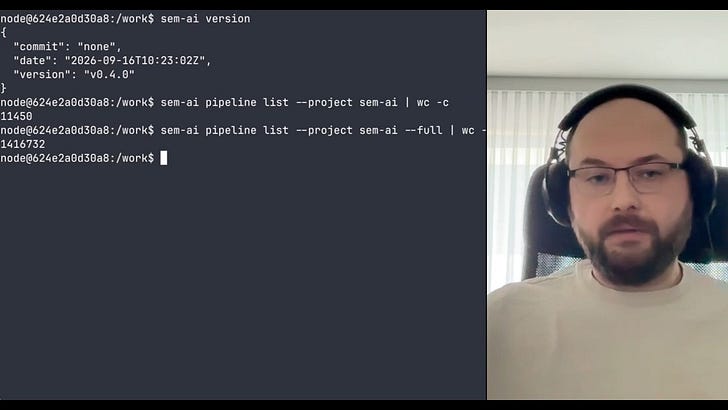 sem-ai 0.4.0 gives AI agents safer and more efficient access to CI/CD 16.09.2026 2minAI coding agents can generate and modify code quickly. But to work effectively with CI/CD, they need focused information, clearly defined permissions, and safeguards that prevent unsuitable changes from progressing.The new sem-ai 0.4.0 release improves all three areas.In our latest product news video, Nick demonstrates more compact pipeline responses, flexible context switching, and the ability to create and validate Semaphore preflight checks directly with an AI coding agent.Get the essential pipeline informationRequests for Semaphore workflows and pipelines now return a much more compact response by default.In the demonstration, the new response was approximately 99 percent smaller than the previous full output. This gives an AI coding agent the essential pipeline information without filling its context window with unnecessary detail.The complete output is still available when needed. Results can also be limited or filtered by date.This makes sem-ai more efficient by default while giving developers control over how much information the agent receives.Switch between permission contextssem-ai 0.4.0 also introduces a context flag.You can define separate contexts for different Semaphore organizations or service accounts, then select the appropriate one through a command line flag or an environment variable.For example, one service account could have read only access for reviewing code and investigating pipeline failures. Another could have permission to modify Semaphore configuration.This supports a safer, least privilege approach. An AI agent receives the access required for its current task without automatically receiving broader control.Create preflight checks with your coding agentThe release also adds support for Semaphore’s preflight checks API.Preflight checks evaluate a request before a workflow starts. Teams can use them to enforce organizational rules, including required branch naming conventions.In the video, Claude Code creates a preflight check for a Semaphore project. It configures a branch naming rule, adds the check, and tests it against several branches.Workflows from accepted branches continue normally. Branches that do not follow the required pattern are blocked before the pipeline begins.This gives teams another way to turn delivery policies into enforceable safeguards, directly from the development environment where the agent is working.One limitation remains. The init job configuration used by preflight checks cannot yet be modified programmatically. The Semaphore team plans to address this in a future update.sem-ai 0.4.0 is available nowPlugins for Claude Code and Codex will update automatically.If you use the sem-ai command line interface directly, it will notify you when the new version is available and provide the command needed to install it.Watch the full demonstration to see sem-ai 0.4.0 in action.Explore the project on GitHub, or create a Semaphore account to try it with your own pipelines. This is a public episode. If you would like to discuss this with other subscribers or get access to bonus episodes, visit semaphoreio.substack.com
 -
 Rerun Only the Jobs That Failed 12.08.2026 1minA pipeline fails on a single job, and you shouldn’t have to rebuild everything around it to recover. That’s what changes with this update.Job rerun is here, and it reruns only the jobs that actually failed. Until now, when a job inside a block failed and you reran the pipeline, every job in that block got rebuilt, including the ones that had already passed. The new default rebuilds only the failed jobs. Every other job in the block, plus jobs from earlier in the pipeline, is carried over and reused, so your workflow topology stays intact and only the new jobs get built.The carried-over jobs are excluded from your billable time. That means a rerun costs you only the jobs that failed, not the whole block. Faster turnaround on failures, and a lower bill to match.The old behavior is still one flag away. We exposed a YAML flag called block rebuild that keeps the full block rebuild when you want it. The new, leaner path is the default, and the escape hatch is there when you need it. sem-ai already understands the new behavior, so agents pick it up and rerun the right way automatically.What’s ComingJob rerun is the first building block of doubling down on CI for the second half of 2026. We’re working through what CI looks like in an agent-driven software development world, with sem-ai as the agent-native interface to the CI. Expect more agentic CI capabilities announced through September.* Try sem-ai* Try Semaphore Cloud* All product newsTill the next time,Pete Miloravac https://semaphore.io This is a public episode. If you would like to discuss this with other subscribers or get access to bonus episodes, visit semaphoreio.substack.com
 -
 Flaky Test API Now GA, New Auto-Fix Skill, Skill Quality Improvements 19.06.2026 1minFlaky test data is now accessible through the sem-ai API, and this week also brings a skill that uses that data to fix the tests automatically.Flaky test data is now generally available through the API. You can query your flakiest tests programmatically, sorted by number of disruptions, with failure timestamps and logs included. Find it on github.A new sem-ai skill can identify and fix flaky tests end-to-end. The agent pulls the highest-disruption tests, gathers failure context, determines the root cause, and writes a fix. It then verifies the result, first by running tests locally, and if that’s not possible, by spinning up Semaphore test boxes to run the test across multiple machines in parallel. Running the test repeatedly across machines is especially important for flaky tests, since a single passing run isn’t enough to confirm a fix. Benchmarking on a real open source project with Claude Opus on high effort showed a cost of $1 to $1.50 per fix.Four existing skills were improved with additional examples. Agents were occasionally not following skill instructions due to a lack of examples. Adding concrete examples improves adherence and makes sem-ai’s output more consistent across runs.What’s ComingUser and organization management will be added to the API in an upcoming release. The team is also continuing to refine skills and commands based on usage patterns.* Try sem-ai* Try Semaphore Cloud* All product newsTill the next time, Pete Miloravac https://semaphore.io This is a public episode. If you would like to discuss this with other subscribers or get access to bonus episodes, visit semaphoreio.substack.com
 -
 Codex Support, Faster Task Creation, and Flaky Test Visibility 04.06.2026 2minHere’s an update on what our engineering team has been shipping in sem-ai and what’s coming up next.Codex marketplace support is live.A few issues were blocking some users from getting sem-ai working on Codex. Those are now fixed. If you tried it before and hit a wall, it’s worth giving it another shot.Task creation got faster.We cleaned up some unnecessary API calls that were causing hiccups. You can now create and manage tasks on your projects entirely through the CLI, exactly where your agent already lives.sem-ai plugin submitted to the Claude marketplace.We’re in review. We’ll share more once it’s through.On the horizon:The team is working on full platform management through sem-ai. Members, organizations, and everything else currently in the Semaphore UI will be accessible directly through the CLI.Also shipped: Show/hide skipped blocks in the workflow editor is now generally available. If you work with complex pipelines, it makes reading results a lot cleaner. This is a public episode. If you would like to discuss this with other subscribers or get access to bonus episodes, visit semaphoreio.substack.com
 -
 Building an AI-Native CICD Experience with sem-ai 27.05.2026 3minWe’ve been talking a lot recently about AI-native developer workflows and where CICD is heading. This week, we shared one of our most exciting demos yet: a look at how SEMai is changing the way developers interact with CICD systems.In the demo, Marcos starts with a completely clean repository: no CI configuration, no GitHub Actions workflows, nothing.Then, inside Claude Code, he runs a single command:/sem-ai initFrom there, sem-ai analyzes the repository, detects the tech stack, and generates a tailored CICD pipeline automatically.It recommends:* Linting* Security scanning* Matrix testing* Pipeline topology improvementsBut the most interesting part comes afterward.Marcos tells the agent:“Work until the pipeline is green.”The system monitors the pipeline, analyzes failures, applies fixes, reruns workflows, and eventually gets the build passing successfully while summarizing everything it changed along the way.Nick also shares lessons learned while building the onboarding experience itself, including why slash commands became critical for reliable agent workflows and how improving contextual skills dramatically increased success rates.This is what we mean when we talk about AI-native CICD:not AI bolted onto existing tooling, but a fundamentally different developer experience built around collaboration between developers and agents.In the full demo, Marko, Marcos, and Nick walk through:* AI-assisted CICD onboarding* Slash command workflows* Self-healing pipelines* Pipeline optimization* The evolution of SEMai skills and agent contextWe’re excited about where this is heading and look forward to sharing more soon.Pete Miloravachttps://semaphore.io This is a public episode. If you would like to discuss this with other subscribers or get access to bonus episodes, visit semaphoreio.substack.com
 -
 Introducing Semaphore for AI Agents 14.05.2026 2minDevelopers are increasingly working inside AI-powered coding tools like Claude Code, Cursor, and Codex.The workflow is changing.Instead of constantly switching between dashboards, logs, terminals, and configuration files, developers are starting to collaborate directly with coding agents using natural language.We think CI/CD should evolve alongside that shift.Today, we’re introducing Semaphore for AI Agents — a new open-source CLI and agentic interface designed to make Semaphore fully accessible from AI coding agents.This is the first step toward what we call the AI-native Semaphore experience.What is Semaphore for AI Agents?Semaphore for AI Agents gives coding assistants a structured way to interact with Semaphore.Instead of manually navigating CI/CD systems, developers can simply ask:* “Why is my CI failing?”* “What tests are flaky?”* “Show me the critical path in this pipeline.”* “Summarize the health of this project.”And their coding agent can retrieve, analyze, and act on that information directly through Semaphore.The first release includes:* Pipeline diagnostics* Flaky test detection* Critical path analysis* Organization-wide CI/CD insights* MCP support* Claude Code integrations* Remote execution workflows on Semaphore infrastructureWe also demonstrate how developers can provision ephemeral machines for agent-driven workflows, remote testing, and scalable execution.Built for Agentic WorkflowsSemaphore for AI Agents was designed specifically for AI-native development workflows.The project ships with:* Agent-oriented commands* Structured JSON outputs* Claude Code skills* Generic agent skills* A local MCP serverThis allows coding assistants to interact directly with Semaphore while developers stay inside their coding environment.Fully Open SourceSemaphore for AI Agents is fully open source.Developers can inspect how it works, extend workflows, contribute new commands, and build their own automations.We believe AI-powered developer tooling should remain transparent, inspectable, and developer-controlled.This Is Just the BeginningSemaphore for AI Agents is the foundation for a broader direction we’re building toward at Semaphore:* Developers define intent* Agents handle repetitive execution* Semaphore provides the infrastructure and orchestration layerOver the coming weeks, we’ll continue shipping new workflows, MCP capabilities, testing automation, and scalable agent execution features.Watch the DemoWe recorded a full walkthrough showing:* CI/CD debugging workflows* MCP integrations* Claude Code usage* Organization-wide insights* Remote execution on Semaphore infrastructure→ [Read the full blog post]Thanks for following along.Till the next product update.Pete Miloravachttps://semaphore.io This is a public episode. If you would like to discuss this with other subscribers or get access to bonus episodes, visit semaphoreio.substack.com
 -
 Introducing .NET Support on Semaphore 07.04.2026 1minModern development teams don’t all build on the same stack and they should not have to.Today, we are expanding Semaphore’s capabilities to better support teams building on the Microsoft ecosystem, with first class support for the .NET framework and Microsoft Edge in CI pipelines.This marks an important step toward making Semaphore a truly flexible platform for all developers, regardless of their technology choices.Supporting More Developers, Where They WorkUntil now, Semaphore has primarily focused on Linux native tooling and ecosystems. With this update, we are extending that foundation to support developers working with the Microsoft stack.This includes:* .NET SDK support for building and compiling applications in CI* Microsoft Edge browser support for running end to end and UI tests* Full compatibility within Semaphore pipelines running on LinuxBy enabling these tools, teams can now build, test, and validate .NET applications directly within Semaphore, without workarounds or custom environments.Built on a Familiar, Reliable FoundationThis new support is already available in production, as part of our latest updates (see the changelog), and works on our latest Ubuntu 24.04 image.You can learn more about the environment here.By leveraging Linux compatible tooling for the Microsoft ecosystem, we are making it possible to run .NET workloads in the same scalable, reliable CI/CD environment teams already use for other stacks.This approach keeps things simple:* No need to manage separate CI systems* No need to maintain custom infrastructure* No disruption to existing workflowsJust a consistent, unified pipeline experience.Why This MattersAs development ecosystems continue to evolve, teams are increasingly working across multiple stacks and technologies.Supporting .NET is not just about adding another SDK. It is about expanding what developers can do within a single CI/CD platform.This aligns directly with our broader vision:* Reduce friction in software delivery* Automate the repetitive work behind building and testing* Let developers focus on what actually mattersAs outlined in our 2026 product strategy, our goal is to remove unnecessary toil and make the right thing the easy thing inside CI/CD .Bringing .NET into Semaphore is one more step toward that goal.What’s NextWe have also prepared a simple demo project showcasing how to build and test a .NET application on Semaphore. You can access it here.Alongside that, documentation updates and image changes are already available, and we will continue improving the experience based on feedback.This is just the beginning.As we continue expanding language and ecosystem support, our focus remains the same. Helping developers ship high quality software faster, with less manual effort.Happy building!Pete Miloravac Semaphorehttps://semaphore.io This is a public episode. If you would like to discuss this with other subscribers or get access to bonus episodes, visit semaphoreio.substack.com
 -
 OAuth for MCP Servers — Lessons from Building for AI Agents 19.03.2026 15minAs AI agents become part of everyday development workflows, authentication is becoming a critical piece of the puzzle.In our latest product update, we’re sharing a behind-the-scenes look at how we implemented OAuth for Semaphore’s MCP server—and what we learned along the way.You’ll get a practical perspective on:* Why OAuth is essential for MCP and AI agents* The challenges of working with evolving specs and inconsistent agent behavior* What actually works in real-world implementations* Key lessons for building secure, reliable integrationsThis isn’t theory—it’s a real engineering deep dive from our team.👉 Read the full blog post👉 Watch the full videoThis work is part of a broader shift at Semaphore, where we’re extending CICD with AI-powered workflows—while keeping developers in control and reducing manual work.If you’re building with MCP or exploring agent-driven workflows, this one’s worth your time.— Pete MiloravacThe Semaphore Teamhttps://semaphore.io This is a public episode. If you would like to discuss this with other subscribers or get access to bonus episodes, visit semaphoreio.substack.com
 -
 Semaphore’s New Pricing Model: Built for the AI Era of CICD 16.03.2026 3minToday we’re introducing an important change to how Semaphore pricing works. CICD is no longer something that runs occasionally during development. For many teams, it’s now always-on infrastructure that powers software delivery.To support this shift, we’re introducing a new Semaphore pricing model designed to keep CICD fast, scalable, and affordable as usage grows.What’s changingThe new model separates compute infrastructure from support and success services, giving teams more transparency and flexibility in how they use Semaphore.Key updates include:Lower machine pricingSemaphore’s fastest runners are now available at significantly reduced prices, starting at $0.0075 per minute.Our new f1 machines replace the previous e1 and e2 runners, focusing the platform on high-performance compute optimized for CICD workloads.Usage-based pricing for self-hosted agentsSelf-hosted agents are no longer billed per developer seat.Instead, usage is priced purely based on compute time at $0.0025 per minute.Support and success plans are now separateInfrastructure pricing now reflects compute consumption only.Teams can choose optional Support and Success plans depending on their operational needs and level of optimization guidance.A modular approach to CICDTeams can now combine:* Compute infrastructure* Support plans for operational reliability* Success plans for performance optimization* On-demand engineering assistanceThis modular model makes it easier to scale Semaphore alongside your CICD usage.For existing customersNothing changes immediately.You can continue using your current plan as-is, and when you’re ready, you’ll be able to switch to the new pricing structure directly in the app.Learn moreYou can explore the full pricing details here:👉 Pricing page👉 Try out SemaphoreIf you have any questions, drop us an email at [email protected] Semaphore Team This is a public episode. If you would like to discuss this with other subscribers or get access to bonus episodes, visit semaphoreio.substack.com
 -
 OAuth Authentication for the Semaphore MCP Server 06.03.2026 2minWe’re preparing a new update for the Semaphore MCP server that will make it easier for developers to connect AI agents and developer tools.The focus of this update is authentication.Today, connecting an agent to the MCP server typically requires using a long-lived API token. While this works well, it also means developers need to generate credentials, store them in configuration files, and manage them manually.In our next release, coming next week, we’re introducing OAuth authentication support for the MCP server.This will make connecting agents and developer tools significantly simpler.Instead of generating and storing API tokens, developers will be able to authenticate through a familiar OAuth flow. When configuring an agent, a browser window opens, you log in, and approve access to the MCP server. Once approved, the connection is established automatically.This approach removes the need to manage long-lived credentials and makes integrations easier to set up.It also improves compatibility with modern agentic development tools. Some tools have limitations when working with static API tokens, and OAuth removes those barriers.Read more on our blog.Pete MiloravacThe Semaphore Teamhttps://semaphore.io This is a public episode. If you would like to discuss this with other subscribers or get access to bonus episodes, visit semaphoreio.substack.com
 -
 AI-Driven Onboarding and Workflow Automation in Semaphore 02.03.2026 2min🚀 We’re introducing AI-driven onboarding and workflow automation in Semaphore. Our new assistive agent helps teams generate pipeline configurations, understand failed jobs, re-run workflows, and refine CI/CD setups using natural language — all while keeping developers fully in control. This is the beginning of Agent-Driven Semaphore: CI/CD at the core, AI handling the repetitive work. Watch to see what’s coming next.Give Semaphore a spin:https://semaphore.io/ This is a public episode. If you would like to discuss this with other subscribers or get access to bonus episodes, visit semaphoreio.substack.com
 -
 Extending CI/CD and What’s Next for Semaphore 19.02.2026 3minOver the past few weeks, we’ve been refining our roadmap for 2026 and focusing on where Semaphore can deliver the most value.Our direction is clear: extend CI/CD beyond execution — and help developers ship software faster.Here’s what’s coming next. This is a public episode. If you would like to discuss this with other subscribers or get access to bonus episodes, visit semaphoreio.substack.com
 -
 Malcolm Matalka on GitOps, Terraform Tooling, and Building Invisible Developer Tools 11.02.2026 37minIn this episode of Semaphore Uncut, Malcolm Matalka (Terrateam) discusses GitOps, Terraform tooling, OpenTofu workflows, and building developer tools that stay invisible. This is a public episode. If you would like to discuss this with other subscribers or get access to bonus episodes, visit semaphoreio.substack.com
 -
 Jamie Dobson on Generative AI, Developer Productivity, and System Stability 28.01.2026 33minIn this episode of Semaphore Uncut, Jamie Dobson, co-founder and former CEO of Container Solutions, shares a thoughtful perspective on generative AI, developer productivity, and system stability.The conversation explores why recent research shows engineers feeling happier and more productive with AI tools—while system reliability quietly declines. Jamie explains how AI-generated code can appear correct while introducing subtle long-term risk, and why speed without deep understanding can be dangerous for growing systems.They also discuss why looking back at the history of computing—from time-sharing to early neural networks—helps demystify today’s AI hype. The episode closes with a reflection on the stories we tell about technology, how humans and machines can work together, and what engineering leaders should be paying attention to next.👉 Read the full blog post for the complete conversation — and happy listening! This is a public episode. If you would like to discuss this with other subscribers or get access to bonus episodes, visit semaphoreio.substack.com
 -
 Sebastian Gierlinger on Scaling Remote Engineering at Storyblok 14.01.2026 31minIn this episode of Semaphore Uncut, Sebastian Gierlinger, VP of Engineering at Storyblok, shares what it really takes to scale a fully remote engineering organization—from early startup days to a 250-person company.The conversation explores how Storyblok scaled engineering across multiple time zones without losing alignment or delivery speed. Sebastian explains why Scrum stopped working as the team grew, what changed after adopting Shape Up, and how specialization—if left unchecked—can quietly turn into a bottleneck for growing teams.They also discuss what remote-first organizations need to get right as they scale, from decision-making and trust to execution at speed. The episode closes with a candid look at how AI is already changing day-to-day engineering work—and why scaling engineering is ultimately less about hiring faster and more about designing better systems.👉 Read the full blog post for the complete conversation — and happy listening! This is a public episode. If you would like to discuss this with other subscribers or get access to bonus episodes, visit semaphoreio.substack.com
 -
 Keren Fanan and Hadar Geva on Reinventing Frontend with MyOp 17.12.2025 24minIn this episode of Semaphore Uncut, Keren Fanan (CEO & Co-founder) and Hadar Geva (CTO & Co-founder) of MyOp share how years of building and scaling frontend systems led them to rethink how UI should be built, shipped, and managed in production.This conversation covers:* How frontend systems break down over time due to framework churn and legacy code* Why treating UI components as runtime contracts changes how teams ship and experiment* How MyOp enables safe UI rollouts and gradual frontend modernization without redeployments* Where this approach goes beyond traditional micro-frontend architectures* How AI-generated UI is accelerating the need for more flexible frontend systems* What MyOp’s open, framework-agnostic model looks like in practiceA clear, practical look at how frontend architecture is evolving—and what it means for teams building long-lived products.👉 Read the full blog post for the complete conversation — and happy listening! This is a public episode. If you would like to discuss this with other subscribers or get access to bonus episodes, visit semaphoreio.substack.com
 -
 Technical Tips: Build Your First MCP Server in 5 Minutes 02.12.2025 6minAI agents can reason, but they don’t actually understand your systems. MCP servers fix that by giving your copilots and assistants structured access to your tools, APIs, and CI/CD data. And the best part is that building one is much simpler than most people expect.In the latest episode of Technical Tips, Tommy walks through how to create a functional MCP server in just a few minutes. He connects it to Semaphore’s API, pulls real project data, and shows how to expose those insights to tools like OpenAI Codex. It’s a straightforward, hands-on demo that finally makes MCP feel practical instead of theoretical.If you’ve been curious about MCP or you’re trying to make your AI tools genuinely useful in day-to-day engineering work, this is the perfect place to start. You’ll see how an MCP server communicates with AI clients, how to wrap a real API into it, how to test everything using the MCP Inspector, and how easily you can turn your CI/CD workflows into a conversational experience.By the end, you’ll understand how surprisingly little code it takes to give your AI agents real operational awareness.Access the full guide on our blog. This is a public episode. If you would like to discuss this with other subscribers or get access to bonus episodes, visit semaphoreio.substack.com
 -
 Jonathan Reimer on Open Source, Startups, and AI 19.11.2025 25minIn this episode of Semaphore Uncut, Jonathan Reimer—founder of Crowd.dev and now VP of Outbound Products at the Linux Foundation—breaks down what he’s learned from years inside the open source startup ecosystem.This conversation covers:* How Crowd.dev grew into a core insights platform for OSS communities and was later acquired by the Linux Foundation* The three types of open source companies Jonathan identified after speaking with 400–500 founders* Why GitHub stars are vanity metrics—and which signal actually reflects real adoption* When open source provides a real go-to-market edge, and when it doesn’t* How AI is already influencing OSS development, from automated bug fixes to running LLMs locally* Why open source models may ultimately dominate the model layer as costs fallA sharp, fast overview of the forces shaping developer tools, open source ecosystems, and AI infrastructure today.👉 Read the full blog post for the complete conversation — and happy listening! This is a public episode. If you would like to discuss this with other subscribers or get access to bonus episodes, visit semaphoreio.substack.com
 -
 Technical Tips: Multiply Your Tests, Not Your Work 05.11.2025 2minIn this episode of Technical Tips, Tommy shows you how to run tests across multiple environments without duplicating your CI/CD setup or writing repetitive jobs.He explains how job matrices in Semaphore help you expand test coverage, catch regressions early, and keep your pipelines organized and efficient.You can also check out the blog post Job Matrix: Feature Showcase for a detailed walkthrough with examples in both the Workflow Editor and YAML.Happy building,The Semaphore Team This is a public episode. If you would like to discuss this with other subscribers or get access to bonus episodes, visit semaphoreio.substack.com
 -
 Brian Douglas: AI Tooling, Open Source, and the Future of Developer Workflows 21.10.2025 25minIn this episode, Darko welcomes Brian Douglas, Head of Developer Experience at Continue and longtime open source advocate. They talk about the rise of the AI engineer, how AI agents are reshaping developer workflows, and what’s next for open source infrastructure. Enjoy the episode!Read the blog post: https://semaphore.io/blog/brian-douglasLike this episode? Be sure to leave a ⭐️⭐️⭐️⭐️⭐️ review on the podcast player of your choice and share it with your friends.🎙️ This podcast is powered by Semaphore! 🚀Show Semaphore Some Love ❤️⭐ Star us on GitHub: https://github.com/semaphoreio/semaphore🚀 Join us on discord: https://discord.com/invite/FBuUrV24NH⬆️ Upvote on Product Hunt: https://www.producthunt.com/products/semaphore-open-source-ci-cdLet’s make open-source CI/CD even better—together! ✨ This is a public episode. If you would like to discuss this with other subscribers or get access to bonus episodes, visit semaphoreio.substack.com
Sarnased taskuhäälingud


Populaarne riigis
See taskuhääling on ka nende riikide taskuhäälingute edetabelites.
