
Liberia: Remembering the Future
LiberiaRTF Podcast
0
Liberia: Remembering the Future is a podcast about memory, history, and possibility in Liberia. Co-hosts Aaron Weah and Gerry Naughton explore how the country's past shapes its present, touching on history, culture, politics, war, peace, and everyday life. The show aims to understand Liberia's complex narrative and consider what the future might hold.
Osad
-
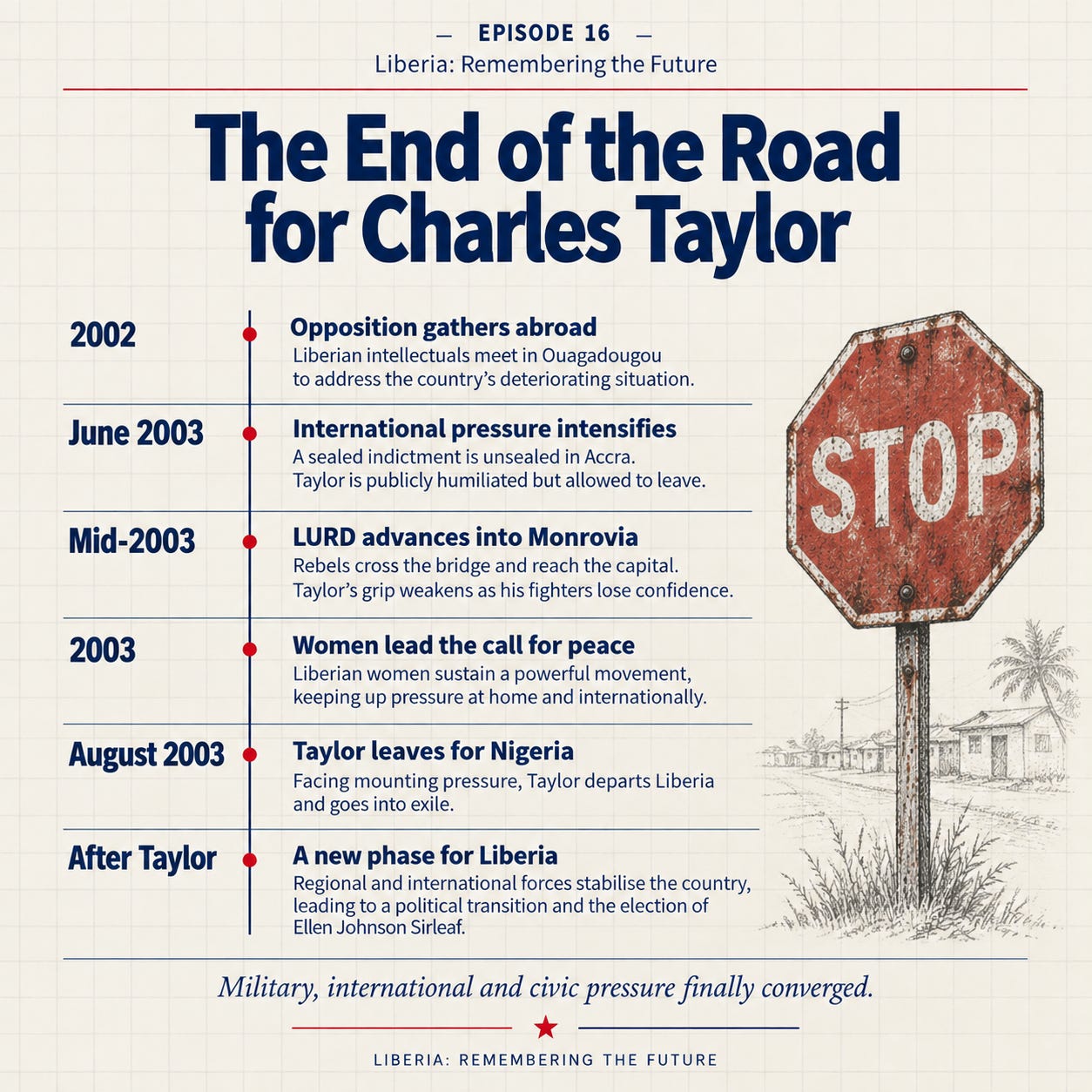 The End of the Road for Charles Taylor 16.09.2026 50minBy 2003, Charles Taylor was running out of options.Rebel forces were advancing on Monrovia. His standing across West Africa had collapsed. An indictment from the Special Court for Sierra Leone was hanging over him. And inside Liberia, a remarkable movement of women was demanding an end to the war.In this episode, Aaron Weah remembers those final months from inside Monrovia – including waking up to 78 missed calls to discover that LURD rebels had crossed the bridge and he was effectively behind their lines. His response was to flee through the fighting carrying one possession he wasn’t prepared to abandon: his guitar.Aaron and Gerry also discuss the international pressure building around Taylor, the Liberian women’s peace movement and its cultural significance, the Accra negotiations, and Taylor’s eventual departure for exile in Nigeria.Finally, they ask what became of the armed factions that had dominated more than a decade of Liberian history – and how some of their political and ethnic constituencies survived the transition from war to peace.In this episode:* LURD’s advance into Monrovia* Aaron behind rebel lines – with his guitar* The international isolation of Charles Taylor* The Special Court for Sierra Leone indictment* Liberia’s women’s peace movement* Taylor’s departure for Nigeria in August 2003* ECOMIL, UNMIL and the beginning of Liberia’s transition* What happened to Liberia’s wartime factions?Liberia: Remembering the Future is presented by Gerry Naughton and Dr Aaron Weah.---In the next episode, we’ll turn our attention to Ellen Johnson Sirleaf, the woman who became Africa’s first elected female president. We are Aaron Weah and Gerry Naughton. Thanks for listening.You can find Liberia Remembering the Future on Substack and wherever you get your podcasts. Search for Liberia Remembering the Future to hear the whole series.* If you know anyone who is interested in Liberia or African history, feel free to share this post with them.* And if you want to subscribe, and receive updates on everything we post direct to your inbox, you can do so below.* You can also follow the podcast on Apple or Spotify, as well as on podcast apps like Pocket Casts and Podcast Addict. This is a public episode. If you'd like to discuss this with other subscribers or get access to bonus episodes, visit liberiartf.substack.com/subscribe
 -
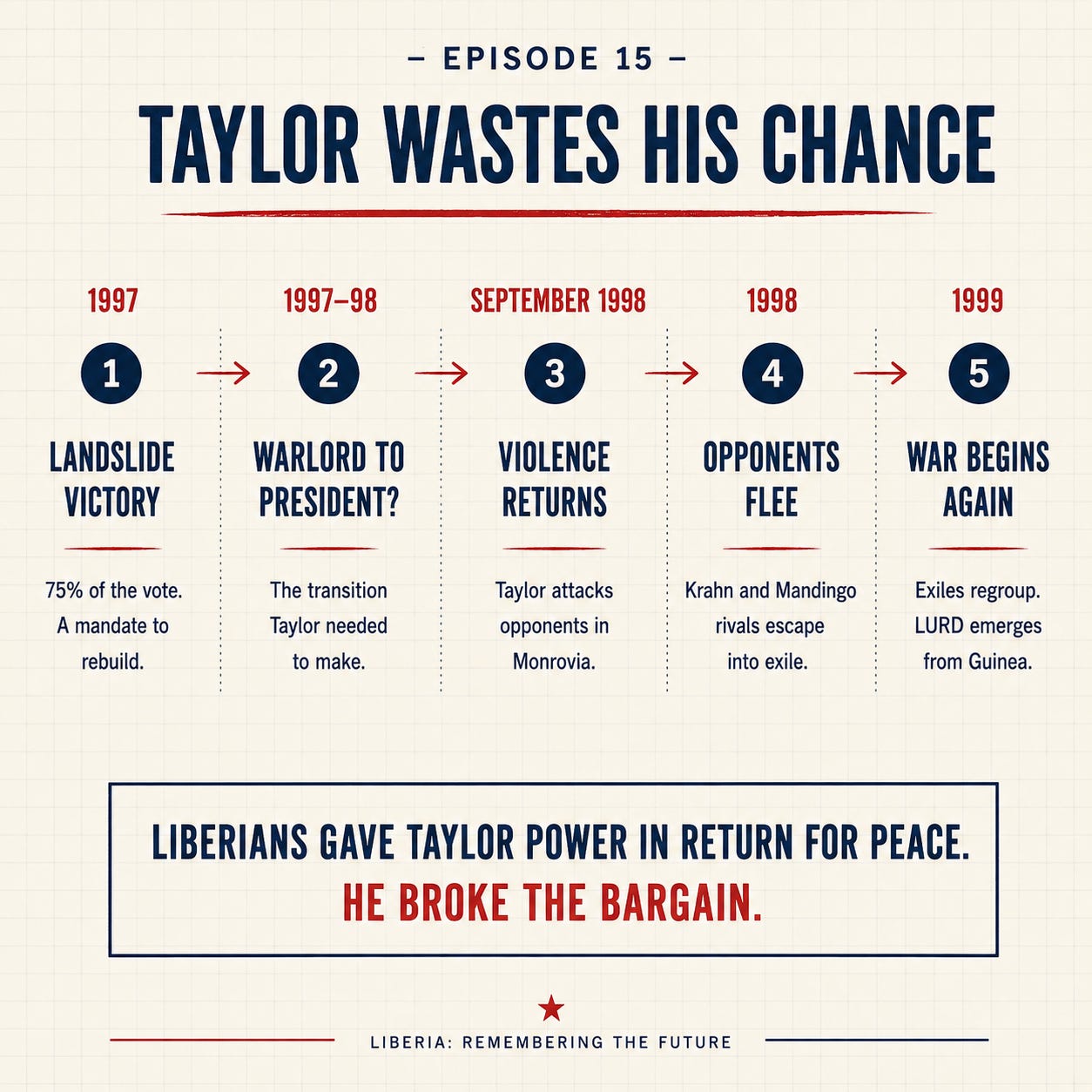 Taylor Wastes His Chance 26.08.2026 29minCharles Taylor finally won what he had spent years fighting for. What would he do with the country now?In 1997, Liberians handed Taylor an overwhelming electoral victory. As Aaron Weah argues, there was an unwritten bargain at the heart of that vote: Taylor would get the presidency, and Liberia would finally get peace.But becoming president required Taylor to make a transition he never really managed – from warlord to democratic leader.In this episode, Gerry Naughton and Aaron Weah look at the political killings, the violence of September 1998, the flight of Taylor’s opponents into exile and the beginnings of the rebellion that would become LURD.They also look beyond Liberia: at Sierra Leone, blood diamonds and a region still living with the consequences of Liberia’s first civil war.Taylor had been given an extraordinary mandate and an opportunity to rebuild.He broke the bargain.Liberia: Remembering the Future is presented by Gerry Naughton and Dr Aaron Weah. This is a public episode. If you'd like to discuss this with other subscribers or get access to bonus episodes, visit liberiartf.substack.com/subscribe
 -
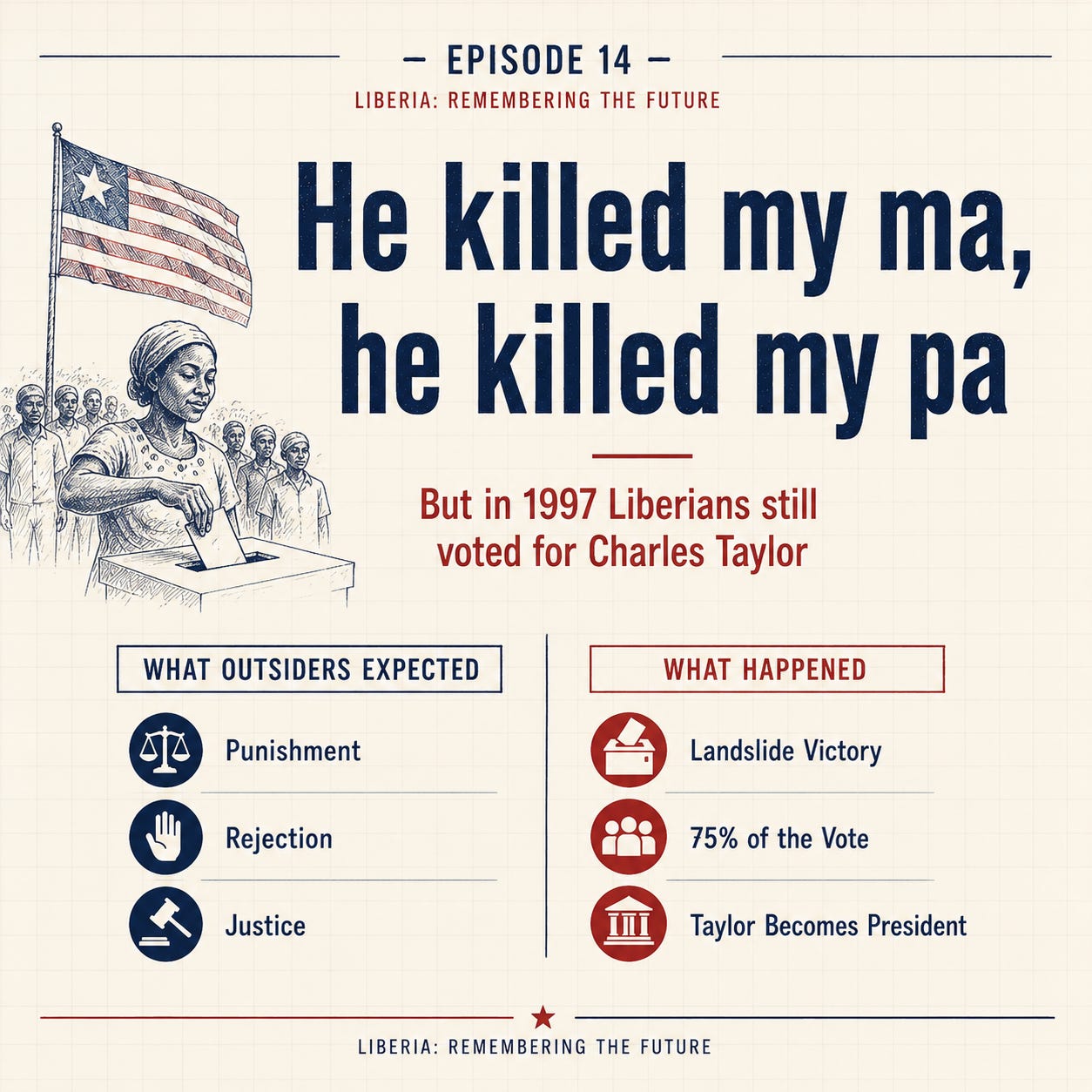 He Killed My Ma, He Killed My Pa 05.08.2026 48minWhy Liberians Voted for Charles TaylorIn 1997, Liberia held elections after seven years of devastating civil war.The result shocked the world. Charles Taylor, the rebel leader whose forces had helped plunge the country into conflict, won an overwhelming 75% of the vote.How could that happen?Was it fear? Intimidation? A desire for revenge? Or something else, something more complicated?In this episode, Dr Aaron Weah explores one of the most debated questions in modern Liberian history. Drawing on decades of research, his own experience growing up during the war, and insights from political science, anthropology and Liberian culture, he argues that the answer cannot be understood through Western political assumptions alone.Together, Gerry Naughton and Aaron Weah examine:* Why many Liberians believed only Taylor could prevent another war.* The famous campaign slogan: “He killed my ma, he killed my pa... but I’ll vote for him.”* The difference between fear, coercion and strategic choice.* The idea of Liberia’s civic and primordial public - as a concept and an important factor in understanding 1997.* Why Taylor’s election represented both hope and a profound missed opportunity.By the end of the episode, Taylor has been given one of the strongest democratic mandates in Liberian history.The question is: what did he do with it? That’s in our next episode…TranscriptHello and welcome to LRTFLast time, Liberia finally emerged from seven years of civil war. Under the interim leadership of Ruth Perry, the country held elections that many hoped would mark a new beginning.But the result stunned the world.Charles Taylor – the man whose rebellion had helped plunge Liberia into war – won a landslide victory.So why did people make that choice?In this episode, Aaron Weah argues that the answer lies far deeper than fear or intimidation. To understand the election of 1997, we have to understand how Liberians were trying to rebuild a shattered society.Charles Taylor won three-quarters of the 1997 vote.He controlled the presidency, the House of Representatives and the Senate.The war was over. The country desperately wanted peace.And hundreds of thousands of Liberians had made what they believed was the only choice ... that could finally end the conflict.The question now was simple.What would Charles Taylor do with that extraordinary opportunity?That’s next time on Liberia Remembering the Future.* If you know anyone who is interested in Liberia or African history, feel free to share this post with them.* And if you want to subscribe, and receive updates on everything we post direct to your inbox, you can do so below.* You can also follow the podcast on Apple or Spotify, as well as on podcast apps like Pocket Casts and Podcast Addict. This is a public episode. If you'd like to discuss this with other subscribers or get access to bonus episodes, visit liberiartf.substack.com/subscribe
 -
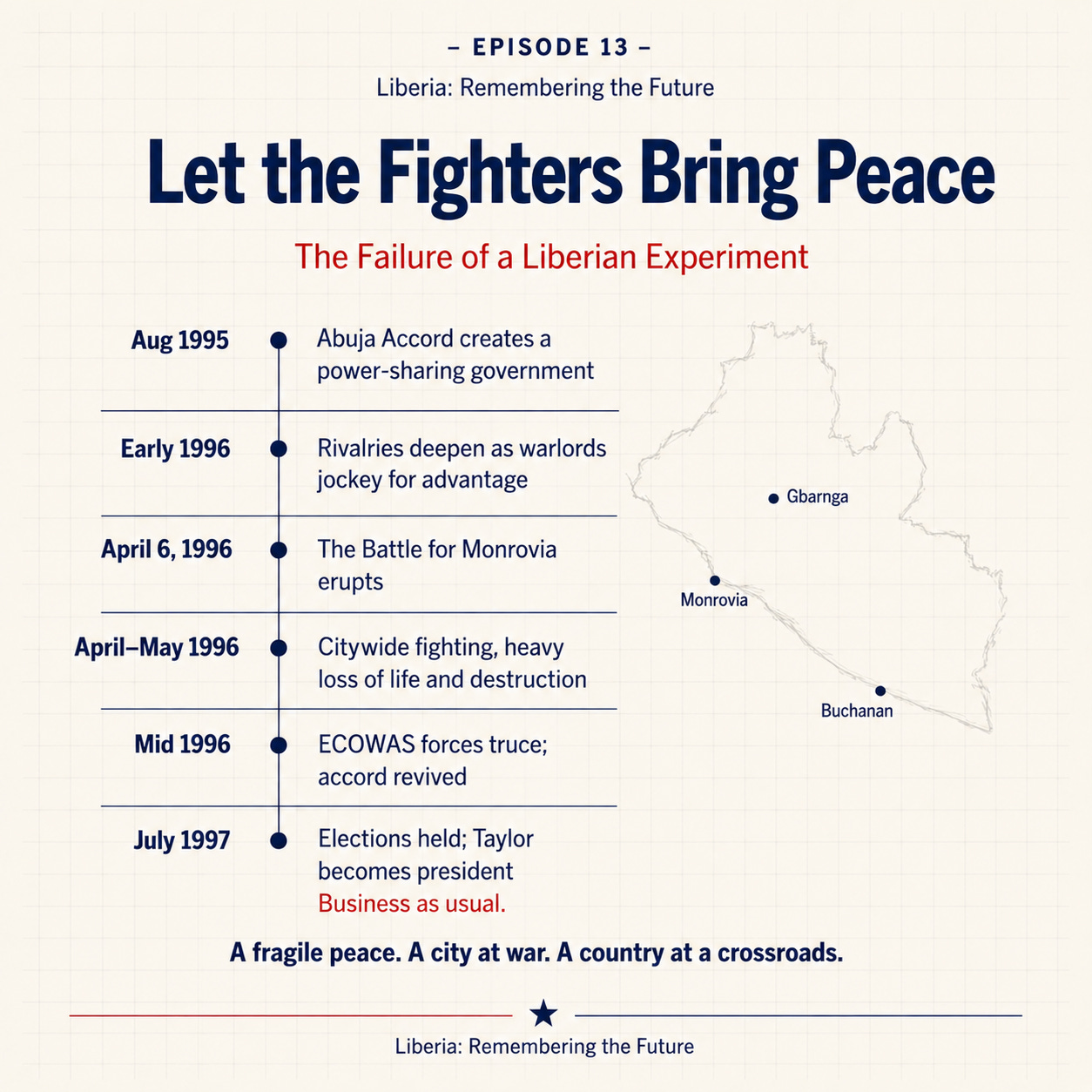 Let the Fighters Bring Peace 15.07.2026 33minBy 1996, Liberia’s civil war had already survived numerous peace agreements. In a final attempt to end the fighting, the country’s main warlords were brought together into a shared transitional government. The hope was simple: hold the peace long enough to organise democratic elections.Instead, the experiment collapsed.In this episode, Ged Naughton and Dr Aaron Weah examine the events that led to the Battle for Monrovia in April 1996—one of the most destructive episodes of Liberia’s first civil war. They explore why the power-sharing arrangement failed, how old rivalries quickly resurfaced, and why the fighting became known for “Operation Pay Yourself”, as thousands of fighters looted a city already exhausted by years of conflict.Drawing on Aaron’s own research in Impunity Under Attack, they reconstruct the chain of events that turned political tension into open warfare and consider what the battle revealed about Liberia’s fractured politics. They also discuss the role of the transitional government, the appointment of Ruth Perry, and why many historians now see the exclusion of women from earlier peace negotiations as a major missed opportunity.In this episode* Why the Council of State was created—and why it failed.* How a single incident triggered the Battle for Monrovia.* “Operation Pay Yourself” and the looting of the capital.* The role of Charles Taylor, Roosevelt Johnson and the rival factions.* Why Ruth Perry’s appointment marked an important turning point.* Lessons from Liberia’s final failed attempt to negotiate peace between warlords.TranscriptIntroOver the last few episodes, we took a side road that led us away from the front lines of Liberia’s civil war to something just as important: how do ordinary people carry on living during such times. We followed Aaron’s own journey through music, friendship and survival.Now we return to the highway.By 1996, Liberia’s latest attempt at peace had brought the country’s rival warlords into a shared government. It was an extraordinary experiment—but one that would end in catastrophe.This is the Battle for Monrovia.00:00:00 AaronSo I would say the impasses—uh, war—was not, not so different from previous episodes of violence in Liberia, but this was just yet another peace agreement that had failed. It’s a seeder in bringing together—in an arrangement—something that appeared like a collective co-presidency that had Charles Taylor, George Boley, Alhaji Kromah, and other warlords together in an arrangement that was meant to carry Liberia through a certain patch of stability and then transition through elections.00:00:43 AaronBut then that arrangement collapsed, and it happened so much so that, for the first time since the war started, there were so many warm factions that were initially located in different parts of the country. But because of the collective arrangement—and this was really what made the April 6 War perhaps one of the most destructive in Liberia—because much of the war factions had converged on the city center. In fact, we’re all living there because they now had the head, the different head of the warm factions were now giving power through power-sharing arrangement, and so they were there.00:01:22 AaronAnd because the agreement failed and Liberia went to conflict, and so you have all of these soldiers who were milling around in town, so in this collapse of yet another peace agreement, an opportunity to loot, and an opportunity to—to—to seek a revenge, you know, on so many different levels. And so part of the TRC report finding was that revenge killings in the Liberian conflict—so people who had personal ice to grind with each other—used that occasion to go at different people. And there were still, even though it was 6 years into the conflict, but there was still killing on based on tribal grounds, based on ethnic grounds, those who were of certain ethnic—perceived to be of some rival ethnic group, you were hounded and you were killed. And there was much looting. There were—the UN was there, there were vehicles, and I mean, it was—it was—it was a very violent, violent episode.00:02:30 AaronAnd Stephen Ellis and other Liberian—and other Liberian academia refer to this period as the Battle for Monrovia, you know, where Monrovia became that single space that, in a way, had not been captured. It was occupied briefly before in 1990, but then because of Ecomog, because of the AFL, rebel forces who converged on the capitals were quickly—were quickly repelled. I mean, they were driven out. But April 6 became an occasion where every other warm factions who had previously been confined to the rural parts of Liberia were now physically present in Liberia. And because historically Monrovia has always been Liberia, it was a big deal.00:03:14 AaronPeople wanted to go to some of these plush places, break it down, take out the loot, and pay themselves. And paying yourself was an important phenomenon in the Iprasis War because many of the fighters took on arms for different reasons. They were not being paid. Occasionally, maybe they and their commanders went out on a particular operation and they got some spoils. They got some spoils from whatsoever the operation was. But April 6 War represented the rare opportunity for Monrovia to be torn apart and people could make a way with whatever they had.00:03:51 AaronI mean, that was really the sad part of the conflict. And you can’t—you can’t miss an opportunity to act, based on a close assessment of the April 6, to say, “What was the Liberian Civil War really about?” If fighters, senior official military officials, saw in Monrovia an opportunity to—an op—and that’s a part of April 6 that is referred to as Operations Pay Yourself. Operation Pay—yeah, Pay Yourself.00:05:47 GedBefore we continue, I asked Erin to go back to something he wrote more than 15 years ago. This is his account, and the account of the book Impunity Under Attack, of how the Battle for Monrovia unfolded.00:06:01 Aaron“One Ulimo-J forces in Kakata heard that Johnson’s home had been searched by Ecomog. Some of the forces, largely loyal to Johnson, saw it as an humiliation of the leader. In protest, they went wild in the city, which lies some 45 km from Monrovia, placing roadblocks along the Kakata Highway, the main route connecting Monrovia to the interior of Liberia, including the NPFL stronghold of Gbarnga. Taylor had found his opportunity. On March—on 8 March 1996, NPFL forces launched a massive attack on Ulimo-J positions in Kakata, Bong Mines, and Todee, with the stated aim of keeping the Kakata Highway open. There is strong suggestion that Charles Tiller brought over some high-ranking Ulimo-J officers in Kakata, who were not loyal to Johnson, and induced them to surrender territory to the NPFL forces. With the acquiescence of these officers, NPFL began a move—NPFL began to move their men and heavy guns into positions previously controlled by Ulimo-J forces, easily routing those who resisted.00:07:15 AaronAt the same time, Ulimo-K forces were launching renewed attacks against Tubmanburg and other places in Bomi and lower Liberia, now in Gbarpolu County, which were under the control of Ulimo-J. But these attacks did not lead to significant shifts in the territorial control. All these attacks provoked strong protests from Roosevelt Johnson and his loyalists, but probably because of the poor standing with Ecomog, the peacekeepers practically ignored his position. In the midst of all this, elements of K5, a Ulimo-J unit commanded by Ama Yulo went around the vicinity of Roosevelt Johnson Beach House residence in the Sinkor district of Monrovia during the night of the 19th to 20th of March 1996. It is not clear why the fighters wandered around Johnson’s house, but in the altercation that ensued between them and Johnson loyalists, one of the K5 men was killed, identified later as Due Bowo. He was found dead the next morning, a few blocks up the road from Johnson’s house. Charles Taylor seized the moment, invoking this authority as a member of the presidency, and enlisting the support of the Ulimo-K’s Alhaji Kromah, who had his own axe to grind with Roosevelt Johnson.00:08:40 AaronTaylor urged on the police to arrest Johnson on murder charges. Incidentally, the director of police, Joe Tate, was an NPFL appointee and cousin to Charles Taylor, and lived on the same block with Johnson. Under the guise of providing protection to Joe Tate’s home, schools of NPFL militiamen now recycled as police special forces began to deploy in the vicinity of Johnson’s home, practically setting up a command post in advance of their move to arrest the Ulimo-J leader. Seeing the situation their leader was in, Ulimo-J fighters began a rapid mobilization at his home to prevent his arrest. The stage was now set for a showdown. Around this time, George Boley, LPC leader and member of the presidency, boarded a plane at the Spruce Fin Airfield in Monrovia on his way out of the country. Before the plane could take off, Charles Taylor arrived at the airfield at the head of a train of heavily armed followers.00:09:45 AaronHe ordered the plane not to take off until he had inspected the occupants. Incensed by this, LPC fighters, who had gone to escort Boley, surrounded the entrance of the plane. Guns at the ready, and they fired anybody to go on board. Boley himself intervened to end a standoff by ordering his men to allow Taylor to board the plane. Taylor went on the plane, took a closer look around, and disembarked. He left—he left when the plane took off shortly afterward, but some of his men stayed at the airfield. As Boley’s LPC escorts were leaving the airfield, they entered into a row with Taylor’s men, who had stayed behind.00:10:32 AaronWithin moments, heavy gunfire erupted. The brief firefight that ensued since the violence in the area running helter-skelter, Monrovia was on edge. Meanwhile, a tense standoff ensued for the next few days between Roosevelt Johnson’s men and the police special forces. The police encircled the area around Johnson’s home to prevent his escape and tried to inch toward his house to enforce his arrest. But the Ulimo-J fighters had set up a defensive cordon around the house. Every time the police came within the range, the Johnson men found too uncomfortable, they would assume a more hostile posture, brandishing cutlasses, threatening and taking up fighting positions. The police would then pull back.00:11:26 AaronThis seesaw continued onto the presidency issued an ultimatum to Roosevelt Johnson. It announced that if Johnson did not turn himself in to the Justice Ministry by 4:00 p.m. of Friday, 5 April, on charges of murder, he would be arrested. Johnson did not turn himself in, arguing that he was not prepared to surrender himself to be slaughtered like a chicken by Kromah and Taylor’s men, posing as state police. On the night of 5 April 1996, the police launched a massive attack on the home of Roosevelt Johnson to secure his arrest. The Ulimo-J fighters beat back the police and burned down the home of the police director, and seized control of the entire street. By next morning, commuters were passing the Ulimo-J fighters at the junction where Johnson Street joined the main motor road from Eastern Stop Bridge to Central Monrovia. Some of these fighters were stark naked, wielding cut lieses and other weapons, as they heard profanities at Charles Taylor and Alhaji Kromah.00:12:39 AaronThese were elements of the Butt Naked Brigade, men and women who went into battle without articles of clothing. Images of the fighting were soon to dominate the international media. Realizing that the police could not arrest Johnson, Taylor, and Kromah began trucking their fighters from the bushes into Monrovia. Ecomog decided to play spectator to these events. With the emergence of the NPFL, Ulimo-K Alliance—against the Krahn dominated Ulimo-J, and the skirmish between the LPC and NPFL at the airfield, still within recent memory, members of the AFL, predominantly Krahn, the LPC, mainly Krahn and Sapo, decided to go into to the aid of Johnson. Thus, AFL and the LPC fighters began to move toward Johnson’s home. There they joined up with the Ulimo-J fighters and made the decision to move Roosevelt Johnson to the Barkley Training Center, home of the AFL in Central Monrovia.00:13:41 AaronAs the crown forces made their way toward the BTC, Tiller’s police, backed by NPFL and Ulimo-K guerrillas, tried to intercept them to capture Johnson. The crown fighters fought their way through the police cordon, many of them stark naked and using only cutlasses. This is how Milton Blahie of the LPC, Alliance General Butt Naked came to prominence. With the crown forces regrouped at the BTC, the Ulimo-K and NPFL artillery pounding the military parade while waves of their troops launched incursions and assorted to capture it. But the crown forces proved too formidable. Fighting was fierce and vicious. Lasting many weeks, Monrovia was comprehensively looted.00:14:33 AaronSome 2,000 persons lost their lives, and millions of dollars’ worth of property was destroyed. Still, Roosevelt Johnson was never captured or arrested, as Taylor and Kromah would describe it. The international community finally emerged from its slumber to pressure the warm factions into a truce. Forces of the Ulimo-K and NPFL withdrew from Monrovia, and Ecomog returned to the streets. The parties were hastily assembled in Abuja to reaffirm the Abuja Accord and agree on an addendum to it.00:15:07 AaronCivilians were left to sort out the total mess the warlords and their fighters had made of their lives. The warlords were restored to power to continue business as usual.”00:17:14 GedWhen you look at it now, you kind of wonder, what on earth were they thinking, putting all those warlords and faction leaders together?You’re right. You’re right. I think it was an experiment. And you have to also put that in context. In that period in West African history, you have to see that democracy was not fully a concept that was embraced. Nigeria was still pretty much a military state, was being ruled by military generals. Ghana was still under the clutches of Jerry Rawlings.00:18:23 AaronCôte d’Ivoire, with Houphouët-Boigny, has been the political big man. And these were the influences. These were the power blocs within the West African politics. And these were the people who had their own biases for different warlords or the other, where everyone knew Houphouët-Boigny provided a lot of support, logistical, political, and otherwise, for Charles Taylor.00:18:53 AaronRawlings, it’s not really clear what leaning he had, but at some point he became the chairperson for ECOWAS, and he made decisions as he saw fit. And then, of course, Nigeria was into all these playing all sides at some point. So the collective presidency was, in lots of ways, a reflection of the state of the state of politics in West Africa at the time.00:19:23 AaronMuch of the big players in West Africa were still in that space of military rule, were then. So experimenting with different power-sharing models was still on the cards, was still part of the different strategy they had envisioned for Liberia. And also by ‘96, you can see that we have had the Yamoussoukro, we’ve gone to Bamako, we’ve gone to Banjul, and I think we did Cotonou at some point.00:19:53 AaronAnd you can see that the negotiators were really running out of options. And so why not put all of these guys together, sort of running the country as a co-presidency? So they were running out of options because they’ve tried here, they’ve tried there.00:20:11 AaronAnd so that was just one throw of the dice.And I think if you look at it, I thought it was another responsible way for the West African leadership to say, “Listen, you guys sort this out yourself.” It was a moment of maybe in the minds of the West African leaders and say, “You are all Liberians, and the country is in flames, the country has been destroyed. Come together and see the good in each other for the first time.”00:21:44 AaronLook at—maybe you’ve never sat in the room with Taylor beyond some of these agreements, but this collective presidency gives you an opportunity to reach out and see this person for the first time differently.00:21:55 AaronAnd I thought, if you look at that, inasmuch it was a gamble, inasmuch it was a wild experiment among adversaries, you can still not think for a moment the opportunity that comes with sitting in the same office with someone and being optimistic, even when you have a lot of violent history between you, but just to see. And somehow that opportunity was squandered. It was never really carefully.We have, in fact, we had Chairman Wilton Sankawulo. He was a writer. He was—he’s one of—if you’re reading Liberian folklore, if you’re reading Liberian short stories, he’s one of those persons. He’s one of the persons that you—so he was chosen as the neutral person who would be—who would serve like the spearhead..00:24:22 GedThat’s got to be the ultimate poison chalice.00:24:35 AaronYeah. Well, I mean, again, you can see that the negotiators were trying to experiment. I mean, we had in total 17 peace agreements. The Accra Agreement began the 18th. The negotiators were running out of options. They were trying to experiment with an impossible model that they could use, that they could—and so they brought in a writer, a well-respected university lecturer among these adversaries to say, “We’ll throw you in the mix. Maybe something’s good to come out of this.” But they were wrong. It never worked.00:25:19 AaronIn fact, I did a course when I was doing—this is a very interesting story about—a professor told me this. We were doing—so I was doing a political science course for my master’s degree, and this professor of mine used to work at the Ministry of Foreign Affairs at the time. And he told me the challenges that Wilton Sankawulo had in adjusting to such a new life. He was a writer, he was a creative person. He was never—he was not conditioned to function in such a hostile environment.00:25:55 AaronAnd diplomatically, I got to know that once you—as Wilton Sankawulo was the head of this collective presidency, so he had to receive every morning a briefing on the state of security in the country. I think it was a two to three-pager every morning he had to receive that. And what was in this briefing? It was scary. According to my lecturer, he said, “This briefing would say, ‘Well, we saw a group of—we saw a group of heavily armed men somewhere in the Sinkor area, but we lost trace of them.’” It00:26:29 Aaronis clear that it may be of just something, perhaps an attack. And these briefings were—this was the spirit of this briefing, and he would read them. And this professor of mine told me he had to carry those briefings to Wilton Sankawulo every morning. And so on this particular morning, he took this briefing to Sankawulo, and Sankawulo told him, “Just stop right there at that door and go and read those briefings yourself. Don’t you know I don’t sleep? Every day you come into me with these briefings. What am I supposed to do with them? You are seeing some armed men that you’ve lost track of.”00:27:05 AaronAnd I mean, he was trying to say, “Some people are not meant to operate in certain environments.” And here was Sankawulo, who came from a more intellectual tradition of writing, of creativity. He’s been thrust into the complex works of trying to help navigate and resolve Liberia’s complex civil war. And he was being given these briefings that were so scaring, were so scaring. And he—and this was meant to be a sort of comic relief, but you can see in it the personality of the head of state for this collective presidency and how it really unraveled him.So going back to April 6th and seeing this new alliance between two forces, you wonder, how deep does this go? Or is it just a marriage of convenience?00:36:31 AaronBut then you have Roosevelt Johnson and LPC have formed a much stronger alliance. In my view, that alliance was much stronger because what you had in Ulimo-K and LPC were all remnants of the AFL. And not just the AFL, but people who were loyal to President Doe and those who had come from predominantly ethnic Krahn, ethnic Sapo, and mostly of Southeastern identity.00:36:58 AaronAnd Southeastern identity is much closer to the identity of President Doe. That alliance, I would say, was a lot more genuine. And you can see how when the April 6th came about, how it became a playout. Johnson and LPC quickly came together. And then somehow Ulimo-K and NPFL sort of worked it out, worked together in a way.00:38:08 GedIn this fight. And it was severely violent and bloody. And I think 3,000-plus people died as a result of the fighting. And tens of thousands left Monrovia, left Liberia even.00:38:25 GedAnd it was, as you say, or as described earlier, it’s been taken as some of the final—finally the battle for Monrovia that never took place earlier.00:38:35 GedSo after all of this and this terrible moment, how did it dissipate? How did the whole thing come to an end?00:39:41 AaronSo how did it play out? Well,00:39:48 AaronI think there was a great deal of coming back again to Operation Spirit itself. All of the heads of war and factions required from their soldiers a certain level of loyalty. And in exchange for that loyalty and commitment, they had to play a blind eye to the plunder of Monrovia. It was calculated. The strategic objective there was to sort of further create a situation where there was another peace agreement that favored, that pushed President Taylor.00:40:31 AaronTaylor was always, whenever he was displeased or unsatisfied with a certain arrangement, he created a new condition that brought him closer to his objective of becoming president. So the entire April 6th conflict was indeed a calculation by Taylor to push himself much closer to his ideal objective. But then in that grand scheme of things was to have the soldiers get for themselves. But these war and factions were unable to pay them.00:41:06 AaronAfter six years of dedicated military service in an environment where you were not on payroll, you were just living off the land, living off vulnerable people, living off intimidating, harassing people, and stealing and that sort of thing. Monrovia was the final place where soldiers who carry arms thought that, okay, this is the time to get something for myself. And this is the time to really—I’ve seen places here that have a lot of things. And so vehicles were looted.00:41:43 AaronUN offices were broken into safes, jewelry shops containing diamonds and gold. Soldiers got into them and looted them and sort of paid themselves. And then eventually, there were interventions by ECOWAS to have yet another peace agreement. And this is where we have Abuja Accords. 00:42:08 AaronThe Abuja Accords brought the hostility to an end, set a realistic timeline on the need for an elections. And then this is where we have Ruth Sando Perry. Ruth Perry used to be a senator from Grand Cape Mount County. She was a respected Liberian stateswoman. She was interestingly the only female head of an interim government in Liberia.00:42:33 AaronSo Ruth Perry, you can see the search for prominent Liberians were running out. They started with Dr. Emma Sawyer, and then it went on to Wilton Sankawulo. And then now we have Ruth Perry, a prominent female leader who was given the task to basically steer the affairs of the interim government until we went to elections. And elections that we saw in the President Ellen Johnson Sirleaf coming a distant second to Charles Taylor, who won overwhelmingly.00:43:07 AaronBut anyway, coming back to the initial question, how did this play out? It played out basically on the authority of these warlords so that the soldiers got something for themselves. I mean, you have to remember, we’re dealing with non-conventional militia groups. Most of them kids. They were my ages. Some of them far younger than I was. Some of them older.00:43:35 AaronAnd they saw Monrovia as the place to feed off the land, to get things done. Until then, these were guys working in the rural past, surviving on people farms. They were feeding off people farms. And what do you think would be the attitude when they came to Monrovia?00:43:52 AaronAnd so an environment that was much more plush, better than the rural parts where you have plantations of bananas and plantains. You’re not standing in a boutique where the total cost of that boutique is about close to maybe 200,000 or more. So that was the attitude.00:44:13 AaronAnd so there was a deliberate—there was a deliberate part of these warlords to have the soldiers just get out and do as much as they could. And then, of course, ECOWAS comes in, AU comes in and say, all right, enough is enough. Let’s go back to the drawing board.00:44:31 AaronLet’s now re-look. Let’s look at the old agreement, see where we can revise and improve upon, and then maybe come up with a more realistic timeline on elections. I was in Africa when the elections were held and Taylor began to say that.00:44:47 GedSo the next things that we’re going to—oh, the next main topic I think is the election and—and I will come to that shortly.00:44:55 GedRuth Perry, you just mentioned Ruth Perry, and I think it’s quite significant that at this point she became the chair of this council. And it’s part of a very strong thread in Liberia’s recent history of these very effective and strong women in government.00:45:18 GedWhat was she—how did people respond to her? Was she popular? Was she—you know, would she seem to be a good leader? How did it feel when she was in charge?00:45:41 AaronI think00:45:45 AaronI recently reviewed an article on the peace agreements in Liberia. And the spirit of that article was that women—there has been a missed opportunity in Liberia not to involve women in peace negotiations much earlier and only at critical periods.00:46:08 AaronAnd this author was arguing that using the Accra Comprehensive Peace Agreement, the significant role of women, the women played led by Leymah Gbowee and there’s some references made to Ruth Perry. I mean, looking at that and in hindsight, there is a point there that much of the earlier agreement was just done in an old boss club, sort of, where guys were coming together. And so women have a way of changing the dynamics.00:46:43 AaronAnd so you see Ruth Perry brought us closer to an election. All the other peace agreements didn’t do that. All the agreements prior never really brought us to an election. Ruth Perry brought us to an election, unfortunately. It produced Taylor, who had two years of stability, and then we went back to war.00:47:01 AaronAnd then in the Accra Peace Agreement, we had an agreement that was significantly shaped by the role women played in the Accra Peace Agreement. So Ruth Perry was a respected stateswoman, and she enjoyed a great deal of support from the women rights community. And then people said, well, this is a new opportunity. And so I think she was really well respected, even long after she died. She was always—she was always there and talked about in lots of different ways.00:47:37 AaronSo looking back at that, I would say there’s a missed opportunity not to have included women much earlier in these peace agreements.00:47:45 GedWe’ll talk about Ellen Johnson Sirleaf coming up when we go through the post-war presidencies. But something around that, around Leymah Gbowee and this moment in Liberian history.OutroThe Battle for Monrovia was the final proof that Liberia’s civil war couldn’t be ended simply by sharing power between the men who had fought it. One last peace agreement followed, a new transitional government was formed under Ruth Perry, and this time the country finally made it to elections.But that only raised an even bigger question. After everything Liberia had endured, why did its people overwhelmingly vote for Charles Taylor? That’s where we’ll pick up next time.Next time: after years of war, Liberians finally went to the polls. But why did so many vote for Charles Taylor?* If you know anyone who is interested in Liberia or African history, feel free to share this post with them.* And if you want to subscribe, and receive updates on everything we post direct to your inbox, you can do so below.* You can also follow the podcast on Apple or Spotify, as well as on podcast apps like Pocket Casts and Podcast Addict. This is a public episode. If you'd like to discuss this with other subscribers or get access to bonus episodes, visit liberiartf.substack.com/subscribe
 -
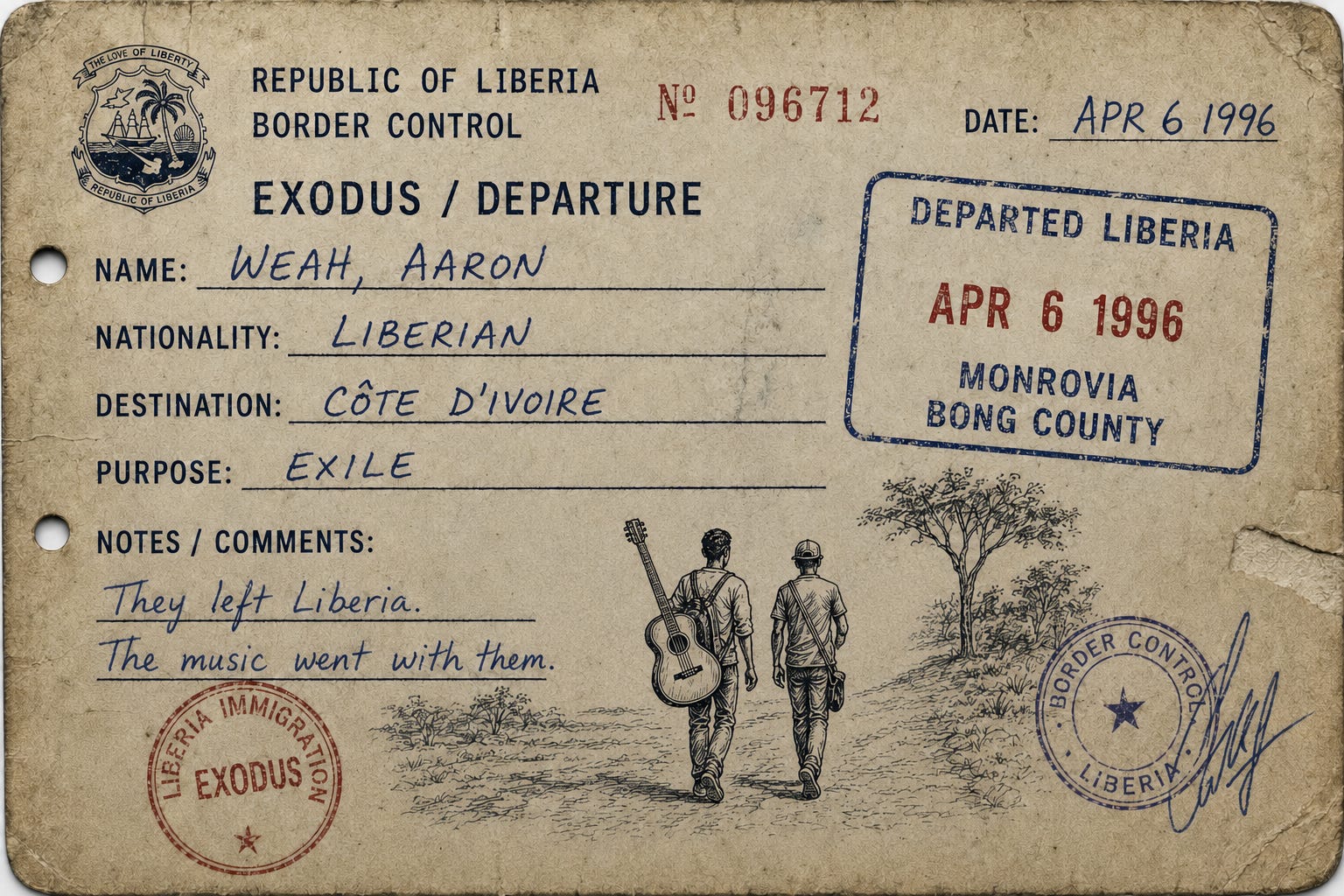 Trust Me, I Played with Papa Wemba 24.06.2026 31minIn April 1996, sixteen-year-old Aaron Weah was caught in the fighting that engulfed Monrovia. With no more than a guitar and a photo album, he joined friends Peter Cole and Jonathan Vawah on a journey into exile.What followed was a story of hunger, prison cells, military checkpoints, unstable soldiers, refugee life and unexpected kindness. Along the way, music kept opening doors when things looked to be at their worst.In this episode, Aaron recalls:* Being caught in the crossfire that erupted on 6 April 1996.* Saving a guitar and leaving everything else behind.* Surviving on mangoes in Gbarnga.* Being arrested and accused of being a child soldier.* Escaping military checkpoints on the road to Côte d’Ivoire.* How photographs with Papa Wemba won the trust of a taxi driver when they had nothing else.* Life as refugee musicians in Côte d’Ivoire.* Secret work in a UNHCR swamp farming project.* The joyful reunion with John Dayen in exile.* Returning to Liberia in 1997 believing the war was finally over.Featuring stories of Peter Cole, Jonathan Vawah, Franklin Siakor and the musicians of Bosco Beat.Liberia: Remembering the Future is a podcast hosted by Dr Aaron Weah and Ged Naughton.Aaron Weah is a Liberian academic and Executive Director of the Ducor Institute for Social and Economic Research. Ged Naughton is a writer, journalist and former communications adviser who lived and worked in Liberia.Together they explore Liberia’s history through memory, conversation and personal experience.🎧 Available on Substack, Spotify and Apple Podcasts.💬 Comments and memories are always welcome. This is a public episode. If you'd like to discuss this with other subscribers or get access to bonus episodes, visit liberiartf.substack.com/subscribe
 -
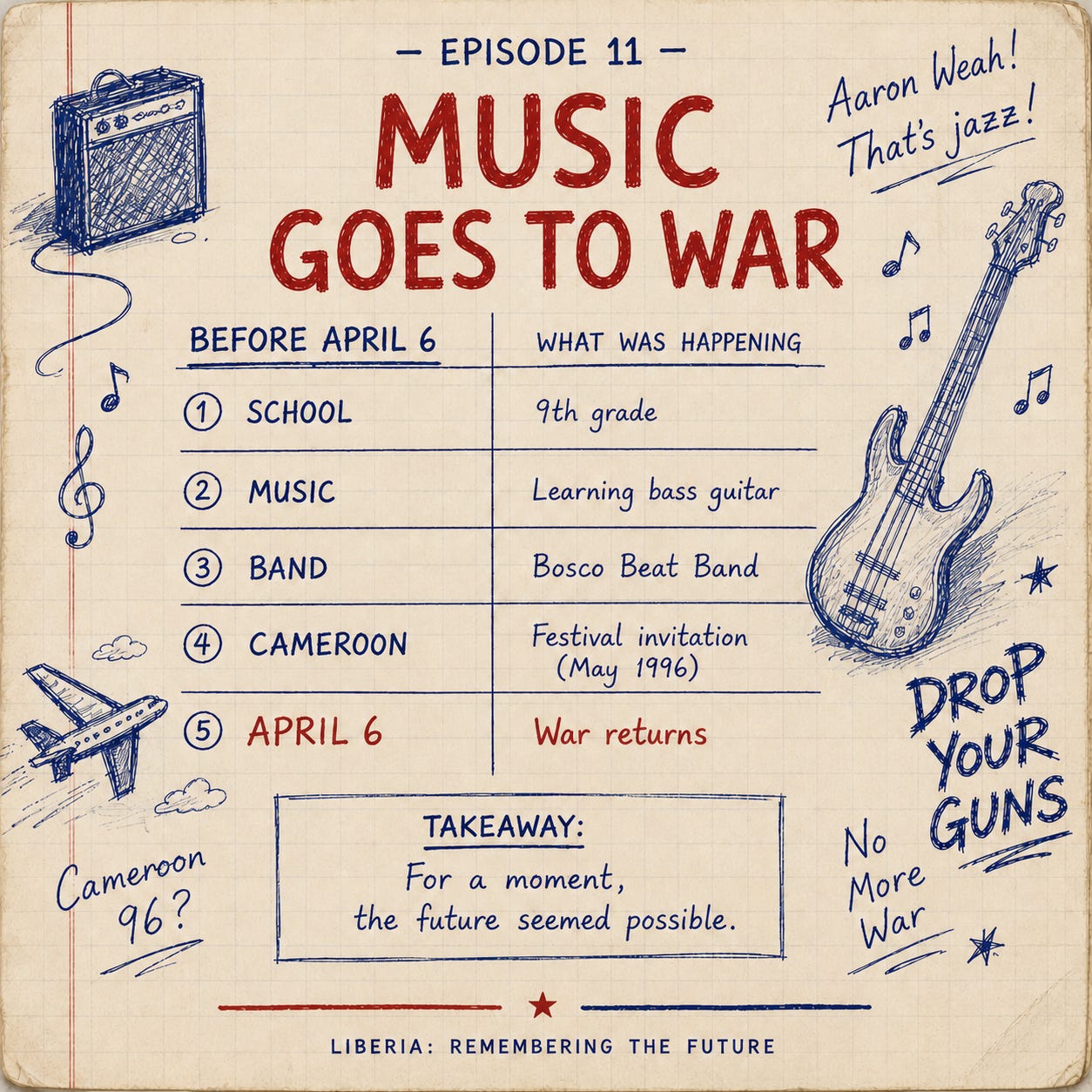 Music Goes To War 03.06.2026 28minIn 1996, Liberia was searching for peace.The politicians had their answer: a power-sharing government that brought rival warlords into a six-man Council of State.The musicians had a different idea.At the Don Bosco Youth Centre in Monrovia, a group of teenagers including this podcast's very own Aaron Weah were learning guitar, writing songs and joining forces with some of Africa's biggest stars. Through the International Committee of the Red Cross's Music Goes to War project, they found themselves sharing a stage with Youssou N'Dour, Papa Wemba and Lagbaja, riffing on a simple message:Drop your guns and go to school.In the midst of the chaos, a different future seemed possible. There was even talk of travelling to a music festival in Cameroon.Then came April 6, 1996.As Liberia's fragile peace process collapsed once again and Monrovia descended into violence, the dreams of a generation collided with the realities of war.This episode tells the story of two competing visions of peace – one negotiated by warlords, the other sung by teenagers.Featuring archive audio from the International Committee of the Red Cross's Music Goes to War project and Liberian singer-songwriter, Peter Cole. Liberia: Remembering the Future is presented by Gerry Naughton and Aaron Weah. This is a public episode. If you'd like to discuss this with other subscribers or get access to bonus episodes, visit liberiartf.substack.com/subscribe
 -
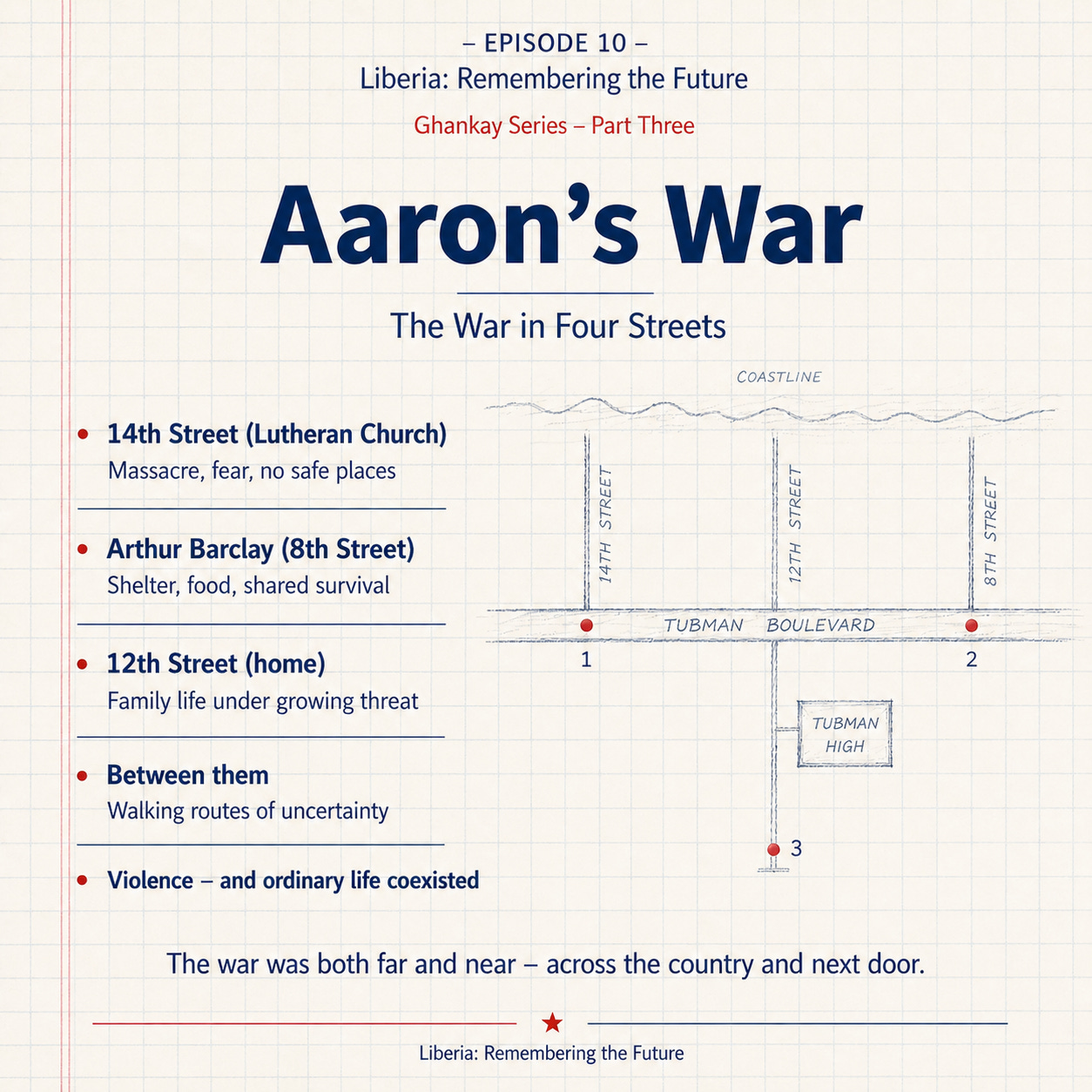 Episode 10 - Aaron's War 29.04.2026 40minMonrovia, early 1990s.Aaron recalls his early teens.Home, school, and the compound on 8th Street, where there was food and somewhere to sleep.His father is unwell. Money is tight. He cleans classrooms to stay in school.There is music. There are friends. Arguments, laughter, the usual awkwardness of being that age.Some nights there is shooting nearby. Other nights there isn’t.At one point, he shares a room with another boy – the same age – who has his own story to tell.At the time, it doesn’t feel like anything unusual.Years later, he comes back to these memories and begins to ask what they meant. This is a public episode. If you'd like to discuss this with other subscribers or get access to bonus episodes, visit liberiartf.substack.com/subscribe
 -
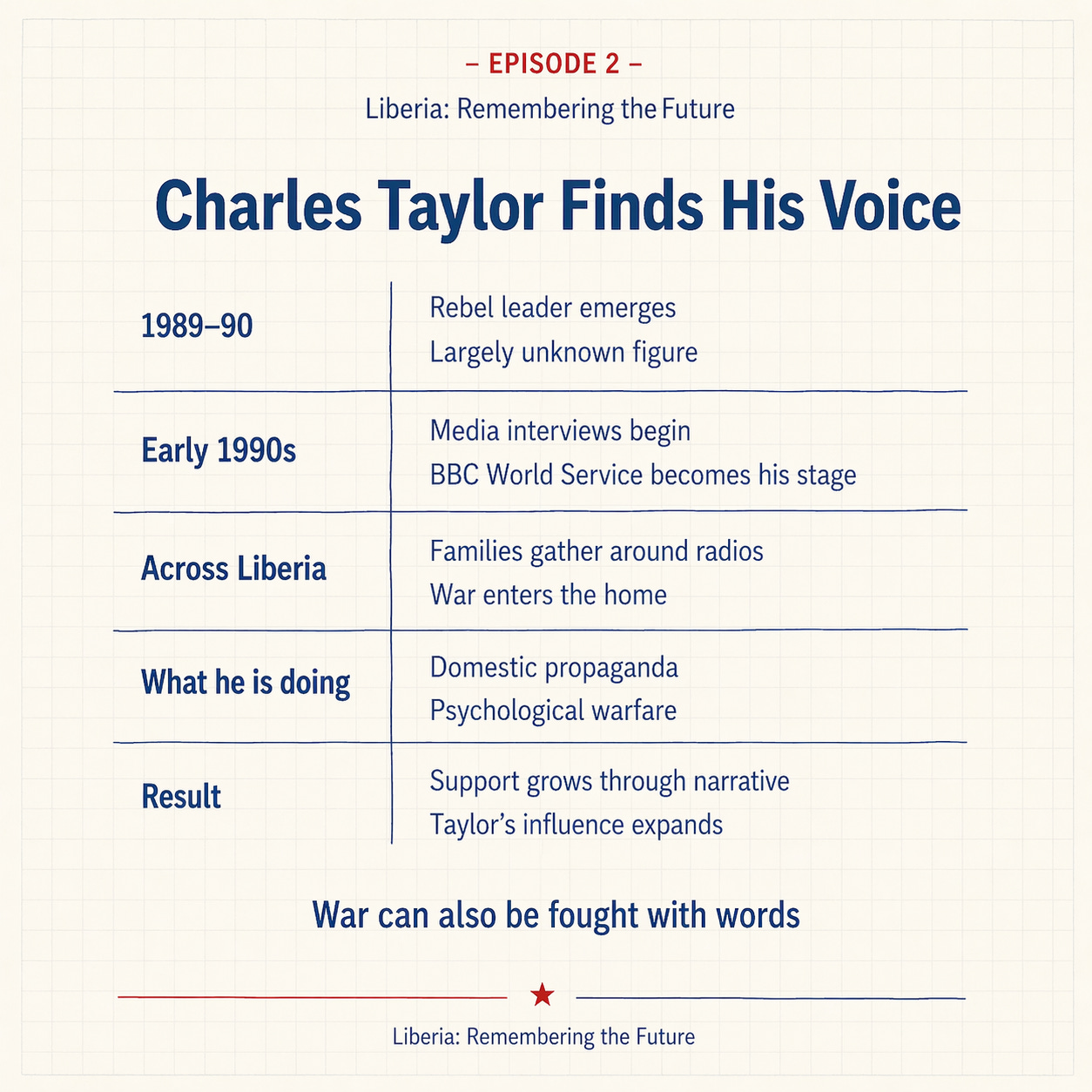 Episode 9 – Charles Taylor Finds His Voice 22.04.2026 35minEpisode 2: Charles Taylor Finds His VoiceIn this episode, Gerry Naughton and Aaron Weah explore how Charles Taylor emerged not just as a rebel leader, but as a powerful communicator during the early years of the Liberian Civil War.The discussion focuses on Taylor’s use of radio – particularly the BBC World Service programme Focus on Africa – to reach Liberian audiences and shape public perception.Key themes:Taylor’s rise as a media figure during the early 1990sThe role of the BBC as an unintended platform for influence“Domestic propaganda” and psychological warfareHow radio brought the war into everyday lifeThe gap between stated and underlying objectives in the conflictThe proliferation of peace agreements and their limited impactThe lead-up to Operation Octopus (1992)The episode also touches on Aaron Weah’s later attempt to interview Charles Taylor in prison – and the weight of confronting such a figure directly.Next episode:Aaron's WarAdditional links:Audio references to BBC Focus on Africa theme music will be shared in accompanying Substack posts. This is a public episode. If you'd like to discuss this with other subscribers or get access to bonus episodes, visit liberiartf.substack.com/subscribe
 -
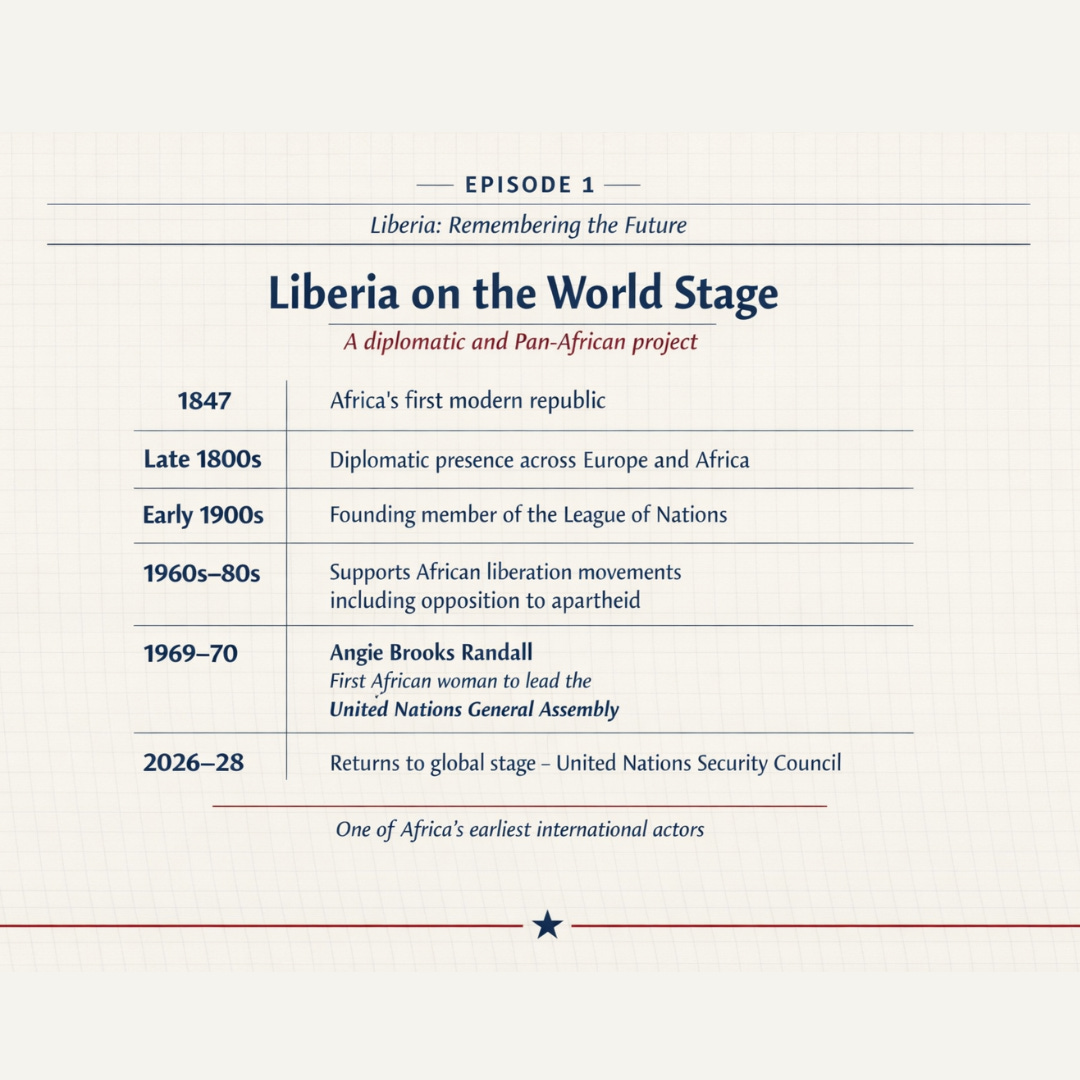 Episode 1 - Liberia and the UN Security Council - re-post 18.04.2026 27minYou’re listening to Liberia: Remembering the Future.In this first episode, we start with Liberia's seat on the UN Security council, which is due to last for two years from January 2026. We ask what status or influence does this give, and what might change as a result? We also go into Liberia's presence on the world stage over the last 180 or so years.Aaron brings the grounded, lived perspective – as a researcher, teacher, and Liberian. Gerry brings the long view – first arriving in 1992, and still learning things that surprise him.We also explore the idea at the heart of the series: remembering the future. Not just recalling the past, but putting it back together – re-membering – in a way that helps make sense of the present. This is a public episode. If you'd like to discuss this with other subscribers or get access to bonus episodes, visit liberiartf.substack.com/subscribe
 -
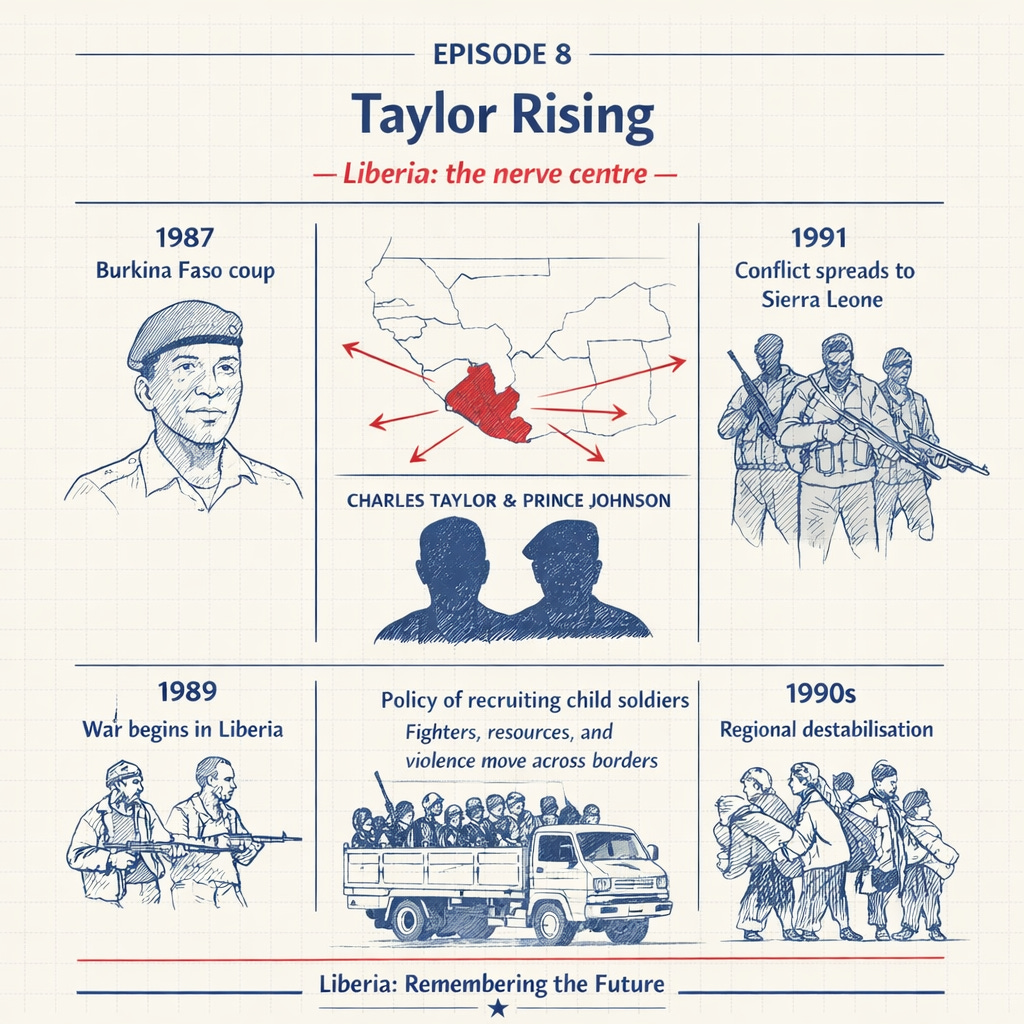 Episode 8 - Taylor Rising 15.04.2026 41minThis episode traces the early stages of Charles Taylor’s rise and the outbreak of Liberia’s civil war. We begin with the little-known background – Taylor’s position within government, his time in the United States, and the network of relationships that shaped his path back to Liberia. From there, we move to the pivotal moment of December 24, 1989, when a small group of fighters crossed into Nimba County and set in motion a conflict that would transform the country.We explore how quickly the situation escalated. What began as a relatively small incursion developed into a multi-front war, with internal splits, shifting alliances, and a rapidly expanding force. As resistance to Samuel Doe grew, Taylor’s movement gained momentum, drawing in fighters and support while also exposing the absence of any clear or unified political vision behind the violence.The episode also looks beyond Liberia’s borders, examining how the conflict was connected to wider regional dynamics in West Africa. At the same time, we begin to confront one of the most disturbing developments of the war – the emergence of child soldiers. Not as an abstract concept, but as something rooted in fear, survival, and the breakdown of society. This is a public episode. If you'd like to discuss this with other subscribers or get access to bonus episodes, visit liberiartf.substack.com/subscribe
 -
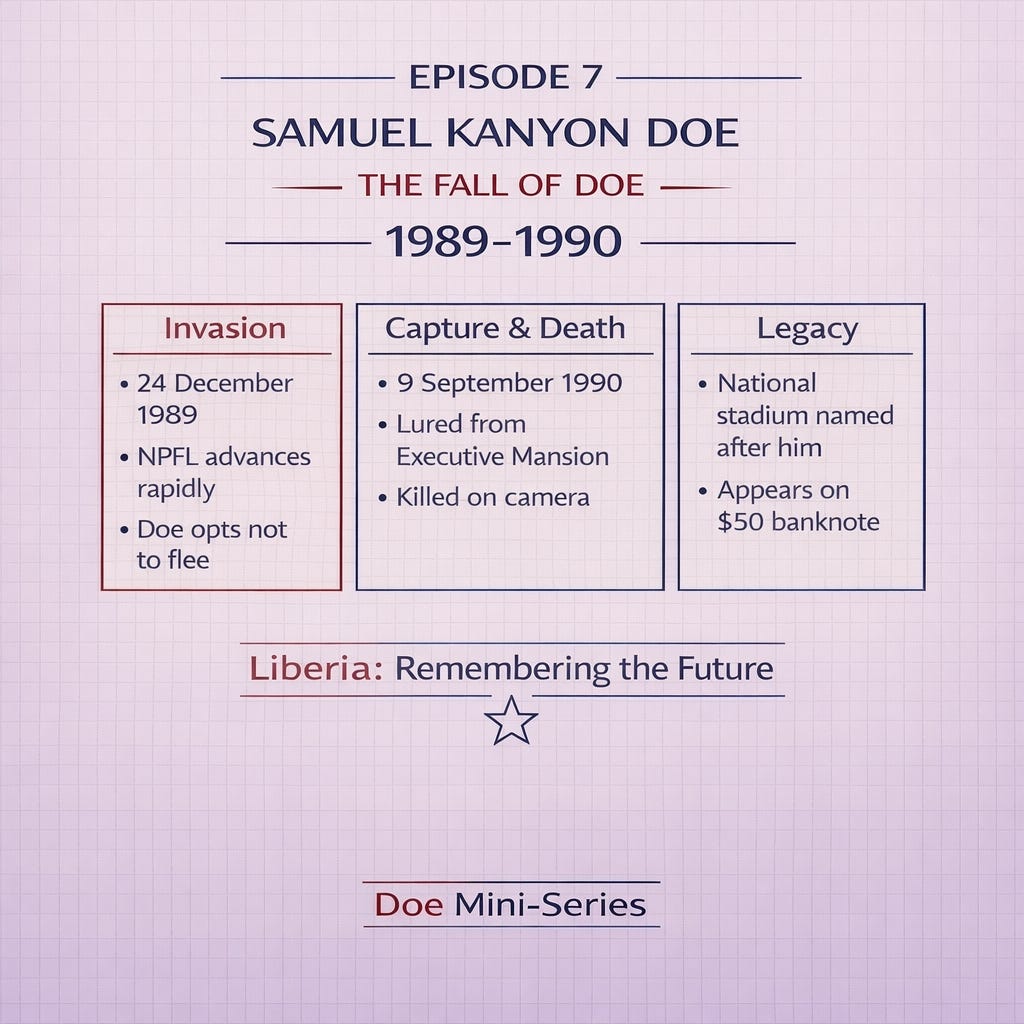 Episode 7 – The Fall of President Doe 01.04.2026 39minEpisode 7 – The Fall of President Doe (Part 3 of the Doe mini-series)In this final part of the Samuel Doe mini-series, we move to his final collapse after nine years in power: the disputed 1985 elections, the failed Quiwonkpa coup, and the rise of Charles Taylor set the stage for a country sliding towards war. Dr Aaron Weah describes how ethnic narratives were shaped – and often manipulated – while Gerry Naughton reflects on how those same stories were simplified for outsiders.The episode brings rare depth through Aaron’s personal testimony: memories of soldiers occupying his family home, the fear and uncertainty of Monrovia in 1990, and a striking moment of humanity in the middle of conflict. These lived experiences sit alongside a wider analysis of how the civil war began, how quickly Liberia changed, and how Doe lost power, allies, and ultimately his life.We close by asking what remains of Doe today – his legacy as a soldier, a patriot, and a deeply flawed leader. This episode marks a turning point in the series, where history, memory, and personal experience come together – and sets the stage for the Taylor years and the long, complex road that followed. This is a public episode. If you'd like to discuss this with other subscribers or get access to bonus episodes, visit liberiartf.substack.com/subscribe
 -
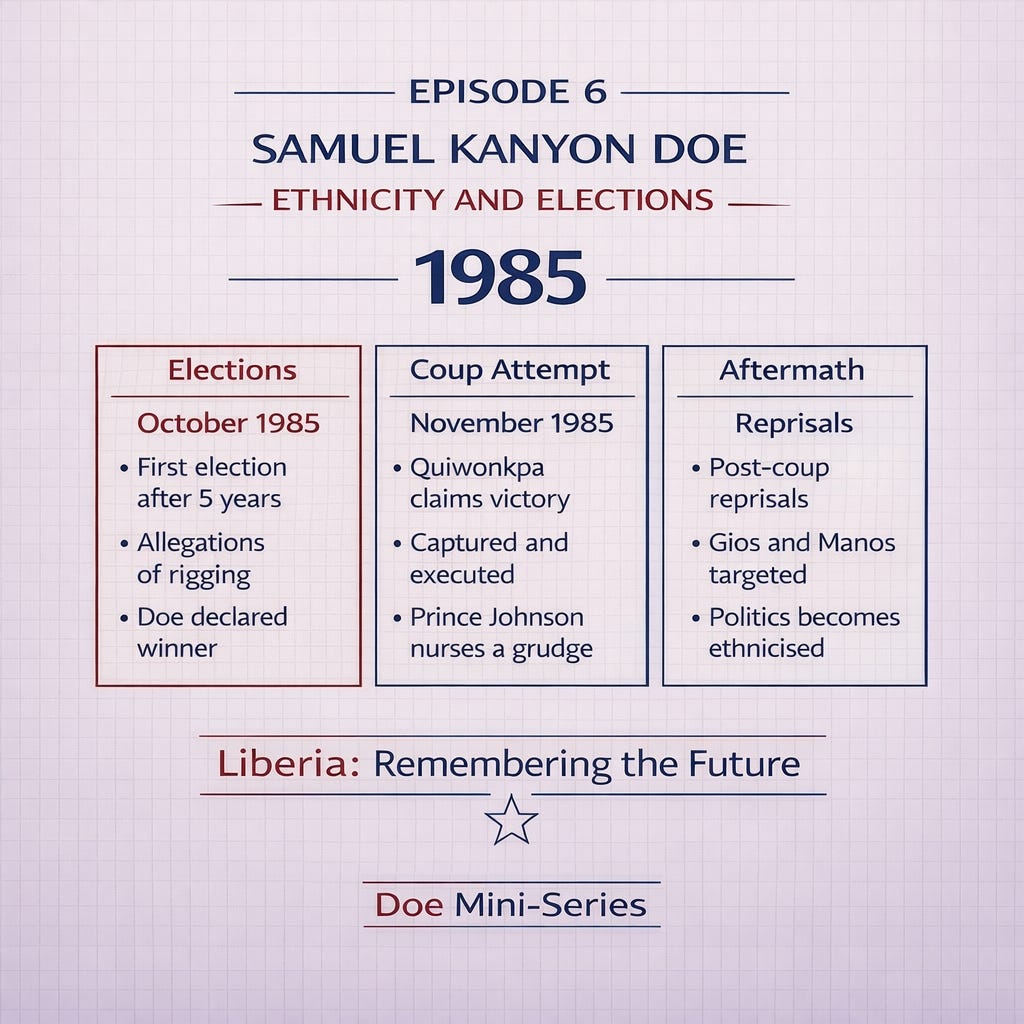 Episode 6: Ethnicity and Elections 25.03.2026 32minEpisode 6 of Liberia: Remembering the Future – and Episode 2 in our Samuel Doe mini-series.In this episode, we move from the aftermath of the 1980 coup into the pivotal year of 1985.We discuss the first election after five years of military rule, allegations of rigging, the return and failed coup attempt of Thomas Quiwonkpa, and the reprisals that followed. The conversation also explores how that moment added an ethnic dimension to Liberian politics that would bring long term repercussions.Along the way, Aaron reflects on the internal tensions of Doe’s rule, the People’s Redemption Council, the pressures of constitutional change, and the wider atmosphere of fear, violence and uncertainty in the first half of the 1980s.Topics include:- Samuel Doe and the People’s Redemption Council- Thomas Quiwonkpa and the split within the 1980 coup leadership- Liberia’s 1985 election- allegations of rigging- the November 1985 coup attempt- reprisals against Gio and Mano communities- the ethnicisation of Liberian politics- Liberia, the Cold War, and US backing under ReaganLiberia: Remembering the Future is a conversational podcast hosted by Gerry Naughton and Aaron Weah, exploring Liberia’s history, politics, culture and future through informed, accessible discussion. This is a public episode. If you'd like to discuss this with other subscribers or get access to bonus episodes, visit liberiartf.substack.com/subscribe
 -
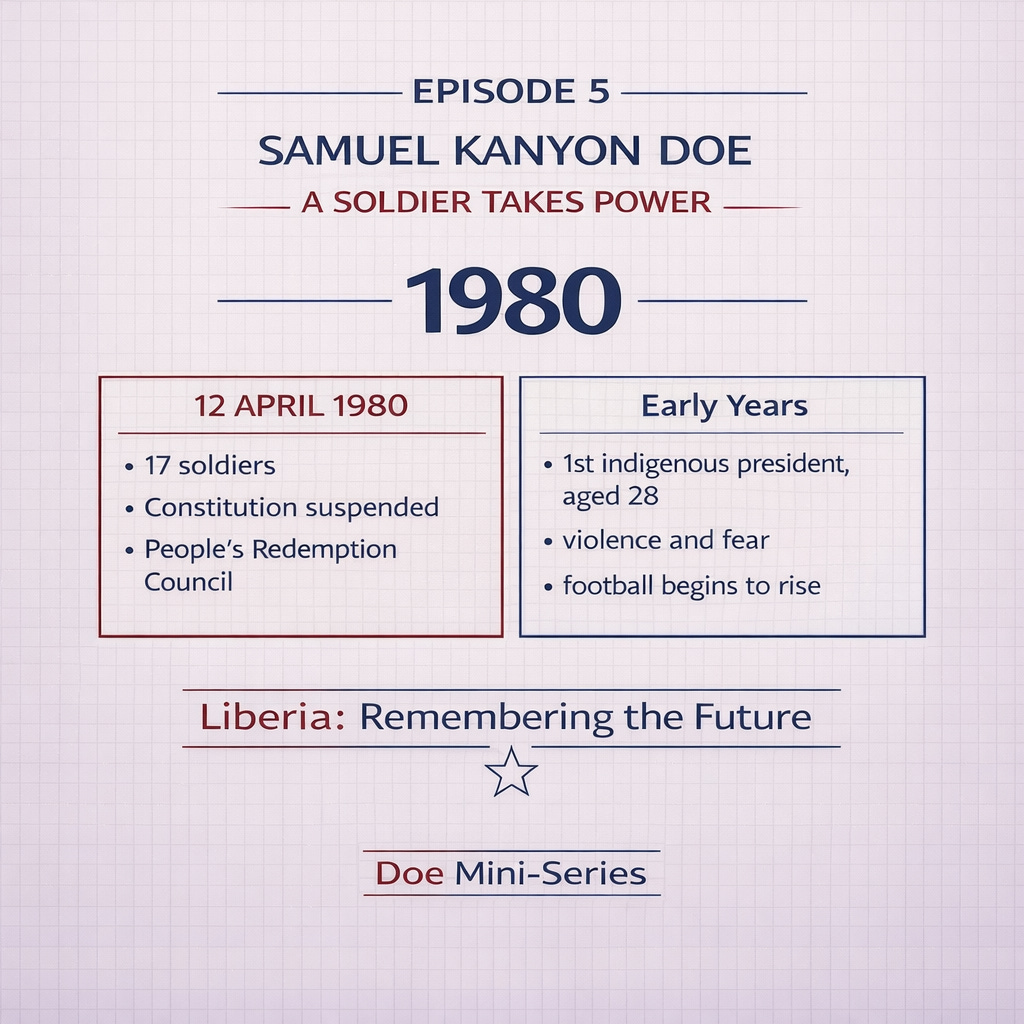 Episode 5: A Soldier Takes Power 18.03.2026 30minPart 1 in our three-part mini-series on Samuel Kanyon Doe.In this episode:- Samuel K. Doe's pivotal role in Liberian history- How he rose from soldier to ruler- Understanding the 1980 coup- The promises and contradictions of the Doe era- Why Doe still provokes strong feelings todayHosts:Gerry NaughtonAaron WeahPodcast:Liberia: Remembering the Future – conversations about Liberia’s history, culture, politics, identity and future.Subscribe / follow:- Spotify- Apple Podcasts- SubstackAlso available:Transcript and more available on Substack: https://liberiartf.substack.com/Coming next:Samuel Doe Part 2 This is a public episode. If you'd like to discuss this with other subscribers or get access to bonus episodes, visit liberiartf.substack.com/subscribe
 -
 Special Bonus: Suakoko and the Fragile Beginnings of Liberia 05.03.2026 13minBonus episode – SuakokoToday is International Women’s Day, so we’re sharing a short outtake from our conversation about Liberia’s early history.It begins with a question – what if Liberia had never become an independent republic? – and ends with the remarkable story of Chief Suakoko, a woman who helped open the interior of the country to negotiation and dialogue.A small digression, but a fascinating one. This is a public episode. If you'd like to discuss this with other subscribers or get access to bonus episodes, visit liberiartf.substack.com/subscribe
 -
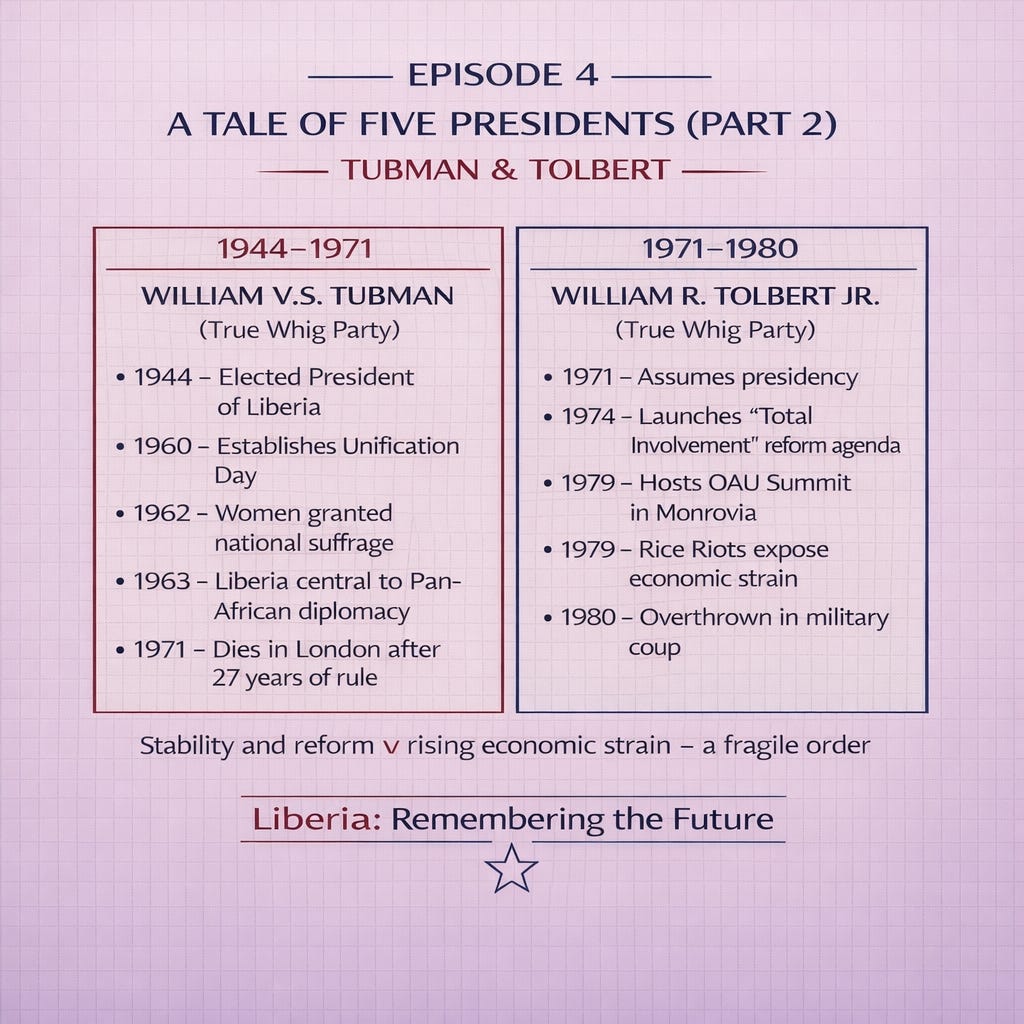 Episode 4: A Tale of Five Presidents (Part 2) Tubman & Tolbert 05.03.2026 49minEpisode summaryIn this episode Aaron and Gerry explore the long presidency of William V.S. Tubman and the reformist ambitions of William Tolbert.For more than three decades Liberia appeared politically stable under the True Whig Party. Yet beneath that stability deeper tensions were building – tensions that would eventually reshape the country.Topics covered• Tubman’s rise to power in 1944• The consolidation of the True Whig Party state• Liberia’s role in Pan-African diplomacy• Economic modernisation and inequality• Tolbert’s reform agenda• The growing tensions of the late 1970sListen to the full seriesYou can listen to Liberia: Remembering the Future on:• Substack• Spotify• Apple Podcasts• Pocket CastsAbout the podcastLiberia: Remembering the Future is a podcast exploring Liberia’s past, present and future through memory, history and conversation.Hosted by Aaron Weah and Gerry Naughton. This is a public episode. If you'd like to discuss this with other subscribers or get access to bonus episodes, visit liberiartf.substack.com/subscribe
 -
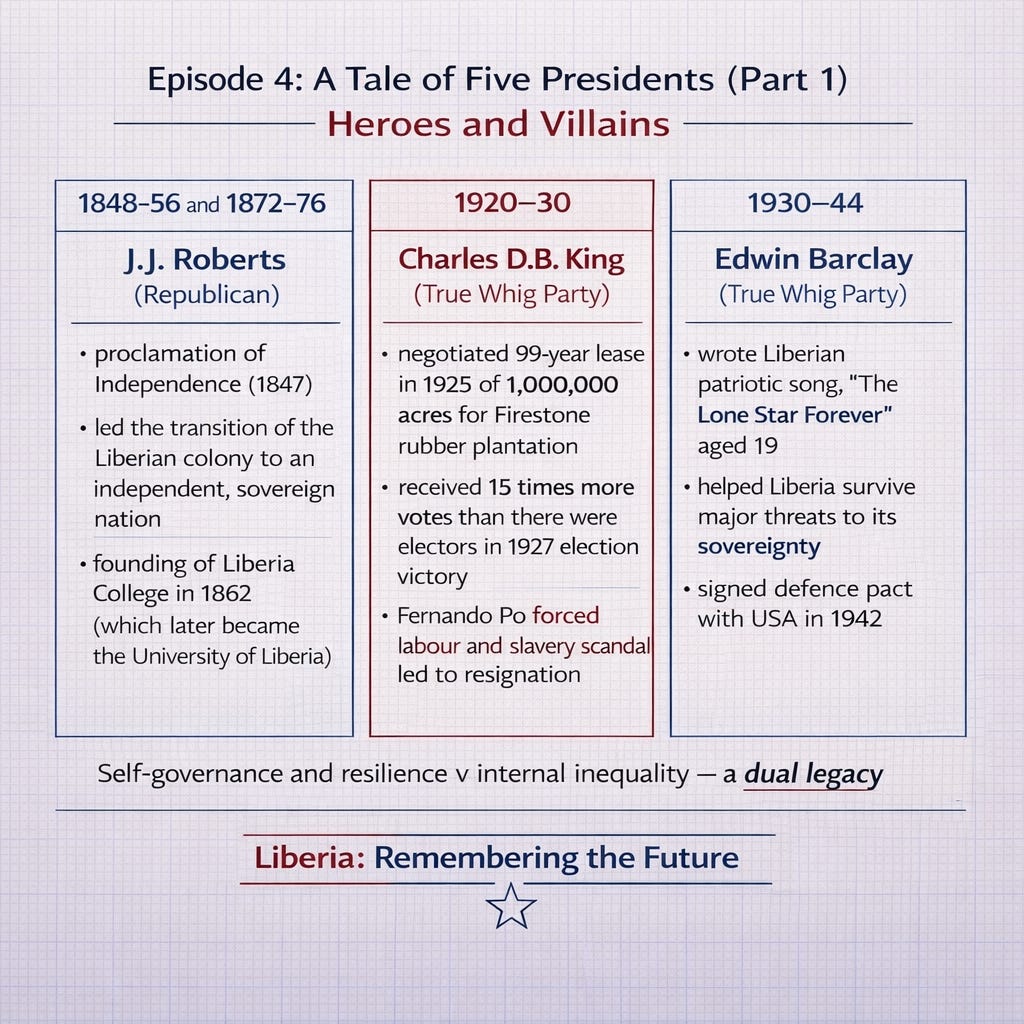 Episode 04: A Tale of Five Presidents - Part 1, Heroes & Villains 26.02.2026 38minIn this episode, Gerry Naughton and Aaron Weah explore the political foundations and contradictions of Liberia’s First Republic. The discussion centres on the 1930 forced labour scandal, when Liberia was accused of practices indistinguishable from slavery, leading to the resignation of President Charles D. B. King. They unpack how fraudulent elections, economic crisis, and elite capture of the state shaped this period.The conversation also examines the League of Nations investigation, its devastating findings, and the moral shock it caused at home and abroad.Moving beyond villains and heroes, the episode reflects on the legacies of figures such as J. J. Roberts and Edwin Barclay, the rise of the True Whig Party, and deep class divisions within settler society. This is a public episode. If you'd like to discuss this with other subscribers or get access to bonus episodes, visit liberiartf.substack.com/subscribe
 -
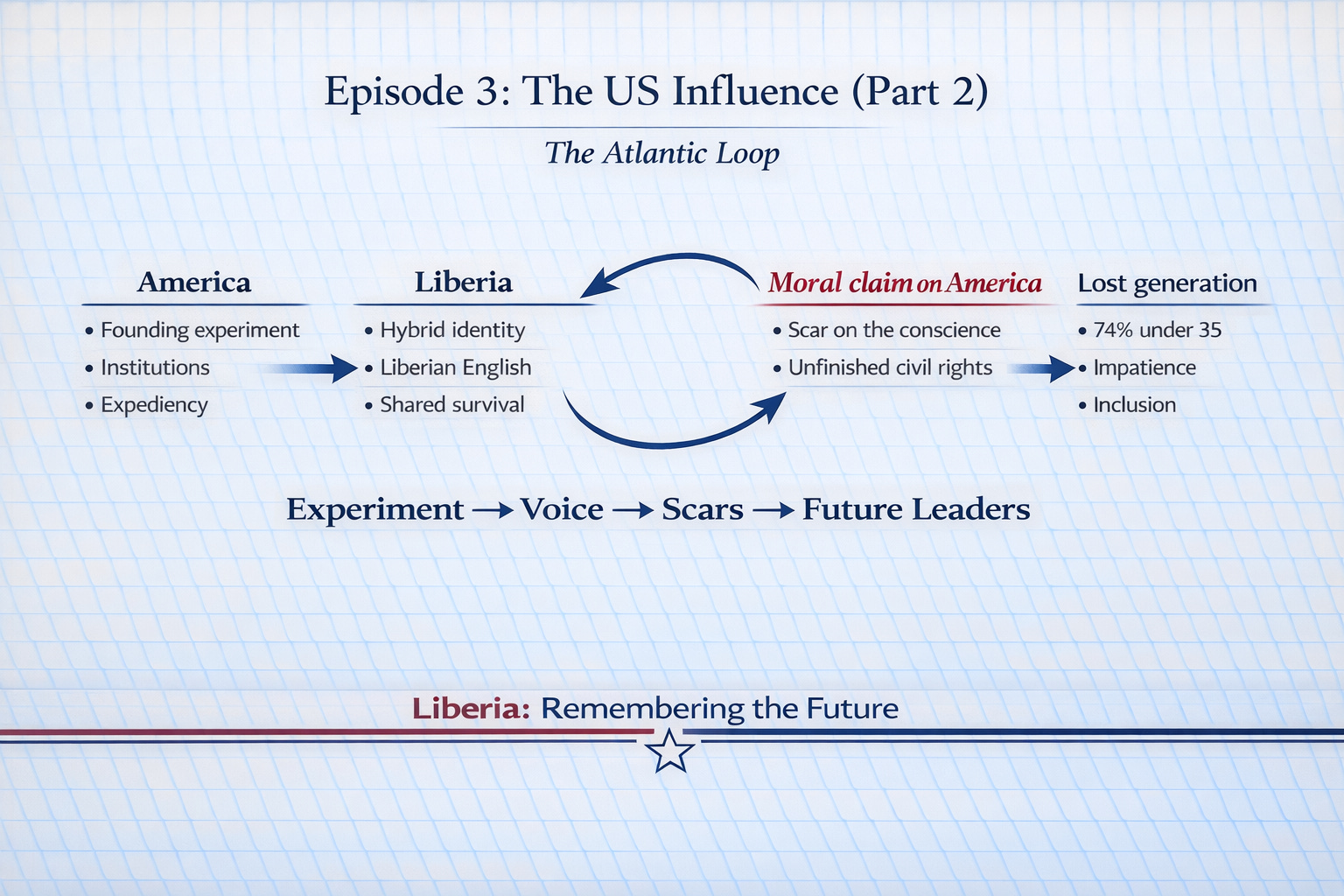 Episode 03: The US Influence (Part 2) 17.02.2026 24minIn Part 1, we sketched the basic shape of the relationship – the founding myth, the strange intimacy, the blind spots, the dependency, the pride. In Part 2, we stay with the same question but get more concrete: what does “US influence” actually look like when you’re living it?We talk about how power travels – through money, through institutions, through culture, and through habits of thinking you barely notice until you try to name them. We also look at the ways Liberians have navigated that influence with intelligence and pragmatism, not just as victims of history.This is not always a neat picture, which is the point: it’s messy, layered, sometimes contradictory. Liberia’s relationship with the US isn’t simply a story of control; it’s also a story of imagination, strategy, and people working with what’s in front of them.If you’re new to the series, Liberia: Remembering the Future is a set of short, informal backgrounders – rigorous on the facts, but conversational in tone. Aaron brings the grounded expertise; Gerry brings the outsider’s questions and a long memory of how Liberia is usually talked about. This is a public episode. If you'd like to discuss this with other subscribers or get access to bonus episodes, visit liberiartf.substack.com/subscribe
 -
 Episode 3: US Influence in Liberia (Part 1) 10.02.2026 42minIn this episode, we begin a longer conversation on US influence in Liberia: from the country’s founding to the deeper assumptions that still shape politics, power, and identity today. We look at how Liberia’s relationship with its ‘big brother’ was formed, how it functions in practice, and why its legacy remains so complicated.This is Part 1 of a two-part discussion. Bonus material for subscribers will be published alongside Part 2. This is a public episode. If you'd like to discuss this with other subscribers or get access to bonus episodes, visit liberiartf.substack.com/subscribe
 -
 Bonus: Dr Amos Sawyer — Memory, Power, and Liberia’s Unfinished Future 02.02.2026 16minWhat we coverWho Dr Amos Sawyer was, and why he mattered at a critical moment in Liberia’s historySawyer’s role as an academic-president — and why that mattered in a post-war contextThe tension between institutional reform and personal power in Liberian politicsMemory, restraint, and why some political virtues are easier to admire than to inheritHow Sawyer’s legacy still challenges Liberia today This is a public episode. If you'd like to discuss this with other subscribers or get access to bonus episodes, visit liberiartf.substack.com/subscribe
 -
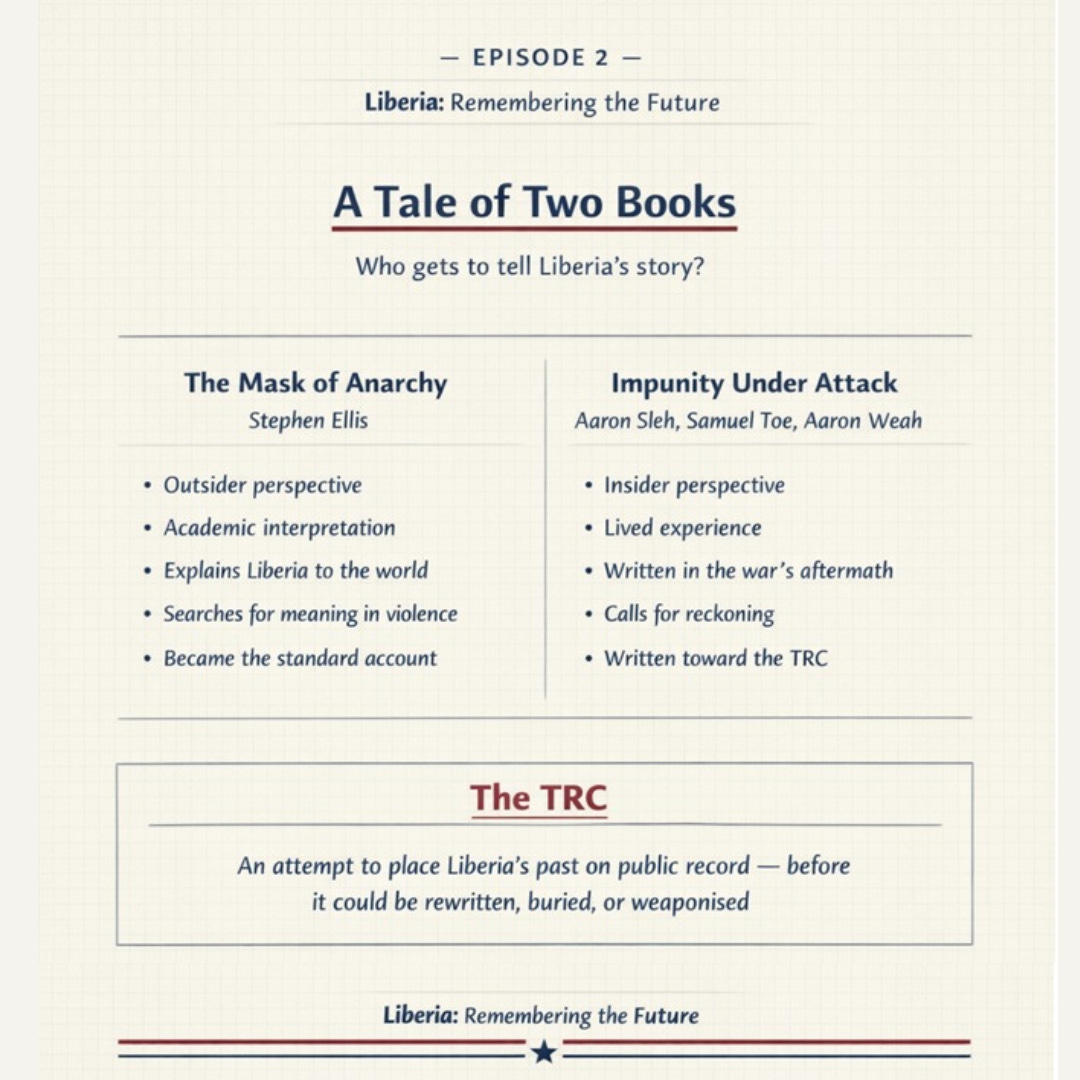 A Tale of Two Books (and a TRC) - repost 24.01.2026 1t 4minOur plan was to discuss the significance of the podcasts’ title. Instead, we discussed two books that have helped shape how Liberia’s story is being told - and its history is being remembered.The first book, by Stephen Ellis, is well-known inside and outside the country. The other, by three young, inexperienced but enthusiastic, writers - including our own Aaron Weah - tries to make sense of their own experiences in the chaotic context leading to Liberia’s Truth and Reconciliation Commission.Our conversation is not just about history, but about who gets to define what a country remembers - and therefore what kind of future is possible.Extract.Aaron Weah (quoting Stephen Ellis): One of the difficulties with how Liberia’s war has been written about is that explanation can begin to replace listening.Liberians today often look back to the mid-twentieth century as a golden age. But that period doesn’t offer a simple blueprint for the present. When people talk about wanting to return to the 1940s or 1950s, they’re not just talking about government or bureaucracy — they’re talking about a whole social world that no longer exists.It was a time when society was close-knit, when children were raised by communities, not just by parents. That social order collapsed long before the war itself, and the violence exposed what had already broken down.That’s why remembering the past isn’t straightforward. Memory carries longing, loss, and idealisation — and it’s very easy to mistake that for a practical plan for the future.Links:https://www.amazon.co.uk/Mask-Anarchy-Updated-Destruction-Religious/dp/0814722385#https://www.amazon.co.uk/Impunity-Under-Attack-Imperatives-Commission/dp/1535198427* If you know anyone who is interested in Liberia or African history, feel free to share this post with them.* And if you want to subscribe, and receive updates on everything we post direct to your inbox, you can do so below.* You can also follow the podcast on Apple or Spotify, as well as podcast apps like Pocket Casts and Podcast Addict. This is a public episode. If you'd like to discuss this with other subscribers or get access to bonus episodes, visit liberiartf.substack.com/subscribe
Sarnased taskuhäälingud


![MY FM 我要Test你 - Radio Station [CHI]](https://cdn.radoxo.com/images/podcasts/15448-my-fm-wo-yao-test-ni-radio-station-chi.avif?v=1790680906)


Populaarne riigis
See taskuhääling on ka nende riikide taskuhäälingute edetabelites.
