
The Joy of Why
Steven Strogatz, Janna Levin and Quanta Magazine
0
The Joy of Why is a Quanta Magazine podcast that explores curiosity and the pursuit of knowledge. Hosts Steven Strogatz and Janna Levin interview leading researchers about major scientific and mathematical questions. New episodes are released every other Wednesday. Quanta Magazine is an editorially independent publication supported by the Simons Foundation.
Jaksot
-
 Where Does the Quantum World End and Ours Begin? 17.09.2026 47minQuantum mechanics may be one of the most precisely tested paradigms in science, but there’s still no universally accepted interpretation of what it tells us about reality. How do we get from the wave-like behavior of quantum systems to the solid, macroscopic world of objects and the universe at large? Jonathan Halliwell, a professor of theoretical physics at Imperial College London, has spent his career probing the foundations of quantum theory. In this episode, he tells Steven Strogatz why decoherence — the process by which fragile quantum behavior becomes dispersed through interactions with the surrounding environment — is key to the transition from quantum to classical behavior, and he describes the “histories” approach that he uses to understand this. Along the way, Halliwell tackles some of the field’s deepest paradoxes. He explains why the quantum-to-classical transition doesn’t require a conscious observer, and he explores Einstein’s famous question of whether the moon is really there when no one looks. The conversation ends with Halliwell explaining how yoga and meditation help him sit with the mystery of competing perspectives in science.
 -
 Live from ICM 2026: What Is Math For in the Age of AI? 03.09.2026 53minMathematicians are witnessing a profound shift in their field. AI systems are now producing proofs, spotting connections between distant fields, and, in a few cases, solving problems that had stumped mathematicians for decades. The pace of progress over the past several months has raised challenging questions: What can AI systems actually do? And what happens to the more human, creative aspects of the field once machines can match – or exceed – people at problem-solving? In this special live episode of The Joy of Why, recorded at the International Congress of Mathematicians in Philadelphia on July 26, 2026, hosts Janna Levin and Steven Strogatz are joined by three mathematicians responding to the rise of AI in math: Akshay Venkatesh at the Institute for Advanced Study; Ravi Vakil at Stanford University and president of the American Mathematical Society; and Alex Kontorovich at Rutgers University. Together they discuss what recent AI-generated proofs really demonstrate, what will be gained and lost as mathematics becomes more machine-assisted at the frontier, and what this means for the next generation of mathematicians. The conversation turns to a deeper question: What do mathematicians value about doing mathematics in the first place? The answer involves grappling with what proof and understanding really mean, and with the surprising importance of storytelling.
 -
 Are We Thinking Correctly about AI Intelligence? 20.08.2026 52minWhen an LLM answers a question, is it reasoning like humans, or just producing text that looks like reasoning? The distinction isn’t just philosophical, this determines what we can trust AI to do, how closely we need to supervise it, and ultimately what its real-world impact will turn out to be. Melanie Mitchell at the Santa Fe Institute argues that we lack adequate methods for measuring machine cognition, and that AI is a form of “alien intelligence” that operates through non-human cognitive mechanisms. In this episode of The Joy of Why, Mitchell tells Steven Strogatz how methods that psychologists use to study cognition in other kinds of “alien intelligence” — babies and animals — can be adapted to probe AI, and she lays out six principles for better assessing machine cognition. Their conversation ranges from the challenge of interpreting what’s happening inside these systems, to recent AI-assisted breakthroughs in mathematics, to why a math-performing horse from the early 1900s offers a cautionary tale for how we assess intelligence.
 -
 How Does Touch Lead To Pain Or Pleasure? 06.08.2026 55minPain and pleasure seem like simple facts of life, but they are far from it. Neuroscientists still cannot say why physical pain differs from psychological pain, for instance, nor why a loved one’s touch soothes while a stranger’s touch repels. To explore the science behind these sensations, Janna Levin talked to Ishmail Abdus-Saboor, a neuroscientist at Columbia University’s Zuckerman Institute. Their conversation covers how pain serves an evolutionary purpose, how researchers measure pain and pleasure in the lab despite the absence of any objective biomarker, and how touch functions as a social and emotional signal, not just a sensory one. Abdus-Saboor also describes his work with naked mole rats — a species that barely feels pain, shows no signs of aging, and lives in colonies built almost entirely on touch — and the ethical trade-offs when studying sensations in animals that cannot describe what they feel.
 -
 How Fast Is the Universe Really Expanding? 23.07.2026 1t 4minOne of the biggest mysteries in cosmology seems to keep getting bigger. Astronomers have known since the 1930s that the universe is expanding, but in the 1990s, the discovery that this expansion is accelerating rather than slowing down came as a huge shock to the field. Something had to be driving that acceleration, and dark energy was proposed as the cause. What began as a seismic shock in cosmology eventually led to a Nobel prize. But this story has a sequel, and it comes with another major plot twist. The two main methods for estimating the universe's present-day expansion rate are producing significantly different answers. As a result, how fast the universe is really expanding has become a matter of considerable debate — with no small amount of angst — and the discrepancy has become known as the Hubble tension. Perhaps most surprising of all is that one of the loudest voices raising concern is Adam Riess, the astrophysicist whose Nobel Prize-winning work helped ignite the acceleration debate in the first place. Riess joined co-host Steven Strogatz on The Joy of Why to explain how we got to this point, what the Hubble tension might be telling us, and what may happen next.
 -
 Will We Ever Find Alien Civilizations? 09.07.2026 53minDoes intelligent life exist elsewhere in the universe? The question has captivated us for centuries, but despite decades of searching it remains frustratingly unanswered. Every so often a curious signal appears — fossilized structures in a meteorite, say, or an unusual gas in an exoplanet’s atmosphere — and for a moment it seems possible that we are not alone before the excitement gives way to a more mundane explanation. So what would it actually take to find life in the cosmos — and how would we know when we saw it? David Kipping, an astronomer at Columbia University, has spent his career finding better ways to answer these questions. His approach is statistical: rather than chasing individual detections, he develops mathematical frameworks for reasoning about where habitable worlds are likely to exist and how confidently we can interpret the signals they produce. In this episode of The Joy of Why, Kipping joins co-host Janna Levin to discuss efforts to frame one of humanity’s oldest existential questions as a tractable scientific problem, why biosignatures have proved so difficult to interpret, and why he believes exomoons may be an overlooked place to search for life.
 -
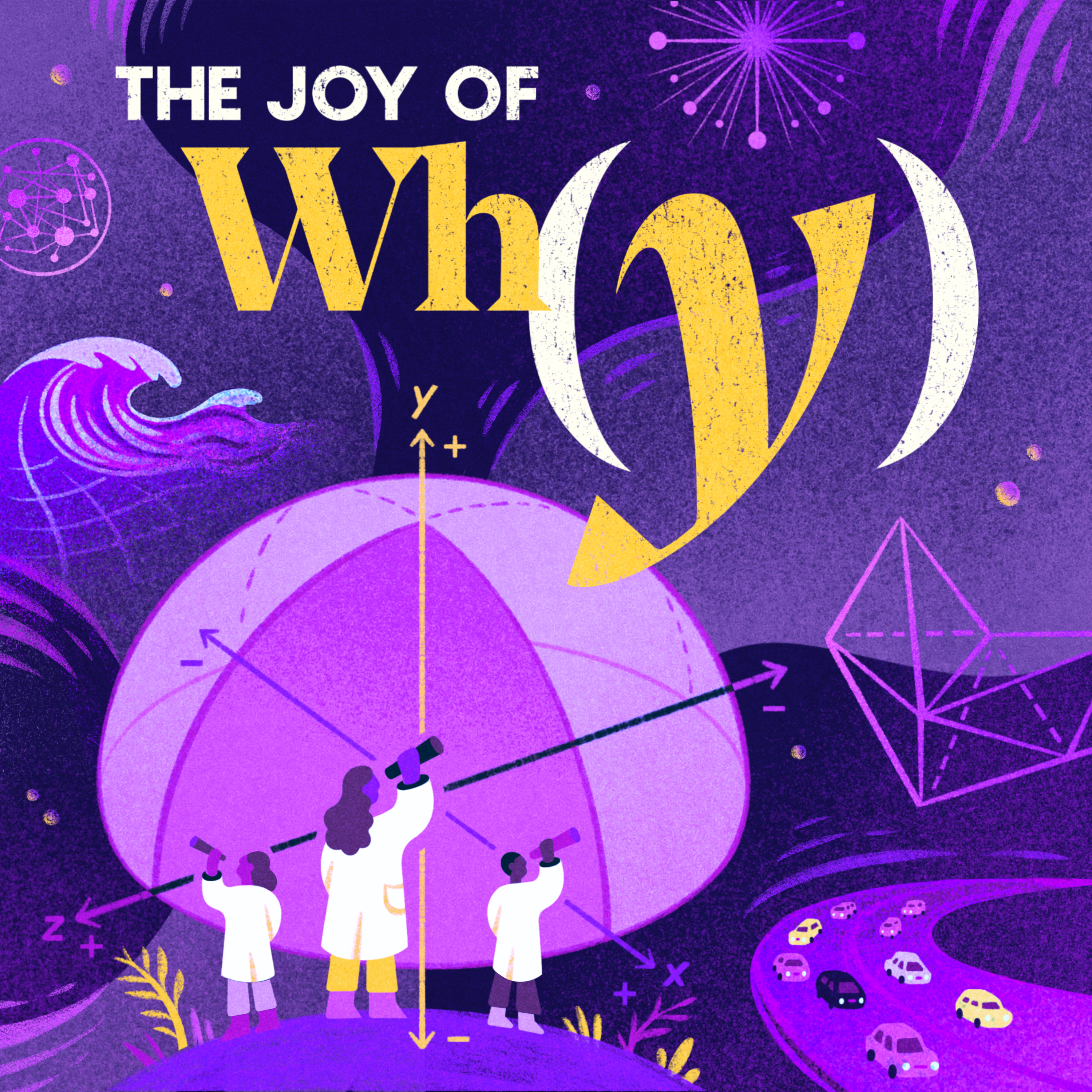 What Is the Positive Grassmannian and Why Does It Show Up Everywhere? 25.06.2026 51minWhat links certain mathematical models of traffic flow, shallow-water waves, and quantum particle scattering? The surprising answer lies in a corner of the algebraic combinatorics world that goes by the name of positive Grassmannian. In simple terms, the positive Grassmannian is a shape that classifies other shapes. Remarkably, pieces of the positive Grassmannian can be reassembled in forms that reveal shared structures in these and many other seemingly unrelated mathematical systems. That we know the positive Grassmannian crops up in many real-world settings is largely down to the theoretical work of Lauren Williams at Harvard University. In this latest episode of The Joy of Why, Williams talks to co-host Steven Strogatz about her work, how she realized the surprising pervasiveness of the positive Grassmannian, and how she has made a career of finding connections among fields that don’t at first sight seem connected. The conversation then switches to another project Williams is working on, called First Proof, which is trying to measure objectively how good AI systems are at coming up with proofs of research-level mathematical statements, and which leads to an exploration of whether AI may or may not take over mathematics. Note: Since this conversation was recorded, results from the First Proof Second Batch project were released on June 10, 2026.
 -
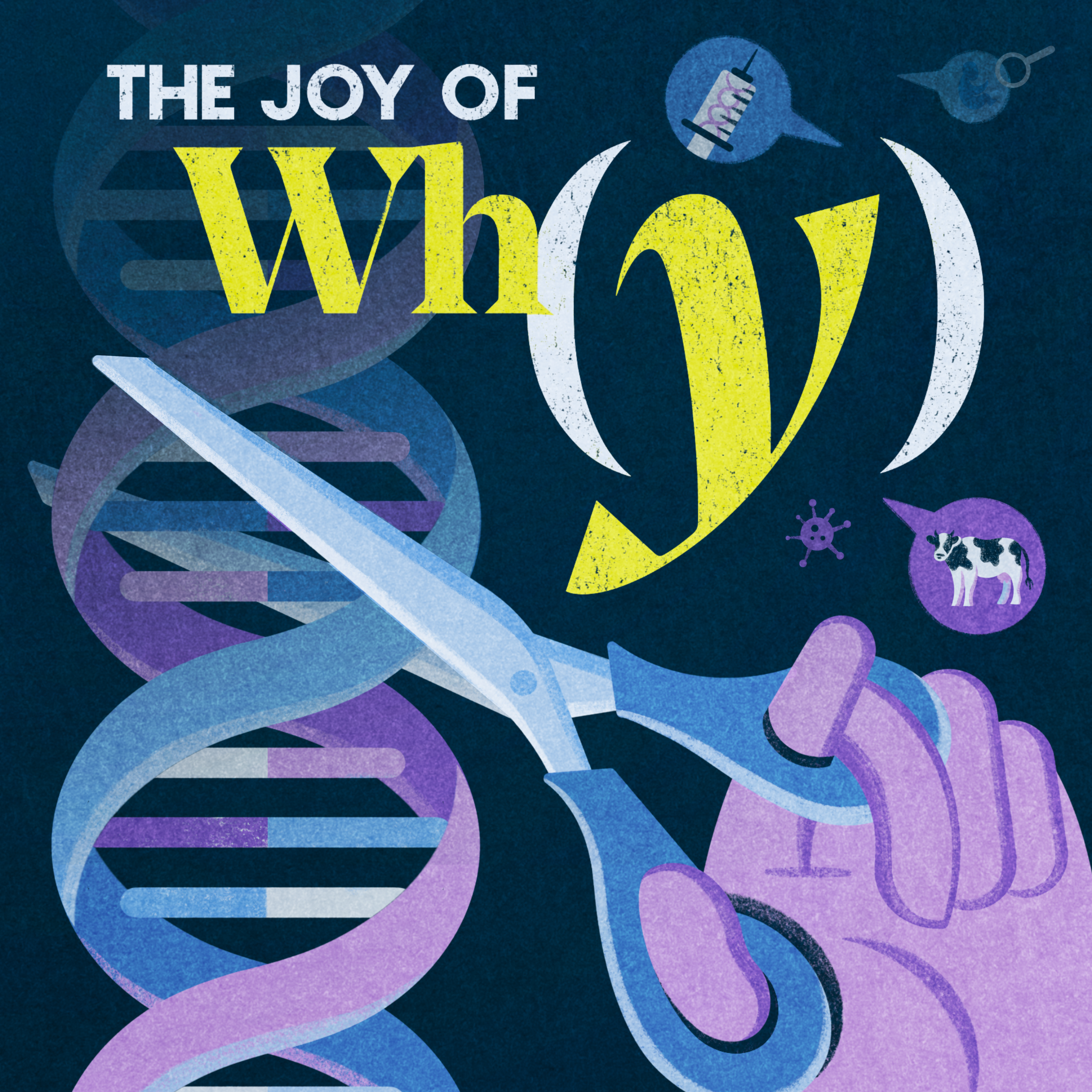 What’s the Future of Gene Editing? 11.06.2026 51minOne of the most surprising and remarkable discoveries in recent scientific history has been CRISPR. Short for Clustered Regularly Interspaced Short Palindromic Repeats, CRISPR is a form of immune system that evolved in bacteria more than a billion years ago to defend against persistent viral threats. Under attack, bacteria can snip a small fragment of a virus’s DNA, store it in the CRISPR region of their genome, and then use it to recognize and destroy the same virus if it returns. The CRISPR-Cas9 system, to give it its longer name, consists of a short strand of guide RNA that identifies where to cut the DNA and a protein that acts as the molecular scissors. What made this system truly revolutionary was the demonstration in 2012 that it could be reprogrammed with different pieces of guide RNA to edit virtually any genome in any species, and at a level of precision and ease that far surpassed existing gene-editing tools. Since then, the editing capability of CRISPR has been tested on everything from developing disease treatments to engineering drought-resistant crops to resurrecting genes of extinct species. The possibilities have expanded so rapidly that researchers, ethicists, and regulators have found themselves struggling to keep up. One person acutely aware of the power of CRISPR is Jennifer Doudna, co-developer of the technology. Doudna, who received the Nobel Prize in Chemistry in 2020 with Emmanuelle Charpentier for this pioneering work, has been a prominent voice not only for its vast potential but also for its responsible and ethical use. In this episode of The Joy of Why, Doudna tells co-host Janna Levin how her early, “rebellious,” decision to study RNA led her on a serendipitous path to one of biology’s most transformative discoveries. They also discuss the breakthroughs, barriers, and frontiers that will define CRISPR’s true impact.
 -
 More Conversations, Complex Questions, and Bold Ideas in Season Five of ‘The Joy of Why’ 04.06.2026 1minWhat is the future of gene editing with CRISPR? Has AI changed mathematics forever? Will we find other civilizations in the universe? What if we’ve been wrong about dark energy all along? These are just a few of the big, bold questions we’ll be exploring in the new season of The Joy of Why. Mathematician Steven Strogatz and physicist Janna Levin are back as your hosts for these and other conversations that explore the frontiers of basic science and mathematics. Each episode features an in-depth conversation in which Steven or Janna sits down with a leading scientist or mathematician to unpack one big idea or area of research. The two hosts also chat together throughout each episode, sharing their own thoughts, reactions, and questions. New episodes drop every other Thursday, kicking off on June 11 with biochemist and Nobel Laureate Jennifer Doudna, who helped revolutionize gene editing and biology as co-discoverer of the CRISPR-Cas9 system. The wide-ranging conversation explores the discovery and sudden rise of CRISPR as a tool that can modify genes in a highly precise manner, the successes and issues the work raised, and what comes next. All 12 episodes of Season 5 will be available to stream or read here, and on Apple Podcasts, Spotify, TuneIn, or wherever you listen to podcasts.
 -
 Do Beautiful Birds Have an Evolutionary Advantage? 21.08.2025 46minBirds are not merely descendants of dinosaurs — they are dinosaurs. For Yale evolutionary biologist and ornithologist Richard Prum, birds have been a lifelong passion and a window into some of evolution’s most intriguing mysteries. In a wide-ranging conversation with co-host Janna Levin, Prum traces the deep evolutionary origins of feathers, which he argues first emerged not for flight but for insulation, camouflage and display. Their colors — often invisible to the human eye — come into sharp focus under birds’ ultraviolet vision, suggesting a sensory world far richer than our own. Prum also explains why he champions Darwin’s once-marginalized theory of sexual selection, which proposes that traits such as the peacock’s tail evolved not for survival, but simply because they were attractive. Beauty, in other words, may shape life as powerfully as utility.
 -
 How Can Math Protect Our Data? 07.08.2025 39minEvery time data travels — from smartphones to the cloud, or across the vacuum of space — it relies on a silent but vigilant guardian in the form of error-correcting codes. These codes, baked into nearly every digital system, are designed to detect and repair any errors that noise, interference or cosmic rays might inflict. In this episode of The Joy of Why, Stanford computer scientist Mary Wootters joins co-host Steven Strogatz to explain how these codes work, and why they matter more than ever. Wootters discusses the evolving list of codes that keep modern communication resilient, and the frontiers in which error correction may have a crucial role, including distributed cloud systems, quantum computing and even DNA-based data storage.
 -
 Why Did The Universe Begin? 24.07.2025 52minMost cosmologists agree that our universe had a beginning. But the finer details about the Big Bang remain a mystery. A history of everything would explain all, or so theoretical physicists hoped. In his final years, Stephen Hawking working with Thomas Hertog proposed a striking idea: The laws of physics were not precisely determined before the Big Bang; they evolved as the universe evolved. In this episode of The Joy of Why, Hertog speaks with co-host Janna Levin about his work and partnership with Hawking. Hertog, now at KU Leuven in Belgium, explains why they rejected the popular multiverse theory and instead explored the idea that the universe’s properties are a result of cosmological natural selection. According to Hertog and Hawking, these properties must be viewed through the lens of human observers, who are also the consequence of natural selection. So, how could the universe have created the conditions needed for life to emerge? Listen to the episode below to find out.
 -
 How Can Regional Models Advance Climate Science? 10.07.2025 45minClimate models have changed the way we view the world. While effective, these models are imperfect, and scientists are constantly looking at ways to improve their accuracy and predictability. MIT professor Elfatih Eltahir has spent decades developing complex models to understand how climate change affects vulnerable regions like the Nile Basin and Singapore. In this episode of The Joy of Why, Eltahir tells co-host Steven Strogatz how growing up near the Nile in Sudan helped him realize that climate change doesn’t occur in isolation. To better understand climate-related impacts and to create more effective adaptation strategies, Eltahir says we need regional models that incorporate contextual data like disease spread and population growth. Eltahir also discusses his “Equation of the Future of Africa,” and he introduces the concept of “outdoor days,” which he hopes can improve public perception about climate change.
 -
 How Does Graph Theory Shape Our World? 26.06.2025 34minBorn in the 18th century when Leonhard Euler solved the puzzle of the seven bridges of Königsberg, graph theory has become a foundational tool in mathematics. It studies relationships through nodes (vertices) and the links (edges) that connect them, transforming the complexity of systems — from friendship networks to airline routes — into elegant abstractions that reveal underlying structure and interaction. Maria Chudnovsky from Princeton University is a leading mathematician in the field. In this episode of The Joy of Why, Chudnovsky talks with co-host Janna Levin about how she got into graph theory, solved the decades-old perfect graph problem, and used it to plan her wedding seating chart. Chudnovsky also reflects on her appearance in commercials as a “superstar mathematician,” and how her background primed her for a discipline that transcends language, culture and time.
 -
 Does Form Really Shape Function? 12.06.2025 47minWhat links a Möbius strip, brain folds and termite mounds? The answer is Harvard University’s L. Mahadevan, whose career has been devoted to using mathematics and physics to explore the form and function of common phenomena. Mahadevan, or Maha to his friends and colleagues, has long been fascinated by questions one wouldn’t normally ask — from the equilibrium shape of inert objects like a Möbius strip, to the complex factors that drive biological systems like morphogenesis or social insect colonies. In this episode of The Joy of Why, Mahadevan tells co-host Steven Strogatz what inspires him to tackle these questions, and how gels, gypsum and LED lights can help uncover form and function in biological systems. He also offers some provocative thoughts about how noisy random processes might underlie our intuitions about geometry.
 -
 Will We Ever Prove String Theory? 29.05.2025 48minFor decades, string theory has been hailed as the leading candidate for the theory of everything in our universe. Yet despite its mathematical elegance, the theory still lacks empirical evidence. One of its most intriguing, yet vexing, implications is that if all matter and forces are composed of vibrations of tiny strands of energy, then this allows for a vast landscape of possible universes with different physical properties, varieties of particles and complex spacetimes. How, then, can we possibly pinpoint our own universe within a field of almost infinite possibilities? Since 2005, Cumrun Vafa at MIT has been working to weed out this crowded landscape by identifying which hypothetical universes lie in a ‘swampland’ with properties inconsistent with the world we observe. In this episode of The Joy of Why, Vafa talks to co-host Janna Levin about the current state of string theory, why there are no more than 11 dimensions, how his swampland concept got an unexpected lift from the BICEP array, and how close we may be to testable predictions.
 -
 How Did Geometry Create Modern Physics? 15.05.2025 46minGeometry is one of the oldest disciplines in human history, yet the worlds it can describe extend far beyond its original use. What began thousands of years ago as a way to measure land and build pyramids was given rigor by Euclid in ancient Greece, became applied to curves and surfaces in the 19th century, and eventually helped Einstein understand the universe. Yang-Hui He sees geometry as a unifying language for modern physics, a mutual exchange in which each discipline can influence and shape the other. In the latest episode of The Joy of Why, He tells co-host Steven Strogatz how geometry evolved from its practical roots in ancient civilizations to its influence in the theory of general relativity and string theory — and speculates how AI could further revolutionize the field. They also discuss the tension between formal, rigorous mathematics and intuition-driven insight, and why there are two types of mathematicians — “birds” who have a broad overview of ideas from above, and “hedgehogs” who dig deep on one particular idea.
 -
 Will AI Ever Understand Language Like Humans? 01.05.2025 41minLarge language models (LLMs) are becoming increasingly more impressive at creating human-like text and answering questions, but whether they can understand the meaning of the words they generate is a hotly debated issue. A big challenge is that LLMs are black boxes; they can make predictions and decisions on the order of words, but they cannot communicate the reasons for doing so. Ellie Pavlick at Brown University is building models that could help understand how LLMs process language compared with humans. In this episode of The Joy of Why, Pavlick discusses what we know and don’t know about LLM language processing, how their processes differ from humans, and how understanding LLMs better could also help us better appreciate our own capacity for knowledge and creativity.
 -
 Can Quantum Gravity Be Created in the Lab? 17.04.2025 42minQuantum gravity is one of the biggest unresolved and challenging problems in physics, as it seeks to reconcile quantum mechanics, which governs the microscopic world, and general relativity, which describes the macroscopic world of gravity and space-time. Efforts to understand quantum gravity have been focused almost entirely at the theoretical level, but Monika Schleier-Smith at Stanford University has been exploring a novel experimental approach — trying to create quantum gravity from scratch. Using laser-cooled clouds of atoms, she is testing the idea that gravity might be an emergent phenomenon arising from quantum entanglement. In this episode of the Joy of Why podcast, Schleier-Smith discusses the thinking behind what she admits is a high-risk, high-reward approach, and how her experiments could provide important insights about entanglement and quantum mechanical systems even if the end goal of simulating quantum gravity is never achieved.
 -
 What Is the True Promise of Quantum Computing? 03.04.2025 38minQuantum computing promises unprecedented speed, but in practice, it’s proven remarkably difficult to find important questions that quantum machines can solve faster than classical ones. One of the most notable demonstrations of this came from Ewin Tang who rose to prominence in the field as a teenager. When quantum algorithms had in principle cracked the so-called recommendation problem, Tang designed classical algorithms that could match them. So began the approach of “dequantizing,” in which computer scientists look at quantum algorithms and try to achieve the same speeds with classical counterparts. To understand the ongoing contest between classical and quantum computing, co-host Janna Levin spoke to Tang on The Joy of Why podcast. The wide-ranging conversation covered what it was like for Tang to challenge the prevailing wisdom at such a young age, the role of failure in scientific progress, and whether quantum computing will ultimately fulfill its grand ambitions.
Samankaltaiset podcastit


Suosittu maassa
Tämä podcast esiintyy myös näiden maiden podcast-listoilla.
-
 Slovenia
-
 Azerbaidžan
-
 Suomi
Suomi
-
 Kambodža
-
 Kypros
-
 Kroatia
-
 Ecuador
-
 Argentiina
-
 Indonesia
-
 Myanmar
-
 Libanon
-
 Bahrain
-
 Tunisia
-
 Kirgisia
-
 Luxemburg
-
 Pakistan
-
 Oman
Oman
-
 Ukraina
-
 Thaimaa
-
 Malta
Malta
-
 Moldova
-
 Guatemala
-
 Viro
Viro
-
 Uruguay
-
 Kreikka
-
 Filippiinit
-
 Costa Rica
-
 Laos
Laos
-
 Paraguay
-
 Zimbabwe
-
 Sri Lanka
-
 Bulgaria
-
 Serbia
-
 Intia
Intia
-
 Bolivia
-
 Romania
-
 Armenia
-
 Latvia
-
 Chile
Chile
-
 Kolumbia
-
 Slovakia
-
 Kenia
Kenia
-
 Sierra Leone
-
 Pohjois-Makedonia
-
 Unkari
-
 Dominikaaninen tasavalta
-
 Liettua