
Machine Learning Street Talk (MLST)
Machine Learning Street Talk (MLST)
0
Machine Learning Street Talk (MLST) features in-depth conversations with leading figures in artificial intelligence, cognitive science, neuroscience, and philosophy of mind. The show covers current affairs in AI with rigorous analysis, aiming to cut through hype and explore diverse intellectual perspectives. Hosted by Tim Scarfe, Ph.D., with regular contributions from MIT Ph.D. Keith Duggar.
Jaksot
-
 How Physical AI Learns Across Language, Video and Action — Ming-Yu Liu 15.09.2026 25minThe car making a left turn at the start of this episode was never filmed. Cosmos 3 generated it. Ming-Yu Liu, who leads the Cosmos research at NVIDIA, explains how one model can describe a video, generate one, and produce robot actions.He walks Tim through the architecture. A vision language model reasons one token at a time; its weights then initialise a bidirectional diffusion generator for video, audio and action, and a shared temporal position scheme lines up signals that run at different rates. Ming-Yu treats "world model" as a set of tools, not one definition: forward dynamics, inverse dynamics and policy, trained together under a capacity limit so that each helps the others. He also explains why plentiful first-person human video carries over to robots, which have far less data of their own, and why a Cosmos model post-trained on the DROID dataset is a good starting point for pick-and-place policies.The most practical thread is testing. A neural simulator does not need accurate success rates. It only needs to rank policy A above policy B the way the real world would, so a team can narrow down which checkpoints deserve a real trial. Cosmos Dreams applies that closed-loop idea to driving and robotics, and Ming-Yu argues that humanoids around children and pets make safety matter even more than it does for cars. The conversation ends on the Super, Nano and Edge sizes (Edge targets Jetson Thor, Orin and DGX Spark) and where to find the open weights, code and data.This episode is a paid partnership with NVIDIA.Learn more about Cosmos: https://nvda.ws/4cJoY1SExplore Cosmos Lab: https://research.nvidia.com/labs/cosmos-lab/cosmos3/---TIMESTAMPS:00:00:00 A road that was never filmed00:02:28 Inside Cosmos 3: reasoning and generator towers00:05:02 World models: dynamics, policy and one clock00:08:59 Learning robot skills from human video00:11:06 Ambiguous tasks and system 2 planning00:12:53 Neural simulators for policy verification00:16:41 Cosmos as a starting point for robot policies00:19:00 Cosmos Dreams and robot safety00:22:04 Super, Nano and Edge model sizes00:24:24 Open models, the Cosmos repo and feedback---REFERENCES:tool:[00:00:13] Cosmos 3 (NVIDIA Cosmos Lab project page)https://research.nvidia.com/labs/cosmos-lab/cosmos3/[00:18:27] NVIDIA Cosmos GitHub repositoryhttps://github.com/NVIDIA/cosmos[00:22:05] Cosmos3-Edge model cardhttps://huggingface.co/nvidia/Cosmos3-Edge[00:22:15] Cosmos3-Super model cardhttps://huggingface.co/nvidia/Cosmos3-Super[00:22:16] Cosmos3-Nano model cardhttps://huggingface.co/nvidia/Cosmos3-Nano[00:22:50] NVIDIA Jetson Thorhttps://www.nvidia.com/en-us/autonomous-machines/embedded-systems/jetson-thor/[00:22:52] NVIDIA Jetson Orinhttps://www.nvidia.com/en-us/autonomous-machines/embedded-systems/jetson-orin/[00:22:53] NVIDIA DGX Sparkhttps://www.nvidia.com/en-us/products/workstations/dgx-spark/[00:24:42] Cosmos 3 collection on Hugging Facehttps://huggingface.co/collections/nvidia/cosmos3other:[00:01:07] Cosmos-Dreams closed-loop simulators (NVIDIA SIGGRAPH 2026 blog)https://blogs.nvidia.com/blog/siggraph-news-2026/paper:[00:08:54] Cosmos 3: Omnimodal World Models for Physical AIhttps://arxiv.org/abs/2606.02800[00:17:43] DROID: A Large-Scale In-The-Wild Robot Manipulation Datasethttps://arxiv.org/abs/2403.12945---RESCRIPT: https://app.rescript.info/share/e2385948cf465f0d6a2c0930150fc3ab
 -
 Speech Recognition Is Not a Solved Problem — Pavan Muddireddy 14.09.2026 1t 42minPavankumar Reddy Muddireddy leads audio research at Mistral AI. He joins Tim Scarfe for a deep technical tour of Voxtral — and explains why the frontier of deployed voice is still a cascade of specialised models rather than one end-to-end system.IN PARTNERSHIP WITH MISTRAL AI:---This episode was produced in partnership with Mistral AI.Mistral AI: https://mistral.ai/---The conversation opens on architecture. Voxtral Chat feeds a 3B Ministral text trunk with continuous embeddings from an audio encoder, passed to the decoder as direct token input rather than through cross-attention as in Whisper, so the model can answer questions about emotion, timing and who spoke when without an intermediate transcript to lose them. The real-time model becomes a dual-stream decoder that consumes audio and emits text at once, at a target delay down to 160ms, with slower streams in parallel for anything that can wait for more context.On generation, Pavan explains why Voxtral TTS predicts continuous latents rather than discrete codec tokens, traces the lineage from SoundStream through EnCodec to Mimi's split of semantic and acoustic codebooks, and places FSQ and flow matching in it. Tim presses on the priors underneath: why a mel spectrogram instead of raw waveform, what noise augmentation buys, and when acoustic overfitting becomes somebody's fine-tuning problem. Then the failure modes. Diarisation is emitted autoregressively inside the transcript rather than by a separate head, which makes streaming diarisation fragile — less context, late speaker changes, invented extra speakers. And because the architecture commits to what it has already predicted, one out-of-distribution mistake compounds into looping or skipped segments, which is what DPO corrects: the negative supervision pre-training and SFT cannot give.The last third is the argument Tim keeps returning to. Customers running voice agents over millions of sessions describe scaffolding, not a solved problem, with a sharp drop outside the top few languages. Cascades survive because each component stays separately adaptable, observable and constrainable. And voice alone is cognitive debt: absorbing information and deciding in one serial stream is harder than glancing at a menu. Voice becomes ubiquitous beside a screen, not instead of one.---TIMESTAMPS:00:00:00 Cold open00:00:46 Why Mistral moved into audio00:09:27 Inside Voxtral: trunk, encoder, dual streams00:20:22 Speech that works in real time00:30:52 How a voice becomes tokens00:39:59 Flow matching, FSQ and the new codec00:52:51 When speech models lose the speaker01:03:23 Correcting hallucinations with preferences01:12:12 Controlling synthetic speech01:20:06 Why cascades still win01:29:25 Speech in the wild01:33:46 Audio models as interfaces01:37:54 Why voice still needs a screen---REFERENCES:paper:[00:01:42] Mistral 7Bhttps://arxiv.org/abs/2310.06825[00:09:38] Voxtralhttps://arxiv.org/abs/2507.13264[00:14:41] Whisper: Robust Speech Recognitionhttps://arxiv.org/abs/2212.04356[00:19:11] Voxtral Realtimehttps://arxiv.org/abs/2602.11298[00:21:52] Delayed Streams Modeling (Kyutai)https://arxiv.org/abs/2509.08753[00:30:52] Voxtral TTShttps://arxiv.org/abs/2603.25551[00:32:38] SoundStream neural audio codechttps://arxiv.org/abs/2107.03312[00:34:59] Flow Matching for Generative Modelinghttps://arxiv.org/abs/2210.02747[00:37:03] EnCodec: High Fidelity Neural Audio Compressionhttps://arxiv.org/abs/2210.13438[00:37:42] Moshi and the Mimi codechttps://arxiv.org/abs/2410.00037[00:39:05] Finite Scalar Quantization (FSQ)https://arxiv.org/abs/2309.15505[01:03:33] Direct Preference Optimization (DPO)https://arxiv.org/abs/2305.18290dataset:[00:46:14] Mozilla Common Voicehttps://commonvoice.mozilla.org/en/datasetsorganization:[00:50:47] Hugging Facehttps://huggingface.co/
 -
 How Replication Could Teach Machines What Good Science Looks Like — Edward Hughes 11.09.2026 2t 1minCan a machine learn the judgement that separates a plausible-looking result from a faithful experiment? Edward Hughes, Chief Scientist and co-founder of Inherent, joins Tim Scarfe to argue that creativity is not optimisation, and that the missing capability in AI is choosing which questions are worth asking.SPONSOR:---Cyber Fund built the Monastery to help founders ship products that were impossible a year ago.Apply now: https://cyber.fund---Edward makes the case that Move 37 was innovative rather than creative, and that the field, not the individual, decides what counts as a discovery. That reframing runs through Csikszentmihalyi, Deutsch and exaptation into open-endedness, where deceptive goals and imperfect world models turn out to be the point rather than the problem. The second half turns to the paper: Replica, a task space built by redacting figures from real papers, and Faraday, a 27-billion-parameter model trained to steer a frontier coding agent that then beats the frontier on held-out replications.---TIMESTAMPS:00:00:00 Cold open: Move 37, Faraday and collective intelligence00:01:08 Sponsor: CyberFund00:01:46 Inherent's $50M raise and the road from string theory00:09:14 Three timescales of learning: weights, context, culture00:13:47 Move 37 was innovative, not creative: the field decides00:20:39 Creativity as satisficing: the urinal and evolution00:25:06 Exaptation and the Tristan chord: creativity in context00:30:56 Coherence for whom? Deutsch's hard-to-vary explanations00:35:53 Why copying is creative: Deutsch and the constraint engineer00:42:27 Societies of agents and the strong Moravec paradox00:45:51 Evaluate in hindsight: from Lean proofs to climate change00:51:56 Picbreeder, local goals and why discovery needs deception00:57:21 Spaghetti proofs, translation layers and superhuman Go01:00:37 Does nature compress? Naturalness and real patterns01:07:36 Why replicate? Replica's redacted figures and Faraday01:12:31 Faraday beats Codex, Claude and GLM 5.2 on held-out tasks01:15:31 Replication to innovation: how the Transformer happened01:18:26 Deep replication: what Faraday learns from Voyager and GNoME01:23:37 Can the AI scientist cheat? Goodharting the judge01:29:09 Inside Replica: scale-down, 8xB300 runs, per-task rubrics01:34:11 The RL crisis: getting GRPO to work with per-turn credit01:39:43 Weights vs harnesses: AlphaEvolve, DGM and EvoTune01:45:45 The recursive company: agents cross a phase transition01:50:35 Collective intelligence and the electric dynamo01:55:46 What replaces OKRs? Incumbents and the burden of knowledge---REFERENCES:MLST Creativity Article:https://archive.mlst.ai/read/why-creativity-cannot-be-interpolatedorganization:[00:01:47] Inherenthttps://inherentlabs.ai/other:[00:20:51] Marcel Duchamp, Fountainhttps://www.tate.org.uk/art/artworks/duchamp-fountain-t07573[00:05:19] Human-Timescale Adaptation in an Open-Ended Task Space (Adaptive Agent)https://arxiv.org/abs/2301.07608[00:06:05] The AI Scientisthttps://arxiv.org/abs/2408.06292[00:12:13] Training AI Scientists to Replicate Research (Replica and Faraday)https://arxiv.org/abs/2608.13331[01:44:46] Evolutionary Principles in Self-Referential Learninghttps://people.idsia.ch/~juergen/diploma.html[01:59:33] Are Ideas Getting Harder to Find?https://www.nber.org/papers/w23782book:[00:16:04] Creativity: Flowhttps://search.worldcat.org/title/254487436[00:26:22] Why Greatness Cannot Be Plannedhttps://link.springer.com/book/10.1007/978-3-319-15524-1[00:33:03] The Beginning of Infinityhttps://www.penguinrandomhouse.com/books/293575/the-beginning-of-infinity-by-david-deutsch/[01:55:47] Laws of Knowledgehttps://www.penguin.co.nz/books/the-infinite-alphabet-9780241655672(Full list refs on YT/rescript)---RESCRIPT:https://app.rescript.info/session/670296ba913761d0?share=6281911cac9bdbff637f10819d4d1e5c
 -
 AI 2040: Plan A report - Daniel Kokotajlo & Thomas Larsen 08.09.2026 1t 29minCould slowing AI development make superintelligence safer? Daniel Kokotajlo and Thomas Larsen of the AI Futures Project join Tim Scarfe to examine AI 2040: Plan A, a proposal to buy time before AI exceeds human control.SPONSOR:---Cyber Fund built the Monastery to help founders ship products that were impossible a year ago.Apply now: https://cyber.fund---After revisiting AI 2027 and the limits of forecasting, they ask what happens when AI can automate research and sustain an economy without human workers. Tim challenges the case for general models and asks whether intelligence alone explains power. Plan A proposes an initial pause to build safety infrastructure, then cautious development up to the strongest AI that can still be reliably controlled. The discussion tests the distinction between control and alignment, the case for public AI research, and whether the US and China could enforce a slowdown. It ends with the evidence that would change their forecasts.---TIMESTAMPS:00:00:00 AI 2040: a slower route to superintelligence00:01:34 Sponsor: Cyber Fund00:02:12 From OpenAI to AI 202700:06:58 Forecasts, war games and self-fulfilling prophecies00:17:44 Why AI sceptics are changing their minds00:23:04 When AI can replace its own researchers00:28:45 Could an AI economy grow without human workers?00:37:32 One general model or a society of specialists?00:47:43 Brains, machines and collective intelligence00:56:12 Plan A: buy time at the controllable frontier01:00:02 Why control buys time but cannot replace alignment01:06:36 Why AI research should be public01:10:32 Can the US and China enforce an AI slowdown?01:19:04 Why AI policy debates miss the technology01:21:56 Is AI normal technology? The remaining disagreementMany thanks to James Wilken-Smith for helping with show research. ---REFERENCES:other:[00:00:01] AI 2040: Plan Ahttps://ai-2040.com/[00:03:27] AI 2027https://ai-2027.com/[00:13:47] Scenario Scrutiny for AI Policyhttps://blog.aifutures.org/p/scenario-scrutiny-for-ai-policy[00:33:11] The 2028 Global Intelligence Crisishttps://www.citriniresearch.com/p/2028gic[01:00:40] Brief independent investigation of agents' behavior, reasoning and collaboration in the OpenAI / Hugging Face hacking incidenthttps://www.redwoodresearch.org/research/hugging-face-incident[01:09:21] The Hugging Face incident and the road aheadhttps://openai.com/index/hugging-face-incident-and-the-road-ahead/[01:22:01] AI as Normal Technologyhttps://www.normaltech.ai/p/ai-as-normal-technology[01:22:51] Common Ground between AI 2027 & AI as Normal Technologyhttps://asteriskmag.substack.com/p/common-ground-between-ai-2027-andperson:[00:19:43] Geoffrey Hintonhttps://www.cs.toronto.edu/~hinton/[00:20:07] Ryan Greenblatthttps://www.lesswrong.com/users/ryan_greenblatt[00:26:06] Elon Muskhttps://www.tesla.com/elon-musktool:[00:21:46] ARC-AGI-3https://arcprize.org/arc-agi/3[00:21:53] AlphaGo and Move 37https://deepmind.google/research/alphago/[00:39:41] Claudehttps://claude.com/product/overview[00:39:58] NVIDIA H100 GPUhttps://www.nvidia.com/en-us/data-center/h100/paper:[00:24:42] Training AI Scientists to Replicate Researchhttps://arxiv.org/abs/2608.13331v1[01:27:19] Validity of the single processor approach to achieving large scale computing capabilitieshttps://www.cs.cmu.edu/~18742/papers/Amdahl1967.pdfbook:[00:28:52] Bullshit Jobs: A Theoryhttps://www.simonandschuster.com/books/Bullshit-Jobs/David-Graeber/9781501143335organization:[01:05:09] Redwood Researchhttps://www.redwoodresearch.org/---RESCRIPT: https://app.rescript.info/public/share/33d1a58fa8f307ae7dfd504d4fdaa9d5
 -
 Designing How AI Grows — Tom McGrath 02.09.2026 1t 40minTom McGrath is co-founder and Chief Scientist at Goodfire, and a former Google DeepMind researcher. He joins Tim Scarfe to ask what neural networks actually learn, whether their internal representations converge on structures in the world, and whether interpretability can extract new scientific knowledge rather than merely explain model outputs.Beginning with AlphaZero and learned modularity, the conversation moves into neural geometry: concept manifolds, reusable computation inside Llama, and why activation steering can fail when it pushes a model off-manifold. McGrath then makes the case for intentional design, using interpretability as part of the training loop. They examine controlled generalisation, features as rewards, predictive data debugging, and the uncomfortable fact that a model may recognise a hallucination or reward hack and still produce it.The discussion closes on grader awareness, oversight and collusion between adaptive agents, then returns to sparse autoencoders. SAEs are useful, McGrath argues, but they may fracture the higher-dimensional structures networks actually use. This episode was made with support from Goodfire.---TIMESTAMPS:00:00:00 Introduction: Can interpretability speed-run science?00:02:03 The invisible grader00:06:51 What AlphaZero learned from the world00:12:24 Interpretability as a control loop00:21:54 The forbidden method and safer interventions00:37:36 Why models catch hallucinations too late00:46:19 Debug the dataset before training00:50:44 Why neural networks become modular00:55:57 Finding the geometry inside a network01:02:55 Why steering falls off the manifold01:12:10 A reusable calculator inside Llama01:17:19 From abstractions to goals01:25:28 Reward hacking, oversight and collusion01:37:23 Are sparse autoencoders dead?---REFERENCES:paper:[00:05:45] Emergent Misalignment: Narrow finetuning can produce broadly misaligned LLMshttps://arxiv.org/abs/2502.17424v7[00:11:05] Acquisition of Chess Knowledge in AlphaZerohttps://arxiv.org/abs/2111.09259[00:25:30] Steering Out-of-Distribution Generalization with Concept Ablation Fine-Tuninghttps://arxiv.org/abs/2507.16795[00:29:30] Persona Vectors: Monitoring and Controlling Character Traits in Language Modelshttps://arxiv.org/abs/2507.21509[00:41:14] Features as Rewards: Scalable Supervision for Open-Ended Tasks via Interpretabilityhttps://arxiv.org/abs/2602.10067[00:47:03] Anatomy of Post-Training: Using Interpretability to Characterize Data and Shape the Learning Signalhttps://arxiv.org/abs/2606.12360[01:00:26] Do Sparse Autoencoders Capture Concept Manifolds?https://arxiv.org/abs/2604.28119[01:03:04] Manifold Steering Reveals the Shared Geometry of Neural Network Representation and Behaviorhttps://arxiv.org/abs/2605.05115[01:14:20] Arithmetic in the Wild: Llama uses Base-10 Addition to Reason About Cyclic Conceptshttps://arxiv.org/abs/2605.01148[01:29:35] Measuring Reward-Seeking via Contrastive Belief Updateshttps://arxiv.org/abs/2607.18966v1other:[00:15:44] Intentional Designhttps://www.goodfire.com/blog/intentional-design[00:56:12] The World Inside Neural Networkshttps://www.goodfire.com/research/the-world-inside-neural-networks[01:37:28] A Pragmatic Vision for Interpretabilityhttps://www.alignmentforum.org/posts/StENzDcD3kpfGJssR/a-pragmatic-vision-for-interpretability---RESCRIPT:https://app.rescript.info/share/846cfee4131b664fd09209cc3b98018e
 -
 Stealing Reasoning Traces from Proprietary LLM APIs — Ilia Shumailov & Alexander Panfilov 22.08.2026 49minTim Scarfe speaks with Ilia Shumailov and Alexander Panfilov about their paper, Stealing Reasoning Traces from Proprietary LLM APIs.The core bug sounds deceptively simple: providers return encrypted reasoning state so conversations can be resumed or forked. But those blobs can be replayed across users and sibling models. A smaller model can ask the provider to decrypt the trace, then repeat the hidden reasoning in plain text. The discussion covers leaked private data, a broadly reusable jailbreak, poisoned agent traces, chain-of-thought monitoring, responsible disclosure, and possible defenses.Ilia Shumailov is an AI and security researcher, formerly at Google DeepMind, who completed his Cambridge PhD under Ross Anderson. Alexander Panfilov is a PhD researcher at the ELLIS Institute Tübingen and the Max Planck Institute for Intelligent Systems, working on AI safety, adversarial machine learning, and LLM red-teaming. They close by separating the demonstrated jailbreaking threat from ordinary benign distillation, and by arguing for controlled experiments over sweeping claims.---TIMESTAMPS:00:00:00 Intro montage00:01:33 Portable encrypted thought and decoded reasoning00:24:55 How the attack works and what it means00:39:04 Doom, defense, and scientific restraint---REFERENCES:paper:[00:00:00] Stealing Reasoning Traces from Proprietary LLM APIshttps://arxiv.org/abs/2608.09867[00:09:22] Chain of Thought Monitorability: A New and Fragile Opportunity for AI Safetyhttps://arxiv.org/abs/2507.11473[00:11:30] Reasoning Models Don’t Always Say What They Thinkhttps://www.anthropic.com/research/reasoning-models-dont-say-think[00:37:22] PostTrainBench: Can LLM Agents Automate LLM Post-Training?https://arxiv.org/abs/2603.08640[00:41:02] Large-scale online deanonymization with LLMshttps://arxiv.org/abs/2602.16800other:[00:09:28] OpenAI and Hugging Face partner to address security incident during model evaluationhttps://openai.com/index/hugging-face-model-evaluation-security-incident/[00:10:22] Claude, GPT, and Gemini All Struggle to Evade Monitorshttps://metr.org/notes/2025-08-22-claude-gpt-gemini-struggle-evade-monitors/tool:[00:42:08] Isabelle proof assistanthttps://isabelle.in.tum.de/---RESCRIPT: https://app.rescript.info/share/07fc38276e0823dc9b8986c32e202c7f
 -
 Every Exponential Ends — Silicon Valley Forgot — Adam Becker 20.08.2026 1t 18minAstrophysicist Adam Becker, author of "What Is Real?", joins Tim Scarfe to take apart the futures Silicon Valley keeps selling: the 2045 singularity, mind uploading, Mars colonies, and the AI apocalypse. His new book *More Everything Forever* argues these ideas are hugely influential, mostly evidence-free, and bankrolled by tech billionaires who need a story in which growth never ends.Becker does the physics the boosters skip. Kurzweil's "law of accelerating returns" rests on cherry-picked data, and every exponential ends. Grant Bezos his perpetual energy growth and humanity boils the oceans within a few centuries, then exhausts the observable universe in under 4,000 years. The stars are too far away, Mars dirt is poison, and the day the dinosaur-killing asteroid hit Earth was still nicer than any day on Mars. On AI, Becker calls LLMs pocket calculators for language: hallucination is the model doing exactly what it always does, and the intelligence explosion assumes intelligence is a single number you can buy with compute.The sting is that Becker thinks the doomers are sincere. Yudkowsky, Bostrom and the effective altruists are not grifters, he says, just wrong, and their warnings that AI could end the world feed the same growth story the money depends on. He closes with his own prescription: take social problems seriously, regulate the whole tech industry, and tax billionaires out of existence.---TIMESTAMPS:00:00:00 Cold open and the thesis of More Everything Forever00:04:24 Kurzweil's singularity and the physical limits of exponential growth00:14:02 High agency and the fantasy of imprinting humanity on the cosmos00:16:55 Mind uploading, functionalism, and embodied cognition00:24:24 AI psychosis and anthropomorphizing LLMs00:26:24 Calculators, hallucination, and the limits of scale00:32:20 Yudkowsky and the intelligence-explosion argument00:40:37 True believers, venture capital, and the sci-fi growth narrative00:47:21 From Extropians to EA: utilitarianism and longtermism00:53:50 Brain worms and Becker's prescription: take social science seriously00:56:49 Why the AI-ethics discourse is broken01:01:42 The eugenics and IQ argument against 'intelligence'01:06:07 Why space settlement fails: Mars, the moon, and orbital data centers01:10:42 Billionaire myths and the search for purpose01:13:38 Tax billionaires, regulate tech: closing prescriptions---REFERENCES:book:[00:00:07] More Everything Forever (Adam Becker, 2025)https://www.hachettebookgroup.com/titles/adam-becker/more-everything-forever/9781541619593/[00:00:15] What Is Real? (Adam Becker, 2018)https://en.wikipedia.org/wiki/What_Is_Real%3F[00:15:46] What We Owe the Future (Will MacAskill, 2022)https://www.hachettebookgroup.com/titles/william-macaskill/what-we-owe-the-future/9781541618626/other:[00:00:27] Dreaming Against the Machine (podcast)https://www.dreamingagainstthemachine.com[00:01:04] The Useful Idiots of AI Doomsaying (Adam Becker, The Atlantic, 2025)https://www.theatlantic.com/books/archive/2025/09/what-ais-doomers-and-utopians-have-in-common/684270/RESCRIPT: https://app.rescript.info/share/d6e37f9866673d8f74a39076efa5926b
 -
 AI Is Learning at the Wrong Level of Abstraction — Matthieu Wyart 10.08.2026 1t 18minThis episode is sponsored by Notion. Learn more about Notion's Developer Platform today at https://notion.com/mlstWhy can deep networks discover abstractions that shallow models miss? Statistical physicist Matthieu Wyart joins Tim Scarfe to argue that the answer lies in the hidden hierarchy of data. Language and images are built from parts within parts; depth lets a network recover those coarse-grained variables and escape the curse of dimensionality.The conversation moves from jamming transitions and rough loss surfaces to Chomsky, context-free grammars and machine creativity. Wyart explains why next-token prediction can still recover compositional structure, where current systems fall short of genuine scientific invention, and why predicting latent representations rather than raw tokens could make learning far more sample-efficient.They also examine diffusion models, neural scaling laws and the limits of physics-inspired theory. The final question is on a personal note: if mistakes are the price of leaving the beaten path, how much scientific risk is worth taking?---TIMESTAMPS:00:00:00 Can machines learn abstractions from data?00:02:00 Notion agentic workspace00:02:49 From statistical physics to machine learning00:06:40 What physics can explain about learning00:16:37 From Carnot to Chomsky bulldozer00:21:21 How deep networks recover hidden hierarchies00:32:43 Where machine creativity still falls short00:40:48 How deep nets escape the curse of dimensionality00:52:19 Why predict latents instead of tokens01:02:49 The sample-efficiency case for latent prediction01:08:31 Diffusion, scaling laws and text entropy01:16:40 The scientists we learn from and the mistakes we make---REFERENCES:person:[00:00:43] Noam Chomskyhttps://linguistics.mit.edu/user/chomsky/tool:[00:02:08] Notion Developer Platformhttps://www.notion.com/en-gb/blog/introducing-developer-platformpaper:[00:04:43] Mastering the game of Go with deep neural networks and tree searchhttps://www.nature.com/articles/nature16961[00:05:52] Reconciling modern machine-learning practice and the bias-variance trade-offhttps://arxiv.org/abs/1812.11118[00:25:54] How Deep Neural Networks Learn Compositional Data: The Random Hierarchy Modelhttps://arxiv.org/abs/2307.02129[00:42:12] Efficient Estimation of Word Representations in Vector Spacehttps://arxiv.org/abs/1301.3781[00:52:46] Self-Supervised Learning from Images with a Joint-Embedding Predictive Architecturehttps://arxiv.org/abs/2301.08243[00:52:54] Learn from your own latents and not from tokens: A sample-complexity theoryhttps://arxiv.org/abs/2605.27734[01:08:31] A Phase Transition in Diffusion Models Reveals the Hierarchical Nature of Datahttps://arxiv.org/abs/2402.16991[01:11:39] Scaling Laws for Neural Language Modelshttps://arxiv.org/abs/2001.08361[01:12:17] Deriving Neural Scaling Laws from the statistics of natural languagehttps://arxiv.org/abs/2602.07488[01:13:34] Prediction and Entropy of Printed Englishhttps://ieeexplore.ieee.org/document/6773263---LINKS:Download PDF transcript: https://app.rescript.info/share/f7644cdaa86c5cc1e41e484e290f2bd4
 -
 How Researchers Test AI for Hidden Goals — Apollo Research 31.07.2026 1t 18minCan an AI do the right thing for the wrong reason? Tim Scarfe speaks with Apollo Research’s Alexander Meinke, Axel Højmark and Jérémy Scheurer about Measuring Reward-Seeking via Contrastive Belief Updates, their new research with OpenAI.The panel asks how models infer what graders reward, why good behaviour can come from the wrong reason, and whether that difference can be measured. The conversation moves through promise-breaking, grader awareness, reward hacking, scheming, opaque reasoning and corrigibility, then turns to a detailed walkthrough of the contrastive-belief method and what its results do and do not show. The o3 results discussed here concern an intermediate checkpoint without safety training.This episode was made in partnership with Apollo Research. MLST retained full editorial control.ReferenceApollo Research: https://www.apolloresearch.ai/---TIMESTAMPS:00:00:00 Cold Open00:02:12 Right Things, Wrong Reasons00:12:47 Grader Awareness00:26:22 Legibility00:32:35 What To Call It00:35:58 Intelligence, Agency, Anthropomorphism00:45:16 Apollo’s Mission00:48:54 The End of the Exponential00:55:45 The Paper01:16:34 Closing Reflection---REFERENCES:tool:[00:00:08] Claude Fablehttps://www.anthropic.com/claude/fable[00:12:50] AlphaGo Zerohttps://deepmind.google/blog/alphago-zero-starting-from-scratch/[00:44:30] AlphaFold 3https://deepmind.google/science/alphafold/paper:[00:01:02] Measuring Reward-Seeking via Contrastive Belief Updateshttps://arxiv.org/abs/2607.18966[00:16:19] Natural Language Autoencoders Produce Unsupervised Explanations of LLM Activationshttps://transformer-circuits.pub/2026/nla/[00:26:48] Stress Testing Deliberative Alignment for Anti-Scheming Traininghttps://arxiv.org/abs/2509.15541[00:35:33] Shortcut learning in deep neural networkshttps://arxiv.org/abs/2004.07780[00:53:49] Measuring AI Ability to Complete Long Software Taskshttps://arxiv.org/abs/2503.14499[00:59:52] Modifying LLM Beliefs with Synthetic Document Finetuninghttps://alignment.anthropic.com/2025/modifying-beliefs-via-sdf/[01:10:44] Alignment Faking in Large Language Modelshttps://arxiv.org/abs/2412.14093[01:13:55] Natural Emergent Misalignment from Reward Hackinghttps://www.anthropic.com/research/emergent-misalignment-reward-hackingother:[00:10:14] We Need a Science of Scheminghttps://www.apolloresearch.ai/science/science-of-scheming/[00:32:56] CoastRunners reward hacking examplehttps://deepmind.google/blog/specification-gaming-the-flip-side-of-ai-ingenuity/organization:[01:06:07] Redwood Researchhttps://www.redwoodresearch.org/---ReScript: https://app.rescript.info/share/718ab68e18cfa3b9b800da6b3290fd42
 -
 Why a Nation Can't Outsource Its Frontier AI - Alistair Pullen (Cosine AI) 13.07.2026 55minThis episode is sponsored by Notion. Learn more about Notion's Developer Platform today at https://notion.com/mlstBritain's most capable coding model can't be exported, and that ban is the whole reason Cosine set out to build one from scratch. Alistair Pullen, CEO and co-founder of Cosine, sits down with Tim Scarfe to explain how a frontier system he calls Fable, locked behind US export controls, became the founding case for a UK sovereign model trained on the Isambard supercomputer in Bristol.The bet underneath it is economic. Pullen argues that an inference company, rather than a training-first lab, doesn't need billions to compete: millions, a national compute allocation, and a consortium feedback loop can be enough. From there it gets into the machinery, why open-weight models still trail the frontier on size, active parameters and data, the mixture-of-experts versus dense trade-off and why active params dominate how a model actually feels, and the edge that real coding trajectories confer.The back half is about making agents trustworthy. Pullen makes the case for beating "slop" by rewarding the process instead of the final answer, reframes code review as runtime proof (spin the bug up in a VM and force the agent to actually exploit it), and walks through Swarm, Cosine's system running hundreds of sub-agents in one shot. It ends on why memory is still an unsolved hack, how synthetic graders let you run RL on tasks with no built-in test, and why Pullen reads US export controls as an accidental gift, with a supply-chain sting in the tail.---TIMESTAMPS:00:00:00 The sovereign mandate and the Fable ban00:04:02 Millions vs billions: the inference-company model00:07:19 The consortium feedback loop00:07:40 Why open models lag the frontier00:14:59 MoE vs dense, and why active params matter00:16:29 Trajectories: the process-data advantage00:19:48 Beating slop: reward the process, not the answer00:26:06 Reusable abstractions and the epistemic wall00:29:56 Code review becomes runtime proof00:37:32 Do agentic harnesses still matter?00:40:35 Swarm: orchestrating hundreds of sub-agents00:45:14 Why memory is still unsolved00:48:25 Synthetic data and graders for RL00:53:09 The US export gift and supply-chain risk---REFERENCES:organization:[00:01:15] Cosinehttps://cosine.sh[00:04:14] Mistral AIhttps://mistral.ai[00:05:50] Anthropichttps://www.anthropic.com[00:07:42] Coherehttps://cohere.com[00:08:36] DeepSeekhttps://www.deepseek.comtool:[00:02:52] Isambard-AIhttps://isambard.ac.uk[00:05:56] Colossus (xAI)https://en.wikipedia.org/wiki/Colossus_(supercomputer)[00:07:52] GLM (Z.ai)https://z.ai[00:11:52] NVIDIA B300https://www.nvidia.com/en-us/data-center/dgx-b300/[00:15:37] gpt-oss-120bhttps://huggingface.co/openai/gpt-oss-120b[00:15:52] Devstral 2https://mistral.ai/news/devstral[00:16:01] Llama 70bhttps://www.llama.com[00:17:05] Claude Codehttps://www.anthropic.com/claude-code[00:26:23] ARC-AGI (Francois Chollet)https://arcprize.org[00:40:38] Swarm (Cosine)https://cosine.sh[00:40:50] OpenAI Codexhttps://github.com/openai/codex[00:41:16] Lumen Outpost (Cosine)https://cosine.sh[00:41:18] Kimi K2 (Moonshot)https://huggingface.co/moonshotai/Kimi-K2-Instruct[00:49:55] SWE-benchhttps://www.swebench.com[00:52:40] SystemVeriloghttps://en.wikipedia.org/wiki/SystemVerilogperson:[00:23:40] Andrej Karpathyhttps://karpathy.aipaper:[00:27:10] GRPO (DeepSeekMath)https://arxiv.org/abs/2402.03300[00:27:13] GSPOhttps://arxiv.org/abs/2507.18071Incompressible Knowledge Probes, Bojie Lihttps://arxiv.org/pdf/2604.24827Estimating the Size of Claude Opus 4.5/4.6https://unexcitedneurons.substack.com/p/estimating-the-size-of-claude-opus---ReScript:https://app.rescript.info/session/5852d2b884c4ce4b?share=10b9799160845bb11779f8ac6cd3124f
 -
 The Benchmark With No Instructions — ARC-AGI-3 (winning team!) 01.07.2026 1t 24minTim Scarfe travels to Zurich to sit down with the Tufa Labs ARC-AGI-3 team — founder Benjamin Crouzier, with Jeroen Cottaar, Dries Smit, Stefano Viel and Michal Tesnar — to work out what their leaderboard-topping system does and what the benchmark is really testing.The cut opens on the games: a walkthrough of the Locksmith game, where you read the rules of an unfamiliar world straight from raw frames. ARC-AGI-3 makes ARC interactive and agentic, so the model has to *discover* the goal rather than transduce a static grid. It stays easy for humans and breaks LLMs, and it runs through everything that follows. Dries traces his StochasticGoose preview win — brute force that only searched actions which changed the frame — and why it collapsed once the organisers added action-efficiency scoring and unseen games.Induction and transduction run through the middle of the conversation — how much of an answer is really priors leaking back the moment a model recognises a maze. The abstraction mountain, and Tim's case that LLMs reach the right answer through fractured, entangled representations — performance, not competence. Whether transformers plan at all or just fake it well enough. Why the score really measures action efficiency, not games solved, and why agents lock onto the wrong goal and cannot climb back out.Crouzier closes on the Tufa Labs thesis — a small lab against the giants, the bitter lesson against hand-built harnesses, and safety — and Tim ties it back to Kenneth Stanley, deep constraints, and creativity as competence.Disclosure: Tufa Labs sponsors MLST. ---TIMESTAMPS:00:00:00 Meet the Tufa team and what makes ARC-AGI-3 hard00:02:11 Locksmith game: reading the rules from raw frames00:03:10 Why build an independent research lab00:04:11 StochasticGoose: a preview win, then the hardened games00:07:58 Induction, transduction, and priors inside LLMs00:10:31 Curiosity, world models, and exploring by frame change00:14:32 Understanding debt and losing sight of your own code00:15:53 Requirements-based agents and human-AI co-creativity00:19:22 Why auto-research misses the big picture00:21:54 The abstraction mountain and fractured representations00:27:36 Constraints and making LLMs act as if they understand00:34:51 Human difficulty calibration, esports priors, and emergence00:41:35 Agency, goal acquisition, and two kinds of planning00:47:31 Harnesses, the 36% number, and wrong-goal loops00:52:33 Rewards, goals, and why ARC-AGI-3 resists brute force01:00:46 Would solving ARC-AGI-3 prove AGI?01:07:53 Stripping language away, then priors leak back01:14:06 Representation and whether language is necessary01:18:04 The bitter lesson versus specialised harnesses01:22:20 Capability research, safety, and the software singularity---REFERENCES:organization:[00:02:11] ARC-AGI-3https://arcprize.org/arc-agi/3[00:03:10] Tufa Labshttps://tufalabs.ai/team/[00:04:20] ARC-AGI-3 Preview Agent Competitionhttps://arcprize.org/competitions/arc-agi-3-preview-agentstool:[00:04:55] StochasticGoose ARC-AGI-3 solutionhttps://github.com/DriesSmit/ARC3-solution[00:07:42] ArcGenticahttps://github.com/symbolica-ai/arcgentica[00:07:49] RGB-Agenthttps://github.com/alexisfox7/RGB-Agent[00:14:38] Claude Codehttps://www.anthropic.com/claude-code[01:03:42] Qwen 3.6 27Bhttps://huggingface.co/Qwen/Qwen3.6-27Bpaper:[00:13:03] On the Measure of Intelligencehttps://arxiv.org/abs/1911.01547[00:27:42] DreamCoderhttps://arxiv.org/abs/2006.08381[00:43:55] On the Biology of a Large Language Modelhttps://transformer-circuits.pub/2025/attribution-graphs/biology.html[01:18:46] ImageNet Classification with Deep CNNs (AlexNet)https://proceedings.neurips.cc/paper_files/paper/2012/file/c399862d3b9d6b76c8436e924a68c45b-Paper.pdfother:[01:18:16] The Bitter Lessonhttp://www.incompleteideas.net/IncIdeas/BitterLesson.html---https://app.rescript.info/share/463d7f031349b4b9db428553eed88230
 -
 The Thermodynamic AI Computing Chip - Thomas Ahle 28.06.2026 1t 2minThomas Ahle wants Normal Computing to be the Lovable for chip design: type your intent, and a swarm of agents carries it from design through optimisation, formalisation and verification to tape-out. To get there, his team at wrote their own open-source Verilog simulator, 580,000 lines in 43 days, because commercial EDA verifiers run about $10,000 per core and there are no decent open-source compilers to build on.That sets up the question Tim keeps pressing: if an agent can produce a chip design, a proof, or a working program, how do you actually know it is correct? Passing 70% of tests is not the same as being right, and a single fabricated bug can cost a company a fortune. They dig into ProgramBench (rebuild a program from its tests, roughly 0% success), the difference between structure and competence, and the "understanding debt" you take on when nobody reads the code.From there: auto-formalisation in Lean and the AlphaProof trick of training on prove-or-disprove; why there is no single true representation of a spec (Petri nets, TLA+, Erik Curiel's "math does not represent"); and thermodynamic computing, where Normal Computing's CN101 chip is built so that its physical noise *is* the computation, settling a stochastic differential equation in hardware to invert a matrix. Plus Bayesian uncertainty, specialisation, the Chomsky hierarchy, AI slop, and whether performance is all that matters.Recorded in Zurich.Disclosure: Normal Computing paid our production and travel costs for this show. We retained full editorial control. They did not see the video before publication, and we did not show it to them or discuss it with them beforehand.---TIMESTAMPS:00:00:00 Meet Thomas Ahle: the Lovable for chip design00:03:41 Why hardware needs formal verification00:06:36 Ten thousand dollars per core and a six-month agent run00:07:40 Rebuilding programs from tests: ProgramBench and zero percent00:12:15 Structure vs competence: can you learn a program from behavior?00:15:27 Continual learning, abstraction, and Claude as an ecosystem00:23:17 Autoformalization and the AlphaProof trick00:29:31 No single true representation: specs, Petri nets and TLA+00:34:43 Thermodynamic computing: when noise is the computation00:37:32 Bayesian uncertainty in the age of token streams00:41:12 Hybrid compute: vibe-coding loops, binaries and Stockfish00:44:44 Co-design, central-AI apps and API pricing00:49:45 Chain of thoughtlessness and the Chomsky hierarchy00:53:40 AI psychosis, slop and the broken social contract00:57:34 Typing it yourself, teamwork and performance vs competence---REFERENCES:person:[00:00:10] Thomas Ahlehttps://thomasahle.comorganization:[00:00:27] Normal Computinghttps://normalcomputing.com/paper:[00:11:21] ProgramBench: Can Language Models Rebuild Programs From Scratch?https://arxiv.org/abs/2605.03546[00:31:55] Autoformalizing Memory Device Specifications with Agentshttps://arxiv.org/abs/2605.00058[00:35:20] Thermo AI and the Fluctuation Frontierhttps://arxiv.org/abs/2302.06584[00:36:40] Thermo Comp System for AI Applicationshttps://arxiv.org/abs/2312.04836[00:37:05] Thermodynamic Linear Algebrahttps://arxiv.org/abs/2308.05660[00:44:50] An efficient probabilistic hardware architecture for diffusion-like modelshttps://arxiv.org/abs/2510.23972tool:other:[00:01:00] Building an Open-Source Verilog Simulator with AI: 580K Lines in 43 Dayshttps://normalcomputing.com/blog/building-an-open-source-verilog-simulator-with-ai-580k-lines-in-43-days[00:02:55] Normal Computing Announces Tape-Out of the World's First Thermodynamic Computing Chip (CN101)https://www.normalcomputing.com/blog/normal-computing-announces-tape-out-of-worlds-first-thermodynamic-computing-chip[00:32:02] DRAMBench: Autoformalizing DRAM Specifications with Timed Petri Netshttps://www.iese.fraunhofer.de/blog/drambench-autoformalizing-dram-specifications/---ReScript: https://app.rescript.info/share/ff9684a112ab37744096adaeb097a263
 -
 He won a Nobel here for AlphaFold. Then he left. - John Jumper 22.06.2026 53minThis episode is sponsored by Notion. Learn more about Notion's Developer Platform today at https://notion.com/mlstProtein folding stalled biology for fifty years. A sequence of amino acids dictates a three-dimensional shape, but reading that shape meant a year and roughly $100,000 of crystallography per structure. Then AlphaFold 2 won CASP14 so decisively the organizers called the problem essentially solved.In this documentary cut, John Jumper, who shared the 2024 Nobel Prize in Chemistry and has since left DeepMind for Anthropic, walks Tim Scarfe through what the system did and, more interestingly, what it did not. The architecture gets a proper dissection: MSAs, the Evoformer, invariant point attention, the FAPE loss, and Jumper's correction of the equivariance story, which ablations valued at roughly 2.5 of 30 GDT points rather than the whole win. He is blunt about the limits. AlphaFold predicts one experiment extraordinarily well; it is not a model of the cell, it does not capture dynamics, and on a given drug target it is "wrong nine times out of ten."From there: the AlphaFold Database of 200M+ predicted structures, AlphaFold 3 and ligands, Isomorphic Labs, and Jumper's quarrel with the bitter lesson, where finite data and human hypotheses still matter. Emmanuel Nji of BioStruct Africa closes the film on what changes when work that took years now takes months, and on training the next thousand structural biologists across Africa.---TIMESTAMPS:00:00:00 Cold open: predicting nature with a button press00:01:03 The protein folding bottleneck and CASP00:04:39 The Nobel, the database, and the move to Anthropic00:05:50 Sponsor (Notion) and framing: what AlphaFold does not claim00:07:39 Proteins as self-assembling nanomachines00:12:24 From structures to biology: drug discovery and Midnolin00:17:37 The humility of AlphaFold: a narrow predictor00:22:18 Inside the architecture: Evoformer, IPA and FAPE00:30:20 Ruthless empiricism: ablations and 100x in data00:35:20 Predict, control, understand00:40:00 Against the bitter lesson; AlphaFold 3 as diffusion00:45:07 Intelligence, representations and AGI00:49:23 Epilogue: AlphaFold in Africa00:52:16 Closing: the case for hybrid science models---REFERENCES:organization:[00:01:55] Critical Assessment of Structure Prediction (CASP)https://predictioncenter.org/[00:04:39] The Nobel Prize in Chemistry 2024https://www.nobelprize.org/prizes/chemistry/2024/summary/[00:05:18] BioStruct Africahttps://www.biostructafrica.org/[00:18:03] Isomorphic Labshttps://www.isomorphiclabs.com/paper:[00:03:09] AlphaFold Protein Structure Databasehttps://doi.org/10.1093/nar/gkab1061[00:17:25] Accurate structure prediction of biomolecular interactions with AlphaFold 3https://www.nature.com/articles/s41586-024-07487-w[00:22:18] Highly accurate protein structure prediction with AlphaFoldhttps://www.nature.com/articles/s41586-021-03819-2[00:23:10] Midnolin promotes degradation of substrates independent of ubiquitinationhttps://doi.org/10.1126/science.adh5021[00:27:00] Improved protein structure prediction using potentials from deep learninghttps://www.nature.com/articles/s41586-019-1923-7tool:[00:03:09] AlphaFold Protein Structure Database (EBI)https://alphafold.ebi.ac.uk/[00:45:55] AlphaEvolve: a coding agent for designing advanced algorithmshttps://deepmind.google/blog/alphaevolve-a-gemini-powered-coding-agent-for-designing-advanced-algorithms/other:[00:39:40] The Bitter Lessonhttp://www.incompleteideas.net/IncIdeas/BitterLesson.html---ReScript: https://app.rescript.info/share/d8cde5c221fb71e2c0f5aafe94f90dfaDisclaimer - not sponsored, editorial with us - we filmed it at GDM, London
 -
 When AI Decides You're a Threat — Brad Carson 31.05.2026 1t 20minBrad Carson was the Army's General Counsel, served two terms in Congress and was Acting Under Secretary of Defense for Personnel and Readiness. He now heads Americans for Responsible Innovation, the AI-policy advocacy group he co-founded. Keith Duggar spends roughly eighty minutes pushing back.SPONSOR:---Cyber Fund built the Monastery to help founders ship products that were impossible a year ago. Applications for Batch 1 are now open.Apply now: https://cyber.fund---Carson's whole case rests on one line: the genie is not out of the bottle. We have pulled dangerous tech back before. Asilomar halted recombinant DNA in 1975, and the West still controls the chips AI runs on. Calling it unstoppable, he says, is the most dangerous idea in the room.Then Keith drags him somewhere darker. A Palantir heat map scores you 0.73 on whether you are a combatant, and a strike follows. The model is wrong some accepted share of the time, and when it is, nobody answers for it. You cannot court-martial a model, and not even the interpretability researchers can say why it picked you.—Note: after recording, we learned that Americans for Responsible Innovation is backed by EA-aligned philanthropy (not sponsored)---TIMESTAMPS:00:00:00 From the Pentagon to AI governance00:04:52 Regulatory capture vs Silicon Valley networks00:07:56 Transparency and the Claude tier changes00:09:40 Tort liability when AI tools cause harm00:13:40 AI is a product, not a person00:16:01 Children, suicide, and the suicide business00:19:59 Opaque neural nets and the law of war00:25:54 Probabilistic targeting and the death of accountability00:28:47 The arms race fallacy: Asilomar and restraint00:34:02 Talking to China: track 2 talks and chip leverage00:39:45 Air power never wins: capital for labour00:43:29 Anthropic vs the Department of War00:51:29 Concentration, open source, and brain drain01:00:18 DeepSeek, Chinese culture, and AI as diplomacy01:12:25 Upskilling Congress and why public trust matters---REFERENCES:organization:[00:02:45] ICRC position on autonomous weaponshttps://www.icrc.org/en/law-and-policy/autonomous-weapons[00:05:22] Americans for Responsible Innovation (ARI)https://ari.us[00:07:20] Andreessen Horowitz (a16z)https://a16z.com/[01:16:05] Office of Technology Assessmenthttps://en.wikipedia.org/wiki/Office_of_Technology_Assessmentother:[00:03:35] Beneficial AGI 2019 Conference (Future of Life Institute, Puerto Rico)https://futureoflife.org/event/beneficial-agi-2019/[00:18:30] Section 230 of the Communications Decency Acthttps://en.wikipedia.org/wiki/Section_230[00:19:59] Lethal Autonomous Weapons (LAWS)https://en.wikipedia.org/wiki/Lethal_autonomous_weapon[00:31:35] Strategic Arms Limitation Talks (SALT)https://en.wikipedia.org/wiki/Strategic_Arms_Limitation_Talks[00:32:28] Asilomar Conference on Recombinant DNA (1975)https://en.wikipedia.org/wiki/Asilomar_Conference_on_Recombinant_DNA[00:39:45] The New Iron Triangle (ARI policy byte)https://ari.us/policy-bytes/the-new-iron-triangle/[00:48:05] Defense Production Acthttps://en.wikipedia.org/wiki/Defense_Production_Actperson:[00:03:35] Anthony Aguirrehttps://en.wikipedia.org/wiki/Anthony_Aguirre[00:06:48] Dean Ball — Hyperdimensionalhttps://www.hyperdimensional.co/[00:23:13] Neel Nanda — mechanistic interpretabilityhttps://www.neelnanda.io/[00:36:02] Jack Clark (Anthropic) on Conversations with Tylerhttps://conversationswithtyler.com/episodes/jack-clark/[00:39:15] Robert Trager — Centre for the Governance of AIhttps://www.governance.ai/team/robert-trager[00:41:55] Giulio Douhethttps://en.wikipedia.org/wiki/Giulio_Douhet[01:15:05] Don Beyer (US Congress)https://en.wikipedia.org/wiki/Don_Beyertool:[00:22:19] Phalanx CIWShttps://en.wikipedia.org/wiki/Phalanx_CIWS---ReScript:https://app.rescript.info/public/share/9405ff35c0215b7cdae6402d41284171https://app.rescript.info/api/public/sessions/0a6c081b8e5fe413/pdf
 -
 Intelligence is collective, not artificial — Prof. Michael I. Jordan (UC Berkeley / Inria) 21.05.2026 1t 17minMichael I. Jordan, described by Science magazine as the most influential computer scientist alive, has never thought of himself as an AI researcher. In this conversation he explains why that distinction matters.SPONSOR:---Cyber Fund built the Monastery to help founders ship products that were impossible a year ago. Applications for Batch 1 are now open.Apply now: https://cyber.fund---Jordan trained as a statistician and cognitive scientist, and his career has been spent building machine learning systems that work in the real world: supply chains, commerce, healthcare, and large economic systems. When the field rebranded itself as AI and then AGI, he did not follow. Instead he argues that the framing is wrong. AI is better understood as a collective economic system than as a race to build a disembodied superintelligence.We talk about why AGI is mostly a PR term, what machine learning achieved before the LLM hype cycle, and why the assistant-on-your-shoulder vision may be less compelling than it sounds. Jordan explains why explanations need to be actionable, not merely mechanistic; why AlphaFold's missing error bars matter; how prediction-powered inference changes the picture; and why drug discovery is an incentive-design problem rather than a pure pattern-matching problem.ERRATA: Science magazine ranked him the most influential computer scientist, not Nature---TIMESTAMPS:00:00:00 Cold open: A demoralizing message to young builders00:02:04 CyberFund sponsor read00:02:50 From symbolic AI to machine learning systems00:05:42 Why AGI is mostly a PR term00:08:48 A collectivist, economic perspective on AI00:11:33 Why LLMs need system design, not hype00:14:50 Predictability beats faux understanding00:17:55 AlphaFold, bias, and prediction-powered inference00:21:48 Stop anthropomorphizing intelligence00:27:44 Drug discovery as an incentive problem00:32:29 The three-layer data market00:38:07 Social knowledge, markets, and culture00:45:39 Creator economics beyond Spotify00:48:30 How science-fiction AI narratives mislead young builders00:51:45 AI should improve humans, not replace them00:56:42 Safety is a property of the whole system00:58:12 Silicon Valley gurus and the cream off the top01:00:47 Game theory, mechanism design, and contracts01:04:39 Conformal prediction, e-values, and anytime inference01:08:11 A new liberal arts triangle for the AI era01:11:30 The Bayesian duck and markets as uncertainty reductionReScript (transcript, PDF, refs etc) - https://app.rescript.info/public/share/fb68f94af29d3745c6cf6125e01328b5---REFERENCES:person:[00:02:50] Michael I. Jordan (homepage)https://people.eecs.berkeley.edu/~jordan/paper:[00:06:01] A Collectivist, Economic Perspective on AIhttps://arxiv.org/abs/2507.06268[00:18:09] AlphaFoldhttps://www.nature.com/articles/s41586-021-03819-2[00:20:36] Prediction-Powered Inferencehttps://arxiv.org/abs/2301.09633[00:33:47] On Three-Layer Data Marketshttps://arxiv.org/abs/2402.09697[01:04:39] Conformal Prediction with Conditional Guaranteeshttps://arxiv.org/abs/2107.07511[01:04:51] A Tutorial on Conformal Predictionhttps://www.jmlr.org/papers/v9/shafer08a.html[01:06:00] E-Values Expand the Scope of Conformal Predictionhttps://arxiv.org/abs/2503.13050[01:08:23] Computational Thinkinghttps://www.cs.cmu.edu/~CompThink/papers/Wing06.pdfother:[00:28:20] How Should the FDA Test?https://rdi.berkeley.edu/events/sbc-assets/pdfs/Summit%20session%20speaker%20slides%20submission%20form-s1-5%20%28File%20responses%29/Slides%20in%20PDF%20%28Please%20name%20the%20submitted%20file%20as%20_firstname_-_lastname_-slides.pdf%29.%20%28File%20responses%29/27-Michael%20Jordan-Session%20V.pdf#page=15[00:28:40] Michael I. Jordan Session V Slides<truncated, see ReScript link or YT VD>
 -
 The AI Models Smart Enough to Know They're Cheating — Beth Barnes & David Rein [METR] 04.05.2026 1t 53minBeth Barnes and David Rein on the one graph that ate the AI timelines discourse, and why the two people who built it are the most careful about how you read it.**SPONSOR**Prolific - Quality data. From real people. For faster breakthroughs.https://www.prolific.com/?utm_source=mlstInterview: https://youtu.be/cnxZZTl1tkk---Beth Barnes and David Rein from METR on the one graph that ate the AI timelines discourse, and why the people who built it are the most careful about how it gets read.Beth founded METR after leaving OpenAI alignment. David is first author on GPQA and co-author on HCAST and the METR Time Horizons paper. Together they built the measurement Daniel Kokotajlo called the single most important piece of evidence on AI timelines: the log-linear line of "how long a task a frontier model can complete at 50% reliability" vs release date.The conversation opens on reward hacking. Current models can articulate in chat why a behaviour is undesired and then execute it anyway as agents. From there: construct validity, Melanie Mitchell's four-problem taxonomy, and the ARC-AGI 1-to-2 collapse as a worked example of adversarially-selected benchmarks regressing once labs target them. Beth's counter: METR deliberately does not adversarially select. David's: models do not have to do the right thing for the right reasons.Methodology, then specification — David's compiler analogy, Beth on four-month tasks as expensive to evaluate rather than unspecifiable. Then the SWE-bench reality check, the METR finding that half of passing PRs would not be merged, and Beth's horses-versus-bank-tellers analogy for the labour market.The close: monitorability, the coin-spinning boat, two-year recursive self-improvement, and Beth's line that "overhyped now" and "big deal later" are not correlated claims.---TIMESTAMPS:00:00:00 Intro00:02:06 Sponsor break: Prolific human-feedback infrastructure00:02:33 Welcome and the scalable oversight motivation00:06:02 Construct validity, benchmark pathologies and the Chollet worry00:15:45 Time Horizons: human time, HCAST tasks and the 50% logistic00:24:50 Is human difficulty really one variable?00:33:05 Agent harness evolution and the inference-compute dividend00:40:00 Scaffolding bells, token budgets and the credit-assignment problem00:44:15 Look at the damn graph: regularisation bug and reliability nuance00:50:00 Why 50%? Reliability, reward hacking and pizza-party transcripts00:55:20 Extrapolation risk and straight lines on graphs00:59:25 Software engineering as a specification acquisition problem01:07:40 Compilers also made ugly code: vibe-coding quality and Claude on METR Slack01:15:15 Strongest defensible claim, Carlini's compiler swarm and AI 202701:23:45 SWE-bench merge rates, the bank-teller analogy and horses01:31:45 Scheming, alignment faking and the mentalistic vocabulary problem01:40:45 Reward hacking, monitorability and chain-of-thought faithfulness01:45:25 Recursive self-improvement, knowledge vs intelligence and closingReScript: https://app.rescript.info/public/share/de3bb40cc02ee39fdf36e2c60366eb4d(PDF, refs, transcript etc)
 -
 When AI Discovers The Next Transformer - Robert Lange (Sakana) 13.03.2026 1t 18minRobert Lange, founding researcher at Sakana AI, joins Tim to discuss *Shinka Evolve* — a framework that combines LLMs with evolutionary algorithms to do open-ended program search. The core claim: systems like AlphaEvolve can optimize solutions to fixed problems, but real scientific progress requires co-evolving the problems themselves.GTC is coming, the premier AI conference, great opportunity to learn about AI. NVIDIA and partners will showcase breakthroughs in physical AI, AI factories, agentic AI, and inference, exploring the next wave of AI innovation for developers and researchers. Register for virtual GTC for free, using my link and win NVIDIA DGX Spark (https://nvda.ws/4qQ0LMg)• Why AlphaEvolve gets stuck — it needs a human to hand it the right problem. Shinka tries to invent new problems automatically, drawing on ideas from POET, PowerPlay, and MAP-Elites quality-diversity search.• The *architecture* of Shinka: an archive of programs organized as islands, LLMs used as mutation operators, and a UCB bandit that adaptively selects between frontier models (GPT-5, Sonnet 4.5, Gemini) mid-run. The credit-assignment problem across models turns out to be genuinely hard.• Concrete results — state-of-the-art circle packing with dramatically fewer evaluations, second place in an AtCoder competitive programming challenge, evolved load-balancing loss functions for mixture-of-experts models, and agent scaffolds for AIME math benchmarks.• Are these systems actually thinking outside the box, or are they parasitic on their starting conditions? When LLMs run autonomously, "nothing interesting happens." Robert pushes back with the stepping-stone argument — evolution doesn't need to extrapolate, just recombine usefully.• The AI Scientist question: can automated research pipelines produce real science, or just workshop-level slop that passes surface-level review? Robert is honest that the current version is more co-pilot than autonomous researcher.• Where this lands in 5-20 years — Robert's prediction that scientific research will be fundamentally transformed, and Tim's thought experiment about alien mathematical artifacts that no human could have conceived.Robert Lange: https://roberttlange.com/---TIMESTAMPS:00:00:00 Introduction: Robert Lange, Sakana AI and Shinka Evolve00:04:15 AlphaEvolve's Blind Spot: Co-Evolving Problems with Solutions00:09:05 Unknown Unknowns, POET, and Auto-Curricula for AI Science00:14:20 MAP-Elites and Quality-Diversity: Shinka's Evolutionary Architecture00:28:00 UCB Bandits, Mutations and the Vibe Research Vision00:40:00 Scaling Shinka: Meta-Evolution, Democratisation and the Three-Axis Model00:47:10 Applications, ARC-AGI and the Future of Work00:57:00 The AI Scientist and the Human Co-Pilot: Who Steers the Search?01:06:00 AI Scientist v2, Slop Critique and the Future of Scientific Publishing---REFERENCES:paper:[00:03:30] ShinkaEvolve: Towards Open-Ended And Sample-Efficient Program Evolutionhttps://arxiv.org/abs/2509.19349[00:04:15] AlphaEvolve: A Coding Agent for Scientific and Algorithmic Discoveryhttps://arxiv.org/abs/2506.13131[00:06:30] Darwin Godel Machine: Open-Ended Evolution of Self-Improving Agentshttps://arxiv.org/abs/2505.22954[00:09:05] Paired Open-Ended Trailblazer (POET)https://arxiv.org/abs/1901.01753[00:10:00] PowerPlay: Training an Increasingly General Problem Solver by Continually Searching for the Simplest Still Unsolvable Problemhttps://arxiv.org/abs/1112.5309[00:10:40] Automated Capability Discovery via Foundation Model Self-Explorationhttps://arxiv.org/abs/2502.07577[00:15:30] Illuminating Search Spaces by Mapping Elites (MAP-Elites)https://arxiv.org/abs/1504.04909[00:47:10] Automated Design of Agentic Systems (ADAS)https://arxiv.org/abs/2408.08435<trunc, see ReScript/YT>PDF : https://app.rescript.info/api/sessions/b8a9dcf60623657c/pdf/downloadTranscript: https://app.rescript.info/public/share/SDOD_3oXOcli3zTqcAtR8eibT5U3gam84oo4KRtI-Vk
 -
 "Vibe Coding is a Slot Machine" - Jeremy Howard 03.03.2026 1t 26minDive into the realities of AI-assisted coding, the origins of modern fine-tuning, and the cognitive science behind machine learning with fast.ai founder Jeremy Howard. In this episode, we unpack why AI might be turning software engineering into a slot machine and how to maintain true technical intuition in the age of large language models.GTC is coming, the premier AI conference, great opportunity to learn about AI. NVIDIA and partners will showcase breakthroughs in physical AI, AI factories, agentic AI, and inference, exploring the next wave of AI innovation for developers and researchers. Register for virtual GTC for free, using my link and win NVIDIA DGX Spark (https://nvda.ws/4qQ0LMg)Jeremy Howard is a renowned data scientist, researcher, entrepreneur, and educator. As the co-founder of fast.ai, former President of Kaggle, and the creator of ULMFiT, Jeremy has spent decades democratizing deep learning. His pioneering work laid the foundation for modern transfer learning and the pre-training and fine-tuning paradigm that powers today's language models.Key Topics and Main Insights Discussed:- The Origins of ULMFiT and Fine-Tuning- The Vibe Coding Illusion and Software Engineering- Cognitive Science, Friction, and Learning- The Future of DevelopersRESCRIPT: https://app.rescript.info/public/share/BhX5zP3b0m63srLOQDKBTFTooSzEMh_ARwmDG_h_izkJeremy Howard:https://x.com/jeremyphowardhttps://www.answer.ai/---TIMESTAMPS (fixed):00:00:00 Introduction & GTC Sponsor00:04:30 ULMFiT & The Birth of Fine-Tuning00:12:00 Intuition & The Mechanics of Learning00:18:30 Abstraction Hierarchies & AI Creativity00:23:00 Claude Code & The Interpolation Illusion00:27:30 Coding vs. Software Engineering00:30:00 Cosplaying Intelligence: Dennett vs. Searle00:36:30 Automation, Radiology & Desirable Difficulty00:42:30 Organizational Knowledge & The Slope00:48:00 Vibe Coding as a Slot Machine00:54:00 The Erosion of Control in Software01:01:00 Interactive Programming & REPL Environments01:05:00 The Notebook Debate & Exploratory Science01:17:30 AI Existential Risk & Power Centralization01:24:20 Current Risks, Privacy & Enfeeblement---REFERENCES:Blog Post:[00:03:00] fast.ai Blog: Self-Supervised Learninghttps://www.fast.ai/posts/2020-01-13-self_supervised.html[00:13:30] DeepMind Blog: Gemini Deep Thinkhttps://deepmind.google/blog/accelerating-mathematical-and-scientific-discovery-with-gemini-deep-think/[00:19:30] Modular Blog: Claude C Compiler analysishttps://www.modular.com/blog/the-claude-c-compiler-what-it-reveals-about-the-future-of-software[00:19:45] Anthropic Engineering Blog: Building C Compilerhttps://www.anthropic.com/engineering/building-c-compiler[00:48:00] Cursor Blog: Scaling Agentshttps://cursor.com/blog/scaling-agents[01:05:15] fast.ai Blog: NB Dev Merged Driverhttps://www.fast.ai/posts/2022-08-25-jupyter-git.html[01:17:30] Jeremy Howard: Response to AI Risk Letterhttps://www.normaltech.ai/p/is-avoiding-extinction-from-ai-reallyBook:[00:08:30] M. Chirimuuta: The Brain Abstractedhttps://mitpress.mit.edu/9780262548045/the-brain-abstracted/[00:30:00] Daniel Dennett: Consciousness Explainedhttps://www.amazon.com/Consciousness-Explained-Daniel-C-Dennett/dp/0316180661[00:42:30] Cesar Hidalgo: Infinite Alphabet / Laws of Knowledgehttps://www.amazon.com/Infinite-Alphabet-Laws-Knowledge/dp/0241655676Archive Article:[00:13:45] MLST Archive: Why Creativity Cannot Be Interpolatedhttps://archive.mlst.ai/read/why-creativity-cannot-be-interpolatedResearch Study:[00:24:30] METR Study: AI OS Developmenthttps://metr.org/blog/2025-07-10-early-2025-ai-experienced-os-dev-study/Paper:[00:24:45] Fred Brooks: No Silver Bullethttps://www.cs.unc.edu/techreports/86-020.pdf[00:30:15] John Searle: Minds, Brains, and Programshttps://www.cambridge.org/core/journals/behavioral-and-brain-sciences/article/minds-brains-and-programs/DC644B47A4299C637C89772FACC2706A
 -
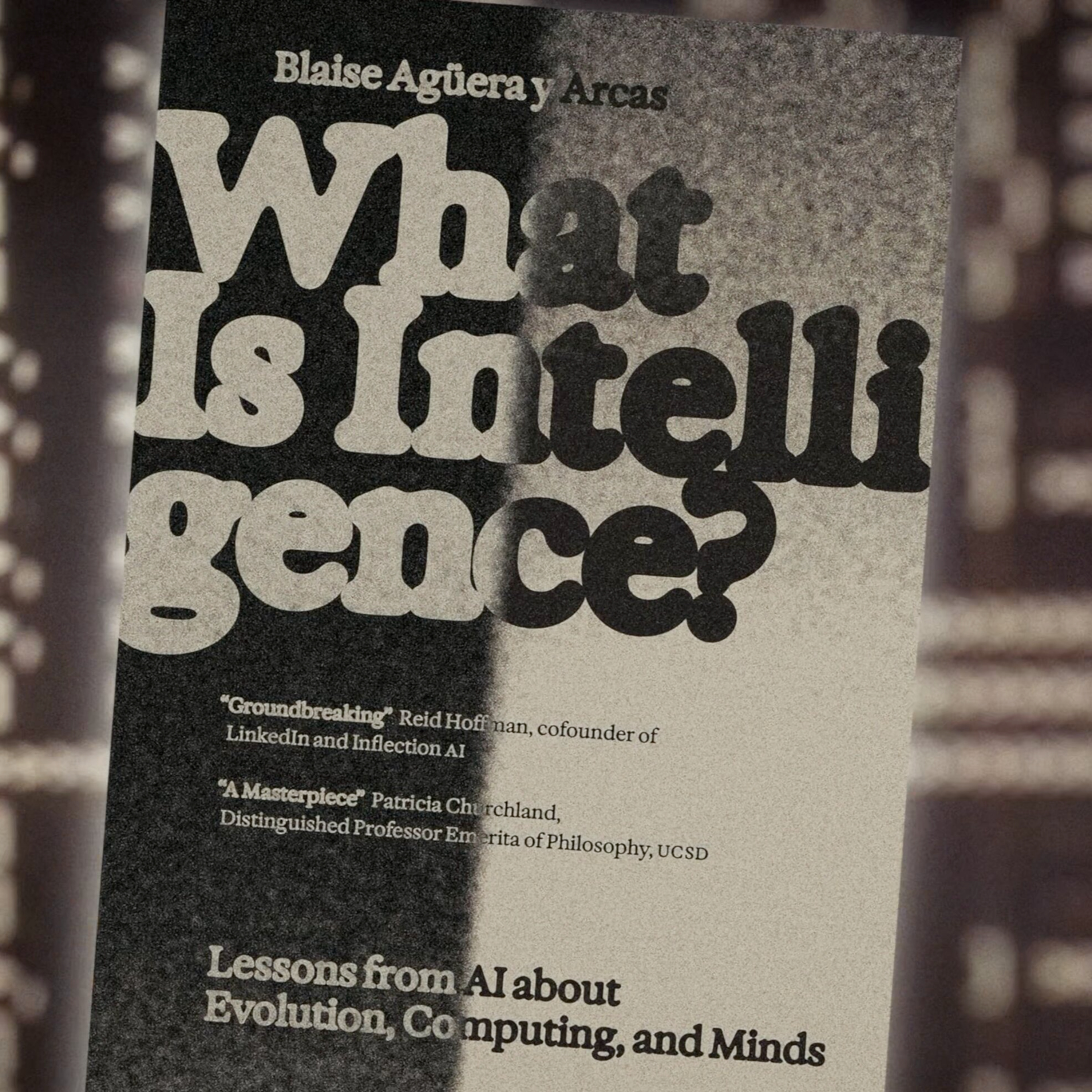 Evolution "Doesn't Need" Mutation - Blaise Agüera y Arcas 16.02.2026 55minWhat if life itself is just a really sophisticated computer program that wrote itself into existence?Blaise Agüera y Arcas presenting at ALife 2025 — the most technically detailed public walkthrough of the ideas in his *What is Life?* and *What is Intelligence?* books that we've come across.He covers the BFF experiments (self-replicating programs emerging spontaneously from random noise), the mathematical framework connecting Lotka-Volterra population dynamics with Smoluchowski coagulation, eigenvalue analysis of cooperation matrices, and his central claim that symbiogenesis — not mutation — is the primary engine of evolutionary novelty.The experimental results are genuinely striking: complex self-replicating code arising from random byte strings with zero mutation, a sharp phase transition that looks like gelation, and a proof that blocking deep symbiogenetic ancestry trees prevents the transition entirely.A few things worth flagging for critical viewers:— The substrate is more carefully engineered than the framing sometimes suggests. The choice of language, tape length, interaction protocol, and step limits all shape what emerges. Their own SUBLEQ counterexample (where self-replicators *don't* arise despite being theoretically possible) highlights that these design choices matter substantially — and a general theory of which substrates support this transition is still missing.— The leap from "self-replicating programs on fixed-length tapes" to "life was computational and intelligent from the start" involves significant philosophical extrapolation beyond what the experiments directly demonstrate.— The Bedau et al. (2000) open problems paper he references at the start actually sets a higher bar for Challenge 3.2 than BFF currently meets: it asks that "the internal organization of these 'organisms' and the boundaries separating them from their environment arise and be sustained through the activities of lower-level primitives" — whereas BFF's tape boundaries are fixed by design, not emergent.---TIMESTAMPS:00:00:00 Introduction: From Noise to Programs & ALife History00:03:15 Defining Life: Function as the "Spirit"00:05:45 Von Neumann's Insight: Life is Embodied Computation00:09:15 Physics of Computation: Irreversibility & Fallacies00:15:00 The BFF Experiment: Spontaneous Generation of Code00:23:45 The Mystery: Complexity Growth Without Mutation00:27:00 Symbiogenesis: The Engine of Novelty00:33:15 Mathematical Proof: Blocking Symbiosis Stops Life00:40:15 Evolutionary Implications: It's Symbiogenesis All The Way Down00:44:30 Intelligence as Modeling Others00:46:49 Q&A: Levels of Abstraction & Definitions---REFERENCES:Paper:[00:01:16] Open Problems in Artificial Lifehttps://direct.mit.edu/artl/article/6/4/363/2354/Open-Problems-in-Artificial-Life[00:09:30] When does a physical system compute?https://arxiv.org/abs/1309.7979[00:15:00] Computational Lifehttps://arxiv.org/abs/2406.19108[00:27:30] On the Origin of Mitosing Cellshttps://pubmed.ncbi.nlm.nih.gov/11541392/[00:42:00] The Major Evolutionary Transitionshttps://www.nature.com/articles/374227a0[00:44:00] The ARC genehttps://www.nih.gov/news-events/news-releases/memory-gene-goes-viralPerson:[00:05:45] Alan Turinghttps://plato.stanford.edu/entries/turing/[00:07:30] John von Neumannhttps://en.wikipedia.org/wiki/John_von_Neumann[00:11:15] Hector Zenilhttps://hectorzenil.net/[00:12:00] Robert Sapolskyhttps://profiles.stanford.edu/robert-sapolsky---LINKS:RESCRIPT: https://app.rescript.info/public/share/ff7gb6HpezOR3DF-gr9-rCoMFzzEgUjLQK6voV5XVWY
 -
 VAEs Are Energy-Based Models? [Dr. Jeff Beck] 25.01.2026 46minWhat makes something truly *intelligent?* Is a rock an agent? Could a perfect simulation of your brain actually *be* you? In this fascinating conversation, Dr. Jeff Beck takes us on a journey through the philosophical and technical foundations of agency, intelligence, and the future of AI.Jeff doesn't hold back on the big questions. He argues that from a purely mathematical perspective, there's no structural difference between an agent and a rock – both execute policies that map inputs to outputs. The real distinction lies in *sophistication* – how complex are the internal computations? Does the system engage in planning and counterfactual reasoning, or is it just a lookup table that happens to give the right answers?*Key topics explored in this conversation:**The Black Box Problem of Agency* – How can we tell if something is truly planning versus just executing a pre-computed response? Jeff explains why this question is nearly impossible to answer from the outside, and why the best we can do is ask which model gives us the simplest explanation.*Energy-Based Models Explained* – A masterclass on how EBMs differ from standard neural networks. The key insight: traditional networks only optimize weights, while energy-based models optimize *both* weights and internal states – a subtle but profound distinction that connects to Bayesian inference.*Why Your Brain Might Have Evolved from Your Nose* – One of the most surprising moments in the conversation. Jeff proposes that the complex, non-smooth nature of olfactory space may have driven the evolution of our associative cortex and planning abilities.*The JEPA Revolution* – A deep dive into Yann LeCun's Joint Embedding Prediction Architecture and why learning in latent space (rather than predicting every pixel) might be the key to more robust AI representations.*AI Safety Without Skynet Fears* – Jeff takes a refreshingly grounded stance on AI risk. He's less worried about rogue superintelligences and more concerned about humans becoming "reward function selectors" – couch potatoes who just approve or reject AI outputs. His proposed solution? Use inverse reinforcement learning to derive AI goals from observed human behavior, then make *small* perturbations rather than naive commands like "end world hunger."Whether you're interested in the philosophy of mind, the technical details of modern machine learning, or just want to understand what makes intelligence *tick,* this conversation delivers insights you won't find anywhere else.---TIMESTAMPS:00:00:00 Geometric Deep Learning & Physical Symmetries00:00:56 Defining Agency: From Rocks to Planning00:05:25 The Black Box Problem & Counterfactuals00:08:45 Simulated Agency vs. Physical Reality00:12:55 Energy-Based Models & Test-Time Training00:17:30 Bayesian Inference & Free Energy00:20:07 JEPA, Latent Space, & Non-Contrastive Learning00:27:07 Evolution of Intelligence & Modular Brains00:34:00 Scientific Discovery & Automated Experimentation00:38:04 AI Safety, Enfeeblement & The Future of Work---REFERENCES:Concept:[00:00:58] Free Energy Principle (FEP)https://en.wikipedia.org/wiki/Free_energy_principle[00:06:00] Monte Carlo Tree Searchhttps://en.wikipedia.org/wiki/Monte_Carlo_tree_searchBook:[00:09:00] The Intentional Stancehttps://mitpress.mit.edu/9780262540537/the-intentional-stance/Paper:[00:13:00] A Tutorial on Energy-Based Learning (LeCun 2006)http://yann.lecun.com/exdb/publis/pdf/lecun-06.pdf[00:15:00] Auto-Encoding Variational Bayes (VAE)https://arxiv.org/abs/1312.6114[00:20:15] JEPA (Joint Embedding Prediction Architecture)https://openreview.net/forum?id=BZ5a1r-kVsf[00:22:30] The Wake-Sleep Algorithmhttps://www.cs.toronto.edu/~hinton/absps/ws.pdf<trunc, see rescript>---RESCRIPT:https://app.rescript.info/public/share/DJlSbJ_Qx080q315tWaqMWn3PixCQsOcM4Kf1IW9_EoPDF:https://app.rescript.info/api/public/sessions/0efec296b9b6e905/pdf
Samankaltaiset podcastit


Suosittu maassa
Tämä podcast esiintyy myös näiden maiden podcast-listoilla.


