
The Pragmatic Engineer
Gergely Orosz
0
Software engineering at Big Tech and startups, from the inside. Deepdives with experienced engineers and tech professionals who share their hard-earned lessons, interesting stories and advice they have on building software. Especially relevant for software engineers and engineering leaders: useful for those working in tech.
Jaksot
-
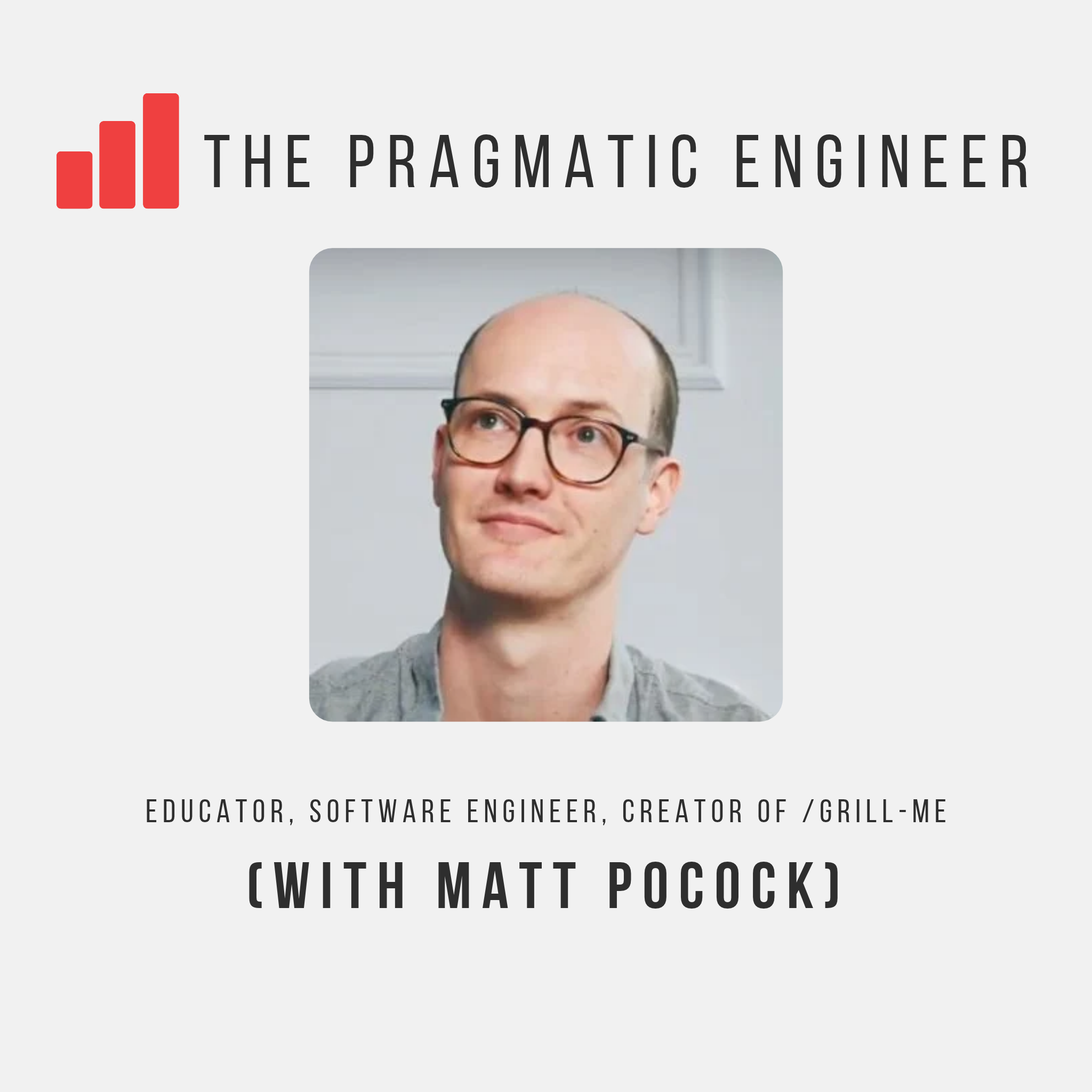 AI Skills with Matt Pocock 17.09.2026 1t 35minBrought to You By:• turbopuffer – a vector and full-text search engine built on object storage. It’s fast, cheap, and extremely scalable• Linear – the product development system for teams and agents• WorkOS – everything you need to make your app enterprise ready.—Why is the “grill-me” skill so popular, and why does its creator swear by the importance of software fundamentals? Matt Pocock created this widely-used skill – and many others – alongside being an educator, content creator, and engineer. His latest course is AI Hero, and he previously created the Total TypeScript course that generated more than $2.5 million in sales.In this episode, Matt and I discuss his unconventional path from working as a voice teacher to becoming a developer and going all-in on technical education. He reveals how communication skills helped him break into tech, why he took an unusual three-days-a-week contract at Vercel, and how he built Total TypeScript through workshops, courses, and a lot of free content.We also explore “strategic coding,” and how he uses skills like “grill me” and “wayfinder” to plan, delegate, and course-correct with AI agents. Matt explains his “day shift” and “night shift” approach, why splitting context up can keep agents in their “smart zone,” and how concepts from classic software engineering books can guide agents to do better. In this episode, there’s also local versus cloud workflows, whether agents need TDD, how AI is changing the ways that engineers learn the fundamentals, and why humans are still essential in teaching.Timestamps00:00 Intro05:48 How Matt got into tech10:14 How Matt got into open source12:58 Joining Vercel18:39 Total TypeScript23:21 AI’s impact on technical education30:32 Building reusable skills for AI coding agents40:46 The “smart zone” vs the “dumb zone”45:02 The wayfinder skill47:52 Why agents excel at software engineering50:54 “Leading words”1:01:10 Learning the fundamentals1:09:17 Local vs. cloud agents1:12:36 Planning vs. course-correcting1:18:13 TDD and agents1:23:06 Living in the UK1:24:21 Teaching: the human part1:28:36 Advice for junior engineers1:31:07 Gardeners and great engineers1:34:01 Book recommendation—The Pragmatic Engineer deepdives relevant for this episode:• What is "loop engineering?"• The Philosophy of Software Design – with John Ousterhout• Context engineering with Dex Horthy• Are AI agents actually slowing us down?• The AI Engineering Stack• How Codex is built• How Claude Code is built• How Uber uses AI for development: inside look—Production and marketing by https://penname.co/. For inquiries about sponsoring the podcast, email [email protected]. Get full access to The Pragmatic Engineer at newsletter.pragmaticengineer.com/subscribe
 -
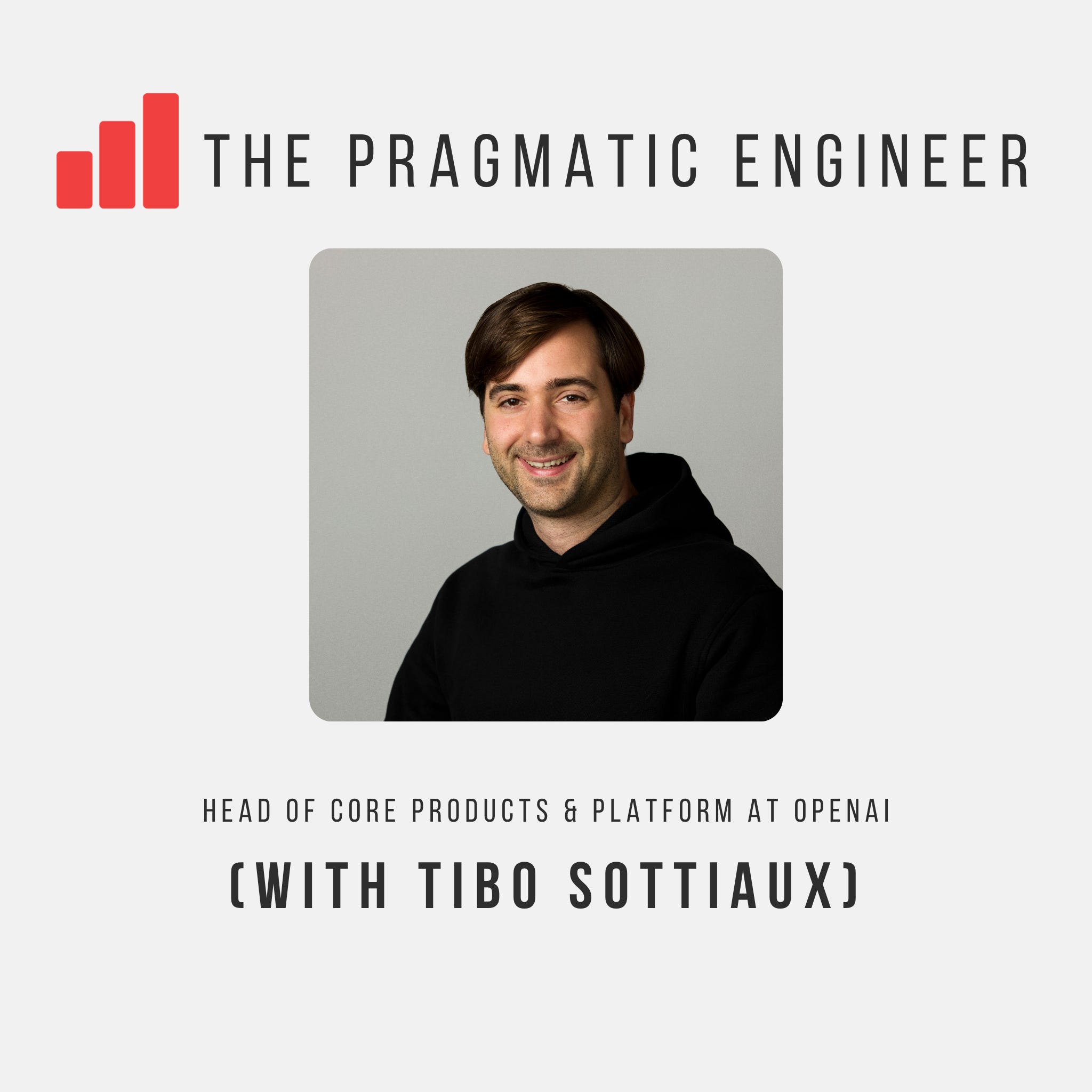 Building Codex with Tibo Sottiaux 09.09.2026 1t 13minBrought to You By:• turbopuffer – a vector and full-text search engine built on object storage. It’s fast, cheap, and extremely scalable• Antithesis – verify your system’s correctness without human review or traditional integration tests – and avoid bugs or outages.• Entire – Git hosting, rebuilt for the agentic era. Every agent session, prompt and tool calls: stored in your repo.—Tibo Sottiaux is one of the engineers who created Codex, and today, he heads up the Core Products & Platform org at OpenAI which also includes Codex. He’s also one of the most public faces of Codex due to his frequent – and generous – usage reset announcements, like this one yesterday.In this episode of the Pragmatic Engineer Podcast, Tibo and I discuss how Codex was built and continues to be iterated upon. We explore why the Codex CLI is written in Rust and was released as open source, how the harness and models have evolved, and why Codex supports models from multiple providers.Tibo also shares details about how the OpenAI team uses Codex throughout the software development lifecycle, including code reviews, maintenance, and system rearchitecture. We look into how AI is lowering the cost of changing code – and some interesting side effects of this – the merger of ChatGPT and Codex, and also how Tibo uses the tools in his own work.—Timestamps00:00 Intro07:21 Working at Google12:41 What drew Tibo to OpenAI15:19 The early days of Codex18:20 Why Codex was built in Rust21:15 Why Codex is open source25:50 Codex plays nice with other models: why?32:09 How the harness works36:44 Harness and model improvements41:19 The SDLC behind Codex46:39 Code reviews at Codex52:09 Maintenance and architecture56:43 How AI tools expand what engineers can do1:02:30 The Merge: ChatGPT + Codex1:07:16 How Tibo uses Codex and ChatGPT1:10:44 Advice for engineers who want to work in AI—The Pragmatic Engineer deepdives relevant for this episode:• How Codex is built• How Claude Code is built• How Cursor was built• What is "loop engineering?”• How Uber uses AI for development: inside look• Why Ramp built its own in-house coding agent, Inspect• “I ship code I don’t read”: with Peter Steinberger, the creator of OpenClaw—Production and marketing by https://penname.co/. For inquiries about sponsoring the podcast, email [email protected]. Get full access to The Pragmatic Engineer at newsletter.pragmaticengineer.com/subscribe
 -
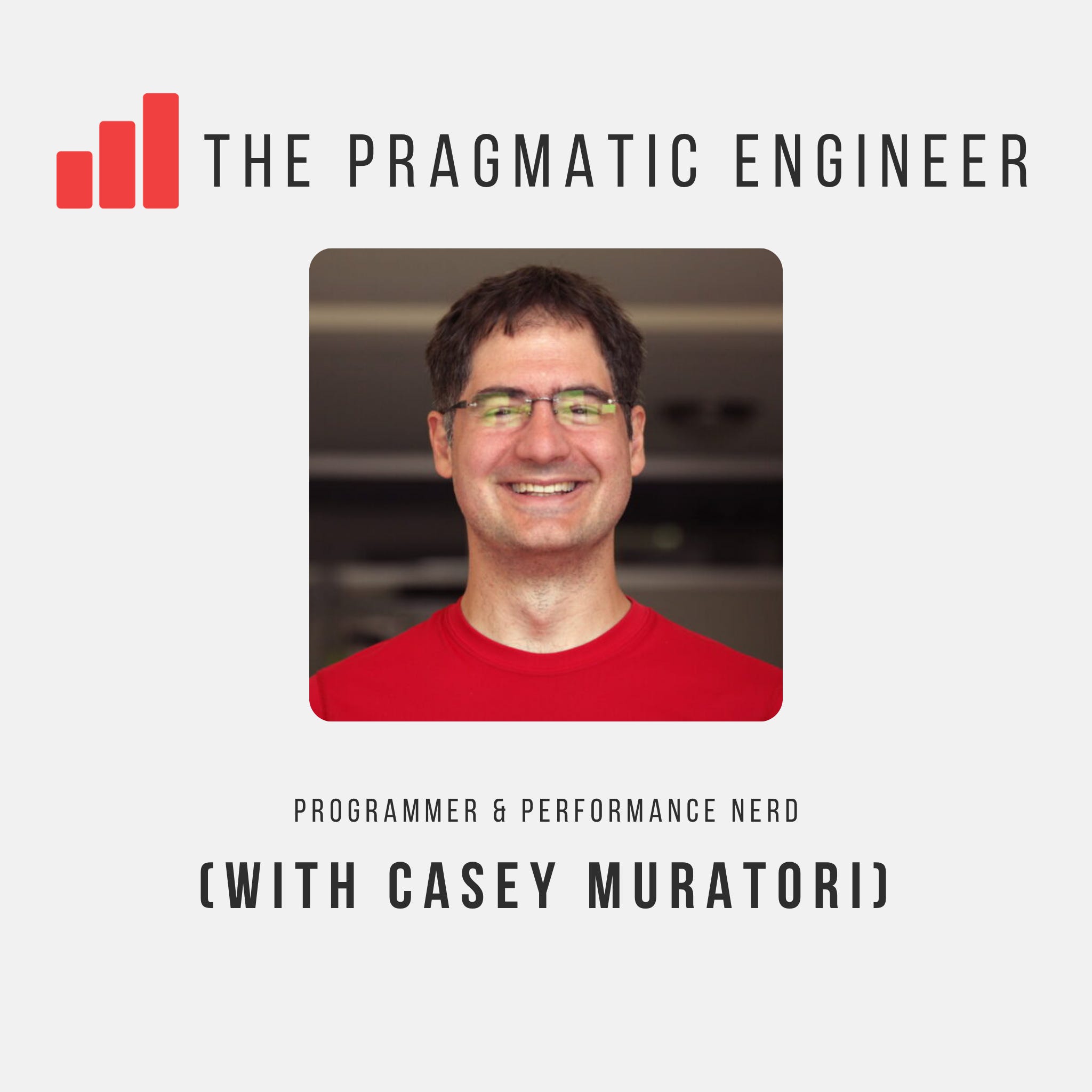 Why performant code matters (but gets widely ignored), with Casey Muratori 26.08.2026 1t 52minBrought to You By:• Antithesis – verify your system’s correctness without human review or traditional integration tests – and avoid bugs or outages.• Sentry – application monitoring software considered “not bad” by millions of developers.• turbopuffer – a vector and full-text search engine built on object storage. It’s fast, cheap, and extremely scalable.—There can be few people around who care about software performance more than today’s pod guest, Casey Muratori. He’s a programmer and videogame developer, founder of Molly Rocket, and creator of Handmade Hero – a long-running series about building a game from scratch. He also evangelizes about performance on his Substack, Computer, Enhance.We got to know each other about three years ago, first via messages, including this one from Casey:“Why does the industry zeitgeist place so little emphasis on software performance when there seems to be overwhelming evidence that performance is critical to their bottom line?Like you, I run a Substack for professional programmers, but I focus exclusively on software performance. Although we are quite large by Substack standards, so a certain subset of programmers must believe performance is important, I nonetheless hear lots of dismissive excuses when I post on social media. This happens so frequently, I devoted an entire article to cataloging the extensive pro-performance evidence we already have from the world's leading software companies: Performance Excuses Debunked.Strangely, nobody has a rebuttal to why performance is important. When I point people to this, they actually tend to agree. But the prevailing attitude nonetheless stays the same.”I’m delighted we finally have Casey on the podcast because it’s overdue! In this episode, we discuss why software performance matters, why it’s overlooked, and how developers can get better at writing performant code. We explore why performance should be considered during design, the value of learning to read assembly & understanding how CPUs work, Casey’s critique of ‘clean code’, and why he believes testing shouldn't drive software design.We touch on how videogame development has changed, and influential game engines. Casey also tells us why he prefers to write code by hand, not with AI, and more.—Timestamps00:00 Intro05:17 Games at Microsoft12:52 Building games16:00 Why performance matters27:12 Why you should learn to read assembly30:36 Designing for optimization42:51 How to get better at writing performant software49:04 Understanding how the CPU works55:53 Building games then and now1:05:56 How game engines changed building games1:10:48 Why new games compete with old games1:13:25 GTA 6: why is it taking so long?1:16:59 Casey’s critique of clean code1:21:48 Casey’s take on TDD1:24:30 What is good code?1:27:32 What makes a good software engineer?1:33:56 Why Casey doesn’t code with AI1:39:01 AI’s impact on the game industry1:44:43 AI and burnout1:50:21 Why you should read papers—The Pragmatic Engineer deepdives relevant for this episode:•Pushing software engineering limits with “napkin math” with Simon Eskildsen •How Games Typically Get Built: prototyping, game engines, and a different type of QA•Game Development Basics: deepdive on how game studios differ from standard software teams•Inside Linear's Engineering Culture: building a performant product with a tiny team•Building a best-selling game with a tiny team – with Jonas Tyroller. A two-person team built a game that sold 1M+ copiesMore on premature optimization: read or watch Casey’s extended take on “premature optimization is the root of all evil”: https://www.computerenhance.com/p/theroot—Production and marketing by https://penname.co/. For inquiries about sponsoring the podcast, email [email protected]. Get full access to The Pragmatic Engineer at newsletter.pragmaticengineer.com/subscribe
 -
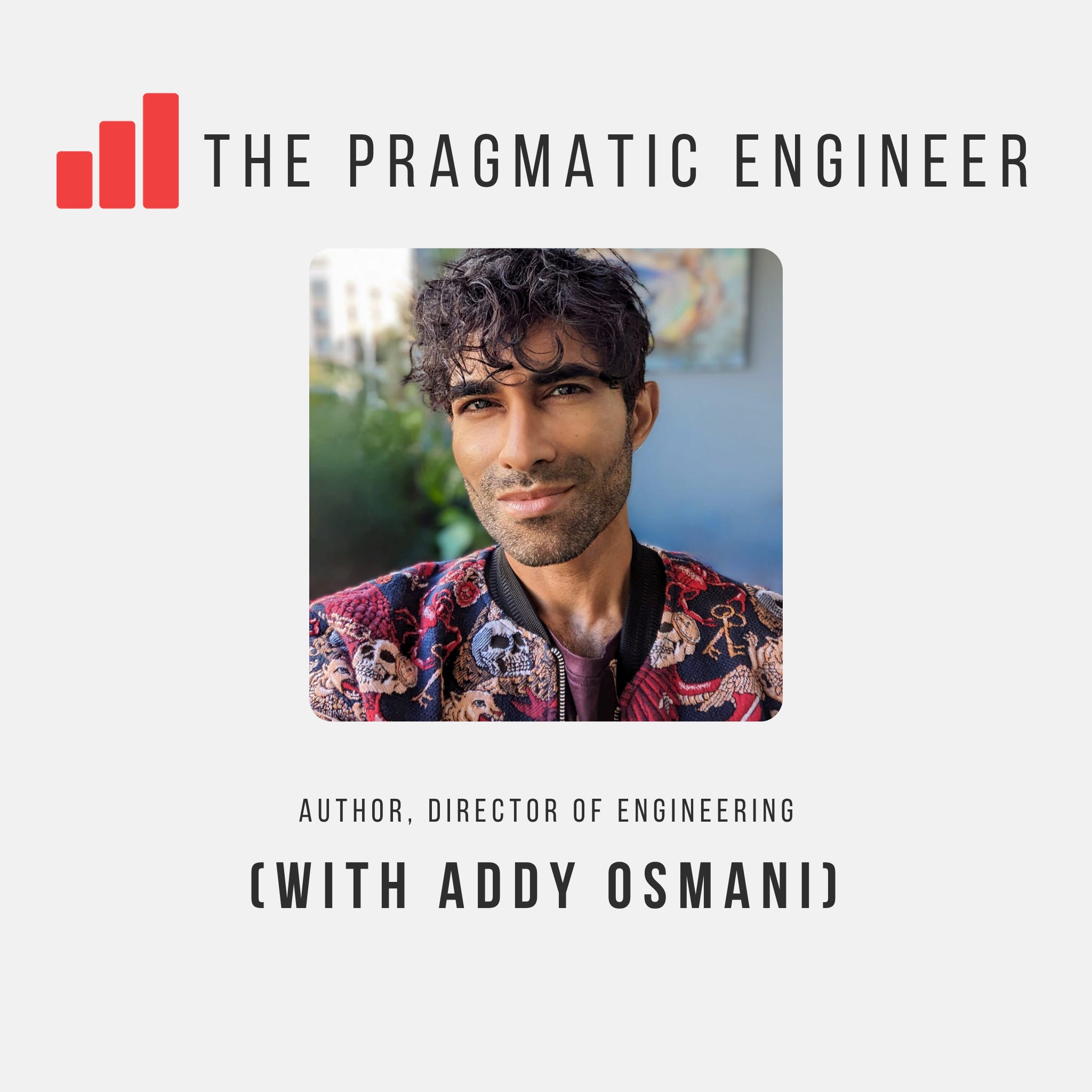 From Chrome DevTools to AI Engineering, with Addy Osmani 19.08.2026 1t 31minBrought to You By:• Antithesis – verify your system’s correctness without human review or traditional integration tests – and avoid bugs or outages.• Google Cloud Run – run your code and host LLMs directly on top of Google’s scalable infrastructure, without having to worry about managing infra.• Sentry – application monitoring software considered “not bad” by millions of developers—Addy Osmani spent more than 14 years at Google, working on Chrome, DevTools, Core Web Vitals, and most recently, AI developer experience.If you've ever opened Chrome DevTools, or optimized a page for Core Web Vitals, you’ve used software built by Addy Osmani. In this episode, I sit down with Addy and we talk about his path from building a web browser aged just 16 to becoming a director at Google. We discuss what he learned from building tools for millions of developers, Google’s engineering culture, and why he continued doing hands-on coding work as a manager. We also get into how he works with AI agents today, the risks of ‘cognitive surrender,’ his approach to ‘loop engineering,’ and why it’s good to develop skills in product management, go-to-market, and other areas.—Timestamps00:00 Intro02:50 Addy’s current workflow05:11 Addy’s path into tech15:04 Addy’s work on jQuery16:44 TodoMVC21:44 Getting hired at Google and working on Chrome27:17 Building dev tools40:15 Core Web Vitals45:42 Google’s engineering culture51:03 Addy’s career trajectory at Google57:55 The director role at Google1:01:40 Cognitive debt and cognitive surrender1:03:03 Working with agents1:05:52 Loop engineering1:12:55 The changing role of the software engineer1:18:15 How Addy uses AI in writing1:27:40 What’s next for Addy1:28:47 Career advice—The Pragmatic Engineer deepdives relevant for this episode:• What is loop engineering?• Inside Google’s engineering culture• How AI-assisted coding will change software engineering: hard truths• Are AI agents actually slowing us down?• How Claude Code is built• How Codex is built• From IDEs to AI Agents with Steve Yegge• Google’s engineering culture: the podcast—Production and marketing by https://penname.co/. For inquiries about sponsoring the podcast, email [email protected]. Get full access to The Pragmatic Engineer at newsletter.pragmaticengineer.com/subscribe
 -
 Stop being skeptical about AI for development with Charity Majors 12.08.2026 1t 25minBrought to You By:• Antithesis – verify your system’s correctness without human review or traditional integration tests – and avoid bugs or outages.• WorkOS – everything you need to make your app enterprise ready.• Buildkite – CI software built to absorb whatever your coding agents throw at the build queue—In 2025, it was rational to be skeptical about AI, but in 2026 it’s clear that AI is changing all of the industry, and there’s less and less place for skepticism. This take is from one of my favorite voices in software reliability and observability: Charity Majors, CTO and cofounder of Honeycomb, co-author of Observability Engineering. (Note: the second edition of Observability Engineering is out, and it’s pretty much a full rewrite of the book, I recommend grabbing it if you’re building reliable systems)In this episode, I sat down with Charity to discuss how her thinking on AI has evolved, why she believes it is becoming a foundational part of software engineering, and what that means for how teams build, review, and ship software.We explore how AI is changing the economics of code generation, why reliability and verification are increasingly the bottlenecks, and why the rise of non-deterministic systems requires more engineering discipline. Charity shares her views on code reviews, observability, DevOps, leadership, and why both AI skeptics and enthusiasts are getting important things right.—Timestamps00:00 Intro02:56 How Parse led to Honeycomb06:00 The limits of individual productivity metrics09:08 How Charity’s perspective on AI has evolved13:50 Rewriting code vs. editing code19:20 Production as a stage of development22:14 Code reviews26:56 Non-deterministic systems31:11 Sensible uses of AI37:41 The two AI camps44:40 Why AI works so well for building software49:42 DevOps55:13 Modern observability1:00:40 Handling context overload1:01:56 What’s new in Observability Engineering’s 2nd edition1:07:45 What effective leadership looks like1:10:25 Engineering management: what is changing?1:16:31 Junior engineers1:18:01 AI fatigue1:21:39 Book recommendations—The Pragmatic Engineer deepdives relevant for this episode:• Shipping to production• Deepdive: How 10 tech companies choose the next generation of dev tools• Why is Meta destroying its engineering organization?• When AI writes almost all code, what happens to software engineering?• Are AI agents actually slowing us down?• Observability: the present and future, with Charity Majors• The third golden age of software engineering – thanks to AI, with Grady Booch—Production and marketing by https://penname.co/. For inquiries about sponsoring the podcast, email [email protected]. Get full access to The Pragmatic Engineer at newsletter.pragmaticengineer.com/subscribe
 -
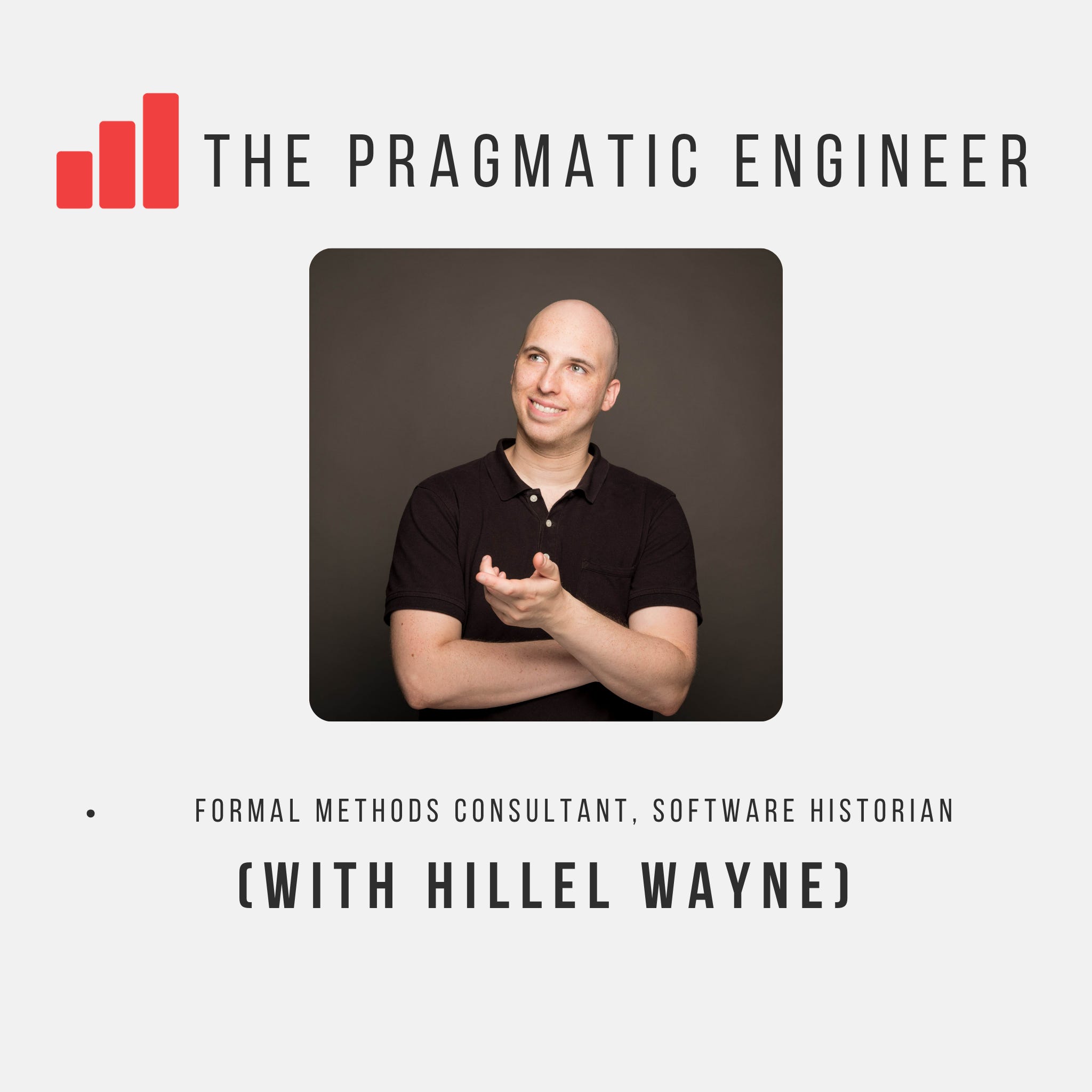 Formal methods with Hillel Wayne 29.07.2026 1t 23minBrought to You By:• Antithesis – verify your system’s correctness without human review or traditional integration tests – and avoid bugs or outages.• turbopuffer – a vector and full-text search engine built on object storage. It’s fast, cheap, and extremely scalable.• WorkOS – everything you need to make your app enterprise ready.—There’s a popular theory that AI will finally make formal verification mainstream because mathematical proof of correctness will be needed when machines write most or all of the code. But will this happen? Today, I’m talking with one of the best people to tackle the prediction. Hillel Wayne is a formal methods consultant, educator, and author, who’s deeply interested in software history. In this episode of Pragmatic Engineer podcast, I sit down with Hillel to compare software engineering with traditional engineering, discuss where formal methods fit into modern software development, and we explore why they are essential for some of the world's most complex systems. We cover the formal specification language, TLA+, walk through several formal verification tools, examine why distributed systems are so difficult to reason about, and look into whether AI will make formal methods accessible to more engineering teams.—Timestamps00:00 Intro03:21 The Crossover Project10:26 What software engineering does better14:19 What traditional engineering does better17:06 Formal methods28:21 TLA+: what it is and demo35:47 TLA+ at Amazon36:59 Ways distributed systems break39:52 Formal methods and systems thinking45:09 The value of learning math49:12 What TLA+ is good for and isn’t51:39 Alloy: a declarative language for software modeling57:42 Other formal methods tools1:00:13 Property-based testing1:04:20 AI and the need for formal verification1:11:18 Logic for programmers1:13:24 Hillel’s 2025 prediction on AI’s impact1:20:19 Book recommendation—The Pragmatic Engineer deepdives relevant for this episode:• How to debug large, distributed systems: Antithesis• How AWS S3 is built• Paying down tech debt• How Big Tech does quality assurance (QA)• Bug management that works• Resiliency in distributed systems—Production and marketing by https://penname.co/. For inquiries about sponsoring the podcast, email [email protected]. Get full access to The Pragmatic Engineer at newsletter.pragmaticengineer.com/subscribe
 -
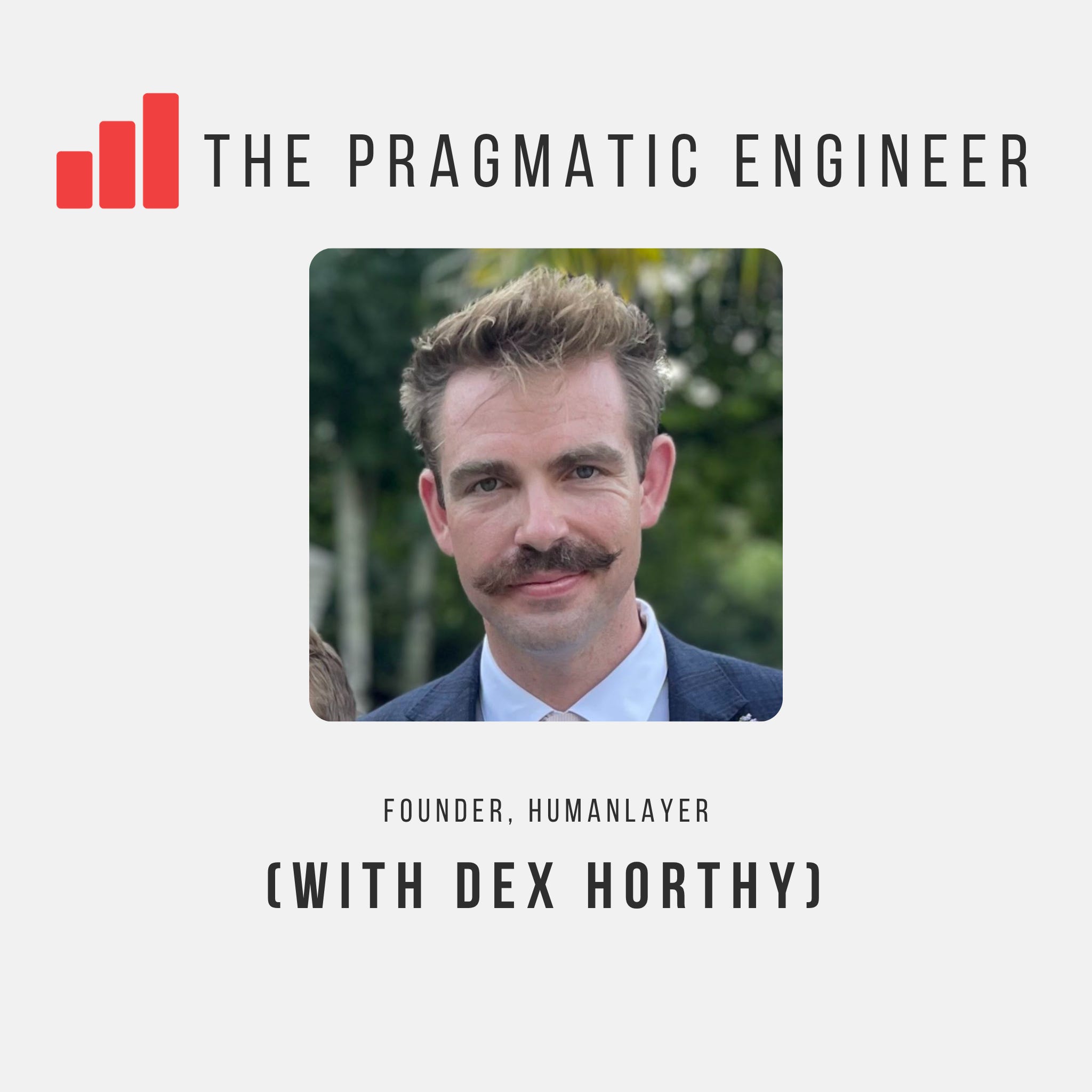 Context engineering with Dex Horthy 15.07.2026 1t 32minBrought to You By:• Antithesis – verify your system’s correctness without human review or traditional integration tests – and avoid bugs or outages.• Buildkite – CI software built to absorb whatever your coding agents throw at the build queue.• Sentry – application monitoring software considered “not bad” by millions of developers.—Knowing how LLM contexts work and how to work around context limitations – aka “context engineering” – is becoming more important for software engineers working with LLMs. Let’s look into what works and what doesn’t, today.In this episode of The Pragmatic Engineer podcast, I sit down with the CEO and cofounder of HumanLayer, Dex Horthy, who coined the term “context engineering”. We discuss the ideas behind this context engineering, harness engineering, loop engineering, software factories, why his approach to AI-assisted software development has evolved, and how HumanLayer is helping engineering teams automate more of the software development lifecycle without sacrificing code quality.—Timestamps00:00 Intro03:35 Dex’s path into tech05:36 Early work in platform engineering07:30 Replicated13:26 Metalytics14:38 12-factor agents20:29 Context engineering25:40 Harness engineering28:13 Context overload32:47 Loop engineering46:36 Software factories before and after AI52:35 Automation limits57:20 Three options for automating1:01:02 RPI framework1:06:18 Intentional compaction1:13:50 Token harder vs. token smarter1:18:46 AI slop1:21:17 HumanLayer1:31:11 Book recommendation—The Pragmatic Engineer deepdives relevant for this episode:• How Uber uses AI for development: inside look• Are AI agents actually slowing us down?• AI Tooling for Software Engineers in 2026• Vibe Coding as a software engineer• How Claude Code is built• AI Engineering in the real world• The AI Engineering Stack• How AI-assisted coding will change software engineering: hard truths• The creator of OpenClaw: "I ship code I don't read"—Production and marketing by https://penname.co/. For inquiries about sponsoring the podcast, email [email protected]. Get full access to The Pragmatic Engineer at newsletter.pragmaticengineer.com/subscribe
 -
 The Pragmatic Engineer AMA 08.07.2026 1t 18minBrought to You By:• Antithesis – verify your system’s correctness without human review or traditional integration tests – and avoid bugs or outages.—In this special “ask me anything” episode of Pragmatic Engineer podcast, I am in the hot seat facing questions sent in by subscribers that are read out by guest Volodymyr Giginiak, CTO and cofounder of Wordsmith AI, a legal tech startup (note: I’m an investor).I tackle your questions on the software industry, AI, hiring, engineering organizations, career growth, the business model of the Pragmatic Engineer, and more. We also discuss where software engineering is headed, and I offer advice on some specific situations. Thanks to everyone who sent questions!—Timestamps00:00 Intro01:56 From Uber to writing09:22 AI-native SDLC14:00 AI and hiring19:06 Engineers currently thriving22:18 Junior roles24:44 Meta’s war mode27:54 AI at Big Tech vs. startups36:46 Tech debt41:36 Types of engineering managers44:40 Measuring AI productivity48:30 The value of CS degrees50:53 AI at Pragmatic Engineer56:09 Future-proofing your career1:01:36 The EU job market1:03:55 Making money as a creator1:08:20 What’s next for The Pragmatic Engineer1:09:27 Bunq and Pollen1:13:38 Spotting trends1:14:33 Book updates1:15:20 Favorite books & tech products1:17:13 What won’t change in engineering—The Pragmatic Engineer deepdives relevant for this episode:• State of the software engineering job market in 2026• The impact of AI on software engineers in 2026: key trends. • How 10 tech companies choose the next generation of dev tools • The reality of tech interviews—Production and marketing by https://penname.co/. For inquiries about sponsoring the podcast, email [email protected]. Get full access to The Pragmatic Engineer at newsletter.pragmaticengineer.com/subscribe
 -
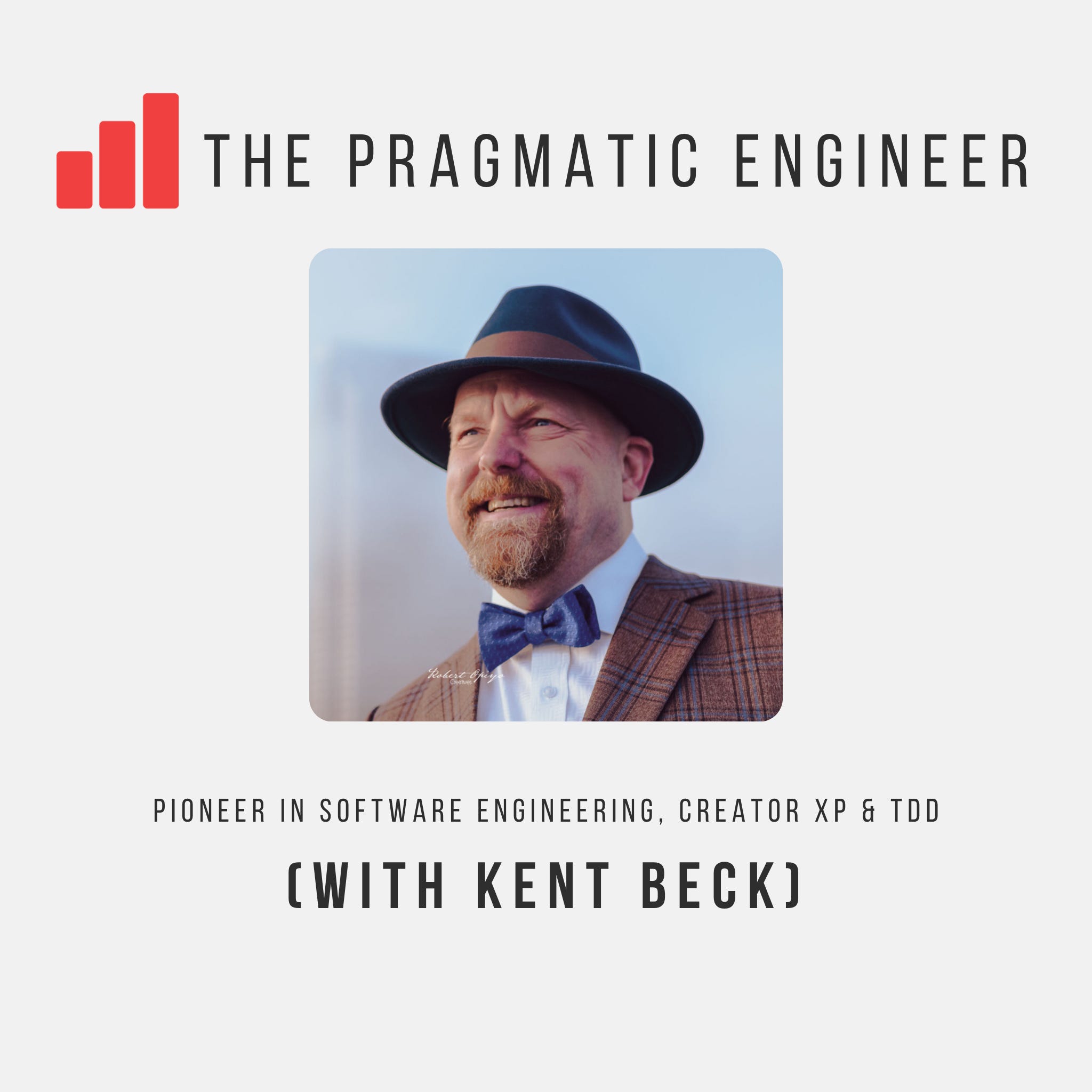 How Kent Beck shapes the software engineering industry 01.07.2026 2t 27minBrought to You By:• Antithesis – verify your system’s correctness without human review or traditional integration tests – and avoid bugs or outages.• turbopuffer – a vector and full-text search engine built on object storage. It’s fast, cheap, and extremely scalable.• WorkOS – everything you need to make your app enterprise ready.—Few have made as big an impact on software engineering as this week’s guest on the Pragmatic Engineer podcast, Kent Beck. He created Extreme Programming, pioneered test-driven development (TDD), co-created JUnit, and is one of the authors of the famous ‘Agile Manifesto’. But these days, he's re-examining many ideas for the age of AI, and says we’re failing to accumulate trust during this new era at the same high rate as new code is being accumulated.In this episode of the Pragmatic Engineer podcast, Kent and I dig into his journey from discovering Smalltalk in the early days of personal computing, to helping define modern software engineering practices. We explore the origins of TDD, design patterns, Extreme Programming, and Agile – along with some lessons learned at Apple and Facebook.Kent explains why he believes software engineering is about far more than writing code, why no one yet knows exactly how engineers should work alongside AI agents, and how his "explore, expand, extract" framework can help engineers navigate major technology shifts.—Timestamps00:00 Intro03:47 Human engineers aren’t going away08:00 Kent's path into tech13:50 Undergraduate and graduate studies17:21 Kent’s first programming job18:54 The rise and fall of Smalltalk27:04 Working with Ward Cunningham37:36 Design patterns44:05 Working at Apple51:08 CRC Cards59:29 Testing tools in the language1:04:22 The C3 project with Martin Fowler1:09:54 Extreme Programming1:16:25 Developing TDD1:25:07 Writing the Agile Manifesto1:30:00 Agile’s impact1:32:40 Agile’s downside1:37:32 The Dotcom Bust1:44:30 Lessons from working at Facebook1:59:44 Kent’s ‘Good to Great’ program at Facebook2:06:07 Soft skills engineers need to learn2:09:30 AI and the challenges of acceleration2:15:53 Explore, expand, extract2:22:33 What Kent is excited about—The Pragmatic Engineer deepdives relevant for this episode:• Measuring developer productivity? A response to McKinsey – co-written with Kent Beck• TDD, AI agents and coding with Kent Beck• Paying down tech debt• The past and future of modern backend practices—Production and marketing by https://penname.co/. For inquiries about sponsoring the podcast, email [email protected]. Get full access to The Pragmatic Engineer at newsletter.pragmaticengineer.com/subscribe
 -
 Tech interviews with NeetCode 24.06.2026 1t 29minBrought to You By:• Antithesis – verify your system’s correctness without human review or traditional integration tests – and avoid bugs or outages.• Sentry – application monitoring software considered “not bad” by millions of developers• Google Cloud Run – run your code and host LLMs directly on top of Google’s scalable infrastructure, without having to worry about managing infra.—Navdeep Singh – oftentimes better known as NeetCode – is the creator of NeetCode.io, one of the most popular coding interview preparation platforms and YouTube channels for software engineers. Before building NeetCode full-time, he worked as a software engineer at Amazon and Google.In this episode of The Pragmatic Engineer, I sit down with Neet to discuss his path from Amazon and Google to building his own startup, why he left Amazon after just two months, what he learned at Google, and the decision to leave a stable engineering career to bet on himself. We also discuss what coding interview preparation teaches beyond passing interviews, the value of going deep on difficult problems, and why systems thinking and domain expertise remain essential engineering skills in the age of AI.Throughout the conversation, NeetCode makes the case that learning hard things is one of the single best investments an engineer can make, helping build the judgment and expertise that remain valuable no matter how the tools change.—Timestamps00:00 Intro02:57 Neet’s take on coding interviews06:41 Getting into tech08:56 Why Neet isn't a fan of the CAP theorem13:12 Quitting Amazon after two months18:22 Google vs Amazon22:26 The origins of NeetCode25:27 Leaving Google to go all in on NeetCode32:02 Why Neet doesn't fix every bug39:26 The value of coding interview prep42:57 Systems thinking and domain expertise47:28 Hiring at Big Tech52:15 Tech stack at Neetcode57:57 The NeetCode redesign contest1:01:46 The future of software engineers1:09:04 Hot takes: AGI, AI skill erosion, personality traits1:22:49 “Maybe some people should just give up”1:24:39 How to be a standout engineer1:27:55 Book recommendation—The Pragmatic Engineer deepdives relevant for this episode:• Learnings from conducting ~1,000 interviews at Amazon• How experienced engineers get unstuck in coding interviews• The Reality of Tech Interviews in 2025• Tech hiring: is this an inflection point?• AI fakers exposed in tech dev recruitment: postmortem—Production and marketing by https://penname.co/. For inquiries about sponsoring the podcast, email [email protected]. Get full access to The Pragmatic Engineer at newsletter.pragmaticengineer.com/subscribe
 -
 CI/CD with Robert Erez 17.06.2026 1t 14minBrought to You By:• Antithesis – verify your system’s correctness without human review or traditional integration tests – and avoid bugs or outages.• WorkOS – everything you need to make your app enterprise ready.• turbopuffer – a vector and full-text search engine built on object storage. It’s fast, cheap, and extremely scalable.—Robert Erez is a principal engineer at Octopus Deploy, and a longtime expert in CI/CD, deployment systems, and software delivery. Rob and I were also once colleagues on the Skype web team, working on large-scale deployments and release processes.In this episode of The Pragmatic Engineer, I sit down with Rob to discuss how teams deploy software safely and efficiently at scale. We cover Kubernetes, GitOps, platform engineering, progressive delivery, feature flags, cloud development environments, and the growing role of AI in CI/CD workflows. We also get into the tradeoffs in different deployment approaches, why self-hosted software still matters for some organizations, and the recent evolution of software delivery practices.—Timestamps00:00 Intro02:09 Canary deployments at Skype05:01 Joining at Octopus Deploy06:15 Continuous deployment10:26 Why Kubernetes won15:51 Kubernetes on-prem18:50 How GitOps works25:00 The uses and limitations of GitOps31:04 The rise of platform teams35:51 How AI is changing CI/CD39:49 Progressive delivery explained47:31 Rollbacks and roll-forwards50:14 Feature flags54:32 How development environments are evolving57:40 Cloud development environments (CDEs)1:03:45 Self-hosting CI/CD1:09:25 Getting started with progressive delivery1:11:15 Book recommendations—The Pragmatic Engineer deepdives relevant for this episode:• Kubernetes and retiring at the top with Kelsey Hightower• The past and future of modern backend practices• Microsoft is dogfooding AI dev tools’ future• How Kubernetes is built with Kat Cosgrove• How Linux is built with Greg KH—Production and marketing by https://penname.co/. For inquiries about sponsoring the podcast, email [email protected]. Get full access to The Pragmatic Engineer at newsletter.pragmaticengineer.com/subscribe
 -
 Kubernetes and retiring at the top with Kelsey Hightower 03.06.2026 2t 51minBrought to You By:• Antithesis – verify your system’s correctness without human review or traditional integration tests – and avoid bugs or outages.• Buildkite – CI software built to absorb whatever your coding agents throw at the build queue• Sentry – application monitoring software considered “not bad” by millions of developers—Kelsey Hightower went from a self-taught technician installing DSL modems to becoming one of Google’s elite Distinguished Engineers, whom the CEO of Microsoft personally tried to recruit. Hightower’s career achievements are rooted in hard work and self-directed learning, and today he’s one of the most influential voices in modern infrastructure, through his talks, open source work, and writing.In this episode of The Pragmatic Engineer podcast, Kelsey and I cover his unconventional path into tech and the lessons he’s learned during three decades in the industry. We discuss his entrepreneurial years, building a reputation through open source, the rise of containers and Kubernetes, and his time at Google during one of the most consequential periods in cloud computing. He recounts how a job offer from a big tech giant led to the biggest raise of his career, what prompted him to slow down after years of career acceleration, and we also discuss his perspective on AI. Throughout, Kelsey keeps a simple idea front of mind: that technology is ultimately about people. Whether it’s infrastructure, leadership, careers, or AI, he argues that the goal is not to build technology for its own sake; it’s to solve meaningful human problems.—Timestamps00:00 Intro03:34 Kelsey’s first job at McDonald’s05:04 His non-traditional path into tech11:45 Landing his first tech job with an A+ certification15:33 His entrepreneurial years19:45 Joining Google as a data center technician27:48 Learning automation at a Rackspace spinoff33:26 Moving into financial services50:00 Building a reputation through open source53:55 From configuration management to containers1:08:20 The rise of Kubernetes1:25:05 Why he almost joined NASA instead of Google1:29:20 Defining DevRel at Google1:38:20 Demonstrating impact at Google1:41:20 Microsoft's offer1:55:20 Learning how to slow down2:06:39 Advising and investing2:15:03 A people-first view of GenAI2:24:27 Using AI with guardrails2:28:26 Matching AI to the task2:36:06 Staying relevant in the AI era—The Pragmatic Engineer deepdives relevant for this episode:• Career paths for software engineers at large tech companies• The past and future of modern backend practices• How Kubernetes is built• How Linux is built• The Staff Engineer’s Path: You’re a role model now (sorry!)—Production and marketing by https://penname.co/. For inquiries about sponsoring the podcast, email [email protected]. Get full access to The Pragmatic Engineer at newsletter.pragmaticengineer.com/subscribe
 -
 Building OpenCode with Dax Raad 27.05.2026 1t 20minBrought to You By:• Antithesis – verify your system’s correctness without human review or traditional integration tests – and avoid bugs or outages.• WorkOS – Everything you need to make your app enterprise ready.• turbopuffer – a vector and full-text search engine built on object storage. It’s fast, cheap, and extremely scalable.—OpenCode is one of the fastest-growing AI developer tools around, surging in just a few months from roughly 650,000 monthly active users to nearly 8 million, and almost 1M daily active users.In this episode of The Pragmatic Engineer Podcast, we meet Dax Raad, co-founder of OpenCode, for a discussion about the gaps in developer tooling that led him to build OpenCode, the advantages of open source, and why taste and engineering judgment matter even more as AI becomes a core part of software development.We also cover how OpenCode turned Anthropic’s blocking of integration with Claude Code into a massive growth lever by partnering with OpenAI and other model providers, why GPU demand is becoming a bottleneck everywhere, how come AI coding tools don’t automatically mean engineering teams move faster, and also why Dax is personally skeptical about predictions for the future of engineering and work, in general.I found this conversation especially interesting because Dax displays a healthy skepticism toward the benefits of AI, even while building one of the most popular AI coding harnesses.—Timestamps00:00 Intro07:03 Dax’s path into tech09:04 Early startup experience13:16 Getting involved with open source16:13 OpenCode23:17 Anthropic banning OpenCode30:34 From terminal to GUI32:34 OpenCode’s business model36:33 Why inference is profitable39:11 GPU bottlenecks40:54 AI hype45:50 AI spending48:47 Dax’s memo55:41 Dax’s skepticism of predictions58:58 Engineering culture at OpenCode1:02:38 How building works at OpenCode1:05:36 Taste and quality1:11:32 Dax’s work setup1:12:35 The role of engineers and EMs1:15:50 Advice for engineers1:18:12 Book recommendation—The Pragmatic Engineer deepdives relevant for this episode:• How Claude Code is built• How Codex is built• Real-world engineering challenges: building Cursor• The AI Engineering stack• How Uber uses AI for development: inside look—Production and marketing by https://penname.co/. For inquiries about sponsoring the podcast, email [email protected]. Get full access to The Pragmatic Engineer at newsletter.pragmaticengineer.com/subscribe
 -
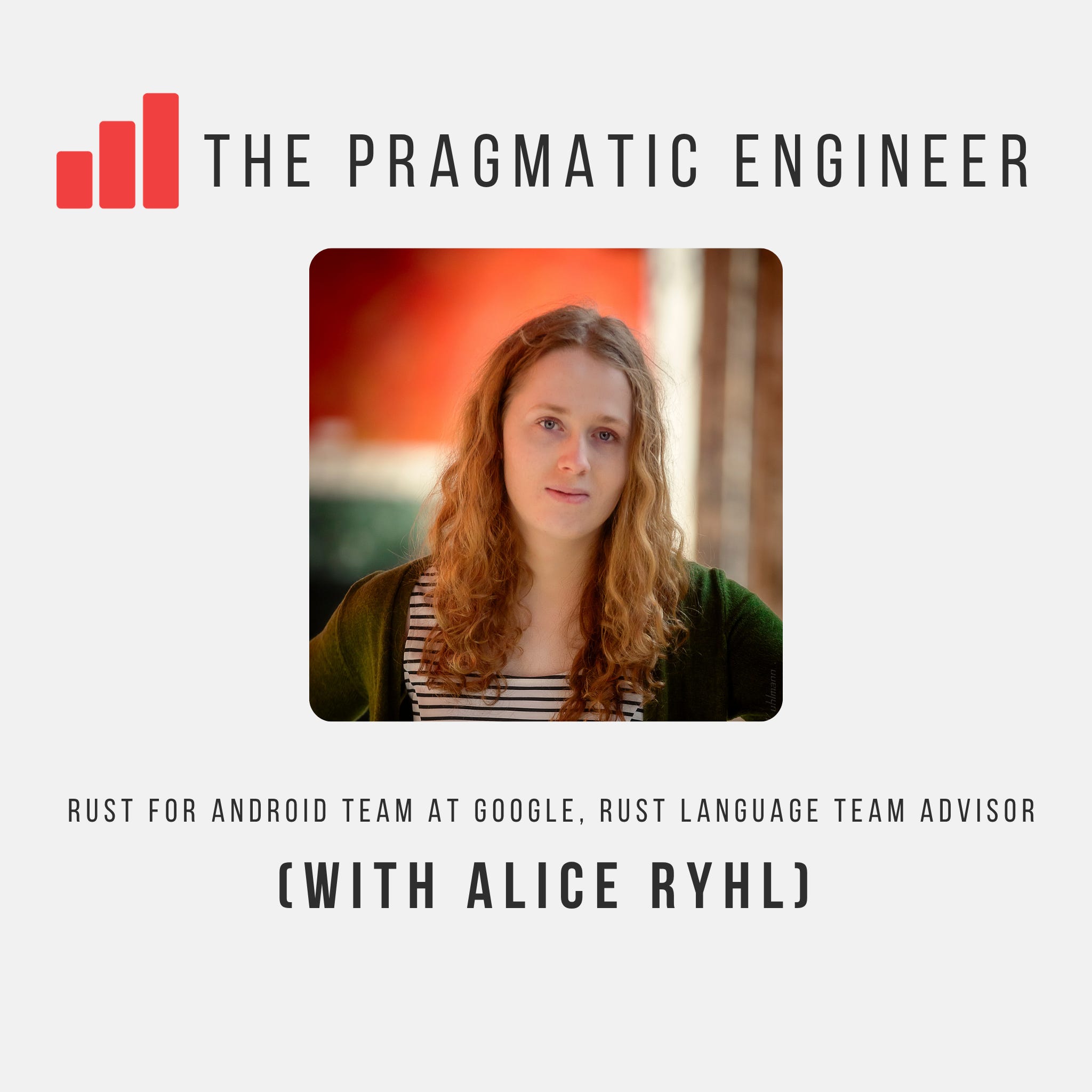 Why Rust is different, with Alice Ryhl 20.05.2026 1t 4minBrought to You By:• Antithesis – verify your system’s correctness without human review or traditional integration tests – and avoid bugs or outages.• Sentry – application monitoring software considered “not bad” by millions of developers• Craft Conference: join Gergely, Kent Beck, Hillel Wayne and others at the conference dedicated to the art and science of software delivery craft.—Rust is one of the most admired programming languages around – and also one of the hardest to learn. What makes developers stick with it?In this episode of The Pragmatic Engineer Podcast, I sit down with Alice Ryhl, a software engineer on Google’s Android Rust team, and a core maintainer of Tokio, which is the most widely-used async runtime in Rust.We discuss what makes Rust different from other languages like TypeScript, Go, and C++, and why so many developers say that “once it compiles, it works.” We go deep into memory safety, ownership, borrowing, unsafe Rust, and Cargo.We also cover how Rust is governed by RFCs, feature flags, its six-week release cycle, how engineers get paid to work on the language, and also look into how Rust’s use inside the Linux kernel is progressing.—Timestamps(00:00) Intro(04:09) Tokio: an overview(05:11) What Alice likes about Rust(12:48) Rust for TypeScript engineers(13:51) Moving from C++ to Rust(14:34) Memory safety(18:12) Garbage collection tradeoffs(21:46) Ownership, references, and borrowing(26:59) Unsafe in Rust(31:21) Crates and Cargo(35:55) Language design and RFCs(43:02) Building new features(46:30) Editions vs. versions(49:47) Getting paid to work on Rust(51:27) Contributing to Rust(53:03) Rust in the Linux kernel(55:45) AI use cases for Rust(1:01:35) Learning Rust(1:03:54) Book recommendation—The Pragmatic Engineer deepdives relevant for this episode:• The past and future of modern backend practices• How Kotlin was built with Andrey Breslav• How Swift was built with Chris Lattner• How Linux is built with Greg KH—Production and marketing by https://penname.co/. For inquiries about sponsoring the podcast, email [email protected]. Get full access to The Pragmatic Engineer at newsletter.pragmaticengineer.com/subscribe
 -
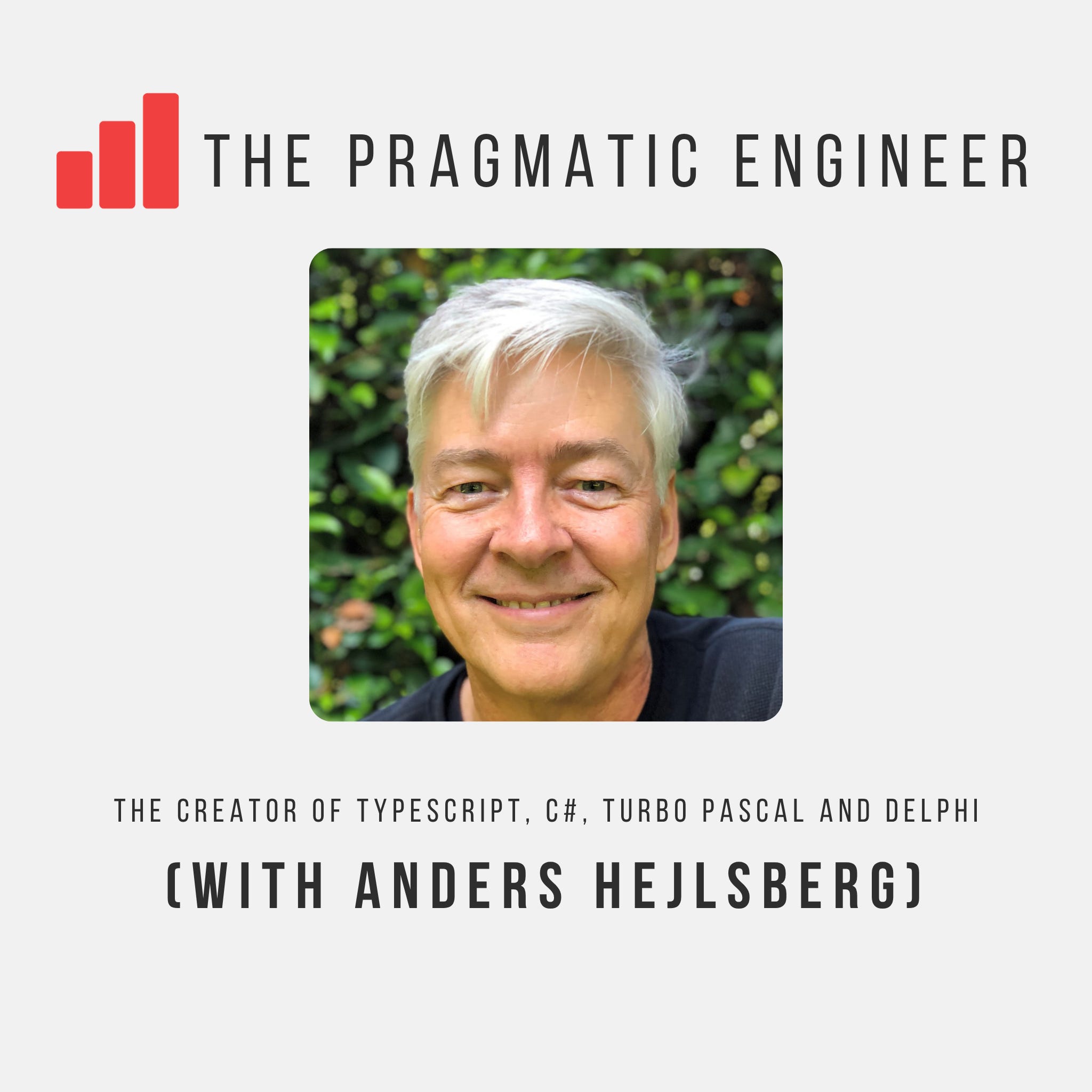 TypeScript, C# and Turbo Pascal with Anders Hejlsberg 13.05.2026 1t 15minBrought to You By:• Antithesis – verify your system’s correctness without human review or traditional integration tests – and avoid bugs or outages.• WorkOS – Everything you need to make your app enterprise ready.• turbopuffer – a vector and full-text search engine built on object storage. It’s fast, cheap, and extremely scalable.—Anders Hejlsberg is a living legend and one of the most influential programming language designers of all time. He created Turbo Pascal, Delphi, C#, and also TypeScript. As well as that, he spent nearly a decade at the pioneering dev tools company, Borland, and is now in his 30th year of working at Microsoft, where he’s a Technical Fellow.In this episode, we discuss what it takes to build programming languages that developers love to use, and trace his career from writing his first compiler to creating Turbo Pascal and Delphi, and helping to pioneer modern software development through C# and TypeScript.Anders details how C# was designed by a small group of experienced language designers who met a few hours each week, and he explains why tooling was just as important as the language for TypeScript’s success, and what he has learned from building languages which stay relevant for decades.We also look into how Anders uses AI today, which language features suit AI-assisted development, and what he thinks is changing in the craft of software engineering as developers move further away from writing code line by line.—Timestamps(00:00) Intro(02:48) How Anders got into programming (05:40) Building his first compiler (07:44) Turbo Pascal(12:25) Delphi (14:53) Joining Microsoft(19:41) Building C# (29:11) Async/await(34:01) The rise of JavaScript(37:52) Building TypeScript(42:58) How the TypeScript compiler works (48:30) JavaScript’s strengths and weaknesses(52:18) How Anders uses AI (56:03) What language features work well with AI (1:02:49) How software craftsmanship is changing(1:07:49) Performance and efficiency (1:09:29) Anders’ tool stack (1:11:30) A 30-year career at Microsoft(1:13:40) Book recommendation—The Pragmatic Engineer deepdives relevant for this episode:• Microsoft’s developer tools roots• 50 Years of Microsoft and developer tools with Scott Guthrie• How Linux is built with Greg Kroah-Hartman• How will AI change operating systems? Part 1: Ubuntu and Linux• How Uber uses AI for development: inside look—Production and marketing by https://penname.co/. For inquiries about sponsoring the podcast, email [email protected]. Get full access to The Pragmatic Engineer at newsletter.pragmaticengineer.com/subscribe
 -
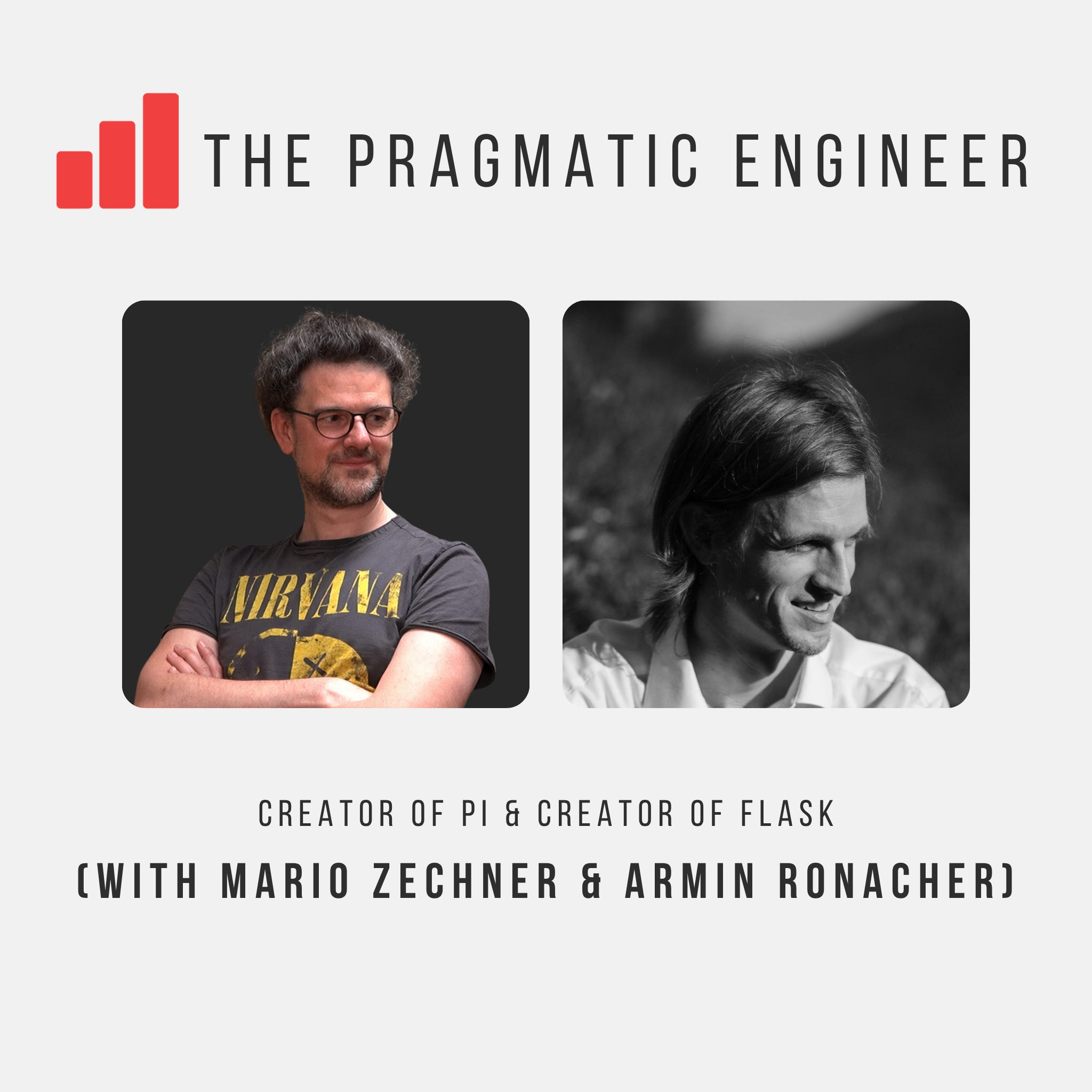 Building Pi, and what makes self-modifying software so fascinating 29.04.2026 1t 33minBrought to You By:• Statsig — The unified platform for flags, analytics, experiments, and more.• Sonar – The makers of SonarQube, the industry standard for automated code review• WorkOS – Everything you need to make your app enterprise ready.—Mario Zechner is the creator of Pi, a minimalist, self-modifying AI coding agent, that is the foundation upon which OpenClaw (created by Peter Steinberger) is built. Meanwhile, Armin Ronacher is the creator of Flask, and a longtime user of Pi. The pair are also friends.I sat down with Mario and Armin for the latest episode of the Pragmatic Engineer Podcast for an interesting conversation about AI and their reservations about it – even though both are heavily invested in building AI-powered tools.Mario explains why he built Pi, and gives his take on why it has become so popular. Armin walks us through how he uses AI tools, including building a game with Pi, and why he always puts human judgment firmly at the heart of his approach.We cover the risks of over-automation, the limits of agentic workflows, and why strong engineers with informed judgment still matter. We also get into the challenges of working with code written by non-engineers, and whether open source can withstand a tidal wave of agent-generated code.—Timestamps(00:00) Intro(07:30) How Mario, Armin, and Peter Steinberger met(15:15) How 30 dev teams use AI agents: learnings(21:50) The importance of judgment(24:26) Challenges when non-engineers write code(28:30) Downsides of over-automation(32:18) Pi(48:09) OpenClaw + Pi(50:54) “Clankers”(57:32) Open source and AI(1:00:22) Complexity as the enemy(1:02:50) Building an AI-native startup(1:11:52) “Slow the F down”(1:16:40) MCPs vs. CLI(1:25:03) Predictions and staying up to date—The Pragmatic Engineer deepdives relevant for this episode:• The impact of AI on software engineers in 2026: key trends• Cycles of disruption in the tech industry• The AI engineering stack• The creator of OpenClaw: "I ship code that I don't read"• What is inference engineering? Deepdive—Production and marketing by https://penname.co/. For inquiries about sponsoring the podcast, email [email protected]. Get full access to The Pragmatic Engineer at newsletter.pragmaticengineer.com/subscribe
 -
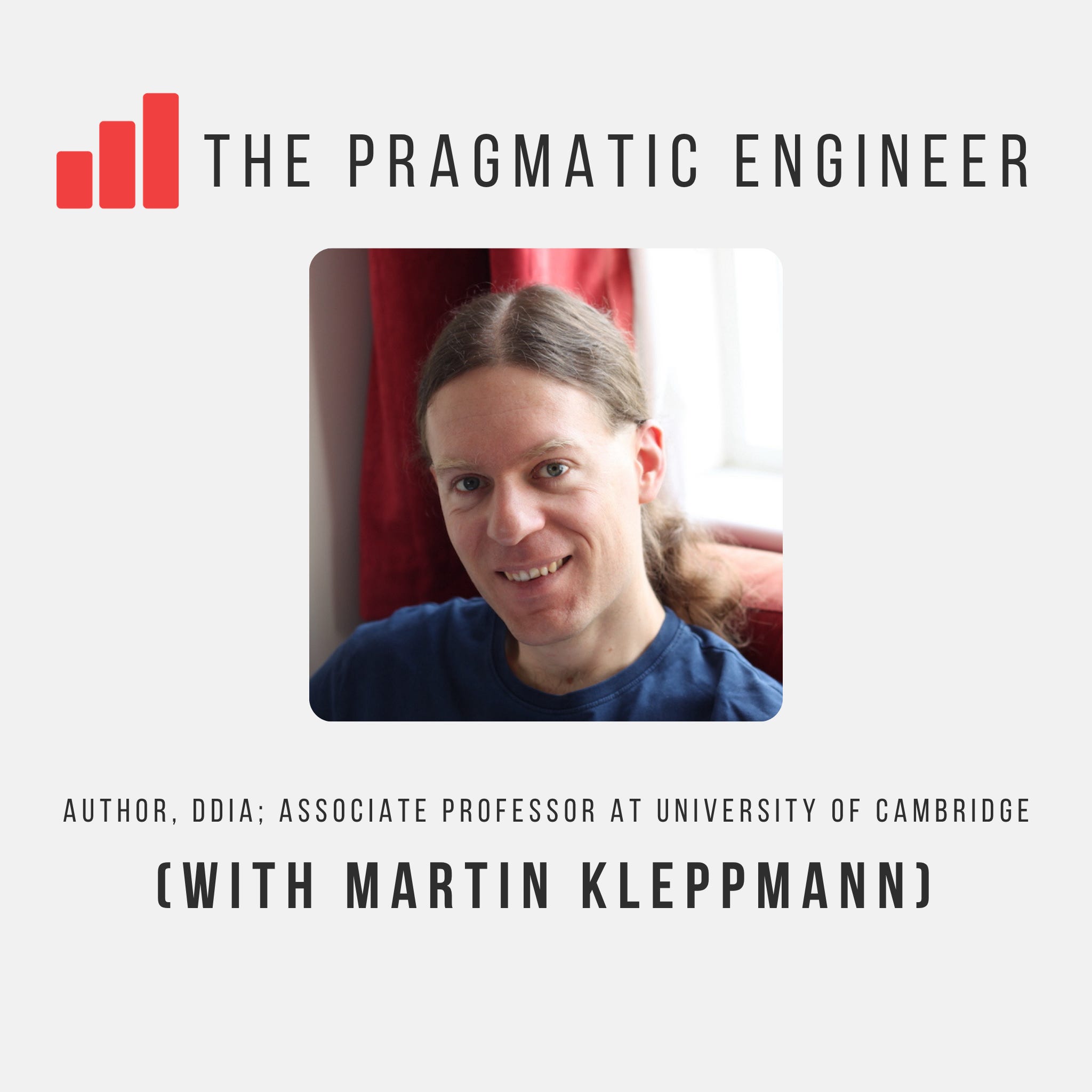 Designing Data-intensive Applications with Martin Kleppmann 22.04.2026 1t 25minBrought to You By:• Statsig — The unified platform for flags, analytics, experiments, and more.• Sonar – The makers of SonarQube, the industry standard for automated code review• WorkOS – Everything you need to make your app enterprise ready.—Martin Kleppmann is a researcher and the author of Designing Data-Intensive Applications, one of the most influential books on modern distributed systems. As of this month, the second, heavily updated edition of the book is out.In this episode of Pragmatic Engineer, we discuss Martin’s career in tech building startups, how he ended up writing this iconic book, and what he’s focused on now after moving into academia.We talk about the tradeoffs behind modern infrastructure, how the cloud has changed what it means to scale, and the thinking behind Designing Data-Intensive Applications, including what’s changing in the second edition.Martin reflects on lessons from building startups like Rapportive, which he sold to LinkedIn, and shares how his experience in both academia and industry shaped his perspective.We also explore what’s ahead: why formal verification may become more important in an AI-assisted world, the challenges of building local-first software, and his recent research into using cryptography to improve transparency in supply chains without exposing sensitive data.—Timestamps(00:00) Early career(05:46) Building Rapportive(10:47) Working at LinkedIn(14:09) Writing Designing Data-Intensive Applications(23:00) Reliability, scalability, and repeatability (26:24) DDIA: the second edition(30:50) Tradeoffs of using cloud services (39:02) How the cloud changed scaling (42:53) The trouble with distributed systems(49:02) Ethics for software engineers (52:45) Formal verification(1:00:12) Academia vs. industry (1:03:50) Local-first software (1:09:50) Computer science education(1:18:32) Martin’s current research and advice—The Pragmatic Engineer deepdives relevant for this episode:• Building Bluesky: a distributed social network• Inside Uber’s move to the cloud• The history of servers, the cloud, and what’s next• The past and future of modern backend practices• How Kubernetes is built—Production and marketing by https://penname.co/. For inquiries about sponsoring the podcast, email [email protected]. Get full access to The Pragmatic Engineer at newsletter.pragmaticengineer.com/subscribe
 -
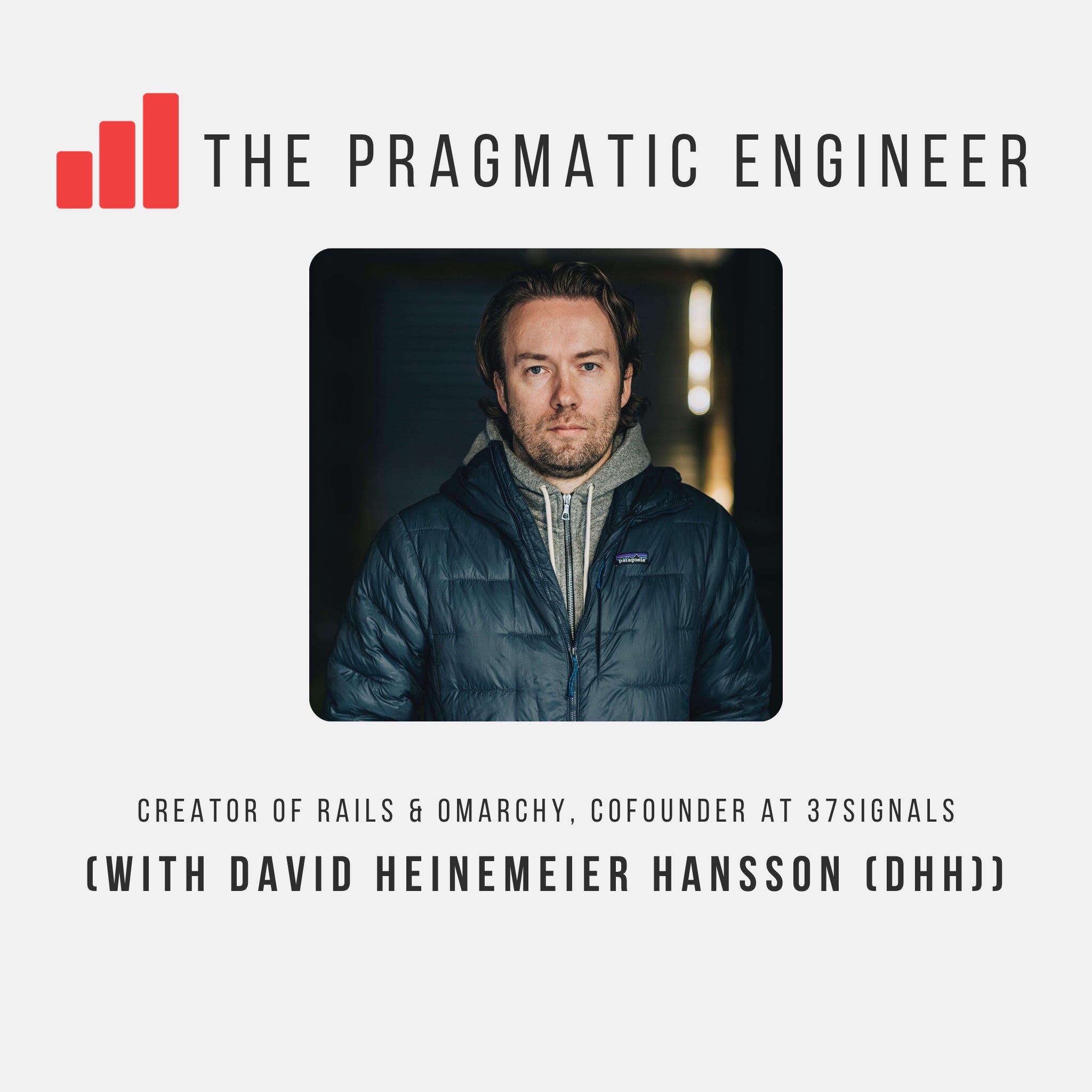 DHH’s new way of writing code 08.04.2026 1t 46minBrought to You By:• Statsig — The unified platform for flags, analytics, experiments, and more.• Sonar – The makers of SonarQube, the industry standard for automated code review• WorkOS – Everything you need to make your app enterprise ready.—David Heinemeier Hansson (DHH) is the creator of Ruby on Rails and Omarchy, co-founder and CTO of 37signals (maker of Basecamp and HEY), and the author of several books including the best-seller, Remote: Office Not Required, co-written with Jason Fried.Six months ago, in an episode of the Lex Fridman podcast, David shared how he doesn’t use AI tools to write code: he types out all his code. But things have changed a lot since then. In this episode, we discuss his approach to building software, how it’s changed in the last six months, and why he now takes an agent-first approach, and how he barely writes any code by hand. We go into how he uses AI agents: which alter how he builds and explores ideas, but also how his standards of quality and craft remain the same.We also discuss how 37signals thinks about product development, from the role of designers to the importance of aesthetics and taste. David gets into how he sees beauty and functionality as closely linked, and why strong opinions about design lead to better software.Finally, we look into the uneven impact of AI which amplifies senior engineers while creating challenges for junior developers, and what this may mean for the role of the software engineer.—Timestamps(00:00) Intro(02:11) Omarchy and Ruby on Rails(08:25) 37signals overview(10:12) Launching HEY(18:38) Building HEY(22:47) Designers at 37signals(28:08) The craft of design(31:52) Why DHH now embraces AI workflows(39:45) The AI inflection point(44:23) DHH’s agent-first workflow(55:09) AI’s impact on junior developers(1:03:08) Developer experience with AI(1:16:43) What does AI mean for developers?(1:23:33) 37signals teams and hiring(1:38:20) Work-life balance with AI(1:41:41) Why DHH keeps building(1:45:24) Closing—The Pragmatic Engineer deepdives relevant for this episode:• Are AI agents actually slowing us down?• How Claude Code is built• The future of software engineering with AI: six predictions• The AI Engineering Stack• Mitchell Hashimoto’s new way of writing code• How Linux is built with Greg Kroah-Hartman—Production and marketing by https://penname.co/. For inquiries about sponsoring the podcast, email [email protected]. Get full access to The Pragmatic Engineer at newsletter.pragmaticengineer.com/subscribe
 -
 Scaling Uber with Thuan Pham (Uber’s first CTO) 01.04.2026 1t 38minBrought to You By:• Statsig — The unified platform for flags, analytics, experiments, and more.• Sonar – The makers of SonarQube, the industry standard for automated code review• WorkOS – Everything you need to make your app enterprise ready.—Thuan Pham was Uber's first and longest-serving CTO, and today he’s the CTO of Faire, a B2B wholesale platform. Back when Thuan joined Uber, it had around 40 engineers and 30,000 rides per day, and the system crashed multiple times a week. Over seven years, he helped rebuild the system, move it from a monolith to microservices, and scaled the engineering organization behind it. I had the privilege of working with Thuan for four of those seven years. Later, the very first issue of The Pragmatic Engineer newsletter was a deepdive into Uber’s Program and Platform split. This episode of the podcast contains a nice “full circle” moment, where Thuan shares even more details about why Uber chose to embrace that structure.We discuss what it takes to operate and build in that kind of environment. Thuan explains how he divided his time at Uber into three “tours of duty,” from stabilizing a fragile system, to re-architecting it, and scaling the org.We go deep into the platform-and-program split, the Helix app rewrite, and what it took to launch Uber in China in just five months (the original estimate was 18 months). We also cover Uber’s in-house tools and explain why they were necessary to support rapid growth.Finally, we discuss his role today as CTO of Faire, how the company is using AI, and how he sees AI changing software engineering.—Timestamps(00:00) Intro(05:32) Getting into tech(16:09) The dot-com bust(20:42) VMware(26:29) Getting hired by Travis at Uber(33:22) Early days at Uber and scaling challenges(40:57) Uber’s China launch(47:12) The platform and program split(50:26) From monolith to microservices (53:38) Internal tools at Uber (57:05) Helix: Uber’s mobile app rewrite(59:55) Thuan’s email about naming(1:02:03) Org structure changes under(1:06:34) Thuan’s work philosophy (1:12:23) The “three tours of duty” at Uber(1:15:37) Why Thuan left Uber (1:17:34) Coupang and Nubank(1:21:59) Faire(1:25:31) How Faire uses AI(1:28:24) AI’s impact on software engineering (1:31:09) The role of the CTO (1:35:13) Career advice—The Pragmatic Engineer deepdives relevant for this episode:• How Uber uses AI for development: inside look• The Platform and Program split at Uber• How Uber is measuring engineering productivity• Inside Uber’s move to the cloud• Uber's crazy YOLO app rewrite, from the front seat• How Uber built its observability platform• Developer experience at Uber with Gautam Korlam• Uber’s engineering level changes—Production and marketing by https://penname.co/. For inquiries about sponsoring the podcast, email [email protected]. Get full access to The Pragmatic Engineer at newsletter.pragmaticengineer.com/subscribe
 -
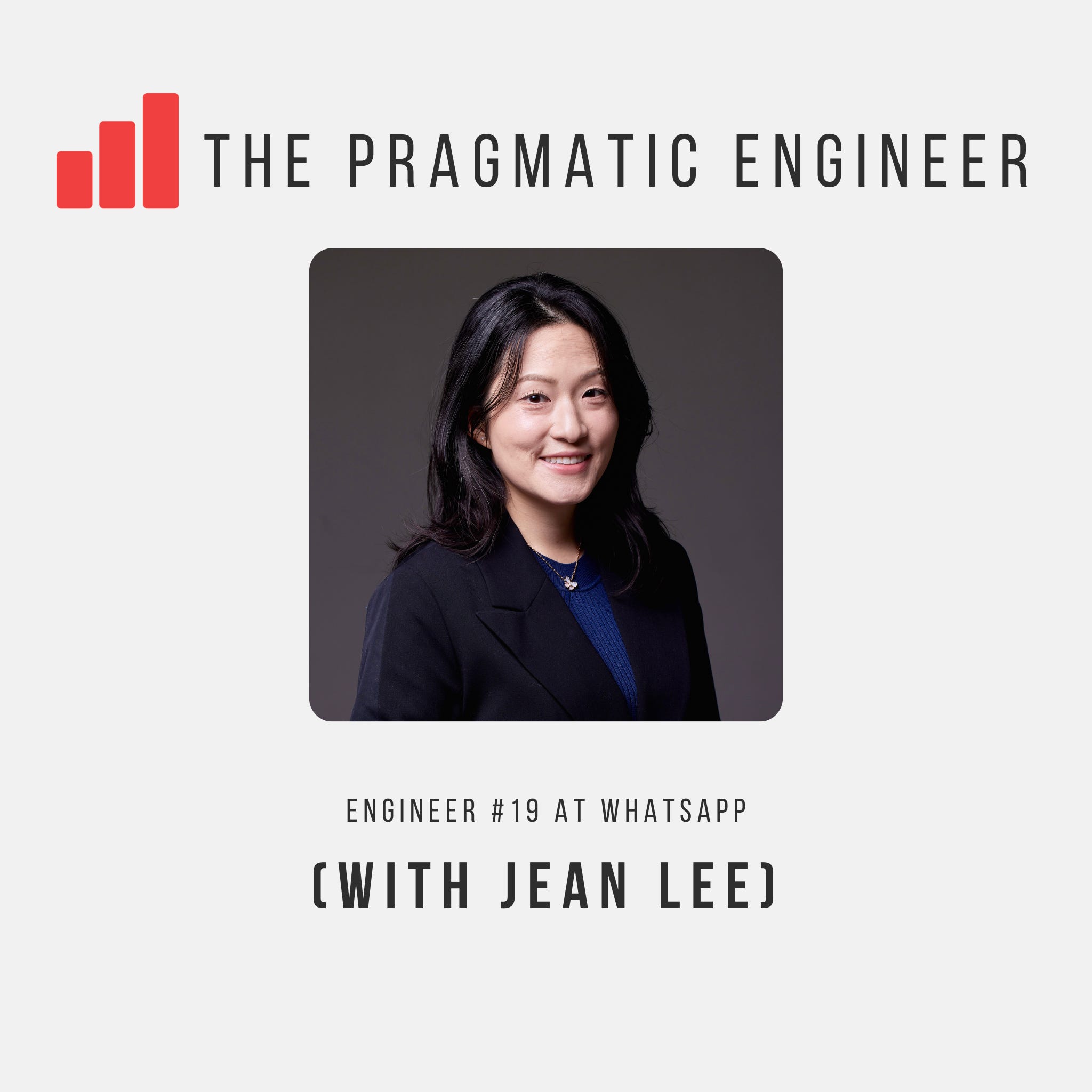 Building WhatsApp with Jean Lee 18.03.2026 1t 10minBrought to You By:• Statsig — The unified platform for flags, analytics, experiments, and more.• Sonar – The makers of SonarQube, the industry standard for automated code review• WorkOS – Everything you need to make your app enterprise ready.—How did a tiny team of 30 engineers build the world-famous messaging app more than a decade ago, and what can dev teams learn from that feat today? Jean Lee was engineer #19 at WhatsApp, joining when the company was still small, with almost no formal processes. She helped it scale to hundreds of millions of users, went through the $19B acquisition by Facebook, and later worked at Meta.In this episode of Pragmatic Engineer, I talk with Jean about what it was like building WhatsApp. When Facebook bought WhatsApp in 2014, only around 30 engineers supported hundreds of millions of users across eight platforms.We discuss how the founders kept things simple, saying “no” to most feature requests for years. Jean explains why WhatsApp chose Erlang for the backend, why the team avoided cross-platform abstractions, and how charging users $1 per year paid everyone’s salaries, while keeping growth intentionally slow.Jean also shares what the Facebook acquisition was like on the inside, how she dealt with sudden personal wealth, and what it was like transitioning from an IC to a manager at Facebook – including the reality of calibration meetings and performance reviews.We also discuss how AI enables smaller engineering teams, and why WhatsApp’s experience suggests ownership and trust might matter more than tools.—Timestamps(00:00) Intro(01:39) Early years in tech(06:18) Becoming engineer #19 at WhatsApp(13:53) WhatsApp’s tech stack(18:09) WhatsApp’s unique ways of working(25:27) Countdown displays and outages(27:07) Why WhatsApp won(28:53) The Facebook acquisition(33:13) Life after acquisition(39:27) Working at Facebook in London(44:07) Transitioning to management(47:27) Performance reviews as a manager(53:29) After Facebook(58:53) AI’s impact on engineering(1:02:34) Jean’s advice to new grads and startups(1:06:45) Empowering employees(1:08:17) Book recommendations—The Pragmatic Engineer deepdives relevant for this episode:• How Meta built Threads• How Big Tech runs tech projects and the curious absence of Scrum• Performance calibrations at tech companies• Software engineers leading projects—Production and marketing by https://penname.co/. For inquiries about sponsoring the podcast, email [email protected]. Get full access to The Pragmatic Engineer at newsletter.pragmaticengineer.com/subscribe
Samankaltaiset podcastit


Suosittu maassa
Tämä podcast esiintyy myös näiden maiden podcast-listoilla.
-
 Kroatia
-
 Bulgaria
-
 Azerbaidžan
-
 Myanmar
-
 Kongon demokraattinen tasavalta
-
 Kypros
-
 Sri Lanka
-
 Jordania
-
 Mongolia
-
 Unkari
-
 Argentiina
-
 Suomi
Suomi
-
 Dominikaaninen tasavalta
-
 Costa Rica
-
 Uzbekistan
-
 Liettua
-
 Indonesia
-
 Viro
Viro
-
 Moldova
-
 Zimbabwe
-
 Panama
-
 Paraguay
-
 Albania
-
 Ruanda
-
 Bahrain
-
 Montenegro
-
 Singapore
-
 Kreikka
-
 Malesia
-
 Guatemala
-
 Slovenia
-
 Jamaika
-
 Ukraina
-
 Ghana
Ghana
-
 Romania
-
 Ecuador
-
 Mosambik
-
 Brasilia
-
 Kirgisia
-
 Pohjois-Makedonia
-
 Puola
Puola
-
 Serbia
-
 Armenia
-
 Peru
Peru
-
 Bosnia ja Hertsegovina
-
 Latvia
-
 Intia
Intia
-
 Nigeria
-
 Pakistan
-
 Uruguay
-
 Slovakia
-
 Kenia
Kenia