
Geopolitical Economy Hour
Radhika Desai
0
As dizzying yet historically deeply-rooted developments transform the political economy of key countries and the world's geopolitical economy, we provide ongoing analyses of the foundations being laid for a multi-polar world beyond capitalism.
Jaksot
-
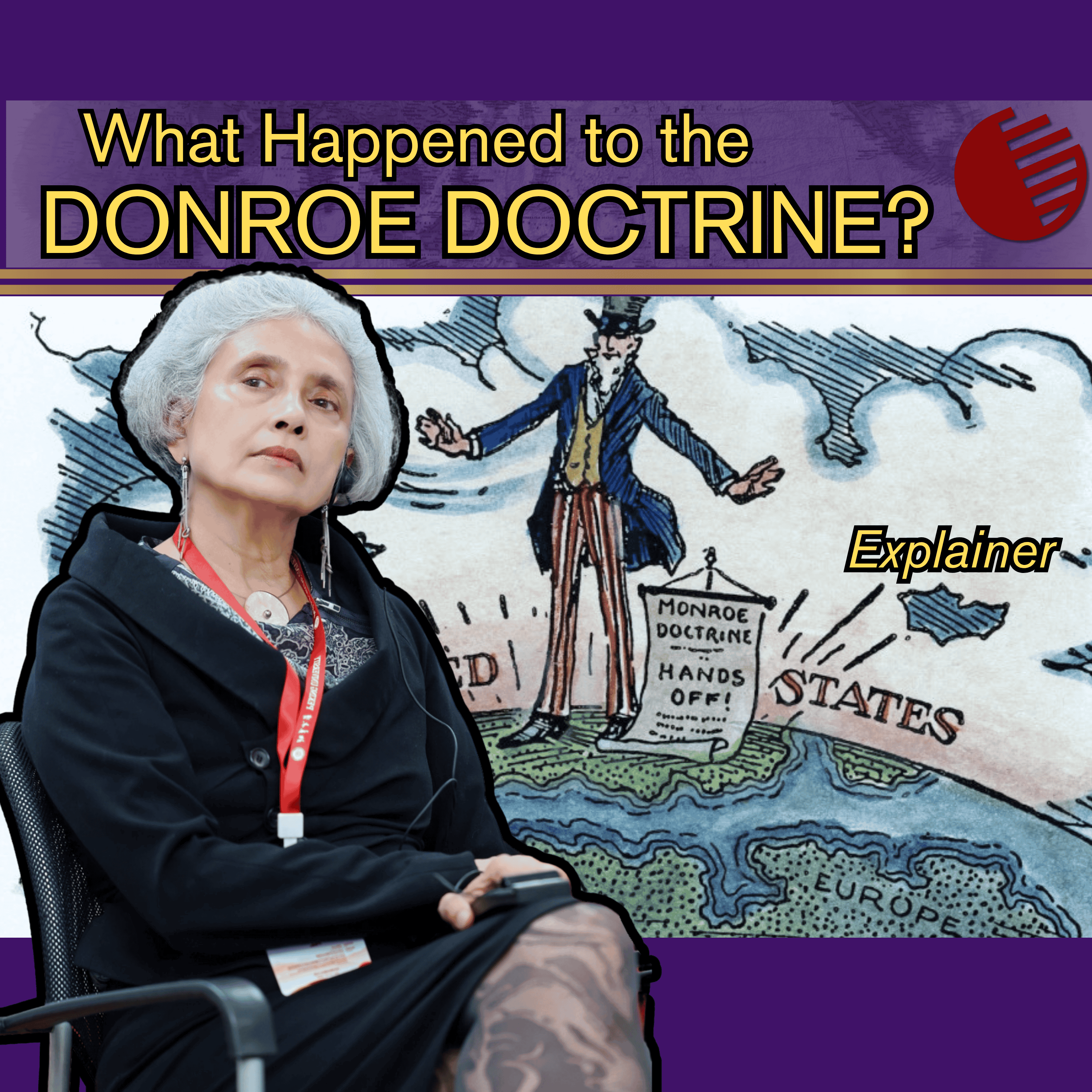 Geopolitical Economy Explainer: Whatever Happened to the Donroe Doctrine? 01.04.2026 22minGEOPOLITICAL ECONOMY EXPLAINER Just over a month ago, the world was abuzz with talk of the Donroe Doctrine? Radhika explains what the so-called "Donroe Doctrine" was supposed to be, what it really was, how it lined up with the Monroe Doctrine and the Roosevelt Corollary, and why it is hardly surprising that it was barely proclaimed before it was violated. The explanation may surprise you.
 -
 Reading Capital with Radhika Desai: 1. Mandel Introduction and Marx & Engels Prefaces 25.03.2026 1tStarting Sunday, 22 March 2026, Radhika Desai is leading a Capital Reading Group on line. It will consist of an hour’s lecture followed by at least an hour’s discussion.In her lectures, Radhika will be presenting an interpretation of Capital that she arrived at in the course of developing Geopolitical Economy, the Marxist approach to understanding the international relations of the capitalist world, which placed imperialism and anti-imperialist resistance at its centre and has required rescuing Marx’s original analysis of capitalism as contradictory value production from more than a century and a half of misinterpretation by Marxists themselves.In this first episode, Radhika analyses an Introduction by Ernest Mandel as well as two Prefaces by both Marx & Engels.
 -
 The West Couldn't Break North Korea And Now They're Afraid | Keith Bennett and Radhika Desai 16.06.2026 1t 4minPresident Xi Jinping followed up his summits with Presidents Putin and Trump with his first foreign trip of the year. The destination – North Korea, or the Democratic People’s Republic of Korea, a nation of some 26 million normally portrayed in the Western media as a dangerously authoritarian state, an economic basket case, worthy of attention only for its nuclear weapons – may seem a surprise to many. However, as veteran Korea observer, Keith Bennett and Radhika Desai discuss, neither the destination nor the timing should surprise anyone with a sense of the intertwined histories of the Chinese and Korean revolutions (not to mention the Soviet) and the continuing cooperation between the two countries, founded on socialist solidarity. Nor should it surprise them that, amid the chaos unleashed on the world by a declining West, China and North Korea are quietly renewing their relations for a new phase of history, and their common history. Keith and Radhika discuss the socialist foundations of one of the most enduring international relationships of the modern era, the myths Western journalists and scholars perpetuate about North Korea, and the unexpected twist the matter of Korean reunification has taken.
 -
 (Blocked) Paths to Dedollarization | GEH with Paolo Nogueira Batista 01.06.2026 55minWhat does the future look like for Dedollarization? How does BRICS play a role? Radhika takes a deep dive with co-founder of New Development Bank, Paolo Nogueira Batista.
 -
 Mohammad Marandi Reveals Iran's True Nuclear Power Goal 21.05.2026 52minIn this interview, Radhika Desai speaks with Mohammad Marandi about Iran’s nuclear programme, the latest escalation with the United States, and the wider geopolitical struggle behind the so-called “Iran nuclear threat.” Is Iran really trying to build a nuclear weapons, or is the nuclear issue being used once again as a pretext for sanctions, pressure and imperialism? Professor Marandi explains how Iran views its nuclear rights, why Western governments continue to portray Iran as a danger, and how the confrontation fits into the broader decline of US power and the crisis of the Western-led order.
 -
 Is NATO Falling Apart? Trump, Ukraine, Russia and the Crisis of the West | GEH w Kees Van der Pijl 20.05.2026 45minGerman Chancellor, Friedrich Merz says, before an audience of schoolchildren, that Iran has humiliated the US. Donald Trump announces the withdrawal of 5000 of its troops from his country. Meanwhile, Minister DonaldTusk, Prime Minister of the most loyal of East European states loyal to the US and the Atlantic alliance, told the Financial Times that Europe's "biggest, most important question is if the United States is ready to be as loyal as it is described in our (NATO) treaties. The question is if NATO is still an organisation ready, politically and logistically, to react - for example, against Russia if they try toattack." The trouble is not recent but in the first year and a half of Donald Trump’s second administration these strains now seem to be building up to breaking point. The two sides of the Atlantic find themselves on opposite sides of both the major conflicts of our time, that in Ukraine and that against Iran. Tariffs on the European Union are hurting its economy. There is increasing discussion particularly in Brussels, on how that body should seek an autonomous defence infrastructure. Europe and Canada are ramping up defence expenditure and if such an infrastructure were to be built, notwithstanding the interminable squabbles of EU member countries, it would represent a major reversal of the foundation of the post Second World War North Atlantic alliance, the security umbrella that the United States provided to Europe in acceptance of US leadership. Radhika Desai and Kees van der Pijl, foremost critical international relations scholar of the Atlantic Alliance discuss
 -
 Trump’s China Trip Was A Disaster — And It’s Getting Worse | Michael Hudson And Radhika Desai 19.05.2026 39minTrump had hoped to go there in triumph after an easy victory over Iran. He actually went there in despair, hoping for China’s help in cleaning up the mess he made there. Last year, he had hoped to cow China into submission with his tariffs, only to push himself in a submissive position.In Beijing, the very tone of his comments – what a great leader Xi is, how wonderful China, is, how well he gets on with everyone, and how the US and China are going to have a ‘fantastic future together’ shows that for all his grandiose plans to project US power, he has ended exactly where China wanted him, having to accept parity with China. How else did he manage to expose the reduction of US power in Beijing? Given that the meeting was initiated by the Chinese, how well did they realise what they wanted? Who budged or blinked on all the major issues: tariffs, investment, Hormuz, Taiwan, Iran’s nuclear programme? How will this summit re-shape the contest between China and the US that has shaped the 21st century? Will the retinue of CEO’s that went there get what they want? Where will it leave the Iran war? and, above all, where will it leave the world which the Trump regime, shall we call it that, has landed in chaos of one sort or another since Trump’s election, let alone his inauguration….. With me to discuss all this is the most regular of regulars, Professor Michael Hudson.
 -
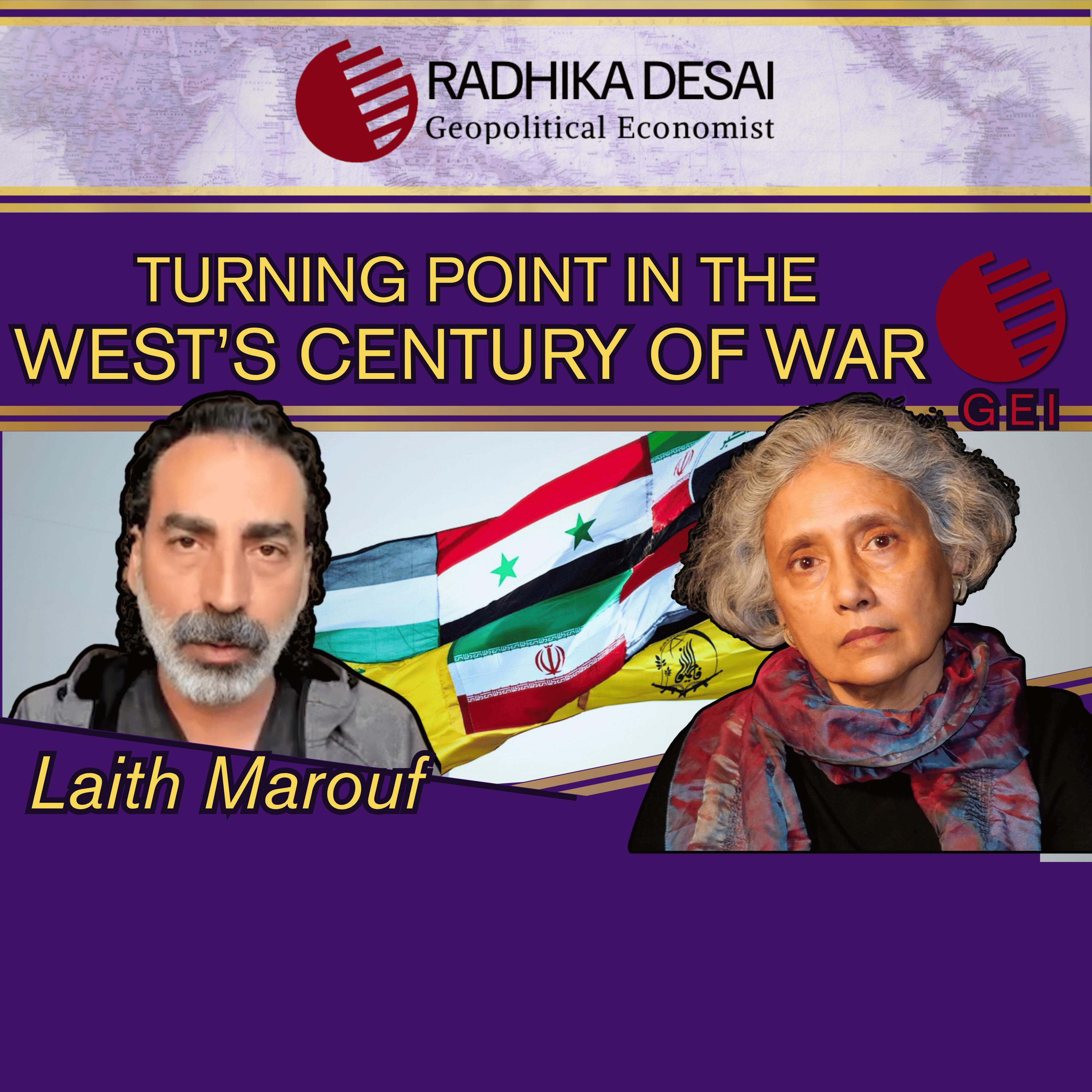 Turning Point in the West's Century of War: Geopolitical Economy Interview with Laith Marouf 30.04.2026 47minIn this collaboration between Radhika Desai – Geopolitical Economist and Free Palestine TV, its founder, Laith Marouf discuss the historical conjuncture of Trump and Netanyahu’s war on Iran, how it is the culmination of the West’s 100-year war, itself hundreds of years in preparation, on the West Asian region. The many questions we range over include the following: What gives Iran and the Axis of resistance its strength?How are we to understand the role of religion, particularly Shia Islam in itHow does it contrast with the instrumental use of synthetic religion in the West, whether by Hegseth or Trump or Netanyahu or Zionism?How have sanctions on Iran boomeranged even more spectacularly than those on Russia, giving that country a military confidence and autonomy few countries have enjoyed?When and how might the war on Iran end?
 -
 The US Is Trying To Save The Dollar Ponzi Scheme With This... Swap Lines Explained w Michael Hudson 08.05.2026 45minIn this episode, I am joined by Michael Hudson to discuss how the United States is attempting to defend dollar hegemony at a time when its global financial power is facing mounting pressure. We examine the role of swap lines, dollar liquidity, sanctions, oil politics, and the Iran crisis in sustaining a world economy still organised around the US dollar. Although swap lines may appear to be a technical instrument of central banking, they reveal something much larger about who has access to liquidity in moments of crisis, who remains dependent on Washington, and how the United States continues to use the dollar as a tool of geopolitical power. As more countries search for alternatives to the dollar system, this conversation asks whether these new financial arrangements are signs of strength or signs that the old order is beginning to crack.
 -
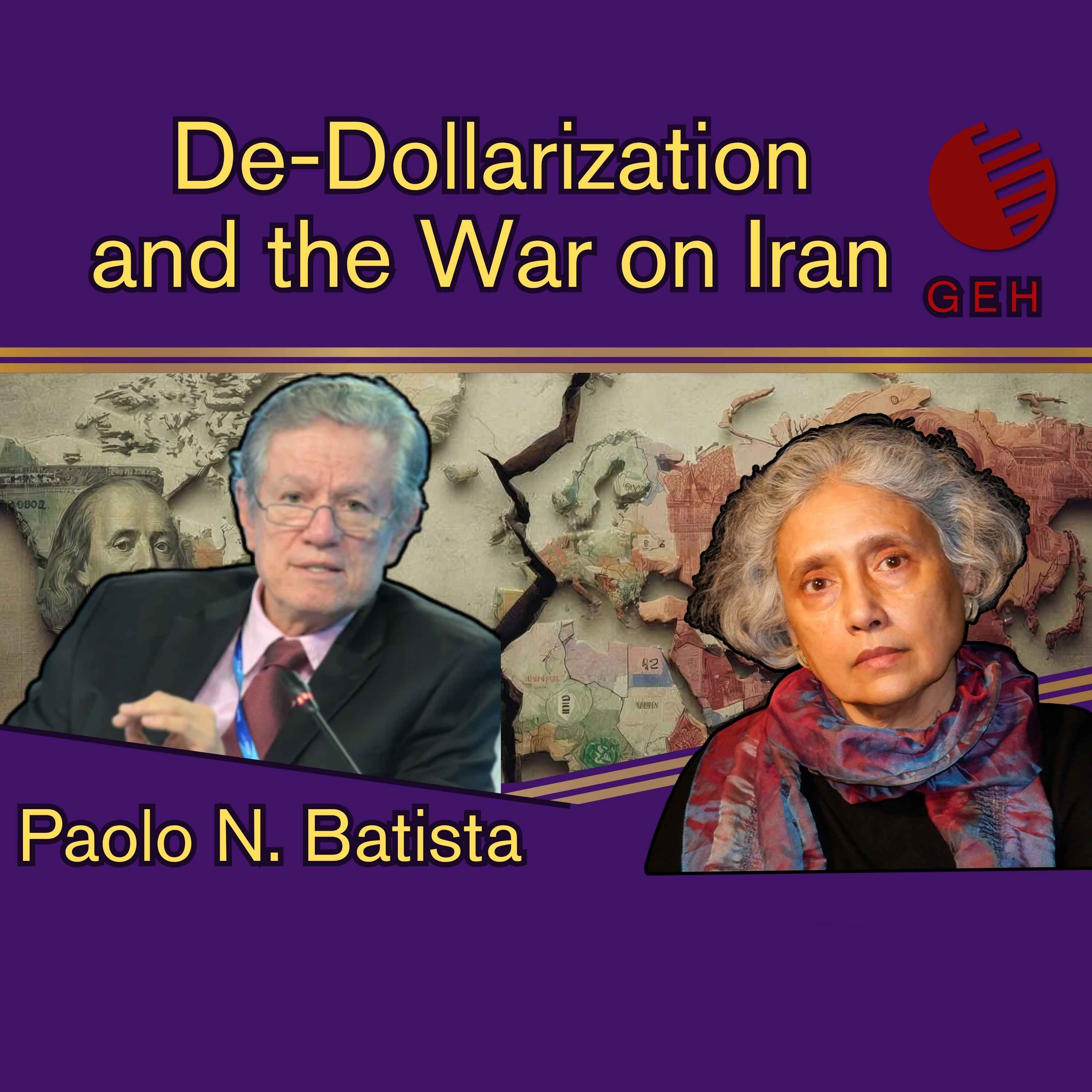 Geopolitical Economy Hour: Dedollarization and the War On Iran 11.04.2026 59minThe illegal, criminal US-Israeli war on Iran is now almost three weeks old. There are new twists and turns by the hour. However, some things are clear. The US and Israel are not winning, Trump is desperately looking for an off ramp and even the most delusional one is not available to him given that it is not up to the US-Israeli side to end the war, only up to Iran, which is willing to fight for months, even a year, and is seeking nothing less than the exit of the US from the middle eastern region, ending a more than century long engagement. Meanwhile, the war has already had significant economic and financial effects The price of oil and gas have risenSo have prices of associated products, like fertilizerInflation and food inflation are rising.Expected cuts to interest rates are now on hold and may even turn into hikesStock markets are falling on expectations of a recessionand dollar denominated asset markets, vulnerable to higher interest rates could soon be tottering on the brink of collapse While there is a lot of commentary on all this, there is hardly any discussion of that the war on Iran means for the dollar system and to the prospects of de-dollarization? In this Geopolitical Economy Hour, Radhika Desai discusses the ins and outs of this question with Paulo Nogueira Batista Jr, who has served, inter alia, with the IMF, the New Development Bank and the Brazilian government.
 -
 The West's International Civil War at the Munich Security Conference with K.J. Noh 22.03.2026 1t 8minFor the Second Year Running, the Munich Security Conference became the theater of a battle in the West’s international civil war that stretches far beyond it, turning increasing insecurity rather than managing security around the world. This war – in which the stakes seem to be not only Greenland but also regime change in Europe – pits the establishment ‘globalizing’ neoliberals against the ultra neoliberal right wing forces represented by Trump, Farage, the Alternative für Deutschland and other such forces and is waged between and within countries. In this relaunch of Geopolitical Economy Hour, Radhika Desai, Geopolitical Economist discusses the outcomes of Munich with K J Noh, one of the best informed journalists and activists on international relations and military affairs. Where does Munich leave the Atlantic Alliance? What about the US equation with China, and, for that matter Russia?
 -
 Did Nationalism Trump Socialism When Socialist Countries Attacked One Another? Keith Bennett 06.09.2026 1t 18minIn the late 1970s, wars involving three self-declared socialist countries, China, Vietnam and Cambodia were gleefully reported in the Western press along with lurid allegations of ‘killing fields’ in Cambodia. Many considered that this had sounded the death knell of socialist internationalism. In this Geopolitical Economy Hour, Radhika Desai is joined by Keith Bennett, co-editor of a new book on China’s foreign policy, to help disinter facts that lie buried under decades of misinterpretation and misunderstanding of these complex events. Our purpose is twofold: to help understand these conflicts in a broadly historical materialist manner, one that makes socialist sense, and on that basis to dig deeper into the complex interrelationship between class and nation in the advance towards socialism. Some of the question we discuss are: Why did Vietnam attack Cambodia and China attack Vietnam? What drove these countries, which had stood shoulder to shoulder against US aggression, apart? Who were the Khmer Rouge and what motivated them? Where did it all go wrong?
 -
 Westerners Think He Made China Capitalist. They're Wrong | Mick Dunford & Radhika Desai 06.09.2026 1tZhu Rongji, China's reform-era premier, has died, and the Financial Times wasted no time eulogizing him as a liberal hero, hoping Xi Jinping might take a leaf out of his book. Mick Dunford, professor emeritus at the University of Sussex and a longtime resident of Beijing, joins me to dismantle that myth, walking through the real human costs of Zhu's reforms, from mass layoffs to soaring inequality, and arguing they were not capitalist triumphs but turbulent steps within a still-socialist system, whose excesses were later corrected by Hu Jintao, Wen Jiabao, and Xi himself. The "liberal hero" the West is mourning is largely their own invention.
 -
 Laith Marouf: Iran Is Now A New Global Superpower And The West Can't Stop It | GEH W/ Radhika Desai 06.09.2026 46minIs the West's devotion to Israel rational statecraft, or ideological blindness dragging the whole imperial order down with it? Laith Marouf, founder of Free Palestine TV, returns to break down why even mainstream military and intelligence assessments now admit Iran cannot be defeated, why the CIA's own hidden regional bases have been destroyed, and why Washington's pivot to economic warfare, sanctioning Iranian gold, crypto, and aviation, is a mark of desperation rather than strategy. Laith argues a rational empire would have abandoned Israel decades ago to preserve itself, but Jewish supremacist ideology among Western elites now overrides basic imperial self-interest, pushing them to strip their own populations of civil liberties to protect the colony.
 -
 The Cockroach Party That's Cracking Modi's BJP | Varghese George & Radhika Desai 06.09.2026 42minIs India's youth revolt a passing meme, or the moment its party system began to visibly crack? Varghese K. George, resident editor in New Delhi for The Hindu, joins me to trace how a Supreme Court judge's slur, calling India's youth cockroaches and parasites, became the seed of the Cockroach Janta Party, a movement with no leaders, no ideology, and millions of members. Varghese explains how this leaderless surge has punctured the BJP's invincibility and Modi's own aura of near-divine leadership, both of which looked unshakeable just two months ago. We trace this rupture back to Modi's hostile takeover of the BJP, a party system crumbling across India's political spectrum, and an employment crisis so severe that 87 million young Indians are now without work, education, or training. Whether this movement can convert its viral power into lasting change, or simply exposes a void no one yet knows how to fill, is the question left hanging over Indian politics.
 -
 Michael Hudson: This Is How The Dollar System Will Actually Break | GEH w/ Radhika Desai 06.09.2026 56minDonald Trump called it an economic D-Day for Iran, but the sanctions threat reveals that the US has already lost the military war and is now waging a financial one it cannot win either. Professor Michael Hudson joins me for our fortnightly conversation to trace how Bessent's push to expel countries from the dollar system is accelerating the very flight it was meant to prevent, driving oil and grain trade onto China's alternative clearing system even as foreign demand for US Treasuries keeps declining and the "everything bubble" inflates on borrowed money rather than production. The dollar's end, we conclude, won't come as a crash but as a long inflationary whimper unless the world rebuilds a financial system around production instead of speculation.
 -
 Fidel Castro: The Man Who Defeated The US Empire | Francisco Dominguez and Carlos Martinez 06.09.2026 1t 12minOn what would have been Fidel Castro's 100th birthday, Cuba is under its most severe siege since 1959. A six-month US naval blockade has cut off oil, worsened by the collapse of Venezuelan supply after Washington's January attack. I am joined by Francisco Dominguez, founding member of the Cuba Solidarity Campaign, and Carlos Martinez, author and co-editor of the Friends of Socialist China website, to trace Fidel's revolutionary audacity from the Moncada Barracks assault through his personal command of the Bay of Pigs victory, where a CIA-trained invasion was crushed in 72 hours, to the internationalism that sent hundreds of thousands of Cuban troops to defeat apartheid South Africa at Cuito Cuanavale. We discuss what his refusal to capitulate when the Soviet Union collapsed, and China, Russia, Brazil, and Mexico's coordinated support today, tell us about whether this revolution can survive Washington once again.
 -
 Reading Capital With Radhika Desai 7: The Production Of Absolute Surplus Value 06.09.2026 59minReading Capital With Radhika Desai 7: The Production Of Absolute Surplus Value
 -
 Richard Murphy: Capitalism Destroys Everything It Touches, Then Calls It Profit 06.09.2026 57minWould the entire global economy collapse if we told the truth about its books? Richard Murphy, chartered accountant and professor of political economy, joins me to expose the accounting trick sitting underneath GDP: the total absence of any concept of capital maintenance. Richard shows how modern accounting distinguishes profit earned through honest enterprise from profit as pure extraction, a distinction erased in law and economics alike, and how GDP rewards this extraction by counting oil spills, divorce settlements, and financial speculation as growth while ignoring the depletion of soil, skills, and the planet itself. We discuss how this same blindness let Ireland's economy be inflated by multinational tax flows into the 'leprechaun economy,' and how Keynes's defeated proposal for Bancor might have spared the world today's dollar-dependent order.
 -
 Michael Hudson: Trump Is Desperate To Save The Dollar Ponzi Scheme | GEH W/ Radhika Desai 16.08.2026 53minIs Washington's rescue of the yen an act of friendship, or a sign that the dollar system itself is beginning to crack? I am joined by economist Michael Hudson to unpack the US intervention to save a collapsing yen and why the official story of "solidarity" masks a far more desperate calculation. Michael explains how the yen's weakness threatens the carry trade and capital inflows the dollar system depends on, why the US chose to sell euros rather than dollars to defend it, and how even long-time dollar bulls like Barry Eichengreen now admit the intervention exposes Washington's growing reluctance to let foreign central banks touch their own reserves. We examine the mounting evidence of dollar fatigue, from the ECB now holding more gold than dollars, to the flood of new Treasury issuance the market must somehow absorb, to a Federal Reserve whose credibility is increasingly in question. Michael argues this is not simply a story about Trump's erratic instincts, but about a financial order that is running out of options.
Samankaltaiset podcastit


Suosittu maassa
Tämä podcast esiintyy myös näiden maiden podcast-listoilla.
