
Feel Better, Live More with Dr Rangan Chatterjee
Dr Rangan Chatterjee: GP & Author
0
Dr Rangan Chatterjee, a GP and author, hosts this podcast aiming to simplify health. He interviews leading health experts and personalities, offering easy life hacks, expert advice, and debunking common health myths. The show covers how to eat, sleep, move, and relax, with the goal of inspiring and empowering listeners to transform their well-being. Dr Chatterjee is known for his BBC show 'Doctor In the House' and his bestselling book 'The 4 Pillar Plan'.
Jaksot
-
 How To Have More Meaningful & Intimate Relationships: A Fresh Approach That Really Works with Terry Real #679 15.09.2026 1t 54minIf there were a health marker guaranteed to shape your happiness, your health and your children’s wellbeing, wouldn’t you want to optimise it? According to today’s guest there is: your relationships. And in this episode, the world-renowned couples’ therapist Terry Real reveals the one skill he believes matters more than any other for lasting love – while showing you exactly how to use it. Nicknamed ‘the turnaround guy’, Terry has spent decades helping couples who’ve tried it all find their way back to connection. His latest bestseller Us: Getting Past You and Me to Build a More Loving Relationship, features a foreword from one-such happy customer, Bruce Springsteen. Terry’s unconventional yet hugely successful approach, Relational Life Therapy (RLT), has trained thousands of therapists worldwide. He believes a good therapist should take sides, and that lasting change often means helping someone come down from grandiosity, not just raising them up from shame. This is one of those conversations that blends big, new ideas with nuggets of advice you’ll be itching to put into practice. We discuss how expectations of love and romance have changed over the generations – and why so many of us are trying to build modern, intimate partnerships using skills we were never actually taught. And Terry explains why the real measure of a strong relationship isn’t how rarely you argue, but which of your ‘three selves’ you use to do it. He introduces the idea of the adaptive child, an old survival pattern that hijacks our behaviour the moment we feel threatened, and explains how learning to recognise it can transform the way we handle conflict. We also discuss the patriarchy and the need to move beyond it for humankind – but this is not about blaming men or women, rather showing how both can and must shift to help each other and the world. So, what is that one skill we need for lasting love? Terry calls it repair, and his bold idea is that it’s not a two-way conversation. When someone we love is hurt or upset with us, our job is not to explain ourselves, but to help them feel heard first. The ability to repair, more than the ability to swerve an argument altogether, is what determines relationship success – and, crucially, he reveals how to do it. It’s a simple reframe, and one that could change how you handle your very next disagreement. Whether you are single, married, co-parenting, or navigating a difficult patch with someone you care about, this conversation is full of practical strategies you can start using today. I have a feeling you’ll want to share this episode, so everyone you love can do the same. The Thrive Tour: Transform Your Health and Happiness, a live show: Book Your Tickets https://drchatterjee.com/live Thanks to our sponsors: https://drinkag1.com/livemore https://hellolingo.com/livemore https://dohealth.co/livemore Show notes https://drchatterjee.com/679 DISCLAIMER: The content in the podcast and on this webpage is not intended to be a substitute for professional medical advice, diagnosis, or treatment. Always seek the advice of your doctor or qualified healthcare provider. Never disregard professional medical advice or delay in seeking it because of something you have heard on the podcast or on my website. Learn more about your ad choices. Visit podcastchoices.com/adchoices
 -
 BITESIZE | A Monk’s Guide To Finding Happiness & Thriving in Hard Times | Gelong Thubten #678 10.09.2026 22minWhat if the most courageous, compassionate thing you could do in life, was to learn how to be with yourself? It’s a powerful, perhaps surprising idea put forward by today’s guest. Today’s Bitesize is from episode 387 of the podcast with Gelong Thubten - Buddhist monk, meditation teacher and author of the fantastic book 'A Handbook for Hard Times: A Monk’s Guide to Fearless Living’. Thubten became a monk back in 1993 after suffering from severe physical and mental burnout whilst following his dream of becoming an actor in New York City. We begin by talking about distraction and addiction, two states that are very closely linked. He explains that when we distract ourselves by scrolling, overeating, or drinking for example, we’re pushing away emotional pain or discomfort - even if we may not realise it. But the discomfort is really in the pushing. If we can learn instead to sit with what’s making us uncomfortable, those emotions start to transform. Thanks to our sponsor https://thewayapp.com/livemore Show notes and the full podcast are available at drchatterjee.com/387 Support the podcast and enjoy Ad-Free episodes. Try FREE for 7 days on Apple Podcasts https://apple.co/feelbetterlivemore For other podcast platforms go to https://fblm.supercast.com. DISCLAIMER: The content in the podcast and on this webpage is not intended to constitute or be a substitute for professional medical advice, diagnosis, or treatment. Always seek the advice of your doctor or other qualified health care provider with any questions you may have regarding a medical condition. Never disregard professional medical advice or delay in seeking it because of something you have heard on the podcast or on my website. Learn more about your ad choices. Visit podcastchoices.com/adchoices
 -
 The 4 Food Types That Repair Your Gut Barrier: A Gastroenterologist's Guide To Beating Inflammation For Good with Dr Will Bulsiewicz #677 08.09.2026 2t 1minCould the food you ate yesterday already be reshaping your gut, your immune system and your risk of chronic disease? This week’s guest says yes, and he’s spent his career demonstrating why that matters so much. Dr Will Bulsiewicz is an award-winning gastroenterologist and the author of the new book, Plant Powered Plus. And few people can explain the science of gut health as clearly, or as compassionately, as Will does in this conversation. If you think you already know everything there is to know about digestion, fibre and plant foods, this episode will change your mind – and deliver a great deal more. Will has identified four nutrition ‘workhorses’ that feed and protect our guts and, unsurprisingly, fibre is one of them. We get into the specifics of how the fibre we eat turns into short-chain fatty acids like butyrate, which Will describes as the most anti-inflammatory substance he has ever come across. He makes the case for fibre as the true longevity nutrient. We talk about resistant starch, found in cooled potatoes and green bananas, and why it feeds a completely different part of your gut microbiome to other fibres. Will shares the research behind the ‘30 plants a week’ target, and why he thinks the exact figure matters far less than most people assume. And he covers the importance of polyphenols, healthy fats and fermented foods. There’s a fascinating section on the different ways our gut microbiomes are shaped by our closest relationships, including some research findings even Will found surprising. We bust some myths around the term ‘leaky gut’. And we discuss why he no longer sees Crohn's disease and ulcerative colitis as straightforward autoimmune conditions, but more like the immune system turning against the microbiome. Will is refreshingly honest about the limits of diet alone. He talks candidly about the patients he could not help through nutrition or medication, and about a period in his own life when food became a coping mechanism for something he wasn’t able to face. It is a reminder that lasting health often asks more of us than simply eating better. Whether you’re new to the topic of gut health or well acquainted, this episode brings a new perspective. It’s packed with valuable and actionable moments – and it’s one you’ll come back to again and again. The Thrive Tour: Transform Your Health and Happiness, a live show: Book Your Tickets https://drchatterjee.com/live Thanks to our sponsors: https://heights.com/livemore https://hellolingo.com/livemore https://thewayapp.com/livemore https://drinkag1.com/livemore Show notes https://drchatterjee.com/677 DISCLAIMER: The content in the podcast and on this webpage is not intended to be a substitute for professional medical advice, diagnosis, or treatment. Always seek the advice of your doctor or qualified healthcare provider. Never disregard professional medical advice or delay in seeking it because of something you have heard on the podcast or on my website. Learn more about your ad choices. Visit podcastchoices.com/adchoices
 -
 BITESIZE | How to Train Your Eyes & Rewire Your Brain for Better Focus & Less Stress | Dr Bryce Appelbaum #676 03.09.2026 23minWhen we think about improving our health, we often think about changing our diet, increasing how much we move, improving the quality of our sleep and lowering stress, but how many of us think about ‘working’ on our vision? Every day, many of us experience symptoms like brain fog, fatigue, headaches or poor concentration – and never realise that our eyes might be playing a central role. In today’s Bitesize, pioneering neuro-optometrist Dr Bryce Appelbaum explains why our visual system is about far more than simply how well we can see. Many of us don’t realise just how much our vision influences how we think, feel and perform. We explore the surprising connection between vision and stress, and Bryce shares some simple, practical exercises we can all use today to better support our visual system and our wider health. Show notes and the full podcast are available at https://drchatterjee.com/576 Thanks to our sponsor https://drinkag1.com/livemore Support the podcast and enjoy Ad-Free episodes. Try FREE for 7 days on Apple Podcasts https://apple.co/feelbetterlivemore For other podcast platforms go to https://fblm.supercast.com. DISCLAIMER: The content in the podcast and on this webpage is not intended to constitute or be a substitute for professional medical advice, diagnosis, or treatment. Always seek the advice of your doctor or other qualified health care provider with any questions you may have regarding a medical condition. Never disregard professional medical advice or delay in seeking it because of something you have heard on the podcast or on my website. Learn more about your ad choices. Visit podcastchoices.com/adchoices
 -
 How To Find Purpose In An Age Of Emptiness with Arthur Brooks #675 01.09.2026 1t 54minWhy does struggling for something make it more satisfying? And why can getting what you want leave you feeling flat? In this episode, I sit down with Arthur Brooks, one of the world's leading voices on the science of happiness, for a conversation that might change how you feel about your life. Arthur is a professor at Vanderbilt University, senior fellow of Harvard Business School and bestselling author of multiple books, including new title, The Meaning Of Your Life. He walked away from a successful career when he realised that despite a happy marriage, strong faith and good income, he struggled to feel happy. That personal reckoning led him to years of research into what really makes people thrive – and in this conversation, he shares the framework he developed to explain it. Using an analogy from nutrition science, Arthur describes happiness as requiring three macronutrients: enjoyment, satisfaction and meaning. We talk about why so many high achievers get the first one wrong. Suffering and struggle, he says, aren’t obstacles to a fulfilling life but essential ingredients of it – hence removing all friction from our lives can leave us feeling empty rather than content. We also get into goals, and why reaching them tends not to deliver the lasting happiness we expect. Arthur calls this the arrival fallacy, and understanding might change how you approach your next big challenge. On relationships, Arthur shares research showing that the healthiest marriages are not the ones with the least conflict, but the ones with the most honesty. We talk frankly about what that has looked like in our own marriages, what we can all learn from our parents when it comes to happiness, and the best (and easiest) way to send a positive message to our children. Arthur also shares what he’s learned about presence, faith and love from his relationship and his daily practices. We explore the difference between solitude and loneliness and how levels of social connection can be individual. And I hope you’ll pay attention to the section on why leisure needs to be treated as seriously as work. This is a warm, honest and personal conversation with someone who’s spent decades studying happiness – but who’s candid about how hard he’s worked to feel it himself. By reframing happiness as a direction not a destination, I think it could be a life-changing listen for you. The Thrive Tour: Transform Your Health and Happiness, a live show: Book Your Tickets https://drchatterjee.com/live Thanks to our sponsors: https://exhalecoffee.com/livemore https://boncharge.com/livemore https://drinkag1.com/livemore Show notes https://drchatterjee.com/675 DISCLAIMER: The content in the podcast and on this webpage is not intended to be a substitute for professional medical advice, diagnosis, or treatment. Always seek the advice of your doctor or qualified healthcare provider. Never disregard professional medical advice or delay in seeking it because of something you have heard on the podcast or on my website. Learn more about your ad choices. Visit podcastchoices.com/adchoices
 -
 The Daily Habits That Protect Your Brain At Any Age: The New Science Of Dementia Prevention with Dr David Perlmutter #674 14.07.2026 1t 50minMost of us assume that memory loss and cognitive decline are just part of getting older. In this episode, a world-leading neurologist says that’s simply not true. That, far from being inevitable, Alzheimer's and other neurodegenerative diseases result from decades of metabolic damage – which we have the power to prevent and even reverse. I’m speaking with Dr David Perlmutter, a board-certified neurologist, six-time New York Times bestselling author, and one of the world's leading experts on brain health. And in this fascinating conversation, we discuss the single biological mechanism that sits at the heart of virtually every neurodegenerative condition, from Alzheimer's and Parkinson's to long Covid and depression, and why understanding it changes everything about how you approach your lifestyle. David’s key insight is that our brain's own immune cells, called microglial cells, have the power to make or break our future brain health. Keep them in their protective state through diet, exercise, and metabolic testing, and we can safeguard our brain for life. Feed them with ultra-processed food and they will shift into a destructive state that drives neuroinflammation. We discuss how, exactly, ultra-processed food damages the brain, why metabolic health is the key to cognitive longevity, and why the diagnosis of Alzheimer's is really the end stage of a process that began decades earlier. The choices you make right now, in your 30s, 40s and 50s, are already shaping the brain you will have in your 70s and beyond. If this all sounds science-heavy, rest assured David approaches it, just as he does in his new book, Brain Defenders, with clarity and plenty of practical takeaway. He outlines the specific blood biomarkers he believes everyone should be tracking, including fasting insulin, homocysteine and uric acid, for a remarkable window into your long-term brain health. We discuss why knowing your numbers is one of the most empowering steps you can take, how to go about getting tested, and how to act on what you find. There is a great deal of fear around dementia, and understandably so. But what I hope you take from this episode is something David emphasises: we needn’t be scared because we have agency. The research is clear that lifestyle choices have a profound impact on your risk, and it is never too early, or too late, to start making them. This is one of the most distinct and important conversations I’ve had about the future of your brain, and I think you will find it incredibly useful, thought-provoking and, above all, hopeful. The Thrive Tour: Transform Your Health and Happiness, a live show: Book Your Tickets https://drchatterjee.com/live Thanks to our sponsors: https://heights.com/livemore https://thesleepreset.com/podcast https://boncharge.com/livemore https://exhalecoffee.com/livemore Show notes https://drchatterjee.com/674 DISCLAIMER: The content in the podcast and on this webpage is not intended to be a substitute for professional medical advice, diagnosis, or treatment. Always seek the advice of your doctor or qualified healthcare provider. Never disregard professional medical advice or delay in seeking it because of something you have heard on the podcast or on my website. Learn more about your ad choices. Visit podcastchoices.com/adchoices
 -
 BITESIZE | What You Need To Know About Strength, Menopause & Healthy Ageing | Dr Stacy Sims #673 09.07.2026 29minAs we get older, have you ever wondered why the exercise advice we’ve been given doesn’t seem to work as well as it once did? As we move into our 40s and beyond, our physiology changes in ways that can often feel confusing and frustrating. But what if we could harness those changes to feel stronger, healthier and more resilient than ever before? Feel Better Live More Bitesize is my weekly podcast for your mind, body, and heart. Each week I’ll be featuring inspirational stories and practical tips from some of my former guests. Today’s clip is from episode 578 of the podcast with exercise physiologist and nutritional scientist, Dr Stacy Sims. Stacy is dedicated to helping active women – and the people who support them – take back control of their bodies, health and lives through science-based knowledge and practical tools. In this clip, Stacy shares why conventional fitness advice often fails women in midlife, and what many of us may be missing when it comes to improving our health, vitality and resilience as we age. Stacy’s insights remind us that with the right information and support, we can build strength, confidence and better health at any stage of life. Thanks to our sponsor https://heights.com/livemore Show notes and the full podcast are available at drchatterjee.com/578 Support the podcast and enjoy Ad-Free episodes. Try FREE for 7 days on Apple Podcasts https://apple.co/feelbetterlivemore For other podcast platforms go to https://fblm.supercast.com. DISCLAIMER: The content in the podcast and on this webpage is not intended to constitute or be a substitute for professional medical advice, diagnosis, or treatment. Always seek the advice of your doctor or other qualified health care provider with any questions you may have regarding a medical condition. Never disregard professional medical advice or delay in seeking it because of something you have heard on the podcast or on my website. Learn more about your ad choices. Visit podcastchoices.com/adchoices
 -
 How To Finally Fix Your Sleep, Wake Up Rested & Transform Your Life with Dr Michael Breus #672 07.07.2026 1t 57min“Sleep is a lot like love: the less you look for it, the more it shows up.” So says my guest on this episode, one of the world's leading sleep doctors, who’s here to reveal the five common traps that are stopping us getting the rest we need. Dr Michael Breus is a clinical psychologist and sleep specialist based in California. He’s the author of several books, including the brilliantly helpful, Sleep, Drink, Breathe. Over the course of his 25-year career, he’s helped thousands of people transform their health by changing the way they sleep. You’ll love his bold, no-nonsense manner and warm, practical advice. In this conversation, we unpack the sleep myths that are keeping us stuck. We talk about why chasing eight hours could be working against you, why sleeping in at the weekend may be doing more harm than good, and why freaking out about your sleep is making it worse. We also explore what is really happening in your body to cause that 3am wake-up, and the practical techniques that can help you get back to sleep quickly and calmly. Michael shares his own diagnosis of sleep apnoea, which will surprise you given his background, and opens up a conversation I think many of you will find both reassuring and galvanising. He dispels common myths around testing and treatment, and makes a clear case for investigating your symptoms – it could change your life. We also cover sleep tracking and how to interpret what your wearables say without driving yourself to distraction. Michael gives his view on the supplements worth considering and those that are not. We talk about the specific challenges facing women going through perimenopause and menopause, and he gives practical advice for shift workers, parents, and carers who feel they can’t get the hours they need. We close by talking through his five-step plan, which is simple, evidence-based, and immediately actionable. It will help you sleep better from tonight. Wherever you are in your journey towards restful, restorative sleep, you will hear something new in this insightful and surprising conversation. By going back to basics, Michael offers some truly fresh perspectives on this most fundamental pillar of your health. The Thrive Tour: Transform Your Health and Happiness, a live show: Book Your Tickets https://drchatterjee.com/live Thanks to our sponsors: https://hellolingo.com/livemore https://dohealth.co/livemore https://thewayapp.com/livemore https://drinkag1.com/livemore Show notes https://drchatterjee.com/672 DISCLAIMER: The content in the podcast and on this webpage is not intended to be a substitute for professional medical advice, diagnosis, or treatment. Always seek the advice of your doctor or qualified healthcare provider. Never disregard professional medical advice or delay in seeking it because of something you have heard on the podcast or on my website. Learn more about your ad choices. Visit podcastchoices.com/adchoices
 -
 BITESIZE | A Shaolin Master's Guide to Self-Mastery, Negative Thoughts & Finding Inner Peace | Master Shi Heng Yi #671 02.07.2026 23minToday’s guest belongs to the 35th generation of Shaolin Masters and began practising Kung Fu at the age of four. In the 38 years since, he’s acquired a wealth of knowledge in Chinese martial arts and Zen Buddhism. Feel Better Live More Bitesize is my weekly podcast for your mind, body, and heart. Each week I’ll be featuring inspirational stories and practical tips from some of my former guests. Today’s clip is from episode 426 of the podcast with Master Shi Heng Yi. In this clip, he shares a beautiful concept - and caution - that our thoughts may shape our destiny, and explains why cultivating greater awareness of our inner world could transform the way we experience our lives. Thanks to our sponsor https://thewayapp.com/livemore Show notes and the full podcast are available at drchatterjee.com/426 Support the podcast and enjoy Ad-Free episodes. Try FREE for 7 days on Apple Podcasts https://apple.co/feelbetterlivemore For other podcast platforms go to https://fblm.supercast.com. DISCLAIMER: The content in the podcast and on this webpage is not intended to constitute or be a substitute for professional medical advice, diagnosis, or treatment. Always seek the advice of your doctor or other qualified health care provider with any questions you may have regarding a medical condition. Never disregard professional medical advice or delay in seeking it because of something you have heard on the podcast or on my website. Learn more about your ad choices. Visit podcastchoices.com/adchoices
 -
 How To Live An Intentional Life with Professor C Thi Nguyen #670 30.06.2026 2t 12minWe’re living in a world that has become extraordinarily skilled at measuring success. But most of us never stop to question which standards really matter to us. Are you chasing success by someone else's definition, without even knowing it? This episode will help you figure that out. My guest is C Thi Nguyen, Associate Professor of Philosophy at the University of Utah and the author of The Score: How to Stop Playing Someone Else's Game, one of the most thought-provoking books I’ve read. This conversation explores where our values really come from, what games and hobbies can teach us about living with freedom, and why so much of what matters most in life resists being measured at all. Thi has developed a fascinating framework for understanding one of the defining problems of modern life: what he calls ‘value capture’. It’s the process by which our own rich, personal values are replaced by simplified external metrics (think followers and likes, salaries, exam grades – even health metrics like your weight or blood pressure score). These metrics can never show the full picture of a human life – but they can end up running it. And once you understand this concept of value capture, you’ll start to notice it everywhere. Thi and I discuss why our culture is so poor at honouring the ‘unmeasurables’. We talk about why joy, love, forgiveness and the quality of our relationships are the substance of a life well lived. Yet they’re systematically undervalued, not because they’re unimportant, but because they’re hard to count. He’s somewhat of an expert on play, whether through sport, board games or hobbies, and we discuss what these activities, often dismissed as trivial, can teach us about meaning and how to live well. Plus, we debate the difference between principles and algorithmic rules – a distinction that might change how you approach your health and your life more broadly. What I love about Thi's thinking is that he’s not telling us to throw out all forms of measurement. He’s more nuanced than that. He is asking us to wake up to the difference between the scorecard we have inherited from the world around us, and the one we would choose for ourselves. He wants us to know that the first step towards genuine fulfilment is simply becoming aware of whose game you have been playing. The Thrive Tour: Transform Your Health and Happiness, a live show: Book Your Tickets https://drchatterjee.com/live Thanks to our sponsors: https://thewayapp.com/livemore https://hellolingo.com/livemore https://exhalecoffee.com/livemore https://drinkag1.com/livemore Show notes https://drchatterjee.com/670 DISCLAIMER: The content in the podcast and on this webpage is not intended to be a substitute for professional medical advice, diagnosis, or treatment. Always seek the advice of your doctor or qualified healthcare provider. Never disregard professional medical advice or delay in seeking it because of something you have heard on the podcast or on my website. Learn more about your ad choices. Visit podcastchoices.com/adchoices
 -
 BITESIZE | 3 Foods to Avoid for Better Brain Health (& How to Reduce Them In Your Diet) | Max Lugavere #669 25.06.2026 23minToday’s guest believes brain decline is not inevitable, we all have agency in how we age, and the secret lies in our food. Feel Better Live More Bitesize is my weekly podcast for your mind, body, and heart. Each week I’ll be featuring inspirational stories and practical tips from some of my former guests. Today’s clip is from episode 330 of the podcast with science journalist and New York Times bestselling author, Max Lugavere. Max is passionate about helping people improve their brain health, their longevity and how they feel by optimising their diet. In this clip, he shares three food types that he believes are worth reducing or removing from our diets, and explains why doing so could have many benefits for our health. Max’s message is one of balance and realism. We can all make choices every single day that set us on the path to better health, even if we’re only taking baby steps. Making small changes could have a meaningful impact on our health. Thanks to our sponsor https://heights.com/livemore Show notes and the full podcast are available at drchatterjee.com/330 Support the podcast and enjoy Ad-Free episodes. Try FREE for 7 days on Apple Podcasts https://apple.co/feelbetterlivemore For other podcast platforms go to https://fblm.supercast.com. DISCLAIMER: The content in the podcast and on this webpage is not intended to constitute or be a substitute for professional medical advice, diagnosis, or treatment. Always seek the advice of your doctor or other qualified health care provider with any questions you may have regarding a medical condition. Never disregard professional medical advice or delay in seeking it because of something you have heard on the podcast or on my website. Learn more about your ad choices. Visit podcastchoices.com/adchoices
 -
 The Science of Deep Rest: How Relaxation Calms Stress & Slows Ageing with Dr Elissa Epel #668 23.06.2026 1t 24minCould the stress you barely notice be more harmful than you think? Most of us know chronic stress is bad for us, but few of us realise how deep that damage can go – or how much power we have to reverse it. In this enlightening episode, I speak with one of the world's leading stress researchers Dr Elissa Epel, a professor of psychiatry at the University of California, to explore the latest science of stress, ageing – and why deep rest may be the remedy we’re overlooking. Elissa's research as a health psychologist reveals that chronic stress can age our immune systems by as much as 10 years. But with the right habits we can activate the repair mechanisms that slow and even reverse that process. We talk about her framework of four mind states – red, yellow, green and blue – outlined in her book, The Seven-Day Stress Prescription. I find it one of the most useful tools for understanding our place on the stress spectrum at any given moment. We explore why so many of us have lost the ability to relax, the importance of deep rest for cellular repair, and the evening habits that transform the quality of your sleep. We also discuss the very latest in wearable technology and the metrics Elissa believes are worth tracking. She makes the distinction between monitoring daily stress levels and the tech that can now track longer-term trends. And she shares her experience with continuous glucose monitoring and what it revealed to her about the relationship between stress, sleep and metabolic health. I loved hearing about the Big Joy Project, Elissa’s ongoing study of around 20,000 people, finding that small, simple acts of kindness and connection can shift our emotions over the course of a week and make us more altruistic and prosocial. At a time when the world can feel divided, I think that matters enormously. Finally, we explore how changing the story you tell yourself about a stressful situation, current or past, can transform your physiological response. This reframing is something I’ve learned to do and find endlessly empowering. Our perception is not just a mental experience. It shapes our biology. Elissa is an open-hearted communicator, whose generosity comes across in everything she shares with us here. Whether you struggle with overwhelm, or you suspect you’re more stressed than you realise, I know this conversation has advice you’ll want to take on board. The Thrive Tour: Transform Your Health and Happiness, a live show: Book Your Tickets https://drchatterjee.com/live Thanks to our sponsors: https://exhalecoffee.com/livemore https://boncharge.com/livemore https://thewayapp.com/livemore https://airbnb.co.uk/host Show notes https://drchatterjee.com/668 DISCLAIMER: The content in the podcast and on this webpage is not intended to be a substitute for professional medical advice, diagnosis, or treatment. Always seek the advice of your doctor or qualified healthcare provider. Never disregard professional medical advice or delay in seeking it because of something you have heard on the podcast or on my website. Learn more about your ad choices. Visit podcastchoices.com/adchoices
 -
 BITESIZE | How to Break the Anxiety Cycle | Dr Russell Kennedy #667 18.06.2026 20minA lot of people are struggling with anxiety at the moment, especially in a world that often feels out of control. Feel Better Live More Bitesize is my weekly podcast for your mind, body, and heart. Each week I’ll be featuring inspirational stories and practical tips from some of my former guests. Today’s clip is from episode 370 of the podcast with physician and neuroscientist, Dr Russell Kennedy, who previously suffered with crippling anxiety for over 30 years. Russell insists anxiety isn’t a disorder of the mind. Our worries are merely a symptom - and one that keeps us in our heads and away from the real problem. His core message is that it’s often more effective to use the body to calm the mind, than the mind to calm the body. In this clip, he explains why anxiety may have less to do with our thoughts than we realise, and shares practical strategies that could help us begin breaking the anxiety cycle. For Thrive Tour tickets and info visit: https://drchatterjee.com/live/ Join my 21-day energy reset: https://drchatterjee.com/reset Show notes and the full podcast are available at drchatterjee.com/370 Support the podcast and enjoy Ad-Free episodes. Try FREE for 7 days on Apple Podcasts https://apple.co/feelbetterlivemore For other podcast platforms go to https://fblm.supercast.com. DISCLAIMER: The content in the podcast and on this webpage is not intended to constitute or be a substitute for professional medical advice, diagnosis, or treatment. Always seek the advice of your doctor or other qualified health care provider with any questions you may have regarding a medical condition. Never disregard professional medical advice or delay in seeking it because of something you have heard on the podcast or on my website. Learn more about your ad choices. Visit podcastchoices.com/adchoices
 -
 The 5 Most Important Biomarkers That Influence Your Health & How To Live Better For Longer with Dr Florence Comite #666 16.06.2026 1t 39minYou might assume that how you’ll age is down to your genes. That your disease risk is out of your hands, sealed by midlife, and something to manage rather than change. But Dr Florence Comite has spent 30 years proving that assumption wrong. And for this conversation, she’s brought the evidence. Florence is a clinician-scientist, Yale and National Institutes of Health-trained endocrinologist, and some might call her a disruptor. Her life’s work has been built on the radical idea that decline is not inevitable, it is detectable. And because it’s detectable, it’s reversible. Her new book, Invincible: Defy Your Genetic Destiny to Live Better Longer, has the core message that our health trajectory is far from fixed. By tuning into our body’s signals, and understanding our physiology, we can make targeted changes to improve how we feel, function and age. In this episode, Florence and I explore why the Western medical model – built around treating disease not creating health – leaves people in the dark when it comes to disease risk. We discuss why the type and frequency of blood tests your doctor currently offers is lacking, as well as what you should ask for (or seek privately) if you want to truly understand your health. Florence talks us through the five blood biomarkers she believes every adult should know about, including one – fasting insulin – that your doctor is highly unlikely to check but that I agree with her is absolutely critical. And she explains why free testosterone is vital for both men and women, how it connects to muscle, memory, bone density, blood sugar and heart health, and why optimising it has transformed some of her patients’ lives. We also sing the praises of continuous glucose monitors. We discuss what they reveal about your individual response to food, why two people can eat the same meal with different results, and how the order in which you eat your meal can change your health. This is a conversation about taking control. It’s about owning your data, your trends – and your future. Florence and I share the belief that our healthcare systems need to move from reactive to proactive. In time, I’m hopeful that will happen. But in the meantime her clinic – and my own Do Health app – are paving an exciting way for you to get ahead of the curve. The Thrive Tour: Transform Your Health and Happiness, a live show: Book Your Tickets https://drchatterjee.com/live Thanks to our sponsors: https://heights.com/livemore https://dohealth.co/livemore https://hellolingo.com/livemore https://airbnb.co.uk/host Show notes https://drchatterjee.com/666 DISCLAIMER: The content in the podcast and on this webpage is not intended to be a substitute for professional medical advice, diagnosis, or treatment. Always seek the advice of your doctor or qualified healthcare provider. Never disregard professional medical advice or delay in seeking it because of something you have heard on the podcast or on my website. Learn more about your ad choices. Visit podcastchoices.com/adchoices
 -
 BITESIZE | How to Stop Overthinking, Embrace Uncertainty & Enjoy Life More | Dr Ellen Langer #665 11.06.2026 25minMany of us spend time agonising over decisions, regretting past choices or wondering what might have happened if we'd chosen differently. But today’s guest believes this way of thinking is based on a fundamental misconception. Today’s clip is from episode 537 of the podcast with Professor of Psychology at Harvard University, Dr Ellen Langer. Ellen has spent over 50 years conducting ground-breaking research into the power of the mind and how our thoughts can shape every aspect of our lives. In this clip, she shares a refreshing approach to decision making that could help us stop overthinking, let go of regret and feel more confident in the choices we make. Ellen is a wonderful human, full of knowledge, expertise and passion. She is the recipient of three Distinguished Scientists awards and the author of twelve books, including The Mindful Body: Thinking Our Way to Chronic Health. Thanks to our sponsor https://thewayapp.com/livemore Join my 21-day energy reset: https://drchatterjee.com/reset Show notes and the full podcast are available at drchatterjee.com/537 Support the podcast and enjoy Ad-Free episodes. Try FREE for 7 days on Apple Podcasts https://apple.co/feelbetterlivemore For other podcast platforms go to https://fblm.supercast.com. DISCLAIMER: The content in the podcast and on this webpage is not intended to constitute or be a substitute for professional medical advice, diagnosis, or treatment. Always seek the advice of your doctor or other qualified health care provider with any questions you may have regarding a medical condition. Never disregard professional medical advice or delay in seeking it because of something you have heard on the podcast or on my website. Learn more about your ad choices. Visit podcastchoices.com/adchoices
 -
 The Hidden Reason You Can't Stop Overthinking, People-Pleasing And Overworking with Dr Nicole LePera #664 09.06.2026 1t 58minWhy do we sometimes react in ways we don’t mean to? Why does criticism land so heavily when others can brush it off? And why, even when life looks good from the outside, do we feel stuck on the inside? This week’s guest offers a new perspective on all this – and an optimistic way forward. With nearly 10 million followers on Instagram as The Holistic Psychologist, Dr Nicole LePera has helped countless people see their lifelong patterns through a helpful new lens. She joins me to discuss her fantastic book, Reparenting the Inner Child: The New Science of Our Oldest Wounds and How to Heal Them. At the heart of our conversation is an important idea: we don’t see the world as it is, we see it through the state of our nervous system. Nicole highlights the signs that yours may be calling the shots, such as restlessness, numbness, disproportionate reactions and the constant need to be busy. And she explains how those patterns trace back to a part of us shaped long before we had the language for it: our inner child. We explore how childhood adaptations follow us into adulthood, often without us realising, shaping our relationships, our careers, our sensitivity to criticism, and our self-worth. Nicole walks us through some of the parent archetypes from her book. And we discuss the universal choice every child makes between authenticity and attachment (and what this costs us later). Importantly, this is never about blaming, parent or child – acceptance of the past (rather than approval or forgiveness) is how we begin to change. You’ll be fascinated to hear Nicole explain how trauma from generations before us may still be wired into our bodies, but we can break the cycle. We also discuss why conflict in relationships can be healthy, and why healing is a two-step process: becoming aware, and then making different choices. The best part? You’ll come away from this conversation with the tools for change. Nicole talks us through her practical strategies, including the conscious check-in, the three body anchors, bilateral stimulation, and getting to know yourself through simple, mindful moments. Whether you've spent years exploring attachment and inner-child work, or this is your first therapy session, I know you’ll find something here that stays with you. As Nicole says, healing isn’t about reaching an end point. It’s an ongoing process, available to all of us at any moment that we choose to join in. The Thrive Tour: Transform Your Health and Happiness, a live show: Book Your Tickets https://drchatterjee.com/live Thanks to our sponsors: https://dohealth.co/livemore https://thesleepreset.com/podcast https://hellolingo.com/livemore https://airbnb.co.uk/host Show notes https://drchatterjee.com/664 DISCLAIMER: The content in the podcast and on this webpage is not intended to be a substitute for professional medical advice, diagnosis, or treatment. Always seek the advice of your doctor or qualified healthcare provider. Never disregard professional medical advice or delay in seeking it because of something you have heard on the podcast or on my website. Learn more about your ad choices. Visit podcastchoices.com/adchoices
 -
 BITESIZE | 3 Hidden Causes of Low Energy (and What You Can Do About Them) | Dr Rangan Chatterjee #663 04.06.2026 13minMany of us assume low energy is simply a consequence of being busy or not getting enough sleep. But there can be other factors contributing to how we feel that often go unnoticed. I’ve decided to try something a little bit different as a Bitesize episode this week. I wanted to record a solo episode about the topic of energy because one of the most common things I hear from patients is that they feel exhausted or overwhelmed even when they seem to be getting enough sleep. So, in this episode, I share a few often overlooked reasons that can leave us feeling low in energy, along with some simple strategies that could quickly begin to help. Please note: these symptoms can also occur in a range of conditions, including depression, sleep apnoea, thyroid disorders and anaemia. If your symptoms persist, or if you have any concerns, it’s important to seek advice from a qualified healthcare professional. For Thrive Tour tickets and info visit: https://drchatterjee.com/live/ Join my 21-day energy reset: https://drchatterjee.com/reset Support the podcast and enjoy Ad-Free episodes. Try FREE for 7 days on Apple Podcasts https://apple.co/feelbetterlivemore For other podcast platforms go to https://fblm.supercast.com. DISCLAIMER: The content in the podcast and on this webpage is not intended to constitute or be a substitute for professional medical advice, diagnosis, or treatment. Always seek the advice of your doctor or other qualified health care provider with any questions you may have regarding a medical condition. Never disregard professional medical advice or delay in seeking it because of something you have heard on the podcast or on my website. Learn more about your ad choices. Visit podcastchoices.com/adchoices
 -
 The Revolutionary Science Of Recovering From Chronic Pain, Fatigue, Anxiety & Depression with Dr Howard Schubiner #662 02.06.2026 1t 33minImagine being told for 25 years that your pain is incurable – then making a full recovery within six weeks. That’s exactly what happened to one of the case studies in this episode and his story is far from exceptional. Could it be that much of the chronic pain we accept in life isn’t evidence our body is broken, but a sign our brain is trying to protect us? My guest this week is Dr Howard Schubiner, one of the world’s leading experts in chronic pain and the mind-body interaction. He’s spent more than 20 years working wonders with people who’d been told their pain was untreatable. He’s published over 100 scientific papers, runs one of the most respected programmes of its kind in the US, and his new book, Unlearn Your Pain, is set to transform how we think about suffering. To kick off this game-changing conversation, Howard debunks some common beliefs around pain, including the assumption that an MRI scan will accurately diagnose back issues. We talk about why bulging discs, degeneration and other scary-sounding findings show up just as often in people who aren’t in pain. And why the language used in scan reports can sometimes do real harm. To explain this, Howard talks us through the difference between structural and neuroplastic pain. The key learning here? All pain is created by the brain, through something called predictive processing. In structural pain, there’s clear tissue damage so your brain creates pain to help you protect the area and seek help. In neuroplastic pain, there’s some sort of perceived danger but no real injury. Here’s what’s important: both types are real. You are feeling pain. The difference is in the treatment. For that, Howard shares his five-part framework for reversing neuroplastic pain – and it has nothing to do with painkillers. He also reveals how the same principles can be applied to tinnitus, dizziness, brain fog, long covid, IBS, anxiety, depression, fatigue and more. We talk childhood, the personality traits that subtly make us more vulnerable to neuroplastic symptoms, and why women are so often the ones carrying the weight. Whether you're living with a long-term condition yourself, supporting someone who is, or you’re simply curious about the communication pathways between our bodies and our brains, this is an episode you won’t want to miss. The Thrive Tour: Transform Your Health and Happiness, a live show: Book Your Tickets https://drchatterjee.com/live Thanks to our sponsors: https://airbnb.co.uk/host https://dohealth.co/livemore https://thewayapp.com/livemore https://drinkag1.com/livemore Show notes https://drchatterjee.com/662 DISCLAIMER: The content in the podcast and on this webpage is not intended to be a substitute for professional medical advice, diagnosis, or treatment. Always seek the advice of your doctor or qualified healthcare provider. Never disregard professional medical advice or delay in seeking it because of something you have heard on the podcast or on my website. Learn more about your ad choices. Visit podcastchoices.com/adchoices
 -
 BITESIZE | The 5 Minute Habits That Can Transform Your Health | Dr Rangan Chatterjee #661 28.05.2026 22minWhy is it that so many of us find it hard to stick to a new diet or lifestyle plan? We all start off well enough – full of energy and optimism but then the novelty soon wears off and life gets in the way. After some time, we are right back where we first started. Feel Better Live More Bitesize is my weekly podcast for your mind, body, and heart. Each week I’ll be featuring inspirational stories and practical tips from some of my former guests. Today’s clip is from episode 92 of the podcast when my good friend, Dr Ayan Panja, put me in the hot seat. In this clip, we explore why lasting change doesn’t often come from huge life overhauls or extreme routines, but from small actions repeated consistently over time. We discuss why so many health plans fail, how 5 minute habits can create a powerful ripple effect throughout our lives, and why sustainable lifestyle change may be much simpler than we think. For Thrive Tour tickets and info visit: https://drchatterjee.com/live/ Show notes and the full podcast are available at drchatterjee.com/92 Support the podcast and enjoy Ad-Free episodes. Try FREE for 7 days on Apple Podcasts https://apple.co/feelbetterlivemore For other podcast platforms go to https://fblm.supercast.com. DISCLAIMER: The content in the podcast and on this webpage is not intended to constitute or be a substitute for professional medical advice, diagnosis, or treatment. Always seek the advice of your doctor or other qualified health care provider with any questions you may have regarding a medical condition. Never disregard professional medical advice or delay in seeking it because of something you have heard on the podcast or on my website. Learn more about your ad choices. Visit podcastchoices.com/adchoices
 -
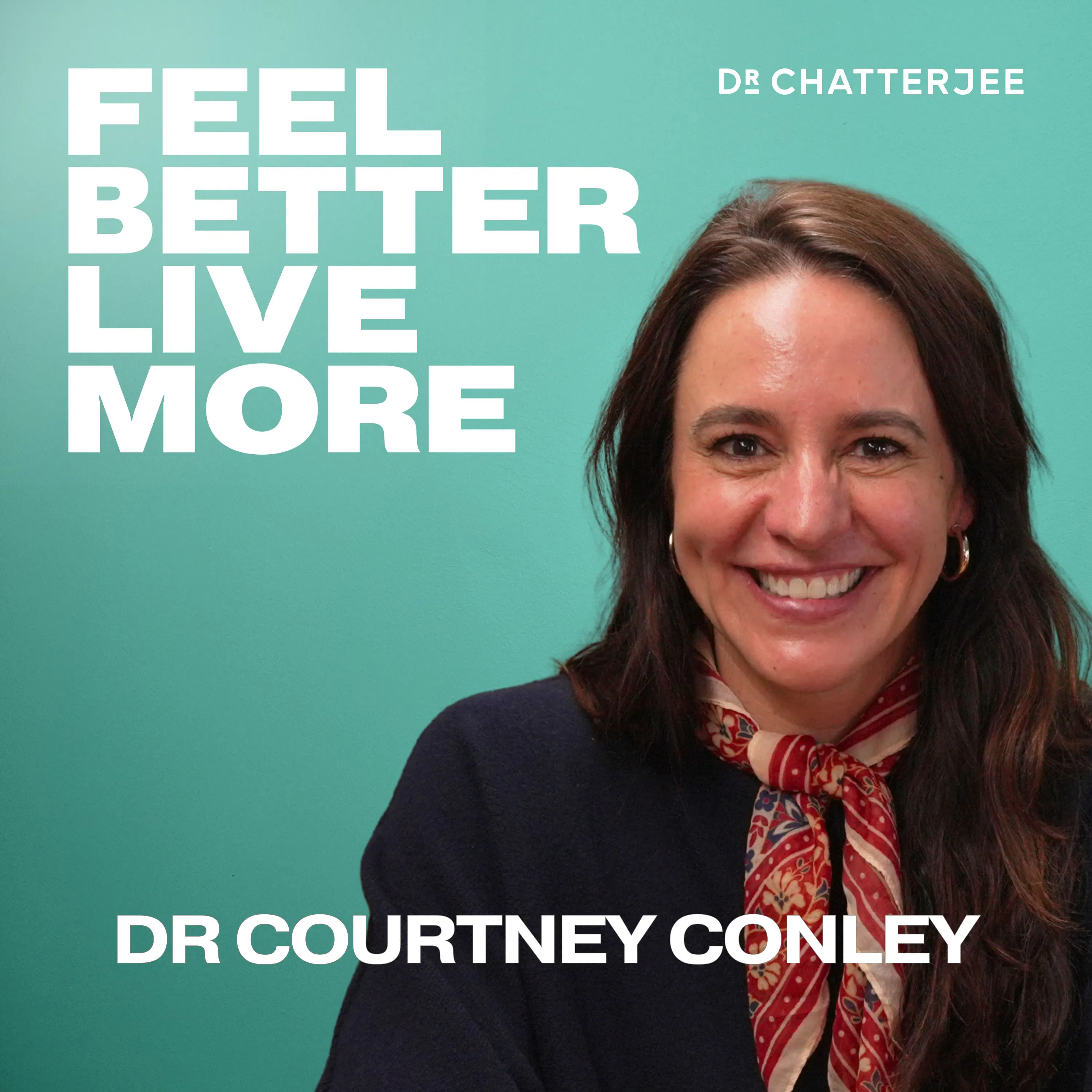 The Life Changing Magic Of Walking & How To Do It Better with Dr Courtney Conley #660 26.05.2026 2t 5minMost of us walk every day without really thinking about it – but this episode is guaranteed to change that. Because this simple, free, radical act is one of the most powerful things you can do for your body, your brain and your longevity. In this episode I’m joined by Dr Courtney Conley, for a conversation that will transform how you feel about your feet and how you use them. Courtney is a movement specialist who’s passionate about helping people move through life with strength, ease and confidence. She's co-author of the must-read new book, Walk: Your Life Depends On It, and this is her second appearance on the show, following one of our most listened-to episodes of the year. We begin by unpacking the 10,000 steps a day target – where it came from and what the research shows we really need (clue: it’s less than you think… but it matters way more than you think). We talk through the wealth of benefits walking brings, with Courtney explaining that wherever you are on the scale, adding just a thousand steps a day can lower your risk of dementia, depression and all-cause mortality. We cover chronic pain and why walking is more likely to help than hinder you. Courtney shares her practical cues for walking more efficiently, including rolling through your feet, walking tall and nasal breathing (try them as you listen and you’ll see why they work). And we discuss why strength and power are equally important components of fitness that we need to protect as we age. There’s also a wealth of information on foot issues from plantar fasciitis to Achilles’ pain, bunions and osteopenia. Plus Courtney’s how-to guide for transitioning from cushioned to functional or minimal footwear. Whether you currently walk a lot, a little, or somewhere in between, I think you'll come away from this conversation with a renewed appreciation for what your feet can do for you. All of us, whatever our age or starting point, can benefit from walking more or better – and this episode will help you do that, one step at a time. The Thrive Tour: Transform Your Health and Happiness, a live show: Book Your Tickets https://drchatterjee.com/live Thanks to our sponsors: https://drinkag1.com/livemore https://thewayapp.com/livemore Show notes https://drchatterjee.com/660 DISCLAIMER: The content in the podcast and on this webpage is not intended to be a substitute for professional medical advice, diagnosis, or treatment. Always seek the advice of your doctor or qualified healthcare provider. Never disregard professional medical advice or delay in seeking it because of something you have heard on the podcast or on my website. Learn more about your ad choices. Visit podcastchoices.com/adchoices
Samankaltaiset podcastit


Suosittu maassa
Tämä podcast esiintyy myös näiden maiden podcast-listoilla.
-
 Brunei
-
 Libanon
-
 Malediivit
-
 Paraguay
-
 Serbia
-
 Trinidad ja Tobago
-
 Sri Lanka
-
 Caymansaaret
-
 Armenia
-
 Intia
Intia
-
 Bahrain
-
 Slovenia
-
 Yhdistynyt kuningaskunta
-
 Afganistan
-
 Malta
Malta
-
 Venezuela
-
 Mauritius
-
 Viro
Viro
-
 Namibia
-
 Peru
Peru
-
 Romania
-
 Uusi-Seelanti
-
 Marokko
-
 Zimbabwe
-
 Bahama
-
 Tunisia
-
 Guyana
-
 Myanmar
-
 Liberia
-
 Botswana
-
 Mongolia
-
 Luxemburg
-
 El Salvador
-
 Suomi
Suomi
-
 Singapore
-
 Azerbaidžan
-
 Kreikka
-
 Puola
Puola
-
 Zambia
-
 Bosnia ja Hertsegovina
-
 Jordania
-
 Kirgisia
-
 Ecuador
-
 Guatemala
-
 Kambodža
-
 Slovakia
-
 Barbados
-
 Algeria
-
 Islanti
-
 Ukraina
-
 Panama
-
 Jemen
Jemen
-
 Turkki
-
 Jamaika
-
 Mali
Mali
-
 Montenegro
-
 Pakistan
-
 Yhdistyneet arabiemiirikunnat
-
 Australia
-
 Papua-Uusi-Guinea
-
 Benin
Benin
-
 Angola
-
 Latvia
-
 Antigua ja Barbuda
-
 Tšad
Tšad
-
 Dominikaaninen tasavalta
-
 Unkari
-
 Etelä-Afrikka
-
 Moldova
-
 Niger
Niger
-
 Bermuda
-
 Laos
Laos
-
 Oman
Oman
-
 Qatar
Qatar
-
 Kroatia
-
 Surinam
-
 Argentiina
-
 Burkina Faso
-
 Liettua
-
 Bolivia
-
 Seychellit
-
 Uruguay
-
 Kanada
-
 Indonesia
-
 Kenia
Kenia
-
 Grenada
-
 Kuwait
-
 Pohjois-Makedonia
-
 Kap Verde
-
 Bulgaria
-
 Irlanti
-
 Nigeria
-
 Filippiinit
-
 Uzbekistan
-
 Guinea-Bissau
-
 Madagaskar
-
 Nepal
Nepal
-
 Saint Lucia
-
 Kypros
-
 Sierra Leone
-
 Tansania
-
 Chile
Chile
-
 Ruanda
-
 Ghana
Ghana
-
 Thaimaa
-
 Albania
-
 Malesia
-
 Norja
Norja
-
 Tadžikistan
-
 Honduras
-
 Malawi