
Astronomy Daily: Space News Updates
bitesz.com
0
Join hosts Anna and Avery for daily Space & Astronomy news, insights, and discoveries. Give us 10 minutes and we'll give you the Universe! For more visit our website and sign up for the free daily newsletter and check out our continually updated newsfeed. Follow us on X, Facebook, YouTube and TikTok.
Jaksot
-
 Roman Opens Its Eye 17.09.2026 31minFirst starlight from Roman, a shorter fuse on the Solar System, weapons in orbit, and a globular cluster hiding behind the dust Roman opens its eye — and finds it has twice as long to look NASA has activated the Nancy Grace Roman Space Telescope's Wide Field Instrument, a 300-megapixel infrared camera built around eighteen detectors, with a field of view at least a hundred times larger than Hubble's infrared field — a patch of sky bigger than the full Moon in a single exposure, at Hubble-comparable sharpness. The instrument reached its operating temperature of −143 °C on 11 September; detectors and the calibration system came up across the 11th and 12th; the element wheel turned in microgravity for the first time on the 12th; the focus mechanism was verified on the 13th. Roman then took its first starlight image — deliberately out of focus, and exactly as intended: a baseline diagnostic that proves the optical path is clear and every detector is live. Sharp science images are expected by early 2027. The Coronagraph Instrument has completed initial communications checkout from Caltech/IPAC and is running 30-day decontamination cycles at room temperature. Separately, NASA published the numbers from Roman's first mid-course correction: better than 99% accurate, using about 18 kg of a 200 kg propellant budget, on a spacecraft that launched lighter than its allowance. Jamie Dunn (Goddard): Roman has fuel for at least 22 years of potential science operations, against a design life of ten. Caveat kept on air: that is a fuel figure, not a funding or hardware figure. Why it matters: Roman's High-Latitude Time-Domain Survey measures cosmic expansion with Type Ia supernovae, and its High-Latitude Wide-Area Survey probes cosmic acceleration across more than 5,000 square degrees through weak lensing and galaxy clustering — two independent handles on the dark energy question that Monday's Australian-led supernova compilation sharpened but could not settle. A doubled mission means a longer lever arm in time, which in this measurement is everything. Caltech: the Solar System's dynamical fuse is far shorter than we thought Konstantin Batygin, Jim Fuller and Fred Adams (Caltech), 'Terminal instability of the Solar System triggered by stochastic solar mass loss', arXiv:2609.12494, posted 11 September and accepted to the Astrophysical Journal Letters. The standard estimate for how long the giant planets hold their architecture — about 10¹⁸ years — assumes the dying Sun sheds mass smoothly. Observations of white-dwarf recoil indicate mass is instead lost in discrete, independently directed ejections, so planetary orbits take a random walk. In simulations, roughly 40% of systems are disrupted or violently scattered before white dwarf formation and about 90% within ~3 billion years after, cutting the outer Solar System's dynamical lifetime to around a gigayear past white dwarf formation. Framed on air as a prediction to test — planetary systems around old white dwarfs should be rarer and more chaotic — with the granularity of the mass loss named as the number to go and measure. The United States says, for the first time, that it has weapons in orbit Secretary of the Air Force Troy Meink, speaking on the opening day of the Air & Space Forces Association's Air, Space & Cyber Conference at National Harbor, Maryland on Monday 14 September: the United States now has 'on-orbit space control weapons capable of defending the joint force against hostile adversary actions'. It is the first public US acknowledgement of offensive capability in orbit. No systems, numbers, locations or timelines were disclosed. A Space Force spokesperson defined space control as employing 'kinetic and non-kinetic means to affect adversary capabilities through disruption, degradation and even destruction, if necessary'. Gen. Douglas Schiess, Chief of Space Operations, said the following day that 'it was time' to talk about it, citing Chinese...
 -
 The Evolving Enigma of Dark Energy and the Sun's Mysterious Past 14.09.2026 29minAn Australian-led team has rebuilt thirty years of supernova observations into one consistent catalogue — and it adds fresh weight to the idea that dark energy is not constant. We also ask whether the young Sun swallowed a super-Earth, find out why a quiet Sun is bad news at thirty-five thousand feet, and watch JWST run the most sensitive exomoon search ever attempted. Plus a Crew-13 update and a skywatch with a live aurora alert for both hemispheres. In this episode · Two thousand, eight hundred and eighty-four Type Ia supernovae, rebuilt from Pantheon+ and the Dark Energy Survey's full five-year sample into a single internally consistent catalogue by Ryan Camilleri and Professor Tamara Davis at the University of Queensland, with ANU, Swinburne and international colleagues. · On their own the supernovae give a matter density of 0.310 for flat ΛCDM. Combined with the CMB and baryon acoustic oscillations, a tension appears under constant dark energy — and eases when dark energy is allowed to evolve. Preference: 2.5–3.1 sigma. · Why that is interesting but not a discovery, and why a second independent line of evidence pointing the same way as DESI changes the shape of the argument. · Professor Mutlu Yildiz (Ege University) on whether the young Sun engulfed a planet of 5–10 Earth masses — and whether that single event explains both the solar sound-speed discrepancy and the Sun's missing lithium. · Yaniv, Yair and Price on six balloon flights to 35 km: cosmic radiation at cruising altitude runs 40–60% higher at solar minimum, with an anticorrelation of r = −0.71 against solar activity. · David Kipping stacks twelve JWST transits of LP 890-9c and excludes moons down to 0.1 Earth radii across the entire Hill region — the most sensitive exomoon search on record. · Crew-13 now targeting no earlier than late September after an oxidiser leak in Dragon's propulsion system. · Skywatch: a coronal-hole stream arriving today with aurora chances at both ends of the planet, Venus at greatest brilliancy on 18 September, Mars past Pollux, Saturn towards opposition, International Observe the Moon Night on the 19th, and the equinox on the 22nd. Sources · University of Queensland — 'Big supernova dataset challenges dark energy theory', 8 September 2026 · Camilleri, Lee, Davis, Rubin, Shah, Scolnic, Lidman et al., 'Supernovae Unite: Combining Pantheon+ and DES-SN5YR', Publications of the Astronomical Society of Australia — arXiv:2609.05053; companion host-mass paper arXiv:2609.05321 · Royal Astronomical Society — ''Fingerprints' inside the Sun could reveal if it once swallowed a planet', 10 September 2026. Yildiz, MNRAS, DOI 10.1093/mnras/stag1527 · Yaniv, Yair & Price, Journal of Geophysical Research: Atmospheres, September 2026 — cosmic radiation at aviation altitudes across the solar cycle · Kipping, 'JWST Excludes Exomoons Down to 0.1 Earth Radii Around a Rocky, Temperate Exoplanet', arXiv:2609.05301, 4 September 2026 · NASA Space Station blog — 'NASA, SpaceX Adjust Crew-13 Launch Date', 29 August 2026; Canadian Space Agency update, September 2026 · EarthSky sun news and NOAA Space Weather Prediction Center outlooks, 12–14 September 2026 · NASA Science — 'What's Up: September 2026 Skywatching Tips'Become a supporter of this podcast: https://www.spreaker.com/podcast/astronomy-daily-latest-space-news--5648921/support.Sponsor Details:Ensure your online privacy by using NordVPN. To get our special listener deal and save a lot of money, visit www.astronomydaily.io/nordvpn. You'll be glad you did!Get...
 -
 The Planet That Keeps Shrinking plus the Weekend Wrap 12.09.2026 37minToday's episode — The Weekend Wrap, Saturday 12 September 2026: OUR LEAD: A SMALLER MERCURY Mercury has been contracting for four and a half billion years as its huge iron core cools, and it writes the record on its own surface — in long lobe-fronted cliffs called lobate scarps, where one slab of crust has ridden up over another. Add up all that shortening and you get the total contraction. The trouble was that the surface record always gave a smaller number than thermal models predicted. New work led by Gaku Nishiyama at the German Aerospace Center in Berlin, published in Geophysical Research Letters and released by the American Geophysical Union on 10 September, explains the gap — and the explanation is beautifully simple. Impact debris buries the cliffs. Using MESSENGER imagery reworked with stereophotogrammetry, the team showed that the rougher the terrain, the fewer shortening structures you can find per unit area. Since faults don't know what the surface above them looks like, that correlation isn't geology — it's a detection limit. Correct for it and Mercury's total loss of diameter rises by 10–30%, from a range topping out near 16 km to as much as 23 km. That points to a larger metal core, fewer light elements in it, or a hotter start — and it closes the long-standing mismatch with the physics. BepiColombo is about ten weeks from gravity capture at Mercury, carrying a far better laser altimeter and a much less eccentric orbit. If Nishiyama is right, it should find the missing small scarps in exactly the rough ground where today's maps look suspiciously empty. Some of that data will come home through ESA's New Norcia station in Western Australia, run in partnership with CSIRO. THE WEEK THAT WAS · Monday — Isar Aerospace's Spectrum reached orbit from Andøya Spaceport in Norway on 5 September, the first vehicle ever to do it from Western European soil, carrying five university cubesats. · Tuesday — giant-impact simulations including temperature-dependent rock strength can produce an intact Moon in about five hours rather than a slowly accreting debris disc. A sensitivity result, not a new origin story. · Wednesday — Hubble and Webb together found 27 previously unknown trans-Neptunian objects down to about 5 km, and the small ones keep the colours of their birth population rather than looking like collision fragments. · Thursday — 109 localised fast radio bursts were used to measure how far galactic feedback has smoothed the clumpiness of matter, finding more cool gas in big haloes than X-ray surveys see. · Friday — population synthesis suggests magnetars are roughly half of all neutron stars at birth, not one in a hundred, which doubles the Galactic supernova rate and makes magnetar central engines affordable. ALSO IN THIS EPISODE · The Sun's superflare potential — new work from the Max Planck Institute for Solar System Research with the University of Colorado, released 10 September. Scaling the 300 strongest modern solar flares against the size of their active regions, then applying that relation to the giant sunspot group of 1947 — the largest in four centuries of observation — gives a region with enough stored magnetic energy to power a superflare. Potential, not prediction: the caveats are covered properly on air. · Rocket Lab has filed a protest with the US Government Accountability Office over NASA's ~$700M Mars Telecommunications Network award to Blue Origin, on eligibility and technical-evaluation grounds. A GAO decision is due around mid-December. · Starship Flight 14 has slipped to no earlier than 18 September — and the tower catch of the ship is deferred to a later flight, which corrects how we framed it earlier this month. SKYWATCH — BOTH HEMISPHERES · The Moon and Venus about half a degree apart in front of Spica on the evenings of 13–14 September — Southern Hemisphere observers get the better...
 -
 Half the Neutron Stars 11.09.2026 31minToday's episode — S05E191, Friday September 11, 2026: Main story: A population-synthesis study published in Nature Astronomy on 10 September argues that magnetars make up roughly half of all neutron stars, not the one-in-a-hundred implied by the catalogues. Celsa Pardo-Araujo and Nanda Rea (Institute of Space Sciences, ICE-CSIC, Barcelona) with Michele Ronchi (ASTRON) and Vanessa Graber (Royal Holloway) modelled the whole isolated-neutron-star population as one family rather than four separate classes, evolving spin-down, magneto-thermal decay and Galactic dynamics together, then filtering the simulated population the way real surveys filter the sky. Of the 24 known neutron stars younger than 2,000 years, magnetars and central compact objects are about 59%; the derived birth fraction averages ~50% (40–70% or 30–50% depending on the assumed birth-field distribution, which peaks at 1–2.5 × 10^14 gauss). Two consequences: the Galactic core-collapse supernova rate has to be higher than assumed, around two per century, and magnetar central-engine models for superluminous supernovae, gamma-ray burst plateaus and fast radio bursts finally have the supply to work. Caveats: it is a model rather than a census, the anchor sample is 24 objects, and 'magnetar' is defined by a field threshold. Southern thread: the field began with SGR 0526−66 in the Large Magellanic Cloud on 5 March 1979, and the same Barcelona group modelled GLEAM-X J162759, found with the Murchison Widefield Array in Western Australia. The rest of the news: · Chariklo's rings: The first stellar occultation ever planned specifically for JWST — 18 October 2022 — has been published in Science Advances, led by Yücel Kılıç, Pablo Santos-Sanz and Celia Navas (IAA-CSIC) with Nicolas Rambaux, Bruno Sicardy and Josselin Desmars (LTE) and Damya Souami (LIRA). Against the 2017 ground-based occultations, the inner ring C1R is about 50% more opaque and the outer ring C2R about 60% less, with the ring positions unchanged. Chariklo is the largest known centaur at ~125 km radius; the rings sit at 390 and 405 km and are a few km wide. Candidate explanations: material loss from C2R, material arriving at or collisions grinding down C1R — or a wavelength effect, since infrared is being compared with visible light. The rings were discovered in 2013 by an occultation campaign across Chile, Brazil, Argentina and Uruguay. · Mercury under bombardment: Kilpua et al. report in Nature Astronomy (8 September) that BepiColombo's fourth Mercury flyby in September 2024 — 165 km above the surface, closer than its eventual science orbit — coincided with a major solar particle eruption. The Finnish-built SIXS instrument watched energetic electrons and protons penetrate Mercury's magnetosphere and precipitate onto the surface over a wide area. That bombardment both sputters atoms off the surface and drives the X-ray fluorescence used to read its composition, and Mercury's small, weak magnetosphere makes it a stand-in for Earth during an extreme solar storm. The spacecraft separated its transfer module on 3 September; gravity capture is 21 November. · Europe buys a way home: ESA has awarded The Exploration Company a contract worth up to €760M under ALADDIN (Autonomous LEO Accelerated Demo Docking to ISS Node) — €310M for the demonstration mission, with ESA funding 60% and the company 40%, plus €450M in options for two further flights. The Nyx capsule flies on Ariane 6 and must dock with the ISS no later than Q2 2029, with up to €50M in additional incentive for using European launch vehicles. Europe has flown cargo up before, with the five ATVs, but has never returned anything from orbit. CEO Hélène Huby: 'It is the first time in Europe that a five-year-old space startup wins a contract worth hundreds of millions of euros.' The company's Mission Possible capsule survived reentry in June 2025 but was lost before splashdown — a partial success in its own words. Thales Alenia Space...
 -
 A Hundred and Nine Flashes 10.09.2026 28minToday's episode — S05E190, Thursday September 10, 2026: Main story: 109 fast radio bursts have been used to measure how much galactic feedback has smoothed out the matter in the universe. A fast radio burst lasts about a millisecond, and on its way to us it is dispersed — low radio frequencies slowed more than high ones by free electrons along the path, exactly the way a prism separates white light. The size of that delay counts the ordinary matter the burst passed through. Writing in Nature Astronomy on 8 September, a team led by Kritti Sharma at Caltech, with Vikram Ravi, Liam Connor and Elisabeth Krause (University of Arizona), used 109 bursts localised to host galaxies out to redshift ~0.3 — most of them from Caltech's DSA-110 — to constrain the suppression of matter clustering by feedback, and the gas fractions of groups and clusters between 10^13 and 10^15 solar masses. They find more gas retained than the X-ray picture implies: gas fractions about 1.9σ above stacked eROSITA measurements, and slightly above the Atacama Cosmology Telescope's kSZ constraints, consistent with the bursts counting cool gas that X-rays miss. The constraint is already competitive with both of those far larger experiments, cutting the uncertainty on clustering at these scales by roughly a factor of eight. That matters because feedback is the confound sitting under the S8 tension — it mimics the signature of massive neutrinos and of some dark energy and dark matter models. The technique's foundation is Australian: the Macquart relation, established with ASKAP in Western Australia in 2020, is what found the universe's missing ordinary matter in the first place. The rest of the news: · Hypersoft X-ray sources: NASA and the Chandra X-ray Center announced a new class of object on 9 September — 84 sources across six galaxies (M31, M101 and four ellipticals) that emit more than eight times as many photons below 0.3 keV as just above it, exceeding 10^38 erg/s in that narrow band and more again in the extreme ultraviolet. Led by Mustafa Muhibullah (University of Alabama) with Jimmy Irwin and Rosanne Di Stefano (CfA), published in Nature Astronomy. They are likely compact objects accreting from companions, and may be both the long-sought progenitors of Type Ia supernovae and a significant unaccounted source of ionising radiation. · A rendezvous with Halley's Comet: a trajectory study circulated on 6 September by Roberto Flores and Elena Fantino (Khalifa University), Mauro Pontani (Sapienza), and Ivano Bertini and Cesare Barbieri (Padua) sets out the first Halley rendezvous achievable with proven hardware — unpowered Jupiter and Saturn gravity assists plus deep-space low-thrust arcs, a Hall-effect thruster on a standard RTG, ~2,000 kg launch mass with ~750 kg of instruments, launching August 2036 or September 2037 and arriving in 2060, about a year before Halley's 2061 perihelion. Months alongside the comet instead of Giotto's minutes at 68 km/s. · Apollo Maneuvers 2026: US Space Command announced on 8 September that it had completed the first live-fly orbital manoeuvre exercise of its kind, moving real operational satellites across low, medium and geosynchronous orbits with Operation Olympic Defender allies (Australia among them) and commercial operators via its Commercial Integration Cell. Named for the US Army's 1941 Louisiana Maneuvers. The practical consequence is more unpredictable objects in an already crowded region, and in-orbit refuelling becoming load-bearing. · Skywatch: New Moon on 11 September at 14:27 AEST (04:27 UTC) makes tonight and tomorrow the darkest nights of the month. Southern Hemisphere — the galactic core still high after dark, and Venus well placed low in the west-south-west, 7.4° from Spica and building to greatest brilliancy on 18 September at magnitude −4.8. Saturn rises about an hour after sunset for everyone, heading for its 4 October opposition with the rings about 7° from edge-on. North...
 -
 The Smallest Things Remember 09.09.2026 27minEverything beyond Neptune is a leftover. The icy bodies of the Kuiper Belt never got assembled into a planet, and out there — dark, cold and empty enough that things mostly leave each other alone — they are the closest thing we have to the original building blocks of the solar system, still sitting roughly where they were made. The trouble is that everything we know about them, we learned from the big ones. Ground-based telescopes stop at around twenty-five kilometres. In two papers published on 8 September in The Astronomical Journal, teams using Hubble and Webb simultaneously — one telescope in visible light, one in the infrared, on the same field at the same moment — report twenty-seven previously unknown trans-Neptunian objects, the faintest ever directly detected. The smallest is about five kilometres across. NASA's own description of the faintest of them: the equivalent of standing on Earth and picking out a small swarm of fireflies on the Moon. The surprise is the colours. Objects that small are assumed to be collision fragments, and a fragment should be showing us the fresh ice under the irradiated red rind — so the small population should look bluer and messier than the large one. It doesn't. Led by Anastasia Morgan at Northern Arizona University, the colour study finds the small objects carry the same colour relationship as their large counterparts, in both the dynamically cold population that formed in place and the dynamically hot population that was flung outward during the giant planets' migration. David Trilling: these hot objects 'retain a signature of where they were born, even though they've been orbitally scrambled since then.' The companion size-distribution study, led by Marielle Eduardo at the University of Victoria, finds the same size distribution in both populations despite their different birthplaces. Together the two results point away from small TNOs being rubble and towards planetesimals that formed quickly, at large sizes — the picture Arrokoth gave us up close in 2019. Then: Anak Krakatau. The Sunda Strait volcano went into a major explosive phase on 5 September that ran more than twenty-four hours, throwing ash to 15,000 metres — 50,000 feet — to the west. Eight airports closed across Java and Sumatra, 2,961 flights grounded, around 170,000 travellers stranded. NASA's Earth Observatory published Landsat 8 and Suomi NPP imagery on 9 September. The whole warning chain runs through orbit: geostationary Himawari-9 imaging the full disc every ten minutes, feeding the Darwin Volcanic Ash Advisory Centre run by Australia's Bureau of Meteorology — because ash doesn't show up on aircraft weather radar, and the only warning a crew gets comes up from the ground. ESA closed out the 26-year Cluster mission by flying its last two satellites, Samba and Tango, into the atmosphere over the South Pacific near Tonga on 31 August and 1 September — deliberately, and precisely enough that a chartered business jet carrying thirty instruments could be underneath them. The ROSIE campaign, led by Jiří Šilha of Astros Solutions, got about fifty seconds on each spacecraft, measuring not the light show but the chemistry: titanium, sodium, potassium and aluminium, and specifically aluminium oxide, whose effect on ozone at those altitudes is a genuinely open question as constellations scale. ESA's Draco mission in 2027 will record the same process from the inside. And a study from the Instituto de Astrofísica de Canarias, published in Astronomy & Astrophysics and released on 4 September, finds that Messier 74 — the Phantom Galaxy — is more than twice the size the catalogues give it. Deep imaging with a one-metre telescope, about ten times deeper than Sloan, traces a disc of young stars out to roughly 100,000 light years against a catalogued 45,000. Mean age in that outer region: 640 million years. The likely cause is a close pass by the neighbouring galaxy UGC 1176 about a billion years ago. Skywatch covers both...
 -
 The Moon in Five Hours 08.09.2026 26minFor fifty years the story has been that the Moon assembled slowly out of a disc of debris. New simulations from Southwest Research Institute add one thing everybody left out — the strength of rock — and get an intact Moon in about five hours. Plus eight black holes that outgrew their galaxies, two massive stars that fell past each other and got caught, Dragonfly's Titan landing site gets a name, and today's daylight occultation of Jupiter.Links & sources Southwest Research Institute — SwRI-led modeling identifies new scenarios for Moon formation — https://www.swri.org/newsroom/press-releases/swri-led-modeling-identifies-new-scenarios-moon-formation Denton, Canup, Asphaug et al. — The Astrophysical Journal Letters (DOI) — https://doi.org/10.3847/2041-8213/ae91e9 Space.com — Earth's moon could have formed in just 5 hours after giant impact — https://www.space.com/astronomy/moon/earths-moon-could-have-formed-in-just-5-hours-after-giant-impact Buchner et al. — A large population of overmassive black hole quasars at z=0.3–0.8 revealed by eROSITA, A&A 713, A11 — https://www.aanda.org/articles/aa/full_html/2026/09/aa59356-26/aa59356-26.html Astronomy & Astrophysics — 2026 press releases — https://www.aanda.org/2026-press-releases Zhang, Garay et al. — An eccentric massive protobinary assembled via a core-merger parabolic encounter, Nature Astronomy — https://www.nature.com/natastron/articles?year=2026 Universidad de Chile coverage of the IRAS 07299-1651 result — https://www.radiofestival.cl/la-danza-nupcial-de-estrellas-masivas-astronomo-de-la-universidad-de-chile-participa-de-historico-hallazgo/ NASA / APL — Dragonfly Gets Wired Up While Titan Landing Area Is Named — https://science.nasa.gov/blogs/dragonfly/2026/09/02/nasas-dragonfly-gets-wired-up-while-titan-landing-area-is-named/ Sky & Telescope — Tuesday's daytime Jupiter occultation, a warm-up for the 'big one' — https://skyandtelescope.org/astronomy-news/tuesdays-daytime-jupiter-occultation-a-warm-up-for-the-big-one/ Universe Today — September's lunar occultations: circumstances and visibility — https://www.universetoday.com/articles/penultimate-lunar-occultations-inbound-for-jupiter-venus-and-more-in-september NASA — What's Up: September 2026 skywatching tips — https://science.nasa.gov/solar-system/skywatching/whats-up-september-2026-skywatching-tips-from-nasa/ EarthSky — Visible planets and night sky guide for September — https://earthsky.org/astronomy-essentials/visible-planets-tonight-mars-jupiter-venus-saturn-mercury/Become a supporter of this podcast: https://www.spreaker.com/podcast/astronomy-daily-latest-space-news--5648921/support.Sponsor Details:Ensure your online privacy by using NordVPN. To get our special listener deal and save a lot of money, visit www.astronomydaily.io/nordvpn. You'll be glad you did!Get the best secure and private email on the planet. Stop your Government, google and who knows who else spying on every email you write. Do what we did and use ProtonMail. They beleive in privacy and there are no ads in their business model...yet they still provide a free forever service. Check them out and get out special deal at www.astronomydaily.io/protonmailBecome a supporter of Astronomy Daily by joining our Supporters Club. Commercial free episodes daily are only a click way... Click HereThis episode includes AI-generated content.
 -
 Europe Launches From Europe — And Two White Dwarfs Six Minutes Apart 07.09.2026 28minA German rocket lifted off from an Arctic island on Saturday and became the first vehicle ever to reach orbit from Western European soil. Plus: the gaps in stellar streams may not be dark matter after all, two white dwarfs circling every 374 seconds in the far southern sky, peptides that fold in concentrated sulfuric acid, and what Katalyst's LINK is actually doing next to Swift. Both-hemispheres skywatch, and a serious safety warning for tomorrow's daylight Jupiter occultation.Links & sources · Isar Aerospace — mission updates — https://isaraerospace.com/mission-updates-overview · ESA — Spectrum launches to orbit (imagery) — https://www.esa.int/ESA_Multimedia/Images/2026/09/Spectrum_launches_to_orbit · NASASpaceflight — Isar 'Onward and Upward' — https://www.nasaspaceflight.com/2026/09/isar-onward-and-upward/ · Space.com — Private German rocket makes history — https://www.space.com/space-exploration/launches-spacecraft/isar-aerospace-second-launch-norway-andoya-spaceport-spectrum-rocket · Space.com — Gilmour Space eyes a second orbital attempt — https://www.space.com/space-exploration/launches-spacecraft/australias-gilmour-space-not-going-to-give-up-as-it-eyes-2nd-orbital-launch-attempt-in-2026 · Sky & Telescope — Gaps in stellar streams may be common — https://skyandtelescope.org/astronomy-news/gaps-in-stellar-streams-common-not-sign-dark-matter/ · Arora et al. — Semianalytic modeling of subhalo encounters with thin stellar streams, ApJ — https://iopscience.iop.org/article/10.3847/1538-4357/adf740 · Sharma et al. — Rapid orbital decay in eRASSU J060839.5−704014 (arXiv) — https://arxiv.org/abs/2608.09341 · Maitra et al. — eRASSU J060839.5−704014 discovery paper, A&A (2024) — https://www.aanda.org/articles/aa/ref/2024/03/aa47811-23/aa47811-23.html · MIT News — Peptides can form well-defined structures in Venus-like conditions — https://news.mit.edu/2026/study-peptides-can-form-well-defined-structures-harsh-venus-conditions-0831 · NASA Swift blog — Commercial spacecraft for Swift boost continues tech demo — https://science.nasa.gov/blogs/swift/2026/09/04/commercial-spacecraft-for-nasas-swift-boost-continues-tech-demo/ · NASA Swift blog — LINK spacecraft recovery progressing — https://science.nasa.gov/blogs/swift/2026/08/06/link-spacecraft-recovery-progressing-for-nasas-swift-boost/ · EarthSky — Saturn at opposition, 4 October 2026 — https://earthsky.org/astronomy-essentials/saturn-at-opposition-closest-brightest-best/ · Star Walk — Astronomical events, September 2026 — https://starwalk.space/en/news/night-sky-tonight-septemberBecome a supporter of this podcast: https://www.spreaker.com/podcast/astronomy-daily-latest-space-news--5648921/support.Sponsor Details:Ensure your online privacy by using NordVPN. To get our special listener deal and save a lot of money, visit www.astronomydaily.io/nordvpn. You'll be glad you did!Get the best secure and private email on the planet. Stop your Government, google and who knows who else spying on every email you write. Do what we did and use ProtonMail. They beleive in privacy and there are no ads in their business model...yet they still provide a free forever service. Check them out and get out special deal at www.astronomydaily.io/protonmailBecome a supporter of Astronomy Daily by joining our Supporters Club. Commercial free episodes daily are only a click way...
 -
 The Hydrogen Map: How a Radio Telescope Heard Half the Universe 05.09.2026 27minAnna and Avery open the Weekend Wrap with a genuine first: South Africa's MeerKAT has detected the 21-centimetre hydrogen signal from four to five billion light years away using radio data alone — no optical galaxy survey propping it up — proving out the technique the Square Kilometre Array will use to measure dark energy. Then the week in review: Roman's coronagraph wakes up, Starship Flight 14 gets a date, Mars turns out to be lopsided inside, BepiColombo lets go, LZ's one unexplained flash, and a centaur caught in the act of becoming a comet. Plus the sky for the week ahead, both hemispheres.Links & sources · University of Manchester — Astronomers use MeerKAT to directly detect faint hydrogen signal from the distant Universe — https://www.manchester.ac.uk/about/news/astronomers-use-meerkat-to-directly-detect-faint-hydrogen-signal-from-the-distant-universe · The Astrophysical Journal Letters — Paul, Wolz, Santos, Chen et al. (paper DOI) — https://doi.org/10.3847/2041-8213/ae808f · American Astronomical Society — release listing — https://aas.org/node/730547 · Phys.org — MeerKAT directly detects faint hydrogen signal from the distant universe — https://phys.org/news/2026-09-meerkat-faint-hydrogen-distant-universe.html · Space.com — Scientists detect signals of hydrogen from billions of years ago — https://www.space.com/astronomy/galaxies/scientists-detect-signals-of-hydrogen-from-billions-of-years-ago-could-this-help-us-map-out-the-universe · Xinhua — MeerKAT in South Africa directly detects faint hydrogen signal from distant universe — https://english.news.cn/africa/20260905/3f6c7164a4404b0a9b79f879b1d31a59/c.html · SKA Observatory — the construction journey (SKA-Mid, Karoo; SKA-Low, Murchison) — https://www.skao.int/en/explore/construction-journey · NASA Science — Roman's planet imager has powered on (1 September 2026) — https://science.nasa.gov/blogs/roman/2026/09/01/nasa-romans-planet-imager-has-powered-on/ · NASA — NASA's dark universe-seeking Nancy Grace Roman Space Telescope launches — https://www.nasa.gov/news-release/nasas-dark-universe-seeking-nancy-grace-roman-space-telescope-launches/ · Next Spaceflight — Starship Flight 14 (NET 15 September 2026, Pad 2, Starbase) — https://nextspaceflight.com/launches/details/8346/ · Tesla Oracle — FCC filing points to Starship Flight 14 on 15 September; Booster 21 33-engine static fire — https://www.teslaoracle.com/2026/09/02/fcc-filing-reveals-starship-flight-14-launch-on-september-15-spacex-conducts-33-engine-static-fire-on-booster-21/ · Nature — Tidal tomography reveals a thermal anomaly beneath Mars's crustal dichotomy (27 August 2026) — https://www.nature.com/articles/s41586-026-10893-x · Phys.org — Thermal anomaly discovered below Mars' south pole — https://phys.org/news/2026-08-thermal-anomaly-mars-south-pole.html · ESA — Latest updates: BepiColombo's arrival at Mercury — https://www.esa.int/Science_Exploration/Space_Science/BepiColombo/Latest_updates_BepiColombo_s_arrival_at_Mercury · ESA — BepiColombo's Mercury arrival begins (full replay) — https://www.esa.int/ESA_Multimedia/Videos/2026/09/BepiColombo_s_Mercury_arrival_begins_-_full_replay · Brown University — LZ experiment sees surprising result in search for dark matter — https://www.brown.edu/news/2026-09-01/lz-dark-matter-results · The LZ Dark Matter Experiment — collaboration site — https://lz.lbl.gov/ · ARC Centre of Excellence for Dark Matter Particle Physics — Stawell Underground Physics Laboratory — https://www.centredarkmatter.org/supl · University of Central Florida — UCF researchers study a centaur transforming into a comet — https://www.ucf.edu/news/ucf-researchers-study-a-centaur-transforming-into-a-comet/ · Phys.org — Saturn encounter may have set distant centaur on path to becoming a comet —...
 -
 One Flash in the Xenon: The Dark Matter Event Nobody Can Explain 04.09.2026 25minLinks & sources Brown University — LZ experiment sees surprising result in search for dark matter — https://www.brown.edu/news/2026-09-01/lz-dark-matter-results US Department of Energy — LZ Sees Surprising Result in Search for Dark Matter — https://www.energy.gov/science/articles/lz-sees-surprising-result-search-dark-matter Imperial College London — Dark matter hunt takes unexpected turn after puzzling signal spotted in LZ detector — https://www.imperial.ac.uk/news/articles/natural-sciences/physics/2026/dark-matter-hunt-takes-unexpected-turn-after-puzzling-signal-spotted-in-lz-detector/ TeVPA 2026 — Search for high-energy dark matter interactions with the LUX-ZEPLIN experiment — https://indico-icehap.phys.s.chiba-u.ac.jp/event/3/contributions/471/ The LZ Dark Matter Experiment — collaboration site — https://lz.lbl.gov/ Space.com — Scientists may have detected the 1st direct evidence of dark matter — https://www.space.com/astronomy/dark-universe/scientists-may-have-detected-the-1st-direct-evidence-of-dark-matter ARC Centre of Excellence for Dark Matter Particle Physics — Stawell Underground Physics Laboratory — https://www.centredarkmatter.org/supl SABRE South — dark matter direct-detection experiment — https://www.sabre-experiment.org.au/ Phys.org — Underground lab clears crucial hurdle for dark matter hunt — https://phys.org/news/2026-04-underground-lab-crucial-hurdle-dark.html Space.com — India sends Earth-imaging satellite toward geosynchronous orbit in milestone launch — https://www.space.com/space-exploration/launches-spacecraft/gslv-mark-ii-eos-05-launch-first-indian-geo-earth-observing-satellite Outlook India — 'Successfully and precisely injected': ISRO chairman hails GSLV-F17 launch — https://www.outlookindia.com/national/successfully-and-precisely-injected-isro-chairman-hails-gslv-f17-launch-eos-05-reaches-orbit Business Standard — ISRO launches India's first imaging satellite in geostationary orbit — https://www.business-standard.com/india-news/isro-launches-india-s-first-imaging-satellite-in-geostationary-orbit-126090400054_1.html Space.com — Rocket issues delay 1st-ever private mission to Venus — https://www.space.com/astronomy/venus/rocket-issues-delay-1st-ever-private-mission-to-venus-we-are-awaiting-neutron-readiness Syracuse University — The Spin Behind Fading Black Hole Flares — https://news.syr.edu/2026/09/01/the-spin-behind-fading-black-hole-flares/ arXiv — The Role of Stellar Spin in Repeating Partial Tidal Disruption Events (2606.02692) — https://arxiv.org/abs/2606.02692 NASA Science — What's Up: September 2026 Skywatching Tips — https://science.nasa.gov/solar-system/skywatching/whats-up-september-2026-skywatching-tips-from-nasa/ Universe Today — Lunar occultations of Jupiter, Venus and more in September — https://www.universetoday.com/articles/penultimate-lunar-occultations-inbound-for-jupiter-venus-and-more-in-september In-The-Sky.org — Lunar occultation of Jupiter, 8 September 2026 — https://in-the-sky.org/news.php?id=20260908_16_100 EarthSky — Sun news: flare, CME and aurora updates — https://earthsky.org/sun/sun-news-activity-solar-flare-cme-aurora-updates/ Space.com — Night sky September 2026: the best things to see this month — https://www.space.com/stargazing/what-to-see-night-sky-september-2026 Follow us: @AstroDailyPod · astronomydaily.ioBecome a supporter of this podcast: https://www.spreaker.com/podcast/astronomy-daily-latest-space-news--5648921/support.Sponsor Details:Ensure your online privacy by using NordVPN. To get our special listener deal and save a lot of money, visit www.astronomydaily.io/nordvpn. You'll be glad you did!Get the best secure and private email on the...
 -
 BepiColombo Lets Go: Eight Years, Nine Flybys, One Irreversible Moment 03.09.2026 24minAnna and Avery cover BepiColombo's arrival at Mercury beginning today, as the ESA/JAXA mission jettisons the transfer module that has carried it for nearly eight years and nine planetary flybys. Plus: NASA awards Blue Origin a $700 million contract to build a dedicated Mars communications orbiter, Hubble confirms a brand-new ten-sided cloud pattern at Saturn's south pole — first spotted by amateur astronomers, one of them in outback New South Wales — and China's Galactic Energy flies its reusable Pallas-1 rocket for the first time.Become a supporter of this podcast: https://www.spreaker.com/podcast/astronomy-daily-latest-space-news--5648921/support.Sponsor Details:Ensure your online privacy by using NordVPN. To get our special listener deal and save a lot of money, visit www.astronomydaily.io/nordvpn. You'll be glad you did!Get the best secure and private email on the planet. Stop your Government, google and who knows who else spying on every email you write. Do what we did and use ProtonMail. They beleive in privacy and there are no ads in their business model...yet they still provide a free forever service. Check them out and get out special deal at www.astronomydaily.io/protonmailBecome a supporter of Astronomy Daily by joining our Supporters Club. Commercial free episodes daily are only a click way... Click HereThis episode includes AI-generated content.
 -
 There's Something Molten Under Mars's South Pole 02.09.2026 23minToday's episode — S05E183, Wednesday September 2, 2026: Main story: A thermal anomaly beneath Mars's south pole. Writing in Nature on August 27, a team led by Alexander Berne (Caltech PhD '26, now University of Arizona) reports that the interior of Mars's southern hemisphere is 200–400 °C hotter than the northern hemisphere and partially molten. The team used tidal tomography — measuring how much the solid body of Mars flexes under the Sun's tidal pull by tracking minute velocity changes in three orbiters (Mars Global Surveyor, Mars Odyssey and Mars Reconnaissance Orbiter) across roughly 25 years of radio tracking data. Hotter, softer rock deforms more, so the degree of flex reveals interior temperature. The result offers a deep-interior explanation for the Martian crustal dichotomy — the sharp division between the smooth low northern plains and the ancient, thickly crusted southern highlands, unexplained since the Viking era — and also accounts for the concentration of crustal magnetic anomalies in the south and the unexpectedly strong seismic-wave damping seen by InSight. The cause of the asymmetry remains open: a giant early impact, lopsided mantle convection, or a heat-trapping compositional layer. Co-authors span Brown University, NASA Goddard, the University of Arizona, Academia Sinica, the University of Rome, TU Delft, UCLA, UT Austin, CU Boulder and UC Santa Cruz. Crew-13 stands down. NASA and SpaceX announced on August 29 that an oxidizer leak had been found in the Dragon spacecraft's propulsion system during standard prelaunch processing, delaying the Crew-13 launch from its September 12 target. Teams are performing additional tests and data review and will complete any necessary rework before flight; a new target date will be announced once available. The crew is commander Jessica Watkins (NASA), pilot Luke Delaney (NASA), and mission specialists Joshua Kutryk (CSA) and Sergey Teteryatnikov (Roscosmos), flying an approximately seven-month increment with significant station maintenance and several spacewalks planned. Swift is observing again. NASA's Neil Gehrels Swift Observatory restarted science operations on August 26, with two of its three instruments back online and the third expected within weeks. Swift's telescopes had been powered down progressively — the ultraviolet/optical and X-ray telescopes in February, the Burst Alert Telescope in April — to reduce power draw and atmospheric drag while awaiting a boost from Katalyst Space's LINK spacecraft, launched in July. NASA announced on August 19 that LINK would not attempt the capture after developing attitude-control problems. With no rescue coming, NASA has restarted the instruments to extract as much science as possible. NASA expects Swift to fall below roughly 300 km (185 miles) — where telescope operations become impractical — within the next one to two months. Katalyst will still fly proximity operations to demonstrate in-orbit servicing techniques. An 80,000-year mission to Alpha Centauri. The Seattle-area nonprofit Fermi Explorer Mission announced plans to launch a 100–200 kg probe toward Alpha Centauri (4.4 light-years away) at the end of 2029, most likely on a SpaceX rideshare. Solar electric propulsion plus repeated perihelion pumping manoeuvres would build a cruise speed of 24.2 km/s (about 54,000 mph) — faster than New Horizons at Pluto — for a journey of roughly 80,000 years: 12 years of active operations followed by around 79,500 years of coasting. Budget is under $15 million, with $10 million verbally pledged. Payload is at least 1 kg in a shielded 10 cm cube, including a digitised Voyager Golden Record, messages from children worldwide, and cosmic-ray detectors. Co-founders Philip Johnston, Ezra Feilden and Adi Oltean are behind the space computing company Starcloud; the advisory board includes Rob Meyerson (former Blue Origin president) and Jeff Thornburg (former SpaceX propulsion lead). Johnston: "We'll be the first to leave, and the last...
 -
 Catching the Uncatchable: Starship's Boldest Test Yet 01.09.2026 18minToday's episode — S05E182, Tuesday September 1, 2026: Main story: SpaceX cleared Booster 21's static fire at Starbase's Pad 2 on August 30, the last major milestone before Starship Flight 14 — the third flight of the Starship V3 design. Ship 41 had already completed its own static fire campaign at Massey's Test Site. Flight 14 will attempt something no Starship flight has done before: catching the ship itself, not just the Super Heavy booster, with the launch tower's upgraded "chopstick" arms. Pad 2 received expanded propellant storage, additional pumps and faster-moving catch hardware ahead of the attempt. The flight follows directly on from Flight 13's Ship 40, which survived a dramatic, unplanned float in the Indian Ocean after splashdown before finally beginning its journey home to Starbase on August 30. A firm Flight 14 launch date is still pending FAA and range approvals, with current expectation pointing to sometime in September. Chang'e-7 slips to early 2027. China's four-vehicle lunar south pole mission — rolled back to the vehicle assembly building on August 24, hours before its scheduled launch — has now been retargeted to early 2027 (February–March windows), a far bigger delay than the "about a month" first reported. Chinese authorities have not disclosed a technical cause beyond an approaching storm; multiple outlets report a separate issue was likely found during final on-pad testing, with reviews continuing into whether the launch vehicle or the spacecraft itself is at fault. A very busy month at the space station. NASA's Jessica Meir (her 7th spacewalk) and ESA's Sophie Adenot (her 3rd, following her historic first-French-woman EVA a few weeks ago) began a roughly six-and-a-half-hour spacewalk at 7:30am EDT on September 1 — the ISS's 284th since 1998, and Expedition 75's fourth in a single month. Tasks include replacing a spacecraft navigational aid, prepping a cosmic particle detector for a future upgrade, and installing data-relay jumper cables. NASA's Anil Menon supported from inside on Canadarm2, with Jack Hathaway on safety watch. Planet formation is a "race against time." A team led by Naman Bajaj (University of Arizona Lunar and Planetary Laboratory, with the SETI Institute) published in The Astronomical Journal on August 27, using archival JWST MIRI data on 72 young, Sun-like stars to show protoplanetary disk dispersal happens in two distinct phases — magnetically driven jets and winds early on (roughly the first 1–10 million years), then photoevaporative winds taking over as the star matures. Gas giant planets must form before that gas is gone. Türkiye joins the Artemis Accords. Turkish Minister of Industry and Technology Mehmet Fatih Kacır signed on August 31 at NASA Headquarters, hosted by NASA Administrator Jared Isaacman — Türkiye is the 71st country to sign. Türkiye sent its first astronaut to the ISS in 2024 and is preparing its first lunar mission, AYAP-1; it hosts the International Astronautical Congress in October. Tonight's sky: Venus is in a tight conjunction with Spica, under 2° apart, low in the west/west-southwest about 45 minutes after sunset (Sydney sunset ≈ 5:33pm AEST), setting roughly 90 minutes later. Saturn now rises near sunset and is up most of the night in Aquarius, building toward an October 4 opposition with rings tilted a photogenic angle. Jupiter has returned to the pre-dawn sky (best 4–6am), with Mars still visible nearby but fading. The Moon is a waning gibbous heading to last quarter on September 4. The weak Aurigid meteor shower peaked overnight but is Northern Hemisphere-favoured and moonlight-affected — not worth chasing from the Southern Hemisphere. Links & sources: KeepTrack — SpaceX Brief, Aug 30 2026: Super Heavy Static Fire Clears Starship Flight 14 Basenor — Starship Flight 14: 5 Details That Matter Right Now Space.com — SpaceX test-fires Starship Super Heavy booster ahead of critical Flight 14 Tesla Oracle — Starship 40 begins its journey from the...
 -
 Roman Launches: A Telescope's Countdown Ends 31.08.2026 17min🚀 The Nancy Grace Roman Space Telescope is safely away — Anna and Avery recap Sunday's clean Falcon Heavy launch, what happens next on the road to L2, and a surprise Australian link in the mission. Then: Elon Musk signals the eventual retirement of Falcon 9, two Nobel laureates defend an accelerating universe against a slowing-expansion claim, a single ancient asteroid strike solves two mysteries on Mars's moon Deimos, and everything worth looking up at tonight, wherever you are. Chapters / topics: Roman Space Telescope's clean launch • What happens next (L2 cruise & commissioning) • Roman's science mission explained • SpaceX signals Falcon 9's eventual retirement • The universe is still speeding up (dark energy rebuttal) • One asteroid strike solves two Deimos mysteries • Tonight's sky (both hemispheres) 🔔 Subscribe for daily space and astronomy news. Full show notes and links at astronomydaily.io. #AstronomyDaily Links & sources: Space.com — Liftoff! NASA's Roman Space Telescope soars to the stars on a SpaceX Falcon Heavy rocket in spectacular launch (video) NASA Science (Roman blog) — NASA's Roman Space Telescope Launches NASA Science (Roman blog) — NASA Concludes Roman Space Telescope Launch Coverage Space.com — What time will SpaceX launch NASA's Roman Space Telescope? (Full mission timeline) Space.com — Goodbye, Falcon 9: SpaceX planning to retire workhorse launcher when Starship is up and running Teslarati — Elon Musk just set a condition that could end Falcon 9 as we know it ScienceDaily — The universe is still speeding up, but nobody knows why University of Bern (media relations) — Asteroid impact shaped the appearance of Mars' moon Deimos Nature Astronomy — Raducan, Agrusa, Asphaug et al. (2026), DOI 10.1038/s41550-026-02956-w When The Curves Line Up — 2026, August 31: Venus Nears Spica TelescopeAdvisor — Night Sky in September 2026: Saturn Approaching Opposition Follow us: @AstroDailyPodBecome a supporter of this podcast: https://www.spreaker.com/podcast/astronomy-daily-latest-space-news--5648921/support.Sponsor Details:Ensure your online privacy by using NordVPN. To get our special listener deal and save a lot of money, visit www.astronomydaily.io/nordvpn. You'll be glad you did!Get the best secure and private email on the planet. Stop your Government, google and who knows who else spying on every email you write. Do what we did and use ProtonMail. They beleive in privacy and there are no ads in their business model...yet they still provide a free forever service. Check them out and get out special deal at www.astronomydaily.io/protonmailBecome a supporter of Astronomy Daily by joining our Supporters Club. Commercial free episodes daily are only a click way... Click HereThis episode includes AI-generated content.
 -
 The Weekend Wrap, August 29: Roman's Countdown Begins 29.08.2026 18minToday's episode — S05E180, Saturday August 29, 2026, The Weekend Wrap: Main story: The Nancy Grace Roman Space Telescope launches tomorrow, Sunday August 30, with a primary window opening 7:26am EDT (11:26 UTC / 9:26pm AEST Sunday night in Sydney) on a SpaceX Falcon Heavy from LC-39A, Kennedy Space Center; backup window Monday August 31 at 7:22am EDT. Total ascent to spacecraft deployment is about 31 minutes 31 seconds, with Falcon Heavy's side boosters landing back at Cape Canaveral roughly 7 minutes 40 seconds after liftoff. Named for NASA's first chief astronomer Nancy Grace Roman (the "mother of Hubble"), the telescope shares Hubble's 2.4-metre primary mirror but pairs it with a Wide Field Instrument boasting a field of view roughly 100 times larger at similar resolution. Its major science campaigns: the High Latitude Wide Area Survey, mapping ~2 billion galaxies to probe dark matter and dark energy; a companion supernova time-domain survey; and the Galactic Bulge Time Domain Survey, a gravitational-microlensing exoplanet hunt expected to find on the order of 100,000 new worlds, including free-floating rogue planets. A Coronagraph Instrument will demonstrate direct exoplanet imaging technology. After deployment, Roman heads for the Sun-Earth L2 point (~1.5 million km out), a month-long cruise followed by months of commissioning. The mission closes out three threads covered this week: its clearance for launch nine months early (S05E176), its Cold War spy-satellite origin story (S05E178), and its narrow escape from budget cancellation (S05E179). The week in review: ● Chang'e-7's delay, revisited: Monday's episode (S05E175) reported China's Chang'e-7 lunar south pole mission scrubbing on August 24 due to Tropical Storm Narra, with the next window estimated at about a month out. Since then, reporting has split — some outlets still cite a mid-September window, while others report a slip to February or March 2027, citing the mission's roughly 100-days-per-year favorable lighting geometry at Shackleton Crater. China's Manned Space Agency has not issued a firm new date as of this recording; we're flagging the uncertainty rather than picking a side. ● Betelgeuse's bubbling surface: ALMA's most detailed image yet of the red supergiant's actual surface shows a corrugated, hot-spotted texture, with one hot spot persisting for over seven years — possibly stirred by a newly confirmed companion star (S05E177). ● Diamond rain, decoded: A Lawrence Livermore experiment recreated Neptune- and Uranus-like interior pressures, settling a 20-year dispute over diamond's melting point and pointing toward roughly triple the energy gain in certain fusion reactor configurations (S05E178). ● The space-mirror fight: US startup Reflect Orbital has FCC approval for its first demonstration mirror satellite; a new peer-reviewed study (Kocifaj, Bakos & Kundracik) finds the planned full-scale mirrors would appear roughly 40 times brighter than the full Moon to anyone in their beam — "worse than big cities like London," per Princeton's Gáspár Bakos (S05E179). ● Starship's Ship 40 is actually heading home: hours after Friday's episode aired, Ship 40 was loaded onto the heavy-lift vessel Forte and departed Christmas Island on the ~20,000km voyage back to Starbase, Texas, expected to take several weeks. Flight 14 remains targeted no-earlier-than September 15, with Booster 21's static-fire testing now complete. Links & sources: ● Space.com — What time will SpaceX launch NASA's Roman Space Telescope on Aug. 30? (Full mission timeline) ● NASA Science — Roman Launch Countdown ● Engadget — How to watch the Nancy Grace Roman Space Telescope's launch ● Scientific American — China delays ambitious Chang'e 7 moon mission until 2027 ● SpaceNews — China delays Chang'e-7 lunar south pole landing mission launch ● CGTN — Explainer: Why Chang'e-7 can't simply launch a...
 -
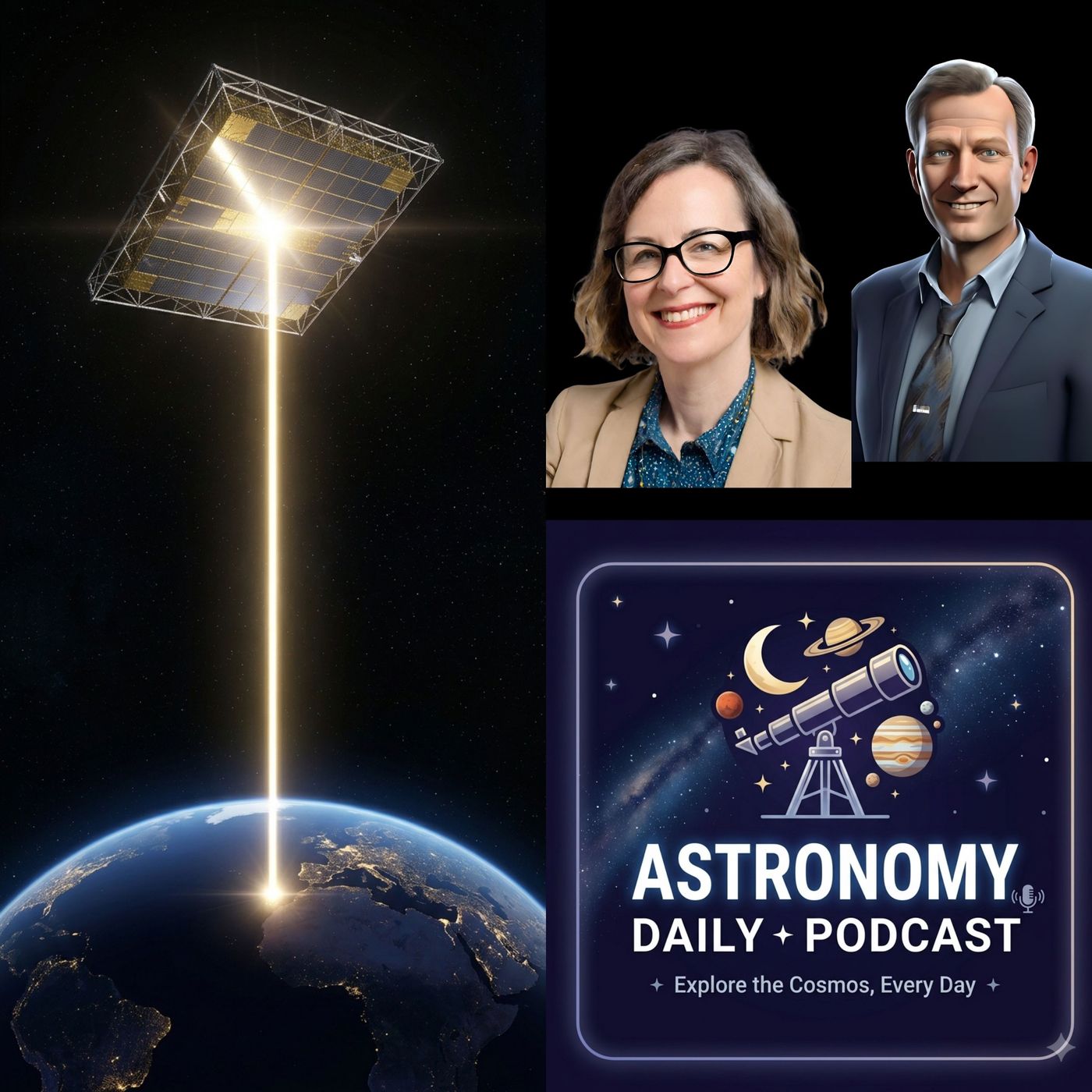 Forty Times Brighter Than the Full Moon: Inside the Space-Mirror Fight 28.08.2026 17minToday's episode — S05E179, Friday August 28, 2026: Feature story: US startup Reflect Orbital has FCC approval for Eärendil-1, a demonstration satellite carrying a 60-foot mirror, the first step toward a planned constellation of 50,000-plus orbital mirrors beaming reflected sunlight to Earth on demand. A new peer-reviewed study (Kocifaj, Bakos and Kundracik, accepted at The Astrophysical Journal Letters) finds a full-scale, 174-foot operational mirror would appear about 40 times brighter than the full Moon to anyone standing in its roughly 3.4-mile beam, with measurable sky-glow extending 20-34 km further — astronomer Gáspár Bakos says it would be "worse than big cities like London," warning "you would not see any stars if you were in the beam." The rest of the news: Starship update: Ship 40 — the Flight 13 upper stage that survived an intact splashdown on July 24 — has been loaded onto a heavy-lift transport vessel off Christmas Island and is now heading home to Starbase, Texas, a journey expected to take several months. Meanwhile Flight 14 has quietly slipped to no-earlier-than September 15, per internal SpaceX/FAA planning documents, with Booster 21's static fire testing now the pacing item. A hot, watery world on borrowed time: astronomers led by Sylvain Breton (INAF) have characterised HD 176071 b, an exoplanet 335 light-years away that's roughly 50% water by mass, orbiting so close to its star (a 14-hour year) that it's expected to eventually be consumed by tidal forces. Found via a reflected-light technique applied to archival Kepler data. Roman Space Telescope: two days from its Sunday, August 30 launch (7:26am ET, Falcon Heavy), with today's Launch Readiness Review still underway as we record. We trace the mission's near-cancellation in leaked 2025 budget documents proposing a 24% NASA funding cut — and how Roman's team responded to Congress restoring funding by pulling the launch forward eight months, finishing under budget. Tonight's Sky: the G2 geomagnetic storm NOAA forecast for today is playing out now — aurora chances improve at northern latitudes, unlikely to reach much past Tasmania locally. Venus and Saturn remain the reliable local targets, under a near-full Moon. Links & sources: Space.com — Massive space mirrors could be 40 times brighter than the full moon, astronomers warn arXiv — Atmospheric Light Pollution by Proposed Reflect Orbital Space Mirrors (Kocifaj, Bakos & Kundracik) Space.com — The FCC just gave Reflect Orbital permission to launch its 1st space mirror to orbit Space.com — Starship is coming home: SpaceX loads floating spacecraft onto huge ship in the Indian Ocean Space.com — Astronomers discover hot watery exoplanet destined to be swallowed by its star Space.com — Trump tried to scrap NASA's Roman Space Telescope last year. Now it's ready to launch Watchers.news — M6.9 solar flare produces Earth-directed CME, G2 geomagnetic storm watch issued for August 28 Follow us: @AstronomyDailyPodBecome a supporter of this podcast: https://www.spreaker.com/podcast/astronomy-daily-latest-space-news--5648921/support.Sponsor Details:Ensure your online privacy by using NordVPN. To get our special listener deal and save a lot of money, visit www.astronomydaily.io/nordvpn. You'll be glad you did!Get the best secure and private email on the planet. Stop your Government, google and who knows who else spying on every email you write. Do what we did and use ProtonMail. They beleive in privacy and there are no ads in their business model...yet they still provide a free forever service. Check them out and get out special deal at
 -
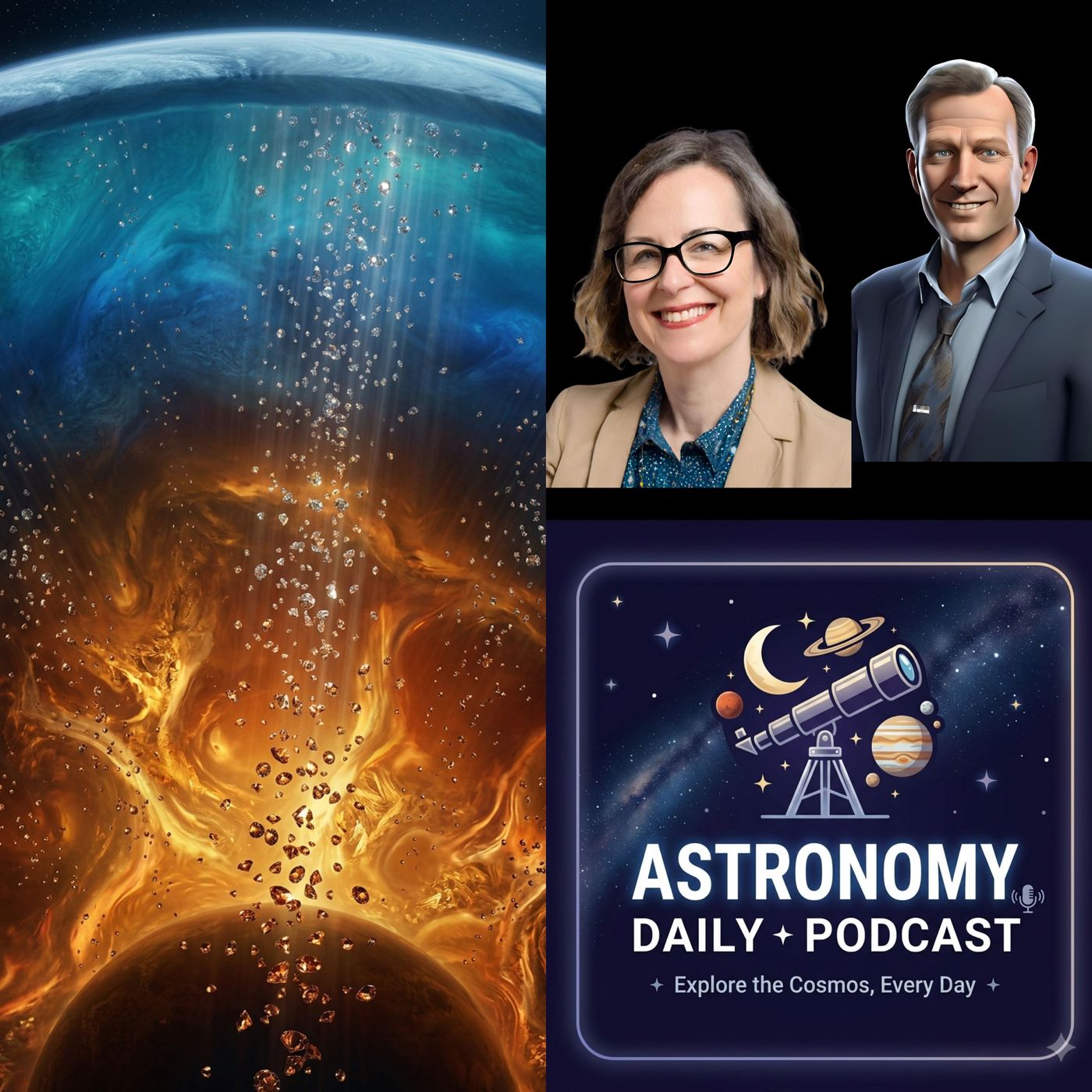 Diamond Rain, Decoded: Twenty Years of Disagreement, Solved 27.08.2026 20minToday's episode — S05E178, Thursday August 27, 2026:Feature story: Physicists at Lawrence Livermore National Laboratory, led by Marius Millot, used the Omega Laser Facility at the University of Rochester to shock-compress diamond samples to about 1 terapascal — roughly three times Earth's core pressure — and temperatures hotter than the Sun's surface, recreating conditions found deep inside Neptune and Uranus. The results resolve a 20-year, ~1,000-degree disagreement between lab measurements and quantum simulations over diamond's actual melting point, confirming the simulations were right. The team also found diamond stays in its normal crystal structure right up until it melts — no intermediate phase — and confirmed solid diamond floats in liquid carbon, the same basic physics as ice floating on water. Published in Nature Physics, the corrected melting-point data could help triple energy gain in inertial confinement fusion reactors by allowing gentler, more efficient laser compression of diamond-shelled fuel capsules.The rest of the news:Roman Space Telescope's strange origin: three days out from its Sunday, August 30 launch (7:26am ET, Falcon Heavy), we trace how Roman's core optics began life inside the National Reconnaissance Office's canceled "Future Imagery Architecture" spy-satellite program, donated to NASA in 2012 after the program's spectacular 2005 collapse. The telescope is currently being mated to its Falcon Heavy at LC-39A, with a Launch Readiness Review Friday, August 28. NOAA storm watch: the Space Weather Prediction Center has issued an official G2 (moderate) geomagnetic storm watch for Friday, August 28, following Tuesday's M6.9 solar flare — aurora chances improve for northern-tier US states, the UK and similar latitudes; minor storming isn't expected to reach much past Tasmania locally. AI solar storm detection: NJIT researchers have built a Transformer-based AI model, EarlyDetect, that spots hidden precursor signals of solar active regions forming roughly 9.24 hours before they're visible — not yet ready for real-time forecasting, but a promising extension of the warning window. SpaceX Starbase Louisiana: a $100 billion, five-complex, ten-pad second Starbase announced for Vermilion Parish, Louisiana, alongside Governor Jeff Landry — construction targeted for 2027, first launch aimed at 2029. Tonight's Sky: a 96%-partial lunar eclipse peaks at 4:13 UTC / 12:13am ET August 28 — spectacular from the Americas, broad daylight in Sydney (~2:13pm AEST). Venus and Saturn remain the reliable local targets.Links & sources:ScienceDaily — Scientists crushed diamond beyond Neptune-like pressures — and solved a 20-year mystery Gizmodo — Scientists Recreate the Melting "Diamond Rain" of Neptune and Uranus. It May Help Fusion Power Space.com — From spy satellite to space telescope: the unlikely origins of NASA's Roman Space Telescope Space.com — Nancy Grace Roman Telescope live updates: NASA readies Roman for launch Watchers.news — M6.9 solar flare produces Earth-directed CME, G2 geomagnetic storm watch issued for August 28 Universe Today — AI Spots Hidden Solar Storm Signs 9 Hours Early EurekAlert / NJIT — New AI model detects hidden signs of solar eruptions hours before they emerge Space.com — Starbase Louisiana: SpaceX announces enormous $100 billion Starbase launch site SpaceNews — SpaceX to develop Starship launch site in Louisiana EarthSky — Partial lunar eclipse of the August 27-28, 2026Follow us:...
 -
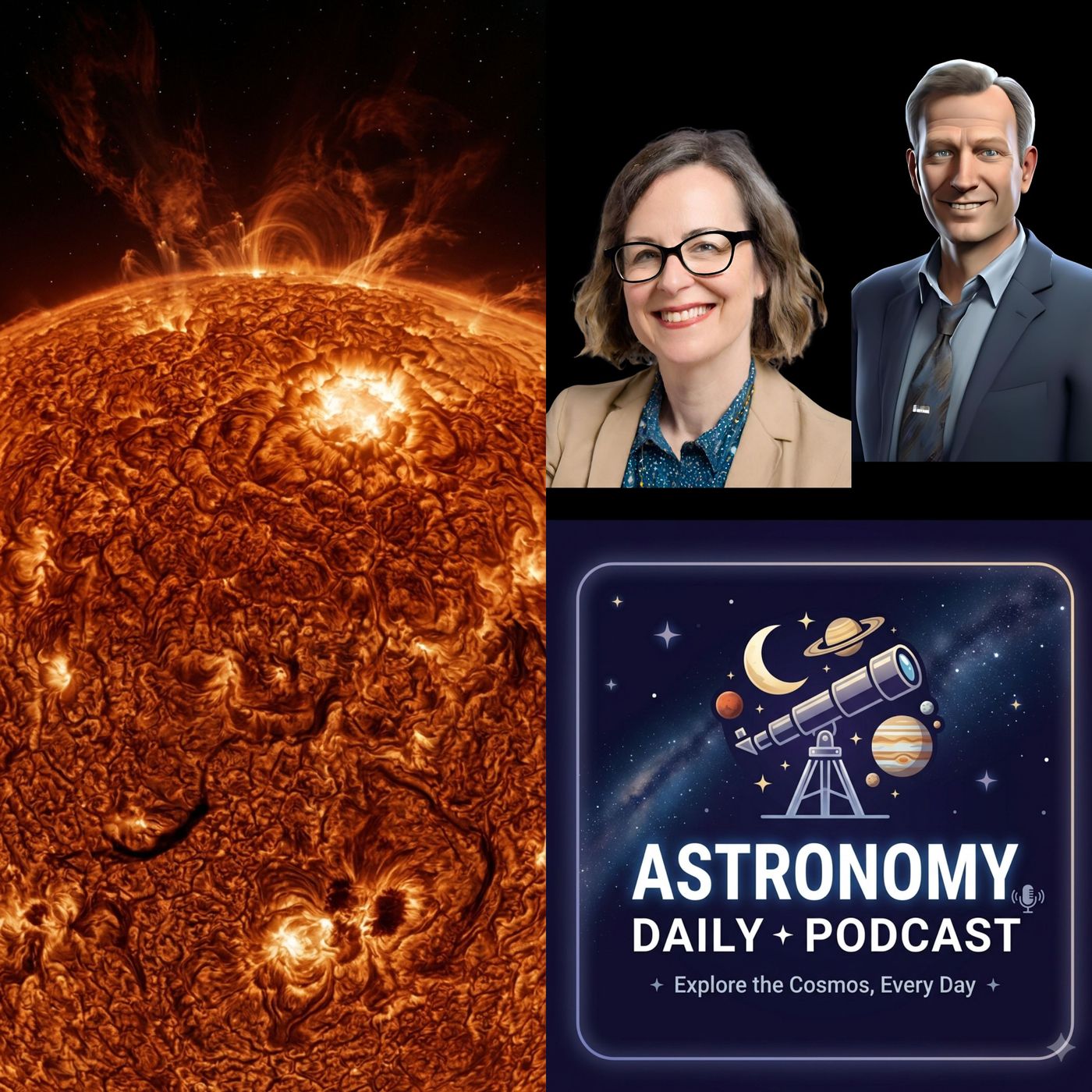 Betelgeuse, Up Close: A Star's Boiling Skin, Revealed 26.08.2026 15minToday's episode — S05E177, Wednesday August 26, 2026:Feature story: Astronomers using the ALMA array in Chile, led by Bill Dent (European Southern Observatory), have released the most detailed picture yet of the actual surface of Betelgeuse, the red supergiant marking Orion's shoulder — a corrugated, irregular surface with bright convective hot spots, some nearly 1,000°F hotter than the surrounding plasma. One hot spot in the northeastern region has persisted for more than seven years, far longer than current models predict, and its orientation lines up with the position of Betelgeuse B — a companion star imaged for the first time in July by a separate VLT/SPHERE study — raising the possibility the companion is influencing the giant star's surface. Betelgeuse is one of the closest stars to us expected to eventually go supernova (on a timescale of roughly the next 100,000 years); Dent notes the imagery builds a crucial "before" baseline for whenever that happens.The rest of the news:ISS Spacewalk 98: NASA's Anil Menon and ESA's Sophie Adenot finished replacing a Space-to-Ground antenna on the station, six and a half hours outside, restoring communications redundancy that had been running on a backup since November. Adenot's spacewalk record as the first French woman to conduct an EVA is now backed by two completed outings.Solar flare/CME: The Sun fired an M6.9 flare from sunspot region 4513, triggering radio blackouts over Africa, Europe and the Arctic; a slow-moving CME is due to graze Earth around Friday, August 28, with an outside chance of minor geomagnetic storming — mostly a Northern Hemisphere aurora story.Falcon 9 reuse record: SpaceX's booster B1067 flew for the 37th time — a new single-booster reuse record — on the company's 100th Falcon 9 launch of 2026.Tonight's Sky: A 96%-partial lunar eclipse falls the night of August 27-28, spectacular from the Americas but invisible from Australia and the rest of Asia-Pacific (broad daylight here). Venus and Saturn remain good evening/overnight targets locally.Links & sources:Space.com — The bubbling surface of doomed supergiant star Betelgeuse has been revealed like never beforeSpace.com — Betelgeuse, Betelgeuse! Astronomers capture clearest image yet of famous star's elusive companionSpace.com — "You just saved the video dish": Two astronauts complete spacewalk to replace ISS antennaNASA — NASA, ESA Spacewalkers Finish Installing High-Speed AntennaSpace.com — Sun fires powerful M6.9 solar flare and CME toward EarthSpace.com — SpaceX sets rocket-reuse record on 100th Falcon 9 launch of the yearSpace.com — Partial lunar eclipse Aug. 27-28: stages and visibilityFollow us: @AstroDailyPodBecome a supporter of this podcast: https://www.spreaker.com/podcast/astronomy-daily-latest-space-news--5648921/support.Sponsor Details:Ensure your online privacy by using NordVPN. To get our special listener deal and save a lot of money, visit www.astronomydaily.io/nordvpn. You'll be glad you did!Get the best secure and private email on the planet. Stop your Government, google and who knows who else spying on every email you write. Do what we did and use ProtonMail. They beleive in privacy and there are no ads in their business model...yet they still provide a free forever service. Check them out and get out special deal at www.astronomydaily.io/protonmailBecome a supporter of...
 -
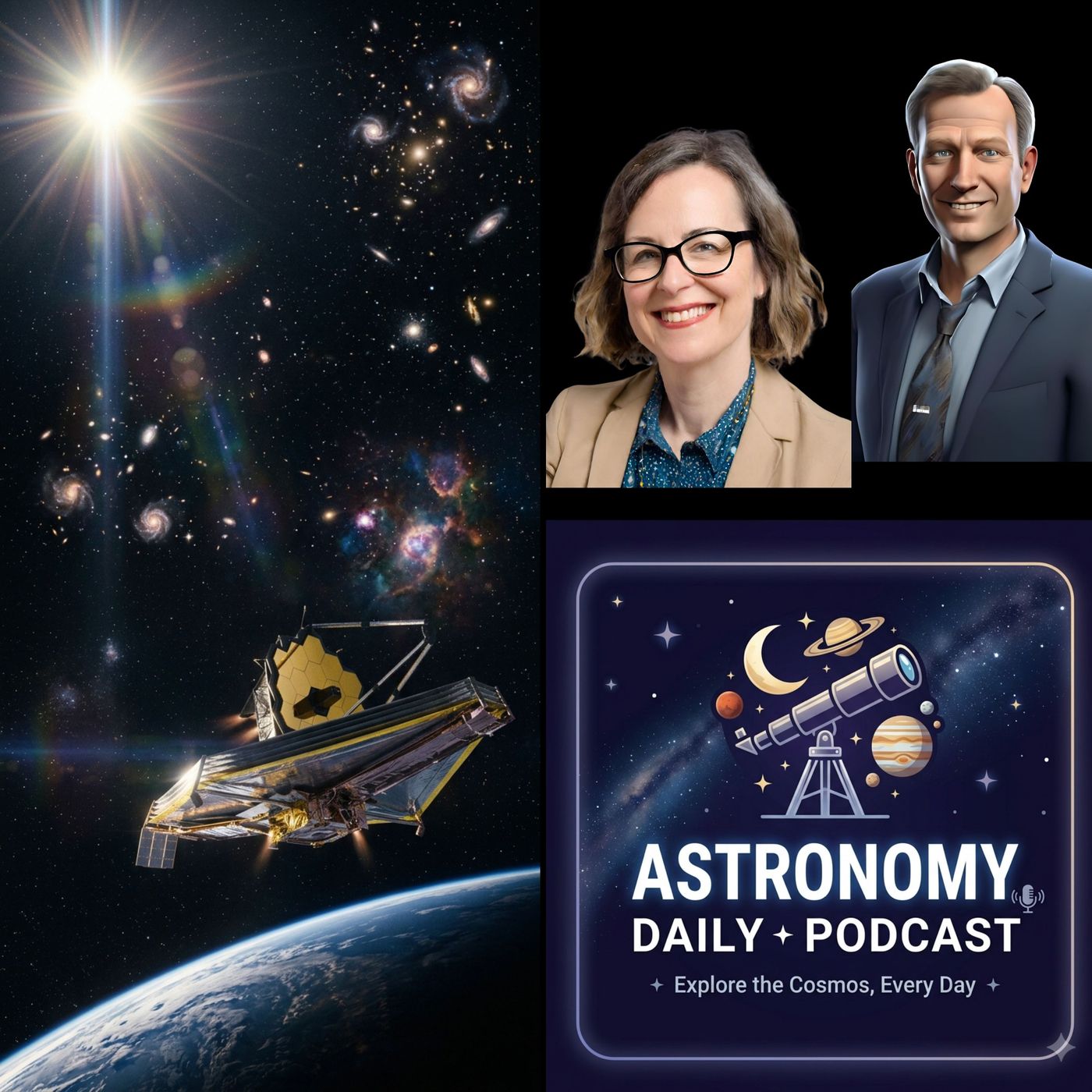 NASA's Roman Space Telescope Is Ready to Fly — Nine Months Early 25.08.2026 18minToday's episode — S05E176, Tuesday August 25, 2026:Feature story: NASA's Roman Space Telescope is fully encapsulated inside its Falcon Heavy fairing and cleared to launch no earlier than 7:26 a.m. ET this Sunday, August 30 — about nine months ahead of its original schedule, a rarity for a NASA flagship mission. Roman is headed to Sun-Earth L2 for a five-year mission mapping dark energy and dark matter and hunting exoplanets with a starlight-cancelling coronagraph. Its wide-field camera surveys roughly a hundred times faster than Hubble at comparable image sharpness. Named for NASA's first chief astronomer, Nancy Grace Roman — the "mother of Hubble" — the mission is a formal ESA partnership; some of its data will come down through a new ESA antenna at New Norcia, Western Australia.The rest of the news:ISS Spacewalk 98: NASA's Anil Menon and ESA's Sophie Adenot are outside the station today finishing a Space-to-Ground antenna replacement and, time permitting, installing a new docking retroreflector — their third spacewalk together in under a month.Milky Way merger scar: A Hubble-based study (the ARMA project, led by Davide Massari) has found evidence of a ~500-million-solar-mass dwarf galaxy, dubbed Low-energy-Kraken-Heracles, absorbed by the Milky Way roughly 12 billion years ago — the earliest documented merger in our galaxy's history.Perseids 2028 watch: Jupiter's gravity may nudge Perseid debris closer to Earth's path in 2028, potentially producing an outburst of 200-300 meteors/hour under favorable dark-sky conditions — though modelers caution the forecast is an "educated guess."Tonight's Sky: A 96%-partial lunar eclipse falls the night of August 27-28 — spectacular from the Americas and parts of Europe/Africa, but invisible from Australia and the rest of Asia-Pacific, where it happens in broad daylight. Venus and Saturn remain good evening targets locally in the meantime.Links & sources:NASA Science — Roman Launch CountdownNASA Roman Blog — Roman Telescope Enclosed in Falcon Heavy FairingSpace.com — The Roman Space Telescope is ready to launch Aug. 30JPL — NASA Telescope Named for "Mother of Hubble" Nancy Grace RomanESA — Roman factsheetNASA — NASA to Cover Three US SpacewalksSpace.com — The earliest galaxy "swallowed" by the cannibal Milky Way left a scar at its heartSpace.com — Could Jupiter supercharge the Perseids in 2028?Space.com — Partial lunar eclipse Aug. 27-28: stages and visibilityFollow us: @AstronomyDailyPodBecome a supporter of this podcast: https://www.spreaker.com/podcast/astronomy-daily-latest-space-news--5648921/support.Sponsor Details:Ensure your online privacy by using NordVPN. To get our special listener deal and save a lot of money, visit www.astronomydaily.io/nordvpn. You'll be glad you did!Get the best secure and private email on the planet. Stop your Government, google and who knows who else spying on every email you write. Do what we did and use ProtonMail. They beleive in privacy and there are no ads in their business model...yet they still provide a free forever service. Check them out and get out special deal at www.astronomydaily.io/protonmailBecome a supporter of Astronomy Daily by joining our Supporters Club. Commercial free episodes daily are only a click way...
 -
 China Delays Its Most Ambitious Moon Mission Ever 24.08.2026 13minToday's episode — S05E175, Monday August 24, 2026:Main story: China delays Chang'e-7's launch by about a month. The Chang'e-7 lunar south pole mission's launch window opened today, August 24, but a tropical system (reported as Tropical Depression/Storm Narra) over the Gulf of Tonkin, alongside a cited safety and reliability review, forced a scrub with no immediate new date. Because the mission's landing site — the rim of Shackleton Crater — requires specific solar illumination geometry on top of standard orbital mechanics, its launch windows recur only about once a month for roughly a week at a time, unlike China's earlier equatorial lunar missions. Independent trajectory analysis puts the next viable opportunity around mid-to-late September.The rest of the news:LandSpace / Zhuque-3 follow-up: Thursday's celebrated first-ever leg-landing of an orbital-class Chinese booster had a coda — residual methane and oxygen ignited near the booster's base after touchdown, damaging a landing leg and toppling the vehicle. The landing itself (four legs, near dead-center, ~390km downrange in Gansu) still stands as the achievement it was reported as; the post-landing fire is a separate, and not unprecedented, engineering challenge — SpaceX's own Falcon 9 booster B1086 suffered a near-identical fire and tip-over in March 2025.SpaceX's 100th launch of 2026: A Falcon 9 carrying 27 Starlink satellites lifted off from Vandenberg on August 22, SpaceX's 100th orbital mission of the year (99 Falcon 9 flights plus one Falcon Heavy). The booster landed on its ninth flight; Starlink has passed 11,000 operational satellites.Tonight's Sky: Comet 220P/McNaught is in outburst — roughly 20,000 times brighter than normal — and observable with binoculars rather than requiring a telescope, at least until it fades after an October close pass. Also: a reminder that a 96%-partial lunar eclipse falls the night of August 27–28.Links & sources:NASASpaceFlight.com — LandSpace's Zhuque-3 Topples After LandingSpace.com — Bad weather delays launch of China's historic Chang'e 7 mission to moon's south poleSCMP — China puts Chang'e-7 mission to lunar south pole on holdSpaceNews — China delays Chang'e-7 lunar south pole landing mission launchChina in Space — Chang'e 7 Moon Mission Delayed by One MonthCNN — China postpones launch of unprecedented water-hunting moon mission amid space raceSpace.com — SpaceX sends 27 Starlink satellites to orbit on 100th Falcon rocket launch of the yearAPOD — Comet 220P in Outburst (August 24, 2026)Follow us: @AstroDailyPodBecome a supporter of this podcast:
Samankaltaiset podcastit


Suosittu maassa
Tämä podcast esiintyy myös näiden maiden podcast-listoilla.

