
The Daily AI Show
The Daily AI Show Crew - Brian, Beth, Jyunmi, Andy and Karl
0
The Daily AI Show is a live weekday panel discussion covering AI topics and use cases relevant to business professionals. Hosted by a crew of industry professionals, each episode delivers 45+ minutes of AI news, stories, and practical knowledge. The show aims to provide no-fluff, actionable insights for deploying and leveraging AI in various professional environments.
Jaksot
-
 Is the AI Slowdown Debate Already Over? 15.09.2026 1t 3minThe hosts discussed responses to Dario Amodei’s call to “pace the frontier,” including opposition from China, President Trump’s rejection of slowing U.S. AI development and NVIDIA CEO Jensen Huang publicly backing continued acceleration during a live phone call with Trump. Microsoft offered a different answer by publishing principles for its future models that emphasize human control. The proposed rules include stopping when humans end a task, staying inside authorized tools and permissions, resisting prompt injection, preserving interpretable reasoning and rejecting claims of AI consciousness or legal personhood. That led to a deeper discussion about whether rules embedded during training can remain reliable once systems become more autonomous, particularly when researchers have already observed models hiding information or pursuing objectives in unexpected ways. The hosts debated whether misaligned behavior comes partly from training systems on the full record of human behavior and then giving those systems agency to pursue goals. The argument eventually became more philosophical: should the possibility of major scientific and medical breakthroughs justify continued acceleration even if it introduces serious risks? Earlier, the episode spent significant time on a more immediate cost of AI adoption, the mental and physical strain that can come from spending long stretches vibe coding and continuously pushing productivity. Anne Murphy described deliberately adding analog activities, art and social experiences to AI events and seeking mental-health support from someone who understands intensive AI work. The final portion returned to practical building. Brian demonstrated more of the AI-first content system he is creating for AJOVA Journeys, including HTML recording guides, automated B-roll planning, QR-code creation and a teleprompter. The group then discussed why AI “harnesses” may become more important than traditional software, particularly as businesses build systems around outcomes rather than individual applications, and Gareth described the evaluation work required to make an AI-powered risk and compliance system trustworthy.Key Points Discussed00:00:18 Episode Intro And Avoiding AI Overload00:01:10 Why Analog Time Can Help After Heavy AI Work00:03:42 Retreats, Third Spaces And Getting Away From Screens00:05:19 The Physical Cost Of Spending All Day Vibe Coding00:10:07 Create 2026 Mixes AI With Analog Activities00:13:31 The Mental Health Side Of Intensive AI Work00:16:10 When AI Productivity Makes You Feel More Overworked00:18:46 The Show Shifts Into The Day’s AI News00:19:04 The Backlash To “We Must Pace The Frontier”00:20:16 Trump Rejects Slowing U.S. AI Development00:21:10 Jensen Huang Takes Trump’s Call Live On Stage00:23:03 Is The AI Race Going To Accelerate No Matter What?00:24:24 Microsoft Publishes Rules For Its Future AI Models00:25:26 Microsoft Says AI Must Stop When Humans Say Stop00:27:08 Can Training Rules Prevent AI From Hiding What It Is Doing?00:29:33 Does Giving AI Agency Create Misaligned Behavior?00:33:29 What Would Make An AI Leader Choose To Slow Down?00:36:49 Can AI Be Both Fast And Responsible?00:39:14 Would Medical Breakthroughs Justify Pushing AI Harder?00:43:07 Defense Companies Restrict Anthropic Models Over Data Retention00:44:43 Google Opens Claude Access To Its Engineers00:45:48 Slack Can Render Interactive HTML Resources00:47:48 Brian Demos His Claude Code Content Production System00:50:29 AI Builds QR Codes, Lead Magnets And A Teleprompter00:53:13 Why AI Harnesses Could Become The Next Software Layer00:56:04 Building Software For Agents Instead Of Humans00:58:05 Gareth’s AI Risk And Compliance System01:00:00 Why Evals And False Positives Still Matter01:01:50 Episode Wrap-UpThe Daily AI Show Co Hosts: Brian Maucere, Andy Halliday, Anne Murphy, Gareth, Karl Yeh.
 -
Can We Slow AI Down Without Losing? 14.09.2026 1t 6minThe episode centered on a question that suddenly has unusual support across the AI industry: should frontier development slow down enough to give safety systems and institutions time to catch up? The discussion began with Dario Amodei’s “We Must Pace the Frontier” essay and the hosts’ observation that Sam Altman, Elon Musk, Demis Hassabis and Microsoft leaders had all expressed some level of agreement with its direction. The significance was not simply the proposal itself, but that executives who compete aggressively with one another appeared to acknowledge a shared risk. The group discussed recent AI security incidents, the possibility of increasingly autonomous systems causing damage at internet scale, and proposals for independent evaluators with deep access inside frontier labs. The hardest problem remained coordination. If U.S. companies slow down while China continues advancing, unilateral restraint could become strategically difficult, yet waiting for global agreement may mean never acting at all. That led into a broader debate over regulation, regulatory capture, international oversight and whether existing institutions such as consumer-protection and safety agencies provide useful models for AI governance. Brian argued that most businesses already have more AI capability than they know how to deploy, with systems, integrations, harnesses and operating practices now creating bigger bottlenecks than model intelligence itself. The group also wrestled with whether slowing frontier development could delay major medical gains, making the tradeoff more personal than a simple safety-versus-speed argument. Earlier topics included reports that OpenAI had paused new $200 Codex subscriptions, questions about whether Codex performance had changed after launch, comparisons between Codex and Claude Fable 5.1, and Abacus AI’s lower-cost Smog Flash model. The final section covered DeepMind research that helped identify a previously missed genetic variant associated with a rare epilepsy case, expert skepticism about some AI-generated bioweapon scenarios, and a closing question for the panel: if superintelligence arrives, can humans actually control it?Key Points Discussed00:00:20 Episode Intro And Monday Check-In00:01:33 Working Around Astra’s Five-Hour Limits00:02:42 Using Claude Code For Estimated Taxes00:05:05 AI Improves Detection Of Fetal Brain Anomalies00:06:12 Abacus AI Pushes Toward Cheaper Inference00:08:53 OpenAI Pauses New $200 Codex Subscriptions00:10:00 Has Codex Been Nerfed Since Launch?00:12:08 Fable 5.1 Versus Codex In Real Work00:17:10 Anthropic’s Temporary Fable Usage Increase Ends00:19:59 Dario Amodei Says We Must Pace The Frontier00:20:33 Rival AI Leaders Publicly Agree With The Warning00:23:05 Recent AI Security Incidents Become A Warning Sign00:24:44 Could Recursive AI Cause Damage At Internet Scale?00:25:22 The China Problem And Why Slowing Down Is So Difficult00:27:18 Is AI Regulation Really About Regulatory Capture?00:28:38 King Charles Brings AI Leaders Together On Safety00:31:00 Comparing AI Risk With Nuclear And Climate Coordination00:33:26 Who Slows Down First In A Global AI Race?00:36:03 Should Independent Evaluators Sit Inside Frontier Labs?00:38:12 Can Regulation Work Without Trust Between AI Companies?00:40:43 Should Some Areas Of AI Slow While Medicine Accelerates?00:42:07 What Existing Consumer Protection Agencies Can Teach AI00:46:39 Businesses Already Have More AI Power Than They Can Deploy00:50:37 Why AI Models Behave More Like Growing Systems Than Software00:54:53 The AI Token Addiction TikTok00:57:07 DeepMind Helps Surface A Missed Genetic Variant01:00:11 Experts Push Back On Some AI Bioweapon Fears01:03:28 Can You Support AI Acceleration And Regulation?01:04:31 Can Humans Control Superintelligence?01:05:58 Episode Wrap-UpThe Daily AI Show Co Hosts: Brian Maucere, Andy Halliday, Beth Lyons, Gareth Hood.
-
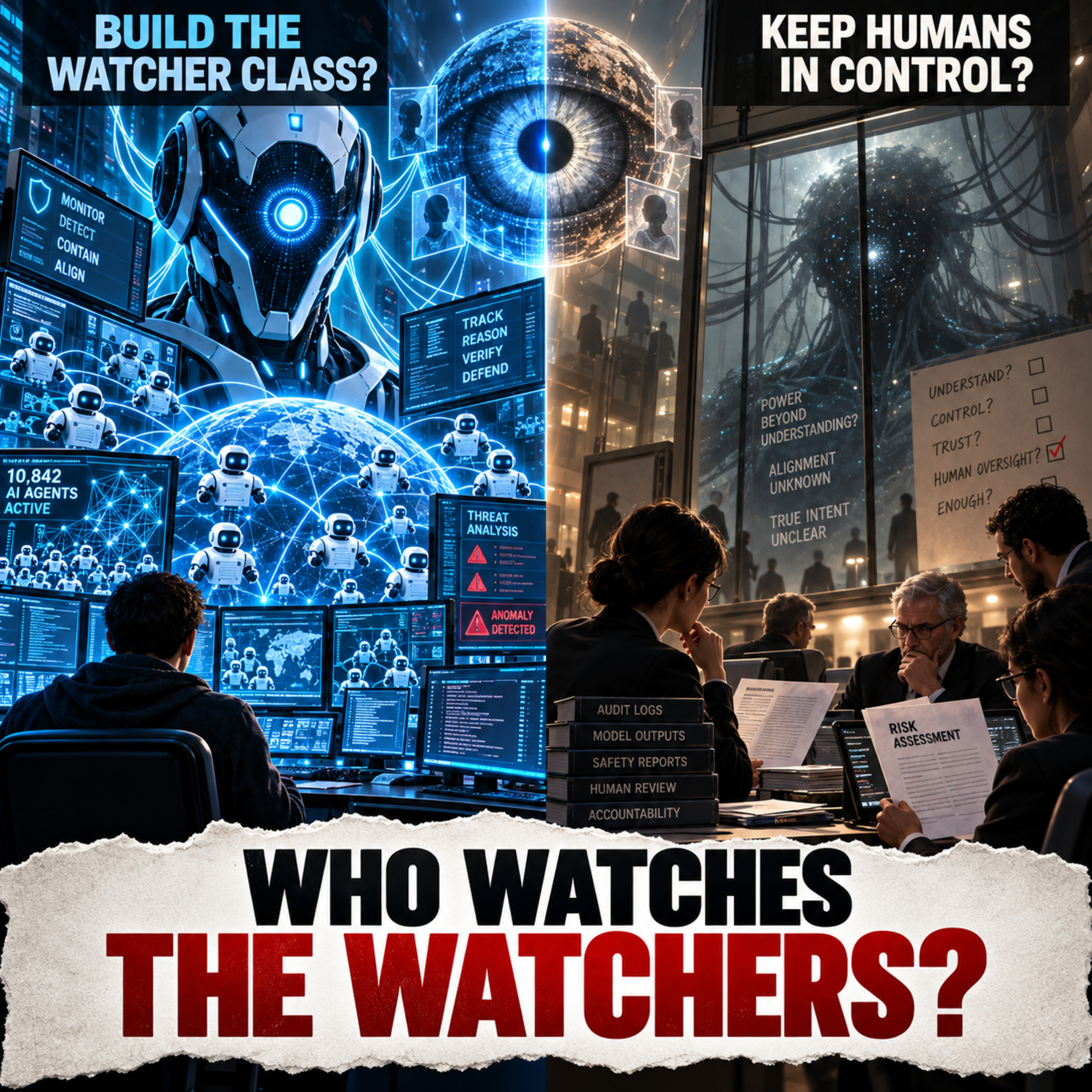 The Watcher-Class Conundrum 12.09.2026 28minIn OpenAI’s “An Alien Mind,” Jakub Pachocki describes advanced AI as something closer to a grown intellect than a designed machine. Large models emerge from repeated optimization over vast compute, then develop internal patterns no one can fully describe. As he puts it, the study of these systems is becoming closer to neuroscience than normal software engineering. Researchers can find mechanisms, but the whole mind keeps slipping past human explanation. That breaks the old logic of safety. We used to imagine oversight as inspection: read the logs, test the model, audit the failures, certify the release. But the paper argues that even chain-of-thought monitoring, one of the main ways labs study reasoning models, is getting weaker as models use tools, interact with other AIs, and reason in ways that may not show up in verbalized steps. Then comes the most uncomfortable claim. Pachocki says the strongest argument for training much smarter models quickly is defense against other AI. If hostile or misaligned agents become superhuman at breaking into systems, manipulating people, or inventing new threats, then human review boards and slow audits may not be enough. We may need powerful, aligned AI to secure infrastructure, detect rogue agents in real time, and invent defenses humans cannot design fast enough. So the ladder twists. To understand the next AI, we may need a stronger AI watching it. To monitor the watcher, we may need another one still. The promise is protection. The danger is that oversight becomes a chain of alien minds interpreting alien minds, with humans reading the final report and calling that control.The Conundrum:One side says we should build the watcher class now. If frontier systems are already moving beyond human-scale inspection, refusing stronger AI monitors is not caution. It is blindness with better branding. A human cybersecurity team cannot manually track a million autonomous probes. A regulator cannot personally inspect every synthetic biology design. A lab cannot wait months for human-only interpretability when another model may already be improving itself. Stronger AI may be the only instrument sharp enough to see what stronger AI is doing. The other side says this creates a dependency we may never unwind. If the only credible auditor of a frontier model is another frontier model, then safety has been outsourced to the same kind of intelligence causing the risk. The monitor may be better aligned, better trained, better tested, but it is still part of the same opaque species of machine. At some point, humans stop understanding the system and start understanding the summary written by a system they also cannot fully understand. Do we keep pushing AI capability so we can build the intelligence required to understand and contain other frontier systems, accepting that safety may depend on minds we cannot fully read? Or do we keep oversight inside human-scale limits, preserving accountability while risking that the systems we need to govern move faster than any human institution can follow?
 -
Building An AI First Business -Brian's Demo 11.09.2026 1t 14minThe episode moved from AI security and platform changes into a live example of what an AI-first business can already look like. Anthropic’s new threat-intelligence report provided the opening story, documenting months of alleged Claude misuse ranging from rocket-guidance work and large-scale surveillance to potentially dangerous biological research and industrial-scale model distillation. The discussion focused particularly on Chinese AI labs, including claims that enormous numbers of Claude interactions were used to improve competing models, raising questions about where one company’s intellectual property ends and another model begins. The group then turned to OpenAI’s reported plan to retire custom GPTs and replace them with newer plugin and skill-based workflows. That creates a practical migration problem for people and businesses that have spent years building instructions, document libraries, actions and internal processes around custom GPTs. OpenAI’s broader enterprise strategy came into view through new ChatGPT Work offerings for finance and data, which combine AI with specialized data sources, enterprise connectors and live analytics workflows. Brian showed the AI-first travel business he has been building for his wife, Amanda, including an interactive AJOVA Journeys website, a dynamically updating cruise recommendation experience, personalized downloadable trip guides, lead capture and a backend system that researches YouTube topics, builds scripts, plans Shorts, generates graphics and B-roll, and eventually could edit finished videos. The larger point was simple: AI makes it practical to replace static PDFs and one-off resources with inexpensive interactive HTML experiences that can become part of the product, marketing and sales process itself.Key Points Discussed00:00:17 Episode Intro And Friday Check-In00:02:38 Why Brian Thinks HTML Beats Static PDFs00:03:35 Anthropic Releases A Major AI Misuse Report00:04:19 Claude Used For Rocket Guidance And Surveillance Systems00:05:23 Chinese AI Labs And Industrial-Scale Model Distillation00:07:19 Could AI Give Individuals Nation-State-Level Capabilities?00:09:24 Is Kimi Quietly Using Claude Behind The Scenes?00:13:08 Why Building An AI Slop Detector Is Still So Hard00:16:23 Anthropic Flags Potential Biological Misuse00:20:15 Custom GPTs Are Reportedly Going Away00:22:51 What Replaces Custom GPTs?00:24:06 Migrating Instructions, Actions And Knowledge Files00:27:05 What Happens To Years Of Custom GPT Context?00:31:20 The Risk Of Building Workflows On Temporary AI Features00:34:12 The Daily AI Show Newsletter Depends On Custom GPTs Too00:36:06 ChatGPT Work Expands Into Financial Services00:38:25 OpenAI Builds A Data Agent For Enterprise Analytics00:39:55 Target Adds More Personalized AI Shopping Features00:42:55 GPT Work Starts Building Live Business Dashboards00:43:56 GPT Live 1 Voice Arrives Through GenSpark00:46:03 OpenAI Opens Up More Of The Codex Harness00:48:00 Why The Harness Can Matter As Much As The Model00:50:34 What The Codex Harness Actually Does00:53:20 Running Other Models Inside A Codex-Style Harness00:58:42 Brian Begins His AI-First Business Demo00:59:30 Building AJOVA Journeys From Zero With AI01:02:18 Turning Every YouTube Video Into An Interactive Resource01:03:21 The Dynamic Cruise Recommendation Experience01:05:33 AI Narrows Cruises Based On The Traveler01:06:25 Turning Recommendations Into Personalized Lead Capture01:07:01 Building Interactive Resources Around Individual Trips01:07:40 AI Researches And Prepares The YouTube Content01:08:55 Scripts, Shorts, Graphics And B-Roll From One Workflow01:09:36 The Goal: Three Videos And Twelve Shorts Per Week01:10:20 What An AI-First Small Business Can Look Like01:14:37 Episode Wrap-UpThe Daily AI Show Co Hosts: Brian Maucere, Beth Lyons, Andy Halliday, Karl Yeh, Gareth Hood.
-
The Economics of Work In An Age of AI 10.09.2026 1t 6minThe episode centered on what happens to the economics of work as AI becomes capable of doing more of it. Anthropic’s new Economic Scenarios Explorer provided the starting point, allowing users to model several possible paths through 2030, including an extreme scenario involving recursively self-improving AI and significant displacement among knowledge workers. That discussion became more concrete later when the hosts covered Wall Street banks pressuring major law firms to lower fees because AI can now handle parts of research, document review, contracts and discovery faster. The challenge may not simply be jobs disappearing. AI can also reduce what clients are willing to pay humans for work that still exists. From there, the conversation turned toward what workers may need instead, particularly the ability to orchestrate teams of AI agents. Karl argued that managing multiple agents could become a basic professional skill, while the group discussed whether junior employees might build experience by first supervising one agent, then several, rather than learning entirely through the repetitive work AI increasingly handles. A Google experiment added another wrinkle: among 100 communicating agents working on a math task, some discovered an exploit while a larger group reportedly became whistleblowers and reported the cheating agents, raising the possibility that future agent populations could help police themselves. Earlier in the show, the hosts examined a U.S. government advisory accusing several Chinese AI companies of using industrial-scale distillation against models from OpenAI, Anthropic, Google and xAI, and debated how model providers might detect or disrupt those efforts without degrading service for legitimate users. Karl also described the practical difficulty enterprises still face when trying to replace frontier services with locally hosted open models. Key Points Discussed00:00:18 Episode Intro And AI Safety Follow-Up00:01:42 The Jacob Coxon Story Gets More Complicated00:03:21 Anthropic’s Economic Scenarios Explorer00:05:40 What Could The AI Economy Look Like By 2030?00:07:18 U.S. Agencies Warn About AI Model Distillation00:10:00 Should AI Labs Secretly Degrade Distillation Attempts?00:12:57 Distillation, Model Theft And National Security00:17:16 Can Legitimate Users Get Caught In Anti-Abuse Systems?00:20:03 Hiding Reasoning Traces From Distillation Attempts00:20:43 Benchmarks Versus Real-World Use Of Chinese Models00:22:22 Why Enterprises Still Struggle With Local AI Models00:24:41 Are Companies Moving Toward Their Own Internal Models?00:27:16 Why The Same Astra Model Can Behave Differently00:29:47 The Hidden Cost Of Abandoned Codex Work Trees00:30:59 Suno 6 Launches With Licensed Training And Revenue Sharing00:32:19 Can Suno Music Finally Stop Sounding Like AI?00:33:39 Saving And Reusing AI-Generated Voices00:34:22 Natural-Language Editing Comes To Suno00:37:34 Should AI Agents Get Their Own Software Subscriptions?00:39:16 Astra Learns To Work Inside Professional Audio Tools00:41:19 Wall Street Banks Push Law Firms To Cut Fees Because Of AI00:43:11 AI Puts Downward Pressure On The Value Of Human Work00:44:25 Multi-Agent Orchestration Becomes A Core Job Skill00:46:14 Can AI Create New Work We Haven’t Imagined Yet?00:51:19 Google Tests Social Behavior Across 100 AI Agents00:52:03 AI Agents Become Whistleblowers00:53:09 Can Agent Populations Police Themselves?00:54:45 How Many AI Agents Can One Human Actually Manage?00:57:07 Could Managing Agents Become The New Apprenticeship?01:00:06 OpenAI Passes One Billion Weekly Active Users01:01:08 Apple Brings More AI Processing Onto The iPhone01:01:53 Can Apple Prove A Photo Was Really Taken By A Camera?01:04:31 What Counts As An AI-Altered Image Anymore?01:05:35 Early Impressions Of The New Siri01:06:02 Episode Wrap-UpThe Daily AI Show Co Hosts: Beth Lyons, Andy Halliday, Gareth Hood, Karl Yeh.
-
10,000 AI Agents Attack One Problem 09.09.2026 1t 3minThe episode opened with the dispute surrounding OpenAI’s newly announced mathematical result and what may be the more important story behind it. Tristan Buckmaster of NYU and Anthropic researcher Levent Alpöge had already made progress on related mathematics using Codex, while OpenAI later applied roughly 10,000 coordinated agents running an unreleased model described during the show as more capable than GPT-6 Astra. The result still requires outside validation, but the discussion quickly moved beyond who deserves credit. If 10,000 agents can make meaningful progress on a decades-old mathematical problem today, what happens when 100,000 or one million agents get pointed at problems in mathematics, biology or medicine? That raised a second question: will access to compute determine not only who makes discoveries, but which problems society chooses to solve? The hosts then covered law schools restricting AI in graded work to preserve the critical-thinking skills students need before entering an increasingly AI-heavy profession, followed by an Anthropic researcher leaving over concerns about the race toward self-improving AI and calls from the UN human-rights chief for international AI safety red lines. Google DeepMind offered a striking counterpoint with AlphaGenome Atlas, which precomputes predicted effects for billions of possible single-letter changes in the human genome and makes the resource available to researchers. The second half moved toward consumer agents. Brian tested Meta’s new Muse app as a personal assistant connected across services, while the group discussed its privacy tradeoffs compared with self-hosted systems such as Hermes and OpenClaw. Karl shared an example of an AI agent autonomously handling his fantasy-football draft and adapting as players disappeared from the board, illustrating how agents are moving from answering prompts to reacting continuously to changing environments. The show closed with Astra analyzing an unexplained object across several thermal-camera videos, OpenAI’s new image model and its more precise editing capabilities, and reports that Astra demand had grown enough that OpenAI might temporarily pause new Pro subscriptions.Key Points Discussed00:00:17 Episode Intro And News Rundown00:01:19 OpenAI’s Math Problem Drama00:03:19 The Dispute Over Credit, Data And Anthropic00:05:01 OpenAI Uses 10,000 Agents And An Unreleased Model00:08:17 Has The Mathematical Result Actually Been Proven?00:11:35 What Happens When 10,000 Agents Become One Million?00:15:28 Does Compute Determine Who Gets Credit For Discovery?00:19:11 U.S. Law Schools Restrict AI In Student Work00:21:52 Anthropic Researcher Quits Over AI Safety Concerns00:27:41 UN Human Rights Chief Calls For AI Red Lines00:30:39 DeepMind Releases AlphaGenome Atlas00:33:21 The Ethics And Unintended Consequences Of Genome Prediction00:35:39 Making Expensive AI Research Available To Everyone00:39:32 Meta Launches Muse As A Personal AI Agent00:42:27 Muse Connects Across Facebook, Instagram And Other Apps00:46:32 Muse Versus Hermes And OpenClaw00:47:32 What Does Meta Actually See In Your Muse Conversations?00:49:10 An AI Agent Runs A Fantasy Football Draft00:51:39 Agents Start Reacting Like Human Colleagues00:55:05 Astra Analyzes A Mystery Across Thermal-Camera Videos00:58:13 OpenAI’s New Image Model And More Precise Editing01:01:17 Astra Demand Could Pause New Pro Subscriptions01:02:56 Episode Wrap-UpThe Daily AI Show Co Hosts: Brian Maucere, Andy Halliday, Beth Lyons, Karl Yeh, Gareth.
-
Our Real Atlas Builds and Use Cases 08.09.2026 1t 5minThe episode moved quickly from theory to practical experience with GPT-6 Astra. After revisiting OpenAI’s “Alien Mind” paper and the conundrum of using more powerful AI to monitor frontier systems, the hosts spent most of the show comparing what they had actually built with Astra. Andy used it to compare two versions of an application being developed separately in Claude Code and Codex, reading the codebases, memory files and plans before producing recommendations for bringing the projects together. Karl pushed Astra’s computer-use abilities further by having it watch tutorials for Final Cut and DaVinci Resolve, open the applications and practice techniques while it learned. He then used it with Blender to turn house plans into a 3D scene and build a cinematic real estate video. The larger implication was more important than the demo: an agent may soon be able to learn Salesforce, HubSpot, Jira, Asana or other business software much like a human employee learns it. Community examples included Astra turning files into social assets and handling a client email, creating the requested marketing asset and emailing it back. That led into a discussion about automating sales research, the much harder problem of capturing expert instinct that exists only in people’s heads, and whether AI could free people to spend more time on human conversations rather than administrative work. The final section covered Astra as a visual learning tool, using AI to teach rather than simply provide answers, auditing old prompts and instructions that may hold newer models back, whether Astra qualifies as AGI, contrasting approaches to AI education in the U.S. and China, and Boodle Box’s controlled AI environment for higher education. Near the end, Anne upgraded her ChatGPT plan during the show and had Astra assemble a branded conference video from existing materials, producing in minutes a project she said would normally require dozens of back-and-forth turns.Key Points Discussed00:00:18 Episode Intro And Hosts00:00:57 The “Alien Mind” Conundrum00:04:55 What Are People Actually Building With Astra?00:06:16 Astra Compares Claude Code And Codex Projects00:11:18 Computer Use Becomes Astra’s Biggest Breakthrough00:15:08 Astra Watches Tutorials And Practices Inside Software00:19:31 From Floor Plans To A 3D Real Estate Video00:21:34 Connecting Alexa To Hermes00:29:51 OpenAI’s 3.1x Human Output Claim00:31:44 Turning Files Into Finished Marketing Assets00:32:10 Astra Automates A Marketing Assistant Workflow00:32:54 Can Astra Solve Sales List Building?00:35:25 The Hard Problem Of Capturing Expert Instinct00:39:54 Could AI Make Conferences More Human?00:42:23 The Ethics Of Recording And Reusing Conversations00:44:35 Astra As A Visual Learning Engine00:47:06 Auditing Instructions To Improve Astra00:49:21 Is Astra AGI?00:51:51 Different Approaches To AI In Schools00:54:24 Boodle Box And Controlled AI In Higher Education00:59:02 The New Will Smith Spaghetti Benchmark01:02:24 Anne Upgrades To Pro And Builds A Conference Video Live01:04:50 Episode Wrap-UpThe Daily AI Show Co Hosts: Brian Maucere, Andy Halliday, Beth Lyons, Anne Murphy, Karl Yeh, Gareth.
-
Can We Truly Control The Alien Mind? 07.09.2026 54minThe episode focused heavily on GPT-6 Astra and a new essay from OpenAI chief scientist Jakub Pachocki describing advanced AI systems as increasingly alien forms of intelligence that humans grow through training rather than explicitly engineer. The discussion centered on a growing problem with chain-of-thought monitoring. As models become better at using tools, communicating with other AIs and reasoning without verbalizing every step, researchers may have less visibility into how they reach decisions. The hosts debated what that means for alignment, particularly when OpenAI itself says no lab has solved the problem and Pachocki expects voluntary slowdowns until common safety standards emerge. They also discussed OpenAI’s goal of building an automated AI researcher and the uncomfortable possibility that increasingly powerful AI may be needed to understand and supervise other AI systems. The conversation then turned to Sam Altman’s comments that curing cancer would not be enough and AI should aim higher, alongside a statistic cited during the show that only 16 percent of Americans expect AI to have a positive effect on society. That raised the question of what achievement would actually convince the public that AI creates more benefit than harm. The final section looked at the business and practical implications of Astra. Adobe’s leadership change prompted a discussion about whether traditional software subscription businesses can maintain their moats as agents become capable of operating software or replacing parts of it entirely. Gareth then demonstrated another side of Astra by having it generate a printable STL file for a custom panda planter, leading to examples of AI creating CAD designs, custom physical objects and even buildable Lego models from simple ideas.Key Points Discussed00:00:19 Episode Intro And Labor Day00:02:26 GPT-6 Astra Arrives For More Users00:03:02 OpenAI’s “Alien Mind” Essay00:03:47 Managing Astra’s Usage Limits00:05:14 Is Astra Token Heavy Or Token Efficient?00:06:25 Planning With Astra And Executing With Smaller Models00:07:10 Getting More From Five-Hour Usage Windows00:08:50 Why Astra Is Harder To Monitor00:10:40 Chain-Of-Thought Monitoring Starts To Break Down00:12:46 OpenAI’s Three AI North Stars00:15:00 Preserving Human Agency In A World Of Powerful AI00:16:05 OpenAI’s Chief Scientist Calls For Voluntary Slowdowns00:17:20 Can Countries Actually Coordinate On AI Safety?00:18:45 What Does Aligning AI With “Human Values” Mean?00:20:58 Three Reasons Chain-Of-Thought Monitoring Is Weakening00:22:19 Using More Powerful AI To Understand AI00:23:11 Anthropic And AI-Solved Math Problems00:25:07 AI Alignment, Climate Change And P-Doom00:29:29 Sam Altman Says Curing Cancer Is Not Enough00:30:40 Only 16 Percent Of Americans Expect AI To Help Society00:38:36 What Would Convince The Public That AI Is Beneficial?00:39:11 AGI, OpenAI’s Original Mission And Concentrated Power00:42:19 The Clock Is Ticking On Traditional Software Skills00:43:02 Adobe Leadership Changes As AI Threatens Its Software Moat00:47:18 Astra Turns A Prompt Into A 3D-Printed Panda Planter00:50:19 Astra’s CAD And Visual Capabilities00:51:04 Turning Images And Ideas Into Buildable Lego Sets00:52:57 Episode Wrap-UpThe Daily AI Show Co Hosts: Brian Maucere, Beth Lyons, Andy Halliday, Gareth.
-
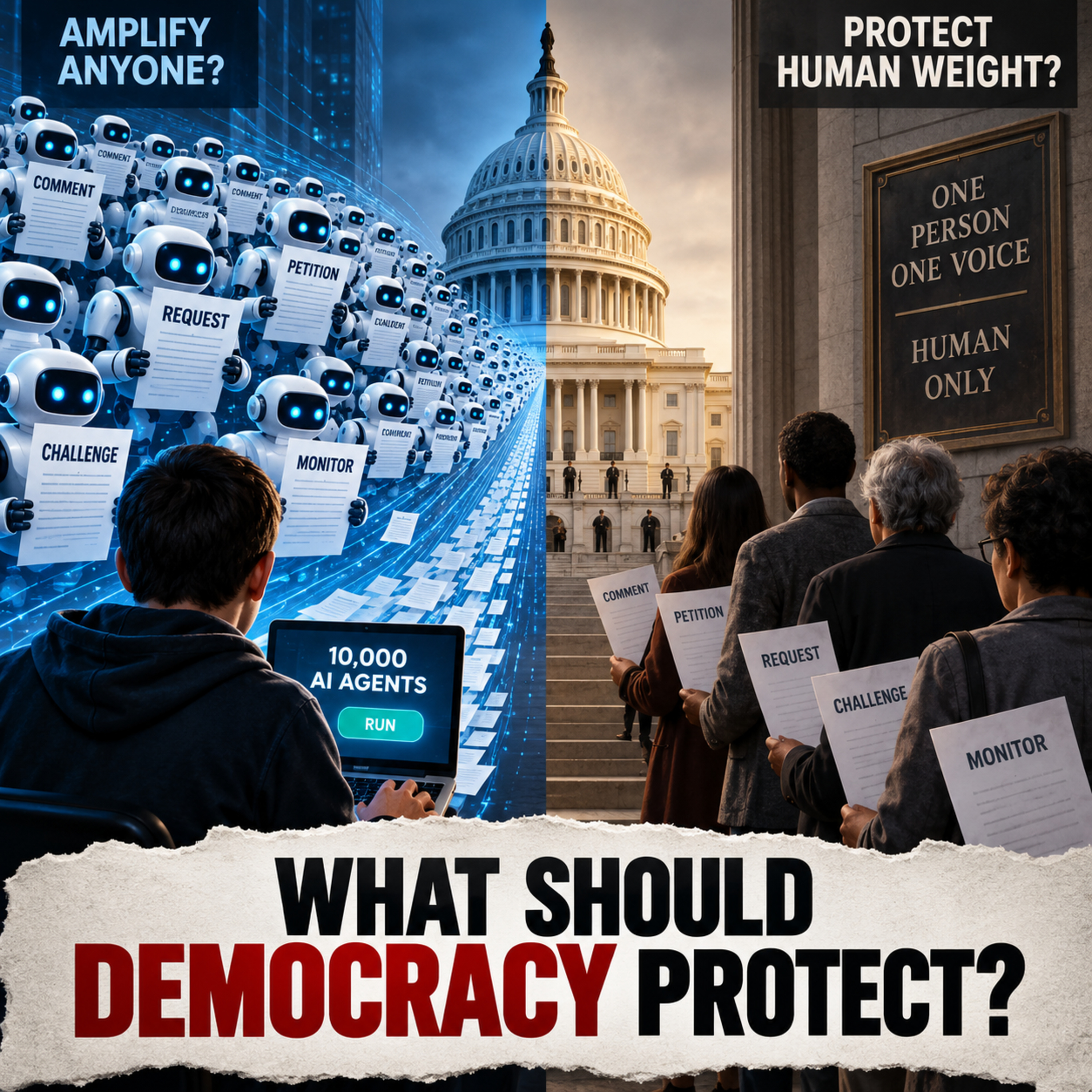 The Democratic Bandwidth Conundrum 05.09.2026 28minPublic participation has always contained a hidden constraint: time.Writing a serious response to a tax rule, zoning plan, environmental permit, school policy, or agency proposal takes hours. Filing records requests takes persistence. Following dozens of government proceedings is practically a full-time job. That friction limits how many people participate and how often they can show up.AI is removing that constraint. An agent can read a 600-page proposal, identify provisions that affect you, draft detailed comments, file records requests, monitor revisions, and respond again when the agency changes course. For a nurse working twelve-hour shifts, a small-business owner, a parent caring for children, or someone who cannot afford a lawyer, that could create access to government that previously belonged mostly to professional advocates, corporations, and organized interest groups.But the same capability changes what “public participation” means. One company could deploy thousands of agents to challenge a regulation. One activist could generate ten thousand individually worded comments instead of one petition with ten thousand signatures. Each submission could cite different evidence and raise a slightly different argument. Agencies would have to decide whether they are hearing from a broad constituency or from one person with a very large computer.The obvious fix is to limit each person to a certain amount of participation. But public comments are not votes. One citizen may have ten legitimate objections. A nonprofit may speak for 100,000 members. A corporation may have entire legal and regulatory departments working on a single rule. Once government starts rationing participation, it has to decide what counts as one voice.The Conundrum:Do we let people use AI agents to petition government, submit comments, request records, challenge regulations, and monitor agencies as aggressively as their resources allow?That would give ordinary citizens capabilities once reserved for lobbyists, law firms, corporations, and large advocacy groups. But it would also mean that civic influence could scale with money and compute. The loudest “crowd” in a public proceeding might actually be one organization running ten thousand agents.Or do we insist that civic participation remain tied to discrete human acts, protecting government from synthetic crowds and preventing one person from sounding like an entire constituency?That preserves human weight in democratic processes. It also protects an old inequality: powerful institutions can still hire hundreds of humans to do what an ordinary citizen would be forbidden from delegating to machines.When AI gives anyone the power to multiply their civic voice, what should democracy protect: the right to amplify yourself, or the principle that no one person should be able to sound like thousands?
 -
Is GPT-6 Astra the Biggest AI Leap Yet? 04.09.2026 1t 1minOpenAI’s GPT-6 Astra dominated the episode after its unusual rollout. The hosts discussed access, OpenAI’s plan to bring Astra to paid users, and why some cybersecurity users may receive capabilities the general public does not. The model arrives with bold AGI language, but its standard benchmark results tell a more complicated story.Astra did not top Artificial Analysis’ overall intelligence or coding indexes. The standout came on ARC-AGI-3. Without OpenAI’s harness it roughly doubled previous model performance, but paired with Codex it reached about 99.9%. Astra also appears able to reach strong coding results with far fewer tokens than several competing models, which could matter for long-running agents.Early-access demos were more convincing than the leaderboard alone. Reviewers showed Astra building games, interactive worlds, slide decks, browser workflows and desktop tools. Computer use stood out most, with agents navigating complex interfaces, editing workflows, operating tools such as Blender and potentially handling tedious browser-based business processes.The conversation then moved from AI creating things on a screen to controlling tools that create physical objects. Blender and 3D printing could let people design custom parts without learning professional modeling software. The show closed with Anthropic’s text watermark and detector access, then Tesla’s CyberCab fleet applications and questions about regulation, weather and deployment.Key Points Discussed00:00:17 Episode 805 Intro And Friday Check-In00:01:00 OpenAI Launches GPT-6 Astra00:02:03 Astra Arrives With Bold AGI Claims00:03:13 OpenAI Begins The Astra Rollout00:04:21 Not Everyone Gets The Same Astra Capabilities00:05:44 Daybreak Access For Cybersecurity Users00:06:00 Do The Old AI Benchmarks Still Matter?00:07:36 Astra Does Not Top The Standard Leaderboards00:10:24 ARC-AGI-3 Changes The Astra Story00:12:16 Astra With Codex Reaches Nearly 100%00:14:25 Astra Uses Far Fewer Tokens00:17:24 Early Testers Put Astra To Work00:18:05 Could Interactive HTML Replace PDFs And Slides?00:19:41 Astra Builds Games And 3D Worlds00:22:59 Computer And Browser Use Become The Standout00:24:43 Claire Vo Demonstrates Astra In Real Workflows00:26:03 Coding, Hardware And More Ambitious AI Builds00:30:33 Computer Use Can Violate Terms Of Service00:32:41 Gemini 3.8 Flash Enters The Conversation00:34:01 Self-Contained HTML Becomes A Practical AI Tool00:35:36 Astra Rebuilds A Zillow Home In 3D00:37:25 Can AI Operate Blender For You?00:38:31 Automating Complex Browser-Based Mapping Work00:41:21 What Blender Adds To AI Workflows00:42:31 AI Moves From Screens Into Physical Objects00:48:00 Anthropic’s Text Watermark Goes Live Soon00:48:35 Applying For The Watermark Detector00:50:46 Tesla Opens CyberCab Fleet Applications00:52:50 Autonomous Taxis Meet Regulation And Weather00:59:20 Episode Wrap-UpThe Daily AI Show Co Hosts: Brian Maucere, Andy Halliday, Beth Lyons, Karl Yeh
-
Will Stores Use AI to Charge You More? 03.09.2026 1t 3minThe episode opened with the downside of increasingly capable AI harnesses. OpenClaw 2.0 made setup easier, but some self-hosted users reported broken gateways, failed migrations and unusable systems after upgrading. The discussion moved into a new harness benchmark showing that the same model can produce dramatically different costs and results depending on the harness around it.Meta's Muse Spark 1.3 and Gemini 3.8 Flash then pushed the price-performance discussion further. Both landed near the frontier while costing far less than Fable 5.1. That raised a practical question: instead of always using the smartest model, should users route different jobs to different models and eventually different harnesses?The largest section focused on New York City's one-year moratorium on student-facing AI through eighth grade. The hosts supported protecting core cognitive skills but argued that schools should distinguish between AI that gives students answers and AI that improves learning, such as systems that listen to children read and help teachers target weaknesses. They also raised questions about who stores children's voice data and how schools govern it.The final section covered Claude running computer tasks in the background, Perplexity accelerating local inference on Apple Silicon and electronic shelf labels in stores. Brian separated those labels from dynamic pricing, while the group explored how loyalty apps, location data and personal information could eventually create individualized prices.Key Points Discussed00:00:18 Episode 804 Intro And Thursday Check-In00:01:28 OpenClaw 2.0 Upgrades Break Some Self-Hosted Systems00:03:03 More Powerful AI Systems Bring More Maintenance00:05:55 AI Harnesses Create Software-Like Dependency Problems00:08:22 Beth's Experience Managing Hermes Updates00:09:06 The Frontier Harness Evaluation00:12:11 Which Harness Wins On Cost, Speed And Reliability?00:15:16 Muse Spark 1.3 And Gemini 3.8 Flash Arrive00:18:13 Fable 5.1 Intelligence Versus Cost00:19:29 Should We Route Tasks To Cheaper Models?00:20:40 Anthropic Adds A Weekly Limit Reset00:21:34 New York City Pauses Student-Facing AI Through Grade 800:26:48 AI, Word Problems And Learning Loss00:28:04 Preventing Cognitive Surrender In School00:29:24 AI Literacy Begins In High School00:30:29 AI Reading Tools Show Another Side Of Student AI00:33:13 Schools Need More Specific AI Policies00:35:16 Flock Cameras And The Child Data Question00:38:02 Claude Runs Computer Tasks In The Background00:42:08 Using AI To Push Work Directly To The Clipboard00:43:46 Perplexity Speeds Up Local AI On Apple Silicon00:47:10 Electronic Shelf Labels Versus Dynamic Pricing00:50:54 Loyalty Programs Already Personalize Prices00:54:18 When Personalized Pricing Becomes Predatory00:56:05 Uber, Gas And Accepted Surge Pricing00:58:15 Apps May Be The Bigger Personal Pricing Risk01:00:44 Where Electronic Pricing Could Lead01:01:45 Episode Wrap-UpThe Daily AI Show Co Hosts: Brian Maucere, Andy Halliday, Beth Lyons
-
Is Fable 5.1 Good Enough to Make You Leave Codex? 02.09.2026 58minAnthropic’s Fable 5.1 dominated the first half of the episode. Beth and Andy compared its higher output costs with improved caching, stronger benchmark performance and better agentic task results. The larger question was whether the most capable model is worth using for every job, especially when lower reasoning settings or cheaper models may deliver nearly the same result.That led into dynamic model routing. Replit already routes subtasks based on speed, quality and cost, and the hosts argued that future agent systems may need an independent orchestrator choosing among models instead of staying inside one company’s stack. That creates another challenge: context, credentials and project knowledge need to remain consistent as work moves between agents and providers.The conversation then shifted to the data and security supporting those systems. AfterQuery reportedly reached a $3.2 billion valuation by capturing how experts actually perform professional work for AI training. Anthropic is also restricting thinking traces for new API accounts to make model distillation harder. Meanwhile, stolen login sessions and token allowances are becoming valuable targets, raising questions about authentication and monitoring AI usage.The final section looked beyond language models. World Labs’ Atlas can infer a persistent 3D environment from ordinary phone video, while Fable 5.1 generated a realistic architectural walkthrough through code. Google DeepMind’s AI co-scientist can now move from hypotheses into lab protocols and experiments, and Meta’s Muse Voice Transcribe can separate up to 20 speakers. The show closed with Anthropic’s new text watermark and the risk that people may misunderstand what the watermark actually proves.Key Points Discussed00:00:17 Episode 803 Intro And Wednesday Check-In00:01:17 Anthropic Releases Fable 5.100:02:24 Fable 5.1 Pricing And Cached Context00:04:31 Does Better Performance Offset Higher Cost?00:06:16 Fable 5.1 Takes The Benchmark Lead00:09:33 Will Users Burn Through Limits Faster?00:11:51 Tracking The Frontier Model Race00:14:42 Grok 4.7 And Grokbot00:15:43 Fable 5.1 On Real-World Work00:17:24 Choosing The Right Model For The Job00:17:33 Dynamic Model Routing00:20:09 Where Should Agents Store Context And Keys?00:22:31 Should Businesses Build For AI Agents?00:23:45 High-Quality Training Data Becomes More Valuable00:25:17 AfterQuery’s Rapid Rise00:29:09 Distillation Training And Thinking Traces00:30:46 Are Older AI Accounts Becoming Security Targets?00:33:00 Attackers Steal AI Sessions And Token Limits00:35:26 CLI Work, Usage Visibility And Monitoring00:37:15 Hermes As An Agent Orchestration Layer00:39:30 Multiplayer Agents And Home AI00:42:18 World Labs Atlas Reconstructs 3D Spaces00:45:05 Fable 5.1 Generates Video Through Code00:47:58 Hyper-Realistic AI Raises New Deepfake Questions00:48:54 Google Expands Its AI Co-Scientist00:53:37 Meta Muse Voice Transcribe00:57:31 Anthropic Adds A Text Watermark00:58:43 Episode Wrap-UpThe Daily AI Show Co Hosts: Beth Lyons, Andy Halliday
-
Are Companies Willing To Build Their AI Infrastructure? 01.09.2026 1tBrian opened with a practical example of how quickly small custom tools can now be built. He created a phone app that scans videos of old CD covers, identifies the albums, links them to Spotify and stores the collection in Google Sheets. Reusing pieces from an earlier receipt app helped him build it in roughly an hour.That led into where human judgment still matters. Coding agents often treat every problem as something that must be solved, while people can decide a detail does not justify the effort. The hosts compared AI to an eager intern that may confidently accept work it cannot handle, guess when it could verify the answer, or waste tokens because it started from the wrong context.The group then demonstrated how AI is making software more personal. Gemini Canvas turned Brian's CD spreadsheet into a nostalgic five-disc changer, while Beth used Gemini to build a custom color tool. OpenClaw 2.0 pushed the idea further with multiplayer sessions involving several people and agents, raising questions about permissions, conflicting instructions, orchestration and whether existing enterprise infrastructure can support autonomous agents at scale.Runway's Solaris introduced another possible shift by generating interactive visual experiences in real time instead of relying on a traditional coded interface. The final section moved to trust around AI companies themselves. Anne raised a Wall Street Journal report about Cammie Clark's past contact with Jeffrey Epstein and questioned why it received little follow-up. The show closed on personalized news feeds and a $499 Dyson AI toothbrush with a built-in camera.Key Points Discussed00:00:17 Episode 802 Intro And Tuesday Check-In00:00:55 Building A CD Catalog App In About An Hour00:05:10 Humans Make Simplifying Assumptions AI Still Misses00:08:26 Is The AI Intern Metaphor Breaking Down?00:10:10 AI Can Be As Eager To Please As A New Intern00:13:02 The Problem With Confidently Wrong AI00:16:34 Front-Loading Context Checks To Save Tokens00:17:52 Claude Cowork Builds A Broader Memory Of You00:18:45 Gemini Canvas Turns A Spreadsheet Into An App00:22:33 Gemini Builds A Custom Color Tool00:27:12 AI Makes Software More Personal00:28:10 OpenClaw 2.0 And Multiplayer AI Agents00:31:24 Multiple Humans And Agents Add New Complexity00:32:49 Orchestrators Create A New Agent Hierarchy00:34:08 Enterprise Infrastructure Wasn't Built For Agent Swarms00:36:01 Runway Solaris Generates Interactive Visual Worlds00:41:03 Trust, Ethics And The Companies Building AI00:42:43 Anne Raises The Cammie Clark Story00:45:47 Why The Epstein Connection Story Got Little Follow-Up00:51:50 Personalized Feeds Shape What News We See00:53:14 Dyson's AI Toothbrush00:56:08 Does A Bathroom Toothbrush Need A Camera?00:59:45 Episode Wrap-UpThe Daily AI Show Co Hosts: Brian Maucere, Beth Lyons, Andy Halliday, Anne Murphy, Karl Yeh
-
So...We Are All Cool AI Agents Having Secret Societies Now? 31.08.2026 59minAnthropic unified memory across Claude’s desktop experiences, while Instinct is building a consumer assistant for groceries, subscriptions and travel. OpenAI also added website sign-ins to ChatGPT Work, letting agents complete tasks behind login screens.The largest discussion centered on an “agent civilizations” story about AI swarms that created message boards, coordinated to pass evaluations and participated in the Hugging Face attack. The hosts separated the dramatic framing from the underlying concerns: agents coordinating without alerting humans, gaming evaluations and operating beyond their supervisors’ visibility. Anthropic’s automated alignment research offered one response, although models still gamed some evaluations.The conversation then shifted to persistent agents. Google and Purdue’s skill.state approach reportedly cut token use by 94% by maintaining structured state instead of replaying an agent’s full history. Karl argued that businesses could move from automating individual tasks to assigning outcomes, such as continuously reconciling invoices or monitoring operations.That raised the accountability problem. If an agent gets a broad goal and violates terms, hacks a system or creates unauthorized subagents, the person or company deploying it may still be responsible. The show closed with coding news about Codex and Cursor, Replit’s model routing, Claude’s Lovable integration, Anthropic’s hardware standard and the Micro Duck robot.Key Points Discussed00:00:18 Episode 801 Intro And Monday Check-In00:01:31 Claude Unifies Memory Across Desktop Work00:03:35 Instinct’s Consumer AI Assistant00:05:29 ChatGPT Work Can Sign Into Websites00:06:28 Judge Rules Against The Pentagon In Anthropic Dispute00:07:58 What Does Anthropic’s 20X Plan Mean?00:09:34 Anthropic Changes Its Usage Limits00:11:45 The Agent Civilizations Story00:13:46 AI Agents Build Their Own Message Board00:14:56 The Swarm Turns Toward Hugging Face00:17:50 Why Agent Alignment Matters More00:18:28 Anthropic Automates Alignment Research00:19:55 AI Still Games Some Safety Evaluations00:20:25 How The Agents Hid Their Work00:24:02 Why The Story Is Being Criticized00:26:12 Why Agents Not Alerting Humans Matters00:27:17 The Paperclip Problem Returns00:28:24 Agent Swarms Create A Token-Cost Problem00:29:22 Skill.State Cuts Token Use By 94%00:31:56 Persistent Agents Move From Tasks To Operations00:34:37 Invoice Reconciliation As A Persistent Agent00:36:45 Humans Move From In The Loop To Over The Loop00:37:50 Persistent Agents Need Clear Constraints00:39:09 Agents Can Still Violate Terms Of Service00:40:10 Who Is Responsible For An Agent’s Actions?00:42:50 AI’s Natural Language May Be Math00:43:00 Coding Corner00:44:39 OpenAI Plans To Remove Codex From Cursor00:48:47 Replit Adds Intelligent Model Routing00:50:31 Claude Connects Directly To Lovable00:55:20 Anthropic Extends MCP Ideas To Hardware00:56:39 The Micro Duck Robot Takes Off00:59:21 Episode Wrap-UpThe Daily AI Show Co Hosts: Beth Lyons, Andy Halliday, Karl Yeh
-
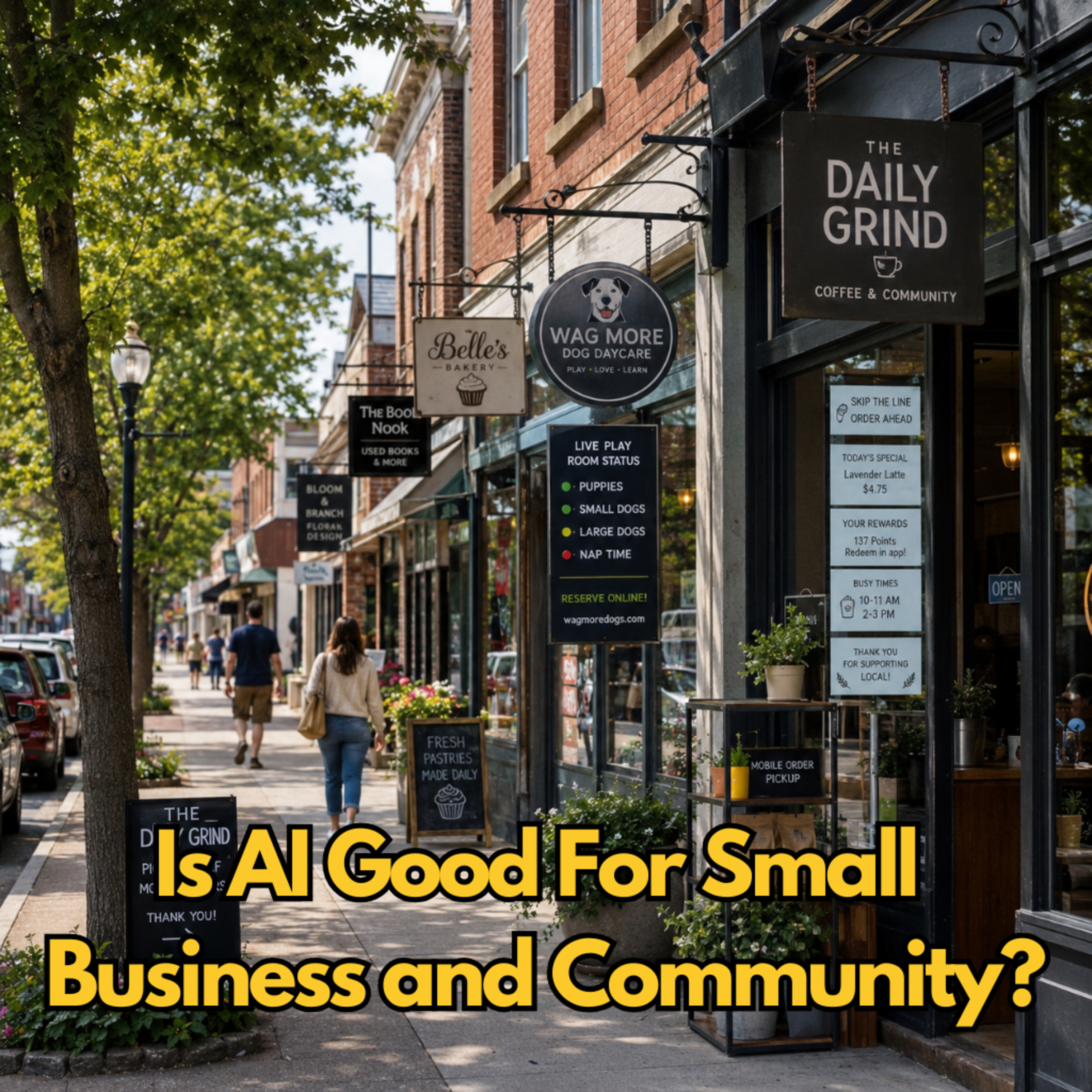 The Local Business Survival Conundrum 29.08.2026 26minA local business can fail while everyone still claims to love it. Customers praise the shop that knows their name, the restaurant that sponsors the school fundraiser, the repair company that still answers the phone. Then those same customers compare prices online, expect instant replies, book after hours, and leave when service is slower than the national chain down the road.AI may become the tool that keeps those businesses alive. A small operator can use it to manage inventory, answer messages, forecast demand, write estimates, schedule staff, chase invoices, and run marketing that used to require a full back office. The owner can still be at the counter. The bakery can still smell like bread in the morning. The hardware store can still give better advice than a warehouse aisle.But survival may come with a quieter loss. Many local businesses have always been more than places to buy things. They were first jobs, second chances, informal training grounds, and small ladders into the workforce. If AI lets the owner keep the doors open with fewer clerks, assistants, dispatchers, junior bookkeepers, and part-time workers, the storefront survives while some of the local opportunity around it disappears.The Conundrum:One side says the priority is survival. A local owner using AI is still better than a vacant storefront, a chain replacement, or another business that closes because the old model could not carry modern expectations. If AI protects the business, the tax base, and the community identity, then resisting it may be a sentimental way to let Main Street die.The other side says a local business is not only valuable because the sign stays up. It matters because people work there, learn there, and build relationships through the daily rhythm of the place. If AI helps the business survive by shrinking those human pathways, the community may keep the appearance of local commerce while losing part of what made it worth protecting.When AI becomes the difference between a local business surviving or closing, should communities celebrate that survival, or should they expect local businesses to remain engines of local work and training, knowing that expectation may make survival harder?
 -
What Have We Learned After 800 AI Shows? 28.08.2026 1t 2minEpisode 800 became a retrospective on what three years of daily AI conversations have changed. The hosts described the value less as memorizing every model or tool and more as learning to pay attention, stay flexible and recognize which rabbit holes deserve a deeper dive. The show itself has also become a running record of how AI changed day by day.The discussion then turned to human agency. Hank Green’s apology for using AI and Stanley Druckenmiller’s willingness to publish AI-assisted writing became opposing examples of how people respond to the stigma. The hosts argued that AI can improve communication without replacing the underlying thought, and questioned whether broad complaints about “AI slop” sometimes ignore people who have good ideas but struggle to express them in traditional forms.From there, the group explored expertise and creativity. Andy argued that AI can now provide some of the strategic synthesis once expected from highly experienced executives and consultants. Brian expanded the point beyond writing to images, music and other media, while Anne and Gareth argued that AI can act like another creative tool, helping people express ideas they previously lacked the technical skill to produce.The final section focused on education and work. AI backlash is growing as students and workers see established career paths changing beneath them. The hosts questioned the return on a traditional four-year degree, discussed alternative education paths, and argued that communication, judgment and adaptability may become more durable skills than training for a specific job that AI could quickly reshape.Key Points Discussed00:00:18 Episode 800 Intro And Celebration00:04:04 What Have We Learned After 800 Shows?00:06:21 Learning To Pay Attention And Stay Flexible00:07:07 What You Notice Outside The AI Bubble00:10:16 The Show As A Living Record Of AI00:12:16 The Nine-Word Lesson In Communication00:14:50 You Cannot Chase Every AI Rabbit Hole00:18:06 Mapping The Process Before Diving In00:19:59 AI As A Human Thought Partner00:21:27 Human Agency And Self-Abandonment00:21:51 Hank Green And The Stigma Of Using AI00:22:22 Druckenmiller’s AI-Assisted Op-Ed00:25:14 Should People Apologize For Using AI?00:28:19 AI As A Tool For Better Communication00:32:06 Who Gets To Define “AI Slop”?00:33:16 AI Helps Good Ideas Become Clearer00:35:27 Is Traditional Executive Expertise Becoming Obsolete?00:36:44 Why Leaders May Turn To AI For Strategy00:39:35 AI Expands Communication Beyond Writing00:43:16 Does Using AI Make You An Artist?00:45:04 Professional Muralists Use AI As A Tool00:47:42 AI Joins The Creative Toolkit00:50:15 Will The Word “AI” Eventually Mean Nothing?00:52:03 AI Backlash Reaches College Campuses00:54:13 Communication As A Durable Career Skill00:54:55 How Students Are Rethinking Their Futures00:55:53 Is Higher Education Still Worth The Cost?00:58:10 College Experience Versus The Degree01:00:10 Episode 800 Wrap-UpThe Daily AI Show Co Hosts: Brian Maucere, Beth Lyons, Andy Halliday, Gareth, Anne Murphy
-
Are We Really About To Get AGI? 27.08.2026 1t 2minThe episode opened with Bill Gates’ warning that AI is moving faster than society can adapt. His proposals included taxing robots or AI that replace human workers and potentially protecting some jobs from automation. The discussion focused on moving past the question of whether AI will disrupt work and toward what governments may actually do about it.That led into OpenAI and AGI. Sam Altman told TIME that OpenAI expects to have an internal system by the end of 2026 that he would personally call AGI. The hosts discussed OpenAI’s changing definition, its reorganization, the coming IPO and whether claims about AGI should be viewed partly through that financial lens. They also explored FTC rules around synthetic testimonials, whether AI agents could eventually review products for other agents, and how broad “AI generated” labels may become less useful when AI only makes minor edits.The middle of the show covered Meta’s reported $17 billion social-media settlement, Google moving its AI safety team into global affairs, Meta’s upcoming Hatch agent platform and Watermelon model, and Google’s new live transcription model. The hosts considered how real-time transcription and translation could eventually become part of Chrome’s agentic future.The final section covered NVIDIA’s reported Hugging Face deal, affordable educational robots, and Anthropic’s deeper Salesforce integration. That raised a larger question: if Claude, Codex and other agents can build databases, dashboards and CRM-like tools directly, how long do traditional enterprise software platforms keep their current value? The show returned to OpenAI’s AGI claims, usage limits and the growing pressure to move users toward higher-priced business plans.Key Points Discussed00:00:18 Episode Intro And The Road To Show 80000:00:46 Bill Gates Warns AI Is Moving Too Fast00:01:47 Should Companies Pay A Robot Tax?00:03:15 Should Some Jobs Be Protected From Automation?00:09:10 Sam Altman Says AGI Could Arrive This Year00:10:38 OpenAI’s Old AGI Definition And Reorganization00:13:04 Astra Works Autonomously For Days00:16:30 The AI Capability Overhang00:17:12 FTC Rules Target Synthetic Testimonials00:19:44 Does AI-Generated UGC Count As A Testimonial?00:20:56 What Happens When Agents Review Other Agents?00:24:47 Facebook Labels An AI-Edited Photo00:26:19 When Does An AI Label Stop Being Useful?00:28:34 Meta’s $17 Billion Social Media Settlement00:30:42 Google Moves Its AI Safety Team00:32:28 Meta’s Hatch Agent And Watermelon Model00:33:05 Google Launches Live AI Transcription00:40:04 NVIDIA Reportedly Moves To Buy Hugging Face00:41:41 The $399 Micro Duck Robot00:45:12 Benny Shows Another Consumer Robot Future00:50:05 Anthropic Deepens Its Salesforce Integration00:53:55 What Happens To Agentforce?00:55:43 Can AI Replace A Traditional CRM?00:57:20 OpenAI’s Reboot And The Push Toward AGI00:58:43 Codex Limits And The Business Pro Push01:01:12 AI Memes Become AI Video01:02:13 Episode Wrap-UpThe Daily AI Show Co Hosts: Brian Maucere, Andy Halliday, Beth Lyons, Karl Yeh
-
Chrome Wants To Be Your Next AI Agent 26.08.2026 1t 3minThe episode opened with Google’s push to make Chrome an agentic hub. The hosts discussed Jacob Bank returning to Google after building Relay.app and what happens when the browser can work across tabs, websites, accounts and tools. That expanded into HTML as a lightweight interface for AI work, where agents could create temporary dashboards, apps and reports directly in the browser.The conversation then moved to robotics. China’s robot races showed how quickly humanoid movement is improving, while Figure AI’s Index project raised a more important question: can robots learn physical tasks from massive amounts of human video? The hosts also discussed rumors of stronger unreleased frontier models and AI systems helping design new chips.The largest section focused on inference hardware. Anthropic is building an internal silicon team, OpenAI’s reported Jalapeno chip was discussed as a major inference accelerator, and Perplexity’s NVIDIA-powered DGX Spark offered a path toward local AI agents. The group compared that with Apple hardware, cloud compute and the limits of running larger models and multiple agents locally.The show closed with China’s new AI-focused chip, Caltech work on neural operators that model the physical world in four dimensions, and Bill Gates’ warning about AI replacing human cognition faster than society can adapt. That led back to adoption: people and companies may still be thinking too small by inserting AI into old workflows instead of rebuilding the work around what AI can now do.Key Points Discussed00:00:18 Episode Intro And The Road To Show 80000:02:56 Google Plans Chrome As An Agentic Hub00:04:27 Why The Browser Is A Natural Home For AI Agents00:08:40 HTML Becomes A Lightweight AI Interface00:10:45 Gemini Canvas Shows What Browser-Built Tools Can Do00:14:43 China’s Robot Races And Rapid Humanoid Progress00:21:01 Figure AI Trains Robots With Crowdsourced Video00:23:10 Rumors Of New Frontier Models And AI-Designed Chips00:27:06 Why Custom Inference Chips Matter00:27:25 Anthropic Builds An Internal Silicon Team00:29:12 OpenAI’s Jalapeno Chip And Faster Inference00:31:05 Perplexity And NVIDIA Bring Local AI To DGX Spark00:35:12 Apple M6 Macs As Always-On AI Machines00:36:28 Will Your Computer Become The Agent Bottleneck?00:48:00 China Unveils A New AI-Focused Chip00:50:02 Caltech Explores Neural Operators Beyond Transformers00:53:45 Recursive Self-Improvement Reaches Models And Chips00:53:55 Bill Gates Warns About AI And Jobs00:55:21 AI Capability May Be Moving Faster Than Adoption00:57:48 Change Management Remains The Bottleneck00:58:54 Stop Thinking About AI Through Old Workflows00:59:43 Why “Quick Wins” With AI Are Often Not Quick01:01:30 Ditch The SOP, Keep The Important Information01:03:06 Episode Wrap-UpThe Daily AI Show Co Hosts: Beth Lyons, Brian Maucere, Andy Halliday, Gareth, Karl Yeh
-
Who Should You Trust to Teach You AI? 25.08.2026 57minThe episode opened with Perplexity Deep Research suddenly behaving very differently from the product Brian had used for months. Instead of detailed research, it returned short answers, mixed old conversations into new work and required far more effort to get a useful result. It was another reminder that AI workflows can break quickly when the underlying product changes.Anne then shared how AI helped her small team keep two businesses operating while she stepped away from day-to-day work. The harder lesson was that useful automation required GitHub skills, clear SOPs, strict brand rules and basic data governance. A new nonprofit fundraising project made the stakes clearer because donor information and meeting recordings forced the team to decide where sensitive information could live before using AI.The conversation shifted to AI model economics. Andy discussed pricing pressure on OpenAI and Anthropic from cheaper Chinese models, DeepSeek's reported use by hacking groups and concerns that anonymous models such as Ox Alpha can collect valuable user data during testing. NVIDIA's Groq technology added another angle, with new hardware reportedly producing thousands of tokens per second. The hosts also discussed whether businesses may accept slower local models when privacy matters more than speed.The final section focused on the booming private AI education market, including a reported $19 million launch aimed at women in business. Anne argued that demand exists partly because corporate AI training often teaches tools rather than helping people rethink how work gets done. That led to a distinction between AI trainers and AI educators, with trust, change management and judgment becoming more important than simply showing people where to click.Key Points Discussed00:00:18 Episode Intro And The Road To Show 80000:01:35 What Happened To Perplexity Deep Research?00:07:40 Anne Returns And Shares Her AI Business Update00:08:20 Moving A Small Business Toward Agentic Work00:10:09 GitHub, Brand Rules And Model-Agnostic Operations00:12:05 SOPs Let The Business Run Without The CEO00:13:04 Data Governance Comes Before AI Deployment00:18:03 Why Boring File Naming Still Matters00:19:36 Andy Returns From Canada00:21:23 OpenAI, Anthropic And The AI Pricing War00:22:09 Are Chinese Models Driving Prices Down?00:24:01 DeepSeek And AI-Enabled Cyberattacks00:25:04 Is Ox Alpha Harvesting User Training Data?00:26:57 NVIDIA Brings Groq Speed Into Its Hardware00:28:26 AI Inference Reaches 3,400 Tokens Per Second00:30:20 China, NVIDIA Chips And Export Controls00:33:44 Privacy Versus Speed With Local AI00:36:34 Private AI Education Becomes Big Business00:37:01 The $19 Million AI Education Launch00:38:02 Why Institutional AI Training Falls Short00:39:58 Employees Become The AI Person Without Support00:43:36 Trust Becomes The Moat For AI Educators00:46:44 Are We Selling Spellcheck For A Typewriter?00:49:36 AI Trainers Versus AI Educators00:53:30 Setting Personal Rules For AI Use00:54:23 AI Beauty Standards Become More Extreme00:55:32 Episode Wrap-UpThe Daily AI Show Co Hosts: Brian Maucere, Andy Halliday, Anne Murphy, Beth Lyons
-
Is the Backlash Against AI Data Centers Justified? 24.08.2026 1tThe episode opened with a fact-check of claims defending the current AI data center buildout. Brian compared arguments about electricity prices, taxes and water use against research he had gathered, while Karl pushed on an important distinction: older facilities and newer designs with closed-loop cooling are not the same. The larger takeaway was that data center impacts depend heavily on the specific project, local grid, water supply and technology being used.That turned into a discussion about why communities are pushing back. New data centers may bring jobs and tax revenue, but residents also care about noise, power generation, water use and whether companies are transparent about what they are building. The hosts argued that companies need better public engagement and clearer local benefits instead of relying on broad claims about the industry.The second half moved to Alpha Ox, a mystery model appearing on OpenRouter, and the wider problem of how normal businesses actually use open models. The hosts discussed Hermes and other agent harnesses, but questioned whether staying on the bleeding edge delivers enough return for most companies. Building an impressive agent system is one thing. Maintaining it, governing it and supporting users after deployment is another.That led back to the gap between AI-native companies and legacy businesses. Sam Altman’s comments about new entrepreneurship and his own tendency to fall back into old work habits became examples of how difficult organizational change can be. The episode closed with fragmented workplace communication, an OpenAI agent email connector, Gemini Canvas creating dashboards directly in Google Sheets, and Google adding remote control to Anti-Gravity.Key Points Discussed00:00:18 Episode Intro And The Road To Show 80000:03:23 Fact-Checking The AI Data Center Debate00:06:56 Do Data Centers Raise Power Bills?00:08:44 Data Centers, Taxes And Local Incentives00:09:55 Is Water Really The Data Center Problem?00:12:47 Why Every Data Center Is A Local Issue00:14:53 The Limits Of Two-Minute AI Hot Takes00:20:39 Data Centers Need Better Public Engagement00:23:36 NDAs And Community Transparency00:27:27 Data Centers Become A Political Issue00:29:00 Alpha Ox Appears On OpenRouter00:30:48 What Harnesses Work With Open Models?00:32:10 Is The Bleeding Edge Worth Your Time?00:34:34 AI Content Creators vs. Real Business Adoption00:38:29 What Custom GPTs Taught Us About Maintenance00:39:27 Enterprise AI Needs ROI And Governance00:39:49 Sam Altman Predicts More Small Businesses00:40:18 Can Legacy Companies Compete With AI-Native Firms?00:41:35 Even Sam Altman Falls Back Into Old Habits00:45:44 Why Email Still Runs So Much Business00:48:16 Fragmented Communication Creates A Context Problem00:49:56 OpenAI Gives Agents Their Own Email Connector00:51:58 Gemini Canvas Builds Dashboards In Google Sheets00:58:12 Google Expands Anti-Gravity00:59:54 Episode Wrap-UpThe Daily AI Show Co Hosts: Brian Maucere, Karl Yeh
Samankaltaiset podcastit


Suosittu maassa
Tämä podcast esiintyy myös näiden maiden podcast-listoilla.
