
The Bedtime Scientist: Calm Science for Sleepy Kids
Josh Fleishman
0
The Bedtime Scientist is a calming podcast that transforms real scientific concepts into soothing bedtime stories for children. It offers a trustworthy alternative to chaotic children's shows, with a single narrator guiding young listeners through the wonders of the world. The podcast aims to help kids learn softly and sleep soundly, without fairy tales or excitement.
Jaksot
-
 Lighthouses: The Light That Comes Back 08.09.2026 7minHow do lighthouses work? Tonight we stand on a dark cliff above the ocean and watch a light turn, pass out over the water, and come back around. A calm bedtime story about one of the best ideas anyone ever had about light.Two hundred years ago, a lighthouse wasted most of its light. Some of it went up into the empty sky. Some went down into the water. Only a thin band went straight out toward the sea, which was the one direction that mattered. Then a scientist put rings of glass around the flame. Circles inside circles, built into a shape people describe as a glass beehive. The rings above bent the stray light back down. The rings below bent it back up. Every ring aimed its share flat at the horizon. Same lamp. Same flame. Nothing added to it. And a light you could have covered with your hands became something a ship could see from twenty miles out.Then comes the part that makes a lighthouse more than a light. In the dark, one light looks like any other light. So every lighthouse on a coast is given its own pattern of flashes, and that pattern is called its character. One flash, then five seconds of nothing. Two quick flashes, then a long dark. Sailors count the flashes, find the pattern on a chart, and know exactly which light they are looking at, which tells them exactly where they are. Pigeon Point in California has flashed once every ten seconds for more than a hundred and twenty-five years.It runs all night whether or not there is a ship out there. Right now, on coasts everywhere, thousands of them are counting in the dark.WHAT YOUR KID WILL LEARNWhy light spreads in every direction, and why that is a problem for a lighthouseHow the rings of a Fresnel lens bend wasted light back toward the horizonWhat a lighthouse's character is, and how sailors read a flash pattern to find their positionPigeon Point Lighthouse and its unbroken hundred and twenty-five year rhythmHow keepers once climbed the stairs and wound the turning machinery by hand, and how a sensor does it nowWhy ships still rely on lighthouses in the age of satellitesGood for bedtime, quiet time, long car rides, waiting rooms, and any moment a kid needs the volume of the world turned down.ABOUT THE SHOWThe Bedtime Scientist is a calm science podcast for curious kids and the grown-ups lying next to them. One steady voice, real science, no sound effects, no shouting, no cliffhangers. Every episode begins by settling the body and ends by letting the mind drift. It is built to be sensory friendly and genuinely soothing, and it is written in layers, so a four year old can feel it, an eight year old can learn from it, and a parent can be quietly moved by it.If your family is looking for bedtime stories for kids, calm sleep stories, or a science podcast for children ages 4 to 10 that respects everyone's intelligence and everyone's nervous system, start here.KEEP EXPLORINGMost episodes begin as questions from listeners. If your kid has been wondering about something, send it to me at bedtimescientist.com. That is also where you will find a free family guide for every episode, so when you wake up tomorrow you can keep going.Following the show is the single most useful thing you can do. It puts the next episode in front of you at bedtime, when you actually need it.Topics in this episode: lighthouses, the Fresnel lens, light and optics, ocean navigation, the sea at night, how things work, bedtime science, calm sleep stories for kids.
 -
 Amazon Rainforest: The River Above the Trees │ Calm Bedtime Science for Kids & Adults 31.08.2026 9minWhat if there were a river above the trees?Deep in the Amazon rainforest, water is always moving. Rain falls through the canopy, soaks into the ground, enters the roots of enormous trees, and travels upward through their trunks. Then, high in the leaves, some of that water leaves the tree and rises into the air as water vapor.It sounds almost impossible: rain going back up.But that's exactly what happens.Learn so much more at www.BedtimeScientist.comIn this calm bedtime science episode, we travel into the Amazon rainforest to discover the hidden water cycle above the forest floor. You'll hear how trees move water from the soil to their highest leaves, how water vapor becomes tiny cloud droplets, and how some of the rain that falls on the forest can return to the atmosphere through the trees.Then we discover something even bigger.The Amazon River carries an enormous amount of water toward the ocean every day. At the same time, the forest is putting an astonishing amount of water back into the atmosphere. Scientists sometimes describe these vast movements of atmospheric moisture as "flying rivers."One river is easy to see.The other is above the trees.And the one you can't see is the one that helps keep the other one full.Along the way, we'll explore the rainforest canopy, transpiration, clouds, rain, water vapor, and the tiny particles that help cloud droplets form. We'll also listen to the rainforest itself: insects calling through the night, frogs below the canopy, and rain arriving slowly through layer after layer of leaves.Like every Bedtime Scientist episode, this is real science presented slowly and simply, with no music, no sudden sounds, and no need to keep up. It's designed for winding down while giving curious minds something fascinating to wonder about.The Bedtime Scientist creates calm, science-based explorations for kids and adults, covering everything from dinosaurs and planets to oceans, weather, animals, Earth, and the surprising science happening all around us.Tonight, somewhere in the Amazon, water is moving upward through millions of leaves.That's the rain going back up.The Bedtime ScientistCalm science for curious minds.Learn softly. Sleep soundly.
 -
 The Bridge Built to Move │ Calm Bedtime Science for Kids & Adults 17.08.2026 9minBridges move. All of them, all the time, and that's not a flaw. That's the design. Be sure to follow/rate the show! Also, check out BedtimeScientist.com for so much more!Tonight, we stand on two very different bridges.One is a stone bridge in Greece, built more than three thousand years ago with enormous limestone blocks and no mortar or glue. The stones hold together through their shape, their weight, and the forces pushing through them. People still cross the actual bridge today.The other is a modern suspension bridge in San Francisco: the Golden Gate Bridge.It looks completely still from the road. But it isn't.Its enormous steel cables expand when they heat up in the sun and contract as they cool. The roadway rises and falls. Wind makes the bridge sway. Traffic makes it vibrate. And engineers have designed every part of the structure to handle those forces.A telescope positioned about two miles away can measure the bridge's movement. On an ordinary day, the roadway can change height by roughly half a foot to a foot and a half as the cables heat and cool. The change doesn't happen immediately, either. Because the cables are so massive, the bridge responds to temperature with a delay of about two hours.And across its full designed range, the bridge can move by as much as sixteen feet from its lowest position to its highest.Sixteen feet.So how does a bridge hold up thousands of pounds of cars, trucks, and people while bending, stretching, swaying, expanding, and contracting?That's where the science of bridges begins.In this episode of The Bedtime Scientist, we'll explore the forces that make bridges work: gravity, tension, compression, weight, heat, wind, and movement. We'll look at how suspension bridges, arch bridges, and truss bridges carry forces through their structures and eventually into the ground.Because a bridge isn't strong because it refuses to move.It's strong because engineers designed it to move in exactly the ways it needs to.The Bedtime Scientist is a free kids science podcast designed for bedtime, quiet time, and winding down. Each episode explores one fascinating piece of real science in a calm, steady voice, from dinosaurs and planets to oceans, animals, weather, engineering, physics, and the science happening all around us.Episodes are about ten minutes long, with nothing to watch and no reason to stay awake for the ending.No sound effects. No characters. No jump scares. No music that builds. Just real science, curiosity, and a voice designed to give kids space to wonder.The show is made for children and families, with a particularly gentle listening experience for kids who are sensitive to sound or stimulation, including many autistic and ADHD listeners.Listen free on Apple Podcasts, Spotify, YouTube, and Yoto.More episodes and more science at bedtimescientist.comThanks for wondering with me,Josh, The Bedtime Scientist
 -
 Octopus: A Mind in Every Arm │ Calm Bedtime Science for Kids & Adults 10.08.2026 11minTonight, we're heading deep into the ocean to visit one of the most remarkable animals on Earth. Eight arms, three hearts, blue blood, and not a single bone in its body. In exactly the time it takes to settle into bed, we'll discover how an octopus tastes the world, carries its own portable shelter across the seafloor, and maybe even dreams in color while it sleeps.Press play, turn off the lights, and let the world get a little quieter.Tonight, we're wondering about:How an octopus uses its suckers to taste the ocean floor.Why it has three hearts, and what happens to them when it swims.The mystery of how an octopus changes color to perfectly match a rock — even though it might be colorblind.What happens to an octopus's skin when it falls asleep (and why scientists think it might dream just like you).Explore So Much More at Bedtimescientist.comLooking for more true science stories? There is so much more waiting for your family at bedtimescientist.com. From our complete audio library to our companion children's science books — designed specifically as calm, guided bedtime reads — you'll find everything you need to build the perfect wind-down routine.About The Bedtime Scientist:The Bedtime Scientist is a calm sleep podcast for kids that tells one true science story every night. No characters, no loud sound effects, no jump scares, and no hype. Just one steady, soothing voice explaining something real in 10 minutes — the exact length of the walk from "brush your teeth" to falling asleep.If you are searching for a screen-free alternative to YouTube and tablets at night, this podcast is built for lights-out listening. It's designed as a low-stimulation, sensory-friendly audio experience that helps busy minds slow down. Loved by parents, teachers, and occupational therapists, it is the perfect ADHD-friendly and autism-friendly bedtime routine for highly sensitive or anxious kids who get overstimulated by typical children's media.Perfect for toddlers, preschoolers, early elementary kids, and the parents listening in the dark right next to them. (Also available as a screen-free listening option on the Yoto app!)Listen, Follow & Review:New episodes arrive regularly. Free wherever you listen to podcasts. If this true science bedtime story helped your family wind down tonight, please leave a rating or review!Thanks for wondering with me,Josh, The Bedtime Scientist
 -
 Where Does Sand Come From? │ Calm Bedtime Science for Kids & Adults 03.08.2026 11minWhere does sand come from? Not from the beach. Pick up a handful and you're holding thousands of separate pieces of something, and none of them started there.Please remember to follow, rate and comment! It goes a long way in helping the show!Tonight we follow a single grain backward. Down a mountain, along a river, out to a coral reef where some of the whitest sand in the world was made by a fish, one mouthful at a time.Along the way: why sand isn't a material at all, why the ocean is moving the beach rather than wearing it down, and why the beach you visited last summer is in the same place but isn't the same sand.Calm bedtime science for a beach week, or for missing one.A free, screen-free bedtime podcast for kids, made for ages 3 to 11. Every night, one steady voice tells the true story of one real thing in the world. A volcano. A whale's song. The tide. About ten minutes, with nothing to watch and no reason to stay awake for the ending.
 -
 Jupiter: A World Made of Sky 28.07.2026 10minA calm bedtime science episode about Jupiter, paced gently to help a child fall asleep.Tonight's episode travels past the satellites, past the Moon, past Mars, out to the largest planet in the solar system. Earth is a ball of rock wrapped in a thin coat of air. Jupiter is the opposite. There are no mountains under its clouds, no valleys, no ocean floor. The sky isn't a coat on Jupiter. The sky is the planet.Go deep enough and the pressure grows so enormous that hydrogen stops behaving like a gas and begins to flow like liquid metal. Higher up, winds race east and west in opposite directions, and where they slide past each other, storms begin.And on Jupiter, storms don't stop. Here on Earth, a hurricane crosses onto land and the land ends it. Jupiter has no land. Which is why one storm there, the Great Red Spot, has been turning for nearly two hundred years, and is still wide enough to swallow the Earth.One voice. Real science. No music, no effects, no screen required. Works as well on the fifth night as the first. Parents often drift off first.The Bedtime Scientist is a bedtime science show for children and families, made for the quiet part of the night when a curious kid isn't quite ready to sleep.Every episode, printable parent guides, and books are at bedtimescientist.com.If your family listens often, following the show and leaving a rating helps other families find it.A bedtime science story about Jupiter, its endless sky, and the storm that has no ground to stop it.
 -
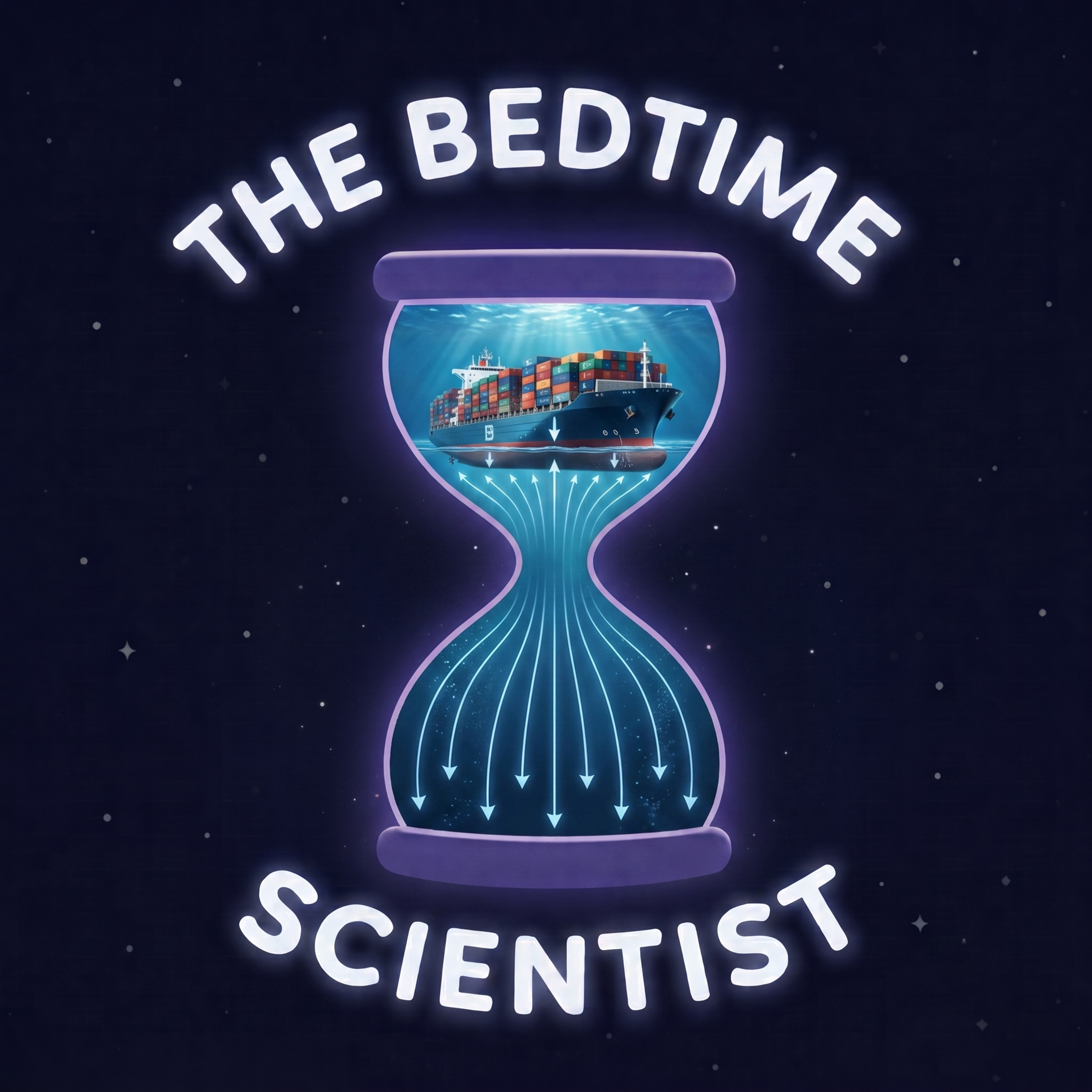 The Giant Ship That Floats | The Science of Buoyancy for Kids 20.07.2026 10minHow can something made of thousands of tons of steel float on the ocean?In this calming bedtime science exploration, we discover the surprising science behind how the world's largest ships stay above the waves. Learn about buoyancy, displacement, water pressure, and why a giant hollow ship can float even though a small piece of steel sinks.From a tiny toy boat in the bathtub to the largest cargo ships on Earth, we'll discover the same invisible force that holds them all up: the gentle push of water.The Bedtime Scientist combines relaxing bedtime stories with real science to help children ages 4–12 replace fear with wonder and curiosity.In this episode, children will explore:Why heavy things sinkHow ships made of steel can floatWhat buoyancy meansHow water pushes backHow the world's biggest ships carry thousands of containers across the oceanPerfect for bedtime, quiet time, homeschooling, road trips, and curious kids who love learning how the world works.Parents & Grown-ups: Visit bedtimescientist.com for more episodes, companion books, parent guides, and resources for curious families.science for kids, bedtime stories for kids, bedtime science, buoyancy explained, how do ships float, why do boats float, ocean science for kids, engineering for kids, physics for kids, educational podcast for kids, calm bedtime stories, science podcast for children
 -
 Sea Turtles: The Map Inside Her 14.07.2026 9minCalm bedtime science for kids and adults.Tonight, a sea turtle is crossing an entire ocean in the dark, headed for one beach: the exact stretch of sand where she was born. She has no signs, no paths, no lights to follow. And she is not lost.This episode follows her long journey home and the real science that makes it possible: the hot liquid iron turning deep inside the Earth, the invisible magnetic field it wraps around our planet, and the way a turtle reads that field like a map made of feeling. Along the way, we rest with her on the ocean floor, where she can hold a single breath for hours while her heart slows to just a few beats a minute.For More Visit: www.bedtimescientist.comOne steady voice. No music, no sound effects, no sudden anything. Real science, told slowly and truthfully, built for the moment before sleep. Made for curious kids ages 4 to 10, the grown-ups listening beside them, and especially for families who need bedtime to be calm.Learn softly. Sleep soundly.
 -
 Thunder & Lightning: The Sky's Electric Lullaby | Meditatively Beautiful Anxiety Reducing Science 10.07.2026 12minFrom the Archives! If storms scare you, you're not alone. In this episode, we discover how understanding transforms fear into wonder.⭐️ If you love The Bedtime Scientist, here are two ways you can support our mission!Join our Patreon community! Get exclusive bonus episodes and episode guides for parents. ➡️The Bedtime Scientist on PatreonExplore our books! Your voice is most important; become the bedtime scientist for your kids. ➡️Browse The Bedtime Scientist Books Thunder & Lightning: The Sky's Electric Lullaby - Calm bedtime scienceThrough gentle science and poetic narration, drift into sleep while learning how storms truly work—from the quiet dance of billions of ice crystals inside a cloud to the brilliant flash of lightning that feeds the Earth. Thunder isn't a warning. It's a messenger. And lightning? It's the sky's way of caring for every living thing below.🤫 What we promise:No sudden sounds. No bright flashes. Only calm narration and the gentle truth about why storms are beautiful.✨ What you'll learn:How lightning forms inside a cloud (and why it's seeking balance, not anger)Why thunder is actually a messenger, not a warningHow storms secretly help every plant and tree on Earth growPerfect for curious kids, restless nights, and anyone learning that understanding transforms fear into wonder.This is science told softly...storms become lullabies...fear becomes curiosity...Thank you to Nate C. from Lower Merion, PA, for suggesting this fantastic topic.
 -
 Fireworks: The Earth Painting the Sky 07.07.2026 10minA calm bedtime episode about fireworks, paced gently to help a child fall asleep. Tonight's episode sits on a hill at the edge of a summer field, far back from the crowd, watching the sky bloom with light. Fireworks aren't just pretty. They're chemistry. The reds, greens, golds, and blues come from tiny bits of metal and mineral tucked into each shell. Strontium glows red. Barium glows green. Sodium, the same mineral in the salt on your dinner table, glows a warm buttery gold. Blue is the hardest color of all to make.The episode also notices something a kid has felt their whole life without naming: the light of a firework reaches your eyes before the boom reaches your ears. Every clap, every voice, every closing door works the same way. Your eyes are always a little ahead of your ears.Along the way: how firework builders design a peony or a willow before the shell ever leaves the ground, why blue took years to figure out, and how to count the seconds between a flash and a boom to tell how far away it was.The Bedtime Scientist is a calm, factual science show for kids and families. Think Mr. Rogers meets Carl Sagan for bedtime. One voice. Real science. No music, no effects, no screen required. Works as well on the fifth night as the first. Parents often drift off first.A bedtime science story about fireworks, the colors that come from the ground, and the light that reaches your eyes before the sound reaches your ears.
 -
 Oxygen: Where Does it Come From? 30.06.2026 7minTonight, we go looking for something invisible. Join me for a calm, awe-filled journey to two places, the trees just outside your door and the far side of the open ocean, as we answer one of the biggest questions a curious child ever asks: where does the air we breathe actually come from?No loud sound effects. No fictional drama. Just the steady wonder of chemistry, the ocean, and the living things that quietly fill the sky with air.WHAT YOUR CHILD WILL LEARN:→ The Breath That Was Once Water: Where does the oxygen in your lungs really come from? Not from the air, the way most people think, but from water, pulled apart by sunlight inside a single green leaf.→ Too Small to See, Big Enough to See from Space: The real makers of more than half the world's air drift in the open ocean. They are called phytoplankton, and a single one is invisible, yet together there are so many you can see their color from orbit.→ When the Sky Had No Air: There was a time on Earth when no one could have taken a single breath. We tell the story of the first tiny living things that slowly filled an empty sky, and never stopped.→ The Breath You Share with the Whole World: The air doesn't stay where it's born. The breath you take tonight may have traveled from a forest a thousand miles away, or the middle of the sea, carried to you on the wind.WHY THE BEDTIME SCIENTIST WORKS:Most kids' podcasts use stories and excitement to engage. We believe the real world is fascinating enough. By delivering factual, non-fiction topics in a calm, low-register tone, we help children ground themselves in reality. This prepares busy minds for deep sleep, easing them from active beta waves into relaxed alpha waves.PERFECT FOR:Kids who ask "Why?" before bedYoung fans of nature, the ocean, and how the world worksParents seeking screen-free, calming bedtime routinesClassroom quiet time or sensory breaksChildren with anxiety or racing thoughts at bedtimeNeurodivergent kids who need predictable, structured audio contentTeachers using podcasts for STEM education and mindfulnessABOUT THE BEDTIME SCIENTIST:The Bedtime Scientist is a sleep-focused educational podcast that explains how the universe works to calm you down. Created for kids who love science but struggle with overstimulation, The Bedtime Scientist delivers real, fact-based science, not stories or fairy tales, in a voice designed for rest.From the floor of the ocean to the surface of the Moon, we dive deep into how the world actually works. Every episode is carefully paced, sensory-friendly, and designed to help busy minds move from active thinking to deep sleep.Perfect for bedtime routines, classroom calm-down time, or anytime a child needs to ground themselves in wonder, instead of worry.SUPPORT THE SHOW:If The Bedtime Scientist is essential to your nightly routine, please consider supporting us at BedtimeScientist.com. Your support keeps us ad-free and helps us create more episodes for families worldwide.Keywords: kids podcast, bedtime stories for kids, science podcast for kids, where does oxygen come from, where does air come from, oxygen, air, how we breathe, how plants make oxygen, photosynthesis for kids, ocean, phytoplankton, sea life, Earth science, biology for kids, nature podcast, STEM education, sleep aid for kids, anxiety relief children, educational podcast, non-fiction science, calming podcast for sleep, sensory-friendly content, screen-free parenting, parenting tools, kids audio, how the world works, sleep routine, children's education, neurodivergent kids, classroom calm down
 -
 The Sun: Anchor of The Solar System 24.06.2026 7minA calm bedtime episode about the Sun, paced gently to help a child fall asleep.Tonight's episode begins at the center of the solar system. The Sun isn't on fire. It's something stranger and quieter than that. At its core, hydrogen atoms are crushed together so hard they become helium, and a flash of energy is released. That energy then begins one of the longest journeys in the solar system. A single particle of light can wander for a hundred thousand years inside the Sun before it escapes. Then it crosses the dark to Earth in eight minutes. The sunlight on your face today had been traveling since before humans existed.The episode follows the Sun outward. Convection cells the size of countries churning at the surface. Magnetic field lines winding and snapping. The northern lights, which are the Sun reaching across the dark and touching the top of our world. And the gravity that holds every planet in its path, including the one you're resting on right now.One voice. Real science. No music, no effects, no screen required. Works as well on the fifth night as the first. Parents often drift off first.The Bedtime Scientist is a bedtime science show for children and families.A bedtime science story about the Sun, gravity, sunlight, and the eight minutes between the center of the solar system and your face.
 -
 Electricity: The Copper Highway & The Speed of Sleep | Calm Bedtime Science for Kids & Families 19.06.2026 8minWelcome to The Bedtime Scientist, the podcast where we skip the fairy tales and dive into the fascinating data of the real world. We believe that for many curious children—especially those who are neurodivergent, have ADHD, or are simply highly inquisitive—the best way to wind down is to understand the "magic" of how things actually work.In tonight’s episode, we explore the Invisible River of Electricity.Electricity isn't just something that lives in our walls or powers our screens; it is a fundamental force of nature that connects the wind on a distant hill to the very beat of our own hearts. Instead of a high-energy science lesson, Josh guides listeners through a low-stimulation, calming analysis of physics, biology, and the modern world.What’s Inside Tonight’s Episode?The World of Electrons: We zoom in on the tiniest building blocks of our universe. We’ll learn about electrons—particles so small that more than you could ever count could fit on the tip of a pencil—and how their simple motion creates the power we use every day.The Copper Highway: We explain the concept of conductors and why copper is the preferred path for electricity’s long journey.The Long Journey Home: Follow the path of an electron from a spinning wind turbine, across mountain-high wires, through the quiet rest stops of substations, and finally into your bedside lamp.The Biological Connection: Discover the "electricity inside you." We explain how tiny electrical signals are the reason your heart beats "squeeze and release" and how your brain creates thoughts.The Speed of Sleep: A gentle transition into the "Current Quieting Down," where we explain how the nervous system settles its internal energy to prepare for rest and repair.Why The Bedtime Scientist? Created by Josh, The Bedtime Scientist is a mission-driven podcast designed to provide a safe, calm, and intellectually honest space for children. We know that many kids don’t want "bedtime stories"—they want to understand the mechanics of the universe.Our episodes are carefully paced to be low-stimulation, featuring:No loud music or sudden transitions.Sophisticated vocabulary that respects a child’s intelligence.A focus on factual patterns that provide a sense of security and predictability.A neurodiversity-affirming approach that understands how a busy brain finds peace through focused curiosity.Whether your child is a future engineer, a young physicist, or just a kid who likes to know the "why" behind the "what," this episode provides the perfect balance of education and relaxation.Keywords for Parents & Educators: Electricity for kids, physics for sleep, educational podcast for children, ADHD sleep aid, autism-friendly bedtime, low-stimulation science, how electricity works, STEM for kids, calming science, neurodivergent bedtime routine, The Bedtime Scientist.
 -
 Genes & DNA: What Makes You... You 15.06.2026 8minWelcome to a calming bedtime story about human biology, DNA, and cells for kids. Tonight on The Bedtime Scientist, I am sharing an incredible science fact sent in by my newest Bedtime Scientist Field Researcher, Fionn from Flitwick, Bedfordshire: If you unraveled all your DNA, it would stretch from Earth to the Sun 600 times!That mind-blowing thought inspired my quiet, vocal-only journey tonight. I will guide us on a relaxing sleep story deep inside a single fingertip to discover the microscopic world of genetics. Together, we'll wonder about the tiny rooms called cells and the long, twisting instruction manual tucked inside them. I designed this episode as a calming journey to help curious minds drift off to sleep while learning about the unbroken chain of traits passed down through thousands of lives straight to you.In my story tonight, we’ll explore:Human Biology: What are cells, and how many do we have?Genetics & DNA: How your body's microscopic "instruction manual" works.Genes & Heredity: How traits like eye color, hair texture, and your unique smile are passed down from parents.Family Trees: The beautiful, unbroken chain of ancestors that connects us to the past.
 -
 Farm Tractors: A Field of Dreams | Calm Nonfiction Bedtime Science for Kids and Parents 11.06.2026 9minHow do you turn a loud tractor into a lullaby? Welcome to The Bedtime Scientist...Tonight, we visit a quiet farm as the sun slips low in the sky. We explore the gentle, wondrous science of the "helpers of the harvest"—the amazing machines that care for our fields.We discover how these big, powerful machines are not about noise, but about a slow, steady, and gentle purpose. We learn how the tractor is the "steady muscle" that softens the earth, the seeder is the "gentle hand" that plants sleeping dreams, and the combine is the "patient heart" that gathers every single grain.✨ What you'll learn:How a tractor's giant, grooved wheels give it the strength to pull.How a seeder plants each seed in a perfect, precise row.How a combine harvester is a "gentle sifter" that saves our food and blankets the field for next year.🩵 Perfect for: Kids who love tractors, finding the quiet purpose in a busy world, and a calming bedtime routine.⭐️ If you love The Bedtime Scientist, here are two ways you can support our mission!Join our Patreon community! Get exclusive bonus episodes and episode guides for parents. ➡️ The Bedtime Scientist on PatreonExplore our books! Your voice is most important; become the bedtime scientist for your kids. ➡️Browse The Bedtime Scientist Books
 -
 Sea Otters: Held by the Water 07.06.2026 10minA calm bedtime episode about sea otters, paced gently to help a child fall asleep.Tonight's episode travels out to the Pacific Ocean, where sea otters float on their backs at the surface, rising and lowering with the water as waves pass beneath them. Their fur holds hundreds of millions of tightly packed hairs, and the tiny pockets of air trapped between those hairs are what keep them warm in the cold ocean.The episode follows one otter as it dives to the seafloor, carries a favorite stone in a built-in pocket of skin under its arm, and floats in the kelp while the ocean does the holding. A group of resting otters is called a raft. Some details stay with you.One voice. Real science. No music, no effects, no screen required. Works as well on the fifth night as the first. Parents often drift off first.The Bedtime Scientist is a bedtime science show for children and families.A bedtime science story about sea otters, the Pacific Ocean, and what they do at the surface of cold water.Visit BedtimeScientist.com for more!
 -
 Friendship: The Science of Closeness 04.06.2026 8minA calm bedtime science episode for children and families, slow enough to help a child settle at night. About why some people start to feel easy to be around.Friendship isn't a mystery. It's something the brain actually builds, one repeated moment at a time. This episode follows what happens inside us when a face goes from unfamiliar to familiar, when a voice starts to feel like home. The science is real: the tiny connections between brain cells grow stronger each time they're used, the way a path through tall grass becomes clearer with every step. A laugh shared. A name remembered. A seat saved. None of it is large on its own. But the brain is keeping track, quietly building something it will eventually know how to follow without thinking.One voice, no sound effects, no screen required. Works as well the fifth time as the first. Parents often drift off first.The Bedtime Scientist is a calm, factual science show that helps children settle into sleep while learning something real about the world.A bedtime science story for kids about friendship, the brain, and why some people start to feel like home.
 -
 Fireflies: The Light that Waited 31.05.2026 8minA beautiful episode about fireflies, written to help children settle and drift toward sleep. If you're looking for a quiet science story for bedtime tonight, this one starts in the backyard.Fireflies make real light, cold light, without fire or heat, through a chemical reaction so small it fits inside a beetle's body. This episode follows that light from the soil where firefly larvae wait, sometimes for two years, to the warm summer dark where they finally rise and blink their slow greenish gold messages through the air. The science is accurate and gently paced. The imagery does the rest.Screen-free and unhurried, The Bedtime Scientist is designed to be replayed. Parents who listen alongside their kids often find it works just as well for them.One voice. Real science. A quiet place to land at the end of the day.Good for anyone searching for a calm bedtime podcast for kids, a science sleep story, or a gentle bedtime story about fireflies, light, or summer nights.
 -
 Clouds: The Shape Water Borrows 30.05.2026 9minA calm bedtime science episode about clouds, designed to help children settle and drift off to sleep. One quiet voice, no music, no sound effects.Tonight's episode asks a question most of us never think to ask: how does something that can weigh a million pounds stay up in the sky? That's a real number, by the way. A single large cloud, the kind that drifts past on a summer afternoon, can outweigh a long line of elephants. And there it sits, floating quietly overhead. This episode traces how clouds form around something as small as a grain of ocean salt, why weight and floating can both be true at once, and where the water inside a cloud might have been before it reached the sky above you tonight. The science is accurate, the imagery is slow, and the whole thing moves at the pace of a cloud crossing an open sky.Screen-free and replayable, it works just as well the third night in a row as the first, and more than a few parents have fallen asleep before their kids did.The Bedtime Scientist is a calm science show for children and families. One voice. Real science. A good night's sleep.Good for anyone searching for a calming bedtime podcast for kids, a science sleep story, or a quiet bedtime story about clouds and the water cycle.
 -
 Dinosaur Fossils: How Scientists Tell Time | Calm Bedtime Science for Kids & Adults 29.05.2026 17minFor More, Check Out: https://www.bedtimescientist.com/ ⭐️ If you love The Bedtime Scientist, here are two ways you can support our mission!Join our Patreon community! Get exclusive bonus episodes and episode guides for parents. ➡️The Bedtime Scientist on PatreonExplore our books! Your voice is most important; become the bedtime scientist for your kids. ➡️Browse The Bedtime Scientist Books About This EpisodeStep into the quiet, dusty silence of the desert at sunset. In this episode of The Bedtime Scientist, we leave the modern world behind to answer a profound question: "How do we know how old the dinosaurs actually are?"We don't just list facts. We explain the mechanism of time. This episode walks young listeners through the logic of geology and physics, helping them visualize the deep history of our planet while lulling them into a peaceful sleep.The Science We Explore:We deconstruct three complex pillars, translating them into calming concepts for kids:The Law of Superposition (The "Layer Cake"): How do geologists read a cliff like a book? We explain Stratigraphy. Imagine Earth’s crust is a layer cake—the bottom layers were put there first. We teach children that depth equals time.Radiometric Dating (The "Atomic Hourglass"): How can a rock tell time? We visualize atoms as tiny hourglasses trapped inside volcanic ash. When a volcano erupts, the hourglass flips. By measuring the "sand" (decayed atoms) left, we calculate the rock's precise age.Permineralization (Bone into Stone): A fossil isn't a bone—it's a stone copy. We explain the chemical process where mineral-rich water seeps into buried bone, replacing it cell by cell with crystal.Why "No Stories"?We believe reality is fascinating enough. By focusing on clear, rhythmic explanations rather than loud characters and plots, we reduce cognitive load. Key Vocabulary:Paleontology: The study of ancient life through fossils.Sedimentary Rock: Rock formed by layers of mud and sand pressing together.Igneous Rock: Rock formed from cooled lava (where "atomic clocks" are found).Deep Time: The concept that Earth's history is so vast, human history is just a blink.🔬 Why This Matters (Parent Note)Understanding "Deep Time" is a major cognitive milestone for children. It moves a child from thinking in terms of "yesterday" to grasping the vastness of history. This episode supports Next Generation Science Standards (NGSS) regarding Earth Systems and History of Earth (4-ESS1-1). By visualizing the abstract concept of rock strata, we build spatial reasoning skills.🧠 The Morning Quiz (Test Their Retention)Ask these three questions at breakfast to reinforce the learning:The Laundry Basket: If the Earth is like a laundry basket, are the clothes at the bottom older or newer? (Answer: Older. This is the Law of Superposition).The Hidden Clock: What do scientists look for inside volcanic ash to tell time? (Answer: Tiny atomic clocks / radioactive atoms).The Stone Copy: Is a fossil a bone? (Answer: No, it is a rock that looks exactly like the bone).📚 Curriculum ConnectionsGrade Level Target: 1st - 5th Grade.Topics: Earth Science, Geology, Logic, Scientific Measurement.Skills: Critical Thinking, Visualization, Abstract Reasoning.Homeschool Science Curriculum, Montessori Science, Waldorf Nature Study, Calm Kids Podcast, Anxiety Relief for Kids, Bedtime Routine for ADHD, Science Facts for 5 Year Olds, How to Explain Carbon Dating, Jurassic Period, Cretaceous Period, Rocks and Minerals, Geology Unit Study, Charlotte Mason Science, Screen-Free Parenting, Peaceful Parenting, Intelligent Bedtime Stories, Non-Fiction for Kids.Dinosaur Fossils, Paleontology for Kids, Geology, Stratigraphy, Radiometric Dating, Deep Time, Earth Science, STEM Education, Bedtime Stories for Smart Kids, Physics for Kids, Permineralization, Sedimentary Rock, The Bedtime Scientist, Sleep Podcast, Calming Audio.
Samankaltaiset podcastit


Suosittu maassa
Tämä podcast esiintyy myös näiden maiden podcast-listoilla.


