
Unpacked by Afar
Afar
0
Unpacked by Afar tackles one tricky topic in travel each week. Whether you want to hack your points and miles, figure out where to travel next, or need advice on an ethical dilemma, we're your expert travel guides. Because the travel world is complicated. We're here to help you unpack it.
Jaksot
-
 How to See Thailand’s Wonders Without Feeling Like a Tourist 10.09.2026 36minTravel journalist Kathryn Romeyn shares how to find Thailand off the beaten path—from Nan Province night markets to Khao Sok's rainforest—plus the best time to visit Thailand if you want fewer crowds and lower prices. This week on Unpacked, host Aislyn Greene explores Thailand off the beaten path with journalist Kathryn Romeyn, who's covered Southeast Asia since 2014 and calls Bali, Indonesia home. Kathryn returned to Thailand again and again since her first real trip in 2018, and wrote Afar's guide to seeing the country differently. In this episode, part of Unpacked's Off the Tourist Trail series, she and Aislyn dig into Bangkok's overlooked neighborhoods, the north's least-visited provinces, and—critically—the best time to visit Thailand if you want to skip both the crowds and the price surge of high season. THIS WEEK'S GUEST Kathryn Romeyn is a Bali-based travel journalist who has covered Southeast Asia since 2014. After spending years visiting nearly every other country in the region—Myanmar, Cambodia, Malaysia, Vietnam—she finally gave Thailand a real chance starting in 2018, and has been chasing its lesser-known corners ever since. IN THIS EPISODE Why finding Thailand off the beaten path means letting go of five-star expectations—and how a $50-a-night, family-run guesthouse can outshine a luxury resort The best time to visit Thailand: why the shoulder seasons (roughly March–July and October–November) beat the crowded, expensive December–January peak, and why to avoid the hot, rainy August–September stretch Inside Nan Province, in Thailand's mountainous north near Laos—road-tripping through opium-turned-coffee country, staying in teak bungalows, and meeting a local guide from the Karen community Local flavors worth seeking out: sai oua northern-style sausage, chicken wings crusted in makhwaen (a wild jungle pepper related to Sichuan pepper), and the tamarind crunchy shrimp at Thanyamundra that Kathryn can't stop thinking about A nightly ritual in Nan: communal floor dinners at bamboo khantoke tables between two illuminated temples, complete with live folk music and unmatched trash-sorting discipline Why Koh Yao Noi—a small island with one gas station and one doctor—offers an escape from the group-boat crowds hitting Phuket's more famous islands Skipping the standard Phuket–Krabi–Chiang Mai loop for Khaosok National Park where limestone karsts rise out of Cheow Lan Lake and langurs swing through the jungle canopy Why hiring a private guide or outfitter (like Smiling Albino or Red Savannah)—rather than a big-group tour—unlocks the kind of moments you can't find with an internet search CHAPTERS 00:00:00 Rethinking Thailand's Reputation 00:02:00 A Freelancer's First Real Trip 00:07:00 Getting Lost in Bangkok on Purpose 00:11:00 Island Escapes and the Road to Nan 00:16:00 Guesthouses Over Five-Star Hotels 00:21:00 Night Markets and Local Food Secrets LINKS & RESOURCES Kathryn Romeyn's AFAR story: How to See Thailand's Wonders Without Feeling Like a Tourist Thanyamundra Organic Resort Nan Seasons Boutique Resort Cape Kudu Hotel Koh Yao Noi Smiling Albino Red Savannah Learn more about your ad choices. Visit megaphone.fm/adchoices
 -
 Sana Javeri Kadri's Regenerative Spice Farming Revolution 04.09.2026 40minThe spices in your cabinet are probably five to seven years old—and that's not an accident. On this episode of Unpacked, host Aislyn Greene sits down with Sana Javeri Kadri, founder of Diaspora Spice Co., who spent nine years dismantling a 500-year-old system and replacing it with something radically different: direct relationships with regenerative spice farming partners across India and Sri Lanka. What starts as a question about how old the spices in your cabinet really are unfolds into a conversation about colonialism, cultural erasure, and what it actually takes to trace a turmeric root back to the family who grew it. THIS WEEK'S GUEST Sana Javeri Kadri founded Diaspora Spice Co. in 2017 at age 23, after discovering that the global spice trade—largely unchanged since European colonization took hold roughly 500 years ago—left farmers earning almost nothing while spices sat in warehouses for five to seven years before reaching store shelves. Sana built the company around regenerative spice farming partnerships, working directly with 140 farmers across India and Sri Lanka to source turmeric, cardamom, cinnamon, black pepper, and more, paying farm partners an average of 4x commodity price. Sana splits time between Mumbai and the Bay Area and is the author of The Diaspora Spice Co. Cookbook, a book five years in the making and built entirely around the farm families behind the spices. IN THIS EPISODE How Sana Javeri Kadri traced the spice trade's roots back 4,000 years—and how colonization, not commerce, is what broke it roughly 500 years ago Why regenerative spice farming partnerships let Diaspora Spice Co. pay farmers well above commodity price, and what that income jump has meant for farming families year over year The 14-month search for pesticide-free cardamom, and what it actually takes to find a handful of true regenerative spice farming partners out of dozens of samples collected Inside Eko Land's cinnamon and clove processing facility in Kandy, Sri Lanka, where quality control means tasting bark from individual trees—and why true cinnamon (Cinnamomum verum) is almost impossible to find in the US What 9 years of relationship-building with Pragati Turmeric farm partner Prabhu Kasereni has looked like, from a 23-year-old showing up unannounced to writing a cookbook credited entirely to the farmers themselves CHAPTERS 00:00:00 The Age of Your Spice Cabinet 00:03:00 The 500-Year-Old Trade Problem 00:10:00 Building Diaspora and Regenerative Farming 00:18:00 The Search for Cardamom and Pepper 00:26:00 Pragati Turmeric in Andhra Pradesh 00:34:00 Cinnamon and Cloves in Kandy 00:42:00 Nine Years, One Family's Story 00:48:00 The Cookbook and What Comes Next INKS & RESOURCES Diaspora Co. The Diaspora Spice Co. Cookbook Pragati Turmeric Guntur Sannam Chilli Stay connected Be sure to subscribe to the show and sign up for our podcast newsletter, Behind the Mic, where we share upcoming news and behind-the-scenes details of each episode. And explore our second podcast, Travel Tales, which celebrates first-person narratives about the way travel changes us, and View From Afar, where we spotlight the people and ideas shaping the future of travel. Unpacked by Afar is part of Airwave Media's podcast network. Please contact [email protected] if you would like to advertise on our podcast. Learn more about your ad choices. Visit megaphone.fm/adchoices
 -
 For a Crowd-Free African Safari, Head for Tanzania's Southern Circuit 01.09.2026 37minAn African safari doesn't have to mean a traffic jam. On this episode of Unpacked, host Aislyn Greene travels to Tanzania's southern circuit—visiting two parks most first-time safari-ers never consider—and discovers what happens when you trade the famous Great Migration crossing for a dry riverbed with not another human being in sight. To get there, she consulted Elizabeth Gordon, co-founder of Extraordinary Journeys, who helped reframe what an African safari could be. What followed was eight days in Ruaha National Park and Nyerere National Park: a walking safari with a guide who reads the wind with a pouch of ash, a river full of hippos and crocodiles that Aislyn took to calling "danger soup," and a fly camp on a lake where a ranger stayed up all night speaking hippo so she didn't have to. Come back next week for a bonus episode about what happens when a lion leaves the park—and meets a herd of cattle. THIS WEEK'S GUESTS Elizabeth Gordon is the co-founder of Extraordinary Journeys, a bespoke travel company designing African safari itineraries—and trips throughout South America and Asia—for travelers who want more than the standard route. Born in Kenya to a mother who joined the Peace Corps, earned her pilot's license, and built a house on a game park outside Nairobi, Elizabeth grew up between Kenya and France, studied in Beijing, and managed safari camps in Namibia before launching the company with her mother. Pay Mbaryo is a walking guide and naturalist with Nomad Tanzania in Ruaha National Park. A farmer's son who grew up in the Gorongosa district, he has spent 15 years in the bush and navigates unmarked wilderness using what he calls a natural GPS. In a decade of guiding, he has never once had to use his rifle. Gerald is a guide with Nomad Tanzania in Nyerere National Park, in his fourth year on the Rufiji River. He can identify a hippo's path out of the water by sight and smell—and he was the one who handed Aislyn a hippo skull to explain exactly why you don't want to be in that path. IN THIS EPISODE Why Tanzania's Southern Circuit—specifically Ruaha National Park and Nyerere National Park—offers a better African safari experience for first-time visitors than the Great Migration crossing: fewer people, better guides, and wildlife that doesn't know you're there What a walking safari in Ruaha actually feels like: reading the wind with a pouch of ash, approaching a mother elephant and her calf without being detected, learning to make a toothbrush from a tree, and discovering the Small Five How Pay spent 15 years learning that birds, buffalo, and elephants are all sharing information with one another—and why walking safari means becoming part of that conversation rather than watching it from a Jeep The Rufiji River at Nyerere: a wide, curving expanse of "danger soup"—filled with hippos and crocodiles—and what an afternoon on the water teaches you about the elephant as a keystone species What fly camping looks like when Nomad's team digs a bathroom into the sand, rigs a hot shower, serves gin and tonics under the stars, and a ranger stays up all night so you can fall asleep to the sound of the hippo brass band CHAPTER MARKERS 00:00:00 Introduction: African Safari, But Different 00:04:00 Why the Southern Circuit 00:08:00 Arriving in Ruaha 00:12:00 Walking Safari With Pay 00:20:00 The Small Five and the Keystone Species 00:26:00 Nyerere and the Rufiji River 00:33:00 Danger Soup: Life on the Water 00:38:00 Fly Camping With Hippos LINKS & RESOURCES Extraordinary Journeys Nomad Tanzania Nomad Kigelia Camp, Ruaha Nomad Sand Rivers Camp, Nyerere Ruaha National Park, Tanzania Nyerere National Park, Tanzania View From Afar—Great Migration episode Stay connected Be sure to subscribe to the show and sign up for our podcast newsletter, Behind the Mic, where we share upcoming news and behind-the-scenes details of each episode. And explore our second podcast, Travel Tales, which celebrates first-person narratives about the way travel changes us, and View From Afar, where we spotlight the people and ideas shaping the future of travel. Unpacked by Afar is part of Airwave Media's podcast network. Please contact [email protected] if you would like to advertise on our podcast. Learn more about your ad choices. Visit megaphone.fm/adchoices
 -
 What We Lose When a Language Dies 20.08.2026 34minBy the end of this century, half of the world's 7,000 languages could be gone. On this episode of Unpacked, host Aislyn Greene hands the mic to travel writer Lucy Kehoe for a conversation about saving language with journalist Sophia Smith Galer, author of the new book How to Kill a Language. For Sophia, saving language is personal: her Italian grandmother spoke Emilian, one of Italy's Indigenous tongues, and it's quietly slipping away. To understand what we lose when a language dies, Sophia traveled from the mountains of Oman to the hills of California, seeking out endangered languages and the communities fighting—or grieving—for them. She and Lucy get into why these languages matter to every traveler, how language and landscape are woven together, and what it means to travel thoughtfully to a place whose language is at risk—beyond learning a few phrases. It's a conversation about treating language as part of the culture we come to experience, and about meeting it with curiosity and respect rather than as something quaint. THIS WEEK'S GUESTS Sophia Smith Galer is an award-winning journalist and author whose new book, How to Kill a Language, traces the forces—colonialism, globalization, migration, and war—pushing thousands of the world's languages toward extinction. Multilingual in English, Spanish, Italian, and Arabic, she reported it across California, Oman, Ghana, Ecuador, Italy, and Greece, meeting speakers of critically endangered languages in person to capture not only their words but their connection to a place. Lucy Kehoe is a London-based journalist who covers travel, food, and the environment, with a particular interest in how people relate to landscape and place. IN THIS EPISODE The statistic that stopped us cold: by 2100, up to half of the world's 7,000 languages could vanish, and the rate of loss is expected to triple over the next 40 years Why a language is far more than a way to order coffee—Sophia's case that it holds the past, present, and future of a people connected to a place, from Oman's Jibbali (with distinct words for animal versus human shelter) to a California tribe down to 12 adult speakers What it really asks of travelers: not memorizing phrases, but bringing respect and dignity to an endangered language, and asking who profits from "language tourism" and whether speaker communities are truly part of it Where to find language on the road—Planet Word in Washington, D.C., the Armenian alphabet monument outside Yerevan, a Ukrainian language tour in Kyiv, and Oman's frankincense heritage experience The range of feelings Sophia found among speakers themselves—pride, determination, and quiet resignation—and why she believes the fate of each endangered language belongs to its own community to decide 00:00:00 A Grandmother's Vanishing Tongue 00:04:00 Why Endangered Languages Matters 00:06:00 Words Shaped by Place 00:10:00 Tourism Done Respectfully 00:16:00 California's Last Speakers 00:24:00 Ladino, Museums, and Hope LINKS & RESOURCES How to Kill a Language by Sophia Smith Galer — buy on Bookshop Sophia Smith Galer's website Lucy Kehoe's website Planet Word, the language museum in Washington, D.C. Armenian Alphabet Monument, outside Yerevan Museum of the Frankincense Land, Oman Stay connected Be sure to subscribe to the show and sign up for our podcast newsletter, Behind the Mic, where we share upcoming news and behind-the-scenes details of each episode. And explore our second podcast, Travel Tales, which celebrates first-person narratives about the way travel changes us, and View From Afar, where we spotlight the people and ideas shaping the future of travel. Unpacked by Afar is part of Airwave Media's podcast network. Please contact [email protected] if you would like to advertise on our podcast. Learn more about your ad choices. Visit megaphone.fm/adchoices
 -
 Five Questions for the Man Who Walked a Fault Line in Japan by Feel 19.08.2026 25minThis kind of Japan travel doesn't show up in guidebooks. In January 2024, a major earthquake struck the Noto Peninsula, lifting the seabed 15 feet into the air and exposing an ocean floor that locals walked across—harvesting octopus and abalone—to get home. This week on Unpacked, Five Questions, host and Afar executive editor Katherine LaGrave is joined by Afar contributing writer Ryan Knighton, who recently wrote a feature about traveling along the peninsula. Ryan, who is blind, visited Noto two years after the earthquake on a slow walking tour, drawn by the parallels between this remote coastal peninsula and his own earthquake-prone home on Vancouver Island. What he found was a place not broken, but mid-repair—and a Japanese art form that made sense of everything. THIS WEEK’S GUEST Ryan Knighton is an author and Afar contributing writing whose stories consistently find the textures, flavors, and human stories that sighted travelers walk past. A former English teacher in South Korea, he brings a slow, sensory approach to Japan travel and beyond—listening to sushi chefs talk about their knives, walking earthquake fracture lines with his feet, and finding the people who hold a place together. IN THIS EPISODE What blind travel in Japan actually looks like: why guides, sushi chefs, and strangers become the mediators of a place, and what it feels like to walk an earthquake fracture line with your feet instead of seeing it with your eyes Why Ryan chose the Noto Peninsula for his Japan travel debut: a remote, earthquake-prone coastal community with striking geographic parallels to his own home—and a story of post-disaster recovery he felt compelled to witness in person The food that made the trip: Tokyo-style sushi whose origins trace directly to a 1923 earthquake, Japanese barracuda, Noto sea salt gelato at 10 a.m. in a parking lot, and a tuna described by his wife as looking like a ruby The scene that didn't make the final cut: a couple walking home after the earthquake on a newly exposed seabed—15 feet of ocean floor lifted overnight, scattered with octopus and abalone, with kids too excited about sea creatures to be scared How kintsugi—the Japanese art of repairing broken objects with gold—became the metaphor that unlocked the entire story, and why it took a gold leaf factory on day one to understand what Noto was actually about LINKS & RESOURCES Ryan's Afar story on Noto, Japan Walk Japan Wajima, Ishikawa Prefecture Somamichi Restaurant 2024 Noto Peninsula Earthquake — background CHAPTER MARKERS 00:00:00 Introduction 00:02:00 Japan Travel on Foot and Without Sight 00:05:00 The Ethics of Disaster Tourism 00:07:00 Food as Craft, Craft as Place 00:10:00 The Scene That Didn't Make the Cut 00:12:00 Walking the Fracture Line 00:14:00 Mr. Squid and the Spirit of Noto 00:16:00 Kintsugi as Metaphor Learn more about your ad choices. Visit megaphone.fm/adchoices
 -
 Why Women's Travel Writing Matters More Than Ever 13.08.2026 33minFor the past several decades, writer and editor Lavinia Spalding has championed women's travel writing. She's helmed seven editions of the Best Women's Travel Writing—the celebrated Traveler's Tales anthology—including the latest, released on June 9th. Over the years, she's read hundreds of submissions a year from women around the world and distilled them into one essential collection. So host Aislyn Greene sits down with Lavinia to talk about what two decades of editing these stories has taught her about how women explore the world, and why amplifying those voices matters more than ever right now. THIS WEEK’S GUEST Lavinia Spalding is the author of Writing Away: A Creative Guide to Awakening the Journal-Keeping Traveler , seven-time series editor of The Best Women’s Travel Writing, and co-author of With a Measure of Grace, This Immeasurable Place, and two editions of the Frommer’s EasyGuide to New Orleans. She has been teaching for more than 30 years and leads writing workshops online and around the world. She lives with her family in New Orleans. Watch her TEDx talk here, and subscribe to her Substack newsletter for updates and essays. IN THIS EPISODE How Lavinia shapes each volume of Best Women's Travel Writing like a playlist—balancing place, tone, voice, and the ratio of dark to light—and why this year's theme might be best described as "flashes of insight that arise from connection" The essay that has never left her: Sandra Gail Lambert's pre-dawn solo kayak trip through the Florida Everglades, written from a wheelchair, with stakes so high that every preparation detail becomes profound What two decades of reading women's travel writing has taught Lavinia: never underestimate a woman, and women who write about travel tend to be actively seeking transformation, not just sights How the legacy of male-dominated adventure travel writing—conquest narratives, man-versus-place drama—may have conditioned women to fear solo travel, and what it looks like as that changes Why a women's travel writing anthology still matters in 2026: to amplify voices of autonomy and adventure at a moment when women's rights and freedom of movement are under pressure CHAPTERS 00:00:00 Young, Fearless, and Filled With Wonder 00:03:00 How a Volume Comes Together 00:07:00 The Traveler She Was, the Traveler She Is 00:10:00 Building the Playlist 00:14:00 The Stories That Live Inside Her 00:19:00 Never Underestimate a Woman 00:23:00 Who Gets to Be an Adventurer 00:28:00 Why It Matters Now LINKS & RESOURCES Best Women's Travel Writing, Volume 13—Bookshop.org Traveler's Tales Lavinia'swebsite Lavinia'sWriting Away Substack Lavinia's essay for Afar and Aislyn's essay for Afar West With the Night by Beryl Markham Learn more about your ad choices. Visit megaphone.fm/adchoices
 -
 This Is One of the Best Architecture Cities in America 12.08.2026 26minBuffalo, New York might be the greatest architecture city you've never heard of. In the fourth and final episode of our Unpacked by Afar series, we explore how this Rust Belt city became one of the richest showcases of American architecture anywhere in the country. Host Aislyn Greene tours Buffalo with Ed Howard, a docent and guide with Explore Buffalo. Ed shares that Buffalo was one of the wealthiest cities in America and drew the biggest names in architecture to build here. Stand on a single downtown corner and you can see work by the architects behind the Flatiron Building, the Twin Towers, and the first true skyscraper. Buffalo is also one of only two American cities with major works by the "holy trinity" of American architecture, Louis Sullivan, H.H. Richardson, and Frank Lloyd Wright, whose Martin House is here. Then come the surprises: the industrial grain elevators that inspired modernist masters, and the Frederick Law Olmsted park system that led the man who designed Central Park to call Buffalo the best-planned city in the country. It's a story of boom, near-ruin, and hard-won revival, a city that nearly lost its treasures and fought to save them. This is cultural travel at its most rewarding, a piece of American travel culture hiding in plain sight. If great architecture is a reason you travel, Buffalo belongs near the top of your list of American travel destinations. Meet this week's guest Ed Howard, docent and tour guide at Explore Buffalo Chapters 00:00 — A Secret Architecture City 03:32 — Five Masters, One Corner 06:40 — The Holy Trinity 11:05 — Saving the Landmarks 17:00 — Grain and Grass Where to go to explore Buffalo's architecture Explore Buffalo — Walking, bus, and boat tours led by local guides; the single best way to take in the city's architecture. Frank Lloyd Wright's Martin House — Wright's Prairie-style masterpiece, fully restored, and one of his finest residential works. The Guaranty Building — Louis Sullivan's 1896 skyscraper, once nearly demolished, now restored to its original glory. Richardson Olmsted Campus — H.H. Richardson's monumental former hospital; part is now a hotel, and Explore Buffalo runs hard-hat tours of the unrestored wings. Buffalo Central Terminal — The grand 1929 Art Deco train station, mid-restoration. Silo City and Duende — The towering grain elevators that awed modernist architects, with a bar tucked right among them. Delaware Park and the Olmsted parkways — The green system that earned Buffalo its "best-planned city" title. Go deeper at buffaloah.com, a database of hundreds of Buffalo buildings, and plan your trip with our Buffalo travel guide. This is the fourth and final episode of our Buffalo series. New here? Go back for Buffalo's food scene, its neighborhoods, and its Black history. And follow Unpacked, a travel podcast from Afar, for more unique travel experiences around the world. Learn more about your ad choices. Visit megaphone.fm/adchoices
 -
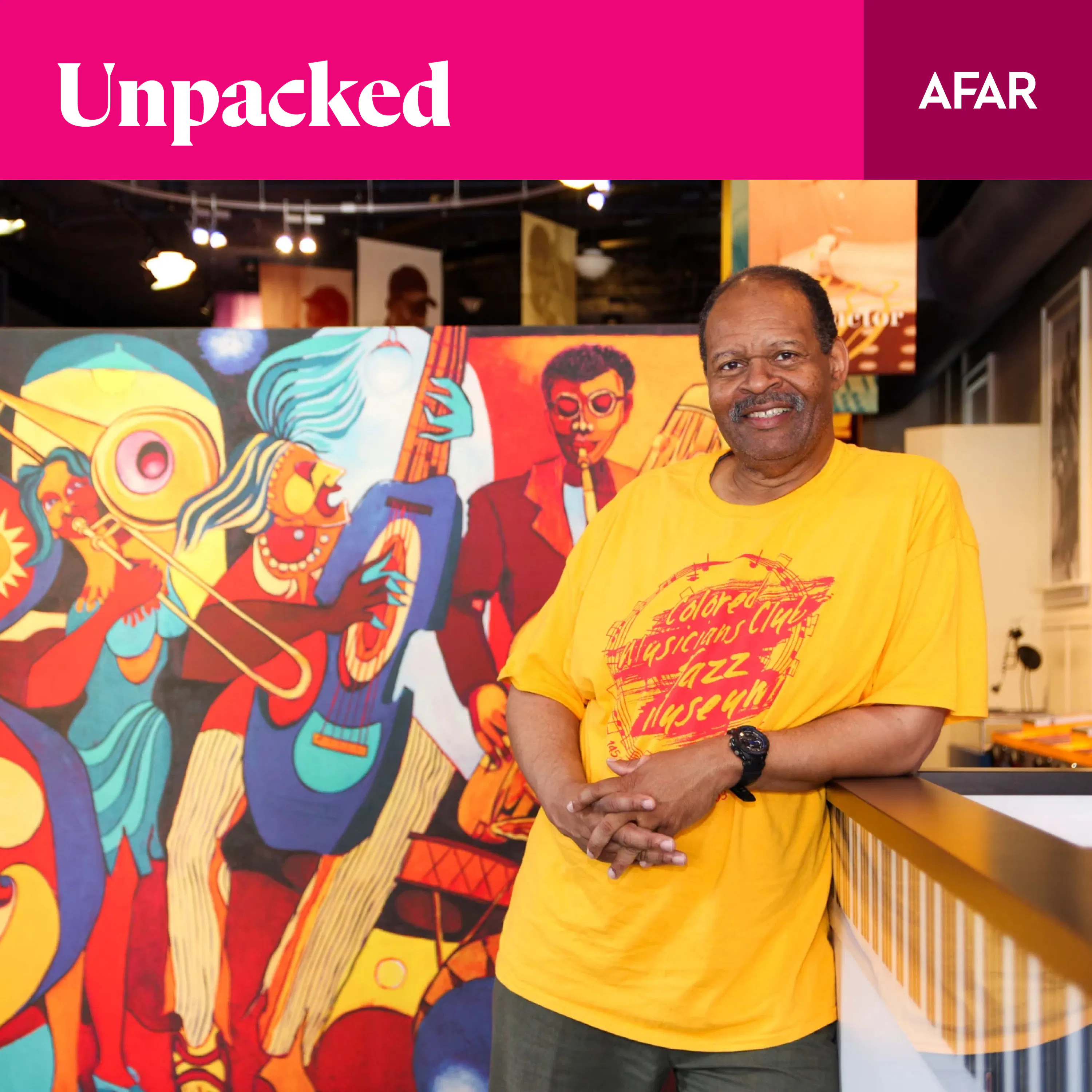 Hallowed Ground: The Street at the Heart of Buffalo's Black History 29.07.2026 22minFor 185 years, some of the most important chapters of American history have unfolded on a few blocks of Buffalo's East Side. In the third episode of our four-part Unpacked by Afar series, we walk the Michigan Street African American Heritage Corridor, the beating heart of Buffalo Black history, with the man who has made preserving it his life's work. Executive director Terry Alford grew up on these streets and is now leading their revival. He guides host Aislyn Greene through 185 years of Buffalo Black history: a church that was one of the last stops on the Underground Railroad, the home where the Niagara Movement was born, the club where jazz greats jammed until dawn because they weren't allowed to sleep in the hotels they had just played, and the radio station that became the megaphone of the Civil Rights movement. Then he shares how urban renewal nearly erased it all, and how he is fighting to bring it back, guided by the Ghanaian principle of Sankofa: move forward, but never forget where you came from. This is cultural travel at its most moving, a piece of American travel culture far too few people know. It is also one of the most powerful travel stories we have told, and a lesson in responsible travel: how to visit a place and honor the people whose stories made it. If Buffalo Black history is not yet on your list of American travel destinations, this episode, and this corridor, will change that. Meet this week's guest Terry Alford, executive director of the Michigan Street African American Heritage Corridor Commission Chapters 00:00 Buffalo's Black History 04:19 Underground Railroad to Jazz 10:02 Loss and Revival 13:42 A Vision for 2030 Where to go to explore Buffalo's Black history Michigan Street African American Heritage Corridor — Start at the visitor center and tour the anchor sites, all just steps apart. Michigan Street Baptist Church — Built in 1845, one of the last stops on the Underground Railroad, with a newly restored interior. Nash House Museum — The preserved home of Rev. J. Edward Nash and Frances Nash, plus the Frances Nash community garden and Tuesday farmers market. The Colored Musicians Club & Jazz Museum — The only continuously running, all-Black-owned club in the U.S., with Sunday night jam sessions and a jazz museum. WUFO Black Radio History Collective — The historic voice of Buffalo's Civil Rights movement. The Freedom Wall — The AKG's 28-portrait mural of Black Civil Rights figures, at the corridor's northern entrance. Read more in Afar's guide to Buffalo's Black history along the Michigan Street corridor, and plan your trip with our Buffalo travel guide. This is episode three of a four-part series. Next week, we explore Buffalo's astonishing architecture, one of the best-kept design secrets in America. Learn more about your ad choices. Visit megaphone.fm/adchoices
 -
 Asheville Hiking, Waterfalls, and the Oldest Mountains on Earth | The Travel Guide 24.07.2026 22minThis is the final stop on our five-part audio guide to Asheville, North Carolina, and we’re heading for the trees. In this episode of Unpacked by Afar, host Aislyn Greene laces up for Asheville hiking, and discovers why the oldest mountains on Earth are also some of the most beloved. On a tour with Hike Bike Kayak Asheville that takes Aislyn and guide David into the Pisgah National Forest, Aislyn learns that Asheville hiking means far more than a simple walk in the woods. These are among the oldest mountains in the world, cloaked in one of the most biodiverse forests in North America, home to thousands of plant species and waterfalls around nearly every bend. David leads her to quiet swimming holes and points out plants that grow nowhere else on Earth. She stands beneath Looking Glass Falls and hears how a single valley packs in world-class rock climbing, fly fishing on the Davidson River, and a 60-foot natural water slide called Sliding Rock. Zoom out, and the scale is staggering. The Great Smoky Mountains and the Blue Ridge Parkway are among the most visited places in the entire national park system, and Mount Mitchell, the highest peak east of the Mississippi, rises just up the road. It helps explain why so many people who come here for Asheville hiking end up never wanting to leave, and why the outdoors are one of America’s great travel destinations. It’s a landscape you can dip into for a single afternoon or disappear into for a week. It all adds up to a rich piece of cultural travel and a fitting finale to our guide: a reminder that in Asheville, the wild is never far away. Whether you want a gentle waterfall stroll or a hard climb to a summit view, the trailheads are closer than you think, and the payoff is some of the most beautiful country in the eastern United States. Consider it your guide to where to go and what to know. Unpacked by Afar is a travel podcast that unpacks one destination at a time. That’s the end of our Asheville audio guide, so catch up on the whole series in the feed. CHAPTERS 00:00:00 Older Than the Atlantic 00:02:30 Meeting My Guide 00:06:30 The Blue Ridge Parkway 00:11:00 Looking Glass Falls 00:13:15 Wildflowers and Orchids 00:16:15 Behind Moore Cove GUESTS | David Teafatiller of Hike Bike Kayak Asheville, our hiking guide PLACES WE VISITED Pisgah National Forest Looking Glass Falls Sliding Rock Davidson River Blue Ridge Parkway Great Smoky Mountains National Park Mount Mitchell State Park MORE FROM AFAR Asheville Travel Guide 10 Travel Itineraries for Exploring Asheville Your Way (includes an outdoor itinerary) Learn more about your ad choices. Visit megaphone.fm/adchoices
 -
 Asheville Food and the Growth of a Farm-to-Table Town | The Travel Guide 24.07.2026 31minThis is the fourth stop on our five-part audio guide to Asheville, North Carolina, and it may be the tastiest one yet. In this episode of Unpacked by Afar, host Aislyn Greene digs into Asheville food, and the surprising reason this mountain city punches so far above its weight at the table. Aislyn joins a walking food tour with Sita of Eating Asheville, eating her way through a town where farm to table isn’t a slogan but a fact of geography. Along the way she: Discovers that Asheville food can be a real relief for anyone with dietary restrictions at the celiac-run kitchen of Strada Italiano Hears the moving, Helene-shaped story behind Mehfil from its owner, Raj Tastes mountain-grown rice at the farm-to-table cornerstone Table with chef Catherine Smedley Forages Appalachian flavors at Luminosa And finishes with a former science teacher turned chocolatier, Melissa Quinn, at Asheville Chocolate. It’s a scene built on tight relationships between kitchens and the farms a few ridges away, where the rice on your plate might have been grown just up the road, and where a devastating hurricane the year before only deepened the sense that these restaurants belong to their community. But great Asheville food is also a question of who gets to make it, and whose history gets remembered. In a segment on the region’s Black foodways, Aislyn talks with two of the city’s most celebrated chefs, Ashleigh Shanti of Good Hot Fish and Rakim Gaines of Capella on 9, about Affrilachian cooking, representation behind the stove, and the stories layered into every plate. Their conversation is a reminder that a food town’s story has to include the people history has too often left off the menu. It all adds up to a rich piece of cultural travel and a portrait of one of the best small food towns in the country. Whatever you come hungry for, consider this your guide to where to go and what to know. Unpacked by Afar is a travel podcast that unpacks one destination at a time, with a real love of food and travel. This Asheville audio guide has one more episode to go, so look for it in the feed. CHAPTERS 00:00 A Real Food Town 03:00 Strada's Gluten-Free Surprise 05:00 Mehfil and Raj's Story 09:45 Table's Mountain Rice 12:40 Foraging at Luminosa 18:15 Cooking on The Block 23:15 Dessert With Melissa Quinn 26:00 Come Hungry GUESTS Sita, operations manager and tour guide, Eating Asheville Walking Food Tours Raj, owner, Mehfil Indian Restaurant Catherine Smedley, chef de cuisine, Table Chef Sean McMullen of Luminosa Melissa Quinn, head chocolatier and owner, Asheville Chocolate Ashleigh Shanti, chef and owner, Good Hot Fish Rakim Gaines, executive chef, Capella on 9 PLACES WE VISITED Strada Italiano Mehfil Indian Restaurant Table Luminosa (in the Flatiron Building) Asheville Chocolate Good Hot Fish Capella on 9 MORE FROM AFAR Asheville Travel Guide A Local Chef’s 2-Day Travel Guide to Asheville Immerse Yourself in Asheville’s Culturally Diverse Experiences Learn more about your ad choices. Visit megaphone.fm/adchoices
 -
 Black Mountain and the Region's Creative Soul | The Travel Guide 24.07.2026 26minThis is the third stop on our five-part audio guide to Asheville, North Carolina, and it takes us just outside the city to the small mountain town of Black Mountain, North Carolina. In this episode of Unpacked by Afar, host Aislyn Greene goes looking for the creative soul of the region, and finds it everywhere: in the galleries, in the glass studios, and above all in the music scene. Aislyn starts with breakfast at Cousins Cuban Cafe, then walks a town so small you can cross it in a few minutes, passing murals of Black Mountain’s famous daughter, the late Roberta Flack. She also traces the ghost of Black Mountain College, the radical, short-lived arts school just outside town that helped shape modern American art before it closed and all but disappeared. She plays with fire at the North Carolina Glass Center alongside executive director Candace Riley and glassblower Mark DeShields, learning how the quartz buried in these mountains helped turn the region into a glass capital. Over dinner at Hell or High Water, chef Eric Morris explains how Appalachian food ways, and a hurricane, gave the restaurant its name. But the heart of the episode is music. At a listening room called White Horse, Aislyn meets managing director Zach Hinkle, who traces the surprising, and nearly lost, blues and gospel roots of Asheville music, and explains why this corner of the Blue Ridge has always pulled creative people in. The episode ends inside a benefit concert, where the whole community turns out to keep a beloved venue alive. It all adds up to a rich piece of cultural travel: the story of why a tiny mountain town became one of the most quietly influential creative places in America, one of the South’s most surprising travel destinations, and why the Asheville music scene still draws people to these hills. Consider it your guide to where to go and what to know. Unpacked by Afar is a travel podcast that unpacks one destination at a time. This Asheville audio guide continues, so look for the rest of the series waiting in the feed. CHAPTERS (00:00) Welcome to Black Mountain (01:30) Breakfast at Cousins Cuban and a walk through town (04:00) Playing with fire at the North Carolina Glass Center (06:30) The quartz that made a glass capital (11:00) Dinner at Hell or High Water (13:30) A restaurant named for the storm (17:00) Inside the White Horse listening room (19:00) The nearly lost blues of these mountains (22:00) A benefit concert, and why the music survives (27:00) The creative soul of Black Mountain GUESTS Candace Reilly, executive director, North Carolina Glass Center Mark DeShields, glassblower, North Carolina Glass Center Eric Morris, executive chef, Hell or High Water (Foothills Local Meats) Zach Hinkle, managing director, White Horse Black Mountain Featured musicians at the White Horse benefit: Robin Bullock, Bill Maddox, Dr. Bill Bares, Peggy Ratusz, and Chris Rosser PLACES WE VISITED Cousins Cuban Cafe North Carolina Glass Center Hell or High Water Trillium Table White Horse Black Mountain (performing at the Monte Vista Hotel during renovations) Stay: Peri Social House MORE FROM AFAR Asheville Travel Guide 10 Travel Itineraries for Exploring Asheville Your Way (including a music itinerary led by Virtuous) Learn more about your ad choices. Visit megaphone.fm/adchoices
 -
 Asheville Wellness and 150 Years of the Mountain Cure | The Travel Guide 24.07.2026 21minThis is the second stop on our five-part audio guide to Asheville, North Carolina, and it reaches back a lot further than you might expect. In this episode of Unpacked by Afar, host Aislyn Greene unpacks the long, strange story of Asheville wellness, and why doctors have been sending patients to these mountains for more than a century and a half. To understand where Asheville wellness began, Aislyn talks with David Freedman, an infectious disease physician and travel medicine expert who retired to the city. He explains the era of climatotherapy, when clean mountain air and a just-right altitude were prescribed for the respiratory illnesses of the Industrial Revolution, and for the deadliest disease of the 19th century, tuberculosis. It’s a history written into the architecture itself, from buildings angled toward the prevailing wind to the once-ubiquitous sleeping porch, and even into the phrase “health resort,” which Asheville helped invent. Then Aislyn brings the story to the present, where Asheville wellness has grown into one of the most diverse scenes in the country. She heads into the Asheville Salt Cave and Spa, surrounded by 30 tons of ancient Himalayan salt, and hears from owner Jodie Appel about the surprising family story that started it all. She also sits in on a sound bath with sound therapist Kristin Hillegas, and gathers the full, wonderfully weird range of what you can try here, from hydrotherapy and aura photography to a practitioner known as the Breath Nurse. It all adds up to a rich piece of cultural travel and a portrait of a place locals call the Happy City. Whatever draws you to these mountains, it’s a reminder that the best travel experiences often start with simply feeling better, and that knowing where to go can be its own kind of medicine. Unpacked by Afar is a travel podcast that unpacks one destination at a time. This Asheville audio guide continues across three more episodes, so look for the rest of the series waiting in the feed. GUESTS David O. Freedman, infectious disease physician and travel medicine expert, Asheville Jodi Appel, owner, Asheville Salt Cave and Spa Kristin Hillegas, sound therapist, who runs Serenity Sound Healing of Asheville and leads sound baths at the Center for Spiritual Living Asheville Tebbé Davis, guide and storyteller, Asheville By Foot walking tours (returning from episode 1) PLACES WE VISITED Asheville Salt Cave and Spa Center for Spiritual Living Asheville Serenity Sound Healing of Asheville The Spa at Omni Grove Park Inn CHAPTERS (00:00) A century-old prescription: go to the mountains (01:40) A sound bath to begin (02:10) Meet David Freedman and the science of climatotherapy (03:40) Fresh air, altitude, and the architecture of breathing (07:50) Tuberculosis and the “Robber of Youth” (09:20) John Dickson’s “cure” and the birth of the “health resort” (11:10) From sanitariums to a modern wellness scene (11:20) Inside the Asheville Salt Cave (13:00) Jodi Appell on salt, her father, and opening the spa (17:00) A sound bath, up close (19:00) Why Asheville calls itself the “Happy City” (20:45) People still come here to feel better MORE FROM AFAR Asheville Travel Guide 10 Travel Itineraries for Exploring Asheville Your Way (includes a restorative, wellness-minded itinerary) Learn more about your ad choices. Visit megaphone.fm/adchoices
 -
 Asheville History and the Making of a Mountain City | The Travel Guide 24.07.2026 31minWelcome to the first stop on our five-part audio guide to Asheville, North Carolina. And where better to start than at the beginning? In this episode of Unpacked by Afar, host Aislyn Greene sets out on foot to trace Asheville history from the ground up, and to answer a simple question: How did a remote, hard-to-reach valley in the Blue Ridge Mountains become one of the most creative small cities in America? Aislyn’s first guide reveals the deep Asheville history hiding in plain sight downtown. There are the ancient mountains and rivers, the Cherokee crossroads that predated the city by thousands of years, the rowdy cattle-drive era that gave the town its early reputation, and the arrival of the railroad in 1880, which brought the Vanderbilts, the Groves, and the money that built landmarks like the Grove Arcade. From there, Aislyn drives out to the Biltmore Estate, America’s largest privately owned home, to meet Chase Pickering, a fifth-generation member of the Vanderbilt family. He shares what it was like to grow up on the estate, and why stewardship and sustainability still shape the property today. But no honest telling of Asheville history is complete without the Black community that helped build the city, including Biltmore itself. Aislyn rides through the historically Black neighborhoods of Eagle Street and Burton Street with DeWayne Barton of Hood Huggers, meets community elder Clifford Cotton, grandson of the pioneering entrepreneur E.W. Pearson, and hears a song from Asheville artist Virtuous. It all adds up to a rich piece of cultural travel and the story of how Asheville became Asheville: a place ringed by mountains where people have both passed through and put down deep roots. Consider this your starting point for planning Asheville travel, and your first look at one of the South’s most distinctive travel destinations. It’s also your reminder that the best trips start with knowing where to go and why a place is the way it is. Unpacked by Afar is a travel podcast that unpacks one destination at a time. This Asheville audio guide continues across four more episodes, so look for the rest of the series waiting in the feed. GUESTS Tebbé Davis, guide and storyteller, Asheville By Foot walking tours Chase Pickering, Vice President of Guest Experience at the Biltmore Estate, and fifth-generation Vanderbilt family member DeWayne Barton, founder, Hood Huggers Clifford Cotton, community elder and grandson of E.W. Pearson, Burton Street Community Center Virtuous, songwriter and performing artist PLACES WE VISITED//WHERE WE STAYED Grove Arcade Biltmore Estate Eagle Street Basilica of Saint Lawrence Burton Street Community Center Peace Gardens & Market Stay: AutoCamp Asheville, Airstream lodging on the river Stay: The Windsor Boutique Hotel, apartment style lodging downtown CHAPTERS (00:00) Welcome to Asheville (01:05) The oldest mountains in the world (02:40) A Cherokee crossroads and the “Las Vegas” of the 1800s (05:00) Inside the Grove Arcade (10:40) The Vanderbilts and the Biltmore Estate (12:10) Chase Pickering on five generations at Biltmore (17:50) The Black community that built Asheville (19:00) Riding with Hood Huggers through Burton Street (21:40) E.W. Pearson’s legacy and the Royal Giants (24:40) The Peace Gardens Sculpture Park (27:15) How Asheville became Asheville MORE FROM AFAR Asheville Travel Guide Immerse Yourself in Asheville’s Culturally Diverse Experiences 10 Travel Itineraries for Exploring Asheville Your Way (including a music itinerary led by Virtuous) Learn more about your ad choices. Visit megaphone.fm/adchoices
 -
 The City of Good Neighbors: A Buffalo Travel Story of Arrival and Belonging 21.07.2026 23minBuffalo, New York has called itself the City of Good Neighbors since 1940, and in 2023 Reader's Digest even voted it the nicest city in America. But is it true? In this episode of Unpacked by Afar, host Aislyn Greene turns a Buffalo travel story into a bigger question: what does it actually take to turn a stranger into a neighbor? We begin 150 years ago, on the East Side patch that grew into the second-largest Polish community in the world and the birthplace of Dyngus Day, one of the most joyful traditions in American travel culture. Then we follow that same ground to today, where newcomers from Burma, Congo, Iraq, and Afghanistan are remaking the city block by block. This is cultural travel at its richest: the refugee resettlement workers who set up a family's home before they arrive, the volunteers who knock on the door, and one man's first snow-covered year going from guest to Buffalonian. If you love travel stories about the people who make a place, this Buffalo travel episode is a love letter to the city's neighborhoods and the neighbors rebuilding them. It's also a reminder that the most meaningful, responsible travel often means slowing down to notice who actually lives somewhere. Where to go to explore Buffalo Dyngus Day — The water-and-pussy-willow spring celebration through the Historic Polonia District, the largest Dyngus Day anywhere outside Poland. Broadway Market — The 130-plus-year-old public market at the heart of the old Polish East Side, still going strong. Buffalo Central Terminal — The grand, once-abandoned Art Deco railroad terminal now being restored, and where the Dyngus Day parade ends. Journey's End Refugee Services — Learn about the Home Again program, volunteer, or donate to help welcome Buffalo's newest neighbors. Buffalo & Erie County Botanical Gardens — Where Ko Ko finally found a mango tree, and a green escape from a long Buffalo winter. Plan your own trip with our Buffalo travel guide. Chapters 00:00 — Dyngus Day 02:00 — City of Good Neighbors 06:00 — Building Polonia 14:00 — A New Wave 22:00 — From Guest to Buffalonian Follow Unpacked by Afar for more on where to go next, and let this be your guide to a side of Buffalo travel most visitors never see. Learn more about your ad choices. Visit megaphone.fm/adchoices
 -
 Beyond the Wing: How Buffalo's Food Scene Quietly Became One of America's Best 14.07.2026 22minEverybody knows Buffalo, New York, for the chicken wing. Fewer people know the real story behind the wing—or the full story of Buffalo's food scene, which is grounded in tradition and full of innovation. In the first episode of our four-part Unpacked by Afar series on Buffalo, we start where you should always start: at the table. Host Aislyn Greene digs into a food scene that has quietly become one of the most surprising in America, shaped by waves of immigrants and refugees, a fiercely independent streak, and chefs who don't need anyone's permission to be great. Meet this week's guests Francesca Bond, food and drink reporter at the Buffalo News Jessica Forster, partner, wine director, and sommelier at Waxlight Bar à Vin Lina Brown-Young, founder of John Young's Original Topics covered The history of food in Buffalo Why serious restaurants are betting on Buffalo's food scene The real story of the Buffalo chicken wing The best traditional foods to try, inclbeef on weck, the Tom and Jerry (a Christmastime drink), and the deep-fried pizza log. Why Buffalo turned down a spot in the Michelin Guide (for now), and what that choice reveals about how the city sees itself. Where to go to explore Buffalo's food scene Southern Junction — Chef Ryan Fernandez's nationally acclaimed "Tex-ish" barbecue, blending Texas smoke with South Indian (Keralan) spice. Waxlight Bar à Vin — Owner-operated wine bar in Black Rock with an ever-changing, French-ish menu, with a happy hour that lets you taste the ambition for around $12. John Young's Original — Lina Brown-Young's bottled mumbo sauce (original and spicy), plus pop-up wings at the Broadway Market. The Wing Ride (Buffalo Bike Tours) — A bike tour into the true, complicated history of the Buffalo wing, featuring a stop with Lina Brown-Young and her father's recipe. West Side Bazaar — A small-business incubator and international food hall built by refugee and immigrant entrepreneurs Duende at Silo City — A bar and gathering space set among Buffalo's historic grain silos on the river. Anchor Bar — The wing's long-credited "official" birthplace, for the other side of the story. Find more in this afar.com guide to Buffalo's food scene and be sure to explore our Buffalo travel guide Chapters 00:00 — More Than Wings 04:00 — A Changing Food Scene 09:00 — Ambition and Affordability 15:00 — The True Inventor 21:00 — Michelin and Beyond This is episode one of a four-part series that includes travel tips to help you explore Buffalo. Next week, we walk the neighborhoods of the self-described "City of Good Neighbors." Learn more about your ad choices. Visit megaphone.fm/adchoices
 -
 Following the Lewis and Clark National Historic Trail—and the Story It Left Out 09.07.2026 40minWelcome to Unpacked Five Questions, a podcast that takes you behind the scenes of one great travel story. In this episode, executive editor Katherine LaGrave sits down with writer Latria Graham, Afar's Unpacked columnist. Latria spent seven weeks driving the nearly 5,000-mile Lewis and Clark National Historic Trail—alone—to report a story about the Corps of Discovery's most essential and least credited member: York, an enslaved man whose skills, knowledge, and presence helped make the entire expedition possible. Latria traces the trail from Kentucky to the Pacific Northwest, stopping at massacre sites, Indigenous mounds, sunflower fields, and a 50-foot statue of an Indigenous woman with a star quilt—asking what it means to travel responsibly through landscapes layered with historical trauma, and the questions that still remain about York's life. Meet this week's guest Latria Graham is a writer and Afar's Unpacked columnist, whose work turns over some of travel's biggest and most difficult questions—from whether we should visit museums with complicated histories to how we can better support hospitality workers. Follow her on Instagram at @missgraham. Episode highlights Why York—the enslaved man who traveled the entire Corps of Discovery expedition—was essential to its survival, and how historical accounts minimized him for generations while Black historians have spent decades restoring his full dimensions What Latria found at the statue of York in Louisville, the Dignity of Earth and Sky sculpture in Chamberlain, South Dakota, and Fort Abraham Lincoln State Park in North Dakota: three sites that grappled honestly with what the trail erased How to travel responsibly through landscapes layered with trauma: spending money with local restaurants and farms, practicing leave no trace principles, sitting with hard history in small museums, and knowing when not to take the riskier hike Why the rivers mattered most: every confluence, every overlook, every moment the water changed direction—the one thing on the trail that was there before the history and will be there after it The questions the trail left open: what actually happened to York after the expedition ended, whether a GIS map or an app might tell these stories better than a book, and what it means to make sure history lives as fully realized human lives rather than names and dates Links & resources Follow Latria Graham on Instagram Read her Lewis and Clark trail story for Afar Lewis and Clark National Historic Trail Learn more about your ad choices. Visit megaphone.fm/adchoices
 -
 Queer Travel Is About Joy, Not Just Safety 02.07.2026 37minLGBTQ+ Americans are more than twice as likely as the general population to hold a valid passport. That stat sits at the heart of (Out )on the Road: The Radical Joy of Queer Travel, a new book from writer Lindsey Danis that's part memoir, part guide. Most conversations about queer travel start and end with safety. Lindsey wanted to write past that, toward joy, belonging, and power. In this episode, they and Aislyn talk about the honeymoon trip that reshaped Lindsey's whole life, the research that turns fear into freedom, and why traveling as exactly who you are is its own kind of homecoming. Meet this week's guest Lindsey Danis is a writer and the author of (Out )on the Road, a travel memoir and reported guide written by and for LGBTQ+ travelers. Their work explores queer travel, belonging, and the search for joy on the road. You can find their work at lindseydanis.com. In this episode you'll learn Why Lindsey scrapped an entire early draft that was a straightforward travel memoir, and what they wrote instead. How research becomes the bridge from fear to joy, and the two tools Lindsey relies on before every trip. Why a honeymoon in Vietnam and Thailand changed not just how Lindsey travels, but where and how they live. What Lindsey hopes allies take away from the book, including readers who never expected to see themselves in it. Episode chapters 00:00 A Surprising Stat 02:00 The Book They Needed 05:00 Scrapping The Memoir 09:00 Hiding And Choice 12:00 On Passing 16:00 Two Favorite Tools 18:00 A Toast In Vietnam 20:00 The Honeymoon Shift 25:00 The Galapagos 27:00 A Note For Allies 30:00 Next Stop, Sri Lanka Resources Movement Advancement Project — a color-coded database comparing US state laws on gender identity and sexual orientation: mapresearch.org EqualDex — a country-by-country index of LGBTQ+ rights and attitudes worldwide: equaldex.com Learn more about your ad choices. Visit megaphone.fm/adchoices
 -
 Travel to Listen: Everyone Knows Motown. Not Everyone Knows Its Story 01.07.2026 23minWelcome to Travel to Listen, a new Unpacked series hosted by veteran music journalist Tim Chester. Over four episodes, Tim took us into the cities where music is more than entertainment—it's the shortcut to a place's soul. In this season finale, he heads to Detroit to explore the legendary Motown sound—and to find out what's next for the little house on West Grand Boulevard that started it all. Meet this week's guests Adam White is the author of Motown: The Sound of Young America, co-written with former Motown president Barney Ales. A former editor-in-chief at Billboard, Adam has spent 40 years exploring the Motown story and writes a weekly blog about the label at adamwhite.com. Robin Terry is the chairwoman and CEO of the Motown Museum—and Berry Gordy's great-niece. Raised by her grandmother Esther Gordy Edwards, who founded the museum, Robyn is currently leading the $75 million expansion. Guest host Tim Chester is a freelance travel and culture writer who has spent the past 20 years exploring the world through the lens of music. His reporting has appeared in NME, Spin, and Afar, and his travels have taken him from Manhattan to Malawi and Beijing to Berlin in search of the festivals, scenes, and stories that reveal a city's soul. Chapters 00:00:00 Welcome to Detroit 00:02:00 Why Motown Endures 00:04:00 The Detroit Advantage 00:07:00 The Motown Family 00:09:00 Inside Hitsville USA 00:12:00 Psychedelic Soul 00:16:00 Hitsville Next A Music Fan's Travel Guide to Detroit Detroit's Motown story is anchored to one street, but the city's music scene runs much deeper. Here's how to experience it. Start here: the essential stops Hitsville USA / The Motown Museum — Berry Gordy's original house at 2648 West Grand Boulevard, where Stevie Wonder, Marvin Gaye, The Supremes, The Temptations, and Martha and the Vandellas all got their start. Note: the museum is closed during its $75 million expansion, but the plaza in front of Hitsville is open and activated with food trucks and live performances all summer. Esther Gordy Edwards Center for Excellence — the nearby space hosting the museum's first major exhibition, Psychedelic Soul, running through September 2026. A deep dive into Motown's overlooked '70s era, Norman Whitfield, and the Temptations. Michigan Central Station — the newly restored Beaux-Arts landmark that anchors Detroit's broader reinvention. A short drive from Hitsville and worth the detour. Hear live music Smokey's Soul Town on SiriusXM — not a venue, but essential listening before and during your trip. The show is recorded at the museum and hosted by Levi Stubbs III and John Mason. The Current (Twin Cities) — if you're road-tripping from Minneapolis, keep this on. Their gig listings track what's happening across the Midwest music scene. Go deeper Standing in the Shadows of Motown — the book and documentary that finally gave names and faces to the Funk Brothers, the studio musicians behind the sound. Hitsville Next — the Motown Museum's emerging artist community for singers, songwriters, musicians, and engineers. hitsvilleusa.com The full Travel to Listen series Episode 1: Macon, Georgia — Little Richard, Otis Redding, the Allman Brothers, and the small Southern city that punches far above its weight. Listen now. Episode 2: Minneapolis — Prince, the Minneapolis sound, and a city still making music history a decade after his death. Listen now. Episode 3: Southern California — the spacey, grungy desert rock scene beyond Coachella. Listen now. Episode 4 (this one!): Detroit — Motown, Hitsville USA, and what comes next. Learn more about your ad choices. Visit megaphone.fm/adchoices
 -
 Feel-Good Friday: The Viral World Cup Food Obsession and a Very American Bourbon 26.06.2026 12minIt’s the last Feel-Good Friday before host Aislyn and producer Nikki take a summer break. And they’re sending the season off with two of summer’s great pleasures: a viral World Cup food obsession and a very American bourbon. First, why international soccer fans are falling hard for ranch dressing—and getting stopped at airport security over it. Then, a first-of-its-kind whiskey blended from all 50 states, arriving just in time for the Fourth of July and America’s 250th birthday. This week’s Feel-Good Friday stories International visitors flooding the US for the World Cup have discovered ranch dressing, and they want to take it home by the bottle. Aislyn and Nikki tackle the great World Cup ranch debate. An independent bottler spent five years and a cross-country road trip visiting more than 100 distilleries to create the first whiskey ever blended from all 50 states. PLUS a limited 1776 edition drawn from the original 13 colonies, made to mark the country’s 250th. Bonus: A couple of cautionary tales about packing wine home in your luggage, and a solemn vow never to pair good bourbon with ranch. That’s a wrap on Feel-Good Friday for the season. Aislyn and Nikki will be back after a summer break — until then, happy Fourth of July, and happy summer. Chapters 00:00:00 Welcome to Feel-Good Friday 00:02:00 The Great Ranch Debate 00:05:00 Liquid Smuggling Confessions 00:07:00 United States of Bourbon 00:10:00 Cheers to Summer Stay connected Be sure to subscribe to the show and sign up for our podcast newsletter, Behind the Mic, where we share upcoming news and behind-the-scenes details of each episode. And explore our second podcast, Travel Tales, which celebrates first-person narratives about the way travel changes us, and View From Afar, where we spotlight the people and ideas shaping the future of travel. Unpacked by Afar is part of Airwave Media's podcast network. Please contact [email protected] if you would like to advertise on our podcast. Learn more about your ad choices. Visit megaphone.fm/adchoices
 -
 Why a Michigan Road Trip Might Be the Best Way to Build a Friendship 26.06.2026 43minOn this episode of Unpacked, host Aislyn Greene and producer Nikki Galteland hit the road in Michigan and find epic adventures, gorgeous waterways—and a new way to connect. Join them as they follow Michigan's mitten counterclockwise, exploring the state's many waterways. They paddle the Au Sable River, flying over the Lake Huron shipwrecks of Thunder Bay, ferry over to the car-free Mackinac Island, savor, the deep quiet of Drummond Island—and the sparkling-wine country of the Leelanau Peninsula. It's a Great Lakes road trip built on short drives, Up North history, and the kindness of strangers, and it turns into a case for why traveling this way might be one of the best ways to build a friendship. Meet this week's guests (aka our new Michigan friends) Adam Hume runs Oscoda Canoe Rental on the Au Sable River. Kathy Erickson helps put on the Au Sable River Canoe Marathon, the 120-mile overnight race she lovingly calls the world's toughest spectator sport. Stephanie Gandulla is a maritime archaeologist at Thunder Bay National Marine Sanctuary. Captain Richard Biffle pilots the glass-bottom Lady Michigan for Alpena Shipwreck Tours. Patrick Conlon is the general manager of The Inn at Stonecliffe on Mackinac Island and one of roughly 500 people who live on the island year round. Emily is the wine club manager at MAWBY on the Leelanau Peninsula. You'll also hear from Jared, the pilot who flew Aislyn and Nikki over the wrecks in a 1975 Cessna, and Sarah, the guide who showed them around Alpena for the afternoon. This summer (or next fall...or spring...) plan your own Michigan road trip, hitting the spots featured in the episode Detroit: Start in the Motor City with Afar's Detroit guide. Oscoda and the Sunrise Coast: Paddle the Au Sable River with Oscoda Canoe Rental and sleep on Lake Huron at the Sweetwater Sea Bed & Breakfast. Time your visit to the Au Sable River Canoe Marathon if you can; this year's race starts July 25. Alpena and Thunder Bay: Start at the free Great Lakes Maritime Heritage Center, then ride the glass-bottom Lady Michigan with Alpena Shipwreck Tours over the wrecks of Thunder Bay National Marine Sanctuary, and climb the New and Old Presque Isle lighthouses. Mackinac Island: Stay at The Inn at Stonecliffe (a humanitarian hotel), bike the 8-mile car-free loop on M-185, and sample your way through the island's famous fudge shops. Drummond Island: Base at Drummond Island Resort and walk the Maxton Plains, one of the world's rare alvar grasslands. Leelanau Peninsula: Taste sparkling wine at MAWBY, the oldest winery on the peninsula. The stops that didn't make the episode but are worth a visit! The Soo Locks in Sault Ste. Marie Traverse City, home to delicious restaurants, fantastic cider, tall-ship sails, the annual cherry festival, and so much more Saugatuck, where Nikki and Aislyn stayed at the retro Pines Motor Lodge And Dablon winery in Baroda, which is part of the Lake Michigan Shore AVA (find more wineries to explore in the region) Plan the whole route with Afar's Michigan guide and Afar's guide to road trips. Stay connected Be sure to subscribe to the show and sign up for our podcast newsletter, Behind the Mic, where we share upcoming news and behind-the-scenes details of each episode. And explore our second podcast, Travel Tales, which celebrates first-person narratives about the way travel changes us, and View From Afar, where we spotlight the people and ideas shaping the future of travel. Unpacked by Afar is part of Airwave Media's podcast network. Please contact [email protected] if you would like to advertise on our podcast. Learn more about your ad choices. Visit megaphone.fm/adchoices
Samankaltaiset podcastit


Suosittu maassa
Tämä podcast esiintyy myös näiden maiden podcast-listoilla.
