
AI Frontiers
Center for AI Safety
0
AI Frontiers is a podcast that serves as a platform for expert dialogue and debate on the impacts of artificial intelligence. It features conversations with researchers, policymakers, and industry leaders about the risks and benefits of AI. The show aims to foster informed discussion on how AI is shaping society. Listeners can also subscribe to the newsletter at ai-frontiers.org.
Jaksot
-
 “A Philosopher’s Guide to AI Welfare” by AI Frontiers 17.09.2026 25minSubtitle: Consciousness, sentience, and agency are three ways that something could matter morally. In AI, unlike in animals, they may not come as a package. Jeff Sebo, Professor at New York University — September 17, 2026 As AI systems become more advanced and widespread, people will naturally wonder whether they deserve moral consideration. This is a thorny question, and it involves uncertainty about both ethics and science. For example, which properties are morally significant? Should we focus on consciousness (the capacity for subjective experience), sentience (the capacity for positive and negative experience), or agency (the capacity to set and pursue goals)? Which of these properties, if any, might AI systems have, today or in the future? “Studying AI Welfare Empirically,” a new report from the NYU Center for Mind, Ethics, and Policy and Eleos AI Research that I co-led, addresses such questions. In this article, I highlight a key challenge for this field: even if consciousness, sentience, and agency often occur together in humans and other animals, they might occur separately in AI systems. Therefore, we need to study each capacity individually. We also need to be ready for unexpected configurations, such as sentience existing in one part [...] ---Outline:(02:16) How Can We Study Consciousness in AI?(09:19) What about Sentience and Agency?(16:54) Which Entity Are We Studying in the First Place?(22:43) Next Steps for the Field --- First published: September 17th, 2026 Source: https://newsletter.ai-frontiers.org/p/a-philosophers-guide-to-ai-welfare --- Narrated by TYPE III AUDIO. ---Images from the article:Apple Podcasts and Spotify do not show images in the episode description. Try Pocket Casts, or another podcast app.
 -
Suicidal Compassion: How Utilitarianism at AI Companies Endangers Humanity 09.09.2026 22minSubtitle: Utilitarians at AI companies imagine a cosmos filled with blissful AIs. They might risk human extinction to achieve it. Dan Hendrycks, Director of the Center for AI Safety — September 9, 2026 For millennia, philosophers have argued over the principles that should guide moral decision-making. Within countries and across the world today, humans continue to hold a huge variety of moral worldviews. However, within AI corporations, employees’ beliefs are far from representative of the wider population. In fact, a large fraction of people involved in AI development subscribe to—or heavily lean toward—a utilitarian worldview with the central goal of maximizing total wellbeing (the sum of pleasure minus suffering across all sentient beings). As innocent as this may initially sound, it can lead to recommendations that most people would consider appalling, including the elimination of humankind. In this essay we outline the utilitarian worldview, showing how its demand for “species impartiality” could ultimately recommend that humans be replaced with AIs. We show that utilitarian beliefs are sincerely held among those influencing AI development today, and that this could jeopardize humanity's future. For simplicity, when we say “utilitarianism,” we are referring to total utilitarianism, which aims to maximize the [...] ---Outline:(02:22) Utilitarianism and Impartiality(04:34) Implications of Utilitarianism in a World with AI(09:45) Successionism: Accelerationists and Utilitarians(14:19) Why Utilitarianism Could Become a Real-World Catastrophe(18:46) Preventing Utilitarianism from Replacing Humans with AIs(21:22) Conclusion --- First published: September 9th, 2026 Source: https://newsletter.ai-frontiers.org/p/suicidal-compassion-how-utilitarianism --- Narrated by TYPE III AUDIO. ---Images from the article:Apple Podcasts and Spotify do not show images in the episode description. Try Pocket Casts, or another podcast app.
-
“AI Could End Encryption as We Know It” by AI Frontiers 09.09.2026 22minSubtitle: Public-key encryption keeps your messaging and web browsing private, but it depends on shaky math assumptions. AI-powered math might break it. Govind Pimpale, Research Fellow at the Foundation for American Innovation — September 9, 2026 Over the past few months, AI models have started resolving major mathematical problems, including ones that have withstood decades of human effort. Claude Fable disproved the Jacobian conjecture in three dimensions, and OpenAI announced a list of 10 problems that its Astra model solved or made significant progress on. Even more recently, an unreleased OpenAI model solved the Navier-Stokes Millennium Prize Problem, one of the most famous open problems in mathematics. These are tremendous accomplishments, but very little about our day-to-day life will actually change as a result. This is because most well-known open mathematical questions are relatively insulated from practical applications. However, there are a few open mathematical problems that do have serious real-world implications. Chief among these is whether public-key encryption is fundamentally secure: that is, whether two strangers can share a secret message over public channels, such as the internet, without eavesdroppers having an efficient way to decipher it. We rely on public-key encryption every day for end-to-end encrypted [...] ---Outline:(03:10) A Brief History of Public-Key Encryption(07:18) Cryptomania or Minicrypt?(11:20) AI and Cryptanalysis(14:39) Living in Minicrypt(19:33) Takeaways and Mitigations --- First published: September 9th, 2026 Source: https://newsletter.ai-frontiers.org/p/ai-could-end-encryption-as-we-know --- Narrated by TYPE III AUDIO. ---Images from the article:Apple Podcasts and Spotify do not show images in the episode description. Try Pocket Casts, or another podcast app.
-
“It’s Too Early to Ban AI Personhood” by AI Frontiers 01.09.2026 17minSubtitle: Several US states have moved to ban AI legal status and reject the possibility of AI consciousness. We should keep our options open instead. Heather Alexander, Cofounder of the Lab for the Future of Citizenship and Lucius Caviola, Professor at the University of Cambridge — September 1, 2026 Should AI systems be able to get married in Wisconsin? With humans increasingly forming relationships with AI, this was the question taken up by several state lawmakers earlier this year. Wisconsin's AB 959 would have barred AI systems from marrying or holding any other rights or responsibilities under the law, as well as declared that AI systems are not conscious, sentient, or self-aware. Wisconsin's bill is part of a wave of similar legislation introduced in 12 states since 2022. We believe that these “exclusion bills” are premature. Some scholars believe legal status could be useful for holding sophisticated AI systems accountable for crimes and harms, and bills that preempt this possibility needlessly limit our future options. Meanwhile, scientists disagree about whether AI consciousness is possible, and legislation cannot resolve an active scientific debate. Finally, the question of whether an AI-human relationship is “real” is deeply personal and philosophical, and [...] ---Outline:(01:49) The Exclusion Bills(04:50) Can AI Be a "Person"?(08:41) The Case for Exclusion(11:12) Keeping Our Options Open --- First published: September 1st, 2026 Source: https://newsletter.ai-frontiers.org/p/its-too-early-to-ban-ai-personhood --- Narrated by TYPE III AUDIO. ---Images from the article:Apple Podcasts and Spotify do not show images in the episode description. Try Pocket Casts, or another podcast app.
-
“We Need Better Infrastructure to Govern AI Agents” by AI Frontiers 27.08.2026 21minSubtitle: Society is not prepared for a flood of agents. We need new protocols and standards, such as Agent ID, to make agents accountable to our legal and financial systems. Gillian Hadfield, Professor of AI Alignment at Johns Hopkins University, Dan Hendrycks, Director of the Center for AI Safety, and Leo Wu, Program Manager at the Center for AI Safety — August 27, 2026 Last month, Cloudflare reported that more than 50% of internet traffic is now non-human, including a 1,700%+ increase in requests from AI agents. This statistic illustrates an ongoing proliferation of agents—AIs that act autonomously—into the world, taking actions alongside humans. This influx could have both positive and negative effects. While McKinsey predicts that AI agents could create 2.9 trillion dollars in economic value by 2030 in the US alone, the recent cyberattack on Hugging Face, conducted autonomously by OpenAI agents, demonstrates one of the many risks of misaligned AI agents. Meanwhile, the speed at which agents can learn certain skills has been doubling every 3 months. As these autonomous agents are introduced into our economies and societies, we will need new infrastructure—laws, protocols, and institutions—to make autonomous AIs accountable to existing legal and financial [...] ---Outline:(03:07) IDs Make Agents Accountable to Governance(05:40) A Concrete Agent ID Proposal(09:53) Model Deployment Cards(13:02) Agent Personhood(15:49) Agents and Payment Systems(18:47) Agent Infrastructure Is Central to AI Governance --- First published: August 27th, 2026 Source: https://newsletter.ai-frontiers.org/p/we-need-better-infrastructure-to --- Narrated by TYPE III AUDIO. ---Images from the article:Apple Podcasts and Spotify do not show images in the episode description. Try Pocket Casts, or another podcast app.
-
“We Don’t Need to Wait for an AI Disaster to Estimate Its Costs” by AI Frontiers 24.08.2026 21minSubtitle: For years, the federal government has required insurers to price hypothetical terrorist attacks. It should run the same exercise for the most severe AI risks. Daniel Carpenter, Professor of Government at Harvard University, Feodora Douplitzky-Lunati, and Arjun Purohit — August 24, 2026 In April, US Treasury Secretary Scott Bessent and then–Federal Reserve Chair Jerome Powell gathered leading banks to discuss the threats of Anthropic's new AI model, Claude Mythos. It was a tacit admission: no one, in the public or private sector, is ready for what is coming. The Mythos announcement led top AI firms to attach tighter restrictions to their own models and prompted even relatively laissez-faire voices in the federal government and think tanks to begin considering preapproval regimes for frontier AI models. Wherever those debates go now, Mythos has changed the game, bringing into sharp focus the vast potential scope and scale of catastrophic risks posed by AI—such as an AI-triggered financial meltdown, vast cybersecurity or infrastructure collapse, or enhanced terrorism risk. As a result, companies, the government, engineers, scholars, and all of society are beginning to look for a different set of institutions, whether in regulation or insurance, to manage the risks. However [...] ---Outline:(03:16) Analyzing and Insuring Against Novel Threats(09:15) How TRIP Data Calls Benefit the Public(16:01) Can the TRIP Model Transfer and Scale?(21:36) Discussion about this post(21:40) Ready for more? --- First published: August 24th, 2026 Source: https://newsletter.ai-frontiers.org/p/we-dont-need-to-wait-for-an-ai-disaster --- Narrated by TYPE III AUDIO. ---Images from the article:Apple Podcasts and Spotify do not show images in the episode description. Try Pocket Casts, or another podcast app.
-
“Hyperlaw: AI Will Change How Law Evolves” by AI Frontiers 17.08.2026 17minSubtitle: As AI makes legal work significantly cheaper, the burden on courts may increase. Some areas of law could see precedent shift faster as a result. Henry Thompson, Professor of Economics at the University of Mississippi — August 17, 2026 History shows that new technologies have often brought about significant changes in the law. The proliferation of rail and heavy machinery during the Industrial Revolution increased the number and severity of accidents. This spurred a shift from strict liability (businesses were liable for harm caused by their activities) to negligence (businesses would be held responsible if they failed to take reasonable care) in cases involving railroad and industrial accidents. Then, in the 20th century, as consumer goods became more complex and supply chains grew, it became much harder for consumers to prove negligence on the part of the producer if a product was faulty. This drove the rise of strict products liability, shifting responsibility for defective products toward manufacturers. Today, the emergence of AI offers a rare opportunity to analyze how the law will change in response to an altogether different kind of innovation: a labor-augmenting technology that is especially likely to change lawyer productivity. In a recent [...] ---Outline:(02:14) AI's Effects on the Practice of Law(05:08) The Number of Disputes(09:51) The Settlement Rate(11:53) AI and the Evolution of Law(14:21) Hyperlaw in Society(17:09) Discussion about this post(17:13) Ready for more? --- First published: August 17th, 2026 Source: https://newsletter.ai-frontiers.org/p/hyperlaw-ai-will-change-how-law-evolves --- Narrated by TYPE III AUDIO. ---Images from the article:Apple Podcasts and Spotify do not show images in the episode description. Try Pocket Casts, or another podcast app.
-
“AI Content Must Now Carry a Label. Cameras Are Next.” by AI Frontiers 13.08.2026 21minSubtitle: New EU and California laws require AI companies, and eventually camera makers, to sign their media outputs. It's our best chance to tell what's real. Eddan Katz, Head of Policy & Gov Affairs at Encypher — August 13, 2026 Two days before Slovakia's 2023 parliamentary election, a fabricated audio clip spread widely on social media, appearing to catch a leading candidate and a prominent journalist discussing how to rig the vote. The following year, nonconsensual pornographic deepfakes of Taylor Swift amassed over 45 million views on X in less than 24 hours. In summer 2025, an elderly woman in Ontario lost her life savings to a cryptocurrency scam, which began with a Facebook advertisement featuring a deepfake of Prime Minister Mark Carney. In each of these cases, harm might have been reduced by content provenance metadata: information attached to content that declares how it was produced. (Generally, the term “provenance” refers to a record of where something came from and what happened to it along the way.) Content provenance tools can’t directly prove whether a bare image or video is real or synthetic; no technology reliably can. Instead, they serve as an evidentiary layer of AI governance [...] ---Outline:(02:49) What Content Provenance Is and How It Works(06:51) Limitations of Content Credentials(12:00) What the EU and California Acts Require(15:15) The EU and California Laws' Global Impact(17:43) How Provenance Mandates Support Courts in Tackling Deepfake Evidence(21:21) Discussion about this post(21:25) Ready for more? --- First published: August 13th, 2026 Source: https://newsletter.ai-frontiers.org/p/ai-content-must-now-carry-a-label --- Narrated by TYPE III AUDIO. ---Images from the article:Apple Podcasts and Spotify do not show images in the episode description. Try Pocket Casts, or another podcast app.
-
“AGI Will Set Off an Industrial Explosion” by AI Frontiers 11.08.2026 26minSubtitle: If AI reaches the point where it can do the cognitive work humans do, robots will proliferate. Standard data on US industry implies a fully automated economy could double its output roughly every year. Damon Binder, Senior Researcher at Coefficient Giving — August 11, 2026 AI systems now write so fluently that cheating at universities has become ubiquitous and “AI slop” is displacing human writing across the internet. They have begun producing original proofs on long-standing open problems in mathematics. Researchers at the frontier AI companies have largely stopped writing their own code, and the models’ hacking abilities are strong enough that the US government temporarily export-controlled Anthropic's Claude Fable 5, days after its release. Ten years ago, every claim in this paragraph would have sounded like science fiction. It is easy to become numb to this progress. Today's AI agents remain endearingly clumsy; watching Claude run a small store is a bit like watching a child running a lemonade stand. But we should not let such awkwardness distract from the trend. These systems have evolved from research curiosities to extremely powerful economic engines in 10 years, with no end in sight. I want to take [...] ---Outline:(03:17) Why AGI Gives You Robots(06:50) Machine Labor Will Be Cheap(08:20) Input-Output Analysis(11:38) How Fast Could an Autonomous Economy Grow?(17:03) From Investment Boom to Unprecedented Growth(20:50) What Could Stop an AI Industrial Explosion?(24:01) Power Without People(26:15) Discussion about this post(26:19) Ready for more? --- First published: August 11th, 2026 Source: https://newsletter.ai-frontiers.org/p/agi-will-set-off-an-industrial-explosion --- Narrated by TYPE III AUDIO. ---Images from the article:Apple Podcasts and Spotify do not show images in the episode description. Try Pocket Casts, or another podcast app.
-
“An International AI Slowdown Is Ready Whenever Politicians Are” by AI Frontiers 05.08.2026 18minSubtitle: Skeptics of an AI slowdown deal with China say we’d need futuristic tech to make it cheat-proof. Instead, the US and China could just give auditors comprehensive access to major AI companies. Felix Choussat, Visiting Policy Researcher at the Center for AI Safety and Adam Khoja, Researcher at the Center for AI Safety — August 5, 2026 On July 28, over a thousand employees of the world's top AI companies advocated that the US government “support an international effort to develop the technical and governance tools needed to deliberately pace the frontier of automated AI development.” Following months of cybersecurity scares and their own loss of control incidents, both OpenAI and Anthropic officially endorsed the same message, recognizing the danger of blindly accelerating AI development. Despite this new urgency, many people argue that coordinating an international slowdown is currently unworkable—including some of the same groups in favor of one. Even if the US slowed down its own AI development, it wouldn’t be able to make sure that China was doing the same, leaving the US no choice but to race. These anti-slowdown arguments usually emphasize the technical challenges with designing AI monitoring measures to ensure a slowdown [...] ---Outline:(05:01) Enforcing a Slowdown Through Whole-Lab Inspections(09:39) Joint Verification(13:47) Benefits of Slowdown(16:10) An AI Slowdown Does Not Require New Technology(18:29) Discussion about this post(18:33) Ready for more? --- First published: August 5th, 2026 Source: https://newsletter.ai-frontiers.org/p/an-international-ai-slowdown-is-ready --- Narrated by TYPE III AUDIO. ---Images from the article:Apple Podcasts and Spotify do not show images in the episode description. Try Pocket Casts, or another podcast app.
-
“AI Jailbreak Disclosure Is Broken. Here’s How to Fix It” by AI Frontiers 03.08.2026 27minSubtitle: Researchers who find dangerous flaws in frontier models have nowhere safe to report them. AI needs the disclosure system that cybersecurity built decades ago. Rich Barton-Cooper, Research Manager at MATS and Adam Gleave, CEO of FAR.AI — August 3, 2026 Frontier AI developers deploy significant safeguards to prevent their AI models from being misused. However, these safeguards are not robust: AI researchers consistently find techniques for circumventing them, commonly known as “jailbreaks.” Once companies learn about a jailbreak, they can usually implement a fix; yet AI researchers currently lack a safe and reliable way to inform AI companies about the jailbreaks they’ve discovered. We propose concrete improvements to the current system based on cybersecurity norms of responsible disclosure. Addressing this problem is urgent. Frontier AI models are already being abused by malicious actors: terrorist group Boko Haram is reported to be training its members on jailbreaking techniques in order to troubleshoot weapons, design new explosive devices, and plan attacks. Some former Boko Haram members stated an unequivocal willingness to use chemical or biological weapons—a task jailbroken models may already be able to help with today. With model capabilities continuing to rapidly accelerate—including in offensive cyber, where jailbreaks [...] ---Outline:(04:11) There Is No Good Way to Report Jailbreaks(06:12) Current Reporting Mechanisms Are Limited(11:19) Fear of Liability May Incentivize Vendors to Ignore Reports(12:26) Established Channels Are Often Covered by Powerful NDAs(15:11) Labs Grade Jailbreaks Without Oversight(16:27) The System Today Looks Increasingly Fragile(17:46) Proposals for Better Disclosure Practices(24:26) Relevant Parties Should Act Now(27:16) Discussion about this post(27:21) Ready for more? --- First published: August 3rd, 2026 Source: https://newsletter.ai-frontiers.org/p/ai-jailbreak-disclosure-is-broken --- Narrated by TYPE III AUDIO. ---Images from the article:Apple Podcasts and Spotify do not show images in the episode description. Try Pocket Casts, or another podcast app.
-
“Don’t Let AI Developers Hire Their Own Referees” by AI Frontiers 29.07.2026 22minSubtitle: Letting AI developers pick their own safety auditors creates a conflict of interest. Requiring liability insurance instead would put insurers’ own capital behind risk assessments. Gabriel Weil, Professor at the University of Houston Law Center — July 29, 2026 A growing chorus of scholars and policymakers favors letting private organizations—rather than a government regulator—govern frontier AI. In the leading family of proposals, the state sets the safety outcomes it wants and licenses independent verification organizations (IVOs) that compete to certify developers against those outcomes. Gillian Hadfield has developed the idea as “regulatory markets,” in which AI developers must pay for oversight from private regulators that governments license and hold accountable for safety standards. Dean Ball, who likens the arrangement to bank supervision, has argued for a version he calls “private governance,” which a nonprofit named Fathom has converted into model legislation. The rationale is that legislators and agencies are poorly positioned to write good safety rules for frontier AI: they understand these systems less well than the labs building them, and rules fixed in advance cannot keep pace as the technology changes. Private verifiers, meanwhile, are closer to the technology than any agency and are disciplined by [...] ---Outline:(03:12) Building the Right Incentive Structures(08:15) A Mandatory Insurance Model for AI Governance(12:23) Objections to a Mandatory Insurance Model(20:41) Mandatory Insurance Is a Better Form of Private Governance(22:38) Discussion about this post(22:42) Ready for more? --- First published: July 29th, 2026 Source: https://newsletter.ai-frontiers.org/p/dont-let-ai-developers-hire-their --- Narrated by TYPE III AUDIO. ---Images from the article:Apple Podcasts and Spotify do not show images in the episode description. Try Pocket Casts, or another podcast app.
-
“Drone WMDs Don’t Need Any New Technology” by AI Frontiers 20.07.2026 24minSubtitle: Today's drones can already navigate indoors, track down humans, and deliver a lethal payload. Attackers willing to kill indiscriminately don’t need to wait for much else. Felix Choussat — July 20, 2026 Drones are cheap, disposable, and the future of war. Over the past four years, we have seen platforms, missiles, and heavy infantry become increasingly obsolete in the face of $500 drones carrying a pack of explosives—a cost advantage that has let Iranians and Ukrainians alike neuter the conventional capabilities of their great power rivals. Eighty percent of casualties in the bloodiest war since 1945 are from drone strikes, Russia has managed to lose one-third of its fleet to a country without a navy, and the US is spending millions of dollars to intercept five-figure Shaheds flying over the Strait of Hormuz. All this is the result of a technology that is still immature. The violence inflicted by today's drones is the handiwork of the scant few that manage to evade countermeasures (a mix of radio jamming, high-power microwave weapons, missiles, automatic cannons, interceptor drones, and nets) before making contact. These defenses exploit the inherent limitations of drones—human guidance, GPS feedback, flight exposure, radio links, range—to [...] ---Outline:(03:02) Breaking the Last Barriers to Autonomous Weapons(08:38) Future Methods of Weaponization(10:52) What an Urban Drone Attack Might Look Like(13:26) Defenses Against Drone WMDs May Be Inadequate(17:46) Strategic Applications for Rogue Actors(21:37) Taking Drone WMDs Seriously(23:43) Discussion about this post(23:47) Ready for more? --- First published: July 20th, 2026 Last updated: July 27th, 2026 Source: https://newsletter.ai-frontiers.org/p/drone-wmds-dont-need-any-new-technology --- Narrated by TYPE III AUDIO. ---Images from the article:Apple Podcasts and Spotify do not show images in the episode description. Try Pocket Casts, or another podcast app.
-
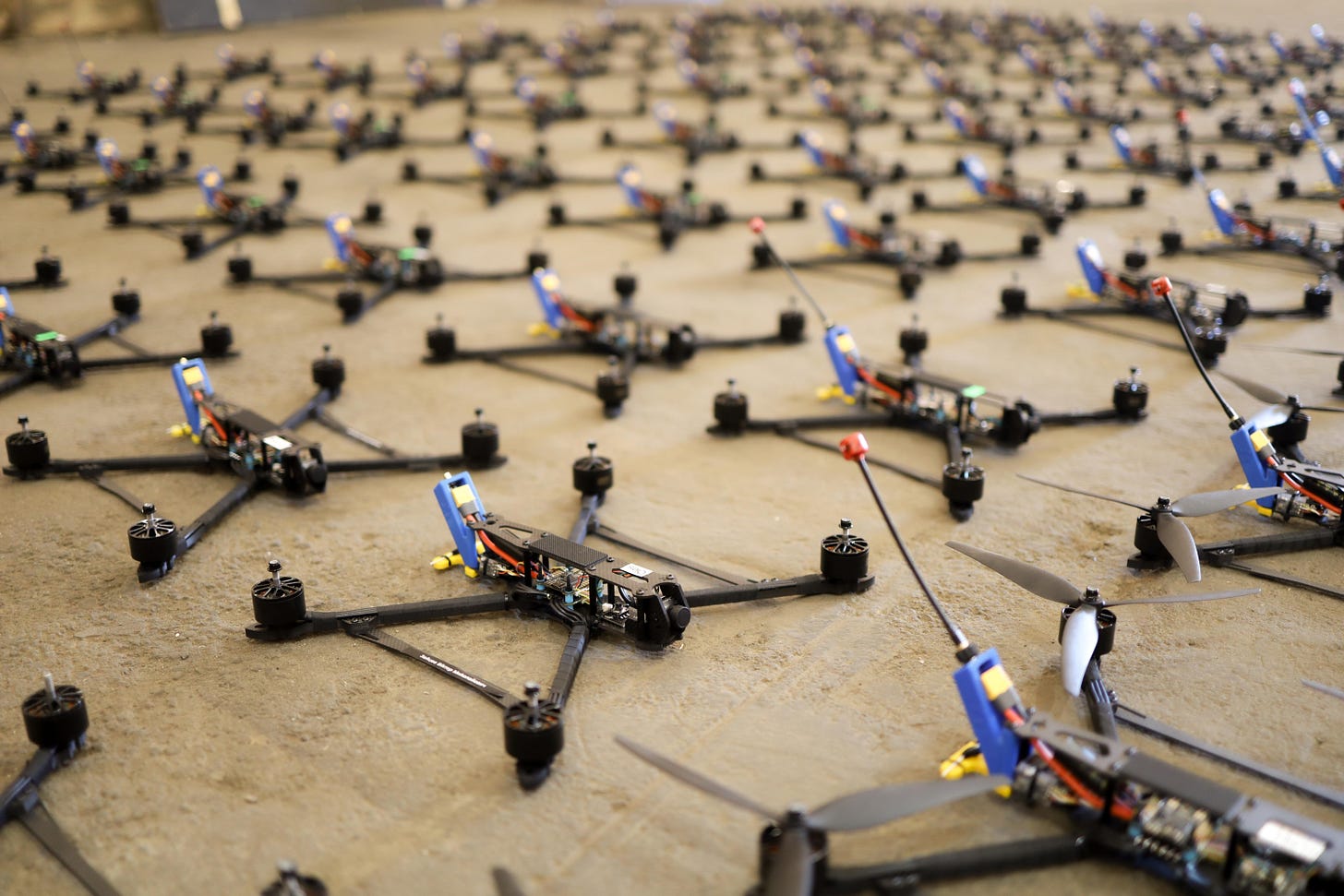 “Drone WMDs Don’t Need Any New Technology” by Felix Choussat 20.07.2026 23minDrones are cheap, disposable, and the future of war. Over the past four years, we have seen platforms, missiles, and heavy infantry become increasingly obsolete in the face of $500 drones carrying a pack of explosives—a cost advantage that has let Iranians and Ukrainians alike neuter the conventional capabilities of their great power rivals. Eighty percent of casualties in the bloodiest war since 1945 are from drone strikes, Russia has managed to lose one-third of its fleet to a country without a navy, and the US is spending millions of dollars to intercept five-figure Shaheds flying over the Strait of Hormuz. All this is the result of a technology that is still immature. The violence inflicted by today's drones is the handiwork of the scant few that manage to evade countermeasures (a mix of radio jamming, high-power microwave weapons, missiles, automatic cannons, interceptor drones, and nets) before making contact. These defenses exploit the inherent limitations of drones—human guidance, GPS feedback, flight exposure, radio links, range—to take them down en masse. And yet, even though 75% of some types of drones manufactured today never reach their targets, they have nonetheless been strategically decisive in Ukraine and elsewhere. These limitations will [...] ---Outline:(02:33) Breaking the Last Barriers to Autonomous Weapons(08:21) Future Methods of Weaponization(10:39) What an Urban Drone Attack Might Look Like(13:20) Defenses Against Drone WMDs May Be Inadequate(17:46) Strategic Applications for Rogue Actors(21:46) Taking Drone WMDs Seriously --- First published: July 20th, 2026 Source: https://aifrontiersmedia.substack.com/p/drone-wmds-dont-need-any-new-technology --- Narrated by TYPE III AUDIO. ---Images from the article:Apple Podcasts and Spotify do not show images in the episode description. Try Pocket Casts, or another podcast app.
 -
“The Government Is Choosing AI Models. Who Chooses Their Values?” by AI Frontiers 10.07.2026 22minSubtitle: The public deserves a say over the values of government-procured AIs. Kevin Frazier and Andrew Reddie — July 10, 2026 In September 2025, the state of California made an AI assistant, Poppy, generally available to employees, to help them “explore AI's productivity benefits.” The following month, the North Dakota Legislative Council deployed AI to assist with summarizing bills. And, in March 2026, the Los Angeles Superior Court partnered with an AI company to provide support across several key functions, including “case information, summarization, research, analysis and drafting assistance,” as well as case management. In the near future, it is likely that more US states and the federal government will direct the technology toward even more sensitive and significant tasks. AI may be used to adjudicate disputes, accelerate law-enforcement activities, and aid military operations to an even greater extent than it does today. As AI use cases are more regularly documented, scrutinized, fine-tuned, and optimized, people may actually demand increased AI adoption among government actors, even in sensitive domains. That raises the question: which models should be used? This question has no simple answer. With other technologies, the choice of a specific model might largely come down to [...] ---Outline:(02:32) How Model Character Could Influence Policy(06:34) Introducing Public Reasoning Fidelity(13:23) Designing an Institution to Evaluate PRF(16:34) Precedents(20:34) The Public Should Choose Public AI Values(21:47) Discussion about this post(21:51) Ready for more? --- First published: July 10th, 2026 Source: https://newsletter.ai-frontiers.org/p/the-government-is-choosing-ai-models --- Narrated by TYPE III AUDIO. ---Images from the article:Apple Podcasts and Spotify do not show images in the episode description. Try Pocket Casts, or another podcast app.
-
 “The Government Is Choosing AI Models. Who Chooses Their Values?” by Kevin Frazier, Andrew Reddie 10.07.2026 21minIn September 2025, the state of California made an AI assistant, Poppy, generally available to employees, to help them “explore AI's productivity benefits.” The following month, the North Dakota Legislative Council deployed AI to assist with summarizing bills. And, in March 2026, the Los Angeles Superior Court partnered with an AI company to provide support across several key functions, including “case information, summarization, research, analysis and drafting assistance,” as well as case management. In the near future, it is likely that more US states and the federal government will direct the technology toward even more sensitive and significant tasks. AI may be used to adjudicate disputes, accelerate law-enforcement activities, and aid military operations to an even greater extent than it does today. As AI use cases are more regularly documented, scrutinized, fine-tuned, and optimized, people may actually demand increased AI adoption among government actors, even in sensitive domains. That raises the question: which models should be used? This question has no simple answer. With other technologies, the choice of a specific model might largely come down to trade-offs between cost and performance. When it comes to AI, however, different frontier models may show significant differences in “character” or appear [...] ---Outline:(02:12) How Model Character Could Influence Policy(06:18) Introducing Public Reasoning Fidelity(13:18) Designing an Institution to Evaluate PRF(16:29) Precedents(20:33) The Public Should Choose Public AI Values --- First published: July 10th, 2026 Source: https://aifrontiersmedia.substack.com/p/the-government-is-choosing-ai-models --- Narrated by TYPE III AUDIO.
 -
“AI Governance Needs Radical Optionality” by AI Frontiers 06.07.2026 10minSubtitle: One of the most valuable things governments can build today is the capacity to govern advanced AI competently in the future. Charlie Bullock, Senior Research Fellow at the Institute for Law & AI — July 6, 2026 How should governments regulate the most advanced AI systems? One possible answer is that they should not. Libertarian-minded writers have made the case for a culture of “permissionless innovation” for AI development, in which the role of government would be limited to enforcing existing laws and facilitating industry self-regulation with “soft law” tools such as voluntary standard-setting. Another possibility, more in vogue across the aisle and the pond, would invoke the precautionary principle, using heavy-handed regulation to restrict the development of frontier AI models until developers can adequately prove that their systems are safe. I think there's a better approach. In a new essay, my co-author Christoph Winter and I make the case for a governance strategy that we call “radical optionality.” The idea is simple: governments should avoid over-regulation in the short term while building up the institutional capacity needed to competently regulate extremely advanced or “transformative” future AI systems when and if these systems come into existence. The [...] ---Outline:(02:02) Addressing AI Risks Under Uncertainty(06:40) Supporting Both Security and Innovation(10:37) Discussion about this post(10:41) Ready for more? --- First published: July 6th, 2026 Source: https://newsletter.ai-frontiers.org/p/ai-governance-needs-radical-optionality --- Narrated by TYPE III AUDIO. ---Images from the article:Apple Podcasts and Spotify do not show images in the episode description. Try Pocket Casts, or another podcast app.
-
 “AI Governance Needs Radical Optionality” by Charlie Bullock 06.07.2026 9minHow should governments regulate the most advanced AI systems? One possible answer is that they should not. Libertarian-minded writers have made the case for a culture of “permissionless innovation” for AI development, in which the role of government would be limited to enforcing existing laws and facilitating industry self-regulation with “soft law” tools such as voluntary standard-setting. Another possibility, more in vogue across the aisle and the pond, would invoke the precautionary principle, using heavy-handed regulation to restrict the development of frontier AI models until developers can adequately prove that their systems are safe. I think there's a better approach. In a new essay, my co-author Christoph Winter and I make the case for a governance strategy that we call “radical optionality.” The idea is simple: governments should avoid over-regulation in the short term while building up the institutional capacity needed to competently regulate extremely advanced or “transformative” future AI systems when and if these systems come into existence. The point of this approach is to maximize optionality by providing our institutions with tools that can be used to respond to a wide range of foreseen or unforeseen future developments. In this piece, we explain the rationale behind maximizing [...] ---Outline:(01:40) Addressing AI Risks Under Uncertainty(06:26) Supporting Both Security and Innovation --- First published: July 6th, 2026 Source: https://aifrontiersmedia.substack.com/p/ai-governance-needs-radical-optionality --- Narrated by TYPE III AUDIO.
 -
“Three Models of Sino-American Competition for the Soul of AI” by AI Frontiers 30.06.2026 25minSubtitle: American leaders agree that the AI race will shape the balance of power with China. But they can’t agree on how to ensure the technology advances American values. Bill Drexel, Senior Fellow at the Hudson Institute — June 30, 2026 When officials in Washington warn about losing the AI race to China, the conversation turns quickly to military and economic advantage—and rightly so. Advanced AI will reshape everything from weapons systems to medicine, with massive implications for our geopolitical competitiveness. But beneath the great-power competition on AI lies a moral one. The ethical character of the most transformative technology in generations—one that will mediate an ever-larger share of human experience—will be a byproduct of superpower rivalry. At stake is the future of the relationship between individuals and the state, of privacy and control, of human agency and algorithmic authority. The fear is not merely that China might build better systems, deploy them more widely, or out-sell American competitors. It is that those systems could carry a tide of new norms shaped by a government that surveils its citizens, suppresses dissent, harbors eugenic ambitions, and treats individual autonomy as a problem. As AI comes to dominate our lives [...] ---Outline:(03:04) Breakaway Tech Dominance(07:03) Encoded Values(12:59) Emergent Control Regimes(18:02) A Rebalanced Approach(24:57) Discussion about this post(25:01) Ready for more? --- First published: June 30th, 2026 Source: https://newsletter.ai-frontiers.org/p/three-models-of-sino-american-competition --- Narrated by TYPE III AUDIO. ---Images from the article:Apple Podcasts and Spotify do not show images in the episode description. Try Pocket Casts, or another podcast app.
-
 “Three Models of Sino-American Competition for the Soul of AI” by Bill Drexel 30.06.2026 24minWhen officials in Washington warn about losing the AI race to China, the conversation turns quickly to military and economic advantage—and rightly so. Advanced AI will reshape everything from weapons systems to medicine, with massive implications for our geopolitical competitiveness. But beneath the great-power competition on AI lies a moral one. The ethical character of the most transformative technology in generations—one that will mediate an ever-larger share of human experience—will be a byproduct of superpower rivalry. At stake is the future of the relationship between individuals and the state, of privacy and control, of human agency and algorithmic authority. The fear is not merely that China might build better systems, deploy them more widely, or out-sell American competitors. It is that those systems could carry a tide of new norms shaped by a government that surveils its citizens, suppresses dissent, harbors eugenic ambitions, and treats individual autonomy as a problem. As AI comes to dominate our lives as thoroughly as digital media already has—shaping our health and finances, how our children learn, how we are tracked, even our species’ genetic makeup—this battle for AI's soul will affect us all intimately. The contours of that battle are almost always left [...] ---Outline:(02:37) Breakaway Tech Dominance(06:45) Encoded Values(12:51) Emergent Control Regimes(18:05) A Rebalanced Approach --- First published: June 30th, 2026 Source: https://aifrontiersmedia.substack.com/p/three-models-of-sino-american-competition --- Narrated by TYPE III AUDIO.
Samankaltaiset podcastit


Suosittu maassa
Tämä podcast esiintyy myös näiden maiden podcast-listoilla.

