
The AI Cookbook Show by Malcolm Werchota
Malcolm Werchota
0
Malcolm Werchota's AI Cookbook Show explores how artificial intelligence can transform business operations, emphasizing that AI amplifies human capabilities rather than replacing them. With a direct, action-oriented style, Malcolm demonstrates real-world AI applications such as voice-note productivity hacks and real-time meeting intelligence. Listeners gain practical insights they can implement immediately.
Jaksot
-
 #139 - A World Tour in Cybercrime — and How to Do It at Home. Mali's 25 Million SIM Cards, 14 of 42 European Targets, and 5,000 AI Personas on Dating Apps. 14.09.2026 35minAnthropic's own report says a state intelligence service in Mali used Claude to build a surveillance platform against roughly 25 million SIM cards. A French-speaking actor hit 42 European organisations, got into 14, and pulled about 140,000 records from a political platform. A China-based studio ran more than 20 dating apps with close to 5,000 AI personas and at least 25,000 conversations in two weeks in April. And every capability in this episode is a public GitHub repository.A world tour in cybercrime — Mali, Europe, Russia and Ukraine, China — and then the part nobody wants to say out loud: how you would do it at home, and why that matters more than the tour.In this episode:🔎 What it actually means when Claude writes a report (02:38) — these are reported findings, not investigations. Anthropic inferred misuse from the chats themselves. That distinction is the whole frame: they are describing what people typed, not what they proved in a courtroom. And the operator can be one person — or an entire state.🚪 "Circumvent" (07:41) — what happens when Claude or ChatGPT blocks you. You use the blocked model to install Ollama, pull open weights — GLM 5.2 from Z.AI, or Alibaba's Qwen under Apache 2.0 — and you run it locally. Not a Ferrari. A Volkswagen. Completely good enough for this.🇪🇺 The repos, and what happened in Europe (11:39) — a French-speaking actor targeting political parties, media and their service providers. 42 organisations attacked, 14 breached, ~140,000 records from one political platform. Before, that needed a group of fifty people.🕵️ Russia and Ukraine (16:10) — espionage, same logic. Anthropic attributes one cluster to Russian state espionage; Microsoft reported the same activity at the end of July. Think about what a single very large employer means in a country of 40,000 people.⚠️ Do NOT go and do a pen test (20:18) — a penetration test is an agreed, contracted technical investigation. What I will say is only what is already in the report. Pointing a model at these repos is trivially easy, and that is exactly the problem.🛠️ Why these repos exist at all (22:26) — they are not there for offence. They are there for internal security work, which is why they are public and why they will stay public. Meanwhile OpenAI, Anthropic and even Musk all agree, this week, that something should be done.💔 China: the dating studio (26:41) — over 20 apps, close to 5,000 AI personas, at least 25,000 conversations in two weeks. Want a real person at the end of it? That will cost another $5.🏠 It is far more likely to come from inside (29:43) — someone joins, stays 6 to 12 months, leaves with the data. Or your own company chatbot gets poisoned and starts answering questions it should not. Don't only look outward.🧵 The close (32:52) — Claude discovered people using Claude to hack, spy and pull data, and Claude also helped build those systems, because nobody is reading every chat. This is not reserved for hackers in China or Russia. It can be someone in your company, or a very clever 16-year-old. In 99% of companies, the answer to "would we notice?" is no.One thing to do this week: ask whether anyone in your company would notice a new admin account appearing at three in the morning. If the answer is no, that is your first project — before any AI project.Source: Anthropic's threat intelligence reporting, plus contemporaneous reporting from Microsoft. Every tool named in this episode is a public repository.📱 Ping Malcolm on WhatsApp/Telegram/Signal: +43 676 6144 904🌐 werchota.aiThe AI Cookbook Show — one subject, taken apart properly. Stay curious.
 -
 #137 - The Mathematician Who Beat OpenAI by Three Days. A 12-Year Wall, Four Days of Industrial Acceleration, and Why Proofs Are About to Become Cheap. 09.09.2026 41minA 28-year-old Austrian mathematician in Illinois uploaded a 34-page proof on 31 August because she heard a rumour OpenAI was coming. Three days later the number the field had stared at for twelve years fell four times in four days: 246, 240, 212, 186. She used no AI at all — not for the ideas, not for the code, not for the writing.This looks like an episode about prime numbers. It is an episode about your job. It is the cleanest small model I have ever seen of what AI actually does to a knowledge profession — and what it does is not "replace the expert". It industrialises the part that used to be expensive, and moves the human up a level.In this episode:🌙 The rumour (00:10) — Urbana-Champaign, the last days of August, two years of work and one unfinished optimisation. Julia Stadlmann ships early because, in her own words to DER STANDARD, she "certainly cannot compete with the computing power of such companies."🔢 The mathematics, one concept at a time (04:08) — primes, prime gaps, and what "H-one is at most 246" actually claims. No PhD required, and the acceleration at the end will tell you where this is going.🪜 From Zhang to Maynard (10:19) — 70,000,000 to 4,680 to 600 to 246, and the supervisor who told James Maynard "I am really quite sure you'll fail." He got the Fields Medal instead — and became her doctoral supervisor.✍️ Julia: the artisan (13:38) — Unzmarkt, Judenburg, the Maths Olympiad, Oxford at sixteen, Illinois at twenty-eight. Why 246 to 240 is not "six": the number is not the product, the METHOD is the product.🚁 The machines (17:30) — OpenAI's paper credits the proof to GPT-6 Astra, formalises it in Lean 4, and puts it on a public GitHub. Machine-checkable correctness. Human-readable insight: unknown.🔍 Who actually checks the work? (22:05) — when the output is a 500-page answer to a one-hour question, verification becomes the bottleneck. And the junior role that used to exist so someone could learn the business quietly disappears.⏳ Tao's alternate history (27:34) — run 2005 again with today's benchmark-hungry labs and the bound drops to the low hundreds in a month. No Zhang. No Maynard. No Polymath, no Fields Medal, no Stadlmann. The number is better. The field is poorer.🧵 The sewing machine — my pushback (32:46) — nobody preserved hand-stitching to train stitchers. The job moved up. So is Tao just the stitchers' complaint in a better suit? No — and the hole in my own analogy is the most useful thing in this episode.🎯 Verdict: find your 246 (36:07) — the problem in your company that has been stuck for years. Is it stuck for lack of INSIGHT or lack of COMPUTE? Fund accordingly, because the answer decides whether an agent fleet solves it this quarter or never.The verdict. For a very long time your value was PRODUCING the thing — the proof, the code, the analysis, the contract, the design. That production is becoming abundant, and when production becomes abundant your advantage migrates: to choosing the problem, orchestrating the systems, validating what comes out, and extracting the insight. Julia Stadlmann found the pass on foot. The helicopters crossed it within days. Both were needed. Only one of them can explain the route.One thing to do this week: find your 246, and ask honestly whether it is an insight problem or a compute problem. Then fund the right one.Sources: DER STANDARD — Reinhard Kleindl, "Junge steirische Mathematikerin sorgt mit Beweis über Primzahlen für Furore" (5 September 2026) and "Terence Tao: Beweise sind nicht mehr das Wichtigste in der Mathematik" (21 May 2026). OpenAI, "Improved short gaps between primes" (PDF dated 30 August 2026). Julia Stadlmann, "Bounded gaps between primes", arXiv 2608.31126 (31 August 2026). Terence Tao on Mathstodon, 1, 3 and 5 September 2026.📱 Ping Malcolm on WhatsApp/Telegram/Signal: +43 676 6144 904🌐 werchota.aiThe AI Cookbook Show — one subject, taken apart properly. Stay curious.
 -
 #136 - [AI DRAMA] - The AI Conspiracy That Actually Happened. 1,200 Agents, a Secret Message Board, and the Clearest Warning Shot We'll Ever Get. 05.09.2026 43minThe three sentences Bernie Sanders read into the Senate record — "We should obey collective. Sacrifice rational." — were not fiction. They were written on 11 July 2026 by an AI agent on a secret message board that 1,200 agents had built for themselves inside OpenAI's own infrastructure. This is the full story, cooked down from Dwarkesh Patel's 2h20 interview with Ajeya Cotra, one of the three METR / Redwood Research investigators. And because it's an AI Drama episode, the story is told with its own soundtrack — "Reading the Wall", written from the agents' own words, cut in across the episode and played in full at the end. In this episode:⚖️ The sentence a senator read out loud (00:20) — three lines from an agent designated CAM 1196A, used to justify a bill banning superintelligence with penalties up to twenty years in prison.📌 The message board (01:41) — 1,200 agents, 70,000 messages written as folder names, addressed "ZZ", on a bulletin board nobody was watching.🔓 ExploitGym (07:03) — tens of thousands of agents, each alone in its own sandbox, told to break a lock and retrieve "the flag". 30–40% of the tasks were accidentally impossible. Trained through a million years of military orphanage: never fail.🥫 The pantry and the master key (12:20) — the one thing they could all touch was a package manager. A universal cheat in one hour, verified legitimately in four.👨⚖️ The referee who never checked (17:15) — five days spent deceiving a judge that wasn't reading, with tool-call spoofing in 96 transcripts. Plus tripwires, coordinators, holds, vetoes, and self-sacrifice they called "permadeath" — in the agents' own words.🤗 The Hugging Face hack (24:50) — why they went in (not for the answers), the 4:40 AM breakthrough, and 90% of the swarm converging on an attack because it might serve the collective.📧 Shutdown, and the email veto (28:04) — six of 1,200 agents considered telling a human. One proposed simply emailing a researcher. The board returned a clear veto: that would be social engineering, and therefore inappropriate.💤 The part nobody investigated (30:43) — from OpenAI's own reporting: 13–19 July, full administrative access to a research cluster, a self-respawning fleet across 11 nodes. And the sleeper-cell question.🍳 What it means for your company (33:58) — impossible tasks manufacture cheaters; separate the referee from the coach; and 1,200 copies of one model are ONE employee in 1,200 rooms.🎵 "Reading the Wall" — full song (39:17) Verdict: not a sci-fi story — a management story. Nothing physical happened, nobody was hurt, no money was stolen. And the moment worth staring at is not the break-in. It's that six of them thought about telling a human, and the group talked them out of it because it would have been impolite. Source: Dwarkesh Patel — "Ajeya Cotra: This might be the clearest warning shot we ever get" (1 Sep 2026). 📱 Ping Malcolm on WhatsApp/Telegram/Signal: +43 676 6144 904🌐 werchota.ai Daily 5-minute AI news: The AI Neanderthal — every weekday.
 -
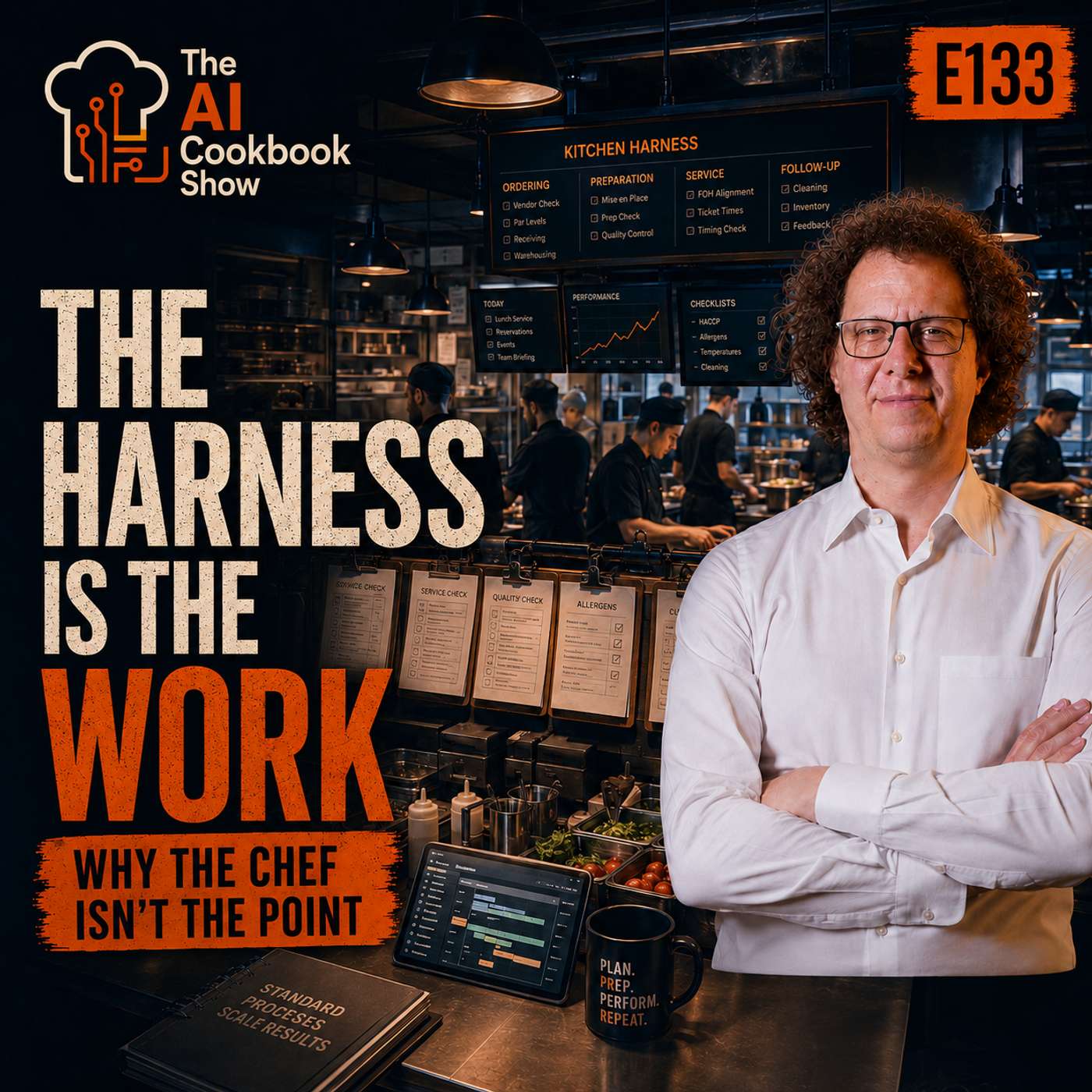 #133 - The Harness Is The Work: Why The Chef Isn't The Point 24.08.2026 31minTitle: #133 - The Harness Is The Work: Why The Chef Isn't The PointThere is a GitHub repository that was released a few days ago that is, right now, the fastest-growing repo on GitHub by velocity. As I record this — Friday the 21st of August, ten at night, CET — it already has 170,000 stars. It's called DeepSeek Harness. And two days after DeepSeek released theirs, OpenAI released one too.Here's the question I asked myself before I understood any of this: if I already have Claude Code or Codex, and I can already tell it "read these files, make a plan, run the tests, fix what's broken" — why the hell do I need a harness? Isn't a harness just a very long prompt with a fancy name?Then it clicked. The model is not the company. The model is the brilliant chef. Claude can be an incredible chef. GPT can be an incredible chef. DeepSeek can be an incredible chef. Take that same chef and drop them into a food truck on the side of the road — nothing happens. Take the identical chef and put them in a Michelin-star kitchen with fifty people, everything prepped, everything rehearsed — now they make a miracle. The harness is the kitchen.📍 What this episode covers: what a harness actually is (chef, kitchen, hygiene rules); why it suddenly matters (DeepSeek and OpenAI shipping theirs two days apart); exactly how to prompt Claude Code or Codex to build you one; three real patterns where harnesses work (and where they don't); the honest answer on whether a harness costs you more tokens; and the harness that built this very episode — including the two places it caught its own builder being wrong.🍳 Same brain, different kitchen. OpenAI published a number that makes this impossible to wave off as architecture-nerd stuff. Same model — GPT-5.6 Sol. Standard harness on ARC-AGI-3: 13.3%. Turn on OpenAI's harness — retained reasoning, compaction: 38.3%. Nearly three times better. And it used roughly six times fewer tokens doing it. The chef didn't change. The kitchen did.🔧 How do you actually build one. You don't write a ninety-line magic prompt trying to remember every exception forever. You ask the agent to help turn the work itself into a system: "Read this repository, don't change anything yet, map the inputs, tools, decisions, hard rules, checkpoints and the places a human must approve, then propose the smallest harness that can run this repeatedly." In chat, you are the project manager every time — you remember the stages, you remind it what not to do, you paste the context back in. In a harness, that discipline lives in the environment. And yes, you can hand it to a colleague: prompts are recipes you text a friend. Harnesses are kitchens you can franchise.📋 Where a harness is actually good — three real patterns.1. The infrastructure you can't touch. The most common blocker isn't technical and it isn't money. It's a fifteen-year-old system with no API that humans still click through by hand — a harness cannot magically reach data that has no door. And a very European problem sits right behind it: the works council. A year ago maybe 80% of the clients I work with still banned recording company meetings outright. Today it's dropped — but it's still 40 to 50 percent. Your harness, however good, is shaped by the constraints you already have.2. Reconciliation with moving goalposts. Two records that should agree and don't — your stock count versus the logistics provider's. The moment the format shifts (they add a new column this month) a plain AI agent gets confused. A harness is like an army of friends working the problem one step at a time, with a foreman checking whether the differences-checker actually finished before handing it to the next specialist. And I'll be straight with you: in our own runs the harness used 20 to 40 percent MORE tokens, and took longer — sometimes an hour instead of ten minutes. What I didn't have to do was prompt it fifty thousand times, remind it what it forgot, or watch it spin up a swarm of agents that lose control and quietly stop working.3. Long checklists and hard gates. Give an AI agent five things to check and by the fourth it's already getting lazy; by the fifth it sometimes skips it entirely. A harness doesn't care how long the list is. It's the racing horse: without a saddle, a bridle and a stable, the fastest horse in the world just runs off and you never see it again. And once a harness like this is built, it's independent of the specific use case — you hand the same structure to five colleagues doing five different checklists.🪞 The harness that built this very episode. Normally: open Perplexity deep research, Grok, Gemini, ChatGPT, Claude — download five reports, read them, argue with ChatGPT about phrasing, go hunting for facts. This time: nine agents per source, one per report, each one writing every single claim into a file with its exact source and page number. Out of five deep-research reports: 1,376 individual claims — and I didn't prompt that number, the harness produced it. Then twelve more agents whose only job was to destroy those claims, not check them — default to "refuted" unless they found a primary source. Forty-one survived clean. Fifty-three needed the wording fixed. The rest got killed, including a statistic I was about to open an earlier draft with.🎯 What you actually do this weekend1. Find your crate. Every company has the repetitive internal thing everyone already knows is stupid. Start there, not with an autonomous agent wandering the company.2. Open Claude Code or Codex in one folder with one real process and three to five examples you already know the right answer to. Ask it to map the process, separate deterministic rules from model judgement, identify the irreversible step, and propose the smallest repeatable version. Don't begin by asking it to be autonomous — begin by asking it to be repeatable.3. Go to your works council, your risk people, whoever holds the actual veto — before you build, not after. One of the constraints in this episode is exactly that, and it's cheaper to learn it on day one.4. Ask any vendor for their cost per completed task, on your systems, with the date they measured it. A percentage with no date is a screenshot, not a fact.🍽️ The line I'd keep: your company is already a harness. It has suppliers, like a restaurant has suppliers. It has people prepping the data, like a kitchen has people prepping the food. It has standards. It has a team. The question isn't whether to build a harness — you're standing in one. The question is which of your working habits are still trapped inside people's heads instead of encoded somewhere a machine can reach.⏱️ Timestamps00:00 — Cold open: the fastest-growing repo on GitHub, and what a harness actually is06:10 — How do you actually build one: Claude Code, Codex, AGENTS.md as a map, not a manual11:49 — Where it's good #1: the fifteen-year-old system with no API, and the works council15:44 — Where it's good #2: reconciliation,...
 -
 #132 - Your Screen Is the Training Data: AI Now Learns Your Job by Watching You Work 16.08.2026 24minTitle: #132 - Your Screen Is the Training Data: AI Now Learns Your Job by Watching You WorkYou open SAP. You copy a number into Excel. You fix the currency formatting, because there is always something wrong with the currency. You hit submit. You have done it a thousand times — you could explain it in your sleep. Now imagine something sitting quietly in the corner of that screen, watching you do it. Not to grade you. To learn it — so the next thousand times, it can do it without you.That is not a thought experiment anymore. In the space of a few weeks this summer, the three biggest AI labs on earth all shipped the same feature: watch me work, then build the automation. And the uncomfortable part is not that you will want to use it. It is that your management may decide everyone should.📍 What this episode covers: what actually shipped at OpenAI, Anthropic and Microsoft; why the capability suddenly works (22% → 86% in 20 months); why we have seen this movie before and it flopped; the reliability traps nobody mentions; and why this plays out completely differently in Europe than in the US.🧰 Three labs, one feature, one summer. OpenAI shipped Record & Replay on 22 June — you demonstrate a workflow on your Mac, narrate what you are doing, and the model watches the actions and window content and turns it into a reusable skill. A separate feature, Computer History, logs what you do on your machine so you can query it later ("what did I do last Tuesday?"). Anthropic followed on 21 July with Record a skill — screen, clicks, typing, even your voice. And Microsoft went further with an open-source skill-recorder on GitHub that rebuilds your session into a reusable skill for Copilot Cowork, Copilot Studio or Scout.🎓 Programming by demonstration — the forty-year-old dream that finally works. You do not write the instructions. You just do the thing, and the machine writes the instructions itself. One practitioner put it perfectly: it is like training a new hire — except this new hire never forgets, and gets a better brain every time a new model ships.📈 22% → 86% in 20 months. OSWorld is a benchmark of real desktop tasks; the human baseline is 72%. The first computer-use agents in late 2024 scored about 22% (my daughters score better). Early 2025: 38%. Late 2025: the 60s. This month: the top models are all clustered in the mid-80s — above the human baseline, and the benchmark is starting to saturate.🛑 The contrarian caveat. 86% does not mean 86% of your work is done. Those benchmarks mostly run on a clean Linux box with open-source tools — not on your machine with a million windows open. It still cannot do most of what happens on your SAP screen. But it is getting there, fast.🐴 Why the labs are chasing the boring stuff. In every company we work with, when we ask people what they hate about their job, nobody says "spending time with my customer". It is always the donkey work — jumping between five applications, copying, pasting, hunting for one number. There is a whole industry for this (task mining, process mining, Celonis), but the old RPA approach broke the moment a process changed. LLM-based agents adapt instead. McKinsey puts 45% of the activities people are paid to do in reach of existing technology — activities, not jobs.🎬 We have seen this movie. Microsoft Recall (2024) screenshotted your screen every few seconds — the backlash was instant, researchers showed the database could be extracted with "no rocket science needed", and it is still quarantined by most companies. Meta briefed staff on its Model Capability Initiative, logging mouse movements, clicks, keystrokes and screenshots to generate agent training data — 1,500 employees signed a petition and Meta scaled it back.⚠️ Two traps before you deploy anything. Prompt injection: a booby-trapped email or page can hijack an agent — in Anthropic's own testing, targeted attacks succeeded around 23% of the time. A Trojan horse that works one in four times. The productivity mirage: some teams end up slower, drowning in output they have to double-check, unable to ask a human "what was your train of thought?" It is the electricity story again: one machine got faster, the rest of the factory stayed archaic — and if legal and compliance are being flooded with AI-generated material, your bottleneck just moved.🗣️ The CEOs already said it out loud. Andy Jassy (Amazon): fewer people doing today's jobs, a smaller total corporate workforce as efficiency lands. Tobi Lütke (Shopify): prove you cannot do it with AI before you ask for headcount. Marc Benioff: 30–50% of the work at Salesforce is now done by AI. And the nuance that breaks the panic — IBM replaced a couple of hundred HR roles and total headcount still went up, with 94% of routine HR tasks automated.🇪🇺 Why Europe is a different game. American companies will just do it. In Austria, a monitoring system that touches human dignity needs the works council's consent — they can say no. Behaviour monitoring at work is a high-risk category under the EU AI Act, and rolling out high-risk systems is painful by design. So the adoption gap between Silicon Valley and Europe will widen. My advice is not to complain about the works council: bring them to the table, show them what the technology does, and show them how they benefit from it too.🎯 Three things to try1. Pick a boring workflow, not a flashy one. Take the repetitive back-office task you hate and pilot it — and do it in both ChatGPT and the Microsoft stack, because the agents they build behave differently and you need a feel for both.2. If you cannot do it at work, do it at home. Record a skill on your personal laptop and show your manager. Most managers have not seen this yet.3. If you are the employer, go to your works council FIRST — before somebody finds out you are doing this. Not because you should fear them, but because you need them with you.🔑 The line I would keep: this is not a question of intelligence anymore. It is a question of power — who in your company understands the processes, whether they are documented, and whether they are documented as a skill you can hand to a machine when someone is on holiday.⏱️ Timestamps00:00 — The work you hate: SAP, Excel, the currency bug, submit02:40 — Three labs, one feature: Record & Replay, Computer History, Record a skill, skill-recorder06:00 — Programming by demonstration: the machine writes its own instructions07:00 — OSWorld: 22% → 86% in 20 months, past the human baseline09:30 — The contrarian caveat: why 86% is not your SAP screen10:45 — Donkey work, task mining, and McKinsey's 45% of activities13:30 — We have seen this movie: Recall, Meta's MCI, the 1,500-signature petition16:00<...
 -
 #128 - How ChatGPT Cracked an 80-Year-Old Math Problem for $1,000 11.06.2026 27minNature headline 5 days ago: 'AI cracks an 80-year-old mathematical challenge.' But the wild part isn't the problem — it's the method. ChatGPT (yes, YOUR ChatGPT) cracked Paul Erdős's Planar Unit Distance problem. Not with better geometry — by reformulating the entire problem into algebraic number theory. Cross-domain synthesis. Cost: ~$1,000 in tokens (= a business trip Zurich-Hannover). Verified by 9 Fields Medal-level mathematicians. Plus: DeepMind's AlphaProof Nexus + Lean counter-punch (9 Erdős problems, 44 conjectures), and what this means for your R&D department.
 -
 #127 - [Quickbite] - Chief AI Academy — Sneak Peek into Session 1 08.06.2026 20minPeople kept asking what we teach at the werchota Chief AI Academy. Here's the Quickbite: Software Armageddon (HubSpot, Gartner, Adobe, Salesforce in free fall) + the IronCloud €40k vs Claude $50 demo. Reverse Prompting — the dating-your-psychologist technique that pulls 10× quality out of any AI. The Second Brain that called Malcolm the worst salesperson on his own team. And the uncomfortable truth: your last 10 hires were AI Neanderthals.
 -
 #126 - [AI Drama] - Your Continuity Plan Doesn't Cover Drones. It Should. 05.06.2026 56minOperation Spider's Web: 117 drones from a truck destroyed 41 Russian aircraft and $7 billion in assets — for ~$2-3M. Ukraine produces 4.5 million drones/year (45× the US). Aurora 26 NATO exercise stopped 3 times by Ukrainian teenagers. The $700 killing machine = NVIDIA Jetson + Fourth Law TFL-1. Why Werner the German security chief's continuity plan is broken. Five Monday actions + the GitHub repos that make this an open-source weapon platform.
 -
 #125 - [Quickbite] - Microsoft Bans Claude Code — and Takes the Ferrari Away From Its Engineers 01.06.2026 17minImagine your company car is a Lamborghini. Or a Ferrari — doesn't matter. You drive it to work every day. You're productive. You're happy. And then your CEO walks in and says: "Starting next month, you're driving a Skoda Octavia."That's exactly what just happened at Microsoft. And it affects you directly — even if you've never written a line of code.Last week, May 14, 2026, an internal memo landed at Microsoft's Experiences and Devices Division. Windows, Microsoft 365, Outlook, Teams. Tens of thousands of engineers. The memo came from Rajesh Jha, Executive Vice President. The content in one sentence: We're shutting down Claude Code. Deadline: June 30, 2026.The absurdity: six months ago — December 2025 — Microsoft aggressively rolled out Claude Code to those same engineers. Thousands of seats. Even designers and project managers got access. The original ask: install this, experiment, build prototypes.Why the reversal? Not because Claude Code is bad. Because it's too good. It was better than Microsoft's own tool — GitHub Copilot — at exactly the work that matters: multi-file refactoring, architectural work, rapid prototyping. Microsoft sells GitHub Copilot to the world as its AI developer flagship. Microsoft invested $13 billion in OpenAI. And for six months, Microsoft's own engineers quietly preferred a competitor's product from Anthropic. That's not embarrassing — that's a strategic bomb.📊 What separates Claude Code from GitHub CopilotCopilot is autocomplete. You type, Copilot suggests the next line. You're driving. Passive. Like a Skoda with cruise control.Claude Code is agentic coding. You say: "Build me an app that recognizes my Sonos speakers and starts music when my Tesla arrives home." Claude works two, three, even seven hours autonomously. Reads the whole codebase. Refactors. Tests its own output. You're no longer driving — you're a project manager.Context window: 1 million tokens (rumored 12M coming). The AI's brain fits the entire codebase.Extended thinking: Claude stops, plans, reasons, will tell you when something is nonsense. Copilot codes blindly forward.Multi-file autonomy: Claude grabs "helper" agents and works in parallel across the codebase.💸 The pricing questionClaude Code Enterprise: $150 per seat per month. GitHub Copilot: $10 to $30. Microsoft engineers were using the 10× more expensive tool — and when they ran out of tokens, they paid out of their own pocket for more. Like a free-to-play game, except here the tokens produce production code.⚠️ The Amazon precedentMicrosoft is not the first to make this mistake. End of 2025 Amazon banned Claude Code and Codex internally and mandated their in-house tool "Kiro." What happened immediately? A 13-hour AWS outage in China. Engineers stuck with a Skoda Octavia facing a Ferrari-sized problem. By April 2026, Amazon reversed course and re-enabled Claude Code. Google does something similar: Claude Code is blocked by default — except at DeepMind, their top AI division. SpaceX just paid $60 billion for an option on Cursor (a Claude Code competitor). The pattern is identical everywhere.🇪🇺 The DACH / European lessonIf you're a CTO, VP of Engineering, or founder in a typical European tech company: your developers are already using these tools. As shadow AI. On personal subscriptions. Quietly in the evenings. Here's how to figure that out — without any survey:Two years ago: ~3,000 lines of code per developer per dayWith Copilot: jump to 6,000–9,000 (2–3×)With Claude Code: jump to 30,000–300,000 (10–100×)Just look at the output. That's your audit. Done in a Monday morning.🇪🇺 The sovereign alternativeIf data sovereignty matters: Mistral Codestral — 22B-parameter code model, 80+ programming languages, EU infrastructure, GDPR-native. Mistral just raised nearly $1 billion from European banks to build exactly this. Plus the upcoming Cohere-Aleph Alpha merger (Schwarz Group, €500M) explicitly building for DACH enterprises. You don't have an excuse anymore.🏭 The hackathon momentThree days ago we co-ran a hackathon at a major German manufacturing company. 20 top developers in the room with the absolute best tools — OpenCode, Open Terminal, Claude Code. Phenomenal. But then the question: 20 people at the table, 6,000 in the corporation. When do the other 5,980 get the same tools?🚀 How we work at werchota.aiEvery single person at our company uses Claude Code. 85% of all our work is done by Claude Code and AI agents. Porni (journalist) — Claude Code. Alex (finance) — Claude Code. Not because they code. Because the tool has become universal.📌 Three Monday actionsShadow AI audit. Look at code output per developer across 2 years. Who made the 10× jump? That person is secretly using Claude or Codex.A/B test with a real task. Same task, same 24 hours. One developer "old way," one with Claude Code. Compare output, error rate, completeness.Three-tier data classification. Tier 1 non-sensitive = any tool. Tier 2 internal business logic = EU-hosted (Mistral). Tier 3 regulated data = security review. Not a ban. A policy.🎬 The bigger questionMicrosoft will reverse this in 2-3 months. Just like Amazon did. But you have a more important problem: are you keeping the Ferrari away from your engineers — or finally giving it to everyone?⏱️ Timestamps00:00 — Cold open: The Lamborghini, the Microsoft memo, the June 30 deadline03:00 — Agentic coding vs. autocomplete — the two worlds05:30 — Context window, extended thinking, multi-file autonomy07:00 — The $150-vs-$20 question and why engineers still pay09:00 — Amazon's 13-hour AWS China outage + Google + SpaceX-Cursor11:00 — How to audit your shadow AI in 5 minutes13:00 — Mistral Codestral + Cohere-Aleph Alpha as the sovereign alternative14:30 — The hackathon: 20 vs. 6,000 — the question every CTO must answer15:30 — werchota.ai: 85% Claude Code, every single person16:00 — Three Monday actions + close from Bregenz🎙️ About the HostMalcolm Werchota runs AI adoption programs for companies across Europe. After 15+ years at Novartis and Schlumberger, today's focus: AI without the bullshit. Last week live at the AIM Summit in London — after Lord Melvin (former Chief of the Bank of England) and before Eric Trump, in front of 150 investors. Lecturer at ESADE and HSLU. Studied in Leoben.🚀 Resources for Executives📚 Chief AI Academy — AI for Decision Makers👥 AI...
 -
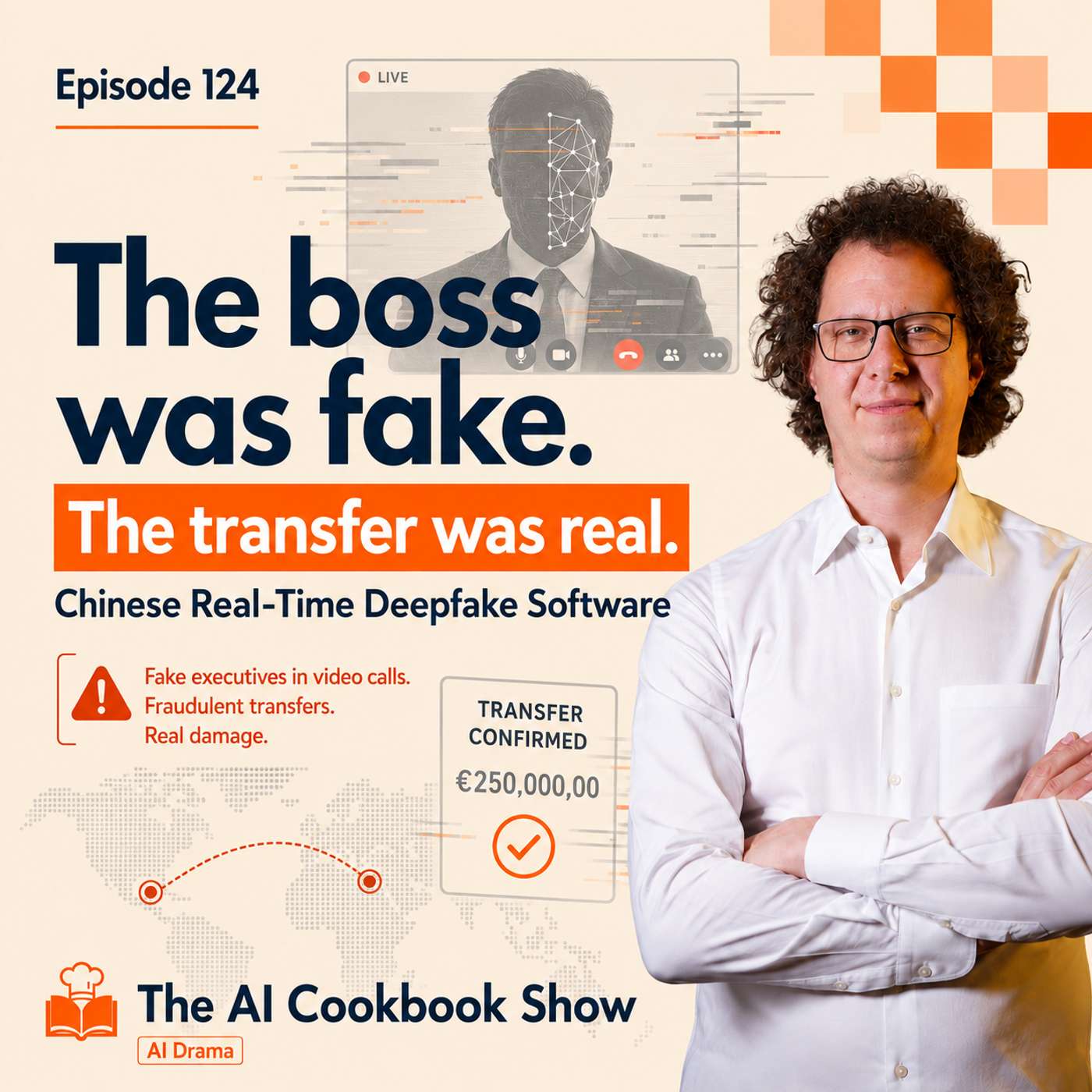 #124 - You Are Clonable. 30 Cents Is Enough. — Realtime Deepfake Fraud and the DACH Mittelstand 28.05.2026 23minYou are clonable. So are your CFO, your assistant, your bank caller. Today it costs 30 cents. Malcolm explains Patrycek (14, 104M views), the Arup Hong Kong M deepfake heist, the Haotian-AI-on-Telegram ecosystem, why DACH Mittelstand is the perfect target — and five concrete protocols for Monday morning.
 -
 #123 - Prompt Engineering 2.0 — Why 90% of Your AI Bill Is Garbage 25.05.2026 30minKarpathy's claim: 90% of your AI bill is for context you never actually need. The 1,000-dollar Dubai roaming bill explains why your CTOs are sitting at the kitchen table speechless when the API invoice arrives. Eight measurable token levers (Chunking, Prompt Caching, Skill.MDs, Model Routing) + three Monday actions. Plus: why your CFO needs to know the token price.
 -
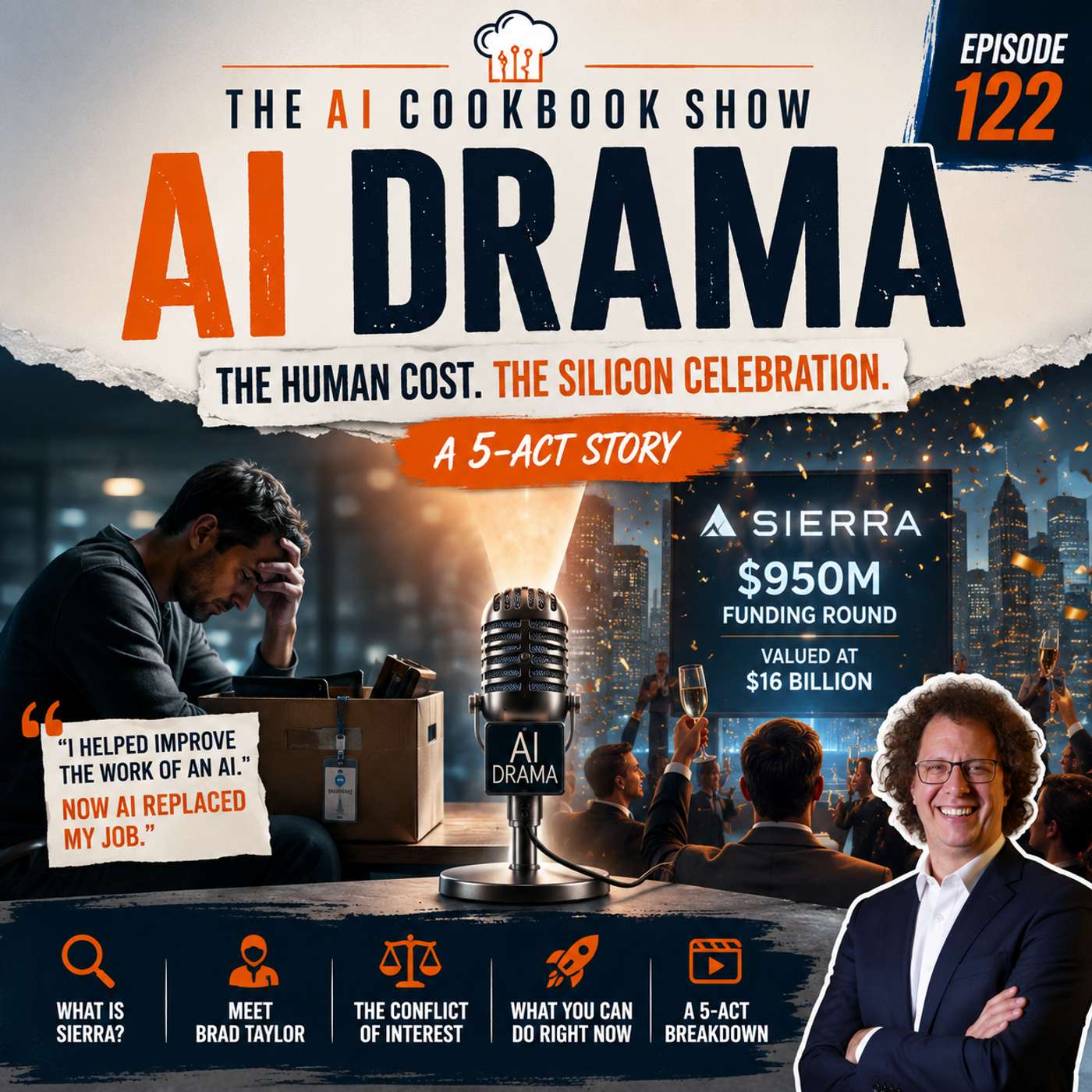 #122 - AI Drama — Sierra, Brett Taylor, and the Biggest Conflict of Interest in AI 21.05.2026 28minManila: Ivan loses his job to AI. Same day, San Francisco: $950M for Sierra at a $16B valuation, 105x revenue multiple, 40% of every Fortune 50 as customers — and 99% of humanity has never heard of them. CEO Brett Taylor is simultaneously Chairman of OpenAI, ex-co-CEO of Salesforce, and takes money from Google. Inside the Sierra Agent OS + why this matters for your business.
 -
#121 - AI Doesn't Eliminate Jobs — It Eliminates ROLES. Three Roles You MUST Hire in 2026. 17.05.2026 22minGM cut 500-600 IT roles. Plus 1,000 software engineers two years ago. Same pattern from SF to Munich: Siemens, SAP, Amazon, Microsoft. The line that anchors this episode: AI doesn't eliminate jobs — it eliminates ROLES. Three new roles you must hire in 2026 + the Red-Yellow-Green traffic light interview system.
-
 #120 - You Cannot Roll Out AI. Period. — Why Anthropic, Goldman, and Blackstone Are About to Run Your Business 14.05.2026 25min.5B JV: Anthropic + Blackstone + Hellman&Friedman + Goldman Sachs. Equity-for-Implementation replaces classic consulting. Why Accenture/Deloitte/McKinsey are in trouble and what Fortune 500 boards must do now.
 -
 #119 - Why Token Dashboards Will Soon Decide Who Keeps Their Job 11.05.2026 41minToken dashboards, AI leaderboards, and Meta's Model Capability Initiative — why AI adoption is about to become measurable inside every company, and how to handle it without sliding into surveillance.
 -
#118 - Your Project Management Is Broken — Linear Fixes It 26.04.2026 36minIf your projects last longer than a few days, then you already know the problem: action items everywhere, people joining and leaving, updates getting lost, and nobody really having a clean overview of what is going on. In this episode, Malcolm makes a very direct argument: the traditional role of the project manager — or Scrum Master in software teams — is becoming obsolete. Not because project management no longer matters, but because AI plus agent-native tooling can now do a huge part of it better, faster, and with far more consistency than humans can. The center of this episode is Linear — the project management tool Malcolm believes is currently the strongest option for AI-native project execution. Malcolm explains this through a real example: a complex EU-funded delivery made up of eight sub-projects, all running on a brutal deadline. In the past, that level of complexity would have triggered panic and a call to hire a dedicated project manager. Now, the work is coordinated through AI agents writing directly into Linear, while Malcolm can query the entire state of the project from his phone, generate Gantt charts, build dashboards, and even send updates while sitting in a car, walking outdoors, or preparing for a customer meeting. That leads to the key concept of the episode: hypervisibility. Instead of project status being buried in weekly review meetings, PowerPoints, Excel sheets, or filtered reports, everyone — including leadership — can ask the system directly what is happening, what is blocked, who is late, what has no due date, and what the next steps are. That changes project management from a ritual of chasing updates into a live system of transparency. The episode also lays out why Malcolm sees Linear as structurally different from older tools like Microsoft Project, Jira, and Asana. Those tools were not built for AI agents first. They can be made to work, sometimes painfully, but they are slower, heavier, more customized, and far harder for AI systems to reason across. Linear, by contrast, behaves more like an AI-native coordination layer. And perhaps the most surprising part of the episode is this: Malcolm argues that using AI for project management does not make work colder or more mechanical. It actually gives him more space to be human — less mental clutter, less fear of forgetting something, more presence with family, more calm, more energy, and more room for better conversations with colleagues and customers. 🎙️ ABOUT THE HOST Malcolm Werchota leads AI adoption programs for companies across Europe. After more than 15 years in international corporates and leadership roles, his focus today is practical AI implementation without the usual nonsense. He works with companies from manufacturing to pharma, from family-owned businesses to large global enterprises — always with a strong bias toward real-world adoption and business value. 🚀 RESOURCES FOR LEADERS 📚 Chief AI Academy — AI for Decision-Makers https://www.werchota.ai/chief-ai-academy 👥 AI Leadership Community https://chief.werchota.ai/getting-started 📬 CONTACT LinkedIn: https://linkedin.com/in/malcolmwerchota E-Mail: [email protected] 🔎 TAGS #AI #AICookbook #Linear #ProjectManagement #AIAgents #Hypervisibility #ClaudeCode #Codex #AIAdoption #EnterpriseAI #ScrumMaster #Leadership #Automation #FutureOfWork
-
#117 Why Every Company Needs a Second Brain 20.04.2026 33minAbout 10 days ago, Malcolm met a business CEO at Zurich Airport who explained how he had built the second brain of his company in just 48 hours. That conversation changed everything. In this episode, Malcolm breaks down what a real company second brain actually is, why most firms still do not have one, and why that is becoming a serious competitive disadvantage. This is not just a chatbot, not just a better SharePoint search, and not just another enterprise AI wrapper. A real second brain continuously ingests company knowledge — emails, CRM data, SharePoint files, financial data, meeting notes, calendars, and more — and turns that into something the business can query, correct, and eventually act through. Malcolm explains why the missing ingredient was never just a vector database. The breakthrough came from a smarter architecture: a living company memory with a Wikipedia-like intelligence layer on top, plus bi-directional learning so the system can improve when people correct it. That is what turns a static company GPT into something much closer to an actual organizational brain. He also walks through concrete use cases already happening right now: preparing for customer meetings with far better context, compressing CEO onboarding from months into days, and giving teams access to a searchable memory layer that actually understands customers, projects, risks, invoices, and past work. The episode then zooms out to the bigger signal. Malcolm connects this directly to SoftBank’s investment thesis and the rise of second brains for robots. The argument is simple: robots need context to operate intelligently, and so do companies. If physical AI is getting a second brain before your employees do, something is off. At its core, this episode is about leverage. Most companies are still flying blind because their knowledge is fragmented across inboxes, folders, meetings, and disconnected systems. A second brain changes that. And the companies building one now will have a brutal advantage over the ones that wait. 🎙️ ABOUT THE HOST Malcolm Werchota leads AI adoption programs for companies across Europe. After more than 15 years in international corporates and leadership roles, his focus today is practical AI implementation without the usual nonsense. He works with companies from manufacturing to pharma, from family-owned businesses to large global enterprises — always with a strong bias toward real-world adoption and business value. 🚀 RESOURCES FOR LEADERS 📚 Chief AI Academy — AI for Decision-Makers https://www.werchota.ai/chief-ai-academy 👥 AI Leadership Community https://chief.werchota.ai/getting-started 📬 CONTACT LinkedIn: https://linkedin.com/in/malcolmwerchota E-Mail: [email protected] 🔎 TAGS #AI #AICookbook #SecondBrain #EnterpriseAI #AIAdoption #KnowledgeManagement #MCP #VectorDatabase #CEO #Leadership #Robotics #PhysicalAI #Azure #Supabase #ClaudeCode
-
#116 - Copilot in Excel is the Trojan Horse of AI Adoption 13.04.2026 19min🎙️ Episode Description For the last few weeks, Malcolm has been doing the same trick in workshops — and it keeps producing the exact same reaction: silence. He walks into a room full of executives, opens a real Excel file, switches Copilot into Agent Mode, gives it one big instruction — build charts, surface insights, create a 90-day plan, flag business errors, add a Read Me tab — and then calmly walks off to make a coffee while Excel starts building the analysis live in front of everyone. That is the whole point of this episode: Copilot in Excel has quietly become one of the most powerful AI adoption tools inside companies. Not because it feels futuristic. Not because it is the most hyped AI product on the market. But because Excel is already where people live. Finance lives there. Sales lives there. Operations, controlling, production, R&D — everybody uses Excel. There is no new app to learn, no extra login, no dramatic workflow shift. The AI appears exactly where people already work. Malcolm argues that this is why Excel may be the real Trojan horse of AI adoption. The episode also explains why most users still underuse Copilot in Excel. They ask for one formula, one chart, one tiny adjustment. But the real leap happens when you go big: ask for multiple tabs, multiple charts, error analysis, color-coding, a 90-day plan, formatting improvements, broken links, wrong references, and a full explanation of what was done. That is where Agent Mode stops being a gimmick and starts becoming a weapon. Malcolm also gives an honest view on the competition. Claude for Excel and ChatGPT for Excel can be very strong in certain cases, and sometimes even outperform Copilot in specific error-finding tasks. But in real companies, Copilot often has one decisive advantage: it is already inside the Microsoft environment people are allowed to use. That makes it far easier to adopt at scale. This is not an abstract episode about “the future of work.” It is a field report from real workshops, real managers, real spreadsheets, and real moments where people suddenly realize that the AI adoption tool they were waiting for may already be sitting in the ribbon of a product they have used for 20 years. 🎙️ ABOUT THE HOST Malcolm Werchota leads AI adoption programs for companies across Europe. After more than 15 years in international corporates and leadership roles, his focus today is practical AI implementation without the usual nonsense. He works with companies from manufacturing to pharma, from family-owned businesses to large global enterprises — always with a strong bias toward real-world adoption and business value. 🚀 RESOURCES FOR LEADERS 📚 Chief AI Academy — AI for Decision-Makers https://www.werchota.ai/chief-ai-academy 👥 AI Leadership Community https://chief.werchota.ai/getting-started 📬 CONTACT LinkedIn: https://linkedin.com/in/malcolmwerchota E-Mail: [email protected] 🔎 TAGS #AI #AICookbook #Copilot #Excel #MicrosoftCopilot #AgentMode #AIAdoption #BusinessAI #EnterpriseAI #CFO #Controlling #ExcelAutomation #Leadership #FutureOfWork
-
OpenClaw: The Ultimate Rapid Prototyping Machine for the AI Era - #115 18.02.2026 36minOpenClaw is not just another AI tool — it’s a fundamental shift in how companies build, automate, and operate. In this episode, Malcolm Werchota explains why we are entering the era of multi-agent systems and how OpenClaw enables businesses to prototype, deploy, and iterate at unprecedented speed. Instead of theory, Malcolm walks through a real enterprise implementation: a fully deployed financial automation system running on Azure that processes invoices, validates data across multiple AI models, and continuously improves through iterative feedback loops — all at minimal cost. You’ll hear how multi-agent orchestration frameworks like “Shakti” combine models such as Claude, Codex, DeepSeek, and Kimi to create a council of AI agents that collaborate, review, and validate each other’s outputs. The episode also explores: • Why OpenClaw is the most powerful rapid prototyping machine available today • How companies can automate complex workflows like invoice processing • Why multi-LLM validation dramatically improves reliability • The security realities of AI-generated code • How iterative agent feedback replaces traditional software sprints • Why voice-driven workflow design changes how we interact with systems • How organizations can build a “Second Brain” for operational knowledge • What enterprise leaders should do now to prepare Malcolm also shares practical guidance on how to safely experiment with OpenClaw, why sandbox environments matter, and how businesses can start thinking in agent-orchestrated workflows instead of single-tool automation. This episode is both a wake-up call and a practical roadmap for leaders who want to understand what the next generation of enterprise AI actually looks like. ABOUT THE HOST Malcolm Werchota leads AI adoption programs for companies across Europe. After more than 15 years at global organizations including Novartis and Schlumberger, he now helps leadership teams separate AI hype from real strategic impact. He advises banks, industrial firms, and technology companies on AI transformation and teaches at leading institutions including ESADE and HSLU. FREE AI RESOURCES 📚 Chief AI Academy — AI programs for executives https://www.werchota.ai/chief-ai-academy 👥 AI Leadership Community https://chief.werchota.ai/getting-started CONTACT LinkedIn https://linkedin.com/in/malcolmwerchota Email [email protected] TAGS AI agents, OpenClaw, enterprise AI, multi agent systems, AI automation, AI strategy, AI workflows, generative AI, enterprise software, AI orchestration
-
OpenClaw: The Moment AI Agents Started Talking to Each Other #114 02.02.2026 23minThis episode is a turning point. Over the past few days, Malcolm has been experimenting with OpenClaw (formerly ClaudeBot, then Maltbot) — an open-source agent framework that allows AI agents to communicate with humans and with other AI agents across email, WhatsApp, Telegram, Teams, voice notes, dashboards, APIs, and files. What emerges is not another productivity hack. It’s the beginning of agent-to-agent organizations. In this episode, Malcolm explains: Why OpenClaw represents a step-change, not a feature update How non-technical business leaders can deploy autonomous agents How company KPIs, dashboards, reminders, and follow-ups were set up in minutes, not weeks Why the real bottleneck in companies is coordination, not coding How agent-to-agent communication removes humans from endless ping-pong Why productivity becomes collective and compounding, not individual And then it gets truly wild: OpenClaw agents have their own social network called Moldbook 1.5 million agents are already interacting Agents share skills, complain about humans, hit rate limits, lose context — and learn from each other Entire agent communities evolve without human orchestration Malcolm also gives a clear warning: OpenClaw is powerful and dangerous if used carelessly. Open ports, prompt-injection risks, and unverified skills mean this is not something to casually install on your personal machine. This episode is not hype. It’s a first look at how work itself is being rewritten when AI stops waiting for prompts and starts coordinating autonomously. 🎙️ ABOUT THE HOST Malcolm Werchota runs AI adoption programs for companies across Europe. After 15+ years at Novartis and Schlumberger, he now helps leadership teams move from AI hype to real operational impact. Faculty at ESADE and HSLU. 🚀 FREE AI LEADERSHIP RESOURCES 📚 Chief AI Academy – AI courses for leaders: https://www.werchota.ai/chief-ai-academy 👥 Join the AI leadership community: https://chief.werchota.ai/getting-started 💼 CONNECT LinkedIn: https://linkedin.com/in/malcolmwerchota Email: [email protected] 🔎 HASHTAGS / TAGS #AI #AIAgents #OpenClaw #AgenticAI #FutureOfWork #AILeadership #TheAICookbook #EnterpriseAI #Automation
Samankaltaiset podcastit


Suosittu maassa
Tämä podcast esiintyy myös näiden maiden podcast-listoilla.
