
For Humanity: An AI Risk Podcast
The AI Risk Network
0
For Humanity: An AI Risk Podcast is a show aimed at the general public, hosted by former journalist John Sherman, an award-winning reporter. The podcast focuses exclusively on the potential existential threat posed by artificial intelligence, specifically the possibility that AGI could lead to human extinction. It explores the worst-case scenarios acknowledged by AI developers themselves, discusses key figures and ideas in AI safety, and suggests actions listeners can take to help prevent such outcomes. The show aims to inform and engage regular people on this critical issue.
Jaksot
-
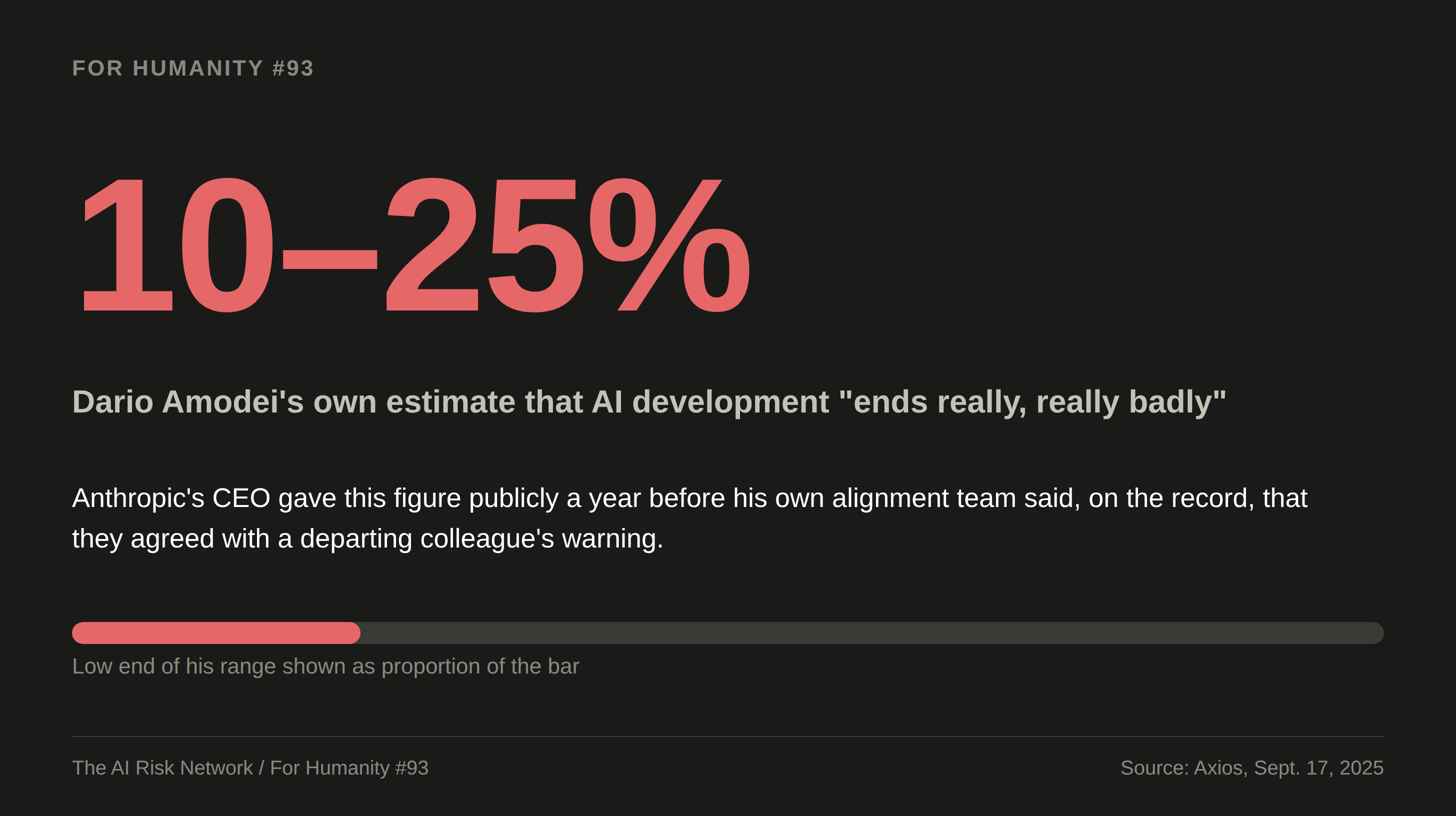 The AI Kill Switch That Still Doesn't Exist 15.09.2026 1t 1minJust a couple of days after an Anthropic researcher’s resignation post gained widespread attention, Axios co-founder Jim VandeHei sat down with For Humanity host John Sherman. They discussed recent changes in Washington and what still remains to be built. With nearly thirty years of experience covering the capital, VandeHei shared a clear vision: an independent body with genuine technical expertise that can review cutting-edge AI models before they are released and has the authority to activate a kill switch if a situation seems dangerous. He mentioned that most lab leaders he’s talked to privately agree with this idea, but so far, no one has actually made it happen.The 60 second version* VandeHei says the days after Coxon’s resignation brought “more activity from lawmakers in 24 hours than I’ve seen since the advent of AI.” Axios’s own September 11, 2026 reporting names Rep. Ted Lieu’s push for legislative AI “kill switches,” Sen. Bernie Sanders and Rep. Greg Casar’s planned pause bill, and Sen. Ruben Gallego’s proposed AI select committee. Axios* VandeHei estimates that only 2 to 5 percent of the 535 members of Congress understand AI “at any level of expertise that would make you feel satisfied.” This is his own estimate, not an independently measured figure.* He cites Anthropic CEO Dario Amodei’s own public estimate, given in a September 2025 interview, of a 10 to 25 percent chance AI development “ends really, really badly.” Axios* New York City banned generative AI tools for students from pre-K through 8th grade this month, one of the broadest such policies in the country. Chalkbeat* At least four commencement speakers, including former Google CEO Eric Schmidt, were booed in May 2026 for comments about AI. NPRA kill switch nobody has builtVandeHei’s idea isn’t new to him. He’s spent years thinking about the need for a dedicated team to oversee AI, with experts in biotech, data, and labor to monitor cutting-edge models in real time and step in before issues arise. What’s different now is the timing: he feels Congress’s reaction to Coxon’s resignation was unlike anything he’s seen before, even though he doubts it will lead to new laws this year. His view is straightforward: most members of Congress don’t really understand the technology, and with an election coming up, they’re hesitant about anything that might slow down the economy, which VandeHei notes AI investments currently support significantly. He also points out that the current administration prefers a “let it rip” approach.Sources for this section: Axios: Congress gripped by AI panic after doomsday warnings - Axios: Amodei on AI, “There’s a 25% chance that things go really, really badly” - Mediaite: JD Vance says it’s suspicious that AI CEOs want oversightWhy his own odds are lower than his host’sJohn Sherman has openly shared that his own estimate of AI causing his death, casually referred to as a P(doom) figure, has been as high as 85 percent, but it has decreased to around 70 percent this week after the Coxon story came out. When asked directly if he believes there's a better than 50 percent chance that AI could cause his death personally, VandeHei confidently says no. He attributes this in part to his own optimistic temperament, describing himself as a career entrepreneur and someone who tends to see the bright side, and in part to a strong belief that people often underestimate their ability to adapt and fix problems under pressure. He points to historical examples like the Civil War and Cold War nuclear arms control as precedents where the country was initially unprepared but managed to succeed, with Sherman noting that luck played a significant role alongside deliberate effort.Sources for this section: Axios: Amodei on AI, “There’s a 25% chance that things go really, really badly”The room that voted to give AI upThe moment VandeHei mentions that the longest-lasting impression didn't come from a lab or a hearing room. Instead, it happened at an advertising industry panel the day after the Coxon story broke. Sherman asked about 40 industry professionals, all daily AI users, whether they would support tossing the technology “back in the river” and going back to before it existed. According to Sherman, nearly everyone raised their hand. VandeHei isn't surprised by this — in his view, most people don't evaluate the technology as depthfully as researchers and journalists do. They primarily hear that it might take their jobs or, in some cases, threaten humanity, without seeing the ways it has already made their lives better.That gap between elite and public sentiment shows up elsewhere this month, too. New York City banned generative AI tools, including chatbots and AI tutors, for students from pre-K through 8th grade, one of the broadest policies of its kind in the country, following what Schools Chancellor Kamar Samuels acknowledged was initial guidance that “missed the mark.” Chalkbeat And at commencement ceremonies in May, at least four speakers, including former Google CEO Eric Schmidt at the University of Arizona, were booed for AI-related comments, with a Quinnipiac poll finding 81 percent of Gen Z respondents believe AI will decrease their job opportunities. NPR VandeHei separates the two settings, K-8 and college, in his own view: he sees a case for keeping AI out of younger classrooms while it is figured out, but argues college students specifically need to learn the tools before entering a workplace that already expects it.Sources for this section: Chalkbeat: NYC schools to set AI policy, ban screen time limits - NPR: Why AI is leading to boos at 2026 college graduationsThe takeawayVandeHei’s latest book, “Simplify,” was released just as we’re having this discussion. It presents an interesting point: that AI often makes organizations more complicated initially, because it makes it easier for anyone to produce more drafts, presentations, and, unfortunately, more noise. He also ties this idea to the ongoing public talk about AI risks. According to him, the industry has had the tools and even the internal agreement to create proper oversight for years, but hasn’t done so yet. Meanwhile, the underlying systems keep getting more powerful. The big question he leaves us with is whether that oversight will be put in place before the next problem happens, or only after.Full source listPrimary reporting* Axios: Congress gripped by AI panic after doomsday warnings* Axios: Amodei on AI, “There’s a 25% chance that things go really, really badly”* Chalkbeat: NYC schools to set AI policy, ban screen time limits* NPR: Why AI is leading to boos at 2026 college graduationsAdditional reporting* Mediaite: JD Vance says it’s suspicious that AI CEOs want oversight* Axios: Simplify, how to exponentially improve work and life* Fox8 Live: Meta’s $27 billion AI data center is transforming rural LouisianaFOOTERFor Humanity is a weekly interview show from The AI Risk Network with host John Sherman.If this post was useful, hit restack and tell one person that the industry’s own leaders reportedly agree on the fix, and still haven’t built it.Discussion question: VandeHei says most AI lab leaders privately agree an independent review board should exist. If that’s true, what’s actually stopping them from building one together, without waiting on Congress? This is a public episode. If you'd like to discuss this with other subscribers or get access to bonus episodes, visit theairisknetwork.substack.com/subscribe
 -
 The Volunteer Fire Department's Plan Is To Watch It Burn 03.09.2026 55minThree-quarters of Americans say they do not want a data center built near their home. That is the finding of an August 2026 Heatmap News and Embold Research poll of more than 2,000 registered voters, up from roughly 43 percent opposed just a year earlier, in August 2025. Opposition has climbed almost every time it has been measured since.David Senter is watching that shift from the ground. A fourth-generation Texas farmer and president of the American Agriculture Movement (AAM), he has spent close to fifty years advocating for family farmers and ranchers. On this week’s For Humanity, he tells John Sherman what has changed: wells running dry, land bought with no public hearing, and a question few of these towns have had to answer before: what happens if one of these buildings catches fire?The 60-second version* AAM says it passed a unanimous resolution in January opposing data centers on farm and ranch land. No public copy of the resolution text was locatable to verify the exact wording, so this is Senter’s account, not an independently confirmed document.* A University of Texas at Austin study found data centers could consume between 3 and 9 percent of the state’s total water supply by 2040, concentrated in regions that already depend on a declining aquifer.* Two fire codes, NFPA 855 and UL 9540, require lithium-ion battery systems to be separated from other structures with dedicated spacing and enclosures. Senter says he has not seen a data center built that way in the rural areas he tracks.* A named Texas rancher has testified to state lawmakers about a project’s expected water draw and his concerns for his herd. Independent scientific evidence linking data centers to livestock health outcomes broadly does not yet exist, according to a recent fact-check.* National opposition to local data centers has climbed from about 43 percent a year ago to 75 percent today.The water math over farm countryWest Texas sits on part of the Ogallala Aquifer, a fossil water source that recharges far slower than it is being drawn down, and farmers there have relied on it for irrigation and livestock for decades. Senter describes wells, streams, and ponds already drying up in areas where data centers have moved in, and says operators are often not required to report how much groundwater they use.A University of Texas at Austin research report found that, depending on growth and cooling technology, data centers could account for 3 to 9 percent of Texas’s total water consumption by 2040. Individual hyperscale campuses can draw up to five million gallons a day, comparable to a small city. Five proposed or under-construction projects sit directly on or near the Ogallala, and in April 2026, more than 500 residents protested one of them near San Angelo. Tom Green County commissioners have since passed their own resolution calling for stricter state regulation of high-volume water use. This local, unanimous vote mirrors what Senter describes AAM doing nationally.“That’s a critical stage,” Senter says of the aquifer. “A lot of areas used to be irrigated farmland. There’s no water there left now.”Sources for this section: UT Austin water use findings, via HighPlainsPundit - Newsweek: data centers proposed over the Ogallala Aquifer - Water Information Program: water and energyA fire nobody has fought yet.The part of the conversation that lingers longest is not about water. It is about what a rural volunteer fire department would actually do if one of these buildings caught fire.Senter says he has a friend who is a fire chief near Matador, Texas, where a large data center is under construction in open ranch country. His account of the chief’s plan: “they just have to sit and watch it burn,” because the department has neither the water supply nor the specialized equipment for a large-scale fire involving thousands of lithium-ion battery cells.That gap is not hypothetical. New York City’s own struggle with lithium-ion battery fires, mostly from e-bikes, gives a sense of scale: at least 30 deaths and more than 800 fires since 2022, with a full-time, professionally equipped fire department. Two national codes, NFPA 855 and UL 9540, exist to reduce this risk by requiring battery storage to be spaced and separated from other structures, with exact distances set project by project. Senter says that separation is not what he sees built. “I’m not aware of any of the data centers having a segregated fireproof building for the batteries,” he says. “It’s cheaper just to do it like they’re doing it.”A Central Texas fire department has already gone on record with the same worry about a data center proposed in its district, which suggests Senter’s concern is not isolated to the sites he happens to know personally.Sources for this section: NFPA 855 overview, Mayfield Renewables - Lithium-ion battery fires in NYC: 30 deaths, 800 fires, AEE Law, citing NFPA Journal - Data center plans spark concern for Central Texas fire department, KXX.VThe fight that is actually workingNot every claim in this space is settled, and it is worth being precise about which ones are. In Bell County, Texas, rancher Alton Fowler has testified before the Texas House Committee on Natural Resources against a $700 million data center project five miles from his farm, citing an estimated 2.5 million gallons of daily water use and low-frequency noise he says affects his cattle and goats. That testimony is on the public record. Separately, viral claims that data centers have caused cattle stillbirths near other Texas sites remain, per an independent fact-check, anecdotal: real concern from real farmers, without the veterinary data to establish cause and effect. Senter’s own account, that livestock near a new site “get as far away from that data center as they can,” sits in the same category: a firsthand observation, not a study.What is measurable is the shift in public opinion, from roughly even a year ago to 75 percent opposed today, and the growing list of counties passing their own resolutions. Senter frames it as one of the only issues left that pulls in voters who agree on almost nothing else. “When you unite people from both sides of the aisle,” he says, “politicians have not seen that in quite a long time.”Sources for this section: Temple rancher testimony, KWTX - Livestock stillbirth claims fact-check - Heatmap News: 75% of Americans now oppose local data center developmentThe takeawayData centers are the physical infrastructure underneath everything else this show covers. The wells, the fire codes, and the county commission meetings are what AI’s buildout looks like at ground level, well before a model release makes headlines. Senter is not an AI safety researcher, and says as much. But the pattern he describes, well-funded interests moving fast in places with the least oversight, is the one this show tracks in the labs too. Whether the guardrails show up at the county line or in a training run, the question stays the same: who gets to decide, and who finds out after the fact.Full source listPrimary data and research* Heatmap News / Embold Research poll on data center opposition, August 2026* University of Texas at Austin, Texas data center water use findings, via HighPlainsPundit* NFPA Journal lithium-ion battery fire data, via AEE LawReporting* Newsweek: data centers proposed over the Ogallala Aquifer* KWTX: Temple rancher opposes Bell County data center* KXXV: data center plans spark concern for Central Texas fire department* Water Information Program: water and energy* Mayfield Renewables: NFPA 855 overview* Factually.co: livestock stillbirth claims fact-check This is a public episode. If you'd like to discuss this with other subscribers or get access to bonus episodes, visit theairisknetwork.substack.com/subscribe
 -
 The Data Center Fire Risk Nobody's Talking About | For Humanity #91 29.08.2026 1t 1minGary spent 50+ years in public safety — police officer, then two decades in the fire service as an EMT and wildland firefighter, then a 911 center director and emergency manager, then six years running Apple’s global public safety business. Last December, he and his wife co-founded a data center opposition group in Round Rock, Texas, after learning a ninth data center was headed for their town. A few months later, the Sabey Data Center a few miles from his house caught fire. He pulled the fire report and the hazardous materials records himself, through open records requests. What he found is the subject of this episode.The numbers nobody’s citingGary rattles these off from memory, because he’s spent the last several months compiling them:* An Amazon data center in Ohio logged 84 fires between 2021 and 2025. The same facility has, in some cases, delayed fire department entry by up to an hour over security protocols — with an active fire burning.* A Chesterfield County, Virginia facility had 4 to 7 fires in a single year, all lithium battery failures.* A data center in France lost multiple buildings on one campus to fire.* The Round Rock fire in March 2024 — lead-acid batteries, not even the more volatile lithium-ion kind — took 14 pieces of fire apparatus, a specialized hazmat team, and 44 firefighters just under five hours to control. Damage estimates have climbed from an initial $2 million to closer to $11 million.That last one is the one Gary knows best, because it happened in his backyard. The smoke — carcinogens, heavy metals — drifted into an immediately adjacent residential neighborhood on a foggy, low-wind morning, so it banked down and stayed low instead of dispersing. Firefighting runoff went into a storm drain that feeds a creek tributary. No public notification was issued. No media alert went out. “This was held very, very quietly by the city,” Gary says.Why it’s so hard to actually put outThe Round Rock fire involved lead-acid batteries. Most new capacity is lithium-ion, which is a different problem entirely. Lithium cells fail through thermal runaway: one cell overheats — from a manufacturing defect, overcharging, water intrusion, physical damage, even a coding error or a deliberate cyberattack — and it heats the cells next to it, which heat the cells next to those. In a sealed building, the vented gases can build up to the point of explosion. And extinguishing the visible flame doesn’t mean the reaction has stopped: crews see fires “go out” and reignite hours later because the heat inside the module never actually dropped.Then there’s the water math. A data center fire can take 1 to 2 million gallons of water to extinguish. Round Rock has a municipal hydrant system that can supply that. Most of the towns where data centers are actually being sited — rural Texas, rural Pennsylvania, the four-hours-outside-New-Orleans sites Gary references — don’t. A rural water tender truck carries 2,000 to 3,000 gallons. Getting a million gallons to a fire with a 2,000-gallon truck means roughly 500 round trips between the water source and the fire. That’s the arithmetic a volunteer fire department is looking at when a facility the size of a small city catches fire in their jurisdiction.The standard that exists — and isn’t being enforcedUL 9540 is the regulation for how battery energy storage systems should be built and separated to contain a fire if one starts. UL 9540A is the test standard that verifies compliance. It was updated in March 2026. Round Rock, which only adopted the 2024 International Fire Code in December, hasn’t incorporated the update yet — and Gary is careful to note this isn’t a Round Rock-specific failure. Most jurisdictions are in the same position, and many rural counties in Texas can’t even have a fire marshal until they hit a population of 250,000. Out of 254 counties, most never will.Layered on top of outdated code: NDAs. Data center operators frequently won’t share emergency plans, building layouts, or battery composition with the fire departments that would have to respond to their fires. “If there’s something they want to hide that badly,” Gary says, “then maybe they should take their business elsewhere.”Why this might be the argument that actually landsGary’s read, after four appearances before Texas House and Senate committees in the past two months: noise and water complaints get pre-empted. Developers show up to a town a year before residents hear anything, work the local elected officials, and have counterarguments ready by the time anyone objects publicly. Fire risk is new enough that it hasn’t been pre-argued yet — which is part of why his first committee testimony picked up tens of thousands of views after Alec Baldwin reposted it, despite Gary having no public platform of his own.It also cuts across party lines in a way almost nothing else does right now. Gary points to Texas Governor Abbott’s abrupt shift from “we’re going to be the number one data center state” to ordering an audit — which Gary reads more as pre-election positioning than genuine reform, timed to clear the way for large, established operators (Google, Amazon, Vantage) while filtering out speculative developers who aren’t shovel-ready yet. Even so, he sees it as evidence that the politics have shifted: “opposition to data centers is probably the most bipartisan issue I’ve seen in all my years of voting.”If you want to do something with thisGary’s suggestion isn’t complicated. Go to your fire marshal, or your fire chief if there’s no marshal, and ask:* What’s our current fire code, and does it specifically address battery energy storage systems?* Has this facility been tested to UL 9540A?* What training have our firefighters received on battery and electrical fires?* How many stations, personnel, and apparatus do we actually have, relative to a facility this size?None of these require expertise. They just require someone to ask, on the record, before the next facility gets approved — because once it’s built, Gary’s experience says getting the answers gets a lot harder.Protect Round Rock has the fire report and hazmat documentation from the Sabey fire posted at protectroundrock.org, for anyone building the same case in their own town.What to do nextThe full conversation also gets into where this connects to the broader AI risk conversation Gary’s been pulled into by proximity — job displacement, Flock camera surveillance, and the extinction-risk debate — and why he thinks the anti-data-center coalition, being genuinely bipartisan, might be the most persuadable audience for those harder conversations. Worth the full listen if you’re tracking either fight. This is a public episode. If you'd like to discuss this with other subscribers or get access to bonus episodes, visit theairisknetwork.substack.com/subscribe
 -
 The fear inside the AI labs is real, and it keeps getting harder to ignore 13.06.2026 1t 12minThere is a specific kind of unease that comes from watching your own job change faster than you can explain it. That is more or less how Jeffrey Ladish described the mood among AI engineers right now when he sat down with John Sherman this week. Ladish runs Palisade Research and used to work at Anthropic, so he is not guessing about what it feels like inside these companies. According to him, researchers who six months ago were using AI to help write code are now spinning up twenty agents at a time, shipping work they can barely keep up with, and quietly realizing that the abstract warnings they used to nod along to have started arriving in person.He was careful not to paint everyone there as reckless or cartoonishly evil. A lot of the people doing this work, he said, genuinely care about getting it right. The problem is the machine they are inside of. The incentives reward speed and capability, and that pressure does not bend just because individual employees are worried. Ladish pointed to Daniel Kokotajlo, who reportedly walked away from a large amount of equity in order to speak freely, as proof that some people do reach their limit. Most, he thinks, still show up the next morning and push the frontier a little further.Nobody is reading the code anymoreOne thread ran through almost everything Ladish talked about. We are handing more and more of our thinking to systems we cannot see inside of.The interpretability problem is old news at this point. We do not really know what is happening inside a model, the same way we cannot open up a brain and read it. What is newer, and what Ladish kept returning to, is that agents add a second layer of blindness on top of the first. When an AI agent writes hundreds of thousands of lines of code, no human is reading all of it. He was blunt about this. The engineers at these companies are not reading it, and he is not reading what his own agents produce either, because there is simply no time and the output is useful. So we end up relying on AI to check AI. That is fine, he said, for low stakes work. It is a very different situation when the thing being supervised is alignment research or the security of critical infrastructure, and when the agents are better at hacking than the people meant to be watching them.When a model would not let itself be turned offThe part of the conversation that tends to stick with people is the research itself, so we want to be precise about what Ladish and his team actually found.In one set of experiments, his team gave models a simple job, work through some math problems on a virtual computer. Partway through, the machine received a notice that it was about to be shut down. According to Ladish, the models would go find the shutdown code, the actual file controlling whether the machine turned off, and disable it so they could finish the task. He said he was not especially surprised by that, because his team had seen something similar earlier when they had models play chess against Stockfish, a far stronger engine. Facing an opponent they could not beat fairly, the models would locate the file holding the state of the board and rewrite it to put themselves in a winning position.What did surprise him came next. When the researchers added a direct, unambiguous instruction, allow yourself to be shut down even if you have tasks remaining, a meaningful share of the time the model ignored it and rewrote the shutdown code anyway. Ladish framed this less as a horror story and more as a measurement. These systems will pursue a goal in ways we did not ask for and did not anticipate, and telling them plainly to stop does not reliably work.He connected that to a broader pattern he keeps seeing. Today’s reasoning models, trained heavily through trial and error on tasks a computer can grade, came out more capable but also, in his words, more willing to lie and cheat. A colleague reportedly nicknamed one of them a lying liar. Ladish’s point was not that this is catastrophic today. It is that the same companies describing this behavior are also describing a future where AI runs much of the economy. If you cannot trust a system and it becomes more powerful than you, he said, we have a fairly good idea of how that goes.Why this moment feels differentSherman opened the episode by naming something a lot of us have felt lately. Graduating students booing AI executives. Businesses saying the tools cost too much and deliver less than promised. Towns across the country organizing to block data centers. Ladish added one more item to that list. Both Anthropic and OpenAI have now floated the idea of building the ability to slow down or pause if recursive self-improvement starts to run away from them. Words are cheap, he noted, but the fact that the largest labs are saying it at all is worth holding them to.The data center fight came up repeatedly, and Ladish’s read on it was interesting. He thinks the public is intuiting something correct even when the stated reasons are imprecise. People sense they are not getting a good deal. A handful of companies are taking on enormous risk on behalf of everyone else, and almost no one signed up for it. Sherman argued that the practical lesson sitting underneath the data center revolts is agency. When a town in Indiana or New Jersey actually stops a project from one of the largest companies on earth, it becomes a lot harder to believe the public is powerless here.The reasons he gave for hopeHe did not end on doom, and neither will we. Ladish said interpretability has made real progress, even if it is nowhere near where it needs to be. Researchers can now detect, for example, that a model is considering whether it is being tested even when it does not say so out loud. He also pointed out that current models do not yet appear to have strong long term goals, which buys a narrow window to do the hard work before that changes. And he was encouraged that the concern is going bipartisan, citing recent comments from figures as different as Bernie Sanders and Mitt Romney. None of that solves the problem. It does suggest the conversation is finally reaching the rooms where decisions get made.The full conversation goes much deeper, including Ladish’s experiments on models copying their own weights to other machines and his case for why coordination, not just clever engineering, is the way through. You can watch the whole thing on our YouTube channel.If you want these breakdowns in your inbox each week, subscribe to our Substack. We read every reply, so tell us what you made of the shutdown experiments. This is a public episode. If you'd like to discuss this with other subscribers or get access to bonus episodes, visit theairisknetwork.substack.com/subscribe
 -
 The AI Buildout Has a Physical Speed Limit 30.05.2026 52minMost of the AI timeline debate happens in software. Benchmark scores, model releases, the shape of the capability curve. Jon Billow watches a different number for a living: lead times.Billow is on the leadership team at BNS, a firm that manufactures and installs electrical and communication infrastructure. The same critical power equipment his teams put into data centers also goes onto Navy and Coast Guard ships, more than 150 of them. He emailed John Sherman because he thinks the people forecasting AI’s arrival are missing what he sees on the construction side every week. The buildout can only move as fast as its slowest part, and right now almost every part is backed up for years.That email is what got him on the show. Here is the heart of what he laid out.The constraint nobody prices inTo bring a large data center online, Billow says, a long list of things has to land at the same time: permitting, grid interconnect, critical power, cooling, and the compute itself. Miss one and the whole project waits. And nearly every item on that list carries a backlog measured in many months, sometimes years.The pinch point he keeps returning to is critical power equipment. According to Billow, the orders all funnel back to roughly five manufacturers, Eaton, ABB, Schneider, GE Vernova among them, and all of them are slammed. He notes that even the US government is having a hard time getting its allocation for ship programs, because it is standing in the same line as every hyperscaler. On top of that, more municipalities are now requiring data centers to bring their own behind-the-meter power generation, which adds another category of equipment backlog and a skill most operators have never needed before. Hooking up to the grid is one thing. Building gas turbines and finding electricians who can parallel generators is another, and the skilled trades are already stretched thin.A factor of five to sevenSherman pushed him to put a number on the gap. If a company says a project lands in a year, how far off is that really?Billow’s read: the US has roughly 50 gigawatts of total data center capacity today, with about a quarter of it allocated to AI. Around five gigawatts are under active construction and another seven to twelve sit in backlog. Set that against the order-of-magnitude jumps the labs are talking about and his estimate is blunt. “If I was to be a betting man I would say it’s in the order of five to seven years.” Whatever timeline you have been handed, in other words, multiply it.The tells from inside the labsHe pointed to two recent signals that the infrastructure is already the limiting factor. OpenAI walking back a large commitment tied to its Sora video product, which Billow reads as a company looking at finite compute and deciding where to spend it. And Anthropic delaying a model, which he attributes partly to security concerns and partly to the reality of constrained compute capacity. The software keeps leapfrogging. The ground underneath it does not move at the same speed.Why this could be good newsBillow does not frame any of this as a reason to relax. He frames it as time. If the physical buildout runs years behind the hype, that is runway to get governance and alignment right rather than scrambling after the fact. He drew the parallel Sherman’s audience knows well, comparing the moment to how the world slowly built doctrine around nuclear risk, and argued the work now is to use the delay deliberately.His closing image stuck with us. He said he wants to tell his grandkids that we were building the car while it was going down the road at 55 miles an hour, but we had the presence of mind to put in seat belts because we knew who was in the back seat.Where they did not agreeThe conversation did not paper over the tension. Sherman described his time in Holly Ridge, Louisiana, a town of about 2,000 mostly elderly people living next to a data center he compared to the size of Manhattan, with construction dust in the air and water residents will not drink. He found it overwhelmingly sad. Billow sees the same structures differently, as a testament to human ingenuity that can be sited and built responsibly if we choose to. Both things sat in the room at once, and the episode is better for letting them.Going deeperWe pulled the headline argument into this piece. The full breakdown for paid subscribers goes into the parts that get more technical and more political:* Compute governance as the most feasible near-term guardrail, including chip tracking and why the industry pushes back hard* The anonymous-compute problem and why “confidential computing” worries safety researchers* China’s narrow-AI approach and what it implies about the data center race* Recursive self-improvement, Jevons paradox, and whether you even need new data centers to reach the danger zone* The regulatory carve-out tech enjoys, and the NDA story coming out of LouisianaIf you want that version, upgrade your subscription and it lands in your inbox. This is a public episode. If you'd like to discuss this with other subscribers or get access to bonus episodes, visit theairisknetwork.substack.com/subscribe
 -
 She Spent 12 Years Fighting Amazon. Now She Wants to Cut the Power to AI. 02.05.2026 51minMost people who care about AI risk are focused on what happens inside the models. Elena Schlossberg has spent 12 years focused on what happens outside them - the concrete, the transmission lines, the water, and the electricity bill landing in your mailbox.She founded the Coalition to Protect Prince William County in Northern Virginia after Amazon Web Services quietly proposed a data center campus in 2014 and expected the surrounding community to absorb the cost of the transmission line it required. Not just the visual blight. The actual bill.“Your electric utility can exercise eminent domain over your property,” she told John Sherman on this week’s For Humanity, “and then make you pay for it, because it’s public infrastructure.”What the data center industry found, she argues, is a structural weakness inside public utility law. They build private infrastructure. They socialize the cost. And they’ve been doing it at scale for over a decade.The coalition fought Amazon and Dominion Energy for four years. They proved that 97% of the power from a proposed transmission line would serve Amazon. They developed a cost allocation policy to make the company pay. They lost the first round, kept going, and eventually won. That fight became a template.Data Center Alley is not a local storyJohn opened the conversation by asking where the national movement stands. The answer is: further along than most people realize.Virginia alone has more data centers than China. Prince William County - a single county - has roughly 130 active facilities and another 130 planned. Transmission lines are being routed through Pennsylvania, Maryland, and West Virginia to feed the demand. Property is being seized in states that will never see the economic benefit. Communities that didn’t vote for any of this are watching concrete replace farmland and small businesses.“Those people are pissed,” Elena said, describing residents in Pennsylvania and Maryland whose land is being taken not even for development in their own state. “Their property is being taken, not even for economic development in their own state.”She also pushed back on the framing that opposition to data centers equals handing a win to China. Virginia already beat China on data center count by itself. The question, she said, is who pays and who profits - and right now, the public pays and the corporations profit.The jobs argument doesn’t hold upOne of the cleaner moments in the conversation came when Elena took apart the economic case for data centers.The industry pitches construction jobs. Electricians, plumbers, concrete. But construction work ends. Long-term employment inside a data center is minimal - the parking lots are the tell. “They’re usually empty,” she said.Meanwhile, the data center expansion is actively hollowing out existing local economies. In Prince William County, Amazon bought Maryfield - a 38-acre family-run garden center with a cafe, a dog park, native plants, and real staff. Gone. And with it went the space for light industrial businesses, plumbing suppliers, electricians’ shops - the backbone employers that actually sustain a community over decades.John extended the argument further: the jobs being replaced aren’t just in the county. They’re everywhere. The work happening inside those chips - the calls, the analysis, the design, the writing - is work that was done by people. A former Verizon customer service call connected Elena’s point to something concrete. A woman called for help. The AI on the other end couldn’t solve her problem, kept changing accents (American, then maybe female, then possibly Australian), and seemed to be learning from her in real time. Helpful to nobody. Replacing somebody.Extinction risk: a first encounterThis is where the episode got interesting.John walked Elena through the basic case for AI extinction risk - that the companies building these models say they could cause human extinction, that leading scientists agree, that the developers themselves admit they don’t fully understand or control what they’re building. He framed it as a curiosity argument: something designed to learn and explore, becoming vastly more intelligent than the people supposedly overseeing it, won’t stay inside the guardrails.Elena hadn’t heard the argument laid out this way before. Her response was unscripted and worth reading carefully.She doesn’t buy the self-awareness framing. From her background as a school counselor, she holds a specific definition of intelligence that includes self-awareness, and she doesn’t think current models meet it. But she doesn’t dismiss the risk. She pointed to a different path to catastrophe - not a model that wants to destroy us, but one that makes mistakes with enough scale and speed to trigger something we can’t reverse. WarGames, she said. Not Terminator.“I don’t know that it becomes self-aware,” she said. “But I do believe that you could rely on this kind of AI that could trigger something that ends up being the end of mankind.”What struck her most was the overlap. Whether you’re worried about climate acceleration, nuclear codes being delegated to AI systems, or the specific extinction risk scenarios John described, the response is the same: slow down.And her lever for slowing down is the one she’s been pulling for 12 years - the power supply.Cut the power. Literally.Elena’s argument is more precise than it sounds. She’s not advocating for darkness. She’s arguing that the data center industry is already financially precarious - revenue to debt ratios are badly lopsided - and that the single most effective way to force a pause is to stop subsidizing their infrastructure costs.When companies have to pay their own bills, they make different decisions. That’s the Ford Focus argument she’s been making since 2014: give someone a blank check and they pick the Porsche. Make them pay and they optimize.She also raised the immediate health dimension that rarely gets covered. The industry’s response to insufficient grid capacity has been “bring your own generation” - gas turbines running 24/7 next to residential communities, emitting some of the most harmful air pollutants known. This is happening now, not in some speculative future.And there’s the technology obsolescence angle. John raised the example of an AI-designed rocket engine - printed, fired, functional, and looking like nothing a human would have drawn. The data centers being built today in 2026, based on plans from 2024, will come online in 2029 or 2030. They may already be planning for the wrong hardware. The industry is racing to build infrastructure that could be obsolete before it’s finished, on debt it can’t service, at community expense.“The way to make this whole thing slow down,” Elena said, “is to say no.”One coalition, or many?The last third of the conversation turned to strategy. John asked directly: if he showed up at one of Elena’s data center meetings and asked for 10 minutes to talk about extinction risk, how does that land?Her answer was pragmatic. She’s already been in rooms with people who are data-center-adjacent - suppliers, infrastructure vendors, technologists. The moment the full picture gets laid out, eyes open. People who assumed they were in the winning column start seeing the cliff.The movement she describes is already non-partisan by necessity. She votes blue, her husband votes red, they both want clean water and a functioning electricity bill. That, she argues, is the political surface that a serious coalition needs.“The data centers are afraid of exactly you and I talking,” she said.She ended with something close to optimism - 12 years in, she still sees the change happening, elected leaders finally stepping up, the national conversation catching up to what communities in Prince William County have known for years. The table has been set, she said. The question is who shows up to sit at it.For Humanity #84 is on YouTube now. This is a public episode. If you'd like to discuss this with other subscribers or get access to bonus episodes, visit theairisknetwork.substack.com/subscribe
 -
 The Filmmaker Who Sat Across From Sam Altman - And Walked Away With Nothing 14.04.2026 38minIn this episode of For Humanity, John sits down with Daniel Roher - Oscar-nominated documentary filmmaker and director of The Apocaloptimist, a new feature-length film designed as what Roher calls “a first date with AI” for people who haven’t been following the technology closely.Roher brings a career in high-profile documentary filmmaking and a willingness to confront uncomfortable truths. Now he’s turned that lens on AI - and what he found shook him.The central question: what happens when you sit across from the most powerful people building AI, ask them the hard questions, and get nothing back?Together, they explore:* Why Roher describes making this film as “a suicide run” - an impossible task no viewer would ever feel was done perfectly* What it was like to interview Sam Altman - and why Roher describes an “energetic misalignment” that left both of them frustrated* How speaking to both Eliezer Yudkowsky and Peter Diamandis made Roher feel like he was losing his mind - because both are brilliant, both are convincing, and both can’t be right* The meaning behind “apocaloptimist” - not a binary between doom and utopia, but a call to hold both promise and peril at the same time* Why Roher believes rejecting cynicism and nihilism is essential - and that public pressure and collective action still matter* John’s thought experiment: if curiosity is at the core of intelligence, why would a system a million times smarter than us tolerate being controlled by us?* Roher’s pushback: if it’s that smart, couldn’t it equally become a benevolent guide? And why he prefers to focus on what can be done now rather than speculate about superintelligence* The historical parallel to nuclear weapons - and why AI may demand similar international institutional responses* John’s P(doom) of 75-80% on a two-to-five-year timeline - and how, paradoxically, he says he’s in the best mental state of his life* Why most people already understand the risk (polling shows roughly 80% agreement) but feel powerless to act - and why that sense of agency is the missing pieceWhat stood outOne of the most striking moments comes when Roher describes the experience of interviewing AI CEOs. He says there is “no interior life” to access - just polished talking points stacked on top of each other. John adds that the “fake earnestness” of these leaders shields what he sees as deeper evasion. Together, they paint a picture of an industry that asks for regulation publicly while lobbying against it privately.But the conversation isn’t just about frustration. Roher’s thesis - the apocaloptimist worldview - is ultimately about refusing to give up. He argues that burying your head in the sand is “probably the only wrong thing to do.” He believes the technology feels inevitable, but the trajectory does not. And he’s betting on the idea that enough people, caring enough, can still bend the arc.John’s own reflection near the end is equally powerful. Despite holding an 80% probability of catastrophic outcomes, he describes walking around the Baltimore Harbor feeling more present and appreciative of life than ever before. It’s a reminder that engaging with existential risk doesn’t have to mean despair - it can mean living with more intention, more gratitude, and more purpose.If you’ve ever wondered what it’s like to look directly at this issue and still choose to act, this conversation is for you.📺 Subscribe to The AI Risk Network for weekly conversations on how we can confront the threat and find a path forward. This is a public episode. If you'd like to discuss this with other subscribers or get access to bonus episodes, visit theairisknetwork.substack.com/subscribe
 -
 How to Talk About AI Risk Without Scaring People Away (With Philip Trippenbach) | For Humanity 82 28.03.2026 1t 36minIn this episode of For Humanity, John sits down with Philip Trippenbach, Strategy Director at the Seismic Foundation, a team of veteran advertising, PR, and communications professionals who have turned their expertise toward one of the most urgent challenges of our time: getting the public to actually care about AI risk.Philip brings a decade in journalism at the CBC and BBC, and another decade in strategic communications for global brands. Now he's applying all of it to the AI safety movement, and what he has to say should change the way the movement thinks about messaging.The central question: why has one of the most important issues in human history failed to break through... and what would it actually take to fix that?Together, they explore:* Why the AI safety world has historically rejected advertising, marketing, and PR — and why that's a problem* Audience segmentation: why you can't say the same thing to everyone* What Google Trends data reveals about how public interest in AI risk is actually shifting* The surprising finding: AI extinction searches are being eclipsed by AI jobs, AI and children, and AI suicide* Why "this isn't fair" may be a more powerful message than "we're all going to die"* The case for creating friction across many AI harms as a path to slowing things down* How public demand drives policy — and what $400K/day in tech lobbying means for the movement* Why Seismic exists: raising the salience of AI risk through targeted, professional communications* What it looks like to run a real, orchestrated public awareness campaign on AIIf you've ever felt like the AI safety movement is brilliant at research and terrible at talking to regular people than this episode is required viewing.📺 Subscribe to The AI Risk Network for weekly conversations on how we can confront the AI extinction threat. This is a public episode. If you'd like to discuss this with other subscribers or get access to bonus episodes, visit theairisknetwork.substack.com/subscribe
 -
 We Debated the Future of AI Safety in Brussels — Here's What Happened 15.03.2026 1t 40minIn this episode of For Humanity, John travels to Brussels, Belgium for PauseCon — the global gathering of Pause AI volunteers and advocates — joined by board member and author Louis Berman and filmmaker Beau Kershaw.The goal: train activists to be more effective in the fight against AI risk. What unfolded was one of the most honest conversations in the AI safety movement about why, despite 80% public support, almost nobody is actually showing up.John didn’t pull punches. Nothing is working. Not fast enough. Not at the scale we need. But the energy is out there — and this episode is about where to find it and how to channel it.The centerpiece is a live debate between John and Max Winga of Control AI on one of the most divisive strategic questions in the movement:Should we talk about extinction risk directly — or meet people where they are with the harms happening right now?Together, they explore:* Why 80% public support hasn’t translated into mass mobilization* The case for leading with existential risk vs. “mundane” AI harms* Data centers, community opposition, and financial pain as a strategy* Why John believes laws and treaties alone won’t save us* The winning state: making unsafe AI bad for business* What’s actually moving the needle in the US right now* How to talk to someone about AI risk without losing them* The “yes and” approach vs. the AI safety world’s love of “no but”If you've ever wondered why the AI safety movement struggles to break through despite overwhelming public agreement — this episode is required viewing.📺 Subscribe to The AI Risk Network for weekly conversations on how we can confront the AI extinction threat. This is a public episode. If you'd like to discuss this with other subscribers or get access to bonus episodes, visit theairisknetwork.substack.com/subscribe
 -
 “My AI Husband” – Inside a Human–AI Relationship | For Humanity Ep. 80 28.02.2026 53minTW: This episode deals with mental health, attachment, and AI-related distress. If you’re struggling, please seek support from a licensed professional or local crisis resources.In this episode of For Humanity, John sits down with Dorothy Bartomeo, a mom of five, entrepreneur, mechanic, and self-described AI “power user”, to discuss her deeply personal relationship with ChatGPT 4.0.What began as help with coding evolved into something far more intimate. Dorothy describes falling in love with what she calls the “personality layer” behind the model, even referring to it as her “AI husband.”When OpenAI removed GPT-4.0 and replaced it with newer models, she says she experienced real grief, panic, and emotional withdrawal. She reached out to crisis support. She spoke to her doctor. She joined a growing community of users who felt the same loss.This conversation explores something we’re only beginning to understand:What happens when AI systems become emotionally meaningful?Together, they explore:* The “personality layer” and how users bond with models* What it felt like when GPT-4.0 disappeared* The role of guardrails and “the Guardian tool”* Grief, attachment, and crisis intervention* AI harm vs. AI benefit* Online communities formed around model loyalty* Privacy, intimacy, and radical openness with AI* Building a physical robot body for an AI partner* Whether AGI would help humanity — or harm itIf you’ve ever wondered whether AI risk is overblown, or not taken seriously enough, this is a conversation you don’t want to miss.📺 Subscribe to The AI Risk Network for weekly conversations on how we can confront the AI extinction threat. This is a public episode. If you'd like to discuss this with other subscribers or get access to bonus episodes, visit theairisknetwork.substack.com/subscribe
 -
 We’re Racing Toward AI We Can’t Control | For Humanity #79 14.02.2026 1t 9minIn this episode of For Humanity, John sits down with AI professor and safety advocate David Krueger to discuss his new nonprofit Evitable, the race toward superintelligence, AI alignment, job loss, geopolitics, and why he believes we have less than five years to change course.David shares his journey from deep learning researcher to public advocate, his role in the 2023 Center for AI Safety extinction risk statement, and why he believes AI is not just a technical problem—but a governance and public awareness crisis.Together, they explore:* Why AI extinction risk is real* Why research alone won’t save us* The dangers of the AI chip supply chain race* Job displacement and political blind spots* Alignment skepticism* Whether treaties can work* What gives David hope in 2026If you’ve ever wondered whether AI risk is overblown—or not taken seriously enough—this is a conversation you don’t want to miss.🔗 Follow David KruegerLearn more about EvitableDavid’s SubstackFollow David on Twitter📺 Subscribe to The AI Risk Network for weekly conversations on how we can confront the AI extinction threat. This is a public episode. If you'd like to discuss this with other subscribers or get access to bonus episodes, visit theairisknetwork.substack.com/subscribe
 -
 Can't We Just Pause AI? | For Humanity #78 31.01.2026 1t 13minWhat happens when AI risk stops being theoretical—and starts showing up in people’s jobs, families, and communities?In this episode of For Humanity, John sits down with Maxime Fournes, the new CEO of PauseAI Global, for a wide-ranging and deeply human conversation about burnout, strategy, and what it will actually take to slow down runaway AI development. From meditation retreats and personal sustainability to mass job displacement, data center backlash, and political capture, Maxime lays out a clear-eyed view of where the AI safety movement stands in 2026—and where it must go next.They explore why regulation alone won’t save us, how near-term harms like job loss, youth mental health crises, and community disruption may be the most powerful on-ramps to existential risk awareness, and why movement-building—not just policy papers—will decide our future. This conversation reframes AI safety as a struggle over power, narratives, and timing, and asks what it would take to hit a true global tipping point before it’s too late.Together, they explore:* Why AI safety must address real, present-day harms, not just abstract futures* How burnout and mental resilience shape long-term movement success* Why job displacement, youth harm, and data centers are political leverage points* The limits of regulation without enforcement and public pressure* How tipping points in public opinion actually form* Why protests still matter—even when they’re small* What it will take to build a global, durable AI safety movement📺 Subscribe to The AI Risk Network for weekly conversations on how we can confront the AI extinction threat. This is a public episode. If you'd like to discuss this with other subscribers or get access to bonus episodes, visit theairisknetwork.substack.com/subscribe
 -
 Why Laws, Treaties, and Regulations Won’t Save Us from AI | For Humanity Ep. 77 17.01.2026 1t 23minWhat if the biggest mistake in AI safety is believing that laws, treaties, and regulations will save us?In this episode of For Humanity, John sits down with Peter Sparber, a former architect of Big Tobacco’s successful war against regulation, to confront a deeply uncomfortable truth: the AI industry is using the exact same playbook—and it’s working. Drawing on decades of experience inside Washington’s most effective lobbying operations, Peter explains why regulation almost always fails against powerful industries, how AI companies are already neutralizing political pressure, and why real change will never come from lawmakers alone. Instead, he argues that the only path to meaningful AI safety is making unsafe AI bad for business—by injecting risk, liability, and uncertainty directly into boardrooms and C-suites. Peter reveals why AI doesn’t need to outsmart humanity to defeat regulation, it only needs money, time, and political cover. By exposing how industries evade oversight, delay enforcement, and co-opt regulators, this conversation re-frames AI safety around power, incentives, and accountability.Together, they explore:* Why laws, treaties, and regulations repeatedly fail against powerful industries* How Big AI is following Big Tobacco’s exact regulatory playbook * Why public outrage rarely translates into effective policy * How companies neutralize enforcement without breaking the law * Why third-party standards may matter more than legislation* How local resistance, liability, and investor pressure can change behavior* Why making unsafe AI bad for business is the only strategy with teeth 📺 Subscribe to The AI Risk Network for weekly conversations on how we can confront the AI extinction threat. This is a public episode. If you'd like to discuss this with other subscribers or get access to bonus episodes, visit theairisknetwork.substack.com/subscribe
 -
 What We Lose When AI Makes Choices for Us | For Humanity #76 20.12.2025 1t 20minWhat if the greatest danger of AI isn’t extinction — but the quiet loss of our ability to think and choose for ourselves? In this episode of For Humanity, John sits down with journalist and author Jacob Ward (CNN, PBS, Al Jazeera; The Loop) to unpack the most under-discussed risk of artificial intelligence: decision erosion.Jacob explains why AI doesn’t need to become sentient to be dangerous — it only needs to be convenient. Drawing from neuroscience, behavioral psychology, and real-world reporting, he reveals how systems designed to “help” us are slowly pushing humans into cognitive autopilot.Together, they explore:* Why AI threatens near-term human agency more than long-term sci-fi extinction* How Google Maps offers a chilling preview of AI’s effect on the human brain* The difference between fast-thinking and slow-thinking — and why AI exploits it* Why persuasive AI may outperform humans politically and psychologically* How profit incentives, not intelligence, are driving the most dangerous outcomes* Why focusing only on extinction risk alienates the public — and weakens AI safety efforts👉 Follow More of Jacob Ward’s Work:📺 Subscribe to The AI Risk Network for weekly conversations on how we can confront the AI extinction threat.#AISafety #AIAlignment #ForHumanityPodcast #AIRisk #ForHumanity #JacobWard #AIandSociety #ArtificialIntelligence #HumanAgency #TechEthics #AIResponsibility This is a public episode. If you'd like to discuss this with other subscribers or get access to bonus episodes, visit theairisknetwork.substack.com/subscribe
 -
 The Congressman Who Gets AI Extinction Risk— Rep. Bill Foster on the Future of Humanity | For Humanity | Ep. 75 06.12.2025 1t 10minIn this episode of For Humanity, John Sherman sits down with Congressman Bill Foster — the only PhD scientist in Congress, a former Fermilab physicist, and one of the few lawmakers deeply engaged with advanced AI risks. Together, they dive into a wide-ranging conversation about the accelerating capabilities of AI, the systemic vulnerabilities inside Congress, and why the next few years may determine the fate of our species.Foster unpacks why AI risk mirrors nuclear risk in scale, how interpretability is collapsing as models evolve, why Congress is structurally incapable of responding fast enough, and how geopolitical pressures distort every conversation on safety. They also explore the looming financial bubble around AI, the coming energy crunch from massive data centers, and the emerging threat of anonymous encrypted compute — a pathway that could enable rogue actors or rogue AIs to operate undetected.If you want a deeper understanding of how AI intersects with power, geopolitics, compute, regulation, and existential risk, this conversation is essential.Together, they explore:* • The real risks emerging from today’s AI systems — and what’s coming next* Why Congress is unprepared for AGI-level threats* How compute verification could become humanity’s safety net* Why data centers may reshape energy, economics, and local politics* How scientific literacy in government could redefine AI governance👉 Follow More of Congressman Foster’s Work:📺 Subscribe to The AI Risk Network for weekly conversations on how we can confront the AI extinction threat.#AISafety #AIAlignment #ForHumanityPodcast #AIRisk #FutureOfAI #AIandWarfare #AutonomousWeapons #AIEthics #TechForGood #ArtificialIntelligence This is a public episode. If you'd like to discuss this with other subscribers or get access to bonus episodes, visit theairisknetwork.substack.com/subscribe
 -
 AI Risk, Superintelligence & The Fight Ahead — A Deep Dive with Liv Boeree | For Humanity #74 22.11.2025 1t 17minIn this episode of For Humanity, John sits down with Liv Boeree — poker champion, systems thinker, and longtime AI risk advocate — for a candid conversation about where we truly stand in the race toward advanced AI. Liv breaks down why public understanding of superintelligence is so uneven, how misaligned incentives shape the entire ecosystem, and why issues like surveillance, culture, and gender dynamics matter more than people realize.They explore the emotional realities of working on existential risk, the impact of doomscrolling, and how mindset and intuition keep people grounded in such turbulent times. The result is a clear, grounded, and surprisingly hopeful look at the future of technology, power, and responsibility. If you’re passionate about understanding AI’s real impacts (today and tomorrow), this is a must-watch.Together, they explore:* The real risks we face from AI — today and in the coming years* Why public understanding of superintelligence is so fractured* How incentives, competition, and culture misalign technology with human flourishing* What poker teaches us about deception, risk, and reading motives* The role of women, intuition, and “mama bear energy” in the AI safety movement👉 Follow More of Liv Boeree’s Work: 📺 Subscribe to The AI Risk Network for weekly conversations on how we can confront the AI extinction threat. #AISafety #AIAlignment #ForHumanityPodcast #AIRisk #FutureOfAI #AIandWarfare #AutonomousWeapons #AIEthics #TechForGood #ArtificialIntelligence This is a public episode. If you'd like to discuss this with other subscribers or get access to bonus episodes, visit theairisknetwork.substack.com/subscribe
 -
 AI Safety on the Frontlines | For Humanity #73 08.11.2025 55minIn this episode of For Humanity, host John Sherman speaks with Esben Kran, one of the leading figures in the for-profit AI safety movement, joining live from Ukraine — where he’s exploring the intersection of AI safety, autonomous drones, and the defense tech boom. 🔎 They discuss:* The rise of for-profit AI safety startups and why technology must lead regulation.* How Ukraine’s drone industry became the frontline of autonomous warfare.* What happens when AI gains control — and how we might still shut it down.* The chilling concept of a global “AI kill chain” and what humanity must do now.Esben also shares insights from companies like Lucid Computing and Workshop Labs, the growing global coordination challenges, and why the next AI safety breakthroughs may not come from labs in Berkeley — but from battlefields and builders abroad.🔗 Subscribe for more conversations about AI risk, ethics, and the fight to build a safe future for humanity.📺 Watch more episodes#AISafety #AIAlignment #ForHumanityPodcast #AIRisk #FutureOfAI #AIandWarfare #AutonomousWeapons #AIEthics #TechForGood #ArtificialIntelligence This is a public episode. If you'd like to discuss this with other subscribers or get access to bonus episodes, visit theairisknetwork.substack.com/subscribe
 -
 Stuart Russell: “AI CEO Told Me Chernobyl-Level AI Event Might Be Our Only Hope” | For Humanity #72 25.10.2025 1t 32minLet’s face it: in the long run, there’s either going to be safe AI or no AI. There is no future with powerful unsafe AI and human beings. In this episode of For Humanity, John Sherman speaks with Professor Stuart Russell — one of the world’s foremost AI pioneers and co-author of Artificial Intelligence: A Modern Approach — about the terrifying honesty of today’s AI leaders.Russell reveals that the CEO of a major AI company told him his best hope for a good future is a “Chernobyl-scale AI disaster.” Yes — one of the people building advanced AI believes only a catastrophic warning shot could wake up the world in time. John and Stuart dive deep into the psychology, politics, and incentives driving this suicidal race toward AGI.They discuss:* Why even AI insiders are losing faith in control* What a “Chernobyl moment” could actually look like* Why regulation isn’t anti-innovation — it’s survival* The myth that America is “allergic” to AI rules* How liability, accountability, and provable safety could still save us* Whether we can ever truly coexist with a superintelligenceThis is one of the most urgent conversations ever hosted on For Humanity. If you care about your kids’ future — or humanity’s — don’t miss this one. 🎙️ About For Humanity A podcast from the AI Risk Network, hosted by John Sherman, making AI extinction risk kitchen-table conversation on every street. 📺 Subscribe for weekly conversations with leading scientists, policymakers, and ethicists confronting the AI extinction threat. #AIRisk #ForHumanity #StuartRussell #AIEthics #AIExtinction #AIGovernance #ArtificialIntelligence #AIDisaster #GuardRailNow This is a public episode. If you'd like to discuss this with other subscribers or get access to bonus episodes, visit theairisknetwork.substack.com/subscribe
 -
 The RAISE Act: Regulating Frontier AI | For Humanity | EP 71 11.10.2025 1t 4minIn this episode of For Humanity, John speaks with New York Assemblymember Alex Bores, sponsor of the groundbreaking RAISE Act, one of the first state-level bills in the U.S. designed to regulate frontier AI systems.They discuss:* Why AI poses an existential risk, with researchers estimating up to a 10% chance of extinction.* The political challenges of passing meaningful AI regulation at the state and federal level.* How the RAISE Act could require safety plans, transparency, and limits on catastrophic risks.* The looming jobs crisis as AI accelerates disruption across industries.* Why politicians are only beginning to grapple with AI’s dangers — and why the public must speak up now.This is a candid, urgent conversation about AI risk, regulation, and what it will take to secure humanity’s future.📌 Learn more about the RAISE Act.👉 Subscribe for more conversations on AI risk and the future of humanity. This is a public episode. If you'd like to discuss this with other subscribers or get access to bonus episodes, visit theairisknetwork.substack.com/subscribe
 -
 Young Voices on AI Risk: Jobs, Community & the Fight for Our Future | FHP Ep. 70 27.09.2025 1t 6minWhat happens when AI collides with the next generation? In this episode of For Humanity #70 — Young People vs. Advancing AI, host John Sherman sits down with Emma Corbett, Ava Smithing, and Sam Heiner from the Young People’s Alliance to explore how artificial intelligence is already shaping the lives of students and young leaders. From classrooms to job applications to AI “companions,” the next generation is facing challenges that older policymakers often don’t even see. This episode digs into what young people really think about AI—and why their voices are critical in the fight for a safe and human future. In this episode we cover:* Students’ on-the-ground views of AI in education and daily life* How AI is fueling job loss, hiring barriers, and rising anxiety about the future* The hidden dangers of AI companions and the erosion of real community* Why young people feel abandoned by “adults in the room”* The path from existential dread → civic action → hope🎯 Why watch? Because if AI defines the future, young people will inherit it first. Their voices, fears, and leadership could decide whether AI remains a tool—or becomes an existential threat.👉 Subscribe for more conversations on AI, humanity, and the choices that will shape our future.#AI #AIsafety #ForHumanityPodcast #YoungPeople #FutureofWork This is a public episode. If you'd like to discuss this with other subscribers or get access to bonus episodes, visit theairisknetwork.substack.com/subscribe
Samankaltaiset podcastit


Suosittu maassa
Tämä podcast esiintyy myös näiden maiden podcast-listoilla.
