
YaleCourses
YaleCourses
0
YaleCourses provides access to lectures and academic programs from Yale University, including complete sets from the Open Yale Courses initiative. The channel aims to train a broadly based, highly disciplined intellect without prescribing how it will be used. Students can also find complementary syllabi, transcripts, and other resources on the Open Yale Courses website. The podcast offers a window into the core of the university's classrooms and academic offerings.
Jaksot
-
 1.5 | US Healthcare Paradox: High Costs, Low Quality? Medical Software Course 19.09.2026 4minWhy is the US healthcare system so expensive, yet its quality lags behind other industrialized nations? In this lesson, we dive into the current landscape of US healthcare, examining its systemic challenges related to drastically increasing costs and surprisingly poor quality metrics, setting the stage for understanding the significant opportunities within this paradox.🎯 Learning Objectives• Understand the systemic challenges facing the US healthcare landscape.• Analyze the drastic increase in US healthcare costs and how they compare to other industrialized nations.• Identify key areas where healthcare spending is allocated in the US.• Examine the paradox of high spending coupled with unexpectedly poor healthcare quality in the US, including medical error rates and infant mortality. Learn more about your ad choices. Visit megaphone.fm/adchoices
 -
 11. Special and General Relativity (cont.) 19.09.2026 47minFrontiers/Controversies in Astrophysics (ASTR 160)The lecture begins with a comprehensive overview of the historical conditions under which Einstein developed his theories. Of particular impact were the urgent need at the turn of the 19th century to synchronize clocks around the world; Einstein's position at a patent office; and a series of experiments that he himself carried out. In 1905 Einstein published three papers that are still considered the greatest papers in the field of physics. The lecture then moves to General Relativity and how it encompasses Newton's laws of gravity. A visual demonstration shows how space-time undergoes curvature when mass is introduced. Class ends with a question-and-answer period on a variety of topics in Special Relativity.00:00 - Chapter 1. Lessons from Einstein's Discovery of Relativity13:27 - Chapter 2. General Relativity as a Theory on Gravity21:30 - Chapter 3. Space-Time Curvature25:45 - Chapter 4. Q&A on Special RelativityComplete course materials are available at the Open Yale Courses website: http://open.yale.edu/courses This course was recorded in Spring 2007. Learn more about your ad choices. Visit megaphone.fm/adchoices
 -
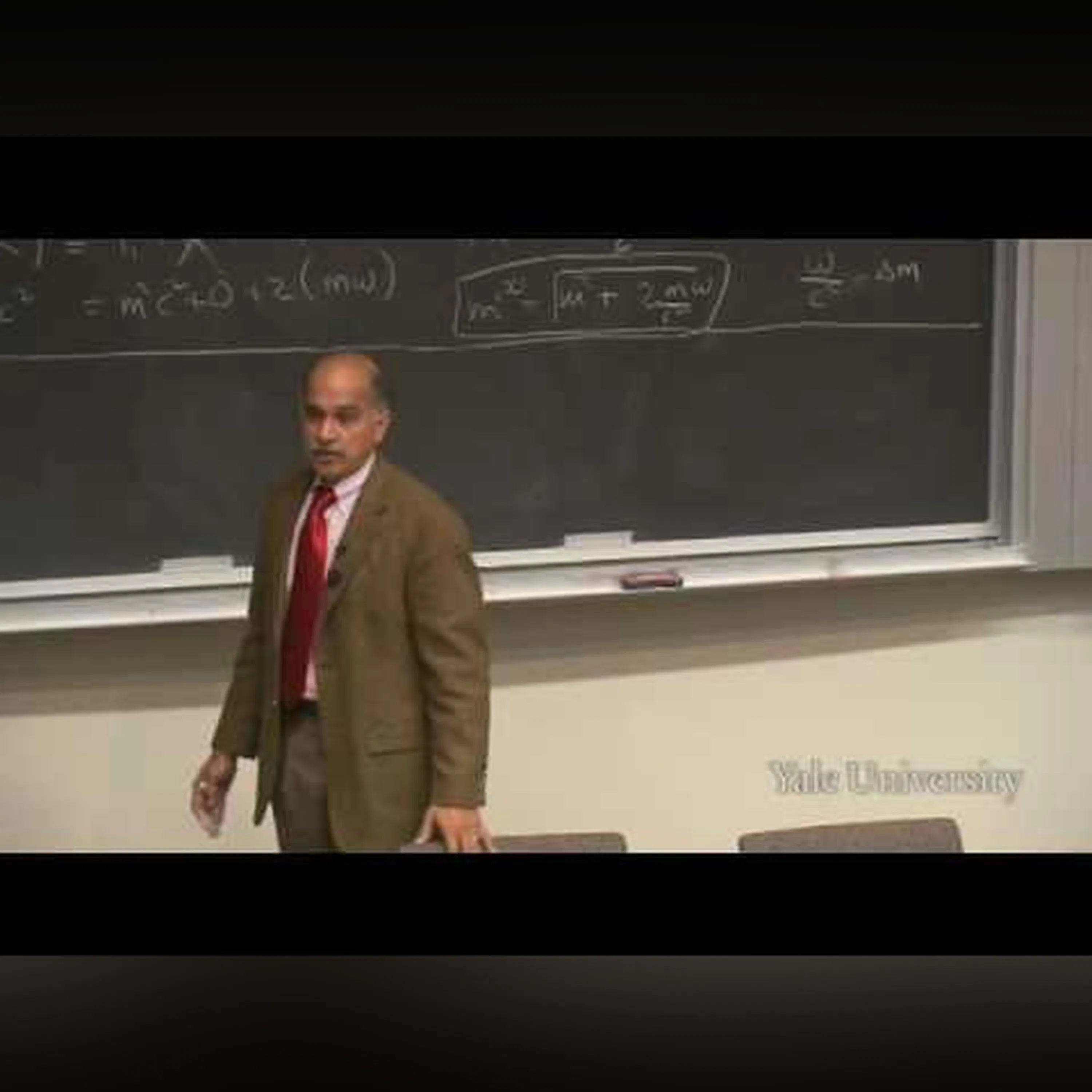 15. Four-Vector in Relativity 19.09.2026 1t 18minFor more information about Professor Shankar's book based on the lectures from this course, Fundamentals of Physics: Mechanics, Relativity, and Thermodynamics, visit http://bit.ly/1jFIqNu.Fundamentals of Physics (PHYS 200)The discussion of four-vector in relativity continues but this time the focus is on the energy-momentum of a particle. The invariance of the energy-momentum four-vector is due to the fact that rest mass of a particle is invariant under coordinate transformations.00:00 - Chapter 1. Recap: The Four-Vectors of Position, Velocity and Momentum in Space-Time15:53 - Chapter 2. The Energy-Momentum Four-Vector32:20 - Chapter 3. Relativistic Collisions41:09 - Chapter 4. Law of Conservation of Energy and Momentum Using the Energy-Momentum Four-VectorComplete course materials are available at the Yale Online website: online.yale.eduThis course was recorded in Fall 2006. Learn more about your ad choices. Visit megaphone.fm/adchoices
 -
 507 | How Daily Table Fights Food Deserts and Waste - Social Entrepreneurship Course 19.09.2026 14minIn this lesson, explore the inspiring case study of Doug Rauch's Daily Table, a social enterprise dedicated to solving urban food deserts. Discover how Daily Table combats food waste by recovering perfectly good food and providing affordable, healthy, and convenient meals, all while navigating challenges of branding, customer perception, and operational costs.🎯 Learning Objectives• Analyze the core problem addressed by Daily Table: food deserts and wasted food.• Understand the critical role of customer empathy and iterative development in building a successful social enterprise.• Recognize how branding and narrative, such as distinguishing "food waste" from "wasted food," impact public perception and business models.• Identify key elements of a social enterprise's business model using concepts like SWOT analysis and the Business Canvas.📚 About the Course Have you ever wondered what it would be like to create real change? You don't have to start your own organization to make a difference in the world. Everyone can learn the social entrepreneurship mindset and skillset to build social impact. In this course, you will immerse yourself in a social or environmental challenge you want to tackle. You'll start by researching your topic of choice, talking to people, and ideating a potential solution that you can contribute. Then, you'll build a business model around that solution, understanding concepts like measuring social change, ensuring financial viability, funding and pitching. This course is a safe space to experiment and explore. You'll be guided by a ten stage framework to help structure your journey. Along the way, you'll hear from social entrepreneurs around the world through case studies and campus conversations. These include Yale alumni, members of the New Haven community, and global changemakers. Everyone is welcome to join this course! You can apply your lived, learned, or professional experience to discover how you're going to make a difference. 📺 Watch the full playlist on YouTube: https://www.youtube.com/playlist?list=PLh9mgdi4rNezbi0aRJeVnt99ynTVZG1PL🎓 Enroll on Coursera for assessments and a certificate: https://online.yale.edu/courses/creating-change-through-social-entrepreneurship🌐 Explore more learning opportunities on Yale Online: https://online.yale.edu/courses/creating-change-through-social-entrepreneurship#SocialEntrepreneurship #YaleCourse #Impact #Changemakers #BusinessPlan #DesignThinking Learn more about your ad choices. Visit megaphone.fm/adchoices
 -
 804 | How Social Impact Funding Evolved: From Charity to Investment - Social Entrepreneurship Course 19.09.2026 16minHave you ever wondered how funding for social change has transformed over the years? In this lesson, we explore the fascinating evolution of social financing, bridging the historical divide between non-profit and for-profit worlds. Discover how the rise of social entrepreneurship has led to new investment approaches like impact investing, and how traditional philanthropy has adapted to become more strategic and catalytic, yet the need for more patient capital persists.🎯 Learning Objectives• Understand the historical separation of non-profit and for-profit funding.• Define and differentiate between various philanthropic approaches, including strategic, catalytic, and venture philanthropy.• Explain impact investing, its unique characteristics, and how it differs from traditional philanthropy and socially responsible investing (SRI).• Identify key organizations and resources that support and define the landscape of social impact funding.• Recognize the ongoing challenge of the "missing middle" and the need for more patient capital in social entrepreneurship.📚 About the Course Have you ever wondered what it would be like to create real change? You don't have to start your own organization to make a difference in the world. Everyone can learn the social entrepreneurship mindset and skillset to build social impact. In this course, you will immerse yourself in a social or environmental challenge you want to tackle. You'll start by researching your topic of choice, talking to people, and ideating a potential solution that you can contribute. Then, you'll build a business model around that solution, understanding concepts like measuring social change, ensuring financial viability, funding and pitching. This course is a safe space to experiment and explore. You'll be guided by a ten stage framework to help structure your journey. Along the way, you'll hear from social entrepreneurs around the world through case studies and campus conversations. These include Yale alumni, members of the New Haven community, and global changemakers. Everyone is welcome to join this course! You can apply your lived, learned, or professional experience to discover how you're going to make a difference. 📺 Watch the full playlist on YouTube: https://www.youtube.com/playlist?list=PLh9mgdi4rNezbi0aRJeVnt99ynTVZG1PL🎓 Enroll on Coursera for assessments and a certificate: https://online.yale.edu/courses/creating-change-through-social-entrepreneurship🌐 Explore more learning opportunities on Yale Online: https://online.yale.edu/courses/creating-change-through-social-entrepreneurship#SocialEntrepreneurship #YaleCourse #Impact #Changemakers #BusinessPlan #DesignThinking Learn more about your ad choices. Visit megaphone.fm/adchoices
 -
 Music and Social Action - Welcome to the Course 19.09.2026 8minLearn more about your ad choices. Visit megaphone.fm/adchoices
 -
 22. Constitutional Crisis and Impeachment of a President 19.09.2026 58minThe Civil War and Reconstruction (HIST 119)Professor Blight continues his discussion of the political history of Reconstruction. The central figure in the early phase of Reconstruction was President Andrew Johnson. Under Johnson's stewardship, southern whites held constitutional conventions throughout 1865, drafting new constitutions that outlawed slavery but changed little else. When the Republican-dominated U.S. Congress reassembled late in 1865, they put a stop to Johnson's leniency and inaugurated Radical (or Congressional) Reconstruction, a process that resulted in the immediate passage of the Civil Rights bill and the Fourteenth Amendment, and the eventual passage of four Reconstruction Acts. The Congressional elections in 1866 and Johnson's disastrous "Swing Around the Circle" speaking tour strengthened Radical control over Congress. Each step of the way, Johnson did everything he could to obstruct Congressional Reconstruction, setting the stage for his impeachment in 1868.00:00 - Chapter 1. Introduction01:56 - Chapter 2. Johnson's Limited Stance and Approach to Reconstruction14:49 - Chapter 3. The Republican Congress's Radical Reconstruction25:41 - Chapter 4. The Reconstruction Amendments: Civil Rights and Citizenship43:06 - Chapter 5. Johnson's "Swing Around the Circle" and ImpeachmentComplete course materials are available at the Open Yale Courses website: http://open.yale.edu/coursesThis course was recorded in Spring 2008. Learn more about your ad choices. Visit megaphone.fm/adchoices
 -
 10. Rotations, Part II: Parallel Axis Theorem 19.09.2026 1t 22minFor more information about Professor Shankar's book based on the lectures from this course, Fundamentals of Physics: Mechanics, Relativity, and Thermodynamics, visit http://bit.ly/1jFIqNu.Fundamentals of Physics (PHYS 200)Part II of Rotations. The lecture begins with an explanation of the Parallel Axis Theorem and how it is applied in problems concerning rotation of rigid bodies. The moment of inertia of a disk is discussed as a demonstration of the theorem. Angular momentum and angular velocity are examined in a variety of problems.00:00 - Chapter 1. Review and Derive the Parallel Axis Theorem16:27 - Chapter 2. For System of Masses: Derive KEtotal = ½ MV2 + ½ ICM227:55 - Chapter 3. Derive KEtotal in Terms of Equivalent Rotation about Stationary Point38:40 - Chapter 4. Effect of Rotational Kinetic Energy on Translational Motion for No Skid43:41 - Chapter 5. Example Problem: Torque on a Disk49:30 - Chapter 6. Advanced Example Problem: Pulley Rotating and Translating01:02:14 - Chapter 7. Example Problem: Systems with Angular Moment Conserved01:09:09 - Chapter 8. Application: Angular Momentum Changes for Spinning BallerinaComplete course materials are available at the Yale Online website: online.yale.eduThis course was recorded in Fall 2006. Learn more about your ad choices. Visit megaphone.fm/adchoices
 -
 Class 8: Capital Chapter 8: The Working Day 19.09.2026 46minHow do fights over the length of the working day affect the capital system? What is absolute surplus value?A chapter by chapter study of Marx’s powerful analysis in Capital: Critique of Political Economy, Volume 1. This book from 1872 is still the best guide to the predatory economic and social system within which we live. The book solves five basic mysteries in our social world. The mysteries are: why social classes struggle against one another, why human beings are in the thrall of things, how a quantity of money turns into more money without seeming to add anything, why some people are forced to work and the more they work the less they make proportional to their effort, and finally, and why it is so hard to transform the system for the better. This course is taught by Paul North, Maurice Natanson Professor of German, Yale University. Prof. North is co-editor of the new English translation and critical edition of Capital Volume 1 by Karl Marx published in 2024 by Princeton University Press. https://press.princeton.edu/books/hardcover/9780691190075/capitalTo view other videos in this course, visit this link. https://youtube.com/playlist?list=PLh9mgdi4rNewd_0qe4c2lkzXZZQka_QnZ&si=CHOgjCcVD0K378kl Learn more about your ad choices. Visit megaphone.fm/adchoices
 -
 Can changing yourself change the whole system? | Connected Leadership 19.09.2026 8minPeter walks through the three pillars of Connected Leadership — getting more out of life, strengthening your leadership toolkit, and applying systems thinking — and previews the personalized, one-page toolkit you'll build along the way. He also sets the ground rules: embrace diversity, cut distractions, and find a buddy to learn alongside.Key topics:- The three course aims: self, team, and system- The one-page leadership toolkit you'll build- Ground rules: diversity, inclusion, single-screen focus, kindness- Why a learning buddy multiplies the value of the course- The scaffolding metaphor — Peter provides the structure, you build the life📚 About the Course:This course is designed to maximize your ability to create change at the individual, team and system levels. Through study, reflection, and deploying practical tools, you will establish a firm connection between your clearly articulated Purpose, effective Priorities, visualized Potential for success, and pathway to maximized Progress. But, what does that mean in practice?When you take this course, you will:Improve your ability to get the most out of life: Learn a simple practice to reflect on your purpose, clarify priorities, visualize your potential, and maximize your effectiveness at progressing towards your goals.Strengthen your leadership toolkit: Tap into your unique leadership style and strengths and join or create a community of others to maximize your potential as a team.Create change through systems thinking: Become a more effective agent of positive change and appreciate the power and complexity of system thinking.Course Takeaways:Improve your ability to get the most out of lifeStrengthen your leadership toolkitPractice and apply systems thinking to plan for change📺 Watch the full playlist on YouTube: https://www.youtube.com/playlist?list=PLh9mgdi4rNezZEnhZC8dS3AvTnzOiB0Ij🎓 Enroll on Coursera for assessments and a certificate: https://www.coursera.org/learn/connected-leadership🌐 Explore more learning opportunities on Yale Online: https://online.yale.edu/courses/connected-leadership Learn more about your ad choices. Visit megaphone.fm/adchoices
 -
 12. The Sovereign State: Hobbes' Leviathan 19.09.2026 52minIntroduction to Political Philosophy (PLSC 114)This is an introduction to the political views of Thomas Hobbes, which are often deemed paradoxical. On the one hand, Hobbes is a stern defender of political absolutism. The Hobbesian doctrine of sovereignty dictates complete monopoly of power within a given territory and over all institutions of civilian or ecclesiastical authority. On the other hand, Hobbes insists on the fundamental equality of human beings. He maintains that the state is a contract between individuals, that the sovereign owes his authority to the will of those he governs and is obliged to protect the interests of the governed by assuring civil peace and security. These ideas have been interpreted by some as indicative of liberal opposition to absolutism.00:00 - Chapter 1. Introduction: Thomas Hobbes07:28 - Chapter 2. Who Was Hobbes?14:12 - Chapter 3. Comparing Hobbes to Machiavelli and Aristotle25:26 - Chapter 4. Hobbes on Art, Science and Politics33:55 - Chapter 5. Hobbes' "Great Question": What Makes Legitimate Authority Possible?40:32 - Chapter 6. What Makes Hobbes' Story a Plausible Account of "The State of Nature"?Complete course materials are available at the Open Yale Courses website: http://open.yale.edu/courses This course was recorded in Fall 2006. Learn more about your ad choices. Visit megaphone.fm/adchoices
 -
 Class 16: Capital Chapters 17-20: Wages; Chapters 21-24: Accumulation, Reproduction 19.09.2026 57minIn how many ways does the wage form deceive us? How does the accumulation process drive the system? What is simple reproduction?A chapter by chapter study of Marx’s powerful analysis in Capital: Critique of Political Economy, Volume 1. This book from 1872 is still the best guide to the predatory economic and social system within which we live. The book solves five basic mysteries in our social world. The mysteries are: why social classes struggle against one another, why human beings are in the thrall of things, how a quantity of money turns into more money without seeming to add anything, why some people are forced to work and the more they work the less they make proportional to their effort, and finally, and why it is so hard to transform the system for the better. This course is taught by Paul North, Maurice Natanson Professor of German, Yale University. Prof. North is co-editor of the new English translation and critical edition of Capital Volume 1 by Karl Marx published in 2024 by Princeton University Press. https://press.princeton.edu/books/hardcover/9780691190075/capital To view other videos in this course, visit this link. https://youtube.com/playlist?list=PLh9mgdi4rNewd_0qe4c2lkzXZZQka_QnZ&si=CHOgjCcVD0K378kl Learn more about your ad choices. Visit megaphone.fm/adchoices
 -
 Class 15: Chapter 15: Increase and Decrease in LP and SV and Chapters 17-20: Wages 19.09.2026 57minHow far can productivity be pushed to produce more surplus-value? How should we calculate the rate of exploitation of labor? What is a wage?A chapter by chapter study of Marx’s powerful analysis in Capital: Critique of Political Economy, Volume 1. This book from 1872 is still the best guide to the predatory economic and social system within which we live. The book solves five basic mysteries in our social world. The mysteries are: why social classes struggle against one another, why human beings are in the thrall of things, how a quantity of money turns into more money without seeming to add anything, why some people are forced to work and the more they work the less they make proportional to their effort, and finally, and why it is so hard to transform the system for the better. This course is taught by Paul North, Maurice Natanson Professor of German, Yale University. Prof. North is co-editor of the new English translation and critical edition of Capital Volume 1 by Karl Marx published in 2024 by Princeton University Press. https://press.princeton.edu/books/hardcover/9780691190075/capital To view other videos in this course, visit this link. https://youtube.com/playlist?list=PLh9mgdi4rNewd_0qe4c2lkzXZZQka_QnZ&si=CHOgjCcVD0K378kl Learn more about your ad choices. Visit megaphone.fm/adchoices
 -
 21. Thermodynamics 19.09.2026 1t 18minFor more information about Professor Shankar's book based on the lectures from this course, Fundamentals of Physics: Mechanics, Relativity, and Thermodynamics, visit http://bit.ly/1jFIqNu.Fundamentals of Physics (PHYS 200)This is the first of a series of lectures on thermodynamics. The discussion begins with understanding "temperature." Zeroth's law is introduced and explained. Concepts such as "absolute zero" and "triple point of water" are defined. Measuring temperature through a number of instruments is addressed as well as the different scales of measurement. The second half of the lecture is devoted to heat and heat transfer. Concepts such as "convection" and "conduction" are explained thoroughly.00:00 - Chapter 1. Temperature as a Macroscopic Thermodynamic Property06:45 - Chapter 2. Calibrating Temperature Instruments22:25 - Chapter 3. Absolute Zero, Triple Point of Water, The Kelvin28:55 - Chapter 4. Specific Heat and Other Thermal Properties of Materials43:17 - Chapter 5. Phase Change55:06 - Chapter 6. Heat Transfer by Radiation, Convection and Conduction01:03:27 - Chapter 7. Heat as Atomic Kinetic Energy and its MeasurementComplete course materials are available at the Yale Online website: online.yale.eduThis course was recorded in Fall 2006. Learn more about your ad choices. Visit megaphone.fm/adchoices
 -
 3. Our Solar System and the Pluto Problem 19.09.2026 52minFrontiers/Controversies in Astrophysics (ASTR 160)Class begins with a review of the first problem set. Newton's Third Law is applied in explaining how exoplanets are found. An overview of the Solar System is given; each planet is presented individually and its special features are highlighted. Astronomy is discussed as an observational science, and the subject of how to categorize objects in the Solar System is addressed. The Pluto controversy is given special attention and both sides of the argument regarding its status are considered.00:00 - Chapter 1. Review of the Problem Set06:22 - Chapter 2. Conservation of Momentum in Exoplanets14:02 - Chapter 3. Inner and Outer Solar System Objects29:47 - Chapter 4. Kuiper Belt Objects and Oort Cloud35:13 - Chapter 5. Classification and Interpretation of Celestial ObjectsComplete course materials are available at the Open Yale Courses website: http://open.yale.edu/courses This course was recorded in Spring 2007. Learn more about your ad choices. Visit megaphone.fm/adchoices
 -
 Are you confusing what's urgent with what's important? | Connected Leadership 19.09.2026 9minGo question by question through the purpose worksheet to understand why each prompt was posed and what insights you can draw from your answers. Useful for individual reflection and for comparing responses across a team.Key topics:- Anchoring purpose to your current position (1a)- Using strengths as your inner pep talk (1b)- Aligning long-horizon vision with daily life (2a)- Separating urgent from important using 2b- Reading your flow activities at work, play, and childhood (3a)- Checking alignment between purpose and direction (3b)📚 About the Course:This course is designed to maximize your ability to create change at the individual, team and system levels. Through study, reflection, and deploying practical tools, you will establish a firm connection between your clearly articulated Purpose, effective Priorities, visualized Potential for success, and pathway to maximized Progress. But, what does that mean in practice?When you take this course, you will:Improve your ability to get the most out of life: Learn a simple practice to reflect on your purpose, clarify priorities, visualize your potential, and maximize your effectiveness at progressing towards your goals.Strengthen your leadership toolkit: Tap into your unique leadership style and strengths and join or create a community of others to maximize your potential as a team.Create change through systems thinking: Become a more effective agent of positive change and appreciate the power and complexity of system thinking.Course Takeaways:Improve your ability to get the most out of lifeStrengthen your leadership toolkitPractice and apply systems thinking to plan for change📺 Watch the full playlist on YouTube: https://www.youtube.com/playlist?list=PLh9mgdi4rNezZEnhZC8dS3AvTnzOiB0Ij🎓 Enroll on Coursera for assessments and a certificate: https://www.coursera.org/learn/connected-leadership🌐 Explore more learning opportunities on Yale Online: https://online.yale.edu/courses/connected-leadership Learn more about your ad choices. Visit megaphone.fm/adchoices
 -
 22. The Boltzmann Constant and First Law of Thermodynamics 19.09.2026 1t 21minFor more information about Professor Shankar's book based on the lectures from this course, Fundamentals of Physics: Mechanics, Relativity, and Thermodynamics, visit http://bit.ly/1jFIqNu.Fundamentals of Physics (PHYS 200)This lecture continues the topic of thermodynamics, exploring in greater detail what heat is, and how it is generated and measured. The Boltzmann Constant is introduced. The microscopic meaning of temperature is explained. The First Law of Thermodynamics is presented.00:00 - Chapter 1. Recap of Heat Theory11:54 - Chapter 2. The Boltzman Constant and Avogadro's Number18:50 - Chapter 3. A Microscopic Definition of Temperature30:15 - Chapter 4. Molecular Mechanics of Phase Change and the Maxwell-Boltzmann46:49 - Chapter 5. Quasi-static Processes50:19 - Chapter 6. Internal Energy and the First Law of ThermodynamicsComplete course materials are available at the Yale Online website: online.yale.eduThis course was recorded in Fall 2006. Learn more about your ad choices. Visit megaphone.fm/adchoices
 -
 Music and Social Action - Dewey 19.09.2026 10minLearn more about your ad choices. Visit megaphone.fm/adchoices
 -
 1104 | Catalyst 2030: Rewriting the Rules of Social Impact - Social Entrepreneurship Course 19.09.2026 10minWhy are the Sustainable Development Goals projected to be achieved by 2082 instead of 2030? In this lesson, we explore Catalyst 2030, an innovative global 'extrapreneurship' network designed to accelerate progress towards the SDGs by addressing insufficient and fragmented funding. Discover how this unique, distributed organization, led by a chief facilitator and refusing traditional hierarchies, empowers social entrepreneurs worldwide to shift power dynamics, influence policy, and foster collective action through a collaborative, constellation-like structure.🎯 Learning Objectives• Understand the mission and 'extrapreneurship' approach of Catalyst 2030 in accelerating Sustainable Development Goals.• Identify critical challenges in current social innovation funding and how Catalyst 2030 addresses them.• Examine the unique, distributed 'constellation' structure and governance model of Catalyst 2030.• Discover key strategies governments can employ to foster supportive ecosystems for social entrepreneurs.• Appreciate the emphasis on shifting power dynamics and empowering grassroots voices in global social impact initiatives.📚 About the Course Have you ever wondered what it would be like to create real change? You don't have to start your own organization to make a difference in the world. Everyone can learn the social entrepreneurship mindset and skillset to build social impact. In this course, you will immerse yourself in a social or environmental challenge you want to tackle. You'll start by researching your topic of choice, talking to people, and ideating a potential solution that you can contribute. Then, you'll build a business model around that solution, understanding concepts like measuring social change, ensuring financial viability, funding and pitching. This course is a safe space to experiment and explore. You'll be guided by a ten stage framework to help structure your journey. Along the way, you'll hear from social entrepreneurs around the world through case studies and campus conversations. These include Yale alumni, members of the New Haven community, and global changemakers. Everyone is welcome to join this course! You can apply your lived, learned, or professional experience to discover how you're going to make a difference. 📺 Watch the full playlist on YouTube: https://www.youtube.com/playlist?list=PLh9mgdi4rNezbi0aRJeVnt99ynTVZG1PL 🎓 Enroll on Coursera for assessments and a certificate: https://online.yale.edu/courses/creating-change-through-social-entrepreneurship 🌐 Explore more learning opportunities on Yale Online: https://online.yale.edu/courses/creating-change-through-social-entrepreneurship #SocialEntrepreneurship #YaleCourse #Impact #Changemakers #BusinessPlan #DesignThinking Learn more about your ad choices. Visit megaphone.fm/adchoices
 -
 Give Your Team a Purpose That Guides Real Decisions | Connected Leadership 19.09.2026 14minA clear team purpose acts as a North Star that guides decisions, builds trust, and empowers distributed teams. This lesson walks through the strategy pyramid and offers practical guidance for crafting vision and mission statements that actually drive behavior.Key topics:- Why team purpose matters: direction, motivation, and coordination- The role of shared values and the tension with diversity- The strategy pyramid: vision, mission, values, and strategy- Crafting concise, memorable vision and mission statements- Researching real-world examples and reflecting on fit- McKinsey data on the gap between mission and impact📚 About the Course:This course is designed to maximize your ability to create change at the individual, team and system levels. Through study, reflection, and deploying practical tools, you will establish a firm connection between your clearly articulated Purpose, effective Priorities, visualized Potential for success, and pathway to maximized Progress. But, what does that mean in practice?When you take this course, you will:Improve your ability to get the most out of life: Learn a simple practice to reflect on your purpose, clarify priorities, visualize your potential, and maximize your effectiveness at progressing towards your goals.Strengthen your leadership toolkit: Tap into your unique leadership style and strengths and join or create a community of others to maximize your potential as a team.Create change through systems thinking: Become a more effective agent of positive change and appreciate the power and complexity of system thinking.Course Takeaways:Improve your ability to get the most out of lifeStrengthen your leadership toolkitPractice and apply systems thinking to plan for change📺 Watch the full playlist on YouTube: https://www.youtube.com/playlist?list=PLh9mgdi4rNezZEnhZC8dS3AvTnzOiB0Ij🎓 Enroll on Coursera for assessments and a certificate: https://www.coursera.org/learn/connected-leadership🌐 Explore more learning opportunities on Yale Online: https://online.yale.edu/courses/connected-leadership Learn more about your ad choices. Visit megaphone.fm/adchoices
Samankaltaiset podcastit


Suosittu maassa
Tämä podcast esiintyy myös näiden maiden podcast-listoilla.

