
Men's Psychology Podcast
Men’s Psychology - the science of being a man
0
Men’s Psychology examines scientific research on male instincts alongside current events and news stories. It explores the everyday lives of today's men in relationships, careers, and parenting. The show also gives equal weight to female psychology. Its goal is to encourage discussion of shared traits and new findings in the field.
Jaksot
-
 Maximizing Impact in Social Gatherings 18.02.2026 9minSHOW NOTES:This lesson explores the dynamics of social gatherings and how to make a positive impact within them. The speakers discuss the concept of ‘social nodes’—high-energy spots in gatherings—and how to become or join these nodes to enhance social connections. They emphasize the importance of inclusion, genuine curiosity, and initiating conversations to build rapport. The conversation also highlights the value of being slightly different to stand out and make an impact, while maintaining a balance of similarity with the group. Practical advice is given on engaging in social activities, hosting events, and expanding one’s social network.Key Concepts:1. Maximizing Social Opportunities: The lesson focuses on leveraging social gatherings not just to initiate friendships but to create opportunities for deeper connections and networks.2. Identifying Social Nodes: Observing the dynamics of social gatherings, the speaker points out that certain individuals, referred to as “social nodes,” naturally attract others due to their positive energy and charisma. These individuals often become focal points in social settings, drawing people in with their happiness.3. Becoming a Social Node: If one cannot immediately embody the characteristics of a high-energy individual, the advice is to join in and connect with those who are. Being part of a vibrant group helps to avoid feelings of isolation and enhances social presence.4. Building Rapport Through Inclusion: The speaker emphasizes the importance of inclusion in social interactions. High-energy individuals often include others in conversations, fostering a sense of community. Cultivating curiosity about others’ lives and actively listening can help in creating engaging dialogues.5. Initiating Conversations: Proactivity is key in social settings. Instead of waiting for the perfect moment or signs to approach, individuals are encouraged to dive into conversations headfirst, especially in areas of high positive energy.6. Engaging with Authenticity: The lesson suggests that showing genuine interest in others’ stories and experiences can position someone to become a central figure in the social network. Asking questions and actively engaging in responses aids in developing rapport.7. Embracing Social Invitations: Individuals are encouraged to accept invitations to various social settings, whether casual or formal, to increase their exposure to new social interactions and opportunities for connection.ConclusionThis lesson stresses the importance of making a positive impact in social gatherings by recognizing and engaging with high-energy individuals, fostering inclusivity, and taking initiative in conversations. By doing so, one can enhance their social network and create meaningful connections.Takeaways* Identify and join ‘social nodes’ in gatherings to enhance connections.* Inclusion and genuine curiosity are key to building rapport.* Initiate conversations quickly to become a social hub.* Balance similarity with a unique difference to stand out.* Engage in social activities to expand your network.* Host events to supercharge your social life.* Introduce new friends to existing groups to grow connections.* Be proactive in social settings to make an impact.* Use curiosity to engage others and learn their stories.* Plan to meet and connect people to build a network.Title Options* Mastering Social Gatherings: The Art of Connection* Becoming a Social Node: Tips for Impactful Networking* The Power of Inclusion in Social Settings* Stand Out and Connect: Strategies for Social Success* From Wallflower to Social Hub: A Guide* Hosting Your Way to a Thriving Social Life* Building Rapport: The Key to Social Influence* Creating Impactful Social Networks* The Balance of Similarity and Difference in Socializing* Proactive Networking: Expanding Your Social CircleSound bites“Be the social node everyone seeks.” “Inclusion is key to rapport.” “Curiosity fuels social connections.” “Stand out with a unique difference.” “Host events to boost your social life.” “Introduce friends to grow networks.” “Proactive engagement makes an impact.” “Learn stories to engage others.” “Plan to connect and build networks.” “Balance similarity with uniqueness.”Chapters* 00:00:00 Understanding Social Nodes* 00:00:29 Building Rapport through Inclusion* 00:02:05 Curiosity and Engagement* 00:04:26 Making an Impact by Standing Out* 00:07:06 Proactive Social Networking* 00:08:54 Hosting and Expanding Your NetworkIf you like what you see and hear, consider getting access to all the courses and Romantipedia.com by becoming a Monthly Paid Member of Men’s Psychology, here: This is a public episode. If you would like to discuss this with other subscribers or get access to bonus episodes, visit menspsychology.substack.com
 -
 The Importance of Discipline in a Man's Life 14.01.2026 5minIf you like what you see and hear, consider getting access to all the courses and Romantipedia.com by becoming a Monthly Paid Member of Men’s Psychology, here:SHOW NOTES:This lesson delves into the concept of discipline, emphasizing its fundamental role in managing resources like time, money, energy, and focus. The speaker discusses how discipline is crucial for personal growth, career success, and financial stability, linking it to the idea of being a disciple. The conversation explores the balance between exploration and commitment, highlighting the importance of setting boundaries and making deliberate choices to achieve long-term goals.Key Concepts:1. Importance of Discipline:- Discipline is essential for effectively managing resources—such as time, money, energy, and focus. Without discipline, individuals will continually expend resources without achieving their goals, leaving them in a position of weakness.2. Definition and Origin:- The term “discipline” derives from “disciple,” indicating a follower of a cause. This suggests that discipline is about committing to a purpose and adhering to one’s values and goals.3. Self-Boundaries:- Discipline is framed as setting boundaries for oneself. It involves saying “no” to personal temptations and distractions to maintain focus on one’s goals. This contrasts with the idea of disappointing others for self-protection.4. Exploration Phase:- For younger men or those in an exploratory phase, it’s acceptable to sample experiences and opportunities—whether it’s career paths or romantic partners. This exploration is a necessary part of discovering one’s identity and interests.5. Commitment and Legacy:- As one matures, the need to commit to specific goals becomes apparent. It’s important to have a clear vision and dedicate oneself to achieving it, especially since life is finite. A legacy is built through purposeful actions and commitments.6. Focus on Goals:- Once a goal is established, discipline becomes critical in resisting distractions and ensuring that one’s resources are aligned with achieving that goal. Financial discipline, for instance, is highlighted as vital for navigating a capitalistic society and enabling future endeavors.Conclusion:This lesson emphasizes that discipline is a foundational skill for men, necessary for effective resource management and achieving life goals. It advocates for exploring various interests initially but underscores the importance of commitment and self-control in pursuing one’s legacy.Takeaways* Discipline is key to managing resources like time and money.* Lack of discipline leads to constant resource depletion.* Discipline applies to personal, career, and financial aspects.* Being a disciple means following a cause with flexibility.* Boundaries are essential for maintaining discipline.* Exploration is important in early life stages.* Commitment becomes crucial as one matures.* Financial resources are vital in a capitalistic society.* Deliberate spending is part of disciplined financial management.* Discipline allows for more options in the future.Title Options* The Power of Discipline in Life* Managing Resources Through Discipline* Discipline: The Key to Success* Exploring the Role of Discipline* Discipline and Personal Growth* Boundaries and Discipline* Financial Stability Through Discipline* The Journey of a Disciple* Discipline in a Capitalistic Society* Flexibility in DisciplineSound bites* Discipline is fundamental.* Manage resources wisely.* Boundaries maintain discipline.* Explore before committing.* Financial resources are crucial.* Deliberate spending matters.* Discipline offers future options.* Be a flexible disciple.* Commitment is key.* Discipline in capitalism.Chapters* 00:00:01 Introduction to Discipline* 00:00:27 Discipline and Resources* 00:00:58 Boundaries and Discipline* 00:01:53 Exploration vs. Commitment* 00:03:13 Financial Discipline* 00:04:05 Legacy and Future Planning* 00:05:01 Flexibility in DisciplineIf you like what you see and hear, consider getting access to all the courses and Romantipedia.com by becoming a Monthly Paid Member of Men’s Psychology, here: This is a public episode. If you would like to discuss this with other subscribers or get access to bonus episodes, visit menspsychology.substack.com
 -
 "The Rite of Passage" With Wally Shaykoun 30.12.2025 1t 5minIf you would like access to the COURSES at and the compendium of human courtship wiki at Romantipedia.com then become a Monthly Paid Member at:SHOW NOTES:In this segment of the “Men’s Psychology” podcast, Dr. Paul introduces his guest, Wally Shaykoun, who he fondly refers to as his Egyptian friend. Dr. Paul shares a personal anecdote about a difficult time during his internship year when he was helped by an Egyptian acquaintance, highlighting the significance of his friendships from this cultural background.Wally is described as a gifted life coach with an intuitive ability to understand psychology, particularly in the context of conflicted relationships. Dr. Paul emphasizes the effectiveness of Gottman therapy in marriage counseling but notes its limitations regarding dating relationships and identifying narcissism, a growing concern in modern society.Wally explains his method of connecting with individuals on a deeper level, likening his approach to that of a Sufi or medicine man. He focuses on understanding a person’s heart and feelings, enabling him to perceive where energy is flowing or blocked within them. This intuitive connection allows Wally to analyze emotional states and provide guidance on their relationship challenges.The discussion sets the stage for exploring how to change the trajectory of troubled relationships and addresses broader themes around marriage, dating, and emotional awareness.TakeawaysNarcissism is on the rise in relationships.Betrayal can be emotional, not just sexual.Emotional intelligence is crucial for healthy relationships.Men often sacrifice their needs in relationships.Initiation and rites of passage are important for men.Self-discovery is key to personal growth.Daily rituals help maintain emotional health.Brotherhood provides essential support for men.Understanding masculine instincts can improve relationships.Emotional awareness is vital for navigating life.SummaryIn this conversation, Wally Shekoun discusses the complexities of modern relationships, focusing on the rise of narcissism, the impact of betrayal, and the importance of emotional intelligence. He emphasizes the need for men to engage in self-discovery and the significance of initiation rites in fostering maturity. The dialogue explores the challenges men face in relationships, the necessity of emotional safety, and the role of brotherhood and daily rituals in maintaining mental health. Ultimately, the conversation highlights the journey of healing and growth that men must undertake to navigate their emotional landscapes effectively.TitlesNavigating Narcissism in Modern RelationshipsThe Impact of Betrayal on Men’s Mental HealthSound bites“Narcissism is on the rise in relationships.”“Betrayal can be emotional, not just sexual.”“Self-discovery is key to personal growth.”Chapters00:00 Introduction to Wally Shekoun and His Background02:29 Understanding Intuition in Relationships05:14 The Impact of Betrayal in Relationships07:47 Assessing Relationship Maturity and Narcissism10:33 The Evolution of Wally’s Personal Journey13:29 Recognizing Red Flags in Dating16:11 The Importance of Emotional Safety and Security18:50 Discernment and Intuition in Relationships21:23 The Role of Masculinity in Modern Relationships24:06 The Need for a Rite of Passage for Men33:28 The Concept of Rite of Passage36:09 Trauma and Masculinity38:53 The Importance of Initiation42:50 Understanding Male Emotions46:48 Navigating Relationship Dynamics52:43 Self-Care and Identity in Relationships56:06 The Role of Rituals in Masculinity01:00:57 Imprinting and Initiation in AdulthoodIf you would like access to the COURSES at and the compendium of human courtship wiki at Romantipedia.com then become a Monthly Paid Member at: This is a public episode. If you would like to discuss this with other subscribers or get access to bonus episodes, visit menspsychology.substack.com
 -
 Building a Social Network (and Happy Thanksgiving) 27.11.2025 5minSHOW NOTES:In this engaging lesson, Dr. Paul shares insights on building a social network through positive energy and friendship. They recount a personal story of learning to sail in college, emphasizing the importance of teamwork and shared experiences. The discussion also delves into the science of friendship, drawing from ancient philosophers and the speaker’s own work, highlighting the core principles of consistency, mutuality, shared experiences, and positive emotions.Key Concepts:1. Power of Positive Attitude: The lesson begins by emphasizing that having a positive attitude, characterized by happiness and good energy, is fundamental for building a social network. Negative emotions, such as depression or fear, can undermine efforts to connect with others.2. Importance of Energy: To cultivate relationships and friendships, individuals must project positivity and humor, offering good energy that attracts others rather than repelling them.3. Personal Story: The speaker shares a personal anecdote from college about fulfilling a dream to sail in New England. Despite having no prior knowledge of sailing, he and a friend answered a call for crew members from a boat captain, leading to valuable experiences and skills in sailing over the years. This story illustrates the benefits of taking risks and stepping into the unknown, which can result in valuable life lessons and strong bonds among men.4. Bonding Through Shared Activities: The experience of sailing serves as a metaphor for male bonding and teamwork. The lesson highlights how men often collaborate to tackle challenges, relying on each other’s strengths in a shared mission, emphasizing the importance of camaraderie.5. Building Friendships: To create a robust social network, one must embody the qualities of a good friend, such as reliability, support, and trustworthiness. Unlike a modular approach to building furniture, developing friendships requires genuine character and interpersonal skills.6. Natural Development of Relationships: The speaker concludes by suggesting that by focusing on being an excellent friend, social networks will grow organically rather than through rigid, mechanical processes.ConclusionThe lesson stresses the significance of a positive attitude and genuine friendship in building a social network. By engaging in shared experiences and displaying good energy, individuals can connect meaningfully with others, fostering lasting relationships. The speaker’s sailing story illustrates the value of taking risks and working together for common goals, a principle that underpins strong social ties.Takeaways* The secret to power is having a positive attitude.* Building a social network requires happiness and good energy.* A personal story about learning to sail highlights teamwork.* Friendship is based on consistent, mutual, shared positive emotions.* Aristotle’s principles of friendship align with modern views.* Friendship requires in-person shared experiences.* Positive emotions are crucial in building friendships.* The speaker’s book explores the science of female friendship.* Friendship is not a step-by-step process but a character trait.* Good friends offer humor, happiness, and good emotions.Title Options* The Secret to Building a Social Network* Sailing Through Life: Lessons in Friendship* Aristotle’s Timeless Friendship Principles* The Science of Friendship: Consistency and Mutuality* Positive Energy: The Key to Social Networks* From Sailing to Social Networking* Friendship: A Journey of Shared Experiences* The Power of Positive Emotions in Friendship* Building Bonds: Lessons from Ancient Philosophers* The Art of Being a Good FriendSound bites“Power through attitude.” “Happiness to give away.” “Fun boat, mean captain.” “Learned how to sail.” “Men go out against nature.” “Consistent mutual shared emotion.” “Friendship is not step-by-step.” “Positive emotion, not negative.” “Shared experiences, not long distance.” “Offer humor, happiness, good emotion.”Chapters* 00:00:00 The Power of Positive Attitude* 00:00:31 A Sailing Adventure* 00:01:00 Learning the Ropes* 00:01:58 Teamwork and Bonding* 00:02:31 Building a Social Network* 00:02:58 The Science of Friendship* 00:03:27 Philosophical Insights on FriendshipIf you like what you see and hear, consider getting access to all the courses and Romantipedia.com by becoming a Monthly Paid Member of Men’s Psychology, here: This is a public episode. If you would like to discuss this with other subscribers or get access to bonus episodes, visit menspsychology.substack.com
 -
 Broken Breakups 26.11.2025 5minWelcome to another sample lesson from one of our courses, The Big Brothers You Never Had.Become a member to get courses:Those who are monthly paid members may access courses and use the Romantipedia app from the Apple App Store for ease of learning:SHOW NOTES:This lesson from Men’s Psychology delves into the complexities of breakups, exploring both the emotional and psychological aspects. It discusses the changing boundaries in relationships, the loss experienced by both parties, and the importance of being true to oneself. The conversation also touches on the differences in how men and women perceive relationships and the impact of compatibility on personal identity.Navigating BreakupsThis lesson discusses the psychological complexities surrounding breakups, highlighting how both parties experience loss and grief as boundaries change. Here are the main points:1. Understanding Breakup Dynamics: - A breakup involves significant emotional pain for both individuals, as intimacy and connected boundaries are severed. This loss can feel like losing a part of oneself.2. Different Emotional States: - Men often process breakups through logical reasoning, seeking practical reasons for the decision. In contrast, women may experience deeper emotional responses, which can create a disconnect in how each party perceives the situation.3. Effective Communication: - When breaking up, it’s important to communicate in a way that resonates with the woman’s emotional nature. This can involve expressing how the relationship affects one’s identity and self-expression.4. Key Relationship Elements: - The lesson identifies three essential components for a healthy relationship: - Personality Compatibility: Partners should gel well together and function as a team. - Maturity Level: Both individuals should share similar emotional and intellectual maturity. - Sexual Attraction: There must be mutual sexual interest and compatibility.5. Honesty and Boundaries: - If any of these three elements are missing, it can hinder one’s ability to be their true self in the relationship. A breakup can be approached with honesty, framing the incompatibility as the reason for needing to part ways, rather than blaming the other person.Overall, the lesson underscores the significance of understanding the emotional impact of breakups while fostering open communication and addressing compatibility issues in relationships.Takeaways* Boundaries change during a breakup, causing pain on both sides.* Loss in a breakup is akin to losing a part of oneself.* Men and women process breakups differently, often using different parts of the brain.* Being true to oneself is crucial in relationships.* Compatibility issues can prevent individuals from being their true selves.* Sexual attraction, personality compatibility, and maturity are key relationship components.* The phrase ‘it’s not you, it’s me’ can be genuinely true.* Women may feel more hurt when they can’t control the breakup outcome.* Men often prioritize career and mission alongside relationships.* Understanding relationship dynamics can aid in personal growth.Navigating Breakups: Emotional and Psychological Insights* Understanding Relationship Dynamics and Breakups* The Pain of Changing Boundaries in Relationships* Being True to Yourself in Love and Loss* Compatibility and Identity in Relationships* The Real Meaning Behind ‘It’s Not You, It’s Me’* Men vs Women: Different Perspectives on Relationships* The Role of Compatibility in Personal Identity* Emotional Boundaries: The Key to Relationship Success* Breakups: A Journey of Personal GrowthSound bites* Boundaries that are changing.* Loss and endings are never easy.* Can’t truly be myself.* Mismatch of personalities or maturity.* Sexual compatibility and interest.* It’s not you, it’s me.* Takes away control from them.* Most important thing in their life.* One of a few very important things.* Career and mission are also important.Chapters* 00:00:00 Introduction to Breakup Dynamics* 00:00:58 Emotional and Psychological Aspects* 00:01:55 Compatibility and Personal Identity* 00:03:25 Understanding Relationship Phrases* 00:04:24 Gender Perspectives on Relationships This is a public episode. If you would like to discuss this with other subscribers or get access to bonus episodes, visit menspsychology.substack.com
 -
 What is the Role and Value of a Brother? 14.11.2025 22minWHAT IS THE ROLE AND VALUE OF A BROTHER?This lesson delves into the importance of generational wisdom in men’s psychology, highlighting how experiences shape advice and choices in life. It emphasizes the value of learning from those who have navigated similar paths before.In this lesson presented by Dr. Paul and Mr. Janka, the focus is on addressing the evolving needs of men in today’s culture, particularly emphasizing the role of “big brothers” as mentors. If you like what you hear in this longer video introduction, you might want the program which addresses what we feel to be the 25 most difficult life problems men young and old face.To do you, you need to first be a Monthly Paid Member at:Here are the key points:1. Cultural Gap in Guidance: The speakers highlight a significant gap in fatherly advice due to the rapid changes in technology and culture, which may leave traditional father figures somewhat out of touch with the challenges faced by younger generations.2. Need for Mentorship: There is a growing hunger for guidance and fatherly advice among men, but the speakers argue that advice from big brothers—peers who have faced similar challenges—can be more relevant and applicable to current circumstances.3. Unique Perspective of Big Brothers: Big brothers offer insights based on their experiences and lessons learned, relating closely to the issues faced by younger men today, including challenges in relationships, education, and career choices.4. Limitations of Traditional Mentorship: Even those who have had great relationships with fathers or mentors can face limitations. Competitive dynamics may arise that prevent open communication and guidance.5. No Competitive Dynamics: Unlike traditional family relationships, the speakers emphasize that their role as big brothers is to provide undivided support and advice without any competitive pressures.6. Practical Tips for Life: Dr. Paul and Mr. Janka intend to share a series of practical tips—25 crucial dilemmas they believe big brothers can uniquely help address—aimed at enhancing the listeners’ lives.In summary, the lesson underscores the value of peer mentorship through big brothers, who can provide relevant guidance and support in navigating the complexities of modern life, filling the gap left by traditional father figures.TakeawaysThe kind of advice men seek today often comes from experienced mentors.Experience plays a crucial role in shaping one’s perspective on life.Generational wisdom can guide younger individuals in making better choices.Learning from the past can help avoid future regrets.Men’s psychology is deeply influenced by the experiences of those who came before them.Navigating life requires understanding both successes and failures.Advice from older generations can resonate with younger men.The school of hard knocks provides valuable life lessons.Understanding relationships is key to personal growth.Choices made in youth can have lasting impacts.TitlesThe Wisdom of Experience in Men’s PsychologyNavigating Life’s Choices: Insights from Generational WisdomSound bites“He kind of experienced things”“He can younger kid’s and choices”“Some things worked out in his favor”Chapters00:00 The Need for Modern Mentorship00:44 Understanding Masculinity and Life ChallengesTo get access to our courses, you need to first be a Monthly Paid Member at: This is a public episode. If you would like to discuss this with other subscribers or get access to bonus episodes, visit menspsychology.substack.com
 -
 Effective Leadership as a Man 13.11.2025 5minIf you like what you hear and want to try the whole program, you first have to be a Monthly Paid Member of Men’s Psychology, here:SHOW NOTES:This lesson from Men’s Psychology delves into the essence of effective leadership, emphasizing the importance of authenticity, trust, and boundaries. It explores how true leadership is not about self-promotion but about elevating others, recognizing individual strengths, and making wise decisions that benefit both the leader and their community.Key Themes:1. Authenticity and Skill Recognition:- The speaker emphasizes that authentic skill cannot be faked; true competence is recognized naturally by others. It’s important for men to focus on refining and demonstrating genuine skills rather than trying to impress others with superficial traits.- Mature individuals will align themselves with those who demonstrate real expertise, fostering connections based on mutual recognition of skills.2. Aligning Passion with Career:- Men are encouraged to identify their true passions and talents as avenues for building a fulfilling career. Playing a charade or remaining in a role that does not resonate with personal interests leads to dissatisfaction.- An example is given of a friend who is more engaged in dating and relationships than his academic pursuits, suggesting that he would be more effective at teaching others about dating based on his real-world experiences rather than classroom learning.3. Leadership and Personal Boundaries:- Effective leadership involves understanding how one’s actions can benefit both oneself and others. Leaders do not seek recognition solely for themselves but aim to elevate those around them.- Strength in leadership is tied to the concept of personal boundaries, ensuring that while leaders shine, they also create opportunities for others to flourish, without being overshadowed.4. Trust and Expertise:- Trust emerges as a crucial element in relationships and leadership. The speaker encourages reflection on relationships to identify individuals whose expertise can be relied upon—whether in planning trips, financial advice, or other areas.- Recognizing and valuing different strengths in friends promotes a supportive network where individuals can depend on one another based on their respective skills.Conclusion:The lesson is a call to authenticity, urging men to identify and develop genuine skills aligned with their passions. It highlights that true leadership is about fostering trust and raising others up, ultimately creating a supportive environment where everyone’s strengths can be acknowledged and utilized.Takeaways* People recognize genuine skill sets without the need for showiness.* Align your career with your true passions for success.* Leadership involves elevating others, not just self-promotion.* Trust is a key component of effective leadership.* Recognize and utilize individual strengths within a team.* Boundaries are essential for strong leadership.* Wise decision-making is crucial for leadership roles.* Delegating tasks effectively is a sign of good leadership.* Experience and expertise build trust and leadership.* Leadership is about making decisions that benefit everyone.Titles* The Essence of Effective Leadership* Authenticity in Leadership* Building Trust as a Leader* The Power of Boundaries in Leadership* Wise Decision-Making for Leaders* Elevating Others: A Leadership Skill* Aligning Career with Passion* Recognizing Individual Strengths* Delegation: A Leadership Tool* Experience and Expertise in LeadershipSound bitesPeople are pretty smart.Align with your true passions.Elevate others, not just yourself.Trust is key in leadership.Boundaries are essential.Wise decisions benefit all.Delegate tasks effectively.Experience builds trust.Leadership is about decisions.Genuine skill sets shine.Chapters* 00:00:00 Introduction to Authentic Leadership* 00:00:28 Aligning Career with Passion* 00:00:57 The Role of Personal Freedom* 00:01:25 Identifying and Being a Leader* 00:01:55 Trust and Leadership* 00:02:25 Recognizing Strengths in Others* 00:02:55 Delegation and Boundaries* 00:04:22 Decision Making and WisdomIf you like what you hear and want to try the whole program, you first have to be a Monthly Paid Member of Men’s Psychology, here: This is a public episode. If you would like to discuss this with other subscribers or get access to bonus episodes, visit menspsychology.substack.com
 -
 Masculine Psychology - Class 5, Lesson 7 12.11.2025 10minWelcome to a series of videos that will introduce you to a simple model of men’s psychology that draws on some of the growing body of research on men.There’s more than meets the eye with men, just as there is with women. Men are driven at the core by instincts the same as women—masculine instincts.However, just like women, they have emotions of very similar types and style. The expression is different because emoting is in some part, governed by the instincts.Finally, the intellect and mature executive functions are also just like those of women (we have identical IQ potential - and “EQ” potential.) Yet the masculine instincts also influence that, and our communication and behavior.This synthesis of the old and new, the rigorous and the elegant, and most important of all, an attempt at “unification of the psychologies” is the aim of Masculine Psychology, as we start to discuss in this first video.It’s Masculine Psychology (originally, MMP), which is available in videos delivered one day at a time, for the full 5+ hours of the course (available to paid subscribers only)…Upgraded Members get full access to the full program and many others from Men’s Psychology right away without waiting for lesson-by-lesson:SHOW NOTES:The talk discusses the concept of giving within interpersonal relationships, particularly focusing on dating dynamics between men and women. The speaker emphasizes the importance of giving in alignment with one’s financial capacity, which can help avoid feelings of resentment or anxiety when the recipient doesn’t express gratitude. This balanced approach allows both parties to engage without the complications of expectation or manipulation.The discussion shifts to financial mindfulness, suggesting that individuals start saving a portion of their earnings, regardless of their current financial situation. The speaker also touches upon elements of mythology, specifically referencing Hades as a symbol for solitude and the unconscious. The dialogue illustrates a deeper exploration of masculinity, solitude, and the psychological implications of financial exchanges in relationships. Overall, the message advocates for intentionality in both giving and financial management to maintain healthy dynamics in personal interactions. This is a public episode. If you would like to discuss this with other subscribers or get access to bonus episodes, visit menspsychology.substack.com
 -
 What Men Do About Depression 17.12.2025 7minIf you want the whole program you need to become a paid monthly member here:SHOW NOTES:The Brothers delve into the themes of men’s psychology, focusing on the transformative power of adversity and the journey of self-discovery. It emphasizes the importance of recognizing one’s strengths and deficits, the role of community in personal growth, and the invaluable lessons learned through challenging experiences.The lesson discusses the metaphorical concept of the “wasteland,” drawing from ancient folklore and the theories of psychologist Carl Jung. It emphasizes the emotional struggles men often face and how these periods of hardship are essential for personal growth and self-discovery.Key Points:1. The Wasteland Metaphor: - Men often feel lost and overwhelmed, akin to wandering in a desolate wasteland. - This represents times of hardship and emotional turmoil, where the surrounding environment feels oppressive.2. Carl Jung’s Perspective: - Jung suggested that these challenging periods are where one finds significant personal treasures (insights, strengths). - It’s through hardship that men are “tempered,” discovering both their strengths and weaknesses.3. Experiential Learning: - Difficult situations reveal personal gifts that can be harnessed, as well as areas for growth and improvement. - One such example is the narrative of two individuals stranded on an island, highlighting the survival skills typically associated with masculinity.4. The Passage of Time: - The lesson stresses the importance of recognizing that emotional pain is often temporary. - “This too shall pass” serves as a reminder of the healing power of time.5. Dealing with Immediacy: - Problems may seem urgent and permanent; however, maintaining perspective about time can alleviate immediate emotional distress. - Practicing patience is essential in overcoming feelings of impatience and immaturity that hinder the acknowledgment of time’s healing effects.6. Controlling Responses to Loss: - The lesson mentions how to cope with uncontrollable events (e.g., loss of a loved one) by accepting the situation and focusing on moving forward. - Understanding that emotional responses will evolve over time is crucial for mental well-being.7. Practical Techniques: - Dr Paul suggests techniques for helping men cope with impatience and emotional distress, encouraging a long-term perspective on challenges.Conclusion:The lesson highlights that while men may face significant emotional challenges, these experiences are crucial for personal development. Emphasizing the importance of patience, resilience, and understanding the passage of time can help men navigate their feelings and ultimately emerge stronger from their hardships.TakeawaysBeing in the wasteland is your forge and made strong.You find out what your deficits are and how to sharpen them.You can’t discover your gifts in other places.Resilience is built through adversity.Community plays a vital role in growth and support.Transformative experiences shape who we are as individuals.Lessons learned are invaluable for personal development.Emotional intelligence is key to understanding oneself and others.Strength comes from embracing challenges and hardships.Self-discovery is a continuous journey that requires introspection.TitlesThe Forge of Strength: Embracing the WastelandDiscovering Gifts and DeficitsSound bites“You find out what your deficits are.”“You have to sharpen your gifts.”“Resilience is built through adversity.”Chapters00:00 Navigating the Wasteland: A Journey of Self-Discovery00:25 The Healing Power of Time and PatienceIf you want the whole program you need to become a paid monthly member here: This is a public episode. If you would like to discuss this with other subscribers or get access to bonus episodes, visit menspsychology.substack.com
 -
 Becoming a Man 30.10.2025 6minGet access to Romantipedia.com and our classes by becoming a monthly paid member of Men’s Psychology:SHOW NOTES:The lesson delves into the themes of navigating uncertainty and understanding self-sabotage. It explores how individuals often unconsciously replicate behaviors from their past, particularly from parental figures, and how this can lead to self-sabotaging actions that hinder personal growth and success.Lesson on Instant vs. Delayed Gratification in Dating1. Instant Gratification vs. Delayed Gratification: The lesson contrasts the mentality of a “boy” who seeks immediate rewards in dating (like sexual intimacy) with a more mature approach adopted by a “man” who appreciates the value of building rapport and patience.2. Boy Mentality:- Characterized by a desire for quick results.- This mindset leads to frustration and rejection when immediate desires aren’t fulfilled.- The example presented involves young men in nightclubs who become angry when women do not respond positively right away.3. Man Mentality:- Involves understanding that building a connection takes time.- A mature individual recognizes that developing relationships is a process, where patience can lead to greater rewards.- The lesson uses the metaphor of two bulls in a meadow, illustrating that a patient approach can yield more significant outcomes over time.4. Embracing the Unknown:- There’s an acknowledgment of the need for men to venture into life’s uncertainties and learn from experiences.- The world today is safer compared to primitive times, implying that challenges faced now are often less severe and offer personal growth opportunities.5. Modern Examples of Adventure:- The mention of Zach Zunderfeld (though the name might be unclear) serves as a contemporary symbol of initiation—a young individual who undertook a solo circumnavigation of the globe via sailing, embodying courage and the spirit of exploration.The lesson emphasizes the importance of patience in relationships, the growth that comes from navigating life’s uncertainties, and the recognition that a more thoughtful approach can yield more profound connections and experiences in dating and beyond.TakeawaysAs you go out there into the unknown, you don’t prepare, you do as you do.People often unconsciously try to replicate their parents’ behaviors.Self-sabotage can manifest in various forms during personal and professional endeavors.Understanding the root of self-sabotage is crucial for overcoming it.Embracing uncertainty can lead to personal growth and new opportunities.Recognizing patterns from the past can help in breaking the cycle of self-sabotage.Mindset plays a significant role in how we approach challenges.The military and organizations can influence our behavior unconsciously.Awareness of these influences can empower individuals to make conscious choices.Personal growth often requires confronting uncomfortable truths about oneself.TitlesEmbracing Uncertainty: A Path to GrowthThe Hidden Forces of Self-SabotageSound bites“You don’t prepare, you do as you do.”“These are the places and times.”“What they’ve called self-sabotage.”Chapters00:00 Instant Gratification vs. Delayed Gratification in Dating00:35 Taking Responsibility and Avoiding Autopilot MindsetsGet access to Romantipedia.com and our classes by becoming a monthly paid member of Men’s Psychology: This is a public episode. If you would like to discuss this with other subscribers or get access to bonus episodes, visit menspsychology.substack.com
 -
 Masculine Psychology - Class 5, Lesson 6 29.10.2025 10minWelcome to a series of videos that will introduce you to a simple model of men’s psychology that draws on some of the growing body of research on men.There’s more than meets the eye with men, just as there is with women. Men are driven at the core by instincts the same as women—masculine instincts.However, just like women, they have emotions of very similar types and style. The expression is different because emoting is in some part, governed by the instincts.Finally, the intellect and mature executive functions are also just like those of women (we have identical IQ potential - and “EQ” potential.) Yet the masculine instincts also influence that, and our communication and behavior.This synthesis of the old and new, the rigorous and the elegant, and most important of all, an attempt at “unification of the psychologies” is the aim of Masculine Psychology, as we start to discuss in this first video.It’s Masculine Psychology (originally, MMP), which is available in videos delivered one day at a time, for the full 5+ hours of the course (available to paid subscribers only)…Upgraded Members get full access to the full program and many others from Men’s Psychology right away without waiting for lesson-by-lesson:SHOW NOTES:In this excerpt, Dr Paul discusses the Greek god Poseidon and his dual nature as both a benevolent and vengeful deity. Within Athens, Poseidon was second only to Athena in importance, and in places like Corinth, he was the chief god. As a creator, Poseidon is depicted as a source of calm seas and new islands; however, when offended, he could unleash chaos, causing earthquakes and shipwrecks.Dr Paul highlights Poseidon’s collaboration with Apollo in colonization efforts, where Apollo sanctioned new settlements, and Poseidon ensured safe passage for travelers. Poseidon also had associations with mental disturbances, as historically noted in texts linking him to epilepsy.Dr Paul likens Poseidon to a powerful financial figure, akin to a venture capitalist in modern terms, emphasizing his role as a god of wealth and resources. This connection extends to practical financial advice, urging listeners to delegate tasks efficiently, like hiring help for cleaning or taxes, which embodies a modern manifestation of Poseidon’s traits.The narrative shifts to a specific myth where Poseidon competes with Athena for the patronage of Athens. Poseidon summons a spring of salty water, but the people ultimately choose Athena’s offer of an olive tree, reflecting her utility and wisdom over Poseidon’s less practical gift.Overall, Dr Paul provides insights into Poseidon’s significance in Greek mythology while drawing parallels to contemporary financial dynamics. This is a public episode. If you would like to discuss this with other subscribers or get access to bonus episodes, visit menspsychology.substack.com
 -
 Masculine Psychology - Class 5, Lesson 5 22.10.2025 10minWelcome to a series of videos that will introduce you to a simple model of men’s psychology that draws on some of the growing body of research on men.There’s more than meets the eye with men, just as there is with women. Men are driven at the core by instincts the same as women—masculine instincts.However, just like women, they have emotions of very similar types and style. The expression is different because emoting is in some part, governed by the instincts.Finally, the intellect and mature executive functions are also just like those of women (we have identical IQ potential - and “EQ” potential.) Yet the masculine instincts also influence that, and our communication and behavior.This synthesis of the old and new, the rigorous and the elegant, and most important of all, an attempt at “unification of the psychologies” is the aim of Masculine Psychology, as we start to discuss in this first video.It’s Masculine Psychology (originally, MMP), which is available in videos delivered one day at a time, for the full 5+ hours of the course (available to paid subscribers only)…Upgraded Members get full access to the full program and many others from Men’s Psychology right away without waiting for lesson-by-lesson:SHOW NOTES:In this transcript, Dr Paul discusses the intense social dynamics among women, particularly focusing on the pressure to belong and maintain their reputation within their peer groups. This pressure can have severe psychological effects on young women, equating social exclusion with life-or-death stakes. Dr Paul references concepts from literature, such as the stigma from “The Scarlet Letter,” emphasizing how damaging social labels can be for women.Additionally, Dr Paul describes interactions between men and women, advising men not to react negatively if a woman’s friend interrupts a conversation. Instead, they should acknowledge the friend and engage with her calmly, as she may simply want to maintain group solidarity or assume a protective role. The speaker encourages understanding women as part of a collective organism and offers insights into managing different personality types in social situations, suggesting that respecting the dynamics at play can help in building connections. The podcast concludes with a reference to masculinity and the importance of mystery in interactions, possibly leading to further discussion on that topic. This is a public episode. If you would like to discuss this with other subscribers or get access to bonus episodes, visit menspsychology.substack.com
 -
 Masculine Psychology - Class 4, Lesson 7 25.08.2025 10minWelcome to a series of videos that will introduce you to a simple model of men’s psychology that draws on some of the growing body of research on men.There’s more than meets the eye with men, just as there is with women. Men are driven at the core by instincts the same as women—masculine instincts.However, just like women, they have emotions of very similar types and style. The expression is different because emoting is in some part, governed by the instincts.Finally, the intellect and mature executive functions are also just like those of women (we have identical IQ potential - and “EQ” potential.) Yet the masculine instincts also influence that, and our communication and behavior.This synthesis of the old and new, the rigorous and the elegant, and most important of all, an attempt at “unification of the psychologies” is the aim of Masculine Psychology, as we start to discuss in this first video.It’s Masculine Psychology (originally, MMP), which is available in videos delivered one day at a time, for the full 5+ hours of the course (available to paid subscribers only)…Upgraded Members get full access to the full program and many others from Men’s Psychology right away without waiting for lesson-by-lesson:SUMMARY:The transcript discusses the attributes of the Greek gods Apollo and Artemis, focusing on their roles as "sun gods" and the concept of precision in their actions, particularly regarding Apollo's keen intellect and skill. The speaker relates the phrase "you killed it," often used to compliment someone's performance, to Apollo's precision—suggesting that this god represents excellence in intellectual pursuits.The conversation shifts to the ancient understanding of diseases, which were thought to be caused by the arrows of Apollo and Artemis. By praying to Apollo, the Greeks believed they could stop epidemics, leading to the association of Apollo with healing through his son, Asclepius, the god of medicine.The myth of Apollo and Daphne is explored next. In this tale, Apollo unsuccessfully pursues the nymph Daphne, who is determined to remain chaste. Her transformation into a laurel tree is framed as a punishment for Apollo’s inappropriate pursuit of a lower-class nymph, akin to modern situations like those involving public figures and private indiscretions.The discussion humorously highlights a character named Leucippus, who disguises himself to gain Daphne's affection, emphasizing themes of desire and desperation in romantic pursuits. Overall, the transcript weaves together mythology, cultural commentary on masculinity, and the implications of desire and class in relationships, using Apollo as a central figure in these narratives. This is a public episode. If you would like to discuss this with other subscribers or get access to bonus episodes, visit menspsychology.substack.com
 -
 Masculine Psychology - Class 4, Lesson 4 05.08.2025 10minWelcome to a series of audios that will introduce you to a simple model of men’s psychology that draws on some of the growing body of research on men.There’s more than meets the eye with men, just as there is with women. Men are driven at the core by instincts the same as women—masculine instincts.However, just like women, they have emotions of very similar types and style. The expression is different because emoting is in some part, governed by the instincts.Finally, the intellect and mature executive functions are also just like those of women (we have identical IQ potential - and “EQ” potential.) Yet the masculine instincts also influence that, and our communication and behavior.This synthesis of the old and new, the rigorous and the elegant, and most important of all, an attempt at “unification of the psychologies” is the aim of Masculine Psychology, as we start to discuss in this first video.It’s Masculine Psychology (originally, MMP), which is available in videos delivered one day at a time, for the full 5+ hours of the course (available to paid subscribers only)…Upgraded Members get full access to the full program and many others from Men’s Psychology right away without waiting for lesson-by-lesson:SUMMARY: The transcript discusses the theme of achieving significant life goals as part of a hero's journey, highlighting the preparation and purification required before attaining a transformative "boon," such as the elixir of life or immortality. The conversation shifts to personal experiences of achievement, specifically mentioning individuals who have reached notable milestones like graduating or attaining the rank of Eagle Scout—a prestigious honor in scouting.One participant named Tim shares his journey to achieving Eagle Scout, emphasizing the rigorous training and time constraints involved, as well as the familial legacy behind his motivation. He notes that only a small percentage of scouts achieve this rank, making it a valued accomplishment, often compared to military honors like the Purple Heart.The discussion also touches on the potential temptation to remain in the state of achievement and bliss after obtaining such a life goal, referencing those who, instead of returning to their ordinary lives to share their gained wisdom, may want to indulge in the newfound freedom and enjoyment without the responsibility it entails. This reflects the broader narrative of the hero's journey, where the return to share the boon can often be met with reluctance. This is a public episode. If you would like to discuss this with other subscribers or get access to bonus episodes, visit menspsychology.substack.com
 -
 Masculine Psychology - Class 4, Lesson 3 28.07.2025 10minWelcome to a series of videos that will introduce you to a simple model of men’s psychology that draws on some of the growing body of research on men.There’s more than meets the eye with men, just as there is with women. Men are driven at the core by instincts the same as women—masculine instincts.However, just like women, they have emotions of very similar types and style. The expression is different because emoting is in some part, governed by the instincts.Finally, the intellect and mature executive functions are also just like those of women (we have identical IQ potential - and “EQ” potential.) Yet the masculine instincts also influence that, and our communication and behavior.This synthesis of the old and new, the rigorous and the elegant, and most important of all, an attempt at “unification of the psychologies” is the aim of Masculine Psychology, as we start to discuss in this first video.It’s Masculine Psychology (originally, MMP), which is available in videos delivered one day at a time, for the full 5+ hours of the course (available to paid subscribers only)…Upgraded Members get full access to the full program and many others from Men’s Psychology right away without waiting for lesson-by-lesson:SUMMARY:In this passage, Dr. Paul reflects on personal transformation and the moments of realization that lead individuals to make significant changes in their lives. Key points include:1. **Deciding to Quit**: The speaker begins with the theme of recognizing when it's time to leave a relationship or a demanding profession. They share a personal story about quitting a surgical residency that often required extensive hours, highlighting the toll it took on their health and well-being.2. **A Moment of Clarity**: A specific moment is described when the speaker felt compelled to reassess their life. Waking up to a depressing video juxtaposed with their lonely living situation prompted an epiphany about the direction of their life, leading to the decision to pursue a new path.3. **Crossing the First Threshold**: The concept of the "crossing of the first threshold" is introduced, symbolizing the point at which an individual leaves their comfort zone and embarks on a new adventure. This is likened to the act of getting on a bus or plane, representing a commitment to entering unknown territories.4. **Belly of the Whale**: The "belly of the whale" is described as a metaphor for complete immersion in the new experience, indicating a readiness for transformation and personal growth. At this stage, the speaker notes that individuals often burn bridges to signify their commitment to change.5. **Initiation and Challenges**: The speaker references Joseph Campbell's model of the hero's journey, particularly the initiation phase, which includes a series of challenges or trials. These tests must be overcome to facilitate personal transformation, and it is common to face failures along the way.6. **Meeting with the Goddess**: The mention of “meeting with the goddess” refers to a pivotal moment in the hero's journey, where the individual experiences profound love or support, symbolizing the importance of relationship and connection during transformational processes.Overall, the discussion emphasizes the journey of self-discovery and the courage required to move from familiar environments into transformative experiences, highlighting the stages of change and growth in the hero’s journey. This is a public episode. If you would like to discuss this with other subscribers or get access to bonus episodes, visit menspsychology.substack.com
 -
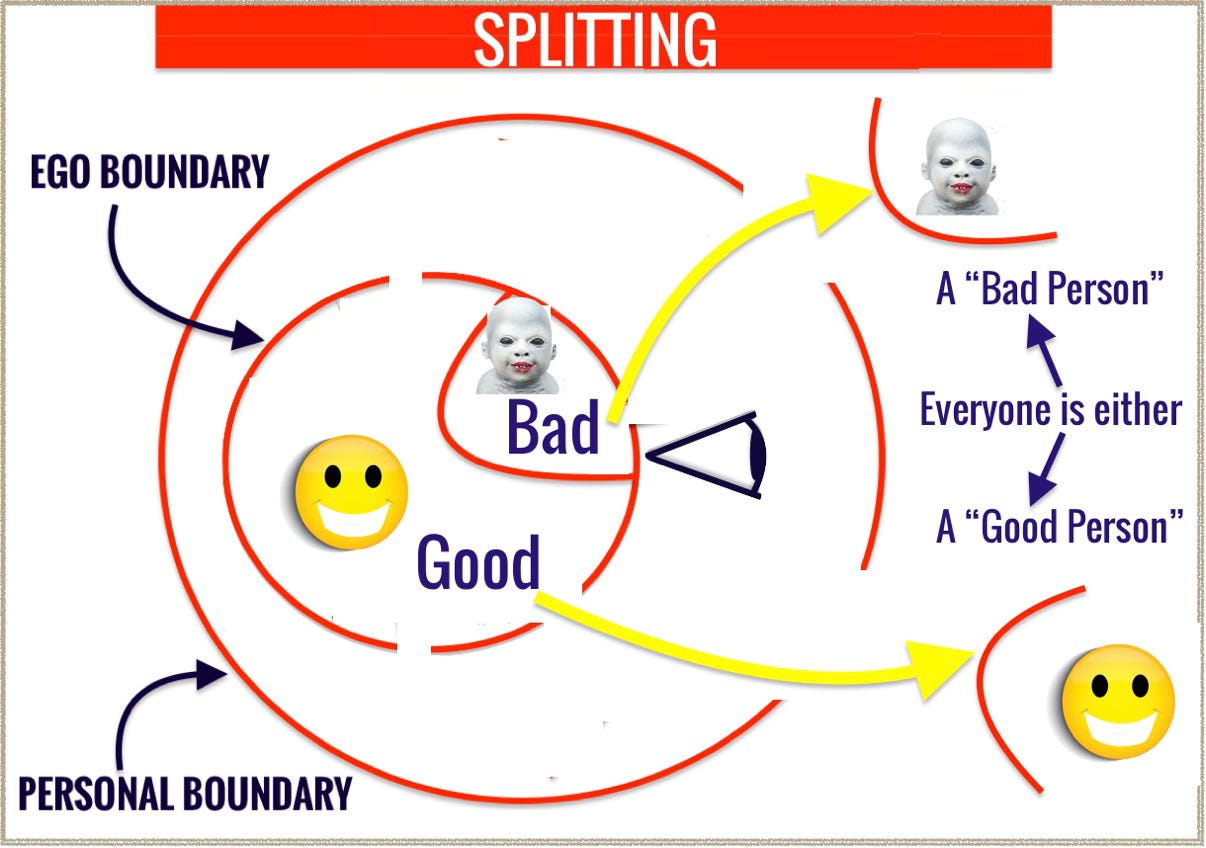 The Ego Defense Superpowers of Compromise and Collaboration Against Splitting and Triangulation 12.07.2025 1t 16minThank you to everyone who tuned into my live video! To access Romantipedia as well as all the courses we offer, please become a Paid Member, here:SHOW NOTES:This conversation delves into the psychological concept of splitting as an immature defense mechanism, its origins in childhood, and its implications in adult relationships. Dr. Paul and Jeremy explore how attachment styles influence splitting, the role of triangulation in interpersonal dynamics, and the importance of effective communication in navigating relationships. They also discuss strategies for overcoming splitting through compromise and collaboration, emphasizing the need for curiosity and mutual understanding in fostering healthy connections.In the discussion, Jeremy Fox discusses the concept of "splitting" as a primitive ego defense mechanism, drawing on the theories of notable psychoanalysts Melanie Klein and Otto Kernberg. They explain that splitting is an immature defense mechanism that develops early in childhood. It occurs when the ego, which mediates between the unconscious desires of the id and the moral constraints of the superego, cannot reconcile conflicting feelings about a person. Instead of seeing the complexities of individuals, splitting leads to all-or-nothing thinking, where a person is viewed as either entirely good or entirely bad.Dr. Paul elaborates on how this mechanism is especially prominent in borderline personality disorder (BPD), where relationships may fluctuate between idealization and vilification, often due to early attachment experiences. They highlight that children often idealize their parents, which can lead to cognitive dissonance if the parents exhibit poor behavior. This lack of nuance in perception can cause significant issues in adult relationships, as individuals with a splitting defense may struggle to see others in shades of gray and may quickly shift their views of others.The discussion also touches on the connection between attachment styles and the development of splitting in adulthood, indicating that insecure or anxious attachment can contribute to this kind of black-and-white thinking. Dr. Paul expresses an interest in integrating various theories, including those of Klein and attachment theory, to better understand the underlying mechanisms behind splitting.In this discussion, Dr Paul explains the concept of "splitting," a primitive ego defense mechanism described by psychoanalysts Melanie Klein and Otto Kernberg. Splitting occurs when the ego struggles to integrate the conflicting aspects of relationships, leading to an all-or-nothing perspective—where individuals are seen as either entirely good or entirely bad. This defense mechanism develops early in childhood, particularly in relation to attachment figures, such as parents.Klein posits that children idealize their parents as a coping strategy, which prevents them from acknowledging negative traits. This idealization can create significant emotional dissonance when a parent exhibits harmful behaviors, ultimately causing the child to vacillate between viewing the parent as a loving figure and as a villain. The discussion notes that splitting not only manifests as black-and-white thinking but also influences emotions like idealization and vilification of others.Furthermore, Jeremy raises a question about the relationship between attachment styles—such as poor or anxious attachment—and the emergence of splitting in adulthood. Dr Paul acknowledges this connection, indicating that early attachment experiences can set the stage for adult splitting behaviors. Overall, the conversation delves into the psychological underpinnings of splitting in the context of child development and adult interpersonal relationships.TakeawaysTakeawaysSplitting is an immature defense mechanism learned in childhood.Attachment styles, particularly avoidant and anxious, influence splitting behavior.Triangulation is a complex interplay of splitting and projection.Effective communication is crucial in navigating relationships and avoiding splitting.Compromise and collaboration are essential superpowers against splitting.Mentalization helps individuals understand their own and others' behaviors.Recognizing the good and bad in others is key to overcoming splitting.Curiosity about others' perspectives can mitigate splitting tendencies.Healthy relationships require ongoing negotiation and communication.Understanding the dynamics of narcissism can help in recognizing splitting behavior.TitlesThe Psychology of Splitting: Understanding Ego DefensesAttachment Styles and Their Impact on RelationshipsSound bites"Splitting is an immature defense.""Splitting occurs in the infant.""Mentalization is observing ego."ChaptersChapters00:00 Understanding Splitting as an Ego Defense Mechanism03:02 Attachment Styles and Their Impact on Splitting06:07 The Role of Mentalization in Ego Development08:55 Triangulation and Its Connection to Splitting12:06 The Dynamics of Narcissism and Splitting15:02 The Boundary Function in Ego Defenses17:56 The Impact of Splitting on Relationships20:59 Gossip, Reputation, and Social Dynamics23:59 The Consequences of Splitting in Communities39:49 Survival and Growth in Modern Society40:18 The Evolution of Personality Disorders41:17 Superpowers Against Narcissism42:17 Building Mature Romantic Partnerships44:44 Curiosity as a Foundation for Relationships49:23 The Dynamics of Compromise53:30 Collaboration: The Power of Co-Laboring58:16 The Importance of Action in Relationships01:01:21 Balancing Idealization and Practicality01:03:41 The Four C's of Healthy Partnerships01:08:26 Mindfulness and Ego Defense in Relationships This is a public episode. If you would like to discuss this with other subscribers or get access to bonus episodes, visit menspsychology.substack.com
 -
 Romantic Dynamics: the New Science of Human Courtship 10.07.2025 1minI’ve been told by a mentor tonight that I haven’t been clear about one of the things I offer people, probably the crown jewel of my life.The best version of it is not digital in my view. It’s in 16 lengthy, paperback books:The entire work (5000+ web articles) is available as a footnoted, research study-referenced, cross-linked Wiki as Romantipedia.com, free to paid members of any of our Substacks automatically, and you can get a preview of how the site works, here:A great deal of individuals have told me what you also see in the social media headlines about how frustrating dating apps are, or how many people are traumatized by divorce, how men vote red and women vote blue (which I’ve been talking about in the media for 20 years.) How there seems to be no answer to finding happiness in love or happiness in general (which always has roots in having love in your life.)“Matchmakers” have been around since the beginning of time, but there has never been a science to it. You had to rely on the intuitive skills and experience of the matchmaker if you lucked out, and that’s only if you lived in a time of history and a culture that supported their work.Guess what? Western culture today does not at all support their work, and there still is no one scientific theory explaining how to find and keep love “soup to nuts,” meeting someone new, and leading to a solid marriage (not divorcing, no way, never an option.)Gottman is the master of marriage, especially “on the rocks.” Evolutionary psychology has not figured out a unified theory (of itself) or practical applications that can be taught to and applied to people (or accepted by everyone as valid.)There are attachment theory specialists and trauma experts, while the new emerging body of knowledge on “narcissistic abuse” and how to spot and avoid narcissists in your romantic life hold crucial new knowledge about what to AVOID.But nobody tells you what the answer is to do it RIGHT—to find happiness through love and romance—the Holy Grail of psychology.Because we now know through the Harvard Study that the key to human happiness is “having a high number of friendships,” and the synonym for “friendship” is “love.”And where the highest form of love is in romantic love.Forces are at work that seek to kill love between two people. So it is no surprise that almost all that you find in academic or clinical work is centered on the mood and healing of the individual, that most of what you find about relationships is how to avoid abusive people (not to find kind people). All of this is because they don’t know what to tell you about how to find good people who are a match for you in love (as the matchmakers through all time only intuitively and experientially knew how to do if you were lucky enough to find a gifted one, in the right culture that supported doing so.)I’ve been 30 years in psychiatry practice, and while I don’t have David Buss’s cellphone number, I’ve studied extensively about how evolutionary psychology applies to human courtship, specifically in only the first of three stages or phases: sexual attraction. This was solidified for me 20 years ago by directly studying— in person, and examining with a scientific eye—the dating coaches of the world. Some of them were teaching some things that had some scientific merit and could be aligned with psychoanalytic principles. Others had bunk to offer, that sunk their entire enterprises.The second and third phases of courtship are also common sense, and were readily available in the traditional clinical education available to me and all my medical colleagues for decades: emotional attraction (friendship, as in boyfriend/girlfriend), and intellectual attraction (which is partnership and commitment, hopefully for life, which the works of John Gottman partially address, but don’t take into account the former phases and steps, and the unavoidable existence of masculine and feminine instincts well-known to both the evolutionary psychologists and to Jungian Psychologists that long-predate them in the evolution of theory on this matter (pun intended.)Because my traditional psychoanalytic training informed me on how to understand the 2nd and 3rd phases, I believe I have decoded human courtship in my own unique way (many can develop their own way, but mine now covers first meeting in the “meet-cute” all the way through marriage or unfortunately divorce and rebirth.)The whole system can be tunneled down into, in depth, and using literary examples from the Ancient Greek myths, through Shakespeare, and into modern cinema to illustrate human behaviors that parallel the science principles referenced to hundreds of research studies.However, it can be simplified into just three phases, each comprising three steps, to master courtship and find love that lasts a lifetime.It is available in a wiki online to anyone who becomes a paid member of any of our substacks at:https://romantipedia.com…and also in my favorite version, which is a set of 16 soft or hardcover books (the softcover are the best since they are 5×8 in and fit in a small backpack or purse, here on amazon, as the Romantic Dynamics series: The entire work (5000+ web articles) is available as a footnoted, research study-referenced, cross-linked Wiki as Romantipedia.com, free to paid members of any of our Substacks automatically, and you can get a preview of how the site works, here: This is a public episode. If you would like to discuss this with other subscribers or get access to bonus episodes, visit menspsychology.substack.com
 -
 Masculine Psychology - Class 3, Lesson 7 07.07.2025 3minWelcome to a series of videos that will introduce you to a simple model of men’s psychology that draws on some of the growing body of research on men.Paid Members get the full courses on the Apple App Store app:There’s more than meets the eye with men, just as there is with women. Men are driven at the core by instincts the same as women—masculine instincts.However, just like women, they have emotions of very similar types and style. The expression is different because emoting is in some part, governed by the instincts.Finally, the intellect and mature executive functions are also just like those of women (we have identical IQ potential - and “EQ” potential.) Yet the masculine instincts also influence that, and our communication and behavior.This synthesis of the old and new, the rigorous and the elegant, and most important of all, an attempt at “unification of the psychologies” is the aim of Masculine Psychology, as we start to discuss in this first video.It’s Masculine Psychology (originally, MMP), which is available in videos delivered one day at a time, for the full 5+ hours of the course (available to paid subscribers only)…Upgraded Members get full access to the full program and many others from Men’s Psychology right away without waiting for lesson-by-lesson:SUMMARY:Dr Paul explores the relationship between spiritual traditions, psychological maturity, and character development, emphasizing the use of storytelling within major religions as a means of instruction. Key points include:1. **Character Instruction in Religions**: The speaker posits that the world's major religions serve as guides for character development, using stories and parables instead of straightforward instructions. This narrative approach is preferred because it resonates more deeply with psychological growth.2. **Symbolism in Religious Narratives**: Using the example of the Garden of Eden, the speaker questions the notion that knowledge is inherently bad. They interpret the story as a metaphor for the transition from childhood ignorance (representing bliss and lack of responsibility) to adult awareness of life's complexities, including the necessity of work and the duality of good and evil in the world.3. **Spiritual and Psychological Growth**: The speaker connects spiritual maturity with psychological maturity, noting that the term "psyche," used in psychology, is synonymous with soul or spirit. They emphasize that psychological development parallels spiritual growth, suggesting that understanding oneself is essential for spiritual enlightenment.4. **Cautions Against Literal Interpretations**: The speaker warns that interpreting religious stories too literally can lead to misunderstandings, advocating for a more symbolic interpretation that recognizes their deeper meanings and lessons.5. **Upcoming Topics**: The speaker notes a transition to discussing psychosocial development models, specifically Eric Erikson's stages of development, indicating a shift towards a more structured, left-brained analysis of maturation.Overall, the discussion shifts between spiritual insights and psychological theories, highlighting how both realms contribute to a comprehensive understanding of human growth and character development.Paid Members get the full courses on the Apple App Store app: This is a public episode. If you would like to discuss this with other subscribers or get access to bonus episodes, visit menspsychology.substack.com
 -
 Masculine Psychology - Class 4, Lesson 1 29.07.2025 10minWelcome to a series of videos that will introduce you to a simple model of men’s psychology that draws on some of the growing body of research on men.There’s more than meets the eye with men, just as there is with women. Men are driven at the core by instincts the same as women—masculine instincts.However, just like women, they have emotions of very similar types and style. The expression is different because emoting is in some part, governed by the instincts.Finally, the intellect and mature executive functions are also just like those of women (we have identical IQ potential - and “EQ” potential.) Yet the masculine instincts also influence that, and our communication and behavior.This synthesis of the old and new, the rigorous and the elegant, and most important of all, an attempt at “unification of the psychologies” is the aim of Masculine Psychology, as we start to discuss in this first video.It’s Masculine Psychology (originally, MMP), which is available in videos delivered one day at a time, for the full 5+ hours of the course (available to paid subscribers only)…Upgraded Members get full access to the full program and many others from Men’s Psychology right away without waiting for lesson-by-lesson:SUMMARY:Dr. Paul presents a structured overview of Erik Erikson's stages of development, discussing the psychological growth process as it relates to specific age ranges and the virtues that emerge from successfully navigating each stage. Key points include:1. **Erikson's Stages**: The speaker emphasizes Erikson's framework which identifies critical stages of emotional and psychological development throughout life, marking specific ages alongside the central conflicts that individuals face.2. **First Stage: Trust vs. Mistrust (0-1 year)**: The first stage focuses on the development of trust through early caregiving experiences. A lack of trust may be traced back to negative early parenting.3. **Second Stage: Autonomy vs. Shame and Doubt (2-3 years)**: In this stage, toddlers learn to assert their independence while having a secure base with their caregiver. Positive experiences foster autonomy, while negative ones may lead to feelings of shame and doubt about their abilities.4. **Third Stage: Initiative vs. Guilt (4-6 years)**: During preschool years, children begin to assert control and take initiative in their activities. A successful navigation of this stage leads to a sense of initiative, whereas guilt may arise from overly controlling environments.5. **Virtues Developed**: The speaker describes the virtues cultivated through each of these stages. For the first stage, the resulting virtue is **hope**; for the second stage, it is **willpower** or the sense of self-efficacy (the belief that one can perform tasks independently).6. **Masculinity and Help-Seeking Behavior**: The speaker notes the challenges men face in asking for help, connecting societal expectations of masculinity to underreporting of emotional struggles, such as depression. They suggest a need for approaches that effectively reach men regarding emotional and mental health issues.Overall, the discussion synthesizes Erikson’s theory with contemporary reflections on emotional growth, masculinity, and the importance of navigating early developmental stages successfully to foster psychological resilience and well-being. This is a public episode. If you would like to discuss this with other subscribers or get access to bonus episodes, visit menspsychology.substack.com
 -
 Masculine Psychology - Class 3, Lesson 5 28.06.2025 10minWelcome to a series of videos that will introduce you to a simple model of men’s psychology that draws on some of the growing body of research on men.There’s more than meets the eye with men, just as there is with women. Men are driven at the core by instincts the same as women—masculine instincts.However, just like women, they have emotions of very similar types and style. The expression is different because emoting is in some part, governed by the instincts.Finally, the intellect and mature executive functions are also just like those of women (we have identical IQ potential - and “EQ” potential.) Yet the masculine instincts also influence that, and our communication and behavior.This synthesis of the old and new, the rigorous and the elegant, and most important of all, an attempt at “unification of the psychologies” is the aim of Masculine Psychology, as we start to discuss in this first video.It’s Masculine Psychology (originally, MMP), which is available in videos delivered one day at a time, for the full 5+ hours of the course (available to paid subscribers only)…Upgraded Members get full access to the full program and many others from Men’s Psychology right away without waiting for lesson-by-lesson:SUMMARY:Dr. Paul addresses how to handle conflict with overpowering individuals—particularly those who exhibit immaturity and aggression—drawing on analogies and practical strategies. Key points include:1. **Handling Aggression**: The speaker compares dealing with an aggressive person to disarming a child with a loaded gun. They suggest using distraction techniques to diffuse tension, such as redirecting the person's focus toward a common issue or task, which can prevent direct confrontation.2. **Using Distraction as a Tool**: In a workplace scenario, the speaker recommends highlighting problems (like poor performance metrics) as a way to engage the aggressive individual in a cooperative discussion rather than escalating the conflict. This approach serves to redirect their energy and attention positively.3. **Sword and Shield Metaphor**: The speaker elaborates on conflict management strategies by comparing fighting with a sword (aggression) versus using a shield (defensive, boundary-setting approach). They emphasize that while engaging in battle can be exhausting, maintaining boundaries and saying "no" can tire out an aggressor, limiting damage during conflicts and conserving energy.4. **Assertiveness and Boundaries**: By continuously asserting boundaries—saying "no" or using more assertive apologies (referred to as "sorry, number two")—the individual can protect themselves from unnecessary conflicts until the right moment to respond is available.5. **Addressing Harassment**: The speaker briefly shares a personal anecdote about a man facing sexual harassment at work, underscoring the importance of communicating about such issues. The man felt isolated and ashamed to seek help, highlighting the need for open dialogue about harassment, regardless of gender.Overall, the discussion focuses on the importance of effective conflict resolution strategies through distraction and boundary setting, allowing individuals to manage aggressive behaviors without escalating tensions unnecessarily. This is a public episode. If you would like to discuss this with other subscribers or get access to bonus episodes, visit menspsychology.substack.com
Samankaltaiset podcastit


Suosittu maassa
Tämä podcast esiintyy myös näiden maiden podcast-listoilla.

