
Lectures in Intellectual History
Institute of IH
0
This podcast presents recordings from a public lecture series on intellectual history. It features new work across all aspects of the field, hosted by the Institute of Intellectual History at the University of St Andrews. Listeners can explore talks and discussions from scholars in intellectual history through the institute's Substack.
Jaksot
-
 Alison Bashford (Sydney) - “Depopulation and Repopulation: Settler Colonialism and Political Economy in the Early 19th Century” 11.08.2026 1t 1minThis lecture was delivered at the University of St Andrews on 26 November 2025. Alison Bashford is Scientia Professor in History and Director of the Laureate Centre for History & Population at the University of New South Wales (Sydney). Her work connects the history of science, global history, and environmental history into new assessments of the modern world, from the eighteenth to the twentieth centuries. She has written about the geopolitics of world population, specifically in two books: The New Worlds of Thomas Robert Malthus: Re-reading the Principle of Population, with Joyce E. Chaplin (Princeton University Press, 2016) and Global Population: History, Geopolitics and Life on Earth (Columbia University Press, 2014). Get full access to Institute of Intellectual History at standrewsiih.substack.com/subscribe
 -
 Niall O’Flaherty (KCL) - "Malthus and the Global Turn" 20.07.2026 45minThis lecture was delivered at the University of St Andrews on the 19th of November 2025. Niall O’Flaherty is Reader in History of European Political Thought at King’s College London. His research focuses on eighteenth and nineteenth-century social, religious and scientific thought in Britain with particular reference to Thomas Robert Malthus and Charles Darwin. Get full access to Institute of Intellectual History at standrewsiih.substack.com/subscribe
 -
 Avi Lifschitz (Oxford) - “Holding the Monarch to Account: Frederick the Great’s Writings in the Public Sphere” 06.07.2026 50minThis lecture was delivered at the University of St Andrews on the 15th of October 2025. The lecture is not for citation without permission of the author.Avi Lifschitz is Professor of Intellectual History and Enlightenment Studies at Magdalen College, Oxford. Get full access to Institute of Intellectual History at standrewsiih.substack.com/subscribe
 -
 Debating Enlightenment 23.05.2026 1t 25minThis discussion took place a the University of St Andrews on February 26, 2025. Ann Thomson is Professor Emerita at the European University Institute, having been Professor of Intellectual History there from 2013 to 2020. Her research interests include the intellectual history of the long Eighteenth Century, and she studies questions at the intersection of religion, medicine and politics, as well as the circulation of ideas, book history and translation, and European writings on the Muslim world. Get full access to Institute of Intellectual History at standrewsiih.substack.com/subscribe
 -
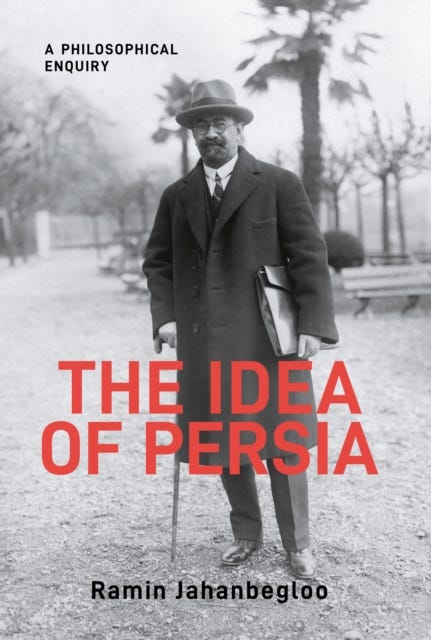 Ramin Jahanbegloo - "The Idea of Persia: A Philosophical Enquiry" (Book launch) 15.05.2026 49minThis episode was recorded at the University of St Andrews on 7th of October 2025. The event was held in Parliament Hall, St Andrews. Ramin Jahanbegloo’s The Idea of Persia can be found here. Get full access to Institute of Intellectual History at standrewsiih.substack.com/subscribe
 -
 Robert Frost (Aberdeen) - "Drawing in the Reins of Government: Justus Lipsius and Republican Monarchy in Poland-Lithuania" 14.11.2025 1t 6minThis lecture was given at the University of St Andrews on Wednesday 17 September 2025. The lecture is not for citation without permission of the author. Get full access to Institute of Intellectual History at standrewsiih.substack.com/subscribe
 -
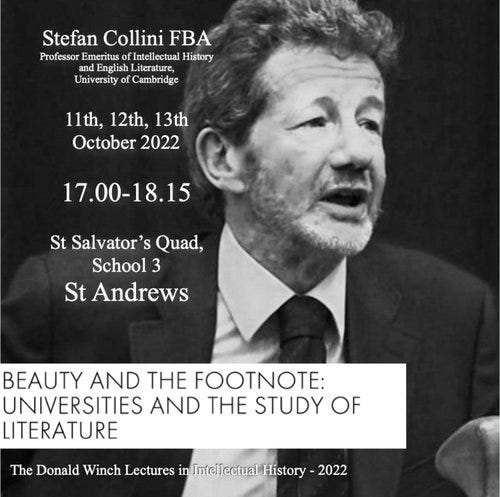 Beauty and the Footnote: Universities and the Study of Literature 10.08.2025 1t 1minStefan Collini, FBA. Professor Emeritus of Intellectual History and English Literature, University of Cambridge.The Donald Winch Lectures in Intellectual History.University of St Andrews. 11th, 12th & 13th October 2022.In the course of the nineteenth and twentieth centuries, universities expanded to include a wide range of what came to be regarded as academic ‘disciplines’. In Britain, the study of ‘English literature’ was eventually to become one of the biggest and most popular of these subjects, yet it was in some ways an awkward fit: not obviously susceptible to the ‘scientific’ treatment considered the hallmark of a scholarly discipline, it aroused a kind of existential commitment in many of those who taught and studied it. These lectures explore some of the ways in which these tensions worked themselves out in the last two hundred years, drawing on a wide range of sources to understand the aspirations invested in the subject, the resistance that it constantly encountered, and the distinctive forms of enquiry that came to define it. In so doing, they raise larger questions about the changing character of universities, the peculiar cultural standing of ‘literature’, and the conflicting social expectations that societies have entertained towards higher education and specialized scholarship.Handout - Lecture 3: Syllabuses1. ‘“English”, including Anglo-Saxon and Middle English along with modern English, including what we ordinarily call the “dull” periods as well as the “great” ones, is an object more or less presented to us by nature.’2. ‘In the 1880s, an exciting duel between two great publishing houses brought the price of the rival National and World Libraries (Cassell’s and Routledge’s, respectively) down to 3d in paper and 6d in cloth. And not only were prices cut: the selection of titles was greatly enlarged, the old standbys - Milton, Pope, Cowper, Thomson, Burns, Goldsmith, and the rest - being joined by many other authors who had seldom or ever appeared in cheap editions.’3. ‘Sir John Denham (1615-1668) is familiar from the oft-quoted couplet in his poem of Cooper’s Hill, the measured and stately versification of which has been highly praised. He died an old man in the reign of Charles II, with a mind clouded by the sudden loss of his young wife, whom he had married late in life. John Cleveland (1613-1659), author of the Rebel Scot and certain vigorous attacks on the Protector, was the earliest poetical champion of royalty. Butler is said to have adopted the style of his satires in Hudibras. Colonel Richard Lovelace (1618-1658) ....’4. ‘Poetry: More advanced poems from Chaucer (e.g. The Prologue), Shakespeare, Spenser, Milton, Pope, Wordsworth, Tennyson, or from selections such as The Golden Treasury; Shakespeare, (Histories, Comedies or easier Tragedies). Prose: Plutarch’s Lives, Kinglake, Eothen, Borrow, Lavengro, Ruskin, Sesame and Lilies, Frowde [sic; ?Froude], selected short studies, Modern prose Comedies (e.g. Goldsmith and Sheridan), Selections from British Essayists (e.g. Addison, Lamb, Goldsmith), Macaulay, Essays or selected chapters from The History.’5. ‘In the 1930s favourite Higher Certificate set books and authors among the various Boards include: The Faerie Queene, Marlowe’s Faustus, Bacon’s essays, Sidney’s Apologie for Poetrie, Hakluyt, The New Atlantis, Shakespeare, Chaucer, Milton, Lamb, Carlyle, Pope, Dryden, Scott and the Romantic poets. These texts and authors changed hardly at all between 1930 and 1950 (and represent a very similar situation to that of 1900-1910).’6. ‘An Honours Degree in English Language and Literature at present entails, in every University in England, some knowledge both of Latin or Greek at the outset, and of Old English later.’ Get full access to Institute of Intellectual History at standrewsiih.substack.com/subscribe
 -
 Beauty and the Footnote: Universities and the Study of Literature 28.07.2025 54minLecture 2: CareersStefan Collini, FBA.Professor Emeritus of Intellectual History and English Literature, University of Cambridge.The Donald Winch Lectures in Intellectual History.University of St Andrews.11th, 12th & 13th October 2022.In the course of the nineteenth and twentieth centuries, universities expanded to include a wide range of what came to be regarded as academic ‘disciplines’. In Britain, the study of ‘English literature’ was eventually to become one of the biggest and most popular of these subjects, yet it was in some ways an awkward fit: not obviously susceptible to the ‘scientific’ treatment considered the hallmark of a scholarly discipline, it aroused a kind of existential commitment in many of those who taught and studied it. These lectures explore some of the ways in which these tensions worked themselves out in the last two hundred years, drawing on a wide range of sources to understand the aspirations invested in the subject, the resistance that it constantly encountered, and the distinctive forms of enquiry that came to define it. In so doing, they raise larger questions about the changing character of universities, the peculiar cultural standing of ‘literature’, and the conflicting social expectations that societies have entertained towards higher education and specialized scholarship.Handout - Lecture 2: Careers1. ‘His tastes and pursuits would no doubt lead him to lecture on the Structure of the English Language and its affinities with cognate tongues, rather than upon Rhetoric or the Art of Composition, but when it was mentioned to him that the latter formed part of the duties of the chair, he made no difficulty about undertaking it.’2. ‘We think that the Professor of the English Language and Literature at our College ought, if it were possible, to unite all the qualifications which we think desirable, to be a thoroughly educated man, a man whose peculiar learning is based upon the sound scholarship which is the general training of English gentlemen. He ought to have made a systematic study of the English Language and English Literature: a systematic study of the Language, so as to be thoroughly conversant with its etymological structure, and the history of its formation through its successive stages; a systematic study of the Literature, so that his familiar knowledge of it may not be confined within the limits of one or two periods. He ought to have experience as a Lecturer, and to be able to lecture well: but he ought to be prepared not only to lecture, but to teach. We must bear in mind, and our Professor must bear in mind, that the practical end of our English Class is to teach our students to use their own language well both in speaking and writing.’3. ‘All the world is standing, every chatterer in every newspaper thinks he is good enough for English language and literature.’4. ‘The lecture list of Easter Term was considered. It was agreed that the Reader in Phonetics should be asked either to change the subject of his lecture on Ugrian Phonetics or to remove it from the list, as in the opinion of the Board the subject did not fall within the scope of the school.’5. ‘The main point, of course, was to choose a scholar and not a chatterer; now the chatterers have command of the newspapers and the scholars have not. That’s all. I have no doubt that to any maker of paragraphs, Matthew, Ealdorman of babblers, seems a greater man than William of Chester’.6. ‘In those early years everyone, whatever her natural bias, read for the English School at Oxford, because that was the only course for which adequate preparation could at that time be secured.’7. ‘Well, I have no hesitation in de-classing the whole professorial squad - Bradley, Herford, Dowden, Walter Raleigh, Elton, Saintsbury’... [Saintsbury is allowed to have some strengths, though in spite of his style rather than because of it] ...For the rest: Professor Walter Raleigh is improving. Professor Elton has never fallen to the depths of sterile and pretentious banality which are the natural and customary level of the remaining three.’ Get full access to Institute of Intellectual History at standrewsiih.substack.com/subscribe
 -
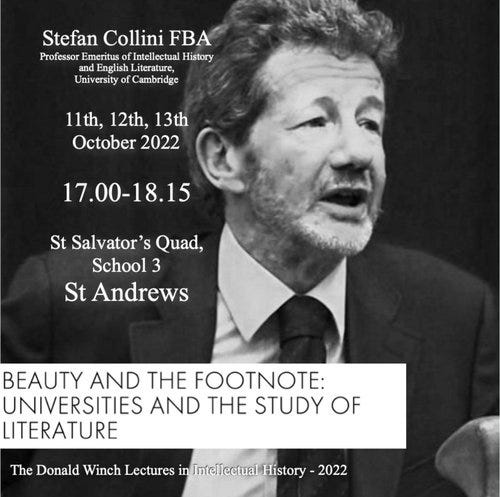 Beauty and the Footnote: Universities and the Study of Literature 20.07.2025 1t 6minLecture 1: JustificationsStefan Collini, FBA. Professor Emeritus of Intellectual History and English Literature, University of Cambridge.The Donald Winch Lectures in Intellectual History. University of St Andrews. 11th, 12th & 13th October 2022. In the course of the nineteenth and twentieth centuries, universities expanded to include a wide range of what came to be regarded as academic ‘disciplines’. In Britain, the study of ‘English literature’ was eventually to become one of the biggest and most popular of these subjects, yet it was in some ways an awkward fit: not obviously susceptible to the ‘scientific’ treatment considered the hallmark of a scholarly discipline, it aroused a kind of existential commitment in many of those who taught and studied it. These lectures explore some of the ways in which these tensions worked themselves out in the last two hundred years, drawing on a wide range of sources to understand the aspirations invested in the subject, the resistance that it constantly encountered, and the distinctive forms of enquiry that came to define it. In so doing, they raise larger questions about the changing character of universities, the peculiar cultural standing of ‘literature’, and the conflicting social expectations that societies have entertained towards higher education and specialized scholarship.Handout.1. ‘Neglected and despised as it is in comparison with its favoured competitor, how far more does it deserve the notice bestowed on her. It is not partial in its cultivation of the intellect, but tends at once to correct the taste, to strengthen the judgement, to instruct us in the wisdom of men better and wiser than ourselves, to exercise the reasoning faculties on subjects which demand and deserve their attention, and to show them the boundaries imposed on them by Providence. It is literature which fits and prepares us best of all for the examination of those moral and intellectual truths, which are not only the worthiest exercise of our reason, but most concern our future destiny.’2. ‘The teaching of English literature will contribute to the formation of sound conclusions on social and political questions; to right feeling and right thinking in all that appertains to morality and religion; to largeness, to sanity, to elevation, to refinement in judgement, taste and sentiment, to all, in short, which constitutes in the proper sense of the term the education of the British citizen.’3. ‘By the humanizing power of literature we mean the development of the higher faculties, the imagination, the sense of beauty and the intellectual comprehension, clear vision, mental harmony, a just sense of proportion, higher illumination.’4. ‘In all my Lectures, more particularly when treating upon that glorious and inexhaustible subject, the LITERATURE of our country - I shall esteem it my duty - and I trust I shall find it my delight - to inculcate lessons of virtue, through the medium of the masters of our language.’5. ‘A chief burden in maintaining and keeping uppermost the spiritual element in man must rest, for a variety of reasons, more upon the teaching of English and English literature than upon any other subject.’6. ‘The value of critical training, and of the various methods of study that I have touched upon, is simply that they educate our power of appreciation and make it possible for us to enter into the life and meaning of the highest poetry. Without some such mental discipline we shall always be in danger of accepting the second-rate for a masterpiece, and shall either be content with this shallower outlet for our emotions or be inclined to dispute the power of art to satisfy us at all. But if we submit our taste for poetry to education, the highest in ourselves will be drawn out to meet what is highest in the great artist: we shall realize our kinship with him and participate in his vision.’ Get full access to Institute of Intellectual History at standrewsiih.substack.com/subscribe
 -
 Sophie Scott-Brown (University of St Andrews; Remarque Institute, New York) - "British Activist-Intellectuals and the Unexpected Revival of Radical Democracy in the (Long) 1950s" 15.01.2025 55minThis lecture was delivered at the University of St Andrews on 25 September 2024. Get full access to Institute of Intellectual History at standrewsiih.substack.com/subscribe
 -
 Michael Brown (University of Aberdeen) - "Creating an Ancien Regime: The Union of 1800 as a Counter Revolutionary Act" 11.12.2024 35minThis lecture was delivered at the University of St Andrews on 18 September 2024. Get full access to Institute of Intellectual History at standrewsiih.substack.com/subscribe
 -
 Tom Pye (UCL) - "The tailzie and the politics of the feudal law in eighteenth-century Britain" 15.10.2024 48minThis lecture was delivered on 3 April 2024 at the University of St Andrews. Get full access to Institute of Intellectual History at standrewsiih.substack.com/subscribe
 -
 Norman Vance - "Individualism and its Discontents: Hobbes to Hayek and Beyond" 15.05.2024 41minThis lecture was delivered at the University of St Andrews on 13 March 2024. Get full access to Institute of Intellectual History at standrewsiih.substack.com/subscribe
 -
 Christopher de Bellaigue - "Suleyman the Magnificent and the 16th-century race for empire" 03.04.2024 44minThis lecture was delivered at the University of St Andrews on 31 January 2024. Get full access to Institute of Intellectual History at standrewsiih.substack.com/subscribe
 -
 Ariane Fichtl - “Overcoming the biopolitical dynamic of enslavement to achieve Immediate Emancipation” 21.03.2024 35minThis lecture was delivered at the University of St Andrews on 24 January 2024. Get full access to Institute of Intellectual History at standrewsiih.substack.com/subscribe
 -
 Tim Stuart-Buttle - "Behind the Curtain: Hobbes and the politics of recognition" 07.03.2024 50minThis lecture was delivered at the University of St Andrews on 17 January 2024. Get full access to Institute of Intellectual History at standrewsiih.substack.com/subscribe
 -
 Richard Whatmore - "The End of Enlightenment (book launch)" 27.12.2023 36minThis talk was given at Toppings in St Andrews on December 7, 2023. Get full access to Institute of Intellectual History at standrewsiih.substack.com/subscribe
 -
 Jesse Norman - "Ambition, revenge, truth, fiction - The Winding Stair" 22.12.2023 1t 4minThe barely known story of the 30-year rivalry between Francis Bacon and Edward Coke is a fascinating case study in late-Elizabethan-Jacobean court politics. But it can also be a means by which to explore the limits of historical truth, and the uses of fiction. Jesse Norman is a Visiting Research Fellow at St Andrews, a Fellow of All Souls and a Member of Parliament (UK). This lecture was given on the 17th of November 2023 at the University of St Andrews. Get full access to Institute of Intellectual History at standrewsiih.substack.com/subscribe
 -
 Vassilios Paipais - "Between Pacifism and Just War: Oikonomia and Eastern Orthodox Political Theology" 20.12.2023 32minThis lecture was given at the University of St Andrews on 15 November 2023. Get full access to Institute of Intellectual History at standrewsiih.substack.com/subscribe
 -
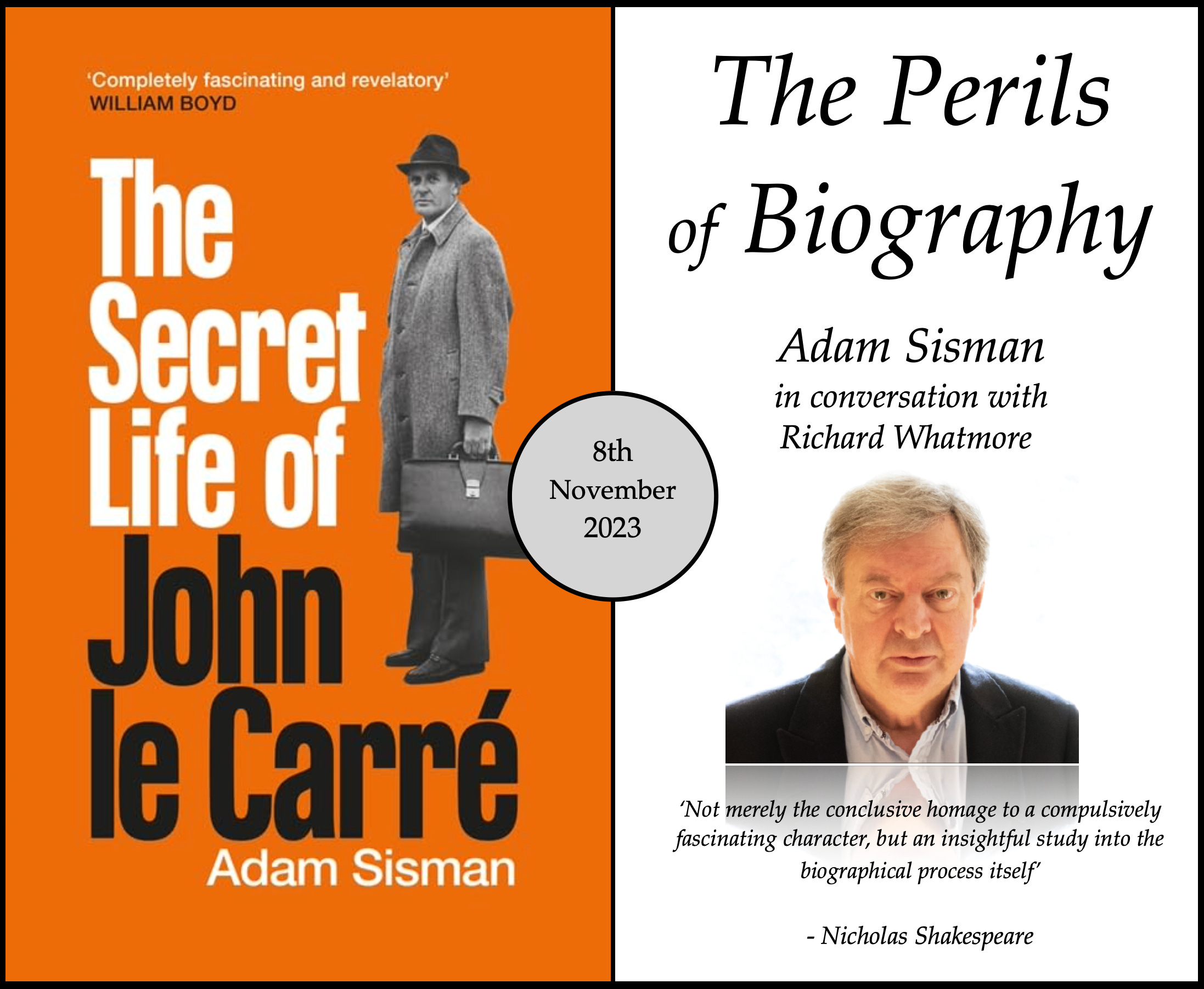 Adam Sisman - "The Perils of Biography" 14.11.2023 56minAdam Sisman in conversation with Richard Whatmore. Recorded on 8 November 2023. Get full access to Institute of Intellectual History at standrewsiih.substack.com/subscribe
Samankaltaiset podcastit


Suosittu maassa
Tämä podcast esiintyy myös näiden maiden podcast-listoilla.
