
The Niall Boylan Podcast (They Told Me To Shut Up)
Niall Boylan
0
Niall Boylan hosts a podcast where he speaks his mind freely, covering a range of topics and engaging with listeners. The show offers premium content for subscribers via his website.
Epizode
-
 #887 Would You Risk Your Child’s Brain For A Boxing Dream? 03.09.2026 1h 11minWould You Let Your Seven Year Old Daughter Take Up Boxing?Niall talks to Karl Deeter about a family disagreement sparked by the influence of Katie Taylor.Around 80,000 fans are expected at Croke Park this Saturday night to watch Taylor take on undefeated French fighter Flora Pili, but one listener says Katie’s success has caused a row at home.His seven year old daughter is a huge Katie Taylor fan and now wants to join her local boxing club. Her dad thinks it would be fantastic for her confidence, discipline, fitness and ability to defend herself. His wife completely disagrees.She worries that what starts as a childhood hobby could turn into a serious passion, with their daughter continuing to box into her teenage years and potentially exposing herself to serious injury. In her view, boxing is simply too dangerous and “barbaric” to encourage in a young child.So is she right to put her foot down, or is she preventing her daughter from discovering a sport she might genuinely love?We celebrate Katie Taylor as one of Ireland’s greatest sporting heroes, but would you actually be comfortable watching your own son or daughter step into a boxing ring?Niall discusses the dilemma with Karl Deeter.
 -
 #886 Is The Dream Of A United Ireland Colliding With Reality? 03.09.2026 1h 2minWould A United Ireland Referendum Create More Problems Than It Solves?Niall talks to election candidate Eddie Punch about the growing debate over whether the time has come for a referendum on a united Ireland.UK Prime Minister Andy Burnham has insisted he is “very aware of every word in the Good Friday Agreement” and says he will abide by it “100%”. His comments follow criticism over remarks made during a visit to Belfast, when he suggested that a referendum on Irish unity was currently “off the table”.But is he right to believe that now is simply not the time?Niall and Eddie examine the enormous political, economic and practical questions that would come with reunification. Who would fund Northern Ireland’s public services and healthcare system? What happens to the financial support currently provided by Westminster? What would become of thousands of people employed directly or indirectly by the British state? Would Ireland adopt one currency across the island immediately, and what happens to politically sensitive issues such as the national flag and anthem?There is also the question of consent. Whatever the result of a referendum, a significant section of the population could feel alienated or betrayed, with concerns that an increasingly heated constitutional debate could inflame community tensions.So, should the people of Northern Ireland be given the opportunity to vote on their constitutional future, or could holding a border poll now create far more problems than it solves?Niall discusses it with election candidate Eddie Punch.
 -
 #885 Freedom or Public Safety: Should Driving Stop at 80? 02.09.2026 56minShould Drivers Be Forced Off the Road at 80?Niall talks to podcaster and restaurateur Paul Treyvaud about a listener’s difficult dilemma involving his 85 year old father, who still insists on driving despite growing concerns about whether he is mentally sharp enough to be safe behind the wheel.The listener says he has repeatedly tried to persuade his father to give up driving, but he refuses to hand over the keys. He now believes there should be a firm legal cut off, once you turn 80, your driving days should be over.But would that be fair?For many older people, driving represents independence, freedom and the ability to live life on their own terms. Should someone lose that simply because they reach a particular birthday, even if they remain perfectly capable behind the wheel?Or should older drivers face regular medical and practical assessments to prove they are still fit to drive?Niall and Paul discuss where the balance should lie between personal freedom and public safety, and ask what families can realistically do when an elderly parent refuses to accept that it may be time to stop driving.Have you ever had to persuade an elderly parent or relative to give up the car, and what happens when they simply refuse?
 -
 #884 Drugs Without Consequences: Has Ireland Gone Too Far? 02.09.2026 1h 7minNiall talks to Cork Councillor Albert Deasy about Ireland’s new Health Referral Scheme, which came into effect on 1 September.Under the new system, Gardaí can refer eligible adults caught for a first drug possession offence to the HSE instead of prosecuting them or issuing an adult caution. Supporters say it could prevent people from being dragged into the criminal justice system over personal drug use and instead direct them towards health services.But the rollout has already raised serious questions. Some frontline Gardaí say they only learned about the scheme through media reports, with official guidelines arriving on the day it was introduced and little or no training provided beforehand.Niall asks how such a significant change in drug policy could be introduced without properly preparing the Gardaí expected to implement it.Possession of illegal drugs remains a criminal offence, so technically this is not decriminalisation. But is Ireland now moving towards decriminalisation in practice?Is treating personal drug possession primarily as a health issue a sensible and compassionate approach, or does avoiding prosecution remove an important deterrent and send the message that illegal drug use carries few consequences?Niall discusses the controversy with Cork Councillor Albert Deasy and asks: should someone caught with illegal drugs for personal use still face prosecution?
 -
 #883 Should Overtime Be Completely Tax Free? 01.09.2026 1h 16minShould Overtime Be Tax Free?Niall talks to Independent Ireland TD Michael Collins about whether workers should be allowed to keep more of the money they earn from putting in extra hours.Independent Kerry TD Michael Healy-Rae has proposed taxing qualifying overtime earnings at a flat rate of 20% as part of Budget 2027, arguing that people who work longer hours should not see so much of the additional income swallowed up by tax. Although INdependent ireland was the fist party to propose the ideaNiall asks whether the Government should go even further and abolish income tax altogether on overtime worked beyond 40 hours a week, as well as removing tax on tips.Critics argue that such a move could reduce the money available to fund public services and create complications within the tax system. Supporters say it would reward hard work, encourage people to take on extra hours and put more disposable income into workers’ pockets, much of which would ultimately flow back into the economy through spending and VAT.Would tax free overtime give working people a badly needed break, or is the idea simply too expensive and unrealistic?Niall discusses the proposal with Independent Ireland TD Michael Collins.
 -
 #882 Two Weeks Away From The Kids: Bliss Or Betrayal? 01.09.2026 53minShould Parents Feel Guilty About Going On Holiday Without The Kids?Niall talks to journalist Laura Perrins about a listener’s holiday dilemma that has caused quite a row at home.The listener says she was furious when her husband suggested they escape together on a surprise two week holiday to the Maldives, leaving their three young children at home. He thought he was planning the ultimate romantic getaway for just the two of them, but luckily he had not booked or paid for anything because his wife has flatly refused to go.She says she could never relax on a beach thousands of miles away while her children were at home, but her husband believes couples need time together and that two weeks away without the kids would be good for their marriage.So, is she being unreasonable? Should parents be able to enjoy a proper holiday without their children, or once you have young kids are two week romantic getaways simply off the table?Niall discusses the dilemma with journalist Laura Perrins and asks whether parents should feel guilty about leaving the children behind.
 -
 #880 If Gardaí Can’t Strike, Why Should Nurses And Teachers? 31.08.2026 1h 4minPublic sector workers are warning that patience is running out over pay, and the threat of industrial action is becoming increasingly serious.Niall Boylan talks to callers about whether Ireland could be heading towards a major wave of strikes across essential public services, and whether workers in areas such as healthcare, education, public transport and social protection should have the same right to withdraw their labour as anyone else.The previous public service pay agreement expired on 30 June 2026 after delivering increases of up to 10.25% over two and a half years. Unions argue that rising prices have continued to erode living standards and that any new agreement must properly reflect inflation. Fórsa has been balloting more than 90,000 public sector members on industrial action, while SIPTU, the INMO and other unions are also moving towards ballots. Prison officers have already backed industrial action, and Unite has warned that Ireland could face a “winter of strikes” unless the Government makes what it considers a meaningful pay offer.Teachers are also becoming increasingly involved. The Teachers’ Union of Ireland has announced a ballot for industrial action in a separate dispute over a 1% salary increase which it says has not been paid as agreed, potentially affecting cooperation with elements of Senior Cycle assessment reform.But where should the line be drawn? If nurses, teachers, transport workers or other essential public servants strike, it is ordinary members of the public who can ultimately suffer. Gardaí are prohibited from striking because of the essential nature of their work, so should similar restrictions apply to other vital services?And then there is the question of pay. Do public servants deserve another substantial increase because of the cost of living, or after receiving increases of up to 10.25% under the previous agreement, is it unreasonable to expect private sector taxpayers to fund another large rise?Niall hears from callers on both sides of a debate that could become one of the biggest industrial relations battles facing the Government this winter.
 -
 #881 Lindsay Clancy: Monster, Murderer Or Mentally Ill Mother? 31.08.2026 1h 16minThe Lindsay Clancy murder trial has gripped millions around the world, and the case is now in the hands of a Massachusetts jury.Niall Boylan is joined by journalist and commentator Laura Perrins to discuss the latest developments in the extraordinary case involving Lindsay Clancy, the Massachusetts mother who killed her three young children, Cora, Dawson and Callan, at their family home in January 2023.Clancy has pleaded not guilty to three counts of first degree murder on the basis that she was not criminally responsible. Her defence argues that she was suffering from postpartum psychosis, was severely mentally unwell and had been prescribed numerous psychiatric medications before the killings. Prosecutors accept that she had significant mental health problems, but argue that she still understood what she was doing and deliberately planned the deaths. After 22 days of testimony and closing arguments, jurors are now deciding whether she should be convicted of murder, found guilty of a lesser offence, or found not criminally responsible because of her mental state.At the heart of the case is an extraordinarily difficult question.There is no dispute that Lindsay Clancy killed her children, but if she was experiencing severe psychosis at the time, should she be held fully criminally responsible?Should a mother who kills her children while suffering from a profound psychiatric illness spend the rest of her life in prison without parole, or should the emphasis instead be on psychiatric treatment and compassion?And how much responsibility, if any, should be placed on a medical system that was treating a woman whose mental health had been deteriorating before the tragedy?Niall talks to Laura Perrins about the evidence heard during the trial, the prosecution and defence arguments, the debate surrounding postpartum psychosis and the verdict that could determine whether Lindsay Clancy spends her life in prison or in psychiatric care.
 -
 #879 Ireland Is Getting Richer, So Why Do You Feel Poorer? 27.08.2026 1h 20minIn this episode, Niall Boylan speaks to economic journalist with The Sunday Times Ireland, Cormac Lucey, about Ireland’s continuing cost of living crisis and whether Government policy is actually making inflation worse.Prices rose by 3.4% in the year to July, with some household costs increasing far more sharply. Education costs were up 8.9%, clothing and footwear increased by 8.5%, while housing, water, electricity and gas rose by 7.7%.Cormac Lucey argues that the Government is not simply failing to control inflation, but is actively fuelling it through its own spending and economic policies.Niall asks whether politicians have become detached from the reality facing ordinary households, and whether part of the reason there is not greater public anger is that a significant section of society can still comfortably absorb the increases.Is Ireland becoming divided between those who can shrug off higher prices and the so called “I’m alright, Jack” brigade, and those who are quietly being pushed closer to the financial edge every month?Are you still coping comfortably, or is the cost of living finally becoming impossible to ignore?
 -
 #878 Ukraine Gets Billions While Irish Families Struggle 27.08.2026 57minIn this episode, Niall Boylan speaks to Independent Ireland TD Ken O’Flynn about Ireland’s continuing financial and political support for Ukraine.O’Flynn has criticised Taoiseach Micheál Martin’s participation in the Coalition of the Willing, warning that “standing with Ukraine cannot mean a blank cheque with no questions asked.”With the EU proposing a new €90 billion loan for Ukraine, questions are being raised about what Ireland’s eventual share could be. Ireland accounted for roughly 2.2% of the EU budget in 2025, and while the final liability cannot simply be calculated on that basis, a proportional comparison would put Ireland’s potential exposure at close to €2 billion.That comes on top of hundreds of millions already provided directly to Ukraine, billions spent accommodating Ukrainians in Ireland, and more than €4 billion recorded in official development assistance across 2024 and 2025, although those figures also include some refugee-related expenditure within Ireland.Niall asks Ken O’Flynn whether the Government is right to continue committing Irish taxpayers’ money to Ukraine, whether there should be greater scrutiny of future funding, and whether Ireland’s generosity abroad is coming at the expense of problems at home.Are we mugs handing out blank cheques, or are we simply a generous and good-natured nation doing our duty?
 -
 #876 No More Hidden Faces: Is It Time For An Irish Ban? 26.08.2026 1h 12minShould Ireland follow Portugal and ban full face coverings in public?Niall Boylan is joined by journalist John McGuirk to debate whether Ireland should introduce a nationwide ban on clothing that conceals a person’s face in public, including the burqa and niqab.Portugal has now introduced one of Europe’s newest face covering laws. Under Law No. 58/2026, published on 24 August, clothing designed to conceal the face or prevent identification will be prohibited in public streets, public services, businesses, sporting events and demonstrations. The law comes into force on 23 September 2026. Anyone who breaches it can face a fine of €150 to €750 for a negligent offence, or €400 to €3,000 where the breach is deliberate. There are exemptions for health, work, artistic and entertainment purposes, security, weather conditions, places of worship, diplomatic premises and aircraft. The legislation also makes it a criminal offence to force somebody to cover their face because of their sex, with a possible prison sentence of up to two years, increased where the victim is a minor.Portugal is far from alone. France, Belgium, Austria, Denmark, Bulgaria and Switzerland have introduced broad restrictions on concealing the face in public. The Netherlands has a more limited ban covering places such as schools, hospitals and public transport, while Germany and Norway have restrictions in particular settings. Italy already has long standing legislation restricting the concealment of a person’s identity in public, while the issue has also been debated in countries including Spain. Across Europe the argument remains deeply divided between religious freedom and individual choice on one side, and security, identification, integration and women’s rights on the other.Supporters of a ban argue that nobody should be permitted to completely conceal their identity while walking through public spaces, entering shops, using public services or dealing with authorities. They also argue that some women may be pressured by husbands, fathers or communities into covering their faces. Opponents say governments should not dictate how people dress and that banning the burqa or niqab disproportionately targets Muslim women and interferes with freedom of religion and cultural expression.Niall asks John McGuirk where the balance should lie. Should Ireland follow Portugal and other European countries and ban full face coverings in public, or would such a law represent an unacceptable intrusion into religious freedom and personal choice?
 -
 #877 Depression, No Sex And No Money: Should She Walk Away? 26.08.2026 1h 1minWhy are men’s mental health struggles so often dismissed until they reach crisis point?In this episode, Niall Boylan talks to callers about a difficult listener dilemma involving marriage, depression, money and the limits of emotional responsibility.A woman has written to the show about her husband, who is in his 40s and says he is depressed. He is self employed, but has stopped looking for work, spends most of his time at home and appears to have lost interest in almost everything, including himself. His wife says she has supported him for months, attended the doctor with him and encouraged him to seek further help, but she feels he is making little effort to change his situation.Their relationship has now deteriorated badly. They have not slept in the same bed or had any intimacy for a year, they are struggling financially and the household is surviving entirely on her income. She says constantly dealing with his depression is now affecting her own mental health and she is beginning to wonder whether she needs to leave the marriage while she still has a chance to rebuild her life.But where does compassion end and personal responsibility begin?Is she being selfish for considering leaving a husband who is clearly struggling, or is it unreasonable to expect one person to carry the emotional and financial burden of a relationship indefinitely?Niall hears from callers on both sides and asks a difficult question: When somebody you love is depressed but appears unwilling to help themselves, how long are you expected to sacrifice your own happiness to save them?
 -
 #874 Stop Making Victims Out Of Deadly Joyriders 25.08.2026 1h 22minIn this episode, Niall Boylan is joined by journalist Laura Perrins to debate whether the law is tough enough on young drivers who deliberately put innocent lives at risk.The discussion comes after a horrifying series of wrong way crashes in Ireland and Britain. Two weeks ago, eight teenagers travelling in a stolen car drove the wrong way onto the M50 before crashing head on into another vehicle, leaving an innocent motorist seriously injured.Days later, tragedy struck again on the M9 when five teenagers were killed after their car was driven the wrong way down the motorway and collided head on with a family travelling to Dublin Airport. Three women and a seven year old boy were seriously injured.Then, on Saturday in Britain, five young men travelling the wrong way on the A66 crashed into a police vehicle. All five occupants of the car were killed, along with two police officers.Niall argues that deliberately driving the wrong way on a motorway is not simply reckless driving. When someone knowingly sends a vehicle towards oncoming traffic at motorway speeds, innocent motorists have nowhere to go and no way of knowing what is coming towards them.He has called for emergency legislation that could see anyone who deliberately drives in this manner, putting innocent lives at extreme risk, facing a sentence of up to 20 years in prison, regardless of their age.Critics say 20 years would be completely disproportionate, particularly when young offenders are involved, and argue that sentencing must still take account of age, maturity, intent and the circumstances of each individual case.But Niall asks where society should draw the line. If somebody deliberately turns a car into what is effectively a lethal weapon and plays Russian roulette with the lives of innocent families, should being 15, 16 or 17 substantially protect them from the consequences?Laura Perrins joins Niall to discuss punishment, personal responsibility, youth justice and whether the threat of much tougher sentences would actually deter this kind of behaviour.How many more innocent people have to be killed or seriously injured before the law gets tougher? Is 20 years an appropriate punishment for deliberately putting motorists' lives at risk, or would it be an excessive response to an appalling problem?
 -
 #875 Irish First, Married First: Is That Fair Housing Policy? 25.08.2026 59minIn this episode of The Niall Boylan Show, Niall opens the phone lines to listeners to debate a controversial question: should married couples with children receive greater priority for social housing in Ireland?The debate follows comments from Reform UK deputy leader Richard Tice, who has argued that marriage provides children with greater stability and suggested that married couples with children should be given greater priority when social housing is allocated.Supporters argue that governments already use taxation and other policies to encourage certain behaviours, so why should marriage be any different? If stable two parent families are considered beneficial for children, should the State actively encourage marriage when deciding how scarce public housing is distributed?Critics say such a policy would create two classes of family. An unmarried couple with children, a single mother, a single father or somebody whose marriage has broken down could potentially find themselves behind a married couple, even when their housing needs are exactly the same.Niall asks callers whether social housing should be allocated purely according to need, or whether governments are entitled to consider the type of family being housed.If two families have identical incomes, the same number of children and exactly the same level of housing need, should the married couple get the house first?And should the State be encouraging marriage at all, or is it none of the Government’s business how people choose to organise their family lives?Niall takes calls from both sides of a debate that goes straight to the heart of how we define family, fairness and who should get priority when there simply are not enough homes to go around.
 -
 #873 Is Irish Citizenship Being Handed Out Like Smarties? 24.08.2026 44minThe Irish Government is considering tougher citizenship rules that could increase the standard residency requirement from five to eight years. Applicants may also have to demonstrate English proficiency, financial independence, good character and an ability to support themselves and their families. These are currently proposals being considered, rather than rules already in force. The Sunday TimesNiall speaks to Nick Delehanty, who believes the proposed changes still do not go far enough. They compare Ireland with Denmark, where applicants must pass a 45-question examination covering Danish society, history, culture, current affairs and national values. Candidates need at least 36 correct answers, including four of the five questions on Danish values. Is Irish citizenship being handed out too easily? Should applicants have to prove that they understand Irish history, culture and values, or would tougher requirements unfairly punish people who genuinely want to become part of the country?
 -
 #872 Does the Leaving Cert Reward Memory Rather Than Intelligence? 24.08.2026 1h 4minFewer Than 100 Points to College Lecturer: Are We Lying to Teenagers About the Leaving Cert?Niall talks to Cleo Knight, Ms Offaly 2026, who left school with fewer than 100 Leaving Certificate points believing she was not academic and that higher education was not for her. The only course she thought was available to her was jam-making, but Cleo had very different ambitions.Today, she is a Business and Media lecturer, a model and the coordinator of an Honours Degree in Business and Psychology. Through Further Education, Cleo found an alternative route into college and proved that one set of exam results does not determine a person’s intelligence or future.Cleo discusses her new “Further Than You Think” campaign and explains why students from very different backgrounds are being judged by the same points system.Do Leaving Certificate points genuinely measure intelligence, hard work and ability, or simply how well someone performs in one set of examinations at 18? Is Ireland placing too much pressure on teenagers and making many of them feel like failures before their adult lives have even begun?
 -
 #871 Not Suitable For Broadcast with Niall Boylans & Eddie Punch. Episode 013 21.08.2026 1h 9minThis week on Not Suitable For Broadcast, Niall Boylan is joined by Eddie Punch for a lively, opinionated and completely uncensored round-up of the stories that got Ireland talking.They begin with the horrific M9 tragedy, where five teenagers died after a stolen BMW was allegedly driven the wrong way along the motorway before colliding head-on with an innocent family. Niall and Eddie ask whether Gardaí need stronger powers, better pursuit training and greater legal protection to deal with drivers who deliberately put lives at risk.They also look at the threatened fuel revolt, as petrol and diesel prices rise again and further tax increases loom. Should protesters be prepared to block roads, fuel depots and city centres to force the Government to listen, or does that simply punish ordinary motorists and businesses?Ireland’s worsening prison overcrowding crisis is also under the spotlight. With more than 5,600 people in custody and some prisoners sleeping on mattresses on the floor, should prison be reserved primarily for violent and dangerous offenders? Could community service, electronic monitoring and compulsory work replace short sentences for some non-violent criminals?Niall and Eddie debate whether the long-term unemployed should be required to work for their welfare, following Reform UK’s proposal for 20 hours of community work each week for some people who have been unemployed for more than a year.They also examine the continuing decline of Catholic Ireland. With baptisms falling and more children being raised with no religion, is Ireland simply becoming a more modern secular society, or are we losing something important in terms of morality, community and belonging?The M9 tragedy returns in two very different debates. First, can parents still mourn and love a child who has caused devastating harm to others, and where does parental responsibility end? Then Niall and Eddie ask whether politicians are too quick to blame Gardaí, parents and TikTok while avoiding harder questions about youth crime, repeat offenders, sentencing and Government policy.Finally, they tackle the story of a reported OnlyFans creator planning to run for Stormont. Should someone’s career in adult content matter when they seek public office, or should voters judge politicians purely on their policies, competence and character?News, views, no filter. Serious and uncensored. This is Not Suitable For Broadcast with Niall Boylan and Eddie Punch.
 -
 #870 Hampergate:The Hamper That Nearly Wrecked a Marriage 20.08.2026 27minIn this episode, Niall talks to callers about a listener dilemma that has caused serious tension in one marriage, all over a beauty hamper.A husband contacted the show after winning a large beauty hamper at a work night out. During the celebrations, and after a few drinks, one of his female colleagues said how much she loved it, so he gave it to her.He thought nothing more of it until he told his wife the following morning.She was furious.His wife believes he crossed a line by giving an expensive prize to another woman instead of bringing it home to her. She has now demanded that he ask his colleague for the hamper back and has even threatened to contact the woman herself if he refuses.The husband admits that, looking back, he probably should have brought it home, but he insists there was no flirting and no hidden meaning behind the gesture. He is now mortified at the thought of having to approach his colleague at work and ask for the hamper back, especially after she was so delighted to receive it.So who is being unreasonable?
 -
 #869 M9 Tragedy: Blame the Gardaí, Blame the Parents, Blame TikTok, But Never Government 20.08.2026 1h 20minIn this episode, Niall talks to financial commentator Karl Deeter about whether TikTok and social media are fuelling a new and deadly wave of joyriding, or whether politicians are looking for a convenient scapegoat following the horrific M9 tragedy.Five teenage males were killed in the early hours of Sunday, 16 August, after the car they were travelling in was driven the wrong way along the M9 near Moone in Co Kildare and collided head on with another vehicle. Three women and a child travelling in the second car were seriously injured. Garda Commissioner Justin Kelly subsequently warned of a disturbing trend in which dangerous driving is being carried out for social media attention and “likes”.Attention has now turned to TikTok, which has been invited to appear before the Oireachtas Committee on Arts, Media, Communications, Culture and Sport. Committee chair Alan Kelly said serious questions have arisen about social media content that appears to glorify dangerous and illegal behaviour on Irish roads. Ireland's media regulator, Coimisiún na Meán, has also contacted TikTok seeking information about how it deals with dangerous driving content.But is social media really the cause? Ireland experienced serious waves of joyriding throughout the 1980s and 1990s, decades before TikTok, Snapchat or Instagram existed. Recent reporting also suggests Gardaí are dealing with repeat teenage offenders, car thefts and dangerous driving incidents on an almost nightly basis, raising questions about policing, Garda resources, youth diversion programmes and whether offenders face sufficient consequences.Niall asks Karl Deeter whether TikTok is genuinely encouraging young people to take greater risks for online notoriety, whether social media companies should be held responsible for amplifying criminal behaviour, or whether calling TikTok before an Oireachtas committee allows the Government to avoid much harder questions about policing, the justice system and how repeat young offenders are dealt with.Is TikTok part of the problem, or is it simply the latest convenient scapegoat?
 -
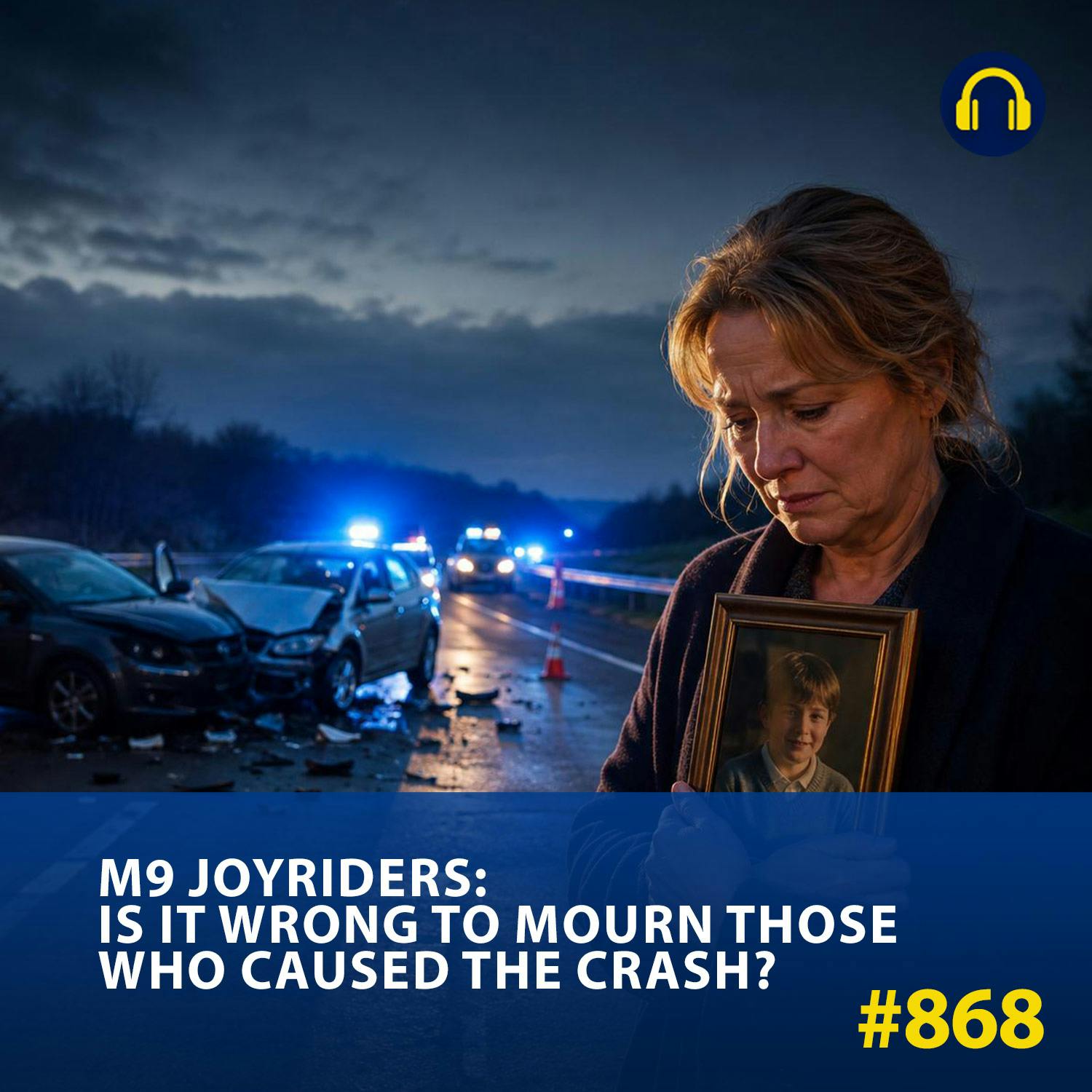 #868 M9 Joyriders: Is It Wrong to Mourn Those Who Caused the Crash? 19.08.2026 1h 8minThe horrific crash on the M9 has shocked the country and left two very different sets of families facing unimaginable consequences.Five teenage boys died after the BMW they were travelling in was driven the wrong way along the M9 near Moone in Co Kildare and collided head on with a Hyundai carrying three women and a seven year old boy. Gardaí are continuing to investigate all of the circumstances surrounding the incident.The innocent occupants of the Hyundai were sisters Alma Kinsella and Niamh Kinsella, both in their 30s, their younger sister Ella Hendricken, who is in her 20s, and Alma’s seven year old son. The family, from the Carlow area, had been travelling to Dublin Airport to attend a family wedding in England. Alma and Niamh were reported to be in critical condition, while Ella and the young boy were being treated for serious injuries.In this episode, Niall opens the phone lines to listeners to discuss a difficult question that has emerged in the aftermath of the tragedy.While there has understandably been enormous sympathy for the innocent family whose lives have been changed, there has also been anger at the reckless behaviour that led to the crash. Some people have gone further, arguing that the parents of young people involved in serious criminal behaviour should accept some responsibility, or even feel ashamed of what their children have done.But is that fair?The discussion takes an emotional turn after a listener contacts the programme with her own story.Twenty years ago, her teenage son died after crashing a stolen car into another vehicle carrying a husband and wife. She says she has lived ever since with enormous sympathy and guilt over what happened to the innocent couple, but strongly rejects the suggestion that she was a bad parent.She describes her son as a loving child who developed a passion for cars and mechanics, but says everything began to change in his early teenage years when he lost interest in school and started mixing with the wrong crowd. Gardaí began arriving at the family home, he got into trouble with the law and, despite repeated attempts by his mother and older siblings to steer him away from that lifestyle, his behaviour continued.Her other two children never got into trouble, went on to build successful lives and careers, and she asks a question many parents will understand: if three children are raised in the same home by the same parents, but only one chooses a destructive path, can the parents really be blamed?Niall asks callers where parental responsibility begins and where it ends.Can loving and responsible parents raise a child who eventually becomes involved in theft, violence, joyriding or other serious criminal behaviour?Should parents be held morally responsible when their teenage children repeatedly break the law?Or does there come a point where a young person has to take responsibility for their own choices, regardless of how they were raised?And perhaps the most difficult question of all: if your child caused terrible suffering to innocent people, could you still grieve for them, defend the way you raised them and love them despite what they had done?
Slični podcasti


Popularan u
Ovaj podcast pojavljuje se i na podcast ljestvicama ovih zemalja.

