
orthodontics In summary
Farooq Ahmed
0
Farooq Ahmed presents key points, references, and understandings from keynote webinars and papers in a concise podcast format. The show provides easy access to insights from esteemed speakers and experts in the field of orthodontics. Note that the information reflects the host's interpretation and may include personal opinions.
Epizode
-
 How To Reduce Aligner Refinements | Orthodontics In Interview | Enzo Pasciuti 05.08.2026 1h 1minHow To Reduce Aligner Refinements | Orthodontics In Interview | Enzo Pasciuti."If you don't understand fixed appliance mechanics, you won't truly understand aligner mechanics.""Don't judge your aligner cases on the computer. Judge them clinically.""Predictability isn't about using fewer aligners, it's about respecting biomechanics and biology.".Why do some orthodontists achieve consistently lower refinement rates with aligners. Joining me is Enzo Pasciuti, shedding light on key mechanics, planning philosophies and clinical pearls that have helped him achieve predictability and reducing refinements, whilst acknowledging challenging aligner mechanics, increasing the number of aligners, and rigidly adhering to biomechanical principles of all tooth movement..We discuss the importance of clinically assessing every refinement, and why orthodontists should never rely solely on virtual treatment planning. Enzo also explains how attachments, passive aligners, staged treatment planning, and Dental Monitoring can significantly improve clinical outcomes..We also explore instability with aligners, a frequently overlooked outcome when unplanned, common mistakes clinicians make with aligners, and why every orthodontist should first master fixed appliance mechanics before expecting excellence with clear aligners..🕒 Timestamps – Key Questions & Answers02:15 Why Does Enzo Have Lower Refinement Rates Than Most Orthodontists?06:20 Why Clinical Assessment Is More Important Than Virtual Treatment Planning09:05 Do More Attachments Improve Aligner Predictability?10:40 How Dental Monitoring Reduces Refinements12:45 Why Complex Cases Should Be Treated in Stages15:30 Passive Aligners Explained: More Than Just Retention18:30 Why Enzo Uses a 9-Month Stabilisation Protocol Before Retainers22:15 Which Tooth Movements Are Most Predictable With Aligners?25:20 Improving Torque & Intrusion Through Better Force Delivery33:00 Is Dental Monitoring Better Than Seeing Patients Every Month?41:40 The Biggest Mistakes Orthodontists Make With Aligners48:30 Will AI Replace Orthodontic Treatment Planning?54:15 The Future of Aligner Technology57:20 One Piece of Advice Every Orthodontist Should Hear.If you enjoyed this conversation, please Like, Subscribe, and Share to support more evidence-based discussions in orthodontics..Please visit the website for this interview podcast:Website – https://orthoinsummary.com/how-to-reduce-aligner-refinements-orthodontics-in-interview-enzo-pasciuti/YouTube – https://youtu.be/TFWAoCptVtsSpotify – https://open.spotify.com/episode/77gTfU6XOR9SurN5JhLSsL?si=AnWu4a_fRUuhJfqxAGSC1g.#OrthodonticsInInterview#Orthodontics#ClearAligners#AlignerOrthodontics#SparkAligners#DentalMonitoring#OrthodonticEducation#OrthodonticBiomechanics#ClearAlignerTreatment#OrthodonticPlanning #OrthodonticRetention #OrthodonticRefinement #DigitalOrthodontics #AIInDentistry #DentalEducation #EnzoPasciuti #FarooqAhmed
 -
 General Dentists & Orthodontics: Where Is The Line? | Orthodontics In Interview | Tif Qureshi 15.07.2026 58minGeneral Dentists & Orthodontics: Where Is The Line? | Orthodontics In Interview | Tif Qureshi"Without orthodontics, dentists are working in a compromised environment."."Minor objective orthodontics can be valuable, but the key is knowing what you should and should not treat."."A two-day course is only an introduction. The real learning comes through mentoring, case assessment, and guided experience."."Remote treatment planning is very different from mentoring.” .The general dentists performing orthodontics remains a debated topic in modern dentistry. Should general dentists provide orthodontic treatment? What level of orthodontics is appropriate? How can general dentists achieve safe and predictable outcomes for their patients?.Joining me is Tif Qureshi, international speaker and educator a general dentist and founder of the Intelligent Alignment Systems Academy (IAS) , and advocate of general dentists performing orthodontics and minimally invasive dentistry We have an in-depth discussion on orthodontic education of general dentists, why general dentists can have greater litigation rates than specialists, the quality of orthodontic planning and treatment, and the issue with education for general dentists in orthodontics..We explore minimally invasive restorative dentistry and Tif explains the merits of orthodontics from the restorative lens. .We also discuss the limitations of short orthodontic courses, as well as anterior guidance, envelope of function, and tooth movement over time, and how dentists can offer something specialists can't, longer term monitoring and patient education..🕒 Timestamps – Key Questions & Answers03:00 Why Should General Dentists Learn Orthodontics?05:10 How Much Orthodontics Should General Dentists Be Doing?08:40 General Dentists Performing Orthodontics: Why Are They Sued More Then Specialists? 10:20 Can Dentists Identify Suitable Orthodontic Cases?13:15 Mentoring vs Remote Treatment Planning18:00 The Difference Between General Dentists and Specialist Orthodontists Treatment 23:30 Are Remote Aligner Planning Services Putting Patients at Risk?26:50 Understanding The Envelope of Function32:40 Why Anterior Guidance Matters 39:10 Can Limited Objective Orthodontics Improve Function?42:20 Long-Term Tooth Movement and Orthodontic Stability47:00 Should Patients Expect Future Orthodontic Retreatment?.Please like and subscribe if you found this discussion useful!.Please visit the website for this interview podcast:Website - https://orthoinsummary.com/general-dentists-orthodontics-where-is-the-line-orthodontics-in-interview-tif-qureshi/Youtube - https://www.youtube.com/watch?v=R9MuqLx9KJgSpotify link - https://open.spotify.com/episode/3Tt3FG79ZfLCa13ntndkIN?si=AIUe1O9MQi-eNt07mBLGYQ.#OrthodonticsInInterview#Orthodontics#GeneralDentistry#DentalEducation#OrthodonticEducation#ClearAligners#Aligners#DentalPodcast#MinimallyInvasiveDentistry#RestorativeDentistry#OrthodonticTreatment#OrthodonticDiagnosis#Occlusion#AnteriorGuidance#EnvelopeOfFunction#TifQureshi#IASAcademy#FarooqAhmed
 -
 Airway Orthodontics Under the Microscope | Orthodontics In Interview | Dr. Claudia Pinter 01.07.2026 47minAirway Orthodontics Under the Microscope | Orthodontics In Interview | Dr. Claudia Pinter"The goal of orthodontics is not occlusion, but jaw development.""It's our job to develop the jaws, and if we don't do our job, other people need to do it-but they can't do it as well.”"I believe that nasal breathing is the foundation of healthy breathing."Airway management in orthodontics remains one of the most debated topics in modern orthodontics. Can orthodontics improve breathing? What does the current evidence say? Why do practitioners carry out orthodontics to improve the airway? Joining me is Dr. Claudia Pinter from Austria for a discussion on airway management, sleep-disordered breathing, and the potential role orthodontist's may have in improving the disorder.We explore research surrounding pediatric airway management, obstructive sleep apnea (OSA), mouth breathing, maxillary expansion, CBCT imaging, skeletal expansion, bed wetting and the ongoing controversies that continue to divide opinion within the profession. The podcast was recorded in Dusseldorf Germany..🕒 Timestamps – Key Questions & Answers03:30 How did you Become Interested in Airway Orthodontics?06:35 How Should Orthodontists Screen Patients for Airway Problems?07:20 Can Facial Type Predict Sleep-Disordered Breathing?11:40 Should CBCT Be Used for Airway Diagnosis?13:30 What Is Upper Airway Resistance Syndrome (UARS)?17:00 Can Orthodontics Help Prevent Pediatric Sleep Problems?22:10 Treating Nasal Breathing vs Treating Sleep Apnea24:00 Diagnosing Mouth Breathing in Children27:20 Jaw Development vs Perfect Occlusion30:20 Does Maxillary Expansion Improve Breathing?34:35 Do Tooth Extractions Cause Sleep-Disordered Breathing?38:40 Skeletal Expansion vs Conventional Rapid Maxillary Expansion43:35 Bedwetting, Sleep Quality & Airway Health46:20 One Piece of Advice for OrthodontistsPlease like and subscribe if you found this discussion useful!Please visit the website for this interview podcast:Website link: https://orthoinsummary.com/airway-orthodontics-under-the-microscope-orthodontics-in-interview-dr-claudia-pinter/Youtube link: https://youtu.be/m_XwdIxBFukSpotify link: https://open.spotify.com/episode/6OJlrjsxKIYcVvaozvgfir?si=lVwsfiTWQg2P2fzwbjV3wg&nd=1&dlsi=596ac38422bd4f1a#OrthodonticsInInterview#Orthodontics#AirwayOrthodontics#SleepApnea#SleepDisorderedBreathing#AirwayManagement#MaxillaryExpansion#SkeletalExpansion#PediatricOrthodontics#ClearAligners#EvidenceBasedDentistry#OrthodonticEducation#ClaudiaPinter#FarooqAhmed
 -
 Innovation, Evidence & the Future of Orthodontics | Orthodontics in Interview | Nikhilesh Vaid 10.06.2026 43min“Most orthodontic research looks strong on paper, but when you ask how much actually changes clinical practice, the number is surprisingly low.”“Case reports may sit at the bottom of the evidence pyramid, but without them, there is no science at all.”“We are not just dealing with appliances and scans. We are dealing with biology, data, and human behaviour all at once.”.I’m joined by Nikilesh Vaid , and in this episode we go beyond clinical techniques and into the deeper questions shaping the specialty: why orthodontic research still produces relatively low levels of high-quality evidence, The role of case reports and what truly influences clinical practice, and why collaboration is not common in academia. Nikhilesh also reflects on institutional responsibility, editorial ethics, and current publication practices impact on broader participation in research..The conversation moves to the future of orthodontics: remote monitoring, artificial intelligence, and data-driven treatment planning. We explore whether these technologies genuinely improve outcomes or are just changes in workflows, and how education systems should adapt to prepare the next generation of orthodontists.Finally, Nikhilesh shares his perspective on the profession itself, reminding us that while excellence defines our science, empathy defines our care.🕒 Timestamps of Key Questions & Topics02:33 Why is orthodontic research still dominated by low-level evidence?07:25 Do case reports still matter in modern orthodontics?09:44 Why is there a lack of collaboration in research?15:07 What is the biggest challenge facing orthodontic institutions today?19:21 Are editorial conflicts of interest a problem in orthodontics?24:40 What real innovation in orthodontics is occurring?29:18 Remote monitoring, evidence, accuracy, and clinical relevance35:53 AI in orthodontics, will it replace skills or enhancing care?40:49 One piece of advice for orthodontistsPlease like and subscribe if you find this useful.Listen on Spotify, YouTube, and other podcast platforms.#OrthodonticsInInterview #NikhileshVaid #Orthodontics #DentalResearch #AIinDentistry #OrthodonticsEducation #EvidenceBasedDentistry #FarooqAhmed @nikhileshvaid
 -
 Attachments - Mistakes, Errors And Solutions | OrthoDontics In Interview | Linton Nash 29.05.2026 52minAttachments - Mistakes, Errors And Solutions | OrthoDontics In Interview | Linton Nash "When we place attachments, we assume they are accurate, but small errors in volume, location, plaque, or insertion can completely change the force system.""Sometimes the attachment itself can make movement worse than having no attachment at all.""I'm not trying to eliminate every error, I'm trying to control every error we can control."I'm joined by Dr. Linton Nash from Australia for a deep dive into aligner attachments andtrim line design, factors often overlooked but significant in tooth movement.We explore Linton’s attachment term ‘VALE’ , volume, abrasion, location, and errors, and discuss how seemingly small factors such as plaque, attachment positioning, and tray design may significantly alter force delivery and treatment outcomes.We discuss attachment design, optimised versus conventional designs, why they can underperform clinically, and the advantage a force system from straight trim lines can achieve. The biomechanics of lingual attachments but the inaccuracy in their use, and whether aligner systems are fundamentally working with unavoidable “play” similar to fixed appliances.Linton also shares his research into 3D printed attachments, attachment accuracy protocols, refinement strategies, and the future of aligner mechanics.🕒 Timestamps of Key Questions & Answers03:12 What Does VALE Mean in Attachment Errors?08:40 Which Attachment Errors Have the Biggest Clinical Impact?15:03 Are We Destined to Work With Errors in Aligners?18:51 Is There “Play / Slop” Between Aligners and Teeth Like Fixed Appliances?21:43 Do Optimized Attachments Work Predictably?28:14 Should Straight Trim Lines Be the Default?33:54 Why Don’t More Companies Offer Trim Line Variations?35:34 Are Negative Attachments & Power Ridges Effective?38:18 How Accurate Are 3D Printed Attachments?44:38 Should We Use Lingual Attachments?47:36 Can Pre-scan Attachments Be The Solution (Universal Attachments by Keejoon)?50:20 One Piece of Advice for OrthodontistsPlease like and subscribe if you find it useful!Please visit the website for this interview podcast:https://orthoinsummary.com/the-biopro.... Spotify podcasts for other platforms.YouTube • The Bioprogressive Theory, Revisited | Or... #OrthodonticsInSummary#LintonNash#Orthodontics#bioprogressive#TADs#OrthodonticsInInterview#FarooqAhmed@Lintonnash
 -
 The Bioprogressive Theory Revisited | Orthodontics In Interview | SERGIO SAMBATARO 06.05.2026 43minThe BioprogressiveTheory Revisited | Orthodontics In Interview | Sergio Sambataro "Whenyou say Class II, to me, you say nothing. We must look for the etiology of themalocclusion — not just the teeth, but the function behind them." "Ifyou extrude the upper molar, the condyle goes downward, and you have morevertical growth of the ramus. Ricketts showed this very clearly back in the 60sand we have published the same result at the University of Milan." "Oneof the principles in Class II correction is: first open the bite, and thencorrect the overjet. This is not just mechanics — it is logic." "Satoonce said — if you ask why he doesn't use retainers, he answers with anotherquestion: why do you use retainers? Because you know your job is notstable." I'm joined by Dr. Sergio Sambotaro from Sicily, for adeep dive into Bioprogressive Orthodontics, principles established by Rickettsand still debated today. We explore the cause of a malocclusion from abioprogressive perspective, the focus on vertical facial types determiningtreatment mechanics and anchorage. We examine the decompression theory of the ClassII case, and the role of the cervical headgear and utility arches. We turn tothe mechanics of sectional treatment over full-arch straight wire, and whereTADs fit in with the bioprogressive philosophy. We tackle the contestedevidence around transpalatal arch anchorage, and what the research may bemissing. Please like and subscribe if you find it useful! Please visit the website for this interview podcast:https://orthoinsummary.com/the-bioprogressive-theory-revisited-orthodontics-in-interview-sergio-sambataro/ .Spotify podcasts for other platforms .YouTubehttps://youtu.be/Y-JgUkR9rSU. #OrthodonticsInSummary#SergioSambataro#Orthodontics#bioprogressive#TADs#OrthodonticsInInterview#FarooqAhmed@SergioSambataro Farooq Ahmed 🕒Timestamps of Key Questions & Answers01:45 What Is the Bioprogressive Understanding of Malocclusion?04:53 How Does Facial Pattern Define the Class II and Class III in Terms ofthe Vertical?11:56 Can We Modify Facial Growth in All Cases?13:49 Can Breathing Pattern Be Changed With Orthodontics?15:32 How Do Cervical Headgear and Utility Arches Work Together in Class IICorrection?19:20 How Important Is Bracket Prescription in Bioprogressive TherapyVersus Straight Wire?22:37 What Are the Key Differences Between Bioprogressive Mechanics andConventional Straight Wire?26:14 Intrusion Arches Versus TADs — Does the Evidence ChallengeBioprogressive Principles?31:18 Does the Research on Transpalatal Arch Anchorage Loss Undermine theBioprogressive Approach?34:33 Do You Use MEAW Wires in Clinical Practice — and How Effective AreThey?38:18 Can a Great Occlusal Result Eliminate the Need for Retention?
 -
 Aligner Planning and Mechanics | Orthodontics In Interview | WADDAH SABOUNI 22.04.2026 14min"If you anticipate, we can reduce the treatment time with aligners." "I never look at the simulation as the final outcome. For me, the simulation is only how the forces should be orientated to the teeth." "Fixed braces are more efficient to treat extraction cases. Not because we cannot do it with aligners, but because aligners need more auxiliaries and more work to achieve the same quality of movement." "10 years ago when we talked about aligners, everyone was looking at us like we are doing only small alignment. Today we are able to see very advanced complicated cases." The podcast was recorded live at this years European AlignerSociety meeting. Please like and subscribe if you find it useful! Please visit the website for this interview podcast:https://orthoinsummary.com/aligner-planning-and-mechanics-orthodontics-in-interview-waddah-sabouni/.Spotify podcasts for other platforms.YouTubehttps://youtu.be/TDMfjtMdvxQ. #OrthodonticsInSummary#Waddahsabouni#Orthodontics#aligners#TADs#OrthodonticsInInterview#FarooqAhmed#EAS#Europeanalignersociety Farooq AhmedI'm joinedby Wadah Sabouni, for a focused exploration of clear aligner therapy and theevolving boundaries of aligners. We examine how science has informed the limitsof tooth movement, why overengineering and auxiliaries are complementary ratherthan opposing strategies, and what a study revealed about the surprisingdifferences between digital setup software platforms. We turnedto the biomechanics of extraction cases with Ying Yang mechanics as well asWaddah’s use of short class 2 elastics for distalisation mechanics. If mandibularadvancement with aligners are fad or innovation. We close with reflections on adecade of the European Aligners Society, and where the field must go to bringaligner orthodontics to its potential.🕒Timestamps of Key Questions & Answers01:54 When Do You Choose Auxiliaries?03:38 Overengineering vs Auxiliaries – How Do You Decide?05:02 Are Occlusal Outcomes Poorer With Aligners in Extraction Cases?06:40 What Are Ying Yang Attachments and Do They Solve the ExtractionProblem?06:46 Does Software Setup Algorithm Matter More Than We Think?08:33 Should CBCT Integration Be Standard in Aligner Planning?09:10 Why Do You Use Short Class II Elastics For Aligner DistalisationMechanics?10:51 Are Mandibular Advancement Aligners Fad or Innovation?12:46 What Does 10 Years of the European Aligners Society Mean for theProfession?
 -
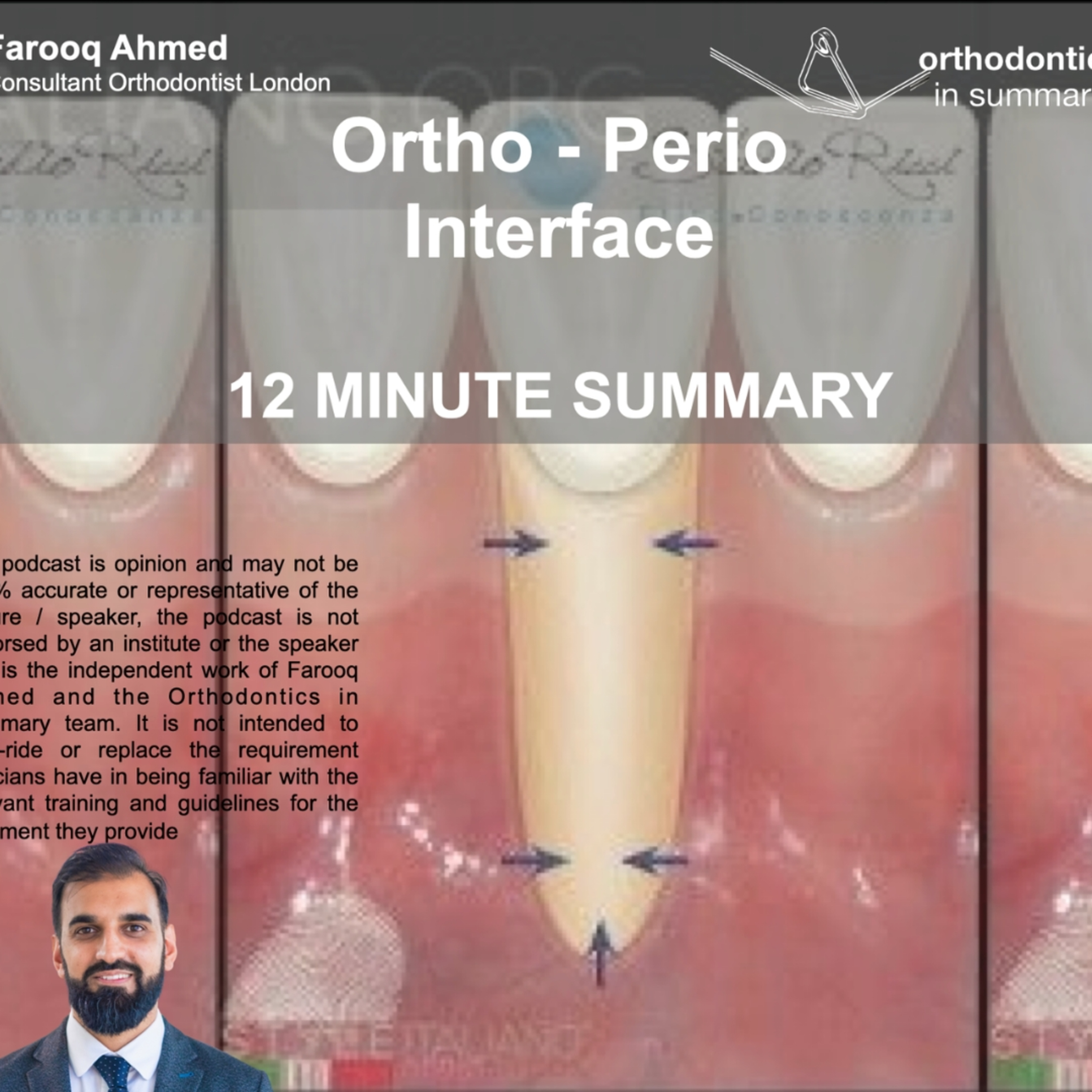 The Ortho-Perio Interface? 12 MINUTE SUMMARY 08.04.2026 12minJoin me for look at the orthodontic -periodontal interface, the latest evidence looking at the effects of orthodontic tooth movement as well what periodontal surgery can offer in recession management. This podcast is a summary of Christos Kassaro and Anton Spurrier’s excellent lecture, as part of the AngleNet Webinar Series. Timestamp0:44 – At 1-year recession risks of orthodontics 2:30 – At 15-year recession risks of orthodontics4:37 – Retainer relapse: "X" & "Twist" effects5:13 – Biomechanics: Using mixed bracket slots for torque6:17 – Perio surgery principles & donor sites7:54 – Flap designs: Full vs. split-thickness8:14 – Surgical techniques: MCAT vs. LCT9:27 – Timing: Surgery before vs. after ortho?10:33 – Surgical adjuncts: Hyaluronic acid Orthodonticaetiology at 2 time points:1. During active orthodonticmovement 2. During retention phase Kloukos2025 1year follow up study of adult orthodontic patients Vs control · 1 year post debond of non-extractiontreatment at 67% greater incidence of recession within the orthodontic group (IRR = 1.67,95% CI: 1.05, 2.67, P = 0.03). Five main findings:1. Recessionlocation: canines and first premolars, 2. Proclination:incisor proclination of 6.35o with no recession3. Recessionin control group: increased but less than orthodonticgroup4. Recessionquantity: Generally small at 1 mm 5. Reductionin recession for some: Both groups showedsome patients had a reversal of their recession Long term though what do we see?· Gebistorf 2018 Swiss group· At 15 years 77% of orthodonticpatients had 1-14 areas of recession, · Control group who had 62%.· Greater recession on lingual aspectthan labial · 2.73 x more recession with crossbitescorrected (95% CI, 0.28-5.17; P = 0.029) · Crowding in controls: 3 mm = 3.29 x more recessions (95% CI, 0.73-5.68; P =0.012) Orthodontics onaverage does not compromise long term health or function, but may compromise aesthetics Fixed Braided Retainers ‘X’effect (torque) or twist effect (proclination) unwanted movement from wire activation· Not relapsed as new movement · Occurrence: 2.7% (n=221 patients) –Renkema 2011 Treatment‘X’ effect 1- Differentialslot side i. Affectedtooth - .18 slot with -17 degrees of torque ii. Remainingteeth.22 slot with 0 torque iii. Sideeffect of intrusion of incisor, due to slot differences Periodontal Surgery concepts:Indication: inadequate gingiva = <2 mm Zhong 2025· Wound healingo Flapdesign to enhance wound stability – avoid vertical releasing incisions· Connective tissue graft, harvest itfrom the palate.o Keratinizedtissue and quantityo Mostavailable, quick healing Karring 1975 o fibroblastfrom the palate biological potential to inducekeratinization. Surgicaltechniques:1- Fullthickness: mucosa, connective tissue and includes periosteal layer2- Splitthickness: mucosa and connective tissue · Timingof surgerySurgeryafter orthodontics· Only when the teeth are in the correctposition· Favorable environment for the woundhealing. · Usual timing of surgery Surgerybefore orthodontics· Require more tissue for the orthodonticmovement: Adjuststo surgery 1- Amelogenins attach proteins to the rootsurface. 2- Hyaluronicacid promotehealing through attracting proteins. Expert consensus on orthodontic treatment of patients with periodontal disease. Zhong2025 https://pmc.ncbi.nlm.nih.gov/articles/PMC11965299/ ContributionsContents:Shanya KapoorEditedand produced: Farooq Ahmed
 -
 The Hidden Biomechanics of Fixed Appliances & Aligners | Orthodontics In Interview | MADHUR UPADHYAY 25.02.2026 53min“The reality is none of us use light continuous forces.” “Friction is awesome. Friction is great, we would be miserable if there was no friction… (with) uncontrolled movement everywhere” “Segmented arch mechanics are very tough to gain three-dimensional control over the tooth.” “The last major landmark in fixed appliance and in orthodontics was the pre-adjusted edgewise appliance.” “The root is not moving according to the wish of the orthodontist (with aligners)” I’m joined by Madhur Upadhyay for a deepexploration of biomechanics, biology, and the true limits of orthodontic innovation. We examine advances in appliances, aligners, and digital workflows and why they have, as of yet, not improved speed or quality of clinical outcomes,and innovation is still governed by the same biological constraints that dictated tooth movement a century ago. However progress has been significant in workflows for both fixed and aligner therapy. We also discuss why complex biomechanics arerarely implemented in routine practice, whether pre-adjusted appliances were the last major landmark innovation, and what aligners can, and cannot, achieve in terms of root control in terms of biomechanics. The conversation extends toartificial intelligence in diagnosis and treatment planning, asking whether automation enhances clinical care or gradually replaces critical thinking. We conclude with thoughts of micro and nano-plastics and the focus needed on this topic in orthodontics. Please like and subscribe if you find it useful! Please visit the website for this interview podcast:https://orthoinsummary.com/the-hidden-biomechanics-of-fixed-appliances-aligners-orthodontics-in-interview-madhur-upadhyay/ .Publications by Madhur UpadhyayBiomechanics of clear aligners: hidden truths & firstprinciples 2022 https://doi.org/10.1016/j.ejwf.2021.11.002ClearAligners in Extraction-Based Orthodontic Treatment: A Systematic Review andMeta-Analysis 2026 DOI: 10.1111/ocr.70052 #OrthodonticsInSummary# Madhurupadhyay #Orthodontics#biomechanics#TADs#OrthodonticsInInterview#FarooqAhmed#OrthodonticBiomechanics#DentalEducation Farooq Ahmed🕒Timestamps of Key Questions & Answers01:43 Are We Overestimating Orthodontic Innovation?02:41 If Technology Has Advanced, Why Is Fixed Appliance Treatment No Quicker?08:55 Why Are Aligners Still Only 50% Predictable?12:23 Why Are Biomechanical Set Ups of Cantilevers Unpopular In ClinicalPractice?22:41 Have Bracket Prescriptions Stopped Innovation?26:42 MBT vs Roth – Does Prescription Really Matter?28:22 Can Aligners Truly Move Roots, OrIs It Just Tipping?33:37 Is Software Innovation Just a Distraction from Aligner Material Limits?36:15 AI in Orthodontics, Will It Replace Clinical Thinking?43:00 What Are The Most Misunderstood Concepts in Biomechanics51:07 The Micro and nano-plastic in Aligners
 -
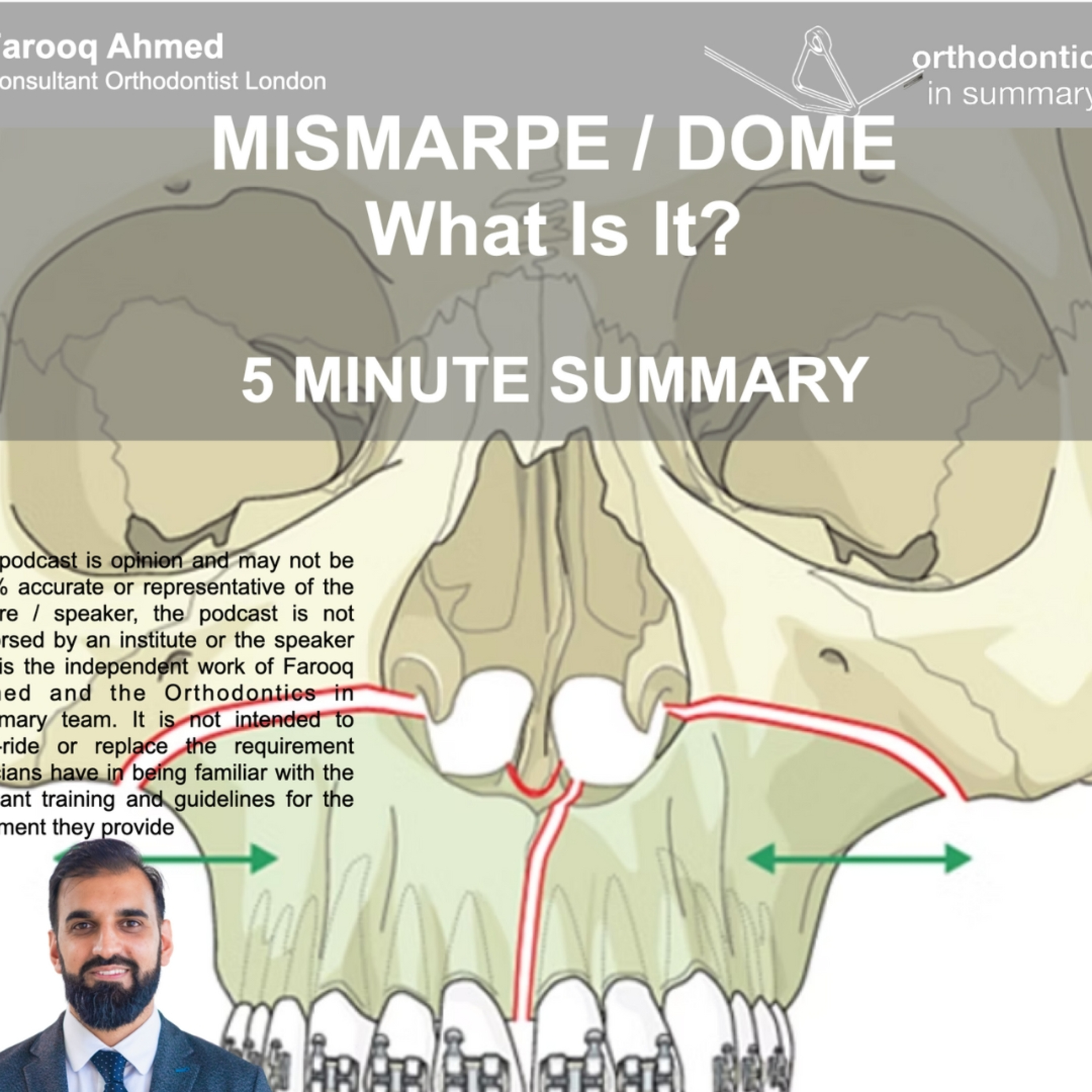 MISMARPE / DOME what is it? 11.02.2026 6minMISMARPE / DOME what is it? Join me for a look at maxillary expansion combining both surgery with miniscrews. Seemingly opposite ideas have been brought together to offer potentially greater versatility in expansion, with less surgical complexity andcomplications. MISMARPE – minimally invasive surgery miniscrew assistedrapid palatal expansion Haas 2021OrDOME Distraction Osteogenesis Maxillary Expansion Liu2017 Protocol· Osteotomyo Anterior vertical incision interdental toperiform fossao Lateral incisions to the base of zygomaticprocess of maxillao Without releasing the pterygomaxillary sutureo Activate in surgery up to 20x ensure diastema o Duration 24 minutes (14.4-32) Junior 2021o Less pain – Mild on VAS· Expansiono 7 days no expansiono Expansion of rate 0.25 - 0.50 mm, § Some until diastema and slow to 0.25 per day Advantages · Less osteotomies required · Under sedation or local anaesthetic· Greater anchorage for force delivery throughminiscrews· Less intra-operative haemorrhage – due to a lackof pterygopalatine disjunction· Parallel expansion – Lin 2015 Vs V shapeexpansion AgeLimitation of MARPE was age, with 20-30 years females 94% 20-30years males 80%, MARPE success 30-37 = 20% Olivera 2021, MISMARPE 96% successage 20-59, 24 patients majority over 30 years old Piccoli 2023. Expansion amount· Direct comparison show no significant differenceda Silva 3mm, and no difference in molar angulation 2023 Indicated for:· Failed MAPRE· Age- greater 30 females and 25 for malesCould MISMARPE / DOME replaceSARPE?
 -
Direct To Print Aligners, Will It Change Clear Aligner Therapy? 8 MINUTE SUMMARY 28.01.2026 8minDirect To Print Aligners,Will It Change Clear Aligner Therapy? 8 MINUTE SUMMARY In this episode, I review direct-to-print alignersand how the material offers potential biomechanical advantages through itsmaterial properties when compared with conventional thermoplastic aligners. Theunique feature of force recovery of the material and current emerging evidence.The episode also explores the current limitations of the evidence base anddiscusses why, despite theoretical advantages, direct-to-print aligners havenot yet entered routine clinical practice. This podcast is based on a recent lectureby Jean-Marc Retrouvey. Timestamp00:27 – What are direct-to-print aligners?01:10 – How do direct-to-print aligners deliver force?02:39 – Push and pull forces and adaptation03:58 – Reactivation with heat, unique force recovery05:09 – Variable aligner thickness07:08 – Why haven’t direct-to-print aligners changed aligner therapy yet? Material photopolymer resins Force delivery – Push and Pull Engage with undercuts not possible with thermoformedalignerso Deliver forces to areas seen as non-engagedsurfaces§ Non-engaged surface – greater displacement thanTFA (Hertan 2022) Force delivery – Adaptation· Closer adaptation 20-30% more accurate 30um or 0.03mm (48 um Graphy Zendura, Essix Ace and DPA Koenig2022). · Uniform thickness i. TFA Non-uniform thickness – due thermal process, thinner areasend of aligner ii. TFA sharp distribution around attachment / transition Force delivery material properties · TFA Stress relaxation – Reduce force with time,12 hours reduce 60%, DPA reduce to around 50%, but with recovery increase to75% Xu 2025 i. Moment to force ratio more sustained for bodilymovement, in vitro study · Thickness customisationo Creating a force couple: 0.8 labial, Vs 0.5mmlingual , creating moment within the aligner Direct to Print Aligners 2 types: Shape memory Vs Activememory· Similarclaims:1. Re-activate force recovery through heating inwater reactivation and reverse stress relaxation and creep2. Customise thickness, trimlines and auxiliaries3. Less attachments4. Speed of printing aligner 5. Less wastage · Shapememory: Graphy 20191. Transition temperature – low 45 degrees, from30-45 degrees = increase temperature = reduce force. Re-activates inside themouth to maintain properties. Choi 2025 · Activememory LuxCreo 2022 1. Transition temperature – high 60 degrees =maintain elasticity2. Re-activated with warm water = restores mechanical properties Challenges: 1. Little clinical research to support biomechanicalsuperiority2. Loss of force from insertion Xu 2025 50% in 12hours3. Effectiveness seems camparable for mild to moderatecases: a. PAR change DPA 86%, refinement of 40% VanessaKnode 2025, b. PAR change TFA 88.9% Jaber 2022, refinement of 70-94%Ladewig 2005, Kravitz 2023 See Jean-Marc Retrouvey’s lecture in full: https://www.youtube.com/watch?v=j7fJmxgXHqU Previous podcast on Direct To Print Aligners February2024https://orthoinsummary.com/direct-to-print-aligners-are-they-really-different-to-normal-aligners-8-minute-summary/ #aligneronorthodontics#directtoprint#orthodontics#orthodonticsinsummary#Farooqahmed#Orthodontics#Luxcreo#graphy#clearalignertherapy
-
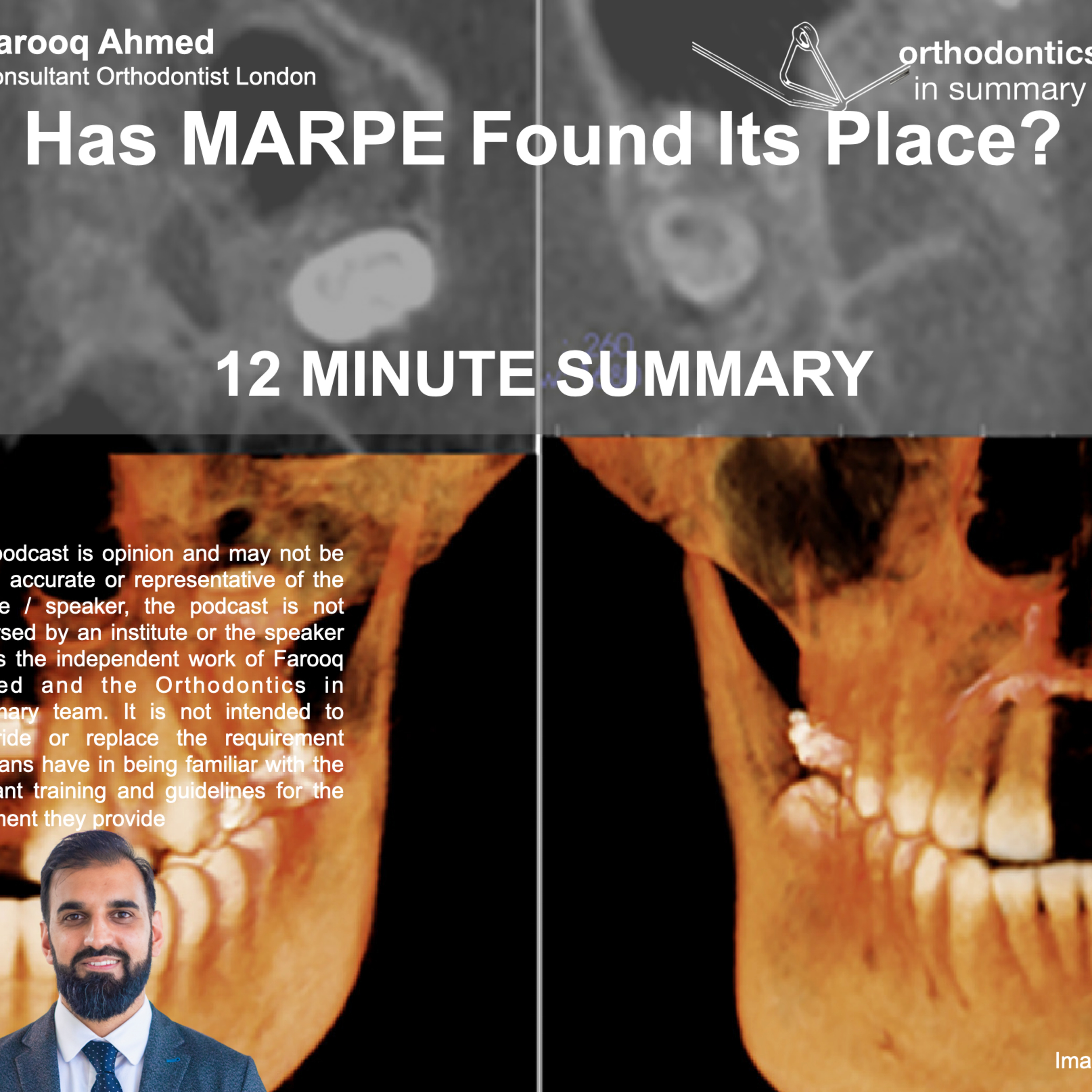 Has MARPE Found Its Place? 07.01.2026 13minHas MARPE Found Its Place? Join me for our first podcast of 2026 looking at Miniscrew AssistedExpansion, and where this treatment modality currently stands in clinicalpractice. With discussions of different designs (MSE Vs MARPE), rapid andslow activation protocols, orthopaedic effects, and predictors of success. Thispodcast is a summary based on an excellent lecture from Angle-Net by DanieleCantarella and Benedict Wilmes. 01:18 – MSE vs MARPE designs: key differences03:55 – Anchorage, bone quality, and force delivery05:29 – Skeletal effects: parallel suture split and expansion amounts06:42 – Asymmetry, resistance areas, and biomechanics07:00 – Class III correction: where MARPE really adds value09:26 – Rapid vs slow activation and what actually happens to bone10:28 – Predicting success: age limits, failure rates, and when to considersurgery#MARPE#MSE#expansion#orthodontics#orthodonticsinsummary#Farooqahmed#Orthodontics#dentalpodcast#orthodonticcommunity
 -
 Reflections on 20 years in Orthodontics | Orthodontics In Interview | BJÖRN LUDWIG 17.12.2025 34minReflections on 20 years in Orthodontics | Orthodontics In Interview | BJÖRN LUDWIG“We focused so much ontechnology that maybe we neglected diagnostics.” “Anecdotal is inspiring,but we need evidence for the average orthodontist.” “If we don’t protectacademic journals, orthodontics becomes vulnerable, legally and professionally.” “Orthodontics grows whenwe are open, critical, and enquiring.” In this special episode, I’m joined by BjörnLudwig for a reflective conversation recorded during the few weeks of hispublic speaking career, as he brings his landmark Ortho 50 series to aclose. We look back on two decades of clinical practice, academic leadership,and contribution to the orthodontic community, and ask whether modernorthodontics has truly improved on the outcomes of the 1990s. We discuss evidence versus clinicalexperience, the impact of technology on diagnosis and treatment planning, thepressures facing academic publishing, and the evolving role of key opinionleaders. Björn also speaks candidly about family, health, Oscar and legacy, andhis decision to step back from speaking in orthodontics, offering thoughtfulinsight into what really matters in an orthodontic career. 02:41 – Why is today’s orthodontics nobetter than the outcomes in the 1990s?04:54 – How do we improve outcomes intoday’s clinical practice?06:36 – Evidence vs experience: shouldwe trust trials or clinical experience?09:13 – When research proves us wrong, howshould orthodontists respond?11:19 – The role of your parents inshaping your orthodontic career14:06 – As Editor-in-Chief of Kieferorthopädie,what changes have you seen over the last decade?17:59 – Do Key Opinion Leaders help orharm orthodontics?21:37 – Quick fire: proudest research, 3best clinical tools, and 3 biggest clinical regrets27:52 – What advice would you give tothe next generation of orthodontists?29:51 – Health, Ortho 50, and knowingwhen to step back Click on the link below to view previous episodes, to refresh topics,pick up tricks and stay up to date. Please like and subscribe if you find it useful! #OrthodonticsInSummary#BjörnLudwig#Orthodontics#ortho50#TADs#OrthodonticEvidence#OrthodonticsInInterview#FarooqAhmed#OrthodonticBiomechanics#OrthodonticResearch #DentalEducation Farooq Ahmed 🕒Timestamps of Key Questions & Answers
 -
 Is There Really A Consensus On Aligners? A Delphi Author Explains| Orthodontics In Interview | VINCENZO D'ANTO 26.11.2025 47min“Even though the panelistswere huge aligner users, the statements are not so in favour of aligners, they are surprisingly reasonable.” “It’s very difficult to find a real aligner experts without a conflict of interest. Almost impossible.” “If you explain the differences honestly, most of my extraction patients choose fixed appliances. I’m not selling aligners.” “Direct printing is the real breakthrough, but right now it has too many shortcomings to be a standard technology.” “I am pessimistic. We must fight for our profession — against the idea that technology can replace orthodontists.” In this episode, I’m joined by Vincenzo D'Antò, lead author and contributing author of this year’s two major consensusstatements on clear aligners. We explore the key findings from these landmark papers and how they translate into real-world clinical practice. Vincenzo shares his own views on aligners, their limitations, and his pragmatic approach to integrating hybrid mechanics, particularly skeletal anchorage, into alignertreatment. We discuss recent innovations in aligner therapy, distinguishing those with genuine clinical value from those that are ineffective. We also hear Vincenzo’s candid concerns about the future of orthodontics. 03:00 – Why did youcreate this Delphi aligner consensus?05:03 – How were thealigner experts selected for the study?06:51 – Do conflictsof interest affect aligner consensus statements?11:49 – Crowding: Whydoes the Alharfi 2025 SR show better outcomes for aligners?15:49 – 7 vs 10 vs 14days: How often should patients change aligners?20:03 – Are complexmovement failures a design flaw or inherent to aligners?22:19 – What trulylimits clear aligner biomechanics?25:46 – Is hybridorthodontics the future of predictable aligner treatment?29:35 – What hybridmechanics do you use most in practice?32:05 – Can wereliably treat extraction cases with aligners?36:03 – Is betterOHRQoL worth compromised occlusal outcomes?39:11 – Do alignerswork for growing patients, or is this just marketing?41:34 – Why ishigh-quality aligner research still so weak?44:30 – Final advice:What should orthodontists focus on for the future? Click on the link below to view previous episodes, to refresh topics,pick up tricks and stay up to date. Please like and subscribe if you find it useful! Please visit the website for this interview podcast:https://orthoinsummary.com/is-there-really-a-consensus-on-aligners-a-delphi-author-explains-orthodontics-in-interview-vincenzo-danto/ Spotify podcasts for other platforms YouTubehttps://youtu.be/jpMUbYINxzg #OrthodonticsInSummary#VINCENZOD'ANTO#Orthodontics#ClearAligners#AlignerTherapy#HybridOrthodontics#SkeletalAnchorage#TADs#OrthodonticEvidence#OrthodonticsInInterview#FarooqAhmed#VincenzoDAnto#OrthodonticBiomechanics#OrthodonticResearch Farooq Ahmed🕒Timestamps of Key Questions & Answers
 -
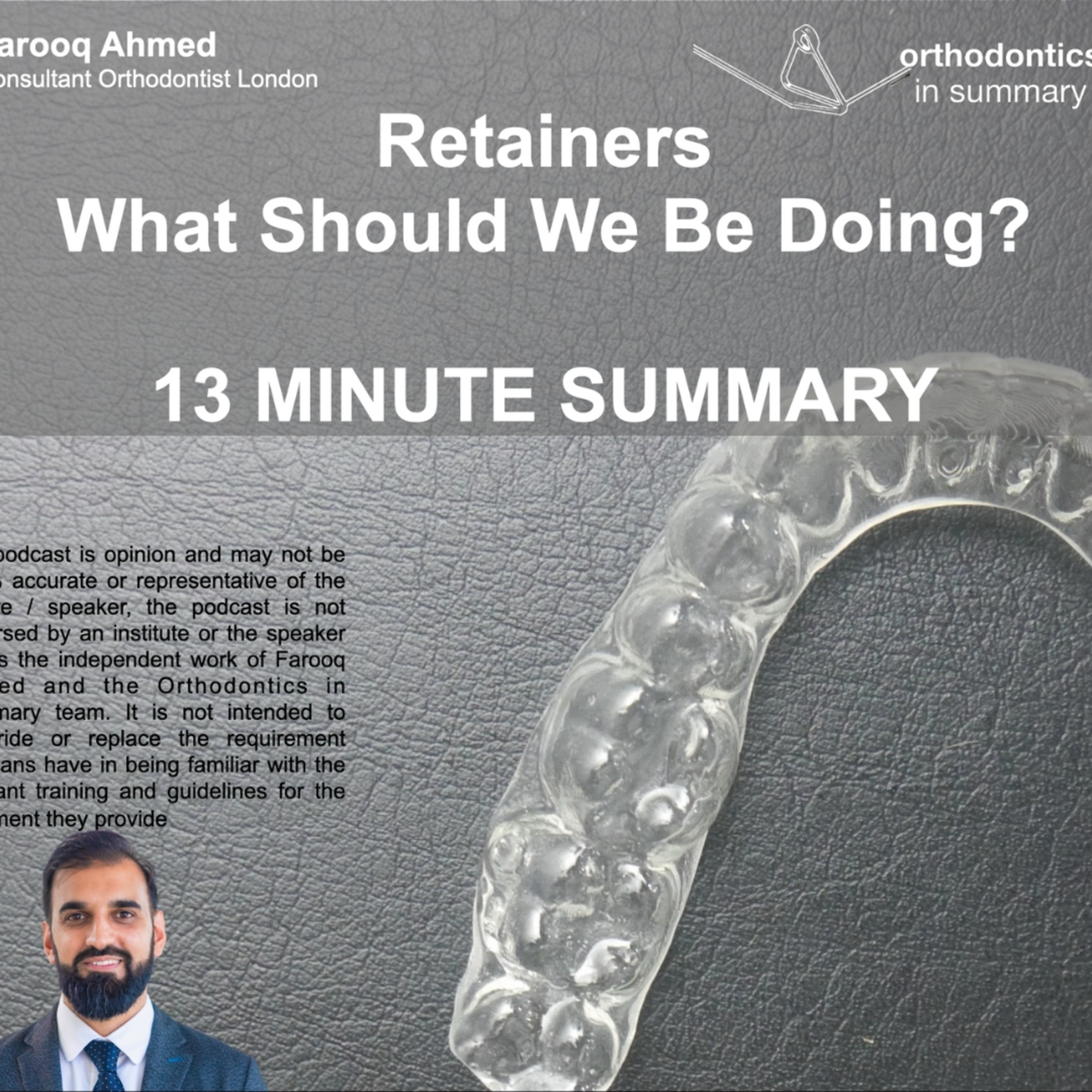 Retention, What Should We Do Now? 12.11.2025 14minRetention, What Should We Do Now? Join me for a update on retention, I explore a review of currentliterature and what the changes are recommended to our retention protocols,research of stability, critical look of retainerfailures and factors to consider in design and location of fixedretainers, as well as monitoring recommendations based on Clinical PracticeGuidelines. This podcast is based on recent literature as well as two excellentlectures from this year’s British Orthodontic Conference by Marie Cornelis(Australia) and Simon Littlewood (UK). Recommendations for the maxilla:· Low risk of relapse = Removable retainer (polyethyleneor polyurethane)· High risk of relapse = Dual retention with fixedand removable retainers· Fixed retainero 3-3 if occlusion allows, most likely 2-2 designunless high risk of canine relapseo Location slightly gingival due to occlusalforces and account for Increase in overbite with age (Littlewood) Recommendations for the mandible Lower archo Low risk of relapse = fixed retainerso High risk of relapse = dual archo Fixed retainer 3-3§ Position slightly incisal Mandible: slightlymore incisal, greater cleanability, less gingival inflammation – Petsos 2023 Monitoring regime· 1 month – fixed retainer (greatest timepoint offailure)· 3 month – removable retainer (motivation ofcompliance)· Every 3-4 months Wouters 2018· 1 year retention necessary Wouters 2018· Annual check-up Wouters 2018o Greater likelihood of compliance if annualcheck-upo General dentist Improve compliance· 2/3rds stop wearing after 4 years,All-Moghrabi 2018· Visual photo of relapse to patient and parentsincreased compliance Vs patient only or instructions only Lin 2015 (1.5Hrsgreater wear) Clinical PracticeGuideline For Orthodontic Retention Wouters 2019 (open access paper)
 -
 Dental Monitoring, Is It The Future Of Orthodontics? | Orthodontics In Interview | PHILIPPE SALAH 29.10.2025 44min“The purpose of Dental Monitoringisn’t to disconnect you from your patient, it’s to make sure you see them atthe right moment for the right reason.” “Fix problems early andyou don’t have problems. If you intercept an issue straight away, you can oftenavoid side effects altogether.” “If you don’t change yourprotocol, DM won’t reduce appointments, you do. The technology empowers smarterscheduling, not magic.” “AI isn’t replacingorthodontists. It’s replicating their eyes, helping you catch what you’d wantto see, every single week.” In this episode, I’m joined by PhilippeSalah, CEO and founder of DentalMonitoring. We explore the evolution of AI-based remote monitoring in orthodontics, how it aims to change the way we communicate with patients, provide data of our practice but also where the evidence remains mixed. Philippe addresses questions on reliability, patient compliance, and the impact on rapport when monitoring replaces in-personvisits. We discuss the real-world challenges of cost, protocol adaptation and workflow change, as well as the future role of AI, sustainability, and data-driven insight in clinical practice. 02:07 – How did youcome up with the concept of Dental Monitoring?08:50 – How accurateis Dental Monitoring, and what happens if the AI misses something?13:55 – Where do yousee the benefits of Dental Monitoring if studies show limited reduction invisits or treatment time?18:56 – Is remotemonitoring less able to build patient rapport compared to in-person officevisits?24:53 – DentalMonitoring comes at a financial cost, what is the return on investment forclinicians?29:48 – Is DentalMonitoring for every patient, given compliance and scanning challenges?33:02 – AI consumesglobal energy resources, how does Dental Monitoring address environmentalresponsibility?36:52 – Tell us aboutDental Monitoring Insights and how it impacts clinical practice.42:28 –What advicewould you give to orthodontists Click on the link below to view previous episodes, to refresh topics,pick up tricks and stay up to date.🕒Timestamps of Key Questions & Answers#OrthodonticsInSummary#DentalMonitoring#AIinOrthodontics#DigitalOrthodontics#RemoteMonitoring#OrthodonticInnovation#AlignerTechnology#OrthodonticEvidence#FutureOfOrthodontics#FarooqAhmedFarooq Ahmed
 -
 Will AI Change Orthodontics? | Orthodontics In Interview | JEAN-MARC RETROUVEY 01.10.2025 47min“Will AI it replace the orthodontist? No. Will it replace the bad orthodontist? Hopefully, yes.” “With AI, you could probably get prediction accuracy down to less than 10% , because it can analyze what the human brain cannot” “Computers are designed to crunch data. That’s all they do. The rest is up to you.” “AI is not going away. There are billions invested in this technology. You better get on with the program.” “Don’t drive your car inreverse… Don’t go backwards.” In this episode of Orthodontics in Interview,I’m joined by Jean-Marc Retrouvey, researcher and innovator in AI-drivenorthodontics. We explore the concept of the “virtual patient” and how artificial intelligence is reshaping orthodontic diagnosis, biomechanics, and aligner staging. Jean-Marc shares his candid thoughts on the pace of change inacademia versus industry, the role of AI in predictions within orthodontics, and how clinicians can embrace AI without losing their judgment. With insightsfrom his work in both universities and industry projects, Jean-Marc offers a compelling vision of how orthodontics will evolve in the AI-era. · 01:47 What isthe “virtual patient” concept?· 03:39 Wherewill AI impact clinicians, diagnosis vs outcomes?· 07:21 Can AIbe our biomechanics co-pilot?· 10:34 Why arealigner companies behind in AI?· 12:57 Whatpractical changes will AI bring to aligner staging?· 15:20 Why didyou say academia is too cautious for AI’s pace?· 19:24 Shouldorthodontic AI education come from industry, and is that biased?· 22:13 DoesRicketts’ 1983 “judgment over computers” still hold?· 25:13 Will AIreplace clinician experience and literature in EBP?· 30:44 Are weat risk of data overload with 3D/CBCT integration?· 35:01 How dowe use AI responsibly given its environmental costs?· 37:59 Why movefrom academia to industry, and what are you building at LuxCreo?· 41:11 Whitepapers vs peer-review: what’s the real difference?· 44:35 Your one piece of advice toorthodontists? Click on the link below to view previous episodes, to refresh topics,pick up tricks and stay up to date. Please like and subscribe if you find it useful! Please visit the website for this interview podcast:https://orthoinsummary.com/will-ai-change-orthodontics-orthodontics-in-interview-jean-marc-retrouvey/ Spotify podcasts for other platforms YouTubehttps://youtu.be/UDfDTtLZm4A #orthodontics #farooqahmed #jeanmarcretrouvey#AIorthodontics#clearalignertherapy #orthodonticsinsummary#orthodonticsininterview Farooq Ahmed🕒Timestamps of Key Questions & Answers
 -
 Aligners Algorithms and Autonomy |Orthodontics In Interview | Guy Deeming 17.09.2025 50min“The biggest variable with any clear aligner treatment is the patient themselves — not the plastic.” “We must remain the conductors of the orchestra, not the technicians of an algorithm.” “Aligners are not inferior to fixed appliances — but neither are they magic. The truth lies somewhere in between.” “Research often lags years behind reality, so we’re not judging today’s aligners with today’s evidence.” In this episode of Orthodontics in Summary,I’m joined by Guy Deeming, orthodontist, business leader, and Director of Professional Development at the British Orthodontic Society We dive into the reality of clear aligner therapy, discussing the recently published Delphi Consensus Statements and if theyagree with his clinical practice. Guy discusses compliance and where the orthodontist role has changed in the era of algorithms. Guy shares candid insights into alignerlimitations, clinical pearls for complex cases, and his vision for orthodontic education. · 01:12– Are aligners now the go-to appliance for mild to moderate crowding?· 03:22– Delphi consensus statement:What are aligners’ limitations?· 05:16– Why do clinical results differ so much from research findings?· 11:08– “no-go” cases for aligners?· 15:28– Extreme cases on social media: genuine progress or misleading?· 17:56– Are orthodontists just technicians of aligner companies’ algorithms?· 24:57– Profitability, corporate influence, and the in-house aligner movement.· 28:30– Extraction cases with aligners: realistic or flawed?· 32:52– Distalisation: predictable movement or just tipping?· 36:31– Should orthodontic training programmes include formal aligner training?· 44:50– Direct-to-print aligners: fad or the next revolution?· 48:08– Guy’s one piece of advice to orthodontists on approaching aligner therapy. Click on the link below to view previous episodes, to refresh topics, pick up tricks and stay up to date. Please like and subscribe if you find it useful! YouTubehttps://youtu.be/wITGxEw1ZNs #orthodontics #farooqahmed #guydeeming#aligners#clearalignertherapy #orthodonticsinsummary#orthodonticsininterview Farooq Ahmed
 -
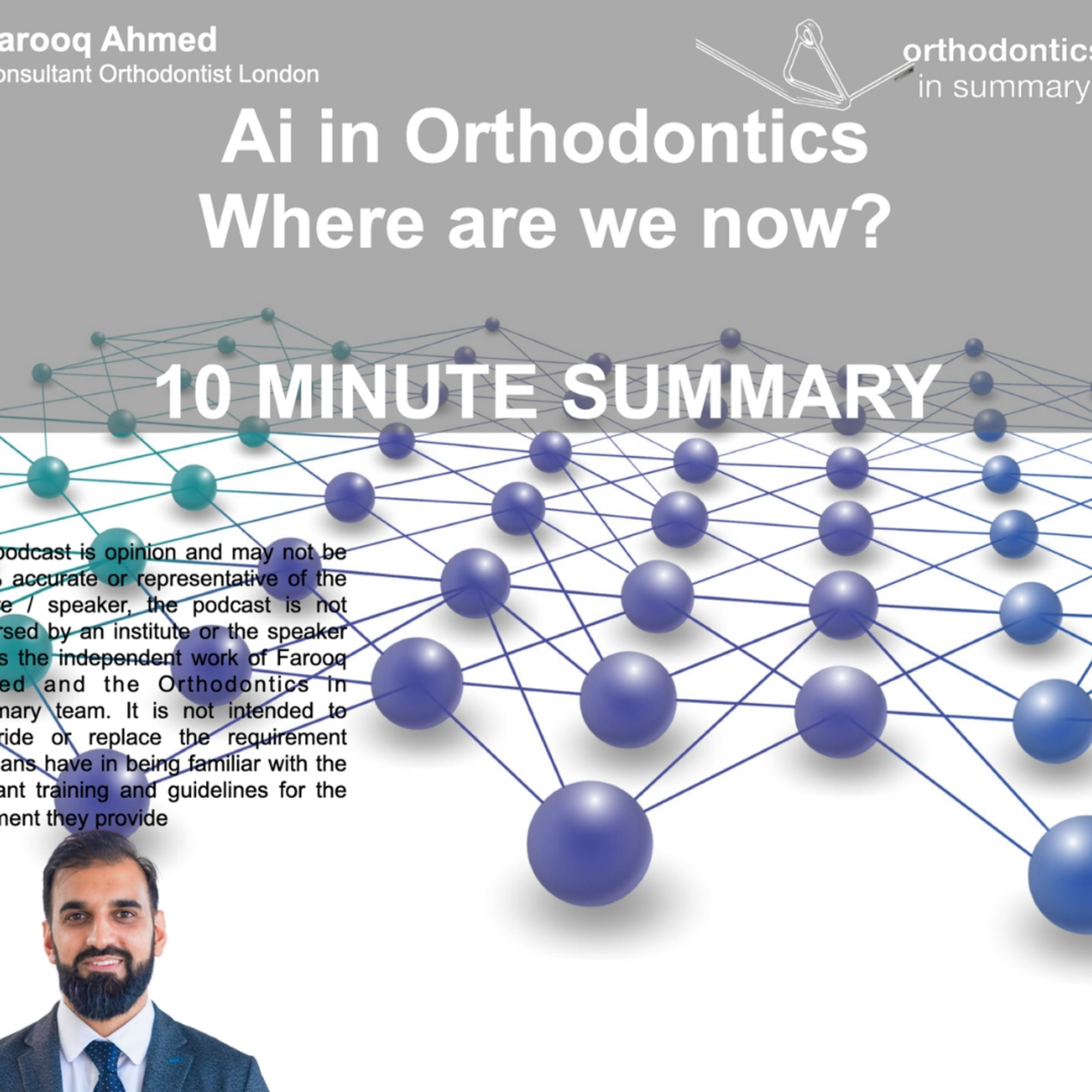 AI in Orthodontics, Where Are We And Where Are We Going 10 MINUTE SUMMARY 21.08.2025 10minJoin me for a podcast summary looking at Ai in orthodonticsand its clinical application. A growing topic in orthodontics, and one of themost featured topics at this years AAO. This summary is based on 3 lectures fromthis year’s summer meeting by Juan Francisco Gonzalez & Jean Marc Retrouvey,Tarek ElShebiny , Jonas Bianchi and Lucia Cevidanes. We will look whatAi is, the way it works and its clinical application, as well as a criticalview on this young field. What is Ai: 1. Technology that enables computers and machinesto simulate human intelligence, perform 1 task very well, e.g. voice command, Youtuberecommendations2. Predictive modelling, makes calculations, convert information into numbers or categoriesand recognise patterns Levels of Ai: Machine learning, Neural Networks and Deep Learning1. Machine learninga. The ability for a machine to learn from data andpast experience to identify patterns and make predictions 2. Neural Networks a. Specific model which relies on interconnectednodes, which perform a mathematical calculation of associations , patterns, andprobabilities 3. Deep learninga. Is a complex version of neural networks Virtual patient· CBCT segment + STL file – segmentation of theteeth and roots, with labelling of different stuctureso Can print model, visualise ideal vector andcalculate ideal vectoro However clinician still required to establish biomechanics · CBCT integration for aligner cases, Unpublishedthesis Khalid Alotaibi:o Treatment planning confidence increased 50%, leastchange was treatment planning modification Diagnostic data:· Ai cephalometric tracingo 46% of 24 landmarks 2.0mm withino 4 different programmes Iortho, Webceph, Orthodc, cephxo All landmarks had good overall agreement butvariation in identification · Facial Analysis· Automated 3D facial asymmetry analysis usingmachine learning Adel 2025o Study – 7 landmarks o Identified manually and with deep learning o 5 accurate, 2 significant difference but notclinically relevant Diagnostic accuracy of photos· Clinical photos assessment by Ai, and comparedto clinical examination· Sensitivity 72%, specificity 54% Vaughan & Ahmed2025 Growth prediction· Poor agreement age 9 Comparison between direct, virtual and AI bonding· DIBs – uses Ai for bonding· Compare Ai Vs user modified indirect bonding Vsdirect bonding (gold standard), 0.5mm significant · Incisors accurate· Premolars and lower laterals inaccurate Monitoring Previous podcast exploring the accuracy of remote monitoringo with Ferlito 2022 80%repeatability from 2 scans 44.7% repeatability and reproducibility Bracket removal from scan and retainer fitTarek Assessment of virtual bracket removal by artificialintelligence and thermoplastic retainer fit AJODO 2024o Retainers for both – clinically acceptable FDA approval of Ai in dentistry· FDA - Software of Medical Diagnosis § 4 dental:· Dental Monitoring· Ray Co · X-Nav technologies· Densply Sirona What’s next· More data learning to train AI model· Robotics customising appliances per patient
 -
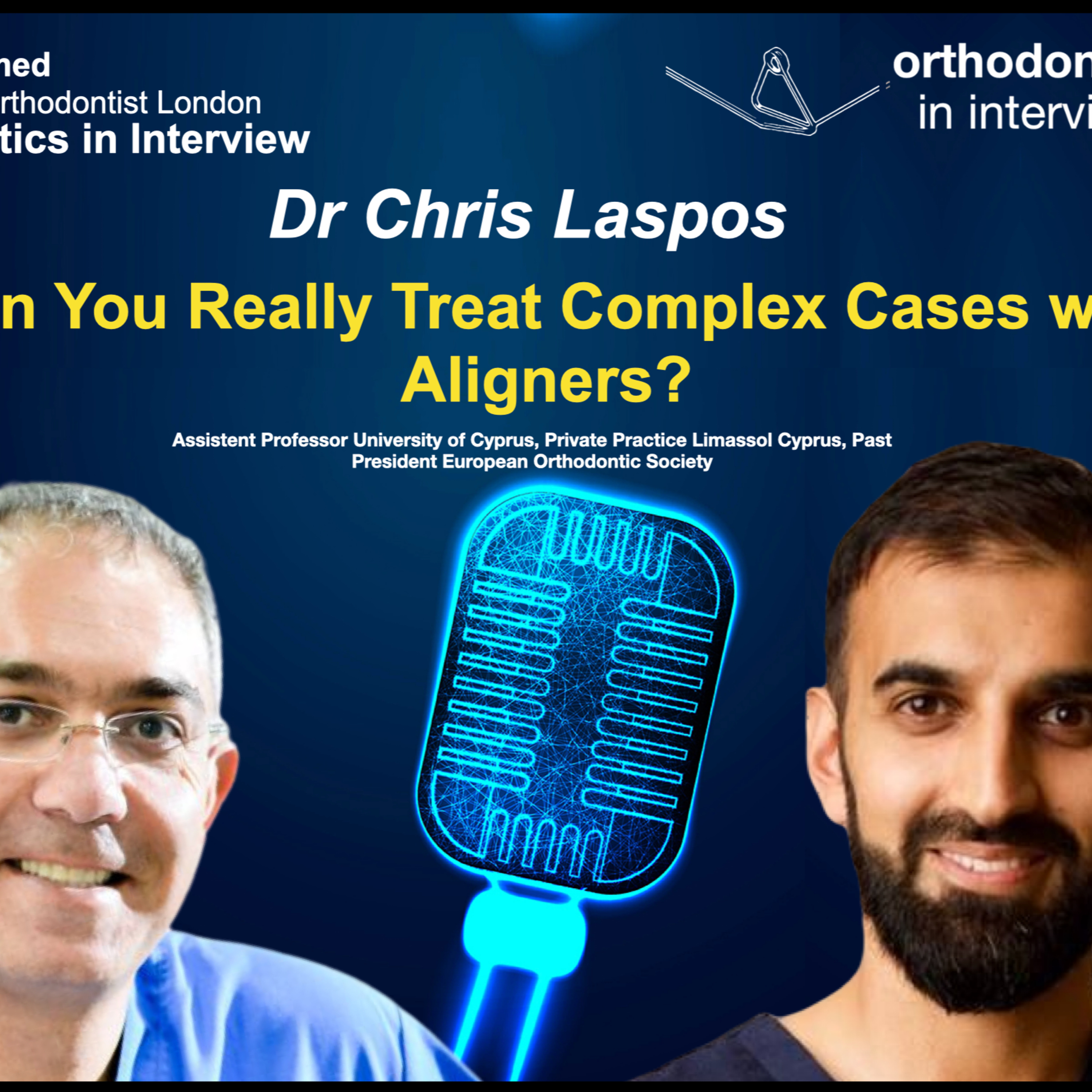 Orthodontics In Interview: CHRIS LASPOS Can you really treat complex cases with aligners? 16.07.2025 39minCan you really treat complex cases with aligners?“We’ve done a study of myextraction cases... when you do one or two sets of additional aligners, thenyou will be able to get everything to ideal” “I will never try to bring17 and 18 mesial to close space” “The staging that eachcompany does, it does make a difference. If your technician doesn’t understandhow to move the teeth in the right stages… it’s never going to happen” “If I have a patient whois not wearing the Class II elastics, then you cannot distalize.” “If you learn to say no tosome of your patients, then you will be a more successful orthodontist.” In this episode of Orthodontics in Interview,we sit down with world-renowned orthodontist Dr. Chris Laspos to explore thereal-world efficacy of aligners, hybrid treatment strategies, and the evolvingrole of auxiliaries and digital planning in modern orthodontics. With over 25years of experience and a background in craniofacial care and surgicalorthodontics, Chris shares insights into clinical decision-making, caseplanning, and the mindset needed for success. Extraction treatment, anterioropenbite and distalisation are discussed and how to improve outcomes, thisinterview is packed with clinical pearls and honest reflections of alignertreatment. 00:00 - Introduction 01:45 - How did you find your way into aligners as an orthodontist? 03:42 - How do you reconcile aligner efficacy data with your clinical results? 06:24 - Can extraction cases be effectively treated with aligners? 07:10 - Do you prefer fixed appliances or aligners for extractions? 09:10 - Do you use more auxiliaries with aligners to compensate for efficacy? 12:03 - Are aligner systems heading toward minimal differences like fixed appliances? 12:49 - Do some aligner systems truly offer better outcomes? 17:59 - How do you manage anterior open bite cases with aligners? 21:02 - How predictable and reliable is distalization with aligners? 24:27 - Can aligners be used effectively in surgical orthodontic cases? 27:54 - What are your thoughts on remote/virtual monitoring? 30:26 - What are common mistakes orthodontists make with aligners? 32:33 - Should general dentists use aligners in practice? 34:15 - Could AI or case simplicity justify aligners by non-specialists? 38:12 - Beyond clinical skill, what makes a successful orthodontist? orthodontics #farooqahmed #chrislaspos#aligners#clearalignertherapy #orthodonticsinsummary#orthodonticsininterview Farooq Ahmed
Slični podcasti


Popularan u
Ovaj podcast pojavljuje se i na podcast ljestvicama ovih zemalja.

